NEH Museum of Art Stages a Riveting Cross-Cultural Dialogue
MANAGING EDITOR
Jared Thayne
ART DIRECTOR
Holly Broome-Hyer
USU PRESIDENT
Stan L. Albrecht
USU FOUNDATION BOARD
Stan L. Albrecht, Richard W. Anderson
Shari L. Badger, Gail Bedke
Robert T. Behunin, Jeannine Bennett
Michael C. Bingham
Brian R. Broadbent, David T. Cowley
Marshall Crawford, Clark P. Giles
Patricia A. Halau a
M. Scott Harries, Jason B. Keller
Blake R. Kirby
W. Brent Robinson
Randall J. Stockham
T. Peter Thomas, Craig Thorley
Scott C. Ulbrich, Kerry H. Wahlen
USU BOARD OF TRUSTEES
Jody K. Burnett
Linda Clark Gillmor
Mark K. Holland
Karen H. Huntsman
Ronald W. Jibson
Susan D. Johnson
J. Scott Nixon
Trevor Sean Olsen
Frank Peczuh, Jr.
Lane L.Thomas
Scott R. Watterson
UTAH STATE (ISSN 1542-2712) is published quarterly by Utah State University Advancement, Logan, UT 84322-1422. Periodicals postage paid at Salt Lake City, UT, and at Liberty, MO, and additional mailing o ces.
POSTMASTER: Send address changes to Utah State University, Development Records, 1422 Old Main Hill, Logan UT 84322-1422.
Reproduction in whole or in part without written permission is prohibited. Opinions expressed do not necessarily represent the o cial position of the university.
Utah State University is committed to equal opportunity in student admissions, nancial assistance, and faculty and sta$ employment.
UTAHSTATE
7 NEWS@USU
“!ere’s nothing quite like seeing someone’s face light up when …”
Well, don’t wait any longer to nd out. Just know that the USU Student Academy of Audiology is once again shaping an incredible cadre of clinicians and — oh yeah — the world.
8 MARK OF HONOR
Some of the most fascinating learners we’ve ever encountered are set soaring through Utah State University’s Honors Program. It’s high time we take a closer look at this dynamic intellectual community, where scholars are emboldened.
22 ON DREAMINGS AND TRANSCENDENCE
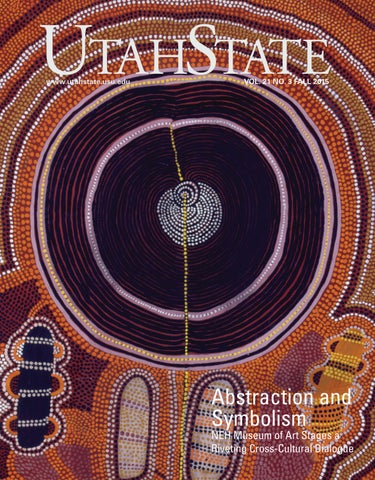
!e Nora Eccles Harrison Museum of Art at Utah State University hosts both Abstraction and the Dreaming: Aboriginal Paintings from Australia’s Western Desert, and Transcendence: Abstraction and Symbolism in the American West, this fall. Two very diverse exhibitions; one very cool convergence. Seriously. Don’t miss this one!
IN PRAISE OF THE DOERS 14
Here’s the thing: there’s a highly trained and impassioned army of experts and professionals who care deeply about this place and the lives and the dreams it envelopes — no matter how much work that means for them. Yup, campus is a beautiful place. Yup, there is a certain presence and comfort here that lifts us and inspires us and thrills us and makes us all better, every day. And nope, those things don’t just happen. Meet some of the heroes we found in USU Facilities.
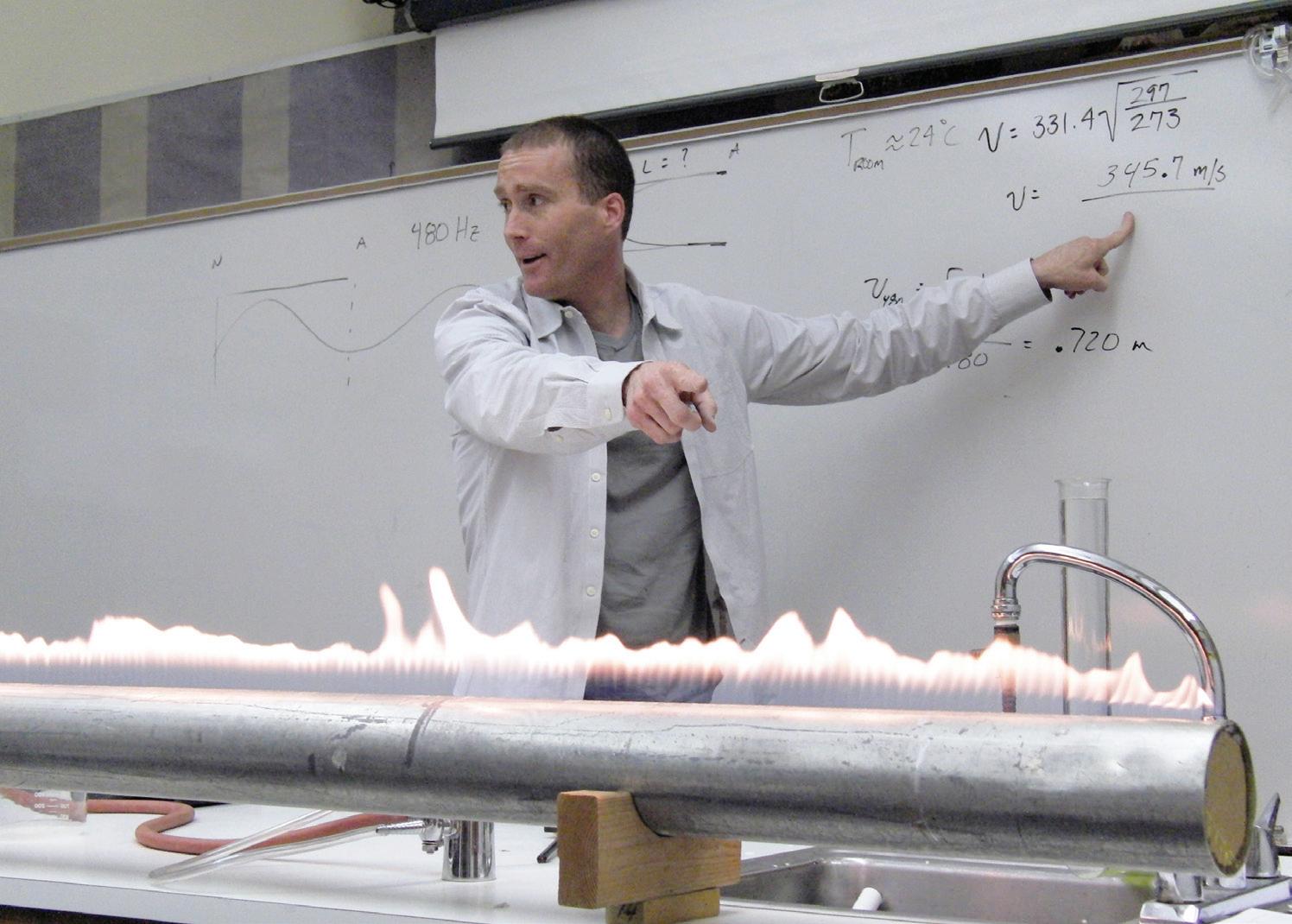
Helping students make discoveries for themselves and teaching science in a way “that makes sense” are guiding aims of Utah State University alum Andrew “Drew” Neilson ’97, physics teacher and coach at Utah’s Logan High School.
Neilson is one of 108 teachers across the nation who received a 2015 Presidential Award for Excellence in Mathematics and Science Teaching in Washington, D.C., earlier this summer. With the honor, Neilson receives a $10,000 cash award from the National Science Foundation.
“I am humbled to have been nominated and selected for the Presidential Award,” Neilson told Utah’s e Herald Journal newspaper. “!is award is especially satisfying because it is focused on e$ective teaching in a student-centered classroom. It validates my career-long efforts to improve my teaching by learning from others, sharing my own innovations and continuing to research ways to improve student performance and enjoyment in my physics classes.”
!e North Logan native, who earned a bachelor’s degree in physical science composite teaching in May 1997 and a master’s degree in education in 2009 from USU, teaches conceptual and advanced placement physics at Logan High. Since
arriving at his current post in 2004, Neilson has grown the school’s physics program from 17 students to the current 230. Under his tutelage, the advanced placement exam pass rate has been nearly 90 percent.
Prior to teaching at Logan High, he taught math and physics at Idaho’s West Side High School in Dayton for eight years.
“To teach well, you need to have a solid foundation in the subject you’re teaching,” he says. “I was prepared by renowned physicists at Utah State, who were leaders in their disciplines.”
Secondly, he says, aspiring teachers need to learn how to facilitate learning — and not just by delivering facts.
“We’re not books,” Neilson says. “!e challenge of teaching is providing meaningful opportunities by which students can pursue hands-on experiments and experiences and make discoveries on their own.”
Neilson was previously honored with Logan High School’s Most In uential Teacher Award in 2012 and received the Teacher Recognition Award from the U.S. Presidential Scholars Program in 2009.
— Mary-Ann Mu oletto ’94 M.A.
TEDxUSU Returns with Ideas Worth Spreading
Utah State University’s premier TEDx event returns to the Caine Performance Hall Oct. 23, bringing together some of the brightest minds in northern Utah. Now in its fourth year, the three-session program includes 12 presentations, performances and recorded TED talks.
!is year’s lineup includes some of USU’s best researchers, including large-mammal ecologist Johan du Toit and gerontologist Elizabeth Fauth, who will share their ideas. TEDxUSU will also bring in external speakers, including Acting Chief Scientist of the U.S. Food and Drug Administration Luciana Borio, from Washington, D.C.
Vice President for Research and Dean of Graduate Studies Mark McLellan said it’s an honor to once again host TEDxUSU.
“Amazing ideas are born every day at this university and in this community,” said McLellan. “How amazing it is to see those ideas come to life on a global stage, right here on campus.”
!e annual event has, in the past, sold out within hours, and the talks have garnered hundreds of thousands of views on YouTube.
“!e campus and community response to TEDx has been phenomenal,” McLellan said. “People often tell me that this is one of their favorite events of the whole year. !e passion and innovation these speakers exhibit will make you think and live di$erently. !e ideas shared on that stage truly are worth spreading — I’ve never left feeling uninspired.”
Tickets will be available this year through a lottery process, beginning Sept. 21. !ose who wish to attend must sign up for the lottery before Oct. 5. !is process is meant to streamline and simplify the ticket purchasing process. For more information on purchasing tickets visit the TEDxUSU website.
With a Rubens’ ame tube, USU alum Drew Neilson demonstrates acoustic standing waves in his physics classroom.
Still in Awe of Merlin
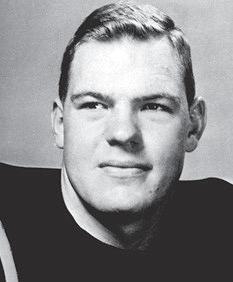
Of course the greatest athlete in the history of Utah State University made the Football Writers Association of America’s 75th Anniversary All-America Team.
Merlin Olsen, a two-time All-American for the Aggies, was a second-team selection by the FWAA. Olsen is one of just two players from the Beehive State to make the Anniversary All-America Team, joining Gordon Hudson, who played tight end at BYU.
Olsen was a three-year letterman on both the o$ensive and defensive lines for Utah State from 1959-61, earning AllAmerican honors during his junior and senior seasons. As a senior in 1961, the native of Logan won the Outland Trophy as the nation’s outstanding interior defensive lineman.
Olsen also was a three-time academic All-American at Utah State and graduated Summa Cum Laude and Phi Kappa Phi in 1962 with a degree in nance. Olsen is a member of the State of Utah’s Sports Hall of Fame, the Utah State University Sports Hall of Fame and USU’s All-Century Football Team. In 2000, he was selected by Sports Illustrated as one of the state of Utah’s Top 50 Athletes of the Century.
Following his senior season with the Aggies, the Los Angeles Rams selected Olsen with the third overall pick in the 1962 NFL Draft and he became a charter member of the Los Angeles Rams and the famed “Fearsome Foursome.”
In 15 professional seasons, he was named to 14 consecutive Pro Bowls and missed a total of two games during his career. Along with earning All-Pro honors nine times during his career, Olsen was named the NFL’s Defensive Rookie of the Year in 1962 and the NFC Defensive Lineman of the Year in 1973.
Olsen was enshrined into the Pro Football Hall of Fame in 1982 and in 1999 he was ranked No. 25 on !e Sporting News’ list of the 100 Greatest Football Players. He was voted to the College Football Hall of Fame in 1980 and to the
All-Academic All-America Hall of Fame in 1988. In 2008, Olsen was named to the 75th Anniversary All-Sun Bowl Team to commemorate the Sun Bowl Association’s Diamond Anniversary.
And that is only a partial list of why the eld at Maverik Stadium bears the man’s name and why we have a statue in his likeness on the south plaza to lift our spirits. He excelled as an actor and sports commentator, but mostly, at being a legend.
Our Connections with Water
No better way to get your literary feet wet in college than starting o$ with a wild 277mile ride through the Grand Canyon. “ e Emerald Mile” is this year’s 2015 Common Literature Experience. !e author, Kevin Fedarko, shared his insights with students Aug. 29 in the Kent Concert Hall about “a trio of inspired fools” led by Kenton Grua, who took the fastest ride in history through the heart of the Grand Canyon during the 1983 ooding of the Colorado River. As National Park Service conducted helicopter rescues of trapped and injured boaters, Grua and two friends launched themselves down the rapids in an open wooden dory called the Emerald Mile, a dilapidated boat that Grua restored. It likely proved a fast read for students participating in the literature assignment, designed to introduce them to college-level writing, including writing an essay and discussing it in their Connections class.
But it is also intended for faculty, sta$ and community to turn pages in tandem to provide a common piece of literature for reading and discussing. And the fact that this year’s choice centers on water is not coincidental. Several water-themed works of literature were considered as part of this year’s “Year of Water” focus by Utah State University. USU’s expertise in water extends across its 127-yearhistory while water as a literary device extends throughout human history. !is year, one ows into another, giving students new appreciation of the power of water in literature and their university’s historic connection with this life-sustaining substance.
— John DeVilbiss
— Wade Denniston ’01
Kevin Fedarko
Taking the Grand View
He has experienced hard things. He grew up in the incessant instability that is the Gaza Strip. Still, he saw past it, and — while still a youth — volunteered in the community development programs oriented toward assisting women and children there. Now, his wife says, “He is passionate toward promoting diversity and strives to achieve justice in this world.” So there’s a goal: justice in this world.
Ayman Ala is a Ph.D. student in civil and environmental engineering who also works as a research assistant in Utah State University’s Water Research Laboratory, and he’s not giving up on his goals. He serves as the vice president of the USU Muslim Student Association and as the director of the Logan Islamic Center. Since his arrival, he has tackled campus and community groups and activities with his trademark passion. He’s a design lead for Engineers Without Borders and has received the USU Sustainability Council’s “Blue Goes Green” grant. He is a prizewinning participant in the C. A. Arden Pope Northern Utah “Clean the Air” contest, is a liated with the Taking IT Global Virtual Community and serves as a translator for TEDx videos. Ala , it seems, is a leader — everywhere.
At the Logan Islamic Center, he has brought together some 200 members from some 35 countries — di$erent sects, di$erent schools of thought. He has helped to organize open houses aiming to better educate the community about Islam as a religion and culture and its peaceful message he chooses to celebrate. Interfaith panel discussions are another strength, both on and o$ campus. He pitched in to help USU’s O ce of Research and Graduate Studies in international recruitment, supplying brochures and information to students in Baghdad, assuring them that once here, in the shadows of Old Main, and throughout the surrounding communities, they would nd acceptance.
Ayman Ala is your typical, atypical Aggie. He knows all about Utah State’s Power to Change for Good, even better, he can show you all about it. He is the 2014-15 student recipient of the Utah State University President’s Diversity Award. Go gure.
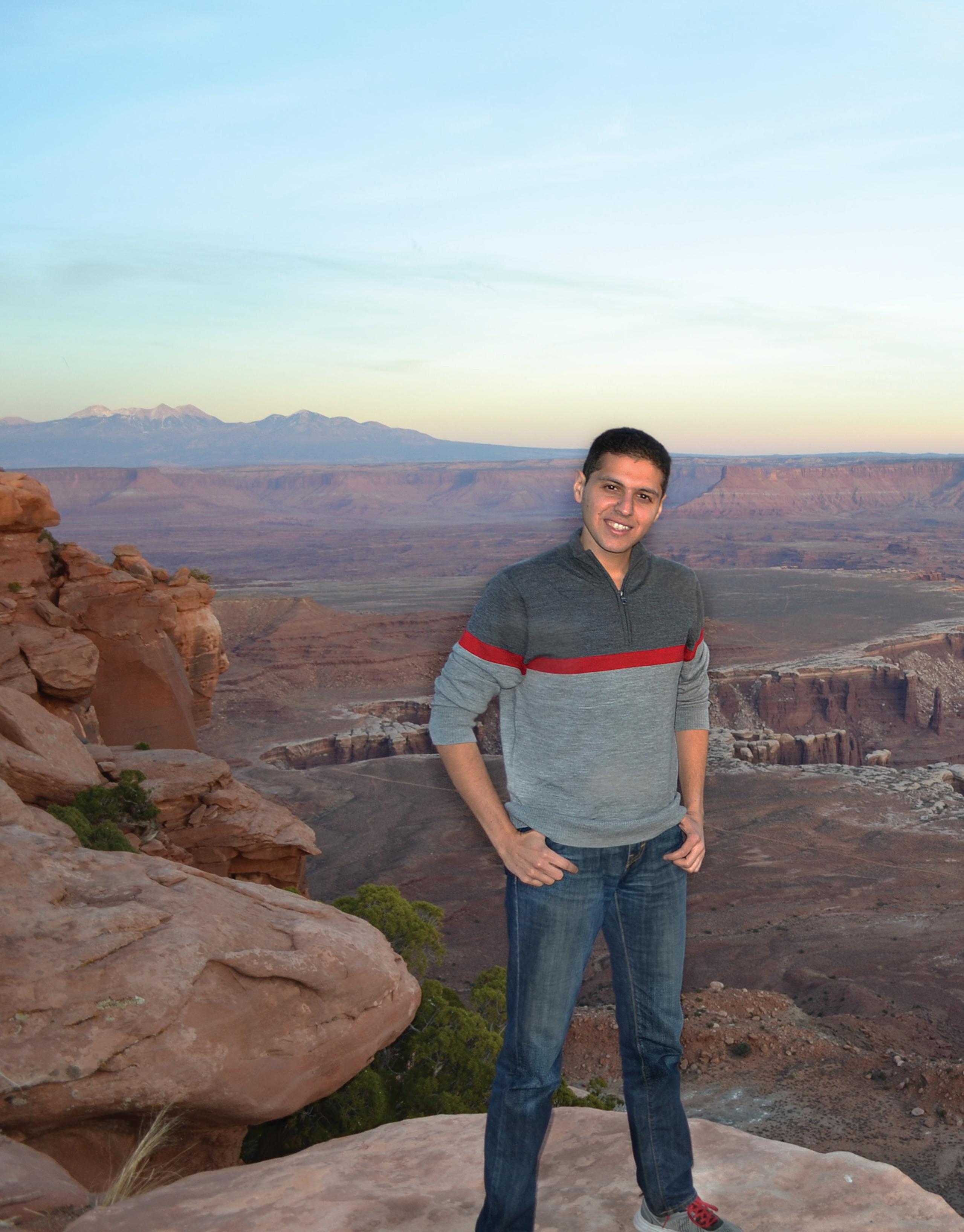
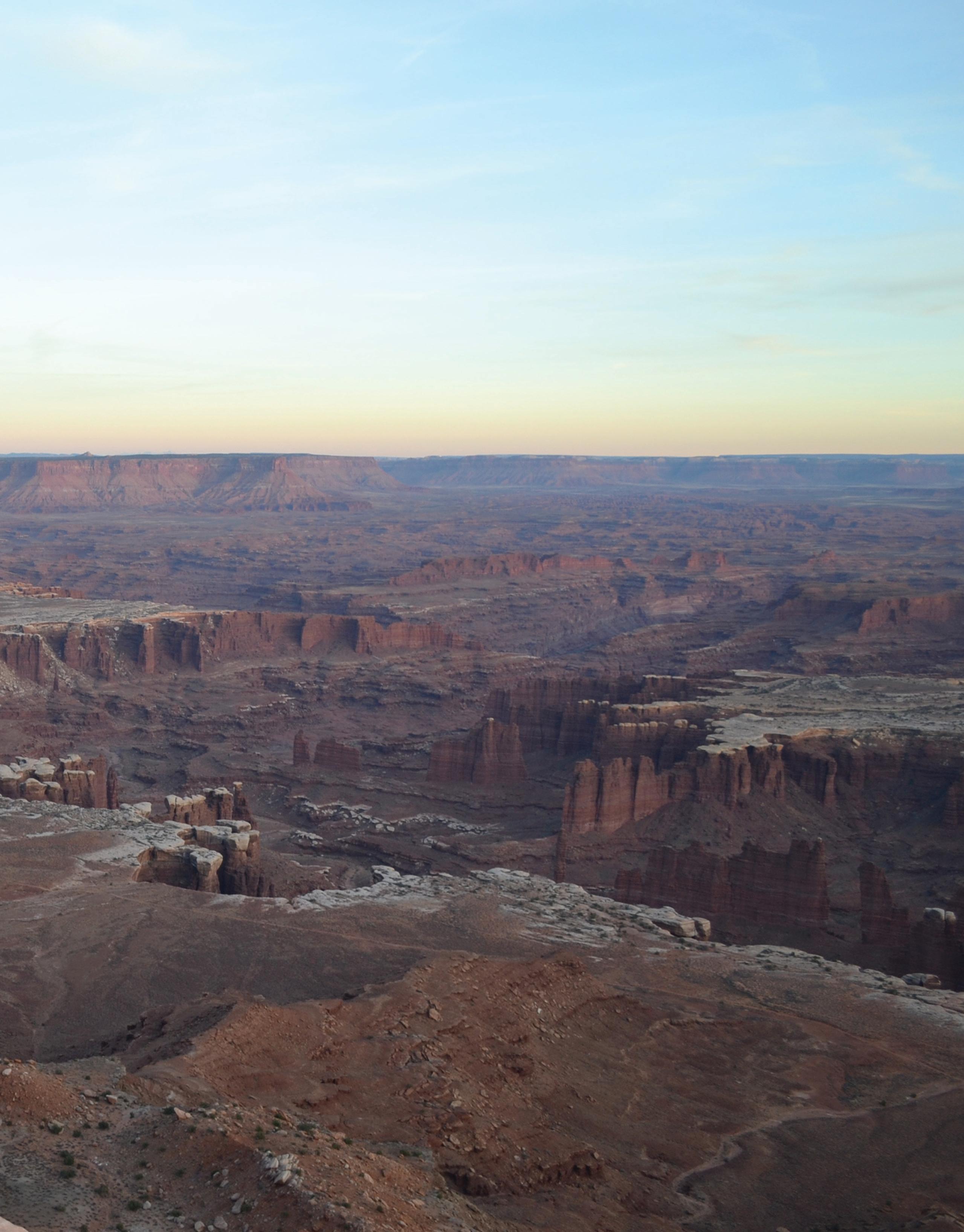
Shown here on Grand View Point Overlook in Canyonlands National Park near Moab, Utah, Ayman Ala has become known for his big-picture efforts.
• Morningstar Gold rating, 2014
• Free to open
• Flexible investment options
• No minimum or ongoing contributions required
• Federal and Utah state tax advantages
An Irreplaceable Education
In May, members of the Utah State University Student Academy of Audiology provided 450 hearing tests and tted 60 people with hearing aids during their 11th “Mission from the hEARt.”
!e organization and logistics were planned in conjunction with Dr. Natalie Goldgewicht of Clínica Auditiva in Costa Rica and Fundación Lloverá Comida. Students traveled around Costa Rica to provide hearing services to underprivileged communities.
“I’m so grateful for the opportunity I had to work with amazing people in Costa Rica,” said Brittany Bown. “!ere’s nothing quite like seeing someone’s face light up when we t them with their rst hearing aid and they realize a whole new world, full of sounds they didn’t even know existed, just opened up for them. First humanitarian mission but de nitely not the last.”
“I loved being able to go to Costa Rica to provide a service for people who have such limited access to hearing healthcare,” said Joshua Pluim. “In addition to seeing life through the eyes of another culture, I gained con dence in myself as a clinician. !e mission was an incredible learning experience for me, made doubly rewarding by seeing the reactions of all the people we were able to help.”
In addition to providing hearing tests and hearing aids, they also provided cerumen management and made medical referrals. Each patient will be tracked for follow up services. In collaboration with Peak ENT, Dr. Joe Dansie t ve bone-anchored hearing softband systems to pre-identi ed children.
!e USU Student Academy of Audiology held fundraisers to facilitate the mission. USU departments, patients and corporate friends answered soaringly and with personal donations the students were also able to provide blankets, food and hygiene items to
the Centro Dormitorio homeless shelter. Lives were changed. Want to help make it happen again next year? Visit www.usuaudiology.com
Academy member Victoria Reyes administers a hearing test. Photo courtesy of Utah State University Student Academy of Audiology.
The Dynamic Intellectual Community of USU HONORS Scholars Emboldened
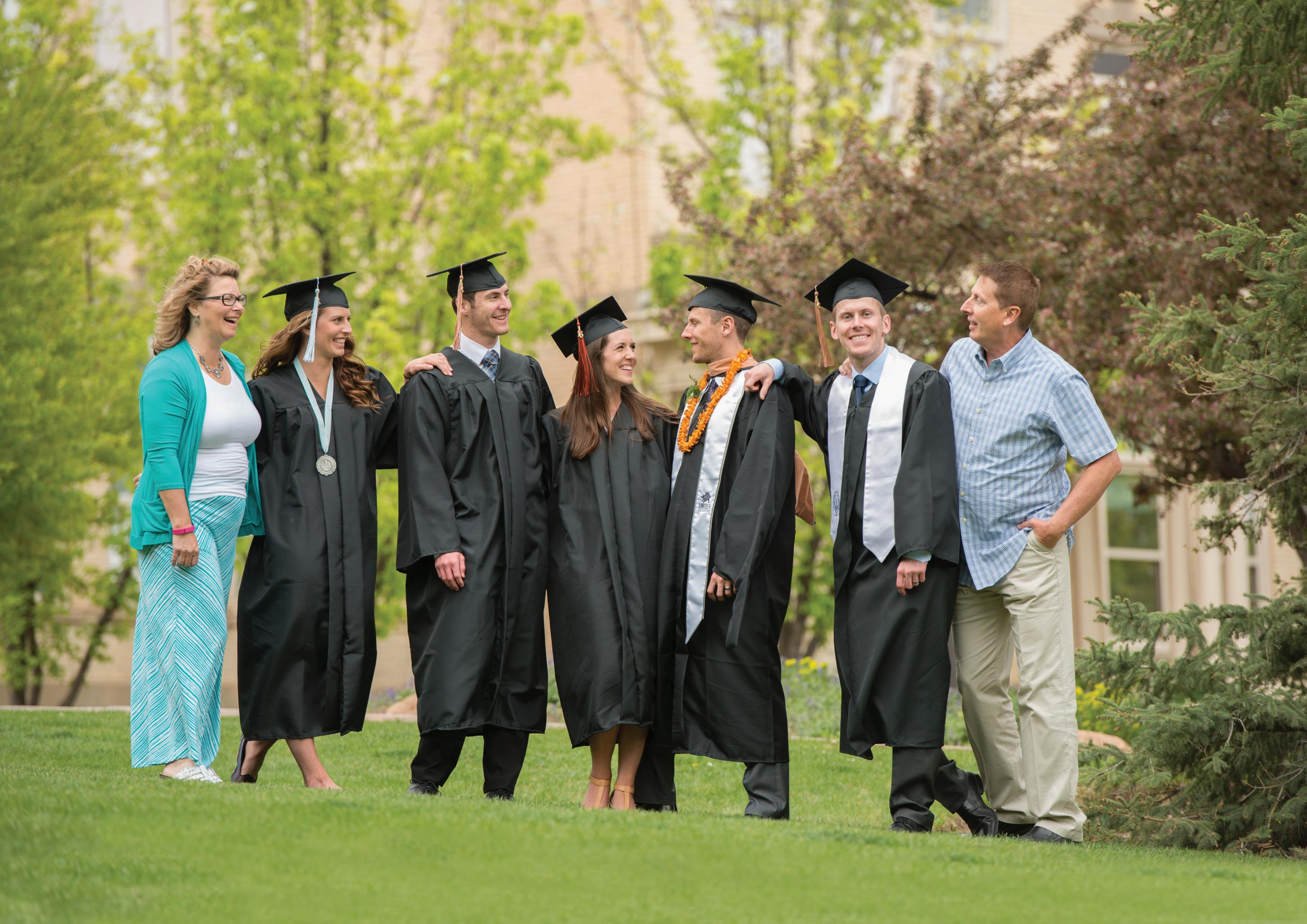
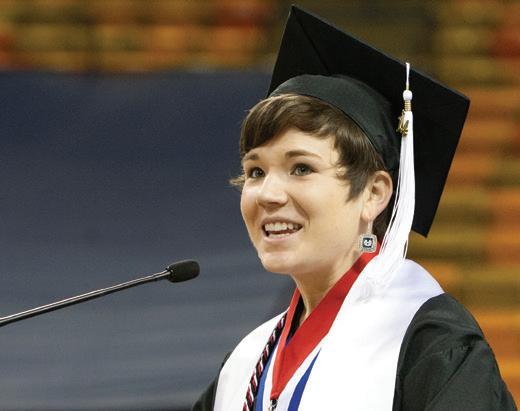
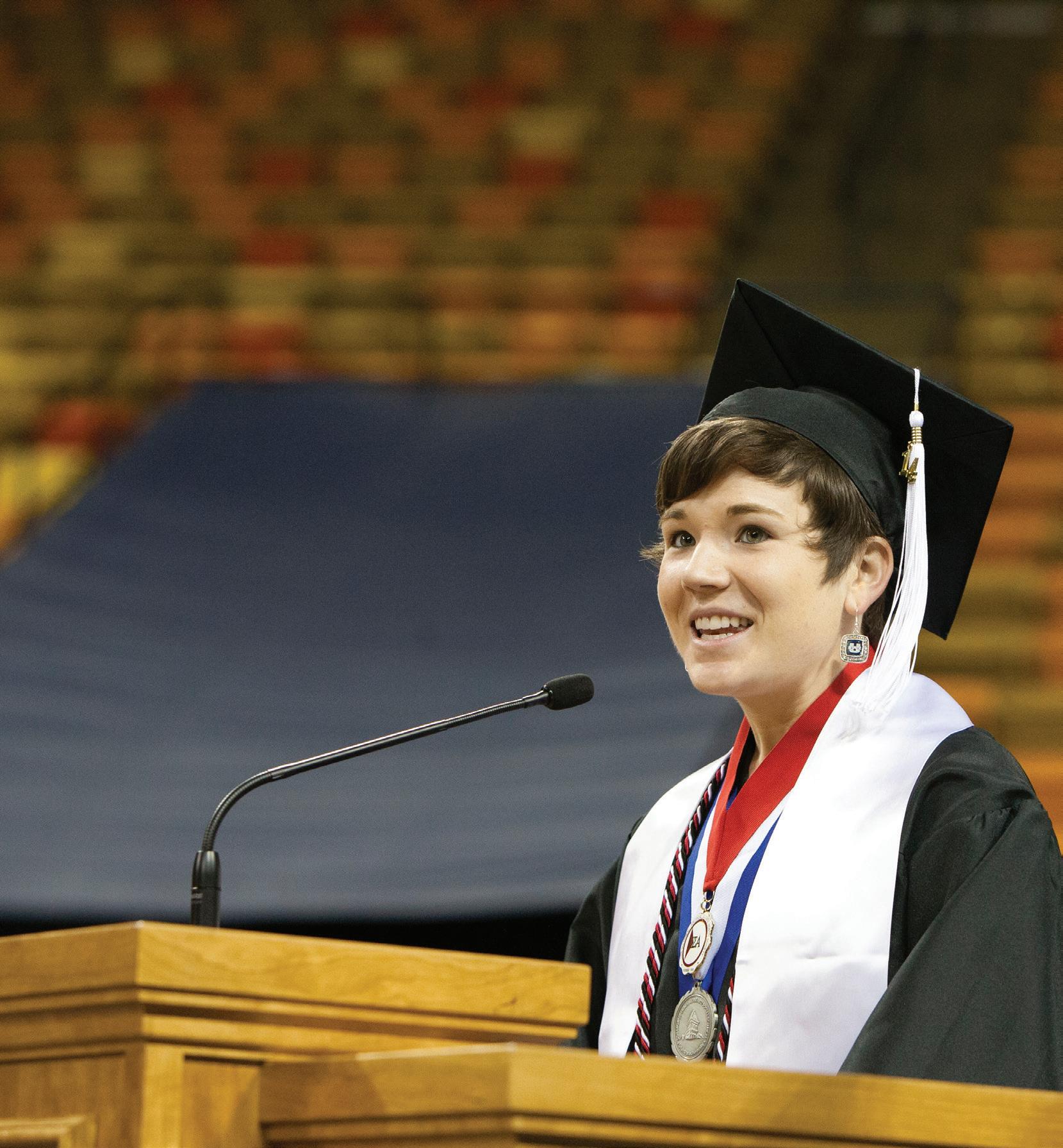
YOU MAY NOT REMEMBER WHAT BRIANA BOWEN SAID when she delivered Utah State University’s valedictorian address May 3, 2014, but her con dence and underlying sense of urgency made it memorable. Hers was a call to arms more than a call to party.
!e fact that she starts this fall at the University of Oxford is of little surprise, least of all to Kristine Miller, director of Utah State University’s Honors Program. She holds Bowen up as a great example of the kind of students the program nurtures.
“She is a jewel,” Miller says. “Ridiculously articulate, and so talented and humble. She’s just a wonderful person.”
So how much of a role did USU Honors actually play in Bowen’s academic success? An immense amount, Bowen says, because the program pushed and dared her to work outside her comfort zone and “having gone outside the box made the di$erence.”
“Dare to know” is a throw down splashed across the Honors webpage that has become the program’s uno cial motto. !e way these students take that challenge to heart and then dare to do something with it re ects the program’s penchant for action. Ironically, it is not the verb form but the noun of the word “honors” that de nes the program — a classi cation of students who have obtained high academic standing. But that is OK, because like
respect, honors are earned and not given. !e nearly 700 students in the program, now in its 50th year at USU, qualify for this distinction because they come not only prepared, but also willing to take the dare to keep pushing.
In Bowen’s case, that preparation and dare began in her home-schooling, which meant personalized learning that matched her interests and pace under her mother’s tutelage.
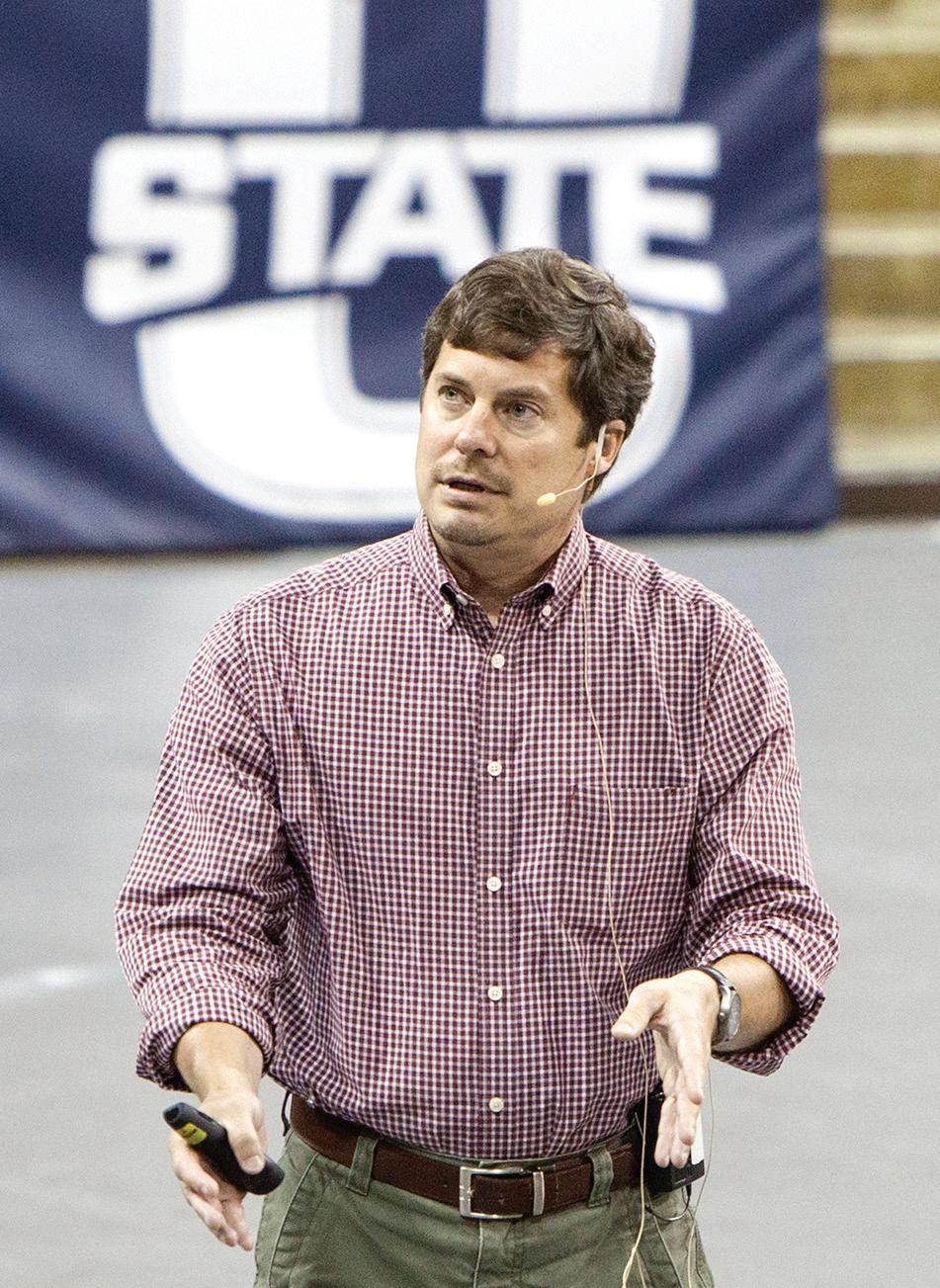
Kristine Miller, director Utah State University Honors Program.
Donna Barry, University photographer.
“Because of that I don’t think I ever got tired of school,” she says. “And it really had a lot less to do with my being some kind of a genius child and a lot more to do with the fact that I had a learning module that suited me so well. It really made school and education an exciting thing.”
!at attitude brings smiles to professors. It signals a student with just the right amount of ambition and curiosity. But for students like these, it is a two-way street. !ey work hard to get to this level of preparation; the college they choose had better be just as prepared to take it up a notch and to engage them every step of the way. It is a challenge of Ivy League proportion for state universities because THAT’S their competition for students of this caliber.
In that way, too, USU more than steps up, as far as Bowen is concerned.
“!e Honors Program, with its various aspects, made me look for unusual opportunities and explore routes I never would have considered,” she says, adding with a laugh, “like when I submitted my application to Oxford, but I wouldn’t have submitted it at all if I hadn’t had the experience of the Honors Program.”
Creating unusual opportunities is core to the program’s mission, whether that be at a Himalayan Health Exchange Program in India where Honors student Erica Hawvermale worked this summer, or in one of the program’s monthly faculty-student socials designed to get scholars to interact with professors com-
Aggie Up: Utah State Has Honors
Utah State University Honors alumni shine in every sector of society and in every corner of the globe. They are teachers, lawyers, leaders of industry, medical professionals, Fortune 500 movers, celebrated academics and ceaseless humanitarians and homemakers. A roster of USU Honors alums shows they work for Facebook; Goldman, Sachs, and Company; Dow Chemical Company; Google; with U.S. Senators and at the world’s top universities, hospitals, media outlets and retailers. They push change in fascinating capacities as rocket scientists, pilots, software engineers, nancial analysts and as a surprisingly numerous crew of registered dieticians. The breadth and depth of their in uence on the planet is jaw dropping, really. Here is a brief catchup with a mere four to prove our point.
Ashley Egan ’98
Research Scientist/Assistant Curator of Legumes
Smithsonian Institution — National Museum of Natural History, Department of Botany, U.S. National Herbarium
Fueled by her lifelong passion for our planet’s biodiversity and the evolutionary patterns and processes that have shaped it, Ashley Egan now travels the globe, documenting, collecting and researching. She curates the legume collection in the U.S. National Herbarium where she continues to be held spellbound by all knowledge pertaining to the third largest plant family in the world — Leguminosae (Fabaceae) — which contains 20,000 species, many of which are economically important crops or invasive species, such as soybean or Kudzu.
“Using genetics and genomics,” Egan says, “my lab studies the evolutionary relationships both above and below the species level within the legume family, in particular, in the Phaseoleae tribe — the group containing the common bean.
“As a systematist, I strive to contribute to the taxonomy, nomenclature, and classication of plant biodiversity. As a phylogeneticist, population geneticist, and comparative genomicist, I strive to contribute to the understanding of the processes and patterns that have created biodiversity during the course of evolutionary change.”
Egan followed her bachelor’s of science from USU with a Ph.D. in microbiology and molecular biology at Brigham Young University and — among myriad other lofty stints — was a postdoctoral researcher in the Department of Plant Biology and the L.H. Bailey Hortorium at Cornell.
— Jared ayne ’99
pletely outside their majors. !e idea is to collaborate across the campus and around the world, Miller says.
Another essential aspect of the program is creating a dynamic intellectual community for the students in comfortable settings. Miller experienced this herself as an honors student at the University of Michigan, a campus she shared with 35,000 other students. She never got lost in the crowd, though, because the Honors program reduced the number to 20 of her most talented English-major peers.
So instead of sitting in huge lecture halls, they assembled in small group settings. “We were extremely disciplined and focused. It was much more a departmental honors program than a university-wide one, like USU’s, but it gave me a way of discovering a real sense of intellectual community.”
She wants nothing less for her students at USU. It is a program that intentionally mimics a small liberal arts college experience on a large campus with all the rich resources of a Research One institution, but at a fraction of the cost of an Ivy League education.
For the rst time this year, the program has lled nearly an entire residence building in the Living Learning Community with Honors students. With the Honors Program o ce based in the LLC’s administration building, the students are a stone’s throw away from their advisor and classroom, where Honors classes are taught and many of their social activities are held.
“It really is a living and learning community,” Miller says.
What makes the USU experience a stand-out from other honors programs is the way it incorporates the university’s unique land-grant mandate of interdisciplinary learning, research and civic engagement. !ese three characteristics, along with critical thinking, comprise the program’s four pillars, Miller says.
!e action component of civic engagement particularly resonates with Michael Hoggard, a fourth-year Honors student and service-learning scholar.
“!e number one thing is the ability to apply your education,” he says.
“Herbert Spencer said ‘the great aim of education is not knowledge but action,’ and I think the Honors Program truly embodies that. We learn something, but then we do something about it. We do something with new-found knowledge.”
Like spend a summer in !ailand researching refugee camps and public health.
He grew up in American Fork, Utah, but loved to fantasize about becom-
ing a doctor (like his dad) and living in the jungle. His proclivity for unusual combinations did not go unnoticed by an Honors Program advisor who suggested that he take some economic classes. Perfect. An entrepreneurial jungle doctor.
To Hoggard’s delight, he quickly learned that economics is not just about money, it is a social science — the science of making decisions about how people choose to use scarce resources. He was amazed just how integral economics is to public health, particularly refugee health care. !is interest led him to a mentorship with Chris Fawson, professor in the Huntsman School of Business.
“I think that’s one of the major roles of the Honors Program for me,” he says. “It’s become sort of the catalyst that combines all my di$erent interests with service, with refugees, with my major in economics, with wanting to do a master’s degree in public health, and with my work with refugee health care overall. It’s sort of the glue that binds it all together.”
His summer 2015 research experience in !ailand was in the region that borders Myanmar. In the refugee camps he researched, he observed how commodities, such as fruit and soap, were scarce and high in price. Others, such as sexual services, were widely abundant and inexpensive. Sexual diseases, as a consequence, including an AIDS epidemic, plagues these camps along the border. !e social science aspects of economics wreaking havoc on public health was playing out right before his eyes.
It’s a follow-the-money, or lack thereof, kind of thing that he sees getting him to the heart of health care solutions for people living in such desperate conditions. So, naturally, he wants to master economics and then move on to medicine. It makes perfect sense to him. !ese degree quests are not the end game; they are ways to get him rst to the knowledge — and then to that place of action — that he so urgently seeks. He knows rst-hand the severe needs of these displaced people — the desperate conditions
Jason Henrie ’98 Teacher in the Peninsula School
District, Gig Harbor, Washington
A former winemaker at Mount Eden Vineyards in California, and with the St. Kathryn label in Colorado, Jason Henrie continues his command of chemistry now as a teacher — because he had so much fun in the USU Honors program studying under the legendary Dr. Joseph Morse.
“!e USU honors program is by far the best I’ve ever seen,” says Henrie, who augmented his honors chemistry bachelor’s of science from USU with an M.S. in agricultural chemistry from U.C. Davis and an M.A. in secondary education in chemistry and science from Paci c Lutheran University.
While at Utah State University, Henrie studied and taught both physical and analytical chemistry and studied guitar under USU’s legendary talent and master teacher, Mike Christiansen. Henrie is the keeper of “more stories than you can imagine” based at the honors lounge (complete with lockers) on the third oor of the library and at honors camp, previously held prior to each academic year. “Very fun,” he says. “But there were rules.”
Jason’s sister, Michelle Henrie, it should be noted, was Utah State’s rst female student body president and is the founder/owner of MHenrie, an environmental law rm in Albuquerque.
Honors legend Briana Bowen. Donna Barry, University photographer.
Service-learning scholar
Michael Hoggard: ‘No. 1 is the ability to apply your education.’
Photo by John DeVilbiss.
Anu Kalaskar, M.D. ’99
“He(?e(, S7en6e( )5-9
‘ ,he .(e5, 5-3 o4
e9065,-on -) no, 2no81e9.e ?0, 56,-on,’ 5n9 I ,h-n2 ,he Hono()
P(o.(53 ,(01: e3?o9-e) ,h5,. We 1e5(n )o3e,h-n., ?0, ,hen 8e 9o
)o3e,h-n. 5?o0, -,. We 9o )o3e,h-n. 8-,h
ne8-4o0n9 2no81e9.e.”
Pediatric Infectious Disease Consultant and Medical Liaison to Infection Prevention and Control, Children’s Hospitals and Clinics of Minnesota
If your child is being seen by Anu Kalaskar your situation is profoundly serious, but you are also right where you need to be. Kalaskar is a repository of medical expertise when it comes to pediatric patients with complicated and unusual infections. In a community marked by its diverse patient population, she works in both inpatient and outpatient settings. She’s also part of her hospital’s infection prevention and control team, where the overarching goal is to prevent infections that may occur simply as a result of being in the hospital.
It’s challenging, important work, to be sure, but Kalaskar says she is fueled every day by the steady opportunities to be involved in “interesting cases” that keep her on her toes.
“I enjoy being involved in protecting our most vulnerable patients through my infection prevention work,” says Kalaskar. “I also enjoy being involved in medical student and resident teaching.”
After graduating with honors from Utah State with a bachelor’s of science in biology with an emphasis in microbiology, Kalaskar next completed her M.D. at the University of Utah School of Medicine.
!ese days, she says she’s inspired by the resilience and strength of her patients and their families, as well as the optimism of her colleagues.
“I am lucky to have the motivation and support of my two beautiful children and husband,” Kalaskar adds. “I thank the Honors program for providing me with excellent support and enhanced learning during my time at USU and am so grateful to have been part of such a wonderful program!”
— Jared ayne
’99
in !ailand and other parts of the world that he wants to change for the better. !is form of intense personal engagement that the Honors Program encourages has had an equally powerful e$ect on Bowen, particularly in the way the program insists that students deepen their learning by crossing disciplines. She calls these serendipitous encounters “spark zones.” !e virtue of the Honors Program, she says, is the way it encourages, and actually requires, students to pick up on the sparks ignited in class discussions and out-of-class events and take them to the next level.
It is fascinating to follow along as she ticks o$ how one spark has led to another in her life. She started at USU when she was 18, majoring in music. A nagging fascination with U.S. history and government sparked by an AP class she took before college caused her to change her major. And then, shortly after turning 19, she was diagnosed with thyroid cancer. Early treatment helped her to beat the disease, but the psychological impact lingered. “It gave me a sense that I’ve only got 80 years left and I’d really like to do something that matters.”
She felt lucky that her parents had good insurance, and she began to wonder what happens to people who fall through the gaps in the system. !at interest led her to think more about government and public policy and eventually landed her in the university’s political science department.
!e week that she received her Truman Scholarship in 2013 (she was the rst USU female student awarded the scholarship and the rst recipient at USU in 29 years) was also the week of the Boston Marathon bombings. !at coincidence sparked another change. If people can’t run down the streets without fear of something, how, in the Je$ersonian sense of life and liberty, can one expect to pursue happiness in any other form without that basic order and stability, she wondered. And on the ip side, how does a nation balance the preservation of freedom and civil liberties and still maintain order?
“Diving into that problem changed my perspective and in my junior year, through the fabulous graces of the Honors Program, I had a chance to go to the Democratic National Convention as a student observer but through the coolest series of events got assigned to work the security team.”
Her work with the Secret Service at the convention — and then again at the 2014 Presidential Inauguration — sparked an ever-growing fascination with government security. By her senior year, she began taking classes from Jeannie L. Johnson, internationally recognized for her work in cultural intelligence and analysis, which ultimately led Bowen to the topic of her Honors thesis centering on how assassination attempts have shaped the organizational culture of the U.S. Secret Service.
By the time she was delivering her valedictorian speech in 2014, she was in full burn, having already completed no less than six Honors projects and about to y o$ to Washington D.C., as a policy intern for U.S. Sen. Mark Udall. Her ame today is as focused as a welding torch as she embarks on a master’s program in Russian and East European Studies.
She says she needed to re ne the scope of her studies, that international security and diplomacy was too broad. She chose Oxford for its interdisciplinary and full-language Russian training. And besides, “How fun, I am getting to learn new things, including the language!” But she is not just learning; she is also doing. She knows one can’t help without understanding and one cannot understand without focusing. !e post-Soviet bloc seems like a very good place for a little more understanding.
“!e more we think strategically and the more willing we are to incorporate that understanding into the way we operate and the way others operate — nding that common ground — the better our hope for the future,” she says.
Miller’s assessment of her Honors students is that they “have a lot of potential.” If that understatement made you smile, you aren’t the only one.
Angela Micklos ’89
Chair, The Utah Board of Pardons and Parole !e decisions Angela Micklos and her colleagues make as !e Utah Board of Pardons and Parole “are quite weighty and often stressful.” Imagine.
!e board is constitutionally charged with determining whether, and under what conditions, o$enders committed to prison may be released, supervised, or returned to custody. Prior to making any decisions, hearings are held; a majority vote — three out of ve — is required. Because of Utah’s indeterminate sentencing scheme, it is the Board, not sentencing judges, that determines exactly how much time o$enders spend in prison. !e Board also has the ability to pardon, which Micklos deems “an awesome exercise of power that is irreversible.” Just imagine.
!e Board’s decisions are nal and not subject to judicial review, with the exception of whether the Board has a$orded due process. However, the substantive decisions are not appealable. Weighty and stressful, indeed.
Appointed in 2009, Micklos became Chair of !e Board Of Pardons and Parole in August 2014, as such, she is also a member of Utah Gov. Gary Herbert’s cabinet. After her pre-law/political science bachelor’s degree from Utah State University, she earned a juris doctorate from the University of Utah. She has since spent her entire career in the criminal justice system, where public safety is the primary concern. She was an Assistant Attorney General for almost seven years, and a Deputy District Attorney for just shy of 11 years.
“I’m driven by a deep commitment to protect the public, while balancing the needs of the o$enders, victims, and their respective families,” Micklos says.
Facing those weighty matters and stressful decisions, Micklos says, she now nds a great sense of pride in the vital role her Board plays.
“Utah’s system is very unique, but I think it’s the best in the nation. In my opinion, it’s better to have a group of individuals, rather than a single person, determining the length of prison sentences and conditions of parole,” Micklos says. “We have the ability to tailor sentences to the unique circumstances of each o$ender, which should be the goal of any criminal justice system.”
— Jared ayne ’99
“How do you make them be meaningful, great people in the world?” she asks. “How do you give them the tools they need to make a di$erence to, you know, change the world? !at’s what we want to do. We’re aiming low,” she laughs.
!ere is an inherent restlessness associated with one who dares knowledge. It is an endless race and not for the mediocre of heart.
“Right now I could feel very satis ed with what I have accomplished here at USU as an undergraduate,” Hoggard says. “I could just kick back and still be good, but I could push for more and that’s the adage that good is the enemy of great.”
!is same exigency permeated Bowen’s commencement address. She urged her fellow graduates to take with them the skills they’ve developed in college not only to learn but also to teach themselves to be innovative and resourceful, not only in solving their own problems, but also in confronting the world’s greater problems.
“To borrow from the words of Winston Churchill, ‘this is not the end,’” she told her classmates. “It’s not even the beginning of the end. It is, perhaps, the end of the beginning, and if so, what lie before us are even greater chapters that we can dream up under the mortarboards right now.”
!at was a dare.
— John DeVilbiss
SOMETIMES IN THE MORNINGS, WHEN THE CANYON BREEZE UNROLLS THE SCENT OF DAMP ANNUAL FLOWER BEDS LIKE A BLANKET OVER THE QUAD, we stall our frenetic paces for a moment just to breath it in. Later, within countless tidy classrooms and gathering commons, we sometimes recognize our own physical settlings, that curious ability to better focus somehow, to dive into new ideas, or to listen — really listen — to an old friend. Sometimes we secretly wish for more days when the Greatest Snow on Earth in sudden, burgeoning volume, shuts everything down to send us on our individual, improvised ways. But in truth, we know, that rarely ever happens here, even where in a blink, a Prius can poof into powdered passing. And sometimes, upon polished panels of glass and steel, we catch the re ections of the faceted spurs on the Bear River Range and are reminded to turn around and humbly gawk — again.
THE DOERS IN PRAISE OF
Every Trade. Every Effort. The Men and Women of USU Facilities
Stories and photos by Jared !ayne ’99
!ere’s something about this place; we can see it and we can feel it. Stories have been told and students have been sold on Utah State University’s essence and presence. Of course that’s just exactly how some 230 full-time employees of USU Facilities would have it be. Moving about unnoticed, both in their routines and in emergencies, ingrained in their incomprehensible culture of labors. Over night and through the weekend they continue, a highly trained army of capable technicians and resident professionals representing every imaginable trade, from high-voltage electricians to horticulturists, engineers to maintenance folk, architects and planners to nishers and receivers and recyclers and waste management thinkers and risk management experts and painters and major building systems heroes and business servicers and locksmiths and central distributors and surplus shu ers and bu$ers and shiners and carpenters and Oh WOW! !is is one vast and varied, trained and re-trained, cutting-edge force!
And maybe only they themselves really know just how early those owers are started from seed, or just how those classrooms receive their daily polish, or just how acre upon acre of sidewalk and road are magically shoveled before classes begin on a freezing February day. Still they are fueled by a spirit of doing, con dent there is no job they don’t have the collective expertise to do. If one shop is short-handed and about to be devoured by deadline, another just steps up — to do.
Charles Darnell, Associate Vice President of USU Facilities knows about all the other stu$. He can tell you about the elevators and the HVAC systems and USU’s co-generation plant with its 4.5 Megawatt turbine that produces around 50 percent of the energy campus consumes per year. He can tell you his army of experts is able to extract steam from that process to then warm campus and about the 5,000 tons of chilling capacity and about the $1 million or so co-generation saves USU annually. He can detail major water and electrical distribution and dual feeds and response times and substations and design standards to reduce maintenance costs and increase building longevity and land and water acquisition e$orts and speak of an orderly transition of campus growth and oversight and about mind-boggling deferred maintenance burdens.
Or, he can tell you what someone told him all those many years ago when he himself stood on the brink of a career in just doing: “You won’t get rich at it, but it’s intensley satisfying.”
Happy customers; palpable, physical progress; minimal turnover; the impassioned pleas to never ever, under any circumstance, remove that one special employee from a given building or area — these are the paydays for Darnell and his managers.
Here we hope to add maybe one payday more in the name of their heart-zinging employees — by shining the light on a paltry six USU Facilitators, while understanding each one of them probably represents some three dozen more.
Of course, you could thank them yourself … and you surely should … the next time you venture o$ behind the scenes.
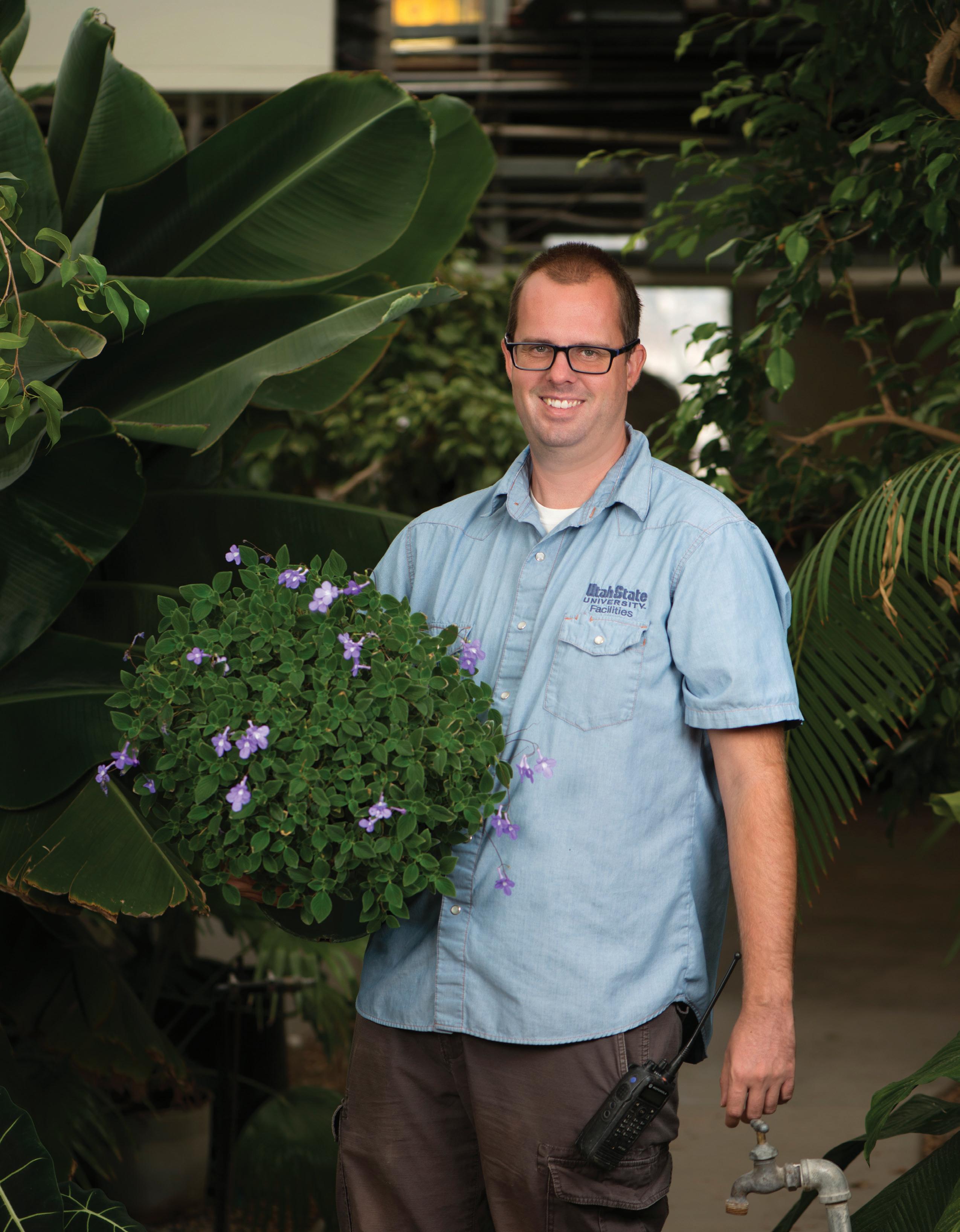
Gilbert Young: Area Coordinator for Innovation Campus, where he oversees all Utah State University landscaping needs north of 1400 North in Logan. (!ink lily babies around the fountain.) And no, he can’t take winters o$, because he also handles snow removal for the same area. Has worked in botanical centers and public gardens up and down the California coast and is deemed indispensible by peers for his riveting knowledge of all things green. Way beyond just the Latin names, he also has stories about where a given species thrives — geographically and environmentally — which plants are prehistoric in their genetic makeup and which (even non-drug plants) can be problematic due to U.S. government restricted species laws and regulations after 1970. Ten minutes in you’ll know he is indeed THE MAN when he starts pointing out all the trees he’s planted and nurtures just because, “We don’t see a lot of those in these parts.” Earth-moving Gilbert.
Mike McBride: Senior Carpenter, USU’s living, breathing de nition of doing it all. Working on the cupolas of Old Main one minute, 30 minutes later is custom-framing windows at LAEP’s recently refurbished Murphy House. Would just as soon not have another photo taken, thank you very much, mostly because it cuts into hanging sheetrock and tacking baseboards and leveling cabinets and any other needful thing. But mostly too, because he still hasn’t gotten even with the guys who “turned me in,” for Employee of the Year. !at’s right, meet the Mike McBride: Utah State University’s legendary and revered Facilities Employee of the Year, 2015.
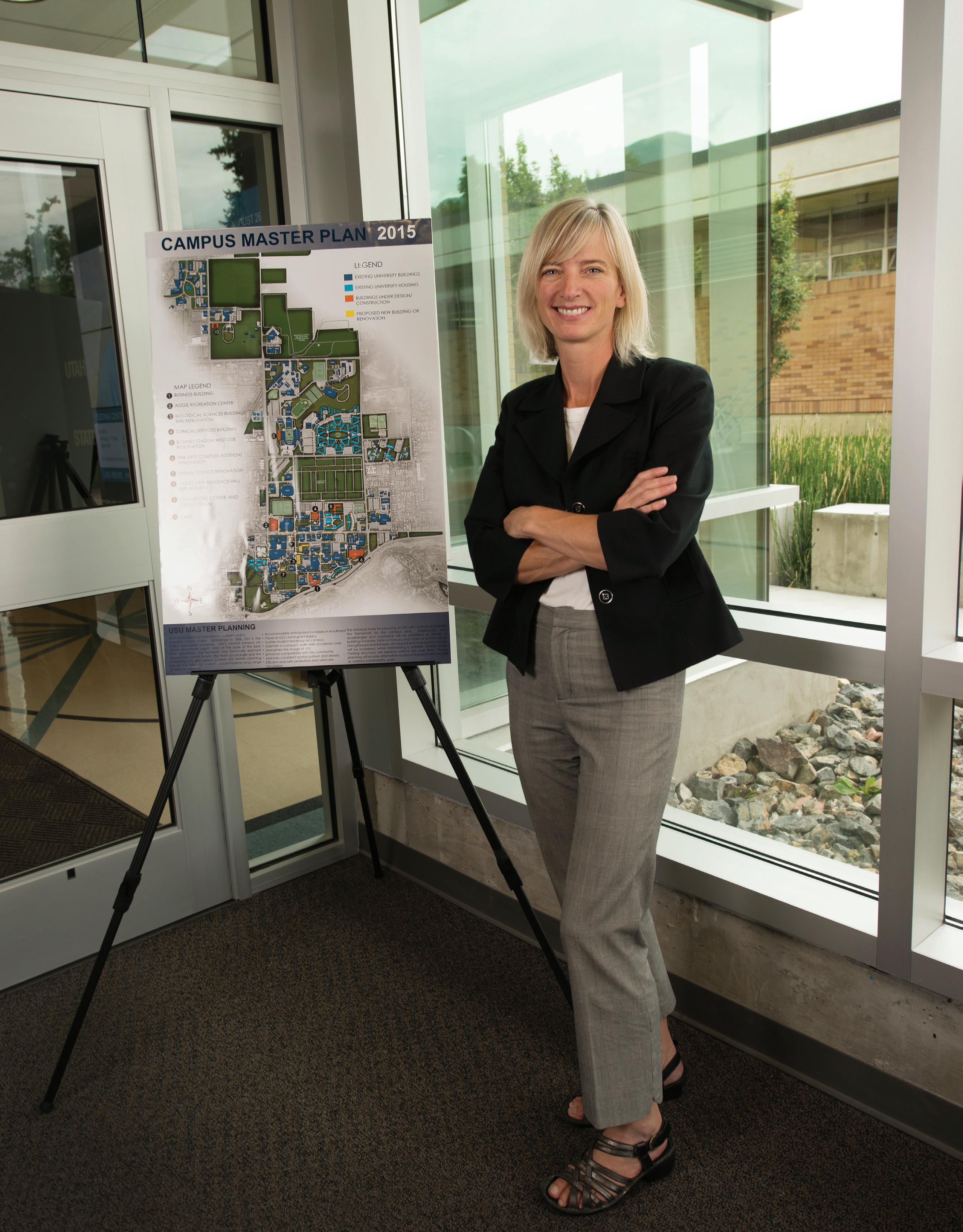
Jordy Guth: Assistant Director of Facilities Planning, Design and Construction, architect and campus planner and current impassioned chair of USU’s Sustainability Council. Product of the western Cascades, bachelor’s in architecture, one-time intern for several rms in Oregon, Washington and Idaho before earning her license to practice architecture. Continues building on what is now a 14-year stint at USU, which has also included cementing a master’s degree in Bioregional Planning, an interdisciplinary program focusing on integration of human and natural systems for the development of sustainable communities. So yeah, Jordy knows her stu$. As for thrills? Raising two young sons with her husband, travel, yoga, art and just about any activity outdoors — especially when a bike is part of the plan.
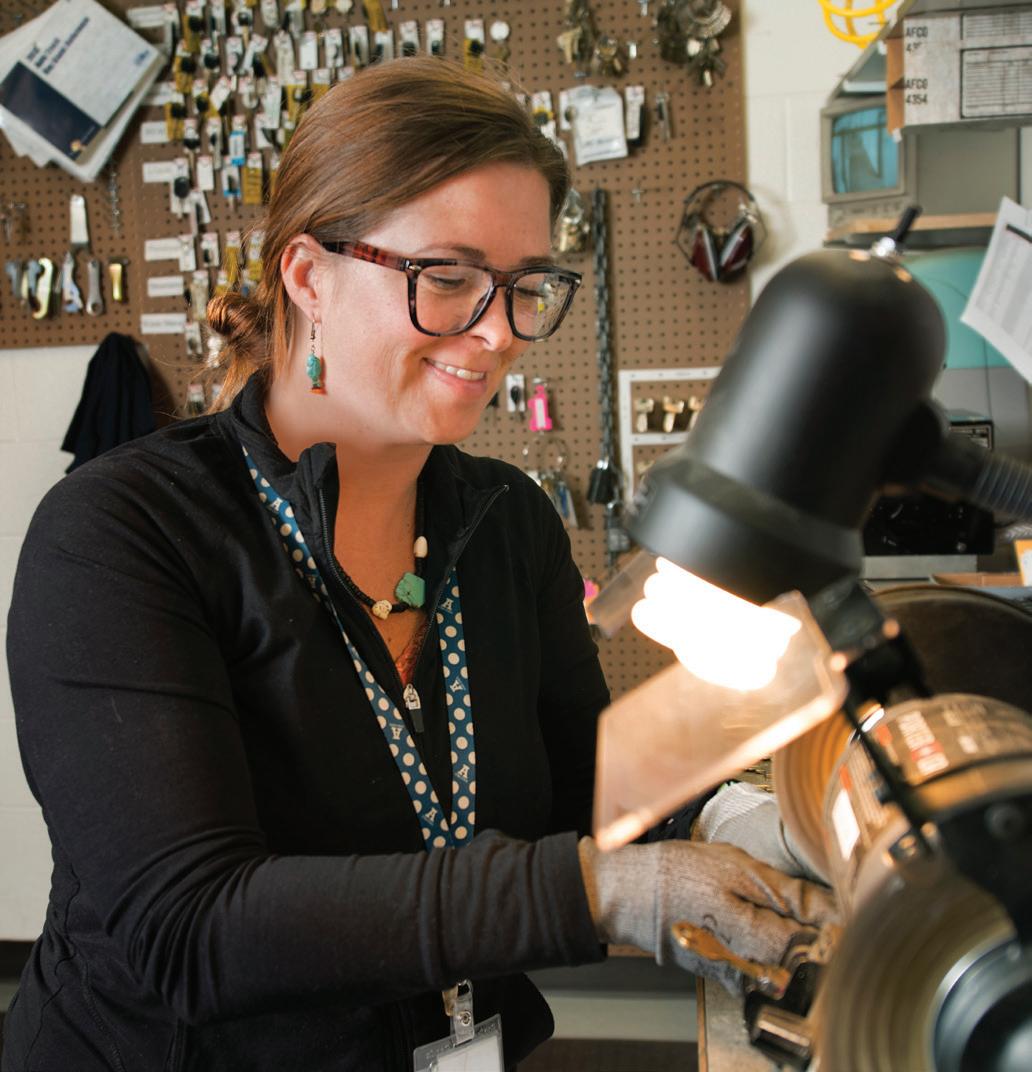
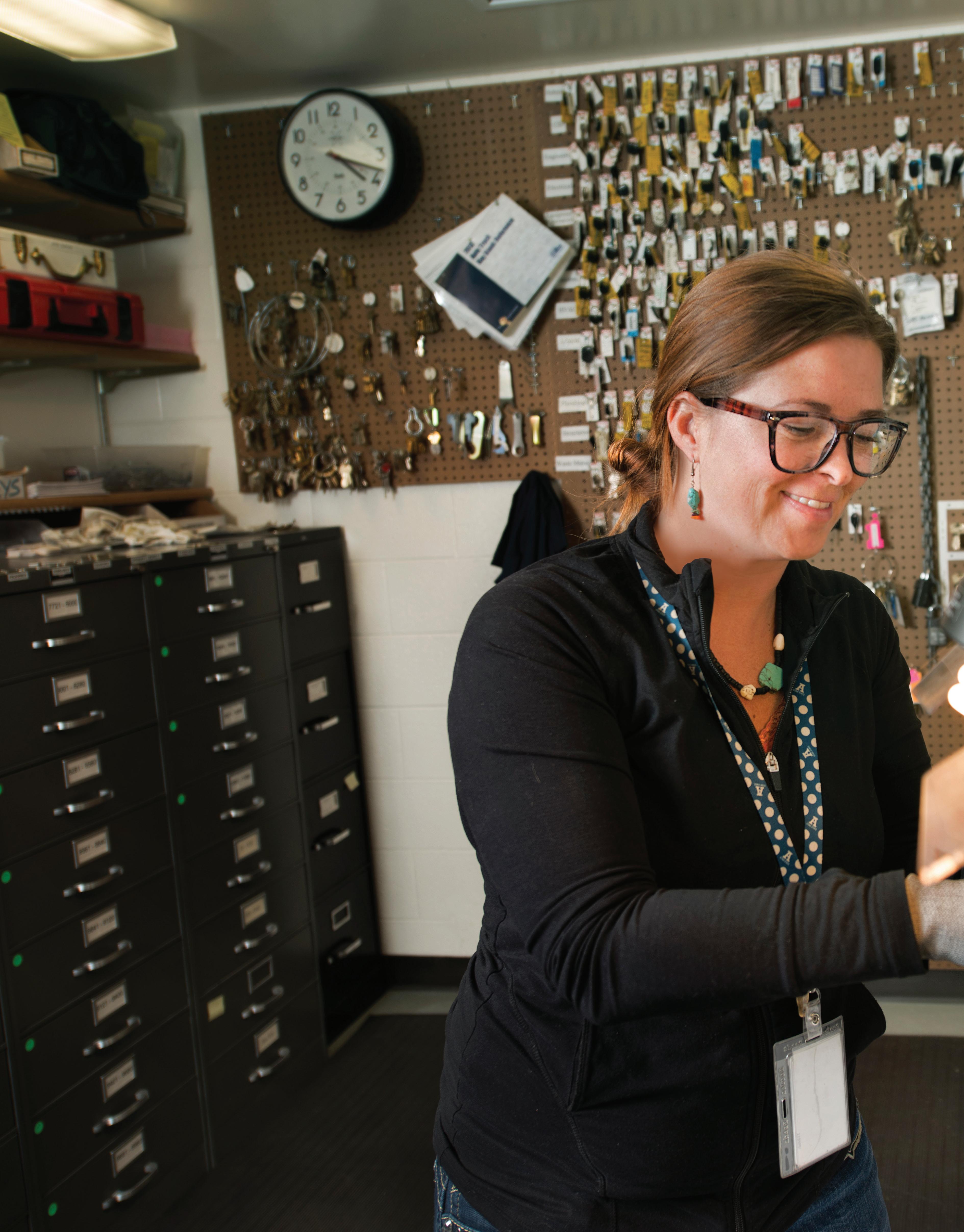
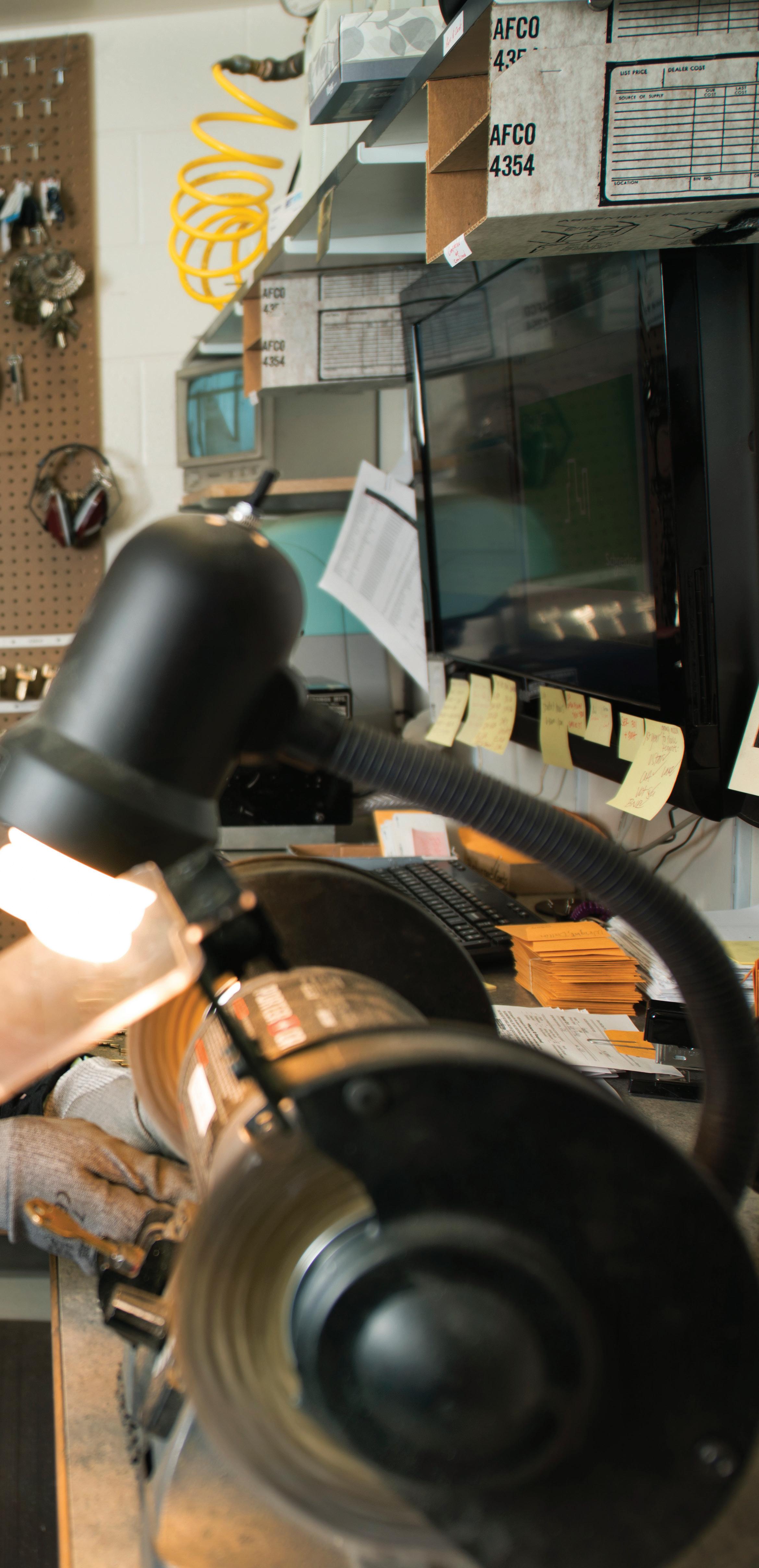
Sarah Elliott: Locksmith II, yoga, gardening, cooking, home-hockey rink and Zamboni do-it-yourselfer. (Seriously: cement forms, PVC pipe, a splitter on the washing machine for hot water, a wood frame and towel for ice smoothing — brilliant!). And what a joy to work with, says everyone who ever has. EVERYONE. !e job is a bit of a grind right now, though. Literally. She’s making keys for a new academic year. And if you ventured a guess you’d be wrong: there are 20,536 doors on Utah State University’s Logan campus, which means 54,123 keys to manage. And so, Smiling Sarah Zamboni continues the grind.
Alexi Lamm: Sustainability Coordinator, which means everything from promoting a culture of campus recycling to teaching a sustainability practicum in the S. J. and Jessie E. Quinney College of Natural Resources. Plans and tracks it all through the Sustainability, Tracking, Assessment and Rating System (STARS), in which USU is a silver-rated institution. Directs Energy Wars, RecycleMania and our National Bike Challenge e$orts, among myriad other pursuits and programs. Sings sustainability in all new construction on campus, where USU shines in Leadership in Energy and Environmental Design (LEED) ratings at the Silver level or higher. And yes, that’s Alexi on her bicycle — EVERYWHERE.
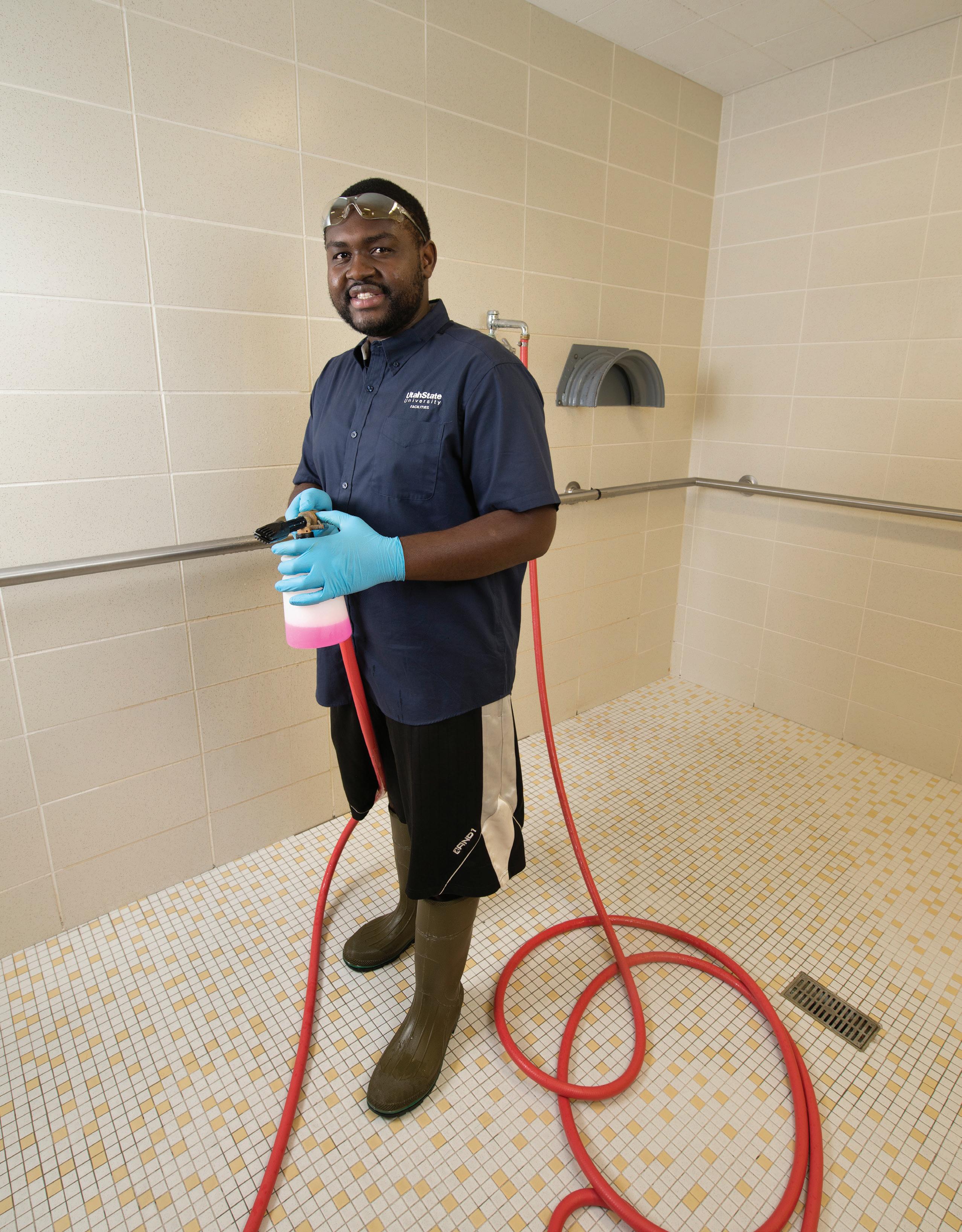
Kalilou Fofana: endlessly grateful, excessively cheerful and the proudest father of two you’ll ever meet. “Look at my daughter,” he says pulling out his phone. “She started kindergarten today! I can’t believe it! And here is my one-and-a-half-year-old son. Look at that hair!” Originally from Mali, now o cially a citizen of the United States, coordinator of the crew that scrubs and sweeps and polishes and bu$s and washes down and sanitizes the HPER, gyms and locker rooms included, every night, top to bottom. “!e President of the university could probably leave town for a couple of days and maybe not too many would notice,” he says, “but if we miss one spot on these oors, one night, we’re going to hear about it — I promise.” As an employee, has already earned a half-tuition bachelor’s — he’s eying a master’s degree in Human Resources, too — and the sincerest respect of his bosses, clients and team. !e ever-smiling Kalilou.
Abstraction and Symbolism
Singular Exhibitions Offer Cross-cultural Dialogue at NEHMA
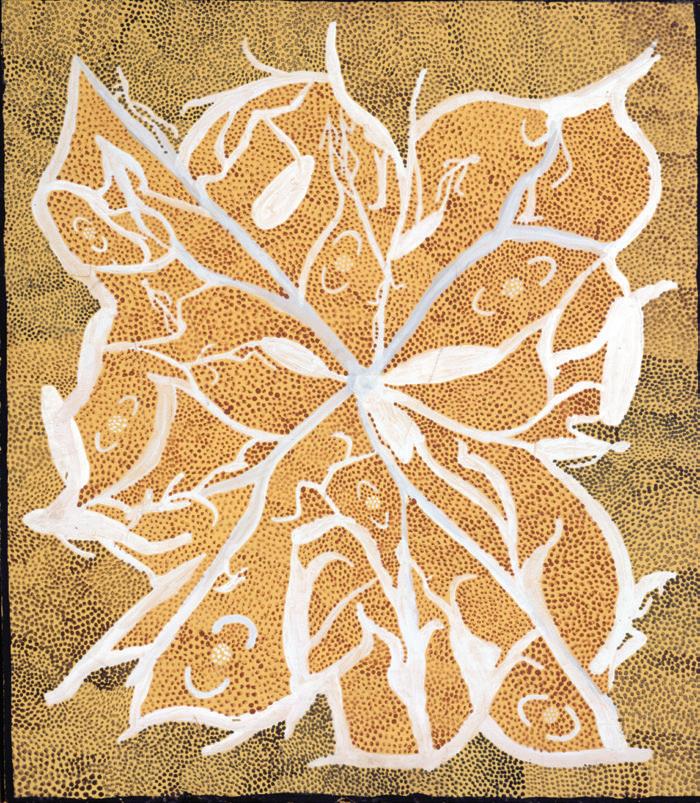
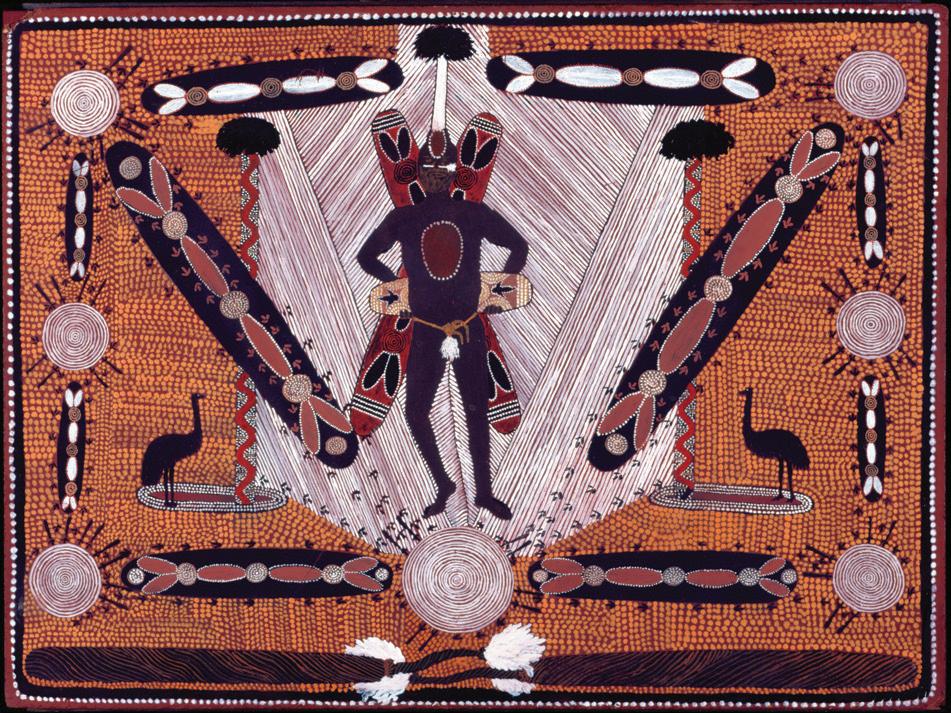
TWO COMPLEMENTARY EXHIBITIONS EXPLORING ABSTRACTION AND SYMBOLISM in 20th and 21st century artistic practices from very di$erent areas of the world — the Australian Western Desert and the American West — open this fall at the Nora Eccles Harrison Museum of Art (NEHMA) at Utah State University. Abstraction and the Dreaming: Aboriginal Paintings from Australia’s Western Desert (1971‒Present), featuring historic and contemporary works from private collections, is on view September 12 to December 12, 2015, and Transcendence: Abstraction and Symbolism in the American West, drawn from NEHMA’s distinguished collection, shows from September 1 to May 7, 2016.
Katie Lee Koven, NEHMA Director, said, “Abstraction and the Dreaming and Transcendence propose a reexamination of how we understand and experience art of the last century, shifting away from cultural or geographical siloes toward rich cross-cultural dialogues and multi-cultural histories. !ese dialogues across cultures exist less as the exception and more as the rule, especially over the last century. Both exhibitions help us understand artists and their work more individualistically, with layers of identity that are complex and distinctive yet, in some ways, connected.”
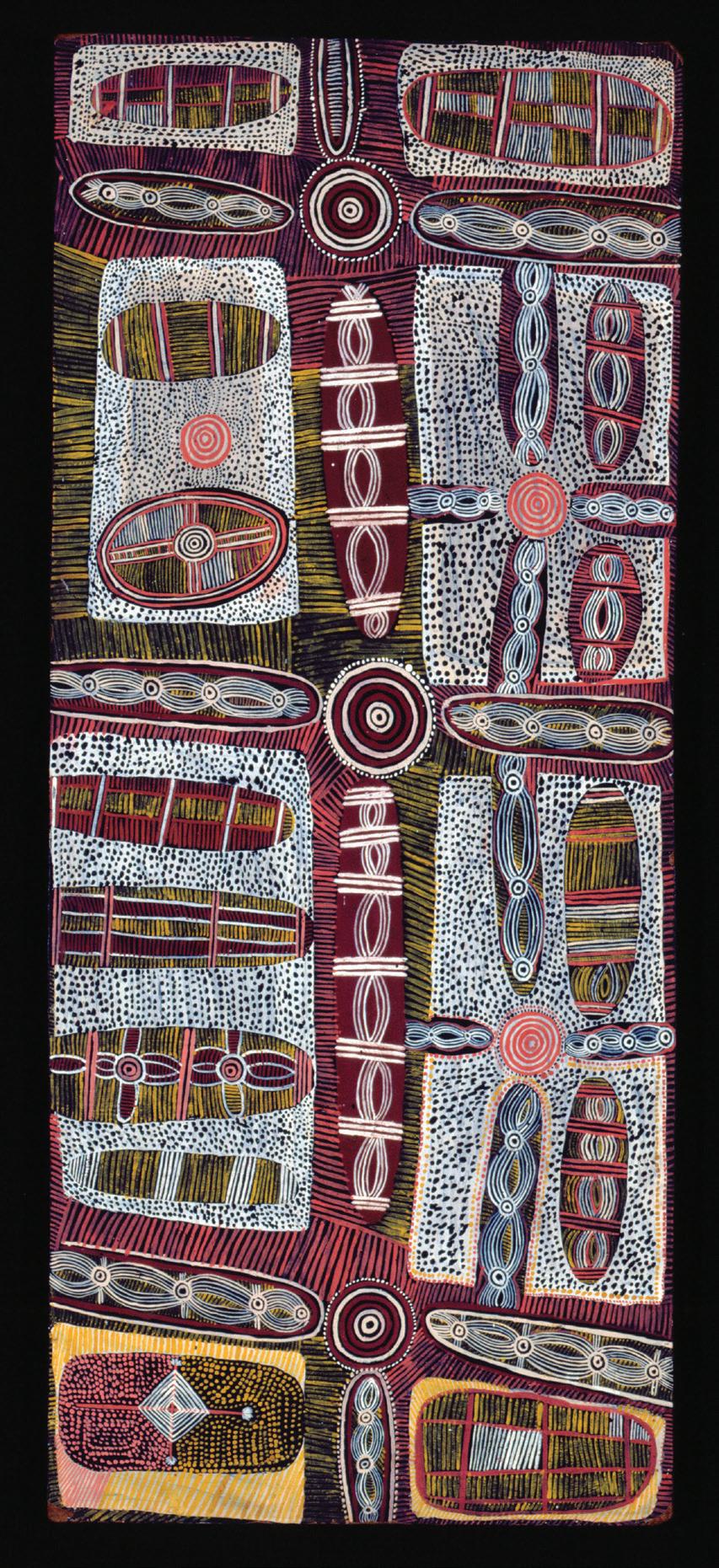
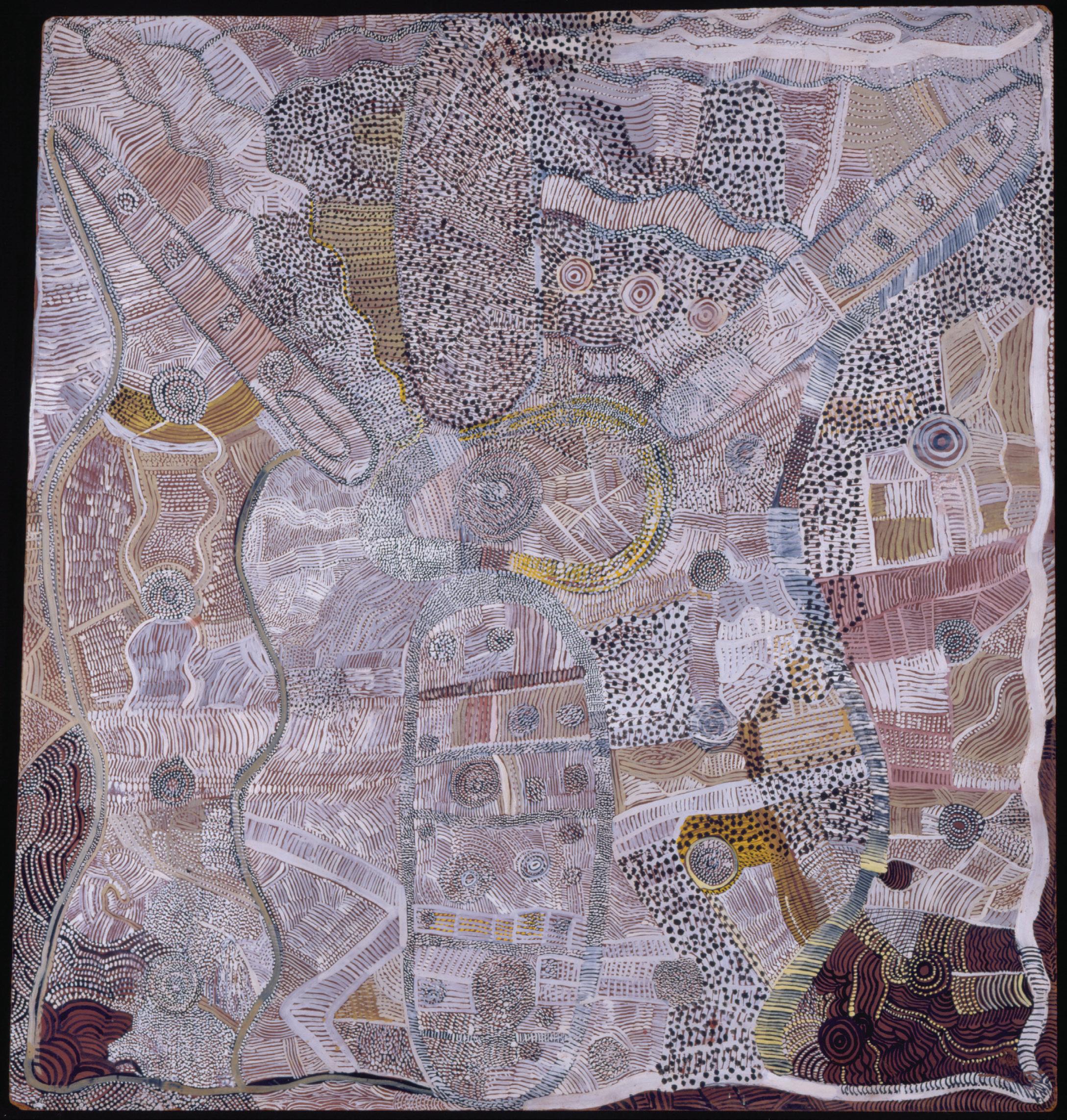
Abstraction and the Dreaming includes more than 50 artworks spanning the emergence of painting at Papunya, a remote Australian Indigenous settlement, to the present day. With fewer than 600 in existence, the “Papunya boards” (1970s) have a singular status within the history of Australian Aboriginal art. !e works include both the early paintings on boards and later paintings on canvas and are on loan from collectors John and Barbara Wilkerson, New York (John is an alumnus of Utah State University); Dennis Scholl, Miami; Julie Harvey, Idaho; and Stephen Luczo, San Francisco.
!e rst Papunya painters were men whose extensive cultural knowledge of ancestral stories, referred to as “Dreamings,” provided the subject matter. Encouraged by a Sydney schoolteacher who provided materials — acrylic paint and masonite boards and, later, canvas — to create permanent works, the artists employed symbols used in other contexts. !ese included drawing in the sand to accompany storytelling or body painting and constructing designs on the ground for ceremonial rituals. !e early “Papunya boards” are descendants of mark-making that dates to well over 100 centuries ago and are the beginning of the Western Desert art movement.
Because some of these designs were associated with sacred male-only ceremonies, women were not allowed to participate in art-making. Over time, Papunya artists moved away from the use of symbols toward greater abstraction. !e scale of artworks on canvas grew and women began painting, using a markedly more gestural and vibrant style than their male counterparts. Today, these works are interpreted and experienced as contemporary abstract paintings, stimulating a rich dialogue about indigenous art in the contemporary art world.
Among the artists included are Long Jack Phillipus Tjakamarra, Tim Payungka Tjapangarti, Tim Leura Tjapaltjarri, Cli$ord Possum Tjapaltjarri, Kaapa Mbitjana Tjampitjinpa, Shorty Lungkarta Tjungurrayi, Johnny Warangkula Tjupurrula, Eileen Napaltjarri, Johnny Yungut Tjupurrula, Kenny Williams Tjampitjinpa, Naata Nungurrayi, Walankura Napangka, Makinta Napanangka and Ningura Napurrula.
Left Page
Water Dreaming at Kalipinypa, ca. August 1972, Johnny Warangkula Tjupurrula.
Top, left
Yam Spirit Dreaming, March 1972, Tim Leura Tjapaltjarri.
Top middle
Water Dreaming, late 1972, Mick Namararri Tjapaltjarri.
Top right
The Trial, 1972, Charlie Tarawa (Tjaruru) Tjungurray.
Bottom
Emu Corroboree Man, February 1972, Clifford Possum Tjapaltjarri.
Transcendence: Abstraction and Symbolism in the American West
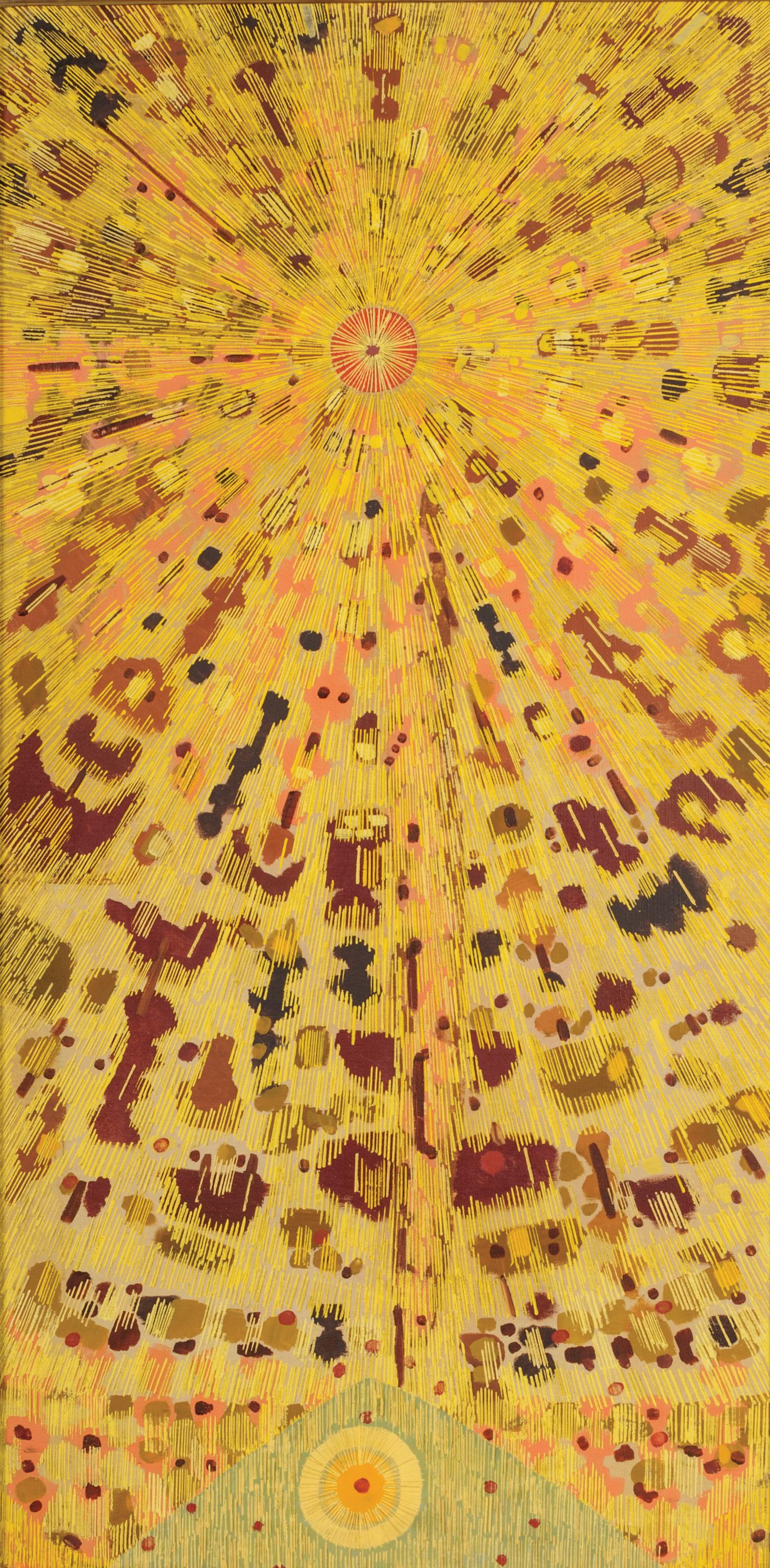
Showcasing NEHMA’s important collection of modern and contemporary art made in the American West after World War I, Transcendence: Abstraction and Symbolism in the American West includes over 45 works spanning painting, photography, sculpture, works on paper, pottery and mixed media. !e exhibition surveys American Indian and non-native artists who employed abstraction and symbolism to convey their experiences and interpretations of the American West. Artists include Edward Corbett, Deborah Remington, Robert Irwin, Sibylle Szaggars Redford, Judy Natal, Jean-Pierre Hebert, Harold Cohen, Raymond Jonson, Helmi Dagmar Juvonen, Julian and Maria Martinez, Lee Mullican, Nampeyo, Henrietta Shore and Takako Yamaguchi. Complementing Abstraction and the Dreaming, the exhibition explores how these artists utilized these genres in various ways to convey responses to place, spirituality and cultural identity.
t The Ninnekah, 1951, Lee Mullican, oil on linen, 50 x 25 in. Nora Eccles Harrison Museum of Art, Utah State University, Logan, Utah, Marie Eccles Caine Foundation Gift. Photo by Andrew McAllister, Utah State University.
The Nora Eccles Harrison Museum of Art
!e Nora Eccles Harrison Museum of Art (NEHMA) is dedicated to collecting and exhibiting modern and contemporary visual art to promote dialogue about ideas fundamental to contemporary society. NEHMA provides meaningful engagement with art from the 20th and 21st centuries to support the educational mission of Utah State University. NEHMA o$ers complementary public programs such as lectures, panels, tours, concerts and symposia to serve the university and regional community. Admission is free and open to the public. Hours are Tuesday Saturday from 10 a.m. to 5 p.m. and by appointment. artmuseum.usu.edu/
Photos by Donna Barry, University photographer
International Limelight
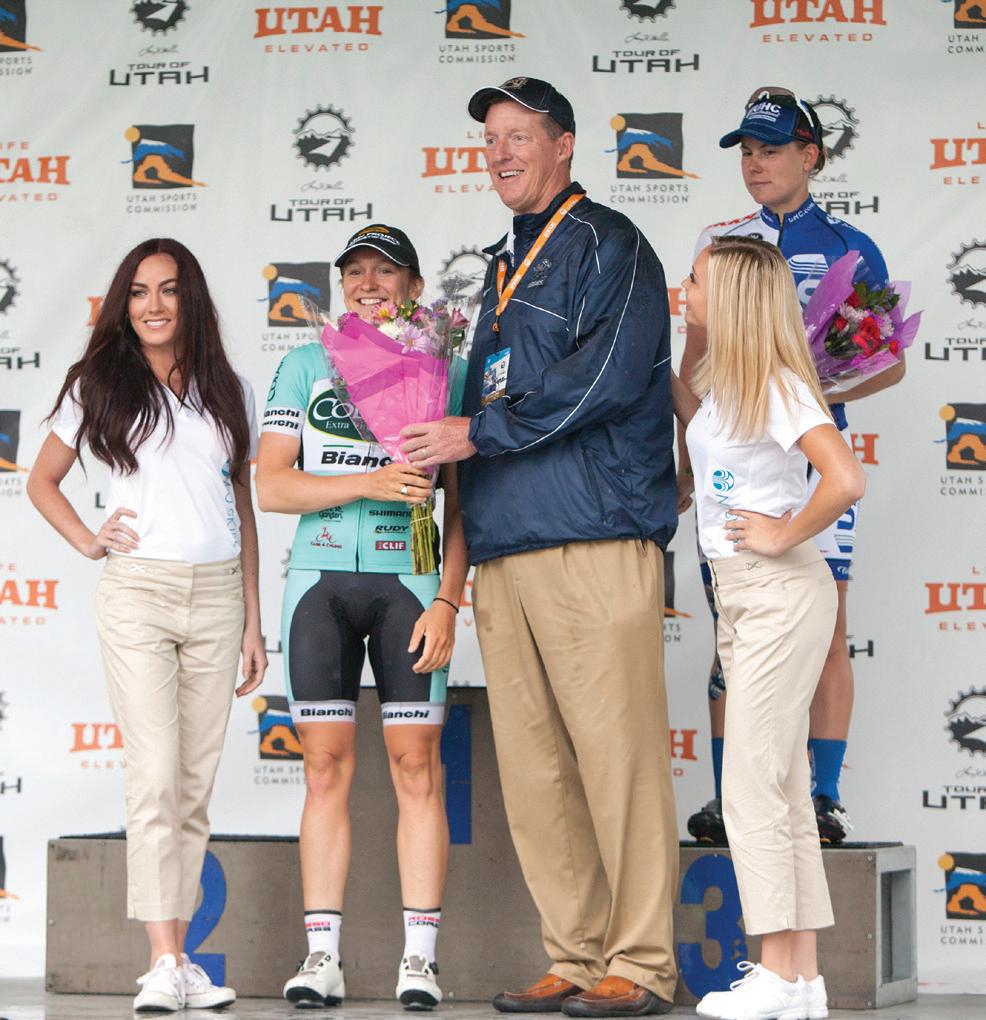
Two unusual things occurred on Aug. 3: an international cycling event was hosted in Logan and it rained. Hard. All day.
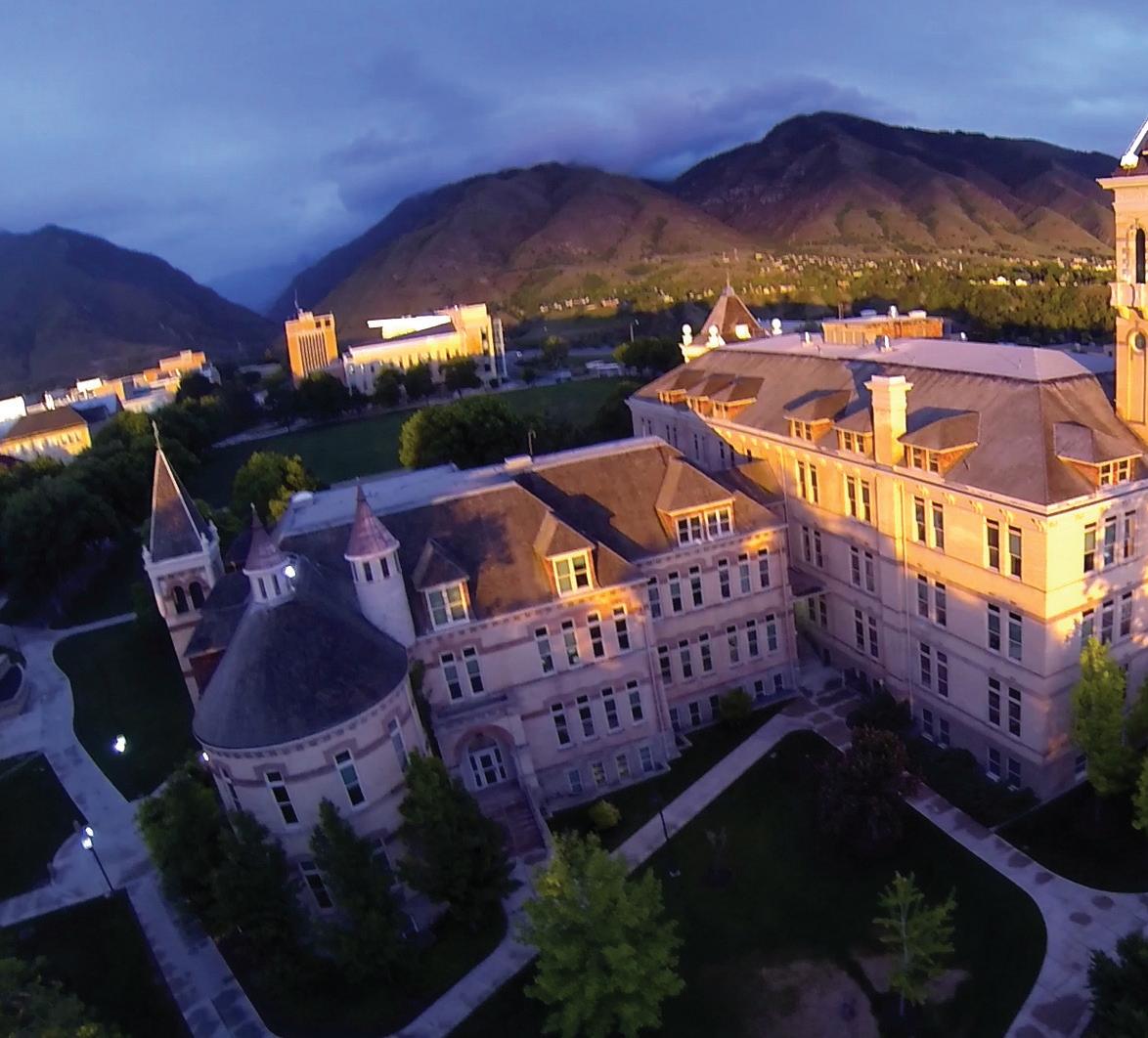
!is was the rst time a cycling tour stage of this importance had been held in the shadows of Utah State University, and while the unusual mid-summer drenching was not in the plans, it did not dissuade the 211 professional cyclists from competing, nor USU from taking advantage of the spotlight beamed internationally. !is included a stunning aerial photograph of the campus posted on the o cial Tour of Utah website, postings on the university’s social media pages, a university welcome tent at the event expo and serendipitous live helicopter footage as the men made their way past the campus to and from Bear Lake and as the women cyclists raced on a technical 1.5-mile course close to campus. It also included a rst-glance at USU’s newly named athletic director, John Hartwell, who participated in the trophy presentations.
!e annual event, now nearly a decade old, is one of only ve UCI (Union Cycliste Internationale)-sanctioned races. It showcases world-class athletes at various Utah locations for seven days in August, attracting widespread attention as the top international cycling event to follow the Tour de France.
For eight weeks this summer, Peter Kranz ’65 M.S., ’69 Ph.D., was a visiting Professor at Naresuan University in Phitsanulok, !ailand. He was invited by the faculty of nursing to teach basic counseling skills to rst- and second-year nurses as well as to do some consulting with both faculty and students on their research projects. In addition, he held classes for students in their development of oral and written skills in English.
1970s
Roietta Goodwin Fulgham ’71 M.S. was recently elected Western Business Education Association (WBEA) Director to the National Business Education Association’s Executive Board at its convention in Chicago. Fulgham, who began her three-year term in July, will develop and implement plans to advance the importance of business education in strengthening the country’s economy.
A professor for nearly four decades at American River College (ARC) in Sacramento, Calif., Fulgham has interacted with students in the business and computer science area. In 2014 Fulgham received the Postsecondary Business Teacher of the Year Award. She also serves as the Small Business Knowledge Communities Convener for the Greater Sacramento area under a grant from the California Community College Chancellor’s O ce. Fulgham has been an active member of the NBEA since 1976 and has served on several NBEA committees and held o ces through NBEA a liates at the state, regional, and international levels. She is an active member of the Sacramento Alumnae Chapter of Delta Sigma !eta Sorority, Inc., and has participated with the local NAACP as a youth advisor.
John Stephens ’74 was raised in Vallejo, Calif., and landed at Utah State University on the advice of dear neighbors. He met legendary Coach Ralph Maughan and was o$ered a scholarship for cross-country and track. Stephens says he loved his time in Logan and cherishes the many friends he made there. After graduation he went to work for the LDS Church in the Translation Department and in May retired after 41 years of service. He and his wife, Michele, then moved to Dammeron Valley, Utah (near St. George), to enjoy the great outdoors with their three horses.
Rod Miller ’75 is winner of the Western Writers of America (WWA) Spur Award for
his novel, Rawhide Robinson Rides the Range, published by Five Star, of Waterford, Maine. He was also recognized for his poem, Song of the Stampede, a Spur Award nalist. Since 1953, Spur Awards have honored the best in Western literature.
Accessible to adults as well as younger readers, the novel is set on a trail drive from Texas to Kansas. !e book is available at many libraries and from booksellers and in December, Five Star will release Rawhide Robinson Rides the Tabby Trail, the second novel to feature the teller of tall tales. !is is Miller’s third WWA Spur Award, having previously been recognized for Best Western Poem and Best Western Short Fiction. !e League of Utah Writers named him Writer of the Year in 2012.
David L. Hutchinson ’77 was recently promoted to executive director of the Sarasota/ Manatee Metropolitan Planning Organization (MPO). His multidisciplinary background spans more than 30 years and combines planning, policy and public a$airs. Hutchinson served as the agency’s planning manager prior to being appointed executive director.
Before joining the MPO sta$ in 2011, he served as director of planning for the Southwest Florida Regional Planning Council, and worked for the Florida Department of Transportation (FDOT) as a senior policy analyst in the O ce of Policy Planning in Tallahassee and as intergovernmental liaison in FDOT’s District One Southwest Area O ce. Before that he worked in the private sector as director of account services and public relations for Tweed Advertising in Fort Myers, handling accounts related to tourism, planning and engineering and economic development.
Before moving to Florida in 2000, he served as county administrator and as administrator/assistant road supervisor for Grand County in Moab, Utah. He worked as a legislative aide to the San Diego County Board of Supervisors for seven years and as National Public Relations Coordinator for the San Diego Convention and Visitors Bureau. Hutchinson earned a bachelor of science degree in Environmental Studies from Utah State University and a certi cate in Gerontology from the Rocky Mountain Gerontology Center. He and his wife, Lupe, reside in Sarasota, Fla., and recently became grandparents. IN
rough July 31, 2015
1930s
Cleone S. Boshard ’39, Jun. 16, MO
Walter H. Gardner ’39, ’47MS, ’50PHD, Jun. 11, UT
Helen Gudmundson (Burns) ’39 Att, May 6, UT
Maurine Henderson (Criddle) ’39, Jul. 19, UT
Louis M. Stuart ’38 Att, Jun. 2, UT
Jack C. !ompson ’39 Att, May 6, UT
F. Marion Warnick ’38, Jun. 13, ID
1940s
Grant F. Andersen ’43, ’54MS, Mar. 31, CA
Phyllis W. Anderson ’46 Att, May 15, UT
R. Grant Athay ’47, Jun. 10, UT
Bernice Christiansen Baugh ’48, May 1, UT
Ross I. Benson ’44 Att, Jul. 21, ID
Elaine Stanford Brockbank ’48 Att, Jul. 19, CA
Donna Carlson (Burrie) ’41, ’60, May 19, UT
LuJean H. Carver ’45, ’74MS, May 23, UT
George H. Champ ’49, May 11, UT
Carol Clay (Wennergren) ’42, ’64, May 23, UT
Ruth Delapp Coates ’43, ’64MS, Jun. 13, UT
Ladell Tankersley Danielson ’48, May 2, UT
Lola D. Evans ’49 Att, May 19, ID
Douglas Farrow ’49, May 8, ID
Earl Clark Greenhalgh ’41, Oct. 9, CA
Julien G. Gri n ’49 Att, May 14, UT
Seth D. Gri n ’48, ’50, May 8, UT
Carlene Lindquist Humphreys ’43 Att, Jun. 20
Marion June Knudson (Smith) ’49 Att, Jun. 14, UT
Mary Nelson (Christensen) ’47, May 6, UT
O. Edward Ogilvie ’44 Att, May 8, UT
Afton G. Pace (Gibson) ’42 Att, Jul. 6, UT
President Boyd K. Packer ’49, ’53MS, Jul. 3, UT
Donna B. Pendleton (Berton) ’47, May 26, VA
Elder L. Tom Perry ’49, May 30, UT
Scott Rice ’42 Att, Jul. 4, UT
Afton !ompson (Danielson) ’47, Jun. 15, CA
James L. VanDerbeek ’42, ’49MS, May 13, UT
Clifton J. Wadley ’43 Att, May 23, UT
Dorothy Wallin (Jorgensen) ’43, May 5, UT
Lydia Willmore (Baxter) ’43 Att, Jun. 16, UT
1950s
Richard C. Baldwin ’58, Jun. 30, UT
Rulon Don Banford ’56 Att, Jul. 3, UT
Robert S. Bergen ’59, Jul. 27, UT
Kenneth G. Broadhead ’57, May 24, UT
Grant J. Budge ’51, May 11, OR
Maxine W. Burgess ’58, Jun. 3, UT
Kendrick Campbell ’56 Att, May 26, UT
Barbara Capener (Ward) ’54, Jun. 26, UT
Jolene C. Clayton (Call) ’52 Att, Jul. 26, UT
Richard B. Clyde ’53, Jun. 13, CA
Colonel Robert A. Conlin ’50, May 17, CA
Edsel L. Corpe ’51, May 5, NV
Russell M. Crawford ’59, May 18, WA
Emerson Eames ’58 Att, Jun. 4, UT
Bernell W. Evans ’51, Jun. 14, UT
Doris Falslev (Hansen) ’59, May 13, UT
James D. Fowers ’59, May 15, UT
Margaret Alice Foy (Willis) ’57, May 28, UT
Bruce K. Gardner ’53, ’61MS, Mar. 4, CO
Keith Godderidge ’59 Att, Jul. 24, UT
Reed H. Gunnell ’51 Att, May 20, UT
Richard Duane Guymon ’57, Jun. 5, UT
Arden M. Hansen ’51, Jul. 2, ID
Max D. Hodge ’52, May 5, NM
Judd Killpack ’50, Jul. 8, OR
!eodore B. Larsen ’53, Jun. 30, NM
John Sewall Laurie ’50 Att, May 13, NC
Laurel W. Lindsay ’58, Jul. 10, ID
William Orson Merrell ’55, Jun. 11, UT
Floyd G. Meyer ’52 Att, Jul. 13, UT
John B. Millard, Sr. ’51, Jun. 15, UT
Louis L. Nelson ’55, ’59MS, May 15, UT
Marva Lou Niederhauser (Jenkins) ’55 Att, May 17, OH
John C. Paulsen ’55, May 6, UT
Carlo Milton Perkins ’54, Jun. 1, UT
Douglas V. Peterson ’58, Jul. 24, UT
Vern Gordon Petty ’57, May 2, NV
Glenn S. Porter ’54, ’75ME, May 19, UT
Leslie W. Rader ’58, Jun. 25, UT
Donald L. Rasmussen ’53, Jul. 23, WV
Eugene U. Ricci ’58, Jul. 8, FL
Veryl Roberts (Hendricks) ’57 Att, Jun. 29, UT
Connie Crandall Rudy ’52 Att, May 17, UT
Fran L. Sessions (Johnson) ’50, Jun. 24, CA
Lt Col Gloyd R. Stanton ’55, Oct. 26, TX
Vernal W. !ompson ’53, Jul. 8, UT
Lovell J. Turner ’52MS, Jul. 10, ID
Monette Welling (Anderson) ’57 Att, Jul. 5, UT
Doyle T. West ’54, May 19, CA
Ned A. Whiting ’54, Jul. 21, UT
Charles E. Woodbury ’50, Jun. 5, UT
Delworth Keith Young ’58, ’67MS, Jul. 6, UT
1960s
James Franklin Allen ’65, May 9, UT
Marvin Jasper Anderson ’66, Apr. 29, ID
Terry E. Anderson ’62, Apr. 26, MO
Cheryl Baker (Patterson) ’69, Sept. 17, AZ
Milton Baker ’64, Jun. 9, UT
Nadine Bastian (Hunter) ’61, Jul. 13, ID
Dean T. Bennett ’63, ’88MED, May 7, UT
Marilyn Gee Black ’60 Att, Jul. 26
Garrick R. Bowen ’67 Att, May 5, UT
John H. Boyce ’69 Att, May 25, UT
Delbert Gene Briggs ’61 Att, May 13, UT
Kendell W. Brinkerho$ ’64MS, Feb. 26, UT
Marlowe Norvell Butler ’62, Jul. 20, UT
Lynn A. Cope ’63, May 7, UT
Stephen J. Crane ’65 Att, Jul. 1, ID
Louise Degn ’68, May 8, UT
Dee Donaldson ’62, Jun. 2, UT
Deanne Ercanbrack ’65, May 14, UT
Larry W. Holmstrom ’64, Jun. 5, UT
DeLoy Johnson ’67 Att, Jun. 18, UT
Bruce Jones ’66, May 15, UT
Kenneth A. Mangelson ’67, ’68MS, ’72PHD, May 31, UT
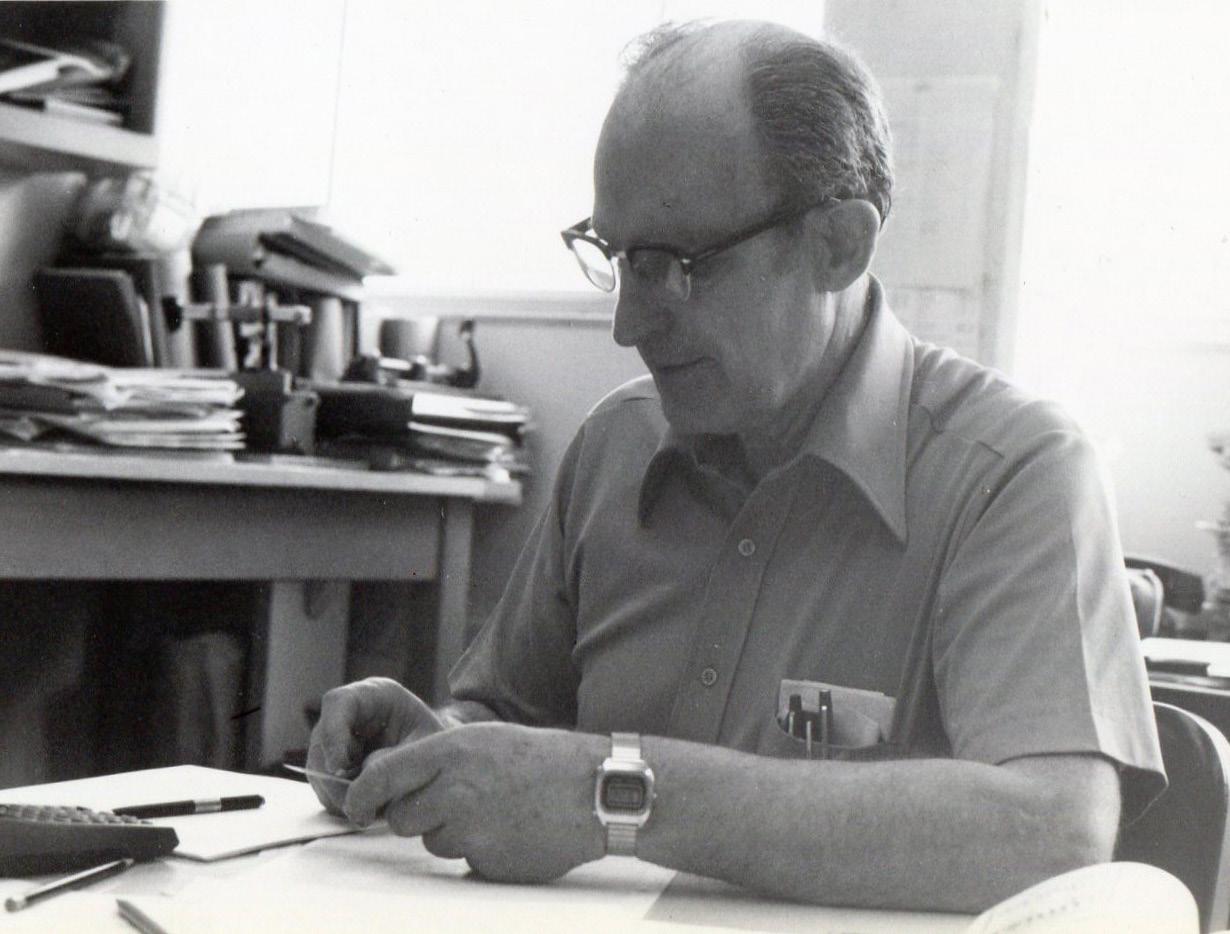
Dr. Walter Hale Gardner passed away on June 11, 2015. He was 98 years old. Gardner was awarded the rst Ph.D. from the Utah State Agricultural College (USAC), now Utah State University, in 1950 (Dr. !an Myint, deceased, also received his doctorate that year).
Gardner was part of an accomplished era of soil scientists that sprung from USU, originating with his father, Dr. Willard Gardner, a physicist from the University of California Berkeley, who was lured to Utah by noted scientist and author John A. Widtsoe, also an apostle for the Church of Jesus Christ of Latter-day Saints. Widtsoe maintained his own interest in irrigation and science to help further agricultural development in the West. Willard Gardner applied traditional physics to soils and irrigation, transforming the agricultural industry.
While chair of the physics department at Utah State, Willard Gardner coached and challenged his son, who of his own merit, developed a remarkable talent for math and science. After completing his bachelor’s degree at USAC, he elected to do graduate work at Cornell University, perhaps the preeminent agricultural school of the time. His love for Cache Valley lured him home prior to graduation, however, and he nished both his crowning degrees at Utah State.
Walter Gardner relocated to Pullman, Wash., where he pursued a faculty position researching and training aspiring scientists. Both he and his father directly in uenced other Aggie soil scientists, including Dr. Gaylon Campbell (’65), who went on to found Decagon Devices, and Eric and Evan Campbell, founders of Campbell Scienti c, Inc., both multinational companies with Cache Valley ties.
Gardner’s contributions to soil science include the ubiquitous and ever-relevant text Soil Physics, as well as the time-lapse movie, Water Movement in Soil. His contributions changed the way many scientists and industrialists understand the non-intuitive way water moves through soil. He was likely also the inventor of the tension in ltrometer, a scienti c instrument widely used in the eld. Gardner constructed the device as an undergraduate student running the physics shop at USAC. Soil Science at Utah State University is still internationally celebrated. — Joshua Paulsen