News Students vote on proposed USUSA Constitution amendments.
Utah State University, Logan, Utah
03
Lifestyles The Clothesline Project returns to USU, organized by SSAVI.
07
Sports Inside Utah State Handball Club’s first semester as a registered club.
Week of October 26, 2026
15
Page 2 - The Utah Statesman, October 26 , 202
Student Events Office shares safety measures ahead of 2026 Howl STATESMAN STAFF REPORT
Every year, Utah State University’s Students Events Office organizes the Howl — “the largest Halloween party in the state,” according to USUSA Student Events Executive Director Creed Jones. This year, Howl: Whodunnit will take place on Oct. 30 in the TSC and George Nelson Fieldhouse from 8 p.m. to 1 a.m. This event is typically very popular with students — this year, all the student and general tickets for the event are sold out. One of Jones’ and his team’s hopes this year is that students will find a safe way to celebrate Halloween. He identified safety issues from past events, including students showing up intoxicated and cases of sexual misconduct. Utah State University is a dry campus, meaning that not only is alcohol not allowed on campus, but that students and staff cannot show up intoxicated to events, because the body is considered a container. If you feel that yourself or a friend is struggling with alcohol use, there are resources available, including the Student Health and Wellness Center and Counseling and Prevention Services. The other big safety issues identified as a problem at past Howl events is cases of sexual misconduct. USUSA left a reminder on their website about
consent that says, “Consent is mandatory. Consent is an agreement to do the same thing at the same time in the same way. Groping or grinding without consent violates the law, and anyone who does this will be removed from the Howl and may be charged with a crime.” Jones also said that a big focus for the organizers was preventative messaging that will help students remember best practices for the entirety of Halloween weekend and beyond. “[We’re] just trying to prepare students for Halloween weekend in general — trying to establish some universal principles and best practices that they can follow, not only for this event but also for the rest of the Halloween festivities,” Jones said. Actions that the Student Events Office are taking to make this happen include tabling from [the Survivor Support, Advocacy, and Violence Intervention Office, or] SSAVI, where students can find support and resources.” The Aggie Shuttle will be running until 1:30 a.m. in an attempt to ensure that students can get back to their vehicles safely. USU also has an amnesty policy, which encourages students to seek immediate medical attention or to report sexual misconduct on behalf of themselves or another person. Attendees of the Howl should remember that the
event is 18+ and an ID, either a driver’s license or student ID, is required for entry. Tickets will not be accepted as a screenshot — only a QR code in the Transact App will be accepted. Jones emphasized that the safety of all Howl attendees is incredibly important to the Student Events Office. “We’re putting in extra effort when it comes to preventative actions, and then also best practices during and after the event when it comes to just overall student safety,” Jones said. “Especially in the context of sexual misconduct, I think we just want students to know that we really are — we’re making an effort. There are resources available, and the student events office is an advocate for students, but also survivors of sexual misconduct, and ultimately, our work and our effort is really for them.” More information on the Howl can be found at usu. edu/involvement/events/howl.
— editor@usustatesman.com
Oct. 6
Oct. 5
An individual reported his bike was missing. USUPD responded and was able to tie this case to others like it. The suspect was identified and arrested.
Oct. 8
USU officers responded to a fraud call for service involving a victim who reported $900 was stolen from her bank account by an unknown suspect. The suspect reportedly used a popular scam targeting individuals on campus.
USUPD attempted a traffic stop on an electric motorcycle on the mall sidewalk. The driver “ran from police.” Police did not pursue and the driver of the motorcycle is unknown.
Oct. 13
Police received a report of gas being siphoned from a USU ATV. The case is under active investigation.
Student-run newspaper for Utah State University since 1902. Reporting online 24/7. Printed weekly during the school year.
By Dylan Moore STATESMAN SENIOR REPORTER
U
tah State University students will vote Monday and Tuesday on changes to the USUSA Constitution that would redefine who counts as a member of the student association and, by extension, who can vote in its elections. Polls open at 9 a.m. Oct. 26 and close at 11:59 p.m. Oct. 27 at vote.usu.edu. USUSA President Max Alder called the special election so the vote would happen before the next regular election cycle. The amendments need a simple majority to take effect. The legislation, ELBR 2027-01, would replace the constitution’s opening membership statement with a definition built around tuition and student fees. “All students at Utah State University who are currently registered for academic credit while being issued charges of tuition and student body fees are members of the USUSA and shall be granted all rights, responsibilities, and privileges established by this Constitution,” the proposed legislation reads. Alder said the legislation has changed the definition of a student from those who are in a degree or certificateseeking program to those who are charged. He said the change uses the word “charged” rather than “paid” so students with tuition waivers and payment plans are still included. “Essentially, this is going to be people that are tuition- and fee-paying students,” Alder said. The change follows questions from the February election, when Alder won the presidency over Kapp McCallister by eight votes. Petitioners later asked for a recount that excluded 113 votes cast by concurrent enrollment students, who are high school students taking college courses. The Executive Leadership Board denied the request in May, as The Utah Statesman reported. “We had lots of people raise concerns about some unclear language in the constitution,” Alder said. Under the new definition, six types of students would lose membership and voting rights, according to Alder. They include concurrent enrollment students, employees and senior citizens auditing courses, and continuing education and workforce development students. Undergraduate and graduate students, thesis-only graduate students, technical education students, study abroad students and employee dependents would remain members. USUSA Student Advocate Vice President Colin Hastings, who sponsored the legislation, said all students could still seek help from the association. “The student association is still here to represent all students, so even if they’re not able to vote for us, they can still come to us with any issues,” Hastings said. Alder said the change could be felt more at some statewide campuses, such as Tooele, where concurrent enrollment students take classes on campus for part of the day. He pointed to the constitution’s preamble, which says it is established for all students, and said officers will still
FREE SINGLE COPY
THE BOARD Hazel Harris-Staples managing editor editor@usustatesman.com
—————— Essence Barnes news editor
Page 3 - The Utah Statesman, October 26, 2026
Students to vote on USUSA Constitution amendments
Jayke Martin lifestyles editor
life@usustatesman.com
—————— Camille Simpson chief copy editor
news@usustatesman.com
copyeditor@usustatesman.com
sports@usustatesman.com
photo@usustatesman.com
—————— Mark Greenwood sports editor
—————— Ezra Robertson multimedia editor
The Utah Statesman Office TSC 118 435.797.1742 usustatesman.com PHOTO BY Owen Clarke USUSA President Max Alder speaks to students proposed changes to the USUSA Constitution in the Hub in the TSC on Sept. 15.
represent nonmembers. Hastings said one statewide officer worried that removing concurrent enrollment students’ voting rights could make them less likely to attend USU later. It was not a widely shared concern, Hastings said, and the legislation passed.
Senior Reporters Dylan Moore Jillian Peterson Rory McNeill Reporters Quinton Papa Cambria Thurgood Kendy Plant Jen Cefalo Wyatt Cano Elissa Ross Payton Shannon Kylie Jones
Senior Photographer Elise Bliss Photographers Lola Probasco Owen Clarke Dane Johnson Copy Editors Piper Durham Spencer Wilkinson
Cover art by Ezra Robertson Letters can be hand-delivered or mailed to the USU Student Media office in TSC 118. They can also be emailed to editor@usustatesman.com.
Dylan is a senior studying political science. You can usually find him on some sort of outdoor adventure. — dylan.moore@usu.edu
Published and distributed by USU Student Media 0165 Old Main Hill Logan, UT 84322
For advertising inquiries TSC 118 435.797.1775 studentmedia@usu.edu
Page 4 - The Utah Statesman, October 26 , 202
Roundabout construction ‘confuses’ on 1200 E. in front of the Student Living Center
An excavator is seen parked on the side of the road after construction is done for the day on the roundabout at 1200 E. on Oct. 22. By Jen Cefalo STATESMAN REPORTER
C
onstruction began on the 1200 E. roundabout on Oct. 12, with visible construction and delays starting the morning of Oct. 20. The construction plan includes closing the northbound lane to allow for installation of landscaping and some signage in the middle of the roundabout safely. According to the Passio GO! App, the project is projected to take three weeks, which would have it end on Nov. 2. The construction has the orange and purple bus lines detouring around the Student Living Center. Logan city buses headed northbound through the roundabout will also be diverted. Students did not feel informed of the roundabout construction. Many didn’t know construction was expected, with construction signage only coming out on Oct. 19. “It is frustrating that they did not tell us that this construction is happening because it definitely is going to affect, like, every day, because the bus is going to take longer to go around and I take the bus every day,” said Baylee Trimble, a student at Utah State University. First-year student Drew McKay also expressed frustration at the lack of communication saying, “It’s kind of annoying that they didn’t tell us, because now I have to plan my way around that because my sister lives in that direction.” Other students, mainly resident assistants and a few others, had heard about the planned construction.
PHOTO BY Jen Cefalo
“I learned about it from my supervisor because I’m an RA,” said Alta Stott, a senior at Utah State. “They sent me a little map of what would be closed, and they said it would start happening on Monday. That would have been the 12th, and I haven’t seen any construction except for today. There are finally construction cones in the center of the roundabout.” The other students who knew about the construction learned a little about it through the Passio GO! public transit app, with a message about the expected detour. The message contained information about the start and expected time frame of the construction. “As a result, the South Campus and Housing routes will be detoured around the construction area. Please expect some changes to the normal route and allow a little extra time for your trip,” the message stated. One change is that the Housing Express, or the purple line, stop at Aggie Village 1 has moved to the corner of the street instead of its usual place at the front of the Student Living Center. Several other students also expressed confusion that the construction was already supposed to be started. Many mentioned the Passio GO! app had changed the bus routes and they didn’t know why. “I did not know until today, but I’ve been seeing it on the app for like the past week now, so I was curious what that was about. But then it never happened, so I was very confused,” said Christina Jiang, a USU student. Students expressed concerns about the construction, with
bus timing and traffic being some of the main concerns posed by students. “I think a concern is just how it’s going to impact the buses and how it’s going to impact the students, like getting to work. I know it will cause a lot of traffic. Just having traffic in this area that’s just so small. It’s a one-lane area. It’s used by a lot of the students here,” said Estee Edwards, a resident assistant at the Student Living Center. The detour is set to go around the block of the Student Living Center, picking up at the stop in front of the Lundstrom Student Living Center and then turning left and looping around the block. “It’s just unfortunate for students who are in the Student Living Center because we rely on the buses to get to campus. Several of my classes take attendance, and if I’m late to class I get docked points, so I’m severely debating if I’m going to continue to take the buses,” Stott said. Jiang felt similarly, saying, “I’m not sure how long that takes, but I’m certain it’s going to add a few more minutes to the clock, so I’m probably going to leave the house a little earlier, just so that it doesn’t make me miss my courses.” Both resident assistants expressed confusion as to why the construction is happening now. “It’s going to be for several weeks, and I fear this could have been done at a better time,” Stott said. Other students agreed it was a weird time to start construction with winter weather starting to come to campus. “I don’t know why they’d be doing it during this time of the school year,” Edwards said. “That’s kind of confusing to me.”
Jen Cefalo is a junior studying kinesiology with an emphasis in exercise science. One of her favorite hobbies is watching Formula 1 races on the weekends. — jen.cefalo@usu.edu
By Kylie Jones STATESMAN REPORTER
W
e The People Cache Valley held a No Kings: Vote Early rally in Logan on Saturday, Oct. 17. This rally was a celebration and a motivator to encourage others to vote early in the upcoming Nov. 3 elections. Cache Valley Daily said the No Kings: Vote Early rally was one of around 3,000 events across the nation. One of the main events at the rally was to promote early voting, and organizers encouraged attendees to come with their ballots in hand. The rally had organized main speakers to raise awareness about voting, as well as other government ideologies. Nico Matiana, an advocate for immigrant rights, wanted to bring awareness to this rally about the rising ICE presence in Logan. Matiana claimed beginning this summer, a Logan resident was being removed from their home every other day, coming to a total of over 200 individuals. Matiana also wanted to emphasize there are many ways to be involved in this movement and help keep families together. She said available and needed services include financial help with legal fees and legal documentation of ICE presence in Logan. Matiana said to remember immigrants are your friends, coworkers and neighbors. Attendees submit their ballots in the drop box at the No Kings: Vote Early rally on Oct. 17. “Voting can really dramatically in this election change the situation for immigrants,” Matiana said. hearts, and that’s how we support our community,” When asked for one message to our government and Hundley said. country, Matiana emphasized we should dive deeper into Showing up to vote was an important idea for many the topic and determine an explanation for ourselves, attendees at the rally. rather than copying someone else’s. Rich Guy, a participant at the rally, talked about the “Who’s actually causing the issues that we are importance of voting, especially for young adults. experiencing?” Matiana said. “In order to make a change or to sustain whatever it is Many participants at this rally were asking questions you believe in, you’ve got to vote,” Guy said. about the causes and effects of the choices being made in Guy explained young adults aren’t voting as our government right now. consistently as they should be and that their votes matter. Shannon Barton, a participant and volunteer at the “We’re really counting on younger people to step up rally, has been involved in similar rallies in the past and and make a difference for this nation,” Guy said. has a strong passion for the cause. Patrick Belmont, a candidate for Utah’s House District 3 Barton wants to raise awareness about the No Kings and professor in the Watershed Sciences Department at rallies in general and wants to see more people attending USU, believes voting is one of the most impactful ways these rallies and speaking out about their beliefs. the citizens can influence how the government is run. Barton also cares deeply about the environment, Belmont explained we have seen the impact that voting especially national parks, and believes that others do as has had on our lives up to this point. well. She explained the significance of the reduction in “We’ve seen how these big decisions made by people acreage of the Bears Ears National Monument. affect the way that we live, the quality of life that we Barton wants to see citizens take voting seriously and have, the quality of life that future generations are going participate in the general elections. She wants to see U.S. to have,” Belmont said. citizens taking steps towards making real change. Belmont asks that U.S. citizens take the time to reflect “I think people were taking voting for granted,” Barton on their values and research what issues and causes said. speak to them. Showing up was a key takeaway and reason for “Show up in ways that are really consistent with that,” attendance at this rally. Belmont said. Nancy Hundley, part of the de-escalation team at the rally, said that showing up and doing what needs to be done was her main motivator to attend the rally. “We show up with our heads and our hands and our
PHOTO BY Dane Johnson
Kylie Jones is a junior student studying social work who enjoys writing, rock climbing and doing yoga. — a02434773@usu.edu
Page 5 - The Utah Statesman, October 26, 2026
Logan rally encourages early voting
Page 6 - The Utah Statesman, October 26 , 202
A new story begins for St. Ann’s By Essence Barnes STATESMAN EDITOR
A
group of Utah State University students took a trip up Logan Canyon to tour a popular site of Cache Valley legend with the man who now owns the supposedly haunted property. He plans to turn what was once known as St. Ann’s Retreat or The Nunnery into a public resort. Cameron Jensen, a Utah entrepreneur, knew once he saw the listing for the $700,000 abandoned property, he had to have it. “Where else could I ever afford — meaning how cheap this place was, with all its issues — 10-plus cabins, a river and a 60-foot swimming pool,” Jensen said during the tour. “This was the only chance in my life to own something like this.” Jensen said at the time of purchasing, he wasn’t aware of the scary stories surrounding the property. According to USU Digital Exhibits, one version of the Cache Valley legend says after the property had been donated to the Roman Catholic Diocese of Salt Lake City in the 1950s, expecting nuns were taken to the retreat and hidden away. It is said that they killed their babies there, and at night you can still hear their cries. After spending countless days and nights on the land and researching its true history, Jensen determined no such things took place.
PHOTOS BY Ezra Robertson Cabins awaiting renovation at the recently acquired St. Ann’s retreat, a long-abandoned site in Logan Canyon on Oct. 8.
“People wish,” Jensen said. “They’re always asking, and I would tell you. Trust me, I would. I would say, ‘Yes,’ and I would have a cool story to tell, but it’s just beautiful and not like that.” The tour began in the Special Collections & Archives in the Merrill-Cazier Library, where Jensen was able to look over original architectural drawings, photographs and artifacts collected from the retreat when it was known as Hatch’s Camp. “I’m historically restoring this, so we needed these, and we could not find them anywhere,” Jensen said. “Because you guys had them on hand, we were able to see how to bring this place back, because otherwise, we’d have been hosed.” One aspect of the property’s past Jensen does believe in is the traffic it receives from legend-tripping trespassers who come to graffiti, smash windows and party. He said the consistent vandalism contributed to why the property remained abandoned for so long. “They’d work a couple months and then get overwhelmed with the vandalism, and they would just desperately sell it to someone else,” Jensen said. He said restoring decades of damage and preventing future damage has been made possible through Starlink internet, which allows him to survey and protect the property against trespassers. “Modern owners did nothing but botch the properties, and that’s because they could because it wasn’t registered or protected until 2006,” Jensen said. “So that’s where I’m coming in and having to historically restore, meaning undo all their crap to put it back to how it was.” Cameron Jensen explains his plans for renovation in the main lodge cabin at St. Ann’s retreat in Logan Canyon on Oct. 8. Obtaining the architectural drawings from USU Special Collections & Archives was only one piece of the Jensen said once restoration is finished, the property restoration process, according to Jensen. The property will be open to the public for free and visitors can rent didn’t have access to clean water for decades until he the venue for events or overnight stays. He said he hopes started restoring the original water line. to have the boy’s cabin, girl’s cabin and swimming pool “It took three months to fix,” Jensen said. finished by 2027, along with the Hatch House, which will During those months, Jensen had to scale the mountain be converted into a coffee shop. to the north of the property, locate the natural spring and J.J. Watts, the USUSA executive vice president who unclog the water line. organized the tour, said he did so to learn more about Jensen said utility changes were also a large part of the restoration plans and to visit a site of scary stories he the process. All of the buildings needed new roofs, and grew up hearing. the whole property needed electrical upgrades and a modernized septic tank, which Jensen showed to the tour group. Despite the modern changes Jensen has to make in order for the resort to be safe for public use, he plans to restore everything that hasn’t already been damaged or modified beyond repair, but he said the usage of oldgrowth wood for the property’s original construction has made restoration easier. “That’s why these things are still standing,” Jensen said. Essence Barnes is a senior “This is old-growth wood, which you literally can’t find. student studying journalism It doesn’t exist anymore, but old growth is 100-plus years who enjoys reading, writing and ago.” storytelling. Much of the original construction of the property still stands, including all the cabins, some glass windows and — essence.barnes@usu.edu the swimming pool.
By Jillian Peterson STATESMAN SENIOR REPORTER
S
hirts displaying “jarring” personal accounts of sexual assault and domestic violence hung from a clothesline at the entrance of Utah State University’s Merrill-Cazier Library as part of a nationwide initiative called the Clothesline Project. Utah State students and members of the Logan community anonymously wrote messages on the shirts for the Oct. 12-16 exhibition, which was organized by the Survivor Support, Advocacy, and Violence Intervention Office, or SSAVI. The Clothesline Project began in October 1990 in Cape Cod, Massachusetts, said Ashleigh Totten, the outreach coordinator for SSAVI.
PHOTOS BY Elise Bliss A sign for the SSAVI Clothesline Project is shown at the Merrill-Cazier Library on Oct. 16.
According to Totten, a group of women wanted to visually show how terrifying the statistics were around sexual and domestic violence, so they decided to display messages and stories by writing on shirts and hanging them on a clothesline.
“It’s sort of jarring,” Totten said. “The installation, when it was initially created in the ‘90s, was meant to be jarring. It’s sort of an uncomfortable installation.” This project now happens on many college campuses throughout the country, and it has been a tradition at Utah State for several years, Totten said. According to previous reporting from The Utah Statesman, Utah State has been involved in the Clothesline Project since 1996. “It operates pretty much the same as it did in the ‘90s,” Totten said. “Survivors can create shirts that share their story unfiltered about their experience with domestic or sexual violence or interpersonal harm.” Two dozen shirts were created this year, with some sharing personal stories and others sharing words of encouragement to survivors. “We don’t filter what people can say on the shirts, so some of them are pretty graphic,” Totten said. When Utah State junior and SSAVI intern Aelin Smith saw the shirts, it took her a minute to take it all in. “It really makes me slow down and think Shirts with anonymous messages made for the SSAVI Clothesline Project. about the people that are actually in these situations,” Smith said. and not heard, and there’s a lot of active victim blaming,” Some of the shirts, she said, can be uncomfortable to look Totten said. at. The office, formerly known as the Sexual Assault and Anti“The project gives students a way to be brutally honest Violence Office, or SAAVI, updated its name to the Survivor about what it is like to be a survivor of violence, and the Support, Advocacy, and Violence Intervention Office, or real, hard emotions that come with it that maybe the public SSAVI, in August this year. isn’t always comfortable receiving,” Smith said. “A lot of people thought we only served students who had Totten said discomfort is part of the project’s purpose. experienced sexual assault and rape,” Totten said. “That’s “I think it makes people a little uncomfortable, but my really not true.” hope is that some of the shock value will encourage people Totten said the new name better represents the services to realize that violence really is happening on campus,” offered. Totten said. “We work with survivors who have experienced any type According to Totten, creating these shirts can help of harm, especially interpersonal harm,” Totten said, “but survivors express pain and grief, as well as spread that ranges from stalking, bullying, roommate conflicts, all awareness and education to the community. of those things, not just assault.” “It can help survivors who maybe haven’t come forward, SSAVI provides free and confidential support to students, or who are struggling themselves, know that they are staff and faculty. More information about the office’s not alone, and that other people in the community are services and available resources can be found at usu.edu/ experiencing this,” Totten said. ssavi/. Totten thinks many people are unaware of how many people are victims of interpersonal harm. “Statistically, we’re looking at probably thousands of students on this campus that have experienced some form of interpersonal harm in their life,” Totten said. Totten hopes this project can help raise awareness of that. “It allows people to really reflect on the fact that violence does happen in our communities. It happens on our college campuses. It happens in our towns. It happens in our Jillian Peterson is a junior studying journalism. She is cities,” Totten said. a big fan of concerts, snowboarding and the Taco Bell Totten said the SSAVI office is available to students who drive-thru. have experienced any kind of interpersonal harm. “We live in a time where a lot of survivors are questioned — jillian.peterson@usu.edu
Page 7 - The Utah Statesman, October 26, 2026
The Clothesline Project returns to USU
Page 8 - The Utah Statesman, October 26 , 202
Show me a Scotsman who doesn’t love T
By Essence Barnes STATESMAN EDITOR
H
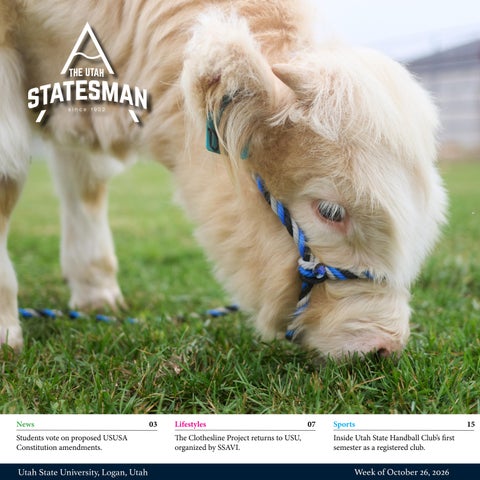
ighland cattle with heritage from the rolling fields of the Scottish Highlands are taking up residence at Utah State University as the school’s first live mascot in decades. On Oct. 23, USU officially announced the mascot’s name to be Thistle. “The choice of the Highland cattle connects to the university’s connection to the Scottish theme,” said Abby Benninghoff, head of the Department of Animal, Dairy and Veterinary Sciences. “We’ve got the bagpipes. We’ve got the Scotsman song. We’ve got an official tartan.” Aggies can expect to see Thistle at sporting games, university events and community events once the cattle are fully trained, according to Benninghoff. Jessica Oyler, USU vice president and chief of staff, said they hope to have him ready by either the last home football game or by spring. She said the president’s office was inspired to bring live mascots back to USU during one of Brad L. Mortensen’s first meetings as president of USU. “One of the things that we’ve actually talked a lot about are what are some traditions that Utah State holds dear,” Oyler said. “We started investigating what it would take to get a live mascot, and now we have this.”
Against the backdrop of the Wellsville mountain range, Thistle No. 1 grazes on a rainy day at the Sam Skaggs Family Equine Education Center on Oct. 22.
According to Oyler, their office has been working with the Department of Animal, Dairy and Veterinary Sciences to determine the best care for the new animals. Brett Bowman, a department lecturer and beef cattle manager, works alongside students majoring in animal science fields to do so. “He’s super mellow, easy, likes people,” Bowman said. The department encouraged USU to get Highland steers, which Benninghoff described as a particularly calm and cute breed. “Steers are males that have been castrated, and that is important for their behavior,” Benninghoff said. “If you have an intact male, they’re going to have high amounts of testosterone. They’re going to want to be breeding, and a male with that kind of behavior is much more difficult to handle.” In working with the office, Benninghoff also explained that cattle and herd animals need companionship and encouraged them to have two at a time. “This is to support the welfare of these animals — their physical health, yes, but also their mental health,” Benninghoff said. Benninghoff said that the two cattle they have now are called Thistle No. 1 and Thistle No. 2, and when they retire, their predecessors will be Thistle No. 3 and so on. She added that this will also allow the animals to share the duties of mascot. PHOTOS BY Ezra Robertson Their lifespan, according to Bowman, is around
On a rainy day at the Sam Skaggs Family Equine Education Center in Wellsville, Thistle No. 1 grazes outside alongside Brett Bowman on Oct. 22.
six to eight years. Benninghoff said the cattle are only about eight months old. “They’ll be pampered, so they could live a lot longer than that,” Bowman said. “In fact, I’m sure they’ll retire out somewhere with somebody.” One aspect of the cattle training process Benninghoff emphasized to the president’s office was the hope to get students involved. “We want students to be highly involved in the training and taking care of the mascot and involved when the mascot is out in public,” Benninghoff said. Benninghoff said students will have the opportunity to apply to be Highland Ambassadors, a group of around eight to 10 students that will train, clean and handle the cattle. “They will need to have training themselves, so they’ll take a class that we offer in our department for animal handling,” Benninghoff said. “They’ll also take a beef cattle production class so that they develop some of that background knowledge, and then they get to do that daily work with those animals.” These ambassadors will also have the responsibility to communicate with the public, according to Benninghoff. “They need to be knowledgeable and share information about this particular species of cattle: some of their unique traits, their behavior, how they’re taken care of, the role of livestock in our food systems, you know — big picture,” Benninghoff said. Before the public can meet Thistle, Benninghoff said they need to be acclimatized to loud environments and lots of people, like the environment of a football game. “They need to be what we call ‘halter broke,’ meaning you can put a halter around their head and
be able to guide them without stressing the animal, without endangering anybody to guide them on and off a trailer,” Benninghoff said. Benninghoff said they chose the color of Thistle for a specific reason. “We wanted white to kind of parallel with the blue for Big Blue,” Benninghoff said. “As a running joke, a lot of people have asked, ‘Well, are we going to color the hair?’” While Benninghoff said they would avoid dying Thistle’s hair, Bowman said his fur will still be soft and clean due to thorough shampooing and blow-drying done by the ambassadors. According to Utah State Today, the last time USU had a live mascot was in the 1970s. He was a bull named GUS that stood for “Go Utah State,” but was ultimately retired because he was harder to manage. This, Benninghoff said, is another reason a Highland cow was chosen. “There is just no denying how stinking cute these calves are,” Benninghoff said. One of the most important parts of having a live mascot, according to Benninghoff, is the safety and well-being of the animal and those that interact with it. “We will always keep in mind the welfare of those animals and make sure that the nature of the event, that the frequency of activities for them, doesn’t create stress,” Benninghoff said. “We want these animals to be healthy and happy, both physically and mentally.”
Thistle No. 1 grazes on some grass outside of the Sam Skaggs Family Equine Education Center in Wellsville on Oct. 22.
— essence.barnes@usu.edu
Thistle No. 1’s coat of white hair on a rainy day at the Sam Skaggs Family Equine Education Center. Oct. 22.
Page 9 - The Utah Statesman, October 26, 2026
Thistle: USU welcomes new live mascot
Page 10 - The Utah Statesman, October 26 , 202
Big band and country swing bring their styles to the TSC ballroom By Wyatt Cano STATESMAN REPORTER
A
t first glance, the image of a 1940s ballroom and the dust-kicking country dance hall seem worlds apart, but both styles have a lot more in common than many might think. Heather Burr, a member of the Big Band Swing Club, described the history between big band and country swing dancing. “There is kind of a rivalry when it comes to big band and country swing dancing,” Burr said. On Oct. 16, both big band and country swing dancing clubs came together to host Dancing with the Clubs in the Evan N. Stevenson Ballroom in the TSC. They invited students with any level of experience to come and join them. When planning the event, both clubs wanted the event to be a way of exposure for students to learn either dance style. “When planning everything, we want students to explore either dance style and let them explore dancing like we all did once, while helping them by teaching them step by step,” said Mason Pike, the Big Band Swing Club president. Students were welcomed by USUSA leadership at the door, and members from both clubs made sure everyone felt welcome when learning new dance moves. Adam Fillmore, a member of the Big Band Swing Club, highlighted the shared history between big band and country swing dancing. “What few people know is how closely related both dance forms are. They are basically siblings when you look at the history. Big band came first, but both forms share the same dance moves. Country came later, but when you look at them, they both have the same dance moves. It’s just the music that’s different,” Fillmore said.
Ryker Monson, the Country Swing Club vice president, and Amanda Richards swing dance at Dancing with the Clubs in the TSC.
For Burr, the Big Band Swing Club is trying to bring appreciation back to swing dancing and being a place for people to have fun. “For us as members, we try to find a place where people can learn how to swing dance but also just enjoy and have fun after a long day. We want to be a place where people can just unwind,” Burr said. Members of both clubs have different reasons for why they joined their club. Amanda Richards, a country swing dance member, found swing dancing an excuse to be social and find new people to meet. “For me originally, swing dancing was a way for me to find a place to meet a lot of cool people and to make new friends that I would never originally meet if I didn’t give swing dancing a chance,” Richards said. Meanwhile, Fillmore found it as a way for him to settle into college and come out of his shell. “For me, swing dancing was a way for PHOTOS BY Owen Clarke Various members of Utah State dance clubs practice a line dance on Oct. 16 in the TSC ballroom. me to meet new people and get out of my
bubble and find new friends,” Fillmore said. “I was an introvert, so it was a good way for me to get out there and settle into college.” When it comes to Utah’s culture, both clubs can agree that country swing dancing has swept all over Utah in recent years. “In the last 10 years, you can see that country swing dancing has grown a lot here in Utah. Right now, I would say it’s the most popular one,” Burr said. When planning the event, both clubs wanted to appeal to students who had never tried swing dancing or who were hesitant to join. Pike’s main goal was just giving people a chance to see if this is for them. “For people who are hesitant, I would say just give it a chance. We are trying to make a beginner-friendly environment for people to dance, and no one is perfect when they first start. We all struggle at first,” Pike said. Ryker Monson, the USU Country Swing Club’s vice president, wanted to give students a chance to gain confidence as he remembers his first days as a new member. “Our goal for this event is to give students a chance to gain confidence. Sometimes you’re your own worst critic. We don’t give ourselves the credit. We do improve, but we compare ourselves to others who have mastered swing dancing,” Monson said. Both clubs hope that students will come and try out what they have to offer. “My piece of advice for new people to dance is to just give yourself grace. No one is perfect when they start, and no one will judge you when you start either. We are all here to help you,” Fillmore said. Richards hopes everyone can enjoy the opportunities that dance opens for people. “Thanks to swing dancing, I get to meet and teach so many new people every time,” Richards said. “It’s a great place to just get out there and make new friends that you would not make if you did not join.”
Wyatt Cano is a first-year student studying public health and pre-med. He loves video games, the outdoors and playing saxophone. — wyatt.cano@usu.edu
By Payton Shannon STATESMAN REPORTER
U
tah’s “Indian Schools” are thing of the past, but a 2024 documentary argues their harm is still around today. Screened at the Logan Library on Oct. 15, “Tuniyay” is a documentary that questions why good people stood by while Native American children were sent to the Uintah Boarding School in Whiterocks, Utah. “If there’s ever been a wrong, it doesn’t expire,” said Craig Wirth, the writer and director of the film. “It’s a story that’s still current. Trauma is still current.” The Episcopal Diocese of Utah film, produced by The Office of The Rt. Rev. Phillis Spiegel, examines the church’s role in the Uintah Boarding School. According to The Salt Lake Tribune, the boarding school opened on Jan. 1, 1881, on the Uintah and Ouray Indian Reservation. Wirth, who grew up surrounded by reservations in Great Falls, Montana, has worked as a journalist in Los Angeles, New York and Salt Lake City. He said he started the project thinking it was about other people. “Then I realized, ‘My gosh, I’m part of it,’” Wirth said. He said as a kid he used racial slurs without thinking about them, and in his Montana school, Custer was a hero and Sitting Bull was “enemy number one.” The Episcopal Church did not run the Uintah school, but it was closely tied to it. Students were required to attend services at the church Forrest Cuch, a Ute elder PHOTO BY Owen Clarke who worked with Wirth on the film, now attends and Ute Elder Forrest Cuch responds to questions from an audience member at the Oct. 15 screening of “Tuniyay” at the Logan Library. helps lead. Wirth said students’ names are still carved into “I’m proud of the strength of our people to get through “Get rid of your fear. If a Native person pulls away, it’s not the backs of the pews. our own Holocaust,” Cuch said. who we are. That’s trauma.” “We did not run that boarding school, but we were so He said the schools might have worked if the government He encouraged people to continue reaching out and integrally involved that we own responsibility,” said Kurt had treated Native people as partners. building connections, even when those efforts are met with Cook, a historiographer at the Episcopal Diocese of Utah “I just wished that long ago they would have seen us as hesitation. who worked on the film. “We were there, and we didn’t more human,” he said. Wirth said young people have the tools to keep the story stop it.” Cuch also said the issue isn’t simple, mentioning the alive. Five religious groups in Utah took part in the school, boarding schools and the Indian Student Placement “They have the resources to do it,” Cuch said. “It’s in your Wirth said, but the film names only the Episcopal Church Program, which placed Native children in homes of iPhone.” because its purpose is to examine that church’s own members of The Church of Jesus Christ of Latter-day record, not to blame others. Saints. Cuch, a former tribal education director, said the point of “The world is not black and white,” Cuch said. the film is not shame. Some children found more stable homes, he said, while “You didn’t do it, your ancestors did,” Cuch said. “The others faced abuse and were taken advantage of. point of it all is we want to stop. We don’t want any more Cuch said people today are still standing by, often out of harm to our people.” fear. Rather than getting to know Native people, he said, Wirth said the effects of the schools show up two or three many only tolerate them, which creates what he called a generations later, in broken families and alcoholism on “superficial relationship.” reservations. “We want to be treated like human beings. That’s it,” “Could you imagine if you were 5 years old and you Cuch said. “We don’t want special treatment. We just want were sent away?” Wirth said. “Children came home at 18 Payton Shannon is studying information systems to be treated fairly.” without knowing how to live in a family.” with a cybersecurity emphasis. He made his own AI at Wirth and audience members connected the history Cuch said his people have survived by staying close to the 17 and started a tech startup before graduating from to present-day issues, including families separated by Creator, nature and ceremonies like the Sun Dance and WSU with his associate’s degree. immigration enforcement and tribes not being consulted Bear Dance. Language is still the hardest piece to restore, on Bears Ears National Monument. he said. — payton.shannon@usu.edu When asked how people can show respect, Cuch said,
Page 11 - The Utah Statesman, October 26, 2026
‘Why do good people stand by?’ Inside one of Utah’s Native American boarding schools
Page 12 - The Utah Statesman, October 26 , 202
Utah State Soccer finds ‘gems’ in Cache Valley Mia Lopez, a Logan native, said. “There are very talented players in the valley who tah State University Women’s Soccer has been probably aren’t getting the recognition able to sustain a high level of success over recent they deserve. Being able to pull from the years, winning the past three Mountain West valley has helped to develop a strong local championships and currently sitting atop the Pac-12 team.” standings. The team strives to keep local talent here One factor that has been able to sustain the team’s success at USU, as they see the benefits within the is their access to local talent. Currently, there are seven team. players on Utah State’s roster who come from Cache Valley, “We’re intentional about our recruiting, nearly a quarter of the roster. and I think this is a philosophy that’s Head coach Manny Martins has a few hypotheses as to been part of my recruiting philosophy, why Cache Valley produces so much soccer talent. His first which is we’re always going to want to has to do with the quantity of players in the valley. keep the best local talent in town. I mean, “I’ve learned since I’ve gotten to Utah State that Utah has it just makes sense,” Martins said. “We the most kids per capita playing soccer out of any state in have benefited from the fact that there’s the country. I’ve also heard that Cache County has the most been a lot of talent in the Cache Valley, so kids per capita out of any county in Utah, so I think that that part has been not necessarily in my PHOTO BY Elise Bliss has something to do with it — just pure numbers,” Martins control. I don’t get to dictate how much said. “I think it says a lot about the community. Moms and talent is in town, but I feel fortunate that Summer Sofonia, 2, contests a BYU attack during a 4-0 Aggie win on Sept. 10. Sofonia is a native of Hyrum, Utah. dads that volunteer to coach — it says a lot about the family kids are growing up in this area and they “There’s tons of groups in different parts of the field who atmosphere where people prioritize making sure that they can associate themselves with Utah State.” are cheering for a local girl,” Lopez said. “We bring a lot are a part of creating a good environment for their kids to Many of the Cache Valley residents have ties to Utah State of fans in general, but the local girls especially because we grow up with sports and other activities.” long before they join the team. For Lopez, those ties helped grew up around so many people from the valley. It goes to In addition to the quantity, Martins believes USU has an her return to Cache Valley after starting her collegiate career show how good of a support system we have.” advantage to accessing that talent due to the secluded at Brigham Young University. While the team views their local ties as a strength, they nature of the Cache Valley. “Growing up, I went to a lot of USU soccer games. I was make sure that factor doesn’t impact the team’s chemistry as “The kids in the Cache Valley that decide at some point able to see the environment as a fan and on the field, and a whole. during their high school years to leave and go play for the that helped me with my decision to come back because I “We work hard to make sure that the dynamic within clubs that play on the national platforms, they get recruited knew what I was going to get out of Utah State,” Lopez the team transcends location or regionality because we’re by successful programs on the national stage,” Martins said. “Growing up in this environment and being able to never going to have a team of 28 players from the Cache said. “Those who choose to stay more local will fly under see it from a different view really encouraged me to commit Valley, so we have to make sure that the team dynamic is the radar, especially for programs that are outside of our here.” not swayed one way or another because of that,” Martins state or outside of our region. But again, we maybe have Another benefit the team sees by recruiting from within said. “It certainly affects the dynamic within the community benefited from that a little bit.” Cache Valley is that many of the players come to the because I think the community is proud of Utah State and Many members of the team feel similar to Martins, which program with connections to their teammates that they how Utah State represents them, especially when Utah State they feel allows them to get lesser-known talent on the were able to develop in high school. has so many members of people from the Cache Valley that roster. “Having that background helps because we know each understand what the Cache Valley is about and that are “[Martins] and I were talking a while ago, and he used the other’s playing styles and we played with them before, so representing it to another level.” phrase ‘hidden gems,’ and I think that’s perfect. Since we just being able to bring that here helps a lot,” said Summer With the team having such strong ties to the community don’t get as much recognition in the valley, he’s able to pick Sofonia, a Hyrum native. “We’re all coming here, and we’ve as a whole, there is a sense of pride within the team to apart and find those hidden gems,” sophomore midfielder already had that experience of that high-level play, and represent Cache Valley within the state of Utah and beyond. so being able to transition was easier because “There’s a different motivation when we play other Utah we’ve already been playing with each other at a teams. Utah State gets stereotyped, and that’s what creates higher level.” that different motivation,” Lopez said. “We’re hungrier to be Lopez, who played her prep years at Logan the best team in that state and to prove that Utah State is High School, played alongside many of her the place to be.” current teammates. “I grew up playing with [Hadli] Barrera, Sofonia, and Capriel Winder. I think there’s a different connection when we’re all on the field together. I know how they play from high school, and that connection really does help.” Lopez said. “I think that connection helps off the field as well. I think it makes being with the team more fun, and I know how to connect with them because I grew up with them.” Rory McNeill is a junior from Rocklin, California Another benefit the team sees with its studying mechanical engineering. He loves Aggie connection to the valley is the attendance of sports, skiing, golf and writing music. PHOTO BY Owen Clarke fans wanting to support players they grew up Capriel Winder, 41, jogs down the pitch during a match against Saint Mary’s College on Sept 20. around. — rory.mcneill@usu.edu Winder is a native of North Logan, Utah. By Rory McNeill STATESMAN SENIOR REPORTER
U
University, where he went 16-8 in singles and charted a new SMU record of 13-10 in doubles play. Calvelo transferred to USU and joined the Aggies in tah State University tennis player Xavier 2025. Once joining the USU team, Calvelo climbed to Calvelo will attend the NCAA individual new levels, reaching 84th in ITA doubles rankings and championships on Nov. 17-22 as the first recorded an unbeaten streak of 15 wins in singles play. national competitor in USU’s new Pac-12 era. Men’s Tennis head coach Aaron Paajanen mentioned According to Daniel Hansen, the current assistant communications coordinator for USU, it’s been over 55 how Calvelo was discussed in 2025 as one of the nation’s most improved players of the year. years since Men’s Tennis last participated in the NCAA “It’s very obvious just from a results standpoint how Division 1 Men’s Individual Tennis Championships, much better he’s gotten,” Paajanen said. “It’s clear to with four participants from Utah State who attended everybody who’s followed his tennis career from when the match in 1970. he got here to where he is now.” Calvelo expressed his excitement to be competing at The men’s team has recorded several records the championship level, saying how it feels incredible and akin to something he only could have “dreamed of since Paajanen began coaching for USU in 2019, doubling the number of participations in NCAA team as a kid.” championships within a single year. “I enjoy playing. … Whatever challenges are ahead, Paajanen stated that there wasn’t one single reason whoever I play, I’m always excited to see what I can for the team’s success, but rather it was a matter of do,” Calvelo said. adapting to the strengths and weaknesses of individual Calvelo was born in the Philippines, but his family players. now primarily resides in Las Vegas, Nevada. “Rosters change quite a bit,” Paajanen said, “so it’s my He has four older siblings, two of whom are currently job to quickly recognize … what they all need in order serving in the U.S. military in Germany and Guam. Calvelo’s family supports him from afar as he continues to get them in the best position to get better — to continue to develop.” his journey to the championships this fall. Additionally, the men’s team won the Mountain West “Because I was born in the Philippines ... there’s not Championship and reached the ITA ranking of 51st in a lot of opportunities there to even go to the U.S. the 2025-26 season, making it their highest ranking and have an education,” Calvelo said. “For me to be since 2018. here, have an education and then be playing what I On May 1, the men’s team competed at the NCAA would consider a high level of tennis, it’s all just been team championships against University of Oklahoma incredible.” and was eliminated within the first round of the According to the 2026 USU tennis roster, Calvelo tournament. began his tennis career at Southern Methodist The men’s team has been close to qualifying for several other national matches in the past, including many other players from the men’s team, not just Calvelo. “It’s basically exciting to get somebody through. We’ve been close before,” Paajanen said. “When it was in the spring, we had some singles players close to the national rankings, and some doubles teams close to the national rankings that would have potentially gotten us there.” Though Calvelo was the only Aggie during the qualifying meet to make it to the championships, his fellow team members still have a chance to earn their way during the Pac-12 qualifier tournament in Spokane, Washington on Oct. 23-25. At this qualifier, USU junior Eliot Nobel and USU freshman George Hakopian will have another shot at PHOTO BY Dane Johnson the NCAA championships. If either
By Elissa Ross STATESMAN REPORTER
U
Xavier Calvelo hits a forehand during practice at the Utah State Tennis Courts on Oct. 19.
Page 13 - The Utah Statesman, October 26, 2026
Calvelo becomes first Aggie in over 55 years to advance to NCAA Individuals Championship
player wins the qualifier, then performs well at the postseason master’s tournament, they will have an opportunity to compete at nationals. Though the team’s fall season is coming to an end, there will be an opportunity for spectators to attend the spring matches starting in January. According to Calvelo and Paajanen, the matches are free for spectators and will be held at the Sports Academy & Racquet Club in Logan. “College tennis, right now, is at the highest it’s ever been,” Paajanen said, “so people in town — if they enjoy sports, if they enjoy good athletes — it’s free to come out and watch us.” Five freshmen joined the men’s team this fall season. Calvelo mentioned how he’s never really seen himself as a leader during past years. However, this season, he’s felt himself step into a leadership role. Calvelo says he’s found himself having to “guide them a little bit” and that the new team members have been doing “super well so far.” “They’re all looking up to me … and they’re all seeking advice,” Calvelo said. “I think it helps being a leader by example.” Currently, Calvelo is on a streak of five consecutive wins. As Calvelo prepares to head to the championship in November, his primary goal is to train himself mentally for the match. “It’s hard to describe,” Calvelo said. “In my own time, I just kind of picture myself not just playing NCAAs but performing even further than that.” Calvelo hopes to continue to grow as a player with the “bigger picture” of someday becoming a professional tennis player. “I don’t really know how far it’s going to take me,” Calvelo said, “but if it could take me as far as No. 1 in the world, then why not give it a shot?”
Elissa is a sophomore from Heber City, Utah studying communication studies. She enjoys hosting her weekly radio show on Aggie Radio, hip-hop dancing and writing in her journal. — elissa.ross@usu.edu
Page 14 - The Utah Statesman, October 26 , 202
Following in family footsteps: Landon Rehkow’s path to USU and beyond that’s why I came over.” It’s not just the team that makes him feel welcome. According to USU special teams coordinator and wo years ago, Landon Rehkow was cut as a punter linebackers coach Shane Hunter, Landon fits right into at Brigham Young University. He was playing alongside his brother, Ryan Rehkow, until Ryan was the team, often staying after practice to work and build relationships with his teammates. brought up to punt for the Cincinnati Bengals after the “Practice is well over, and he’s sitting there still kicking 2023 season. Their oldest brother, Austin Rehkow, signed with NFL teams such as the Indianapolis Colts and Buffalo around, messing around with the guys and having a good time,” Hunter said. “The guys appreciate him for one, what Bills, according to the Indianapolis Colts website. he’s doing on the field, but also how he’s doing it.” Landon was inspired by his older brothers. When asked Now in his second year at USU, Landon has started to about why he wanted to enter the gridiron and punt, he make big plays for the team, especially when punting from mentioned his brothers. the opposing 45-yard line, according to Hunter. “In high school, [Austin] was the first one to really play “Coming off of last year, what we call our sky punts, football in our family, other than my dad, but he kind of set we weren’t great at them. That was the area that we the way,” Landon said. “I got to see firsthand how football challenged him to get better at in the off-season. He can change somebody’s life. He set the example for the rest of us, and all of us have since, other than my youngest worked on it, and you see the success that he’s had,” Hunter said. “I think this year, in terms of hit and plant brother, been able to play collegiate football and have situations, and that’s what we consider like 45 in the great careers, so it’s been great.” opposite 45. I think he’s seven of eight, like putting them Landon played his first year of collegiate football at BYU where we can get them. The only one was the Utah one. where his brother Ryan was already punting. He just kicked it a little low, but we still had a chance, and “It was a lot of fun. My first year was with him, and so I got to see just what hard work looks like, and really what it so he took the challenge. He was like, ‘I’m going to get better at it.’ It’s helping our team a lot.” took to be at this level, especially going to the next level,” Off the field, Landon has other priorities that take up his Landon said. “Just having an example is really the biggest time and attention. Along with being close to graduating thing that I got from that. Other than that, it’s super fun. with a major in management, Rehkow and his wife have Just all in all, we just got to hang out for a whole season recently welcomed a little girl into the world. and play a lot of ping-pong.” “It just gives me more to play for. I’m not playing just for After being cut from BYU, Landon took a visit to Utah myself anymore, or even just for me and my wife,” Landon State University where he said he felt very welcome. said. “There’s a third person I have to take care of, and so “I mean, I got cut. That kind of puts it into perspective,” Landon said. “I think the main reason I came to USU was I yeah, I think that’s just a greater perspective on life itself. Got to work hard for what you got.” took a visit here, and I got to meet some of the coaches — Landon acknowledged the role of his wife in getting especially coach Mendenhall — and the biggest thing for him to where he is today. Along with his brothers, he me was wanting to be wanted, and I felt that here, and so
By Quinton Papa STATESMAN REPORTER
T
mentioned his wife as a major role model. “I’ve got a lot of great role models in my life, especially my wife. She’s the epitome of hard work. I just try to do my best to do my part,” Landon said. Looking forward, Landon is working hard to follow in his brothers’ footsteps into the NFL. When asked about moving to the next level, he said it was all about mindset. “If you want to do something, you got belief, and once you believe, then you put forth the effort,” Landon said. “Who doesn’t want to play at the next level? I think that’s something that I want to do.” Hunter was encouraging, but firm about what it takes to get to the professional level. “I always tell this: it’s up to him,” Hunter said. “I mean, he’s had two older brothers, and both of them are obviously really good, and so that’s why with kickoffs, I tell him the more you can do, the more you can do. It makes you more marketable. It gives yourself a better chance. Whether it’s punting, kicking, whatever, and if that’s your goal, then you got to do everything you can to get there.”
Quinton is a senior studying communication studies from Springfield, Missouri. He loves writing music, off-roading and being an Aggie. — quinton.papa@usu.edu
By Cambria Thurgood STATESMAN REPORTER
U
tah State University’s Campus Recreation has lots of club sports for students to get involved in. Club sports range anywhere from baseball, men’s hockey, and men’s and women’s soccer to rodeo, shooting, disc golf and water polo. This semester, a new club sport joined the list: the Utah State Handball Club. “You do not have to be a super athlete to play handball. Anybody can come play,” said Herm Olsen, one of the coaches for the team. Olsen graduated from USU in 1973, and he said that back when he started college, handball was a popular sport. “That’s all anyone played,” Olsen said. “Handball was the best sport.” After graduation, he moved away from Logan. When he moved back in 1990, handball wasn’t as popular. “When I came back, the only guys who were playing handball were old guys — older than me,” Olsen said. “I thought, ‘This is too good of a sport to just let it die.’” That’s when he asked the university if he could teach a handball class to get students back involved. “I’ve been teaching the class and then coaching the team for almost 30 years,” Olsen said. Handball is played in a four-wall court. Players score points by hitting a rubber ball with the palm of their hand to hit the front wall. Opponents will hit the ball at the wall and go back and forth until one of them fails to return it. “Once the ball hits the front wall, it’s the other opponent’s turn to then return your hit,” said Seth Gentry, president of the Handball Club. “It can only bounce once
before you have to hit it and return the ball. If you mess up, it’s either the other person’s point or you get to serve.” Players are only able to get points if they are the ones serving the ball. “If your opponent doesn’t return the ball and it doesn’t hit the front wall, you get a point if you’re serving,” Gentry said. “If you weren’t serving, you swap servers, then when your opponent messes up you get the point.” The first player to score 21 points wins the game. Gentry said he found the sport through his older brother who signed him up for the handball class. “I ended up taking it, and I really like it. I decided to join the club and then we became a club sport and we needed a president. I was the oldest member at that point,” Gentry said. “I would say it’s probably my favorite sport out of all the ones I’ve played.” The handball team has gone to national competitions where they compete against other schools across the United States and even against teams from Ireland. “We compete with the great schools like New York, Michigan, Texas, California and Missouri — some of the best handball teams in the country,” Olsen said. “Over the years, we’ve done very well. We’ve even won two national championships.” There are two different kinds of competition: individual play and team competitions. “If it’s an individual play, it’s not a team effort so you play, and if you win, you go to the next spot like a bracket,” Gentry said. “If it’s a team, it’s different. You only play one versus one or two versus two. If you win, you get a certain number of points and then collectively as a school you combine points, and whoever has the most points at the end wins.”
In order for everyone to compete, the competitions are set up into five divisions that correlate with players’ skill levels. “There’s ‘novice’ for people who have just put gloves on and don’t hardly know how to play, but that’s okay because they’re playing other novice players who are in the same situation,” Olsen said. “And then there’s a C level, a B division and an A division. Then there’s an ancient division and that’s the one I play.” Since becoming a registered club sport, the handball club has received a $2 million endowment. This endowment was made in support of the growing handball team and will help with tournament travel and support students. “To take a team to tournaments, we’ve got to reimburse kids for their gas or their airplane flight or their hotel. It gets kind of pricey,” Olsen said. When the endowment was announced, Olsen said he felt “over the top.” “This endowment will go a long way into making sure we can take as many kids that want to go play,” Olsen said. “It’s great.” When students come to play handball for the first time, Olsen said by the end of the semester they’re already competing and strategizing with people who have played the sport for longer. “You never want to go where the ball is — you want to go where it’s going to be. You’ve got to do some instantaneous thought processes about how to get there and how to move and swing,” Olsen said. “Any student can develop that. They don’t have to be super good to begin with.” When students first begin learning how to play, Olsen said they have to remember what he calls “The 10,000 Rule.” “You’ve got to swing and hit that ball 10,000 times before it starts to feel comfortable,” Olsen said. The handball team practices in the HPER on Mondays and Wednesdays, and their doors are open to anyone. “We’ve had people who have never played sports before come and try it,” Gentry said. “It’s for everyone.”
Cambria is from West Point, Utah. She is a junior double majoring in journalism and communications. She loves camping and snowboarding.
The USU handball team gathers outside the courts after a practice in the HPER on Oct. 14.
PHOTO BY Lola Probasco
— cambria.thurgood@usu.edu
Page 15 - The Utah Statesman, October 26, 2026
USU handball team starts first semester as a registered club sport
Page 16 - The Utah Statesman, October 26 , 202
AGgIe RAdIo PReSeNtS
BlAcK CaT BrOaDcAsT
LIsTeN On AGgIe RAdIo 92.3 fM oR At rAdIo.uSu.eDu OCtObEr 30tH, 2026, 8aM-8pM RAdIo sHoWs, SpOoKy sToRiEs, GiVeAwAyS, tArOt rEaDiNgS & MoRe!
Since her breakthrough hit over a decade ago with 2014’s “2 On,” Tinashe has established herself as a contemporary R&B scholar, with a minor in club classics. She’s continuously upped her game with each release, having one finger on the pulse of pop and the other on the fringe of electronica. Her most recent offering, “Popstar,” released Sept. 25, is infectiously catchy, eclectic and confident. Album opener “Sunglasses,” through an obtuse, minimalist soundscape, preaches “music my religion.” Her faith is laid bare across 16 tracks as they unravel to their raw, digital components, before rebuilding again underneath pristine vocal delivery and layering. Back-to-back hedonistic kiss offs “Too Easy” and “Melatonin” are perfectly curated dopamine IV drips; Fischerspooner-esque synths tightened to perfection. This isn’t just a club album, though. The uneasy sensuality of “Flashbacks” is the perfect mix of tender and tongue-in-cheek, bringing us off the dance floor and onto the hardwood floors of a fling we used to know. The title track “Popstar” serves as a thesis statement to the project. Amidst vocal layering, she explores lyrical clichés not with irony, but respect, after which “Cloud 9” takes us along for a well-deserved victory lap. Tinashe reinvents the wheel by paying respects to the altar of pop. She is ship of Theseus-ing the well-loved formulas of pop, delicately replacing it with pristine abstraction. It’s just too easy for her. — Dottie Lesueur
It’s Not a Phase, It’s ‘Pylon’
On Sept. 18, beabadoobee released her latest album, “Pylon.” Listening to this album feels like screaming, “It’s not a phase, Mom!” while whispering, “I love you,” all the same. While stylistically the album is similar to beabadoobee’s other works, I thought to myself while listening that it could fit into Paramore’s own discography, only for Hayley Williams herself to prove me right with a feature on “Nothing To Prove.” “Pylon” feels like beabadoobee is making precisely the music that she wants to make, and that sentiment is felt in every chord. She might as well be saying, “This is me! Take it or leave it!” I find the sounds on this album intoxicating. The grunge-esque guitars and unapologetically loud drums are the backing track to nearly every song, with the vocals being almost screamed into the microphone or whispering directly into your ear. The intentional feedback blaring combined with beabadoobee’s powerful yet soft vocals create a piece of music that is overloaded with emotion. Anger, joy, sadness and a mix of everything in between was what this album was created with —a good listen for any situation. The album does feel a little repetitive, however, with nearly every single track employing the same components. The vocals are the key factor that manage to give every song their own distinctive feel. If you love crashing out with a guitar and staring out the window at the rain, this is the album for you. —Isabella Fierro
Over Now
Useless
Groan
Add It Up
OC93
Dak’s Back
Alice In Chains
Junkhead Radio Junkhead is your weekly fix of handpicked alternative music. DJ Cate is always exploring and featuring different genres of alternative music and showcasing her top picks. Tune into Junkhead radio Fridays at 2 p.m. on Aggie Radio 92.3 FM.
Dazey and the Scouts
The Garden
Satanic Togas
Violent Femmes
The Buttertones
Page 17 - The Utah Statesman, October 26, 2026
Tinashe embraces inner ‘Popstar’ on latest release
Page 18 - The Utah Statesman, October 26 , 202
USU Hockey goes head to head with NAU
Owen Clarke is a senior from Downingtown, Pennsylvania studying information systems. He loves playing the cello, climbing and motorsports. — owen.clarke@usu.edu
Page 19 - The Utah Statesman, October 26, 2026
Last week’s solution:
Sudoku puzzles are provided by www. sudokuoftheday.com.
Page 20 - The Utah Statesman, October 26 , 202
Debug your gameplan. Verify you’re a student; unlock $579 value.