the
ustinovian
62nd Edit ion
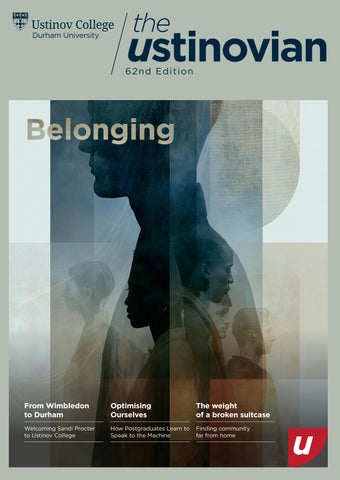
From Wimbledon to Durham
Optimising Ourselves
The weight of a broken suitcase
Welcoming Sandi Procter to Ustinov College
How Postgraduates Learn to Speak to the Machine
Finding community far from home
u
Editor Zoya Medina Published with the support of Ustinov College The Graduate Common Room (GCR) The Global Citizenship Programme (GCP) Special Thanks to Glenn McGregor Professor of Climatology, Department of Geography Principal of Ustinov College Sophie Holland Vice Principal of Ustinov College
Editor’s Note
Jasmine Donovan College Administration Coordinator © 2026 The Ustinovian Printed in Durham, United Kingdom
Hello everyone,
the
ustinovian
2
contents 62n d Edit ion
The Ustinovian magazine is written by Ustinovians, for Ustinovians. The views, opinions and positions expressed by the authors and those providing comments in the articles do not necessarily reflect the views of Ustinov College or Durham University.
3
Editor’s note
4
My Journey to Becoming Interim Principal
6
Ustinov Serve: Volunteering in and for our community
8
From Wimbledon to Durham: Welcoming Sandi Procter to Ustinov College
10 Optimising Ourselves How Postgraduates Learn to Speak to the Machine
CUR/07/26/434
12 Whose City Is It, Anyway? On Durham, the University, and the Community Left Behind
If you would like to submit to the next edition of the Ustinovian, please email zoya.f.medina@durham.ac.uk
durham.ac.uk
theUstinovian
16 Stuck in the Middle of a Film Review and a Breakdown 18 10 years later, Durham still feels like home 20 The Seat Had Always Been Mine 22 The (Wash) Cycle of Violence 24 Eid Mubarak to those who celebrate! 25 The weight of a broken suitcase
This year’s issue of The Ustinovian is in many ways centred around belonging. Among these pages you’ll find stories of navigating identity, building community, and learning to exist between new cultures and expectations. This edition goes beyond day-to-day life at Durham, and explores both the positives & negatives of postgraduate life, especially as an immigrant; from the uncertainty and pressure of academia, to homesickness and adapting to a new environment. Together, these pieces capture the complexity of life at Ustinov. The moments of connection, the isolation, the confidence, the selfdoubt, the comfort, but also the displacement that coexist within a diverse & international community like ours. Through the variety of work submitted, this issue offers an honest portrait of the challenges of post-graduate life, while also celebrating the experiences that give it meaning. It has been an absolute honour to read and reflect on this year’s submissions, and bring together a collection of work that feels both deeply personal and profoundly relatable. I hope these stories resonate with you, and perhaps help you recognise bits of your own experiences within them. Happy reading! Zoya Medina
MSc Management (Entrepreneurship) Editor of The Ustinovian & Pantomath
3
My Journey to Becoming Interim Principal If someone had told me at the start of my career that I would one day become Interim Principal of a Durham University college, I would never have believed them. My career began in Teesside, working with vulnerable young people and helping to raise aspirations in communities where higher education was not always seen as an accessible or achievable pathway. It was during this time that I developed a passion for education, social mobility, and supporting people in recognising their potential. Seeing the impact that encouragement, opportunity, and belief can have on someone’s future shaped the values that continue to guide me today.
4
From there, I moved into higher education, spending a number of years working in student support and student experience roles. I had the privilege of working with students from a wide range of backgrounds, helping them navigate the challenges of university life while making the most of the opportunities available to them. These experiences reinforced my belief that universities should not only provide academic excellence but also foster belonging, confidence, and personal growth. Joining Ustinov College was a significant milestone in my career. As Durham University’s only exclusively postgraduate college, Ustinov is a truly remarkable community. Every day I have the opportunity to engage with students from across the world, each bringing unique experiences, perspectives, cultures, and expertise. One of the greatest privileges of my role is that I learn something new every day from the people around me. Our postgraduate community is intellectually curious, ambitious, resilient, and committed to making a positive impact on the world. It is impossible not to be inspired by the students who call Ustinov home.
What excites me most is seeing Ustinov continue to grow in confidence and reputation. Increasingly, the college is making its mark within Durham University and beyond. Through our academic engagement programmes, volunteering opportunities, publishing platforms such as The Pantomath and The Ustinovian, global citizenship initiatives, alumni networks, and the incredible range of events led by the Ustinov Graduate Common Room, Ustinov is becoming recognised for the unique contribution it makes to postgraduate life. The Graduate Common Room plays a vital role in creating a vibrant and
Being appointed Interim Principal is both an honour and a responsibility. It is a role I take great pride in, and one that allows me to continue supporting a college community that I care deeply about. My vision is to ensure that Ustinov remains a place where students from all backgrounds can thrive, build meaningful connections, and achieve their ambitions. Looking back, my journey has been shaped by the people I have met along the way. From the young people I worked with in Teesside to the students and colleagues I work with today, each experience has reinforced my belief in the transformative power of education and community. As I begin this new chapter as Interim Principal, I remain committed to the values that first 5
My vision is to ensure that Ustinov remains a place where students from all backgrounds can thrive, build meaningful connections, and achieve their ambitions. welcoming community, bringing students together through cultural celebrations, social events, sports, formals, and opportunities to build lasting friendships. It is exciting to be part of a college that is continually evolving while remaining true to its values of inclusivity, diversity, and community. Over the years, I have been fortunate to work alongside dedicated colleagues, inspiring students, and engaged alumni to develop initiatives that strengthen community, encourage volunteering, promote global citizenship, and enhance academic engagement. Whether supporting individual students, leading strategic projects, or helping to shape the future direction of the college, I have always been motivated by the opportunity to make a positive difference.
inspired me to work in education: creating opportunity, raising aspirations, and helping people realise their full potential. Most importantly, I remain grateful to be part of a postgraduate community that continues to challenge, inspire, and teach me something new every single day. As Ustinov continues to grow and strengthen its reputation, I am proud to play a small part in its story and excited about what the future holds for our college community.
Sophie Holland Interim Principal (Sept 2026) Ustinov College
durham.ac.uk
theUstinovian
Ustinov Serve: Volunteering in and for our community Samantha Brant PhD in Education
Service is a key pillar of Ustinov College. The students of the college give hundreds of hours to organisations and efforts that serve the local community but provide lasting impact on a global scale. From planting flowers to sharing research, Ustinovians find ways each year to contribute to the Durham community and beyond. Here are a few of our ongoing projects.
REfUSE Cafe in Chester-le-Street
seminar about food waste and the café, became a regular group volunteering opportunity.
Over the last two years, Ustinov has developed a partnership with REfUSE Cafe in Chester-le-Street. The cafe is a social enterprise that focuses on providing healthy food to the community on a pay-as-youfeel basis. They raise awareness and run programmes to combat food waste and the effects of climate change. What started as a Global Citizenship Programme (GCP)
Some of the projects conducted in partnership with REfUSE have included organising the warehouse, pressing apples for juice, serving with the catering team at largescale events, and making jams and chutneys. The cafe is a lively community hub run with the help of many volunteers, and Ustinovians have delighted in playing their role to continue the success of the cafe!
Children’s Parties at Keenan House
Toward the Future As Ustinov looks toward the future, volunteering will continue to be a valued piece of college life. Whether it be projects initiated by the college such as beautifying Sheraton Park or supporting the university volunteering office by participating in the collecting canned food or writing Christmas cards, Ustinovians will take part. The volunteering spirit is strong at this college, and new partnerships and opportunities are always on the horizon!
Many Ustinovians, especially PhD students, have families who live with them, usually at Ustinov’s accommodation at Keenan House. The GCP and GCR have come together to provide engaging and entertaining evenings of crafts and games for the younger children there. Volunteers have helped teach crafting skills such as painting or paper folding to create beautiful decorations that celebrate holidays and seasons. The parties offer a way for the children to interact, learn new games, and express themselves through art and play. Last year, children were invited to five parties throughout the academic terms to celebrate Halloween, snow and winter, Valentine’s Day, spring, and summer.
6
Ustinov SPARK Ustinov SPARK is an award-winning programme designed to support the depth and breadth of research undertaken by our postgraduates and facilitate the communication of that research to a wide range of audiences in our local community. Students volunteer to visit local primary schools throughout a week in the spring where they present their research course work to Key Stage 2 pupils in an engaging and age-appropriate way. After each presentation, the children have the opportunity to ask questions about the topics and university life. This annual project has served as an excellent opportunity for Ustinovians to interact with local schools and provide a snapshot of postgraduate study to local school children. Additionally, it provides Ustinov students the opportunity to think about and disseminate their own work and ideas in a unique way.
durham.ac.uk
theUstinovian
7
LTA President, Sandi Procter speaking at the Tennis History Conference (Credit: AELTC)
Jonathon Dawes alongside the three panelists Ingrid Löfdahl Bentzer, Sam Smith and Sandi Procter
From Wimbledon to Durham: Welcoming Sandi Procter to Ustinov College 8
Jonathon Dawes, Ustinov College President 1st Year PhD Student in the Department of Sport and Exercise Sciences
9 Jonathon Dawes speaking at the Tennis History Conference (Credit: AELTC)
My first conference as a PhD student was the Tennis History Conference, hosted at the All-England Lawn Tennis Club, home of the Wimbledon Championships. This bi-annual conference brings together historians, researchers, tennis enthusiasts, and members of the British tennis community for presentations and discussions that cross disciplinary boundaries. The theme of the 2025 conference was “Trailblazers in Tennis,” marking the 50th anniversary of Arthur Ashe and Billie Jean King’s ground-breaking 1975 Wimbledon victories. It focused on the people, innovations, and movements that have helped to shape and reshape tennis over time. I had the privilege of speaking alongside three remarkable figures in the sport: LTA President, Sandi Procter; former world number 14 and founding member of the Women’s Tennis Association, Ingrid Löfdahl Bentzer; and former British number 1, Sam Smith. Together, we explored what at first seems a simple question: what does it mean to be a trailblazer? The discussion situated tennis within its wider social, political and historical context, reflecting on continuities and changes over time
— from the activism and visibility of figures such as Billie Jean King and Arthur Ashe in the 1970s, to contemporary leadership within governing bodies, examples of player advocacy on the professional tours, and a speculative conversation of what trailblazing in tennis might look like in the future. I have known Sandi for several years through my role as a Lawn Tennis Association Councillor. After the panel, she mentioned that she
would be visiting Sunderland in February as part of her work on the Tennis Europe Board. I asked whether she might be willing to visit Ustinov College while she was in the North East for a seminar and dinner organised jointly by the Graduate Common Room and the Global Citizenship Programme, and I was delighted when she agreed. Sandi’s visit to Ustinov College became one of the highlights of the academic year so far. Drawing on more than 25 years of leadership in British tennis, she reflected on her experience of driving change through the roll out of mini tennis, the importance of volunteering in sport, and the broader influence sport can have beyond the court. Her central message resonated strongly with many of those in the room: the importance of making opportunities, taking opportunities, and, just as importantly, giving opportunities to others. The evening ended with dinner and a generous gift to the College from Sandi: a signed Great Britain Davis Cup shirt bearing durham.ac.uk
Sandi’s visit to Ustinov College became one of the highlights of the academic year so far. the signatures of team members, including two-time Wimbledon champion Sir Andy Murray. It was a wonderful gesture and a memorable way to mark the occasion. For me, one of the most valuable lessons from this experience was what Sandi described as the importance of making opportunities. Sometimes new opportunities begin with attending a first conference and asking a quick (or in this case cheeky!) question about whether something might be possible. At Ustinov, I think there is real scope for all of us to contribute in this way. Whether through our academic work, professional networks, creative ideas, or willingness to get involved, each of us can play a part in supporting the College’s continued
theUstinovian
growth and development. Everyone doing their bit can help open new doors for others, help us move into new spaces, and strengthen the sense of community that makes Ustinov such a distinctive place to live and study in Durham. I am very grateful to everyone whose support made this possible: to Sophie and The Ustinov College Team and the Graduate Common Room Executive Committee for encouraging the idea and hosting such an inspiring visit; to the Department of Sport and Exercise Sciences and my supervision team for their continued guidance and encouragement; and to the Northern Ireland and North East England Doctoral Training Programme (NINE DTP) for supporting my time at Durham, both as a master’s and PhD student, and for enabling opportunities such as this along the way.
Jonathon Dawes, Professor Glenn McGregor, Sandi Procter and Sophie Holland alongside the signed Davis Cup t-shirt gifted to College
Optimising Ourselves How Postgraduates Learn to Speak to the Machine Mustafa Abbas MSc Financial Technology & Banking
For many of us at Ustinov, the modern job hunt begins not with an interview, but with a quiet, high-stakes negotiation between a CV and an algorithm. Late at night in the Bill Bryson Library, the “academic” work ends and the “optimisation” begins. We rewrite lines to mirror job descriptions and carefully insert keywords to ensure our documents survive the invisible filters of Applicant Tracking Systems (ATS) before a human ever sees them. If your evening feels less like a pursuit of knowledge and more like a bureaucratic episode of Black Mirror, you’re definitely a Durham postgrad on the job hunt. trading our hoodies in for Patagonia gilets and a sudden interest in “market dynamics”. Oftentimes, we find that these “algorithmic gatekeepers” are the first and most formidable hurdle.
10
What used to be a straightforward application has become a strategic exercise in professional “debugging”. We test, tweak, and refine our CVs like code, adjusting keywords and restructuring experiences until
Increasingly, we aren’t just preparing for interviews; we are preparing for algorithms. We find ourselves trying our absolute best to impress an AI model, essentially performing a digital song-and-dance for a recruiter that doesn’t actually have a heartbeat. In this era of automated screening, the process of finding a job has quietly transformed into a game of technical strategy. This shift feels particularly surreal for the postgraduate community. Many of us, such as myself, come to Durham specifically to pivot, perhaps transitioning from a background in Computer Science to the world of Finance, effectively
durham.ac.uk
theUstinovian
The Industrial Revolution mechanised manual labour. The late twentieth century saw computers rewrite the rules of office work. The internet fundamentally changed how businesses hire. the output finally passes. It turns out that understanding how these systems operate is now almost as important as the degrees we are working so hard to earn. While this digital mediation can feel unsettling and occasionally absurd, history suggests that these “machine-driven” growing pains are far from new. Every major technological shift has forced us to change how we access opportunities. The Industrial
Revolution mechanised manual labour. The late twentieth century saw computers rewrite the rules of office work. The internet fundamentally changed how businesses hire. In each case, people were initially uncertain about how to adapt. Yet, over time, individuals and industries adjusted, developing new skills to navigate the evolving systems. For students today, this process of adjustment is already well underway. We are learning to approach the job search with a greater sense of strategy and awareness, refining the way we present ourselves until the “system” becomes just another tool we’ve mastered. Despite the growing presence of automated systems, the process itself remains fundamentally human. While technology helps massive organisations manage the sheer scale of modern hiring, it cannot fully capture the qualities that often matter most when selecting a teammate. While the modern job search may begin with digital filters and automated screening, it still ultimately depends on the connections formed between people. Interviews, conversations, and personal interactions, the kind we practice daily in our college common rooms, continue to play a central role. It is in these moments that curiosity, communication, and character become visible in ways no system can easily measure. We may optimise our CVs for the machines, but it is our unoptimised selves that people ultimately remember.
11
Whose City Is It, Anyway?
“ DURHAM’S 12
COLD WIND CUTS THROUGH US. THE CATHEDRAL RISES OVER THE RIVER WEAR LIKE SOMETHING DREAMED RATHER THAN BUILT.
13
durham.ac.uk
theUstinovian
Whose City Is It, Anyway? On Durham, the University, and the Community Left Behind
The university runs programmes. Issues statements. Talks about community. I do not doubt that it is sincere. Ustinov College’s SPARK initiative, where postgraduates present their research to Key Stage 2 children from local schools, is one of the more honest versions of this. It is not a press release, but an afternoon in a room with seven-year-olds who are being shown, concretely, that university is a place where people like them might one day belong. But an institution cannot remedy a harm it has not fully admitted to causing. It is housing policy, planning decisions, and sustained school outreach that change who actually ends up behind those gates.
By Loveleen Jain, LLM candidate in Intellectual Property Law at Durham University
Durham’s cold wind cuts through us. The cathedral rises over the River Wear like something dreamed rather than built. But beauty can be possessed. Which is precisely why it matters who possesses you, Durham.
14
I am torn in this debate. I have lingered here long enough to recognise faces, to move with the city’s pulse, to mistake routine for belonging. Yet I now see the transformation that I am part of. Students like me do not just pass through Durham. We reshape it, quietly, unintentionally, and uninvited.
This tension is not new. The townand-gown divide has scarred English university cities for centuries, and Durham carries some of its oldest scars. The deepest scar is housing. Walk around the streets near the city centre and you see row after row of houses turned into private
accommodation. One house on Ferens Close in Claypath went up in price by 52% in three years. Private rents across Durham went up 9.2% in just one year, rising faster than anywhere else in the Northeast. What remains is not a housing market. It is an eviction, conducted slowly, street by street, in the language of supply and demand. There is also a class issue here that people rarely discuss. Durham University has more students from private schools than almost any other top university in the country. For those students, Durham is simply the next beautiful thing in a life already full of them. For the child who attended the comprehensive and never considered applying, the university does not represent an opportunity withheld; it is a world so remote it was never considered as a possibility.
Is this city built for students or for the people who actually live here? I reckon neither the students nor the locals can truly call it home. I keep returning to these questions and finding no clean answer, only the faces of people who have stopped expecting one.
https://www.palatinate.org.uk/ durhams-housing-market-is-out-ofcontrol/ 2 Intergenerational Foundation, “Durham epitomises the housing affordability crisis facing students”, 2 April 2025. https://www.if.org.uk/2025/04/02/ durham-epitomises-the-housingaffordability-crisis-facing-students/
Walk around the streets near the city centre and you see row after row of houses turned into private accommodation. 15
Students come here from across the world. For them, this city is the dream, finally standing still long enough to touch. I understand that feeling. But I think about the kid who grew up here, who walked past these same buildings on the way to school, and for whom none of this ever felt like it was reaching toward them. Durham exports aspiration to the world and quietly withholds it from those who have never had to travel to find it.
durham.ac.uk
For Jake Towns, who showed me what this city feels like from the other side.
Palatinate, “Durham’s housing market is ‘out of control’”, 26 October 2023.
That work is slower and less visible, which is perhaps why its efforts aren’t showing yet.
And then the buildings. Norman archways, courtyards worn smooth by centuries, chapels that have held more history than most cities ever accumulate. Locals have grown up minutes from here and never walked through those gates. Not turned away at the door. Just never made to feel that the door was theirs to open.
One house on Ferens Close in Claypath went up in price by 52% in three years. Private rents across Durham went up 9.2% in just one year, rising faster than anywhere else in the Northeast.
I love Durham. I did not plan to. Its cold wind, its cathedral light, the way its streets seem to fold secrets into themselves. But I cannot love it honestly without sitting with what it withholds, and from whom. The wind at least does not discriminate. It cuts through all of us, student and local, newcomer and lifer, equally and without apology. The city has not yet learned to do the same. Until it does, the least those of us passing through can offer is the honesty to say so.
theUstinovian
Stuck in the Middle of a Film Review and a Breakdown. Apabrita Mitra Sarkar, PhD in Philosophy, South Asian Literature
I first watched Martin McDonagh’s In Bruges sometime in 2023. It is a brilliant film and I would strongly recommend it, even though I am going to spoil it for you a little in the next few paragraphs.
16
The thing is, I never really imagined that I would be trying to relate to one of the protagonists of In Bruges, of all films. He is a hitman called Ray, who accidentally kills a kid and is sent to the medieval, dead, touristy town of Bruges in Belgium by his boss, where he awaits his fate. Ray has no idea that his boss, played by Ralph Fiennes, in case that is of interest, is going to ask his longtime partner to kill him here. So, for him this is basically purgatory, he is in limbo awaiting his fate. It is a comedy, just by the way, and if you ignored the murder bits and focus on just the town, does it not seem a little like this beautiful place that we are living in? Medieval, maybe a little dead and definitely touristy. If you google Bruges, you will see pictures of very familiar cobblestone streets, gothic architecture and a lot of canals. But for me, the resemblance has not just been architectural; it has been a little bit like purgatory as well. This is a retrospective piece. It’s pretty much a journal entry, if I am being honest. In fact, this is several journal entries, some of which are from my first term in Durham, put together as a piece. To be fair, I have spent over six months in this town by now and I am still wondering if this feeling of being in limbo should apply to me. But what I am waiting for is clarity on whether I love this city as a home of sorts or if it is always going to be a transitional space.
For the first couple of weeks of lovely parties organised by the Ustinov GCR that I could go to because no one expected me to start working on my PhD, it was a vacation. But then I realised that I would have to start making this place feel like home. Whether it is trekking up the hill leading up to Ustinov after dark or convincing myself that the Observatory Hill route would be faster only to make it back to the flat and start furiously scrubbing my muddy shoes, I would have to accept all of it. Initially, I started with my room. Only the
missing it so to speak, maybe the people, not the city so much. I was thinking of the fire drill in the cold, I was thinking of freaking out at the sight of a little rabbit jumping out from behind a bush on that terrible muddy walk to Ustinov. But even these little scraps of thought while I was almost struggling to experience each second as it flew by in my home city were quite disarming. I came back after a month in the middle of January, and I wanted to catch the next flight back to warmth for the first week. That only changed somewhat after the first
But here was a tiny miracle, at the risk of stretching this metaphor-talk too far—I found myself thinking of Durham a couple of times. bed, the desk and whatever little space I called my own started to feel familiar. Since then, I have focused on one room, one road, or one building at a time. It is a little like putting together a sense of belonging, I am not sure how far along I am, but I think I have started to like my kitchen as well. Then I made the mistake of going back home during the first break, or the Christmas break. I do not regret it, Durham empties itself out and the deserted square with a beautifully lit Christmas tree made me want to cry. Who was it even for? I have also spent almost all my life before Durham in Calcutta, where you would be lucky to find even a by-lane deserted at any time during the day. So, I was back home, and it felt like four weeks went by before I could even get over the jet lag. But here was a tiny miracle, at the risk of stretching this metaphor-talk too far—I found myself thinking of Durham a couple of times. I do not really think I was
17
sunny day sometime in March and then disappeared after I spotted the perfect rainbow the other afternoon. Lately it has been all sunshine and rainbows in purgatory. But that’s about it, I still don’t fully know where I am. I don’t know if by the end of this year, I will have more clarity. But I am reminded of one of the dialogues in the film every time someone asks me what it is like living in Durham. It is something Ray’s partner says to him while looking at Bosch’s The Final Judgement, “Purgatory. Purgatory’s kind of like the inbetweeny one. ‘You weren’t really terrible but you weren’t really that great either.’ Like Tottenham...”
durham.ac.uk
theUstinovian
10 years later, Durham still feels like home Linda Chou Ustinov Alum
Last year, I unexpectedly embarked on a journey back to my alma mater, Durham University in the UK. Attending the MBA alumni gathering and celebrating the 60th anniversary of Ustinov College in my beloved second hometown made me feel so connected with my alma mater again. Exploring the new building of the Business School, returning to the student residence where I once lived, visiting the Bill Bryson Library (where I spent most of my time), all brought back precious memories. The scenery before me deeply touched my heart, and the whole journey was full of memories.. Returning to my Second Hometown Brought back a Flood of Emotions After attending an MBA Alumni Launch event in London, I embarked on my journey back to my alma mater in Durham. The three-hour train ride brought back memories of my travels across England, Scotland, and Wales. Upon arriving at the station and stepping off the train, the familiar air of my hometown embraced me, evoking a deep sense of nostalgia. Ten years later, I was pleasantly surprised to find the station now has lifts! On the way to my hotel, each step was full of memories, and as I looked out at the scenery that was both familiar and strange, I could not help but whisper: Finally, I am back!
18
The Castle Dinner Filled the Void in My Heart The Durham castle hosts graduation ceremonies, university dinners, and various events. I remember my Russian flat mate bought two tickets and invited me to join her for a formal dinner held at the Castle. I was too busy with my studies to attend, and turned her down. On the day of the formal dinner, I saw photo’s on Facebook of the event and was heartbroken to have to miss it.
durham.ac.uk
theUstinovian
Therefore, this year, I decided to attend Ustinov College’s 60th anniversary formal dinner, to make up for the regret I’ve felt over the past a decade. Since my alma mater has countless international students from over 120 countries, it was almost impossible to reunite with my MBA cohort. Although those surrounding me at the same table were all alumni I did not know, we all had one thing in common; memories of Ustinov College.
Alumni from Different Generations Gathered, and Memories Flooded Back The 60th anniversary celebration included a castle dinner, lunch, afternoon tea, visits to the botanical garden and the original site of Ustinov College (now Stephenson College). I walked back to my old home, along the road leading to the Howlands that I used to walk every day. It was lined with a canopy of trees, but at the time I was too overwhelmed by academic pressure to appreciate the scenery. Gathering with alumni in the college common area, I remembered playing table football with my MBA cohorts and attending Halloween costume parties. The scenery remained the same, although the students
I knew were no longer beside me. Still, I was glad to return and relive the memories of my time as an international student. I walked alone to the hall of residences where I had lived. I wanted to see my room and kitchen again, but the building was empty and deserted, so I could only take pictures outside. I stood beneath the window of my former room, remembering the snowy scenery, the academic pressure, and wondering whether I would graduate smoothly. The visit brought back unpleasant memories too; of the anxiety, struggles, and the monotonous routine between my flat, the business school, and the library. I had little time to enjoy student life. Looking back, I wish I had come to the UK earlier to pursue my dream, as delaying postgraduate study affected my career. Despite failures and setbacks in my life, I am proud to have overcome the hardships of my studies and earned my MBA degree. I once thought this journey was the toughest period of my life, but as the saying goes, “No pain, no gain!”. After graduation, I realised that I had transformed into ‘iron-willed Linda’, able to face and overcome all obstacles in my later life journey with equanimity. I hope others pursuing their dreams can also persevere through difficulties until their dreams come true.
19
The Seat Had Always Been Mine I sat at the high table. Cutlery I was unfamiliar with. Faces that didn’t look like mine. Someone recently told me my English wasn’t colloquial enough. I who learned, argued, bled in English my whole life. Durham didn’t even ask me for a language test. But someone in that room said that the English that slipped from my tongue was a little too wrong, too much of home. I sat at the high table anyway. Wrong fork. Wrong preposition. Wrong longitude. Then I asked something absurd 20
A selfie. Me and the Principal. He was standing. I was seated. Before I could rise, he kneeled. In India, we bow to those above us. We make ourselves small to show someone they are large. Here, the Principal of Ustinov College kneeled on the floor for me. For my absurd request. For the girl with the wrong fork and the accented English and the brown skin at the high table. Someone had just told me I wasn’t enough. But I left knowing the seat had always been mine.
Loveleen Jain LLM candidate in Intellectual Property Law at Durham University
durham.ac.uk
theUstinovian
21
The (Wash) Cycle of Violence
22
no one is born like this.
you open the machine –
it starts small with you, your laundry basket, a Teams call that runs over time and now you’re flying down the stairs.
stick your hand straight in. wet, heavy, a soft, sinking mass of someone else’s life.
You’re late – only by two minutes, maybe three? but something in the world had already decreed you must answer for your crimes.
and you feel it.
You’re greeted with your clothes your sole companions in the 23kgs you moved countries with sopping, dripping – dropped in a careless pile on the floor.
you are not the problem.
this is crazy, you think. you’re not crazy.
like they were never held with care. like they belong to someone who doesn’t moisturize, someone who claps when the plane lands.
Then why are your fingers curling around the hoodie?
you peel them off the ground pretend the pity stares don’t make your ears burn, and climb back up the stairs with your blood on fire.
it is heavier than it should be, waterlogged, dragging downward like it already belongs to the floor.
weeks pass. you let it become a story you tell – wonder out loud how evil people can be, praise your parents for raising you right. you vote for the green party. you hold doors open. you thank bus drivers. you keep a list called things I’m grateful for :)
not warm like a friends. foreign between your fingers – and therefore easier to discard. you look at the floor. the floor looks back. wait. this hoodie – no. you know this hoodie.
but tonight… the timer on the screen winds down to 0:00 and the laundry room door stays shut.
the frayed sleeve he used to worry between his fingers during fresher’s week, this stupid colour he called “unique,”
you stand inside, swallowed by the deafening silence glancing at your watch, the LCD machine screen, the CCTV camera.
and your stomach drops before your thoughts can catch it.
one minute goes by. five more. then eleven.
and of course –
something in you tightens, and your morality…loosens.
“The (Wash) Cycle of Violence” transforms the university laundry room into a miniature political world governed by scarcity that contends with performative civility. Through the mundane act of moving someone else’s washing, the poem critiques the contradictions of liberal selfhood: how empathy collapses the moment another person’s existence becomes inconvenient to one’s own comfort. What begins as outrage at being discarded slowly mutates into the reproduction of the same violence, revealing how easily human beings justify small acts of cruelty as the price of inconvenience.
…right?
the door opens.
Nusaiba Meshquat Masters by Researcher in English Literature
it slips from your hand, slaps the floor with a wet thud – just as he walks in.
durham.ac.uk
theUstinovian
23
Eid Mubarak to those who celebrate! Fazlina Harun Narasid
My family and I have been living in Durham for about 6 months now. We have started to adapt and get familiar with the environment, and have been meeting people across countries and cultures, which makes this experience so much more interesting and diverse. As a proud Ustinovian, even though I don’t live in college accommodation, I do bring my family to the college occasionally. We play at Sheraton Park and immerse ourselves in the activities going on there, or play games in the Paddle on weekends! 24
The weight of a broken suitcase
We celebrated Eid recently, after a month of fasting during Ramadan here in Durham. We took some lovely pictures in front of Neville House, wearing our traditional Malaysian outfits. Enjoy!
25
Zoya Medina MSc Management (Entrepreneurship)
It’s midnight on a Saturday, and I’m standing on an unfamiliar street at the very edge of Marseille. My Uber driver has dropped me off fifteen minutes away from my accommodation, and now I’m dragging an overweight, broken suitcase that has my entire life packed into it, following a map that reroutes and sends me in a different direction every time I look at it. Nobody around me speaks any of the languages I do, and I can’t blame them. I’ve moved across the continent for the second time this year, with very little else to my name than some pots and pans, a few T-shirts and jeans, and a purse filled to the brim with medicines, my favourite jewellery, and my passport. For the first time in a long while, I feel completely unmoored. When I signed up to do my dissertation in France, I pictured lounging on the beach with a compelling book in hand, and if I’m being honest, not much else. The dissertation itself was secondary. I was too busy dreaming of
durham.ac.uk
theUstinovian
croissants and hot chocolate. So obviously, I wasn’t prepared in the slightest when I found myself on a dark pavement at midnight, scared, and wondering how I was going to find my front door. Things got worse before they got better.
My suitcase had broken somewhere along the journey, and the airline had covered it in plastic wrap to keep it together. As I dragged it towards reception, the flimsy plastic ripped clean open and before I knew it my belongings were spilling out across the pavement. There’s something uniquely humbling about watching your clothes, chargers and miscellaneous life possessions scatter themselves across a street in a city you’ve been in for less than an hour. I remember crouching down and trying to shove everything back in, fighting back tears. I was exhausted, I hadn’t eaten all day. My French vocabulary stretched to perhaps five useful sentences, none of which covered “please help me stuff the contents of my life back into this suitcase.” Every problem felt bigger than it probably was.
26
In the end, I did what any supposedly independent adult would do in a crisis: I called my parents. And my best friend. And then my parents again. Between the three of them, they managed to talk me through the situation from hundreds of miles away. I found my accommodation and checked in. Nothing catastrophic really happened. But that feeling stayed with me; not the stress of it, necessarily, but the loneliness. Or at least, what I thought was loneliness. It made me think back to a very different arrival: the one to Ustinov less than a year earlier. I remember walking through the college entrance and being greeted by Shaf, the president of the GCR (Graduate Common Room) at the time, who somehow seemed to know exactly how to make nervous new postgraduates feel welcome. The porter on duty didn’t just hand me my keys and point me in the general direction of my room. He showed me up there himself. He told me I had a beautiful view from my window before I’d even seen it. None of it was particularly dramatic, but it immediately made Ustinov
Walking into a room full of strangers on that first night was objectively terrifying. I spent a good thirty minutes in my room debating if I should even go. feel less like a building and more like a place that I could actually call home. When I got to my room, there was already a schedule waiting in my inbox. Two weeks packed with GCR events, followed by, wait for it… even more events in the upcoming semester. Pizza nights in The Paddle, pub quizzes, games of pool, Halloween, Guy Fawkes night; you name it, the college had planned for it. People who had clearly done this whole postgraduate thing before, patiently explaining the bits the rest of us hadn’t yet figured out. I didn’t make loads of close friends in those first few days. But what I did discover was that everyone else was just as lost as I was. Walking into a room full of strangers on that first night was objectively terrifying. I spent a good thirty minutes in my room debating if I should even go. But once I
did, it turned out that everyone else was doing exactly the same thing. Everyone was introducing themselves for the twentieth time. Everyone was trying to remember names. Everyone was wondering whether they’d made the right decision moving here. There was something oddly comforting about that. Not because it solved anything. We were all still new. We all still had to figure out where our lectures were, how the college worked, and how to build a life in a city most of us had only just arrived in. But it meant that none of us felt uniquely incapable of doing so. That stayed with me when I moved to France. There was no equivalent here. No welcome programme. No GCR. No room full of people going through exactly the same thing at exactly the same time.
durham.ac.uk
Every task felt heavier than it should have. Every interaction required concentration. Finding food became a daily challenge. I’ve now lived here for almost two weeks and still don’t know where the laundry room is. Every day that I don’t ask somehow makes asking harder. None of these things are serious on their own. But that’s precisely the point. Small difficulties become heavier when you carry them alone. What eventually changed wasn’t that I suddenly became more capable of navigating it all. It was that I met someone else living in the same accommodation. As we talked, they began describing their own arrival. The confusion, the mistakes, the frustration, the feeling of not knowing how anything worked. And for the first time since arriving, I felt the knot in my chest loosen. Not because they solved my problems or offered some miraculous piece of advice, but because they saw my experience and said, “yes, that happened to me too”. That conversation did something none of the maps, translation apps, or university documents had
theUstinovian
managed to do. It transformed my experience from a private struggle into a shared one. I think that’s what I’ve come to understand about community. We often talk about it as though it’s synonymous with friendship, or sociability, or having people around you. But community is also recognition. It’s the moment someone reflects your experience back to you and shows you that your struggles are not unique. It’s the discovery that what feels like a personal failing is often simply a part of doing something new, or out of your comfort zone.
As we talked, they began describing their own arrival. The confusion, the mistakes, the frustration, the feeling of not knowing how anything worked. And for the first time since arriving, I felt the knot in my chest loosen.
Looking back, what Ustinov gave me wasn’t really information. I had plenty of that; handbooks, accommodation details, administrative guidance. What it gave me is something harder to put into a document: opportunities for recognition. Through the collegiate system, through postgraduate life, through countless formal and informal interactions, it repeatedly places people in situations where they can discover that others are navigating the same uncertainties they are. You cannot manufacture friendship, or engineer belonging. But you can create conditions in which people realise they are not alone. And that’s what I needed on that street in Marseille. Not a better map, or even a less broken suitcase. I needed the thing I eventually found days later in a conversation with another resident: the knowledge that what I was going through was a normal, shared experience. Community, I’ve learned, isn’t the absence of difficulty. It’s never having to carry it alone.
27
the
ustinovian
durham.ac.uk