Exploration and grade control of zinc ore using the Thermo Scientific™ Niton™ XL5 Plus Handheld XRF Analyzer
Introduction
After iron (Fe), aluminum (Al), and copper (Cu), zinc (Zn) is the fourth most used metal in the world today. About half of the annual production of zinc is utilized for corrosion protection of steel (galvanized steel), zinc alloys, and brass. Zinc is used in construction materials, automotive manufacturing—each car uses about 18 kg(40 lbs) of zinc—and infrastructure projects.¹ The high demand for zinc translates into a continuous need for exploration and mining activities to supply this metal. Sphalerite (ZnS) is the primary source of Zn ore, accounting for 95% of the world’s supply. Other elements associated with sphalerite, such as lead (Pb) present as galenite, copper (Cu) present as chalcopyrite, or silver (Ag), offer additional opportunities to capitalize on by-products.
Application
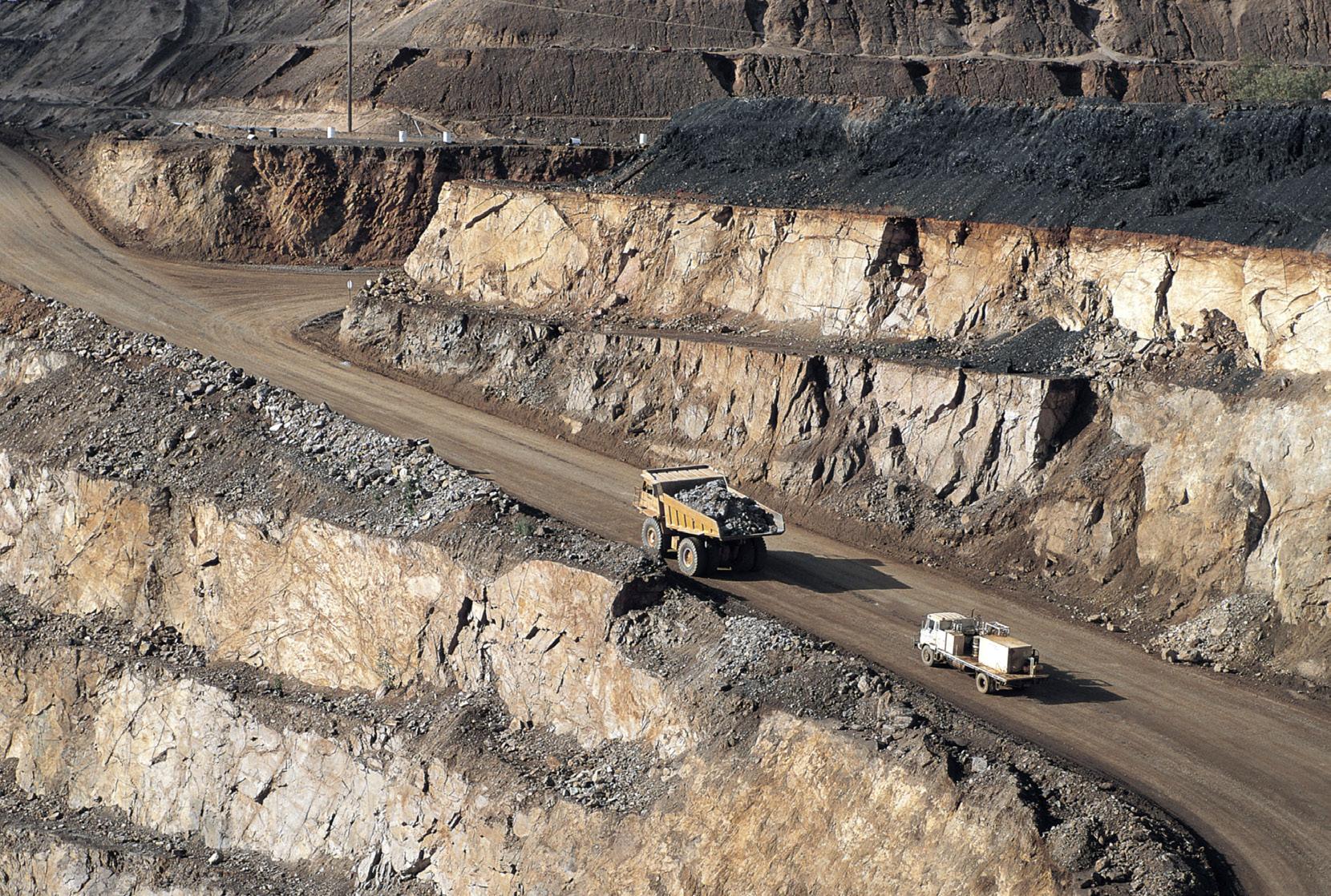
Accurately measuring the concentration of Zn, Pb, Cu and Ag is important during the exploration process to ascertain the viability of deposits and it is equally important in the mining process to provide grade control of the extracted ores and to delineate ore from waste. In both environments, the long lead time of lab analysis can be a major factor limiting progress and productivity. Hence, it is essential for geologists and mining companies to be able to rapidly conduct the analyses that allow them to optimize exploration strategies, efficiently locate drilling targets, and assure grade and quality of the recovered ore. Practically, this translates into the need for on-site geochemical analysis comparable in quality to lab analysis, with low detection limits and high accuracy comparable for the sought after commodities. Handheld X-ray fluorescence (XRF) spectrometry is an effective method for on-site analysis that enables the user to generate results in real time for those elements and make confident decisions.
Handheld XRF Analysis
Method
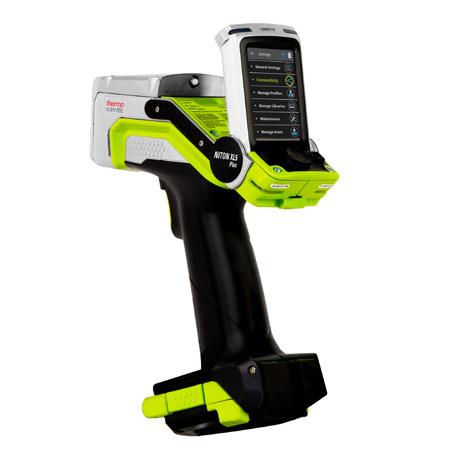
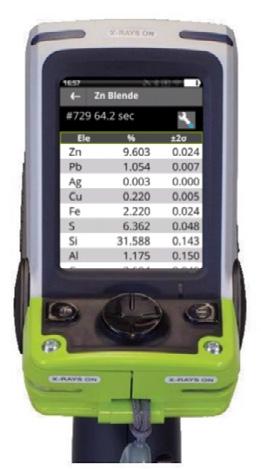
The Niton XL5 Plus handheld XRF analyzer (Figure 1a) is the smallest and lightest tube-based handheld XRF analyzer on the market today. Featuring a 5W/50kV miniaturized X-ray tube and a large area silicon drift detector (SDD) with graphene window, the Niton XL5 Plus analyzer delivers accurate elemental analysis with unmatched efficiency across all stages of mining and exploration.
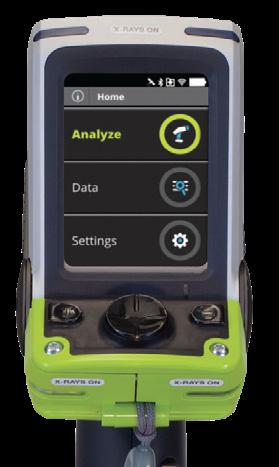
The Mining Mode on the XL5 Plus analyzer can measure 41 elements from magnesium (Mg) to uranium (U) using up to 4 different filters and voltages to enhance the signal-to-noise ratios of fluorescence lines across the entire range of energy. Mining Mode uses a proprietary fundamental parameter (FP) based algorithm that accounts for the high variability of sample composition by correcting for absorption and secondary excitation effects arising from the matrix to deliver accurate results. The results are displayed in real time on the screen of the analyzer (Figure 1b).
Users can optimize settings of Mining Mode and store those under Profiles. Profiles enable users to have multiple analytical methods on the same instrument; the most appropriate Profile for a given task can be easily selected to perform desired measurements quickly. The Niton XL5 Plus analyzer also comes with integrated GPS to facilitate spatial visualization of data using GIS programs useful for mapping and site modelling.
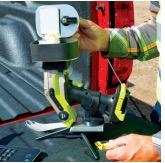
The analysis of Zn-Pb-Cu-Ag ores can be carried out in two ways: either in “point and shoot” mode directly on the rockface, or after sample preparation. Operating the handheld XRF analyzer in “point and shoot” mode is suitable for screening, and it delivers qualitative or semi-quantitative results enabling a quick localization of high-grade ore. In order to obtain accurate quantitative results, sample preparation is necessary. This preparation requires a sample to be collected and then homogenized using a grinder. If the moisture level is high, drying might also be necessary. The obtained powder would then be introduced into a sample cup, and the analysis carried out using the XL5 Mini Test Stand (Figure 1c). This approach allows longer measurements and generally yields results that are more comparable to those from laboratory methods. In the present study, Zn-Pb-Cu-Ag ore samples have been finely ground and packed into standard XRF sample cups fitted with 4µm polypropylene film and measured for 90 seconds using Mining Mode on the Niton XL5 Plus analyzer with 3 beam conditions (30s/Main Range, 30s/High Range and 30s/Light Range).
To optimize accuracy, a simple post calibration adjustment was made running some reference materials with a similar concentration range and mineralogy than the unknown samples.
Results
The results from the analysis of thirteen samples using the Niton XL5 Plus analyzer have been plotted against lab results obtained using atomic absorption spectrometry (AAS) after total dissolution of the samples. The correlation coefficient R² is a measure of how closely the data sets correlate with each other, where a perfect correlation would have an R² of 1. Also, the slope of the curve indicates, when close to 1, a low systematic error. As can be seen in Figure 2, there is a high correlation and low systematic error between field and lab results, which indicates the high accuracy of the handheld XRF analytical method for exploration and mining of Zn-Pb-Cu-Ag-Ores. Also, the measurement of Ag, present at low concentrations (down to 10 ppm) was found to be accurate. Additional results for iron and light elements provide information about the mineralogy of the rocks.
Conclusion
With outstanding sensitivity and portability, the Niton XL5 Plus analyzer is one of the most powerful and advanced handheld XRF analyzers available today, which helps geologists and mining operations managers in a number of ways:
• Access assay data in real time.
• Drastically reduce the number of samples sent out for lab testing.
• Make fast and confident decisions onsite.
• Improve productivity, and save time and money.
References
1. The World Zinc Factbook 2020, International lead and Zinc Study Group, https://www.ilzsg.org/