Exploration and mining of tantalum-niobium (coltan) and tin with handheld XRF analyzers
Introduction
Tantalum (Ta), niobium (Nb), and tin (Sn) are frequently used in high-end technology products. Because tantalum is a very robust metal with a high fusion point, it is utilized in electronics for capacitors like those in mobile phones, computers or digital cameras. Tantalum is also used in alloys employed in aerospace or the nuclear industry. Niobium is used in the steel industry, as well as in super-alloys and super-conductors. Tin has been used for thousands of years in numerous applications due to its low fusion point.
The world’s resources available today are not meeting the increased demand for tantalum. Demand for niobium, an already scarce metal, is expected to exhibit consistent annual growth going forward. Demand for tin has also increased dramatically since 2006, when its use in solders increased dramatically because lead (Pb) was forbidden in welding products in some countries. Locating and verifying viable sources of tantalum, niobium, and tin can be challenging and require advanced instrumentation like handheld X-ray fluorescence (XRF) analyzers.
Application
Geologically, Ta, Nb, and Sn are found in late-stage magmatic products, such as pegmatites and high-temperature veins. Common minerals containing these elements are tantalite (FeMn)Ta₂O₆, columbite (FeMn)Nb₂O₆, and cassiterite (SnO₂). Tantalite is commonly found with columbite. This close association is called columbite-tantalite, or coltan. These dense minerals can be reworked, eroded, transported by water, and accumulated due to gravity separation during sedimentary processes. Such accumulations are called placer deposits, which are common deposits for the mining of Ta, Nb, and Sn in some countries.
Handheld X-ray fluorescence (HHXRF) instruments are great tools not only for prospecting but also for grade control of these metals. Accuracy is a key factor in the evaluation of ore concentrates, particularly due to their high trading values.
Handheld XRF Analyzers in Mining
Handheld XRF analysis is a technique with the ability to deliver fast and accurate results with little or no sample preparation. It can be used in various stages of mining activity from grass root exploration to exploitation, ore grade control, and even environmental investigations.
The handheld Thermo Scientific™ Niton™ XL2 Plus Analyzer, the Thermo Scientific™ Niton™ XL3t GOLDD+ Analyzer, and the Thermo Scientific™ Niton™ XL5 Plus Analyzer each deliver real-time, accurate elemental analysis with unmatched efficiency for companies across all stages of mining and exploration. These benefits derive from Thermo Scientific’s high-power x-ray tube with dynamic current adjustment, and from the use of state-of-the-art silicon drift detectors.
There are more than 10,000 Niton handheld XRF analyzers currently being used extensively throughout the mining industry worldwide. A broad range of elements from magnesium (Mg) to uranium (U) can be analyzed using these instruments. An example of the result from a handheld XRF analysis is shown in Figure 1.
Methodology
Prepared (pulped) high-grade samples were used for this investigation. These samples were analyzed with a Niton XL3t GOLDD+ handheld XRF analyzer, and also by laboratory methods (ICP and AAS) for comparison purposes. Analyses were carried out using the Mining mode on the handheld analyzer. This is a “fundamental parameters” algorithm on the analyzer that is able to quantify more than 30 elements, typically without the requirement of user calibrations. However, when required, a simple post calibration adjustment can be made to improve accuracy using previously characterized lab samples.
Results
The coefficient of determination, the R² value, is a measure of how closely the data sets correlate with each other, where a perfect correlation would have an R² value of 1. The study shows high correlation between data from the Niton XL3t GOLDD+ XRF analyzer and from the lab methods (see Figure 2).
Conclusions
Many minerals occur as dark gray to black grains, which may look like fine-grain coltan in some situations. The high correlation between assay results from the handheld Niton XL3t GOLDD+ and lab data indicates that it is possible to successfully identify high- and low-grade concentrates of coltan samples in seconds using handheld XRF. The Niton XL5 Plus, Niton XL3t GOLDD+, or Niton XL2 Plus XRF analyzers all deliver fast, accurate elemental analysis across all stages of the mining workflow, from exploration to extraction and processing of base metals and industrial minerals.
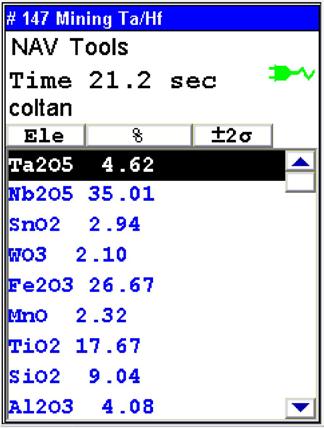
for an analysis of a Coltan concentrate mineral sample using the Niton XL3t GOLDD+ XRF analyzer.
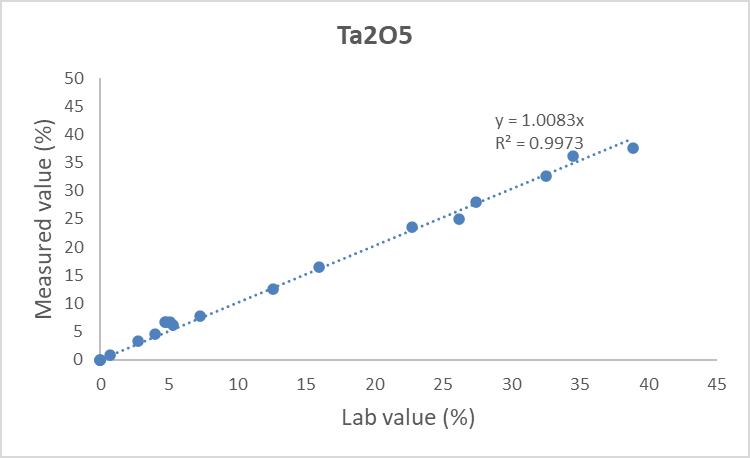
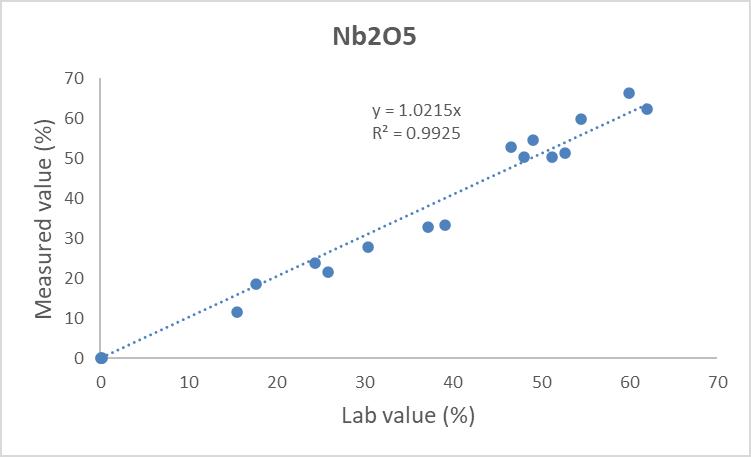
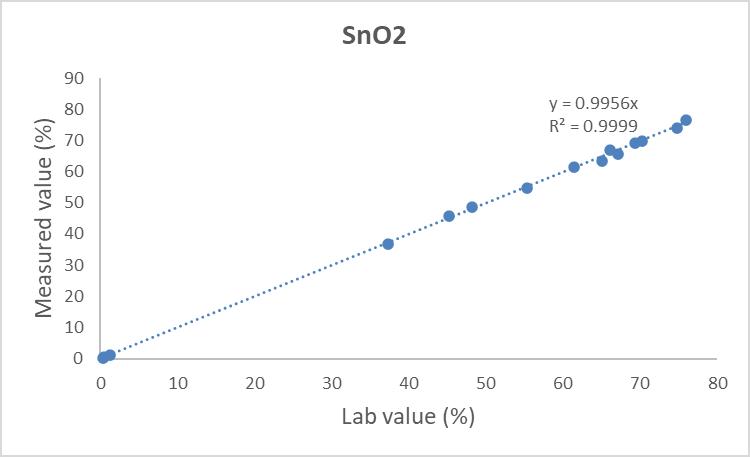
Figure 1. Example result
Figure 2. Correlation diagrams for Ta, Nb, and Sn analyzed using the Niton XL3t GOLDD+ analyzer.