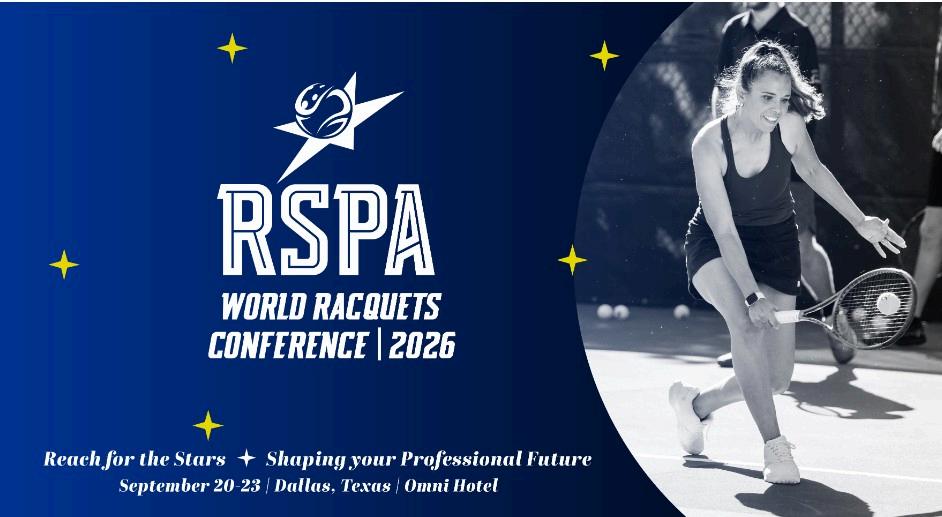
Registration is officially open for the RSPA World Racquets Conference 2026, taking place September 20–23 at the Omni Dallas Hotel This year’s theme Reach for the Stars: Shaping Your Professional Journey invites you to lean into growth, stretch past comfort and elevate your career as a racquets sports professional.
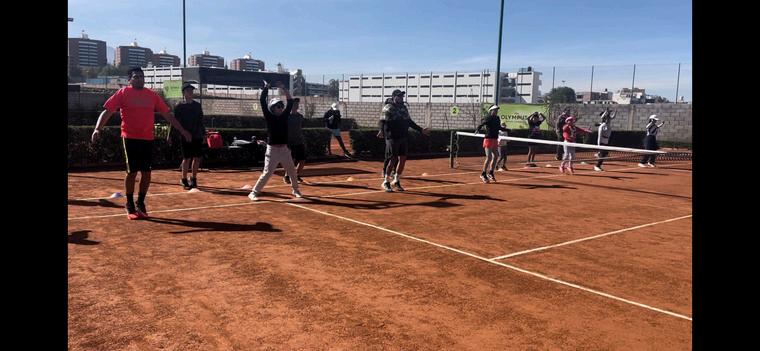
WRC26 will be our most immersive experience yet, connecting you with industry experts and equipping you with practical, applicable tools across coaching, leadership and operations We're bringing our learnings from last year's conference in Hawaii and showcasing an educational program with a focus on tennis and sessions in pickleball and padel, both in the classroom and on all three courts.
Exclusive Pricing for Members!
Early Bird Pricing (Members Only): $579
Limited availability secure your spot early!
Full Member Rate: $649 when early bird availability runs out
Late Registration: $749 for those who register after Sept. 13, 2026
Non-member Early Bird Pricing: $679
You'll receive the link to book our exclusive hotel rate via email after registering for the conference.
RSPA SAN DIEGO DIVISION
CONFERENCE A RESOUNDING SUCCESS
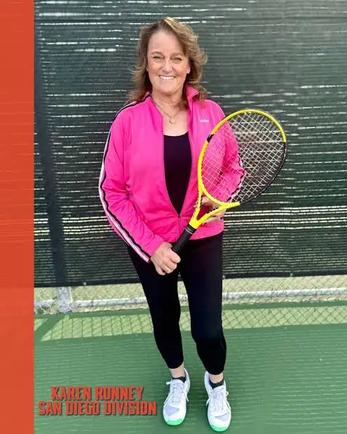
Karen Ronney RSPA Elite Professional
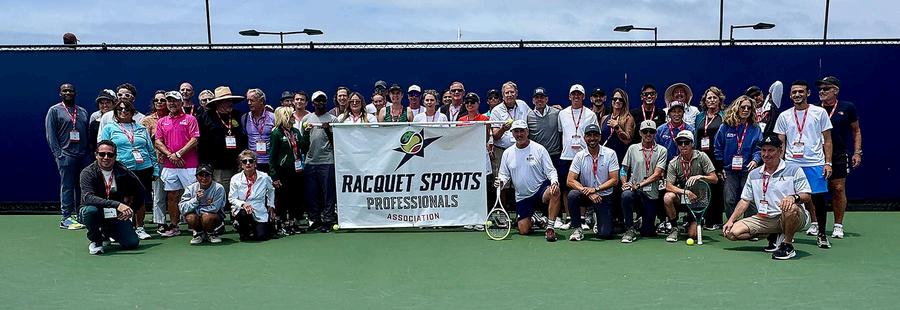
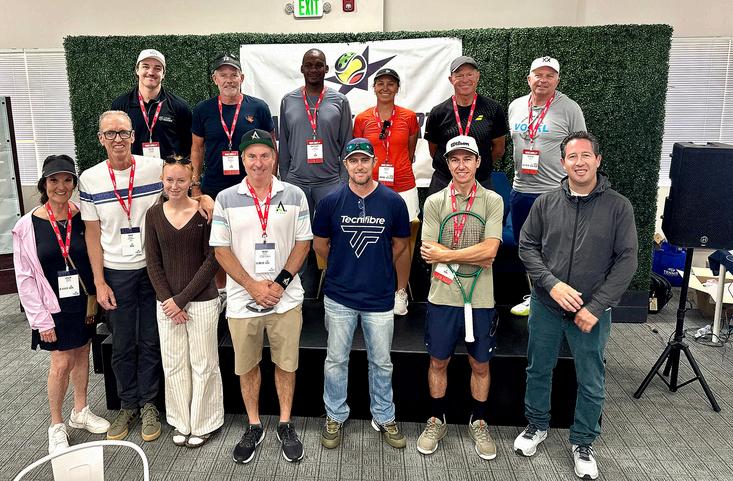
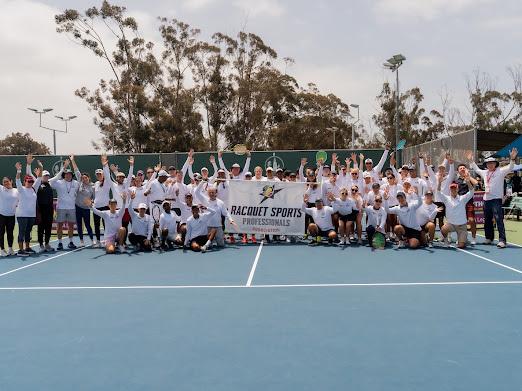
There was something for everyone at the RSPA San Diego Division Conference. The prestigious annual event gathered approximately 70 pros, coaches, vendors, players, guests and award winners on June 6 at the Barnes Tennis Center. It was a wonderful day of learning, networking and camaraderie for the San Diego and Coachella Valley tennis communities.
Conference topics included leadership, sports nutrition, mental toughness, junior development, court maintenance, pickleball and coaching strategies There was also a welcome coffee and breakfast bar, a diverse Vendor Village and a silent auction Participants enjoyed a greeting from an RSPA national representative, a raffle with fantastic prizes, and a multi-sport open play session The grand finale was a one-point tournament and a hosted happy hour for networking and catching up with peers and friends
The RSPA San Diego Division is grateful to its main sponsor, the Barnes Tennis Center (BTC), for being the host site for the second straight year Attendees enjoyed BTC’s beautiful meeting room, use of the center court for tennis as well as access to pickleball and padel We also thank Court Reserve for their generous support
“We were very pleased to offer a full day of education, recognition, networking and fun for our members and guests,” said Steve Kappes, the Executive Director for RSPA San Diego. “We are grateful for the ongoing support from Barnes Tennis Center, the dynamic speakers and more than twenty local and national sponsors and vendors. There was a high level of engagement and camaraderie from everyone that attended, and it highlighted the value of RSPA membership. It was impressive to see our dedicated pros enjoy learning, networking and building community.”
The RSPA San Diego Division is very grateful to all conference sponsors including Babolat, Technifibre, Yonex, Volkl, CH Court Tech, Rays Tennis, The Tennis Depot, Aleaf, Fletcher Hills Tennis, South County Tennis Shop, Lanethix, Leon-Jung Tennis Academy, Chemistrie Eyewear, Toroline, American Racket Sports Association and Tokkitennis. Appreciation to our national endorsees including Court Reserve, Tennis Warehouse, Dunlop, Volkl and Centerline.
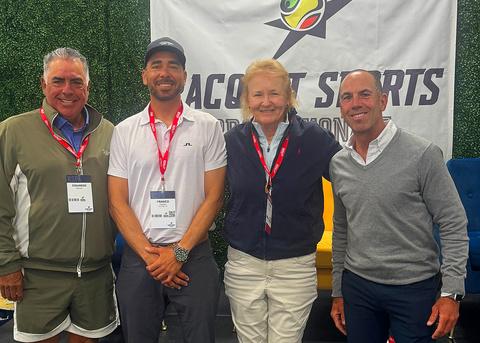
In the early morning, attendees were welcomed with a breakfast hosted by Fletcher Hills Tennis, who provided delicious coffee, bagels, crème cheese and more. It was an exciting time to reconnect with friends and catch up on community news. Then the opening session offered an outstanding leadership panel discussion featuring a trio of respected experts. They were Colleen Ferrell, the Club Director for Balboa Tennis Club, Franco Castejon, Head of Racquets at the Bridges Club, and Eduardo Sanchez the Head Tennis Pro at Rancho Valencia. Juan Garcia, the Director of Racquets at San Dieguito Tennis Club, did a brilliant job of offering insightful questions Ferrell said communication and consistency are her top priorities to manage one of the largest public facilities in San Diego, which has 1,750 members and brings 6,000 guests to the club each year
Sanchez has been at his facility for thirty-seven years and he believes having passion for your teaching career is the key He suggested, “If you love what you do, you will never work a day in your life ” Castejon, who grew up in Venezuela and Ecuador, said his leadership skills were honed from the ground up He started coaching at age 17 and was guided by mentors, who taught him about operational competence and emotional intelligence “
I learned about leadership, discipline and professionalism,” Castejon said “People will remember you because of the way you treated them on the court If you listen with respect and kindness, you will give them a memorable experience ”
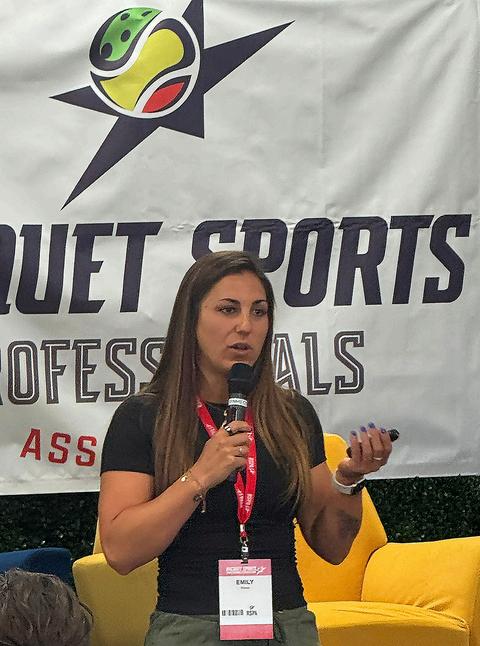
Following the leadership discussion, Emily Kloss, an exercise physiologist and performance nutritionist, had incredible information to share She offered tips on how to build energy reserves, use food for fuel and the best ways for sports recovery. She addressed why athletes need protein, amino acids and recommended sources for rehydration. She also educated coaches about the use of caffeine and vitamin supplements. Additionally, she debunked health and fitness trends.
“Carefully read the ingredients of electrolyte replacement drinks to decide the best choices to use during exercise,” said Kloss, who also trains military and fire fighters “There are differences in the amounts of sodium, sugar and some have caffeine Your choices should be aligned with the health of the individual ”
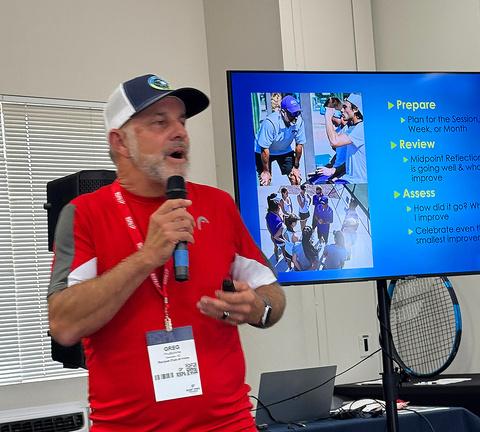
Dr. Gregory Prudhomme talked about mental toughness with a focus on “How and What to Coach ” He said thoughts and emotions drive a player’s behavior and can build a competitive mindset. As a coach, he suggested it is important to model the behavior you wish to see in an athlete. Then create a system to develop it and carefully plan out training sessions. “Remember the ‘P.A.S.’ system. You should Prepare, Review and Assess your coaching program,” said Prudhomme, the General Manager of the Racquet Club of Irvine “That means plan the training sessions, review them to look for ways to improve, and then measure your success Celebrate the smallest improvements and keep growing ”
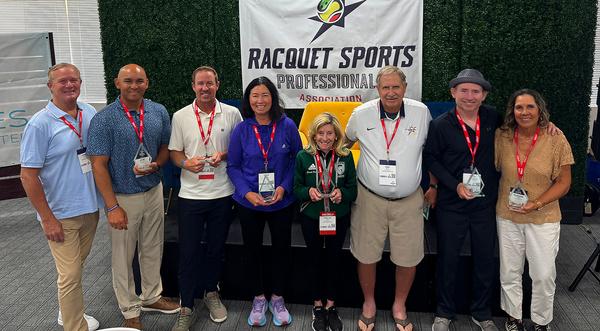
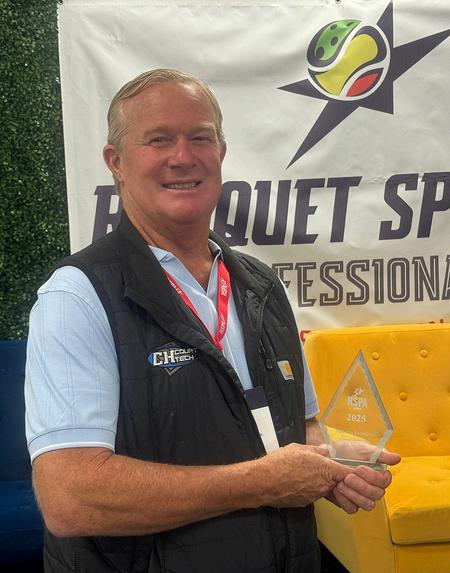
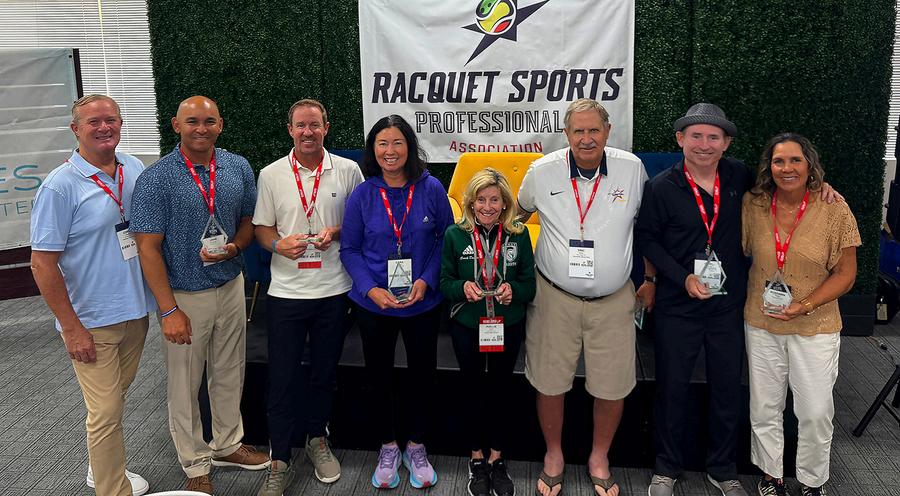
At lunchtime, the RSPA San Diego Division presented its annual awards to eight outstanding winners from the San Diego and Coachella Valley areas Veteran pro Eric Mann received the prestigious Bob Bacon Lifetime Achievement Award, Phillis Dattilo was the High School Pro of the Year, and Cara Beltran was the Community Service of the Year recipient. John Chanfreau and Caerwyn Evans were recognized as Club Managers of the Year, and Corey Hardick was the winner of the Industry Excellence of the Year award. The Ben Press Pro of the Year was given to Josh Jorgensen and Roxy Potter.
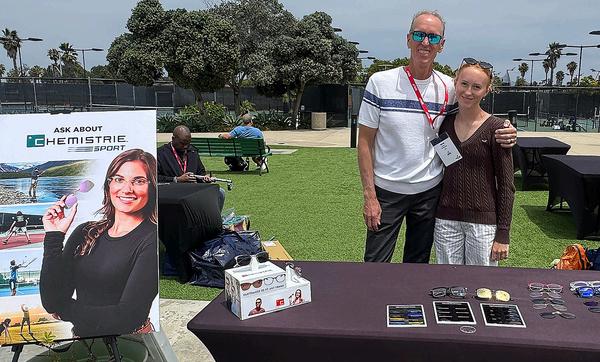
RSPA Pro Scott Burton, a National Vice President based in Santa Barbara, spoke via Zoom about the state of the RSPA organization and racquet sports industry in general. Then during the one-hour lunch break, there was a fantastic Vendor Village that included a variety of tennis products, eyewear, sports clothing, supplements and more Thank you again from RSPA San Diego to all of our vendors and sponsors (mentioned above )
“We were excited to have the opportunity to launch our new Chemistrie clip-on tennis sunglasses at the RSPA conference,” said Dan Bruton, the Founder of Chemistrie Eyewear “We had a vendor table where we could interact with the coaches It was also invaluable to have the chance to speak for a few minutes during the conference We sponsored a raffle and congrats to RSPA Pro Amy Kelts for winning Chemistrie clip-on glasses ”
RSPA Pro Matt Jones opened the afternoon agenda with a session on “Junior Development Keys to Success ” Jones believes that kids should play multiple sports for best all-around athletic development
“Kids can learn so much from seeing balls come to them from various sports that make them adjust to different speeds, angles and distances,” said Jones, Founder of the Matt Jones Tennis Academy in Del Mar. “They need to learn to run, catch, kick and throw balls in multiple sports at a young age.”
What is the golden age to focus on a singular sport? Jones says it is around ages 11 to 13 when kids hit puberty Then they can make decisions themselves based on passion and preference. Also, parents can see what sports and activities kids enjoy most when they are home.
Jones advises coaches to have a serious talk with their students and ask about their goals. Then he urges coaches to help students determine their competitive identities. His method is to ask players to recall their best three wins in recent times Then, he asks how they won the matches Was it by aggressive baseline play, counter punching or grinding? The answer determines the player’s identity
“Then I build a Monday through Sunday routine based on that information,” Jones said “If they want to play junior tennis, high school or college tennis or even go pro, there are different paths to follow once they choose an item on that sports buffet list ”
Nigel O’Rourke is the Director of Tennis and Pickleball at the Club at Morningside in Rancho Mirage He suggested tennis players can easily transition to pickleball, but some tennis habits can slow improvement He said there were three common mistakes to avoid when transitioning to pickleball Power has its place, but pickleball rewards patience, placement, and consistency more than sheer pace So consider hitting a more medium-paced shot
The second suggestion was to hit with less topspin. Unlike tennis racquets, pickleball paddles have a solid surface without strings. While topspin is effective, generating it consistently takes practice and proper technique. Finally, tennis players naturally feel comfortable near the baseline, but that is rarely the best position in pickleball. Try to move toward the kitchen line to learn the sport.
Dave Hagler, an RSPA Master Professional and Coach Developer, introduced the concept of “Exaggerated Learning” when teaching tennis. His idea was to encourage students to strive for a variety of options when learning skills and strategies Try giving students a general idea of what you want them to do, and let them experience the process He offered the following example
“If kids are hitting their groundstrokes short, encourage them to go for an exaggerated target beyond the baseline,” said Hagler, also an Assistant Coach at California State University Northridge. “Then, let them discover how to find the ranges in between the short ball and the out ball. If they learn through self-discovery, they will have better retention.”
Corey Hardick, the Founder of CH Court Tech, shared valuable advice on building and maintaining sports courts. It was an interactive Q&A discussion that covered a variety of topics including resurfacing, post-tension cable repairs, patching courts, fencing, lighting, all types of surfaces, clay court maintenance, curing concrete, converting tennis to pickleball courts and sound-proof windscreens for pickleball
“Be careful when you buy lights,” said Hardick, who has installed over 6,000 court lights “Tennis court lights are not parking lot lights There are only about three manufactures that do tennis court lights so do your research before choosing a vendor When upgrading, it is simple, clean and easy to convert existing lights to LED lights.”
Regarding the speed of the tennis court surfaces, Hardick said there are five categories dictated by the International Tennis Federation. There is fast, medium fast, medium, medium-slow and slow. Hardick recommends a medium-slow surface for the best overall experience “If you make your court too slow it will wear out quickly and it is also a safety hazard Keep in mind everyone who will play on your court when you resurface ”
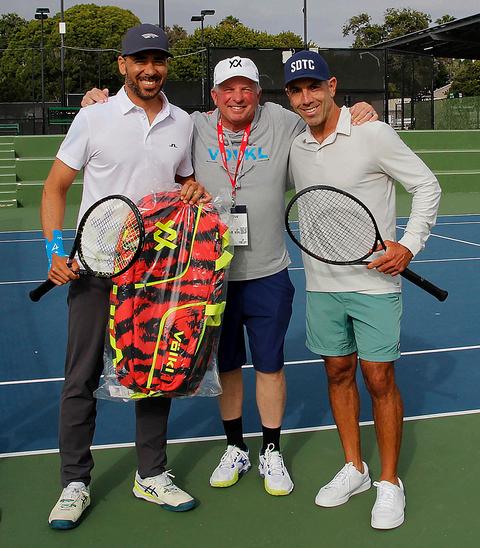
At the midday break, Volkl sponsored an exciting One-Point Tournament The winner was Franco Castejon, who received a fantastic Volkl racquet package Shout out to Juan Garcia for being the event finalist.
After the sessions, there was an open play opportunity with an RSPA hosted happy hour. Attendees had the opportunity to play tennis, pickleball or padel at Barnes Tennis Center and then join friends at the hosted bar to toast to a great day.
“This was an outstanding conference in every way,” said Karen Ronney, an RSPA Vice President. “The session content was well-rounded, the expert speakers were on-point, and the community support was off the charts Our sponsor support made this a fun, friendly and informative conference We are grateful to all who made this a resounding success
###
About the Author: Karen Ronney is an RSPA and PTR certified tennis and pickleball professional as well as a 3x National High School Coach of the Year. A RSPA San Diego Division Vice President, she is an award-winning author of Proud Parents Guide to Raising Athletic, Balanced and Coordinated Kids. She is also the Director of Tennis at the Mission Trails Tennis Academy, Director of Tennis at Patrick Henry High (girls), and the Director of Marketing for the Southern California Tennis Association Foundation
Photo Credit: Karen Ronney
LEADERS FOR RACQUET SPORTS EXCELLENCE
By: Karen Ronney, RSPA Elite Professional
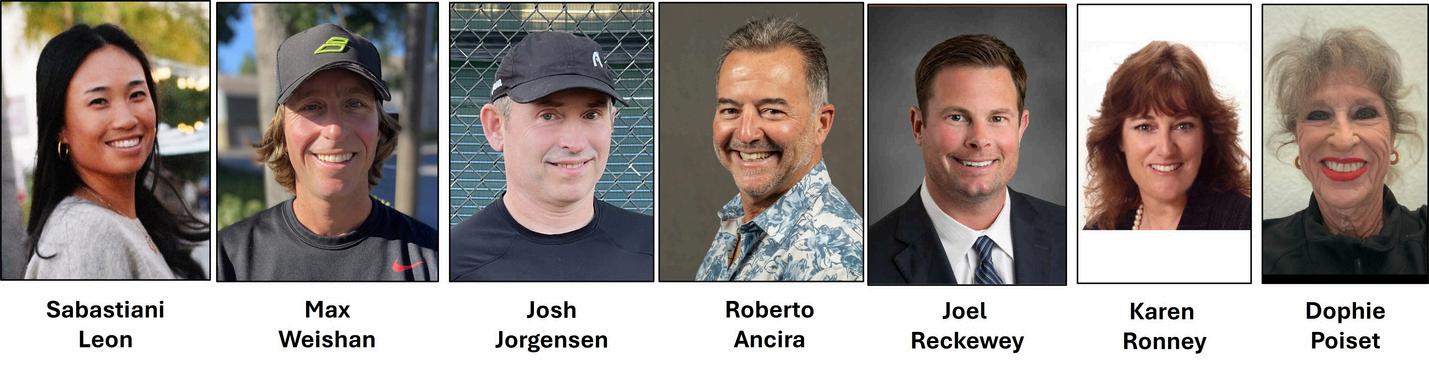
When it comes to outstanding teaching, leading and mentoring skills in racquet sports, it was a competitive field from which to select this year’s RSPA San Diego Division award winners Among the 265 members, eight outstanding RSPA candidates were honored from the San Diego and Coachella Valley areas. Eric Mann received the prestigious Bob Bacon Lifetime Achievement Award, Josh Jorgensen and Roxy Potter won the Ben Press Pro of the Year Awards and Phillis Dattilo was the High School Coach of the Year. Esteemed Club Managers of the Year were John Chanfreau (San Diego) and Caerwyn Evans (Coachella Valley), Corey Hardick from CH Court Tech was honored for Industry Excellence and Cara Beltran received the Community Service Award. We are proud to share their backgrounds and accomplishments.
Eric’s distinguished tennis career began as a collegiate standout at UC Irvine, where he led the Anteaters to two NCAA Division II National Championships and was named to the 1977 All-Time Player list He then competed on the men's professional tour for five years before transitioning into a 19-year tenure as a pro tour coach A certified USPTA/RSPA Teaching Professional and USTA High Performance Coach, Eric has spent over three decades shaping the Southern California tennis landscape. His leadership spans foundational coaching and administrative roles at major tennis hubs, including the Burbank Tennis Center and Barnes Tennis Center, earning him prestigious accolades such as the USPTA California Division Pro of the Year (2001) and the San Diego Division Pro of the Year (2013).
As a premier junior and adult coordinator, Eric has developed a profound legacy of cultivating elite talent and expanding community outreach. He served as the USTA Junior Davis Cup Team Coach and spent years leading San Diego's USTA Competitive Cup Training Center program, mentoring hundreds of top-ranked juniors including ATP stars Taylor Fritz and Sam Querrey and guiding the YTSD Whalers to a World Team Tennis Junior National title in 2009. Beyond elite youth training, Eric has served as the Director of Adult Tennis Programs for YTSD, managed comprehensive inclusive initiatives like wheelchair tennis, and routinely works as a trusted USTA tournament referee His enduring, humble dedication to making tennis fair, structured, and accessible across all levels has earned him the Lifetime Achievement Award
Ben Press Pro of the Year: Josh Jorgensen
Josh Jorgensen is the longtime Racquet Sports Director at Club Torrey Pines in Carmel Valley and one of fewer than 150 RSPA Master Professionals in the country A former USTA national junior competitor and Division I collegiate tennis player, Josh remains a high-level competitor who recently qualified for the USA Pickleball Nationals His coaching resume features remarkable player development milestones, including guiding students to top-4 SCTA and top-50 national rankings, coaching three future junior Grand Slam champions including Alex Michelsen and leading champion USTA National Zonals teams In the high school circuit, his students have secured three CIF individual championships and seven AllCIF honors, including the only girl in San Diego CIF history to reach four individual finals and win a championship
Beyond on-court player development, Josh is a highly respected educator, advocate, and industry leader. He has earned three national awards as the RSPA's Top Education Participant, holds a Specialist Degree in Competitive Player Development, and is a Pickleball Coach Developer and certification tester. Josh frequently shares his expertise by speaking at conferences, publishing in RSPA ADDvantage magazine, helping develop the RSPA Specialist Degree Program in Tennis Fitness, and serving on both national committees and the RSPA San Diego Division Board. Deeply committed to expanding the sport, Josh supports adaptive tennis programs like the National Wounded Warriors Tennis Camps, works with autistic athletes, and has spent over a decade on the USTA San Diego District Board, where he chairs the Tennis Advocacy Committee and successfully helped secure approval for new public tennis courts in North County
Bob Bacon Lifetime Achievement Award: Eric Mann
Roxy has spent over three decades building community and developing players with her current home base at the Surf and Turf Tennis Center since December 2022 Her foundational understanding of player development stems from a 1994 degree in Kinesiology from Cal State University Fullerton Her career is distinguished by an impactful 11-year tenure at Morgan Run Country Club from 2010 to 2021, where she served as the heartbeat of the facility During her time there, Roxy transformed the club into a center of family life by personally onboarding new members, introducing the club's first dedicated men’s night events, and organizing comprehensive junior clinics, high-energy women's clinics, and intense tennis bootcamps.
Beyond daily club management, Roxy has committed herself to tournament operations, youth mentorship, and volunteerism For five years, she served on the planning committee for the WTA Women’s Professional $50k Tournament at Morgan Run, managing logistics, player services, and ball kid training A passionate leader of youth programs, she has dedicated her summers to volunteering at the Fellowship of Christian Athletes (FCA) High Performance Sports Camps across California, including stints at UCSB, UCLA, and ongoing work at Point Loma Nazarene University since 2022 Recognized additionally for her local outreach at community events like Tennis Fest and her leadership of monthly FCA Game Nights, Roxy is celebrated for her exceptional ability to use tennis as a tool for personal growth and safe fellowship.
Industry Excellence: Corey Hardick
Corey discovered his passion for court construction as a child working alongside his father and brothers in the late 1970s After high school, he refined his craft for a decade under the mentorship of Greg Caledonia at Advantage Tennis Courts When Caledonia semi-retired, Corey founded CH Court Tech, leveraging strong word-of-mouth to expand his club and private court business across the West Coast and Hawaii Today, he is responsible for resurfacing and repairing prestigious venues throughout Southern California, including the La Jolla Beach and Tennis Club, San Diego Tennis and Racquet, Rancho Santa Fe, and the Barnes Tennis Center, as well as major universities like SDSU, UCSD, USD, and UCLA, and multiple regional high school school districts
Now recognized as perhaps the top court contractor in the Western United States, Corey and his firm completed over 500 pickleball and tennis courts last year alone. Beyond his construction success, Corey is deeply committed to supporting the broader racquet sports ecosystem. He actively backs tennis organizations, educational conferences, and community programs, frequently donating equipment to underserved high school teams and contributing to groups like the RSPA. He also sponsors networking lunches to help tennis professionals and industry leaders collaborate and share knowledge, remaining dedicated to providing high-quality courts that communities can enjoy for years to come
Ben Press Pro of the Year: Roxy Potter
Club Manager of the Year San Diego: John Chanfreau
John has set a gold standard for facility excellence through his visionary leadership as the General Manager of the Rancho Santa Fe Tennis Club Under his direction, the club has built a thriving, modern racquet sports ecosystem that currently boasts eight hardcourts, two Har-Tru clay courts, and eight new dedicated pickleball courts, with two additional hard courts in development and a future fitness center in the works. Beyond facility expansion, John has successfully transformed the club into a premier destination for elite competition, hosting prestigious professional events like the Women’s ITF/USTA$60k Rancho Santa Fe Open for five consecutive years and the SoCal Pro Series ITF/USTA $15k tournaments for four years, alongside various high-level junior tournaments.
In addition to operational brilliance, John has fostered a vibrant, inclusive club culture that prioritizes community spirit and philanthropy. He has championed numerous charitable causes, including the James Blake Foundation pickleball tournament, the Tom Svajda exhibition, and the Country Friends fundraiser On the social front, John has cultivated an unforgettable member experience by offering year-round junior programming, adult clinics, and highly anticipated community events ranging from regular monthly socials and the unique "Wimbledon whites and wood rackets" night to the marquee Member-Guest Event, which members routinely call the best club event of the year.
Club Manager of the Year
Coachella Valley: Caerwyn Evans
Caerwyn is an innovative educator and sports architect whose impactful career ranges from grassroots development to luxury resort programming Between 2008 and 2012, he served as the Head Pro at the Indian Wells Tennis Garden, where he launched a foundational junior academy and established his signature WynTennis youth blue print. He then spent twelve years, from 2013 to 2025, as the Director of Tennis at Shadow Mountain Resort & Club, mastering luxury operations and transforming the center into both an elite training ground and a vibrant community hub
Beyond resort management, Caerwyn is a prominent tournament director and an industry pioneer. He owns and directs the Wilson World Tennis Classic at Mission Hills Country Club, manages the 30s Hardcourt National Championships, and produces exclusive international racquet retreats, such as upcoming events at Hawaii's Mauna Kea Beach Resort. Recognizing modern trends ahead of the curve, Caerwyn also established himself as a "Padel Pioneer," helping develop the Coachella Valley's first padel courts Through WynPadel, he currently oversees courts at the Parker Hotel while spearheading new luxury construction at destinations like The Westin, cementing his legacy as a leader in modern racquet sports.
Phillis has been a dedicated tennis leader at Poway High School for 19 years. Her coaching journey at the school began with an 11-year tenure as the Head JV coach alongside local coaching icon Evi Valles, before she stepped up to lead the varsity boys and girls programs eight years ago Drawing on her academic background, which includes a bachelor's degree in Kinesiology and Exercise Physiology from Spalding University and a master’s degree in arts and teaching from Bellarmine University, Phillis has used her deep understanding of sports education to provide invaluable mentorship and leadership to generations of studentathletes
Under her guidance, Poway High's tennis program has achieved remarkable competitive success and built a culture of excellence Her teams secured the San Diego Section Division II CIF Girls Championship in 2021, earned a share of the Palomar League Co-Championship in 2024, and produced the Palomar League's number one player in 2025. Additionally, her varsity squad has dominated the Pete Brown First Serve Tournament, winning the event for eight consecutive years. Beyond the impressive titles and regional accolades, the RSPA honors Phillis for her enduring passion, exceptional coaching expertise, and the profound care she brings to the high school tennis community.
Cara grew up in an enthusiastic tennis family from Fresno, eventually playing varsity high school tennis and NCAA Division I tennis at UC Berkeley. Her love for the sport continued into adulthood, leading her to participate in two World Team Tennis National Championship teams. Grateful for the opportunities the sport provided her, Cara has dedicated her adult life to giving back heavily to the San Diego tennis community through extensive volunteer work. Since 2014, Cara has used her skills to elevate several local organizations, beginning with her work promoting and planning tennis camps for the San Diego Wounded Warrior Tennis program. Around 2016, she joined the San Diego Tennis District Board, volunteering on various committees and spending the last five years successfully promoting Tennis Fest San Diego Additionally, since 2020, Cara has assisted the Greater San Diego Tennis Council by improving their website, social media, and marketing. Her tireless efforts on and off the court reflect her deep commitment to sharing the positive impact of tennis with others.
High School Coach of the Year: Phillis Dattilo
Community Service Award: Cara Beltran
TENNIS FEST CELEBRATES 25 YEARS OF COMMUNITY
Roberto Ancira RSPA Elite Professional
SUCCESS
Karen Ronney RSPA Elite Professional
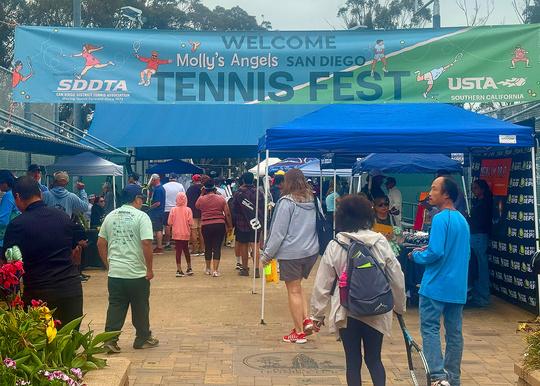
What started as a small gathering by three friends has grown to a wonderful traditional event now starring as San Diego Tennis Fest In 2000, Geoff Griffin, Bill Rennie and Monty Grout thought it would be a great idea to offer free tennis lessons to the San Diego community at Balboa Tennis Club. Then, a few dozen people showed up to hit balls and have fun. Now twenty-five years later, the Molly’s Angles San Diego Tennis Fest gathered approximately 2,000 enthusiasts including pros, college players, families and kids of all ages and levels to gather at the historic club for free group lessons, clinics, prizes, food, networking and so much more. It is one of the largest free community tennis play days in the country.
The founding trio of Griffin, Rennie and Grout created Tennis Fest in the month of May because there were no conflicting scheduled activities or tournaments at Balboa Tennis Club. This was also before the USTA designated May as National Tennis Month. Also, it was the perfect time to take control of the twenty-five courts located at Morley Field. In the early days, the highlight of the event was enjoying a keg of beer and a free tennis clinic San Diegan touring pro and college coach Gretchen Magers, a former WTA player in the 1980’s and 1990’s, leveraged her multiple connections to secure great media coverage.
"The first year there were more media people there than participants," Griffin said. "We had a tournament for the media, and wined and dined them a bit. It started as a way to get the media more interested (in tennis) We still get coverage, but word of mouth keeps the event growing stronger every year.”
Since its inception, San Diego Tennis Fest continues to expand. It has found support from sponsors and funding from various groups and organizations Those who have been influential throughout the years include the Racquet Sports Professional Association (then USPTA), the San Diego District Tennis Association (SDDTA) and the Southern California Tennis Association Foundation (SCTAF). This year, the title sponsor was Molly’s Angels Foundation, an organization to keep children and young adults safe by preventing them from falling into addiction, depression and abuse
Balboa Tennis Club is happy to host Tennis Fest each year because it represents what our club is all about, community tennis for all ages and levels,” said Colleen Clery Ferrell, the Executive Director for Balboa Tennis Club. “It’s a privilege to let players participate in this free event to spread the word about the great game of tennis.”
For years, the SCTA has provided thousands of T-shirts along with USTA Southern California tennis swag for participants to win on the hitting for prizes courts. The RSPA has led the charge by encouraging hundreds of certified pros to volunteer their time and expertise to give back to the tennis community. The SDDTA board members and volunteers anchor the heart of the organizing campaign by dedicating hours of planning, networking and advertising this incredible event
“It has always been an honor to support events like Tennis Fest because it reaches the grassroots community,” said Linda Milan, the Executive Director of the SCTA Foundation “We want them to experience the joy of playing tennis and encourage them to continue in their local communities.”
In 2004, Tennis Fest started a tradition of creating an award to honor legendary tennis pros and sports leaders
The honor was named after Ben Press, then a premier teaching professional and top-ranked player in the 1950’s. Ben co-founded the Greater San Diego Tennis Council and was the heart of tennis for 28 years at the Hotel Del Coronado.
He taught four-time Grand Slam singles champion Maureen Connolly, 1980 Australian Open singles winner Brian Teacher, and mentored tennis greats such as Marita Redondo, Angelica Gavaldon and Alexandra Stevenson. Ben was affectionately known as Mr. Tennis, and he passed away in 2016. His life’s efforts to promote tennis lives on.
Now for two decades, the Ben Press Award has been given to an impressive list of recipients including SDSU professor and tennis champion Dr. Jim Lackritz (2026), Colleen Clery Ferrell (2025), International Tennis Hall of Famer Charlie Pasarell (2024), President of the GSDTC Dave Gill (2022), Wounded Warrior Tennis Program co-founder Geoff Griffin (2018), sports broadcaster Dick Enberg (2017), community tennis leader Virgina Glass (2011), USD men’s tennis coach Ed Collins (2009), President of La Jolla Beach and Tennis Club Bill Kellogg (2006) and Union Tribune sportswriter Jerry Magee (2011.) The full list is located at Balboa Tennis Club.
In 2015, Tennis Fest included the San Diego Wounded Warrior Program, a tennisbased wellness organization hosted by the SDDTA. This program, cofounded by Geoff Griffin and RSPA Executive Director Steve Kappes, serves wounded, ill and injured service members and veterans of all ages Tennis Fest hosted a successful fundraising effort with a contest that encouraged teaching pros to raise funds for the cause. The prize was two all-expense paid tickets to the US Open and it was a tremendous success.
In 2018, SDDTA stepped up to organize the event and continue to expand each year. This year there were over 80 teaching professionals and 120 volunteers who assisted with beginning adult clinics in the morning. In the afternoon, there were a wide variety of events including clinics, strategy courts, hit for prizes, wheelchair tennis, product demo sponsors, beat the pro challenges and more There were also product giveaways and community vendor booths. m tion ) and on.”
GORDON ZAWTUN: A GIANT AMONG COACHES
By: Karen Ronney, Elite Professional
A Personal Tribute to A Great Coach
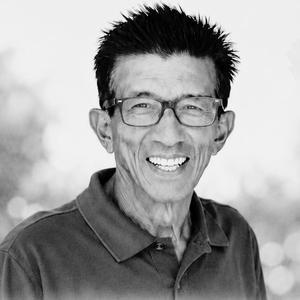
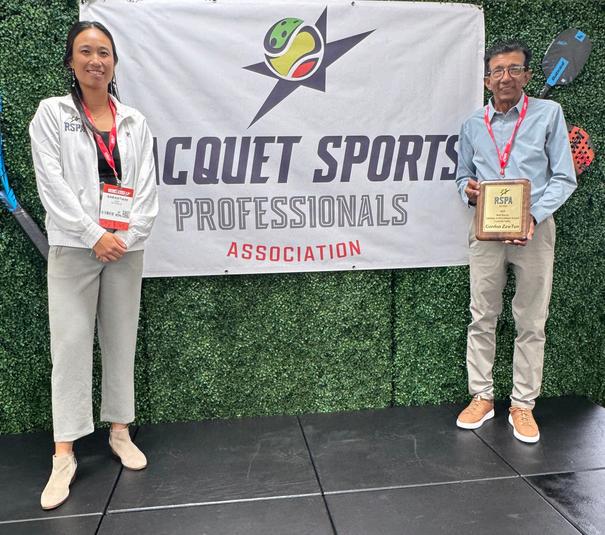
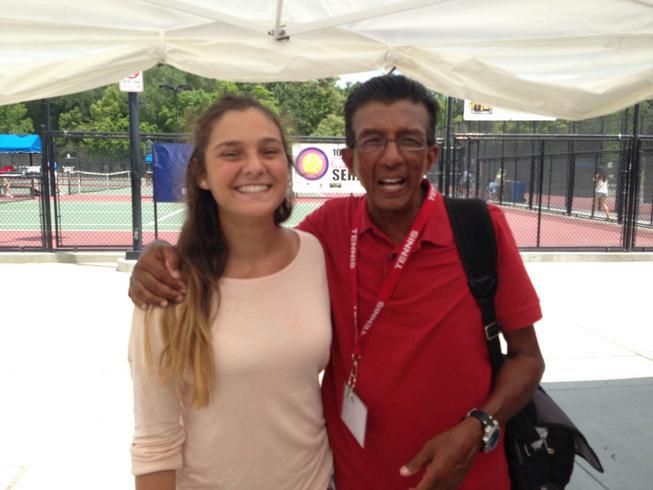
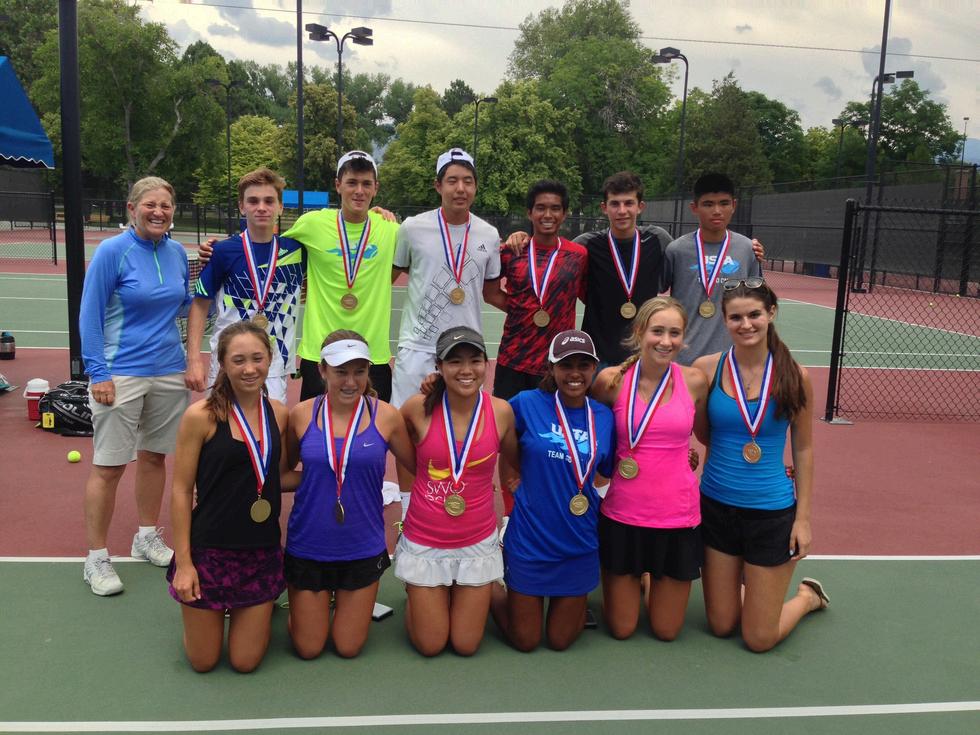
Gordon ZawTun had a quietly powerful presence. He was small in stature, but big in impact. He received the RSPA San Diego Bob Bacon Lifetime Achievement Award in 2025 and passed away on April 20, 2026. He was 71 years old. I first met Gordon at the 2015 USTA Boys and Girls 16s Zone Championships in Salt Lake City He was one of five USTA Southern California coaches that were assigned to teams representing that area It was a blessing to watch this iconic coach in action as he led a group of high-performance teens through a week-long intense tennis competition.
The Zonal teams came from areas within the Western U S and Hawaii Each squad consisted of twelve top-ranked talented juniors: six boys and six girls. Every match consisted of singles, same gender and mixed doubles. Gordon led the So Cal Renegades, and my daughter, Julia, was blessed to be a part of his team. I was fortunate to be part of the parent crew
Gordon was an expert at providing unique perspectives, encouraging independent thinking and creating team chemistry. He accepted the almost impossible task of coaching a group of talented teenaged athletes with strong minds, developing egos and diverse personalities. His coaching quest was to guide them through tough matches –within 24 hours of meeting them Add in the challenge of managing tennis parents It was a tough gig, but Gordon succeeded By the end of the event, he earned the respect of both players and parents along with their admiration, loyalty and gratitude.
At the orientation, Gordon met with the players and their parents to share his coaching philosophy and expectations. It was simple. He asked each athlete to bring their best to the tennis court every day Show respect for all, compete with honor and take responsibility for their tennis To Gordon, that meant players should prepare their own equipment and take care of their tennis needs.
He asked them to be punctual, supportive and show kindness to all The parent’s role should be minimal and focus on the fundamentals such as providing food, transportation and encouragement. No coaching or criticism allowed. Then, he asked the players to make team posters to be displayed at each match. He provided poster boards and art supplies for the task
The next day, Gordon quietly observed the players as they practiced with one another. He did not demand specific drills. He merely suggested they hit while he observed their groundstrokes, net skills and he noted how they moved and behaved on the court. This was how he determined doubles pairings and match line-ups.
Gordon believed having a team cheer was essential to building a great culture He gave the group the task of creating a Renegade cheer. As young teens can be, they were hesitant and embarrassed to speak out. He gave the players general ideas and asked them to create something. Gordon had a way of encouraging the kids and made them feel safe to try. The group embraced the challenge. When the Renegades opened their first match, their team cheer could be heard across the facility They bonded over that cheer, and it got louder each day
Another way Gordon celebrated success was by honoring one boy and one girl for their performance after each match. He had a formula that calculated games won vs games lost. The players with the highest number of games won - regardless of their position on the team - received gift certificates for ice cream at Baskin-Robbins
Off-court time was also important to Gordon for team building and camaraderie. The Zonal tournament was held over July 4th weekend and Gordon arranged for the players to see highlights of Salt Lake City. They went to various eateries, shopping centers, and to a fireworks show.
“Being on Coach Gordon’s Zonal team was one of my favorite junior tennis memories,” said Julia Ronney, who played NCAA Division I tennis at the University of Montana. “He made me feel like an important part of the team. We had fun whether we were playing tennis, hanging around the hotel or exploring the city. He let us have a say in how we wanted things to go, and sometimes he let us pick our doubles partners.”
Motivation was one of Gordon’s strong coaching qualities Before each match, he shared true-life experiences of what it means to be a champion. He had a notebook that housed a collection of motivational stories. These are some of the stories he shared with the Renegades and their parents. 24
Walt Disney was fired by a newspaper editor because he lacked imagination and did not have any good ideas. Disney was also told the theme park would only attract riffraff and the City of Anaheim denied his plans on multiple occasions. He went bankrupt several times before building Disneyland and it became the theme park it is today.
Thomas Edison’s teachers told him he was too stupid to learn anything He was fired from his first two jobs for being non-productive He had more than one thousand attempts while trying to invent the light bulb. When asked about how it felt to fail one thousand times, he said he never failed. It was just that inventing the light bulb took one thousand steps.
“You will learn more from your losses than you will ever learn from your wins,” Gordon said. “So when you eventually win, it took that many steps to become a champion Keep that in mind I wish it were that easy that everyone could start winning right off the bat, but it takes many steps to become a winner.”
Other Gordon ZawTun stories:
Inventor Albert Einstein did not speak until he was 4 years old and he did not read until he was age 7 His parents thought he was “sub-normal ” One of his teachers described him as “mentally slow, unsociable and adrift. Forever in foolish dreams.” He was expelled from school Cartoonist Charles Schultz, who created the comic “Peanuts”, submitted early drafts to his high school yearbook. They were rejected.
Fred Astaire, one of the greatest actors and dancers of the 1930s, was rejected after his first screen test It is reported that producers wrote in a memo, “He can’t act, he can’t sing, he is slightly bald and can dance a little.” Astaire hung that memo over his fireplace in his Beverly Hills home. Decca Records declined to sign the Beatles in 1962 saying “We don’t like their sound. Guitar groups are on their way out.” Several other major labels passed on the band before they found their home at EMI’s Parlophone Label
In 1960, Liberty Records kicked a young singer named Reg Dwight out of its office and complained that Dwight’s talent was a “waste of their time.” That same singer is known today as Elton John.
Said Gordon: “Imagine if these people had given up because they thought they were doomed to fail They would’ve never achieved success Do you think they ever felt down or depressed? Sure they did, but they never allowed those feelings to take over. They followed their desires to succeed, and in every case, exceeded their wildest dreams. That experience can be viewed as positive in hindsight. Their failures were actually steppingstones, not stumbling blocks It is your choice, so be determined and never give up ”
For more than four decades, Gordon’s coaching journey included serving as the Director of Tennis at the Palm Valley Country Club, and he was a professional at The Ritz-Carlton in Rancho Mirage. He ran the prestigious USTA Henry Talbert Junior Championships and many other USTA tournaments He led Junior Team Tennis programs and was a USTA high-performance coach
Gordon was born in Rangoon, Burma (now Myanmar), and became a leader in the SoCal desert tennis communities. He was deeply respected within the industry, recently honored with the Coach Dave Borelli Leadership Award at the 14th Annual Orange County Community Tennis Seminar Following his passing, the local tennis community and the Love and Love Tennis Foundation established the Gordon ZawTun Memorial Scholarship to continue his legacy of developing junior talent in the desert
The Renegades did not win the 16s Zonals that year. In fact, I believe they finished fourth overall. But it didn’t matter. Having Gordon ZawTun as their coach was the biggest prize possible
I feel so blessed to be able to call Gordon my friend He made a lasting impact on my coaching career. He set the bar on how to be a kind, loving and accepting leader. He met his students where they were and guided them to be better people on and off the court. This was Gordon’s motivational story when meeting with the Renegades for the last time:
“The Sequoia tree is believed to be one of the largest and oldest living things in North American Continent. One in particular is called the General Sherman Tree. These are a few facts concerning this magnificent tree. It has been measured as 272 feet, 4 inches tall. The base circumference of the tree is 101 feet, 7 inches. It would require 17 men armin-arm to encircle the base of the tree It is estimated to contain over 6,000 feet of lumber, sufficient enough to build 35 five-bedroom homes In places the bark is up to 24 inches thick This tree is estimated to weigh up to 1,350 tons Now consider this the seed of a sequoia weighs .005 grams (like the flake of oatmeal.) This represents a growth from seed to maturity to 100,000%.
“The same creator who created that seed, created each and every one of you. Do you believe he would give any one of you less potential for growth? You all have a phenomenal amount of potential for growth Use it ”
Then, he shook the hand of each of his players and said: “Have a safe trip and I hope to see you again soon.”
Gordon, you were indeed a Giant Sequoia kind of coach You helped plant thousands of seeds of greatness in your lifetime Thank you Your legacy lives on
(For more info about Gordon Zawtun’s life, please visit the tribute from USTA SoCal at https://ustasocal.com/news/remembering-gordon-zawtun/.
CONGRATS TO OUR 2026 RSPA SAN DIEGO CERTIFIED TENNIS PROFESSIONALS
Conan Lorenzo RSPA Tennis Coach Developer
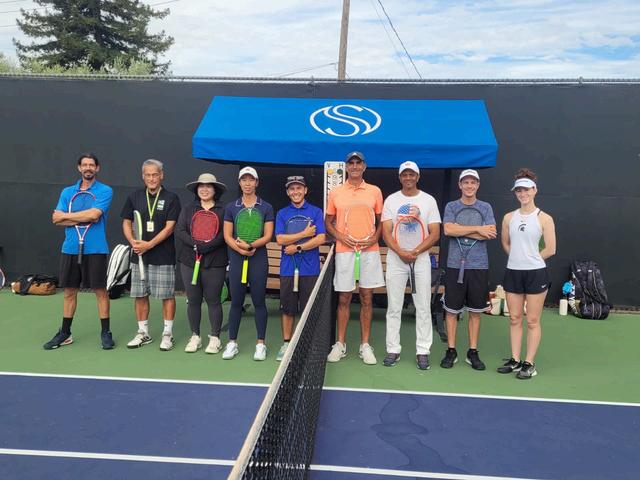
Congratulations to our newly certified RSPA San Diego tennis teaching professionals in 2026! We applaud you on this important milestone as it reflects the hard work, technical knowledge and dedication you’ve shown to become a RSPA certified pro. You have the unique opportunity to inspire a lifelong love for the game in others, build mental toughness, and guide players to learn new skills We wish you well in this new chapter of your coaching career.
Tennis Instructor: Max Mereles, Ally Mills, Scott Nagel, Dan Potter
Tennis Professional: Brian Guzman
Thanks to the pros who participated in certification courses with our San Diego Division Coach Developer Conan Lorenzo this year:
Eric Alm (San Diego), Morcos Boutros (NorCal), Jenna Dizon (NorCal), Jose Eschen (NorCal), Ervine Flores (NorCal), Yu-Ting Huang (NorCal), Vernal Leslie (NorCal), Louis Maunupau (NorCal), Michael McGrath (SoCal), Ally Mills (San Diego), Scott Nagel (San Diego), Milan Norgauer (NorCal), Carlos Sandoval (SoCal), Marlo Schiffman (NorCal), Arthur Varela (NorCal)
CONGRATS TO OUR 2026 RSPA SAN DIEGO CERTIFIED PICKLEBALL PROFESSIONALS
Josh Jorgensen RSPA Pickleball Coach Developer
Congratulations to our newly certified RSPA San Diego Pickleball Professionals in 2026! Great job on reaching this milestone in your careers. You have shown dedication and commitment to expand your racquet sports teaching skills and we wish you all the best.
Pickleball Instructor: Travis Albini, Steve Chang, Dan King, Mike Loisel
Thanks to the pros who participated in certification courses with our San Diego Division Coach Developer Josh Jorgensen this year:
Travis Albini (San Diego), John Broderick (San Diego), Steve Chang (San Diego), Mike Downs (NorCal), Amy Kelts (San Diego), Mike Loisel (San Diego), Keith Orahood (SoCal)
Upcoming Certifications
We are pleased to announce upcoming professional development workshops in our region, featuring sessions for both tennis and pickleball. Padel courses are available in other states. These programs are designed to strengthen your coaching expertise, expand your industry knowledge and support your continued growth within the racquet sports profession. To register for any of these, please visit the RSPA website.
Level 1 Tennis
Sept 25-26 | La Jolla, CA Register Here
October 17-18 | Mission Viejo, CA Register Here
Nov 13-14 | La Jolla, CA Register Here
Dec 12-13 | Cerritos, CA Register Here
Pickleball
August 29 | Mission Viejo, CA Register Here
October 3 | Cerritos, CA Register Here
Padel
August 14-15 | Westfield, IN Register Here
Sept 12-13 | Charlotte, NC Register Here
Level 2 Tennis
Aug 22-24 | La Jolla, CA Register Here
Sept 12-14 | Cerritos, CA Register Here
Nov 14-16 | Irvine, CA Register Here
Dec 12-14 | La Jolla, CA Register Here
December 7 | Cerritos, CA Register Here
Sept 18-19 | Carrolton, TX Register Here
October 3-4 | Milwaukee, WI Register Here
Congratulations to Juan Garcia on Achieving RSPA Master Professional Status
Sabastiani Leon RSPA Elite Professional
The RSPA San Diego Division proudly congratulates Juan Garcia on earning the prestigious RSPA Master Professional designation, the highest professional honor within the Racquet Sports Professionals Association
This distinguished recognition is awarded to professionals who have demonstrated exceptional leadership, innovation, and excellence throughout their careers, making a lasting impact on both the profession and the racquet sports community.
As the Director of Racquets at San Dieguito Tennis Club, Juan is recognized for his innovative coaching and leadership He is also the author of The Modern Tennis Coach and The Courts, with work featured in Racquet Magazine Through his writing, speaking engagements, workshops, podcasts, and mentorship, he continues to inspire coaches and advance the profession.
Congratulations, Juan, on this well deserved achievement. The RSPA San Diego Division is proud to celebrate this milestone and grateful for your continued leadership and dedication to our industry.
Welcome New Members
We are pleased to welcome our new members who joined the San Diego Division since the beginning of 2026!
Top 3 Tips for Tennis Players to Transition to Pickleball
RSPA Elite Professional
If you love tennis, you already have a huge head start to learn the game of pickleball. It is fun, builds friendships and offers a totally different kind of thrill. Think of pickleball as tennis dialed up to a faster and more strategic gear It takes your sharp volleys, ability to rally and court awareness and drops them into a fast-paced chess match at the kitchen line
The learning curve can be incredibly rewarding, and you can be competitive on day one. It’s not about replacing the sport you love, but pickleball can add a highly social and fun alternative to your weekly routine that can sharpen your tennis game.
Here are some tips to consider when trying pickleball.
1. Embrace the soft game.
Learn to use drop shots and resets instead of overpowering your opponents with speed ups or harder drives Consider that soft and low balls are often the most effective shots in pickleball.
2. Master the dink.
Strive to develop a reliable dink game that promotes touch, control and patience. Focus on consistency before trying to create excessive spin.
3. Win the transition game.
Work your way to the kitchen line after the serve and return The team that controls the kitchen line controls most points
The Bottom Line
Pickleball is fundamentally different from tennis. While athleticism and racket skills transfer well, success comes from embracing the sport’s unique strategies. The sooner tennis players learn to value control over power and understand that pickleball is primarily played from the kitchen line, the faster they’ll improve and enjoy the game ###
About the Author: Joel Reckewey has over 20 years of coaching experience. He is an RSPA Vice President and the Racquet Sport Director of Palm Valley Country Club in the Coachella Valley. Joel is also an RSPA San Diego Pickleball Coach Developer.
Education & Professional Development
Why Different Coaching Personalities Matter for a Tennis Program
Conan Lorenzo RSPA Elite Professional
An important part of leading a strong and effective team can start with understanding personality differences in the workplace and on the tennis court. Whether in business, athletics or education, people approach situations differently. Some are thinkers that rely heavily on logic and analysis when making decisions. Others are feelers who place greater emphasis on relationships and emotional considerations Neither approach is the best solution, rather consider that each coaching style brings unique strengths to the program.
Successful organizations, whether on the tennis court or in the traditional workplace, benefit from individuals with different personalities, backgrounds and strengths This diversity of perspective can foster creativity, critical thinking skills and rich learning environments.
This concept is especially relevant when working with tennis players Every athlete learns differently. Some are visual learners, who benefit from watching demonstrations and modeling movements. Others respond best to verbal instruction. Yet a third group needs hands-on guidance and physical feedback as kinesthetic learner. In all cases, it takes time to process information independently.
As tennis professionals, our responsibility is to recognize these differences and adapt our coaching styles accordingly. Because of this, it is important that a coaching staff reflects a variety of personalities, strengths and teaching-style approaches. For example, a coach may possess a commanding presence and excel at communicating with large groups This type of individual helps establish the tone for each session while clearly articulating the day’s goals and objectives.
Another type of coach could bring tremendous energy and expertise in fitness and athletic development By leading dynamic warm-ups, conditioning sessions and movement training, players build the physical foundation necessary for long-term success.
A third coaching style might be naturally outgoing and highly engaging Their ability to connect with shy or reserved players helps foster confidence, enthusiasm and a positive training environment within a demanding program. Then there is a type of coach who is an exceptional player and a role model. They will lead by example by competing alongside juniors and challenging them on court They provide athletes with a tangible example of higher skill levels of achievement.
A female coach in the tennis teaching profession provides valuable perspective, mentorship, and representation for female athletes. While tennis has historically been male-dominated field, a female coach can inspire and motivate young female athletes She can also build strong social connections and cultivate a sense of belonging for all within a program.
The reality is that no single coaching style can effectively reach every player the same way at a club or in a program Each athlete has unique needs, motivations, personalities and learning styles. By providing players with a diverse coaching team, we increase the likelihood that every athlete will find a coach with whom they connect to grow their mental, physical and social skills.
When it comes to player development, the goal is not to find one perfect coach. Rather, consider a program that offers a team of coaches whose collective strengths provides athletes with the greatest opportunity to succeed. ###
About the Author: Conan Lorenzo is an RSPA Elite pro and the Director of Tennis at the La Jolla Beach and Tennis Club.
Education & Professional Development
Coach Karen’s Korner: Top 5 Tips to Set Goals for Success
Karen Ronney RSPA Elite Professional
e or level involves dealing with pressure and feeling successful. Billie sure is a privilege,” and that can be true. However, most athletes are y to thrive under pressure with positivity and focus. It can also be a he concepts of winning and losing. This is where an experienced RSPA tennis professional can help in both areas as they are directly related
Here are the Top 5 Tips to help your students face pressure and set up for success:
1.Focus on the process of playing instead of the results: Tennis is at its best when it is playful and fun. Help your student enjoy the feeling of moving, hitting a ball and rallying in non-competitive and competitive environments Why? Because fun fades when results are attached to the process Mental judgements applied of “good or bad” or “winning and losing” tend to diminish the experience. The solution is to guide students to “play” with a child like perception of non-judgement. Teach them to focus on the process – not the results of the effort.
2.Set individual goals for each student: Before each practice, match or tournament, set individual goals for athletes For example, a practice goal can be taking the ball on the rise on groundstrokes A match goal could be starting inside the baseline on a secondserve turn. A mental goal might be sitting on the bench for 90 seconds taking three deep breaths to reset between side changes. In all cases, it is important to define a specific action for which to measure success.
3.Two glows and a grow: After each practice, match or tournament, ask your student to name two glows or successes, and one grow, the latter, something to improve This assessment should come from the student and not the parent Talk about it at the next lesson.
4.Create a measuring system for each goal. Introduce a self-rating system of 1 to 10 to assess an effort toward an action or goal. (1 is low and 10 is high.) Ask the student to give each “glow” and “grow” a number. Ask how often they were able to take the action? Perhaps 1 to 3 means a few times, 4 to 6 is sometimes, and 7 to 10 is most of the time Empower your students to hone their instincts, develop independent thinking and feel more confident under pressure.
5.Write it down: There is power in the written word. Give your student a notebook of any size to keep in their racket bag. It can be an inexpensive spiral binder. For older teens and adults, use the Notes App on a cellphone What should they write? After each lesson, practice and tournament include the date of the entry, name the goal, and finish with the actions taken. Also, after matches, write two glows and a grow with the 1 to 10 rating scale of assessment.
Individually, these five tips can help develop your students’ tennis skills with a focus on fun. When you strive to apply all of them you can help build a player that has fun, thrives in competition, feels successful and truly believes Pressure is a Privilege. Thoughts or comments? Feel free to share them with me at kronney@yahoo.com.
Education & Professional Development
Top Five Padel Tips for Newly Converted Tennis Players
Steve Thom RSPA Elite Professional
For tennis players looking to inject a new rush of adrenaline into their racquet skills, Padel can be a great choice. This sport takes your existing groundstrokes and crisp volleys and introduces a dynamic, 3D element. The enclosed glass walls will keep the ball alive and completely transform the tactical landscape of this racket sport. You don't have to unlearn tennis, instead consider adapting your court awareness to a faster, high-octane game. It’s a space where patience beats raw power and clever angles matter more than hitting groundstrokes. If you are willing to give Padel a try, consider these Top Five Tips:
1.Use the Continental Grip: Every shot is better with this neutral grip. You can quickly transition from forehand to backhand.
2.Touch Matters: Hit soft touch shots when volleying.
3.Get to the Net: Take over the net and move forward with your partner.
4.Embrace the Glass: Learn to use the glass to your advantage and play the balls off the glass when possible. This is one of the most difficult transitional elements for tennis players.
5.Love the Lob: Hit high deep lobs to force your opponents away from the net. By pushing them to the back wall, it allows you and your partner to take the net advantage.
About the Author: Steve Thom has been an RSPA pro for 23 years and is the Co-Director of Junior Programming at Lake Murray Tennis Club. He teaches junior and adult classes, as well as leads the club’s USTA Junior Team Tennis program. Steve also co-leads a successful summer camp program with Fletcher Hills Tennis.
Roberto D. Martini RSPA Professional
Education & Professional Development
The
"Boring"
Strategy That Will Save Your Bad Tennis Days
We’ve all been there. You step onto the court, and within fifteen minutes, you want to launch your racquet over the fence. Whether it's a lingering bad day at work or just an off-tempo afternoon, frustration takes over, the unforced errors pile up and the fun completely vanishes.
When your strokes, footwork, and mental game suddenly desert you, you don't need a complex technical overhaul. You need a quick, reliable reset button. Next time you feel the rage building, commit to a simple survival tactic before you even finish warming up:
The Mirror Shot Strategy
What is the Mirror Shot Strategy? It is exactly what it sounds like Instead of trying to construct brilliant, aggressive points, you resolve to simply mirror whatever your opponent sends your way. You can use it for a few points to regain your confidence or ride it out for a couple of games or even a whole match.
Here is how it translates on the court:
They hit cross-court? You return it cross-court.
They hit down the middle? You send it right back down the middle
They push a soft ball? You push a soft ball back
They slice? You slice it right back.
They hit with heavy pace? Don't overswing. Just block it back using their own speed.
The One Critical Exception: If your opponent hits a down-the-line shot, do not mirror it. Instead, hit it back down the middle or cross-court. If you mirror a down-the-line shot, you will open up the entire court and end up doing an exhausting amount of running
Why This Strategy Solves Your Frustration: By mirroring, you instantly shift 100% of the pressure onto your opponent You are forcing them to take the risks, change the ball's direction, and find a way to hit a winner If they happen to be having a flawless day and beat you anyway, fair enough But the most important thing? You stop beating yourself Your unforced errors will plummet, and you’ll be shocked by how many free points you get just by staying in the rally.
Match Point
Is playing this way boring? Honestly, yes It requires you to put your killer instinct on the back burner and play simple, patient tennis, but you will be incredibly surprised by how many more balls you get back and how many more matches you can scramble to win when you aren't playing your best.
Give the Mirror Shot Strategy a shot next time the wheels start coming off. Stay on your toes, keep it simple.
###
About the Author: Roberto Martini is an RSPA Professional Level teaching pro, who works at Towers Costa Verde in San Diego He was a top 25 ranked junior in Brazil and worked at La Jolla Country Day for thirteen years. He emphasizes a strong work ethic and his goal is to help students love the learning process while developing strong tennis skills.
Education & Professional Development
The Ball Matters: A Better Way to Introduce and Retain Adult Tennis Playerss
Juan Garcia RSPA Master Professional
Tennis has always been one of the most rewarding sports in my life It teaches discipline, resilience, problem-solving, emotional control, fitness and community It creates friendships, mentorships, business relationships and life lessons that stay with people forever Yet despite everything tennis offers, our industry still faces a major challenge: too many people feel like tennis is not for them
Here in San Diego, we are fortunate to have an incredible tennis community filled with passionate players, coaches, clubs and programs. Even with all the positives surrounding our sport, many new players still walk into a tennis environment feeling intimidated before they ever hit a second ball.
They see experienced players rallying with yellow balls at high speed, using advanced terminology and years of technical understanding. For a beginner adult that experience can feel overwhelming. If we truly want to continue growing tennis in our communities, we need to become better at meeting players where they are. Fortunately, one of the most effective tools for doing that already exists.
The ball matters
Today’s coaching landscape provides us with excellent developmental tools through the progression system There are red balls for entry-level beginners, orange balls for intermediate enthusiasts and green dot balls for players to grow their tennis skills These balls slow the game down, create longer rallies, reduce frustration and allow players to experience success earlier in their tennis journey
Yet somewhere along the way, these balls became labeled as “kids’ balls”,which may unintentionally limit participation growth in the adult space A beginner adult does not care whether the ball was originally designed for junior development. They care whether they can rally, improve, have fun, and feel successful enough to come back next week.
As coaches and tennis leaders, we need to remove the ego attached to development. No one walks into a gym for the first time and bench presses three hundred pounds. No one learns to ski on a black diamond run. Every successful sport adjusts the environment to help participants build confidence and competency. Tennis should do the same without hesitation.
The reality is that many beginner adults struggle unnecessarily with traditional yellow balls The speed, bounce, timing, spacing and physical demands can create frustration Instead of learning movement patterns and ball control, many players spend most of the lesson chasing balls and feeling defeated in their efforts That experience does not grow the game
Success grows the game When a new player can rally five balls in a row with an orange ball, they smile. When they can move correctly and recover without constantly feeling rushed, they gain confidence. When they feel athletic and capable instead of embarrassed, they begin identifying themselves as tennis players. That identity shift matters.
This idea also applies to warm-ups for current recreational players Many adult players struggle to warm up consistently with yellow balls, especially at the recreational level The pace can become rushed, rallies break down quickly and players feel frustrated rather than confident.
Using orange or green dot balls during warm-ups can immediately improve rhythm, consistency, movement quality and confidence Players rally more, move better and begin feeling successful instead of tense
Sometimes slowing the game down actually accelerates improvement. This conversation also connects directly to equipment selection. Too often, a beginner walks into a pro shop and leaves with a racquet designed for a different level of play based on brand marketing For example, an ultra-light or head-heavy racquet paired with a yellow ball can make tennis a challenging experience Instead, it’s better to guide players toward the right combination of racquet and ball for their current level, not the level they someday hope to reach. That is how retention is created.
The tennis industry has a tremendous opportunity right now People are looking for movement, connection, fitness, fun and accessible entry points into sports Tennis already has the tools to provide that experience Imagine walking into a tennis facility where a beginning adult player happily hits with orange or green dot balls without embarrassment. Imagine group classes where progression is normalized instead of hidden. Imagine more players leaving the court feeling encouraged, confident and excited to return. That cultural shift could have a tremendous impact on our sport because it can build a strong foundation for change
The future of tennis growth will not come from convincing advanced players to play one extra day a week. It will come from encouraging new players to fall in love with the game for the very first time. And sometimes, something as simple as the right ball can make all the difference
About the Author: Juan Garcia is a RSPA Master Professional and the Director of Racquets at San Dieguito Tennis Club. A recognized racquet sports leader, published author and an advocate for innovation and education. He is an advocate for the continued growth of tennis and racquet sports.