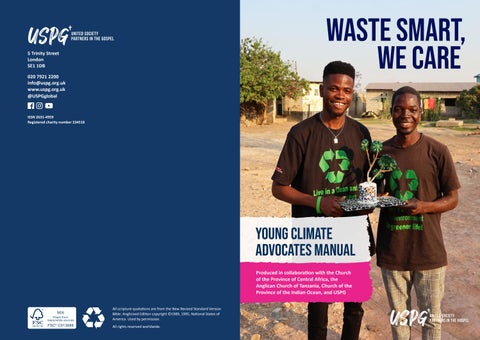
WASTE SMART, WE CARE
5 Trinity Street London SE1 1DB 020 7921 2200 info@uspg.org.uk www.uspg.org.uk @USPGglobal
ISSN 2631-4959 Registered charity number 234518
Young Climate Advocates Manual Produced in collaboration with the Church of the Province of Central Africa, the Anglican Church of Tanzania, Church of the Province of the Indian Ocean, and USPG All scripture quotations are from the New Revised Standard Version Bible: Anglicised Edition copyright ©1989, 1995, National States of America. Used by permission. All rights reserved worldwide.
1|
|2
CONTENTS Foreword and Acknowledgements...........1 Module 1: Created with Purpose.........3 Module 2: Understanding the Problem........................7 Module 3: Finding Your Voice........... 11 Module 4: Advocacy in Action.......... 15 Module 5: Let’s Go!.......................... 21
FOREWORD “The earth is the Lord’s and all that is in it, the world, and those who live in it.” Psalm 24:1 Climate change is one of the greatest challenges facing our world. Its effects are felt across every continent, from rising temperatures, droughts, and floods to food insecurity, environmental degradation, and the loss of livelihoods. While no country or community is untouched, those who have contributed least to the climate crisis are often among the most severely affected. Across Africa, these environmental pressures compound existing challenges, including unemployment and unequal access to resources. Addressing these challenges requires a shared response. The Waste Smart, We Care - Young Climate Advocates Manual is a timely, faith-inspired resource that bridges the gap between biblical principles of social justice and practical, locally rooted action. It recognises young people as active changemakers today, guided by Christ’s call to love our neighbours. Across five modules, this manual explores what the Bible says about caring for creation, helps us to look around and understand environmental challenges and their root causes, and shows us how to work with others to bring about change through safe and effective advocacy campaigns whether online or out in our communities.
Cover photo: Robert and Njobvu, two climate champions from the Eastern Province in Zambia, with a handmade ornament made from recycled glass and water bottles.
We warmly commend this resource to clergy, youth leaders, church fellowships, and all young climate advocates. Our prayer is that it will inspire a generation of compassionate, resilient leaders who put their faith into action and work together to build a healthier and greener future. The Revd Canon Dr Duncan Dormor General Secretary of USPG
Calls for a plastic-free future in the Anglican Diocese of Lake Malawi
ACKNOWLEDGEMENTS The development of this manual has been made possible through the commitment, collaboration, and encouragement of our church partners, particularly those that make up the Provincial Climate Change Campaign: the Anglican Church of Central Africa, the Anglican Church of Tanzania, and the Church of the Province of the Indian Ocean. And in particular: • The Most Revd Dr Maimbo William Mndolwa, Archbishop of Tanzania and Bishop of Tanga • T he Most Revd Albert Chama, Archbishop of Central Africa and Bishop of Lusaka • T he Most Revd Dr Gilbert Rateloson Rakotondravelo, Archbishop of the Indian Ocean and Bishop of Fianarantsoa
We are grateful to all the bishops, clergy, and programme co-ordinators who have contributed their time, experience, and perspectives to this work. You lead by example and so we thank you for shepherding the Church in a way that champions care for God’s creation. We also recognise and appreciate the invaluable contribution of the USPG Africa team in fostering and strengthening these partnerships, and in supporting our collective commitment to climate justice across the region. Finally, we recognise the young climate advocates whose passion, commitment, and determination to make a difference in their communities is commendable. Thank you to everyone who has played a part in bringing this resource to life.
3 | MODULE 1
CREATED W ITH PURPOSE | 4
WHY CARE?
MODULE 1 CREATED WITH PURPOSE
The Bible teaches that creation belongs to God and that human beings are entrusted with its care. Caring for the environment is therefore not separate from our Christian faith; it is part of how we love God, love our neighbours, and serve the common good. Let’s have a look:
• “God saw everything that he had made, and indeed, it was very good.”
INTRODUCTION
Genesis 1:31
Many of us want to see positive change in our communities, yet we often wonder where to begin or how to make a real difference. Across Africa, young people navigate pressing daily challenges from unemployment and social pressures to severe environmental issues such as unmanaged waste, water shortages, and deforestation. At times, we may also feel that our voices are excluded from key decision-making spaces. By understanding who we are in Christ and our calling to care for God’s creation, we can put our faith into action. As Christians, we are called to love our neighbours, seek justice and be faithful stewards of what God has entrusted to us. Together, we can use our voices and actions to bring meaningful change.
• “The Lord God took the man and put him in the garden of Eden to till it and keep it.” Genesis 2:15
• “The earth is the Lord’s and all that is in it, the world, and those who live in it.” Psalm 24:1
• “The second is this, ‘You shall love your neighbour as yourself.’ There is no other commandment greater than these.” Mark 12:31
• “I praise you, for I am fearfully and wonderfully made. Wonderful are your works; that I know very well.” Psalm 139:14
• “Before I formed you in the womb I knew you, and before you were born
I consecrated you; I appointed you a prophet to the nations.” Jeremiah 1:5
• “You are the salt of the earth, but if salt has lost its taste, how can its saltiness be restored? It is no longer good for anything but is thrown out and trampled underfoot. You are the light of the world. A city built on a hill cannot be hid.” Matthew 5:13-14
Because creation belongs to God, Christians are called to be responsible stewards of creation and advocates for people whose lives are affected by environmental harm. Christian advocacy therefore asks two questions: “What is happening to creation?” and “Who is most affected, vulnerable, or unheard?” This can be understood as:
• Identity: I am created and valued by God. Gifts: I have strengths, skills and experiences that can serve others. • • Calling: I am called to love, serve and steward God’s creation. Justice: I pay attention to people and communities who are vulnerable • Young Zambian climate advocates create ecofriendly fuel blocks from recycled waste materials
or unheard.
Advocacy: I use my voice, relationships and actions to contribute to • positive change.
5 | MODULE 1
CREATED W ITH PURPOSE | 6
PRACTICAL ACTIVITY Our Shared Identity Map I nstructions: Draw a circle on a piece of paper with our individual or group names in the center. Around our names, let us map out our:
• Strengths: What natural talents do we bring to the team? • Skills: What practical abilities can we contribute? • Passions: Which local climate issues do we care about most?
• Faith Values: Which biblical principles guide our stewardship?
REFLECTION QUESTIONS • What unique gifts and strengths has God placed within our group to serve our community and protect creation?
• When we look at our local environment,
which challenges resonate most with us, and why do they matter to us?
• What happens when we remain silent
about environmental injustice, and what positive impact can we achieve when we choose to speak up together?
ACTION STEP Choose one of the Bible verses above that speaks most strongly to you. Reflect on what it teaches you about your responsibility to God, your neighbours and creation. Pray into this by yourself or with a friend.
A young advocate collects waste plastic at a market in Fort-Dauphin, Madagascar.
7 | MODULE 2
UNDERSTANDING THE PROBLEM | 8
MODULE 2 UNDERSTANDING THE PROBLEM INTRODUCTION We all notice things in our communities that we would like to change. Perhaps waste is accumulating around the church, young people are excluded from decisions that affect them, or a community has limited access to clean water or environmental services.
Young climate advocates in Likoma, Malawi, take action to clean up the beach.
Seeing a problem is important, but seeing is only the beginning. Advocacy is not about complaining, attacking leaders or trying to solve everything ourselves. It is about working with others to influence decisions, attitudes, practices and actions that can improve people’s lives and protect God’s creation. Many problems continue because we respond only to what we can see.
CHANGE REQUIRES PEOPLE Now we've identified the root causes, we can start creating change. But we rarely create lasting change alone. Some people make decisions, control resources, influence public opinion, have technical knowledge, are directly affected, can mobilise others or provide support.
For example:
These people and groups are called stakeholders. Understanding who they are helps us know who to involve, who to influence and who can support our advocacy.
You notice that plastic waste is accumulating. A clean-up may provide an immediate solution, but we can also ask:
These are people who can help us understand the problem and create change. They:
• Why is waste accumulating? • Are bins available? • Who is responsible for collection? • What happens after collection? • What behaviours contribute to the problem? • Who has the power to improve the system? These questions help us move beyond the symptoms and understand the root causes.
Make decisions: Church leaders, councillors, government officials • Control resources: Church administrators, businesses, donors • Influence others: Faith leaders, teachers, journalists, community leaders • Have expertise: Environmental officers, health workers, engineers • Are affected: Young people, residents, farmers, vulnerable communities • • Mobilise others: Youth leaders, church groups, schools, community organisations
• Provide support: NGOs, churches, businesses and civil society groups Remember: One stakeholder can play several roles. A church leader, for example, may make decisions, influence others and mobilise the congregation.
9 | MODULE 2
UNDERSTANDING THE PROBLEM | 10
PRACTICAL ACTIVITIES Activity 1: Uncovering Root Causes (The 3 Whys) Instructions: Together, let us select an environmental problem in our community (e.g., waste accumulation) and ask "Why?" three times to reach the root cause:
• Problem: Excessive plastic litter around our meeting venue.
• Why? → There are no waste bins or collection facilities available.
• Why? → There is no active environmental management plan in place.
• Why? → Waste management has not yet been prioritised by local leadership.
Activity 2: The Advocacy Power Map 'Trash to Cash' is the motto of this young group of advocates from Lusaka, Zambia.
Place stakeholders on a simple four-box grid: High Interest
Low Interest
High Power
Work closely with them
Keep engaged
Low Power
Mobilise and support
Inform and involve
Consider:
• Who can make the decision? • Who is directly affected? • Who could become an ally? • Who needs more information?
DISCUSS: • Which community problems require us to look beyond the immediate symptoms?
• Who is most affected by the issue we have identified? • Whose voice may be missing? • Who has influence over the issue?
PRAY TOGETHER: Lord God, open our eyes to the needs around us, give us wisdom to understand the causes of injustice, and give us courage to speak up for those whose voices are not heard. Help us to care faithfully for your creation, love our neighbours, and use the gifts you have given us to bring positive change. Guide us to work together with humility, courage, and hope. Amen.
11 | MODULE 3
FINDING YOUR VOICE | 12
3. A strong message is simple
MODULE 3 FINDING YOUR VOICE INTRODUCTION Having something important to say does not always mean we feel confident saying it. We may worry:
• “What will people think?” • “What if I make a mistake?” • “What if leaders don't listen?” • “I am not a good public speaker.” • “Someone else knows more than me.” These feelings are normal. Finding our voice is not about becoming loud or trying to dominate a conversation. It is about learning to communicate clearly, confidently and respectfully. Our voice becomes stronger when we use it with purpose.
KEY CONCEPTS & MESSAGES
A useful advocacy structure is: PROBLEM → SOLUTION → ACTION Example: “Plastic waste is increasing around our church. We can reduce it by separating waste and reducing single-use plastics. Let us agree on a youth-led waste plan this month.”
4. Stories help people connect Facts can inform people. Whereas stories can help people care. Finding our voice also means listening. Advocacy is not simply speaking. It is also: paying attention; asking questions; listening without interrupting; understanding different perspectives; responding respectfully.
5. Our bodies communicate too Strong communication involves more than simply choosing the right words. It includes making appropriate eye contact, speaking clearly, using an open and confident posture, and being mindful of facial expressions. It also means maintaining a calm and respectful presence when engaging with others. However, good communication does not require everyone to communicate in exactly the same way. Some people are naturally expressive and comfortable speaking openly, while others are quieter and more reflective. Both approaches can be effective. What matters is communicating in a way that is clear, respectful and authentic to who we are.
1. Confidence is built through practice We do not need to wait until we feel completely confident before speaking.
A STORY OF CHANGE
Confidence grows when we: prepare; practice; start small; learn from feedback; speak about things we care about.
Nicole, Diocese of Central Zimbabwe
2. Remember Confidence is not the absence of nervousness. Confidence is choosing to speak even when we feel nervous.
Nicole used her passion for social media and videomaking to share the story of three young boys - Blessed, Edgar and Talent - who turned discarded bottle seals into useful ropes. Her short video brought their simple idea to life and showed how powerful storytelling can be.
13 | MODULE 3
FINDING YOUR VOICE | 14
PRACTICAL ACTIVITIES Activity 1: The 60-Second Story In pairs, complete: “One change I would like to see in my community is…” Speak for 60 seconds. Your partner listens without interrupting. Then the listener gives feedback: One thing that was clear... One thing that was powerful... One thing that could be clearer... Swap roles.
Activity 2: Know Your Audience Read the message: “We need to reduce plastic waste because it harms our environment and our health.” Now imagine you are sharing this message with one of these audiences: church leaders, young people, community members or decision-makers. In 2–3 minutes, rewrite the message so that it speaks directly to your chosen audience. Think about the language, tone and examples they would respond to. Then, share your version with the group.
REFLECTION QUESTIONS 1. What helps us become more confident? 2. Are we better at speaking or listening? 3. What makes a message memorable? 4. How should we respond when someone disagrees with us? 5. Which audience do you find hard to speak to?
Climate advocates speak up at a workshop in Ambilobe, northern Madagascar.
15 | MODULE 4
ADVOCACY IN ACTION | 16
MODULE 4 ADVOCACY IN ACTION INTRODUCTION An advocacy message becomes more powerful when people move from hearing about an issue to participating in action. A campaign does not have to be large or expensive. It might begin with:
• five young people; • one church; • one WhatsApp group; • one community meeting; • one clean-up; • one conversation with a leader. What matters is having a clear purpose, the right people, trust, and a realistic goal.
Young eco-club members in Morogoro, Tanzania learn to water and nurture plants.
KEY CONCEPTS & MESSAGES 1.People are at the heart of every campaign A campaign is not simply a series of posters or social-media posts. It is about people working together around a shared purpose. We need to ask: Who cares about this issue? Who is directly affected? Who can help? This might include church leaders, youth groups and local authorities among potential stakeholders.
2. Build trust before asking people to act People are more likely to participate when they trust the people organising the action. Trust grows through: Honesty + Consistency + Respect + Listening + Follow-through
A clean-up in action in Fort-Dauphin, Madagascar.
Example If we announce a clean-up but repeatedly cancel activities, people lose confidence. Whereas if we communicate clearly, arrive when promised and appreciate people's contributions, participation becomes stronger.
17 | MODULE 4
ADVOCACY IN ACTION | 18
3.Online and offline action should reinforce each other
5. Safe and responsible digital advocacy
The strongest approach connects both online and offline action. Use online platforms to tell people about the campaign and encourage them to get involved. Then, create opportunities for people to participate in activities in their communities. Share the learning and results online to reach a wider audience, while continuing to follow up offline to support lasting change.
Our online actions should reflect the same values as our offline actions.
Offline action
Online action
• church meetings • community dialogues • clean-ups • tree planting • workshops • petitions • meetings with leaders • peer mobilisation
• WhatsApp messages • Facebook posts • short videos • voice notes • digital posters • online discussions • campaign hashtags
Before sharing, ask:
• Is it true? • Is it necessary? • Is it respectful? • Do we have permission? • Could it harm someone? The PCC manual highlights misinformation, negative comments, privacy, consent and misuse of content as important digital risks.
4. Choose the platform according to the purpose For example: Objective
Possible approach
Inform church members
Church announcement + WhatsApp
Mobilise youth
WhatsApp + Instagram
Reach community members
Meetings + WhatsApp
Share a success story
Short video
Engage leaders
Formal meeting + concise written message
A STORY OF CHANGE Kikiye Narare: Zimbabwe Kikiye is a student at High School and a PCC Young Climate Advocate. She became concerned after noticing a recurring problem at church gatherings: large amounts of litter were being left behind after events. Rather than simply raising the concern, Kikiye proposed a practical solution based on some large waste bins she had seen being used in the city of Gweru. She worked with the PCC team to develop lighter, affordable alternatives. The first two bins were introduced in Masvingo, where they helped significantly reduce litter. Church leaders, community members and youth groups then joined the effort to promote responsible waste disposal. The collaboration with the church leadership was particularly impactful, as it helped embed the message within community structures.
19 | MODULE 4
ADVOCACY IN ACTION | 20
PRACTICAL ACTIVITIES Activity 1: Build a Campaign Questions
Our campaign
Change we want
REFLECTION QUESTIONS 1. What helps us become more confident? 2. Are we better at speaking or listening? 3. What makes a message memorable? 4. How should we respond when someone disagrees with us? 5. Which audience do you find hard to speak to?
Who is affected? Who needs to be involved? Our key message Offline action Online action Platform(s) Date/time Who coordinates? How will we know something changed?
Activity 2: Get Creative Create one simple digital advocacy product: Option 1: WhatsApp message Option 2: Digital poster Option 3: 30-second video Option 4: Voice note It must contain: Problem + Solution + Action In Central Zimbabwe, discarded plastic is being turned into handwoven mats which can then be sold.
21 | MODULE 5
ADVOCACY IN ACTION | 22
For example:
MODULE 5 LET’S GO! . INTRODUCTION We have explored: Who we are → What we believe → What matters to us → How advocacy works → How to communicate → How to mobilise others Now comes the most important question:
What will we actually do? Good advocacy does not have to begin with a large project. This manual repeatedly emphasises that change can start small - from church clean-ups and youth awareness campaigns to community mobilisation - and that lasting action requires follow-through and ownership.
Rather than saying...
Instead say...
“ We will solve waste management in our city.”
“ We will introduce waste separation at our church.”
“ We will stop climate change.”
“ We will organise a youth climateawareness conversation.”
“ We will change government “ We will meet one relevant decisionpolicy.” maker and present our proposal.”
Impact Story – Thembelani, Zimbabwe "My name is Thembelani, and I’ve been involved with church activities since I was a child. In my early 20s, I joined the church’s social service arm, which helped me understand the importance of community service and caring for our environment. I later took on the role of coordinator for the Anglican Women’s Fellowship (AWF). Together with my peers, we are leading by example; for instance, as AWF, we purchased a water dispenser for the diocese, which helps reduce plastic use by buying water in bulk. Sometimes the small things make a big difference."
“Let's go!” does not mean acting without thinking.
Action is stronger together
It means: We have prepared. We have listened. We have prayed. We trust God, regardless of the outcome. We have a plan. Now, we move forward in faith.
Change is more impactful when done together. Therefore, before you move forward, ask:
KEY POINTS
Reflection does not mean failure. Sometimes an action does not produce the result we expected, and that is valuable information. We learn from what happened, adapt our approach and try again.
Start with one achievable action Sometimes young people become overwhelmed because the problem appears too large. But our first action does not need to solve the whole problem. Instead ask: What can we realistically influence?
• Who else can lead? • Who can support? • Who can take over when we are unavailable? • How can we involve the wider church? • How can we learn from our mistakes?
A clean-up is useful, but what happens the following month? A social media campaign can attract attention, but what happens after the post? A meeting with a leader can open a door, but who follows up? Real change requires us to keep going, follow up on our actions and build momentum over time.
23 | MODULE 5
ADVOCACY IN ACTION | 24
PRACTICAL ACTIVITY Our Advocacy Commitment Circle Stand or sit in a circle. Each person completes: “One change I want to help create is…” Then: “One thing I can contribute is…” Finally: “One person I will involve is…” The facilitator records common commitments and identifies opportunities for collective action.
REFLECTION QUESTIONS 1. What is one issue we genuinely care about to act on? 2. What is realistic for us to achieve in the next 30 days? 3. Who needs to be involved? 4. What could prevent our action from succeeding? 5. How will we respond if participation is low? 6. How will we make sure our action continues beyond one event?
NEXT STEPS The issue we choose to tackle:............................................... The change we want: ............................................................ Our first action: ..................................................................... The people we will involve: ................................................... Our start date: ....................................................................... Our 30-day goal:..................................................................... How we will measure progress: ............................................ Our follow-up date: ...............................................................
Tungwanio Rulenguka, a youth advocate from the Diocese of Morogoro, Tanzania, separates waste collected from local shops, offices and homes.
25 |
| 26
NOTES
___________________________________________________________________________________
___________________________________________________________________________________
___________________________________________________________________________________
___________________________________________________________________________________
___________________________________________________________________________________
___________________________________________________________________________________
___________________________________________________________________________________
___________________________________________________________________________________
___________________________________________________________________________________
___________________________________________________________________________________
___________________________________________________________________________________
___________________________________________________________________________________
___________________________________________________________________________________
___________________________________________________________________________________
___________________________________________________________________________________
___________________________________________________________________________________
___________________________________________________________________________________
___________________________________________________________________________________
___________________________________________________________________________________
___________________________________________________________________________________
___________________________________________________________________________________
___________________________________________________________________________________
___________________________________________________________________________________
___________________________________________________________________________________
___________________________________________________________________________________
___________________________________________________________________________________
___________________________________________________________________________________
___________________________________________________________________________________
___________________________________________________________________________________
___________________________________________________________________________________
___________________________________________________________________________________
___________________________________________________________________________________
___________________________________________________________________________________
___________________________________________________________________________________
___________________________________________________________________________________
___________________________________________________________________________________
___________________________________________________________________________________
___________________________________________________________________________________
___________________________________________________________________________________
___________________________________________________________________________________
___________________________________________________________________________________
___________________________________________________________________________________
___________________________________________________________________________________