USPG is helping churches worldwide respond to crises
The churches in Ethiopia, Sri Lanka and Pakistan have received emergency support from USPG’s Rapid Response Fund to help reach out to communities in crisis.
In Ethiopia, the Anglican Church is supporting communities recovering from violence in the volatile Gambella region, which is home to Sudanese refugees.
In spring, cattle raiders from the Murle ethnic group launched an attack on Nuer villages, killing over 200 people, injuring a further 100, and kidnapping 100 children (of whom about 70 children have now been found). In the aftermath, long-standing tensions erupted and dozens more were killed.
With the situation now settled, the church has been helping those left reeling by the attacks.
A grant from our Rapid Response Fund has funded food, clothes, medicine, mosquito nets and housing materials which are benefiting 300 families.
Sri
Lanka
In Sri Lanka, in June, we sent emergency funding to the Church of Ceylon after flash
floods destroyed three villages in the Kegalle region, claiming at least 100 lives and damaging or destroying over 128,000 homes.
Those made homeless were given temporary shelter in camps, schools, religious buildings and community centres, as well as with relatives and neighbours.
USPG sent funds to the Diocese of Colombo, which was badly affected. The church provided 30 boats for rescue operations, then distributed emergency supplies. The church is also helping with house repairs and providing schools with supplies.
Pakistan
In Pakistan, also in June, we sent a grant to support the Diocese of Hyderabad in its response to drought, providing communities with clean water and other supplies.
Ashley Farooq, of Hyderabad Diocese, said: ‘We are so grateful to USPG for assisting families.’
Sudanese refugees in Ethiopia. (USPG/Leah Gordon)
My dream is to cultivate more so I can earn enough to buy a cow.' '
The Church of Bangladesh’s Climate Change Adaptation Project (CCA) is helping marginalised communities respond to drought. Article by Mike Roy, Director of the Church of Bangladesh Social Development Programme.
If sea levels continue to rise due to climate change, by 2015 as many as 15 million people in Bangladesh may be forced to relocate – triggering what could be the largest migration in human history.
Meanwhile, erratic weather patterns and natural disasters, including drought in the north and flooding in the south, have led to food shortages affecting thousands of communities, with those who are marginalised being impacted on the most.
With support from USPG, we have been working with local farmers in impoverished communities to respond to the crisis and plan for the future.
Through our Climate Change Adaptation Project (CCA), we are helping communities to meet and share their concerns, then devise a response. This has involved providing training, establishing community development groups, and introducing sustainable technologies.
To address the urgent need for drinking
water and water for irrigation, new ideas being introduced include deep tube-wells, bottle-drip gardening for homestead agriculture, sand-filters for decontaminating pond water, and re-excavating silted ponds to create all-season reservoirs.
There is also a focus on lobbying the government to uphold constitutional rights for marginalised communities, most of whom belong to the discriminated against Dalit tribal group.
Initially, we launched a pilot programme in villages in the Chapai district, and we will be replicating what we learn throughout the Barrindra region.
People have appreciated our participatory approach and – despite many of the communities being predominantly Hindu –they find the church to be trustworthy and appreciate that we are willing to be alongside them so deeply, which we believe is the way of Christ.
Ummenton’s story
Ummenton, her husband and three children live in the village of Amnura Miapara, where their one-acre smallholding had become almost barren due to severe drought. The family tried to sell the land but couldn’t find a buyer.
Through CCA, Ummenton learned about bottle-drip irrigation. The technology
Take a stand against climate change today
We are partnering Hope for the Future in the UK to help you campaign for climate justice by lobbying your MP. For more details, visit www.hftf.org.uk
Find out more about how we are working with the world church to tackle the impact of climate change at www. uspg.org.uk/climate
is simple and efficient but uses little water, which is critical in a drought-prone environment. Ummenton was also taught about organic manures and natural pesticides, which are easier to obtain, cheaper and friendlier to the environment.
In five months, Ummenton’s land was transformed, producing a higher yield than in the previous two years combined. Ummenton now has food to feed her family and extra produce to sell at market.
Little wonder, neighbours took note, and now the new simple technology is gaining in popularity, with many women in particular using this approach for homestead gardening.
Ummenton told me with great emotion: ‘I’m very happy. In my local community development group I receive training and I’ve benefited a lot. My dream is to cultivate more so I can make enough money to buy a cow. This project has given us life and hope.’z
Opposite: Ummenton with the bottle-drip irrigation system that has transformed her livelihood. (Church of Bangladesh)
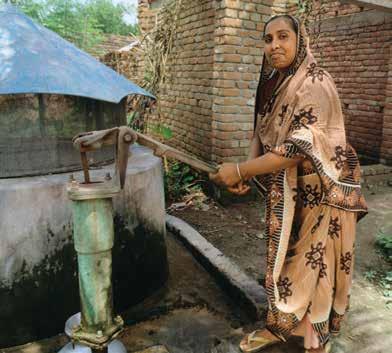
Asura Khatun and a well built by the Church of Bangladesh, with support from USPG, in Alumpur, Bangladesh.
(USPG/Leah Gordon)
www.uspg.org.uk
God bless those who supported this life-saving project.’ ‘
The USPG-supported Prevention of Mother to Child Transmission of HIV (PMTCT) programme in Chamwino District, Tanzania, is estimated to have saved the lives of 100 babies during 2015. Report by Frank Haji, Provincial Health Officer for the Church of Tanzania.
Welaunched the programme in 2015. During the first year, we were very successful because we managed to see more women and children compared to the years previously before we received support from USPG.
I’d like to share the stories of Agatha and Flora, who are two of the many women who have been helped by this project to regain happiness.
Agatha’s story
Agatha, 37, is the mother of four children from three different relationships. She was first married at just 16 years. This marriage lasted five years before her husband left while she was nursing her first child.
A year later, she started a new relationship, which lasted ten years before her partner disappeared, leaving her with another two daughters.
Once again by herself, now aged 35 with three children, Agatha found a new partner.
Around a year later, now pregnant with her fourth child, Agatha started to feel unwell. She attended a family health clinic where she tested positive for HIV and was advised to invite her partner for testing. But her new partner refused and ran away.
Agatha was heart-broken. She later learned from a friend that her partner was a known case of HIV.
The clinic advised Agatha to attend the PMTCT clinic where she was put onto
anti-retroviral treatment (ARV) and nurses undertook all the necessary preventive measures for her expected newborn.
In April 2015, Agatha’s baby was born and she was called Elizabeth. Later, Elizabeth underwent an HIV test and was found to be HIV-negative – the treatment had worked!
Agatha was happy beyond words. She is now living with her parents, who gave her a small farm to cultivate, and she has started breeding pigs.
When we asked what more the PMTCT programme could do, Agatha told us: ‘Please give more health education in the community because there are many men and women practising an unsafe lifestyle and I fear many of them and their newborns will be vulnerable to HIV.’
Flora’s story Flora married Michael in 1999 and today they have six children.
Last year, a PMTCT outreach team visited their village, Makang’wa. At the time, Flora was pregnant and, after counselling, she and
her husband agreed to be tested for HIV –and they both tested positive.
They were put on ARV. Michael stopped his treatment after three months, preferring to use traditional medicines instead, but Flora remained on the medication.
A few months later Zephania was born, and Flora was overjoyed when her baby son tested negative for HIV. However, she remained concerned about her husband, whose health was deteriorating.
Then, last December, the PMTCT outreach team again visited their village. The couple attended an HIV awareness meeting and received a home visit from a health worker. As a result, Michael decided to resume ARV treatment.
Flora is now happy again because she and her husband are both healthy, and her husband is working hard in their vegetable plot.
Flora said: ‘My husband and I pray that we will live long and see our children grow up. God bless those who have supported this life-saving project.’
Opposite: Sayuni Novice House, a clinic for mothers and babies run by the Anglican Sisters of St Mary, South West Tanganyika, Tanzania. (USPG/Leah Gordon)
Resources for World AIDS Day
We have produced a range of resources to help congregations better understand and prayer about the impact of HIV and AIDS around the world, including prayer and worship resources, a bible study, talk and PowerPoint material.
www.uspg.org.uk/hiv
Agatha and one of her four children, in Makang’wa, Tanzania. (Church of Tanzania)
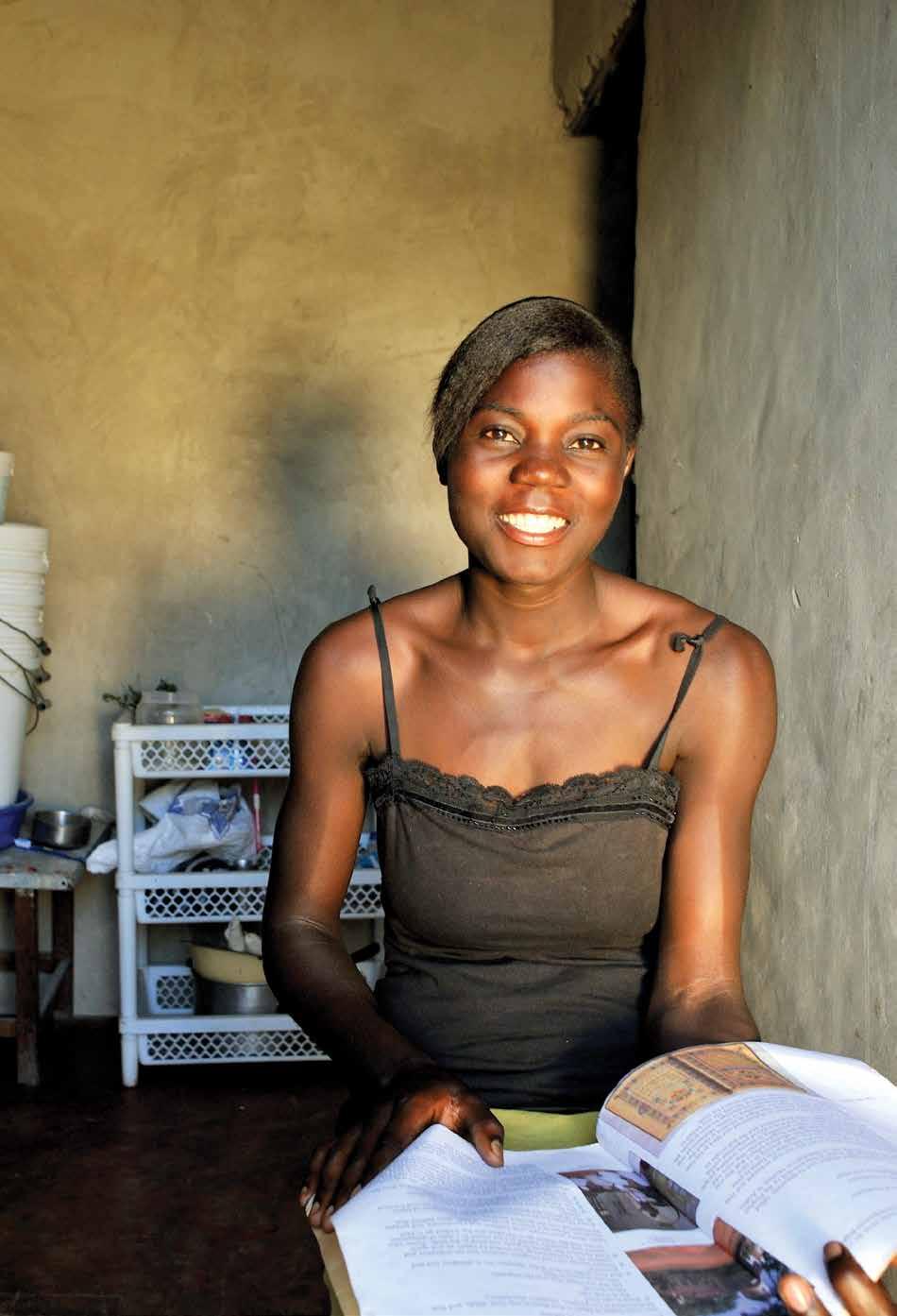
No-one will say again I should stop my daughter’s education.’ ‘
The USPG-supported Let My People Go programme was set up by the Church of North India to help families from marginalised Dalit communities set up income generation projects. Report by the Synodical Board of Social Services of the Church of North India.
Sumathi’s story
Life was difficult for Sumathi and her family. Her husband, a daily wage labourer, struggled to earn enough to feed the family, and Sumathi was struggling to do all the work in the home – this is a household without any home conveniences.
Neighbours advised Sumathi to send her eldest daughter to work to supplement the family income, but Sumathi insisted that both her daughters and her son would continue at school, believing that education might offer them a better future.
Then Sumathi heard about a self-help group for women being set up in her village, Durgabati in West Bengal.
She joined and met other women who were also yearning to change their circumstances. The group facilitator encouraged the women to consider how they might improve their income and empower their community.
Sumathi and four new friends decided to undergo training in organic vegetable cultivation – after which they shared what they had learned with the other women in the group.
Inspired, the group decided to work together to start growing aubergines. In November last year, the women took out a lease on a plot of land, bought seeds and equipment, and set to work, taking it in turns
to sell the produce at the local market.
They quickly earned enough to cover the cost of the lease, and within four months they were selling around 60kg of aubergines a week – their income exceeded the cost of their initial investment and they were all earning extra money for their families.
Exhilerated by their success, Sumathi and her friends are now encouraging others to do the same by talking about the success and challenges they faced at community forums.
Now Sumathi’s group is expanding, planting chillies, cabbages and other vegetables. Life is finally a little easier.
Sumathi said: ‘No-one will say again that I should stop my daughter’s education and make her earn money. I’m very happy and thankful to those who trained and supported us in our work.’
Baljinder’s story
Baljinder works as a domestic servant, while her husband works as a farm labourer. They are what has been called debt slaves because
Opposite: Members of a Let My People Go support group display their harvest. (USPG/Anne Bonger/Davidson Solanki)
their employer is their landlord, and he pays such low wages that Baljinder and her husband could never imagine being able to repay him the money they owed in rent.
Baljinder is a Dalit and, like most of her neighbours in Dhanua village in Punjab, she was being exploited with no hope of living a dignified life as she struggled in silence to feed her four children.
Then the Let My People Go programme set up a self-help group in her village. Baljinder joined and has not looked back.
After receiving training and encouragement in the group, she is now running her own small business growing and processing date palm fruit, which are made into a popular local confectionary.
Baljinder says the experience has changed her life. She no longer has to work for the landlord and can imagine a better life for her and her family.
She said: ‘I am thankful to God for this opportunity that was provided to me.’
A mother and daughter work the fields together in India. (USPG/Leah Gordon)
Attitudes have been transformed from dependence to self-reliance.' ‘
A new approach to development is inspiring communities in Zambia to tackle local issues using their own skills and resources. Report by Monica Masonga of the Zambia Anglican Council.
The Church and Community Mobilisation
Process (CCMP) is an approach to development that helps communities to take charge of their own lives, rather than relying on external help.
The Zambia Anglican Council has been promoting CCMP now for four years with great success.
The process begins with a series of
community bible studies during which participants are delighted to discover that each of them has gifts and skills and something to offer the community. Participants are then encouraged to work together to set up projects to boost income or improve the local environment.
After CCMP was introduced to the parish of St Barnabas and Michael, in Central
Diocese, lay reader Chrisphine Nguni realised he could start selling the grass that grew on his smallholding – a rare type of grass that is much in demand for roofing and making soft brooms.
Chrisphine employed local people to harvest the grass – creating jobs – then sold the grass to businessmen, making enough profit to buy six goats, poultry, and fertilizer to grow more of the grass. The Anglican Church’s Agriculture Officer offered advice, and now Chrisphine also has plans to start a fish farm.
Church warden Mrs Mwelwa impressed by CCMP too. After the training, villagers were inspired to give their time and resources to build a new church.
She said: ‘Before CCMP we depended on donor funding, but now people realise the importance of giving and sharing because they want to improve themselves rather than rely on outsiders.’
Also in Central Diocese, Judy Nankoje was surprised to see the impact of CCMP on her neighbours, so she decided to take part in one of the CCMP bible studies.
Until this point, Judy had been paying people money she couldn’t afford to manage her smallholding. Judy decided she could do the work herself and started growing soya beans and groundnuts. With the money she saved she bought three beehives and started selling the honey. She then invested in 13 goats and is selling the milk. All of this means she no longer struggles to pay her children’s
school fees.
Judy said: ‘I realised God had created me for a purpose and put resources around me at my disposal.’
Change in attitude
Another beneficiary of CCMP was Ezekiel Chipando, in the parish of St Barnabas and Michael. Like many men in his culture, and indeed around the world, he admitted he used to view his wife, not as a partner, but as a resource for earning money.
But through CCMP, he and his wife Evelyn embarked on a project utilising the trees on their smallholding to make and sell charcoal. With the profits, they bought fertilizer and were able to grow a healthy crop of maize.
They have bought goats, and their vision is to buy a farm and build a house with a permanent structure. Evelyn also goes to market to sell the vegetables they grow.
The couple has been able to pay their children’s school fees, and they give thanks to God by giving a tithe to their church.
Ezekiel says he has changed his attitude and sees his wife in a new light. This is an example of how CCMP can have a farreaching impact on communities, improving relationships as well as livelihoods.
After training in CCMP, Christopher Mwila, a priest warden from Northern Diocese, summed up the experience by saying: ‘I have realised that if people can come together with whatever resources they have, they can do wonders.’
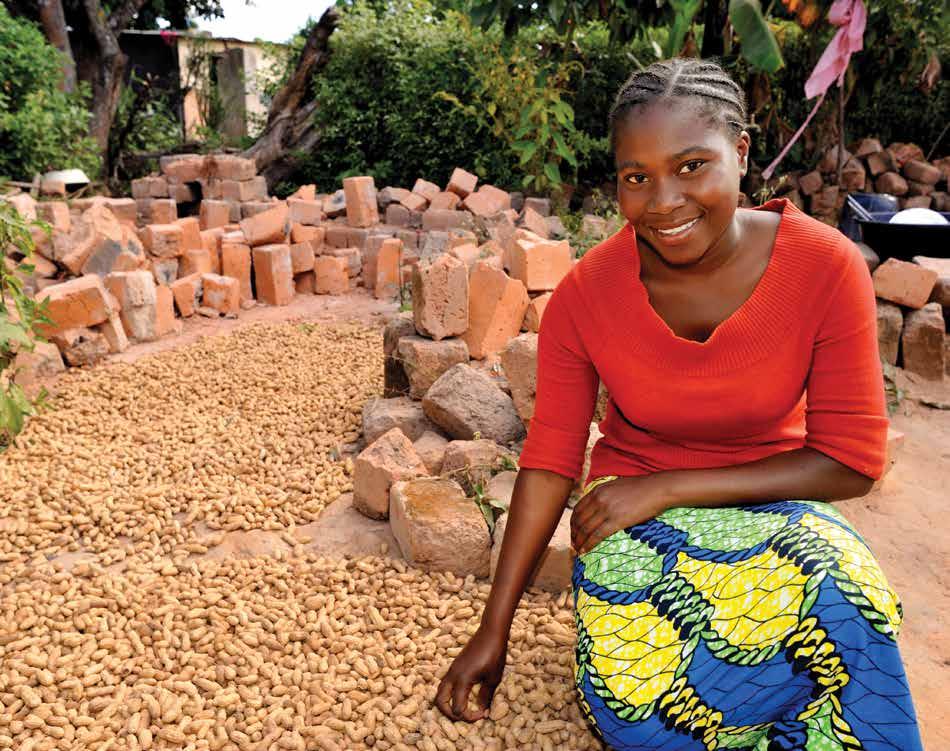
Opposite: Eveline took part in an economic empowerment programme set up by the Anglican-run Agape Women’s Group in Mwape, Zambia. (USPG/ Leah Gordon)