THE UNIVERSITY OF SOUTHERN MISSISSIPPI
CHORAL ACTIVITIES
PRESENTS
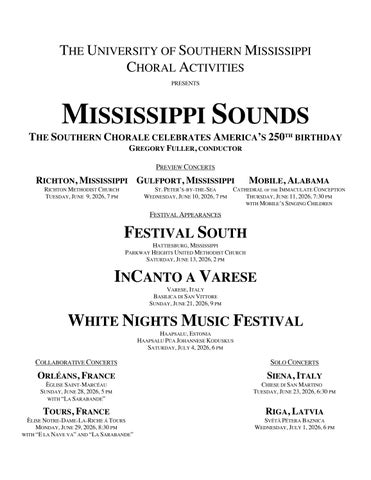
THE UNIVERSITY OF SOUTHERN MISSISSIPPI
CHORAL ACTIVITIES
PRESENTS
THE SOUTHERN CHORALE CELEBRATES AMERICA’S 250TH BIRTHDAY
GREGORY FULLER, CONDUCTOR
PREVIEW CONCERTS
RICHTON METHODIST CHURCH ST PETER’S-BY-THE-SEA CATHEDRAL OF THE IMMACULATE CONCEPTION
TUESDAY, JUNE 9, 2026, 7 PM WEDNESDAY, JUNE 10, 2026, 7 PM THURSDAY, JUNE 11, 2026, 7:30 PM WITH MOBILE’S SINGING CHILDREN
FESTIVAL APPEARANCES
HATTIESBURG, MISSISSIPPI
PARKWAY HEIGHTS UNITED METHODIST CHURCH
SATURDAY, JUNE 13, 2026, 2 PM
VARESE, ITALY
BASILICA DI SAN VITTORE
SUNDAY, JUNE 21, 2026, 9 PM
HAAPSALU, ESTONIA
HAAPSALU PÜA JOHANNESE KODUSKUS
SATURDAY, JULY 4, 2026, 6 PM
COLLABORATIVE CONCERTS
SOLO CONCERTS
ÈGLISE SAINT-MARCÉAU CHIESE DI SAN MARTINO
SUNDAY, JUNE 28, 2026, 5 PM
TUESDAY, JUNE 23, 2026, 6:30 PM WITH “LA SARABANDE”
TOURS, FRANCE RIGA, LATVIA
ÈLISE NOTRE-DAME-LA-RICHE Á TOURS SVĒTĀ PĒTERA BAZNICA
MONDAY, JUNE 29, 2026, 8:30 PM WEDNESDAY, JULY 1, 2026, 6 PM WITH “E LA NAVE VA” AND “LA SARABANDE”
The Sixty-Seventh Psalm (1898)
and the swallow (Psalm 84) (2017)
Privilege (2010)
IV. they get it
V. we cannot leave
Partita for 8 voices (2014)
I. Allemande
The Sixty-Seventh Psalm
Charles E. Ives (1874-1954)
Caroline Shaw (b. 1982)
Ted Hearne (b. 1982)
Caroline Shaw
as the swallow (Psalm 84) God be merciful unto us, and bless us; how beloved is your dwelling place, and cause his face to shine upon us. o lord of hosts
That thy way may be known upon earth, my soul yearns, thy saving health among all nations. my heart and my flesh cry Let the people praise thee, o God; the sparrow found a house, O let the nations be glad and sing for joy: and the swallow her nest, for thou shalt judge the people righteously, where she may raise her young and govern the nations upon the earth. they pass through the valley of bakka Let the people praise thee, O God; they make it a place of springs let all the people praise thee. the autumn rains cover it with pools Then shall the earth yield her increase; and God, even our own God, shall bless us. And all the ends of the earth shall fear him.
they get it
we cannot leave we pretend to need them we cannot leave we pretend to educate the kids this land of our ancestors but we don't on this earth and they're not foolish we are being killed by the monster they get it on this earth (David Simon) shuku shuku oh, mother, it's leaving me behind! I want to get on the train to get on the train in the morning I want oh, mother, it's leaving me behind! (traditional Xhosa, translated by Patiswa Nombona and Mollie Stone)
Allemande allemande left to the side and around
Fourth wall: twenty-four lines from the center, through the middle and twelve lines from the midpoint to the side and around of each of the sides and around through the middle
#thedetailofthepatternismovement and across Find a way back home two three four Fall away five six seven eight through the midpoint of the line
Time and time again drawn from the left side Find a way back home to the midpoint of the line drawn Fall away allemande left and around and around and thru allemande and thru allemande
A square divided horizontally and vertically to the side and across and around into four equal parts, and around and around one gray, one yellow, one red, and one blue and thru allemande and across Cut the diamond allemande left allemande and around allemande The wall is bordered and across to the side and thru the middle to the side and around and thru the right divided into four equal parts
Follow your neighbor grand swing thru Far and near are all around round and around and thru
A black outlined square toward you with a red horizontal line from the midpoint with a line centered on the axis between the midpoint of the left side and the midpoint a red diagonal line from the lower left corner toward the upper right corner sides forward and back
music by Tõnu
Kõrvits
(b. 1969) written for The Southern Chorale inspired by the Mississippi Delta Blues
Canticle of the Sun (2014)
III. Sister Moon VIII. Mother Earth
text by St. Francis of Assisi (c. 1181-1226)
St. Michael Songs (2020) text by Emily Dickinson (1830-1886)
II. if I can stop one heart from breaking V. adrift! a little boat adrift! VI. our journey has advanced
sister moon adrift! a little boat adrift! Be praised, my Lord, Adrift! A little boat adrift! through Sister Moon and the stars; and night is coming down! in the heavens Will no one guide a little boat You have made them bright, unto the nearest town? precious and beautiful.
So sailors say on yesterday mother earth just as the dusk was brown Be praised, my Lord, One little boat gave up its strife through our sister Mother Earth, and gurgled down and down. who feeds us and rules us, and produces various fruits
So angels say on yesterday with colored flowers and herbs. just as the dawn was red One little boat o’er spent with gales if I can stop one heart from breaking retrimmed its masts redocked its sails If I can stop one heart from breaking, and shot exultant on! I shall not live in vain; If I can ease one life the aching, our journey had advanced or cool one pain, Our journey had advanced; or help one fainting robin our feet were almost come unto his nest again, to that odd fork in Being’s road, I shall not live in vain. eternity by term.
Our pace took sudden awe, our feet reluctant led. Before were cities, but between, the forest of the dead. Retreat was out of hope, behind, a sealed route, eternity’s white flag before, and God at every gate.
His Eye Is On The Sparrow (2023)
I Can Tell The World (1998)
They Led My Lord Away (2018)
Didn’t It Rain (2018)
Charles Gabriel & Civilla D. Martin (1856-1932) & (1866-1948) arranged by Zanaida Stewart Robles (b. 1978)
Traditional Spiritual arranged by Moses Hogan (1957-2003)
Traditional Spiritual arranged by Brandon Waddles (b. 1988)
Traditional American Gospel Song arranged by Donald Dillard (b. 1940) transcribed by Casey Wood (b. 1987)
Double Choir settings for The Southern Chorale by Jonathan Rodgers (b. 1981)
A Tribute to Paul Williams (2025) Paul Williams (b. 1940)
I. Love Boat
II. We’ve Only Just Begun
III. Evergreen
lyrics by Paul Williams music by Charles Fox performed by Jack Jones on the television show “The Love Boat”
music and lyrics by Paul Williams and Roger Nichols performed by The Carpenters on the album “Close to You”
lyrics by Paul Williams music by Barbara Streisand and Paul Williams performed by Barbara Streisand in the film “A Star is Born”
IV. I Won’t Last A Day Without You lyrics by Paul Williams music by Roger Nichols performed by The Carpenters on the album “A Song for You”
V. Rainbow Connection music and lyrics by Paul Williams and Kenneth Ascher performed by Jim Henson as “Kermit the Frog” in the film “The Muppet Movie”
Marvin Gaye Motown Medley (2023)
I. What’s Going On
II. Mercy, Mercy Me
III. You’re All I Need To Get By
Marvin Gaye (b. 1940)
music and lyrics by Renaldo Benson, Al Cleveland, and Marvin Gaye performed by Marvin Gaye on the album “What’s Going On” setting based on the original hit and a cover by Hall & Oates
music and lyrics by Marvin Gaye performed by Marvin Gaye on the album “What’s Going On” setting based on the original hit and a bossa nova cover by Sarah Menescal
music and lyrics by Nicholas Ashford and Valerie Simpson performed by Marvin Gaye and Tammi Terrell setting based on the original hit and a cover by Michael McDonald
Charles Edward Ives was an American modernist composer, actuary and businessman. Ives was among the earliest renowned American composers to achieve recognition on a global scale. His music was largely ignored during his early career, and many of his works went unperformed for many years. Later in life, the quality of his music was publicly recognized, and he came to be regarded as an "American original.” “The Sixty-Seventh Psalm” begins with an eight-part bitonal chord, the men singing in four parts in G minor and the women ink four parts in C major. In The World of Twentieth Century Music, David Ewen describes what this portended: “Before Stravinsky, Ives worked with polyrhythms; before Bartók . . . discords; before Stravinsky and Milhaud . . . polytonality; before Schoenberg . . . atonality; before Alois Hába . . . quarter tones; before Henry Cowell . . . tone clusters; and long before Boulez, he introduced music of chance.”
Caroline Adelaide Shaw is a New York-based musician, appearing in many guises. She performs primarily as a violinist with the American Contemporary Music Ensemble (ACME) and as a vocalist with Roomful of Teeth. She also works with the Trinity Wall Street Choir, Alarm Will Sound, Wordless Music, Signal, The Yehudim, Victoire, the Mark Morris Dance Group Ensemble, and Opera Cabal. Caroline's music has been performed by So Percussion, ACME, the Brentano Quartet, and Roomful of Teeth, and her collaboration with artist Jane Philbrick is part of a permanent landscape installation at Mass MoCA. Caroline has been a Yale Baroque Ensemble fellow and a Rice University Goliard fellow. She was a recipient of the infamous Thomas J. Watson fellowship, to study historical formal gardens and landscape architecture in Europe. She is the youngest recipient of the Pulitzer Prize for Music for Partita for 8 voices. Her music is renowned for its use of extended vocal techniques, the most basic of which can be heard in “and the swallow,” a setting of Psalm 84 which ends with the singers evoking the sound of autumn rains. Shaw was thinking of the Syrian refugee crisis as she composed. “The sparrow found a house” gives the image of a bird trying to keep her children safe, representing Syrian people trying to offer their families safety. It was composed for the Netherlands Chamber Choir.
Ted Hearne is a composer, singer, bandleader and recording artist. Inspired by the overlay of different viewpoints and their sonic possibilities, he creates personal and multi-dimensional works that often explore unconventional interactions of text and music and are rooted in a sense of inquiry. The New York Times has praised Mr. Hearne for his “tough edge and wildness of spirit,” and “topical, politically sharpedged works.” Pitchfork called Hearne's work "some of the most expressive socially engaged music in recent memory from any genre,” and Alex Ross wrote in The New Yorker that Hearne's music "holds up as a complex mirror image of an information-saturated, mass-surveillance world, and remains staggering in its impact."
Privilege is a collection of five short pieces, to be performed individually or as a set. The second and fourth movements are set to portions of Bill Moyers' 2009 interview with David Simon. “they get it” addresses the idea that there is a large segment of our population whose existence is unnecessary to the American economy, especially those who are “undereducated, that have been ill served by the innercity school system, that have been unprepared for the technocracy of the modern economy.” The final movement, “we cannot leave, ” is set to an English translation of As' Kwaz' uKuhamba, a Xhosa antiApartheid song. South Africa has a strong tradition of music being used as a tool to fight societal oppression and inequality. The setting is a tribute to that practice.
Partita for 8 Voices was composed over three summers from 2009-2011. It was nominated for a Grammy in addition to receiving the 2013 Pulitzer Prize. The inscription reads, “Born of a love of surface and structure, of the human voice, of the dancing and tired ligaments, of music, and of our basic desire to draw a line from one point to another.” “Allemande,” a French word for German dance during the Renaissance and Baroque eras, opens with the organized chaos of square dance calls overlapping with technical wall drawing directions of the artist Sol LeWitt, suddenly congealing into a bright, angular tune that never keeps its feet on the ground for very long. There are allusions to the movement’s intended simulation of motion and of space in the short phrases of text throughout, which are sometimes sung and sometimes embedded as spoken textures. It was written with and for Roomful of Teeth. Inspired by Sol LeWitt’s “Wall Drawing 305.” While intended for only eight singers, The Southern Chorale has adapted this piece for full choir.
The music of Tõnu Kõrvits is like a doorway from this world into others – into the secret worlds of folklore, blues, myth and the subconscious. The patterns and textures in his music are filled with fantasy and they are everchanging, but at the heart of them lie the melodies – a quiet talk of the soul. They often seem to be almost full of resignation, fading into infinity like a gentle breeze. Sometimes a melody suddenly blooms like a colorful blossom – to fade again like a brief, evanescent occurrence. But just as important is the silence – fades, pauses, emptiness. Sometimes it seems that silence is even more important in Kõrvits' music than the musical material itself. That's because that silence is pungent – it is filled with secrets. by Evi Arujärv, 2015
Kõrvits' works belong to the repertoire of the most important Estonian orchestras and artists including Estonian State Symphony Orchestra, Tallinn Chamber Orchestra and Estonian Philharmonic Chamber Choir. His music has also been performed by numerous foreign artists and collectives, such as the BBC Symphony Orchestra, Frankfurt Radio Symphony Orchestra, Britten Sinfonia, Swedish Radio Choir, The Southern Chorale, The Sixteen and many other collectives. His recent collaboration brings him together With Radiohead guitarist Ed O’Brien on his 2026 solo album.
Tõnu Kõrvits has gained recognition from the Estonian state and cultural institutions. He was awarded the Annual Music Prize of the Estonian Music Council (2007), the Cultural Prize of the Republic of Estonia (2011 & 2016), Choral Composer of the Year by Estonian Choral Association (2014 and 2021), Estonian Public Broadcasting Musician of the Year (2015 and 2016), Order of the White Star 3rd Class (2018), the Lepo Sumera Award for Composition, Estonian Music Award for Classical Album of the Year and 3rd best classical album of the year by National Public Radio (USA) for “Moorland Elegies” (2017), and the Estonian Cultural Endowment’s main price (2025) for an exceptional creative year and the new works Aroha and The Seasons. Kõrvits has been a prolific arranger of pop and rock music and has composed extensively for film. His best-known film scores include Comrade Child (“Seltsimees laps“, 2018) and the Icelandic–Estonian co-production Journey with My Mother (“Á Ferð með Mömmu”, director Hilmar Oddsson), which won the Grand Prix at the Tallinn Black Nights Film Festival (PÖFF) 2022 and received the Best Original Score prize, as well as the Edda Award of Icelandic Film and Television Academy in 2024.
Kõrvits visited Mississippi the first time in 2014. The University of Southern Mississippi presented the U.S. premiere of Kreek’s Notebook. During his stay, a short pilgrimage to the Mississippi Delta was provided with stops in Clarksdale to see “The Crossroads” and other important Robert Johnson sites. From the moment Tõnu Kõrvits imagined writing music for his new Mississippi friends, he had the blues in mind, celebrating this genre that emerged from the Mississippi Delta. The five Kõrvits selections are from two longer cycles written for The Southern Chorale and encase a nod to the blues. Kõrvits is an honorary citizen of Clarksdale Mississippi for his music through which he has brought honor to Clarksdale, The Delta,and to the preservation of the Blues.
The merging influence of two faraway places and cultures into a single musical composition gives Canticle of the Sun a unique identity. However, that Mississippi Blues “state of mind” or familiar ache of life, and the Estonian desire for solitude and communion with nature are certainly common to the human condition in both locations. The combination of these sensitivities brings elegance and grace to this marriage of music and this text by St. Francis of Assisi. Canticle of the Sun is “dedicated to all my brothers and sisters in blues, written for The Southern Chorale, Mississippi, conductor Gregory Fuller.”
St. Michael Songs was written for Gregory Fuller and The Southern Chorale in 2020 and was inspired by St. Michael Catholic Church in Biloxi, Mississippi. From its beginning, life in St. Michael parish was centered around the occupational background of the parishioners “Fishermen.” Biloxi, Mississippi was, at one time, the “seafood capitol of the world.” From the scallop-shaped domes to the stained-glass windows, architectural components reflect the name given to St. Michael, “Church of the Fisherman.” It is a one-of-a-kind structure with architectural brilliance. There are 4,000 square feet of stained glass in thirty-six columns. The motif of fish, water, and nets is linked to the fishing history. The Dickinson poems used in St. Michael Songs are not part of a set but are all individually chosen with St. Michael Church in mind. The music and text are filled with symbolism, imagery, hope, and beauty. Many of the metric and melodic patterns in the music are corresponding to features at St. Michael.
“if I can stop one heart from breaking” talks about a love so deep that it places others before self. The poet would happily spend her life helping those who suffer from heartbreak, deep sadness, and despair. By wishing to help a “fainting robin” back into the nest, she reveals her vulnerable and sensitive side. In “adrift! a little boat adrift!” Dickinson metaphorically compares the human being to a “little boat” floating without a guide on the sea of life. The poem begins with an exclamation revealing that danger is on the horizon. “Will no one guide a little boat unto the nearest town?” The sailors report that the vessel simply "gave up" at dusk because it could not overcome its “strife.” The reader will detect what seems to be a contradiction in the poem. Sailors, seeing human death, say the vessel sank. Angels, seeing eternal life, say that the little boat fixed itself and “shot on” exultantly. Even as the soul was tired and defeated by the storms of life, it managed to transform as it “Retrimmed its masts redocked its sails . ” The final sounds reflect a triumphant journey beyond the storms to Eternity. Dickinson describes this journey and transition from life to death in “our journey has advanced.” They had moved through life until at death they faced “that odd Fork in Being’s Road” eternity looming ahead. They could not turn back to life as “Retreat was out of Hope.” That way was “sealed.” They must move forward. The last two lines possibly indicate the sort of joy a lost sailor would feel upon seeing a lighthouse showing the way to harbor. The “white flag” of truce symbolizes the release of “Eternity” with “God – at every gate.”
“His Eye Is on the Sparrow” is a classic American gospel hymn written by Civilla D. Martin by (lyrics) and Charles H. Gabriel (music) in 1905, inspired by Matthew 6:26 and 10:29-31. It is a song of faith, comfort, and divine protection, suggesting that God watches over even the smallest creatures and, by extension, cares for humanity. Hailed as a “composer of energized and soulful music,” Zanaida Stewart Robles is an award-winning artist whose vibrant works have been performed worldwide. A sought-after composer, vocalist, and educator, she blends rich harmonies, rhythmic drive, and influences from gospel to progressive rock, creating music that connects deeply with performers and audiences alike.
“I Can Tell the World” is a traditional African-American spiritual and song of hope. It frequently features lyrics about sharing personal faith, noting that “the Lord has done” great things, such as healing the sick and raising the dead. Moses George Hogan (1957-2003) was an American composer and arranger of choral music. He was best known for his settings of spirituals. Hogan was a pianist, conductor, and arranger of international renown. His works are celebrated and performed by high school, college, church, community, and professional choirs today. Over his lifetime, he published 88 arrangements for voice, eight of which were solo pieces. Born in New Orleans (near Hattiesburg, MS), Hogan lived with five siblings and his parents, who gave their children a passion for music. He was an accomplished pianist by the age of nine. In 1980, he formed the New World Ensemble and began arranging choral music. In 1993, he founded the Moses Hogan Chorale in New Orleans.
“They Led My Lord Away” is credited to Adoniram Gordon, but it may be that he collected and harmonized the song from the African-American spiritual tradition. Gordon was an active Baptist minister at a time of spiritual revival in the United States and music that inspired emotion was important to the revival music. The call and response form of the song suggests an African American influence. The hymn was published at a time that newly freed slaves were disseminating their musical traditions across the United States and into Europe. Brandon Waddles has compositions and arrangements that have been published and performed by choral ensembles around the world. In 2019, he was awarded as the inaugural recipient of the ACDA Diverse Voices Collaborative Grant. In addition, he has worked as a transcriber of Black gospel music for numerous choral octavos, hymnals and hymnal supplements published by GIA, including his recent work as a contributing editor for the One Lord, One Faith, One Baptism hymnal.
“Didn't It Rain” is a traditional African American spiritual about Noah and the flood. It is frequently performed in a gospel style, with the most famous version recorded by Sister Rosetta Thorpe in the 1960s. Other notable recordings include Mahalia Jackson (1958) and The Blind Boys of Alabama (2005). Donald E. Dillard was born in Philadelphia, Pennsylvania. His early music training included study at the Settlement Music School with concert pianist, Charles Engel. Upon graduation he attended West Chester University, followed by graduate studies at Westminster Choir College, Princeton, NJ, where he served as graduate teaching assistant in the Music Theory Department. Casey Wood is a DMA student at The University of Southern Mississippi.
Paul Williams is one of the most beloved and respected music creators in the world today. A lyricist and composer who has won an Oscar Award, three Grammy Awards, two Golden Globe Awards, an Ivor Novello International Award, and earned induction into the Songwriters Hall of Fame, Williams’ timeless classics range from “We’ve Only Just Begun”, “You and Me Against the World” and “The Rainbow Connection” to “Touch” and “Beyond” on Daft Punk’s chart-topping Album of the Year, Random Access Memories on which he also performed, receiving a Grammy as Featured Artist.
The Southern Chorale was attracted to a collection of tunes by Williams not only for their strong connection to American television and film, but because of the iconic artists that made the songs famous. Jack Jones, while one of the most celebrated popular singers of his time, is best known for his performance of the “Love Boat” for the very popular TV series bearing the same name. Originally written for a commercial, “We’ve Only Just Begun” topped the charts as recorded by the top selling artists of the 70s, The Carpenters. Barbara Streisand has been awarded two Oscars, five Emmys, ten Grammys, a Tony Award, and eleven Golden Globes. The #1 single “Evergreen,” was the theme song from the film “A Star Is Born,” and won the Academy Award for best original song. Also recorded by the Carpenters, “Won’t Last a Day Without You” hit #11 on the charts, and references “Over the Rainbow” from “The Wizard of Oz.” “Rainbow Connection” was performed by Jim Henson as “Kermit the Frog” in “The Muppet Movie.” More relevant to us, Jim Henson was born and grew up in the Mississippi Delta.
Marvin Gaye remains popular long after his passing for his song-writing skills and his social conscience. It is often said that he broke the rules of Motown, set by his brother-in-law Berry Gordy, Jr., charting his own course. The three tunes in this medley are examples of recordings that did not fit the normal Motown text or sound. The first two are from What's Going On, a concept album. The narrative established is told from the point of view of a Vietnam veteran returning to his home country to witness hatred, suffering, and injustice. The album was ranked number one on Rolling Stone’s 500 Greatest Albums of All Time list. “Mercy, Mercy Me” followed on that 1971 album. It became an anthem of sorrow regarding the enkvironment. Led by Gaye at the piano and including multi-track vocals, the song rose to number four on Billboard’s Pop Singles chart and number one for two weeks on the R&B Singles charts. “You’re All I Need to Get By,” written by Nicholas Ashford & Valerie Simpson, had a more soulful and gospel sound than typical Motown. Ashford and Simpson sang background vocals on the recording and Marvin Gaye joined Tammi Terrell for a duet on the hit song. Two years after the recording, Terrell died of a brain tumor. The song was played at her funeral while Marvin Gaye gave a brief, tearful eulogy. It was the most successful duet recording of Marvin Gaye’s career.
For more than a decade, The Southern Chorale has looked forward to the customized charts of Rock ‘n’ Roll standards provided by Jonathan Rodgers. They are scored for double choir and small solo ensembles, making them both challenging and rewarding. The list of covers/arrangements includes artists like Chicago, The Fifth Dimension, Phil Collins, and the Little River Band. The goal has been to capture classic rock with a dash of Gene Puerling, while remaining idiomatic for a concert choir.
Jonathan Rodgers is on faculty at Samford University as Assistant Professor of Church Music. His compositions and arrangements have been published with Walton Music, Pavane, and Colla Voce. Rodgers earned his Bachelor of Music in Music Education and Master of Music in Church Music degrees from Samford University and the Doctor of Musical Arts degree in Choral Conducting from The University of Southern Mississippi.
Morgan Anderson* Kalyn Bales* Emmanuel Carney* August Duncan Orlando, Florida Stringer, Mississippi Ripley, Tennessee Hattiesburg, Mississippi
Brynna Carpenter Bayleigh Batchelor* Tanner Green Tyrese Hardy Poplarville, Mississippi Mobile, Alabama Vicksburg, Mississippi Laurel, Mississippi
Jaynie Darby
Sarah Hamman Hutson Rollins* Joseph Jones* Crestview, Florida Connellsville, Pennsylvania Gulfport, Mississippi Gulfport, Mississippi
Mackenzie Kuykendoll* Christine King Krys Taylor*
Sean Murphy Memphis, Tennessee Seminole, Florida Hurley, Mississippi Buffalo, New York
Amelia Sutherland Anna Kate Long* Blake Tolbert Lucus Orndorff*
Midland, Michigan Long Beach, Mississippi Oak Grove, Mississippi Augusta, West Virginia
Reese Walker Emma Walker Casey Wood Van Voorhies Crystal Springs, Mississippi Mobile, Alabama Ogden, Utah Long Beach, MS
Sadie Graham**
Paetyn Johnson** Noah Brand** Devin Jones** Long Beach, Mississippi Little Rock, Mississippi Ashland, Kentucky Waynesboro, MS
Kathlyn Arcemont* Kaylee Cripple** Bo Campbell Faizon Ellis Madison, Mississippi Long Beach, Mississippi Vicksburg, Mississippi Long Beach, Mississippi
Morgan Burroughs** Jayla Davis Hunter King* Aubrey Glenn Tuscaloosa, Alabama Clinton, Mississippi Picayune, Mississippi Oxford, Mississippi
Danielle Gray** Caitlyn Dixon* Jay Koozer Julian Herr Vicksburg, Mississippi Spruce Creek, Pennsylvania Norfolk, Nebraska Long Beach, Mississippi
Kathryn Hasenkampf Bianca Ingraham**
Jaiden McGloster Garret Johnston* Picayune, Mississippi Slidell, Louisiana Vicksburg, Mississippi Union, Mississippi
Leah Lott
Sarah Kwas* Chase Moore Aiden Luttrell Baton Rouge, Louisiana Oxford, Mississippi Somerset, Kentucky Mobile, Alabama
Magdalena Martinez* Tara Piggott* Jeremy Moore* Connor Schuster* Medina, Tennessee Mobile, Alabama Prairie, Mississippi Clarkston, Michigan
Lila Reed
Rebekah Presswood Omari “Momo” Walker** Kenolbe Taylor* Sumrall, Mississippi New Orleans, Louisiana Flora, Mississippi Pearl, Mississippi
Tatiana Rivera-Raffucci* Grace Salmon Ocean Springs, Mississippi Citronelle, Alabama
Avery Smith Madison, Mississippi
*Alumni Guest Artist
**State-Side Appearances Only
The Southern Chorale has a long history of excellence at Southern Miss, the most comprehensive School of Music in Mississippi. Membership consists primarily of junior and senior music majors and graduate students studying conducting and voice. The ensemble has been chosen by blind/refereed audition to perform at state, regional, and national conferences on sixteen occasions over the past twenty years, including two national conventions and three regional conventions. In addition to appearances across North America, the Chorale has been featured at festivals or concert series in Austria, The Czech Republic, England, Estonia, France, Hungary, Italy, Jamaica, Latvia, Mexico, Norway, Romania, South Korea, Spain, and Sweden The Southern Chorale has premiered or participated in many important premieres of new oratorio and extended works, including composers Richard Burchard (Et Lux Et Tenebrae Lucet: Requiem for the Forgotten, Stabat Mater, The Seven Last Words), John Cheetham (Gloria, Propheta Lucis), Tõnu Kõrvits (Canticle of the Sun, St. Michael Songs, U.S. premieres of Moorland Elegies, Kreek’s Notebook), James Mulholland (Missa Romanitca, a cappella version), Ed Penhorwood (An American Requiem), Jonathan Rodgers (extended double choir arrangements of popular groups like Chicago, 5th Dimension, Phil Collins, Little River Band, Marvin Gaye, Paul Williams) , Mack Wilberg (The Prodigal), and Luigi Zaninelli (Trinity Mass). The group is known for innovative programming.
Gregory Fuller is a Professor of Music and the Director of Choral Activities at The University of Southern Mississippi. He conducts The Southern Chorale and the Hattiesburg Choral Union, teaches graduate conducting courses, and supervises candidates in the master’s and doctoral conducting program. Previously, Professor Fuller held conducting appointments at The University of Missouri in Columbia, Missouri and Briar Cliff University in Sioux City, Iowa.
Fuller has appeared as a conductor or clinician in many locations around the world. His performance record includes numerous refereed performances, including podium appearances at national conferences of American Choral Directors Association (ACDA), Music Educators National Conference (MENC), and the National Collegiate Choral Organization (NCCO). In addition, Fuller has appeared on many concert series performances and festivals in North America, Central America, Scandinavia, The Baltic States, Western Europe, Japan, Korea, and Russia. He has served the Mississippi Chapter of American Choral Directors Association as College and University Chair, Convention Site Coordinator, and President.
Dr. Fuller has remained active as a conductor in orchestral and wind settings. That includes numerous oratorios, orchestral works, and a five-year appointment with the professional Sioux City Municipal Band (formally the Monahan Post Band). He has become known as a champion of new extended works, including many US and world premieres over the last three decades. Other notable performances include engagements on Japanese National Public Television, Estonian Public Radio, and the ordination of Bishop Daniel DiNardo, now Cardinal DiNardo, retired Archbishop of the Galveston-Houston Diocese.
Gregory Fuller, PhD | Professor & Director
Jonathan Kilgore, DMA | Associate Professor & Associate Director
Sinetta Bolton | Administrative Assistant
Richard Burchard | Composer in Residence
Morgan Anderson | MM Choral Conducting | Orlando, FL
Morgan Burroughs | DMA Choral Conducting | Tuscaloosa, AL
Christine King | DMA Choral Conducting | Seminole, FL
Chase Moore | DMA Choral Conducting | Somerset, KY
Sean Murphy | MM Choral Conducting | Buffalo, NY
Lucus Orndorff | DMA Choral Conducting | Augusta, WV
Tara Piggott | MM Choral Conducting | Mobile, AL
Rebekah Presswood | DMA Choral Conducting | New Orleans, LA
Amelia Sutherland | MM Vocal Performance | Midland, MI
Casey Wood | DMA Choral Conducting | Ogden, UT

Southern Miss Choral Activities are supported through The USM Foundation. To make a gift to support choral activities, scan the QR code above. The USM Foundation is a 501(c)(3) nonprofit organization dedicated to serving the University community by overseeing fundraising efforts. Gifts are tax-deductible to the extent of current IRS regulations.
Unable to scan? Visit usm.edu/foundation and donate using code: CHORAL ACTIVITIES AT USM FUND (0098)