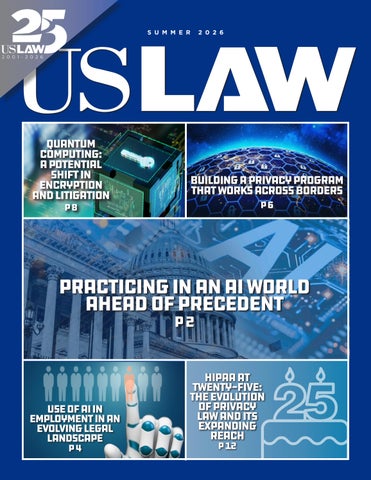
2 5 T H S AUNMN M I VEE R RS2 AR 0 Y2 6 ISSUE
QUANTUM COMPUTING: A POTENTIAL SHIFT IN ENCRYPTION AND LITIGATION
Building a Privacy Program That Works Across Borders P6
P8
PRACTICING IN AN AI WORLD AHEAD OF PRECEDENT p2
Use of AI in Employment in an Evolving Legal Landscape p4
HIPAA at Twenty-Five: The Evolution of Privacy Law and Its Expanding Reach p 12
We erase the speculation.
We analyze the could’ve beens.
We investigate the maybes.
We explain away the what-ifs.
To take note of the facts.
Precisely revealing the cause of accidents and thoroughly testing to mitigate risk. Doing both at the highest level is what sets us apart. From our superior forensics talent, technology, and experience to the visualization expertise of our Imaging Sciences team, we dig past the speculation to find and convey the truth about what happened like no one else. Proud Partner USLAW NETWORK Inc. since 2004.
Know.
Forensic Engineering, Investigation and Analysis ( 80 0 ) 782-6851
SEA limited. com
Since 1970
SUBMIT AN ASSIGNMENT © 2025
SUMMER
ta b le o f
2026
www.uslaw.org
contents
FEATURES: PRACTICING IN AN AI WORLD AHEAD OF PRECEDENT: LEGAL TECH, DOCTRINAL DRAG AND THE MODERN DUTY OF COMPETENCE
MASS TORTS THROUGH THE DECADES
Use of AI in Employment in an Evolving Legal Landscape
By Alison Sausaman and Austin Sherman • Carr Allison ............................................. page 18
By Christina Hesse • Duke Evett, PLLC........................................................................... page 2 By Lisa A. Zaccardelli • Hinckley Allen........................................................................................page 4
Building a Privacy Program That Works Across Borders: How a Common Legal Framework Shaped Global Privacy Laws
By John Williams • Amundsen Davis......................................................................................page 6
QUANTUM COMPUTING: A POTENTIAL SHIFT IN ENCRYPTION AND LITIGATION
By Richard R. Marsh • Flaherty Sensabaugh Bonasso PLLC............................................ page 8
By Paul V. Majkowski • Rivkin Radler LLP ......................................................................... page 16
Survival of the Artificially Fittest
FROM NECESSITY TO STRATEGY: HOW SPAIN’S LAW FIRMS ARE NAVIGATING THE AI REVOLUTION
By Juan José García • Adarve Abogados SLP............................................................... page 20
The Challenge of Cost-Effectively Resolving Nuclear Verdicts and Catastrophic Cases
By John McCulloch, JD/MBA • Arcadia Settlements Group.......................................... page 22
The More Things Change, the More They Stay the Same
Hospitality Risk Reduction: Lessons from the Past, Strategies for Today and a Look into the Future
HIPAA at Twenty-Five: The Evolution of Privacy Law and Its Expanding Reach
When the “Facts” Don’t Match: Using Biomechanical Incident Analysis with Inconsistent Fact Patterns
By Chris Torrens and Allison Sweeney • S-E-A............................................................. page 10
By Sydney Stuart • MehaffyWeber............................................................................... page 12
By Justin B. Jones • Fee, Smith, & Sharp LLP................................................................. page 24
By Grace Oswald, M.S., E.I. • S-E-A.............................................................................. page 26
When Technology Became Strategy: How data, analytics and AI have reshaped the way litigation is investigated, evaluated, and tried
By Deborah Temkin • MDD........................................................................................... page 14
DEPARTMENTS: From the Chair........................................................... page 1 faces of uslaw...........................................................page 30 2026 SCHOLARSHIP RECIPIENTS....................................page 38 firms on the move......................................................page 41 PRO BONO SPOTLIGHT...................................................page 43 Successful verdicts & transactions.........................page 44
About USLAW .............................................................page 60 USLAW NETWORK SourceBook......................................page 52 uslaw member firm listings......................................page 55 telfa listings........................................................... page 65 Spotlight on Corporate Partners.............................page 68
The articles contained herein are for informational purposes only and are not intended to be the basis for decisions in specific situations nor a substitute for legal counsel. Copyright © 2026 USLAW NETWORK, Inc. All rights reserved.
USLAW
www.uslaw.org
1
www.uslaw.org
from t h e
Chair’s Desk
Publisher Roger M. Yaffe Editor Connie Wilson Art Director Jeff Freibert • Compass Creative
BOARD OF DIRECTORS Jennifer D. Tricker, Chair Baird Holm LLP, Omaha, NE
Tamara B. Goorevitz, Vice Chair
Franklin & Prokopik, P.C., Baltimore, MD
Thomas S. Thornton, III, Secretary/Treasurer Carr Allison, Birmingham, AL
As we reach the midpoint of 2026, it is clear this has been a milestone year for USLAW. We are proudly celebrating USLAW’s 25th anniversary and reflecting on the relationships, accomplishments and shared experiences that have shaped our first quarter century and our path ahead. We also continue to
Keely E. Duke, Assistant Treasurer/ Client Liaison Co-Director Duke Evett, PLLC, Boise, ID
Douglas W. Clarke, Practice Group Co-Director Therrien Couture Joli-Coeur, Montreal, Quebec, Canada
Earl W. Houston, II, Membership Management Director Martin, Tate, Morrow & Marston, P.C., Memphis, TN
recognize the 20-year legacy and impact of the USLAW Women’s Connection
Julie A. Proscia, Client Liaison Co-Director
and our longstanding collaboration with TELFA in Europe.
Kenneth B. Wingate, Immediate Past Chair
In this summer edition of USLAW Magazine, you will find insightful articles that explore the evolution of the legal profession and the forces shaping its future. Topics range from HIPAA at 25 and the accelerating pace of technology to the legal considerations surrounding employers’ use of artificial intelligence. Our authors offer practical perspectives to help businesses navigate today’s increasingly complex legal and regulatory landscape. We are also pleased to highlight the achievements of our members, whose professional excellence, community involvement and commitment to service continue to distinguish our NETWORK. In addition, we congratulate
Amundsen Davis LLC, Chicago, IL
Sweeny, Wingate & Barrow, P.A., Columbia, SC
Oscar J. Cabanas, Chair Emeritus Wicker Smith, Miami, FL
Amanda Pennington Ketchum, Chair Emeritus Dysart Taylor, Kansas City, MO
Barbara Barron MehaffyWeber Houston, TX
Lisa J. Black
Moira Pietrowski Roetzel & Andress Cleveland, OH
Julie Proscia
Black Marjieh & Sanford LLP, Elmsford (Westchester), NY
Amundsen Davis LLC Chicago, IL
Thomas W. Fee
Sandra L. Rappaport
Frederick M. Heiser
Timothy R. Smith
Fee, Smith & Sharp, L.L.P. Dallas, Texas Klinedinst PC Irvine, CA
Richard C. Moreno
Hanson Bridgett LLP San Francisco, CA
Pion, Nerone, Girman & Smith, PC, Pittsburgh, PA
David S. Wilck
the recipients of the USLAW NETWORK Law School Scholarship Program.
Murchison & Cumming, LLP Los Angeles, CA
Rivkin Radler LLP Uniondale, NY
Their awards are made possible through the generosity of our Partners
Constantine G. “Dean” Nickas
Renato Martinez Quezada
Program and individual donors, and we are proud to support the next generation of legal professionals. Thank you for your continued support of USLAW, and please contact us if we can assist you with any USLAW connections
Wicker Smith Miami, FL
EC Rubio (Mexico) International Director
Kevin L. Fritz, Chair Emeritus Lashly & Baer, P.C., St. Louis, MO
Dan L. Longo, Chair Emeritus
Murchison & Cumming LLP, Los Angeles, CA
Rodney L. Umberger, Chair Emeritus Williams Kastner, Seattle, WA
All the best,
Andrea Rescigno, Ex Officio/ TELFA Representative Ughi e Nunziante, Milan, Italy
Michael J. Judy, USLAW LeadX Observer Dysart Taylor, Kansas City, MO
Jennifer D. Tricker USLAW Chair Baird Holm LLP | Omaha, Nebraska
®
®
Roger M. Yaffe, Chief Executive Officer Cheryl Hanley, Vice President, Practice Groups and Network Strategy Paige Marotta, Events and Special Projects Manager Jennifer Randall, Director of Membership Services Connie Wilson, Director of Communications Stephanie Lay, Meetings Manager Rosana Vollmerhausen, Meetings Manager
uslaw.org • Phone/Fax 800.231.9110
2
SUMMER 2026 USLAW MAGAZINE
USLAW
PRACTICING IN AN AI WORLD AHEAD OF PRECEDENT
Legal Tech, Doctrinal Drag, and the Modern Duty Of Competence Christina Hesse
Technology evolves faster than the law, a persistent gap driven by the rapid pace of innovation compared to the measured, deliberate nature of our legal system. Artificial intelligence (AI), cloud platforms and automated data systems now shape nearly every aspect of modern legal practice, yet judicial doctrine continues to develop incrementally and often by analogy to a paper-based past. Courts are still resolving disputes about electronically stored information (ESI), digital evidence, and AI-assisted advocacy by mapping legacy rules onto unfamiliar technological terrain. At the same time, professional conduct standards are moving in the opposite direction, increasingly treating technological competence as a baseline obligation rather than a specialized skill. The result is a growing tension: attorneys are expected to adopt and competently use advanced technology even as precedent lags—and even as courts may later judge those decisions using frameworks never designed for modern systems. This article explores that tension. It offers (1) a brief account of how the gap between technology and precedent emerged, (2) three pressure points where doctrinal drag is most visible—discovery sanctions,
Duke Evett, PLLC
authentication of digital evidence, and AI-assisted advocacy—and (3) a practical framework for making technology decisions defensible when clear precedent does not yet exist. FROM PAPER TO PLATFORMS: HOW THE GAP OPENED In the early 2000s, discovery and evidentiary practice assumed a paper world: discrete documents, identifiable custodians, and visible destruction. Email and shared drives were emerging, but most doctrine still rested on physical metaphors. As technology accelerated, judicial doctrine struggled to keep pace. Mobile devices, cloud storage, collaboration platforms, and automated retention systems introduced complexity that paper-era rules were never designed to measure. By 2011, BlackBerry devices had captured a sizeable market share among professionals wanting a secure mobile email device before losing popularity to iOS and Android touchscreen devices. Recognizing the need for attorneys to be technologically savvy, in 2012, the American Bar Association added specific language that keeping current with “benefits and risks associated with relevant technology” is integral to an attorney’s
duty of competency under Model Rule of Professional Conduct 1.1. Courts analogized where necessary—emails became letters, servers became filing cabinets, and deletion became shredding—preserving continuity while also embedding assumptions that no longer hold in light of today’s technological advances. The 2015 amendments to the Federal Rules of Civil Procedure attempted to modernize discovery by elevating proportionality and expressly addressing ESI, but many applications of those rules still require judges to stretch precedent to fit unfamiliar systems. Federal Rule 26 frames discovery as limited to what is “relevant” and “proportional,” but what counts as “proportional” can turn on technical details about data volume, accessibility, and system burden that paper-era doctrine never had to measure. Ethics rules, however, have moved more decisively. Since 2012, most U.S. jurisdictions have adopted similar language to Rule 1.1 requiring technological upkeep. Competence now explicitly includes understanding how technology affects confidentiality, accuracy, efficiency, informed consent, fees, and client service. The gap between technology and legal precedent persists today and is at risk of
USLAW
further widening. Courts continue to resolve disputes using analog-era reasoning, while attorneys are professionally obligated to understand and use modern technological tools. That tension is most visible where litigation risk intersects with technological complexity, particularly in the context of AI. DISCOVERY SANCTIONS IN A WORLD OF ESI AND AUTO-DELETION Spoliation disputes remain one of the clearest examples of doctrinal drag. Federal Rule 37(e) governs the loss of ESI and centers on whether a party took “reasonable steps” to preserve information when litigation was reasonably anticipated. Severe sanctions require intent to deprive, but even unintentional loss can result in curative measures, cost shifting, or adverse inferences. What constitutes “reasonable steps,” however, is inseparable from the technology itself. Retention policies, auto-delete settings, ephemeral messaging, cloud collaboration tools, and mobile device management all affect what is preserved—and what is lost. Courts are often asked to assess those decisions after the fact, applying precedent developed in a very different technological context. Consider a common scenario: a company preserves email but notifies no one to suspend auto-deletion in an unsanctioned messaging platform where key discussions occurred. When relevant messages disappear, the court’s analysis will not focus on intent alone. It will ask whether counsel understood how employees actually communicated and whether preservation efforts reflected modern business reality. Legacy case law still supplies the framework, but the judgment turns on technological awareness and foresight. The lesson is not that every system must be preserved in every case. It is that preservation decisions must be informed, deliberate, and documented. When precedent lags, defensibility depends less on the outcome and more on the reasonableness of the process used to reach it. AUTHENTICITY AT SCALE: PROVING DIGITAL EVIDENCE IS WHAT YOU CLAIM Authentication presents a similar challenge. Rule 901 requires evidence sufficient to support a finding that an item is what the proponent claims it is. That standard is straightforward when the exhibit is a paper document. It is more complex when the evidence is a system log, platform export, geolocation dataset, or automated record. Modern digital artifacts can be altered without a visible trace, and their integrity often depends on system configuration
SUMMER 2026 USLAW MAGAZINE
and extraction methods. While courts still rely on familiar foundations—witness testimony, distinctive characteristics, or process evidence—disputes increasingly turn on technical details that traditional custodians cannot explain. The 2017 amendments to the Federal Rules of Civil Procedure, adding Rules 902(13) and 902(14), offer a partial solution by allowing certain electronic records and data copies to be self-authenticated through certification. Properly used, these rules shift the focus from rhetorical assurance to process proof: how the data was generated, extracted, and verified. For litigators, the takeaway is clear. Authenticity disputes are best addressed upstream through documented, repeatable processes that can be explained without requiring the court to master the underlying technology. When precedent is thin, structure and transparency become substitutes for doctrinal certainty. GENERATIVE AI AND THE REASSERTION OF ATTORNEY AS GATEKEEPER No area better illustrates practicing ahead of precedent than generative AI. Courts have been quick to clarify that AI itself is not prohibited in the legal industry; unchecked and irresponsible use is. Recent decisions across jurisdictions have sanctioned attorneys for submitting filings containing fabricated citations, misquoted authority, or nonexistent cases “hallucinated” by AI tools. The emerging judicial consensus is consistent: existing duties of candor, diligence, and supervision apply regardless of whether work product is generated by a human or a machine. Courts have invoked Rule 11, professional conduct rules governing candor and supervision, and inherent authority to sanction AI-related misconduct. In response, many judges have issued standing orders requiring disclosure or certification of AI use. While these orders vary in form from judge to judge or court to court, they share a common theme: responsibility for accuracy, candor, diligence, and truthfulness remains with the attorney who signs the filing. Failure to comply can result in sanctions (including fines, striking of pleadings, case dismissal, and/or referral to a state bar association for disciplinary proceedings), as well as reputational harm and strategic disadvantage for the client. The practical lesson is not “never use AI.” It is to treat AI output like non-lawyer or junior work product—useful, efficient, and potentially powerful, but never final without human oversight and verification. AI does not displace the lawyer’s role as gatekeeper; it intensifies it.
3
ETHICAL COMPETENCE AND RESPONSIBLE TECHNOLOGY USE Model Rule 1.1 and its state analogs make technological competence an ethical obligation for attorneys. That obligation extends beyond knowing how to operate tools; it requires understanding their benefits, risks, and limitations. In 2024, the ABA’s first formal opinion on generative AI emphasized that competency, confidentiality, informed consent, and reasonable fees are all implicated by AI use. Attorneys must safeguard client information regardless of its source, communicate with clients about how objectives will be achieved—including the use of AI—and remain alert to risks such as bias, inaccuracy, and overreliance. Ethical exposure is more likely to arise from unmanaged risks than from the mere use of advanced technology tools like AI. While superhero culture may have popularized the maxim, “with great power comes great responsibility,” the principle is centuries old and still relevant. Technological advances, including the capacity of AI to rapidly synthesize case law, draft pleadings, and automate discovery, are impressive. For attorneys, “great responsibility” is not just a moral ideal but increasingly part of ethical mandates and client expectations. PRACTICING AHEAD OF PRECEDENT Practicing ahead of precedent is the new normal. Courts will continue to rely on analog-era concepts, while ethics rules and clients will demand fluency in modern technology tools. The answer is not avoidance, but rather disciplined adoption grounded in informed judgment, verification, and documentation. When precedent lags, defensibility lies in process: understanding the technology, anticipating courts’ analysis, and creating a record that reflects reasoned practice. Attorneys who navigate it successfully will be those who combine technological competence with professional judgment—long before the case law catches up.
Christina Hesse is a partner at Duke Evett in Boise, Idaho, specializing in medical/professional malpractice defense and business/commercial litigation. Christina is vice chair for USLAW’s Medical Practice Group and vice chair for AHLA’s Medical Staff, Credentialing, & Peer Review Practice Group. While not working, Christina enjoys hiking, biking and exploring the great outdoors with her husband and two young sons.
4
SUMMER 2026 USLAW MAGAZINE
USLAW
UseofAIinEmployment inanEvolvingLegal Landscape Lisa A. Zaccardelli
Legal risk in employment has long been a challenge as laws are constantly passed to address inequity in a society ever seeking to create a more even playing field for employees, and each change forces employers to adapt to a new landscape. Today, employers are increasingly utilizing AI to assist in day-to-day employment decisions. Tasks ordinarily conducted by trained human resource professionals, whether as routine as reviewing resumes and employment applications, or as consequential as hiring decisions, conducting performance management processes, and even monitoring employees’ on-the-job activities, are now being performed in part, and in some cases entirely, by AI, an emerging technology whose precise benefits and drawbacks are as of yet unknown. The surface appeal for employers is obvious: AI promises greater efficiency, data-driven insights, emotionless judgment, and cost savings. But as adoption accelerates, so does legal exposure. AI’s powerful yet unnuanced logic may lead to biased workplace decisions that subject employers to liability under a host of federal, state, and local anti-discrimination and privacy laws — even where the employer did not intend to discriminate. This article surveys the key legal frameworks implicated by employers' use of AI in the workplace, examines recent litigation that illustrates the real-world consequences of noncompliance, and offers practical recommendations for mitigating risk.
Hinckley Allen
DISCRIMINATION CONCERNS AND AI BIAS The most pressing legal risk associated with AI in employment is its potential to produce discriminatory outcomes. For example, some AI hiring software rates job candidates by comparing their micro-facial expressions to those of current employees, and those who differ may be rated lower, disadvantaging them in the hiring process. The core issue is that AI systems are only as unbiased as the data on which they are trained and the sophistication of the algorithms that power them. In combination, these can lead to subtle latent errors that directly contravene multiple established federal anti-discrimination frameworks. For one, the long-standing Americans with Disabilities Act (“ADA”) protects persons with disabilities from workplace discrimination. Employers may violate the ADA when AI tools unfairly screen out qualified disabled individuals. The ADA also requires employers to provide reasonable accommodations to individuals with disabilities, including during the hiring process. Users of AI may run afoul of this requirement if the tools preclude or impede the provision of reasonable accommodations – one possible scenario is an AI-powered interview platform not accommodating a candidate's need for additional time or assistive technology, unintentionally exposing the employer to liability. Similarly, Title VII of the Civil Rights Act prohibits employment discrimination on the basis of race, color, religion, sex, or national origin. An employer engages in
disparate treatment discrimination when it employs automated decision-making tools to intentionally treat members of a protected class differently. For example, in Equal Employment Opportunity Commission v. iTutorGroup, Inc., the EEOC alleged a violation of the Age Discrimination in Employment Act against a company that used an AI hiring program to automatically filter out candidates over a certain age, resulting in a substantial payment to the rejected applicants. Even where there is no intentional discrimination, AI systems that unfairly exclude protected groups may violate Title VII under a disparate impact theory. Disparate impact discrimination may arise, for example, if a company uses an automated decision-making tool to review resumes and the tool disproportionately excludes female applicants. Unlike disparate treatment, a disparate impact claim does not require proof of discriminatory intent—only that the tool produces an unjustified adverse effect regarding a protected class. The EEOC has also cautioned that certain AI capabilities may violate employment discrimination laws, and although it has withdrawn some earlier guidance, its reasoning is instructive. Examples cited by the EEOC include video interviewing software that analyzes applicants' speech patterns and applies low scores to those with speech patterns attributable to a disability, and monitoring software that incorporates facial recognition technology that is less accurate for darker skin tones, leading to potential bias against minority employees.
USLAW
Notably, employers are liable for discriminatory outcomes caused by AI tools regardless of whether the software was supplied by an outside vendor, as the decision to employ a particular tool is sufficient to trigger employer liability for that tool's outputs. One of the greatest challenges employers face is the opacity of AI decision-making. Unlike human decision-makers who can articulate their reasoning, generative AI systems often operate as "black boxes," making it difficult — if not impossible — to understand or justify how their decisions are reached. This presents a significant obstacle when defending against discrimination claims, because an employer may struggle to present a legitimate, non-discriminatory reason for an adverse employment action if the logic underlying the AI's recommendation cannot be explained. Finally, the use of AI to monitor employees raises additional concerns under federal and state privacy laws. If an employer is monitoring or collecting employee information through AI systems, it must consider if applicable laws require disclosure of that monitoring. Failure to provide adequate notice may expose employers to claims under state privacy statutes, while concurrently eroding workplace trust. THE FEDERAL AND STATE REGULATORY LANDSCAPE There is currently no comprehensive federal law governing AI use in employment settings. On January 20, 2025, President Trump issued an executive order revoking President Biden's Executive Order 14110, "Safe, Secure, and Trustworthy Development and Use of Artificial Intelligence," which implemented safeguards for AI’s evolution and directed agencies to develop guidance to ensure AI policies were consistent with civil rights. Shortly thereafter, the Trump Administration issued Executive Order 14179, "Removing Barriers to American Leadership in Artificial Intelligence.” The executive order instructed federal agencies to review and roll back existing AI policies and regulations deemed to be barriers to innovation, and to ensure AI systems are "free from ideological bias or engineered social agendas." This executive order signaled a federal preference for minimal regulation in this space. In the absence of comprehensive federal AI legislation, state and local governments are rapidly filling the regulatory vacuum. Over 1,500 AI-related bills have been introduced across 45 states as of March 2026. This presents an obvious tension between state and the more permissive
SUMMER 2026 USLAW MAGAZINE
federal law. For example, in New York City, employers that deploy automated employment decision tools in hiring or promotion must conduct annual bias audits for race and gender traits, make the results public, and provide transparency notices about the use of the tool to job seekers. Enforcement, however, has proven difficult. Illinois law goes further, making it a civil rights violation for employers to use AI in recruiting, hiring, promotion, renewal of employment, selection for training or apprenticeship, discharge, discipline, tenure, or the terms, privileges, or conditions of employment when such use leads to discrimination based on a protected class — even if the discrimination is unintentional. Employers are required to provide employees with the AI product's name, the employment decisions it influences, the data it collects, and grant them the right to request a reasonable accommodation. Employers in Illinois must also provide notice to candidates and obtain consent before using AI to analyze video interviews. In Colorado, employers must provide notice when AI is used in "consequential decisions," a category that includes decisions to offer or deny employment. Employers in Maryland must obtain applicant consent before using facial recognition in job interviews. And in California, employers cannot use AI in any way that causes discrimination in employment, including in hiring, promotion, and screening. Further, California's Automated Decision-Making Technology Regulations, which will apply to many employers by January 1, 2027, impose detailed requirements before automated decision-making technology can be used for certain employment actions. As of this writing, the Connecticut legislature has passed a bill regulating the use of AI tools in employment-related decision-making, and Massachusetts is considering regulations requiring bias audits. Even employers in states without a local AI regulatory framework may be exposed to legal challenges for the use of AI in their decision-making. Plaintiffs have already started filing putative class actions against AI software companies whose tools assist with employment decisions. No statutes at present preclude individual or class action lawsuits from being brought against employers for challenges based on legal theories listed above – and as discussed, defenses may be hindered when the AI’s underlying decision-making process is unknown. WAYS TO AVOID AI PITFALLS Given the complexity and rapid evolution of the legal landscape, employers should take proactive steps to mitigate the risks
5
associated with AI in employment. 1. Employers should implement clear, written policies governing the use of AI in employment decisions. These policies should define the scope of permissible AI use, establish approval processes for new tools, and assign responsibility for compliance. 2. Employers must review applicable state and local laws as they relate to AI use in employment practices and obtain all required consent from applicants and employees. 3. Employers should train HR professionals and managers on the appropriate use of AI in employment. Training should cover the tools’ technical capabilities and all legal requirements associated with their use. 4. Employers should regularly audit and review AI software for bias to help identify and remediate discriminatory patterns before they result in legal exposure. 5. Employers should implement meaningful human review of AI-driven employment decisions and ensure that humans retain decision-making authority so that AI is used to inform — rather than dictate — workforce decisions. CONCLUSION While the integration of AI into employment decision-making offers substantial benefits in efficiency and scale, a robotic application of these powerful new tools will introduce significant legal risks. With the shifting regulatory framework on AI, for now, the onus is on employers to proactively monitor how they use these systems and to make sure they are compliant with changing laws. Discrimination claims, privacy violations, and a rapidly expanding web of state requirements and potential private litigation mean that employers cannot adopt these technologies without careful planning. By implementing robust policies, training their workforces, auditing their tools, and most importantly, maintaining meaningful human oversight, employers can harness the ever-increasing power of AI while minimizing the legal pitfalls that accompany it.
Lisa Zaccardelli is the Chair of the Labor and Employment Practice at Hinckley Allen and practices in all areas of civil litigation with a concentration on employment law litigation and commercial matters.
6
USLAW
SUMMER 2026 USLAW MAGAZINE
Building a Privacy Program That Works Across Borders
HowaCommonLegal FrameworkShapedGlobal PrivacyLaws John Williams
Since Sweden passed the first privacy law in 1973, 171 countries have adopted national laws regulating how personal information can be collected, used, and shared. The U.S. is not one of those countries. Instead of one comprehensive federal privacy law for the private sector, we have dozens of industry- and state-specific laws that vary based on what kind of information businesses collect and where their customers live. While managing this global patchwork of privacy laws can feel overwhelming, it may be easier than you think. Almost all privacy laws share a common, easily recognizable structure: they create rights for the people whose personal data is collected (“data subjects”) and obligations for the entities that collect and use the personal data (“data controllers”). Data subjects generally have the right to know what information a data controller has about them and correct or delete that information. For their
Amundsen Davis
part, data controllers are prohibited from over-collecting or misusing personal data, and they must keep it secure. Understanding why privacy laws around the world are so similar is an interesting story; it can also help businesses comply with these laws efficiently and sensibly. THE COMPUTER NERDS WHO INVENTED PRIVACY LAW The common elements in today’s privacy laws were very intentionally developed by a small group of computer policy experts in the 1970s. Probably the most important American member of this group was Willis Ware, a Rand Corporation scientist and lead author of the famous 1973 U.S. government report, “Records, Computers, and the Rights of Citizens.” This report proposed five basic rules to govern the relationship between humans and computers, which it called “fair information practices” (FIPs).
The policy debate during the time Ware and his team developed the FIPs was similar in some ways to today’s debate about artificial intelligence (AI). As the capability of computers to process and store personal information (in so-called “data banks”) quickly advanced, the technology faced backlash from people who worried that it would eliminate their jobs and threaten their personal autonomy. Professor Arthur Miller published a bestselling book titled “The Assault on Privacy: Computers, Data Banks, and Dossiers,” and Congress held hearings examining whether the U.S. was turning into the surveillance state depicted in George Orwell’s novel “1984.” Ware and his colleagues were optimistic computer nerds, confident that technology could help governments and businesses operate more efficiently while respecting important human values. They emphasized the “mutuality” of the relationship between data controllers and data subjects. In the
USLAW
digital age, data subjects may have to share their personal information with a third party to receive services or government benefits. But in exchange, the third party must agree to limits on data use. This insight formed the basic structure of Ware’s FIPs and many later versions of “fair information principles” that form the core of today’s global privacy laws. FIPS BECOME LAWS Congress liked Ware’s ideas so much that they used his FIPs as the foundation for the Privacy Act of 1974, one of the earliest national privacy laws that, more than 50 years later, still governs how federal agencies must treat the personal information of U.S. citizens. The law requires federal agencies to disclose what kinds of personal “records” they gather about U.S. citizens and limits how they may use those records. It correspondingly gives individuals the right to access and correct any records the agencies hold about them, and to sue agencies that misuse the records. Ware had colleagues in other countries who were developing similar rules of the road for humans and computers. In 1980, two important multinational organizations, the Council of Europe (CoE) and the Organization for Economic Cooperation and Development (OECD), published “data protection” (i.e., privacy) guidelines for their member countries. The dual goals of these guidelines were to protect personal information and “harmonize” the privacy laws that individual countries were beginning to adopt. Following Ware’s approach, the CoE and OECD guidelines are based on a set of high-level privacy principles. For the CoE’s authors, the purpose of this “common core” set of principles was to “guarantee to data subjects in all countries…a certain minimum protection with regard to automated data processing of personal data.” If different countries’ privacy laws shared a common baseline of privacy protections, then people’s privacy would be protected and the data could cross national borders without restrictions. Although the OECD proposed eight fair information principles (instead of the five FIPs developed by Ware), they followed the same pattern: a few basic rights for data subjects and obligations for data controllers. These guidelines were, and remain, hugely influential models for national privacy laws all over the world. The CoE document, known as “Convention 108,” is still in effect and has been ratified by 55 countries, including almost a dozen non-European countries. From our 2026 perspective, however,
7
SUMMER 2026 USLAW MAGAZINE
the most important impact of these guidelines comes through the privacy laws that the European Union adopted in 1995 and then revised and updated in 2016. Article 5 of the 2016 law, commonly known as the General Data Protection Regulation (GDPR), lists six fair information principles that descend directly from the OECD list. Article 5 requires that personal data must be: • • • • • •
Processed with “lawfulness, fairness, and transparency.” Collected for limited purposes (“purpose limitation”). Used only to perform agreed-upon services (“data minimization”). Maintained in an accurate and upto-date condition (“accuracy”). Disposed of when no longer needed (“storage limitation”). Protected from unauthorized use (“integrity and confidentiality”).
A final, seventh “accountability” principle requires data controllers to comply with the previous six principles. THE “BRUSSELS EFFECT” The GDPR’s Article 5 fair information principles may seem familiar to you because they have almost literally been copied and pasted into the privacy laws of dozens of countries around the world and many U.S. states. For example, the authors of the ballot initiative that created the California Consumer Protection Act (CCPA) used the principles listed in Article 5 as the model for the CCPA’s section setting out the “General Duties of Businesses that Collect Personal Information” (Cal. Civ. Code § 1798.100). One of the reasons the GDPR has been so widely imitated by the rest of the world is the GDPR’s “adequacy” provision (Article 45). This section says that if a non-EU country has privacy protections that are “essentially equivalent” to those that the GDPR provides European citizens, the personal information of European citizens can be transferred to that country without additional legal protections. Countries eager to increase their digital trade with the large and wealthy European market have a strong incentive to achieve “adequacy.” The European Commission currently recognizes 15 countries (including Brazil, Japan, and—at least for now—the U.S.) as “adequate,” but many others are vying for this favored status. This global interest in meeting Europe’s privacy standards (sometimes called the “Brussels effect”) means that most national privacy laws adopted over the past two decades have been modeled on the EU laws.
WHAT THIS MEANS FOR YOUR PRIVACY PROGRAM It is easy to dwell on the quirky nuances and vocabulary of individual privacy laws. In one law, a data controller needs to have a “legitimate interest” to use personal data, while in another it must have a “business purpose." An entity can be a “processor” in one law, but a “service provider” or “business associate” in others. And, of course, no privacy law defines “personal information” or “personal data” in exactly the same way. But when you look closely, you will see they are built on the same basic chassis that Ware and his colleagues designed many decades ago. Following Ware’s “mutuality” model, the laws give data subjects certain rights over their personal information and hold data controllers accountable for honoring these rights. For businesses trying to follow the letter and spirit of these privacy laws, accountability means: •
• •
•
Clearly disclosing to data subjects (through a privacy policy or other documents) what information they are collecting and what they are doing with it. Giving data subjects access to their information and the ability to update, correct and delete it. Keeping track of the personal information they hold, using it only for purposes they have disclosed to data subjects, and getting rid of it when they no longer need it. Implementing security measures that protect the information from improper use or sharing.
A business that has implemented and maintains this framework has done most of the work necessary to comply with any privacy law in the world. In other words, if a business following these global “fair information principles” decides to enter a new market, it has already done most of the work necessary to comply with the privacy laws of the new jurisdiction. While the details of each law are important, it is equally important to recognize that privacy law is a global language.
John Williams, partner in Amundsen Davis’s Cybersecurity & Data Privacy Service Group, advises companies of all sizes on data privacy and cybersecurity practices, helping them distinguish themselves and build trust. He can be reached at jwilliams@amundsendavislaw.com.
8
USLAW
SUMMER 2026 USLAW MAGAZINE
QUANTUM COMPUTING A Potential Shift in Encryption and Litigation Richard R. Marsh
Attorneys have always adapted to new technology and utilized those advancements in their practice, including in the areas of confidentiality, discovery, and the presentation of evidence. Quantum computing, once just a theory, is becoming real in small ways and will soon affect many industries, including law. WHAT IS QUANTUM COMPUTING? In discussions of quantum computing, devices such as desktops and smartphones are considered classical computers. Quantum computers are not just faster classical computers; rather, they work in a completely different way.
Flaherty Sensabaugh Bonasso PLLC
Any computer relies upon binary code: the basic language of all digital communications. Binary code is comprised of only two characters: 0 and 1. Classical computers use bits to express this code. This creates an “either-or” or “on-off” setup that limits how they compute. Quantum computers use qubits, which can be 0, 1, or both at the same time. This feature, called superposition, allows quantum systems to handle many possibilities simultaneously, greatly boosting their power for some tasks. Quantum computers are not meant to take over everyday computing. They are built for specialized uses such as complex modeling, running simulations and analyz-
ing large amounts of data. These abilities could affect encryption, scientific research and product development. FROM STRONG ENCRYPTION TO VULNERABILITY: A PRIVACY RECKONING Quantum computing poses a real challenge to today’s encryption methods. In the past, attorneys did not need to know much about encryption, but now their professional duties require at least a basic understanding. In the past, keeping information confidential meant locking up paper files. As digital records became common, attorneys also had to protect electronic data. Now,
USLAW
they must follow rules such as HIPAA and state data breach laws, and guard against risks such as wire fraud. Due to these changes, attorneys could (and can) no longer ignore rules of encryption and instead had to have a basic user’s understanding of the technical mechanisms by which their clients’ sensitive information was protected. Today’s encryption methods rely on mathematical problems, such as factoring large prime numbers or solving certain discrete logarithm problems. Classical computers cannot solve these math problems quickly. Quantum computers, on the other hand, can solve these problems much faster. A classical computer could take thousands of years to crack an encrypted file, whereas a quantum computer might only take hours. In response, governments and industry are developing post-quantum cryptography or PQC. PQC encompasses new encryption methods designed to withstand quantum attacks. Transitioning to PQC will take years; the U.S. government aims to mitigate quantum-related risks by 2035. Attorneys should keep an eye on this change. Big companies such as Microsoft and Google are working to add PQC to their systems, which matters because so many people use cloud services. Still, lawyers need to carefully select and vet vendors to ensure data remains safe. Importantly, even before quantum systems become mainstream, attorneys must still practice good cybersecurity and encryption protocols. Attackers have been focused on a “harvest now, decrypt later” strategy, which is already in use. With this strategy, bad actors may collect encrypted data today, anticipating future decryption capabilities. This reinforces the need for continued vigilance in data security as part of an attorney’s duty of confidentiality. THE COURTROOM OF THE FUTURE: SIMULATION, EVIDENCE, AND LIABILITY Technology has steadily transformed courtroom practice, from overhead projectors to digital presentations and AI-assisted tools. Attorneys started with overhead projectors and then started using computers to present slide decks. Today, the presentation of video and audio recordings is almost expected. And with the latest AI advancements, “on the fly” slide decks can be prepared as part of openings or closings to provide near real-time advocacy to the jury. Expert witnesses have frequently relied upon technology in developing and presenting their opinions. This technology includes modeling software for accident reconstruction, engineering analysis and financial projections. Courts have responded to this
SUMMER 2026 USLAW MAGAZINE
modeling software by developing standards, such as Daubert, to evaluate the reliability and admissibility of such evidence. Quantum computing has the potential to significantly enhance these capabilities. One key application is advanced simulation. For example, in pharmaceutical research, companies want to model chemical interactions before performing lab experiments. Classical computers have a difficult time with these and similar scenarios. Quantum systems can run multiples of those scenarios and thereby model chemical interactions with significant accuracy. Instead of relying on limited scenarios and then focusing on physical experiments, researchers can simulate numerous scenarios and refine their hypotheses before testing a closer-to-final product in the lab. As a result, quantum computing is predicted to greatly change pharmaceutical research and lead to quicker creation of new drugs. The advancement in scenario simulation could translate directly into litigation. Experts in product liability cases, for instance, currently analyze a limited number of scenarios to assess defect or foreseeability. Quantum computing could enable them to simulate hundreds or thousands of variations, generating a broader, more detailed evidentiary record. These enhanced simulations could benefit both plaintiffs and defendants. Plaintiffs may use them to demonstrate that harm was likely across a wide range of conditions. Defendants could simulate the occurrence and show that it could only occur under rare or unforeseeable circumstances. Early adopters of quantum tools could gain a significant strategic advantage. At the same time, these developments will raise familiar evidentiary issues. Courts will still need to evaluate whether quantum-generated evidence is reliable, testable, and reproducible under Daubert. Questions of transparency may become more complex if opposing parties lack access to comparable technology. Attorneys with a working understanding of quantum methods will be better equipped to address these challenges. DISCOVERY REIMAGINED: QUANTUM-ACCELERATED ANALYSIS Over the last 25 years, discovery has changed significantly due to the rapid growth of digital information. Moreover, with e-discovery, there is “hidden” information to find and disclose. Historically, in large lawsuits, teams of attorneys and staff would review thousands or perhaps millions of documents for relevance, privilege and responsiveness. This process was obviously time-consuming and expensive. Artificial intelligence and machine
9
learning have already improved document review by increasing speed and accuracy. Courts have largely accepted these tools and their methodologies. Quantum computing is positioned to make another leap forward for large-scale document review. Quantum algorithms are especially adept at solving optimization problems, including the identification of related documents, the determination of communication methods, and the detection of patterns of concealment or spoliation. They can process and categorize documents far faster and on a larger scale than classical computers. These quantum algorithms will be better able to tackle discovery-intensive large lawsuits. Quantum systems will make discovery much more efficient by sorting and analyzing data faster than ever before. As with earlier technologies, attorneys need to know how these tools work, including their limitations and potential pitfalls. If they do not, then they are poorly positioned to supervise their use or to respond when opposing counsel challenges the methodology. Those who learn about quantum tools early will probably work more efficiently and have better strategies. CONCLUSION Quantum computing is moving from theory to practical reality, with meaningful implications for encryption, discovery and evidence. While it will not replace classical computing, its ability to disrupt existing encryption and expand simulation capabilities introduces both risks and opportunities. As post-quantum cryptography becomes standard and quantum-enhanced tools enter legal practice, attorneys will need to understand these technologies as part of their professional obligations. Those who proactively engage with these developments will be better positioned to safeguard client data, evaluate emerging forms of evidence, and advocate effectively in a changing technological landscape. Richard Marsh is an attorney in Flaherty’s Morgantown, West Virginia, office, focusing on trust and estate planning, administration and litigation; real property; general business representation; and municipal law. He has developed a growing interest in cybersecurity and data privacy issues. Richard is expanding his practice to help clients safeguard sensitive information, manage cyber risks, and navigate the legal implications of data breaches and digital asset protection. He may be reached at 304.225.3057 or rmarsh@flahertylegal.com.
10
SUMMER 2026 USLAW MAGAZINE
USLAW
The More Things Change, the More They Stay the Same
Chris Torrens and Allison Sweeney
The courtroom was quiet in that way that suggests a turning point in the case. Papers were stacked neatly, laptops open, the low voices of attorneys giving way to anticipation as the expert witness’s report, central to the case, was brought into focus. It had been presented during discovery as authoritative and meticulous, the product
S-E-A
of years of experience. And then cross-examination began. An odd phrasing here, an improper citation there. Something felt off. Within minutes, all unraveled as it was discovered that the report hadn’t just been written by an expert, it had been generated in part by artificial intelligence (AI). What followed was the swift and decisive collapse
of credibility as the judge moved to strike the testimony entirely from the record. In a recent Harvard Business Review podcast interview, McKinsey & Company CEO Bob Sternfels offered a glimpse into how the firm is reshaping its strategy around AI. Asked about the company’s size, his answer reflected an important shift in
USLAW
how that question is even defined. “I update this almost every month,” he said, “but the latest number is about 60,000—40,000 humans and 20,000 agents.” Just a year and a half ago, McKinsey had roughly 3,000 AI agents, and Sternfels expected it would take until 2030 to reach a one-to-one ratio of agents to employees. Now, he believes that milestone is less than 18 months away, with every employee supported by at least one AI agent. Forensic engineering and the surrounding industries are reaching a similar inflection point, one that underscores a familiar truth: the more things change, the more they stay the same. Today’s tools, such as advanced simulation software, high-resolution scanning, drone-based inspections, non-destructive CT scan abilities and much more, are more powerful and accessible than ever, allowing us to gather data faster and with unprecedented precision. Yet as the volume and complexity of that data increases, so does the need for experienced human judgment and, perhaps even more importantly, the relationships that support it. Technology can identify patterns, flag anomalies, and compare datasets, but it cannot replicate the trust built among engineers, clients, attorneys, and courts. It cannot replace the nuanced discussions that shape an investigation, the gut instinct that guides questions, or the credibility earned through years of practice. In a field where conclusions must stand up to scrutiny, it’s not just about what the data shows; it’s about who interprets it, how it’s communicated, and whether it’s trusted. As the investigative and analytical tools we use every day continue to evolve, they don’t diminish the role of the human; they elevate it, reinforcing that while the methods may change, the responsibility and that human element at its core, remains the same. As the unending growth of technologies and AI becomes even more embedded in our professional workflows, one thing that remains indispensable is the critical role of human judgment. While these systems can process massive amounts of information and generate outputs at remarkable speed, they still lack the ability to do what humans can: weigh context, assess credibility, and make principled decisions in uncertain or high-stakes situations. Let’s say a civil/structural engineer investigates a building collapse. This individual will use high-resolution scan data to map the building, and perhaps that data shows areas of deterioration that might point to an obvious reason for the collapse. But the engineer, being able to draw on experience, will also look into things like build-
SUMMER 2026 USLAW MAGAZINE
ing history, codes and standards, periods of maintenance, as well as load distribution. These other factors could perhaps bring them to a completely different outcome than what the initial scan data suggested. This professional judgment is shaped by experience, ethics, and accountability and still remains the constant that determines whether data is relevant, reliable, or appropriate to act upon. In fields like engineering, conclusions carry real legal, financial, and safety consequences. This is why it is ultimately the human expert who must interpret the results, challenge assumptions, and stand behind their outcomes. Technology may evolve, but the need for thoughtful, accountable decision-making endures. That same principle extends beyond individual judgment to the need for collaboration across disciplines and even industries. As technology advances, investigations rarely live within the boundaries of a single expertise. That same building collapse, for example, may require input from structural engineers, but what about corrosion of metals like rebar or steel beams? What about the foundation settlement under the building? What about warnings or hazard communication failures? Materials experts, geotechnical engineers, mechanical engineers, and even human factors specialists each bring a different lens that technology alone cannot replicate. The scan data may show what happened, but it takes a coordinated effort from professionals to understand why it happened. These conversations during site inspections, debates in conference rooms, and shared insights over a meal are where critical connections are made and assumptions are tested. It is this multidisciplinary collaboration that ensures conclusions are not only technically sound but also complete, credible, and able to withstand real-world scrutiny. Just as critical is the role of personal relationships and building trust, something that has always been foundational, regardless of how much the tools around us continue to evolve. With all these steady increases and advances in technology and AI, decisions are still made, accepted and defended by people. Clients rely on engineers they trust. Attorneys depend on experts who can clearly and credibly communicate their findings. And courts weigh not just the data, but the confidence and integrity behind it. These relationships aren’t built by algorithms; they are developed over time through consistency, transparency, and professional accountability. You’ll always remember the engineer who calls you with empathy to break the bad news that your client was responsible for the incident,
11
or the one who answers the phone at any time of day to talk through the nuances of a tricky case. As technology accelerates the pace and complexity of our work, it doesn’t replace this human element, it reinforces it. Because at the end of the day, no matter how sophisticated the tools become, trust remains the real piece that gives conclusions their weight. Think of the opening scenario in a different way. The courtroom was quiet as the expert’s report, central to the case, was brought into focus. As questions began, nothing wavered. Each answer was clear, supported by both advanced tools and deep expertise. The data held, the conclusions aligned, and the credibility of the expert was strengthened. In the end, the report and testimony were allowed by the judge and helped shape the outcome of the case. The contrast between these two scenarios is clear. In one courtroom, credibility unraveled in moments. In another, it held firm because it was built on experience, reinforced by relationships, and supported by technology used in the right way. That is the balance the profession and the industry must continue to strike. The tools will keep advancing. The data will keep growing. AI will keep suggesting outcomes. But the right outcome will always depend on the same constants: sound judgment, collaborative insight, and the trust earned over time. Because when the questions begin, and they always do, it won’t be the technology that answers them. It will be the expert. And that is why, no matter how much the landscape evolves, the foundation remains unchanged. Chris Torrens is vice president of business development at S-E-A, located in the Baltimore, MD, office. With over 25 years of experience in the forensic engineering, fire investigation and consulting space, Chris and his team are responsible for the development and oversight of S-E-A’s business development concepts and strategies. Allison Sweeney is the manager, marketing projects based out of S-E-A’s Columbus, Ohio, office. In her current role, Alli conceptualizes digital and print marketing campaigns, plans corporate and regional events, updates and runs the company’s social media presence and website, and works to generally maintain and enhance the company’s brand recognition.
12
USLAW
SUMMER 2026 USLAW MAGAZINE
HIPAA at Twenty-Five The Evolution of Privacy Law and Its Expanding Reach Sydney Stuart
Twenty-five years ago, privacy law was a relatively modest corner of American regulatory practice. It largely consisted of discrete, sector-specific statutes, rarely discussed outside compliance departments and seldom treated as a board-level risk. Today, privacy law is one of the most consequential and fast moving areas of regulation, touching nearly every aspect of modern business operations and legal practice. As technology has reshaped how information is created, stored, shared, and monetized, privacy law has evolved in lockstep—often reactively, and sometimes imperfectly, but consistently expanding in reach and importance. Today, privacy regulation sits squarely at the intersection of business operations, cybersecurity, litigation risk, and professional responsibility. Few statutes illustrate this transformation more clearly than the Health Insurance Portability and Accountability Act of 1996 (HIPAA). What began as an effort to promote insurance portability and administrative efficiency has become one of the most influential privacy regimes in American law. HIPAA’s reach now extends well beyond hospitals and physicians to insurers, vendors, litigation support teams, and law firms—often in ways that would have seemed implausible
MehaffyWeber
when the statute was first passed. This article looks back at how privacy law has evolved over the past quarter century and examines how HIPAA, in particular, has come to shape the daily realities of clients, insurers, and practicing attorneys. THE PRIVACY LANDSCAPE At the turn of the millennium, U.S. privacy law was defined more by fragmentation than by coherence. Rather than a unified body of principles, practitioners navigated a collection of targeted statutes, each addressing a narrow slice of personal information: • The Privacy Act of 1974, governing federal agencies • The Fair Credit Reporting Act (FCRA), focuses on consumer credit data • The Family Educational Rights and Privacy Act (FERPA), protecting educational records • The Video Privacy Protection Act (VPPA), famously aimed at video rental histories • HIPAA, enacted in 1996 but not fully operational until the early 2000s What was largely absent from this land-
scape was a shared understanding of data as both a core business asset and a significant legal liability. A broad, unified concept of “data privacy” as we understand it today had not yet firmly taken hold. Cybersecurity rarely features in boardrooms. Compliance programs were lean. And few organizations appreciated that a single privacy failure could simultaneously trigger regulatory scrutiny, civil litigation, contractual exposure and reputational harm. That world would not last long. THE FORCES THAT CHANGED EVERYTHING Several converging developments fundamentally altered the privacy landscape over the ensuing decades. Digitization Became the Default. Paper records gave way to electronic systems, and electronically stored information became the norm across industries. Efficiency increased, but so did vulnerability. Regulatory attention followed closely behind. Personal Data Became a Commodity. The rise of e-commerce, social media, mobile platforms, and cloud computing transformed personal information into both currency and risk. Data could be leveraged, monetized, shared—and breached.
USLAW
Cyber Incidents Went Mainstream. Highly publicized breaches made clear that data security failures carried staggering financial, legal, and reputational consequences. Health care systems and insurers, in particular, became frequent targets. Data Crossed Borders. Global data flows forced policymakers to confront inconsistencies among national privacy regimes. European developments – most notably the General Data Protection Regulation (GDPR) – began influencing U.S. expectations even without their outright adoption. Public Expectations Shifted. Consumers increasingly demanded transparency, accountability, and meaningful control over their personal information. Privacy concerns moved from the abstract to the personal. Together, these forces transformed privacy law from a background compliance issue into a central operational concern. In the business and insurance context, they vaulted HIPAA from a sector-specific statute to a de facto privacy and security benchmark for privacy and security practices . EXPANDING PRIVACY EXPECTATIONS IN THE UNITED STATES Despite the absence of a single comprehensive federal privacy statute, the United States has seen significant expansion of privacy regulations through overlapping mechanisms. State Privacy Laws. An increasing number of states have enacted consumer privacy statutes modeled loosely on GDPR style principles. Although many of these laws carve out HIPAA covered data, they still intersect with health care and insurance operations through breach notification requirements, vendor oversight, and data governance obligations. Federal Enforcement Through the FTC. Relying on its authority to police unfair and deceptive practices, the Federal Trade Commission has effectively assumed the role of a national privacy regulator. Its enforcement posture reshaped expectations across industries, including health care and insurance. HIPAA’s Regulatory Maturation. HIPAA itself has evolved through successive layers of regulation, including the Privacy Rule,
1
SUMMER 2026 USLAW MAGAZINE
the Security Rule, the Breach Notification Rule, the HITECH Act, and subsequent omnibus updates. Collectively, these developments produced a robust and continuously evolving framework that reaches far beyond hospitals and physician offices. HIPAA’S QUIET EXPANSION HIPAA was never intended to be the backbone of American privacy law. Over time, however, it has effectively assumed that role within the business and insurance ecosystem. Defining the Rules of Disclosure. The Privacy Rule formalized limits on the use and disclosure of protected health information (PHI) while granting individuals enforceable rights. These requirements reshaped how information flows among providers, insurers, vendors, and counsel. Requiring Ongoing Security Judgment. The Security Rule established a flexible, risk based obligation to safeguard electronic PHI. For insurers and law firms managing large volumes of sensitive data, this obligation is both demanding and legally consequential. Making Breaches Public. The Health Information Technology for Economic and Clinical Health Act (HITECH) introduced mandatory breach notification and significantly expanded enforcement authority. Public reporting obligations, regulatory investigations, and reputational fallout became unavoidable features of data incidents. Bringing Business Associates into the Fold. Perhaps most significantly, HIPAA now directly regulates business associates. Law firms that handle medical records— whether in claims administration, litigation, or employment matters—are no longer peripheral participants. They are regulated entities with independent compliance obligations. PRACTICAL IMPLICATIONS FOR CLIENTS, INSURERS AND LAW FIRMS Clients. For client organizations handling PHI, HIPAA compliance has evolved well beyond a static checklist. Meaningful compliance now requires formal policies, workforce training, periodic risk assessments, and tested incident response plans.
U.S. Department of Health & Human Services, Direct Liability of Business Associates, https://www.hhs.gov/
hipaa/for-professionals/privacy/guidance/business-associates/ 2. U.S. Department of Health & Human Services, HIPAA Security Risk Assessment Tool, https://www.healthit.
gov/topic/privacy-security-and-hipaa/security-risk-assessment-tool. 3. IBM Security, Cost of a Data Breach Report 2024, https://www.ibm.com/reports/data-breach. 4. Marsh McLennan, Cyber Insurance Market Trends, https://www.marsh.com/us/insights/research/cyber-
insurance-market-trends.html.
13
Technology safeguards—from encryption to access controls—are essential, not optional. Enforcement risk has increased, with investigations often lasting years even when no penalties are ultimately imposed. Reputational stakes are higher than ever. Insurers. Insurers sit at the crossroads of health care delivery, data, and regulatory oversight. They process enormous volumes of PHI, rely on complex vendor ecosystems, and must underwrite privacy risk amid shifting enforcement standards. HIPAA compliance is now inseparable from insurers’ operational and underwriting strategies. Law firms. Law firms, particularly those in litigation and insurance defense, have experienced HIPAA’s expansion acutely. Firms handling PHI are business associates subject to direct regulatory obligations. Clients increasingly demand sophisticated cybersecurity controls and documentation. Discovery involving PHI requires careful management, from protective orders to secure data transfer and storage. Ethical duties of competence and confidentiality now clearly encompass privacy and cybersecurity literacy. In practice, firms are expected to operate with security sophistication approaching that of their clients. LOOKING AHEAD Over the past 25 years, HIPAA has evolved from a narrow administrative statute into a defining pillar of American privacy law. In doing so, it has reshaped the obligations of clients, insurers, and legal professionals alike. For attorneys advising clients in these spaces—or simply handling medical records in the ordinary course of practice— HIPAA compliance is no longer incidental. It is a core professional responsibility and a strategic imperative. The next phase of privacy law will be shaped by increased use of artificial intelligence, remote care, and connected health technologies, alongside escalating cyber threats and continued pressure for privacy reform. HIPAA will remain foundational— but it will not stand still.
Sydney Stuart has been practicing law for over three decades and is a shareholder with the firm of MehaffyWeber. Sydney has an active insurance defense practice and extensive in-house and general counsel experience in both insurance and health law. She has first-chair litigated over 40 jury trials to verdict and is a credentialed and experienced mediator.
14
SUMMER 2026 USLAW MAGAZINE
USLAW
WhenTechnology Became Strategy How data, analytics, and AI
have reshaped the way litigation is investigated, evaluated, and tried Deborah Temkin, CA (SA), CFE, MMI, eDex
INTRODUCTION I remember all too well the experience of searching for relevant financial documents in warehouses filled with paper records in the 90s and early 2000s. Nowadays, the quest for relevant evidence is executed at a desk, using technology that we had not even begun to imagine in 2001. Today, litigation involves massive volumes of data extracted from emails, text messages, accounting systems and cloud platforms. What once took months of manual review can now be found in hours using sophisticated review platforms and advanced analytics. The legal technology revolution began in the early 2000s, when corporate scandals such as Enron and WorldCom established that critical evidence was no longer confined to paper. Email and other electronic records moved to the center of cases, offering attorneys a direct view into the decision-making and intent of the parties involved. Technology was moving at lightning speed through a legal system that had not anticipated the sudden information dumps.
MDD Forensic Accountants
The impact on forensic accountants, often brought in as consultants or expert witnesses to assist on cases with financial aspects to them, has been just as significant. Financial evidence is no longer limited to ledgers and bank statements. It now includes transactional data, system logs, communications, and digital artifacts that, when considered together, tell a more complete story than the numbers alone. In 25 years, technology has moved from the background to the center of litigation, influencing how attorneys and their experts build case theories, assess risk, and present complex issues clearly and persuasively. Understanding how we got here helps explain what litigation looks like today and where it is heading next. 2001–2008: DIGITAL EVIDENCE RESHAPES LITIGATION WORKFLOWS The early 2000s marked a turning point. High-profile corporate failures showed that electronic communications often contained the most revealing evidence. Emails, internal drafts, and accounting system data helped explain not just what happened, but how
decisions were made, who was involved and when events occurred. For forensic accountants, this meant rethinking how financial investigations were conducted. Financial records alone were no longer enough. A journal entry might look routine on its face, but when paired with internal emails discussing pressure to meet earnings targets, it could tell a very different story. At the same time, the sheer volume of data quickly became overwhelming. What once felt like an unmanageable amount of paper was dwarfed by the scale of electronically stored information (ESI). Relevant evidence could be buried in hundreds of thousands of documents across multiple systems and entities, increasing the risk of missing the “smoking gun.” Having no alternative, attorneys and courts were applying traditional discovery approaches to this new type of evidence. A framework for handling ESI was urgently needed, prompting the 2006 amendments to the Federal Rules of Civil Procedure. Even then, the available technology lagged behind the demands of modern discovery.
USLAW
Keyword searches and manual linear review remained the norm, often hindering and slowing the process, making it prohibitively expensive. 2008–2016: WHEN DATA ANALYSIS BEGAN SHAPING STRATEGY As technology continued to evolve, so did the scope of evidence in litigation. Smartphones, text messaging, cloud computing, and social media introduced entirely new sources of data. Financial activity became increasingly intertwined with communication and operational systems. At first, this compounded the challenge. Data volumes continued to grow, costs increased, and review timelines stretched out. The risk of missing something important grew even greater. Over time, better tools began to change the equation. Technology-Assisted Review allowed teams to prioritize documents more efficiently, reducing the need for extensive manual review. Courts gradually became more comfortable with these methods, which helped drive broader adoption. Analytics tools also improved, with email threading making it easier to follow conversations and clustering group-related documents. At the same time, forensic accounting became even more data driven. Forensic accountants could now analyze entire populations of transactions. This made it easier to identify patterns that stood out, such as round-dollar payments, unusual vendor relationships, or timing that did not match normal business activity. In bid rigging and revenue recognition cases, analytics made it possible to identify pricing patterns, bidder behavior, and transactions that did not align with historical trends or underlying operations. Computer forensics added another critical layer of insight. Metadata and system logs made it possible to see when transactions were created, modified or deleted. This helped build clearer timelines and connect financial activity to user behavior. Together, these developments marked a shift away from data review as a downstream exercise and toward data analysis as a strategic input. This shaped how cases were investigated, where discovery was focused and which issues emerged as central. 2016–PRESENT: AI AND THE INTEGRATION OF DATA INTO LITIGATION STRATEGY Over the last decade, litigation technology has become more integrated and more influential. Platforms now routinely combine data collection, processing, review and analysis within a single environment. This
SUMMER 2026 USLAW MAGAZINE
integration has made it easier to connect communications, financial data, system logs and user activity, providing attorneys and their experts with the full evidentiary picture rather than isolated data points. Although nascent, Artificial Intelligence (AI) is already central in this shift. AI-enabled tools are commonly used to identify relevant documents, flag unusual transactions, and reveal connections between individuals and financial activity. These tools have significantly reduced the time required to sift through large data sets, allowing litigation teams to focus more on interpretation and judgment rather than on data management. Generative AI has also begun to play a role in litigation support. In the last several years, these tools have been used to summarize large collections of documents, assist with drafting, and help translate complex analyses into clearer narratives. While human oversight remains essential, these capabilities have already changed how work is performed and how insights are communicated. At the same time, computer forensics has expanded in scope. Investigations increasingly involve reconstructing activity across multiple devices, cloud platforms and enterprise systems. This has made it possible to link financial transactions more directly to user behavior, strengthening timelines and providing greater insight into intent and control. Together, these developments have changed how litigation is approached. Data analysis is no longer confined to later stages of a case or limited to supporting conclusions reached through other means. Instead, it has become central to litigation strategy, informing early assessments, shaping discovery priorities and influencing how cases are positioned and pursued. THE FUTURE: WHERE LITIGATION IS HEADED Looking ahead, technology is poised to play an even larger role in litigation strategy. Predictive analytics tools are being developed to identify risk patterns and assist in evaluating potential outcomes at earlier stages of a dispute. While still evolving, these tools point to a future in which litigation decisions are increasingly informed by deeper and more sophisticated data analysis. Artificial intelligence is also expected to continue expanding its role in areas such as anomaly detection and transaction analysis. As these capabilities improve, they may allow potential issues to be identified earlier and with greater precision, helping litigation teams focus their efforts on the most consequential facts.
15
At the same time, the legal and regulatory landscape will continue to evolve. Courts are likely to articulate clearer standards governing the use of AI and advanced analytics in litigation. As a result, ensuring that analytical methodologies remain transparent, defensible, and well documented will become even more important. The role of the forensic accountant is expected to continue changing alongside these developments. In addition to traditional financial expertise, future engagements will increasingly require an understanding of data systems, technology, and digital behavior, reflecting the growing integration of analytics and technology into litigation practice. CONCLUSION Over the past 25 years, litigation has undergone a fundamental shift. What started as a move away from paper has become a fully data-driven approach to investigating and resolving disputes. Today, cases are no longer built solely on documents or financial records. They are built by connecting the numbers to the surrounding data, the communications, system activity, and user behavior, to understand what really happened. For attorneys, this shift has real, practical implications. It means engaging with data early in the case, not waiting until discovery is well underway. It means working closely with forensic and technical experts from the outset to identify key issues and risks. And it means being prepared to explain complex data in a way that is clear and persuasive to judges and juries. The core objective of litigation has not changed. It is still about telling a compelling and credible story. What has changed is how that story is built. Increasingly, it is grounded in data and shaped by tools that allow attorneys to see the facts more clearly and act more quickly. The past 25 years have shown that the future of litigation will belong to attorneys who understand this shift, who are comfortable at the intersection of law, data, and technology, and who can turn data into insight and insight into effective strategy. Deborah Temkin is a managing director with a focus on disputes and litigation in MDD’s Chicago office. Deborah has almost 30 years of experience, working in the forensic accounting, litigation dispute and eDiscovery areas. Deborah enjoys working with law firms, in-house counsel and C-Suite executives.
16
USLAW
SUMMER 2026 USLAW MAGAZINE
MASSTORTS THROUGH THEDECADES Paul V. Majkowski Rivkin Radler LLP
With mass torts as with many things in life, the aphorism – the more things change, the more they remain the same – rings true. Legal practitioners still grapple with the issue of causation and how to achieve collective redress, key issues in one of the seminal mass tort litigations involving Agent Orange, the herbicide formulation developed and used by the U.S. military during the Vietnam War. We continue to look for the next asbestos – PFAS (per/polyfluoroalkyl substances) and the herbicide, Roundup, are among the recent candidates – yet asbestos litigation continues apace with the emergence of cosmetic talc litigation; and we might wonder if ultra-processed foods will become an analog to the tobacco litigations. Given the hurdles in prosecuting traditional toxic tort and product liability theories for a class, there has been a trend toward seeking class action relief based on consumer protection theories (which com-
pares to an earlier trend of class actions seeking “medical monitoring” on a classwide basis without needing to prove injury). AGENT ORANGE RETROSPECTIVE One of the first chapters in the mass torts story is the Agent Orange litigation. The cases were presided over by late federal district judge Jack Weinstein, who is commonly referred to as the Father of Mass Torts for his innovations in handling such matters, including his use of special masters and creative settlement and claim administration processes. As some basic background, lawsuits against the chemical companies that produced the herbicide for the U.S. government under contracts governed by the Defense Production Act were first commenced in the late 1970s, with some 600 cases later being consolidated in a federal multi-district litigation. These cases alleged a variety of diseases arising out of purported
exposure to Agent Orange and, more particularly, trace amounts of dioxin formed during the production of the formulation’s 2,4,5-T component (measurable in an average concentration of less than 2 parts per million). The matter was ultimately certified as a class action encompassing veterans from the U.S., Australia and New Zealand, along with their spouses, children and parents. On the eve of trial in May 1984, the case settled with seven defendants agreeing to pay $180 million into a settlement fund to be established and administered by the court. Issues over the application of class action principles and standards for causal proof in the mass torts context – which Judge Weinstein tried to solve in the Agent Orange litigation – have persisted across the succeeding decades of mass tort practice. MASS TORT CLASS ACTIONS As individual issues (exposure, medical history) typically predominate over
USLAW
common issues in the mass tort context, proceeding by class action is uncommon. Agent Orange was an exception; Judge Weinstein is said to have structured a class action to engineer a settlement. But a problem that emerged with respect to treatment of the Agent Orange claims on a class basis was how a mass tort settlement could be applied to future claims, affording settling defendants a complete resolution. The Agent Orange settlement fund was designed to last for 10 years; however, beginning in 1998, new lawsuits were filed by veterans claiming their diseases were not discovered until after the settlement fund was exhausted, and they were therefore not bound by the class settlement. Judge Weinstein dismissed the newly filed cases as barred by the 1984 class settlement, but the Second Circuit concluded that such future claimants could not be bound to a class settlement without violating their due process rights. The resolution of future claims has significantly impeded class treatment of mass torts, resulting in delays and inefficiencies. A proposed class settlement of Roundup claims in Missouri State Court tackles the future claims issue by providing for its compensation program to last for 21 years, though the Federal judge presiding over the Roundup MDL questions whether it could legally bind people who may develop cancer in the future. MASS TORT CAUSATION AND EXPOSURE Causation and exposure remain battleground issues for mass toxic torts. To support approval of the Agent Orange class settlement, the courts acknowledged the weakness of the evidence supporting a causal link between Agent Orange and the myriad diseases claimed by the veterans. Judge Weinstein later observed that “in the 1970s, 1980s and 1990s, the courts concluded that none of the available evidence would support a finding to a more-probable-than-not standard of causality between exposure to Agent Orange and disease.” As for Agent Orange exposure, although there is historical data on the timing and parameters of spray missions and troop locations, the National Academy of Medicine describes it as an “intractable” scientific issue. The tug-of-war over causation and exposure has continued in the mass torts arena. Pulling in one direction, scientific evidence is now generally more accessible and available to plaintiffs. Researchers’ ability to gather and analyze data for epidemiological studies is always improving, aided by advancements in AI, and scientific liter-
SUMMER 2026 USLAW MAGAZINE
ature continues to proliferate. Regarding exposure, methods to detect substances in the environment and the human body have become increasingly sensitive, along with methods to model exposure pathways. In addition, we have seen the hazard classifications issued by the International Agency for Cancer Research (IARC) become more impactful over the years, perhaps most prominently with its 2015 assessment of glyphosate as probably carcinogenic, playing a key role in the Roundup litigation. (Regarding IARC, we might flag its 2025 monograph upgrading its classification for automotive gasoline to “carcinogenic to humans” as a potential source of new litigation.) Pulling in the other direction, first, with the expanse of scientific literature, provenance and quality have become significant concerns. Indeed, issues have arisen on both the plaintiff and defense sides. While a scientific journal recently retracted a glyphosate paper based on questions of “authorial independence,” in other instances, papers authored by plaintiff experts have been subject to efforts to quash as nothing more than made-for-litigation science. Amendments to Federal Rule 702, effective in 2023, were intended to reinvigorate the federal courts’ gatekeeping role on expert scientific evidence in response to growing criticism that courts were inadequately fulfilling that role, including deferring consideration of expert evidence to the jury as a matter of its strength or weight. The 2023 amendments clarified that a court must review expert testimony as a preliminary question, finding whether its admissibility is established by a preponderance of the evidence and the expert’s “opinion reflects a reliable application of the principles and methods to the facts of the case.” ALTERNATIVE MASS TORT THEORIES Given the causation battleground and lack of class-wide relief in a traditional toxic tort context, it is not surprising that claimants have sought out other theories on which to base recovery. Around the 1990s, claims for class-wide medical monitoring, which would not require a fulsome showing of causation and provided recovery for “no-injury” plaintiffs, became a trend, but those cases had mixed results. The current trend to avoid the elements of a traditional toxic tort case and invoke class-wide relief has been to attack a product’s alleged toxic hazards under various consumer protection statutes and causes of action, asserting that the consumer was misled because some undisclosed, potentially hazardous substance is
17
in the product. For instance, as a corollary to the Roundup cancer cases, consumer class actions were brought alleging that the purported presence of glyphosate in breakfast cereal (used on wheat crops), was misleading insofar as the product was advertised as “natural.” PFAS have been a broader target in this regard. PFAS are referred to as “forever chemicals” because they do not break down in the environment or the body due to an exceptionally strong carbon-fluorine bond, and they have been linked to cancer, liver damage and weakened immunity, among other things. The substances are found in numerous consumer products (nonstick pans, stain-resistant carpets, grease-resistant paper used in food packaging, cosmetics, etc.), leading to consumer lawsuits based on the nondisclosure or misdescription of the presence of PFAS in the product and their attendant risks. For example, suits have been filed against cosmetics manufacturers on the theory that the presence of PFAS in their products contradicts their representation of the product as providing “sustainable beauty.” WHAT’S NEXT? Predicting the next mass tort, we might follow the growing focus on ultra-processed foods (UPFs) as foretelling a litigation trend. One of the early UPF cases analogized the food companies to the tobacco industry for concealing health risks while using “addiction science techniques and predatory marketing campaigns.” The case was dismissed, though, with the court relying on the traditional exposure and causation standards, observing that the plaintiff failed to “allege how often he consumed Defendants’ products, in what amounts, or when” and “[e]ven putting aside the reality that [his] diseases have a multitude of causes, there are simply not enough facts to suggest that Defendants’ products caused Plaintiff's harm.” For the mass torts process, it seems the primary issues and our tool kits will largely resemble earlier versions. Paul V. Majkowski is a partner with Rivkin Radler LLP in Uniondale, New York. He focuses on the defense of complex mass toxic tort and class action litigation in both domestic and foreign forums, in matters involving herbicides, pesticides and other chemicals. He can be reached at paul.majkowski@rivkin.com.
18
USLAW
SUMMER 2026 USLAW MAGAZINE
Survival of the Artificially Fittest
How AI Is Rewriting Litigation Strategy and Evidence for the Civil Defense Alison Sausaman and Austin Sherman
Technology has always reshaped the practice of law, but the current speed at which it is evolving is unprecedented. In the last couple of years, artificial intelligence (“AI”) has transformed from an abstract, hypothetical, and extremely daunting curiosity that clients forbade practitioners from using to a nearly mandatory tool that lawyers are expected to utilize. For general counsel, risk managers, claims professionals, and business professionals who oversee claims and litigation, the implications seem immediate and concrete: the teams that embrace these technologies will be equipped to resolve cases or litigate more effectively and efficiently. The teams that do not will be playing catch-up against opponents (and competitors) who already have. With the growing acceptance and implementation of AI in the legal profession, trial attorneys, risk managers, and legal departments must accept that, while AI is not going to steal their jobs, legal professionals who embrace AI will. WHERE WE CAME FROM — AND HOW QUICKLY THINGS CHANGED Every generation of legal professionals has faced a technological advancement they believed signaled the beginning of the end. Whether it is the creation of e-mail, digital legal research databases, claims handling software, or LegalZoom, legal professionals have shown their resilience by embracing and incorporating these changes to better our profession. When it comes to AI, document review
Carr Allison
presents the perfect case study and illustrative example of how AI can be embraced. Historically, document review meant armies of attorneys and paralegals digging through bankers’ boxes of documents in boardrooms, sifting through millions of pages of documents at substantial hourly rates. Document review was first revolutionized
by digital evidence collection and review, wherein scrolling replaced paper shuffling and “control F” made “find” everyone’s favorite four-letter word. Now, the next document review revolution is upon us as OCRing quickly becomes a relic of the past with the introduction of Co-Pilot, Harvey, ChatGPT, Claude,
Perplexity, and so many others — which have demonstrated they can draft, summarize, analyze, and brainstorm at a scale no human team could ever match, no matter how much coffee was consumed. Between 2024 and 2025, the percentage of lawyers using some form of generative AI more than doubled. The legal profession quickly abandoned its original skepticism and broadly adopted the use of AI. This adoption paid, and will continue to pay, dividends. WHAT AI DOES WELL Here is what most savvy defense practitioners are already doing with AI on a daily basis. Early case assessment and triaging. Defense counsel can now upload an entire case file — claim notes, incident report, witness statements, police reports, medical records, photographs, repair estimates, trucking logs, text messages, emails, policies and procedures, training materials, handbooks, personnel files, black box downloads — into a secure, closed AI platform and receive an immediate summary of pertinent information. This enables counsel to quickly learn an entire file and have a tailored, interactive roadmap of its contents with easyto-use hyperlinks to every critical piece of information, so that they can easily navigate even the most voluminous files. Defense counsel can have a structured evaluation of liability, causation, damages, and settlement range within minutes. For outside counsel, in-house counsel, and risk and claims professionals managing hundreds of open
USLAW
files, this is a transformative triage tool. AI should not be used instead of human review of a file, but rather as a tool to guide and focus human review and help find the proverbial needle in the haystack. AI is essentially going through the bankers’ boxes for the lawyers and narrowing the focus to just a few boxes with pre-labeled yellow tabs on all of the most important pages, with a corresponding customized table of contents. Discovery. AI accelerates the drafting of interrogatories, document requests, and requests for admission, calibrating each set to the specific complaint, defenses, evidence, and testimony. AI can also flag objectionable requests, articulate the legal basis for each objection, and draft responses. AI can also review documents to determine what is responsive and aid in organizing documents in the course of discovery. Deposition preparation. Defense practitioners can load pleadings, discovery responses, expert reports, and medical records into a closed AI system to generate detailed deposition outlines, anticipate opposing counsel's lines of questioning, and prepare witnesses for specific tactics, including certain techniques like “safetyism” and the “reptile theory.” Because AI draws on the collective knowledge embedded in thousands of published articles, CLE presentations, and treatises on these very topics, it effectively has access to the strategic thinking of others and can emulate savvy plaintiffs’ attorneys so that defense counsel can better defend against such tactics. AI can be especially helpful in preparing for expert depositions because defense practitioners can load voluminous expert files, including the deponent’s articles, treatises, publications, CVs, prior depositions, prior reports, etc. and prepare a tailored outline of impeachment questions based on prior inconsistent testimony or opinions given. Similarly, defense counsel can better prepare their own experts and corporate representatives by ensuring that they give testimony that is consistent with their own prior depositions, publications and articles. Preparing and summarizing record evidence for use in court filings. AI can quickly summarize deposition transcripts and other record evidence for use in motions, providing pinpoint citations and significantly reducing the time spent writing the “facts” section in many motions. Trial preparation. Through a structured series of prompts, a defense attorney can upload an entire case file and brainstorm trial themes, draft multiple versions of opening and closing arguments, develop cross-examinations tailored to prior depo-
SUMMER 2026 USLAW MAGAZINE
sition testimony, and design jury-selection strategies. One can even upload transcripts evidencing opposing counsel’s prior opening and closing arguments or voir dire outlines to enable AI to contemplate the opponent’s trial theme and strategy. In a world where “top” trial attorneys for national plaintiff firms set the trial themes and narratives utilized by even the lowest tier of plaintiff attorneys, the trickle-down advantage of dissecting and countering these national themes will be significant. PLAYING CATCH-UP: THE PLAINTIFFS’ BAR HAS HEAVILY UTILIZED AI FOR YEARS The plaintiffs’ bar was quick to adopt and utilize AI early and has invested heavily. Plaintiff firms are using AI to evaluate potential claims by uploading medical records and bills, to prepare demand packages, draft pleadings and discovery, and develop trial strategies. They are maintaining repositories of corporate and expert deposition transcripts, expert reports, handbooks, policies, procedures, training materials, and other key materials to use against defendants on a national scale. They use AI to track jury verdicts and past settlements and have developed algorithms based on such to determine the value of current cases. Thus, despite the ongoing acceptance of AI, defense counsel are already significantly behind the plaintiffs’ bar in our strategic implementation and utilization. THE HUMAN ELEMENT: WHY SEASONED JUDGMENT IS STILL VITAL At first glance, any legal professional reading this article would ask themselves, “How do I stay relevant”? The simple answer is that AI is a useful tool, but it is not a replacement for experienced professional judgment. The answers and information we receive from AI are only as accurate as the content we provide and the prompting we give it. We have all read the orders where practitioners have been sanctioned for filings containing fabricated case citations generated by AI, with the sanctions growing more severe each time. While AI is a powerful tool, it is the ultimate “yes man,” often generating false positives that tell users what they want to hear rather than what they need to hear. These false positives without a thoughtful, seasoned review are worthless. The firms producing the best results are those that utilize AI as a tool with prudent attorney oversight. Firms should implement structured and specific mandatory verification protocols — requiring independent confirmation of every legal citation
19
and “fact” written in any document and senior sign-off on AI-assisted work product. This careful deployment and utilization of AI creates a competitive advantage—making lawyers more efficient and effective— without the liability. THE ECONOMIC EQUATION: LOWER COSTS FOR CLIENTS With AI reducing the time required for discovery, depositions, file analysis, motion practice, and medical chronologies, clients naturally expect to see a commensurate reduction in their litigation costs and attorneys’ fees. Strategy and defense development billing entries will become the norm, rather than pure drafting and review, requiring an evolving mindset of what qualifies as an attorney task for traditional billing relationships. This could lead to recalibrating and reimagining fee arrangements, especially since firms will be expected to absorb the costs associated with utilizing this new technology. TIME TO GET WITH THE TIMES The legal profession is changing, and AI is unquestionably here to stay. Those who embrace it now will be best positioned for what comes next. Practical first steps include forming an AI committee to evaluate platforms and develop specific verification protocols and guidelines for responsible use of AI. The firms and defense teams that invest today in scalable processes, disciplined attorney oversight, and advanced technology will deliver superior results at a lower total cost and likely expand their business as a result of such. AI's true superpower is not efficiency alone — it is the ability to make legal teams more creative, more imaginative and more effective, provided they learn to handle the technology responsibly. Alison Sausaman is a shareholder in Carr Allison's Jacksonville, Florida, office, where she practices in the areas of retail and hospitality, transportation, and labor and employment. Austin Sherman is a shareholder in Carr Allison's Jacksonville (FL) office. He focuses his practice on defending matters involving personal injury, trucking and transportation, construction defect, professional malpractice and commercial litigation.
20
SUMMER 2026 USLAW MAGAZINE
USLAW
From Necessity to Strategy: HOW SPAIN’S LAW FIRMS ARE NAVIGATING THE AI REVOLUTION Juan José García
WHY SPAIN IS A COMPELLING CASE STUDY Spain offers a particularly interesting lens through which to look at how the legal profession is changing. Its legal market has traditionally been seen as formal, procedure-heavy, and deeply relationship-driven. For years, that meant change often came slowly. But over the last five years, Spain has become a surprisingly revealing example of how quickly a legal market can evolve when client pressure, operational demands and regulation start moving (almost) in the same direction. What makes Spain stand out is not simply that law firms have adopted more technology. Many markets can say that. The more interesting story is how that adoption has happened. It began as a practical response to disruption during the pandemic, then accelerated under pressure from clients demanding more predictability, transparency and value. Now it is entering a new
Adarve Abogados SLP
phase, shaped in large part by artificial intelligence (“AI”) and the regulatory framework developing around it. Generative AI and Agentic AI have now intensified that shift. It has exposed the gap between how firms operate and what clients increasingly expect, and it has done so very quickly. For Spanish firms, that creates both risk and opportunity. For outside observers, it makes Spain a useful and interesting case study of what legal modernization looks like when driven not by theory but by real commercial pressure. THE PRE-AI MODERNIZATION ARC (C. 2021–2023): OPERATIONAL CHANGE DISGUISED AS CONTINUITY From the outside, the first phase of modernization in Spain did not look revolutionary. In many firms, it appeared as a practical consolidation of habits adopted during the pandemic, such as more remote coordination, more structured document
handling or closer attention to cybersecurity. But the deeper shift was not really about gadgets, it was about process. Spanish firms were slowly beginning to treat legal work as something that could be organized, standardized and monitored more deliberately, rather than left entirely to individual working styles. One important nuance in the Spanish case is that this was not the starting point of judicial digitization. The foundations had been laid earlier through the framework for electronic justice and the general obligation for justice professionals to interact electronically with the courts. What changed between 2021 and 2023 was the sense that digital interaction was no longer just a formal requirement, but an operational reality that firms had to build around. The Ministry of Justice’s (the “Ministry”) 2030 agenda and its 2022–2023 digital transformation projects placed interoperability, common electronic commu-
USLAW
nications, digital infrastructure and access to the electronic case file at the center of reform. That mattered in practice. In 2023, LexNET (the digital platform for the electronic exchange of documentation between judicial bodies and legal professionals) was already operating at very high volume, with hundreds of millions of notifications and well over one hundred million submissions by professionals. The Ministry also launched Carpeta Justicia in June 2023 as a single access point for citizens, companies and legal professionals, with the stated aim of improving access to digital justice services regardless of territory and advancing full interoperability; by October 2023, professionals’ access to the electronic case file through Carpeta Justicia and Visor Horus (the file visualizer used by the Ministry) was being expanded. For firms, this meant that digital workflow discipline was becoming part of day-to-day legal practice, not a back-office improvement project. At the same time, clients were also changing. Spanish market studies on LegalTech in law firms and in-house legal teams increasingly framed efficiency, intake, pricing and better process visibility as unmet needs. The firms that adapted best understood this early. 2024: THE YEAR “LEGAL OPERATIONS” EVOLVED FROM A DEPARTMENT INTO A STRATEGY By 2024, the conversation in Spain had clearly moved beyond simply adopting new tools. The real issue was no longer whether firms should digitize, but how legal work should be organized, supervised and delivered. That shift was visible across the market. For instance, the Informe Innovación y Tendencias del Sector Legal 2024, presented at Madrid´s Bar Association (Ilustre Colegio de la Abogacia de Madrid or ICAM) – the biggest bar association in Spain – highlighted that technological innovation was gaining real weight in the business and growth strategies of Spanish legal operators, while the debate around generative AI was already being framed as part of a broader rethinking of the legal function. In practical terms, that meant a more operational mindset. Firms and legal teams were paying closer attention to standardization, workflow design, consistency and turnaround times. The best example came from Iberdrola’s Legal Hub, recognized in 2024 by the Financial Times for operational transformation through a contract lifecycle platform that digitized the full contract process and legal queries at scale. The broader
SUMMER 2026 USLAW MAGAZINE
market conversation was moving in the same direction, with Spanish legal leaders openly linking AI to efficiency, shorter delivery times and new models of supervision. By that point, legal operations were no longer a side function. It was becoming part of the service model itself. THE LAST MONTHS: GENERATIVE AI AND AGENTIC AI If the earlier phase of modernization made legal work more structured, the last 18 months have made it impossible to talk about efficiency without also talking about AI. In Spain, generative AI has landed at the same time as the EU AI Act. That timing matters because it turns AI from a productivity tool into something much closer to an operational and regulatory issue. The Spanish angle makes that shift even more concrete. Spanish Agency for Supervision for Artificial Intelligence (“AESIA”) was created precisely to supervise, guide, raise awareness and support the implementation of national and European rules on AI. In practice, the debate has become much more specific in recent months, as the AESIA has published practical AI Act compliance guides covering areas such as risk management, human oversight, data governance, transparency, cybersecurity and technical documentation. For law firms, that raises the stakes. It means governance can no longer stop at procurement or confidentiality clauses. It now reaches training, supervision, accountability, human review and data protection by design. That is why the commercial question for firms is changing in Spain. Clients are no longer just curious about whether their lawyers use AI. Increasingly, they want to know how it is controlled, where the risks sit, and whether the firm can explain its use of these systems in a way that is credible, disciplined and trustworthy. THE SPANISH CONTEXT Spain’s path has been uneven for reasons that are quite specific to the market. In our own experience, we found clear gaps in areas such as matter intake, pricing, budgeting and predictive risk tools, while much of the market still focused more on managing legal work than on improving the operational side of firms themselves. Some studies also pointed to cultural resistance and limited technological training among lawyers as real barriers to adoption. Against that backdrop, the milestones mattered. Procedural digitization had already pushed firms toward more disciplined digital workflows, and the arrival of the mentioned EU AI Act, together with Spain’s growing super-
21
visory architecture, made it harder to treat modernization as optional. Spain’s story, then, is not one of sudden disruption but of steady pressure that finally becomes impossible to ignore. THE IMMEDIATE FUTURE FOR SPANISH LAW FIRMS The next stage in Spain will be less about experimenting with AI and more about learning how to build around it. The real challenge is not technology alone, but combining it with judgment, communication, leadership and ethics. In practice, firms will need to invest not only in tools but also in supervision, internal standards, and new ways of developing junior lawyers whose early learning used to depend on repetitive tasks. There are also deeper professional questions to solve. Firms will need to think carefully about how junior lawyers (reduced by 14% in the last few years) are trained in an environment where some traditional learning tasks are being compressed or automated. As all around the world, they will need to make sure tools are reliable, appropriately governed and used with proper human judgment. And they will need to remain alert to issues such as bias, over-reliance and uneven quality. The firms that get ahead will be the ones that treat AI as part of professional design, not just as a productivity tool. In the years ahead, the strongest firms in Spain will not be those that use the most AI, they will be the ones Spanish and international clients trust to use it well. CONCLUSION Throughout 2026, artificial intelligence tools will solidify their position as a strategic pillar in law firms—not merely as support functions but as key drivers of competitiveness and profitability. The future law firm in Spain will compete as much on its operating system as on its legal intellect—and clients will increasingly purchase the former as a condition for trusting the latter.
Juan José Garcia is a partner at Adarve Abogados in Spain. He has more than 30 years of experience in legal advice to companies in several sectors. He earned his law degree from the Complutense University (Madrid), LLM at the London School of Economics (London) and a Master's in Tax Law and European Law from Complutense University.
22
USLAW
SUMMER 2026 USLAW MAGAZINE
The Challenge of Cost-Effectively Resolving Nuclear Verdicts and Catastrophic Cases John McCulloch, JD/MBA
Nuclear verdicts have continued to grow over the last several years, putting upward pressure on settlements, particularly when trying to resolve catastrophic injury cases. According to the most recent study by Marathon Strategies, nuclear verdicts rose 55% between 2015 and 2022.1 In 2022
Arcadia Settlements Group
alone, there were 20 verdicts over $100 million and four verdicts over $1 billion. The risk of an eight or nine-figure verdict is substantial, thus forcing settlement values to rise. Catastrophic injuries, often with extensive or lifetime medical care required, can quickly add up to eight figures.
Jurors are sensitive to this issue, often struggling with the rising cost of healthcare and financial troubles themselves, leading them to award higher verdicts. Compounding this is the public’s general distrust of big businesses, insurance companies and hospitals, which can lead to verdicts intended to
USLAW
punish rather than compensate. Together, these dynamics present a significant financial challenge for even the most skilled defense attorneys and claims professionals. There are a number of strategies that counsel can deploy to mitigate this. One of the oldest techniques is a structured settlement annuity, a needs-based settlement offer that employs a fixed annuity to fund longterm needs such as medical care and income replacement. Needs-based negotiation, or horizontal negotiation theory, focuses on providing a settlement offer that meets the specific needs of the plaintiff, creating more flexibility in negotiations than the more traditional positional or vertical bargaining. Vertical bargaining usually starts off with the plaintiff demanding X while the defense counters with Y until the numbers overlap, or failing in that, proceeds to trial. For the last 50 years, the majority of structured settlements utilized fixed annuities, given the strength of tax-free, guaranteed rates of return and the peace of mind for plaintiffs that predictability provides. In recent years, additional product options have been layered into the traditional taxfree annuity approach to keep pace with inflation and overall changes in the market. One such option is a market-based structured settlement that layers an indexed or equities option on top of a fixed annuity to enhance the settlement offer by combining guaranteed growth with higher potential returns. But why is that important? When a plaintiff's attorney is contemplating a settlement for their client, one of the most critical considerations, particularly in catastrophic cases, is the economic sufficiency of the settlement amount. In other words, will this recovery be sufficient to take care of an injured person and their family? In the past, it was often a discussion of whether to choose cash and invest it in the market to offset medical inflation to provide for all of their future needs or choose the structured settlement and its guaranteed tax-free return. A key driver of high demands and higher verdicts in catastrophic cases is the impact of medical inflation. Utilizing data from the Bureau of Labor Statistics and the Bureau of Economic Analysis, an analysis by PetersonKFF showed that the cost of medical care increased 121.3% between 2000 and 2024,2 a significantly larger increase than overall inflation over the same period.
1
SUMMER 2026 USLAW MAGAZINE
Thanks to the evolution of the structured settlement industry, this Hobson’s choice no longer exists. A plaintiff can obtain a tax-free structured settlement that is the optimal blend for future medical and financial needs. While the structured settlement annuity can provide low-risk payments that provide a set guaranteed return, the market-based structured settlement can address medical and general inflation and the potential for greater tax-free growth so that a lifetime of needs can always be met. This creates a value point or anchor for the negotiations by providing the actual cost to provide a lifetime of care or income replacement. Kevin Ogilby, chief growth officer of Prospera Market Strategies, a leading market-based structured settlement provider, summed it up this way, “Marketbased structured settlements in the form of equity investments have a superior ability to provide growth and inflation protection because businesses have the ability to raise prices to protect their margins, innovate and increase productivity to enhance them, thus growing along with the economy. While fixed-rate annuities offer predictable consistency, alone they lack the structural growth necessary to outpace inflation and protect long-term purchasing power.” Blending the two options can take the same settlement dollars and stretch them much further than a cash or an annuity-only option can. A tax-free structured settlement that can protect from loss and provide growth enhances the settlement offer by providing more dollars without more cost. It creates an option for putting more money into the plaintiff’s hands for their future needs without the defense having to spend more to provide it. For example, consider John Doe, a 40-year-old male receiving a $2 million settlement. Placing it into a lifetime annuity will provide him with a monthly income of $9,000 and an expected payout over his lifetime of over $3.3 million. This is a substantial level of security and makes for a compelling offer. Alternatively, if $1 million were placed into an annuity and $1 million into a market-based structure, the total payout goes from a projected range of $6 million at the low end to $10 million on the high end (based on market performance) with $2 million guaranteed by the annuity. The monthly payments would increase over
Corporate Verdicts Go Thermonuclear, Marathon Strategies. https://marathonstrategies.com/corporate-
verdicts-go-thermonuclear-report/ 2
Peterson-KFF Health System Tracker (2024), https://www.healthsystemtracker.org/
23
time, keeping pace with both medical and general inflation, addressing one of the plaintiff’s greatest fears – is this settlement enough? By providing a settlement offer that fully funds their future needs and won’t be eroded by inflation, that obstacle to settlement and the reason they hold out for more money has been removed. Which then would be the more compelling offer to get the case resolved? For some plaintiffs, security is paramount and the annuity more compelling; for other plaintiffs, higher returns and larger payouts are more important, and the market-based blend is more compelling. More options provide more opportunities to resolve the case at a cost the defense is willing to pay. Catastrophically injured plaintiffs and their families face financial decisions of extraordinary complexity, often while managing trauma, ongoing medical care and an uncertain future. A blended structured settlement – combining guaranteed annuity payments with market-based growth – provides an attractive framework that serves both immediate and long-term needs. This is particularly important for minors, who cannot access funds until reaching the age of majority, and for adults under guardianship who require ongoing assistance managing their medical and financial affairs. Modern settlement theory puts an injured person’s need for economic sufficiency at the forefront in a much more holistic way. Blended structured settlements leveraging both market-based and annuity options provide defense counsel and claims professionals with a unique settlement tool to add significant additional financial value to the settlement offer without adding significant cost. The successful settlement of a nuclear verdict or catastrophic case is difficult even in the most skilled hands. Leveraging a tool like market-based structured settlements that can cost-effectively meet all of a plaintiff’s needs today and tomorrow can greatly increase the chance of a positive outcome for all.
John McCulloch, JD/MBA, CSSC, CMSP, CMSS, FLMI is the vice chairman and a settlement consultant for Arcadia Settlements (jmcculloch@teamarcadia.com). Prior to joining Arcadia, John was the senior vice president of structured settlements at Allstate Financial and a regional vice president at AEGON Transamerica. He holds a JD, an MBA and a B.A., with multiple professional designations in both financial services and claims settlements.
24
USLAW
SUMMER 2026 USLAW MAGAZINE
Hospitality Risk Reduction
Lessons from the Past, Strategies for Today and a Look into the Future Justin B. Jones
In today’s nuclear-verdict litigation landscape, hospitality businesses face increasing exposure across vendor management, premises liability, and alcohol service practices. This piece provides some historical context, outlines key strategies for reducing legal risk in 2026, and identifies issues we will likely see in the future. By proactively addressing some of these areas, our hospitality clients can better protect their organizations and create safer, more resilient environments for guests and employees alike while at the same time ideally
Fee, Smith, & Sharp LLP
curbing their actual litigation risk. THE PAST Historically, hospitality risk for some was predominantly thought of as slip-and-fall exposure. Boxes of paper records kept track of employee schedules and reporting. Vendor agreements were redlined by hand, and risk exposure guidelines were transferred on floppy disks. Surveillance video, if any, was stored on VHS tapes. Legal costs and legal risk audits were viewed primarily as expenses and cost centers as opposed to value adds.
STRATEGIES FOR TODAY Today, hospitality risk encompasses a broader reach, and in today’s nuclear-verdict environment, significantly more risk. Here are several key issues for hospitality risk management in 2026. 1. Insurance considerations
First, hospitality businesses should reassess their insurance limits and coverage with an eye toward today’s nuclear verdict environment, ensuring that excess policies are appropriately structured and strategi-
USLAW
cally assessed. Several of our clients have encountered catastrophic personal injury cases where they were simply underinsured, which presented the client with scary exposure that exceeded their available insurance. Rather than relying on generic “off the rack” coverage that may look adequate in name only, it is important for our hospitality clients to work closely with their insurance personnel to prioritize industry specific coverage that aligns with real risk exposure. Further, clients that serve alcohol should revisit their liquor liability provisions within their policies, recognizing that gaps in alcohol related coverage can create significant vulnerabilities. 2. Risk transfer
Next, hospitality clients should take a disciplined approach to risk transfer by closely reviewing their key vendor contracts. As part of the vendor review, verification that each key vendor’s Certificate of Insurance (“COI”) accurately reflects the underlying policy can pay dividends down the road. In several instances in our hospitality cases, we identified COIs for vendors that did not match the actual written insurance policy, creating unexpected exposure. While a remedy to sue the vendor may exist, pursuing the vendor can be costly, challenging, and damaging to the vendor-business relationship. To reduce this risk, businesses should not only obtain COIs but also request full insurance policies when appropriate. Moreover, today’s AI based tools can help speed up an analysis of vendor insurance documentation for inconsistencies or gaps between the contract language and policy language. 3. Key contracts with indemnity language
Further, hospitality businesses should carefully review their contracts with counsel to ensure that the indemnity provisions truly meet their operational and risk management needs. Just as important, businesses must evaluate whether the indemnification provisions are actually enforceable in the jurisdictions where they face the greatest litigation pressure, since indemnity language can be limited or invalidated by state specific contract law on a state-by-state basis. For example, in Texas, courts apply the Ethyl rule, which requires conspicuous and explicit drafting for an indemnity clause to shift liability for a party’s own negligence, among other requirements. Ensuring the mission-critical indemnity provisions are both tailored and enforceable can help transfer risk in or even before litigation.
SUMMER 2026 USLAW MAGAZINE
25
4. Double-check and re-think system designs for litigation
consider that they offer meaningful value when framed as an added layer of protection—functioning almost like an umbrella insurance policy created through practice rather than premiums. It is also advisable to require ongoing training on alcohol service compliance. This helps rebut in-litigation arguments that guidelines exist “only on paper” and reinforces a culture of safe service. This is especially important for businesses that rely heavily on beverage sales as a high percentage of total revenue, such as breweries and brewpubs. In conjunction with the ongoing safe service of alcohol training, clients should include a renewed emphasis on preventing the service of alcohol to minors, which can be an exacerbating factor in hospitality dram-shop litigation.
In addition, hospitality businesses should double check and rethink their system designs with litigation in mind, particularly in substantive areas where they face frequent litigation. For example, one key inquiry is how easily a business can retrieve documents when needed for litigation. I.e., sophisticated restaurant clients should be able to quickly compile maintenance requests and incident reports. This is particularly important in jurisdictions where the burden of producing information in litigation typically falls on the producing party; thus, efficient document retrieval can save expenses. While the producibility of information is obviously not the sole business consideration, as real business use still reigns paramount, thoughtfully designing systems that make frequently requested information easy to access can help reduce litigation challenges. 5. Guidelines and training – do they need a refresh?
Separately, hospitality businesses should regularly evaluate whether their formal and informal guidelines and training programs need updating, especially when materials are outdated or rely on antiquated references that no longer reflect modern operations. Any update must also be effectively cascaded throughout the organization, since even the best revisions from legal or key decision-makers are ineffective if they never reach frontline employees. As part of this refresh, operators should revisit their premises liability practices by: (1) strengthening written inspection checklists; (2) emphasizing the importance of swift action when hazards arise; and (3) ensuring that hazard signage includes multiple languages to meet current best practices. These efforts should be reinforced with consistent, targeted training so that updated procedures are fully understood and reliably executed. 6. The safe service of alcohol
Hospitality businesses with alcohol-service components should maintain a focused approach to dram shop (the safe service of alcohol) compliance with a jurisdiction-by-jurisdiction analysis. Where appropriate, alcohol service providers should ensure that all required state certifications are current and consider supplemental training programs such as ServSafe, TIPS Alcohol Training, etc., to bolster responsible service practices. While additional training expenses for the safe service of alcohol can be a concern,
THE FUTURE The future of hospitality risk is sure to bring additional nuance, some known and others more opaque. For example, the proliferation of electronic data poses its own regulatory and legal issues. AI will probably help supplement a client’s repertoire in identifying and comparing insurance policies. Interestingly, video software is now being trained to recognize human behavior. Will it soon be able to identify allegedly drunk patrons? And if so, will the legal standard of care rise as the price of new video identification software drops? Exciting questions abound as new technology impacts hospitality risk. CONCLUSION In sum, thoughtful efforts to attempt to control risk before litigation can pay huge dividends for hospitality clients. Today’s best practices are evolving. By reviewing the appropriate insurance coverages, scrutinizing vendor contracts with an eye toward risk transfer, improving documentation systems, refreshing training, and intensifying alcohol service practices, hospitality clients can face 2026’s litigation landscape with greater confidence. While the future will bring even more change, especially with respect to technology issues, thoughtful planning now can help pay dividends in the future. Justin B. Jones is a partner at Fee, Smith, & Sharp LLP in Dallas, where he focuses on litigation with an emphasis in hospitality, insurance, sports law, and catastrophic personal injury. He is a part of the 2026 USLAW LeadX: Pathway to Success leadership development initiative and can be reached at jjones@feesmith.com.
26
USLAW
SUMMER 2026 USLAW MAGAZINE
When the “Facts” Don’t Match Using Biomechanical Incident Analysis with Inconsistent Fact Patterns Grace Oswald, M.S., E.I.
Let’s talk about facts. Not facts like the sky being blue (on a good day), or facts like there exist 206 bones in the adult human skeleton (also on a good day), but fact patterns. Do we accept as “fact” that the claimant interacted with the alleged sidewalk defect and that this interaction resulted in all alleged injuries? Do we believe these “facts” with the same level of certainty as the laws of physics? Can an investigation and analysis be completed to scientifically evaluate the allegations? Oftentimes, a biomechanical incident analysis is the missing link to help with this determination. Frequently, these so-called “facts” are
S-E-A
the crux of the case and the main point of contention. This is particularly common within the premises liability space, in which the differences in a small detail can drastically shift not only the damages aspect of a case but also the liability aspect as well. Biomechanists, with their backgrounds not only in physics and mechanics but also in human anatomy and movement, can be uniquely poised to address a variety of concerns in these cases. By walking through several case studies, I will illustrate how the unique background of biomechanists can be used to address not only the alleged injuries but also how well these foundational
“facts” fit all of the evidence. A GUT FEELING Picture a person riding an old-school push scooter down the sidewalk. According to the “facts” of the matter, they are cruising right along, then boom, the front wheel of their scooter encounters an alleged defect on your client’s sidewalk. Suddenly the scooter comes out from underneath them, and they fall to the sidewalk. But how did they fall and how does the way they fell explain the interaction or lack thereof? If they fell “backward” versus falling “head over handlebars” when the scooter inter-
USLAW
acted with the alleged defect, how does this change things? Not long ago we received a call with this scenario. The client said they could not get over this gut feeling that the claimant really should have fallen forward, not backward as claimed. A civil engineer had previously been sent out and determined that a.) the pavement condition was on his client’s property and b.) the condition was out of code. However, the civil engineer had recommended retaining a biomechanical expert to further address the alleged incident. Using the surveillance footage of the incident, as well as laser scans collected at the scene, a camera match was performed to confirm the path of travel of the scooter, and the motion of the claimant as they traversed the region of interest. The first allowed us to confirm something vital to the case, while the latter led to an opposing hypothesis. Through the camera match we were able to determine that not only was the scooter tire six inches minimum away from the nearest point of the alleged defect, but the scooter operator had steered away from this area well before the alleged defect. Thus, we were able to eliminate two “facts”: the scooter tire did not interact with the defect, and the operator was not surprised by the defect, as determined by their pre-incident steering input. In addition to this, the camera match of the scooter rider’s motion, specifically their pushing leg prior to the incident, allowed us to propose an alternative hypothesis for their fall. When examining the push cycle directly prior to the incident, it was determined that the push leg stayed planted even as the rear tire of the scooter passed the rear foot, in contrast to the prior push cycles. This led to the individual losing control of the scooter as their weight was not evenly distributed, which could reasonably be expected to result in a rearward fall consistent with the subject incident. Thus, understanding human movement resulted in a determination of liability favorable to the case, and allowed us to directly combat the proposed “facts” regarding incident location and inciting event. NEGLIGENT STAFF, OR SOMETHING ELSE The next case occurred at a skilled nursing facility. The claimant stated that during a transfer from their wheelchair to a different seat, the staff at the facility stepped on their ankle and pulled up on their torso to lift them, resulting in a severe ankle fracture. Opposing counsel hired a biomechanist who corroborated this narrative. When
SUMMER 2026 USLAW MAGAZINE
the staff’s depositions were taken, they all testified that the individual repeatedly denied assistance and proceeded to trip over their own two feet during the transfer. The other fact that everyone agreed upon was that at the beginning of the interaction the plaintiff had two uninjured ankles, and at the end they only had one. At this point, a standard of care expert was retained, but there was still one thing that needed to be determined: was this ankle fracture consistent with the alleged incident scenario? This question was the catalyst for my retention on the matter and was one that a biomechanist may be best suited to answer. Within the radiographs provided I saw something illuminating: the involved bones in the foot and ankle were pushed together, similar to what would be expected if a force had been applied to the bottom of the foot driving it upwards. In the proposed injury mechanism, the fracture surfaces would be expected to be pulled apart from each other as the ankle would be in tension, not compression. Thus, the plaintiff’s claimed injury mechanism did not align with the one objective fact of the matter, the injuries. An interesting tangent on this matter is that in addition to asserting that the primary ankle fracture was a result of stepping on the side of the foot and pulling the torso upwards, the opposing biomechanist postulated that a fracture of the opposite ankle diagnosed months after the incident was a result of an unbalanced gait. A review of the medical records illustrated a key point that was lost in the shuffle: the first diagnosis of the opposing ankle fracture was actually the same day as the incident. While this was initially concerning, it proved to be both favorable and key to excluding the plaintiff’s alleged incident scenario. Afterall, how does stepping on one foot fracture the opposite ankle? AN ANTI-THEFT FEATURE, OR A LIABILITY A man walked into a large retail store with a shopping cart with the intention of buying only one item. Having wandered the store, he determined the object was not available and proceeded to exit, bypassing the checkout. As he was exiting the store, the anti-theft wheel lock on the shopping cart deployed, stopping the cart as it was designed. The man, who had been leaning on the cart at the time, proceeded to fall and fracture his hip. The Complaint stated that the wheel lock mechanism was the sole direct contributor to his fall and subsequent injuries. However, the footage from the store showed numerous wheel locks deploying on other carts, but only one fall. Thus,
27
the question was raised: why did the plaintiff fall over, but not the other shoppers who experienced wheel-lock deployment? Within this matter, the “fact” in question was the assertion that the deployment of the wheel lock was the sole contributor to the plaintiff’s fall and injuries. Given that he was the only shopper to fall as a result of the wheel lock deployment despite numerous other deployments, I was retained to analyze the plaintiff’s incident and determine what the difference was in this case. A site inspection was performed which allowed for a camera match of the plaintiff’s posture and gait as he traversed the store. Using the camera match, the center of gravity of the individual was calculated, and it was determined that it was in front of his feet prior to deployment of the wheel lock feature. This indicates that prior to the wheel lock deployment, the plaintiff was using the shopping cart to extend his base of support, projecting it forward of his own two feet. Thus, when the cart stopped as designed, his base of support was reduced to only his own feet, resulting in instability and the subsequent fall. An analysis of a patron that successfully traversed the entrance when the wheel lock on their cart deployed indicated that an upright posture while pushing the cart resulted in the center of gravity staying within the base of support, mitigating instability. Therefore, the plaintiff’s chosen posture and improper cart use directly caused or contributed to the incident and subsequent injuries. So, what do you think? Should these so-called “facts” be accepted as truths, or examined as allegations that must withstand objective scrutiny? These cases demonstrate that the difference between allegation and reality often lies in details best uncovered through analysis of human movement, injury mechanics, and physical evidence. Whether disproving contact with an alleged defect, identifying an injury mechanism inconsistent with the claimed event, or revealing how a plaintiff’s own posture and movement contributed to a fall, biomechanical analysis provides a powerful tool in your legal fact-finding mission. Grace Oswald holds a Bachelor and Master of Science from Ohio State University in biomedical engineering. Prior to S-E-A, she applied biomechanics in a variety of medical device development fields. Grace now applies her knowledge to a variety of matters at S-E-A, including investigation of premise liability claims.
humanistic
Our approach leads to better settlements for your clients.
Jim Beatty
John McCulloch
Kerri Poe
Iliana Valtchanova
Alpharetta, GA
Nashville, TN Los Angeles, CA
Grayslake, IL
Pittsburgh, PA
At Arcadia, our passion for empowering people is at the heart of everything we do. Our knowledge helps resolve conflicts, reduce litigation expenses and create long-term financial security for people involved in personal injury claims — helping settle over 500,000 claims, and positively impacting the lives of those we serve. Over 1,000 clients rely on Arcadia; we invest significantly in the development of innovative products and security tools that make doing business with us easier, and helping your clients settle more cases, faster.
•
Licensed in all 50 states & Canada
•
Experienced settlement consultants
•
Lifetime payments & tax-advantaged income
•
Spendthrift protection using a myriad of settlement tools
Visit teamarcadia.com | call 786.395.9581
®
30
SUMMER 2026 USLAW MAGAZINE
USLAW
Jessica Dark goes to Washington
Pierce Couch Partner Jessica Dark participated in Capitol Hill Day in March in Washington, D.C., for a day of advocacy with the Federal Bar Association (FBA). Dark is the Government Relations Chair for the FBA's Oklahoma City Chapter. The Oklahoma contingent met with both U.S. Senator James Lankford and Congresswoman Stephanie Bice to discuss issues impacting the federal judiciary.
Simmons Perrine cares!
Simmons Perrine PLC recently participated in the annual United Way Day of Caring. This year, the firm joined 58 organizations and more than 1,600 volunteers to assist in cleanup efforts for organizations such as His Hands Free Clinic and the Cedar Rapids Metro Economic Alliance.
of USLAW
Poyner Spruill shines in annual service week
Poyner Spruill LLP in North Carolina recently organized its fourth annual Service Week, honoring the life and legacy of their late colleague, Cheslie Kryst. Kryst served as both an attorney and, later, the firm’s diversity advisor, championing social justice and advocating for underserved communities. Her legacy of service continues to inspire the firm’s efforts each year, and from May 4–8, 2026, the Poyner Spruill DEI Committee organized opportunities for employees to give back to local organizations while also focusing on mental health awareness.
USLAW
31 of USLAW
March Naturalization Ceremony
Carr Allison shareholder and retired Mobile Co u n t y District Judge Judson W. Wells, Sr. recently spoke at the March Naturalization Ceremony in Mobile, Alabama. The formal ceremony was conducted by the United States District Court for the Southern District of Alabama. In his capacity as past president of the Mobile Bar Association, Judge Wells congratulated 29 new American citizens and delivered remarks after they were admitted to citizenship by U.S. District Judge Sonja Bivins.
Han organizes AANHPI Fireside Chat
(above) Rivkin Radler Partner Lawrence Han helped to organize the event, “Fireside Chat with Asian American Women in Robes – In Celebration of Asian American & Native Hawaiian/Pacific Islander Heritage Month,” presented by the Korean American Lawyers Association of Greater New York.
Fabulous February games raise money for charity
Each year, Rivkin Radler splits into teams for a month-long friendly competition called “Fabulous February.” Each team selects a charity to support and raises money for it over the course of the month by playing a variety of games. This year, the firm raised $7,000, which was distributed to the American Foundation for Suicide Prevention, CancerCare, America’s VetDogs, and St. Jude Children’s Research Hospital..
Paws for a Cause
(below) Rivkin Radlers Women’s Initiative organized a puppy yoga event to benefit Smile Train.
Goodsill tees it up for a good cause
Goodsill sponsored and participated in the 52nd Annual Law Day Golf Tournament hosted by the Hawai‘i State Bar Foundation on April 27, 2026, at Oahu Country Club. The annual tournament brings together members of Hawai‘i’s legal community for a day of camaraderie and purpose, raising funds to support nonprofit legal service providers across the state. These organizations play a critical role in expanding access to justice, particularly for individuals and families who might otherwise be unable to secure legal assistance. Goodsill’s sponsorship reflects the firm’s ongoing commitment to supporting initiatives that strengthen the legal system and serve the broader community. Attorneys from Goodsill who attended the event included Daniel Lam, John Mackey, David Gruebner, Joelle Yamamoto, David Hoftiezer, Thomas Starks, Peter Kashiwa, Dale Zane, Shannon Wong, Kenory Khuy, Kellie Wong and Kylie Takafuji.
Goodsill supports cross-border collaboration
Baker honored by Capital District YMCA
Rivkin Radler Associate Colin Baker (pictured left) was an honoree at the Capital District YMCA 2026 President's Awards Celebration, which recognizes the contribution of key area leaders who share a passion for building stronger communities and helping individuals and families live healthier lives. .
Goodsill served as a sponsor of the 2026 East Meets West conference, hosted by Blue Startups and held April 8 – 9 on O'ahu. Recognized as Hawaii's premier technology and innovation conference, East Meets West convenes entrepreneurs, investors, and industry leaders from across the Asia-Pacific region and the United States to exchange ideas, explore opportunities, and advance cross-border collaboration. The firm was represented by partners Jamie Fukumoto, Joe Dane, and Daniel Lam, along with associate Trent Miyashiro. Their participation reflects Goodsill’s continued commitment to supporting Hawaii's innovation economy and engaging with emerging companies, investors, and global business leaders.
Community connections
On Monday, May 11, Hanson Bridgett attorneys and staff visited Monument Crisis Center for their annual spring volunteer event. They spent a sunny morning assisting with food distribution to the local community. ,
32
USLAW of USLAW
ISO 27001 certification
Connell Foley achieved ISO 27001 certification, the internationally recognized gold standard for information security management systems. This prestigious certification highlights the firm’s unwavering commitment to protecting its clients' most sensitive information.
A TRADITION OF LEGAL EXCELLENCE SINCE 1938
Celebrating 20 years
Experienced mergers and acquisitions, corporate, and transactional attorneys from USLAW NETWORK and TELFA member firms across the United States, Europe, Canada, Mexico, Latin America, and Asia joined forces during the 2026 USLAW NETWORK/TELFA Business Transactions Exchange to commemorate the 20th Anniversary of the USLAW NETWORK and TELFA partnership, celebrating two decades of collaboration, trusted referrals, and lasting professional relationships
CCTB attorneys volunteer in Ole Miss Moot Court Competition
®
The University of Mississippi School of Law recently concluded the 2026 Copeland, Cook Taylor & Bush (CCTBMoot Court Competition), for which CCTB attorneys Cole Wood, Charles Partridge and Ken Davis volunteered as judges for the championship round. For over 20 years, CCTB has sponsored this competition that provides an invaluable opportunity for first-year law students to showcase their legal research and writing abilities and to hone their oral advocacy skills. The competition also serves as a springboard for students to compete in state and national trial appellate advocacy programs through the Ole Miss Moot Court Board.
e See thist of L 2026ipients Rec GE 39 – – PA
BE SOMEONE’S GAME CHANGER Support, donate and invest in the next generation of legal leaders
SCAN THE QR CODE AND HELP FUND LAW SCHOOL SCHOLARSHIPS TO DESERVING STUDENTS THROUGH THE USLAW NETWORK FOUNDATION N E T W O R K F O U N D AT I O N
USLAW
33 of USLAW
Faces from around the USLAW circuit...
Throughout the year, USLAW members and clients lead facilitated discussions at USLAW events from coast to coast. Here are some of the recent leading voices.
Julie A. Brennan, Pion, Nerone, Girman & Smith, P.C. (Pittsburgh, PA); Michael J. Judy, Dysart Taylor, P.C. (Kansas City, MO)
Anne M. Fishbeck, Amundsen Davis LLC (Chicago, IL); Taylor M. Brewer, Moran Reeves & Conn (Richmond, VA); Tom Hernandez, EMA Risk Services (Mesa, AZ)
Kurt M. Spengler, Wicker Smith (Central Florida); R. Eric Toney, Copeland, Cook, Taylor & Bush, P.A. (Ridgeland, MS); Kyle Weaver, Assistant General Counsel, Transportation Resource Management (Fort Worth, TX); James K. Hetzel, Franklin & Prokopik, P.C. (Baltimore, MD)
Nicholas A. Rauch, Larson King, LLP (St. Paul, MN); Josephine M. Birdwell, Director of Risk Management, Koch Companies (Green Bay, WI); Jack J. Laffey, Laffey, Leitner & Goode LLC (Milwaukee, WI)
Michael J. Judy, Dysart Taylor, P.C. (Kansas City, MO); Jack Nevins, SEA, Ltd. (Liberty, MO); Bryan E. Stanton, Pierce Couch Hendrickson Baysinger & Green, L.L.P. (Oklahoma City, OK)
Bryan Currie, National Interstate Insurance Company (Lagrange, OH); Patrick E. Foppe, Lashly & Baer, P.C. (St. Louis, MO); Chris Cotter, Roetzel & Andress (Cleveland, OH)
Jamie S. Lane, Amundsen Davis LLC (Chicago, IL); Cristi Bullard Laird, Counsel and Director of Litigation, Western Flyer Express (Oklahoma City, OK); Timothy R. Smith, Pion, Nerone, Girman and Smith, P.C. (Pittsburgh, PA)
Jean Charest, Therrien Couture Joli-Coeur (Montreal, QC Canada); Jennifer D. Tricker, USLAW NETWORK Chair; Baird Holm LLP (Omaha, NE)
Pamela Springrose Hallford, Carr Allison (Dothan, AL); Julie A. Brennan, Pion, Nerone, Girman & Smith, P.C. (Pittsburgh, PA): Lea Kapral, Executive Claims Examiner, Knight-Swift Transportation Holdings Inc. (Chilton, WI)
Ryan P. Atkinson, Strong & Hanni, PC (Salt Lake City, UT); Brett E. Feldman, Sweeney & Sheehan, P.C. (Philadelphia, PA); Taira H. Towne, Wicker Smith (Central Florida); Adam M. Crain, Sweeny Wingate & Barrow, P.A. (Columbia, SC): Jordan C. Hettrich, Pion, Nerone, Girman & Smith, P.C. (Pittsburgh, PA)
Andrea Rescigno, TELFA President; Ughi e Nunziante (Milan, Italy); Rodolpho Protasio, Mundie e Advogados (São Paulo, Brazil)
Shea Sisk Wellford, Martin Tate Morrow & Marston (Memphis, TN); Nicola Shaver, CEO and CoFounder, Legaltech Hub; Joseph S. Goode, Laffey, Leitner & Goode LLC (Milwaukee, WI)
Jake G. Pipinich, Pierce Couch Hendrickson Baysinger & Green, L.L.P. (Oklahoma City, OK); Richard C. Moreno, Murchison & Cumming, LLP (Los Angeles, CA); Peter T. DeMasters, Flaherty Sensabaugh Bonasso PLLC (Morgantown, WV)
Marshall C. Crane, Sweeny Wingate & Barrow (Columbia, SC); Heath L. Vickers, Carr Allison (Northwest Florida); B. Trey Sandoval, MehaffyWeber (Houston, TX); Jennifer Mauer Lee, Fee, Smith & Sharp LLP (Dallas, TX); Chris Cotter, Roetzel & Andress (Cleveland, OH)
Peter T. DeMasters, Flaherty Sensabaugh Bonasso PLLC (Morgantown, WV); John T. Pion, Pion, Nerone, Girman & Smith, PC (Pittsburgh, PA); Rodney L. Umberger, Williams Kastner (Seattle, WA)
Andrea Rescigno, Ughi e Nunziante (Milan, Italy); Stella Lellos, Rivkin Radler LLP (Long Island, NY); Jan Tibor Lelley, BUSE (Frankfurt, Germany)
Keely E. Duke, Duke Evett, PLLC (Boise, ID); John Kim, Pierce Couch Hendrickson Baysinger & Green, L.L.P. (Oklahoma City, OK); Jessica Kansky, Verdict Insight Partners
J. Scott Searl, Baird Holm LLP (Omaha, NE); Kenneth B. Wingate, Sweeny, Wingate & Barrow, P.A. (Columbia, SC)
Lisa A. Zaccardelli, Hinckley Allen (Hartford, CT); Sandra L. Rappaport, Hanson Bridgett LLP (San Francisco, CA)
Joseph Goode, Laffey, Leitner & Goode LLC (Milwaukee, WI); Earl W. Houston, II, Martin, Tate, Morrow & Marston, P.C. (Memphis, TN)
34
USLAW of USLAW
...and more USLAW facilitator faces.
Douglas W. Clarke, Therrien Couture Joli-Coeur L.L.P. (Montreal, QC, Canada); René Mauricio Alva - EC Rubio (Chihuahua, Mexico); James D. Snyder, Klinedinst PC (San Diego, CA); Nicolás P. Jaca Otaño, Barreiro (Buenos Aires, Argentina)
Julia A. Proscia, Amundsen Davis LLC (Chicago, IL); Robert P. Brooks, Adler Pollock & Sheehan, P.C. (Providence, RI); Barbara Barron, MehaffyWeber (Houston, TX)
Julie A. Brennan, Pion Nerone Girman & Smith, PC (Pittsburgh, PA); Krista Cammack, Wicker Smith (Orlando, FL)
Julie Z. Devine, Lashly & Baer, P.C. (St. Louis, MO); Noelle Sage, Coleman Chavez & Associates – Workers’ Compensation Only (Los Angeles, CA); Nichole Koford, Wicker Smith (Tampa, FL)
Jennifer D. Tricker, Baird Holm LLP (Omaha, NE); Shea Sisk Wellford, Martin Tate Morrow & Marston (Memphis, TN)
Nancy M. Mellard, Executive Vice President and General Counsel, CBIZ Benefits & Insurance Services (Kansas City, MO); Sarah Thomas Pagels, Laffey, Leitner & Goode, LLC (Milwaukee, WI); Moira H. Pietrowski, Roetzel & Andress (Cleveland, OH)
Paul R. McCullough, P.E., Discipline Lead, Civil/ Structural Engineering, SEA, Limited (Tampa, FL); Jacob Liro, Wicker Smith (Miami, FL); Jack Sanker, Amundsen Davis LLC (Chicago, IL)
Daniel W. Gerber, Gerber Ciano Kelly Brady LLP (Buffalo, NY); Christy E. Mahon, Sweeny, Wingate & Barrow, P.A. (Columbia, SC); John W. Bieder, Black Marjieh & Sanford (Elmsford, NY)
Pamela Springrose Hallford, Carr Allison (Dothan, AL); Juliana Manrique, Jury Consultant, Verdict Insight Partners (New York, NY); Keely E. Duke, Duke Evett, PLLC (Boise, ID); Taylor D. Brewer, Moran Reeves Conn PC (Richmond, VA)
Julie A. Proscia, Amundsen Davis LLC (Chicago, IL); Sheryl J. Willert, Williams Kastner (Seattle, WA); Sandy L. Rappaport, Hanson Bridgett LLP (San Francisco, CA)
James Dierking, Fluor Corporation (Aliso Viejo, CA); Joseph Moore, Hanson Bridgett (San Francisco, CA)
Denise M. Montgomery, Sweeney & Sheehan, P.C. (Philadelphia, PA); Bret A. Sanders, Fee, Smith & Sharp L.L.P. (Austin, TX)
Christine V. Anto, Amundsen Davis LLC (Chicago, IL); Jennifer M. Lee, Fee Smith & Sharp L.L.P. (Dallas, TX); Jeanie Seidelmann, AVP, Arch Insurance Group Inc. (Jersey City, NJ); Kristin L. Chong, General Counsel, Johnson Brothers Liquor Company (St. Paul, MN)
Rebecca K. Hinds, Martin Tate Morrrow & Marston, P.C. (Memphis, TN); Kristin A. VanOrman, Strong & Hanni, PC (Salt Lake City, UT); Maggie A. Ziemianek, Hanson Bridgett LLP (San Francisco, CA)
Matthew C. Bouchard, Poyner Spruill LLP (Raleigh, NC); James T. Dixon, Roetzel & Andress (Cleveland, OH)
Kyle B. Mandeville, Duke Evett, PLLC (Boise, ID); Dawn R. Freyder, Principal Mechanical Engineer/ Biomechanics, SEA, Limited (Tampa, FL)
Kristina J. Kamler, Baird Holm LLP (Omaha, NE); John Jablonski, Gerber Ciano Kelly Brady LLP (Buffalo, NY)
Stephen J. Marshall, Franklin & Prokopik, P.C. (Baltimore, MD); Juliana Manrique, Verdict Insight Partners (New York, NY); Nicholas A. Rauch, Larson ● King, LLP (Fargo, ND)
Scott W. Self, Fee, Smith & Sharp L.L.P. (Dallas, TX); Anne A. Fishbeck, Amundsen Davis LLC (Chicago, IL)
C. Dewayne Lonas, Moran Reeves Conn PC (Richmond, VA); Troy Graham, P.E., CFEI, CVFI, Mechanical Engineer, SEA, Ltd. (Columbus, OH); Jack J. Laffey, Laffey, Leitner & Goode LLC (Milwaukee, WI)
USLAW
35 of USLAW
USLAW NETWORK Women’s Connection at 20
Stars were bright in Beverly Hills as USLAW celebrated Women’s Connection 20th anniversary. Attendees kicked off the Women’s Connection’s 20th anniversary celebration with an event at Spago Beverly Hills, the flagship restaurant of world-renowned chef Wolfgang Puck. Chef Puck visited with attendees during the evening.
Unlocking Excellence.
USLAW Women’s Connection leadership with keynote speaker and Olympian Sarah Wells (pictured L-to-R: Jennifer Lee, Margot Wilensky, USLAW Chair Jennifer Tricker, Sarah Wells, Mandy Ketchum, Hailey Hopper, USLAW Vice Chair Tamara Goorevitz) and an energizing morning run with Olympian Sarah Wells,
36
USLAW of USLAW
A Glamorous Red Carpet Celebration
Red Carpet evening of luxury and legacy in the famed Beverly Wilshire Ballroom.
Presenting the 2026 USLAW NETWORK O'Hagan-Carr Award During the USLAW NETWORK Women’s Connection’s 20th anniversary celebration, USLAW NETWORK presented the 2026 USLAW NETWORK O’Hagan-Carr Award to the founder and pioneers of the USLAW NETWORK Women’s Connection. The award is named after Jim O’Hagan and Charles Carr, co-founding members of USLAW NETWORK, and is given annually by the USLAW Chair to a USLAW member(s) who demonstrates outstanding service and commitment to the organization’s mission and guiding principles. “The USLAW Women’s Connection has become one of the most successful programs within USLAW, and it is fitting to recognize its founder and early leaders with the 2026 USLAW NETWORK O’Hagan-Carr Award,” said Jennifer D. Tricker (pictured right), Chair of USLAW NETWORK from Baird Holm LLP in Nebraska. “We are grateful for the many individuals who served as the initial catalyst to create, develop, inspire and spark this remarkable USLAW community.” Judge Renée Yanta (retired), founder of the USLAW Women’s Connection and the first female Chair of USLAW NETWORK, accepted the award on behalf of all who have helped shape and contributed to its growth since 2006.
20th Anniversary Commemorative Film USLAW NETWORK unveiled a 20th anniversary commemorative film that captures the spirit, strength and stories of the past two decades of the USLAW NETWORK Women’s Connection. Through archival photos, personal narratives and a look at the remarkable rise of women in the legal profession, the film tells the story of how far this community has come—and where it is headed next.
watch ON DEMAND
premierE Experience the
USLAW
37 of USLAW
On the Road with USLAW
Once the formal sessions end, USLAW event attendees continue networking together while enjoying fun times in various host cities, including exclusive events at the GRAMMY Museum, kayaking excursions, curated shopping tours, playing mahjong, pedaling through the heart of Beverly Hills and Bel-Air, downtown Nashville food tours, exclusive music experiences with #1 Billboard artist Meghan Linsey from The Voice and producer Tyler Cain, a powerhouse performance with Def Leppard, custom experiences at Dig This – Las Vegas, the Las Vegas Motor Speedway and Allegiant Stadium, home of the Las Vegas Raiders, plus so much more.
USLAW
SUMMER 2026 USLAW MAGAZINE
CONGRATULATIONS! 2026 USLAW NETWORK FOUNDATION LAW SCHOOL SCHOLARSHIP RECIPIENTS Twelve exceptional law school students from ABA-accredited law schools across the United States have been named recipients of the 2026 USLAW NETWORK Foundation Law School Scholarship Program. The scholarship program is dedicated to supporting eligible law students who demonstrate a genuine commitment to their communities and have a financial need to achieve their academic and professional goals. Each recipient receives $5,000 towards their law school tuition as well as an invitation to participate in the 2026 USLAW NETWORK Annual Client Conference in Boston in September. The scholarship program is funded through the USLAW NETWORK Foundation Partners Program, which invites individuals, corporations and foundations to support access to legal education by sponsoring one full scholarship per partner. Additional contributions from USLAW member attorneys, in-house legal decision-makers and corporate partners help extend the program's reach through smaller individual donations.
N E T W O R K F O U N D AT I O N
38
39
USLAW
SUMMER 2026 USLAW MAGAZINE
Ada Cruz University of Florida Levin College of Law
Jasmine Flores Northwestern Pritzker School of Law
Maria Islam Temple University Beasley School of Law
Yulissa Jimenez USC Gould School of Law
Zion Lampley Stetson University College of Law
Peter Lubembela Howard University School of Law
Daniel Moussa Boston College Law School
Gaelle Nelfise Suffolk University Law School
Sophia Polisar Northeastern University School of Law
Daryn Rockett Washington University in St. Louis School of Law
Blaine Samson UCLA School of Law
Alejandra Tinoco Bonilla Seattle University School of Law
40
SUMMER 2026 USLAW MAGAZINE
USLAW
Legaltech Hub In-House Legal Team Referral Program USLAW NETWORK is extending its collaboration with Legaltech Hub - the leading platform for legal technology insights, research, and advisory - to USLAW’s client community through the USLAW Legaltech Hub In-House Legal Team Referral Program. Through this program, corporate legal teams referred by USLAW NETWORK gain exclusive access to trusted research, curated insights, and a 10% discount on Legaltech Hub Premium subscriptions—plus direct links to expert advisory support and the most comprehensive legal tech directory in the market. It’s a simple way to stay ahead of emerging tools and trends without the uncertainty of navigating the market on your own. These resources help define requirements, secure stakeholder buy-in, pilot effectively, and onboard legal departments with confidence—so they avoid costly missteps and deliver results faster. With this support, in-house legal teams can quickly adopt technology, manage risks and achieve better outcomes.
Whether exploring new solutions, evaluating vendors, or planning the next phase of innovation, this program provides a competitive edge and trusted guidance at every step. How to participate Visit USLAW Legaltech Hub In-House Legal Team Referral Program for details and to sign up Benefits of the USLAW Legaltech Hub In-House Legal Team Referral Program • Explore the world’s most complete legal tech directory. • Watch short, expert-moderated demos offering a firsthand look at legal tech products. •`Access to the latest legal tech trends and news. • Access in-depth reports and commentary on legal tech developments. • Access to step-by-step templates, checklists and planning tools. PLUS Get a 10% discount on Legaltech Hub Premium subscriptions as a result of this USLAW NETWORK referral.
USLAW
SUMMER 2026 USLAW MAGAZINE
41
f irms
on the move
The Rhode Island Public Expenditure Council (RIPEC) has elected Bob Brooks of Adler Pollock & Sheehan in Rhode Island as treasurer of the organization. Brooks has served on the RIPEC Board of Directors since 2022 and has been an active contributor to the organization’s mission of promoting sound public policy and fiscal responsibility in Rhode Island. The Rhode Island Public Expenditure Council is a nonprofit, nonpartisan organization dedicated to improving the effectiveness of government through objective research, analysis, and public education on fiscal and economic issues facing Rhode Island. Hamza Chaudary of Adler Pollock & Sheehan in Rhode Island has been named Chair of the Leadership Rhode Island Board of Governors. Chaudary was a 2017 graduate of Leadership Rhode Island’s Nu II Class and has served on the Board of Governors as a member and as vice chair for the past three years. Board members are widely respected Rhode Island leaders from a cross-section of community sectors, including business, finance, education, and community nonprofits. Adler Pollock & Sheehan is committed to promoting the economic growth of its community and has maintained a long relationship with Leadership Rhode Island since its inception. Twenty percent of Adler Pollock & Sheehan attorneys are Leadership Rhode Island graduates. Karen Painter Randall of Connell Foley in New Jersey was named one of only five recipients of the 2026 International Legal Technology Association (ILTA) Influential Women in Legal Tech Award. Randall was selected from an exceptionally competitive field of 96 nominations and 70 applications, underscoring the distinction and importance of this recognition within the global legal technology community. A TRADITION OF LEGAL EXCELLENCE SINCE 1938
Christina Hesse, a partner at Duke Evett, PLLC, in Idaho, has been appointed vice chair of the Medical Staff, Credentialing, and Peer Review Practice (MSCPR) Group of the American Health Law Association (AHLA), effective July 1, 2026. AHLA is the nation’s largest nonpartisan educational organization devoted to legal issues in the health care field, serving more than 12,000 members nationwide. Hanson Bridgett Partner Payam Saljoughian has been elected president of the Iranian American Bar Association (IABA), a national nonprofit legal organization and national bar association founded in 2000 dedicated to advancing the professional interests and civic engagement of Iranian American attorneys, judges, and law students across the United States. Through its chapters, national programming, education initiatives, and public advocacy, IABA works to support and empower the Iranian American community and other minority communities. Longtime Klinedinst PC Shareholder and immediate-past treasurer Ian A. Rambarran has been elected chief executive officer following a unanimous decision by the firm's Board of Directors. He succeeds interim CEO and firm founder John D. Klinedinst, who resumes his role as Chairman. James D. Snyder has been named Klinedinst PC managing shareholder of its San Diego office. Snyder has been a cornerstone of the firm and its San Diego office for many years, establishing and expanding the firm’s transactional and data privacy/ AI practice groups firmwide, while positioning KPC for continued growth and innovation.
42
SUMMER 2026 USLAW MAGAZINE
USLAW
f irms
on the move
Maryalyce Cox of MehaffyWeber in Houston, Texas, has successfully passed the rigorous certification examination administered by the Texas Board of Legal Specialization (TBLS) and is now officially Board Certified in Personal Injury Trial Law. Fewer than 10% of Texas attorneys earn Board Certification. Jeb H. Joyce of Quattlebaum, Grooms & Tull PLLC in Arkansas has been selected as a Fellow of the American College of Mortgage Attorneys (ACMA). With this distinction, Joyce joins firm partners Tim Grooms and Cliff McKinney as Fellows of ACMA. ACMA Fellows are recognized for their significant contributions to real estate mortgage law. A managing member of the firm, Joyce focuses his practice on commercial real estate and commercial finance. Rivkin Radler Partner Brian Schlosser was appointed as a member of the Nassau County Bar Association Lawyer Assistance Committee. Nassau County Bar Association Lawyer Assistance Program (LAP) provides a range of services to lawyers, judges, law students, and their immediate family members who are struggling with alcohol or drug abuse, depression, anxiety, stress, as well as other addictions and mental health issues. Rivkin Radler Partner Stu Gordon was elected as secretary of the Board of Directors of Developmental Disabilities Institute (DDI). DDI operates day and residential programs in approximately 50 locations throughout Long Island for the care, education, treatment and training of children and adults with autism and other developmental disabilities.
Rivkin Radler Partner Eric Santos was appointed by the Appellate Division, Second Judicial Department to serve a fouryear term on the Committee on Character and Fitness for the Ninth Judicial District. Rivkin Radler Partner Michael Antongiovanni has been elected to the Executive Committee of the Nassau County Bar Association. He will serve a one-year term as secretary effective June 2026, and will advance through the leadership ranks, ultimately serving as president of the association in 2030. Lewis W. Adkins Jr., shareholder-in-charge of development and practice integration, and president of Roetzel Consulting Solutions at Roetzel & Andress, received an honorary Doctorate of Humane Letters from The University of Akron during the College of Health and Human Sciences 2026 commencement ceremony. Adkins has served as chair and vice chair of The University of Akron Board of Trustees during the past eight years and has supported numerous community organizations and initiatives throughout the greater Akron and Summit County region, including the Akron Urban League.
JOB # / NAME: 8458 Thorndal, Armstrong 2023 Website Updates DESCRIPTION: Logo VERSION: Concept 2 FINAL DATE: 1/10/23
Aileen E. Cohen of Thorndal Armstrong in Nevada was awarded the 2025 Volunteer of the Year by the Southern Nevada Association of Women Attorneys (SNAWA) at the Annual SNAWA Kick Off Party in January 2026.
USLAW
43
SUMMER 2026 USLAW MAGAZINE
p ro bo no
spotlight Quattlebaum, Grooms & Tull PLLC commitment to public service Quattlebaum, Grooms & Tull PLLC has been recognized as a 2025 Pro Bono Leader for its extraordinary pro bono service through ABA Free Legal Answers, a virtual legal clinic operated by the American Bar Association. ABA Free Legal Answers allows income-eligible individuals to post civil legal questions online, which are then answered by volunteer pro bono attorneys licensed in their state. Quattlebaum, Grooms & Tull received this honor in recognition of the firm’s commitment to public service, having answered 77 civil legal questions on the Arkansas ABA Free Legal Answers site in 2025. In addition to the firm’s recognition, J. Cliff McKinney II, managing member of Quattlebaum, Grooms & Tull PLLC, was honored individually for his exceptional service. McKinney answered more than 50 civil legal questions through the program in 2025, demonstrating a strong personal commitment to expanding access to justice.
Hanson Bridgett files Amicus Brief in Ninth Circuit Appeal addressing inclusive academic support programs Hanson Bridgett LLP in San Francisco has filed an amicus curiae brief in the U.S. Court of Appeals for the Ninth Circuit in Californians for Equal Rights Foundation v. Her, et al., a high-profile appeal involving a challenge to Fresno Unified School District’s inclusive academic support programming. Partner Patrick Burns (left) and Associate Shandyn Pierce serve as counsel for amici curiae and filed the brief in partnership with the National Center for Youth Law and advocacy organizations dedicated to expanding access to educational opportunity for underserved students across California. Drawing on longstanding U.S. Supreme Court precedent, the amicus brief emphasizes that speculative allegations of harm are insufficient to sustain legal challenges to programs designed to expand opportunity through tutoring, mentoring, college counseling, and other inclusive academic supports.
The organizations represented in the brief bring decades of experience advancing educational equity and supporting students in historically under-resourced communities. Their perspective underscores what is at stake in this appeal: the continued availability of inclusive programs that help close opportunity gaps and improve student outcomes statewide. “We are honored to partner with mission-driven organizations advancing access to educational opportunity for students across California,” said Burns. “This case raises important questions about the ability of school districts to provide inclusive academic support programs that benefit students who have historically lacked access to critical resources.” Hanson Bridgett’s work on this matter reflects the firm’s ongoing commitment to public interest advocacy and advancing legal strategies that support equitable access to education .
Nassau County Bar Association recognizes Rivkin Radler as a Top Pro Bono On Thursday, April 16, Rivkin Radler was recognized by the Nassau County Bar Association as a Top Pro Bono Provider for 2025. Several Rivkin attorneys were also individually recognized for their pro bono contributions this year, including Brian Bank, Lindsay Brocki, Bernadette Kasnicki, Jessica Flores Lynch, Ben Malerba, Christopher Mango, Harini Maragh, Phil Nash, Moise Ogé, Ashley Prinz, Joanna Rosenblatt, Alan Rutkin, Bill Savino, and Madison Willmott.
44
SUMMER 2026 USLAW MAGAZINE
USLAW
s u cc essful
RECENT USLAW LAW FIRM VERDICTS & transactions Black Marjieh & Sanford LLP (Elmsford, NY) BMS secures summary judgment dismissal in construction accident case and dismissal of accountant liability suit Black Marjieh & Sanford LLP Partner James J. Lofrese secured summary judgment dismissal of all claims asserted against the firm’s client in a personal injury action arising from a construction accident. The plaintiff alleged injuries after falling through an elevator shaft at a construction site. After the accident, the plaintiff reported that he stepped on a conduit and repeated that account to health care providers, but he later admitted during deposition testimony that the account was fabricated. Lofrese’s motion was opposed by several parties asserting contractual claims against the firm’s client, who argued that the prior statements created issues of fact. The Court agreed with Lofrese’s argument that the prior version constituted inadmissible hearsay and was insufficient to create a genuine issue of material fact. As a result, the Court granted summary judgment dismissing all claims against the firm’s client. In an unrelated matter, Black Marjieh & Sanford LLP Partner Dana K. Marjieh secured dismissal of all claims against the firm’s client, an accountant named as a third-party defendant in a professional liability action. The case involved allegations that the firm’s client was professionally negligent in providing accounting and tax-related services. The Court agreed that no viable cause of action existed. BM&S demonstrated that the third-party complaint failed as a matter of law because common-law indemnification was unavailable, as the defendant was sued for its own alleged negligence rather than under a vicarious liability theory. In the underlying action, the defendant was alleged to have committed errors in rendering tax advice, resulting in substantial damages to the plaintiffs. The defendant then commenced a third-party action seeking common-law indemnification and contribution. BM&S established that such claims could not be maintained because contribution is unavailable where the alleged loss is purely economic and the defendant was sued for its own negligence. The Court granted dismissal of the third-party complaint and all cross claims in their entirety, reaffirming important principles governing professional liability and common-law indemnification. As a result, all claims against the firm’s client were dismissed prior to the commencement of extensive discovery, bringing the
matter to a swift and favorable resolution. The ruling underscores BM&S’s commitment to vigorously defending its clients and achieving successful outcomes in complex litigation. Carr Allison (Jacksonville, FL) Sausaman obtains appeal on behalf of a convenience store client Alison H. Sausaman of Carr Allison’s Jacksonville (Florida) office won a recent appeal of an order granting Defendant’s motion for summary judgment on behalf of a convenience store. The Fifth District Court of Appeals affirmed the trial court’s order, which held that an undefined change in elevation where concrete met asphalt is an open and obvious condition and does not constitute a dangerous condition as a matter of law. Carr Allison (Birmingham, AL) DeCoudres and Brown Granted Summary Judgment, DeCoudres and Driver Obtain Summary Judgment Shaun DeCoudres and Web Brown of Carr Allison’s Birmingham (Alabama) office were granted summary judgment in Jefferson County (Alabama) on claims of negligent hiring, training and supervision in a death case involving a temp agency and tire wholesaler. DeCoudres and Brown argued that the temp agency scans possible employees for placement and once placed, the agency has no control over the worker’s job duties and responsibilities. In the motion, DeCoudres and Brown argued the plaintiff had not established the temp agency owed a duty to the plaintiff, and even if they did owe a duty, there was no evidence that the said duty was breached. Ultimately, the court agreed and granted the motion. In an unrelated matter, Shaun DeCoudres and Joseph Driver of Carr Allison’s Birmingham (Alabama) office recently had their summary judgment upheld by the Alabama Supreme Court. The case involved a trip and fall at a shopping center while the plaintiff was walking through a construction zone that had been established in front of a store entrance during a renovation project. At her deposition, the plaintiff admitted she noticed the construction signs and warning as she was approaching the store; however, she claimed she fell because of uneven concrete that had been cut several days earlier as part of the sidewalk replacement project. Spray paint had been used to mark the uneven concrete. The open and obvious defense was argued at the summary judgment level and upheld at the appellate level.
USLAW
SUMMER 2026 USLAW MAGAZINE
45
s u cc essful
RECENT USLAW LAW FIRM VERDICTS & transactions Duke Evett, PLLC (Boise, ID) Duke Evett attorneys obtain four separate trial wins in early 2026 Since January 2026, Duke Evett has gone 4-0 in trials: a medical malpractice win in Alaska, a real estate victory in Boise, a successful bench trial in Salt Lake City, and an appropriate use-of-force triumph in Boise. Keely Duke and Christina Hesse of Duke Evett, PLLC, in Idaho, represented a Boise hospital and three of its protection officers in a week-long jury trial against allegations of civil battery. The Plaintiff was an emergency department patient being evaluated for initiation of an involuntary mental health hold. While in the emergency department, the Plaintiff struck one of the protection officers and was restrained so she could receive medical help. During the restraint, she sustained injuries to a wrist and the opposite arm. The jury returned a defense verdict for all defendants because it determined that the protection officers used necessary and reasonable force in self-defense and in defense of others while acting in the course and scope of their employment with the hospital. Molly Mitchell and Duke Evett represented a window-and-door company that installed a custom sliding-door panel system in a customer’s home in Utah. After the door system was installed, the customer refused to pay for it. The customer claimed he expected the door system to be taller, despite it matching the specifications in the agreement he signed. The customer filed a counterclaim alleging the door did not meet his expectations. Duke Evett filed suit in Utah state court, and the case proceeded to a bench trial. Although the court allowed a minor offset for certain work that had allegedly not been completed, the firm’s client was awarded the majority of the funds it was seeking. Kyle Mandeville and Molly Mitchell represented a client who purchased a home in the East Boise foothills for an employee. After the employee moved, Duke Evett’s client sold the property. The buyer and his engineering experts later found that the property has serious issues with the foundation and structure. The buyer sued Duke Evett’s client, who never lived at the property, for fraud and violation of the Idaho Consumer Protection Act. After a week-long trial, the Duke Evett team convinced the jury that its client should not be held responsible for issues its client did not know about and that arose after the sale. The Court dismissed all claims against Duke Evett’s client with prejudice. Keely Duke, Christina Hesse, and the entire trial team secured a hard-fought defense verdict after a two-week medical malpractice trial in Juneau, Alaska. The case centered on the defense of a bariatric surgeon against claims involving alleged thiamine defi-
ciency, Wernicke’s Encephalopathy, and complications related to a Roux-en-Y gastric bypass, including stricture. Following less than two hours of deliberation, the jury returned a unanimous verdict finding no negligence. Fee, Smith & Sharp LLP (Dallas TX) Daniel Karp secures dismissal with the Texas Supreme Court on behalf of national retailer in shipping liability. Following a fatal traffic accident involving a commercial vehicle, Plaintiff filed suit against Home Depot, alleging that a common shipper of goods has a duty under Texas law to vet, control or be responsible for the independent acts of a motor carrier and its driver. The dismissal of the case was initially denied by the Trial Court and again by the 14th Court of Appeals. The Texas Supreme Court granted a mandamus, holding today and making new law in Texas that a shipper has no such duties and ordered that all claims against Home Depot be dismissed as a matter of law. In a case of first impression, Equity Partner Daniel Karp argued to the Texas Supreme Court that placing a burden on a common shipper would contradict many of the guiding principles of tort responsibility in Texas and could not be allowed to stand. This same logic and holding can be applied to broker cases across the State of Texas as well, especially in light of the newest U.S. Supreme Court opinion as to Broker pre-emption. This well-thought-out decision marks a win not only for the firm’s client, but also for consumers across Texas who depend on shippers like Home Depot to keep shelves stocked. Flaherty Sensabaugh Bonasso PLLC (Charleston, WV) Flaherty secures insurance coverage victory for Berkley National Insurance Company in Mingo County Flaherty attorney Erica Baumgras recently secured a significant insurance coverage victory for Berkley National Insurance Company in the Circuit Court of Mingo County, West Virginia. The matter arose from claims asserted by Cost Control Consulting, Inc. against Kinzer Business Realty, Ltd., including ejectment, trespass, conversion, and tortious interference. Cost Control alleged that Kinzer had no legal right or interest in the surface property that would permit Kinzer to construct, operate, and maintain a gas pipeline transporting gas from other properties. Berkley National Insurance Company denied coverage for the claims asserted against Kinzer under the applicable policy and
46
SUMMER 2026 USLAW MAGAZINE
USLAW
s u cc essful
RECENT USLAW LAW FIRM VERDICTS & transactions was subsequently brought into the litigation through a third-party complaint seeking declaratory judgment and alleging breach of contract. On behalf of Berkley, Flaherty successfully obtained judgment on the pleadings before Judge Deskins, resulting in dismissal of the claims against Berkley without the need for trial. Applying West Virginia’s conflict-of-law analysis, the Court determined that Kentucky law governed the insurance coverage dispute and found there was no coverage under the Berkley policy on four independent grounds. First, the Court held that the claims against Kinzer did not constitute an “occurrence” or “accident” within the meaning of the policy. Second, the Court found that the claims fell within the policy exclusion for bodily injury or property damage expected or intended from the insured's standpoint. Third, the Court concluded that the exclusion for property damage to property the insured “owns, rents, or occupies” applied. Finally, the Court determined that coverage was barred by the exclusion applicable to property damage arising out of operations being performed on the subject real property. Kinzer did not appeal the Circuit Court’s ruling. The result provided Berkley with a complete dispositive victory at the pleadings stage, avoiding the substantial time and expense associated with prolonged litigation and trial proceedings. Hanson Bridgett LLP (San Francisco, CA) Hanson Bridgett secures Appellate Victory in landmark Ventura County groundwater adjudication Hanson Bridgett attorneys successfully defended a favorable trial court judgment in a significant groundwater rights adjudication involving Ventura County’s Las Posas Valley Groundwater Basin. The California Court of Appeal affirmed the judgment in full, resolving challenges to the final judgment brought by several parties. The case was the first comprehensive groundwater adjudication filed under the Sustainable Groundwater Management Act (SGMA), addressing competing claims to groundwater rights within the Basin. The litigation involved two trials over a multiphase process that determined the Basin’s safe yield and operating yield; allocated water rights; and determined a court-approved physical solution for managing the Basin. Throughout those phases, the trial court ensured its adjudication was consistent with the Basin’s Groundwater Sustainability Plan. Hanson Bridgett represented Ventura County Waterworks District Nos. 1 and 19, which played a leading role in litigation as
they collectively held the largest share of water rights in the Basin. Partners Michael Van Zandt and Sean Herman tried the case in the trial court, where the team obtained a favorable judgment for their clients. Herman later argued the appeal before the Court of Appeal. The appellate court affirmed the judgment, rejecting numerous challenges and confirming the trial court’s allocation framework and management structure for the basin. The appellate decision confirms that courts may implement comprehensive solutions in groundwater adjudications that fit with groundwater sustainability plans developed under SGMA. The streamlined adjudication balanced competing water rights while advancing the state’s constitutional mandate for reasonable and beneficial use of water resources. The Hanson Bridgett team also included Nathan Metcalf, Spencer Ferguson, Kimberly Sutton, and Delores McCullum. This appellate victory reinforces the firm’s experience advising clients in complex water rights litigation and in matters involving SGMA compliance and groundwater basin management. MehaffyWeber (Houston, TX) In separate cases, MehaffyWeber attorneys secure mandamus win in the Texas Fourteenth Court of Appeals and summary judgment in a transportation case A trial court in Fort Bend County (Texas) granted a Rule 202 Petition filed by a personal injury claimant, ordering a corporate defendant to appear for deposition and produce documents before a lawsuit was filed. MehaffyWeber Shareholder Konor Cormier drafted and filed a petition for a writ of mandamus on behalf of the defendant, seeking to have the court of appeals overturn the order. The Fourteenth Court of Appeals agreed that the plaintiff had not met its burden for needing a pre-suit deposition or discovery and set aside the order. In a separate matter, Mike Magee and Mark Appling have been defending EOG Resources (EOG) in a quadruple death lawsuit pending in Ector County (Texas). The case involves the death of four Pioneer crewmembers who were killed as they were heading back to EOG’s well site from breakfast; apparently, the driver of the crew’s truck was intoxicated, and the truck was hit by a semi-truck after rolling through a stop sign. The Court recently granted summary judgment for EOG in full and then denied Plaintiffs’ motions for reconsideration. It should be noted that the MSJ was opposed by three separate camps of plaintiff lawyers (MehaffyWeber had one lawyer arguing against 4-5 plaintiff lawyers at the original hearing). The result is the right result for a sad case.
USLAW
SUMMER 2026 USLAW MAGAZINE
47
s u cc essful
RECENT USLAW LAW FIRM VERDICTS & transactions Rivkin Radler LLP (Uniondale, NY) DRIVENof TO1st DELIVER® On the issue Impression, Rivkin Team establishes a 3-year statute of limitations for charging lien A trial and appellate team comprised of Rivkin Radler Partners Henry Mascia and John Queenan, Counsel Merril Biscone, and Associate Jeff Ehrhardt successfully argued before the Appellate Division that a charging lien under Judiciary Law § 475 is subject to a three-year statute of limitations, rather than a six-year period. The First Department unanimously affirmed the Supreme Court’s dismissal of the plaintiff’s attorney charging lien claim against Rivkin’s client, which allegedly paid settlement funds without protecting an attorney of record’s charging lien. The court agreed with Rivkin’s primary argument advanced at the trial court that, under existing Court of Appeals precedent, a charging lien is a species of property interest. By extension, Rivkin argued that a claim for alleged violation of a Judiciary Law § 475 charging lien is governed by the threeyear statute of limitations for conversion of property, not the sixyear period for equitable claims or for claims for which no period is provided. The Appellate Division held that the claim accrued when the settlement funds in escrow were allegedly converted. This is a significant decision because this was an issue of first impression. No New York appellate court (and perhaps no prior trial court) has decided a charging lien’s statute of limitations before, which means that until further notice or on distinguishable facts, it is the law in New York State that an action on a Judiciary Law § 475 charging lien is subject to a three-year statute of limitations. Wicker Smith (Orlando, FL) Wicker Smith obtains defense verdict for retail client Wicker Smith Orlando Partner Mike Tyson and Associate Oscar Draughn obtained a defense verdict on behalf of a national retail department store in Volusia County, Florida. This case arose from an alleged slip and fall in the fragrance department of the store, where Plaintiff worked as an independent perfume vendor. Plaintiff’s counsel contended that the slip and fall was caused by an accumulation of perfume on the floor because of the way perfume is marketed and sold in the fragrance department. Specifically, it was alleged perfume accumulated on the floor of the fragrance department as a result of it being sprayed into the air and on perfume strips for customers. Eyewitnesses testified that the floor was not slippery that day, all regular cleaning processes had been followed, and that Plaintiff
was not looking where she was going at the time of the incident, causing her to trip over her own feet. Additionally, there was no evidence presented that established that the firm’s client had actual or constructive notice of the alleged dangerous condition. As a result of the fall, Plaintiff sustained a fractured wrist and a fractured hip, which required surgery to repair, along with a recommendation for a future hip replacement and significant ongoing need for medical treatment to manage her injuries. Plaintiff’s medical records pre-dating the incident showed a history of osteoporosis and an inconsistent use of the medications prescribed to treat the condition. Reasonable efforts to settle the case prior to trial were not successful, and Plaintiff’s counsel asked the jury for $2.5 million at closing. The jury found no negligence on the part of Wicker Smith’s client and returned a complete defense verdict. Wicker Smith (Miami, FL) Wicker Smith obtains defense verdict in medical malpractice case In May 2026, Viviana Varela and Mary Street, partners in Wicker Smith’s Miami office, obtained a defense verdict in a medical malpractice case in Miami-Dade County. They represented an OBGYN hospitalist in this case, which involved routine complications during delivery. Plaintiffs claimed that the newborn suffered hypoxia during delivery that resulted in permanent brain injury manifesting in speech delays and behavioral issues diagnosed as a toddler, and that had Wicker Smith’s client performed a cesarean section these injuries would have been avoided. Plaintiffs’ experts claimed the child was intellectually disabled and they presented a $4 million life care plan assuming the child would never be able to work. Despite the record evidence that the child did not exhibit any signs of hypoxic injury at birth, did not require any NICU care, and that the mother and baby were discharged from the hospital on the standard timeframe, at the end of the three-week trial Plaintiffs’ counsel asked the jury for $10 million in damages, including compensation for the consortium claims of the parents. The jury found no negligence on the part of the doctor and returned a complete defense verdict.
48
SUMMER 2026 USLAW MAGAZINE
USLAW
s u cc essful
RECENT USLAW LAW FIRM VERDICTS & transactions transactions Laffey, Leitner & Goode LLC (Milwaukee, WI) Laffey, Leitner & Goode represented the Center for a Humane Economy (CHE) in the successful release of 1,500 beagles from a laboratory facility in Madison, Wisconsin Laffey, Leitner & Goode (LLG) represented the Center for a Humane Economy (CHE) to help secure the release of 1,500 beagles from a laboratory facility in Dane County, Wisconsin. Ridglan Farms, a laboratory and contract testing facility, housed thousands of beagles. A recent plea agreement between Ridglan Farms and a special prosecutor appointed by a Dane County judge resulted in the facility’s agreement to give up its dog seller’s license as of July 1, 2026. Amid concerns that many of the dogs might be sold quickly, potentially into further research environments, CHE’s rescue window was limited, and the dog’s outcome uncertain. LLG Partner Joe Goode represented CHE in negotiations throughout the process. It was not straightforward. There were setbacks and moments when progress stalled. In the end, 1,500 beagles are being released under the confidential agreement reached with Ridglan Farms. Reflecting on the effort, Goode shared: “At Laffey, Leitner & Goode, we’re fortunate to apply our expertise to cases that make a real difference. Representing the Center for a Humane Economy in this matter required weeks of complex negotiations, persistence and problem-solving to keep conversations moving even when progress wasn’t certain. I’m proud to have helped secure this outcome. After 34 years in practice, it stands out as one of the most meaningful results of my career.” As Wayne Pacelle, CHE’s president, shared: “Joe stayed with a difficult negotiation because he believed in the outcome. In the end, he got it done and made a real difference for the animals. Our tails are still wagging.” The outcome was made possible through collaboration with several organizations working to receive, care for and rehome the animals.
Poyner Spruill LLP (Raleigh, NC) Poyner Spruill represents SE&M in Everus Construction Group’s first acquisition as a public company Poyner Spruill LLP represented SE&M Constructors, Inc., SE&M of the Triangle, Inc., and SECO Rentals, LLC in Everus Construction Group’s first strategic acquisition since becoming a stand-alone public company. Poyner Spruill’s multidisciplinary transaction team counseled SE&M during the acquisition process on matters involving corporate proceedings, tax strategy, environmental considerations, employment and employee benefits matters, real estate transactions, and intellectual property dealings. Poyner Spruill regularly represents closely held businesses, family owned companies, and management teams in mergers and acquisitions, strategic transactions, and ownership transitions. Partners Mike Slipsky and Chris Dwight spearheaded the acquisition efforts, assisted by associates Marissa Barbalato and Grayson Jones. Poyner Spruill partners Charlie Davis, Glenn Dunn, Steve Rowe, Jesse St. Cyr, Stephanie Sanders, and Eric Stevens furthered the process by contributing their extensive knowledge in their respective fields of law. SE&M provides mechanical, electrical, and plumbing services to customers across the pharmaceutical, industrial, and healthcare sectors. Everus cited SE&M’s established presence in the Southeast, its mechanical services capabilities, and its focus on complex and specialized projects as key factors in the transaction.
USLAW
SUMMER 2026 USLAW MAGAZINE
49
50
USLAW
SUMMER 2026 USLAW MAGAZINE
a bout
uslaw network 2001. The Start of Something Better. Mega-firms...big, impersonal bastions of legal tradition, encumbered by bureaucracy and often slow to react. The need for an alternative was obvious. A vision of a network of smaller, regionally based, independent firms with the capability to respond quickly, efficiently and economically to client needs from Atlantic City to Pacific Grove was born. In its infancy, it was little more than a possibility, discussed around a small table and dreamed about by a handful of visionaries. But the idea proved too good to leave on the drawing board. Instead, with the support of some of the country’s brightest legal minds, USLAW NETWORK became a reality.
Fast forward to today. The commitment remains the same as originally envisioned. To provide the highest quality legal representation and seamless cross-jurisdictional service to major corporations, insurance carriers, and to both large and small businesses alike, through a network of professional, innovative law firms dedicated to their client’s legal success. Now as a diverse network with more than 6,000 attorneys from approximately 90 independent, full practice firms across the U.S., Canada, Latin America and Asia, and with affiliations with TELFA in Europe, USLAW NETWORK remains a responsive, agile legal alternative to the mega-firms.
Home Field Advantage. USLAW NETWORK offers what it calls The Home Field Advantage which comes from knowing and understanding the venue in a way that allows a competitive advantage – a truism in both sports and business. Jurisdictional awareness is a key ingredient to successfully operating throughout the United States and abroad. Knowing the local rules, the judge, and the local business and legal environment provides our firms’ clients this advantage. The strength and power of an international presence combined with the understanding of a respected local firm makes for a winning line-up.
A Legal Network for Purchasers of Legal Services. USLAW NETWORK firms go way beyond providing quality legal services to their clients. Unlike other legal networks, USLAW is organized around client expectations, not around the member law firms. Clients receive ongoing educational and programming opportunities – onsite and virtual – and online resources, including webinars, jurisdictional
updates and USLAW Magazine. To ensure our goals are the same as the clients our member firms serve, our Client Leadership Council and Practice Group Client Advisors are directly involved in the development of our programs and services. This communication pipeline is vital to our success and allows us to better monitor and meet client needs and expectations.
USLAW IN EUROPE. Just as legal issues seldom follow state borders, they often extend beyond U.S. boundaries as well. In 2007, USLAW established a relationship with the TransEuropean Law Firms Alliance (TELFA), a network of more than 30 independent law firms representing more than 1,000 lawyers through Europe to further our service and reach.
How USLAW NETWORK Membership is Determined. Firms are admitted to the NETWORK by invitation only and only after they are fully vetted through a rigorous review process. Many firms have been reviewed over the years, but only a small percentage were eventually invited to join. The search for quality member firms is a continuous and ongoing effort. Firms admitted must possess broad commercial legal capabilities and have substantial litigation and trial experience. In addition, USLAW NETWORK members must subscribe to a high level of service standards and are continuously evaluated to ensure these standards of quality and expertise are met.
USLAW in Review. • All vetted firms with demonstrated, robust practices and specialties • Organized around client expectations • Efficient use of legal budgets, providing maximum return on legal services investments • Seamless, cross-jurisdictional service • Responsive and flexible • Multitude of educational opportunities and online resources • Team approach to legal services The USLAW Success Story. The reality of our success is simple: we succeed because our member firms’ clients succeed. Our member firms provide high-quality legal results through the efficient use of legal budgets. We provide cross-jurisdictional services eliminating the time and expense of securing adequate representation in different regions. We provide trusted and experienced specialists quickly. When a difficult legal matter emerges – whether it’s in a single jurisdiction, nationwide or internationally – USLAW is there. For more information, please contact Roger M. Yaffe, USLAW CEO, at (800) 231-9110 or roger@uslaw.org
USLAW
2026
membership roster ALABAMA | BIRMINGHAM Carr Allison Charles F. Carr............................. (251) 626-9340 ccarr@carrallison.com ARKANSAS | LITTLE ROCK Quattlebaum, Grooms & Tull PLLC John E. Tull, III............................ (501) 379-1705 jtull@qgtlaw.com CALIFORNIA | LOS ANGELES Murchison & Cumming LLP Dan L. Longo............................... (714) 953-2244 dlongo@murchisonlaw.com CALIFORNIA | SAN DIEGO Klinedinst PC Frederick Heiser.......................... (949) 868-2606 fheiser@klinedinstlaw.com CALIFORNIA | SAN FRANCISCO Hanson Bridgett LLP Merton A. Howard...................... (415) 995-5033 mhoward@hansonbridgett.com CALIFORNIA | SANTA BARBARA Snyder Burnett Egerer, LLP Sean R. Burnett........................... (805) 683-7758 sburnett@sbelaw.com CALIFORNIA | ROSEVILLE Coleman, Chavez & Associates, LLP
– For Workers’ Compensation Only Richard Chavez.......................... (916) 787-2300 rchavez@cca-law.com COLORADO | DENVER White and Steele, P.C. John C. Matthews....................... (303) 824-4313 jmatthews@wsteele.com CONNECTICUT | HARTFORD Hinckley Allen Noble F. Allen.............................. (860) 725-6237 nallen@hinckleyallen.com DELAWARE | WILMINGTON Cooch and Taylor P.A. C. Scott Reese.............................. (302) 984-3811 sreese@coochtaylor.com FLORIDA | CENTRAL FLORIDA Wicker Smith Richards H. Ford......................... (407) 843-3939 rford@wickersmith.com FLORIDA | SOUTH FLORIDA Wicker Smith Oscar Cabanas............................ (305) 461-8710 ocabanas@wickersmith.com FLORIDA | NORTHWEST FLORIDA Carr Allison Alison H. Sausaman................... (904) 328-6460 asausaman@carrallison.com GEORGIA | ATLANTA Bovis Kyle Burch & Medlin LLC Kim M. Jackson........................... (678) 338-3975 kjackson@boviskyle.com HAWAII | HONOLULU Goodsill Anderson Quinn & Stifel LLP Edmund K. Saffery...................... (808) 547-5736 esaffery@goodsill.com IDAHO | BOISE Duke Evett, PLLC Keely E. Duke.............................. (208) 342-3310 ked@dukeevett.com ILLINOIS | CHICAGO Amundsen Davis LLC Lew R.C. Bricker.......................... (312) 894-3224 lbricker@amundsendavislaw.com INDIANA | INDIANAPOLIS Amundsen Davis LLC Edward Harcourt........................ (317) 464-4156 eharcourt@amundsendavislaw.com IOWA | CEDAR RAPIDS Simmons Perrine PLC Kevin J. Visser.............................. (319) 366-7641 kvisser@sp.law KANSAS/WESTERN MISSOURI |
KANSAS CITY Dysart Taylor Amanda Pennington Ketchum...........(816) 714-3066 aketchum@dysarttaylor.com
51
SUMMER 2026 USLAW MAGAZINE
LOUISIANA | NEW ORLEANS Plauché Maselli Parkerson LLP R. Heath Savant........................... (225) 406-7303 hsavant@pmpllp.com
SOUTH DAKOTA | PIERRE Riter Rogers, LLP Lindsey L. Riter-Rapp................. (605) 224-5825 l.riter-rapp@riterlaw.com
ENGLAND Wedlake Bell Edward Craft........................... +44 20 7395 3099 ecraft@wedlakebell.com
MARYLAND | BALTIMORE Franklin & Prokopik, PC Tamara B. Goorevitz................... (410) 230-3625 tgoorevitz@fandpnet.com
TENNESSEE | MEMPHIS Martin, Tate, Morrow & Marston, P.C. Lee L. Piovarcy............................ (901) 522-9000 lpiovarcy@martintate.com
ESTONIA
MINNESOTA | ST. PAUL Larson • King, LLP Mark A. Solheim......................... (651) 312-6503 msolheim@larsonking.com
TEXAS | DALLAS Fee, Smith & Sharp, L.L.P. Thomas W. Fee............................ (972) 980-3259 tfee@feesmith.com
FINLAND Lexia Attorneys Ltd. Peter Jaari............................. +358 (0)10 4244 210 peter.jaari@lexia.fi
MISSISSIPPI | SOUTHERN MISSISSIPPI Carr Allison Nicole M. Holder........................ (228) 678-1009 nholder@carrallison.com
TEXAS | HOUSTON MehaffyWeber Barbara J. Barron........................ (713) 655-1200 BarbaraBarron@mehaffyweber.com
FRANCE Delsol Avocats Emmanuel Kaeppelin........... +33(0)4 72 10 20 30 ekaeppelin@delsolavocats.com
MISSISSIPPI | RIDGELAND Copeland, Cook, Taylor & Bush, P.A. James R. Moore, Jr....................... (601) 427-1301 jmoore@cctb.com
UTAH | SALT LAKE CITY Strong & Hanni, PC Kristin A. VanOrman................... (801) 323-2020 kvanorman@strongandhanni.com
MISSOURI | ST. LOUIS Lashly & Baer, P.C. Julie Z. Devine............................. (314) 436-8329 jdevine@lashlybaer.com
VIRGINIA | RICHMOND Moran Reeves & Conn PC C. Dewayne Lonas...................... (804) 864-4820 dlonas@moranreevesconn.com
MONTANA | GREAT FALLS Davis, Hatley, Haffeman & Tighe, P.C. Maxon R. Davis........................... (406) 761-5243 max.davis@dhhtlaw.com
WASHINGTON | SEATTLE Williams Kastner Rodney L. Umberger.................. (206) 628-2421 rumberger@williamskastner.com
NEBRASKA | OMAHA Baird Holm LLP Jennifer D. Tricker....................... (402) 636-8348 jtricker@bairdholm.com
WEST VIRGINIA | CHARLESTON Flaherty Sensabaugh Bonasso PLLC Peter T. DeMasters...................... (304) 225-3058 pdemasters@flahertylegal.com
NEVADA | LAS VEGAS Thorndal Armstrong, PC Michael C. Hetey........................ (702) 366-0622 mch@thorndal.com
WISCONSIN | MILWAUKEE Laffey, Leitner & Goode LLC Jack Laffey................................... (414) 881-3539 jlaffey@llgmke.com
NEW JERSEY | ROSELAND Connell Foley LLP Kevin R. Gardner......................... (973) 840-2415 kgardner@connellfoley.com
WYOMING | CASPER Williams, Porter, Day and Neville PC Scott E. Ortiz............................... (307) 265-0700 sortiz@wpdn.net
NEW MEXICO | ALBUQUERQUE Modrall Sperling Jennifer G. Anderson.................. (505) 848-1809 jennifer.anderson@modrall.com
USLAW INTERNATIONAL
NEW YORK | BUFFALO Gerber Ciano Kelly Brady LLP Daniel W. Gerber......................... (646) 650-5155 dgerber@gerberciano.com NEW YORK | CAPITAL DISTRICT Rivkin Radler LLP John F. Queenan.......................... (518) 641-7071 john.queenan@rivkin.com NEW YORK | UNIONDALE Rivkin Radler LLP David S. Wilck............................. (516) 357-3347 David.Wilck@rivkin.com NEW YORK | WESTCHESTER Black Marjieh & Sanford LLP Lisa J. Black................................. (914) 704-4402 lblack@bmslegal.com NORTH CAROLINA | RALEIGH Poyner Spruill LLP Deborah E. Sperati...................... (252) 972-7095 dsperati@poynerspruill.com NORTH DAKOTA | FARGO Larson • King, LLP Jack E. Zuger................................ (877) 373-5501 jzuger@larsonking.com OHIO | CLEVELAND Roetzel & Andress Bradley A. Wright........................ (330) 849-6629 bwright@ralaw.com OKLAHOMA | OKLAHOMA CITY Pierce Couch Hendrickson Baysinger & Green, L.L.P. Mark E. Hardin........................... (918) 583-8100 mhardin@piercecouch.com
GERMANY Buse René-Alexander Hirth............. +49 711 2249825 hirth@buse.de GREECE Corina Fassouli-Grafanaki & Associates Law Firm Korina FassouliGrafanaki............................. +30 210 3628512 korina.grafanaki@lawofmf.gr HUNGARY Bihary Balassa & Partners Attorneys at Law Agnes Balassa............................. +36 1 391 44 91 agnes.balassa@biharybalassa.hu IRELAND Kane Tuohy Sarah Reynolds......................... +353 1 672 2233 sreynolds@kanetuohy.ie ITALY Ughi e Nunziante Andrea Rescigno.......................... +39 02 762171 a.rescigno@unlaw.it LATVIA WIDEN Janis Esenvalds........................ +371 26 458 754 esenvalds@widen.legal
ARGENTINA | BUENOS AIRES Barreiro Nicolás Jaca Otaño................ (54 11) 4814-1746 njaca@bodlegal.com
LITHUANIA WIDEN Lina SikSniuteVaitiekuniene........................ +370 652 135 93 lina.vaitiekuniene@widen.legal
BRAZIL | SÃO PAULO Mundie Advogados Rodolpho Protasio................. (55 11) 3040-2923 rofp@mundie.com
LUXEMBOURG Tabery & Wauthier Véronique Wauthier................... +352 251 51 51 avocats@tabery.eu
CANADA | ALBERTA
NETHERLANDS Dirkzwager Karen A. Verkerk....................... +31 26 365 55 57 verkerk@dirkzwager.nl
CALGARY & EDMONTON Parlee McLaws LLP Connor Glynn............................. (780) 423-8639 cglynn@parlee.com CANADA | ONTARIO | OTTAWA Kelly Santini Lisa Langevin................. (613) 238-6321 ext 276 llangevin@kellysantini.com CANADA | QUEBEC | MONTREAL Therrien Couture Joli-Coeur Douglas W. Clarke....................... (450) 462-8555 douglas.clarke@groupetcj.ca CHINA | SHANGHAI Duan&Duan George Wang............................ +8621 6219 1103 george@duanduan.com MEXICO | MEXICO CITY EC Rubio René Mauricio Alva................ +52 55 5251 5023 ralva@ecrubio.com
TELFA AUSTRIA Oberhammer Rechtsanwälte GmbH Christian Pindeus........................ +43 1 5033000 c.pindeus@oberhammer.co.at
OREGON | PORTLAND Williams Kastner Thomas A. Ped............................ (503) 944-6988 tped@williamskastner.com
BALKANS Vukovic & Partners Dejan VukoviĆ.......................... +381 63 240 350 vukovic@vp.rs
PENNSYLVANIA | PHILADELPHIA Sweeney & Sheehan, P.C. Robyn F. McGrath....................... (215) 963-2485 robyn.mcgrath@sweeneyfirm.com
BELGIUM Delsol Avocats Sébastien Popijn...................... +32 479 30 84 58 spopijn@delsolavocats.com
PENNSYLVANIA | PITTSBURGH Pion, Nerone, Girman & Smith, P.C. John T. Pion................................. (412) 281-2288 jpion@pionlaw.com
CYPRUS Demetrios A. Demetriades LLC Demetrios A. Demetriades.............+357 22 769 000 dadlaw@dadlaw.com.cy
RHODE ISLAND | PROVIDENCE Adler Pollock & Sheehan P.C. Richard R. Beretta, Jr.................. (401) 427-6228 rberetta@apslaw.com
CZECH REPUBLIC Vyskocil, Kroslak & spol. Advocates and Patent Attorneys Jiri Spousta.............................. +420 224 819 133 spousta@akvk.cz
SOUTH CAROLINA | COLUMBIA Sweeny, Wingate & Barrow, P.A. Mark S. Barrow............................ (803) 256-2233 msb@swblaw.com
WIDEN Urmas Ustav................................ +372 50 48 341 urmas.ustav@widen.legal
DENMARK Lund Elmer Sandager Jacob Roesen............................... +45 33 300 268 jro@les.dk
NORWAY Ræder Bing Tom Eivind Haug........................ +47 906 53 609 teha@raederbing.no POLAND GWW Aldona Leszczyńska -Mikulska.............................. +48 22 212 00 00 warszawa@gww.pl PORTUGAL Carvalho, Matias & Associados Antonio Alfaia de Carvalho.......................... +351 21 8855440 acarvalho@cmasa.pt SLOVAKIA Alianciaadvokátov Gerta Sámelová Flassiková............................. +421 2 57101313 flassikova@aliancia.sk SPAIN Adarve Abogados SLP Juan José García.........................+34 91 591 30 60 Juanjose.garcia@adarve.com SWEDEN HSA Söderqvist Advokatbyrå Max Bjorkbom........................... +46 8 407 88 00 max.bjorkbom@hsa.se SWITZERLAND MLL Legal Ltd. Nadine von Büren-Maier............+41 22 737 10 00 nadine.vonburen-maier@mll-legal.com TURKEY Baysal & Demir Pelin Baysal............................ +90 212 813 19 31
pelin@baysaldemir.com
52
USLAW
SUMMER 2026 USLAW MAGAZINE
the c om pl e t e
uslaw sourcebook
USLAW NETWORK offers legal decision-makers a variety of complimentary products and services to assist them with their day-to-day operation and management of legal issues. USLAW Client Resources provide information regarding each resource that is available. We encourage you to review these and take advantage of those that could benefit you and your company. For additional information, contact Roger M. Yaffe, USLAW CEO, at roger@ uslaw.org or (800) 231-9110, ext. 1. USLAW is continually seeking to ensure that your legal outcomes are successful and seamless. We hope that these resources can assist you. Please don’t hesitate to send us input on your experience with any of the USLAW client resources products or services listed as well as ideas for the future that would benefit you and your colleagues.
VIRTUAL OFFERINGS
USLAW has many ways to help members virtually connect with their clients. From the USLAW Remote virtual learning collection and USLAW Panel Counsel Virtual Meetings to exclusive social and networking opportunities to small virtual roundtable events, industry leaders and legal decision-makers have direct access to attorneys across the NETWORK to support their various legal needs.
BOSTO
NASHVILLE, TENNESSEE
It’s no secret – USLAW can host a great event. We are very proud of the timely industry-leading interactive roundtable discussions at our annual client conference, forums and client exchanges. Reaching from national to more localized offerings, USLAW member attorneys and the clients they serve meet throughout the year at USLAW-hosted events and at many legal industry conferences. USLAW also offers industry and practice group-focused virtual programming. CLE accreditation is provided for most USLAW educational offerings.
N ANNU 2 26 2026 AL CLIENT CONFE0 RENCE TION USLA
W NE
TWOR
K
RK
UC CONSTRRU M LAWURINFOG INSIGHTS FROM SEA, LTD.
USL
EDUCATION
WO AW NET
— FEAT
SAVE TH E
SEPTEM DATE 23-25, 20BE26R
Join
us in the con Bostond to the 2026 ferenceinvite for ille and Nashv cordially 2026 are Gendthe areClai ms, USLAW the Conra , as you erallimite d to atand Counsel This prog 15, 2026 USL NET AWis taking place dance May 13 NETWO s/In-Hou WORK Ann ram inclu t, atten Forum, Tranforma the dates sportatio se on Law ual RK des a Please save ORK Constructi interactive rs, member Counsel, Chie Client Con n and multi-tr Log attorney legal office ference. to its highly f Leg NETW Enc COM el, chief istic al Offi s, ande ack focus s USLAW ssee. PLIM Invit oreDue couns cers, on Con from the Reta ENTARY try includ lodguse Bos ille, Tenne in-ho Heads ed to indus ing, ruction ATT in Nashv ienced il and Hospita struction United Stat Har rants.a Wyn ton together of Risk exper constgrou nd will be END es and ANCE Law, Insu 60 registBos ned to n bring bor of the lity. UP TO g them tran sportat ents INCL the first ton, Mas Resosegm abroad. rt desig the rance is s UDES... FIVE all Joinin ion, sach rs.state All Law, HOURS acros The Forum regi Coach claims from uset firms from s are OF nt, litigation stration tes insure ber law risk and opers, and currently and soci airfare for gemeCLE. .. (all e mem heads of iers, devel states) (2), USLAW risk mana pen A form suppl provid al acti s, for will ding from am and CE al invit vity fees up to (3) app contractor law attorneys follow. responsible beroval. ation (Florida n nt, this progr for you nights dees are with s that can gemePlea se cont and Texa jenn ience constructio Whether atten mana and a ifer@d exper act Jenn further even ing and s) gue usla ORK. share accr handl s st. t ’deta and w.org ifer Ran NETW editatio ils and for furth nt, or claim orld takeaways dall, USL nights n avai lace. ertwo lable. manageme two, real-w lAW NET instructions details.forma CONRAD insights, A airfare for in the workp on ical WO ed two. how Coach E for pract RK Mem to in ty fees y implement INCLUDES... NASHVILL ESSEE bership register will will follow W DANCE social activi immediatel , TENN Services instructions TARY ATTEN ration, and all, USLA NASHVILLE Manager COMPLIMEN necessary), regist s and registration Jennifer Rand at ct detail (three if rg. please conta lete event lodging da and er@uslaw.o with comp ional information, (Flori jennif tion at CE ger, invita ) and es Mana y. For addit (all states mid-Januar Membership Servic ditation .CLE accre approval. NETWORK OF CLE.. pending HOURS currently UP TO FIVE ble. All states are availa Texas) are
DATE SAVE THE
MAY 13-15, 2026
A TEAM OF EXPERTS USLAW NETWORK undoubtedly has some of the most knowledgeable attorneys in the world, but did you know that we also have the most valuable corporate partners in the legal profession? Don’t miss out on an opportunity to better your legal game plan by taking advantage of our corporate partners’ expertise. This team of specialists focuses on forensic engineering, legal visualization services, record retrieval, structured settlements, legal technology insights & analysis, jury consulting, investigations, and forensic accounting.
USLAW NETWORK PARTNERS
LAWMOBILE
We are pleased to offer a completely customizable one-stop educational program that will deliver information on today’s trending topics that are applicable and focused solely on your business. We focus on specific markets where you do business and utilize a team of attorneys to share relevant jurisdictional knowledge important to your business’ success. Whether it is a one-hour lunch and learn, half-day intensive program or simply an informal meeting discussing a specific legal matter, USLAW will structure the opportunity to your requirements – all at no cost to your company.
USLAW REMOTE
USLAW Remote offers an engaging and diverse catalog of virtual opportunities to learn, connect and collaborate with member attorneys (outside counsel), in-house legal leaders, and USLAW corporate partners from across the NETWORK. USLAW Remote includes USLAW Remote: Share, USLAW Remote: Learn, USLAW Remote: Listen, USLAW Remote: Social and USLAW Remote: Custom. USLAW Remote offers a variety of delivery methods to suit your schedule, team, and business needs from the comfort of your computer or mobile device.
USLAW
53
SUMMER 2026 USLAW MAGAZINE
STATE JUDICIAL PROFILES BY COUNTY
Jurisdictional awareness of the court and juries on a county-by-county basis is a key ingredient to successfully navigating legal challenges throughout the United States. Knowing the local rules, the judge, and the local business and legal environment provides a unique competitive advantage. In order to best serve clients, USLAW NETWORK offers a judicial profile that identifies counties as Conservative, Moderate or Liberal and thus provides you an important Home Field Advantage. W I
N T
E R
2 0
2 6
spri ng
What ’s New AI Is No Dif Is Old Anyt ferentAgain: hing Than p 10 Else
USLAW MAGAZINE
USLAW Magazine is an in-depth publication produced and designed to address legal and business issues facing today’s corporate leaders and legal decision-makers. Recent topics have covered cybersecurity & data privacy, artificial intelligence, medical marijuana & employer drug policies, management liability issues in the face of a cyberattack, defending motor carriers performing oversized load & heavy haul operations, nuclear verdicts, employee wellness programs, social media & the law, effects of electronic healthcare records, allocating risk by contract and much more.
P6
itigat ModMer ing What n Thre ats: Cyberthe Late st Gangcriminal s s AbTeach CybU erse out curity p2
M&A Ea The Dern-Outs: Uncevil Is in th rtain e ty P 4
• 20 25
Ch Newanges Empl Jer in sey in 20oymen NAVIG Em 25: t La WA ATING SHAR RS A plo Wha w K-INF AND TE ES Co cro yer t ST : MITIG COMMORAGE EXATING TOWTED untRss thes to Kny Nee ERCIA POSURE L TRUC Pr p ow d KIN IN
egn anc Case s yD Ar Are iscrim
14
G
e Yo on th in Com uR e ati P 2 eady?Rise: on Avopany idin We in Ng Pebsite on- rso s & In Bus nal te ine Jur rne p 4 ss St isdict Ads P Th rec ate tio Pr e Po ision s n odu wer in Ev ct o and Test f CT Scery Pix Idening, ann el: tifi Evalu ing cati ati in P 24 on on,
The Ne w Fron tier: AI an Health d LiabilCare ity p
PL M ANN TA AXI ING IN X B MIZE TO CODTERNAENEFITTHE S OF FORE SECTL REVEN PASSMEM ION 19 UE -T BER 9A ENTIHROUS OF TIES GH
16
p 12
USLAW CONNECTIVITY In today’s digital world there are many ways to connect, share, communicate, engage, interact and collaborate. Through any one of our various communication channels, sign on, ask a question, offer insight, share comments, and collaborate with others connected to USLAW. Please connect with us via Instagram, LinkedIn, TikTok, YouTube, Facebook and X. .
TELFA CORPORATE PRACTICE GROUP COUNTRY-BY-COUNTRY GUIDE
The Trans European Law Firms Alliance (TELFA) Corporate Practice Group Country-by-Country Guide provides legal decision-makers with relevant info for creating corporate structures in jurisdictions across Europe. The corporate structure guide is intended to: • Provide an overview of the different corporate structures and requirements in the EU. • Inform about directors’ liabilities. • Supplement company law aspects by always considering issues of tax. To view and download the TELFA Country-by-Country Guide, visit the Client Toolkit section of uslaw.org.
PRACTICE GROUPS
COUNTRY BY COUNTRY
GUIDE
TELFA COUNTRY BY COUNTRY GUIDE
1
BACK TO INDEX
USLAW prides itself on variety. Its 6,000+ attorneys excel in all areas of legal practice and participate in USLAW’s 25+ substantive active practice groups and communities, including Appellate Law, Banking and Financial Services, Business Litigation and Class Actions, Business Transactions/Mergers and Acquisitions, Cannabis Law, Complex Tort and Product Liability, Construction Law, Data Privacy and Security, eDiscovery, Energy/Environmental, Insurance Law, International Business and Trade, IP and Technology, Labor and Employment Law, Medical Law, Professional Liability, Real Estate, Retail and Hospitality Law, Tax Law, Transportation and Logistics, Trust and Estates, White Collar Defense, Women’s Connection, and Workers’ Compensation. Don’t see a specific practice area listed? Not a problem. USLAW firms cover the gamut of the legal profession and we will help you find a firm that has significant experience in your area of need.
CLIENT LEADERSHIP COUNCIL AND PRACTICE GROUP CLIENT ADVISORS
Take advantage of the knowledge of your peers. USLAW NETWORK’s Client Leadership Council (CLC) and Practice Group Client Advisors are hand-selected, groups of prestigious USLAW firm clients who provide expertise and advice to ensure the organization and its law firms meet the expectations of the client community. In addition to the valuable insights they provide, CLC members and Practice Group Client Advisors also serve as USLAW ambassadors, utilizing their stature within their various industries to promote the many benefits of USLAW NETWORK.
plu s+
American Legal Records offers many services to assist and simplify the discovery process. ALR is an industry leader in record procurement and duplication services with a personalized customer service staff for all your needs. Our management represents over 200 years of knowledge in our field assisting the legal and insurance communities.
Below are a few types of Records American Legal retrieves
We offer a full range of services for the record retrieval process including
Medical
Notices to all parties
Insurance
Customized Billing including direct to Carrier/TPA or Client
Government (including SSA)
Dedicated account reps
Employment
Expedited Service
Scholastic
Multi-Party Management
Military
Online Secure Account access with live status updates of requests
Pharmacy
Payment of Fee Advances/ Custodial Fees
Our staff is fully HIPAA Compliant
Many other services customized to your needs
CLIENT SERVICES SECOND TO NONE P# (888)519-8565 F# (877)861-9459
info@americanlegalrecords.com www.americanlegalrecords.com
NATIONWIDE LEADERS IN DOCUMENT RETRIEVAL
55 | USLAW NETWORK MEMBER FIRMS
AL
CARR ALLISON
CA Klinedinst PC
ADDRESS 100 Vestavia Parkway Birmingham, AL 35216
ADDRESS 501 West Broadway Suite 1100 San Diego, CA 92101
PH (205) 949-2925 FAX (205) 822-2057 WEB www.carrallison.com PRIMARY
ALTERNATE
ALTERNATE
Charles F. Carr (205) 949-2925 ccarr@carrallison.com
Thomas L. Oliver, II (205) 949-2942 toliver@carrallison.com
Thomas S. Thornton, III (205) 949-2936 tthornton@carrallison.com
MEMBER SINCE 2001 Carr Allison, one of the fastest growing firms in the Southeast, has offices strategically located throughout Alabama, Mississippi and Florida to provide our clients with sophisticated, effective and efficient legal representation. We are the largest pure litigation firm in Alabama and have been recognized as a top five law firm by the Alabama Trial Court Review. From complex class actions to the defense of professionals, retailers, transportation companies, manufacturers, builders, employers and insurers, we represent clients of all sizes. Our attorneys include two former USLAW Chairs, the Executive Director of the Alabama Self-Insurers Association, adjunct faculty in Alabama’s law schools and several national speakers and writers on legal subjects ranging from punitive damages in Mississippi to quantifying death verdict values in Alabama and around the country. . Additional Offices: Daphne, AL • PH (251) 626-9340 | Dothan, AL • PH (334) 712-6459 | Florence, AL • PH (256) 718-6040 Jacksonville, FL • PH (904) 328-6456 | Tallahassee, FL • PH (850) 222-2107 | Gulfport, MS • PH (228) 864-1060
AR Quattlebaum, Grooms & Tull PLLC ADDRESS 111 Center St., Ste. 1900 Little Rock, AR 72201
PH (619) 400-8000 FAX (619) 238-8707 WEB www.Klinedinstlaw.com
PRIMARY
ALTERNATE
Frederick M. Heiser (949) 868-2606 fheiser@klinedinstlaw.com
Kurt U. Campbell (619) 400-8000 kcampbell@klinedinstlaw.com
MEMBER SINCE 2002 Klinedinst PC serves domestic and international clients in a broad range of civil litigation, corporate defense, white collar, and transactional law matters. Klinedinst attorneys are highly skilled and experienced individuals who provide a range of sophisticated legal services to corporations, institutions, and individuals at both the trial and appellate levels in federal and state courts. Each matter is diligently and effectively managed, from simple transactions to complex document-intensive matters requiring attorneys from multiple disciplines across the West. Klinedinst is firmly committed to providing only the highest quality legal services, drawing upon the individual background and collective energies and efforts of each member of the firm. Klinedinst’s overriding goal is to efficiently and effectively achieve optimal results for each client’s legal and business interests. Additional Office: Irvine, CA • PH (949) 868-2600
CA Hanson bridgett llp ADDRESS 425 Market Street 26th Floor San Francisco, CA 94105
PH (501) 379-1700 FAX (501) 379-1701 WEB www.QGTlaw.com PRIMARY
ALTERNATE
ALTERNATE
John E. Tull, III (501) 379-1705 jtull@qgtlaw.com
Thomas G. Williams (501) 379-1722 twilliams@qgtlaw.com
Michael N. Shannon (501) 379-1716 mshannon@qgtlaw.com
MEMBER SINCE 2004 With offices in Northwest and Central Arkansas, Quattlebaum, Grooms & Tull PLLC is a full-service law firm that can meet virtually any litigation, transactional, regulatory or dispute-resolution need. The firm’s clients include Fortune 500 companies, regional businesses, small entities, governmental bodies, and individuals. Our goal is to provide legal expertise with honesty, integrity, and respect to all clients, always keeping our client’s best interests in the forefront. Whether engaging in business formation, commercial transactions, or complex litigation, clients look to our over 40 attorneys for sound counsel, guidance and dependable advice, which has led to many long-term client relationships founded on mutual trust and respect.
PH (415) 777-3200 FAX (415) 541-9366 WEB www.hansonbridgett.com
ALTERNATE
Mert A. Howard Sandra Rappaport (415) 995-5033 (415) 995-5053 MHoward@hansonbridgett.com SRappaport@ hansonbridgett.com
ALTERNATE
Jonathan S. Storper (415) 995-5040 JStorper@hansonbridgett.com
MEMBER SINCE 2015 Hanson Bridgett LLP is an Am Law 200 law firm with more than 200 attorneys and offices across California. Rooted in California and well-versed in its complex legal landscape, the firm proudly serves clients nationwide. The firm is structured to support businesses, public agencies, nonprofits, and individuals spanning industries including: construction, corporate and risk management, government and transportation, employer services, health and senior care, wealth management, and real estate and environment. As the first law firm certified as a B Corp, Hanson Bridgett is deeply committed to public service, sustainability, and advancing the communities where we live and work — in California and beyond. Additional Offices: Sacramento, CA • PH (916) 442-3333 | San Rafael, CA • PH (415) 925-8400 | Walnut Creek, CA • PH (925) 746-8460
Additional Office: Springdale, AR • (479) 444-5200
CA Murchison & Cumming, LLP
CA SNYDER BURNETT EGERER, LLP
ADDRESS 801 South Grand Avenue Ninth Floor Los Angeles, CA 90017
ADDRESS 3757 State Street Suite 2A Santa Barbara, CA 93105
PH (213) 623-7400 FAX (213) 623-6336 WEB www.murchisonlaw.com
PH (805) 692-2800 FAX (805) 692-2801 WEB www.sbelaw.com
PRIMARY
ALTERNATE
Dan L. Longo (714) 501-2838 dlongo@murchisonlaw.com
Richard C. Moreno (213) 630-1085 rmoreno@murchisonlaw.com
MEMBER SINCE 2001 Founded in 1930, Murchison & Cumming, LLP is an AV-rated AmLaw 500 “Go To” law firm for litigation in California. One third of the firm’s shareholders are from diverse backgrounds. We have the resources of a large firm while ensuring the level of personalized service one would expect to receive from a small firm. We represent domestic and international businesses, insurers, professionals and individuals in litigated, non-litigated and transactional matters. We value our reputation for excellence and approach our work with enthusiasm and passion. What truly sets us apart is our ability to provide our clients with an early evaluation of liability, damages, settlement value and strategy. Together with our clients we develop an appropriate strategy as we pursue the targeted result in a focused, efficient, and effective manner. Additional Office: Irvine, CA • PH (714) 972-9977
PRIMARY
PRIMARY
ALTERNATE
ALTERNATE
Sean R. Burnett (805) 683-7758 sburnett@sbelaw.com
Ashley Dorris Egerer (805) 683-7746 aegerer@sbelaw.com
Christopher M. Cotter (805) 692-2800 ccotter@sbelaw.com
MEMBER SINCE 2001 Snyder Burnett Egerer, LLP is an AV rated firm which concentrates its practice on the defense and prosecution of civil litigation matters. The firm handles matters in state and federal courts throughout Central and Southern California, primarily for self-insured clients. Our very active trial practice includes actions in personal injury, premises liability, professional malpractice, business and complex litigation, employment law, products/drug liability, environmental, toxic tort, property, land use and development. Because the firm is staffed with trial lawyers, discovery does not involve “turning over every rock” and then billing the client for the effort. Rather, we direct discovery and investigation to the issues that will move the case toward resolution. If the case does not settle, we relish protecting our client’s rights at trial. The firm’s trial record is enviable – a winning percentage of over 85% for over 300 jury trials in the past decade.
56 | USLAW NETWORK MEMBER FIRMS
CHAVEZ & ASSOCIATES CA COLEMAN FOR WORKERS’ COMPENSATION ONLY
DE
COOCH AND TAYLOR
ADDRESS 1731 E. Roseville Parkway Suite 200 Roseville CA 95661
ADDRESS 1000 N. West Street Suite 1500 Wilmington, DE 19899
PH (916) 787-2312 FAX (916) 787-2301 WEB www.cca-law.com
PH (302) 984-3800 FAX (302) 984-3939 WEB www.coochtaylor.com www.delawarelitigator.com PRIMARY
PRIMARY
ALTERNATE
ALTERNATE
Richard Chavez (916) 607-3300 rchavez@cca-law.com
Jose Morales (213) 395-9084 jmorales@cca-law.com
Noelle Sage (714) 742-0782 nsage@cca-law.com
MEMBER SINCE 2023 Coleman Chavez & Associates, LLP is a 65+ attorney law firm focused on the defense of workers’ compensation claims and related litigation in California. Coleman Chavez & Associates was established in 2008, and we recently celebrated our 15th anniversary. Coleman Chavez & Associates represents a variety of clients, including employers, insurance carriers and third-party administrators. We take pride in the quality of our work, and we are committed to providing thorough and effective representation to our clients. We believe that we can achieve the best results by staying well informed on the law, being thoroughly prepared, negotiating assertively and effectively, and keeping an open line of communication with our clients. From our offices throughout the state, we service all Northern California and Southern California WCAB District Offices. The attorneys at Coleman Chavez & Associates look forward to working with you and your team members.
C. Scott Reese (302) 984-3811 sreese@coochtaylor.com
ALTERNATE
ALTERNATE
Blake A. Bennett (302) 984-3889 bbennett@coochtaylor.com
Grant Dick IV (302) 984-3867 gdick@coochtaylor.com
MEMBER SINCE 2015 Cooch and Taylor, established in 1960, has long been regarded as one of Delaware’s best litigation firms. The firm’s attorneys spend a significant amount of time in the courtroom and have achieved many significant bench and jury verdicts, but recognize that to the vast majority of clients, success is defined by getting the best possible outcome long before a jury is ever seated. Delaware’s judiciary has a reputation as one of the best in the country based on factors such as judicial competence, treatment of litigation and timeliness. As a result, Delaware’s judges have strict expectations for all counsel appearing before them and Cooch and Taylor has over half a century of experience in ensuring its clients and co-counsel meet those expectations.
Additional Offices: Los Angeles | Encino/Van Nuys | Orange County | Riverside | San Diego | Sacramento | . Bay Area/Pleasant Hill | Fresno | San Jose/Salinas | Santa Rosa • PH (916) 787-2312
CT
HINCKLEY ALLEN
FL
ADDRESS 20 Church Street, 18th Floor Hartford, CT 06103
WICKER SMITH | CENTRAL FLORIDA
ADDRESS 390 North Orange Street, Suite 1000 Orlando. FL 32801
PH (860) 331-2610 FAX (860) 278-3802 WEB www.hinckleyallen.com PRIMARY
ALTERNATE
ALTERNATE
Noble F. Allen (860) 331-2610 nallen@hinckleyallen.com
William S. Fish, Jr. (860) 331-2700 wfish@hinckleyallen.com
Lisa A. Zaccardelli (860) 331-2764 lzaccardelli@hinckleyallen.com
MEMBER SINCE 2009 Hinckley Allen is a client-driven, forward-thinking law firm with one common
goal: to provide great value and deliver outstanding results for our clients. We collaborate across practices and continuously pursue operational excellence to deliver cost-effective, exceptional service. Structured to serve our clients based on their industries and how they do business, we offer a rare combination of agility, responsiveness, full-service capabilities, and depth of experience. Recognized as an AmLaw 200 Firm, Hinckley Allen offers pragmatic legal counsel, strategic thinking, and tireless advocacy to a diverse clientele. Our clients include regional, national, and international privately held and public companies and emerging businesses in a wide range of industries. Leading utilities, financial institutions, manufacturing companies, educational institutions, academic medical centers, health care institutions, hospitals, real estate developers, and construction companies depend on us for counsel. We have been a vital force in businesses, government, and our communities since 1906. Additional Office: Manchester, NH • PH (603) 225-4334
CO WHITE AND STEELE P.C.
PH (407) 317-2170 FAX (407) 649-8118 WEB www.wickersmith.com
WICKER SMITH | SOUTH FLORIDA
ADDRESS 2800 Ponce de Leon Blvd. Suite 800 Coral Gables, FL 33134
PH (303) 296-2828 FAX (303) 296-3131 WEB www.whiteandsteele.com
PH (305) 461-8718 FAX (305) 441-1745 WEB www.wickersmith.com
ALTERNATE
ALTERNATE
Nick B. Klann (303) 824-4322 nklann@wsteele.com
Matthew A. Ralston (303) 824-4304 mralston@wsteele.com
MEMBER SINCE 2025 White and Steele P.C., serving clients since 1953, is proud to be one of the most
experienced and well-respected litigation firms in Colorado. We are a full-service litigation firm, with a primary focus on the representation of defendants in all types of civil litigation. White & Steele handles matters ranging from consumer class actions, to auto and trucking injuries, to construction defect claims involving residential and commercial property. The firm’s attorneys also specialize in the defense of claims made against real estate brokers, mental health professionals, and medical providers. .
Kurt M. Spengler (407) 317-2186 kspengler@wickersmith.com
Additional Offices: Fort Lauderdale, FL • PH (954) 847-4800 Jacksonville, FL • PH (904) 355-0225 Key Largo, FL • PH (305) 448-3939 | Melbourne, FL • PH (321) 610-5800 | Naples, FL • PH (239) 552-5300 Orlando, FL • PH (407) 843-3939 | Palmetto Bay, FL • PH (305) 448-3939 | Sarasota, FL • PH (941) 366-4200 Tampa, FL • PH (813) 222-3939 | West Palm Beach, FL • PH (561) 689-3800
ADDRESS 600 17th Street Suite 600 N Denver CO 80202
John C. Matthews (303) 824-4313 jmatthews@wsteele.com
ALTERNATE
Richards H. Ford (407) 317-2170 rford@wickersmith.com
MEMBER SINCE 2001 Founded in 1952, Wicker Smith O’Hara McCoy & Ford P.A. is a full-service trial firm deeply experienced in handling significant and complex litigation for a broad variety of clients including multinational corporations to individuals. With more than 260 attorneys, Wicker Smith services clients throughout Central and South Florida and beyond. Our Central Florida region serves Melbourne, Orlando, Tampa, and Sarasota. In South Florida, we serve Fort Lauderdale, Key Largo, Miami, Naples, Palmetto Bay, and West Palm Beach. The backbone of our relationship with clients is built upon integrity and stability. We strive to establish long-term relationships with our clients built upon a partnership of communication and trust by listening to our clients, understanding their businesses, and developing legal solutions to best meet their individual needs.
FL
PRIMARY
PRIMARY
PRIMARY
ALTERNATE
ALTERNATE
Oscar J. Cabanas ((305 )461-8710 ocabanas@wickersmith.com
Constantine “Dean” Nickas (305) 461-8703 cnickas@wickersmith.com
Jacob J. Liro ((305 )448-3939 jliro@wickersmith.com
MEMBER SINCE 2001 Founded in 1952, Wicker Smith O’Hara McCoy & Ford P.A. is a full-service trial firm deeply experienced in handling significant and complex litigation for a broad variety of clients including multinational corporations to individuals. With more than 260 attorneys, Wicker Smith services clients throughout Central and South Florida and beyond. Our Central Florida region serves Melbourne, Orlando, Tampa, and Sarasota. In South Florida, we serve Fort Lauderdale, Key Largo, Miami, Naples, Palmetto Bay, and West Palm Beach. The backbone of our relationship with clients is built upon integrity and stability. We strive to establish long-term relationships with our clients built upon a partnership of communication and trust by listening to our clients, understanding their businesses, and developing legal solutions to best meet their individual needs. Additional Offices: Fort Lauderdale, FL • PH (954) 847-4800 Jacksonville, FL • PH (904) 355-0225 Key Largo, FL • PH (305) 448-3939 | Melbourne, FL • PH (321) 610-5800 | Naples, FL • PH (239) 552-5300 Orlando, FL • PH (407) 843-3939 | Palmetto Bay, FL • PH (305) 448-3939 | Sarasota, FL • PH (941) 366-4200 Tampa, FL • PH (813) 222-3939 | West Palm Beach, FL • PH (561) 689-3800
57 | USLAW NETWORK MEMBER FIRMS
FL
CARR ALLISON | NORTHWEST FLORIDA
ID
DUKE EVETT PLLC
ADDRESS 1087 W River Street Suite 300 Boise, ID 83702
ADDRESS 305 South Gadsden St. Tallahassee, FL 32301 PH (850) 518-6913 FAX (850) 222-8475 WEB www.carrallison.com
PH (208) 342-3310 FAX (208) 342-3299 WEB www.dukeevett.com
PRIMARY
Alison H. Sausaman (904) 328-6460 asausaman@carrallison.com
MEMBER SINCE 2001 The Tallahassee office of Carr Allison brings a legacy of more than 40 years of providing quality legal service to north Florida. A member of USLAW since 2001, Carr Allison has increased the scope of services available to its clientele, covering the Gulf Coast from Mississippi through Alabama and across the northern Florida panhandle to Jacksonville on the Atlantic coast.The lawyers handle all insurance issues from licensing to litigation. Firm members have extensive trial experience in the event matters can’t be resolved. Clients of the firm include insurance carriers as well as self-insured companies. Having a unique location in Florida’s Capital gives us the ability to lobby the legislature and influence public policy.With the resources of more than 120 lawyers in Alabama, Florida and Mississippi behind it, Carr Allison’s offices in Tallahassee and Jacksonville stand ready to serve the national and international client faced with legal exposure in Florida. Additional Offices: Birmingham, AL • PH (205) 822-2006 | Daphne, AL • PH (251) 626-9340 | Dothan, AL • PH (334) 712-6459 Florence, AL • PH (256) 718-6040 | Jacksonville, FL • (904) 328-6456 | Gulfport, MS • PH (228) 864-1060
GA BOVIS KYLE BURCH & MEDLIN LLC
IL
PH (770) 391-9100 FAX (770) 668-0878 WEB www.boviskyle.com
PH (312) 894-3200 FAX (312) 894-3210 WEB www.amundsendavislaw. com
ALTERNATE
ALTERNATE
Adam C. Grafton (678) 338-3923 acg@boviskyle.com
Christina L. Gulas (678) 338-3982 clg@boviskyle.com
MEMBER SINCE 2023 Bovis, Kyle, Burch & Medlin, LLC was founded over 50 years ago, when John Bovis joined the firm’s predecessor started by federal Senior Judge William C. O’Kelley. Encouraged by our clients’ needs, the firm has grown to include attorneys dedicated to a wide variety of practice areas. In 2008, that growth spurred the firm’s move to a larger main office that includes state-of-the-art mediation space and advanced technology, helping us to better serve our clients’ needs. Bovis, Kyle, Burch & Medlin, LLC is a multi-practice firm with its main office located in the growing Perimeter Center area, north of downtown Atlanta, Georgia. Additional Offices: Cumming, GA • PH (770) 391-9100
HI
GOODSILL ANDERSON QUINN & STIFEL LLP
IN
PH (317) 464-4100 FAX (463) 422-6953 WEB www.amundsendavislaw. com/contact-Indianapolis
Johnathan C. Bolton (808) 547-5854 jbolton@goodsill.com
MEMBER SINCE 2004 With nearly 60 attorneys located in downtown Honolulu, Goodsill offers knowledge and experience in all aspects of civil law, including business and securities law, banking, real estate, tax, trusts and estates, public utilities, immigration, international transactions and civil litigation. In addition to representing clients in trials and alternative dispute resolution, a number of our trial lawyers are trained mediators and are retained to resolve disputes. Goodsill’s litigation department also handles appeals in both state and federal courts. .
Julie A. Proscia (630) 587-7911 jproscia@ amundsendavislaw.com
AMUNDSEN DAVIS LLC
PH (808) 547-5600 FAX (808) 547-5880 WEB www.goodsill.com
ALTERNATE
ALTERNATE
Lew R.C. Bricker (312) 894-3224 lbricker@ amundsendavislaw.com
Additional Offices: Crystal Lake, IL • PH (815) 337-4900 | Rockford, IL • PH (815) 987-0441 | St. Charles, IL • PH (630) 587-7910 Indianapolis, IN • PH (317) 464-4100
ADDRESS 201 North Illinois Street Suite 1400 Capital Center, South Tower Indianapolis, IN 46204
Edmund K. Saffery (808) 547-5736 esaffery@goodsill.com
PRIMARY
MEMBER SINCE 2001 Amundsen Davis is a full service business law firm of more than 260 attorneys serving companies of all sizes throughout the U.S. and beyond. Our attorneys are prepared to handle a multitude of diverse legal services from the inception of business, to labor and employment issues, and litigation. We understand the entrepreneurial thinking that drives business decisions for our clients. Amundsen Davis attorneys combine experience with a practical business approach to offer client-centered services efficiently and effectively. The foundation for our success is the integrity, quality and experience of our attorneys and staff, an understanding of the relationship between legal risks and business objectives, and the desire to explore new and innovative ways to solve client problems.
ADDRESS First Hawaiian Center Suite 1600 999 Bishop Street Honolulu, HI 96813
PRIMARY
Joshua S. Evett (208) 342-3310 jse@dukeevett.com
AMUNDSEN DAVIS LLC
ADDRESS 150 North Michigan Ave. Suite 3300 Chicago, IL 60601
Kim M. Jackson (678) 338-3975 kjackson@boviskyle.com
ALTERNATE
Keely E. Duke (208) 342-3310 ked@dukeevett.com
MEMBER SINCE 2012 Success. Excellence. Experience. Dedication. These values form the foundation of our firm. At Duke Evett, we are dedicated to representing corporate, insurance, and healthcare clients through litigation, trials, and appeals all across Idaho. We offer the experience and dedication of seasoned trial attorneys who insist on excellence in the pursuit of success for our clients. Our clients know that we not only consistently win, but that we keep them informed of case strategy and developments, while helping them manage the costs of litigation. In handling each case, we employ the following key strategies to help us effectively and efficiently fight for our clients: early and continued case evaluation and budgeting; consistent and timely communication with our clients; efficient staffing; and the use of advanced legal technology both in and out of the courtroom. While we bring experience and dedication to each of our cases, we are also proud of our profession and feel strongly that we – and the profession – can positively impact the lives of others. As part of our commitment, we support enhancing diversity in the legal field, working to improve our profession, and helping our community.
ADDRESS 200 Ashford Center North Suite 500 Atlanta, GA 30338
PRIMARY
PRIMARY
PRIMARY
ALTERNATE
ALTERNATE
Edward C. Harcourt (317) 464-4156 eharcourt@ amundsendavislaw.com
Paul Mackowski (317) 464-4110 pmackowski@ amundsendavislaw.com
Joey K. Wright (317) 464-4125 jwright@ amundsendavislaw.com
MEMBER SINCE 2025 Amundsen Davis is a full-service business law firm of more than 260 attorneys serving companies of all sizes throughout the U.S. and beyond. Our attorneys are prepared to handle a multitude of diverse legal services from the inception of business, to labor and employment issues, and litigation. We understand the entrepreneurial thinking that drives business decisions for our clients. Amundsen Davis attorneys combine experience with a practical business approach to offer client-centered services efficiently and effectively. The foundation for our success is the integrity, quality and experience of our attorneys and staff, an understanding of the relationship between legal risks and business objectives, and the desire to explore new and innovative ways to solve client problems. For more information, visit amundsendavislaw.com. Additional Offices: Chicago, IL • PH (312) 894-3200 | Crystal Lake, IL • PH (815) 337-4900 | Rockford, IL • PH (815) 987-0441 | St. Charles, IL • PH (630) 587-7910
58 | USLAW NETWORK MEMBER FIRMS
IA
MD FRANKLIN & PROKOPIK P.C.
SIMMONS PERRINE PLC
ADDRESS 115 Third Street SE Suite 1200 Cedar Rapids, IA 52401
ADDRESS 2 North Charles Street, Suite 600 Baltimore, MD 21201
PH (319) 896-4059 FAX (319) 366-1917 WEB www.sp.law
PH (410) 752-8700 FAX (410) 752-6868 WEB www.fandpnet.com
PRIMARY
ALTERNATE
ALTERNATE
Kevin J. Visser (319) 366-7641 kvisser@sp.law
Lynn W. Hartman (319) 366-7641 lhartman@sp.law
Brian J. Fagan (319) 366-7641 bfagan@sp.law
MEMBER SINCE 2005 Simmons Perrine PLC is a full-service law firm headquartered in Cedar Rapids, Iowa with an additional office located in Coralville, Iowa. The firm’s deep history dates back to 1916, having more than a century of experience representing national (and international) clients in matters from complex transportation, construction and intellectual property litigation to business transactions of all sizes. We are also home to one of the largest banking practices in Iowa and are known for our long history of serving the needs of families and their businesses, including estate and succession planning. Our attorneys work together to find the most efficient solutions for the best outcomes for our clients.
Stephen J. Marshall (410) 230-3612 smarshall@fandpnet.com
MN larson•king, LLP
DYSART TAYLOR
ADDRESS 30 East Seventh Street Suite 2800 St. Paul, MN 55101
PH (816) 931-2700 FAX (816) 931-7377 WEB www.dysarttaylor.com
PH (651) 312-6500 FAX (651) 312-6618 WEB www.larsonking.com
PRIMARY
ALTERNATE
ALTERNATE
Amanda Pennington Ketchum (816) 714-3066 aketchum@dysarttaylor.com
Michael Judy (816) 714-3031 mjudy@dysarttaylor.com
John F. Wilcox, Jr. (816) 714-3046 jwilcox@dysarttaylor.com
MEMBER SINCE 2014 Dysart Taylor was founded in 1934. It is a highly respected Midwestern law firm with broad expertise to support its clients’ growth and success in a myriad of industries. It is also touted as one of the nation’s leading transportation law firms. Six members of the firm have served as Presidents of the Transportation Lawyers Association, the leading bar association for attorneys in the transportation industry. Our attorneys are active in the community and have held governing positions in local and state bar associations and community organizations. Our AV-rated law firm is proud of its reputation for zealous advocacy, high ethical standards, and outstanding results. We are equally proud of the trust our local and national clients place in us.
PLAUCHÉ MASELLI PARKERSON LLP
ADDRESS 701 Poydras Street Suite 3800 New Orleans, LA 70130 PH (504) 582-1142 FAX (504) 582-1142 WEB www.pmpllp.com
ALTERNATE
Albert B. Randall, Jr. (410) 230-3622 arandall@fandpnet.com
MEMBER SINCE 2005 Headquartered in Baltimore City, Franklin & Prokopik is a regional law firm comprised of over 70 experienced attorneys. Our mission of providing the highest quality personal service enables us to grow, as we attract and develop other likeminded attorneys to serve our clients. From twenty-four hour emergency services to complex litigation, we listen carefully to our clients and tailor our services to meet their outcome goals. Franklin & Prokopik provides a broad spectrum of legal services and represents corporate and business entities of all sizes, from small “mom and pops” to Fortune 500 companies across a wide range of industries.
ADDRESS 700 West 47th Street Suite 410 Kansas City, MO 64112
LA
ALTERNATE
Tamara B. Goorevitz (410) 230-3625 tgoorevitz@fandpnet.com
Additional Offices: | Easton, MD • PH (410) 820-0600 | Hagerstown, MD • PH (301) 745-3900
Additional Office: Coralville, IA • PH (319) 354-1019
KS/MO
PRIMARY
PRIMARY
ALTERNATE
ALTERNATE
Mark A. Solheim (651) 312-6503 msolheim@larsonking.com
David M. Wilk (651) 312-6521 dwilk@larsonking.com
Shawn M. Raiter (651) 312-6518 sraiter@larsonking.com
MEMBER SINCE 2002 As a nationally recognized firm with an enviable track record of success, Larson • King delivers high quality legal services through a nimble and cost-effective team, without strict or overpriced fee structures. Our firm is capable of efficiently managing dispersed litigation resources and our attorneys provide seamless integration and rapid response times. Larson • King partners work directly with clients, and are closely involved with all aspects of a dispute. Whether it is finding the right expert testimony in a construction case, or retaining local counsel in a remote jurisdiction, Larson • King attorneys hand-select the right team to achieve client objectives. With these resources, Larson • King stands ready to take a case to the highest court – there are times when this fact alone can deter the opposition. Additional Office: Fargo, ND • PH (877) 373-5501
MS CARR ALLISON | SOUTHERN MISSISSIPPI ADDRESS 1319 26th Avenue Gulfport, MS 39501 PH (228) 678-1005 FAX (228) 864-9160 WEB www.carrallison.com
PRIMARY
ALTERNATE
ALTERNATE
R. Heath Savant (225) 406-7303 hsavant@pmpllp.com
Lauren Dietzen (504) 586-5285 ldietzen@pmpllp.com
Mark E. Young (504) 586-5291 myoung@pmpllp.com
MEMBER SINCE 2024 At Plauché Maselli Parkerson, we specialize in the defense of corporate entities, individuals, and insurers in state and federal courts. With decades of experience, we have earned a reputation for efficient and knowledgeable handling of individual cases, complex multi-party cases, and cases with industry wide importance. Additional Offices: | Baton Rouge, LA
PRIMARY
Nicole M. Holder (228) 864-1060 nholder@carrallison.com
MEMBER SINCE 2001 Carr Allison is one of the fastest growing firms in the Southeast. Why? Our clients tell us the fact that we have lawyers with a lifetime of ties in the seven cities in Alabama, Florida and Mississippi where our offices are located is the primary reason they come to us for legal problems in those areas. In Mississippi, we provide litigation services to national clients in the southern part of Mississippi from our office in Gulfport.When clients face litigation exposure in Mississippi they often hear the horror stories involving the imposition of punitive damages. We like to think we “wrote the book” on the subject of punitive damages in Mississippi. With the resources of more than 120 lawyers in Alabama, Florida and Mississippi behind it, the Carr Allison office in Gulfport, Mississippi stands ready to serve the national and international client faced with legal exposure in southern Mississippi. Additional Offices:
Birmingham, AL • PH (205) 822-2006 | Daphne, AL • PH (251) 626-9340 | Dothan, AL • PH (334) 712-6459 Florence, AL • PH (256) 718-6040 | Jacksonville, FL • PH (904) 328-6456 | Tallahassee, FL • PH (850) 222-2107
59 | USLAW NETWORK MEMBER FIRMS
MS COPELAND, COOK, TAYLOR AND BUSH, P.A.
NE baird holm llp
ADDRESS 600 Concourse, Suite 200 1076 Highland Colony Pkwy. Ridgeland, MS 39157
ADDRESS 1700 Farnam Street Suite 1500 Omaha, NE 68102
PH (601) 856-7200 FAX (601) 856-7626 WEB www.copelandcook.com
PH (402) 344-0500 FAX (402) 344-0588 WEB www.bairdholm.com
PRIMARY
ALTERNATE
ALTERNATE
James R. Moore, Jr. (601) 427-1301 jmoore@cctb.com
R. Eric Toney (601) 427-1302 etoney@cctb.com
J. Ryan Perkins (601) 427-1365 rperkins@cctb.com
MEMBER SINCE 2004 Copeland, Cook, Taylor and Bush, P.A. is a full-service AV-rated law firm based in the Metro Jackson area of Mississippi. Founded in 1985 by the four named shareholders, the firm’s original practice was based principally on Commercial Litigation, Oil and Gas, and Insurance Defense. The firm’s growth has resulted from strategic planning in direct response to the diverse needs of our clients. CCTB has built a reputation for strong client relationships as a result of its lawyers’ skills in communication and counseling. If litigation cannot be avoided, our seasoned litigation group is prepared to aggressively defend the interests of our clients in state and federal courts. While Mississippi can be a challenging jurisdiction, the record of CCTB clients speaks well for the quality of our representation.
MO LASHLY & BAER, P.C.
ALTERNATE
ALTERNATE
Jennifer D. Tricker (402) 636-8348 jtricker@bairdholm.com
J. Scott Searl (402) 636-8265 ssearl@bairdholm.com
Christopher R. Hedican (402) 636-8311 chedican@bairdholm.com
MEMBER SINCE 2007 Baird Holm LLP’s integrated team of 97 attorneys, licensed in 22 states, is committed to connecting each of its valued clients to the positive outcomes they seek. With extensive and diverse expertise, we leverage one another’s skills to respond efficiently to our clients’ local, regional, national and international legal needs. We are proud to represent public and private companies, individuals, private funds and other investors, financial institutions, governmental entities and nonprofit organizations. Rooted by the promise to constantly evolve in anticipation of our clients’ changing needs, Baird Holm has enjoyed steady and measured growth since its founding in 1873. We are proud of our strong tradition of uncompromising quality, dedication to clients, personal and professional integrity, and service to the profession and the community.
NV THORNDAL ARMSTRONG, PC ADDRESS 600 S. Las Vegas Blvd. Suite 400 Las Vegas, NV 89101
ADDRESS 714 Locust Street St. Louis, MO 63101 PH (314) 621-2939 FAX (314) 621-6844 WEB www.lashlybaer.com PRIMARY
ALTERNATE
ALTERNATE
Julie Z. Devine (314) 436-8329 jdevine@lashlybaer.com
Patrick E. Foppe (314) 436-8312 pfoppe@lashlybaer.com
Kevin L. Fritz (314) 436-8309 klfritz@lashlybaer.com
MEMBER SINCE 2002 Lashly & Baer, P.C. is a mid-size Missouri law firm with deep roots in St. Louis and surrounding areas. As a full-service firm, we have been fortunate to develop a very diverse and extremely loyal base of national, regional and local clients. Our clients have learned to expect a high level of service and a great degree of satisfaction, regardless of their size. Whether it’s a publicly-owned or private business, government institution, hospital or an individual – to each client, there is no more important legal matter than theirs. We know this and work hard to achieve results and help our clients reach their goals. Given the complexities of today’s business environment, lawyers develop experience in specific practice areas, such as: civil litigation, corporate, product liability, retail, transportation, professional liability, labor and employment, education, estate planning, government, health care, medical malpractice defense, personal injury, toxic tort and real estate. Since 1912 our simple philosophy has never changed: at the core of every case is the client. The client’s goals become our goals, and our firm works tirelessly to find the most efficient and cost-effective solution to each legal issue.
MT DAVIS, HATLEY, HAFFEMAN & TIGHE, P.C. ADDRESS The Milwaukee Station Third Floor 101 River Drive North Great Falls, MT 59401 PH (406) 761-5243 FAX (406) 761-4126 WEB www.dhhtlaw.com
PRIMARY
PH (702) 366-0622 FAX (702) 366-0327 WEB www.thorndal.com
PRIMARY
ALTERNATE
ALTERNATE
Michael C. Hetey (702) 366-0622 mch@thorndal.com
Katherine F. Parks (775) 786-2882 kfp@thorndal.com
Meghan M. Goodwin (702) 366-0622 mmg@thorndal.com
MEMBER SINCE 2007 Thorndal Armstrong, PC has enjoyed a strong Nevada presence since 1971. Founded in Las Vegas, the firm has grown from two lawyers to just under thirty. It expanded its statewide services in 1986 with the opening of the northern Nevada office in Reno. An additional office was opened in Elko in 1996 to further satisfy client demand in the northeastern portion of the state. With a strong emphasis in civil defense litigation for insureds and self-insureds, including expertise in complex litigation, general business, commercial law, and industrial insurance defense, Thorndal Armstrong, PC is committed to providing thorough, efficient and effective legal services to its clients. Its experienced attorneys, combined with a highly capable professional support staff, allow the firm to represent clients on a competitive, cost-efficient basis. Additional Office: Reno, NV • PH (775) 786-2882
NJ CONNELL FOLEY LLP ADDRESS 56 Livingston Avenue Roseland, NJ 07068 PH (973) 535-0500 FAX (973) 535-9217 WEB www.connellfoley.com
PRIMARY
ALTERNATE
ALTERNATE
PRIMARY
ALTERNATE
ALTERNATE
Maxon R. Davis (406) 761-5243 max.davis@dhhtlaw.com
Paul R. Haffeman (406) 761-5243 paul.haffeman@dhhtlaw.com
Stephanie Hollar (406) 761-5243 steph.hollar@dhhtlaw.com
Kevin R. Gardner (973) 840-2415 kgardner@connellfoley.com
John D. Cromie (973) 840-2425 jcromie@connellfoley.com
Karen P. Randall (973) 840-2423 krandall@connellfoley.com
MEMBER SINCE 2007 Davis, Hatley, Haffeman & Tighe, P.C., is a business and litigation law firm located in Great Falls, Montana. It has been in continuous existence since 1912. Originally the firm focused on insurance defense work. While the defense of insureds and insurers remains a primary component of DHHT’s practice, the firm’s work has expanded over the years to include business litigation, representation of national and multi-national corporations in class actions, products liability, employment, environmental, toxic tort and commercial litigation, and the defense of public entities, including the State of Montana and numerous cities and counties, as well as a wide range of transactional work, running the gamut of business formations, farm and ranch sales, commercial leasing, oil and gas, and business consulting. There is also an active estate planning and probate practice. The firm carries on a state-wide trial practice. The lawyers at DHHT are proud of their reputation in the Montana legal community as attorneys who are always willing to go the distance for their clients. Since 2007, DHHT lawyers tried cases to verdict in federal and state courts all over Montana, including Great Falls, Billings, Missoula, Helena, Bozeman, Kalispell, Lewistown, Glasgow, Deer Lodge and Shelby. That reputation assures clients of experienced representation through all phases of litigation and instant creditability with the Montana bench & bar.
MEMBER SINCE 2005 A leading full-service regional law firm headquartered in New Jersey, Connell Foley LLP has more than 140 attorneys across seven offices. We take a hands-on approach to provide outstanding legal services while maintaining a firm culture predicated on service and teamwork. Our clients range from Fortune 500 corporations, to government entities, middle market and start-up businesses, and entrepreneurs. With experience in the various industries in which our clients operate, we offer innovative and cost-effective solutions. Connell Foley is recognized as a leader in numerous areas of law, including: banking and finance, bankruptcy and restructuring, commercial litigation, construction, corporate law, cybersecurity, environmental, immigration, insurance, labor and employment, product liability, professional liability, real estate, zoning and land use, transportation, trusts and estates, and white collar criminal defense. Additional Offices: Cherry Hill, NJ • PH (856) 317-7100 | Jersey City, NJ • PH (201) 521-1000
Newark, NJ • PH (973) 436-5800 | New York, NY • PH (212) 307-3700
60 | USLAW NETWORK MEMBER FIRMS
NM MODRALL SPERLING
NY RIVKIN RADLER LLP | LONG ISLAND
ADDRESS 500 Fourth Street N.W. Suite 1000 Albuquerque, NM 87102 PH (505) 848-1800 FAX (505) 848-9710 WEB www.modrall.com
ADDRESS 926 RXR Plaza Uniondale, NY 11556-0926 PH (516) 357-3000 FAX (516) 357-3333 WEB www.rivkinradler.com PRIMARY
ALTERNATE
PRIMARY
Jennifer G. Anderson Megan T. Muirhead (505) 848-1809 (505) 848-1888 jennifer.anderson@modrall.com megan.muirhead@modrall.com
David S. Wilck (516) 357-3347 david.wilck@rivkin.com
MEMBER SINCE 2004 Modrall Sperling provides high quality legal services on a range of issues and subjects important to businesses and individuals in New Mexico. Our clients include financial institutions, state and local governmental bodies, insurance companies, small and family businesses, national and multi-national corporations, energy and natural resource companies, educational institutions, private foundations, farmers, ranchers, and other individuals.With offices in Albuquerque and Santa Fe, the firm provides innovative legal solutions and is prepared to meet both the basic and sophisticated demands of business and individual clients in a challenging economy. Since its founding in 1937, Modrall Sperling has been recognized for excellence in a variety of practice areas and many of our lawyers have been consistently ranked among the best and brightest by peer review, as conducted by legal ranking organizations including Best Lawyers in America®, Chambers USA, Southwest Super Lawyers®, Martindale-Hubbell, and Benchmark Litigation. Several of our lawyers have also been recognized on a regional and national level.
ALTERNATE
ALTERNATE
Jacqueline Bushwack (516) 357-3239 jacqueline.bushwack@rivkin.com
Stella Lellos (516) 357-3373 stella.lellos@rivkin.com
MEMBER SINCE 2016 Through six offices and 235 lawyers, Rivkin Radler consistently delivers focused and effective legal services. We’re committed to best practices that go beyond professional and ethical standards. Our work product is clear and delivered on time. As a result, our clients proceed with confidence. We provide strong representation and build even stronger client relationships. Many clients have been placing their trust in us for more than 30 years. Our unwavering commitment to total client satisfaction is the driving force behind our firm. We are the advisor-of-choice to successful individuals, middle-market companies and large corporations. Additional Offices: New York, NY • PH (212) 455-9555 | Albany, NY • PH (518) 462-3000
Additional Office: Santa Fe, NM • PH (505) 983-2020
NY GERBER CIANO KELLY BRADY LLP | BUFFALO ADDRESS 599 Delaware Avenue Suite 100 Buffalo, NY 14202
ADDRESS 100 Clearbrook Road Elmsford, NY 10523 PH (914) 704-4400 FAX (914) 704-4450 WEB www.bmslegal.com
PH (716) 313-2080 WEB www.gerberciano.com PRIMARY
Daniel Gerber (646) 650-5155 dgerber@gerberciano.com
ALTERNATE
ALTERNATE
John Jablonski (716) 313-2082 jjablonski@gerberciano.com
Brian R. Biggie (716) 313-2195 bbiggie@gerberciano.com
MEMBER SINCE 2025 With 75 lawyers and a full team of legal service providers, the firm provides legal counsel and advocacy to businesses, insurers and professionals alike.rnrnTeamwork, authenticity, listening, respect and humility form the foundation of Gerber Ciano Kelly Brady LLP. This foundation has positioned the firm to be a strong and contributing member of the USLAW NETWORK. rnGerber Ciano Kelly Brady LLP, in just seven years, has grown from six founding members to 75 lawyers. Focused on providing unparalleled legal representation to clients across key industries like risk management, insurance coverage, product liability, and civil litigation, the firm continues to grow and evolve to meet its clients’ needs in an ever-changing legal landscape.rnGerber Ciano Kelly Brady LLP serves as national coordinating counsel for several insurers and self-insureds. The firm is designed to create solutions for client challenges by understanding client goals and outcomes — utilizing key metrics, AI and unique feedback mechanisms to produce successful results for clients while never losing sight of core values.
NY RIVKIN RADLER LLP | CAPITAL DISTRICT ADDRESS 66 South Pearl Street Floor 11 Albany, NY 12207 PH (518) 462-3000 FAX (518) 462-4199 WEB www.rivkinradler.com
NY BLACK MARJIEH & SANFORD LLP
PRIMARY
Lisa J. Black (914) 704-4402 lblack@bmslegal.com
ALTERNATE
ALTERNATE
Dana K. Marjieh (914) 704-4403 dkmarjieh@bmslegal.com
Sheryl A. Sanford (914) 704-4404 ssanford@bmslegal.com
MEMBER SINCE 2024 Teamwork for forward-thinking client solutions. We are a team of seasoned attorneys who act as tireless advocates for our clients. Our decades of combined experience and knowledge inform strategies that drive successful outcomes. With a results-focused, cost-conscious approach, we are dedicated to creating meaningful and long-term client partnerships. At Black Marjieh & Sanford LLP, our guiding principle is to foster an inclusive, rewarding and collaborative work environment that inspires excellence, passion and innovation. It’s our people who drive us forward as a firm and on behalf of our clients. We are nationally certified as a Woman Business Enterprise (WBE). In addition, we are certified as a Great Place to Work for 2022-2023, with 100% of our team reporting they are proud to tell others they work at Black Marjieh. Black Marjieh & Sanford was also selected as the 2019 winner of the WWBA Family Friendly Employer Award and recognized as one of Fortune’s Best 50 Small Workplaces for 2018. We were especially proud to be the only law firm on this list. Seven BM&S attorneys have been recognized by Super Lawyers® for 2023 honors.
NC POYNER SPRUILL LLP ADDRESS 301 Fayetteville St. Ste. 1900 P.O. Box 1801 (27602) Raleigh, NC 27601
PRIMARY
John F. Queenan (518) 641-7071 john.queenan@rivkin.com
ALTERNATE
ALTERNATE
Joseph Pidel (518) 641-7084 joseph.pidel@rivkin.com
Benjamin Wisher (845) 554-1820 benjamin.wisher@rivkin.com
MEMBER SINCE 2016 Through six offices and 235 lawyers, Rivkin Radler consistently delivers focused and effective legal services. We’re committed to best practices that go beyond professional and ethical standards. Our work product is clear and delivered on time. As a result, our clients proceed with confidence. We provide strong representation and build even stronger client relationships. Many clients have been placing their trust in us for more than 30 years. Our unwavering commitment to total client satisfaction is the driving force behind our firm. We are the advisor-of-choice to successful individuals, middle-market companies and large corporations. Additional Offices: New York, NY • PH (212) 455-9555 | Uniondale, NY • PH (516) 357-3000
PH (919) 783-6400 FAX (919) 783-1075 WEB www.poynerspruill.com
PRIMARY
ALTERNATE
ALTERNATE
Deborah E. Sperati (252) 972-7095 dsperati@poynerspruill.com
Sarah DiFranco (704) 342-5330 sdifranco@poynerspruill.com
Matthew C. Bouchard (919) 783-2887 mbouchard@poynerspruill.com
MEMBER SINCE 2004 Poyner Spruill LLP is a large, multidisciplinary North Carolina law firm, providing a comprehensive range of business and litigation legal services. The firm has a reputation for professional excellence and client service throughout the Southeast. Poyner Spruill has approximately 100 attorneys with offices in Charlotte, Raleigh, Rocky Mount, Southern Pines and Wilmington, from which we cover all federal and state courts. Approximately one-half of the firm attorneys practice litigation including a broad range of general commercial litigation, bank litigation and defense work in various types of liability cases. Many of our practice groups send up-to-the-minute legal developments on a myriad of issues pertinent to our clients’ business needs. Our periodic mailings are distributed via e-mail and posted to our web site’s publications page. We invite you and your clients to take advantage of this complimentary news service by signing up through our web site. Additional Offices: Charlotte, NC • PH (704) 342-5250 | Rocky Mount, NC • PH (252) 446-2341 | Southern Pines, NC • PH (910) 692-6866
61 | USLAW NETWORK MEMBER FIRMS
OR WILLIAMS KASTNER
ND LARSON • KING, LLP
ADDRESS 805 SW Broadway Suite 2440 Portland, OR 97205
ADDRESS 10 Roberts Street North Fargo, ND 58102 PH (877) 373-5501 FAX (651) 312-6618 WEB www.larsonking.com PRIMARY
Jack E. Zuger (701) 400-1423 jzuger@larsonking.com
PH (503) 228-7967 FAX (503) 222-7261 WEB www.williamskastner.com
ALTERNATE
Nicholas A. Rauch (651) 312-6509 nrauch@larsonking.com
MEMBER SINCE 2024 As a nationally recognized firm with an enviable track record of success, Larson • King delivers high quality legal services through a nimble and cost-effective team, without strict or overpriced fee structures. Our firm is capable of efficiently managing dispersed litigation resources and our attorneys provide seamless integration and rapid response times. Larson • King partners work directly with clients, and are closely involved with all aspects of a dispute. Whether it is finding the right expert testimony in a construction case, or retaining local counsel in a remote jurisdiction, Larson • King attorneys hand-select the right team to achieve client objectives. With these resources, Larson • King stands ready to take a case to the highest court – there are times when this fact alone can deter the opposition.
PRIMARY
ALTERNATE
ALTERNATE
Thomas A. Ped (503) 944-6988 tped@williamskastner.com
Heidi L. Mandt (503) 228-7967 hmandt@williamskastner.com
Megan Ferris (503) 546-1425 mferris@williamskastner.com
MEMBER SINCE 2002 Williams Kastner has been providing legal and business advice to a broad mix of clients since our Seattle office opened in 1929. With more than 65 lawyers in Washington and Oregon, the firm combines the resources and experience to offer national and regional capabilities with the client service and sensibility a local firm can provide. The firm culture is characterized by hard work, high-performance teamwork, diversity and partnerships with our clients and the local community. Our commitment to our clients is reflected through our quality legal work, personalized approach to servicing our clients and the integrity and pride we devote towards the practice of law. Additional Office: Seattle, WA • PH (206) 628-6600
Additional Office: St. Paul, MN • PH (651) 312-6500
OH ROETZEL & ANDRESS
PA SWEENEY & SHEEHAN, P.C. ADDRESS 1515 Market Street Suite 1900 Philadelphia, PA 19102
ADDRESS 1375 East Ninth Street One Cleveland Center 10th Floor Cleveland, OH 44114 PH (216) 623-0150 FAX (216) 623-0134 WEB www.ralaw.com
PRIMARY
ALTERNATE
ALTERNATE
Bradley A. Wright (330) 849-6629 bwright@ralaw.com
Moira H. Pietrowski (330) 849-6761 MPietrowski@ralaw.com
Chris Cotter (330) 819-1127 ccotter@ralaw.com
MEMBER SINCE 2003 Founded in 1876, Roetzel & Andress is a leading full-service law firm headquartered in Ohio. The firm provides comprehensive legal services to publicly traded and privately held companies, financial services participants, professional and governmental organizations, as well as private investors, industry executives and individuals. With over 160 lawyers in 12 offices, including five regional offices in Ohio, Roetzel & Andress collaborates seamlessly across industries and disciplines to provide sophisticated transactional, employment and litigation guidance to clients across the public and private sectors. Additional Offices:
Akron, OH • PH (330) 376-2700 | Cincinnati, OH • PH (513) 361-0200 | Columbus, OH • PH (614) 463-9770 Toledo, OH • PH (419) 242-7985 | Wooster, OH • PH (330) 376-2700 | Detroit, MI • PH (313) 309-7033
OK
PIERCE COUCH HENDRICKSON BAYSINGER & GREEN, L.L.P.
PH (215) 563-9811 FAX (215) 557-0999 WEB www.sweeneyfirm.com
PA
PH (405) 235-1611 FAX (405) 235-2904 WEB www.piercecouch.com
PH (412) 281-2288 FAX (412) 281-3388 WEB www.pionlaw.com
ALTERNATE
ALTERNATE
Hailey M. Hopper (405) 552-5259 hhopper@piercecouch.com
Jessica L. Dark (405) 552-5215 jdark@piercecouch.com
MEMBER SINCE 2002 Pierce Couch Hendrickson Baysinger & Green, L.L.P. was founded in 1923 and is the largest litigation defense firm in the state of Oklahoma. The Firm has offices in Oklahoma City and Tulsa and is engaged in the representation of clients in all 77 Oklahoma Counties and all three federal district courts. Our attorneys have expertise in the areas listed below and prides itself in developing strategies for the defense of its clients, delivering advice and counsel to deal with claims ranging from the defensible to the catastrophic. Our attorneys have tried hundreds of cases to jury verdict and have mediated and/or arbitrated thousands of disputes. We attribute the success and longevity of our firm to our steadfast philosophy of combining the best in cost-efficient legal services with client-tailored strategies. Additional Office: Tulsa, OK • PH (918) 583-8100
ALTERNATE
Frank Gattuso (856) 671-6407 frank.gattuso@ sweeneyfirm.com
Louis J. Vogel (215) 963-2477 louis.vogel@ sweeneyfirm.com
PION, NERONE, GIRMAN & SMITH, P.C.
ADDRESS 1500 One Gateway Center 420 Ft. Duquesne Blvd. Pittsburgh, PA 15222
Mark E. Hardin (918) 583-8100 mhardin@piercecouch.com
ALTERNATE
Robyn F. McGrath (215) 963-2485 robyn.mcgrath@ sweeneyfirm.com
MEMBER SINCE 2003 Founded in 1971, Sweeney & Sheehan is a litigation firm of experienced and dedicated trial attorneys and other professionals working in partnership with our clients to meet their changing and increasingly sophisticated particular needs. With client satisfaction our primary goal, we are committed to delivering superior legal services and pursuing excellence in all aspects of our practice. Our success is achieved without compromising the ideals which define the best in our profession: integrity, loyalty and expertise. We constantly enhance our firm to meet the expectations of our clients. Committed to these principles, we have a reputation as skillful and effective litigators in a broad range of practice areas, providing the talent and experience of larger firms while maintaining flexibility to deliver personalized, cost-effective quality service.
ADDRESS 1109 North Francis Pierce Memorial Building Oklahoma City, OK 73106
PRIMARY
PRIMARY
PRIMARY
ALTERNATE
ALTERNATE
John T. Pion (412) 667-6200 jpion@pionlaw.com
Michael F. Nerone (412) 667-6234 mnerone@pionlaw.com
Timothy R. Smith (412) 667-6212 tsmith@pionlaw.com
MEMBER SINCE 2011 Pion, Nerone, Girman & Smith, P.C. is a civil litigation firm with offices in Pittsburgh and Harrisburg. Our practice areas include transportation, railroad, asbestos, premises liability, products liability, family law, estate, Medicare Set-Aside, workers’ compensation, and general liability. In addition to trial representation, catastrophic response and business consulting, the firm has an appellate and complex research group. The Partners of the firm have more than 150 years of collective experience. Most of our lawyers and staff were born and raised in Pennsylvania and we are proud to be part of the distinguished Pittsburgh and Harrisburg legal communities. The emergency response telephone number (412-600-0217) is answered by a lawyer 24/7 and allows us to provide high quality service to our clients. We urge our clients to utilize this number should the need arise.
62 | USLAW NETWORK MEMBER FIRMS
RI
ADLER POLLOCK & SHEEHAN P.C.
TN
MARTIN, TATE, MORROW & MARSTON, P.C.
ADDRESS 100 Westminster Street 16th Floor Providence, RI 02903
ADDRESS 6410 Poplar Avenue Suite 1000 Memphis, TN 38119
PH (401) 274-7200 FAX (401) 751-0604 WEB www.apslaw.com
PH (901) 522-9000 FAX (901) 527-3746 WEB www.martintate.com
PRIMARY
ALTERNATE
ALTERNATE
Richard R. Beretta, Jr. (401) 427-6228 rberetta@apslaw.com
Robert P. Brooks (401) 274-7200 rbrooks@apslaw.com
Elizabeth M. Noonan (401) 274-7200 bnoonan@apslaw.com
MEMBER SINCE 2008 Since 1960, Adler Pollock & Sheehan P.C. has delivered client-focused business law services designed to achieve cost-effective solutions for today’s complex challenges. Based in Providence, the firm is a full-service regional law firm featuring a sophisticated corporate practice and a nationally renowned litigation practice. The firm successfully combines the depth and breadth of expertise of a large law firm with the advantages of responsive and direct personal service by partners found in smaller firms. We are proud of our demonstrated record of achievement, which is sustained by a genuine and deep-rooted commitment to the ideals of the legal profession. The core of the AP&S approach is our focus on the client, which is evident in the personal high-level attention each client receives.
Additional Office: Newport, RI • PH (401) 847-1919
PRIMARY
ALTERNATE
ALTERNATE
Lee L. Piovarcy (901) 522-9000 lpiovarcy@martintate.com
Earl W. Houston, II (901) 522-9000 ehouston@martintate.com
Shea Sisk Wellford (901) 522-9000 swellford@martintate.com
MEMBER SINCE 2002 Martin Tate was endowed by its founder, Judge John D. Martin, Sr., over 100 years ago, with a solid tradition of service to clients, the profession and the Memphis Community. Because of its long-term commitment to the Memphis community, Martin Tate projects a unique perspective in delivering legal services for Memphis businesses and national clients. The firm combines quality legal services with innovative legal thinking to create practical solutions that provide clients a competitive edge. The firm’s areas of significant practice are business and commercial transactions; litigation in state and federal courts; trusts and estates; and commercial real estate. The firm’s attorneys counsel clients in M&As, banking, IPOs, partnership matters, PILOT transactions, bankruptcy reorganizations and creditor’s rights. Attorneys regularly deal with matters involving contracts, transportation law, insurance, products liability, and employment rights. Attorneys in the real estate section are involved in transactions regarding construction, development, leasing and operation of shopping centers, office buildings, industrial plants, and warehouse distribution centers. The firm is involved in financing techniques for real estate syndications, issuance of tax-exempt bonds, and equity participations. Additional Office: Nashville, TN • PH (615) 627-0668
SC
SWEENY, WINGATE & BARROW, P.A.
TX
ADDRESS 1515 Lady Street Columbia, SC 29201 PO Box 12129 (29211)
ADDRESS 13155 Noel Road Suite 1000 Dallas, TX 75240
PH (803) 256-2233 FAX (803) 256-9177 WEB www.swblaw.com
PH (972) 934-9100 FAX (972) 934-9200 WEB www.feesmith.com
PRIMARY
ALTERNATE
ALTERNATE
Mark S. Barrow (803) 256-2233 msb@swblaw.com
Kenneth B. Wingate (803) 256-2233 kbw@swblaw.com
Christy E. Mahon (803) 256-2233 cem@swblaw.com
MEMBER SINCE 2002 Sweeny, Wingate & Barrow, P.A. is a litigation and consulting law firm serving the needs of individuals, businesses and insurance companies throughout South Carolina. We are committed to a philosophy of excellence, integrity, and service. Cooperation, selflessness, and diligence are essential to providing high-quality service to every client. At Sweeny, Wingate and Barrow, we are committed to providing excellent representation to our clients in helping achieve their legal goals. Our relationships with our clients are honest, open, and fair. Our practice covers many legal issues in two distinct areas. As a business and tort litigation defense firm, we provide defense representation to corporations and individuals in trucking litigation, construction defect litigation, product liability cases, medical malpractice cases, and insurance coverage matters, including opinion letters and defense of accident claims, professional liability, construction defect, and product liability defense. The other section of our practice includes the transactions and litigation situations that arise in connection with business planning, estate planning, probate administration, and probate litigation. We handle contract drafting, incorporations, startups, wills, trusts, probate matters, and countless other business needs for our clients.
FEE, SMITH & SHARP LLP
PRIMARY
ALTERNATE
ALTERNATE
Thomas W. Fee (972) 980-3259 tfee@feesmith.com
Jennifer M. Lee (972) 980-3264 jlee@feesmith.com
Daniel M. Karp (972) 980-3293 dkarp@feesmith.com
MEMBER SINCE 2005 Fee, Smith & Sharp, LLP an AV rated firm based in Dallas, Texas, was founded to service the litigation needs of the firm’s individual, corporate and insurance clients. The partners’ combined experience as lead counsel in well over 200 civil jury trials allows the firm to deliver an aggressive, team-oriented approach on behalf of their valued clients. The partnership is supported by a team of talented, experienced, and professional associate attorneys and legal staff who understand the importance of delivering efficient, quality legal services. The attorneys at Fee, Smith & Sharp, LLP are actively involved in representing clients throughout Texas in a variety of commercial, property and casualty cases at the state, federal and appellate levels. Additional Offices: Austin, TX • PH (512) 479-8400 | San Antonio, TX • PH (210) 824-0009
Additional Office: Hartsville, SC • PH (843) 878-0390
SD
RITER ROGERS, LLP
TX
ADDRESS One Allen Center 500 Dallas, Suite 2800 Houston, Texas 77002
ADDRESS Professional & Executive Building 319 South Coteau Street Pierre, SD 57501 PH (605) 224-5825 FAX (605) 224-7102 WEB www.riterlaw.com
MEHAFFY WEBER PC
PRIMARY
ALTERNATE
ALTERNATE
Lindsey Riter-Rapp l.riter-rapp@riterlaw.com
Jason Rumpca j.rumpca@riterlaw.com.
Ellie J. Bailey e.bailey@riterlaw.com
MEMBER SINCE 2004 The original predecessor firm of Riter Rogers, LLP commenced the practice of law in Pierre, South Dakota over 100 years ago. The firm has a wide and varied practice, particularly in central South Dakota, but also maintains a statewide litigation practice, regularly appears before State boards and commissions, and serves as legislative counsel for numerous associations and cooperatives. Firm members have spent considerable time representing insurance companies in defense of casualty suits, products liability claims and similar matters. The firm handles substantial regulatory law matters, and also does much work relating to banking, contracts, real estate, title work and probate and estate planning. All members of the firm are active in professional activities and civic and fraternal organizations.
PH (713) 655-1200 FAX (713) 655-0222 WEB www.mehaffyweber.com
PRIMARY
ALTERNATE
ALTERNATE
Barbara J. Barron (832) 526-9728 BarbaraBarron@ mehaffyweber.com
Bernabe G. Sandoval, III (713) 210-8906 TreySandoval@ mehaffyweber.com
Michele Y. Smith (409) 951-7736 MicheleSmith@ mehaffyweber.com
MEMBER SINCE 2019 MehaffyWeber was founded in 1946 as a litigation firm. As our clients’ needs expanded, we evolved into a broad-based law firm, still with a strong litigation emphasis. We tailor our approaches to best suit the client’s individual needs. We are proud to have a long record of winning cases in tough jurisdictions, but we know that not all cases need to be tried. We use legal motions and other means to achieve positive results pre-trial, and when appropriate, we work hand in hand with our clients to secure advantageous settlements. Today, we continue to believe that hard work, ethical and innovative approaches are core values that result in success for the firm and our clients.
63 | USLAW NETWORK MEMBER FIRMS
UT
STRONG & HANNI
WV FLAHERTY SENSABAUGH BONASSO PLLC ADDRESS 200 Capitol Street Charleston, WV 25301
ADDRESS 102 South 200 East, Suite 800 Salt Lake City, UT 84111 PH (801) 532-7080 FAX (801) 596-1508 WEB www.strongandhanni.com
PH (304) 345-0200 FAX (304) 345-0260 WEB www.flahertylegal.com PRIMARY
ALTERNATE
ALTERNATE
Kristin A. VanOrman (801) 323-2020 kvanorman@ strongandhanni.com
Peter H. Christensen (801) 323-2008 pchristensen@ strongandhanni.com
Ryan P. Atkinson (801) 323-2195 ratkinson@ strongandhanni.com
MEMBER SINCE 2005 Strong & Hanni, one of Utah’s most respected and experienced law firms, demonstrates exceptional legal ability and superior quality. For more than one hundred years, the firm has provided effective, efficient, and ethical legal representation to individuals, small businesses, and large corporate clients. The firm’s attorneys have received awards and commendations from many national and state legal organizations. The firm’s practice groups allow attorneys to focus their in-depth knowledge in specific areas of the law. The firm’s organization fosters interaction with attorneys across the firm’s practice groups insuring that even the most complex legal matter is handled in the most effective and efficient manner. The firm’s commitment to up to date technology and case management tools allows matters to be handled with client communication and document security in mind. The firm’s trial attorneys have received commendations and recognition from local, state, and national organizations. Our business is protecting your business. Additional Office: Sandy, UT • PH (801) 532-708
VA MORAN REEVES & CONN PC
PRIMARY
ALTERNATE
ALTERNATE
Peter T. DeMasters (304) 225-3058 pdemasters@flahertylegal.com
J.Tyler Dinsmore (304) 347-4234 tdinsmore@flahertylegal.com
Bryan N. Price (304) 347-4236 bprice@flahertylegal.com
MEMBER SINCE 2015 Flaherty Sensabaugh Bonasso PLLC serves local, national and international clients in the areas of litigation and transactional law. Founded in 1991, today more than 50 attorneys provide quality counsel to turn clients’ obstacles into opportunities. At Flaherty, we are deeply committed to partnering with our clients to obtain optimum results. Throughout our history, our prime consideration has been our client’s interests, with a key consideration of the costs associated with litigation. While avoiding litigation may be desired, when necessary, our attorneys stand prepared to bring their considerable experience to the courtroom. We are experienced in trying matters ranging from simple negligence to complex, multi-party matters involving catastrophic damages. Additional Offices: Clarksburg, WV • PH (304) 624-5687 | Morgantown, WV • PH (304) 598-0788 | Wheeling, WV • PH (304) 230-6600
WI
LAFFEY,LEITNER & GOODE LLC
ADDRESS 325 E. Chicago Street, Suite 200 Milwaukee, WI 53202
ADDRESS 1211 E. Cary Street Richmond, VA 23219 PH (804) 421-6250 FAX (804) 421-6251 WEB www.moranreevesconn.com PRIMARY
ALTERNATE
C. Dewayne Lonas Ashley W. Winsky (804) 864-4820 (804) 864-4806 dlonas@moranreevesconn.com awinsky@moranreevesconn.com
ALTERNATE
PH (414) 312-7003 FAX (414) 755-7089 WEB www.llgmke.com
Taylor D. Brewer (804) 864-4805 tbrewer@moranreevesconn.com
MEMBER SINCE 2022 For more than 25 years, Moran Reeves & Conn PC has been delivering high‑caliber litigation and legal counsel to its clients. Supported by a team of experienced attorneys and legal professionals, we are committed to delivering exceptional client service, enhanced by the use of technology and a collaborative work culture. Our litigation team is trusted by leading organizations to defend complex matters, including product liability, toxic torts and environmental claims, transportation claims, commercial and constructions disputes, premises claims, and general liability defense. Our award‑winning healthcare team is recognized for its depth of experience in medical professional liability, healthcare litigation, and employment‑related disputes. Clients rely on us not only for strong trial advocacy but also for our strategic use of arbitration and mediation to achieve efficient, practical resolutions when appropriate. With a focus on responsiveness, precision, and results, Moran Reeves & Conn helps clients navigate high‑stakes challenges with confidence.
WA WILLIAMS KASTNER
PRIMARY
ALTERNATE
ALTERNATE
Jack J. Laffey (414) 881-3539 jlaffey@llgmke.com
Joseph S. Goode (414) 312-7181 jgoode@llgmke.com
Mark M. Leitner (414) 312-7108 mleitner@llgmke.com
MEMBER SINCE 2019 Relentless. Inspired. Committed. Authentic. Our team of professionals share an almost fanatical commitment to practicing Law as a means of balancing the unbalanced, leveling the unleveled, and bringing big-time results to you, our client. We want the hardest problems you can throw at us. There is nothing we love more than diving deep into complex litigation and disputes. We will solve your problems, no matter how large or how small. This team thrives under pressure, so pile it on. Our team of battle-tested attorneys brings an unmatched drive and determination to every client. We don’t rest on our laurels. We innovate and create new solutions to produce winning results. We bring order and symmetry to chaos and complexity. We love what we do. Lots of firms talk about being responsive; we live it. Our commitment to serving our clients fundamentally shapes how we view and practice law. We are human beings. While we thrive under incredible challenges and difficult circumstances, we also care deeply about the people we work with and represent. Being authentic also means that we recognize our clients are people too. We understand them, and we know them.
WY WILLIAMS, PORTER, DAY & NEVILLE, P.C. ADDRESS 159 North Wolcott Suite 400 Casper, WY 82601
ADDRESS Two Union Square 601 Union Street Suite 4000 Seattle, WA 98101-2380 PH (206) 628-6600 FAX (206) 628-6611 WEB www.williamskastner.com PRIMARY
Rodney L. Umberger (206) 628-2421 rumberger@williamskastner.com
ALTERNATE
ALTERNATE
Sheryl J. Willert (206) 628-2408 swillert@williamskastner.com
Eliot M. Harris (206) 233-2977 eharris@williamskastner.com
MEMBER SINCE 2002 Williams Kastner has been providing legal and business advice to a broad mix of clients since our Seattle office opened in 1929. With more than 65 lawyers in Washington and Oregon, the firm combines the resources and experience to offer national and regional capabilities with the client service and sensibility a local firm can provide. The firm culture is characterized by hard work, high-performance teamwork, diversity and partnerships with our clients and the local community. Our commitment to our clients is reflected through our quality legal work, personalized approach to servicing our clients and the integrity and pride we devote towards the practice of law. Additional Office: Portland, OR • PH (503) 228-7967
PH (307) 265-0700 FAX (307) 266-2306 WEB www.wpdn.net
PRIMARY
ALTERNATE
Scott E. Ortiz (307) 265-0700 sortiz@wpdn.net
Erica R. Day (307) 265-0700 eday@wpdn.net
MEMBER SINCE 2006 Williams, Porter, Day & Neville, P.C. (WPDN) has deep roots in Wyoming, running back over 70 years. WPDN is the pinnacle of representation in Wyoming and has been involved in Wyoming’s most seminal legal decisions, across many practice areas, in state and Federal courts. WPDN represents clients from international, national, and state-based insurance providers, publically-traded to privately-held natural resource companies, national and local trucking operations, local and state governmental entities, ranches, banks and other business entities. With its high standards and integrity, WPDN offers clients a vast knowledge and understanding of the ways of Wyoming and provides the highest quality representation within its practice. WPDN attorneys and staff work as a team to ensure fairness, productive working atmosphere and high-quality representation.
64 | USLAW NETWORK INTERNATIONAL MEMBER FIRMS
ARGENTINA | BARREIRO ADDRESS Av. Córdoba 1309 3° A Ciudad de Buenos Aires C1055AAD Argentina PH +54 11 4814 1746 WEB www.bodlegal.com
MEMBER SINCE 2019 BARREIRO is a law firm based in Buenos Aires, Argentina. We advise our clients on all business matters including M&A, Banking & Finance, Employment & Labor, Dispute Resolution, Regulatory and Tax. We also have special teams focused on infrastructure and construction, corporate and foreign investments, technology, energy and natural resources. As a boutique firm, we have a high involvement at partner and senior associate level, which allows us to work efficiently and to provide an outstanding level of service to our clients PRIMARY
ALTERNATE
ALTERNATE
Nicolas Jaca Otano +54 11 4814 1746 njaca@bodlegal.com
Gonzalo Oliva-Beltrán +54 11 4814-1746 goliva@bodlegal.com
Ricardo Barreiro Deymonnaz +54 11 4814-1746 rbarreiro@bodlegal.com
PRIMARY
ALTERNATE
ALTERNATE
Rodolpho Protasio (55 11) 3040-2923 rofp@mundie.com.br
Eduardo Zobaran (55 11) 3040-2923 emz@mundie.com.br
Cesar Augusto Rodrigues (55 11) 3040-2855 crc@mundie.com.br
PRIMARY
ALTERNATE
Connor Glynn (780) 423-8639 cglynn@parlee.com
Kyle T. H. Smith (403) 294-4565 kylesmith@parlee.com
PRIMARY
ALTERNATE
ALTERNATE
Lisa Langevin (613) 238-6321 ext 276 llangevin@kellysantini.com
Kelly Sample (613) 238-6321, ext 227 ksample@kellysantini.com
J. P. Zubec (613) 238-6321 jpzubec@kellysantini.com
PRIMARY
ALTERNATE
ALTERNATE
Douglas W. Clarke (514) 871-2800 douglas.clarke@groupetcj.ca
Eric Lazure (450) 462-8555 eric.lazure@groupetcj.ca
Yannick Crack (819) 791-3326 yannick.crack@groupetcj.ca
BRAZIL | MUNDIE ADVOGADOS ADDRESS Av. Brig. Faria Lima, 3400 CJ. 151 15.º andar 04538-132 São Paulo, SP, Brazil PH (55 11) 3040-2900 WEB www.mundie.com.br
MEMBER SINCE 2012 Mundie e Advogados was established with the goal of providing high quality legal services to international and domestic clients. The firm is a full service law firm, with a young and dynamic profile, and it is renowned for its professionalism and its modern and pragmatic approach to the practice of law. Since its inception, in 1996, the firm has been involved in several landmark transactions that helped shape the current Brazilian economic environment and has become a leading provider of legal services in several of its areas of practice, especially in corporate transactions, mergers & acquisitions, finance, tax, litigation, arbitration, governmental contracts and administrative law, regulated markets and antitrust. Clients of the firm benefit from its knowledge and experience in all areas of corporate life and our commitment to excellence. The firm`s work philosophy, combined with the integration among its offices, practice groups and lawyers, put the firm in a privileged position to assist its clients with the highest quality in legal services. Additional Offices: Brasilia • PH (55) 61 3321 2105 | Rio de Janeiro - RJ • PH (55) 21 2517 5000
CANADA | PARLEE MCLAWS | ALBERTA ADDRESS 1700 Enbridge Centre 10175 101 Street NW Edmonton, AB T5J 0H3 PH (780) 423-2870 FAX (780) 423-2870 WEB www.parlee.com
MEMBER SINCE 2025 Parlee McLaws LLP has been part of Alberta’s story for more than 140 years. Founded in 1883, we have grown alongside the province, advising businesses, families, and institutions through every stage of their development. Our history reflects consistency, resilience, and trust. Clients choose us for clear advice and practical solutions, delivered with the sound judgment that comes from experience. They stay with us because we are approachable, steady, and invested in long-term relationships. Many have worked with us for decades, a testament to the confidence they place in our counsel. Rooted in Alberta and connected across Canada and beyond, we understand the industries that drive the province and the challenges that shape them. Whether in transactions, disputes, or regulatory matters, our advice is grounded, disciplined, and effective. Parlee is home to one of Western Canada’s leading Intellectual Property groups, and our lawyers bring deep expertise across a broad range of sectors. We advise on business and corporate matters, technology and IP issues, complex disputes, and specialized industries, including energy, municipal, and life sciences. Integrity, professionalism, and respect guide everything we do. With a focus on innovation, strong client partnerships, and regional expertise, the firm serves as a trusted advisor and forward-looking legal partner. For more information about Parlee McLaws, visit parlee.com.
.
CANADA | KELLY SANTINI LLP | OTTAWA ADDRESS 160 Elgin Street Suite 2401 Ottawa, Ontario K2P 2P7 PH (613) 238-6321 FAX (613) 233-4553 WEB www.kellysantini.com
MEMBER SINCE 2011 Kelly Santini LLP is based in the nation’s capital of Ottawa and is ideally placed to advise businesses looking to establish or grow their Canadian operations. We act for many Toronto-based financial institutions and insurers and represent clients throughout the province of Ontario. We also regularly advise on procurement matters with the Canadian Federal Government and interface with regulatory bodies at both national and provincial levels on our clients’ behalf. Our Business Group handles cross border transactional files throughout the US. Our insurance defence team is amongst the largest in the region and is recognized in the Lexpert Legal Directory for Canada as a ‘leading litigation firm in eastern Ontario’ in the area of commercial insurance. The group regularly acts for leading insurers on insurance defence and subrogation. Additional Office: Ottawa, Ontario • PH (613) 238-6321
CANADA | THERRIEN COUTURE JOLI-COEUR L.L.P. | QUEBEC
ADDRESS 1100 Blvd. René-Lévesque West, Suite 2000 Montreal, Quebec H3B 4N4 PH (514) 871-2800 / (855) 633-6326 FAX (514) 871-3933 WEB www.groupetcj.ca
MEMBER SINCE 2013 Therrien Couture Joli-Coeur LLP is a team of more than 350 people including a multidisciplinary team of experienced professionals that consist of lawyers, notaries, tax specialists, trademark agents and human resources specialists working together to create a stimulating, collegial work environment in which to serve their clients with an approach to the law that is simple, dynamic and rigorous. From our original focus on agri-business, the firm has grown and branched out both in terms of its size and expertise. While we have maintained our industry leadership with respect to our historical roots, we handle a wide range of matters for our clients. Our most significant ingredient for success however continues to be the professionals of our firm who commit themselves every day to serving our clients. Additional Offices:
Brossard, QC • PH (450) 462-8555 | Laval, QC • PH (450) 682-5514 | Quebec City, QC • PH (418) 681-7007 Saint-Hyacinthe, QC • PH (450) 773-6326 | Sherbrooke, QC • PH (819) 791-3326
CHINA | DUAN&DUAN ADDRESS Floor 47, Maxdo Center, 8 Xing Yi Road 200336, Shanghai, China PH (008621) 6219 1103, ext. 7122 FAX (008621) 6275 2273 WEB www.duanduan.com
MEMBER SINCE 2012 In 1992, Duan&Duan Law Firm was one of the first firm to open its doors in Shanghai and in China. From its beginning, Duan&Duan Law Firm has always offered, to selected PRC Lawyers, a unique opportunity to leave their mark on the legal community and to contribute to China’s flourishing economy and developing legal environment. Due to its long history, Duan&Duan can be seen as a window reflecting the multiple changes and the rapid evolution of the legal industry in the PRC during China’s reform and opening-up. Duan&Duan’s success can be understood by examining closely its unique business model: • It is the first private partnership that has been established in the PRC by Chinese nationals returning to China after completing overseas studies and after gaining working experience abroad; and • It is also a small, but a representative example, of the many successful businesses that saw the need for services focusing on PRC related to foreign businesses and transactions. Duan&Duan Law Firm has grown to become a prestigious medium size PRC law firm, with an international profile and practicing law in accordance with international standards, focusing on legal issues involving foreign businesses and PRC laws and regulations. Additional Offices: Beijing • PH 010 - 5900 3938 | Chengdu • PH 028 - 8753 1117 | Chongqing • PH 023-60333 969 Dalian • PH 0411 - 8279 9500 | Hefei • PH 0551 6353 0713 | Kunming • PH 0871 - 6360 1395 | Shenzhen • PH 0755 - 2515 4874 | Sichuan Province • PH 0838-2555997 | Wanchai • PH 00852 - 2973 0668 | Xiamen • PH 0592 - 2388 600
MEXICO | EC RUBIO ADDRESS Ejército Nacional 7695-C 32663 Ciudad Juárez, Chihuahua México PH +52 656 227 6100 FAX +52 55 5596-9853 WEB www.ecrubio.com
MEMBER SINCE 2016 Our firm’s attorneys have more than 40 years of experience catering to foreign companies doing business in Mexico. Because of the importance of providing high-quality legal assistance to our clients, we have built one of Mexico’s largest legal firms with a presence in the top income per capita cities in Mexico with specialized attorneys with key practices to fulfill our clients’ needs and satisfy their expectations. Our firm and attorneys have been ranked as leading firm and practitioners in Mexico in M&A, customs and foreign trade, labor & employment, real estate and finance. We have a wide range of clients from all spectrums of industries and businesses, each of our clients has its own particular manner of operating and doing business in Mexico, which requires us to be cognizant of their specialized and peculiar legal needs both for their day-to-day operations, as well as with their finer and greater projects. For many of PRIMARY our clients, our attorneys act as the in-house counsel in Mexico. EC Legal has become their legal department René Mauricio Alva for their entire operations in Mexico, working closely not only with our peers in our clients’ headquarters but +1 (915) 217-5673 also with their local teams. Additional Office: México City rene.alva@ecrubio.com
PRIMARY
George Wang (008621) 3223 0722 george@duanduan.com
ALTERNATE
ALTERNATE
Javier Ogarrio +52 (55) 5251-5023 javier.ogarrio@ecrubio.com
Fernando Holguín +52 (656) 227-6123 fernando.holguin@ecrubio.com
65 | TELFA MEMBER FIRMS
DENMARK | COPENHAGEN
LUND ELMER SANDAGER Kalvebod Brygge 39-41 • DK-1560 Copenhagen V •(+45 33 300 200 • Fax: +45 33 300 299 • Web: www.les.dk
PRIMARY
ALTERNATE
Jacob Roesen (+45 33 300 268) jro@les.dk
Sebastian Rungby (+45 33 300 255) sru@les.dk
ENGLAND | LONDON
WEDLAKE BELL LLP 71 Queen Victoria Street • London EC4V 4AY • +44(0)20 7395 3000 • Fax: +44(0)20 7395 3100 Web: www.wedlakebell.com
PRIMARY
Edward Craft +44 20 7395 3099 ecraft@wedlakebell.com
AUSTRIA | VIENNA
CYPRUS
OBERHAMMER RECHTSANWÄLTE GMBH
DEMETRIOS A. DEMETRIADES LLC.
Karlsplatz 3/1, A-1010 Vienna • +43 1 503300) Dragonerstraße 67, A-4600 Wels • +43 7242 309050 100 www.oberhammer.co.at • info@oberhammer.co.at
Three Thasos Street • Nicosia, 1087 • Cyprus PHONE: +357 22 769 000 • FAX +35722 769 004 Web: www.dadlaw.com.cy
PRIMARY
ALTERNATE
PRIMARY
ALTERNATE
ALTERNATE
Christian Pindeus +43 1 5033000 c.pindeus@ oberhammer.co.at co.at
Ewald Oberhammer +43 1 5033000 e.oberhammer@ oberhammer.co.at
Demetrios A. Demetriades +357 22769000 ddemetriades@dadlaw. com.cy
Harris D. Demetriades +357 22769000 hdemetriades@dadlaw. com.cy
Natasa Flourentzou +357 22769000 nflourentzou@dadlaw. com.cy
ESTONIA
WIDEN Konstitucijos ave. 7 • LT-09308 Vilnius • Lithuania • +370 5 248 76 70 • Web: www.widen.legal Additional Offices: Latvia Lithuania
PRIMARY
ALTERNATE
Urmas Ustav Marge Manniko +372 6400 250 +372 510 4475 urmas.ustav@widen.legal marge.manniko@widen.legal
BELGIUM | BRUSSELS
CZECH REPUBLIC | PRAGUE
FINLAND | HELSINKI
Avenue Louise 480, 1050 Brussels +32 479 30 84 58 • delsol-lawyers.com/ Additional Offices: Paris and Lyon, France
Vorsilska 10 • 110 00 Prague 1 • Czech Republic • +420 224 819 141 • Fax: +420 224 816 366 • Web: www.akvk.cz
Lönnrotinkatu 11 • FI-00120 Helsinki, Finland • +358 104 244 200 • Fax: +358 104 244 21 • Web: www.lexia.fi
DELSOL AVOCATS
VYSKOCIL, KROSLAK & PARTNERS, ADVOCATES
PRIMARY
PRIMARY
Sebastien Popijin (+32) 479 30 84 58 spopijn@delsolavocats. com
Jiri Spousta (00 420) 224 819 133 spousta@akvk.cz
ALTERNATE
Michaela Fuchsova (00 420) 224 819 106 fuchsova@akvk.cz
LEXIA ATTORNEYS LTD.
PRIMARY
Peter Jaari +358 10 4244200 peter.jaari@lexia.fi
66 | TELFA MEMBER FIRMS
FRANCE | PARIS & LYON
IRELAND | DUBLIN
DELSOL AVOCATS
KANE TUOHY LLP SOLICITORS
LUXEMBOURG | LUXEMBOURG
TABERY & WAUTHIER
4 bis, rue du Colonel Moll • PARIS 75017 France • +33(0) 153706969 • 11, quai André Lassagne • LYON 69001 France • +33(0) 472102030 • Web: www.delsolavocats. com • contact@delsolavocats.com
Hambleden House, 19-26 Pembroke Street Lower, Dublin 2 Ireland • +353 1 6722233 • Fax: +353 1 6786033 Web: www.kanetuohy.ie
BP 619 • Luxembourg L-2016 • Grand-Duchy of Luxembourg 10 rue Pierre d’Aspelt • Luxembourg L-1142 • +352 25 15 15-1 • Fax: +352 45 94 61 • Web: www.tabery.eu
PRIMARY
PRIMARY
PRIMARY
ALTERNATE
Véronique Wauthier (00352) 251 51 51 avocats@tabery.eu
Didier Schönberger (00352) 251 51 51 avocats@tabery.eu
Sarah Reynolds +353 1 672 2233 sreynolds@kanetuohy.ie
Emmanuel Kaeppelin (+33) 472102007 ekaeppelin@ delsolavocats.com
GERMANY | MUNICH
ITALY | MILAN
NETHERLANDS | ARNHEM
Bavariaring 14, Munich 80336, Germany Tel. +49 89 2880300 • Fax +49 89 288030100 Web: www.buse.de Additional Offices: Berlin, Düsseldorf, Hamburg, Munich, Stuttgart, Sydney, Brussels, London, Paris, Milan, New York, Zurich
Main offices: Piazza Pio XI 1 – 20123 +39 0245381201 (no fax); Rome – Via Venti Settembre 98/G – 00187; unlaw.it Additional Office: 37122 Verona via Locatelli no. 3
Postbus 111 • 6800 AC Arnhem • The Netherlands • Velperweg 1 6824 BZ Arnhem • The Netherlands • +31 88 24 24 100 Fax: +31 88 24 24 111 • Web: www.dirkzwager.nl
PRIMARY
PRIMARY
ALTERNATE
PRIMARY
ALTERNATE
Andrea Rescigno +39 02 762171 a.rescigno@unlaw.it
Alessandro Pappalardo +39 02 762171 a.pappalardo@unlaw.it
Karen A. Verkerk +31 26 365 55 57 verkerk@dirkzwager.nl
Tom Vandeginste Joost Becker +31 (0) 26 353 83 44 +31 (0) 26 353 83 77 vandeginste@dirkzwager.nl becker@dirkzwager.nl
BUSE
René-Alexander Hirth +49 711 2249825 hirth@buse.de
UGHI E NUNZIANTE
ALTERNATE
ALTERNATE
Jasper Hagenberg (+49) 30 327942 38 hagenberg@buse.de
Dr. Dagmar Waldzus (+49) 40 41999 215 waldzus@buse.de
GREECE | ATHENS CORINA FASSOULI-GRAFANAKI & ASSOCIATES Panepistimiou 16 • Athens 10672 Greece • +30 210-3628512 • Fax: +30 210-3640342 • Web: www.cfgalaw.com Additional Offices: New York City
LATVIA
DIRKZWAGER
Additional Office: Nijmegen
NORWAY | OSLO
WIDEN
RÆDER BING
Kr. Valdemara 33-1 • Riga, LV-1010 Latvia Phone: +371 6728068 • Web: www.widen.legal Additional Offices: Estonia • Lithuania
Dronning Eufemias gate 11 • 0191 Oslo, Norway Telephone: +47 23 27 27 00 • Web: www.raederbing.no
PRIMARY
PRIMARY
ALTERNATE
ALTERNATE
PRIMARY
Korina Fassouli-Grafanaki (+30) 210-3628512 korina.grafanaki@ lawofmf.gr
Anastasia Aravani (+30) 210-3628512 anastasia.aravani@ lawofmf.gr
Theodora Vafeiadou (+30) 210-3628512 nora.vafeiadou@ lawofmf.gr
Jãnis Ešenvalds Liene Pommere +371 26458754 +37129325015 janis.esenvalds@widen.legal liene.pommere@widen.legal
Tom Eivind Haug +47 906 53 609 teha@raederbing.no
LITHUANIA
POLAND | WARSAW
HUNGARY | BUDAPEST
BIHARY BALASSA & PARTNERS Zugligeti út 3 • Budapest 1121 Hungary • +36 1 391 44 91 • Fax: +36 1 200 80 47 • Web: www.biharybalassa.hu
ALTERNATE
ALTERNATE
WIDEN
GWW
Konstitucijos ave. 7 • LT-09308 Vilnius • Lithuania +370 5 248 76 70 • Web: www.widen.legal Additional Offices: Estonia • Latvia
Ksiazeca 4, 00-489 Warsaw, Poland • +48 22 212 00 00 Fax: +48 22 212 00 01 • Web: www.gww.pl
Additional Offices: Wroclaw • Poznan • Rzeszow • Lodz
PRIMARY
ALTERNATE
PRIMARY
ALTERNATE
PRIMARY
Ágnes Dr. Balassa 0036) 391-44-91 agnes.balassa@bihary balassa.hu
Tibor Dr. Bihary (0036) 391-44-91 tibor.bihary@bihary balassa.hu
Lina SiksniuteVaitiekuniene +370 5 248 76 70 lina.vaitiekuniene@ widen.legal
Aušra Brazauskiene +370 6876 5171 ausra.brazauskiene@widen.legal
Aldona Leszczynska-Mikulska +48 22 212 00 00 Aldona.leszczynska-mikulska@gww.pl
67 | TELFA MEMBER FIRMS
PORTUGAL | LISBOA
CARVALHO MATIAS & ASSOCIADOS Rua Júlio de Andrade, 2 • Lisboa 1150-206 Portugal +351 21 8855440 • Fax: +351 21 8855459 Web: www.cmasa.pt
PRIMARY
ALTERNATE
António A. Carvalho (+351) 21 8855448 acarvalho@cmasa.pt
Rita Matias (+351) 21 8855447 rmatias@cmasa.pt
SWEDEN | STOCKHOLM
HSA SÖDERQVIST ADVOKATBYRÅ Kungsgatan 36, PO Box 7836 • SE-103 98 Stockholm Sweden • (+46) 8 407 88 00 • Fax: +46 8 407 88 01 Web: www.hsa.se
PRIMARY
Max Björkbom (+46) 8 407 88 00 max.bjorkbom@hsa.se
SERBIA AND WESTERN BALKANS
SWITZERLAND | GENEVA AND ZURICH
Teodora Drajzera 34 • 11000 Belgrade • Serbia +381.11.2642.257 • website: vp.rs
65 rue du Rhône | PO Box 3199 • Geneva 1211 • Switzerland • +00 41 58 552 01 00 Web: www.mll-legal.com Additional Offices: Zurich • Lausanne • Zug • London • Madrid
VUKOVIC & PARTNERS
PRIMARY
PRIMARY
Dejan Vukovic (+381) 63 240 350 vukovic@vp.rs
Predrag Miladinovic (+381) 65 433 03 00 predrag.miladinovic@vp.rs
SLOVAKIA | BRATISLAVA
ALIANCIAADVOKÁTOV Vlčkova 8/A • Bratislava 811 05 Slovakia • +421 2 57101313 • Fax: +421 2 52453071 • Web: www.aliancia.sk
PRIMARY
ALTERNATE
Gerta Sámelová Flassiková +421 903 717431 flassikova@aliancia.sk
Jan Voloch +421 903 297294 voloch@aliancia.sk
SPAIN | MADRID
ADARVE ABOGADOS SLP Calle Guzmán el Bueno • 133, Edif. Germania • 4ª planta-28003 Madrid, Spain • +0034 91 591 30 60 • Fax: +003491 444 53 65 • info@adarve.com • Web: www.adarve.com Additional Offices: Barcelona • Canary Islands • Malaga • Santiago de Compostela • Seville • Valencia
PRIMARY
ALTERNATE
Juan José Garcia (0034) 91 591 30 60 Juanjose.garcia@adarve.com
Belén Berlanga (0034) 91 591 30 60 belen.berlanga@adarve.com
MLL
PRIMARY
ALTERNATE
ALTERNATE
Nadine von Büren-Maier (00 41) 58 552 01 50 nadine.vonburen-maier@ mll-legal.com
Wolfgang Müller (00 41) 58 552 05 70 wolfgang.muller@ mll-legal.com
Guy-Philippe Rubeli (00 41) 58 552 00 90 guy.philippe.rubeli@ mll-legal.com
TURKEY
BAYSAL & DEMIR Akat Mahallesi Güldeste Sokak No:1 34335 Besiktas Istanbul Turkey info@baysaldemir.com • +90 212 813 19 31 Website: baysaldemir.com
PRIMARY
Pelin Baysal +90 212 813 19 31 pelin@baysaldemir.com
68
SUMMER 2026 USLAW MAGAZINE
USLAW
2 0 26 USLAW Corporate P artn e r s HH
H HH USLAW PREMIER
THANK YOU PARTNERS
PARTNER
S-E-A
OFFICIAL TECHNICAL FORENSIC ENGINEERING AND LEGAL VISUALIZATION SERVICES PARTNER
www.SEAlimited.com 7001 Buffalo Parkway Columbus, OH 43229 Phone: (800) 782-6851 Fax: (614) 885-8014 Chris Torrens Vice President 6956 Aviation Boulevard, Suite A Glen Burnie, MD 21061 Phone: (410) 766-2390 Email: ctorrens@SEAlimited.com Ami Dwyer, Esq. General Counsel 6956 Aviation Boulevard, Suite A Glen Burnie, MD 21061 Phone: (410) 766-2390 Email: adwyer@SEAlimited.com Dick Basom Manager, Regional Business Development 7001 Buffalo Parkway Columbus, Ohio 43229 Phone: (614) 888-4160 Email: rbasom@SEAlimited.com
S-E-A is proud to be the exclusive partner/sponsor of technical forensic engineering and legal visualization services for USLAW NETWORK. A powerful resource in litigation for more than 55 years, S-E-A is a multi-disciplined forensic engineering, fire investigation and visualization services company specializing in failure analysis. S-E-A’s full-time staff consists of licensed/registered professionals who are experts in their respective fields. S-E-A offers complete investigative services, including mechanical, biomechanical, electrical, civil and materials engineering, as well as fire investigation, industrial hygiene, visualization services, vehicle/ product testing, human factors, digital forensics and health sciences. These disciplines interact to provide thorough and independent analysis that will support any subsequent litigation. S-E-A’s expertise in failure analysis doesn’t end with investigation and research. If animations, graphics or medical illustrations are required, S-E-A’s Imaging Sciences team can produce precise, effective demonstrative materials for litigation support. Our in-house engineers and graphics professionals collaborate closely, combining their expertise to clearly communicate complex principles and case nuances, helping judges, mediators and jurors better understand the issues at hand. S-E-A can provide technical drawings, camera-matching technology, motion capture for biomechanical analysis and accident simulation, and 3D laser scanning, drone imagery and fly-through technology for scene documentation and preservation. In addition, S-E-A can prepare scale models of products, buildings or scenes made by professional model builders or using 3D printing technology, depending on the application. You only have one opportunity to present your case. The work being done at S-E-A is incredibly important to us and to our clients – because a case isn’t made until it is understood. Please visit www. SEAlimited.com to see our capabilities and how we can be a resource on your next case.
USLAW
69
SUMMER 2026 USLAW MAGAZINE
2 0 26 USLAW Corporate P artn e r s
American Legal Records
Arcadia
OFFICIAL RECORD RETRIEVAL PARTNER
OFFICIAL STRUCTURED SETTLEMENT PARTNER
www.americanlegalrecords.com 1974 Sproul Road, 4th Floor Broomall, PA 19008 Phone: (888) 519-8565
www.teamarcadia.com 5613 DTC Parkway, Suite 610 Greenwood Village, CO 80111
Michael Funk Director of Business Development Phone: (610) 848-4302 Email: mfunk@americanlegalrecords.com
Iliana I. Valtchanova Settlement Specialist Email: ivaltchanova@teamarcadia.com
Jeff Bygrave Account Executive Phone: (610) 848-4350 Email: jbygrave@americanlegalrecords.com Kelly McCann Director of Operations Phone: (610) 848-4303 Email: kmccann@americanlegalrecords.com American Legal Records is the fastest-growing record retrieval company in the country. We have streamlined this process to eliminate the monotonous, never-ending time your team/panel counsel is spending on obtaining records. Our team has over 200 years of experience and can provide nationwide coverage for all your record retrieval needs. Our highly trained staff is experienced in all civil rules of procedures and familiar with all state-mandated statutes regarding copying fees. We are approved by more than 80% of the carriers and TPAs.
Phone: (786) 395-9581
Your USLAW structured settlements consultants are:
Jim Beatty Alpharetta, GA • jbeatty@teamarcadia.com John McCulloch Grayslake, IL • jmcculloch@teamarcadia.com Kerri Poe Nashville, TN and Los Angeles, CA kpoe@teamarcadia.com Iliana Valtchanova Pittsburgh, PA • ivaltchanova@teamarcadia.com Arcadia Settlements Group is honored to be USLAW’s exclusive partner for structured settlement services. Arcadia Settlements Group (Arcadia), the largest provider of structured settlement services, combines the strength of best-in-class consultants, innovative products and services, and deep industry expertise. Our consultants help resolve conflicts, reduce litigation expenses, and create long-term financial security for injured people through our settlement consulting services. Arcadia consultants also assist in the establishment and funding of other settlement tools, including Special Needs Trusts and Medicare Set-Aside Arrangements, and are strategically partnered to provide innovative market-based, tax-efficient income solutions for injured plaintiffs. Arcadia is recognized as the first structured settlement firm with more than 50 years in business. Our consultants have used our skill and knowledge, innovative products and unparalleled caring service to help settle over 500,000 claims involving structured settlements, providing more than $150 billion in future benefits and positively impacting hundreds of thousands of lives by providing security and closure. Your USLAW structured settlements consultants look forward to working with you!
Legaltech Hub
OFFICIAL LEGAL TECHNOLOGY INSIGHTS & ANALYSIS PLATFORM
legaltechnologyhub.com Yasmin Green Global Account Manager Email: yasmin@legaltechnologyhub.com Legaltech Hub is the leading global insights and analysis platform for legal professionals, featuring exclusive content written by respected industry experts. It offers the tools, knowledge, events, and resources needed to navigate the evolving legaltech landscape—anytime, anywhere, and in any language. The platform maintains a comprehensive library of expert-authored materials, including solution guides, procurement roadmaps, and know-how on innovation, knowledge management, and digital transformation, all designed to enhance lawyer fluency. In addition to its expert content, Legaltech Hub provides bespoke consulting and advisory services to law firms, in-house legal teams, and technology vendors. The platform also hosts high-quality educational events that deliver practical guidance and insights, supported by a growing global conference calendar for organizations of all sizes. Combined with the world’s most comprehensive directory of legal technology tools and a powerful, data-driven search engine, Legaltech Hub empowers legal professionals to find the right solutions for any use case with precision and confidence.
70
USLAW
SUMMER 2026 USLAW MAGAZINE
2 0 26 USLAW Corporate P artn e r s
Marshall Investigative Group
MDD Forensic Accountants
OFFICIAL INVESTIGATIVE PARTNER
OFFICIAL FORENSIC ACCOUNTANT PARTNER
OFFICIAL JURY CONSULTING PARTNER
www.mi-pi.com 401 Devon Ave. Park Ridge, IL 60068 Phone: (855) 350-6474 (MIPI)
www.mdd.com 11600 Sunrise Valley Drive, Suite 450 Reston, VA 20191 Phone: (703) 796-2200 Fax: (703) 796-0729
www.verdictinsight.com
David Elmore, CPA, CVA, MAFF 11600 Sunrise Valley Drive, Suite 450 Reston, VA 20191 Phone: (703) 796-2200 Fax: (703) 796-0729 Email: delmore@mdd.com
Jessica Kansky, Ph.D. Director of Jury Consulting Phone: (570) 817-2573 jessica.kansky@verdictinsight.com
Doug Marshall President Email: dmarshall@mi-pi.com Adam M. Kabarec Vice President Email: akabarec@mi-pi.com Matt Mills Vice President of Business Development Email: mmills@mi-pi.com Thom Kramer Director of Business Development and Marketing Email: tkramer@mi-pi.com Jake Marshall Business Development Manager Email: jmarshall@mi-pi.com Shannon Thompson Business Development Manager Email: sthompson@mi-pi.com Kelley Collins SIU Manager Email: kcollins@mi-pi.com With over 30 years of experience, Marshall Investigative Group is a premier leader in construction, retail, and transportation fraud investigations across the U.S., Canada, and Mexico. We specialize in disability, liability, bodily injury, and workers’ compensation cases, utilizing the latest technologies to deliver comprehensive solutions that save our clients millions annually. Our expertise spans surveillance, research, SIU, and internet-based investigations. Headquartered in Chicago, with regional offices nationwide, our goal is to exceed your expectations. Marshall Investigative Group’s surveillance investigators are committed to delivering effective solutions for well-positioned claims. Our nationwide services include observation, video surveillance, testimony, and report writing. In 2025, we are launching the ROVR (Remote Observation Video Recorder) program in selected cities. ROVR will allow us to monitor areas live or for extended periods, with vehicles placed only in publicly accessible areas, ensuring no encroachment on private or utility property. Our Research Group offers specialized investigations for all industries, including activity checks, background checks, employment checks, facility canvass searches, pharmacy canvass searches, and skip trace/locate services. Marshall Investigative Group’s Special Investigation Unit (SIU) provides comprehensive support to identify and combat fraudulent insurance claims. Services include: • Activity/Background Checks • AOE / COE • Asset Checks • Bankruptcies • Contestable Death • Criminal & Civil Records • Decedent Check
• Internet Presence/ Social Media Investigations • Pre-Employment • Recorded Statements • Skip Trace • Surveillance (Manned Unmanned) • SIU Services
Kevin Flaherty, CPA, CVA 10 High Street, Suite 1000 Boston, MA 02110 Phone: (617) 426-1551 Fax: (617) 830-9197 Email: kflaherty@mdd.com Tracing its roots back to 1933, MDD is one of the world’s top forensic accounting firms specializing in providing economic damage quantification assessments for our clients. In 2024, MDD became a part of Davies. We have been honored to provide our expertise on cases of every size and scope, and we would be pleased to discuss our involvement on these files while still maintaining our commitment to client confidentiality. Briefly, some of these engagements have involved: lost profit calculations; business disputes or valuations; commercial lending; fraud; product liability and construction damages. However, we have also worked across many other practice areas and, as a result, in virtually every industry. MDD is now a global entity with over 40 offices worldwide. In the United States, MDD’s partners and senior staff are Certified Public Accountants; many are also Certified Valuation Analysts and Certified Fraud Examiners. Our international partners and professionals possess the appropriate designations and are similarly qualified for their respective countries. In addition to these designations, our forensic accountants speak more than 30 languages. Regardless of where our work may take us around the world, our exceptional dedication, singularly qualified experts and demonstrated results will always be the hallmark of our firm. To learn more about MDD and the services we provide, we invite you to visit us at www.mdd.com.
Verdict Insight Partners
Christina Marinakis, J.D., Psy.D. CEO Phone: (443) 742-6130 christina.marinakis@verdictinsight.com
Juliana Manrique, M.A. Jury Consultant Phone: (718) 813-6020 juliana.manrique@verdictinsight.com Verdict Insight Partners is USLAW’s official jury consulting partner, providing trusted expertise to member firms and their clients. With team members located around the country and delivering comprehensive services across all 50 states, VIP completed more than 60 jury research exercises and assisted over 125 jury selections in 2025 alone—achieving an 80% success rate in cases that resulted in a verdict. Through carefully crafted focus groups, mock trials, and online surveys, VIP's team of jury consultants meticulously analyzes juror feedback to arm litigators with data-driven insights and powerfully pithy themes. Their process blends rigorous behavioral research, psychological analysis, and real-world courtroom experience to uncover how jurors think, decide, and respond to complex issues. Their data-driven methods can not only be used to test case themes, liability, and damages, but also to build robust juror profiles, equipping trial teams with insight into juror behaviors before voir dire even begins. When cases proceed to trial, they leverage cutting-edge jury selection techniques to optimize success in the courtroom. By combining carefully crafted voir dire strategies, tailored juror questionnaires, advanced internet research, and real-time courtroom assistance, VIP helps attorneys sharpen their skills to seat their optimal jury, even in challenging venues. VIP shows its commitment to USLAW by providing preferred pricing and options to suit every budget.
We test the speculation.
We analyze the could’ve beens.
We investigate the maybes.
We explain away the what ifs.
So you know.
At S-E-A, we test a multitude of products. From automotive components to candles to electronics devices, children’s toys, and, yeah, even medical devices too. But, when there is an alleged issue, we use forensic knowledge developed over five decades to dig past the speculation and precisely reveal the facts. Then we explain those facts in the simplest of terms, often presenting them visually via our Imaging Sciences team. Doing this at the highest level is what sets us apart. Proud Partner USLAW NETWORK Inc. since 2004.
Know.
Forensic Engineering, Investigation and Analysis ( 80 0 ) 782-6851
SEA limited. com
Since 1970
SUBMIT AN ASSIGNMENT © 2025
www.uslaw.org
11555 Heron Bay Blvd., Suite 200 Coral Springs, FL 33076
SO MUCH MORE THAN JUST A NETWORK OF OVER 6000 ATTORNEYS USLAW MEMBER CLIENTS RECEIVE THESE COMPLIMENTARY SERVICES:
USLAW NETWORK
2026
FORT LAUDERDALE GENERAL COUNSEL AND IN-HOUSE COUNSEL FORUM BEACH
SAVE THE DATE
MARCH 4-5, 2026
CONRAD FORT LAUDERDALE BEACH Fort Lauderdale, Florida
Please save the dates March 4 – 5, 2026, as you are cordially invited to the 2026 USLAW NETWORK General Counsel and In-House Counsel Forum, taking place at the beautiful Conrad Fort Lauderdale Beach in Fort Lauderdale, Florida. Due to its highly interactive format, attendance is limited to the first 100 registrants. The Forum is designed to unite general counsels, assistant/associate/in-house counsel, and heads of legal from a broad range of industries. Whether attendees oversee litigation, corporate/transactional matters, and/or labor and employment issues, this program will deliver practical insights, real-world takeaways, and shared experiences that can be implemented immediately in the workplace. In-house counsel will be joined by attorneys from USLAW NETWORK and TELFA member law firms representing regions across the U.S., Canada, Latin America, and Europe.
EDUCATION
A TEAM OF EXPERTS
COMPLIMENTARY ATTENDANCE INCLUDES... Coach airfare for two, two nights’ lodging (three if necessary), registration, and social activity fees for two. A formal invitation with complete event details and registration instructions will follow shortly. For additional information, please contact Jennifer Randall, USLAW NETWORK Membership Services Manager, at jennifer@uslaw.org.
USLAW ON CALL
LAWMOBILE
USLAW REMOTE
UP TO FIVE HOURS OF CLE... CLE accreditation (all states) available. All states are currently pending approval. W I N T E R
2 0 0 1 - 2 0 2 6
2 0 2 6
CHILE ARGENTINA
Buenos Aires
.
Santiago
Edmonton, AB
What’s New Is Old Again: AI Is No Different Than Anything Else
. .. . . .. . . . . .. . ... . .. ... . . . .. . . . . . . .. . ... . . . . . .. .. . . .. . . . ... . Brossard, QC
p 10
Ottawa, ON
. .. . ...
. .
. ..
NAVIGATING SHARK-INFESTED WATERS: MITIGATING TOW AND STORAGE EXPOSURE IN COMMERCIAL TRUCKING P6
Mitigating Modern Threats: What the Latest Cybercriminal Gangs Teach Us About Cybersecurity p2
.
STATE JUDICIAL PROFILES BY COUNTY
HOME FIELD ADVANTAGE
PRACTICE GROUPS
USLAW CONNECTIVITY
M&A
The New Frontier: AI and
Earn-Outs: Health Care The Devil Is in the USLAW MAGAZINE Liability Uncertainty P4
p 16
. . . . . .. . .
Dalian
Beijing
CHINA
Chengdu
Kunming
Hefei Shanghai
Xiamen Shenzhen Taiwan Hong Kong
VIRTUAL OFFERINGS
USLAW MEMBERSHIP DIRECTORY
RAPID RESPONSE
CLIENT LEADERSHIP COUNCIL AND PRACTICE GROUP CLIENT ADVISORS
For more information about these complimentary services, visit uslaw.org today!