Statistical issues in survival analysis (deep AFT interval-censored)
August 12, 2026 The authors, Qiang et al (2026) proposed a semiparametric modeling framework for intervalcensored data using a deep generalized accelerated hazards model (DGAHM) which uses Cox proportional hazard regression or accelerated failure time (AFT) regression along with neural networks and monotone splines. They used B-splines to enforce monotonicity of the baseline hazard function. They used deep neural network (DNNs) to estimate function of the pooled covariates and monotone splines to estimate the baseline hazard function. They called this method nonparametric deep generalized accelerated hazards model (DGAHM-Non). In simulations, the authors compared their DGAHM method to the extended hazard model (EHM) from Chen and Jewell (2001). They also compared all of these to a modified version of their method at the midpoint, DGAHM-Mid. The performance of the proposed estimator became
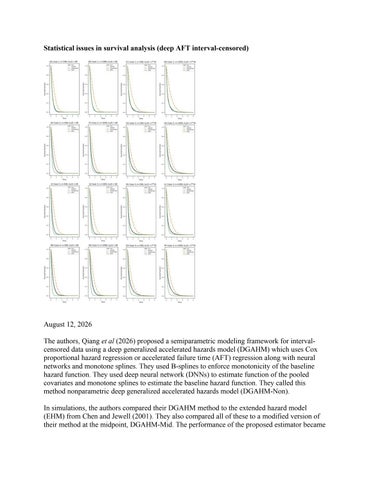
better when the sample size was increased from 500 to 1000 in all simulations. On the other hand, the DGAHM-Mid method exhibited substantial biases across all scenarios, demonstrating its overall inadequacy. The DGAHM greatly outperformed the EHM method in the settings of Case 2, Case 3, and Case 4, where the overly restrictive EHM method caused large biases. For survival function, all figures showed that the DGAHM estimates closely approximated the true survival function. In contrast, the DGAHM-Mid method exhibited substantial positive biases, consistently overestimating the survival probabilities across all cases and settings. Furthermore, the EHM estimates for Cases 2–4 also exhibited noticeable biases. They also conducted a simulation for predictive performance of their proposed approached under complex settings and compared the predictive accuracy of 4 different methods for handling interval-censored data, one of which was a neural network=based method (NN-IC) proposed by Sun and Ding (2023). These authors had used a mean squared prediction error (MSPE) as a performance metric which quantifies the distance between the true survival function and its estimated counterpart. Comparing the different methods, DGAHM-Non demonstrated highly robust and superior predictive performance across the varying complexities of the 5 scenarios. As they conclude, their method preserves the interpretability of Cox models. They also added that their method address a clinical challenge, the uncertainty of true survival times in interval censoring. A limitation of their method is that it assumes conditionally independent censoring which since real data often has informative censoring, they hope to address through copulas, frailty models, and join modeling within their DNN-spline architecture. In general, guaranteeing simultaneous deep estimation and variable selection under interval censoring continues to remain a challenging open problem.
Written by, Usha Govindarajulu, MS PhD Keywords: survival analysis, AFT, DNNs, interval censoring References: Chen Y. Q. , Jewell N. P. (2001) On a general class of semiparametric hazards regression models. Biometrika, 88, 687–702. Qiang Wu, Mingyue Du, Shuangge Ma, Xingqiu Zhao, Efficient estimation for deep generalized accelerated hazards models with interval-censored data, Biometrics, Volume 82, Issue 3, September 2026, ujag140, https://doi.org/10.1093/biomtc/ujag140 Sun T., Ding Y. (2023) “Neural network on interval-censored data with application to the prediction of Alzheimer’s disease”. Biometrics, 79, 2677–2690.
https://oup.silverchaircdn.com/oup/backfile/Content_public/Journal/biometrics/ 82/3/10.1093_biomtc_ujag140/1/m_ujag140fig1.jpeg? Expires=1789522658&Signature=Mw49IZyzaFmIJ40sTUh~P2pXcepHBE1I0uhP2jChzha7Bjy MwxE1VlVv1IEmP5QDG55lu6~Fe11F2eJ0nUXWoTw9Pi3taOBPp9yQqxEEpyTPYrmBvJUO 2mFZrf4pN3dgfWHI2j0Kl53nry4WRnfhCSRIvFcCIhQTdeMYwUVnYXhqoic2U0KtS8iMlLKZ4yAI1BSTKf1-gVsy~-sabPR2 RERCQKS9jLTukloa7r8tuqGezFo3~e6bwp7d8UePg7QeugFM2DrI9cekvfdiCzqdQVXN2AYG gXs~suNv4zSn8fj1ipEs34OwN5ZwAdLYUrU9lmsqNhloRtqFI8uqXQ__&Key-Pair Id=APKAIE5G5CRDK6RD3PGA .