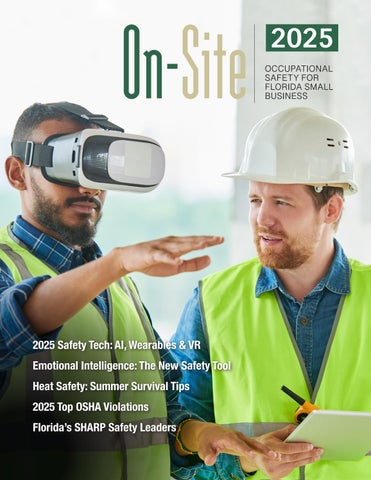
OCCUPATIONAL SAFETY FOR FLORIDA SMALL BUSINESS
2025 Safety Tech: AI, Wearables & VR Emotional Intelligence: The New Safety Tool Heat Safety: Summer Survival Tips 2025 Top OSHA Violations Florida’s SHARP Safety Leaders
E
nhancing Workplace Safety Through OSHA Strategic Partnerships As the Program Director of the USF SafetyFlorida Consultation Program, I am pleased to share insights on the importance and benefits of OSHA Strategic Partnerships for our stakeholders. These partnerships are a cornerstone of our efforts to enhance workplace safety and health across various industries. “Safety Insights from the Director” provides a comprehensive look at how these partnerships are formed, their impact on workplace safety, and the future of safety initiatives.
Brian L. Warrick PhD, CSP, CIH Program Director, USF SafetyFlorida
Understanding OSHA Strategic Partnerships The Occupational Safety and Health Administration (OSHA) Strategic Partnership Program (OSPP) fosters collaboration between OSHA and businesses, labor organizations, and other stakeholders. The goal is to improve workplace safety and health through cooperative relationships rather than traditional enforcement methods. By working together, we can identify and address safety and health hazards more effectively, leading to safer work environments. Benefits of Strategic Partnerships 1. Enhanced Safety and Health Performance: Strategic partnerships can help organizations significantly improve their safety and health performance. These partnerships encourage sharing best practices and innovative solutions, which can reduce workplace injuries and illnesses. 2. Access to Resources and Expertise: Partnering with OSHA provides access to a wealth of resources and expertise. This includes training programs, technical assistance, and guidance on compliance with OSHA standards. These resources are invaluable in helping organizations develop and implement effective safety and health management systems. 3. Positive Workplace Culture: Strategic partnerships promote a culture of safety within organizations. When employees see that their employer is committed to their well-being, it fosters a positive work environment and enhances employee morale and productivity. 4. Recognition and Credibility: Organizations participating in OSHA Strategic Partnerships are often recognized for their commitment to safety and health. This recognition can enhance the organization's reputation and credibility with customers, clients, and the community.
MISSION STATEMENT: USF SafetyFlorida Mission: Committed to reducing work related illnesses and injuries through on-site workplace consultation. To achieve its goal USF SafetyFlorida employs Creativity, Resourcefulness and Boldness. U.S. Department of Labor, Bureau of Labor Statistics Average hours per day spent in selected activities on days worked by employment status and sex. 2021. https://www. bls.gov/charts/american-time-use/activity-by-work.htm 1
Harvard Business Review (2013) The Impact of Employee Engagement on Performance https://hbr.org/resources/ pdfs/comm/achievers/hbr_achievers_report_sep13.pdf
Our Commitment to Safety At USF SafetyFlorida, we are dedicated to supporting our stakeholders in their efforts to create safer workplaces. Our consultation services are designed to help businesses identify hazards, develop effective safety programs, and achieve compliance with OSHA standards. By participating in OSHA Strategic Partnerships, we can further our mission of promoting workplace safety and health. Looking Ahead As we continue to navigate the challenges of today's work environment, the importance of collaboration and partnership cannot be overstated. OSHA Strategic Partnerships provide a framework for working together to achieve common goals and create safer workplaces. We encourage our stakeholders to explore these partnership opportunities and utilize the resources and support available through the USF SafetyFlorida Consultation Program. Together, we can significantly impact workplace safety and health. Exclusive Interview: Voices of Safety In addition to this article, we are excited to present an exclusive "Voices of Safety” interview with Tampa OSHA Area Office Compliance Assistance Specialist Olja Correa. This interactive interview delves deeper into the topic and explores strategic partnerships. You can find this interview on page [9]. Thank you for your continued commitment to safety. Sincerely,
2
1
USF SafetyFlorida
ON-SITE
Brian L. Warrick
OCCUPATIONAL SAFETY FOR FLORIDA SMALL BUSINESS
TABLE OF CONTENTS 1 3 5 6 7 8 9 11
On-Site magazine is published annually by USF SafetyFlorida, a small business safety and health consultation program funded by the Occupational Safety and Health Administration (OSHA) and Florida Department of Financial Services Division of Workers’ Compensation. The University of South Florida College of Public Health is the academic home for USF SafetyFlorida.
Safety Insights from the Director From the Editor’s Desk Innovations in Occupational Safety Emotional Intelligence & Safety Culture Surviving the Summer: Heat Safety Case Studies in Safety Success Voices of Safety: Expert Interview Compliance Corner: OSHA Updates & Violations
5
6
P r o g ra m D i re c t o r: Brian L. Warrick, Ph.D., CSP, CIH USF SafetyFlorida College of Public Health 13201 Bruce B. Downs Boulevard, MDC 56 Tampa, FL 33612-1105 1-866-273-1105 www.usfsafetyflorida.com warrickb@usf.edu Editor in Chief: Thalia Barber tbarber3@usf.edu D e s i g n e r: Martin Young martin@youngdesign.art
12 Building a Safer, Healthier Workforce
15 Community Spotlight:
7
SHARP Honorees
18 Tools & Resources
COVER PHOTO: An engineer navigates a VR simulation of construction plans with real-time guidance, showcasing how immersive tech and collaboration drive safer, smarter building practices.
20
Reading this code with your smartphone, using QR code scanning software such as http://web.scanlife.com/en/ download-application, will enable you to go directly to the USF SafetyFlorida website. 2
F ro m T h e E d i t o r ’s D e s k
Thalia Barber Editor-in-Chief USF SafetyFlorida Consultation Program
D
ear Readers,
Welcome to the latest issue of the 2025 On-Site Magazine, your go-to resource for enhancing occupational safety and health. As the editor-in-chief, I am thrilled to present this comprehensive guide to keep you informed about the newest developments, innovations, and best practices in workplace safety. In this issue, we are excited to feature a column from our Program Director, Dr. Brian L. Warrick, who shares valuable insights on the importance of OSHA Strategic Partnerships. These partnerships foster safer work environments through collaboration and shared expertise. Our magazine is packed with articles and features that we hope you will find informative and engaging. From in-depth analyses of new safety technologies to real-world success stories, expert interviews, and practical safety tips, we aim to cover all aspects of occupational safety and health. We also highlight recent changes in safety regulations, offer advice on promoting employee health and wellness, and provide best practices for safety training and development. Additionally, our community spotlight section showcases local safety initiatives and programs that are making a difference. As we embark on this journey together, we encourage you to explore the opportunities and resources available through the USF SafetyFlorida Consultation Program. Our goal is to support you in creating safer workplaces and fostering a culture of safety. Thank you for your commitment to safety and for being a part of our community. We look forward to bringing you valuable content throughout the 2025 On-Site Magazine. Stay safe and informed! Warm regards,
Thalia Barber Editor-in-Chief 3
USF SafetyFlorida
ON-SITE
Are you ready to take the next step toward safety? Injury and illness prevention are the primary missions of USF SafetyFlorida’s confidential consultative services. Our team of experts will identify hazards and propose solutions that prevent accidents and injuries in your workplace. We also help you develop customized occupational safety and health management systems that create a sustainable safety culture. Our strategies give you the results you’re looking for – reduced injury and illness rates, decreased workers’ compensation premiums, increased employee morale, lower turnover and increased productivity. Take the next step toward safety. Contact us for a FREE consultation. Scan to learn more about the USF SafetyFlorida Program
866-273-1105 USF SafetyFlorida Consultation Program
www.usfsafetyflorida.com 4
Feature Article I
Innovations in Occupational Safety for 2025
A
s we enter 2025, the landscape of occupational safety and health is rapidly evolving, driven by technological advancements and a deeper understanding of workplace well-being. For readers of the USF SafetyFlorida Program, staying ahead of these trends is crucial for fostering safer and healthier work environments.
One of the most exciting developments is the rise of wearable technology. Devices like smart helmets and health-monitoring wristbands are becoming indispensable in monitoring and enhancing worker safety. These gadgets provide real-time data on workers' physical conditions and environmental hazards, alerting them and their supervisors to potential issues like heat stress, fatigue, or exposure to harmful substances. Imagine a wristband that can warn you before you overheat or a helmet that detects dangerous gases—these innovations are making workplaces safer than ever. Artificial Intelligence (AI) and predictive analytics are also transforming workplace safety. By analyzing vast amounts of data, AI can predict potential hazards and suggest preventive measures. This proactive approach helps identify patterns that might lead to accidents, allowing companies to address issues before they escalate. Think of it as having a safety expert who never sleeps, constantly analyzing data to keep you safe. Training is another area seeing significant innovation, thanks to Virtual Reality (VR) and Augmented Reality (AR). These immersive technologies provide realistic simulations of hazardous scenarios, enabling workers to practice responses in a controlled environment. This hands-on experience enhances learning and retention, making safety training more effective. Imagine being able to practice emergency responses in a virtual world before facing them in real life. The focus on psychological safety and mental health is also gaining momentum. Creating a work environment where employees feel safe to express concerns and seek support is linked to higher job satisfaction and reduced accidents. Programs that promote mental well-being, stress management, and open communication are becoming integral to occupational health strategies. It's about creating a culture where everyone feels valued and supported.
The Industrial Internet of Things (IIoT) is another game-changer. By connecting machinery and equipment to the Internet, IIoT allows for continuous monitoring and data collection. This connectivity helps maintain equipment, predict failures, and ensure operational safety. For example, sensors can detect anomalies in machinery performance, preventing accidents caused by equipment malfunctions. Off-site construction is emerging as a safer alternative to traditional onsite building. By manufacturing components in controlled environments and assembling them on-site, the risks associated with construction work, such as falls and exposure to harsh weather, are significantly reduced. This method also improves project efficiency and reduces environmental impact. Collaborative robots, or cobots, are designed to work alongside human workers, enhancing productivity and safety. These robots can take over repetitive, dangerous tasks, reducing the risk of injuries. Equipped with advanced sensors and AI, cobots can operate safely near humans, making them valuable partners in the workplace. Finally, the gamification of safety programs makes training more interactive and engaging. Companies can improve participation and retention by applying game-design elements to safety training. Employees are more likely to remember safety protocols and apply them in real-life situations when they are presented in a fun and competitive way. The innovations in occupational safety and health for 2025 are set to make workplaces safer and more efficient. By embracing these technologies and approaches, organizations can not only comply with safety regulations but also create a culture of safety that benefits everyone. To stay ahead of these advancements and ensure your workplace is as safe as possible, connect with the USF SafetyFlorida Consultation Program. Our experts are here to provide guidance, resources, and support tailored to your specific needs. Please note that the USF SafetyFlorida Consultation Program does not endorse specific products. Let's work together to make 2025 the safest year yet!
5
USF SafetyFlorida
ON-SITE
Feature Article II
The Role of Emotional Intelligence in Enhancing Safety as a Core Value
E
Clarence Rodrigues, PhD, PE, CSP, CPE Senior Health & Safety Consultant and Central Region Supervisor, USF SafetyFlorida motional intelligence (EI) refers to the ability to recognize, understand, and manage the dynamics of our emotions, those of others, and their interactions. In workplace safety, EI plays a crucial role in fostering a positive safety culture, a precursor to building safety as a core value in an organization.
Safety as a Priority vs. Safety as a Core Value Safety can be viewed as a priority and a core value, but these concepts represent different approaches to integrating safety into a company’s culture. When safety is prioritized, it is given importance relative to other business functions like sales, quality, production, and engineering. While this approach acknowledges the significance of safety, it often reduces it to just another item on the to-do list. Prioritizing safety can be reactive, driven by specific circumstances such as regulatory compliance or incident response. In contrast, when safety is made a core value, it becomes an integral part of the organization’s identity and culture. Safety as a core value transcends mere prioritization, reflecting a long-term commitment to embedding safety at all levels. This approach influences decisionmaking, behaviors, and practices consistently over time, demonstrating a genuine commitment to the well-being of employees, customers, and the community. It also extends to off-the-job safety, recognizing that protecting employees outside of work is equally important. What good does it do an organization if they keep their employees safe during work hours only to lose them to injury, illness, and death when off the job? Safety as a core value supersedes safety as a priority, as priorities can change depending on the situation, but core values do not. Applications for Emotional Intelligence in Enhancing Safety 1. Empathetic Scenarios in Training: Incorporate role-playing exercises in safety training sessions where employees navigate safety issues from various perspectives. This fosters understanding and encourages collective responsibility for safety. 2. Open Communication Environment: Create a culture where employees feel comfortable expressing their feelings about workplace safety. Employees who feel heard and valued are likelier to report unsafe conditions or behaviors. 3. Recognition Programs: Develop programs that reward employees for demonstrating safety-conscious behavior and emotional support for their colleagues. Celebrating these behaviors reinforces their importance and encourages others to follow suit.
4. Anonymous Feedback Mechanisms: Implement systems where employees can share their concerns anonymously and offer solutions. Respond to all suggestions, explaining the reasons, even if they are not implemented. This encourages continuous feedback. 5. Stress and Emotion Management Workshops: Offer workshops to help employees manage stress and emotions. A calmly collected workforce will make thoughtful, safety-oriented decisions, especially in high-pressure situations. 6. Training for Supervisors and Managers: Train leaders in emotional intelligence to model safe behavior and effectively communicate the importance of safety. Empathetic leaders can inspire their teams to prioritize safety naturally. 7. Peer Support Networks: Establish networks where employees can discuss emotional challenges related to safety concerns. This creates a supportive community, leading to better emotional management and improved safety practices. 8. Storytelling Sessions: Conduct sessions where employees share individual safety-related experiences. This can create a deeper emotional connection to the value of safety, making it more relatable. 9. Conflict Resolution Capabilities: Develop in-house capabilities for managing conflicts constructively. In safety-critical environments, resolving disagreements promptly can prevent accidents and promote a safer atmosphere. 10. Resources for Stress Management: Provide resources to help employees cope with and manage stress, leading to better decisionmaking and focus. When employees manage their emotions effectively, they are less likely to engage in risky behaviors. Integrating EI into safety initiatives can help organizations create a more engaged and responsive workforce. This helps cultivate a culture where safety is not just a policy but a shared, deeply felt value, bridging the gap between safety as a priority and safety as a core value. To further enhance your organization’s safety culture, consider partnering with the USF SafetyFlorida Consultation Program. This program offers free, confidential, and comprehensive safety and health consultations to small and medium-sized businesses in Florida. By leveraging their expertise, you can identify potential hazards, improve safety practices, and ensure compliance with OSHA standards. Visit the USF SafetyFlorida Consultation Program to learn more and schedule a free consultation today. https://health.usf.edu/publichealth/ research/cohpe/safetyflorida/overview. 6
Feature Article III
Surviving the Summer: Heat Stroke Prevention Strategies To reduce the risk of heat-related illness, the Occupational Safety and Health Administration (OSHA) recommends the following preventive measures:
Maribel Alvarado Safety and Health Consultant USF SafetyFlorida
A
ccording to the Centers for Disease Control and Prevention (CDC), heat-related emergency depar tment visits and hospitalizations have surged recently, with 2023 recording some of the highest rates since 2018. Florida continues to rank among the states with the highest rates of heat-related illness, particularly among outdoor workers in construction, agriculture, and landscaping. These trends highlight the growing threat of heat stroke and the urgent need for preventive action. As climate change drives more frequent and intense heat waves, protecting workers from extreme heat is more critical than ever.
“Heat stroke is preventable— with proper planning, training, and vigilance, employers can ensure their teams stay safe and healthy, even in extreme conditions.”
• Provide workers with access to water or electrolyte-rich sports drinks. • Schedule regular breaks in shaded or air-conditioned areas. • Train employees to recognize the signs and symptoms of heat stroke and when to seek medical help. • Gradually acclimate new or returning workers to hot environments over several days. • Encourage the use of lightweight, light-colored, and loosefitting clothing. • Monitor workers for signs of heat stress and respond immediately if symptoms appear. Employers can also take proactive steps to raise awareness and build a culture of prevention. Regular safety meetings focused on heat illness and distributing educational materials, such as posters and brochures, can help reinforce key messages. Encouraging peer-to-peer monitoring and open communication further strengthens workplace safety. It’s important to remember that heat stroke is preventable. With proper planning, training, and vigilance, employers can ensure their teams stay safe and healthy, even in extreme conditions. The USF SafetyFlorida Consultation Program is here to help. Our team offers free, confidential services to identify heat-related hazards, improve safety and health programs, and even help your business qualify for a one-year exemption from routine OSHA inspections. To learn more or request a no-cost consultation, visit usfsafetyflorida. com or call toll-free at (866) 273-1105.
Heat stroke is a serious and potentially fatal condition that occurs when the body can no longer regulate its temperature. It poses a significant risk to Florida workers, especially during the summer when temperatures regularly reach dangerous levels. Overheated port worker sweating under intense summer heat.
USF OSHA Training Institute Education Center
7 7
USF SafetyFlorida
ON-SITE
Case Studies in Safety Success
Enhancing Workplace Safety: Success Stories from USF SafetyFlorida Consultation Program
W
orkplace safety is a critical concern across various industries, and the USF SafetyFlorida Consultation Program has been leading the charge in helping businesses create safer work environments. Here, we explore two compelling case studies highlighting the program's impact.
Case Study 1: USF On-Campus Stadium Industry: Construction Partners: Manhattan-HJ Russell, DuCon LLC, OSHA, ABC Florida Gulf Coast Chapter The 35,000-seat stadium project at the University of South Florida involved high-risk construction and a diverse workforce. Through an OSHA Strategic Partnership, the team implemented: · 100% Fall Protection for work above 6 feet · Weekly safety audits and bi-monthly inspections · OSHA 10- and 30-hour training for all workers · Heat Illness Prevention using OSHA’s app · Multilingual signage and training Results: Improved hazard identification, stronger subcontractor engagement, and a safety-first culture built on mentorship and accountability.
Back row (L–R): Eric Mitchell, Matt Jerrells, Olja Correa Mike Alisea (Stevens Construction, OSHA) Front row (L–R): Danelle Jindra, Dan Adams, Brian Warrick (OSHA, Stevens Construction, USF SafetyFlorida)
Case Study 2: Premier Women’s Health Care Facility Industry: Healthcare/Construction Partners: Stevens Construction Inc., OSHA, USF SafetyFlorida This 40,000 sq. ft. medical office project in Cape Coral required careful coordination and hazard control. Key safety strategies included: · Daily audits and monthly inspections · OSHA training with bilingual instruction · Fall protection and confined space protocols · Heat safety and air/noise monitoring
Results: Enhanced compliance, reduced injury risks, and improved communication across subcontractors. A Safer Tomorrow Starts Today These case studies demonstrate how collaboration, training, and expert guidance from USF SafetyFlorida help organizations go beyond compliance to build a culture of safety. As industries evolve, USF SafetyFlorida remains a trusted partner in creating resilient, risk-aware workplaces.
Back row (L–R): Scott Heddens, Travis Mellon, Michael Miller, Steve Cona III, Olja Correa, Jeffery Loesche (Manhattan Construction, ABC Florida Gulf Coast, OSHA). Bottom row (L–R): David Steger, Margiory San Juan, Clarence Rodrigues (Manhattan, HJ Russell, USF SafetyFlorida).
8
Voices of Safety – Exploring Strategic Partnerships
An Interview with Olja Correa, an OSHA Compliance Assistance Specialist
W
elcome to our interactive Q&A session! Today, we have the pleasure of speaking with an OSHA Compliance Assistance Specialist who will illuminate the transformative impact of Strategic Partnerships. Get ready to dive into an engaging discussion that will enhance your understanding of workplace safety.
Q1: The Journey Begins Can you share your journey and what inspired you to become an OSHA Compliance Assistance Specialist? My journey into workplace safety has been long, and I think many people can relate to some part of it. Growing up in different countries, and later as an immigrant, I saw firsthand how workers often endured conditions where their health and safety were not prioritized. I’ve been working since I was 13, moving through a wide range of jobs, and I know what it feels like to be on the receiving end where health and safety of workers might not be a priority. My true awakening came during my time in the U.S. Army, as a Commissioned Military Officer where I learned that proper training, open communication, and a commitment to safeguarding one another could make all the difference. After my service on active duty, I joined OSHA as a Compliance Safety and Health Officer (CSHO) and spent nine years investigating preventable fatalities and serious injuries. Those experiences showed me just how crucial proactive measures can be and inspired me to become a Compliance Assistance Specialist, a role that allows me to focus on prevention through education, outreach, and meaningful partnerships. Knowing that my efforts can help ensure every worker — someone’s child, sister, brother, spouse, parent, or grandparents — comes home safely at the end of the day. This is what drives me. I’m grateful for the support from the OSHA Tampa Area Office, the Atlanta Regional Office and National Office whose leadership and guidance have helped shape the way I serve both employees and employers.
What excites you most about working with OSHA Strategic Partnerships? What truly energizes me about OSHA Strategic Partnerships is the collaborative spirit that it brings to the table. When OSHA, USF SafetyFlorida, businesses and industry unite around a shared goal—
9
USF SafetyFlorida
ON-SITE
improving workplace health and safety—we create a collaboration that goes far beyond basic health and safety compliance. The tangible results, like reduced injury rates and more engaged employees, are incredibly rewarding. Even more exciting is seeing the perspective shift: once workers and organizations experience the benefits of a strategic partnership, they start viewing safety not as an obligation but as a shared value. That shift is where the real magic happens.
Q2: Demystifying OSHA Strategic Partnerships For those new to the concept, how would you describe OSHA Strategic Partnerships in a nutshell? OSHA Strategic Partnerships are voluntary cooperative agreements that provide an opportunity for OSHA to partner with employers, workers, professional or trade associations, labor organizations, and other interested stakeholders to build safer, healthier workplaces. They are unique agreements designed to encourage, assist, and recognize partner efforts to eliminate serious hazards and enhance workplace safety and health practices. They include established goals, strategies, and performance measures designed to improve worker safety and health. These partnerships foster continuous improvement, education, and open dialogue. They’re all about working together proactively to protect workers’ well-being.
What are the core objectives of these partnerships, and why are they crucial for workplace safety? The main goals are to prevent workplace injuries and illnesses, raise safety and health awareness, improve safety management systems, and maintain open channels of communication among employers, workers, USF SafetyFlorida, and OSHA. These objectives are crucial because they transform the traditional top-down regulatory approach into a cooperative effort that emphasizes prevention and continuous improvement. In other words, it’s about creating a culture where everyone—employers, employees, and regulators—works hand-in-hand to achieve excellence in safety and health.
“Knowing that my efforts can help ensure every worker—someone’s child, sister, brother, spouse, parent, or grandparent—comes home safely at the end of the day. This is what drives me.” Q3: The Benefits Unveiled What are some of the standout benefits that organizations can experience by par ticipating in OSHA Strategic Partnerships? Organizations often see immediate improvements in their safety performance: lower injury and illness rates, reduced workers’ compensation costs, and a more robust risk management framework. Beyond the metrics, these partnerships boost employee morale (which is my favorite), strengthen relationships with OSHA and partner entities, and help instill a safety-first mindset that lasts long after a project ends. By actively participating, companies develop a legacy of health and safety that benefits current and future worksites and hopefully seek out OSHA Strategic Partnerships for future projects.
Officials from Moss & Associates LLC - Gasworx E3 Project and OSHA pose together after signing the Partnership agreement ) on June 5, 2025, symbolizing a commitment to safety. Seated (L-R): Brian Warrick (USF On-Site Construction), Michael Svac (Executive VP, Moss & Associates), and Toby Manulak (Senior VP, Moss & Associates). Standing (L-R): John McLoud, Jeremy Freeman, Jordan Carlin, Jeffey Sellers, Franco Polanco, Daniel Diaz (all Moss & Associates), and Olja Correa (US DOL-OSHA).
Can you share a memorable success stor y where a partnership led to significant safety improvements? One particular success story involves a construction general contractor who initially hesitated to join a partnership due to past subcontractor injuries and challenging worksite conditions. With the guidance of OSHA and USF SafetyFlorida, they instituted a comprehensive safety and health management system, invested in training, and engaged in open communication with their workers to enhance employee participation in safety practices and policies. After a year, the contractor saw a notable drop in injuries and a surge in employee satisfaction. Encouraged by these results, they went on to establish additional OSHA Strategic Partnership sites, effectively making worker health and safety a core part of their business identity.
Q4: Getting Involved What steps should an organization take to partner with OSHA and USF SafetyFlorida? Start by contacting the USF SafetyFlorida Consultation Program or your local OSHA office to speak with a Compliance Assistance Specialist. Following an initial discussion and evaluation, the parties align established goals and responsibilities, then formalize their agreement. The process is rooted in transparency, open dialogue, and a sincere willingness to invest in long-term improvements.
Are there any specific criteria or prerequisites that organizations must meet to qualify for a partnership? The OSHA Strategic Partnership Program (OSPP) does not have a rigid qualification checklist. Organizations are encouraged to commit to a partnership duration of at least one year to maximize benefits for all parties. Essential requirements include a genuine dedication to enhancing workplace safety and health, allocating adequate resources, and fostering open communication. Organizations eager to learn, adapt, and prioritize worker well-being are well-positioned to explore partnership opportunities. Please contact your local OSHA office for more details or to discuss potential partnerships. References: OSHA Strategic Partnership Program (OSPP) OSHA Strategic Partnerships - Frequently Asked Questions
Q5: Resources and Support What resources and support does OSHA offer to organizations involved in these partnerships? OSHA provides safety and health technical assistance and guidance and access to various compliance assistance resources. As a Compliance Assistance Specialist, we are just a phone call or email away. Additionally, USF SafetyFlorida does an incredible job of providing free safety and health consultation services to small businesses, which fully complements OSHA’s compliance assistance efforts. Our websites, publications, and case studies serve as invaluable resources, ensuring that every partner has the tools they need to protect their workers. This personal, hands-on approach helps humanize our mission and ensures that every employee knows their health and safety truly matter.
How can organizations maximize these resources to enhance their safety programs? Organizations should actively engage OSHA or USF SafetyFlorida to consider opportunities in improving workplace hazard prevention. Whether it results in a free safety and health consultation visit by our USF SafetyFlorida partners or a formal partnership with OSHA, turning knowledge into action is key. Important actions such as establishing procedures, performing a job hazard /job safety analysis, or enhancing reporting systems for near-misses, bring the organization one step closer to a sustainable culture of safety and health.
Q6: Overcoming Challenges What are some common challenges organizations face when participating in OSHA Strategic Partnerships, and how can they overcome them? Common hurdles include resource and budget constraints, as well as resistance to change and uncertainty about implementing new measures. Overcoming these challenges starts with leadership commitment, as well as setting clear goals, involving employees in decision-making, and using data-driven approaches to measure progress. These incremental steps help build momentum and, over time, create a foundation for lasting health and safety improvements. 10
Unfortunately, there is often mistrust in government agencies, which can hold organizations back. Transparency is key. When partners see clear, honest actions, such as open communication and real safety improvements, that skepticism vanishes.
How does OSHA assist organizations in navigating these challenges? OSHA provides guidance tailored to each organization’s unique situation. We provide technical assistance and guidance for instituting a comprehensive safety program, as well as assistance in identifying and instituting effective abatement measures. The Compliance Assistance Specialists in the Atlanta Region serve as Voluntary Protection Programs (VPP) Team Leaders, performing worksite safety and health evaluations across a wide array of industry sectors, and maintaining practical, real-world insight into overcoming obstacles in managing safety and health in the workplace. By working closely with organizations, we ensure that solutions are both meaningful and sustainable in the long run.
Q7: Upcoming initiatives Are there any upcoming initiatives or changes that stakeholders should be aware of? OSHA regularly updates guidance documents and outreach materials in response to high-hazard industries and emerging hazards. Keep informed by following OSHA’s website, newsletters, and local outreach events. Upcoming OSHA-supported initiatives include the Heat Illness Prevention Campaign and Extreme Heat Safety Month (July); the Safe+Sound Campaign, along with Safe+ Sound Week (August 11-17, 2025); and Suicide Prevention Month (September) and Construction Suicide Prevention Week (September 8-12, 2025). The Agency just concluded the National Safety Stand-Down to Prevent Falls in Construction (May 5-9) and Mental Health Awareness Month (May). Each initiative promotes a stronger emphasis on building a health and safety culture that adapts to changing workforces and working conditions, ensuring that The Workers of America get to go home the way they came into work.
Q8: Expert Advice What advice would you give organizations considering joining an OSHA Strategic Partnership? Open the communication. Begin with a clear vision of what you hope to achieve. Identify your most pressing safety and health concerns, and prepare to invest time, resources, and honest effort into addressing them. Remain open to feedback, involve employees at every step, and think of this as a journey toward long-lasting and meaningful improvement, not a quick fix.
11
USF SafetyFlorida
ON-SITE
How can stakeholders maximize the benefits of their participation in these partnerships? Embrace communication, collaboration, and continuous learning. Monitor progress, celebrate successes, and remain flexible. Share what you learn with peers and colleagues, turning your own improvements into industry-wide gains. By doing so, you create a ripple effect that advances the health and safety of everyone involved.
Q9: Interactive Segment Can you share a quick safety tip or best practice that organizations can immediately implement? Start each shift with a “safety huddle.” During this quick meeting, supervisors and team members review the day’s tasks, identify potential hazards, and confirm that everyone is equipped with the proper personal protective equipment and tools for the job. This small step encourages dialogue, situational awareness, and proactive hazard management before work even begins. Encouraging employee engagement in safety is crucial for creating a proactive safety culture, reducing workplace accidents, and enhancing overall organizational performance. What’s one question you wish more organizations would ask about OSHA Strategic Partnerships? I wish more organizations would ask: “How can we take what we learn here and actively mentor other businesses to elevate health and safety standards across the industry?” By focusing on sharing knowledge and best practices, organizations can help spark a positive chain reaction that extends the benefits of their own partnership experiences to other companies, workers, and communities.
Q10: Closing Thoughts Is there anything else you’d like to share with our readers about the value of OSHA Strategic Partnerships and working with USF SafetyFlorida? OSHA Strategic Partnerships and USF SafetyFlorida’s consultation services aren’t just about passing an inspection or meeting a regulation—they’re about fundamentally shifting how we value and protect human life in the workplace. By collaborating with OSHA, USF SafetyFlorida, and other partners, employers can create work environments where everyone thrives. This proactive and cooperative approach can transform entire industries, ensuring that at the end of the day, everyone returns home healthy and whole. Serving in this role for the past three years has been a tremendous honor – especially in building relationships and changing perspectives. My counterparts and I are so excited you are reading this article and can’t wait to hear from you!
“OSHA Strategic Partnerships aren’t just about compliance—they’re about fundamentally shifting how we value and protect human life in the workplace.”
U S F O S H A Tr a i n i n g I n s t i t u t e E d u c a t i o n C e n t e r
• Flexible Learning Options: Students can choose from various learning formats, including in-person, online, and on-site training. • Certification: Successful completion of courses often leads to OSHA certification, which can enhance career prospects and professional credibility.
Empowering Safer Workplaces Through Education: The USF OSHA Training Institute Education Center Who Are They Since its establishment in 2003, the University of South Florida OSHA Training Institute Education Center (USF OTIEC) has been a cornerstone of occupational safety and health education in the Southeast. As one of only a few OSHA-authorized education centers in the nation, USF OTIEC delivers high-quality, expert-led training designed to equip workers, supervisors, and employers with the knowledge and tools they need to create safer, more compliant workplaces. What They Offer USF OTIEC offers a wide range of courses designed to enhance workplace safety and health. These courses are tailored for workers, supervisors, and employers in both the private and public sectors. The center's mission is to equip individuals with the knowledge and skills to prevent workplace injuries and illnesses. Training is delivered by experienced industry professionals who incorporate real-world scenarios into their teaching, ensuring that participants gain practical, applicable knowledge. Benefits to Students Students who enroll in courses at USF OTIEC benefit in several ways: • Expert Instruction: Courses are taught by seasoned professionals with extensive industry experience. • Comprehensive Curriculum: The curriculum covers a broad spectrum of safety and health topics, ensuring well-rounded training.
Where Classes Are Offered and In What Format USF OTIEC offers classes in multiple formats to accommodate different learning preferences and schedules: • In-Person Classes: Held at the USF campus in Tampa, Florida, and other locations within OSHA’s Atlanta Region, which includes Florida, Georgia, North Carolina, and South Carolina. • Online Courses: Virtual Instructor-Led Training (VILT) allows students to participate in interactive sessions from anywhere. • On-Site Training: Customized training sessions can be arranged at an employer’s location, providing convenience and relevance to specific workplace needs. Course Schedule and Classes Offered USF OTIEC offers a diverse array of courses, including but not limited to: • OSHA 500: Trainer Course in Occupational Safety and Health Standards for the Construction Industry • OSHA 501: Trainer Course in Occupational Safety and Health Standards for General Industry • OSHA 510: Occupational Safety and Health Standards for the Construction Industry • OSHA 511: Occupational Safety and Health Standards for General Industry • OSHA 5400: Trainer Course in Occupational Safety and Health Standards for the Maritime Industry • OSHA 5600: Disaster Site Worker Trainer Course A Partner in Prevention USF OTIEC is more than a training provider—it’s a partner in building a culture of safety. Whether you're a small business owner seeking compliance guidance or a safety professional looking to advance your credentials, USF OTIEC offers the resources and support to help you succeed. Explore upcoming courses and registration details at www.usfotiec.org.
12
Safety Tips: Avoid These Top 10 OSHA Violations in 2025 A Guide to the Most Common OSHA Citations and How to Stay Compliant in the Year Ahead Each year, the Occupational Safety and Health Administration (OSHA) publishes its list of the most frequently cited workplace
2. Hazard Communication – General Industry (1910.1200) Violations: 3,213 Overview: This standard ensures that workers are informed about chemical hazards and associated
safety violations—offering a clear snapshot of where employers
protective measures. Proper labeling, safety data
are falling short. The 2024 data highlights persistent hazards that
sheets, and training are essential components.
continue to put workers at risk. Now, midway through 2025, this list
Tip for Avoidance: Maintain an up-to-date chemical
remains a practical guide for organizations looking to strengthen
inventory, ensure all containers are properly labeled,
their safety programs, correct common oversights, and foster a
provide accessible SDSs, and conduct regular hazard
culture of prevention. Here’s a closer look at the top 10 violations
communication training.
and how to avoid them. 3. Control of Hazardous Energy (Lockout/ Tagout) – General Industry (1910.147) Violations: 2,978 1. Fall Protection – General Requirements (1926.501)
Overview: Protects workers from accidental machine startup during maintenance. Violations include failure to implement or follow lockout/tagout procedures,
Violations: 7,271 Over view: For the 14th consecutive year, fall protection remains the most cited violation. This standard requires employers to provide fall protection systems for employees working at heights to prevent falls, which are a leading cause of workplace injuries and fatalities. Tip for Avoidance: Conduct regular fall hazard assessments, ensure guardrails or personal fall arrest systems are in place, and train workers on the proper use of fall protection equipment.
which can lead to serious injuries or fatalities. Tip for Avoidance: Maintain an up-to-date chemical inventory, ensure all containers are properly labeled, provide accessible SDSs, and conduct regular hazard communication training. 4. Ladders – Construction (1926.1053) Violations: 2,978 Overview: Violations often involve improper use of ladders, such as using the wrong type of ladder for a task or not securing ladders properly. Ensuring that ladders are in good condition and used correctly is vital for preventing falls.
13
USF SafetyFlorida
ON-SITE
Tip for Avoidance: Maintain an up-to-date
improper construction and use, which can lead to falls
chemical inventory, ensure all containers are
and structural collapses. Ensuring scaffolds are erected
properly labeled, provide accessible SDSs, and
and used according to OSHA standards is critical.
conduct regular hazard communication training.
Tip for Avoidance: Maintain an up-to-date chemical inventory, ensure all containers are properly labeled,
5. Respiratory Protection – General Industry
provide accessible SDSs, and conduct regular hazard
(1910.134)
communication training.
Violations: 2,478 Overview: This standard requires employers to
9. Eye and Face Protection – Construction
establish and maintain a respiratory protection
(1926.102)
program. Violations typically involve inadequate
Violations: 1,769
fit testing, medical evaluations, and training for
Overview: This standard requires employers to provide
employees using respirators.
appropriate eye and face protection when workers are
Tip for Avoidance: Maintain an up-to-date
exposed to hazards such as flying particles, molten
chemical inventory, ensure all containers are
metal, liquid chemicals, acids, or caustic liquids.
properly labeled, provide accessible SDSs, and
Tip for Avoidance: Maintain an up-to-date chemical
conduct regular hazard communication training.
inventory, ensure all containers are properly labeled, provide accessible SDSs, and conduct regular hazard
6. Powered Industrial Trucks – General
communication training.
Industry (1910.178) Violations: 2,341
10. Machine Guarding (1910.212)
Overview: Commonly known as forklifts, these
Violations: 1,644
vehicles must be operated safely. Violations often
Overview: This standard requires that machines have
involve inadequate operator training and failure to
proper guards to protect workers from hazards such as
maintain equipment properly.
rotating parts, flying chips, and sparks. Ensuring that
Tip for Avoidance: Maintain an up-to-date
guards are in place and functioning correctly is essential
chemical inventory, ensure all containers are
for preventing injuries.
properly labeled, provide accessible SDSs, and
Tip for Avoidance: Maintain an up-to-date chemical
conduct regular hazard communication training.
inventory, ensure all containers are properly labeled, provide accessible SDSs, and conduct regular hazard
7. Fall Protection Training – Construction
communication training.
(1926.503) Violations: 2,003
Addressing these top OSHA violations isn’t just about
Overview: Employers must provide training for
compliance—it’s about protecting lives. By proactively
employees exposed to fall hazards. This includes
reviewing safety protocols, investing in employee training,
understanding the use of fall protection systems
and correcting common hazards, employers can create
and recognizing potential fall hazards.
safer, more resilient workplaces. Focusing on these high-
Tip for Avoidance: Maintain an up-to-date
risk areas can significantly reduce injuries, improve morale,
chemical inventory, ensure all containers are
and strengthen your safety culture.
properly labeled, provide accessible SDSs, and conduct regular hazard communication training.
For additional support, the USF SafetyFlorida Consultation Program offers free, confidential
8. Scaffolding - Construction (1926.451)
services to help small and medium-sized
Violations: 1,939
businesses identify and correct workplace
Overview: Scaffolding violations often involve
hazards. Visit usfsafetyflorida.com to learn more and schedule a consultation. 14
Regulatory Updates
Navigating New Safety Regulations
I
n recent years, the landscape of safety regulations has evolved significantly, driven by the need to enhance workplace safety and adapt to emerging risks. This article explores the latest regulatory updates and provides insights on how organizations can navigate these changes effectively.
Source: OSHA regulatory updates and public hearing schedules (2025)
Four Key Regulatory Updates
Strategies for Compliance
1. PPE Fit Requirements (Effective January 13, 2025)
To effectively navigate the evolving landscape of safety regulations, organizations should adopt a proactive and multifaceted approach to compliance. Continuous training is a cornerstone of this strategy. Regular, hands-on sessions help ensure that employees not only understand new safety protocols but can also apply them confidently in real-world scenarios. These trainings should be interactive, role-specific, and offered in multiple languages to accommodate a diverse workforce.
OSHA has finalized a rule requiring personal protective equipment (PPE) to properly fit each employee, replacing vague language that previously allowed for “appropriate” gear. This change addresses longstanding safety concerns, especially for women and smaller-framed workers, by ensuring PPE is functional, comfortable, and inclusive.
2. Heat Injury and Illness Prevention:
OSHA is moving forward with its proposed rule to address heat injury and illness in outdoor and indoor work environments. A virtual public hearing is scheduled to begin on June 16, 2025, allowing stakeholders to provide input on the proposed standards. This rule aims to protect workers from the growing risks of extreme heat exposure, particularly in industries like construction, agriculture, and manufacturing. Employers should begin evaluating their current heat safety protocols in anticipation of future compliance requirements.
3. Hazard Communication Standard (HCS) Update
A final rule is expected in 2025 to revise the Hazard Communication Standard, improving chemical labeling, multilingual access to safety data, and training requirements. This update aligns U.S. standards more closely with the Globally Harmonized System (GHS) and enhances worker understanding of chemical hazards.
4. Fall Protection Enhancements
New fall protection regulations emphasize smart PPE, climate-aware surface evaluations, and inclusive training. These changes are designed to reduce fall-related injuries, particularly in construction, by mandating more proactive and adaptive safety measures.
15
USF SafetyFlorida
ON-SITE
In addition to training, conducting routine internal audits is essential for identifying and addressing compliance gaps before they escalate into violations. Both scheduled and unannounced inspections can help maintain a state of readiness, while involving cross-functional teams in the audit process brings valuable perspectives. Promptly addressing audit findings with clear action plans reinforces a culture of accountability. Leveraging digital compliance tools can further streamline efforts. Safety management software can automate reminders for training, audits, and reporting deadlines, while also centralizing documentation and tracking regulatory changes. This reduces the administrative burden on safety personnel and ensures that compliance efforts remain organized and up to date. Finally, fostering a strong culture of safety is critical. When safety becomes a shared value across all levels of an organization, compliance naturally follows. Encouraging open communication about hazards, involving employees in safety initiatives, and recognizing proactive safety behavior all contribute to a more engaged and vigilant workforce. By integrating these strategies, organizations can not only meet regulatory requirements but also build a safer, more resilient workplace.
In The Field
In the Field: Real Hazards, Real Solutions
U
SF SafetyFlorida consultants are on the ground daily, partnering with small and medium-sized employers across Florida’s high-hazard industries. We've seen everything from construction sites to manufacturing floors—exposed wiring, unguarded machinery, fall risks, and more.
But identifying hazards is only the beginning. What truly makes a difference is what happens next: our consultants work closely with employers to correct these issues, implement safer practices, and ensure workers go home healthy and injury-free. The photos on this page are just a snapshot of the hazards we’ve encountered this year—and the positive changes that followed. Because at the end of the day, safety isn’t just about compliance. It’s about people.
Cutting roof tiles without proper dust control exposes workers to respirable crystalline silica, which can cause severe health issues such as silicosis, lung cancer, and kidney disease. (Linette Pruna Padilla/Photo courtesy of Miram F. Escobar)
Working at heights without proper fall protection—such as tying off to an unapproved anchor point like a roof truss—can result in serious injury or death from falls. (William Tomlin)
Using a dirty, damaged, or improperly stored respirator can expose you to harmful substances and serious respiratory health risks. (Maribel Alvarado)
Relying on a defective, empty, or poorly maintained fire extinguisher during an emergency can result in serious injury, smoke inhalation, or death. (Luis Silva)
16
Health and Wellness
Promoting Employee Health
H
ey there! Let's discuss something super important: promoting health and wellness at work. It's incredible how thoughtful changes can significantly affect our feelings and performance. Let's dive into three key areas: mental health, ergonomics, and wellness programs. Mental Health The first up is mental health. It's crucial for overall well-being. Creating a supportive environment where people feel comfortable talking about mental health issues is a great start. Reducing stigma and encouraging open communication can help. Offering resources like counseling services, mental health days, and stress management workshops can make a huge difference. And don't forget that training managers to recognize and address mental health concerns is essential!
17
USF SafetyFlorida
ON-SITE
Ergonomics
Wellness Programs
Next, let's talk about ergonomics. This is all about designing workspaces that keep us comfortable and efficient, reducing the risk of injury. Consider setting up workstations properly with adjustable desks, chairs, and computer monitors. Encouraging movement is also key— regular breaks and standing desks can help reduce that dreaded sedentary behavior. And a little ergonomic training on proper posture and techniques to avoid repetitive strain injuries can go a long way.
Finally, wellness programs are initiatives designed to boost overall health. Offering physical activity options like gym memberships, on-site fitness classes, or incentives for active commuting can get everyone moving. Providing healthy snacks, nutrition workshops, and access to dietitian services can promote better eating habits. Regular health screenings help catch potential health issues early, which is always good. Focusing on these areas can create a healthier, more supportive work environment. Promoting employee health is not just about feeling good— it's also a smart move for any organization. Promoting employee health is a win-win for everyone involved!
Tr a i n i n g a n d D e v e l o p m e n t
Building a Culture of Safety
B
uilding a culture of safety within an organization is essential for ensuring employee well-being and overall business success. A strong safety culture not only reduces the risk of accidents and injuries but also enhances employee morale and productivity. To achieve this, leadership must demonstrate a genuine commitment to safety by setting clear policies, providing necessary resources, and leading by example. Developing comprehensive safety training programs is crucial. These programs should cover all aspects of workplace safety, including general practices, specific job-related hazards, and emergency procedures. Regular safety audits and inspections help identify potential hazards and ensure compliance with safety standards, allowing for continuous improvement of safety measures. Employee involvement is key to a successful safety culture. Encouraging participation in safety committees and empowering employees to provide feedback and identify hazards fosters a sense of ownership and responsibility. Ongoing education and training keep employees updated on the latest safety practices and regulations, ensuring that safety is a continuous priority.
and incident analysis is essential. By following these best practices, organizations can build a robust culture of safety that protects employees and enhances overall productivity. Remember, safety is a continuous journey that requires commitment, education, and active participation from everyone in the organization.
Clear communication channels are vital for reporting safety concerns and incidents. Establishing these channels ensures that employees feel comfortable reporting issues without fear of retaliation. Additionally, implementing a recognition and rewards program can motivate employees to prioritize safety by acknowledging those who contribute to a safer workplace. L e v e r a g i n g t e c h n o l o g y, s u c h a s s a f e t y management software, can streamline incident tracking, training record management, and safety data analysis. Emergency preparedness plans should be developed and regularly updated, and drills should be conducted to ensure employees know how to respond in case of an emergency. Finally, fostering a culture of continuous improvement by regularly reviewing and updating safety policies and procedures based on feedback
18
Community Spotlight
Safety in Our Community Celebrating Excellence: Sunshine State & SHARP Award Honorees
A
t USF SafetyFlorida, we believe that safety excellence begins at the community level. Across Florida, businesses and organizations go above and beyond to protect their workers and foster a safety culture. In this spotlight, we celebrate those efforts by recognizing the recipients of the Sunshine State Safety Recognition and SHARP (Safety and Health Achievement Recognition Program) awards.
Sunshine State Safety Recognition Award This award honors small businesses demonstrating a strong commitment to workplace safety and health through proactive hazard identification, employee involvement, and continuous improvement.
Celebrating Excellence: 2025 Award Recipients Featured Recipients: KAST Construction – Project: PLD Building Number 44 Link Construction Group – Project: PLD Building Number 44 Link Construction Group – Project: PLD Building Number 45 Pond Company Moss & Associates, LLC – Project: Alba
USF SafetyFlorida developed the Sunshine State Safety Recognition Award to motivate and support employers who demonstrate a commitment to continuously improve their workplace safety and health management system.
Moss & Associates, LLC – Project: Belmont Village Aventura Moss & Associates, LLC – Project: Hollywood Police Headquarters Moss & Associates, LLC – Project: Nora Moss & Associates, LLC – Project: Palm Beach Atlantic University (PBAU) Resia Construction, LLC – Project: Golden Glades SICE Miami Warehouse
19
USF SafetyFlorida
ON-SITE
Link Construction Group proudly displays their Sunshine State awards in front of a newly completed industrial facility, celebrating their commitment to workplace safety and health.
“Achieving SHARP status has transformed our safety culture. It’s not just about compliance— it’s about protecting our people every day.” — Melitta USA, Inc. Featured Recipients: Allied Scrap Processors, Inc – Industry: Scrap Processor Alti-2 Technologies, Inc – Industry: Manufacturing
SHARP Award The SHARP (Safety and Health Achievement Recognition Program) Award is OSHA’s highest honor for small businesses. It recognizes organizations that have implemented exemplary injury and illness prevention programs, going above and beyond compliance to create truly safe and healthy workplaces.
American Thermoplastic Extrusion Company (ATECO) – Industry: Manufacturing Berman Brothers, Inc – Industry: Warehousing & Scrap Recycling Canterbury Tower – Industry: Rehabilitation & Skilled Nursing Center Flotech, Inc – Industry: Environmental Contractor Melitta USA, Inc – Industry: Manufacturing Ridgway Roof Truss Company – Industry: Manufacturing Techfit Digital Surgery, Inc – Industry: Medical Technology Industry Tintometer, Inc – Industry: Manufacturing & Supplier
Ridgway Roof Truss Company Team members commemorate their SHARP award achievement alongside colleagues in an industrial facility, highlighting their dedication to maintaining a safe and healthy workplace.
Get Involved Interested in joining this elite group of safety leaders? Learn how your business can qualify for SHARP recognition by visiting usfsafetyflorida.com. Our team is here to guide you through the process and help you build a culture of safety excellence. 20
Discover SafetyWriter: Your Compliance Companion
N
eed help crafting OSHA-compliant safety programs, policies, or procedures? SafetyWriter is your go-to digital tool. Designed for Florida’s small businesses, this intuitive platform helps you generate customized safety documents in minutes—no technical writing experience required. Whether updating your hazard communication plan or creating a new lockout/tagout procedure, SafetyWriter makes it simple, fast, and effective.
Stream Safety Anytime, Anywhere Introducing our Safety Video Streaming Service—a curated library of highquality safety training videos available on demand. From forklift safety to PPE best practices, our videos are perfect for toolbox talks, onboarding, or refresher training. Stream directly from your device and keep your team engaged and informed with visual learning that sticks. Stay Connected, Stay Compliant Join our growing community of safety-conscious professionals! Follow USF SafetyFlorida on Facebook, LinkedIn, and YouTube for safety tips, regulatory updates, success stories, and a look at how our program saves lives. Be part of the conversation and stay ahead of the curve.
SafetyWriter: Your Step-by-Step Safety Plan Builder Step 1 Log In – Access the SafetyWriter tool through the USF SafetyFlorida website. Step 2 Choose a Template—Choose from a library of pre-built templates covering topics such as Hazard Communication, Lockout/Tagout, PPE, and more.
Connect with us! Facebook: https://www.facebook.com/USFSafetyFlorida/ LinkedIn: https://www.linkedin.com/company/usfsafetyflorida/ YouTube: https://www.youtube.com/channel/UCqYhihWb0YtuYQZXzwpM-1Q
Step 3 Answer Simple Prompts – Fill in basic information about your workplace. No technical writing or regulatory expertise needed. Step 4 Customize as Needed – Add site-specific details or policies to tailor the plan to your operations. Step 5 Download & Share – Instantly download your completed safety plan in a professional format, ready to print or distribute digitally. Whether starting from scratch or updating an existing plan, SafetyWriter saves time and ensures compliance with OSHA standards—all in plain language.
Subscribe to Our Bi-Monthly Newsletter Don’t miss out on the latest in workplace safety. Our bi-monthly newsletter delivers expert insights, upcoming training opportunities, regulatory news, and real-world success stories to your inbox. It’s the easiest way to stay informed and inspired. Join our newsletter community at https://health.usf.edu/publichealth/ research/cohpe/safetyflorida/e-letter
21
USF SafetyFlorida
ON-SITE
CONSULTING. TRAINING. EDUCATION. About Us
Hazard Assessments
USF SafetyFlorida offers free, confidential workplace safety and health consultations to help Florida’s small businesses comply with OSHA standards and create safer work environments. Our expert team partners with employers to identify hazards and improve overall safety culture.
Written Program Evaluation Review and improve safety program compliance.
Monitoring & Sampling Identify risks and recommend exposure controls.
Our Mission Our mission is to save lives by reducing work-related illnesses and injuries and to help Florida’s small businesses profit from safety through free, confidential workplace consultations. We are committed to fostering a proactive safety culture that empowers employers and protects workers across the state.
Management Systems Evaluate safety culture and system effectiveness.
Informal Training Provide OSHA updates, informal training, and safety presentations.
Analytics & Insights
Industries We Serve
Analyze data to guide safety actions.
Healthcare
General
Construction
Maritime
Manufacturing
High-risk sectors
usfsafetyflorida.com
Identify hazards and recommend safety improvements.
866-273-1105
Sign up today! usfsafetyflorida@usf.edu22
NON-PROFIT ORG. U.S. POSTAGE
PA I D
13201 Bruce B. Downs Blvd. Tampa, FL 33612
TAMPA, FLORIDA
Toll-free: 1-866-273-1105 Phone: 813-974-9962 Fax: 813-974-8270 usfsafetyflorida.com
PERMIT # 236
OCCUPATIONAL SAFETY FOR FLORIDA SMALL BUSINESS
University of South Florida, Tampa Campus
23
USF SafetyFlorida
Reading this code with your smartphone, using QR code scanning software such as http://web.scanlife.com/en/downloadapplication, will enable you to go directly to the USF SafetyFlorida website.
2023 Casey Brooke Lawson
ON-SITE