2012
Top 5 Safety Tips for New Business Owners Nursing Home, Residential Care Industries Targeted by OSHA Florida's Leading Small Businesses in Safety
Program Directors' Columns
Dr. Yehia Hammad
Charlene Sitterly
Professor, USF College of Public Health
Program Manager
Program Director, USF SafetyFlorida
USF SafetyFlorida Consultation Program
New Center Consolidates College of Public Health Safety Outreach
I
n this year’s On-Site Magazine, we are proud to announce the opening of the new Center for Occupational Health Planning and Education (COHPE), part of the USF College of Public Health (COPH).
The COPH serves a vital role protecting the health of workers. To enhance that mission, USF COPH created the Center for Occupational Health Planning and Education (COHPE) to promote, educate, and assist both private and public sector employers throughout the Southeast in developing programs and systems that improve workplace safety and health. The collaborative effort includes the contributions and resources of faculty and staff of the COPH Department of Environmental and Occupational Health as well as those of USF SafetyFlorida (OSHA 21(d) Consultation Program) and the USF OSHA Training Institute Education Center. As you’ll read in this issue, USF SafetyFlorida, the state's safety and health consultation program, provides free and confidential services to Florida's small business owners. Its mission is to save lives by reducing workplace injuries and illnesses. This also helps Florida's small business owners protect their profits and provide better safety and health programs for workers. The program is funded by grants from the Occupational Safety and Health Administration (OSHA) and the state of Florida. You’ll also read about the USF OSHA Training Institute Education Center (USF OTIEC), which provides courses to train and certify workers in the various aspects of safety and health. Such training includes: • Job hazard recognition classes • Courses in OSHA standards, policies, and procedures for personsresponsible for enforcing or directly supporting the Occupational Health and Safety Act of 1970 • Job hazard training • Hazardous materials communication training • Hazardous communication classes for low literacy workers • OSHA maritime standards • Construction industry standards • General industry standards We believe that the joint effort of our diverse team at the COHPE toward our common goal will be helpful to the business community in Florida and in the region. So, please contact us with your questions, concerns, requests for free consultation services and fee-based training. We look forward to helping you create a safe and more healthful workplace. You can reach us by calling the number shown on the left side of this page or by clicking on the e-mail link shown below.
Small Business Employers Should Use Our Services to Prep for NEPs
N
EPs, or national emphasis programs, are OSHA’s industry-focused outreach efforts designed to protect workers from serious safety and health hazards. These efforts include targeted inspections of businesses for a specified period of time. Currently, the following NEPs are in effect: • Combustible dust • Federal agencies • Flavoring chemicals/diacetyl • Hazardous machinery (focus on amputations) • Hexavalent chromium • Lead • Nursing and residential care facilities • Primary metals industries • Process safety management • Recordkeeping • Shipbreaking • Silica • Trenching and excavation
If your company is classified within these industries or works with any of the aforementioned materials, take note. Now is the time to be proactive in addressing your safety and health management system. Don’t wait until an OSHA enforcement officer visits you. The delay could be costly. At USF SafetyFlorida, our mission is to protect workers from injuries and illnesses on the job. We also protect Florida’s small business economy by keeping dollars in employers’ pockets instead of being paid out in through higher workers’ compensation premiums, hospital or urgent care bills, and lost time production. If your company needs assistance with workplace safety and health, let us help. We will perform a free, confidential and comprehensive analysis of your worksite to assess how your safety and health management system can be improved. Furthermore, if your worksite has hazards or potential hazards, we will help you address those areas, understand how to correct them, and prevent the hazards from occurring in the future. You have nothing to lose and everything to gain from on-site consultation. If we can help prevent an OSHA citation and penalty, your consultation’s return on investment will be worth it, in the short- and long-term. Request yours today at www.safetyflorida.usf.edu.
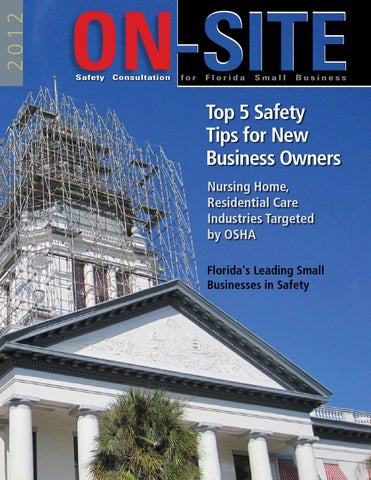
Cover photo: Scaffolding surrounds the copper dome at Florida’s old capitol building in Tallahassee. The dome received its first renovation in more than 100 years this winter. Mike Tartal of USF SafetyFlorida assisted Childers Construction, general contractor of
USF SafetyFlorida On-Site
the project, with an on-site consultation.
2 0 1 2 , V o l . 5. I ss u e 1
5
table of contents
7
1 3 5 7 9 11 17 18 19
Program Directors' Columns USF SafetyFlorida News USF OSHA Training Institute Education Center News Think SHARP Sunshine State Safety Recognition Award Features By the Numbers What We SEE USF SafetyFlorida Management Tools 19 SafetyWriter 20 Accident Tracker 21 RecordKeeper 22 HurriPlanner
23
USF Safetyflorida announcements and accolades
21
Program Manager
Charlene Sitterly USF SafetyFlorida College of Public Health 13201 Bruce B. Downs Boulevard, MDC 56 Tampa, FL 33612-3805 1-866-273-1105 www.safetyflorida.usf.edu csitterl@health.usf.edu
Designer
Reading this code with your smartphone, using QR code scanning software such as http://web.scanlife.com/en/ download-application, will enable you to go directly to the USF SafetyFlorida website.
Martin Young martinyoung@comcast.net
Editor
Kelly Garland kellygarland@comcast.net
On-Site magazine is published annually by USF SafetyFlorida, a small business safety and health consultation program funded by the Occupational Safety and Health Administration (OSHA) and the Florida
19
Department of Financial Services’ Division of Workers’ Compensation.
USF SafetyFlorida News
USF SafetyFlorida joins Center for Occupational Health, Planning and Education This spring, USF’s College of Public Health announced the creation of the Center for Occupational Health, Planning and Education, a non-profit organization dedicated to reaching private and public sector employers throughout the Southeast through the improvement of workplace safety and health. USF SafetyFlorida will join forces with the college’s Department of Environmental and Occupational Health, as well as the USF OSHA Training Institute Education Center, to provide safety and health programming, training and consultation services that will create stronger and safer workplaces.
really does round out our discussion of what the law’s requirements are and what resources are available," says Birdsong. The Division of Workers' Compensation is part of Florida's Department of Financial Services and handles workers' compensation claims for employees who are injured or killed on the job. For the past four years, total health care provider payments have exceeded $500 million annually due to workplace injuries, illnesses and fatalities. Note: The Division’s trust fund adds a 10 percent matching grant to the federal government’s funding of the USF SafetyFlorida consultation program.
Florida's newly certified SHARP companies received recognition letters from Florida Governor Rick Scott in May. See page 7 for complete list of Florida SHARP companies. Scaffolding surrounds the copper dome at Florida’s old capitol building in Tallahassee. The dome received its first renovation in more than 100 years this winter.
On-site consultation reaches Florida’s capitol USF SafetyFlorida’s Mike Tartal performed an on-site consultation at Florida’s capitol building in Tallahassee last fall and this winter during the historic building’s recent renovation. Childers Construction was assigned the task of repairing and upgrading the capitol’s copper dome and cupola. The project provided protective coatings to alleviate water leaks that were damaging the building’s interior, and was completed in April.
USF SafetyFlorida continues presence at Florida Division of Workers' Compensation's Workplace Safety seminars USF SafetyFlorida partnered for the third year with the Florida Division of Workers' Compensation at its workplace safety seminars. Held throughout the state, the free and educational seminars provide attendees with important information about workers' compensation laws as well as workplace safety. In 2011, 43 seminars were held with 1,970 attendees, ranging from business owners, licensed contractors and other employers. Sheryle Birdsong with the Division's Compliance Bureau says the partnership is a win-win. "The (consultation) program is an integral part of the educational program. Having USF SafetyFlorida’s presence at the seminars
USF SafetyFlorida On-Site
Governor Rick Scott recognizes Florida's new SHARP employers Governor Rick Scott recognized eight new Florida SHARP employers for exemplary workplace safety practices with a letter he sent to each of the companies. OSHA's Safety and Health Achievement Recognition Program award is the highest safety honor for small businesses and granted to employers nominated by USF SafetyFlorida. SHARP certified companies are exempt from OSHA inspections for a period up to two years, with the exception of a serious accident, fatality or employee complaint. In his letter to the employers, Scott wrote, "Your commitment to a safe work environment for Floridians is to be commended. We are fortunate to have companies like yours in the Sunshine State who provide a safe place to work each and every day." There are currently 60 SHARP-certified businesses in the state of Florida. To qualify, a firm must: • Request and undergo a consultation visit from USF SafetyFlorida • Involve all employees in the consultation process • Correct hazards identified during the on-site consultation • Implement and maintain a safety and health management system that, at a minimum, addresses OSHA's 1989 Safety and Health Program Management Guidelines • Reduce their Lost Workday Injury and Illness Rate and Total Recordable Case Rate below the national average for their industry • Agree to notify USF SafetyFlorida prior to making changes to working conditions or introducing new hazards into the workplace
USF SafetyFlorida plays central role in annual OSHA conference USF College of Public Health undergraduate students participate in a field trip to learn more about the relationship between environmental and public health. USF SafetyFlorida consultants accompanied the students during the visit in March 2012.
Shadowing experiences help USF students learn about occupational safety and health USF College of Public Health students are learning about occupational safety and health first-hand as part of a shadowing project with USF SafetyFlorida consultants. The undergraduate and graduate-level students participate in on-site consultations as well as field visits alongside USF SafetyFlorida professionals. In March, 12 undergraduate students and two instructors specializing in epidemiology, global health, and maternal health and well-being visited a surface water treatment plant in Tampa and the Pinellas County Solid Waste Site in St. Petersburg. Safety and Health Supervisor Mylene Kellerman, who accompanied the group, said the visit was an insightful experience for the students. "Students better appreciated the practical application of their public health curriculum as it relates to the community.” USF nursing students enrolled in the graduate certificate course Occupational Health Nursing II received a 15-hour mentoring experience with Safety and Health Consultant Jim Ulseth. With Jim they learned how OSHA and on-site consultation programs affect high-hazard industries and the occupational health nursing practice. One student praised the mentoring program because it put what she had learned during the past two years “into a practical application.” Another commented how it was “a great chance to see first-hand many of the concepts discussed during our introductory safety and IH (industrial hygiene) courses, such as utilization of specific OSHA standards as well as the process of an on-site visit … I wish we had more opportunities like this.”
David Schenk
Ulseth says nursing students benefit from the shadowing experiences because they can see how safe workplaces can prevent occupational injuries and illnesses.
Assistant Secretary of Labor for OSHA Dr. David Michaels delivers the keynote speech during the 2012 National On-site Consultation Training Conference that was held April 23-26.
For the fourth consecutive year, USF SafetyFlorida assisted OSHA with coordinating its annual On-site Consultation Training Conference. The conference, which was held in Nashville, Tenn., drew in representatives from all 50 states and U.S. territories. Featured as keynote speaker was Assistant Secretary of Labor for OSHA Dr. David Michaels, who continues to praise on-site consultation as "one of the government's best kept secrets." The conference also provided attendees an opportunity to participate in 24 different training workshops, ranging in topics from emerging industrial hygiene issues, workplace fatigue, and successes and challenges in the healthcare and nursing home industries, to noise control technology.
USF SafetyFlorida assists Florida Department of Health with occupational hazard data As part of a statewide occupational safety and health study, USF SafetyFlorida provided the Florida Department of Health with five years’ worth of important data about occupational injuries and illnesses in the state in addition to frequently referenced standards between 2006 and 2011. Referencing OSHA standards is an essential service that consultants provide to Florida small business owners. Since on-site consultation is separate from OSHA enforcement, USF SafetyFlorida consultants do not have the ability to cite violations or fines during a comprehensive visit. Instead, consultants reference which OSHA standards apply when a hazard is identified during a visit. This helps employers meet OSHA safety and health standards at their work sites. OSHA standards referenced by employer size include: Top 5 OSHA Standards Referenced in Hazard Identification by USF SafetyFlorida from October 1, 2006 until May 31, 2011 (Based on Employer Size)
Standard Referenced:
With Fewer than 100 employees 1910.1200 - Hazard Communication 1910.303 - General Requirements Electrical 1910.305 - Wiring Methods, Components and Equipment for General Use 1910.132 - Personal Protective Equipment 1910.157 - Portable Fire Extinguishers Between 101-300 employees 1910.303 - General Requirements Electrical 1910.305 - Wiring Methods, Components and Equipment for General Use 1910.1200 - Hazard Communication 1910.147 - Control of Hazardous Energy (Lockout/Tagout) 1910.132 - Personal Protective Equipment More than 300 Employees 1910.305 - Wiring Methods, Components and Equipment for General Use 1910.303 - General Requirements Electrical 1910.1200 - Hazard Communication 1910.147 - Control of Hazardous Energy (Lockout/Tagout) 1910.132 - Personal Protective Equipment
Number of Times Referenced
672 382 375 364 320
160 149 140 97 89
41 33 24 22 19
U S F O S H A Tr a i n i n g I n s t i t u t e E d u c a t i o n C e n t e r
Bob Nesbit Program Manager USF OSHA Training Institute Education Center
In January, USF OTIEC unveiled the OSHA Authorized Trainer Student Processing System, which offers authorized outreach trainers a streamlined method for student course completion card requests. This entirely web-based system enables the center to respond to requests faster than before, allowing students to get to work sooner with the credentials they need.
The USF OSHA Training Institute Education Center: Florida's Workplace Safety Training and Continuing Education Resource
T
he USF OSHA Training Institute Education Center (OTIEC) bustled with activity this year. As Florida's premier source of safety training and education, the center is one of 25 OSHA education centers in the U.S. and the third most-active in the country. Located in Wesley Chapel near Tampa, it offers live safety training courses across the Southeast to nearly 1,000 students annually, and the center offers online training across the nation. Moreover, its 2,044 authorized outreach trainers delivered safety courses to over 13,300 students this year. During 2012, the center continued its partnership with the City of Miami and the Environmental Protection Agency (EPA) by conducting numerous courses as part of The City of Miami Brownfield Job Training Program. The program provides free environmental- and industrial-related training and certification to Miami residents, helping to increase job skills and workforce employability in the green job sector.
City of Miami residents receive safety training from the USF OSHA Training Institute Education Center as part of a job training program sponsored by the city and Environmental Protection Agency. The program is designed to help residents increase job skills for the workforce.
Arsen Bayandrian (standing) teaches a course at the USF OSHA Training Institute Education Center in Wesley Chapel.
Courses are offered throughout the Southeast and internationally in the countries shown above.
USF SafetyFlorida On-Site
The month of June saw the debut issue of USF OTIEC’s bi-monthly electronic newsletter that informs subscribers of the latest news and trends concerning occupational safety and health, notifies readers of promotions and discounts through USF OTIEC, and provides advance notice of upcoming courses and additions to the center’s schedule. Maritime Prerequisite The center also unveiled a new course: OTI 5410 Occupational Safety and Health Standards for the Maritime Industry. As of Oct. 1, 2012, the course will serve as a prerequisite for OTI 5400 Train-the-Trainer for the Maritime Industry. The prerequisite will cover OSHA policies, procedures and standards for the maritime industry as well as safety and health principles. Locations Courses continue to be offered throughout the Southeast, including: Gulfport, MS; Charlotte, NC; Charleston, SC; Columbia, SC; Nashville, TN; Raleigh/Durham, NC; Savannah, GA; Boca Raton, FL; Clearwater, FL; Daytona Beach, FL; Fort Lauderdale, FL; Fort Myers, FL; Fort Pierce, FL; Jacksonville, FL; Key Largo, FL; Key West, FL; Miami, FL; Naples, FL; Orlando, FL; St. Petersburg, FL; Tampa, FL; and West Palm Beach, FL. To date, USF OTIEC has provided contract training abroad in Jamaica, Colombia, Trinidad and Tobago, the Bahamas, Panama and the Cayman Islands. The center has also provided OSHA training across the U.S. military for the Navy, Army, Coast Guard and Air Force. In addition, the center has developed and delivered specialized training for NASA and multiple agencies within the U.S. Department of Justice, including the Federal Bureau of Prisons and the U.S. Marshals Service. Private Safety Classes For companies in need of training at their place of business or during specific dates, private safety courses are available. We can develop private courses upon request and tailor them to a business' needs. Furthermore, they are an effective way to bring training to your site and save money in travel-related costs.
For more information about the USF OTI Education Center and to register for classes, visit us on the web at www.usfoticenter.org or call 813-994-1195.
Regularly Offered Courses The center's catalog of courses includes the following classes: Online v 10-Hour OSHA General Industry v 30-Hour OSHA General Industry v 10-Hour OSHA Construction v 30-Hour OSHA Construction v Certified Aggression Control Manager v 24-hour HAZWOPER v 8-hour HAZWOPER v 4-hour Recordkeeping v Fleet Driver Program v Safe Teen Jobs Awareness Training Specialty 1-Hour Online Courses v Fall Protection v Blood Borne Pathogens v Scaffold v Stairways and Ladders v Introduction to OSHA v OSHA Standards and Inspection Procedures v Personal Protective Equipment v Recordkeeping v Safety Programs v Rigging and Material Handling General Industry v OTI 501 Trainer Course in Occupational Safety and Health Standards for the General Industry v OTI 503 Update for General Industry Outreach Trainers v OTI 511 Occupational Safety and Health Standards for General Industry v OTI 521 Guide to Industrial Hygiene v OTI 2015 Hazardous Materials v OTI 2045 Machinery and Machine Guarding Standards v OTI 2225 Respiratory Protection v OTI 2250 Principles of Ergonomics Applied to Work Related Musculoskeletal and Nerve Disorders v OTI 2264 Permit Required Confined Space Entry v OTI 3010 Excavation, Trenching and Soil Mechanics v OTI 3095 Electrical Standards v OTI 6000 Collateral Duty Course for Other Federal Agencies v OTI 7000 OSHA’s Ergonomic Guidelines Training for Nursing Homes v OTI 7100 Introduction to Machinery and Machine Safeguarding v OTI 7105 Introduction to Evacuation and Emergency Planning
v
v v v v v v v v v v
OTI 7115 Lock out/Tag Out Controlling Hazardous Energy to Prevent Workplace Injury OTI 7120 Introduction to Combustible Dust Hazards OTI 7200 Blood Borne Pathogens Exposure Control for Healthcare Facilities OTI 7205 Health Hazard Awareness OTI 7210 Pandemic Influenza and Workplace Preparedness OTI 7300 Understanding OSHA's Permit Required Confined Space Standards OTI 7410 Managing Excavation Hazards OTI 7500 Introduction to Safety and Health Management OTI 7505 Introduction to Accident Investigation OTI 7510 Introduction to OSHA for Small Business OTI 7845 Recordkeeping Rule Seminar
Construction v OTI 500 Trainer Course in Occupational Safety and Health Standards for the Construction Industry v OTI 502 Update for Construction Industry Outreach Trainers v OTI 510 Occupational Safety and Health Standards for the Construction Industry v OTI 3110 Fall Arrest Systems v OTI 7400 Trainer Course in Construction Noise v OTI 7405 Fall Hazard Awareness for the Construction Industry v OTI 7415 OSHA Construction Industry Requirements: Awareness of Major Hazards and Prevention Strategies v Scaffolding Qualified Person Training v Fall Protection Qualified Person Training v USF 9001 Sub Part R Steel Erection Safety Standards Maritime v OTI 5400 Trainer Course in Occupational Safety and Health Standards for Maritime Industry v OTI 5410 Occupational Safety and Health Standards for the Maritime Industry Disaster v OTI 5600 Disaster Site Worker Train-the- Trainer Course v OTI 5602 Update for Disaster Site Worker Trainer Course v OTI 7105 Evacuation and Emergency Planning v OTI 7600 Disaster Site Worker Course
USF OSHA Training Institute Education Center 2612 Cypress Ridge Boulevard, Suite 101, Wesley Chapel, FL 33544 usfoticenter@health.usf.edu • www.usfoticenter.org
Safety and Health Achievement Recognition Program Award
Exemplary Safety and Health Equates to Prestigious SHARP Certification What is SHARP?
SHARP Renewal
Why SHARP?
SHA created the Safety and Health Achievement Recognition Program award to recognize small business owners who operate an exemplary safety and health management system (SHMS). Once SHARP certified, employers are exempt from OSHA inspections for a period up to two years, with the exception of a serious accident, fatality or employee complaint. Firms throughout the U.S. can earn a SHARP award, and for a Florida company the approval process begins with a recommendation to OSHA from USF SafetyFlorida.
If a company wishes to renew its SHARP certification, the application process must begin during the last six months of its exemption period. The company must also undergo a comprehensive visit by a USF SafetyFlorida consultant to ensure its SHMS has improved or maintained. Furthermore, the employer must meet all SHARP eligibility requirements, agree to conduct self-evaluations and provide a written report based on the elements of OSHA 1989 Safety and Health Program Management Guidelines and OSHA’s required injury and illness logs.
Businesses that earn a SHARP award say the recognition instills a sense of pride and accomplishment. “It ignites a spark for each employee to take the initiative to resolve any small or large issue right away, so that the accomplishment of achieving the SHARP recognition does not become jeopardized,” says Craig Davis of Aluma Tower Company, Inc. The Vero Beach manufacturer of lightweight, portable aluminum towers and command centers now has two worksites that are SHARP certified. This year one
How can your company become SHARP?
SHARP Deferral
earned a renewal and the second location earned its first SHARP award.
Companies interested in pursuing SHARP status must first request a safety and health consultation from USF SafetyFlorida. The on-site consultation involves a comprehensive safety and health hazard survey of the worksite(s) involved, including equipment and work processes. Other qualifying requirements for the SHARP program include: • Have at least one year of operating history at the company or worksite; • Implement, demonstrate and maintain a safety and health management system (SHMS) that, at a minimum, addresses the major elements of OSHA’s 1989 Safety and Health Program Management Guidelines; • Lower the company’s Days Away, Restricted or Transferred (DART) rate and Total Recordable Case (TRC) rate below industry national average; • Correct all hazards identified by the consultant; • Agree to notify the USF SafetyFlorida Consultation Program prior to making changes in working conditions or work processes that may introduce new hazards into the workplace.
If a business meets most but not all of OSHA’s SHARP eligibility requirements, a USF SafetyFlorida consultant may recommend a business for an inspection deferral up to 18 months, provided the company has: • Completed a hazard identification survey with a USF SafetyFlorida consultant and corrected all identified hazards; • Implemented, demonstrated and maintained a SHMS that, at a minimum, addresses the major elements of OSHA’s 1989 Safety and Health Program Management Guidelines; • Implemented an action plan with established abatement dates that completes the necessary items that prevented the company from reaching SHARP status during the original survey.
O
First-Time SHARP Certification and Exemption Once a business satisfies all SHARP requirements, a USF SafetyFlorida consultant may recommend it for SHARP approval and certification. If approved by OSHA, the company will receive formal SHARP recognition from OSHA and USF SafetyFlorida during an award ceremony. The company will also be exempt from OSHA inspections for a period up to two years.
Aluma Tower Company of Vero Beach. USF SafetyFlorida On-Site
Other companies that earn SHARP status report that safety results in lower operating costs, which equals a higher profit margin. Trucks and Parts of Tampa, Inc. has been in the SHARP program since 2007. Not only did the company successfully reduce its Total Recordable Case (TRC) rate and Days Away, Restricted or Transferred (DART) rate from 2.6 to 0.0, but it also reduced its workers’ compensation premiums by nearly $150,000 in a five-year period. The company’s president, Bruce Goldberg, who actively supports its safety culture, says the lower workers’ compensation costs directly benefits customers. “This allows us to pass these savings on to them.”
Florida’s SHARP Companies This year 58 Florida companies qualified for OSHA’s SHARP award and two qualified for a SHARP deferral. SHARP Key: (N) = new (R) = renewal
(D) = deferral
(N) Alti-2, Inc., Deland (R) Aluma Tower Company, Inc., Vero Beach (1639 Old Dixie Highway) (N) Aluma Tower Company, Inc., Vero Beach (926 Old Dixie Highway) (R) American Compliance Technologies, Inc. (ACT), Bartow (N) American Thermoplastic Extrusion Company (ATECO), Miami (R) Associated Grocers of Florida, Pompano Beach (N) Ayers Health & Rehabilitation Center, Trenton (R) BAE Systems Aerospace Solutions, Crestview (N) BAE Systems, Metal Fabrication Division, Crestview (R) Bayonet Point Health & Rehabilitation Center, Hudson (R) Beall’s 810 Facility, Bradenton (R) Beall’s 817 Facility, Bradenton (R) Cable USA, Inc., Naples (R) Canterbury Tower, Tampa (N ) Control Micro Systems, Winter Park (R) Coreslab Structures Orlando, Inc. (R) Cox's Wholesale Seafood, Tampa (R) Current Builders, Pompano Beach (R) Daws Manufacturing Company, Inc., Pensacola (R) Exactech, Inc., Gainesville (R) Florida Club Care Center, Miami (R) Florida Presbyterian Homes, Lakeland (R) Florida’s Blood Centers, Lake Park (R) Florida’s Blood Centers, Miramar (R) Gate Precast Company, Jacksonville (R) Gate Precast Company, Kissimmee (R) Great Southern Wood of Florida, Inc., Lake Panasoffkee (N) Inn and Nursing Center at La Posada, Palm Beach Gardens (R) Johnson Controls Miami Warehouse (N) Kauff’s Transportation Systems, (N) La Posada Health Care, Palm Beach Gardens (N) Main Metal Recycling, Jacksonville (R) Mapei, Inc., Fort Lauderdale (N) MI Metals, Inc., Oldsmar (R) Moss & Associates, Fort Lauderdale (D) MTS Medication Technologies, St. Petersburg (R) Mueller Industries, Ft. Pierce (N) Neptune Research, Inc. (NRI), Lake Park
Trucks and Parts of Tampa, Inc.
(R) New Limeco, LLC., Princeton (R) Orbeco-Hellige, Sarasota (N) Orchid Island Juice Company, Ft. Pierce (D) Palm Garden, Largo (N) Pebble Creek Animal and Bird Hospital, Tampa (R) Phoenix Wood Products, Ocala (N) (N) (R) (R) (D) (N) (R) (N) (N) (R) (R) (R) (R) (R) (R) (R)
Portus Stevedoring, Jacksonville Precision Econowind, Ft. Myers Probuild #82, Milton Pursuit Boats, Ft. Pierce Quality Health Care Center, North Port Raydon Corporation, Port Orange Ro-Mac Lumber & Supply, Leesburg Southern Manufacturing Technologies, Inc., Tampa Standard Precast, Inc., Jacksonville Stewart-Marchman-Act Behavioral Health care Enrichment Program, Daytona Beach Sypris Electronics LLC, Tampa Technology Conservation Group, Lecanto Thomas & Betts Corporation, Ormond Beach (Southland) Thomas & Betts Corporation, Ormond Beach (Aviator Way) Trucks & Parts of Tampa Trusswood, Titusville
Ready to become SHARP? Contact USF SafetyFlorida at 1-866-273-1105 or visit us online at www.safetyflorida.usf.edu to request a free on-site consultation.
Raydon Corporation of Port Orange.
NRI of Lake Park.
La Posada Health Care of Palm Beach Gardens.
BAE Systems Aerospace Solutions of Crestview.
Safety and Health Achievement Recognition Program Award
Commitment to safety and teamwork makes the difference
A
sk any successful business owner involved in high-risk industry their advice on keeping incident levels low, and their answer will most likely be employers and employees working together to keep a job site safe. This employer-employee safety commitment is the reason USF SafetyFlorida developed the Sunshine State Safety Recognition Award.
Chapman Partnership of Miami.
First Florida Builders at its Bayside Apartments project in Largo.
Created in 2006, the Sunshine State Safety Recognition Award commends employers and employees in all industries who proactively and routinely engage in job safety. Approximately 40 firms earn this honor annually, and it recognizes companies that have implemented good safety initiatives to better protect employees on the job. According to Keith Brown, a USF SafetyFlorida safety and health supervisor, “Team work is essential in accident prevention, and when there are open lines of communication between workers and management, it speaks volumes about a company’s commitment to safety.” To qualify, a business should request and receive a complete on-site consultation survey and employ at least one person at the worksite to be evaluated. Additionally, the business should have no willful, repeat or willful-repeat citations within 24 months of the consultation and no serious citations related to injury or exposure within 12 months of the consultation.
During the consultation, a safety consultant will perform a comprehensive on-site evaluation of all written accident prevention management programs. The consultant will also speak with workers and conduct an evaluation of the work area. The safety consultant will review: • Administration and oversight of safety management programs • Safety and health management practices • Safety training and instruction • Employee safety rules • Internal safety inspection routines for new and existing substances, processes and equipment If hazards are identified during the visit, an abatement of those specific hazards must take place before recognition is granted. Once initial and final consultations are complete, a safety consultant may decide to formally recommend the firm for a Sunshine State Safety Recognition Award, which is approved by USF SafetyFlorida management. A formal letter of commendation is sent to the company, recognizing the employers’ and employees’ efforts in implementing and maintaining an effective injury and illness prevention program. “Working together towards maintaining safety is something everyone can take pride in,” adds Brown.
USF SafetyFlorida developed the Sunshine State Safety Recognition Award to motivate and support employers who demonstrate a commitment to continuously improve their workplace safety and health management system. Olympia Plumbing at the Centurion Air Cargo project at Miami International Airport.
USF SafetyFlorida On-Site
The 2012 Sunshine State Safety Recognition Award recipients include: Artisan Industries Holdings, LLC B & I Contractors, Inc., Lemon Bay High School Balfour Beatty Construction, Lemon Bay High School Batson-Cook Company Burris Logistics C. Davis Electric, Publix Pompano Beach Chapman Partnership, Homestead and Miami Childers Construction, Florida Capitol Conner Industries Dermatology Depot Medical Spa Endoscopy Center of Pensacola Fagen, Inc.
Stiles Construction at the Centurion Air Cargo project at Miami International Airport.
First Florida Building Corporation, Bayside Apartments, Colonial Lakes Apartments Inter America Stage Jacobsen Manufacturing, Inc. JJ Taylor Distributing Kensington Gardens II Lotspeich Company, Barry University, Publix Pompano Beach Mettler, Toledo Safeline Moss & Associates, Barry University, Publix Pompano Beach MWI Corporation OHL Arellano, South Miami Hospital Olympia Plumbing, Centurion Air Cargo project at Miami International Airport Southern Sheet Metal Stiles Construction, Centurion Air Cargo project at Miami International Airport Titan America, Edgewater, Jacksonville and Melbourne terminals Valor Construction Management VF Imagewear Viatek Solutions Yara North America
Inter America Stage, Inc. of Sanford.
10
Features
OSHA’s New National Emphasis Program Targets Nursing Home, Residential Care Facilities
B
ecause serious safety and health hazards are often found in nursing homes and residential care facilities, on April 5, 2012, the U.S. Department of Labor’s Occupational Safety and Health Administration announced a new National Emphasis Program (NEP) targeting this health care industry through 2015. OSHA’s focused outreach efforts include educational materials and inspections that are to help reduce occupational injuries and illnesses. The program emphasizes the awareness of safety and health hazards such as ergonomic stressors in patient lifting and handling, bloodborne pathogens, tuberculosis, workplace violence, and situations or conditions that cause slips, trips and falls. The injuries and illnesses caused by these hazards have contributed to nursing home and residential care facilities having one of the highest rates of lost workdays of all major U.S. industries. According to the Bureau of Labor Statistics, the 2010 incidence rate for cases involving days away from work was 2.3 times higher than all of private industry (OSHA News Release, 2012). What the NEP Means for Florida In Florida, there are 677 nursing home providers and 2,968 assisted living facilities, for a combined total of more than 166,000 beds. (Florida Active Healthcare Providers, 2012). Job-wise, 86,980 nursing aides, orderlies and attendants were employed in Florida in 2011. (Florida Occupational Employment and Wages, 2012). With the potential for several hundred Florida
11
USF SafetyFlorida On-Site
healthcare worksites being targeted by OSHA’s National Emphasis Program, employers with a Days Away, Restricted or Transferred Rate (DART) of 10.0 or higher, need to take note in NAICS codes 623110, 623210 and 623311 (formerly SIC codes 8051 Skilled Nursing Care Facilities, 8052 Intermediate Care Facilities, and 8059 Nursing and Residential Care Facilities). What to Do Mylene Kellerman, assistant director and safety and health supervisor with the USF SafetyFlorida OSHA on-site consultation program, visits numerous nursing home and residential care facilities each year throughout the state. She says it is an important time for Florida’s nursing home and residential care administrators to become proactive in occupational safety and health. “An effective safety and health management system is critical,” says Kellerman, “particularly one that has been reviewed and evaluated by USF SafetyFlorida. Onsite consultation is a strong defense to reduce the likelihood of receiving an OSHA citation.” More importantly, she says a company’s commitment to workplace safety can reduce injury and illness rates, workers’ compensation claims and increase employee performance. Safety and health management systems are for both management and employees, not exclusively the latter, reminds Kellerman. “Everyone—top to bottom—should be on-board with workplace safety,” she says. “Educating management and staff about the importance of a safe working environment is critical.”
USF SafetyFlorida’s Mylene Kellerman (left) reviews a written safety and health plan with representatives from Florida Presbyterian Homes in Lakeland, Fla. The residential care facility has been working with the on-site consultation program since 2004 and is part of OSHA’s SHARP program, which recognizes employers for exemplary workplace safety and health.
Luis Pieretti, Ph.D., of USF SafetyFlorida discusses chemicals in cleaning products with a janitorial staff member during an onsite consultation. Employees must be aware of chemical handling and use to prevent exposure. Photo credit: Colin Hackley
But educating management and staff is not enough, according to Kellerman. Proper training ensures employees understand how to avoid potentially unsafe behavior. For this reason, nursing home and residential care facilities should develop written plans, including the following, that both educate and train workers about workplace safety: • General safety— This safety plan includes policies and procedures on work surroundings, potentially hazardous equipment, workplace violence—addressed in OSHA’s NEP—and safety committees to create and maintain a safe work environment. • Exposure control—To eliminate or minimize occupational exposure to bloodborne pathogens—also addressed in OSHA’s NEP— the exposure control plan includes details on personal protective equipment, engineering and work practice controls, housekeeping, post-exposure evaluation and follow-up, as well as recordkeeping and procedures for evaluating an exposure incident. • Hazard communication— This plan is designed to protect personnel from exposure to potentially dangerous chemicals. As such it recommends assigning a hazard communication program coordinator to maintain and share a list of hazardous chemicals and their properties so that employees are aware of chemical handling and protective measures. The plan also advises that safety data sheets be obtained from manufacturers of hazardous chemical substances and that they be updated annually. Chemicals must be properly labeled and employees trained on their handling and use.
• Lifting policy—A lifting policy plan addresses ergonomic issues and establishes procedures for how patients should be safely lifted and moved by nursing and residential care employees to reduce potential for musculoskeletal injuries.
and employees. “Safety committees stimulate critical questions such as ‘Why did this happen?’ and ‘How did this happen?’ both important in determining the source of what could be a hazardous or potentially hazardous condition and come up with recommendations and solutions to prevent recurrence,” says Kellerman. “The Benefits Are Long-Term” Florida Presbyterian Homes, a continuing care retirement community in Lakeland, has 300 residents among its 38 assisted living apartments, a 48-bed skilled nursing center, 61 independent living apartments and 115 homes. With 150 employees, its 2011 DART rate is 3.5, well below the 2010 Bureau of Labor Statistics industry average of 5.6
Photo credit: Colin Hackley
The company first contacted USF SafetyFlorida in 2004 to receive an on-site consultation. “We wanted someone from an outside agency to look at what was already in place and to enhance employee training on safe working conditions,” says Maria Rivera, Florida Presbyterian Homes’ administrator.
Mark Leon of USF SafetyFlorida (right) explains how a lifting device can be properly used when lifting a patient from a wheelchair. Lifting devices can prevent nursing and residential care employees from experiencing musculoskeletal injuries while handling patients.
• Lock-out/tag-out— This plan addresses how to prevent the accidental starting or activation of machinery or electrical systems while being repaired, cleaned or serviced. Furthermore, it establishes responsibility for who will implement and maintain the program, and procedures for staff and outside personnel or subcontractors using the equipment. Also addressed are training, communication and machinery inspection. • Emergency action—To address emergencies such as fire and inclement weather, this plan includes evacuation procedures, escape route assignments, rescue and medical duties, fire protection and prevention responsibilities and more. Once written plans are in place, nursing home and residential care facilities are encouraged to train supervisors as well as establish a safety committee to provide interaction and encourage information exchanges between management
USF SafetyFlorida’s Kellerman worked with Rivera and her team on ergonomic issues, such as resident lifting and handling; resident bathing and toileting; and kitchen, dietary and laundry operations. As a result, the company successfully corrected the hazardous areas and subsequently reduced its DART rate, employee turnover rate and workers’ compensation costs. Rivera praises the knowledge and expertise that comes from working with a safety and health consultant. “You’re not on your own. The consultant relationship is wonderful. She (Kellerman) guides us, informs us of what we need to do, and how to make improvements,” says Rivera. Rivera recommends that health care facilities embrace a safety culture. “You have to make time to improve safety. The benefits are longterm,” says Rivera. Today, Florida Presbyterian Homes is one of OSHA’s SHARP (Safety and Health Achievement Recognition Program) award recipients—given to small businesses demonstrating exemplary workplace safety and health--and the award has been renewed three times. SHARP status creates a sense of pride for businesses and also exempts them from OSHA programmed inspections.
How to Get Help Nursing homes and residential care facilities can get free and confidential help with workplace safety and health. USF SafetyFlorida is OSHA’s on-site consultation program for small and private employers in the state. The program’s 12 consultants are located throughout the state, and one will come to your place of business, free of charge, to perform a comprehensive workplace analysis of your safety and health management system. More importantly, since consultants are professionally trained to use OSHA standards to identify hazards, they will identify what OSHA could cite as hazardous areas and offer you guidance on how to correct them.
Injuries and Illnesses Targeted by OSHA NEP OSHA’s new National Emphasis Program targeting nursing home and residential care facilities addresses the following injuries and illnesses that are common to this field: 1. Lifting and ergonomic injuries: Injuries to back, neck and shoulder areas caused from patient handling and lifting. 2. Slips, trips and falls: Resulting from wet or waxed floors in kitchens and other common areas cause sprained ankles, wrists and more. 3. Bloodborne pathogens: Contaminated needle sticks as well as patient bites can result in Hepatitis A, B and C, as well as AIDS (Acquired immune deficiency syndrome). 4. Workplace violence: Strikes, blows and hitting from patients and even family members of patients cause injuries. USF SafetyFlorida and the USF OSHA Training Institute Education Center will offer a series of five informational seminars throughout the state for nursing home and residential care administrators and safety directors. For more information and to register, visit www.safetyflorida.usf.edu.
12
Features
Luis Pieretti, Ph.D. USF SafetyFlorida, Industrial Hygienist and Safety and Health Consultant
Working with Formaldehyde: Risky Business?
F
ormaldehyde is a commonly used chemical in business. Medical laboratories use it as a preserving agent, the clothing industry for crease-resistant fabrics, and funeral homes for embalming and sterilizing. More recently, formaldehyde has found its way into hair salons as a straightening and smoothing product for hair. Questions and complaints from hair salon owners and workers prompted OSHA last year to issue a hazard alert about hair smoothing products that could release formaldehyde. Formaldehyde is classified as a human carcinogen by the 12th Report on Carcinogens (2011) by the National Toxicology Program from the Public Health Services, U.S. Department of Health and Human Services. The Occupational Safety and Health Administration (OSHA) classifies it as a potential occupational carcinogen. Since overexposure to formaldehyde can be potentially dangerous, OSHA addresses the chemical in its specific standards for general industry (29CFR 1910.1048), construction (29 CFR 1926.1148) and the maritime industry (29 CFR 1915.1048). What are the health risks associated with working with formaldehyde, and how can businesses protect employees who work with this agent? To learn more, we asked Dr. Luis Pieretti, an industrial hygienist with the USF SafetyFlorida OSHA Consultation Program. Dr. Pieretti has performed air sampling tests for formaldehyde in small businesses in Florida, including hair salons. USF SF: What is formaldehyde and what makes it effective for businesses to use it as part of its operations? LP: Formaldehyde is a colorless gas at room temperature, and it has a pungent odor. In a liquid state, formaldehyde is commonly found as a mixture with water and a stabilizer agent, typically methanol; this is known as formalin. It also can be found in a solution where formaldehyde is hydrated to methylene glycol. Formaldehyde is mainly used to produce resins, as an intermediary to produce other substances, to disinfect, and also to treat textiles, plywood, paper, decorative laminates and some paints. It has also been found in cosmetics, shampoos and glues. And recently,
13
USF SafetyFlorida On-Site
it has been found in products some hair salons use to help straighten hair.
effects, and train them on how to properly work with the substance to avoid overexposure.
USFSF: When does it become dangerous or harmful for a person to work with formaldehyde?
Analytical methods developed by OSHA and NIOSH are commonly used to determine airborne formaldehyde concentrations in the workplace. The initial monitoring of airborne concentrations is an important step required by OSHA’s formaldehyde standard (1910.1048(d)(1)(i)). The results of the initial monitoring will define the employer’s next steps to follow. For example, if an initial monitoring indicates that airborne concentrations are above OSHA’s action level (time weighted average or TWA of 0.5 ppm) but less than the permissible exposure limit of TWA 0.75 ppm, the employer needs to re-sample the task every six months. If the employer changes the work process so that it results in lower formaldehyde exposure, then he or she can terminate the periodic monitoring, but only when two consecutive air sampling results--taken at least seven days apart-are below the action level and STEL (Short Term Exposure Limit). Even if airborne concentrations are below OSHA’s action level, employers need to communicate the formaldehyde health effects and properties as part of their hazard communication program, particularly if formaldehyde is present in more than 0.1 percent of the solution or mixture, and in materials capable of generating airborne concentrations of 0.1 ppm or more.
LP: Formaldehyde enters the body, as with most chemicals, mainly through inhalation. The Occupational Safety and Health Administration (OSHA) established two exposure limits that are enforceable by law. One is the permissible exposure limit (PEL) for a typical 8-hour work-shift, an 8-hour Time Weighted Average or TWA. The second limit is called Short Term Exposure Limit (STEL), which is a limit for a 15-minute period. For shorter exposures, the STEL is 2 parts per million (ppm) for 15 minutes. For longer periods, the TWA is 0.75 ppm for an 8-hour period. Even if an employer is in compliance with OSHA’s formaldehyde exposure limits, two other guidelines offer additional protection of your employees. One is from the National Institute for Occupational Safety and Health (NIOSH), which makes recommendations to OSHA. Its limits are known as Recommended Exposure Limits, or RELs. Like OSHA, NIOSH has two types of limits. It recommends a TWA of 0.016 ppm and a 15-minute ceiling limit of 0.1 ppm. Concurrently, a third guideline is the Threshold Limit Value (TLV) from the American Conference of Governmental Industrial Hygienists or ACGIH. Their ceiling value of 0.3 ppm recommendation is that an exposure should not be exceeded during any part of an employee’s work period. While the NIOSH and ACGIH guidelines are not enforceable by law and are more restrictive than OSHA’s limits, these guidelines are good to follow because they have been updated more recently as new data becomes available. USFSF: What happens to an individual when they are exposed? LP: Formaldehyde can irritate a person’s eyes, nose and throat and can cause asthma-like symptoms. Exposed employees can also experience allergic reactions of the skin, eyes and respiratory tract. Other effects reported include headaches, dizziness, and disturbed equilibrium, among others. If ingested, it can be fatal. USFSF: What can an employer do to ensure employees are working with formaldehyde properly and to reduce exposures? LP: The best way to reduce exposures is to assess if the product containing formaldehyde can be substituted with a less hazardous product. If the employer continues to use formaldehyde as part of its business process, we advise them to conduct air sampling, have employees use personal protective equipment, train employees on the chemical’s properties and health
On the other hand, if sampling results are above the TWA or STEL, OSHA’s standard has several requirements with which an employer should comply. These requirements include signage in regulated areas, methods of compliance, respiratory protection, protective equipment and clothing, hygiene protection, housekeeping, emergency procedures, medical surveillance for affected employees, hazard communication requirements, employee information and training, and recordkeeping requirements. These requirements are to ensure employees working with formaldehyde are informed and protected. If an employer believes that formaldehyde is or may be present in their workplace, I encourage them to contact their state OSHA consultation program for a free consultation. A professionally trained consultant will help them ensure that their business is in compliance with OSHA standards and their employees are protected. In Florida, USF SafetyFlorida will come to your place of business, free of charge, to perform a confidential safety and health consultation, including an air sampling test. To request your consultation, visit www.usfsafetyflorida.com.
Gabe Garcia USF SafetyFlorida Safety and Health Consultant
Advice to New Business Owners: Don’t Overlook the Importance of Workplace Safety
S
tarting a small business is no easy venture. Nailing down a business idea, writing a business plan, securing financing, obtaining proper state licenses, among other myriad details, is not for the faint of heart.
Yet since the economic slowdown, many individuals are traveling the small business route and opening their own business. Timing- and income-wise, it is a must. Small business owners can agree that they wear many different hats: HR recruiter, manager, accountant, marketer, engineer, and, yes, even custodial worker. But where do safety and health fit in? After all, a business owner works incredibly hard to build a new and often times vulnerable business from scratch. With that list of responsibilities and risks in mind, what happens if an employee becomes seriously injured or even killed while on the job? Gabe Garcia is a USF SafetyFlorida safety and health consultant based in Miami and has worked with hundreds of companies throughout his six-year tenure with the consultation program. Moreover, he has guided countless small businesses in their first few years on the howto’s and why’s of establishing a safety and health management system. According to Garcia, “Safety and health is one of the most overlooked items when individuals start a new business. With the enormous list of things owners have to do day-to-day, sadly, workplace safety is not even thought about. What I try to teach owners is that safety is a critical element to becoming successful and profitable for the long haul.”
Garcia sat down with us to offer small business owners his top five safety and health management tips. 1. Develop a company and site-specific written safety plan outlining company policies and procedures, training, personal protective equipment, self inspections, hazard recognition and abatement programs. “Including these items in a written plan is necessary for a strong foundation and successful safety process,” says Garcia. 2. Train supervisors and management. “Let’s face it,” says Garcia, “If company management and supervisors are not properly trained in workplace safety, the entire safety program will never be successful.” 3. Train employees. A comprehensive training program that includes safety and hazard recognition will ensure employees work safely, plus identify and abate any potential hazards.
I
n addition to workplace safety, workers’ compensation often also gets overlooked by new small business owners. Sheryle Birdsong with the Florida Division of Workers’
Compensation’s Bureau of Compliance suggests new business owners use the following tips to comply with Florida Statutes Chapter 440.FS. • Purchase a Workers’ Compensation insurance policy in order to protect your employees in the event of a work related injury or fatality and to protect your business. You may also contract with a Professional Employer Organization (PEO or employee leasing company) to provide Workers’ Compensation insurance coverage for
4. Self inspect. A consistent self inspection program is an essential part of the safety process, especially when it is conducted by all employees. “Employees need to be taught hazard recognition and be empowered and encouraged to identify, report and abate hazards without repercussion,” says Garcia. 5. Hold employees accountable. Everyone from the top down must be accountable for their actions. If an employee defies company policies and OSHA standards, he or she needs to be held responsible for their actions, and disciplinary procedures must be implemented. Garcia says the common denominator of the successful start-ups he has seen is workplace safety. “It is paramount to the success of any small business, regardless of industry section or NAICS code.”
your employees. • Make certain that all sub-contractors (and vendors) with whom you do business also protect their employees with Workers’ Compensation insurance. • Access the Division’s “Proof of Coverage Database” to determine whether or not a business with whom you are doing business has Workers’ Compensation insurance. (available at www.MyFloridaCFO.com/wc) • Register and use the “Construction Policy Tracking Database” to keep track of your sub-contractors’ and vendors’
To ensure your company is operating in the safest manner possible, contact us today at www.safetyflorida.usf.edu to request a free and confidential on-site consultation. Our consultants are professionally trained in OSHA standards and will help business owners with written safety plans, hazard identification and correction methods, safety training and education and more.
insurance coverage and exemptions, so that if the coverage expires you will know about it and can protect your business. (available at www. MyFloridaCFO.com/wc) For more information about Florida’s workers’ compensation laws, visit www.myfloridacfo.gov/wc/employer
14
What We See
Each day, our consultants are out in the field visiting small employers in high-hazard industries. From a hazard standpoint, we see it all. On this page are photos of hazards we have identified this year. More importantly, our consultants assisted these companies with correcting the hazards so their employees can work safely.
“Identified some serious fall hazards that if left uncorrected, may have resulted in a serious injury to someone. The cost savings in workers comp for this type of fall injury could have easily been in the $100K’s.” -- Gus Cagigas, Safety Manager, Portus Stevedoring, when
A large box/floor fan has been retrofitted with expanded metal as a guard. When the periphery of fan blades is less than seven (7) feet above the floor or working level, the blades shall be guarded. The guard shall have openings no larger than one-half (1/2) inch.
This employee is using the top step of a ladder for support as well as the rear-side’s cross-bracing for climbing. The employer needs to train this employee on the proper use of ladders in addition to issuing the employee a written violation notice in order to prevent the hazard from occurring again.
describing a success that resulted from participating in OSHA’s SHARP program
15
USF SafetyFlorida On-Site
Open, unprotected holes, pits, and trenches should have guardrail systems in place on all unprotected sides or edges of the hole, pit or trench to prevent employees from falling into them.
This woodworking machine is not guarded; therefore, woodworkers are exposed to amputations, lacerations, severed fingers and blindness. Guards are now standard equipment on most woodworking machines. However, if the machine does not come with a guard, it is important to install one by a technically competent and qualified person.
Without a proper guardrail, this worker is exposed to a fall of 12 feet. Furthermore, there is no handrail available on the stairway. Instead, a 42� high guardrail should be provided across the second floor balcony, in addition to a 3.5� high toe board, to prevent objects from falling.
Extension cords should not be used as permanent wiring. A cord used in this manner could become easily damaged, which could cause electrical injuries, such as shock, electrocution and even death. Instead, the flexible cord should be replaced with permanent wiring.
Obstructed electrical panels can create a fire hazard. Easy access to electrical panels is essential for protecting employees in the workplace. This person is using headphones from an MP3 player as noise protection. This practice translates in using noise at a higher volume to overcome the noise already produced at the workplace, potentially affecting the employee’s hearing capabilities. Prolonged exposures to high occupational noise levels may cause permanent hearing loss. Corrective actions include implementing a hearing conservation program with feasible engineering and administrative controls to reduce exposure to occupational noise.
16
By the Numbers
“At first, the company had a challenging time
Here is a look at USF SafetyFlorida statistics for the 2012 fiscal year (through September 30) in addition to testimonials from our clients. Of course, we think their words say it best. Number of hazards identified in FY 12 – 3,762 Number of serious hazards identified in FY12 – 3,498 Number of workers removed from serious hazards in FY 12 – 45,065 Most violated standard in construction - 1926.503 – Subpart M – Fall Protection Most violated standard in general industry - 1910.305 – Subpart S – Electrical
with certain employees buying in to the safety program. After asking these employees to join the company’s safety committee, they started to realize the importance of an effective safety and health program. Now, those employees are helping management identify area where the company’s program can improve.”
Scaffolding leads OSHA top 10 most-cited list Each year the Occupational Safety and Health Administration (OSHA) releases its Top 10 Most Frequently Cited Standards list. For fiscal year 2011 (October 1, 2010 through September 30, 2011), these OSHA standards included (standard numbers are in parentheses below): 1. Scaffolding (1926.451) 2. Fall protection (1926.501) 3. Hazard communication (1910.1200) 4. Respiratory protection (1910.134) 5. Lockout/Tagout (1910.147) 6. Electrical, wiring methods (1910.305) 7. Powered industrial trucks (1910.178) 8. Ladders (1926.1053) 9. Electrical, general requirement (1910.303) 10.Machine guarding (1910.212)
– Linda Watkins,
$150,000: Reduction in workers’ compensation premiums during a fiveyear period for Trucks and Parts of Tampa.
The five most frequent hazards identified in Floridaduring an on-site consultation during fiscal year 2011 included: Hazards
Number of Instances
1. Amputation hazards 2. Electrical hazards 3. Noise hazards 4. Fall hazards 5. Struck-by hazards
1,677 1,078 840 779 603
$289,000: Dollar reduction in workers’ compensation premiums paid by Standard Precast after working with USF SafetyFlorida.
Vice President, Main Recycling Company
25 20 15 10
17
USF SafetyFlorida On-Site
26.67 to 3.88: Drop in Aluma Tower Company’s Days Away, Restricted or Transferred (DART) rate
5
between 2006 (year prior to its first
0
consultation visit) and 2011.
“It’s easy to use!”
T
his was the theme of responses SafetyWriter users submitted to an early-2012 survey. In the seven years since we created the first free web-based safety plan builder in the U.S., we had never before surveyed our users. That’s largely because the number of the site’s visitors quickly grew not only in Florida but also across the nation. Annually, more than 2,760 unique visitors–-over 13,800 in the past five years--have come to the SafetyWriter website from all states in the U.S. as well as from countries around the globe: Canada, United Kingdom, Germany, Australia, South Africa, India, and from the Caribbean, South America, the Middle East, and Southeast Asia. This traffic volume indicates SafetyWriter’s value to small business employers everywhere.
When we award contracts we examine their safety and health manuals. If they have problems, this tool has enabled us to help them build a plan quickly and meet our high standards. We compliment USF for sharing this tool with our industry.” In summary, here’s where we are today with SafetyWriter. Users like its: • Provision and variety of safety "rules"/ safe work procedures. • Ability to personalize it to a company and to customize it by adding optional program sections. • Convenience • Details and flow • Ease of use. Not complicated. And where we’re going with SafetyWriter will continue to impress users. We will add many small features making SafetyWriter even easier to save and edit. And customizing a site-specific illness and injury prevention program for a small business will make each plan unique to the employer.
Our survey asked users how well SafetyWriter met their plan-writing needs. We wanted that information to improve on what was a good, basic safety plan service. Many of the respondents shared ideas that will directly impact the design of SafetyWriter 2.0. This new and improved version will be available, beginning concurrently for several months with the present version, late in the fall of this year. SafetyWriter users say they like its quickness, customization, and simplicity. One survey respondent said it is “a great program for a small business owner / representative with limited knowledge of OSHA and industry safety standards.” Further, as one of several users pointed out, the price is right. “It was free of charge. Before I found you guys, I was told it would cost $200-$300 dollars to get a program like this!” Survey respondents scored SafetyWriter high for being user-friendly and thorough: • “I like how it sets up programs automatically, and all I had to do was adjust it slightly to my own business.” • “It makes safety compliance easy.” • “Forms in the plan make it easy to fill in the names of those who are identified as the contact or competent person.” And it produces a tidy customized package for a small business: • “The way it all comes together at the end is very professional and complete.” • “It has all-in-one resources. I don't have to go anywhere else to produce a good reliable safety program.” At the other end of the company size spectrum, a utility company that wants its sub-contractors to work safe, appreciates SafetyWriter’s feature they call, ‘Plug and play.’ “This has provided a powerful capability for our utility to help our small business vendors develop an OSHA-compliant enterprise.
USF SafetyFlorida’s Gabe Garcia, Jim Ulseth, Mike Tartal, Pat Stark and Ned Fayson (top and middle rows) worked this summer to create an enhanced edition of SafetyWriter, making it a tool for users to create a full-fledged illness and injury prevention program. Mylene Kellerman, Keith Brown and William Tomlin (bottom row) also assisted with this effort.
18
S a f e t y M a n a g e m e n t To o l s
“This is an excellent management tool, especially for employers who have people at more than one location, like construction companies, fast food operations, and retailers.” “No one wants a reportable accident. But
No time to document high-frequency accident hot-spots? AccidentTracker helps you collect much-needed data for documenting lost-time accidents. If your company has a risk manager, it’s imperative they know the whowhat-where-when-and-how of each accident and injury. AccidentTracker is a template that lets you quickly fill in accident information. And the reports AccidentTracker produces are a real payoff. Information is money, and the better reporting you have about accident stats, the better you can manage down your workers’ comp insurance costs. Your data is secure at https://secure.consultationconnection.com/AccidentTrackingSystem.
when one happens, RecordKeeper saves
AccidentTracker is Easy
time with the necessary OSHA forms.”
Step 1: Create a Profile Indicate locations where you have work sites. Once locations are in the system, you can quickly enter accident data by location.
“Having an emergency management system in place—for hurricanes or any type of disaster—can be life-saving for a business. More importantly, HurriPlanner ensures that business
Step 2: Enter Injury Data You can enter virtually every kind of data associated with an accident, and choose to add as little or as much as is available. If you’ve never kept track of workers’ accident facts because paper systems were too cumbersome, AccidentTracker eliminates paper, helping you gather data that’s important to you. Your insurance carrier will be impressed; you won’t have to wait for their reports. And these will tell you so much more.
What You’ll Get with AccidentTracker Reports that let you customize your employees’ accident data by injury type, body part, cause and claim type. AccidentTracker’s reports provide important data, allowing you to put your finger on the sources and causes of safety incidents that are costing you–and your workers–money.
owners and employees understand the important details that come with dealing with all phases of a storm, from preparation to business re-entry.
Jessica Bohan USF SafetyFlorida Safety and Health Consultant
This website can be an invaluable tool for Florida small businesses.” To learn more about AccidentTracker, visit
www.safetyflorida.usf.edu. 19
USF SafetyFlorida On-Site
No time to keep OSHA records?
USF SafetyFlorida Offers HurriPlanner Tool for Small Businesses
RecordKeeper’s wizard fills in all three OSHA accident-reporting forms.
Create a customized emergency management plan online in three easy steps.
Record keeping has never been easier. This wizard walks you through from input to printout. Save files online or download them to your hard drive. RecordKeeper’s easy-to-fill-in wizard lets you input data one time for three OSHA-required recordable-accident reporting forms. Whether you have one location or many, RecordKeeper lets you complete OSHA’s required 300-series of accident reporting forms. The wizard saves you time, and you can archive records and print them out for posting or for your files. Your data is secure at: https://secure.consultationconnection.com/RecordKeeping
RecordKeeper is Easy Step 1: Enter Data When you add a new incident, the wizard steps you through each of the data screens and automatically fills out three OSHA forms—301 (to report recordable accidents), 300 (all accidents at a location) and 300A (summary of accidents to be posted). Step 2: Save, Print, Edit Once data is entered into RecordKeeper, reports can be saved, edited, printed and produced at the click of a button. It’s that easy!
Floridians know that hurricane season is June through November, yet USF SafetyFlorida encourages business owners to do damage control ahead of the storms. That’s why it created HurriPlanner (www.hurricanebusinesssafety. com), a free online hurricane and emergency preparedness plan specifically for small businesses. With HurriPlanner, you can create a hurricane business safety plan in just a few clicks. HurriPlanner delivers a comprehensive approach to hurricane preparedness with safety tips for before, during and after a storm. The tool is quick and easy, allowing you to create a custom plan for your business and employees.
Three Easy Steps Step 1: Enter important contact information such as your business name, locations, phone numbers and names of emergency and disaster coordinators. Step 2: Decide if you want additional disaster information added to the plan such as hurricane disaster assistance, continuity of operations; floods, tornadoes and wildfires assistance; emergency planning for employees, and preventing structure assistance.
What You’ll Get with RecordKeeper • Completed official OSHA-required forms • Three safety performance measures: Days Away, Restricted or Transferred (DART), Total Recordable Case Rate (TRCR), and Lost Workday Injury and Illness (LWDII) • Real-time information, allowing you to monitor your safety record and project whether it may lower your workers’ comp modification rate • Time savings so you don’t have to guess about what to fill in
William Tomlin USF SafetyFlorida Safety and Health Supervisor
Step 3: Review the HurriPlanner plan in a Microsoft Word document, print and save.
What You’ll Get With HurriPlanner The end result is a thorough and tailored emergency management plan, with detailed how-to’s for protecting management information systems and handling other key areas such as utility disruptions, damage assessments, employees and suppliers, emergency supplies and more.
Bob Nesbit Program Manager USF OSHA Training Institute Education Center
To learn more about RecordKeeper, visit
To learn more about hurricane and emergency preparedness and USF SafetyFlorida’s HurriPlanner, visit
w w w. s a f e t y f l o r i d a . u s f . e d u .
www.hurricanebusinesssafety.com. 20
USF SAFETYFLORIDA Achievements and Accolades
Fe b r u a r y • Pat Stark delivered a presentation on Injury and Illness Protection Programs at the 9th annual Mine Safety and Environmental Conference that was held February 28 in Kissimmee.
Amanda Moore (left) of the USF OSHA Training Institute Education Center and Mylene Kellerman (right) of USF SafetyFlorida at ACFS Safety Day.
• William Tomlin spoke about the importance of workplace safety and health at the Manufacturers Association of Florida’s Environmental & Safety Conference, March 22-23, in Tampa. • Jim Ulseth spoke about the importance of electrical safety before a group of residential and commercial electricians during the Independent Electrical Contractors Association meeting held in Tampa. Approximately 2000 electricians from throughout the state were in attendance.
Pat Stark of USF SafetyFlorida delivers a presentation on fall protection at the National Ornamental and Miscellaneous Metal Association conference.
Ma r c h • Pat Stark presented a workshop on fall protection at the National Ornamental and Miscellaneous Metal Association conference held in Orlando on March 1. • Charlene Sitterly spoke as part of a panel titled “The Impact of the New OSHA on Small Business” during the American Bar Association OSH Law Committee’s Midwinter Meeting. The meeting was held in Sarasota March 12-15 and included attendees from around the country. • Mylene Kellerman and Amanda Moore of the USF OSHA Training Institute Education Center attended the Alliance for Central Florida Safety’s (ACFS) Annual Safety Day, which was held March 19 in Orlando. The annual event attracts more than 500 safety professionals annually.
Luis Pieretti, Ph.D. discusses his research on formaldehyde in hair salons during the 2012 OSHA On-site Consultation Training Conference, which was held in April in Nashville. Photo credit: David Schenk, Schenk Photography.
April • OSHA invited Luis Pieretti, Ph.D. to deliver a presentation on his work with formaldehyde testing in hair salons at the 2012 OSHA On-site Consultation Training Conference, held April 23-26, in Nashville.
21
USF SafetyFlorida On-Site
Jessica Bohan (second from left), trains Ambassador Services’ supervisors on OSHA’s longshoring regulations.
May • Jim Ulseth represented USF SafetyFlorida in Fort Myers during the May 17 meeting of the Florida Suncoast Chapter of the American Society of Safety Engineers (ASSE). • Jessica Bohan led a longshoring supervisor training course on May 1 for 17 new supervisors of Ambassador Services in Port Canaveral. The company requires all of its new supervisors to receive OSHA’s longshoring regulations course. Bohan performed training for the company four years ago and was requested to do so again.
June • Daniela Sloan, Ph.D. joined USF SafetyFlorida as an industrial hygienist in June. Formerly with the Florida Department of Health, Daniela served as an environmental specialist performing inspections of public drinking water systems and swimming pools and spas to ensure their compliance with state and federal regulations. She is also experienced in emergency preparedness and relief response in the event of a hurricane or other natural disaster. She has a Ph.D. in environmental and occupational health from the University of South Florida.
• Gabe Garcia participated in the Florida Crane Safety Alliance, held in Ft. Lauderdale. The event brought in more than 120 attendees representing the construction industry. Sessions discussed included crane safety training, inspections and responsibilities.
July • Noel (Mac) McCatty, Jr., joined USF SafetyFlorida as a safety and health consultant. He has more than 20 years’ experience in fire and emergency services and served as a quality safety and environmental representative with the United States Air Force. He has extensive knowledge on NFPA standards, OSHA and EPA standards, and training through the United Kingdom’s National Examination Board in Occupational Safety and Health (NEBOSH). As part of USF SafetyFlorida, Noel will service the South Florida area. • Gabe Garcia delivered a safety presentation to Christmas Décor, a professional holiday decorating company with franchises throughout the U.S. His session included the importance of written safety programs and fall protection equipment and plans.
22
USF SafetyFlorida HEALTH
13201 Bruce B. Downs Blvd. MDC 56 Tampa, FL 33612 Toll-free: 1-866-273-1105 Phone: 813-974-9962 Fax: 813-974-8270 www.safetyflorida.usf.edu info@safetyflorida.usf.edu
Non-profit org. u.s. postage
Paid taMPA, florida PERMIT # 236
USF SafetyFlorida Consultation Staff
23
Reading this code with your smartphone, using QR code scanning software such as http://web.scanlife. com/en/download-application, will enable you to directly to the USF SafetyFlorida website. U S F S a f e t y F l o r i dgo a O n-Site
USF SafetyFlorida safety consultants and administrative staff are located throughout the state of Florida. The program is operated in Tampa from the University of South Florida College of Public Health.