2016
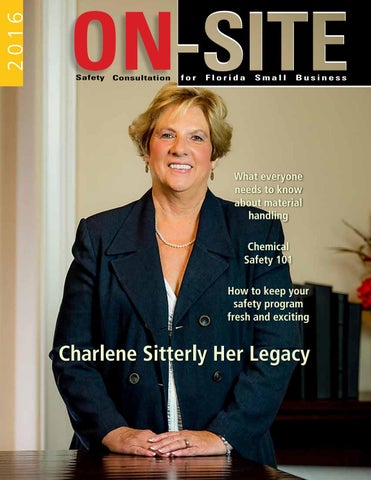
What everyone needs to know about material handling Chemical Safety 101 How to keep your safety program fresh and exciting
Charlene Sitterly Her Legacy
Program Directors' Columns
Dr. Yehia Hammad
Charlene Sitterly
Professor, USF College of Public Health
Program Director,
Director, USF SafetyFlorida Consultation Program
USF SafetyFlorida Consultation Program
T
he U.S. Department of Labor made history last March when it passed the new OSHA Silica Standard. The final rule took effect on June 23, 2016. This is an action that will reduce illnesses and death related to crystalline silica dust exposure. High levels of exposure to silica dust can result in an irreversible fibrotic lung disease called silicosis. Workers who develop silicosis are at a higher risk of acquiring lung cancer (1). In addition to lung cancer, silica exposure has contributed to 1,437 deaths from silicosis between 2001 and 2010. OSHA estimates that the rule will save over 600 lives and prevent more than 900 new cases of silicosis each year, once its effects are fully realized. The Final Rule is projected to provide net benefits of about $7.7 billion, annually, chiefly through reduction of health care costs. About 2.3 million workers are exposed to respirable crystalline silica in their workplaces, including 2 million construction workers in the construction industry who drill, cut, crush, or grind silica-containing materials such as concrete and stone(2) and 300,000 workers in general industry operations such as brick manufacturing, foundries, and hydraulic fracturing, also known as fracking(3). It took over 45 years for the new standard to work its way through the rule making process with support from the Clinton Administration in 1997, the George W. Bush Administration in 2002 and the Obama administration in 2009. The Silica Standard has probably faced the most rigorous scrutiny among all the OSHA Standards. This is due to the fact that silicon presence in nature amounts to 27.7% of all elements on earth and nine silicate minerals constitute 95% of the Earth’s Crust. For example, sandstone and flint may contain almost 100% silica, granite between 20 and 70%, and slate about 40 percent. This ubiquitous presence of silica in the environment constitute a very serious problem to health professionals in general and industrial hygienists in particular because it renders the process of air sampling and chemical analysis of silica in air samples very challenging. The OSHA silica standard is based on the National Institute for Occupational Safety and Health (NIOSH) Recommended
I
magine walking into your first day on the job as a garment worker in 1972, in a sewing machine factory in upstate New York, employed as piece worker on a sewing machine line that exposed workers to machine guarding violations, toxic chemicals, cotton dust inhalation hazards from the fabrics, and many more hazards that we would consider today to be multiple OSHA violations. Can you imagine the number of hazards present in this environment? This was my first job and my first encounter with workplace safety and health hazards. Working in this environment made me fearful of what could happen as it reminded me of the Triangle Shirtwaist Factory fire that occurred in New York City in 1911, killing 146 workers. This tragedy led to the development of a series of laws and regulations to better protect the safety and health of factory workers. As I advanced into a Supervisory capacity within the factory, my compassion for the workers on the assembly line and my desire to improve working conditions became far more compelling to me. I therefore began to study and research various labor laws. Having eight years of experience in a factory setting gave me a foundation, and the drive to move forward to obtain my Bachelor of Science in Human Resource Management as well as a Master’s of Science Degree in Educational Administration, and multiple technical educational courses to support the specialized education needed to be able to teach and further my leadership role in Public Service for this past 30 years. As I continued to travel down my career path in health administration, risk management and as a Safety and Health Director, I continued to strive for better career opportunities and continued my educational opportunities never forgetting the real meaning of a worker. I have had many proud moments in my years in my career. Some of the most outstanding were the Hispanic Safety and Health fairs and working with the Hispanic communities, SHARP conferences, and developing a national marketing campaign for all consultation programs under the direction of OSHA. There are so many to mention.
Continued on page 3 Cover photo: Charlene Sitterly in her words, after 30 years of service.
1
USF SafetyFlorida ON-SITE
table of contents
10 20 16,
VOL.
9.
ISSUE
1
table of contents
13
1 4 5 8 11 13 15 17 23 25 26
PROGRAM DIRECTORS’ COLUMNS THE EDITOR’S DESK COVER STORY: A LEADER IN THE SPOTLIGHT USF SAFETYFLORIDA NEWS USF OSHA TRAINING INSTITUTE EDUCATION CENTER NEWS THINK SHARP SUNSHINE STATE SAFETY RECOGNITION AWARD FEATURES WHAT WE SEE USF SAFETYFLORIDA MANAGEMENT TOOLS
25
SAFETYWRITER 2.0
25
SAFETY VIDEO BORROWING SYSTEM
25 FACEBOOK
25 NEWSLETTER
USF SAFETYFLORIDA ACHIEVEMENTS AND ACCOLADES Program Manager
Charlene Sitterly USF SafetyFlorida College of Public Health 13201 Bruce B. Downs Boulevard, MDC 56 Tampa, FL 33612-3805 1-866-273-1105
15
www.safetyflorida.usf.edu Reading this code with your smartphone, using QR code scanning software such as http://web.scanlife.com/en/ download-application, will enable you to go directly to the USF SafetyFlorida website.
csitterl@health.usf.edu
Designer
Martin Young martin@youngdesign.us
Editor
Thalia Barber tbarber@health.usf.edu
23
On-Site magazine is published annually by USF SafetyFlorida, a small business safety and health consultation program funded by the Occupational Safety and Health Administration (OSHA) and the Florida Department of Financial Services’ Division of Workers’ Compensation. The University of South Florida College of Public Health is the academic home for USF SafetyFlorida.
2
Continued from page 1 Exposure Limit (REL) of 50 micrograms per cubic meter published in 1974. As a doctoral student at the University of Pittsburgh, PA, in 1974, I was asked by my professor Dr. Morton Corn, who also served as the Assistant Secretary of Labor for OSHA at that time, to review the new NIOSH criteria document Recommended Exposure Limit (REL) for silica as part of fulfilling the requirements for my doctorate degree. Subsequently, I have participated in the preparation and later testified as an expert in the hearings of the OSHA standards for Cotton dust (1977) and Asbestos Dust (1984). As a result, I am familiar with the painstaking and thorough process of issuing an OSHA standard. I am not surprised to witness the long time and scrupulous process that has taken place for the Silica Standard. Silicosis is one of the oldest occupational diseases known to man. It has been diagnosed in the lungs of mummies and of workers in the Pharaohs gold mines. Here in the United States, the major incidences of the disease occurred in the 1930s during the construction of the Gauley Bridge in southern West Virginia, where a tunnel was driven through a sandstone mountain. Congressional hearings revealed that 476 workers had died in the course of its construction, and an additional 1,500 had contracted silicosis. Subsequent studies showed high prevalence of silicosis among Vermont granite workers and sandblasters working on ships, barges and oil rigs in the Gulf of Mexico. We are proud that our OSHA Consultation program will promote good health among workers in the construction, general industry and maritime industries in Florida by helping small businesses abide by the OSHA Standards.
Sometimes we spend all of our time as safety and health professionals going around in circles debating which is more effective safety and health programs or technical training. In wrapping up my career at USF, my thoughts are that it really comes down to educating employees to recognize hazards and exposures, and teaching them how to recognize the dangers that they encounter from day-to-day in their place of employment. The bottom line is that we as professionals in the field of health and safety need to ensure that all employees take responsibility for themselves. The worker needs to be able to make well educated and informed decisions based on what employers, Safety and Health Professionals, Human Resource Directors, Risk Managers and many other professionals in the industry have worked hard to establish; to include both education and training initiatives they have instituted that have a major impact on the employee in the workforce. The following questions still remain: how can we make a difference in the field of health and safety, reach the maximum number of employees, reduce workers compensations injuries, and workplace fatalities? These are all questions that we as Safety and Health professionals and employers need to strive to improve upon until we no longer have workplace fatalities. The American worker can learn life-long skills that enables them to make better and safer choices not only at work, but also at home that allow them to live the American dream. My closing remarks to the community that has supported me over the years is, thank you, be blessed, and stay safe.
Charlene Sitterly 1. https://www.osha.gov/Publications/OSHA3683.pdf 2. https://www.osha.gov/silica/SilicaConstructionRegText.pdf 3. https://www.osha.gov/silica/SilicaGeneralIndustryRegText.pdf
Dr. Yehia Hammad Professor, USF College of Public Health Director, USF SafetyFlorida Consultation Program
3
USF SafetyFlorida ON-SITE
Program Director, USF SafetyFlorida Consultation Program
FROM THE EDITOR'S DESK
Celebrating Safety and Health in the Workplace
I
n this issue of On-Site, you will hear from our expert safety and health field consultant’s on some of the most common safety hazards affecting today’s workforce; from Chemical Safety and proper material handling techniques to frequently overlooked fall protection hazards and building better, more effective safety cultures in the workplace.
As OSHA gears up to kick off their heat stress safety campaign, the USF SafetyFlorida Consultation Program turns up the heat with a new article co-written by Dr. Thomas Bernard and Ximena P. Garzón, entitled "Heat Stress in Florida — And the Risks to Health and Safety." This special feature touches on heat-related disorders and exertional heat illness, as well as what exposure limits mean in terms of managing risks. Also in this issue, we shine a spotlight on some of Florida’s remarkable small business employers who have gained elite recognition by being inducted into the SHARP (Safety and Health Achievement Recognition Program) and the Sunshine State Safety Recognition Program. The SHARP Program recognizes small business employers who operate exemplary safety and health management systems. The Sunshine State Safety Recognition program, created in 2006 by USF SafetyFlorida, recognizes Florida’s employers and employees in all industries who proactively and routinely engage in job safety. There are approximately 40 small businesses who earn the honor annually, and the firms implement sound safety initiatives to better protect employees on the job. Additionally, we will highlight free training opportunities available for small-to-medium sized businesses and the success of the recently celebrated Workers’ Memorial Day commemoration event, a jointpartnership between the University of South Florida, City of Temple Terrace, and the OSHA Training Institute Education Center. On our cover, we feature USF SafetyFlorida Consultation Program’s, Program Director, Charlene Sitterly, an iconic leader in the state of Florida who has dedicated much of her life to teaching and educating employers on the benefits of safe and healthful workplaces. Mrs. Sitterly’s message is a powerful one -- Set the foundation for workers; Supply them with the knowledge and skills necessary to complete their job tasks; Do more to stomp out workplace deaths; and Recommit yourself and your company to holding workplace safety as a core value.
On-Site Safety Consultation for Florida Small Business magazine
Worker protection — reducing injuries, illnesses and fatalities on the job — is the primary mission of the USF SafetyFlorida Consultation Program. Our safety and health consultants are your key to achieving these benefits. They follow high and consistent standards for helping employers protect their workers. These standards, along with their years of consultation experience, will help you build a workplace safety system that unites all the elements of leadership commitment and job task procedures.
At USF SafetyFlorida, our mission is to protect workers from injuries and illnesses on the job, and to protect Florida’s small business economy.
With a workplace safety system in
We work with many different types of employers from the various industries such as Construction, General Industry, Maritime and Disaster Site.
goals while maintaining the health
If your company is ready to take the next step towards safety, please contact us today and request a free and confidential safety consultation. Requesting a consultation is a simple as calling us at 1-866273-1105 or visiting us online at www.usfsafetyflorida.com. You will be glad you did!
place, you can meet production of the whole employee family. “It can help you and even save one of your employee’s lives.” — Gus Cagigas, Safety Coordinator, Portside
Thalia Barber
Maintenance and Repair
Communications & Marketing Specialist and Editor USF SafetyFlorida Consultation Program
4
A Leader in the Spotlight
Charlene Sitterly Previous posts: President, OSHA Consultation Managers (OSHCON) 2004-2008; Master Trainer, State of Florida Youth Works program 2001; Bureau Chief and Assistant Director for Risk and Program Management, Florida Division of Safety 1996 to 2000. Education: Bachelors of Science degree in Human Resources Management, New York School of Social Research, and Masters of Science degree in Education Administration, The State University of New York at Albany. Family: Husband, Mark Sitterly; two sons, Robert Vespi, Jr. and Michael Vespi; one daughter, Desiree Thomas; and 17 grandchildren. Hobbies: Missionary work, reading, arts and crafts and not-for-profit consulting.
5
USF SafetyFlorida ON-SITE
Lessons learned after serving 30 years in the industry How long have you been in the field of Occupational Safety and Health? I have been in the field of Occupational Safety and Health for 30 plus years. I began my career as a Health/Safety/Risk Manager after I received a Bachelor of Science degree from the New School of Social Research in New York City. The first position I held was in Albany, NY as a Program Director to develop an Occupational Safety and Health Risk Management program for 75 school districts in a 12 County Region. The purpose of the program was to provide leading-edge safety and health training to all levels of management and employees. My focus was to create an educational environment that was a model for all educational workplaces in the region. I was one of the first Program Managers, and pioneers of the Health Safety Risk Management services program for the Capital region BOCES, (Board of Cooperative Educational Services.) Why did you choose this career? I am not sure I chose this career, I think the career chose me. I have cared about people and had a love for education. My passion to improve working conditions has been a desire of mine since I started to work as a young worker. Occupational safety and health is a means to an end to workplace safety and health. Creating regulations and environmental laws or writing safety and health policies is extremely important. However, the equally important questions are, how do you get systems and people to follow them? How do you create an environment of education and training for all levels of management and all workers in a workplace to understand the importance of recognizing the hazard or exposure? How do you get each worker to understand what that exposure is or the individual action that happens each day in their own work environment? Getting that individual to understand that what they have been exposed to will have a direct impact on their individual health and the individual’s direct safety for the rest of their life. These questions apply to everyone no matter what you are doing in life or what occupation you are in. Having the educational knowledge to make informed decisions is also a means to an end or a choice or a beginning. The program that I had the opportunity to develop from infancy in New York State specialized in training superintendents, building principals, school nurses, classroom teachers and facilities staff. This was a proactive approach to train them in Health Safety and Environmental Regulatory Compliance. I was intrigued, and with my Human Resource background, to develop a program that would be effective in providing the leadership of school administrators a way to learn and to become compliant with state and federal regulations was a great opportunity. I was able to use my individual knowledge, skills, and passion in all these areas to create a program that was needed for NY State schools through the Board of Cooperative Educational Services, State Department of Education in addition to using the same concepts for the business community.
What does Occupational Safety and Health mean to you as it relates the USF Safety Florida Consultation Program? I think that what the program means is that it is “a means to an end for safety” to focus on business owners who have limited resources to provide education and training to their employees. To have the employers offer their employees the best educational opportunities and resources to protect the employees and provide opportunities for a healthy workforce, which in turn helps small businesses in the state of Florida.
“I am not sure I chose this career, I think the career chose me. I have cared about people and had a love for education.” What was your goal for the program when you began? My goal for the program was to make USF Safety Florida the best Federal Consultation Program in the nation. Why did you feel that way? In 2000, when the Division of Safety within the Florida Department of Labor and Security was abolished by Legislative action, I was the Assistant Director of Operations and Technical Training for the Division of Safety, and the Project Director for the 21(d) consultation program within the Division of Safety. It was an emotional loss and professional concern, and raised many questions for the future educational opportunities and workforce awareness to Occupational Safety and Health. Even though Florida is a federal state and OSHA has the enforcement rights to oversee the private employers, what happens to the public employees that the Division of Safety served over the years? The city, county and school districts and state government placed a great deal of effort in providing good safety and health programs to their employees however there was still going to be a void without the training and educational resources available to these agencies. I was honored when I was hired by USF to continue on with my responsibilities within USF for just the 21(d) grant program. I also knew that this grant program was going to be a major source for education and training support to both the public and private sector until other resources and opportunities were established to assist all employers throughout the state. I have been very honored and humbled to be a part of the leadership within the USF College of Public Health, Department of Environmental and Occupational Health, to create an excellent consultation and educational program, along with a team of professional consultants and staff. It was exciting to be challenged and to share my working knowledge with others. To see programs and systems grow that have a positive impact on CEOs, Managers, Administrators, and Employees in all workplaces. Everyone has the right to a good work environment, to feel safe at work, and to be able to go home each night.
6
How would you measure your professional success as well as your program success? As a result of our professional team effort, over the years the goals for the program have been achieved. We received annual reviews on the success of the program and over the past 16 years we have accomplished or exceeded all of the goals. For the past 16-years we have received national recognition and awards for successful programs such as reaching the Hispanic workers in establishing safety fairs throughout the State of Florida. Developing training materials and safety and health tools that were used nationally by other states and territories; to name just a few. Customer surveys that we have received and different accolades from speaking engagements, and the satisfaction of our customers has shown that we have continued to do an excellent job. In essence, the success of the program has been measured in two ways. By feedback from the customer and feedback from the Federal Government who has continued to fund the program for over 16 years within USF. As it relates to my professional success, I have served on many National committees and received many National awards from the U.S. Department of Labor throughout my 23 years here in State of Florida. However, two elected positions that I held have brought the highest honors to my career here in Florida. I was first elected as the Co-President of the Interagency Advisory Council on Loss Prevention within the state of Florida, while in my ten years as the Assistant Director of Operations and Technical Training within the Florida Department of Labor and Security. Next, I was elected by my peers within the 21(d) consultation programs as the first female President for the National Association of Occupational Safety and Health Programs of which I served for four years.
“As a result of our professional team effort, over the years the goals for the program have been achieved.”
What has given you the most satisfaction in your 30 plus years of working in the field of Occupational Health and Safety? Teaching people from all walks of life about Occupational Health and Safety and being able to discuss Health and Safety regulations and best practices. Giving people the knowledge, skills and ability to take that information back to their respective places of employment to implement programs that would have a positive impact for their employees and provide companies a strong business foundation to profit within their own operations. Also, meeting with, working with, and hiring individuals who had career goals in the field of Occupational Safety and Health and having the ability to guide them and see them advance in their careers. In what direction would you like to see the consultation program go in the future? I would like to see the program continue to flourish, and ultimately, I would like to see the program reach out to small businesses in the state of Florida, to work together in partnership to establish goals to address the rising financial concerns of workers’ compensation and health costs in the State of Florida.
7
What are your plans after you retire? I would like to begin to live the American dream, by traveling with my husband, continuing missionary work in Honduras, and enjoying our grandchildren together. If there is an opportunity to share my years of experience to have a positive impact on workers’ compensation reduction, and health care costs, I would welcome that opportunity at some point.
USF SafetyFlorida ON-SITE
USF SafetyFlorida News
Third Annual Stand-Down Targets Construction Industry Workers Falls in construction continue to take the lead as the most common cause of death, and accounts for 337 out of 874 total deaths in the industry. While lack of proper fall protection may not be the sole cause leading to this increase in fall-related deaths, it certainly is a contributing factor according to the 2015 most frequently cited OSHA standard violations list. In support of the 3rd Annual National Safety Stand-Down to prevent falls in construction movement, the USF SafetyFlorida Consultation Program, USF OSHA Training Institute Education Center and the Fort Lauderdale OSHA Area Office partnered to co-sponsor several one-day seminars on fall hazard awareness in the Construction Industry. Our goal was to offer innovative training, education and resources to affected employers and employees. Through our joint effort, we were successfully able to reach many employers and workers, and raise awareness to the hazards affecting this industry. This year’s Fall Safety Stand-Down event was observed from May 2-6, 2016. Seminars offered in both English and Spanish took place in Ft. Lauderdale and Wesley Chapel, Florida. Several topics discussed included but were not limited to OSHA regulatory updates on fall prevention in construction; solutions and training for prevention of accidents and fatalities; implementing injury prevention plans and safety management systems, and fall hazards on construction sites. “Falls still kill far too many construction workers,” said Dr. David Michaels, Assistant Secretary of Labor for Occupational Safety and Health. “While we regularly work with employers, industry groups and worker organizations on preventing falls and saving lives, the National Safety Stand-Down encourages all employers - from small businesses to large companies operating at many job sites - to be part of our effort to ensure every worker makes it to the end of their shift safely.” The stand-down is part of OSHA’s ongoing Fall Prevention Campaign, started in 2012 and was developed in partnership with the National Institute for Occupational Safety and Health (NIOSH) and the National Occupational Research Agenda (NORA) programs.
Florida’s newly certified SHARP companies received recognition letters from Florida Governor Rick Scott in April. See page 13 for complete list of Florida SHARP companies. Florida Governor, Richard (Rick) L. Scott
Governor Rick Scott recognizes Florida’s new SHARP employers Governor Rick Scott recognized ten new Florida SHARP employers for exemplary workplace safety practices with a letter he sent to each of the companies. OSHA’s Safety and Health Achievement Recognition Program award is the highest safety honor for small businesses and granted to employers nominated by USF SafetyFlorida. SHARP certified companies are exempt from OSHA inspections for a period up to two years, with the exception of a serious accident, fatality or employee complaint. In his letter to the employers, Scott wrote, “You are to be commended for your exemplary safety and health management practices. Floridians like you are helping make our state the best place in the world to raise a family and have a great career.” There are currently 29 SHARP-certified businesses in the state of Florida. To qualify, a firm must: • Request and undergo a consultation visit from USF SafetyFlorida • Involve all employees in the consultation process • Correct hazards identified during the on-site consultation • Implement and maintain a safety and health management system that, at a minimum, addresses OSHA’s 1989 Safety and Health Program Management Guidelines • Reduce their Lost Workday Injury and Illness Rate and Total Recordable Case Rate below the national average for their industry • Agree to notify USF SafetyFlorida prior to making changes to working conditions or introducing new hazards into the workplace
USF SafetyFlorida continues presence at Giving back to the community - Free seminars Florida Division of Workers’ Compensation’s offered to all industries Workplace Safety Seminars The USF SafetyFlorida Consultation Program strives to provide Florida’s small business employers and workers with a broad selection of meaningful training and education opportunities to promote hazard awareness, and broaden workers knowledge on the safety and health issues currently affecting today’s workforce. During fiscal year 2016, USF SafetyFlorida partnered with other like-minded organizations whose main focus is also to support healthier, safer and more sustainable communities. The partnership offered the following workplace safety trainings, free of charge to workers across all industries within the state of Florida: • Confined Space Safety • Arc Flash Safety & I2P2 • Cranes in Construction • Preventing Workplace Violence • Temporary Workers Hazards Training Collectively, all training initiatives drew a total of 169 attendees. We are here to support you. Please contact the Communications and Marketing Specialist via email at tbarber@health.usf.edu with any training suggestions that you may have.
USF SafetyFlorida partnered for the seventh year with the Florida Division of Workers’ Compensation at its workplace safety seminars. Held throughout the state, the free and educational seminars provide attendees with important information about workers’ compensation laws as well as workplace safety. In 2015, 14 seminars were held with 149 attendees, ranging from business owners, licensed contractors and other employers. The now retired Sheryle Birdsong formerly with the Division’s Compliance Bureau stated that the partnership is a win-win. “The (consultation) program is an integral part of the educational program. Having USF SafetyFlorida’s presence at the seminars really does round out our discussion of what the law’s requirements are and what resources are available,” said Birdsong. The Division of Workers’ Compensation is part of Florida’s Department of Financial Services and handles workers’ compensation claims for employees who are injured or killed on the job. The Division received 11,898 new workers’ compensation claims and paid $106.5 million in medical and indemnity benefits during the 2014-15 fiscal year. Note: The Division’s trust fund adds a 10 percent matching grant to the federal government’s funding of the USF SafetyFlorida consultation program. 8
Top 10 most frequently cited OSHA standards violated in FY2015 The Occupational Safety and Health Administration (OSHA) released its Top 10 Most Frequently Cited Standards list for 2015. The cited standards for fiscal year 2015 (October 1, 2014, through September 30, 2015) consisted of the following: 1. Fall protection, construction (29 CFR 1926.501) 2. Hazard communication standard, general industry (29 CFR 1910.1200) 3. Scaffolding, general requirements, construction (29 CFR 1926.451) 4. Respiratory protection, general industry (29 CFR 1910.134) 5. Control of hazardous energy (lockout/tagout), general industry (29 CFR 1910.147) 6. Powered industrial trucks, general industry (29 CFR 1910.178) 7. Ladders, construction (29 CFR 1926.1053) 8. Electrical, wiring methods, components and equipment, general industry (29 CFR 1910.305) 9. Machinery and Machine Guarding, general requirements (29 CFR 1910.212) 10. Electrical systems design, general requirements, general industry (29 CFR 1910.303)
USF SafetyFlorida Consultation Staff (from left to right): Liza Paige, Charlene Sitterly, Thalia Barber and Keila Ashman.
Jacksonville Safety and Health Education Fair The University of South Florida SafetyFlorida Consultation Program and USF OTI Education Center partnered once again to host the Jacksonville Health & Safety Education Fair to bring awareness to some of the most frequently cited standards by the Federal Occupational Safety and Health Administration (OSHA). By providing this event, we were able to raise awareness, and provide free training and education resources to help members of the Jacksonville community stay safe, and reduce occupational related illnesses, injuries and fatalities. We believe that through our efforts, we were able to aid employers and employees in recognizing that occupational safety and health add value to American businesses, workplaces and workers’ lives. There were approximately 15 vendors ranging from Sam’s Club who provided free health screenings and flu immunizations to the Department of Labor, Division of Wage and Hour to discuss issues affecting young workers and disseminate information to attendees. Free training workshops on Construction and General Industry topics were offered from our professional staff to include Fall protection in Construction, Powered Industrial Trucks, Scaffolding in Construction, Hazard Communication, Respiratory Protection, and Controlling Hazardous Energy (LO/TO). USF SafetyFlorida Jacksonville Health & Safety Education Fair Flier.
USF, OHNP Field experiences that inspire! Every year, the USF SafetyFlorida Consultation Program partners with the University of South Florida’s Occupational Health Nursing Program (OHNP) to enrich and contribute to the classroom education received by the Graduate level nursing students. The students of the program are paired with our expert safety and health consultants to gain first-hand knowledge and experience with the various types of industries and the occupational related hazards that those industries may face. This year, the nursing students received the opportunity to visit several companies, ranging from construction sites to manufacturing plants.
USF SafetyFlorida Communications and Marketing Specialist, Thalia Barber with Grand prize Winner Robert Archenbacher in the Expo Hall.
This field experience was very well received by USF Nursing Student, Laura Long. As Ms. Long stated, “being out on the field visit made all the Safety lectures, industrial hygiene discussions, and OSHA regulations come to life. I was able to see how all of what I have been studying is put into practice, and how important it is to have a [safety culture] instilled in the workers at every level in a company.” Ms. Long further added, “Thank you for this valuable opportunity!” This is the seventh year that the students from the graduate certificate program have participated in the shadowing field experience. We hope to continue to do so, taking an active role in the community by mentoring students.
9
USF SafetyFlorida ON-SITE
Tomlin illustrated the importance of workplace safety by holding up the mask that could have prevented his grandfather from developing silicosis.
Workers’ Memorial Day event highlights need for workplace safety
Every year almost 5,000 workers become injured, contract an illness from overexposure to chemicals and harmful substances, or worse, are killed from on-the-job hazards and unsafe practices. “We can do more about workplace deaths,” said Charlene Sitterly, USF SafetyFlorida Consultation Program, Program Director. “Recommit yourself and your company to holding workplace safety as a core value.”
Ellen Kent
On April 28, the USF SafetyFlorida Consultation Program, USF OTI Education Center, the Tampa OSHA Area Office, and members of the City of Temple Terrace joined the nation to recognize Workers’ Memorial Day—a national observance honoring workers who have died in the workplace due to unsafe working conditions.
For Tanner Holloman, director for the Division of Workers’ Compensation in Florida, the service allowed him to share how he personally has seen unsafe working environments impact families. “I can’t think of any other call that I may receive that is more disheartening than talking to a family member about a death in the workplace,” said Holloman. “To see an employer who has not taken the opportunity, knowingly, to protect his employees is just unconscionable.” William Tomlin, Safety and Health Supervisor for USF SafetyFlorida, shared how he personally lost a relative. His grandfather, whom he described as 10-feet-tall with a booming voice and someone who could fix anything, worked as a “mud man” with a construction company in Oklahoma City. Towards the end of his grandfather’s life, he could barely walk across the room without losing his breath.
Ellen Kent
His grandfather succumbed to silicosis, a lung fibrosis caused by inhalation of dust containing silica, as a result of the mud he worked with in his employment. “He died for his job,” Tomlin said. “This is not an abstract thing to me, I know what it means to die to make a living.” The City of Temple Terrace hosted the event and Mayor Frank Chillura issued an official proclamation declaring April 28 as a day the city of Temple Terrace will remember fallen workers.
Managers, supervisors, and workers are all involved in safety, Tomlin said, sharing what organizations can do to ensure safer environments and how to train employees to recognize and avoid hazards.
The service also aimed to raise awareness of the issues affecting America’s workforce and advocate for safer workplaces, bringing together occupational safety experts from across the state.
“Employers have to do the right thing and unfortunately, that does not always happen,” said Les Grove, office director of the Tampa area OSHA. According to Grove, in 2015 OSHA investigated a total of 75 deaths in Florida. That number is already up to 55 deaths for the new OSHA fiscal year, with more than five months left to go. “Something went off the rails,” Grove said.
Ellen Kent
Many of the deaths involved fatalities of workers being run over at the work zone, he said.
Presenters at the event included representatives from the Coalition of Immokalee Workers, Tampa OSHA, Division of Workers’ Compensation and USF SafetyFlorida.
“Concerned Americans are determined to prevent these tragedies. All employers including local governments are urged to dedicate their efforts to improve workplace safety and seek stronger health standard enforcement, and to treat workers with dignity, as well as pursue constant improvements to worker safety,” Charles Stephenson, city manager of Temple Terrace, said as he read the official proclamation.
“People say ‘it was an accident,’” Grove said. “It’s not an accident, it’s preventable, it was an incident and if people had done what they should have done that particular fatality would not have happened.”
Ribbons and candles were available to attendees to take part in the prayer to honor fallen workers. The event concluded with a reading of the official proclamation issued by the mayor of the City of Temple Terrace, followed by a prayer and candlelight vigil.
Employers interested in receiving a free and confidential consultation from the USF SafetyFlorida Consultation Program may call toll-free, 1-866-2731105, or visit www.usfsafetyflorida.com.
Anna Mayor
The proclamation urges residents of Temple Terrace to observe April 28 as Workers’ Memorial Day and remember fallen workers.
10
U S F O S H A Tr a i n i n g I n s t i t u t e E d u c a t i o n C e n t e r N e w s
The USF OSHA Training Institute Education Center: Florida’s Workplace Safety Training and Continuing Education Resource Bob Nesbit Program Director, USF OSHA Training Institute Education Center
T
he USF OSHA Training Institute Education Center is a non-profit organization authorized by the Occupational Safety and Health Administration (OSHA) to deliver occupational safety and health training to public and private sector employers. It is the Training Institute’s ultimate goal to support OSHA’s initiatives by contributing to the reduction of workplace accidents and injuries by training workers, employers and safety professionals on hazard recognition and avoidance.
This fiscal year, the USF OTI Education Center has successfully conducted 118 safety and health training courses on various topics, positively impacting over 1,581 students. Additionally, the USF OTI Education Center has issued a total of 21,410 OSHA 10- and 30-Hour DOL cards. The DOL Cards are issued to students who attend the 10- or 30-hour outreach training courses. These courses offer a greater depth and variety of training on multiple topics to include, workplace hazards, basic awareness training, avoidance, and abatement of hazards. As part of an OSHA national effort to contribute to the health and safety of employees, the USF OTI Education Center signed an agreement establishing an alliance with the U.S. Department of Labor’s Occupational Safety and Health Administration Atlanta Regional Office. As stated in the agreement, both organizations recognize the value of establishing a collaborative relationship to foster safer and more healthful American workplaces. The alliance will bring guidance and information to employers and employees, as well as provide access to available training and education resources. Furthermore, the alliance aims to reduce and prevent exposure to prevalent health and safety hazards in the general and construction industries, and to enhance the workers understanding of workers’ rights and responsibilities of employers under the Occupational Safety and Health Act (OSH Act) (osha.gov, 2015). The Alliance confirms the continuation of a vital collaborative relationship to provide OTI Education Center students and employers with essential information, guidance, and access to training resources that will aid them in protecting the health and safety of workers, particularly by reducing and preventing exposure to prevalent safety and health hazards in the general and construction industries. The Alliance also serves as a voluntary cooperative relationship with OSHA for purposes such as raising awareness of OSHA’s rulemaking and enforcement initiatives, training, education, outreach, and communication.
MACOSH meeting at the University of South Florida.
Keila Ashman, USF OTI Education Center Deputy Director present at the partnership alliance signing.
OTI Education Center Directors Meeting OTIEC Directors Spring 2016 meeting took place in Charlotte, NC. - The bi-annual meetings involve key policy and planning issues concerning the OTI Education Centers Program. Mrs. Keila Ashman, USF OTIEC Assistant Director, is a part of the OTI Education Centers Performance Goals Enhancement Team. Maritime Advisory Committee for Occupational Safety and Health (MACOSH) USF OTI Education Center participating in the 2016 Spring Directors meeting.
As OSHA holds meetings to improve the Maritime Standard for workers in the maritime industry, the USF OTI Education Center had the opportunity to host a national meeting on behalf of the Maritime Advisory Committee for Occupational Safety and Health (MACOSH). The meeting drew attendees from all over the United States, including participants from both Hawaii and Alaska. 50 members from the maritime industry met over the course of two days to discuss ways to improve the safety and health of workers in the maritime industry. Mr. Tom Pope, USF OTIEC Maritime Instructor gave a special presentation on the importance of proper training and resources available through USF OTIEC.
From left to right: Les Grove, Tampa Area Director, Tom Pope USF OTIEC Maritime Advisor and Senior Adjunct Instructor, Kurt Petermeyer, OSHA Region IV Administrator, and Keila Ashman, Assistant Director.
In an effort to support OSHA’s endeavors, the USF OTI Education Center is proud to offer the OSHA 5400 – Trainer Course in OSHA Standards for the Maritime Industry. This course will offer its attendees effective training on how to identify hazards, determine appropriate standard usage, and supply students with information on how to conduct internal training on the OSHA Maritime regulations. Registration for this course will begin as soon as November 28, 2016. If you are interested in attending, contact the USF OSHA Training Institute Education Center via phone at (813) 994-1195 or visit www.usfoticenter.org.
11
USF SafetyFlorida ON-SITE
Private Safety Training Bringing safety training directly to a company saves clients’ money in travel-related costs. Moreover, we can create customized courses to meet an employer’s education needs. We send an instructor to a facility at a time that works best for them, and the course is tailored to meet its specific training needs. Regularly Offered Courses The center’s catalog of courses includes the following classes:
General Industry
Online • • • •
9031 – 8 Hour Hazwoper 9032 – 24 Hour Hazwoper 9092 – 4 Hour Recordkeeping Safe Teen Jobs Awareness Training
Additional Safety and Health online courses are available. Specialty 1-hour Online Courses General Industry • • • • • • • • • • • •
9070 – Introduction to OSHA 9073 – Recordkeeping 9074 – Bloodborne Pathogens 9075 – Confined Space Entry 9077 – Ergonomics 9079 – Safety and Health Programs 9081 – Machine Guarding 9083 – Lockout and Tagout 9085 – Walking and Working Surfaces 9086 – Personal Protective Equipment 9087 – Fire Detection and Protection 9089 – OSHA GHS & Hazard Communication Course
Construction Industry • 9040 – Introduction to OSHA • 9041 – OSHA Standards and Inspection Procedures • 9043 – Recordkeeping • 9044 – Health Hazards in Construction • 9048 – Welding and Cutting • 9049 – Safety Programs and Subpart C
• 9050 – Rigging and Material Handling • 9051 – Cranes, Derricks, Hoists, Elevators, and Conveyors • 9052 – Electrical • 9053 – Excavations • 9054 – Fire Prevention • 9055 – Scaffolds • 9056 – Personal Protective Equipment • 9057 – Fall Protection • 9058 – Stairways and Ladders • 9060 – Concrete and Masonry • 9059 – OSHA GHS & Hazard Communication Course
• OSHA 501 – Trainer Course in Occupational Safety and Health Standards for General Industry • OSHA 503 – Update for General Industry • Outreach Trainers • OSHA 511 – Occupational Safety and Health Standards for General Industry • OSHA 521 – OSHA Guide to Industrial Hygiene • OSHA 2015 – Hazardous Materials • OSHA 2045 – Machinery and Machine Guarding Standards • OSHA 2225 – Respiratory Protection • OSHA 2255 – Principles of Ergonomics • OSHA 2264 -Permit-Required Confined Space Entry • OSHA 3015 -Excavation, Trenching, and Soil Mechanics • OSHA 3095 – Electrical Standards • OSHA 6000 – Collateral Duty Course For Other Federal Agencies • OSHA 6010 – Occupational Safety and Health Course for Other Federal Agencies • OSHA 7000 – OSHA Training Guidelines for Safe Patient Handling • OSHA 7100 – Introduction to Machinery and Machine Safeguarding (8 Hour) • OSHA 7115 – Lockout/Tagout – Controlling Hazardous Energy to Prevent Workplace Injury • OSHA 7120 – Introduction to Combustible Dust Hazards • OSHA 7200 – Bloodborne Pathogens Exposure Control for Healthcare Facilities • OSHA 7205 – Health Hazards Awareness • OSHA 7300 – 8 Hour Permit-Required Confined Space Standards • OSHA 7410 – Managing Excavation Hazards
• OSHA 7500 – Introduction to Safety and Health Management • OSHA 7505 – Introduction to Accident Investigation • OSHA 7510 – Introduction to OSHA for Small Business • OSHA 7845 – Recordkeeping Rule Seminar Construction • OSHA 500 – Trainer Course in Occupational Safety and Health Standards for the Construction Industry • OSHA 502 – Update for Construction Industry Outreach Trainers • OSHA 510 – Occupational Safety and Health Standards for the Construction Industry • OSHA 3115 – Fall Protection • OSHA 3015 -Excavation, Trenching, and Soil Mechanics • OSHA 7400 – Noise in the Construction Industry • OSHA 7405 – Fall Hazard Awareness for the Construction Industry • OSHA 7415 – Construction Industry Hazards and Prevention Strategies Maritime • OSHA 5400 -Trainer Course in Occupational Safety and Health Standards for the Maritime Industry • OSHA 5402 – Up-Date for Maritime Outreach Instructors • OSHA 5410 – OSHA Standards for the Maritime Industry Contract courses are available for the General, Construction and Maritime Industry. To schedule a contract course, please email usfotioutreach@ health.usf.edu. Disaster • OSHA 5600 - Disaster Site Worker Train the Trainer Course • OSHA 5602 – Update Course for Disaster Site Worker Train the Trainer Course • OSHA 7105 – Evacuation and Emergency Planning • OSHA 7600 – Disaster Site Worker Course
The USF OSHA Training Institute Education Center offers a wide array of courses to satisfy most industries. If you do not see a particular course listed above, please visit www.usfoticenter.org to view additional course offerings, or call (813) 994-1195. USF OSHA Training Institute Education Center 2612 Cypress Ridge Boulevard, Suite 101, Wesley Chapel, FL 33544 usfotioutreach@health.usf.edu • www.usfoticenter.org.
For more information about the USF OTI Education Center and to register for classes, visit us on the web at www.usfoticenter.org or call 813-994-1195. 12
Think SHARP
Exemplary Safety and Health Equates to Prestigious SHARP Certification What is SHARP?
O
SHA created the Safety and Health Achievement Recognition Program award to recognize small business owners who operate an exemplary safety and health management system (SHMS). Once SHARP certified, employers are exempt from OSHA inspections for a period up to two years, with the exception of a serious accident, fatality or employee complaint. Firms throughout the U.S. can earn a SHARP award, and for a Florida company the approval process begins with a recommendation to OSHA from USF SafetyFlorida. How can your company become SHARP? Companies interested in pursuing SHARP status must first request a safety and health consultation from USF SafetyFlorida. The on-site consultation involves a comprehensive safety and health hazard survey of the worksite(s) involved, including equipment and work processes. Other qualifying requirements for the SHARP program include: • Have at least one year of operating history at the company or worksite; • Implement, demonstrate and maintain a safety and health management system (SHMS) that, at a minimum, addresses the major elements of OSHA’s 1989 Safety and Health Program Management Guidelines; • Lower the company’s Days Away, Restricted or Transferred (DART) rate and Total Recordable Case (TRC) rate below industry national average; • Correct all hazards identified by the consultant; • Agree to notify the USF SafetyFlorida Consultation Program prior to making changes in working conditions or work processes that may introduce new hazards into the workplace.
13
USF SafetyFlorida ON-SITE
First-Time SHARP Certification and Exemption Once a business satisfies all SHARP requirements, a USF SafetyFlorida consultant may recommend it for SHARP approval and certification. If approved by OSHA, the company will receive formal SHARP recognition from OSHA and USF SafetyFlorida during an award ceremony. The company will also be exempt from OSHA inspections for a period up to two years. SHARP Renewal If a company wishes to renew its SHARP certification, the application process must begin during the last six months of its exemption period. The company must also undergo a comprehensive visit by a USF SafetyFlorida consultant to ensure its SHMS has improved or maintained. Furthermore, the employer must meet all SHARP eligibility requirements, agree to conduct self-evaluations and provide a written report based on the elements of OSHA 1989 Safety and Health Program Management Guidelines and OSHA’s required injury and illness logs. SHARP Deferral If a business meets most but not all of OSHA’s SHARP eligibility requirements, a USF SafetyFlorida consultant may recommend a business for an inspection deferral up to 18 months, provided the company has: • Completed a hazard identification survey with a USF SafetyFlorida consultant and corrected all identified hazards; • Implemented, demonstrated and maintained a SHMS that, at a minimum, addresses the major elements of OSHA’s 1989 Safety and Health Program Management Guidelines; • Implemented an action plan with established abatement dates that completes the necessary items that prevented the company from reaching SHARP status during the original survey.
Company: Chapman Partnership Location: Miami, Florida NAICS Code: 6242, Community Food and Housing, and Emergency and Other Relief Services Employees: 173
USF-SFCP Recognizes Chapman Partnership (Miami) as its Newest SHARP Member Chapman Partnership is a not-for-profit organization, providing assistance to people experiencing homelessness in Miami-Dade County. Located in downtown Miami, Florida, Chapman Partnership manages a homeless assistance center. The center specializes in providing comprehensive services, such as emergency beds; food service; case management; mental, physical, and dental care; day care; job development, training; and placement; and housing assistance. The University of South Florida – Safety-Florida Consultation Program (USF-SFCP) has been working with Chapman Partnership since 2013. Through dedication and hard work, the company has continuously improved their safety and health management systems, selfinspection processes, and training programs. Chapman Partnership’s commitment and management support has always been there. USF-SFCP safety and health consultants have steadily guided Chapman Partnership in lowering their injury and illness rates. In 2013, the company’s Total Recordable Case Rate (TRC) was 5.83. By 2015, their TRC rates dropped to 0.98. Similarly in 2013, the company’s days away from work, job transfer, and restriction (DART) rate was also 5.83. By 2015, their DART rate had dropped to zero. Chapman Partnership’s injury and illness rates were at their lowest, easily allowing the company to be accepted into the OSHA Safety and Health Recognition Program (SHARP). As a community food and housing, and emergency and other relief services provider, Chapman Partnership is very proud to be the first organization of its kind in Miami, Florida, to become OSHA SHARP certified.
Florida’s SHARP Companies
Tremron Group, Inc. of Medley
This year 29 Florida companies qualified for OSHA’s SHARP award. SHARP Key: (N) = new (R) = renewal
(D) = deferral
(R) A&N Corporation (R) Accuform Manufacturing, Inc. (R) Ajax Building Corporation (R) Allied Scrap Processors, Inc. (R) Alti-2
Chapman Partnership of Miami
(R) Aluma tower Company (926 Old Dixie Hwy.) (R) American Thermoplastic Extrusion Company (ATECO) (R) Big Top Manufacturing, Inc. (R) Canterbury Tower (R) Cast-Crete, Inc. (N) Chapman Partnership (R) ClassB, Inc. (R) Cypress Cove Care Center (R) Daws Manufacturing Company, Inc. (R) Great Southern Wood of Florida (R) InterMed Biomedical Services, Inc. (R) Main Metal Recycling (R) Melitta USA, Inc.
Cast-Crete, Inc. of Seffner
(R) Metal Industries, Inc. (R) Portus Services (R) Portus Stevedoring (R)Precision Econowind, Inc. (R) Raydon Corporation (R) Seaonus Stevedoring (R) Standard Precast, Inc. (R) Tremron Group, Inc. - Arcadia (R) Tremron Group, Inc. - Jacksonville (R) Tremron Group, Inc. - Medley
Big Top Manufacturing, Inc. of Perry
(R) Trumeter Company, Inc.
Ready to become SHARP? Contact USF SafetyFlorida at
1-866-273-1105 or visit us online at www.safetyflorida.usf.edu to request a free on-site consultation.
14
Sunshine State Safety Recognition Award
Commitment to Safety and Teamwork Make the Difference
A
sk any successful business owner involved in high-risk industries their advice on keeping incident levels low, and their answer will most likely be employers and employees working together to keep a job site safe. This employeremployee safety commitment is the reason USF SafetyFlorida Consultation Program developed the Sunshine State Safety Recognition Award. Created in 2006, the Sunshine State Safety Recognition Award commends employers and employees in all industries who proactively and routinely engage in job safety. Approximately 40 firms earn this honor annually, and it recognizes companies that have implemented good safety initiatives to better protect employees on the job. According to Keith Brown, a USF SafetyFlorida safety and health supervisor, “Commitment to safety is best demonstrated by teamwork between workers and managers in resolving workplace safety and health issues. Teamwork includes maintaining open and effective means of communication to not only identify problems, but also to achieve solutions.”
To qualify, a business should request and receive a complete on-site consultation survey and employ at least one person at the worksite to be evaluated. Additionally, the business should have no willful, repeat or willful-repeat citations within 24 months of the consultation and not serious citations related to injury or exposure within 12 months of the consultation. During the consultation, a safety consultant will perform comprehensive on-site evaluation of all written programs. The consultant will also speak with workers and conduct an evaluation of the work area. The safety consultant will review: • Administration and oversight of safety management programs • Safety and health management practices • Safety training and instruction • Employee safety rules • Internal safety inspection routines for new and existing substances, processes and equipment
USF SafetyFlorida developed the Sunshine State Safety Recognition Award to motivate and support employers who demonstrate a commitment to continuously improve their workplace safety and health management system.
If hazards are identified during the visit, an abatement of those specific hazards must take place before recognition is granted. Once initial and final consultations are complete, a safety consultant may decide to formally recommend the firm for a Sunshine State Safety Recognition Award, which is approved by USF SafetyFlorida management. A formal letter of commendation is sent to the company, recognizing the employers’ and employees’ efforts in implementing and maintaining an effective injury and illness prevention program. “Working together towards maintaining workplace safety and health is something everyone can take benefit from,” adds Brown.
Satterfield & Pontikes Construction, Inc. of Sarasota
15
USF SafetyFlorida ON-SITE
The 2016 Sunshine State Safety Recognition Award recipients include: Munilla Construction Management - OLOG Construction Satterfield & Pontikes Construction, Inc. - Walmart Satterfield & Pontikes Construction, Inc. - Janie’s Garden Apartments First Florida Building Corporation - Grady Square Arellano Construction Company - Baptist MOB at
EMJ Hospitality of Clearwater
Pinecrest Moss Construction Management - Downtown Doral Condominiums First Florida - Three Lakes Onsight, Inc. Facchina Construction of Florida EMJ Hospitality - Marriot & Springhill Covenant Christian School Munilla Construction Management - St. Louis Covenant School Gym Odebrecht USA-Herbert Hoover Dike Rehab Structure Replacements NSM Florida Enterprises, LLC dba Natural Stone Motif Lamb’s Yacht Center
Facchina Construction of Florida
Barton Malow - Tiger Town/Joker Merchant Stadium Overland Contracting, Inc. - FPL Arcadia Citrus Solar Project EMJ dba Accent Construction Services Barton Malow - Orlando City Soccer Stadium Florida Lemark Corporation - George Merrick Parking Garage Odebrecht - Krome Avenue Project EMJ Construction - Bass Pro Shop Gainesville Oxygen Development
First Florida of Miami
16
16
Feature
Heat Stress in Florida – And the Risks to Health and Safety
O
ver several years, we have brought up heat stress and Thomas E. Bernard, Ph.D. outdoor workers in Florida. College of Public Health And all of what we had to University of South Florida Ximena P. Garzón (not pictured) say applied to indoor work as well. Remember that in the United States from 2008 through 2014, there were 650 deaths related to environmental heat stress. In 2011, there were 2,520 lost-time cases. Between 2012 and 2013, a total of 20 cases were cited for federal enforcement, which included 13 fatalities, and 7 non-fatal occupational injuries; and 15 of the 20 were among outdoor workers. These cases occurred on workdays with a National Weather Service Heat Index between 84 and 106 °F. Please see the 2013 article for more information on the causes and mitigation strategies http://issuu.com/usfsafetyflorida/docs/2013_on-site_low_res/13?e=0http:// issuu.com/usfsafetyflorida/docs/2013_on-site_low_res/13?e=0 and the 2014 article on using Heat Index as a metric for heat stress. http://issuu.com/usfsafetyflorida/docs/on-site_ web/15?e=4907434/9019496 We shifted the emphasis in 2015 to effects of clothing and risk of accidents. See https://issuu.com/usfsafetyflorida/docs/on-site_web_9297209439ea29/14 This year we wish to talk about what the exposure limits mean in terms of managing risk. The first type of risk is for heat-related disorders and especially exertional heat illness. That is, heat exhaustion and heat stroke. Common heat stress exposure limits are based on the ACGIH® Threshold Limit Value® (TLV®) and the identical National Institute for Occupational Safety and Health (NIOSH) Recommended Exposure Limit (REL). OSHA provides similar guidance based on the TLV and REL with some additional information based on US military practice. For this article, we will refer to the TLV in particular but the information works for the other occupational limits. To remind you, heat stress is a combination of environmental conditions, work demands and clothing requirements. The assessment of the environment should include at least the air temperature, humidity, air motion and radiant heat; and wet bulb globe temperature (WBGT) index does this well. (Some people find the Heat Index easier to use. For those, please see the 2014 article mentioned above.) The work demands are most often light to moderate as an overall average. Clothing has an important effect and adjustments are suggested in the 2015 article.
17
USF SafetyFlorida ON-SITE
It is a shared experience that we often work above the TLV for heat stress and experience no problems. But this anecdotal information, like similar stories in safety and health, can lead to poor decisions about real risk. The TLV is based on a 1% probability that a healthy, well rested and acclimatized person will not have an increase in body core temperature over a couple of hours. It is also clear that the risk increases about 2.5 times for each °C-WBGT above the TLV. On its face, that is a fairly protective threshold; and it re-enforces the idea that the TLV is very protective. In the real world, the threshold may be too high. As you see in the first paragraph, there are OSHA cases where the heat exposure may have been below the TLV. Dr. Spector and her colleagues in Washington State found about 25% of workers compensation cases for heat stress among outdoor workers to be below a Heat Index of 82 °F. This is a significant number that is not predicted by the TLV. In a USF study of workers involved in the 2010 Deepwater Horizon clean-up effort, we found that an uptick in risk of exertional heat illness was likely to be below the TLV. In addition, we found that an exposure above the TLV on the previous day increased the risk of an exertional heat illness. So, while the TLV seems to be too low, experience tells us that heat-related illnesses do happen and some of these will lead to compensable illnesses. This really means that we need to be prepared with a heat stress management plan like that presented in 2013. We also remind you that an emergency plan is essential. The plan should include a procedure for rapid cooling of a suspected heat stroke victim (e.g., immersion in an ice water bath) followed by methods to summon emergency services. The second issue is accidents that lead to injuries. In fact, for many workplaces, the increase in frequency of unsafe behaviors is almost double at the occupational exposure limit compared to a condition that would be described as comfortable. We introduced you to that idea last year, and wish to remind you that an increase in injuries also means that there may be an increase in equipment loss and potential damage to the environment. When compared to exposures below the TLV, we found that the odds of having an acute injury increase by 40% when the exposure is just a little bit above the TLV and that the odds increase 70% when the exposure is greater than 3 °C-WBGT above the TLV. So not only does the risk of heat-related disorder increase, but so does the risk of injury. Our work with the BP illness and injury data further supports those findings. The BP experience suggests that first aid and recordable injuries increase steadily with the level of heat stress. The risk increases about 1.15 times per °C-WBGT. We also found that the ratio of first aid to recordable was about five to one; or about 17% of incidents were recordable. Wrapping up, heat stress increases the obvious risk of heat-related disorders as well as the risk for accidents, acute injury and property damage. It will also have an effect on productivity. If you are interested in discussing your situation, please contact a USF SafetyFlorida consultant or Thomas E. Bernard at USF College of Public Health.
Chemical Safety 101
Adam Marty, Ph.D. Safety and Health Consultant
W
hat is chemical safety? The World Health Organization implies that chemical safety is a condition that “is achieved by undertaking all activities involving chemicals in such a way as to ensure the safety of human health and the environment.” For the sake of brevity, let us focus on the activities needed to protect the safety of human health when we use chemicals in an occupational setting and, specifically, the safe use of chemicals. How do you use chemicals safely at work? Scenario…Your boss gives you three bottles, labeled 1, 2, and 3, and you are told to clean the oil off some metal parts; you have little to no information readily available on the liquids contained in these three bottles. So what do you do? Besides calling OSHA to complain that there are serious deficiencies in your employer’s Hazard Communication Program, a good first step would be to identify the chemicals before you use them. A few questions later and you learn bottle 1 contains water, bottle 2 contains acetone, and bottle 3 contains carbon tetrachloride. All three bottles contain chemicals, all are considered solvents, and all three may get the job done. However, not all chemicals are created equal. The first important rule to using chemicals safely is to know the chemicals before you use them. A few internet searches later and you learn that water is terrible at cleaning oil but that both acetone and carbon tetrachloride work great! You also find the Safety Data Sheets (SDS) for these three chemicals. A quick glance at the SDSs reveals that water, to no one’s surprise, is quite safe; that acetone is only moderately toxic but very flammable; and that carbon tetrachloride causes liver cancer but is nonflammable. This brings us to the second rule for using chemicals safely and that is to review and understand the hazards of the chemicals before you use them. Not only is this a good common sense approach but also a critical component of OSHA’s hazard communication requirement. The SDS provides a wealth of information including chemical properties, first aid measures, personal protective equipment requirements, toxicological information, etc. The important message is to know the hazards of the chemicals before you use them. Now it is time to use one of the chemicals to do the job. You know the hazards associated with the chemicals and hopefully your boss has given you some guidance for cleaning the parts. Water is ruled out because it could rust the parts and the cleaning could take seemly forever. Both acetone and carbon tetrachloride are compatible with the metal parts but you decide that carbon tetrachloride has more potential negative health consequences. Acetone is chosen to do the job. There are no proper procedures in place, so what now? Answer, perform a job hazard analysis. Actually, a job hazard analysis is already underway since you decided to substitute a more hazardous chemical with a safer one, a type of engineering control. Now you begin to list all of the steps, from start to finish, to accomplish the job. You identify the hazards associated with each step and the potential controls, be it engineering, administrative, and/ or personal protective equipment, to minimize the hazards. After considering the resources available, you document the steps to accomplish the job, the potential hazards associated with each step, and the specific controls. In general, the document that is produced is now considered the safe workplace
procedures for cleaning oil from metal parts and a form of administrative control. Hopefully, some of the controls identified would include: use acetone only in well ventilated areas, clean parts only in ventilated hoods, wear chemical safety glasses and chemical safety gloves when cleaning parts, and keep ignition sources away, among others controls. Now that there are safe procedures in place, the third rule is to follow them. One of the workplace procedures identified for safely cleaning metal parts with acetone is to perform the cleaning in a well-ventilated area and specifically in your employer’s ventilated hood. However, a chemical hood only performs as well as it is maintained. This brings us to the fourth rule for using chemicals safely: always maintain and use the required safety equipment. Another workplace procedure identified is the need to wear personal protective equipment (PPE) during the cleaning process. Hopefully, the PPE that is selected is specifically selected to protect against, in this case, acetone, since, latex gloves provide little to no protection against it. OSHA also requires that the selection of PPE be documented for just this purpose. The fifth rule for using chemicals safely: use the proper personal protective equipment correctly. Some people like to smoke while working. Keeping an ignition source away from where acetone is being used is obviously important because acetone is rather flammable. Smoking is not a healthy activity by itself, let alone while working with acetone. There are other issues associated with this unsafe practice as well. Eating, drinking, and using tobacco in areas where chemicals are used all have the potential to lead to the accidental ingestion of chemicals through the inadvertent contamination of the product. This example leads us to the sixth rule for using chemicals safely and that is to never bring food or drinks, or use tobacco in areas where chemicals are used. It should go without saying that clutter and poor housekeeping often lead to accidents, slips, trips, and falls. In areas where chemicals are used, clutter and poor housekeeping can lead to chemical spills, employee exposures, and even worse consequences. Seventh rule: keep the workplace neat and orderly. Certain other protective equipment, emergency eyewashes, and showers are usually commonplace in areas where quantities of chemicals are used and serve to decontaminate exposed body parts. Such equipment may become necessary in the unfortunate event a worker finds him or herself with chemicals in the eyes or over the body. The worker should obviously be trained to use and know how to use this equipment. However, this equipment serves little purpose if it is not properly maintained. The eighth rule for using chemicals safety is to maintain and use decontamination equipment. In short, the rules discussed for using chemicals safely in the workplace are: 1. Know the chemicals before you use them. 2. Know and understand the hazards of the chemical before you use them. 3. Follow the safe procedures established in the workplace. 4. Maintain and use the required safety equipment. 5. Use the proper personal protective equipment correctly. 6. Never bring food or drinks, or use tobacco in areas where chemicals are used. 7. Keep the workplace neat and orderly. 8. Maintain and use decontamination equipment. This list is not exhaustive as I am sure there are other good rules for using chemicals safely, such as washing your hands after handling chemicals. I would, however, like to add one more ideal that I hope is fostered in all workplaces and that is the hope that everyone develops a positive attitude towards safety and a sense of safety awareness.
18
Feature
Safety Requirements for Materials Handling Noel McCatty Safety and Health Consultant
“I
mproper stacking and storage can result in injuries to workers and damage to costly materials. Make sure your material handlers stack up when it comes to safety.” - Noel (Mac) McCatty
Handling and storing materials involve diverse operations such as hoisting tons of steel with a crane, driving a truck loaded with concrete blocks, carrying bags or materials manually, and stacking palletized bricks or other materials such as drums, barrels, kegs, and lumber. Efficient handling and storing of materials is vital to any industry. In addition to raw materials, these operations provide a continuous flow of parts and assemblies through the workplace, and ensure that materials are available when needed. Unfortunately, improper handling and storing of materials often results in costly injuries.
• Interlock boxes to make a more stable stack. • Band boxed materials or secure them with cross-ties or shrink wrap. When stacking pipes, poles, and bars, employees should: • Not store pipes, poles, and bars in racks that face main aisles to avoid creating a hazard to passersby when removing supplies. • Stack and block pipes and poles as well as structural steel, bar stock, and other cylindrical materials to prevent spreading or tilting unless they are in racks. When stacking bags, sacks, and baled and bundled materials, workers should: • Stack bags and bundles in interlocking rows to keep them secure. • Stack bagged material by stepping back the layers and cross-keying the bags at least every 10 layers. • Store baled paper and rags inside a building no closer than 18 inches to the walls, partitions, or sprinkler heads. When stacking barrels and drums, workers should: • Stack drums, barrels, and kegs symmetrically. • Chock the bottom tiers of drums, barrels, and kegs to keep them from rolling if stored on their sides. • Place planks, sheets of plywood dunnage, or pallets between each tier of drums, barrels, and kegs to make a firm, flat stacking surface when stacking on end. When stacking lumber, employees should:
Although the Occupational Safety and Health Administration (OSHA) does not provide specific direction concerning safe stacking and storage, 29 CFR 1910.176(b) of the material handling standard does generally require secure workplace storage of materials. The regulation states that, “storage of material shall not create a hazard. Bags, containers, bundles, etc., stored in tiers shall be stacked, blocked, interlocked and limited in height so that they are stable and secure against sliding or collapse.”
What are the potential hazards for workers?
A good rule of thumb for ensuring a stable stack is to observe a height-tobase ratio that does not exceed 3:1 (or 4:1 at most if the stack is effectively interlocked and there is a good grip between the contacting surfaces).
Hazards include falling objects, improperly stacked materials, and various types of equipment. You should make your employees aware of potential injuries that can occur when manually moving materials, including the following:
General safe stacking and storage rules with which employees who handle materials should be familiar with include the following:
• Strains and sprains from lifting loads improperly or from carrying loads that are either too large or too heavy; • Fractures and bruises caused by being struck by materials or by being caught in pinch points, and • Cuts and bruises caused by falling materials that have been improperly stored or by incorrectly cutting ties or other securing devices.
• • • •
Ensure that stacks are stable and self-supporting. Observe height limitations when stacking materials. Allow sufficient clearance around stacks for safe handling and easy access. Make sure there is sufficient clearance between stacks and lights, heating pipes, and sprinkler heads. • Make sure stacks don’t block emergency exits, emergency equipment, or fire alarms. When stacking boxes, employees should: • Place boxes on a pallet for stability and to make them easy to move.
19
USF SafetyFlorida ON-SITE
• Stack lumber no more than 16 feet high if it is handled manually, and no more than 20 feet if using a forklift. • Remove all nails from used lumber before stacking. • Stack and level lumber on solidly supported bracing.
Before you begin to assess the risks and identify the potential hazards, you must first evaluate your level of expertise. If you are not comfortable with this, it’s perfectly fine to look for a third party safety consultant or industrial hygienist. Here at the USF Safety Consultation Program, we provide both of these services confidentially and at no cost to you. Please click on the following link and submit your request http://www.usfsafetyflorida.com/ Consultation-Request-Form
Employee Participation: How to build effective safety cultures that really work Jim Ulseth Safety and Health Consultant
T
he simple facts are, nobody wants to get hurt and no one wants anyone else to get injured. All companies want their employees to get home safely every day. Most employers want to be OSHA compliant and want their facilities or jobsites to be hazard-free as well. The challenge for most is, how do you get there? The answers, as I see it are: by getting your employees more actively involved, and getting your workers to participate and buy-in to the safety culture you are trying to create. However, to have a really effective safety culture, you need to have total employee involvement, not just a select few. The truth is, without complete employee involvement, you will never have a truly effective safety culture. Safety is a team effort. You need to find ways to get your employees involved. Employers cannot and should not, do it all themselves; you need the employee’s involvement. One method I have found to be effective across all industries ranging from small to large, is a safety committee. Having regular monthly meetings lasting for approximately one hour in length, with management and workers, seems to get people talking, working together and trying to improve their safety culture. If you’re a small company, with 10 or fewer employees, consider having all of your employees participate in a regular monthly safety committee meeting. If you’re a larger company, consider starting with a core group of 4-6 employees, and every third month rotate a new member in, while keeping the core group together for continuity. The owner and managers should join in to help facilitate the flow, but should allow the workers to predominantly conduct the meeting, so that they can open up and problem solve. There is an endless list of positive things you could do in a safety committee to get your employees involved in your safety culture. Do not have them meet just for the sake of meeting. Your safety committee is a terrific platform for employees to be able to openly discuss safety issues, corporate safety goals and ideas, track identified hazards, incidents, accidents, watch safety videos or simply request specific safety trainings that an employee feels would make his/her company a safer place to work. Often, employees are too timid to say that they don’t feel comfortable or safe working on a specific task. Explain to them that this is what the safety committee is about. It is important to remember that you should not only confirm that the employee’s input was received, but you should also provide prompt feedback to the employee concerning how the information or suggestions were used, or an objective explanation why no corrective action will be taken.
Your safety committee could review injury reports looking for prevention strategies. Safety committee members could be trained and assist you in doing the actual accident/incident investigations and work with you to determine the root cause. When trained, safety committee members could be summoned to an accident scene, while it is still fresh, when you’re in a meeting or otherwise indisposed. Your safety committee could, and should, do regular monthly facility or job-site inspections, which would be a great way to identify hazards and a fantastic training tool. As you identify hazards during your inspections, seize the opportunity for a mini safety training to try and prevent any hazard from recurring. Then, allow your safety committee to problem solve about the identified safety challenges and work with you to establish new strategies, recommendations or policies, and modify your written safety program in an attempt to prevent each hazard from recurring. All employees need to have a good understanding of your written programs and know how to implement each one. To better improve this, your safety committee could also work with you to actually review your entire written safety program annually (one program at a time and one month at a time) to keep the programs current and to help improve their knowledge and buy-in. All company employees, along with the owners, need to understand and follow all of the rules 100% of the time. As they start to understand the rules and regulations better, it should be explained to them that they need to report all injuries, accidents, property damage, near-miss incidents, unsafe acts and conditions that they experience or see, so that together with management, employees are able to work to correct the issues and improve the prospect of the future. As your people are better trained on the potential hazards of the workplace; emphasize to them that they need to be part of the solution and either A) correct the hazard (assuming they are knowledgeable, trained, skilled and authorized to do so) and then report it to the office for tracking purposes or B) they must immediately report the hazard to management for abatement options. Setting the expectation that all employees will report all injuries, as well as near misses (incidents) and all identified hazards, is a big step in the right direction. Then track the incidents to identify trends and to verify complete abatement. This should apply to all incidents (near misses) and things that didn’t go as planned. How many near misses does it take before you have an injury? If you conduct a safety committee well, employees will start to plan out safety strategies for eliminating many of the hazards they see. The list of things that a safety committee could do to increase employee involvement in your safety culture is really endless. If you are absolutely certain that you do not desire workplace incidents, and that you want a more effective safety culture, then find ways to get your employees involved. If a safety committee does not work for you, find other methods to get them involved; but do get every employee involved and participating in your safety culture. To schedule a free and confidential consultation visit, please contact the USF SafetyFlorida Consultation Program toll-free 1-866-273-1105 or visit www.usfsafetyflorida.com.
20
How to keep your safety program fresh and exciting William Tomlin Safety and Health Supervisor
T
hose are two words you typically don’t associate with a company’s safety program - fresh and exciting.
work areas. The point is for management to identify safe behaviors they want to see in their employees and make that the quarterly or annual goal.
I have visited several locations where the company has established a good safety program, but over the years, the program has gotten stale and routine and the once motivated Safety Professional has either left the organization or has moved up the corporate ladder. The employee who was assigned to monitor the safety and health programs and ensure that safe practices are being followed, just went through the motions, failing to review the program for its accuracy and efficacy. As a result, unforeseen hazards could now be present in the workplace to the detriment of all workers involved.
Fresh Faces. One of the down-sides of being a safety manager in an organization, is becoming the “SAFETY COP”. This happens when the safety manager is the primary person for enforcing safety rules, conducting work area inspections, and leading all of the training. To avoid this, most safety professionals need to establish a safety committee to involve employees in these duties. Try to avoid having the same few individuals “volunteer” or assigned to be on the committee. There should be a regular rotation of safety committee members even in a small organization. This will prevent “burn-out” and bring new ideas to the committee.
Here are three things to consider to keep your safety program going strong, and more importantly to keep individuals motivated; fresh materials, new goals and fresh faces.
According to the Occupational Safety and Health Administration (OSHA), three key tips to create a great safety culture at your organization is to continuously measure performance, communicate the results and celebrate success when performance measures are achieved.
Fresh Materials. What I mean by fresh materials is to continuously update the audiovisual and printed materials used for tool box talks, yearly training presentations or new employee orientation. One organization I reviewed had the same basic safety training videos they showed at all of the yearly safety meetings. Supervisors dreaded these meetings because they knew that they would see the same training videos again and again. With respect to printed materials, the internet is a good source for new materials. While some may come at a cost, free resources are available through the USF SafetyFlorida Consultation Program and OSHA.gov website. Additional resources can be found at nationally known insurance carriers or state university websites. The most important thing is to review the materials and update them periodically, as needed. New Goals. The most common standard safety goal for any organization is no accidents, or more typical, no OSHA recordable accidents. This is a commendable goal; however, it lacks specificity and if one accident were to occur in the first quarter of the year, the organization would miss the goal for the year. The yearly safety goal should be specific to an outcome the organization wants for its employees such as, 100% safety glass usage or which work group has the best housekeeping rating in a competition between
21
USF SafetyFlorida ON-SITE
Publicizing the results of employees’ safety performance achievements, keeps everyone motivated and shows that management is actively involved in these improvements. Every employee needs to be updated throughout the process. Likewise, progress reports provided during normal shift meetings allow and encourage employee input. It is imperative that employees have a voice; otherwise, they will be reluctant to get involved and keep the program going. A system can be as simple as using current meetings notes that are distributed to the entire staff or a bulletin board where individual employees are recognized. Finally, let me give you a warning. Employers often times try to increase participation in the safety program by offering incentives such as a safety bingo drawing for periods without accidents or a big end-of-the year event if no accidents are reported. These types of incentives generally lead to employees hiding or failing to report accidents to receive the incentive, or worse, not wanting to be the person who caused the team not to receive the bonus or cash award. Cash bonuses are soon spent and year end events may not have an immediate motivating effect. Most employees will tell you that simply having management acknowledge their accomplishments has a more lasting, positive impact.
USF SafetyFlorida’s primary purpose is to help your company prevent work-related fatalities, injuries and illnesses. In the short term, we do that by emphasizing hazard identification. In the long term, we do that by helping you develop a safety management program. If you are ready to take the next step toward safety in your business, please contact us today and request a free and confidential safety consultation.
13201 BRUCE B. DOWNS BOULEVARD │ TAMPA, FL 33612 │ WWW.USFSAFETYFLORIDA.COM LOCAL: (813) 974-9962 │ TOLL-FREE: 1-866-273-1105
22
What We See
E
Gabe Garcia
ach day, our consultants are out in the field visiting small employers in high-hazard industries. From a hazard standpoint, we see it all. On this page are photos of hazards we have identified this year. More importantly, our consultants assisted these companies with correcting the hazards so their employees can work safely.
Luis Silva
Covers located in roadways and vehicular aisles shall be capable of supporting, without failure, at least twice the maximum axle load of the largest vehicle expected to cross over the cover. Employees and/or equipment could easily break the Âź inch plywood and fall to the floor below causing severe injuries including lacerations, fractures and even death.
Pat Stark
William Tomlin
Serious injuries from the operation of grinding equipment can be fatal. Abrasive wheels must be guarded in accordance with 29 CFR 1910.215 which addresses the hazards coming into contact with a rotating abrasive wheel and of being struck by abrasive wheel fragments.
Extension cords (not to be used as fixed wiring) can lead to electric shock, electrocution, and potential electrical fire hazards.
23
USF SafetyFlorida ON-SITE
The visible gauge on the spray booth indicates the pressure reading has exceeded the present point as indicated by the red arrow. If the filter is heavily clogged, this will produce a greater pressure difference and the device will show a much higher reading. Burns and smoke-related injuries from fire and/or explosion of flammable vapors not removed by the exhaust system can occur.
Mylene Kellerman David Ashman
OSHA requires employers to ensure that exit routes in the workplace are free and unobstructed. No materials or equipment may be placed, either permanently or temporarily, within the exit route. Potential consequences of a blocked exit may include death, asphyxiation, burns and other injuries from inability to safely exit in case of fire or other emergency.
Keith Brown
Noel McCatty
Employees shall always stand firmly on the floor of the basket, and shall not sit or climb on the edge of the basket or use planks, ladders, or other devices for a work position. Falls from aerial lifts could result in fractures, lacerations, contusions, concussions, or death.
Where the work permits, the welder should be enclosed in an individual booth painted with a finish of low reflectivity such as zinc oxide (an important factor for absorbing ultraviolet radiations) and lamp black, or shall be enclosed with noncombustible screens similarly painted. Booths and screens shall permit circulation of air at floor level. Workers or other persons adjacent to the welding areas shall be protected from the rays by noncombustible or flameproof screens or shields or shall be required to wear appropriate goggles. Workers may sustain injuries to eyes from exposure to radiant energy or light radiation.
Under the HazCom GHS container label requirements, chemical manufacturers, importers, and distributors are required to ensure that every container of hazardous chemicals is labeled, tagged, or marked with six information elements. Labels must be in English, but other languages may be included. Employees may be exposed unknowingly to a toxic material or may use a physically hazardous material in an unsafe manner due to lack of information about the chemical or its hazards. Medical care may be inadequate due to an employee not connecting symptoms to occupational exposure.
24
USF SAFETYFLORIDA MANAGEMENT TOOLS
Safety Video Borrowing System SafetyWriter 2.0
A
Here at USF SafetyFlorida Consultation Program, we pride ourselves on making Florida’s small businesses safer and more productive. We recently revamped our safety and health training video borrowing site, to better assist private sector employers/employees as well as Florida state agencies, counties, municipalities, K-12 and higher education units.
ccording to the National Safety Council, workplace injuries and illnesses cost our economy 198.2 billion dollars a year. That’s over half a billion dollars per day! “Employers who invest in injury and illness prevention programs can expect significant cost savings in addition to reducing fatalities, injuries, and illnesses. Workplace safety is not only the right thing to do for your workers; it’s the right thing to do for your business.” (osha.gov, 2016)
Let us help you streamline your training program. The new and improved video borrowing system will aid in ensuring that workers understand OSHA requirements and standards, provide effective training and education that actually works, and provide resources that are beneficial to all, while protecting workers’ safety and health. The wealth of knowledge and information that you will receive costs you nothing, but the benefits will be priceless.
If you have visited the SafetyWriter site within the past 12 months, then you were among 5,858 users from many countries across the nation that came on board to build or update a customized safety plan for your company.
USF SafetyFlorida supplies access to over 2,000 safety and health videos in DVD format. Many training materials and videos are offered in other languages including English, French (limited), Spanish and Portuguese (limited). Borrowers may choose up to two titles at a time.
SafetyWriter is free. Yes, that’s right. This free program is quick, fast and very easy to use. In as little as six simple steps, users can customize a safety plan for their own business. The plan is downloadable as a word document so that employers can add details specific to their company and save it to their desktop, or upload the tailored plan back into the system where it may be accessed at any time, from any location. In addition to the plan, you will receive free self-inspection checklist, the ability to create multiple plans, and the freedom to adapt a plan to your specific industry. For more information or to request a complimentary consultation, visit www. safetyflorida.usf.edu or call toll-free 1-866-273-1105.
6 Easy steps to create your Injury and Illness Prevention Plan Step One Choose a safety plan language
Step Two Select industry type (i.e. – General, Construction, Maritime industry)
Step Three Choose applicable plan
Step Four Select work area
Step Five Add-on to plan by selecting safety guidelines from a checklist
Step Six Preview and/or save safety plan With the reduced amount of time that it takes to complete, you can get back to what’s really important, protecting your workers!
25
USF SafetyFlorida ON-SITE
The Safety Video Rentals have positively impacted more than 25,341 workers during fiscal year 2016. Visit www.usfsafetyflorida.com to peruse our catalog.
Visit us on Facebook USF SafetyFlorida continues to create and develop new partnerships to bring you – our most valued customer’s new and fresh occupational safety and health related training and education opportunities, events and activities. To stay in the loop and learn more about what we are doing to help Florida’s small businesses, please be sure to like us on Facebook @USFSafetyFlorida.
Subscribe to our monthly newsletter Did you know? USF SafetyFlorida issues an electronic newsletter once a month. The newsletter is as awesome online resource for learning about new OSHA initiatives, enforcement activities, safety training class schedules, and much, much more. To receive a copy of the newsletter each month to your e-mail account, click eLetter Signup or visit www.usfsafetyflorida.com.
USF SAFETYFLORIDA Achievements and Accolades
FY 20 1 6 ( Qua r t e r 1 ):
FY 2016 ( Quarter 3) :
William Tomlin attended the OSHA 7225 Transitioning to Safer Chemicals course in Chicago, IL.
David Ashman attended the OSHA 2080 Cranes and Material Handling for General Industry course at the OSHA Training Institute in Chicago, IL
Adam Marty participated in the OSHA 7300 Understanding OSHA’s PermitRequired Confined Space Standard course that took place in Wesley Chapel, FL.
Noel McCatty attended the OSHA 3010 Excavation, Trenching and Soil Mechanics course in Chicago, IL.
Keith Brown attended the OSHA 5402 Maritime Industry Trainer Update Course in Wesley Chapel, FL. Mylene Kellerman participated in the OSHA 5402 Maritime Industry Trainer Update Course in Wesley Chapel, FL.
FY 20 1 6 ( Qua r t e r 2 ):
Jim Ulseth attended the OSHA 3160 Steel Erection course in Denver, CO. Michael Tartal attended the OSHA 3190 E lectrical Power Generation, Transmission and Distribution course in Chicago, IL. Michael Tartal participated in the OSHA 501 Trainer Course in OSHA Standards for General Industry in Wesley Chapel, FL. David Ashman participated in the OSHA 7115 Lockout/Tagout course in Wesley Chapel, FL.
Luis Silva attended the OSHA 1250 Introduction Health Standards for Industrial Hygienist course in Chicago, IL. Adam Marty attended OSHA 2450 Evaluation of Safety and Health Management Systems course in Chicago, IL. Mylene Kellerman attended the OSHA 5400 Trainer Course in OSHA Standards for the Maritime Industry at the USF OTI Educational Center in Wesley Chapel, FL.
David Ashman attended the OSHA 7410 Managing Excavation Hazards course in Wesley Chapel, FL.
FY 2016 ( Quarter 4) : Robert Nesbit participated in the OSHA 502 Update for Construction Industry Outreach Trainers course in Wesley Chapel, FL. Keila Ashman participated in the OSHA 502 Update for Construction Industry Outreach Trainers course in Wesley Chapel, FL. Noel McCatty attended the OSHA 502 Update for Construction Industry Outreach Trainers course in Wesley Chapel, FL. Noel McCatty attended the OSHA 503 Update for General Industry Outreach Trainers course in Wesley Chapel, FL.
Noel McCatty
David Ashman
William Tomlin
Adam Marty
Keith Brown
Jim Ulseth
Mylene Kellerman
Michael Tartal
Robert Nesbit
Luis Silva
Keila Ashman 26
USF SafetyFlorida HEALTH
13201 Bruce B. Downs Blvd. MDC 56 Tampa, FL 33612 Toll-free: 1-866-273-1105 Phone: 813-974-9962 Fax: 813-974-8270 www.safetyflorida.usf.edu info@safetyflorida.usf.edu
NON-PROFIT ORG. U.S. POSTAGE
PA I D TAMPA, FLORIDA PERMIT # 236
USF SafetyFlorida Consultation Staff University of South Florida SafetyFlorida Consultation Program, College of Public Health
Reading this code with your smartphone, using QR code scanning software such as http://web.scanlife.com/en/downloadapplication, will enable you to go directly to the USF SafetyFlorida website. 27
USF SafetyFlorida ON-SITE