2017
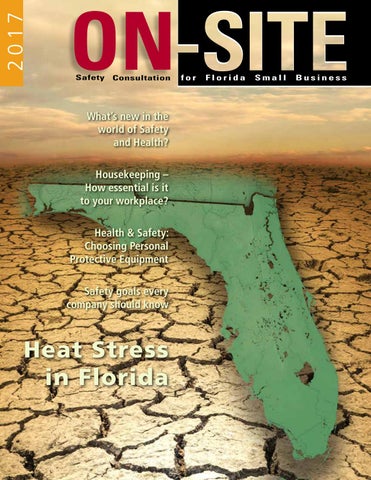
What’s new in the world of Safety and Health? Housekeeping – How essential is it to your workplace? Health & Safety: Choosing Personal Protective Equipment Safety goals every company should know
Heat Stress in Florida
Program Director's Column
The role USF SafetyFlorida plays in matters of Workers’ Compensation For over 30 years, I have been very hands-on and actively involved in the field of Occupational Safety and Health. Striving to ensure the reduction of lives lost due to unsafe business practices, including injuries and illnesses, in an effort to assist Florida’s small business community remain profitable. As the program director of the USF SafetyFlorida Consultation Program, it is my duty to undertake efforts to establish and maintain safe and healthful places of employment. I believe one key element that contributes to this success is having a thorough understanding of how the Florida Division of Workers’ Compensation actually works, and the purpose of the USF SafetyFlorida Consultation Program. According to the English dictionary, the term workers’ compensation is defined as a system of insurance that reimburses an employer for damages that must be paid to an employee for injury occurring in the course of employment or, as compensation for injury to an employee arising out of and in the course of employment that is paid to the worker or his or her dependents by an employer whose strict liability for such compensation is established by statute. Workers' compensation is generally the exclusive remedy for injuries arising from employment. How has USF SafetyFlorida bridged the gap by working with the Florida Division of Workers’ Compensation? The USF SafetyFlorida Consultation Program has participated in Workers’ Compensation seminars in conjunction with Federal OSHA compliance
assistance specialists and Workers’ Compensation personnel from the Florida Division of Workers’ Compensation (FDWC). The seminars were presented throughout the state of Florida. In FY 2016, USF SafetyFlorida presented at 16 of the offered seminars, which yielded approximately 153 attendees. These seminars helped to promote the consultation program and inform employers on how effective safety and health policies and practices significantly impact and reduce compensation insurance costs. In Florida, our consultation program works to protect workers by helping employers prevent injuries, accidents and deaths. It starts as soon as an employer requests an on-site consultation. We visit high-hazard establishments and perform a thorough and comprehensive analysis of the worksite and injury and illness prevention program. If hazards are found, we make recommendations to mitigate the hazard(s). We also offer training, education and safety-related resources to bring your company into compliance with OSHA standards. OSHA created its voluntary on-site consultation program as part of the OSH Act of 1970. Last year, programs around the country performed approximately 30,000 visits to small business worksites, reaching more than 1.5 million workers. We support OSHA and the Florida Division of Workers’ Compensation in their efforts to keep employees safe in the workplace. Let us support your workplace by helping to make it a safer place. You will notice a positive difference, such as fewer injuries and illnesses, reduced workers’ compensation claims, fewer out-of-pocket medical expenses, higher productivity and increased employee morale. To learn more about our services and to request a free and confidential safety and health consultation, visit www.usfsafetyflorida.com
Charlene Sitterly Program Director, USF SafetyFlorida Consultation Program
1
USF SafetyFlorida ON-SITE
Ta b l e o f C o n t e n t s
20 17,
VOL.
10.
ISSUE
1
table of contents
6
7
1 3 4 7 9 11 13 19 21 22
PROGRAM DIRECTOR'S COLUMN THE EDITOR’S DESK USF SAFETYFLORIDA NEWS USF OSHA TRAINING INSTITUTE EDUCATION CENTER NEWS THINK SHARP SUNSHINE STATE SAFETY RECOGNITION AWARD FEATURES WHAT WE SEE USF SAFETYFLORIDA MANAGEMENT TOOLS
21 SAFETYWRITER
21
21 FACEBOOK
21 NEWSLETTER
SAFETY VIDEO BORROWING SYSTEM
BY THE NUMBERS
Program Director:
Charlene Sitterly USF SafetyFlorida College of Public Health 13201 Bruce B. Downs Boulevard, MDC 56
12
Tampa, FL 33612-3805 1-866-273-1105 www.safetyflorida.usf.edu Reading this code with your smartphone, using QR code scanning software such as http://web.scanlife.com/en/ download-application, will enable you to go directly to the USF SafetyFlorida website.
csitterl@health.usf.edu
Designer
Martin Young martin@youngdesign.us
Editor
Thalia Barber
20
tbarber@health.usf.edu
On-Site magazine is published annually by USF SafetyFlorida, a small business safety and health consultation program funded by the Occupational Safety and Health Administration (OSHA) and the Florida Department of Financial Services’ Division of Workers’ Compensation. The University of South Florida College of Public Health is the academic home for USF SafetyFlorida.
2
FROM THE EDITOR'S DESK
Safety Matters: Occupational Safety and Wellness
T
hank you for being a loyal On-site Magazine subscriber. Each year, it is our pleasure to bring you content that inspires you to make well informed decisions in the workplace.
In this edition of the On-site magazine, we will delve into new and exciting things taking place in the world of safety and health. USF SafetyFlorida Safety and Health Consultant, Pat Stark sheds some light on several OSHA standards that affect both the General and Construction Industry, as well to provide a very informative and helpful guideline on how to ensure effective safety and health programs. More often than not, housekeeping is one of those areas that are the most neglected on a job-site. Good housekeeping techniques are essential to sustain a clean and healthy environment. Be sure to read up on Mylene Kellerman’s article which includes 6 excellent tips on good housekeeping practices for your organization. Did you know? Personal Protective Equipment also commonly referred to as PPE, was designed to protect workers from serious workplace injuries and illnesses. It only seems like common sense to choose the correct PPE for the job, and to actually use it, right? Wrong! PPE appears to be used incorrectly majority of the time. The other half fail to use it altogether. According to osha. gov, if PPE is to be used, a PPE program should be implemented, and should address the hazards present; the selection, maintenance, and use of PPE; the training of employees; and monitoring of the program to ensure its ongoing effectiveness. This topic is covered in great detail in the features section of this edition. Keep reading to find out more! At USF SafetyFlorida, it is our mission to protect workers from unsafe practices in the workplace that contribute to injuries, illnesses and fatalities. We are here to aid in the protection of Florida’s small business economy. We work very closely with many different types of employers spanning from the Construction Industry, General Industry, Maritime and Disaster Site. If your company is ready to take the next step towards safety, please contact us today and request a free and confidential safety consultation. Requesting a consultation is as simple as calling 1-866-273-1105 or visiting www.usfsafetyflorida.com. You will be glad you did!
On-Site Safety Consultation for Florida Small Business magazine
Worker protection — reducing injuries, illnesses and fatalities on the job — is the primary mission of the USF SafetyFlorida Consultation Program. Our safety and health consultants are your key to achieving these benefits. They follow high and consistent standards for helping employers protect their workers. These standards, along with their years of consultation experience, will help you build a workplace safety system that unites all the elements of leadership commitment and job task procedures. With a workplace safety system in place, you can meet production goals while maintaining the health of the whole employee family. “It can help you and even save one of your employee’s lives.”
Thalia Barber Communications & Marketing Specialist and Editor USF SafetyFlorida Consultation Program
3
USF SafetyFlorida ON-SITE
— Gus Cagigas, Safety Coordinator, Portside Maintenance and Repair
USF SAFETYFLORIDA NEWS
Fourth Annual Stand-Down Targets Workers in the Construction Industry Falls from elevated surfaces is the leading cause and major contributing factor among deaths in the construction industry. According to data collected by the Bureau of Labor Statistics (BLS), fatalities due to falls among construction workers accounted for 364 out of 937 total deaths in the industry. In an effort to support the Occupational Safety and Health Administrations (OSHA) 4th Annual National Safety Stand-Down, USF SafetyFlorida joined forces with the USF OSHA Training Institute Education Center to bring awareness to the many lives lost due to falls in construction, and to generate discussion on key fall prevention methodologies. Acting together as an alliance, all three organizations were able to come together to offer the OSHA 7405 – Fall Hazard Awareness for the Construction Industry training course, free of charge to employers and employees in Wesley Chapel and Miami, Florida. Our ultimate goal was to offer innovative training, education and resources to employers and employees that were directly impacted by this occurrence. Through our joint effort, we were able to reach-out to several employers and workers in the industry. This year’s Fall Safety Stand-Down event was observed from May 8-12, 2017. Several topics addressed in the trainings included OSHA regulatory updates on fall prevention in construction; solutions and training for prevention of accidents and fatalities; implementing injury prevention plans and safety management systems, and fall hazards on construction sites. “Our message is “safety pays and falls cost.” We emphasize planning ahead and providing the right equipment- such as guard rails or safety harnesses, lines and anchors, and training all employees. These simple steps can save lives. Whether working on roofs or scaffolds, climbing ladders, or performing any work from heights - falls can be prevented with the right equipment and training,” said Dr. David Michaels, Then-Assistant Secretary of Labor for Occupational Safety and Health. The stand-down is part of OSHA’s ongoing Fall Prevention Campaign, created in 2012 and was developed in partnership with the National Institute for Occupational Safety and Health (NIOSH) and the National Occupational Research Agenda (NORA) programs.
Governor Rick Scott recognizes Florida’s new SHARP employers Every year, Governor Rick Scott recognizes new Florida SHARP employers for exemplary workplace safety practices with a letter he sends to each of the companies. OSHA’s Safety and Health Achievement Recognition Program award is the highest safety honor for small businesses and granted to employers nominated by USF SafetyFlorida. SHARP certified companies are exempt from OSHA inspections for a period up to two years, with the exception of a serious accident, fatality or employee complaint. In his letter to the employers, Scott wrote, “You are to be commended for your exemplary safety and health management practices. Floridians like you are helping make our state the best place in the world to raise a family and have a great career.”
Florida Governor, Richard (Rick) L. Scott
There are currently 17 SHARP-certified businesses in the state of Florida. To qualify, a firm must: • Request and undergo a consultation visit from USF SafetyFlorida • Involve all employees in the consultation process • Correct hazards identified during the on-site consultation • Implement and maintain a safety and health management system that, at a minimum, addresses OSHA’s 1989 Safety and Health Program Management Guidelines • Reduce their Lost Workday Injury and Illness Rate and Total Recordable Case Rate below the national average for their industry • Agree to notify USF SafetyFlorida prior to making changes to working conditions or introducing new hazards into the workplace
USF SafetyFlorida continues presence at Florida Division of Workers’ Compensation’s Workplace Safety Seminars USF SafetyFlorida has partnered for the eighth year with the Florida Division of Workers’ Compensation and OSHA to provide workplace safety classes, seminars and webinars. The long-standing partnership held throughout the state, provides business owners, contractors and those responsible for assuring workers’ compensation, with important information about workers’ compensation laws as well as workplace safety. In 2016, 16 seminars were held with 153 attendees. The sessions delve into Key Statutory Definitions, Insurance Coverage Requirements, Exemptions, Contractor Responsibilities, Enforcement Provisions, Direct and Indirect Costs, Inspections, and Florida Fatalities. The now retired Sheryle Birdsong formerly with the Division’s Compliance Bureau stated that the partnership is a win-win. “The (consultation) program is an integral part of the educational program. Having USF SafetyFlorida’s presence at the seminars really does round out our discussion of what the law’s requirements are and what resources are available,” said Birdsong. The Division of Workers’ Compensation is part of Florida’s Department of Financial Services and handles workers’ compensation claims for employees who are injured or killed on the job. According to the United States Department of Labor, Office of Workers’ Compensation (OWCP), their data supports that as of August 27, 2017, there were 7,596 claims filed and $277,292,666 awarded in Total Compensation to include paid medical bills. (This data represents combined Part B and E Summary). Note: The Division’s trust fund adds a 10 percent matching grant to the federal government’s funding of the USF SafetyFlorida consultation program.
4
Attendees of the “Update General Industry Walking-Working Surfaces & Fall Protection Standards” Seminar at the Entrepreneur Collaborative Center in Ybor City.
USF SafetyFlorida continues to make worker safety a priority USF SafetyFlorida’s mission continues to be reducing workplace injuries, keeping workers safe and helping Florida small businesses develop and implement effective safety and health programs. USF SafetyFlorida has continued to focus of providing Florida’s small business community with free training, educational seminars and resources. The programs marketing and outreach efforts have been applied to multiple industries, with the focus being on both local and national areas of emphasis that have the greatest impact on Florida’s workforce. USF SafetyFlorida frequently partnered with various other organizations to deliver state-of-the art training, provide educational resources and conduct safety and health presentations. During fiscal year 2016-2017, USF SafetyFlorida Consultation Program in conjunction with its partners offered complimentary activities to high-hazard industries in an effort to help sustain stronger and healthier communities. The following activities listed highlight some of the events offered in FY 16-17: • Safety in Construction Workshops • IEC Electrical Showcase • Florida Building Engineers Maintenance Showcase • Workers’ Compensation Educational Conference • OSHA 7000 Series Training • ACFS Safety Day • Fall Safety Stand-Down • Heat Illness Prevention Webinar • Walking-Working Surfaces Seminar Collectively, all trainings combined yielded a total of 684 attendees. We are here to support you. Please contact the Communications and Marketing Specialist via email at tbarber@health.usf.edu with any training suggestions that you may have.
5
USF SafetyFlorida ON-SITE
Florida recognizes Workers’ Memorial Day Did you know? April 28th is Workers’ Memorial Day. A day when the nation gathers to commemorate workers who have died on the job and honor them by continuing to fight for improved worker safety. Every year almost 4,000 workers die or the job, and approximately 4 million others become injured and/or contract an illness from overexposure to chemicals and harmful substances due to occupational-related hazards and unsafe practices. These deaths are all preventable. We can do more about workplace deaths! The USF SafetyFlorida Consultation Program and USF OTI Education Center joined forces to honor workers and raise awareness of the issues affecting Florida’s workforce. By providing several free training sessions, our goal was to evoke change and advocate for better and safer workplaces. The complimentary training sessions offered were as follows:
Training Sessions: Number of participants: OSHA 7205 – Health Hazard Awareness OSHA 7005 – Public Warehousing and Storage OSHA 7115 – Lockout/Tagout OSHA 7300 – Understanding OSHA’s Permit Required Confined Space Standard OSHA 7505 – Introduction to Incident Investigation
21 21 21 19 21
USF SafetyFlorida would like to challenge you and your organization to recommit yourself to help keep workers safe and healthy, and promote good work ethics, so that workers may return home to their families at the end of the day. Employers interested in receiving a free and confidential consultation from the USF SafetyFlorida may call toll-free, 1-866-273-1105, or visit www.usfsafetyflorida. com. We are committed to assisting you.
Top 10 most frequently cited OSHA standards violated in FY2016 The Occupational Safety and Health Administration (OSHA) released its Top 10 Most Frequently Cited Standards list for 2016.
OHNP Students complete field experience at company that manufactures vinyl fences.
The cited standards for fiscal year 2016 (October 1, 2015, through September 30, 2016) consisted of the following: 1: Fall protection, construction (29 CFR 1926.501) 2: Hazard communication standard, general industry (29 CFR 1910.1200) 3: Scaffolding, general requirements, construction (29 CFR 1926.451) 4: Respiratory protection, general industry (29 CFR 1910.134) 5: Control of hazardous energy (lockout/tagout), general industry (29 CFR 1910.147) 6: Powered industrial trucks, general industry (29 CFR 1910.178) 7: Ladders, construction (29 CFR 1926.1053) 8: Machinery and Machine Guarding, general requirements (29 CFR 1910.212) 9: Electrical, wiring methods, components and equipment, general industry (29 CFR 1910.305) 10: Electrical systems design, general requirements, general industry (29 CFR 1910.303)
USF SafetyFlorida lends a helping hand to OHNP students Every year since 2009, during the spring semester, a small group of students from the USF Occupational Health Nursing Program (OHNP) are selected to attend a full-service on-site visit with one of the USF SafetyFlorida consultants. The visit exposes the nursing student to safety and health issues in various work industries and job functions. OHNP Graduate students receive a vast amount of knowledge in their educational curriculum; the USF SafetyFlorida Consultation Program is able to further expand on that knowledge by introducing the students to real-live jobsites, allowing the student to fully apply all of the concepts learned in class to real world environments. This was an especially great learning experience for OHNP Graduate students, Dana Lord and Mercedia White. Ms. Lord expressed, “It was really a great experience. I learned about the importance of each OSHA standard and having a written program. I learned in more detail about safety management systems, hazardous communication, blood borne pathogens, and respiratory protection. I learned more about the requirements for small businesses. I learned what the Safety Florida consultation program is about and its emphasis not only on compliance, but putting the safety and health of employees first.” Ms. White further added, “The on-site experience made theory relevant and practical. I learned how specific OSHA standards are applied and can be successfully blended in the most primitive of occupational settings, where allotted monetary resources are minimal. I ascertained firsthand that when employers jumpstart a business, many are ignorant of the dangers present in their workplace”. This is the eighth year that the students from the graduate certificate program have participated in the shadowing field experience. We hope to continue to do so, taking an active role in the community by mentoring students.
USF SafetyFlorida’s primary purpose is to help your company prevent work-related fatalities, injuries and illnesses. In the short term, we do that by emphasizing hazard identification. In the long term, we do that by helping you develop a safety management program. If you are ready to take the next step toward safety in your business, please contact us today and request a free and confidential safety consultation.
13201 BRUCE B. DOWNS BOULEVARD │ TAMPA, FL 33612 │ WWW.USFSAFETYFLORIDA.COM LOCAL: (813) 974-9962 │ TOLL-FREE: 1-866-273-1105
6
U S F O S H A Tr a i n i n g I n s t i t u t e E d u c a t i o n C e n t e r N e w s
The USF OSHA Training Institute Education Center: Florida’s Workplace Safety Training and Continuing Education Resource
T
he USF OSHA Training Institute Education Center is a non-profit organization authorized by the Occupational Safety and Health Administration (OSHA) to deliver occupational safety and health training to public and private sector employers. It is the Education Center’s ultimate goal to support OSHA’s initiatives by contributing to the reduction of workplace accidents and injuries by training workers, employers and safety professionals on hazard recognition and avoidance. This fiscal year, the USF OTI Education Center has successfully conducted 154 inclass safety and health training courses on various topics, positively impacting more than 1,850 students. During fiscal year 2017, the USF OTI Education Center has issued over 46,000 OSHA DOL Cards. The DOL Cards are distributed to students who attend the 10 or 30-hour Outreach Training Program courses. The USF OTI Education Center offers a great variety of training on multiple topics.
Robert Nesbit Program Director USF OSHA Training Institute Education Center
Courses offered include OSHA standards and Outreach Training Program trainer and update courses. Additionally, USF OTI Education Center course offerings include topics such as recordkeeping, machine guarding, confined space entry, electrical standards, and fall arrest systems. In other news, the University of South Florida received the Susan Harwood Training Grant to provide education and training on Silica Exposure in General and Construction Industries. The USF OSHA Training Institute Education Center of Wesley Chapel had the opportunity to work closely with the university to implement the grant and develop training materials. The Silica exposure training course offered an overview of the new silica standard, as well as provided information on how to recognize, avoid and abate silica dust hazards, and about appropriate housekeeping techniques. Furthermore, students were able to receive hands-on training workshops regarding respiratory protection use. Students working together during the Silica Exposure Training Course.
7
USF SafetyFlorida ON-SITE
Private Safety Training Bringing safety training directly to a company saves clients’ money in travel-related expenses. Moreover, we can create customized courses to meet your educational needs. Our expert instructors can facilitate training wherever is most convenient, whether it be at your facility or our headquarters in Wesley Chapel, FL. Contact a member of the USF OTI Education Center at usfotioutreach@health.usf.edu to receive a free quote!
• • • • • • • • •
Online • 10 hour Construction • 30 hour Construction • 10 hour General Industry • 30 hour General Industry • 9031 – 8 Hour Hazwoper • 9032 – 24 Hour Hazwoper • 9092 – 4 Hour Recordkeeping
To view the full listing of online courses, visit: http://usfoticenter.org/online-training/
Additional Safety and Health online courses are available. Specialty 1-hour Online Courses General Industry • 9070 – Introduction to OSHA • 9073 – Recordkeeping • 9074 – Bloodborne Pathogens • 9075 – Confined Space Entry • 9077 – Ergonomics • 9079 – Safety and Health Programs • 9081 – Machine Guarding • 9083 – Lockout and Tagout • 9085 – Walking and Working Surfaces • 9086 – Personal Protective Equipment • 9087 – Fire Detection and Protection • 9089 – OSHA GHS & Hazard Communication Course Construction Industry • 9040 – Introduction to OSHA • 9041 – OSHA Standards and Inspection Procedures • 9043 – Recordkeeping • 9044 – Health Hazards in Construction • 9048 – Welding and Cutting • 9049 – Safety Programs and Subpart C • 9050 – Rigging and Material Handling • 9051 – Cranes, Derricks, Hoists, Elevators, and Conveyors
9052 – Electrical 9053 – Excavations 9054 – Fire Prevention 9055 – Scaffolds 9056 – Personal Protective Equipment 9057 – Fall Protection 9058 – Stairways and Ladders 9060 – Concrete and Masonry 9059 – OSHA GHS & Hazard Communication Course
Courses offered in a classroom setting include a variety of courses for Construction, General, Maritime, and Disaster-site Industries. General Industry • OSHA 501 – Trainer Course in Occupational Safety and Health Standards for General Industry • OSHA 503 – Update for General Industry Outreach Trainers • OSHA 511 – Occupational Safety and Health Standards for General Industry • OSHA 521 – OSHA Guide to Industrial Hygiene • OSHA 2015 – Hazardous Materials • OSHA 2045 – Machinery and Machine Guarding Standards • OSHA 2225 – Respiratory Protection • OSHA 2255 – Principles of Ergonomics • OSHA 2264 -Permit-Required Confined Space Entry • OSHA 3015 -Excavation, Trenching, and Soil Mechanics • OSHA 3095 – Electrical Standards • OSHA 6005 – Collateral Duty Course For Other Federal Agencies • OSHA 6015 – Occupational Safety and Health Course for Other Federal Agencies • OSHA 7000 – OSHA Training Guidelines for Safe Patient Handling • OSHA 7100 – Introduction to Machinery and Machine Safeguarding (8 Hour) • OSHA 7115 – Lockout/Tagout – Controlling Hazardous Energy to Prevent Workplace Injury • OSHA 7120 – Introduction to Combustible Dust Hazards • OSHA 7200 – Bloodborne Pathogens Exposure Control for Healthcare Facilities • OSHA 7205 – Health Hazards Awareness • OSHA 7300 – 8 Hour Permit-Required Confined
Space Standards • OSHA 7410 – Managing Excavation Hazards • OSHA 7500 – Introduction to Safety and Health Management • OSHA 7505 – Introduction to Incident Investigation • OSHA 7510 – Introduction to OSHA for Small Business • OSHA 7845 – Recordkeeping Rule Seminar Construction • OSHA 500 – Trainer Course in Occupational Safety and Health Standards for the Construction Industry • OSHA 502 – Update for Construction Industry Outreach Trainers • OSHA 510 – Occupational Safety and Health Standards for the Construction Industry • OSHA 3115 – Fall Protection • OSHA 3015 -Excavation, Trenching, and Soil Mechanics • OSHA 7400 – Noise in the Construction Industry • OSHA 7405 – Fall Hazard Awareness for the Construction Industry • OSHA 7415 – Construction Industry Hazards and Prevention Strategies Maritime • OSHA 5400 -Trainer Course in Occupational Safety and Health Standards for the Maritime Industry • OSHA 5402 – Up-Date for Maritime Outreach Instructors • OSHA 5410 – OSHA Standards for the Maritime Industry Contract courses are available for the General, Construction and Maritime Industry. To schedule a contract course, please email usfotioutreach@health.usf.edu. Disaster • OSHA 5600 - Disaster Site Worker Train the Trainer Course • OSHA 5602 – Update Course for Disaster Site Worker Train the Trainer Course • OSHA 7105 – Evacuation and Emergency Planning • OSHA 7600 – Disaster Site Worker Course
Contract courses are available for the General, Construction, Maritime, and Disaster-site Industries. To schedule a contract course, please email usfotioutreach@health.usf.edu. USF OSHA Training Institute Education Center 2612 Cypress Ridge Boulevard, Suite 101, Wesley Chapel, FL 33544 usfotioutreach@health.usf.edu • www.usfoticenter.org.
For more information about the USF OTI Education Center and to register for classes, visit us on the web at www.usfoticenter.org or call 813-994-1195. 8
Think SHARP
Exemplary Safety and Health Equates to Prestigious SHARP Certification What is SHARP? OSHA created the Safety and Health Achievement Recognition Program award to recognize small business owners who operate an exemplary safety and health management system (SHMS). Once SHARP certified, employers are exempt from OSHA inspections for a period up to two years, with the exception of a serious accident, fatality or employee complaint. Firms throughout the U.S. can earn a SHARP award, and for a Florida company the approval process begins with a recommendation to OSHA from USF SafetyFlorida.
How can your company become SHARP? Companies interested in pursuing SHARP status must first request a safety and health consultation from USF SafetyFlorida. The on-site consultation involves a comprehensive safety and health hazard survey of the worksite(s) involved, including equipment and work processes. Other qualifying requirements for the SHARP program include: • Have at least one year of operating history at the company or worksite; • Implement, demonstrate and maintain a safety and health management system (SHMS) that, at a minimum, addresses the major elements of OSHA’s 1989 Safety and Health Program Management Guidelines; • Lower the company’s Days Away, Restricted or Transferred (DART) rate and Total Recordable Case (TRC) rate below industry national average; • Correct all hazards identified by the consultant; • Agree to notify the USF SafetyFlorida Consultation Program prior to making changes in working conditions or work processes that may introduce new hazards into the workplace.
First-Time SHARP Certification and Exemption Once a business satisfies all SHARP requirements, a USF SafetyFlorida consultant may recommend it for SHARP approval and certification. If approved by OSHA, the company will receive formal SHARP recognition from OSHA and USF SafetyFlorida during an award ceremony. The company will also be exempt from OSHA inspections for a period up to two years.
SHARP Renewal If a company wishes to renew its SHARP certification, the application process must begin during the last six months of its exemption period. The company must also undergo a comprehensive visit by a USF SafetyFlorida consultant to ensure its SHMS has improved. Furthermore, the employer must meet all SHARP eligibility requirements, agree to conduct self-evaluations and provide a written report based on the elements of OSHA Safety and Health Program Management Guidelines and OSHA’s required injury and illness logs.
SHARP Deferral If a business meets most but not all of OSHA’s SHARP eligibility requirements, a USF SafetyFlorida consultant may recommend a business for an inspection deferral up to 18 months, provided the company has: • Completed a hazard identification survey with a USF SafetyFlorida consultant and corrected all identified hazards; • Implemented, demonstrated and maintained a SHMS that, at a minimum, addresses the major elements of OSHA’s Safety and Health Program Management Guidelines; • Implemented an action plan with established abatement dates that completes the necessary items that prevented the company from reaching SHARP status during the original survey.
(N) A&N Corporation (R) Accuform Manufacturing, Inc. (R) Ajax Building Corporation (R) Alti-2, Inc. (R) Canterbury Tower (R) Cast-Crete, Inc. (N) Chapman Partnership (R) ClassB, Inc. (R) Cypress Cove Care Center (R) Daws Manufacturing Company, Inc.
Florida’s SHARP Companies
(N) InterMed Biomedical Services, Inc. (R) Main Metal Recycling (R) Metal Industries, Inc.
This year 17 Florida companies qualified for OSHA’s SHARP award. SHARP Key: (N) = new (R) = renewal
(R) Portus Stevedoring (R) Seaonus Stevedoring
(D) = deferral
(R) Tintometer, Inc. (R) Trumeter Company, Inc.
9
USF SafetyFlorida ON-SITE
USF SafetyFlorida Recognizes Main Metal Recycling (Jacksonville) as a Proud Recipient of the SHARP Award Main Metal Recycling is proud to belong to an industry that provides thousands of jobs, diverts tons of materials from landfills, and makes a positive impact on the U.S. balance of trade and resource sustainability. Main Metal Recycling produces new materials from scrap using 95% less energy than producing the same product from natural resources. Additionally, the company specializes in buying and recycling ferrous and nonferrous scrap metal and computer electronics scrap from manufacturers, contractors and the general public. Main Metal Recycling learned about the SHARP program when their Plant Manager, Micah Thornton, attended a Florida Recycler’s Association meeting in June 2010. The company’s desire is to improve their safety and health culture among employees and customers alike, lead them to contact USF SafetyFlorida Consultation Program. By doing so, Main Metal Recycling has increased their safety meetings from monthly to weekly, began offering a better variety of personal protective equipment, and increased the involvement of employees in the decision making process in regards to improvements, training and everyday best practices.
Main Metal Recycling of Jacksonville
“For us, an increase in employee involvement is the most important result of being involved in this program. We have only had one injuries/illnesses in the past 6 years. Our property insurance agent understands the value of an excellent safety program and is impressed by our SHARP designation,” said Micah Thornton, Main Metal Recycling Plant Manager. The company works diligently to ensure that their employees go home to their family each night in one piece and are ready to come back to the team the next day. Main Metal Recycling believes in giving their employees more opportunities to be involved in creating and maintaining safety programs. Ready to become SHARP? Contact USF SafetyFlorida at 1-866-273-1105 or visit us online at www.safetyflorida.usf.edu to request a free on-site consultation.
10
Sunshine State Safety Recognition Award
Commitment to Safety and Teamwork Make the Difference Ask any successful business owner involved in high-risk industries their advice on keeping incident levels low, and their answer will most likely be employers and employees working together to keep a job site safe. This employer-employee safety commitment is the reason USF SafetyFlorida Consultation Program developed the Sunshine State Safety Recognition Award. Created in 2006, the Sunshine State Safety Recognition Award commends employers and employees in all industries who proactively and routinely engage in job safety. Approximately 40 firms earn this honor annually, and it recognizes companies that have implemented good safety initiatives to better protect employees on the job. According to Keith Brown, a USF SafetyFlorida safety and health supervisor, “Commitment to safety is best demonstrated by teamwork between workers and managers in resolving workplace safety and health issues. Teamwork includes maintaining open and effective means of communication to not only identify problems, but also to achieve solutions.” To qualify, a business should request and receive a complete on-site consultation survey and employ at least one person at the worksite to be evaluated. Additionally, the business should have no willful, repeat or willful-repeat citations within 24 months of the consultation and not serious citations related to injury or exposure within 12 months of the consultation.
During the consultation, a safety consultant will perform comprehensive on-site evaluation of all written programs. The consultant will also speak with workers and conduct an evaluation of the work area. The safety consultant will review: • • • • •
Administration and oversight of safety management programs Safety and health management practices Safety training and instruction Employee safety rules Internal safety inspection routines for new and existing substances, processes and equipment
If hazards are identified during the visit, an abatement of those specific hazards must take place before recognition is granted. Once initial and final consultations are complete, a safety consultant may decide to formally recommend the firm for a Sunshine State Safety Recognition Award, which is approved by USF SafetyFlorida management. A formal letter of commendation is sent to the company, recognizing the employers’ and employees’ efforts in implementing and maintaining an effective injury and illness prevention program. “Working together towards maintaining workplace safety and health is something everyone can take benefit from,” adds Brown.
First Florida Building Corporation of Tampa
11
USF SafetyFlorida ON-SITE
USF SafetyFlorida developed the Sunshine State Safety Recognition Award to motivate and support employers who demonstrate a commitment to continuously improve their workplace safety and health management system.
The 2017 Sunshine State Safety Recognition Award recipients include: Accent Construction Services - 7-Eleven AFL Construction dba Aireko Community Health & Rehabilitation Center CSA Ocean Sciences, Inc. EMJ Construction - Lee Vista Promenade Phase 2
Accent Construction Services of Miami
Engle Implant Dentistry Engle Implant Dentistry First Florida - Azola at Magnolia First Florida - City Vista First Florida Building Corporation - Rocky Point Apartments Greystar Development & Construction, LP KVC Constructors, Inc. - Aventura Medical Tower KVC Constructors, Inc. - Museum Garage Legendary Marina
Greystar Development & Construction, LP of Davie
Nautique Boat Company OHL/Arellano Construction PetIQ Rehrig Pacific Company Stiles Construction - Canvas Project Stiles Construction - Seaglass Stiles Corporation - Hollywood Circle Tutor Perini Corporation - Panorama Project
Tutor Perini Corporation of Miami
12
Feature
Heat Stress in Florida – And the OSHA Fact Sheet
T
his is the fifth year that I have had the pleasure of writing on the topic on heat stress in Florida. The organizing principle for this article is the OSHA Fact Sheet for Protecting Workers from the Effects of Heat (https://www.osha.gov/OshDoc/ data_Hurricane_Facts/heat_stress.pdf). The following is my commentary and should not be interpreted as OSHA policy. Person Designated to Oversee the Program The essential feature of this key element is someone who knows accurate information about heat stress and the risks for heat-related disorders and who can organize the company’s program. This requires a level of sophistication that comes from reading and understanding the NIOSH Criteria Document (see below), being familiar with textbook chapters on heat stress and the material presented on the OSHA and NIOSH websites, and attending professional development training. The core message is that the safety and health professional should have a deeper appreciation of heat stress than simply using canned material. Not emphasized enough, is that the central authority needs a line of sight through all of the line employees. All of the line employees should understand heat stress and know their responsibilities. Hazard Identification We’ve talked about the job risk factors before and to briefly repeat them here: They are the environment (and especially the humidity expressed as dew point), the work demands, and clothing requirements. Ideally, the Designated Person facilitates a Job Hazard Analysis (JHA) for the typical or frequent jobs that might be related to heat stress. The JHA will likely result in an estimate of metabolic rate (work demand) and the need for protective clothing. This combination can then be used to select trigger temperatures. Water. Rest. Shade. The “Water. Rest. Shade.” campaign is used to emphasize the importance of hydration and recovery from heat exposures. (See more on work and recovery cycles below.) These are important concepts
13
USF SafetyFlorida ON-SITE
but care needs to be taken that the management of heat stress reaches far beyond this script. Acclimatization Acclimatization is a valuable physiological adjustment that allows the acclimatized individual to better tolerate heat than they would be able to prior to acclimatization. The acclimatization schedule for new employees is designed to allow them to adjust more slowly to the heat while they are learning the job. It is important to remember that under normal circumstances (e.g., vacation, re-assignment, and injury) that acclimatization is lost over three weeks. If the person is away from work due to an illness, the loss can occur over a week. Modified Work Schedules There are many variations of work schedules that con be considered; and the Fact Sheet covers them. Most of them are some variation of allocation of resources and time/when the work is performed. A special case would be a limit where stopping work may be an appropriate response. Work and recovery cycles are a commonly recommended administrative control. Figure 1 illustrates a way to express recovery allowances as the minutes of work in an hour. Moderate work is likely to be the highest sustained level of work seen under conditions of heat stress, but heavy is included in the figure. Figure 2 translates the WBGT to an equivalent ambient Heat Index (HI) assuming work in the sun and rest in the shade. Training Training is a linchpin in all health and safety programs and the hazard of heat stress is not an exception. The training must include the causes of heat stress and the normal physiological responses, recognition of heat-related disorders along with knowing prevention practices and first aid, and knowing heat stress hygiene practices (e.g., fluid replacement, selfdetermination, and personal risk factors). It is helpful to know that first line employees can describe the heat stress hazard and the steps taken to minimize and manage the hazard. Monitoring for Signs and Symptoms of Heat-Related Disorders When looking at cases of heat stroke and citations for heat stress, there are many reasons and most center around the lack of a clearly understood heat stress management program and many of the
Thomas E. Bernard, Ph.D. College of Public Health University of South Florida
employees are on the job for just a few days. I think that this view misses a much larger point. After you have a heat stress management program, the risks for a person who might be heat-intolerant is not minimal. That is, exertional heat illness can be due to a variety of factors from program drift to individual circumstances, and exertional heat illness can occur below the occupational exposure limit. Monitoring for signs and symptoms of heat-related disorders and taking the correct first aid steps is the backstop for an otherwise effective program. The Designated Person can articulate this as policy, but it relies on first line supervision and fellow employees to work. Emergency Planning and Response Following from the premise of monitoring for signs and symptoms of heat-related disorders is the need for proper responses. Often this is appropriate first aid, and this may not represent an emergency. A heat stroke, however, is a medical emergency that requires immediate and aggressive first aid. And this cannot be achieved without a good emergency plan. When there is the suspicion of a heat stroke (you will not be able to definitively determine this in the field), immediate and aggressive cooling is required. Ideally, this is immersion into ice or cold water. The closest approximation to this, like continuously running water over the person, is better than no action. Engineering and Other Controls There are many engineering controls to reduce or eliminate the heat stress. The Designated Person along with others from the organization can explore those that are adaptable to the individual workplaces. The effect of an air-conditioned rest area is illustrated in Figure 3. As can be seen, very high environmental heat can be readily balanced by recovery in a cool area. There are also effective personal cooling devices. These should be evaluated in the workplace doing the actual work. Generally, those with the greatest surface area coverage and greatest heat absorbing capacity will be the most effective. In case you missed it, a new NIOSH Criteria Document, called Occupational Exposures to Heat
and Hot Environments (https://www.cdc.gov/ niosh/docs/2016-106/pdfs/2016-106.pdf ), is out. The NIOSH criteria document is a very rich source of information on the rationale for heat stress exposure assessment, the underlying physiological, physical and personal factors that contribute to heat stress and heat strain, heat-related disorders, and methods to mitigate heat stress and strain. The first chapter provides the key points: Workplace Limits and Surveillance; Medical Monitoring; Surveillance of Heat-related Sentinel Health Events; Posting of Hazardous Areas; Protective Clothing and Equipment; Worker Information and Training; Control of Heat Stress; and Recordkeeping. If you are interested in discussing your situation, please contact a USF SafetyFlorida consultant or Thomas E. Bernard at USF College of Public Health.
Amount of work time in an hour to stay within the NIOSH REL for heat stress with recovery in the shade.
William Tomlin Industrial Hygiene Team Leader and Supervisor
Developing Company Safety Goals
A
s part of our safety and health consultation services, while on-site, consultants complete a company “safety policy and procedures” evaluation as part of our safety review. One of the 58 questions we ask is, “What is your safety goal for this year?” The typical answer is, “our goal is no accidents this for this year.” I generally score that response as a 1 of 3, with 1 being the worst. It is not a very good goal because, just one accident would eliminate the facility from reaching its goal. Very few organizations can go an entire year without an accident occurring. I suggest to the safety manager, that they review the accident trends looking for a behavior or conditions that show unhealthy trends. I then suggest using total compliance with written policies regarding that behavior as the yearly or current safety goal. Two examples of a behavior based safety goal would be 100% safety glasses usage for all work groups or to promote good housekeeping within the facility, for all employees to remove tripping hazards in their respective work area. I also suggest using the “SMART” format to help change employee behaviors. SMART stands for: Specific /Measurable/Action Oriented /Realistic/ Time Bound
Translation of Figure 1 to ambient Heat Index in the sun.
After first selecting a behavior to change, next develop a measurement tool that easily tracks employee’s behavior regarding the goal. A check list on weekly inspections for housekeeping, or a weekly surprise inspection for compliance safety glasses usage in each work area.
Following that, select a simple reporting metric to indicate the results: letter grade or percent of compliance and break it down by work group or specific work area. Bar graphs and charts are useful in production meetings, but for this to work, employees should be able to easily see their “score” and how it relates to other employees or work groups in the organization. Post the results of the inspection in a central location for the total work force to review. This lets everybody know who is following safety procedures and who is not. No supervisor wants his group to have an “F” or a low compliance rate regarding a company-wide goal. Friendly competition between work groups is never a bad thing. The shorter the time period between the scoring the better. Typically, one week between evaluations gives employees timely feedback. Also, this could be an opportunity to celebrate a team victory with a nice Friday celebration. By celebration, I mean have some type of small reward for work groups that meet the goal. When I used this method for a housekeeping safety goal, and the group receiving an “A+,” they received a small breakfast sandwich from management. In conclusion, a safety goal whether it be yearly or otherwise, should be a SMART goal that modifies an employee’s behavior as it relates to a safety issue. Pick a measurable safety goal that addresses a concern, measure the activity and post the results frequently. Remember to praise (celebrate) those who achieve the goal. This activity will not only demonstrate management’s commitment to safety, but also document that written safety rules are being enforced.
Hourly work allowances to stay within the NIOSH REL for outdoor work in the sun when recovery can occur in an air-conditioned space. 14
Feature
Housekeeping – how essential is it to your workplace?
"H
ousekeeping in the workplace’ essentially refers to the routine upkeep, maintenance and cleanliness of the work environment. Workplace housekeeping activities include keeping work areas organized, maintaining aisles clear of debris, swift clean-up of spills and waste materials and maintenance of building facilities and equipment, all of which help safeguard worker safety and health, prevent workplace injuries and illnesses and make work operations more efficient. OSHA references housekeeping in several occupational safety and health standards. Listed below are a few: In General Industry* 29 CFR 1910.22(a)(1) states that the employer must ensure all places of employment, passageways, storerooms, service rooms, and walking-working surfaces are kept in a clean, orderly, and sanitary condition. In Construction* 29 CFR 1926.25(a) states that during the course of construction, alteration, or repairs, form and scrap lumber with protruding nails, and all other debris, shall be kept cleared from work areas, passageways, and stairs, in and around buildings or other structures. In Shipyard Employment* 29 CFR 1915.81(a)(1) states that the employer shall establish and maintain good housekeeping practices to eliminate hazards to employees to the extent practicable. In Longshoring* 29 CFR 1918.91(a) states that active work areas shall be kept free of equipment, such as lashing gear, and materials not in use, and clear of debris, projecting nails, strapping and other objects not necessary to the work in progress. It is clear to see that good effective housekeeping is a key component to maintaining a safe work environment. Why? According to the Bureau of Labor and Statistics, in 2015, slips, trips, and falls (STFs) accounted for 27 percent (309,060 cases) of the total occupational injuries and illnesses (the incidence rate for STFs was 27.9 cases per 10,000 full-time workers). And poor housekeeping frequently contributes to slip, trip and fall accidents in the workplace because of work areas and walkways that are cracked/damaged or uneven or
15
USF SafetyFlorida ON-SITE
obstructed by trash that has not been thrown away, spills, equipment lying around, unused and broken items, etc. Good effective housekeeping can reduce and even eliminate: 1: Trip and slip incidents when walkways, platforms, stairs and working surfaces are free of clutter, grease and spills; 2: Fire hazards when there is a reduction or elimination of waste (cardboard, paper), dust (wood, metal, plastics), debris, and other unnecessary flammable materials; 3: Injuries as a result of being struck by objects when there is organized and careful storage of materials, proper stacking of merchandise, tools, and equipment; 4: Injuries such as cuts, punctures, lacerations to parts of the body from protruding nails, wire or steel strapping when there is daily workplace cleanup and tidy up; 5: Employee exposure to hazardous substances, such as dust and vapor buildup, when there is a regular facilities and equipment maintenance and cleaning schedule; 6: Illnesses from the risk of exposure to harmful contaminants (e.g. germs and hazardous/ toxic substances) when there is cleaning and restocking of supplies in common areas (such as change rooms, washrooms, lockers, breakrooms, etc.). Good housekeeping practices help ensure neat, organized, and safe worksites, which can reduce stress, improve employees’ attitudes and morale and thereby help productivity. Good housekeeping is also a basic part of accident and fire prevention. Moreover, a clean and uncluttered worksite makes a good impression on government representatives, a vendor or a potential customer. Workplaces with sloppy housekeeping often get more closely scrutinized! OSHA’s new revised guidance on Recommended Practices for Safety and Health Programs references general housekeeping as a component of regular workplace inspections. So it is important that an effective workplace safety and health management system also include housekeeping policies and
Mylene Kellerman
Assistant Director procedures in which each employee plays a vital role. Housekeeping should also have management’s commitment and support so employees realize its importance. Housekeeping practices are among the easiest and most visible safety measures to implement in the workplace. It also requires paying attention to important details such as the layout of the whole workplace, aisle marking, the adequacy of storage facilities, and maintenance. So what are some basic steps you can take to maintain good housekeeping in your workplace? Much depends on the type of work done. For instance, housekeeping for a metal fabrication company would be quite different than for a healthcare facility. There are three steps that would help a company maintain good housekeeping in the workplace: Step 1: Worker training Educate workers about general housekeeping procedures such as: a. Ensuring that all trash (e.g. recyclables, manufacturing/construction process waste) is placed in proper bins during the work shift and at the end of the day; b. Ensuring that walkways and working surfaces are free of debris, including solid and liquid wastes, and other items such as tools that are not in use; c. Ensuring that workers understand that any potential hazards identified should be reported to supervisors as soon as possible so that, for example, items that are causing an obstruction can be relocated and damaged equipment or machinery can be fixed promptly; d. Ensuring that if workers observe materials protruding from shelving that could either fall onto or injure anyone walking by, they need to reposition them or if they are too bulky to handle and cannot be rearranged so they fit on the shelf, inform the supervisor. Workers should never stack material to a height where it becomes unstable and might fall or overload the weight capacity of shelving.
Keith Brown Safety Team Leader and Supervisor
Step 2: Routine maintenance and housekeeping schedule Develop and implement a schedule for routine maintenance and housekeeping to include: a. Organizing of storage areas; b. Sanitation of change rooms/ clean rooms; c. Cleaning and restocking of supplies in common areas (e.g. lunch areas and bathrooms); d. Ensuring that emergency equipment is easily accessible (e.g. eyewash units, fire-fighting equipment, electrical disconnect switches); e. Ensuring that exits, stairways, walkways and working surfaces are not obstructed, slippery or cluttered; f. Ensuring that machinery, equipment and systems are serviced according to manufacturers’ instructions so as to prevent malfunction which can cause injury/ illness; g. Ensuring that dusts (e.g. grain, wood, metal, plastics) generated in the workplace are cleaned up periodically and not allowed to accumulate. Step 3: Worker Responsibilities Housekeeping is a team effort. Assign each worker a task or work area, and assign a frequency for conducting those tasks. For example, workers should be responsible for keeping their work areas clean, organized, and free of debris/clutter or unused materials/equipment during and especially at the end of their work shift. Any hazardous materials and waste products should be stored or safely/responsibly discarded when no longer used. Supervisors should also inspect the workplace at regular intervals and at the end of the work day to ensure that good housekeeping practices are effective. Effective housekeeping is an ongoing operation; it is a project that is never finished. A workplace must maintain good housekeeping throughout the workday. Although this effort requires a great deal of management and planning, the benefits are hundredfold! Some of us are organized, neat and tidy and some of us are messy, sloppy and disorganized. How we are with housekeeping at home is up to each one of us; however, how we are with housekeeping at work also impacts our co-workers and work mates which could result in our own injury or that of another. Remember, a clean work area is a safe work area.
Safety & Health: Personal Protective Equipment
A
myriad of occupational-related hazards exists in just about all workplaces. It is imperative to control hazards at their source to better ensure employee safety. There are various kinds of engineering, work practices and administrative controls that can be used to effectively manage or eliminate hazards. Over the past couple weeks, I have received several telephone inquiries on the topic of personal protective equipment (PPE). Specifically, the following questions arise most frequently: 1: Who decides what PPE is needed? 2: When and where is PPE to be used? 3: How do I determine what is the right choice of PPE to provide? The whole PPE decision process begins with an assessment of the workplace and work processes by the employer to determine if there are hazards which truly require the use of PPE. Though it is the employer’s responsibility to ensure the assessment is conducted, it is strongly recommended that employers include workers in this process. The assessment is a basic requirement of OSHA’s Personal Protective Equipment standard, Subpart I, of the General Industry Safety and Health Standards (29 CFR 1910.132). Simply identifying the existence of real or potential hazards is not enough. Hazards must be evaluated through observation or scientific sampling to determine the likelihood and severity of worker exposure.
rotating personnel in and out of, for example, a noisy environment where the noise cannot be attenuated to an acceptable level. If neither the implementation of Engineering Controls and/or Administrative Controls is adequate to abate the hazard, then the employer may need to consider the selection and use of appropriate PPE as a last resort. Once the need for PPE has been established, the employer should review the specific OSHA standard for the type of PPE needed: §1910.133 – Eye and face protection §1910.134 – Respiratory protection §1910.135 – Head protection §1910.136 – Foot protection §1910.137 – Electrical protective equipment §1910.138 – Hand protection These standards are available on OSHA’s website (https://www.osha.gov/law-regs.html), and provide valuable information on what to look for when it comes to procuring the needed equipment. The standards also articulate employers’ responsibilities in providing the equipment to employees and training personnel on the proper use, maintenance, and storage of the equipment.
It must also be determined if the hazard(s) can be eliminated, or worker exposure minimized to a safe level by installing engineering controls such as guards, barriers, mechanical control devices, ventilation systems, or sound dampening systems.
Another important consideration on the topic of PPE is not only the requirement that it be provided, but that the employer ensures its proper use. While we all too often hear of the employer’s responsibility to provide a safe work environment, employees also have the responsibility to comply with all reasonable workplace rules and policies established to ensure their safety, including the proper use of PPE. That responsibility is only effective if there is accountability.
If engineering controls are not feasible, or able to reduce the hazard to a safe level, then Administrative Controls must be considered next for employee protection. Administrative Controls might include the development of specific procedures, and training employees on those procedures, or perhaps
OSHA holds employers, not employees, accountable. It is therefore incumbent that after the need for PPE has been recognized, equipment provided, and its intended use effectively communicated, employers must hold employees accountable for its proper and consistent use, for their own safety and well-being. 16
Feature
What’s new in the world of Safety and Health?
F
or those employers and employees regulated by OSHA, there have been some significant new OSHA standards or revisions to existing standards that need mentioning. Below are some of OSHA’s new or revised standards, as well as a description of OSHA’s increased penalties, recordkeeping tracking requirement, and revised safety and health program guidelines. This is not intended to depict the entire standard or compliance guideline. All employers and employees who are affected by any of these are advised to find further detailed information on the OSHA website. Additionally, there are Fact Sheets, pamphlets and publications available to assist with many of the items listed below on the OSHA website. The full standard is also readily available on the OSHA website. You may contact USF Safety Florida as well, if you have further questions regarding these or other occupational safety & health standards. Confined Spaces in Construction (1926 Subpart AA) This standard took effect in August 2015. Some elements of this recent standard include: -When applicable, affected employers must have a written permit-required confined spaced (permit space) program. There are approximately 14 elements to this written program that need to be addressed. -With some exceptions, affected employers (those entering permit spaces) must complete a written entry permit document.
Respirable crystalline silica-Construction (Subpart Z-1926.1153) OSHA began enforcing some elements of the crystalline silica standard on September 23, 2017. Some elements of this standard include: -If an employer’s employees can be exposed to respirable crystalline silica at or above 25 micrograms per cubic meter of air for an 8-hour time weighted average this standard is applicable. -Standard contains many elements including mandated written exposure control plan, training, recordkeeping, and medical surveillance aspects when an employee must wear respirators under this standard for more than 30 days a year. -There is a table (Table 1) as part of this standard that contains 18 tasks. An employer who performs and follows the applicable task elements listed in this table and incorporates the engineering controls, etc. is not required to conduct exposure control assessments or comply with the OSHA permissible exposure limit (PEL) (50 micrograms per cubic meter of air), since if these tasks are performed utilizing the criteria stipulated in this table, OSHA believes the work will be performed below the PEL.
Patrick Stark Safety and Health Consultant, CHST, PCG, PCC
Walking-working surfaces & personal protective equipment-General Industry (1910 Subpart D) A revision to the existing standard. Most elements in effect January 2017, with some elements that have extended effective dates. Some elements of this revised standard include: -Fall protection flexibility (more elements than the old standard that basically only had guard rail systems for fall protection) -Updated scaffold and ladder requirements -Phase-in of ladder systems or personal fall arrest systems on fixed ladders -Phase-out of “qualified climbers” on outdoor advertising structures -Rope descent systems -Adds requirement for personal fall protection equipment -Adds training requirements OSHA’s increase in Penalties in effect after August 1, 2016 The penalties were increased significantly as follows: Type of Violation Serious, Other-Than-Serious, Posting Requirements Failure to Abate Willful or Repeated
17
USF SafetyFlorida ON-SITE
New Maximum Penalty
$7,000 per violation $7,000 per day beyond the abatement date $70,000 per violation
$12,471 per violation $12,471 per day beyond the abatement date $124,709 per violation
OSHA’s Recordkeeping Tracking of Workplace Injuries and Illnesses-Effective submission dates may vary, depending on size of the employer. This rule requires applicable employers to electronically send OSHA certain injury / illness data (OSHA 300 and/or 300A, 301). This ruling also adds employees’ Right to Report (injuries, illnesses) free from retaliation by the employer. Establishments (Employers) With 20-249 employees Form 300A Form 300A
Respirable crystalline silica-General Industry and Maritime-(General Industry Subpart Z-1910.1053) Most elements of this standard will go into effect on June 23, 2018. Many similar elements as those in the construction respirable crystalline silica standard, with the exception that there is no table with 18 tasks to be utilized when conducting general industry work that entails the exposure to respirable crystalline silica. Although, this general industry standard states that this general industry respirable crystalline silica standard (section) does not apply if the employer complies with 29 CFR 1926.1153 (respirable crystalline silica for construction) if the task performed is indistinguishable from a construction task listed on Table 1 (of the construction respirable crystalline silica standard) and the task will not be performed regularly in the same environment and conditions.
Prior to 8/1/16
Establishments (Employers) with 250 or more employees Form 300A
Submission of Data Deadline
Originally scheduled for July 1, 2017 Extended until December 1, 2017 Form 300A, 300 and 301 July 1, 2018
OSHA’s Safety and Health Program (SHP) Guidelines-revised October 2016 These guidelines were originally published in 1989 and contained basically four elements of an effective safety and health management system. These basic four elements were: Management Commitment and Employee Involvement, Workplace Analysis, Hazard Prevention and Control, and Safety and Health Training. These four have been somewhat revised, and as of October 2016, the OSHA guidelines for an effective SHP now consist of seven elements: Management Leadership, Worker Participation, Hazard Identification and Assessment, Hazard Prevention and Control, Education and Training, Program Evaluation and Improvement, and Coordination and Communication on Multiemployer Worksites.
USF SafetyFlorida Consultation Program Consulting • Training • Education USF SafetyFlorida Consultation Program’s primary purpose is to help your company prevent work-related fatalities, injuries and illnesses. In the short term, we do that by emphasizing hazard identification. In the long term, we do that by helping you develop a safety management program. If you are ready to take the next step towards safety in your business, please contact us today and request a free and confidential safety consultation.
On-site Consultation
USF SafetyFlorida offers free and confidential safety and occupational health advice to small and medium-sized businesses, with priority given to high-hazard worksites. Our consultants work with employers to identify workplace hazards, provide advice on compliance with OSHA standards, and assist in establishing injury and illness prevention programs.
Training & Education
The OSHA Training Institute provides training and education in occupational safety and health for federal and state compliance officers, state consultants, other federal agency personnel, and the private sector.
On-line Management Tool
SafetyWriter, an online safety management tool developed by USF SafetyFlorida helps companies customize a written safety and health management program without the guesswork.
Award Programs
USF SafetyFlorida rewards small businesses who demonstrate strong, effective safety cultures with the opportunity to receive either the SHARP (from the OSHA national office) or the Sunshine State Safety Award (exclusively for Florida’s small businesses).
CALL NOW! 813-974-9962 WWW.USFSAFETYFLORIDA.COM • (813) 974-9962 • 13201 BRUCE B. DOWNS BOULEVARD • TAMPA, FL1833612
What We See
E
Jim Ulseth
Mylene Kellerman
ach day, our consultants are out in the field visiting small employers in high-hazard industries. From a hazard standpoint, we see it all. On this page are photos of hazards we have identified this year. More importantly, our consultants assisted these companies with correcting the hazards so their employees can work safely.
The overloading of jacks can cause load failure. Struck by injuries such as fractures, crushing injuries, lacerations, abrasions, amputations and contusions from contact with the falling loads are very serious and can even be fatal. Remove defective lifting devices from service, and ensure that all lifting devices are inspected by fully trained and knowledgeable personnel.
Gabe Garcia
Adam Marty
Several tube lights used for general illumination at work stations were within arm’s reach (less than 6 ft. from the ground) of workers. Being within easy reach, the tube lights could break and shatter from accidental contact. This could result in eye, head and other bodily injuries from shattered broken glass and illness from exposure to mercury vapors.
A flexible electrical cable was observed freely connected through the front of an open circuit panel box. The cable was then run through a hole in a wall. The cable was accessible on the other side of the wall. The cable was then run up into an area above a suspended ceiling. Flexible cords and cables may not be used where run through holes in walls, ceilings, or floors. Each cable shall be secured to the cabinet, cutout box, or meter socket enclosure where cables are used. The hazards associated with this situation include injuries and fatalities from electrical shock or fire.
19
USF SafetyFlorida ON-SITE
Multiple gas fuel cylinders are stored next to each other without an acceptable barrier and unprotected from falling. Cylinders can tip over and fall on someone, or the cap can come off and turn the cylinder into a missile. Oxygen cylinders exposed to grease can ignite and explode.
Jim Ulseth
Pat Stark
Rotating shafts can grip clothing and, through mere skin contact, force an arm or hand into a dangerous position. Injuries due to contact with rotating parts can be severe. Lacerations, abrasions, fractures, crushing injuries and amputations from contact with, caught-in or getting wound around the rotating shaft are possible.
Keith Brown
David Ashman
This is a general industry setting and the step ladder is being improperly used for access to this mezzanine. Step ladder can kick-out due to improper positioning leading to a worker falling to lower level; miss-step by worker accessing ladder from mezzanine leading to fall to lower level.
A flight of stairs less than 44� in width, having at least three treads and at least four risers, was not equipped with a stair rail along its open sides. Each flight of stairs having at least 3 treads and at least 4 risers is to be equipped with stair rail systems and handrails. Potential sprains, strains, and fractures from inability to grasp a stable support in the event of a slip, trip, or fall while ascending or descending the stairs.
OSHA requires that each platform on all working levels of scaffolds be fully planked or decked between the front uprights and the guardrail supports. Falls from elevated surfaces could result in fractures, laceration, contusions, concussions, or death.
20
USF SAFETYFLORIDA MANAGEMENT TOOLS
Safety Video Borrowing System SafetyWriter is good for you, and great for business!
A
ccording to the Bureau of Labor Statistics, 4,836 workers were killed on the job in 2015 (3.4 per 100,000 full-time equivalent workers) — on average, more than 93 a week or more than 13 deaths per day.
“Employers who invest in injury and illness prevention programs can expect significant cost savings in addition to reducing fatalities, injuries, and illnesses. Workplace safety is not only the right thing to do for your workers; it’s the right thing to do for your business.” (osha.gov, 2016) The SafetyWriter program enables small businesses to select safety plan components from a list of different menu options to customize a site-specific safety plan for their business. The plan is downloadable as a word document so that employers can add details specific to their company and save it to their desktop, or upload the tailored plan back into the system where it may be accessed at any time, from any location. Furthermore, SafetyWriter is fast, quick and free to use today. Many countries across the nation have benefited from using the SafetyWriter program. Join the many users around the nation to build or update a customized safety plan for your company. For more information or to request a complimentary consultation, visit www. safetyflorida.usf.edu or call toll-free 1-866-273-1105.
6 Easy steps to create your Injury and Illness Prevention Plan Step One
Step Four
Choose a safety plan language
Select work area
Step Two
Step Five
Select industry type (i.e. – General, Construction, Maritime industry)
Add-on to plan by selecting safety guidelines from a checklist
Step Three
Step Six
Choose applicable plan
Preview and/or save safety plan
With the reduced amount of time that it takes to complete, you can get back to what’s really important, protecting your workers!
21
USF SafetyFlorida ON-SITE
Here at USF SafetyFlorida Consultation Program, we pride ourselves on making Florida’s small businesses safer and more productive. We recently revamped our safety and health training video borrowing site, to better assist private sector employers/employees as well as Florida state agencies, counties, municipalities, K-12 and higher education units. Let us help you streamline your training program. The new and improved video borrowing system will aid in ensuring that workers understand OSHA requirements and standards, provide effective training and education that actually works, and provide resources that are beneficial to all, while protecting workers’ safety and health. The wealth of knowledge and information that you will receive costs you nothing, but the benefits will be priceless. USF SafetyFlorida supplies access to over 2,000 safety and health videos in DVD format. Many training materials and videos are offered in other languages including English, French (limited), Spanish and Portuguese (limited). Borrowers may choose up to two titles at a time. The Safety Video Rentals have positively impacted more than 26,215 workers during fiscal year 2016-2017. Visit www.usfsafetyflorida.com to peruse our catalog.
Visit us on Facebook USF SafetyFlorida continues to create and develop new partnerships to bring you – our most valued customer’s new and fresh occupational safety and health related training and education opportunities, events and activities. To stay in the loop and learn more about what we are doing to help Florida’s small businesses, please be sure to like us on Facebook @USFSafetyFlorida.
Subscribe to our monthly newsletter Did you know? USF SafetyFlorida issues an electronic newsletter once a month. The newsletter is as awesome online resource for learning about new OSHA initiatives, enforcement activities, safety training class schedules, and much, much more. To receive a copy of the newsletter each month to your e-mail account, click eLetter Signup or visit www.usfsafetyflorida.com.
By The Numbers
By The Numbers USF SafetyFlorida Program Statistics for fiscal year 2017
In fiscal year 2016, USF SafetyFlorida conducted
Serious Hazards consultation visits New companies inducted into the
Other than serious Hazards
Safety and Health Achievement Recognition Program (SHARP) Regulatory Hazards
That’s a whopping total of The number of safety and health videos available to the public and private sector businesses
employees that were removed from hazardous environments
The number of companies that received the USF SafetyFlorida Sunshine State Safety Award. This award is given to Florida employers and employees in all industries who proactively and routinely engage in job safety. 22
USF SafetyFlorida HEALTH
13201 Bruce B. Downs Blvd. MDC 56 Tampa, FL 33612 Toll-free: 1-866-273-1105 Phone: 813-974-9962 Fax: 813-974-8270 www.safetyflorida.usf.edu
USF SafetyFlorida Consultation Staff
University of South Florida, SafetyFlorida Consultation Program Staff.
23
USF SafetyFlorida ON-SITE
NON-PROFIT ORG. U.S. POSTAGE
PA I D TAMPA, FLORIDA PERMIT # 236
Reading this code with your smartphone, using QR code scanning software such as http://web.scanlife.com/en/downloadapplication, will enable you to go directly to the USF SafetyFlorida website.