2014
The New SafetyWriter 2.0
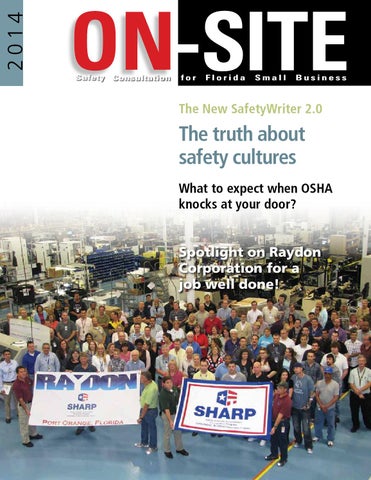
The truth about safety cultures What to expect when OSHA knocks at your door? Spotlight on Raydon Corporation for a job well done!
Program Directors' Columns
Dr. Yehia Hammad
Charlene Sitterly
Professor, USF College of Public Health
Program Manager
Program Director
USF SafetyFlorida Consultation Program
USF SafetyFlorida Consultation Program
Y
ou may recall that in the past, safety and health programs did not exist, or if they did exist, they were in name only. Also, you may remember when a worker would walk on rooftops without any fall protection or when workers inhaled asbestos fibers or when little or no personal protection was used in the workplace. Everyone acknowledges that workplace safety and health is important, yet it is sometimes unintentionally overlooked, leaving workers and others at a worksite exposed to risk. That is why well implemented safety and health programs which include policies and work practices designed specifically for every workplace are important. An effective safety and health program should not only implement the OSHA regulations to reduce the exposure to hazards in the workplace, but also should include detailed procedures to integrate safety and health related decisions and precautions into the design of jobs and work processes. Also, in order for a program to work, it is essential that proper safety and health training is included because it provides the tools that workers need to understand and keep their own work areas safe. I am very pleased to share that USF SafetyFlorida’s home page (www. safetyflorida.usf.edu) has a new and improved web-based tool geared towards preventing workplace injuries and illnesses. The SafetyWriter 2.0 was re-designed to assist small business employers in creating tailored, industry-specific illness and injury protection plans. This web-based tool enables employers to easily assemble and customize a protection plan in a few easy steps. Implementing an effective safety and health program using this e-tool is a cost effective way for employers to lower injury and illness rates leading to higher profit margins. Safety is not expensive; it is priceless and tomorrow is a precious reward for working safely today. (USF SafetyFlorida is the state of Florida’s official small business safety and health consultation program. The program, funded by OSHA and the state of Florida, provides free and confidential occupational safety and health services to small businesses throughout Florida. For more information or to request a complimentary consultation, visit www.safetyflorida.usf. edu or call toll-free 1-866-273-1105).
Cover photo: Raydon Corporation employees receiving their SHARP Award.
1
USF SafetyFlorida On-Site
N
o job is a good job unless it's a safe job. That is the basic belief of the USF SafetyFlorida Consultation Program. We firmly believe that workers should not have to risk their lives or their health while working to provide for their families.
Last year we conducted over 747 free on-site consultation visits to small and medium-sized businesses to help protect more than 40,710 workers. We also conducted training sessions, and through on-site program assistance, outreach and education, we helped Florida businesses implement effective safety and health management systems. The latter is especially critical to driving down injury, illness, and fatality rates. Our employers in the Federal SHARP and Sunshine State Safety Award recognition programs know that safety is good for business. We encourage them to share best practices with other Florida employers. According to 2012 data from the Bureau of labor and statistics, fatal work injuries totaled 209 in Florida. This averages to 17 Florida workers dying each month. And every year, thousands of Floridians suffer a serious workplace injury. Tragically, these deaths and injuries are preventable - preventable by basic safety precautions such as providing a safety harness and line to prevent workers from falling off a roof; shoring up a trench to make sure it doesn't collapse; or guarding a machine so a worker doesn't get his hand cut off. At USF SafetyFlorida, our mission is to protect workers from injuries and illnesses on the job. We also protect Florida’s small business economy by keeping dollars in employers’ pockets instead of being paid out in through higher workers’ compensation premiums, hospital or urgent care bills, and lost time production. If your company needs assistance with workplace safety and health, let us help. We will perform a free, confidential and comprehensive analysis of your worksite to assess how your safety and health management system can be improved. Furthermore, if your worksite has hazards or potential hazards, we will help you address those areas, understand how to correct them, and provide recommendations and guidance to prevent the hazards from occurring in the future. You have nothing to lose and everything to gain from on-site consultation. If we can help prevent an OSHA citation and penalty, your consultation’s return on investment will be worth it, in the short- and long-term. Request yours today at www.safetyflorida.usf.edu.
table of contents
20 14,
4
8
Vol.
7.
Issue
1
table of contents 1 3 5 7 9 11 17
Program Directors' Columns USF SafetyFlorida News USF OSHA Training Institute Education Center News Think SHARP Sunshine State Safety Recognition Award Features USF SafetyFlorida Management Tool 17 SafetyWriter
18 19 21
ISSUE SPOTLIGHT WhaT WE SEE USF SAFETYFLORIDA ACHIEVEMENTS AND ACCOLADES
Program Manager
Charlene Sitterly USF SafetyFlorida College of Public Health
9
13201 Bruce B. Downs Boulevard, MDC 56 Tampa, FL 33612-3805 1-866-273-1105 www.safetyflorida.usf.edu Reading this code with your smartphone, using QR code scanning software such as http://web.scanlife.com/en/ download-application, will enable you to go directly to the USF SafetyFlorida website.
csitterl@health.usf.edu
Designer
Martin Young martin@youngdesign.us
Editor
Thalia Barber tbarber@health.usf.edu
19
On-Site magazine is published annually by USF SafetyFlorida, a small business safety and health consultation program funded by the Occupational Safety and Health Administration (OSHA) and the Florida Department of Financial Services’ Division of Workers’ Compensation. The University of South Florida College of Public Health is the academic home for USF SafetyFlorida. 2
USF SafetyFlorida News
Webinar promotes safe practices against fall prevention This year, USF SafetyFlorida Consultation Program and the USF OSHA Training Institute Education Center hosted a free fall protection webinar geared towards the construction industry, in an effort to promote better and safer practices against fall prevention, create safety awareness through training and applicable standards, and to ultimately decrease worksite fatalities. Topics discussed included OSHA regulatory update on fall prevention in construction, fall protection hazards on construction sites, solutions and training for prevention of accidents and fatalities, and implementing injury prevention plans and safety management systems for fall protection. The webinar was in direct response to OSHA’s nationwide outreach campaign that targets fall prevention in the construction industry. More than 300 General Contractors, Sub-Contractors and Construction workers attended this webinar. The University of South Florida College of Public Health is the academic home for USF SafetyFlorida Consultation Program and the USF OSHA Training Institute Education Center. They are based in the Department of Environmental and Occupational Health.
Florida’s newly certified SHARP companies received recognition letters from Florida Governor Rick Scott in May. See page 8 for complete list of Florida SHARP companies.
Governor Rick Scott recognizes Florida's new SHARP employers
Florida Governor, Richard (Rick) L. Scott
Governor Rick Scott recognized seventeen new Florida SHARP employers for exemplary workplace safety practices with a letter he sent to each of the companies. OSHA's Safety and Health Achievement Recognition Program award is the highest safety honor for small businesses and granted to employers nominated by USF SafetyFlorida. SHARP certified companies are exempt from OSHA inspections for a period up to two years, with the exception of a serious accident, fatality or employee complaint. In his letter to the employers, Scott wrote, "Your commitment to a safe work environment for Floridians is to be commended. We are fortunate to have companies like yours in the Sunshine State who provide a safe place to work each and every day."
USF SafetyFlorida continues presence at Florida Division of Workers' Compensation's Workplace Safety seminars
There are currently 51 SHARP-certified businesses in the state of Florida. To qualify, a firm must: • Request and undergo a consultation visit from USF SafetyFlorida • Involve all employees in the consultation process • Correct hazards identified during the on-site consultation • Implement and maintain a safety and health management system that, at a minimum, addresses OSHA's 1989 Safety and Health Program Management Guidelines • Reduce their Lost Workday Injury and Illness Rate and Total Recordable Case Rate below the national average for their industry • Agree to notify USF SafetyFlorida prior to making changes to working conditions or introducing new hazards into the workplace
USF SafetyFlorida partnered for the fifth year with the Florida Division of Workers' Compensation at its workplace safety seminars. Held throughout the state, the free and educational seminars provide attendees with important information about workers' compensation laws as well as workplace safety. In 2013, 26 seminars were held with 311 attendees, ranging from business owners, licensed contractors and other employers.
SHARP Webinar offered to existing SHARP Award recipients
Sheryle Birdsong with the Division's Compliance Bureau says the partnership is a win-win. "The (consultation) program is an integral part of the educational program. Having USF SafetyFlorida’s presence at the seminars really does round out our discussion of what the law’s requirements are and what resources are available," says Birdsong. The Division of Workers' Compensation is part of Florida's Department of Financial Services and handles workers' compensation claims for employees who are injured or killed on the job. For the past four years, total health care provider payments have exceeded $500 million annually due to workplace injuries, illnesses and fatalities. Note: The Division’s trust fund adds a 10 percent matching grant to the federal government’s funding of the USF SafetyFlorida consultation program.
3
USF SafetyFlorida On-Site
USF SafetyFlorida Consultation Program, along with the USF OSHA Training Institute Education Center and Florida Division of Workers’ Compensation joined forces to host a Safety & Health Awareness Recognition Program (SHARP) webinar. This webinar was created solely for qualifying employers, who are operating exemplary safety and health management systems, and whom already are in receipt of the SHARP award. This purpose of this webinar was to discuss the following topics: • New OSHA updates o Temporary Workers o Hospital Safety o Whistleblower Guidelines o Crystalline Silica PEL Update • Safety Incentive programs • Florida SHARP Associations • How to stay SHARP after receiving the initial award • Rules and Responsibilities to maintain SHARP status • Testimonials – How has the SHARP program benefited your company?
The SHARP webinar was attended by approximately 33 SHARP award recipients. This 1-hour webinar was very informative and well received by the attendees based on the results obtained from the Customer Satisfaction Surveys. In conjunction with the USF SafetyFlorida Consultation Program, the USF OSHA Training Institute Education Center offers free resources and inexpensive training and education. USF OTIEC is a non-profit organization, authorized by the Occupational Safety and Health Administration to teach OSHA approved numbered courses offered in a variety of settings, (i.e. – Online and In-class). For more information email: mkellerm@health.usf.edu.
Fall protection leads OSHA top 10 most-cited and highest penalties lists The Occupational Safety and Health Administration (OSHA) released its Top 10 Most Frequently Cited Standards list for 2013. The cited standards for fiscal year 2013 (October 1, 2012 through September 30, 2013) included (standard numbers are in parentheses below) the following: 1. Fall protection, construction (29 CFR 1926.501) 2. Hazard communication standard, general industry (29 CFR 1910.1200) 3. Scaffolding, general requirements, construction (29 CFR 1926.451) 4. Respiratory protection, general industry (29 CFR 1910.134) 5. Electrical, wiring methods, components and equipment, general industry (29 CFR 1910.305) 6. Powered industrial trucks, general industry (29 CFR 1910.178) 7. Ladders, construction (29 CFR 1926.1053) 8. Control of hazardous energy (lockout/tagout), general industry (29 CFR 1910.147) 9. Electrical systems design, general requirements, general industry (29 CFR 1910.303) 10. Machinery and Machine Guarding, general requirements (29 CFR 1910.212)
OSHA, USF SafetyFlorida and Barton Malow Company Strategic Partnership On April 4, 2014, the Daytona International Speedway Front Stretch Redevelopment Project Strategic Partnership (referred to as the DIS Partnership) between the Occupational Safety and Health Administration Jacksonville Area Office, the University of South Florida SafetyFlorida Consultation Program and Barton Malow Company was signed. The Partnership which was developed jointly by the three partners covers the construction of the Daytona International Speedway (DIS) Front Stretch Redevelopment Project, which is located in Daytona Beach, FL. Common objectives and goals of the Partnership include the following: 1. Reduce injuries and illnesses 2. Increase safety and health training 3. Share of best work practices 4. Ensure employers have appropriate safety and health management systems
This Partnership is consistent with OSHA’s long-range efforts to develop a contractor/ government partnership approach to safety management. It allows for better use of OSHA resources and innovation in safety management and encourages more participation in the safety process from the construction community. The purpose of this partnership is to create a working relationship that focuses on preventing work-related fatalities, controlling or eliminating serious workplace hazards, and establishing a foundation for the development of an effective safety and health program. To facilitate the goal of reducing occupational related fatalities and serious injuries within the construction industry, OSHA, USF SafetyFlorida Consultation and Barton Malow Company will implement this agreement under the OSHA Strategic Partnership Program (OSPP). By combining their efforts, skills, knowledge and resources, OSHA, Barton Malow Company and USF SafetyFlorida Consultation Program expect to reduce exposure to hazards and thereby decrease the possibility of serious injuries and fatalities during all phases of construction at the DIS Partnership site.
Occupational health nursing students experience workplace safety firsthand Students enrolled in the University of South Florida’s Occupational Health Nursing Program were able to experience firsthand, issues involving safety and health in the field and the ability to apply learned applications in the classroom, to real, live jobsites in the field. This was especially a great learning experience for USF Nursing student, Lynn Henderson. Ms. Henderson was able to don Personal Protective Equipment (PPE) and observe USF SafetyFlorida Consultant, Jim Ulseth, interact with small business owners. Ms. Henderson was also able to see the correlation between applications learned in class, and how they are applied to the field, such as the evaluation of a Safety & Health Program, actual workplace violations, and suggested recommendations on how to correct and prevent certain hazards from reoccurring. “She believes that it is the desire of most employers to keep their employees safe, and that the USF SafetyFlorida Consultation Program can be beneficial to those employers who wish to take advantage of it.” This is the fifth year that students from the graduate certificate program have participated in the shadowing experience. 4
U S F O S H A Tr a i n i n g I n s t i t u t e E d u c a t i o n C e n t e r N e w s
Bob Nesbit Program Manager USF OSHA Training Institute Education Center
The USF OSHA Training Institute Education Center: Florida's Workplace Safety Training and Continuing Education Resource
T
he USF OSHA Training Institute Education Center is happy to report another successful year of teaching and educating students and employers on Occupational Safety and Health topics. This year, our program trained over 4,500 students via online and in a classroom setting. Furthermore, our OSHA authorized trainers have delivered safety training courses to more than 23,700 student’s to-date. The USF OSHA Training Institute Education Center currently has 2,300 active OSHA authorized outreach trainers. It is our goal to teach employees in the construction, general and maritime industries how to recognize and correct hazards within the workplace to create a safe and healthful work environment for all employees.
USF OSHA Training Institute Education Center located in Wesley Chapel, FL.
5
USF SafetyFlorida On-Site
Recently, Temporary Workers have been making headlines due to countless reports of serious and fatal injuries. The Occupational Safety and Health Administration (OSHA) has therefore launched a Temporary Worker Initiative and made a concerted effort to provide enforcement, outreach and training to protect temporary workers, and ensure that they are afforded the same training and education opportunities as permanent workers. This initiative was created on April 29, 2013 to ensure that both host employers and staffing agencies alike, are knowledgeable about their individual roles and responsibilities as it relates to temporary workers. Staffing agencies and host employers are jointly responsible for defining duties and scope of work in the temporary workers contract, providing adequate training, ensuring hazard communication and recordkeeping requirements are being met, and for maintaining a safe work environment. OSHA has also implemented a new educational tool, now readily accessible at https://www.osha.gov/temp_workers/ that will better identify who is responsible for recording injuries and illnesses for temporary workers. The tool further explains the reporting requirements for staffing agencies and host employers. Under the OSHA Recordkeeping regulation 29CFR 1904, covered employers are required to prepare and maintain records of serious occupational injuries and illnesses. Need help completing the OSHA 300 log? Consider these classes: OSHA 9073 – 1 hour General Industry Recordkeeping course or OSHA 9043 – 1 hour Construction Recordkeeping course. Contact the USF OSHA Training Institute Education Center for scheduling and course availability.
Private Safety Training Bringing safety training directly to a company saves clients money in travel-related costs. Moreover, we can create customized courses to meet an employer’s education needs. We send an instructor to a facility at a time that works best for them, and the course is tailored to meet its specific training needs. Regularly Offered Courses The center's catalog of courses includes the following classes: Online • • • • • •
Certified Aggression Control Manager 24-hour HAZWOPER 8-hour HAZWOPER 4-hour Recordkeeping Fleet Driver Program Safe Teen Jobs Awareness Training
Specialty 1-hour Online Courses • • • • • • • • • •
Fall Protection Blood Borne Pathogens Scaffold Stairways and Ladders Introduction to OSHA OSHA Standards and Inspection Procedures Personal Protective Equipment Recordkeeping Safety Programs Rigging and Material Handling
General Industry • OTI 501 Trainer Course in Occupational Safety and Health Standards for the General Industry • OTI 503 Update for General Industry Outreach Trainers • OTI 511 Occupational Safety and Health Standards for General Industry • OTI 521 Guide to Industrial Hygiene • OTI 2015 Hazardous Materials
• OTI 2045 Machinery and Machine Guarding Standards • OTI 2225 Respiratory Protection • OTI 2255 Principles of Ergonomics • OTI 2264 Permit Required Confined Space Entry • OTI 3015 Excavation, Trenching and Soil Mechanics • OTI 3095 Electrical Standards • OTI 6000 Collateral Duty Course for Other Federal Agencies • OTI 6010 Occupational Safety and Health Course for Other Federal Agencies • OTI 7000 OSHA Training Guidelines for Safe Patient Handling • OTI 7100 Introduction to Machinery and Machine Safeguarding (8 Hour) • OTI 7105 Introduction to Evacuation and Emergency Planning • OTI 7115 Lock out/Tag Out Controlling Hazardous Energy to Prevent Workplace Injury • OTI 7120 Introduction to Combustible Dust Hazards • OTI 7200 Blood Borne Pathogens Exposure Control for Healthcare Facilities • OTI 7205 Health Hazard Awareness • OTI 7300 Understanding OSHA's Permit Required Confined Space Standards • OTI 7410 Managing Excavation Hazards • OTI 7500 Introduction to Safety and Health Management • OTI 7505 Introduction to Accident Investigation • OTI 7510 Introduction to OSHA for Small Business • OTI 7845 Recordkeeping Rule Seminar Construction • OTI 500 Trainer Course in Occupational Safety and Health Standards for the Construction Industry • OTI 502 Update for Construction Industry Outreach Trainers • OTI 510 Occupational Safety and Health Standards for the Construction Industry
USF OSHA Training Institute Education Center 2612 Cypress Ridge Boulevard, Suite 101, Wesley Chapel, FL 33544 usfotioutreach@health.usf.edu • www.usfoticenter.org.
• OTI 3015 Excavation, Trenching and Soil Mechanics • OTI 3115 Fall Protection • OTI 7400 Trainer Course in Construction Noise • OTI 7405 Fall Hazard Awareness for the Construction Industry • OTI 7415 OSHA Construction Industry Requirements: Awareness of Major Hazards and Prevention Strategies • Scaffolding Qualified Person Training • Fall Protection Qualified Person Training • USF 9001 Sub Part R Steel Erection Safety Standards Maritime • OTI 5400 Trainer Course in Occupational Safety and Health Standards for Maritime Industry • OTI 5402 Up-Date for Maritime Outreach Instructors • OTI 5410 Occupational Safety and Health Standards for the Maritime Industry We offer “contract” classes for 10 and 30 hour maritime outreach courses. Please send us an email at usfotioutreach@health.usf.edu if you have any questions. Disaster • OTI 5600 Disaster Site Worker Train-theTrainer Course • OTI 5602 Update for Disaster Site Worker Trainer Course • OTI 7105 Evacuation and Emergency Planning • OTI 7600 Disaster Site Worker Course
Professional certificates in General Industry, Construction and Maritime are now offered through the USF OSHA Training Institute Education Center. Contact us for more information.
For more information about the USF OTI Education Center and to register for classes, visit us on the web at www.usfoticenter.org or call 813-994-1195. 6
Safety & Health Achievement Recognition Program Award
Exemplary Safety and Health Equates to Prestigious SHARP Certification What is SHARP?
O
SHA created the Safety and Health Achievement Recognition Program award to recognize small business owners who operate an exemplary safety and health management system (SHMS). Once SHARP certified, employers are exempt from OSHA inspections for a period up to two years, with the exception of a serious accident, fatality or employee complaint. Firms throughout the U.S. can earn a SHARP award, and for a Florida company the approval process begins with a recommendation to OSHA from USF SafetyFlorida.
How Can Your Company Become SHARP? Companies interested in pursuing SHARP status must first request a safety and health consultation from USF SafetyFlorida. The on-site consultation involves a comprehensive safety and health hazard survey of the worksite(s) involved, including equipment and work processes. Other qualifying requirements for the SHARP program include: • Have at least one year of operating history at the company or worksite; • Implement, demonstrate and maintain a safety and health management system (SHMS) that, at a minimum, addresses the major elements of OSHA’s 1989 Safety and Health Program Management Guidelines; • Lower the company’s Days Away, Restricted or Transferred (DART) rate and Total Recordable Case (TRC) rate below industry national average; • Correct all hazards identified by the consultant; • Agree to notify the USF SafetyFlorida Consultation Program prior to making changes in working conditions or work processes that may introduce new hazards into the workplace.
7
USF SafetyFlorida On-Site
First-Time SHARP Certification and Exemption Once a business satisfies all SHARP requirements, a USF SafetyFlorida consultant may recommend it for SHARP approval and certification. If approved by OSHA, the company will receive formal SHARP recognition from OSHA and USF SafetyFlorida during an award ceremony. The company will also be exempt from OSHA inspections for a period up to two years.
SHARP Renewal If a company wishes to renew its SHARP certification, the application process must begin during the last six months of its exemption period. The company must also undergo a comprehensive visit by a USF SafetyFlorida consultant to ensure its SHMS has improved or maintained. Furthermore, the employer must meet all SHARP eligibility requirements, agree to conduct self-evaluations and provide a written report based on the elements of OSHA 1989 Safety and Health Program Management Guidelines and OSHA’s required injury and illness logs.
SHARP Deferral If a business meets most but not all of OSHA’s SHARP eligibility requirements, a USF SafetyFlorida consultant may recommend a business for an inspection deferral up to 18 months, provided the company has: • Completed a hazard identification survey with a USF SafetyFlorida consultant and corrected all identified hazards; • Implemented, demonstrated and maintained a SHMS that, at a minimum, addresses the major elements of OSHA’s 1989 Safety and Health Program Management Guidelines; • Implemented an action plan with established abatement dates that completes the necessary items that prevented the company from reaching SHARP status during the original survey.
Why SHARP? Many small businesses who have received the SHARP award view it as a way to take their pre-existing safety and health management system to a higher level, as well as a means of demonstrating their businesses pride and commitment to ensuring a safe and healthful work environment for their employees. “Our desire is to improve our safety and health culture among all employees”, states Tammy Wainright, President of Main Metal Recycling of Jacksonville. “USF SafetyFlorida Consultation provides the information and services needed to create and maintain a safe work environment, and the high standard that the SHARP program sets, challenges us to continue to pursue the award and the safety culture recognition”, she adds. Ms. Karen Preusz, Director of Nursing for Quality Health Care Center says, “When top management really cares, it speaks volumes. It sends a direct message to front line employees that they care about me. USF SafetyFlorida Consultation has been a very valuable resource for information. The SHARP award has empowered our staff to take pride in their workplace and allows them to truly experience the fact that safety is everyone’s responsibility,” continues Preusz. Other companies that earn SHARP status report lower operating costs and recordable incidents, which result in higher profit margins. Alti-2, an altimeter manufacturer for the sport and military parachuting industry, has been working with USF SafetyFlorida since 2006. In 2008, Alti-2 had a zero Total Recordable Case (TRC) and Days, Away, Restricted or Transferred (DART) rate. The company’s owner, Kathy Grix, believes that “Implementing safety and health takes much time and effort, but pays handsomely in the long run with a sustained excellent safety record.”
Florida’s SHARP Companies This year 51 Florida companies qualified for OSHA’s SHARP award and two qualified for a SHARP deferral.
SHARP Key: (N) = new (R) = renewal
(D) = deferral Main Metal Recycling of Jacksonville
(R) (N) (R) (R) (N) (N) (R) (N) (R) (N) (R) (N) (R) (R) (N) (N) (N) (N) (N) (N) (N) (R) (R) (R) (R) (R) (R) (R) (R) (N) (R) (R) (N) (N) (R) (R) (R)
Main Metal Recycling, Jacksonville Southeast Wood Treating, Rockledge Ajax building Corp, Midway Romac Lumber, Leesburg Cast Crete Corp, Seffner Metal Industries, Bushnell Phoenix Wood Products, Ocala Accuform Signs, Brooksville Moss & Associates, FT. Lauderdale Seaonus Stevedoring, Jacksonville Southern Manufacturing Technologies, Tampa Cypress Cove Centre, Crystal River Sypris Electronics, Tampa MI Metals, Oldsmar Charlotte Harbor Health Care, Charlotte Harbor Portus Services, Jacksonville King Plastic Corp, North Port Eastern Metal Supply, Lakeland Trumeter, Deerfield Beach Palm Garden of Largo, Largo Suncoast Beverage Sales, Ft Myers Cable USA, Naples Trusswood, Inc., Titusville Ayers Health & Rehab Center, Trenton Gate Precast – Jacksonville Great Southern Wood of Florida, Lake Panasoffkee BAE Aerospace Solutions, Crestview Associated Grocers of FL, Pompano Beach Daws Manufacturing, Pensacola Precision Econowind, Ft Myers Raydon Corporation, Port Orange Alti-2, Deland Neptune Research, Lake Park American Thermoplastic Extrusion Co, Miami American Compliance Technologies, Bartow Florida Presbyterian Homes, Lakeland Aluma Tower Co. – 1639 Old Dixie Hwy, Vero Beach
(N) (R) (R) (R) (R) (N) (R) (N) (R) (N) (R) (N) (N) (N)
Aluma Tower Co – 926 Old Dixie Hwy, Vero Beach Bealls 810 (distribution & transportation center), Bradenton Bealls 817 (distribution & transportation center), Bradenton Trucks and parts of Tampa, Tampa Technology Conservation Group, Lecanto Portus Stevedoring, Jacksonville Cox Seafood, Tampa Kauff’s Transportation, West Palm Beach New Limeco, Princeton Control Micro Systems, Winter Park Probuild # 82, Milton ClassB, Inc. Canterbury Tower Quality Health Care Center
Quality Health Care Center of North Port
Raydon Corporation of Port Orange
ClassB, Inc. of Zephyrhills
Alti-2, Inc. of Deland
Ready to become SHARP? Contact USF SafetyFlorida at 1-866-273-1105 or visit us online at www.safetyflorida.usf.edu to request a free on-site consultation. 8
Sunshine State Safety Recognition Award
Commitment to Safety and Teamwork Make the Difference
A
sk any successful owner of a high-risk industry business their advice on keeping incident levels low, and their answer will most likely be staff working together to keep a job site safe. This employeremployee safety commitment is the reason USF SafetyFlorida created the Sunshine State Safety Recognition Award. Since 2006, USF SafetyFlorida has bestowed the Sunshine State Safety Recognition Award on small businesses in all industries that proactively and routinely engage in job safety. Approximately 40 firms earn this honor annually, and it recognizes firms that have implemented good safety initiatives to better protect employees on the job. According to Keith Brown, a USF SafetyFlorida safety and health supervisor, “Team work is essential in accident prevention, and when there are open lines of communication between workers and management, it speaks volumes about a company’s commitment to safety.” To qualify, a business should request and receive a complete on-site consultation survey and employ at least one person at the worksite to be evaluated. Additionally, the business should
USF SafetyFlorida developed the Sunshine State Safety Recognition Award to motivate and support employers who demonstrate a commitment to continuously improve their workplace safety and health management system.
9
USF SafetyFlorida On-Site
have no willful, repeat or willful-repeat citations within 24 months of the consultation and no serious citations related to injury or exposure within 12 months of the consultation. During the consultation, a safety consultant will perform a comprehensive on-site evaluation of all written accident prevention management programs. The consultant will also speak with workers and conduct an evaluation of the work area. The safety consultant will review: • Administration and oversight of safety management programs • Safety and health management practices • Safety training and instruction • Employee safety rules
• Internal safety inspection routines for new and existing substances, processes and equipment If hazards are identified during the visit, an abatement of those specific hazards must take place before recognition is granted. Once initial and final consultations are complete, a safety consultant may decide to formally recommend the firm for a Sunshine State Safety Recognition Award, which is approved by USF SafetyFlorida management. A formal letter of commendation is sent to the company, recognizing the employers’ and employees’ efforts in implementing and maintaining an effective injury and illness prevention program. “Working together towards maintaining safety is something everyone can take pride in,” adds Brown.
Oil Spill Response USA, Inc., of Ft. Lauderdale
The 2014 Sunshine State Safety Recognition Award recipients include: CHEP Aerospace Solutions Landmark Aviation – North County Airport
CHEP Aerospace Solutions of Miami
Landmark Aviation - Miami Airport Oil Spill Response USA Inc. The Protective Group EMJ Hospitality – Marriott Hotel Moss & Associates – Flagler Village Munilla Construction Management The Health Center of Coconut Creek Locus Traxx of Jupiter MCM Miramar Readiness Center of Miramar MCM Ravenswood Bus Maintenance
Landmark Aviation of North County Airport
Facility of Ft. Lauderdale The Protective Group of Miami Lakes
10 10
Features
What to expect when OSHA knocks at your door?
I
am asked this question repeatedly: “What will OSHA look for if I get inspected?’” Honestly, there’s no simple answer. The hazards inside your facility or jobsite are as unique as you, your company, and the product or service you provide. A good starting point to determine where OSHA enforcement will focus its efforts when it comes to your location can be found online via www. OSHA.gov, or on (page 4 – The top 10 cited standards.)
Thinking like a Compliance Officer
Navigating Standards
From my experience in speaking with employers whose businesses have been inspected, most compliance officers will take the path of least resistance. If an officer is noting obvious hazards throughout the facility/worksite, there is a good chance that is where they will focus their inspection. For example, if many unlabeled or incorrectly labeled containers are found, more than likely the inspector will focus on your hazard communication program and training.
Another common question I am asked by many employers is “How do I know which standards apply to me?” Some standards are easier to pinpoint than others. For example, if you use forklifts and chemicals at your location, then the powered industrial trucks and hazard communication standards will apply to your establishment. However, as the employer, you must know what is associated with each standard, which could include a written program, training, etc.
Therefore, some of the first steps you can take in an effort to eliminate hazards within the workplace are training and inspections. However, before effective inspections can be performed, you must first gain the knowledge of hazard Now compare the OSHA’s Top recognition. This can be acquired 10 Cited Hazards list to those through training that can be frequently identified by our David Ashman provided by our consultants or USF SafetyFlorida consultants, Safety and Health Consultant the USF OSHA Training Institute and it is quite obvious which Education Center (http://usfoticenter.org/.) hazards are the most commonly seen at a jobsite As you will observe from the list, there is a good mix of citations related to construction, general industry and standards that apply to both, such as Hazard Communication.
or facility. Hazards identified by USF SafetyFlorida Consultants 2013-2014 1. 2. 3. 4. 5.
Walking Working Surfaces Hazard communication standard Forklifts Respiratory protection Electrical systems design, general requirements 6. Personal protective 7. Fire Protection 8. Control of hazardous energy (lockout/tagout) 9. Recordkeeping 10. Machine Guarding
Whether your company falls under general industry, construction or both, it would be best to focus on those areas that have been noted on both lists.
11
USF SafetyFlorida On-Site
Inspections should be performed on a regularly scheduled basis. How often really depends on the work being performed and the environment. If you are a small manufacturer, monthly would be acceptable; however, a construction site should be inspected daily since the work environment is in a constant state of change. If possible, inspections should be performed by more than one individual, in an effort to eliminate complacency or “pencil whipping” the forms. Fresh eyes normally notice items that are being taken for granted on a daily basis.
For other standards it can be much more complicated in not just determining if the standard applies, but which parts of the standard. Your best bet in determining which standard, training and/or written programs apply would be to schedule a free consultation with USF SafetyFlorida. Not only will our consultants assist you with understanding and interpreting the standards, they can also help you in identifying hazards in your workplace, reviewing your injuries for trends, developing a safety culture, and possibly assist you in lowering your workers’ compensation cost.
What Kind of Safety Culture Do Your Employees Follow… When You Are Not Around? What is a safety culture? Merriam-Webster defines culture as “a way of thinking, behaving or working that exists in a place or organization, such as a business.” Tack safety in front of the word culture, and it becomes the way we think, behave or work as it pertains to safety within our place or organization. For example, we wear safety glasses to protect our eyes from potential occupational injuries. But delve a little deeper into the why we wear safety glasses, and it becomes more significant. We wear safety glasses to protect our eyes, so we can see our kids grow up.
by having employees focus on getting everyone safely home to their family in the same condition that they came to work. Rather than because the supervisor said so or because that’s the way we do it, do it to return home safely to your family. I hear owners and managers say that the reason the shop or the jobsite is in such a mess or the reason that people aren’t working safely
is “because the company safety director is out sick or took another job.” A safety Safety and Health Consultant director does not make an effective safety culture (although they can be a significant factor in the process). People who look out for their fellow No Excuses employees make an effective safety culture. It Over the years, I’ve heard supervisors make is a learned belief or an attitude that employees excuses why certain hazards are present or certain share in their relationship to safety. unsafe acts are performed. It’s always because he or she was on vacation, and the employees Study and Analyze were at fault. Sorry, but not true. Effective safety Instead of allowing little things to slide by and cultures are self-sustaining and exist whether the habits to fester, take a different approach. supervisor is there or not. It is less about you and Establish a company goal to study and learn more about employees’ choices. from every injury as well as near-miss incidents Jim Ulseth
Safety cultures thrive when there is management commitment, supervisory commitment, established safety rules and safety procedures, communication, training, and thorough inspection processes, hazard controls by virtue of effective design, an effective reporting system, and above all – employee involvement in every aspect of getting their job done safely. Instead of focusing on compliance, set the bar higher
and work diligently to prevent each one from recurring. How many near-miss incidents does it take before we have an injury and perhaps a significant injury? Ask yourself: • Could we do the task differently? • Could we do the job safety training differently? • Could we establish a different inspection or observation process?
• Did we involve the worker doing the job in his perception of what could change to make the process safer, and above all, did we listen? Before most injuries occur there are definite warning signs. After an injury while you’re doing your accident investigation, don’t throw your employees under the bus. Instead of simply saying the employee was at fault, ask these questions: • What did I miss? • Was he doing it unsafely yesterday or last week and I missed the opportunity to correct it? • Was my training for that employee weak or flawed? • Was my discipline technique lame? • Do I need to do the training better or differently? • Did my behavior allow him to get hurt? • Did I let my employee down? Blow the dust off your written safety program. You likely have very good written programs and inspection checklists, but are they being read and are they being applied? Like any good tool, if it isn’t used – what good is it really? Some workers refuse to get involved or cooperate with accident investigations because they mistakenly believe that its purpose is to place blame on someone else. However, without full cooperation from everyone, inaccurate conclusions may be reached as to the cause of the incident, and proper measures may not be taken to prevent a reoccurrence. In an effective safety culture, employees cooperate, employees pay attention during training and ask questions in an effort to raise the bar and work diligently to get everyone safely back home to their families. What kind of safety culture do your employees have …when you are not around?
To learn more about safety culture, visit https://www.osha.gov/SLTC/etools/safetyhealth/mod4_factsheets_culture.html. If you would like to request a free and confidential on-site safety consultation, visit www.usfsafetyflorida.usf.edu.
12
Features
Using Heat Index to Manage Heat Stress
L
ast year, I discussed how to effectively
Because WBGT is the reference index for
then the amount of work time should be balanced
manage heat stress in Florida. One
occupational exposures, it is worthwhile
by the recovery time in the same environment.
premise was that work outside in the
mentioning how well Heat Index is related to
These proportions of work/recovery are specified
summer is likely to be above normally
WBGT. For Heat Index values less than 100 째F,
on a 60-minute basis in Table 1. Once the trade-
accepted occupational exposure limits. So
the table overstates the level of heat stress for
off between work and recovery becomes limited,
it would be appropriate to institute at least basic
conditions at 20% relative humidity and to a
Table 1. indicates Caution. At this point, the heat
heat stress management practices.
lesser extent for 40% Relative humidity. The
stress can be substantial and extra care should be
problem of overprotection is small above a Heat
taken in the management of heat stress.
To evaluate the level of heat stress, it is
Index of 100 째F.
important to consider the environmental
Bernard, T.E. & Iheanacho, I. (2014)
conditions, the work demands and the clothing
The Heat Index does not account for radiant
requirements. Humidity plays the largest role in
heat. As the Heat Index increases, the effect
the contributions to heat stress. This is the reason
of radiant heat on the index increases. For
that air temperature alone does
practical purposes, work in the
If you are interested in discussing your situation,
not provide much insight to
sun between 10 AM and 3 PM
please contact a USF SafetyFlorida consultant at
the level of heat stress. Work
can be accounted for by adding
www.usfsafetyflorida.com or Thomas Bernard at
demands indicate how much
10 째F to the Heat Index. This
tbernard@health.usf.edu.
heat is being generated inside
again is protective below 100 째F.
the body that must be removed through sweat evaporation
The heat stress level also depends
to the environment. For this
on the work demands. The
article, we assume clothing will be ordinary woven clothing that includes pants and a shirt with long sleeves. With respect
three work demand levels are Thomas E. Bernard College of Public Health, University of South Florida
described in Table 2. There is a column in Table 1 for each work demand level. As can
to heat stress evaluation, the greater the work
be seen, the heat stress level designation (see
demands the dry and cooler the environment
Table 3) indicates higher heat stress for the same
must be to remove the heat generated by the
Heat Index as the work demands level increases.
body.
Examples for the ISO are offered for the types of work in each category. Over the course of an hour,
Wet bulb globe temperature (WBGT) is the most
Heavy work is seldom observed. That is, most work
common index of the environment used to
can be described as Light or Moderate.
assess occupational exposures to heat stress. The threshold WBGT is adjusted depending on the
The Heat Stress levels in Table 1. are described
work demands. Because the National Oceanic and
in Table 3. Alert/Action Limit (AL) is the point at
Atmospheric Administration (NOAA) Heat Index is
which heat stress may affect those who are not
roughly related to WBGT, this article provides some
acclimatized to the heat. Thus a combination of
guidance on when the heat stress exposure limit
Heat Index and Work Demand below the AL is not
might be exceeded based on Heat Index. We chose
associated with heat stress. Once somebody has
the Heat Index because it is widely recognized and
worked for 2 or more hours in a hot environment
reported through the National Weather Service.
for 5 of the last 7 days, they can be considered
The guidance is provided in Table 1. To compute an
acclimatized. The Exposure Limit (EL) marks the
accurate Heat Index, air temperature and humidity
point at which they would be considered exposed
must be measured concurrently.
to heat stress. As the heat stress level increases,
13
USF SafetyFlorida On-Site
Heat Light Index [°F] † 180 W
77 78 79 80 81 82 83 84 85 86 87 88 89 90 91 92 93 94 95 96 97 98 99 100 101 102 103 104 105 106 107 108 109 110 111 112 113 114 115 116 117 118 119 120 121 122 123 124 125 >125
Moderate Heavy 300 W 415 W
<AL <AL <AL <AL <AL <AL <AL <AL <EL <AL <AL <EL <AL <AL <EL <AL <AL <EL <AL <AL <EL <AL <AL <EL <AL <AL <EL <AL <AL <EL <AL <EL <EL <AL <EL <EL <AL <EL <EL <AL <EL <EL <AL <EL <EL <AL <EL <EL <AL <EL 45/15 <AL <EL 45/15 <AL <EL 45/15 <AL <EL 45/15 <AL <EL 40/20 <AL <EL 40/20 <AL <EL 35/25 <EL 45/15 35/25 <EL 45/15 30/30 <EL 45/15 30/30 <EL 45/15 25/35 <EL 40/20 25/35 <EL 35/25 20/40 <EL 35/25 20/40 <EL 30/30 20/40 <EL 30/30 15/45 <EL 25/35 15/45 <EL 25/35 15/45 <EL 20/40 15/45 <EL 20/40 Caution 45/15 20/40 Caution 45/15 15/45 Caution 45/15 15/45 Caution 40/20 15/45 Caution 35/25 Caution Caution 30/30 Caution Caution 30/30 Caution Caution 25/35 Caution Caution 20/40 Caution Caution 15/45 Caution Caution 15/45 Caution Caution Caution Caution Caution Caution Caution Caution Caution Caution Caution
Table 1. Heat stress level for three work demands based on Heat Index. Add 10°F to Heat Index if the work is in direct sunlight. The work demands are expressed as Light, Moderate and Heavy (see Table 2). Exposure levels are based on an Alert/Action Limit (AL), Exposure Limit (EL), a Work/Rest allocation in minutes (Work/Rest), and Caution (see Table 3).
Table 2. Description of work demands in Table 1. Level
Description
Light (180 W)
Light manual work; such as, hand and arm work; arm and leg work (driving vehicle in normal conditions, operating foot switch or pedal). Standing and using powered tools or machine tending. Casual walking. Light work can be sustained for two or more hours
Moderate (300 W)
Sustained hand and arm work; arm and leg work; arm and trunk work; such as, plastering, intermittent handling of moderately heavy material, weeding, hoeing, picking fruits or vegetables, pushing or pulling lightweight carts or wheelbarrows, walking. In a cool environment, moderate work can be sustained by most people with a break every two hours. Heat stress can reduce the amount of time between breaks.
Heavy (415 W)
Intense arm and trunk work; carrying heavy material; shovelling; sledgehammer work; sawing; planning or chiselling hard wood; hand mowing; digging; fast walking. Pushing or pulling heavily loaded hand carts or wheelbarrows; chipping castings; concrete block laying. Heavy work cannot be sustained by most people without breaks within an hour. For this reason, it should not be considered as continuous work for an hour.
Table 3. Heat stress levels in Table 1. and appropriate actions. Level
Description
Alert/Action Limit (AL)
Below the AL, the heat stress exposure is minimal. At and above the AL, the heat stress may be significant for unacclimatized workers.
Exposure Limit (EL)
Above the EL, the heat stress is above the occupational exposure limit and heat stress controls should be considered.
Work/Recovery (e.g., 45/15)
Among the controls above the EL is work/recovery cycles. As the work period decreases (and the recovery period increases), the heat stress level is increasing.
Caution
Once the heat stress cannot be reduced through work/recovery cycles, then other precautions are necessary to manage the heat stress.
† Add 10°F to Heat Index if the work is in direct sunlight.
14
Features
Bridging The Language Barrier In Safety Bridging the language gap is critical to maintaining a safe Ned Fayson and healthful workplace. Safety and Health Consultant Over the past decade, remarkable gains have been achieved in occupational safety and health. Although general industry and construction injury and illness incidence rates have dropped, similar improvements have not occurred for non-English speaking workers such as Hispanics or Latinos. Fatal work injuries among Hispanic or Latino workers rose to 54 fatalities in 2012, up from 53 in 2011. Injuries and Illnesses 2012 Fatal Occupational Injuries – Florida, by ethnic group:
White: 121 Hispanic/Latino: 54 Black/African American: 38 Asian: 4 *Source: Bureau of Labor Statistics (BLS) 2011 Fatal Occupational Injuries – Florida, by ethnic group:
White: 133 Hispanic/Latino: 53 Black/African American: 32 Asian: 6 *Source: Bureau of Labor Statistics (BLS) English-speaking workers have the benefit of learning from each other (informal training) on the jobsite. Traditional safety training is not effective for immigrants who do not speak English or speak a little English, especially when it is delivered by a trainer who expects the worker to receive it, understand it and use it. Furthermore, safety meetings, tool box talks and briefings are not as productive when the knowledgeable trainer, supervisor or employer only speaks English. When workers cannot communicate effectively to perform work duties, co-workers also can become impacted resulting in low morale, low production and profit and potentially increased accidents.
15
USF SafetyFlorida On-Site
Under the Occupational Safety and Health Act of 1970, employers are responsible for providing a safe and healthy workplace for all employees. Collaborative efforts with government, trade associations, alliances, educational institutions, labor unions and employee representatives are essential to bridge the language gap in workplaces small and large across America with the ultimate goal of aggressively eliminating injuries, illnesses and fatalities for all workers. Closing the Gap OSHA has initiated alliances and public-sector outreach initiatives for Latino and Hispanic workers as well as other non-English speaking groups. Many OSHA publications and safety training materials are available in multiple languages, including Spanish, Chinese, Creole, Korean, Russian and Vietnamese. Efficient communication with non-Englishspeaking employees results in fewer workplace injuries, illnesses and fatalities. Some companies use innovative methods to bridge the language gap and improve communication, such as: • Seek out bilingual employees in your firm. These workers can relate to and can help nonEnglish speaking workers or trainees relax and get comfortable in both a formal and informal training session. They translate and enable clearer communication between English-speaking and non-English speaking employees, which can foster participation in training by asking questions and sharing past experiences, ultimately leading to safe performance on the job. • Offer hands-on training that requires demonstration of understanding. This can be an effective method to overcome literacy and language barriers. Hands-on training, with positive reinforcement, is a powerful way to reduce workplace accidents and increase safety understanding. • Consider offering English as a Second Language courses, with monetary incentives upon completion. Companies are using various initiatives to improve safety and health among non-English speaking workers. OSHA Training Institute Education Centers also offer Spanish-language courses, both live and online. The USF OTI Education Center can deliver Spanish-language safety and health courses upon request.
Diversity on the Rise The number of workers for whom English is a second language is expected to continue to increase in the future; therefore, taking a proactive initiative is critical to ensuring worker safety. It is imperative to remember inclusivity in safety training versus exclusivity. Furthermore, literacy and cultural differences may prevent workers from reporting or questioning potential hazards, conditions or work practices present to their employer, supervisor or co-workers. Knowledge is power. Learn more about the ethnic backgrounds of your workers, their languages, customs and traditions. This will help you bridge the gap to better worker safety, productivity and employee morale.
First Annual SHARP & SSSRA Webinar USF SafetyFlorida Consultation Program partnered with the Division of Workers’ Compensation to host their first annual SHARP – Safety & Health Awareness Recognition Program & SSSRA – Sunshine State Safety Recognition Award webinar to feature model employers, and commend them for effectively implementing best safety and health management practices and systems and for maintaining worksite injury and illness rates below the national average for their industry. Topics discussed during this webinar included: • The importance of workers’ compensation coverage • An introduction to Secretary of Labor, Thomas E. Perez • OSHA’s proposed rule to amend On-site consultation programs • Current OSHA issues and initiatives • OSHA NEP’s - National Emphasis Program and regulation updates • Benefits of becoming SHARP and SSSRA certified • How to maintain SHARP and SSSRA status • A reflection on SHARP recipients Over 20 SHARP and SSSRA recipients participated in the webinar. This 1.5 hour webinar was very informative and well received by the attendees.
Raydon Corporation receives its first SHARP Renewal Raydon Corporation, a manufacturer of simulation training products for the U.S. military, received its first SHARP renewal award in January 2014. Based in Port Orange, the company employs a staff of 220 in an 112,000-square-foot, state-of-the-art purpose built facility that is situated on 15 acres. The company has been one of the world's leading developers of simulation training products and solutions over the last twenty years. In fact, selected members of the United States Armed Services have long depended on Raydon to provide an extensive range of trainers including embedded trainers, tabletops trainers, appended trainers and institutional Trainers. Raydon specializes in developing new simulation and training technologies for gunnery training, maneuver training and critical task training. Working safely is Raydon’s first priority. The company learned about OSHA’s On-site Consultation Program during an industrial hygiene course that was given by the USF OTI Education Center. Eager to continue in the SHARP program, Michael Sallese, Safety and Corporate Training Coordinator for Raydon Corporation, says he contacted USF SafetyFlorida’s Mylene Kellerman to renew the SHARP certificate. Being very progressive and environmentally conscious, Raydon Corporation has instituted many environmental conservation programs including recycling and energy conservation. Also, following its initial SHARP certification in December 2011, the company proudly implemented the 6S lean manufacturing technique which is a methodical method to improve housekeeping and standardize work processes making them more efficient and less stressful for employees.
“6S benefits are many, higher efficiencies, less stress, fewer accidents, higher levels of quality, fewer breakdowns and so on” says Mr. Sallese, “with safety, the 6th S being an integral part of the process”. “The focus on safety can ensure that we do not overlook potentially hazardous conditions which may have escaped our attention while implementing changes that have made our work environment more efficient and easier to operate” continues, Mr. Sallese. “Raydon Corporation has deep cultural values that frame who we are as a company. Our core values of being family oriented, customer focused and goal driven lead the way to our other values of integrity, competence, teamwork, innovation and mutual respect. We have operated with the intention of having the safest possible workplace. We have made every attempt to operate in a proactive manner and have a team of first responders located throughout the facility” says, Raydon CEO, Mike Vollmar. “In receiving the SHARP award and the follow on, organizational behavior has taken our positive re-enforcement philosophy to another level. Pride and recognition have made us more diligent”. In pursuing the SHARP certificate renewal and in subsequent follow-up reviews with USF SafetyFlorida’s Pat Stark and Mylene Kellerman, Raydon Corporation was made aware of additional proactive measures and process adjustments that they readily incorporated in their safe work practices. Raydon continues working safely having a zero DART and TRC rate for 2013, in comparison to that of 2.0 and 4.1 for companies in the same NAICS code per BLS data of 2012. The SHARP award validates the company’s exemplary safety efforts and culture.
USF SafetyFlorida Consultation Program and USF OSHA Training Institute Education Center to support the National Safety Stand-Down: Falls in Construction Industry Falls are the leading cause of death in the construction industry, and they accounted for 12 percent of all occupational injuries in 2012. In an effort to prevent these injuries and fatalities through education and outreach, the Occupational Safety and Health Administration launched the 2014 Fall Safety Stand-Down, which was held from June 2-6. An estimated 1 million workers and 25,000 businesses, including construction industry leaders, stopped their work for one hour during that week to discuss the importance of recognizing fall hazards and implementing fall safety measures. The USF SafetyFlorida Consultation program and USF OSHA Training Institute Education Center partnered to participate in the nationwide effort. Nearly 300 workers attended the events in Wesley Chapel, Orlando, Palm Beach Gardens, Fort Lauderdale and Miami, Florida. Topics covered included OSHA regulatory updates on fall prevention in construction; solutions and training for prevention of accidents and fatalities; implementing injury prevention plans and safety management systems; and fall hazards on construction sites. “Falls account for more than a third of all deaths in the construction industry,” said Dr. David Michaels, assistant secretary of labor for occupational safety and health. “One fall can cost an employer their business and a worker their life. Every person participating in these events is showing their commitment to preventing a senseless loss of life and livelihood.” The stand-down was part of OSHA’s ongoing Fall Prevention Campaign, which was started in 2012 and was developed in partnership with the National Institute for Occupational Safety and Health and NIOSH’s National Occupational Research Agenda Program.
16
S a f e t y M a n a g e m e n t To o l
USF SafetyFlorida Consultation released Exclusive Interview! a new injury and illness prevention tool to the public – SafetyWriter 2.0. Consultant, Gabe Garcia shares his expertise regarding the new & improved SafetyWriter 2.0.
U
SF SafetyFlorida Consultation Program released a new and improved web-based tool geared towards preventing workplace injuries and illnesses. The SafetyWriter 2.0 was re-designed to assist Florida’s small business employers in creating tailored, industry-specific illness and injury protection plans. The web-based tool enables employers to easily assemble a protection plan in as little as 6 easy steps. 1. 2. 3. 4. 5. 6.
Choose a safety plan language Select industry type (i.e. – General, Construction, Maritime industry) Choose applicable plan Select work area Add-on to plan by selecting safety guidelines from a checklist Preview and/or save safety plan
The plan is downloadable as a word document so that employers can add details specific to their company and save it to their desktop or upload the tailored plan back into the system where it may be accessed at any time, from any location. In addition to the plan, you will receive free self-inspection checklists, the ability to create multiple plans, and the freedom to adapt a plan to your specific industry. According to Dr. David Michaels, Assistant Secretary of Labor, "The Bureau of Labor Statistics estimates that approximately 3.3 million serious workrelated injuries and about 4,300 fatalities occurred in 2009. The human cost of preventable workplace injuries and deaths is incalculable. However, according to the 2010 Liberty Mutual Workplace Safety Index, the direct cost of the most disabling workplace injuries and illnesses in 2008 amounted to $53.42 billion in U.S. workers compensation costs, more than one billion dollars per week. This money would be better spent on job creation and innovation. Injury and illness prevention programs are good for workers, good for business and good for America." The consultation programs goal is to protect workers and help employers profit from a safer workplace. The mission is to save lives by reducing workplace injuries and illnesses and assist Florida’s small businesses in profiting from safety. USF SafetyFlorida Consultation Program, funded by OSHA and the state of Florida provides free and confidential services to small businesses. For more information or the request a complimentary consultation, visit www.usfsafetyflorida.com or call toll-free 1-866-273-1105.
17
USF SafetyFlorida On-Site
Gabe Garcia Safety and Health Consultant
USF SF: What is the difference between the SafetyWriter 1.0 and SafetyWriter 2.0? GG: The main differences that you will notice, is the sleek, new design, ease of use and time to complete. The SafetyWriter 2.0 (SW 2.0) is very simple and easy to use. And what’s more, it’s faster! This new and improved injury and illness prevention program can be completed in as little as 6 easy steps. With the reduced amount of time that it takes to complete, you can get back to what’s really important, protecting your workers! USF SF: How will this new version of SafetyWriter benefit the employer? GG: SW 2.0 provides employers with a comprehensive Safety & Health Training Program that is customizable. This new package also includes a safety checklist and guidelines. Employers will certainly benefit from the following: • Save time! In as little as 6 easy steps, the plan is complete and ready for use. • Save money! Paying a contractor to complete your injury and illness prevention program can be costly • Improve your company’s “bottom line.” An effective injury and illness prevention program can reduce injury, illness and fatality incidences, decrease workers’ compensation costs, reduce indirect cost’s to employers, decrease loss of human capital assets, reduce loss of productivity, increase workplace morale, and most importantly, save lives! • Improve workplace environment • Improve compliance with regulatory requirements USF SF: How can employers apply this written program? GG: SW 2.0 can be applied to all industries; including General, Construction and Maritime. The plan is generic; however, employers have the opportunity to curtail the safety and health plan to meet their jobsite’s size and the nature of work. Employers will need to periodically review their plan to ensure accuracy and make improvements as needed. USF SF: What part of the standard(s) requires employers to have a Safety and Health program in place? GG: Only specific standards require an employer to have a written plan. Adopting a written plan, whether required or not will set forth company policies and guidelines. USF SF: How much work is required to develop an injury and illness prevention program? GG: Putting together a comprehensive safety and health program can take hours and in some cases, even days to complete. The process can be tedious and very time consuming. Outsourcing this job can also get quite expensive, well into the hundreds. The SW 2.0 would eliminate both time and expense.
Issue Spotlight
Are your employees safe from Laser exposure? Know the danger associated with use of lasers, and what an OSHA inspector will look for. On February 3, 2014, the USF OSHA Training Institute Education Center (USF OTIEC) and USF SafetyFlorida Consultation Program co-hosted a Laser Safety Seminar, as part of the alliance between OSHA and the Laser Institute of America (LIA). The LIA gave a presentation that focused on protecting workers safety and health, with an emphasis on reducing and preventing laser beam and non-beam hazards. LIA also covered applicable USA Laser Standards. Answers to your most frequently asked questions! Who is at risk of exposure? Any industry that works around lasers are at risk of exposure. The most common subjects exposed to laser hazards include: • Patients • Technicians • Physicians • Scientists • Students What hazards can be associated with lasers? There are two types of hazards associated with laser usage. They are as follows: Laser Beam Hazards: When a laser beam is directed, reflected or focused, it can alter or deform materials. Exposure to laser beams can also cause tissue damage to humans, and can damage the eye and skin. Non-Beam Hazards: Non-laser beams pose additional hazards that can be life threatening, such as noise damage, x-radiation, fire, explosion, electrical damage, plasma radiation, and Laser Generated Air Contaminants (LGAC) to name a few besides the obvious skin and eye damage. What can employers do to mitigate risk? Employers can provide Laser Safety Training and implement laser safety programs. Employers should also ensure proper engineering controls to include protective housing and interlocks, protective filter installations, key-controls, installation based on manufacturer’s instructions, system interlocks, and emergency shut-off systems. Likewise, employers should ensure proper use of administrative controls to include standard operating procedures and personal protective equipment. Following the ANSI Z136.1 Safe Use of Lasers standards can also protect workers against potential accidents.
Laser Pointer Safety Tips: Never shine a laser pointer at anyone. Laser pointers are designed to illustrate inanimate objects. Do not allow minors to use a pointer unsupervised. Laser pointers are not toys. Do not point a laser pointer at mirror-like surfaces. A reflected beam can act like a direct beam on the eye. Be aware of irresponsible uses of pointers so the psychological effect will be minimized if you are illuminated by one. Do not purchase a laser pointer if it does not have a caution or danger sticker on it identifying its class. Report suspicious devices to the FDA. Source: https://www.lia.org/subscriptions/safety_bulletin/laser_pointer/ An OSHA inspector visiting you site, may be looking for a plethora of hazards. Prepare ahead of time! Familiarize yourself and workers with equipment and proper use of the equipment. Provide adequate training and safety precaution measures. Do you know what an OSHA inspector would say if they made a visit to your facility today? If not, then ask yourself these 13 questions that an OSHA inspector will most likely ask. Question 1: What class of laser(s) are used? Question 2: Do you have a copy of ANSI Z136.1 Safe Use of Lasers standard? Question 3: Who is the Laser Safety Officer (LSO)? Question 4: Do you have a Laser Safety Program in place? Can you show me? Question 5: What types of lasers do you have and what are they used for? Question 6: Do you know where all the lasers are? Do you have an inventory list? Question 7: Is laser eyewear required and used? Question 8: Are access control measures in place such as interlocks or visual indicators? Question 9: Ask to see laser warning signs. Are they accurate and ANSI compliant? Are they posted correctly? Question 10: Do you have a procedure in place for responding to laser accidents? Question 11: Are all the lasers in use certified? Question 12: Have employees been given training? Ask to see the records? Question 13: If running more than one shift, how are laser safety concerns dealt with?
A Laser Safety Officer (LSO) should be used in organizations where class 3B or class 4 lasers are used. The LSO has the authority and responsibility to monitor and enforce the control of lasers hazards. The LSO is also accountable for evaluating laser hazards and creating appropriate control measures.
If you can answer these questions, then you are off to a great start! If not, perhaps you should consider contacting a USF SafetyFlorida Consultant to ensure that you are in compliance. Consultation visits are free and confidential. Consultants will help employers recognize hazards in the workplace, assist employers in developing or maintaining effective safety and health management programs, suggest general approaches or options for solving a safety or health problem, identify resources available if an employer needs further assistance, provide employers with a written report summarizing findings and provide safety and health training. Consultants will not issue citations or propose penalties for violations of OSHA standards.
Although the Occupational Safety and Health Administration (OSHA) does not currently have a comprehensive laser standard, OSHA citations have been issued under the General Duty Clause of Public Law 91-596.
For more information about the USF SafetyFlorida Consultation Program or to request a free consultation, visit www.usfsafetyflorida.com or call toll-free 1-866-273-1105. 18
What We See
Noel McCatty
E
ach day, our consultants are out in the field visiting small employers in high-hazard industries. From a hazard standpoint, we see it all. On this page are photos of hazards we have identified this year. More importantly, our consultants assisted these companies with correcting the hazards so their employees can work safely.
Gabe Garcia
Numerous reinforcing bars exposing employees to impalement hazards were not protected. Unguarded protruding steel reinforcing bars are hazardous. Even if you just stumble onto an unguarded rebar you can impale yourself, resulting in serious internal injuries or death.
Employees are exposed to pinch points between material hold-downs and bed of shear due to guard not being properly adjusted to prevent access to the pinch point. Also, potential exposure to the point of operation (shearing point) exists due to the guard not being properly adjusted. 19
USF SafetyFlorida On-Site
Jim Ulseth
Keith Brown
Cylinders should be properly stored to avoid potential hazards, injuries or death.
OSHA Construction Industry regulation states that, when guardrail systems are used around holes which are used as points of access, they shall be provided with a gate, or be so offset that a person cannot walk directly into the hole. This situation can easily lead to broken bones, sprains, contusions, cuts and in some cases death from falling through the guardrail.
David Ashman William Tomlin
Listed or labeled equipment shall be installed and used in accordance with any instructions included in the listing or labeling. Unused openings in cabinets, boxes, and fittings shall be effectively closed. Flexible cords and cables shall be connected to devices and fittings so that strain relief is provided that will prevent pull from being directly transmitted to joints or terminal screws. Fire, electrocution, electrical buns, electric shock, and arc flash can result from the three hazards shown. Employees walking by this wall opening or an employee opening the case stored at the edge could fall through the doorway to the floor below and suffer broken bones or, in the extreme, death from trauma.
Michael Tartal
Pat Stark
The OSHA Construction Industry standard for ladders states that, “the top or top step of a step ladder shall not be used as a step.” Step ladders become unstable when a person stands on the top step. This can cause a person to lose their balance and fall to the ground, drop tools, or fall onto other objects.
Unguarded window openings on 2nd and 3rd level of this multi-family newconstruction could lead to fatal or severe/serious fall-related injuries. Ensure that all window openings that have a fall potential to lower level of 6’ or more to lower level, and inside edge is less than 39” are properly guarded. 20
USF SAFETYFLORIDA Achievements and Accolades
August 2013 • Noel McCatty attended the 40-hour Hazardous Waste Operations and Emergency Response (HAZWOPER) course in Wesley Chapel, FL. • USF SafetyFlorida and USF OSHA Training Institute Education Center provided a 10-hour general industry class at the Annual Florida Workers’ Compensation Convention in Orlando, FL. • USF SafetyFlorida Staff attended the 68th Annual Workers’ Compensation Educational Conference in Orlando, FL. Consultants and trainers taught the OSHA 10-hour General Industry course for the 5th year.
November 2013 • Pat Stark attended the Update for Construction Industry Outreach Trainers course (OTI 502) in Wesley Chapel, FL.
December 2013 • Michael Tartal participated in the OSHA Machinery and Machine Guarding Standards course (OSHA 2040) at the OSHA Training Institute in Chicago, IL. • Ned Fayson participated in the Industrial Noise course (OSHA 2200) at the OSHA Training Institute in Chicago, IL. • Daniela Sloan attended the Hazardous Materials course (OTI 2015) in Wesley Chapel, FL.
21
USF SafetyFlorida On-Site
Jan ua r y 2 01 4 • Melvin Nia attended the Occupational Safety and Health Standards for the Construction Industry (OTI 510) in Wesley Chapel, FL. • Melvin Nia attended the Occupational Safety and Health Standards for the General Industry (OTI 511) in Wesley Chapel, FL.
Febr ua r y 2 01 4 • Mylene Kellerman attended the Update for General Industry Outreach Trainers course (OTI 503) in Wesley Chapel. • William Tomlin attended the Update for Construction Industry Outreach Trainers course (OTI 502) in Wesley Chapel, FL. • Gabe Garcia presented a seminar about General Industry, Construction and Maritime Industry updates in Naples, FL.
Ma r c h 201 4 • Daniela Sloan attended the Evaluation of Safety and Health Management Systems (OTI 2450) in Chicago, IL. • William Tomlin attended the Update for General Industry Outreach Trainers course (OTI 503) in Wesley Chapel, FL. • Pat Stark presented at Turner Construction School of Management meeting in Orlando, FL.
Apr il 201 4 • David Ashman attended the Cranes in Construction course (OSHA 2055) in Chicago, IL. • David Ashman attended the Permit-Required Confined Space Entry course (OSHA 2260) in Chicago, IL. • Keith Brown represented the USF SafetyFlorida at the IEC-FWCC Showcase held at the Tampa Convention Center in Tampa, FL. • Gabe Garcia provided a presentation to Wilson, Washburn & Forster Insurance Company to promote USF SafetyFlorida and USF OSHA Training Institute Education Center products and services.
Ju ne 201 4 • Pat Stark supported the National Safety Stand-Down: Fall Protection in Construction iniative by providing 5 presentations throughout various regions in Florida. • Thalia Barber received a professional certificate in Marketing and Public Relations from the USF Continuing Education Center.
Ju ly 201 4 • Michael Tartal attended the OSHA Training Institute’s Concrete and Shoring course (OTI 3030) in Wilmington, IL. • USF SafetyFlorida and USF OSHA Training Institute Education Center presented a presentation on Residential Fall Protection at the Florida Roofing and Sheet Metal Association Convention.
22 22
USF SafetyFlorida HEALTH
13201 Bruce B. Downs Blvd. MDC 56 Tampa, FL 33612 Toll-free: 1-866-273-1105 Phone: 813-974-9962 Fax: 813-974-8270 www.safetyflorida.usf.edu info@safetyflorida.usf.edu
USF SafetyFlorida Consultation Staff USF SafetyFlorida safety consultants and administrative staff are located throughout the state of Florida. The program is operated in Tampa from the University of South Florida College of Public Health.
23
Reading this code with your smartphone, using QR code scanning software such as http://web.scanlife. com/en/download-application, will enable you to USF SafetyFlorida On - Sdirectly ite go to the USF SafetyFlorida website.
Non-profit org. u.s. postage
Paid taMPA, florida PERMIT # 236