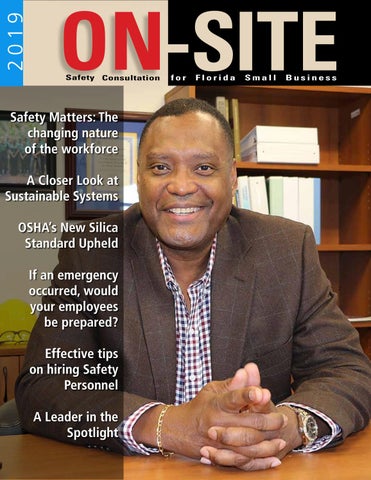
2019 Safety Matters: The changing nature of the workforce A Closer Look at Sustainable Systems OSHA’s New Silica Standard Upheld If an emergency occurred, would your employees be prepared? Effective tips on hiring Safety Personnel A Leader in the Spotlight
Program Director's Column
Brian L. Warrick, PhD, CSP, CIH Program Director, USF SafetyFlorida Consultation Program
The Consultation Program provides: • On-site safety and health hazard assessments, to include hazard recognition and prevention, • Written program evaluations, • Noise monitoring and air sampling, • Comprehensive safety and health management system evaluations, • Formal and informal training, to include technical updates on OSHA standards and Trend analysis.
n behalf of the SafetyFlorida Consultation Staff at the University of South Florida (USF), I would like to take this opportunity to welcome you as a prospective new client or a repeat customer. We are thrilled to showcase our expertise and invite you to explore our safety and health consulting services. The mission of the Consultation Program is to potentially save lives by reducing work related illnesses, injuries and fatalities, and assist Florida’s small businesses profit from safety.
With more than 150 years of combined occupational health and safety leadership experience, our consultants come from a variety of industries such as, private manufacturing, construction and mining industries and the federal government. They are senior professionals committed to providing quality services and protecting employees. Be sure to peruse through our On-Site Magazine to see which Consultant services your regional area, and to learn more about their specific expertise and qualifications.
USF SafetyFlorida, the state's safety and health Consultation Program, provides free, confidential, compliance assistance to Florida's small, high hazard, private sector employers in an effort to keeping workers safe. The Program, funded by the federal government (OSHA) and the State of Florida, continues to provide services to thousands of employers and has protected tens of thousands of employees from serious workplace hazards since its inception in 2000. Secondarily, Florida's small businesses often find that they profit from these free consultation visits due to reduced costs associated with injuries, illnesses, lower workers’ compensation premiums and increased productivity.
Thank you for taking the time to explore our magazine and discover how together we can make Florida the safest State to work in America. We will be honored to have you as our client. Feel free to contact us any time with your questions +1.866.273.1105 (Toll Free) or leave us a comment at usfsafetyflorida@health.usf.edu.
O
1
USF SafetyFlorida ON-SITE
Ta b l e o f C o n t e n t s
20 19,
VOL.
12.
ISSUE
1
table of contents
9
11
1 3 5 7 9 11 13 15 19 21
22
Program Director’s Column A Leader in the Spotlight From The Editor’s Desk USF SafetyFlorida News USF OSHA Training Institute Education Center News Think SHARP Sunshine State Safety Recognition Award Features What We See USF SafetyFlorida Management Resources SafetyWriter is good for you, and great for business! Training Videos Social Media Newsletter Who we are
13
Program Director:
Brian L. Warrick, PhD, CSP, CIH USF SafetyFlorida College of Public Health 13201 Bruce B. Downs Boulevard, MDC 56 Tampa, FL 33612-1105 1-866-273-1105 www.safetyflorida.usf.edu warrickb@health.usf.edu
“The first line of business is not the maximization of profit, but the avoidance of loss.” -Peter Drucker Injury and illness prevention is the primary mission of USF SafetyFlorida’s confidential consultative services. Our team of Designer: Martin Young,in martin@youngdesign.us experts will identify hazards and propose solutions that prevent accidents and injuries your workplace. We also help you develop customized occupational safety and health management systems that create a sustainable culture of safety. Reading this code with your smartphone, using QR code
Editor:
download-application, will
Contributor:
Thalia Barber, tbarber@health.usf.edu Our strategies give you the results you’rescanning lookingsoftware for – reduced such as injury and illness rates, decreased workers’ compensation insurance premiums, increased employee morale, lower turnover, and increased productivity. http://web.scanlife.com/en/
19
Nicholas ngirod@health.usf.edu enable to go Take the next step toward safety. Contact usyou today fordirectly your to FREE consultation byGirod, visiting usfsafetyflorida.com or call the USF SafetyFlorida website. toll-free 1-866-273-1105.
For more information on OSHA courses and occupational safety and health classes, contact the USF OTI Education Center by emailing usfotioutreach@health.usf.edu or calling (813) 994-1195.
13201 Bruce B. Downs Boulevard Tampa, FL 33612 www.usfsafetyflorida.com Toll-Free: (866) 273-1105
On-Site magazine is published annually by USF SafetyFlorida, a small business safety and health consultation program funded by the Occupational Safety and Health Administration (OSHA) and the Florida Department of Financial Services’ Division of Workers’ Compensation. The University of South Florida College of Public Health is the academic home for USF SafetyFlorida.
2612 Cypress Ridge Boulevard, Suite 101 Wesley Chapel, FL 33544 2 www.usfotiec.org Local: (813) 994-1195
A Leader in the Spotlight
Dr. Brian Warrick on his position as director, and driving workplace safety and health How long have you been in the field of Occupational Safety and Health?
What made you decide to become Director of the USF SafetyFlorida Consultation Program?
I have been in the Occupational Safety and Health field for 25 plus years. My career began as an Industrial Hygienist (Bioenvironmental Engineer) in the United States Air Force. I was responsible for ensuring a safe and healthy working environment for in garrison and deployed forces. I’ve held multiple operational and leadership positions, including being a fellow at the Air Force Surgeon General, a member of the Air National Guard Surgeon General Leadership Staff and military medical commander at a remote location. In my primary role of overseeing the environmental and occupational health surveillance of high-risk industrial activities, I have led multiple teams in conducting air, soil and water quality studies at deployed locations. In the private sector, I have held various senior level positions, most notably as the Executive Vice President for Cardno and directorship positions at Fortune 500 companies providing direction and oversight. It’s amazing how fast time flies.
I saw this as a wonderful opportunity to impact hundreds of small employers in high hazard industries. The timing could not have been better! Giving back to society has always been a priority for me. During the history of my career I primarily supported one, large organization at a time, i.e. the USAF, ITT Corporation, Cardno and Mosaic; However, with the USF SafetyFlorida Consultation Program I am now able to impact small businesses at scale. Most small employers lack the in-house expertise capable of reducing workplace injuries, minimizing workers’ compensation costs and avoiding losses. Although we may not always be able to see the fruits of our labor, i.e. reduced injury rates from an individual employer, collectively we can see the differences in reduced injury rates for the state.
Why did you choose this career path? The relationship between human behavior, the workplace and the environment has always fascinated me. While the Air Force provided the opportunity to explore the effects that both the workplace and the environment may have on human beings, my research studies focused largely in part on how our behavior affects the environment. Specifically, the interrelationship between employees’ pro-environmental behaviors, values and attitudes, organizations and the natural environment.
How does this program impact Florida’s workforce? The USF SafetyFlorida Consultation Program has conducted over 550 safety and health visits in FY 2018, abated over 2,000 workplace hazards and removed over 24,000 workers from potentially serious and other-thanserious hazards. The end result is a much safer workforce.
Brian L. Warrick, PhD, CSP, CIH Program Director, USF SafetyFlorida Consultation Program
3
USF SafetyFlorida ON-SITE
Program Director, Dr. Warrick and Safety & Health Consultant, Michael Tartal presenting a SHARP Award to Legendary Marina.
been in this field for over 25 years and this was the first I have heard of the program. I am perplexed at how this valuable state program is not more widely known by others, especially in the profession. To enable this removal, we aim to highlight the impact this program is having on employers and states.
Background Information Family: I have been married to my high school sweetheart Stacy for almost 30 years. We have two adult girls and a shih tzu.
Born: I was born and raised in Trinidad and Tobago
Education: U.S. DOL partners with USF SafetyFlorida and Contractors to promote safety during construction of Florida development project.
What are the economic benefits of participating in the consultation program? Based on three economic models in a recent white paper, the value of the USF’s SafetyFlorida Consultation program ranged from $127.2M (Safety & Health Program approach) to $112.1M (Hazards Removed approach) to $50.9M to (OSHA Enforcement Inspection penalties and fines approach). As such, there is a significant return on the investment of reducing workplace injuries, illnesses and their associated costs.
In what ways are trends affecting safety and health as it relates to the workforce? An aging, diverse and multi-generational demographic is wreaking havoc on todays’ workforce. Not only do employers have to address the issues of ergonomics on an aging society along with baby boomers who grew up using advanced technology, employers are also challenged in dealing with changing work values and evolving generational norms. Employers need to address conformers (traditionalists), to those who question everything (baby boomers), to high job expectation and a lack of organizational loyalty (generation X) to a feeling of civic duty (millennials) simultaneously in the same workforce. This is not an easy task.
PhD MA MSc BSc
Management (Leadership), Walden University, Minnesota, MN Military Operational Science, Air Command and Staff College, Maxwell AFB, AL Environmental Science, New Jersey Institute of Technology, Newark, NJ Industrial Technology University of Southern Maine, Presque Isle, ME
Previous posts/Career: 1984 – 2005 2005 – 2007 2008 – 2014 2014 – 2016 2016 – 2017 2017 – Present
Bioenvironmental Engineer (Lieutenant Colonel) United States Air Force, Various Locations Corporate Health and Safety Officer PBSJ Corporation, Tampa, FL Director, Environment, Safety, Health and Security ITT Corporation, Santa Ana, CA Executive Vice President, Health, Safety, Security, Environment and Quality, Cardno, Lake Forrest, CA Director, Corporate Health and Safety Mosaic Inc., Lithia, FL Program Director SafetyFlorida Consultation Program University of South (USF), Tampa, FL
Hobbies: Reading, traveling, and a car enthusiast
What is your vision for the future of the consultation program? This reminds me of a question I received while being interviewed for this position. I certainly do not want the program to be a secret anymore! The consultation program needs to be front-and-center. I think we offer tremendous value to small businesses in the state of Florida. My response is twofold. First, I’d like to see the Program recognized as a Center of Excellence (COE) for occupational surveillance. We should be the first consideration among our stakeholders, specifically the National OSHA office, the State Division of Workers’ Compensation, like-minded organizations such as ASSP, AIHA and more importantly Florida employers. We have the expertise in-house to address current and emerging trends in the area of occupational sciences. Whether it is ergonomics, indoor air quality, heat stress surveillance, posttraumatic stress disorder (PTSD) training development or total worker health, stakeholders should look to us first. Secondly, to lift the veil of secrecy over the consultation program. I have
Dr. Brian Warrick presenting on the effects of Silica to the National Wood Flooring Association (NWFA) Conference attendees.
4
From The Editor's Desk
Safety Matters: The Changing Nature of the Workforce
“The first line of busine profit, but the avoida
Thank you for being a loyal supporter of the annual On-site Magazine. Each year, it is our pleasure to bring you the latest and greatest content that inspires you to make well informed decisions regarding safety and health in the workplace.
Whether you have arrived at this decision by receiving an OSHA citation, a traumatizing accident, or loss of life, William Tomlin shares several effective tips and best practices to consider before hiring your next safety candidate.
a company’s culture and the way in which they do business. A s baby boomers continue to retire, and a younger demographic enters the workforce, new challenges begin to emerge. According to the Bureau of Labor Statistics (BLS), Millennials born between 1981 and 1996 account for 50% of the workforce. Workplace trends show that this segment of the workforce appear to be more technologically savvy and require companies to be more flexible; providing opportunities for learning and development, create stronger, more sustainable company cultures, mentorship and offer a higher focus on work/life balance. When companies adopt a high trust culture, they are then rewarded with low turnover.
us today and request a FREE and CONFIDENTIAL safety consultation. Requesting a consultation is as simple as dialing 1-866- 273-1105 or visiting www.usfsafetyflorida.com. It’s the best decision you can make for your workplace!
At USF SafetyFlorida, it is our mission to protect workers from unsafe practices in the workplace that contribute to injuries, illnesses and fatalities. We are here to aid in the protection of Florida’s small business economy.
Injury and illness prevention is the primary mission o We work very closely with many different types of employers spanning from T o d a y ’ s w o r k f o r c e experts has the Construction Industry, General Industry,and Maritime, and Disastersolutions Site. will identify hazards propose undergone many changes you develop customized occupational safety and he that significantly impacts If your company is ready to take the next step towards safety, please contact
Our strategies give you the results you’re looking for insurance premiums, increased employ
Take the next step toward safety. Contact us today toll-f Thalia Barber Communications & Marketing Specialist and Editor USF SafetyFlorida Consultation Program
For more information on OSHA courses and occu Center by emailing usfotioutre
In a study conducted by the American Psychological Association (APA), millennials reported that personal safety is a leading cause of stress in the workplace, and they are more concerned about personal safety that any other generation in the workplace. Simply put, millennials strongly encourage safer workplaces. In this edition of the on-site magazine, the Silica standard has undergone some revisions that have had a significant impact on the General, Construction and Maritime Industries. USF SafetyFlorida’s own, Safety and Health Consultant, Dr. Adam Marty covers these industry specific revisions to the Silica Standard in an exclusive piece featured on page 15. Planning and preparing your employees for emergent situations is critical to keeping your employees safe. As you know, emergencies and disasters can strike anywhere and at any time bringing about workplace injuries and illnesses. Employers and workers may be required to deal with an emergency when it is least expected and proper planning before an emergency is necessary to respond effectively. This topic is covered in great detail in the features section of this edition. Keep reading to find out more! Has the time come for you to hire safety personnel dedicated to safety?
5
USF SafetyFlorida ON-SITE
13201 Bruce B. Downs Boulevard Tampa, FL 33612 Do you worry that a serious workplace injury could disrupt or even www.usfsafetyflorida.com shut down your business? Can’t afford to hire a safety consultant? Toll-Free: (866) 273-1105 Free On-Site Safety and Health Services for Small Business
If so, USF SafetyFlorida’s FREE and CONFIDENTIAL On-Site Safety and Health Consultation may be perfect for you! On-Site Consultation services are separate from enforcement and do not result in penalties or citations. At your request, a consultant from USF SafetyFlorida will visit your workplace to help you identify hazards and make recommendation on possible solutions.
“The first line of business is not the maximization of profit, but the avoidance of loss.” -Peter Drucker Injury and illness prevention is the primary mission of USF SafetyFlorida’s confidential consultative services. Our team of experts will identify hazards and propose solutions that prevent accidents and injuries in your workplace. We also help you develop customized occupational safety and health management systems that create a sustainable culture of safety. Our strategies give you the results you’re looking for – reduced injury and illness rates, decreased workers’ compensation insurance premiums, increased employee morale, lower turnover, and increased productivity. Take the next step toward safety. Contact us today for your FREE consultation by visiting usfsafetyflorida.com or call toll-free 1-866-273-1105. For more information on OSHA courses and occupational safety and health classes, contact the USF OTI Education Center by emailing usfotioutreach@health.usf.edu or calling (813) 994-1195.
13201 Bruce B. Downs Boulevard Tampa, FL 33612 www.usfsafetyflorida.com Toll-Free: (866) 273-1105
2612 Cypress Ridge Boulevard, Suite 101 Wesley Chapel, FL 33544 6 www.usfotiec.org Local: (813) 994-1195
USF SafetyFlorida News
USF SafetyFlorida holds Focus Four seminar to combat workplace fatalities
USF Undergraduate Students Getting a Closer Look at Sustainable Systems
According to OSHA, out of 4,674 worker fatalities in the private industry in calendar year 2017, 971 or 20.7% were in construction — that is, one in five worker deaths. OSHA has identified the four leading causes of fatalities in the Construction Industry, also known as the “Fatal Four” hazards which includes Electrical, Falls, Struck-By and Caught-In/Between.
On Friday December 14th, 2018, the USF SafetyFlorida Consultation Program and the USF OTI Education Center (USF OTIEC) partnered to provide undergraduate students of the USF College of Public Health the exclusive opportunity to take an up-close look at the Tampa Bay Surface Water Treatment and Pinellas County Waste Management systems in an effort to allow students to connect theory and real-world application of environmental safety and health management systems.
The seminar offered in conjunction with the USF OSHA Training Institute Education Center focused on the Fatal Four Hazards as it relates to the construction industry. The training objectives consisted of what the four hazards are, tips on how to avoid them, and steps to follow an effective safety and health plan to help combat accidents and injuries in the workplace. The Fatal/Focus Four seminar was geared towards workers in the construction industry, managers, safety supervisors and those who are responsible for the safety of their jobsite. Attendees of this training program enjoyed the professional and quality level of instruction received and highly recommend this training to all workers and employers in the construction industry.
USF SafetyFlorida continues presence at Florida Division of Workers' Compensation's Workplace Safety Seminars
The first visit of the field trip was at the Pinellas County Solid Waste-toEnergy Facility, a site considered to be one of the most advanced waste management systems in the southeastern United States. Here students were given a detailed presentation on the innovative “Closed Loop” recycling management system and a behind the scenes tour of the facility. The next stop was the Tampa Bay Regional Surface Water Treatment Facility, a state-of-the-art surface water treatment plant, known for being the first alternative water supply built to serve local governments that traditionally relied on groundwater. During the guided tour of the facility, students were introduced to the ACTIFLO, Ozone Disinfection and Biologically Active Filtration processes. This 3-step process is used to produce water that both meets quality standards established by Tampa Bay Water’s members and is superior to state and federal drinking water standards.
USF SafetyFlorida has partnered for the tenth year with the Florida Division of Workers’ Compensation and OSHA to provide workplace safety classes, seminars and webinars. The long-standing partnership held throughout the state, provides business owners, contractors and those responsible for assuring workers’ compensation, with important information about workers’ compensation laws as well as workplace safety. In 2019, 13 workers’ compensation seminars were held with 84 attendees. The sessions delve into Key Statutory Definitions, Insurance Coverage Requirements, Exemptions, Contractor Responsibilities, Enforcement Provisions, Direct and Indirect Costs, Inspections, and Florida Fatalities. The partnership with the Division’s Compliance Bureau is a win-win. The consultation program is an integral part of the Florida Division on Workers’ Compensation educational program. Having USF SafetyFlorida’s presence at the seminars rounds out the discussion of what the law’s requirements are and what resources are available.
Students get a closer look at Main Solid Waste Collection site.
The Division of Workers’ Compensation is part of Florida’s Department of Financial Services and handles workers’ compensation claims for employees who are injured or killed on the job. According to the United States Department of Labor, Office of Workers’ Compensation (OWCP), their data supports that as of April 14, 2019, there were 7,971 claims filed and $313,799,619 awarded in Total Compensation to include paid medical bills. (This data represents combined Part B and E Summary). Note: The Division’s trust fund adds a 10 percent matching grant to the federal government’s funding of the USF SafetyFlorida consultation program.
7
USF SafetyFlorida ON-SITE
USF SafetyFlorida Health Supervisor, William Tomlin explains the importance of Safety and Health Management Systems at Waste Treatment Facility.
U.S. Department of Labor Partners with Contractors to Promote Safety During Construction of Florida Development Project The U.S. Department of Labor’s Occupational Safety and Health Administration (OSHA) has signed a strategic partnership with the University of South Florida, SafetyFlorida Consultation Program, H.J. High Construction, and the Haskell Co. to promote worker safety and health during the construction of the City of Boynton Beach’s Town Square development project in Boynton Beach, Florida. Haskell Co. and H.J. Construction seek to prevent injuries and exposure to hazards during the construction of a 109,085-square-foot city hall and library building, 63,000-square-foot police headquarters, and 13,000-square-foot fire station. Under the agreement, the partners will address the use of personal protective equipment, heat illness prevention, and hazards related to falls, struck-by, caught-in/between, electrical, fire protection and prevention, hand and power tools, silica, and noise. The partners will also encourage contractors to develop and implement safety and health programs, and provide safety and health training to employees, employers, and supervisors. Through the Strategic Partnership Program, OSHA works with employers, employees, professional and trade associations, labor organizations, and other interested stakeholders to establish specific goals, strategies, and performance measures to improve worker safety and health.
USF SafetyFlorida offers training on Active Shooter Incidents to better prepare workers and small business owners Recent national tragedies remind us that the risk is real, an active shooter incident can happen in any place, at any time. In the midst of the chaos, anyone can play an integral role in mitigating the impact of an active shooter incident. According to a recent report issued by the Federal Bureau of Investigation (FBI), in the United States, there were a total of 20 active shooter incidents in 2016, 30 in 2017, and in 2018 on average, one mass shooting occurred every week. Having a plan in place is critical to the safety of you, your employees, and your loved ones. In an effort to raise awareness to active shooter incidents, USF SafetyFlorida Consultation Program partnered with the Florida Department of Law Enforcement (FDLE) and the USF OTI Education Center to bring a free workshop dedicated to the prevention, protection, mitigation, response, and recovery of workers and employers. Employers interested in receiving a free and confidential consultation from the USF SafetyFlorida may call toll-free, 1-866-273-1105, or visit www.usfsafetyflorida.com. We are committed to assisting you.
Top 10 most frequently cited OSHA standards violated in FY2018 The Occupational Safety and Health Administration (OSHA) released its Top 10 Most Frequently Cited Standards list for 2018. The cited standards for fiscal year 2018 (October 1, 2017, through September 30, 2018) consisted of the following: 1. 2. 3. 4. 5.
Fall protection, construction (29 CFR 1926.501) Hazard communication standard, general industry (29 CFR 1910.1200) Scaffolding, general requirements, construction (29 CFR 1926.451) Respiratory protection, general industry (29 CFR 1910.134) Control of hazardous energy (lockout/tagout), general industry (29 CFR 1910.147) 6. Ladders, construction (29 CFR 1926.1053) 7. Powered industrial trucks, general industry (29 CFR 1910.178) 8. Fall Protection–Training Requirements (29 CFR 1926.503) 9. Machinery and Machine Guarding, general requirements (29 CFR 1910.212) 10. Eye and Face Protection (29 CFR 1926.102)
USF SafetyFlorida lends a helping hand to OHNP students For the past 10 years, USF SafetyFlorida has immensely enjoyed to opportunity to mentor students from the USF Occupational Health Nursing Program (OHNP) by providing them with hands-on field experience that supports their educational curriculum, and enhances their knowledge by allowing the students the ability to fully apply all of the concepts learned in class to real world situations. Every year since 2009, during the spring semester, a small group of graduate students from the nursing program are selected to participate in the field experience. This was an especially great learning experience for OHNP Graduate student, Victoria Jacobs. Ms. Jacobs expressed, “The field experience was incredibly powerful to put the theoretical knowledge that I have been studying into physical practice. I was able to see how my education will be applicable in the real world and found it very rewarding,” “I learned that there are a lot of real hazards to workers on the job. The field of occupational health and safety is essential to society. I saw first-hand worker’s exposure to electrical hazards, heat stress, particulate inhalation of noxious vapors, and lead exposure. I was also able to suggest a few ideas to the consultant and employer to reduce the exposures.” Ms. Jacobs further added, “There are many opportunities to improve the safety and health of our nation’s workforce. I am proud and excited to be a future practitioner in this arena.” The field of Occupational Safety is devoted to promote occupational health and safety of workers in their organizations. USF SafetyFlorida Consultants primarily focus on identifying hazardous workplace conditions, practices and processes that may cause injuries, illnesses and fatalities.
Attendees and presenters of the Active Shooter Preparedness Training Workshop offered in partnership with the F.D.L.E. in Tampa, FL.
8
U S F O S H A Tr a i n i n g I n s t i t u t e E d u c a t i o n C e n t e r N e w s
The USF OSHA Training Institute Education Center: Florida’s WorkplaceSafety Training and Continuing Education Resource About Us The USF OSHA Training Institute Education Center is part of OSHA Region IV which is comprised of the following states: Alabama, Georgia, Florida, Kentucky, Mississippi, North Carolina, South Carolina and Tennessee. The center serves Florida, the Southeast and beyond to support OSHA’s overall mission of reducing workplace injuries and illnesses by training workers, employers and safety professionals on workplace hazard recognition, avoidance, abatement and prevention.
Mylene Kellerman, Acting Program Director, USF OSHA Training Institute Education Center
9
The USF OTIEC has a focused curriculum that encompasses O S H A’s G e n e r a l I n d u s t r y, Maritime and Construc tion standards, as well as applicable consensus standards and Disaster Site Worker training. The Education Center participates in several conferences, expos, symposiums, seminars and work shops that promote and support OSHA’s national and local
USF SafetyFlorida ON-SITE
emphasis programs and initiatives. To name a few - the National Worker’s Compensation Conference, OSHA’s Workers’ Memorial Day, Safe + Sound Campaign, National Fall Prevention Stand-Down, Heat Illness Prevention Stand-Down, Respirable Crystalline Silica Standard Awareness Training. Future Goals With so many industries in need of occupational safety and health training, it is difficult to target them all. The year 2019 has brought considerable expansion for the USF OTI Education Center! We are working to reach different areas in the Southeast that previously offered only a very limited number of safety courses. Additionally, we are in the process of developing and establishing new curriculum for safety and health courses for industries such as healthcare, logging, chemical processing and landscaping. As we continue to add new curriculum and courses to our repertoire, our current courses are simultaneously going through review and revision to provide more updated and enriched information that includes quality examples, improved learning tools and hands on experiences, all with the goal to offer quality training to our students.
Private Safety Training Bringing safety training directly to a company saves clients’ money in travel-related expenses. Moreover, we can create customized courses to meet your educational needs. Our expert instructors can facilitate training wherever is most convenient, whether it be at your facility or our headquarters in Wesley Chapel, FL. Contact a member of the USF OTI Education Center at usfotioutreach@health.usf.edu to receive a free quote!
Classroom (Live Training) Construction Industry • • •
Online Training
• •
• • • •
• • •
10 hour Construction 30 hour Construction 10 hour General Industry 30 hour General Industry
General Industry
Construction Industry • • • • • • • • • • • • • • • •
9040 – Introduction to OSHA 9041 – OSHA Standards and Inspection Procedures 9043 – OSHA Recordkeeping 9044 – OSHA Health Hazards in Construction 9048 – OSHA Welding and Cutting for Construction 9049 – OSHA Safety Programs and Subpart C 9050 – OSHA Rigging and Material Handling 9051– OSHA Cranes, Derricks, Hoists, Elevators, and Conveyors for Construction 9052 – OSHA Electrical for Construction 9053 – OSHA Excavations for Construction 9054 – OSHA Fire Prevention for Construction 9055 – OSHA Scaffolds Course 9056 – OSHA Personal Protective Equipment 9057 – OSHA Fall Protection Course 9058 – OSHA Stairways and Ladders Course 9060 – OSHA Concrete and Masonry Construction for Construction
General Industry
2055 Cranes in Construction 3115 Fall Protection (formerly OSHA #3110 Fall Arrest Systems) 500 Trainer Course in Occupational Safety and Health Standards for the Construction Industry 502 Update for Construction Industry Outreach Trainers 510 Occupational Safety and Health Standards for the Construction Industry 7215 Silica in Construction, Maritime, and General Industry 7400 Noise Hazards in the Construction Industry 7405 Fall Hazard Awareness for the Construction Industry
• • • • • • • • • • • • • • • • • • • • • •
2015 Hazardous Materials 2045 Machinery and Machine Guarding Standards 2225 Respiratory Protection 2255 Principles of Ergonomics (formerly OSHA #2250) 2264 Permit-Required Confined Space Entry 3015 Excavation, Trenching and Soil Mechanics (formerly OSHA #3010) 3085 Principles of Scaffolding 3095 Electrical Standards 501 Trainer Course in Occupational Safety and Health Standards for General Industry 503 Update for General Industry Outreach Trainers 511 Occupational Safety and Health Standards for General Industry 521 OSHA Guide to Industrial Hygiene 6005 Collateral Duty Course for Other Federal Agencies 6015 Occupational Safety and Health Course for Other Federal Agencies 7115 Lockout/Tagout 7200 Bloodborne Pathogens Exposure Control for Healthcare Facilities 7205 Health Hazard Awareness 7210 Pandemic Influenza and Workplace Preparedness 7410 Managing Excavation Hazards 7500 Introduction to Safety and Health Management 7505 Introduction to Incident (Accident) Investigation 7845 Recordkeeping Rule Seminar
• 9070 – Introduction to OSHA for General Industry • 9073 – Recordkeeping for General Industry • 9074 – OSHA Bloodborne Pathogens Course • 9075 – OSHA Confined Space Entry for General Industry • 9077 – Ergonomics for General Industry Disaster Worker • 9079 – OSHA Safety and Health Programs for General Industry • 5600 Disaster Site Worker Trainer Course • 9081 – OSHA Machine Guarding for General Industry • 5602 Disaster Site Worker Trainer Update Course • 9083 – OSHA Lockout and Tagout for General Industry • 7105 Evacuation and Emergency Planning • 9085 – OSHA Walking and Working Surfaces for General Industry • 24 Hazardous Waste Operations and Emergency Response • 9086 – OSHA Personal Protective Equipment for General Industry • 40 Hazardous Waste Operations and Emergency Response • 9087 – OSHA Fire Detection and Protection for General Industry • 8 Hazardous Waste Operations and Emergency Response • 9089 – Hazardous Communication – General Industry – 1 Hour Injury and illness prevention is the primary mission of USF SafetyFlorida’s confidential consultative services. Our team of • 9092 – 4 Hour Record Keeping experts will identify hazards and propose solutions that prevent accidents and injuries in your workplace. We also help Maritime you develop customized occupational safety and health management systems that create a sustainable•culture of Trainer safety. Course in Occupational Safety and Health Standards 5400
“The first line of business is not the maximization of profit, but the avoidance of loss.” -Peter Drucker Disaster Worker
compensation for the Maritime Industry Our strategies give you the results you’re looking for – reduced injury and illness rates, decreased workers’ • 9031 – HAZWOPER 8-Hour Refresher insurance premiums, increased employee morale, lower turnover, and increased productivity. • 5402 Maritime Industry Trainer Update Course • 9032 – HAZWOPER 24-Hour Training • 5410 Occupational Safety and Health Standards for the Maritime Industry Take the next step toward safety. Contact us today for your FREE consultation by visiting usfsafetyflorida.com or call toll-free 1-866-273-1105. Contract courses are available for the General, Construction, Maritime, and Disaster-site Industries. For more information on OSHA courses and occupational safetyaand health course, classes, contact USF OTI Education To schedule contract please the email usfotioutreach@health.usf.edu. Center by emailing usfotioutreach@health.usf.edu or calling (813) 994-1195.
13201 Bruce B. Downs Boulevard Tampa, FL 33612 www.usfsafetyflorida.com Toll-Free: (866) 273-1105
USF OSHA Training Institute Education Center 2612 Cypress Ridge Boulevard, Suite 101, Wesley Chapel, FL 33544 usfotiec-cards@health.usf.edu • www.usfotiec.org. 2612 Cypress Ridge Boulevard, Suite 101 Wesley Chapel, FL 33544 www.usfotiec.org Local: (813) 994-1195
For more information about the USF OTI Education Center and to register for classes, visit us on the web at www.usfotiec.org or call 813-994-1195. 10
Think SHARP
Exemplary Safety and Health Equates to Prestigious SHARP Another path toward SHARP Participation: Pre-SHARP What is SHARP? The Safety and Health Achievement Recognition Program (SHARP) recognizes small employers who operate an exemplary safety and health program. Acceptance into SHARP by OSHA is an achievement of status that will single you out amount your business peers as a model for your worksite safety and health and will reap rewards for your business. Upon receiving SHARP recognition, your worksite will be deferred from OSHA programmed inspections during the period that your SHARP certification is valid.
If you meet most but not all of the SHARP eligibility criteria and are committed to working toward full SHARP approval, you may be recommended by USF SafetyFlorida for an inspection deferral of up to 18 months if: • You have had a full service comprehensive consultation visit at your worksite and you have corrected all hazards identified by the consultant • You are in the process of implementing an effective safety and health program • You can meet all the SHARP requirements during the deferral period, not to exceed a total of 18 months
How can your company become SHARP? SHARP Certification and Inspection Exemption Companies interested in pursuing SHARP status must first request a comprehensive consultation visit that involves a complete hazard identification survey from USF SafetyFlorida. Other qualifying requirements for the SHARP program include: • Involve employees in the consultation process • Correct all hazards identified by the consultant • Implement and maintain an effective safety and health program • Agree to call and notify USF SafetyFlorida prior to making any changes in the working conditions or introducing new hazards into the workplace • Have fewer than 250 employees on-site and fewer than 500 employees corporate-wide
After you satisfy all SHARP requirements, USF SafetyFlorida may recommend your worksite for final SHARP approval and certification. As a certified SHARP site, you will be granted a deferral from OSHA programmed inspections for up to 2 years. After your initial certification, you may request SHARP renewal for up to 3 years, provided that you: • Apply for renewal during the last quarter of the deferral period • Allow a full service comprehensive visit to ensure that your exemplary safety and health program has been effectively maintained or improved • Continue to meet all SHARP eligibility criteria and program requirements • If requesting a 2 or 3-year renewal, con-duct and submit an Interim Year SHARP Site Self- Evaluation to USF SafetyFlorida that is based on OSHA’s recommended practices for safety and health programs (available online at www.osha.gov) and includes your worksite's injury and illness logs that are required by OSHA to be maintained.
Florida’s SHARP Companies This year 10 Florida companies qualified for OSHA’s SHARP award.
(R) Alti-2, Inc. (R) American Thermoplastic Extrusion Company (N) Ayers Health and Rehabilitation Center (R) Canterbury Tower (R) Class B, Inc. (R) Cypress Cove Care Center, LLC (R) Daws Manufacturing Company, LLC (N) Legendary Marine, LLC (R) Main Metal Recycling (R) Melitta USA, Inc (N) Metal Industries, Inc (N) New Limeco, LLC (R) Portus Stevedoring, LLC (N) Stiles Construction (D) Suncoast Beverage Sales (N) Tintometer, Inc. SHARP Key: (N) = new (R) = renewal
11
USF SafetyFlorida ON-SITE
(D) = deferral
Stiles Construction works with USF SafetyFlorida and earns the first Pilot Construction SHARP Award Company: Stiles Construction Location: Fort Lauderdale, Florida NAICS Code: 236116, New Multifamily Housing Construction (except For-Sale Builders) Employees: 25 On-Site/ 250 Corporate Wide Stiles Construction is a privately held company that provides many different types of construction services. They specialize in high-rise residential, mixed use residential, car dealerships, parking garages, supermarkets, and municipal work just to name a few. Stiles Construction is a part of Stiles Corporation, a full-service commercial real estate firm with a clear mission: Invest. Build. Manage. Stiles services include development, construction, tenant project management, brokerage, property management, architecture, asset management, acquisitions and financing. Stiles Construction has been working closely with USF SafetyFlorida to conduct on-site safety consultation visits for several years on multiple projects. Due to Stiles’ construction project success, USF SafetyFlorida encouraged Stiles to apply for the SHARP Award Program. It’s clear that Stiles Construction upper management has placed great emphasis on safety by putting together an experienced and dedicated safety team. They strive for growth and the betterment of their safety culture; not only within the Stiles organization, but also among their subcontractors. Stiles remains proactive in working with their subcontractors to expand safety training and occupational hazard awareness to working personnel across all projects. They believe in empowering each and every employee to remain proactive in educating one another and having the ability to stop work at any time in the event that a potential hazard presents itself. The consultation program from the University of South Florida (USF) identified a few small floor openings, as well as a few chemical products that contained illegible GHS symbols. All hazards were promptly addressed and corrected on-site. The noted floor openings were immediately covered and secured. The two (2) products that contained unreadable GHS symbols consisted of a PVC primer and cement. The GHS symbols were inadvertently covered-up when tape
was applied to attach the two cans of product together. The solution was to use transparent tape to ensure the GHS symbols remain visible at all times. One major business practice that changed after the first consultation visit was the implementation of employee training. Stiles Construction increased its on-site training in disciplines such as rigging, aerial lifts, P.I.T., fall protection, and signaling. From the time that Stiles Construction and the Residence of Las Olas team began working with the consultation program, illness and injury rates have progressively decreased. During the last 6 months of the project from January 1, 2019 to present, the injury and illness rate has been zero. This is due to an entire team effort from upper management to the hands-on employees in the field. There is no doubt that the safety culture has not only grown but has expanded to other Stiles projects. While Stiles already had a pre-existing safety program in place, there was limited focus on the production of projects. Now, not only is the construction personnel focused on production, but they also place an equal amount of emphasis on workplace safety and health, demonstrating that with the appropriate preparation, both safety and production are achievable simultaneously. News of the success and achievements of the ROLO project has spread to other Stiles projects and to their South Florida competitors. They have become increasingly aware of their successful zero-incident rate. Becoming a member of the SHARP program helps to reinforce a positive safety culture, and additionally lends to a lower experience modification rate (EMR) to reduce insurance premiums. “The knowledge and expertise provided by USF personnel has proven invaluable. Our experience with USF SafetyFlorida has been nothing short of positive. In fact, on-site consultation has been fully integrated into our Safety and Health Management approach. I would definitely recommend this service to small and medium sized businesses operating in high hazard industries within the State of Florida,” said Ian Schwartz, Vice President of Operations, Stiles Construction.
Stiles Construction earns their first construction SHARP award.
12
Sunshine State Safety Recognition Award
Commitment to Safety and Teamwork Make the Difference Ask any successful business owner involved in high-risk industries their advice on keeping incident levels low, and their answer will most likely be employers and employees working together to keep a job site safe. This employer-employee safety commitment is the reason USF SafetyFlorida Consultation Program developed the Sunshine State Safety Recognition Award. Created in 2006, the Sunshine State Safety Recognition Award commends employers and employees in all industries who proactively and routinely engage in job safety. Approximately 40 firms earn this honor annually, and it recognizes companies that have implemented good safety initiatives to better protect employees on the job. According to Keith Brown, a USF SafetyFlorida safety and health supervisor, “Commitment to safety is best demonstrated by teamwork between workers and managers in resolving workplace safety and health issues. Teamwork includes maintaining open and effective means of communication to not only identify problems, but also to achieve solutions.” To qualify, a business should request and receive a complete onsite consultation survey and employ at least one person at the worksite to be evaluated. Additionally, the business should have no willful, repeat or willful-repeat citations within 24 months of the consultation and not serious citations related to injury or exposure within 12 months of the consultation. During the consultation, a safety consultant will perform comprehensive on-site evaluation of all written programs. The consultant will also speak with workers and conduct an evaluation of the work area. The safety consultant will review: • Administration and oversight of safety management programs • Safety and health management practices • Safety training and instruction • Employee safety rules • Internal safety inspection routines for new and existing substances, processes and equipment If hazards are identified during the visit, an abatement of those specific hazards must take place before recognition is granted. Once initial and final consultations are complete, a safety consultant may decide to formally recommend the firm for a Sunshine State Safety Recognition Award, which is approved by USF SafetyFlorida management. A formal letter of commendation is sent to the company, recognizing the employers’ and employees’ efforts in implementing and maintaining an effective injury and illness prevention program. “Working together towards maintaining workplace safety and health is something everyone can take benefit from,” adds Brown.
USF SafetyFlorida developed the Sunshine State Safety Recognition Award to motivate and support employers who demonstrate a commitment to continuously improve their workplace safety and health management system.
The 2018-2019 Sunshine State Safety Recognition Award recipients include: Carr Builders LLC Coastal Tishman (Joint Venture) – Miami World Paramount Project Current Builders, LLC. – Allegro Project EMJ Special Projects E-Z Weld First Florida Building Corporation – Biscayne 27 Project First Florida Building Corporation – The Cube Project First Florida Building Corporation – Lenox at Bloomingdale Project Florida Lemark Corporation – Nativity Catholic Church Flotech, Inc. KAST Construction Company, LLC – 3550 South Ocean Project KAST Construction Company, LLC – 5000 N. Ocean Drive Project KAST Construction Company, LLC – Las Olas Project KAST Construction Company, LLC – Azola Project KAST Construction Company, LLC – Delray Marriott Project KAST Construction Company, LLC – Metropolitan Project KAST Construction Company, LLC – Sunset Pointe Project KAST Construction Company, LLC – The Mark Project Mill Creek Residential Trust South Florida LLC. – Modera Metro 2 Project Moss & Associates, LLC. – Dr. K. Com Project Moss & Associates, LLC. – Harmony Middle School Project Moss & Associates, LLC. – Maizon at Brickell Project Moss & Associates, LLC. – Neocity Office Building Project Moss & Associates, LLC. – UM Student Housing Project Southeastern Metals Manufacturing Company, Inc. Stiles Construction – 790 Project Stiles Construction – ROLO Project Zellwin Farms Company
13
USF SafetyFlorida ON-SITE
KAST Construction Company, LLC. of West Palm Beach
Florida Lemark Corporation of Miami
First Florida Building Corporation of Tampa
Southeastern Metals Manufacturing Company, Inc. of Miami
14
Feature I
OSHA’s New Silica Standard Upheld
A
year ending court decision was met with little fan-fare among industries where silica dust exposure is a concern. In response to industry challenges to OSHA’s new silica standards for the construction, maritime, and general industries, the U.S. Court of Appeals for the District of Columbia has sided with OSHA. The National Law Review reported the court’s decision on December 26, 2017 and the full review can be found at https://www.natlawreview.com/article/ dc-circuit-rejects-all-industry-challenges-to- oshas-new-silica-standards. What does the court’s decision mean? The general, maritime and construction industries where silica exposures are likely to be at or above the action level must now be in compliance with the new silica standard. For the construction industry, they can expect OSHA to immediately enforce the new standard. For all industries, feasible engineering and work practice controls must be used to reduce and maintain employee exposure to respirable crystalline at or below the permissible exposure limit (PEL) of 50 micrograms per cubic meter (ug/m3). In the construction industry, the control methods specified in table 1 of the standard need to be followed when the respective task(s) is or are regularly performed. In the general and maritime industries, all possible engineering and work practice controls must be considered and those controls found feasible must be used to reduce the exposure to or below the PEL. Who does the new silica standards apply to? Standard 29 CFR 1910.1053 applies to general industry and maritime. Standard 29 CFR 1926.1153 applies to the construction industry. Specifically, any company with operations that expose its employees to respirable crystalline dust at or above the action level of 25 ug/m3 as an eight-hour time-weighted average must comply with the standard. Subjectively, any company where work operations involving silica-containing material regularly generate noticeable airborne dusts would likely need to comply with the standard. It would be difficult to imagine a situation where a company that performs a time limited, dust-generating activity (i.e. drilling a small hole) once or twice throughout the day would be above the action level. A well-documented job hazard analysis should accompany such an assumption. What should companies in general industry or maritime do? Assess your operations where work with silica-containing material has a tendency to generate noticeable airborne dusts and determine
15
USF SafetyFlorida ON-SITE
your employees’ exposures. If it is determined that employees are likely to be exposed to respirable crystalline silica above the action level, read and become familiar with the new standard. Implement engineering and work practice controls if it is determined that exposures are likely to be above the PEL. The table 1 entries within the construction standard provide some guidance on various taskbased controls. Begin to develop and implement your program to comply with the new silica standard. What should construction companies do? Assess your operations to determine if the tasks listed in table 1 of the standard are performed as a regular part of your employees’ jobs. If employees are regularly engaged in those tasks, it can be assumed that their exposures are above the action level and probably above the PEL. Implement the specified engineering and work practice controls for that task. No exposure monitoring (e.g. air monitoring) is required where the specified engineering and work practice controls are fully and properly implemented because the assumption is that those controls, when fully and properly implemented, keep the exposure below the PEL. If employees are regularly engaged in tasks that have a tendency to generate noticeable airborne dusts but the task is not specified in table 1, implement feasible engineering and/or work practice controls and conduct an exposure assessment that includes personal air monitoring. The new silica standard applies to all companies where employee exposures are likely above the action level, however, engineering controls are only required where the exposure is above the PEL. How is OSHA enforcing the new silica standard for the construction industry? OSHA issued a memorandum that provides enforcement guidance to compliance officers. In short, the memorandum states that compliance officers should be prepared to conduct personal air monitoring on the first day of the inspection. The compliance officer will review your written exposure control plan and any other relevant programs (e.g. respiratory, hazard communication), review any exposure assessment data collected, and interview affected employees. The compliance officer would not likely collect personal air samples where table 1 requirements are fully and properly implemented. However, when table 1 requirements are not met or the task or equipment not specified in the table, the compliance officer may then collect personal air samples to determine the exposure and compliance with the standard.
Adam Marty, PhD, CIH, Health Consultant.
The memorandum also provides compliance officers citation guidance for several scenarios where table 1 tasks are performed, or the tasks performed or equipment used are not included in the table. The first scenario states, “Where the employer has fully and properly implemented the engineering controls, work practices, and respiratory protections specified in Table 1, the compliance officer will not cite the employer for any PEL or exposure assessment violation.” This is not to say that other deficiencies, be it ineffective housekeeping practices, training, etc., could not be cited. Other scenarios deal with not fully and properly implementing table 1 requirements when the specified task is performed, or when a task not included in table 1 is performed and appropriate controls are not implemented. Basically, if an overexposure is found, the company would likely be cited for violations of table 1 and/or the exposure assessment requirements, be required to pay a fine, and provide OSHA abatement verification that would include implementing effective engineering and work practice controls. The court’s decision may be a new development, however, the standard should not be if it applies to your business. The new silica standard for construction is being enforced. All construction companies should be familiar this standard. It is recommended that construction companies use and follow table 1 where they regularly perform those tasks. It is recommended that construction companies performing other dust-generating activities not included in table 1 assess their employee exposures and implement appropriate controls. Finally, it is recommended that all construction companies implement aspects of the new standard, implement a silica exposure control plan, perform silica hazard awareness training, use proper housekeeping techniques, and periodically reassess the workplace for potential exposures even if the standard may not apply to your company. This action shows a good faith effort and it shows your employees that their health is important to you. If there are questions about the new silica standard or you need assistance in conducting an exposure assessment, please contact USF SafetyFlorida Consultation Program, http://www.usfsafetyflorida. com, for a free review and evaluation.
Feature II
If an emergency occurred, would your employees be prepared?
A
fter last year’s record season of 17 named storms – 10 of which became hurricanes, and six of those 10 reached Category 3 strength or higher, names like Harvey, Irma, and Maria are ones we won’t soon forget. OSHA encourages and in certain work environments requires employers to plan and prepare for workplace emergencies. As we know, emergencies and disasters can strike anywhere and at any time bringing workplace injuries and illnesses with them. Employers and workers may be required to deal with an emergency when it is least expected and proper planning before an emergency is necessary to respond effectively. What is a workplace emergency? According to OSHA, a workplace emergency is a situation that threatens workers, customers, or the public; disrupts or shuts down operations; or causes physical or environmental damage. Emergencies may be natural or man-made, and may include hurricanes, tornadoes, earthquakes, floods, wildfires, winter weather, chemical spills or releases, disease outbreaks, releases of biological agents, explosions involving nuclear or radiological sources, and many other hazards. Many types of emergencies can be anticipated in the planning process, which can help employers and workers plan for other unpredictable situations. Several OSHA standards address emergency planning requirements, including 29 CFR 1910.38; 29 CFR 1926.35; Hazardous Waste Operations and Emergency Response (HAZWOPER) (29 CFR 1910.120(q)); Fire Brigades (29 CFR 1910.156); and Permit-Required Confined Spaces (29 CFR 1910.146(k), 29 CFR 1926.1211). OSHA Publication 3122, Principal Emergency Response and Preparedness Requirements in OSHA Standards and Guidance for Safety and Health Problems, provides a broad overview of emergency planning requirements in OSHA standards.
Employers should also be familiar with the consensus standards of the National Fire Protection Association (NFPA), American National Standards Institute (ANSI), and other standards-setting organizations, as these may provide additional recommendations and requirements about emergency planning. What is an emergency action plan? An emergency action plan (EAP) is intended to facilitate and organize employer and worker actions during workplace emergencies and is recommended for all employers. Well-developed emergency plans and proper worker training (i.e., so that workers understand their roles and responsibilities within the plan) will result in fewer and less severe worker injuries and less damage to the facility during emergencies. A poorly prepared plan may lead to a disorganized evacuation or emergency response, resulting in confusion, injury, illness (due to chemical, biological and/or radiation exposure), and/or property damage. Two OSHA standards (29 CFR 1910.38(a) and 29 CFR 1926.35) require written EAPs. Not all employers are required to establish an EAP, but developing an EAP is a good way to protect workers and businesses during an emergency. Emergency preparedness is a well-known concept in protecting workers' safety and health.
Mylene Kellerman, Assistant Director
Most organizations find it beneficial to include a diverse group of representatives (management, workers, local health departments and agencies, and public safety officials/members) in this planning process and to meet frequently to review progress and allocate development tasks. Outside representatives from federal, state and local agencies may be able to assist organizations with incorporating other requirements or guidelines into their EAPs. The commitment and support of all workers and employers is critical to the plan's success in the event of an emergency; ask for worker input in developing and implementing an EAP. For smaller organizations with 10 or fewer workers, the plan does not need to be written and may be communicated orally (General Industry Standard - 29 CFR 1910.38(b), Construction Industry Standard - 29 CFR 1926.35(e)(3)). If you are unsure about whether you are required to have an EAP, use OSHA's Expert System to help you determine your EAP requirements. For more information on Emergency Response and Preparedness, please access this OSHA link: https:// www.osha.gov/SLTC/emergencypreparedness/ index.html
Putting together a comprehensive emergency action plan involves conducting a hazard assessment to determine what, if any, physical or chemical hazards inside or from outside the workplaces could cause an emergency. The plan should describe how workers will respond to different types of emergencies, taking into account specific worksite layouts, structural features, and emergency systems. If there is more than one worksite, each site should have an emergency action plan.
16
Feature III
Effective Tips on Hiring Safety Personnel
T
he time has come for your organization to add a full-time Safety Director to your staff; whether you have arrived at this point by way of an OSHA citation, a traumatizing accident, or loss of life, there are many factors to consider when looking for a candidate. The level of expertise, education level and experience you will get depends on the salary you can afford. The more experience and education you require, the higher the salary must be offered to get that appropriate candidate. However, there are other characteristics that should be considered when looking for that first time Safety Director. We have all had experience with the new hire who “looked good on paper” but did not live up to our expectations. First, let’s assume your candidates have an acceptable background in safety and health with several years of experience in the field. What are some of the other characteristics you should be looking for in that new Safety Director? During the interview process they should demonstrate considerable communication and interpersonal skills. These skills will be needed to talk to a worker and convince them of the need to follow safety protocols. Will this candidate be able to overcome the typical push backs they encounter from employees or supervisors? You know the drill: “we have never done it like that,” or “they already know to be careful.” A good safety director should be able to dispel those negative beliefs in a positive and effective manner. His/her assertiveness with employees should also be readily seen when they deal with upper management. Nothing will invalidate a safety policy more quickly than an employee observing management not following those same policies. This director will have to tactfully ensure that the highest levels of management are held to the same level of accountability, as that first day new hire. During the interview, they should not appear to be a push- over, who just wants to get along with people, or a safety bully who just wants to enforce rules. The
17
USF SafetyFlorida ON-SITE
William Tomlin, Health Supervisor
candidate for the position should show an attitude and a determination to create a safe workplace and clearly state that all accidents are preventable. Any candidate who accepts that injuries are just part of the job is not a person you want in your organization. Developing a zero accident culture is not only priority, but should be a core value for any safety professional. When selecting a candidate for the position, a major consideration is whether to hire from within the organization, to look for persons outside of the organization, or even outside of the manufacturing field. Hiring internally would ensure the new safety director knows the hazards associated with manufacturing processes, and is familiar to the management team. However, people typically will do what they have always done until someone shows them something different or new. Bringing in someone from outside the organization or “field” may bring fresh ideas or practices that could improve the safety culture at your facility. Now let’s talk about how management should support this new safety position. The Safety Director is not just a “safety cop” looking to enforce rules, or an “ambulance driver” whose task is to take injured employees to the clinic and ensure that they get back to work as soon as possible. Management should see this person as a corporate officer with the ability to make policies; and possibly overrule supervisors, if their professional judgement indicates there is an unsafe condition or behavior. This position should also have a yearly budget to effectively fund
any upgrades to personal protective equipment, provide timely training to employees and finance implementation of any needed engineering controls. This budget should support bringing experts into the facility to assess hazards relating to noise or chemical exposures, if the new director does not already have that expertise. A critical program for any safety professional will be developing a new hire training system, establishing safety teams and developing self- inspection protocols. These goals will require management to fund employee activities not directly related to production goals. Taking production employees “off the line” to address safety issues will show management’s commitment to developing an effective safety program; however, associated costs must be factored into the yearly budget. Another factor to take into consideration is, like most organizations, people are sometimes assigned various jobs within an organization. The safety person may be assigned other duties in the organization. These tasks should be minor, and should not interfere with safety related functions. Finally, hiring your first Safety Director may seem like you’re adding additional overhead to your organization, but a good safety program is a profit center not a cost center. The prevention of accidents leading to injury will reduce medical costs, workers’ compensation insurance premiums, and any costs associated with lost productivity. Any reduction in cost translates into a higher profit margin for the organization.
USF SafetyFlorida Consultation Program Consulting • Training • Education USF SafetyFlorida Consultation Program’s primary purpose is to help your company prevent work-related fatalities, injuries and illnesses. In the short term, we do that by emphasizing hazard identification. In the long term, we do that by helping you develop a safety management program. Our strategies give you the results you’re looking for. If you are ready to take the next step towards safety in your business, contact us today to request a free and confidential safety consultation.
On-site Consultation
USF SafetyFlorida offers free and confidential safety and occupational health advice to small and medium-sized businesses, with priority given to high-hazard worksites. Our consultants work with employers to identify workplace hazards, provide advice on compliance with OSHA standards, and assist in establishing injury and illness prevention programs.
Training & Education
The OTI Education Center provides training and education on occupational safety and health subjects for federal and state compliance officers, state consultants, other federal agency personnel, and the private sector.
On-line Management Tool
SafetyWriter, an online safety management tool developed by USF SafetyFlorida helps companies customize a written safety and health management program without the guesswork.
Award Programs
USF SafetyFlorida rewards small businesses who demonstrate strong, effective safety cultures with the opportunity to receive either the SHARP (from the OSHA national office) or the Sunshine State Safety Award (exclusively for Florida’s small businesses).
CALL NOW! 813-974-9962 18 WWW.USFSAFETYFLORIDA.COM • (813) 974-9962 • 13201 BRUCE B. DOWNS BOULEVARD • TAMPA, FL 33612
What We See
Luis Silva
E
ach day, our consultants are out in the field visiting small employers in high-hazard industries. From a hazard standpoint, we see it all. On this page are photos of hazards we have identified this year. More importantly, our consultants assisted these companies with correcting the hazards so their employees can work safely.
Pat Stark, CHST, PCC, PCG
The eyewash station was found in a state of disrepair, with missing caps, not inspected, tested, or maintained in a clean and sanitary condition. This can cause serious injury, loss of vision and eye irritation from malfunction of the eyewash station and from the unsanitary conditions, making it not suitable for emergent use. It is important to effectively implement and communicate written procedures, to identify and prevent hazards and to track timely hazard correction.
Noel (Mac) McCatty Jr.
Adam Marty, PhD., CIH
Workers were using a handheld power saw and plastic water bottle to hand-spray water on the blade while cutting concrete, not in accordance with Table 1. This can lead to potential over-exposure to crystalline silica resulting in lung damage or silicosis. Workers should be trained, a site specific plan implemented, and Table 1 adhered to, to prevent risk.
The company failed to attain written approval for modification and/or altering of the Powered Industrial Truck (PIT). The PIT fork tines were modified so that it could tow equipment. Employees are susceptible to fork tines disintegrating which could result in struck by hazards from the load it is pulling.
19
USF SafetyFlorida ON-SITE
A Lutz Model B 36 liquid pump was observed with its pump tube immersed in mineral spirits, a combustible liquid. This could result in potential burns, smoke-related injuries, and traumatic injuries from fire due to mineral spirits, or its vapors, coming into contact with electrical arching, sparking, or heat produced by the pump or its parts.
David Ashman Keith Brown
Personal Fall Arrest Systems (PFAS) should be inspected prior to each us for wear, damage, deterioration and defective components. Falls could result in fractures, lacerations, contusions, concussions or death.
William Tomlin
Gabe Garcia, PCG, PCC, PCM
Fourteen UL-listed power strips, aka: relocatable power taps (RPTs) were found to be connected in series (daisy chained) and fed from a single electrical extension cord. Workers may be exposed to electrical shock and/or electrocution from exposed live electrical parts; burns and/or smoke inhalation from fires caused by electrical overload conditions. Sprains, strains, contusions, or fractures from trip and fall hazards.
This is commonly seen among the general and construction industry, where containers are improperly labeled. This bottle appears to be vitamin water; however, it actually contains acetone. Acetone is a highly flammable chemical (category 2) mostly used as a solvent. The proper container with the correct warning label is required. The could have potentially lead to serious physical and health hazards.
A potential ergonomic problem was solved by an inventive employee. This should prompt employers to be on the lookout for this type of employee creativity. An employees’ modification to a work area should trigger employers to design/re-design work stations that reduce an employee’s exposure to extreme exertion or repetitive motion hazards. Currently there are no specific OSHA regulations dealing with ergonomic issues.
20
Workplace safety is not only the right thing to do for your workers, it's the right thing to do for your business!
U
SF SafetyFlorida has been working diligently to provide employers in high hazard industries with useful web-based tools and services to help keep Florida’s workforce safe. We are committed to making safety second nature to Florida’s small business community, which is why we take pride in continuing to provide these services at absolutely no cost to you.
SafetyWriter – Illness & Injury Prevention Plan Paying a contractor to complete your injury and illness prevention plan can be costly. We’ve developed a new system to help employers create Safety Management Plans on-the-go! With a few clicks, our SafetyWriter program will create a Safety Management Plan instantly. The SafetyWriter program can be applied across all industries including General, Construction and Maritime. The plan is generic; however, employers have the opportunity to curtail the safety and health plan to meet their jobsite’s specific needs, to include company size and nature of work. The user may select components from a list of different menu options to assist in customizing a site-specific safety plan for their business. The plan is downloadable as a word document and can be saved to the user’s desktop, or uploaded back into the system where it may be accessed at any time, from any location. SafetyWriter is fast, quick and free to use.
6 Easy steps to create your Injury and Illness Prevention Plan Step One
Step Four
Choose a safety plan language
Select work area
Step Two
Step Five
Select industry type (i.e. – General, Construction, Maritime industry)
Add-on to plan by selecting safety guidelines from a checklist
Step Three
Step Six
Choose applicable plan
Preview and/or save safety plan
With the reduced amount of time that it takes to complete, you can get back to what’s really important, protecting your workers!
21
USF SafetyFlorida ON-SITE
Safety Video Borrowing System Let us help you streamline your training program. USF SafetyFlorida has over 2,000 safety and health videos in DVD format and live streaming readily accessible for rent. The new and improved video borrowing system will aid in ensuring that workers understand OSHA requirements and standards, assist in administering effective training and education that actually works, and provide learning resources that are beneficial to all. Many training materials and videos are offered in other languages including English, French, Spanish and Portuguese. Borrowers may choose up to two titles at a time.
Like us on Facebook
USF SafetyFlorida continues to create and develop new partnerships to bring you – our most valued customer’s new and fresh occupational safety and health related training and education opportunities, events and activities. To stay in the loop and learn more about what we are doing to help Florida’s small businesses, please be sure to like us on Facebook @USFSafetyFlorida.
Visit us on LinkedIn
Stay in the loop and get the latest updates on OSHA compliance standards by following us on LinkedIn where we regularly feature industry specific compliance updates and announce upcoming events. Visit USF SafetyFlorida on LinkedIn, at linkedin.com/company/usfsafetyflorida.
Subscribe to our monthly newsletter Did you know? USF SafetyFlorida issues an electronic newsletter once a month. The newsletter is as awesome online resource for learning about new OSHA initiatives, enforcement activities, safety training class schedules, and much more.
To receive a copy of the newsletter each month to your e-mail account visit www.usfsafetyflorida.com. For more information or to request a free consultation, visit www.safetyflorida.usf. edu or call toll-free 1- 866-273-1105.
Who We Are
1
3
2
4
7
10
5
8
11
14
17
9
12
15
18
19
Consultation Staff
1: Brian Warrick, PhD, CSP, CIH – USF SafetyFlorida Program
3: David Ashman, PCG, PCC – Safety Consultant 4: Keila Ashman – Technology & Systems Manager 5: Thalia Barber, BS – Communications & Marketing Specialist 6: Keith Brown – Safety Supervisor 7: Alex Fernandez – Staff Assistant 8: Amal Forbes – Training Support Specialist 9: Gabe Garcia, PCG, PCC, PCM – Safety Supervisor 10: Nicholas Girod – Marketing & Communications Specialist 11: Margaret Hennis – Health Consultant
2: Mylene Kellerman – USF SafetyFlorida Assistant Director
13
16
Management Director
6
20 12: Garrick Johnson, MSPH – Health Consultant 13: Winfred Marrero Págan, Sr., BCS – Health Consultant 14: Adam Marty, PhD, CIH – Health Consultant 15: Noel McCatty, Jr. – Safety Consultant 16: Luis Silva – Health Consultant 17: Pat Stark, CHST, PCC, PCG – Safety Consultant 18: Michael Tartal – Safety Consultant 19: Katlyn Thomas – Health Consultant 20: William Tomlin – Health Supervisor 22
Take the next step toward safety. Contact us today for your FREE consultation by visiting usfsafetyflorida.com or call toll-free 1-866-273-1105. For more information on OSHA courses and occupational safety and health classes, contact the USF OTI Education Center by emailing usfotioutreach@health.usf.edu or calling (813) 994-1195.
NON-PROFIT ORG. U.S. POSTAGE
PA I D Bruce B. Downs Blvd. MDC 56 2612 Cypress Ridge Boulevard, Suite 101 13201 Bruce13201 B. Downs Boulevard Wesley Chapel, FL 33544 Tampa, FL 33612 Tampa, FL 33612 www.usfotiec.org www.usfsafetyflorida.com Local: (813) 994-1195 Toll-Free: (866) 273-1105 Toll-free: 1-866-273-1105
TAMPA, FLORIDA PERMIT # 236
Phone: 813-974-9962 Fax: 813-974-8270 www.safetyflorida.usf.edu
USF SafetyFlorida Consultation Staff
Caption: University of South Florida, SafetyFlorida Consultation Program Staff. (Not pictured, Margaret Hennis and Winfred Marrero Pagรกn, Sr.)
23
USF SafetyFlorida ON-SITE
Reading this code with your smartphone, using QR code scanning software such as http://web.scanlife.com/en/downloadapplication, will enable you to go directly to the USF SafetyFlorida website.