2013
Help! What to Do if Your Business Receives a Letter From OSHA How to Deal With Heat Stress Do Safety Committees Really Work?
Program Directors' Columns
Dr. Yehia Hammad
Charlene Sitterly
Professor, USF College of Public Health
Program Manager
Program Director, USF SafetyFlorida
USF SafetyFlorida Consultation Program
USF SafetyFlorida Consultation Program
I
n this year’s On-Site Magazine, we are proud to announce the establishment of the USF Occupational Safety and Health Administration Training Institute Education Center (OTI-EC) on June 12, 2013, by the State University System of Florida’s Board of Governors.
The mission of the OTI-EC is to provide the highest quality health and safety training services for citizens of the state of Florida and throughout the Southeast, as well as hands-on training for graduate students in the USF College of Public Health. Courses offered by the center will be available both in the classroom and online. A sampling of these courses includes: • Job hazard recognition classes • Courses in OSHA standards, policies, and procedures for persons responsible for enforcing or directly supporting the Occupational Health and Safety Act of 1970 • Job hazard training • Hazardous materials communication training • Hazardous communication classes for low literacy workers • OSHA maritime standards • Construction industry standards • General industry standards The services of the OTI-EC will complement those provided by USF SafetyFlorida, Florida’s on-site safety and health consultation program for small to medium-sized employers. USF SafetyFlorida helps employers create better safety and health management systems through on-site workplace inspections, hazard identification and training. (On-site consultations are separate from OSHA enforcement, and consultants do not have the ability to cite or assess penalties.) The program is funded by grants from the Occupational Safety and Health Administration (OSHA) and the state of Florida. Through quality programming, education and consultation services, our OTI-EC and USF SafetyFlorida will engage communities and businesses with the importance of workplace safety and training. Keeping workforces safe and productive keeps businesses in operation and more profitable.
U
SF SafetyFlorida, the state’s official small business safety and health consultation program, has had another busy year keeping Florida’s most valuable and precious resource—its people—safe while working on the job.
Since October 1, 2012, our consultants have identified 1,963 workplace hazards at businesses throughout the state. This resulted in removing 36,311 employees from the hazards’ potentially harmful or fatal effects. By protecting workers from injuries, we help to protect Florida’s small business economy. Keeping workers safe at work means greater productivity, fewer out-of-pocket medical expenses and fewer workers’ compensation claims. This also keeps workers going home each day to be with their families. If your company needs assistance with workplace safety and health, we can help. Our professional safety and health consultants will perform a free, confidential and comprehensive analysis of your worksite. They will assess your safety and health management system and identify workplace hazards. Furthermore, we will help you understand how to correct the hazards, if found, and how to prevent them from occurring in the future. You have nothing to lose and everything to gain from being proactive and requesting an on-site consultation. If we can help prevent an OSHA citation and penalty, your consultation’s return on investment will be worth it, in the short- and long-term. Request your consultation today at www.safetyflorida.usf.edu.
We look forward to helping you create a safe and more healthful workplace. If you would like to learn more about what we can do for you, call us at 1-866-273-1105 or visit us online at www.safetyflorida.usf.edu
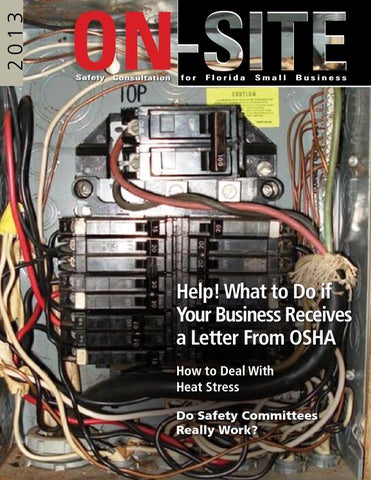
Cover photo: This electrical panel box does not have a safe door and does not include an enclosure for the contained conductors or cables. The box and cables expose workers to electric shock, fire or death.
USF SafetyFlorida On-Site
2 0 1 3 , V o l . 6. I ss u e 1
5
table of contents
8
1 3 5 7 9 11 18 19
Program Directors' Columns USF SafetyFlorida News USF OSHA Training Institute Education Center News Think SHARP Sunshine State Safety Recognition Award Features What We SEE USF SafetyFlorida Management Tools 19 SafetyWriter 20 Accident Tracker 21 RecordKeeper 22 HurriPlanner
23
USF Safetyflorida announcements and accolades
Program Manager
9
Charlene Sitterly USF SafetyFlorida College of Public Health 13201 Bruce B. Downs Boulevard, MDC 56 Tampa, FL 33612-3805 1-866-273-1105 www.safetyflorida.usf.edu Reading this code with your smartphone, using QR code scanning software such as http://web.scanlife.com/en/ download-application, will enable you to go directly to the USF SafetyFlorida website.
csitterl@health.usf.edu
Designer
Martin Young martinyoung@comcast.net
Editor
Kelly Garland kellygarland@comcast.net
17
On-Site magazine is published annually by USF SafetyFlorida, a small business safety and health consultation program funded by the Occupational Safety and Health Administration (OSHA) and the Florida Department of Financial Services’ Division of Workers’ Compensation. The University of South Florida College of Public Health is the academic home for USF SafetyFlorida.
USF SafetyFlorida News
Florida’s newly certified SHARP companies received recognition letters from Florida Governor Rick Scott in May. See page 8 for complete list of Florida SHARP companies.
Governor Rick Scott recognizes Florida’s new SHARP employers Keith Brown of USF SafetyFlorida discusses OSHA’s National Emphasis Program with nursing home and residential care administrators and safety directors during a workshop that was held in Wesley Chapel.
Seminars assist nursing home and residential care industry This year, USF SafetyFlorida and the USF OSHA Training Institute Education Center hosted a series of occupational safety and health seminars for nursing home and residential care facility workers. Topics discussed included ergonomic and chemical hazards; hazards that cause slips, trips, and falls; and recordkeeping. The events were held in Wesley Chapel, Orlando, Jacksonville and Tamarac. The seminars were in response to OSHA’s National Emphasis Program, which went into effect April 2012 and targets high injury and illness rates affecting the nursing home and residential care industry. The University of South Florida College of Public Health is the academic home for USF SafetyFlorida and the USF OSHA Training Institute Education Center. They are based in the Department of Environmental and Occupational Health.
USF SafetyFlorida continues presence at Florida Division of Workers’ Compensation’s Workplace Safety seminars USF SafetyFlorida partnered for the third year with the Florida Division of Workers’ Compensation at its workplace safety seminars. Held throughout the state, the free and educational seminars provide attendees with important information about workers’ compensation laws as well as workplace safety. In 2012, 55 seminars were held with 1,047 attendees, ranging from business owners, licensed contractors and other employers. Sheryle Birdsong with the Division’s Compliance Bureau says the partnership is a win-win. “The (consultation) program is an integral part of the educational program. Having USF SafetyFlorida’s presence at the seminars really does round out our discussion of what the law’s requirements are and what resources are available,” says Birdsong. The Division of Workers’ Compensation is part of Florida’s Department of Financial Services and handles workers’ compensation claims for employees who are injured or killed on the job. For the past four years, total health care provider payments have exceeded $500 million annually due to workplace injuries, illnesses and fatalities. Note: The Division’s trust fund adds a 10 percent matching grant to the federal government’s funding of the USF SafetyFlorida consultation program.
USF SafetyFlorida On-Site
Governor Rick Scott recognized eight new Florida SHARP employers for exemplary workplace safety practices with a letter he sent to each of the companies. OSHA’s Safety and Health Achievement Recognition Program award is the highest safety honor for small businesses and granted to employers nominated by USF SafetyFlorida. SHARP certified companies are exempt from OSHA inspections for a period up to two years, with the exception of a serious accident, fatality or employee complaint. In his letter to the employers, Scott wrote, “Your commitment to a safe work environment for Floridians is to be commended. We are fortunate to have companies like yours in the Sunshine State who provide a safe place to work each and every day.” There are currently 60 SHARP-certified businesses in the state of Florida. To qualify, a firm must: • Request and undergo a consultation visit from USF SafetyFlorida • Involve all employees in the consultation process • Correct hazards identified during the on-site consultation • Implement and maintain a safety and health management system that, at a minimum, addresses OSHA's 1989 Safety and Health Program Management Guidelines • Reduce their Lost Workday Injury and Illness Rate and Total Recordable Case Rate below the national average for their industry • Agree to notify USF SafetyFlorida prior to making changes to working conditions or introducing new hazards into the workplace
Involvement with association, industry seminars help to educate employers USF SafetyFlorida was invited to attend and speak at a number of association and industry events and conferences this year. The speaking engagements were an effective way for safety and health consultants to educate and inform attendees about the importance of workplace safety and creating an effective safety and health management system for their establishment. Presentations delivered this year, among others, include: • National Safety Council and Expo • LeadingAge of Florida • Alliance for Central Florida Safety • Safety Alliance for Excellence • Florida Roofing, Sheet Metal and Air Conditioning Contractors Association • Florida Home Builders Association • West Coast Chapter, Florida Independent Electrical Contractors If your association would like a representative from USF SafetyFlorida to discuss the importance and benefits of workplace safety at your association meeting, contact Mylene Kellerman at mkellerm@health.usf.edu.
Fall protection leads OSHA top 10 most-cited and highest penalties lists
Shadowing experiences help USF students learn about occupational safety and health
The Occupational Safety and Health Administration (OSHA) released its Top 10 Most Frequently Cited Standards list and Highest Penalties list for 2012.
Undergraduate students from the College of Public Health participated in a field trip in March at the Tampa Bay Surface Water Treatment Plant and Pinellas County Solid Waste Site. The 12 students learned about communitywide public health issues and occupational safety and health in the local utility industry.
The cited standards for fiscal year 2012 (October 1, 2011 through September 30, 2012) included (standard numbers are in parentheses below) the following: 1. Fall protection, construction (1926.501) 2. Hazard communication standard, general industry (1910.1200) 3. Scaffolding, general requirements, construction (1926.451) 4. Respiratory protection, general industry (1910.134) 5. Control of hazardous energy (lockout/tagout), general industry (1910.147) 6. Powered industrial trucks, general industry (1910.178) 7. Electrical, wiring methods, components and equipment, general industry (1910.305) 8. Ladders, construction (1926.1053) 9. Machines, general requirements, general industry (1910.212) 10. Electrical systems, design, general requirements, general industry (1910.303) The standards for which OSHA assesses the highest penalties in fiscal year 2012 include: 1. Fall protection, construction (1926.501) 2. Scaffolding, general requirements, construction (1926.451) 3. Control of hazardous energy (lockout/tagout), general industry (1910.147) 4. Machines, general requirements, general industry (1910.212) 5. Powered industrial trucks, general industry (1910.178) 6. Ladders, construction (1926.1053) 7. Electrical, wiring methods, components and equipment, general industry (1910.305) 8. Process safety management of highly hazardous chemicals (1910.119) 9. Hazard communication standard, general industry (1910.1200) 10. Electrical systems, design, general requirements, general industry (1910.303)
USF SafetyFlorida plays central role in annual OSHA conference For the fifth consecutive year, USF SafetyFlorida assisted OSHA with coordinating its annual On-site Consultation Training Conference. The conference was held in Salt Lake City, Utah, and drew in representatives from all 50 states and U.S. territories. Assistant Secretary of Labor for OSHA Dr. David Michaels was featured as keynote speaker. The conference provided attendees an opportunity to participate in 24 different training workshops, ranging in topics from emerging industrial hygiene (IH) issues, electrical hazards, healthcare hazards, and process safety management, among others. Assistant Secretary of Labor for OSHA, Dr. David Michaels, delivers the keynote speech during the 2013 National On-site Consultation Training Conference that was held April 15-18.
Four instructors accompanied the students: Mylene Kellerman and William Tomlin, safety and health supervisors from USF SafetyFlorida OSHA On-site Consultation Program, in addition to June Lake and Alison Oberne, course instructors with the College of Public Health. This is the third time students from the College of Public Health have participated in this field trip exercise. According to Mylene Kellerman, “Every group of students visiting these sites in the Tampa Bay area have come away amazed and impressed at the complexity of the processing systems. The students have a unique opportunity to see the high-tech equipment and methods needed to bring clean and safe drinking water to neighboring communities. They also learn that household garbage and trash do not just ‘go away’ but needs to be managed in a sustainable manner for the longevity of the community and for planet earth.”
USF College of Public Health undergraduate students participate in a field trip to learn more about the relationship between environmental and public health. USF SafetyFlorida consultants accompanied the students during the visit in March.
Occupational health nursing students experience workplace safety firsthand Students participating in USF’s Occupational Health Nursing Program got firsthand experience of the potential health risks associated with workplace hazards. Seven students from NGR 6651 Occupational Health Nursing II shadowed USF SafetyFlorida consultants out in the field during a series of on-site consultations at several businesses in the Tampa area. The visits were to give the students more insight into the connection between occupational health nursing and physical factors in the workplace. One student said the experience was beneficial because it helped her to know more about OSHA’s on-site consultation program. “Walking through the site with a consultant helped me to understand how much easier it is to correct before a potential citation or injury has occurred. The entire consultation program is very beneficial to the agency, the workplace, and most importantly to the worker by protection of their safety and health,” said Doreen Yumang-Ross. Another student commented how workplace safety and health needs to be a team endeavor. “One person cannot be responsible for the safety and health of the workplace. For a safety and health program to be effective, management commitment has to be evident with more than just words,” said Kathleen Lauritano. In fact, Lauritano is putting into practice what she learned in the field. “I have already started using information I learned about worker training on the proper use and storage equipment into practice. I have identified and corrected a number of safety hazards on my unit at the hospital.” This is the fourth year that students from the graduate certificate program have participated in the shadowing experience.
U S F O S H A Tr a i n i n g I n s t i t u t e E d u c a t i o n C e n t e r
Our goal is to teach employees in construction, general industry and maritime industries how to recognize and correct hazards within the workplace and to create a safe and healthful workplace for all employees. Bob Nesbit Program Manager USF OSHA Training Institute Education Center
The USF OSHA Training Institute Education Center: Florida’s Workplace Safety Training and Continuing Education Resource
T
he USF OSHA Training Institute Education Center (OTI) experienced another banner year in occupational safety and health training. We assisted 1,472 students throughout the Southeast (Region IV) with live classroom training and an additional 4,984 students through online classes. Furthermore, our 2,395-plus authorized OSHA trainers delivered life-saving training courses to 19,297 students this year. Our reach spans beyond Florida to states that include Alabama, Georgia, Mississippi, South Carolina and North Carolina.
This year, the OTI Center upgraded its Wesley Chapel training facility with state-of-the-art video and audio equipment in our training rooms. Also this year, the Center created a partnership with Broward State College located in Miramar, Fla., by offering numerous courses on campus. This opened the door to South Florida students wanting to learn more about occupational safety and health in the construction, general industry and maritime industries. The success of this partnership has doubled the OTI Center’s live classroom participation in the South Florida region. Scheduled classes in Biloxi and Jackson, Mississippi, have given us access to the Gulf Coast area. The OTI Center recently purchased a supply trailer to carry required equipment for the 40-hour Hazwoper (Hazardous Waste Operations) course. The equipment, which includes a self-contained breathing apparatus (SCBA); Level A, B and C entry suits; and mock drill and decon equipment, is used to teach simulated drills. Now we can bring necessary Hazwoper teaching tools to offsite locations, not just our Wesley Chapel facility.
USF OSHA Training Institute Education Center staff (front row, left to right) Chris Hopkins, George Buck, Artie Bayandrian, Nikole Brown and Tracy Kelly. (Back row, left to right) Dennis O’Brien and Scott Young.
USF SafetyFlorida On-Site
Private Safety Training Bringing safety training directly to a company saves clients money in travel-related costs. Moreover, we can create customized courses to meet an employer’s education needs. We send an instructor to a facility at a time that works best for them, and the course is tailored to meet its specific training needs.
v
Regularly Offered Courses
v
OTI 2015 Hazardous Materials OTI 2045 Machinery and Machine
v
OTI 2225 Respiratory Protection
v
OTI 2250 Principles of Ergonomics Applied Nerve Disorders
v
OTI 3110 Fall Arrest Systems
v
OTI 2264 Permit Required Confined Space
v
OTI 7400 Trainer Course in Construction
v
OTI 3010 Excavation, Trenching and Soil
v
OTI 7405 Fall Hazard Awareness for the
OTI 3095 Electrical Standards OTI 6000 Collateral Duty Course for Other
Standards for the Construction Industry
8-hour HAZWOPER
v
4-hour Recordkeeping
v
Fleet Driver Program
Construction Industry
Federal Agencies v
OTI 7000 OSHA’s Ergonomic Guidelines
v
Training for Nursing Homes
Safe Teen Jobs Awareness Training v v
Specialty 1-hour Online Courses
v
Fall Protection Scaffold
Noise
Mechanics
v
OTI 7415 OSHA Construction Industry Requirements: Awareness of Major
OTI 7100 Introduction to Machinery and
Hazards and Prevention Strategies
Machine Safeguarding
v
OTI 7105 Introduction to Evacuation and
v
Fall Protection Qualified Person Training
Emergency Planning
v
USF 9001 Sub Part R Steel Erection Safety
OTI 7115 Lock out/Tag Out Controlling
Scaffolding Qualified Person Training
Standards
Hazardous Energy to Prevent Workplace Injury
v
Stairways and Ladders
v
Introduction to OSHA OSHA Standards and Inspection
Maritime
v
OTI 7120 Introduction to Combustible
v
OTI 7200 Blood Borne Pathogens Exposure
Dust Hazards
Procedures v
Personal Protective Equipment
v
v
Recordkeeping
v
v
Outreach Trainers OTI 510 Occupational Safety and Health
24-hour HAZWOPER
Blood Borne Pathogens
OTI 502 Update for Construction Industry
v
v
v
v
to Work Related Musculoskeletal and
Certified Aggression Control Manager
v
Construction Industry
Entry
v
OTI 500 Trainer Course in Occupational Safety and Health Standards for the
Guarding Standards
v
v
Construction v
v
v
v
OTI 521 Guide to Industrial Hygiene
v
Online
v
Standards for General Industry
The center’s catalog of courses includes the following classes:
v
OTI 511 Occupational Safety and Health
v
Safety and Health Standards for Maritime
OTI 7205 Health Hazard Awareness
Industry
OTI 7210 Pandemic Influenza and
v
Workplace Preparedness
Safety Programs v
Rigging and Material Handling
OTI 5400 Trainer Course in Occupational
Control for Healthcare Facilities
OTI 5410 Occupational Safety and Health Standards for the Maritime Industry
OTI 7300 Understanding OSHA's Permit Required Confined Space Standards
General Industry
Disaster
v
OTI 7410 Managing Excavation Hazards
v
OTI 7500 Introduction to Safety and
v
OTI 7505 Introduction to Accident
v
OTI 7510 Introduction to OSHA for Small
Health Management v
OTI 501 Trainer Course in Occupational Safety and Health Standards for the
Investigation
General Industry v
OTI 503 Update for General Industry Outreach Trainers
Business v
v
Trainer Course v
OTI 5602 Update for Disaster Site Worker
v
OTI 7105 Evacuation and Emergency
Trainer Course
OTI 7845 Recordkeeping Rule Seminar
Planning v
USF OSHA Training Institute Education Center 2612 Cypress Ridge Boulevard, Suite 101, Wesley Chapel, FL 33544 usfoticenter@health.usf.edu • www.usfoticenter.org
OTI 5600 Disaster Site Worker Train-the-
OTI 7600 Disaster Site Worker Course
For more information about the USF OTI Education Center and to register for classes, visit us on the web at www.usfoticenter.org or call 813-994-1195.
Safety and Health Achievement Recognition Program Award
Exemplary Safety and Health Equates to Prestigious SHARP Certification What is SHARP?
O
SHA created the Safety and Health Achievement Recognition Program award to recognize small business owners who operate an exemplary safety and health management system (SHMS). Once SHARP certified, employers are exempt from OSHA inspections for a period up to two years, with the exception of a serious accident, fatality or employee complaint. Firms throughout the U.S. can earn a SHARP award, and for a Florida company the approval process begins with a recommendation to OSHA from USF SafetyFlorida.
How Can Your Company Become SHARP? Companies interested in pursuing SHARP status must first request a safety and health consultation from USF SafetyFlorida. The on-site consultation involves a comprehensive safety and health hazard survey of the worksite(s) involved, including equipment and work processes. Other qualifying requirements for the SHARP program include: • Have at least one year of operating history at the company or worksite; • Implement, demonstrate and maintain a safety and health management system (SHMS) that, at a minimum, addresses the major elements of OSHA’s 1989 Safety and Health Program Management Guidelines; • Lower the company’s Days Away, Restricted or Transferred (DART) rate and Total Recordable Case (TRC) rate below industry national average; • Correct all hazards identified by the consultant; • Agree to notify the USF SafetyFlorida Consultation Program prior to making changes in working conditions or work processes that may introduce new hazards into the workplace.
USF SafetyFlorida On-Site
First-Time SHARP Certification and Exemption Once a business satisfies all SHARP requirements, a USF SafetyFlorida consultant may recommend it for SHARP approval and certification. If approved by OSHA, the company will receive formal SHARP recognition from OSHA and USF SafetyFlorida during an award ceremony. The company will also be exempt from OSHA inspections for a period up to two years.
SHARP Renewal If a company wishes to renew its SHARP certification, the application process must begin during the last six months of its exemption period. The company must also undergo a comprehensive visit by a USF SafetyFlorida consultant to ensure its SHMS has improved or maintained. Furthermore, the employer must meet all SHARP eligibility requirements, agree to conduct self-evaluations and provide a written report based on the elements of OSHA 1989 Safety and Health Program Management Guidelines and OSHA’s required injury and illness logs.
SHARP Deferral If a business meets most but not all of OSHA’s SHARP eligibility requirements, a USF SafetyFlorida consultant may recommend a business for an inspection deferral up to 18 months, provided the company has: • Completed a hazard identification survey with a USF SafetyFlorida consultant and corrected all identified hazards; • Implemented, demonstrated and maintained a SHMS that, at a minimum, addresses the major elements of OSHA’s 1989 Safety and Health Program Management Guidelines; • Implemented an action plan with established abatement dates that completes the necessary items that prevented the company from reaching SHARP status during the original survey.
Why SHARP? Businesses look at the SHARP award as a way to take their existing safety and health management system a step forward. “I looked at the requirements for SHARP recognition and matched those up to the efforts we wanted to make to improve our safety and health programs,” said Chris Kingsley, safety director of Accuform Manufacturing of Brooksville. “I saw this as a perfect opportunity for us to improve our programs with the assistance and guidance of a recognized program with recognized professionals.” “The greatest success in participating in the SHARP program has been, of course, the reduction in accidents, but we have also learned so much throughout this process,” said Laura Sullivan, administrator of Cypress Cove Care Center in Crystal River. “Our consultant has been available for any education needed. It has empowered our staff to take pride in their workplace and allowed them access to make any needed changes.” Other companies that earn SHARP status report lower operating costs and recordable incidents, which result in higher profit margins. Southeast Wood Treating, a supplier of pressure treated lumber for Georgia-Pacific, has had zero recordable incidents for the past five years and has completed 219,258 work hours since its last recordable/lost time injury.
Florida’s SHARP Companies This year 55 Florida companies qualified for OSHA’s SHARP award and two qualified for a SHARP deferral.
SHARP Key: (N) = new (R) = renewal
(D) = deferral Metal Industries, Inc. of Bushnell
(N) (R) (N) (R)
Accuform Manufacturing, Brooksville Ajax Building Corporation, Midway Alti-2, Inc., Deland Aluma Tower Company, Inc., Vero Beach (1639 Old Dixie Highway) (N) Aluma Tower Company, Inc., Vero Beach (926 Old Dixie Highway) (R) American Compliance Technologies, Inc. (ACT), Bartow (N) American Thermoplastic Extrusion Company (ATECO), Miami (R) Associated Grocers of Florida, Pompano Beach (N) Ayers Health & Rehabilitation Center, Trenton (R) BAE Systems Aerospace Solutions, Crestview (N) BAE Systems, Metal Fabrication Division, Crestview (D) Bayonet Point Health & Rehabilitation Center, Hudson (R) Beall’s 810 Facility, Bradenton (R) Beall’s 817 Facility, Bradenton (R) Cable USA, Inc., Naples (N) Cast-Crete Corporation, Seffner (N) Charlotte Harbor Healthcare, Port Charlotte (N) Control Micro Systems, Winter Park (R) Cox’s Wholesale Seafood, Tampa (N) Cypress Cove Care Center, Crystal River (R) Daws Manufacturing Company, Inc., Pensacola (N) Eastern Metal Supply, Lakeland (R) Florida Presbyterian Homes, Lakeland (R) Gate Precast Company, Jacksonville (R) Great Southern Wood of Florida, Inc., Lake Panasoffkee (N) Inn and Nursing Center at La Posada, Palm Beach Gardens (R) Johnson Controls Miami Warehouse, Miami (N) Kauff’s Transportation Systems, West Palm Beach (N) King Plastic Corporation, North Port (N) Main Metal Recycling, Jacksonville (N) Metal Industries, Inc., Bushnell (R) MI Metals, Inc., Oldsmar (R) Moss & Associates, Fort Lauderdale (R) Mueller Industries, Ft. Pierce (N) Neptune Research, Inc. (NRI), Lake Park (R) New Limeco, LLC., Princeton (N) Orchid Island Juice Company, Ft. Pierce (N) Palm Garden of Largo, Largo
(N) (R) (N) (N) (N) (R) (R) (D) (N) (R) (N) (N) (R) (N) (N) (R) (R) (R) (N) (R)
Pebble Creek Animal and Bird Hospital, Tampa Phoenix Wood Products, Ocala Portus Services, LLC, Jacksonville Portus Stevedoring, LLC, Jacksonville Precision Econowind, Inc., Ft. Myers Probuild #82, Milton Pursuit Boats, Ft. Pierce Quality Health Care Center, North Port Raydon Corporation, Port Orange Ro-Mac Lumber & Supply, Leesburg Seaonus Stevedoring, LLC, Jacksonville Southeast Wood Treating, Rockledge Southern Manufacturing Technologies, Inc., Tampa Standard Precast, Inc., Jacksonville Suncoast Beverage Sales, Fort Myers Sypris Electronics LLC, Tampa Technology Conservation Group, Lecanto Trucks & Parts of Tampa, Tampa Trumeter Company, Inc., Deerfield Beach Trusswood, Inc., Titusville
Seaonus Stevedoring of Jacksonville
King Plastic Corporation of North Port
Suncoast Beverage Sales of Fort Myers
Ajax Building Corporation of Midway
Accuform Manufacturing, Inc. of Brooksville
Ready to become SHARP? Contact USF SafetyFlorida at 1-866-273-1105 or visit us online at www.safetyflorida.usf.edu to request a free on-site consultation.
Safety and Health Achievement Recognition Program Award
Commitment to Safety and Teamwork Make the Difference
A
sk any successful owner of a high-risk industry business their advice on keeping incident levels low, and their answer will most likely be staff working together to keep a job site safe. This employeremployee safety commitment is the reason USF SafetyFlorida created the Sunshine State Safety Recognition Award.
To qualify, a business should request and receive a complete on-site consultation survey and employ at least one person at the worksite to be evaluated. Additionally, the business should have no willful, repeat or willful-repeat citations within 24 months of the consultation and no serious citations related to injury or exposure within 12 months of the consultation.
Since 2006, USF SafetyFlorida has bestowed the Sunshine State Safety Recognition Award on small businesses in all industries that proactively and routinely engage in job safety. Approximately 40 firms earn this honor annually, and it recognizes firms that have implemented good safety initiatives to better protect employees on the job. According to Keith Brown, a USF SafetyFlorida safety and health supervisor, “Team work is essential in accident prevention, and when there are open lines of communication between workers and management, it speaks volumes about a company’s commitment to safety.”
During the consultation, a safety consultant will perform a comprehensive on-site evaluation of all written accident prevention management programs. The consultant will also speak with workers and conduct an evaluation of the work area. The safety consultant will review: • Administration and oversight of safety management programs • Safety and health management practices • Safety training and instruction • Employee safety rules • Internal safety inspection routines for new and existing substances, processes and equipment
Gardner-Watson Decking, Inc. of Oldsmar
W.R. Carlson Roofing Specialists of Englewood
USF SafetyFlorida On-Site
If hazards are identified during the visit, an abatement of those specific hazards must take place before recognition is granted. Once initial and final consultations are complete, a safety consultant may decide to formally recommend the firm for a Sunshine State Safety Recognition Award, which is approved by USF SafetyFlorida management. A formal letter of commendation is sent to the company, recognizing the employers’ and employees’ efforts in implementing and maintaining an effective injury and illness prevention program. “Working together towards maintaining safety is something everyone can take pride in,” adds Brown.
USF SafetyFlorida developed the Sunshine State Safety Recognition Award to motivate and support employers who demonstrate a commitment to continuously improve their workplace safety and health management system.
The 2013 Sunshine State Safety Recognition Award recipients include: Ampco Products, Inc., Miami Artistic Touch Dentistry, West Melbourne Blue Springs Surgery Center, Orange City Charlotte Pipe & Foundry, Wildwood Coastal Construction Group, Oceana, Key Biscayne C. Davis Electric, Florida International University Parkview Apartments Drawdy Brothers, Toyota Dealership, Deerfield Beach First Florida Building Corporation, Cameron Apartments, Delray Beach First Florida Building Corporation, Double Branch Apartments, Tampa First Florida Building Corporation, Enclave Apartments, Royal Palm Beach
Red Hills Surgical Center of Tallahassee
First Florida Building Corporation, Lakeside at Park Place, Clearwater Gardner-Watson Decking, Inc., Oldsmar Link Construction Group, Hialeah Park Lotspeich Company, Florida International University Parkview Apartments Moss & Associates, Florida International University Parkview Apartments Red Hills Surgical Center, Tallahassee Robins & Morton, Mayo Clinic expansion, Jacksonville St. Augustine Oral & Facial Center, St. Augustine W.R. Carlson Roofing Specialists, Inc., Englewood Woodland Construction, Miami Herald Production Building, Miami
Robins & Morton, Mayo Clinic expansion in Jacksonville 10
Features
Help! What Should I Do After Receiving a Letter From OSHA?
A
s a member of USF SafetyFlorida’s management team, I receive a number of employer calls asking what action(s) should be taken after receiving a letter from one of Florida’s OSHA area offices. I hear everything from … • “This (letter) was generated by a disgruntled employee” • “The complaint has no merit. I know three other employers who did the exact same thing I do.” • “Why is OSHA bothering me?” and • “What do I do now?” William Tomlin
policy or program addressing the equipment’s correct usage. You shouldn’t try to identify the employee who reported you. Employer retaliation, in any form, against an employee for reporting workplace hazards is illegal and could lead to whistle-blower action by OSHA to protect the employee. Remember, if OSHA has contact information of the complaining employee, they will find out about any retaliation efforts. “But My Competitor Does the Exact Same Thing …”
USF SafetyFlorida First, let’s dissect what the Safety and Health Supervisor complaint letter really means. Let’s face facts: if the hazard Someone, either in your is in your facility, then it’s not organization or in the general public, contacted entirely out of realm the hazard could also exist your local OSHA area office with information in your competitor’s facility. But what matters is about a hazard in your workplace. The complaint this: your company is what is on OSHA’s radar may have been anonymous, or the person who today. Tomorrow? It very well may be the other complained left their contact information. (This business. distinction is important as you will read later.) Whether the hazard exists across the street or An OSHA area office must respond to all not has no bearing on the conditions in your complaints within a designated time period. One facility. It’s your responsibility, as the employer, method OSHA uses to contact an employer is a to provide a safe and healthful workplace for “Fix and Fax” letter. This letter details the hazard your employees. Also, it makes sense to eliminate reported and requests information about your the hazard, even if you think the hazard is company’s policies and procedures regarding commonplace within the industry. The cost of the hazard. one accident far exceeds any savings gained by following the perceived “acceptable” way The Disgruntled Employee … of doing things. One time, a caller wanted to go to each of his competitors in an attempt to If the hazard in question was in the imagination enforce the hazardous condition outlined in the of a disgruntled employee, the hazard will not letter he received from OSHA. It might have given exist in the first place. As an employer, you can him some satisfaction, but only OSHA has the discuss with the OSHA area compliance officer authority to enter and enforce standards. your worksite’s actual conditions (photographic evidence is good documentation). If the hazard “Now What Do I Do?” does exist, however, you can show how it is currently being mitigated through engineering If you receive a letter from OSHA requesting controls, personal protective equipment or a information about a reported hazard in your combination of both. If your employees use workplace, supply as much information as personal protective equipment, provide the possible about the conditions outlined in the compliance officer with a copy of your written letter. You also should detail your efforts to
11
USF SafetyFlorida On-Site
mitigate the problem, provide written polices addressing the issue, and respond as soon as possible. Above all else, be honest. OSHA does conduct random follow-up visits on the responses they receive from employers! We here at USF SafetyFlorida are available to provide you with a comprehensive onsite consultation. We will help you address whatever hazards were outlined in your letter, including those that require additional industrial hygiene testing or analysis, free of charge. Our consultants will help you develop and implement work procedures and required OSHA safety programs that bring you into OSHA compliance. Please contact us if you need any help dealing with safety and health issues at your facility. You have nothing to lose and everything to gain.
Each year, OSHA sends letters to thousands of employers throughout the country that have higher than average injury and illness rates for their industry. USF SafetyFlorida offers free safety and health consultations to assist these employers reduce their injury and illness rates.
Heat Stress in Florida
I
the ability to accomplish work decreases with increasing levels of heat stress.
t is no surprise that heat stress is a common Less appreciated, but very important, is the occurrence for agriculture and construction freedom of the employee to pace their work and workers, and really anybody who works take breaks as needed. First, self-paced work tends outside or in buildings with no air conditioning. to be optimized to the individual. Problems occur It is the humidity that makes the climate feel when a less tolerant worker tries to keep up with so hot, and it is also the humidity that reduces the a group. Second, if an individual is experiencing effectiveness of the body’s main mechanism to the symptoms of heat-related disorders, they reduce the effects of heat. That is, should be provided an adequate the high humidity common in the recovery. Maintaining a healthy summertime reduces the body’s lifestyle with adequate sleep ability to cool by sweat evaporation and a balanced diet as well and the reason why we are often as avoiding drugs and using dripping in sweat. Other factors alcohol with moderation is key to that contribute to heat stress are maintain good tolerance for heat work demands, which generate stress. Acute and chronic illnesses heat in the body that must be and treatment drugs (both overmoved to the environment by the-counter and prescription) sweat evaporation, and clothing can reduce heat tolerance. Lastly, Thomas E. Bernard that limits the ability to evaporate during the first week on the job, College of Public Health, University of South Florida sweat. employees are going to develop During the summer months, you can safely assume that heat stress is above commonly recognized occupational exposure limits distributed or endorsed by OSHA, NIOSH, ACGIH®, and the ISO. With heat stress as a given, the least that an employer can do is provide heat stress training to supervisors and employees, support heat stress hygiene practices, monitor the workplace and have an emergency response plan. Table 1 is a checklist of these minimal actions. Unfortunately, these recommendations are re-enforced by the case studies of heat stroke among outdoor workers. Every employer has preferred methods for training. Heat stress training can be easily adapted to the employer’s preferences, but training needs to include the causes and outcomes of heat stress and how to minimize the risks and effects. What You Can Do Heat stress hygiene practices are simply what an employee can do to reduce their individual risk of heat-related disorders. Employers must minimize the barriers to practice good heat stress hygiene. The best known hygiene practice is to maintain adequate hydration. For planning purposes, there should be six liters (or quarts) for each worker. The critical component of the drink is water but non-carbonated flavored drinks and commercial electrolyte drinks are better in that people will drink more of them than water. It is clear that
some tolerance for heat stress, and new employees and their supervisors should understand this. Employer monitoring of the workplace should include anticipation of the heat stress level on a given day and to prepare for sudden changes that will come with a heat wave. Adjustments to work expectations may be necessary. Further, an employer should be aware of heat-related incidents that might not be reportable but indicate that heat stress is a significant risk. These include self-treated cases of heat exhaustion. Last, but not least, the employer must have an emergency response plan. A key element is that all workers should be in eyesight of, and preferably in easy communication with, another worker. At the earliest sign of heat stroke, usually confusion or listlessness to unconsciousness or convulsions, aggressive cooling should begin. The best method is to soak the victim in an ice or cold-water bath, but packing them in ice or soaking them in water with fanning is a second approach. Never wait for emergency services to arrive. Then call emergency services and be prepared to provide clear directions to where you are. Employers can take other actions to protect their employees from heat stress. These tend to depend more on the specific circumstances of the exposures. For this reason, it is difficult to make specific recommendations here.
Engineering controls are methods to reduce the heat stress level, and the most effective include reducing the environmental conditions through air conditioning and reducing the work demands through mechanization. Administrative controls are usually in two categories. For limited exposures, a maximum exposure time can be set. For sustained or repeated exposures, guidelines for work and recovery can be developed. As a note, providing shade is a common recommendation that has very limited benefit for recovery. It adds comfort but does not significantly enhance cooling. Personal cooling systems are very effective under some circumstances. A key feature of personal cooling is covering large portions of the body (i.e., just the neck or head will not be sufficient). If you are interested in discussing your situation, please contact a USF SafetyFlorida consultant at www.usfsafetyflorida.com or Thomas Bernard at tbernard@health.usf.edu.
Training • Use training materials from a recognized authority, including OSHA, NIOSH, professional organizations and training vendors • Include the causes of heat stress • Include the body’s responses to heat stress • Include the signs, symptoms, and first aid for major heat-related disorders (especially, heat exhaustion and heat stroke) • Include any measures that the employer provides to minimize heat stress • Include a description of heat stress hygiene practices (see immediately below) Heat Stress Hygiene Practices • Self-directed work patterns and selflimitation of exposure • Adequate hydration • Healthy lifestyle including diet and sleep • Understand the risks of acute and chronic illness • Adjust expectations if there is no recent history of heat exposures Monitoring • Monitor environmental conditions and anticipate heat waves • Monitor employee performance and incidents of heat-related problems Emergency Response Plan • Work within eye sight of another person (never alone) • All employees able to recognize the signs of heat-related disorders; especially heat stroke • Take immediate action with any suspicion that a person is experiencing a heat stroke. These actions include immediate and aggressive cooling and calling for emergency services with adequate directions to find the work location 12
Features
Safety Committees: Just Hype, or Do They Really Benefit A Company?
D
o safety committees work and are they effective? The answer is not as clear-cut as it might seem.
A safety committee’s potential value and benefit is only as good as its defined purpose, functions, activities and follow-through. When the input and value of the committee and its members are recognized, employees, supervisors and managers welcome its services.
Some Background Safety committees are often a blend of employees and management. The committee's purpose is to provide an open forum to discuss accidents, nearmisses, recommendations for corrective action and prevention of recurrence, and opportunities for improvement.
Does the Occupational Safety and Health Administration Mylene Kellerman (OSHA) require employers Industrial Hygienist to have a workplace safety Safety and Health Supervisor committee? No. However, I highly recommend having an effective safety committee in the workplace. This is because all workers have the right to a safe and healthy workplace. For example, The
OSH Act of 1970 requires employers to provide a safe and healthy workplace and mandates that certain standards be met to ensure workplace safety. Safety in the workplace is everyone’s responsibility. So a workplace safety committee enables employee participation and involvement in the safety and health process, plus it provides an opportunity to share the responsibility in maintaining a safe work environment. Illnesses and injuries cost companies a great deal of money in lost productivity and time away from work. The immediate role of the workplace safety committee is to reduce worker illnesses and injuries by identifying health and safety risks and potential hazards, making recommendations and developing strategies to decrease incidents, conducting periodic safety audits, and most important, empowering co-workers to play a role in workplace safety and health. In the long run, this adds up to savings for the company, which will result in lower workers’ compensation costs. So bottom line, effective, well-functioning safety committees can truly benefit and have an overall positive money-saving impact on the company.
Colin Hackley
Some committees, however, do not follow-through with their safety vision. Unfortunately in these particular instances, the safety committee members lack a clear understanding of what was expected when it comes to preventing accidents and injuries in the workplace.
To have a motivated, productive and wellfunctioning safety committee, let’s revisit what a safety committee is and its purpose.
13
USF SafetyFlorida On-Site
USF SafetyFlorida consultants review written safety plans and offer advice on how to improve a company’s safety and health program, including how to establish or improve a safety committee.
Starting a Safety Committee
H
ow do you get employees interested and involved in participating on a safety committee and in the company’s safety program as a whole? Here are some suggestions that can help: 1. Ask for their involvement. Do not wait for employees to volunteer. Search for opportunities to involve employees. Listen, pay attention to what employees have to say. Respond to and resolve issues brought forth by their involvement. This will energize employees in the safety process and motivate them to more readily and enthusiastically participate in the safety committee. 2. Develop a vision for safety. This vision should get employees excited about moving toward excellence in safety. Along with this vision, management must provide opportunities for learning that go beyond compliance activities or the basics. These learning opportunities must create a high-trust culture. Within this culture, people must be given opportunities to fail and succeed, realizing that they are being empowered to move toward “their” vision of excellence for safety. 3. Offer applicable education, training, resources and authority so employees can take ownership of the safety process. Do not expect employees to take pride and be enthusiastically involved in the safety and health process if the goal is simply to conform to top-down management programs, or merely comply with OSHA regulations. The single most powerful source of motivation is employee ownership of the safety process. 4. Assure employees they can bring any health and safety-related problem to the forefront freely without fear of fault-finding or retribution. With management support, each item is then reviewed, a response or resolution is proposed and items are tracked to completion. 5. Communicate often and openly. Employees see what can happen when safety is compromised, and they do not want that type of situation. Instead, they want a safe working environment. The difficulty comes when barriers are inadvertently constructed
that de-motivate the employee. Barriers are things like not listening to the employees’ view, sending mixed messages about the real importance of safety, having mixed support within management, poor quality safety meetings, poor communication. Lack of employee motivation is a symptom, not a cause. 6. Show results. When employees begin to see positive results by eliminating hazards, they all want to get on board and you end up with a waiting list of employees ready to contribute to safety committees and other activities. Remember everyone wants to be part of a winner and no one wants to be part of a loser. Eight Tips to Improve Your Safety Committee If you already have an existing safety committee, here are a few key suggestions and tips I recommend for them to be effective: 1. Training and education are essential. Committee members should be adequately trained in OSHA regulations and workplace safety and injury prevention so they can educate co-workers. Safety committee members should also be able to run effective meetings, since workers, who might not have any experience or training in management issues, will comprise a good portion of the committee. 2. Clear and frequent communication between company management and the safety committee is very important. Communicate safety expectations, goals, problems, solutions and challenges. The safety committee should function as a communication link between employees, the safety department and management. 3. Meet regularly on a specific day and time. When a meeting schedule is planned well in advance, members are then in a better position to arrange for their attendance and prepare for discussion. Have a planned, well-defined agenda and set goals and objectives. Members need to know what is expected of them. 4. Give time to fulfill committee duties and responsibilities. Members should be given a reasonable time period to complete safety projects.
5. Prohibit non-safety related issues during meetings. Discussing issues other than safety is not only irrelevant but also takes time away from getting things done. Identify the issue as having little or no impact on safety, stop the discussion, and move on to relevant safety issues. 6. Enlist top management support and commitment. Since top management is ultimately held accountable for the safety of the company’s employees, it is crucial for them to monitor the safety committee’s progress and provide direction, coaching and training as the committee proceeds in its efforts. Employees should know with 100% certainty that top management is dedicated and passionate about the safety committee’s mission. 7. Measure progress. Frequent checks ensure goals are being met. Every project or task should be assigned to a person, team, or subcommittee, and a follow-up report should determine the status of the action item, or if it was completed. 8. R e c o g n i z e a c c o m p l i s h m e n t s : Acknowledging and publicizing the committee’s accomplishments in the company newsletter, for example, will further motivate members and keep employees informed about the committee’s safety efforts. Safety committees are effective in helping prevent unsafe practices and conditions, reducing the risk of injury and illnesses, and motivating employees and supervisors to become actively involved in the company’s injury and illness prevention program. If you would like guidance and assistance on establishing a safety committee, request a free consultation by visiting www.usfsafetyflorida.com. If you would like more information regarding safety committees, visit http://www.osha.gov/dte/grant_materials/fy08/ sh-17818-08/l2_safety_committees.pdf
14
Features
Revised Standard to Help Workers Better Understand Chemicals
O
n March 26, 2012, OSHA published its revised Hazard Communication Standard (29 CFR 1910.1200) to align with the United Nations’ Globally Harmonized System of Classification and Labeling of Chemicals (GHS).
The basic tenets of the Hazard Communication Standard (HCS) are not changing. Employers are still required to develop and implement effective written Hazard Communication programs, which include: • Identifying and documenting hazardous chemicals in the workplace • Maintaining and providing access to safety data sheets (SDS) • Establishing procedures for labeling containers of hazardous chemicals • Providing training on chemical hazards
Keith Brown Safety and Health Supervisor
What the revised standard does do, however, is to require chemical manufacturers and importers to evaluate the chemicals they produce or import. In addition, they must provide hazard information to affected employers and employees by labeling containers and preparing safety data sheets. Affected employers will need to adapt their written Hazard Communication Programs to reflect new terminology, update container labels, replace MSDSs with newly formatted SDSs and, perhaps most importantly, train employees on these changes. The good news is that the standard allows for a multi-year transitional period for compliance for most employers. Employers covered by the standard must complete all training regarding the new label and SDS format by December 1, 2013. OSHA is requiring compliance with all provisions for preparation of new labels and safety data sheets by June 1, 2015. Distributors, however, have an additional six months (by December 1, 2015) to distribute containers with manufacturers’ labels in order to accommodate those they receive very close to the compliance date. Employers also will be given an additional year (by June 1, 2016) to update their hazard communication programs or any other workplace signs, if applicable. Following are excerpts from the Federal Register, as published on March 26, 2012:
15
• “The HCS (Hazard Communication Standard) requires a comprehensive hazard evaluation and communication process, aimed at ensuring that the hazards of all chemicals are evaluated, and also requires that the information concerning chemical hazards and necessary protective measures is properly transmitted to employees. The HCS achieves this goal by requiring chemical manufacturers and importers to review available scientific evidence concerning the physical and health hazards of the chemicals they produce or import to determine if they are hazardous.
USF SafetyFlorida On-Site
* For every chemical found to be hazardous, the chemical manufacturer or importer must develop a container label and an SDS, and provide both documents to downstream users of the chemical.
* All employers with employees exposed to hazardous chemicals must develop a hazard communication program, and ensure that exposed employees are provided with labels, access to SDSs, and training on the hazardous chemicals in their workplace.” • “There are three information communication components in this system—labels, SDSs, and employee training, all of which are essential to the effective functioning of the program. * Labels provide a brief, but immediate and conspicuous, summary of hazard information at the site where the chemical is used. * SDSs provide detailed technical information and serve as a reference source for exposed employees, industrial hygienists, safety professionals, emergency responders, health care professionals, and other interested parties. * Training is designed to ensure that employees understand the chemical hazards in their workplace and are aware of protective measures to follow. Labels, SDSs, and training are complementary parts of a comprehensive hazard communication program—each element reinforces the knowledge necessary for effective protection of employees.
Information required by the HCS reduces the incidence of chemical-related illnesses and injuries by enabling employers and employees to implement protective measures in the workplace. Employers can select less hazardous chemical alternatives and ensure that appropriate engineering controls, work practices, and personal protective equipment are in place. Improved understanding of chemical hazards by supervisory personnel results in safer handling of hazardous substances, as well as proper storage and housekeeping measures.” • “Employees provided with information and training on chemical hazards are able to fully participate in the protective measures instituted in their workplaces. Knowledgeable employees can take the steps required to work safely with chemicals, and are able to determine what actions are necessary if an emergency occurs. Information on chronic effects of exposure to hazardous chemicals helps employees recognize signs and symptoms of chronic disease and seek early treatment. Information provided under the HCS also enables health and safety professionals to provide better services to exposed employees. Medical surveillance, exposure monitoring, and other services are enhanced by the ready availability of health and safety information. The modifications that make up this final rule build on these core principles by establishing a more detailed and consistent classification system and requiring uniform labels and SDSs, which will better ensure that workers are informed and adequately protected from chemical exposures.” OSHA concluded that the revision significantly improves the current HCS standard. Moreover, there is widespread agreement that aligning the HCS with the GHS will establish a valuable, systematic approach for employers to evaluate workplace hazards and provide employees with consistent information regarding the hazards they encounter. A member of the United Steel Workers summed up the revision by stating that “the HCS in 1983 gave the workers the `right to know,’ but the GHS will give the workers the `right to understand’.” If you have questions about how this revision affects your company, or to receive a free consultation to help you comply with the standard, contact USF SafetyFlorida at www. usfsafetyflorida.com. To read the standard in its entirety, click visit https://www.federalregister. gov/articles/2012/03/26/2012-4826/hazardcommunication.
SafetyWriter 2.0 Makes Developing a Safety Plan Even Easier “Amazing thoroughness!”
6. And last, step three you asks SafetyWriter to assemble your plan. In seconds you will see a Word document customized for your company, using the profile information you filled out in the Single Signon process. Now, save the document to your hard drive, and edit it to reflect the full detail of your safety policies. When you are happy with the result, email a copy of your safety plan to your employees, and give them each a printed copy.
“Even for companies with an existing safety plan,” says USF SafetyFlorida’s Pat Stark, “SafetyWriter offers elements that the existing company plan may not—one
“What an absolutely magnificent web tool! Wow! Thoroughly impressed!” Feedback like this is why SafetyWriter is our most popular safety management tool. This year, we updated the program to make it even better. As the nation’s first free web-based safety plan builder, we knew how valuable the program had become. Annually, more than 2,760 unique visitors–-over 13,800 in the past five years--have come to use SafetyWriter from all states in the U.S. as well as from countries around the globe: Canada, United Kingdom, Germany, Australia, South Africa, India, and from the Caribbean, South America, the Middle East, and Southeast Asia. This traffic volume indicates SafetyWriter’s value to small business employers everywhere. SafetyWriter users say they like its quickness, customization, and simplicity. As one user noted, SafetyWriter made the program writing process simple. Another user says, “This is truly an amazing tool!”
What SafetyWriter Does *Creates an OSHA-compliant, customized, site-specific safety plan for your industry *Enables you to save multiple safety plans in Word Document format for easy retrieval and for updates * Is easy to use again and again
How SafetyWriter Works 1. Go to www.usfsafetyflorida.com and click on the SafetyWriter tab. 2. Fill out the Single Signon profile. (Filling out the profile gives you constant access to SafetyWriter, plus RecordKeeper and AccidentTracker.) 3. Submit the profile, and then click on SafetyWriter. 4. Once in SafetyWriter, you have several choices that can enhance the basic safety plan you will soon see as a Word document. Your first choice (Method 1) is to enhance the basic plan by clicking on one or more of a list of safety procedures listed by SIC or sorted by industry type. Your second choice is to select from a list of 640 individual safety procedures (Method 2). Method 2 is available in English and can be used to create a Spanish safety plan. 5. The second step is to click on a list of topics you want to include in your safety plan if they are required by OSHA. Examples include Confined Space, Lockout/Tagout, Personal Protective Equipment and nine more.
of the most important being Assigned Safety Responsibilities (to key personnel).” Pat stresses that every company should assess their safety and health plan annually. For example, “SafetyWriter may offer elements that are not part of this existing plan.” Pat says “SafetyWriter is a prototype, a template, not in itself a company’s safety program until that company tailors it to their workplace, their workforce, and their exposures.” While SafetyWriter has boilerplate language in the safety policy section, top management needs to use their own words in this policy, Pat says, “so that it relates to their philosophy, their true beliefs.” As important as any safety plan you put on paper, says Pat, is what management and supervisors practice.
“Employees are smart enough to tell if their company has just cut-and-pasted a safety program together or if top management, middle management or supervisory personnel are fully committed to practicing safety across the worksite.”
Pat Stark USF SafetyFlorida Safety and Health Consultant To learn more about SafetyTracker, visit
www.safetyflorida.usf .edu. 16
W H AT W E S E E
David Ashman
Melvin Nia
E
ach day, our consultants are out in the field visiting small employers in high-hazard industries. From a hazard standpoint, we see it all. On this page are photos of hazards we have identified this year. More importantly, our consultants assisted these companies with correcting the hazards so their employees can work safely.
This electrical panel box does not have a safe door and does not include an enclosure for the contained conductors or cables. The box and cables expose workers to electric shock, fire or death.
Pat Stark
Gabe Garcia
Machine guarding shall be provided to protect the operator and other employees from hazards such as those created by point of operation, ingoing nip points, rotating parts, flying chips and sparks.
This 5-kilowat generator was being used to power electrical tools without a GFCI and could expose workers to serious burns or electrocutions if the power source is not protected. To correct this hazard, the employer should replace the generator with one that has a GFCI built in or use a dedicated GFCI extension cord.
17
USF SafetyFlorida On-Site
This non-rated chain sling was being used for lifting in a warehouse. Instead, it should be replaced with an alloy steel chain sling that has permanently affixed durable identification stating size, grade, rated capacity and reach.
Mark Leon Keith Brown
Guardrail systems shall be installed along all open sides and ends of a platform before being released for use. Top rails must be capable of withstanding 200 pounds of pressure from all directions. The mid-rail must be capable of withstanding 150 pounds of pressure from all directions. Each platform must be fully planked with the space between the work platform and uprights not more than 1 inch. The greater the surface area an employee has to work on, the greater protection from falls.
Jim Ulseth
This stairway and exit route exposes workers to potential trip and fall hazards that could result in scrapes, lacerations, contusions and fractures.
Ned Fayson
Three workers are exposed to fall hazards, which could result in scrapes, lacerations, contusions, fractures and death. Employers must instruct all workers who are exposed to falls of 6 feet or greater on the hazards associated with working on elevated surfaces, the protective measures available to protect them from falling, and how to properly use, install and inspect their fall protection equipment. Defective or damaged personal protective equipment does not provide maximum protection against flying objects to the face and eye area. Furthermore, tools and equipment should be in proper working condition to prevent injuries. And lastly, fire extinguishers should be mounted so they are easily located and identified and readily accessible to employees without subjecting the employee to possible injury. 18
S a f e t y M a n a g e m e n t To o l s
No time to document high-frequency accident hot-spots? AccidentTracker helps you collect much-needed data for documenting lost-time accidents. If your company has a risk manager, it’s imperative they know the whowhat-where-when-and-how of each accident and injury. AccidentTracker is a template that lets you quickly fill in accident information. And the reports AccidentTracker produces are a real payoff. Information is money, and the better reporting you have about accident stats, the better you can manage down your workers’ comp insurance costs. Your data is secure at https://secure.consultationconnection.com/AccidentTrackingSystem.
AccidentTracker is Easy Step 1: Create a Profile Indicate locations where you have work sites. Once locations are in the system, you can quickly enter accident data by location. Step 2: Enter Injury Data You can enter virtually every kind of data associated with an accident, and choose to add as little or as much as is available. If you’ve never kept track of workers’ accident facts because paper systems were too cumbersome, AccidentTracker eliminates paper, helping you gather data that’s important to you. Your insurance carrier will be impressed; you won’t have to wait for their reports. And these will tell you so much more.
What You’ll Get with AccidentTracker Reports that let you customize your employees’ accident data by injury type, body part, cause and claim type. AccidentTracker’s reports provide important data, allowing you to put your finger on the sources and causes of safety incidents that are costing you–and your workers–money.
“This is an excellent management tool, especially for employers who have people at more than one location, like construction companies, fast food operations, and retailers.”
19
No time to keep OSHA records? RecordKeeper’s wizard fills in all three OSHA accident-reporting forms. Record keeping has never been easier. This wizard walks you through from input to printout. Save files online or download them to your hard drive. RecordKeeper’s easy-to-fill-in wizard lets you input data one time for three OSHA-required recordable-accident reporting forms. Whether you have one location or many, RecordKeeper lets you complete OSHA’s required 300-series of accident reporting forms. The wizard saves you time, and you can archive records and print them out for posting or for your files. Your data is secure at: https://secure.consultationconnection.com/RecordKeeping
RecordKeeper is Easy Step 1: Enter Data When you add a new incident, the wizard steps you through each of the data screens and automatically fills out three OSHA forms—301 (to report recordable accidents), 300 (all accidents at a location) and 300A (summary of accidents to be posted). Step 2: Save, Print, Edit Once data is entered into RecordKeeper, reports can be saved, edited, printed and produced at the click of a button. It’s that easy!
What You’ll Get with RecordKeeper • Completed official OSHA-required forms • Three safety performance measures: Days Away, Restricted or Transferred (DART), Total Recordable Case Rate (TRCR), and Lost Workday Injury and Illness (LWDII) • Real-time information, allowing you to monitor your safety record and project whether it may lower your workers’ comp modification rate • Time savings so you don’t have to guess about what to fill in
“No one wants a reportable accident. But when one happens, RecordKeeper saves time with the necessary OSHA forms.”
Gabe Garcia USF SafetyFlorida Safety and Health Supervisor
William Tomlin USF SafetyFlorida Safety and Health Supervisor
To learn more about AccidentTracker, visit
To learn more about RecordKeeper, visit
w w w. s a f e t y f l o r i d a . u s f . e du.
www.safetyflorida.usf.edu.
USF SafetyFlorida On-Site
“Having an emergency
USF SafetyFlorida Offers HurriPlanner Tool for Small Businesses Create a customized emergency management plan online in three easy steps. Floridians know that hurricane season is June through November, yet USF SafetyFlorida encourages business owners to do damage control ahead of the storms. That’s why it created HurriPlanner (www.hurricanebusinesssafety. com), a free online hurricane and emergency preparedness plan specifically for small businesses. With HurriPlanner, you can create a hurricane business safety plan in just a few clicks.
management system in place—for hurricanes or any type of disaster—can be lifesaving for a business. More importantly, HurriPlanner
HurriPlanner delivers a comprehensive approach to hurricane preparedness with safety tips for before, during and after a storm. The tool is quick and easy, allowing you to create a custom plan for your business and employees.
ensures that business owners
Three Easy Steps
and employees understand the
Step 1: Enter important contact information such as your business name, locations, phone numbers and names of emergency and disaster coordinators.
important details that come
Step 2: Decide if you want additional disaster information added to the plan such as hurricane disaster assistance, continuity of operations; floods, tornadoes and wildfires assistance; emergency planning for employees, and preventing structure assistance. Step 3: Review the HurriPlanner plan in a Microsoft Word document, print and save.
What You’ll Get With HurriPlanner The end result is a thorough and tailored emergency management plan, with detailed how-to’s for protecting management information systems and handling other key areas such as utility disruptions, damage assessments, employees and suppliers, emergency supplies and more.
Bob Nesbit Program Manager USF OSHA Training Institute Education Center
with dealing with all phases of a storm, from preparation to business re-entry. This website can be an invaluable tool for Florida small businesses.”
To learn more about hurricane and emergency preparedness and USF SafetyFlorida’s HurriPlanner, visit
www.hurricanebusinesssafety.com. 20
USF SAFETYFLORIDA Achievements and Accolades
October • David Ashman, Mike Tartal and Jim Ulseth received Professional Certificates for Construction by the USF OSHA Training Institute Education Center in Wesley Chapel. • Jim Ulseth delivered a presentation about injury and illness prevention to the West Coast Chapter of Independent Electrical Contractors located in Clearwater. • Keith Brown represented USF SafetyFlorida at the National Safety Council Congress and Expo on October 24. The event was held in Orlando. • Pat Stark addressed the importance of fall protection for the residential construction industry before a group of 50 representatives of DR Horton. The workshop was held on October 11 in Kissimmee.
November • Pat Stark attended the OSHA Training Institute’s Excavation, Trenching and Soil Mechanics course (OTI 3010) in Chicago. • Pat Stark presented a seminar for LeadingAge Florida about occupational injuries and hazards in the nursing home and residential care industry. The event was held on November 8 in Championsgate with 70 attendees. LeadingAge of Florida is a nonprofit association representing Florida’s continuing care retirement communities and housing facilities. • Daniela Sloan, Noel McCatty and Melvin Nia participated in the USF OSHA Training Institute Education Center’s Consultation Systems Assessment Training (CSAT) class in Wesley Chapel. The course was led by Gabe Garcia and Mike Tartal. • Mike Tartal participated in the OSHA Training Institute’s Combustible Dust Hazards and Controls training course (OTI 3320) in Chicago. • Gabe Garcia was a featured speaker at the Safety Alliance for Excellence holiday luncheon on December 5. The alliance is an organization for South Florida construction safety and risk professionals. • Pat Stark presented a webinar on December 13 about occupational injuries and hazards in the nursing home and residential care industry for LeadingAge of Florida, a nonprofit association representing Florida’s continuing care retirement communities and housing facilities.
21
USF SafetyFlorida On-Site
Janu a r y • Gabe Garcia discussed the importance of fall protection and personal fall arrest systems in the residential construction industry to 20 members from Link Construction Group in Hialeah. The workshop was held on January 15. • Noel McCatty participated in the OTI Machinery and Machine Guarding Standards course (OTI 2040) at the USF OSHA Training Institute Education Center in Wesley Chapel.
Febru a r y • David Ashman attended the OSHA Training Institute’s Power Press Guarding course (OTI 3400) that focuses on specific requirements of 29 CFR 1910.217. Participants operate presses in the Chicagobased Institute’s laboratory, determine appropriate safeguards and analyze press operations.
Marc h • Pat Stark spoke with 75 representatives from BevCap Management Insurance Company about OSHA inspections and the importance of Injury and Illness Prevention Plans and safety committees. The event was held on March 15 at the Boardwalk Inn in Lake Buena Vista.
• Gabe Garcia attended the USF OSHA Training Institute’s Update for Construction Industry Outreach Trainers course (OTI 502), which provides authorized trainers with an update on OSHA construction standards, policies and regulations. • Pat Stark presented a workshop about jobsite safety and fall protection to representatives from Turner Construction of Orlando on May 2. • Mylene Kellerman participated in the OSHA Training Institute’s Occupational Safety and Health Standards for Other Federal Agencies course (OTI 6010). The course, offered at the Chicagobased Institute, provides an overview of the Occupational Safety and Health Act as well as federal agency occupational safety and health responsibilities.
July • Pat Stark was a featured presenter at the Florida Home Builders’ Southeast Building Conference on July 12. Stark spoke about safety in the residential construction and home building industry. • Jim Ulseth and Pat Stark delivered a presentation about OSHA’s fall protection directive at the Florida Roofing, Sheet Metal and Air Conditioning Contractors Association’s annual convention, which was held July 18-20 in Orlando.
April • Jim Ulseth discussed the importance of confined space entry with members of the West Coast Chapter of Independent Electrical Contractors on April 19. • William Tomlin co-presented a webinar on April 25 with representatives from the Florida Division of Workers’ Compensation about occupational safety and health hazards in the hospitality industry.
May • Jim Ulseth participated in the USF OSHA Training Institute’s Update for General Industry Outreach Trainer course (OTI 503), which provides authorized trainers with an update on OSHA general industry standards and OSHA policies.
22
USF SafetyFlorida HEALTH
13201 Bruce B. Downs Blvd. MDC 56 Tampa, FL 33612 Toll-free: 1-866-273-1105 Phone: 813-974-9962 Fax: 813-974-8270 www.safetyflorida.usf.edu info@safetyflorida.usf.edu
Non-profit org. u.s. postage
Paid taMPA, florida PERMIT # 236
USF SafetyFlorida Consultation Staff USF SafetyFlorida safety consultants and administrative staff are located throughout the state of Florida. The program is operated in Tampa from the University of South Florida College of Public Health.
23
Reading this code with your smartphone, using QR code scanning software such as http://web.scanlife. com/en/download-application, will enable you to directly to the USF SafetyFlorida website. U S F S a f e t y F l o r i dgo a O n-Site
Back row (left to right): Daniela Sloan, Ph.D., David Ashman, Mike Tartal, Gabe Garcia, Pat Stark, Melvin Nia, Jim Ulseth, Keith Brown Front row (left to right): Noel McCatty, Mark Leon, Mylene Kellerman, Jessica Bohan, Ned Fayson, William Tomlin