U N I V E R S I T Y O F S A N F R A N C I S C O S C H O O L O F L AW • FA L L 2 0 2 6
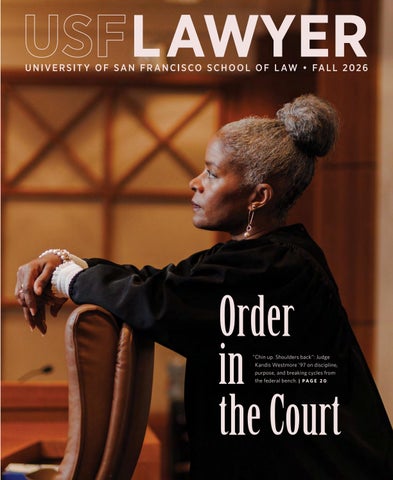
Order in the Court ”Chin up. Shoulders back”: Judge Kandis Westmore ’97 on discipline, purpose, and breaking cycles from the federal bench. | P A G E 2 0
A MESSAGE from THE DEAN Dear Alumni and Friends, As I begin my third year as dean, both legal education and the legal profession are in a period of challenge and reinvention. What grounds me in this moment is the generosity, commitment, and creativity of the USF Law community. As we transition to preparing our students for the NextGen Bar Exam, explore the opportunities created by generative AI, and confront ongoing threats to the rule of law, our community helps us shape our response, while grounding us in our history and mission. That spirit comes to life throughout this issue of USF Lawyer magazine. We celebrate the remarkable careers of two alumni whose retirements mark decades of service on their states’ highest courts: Illinois Supreme Court Chief Justice Mary Jane Theis ’74 (page 27) and California Supreme Court Associate Justice Martin Jenkins ’80 (page 2). Alongside the continued leadership of Judge Kandis Westmore ’97 (page 20), their careers exemplify the integrity, excellence, and commitment to justice that have long distinguished USF lawyers. USF Law faculty continue to shape the future of legal education. This year, Insight Into Academia recognized the creativity and vision our professors bring to training USF Law students for a profession transformed by new technologies and new challenges. You can read more about their work beginning on page 16. Alumni also play an essential role in preparing tomorrow’s lawyers. I am grateful to Bob Arns and Tom Brandi, whose generous gift established the Arns & Brandi Trial Institute, which will support our students’ development into confident, courtroom-ready attorneys (page 12). Their dedication is a powerful reminder that every generation of USF lawyers helps strengthen the next. I hope you’ll enjoy this issue and take pride in the many ways our alumni, faculty, and students are advancing the legal profession. Thank you for being part of a community that continues to lead with purpose, embrace innovation, and invest in the success of our school. Warmly,
Johanna Kalb
SALVADOR D. ACEVES University President EILEEN CHIA-CHING FUNG Provost and Vice President of Academic Affairs JOHANNA KALB Dean and Professor of Law AMY FLYNN Senior Associate Dean for Academic Affairs STEPHANIE CARLOS Associate Dean for Enrollment Management and Student Affairs BILL ONG HING Associate Dean for Faculty Scholarship ANNA TAIT Director of Development SHELLI FYFE Editor DESIGNED BY USF Office of Marketing Communications
USF LAWYER IS PUBLISHED BY University of San Francisco School of Law 2130 Fulton Street San Francisco, CA 94117-1080 (415) 422-6097 lawcommunications@usfca.edu
USF Lawyer is printed on paper and at a printing facility certified by BM TRADA Certification North America Inc. to FSC® standards. From forest management to paper production to printing, FSC certification represents the highest social and environmental standards.
CONTENTS 12
FALL • 2026
DEPARTMENTS
READY TO PRACTICE ON DAY ONE Alumni and longtime adjunct faculty Robert Arns ’75 and Thomas Brandi ’72 cofound new Trial Institute.
2 IN BRIEF Lessons From the Bench From Classroom to Command One to Watch: Iyunoluwa Irene Falade ’27 Rewriting the Playbook on Human Rights Advocacy
8 FACULTY FOCUS For the Planet, For Her Students New Voices at USF Law
26 ALUMNI NEWS Class Notes A Lasting Legacy With Gratitude: Alumni Award Recipients Inside the Verdict
32
16
20
HEAD OF THE CLASS
ORDER IN THE COURT
USF leads to prepare students for the future of practice.
Judge Kandis Westmore ’97 brings discipline and compassion to the bench.
CLOSING ARGUMENT Six Years Later By Marisa San Filippo ’08
ON THE COVER: Judge Kandis Westmore ’97
USFCA.EDU/LAW
1
IN BRIEF
IN BRIEF
Lessons From the Bench Nearly five decades after graduating from USF Law, retired California Supreme Court Justice Martin Jenkins ’80 returned to the Hilltop this past spring to deliver the law school’s 2026 commencement address: a full-circle moment for one of USF Law’s most distinguished alumni. Jenkins, who retired from the Supreme Court of California earlier this year, told graduates that attending USF Law was “one of the most important decisions of my life,” crediting the school with shaping his career. “The legal education I received here was second to none,” he said. “It was truly a transformative experience.” The son of parents who came to San Francisco seeking opportunity and dignity after growing up under segregation in Texas and Louisiana, Jenkins spoke candidly about the values that guided his life and career: integrity, humility, civility, mentorship, and service to others. He urged graduates to embrace honest self-evaluation, seek out mentors, and use their legal education “not only to build a successful career, but to expand justice and create opportunities for others.” The themes reflected a career defined by public service and judicial leadership. Over more than four decades, Jenkins served as a state and federal trial judge, a justice on the California Court of Appeal, judicial appointments secretary to Gov. Gavin Newsom, and ultimately as an associate justice of the California Supreme Court. Earlier in his career, he prosecuted civil rights cases for the U.S. Department of Justice, including cases involving Ku Klux Klan violence in the South. Widely respected for his thoughtful jurisprudence and steady courtroom demeanor, Jenkins became the first openly gay justice on the California Supreme Court and only the third Black man to serve on the state’s high court. Throughout his career, he remained deeply connected to USF Law, mentoring generations of students and alumni and serving as a trustee emeritus of the university. In his introduction at commencement, longtime friend and fellow USF Law alumnus George Leal ’80 described Jenkins as “the living embodiment” of the principle that “our character is our destiny.” He praised Jenkins’s compassion, work ethic, and lifelong commitment to ethics and civility in the profession. For the graduates seated before him, Jenkins framed the law not as a path to status, but as a vehicle for service. Quoting Langston Hughes and reflecting on the enduring promise of justice, he reminded the Class of 2026 that “the law is a profoundly human enterprise” and urged them to carry that responsibility forward with courage and integrity.
2
USF SCHOOL OF LAW
From Classroom to Command By Joseph Gruber ’14 I was three months into teaching my first Estate Planning course at the University of San Francisco School of Law when my student, John Nelson, a Navy veteran, approached me after class. He had a simple but powerful question: Could our course actually serve veterans? He was absolutely right. Estate planning is an ideal way to provide meaningful legal support to veterans, offering them legal protection during their lifetimes and effectuating their testamentary intent. It’s also a tremendous learning opportunity for our students, who can gain practical experience drafting advanced health care directives, powers of attorney, and wills under the guidance of practicing attorneys. I decided to turn Mr. Nelson’s idea into a reality. Thankfully, the law school’s leadership shared our vision. Sr. Associate Dean for Academic Affairs Amy Flynn connected me with the law school’s Veterans Oriented Law Society and the Students of Tax and Estate Planning Society to help build student interest in holding one-day practicums in support of veterans. Dean Johanna Kalb, drawing on her
experience supporting similar programs during her tenure at the University of Idaho, identified contacts and resources to make our plans feasible. Next, I reached out to Swords to Plowshares, a Bay Area nonprofit organization that has been supporting veterans since 1974. Their legal director, Mo Siedor, was instrumental in identifying locations, dates, and times that would best meet veterans where they are. We wanted the one-day practicum to be accessible, welcoming, and free of unnecessary barriers in order to maximize participation and impact. The result was a comprehensive estate planning practicum that took place in April 2026, offering health care directives, powers of attorney, and statutory wills. Our goal was simple: to help as many veterans as possible put essential estate plans in place. As an estate planning attorney myself, I stress to every client as well as every student the importance of having an advanced healthcare directive, a power of attorney, and a will. Each of these documents tells a story about dignity, trust,
and legacy. They empower veterans to make their voices heard, both now and in the future. Through this practicum, our students guided veterans through critical tasks, including nominating executors, recording their preferences on issues like pain management, and assigning beneficiaries. My hope is that the practicum was only the beginning. By bringing together students, faculty, practitioners, and community partners, we can continue to build our connections with the veteran community while also providing our students with hands-on legal experience. The article was originally published in The Daily Journal and has been updated and reprinted with permission.
Legal Frameworks in an Era of Climate Risk As wildfire risk intensifies across California and beyond, the legal questions surrounding prevention, response, and recovery are becoming even more urgent. This year’s Law Review Symposium, “Stages of Fire: Mitigation, Adaptation, and Rebuilding,” convened leading voices from law, policy, and land management to explore how legal systems are responding to the increasing scale and complexity of the issue. Led by Symposium Editor Flannery Kelleher ’26, the program followed the lifecycle of wildfire disaster, tracing the legal implications from prevention through long-term recovery. In his keynote address, Dr. David Saah, professor and director of USF’s Geospatial Analysis Lab, offered a big-picture view of climate governance and land management. Dr. Saah challenged the legal profession to move beyond reactive frameworks and help design systems capable of anticipating environmental disruption at scale. The message was clear: The law can’t afford to operate one disaster behind reality.
USFCA.EDU/LAW
3
IN BRIEF
ONE TO WATCH: IYUNOLUWA IRENE FALADE ’27 Student Bar Association (SBA) President Irene Falade arrived at USF Law from Edmonton, Alberta, Canada, having never visited California or toured the campus. She enrolled thanks to scholarship support and quickly found connections, leadership opportunities, and a passion for intellectual property law. Throughout her time at USF, she has served on numerous student organization boards, including the Black Law Students Association (president), Pride Law (treasurer), and First Generation Students Association (2L representative), and has worked with the Intellectual Property Technology Law Journal and as an ASP tutor. Following graduation and the bar, she hopes to build a career protecting artists and creators in an increasingly AI-driven world. Here, Irene reflects on finding community at USF, discovering new pathways in the law, and her priorities as SBA president. Did you dream of becoming a lawyer as a kid? For years, my parents would tell me that I should become a lawyer. But every time they brought it up, I would refuse because the only thing I knew about lawyers was going to court and dealing with criminals, which didn’t interest me. It was only in my final year of undergrad that I even considered becoming a lawyer. I did my research into the process and discovered that the law was more diverse with so many different areas of practice, and the opportunities seemed endless. That is ultimately what pushed me to pursue a JD, and I have found myself loving it more than I could have ever expected.
Any memorable moments at USF? I have had a lot of memorable experiences at USF, but the one that sticks with me the most happened on my first day here. I was chosen to be part of the Academic Support Program (ASP), which meant I had to arrive before orientation. As I walked into the Terrace Room that morning, I was greeted by Carol and Heidi, who both shared warm smiles at the door. Heidi immediately swept me into a hug before I could even introduce myself, and I was stunned. I don’t think I had ever had such a warm welcome, and it still sticks with me because having just that one person opening
4
USF SCHOOL OF LAW
up their arms to me was incredibly comforting and made me feel like I was in the right place.
Which class has challenged you the most? Constitutional law proved to be my most demanding class. As doctrine evolves with each court and era, the rules often shift in unexpected ways. Detailed case charts were key to my success in this class.
What do you hope to achieve as SBA president? I want every student to feel like they have a voice and a representative who uplifts them to make them heard. I want to develop our community into one that is even more supportive, helpful, accepting, and kind. My communities at USF have helped me get to where I am right now, and I will never stop being grateful to them for their endless faith in me. I want every student in our student body to have a similar experience.
Plans for after graduation and the bar? I plan to use my law degree to protect and support human creators in the fields of music, literature, visual arts, and more. A lot of the enrichment and pleasures we enjoy in our society come from creators sharing their works with us. I think human creators, especially artists, writers, and musicians, are taken for granted, especially now with the rise of AI. I want to be able to help them retain the rights over their creations through licensing, filing trademark applications, registering with the copyright office, and enforcing those rights when needed. Creators deserve to have their ideas safeguarded. ■
PRESS CLIPPINGS “ T here are lots of things that the ABA does in their standards to make sure that faculty qualifications are high, that bar pass rates are steady, that professional responsibility is part of our curriculum, and that there are minimum requirements on experiential and clinical training, library resources, and financial stability of the institution.” Sr. Associate Dean Amy Flynn spoke with Law360 on more states potentially allowing non-ABA accredited schools’ graduates to sit for their bar exams.
“ This is really a story about what happens to workers’ bodies when employers have total control and zero accountability.”
“ The pope adds some teeth to this dialogue, arguing for the protection of people as consumers, workers and citizens, and he also calls for us to retain what is uniquely human, including our vulnerability; he argues that human limitations are not “errors” that need correction.”
Professor Lindsay Harris told KQED about Saudi Arabia’s kafala system and its impact on migrant domestic workers. Professor Michele Neitz wrote in an op-ed she coauthored with Erin Brigham titled “Why non-Catholics should listen to Pope Leo’s message on AI,” published in The San Francisco Chronicle.
“ In the 1990s, law enforcement thought it was especially unlikely to get false confessions in very serious cases, homicide cases, capital cases, for example.”
Professor Richard Leo discussed a Texas wrongful conviction case with the Austin American-Statesman.
“ T he San Francisco Immigration Court’s closure is the end of an era in immigration history.” Professor Bill Hing discussed the court’s reputation for precedentsetting decisions with KTVU2 news.
USFCA.EDU/LAW
5
IN BRIEF
Rewriting the Playbook on Human Rights Advocacy In a bold legal effort, the International Human Rights Clinic filed 15 complaints before the United Nations Committee on the Rights of Persons with Disabilities (CRPD), advancing a novel strategy at the intersection of disability rights and migrant labor justice. Working in partnership with Global Justice Kenya and timed with World Day for Safety and Health at Work, the filings seek accountability for Kenyan migrant domestic workers who became permanently disabled after enduring abuse and neglect while working in Saudi Arabia under the kafala system. The cases argue that Saudi Arabia has failed to meet its obligations under international law by denying migrant domestic workers access to basic protections, medical care, and legal recourse. While reforms to the kafala system have been proposed for decades, domestic workers remain explicitly excluded, leaving them uniquely vulnerable to exploitation. Fourteen of the complainants are survivors now living in Kenya. A fifteenth complaint was filed by the mother of a 27-year-old woman who died after being denied timely treatment for meningitis. For the clinic’s student advocates, the work underscores USF Law’s commitment to hands-on, forward-looking legal education. “Law school teaches you to analyze problems,” said student Ruben Vergara-Murayama, who traveled to Nairobi as part of a clinic team that interviewed more than 40 survivors. “The clinic pushes us to think creatively about solutions that truly serve our clients.” Those firsthand accounts form the backbone of the complaints, detailing how women who arrived healthy returned home with life-altering conditions, including blindness, paralysis, and chronic pain, after being forced to work through serious injuries without medical care. The clinic’s director, Professor Lindsay M. Harris, describes the filings as both unprecedented and urgent. “These cases ask the Committee to recognize that the kafala system doesn’t just exploit workers, it disables them,” she said. “We’re using every tool available to demand accountability.”
6
USF SCHOOL OF LAW
Stellar Development Foundation’s Gift Advances USF’s Leadership in Tech Law USF Law has received a $1.25 million gift from the Stellar Development Foundation (SDF), that has been matched by the Getty Geschke Fund, to establish the Stellar Development Foundation Law, Technology, and Social Transformation Professorship, a new initiative exploring how emerging technologies can advance equity and access in law and policy. Michele Neitz has been appointed by the law school to serve as the first holder of the professorship. For SDF, a foundation that supports the development and growth of the open-source Stellar network, the gift reflects its broader mission to expand equitable access to the global financial system through education, research, and collaboration. Dean Johanna Kalb emphasized the significance of the endowed professorship for students and the wider legal community. “I am grateful to SDF for this pivotal gift, which will help the law school continue to train students on the legal implications of blockchain and other emerging technologies,” said Kalb. “We feel very lucky to have Professor Neitz, an internationally recognized expert and a talented teacher and scholar, as a member of our faculty.” Professor Neitz advises international and state organizations on emerging technologies and has trained more than 1,000 government officials on the responsible regulation of emerging technologies. As the Stellar Development Foundation Law, Technology, and Social Transformation Professor, Neitz will lead the creation of pioneering tech law courses, collaborative student-faculty research opportunities, and policy resources for government officials, all focused on leveraging technology to advance equity and inclusive growth in our digital society. “This gift ensures that future generations of lawyers will be prepared for the challenges and opportunities presented by emerging technologies,” Neitz said. “I am honored to represent SDF’s commitment to global inclusion and transparency through the use of innovative technology.”
#USFLAW
/usflaw
@usflaw
@usflaw
Stay connected with USF School of Law on social media. Tag your posts to share your #USFLaw moments!
FEBRUARY 2026 A very special homecoming at #USFLaw! We were honored to welcome Professor Emeritus John Adler back to campus to discuss his new book, Second Chance. Professors Susan Freiwald and Bill Hing, along with Associate Director Margaret Mullane, led a thoughtful Q&A with faculty and staff. Thank you, Prof. Adler, for an inspiring visit!
MAY 2026 APRIL 2026 Great to see the momentum coming out of this weekend’s Ripple x University of San Francisco Hackathon for Social Good! Bringing together students from computer science and law, this interdisciplinary group explored how blockchain can be applied to real-world challenges. Topics ranged from streamlining nonprofit donations and air quality monitoring, to political violence documentation, peer-to-peer microtransactions, blockchain-based voting, and even university meal plan transfers.
While at Legalweek 2026 in NYC, Lydia Flocchini ’98 had the chance to connect with Andreas Becker ’11 to discuss his legal tech journey with Clio, the role of AI in legal technology, and how their time at #USFLaw impacted their careers.
APRIL 2026 MAY 2026 Congratulations to alumnus Frank Pitre ’81, named to the Litigation Section of the California Lawyers Association’s Trial Lawyer Hall of Fame!
JUNE 2026 Grateful to the more than 20 dedicated #alumni who joined us at yesterday’s reception for our incoming 1L class. Excited to welcome the Class of 2029 to our #USFLaw community!
Congratulations to #USFLaw students Alexandria Moorehead and Morgan Vonder Haar, first-place winners at the 2026 Environmental Law Section Student Negotiations Competition! The annual competition brought together law students from across California to negotiate real-world environmental law scenarios and build advocacy skills.
USFCA.EDU/LAW
7
FACULTY FOCUS
IN BRIEF
For the Planet, for Her Students: Professor Alice Kaswan Retires “I’ll miss the community, the smiles in the hall, the ‘how’s your day’, and the ‘thank yous’ our students relay so generously.” For Professor Alice Kaswan, reflecting on 27 years at USF Law, it’s the people who stand out above all else. “The students, the faculty, and the staff bring such positive energy to their engagement with USF,” she said. It’s a reflection that tells you everything about who she is. This past summer, after nearly three decades of teaching, scholarship, and advocacy, Kaswan retired from USF Law, where she had become the school’s most recognized voice in environmental justice and climate change policy.
A Career Built With Purpose Kaswan arrived at USF in 1999 as an associate professor, but her path here was deliberate from the start. While clerking for Justice Marie Garibaldi on the New Jersey Supreme Court and honing her practice at Berle, Kass & Case and Morgan, Lewis & Bockius, she never lost sight of where she was headed. Teaching had always been the goal; a calling, not just a career. After four years on the faculty at the Catholic University School of Law, she found her home in San Francisco. Over the next 27 years, she became a Dean’s Circle Scholar, served as associate dean for faculty scholarship, and stewarded the Environmental Law Student and Alumni Society (ELSAS). For the last few years, she has also cochaired USF’s One Earth Initiative,
8
USF SCHOOL OF LAW
the university’s effort to integrate environmental justice and sustainability across the institution as called for by Pope Francis’s landmark encyclical Laudato Si’: On Care for Our Common Home.
At the Intersection of Climate and Justice Since the mid-2000s, Kaswan’s scholarly work has focused on climate change and environmental justice. “I always wanted to do something to change the world from here and better the planet,” she said, “especially as climate change emerged as one of the paramount concerns of our lifetimes, and of the lifetimes of future generations.” Kaswan has seen interest in environmental justice go through ebbs and flows.“When I started teaching in the mid-90s, it was on an upswing as people began recognizing that the panoply of environmental laws that had been adopted in the 1970s were not adequately addressing disproportionate pollution burdens in marginalized communities.” She notes that these years were followed by relative stagnation and credits the Biden administration with later bringing an “unprecedented level of attention to environmental justice.” While Kaswan acknowledges that the Biden-era policies have since been reversed, she believes that “the movement has become more powerful and more organized” over the last few decades.
Building Bridges Between Students and Alumni One of Kaswan’s most enduring contributions is the way she has helped build connections between students and USF Law graduates. Around 2013, she and then-student Michael Hewitt ’15 reimagined the Environmental Law Society, expanding membership to include both students and alumni. The organization remains active today, bringing together current students with the practitioners who were once in their shoes. “ELSAS has allowed me to maintain relationships with alumni in the field, making it a lot easier to connect current students with alumni mentors,” Kaswan said. That ongoing connection with alumni is something former students feel deeply. Leuwam Tesfai ’12, now executive director at the California Public Utilities Commission, has stayed connected through ELSAS. “I am very grateful for Professor Kaswan’s mentorship. Working as her research assistant during law school exposed me to climate adaptation and environmental justice, issues that continue to play a role in my career.” For Kaswan, that kind of impact is a measure of a life in teaching. “As a teacher, I’m proud to vicariously live through my students’ accomplishments. As a scholar, I’ve spent decades writing about environmental justice and climate justice that I hope will help shape the field. The life of a professor has multiple dimensions, and I feel lucky to have found all of them meaningful.”
FACULTY FOCUS
Faculty Scholarship USF Law faculty are active scholars, advocates, and public voices in courtrooms, policy debates, and national media. Over the past year, they have published influential scholarship, presented at major conferences around the world, and contributed their expertise to some of the most consequential legal conversations of our time. Here are a few recent highlights.
Professor Lara Bazelon Wrote “Rejecting Confessions of Error,” which will be published in the Loyola Marymount Law Review (2027). Professor Susan Freiwald Coauthored “Superwarrants” with Paul Ohm, forthcoming in Arizona Law Review (2026). Professor Lindsay M. Harris Published her coauthored casebook, Refugee Law and Policy: A Comparative and International Approach (6th ed.) with Carolina Academic Press. Coauthored “The Parenting Professor Penalty in Legal Academia,” forthcoming in the Columbia Journal of Gender and Law (2026). Professor Bill Ong Hing Published “On Resistance: Confronting the Second Trump ICE Age,” in the Southwestern Law Review (2026). Associate Professor Juan Carlos Ibarra Authored two forthcoming articles, “Revisiting Integrating Spaces: Racial Legal Entitlements and the Reorientation of Property Law Education,” for the Journal of Legal Education (2026) and “Racial Legal Entitlements and Heirs’ Property,” in Loyola of Los Angeles Law Review (2027). Professor Richard Leo Coauthored “The Innocence Revolution: How The Innocence Movement Changed America” (forthcoming, Oxford University Press, 2027). Ranked No. 16 nationally for scholarly impact in criminal law and justice by HeinOnline (2026). Professor Matthew Liebman Published “Legislating Nonpersonhood,” Wake Forest Law Review (2026). Awarded the 2026 Fred C. Zacharias Memorial Prize for Scholarship in Professional Responsibility and the 2026 Association of American Law Schools Excellence in Animal Law Award.
Professor Michele Neitz Published “Ready or Not: How Congressional Dysfunction and Loper Bright Enterprises v. Raimondo Will Shift U.S. Regulation of Emerging Technologies to the Federal Bench,” SMU Law Review (2025). Professor Julie Nice Published “The Irrationality of Punishing Homelessness” in Santa Clara Law Review (2026). Professor Mark Niles Published two scholarly articles, “Student Protests and ‘Fighting Words’: Critical Race Theory and the Evolution of Hate Speech Codes on College Campuses” in the Albany Law Review (2025), and “Stare Decisis and the 1L Classroom: Can Legal Reasoning Be Taught Without Judicial Respect for Precedent?” in St. Johns Law Review (2025). Associate Professor Alexandria Serra Published three scholarly articles, “AI as your CoCounsel: The Next Evolution in Training” in the Ohio State Tech Law Journal (2026), “Why Smart Lawyers Are Building AI Tools Instead of Buying Them,” National Law Review Online (2026), and ”Trial by AI: Reinventing Advocacy Training for the Modern Lawyer” in Stetson Journal of Advocacy and the Law (2026). Professor Allison Tirres Named co-editor-in-chief of the American Journal of Legal History, a peer-reviewed journal published by Oxford University Press. Authored “A New Normal? Making Sense of this Moment in the History of Immigration and Citizenship Law,” forthcoming in the Journal of Civil Rights and Economic Development, and “The Strange Career of the Birthright Citizenship Executive Order,” forthcoming in the Santa Clara Law Review. Associate Professor Megan Wachspress Authored “Dear Prudence: The Atomic Origins, Decarbonization Deployment, and Transformative Potential of a Regulatory Principle,” forthcoming in Utah Law Review (2026).
USFCA.EDU/LAW
9
FACULTY FOCUS
New Voices at USF Law
Assoc. Prof. Alexandria Serra
Prof. Mark Niles
Assoc. Prof. Megan Wachspress
ASSOC. PROF. ALEXANDRIA SERRA
L
ong before she began building AI tools for law students, Assoc. Prof. Alexandria Serra was figuring out how technology could help her better serve clients in her own criminal defense practice. The daughter of a Puerto Rican father born in Ponce, Serra was the first in her family to graduate from college, and then from law school. A nationally competitive speech and debate student during her college years, she attended night law school at Southern Methodist University while working at a patent law firm during the day. Navigating professional school without a family roadmap wasn’t easy. Her family was proud and supportive, she says, but couldn’t provide her much guidance. After graduating and practicing patent law briefly, she realized she wanted to be in the courtroom instead. “I said, ‘All right, patents are not for me.’” Serra went on to work as a public defender in El Paso, Texas, before building
10
USF SCHOOL OF LAW
her own criminal defense practice, where she began experimenting with technology to better serve clients and manage a highvolume caseload. “I built an app where clients could snap a picture of their ticket and hire me automatically,” she said. The app was designed to dismantle the barriers that keep ordinary people from accessing legal help: the time off work, the unfamiliar courthouse, the anxiety of navigating a system that was not built with them in mind. That early interest in technology as a tool for access to justice eventually shaped her teaching and scholarship. While teaching advocacy courses and coaching mock trial teams, Serra began developing AI-powered tools that allow students to practice oral arguments, objections, cross-examinations, and client counseling exercises. “I thought, how do I serve more students in a better way?” she said. “We are limited in
our capacity by the hours in which we can dedicate to teaching and coaching. AI is not.” For Serra, it is the repeatable, scalable, accessible aspects of these technologies that prove invaluable. Today, her work focuses not only on how AI can improve legal training, but also on the harder questions where the rights of the accused are concerned. Her scholarship sits at the intersection of AI and constitutional criminal procedure, examining how AI is reshaping the criminal justice system. For lawyers thinking of leveraging AI, the key, she observes, is separating machine tasks and human tasks. “Lawyers have been doing too many machine tasks for too long,” she said. “If we can leverage AI to operate at the top of our licenses, meaning delegating those tasks to AI, the lawyer work, like strategy, judgment, problem-solving, is going to turn out better for lawyers and their clients.”
PROF. MARK NILES
B
efore he ever stepped into a law school classroom as a student, Prof. Mark Niles was already captivated by legal education. His mother attended law school while he was in junior high, and Niles asked to sit in on one of her classes: Criminal Procedure. “I was hooked,” he said. That early fascination with the law, combined with a longstanding interest in teaching, shaped the path that ultimately brought Niles to USF, where he joined the faculty this past summer. Niles’s scholarship focuses on the balance of power between state and federal governments, including current research examining how political and racial gerrymandering undermine democratic accountability in local, state, and federal legislatures. At the center of his work, however, is teaching. “I focus on helping students understand that, as lawyers, their job will be to advocate for their clients’ interests,” Niles said. “The best way to be an effective advocate is to understand legal analysis and how to use it to achieve your client’s goals.” Niles teaches Civil Procedure, a foundational first-year course that he believes students often underestimate. “There’s a misconception that Civil Procedure is boring,” he said. “It is actually a fascinating subject that involves a wide range of ideas and strategies that are central to the work of lawyers.” Students in Niles’s classroom can expect a traditional Socratic approach delivered with intentionality and care. While
ASSOC. PROF. MEGAN WACHSPRESS
he values rigor and engagement, he is equally committed to creating an environment where students feel supported as they build confidence and analytical skills. “I do my best to make the classroom as humane and non-stressful as possible,” he said. “I am very committed to making sure students understand what they need to know from the course and that they are prepared for what to expect on exams and other assessment models.”
“ The best way to be an effective advocate is to understand legal analysis and how to use it to achieve your client’s goals.” That student-centered philosophy made USF Law a natural fit. “I love that USF has one of the most diverse student bodies of any law school in the country,” Niles said. “I have always loved teaching different kinds of students from different backgrounds and with different perspectives.” He hopes students leave his classroom not only with a strong foundation in legal analysis, but also with a broader sense of possibility about their futures in the profession. “I hope that I have given students of color, and all students, a sense that they can do whatever they want to with their legal degree,” he said.
A
ssoc. Prof. Megan Wachspress’s path to higher ed has taken her from labor litigation and appellate clerkships to environmental advocacy work challenging utilities and coal plants across the Midwest. Along the way, her work centered on questions of justice, public policy, and social change. “I think I’ve always wanted to be a part of movements to address injustice,” Wachspress said. After graduating from law school, Wachspress clerked for Justice Goodwin Liu of the California Supreme Court and Judge William Fletcher of the Ninth Circuit Court of Appeals. She later joined Altshuler Berzon, representing unions and workers in labor and employment disputes involving discrimination, wage theft, and government transparency issues. Eventually, the climate crisis shifted the focus of her work. Wachspress joined the Sierra Club’s Beyond Coal Campaign, where she litigated against utilities to prevent the construction of new gas plants and accelerate the retirement of coal plants. During this time, “I came to belatedly realize how urgent the climate crisis is and how unequally its impacts will be felt,” she said. “All of these inequities of citizenship, economics, race, and gender were going to be turbocharged by global warming.” After years in practice, Wachspress realized she wanted to combine advocacy with scholarship and teaching. Before entering academia, she volunteered as an instructor at
“ For better or worse, environmental law is about people. It’s overwhelmingly driven by human concerns.” Mount Tamalpais College at San Quentin and later taught legal writing at Stanford Law School as a Thomas C. Grey Fellow. Wachspress said she was drawn to USF because of its commitment to social justice. In the classroom, Wachspress blends doctrinal rigor with humor, storytelling, and real-world examples drawn directly from practice. “Thrills! Chills! Dramatic twists! Melodrama!” she said when asked what students can expect from her courses. More seriously, she hopes students leave each class feeling “like they’ve been on a little intellectual adventure.” Her courses incorporate real litigation documents, environmental impact statements, and examples from her years working in environmental law. “I have six years’ worth of examples of how to go about suing a coal plant,” she said, “and I am excited to bring those examples into the classroom.” Wachspress hopes students come away with a broader understanding of environmental law and the human impact at the center of it. “For better or worse, environmental law is about people,” she said. “It’s overwhelmingly driven by human concerns.” USFCA.EDU/LAW
11
“ READY to
PRACTICE on DAY ONE” ALUMNI AND LONGTIME ADJUNCT FACULTY ADD NEW ROLES TO THEIR RESUMES: COFOUNDERS OF USF’S FIRST TRIAL INSTITUTE
By Annie Breen 12
USF SCHOOL OF LAW
I
n a sense, USF Law’s new Arns & Brandi Trial Institute has been in the works for over 20 years. That’s around when its cofounders, Robert Arns ’75 and Thomas Brandi ’72, first took on adjunct co-teaching duties for the Trial Practice course at USF Law. “I had always thought I would teach,” Arns says. “But when USF Law first approached me to instruct a trial course, I was in the middle of a trial. I knew I wouldn’t be able to be present for the students in the way I should be, to teach them the way they deserved to learn. So I thought, ‘I need a partner.’ The first person to come to mind was Tom.” For the next two decades, Arns and Brandi balanced their roles teaching USF Law students how to try a case in court with their heavy caseloads as successful plaintiffs' attorneys. Of his time in the classroom, Brandi says, “It’s been one of the most wonderful experiences of my life. To teach is a way to give back for all that I’ve received.” Today, Arns and Brandi are giving back far more than instruction. They’ve committed a combined lifetime donation of $3.25 million to USF Law, $1.86 million of which is going directly to the establishment of the new trial institute.
Parallel Lives A commitment to giving back to their alma mater is just one in a long line of similarities between the two men, beginning with the fact that their early years didn’t necessarily portend big-time law careers. “My father never finished high school, and my mother’s education ended there, too,” says Arns, who grew up in Portland, Oregon. “I started working at Albertson’s when I was 14, and was a journeyman in the union as a checker and a produce worker by 16. But I was lucky, because
I was good at school even though I was working full-time.” So good, in fact, that he was in honors classes and was admitted to the University of California at Santa Barbara upon graduating. He arrived at UCSB as an English major, studied Renaissance Literature specifically, and says that all he wanted to do was write. “I grew up with no money, and had no idea what monetary success was or could do. So my plan was to get a PhD and teach. In fact, I’d gotten into Cal to get a PhD in Renaissance Literature when life intervened.” The interventionist? Arns’s new father-in-law, John McCarrick. “Anne and I had just gotten married. One day, her dad, a guy who had stormed Normandy and was a union rep for the lithographers' union, walked by as I was writing and said ‘What a bunch of bullsh*t.’ I asked what he meant, and he told me, ‘Go to law school and help people.’ I applied to law schools the very next day.” He was admitted with a full scholarship to USF Law, and he and his wife, Anne, moved to San Francisco. He would miss being in the halls alongside Tom Brandi by just a year or two. Brandi was a city kid, had grown up in the Outer Sunset and attended St. Ignatius College Prep. His father had worked in SF shipyards all his life, and he didn’t have the legal connections that made law school a likelihood, or even a possibility. In fact, Brandi was set on playing professional baseball. He’d been a star at St. Ignatius and was named an All-City second baseman, and earned a full athletic scholarship to San Jose State University. “In my junior year, I was talking to a scout from the St. Louis Cardinals, but I knew I’d reached the end of that road,” Brandi says of his college career. Yet after graduation, he was asked to stay on with the SJSU baseball program as a graduate assistant, and Brandi felt an opportunity click into place. “I saw it as an opportunity to get a graduate degree,” he says. "Then I decided to go to law school.”
USFCA.EDU/LAW
13
He was with the SJSU team at what was then the Max Ulrich Field, and is now the Dante Benedetti Diamond at Max Ulrich Field, on the Hilltop, when he got the news that he’d been accepted to USF Law. “The San Jose coach knew someone at USF Law who told him I’d been accepted, and I found out that day that I’d be attending law school on that campus.” Though they did not attend USF Law at the same time, both Arns and Brandi quickly found what was to be their mutual legal passion: trial advocacy. Arns says, “I loved being in law school then. It was during the Civil Rights Movement, the Vietnam War … at that time, there were big corporations taking advantage of families by either paying low wages or trying to lowball them after a workplace injury. I wanted to fight for those families.” He credits his father-in-law, John, here, too. “He was injured on the job when my wife was 8. He was recuperating for a year and a half, which affected their family greatly. Anne has always been supportive of the long hours of trying cases partially because she lived through her dad’s injuries.” Brandi, too, chose to become a plaintiff’s lawyer to right what he felt society was getting
"IT WAS IMPORTANT TO ME THAT NEWLY MINTED LAWYERS UNDERSTAND THAT AT THE BOTTOM OF EVERY LAWSUIT IS A HUMAN BEING."
—Thomas Brandi
14
USF SCHOOL OF LAW
wrong. After a stint in law school clerking in the public defender’s office, where he once had to interview a man who had beaten his own grandmother, “I couldn’t work with violent criminals. It’s not what I was equipped for.” What was he equipped for? “I realized I needed to be in the courtroom, working on behalf of families who had been injured or taken advantage of. I could give my whole self to that,” Brandi says. “The courtroom was a place where Little could hold Big accountable.”
Connecting Over Practice Arns and Brandi each cut their trial teeth at private firms before hanging out their own shingles, and it was then their paths crossed. “We were both plaintiff’s attorneys who were winning in San Francisco,” Arns says. “We knew of each other, circled around each other. But it was because of the Dalkon Shield cases that we really got to know one another.” The men’s firms represented plaintiffs in the large class action lawsuit against the A. H. Robins Company, which manufactured a contraceptive intrauterine device known as the Dalkon Shield. It was found to cause severe infection, injury, and infertility in a disproportionate number of women who used it, and Arns and Brandi represented many of the plaintiffs. “The defense tried to imply that the women who were affected were promiscuous,” says Brandi, sounding indignant even to this day. Arns and Brandi formed a close connection as a result of those cases, which they won resoundingly on behalf of their clients, and from there a partnership was born.
An Offer Accepted “When Bob asked, I don’t think I hesitated,” Brandi says of agreeing to coteach the Trial Practice course. “It was important to me that newly minted lawyers understand that at the bottom of every lawsuit is a human being. It’s about, ‘Did something bad happen to someone good, and is there a remedy? And can we prevent it from ever happening again via litigation?” That philosophy comes to life each fall in the capstone experience for their Trial Practice students. After a semester spent mastering courtroom fundamentals, students travel to Napa Valley for a full-scale mock trial at Arns's vineyard, Tournesol, where a large barn has been transformed into the Rock Barn Courthouse. There, students step into the roles of trial lawyers, presenting evidence, examining witnesses, arguing motions, and making their cases before a judge. Last year's trial was presided over by retired California Supreme Court Justice Ming Chin BA ’64 JD ’67. For some students, it is their most vivid opportunity to experience the pressure and unpredictability of a realistic courtroom setting. "The goal is to make it as real as possible," says Brandi. "You can read about trial advocacy and you can practice pieces of it in class, but there is no substitute for standing up and trying a case." When the trial concludes, the experience shifts from courtroom to community. Everyone gathers for lunch at Arns's home overlooking the vineyard, discussing strategy, lessons learned, and the realities of trial practice. The setting may be uniquely Napa, but the purpose is quintessentially USF Law: bringing together students with lawyers and judges committed to mentoring the next generation of advocates. Though the men are still practicing and teaching, they decided that now was the right time to share the legacy of their success with the school to which they’ve belonged as students, mentors, or adjunct professors for over 50 years. “We’ve had time to develop the structure of the trial institute through years of teaching the course, and have the financial means to support it in the way we think it deserves,” says Arns. The institute's curriculum reflects Arns’s and Brandi’s thoroughness. Students move from foundational courses, including evidence, civil procedure, and discovery, through advanced trial simulations, mastering voir dire, opening statements, witness examination, and closing arguments. Select classes use Arns’s longtime teaching materials, the Evidence and Trial Wheels course books, used by attorneys and universities across California. Coursework in applied AI and emerging legal technology ensures graduates are fluent in the tools reshaping modern litigation. Dean Johanna Kalb credits both alumni for their long commitment to the school and its students. "I am grateful to Bob and Tom for this extraordinary gift," says Kalb. "As alumni, longtime faculty, and two of the finest trial lawyers this school has produced, they have already shaped a generation of advocates. The Arns & Brandi Trial Institute ensures that legacy will continue for generations to come." Arns and Brandi share a single goal for the newly formed institute: “We want every student who goes through the curriculum and program to graduate and walk into a firm, ready to practice on Day One.” n
USFCA.EDU/LAW
15
HEAD OF
THE CLASS By Dave Kuhl
The legal profession is changing faster than it has in decades, and law schools are racing to keep pace. At USF, the response has been swift and nationally recognized. For more than two years, publications including National Jurist and The National Law Review have highlighted USF’s leadership in preparing students for the future of legal practice. 16
USF SCHOOL OF LAW
When Johanna Kalb became dean in 2024, conversations with alumni made it clear that artificial intelligence was an immediate priority. Among those voices was Aaron Crews ’04, who told her something she couldn’t stop thinking about: Her current students were going to graduate into a profession their legal education hadn’t prepared them for. Crews said, “Students need to learn how AI can operate as a thinking partner for lawyers, and they need hands-on practice with it.” She started looking for ways to move forward and discovered that several of her faculty members were already getting started. Legal Writing professors Megan Hutchinson and Nicole Phillips, both practicing employment lawyers, had independently started experimenting with AI in their classes back in 2022. Neither considers themselves a technology enthusiast. What brought them to AI was their own experience in practice, where they could already see AI reshaping
legal work. As Hutchinson says, “It was like we both created the wheel separately.” By fall 2025, AI instruction had become part of the required USF Law curriculum. Kalb says she provided resources and enthusiasm, and credits Hutchinson, Phillips, and other faculty members for laying the groundwork for everything that followed. While other law schools were building certificate programs and optional AI tracks, USF chose a different path: Weave genAI instruction into the required first-year curriculum and frame it as one professional tool among many, rather than a separate subject requiring its own special designation. It was the first law school in the country to take this approach. For Kalb, the context matters. “If AI instruction lives off to the side,” she says, “it won’t connect with what students are actually learning in their doctrinal and skills courses.” Initially, that context was Legal Research and Writing. In the fall semester
at USF, students learn the fundamentals without AI. In the spring semester, after they’ve mastered the basics, the AI tools come out alongside more difficult questions: When should you use AI? When shouldn’t you? How do you verify what it produces? And who is ultimately responsible for the work? Hutchinson describes the sequencing with this analogy: You learn math by hand before you learn it on a calculator. The technology may be new, but the underlying lesson isn’t. Good lawyering has always depended on sound judgment. “AI is like a 14-year-old who’s also a genius,” Hutchinson says. “You never know if you’re getting garbage or something brilliant, and the only way to find out is to check.” The lawyers making headlines for submitting AIgenerated briefs full of invented citations are not, Hutchinson would argue, suffering from a technology problem so much as a verification problem; AI has simply made the consequences arrive faster and in more public ways.
STUDENTS HELP WRITE THE RULES As the law school expanded its use of AI, Kalb wanted students to have a voice in shaping how the technology would be used. Working with Liza Levitt ’00, Intuit’s VP and deputy general counsel for platforms, responsible AI, and emerging technology, Kalb created a student advisory process to help develop guiding principles for AI use across the institution. Student representatives conducted interviews and surveys throughout the law school community, gathering perspectives from classmates, faculty, and staff before drafting a set of recommendations that were ultimately adopted through the school’s faculty
governance process. Their surveys found a striking degree of consensus across different constituencies. The concern that rose to the top, cited equally by students and faculty, was not job displacement or academic integrity or any of the fears that tend to dominate public conversation about AI. It was the loss of critical thinking: the worry that somewhere in the accumulating efficiency, something essential to the practice of law was being quietly handed off. The principles they ultimately created emphasize responsible innovation, professional ethics, transparency, equity,
and the development of core lawyering skills such as critical judgment and creativity. They now help inform decisions about curriculum, policy, and AI governance at the law school. HENRY CUNNINGHAM, a member of the student advisory team, said it was important for “students’ concerns about the use of technology to be addressed. One strength of our principles is that they are flexible and can be adapted as this landscape continues to change.” USFCA.EDU/LAW
17
USF’s response was to build verification into the curriculum at its most foundational level. In the redesigned Legal Writing final exam, students scrutinize every legal proposition in an opposing motion for accuracy. Phillips and Hutchinson give their students three questions to apply whenever they are considering using AI in their work: Does it make you more efficient? Can you verify it? Would you be comfortable putting your name on it? All three need to be a “yes” before they proceed, and the standard applies to any document a lawyer puts their name on, regardless of who or what produced it. Those lessons don’t stop after the first year. AI instruction now appears throughout the curriculum, from required courses in Professional Responsibility and Evidence to electives in Contracts Drafting, Community Property, and International Human Rights Law. In Professional Responsibility, students grapple with how the rules of the profession structure the responsible and ethical use of AI. In Evidence, students learn to use AI to improve their workflow. In a project designed by Crews, students work through an incomplete case file with Claude, mapping claims and defenses, surfacing evidentiary gaps, and building a litigation strategy. As students’ knowledge of legal practice and doctrine deepens, so does the sophistication of the work they’re asked to do with AI. Kalb and the faculty also view emerging technologies as a tool for expanding
18
USF SCHOOL OF LAW
opportunity within legal education. USF draws students from varied backgrounds, and not all of them arrive on campus having worked in a professional office, navigated a client-facing job, or had the chance to absorb the unspoken norms of legal culture simply by being around it. Nicole Phillips built her bot ecosystem to address these gaps. The cold-call practice bot she created lets students choose their professor type, demanding or encouraging, theory-focused or practically focused, and rehearse before class. The client intake bot gives them their first simulated client meeting before real consequences are attached to the outcome. The negotiation bot lets them practice something most lawyers don’t attempt until they’re already billing for it. The goal, as Phillips frames it, is straightforward: Students who arrive without a professional head start should leave on equal footing with those who did. Kalb is working with the faculty to scale and adapt these simulations. USF’s Jesuit mission shapes AI-related efforts in other ways. Through the law school’s Center for Law, Tech, and Social Good, students are encouraged to engage with AI as a transformative force in society. Michele Neitz, the center’s director, says the focus is on responsibility. “We want to help students build the habit of asking what a given technology will do to vulnerable populations before asking what it will do for anyone’s bottom line.” Hutchinson and Phillips haven’t stopped questioning their own model, either. They’re already rethinking the mathbefore-calculator model, because each new class of students will have grown up with these tools in ways the prior year’s students didn’t, which means the curriculum that made sense at the beginning may become out of date as quickly as it’s completed. They discuss it roughly once a day. Hutchinson says, “It’s a constant evaluation of what we’re doing, why we’re doing it, and whether it’s still the best way to get students where they need to go.”
“If AI instruction lives off to the side, it won’t connect with what students are actually learning in their doctrinal and skills courses.” JOHANNA KALB
That kind of relentless selfexamination is not what most people picture when they think about institutional change in legal education, which tends to move at the speed of committee consensus and accreditation cycles. What USF has built is something nimbler than that, and more honest: a program that treats its own assumptions as revisable, its tools as temporary, and its students and their growth as the priority. n
AI IN ACTION For upper-division students interested in civil litigation, the Applied AI course offers a glimpse of their future workplace. Taught by alumnus and civil litigator SHOUNAK DHARAP ’16, the course explores how attorneys are using AI to research legal issues, analyze evidence, develop case strategy, conduct discovery, and prepare motions. “Students come in wanting to know what the tools can do and the best prompts to get them there,” Dharap says. “What surprises them is how much of using AI well is about practice and restraint. You try everything—and then you figure out which tasks you still have to do the slow way, because that’s the only way you build the judgment necessary to turn an output into a real piece of lawyering.”
USFCA.EDU/LAW
19
Order in the Court BY EVAN ELLIOT
Every afternoon after school, Kandis Westmore walked to Vala Bovie’s School of Classical Ballet in Berkeley. She had been going there since she was 4. By the time she was 9, she made the walk alone. “Madame Bovie would not let you slouch,” Westmore says. “Chin up. Shoulders back. She had such a strong impact on my life that I could hear her voice in my head when I was not even with her. If I was walking down the street and caught myself slouching, I would stand up.” Those early lessons taught discipline and the importance of carrying yourself with purpose, Westmore says. Years later, those same qualities would help her navigate law school, motherhood, and eventually a seat on the federal bench. They would also shape the way she views her role as a judge: not simply to decide cases, but to recognize potential in others. Her mother earned a bachelor’s degree, then a master’s in public health, then a law degree from UC Berkeley, raising
20
USF SCHOOL OF LAW
Westmore alone. As a teenager, watching her mother buried under stacks of law books, Westmore decided law was not for her. In the local legal community, she was known as Kittye Beasley’s daughter. Years later, when Westmore announced she planned to apply to law school, her mother laughed. Now her mother is proud to be called Judge Westmore’s mother. Westmore went to law school at night while raising two young children and working full-time at UC Berkeley. Berkeley’s law school discouraged first-year students from working, she says. USF’s evening program allowed students to keep their jobs. Two of her mother’s friends — lawyers Saundra Brown Armstrong ’77 and Martin Jenkins ’80 — had been part of Westmore’s life since childhood. Her mother had worked with both at the Alameda County District Attorney’s Office. Armstrong later became a U.S. district judge for the Northern District of California. Jenkins later served as an associate justice of the California Supreme Court. “I knew Judge Armstrong went to USF, so it had to be a good school,” Westmore says.
USFCA.EDU/LAW
21
At UC Berkeley, where she was an undergraduate, Westmore says she often felt anonymous among 33,000 students. At USF Law, professors knew her by name. She moved through the program alongside classmates who were balancing jobs, children, and commutes. “IT’S KIND OF A BLUR, IT
W A S S O H A R D ,” S H E S AY S . “ YOU JUST GET HYPER-
F O C U S E D. G E T T H R O U G H I T. M A K E I T H A P P E N .”
In her final semester, Westmore landed a judicial externship in Judge Armstrong's chambers. Armstrong offered her the position when Westmore wasn’t sure
22
USF SCHOOL OF LAW
she was ready, worried her writing wasn’t strong enough. “‘I don’t expect you to come to my chambers and produce work that I’m going to put out there,’” Westmore recalls Armstrong saying. “‘I expect you to come and learn as much as you possibly can. This is for you. This is not for me.’” With every legal brief after that, Westmore says, “I asked myself if Judge Armstrong would approve. If the answer was no, I kept working.” After graduation, Westmore worked briefly as a plaintiff’s attorney, then joined the Oakland City Attorney’s Office. It was there, she says, that she understood for the first time that law was what she was supposed to do.
In 2012, she was appointed a magistrate judge for the Northern District of California. Before she applied, however, she sought advice from Justice Jenkins. “He said: ‘You are right for that, and I’m surprised you haven’t already submitted your application,” she recalls. And then he said, ‘It is already written.’” That affirmation from Jenkins “shattered all my insecurities,” she says. “Whether I was good enough, whether my writing was good enough, whether I had what it took. He filled all those spaces inside of me that carried doubt. He spoke that truth to me, and it became my truth.” For the first few years, court staff, litigants in cases, and lawyers told her that she didn’t look like a judge.
“The image that comes into your mind when you say ‘federal judge’ is not me,” she says. As the only African American magistrate judge in the district, she understands the significance of representation. “When women and minorities come into my courtroom, you can see them light up.” She also knows what it feels like to be overlooked. She is careful not to name names or describe specific incidents, but she says invisibility is real. “Now I've seen it so many times, I almost watch it like a movie when it’s happening,” she says. “Oh, here’s this cloak of invisibility. I’m invisible at this moment. I’m recognizing it.” These experiences sharpened her awareness of how powerful it can be when someone is truly seen. It is part of the reason she teaches at USF Law and actively seeks out student externs who might not apply because they doubt themselves. "I don't want just the top 10 percent," she says. "They can extern anywhere. I want people who may not be in the top 10, because of whatever their life experiences may have been.” In her courtroom, everyone knows the judge is in charge. “There is no need to say so — and no need to speak to anyone in a hostile or condescending manner. It is simply not necessary,” she says. She carries the same thinking into her work with the Conviction Alternatives Program, or CAP. “Are we making our communities safer by incarcerating every single defendant who appears in front of us?” she asks. “Does incarceration produce law-abiding citizens? Generally, no.”
USFCA.EDU/LAW
23
“A R E W E M A K I N G
OUR COMMUNITIES SAFER BY
I N C A R C E R AT I N G
EVERY SINGLE
DEFENDANT WHO
APPEARS IN FRONT OF US? DOES
I N C A R C E R AT I O N
PRODUCE LAW
ABIDING CITIZENS?”
CAP, which she co-leads in the Oakland division of the Northern District of California with U.S. District Judge Haywood Gilliam, serves defendants who have pled guilty to federal charges and who struggle with substance use disorders, untreated trauma, or both. Participants who complete the program, which lasts 12 to 18 months, can be sentenced to supervised release or probation rather than prison. Every two weeks, they appear before a team — two judges, a prosecutor, a public defender, a pretrial services officer, a clinician — and talk about their lives. “When people go to prison, they don’t address their substance use problem,” Westmore says. “They use drugs in prison, so they come out just as bad, if not worse, than when they went in. They get out and go straight back to the same place, with the same people, doing the same things. Doing the same thing and expecting a different result — that’s insanity. And that’s what we’ve been doing for years and years.” When participants complete the program, there is a graduation ceremony. Judges, prosecutors, public defenders, and court staff gather, along with families who have lived through addiction, crime, and incarceration. Westmore and Gilliam speak about
each graduate by name, and each graduate speaks in turn. Their names are engraved on a plaque in the courthouse. One CAP graduate comes back every year to the graduations and alumni gatherings. She was one of the hardest cases the program had seen, Westmore says. “Said she had a degree that she never had. Said she had jobs that she never had. It was pathological.” After addressing her substance use, receiving cognitive behavioral therapy, and attending CAP court for a year, the woman went back to school and earned a degree. “She accomplished all the things she had been lying about accomplishing.” At the end of her time in the program, the participant stood up and spoke directly to Westmore and Gilliam. Westmore recalls what she said: “A generational cycle is being broken through me. It’s been a family pattern — the kinds of things that I’ve done, and the kinds of things that I’ve gone through. And now my life is different, and my children’s lives are going to be different.” Westmore pauses when she tells the story. She sits up straight. Then: “Nobody can tell me CAP doesn’t work. I’ve got 10 years of doing it and seeing it with my own eyes.” n
USFCA.EDU/LAW
25
ALUMNI NEWS CLASS NOTES ’73
Nancy Orrell and Florence Fee‘s organization, No Health Without Mental Health, received the 2026 International Society of Psychiatric Nurses (ISPN) Psychiatric Mental Health Advocacy Award for its outstanding contributions to health policy advocacy over the past 19 years.
’76
Martin E. Karlinsky has joined Omnus Law as a partner in New York. William Monning, California State Senate Majority Leader Emeritus, served as the 2026 commencement speaker for Middlebury Institute of International Studies and received an honorary doctorate degree.
’77
David Clark has been reappointed to the California Commission on Uniform State Laws, where he has served since 2008.
’81
Judge Stephen Murphy published Beneath the Gavel, his sixth novel. Frank Pitre was named to the Litigation Section of the California Lawyers Association’s Trial Lawyer Hall of Fame.
’85
Alan Wilhelmy was appointed to the Construction Mega Project Panel by the American Arbitration Association.
STAY CONNECTED We would love to know where your degree has taken you, and share with you the latest news and alumni activities at USF. usfca.edu/law/alumni
26
USF SCHOOL OF LAW
’93
Maria Miller joined Ogletree Deakins as of counsel, working on labor and employment matters.
’94
Michael Lateef joined Duane Morris LLP as a partner in the firm’s Corporate Practice Group in the San Francisco office.
’96
Noah Lebowitz joined Signature Resolution as a neutral.
’97
Kim Peterson Evans joined Blaize as general counsel and vice president.
’98
The Hon. John Langan was appointed by Governor Newsom to serve as a judge in the Lake County Superior Court. Langan has served as a commissioner at the Lake County Superior Court since 2019. Michon Martin was recognized as one of Adweek’s 2026 Most Powerful Women in Sports. Martin is CEO of R&R Partners, the creative agency of record for the city of Las Vegas.
Chris Stecher joined Frost Brown Todd’s (FBT) San Francisco office as a partner in the Business and Commercial Litigation practice group.
’03
Anne Cherry Barnett was elevated to vice president, global employment legal and employee relations at Lyft. Jonathan Hanish joined Quarles & Brady LLP in the firm’s San Diego office as senior counsel in the Intellectual Property Practice Group. Loretta James was promoted to senior procurement counsel, technology and data at Axiom.
’04
Imran Khaliq joined Subsense Inc., a neurotechnology company, as IP strategy lead. Kelly Wentzel joined OpenTable as senior director, legal.
’06
Kristin Havranek cofounded Antheros Legal, an IP law firm serving growth-stage life sciences companies.
.
’07
Jennifer Ashley Duffy, a partner with Rimon PC, was recognized by Marquis Who’s Who for leadership in family law.
Michael Caves became the judicial advisor — Power of Democracy Civic Learning Initiative for the Supreme Court of California.
’00
Alex Edmondson joined Faegre Drinker in the firm’s private client group in the Chicago office.
’99
William Greenlee became the deputy county counsel for San Joaquin County.
’01
Erika Barbara has rejoined Jackson Lewis PC as a principal in the firm’s Sacramento office. She returns from the California Chamber of Commerce, where she served as senior employment law counsel.
Carmen Aviles joined AMD as assistant general counsel.
C. Brandi Hannagan was promoted to director, regulatory and research compliance with the UC Davis Health system. Robert Lawton joined MG+M The Law Firm as an associate attorney. Ketul Patel joined Dorsey & Whitney LLP as a partner in the
Labor and Employment Group in Southern California.
’08
Natalie Foti joined Kutak Rock as of counsel in the firm’s Commercial Trial Practice Group, in the Irvine office. The Hon. Jennifer M. Frost was appointed by Governor Newsom to serve as a judge in the San Mateo County Superior Court. Kevin Jeong joined Salesforce as an international tax director. The Hon. Veronica Juarez was appointed to serve as a judge in the Napa County Superior Court. The Hon. Elizabeth Leitzinger was appointed to serve as a judge in the Monterey County Superior Court. Brendan Raven was named senior legal counsel with Quantum Leap Healthcare Collaborative.
Marisa San Filippo was named a Top Family Lawyer by Daily Journal and named among Leading Family, Matrimonial and Divorce Lawyers — San Francisco, 2026, and Leading High Net Worth Family Lawyers — San Francisco, 2026, by Doyle’s Guide.
’09
Dani Kleinman joined PsiQuantum as chief people officer in the company’s Palo Alto, California headquarters. Jenica Maldonado joined Hanson Bridgett as a partner in the firm’s Employer Services Section in San Francisco. Erik Chancellor Smith joined the USF Center for Law, Tech, and Social Good Advisory Board.
A Lasting Legacy When Mary Jane Theis ’74 retired as Chief Justice of the Illinois Supreme Court in January 2026, she closed out nearly 43 years on the bench. Her career began the same summer Illinois’ judiciary was rocked by the Greylord bribery scandal, and ended with her having helped rebuild public trust in that same system. Long before she wore the robe, Theis was a 3L answering a call for help. In the early 1970s, when the Bay Area legal community was reeling from the San Quentin Six and Marin County Massacre cases, the Marin County Public Defender's Office asked USF for accomplished students to help ease the load. Theis stepped up. “So I was practicing law from the time I was a 3L,” she recalled in a 2023 interview. “And what I remember from that time was that when the local legal community was suffering, USF stood up.” That instinct, to serve where the need is greatest, never left her. It showed up in her years as an assistant public defender in Cook County, where she came to “appreciate the intimacy of the law.” It showed up as she rose through Illinois’ courts: associate judge, circuit court judge, appellate justice, and finally the state’s top jurist. And it echoed values her father, a Cook County judge himself, had modeled for her from the bench years before. In her retirement letter, written to her Supreme Court colleagues, Theis traces four decades of work to restore the public's faith in Illinois courts: a strengthened Courts Commission, a modern Code of Judicial Conduct, the creation of the Access to Justice Commission, cameras in courtrooms, and a judiciary that met the pandemic by rethinking, rather than retreating from, its obligations to the public. Her closing conviction sums up the philosophy that guided her the whole way through: “Courts are not a place, they are a service.” Colleagues describe a jurist as rigorous as she was fair. “Chief Justice Theis is always well-prepared, insightful, deliberate,” retired Justice Rita Garman, a friend of 40 years, said in a 2023 interview. “If I ever read an opinion of hers that I didn't agree with, I would go back and reread the entire case to see if there was something I missed.” Family, too, remained central throughout. She cherishes time with children, grandchildren, and her husband of more than 50 years, fellow USF Law alumnus John Theis ’73. More than four decades after she first put on the robe, Chief Justice Theis leaves behind a judiciary that is more transparent, more accountable, and more attuned to the people it serves. It is, in the end, exactly what she set out to build: a court that earns the public's trust, one case at a time. n
USFCA.EDU/LAW
27
WI T H G RAT I TUDE FOR AL L THAT THEY DO The law school experience doesn't end at graduation. For many alumni, their connection to USF only grows stronger with time. They return as mentors, judges, donors, and advocates, pouring their time, expertise, and resources back into the community that served as their own launchpad. Each year, we gather to celebrate the alumni and friends who embody that spirit. This year's award recipients represent the very best of it.
MATT CHIVVIS ’07 Donald L. Carano ’59 Alumni of the Year Award
The HON. KANDIS WESTMORE ’97
SHAUNA MADISON ’14 Rising Star Award
The Hon. Saundra Brown Armstrong ’77 Alumni Award
COREY, LUZAICH, DE GHETALDI & RIDDLE LLP Law Firm of the Year Award
DAVID SUTTON ’08 John J. Meehan ’59 Alumni Fellow Award
(Pictured: Partner Amanda Riddle ’01)
’10
Eric Almon was named executive partner of Holland & Knight’s Tampa office, overseeing the day to day management of the office, in addition to continuing his practice in mergers and acquisitions and corporate and securities law. Laura Alterman was elevated to partner with DeLacey, Riebel & Shindell, LLP. Aichi Daniel joined Crusoe as director, product and privacy counsel. Christine Start joined Harbottle Law Group as a special education attorney.
’11
Kendal Fletcher was promoted to partner with Sheppard Mullin Richter & Hampton LLP working in the firm’s Silicon Valley office on the Business Trial Practice Group and Private
28
USF SCHOOL OF LAW
Wealth and Fiduciary Litigation Industry Team. Ken Fung joined Hewlett Packard Enterprise as senior IP litigation counsel. Allen Kuo joined Checkerspot as head of legal. Heidi Urness opened her own practice, Heidi Urness Law PLLC and joined the USF Law faculty, teaching Legal Research, Writing, and Analysis. Alicia Valencia was named managing partner at Llarena Murdock Lopez and Azizad APC in the firm’s Westlake office. The Hon. Daniel Walters was appointed by Gov. Newsom to serve as a judge with the Madera County Superior Court. He was previously a senior prosecutor in the Fresno County District Attorney’s Office.
’12
The Hon. Cherisse Heidi Alcantara Cleofe was appointed by Gov. Newsom to serve as a judge in the Los Angeles County Superior Court. Arthur Gaus joined CDF Labor Law LLP as senior counsel. Miko Sargizian was elevated to shareholder with Littler in the firm’s Irvine, California office.
’13
Masha Koltsov joined DLA Piper as an attorney working on sports, media, and entertainment finance and transactions. Damian Marano became the founding head of GTM at Sundial.ai. Tessa (Maria-Theresa) Peralta joined Canva as managing commercial counsel, GTM. Ronald Tran was elevated to principal with Jackson Lewis P.C.
Jamal Anderson joined the San Francisco Department of Police Accountability as policy director and attorney.
Brandon Wiebe joined Clay as head of legal.
Anthony Culpepper Jr. joined Employer Defense Group LLP as a partner.
’14
Kirill M. Devyatov was elevated to partner with Ropers Majeski PC. Jessica Galaif was promoted to senior counsel at Apple.
Madeline Zepeda joined Brayton Purcell LLP as a plaintiff’s attorney.
Shani Colson joined Temmerman, Cilley, Kohlmann & Norcia LLP as a partner. Matthew Johnston was elevated to vice president and San Francisco office lead with Thomas Miller.
Inside the Verdict For more than three decades, Mark Molumphy ’93 has built a career around complex, high-stakes litigation. This year, he stepped into the national spotlight as lead trial counsel in a rare securities fraud class action against Elon Musk. The case resulted in the largest securities fraud jury verdict in U.S. history: an estimated $2.5 billion verdict tied to Musk’s 2022 acquisition of Twitter. But for Molumphy, the case was never about headlines. It was about connecting with the jury and securing justice for investors. “This case came down to the same thing most trials come down to,” Molumphy said. “Credibility.” The lawsuit centered on public statements Musk made during his attempt to purchase Twitter, including tweets that plaintiffs argued misrepresented key facts about the deal and impacted investors. Molumphy said he and his legal team focused on a straightforward question for jurors: whether Musk’s public statements aligned with the documentary evidence, including texts, emails, and internal communications with his deal team introduced at trial. “We weren’t trying the public persona,” Molumphy explained. “We were focused on the evidence and on what was said publicly versus what the documents showed privately.” The trial drew intense media attention and presented unusual legal questions about social media’s role in securities litigation. According to Molumphy, one of the most significant aspects of the case was the jury’s consideration of whether statements made on a social media platform should carry the same legal weight as traditional corporate disclosures. “A lot of companies now communicate directly through social media,” he said. “This case raised important questions about accountability and the impact those statements can have on investors and markets.” Although the verdict involved billions of dollars and one of the world’s most recognizable business leaders, Molumphy said the most powerful moments at trial came from the testimony of ordinary investors whose
retirement savings and financial security were affected. “Our clients were individual investors, not big institutions,” he said. “They were talking about retirement funds, mortgages, and personal losses. Those stories mattered.” The road to trial lasted nearly four years and required an enormous commitment of time and resources. Securities class actions are notoriously document-intensive, and Molumphy said simply reaching trial is a major hurdle. Fewer than 20 cases have ever reached a jury verdict. Yet the experience reinforced what first drew him to litigation as a student at USF Law. Molumphy joined his current firm, Cotchett, Pitre & McCarthy LLP, as a summer associate during law school and has remained there for his entire 33-year career. Early mentorship from fellow USF Law alumni helped shape his approach to trial work, particularly from legendary trial lawyer Frank Pitre ’81. “They taught me that everything you do in litigation should be done with an eye toward trial,” Molumphy said. “How will this look to a jury? How will the other side respond? That perspective stayed with me.” He also credits his professors at USF Law with sharpening the critical thinking skills that continue to guide his courtroom strategy today. “The best professors taught you to think from both sides of an argument,” he said. “That’s essential in trial work because you’re constantly anticipating what the other side will do next.” Despite the significance of the verdict, Molumphy emphasized that the case is not over. Post-trial motions and appeals are ongoing, and the legal team is currently working through the claims process for affected shareholders. Still, the unanimous jury verdict marked a rare outcome in securities litigation and a defining moment in Molumphy’s career, reflecting decades of trial work, preparation, and persistence. n USFCA.EDU/LAW
29
Lorenzo Robleto joined Replit, the agentic software creation platform, as associate general counsel.
Jennifer Sta.Ana was named special assistant attorney general with the California Department of Justice.
Ariel Vento joined the California Department of Justice as a deputy attorney general IV, employment law section.
’15
Rebecca L. Taylor was elevated to partner with Sally Morin Personal Injury Lawyers PC.
’17
Jamal Atiba was elevated to partner with Gordon Rees Scully Mansukhani, LLP. Colleen Cleary was elevated to partner with Burke, Williams & Sorensen, LLP. Sophia Cohn joined the California Department of Education as deputy general counsel. Zaki Khorasanee was elevated to managing partner at Albert and Mackenzie. Meghan C. Killian was promoted to special counsel at Duane Morris LLP. She practices intellectual property law with a concentration on trademarks, copyrights, and right of publicity. Justine Lee joined ArnetFox Schiff as a partner in the firm’s newly opened Silicon Valley office.
Elisha Yang was elevated to partner at Hanson Bridgett LLP.
’16
Marilena Guadagnini was elevated to partner with O’Hagan Meyer. Max Hyatt joined Arcos Labs as head of corporate and transactions. Brandon Kahoush joined the HR Executive Compliance Council Board of Directors. Kahoush is a partner with Fisher Phillips and co-leader of the Life Sciences Industry team. Anna Nagornaia was promoted to assistant general counsel and director at Sunrun. Blair (Copple) Senesi was elevated to shareholder with Littler.
In Memoriam Elizabeth “Petie” Helfrich ’58 April 2026
Michael J. Boland BA ’77 JD ’80 May 2026
Justice Donald King ’58 November 2025
Stephanie (Shelly) Whidden ’84 November 2025
James “Jim” Wayne Basin ’70 December 2025
Robert Staley ’85 December 2025
Edward Glynn Stanley Jr. ’73 January 2026
Mark Reedy ’86 February 2026
Gaetano Maxim Fong ’97 November 2025
30
USF SCHOOL OF LAW
Rosan Agbajoh joined Fenwick & West as an employment attorney. Kristin Cobbs joined Pacific Gas and Electric Company as an expert regulatory case manager. Lena Ghamrawi founded a boutique firm, The Privacy Counsel. Ryan Herrera joined Phillips Spallas & Angstadt LLP as an associate attorney. Jonathan Kathrein joined the real estate legal team at Nixon Peabody LLP. Ani Keledjian joined Donahue Fitzgerald LLP as senior counsel.
Paul Hirsch was elevated to partner with Brock & Gonzales, LLP. Zachary Tomlin joined Exelixis as corporate counsel, contracts.
’20
Jessica An joined Seligson Law P.C. as an associate attorney. Ryan Cockerton joined Talbot Law Group, P.C. as an estate planning attorney. Christian R. Jajeh joined Donahue Fitzgerald as senior counsel in the firm’s Trusts and Estates practice group.
’21
Jordan Hameen joined Sideman & Bancroft LLP as an attorney in the Brand Integrity and Innovation Group.
’18
Gabi Hoffmann joined WRITER as senior commercial counsel.
Janet Hur joined Bowman and Brooke LLP as of counsel.
John Milesi joined Cooley LLP as a fund formation associate in the firm’s Chicago, IL office.
Gayle Ketchie joined Wilson Elser as of counsel in the firm’s San Francisco office.
Brian Ulyatt started a new position as an associate partner with Mullen & Filippi, LLP.
Michael Martinez joined the Alameda County District Attorney’s Office as a deputy district attorney.
’22
Keani Christian joined the Metropolitan Transportation Authority as labor counsel.
Cassie Peabody opened a boutique law firm, Peabody Law.
Tyler Alsey joined Houston Dynamo Football Club and Houston Dash as legal counsel.
Cynthia Swaminathan started a new position as a trial attorney with Manly, Stewart & Finaldi.
Brady Anderson joined Cedar Employment Law, APC as a shareholder.
’19
Leticia Velez Ericson joined Ogletree Deakins.
Peter Banyai was elevated to partner with Kirkland & Ellis. Danny Boord joined Level AI as a commercial account executive. Javkhlan Enkhbayar joined Lewis Brisbois as an associate.
’23
Morgan Jones joined Foster Garvey as an associate in the firm’s Investment Management group.
“As a first-generation student, USF scholarships are turning my dream of a legal career into reality and giving me the chance to pursue opportunities like participating in the Judicial Clerkship Conference and in USF’s immigration law clinics.” ALEX MARTINEZ GUTIERREZ ’28
EVERY GIFT COUNTS. M A K E YO U R S T O D AY. U S F C A . E D U/ L AW/ M AG 415-422-5457
Six Years Later By Marisa San Filippo ’08 March 13, 2020, was supposed to be memorable for one reason: the birth of my son. Months earlier, when we scheduled the induction, my OBGYN teased me about intentionally having a baby on Friday the 13th. I laughed off her nod to the superstition. Four days after I delivered, the Bay Area shut down. Like everyone else, I watched the world change overnight. As a family law attorney, I had no idea how profoundly those changes would reshape my practice and the lives of the families I serve. For the first time in my nearly 20-year career, the courts effectively stopped. Hearings were postponed indefinitely as judges and court staff scrambled to build remote systems. New client calls dried up. In those early weeks, people were focused on far more immediate concerns than divorce. That pause didn’t last long. By the summer of 2020, the calls started trickling back in. Then they became a flood. People called from their closets, their bathrooms, a park, a socially distanced playdate, their cars. Months of sheltering in place had exposed fractures that many couples could no longer ignore. Six years later, that rising tidal wave hasn’t stopped. Family law calendars remain overloaded, trial dates can be more than a year away, and judges continue to rotate through family law because of burnout. But the most significant changes aren’t reflected in the caseload numbers. What stands out to me is how much conflict itself has changed. Increasingly, parties are turning to AI tools like ChatGPT and Claude to represent themselves without counsel. Clients send me AI-generated memos, one client deemed me the “mean” lawyer who picks apart the work of the “nice” lawyer, Claude.
32
USF SCHOOL OF LAW
Tolerance for disagreement seems to be at an alltime low. Patience, civility, and personal connection are often lacking in ways they weren’t pre-pandemic. At the same time, disputes have become more entrenched. Co-parenting disagreements over school, medical decisions, and holidays escalate more quickly. Financial issues have grown more complicated as newly created wealth turns questions that once seemed routine into disputes worth significant amounts of money. The profession itself has changed, too. Most client meetings remain on Zoom, and some court calendars are still remote. Opportunities to resolve cases through a hallway conversation before a hearing have largely disappeared. Yet the reasons I chose family law haven’t changed. Every day, I help people navigate one of the hardest transitions of their lives. No two cases are alike. I’ve built lasting relationships with colleagues over two decades that I cherish both professionally and personally. The facts of the cases are challenging, and even amid conflict, there are opportunities to find common ground and help families move forward. The work is demanding, but it remains deeply meaningful. When my son was born on March 13, 2020, I didn’t know a pandemic would change my practice, the courts, and countless families in ways that are still unfolding today. But when I think about those early days now, what stands out isn’t the uncertainty; it’s the reminder that even in moments of profound disruption, life moves forward. This past June, my pandemic baby finished kindergarten. He learned to read, lost his first tooth, and fell in love with sports. After all, while the world was shutting down, a little boy was just getting started. n Marisa San Filippo is a principal with Flicker Kerin LLP in Menlo Park, California.
USFCA.EDU/LAW
33
The Koret Law Center 2130 Fulton Street San Francisco, CA 94117-1080
NON-PROFIT ORG. U.S. POSTAGE PAID SAN FRANCISCO, CA PERMIT NO. 1908
C H A N G E S E R V I C E R EQ U E S T E D
Robert Arns ’75 and Thomas Brandi ’72 have established the Arns & Brandi Trial Institute to prepare USF Law grads for practice on Day One. | P A G E 1 2