
HORSE-HEALTH ISSUE
Dental Issues’ Effects on Dressage Performance
Is Spookiness Genetic?
Shannon Dueck: Training with Carl Hester (p. 28)
July/August 2024
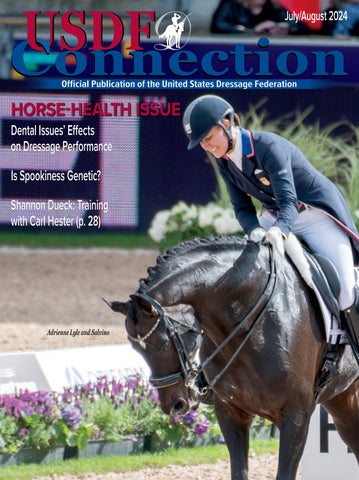
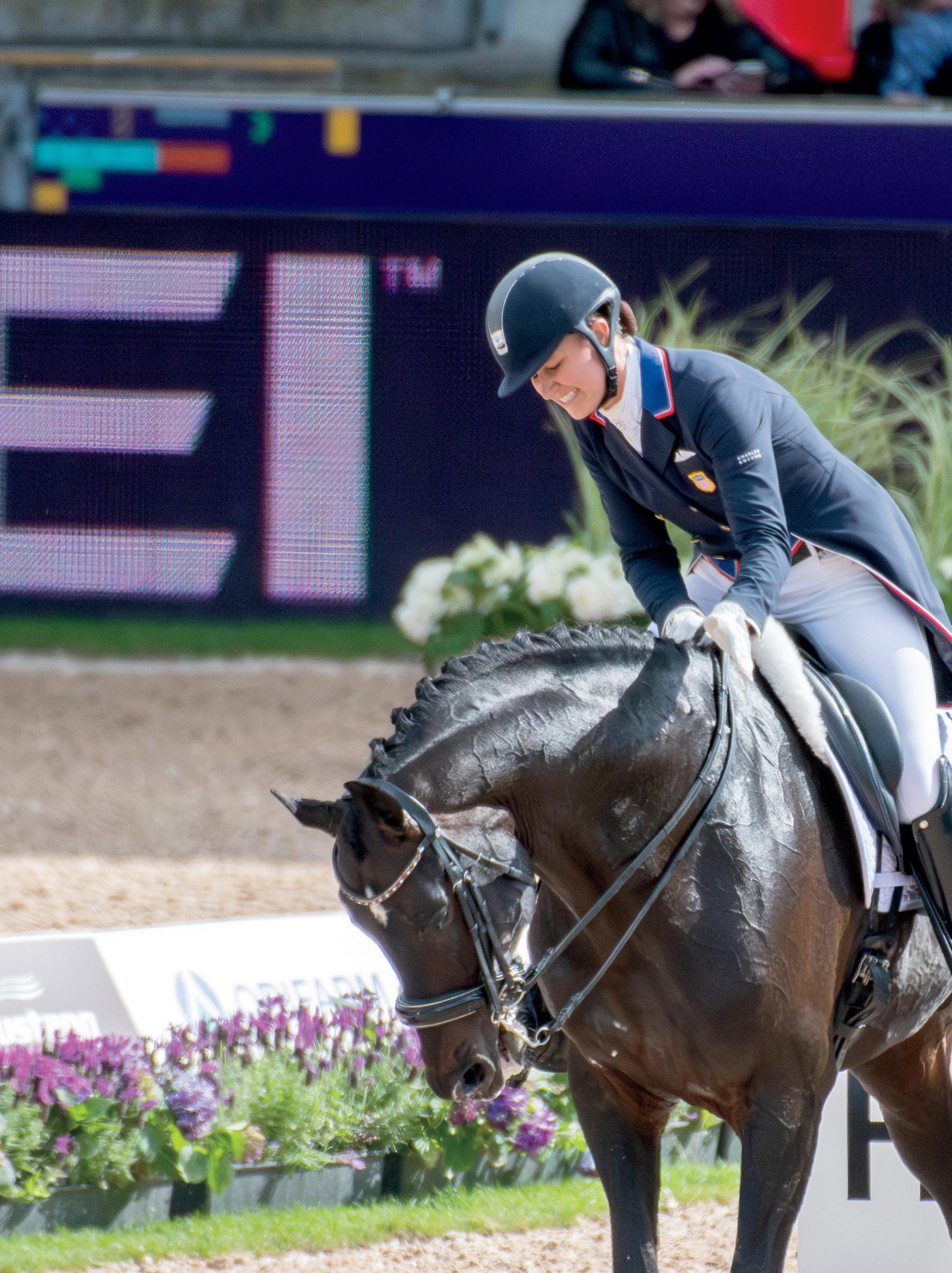
Adrienne Lyle and Salvino
the United
Official Publication of
States Dressage Federation

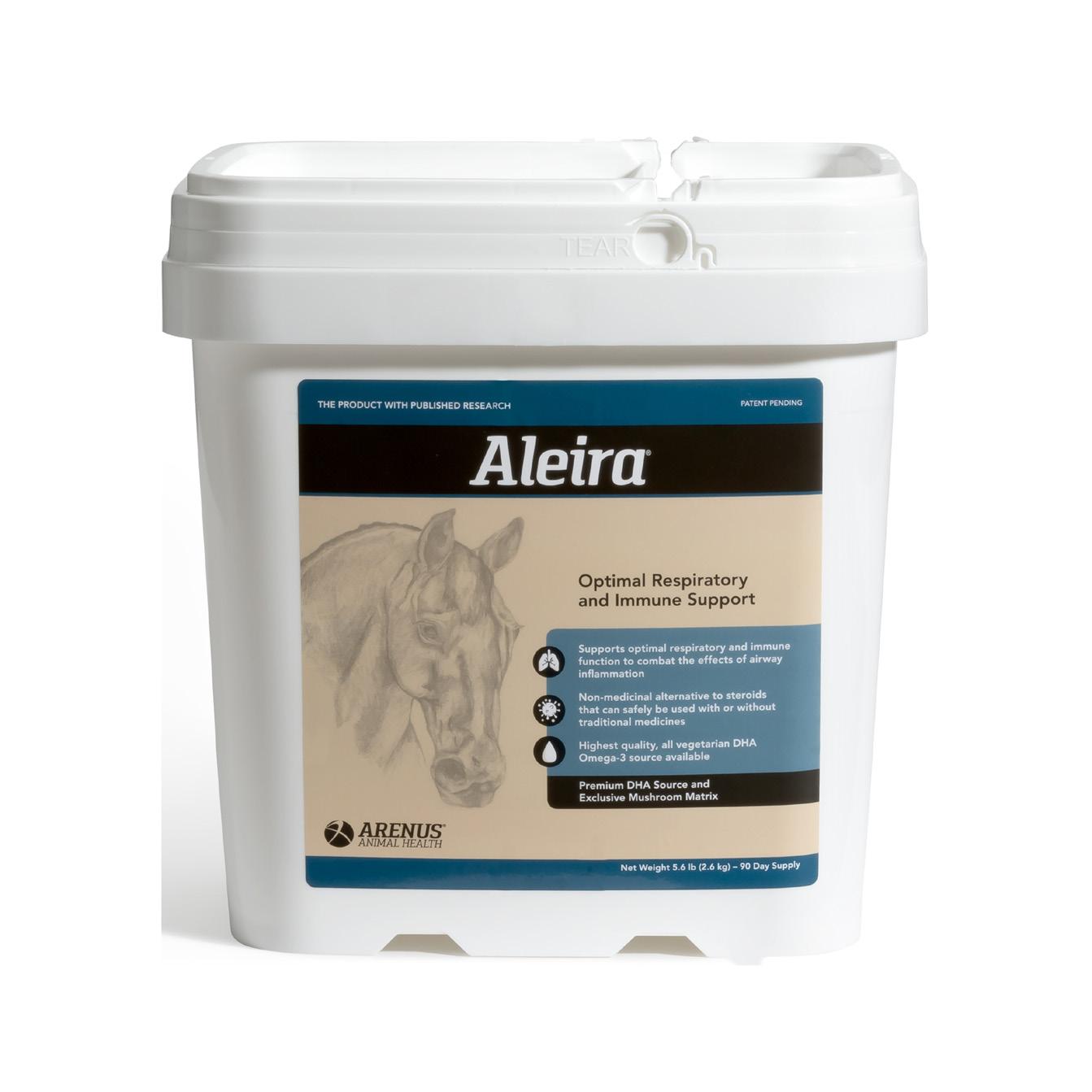
Fights Equine Asthma
Researched and Proven as an aid in controlling Equine Asthma [IAD and RAO][1]. Recommended in the American College of Internal Veterinary Medicine Consensus Statement on Respiratory Disease[2].
Not all Omega 3’s are the same; use the only Researched and Recommended 1500 mg Purified DHA formulation. Talk to your veterinarian today to see how Aleira can help your horse effectively cope with respiratory and immune challanges. Experience the improved performance and recovery that Aleira brings to your horse. References: [1]
POWER YOUR PERFORMANCE WITH
Intern Med
ARENUS ANIMAL HEALTH Arenus Animal Health • 866-791-3344 • www.arenus.com
Nogradi N, Couetil LL, Messick J, Stochelski MA, Burgess JA. Evalutation of an Omega-3 Fatty Acid Containing Feed Supplement in the Management of Horses with Chronic Lower Airway In ammatory Diseases. J Vet Intern Med 2015; 29:299-306 [2} Couetil LL, Cardwell J.M, Gerber V, Lavoie J.P, Leguilette R, Richard E.A. In ammatory Airway Disease of Horses. ACVIM Consensus Statement of J of
Vet
2016; 30:503-515 p. 508-510.
December 4 – 7 // Houston, TX
WWW.USDF.ORG/CONVENTION
JW Marriott Houston by The Galleria
An official property of the United States Dressage Federation
YourDressage delivers exclusive dressage stories, editorial, and education, relevant to ALL dressage enthusiasts and is your daily source for dressage!
Look for these featured articles online at YourDressage.org
EDUCATION
“5 Ways the USDF Virtual Education Series Benefits the Dressage Community”
Top notch dressage education delivered right to your computer or phone. Check out why this FREE series is growing in popularity and how it can benefit you, your riding, and your horses’ wellbeing. as athletes.
COMPETITION
“Six Decades - The Lifetime Sport”
At the 2023 US Dressage Finals, an 11-year-old and a 70-year-old rider both competed at the same show, proving dressage is truly a lifetime sport.
ACHIEVEMENT
“My Hero: A Century Together”
A Century Club member shares how an ailment in her 20’s caused doctors to recommend that she stop riding, and why she preserved because of her love for horses.
COMMUNITY
“Haybales and Barbells”
A Certified Personal Trainer, Youth Exercise Specialist, and Master’s Level Recreation Therapist shares how crosstraining has changed her life, both in and out of the saddle.
It’s YourDressage, be a part of it! Visit https://yourdressage.org/ for all these stories & much more!
USDF CONNECTION
The Official Publication of the United States Dressage Federation
EXECUTIVE DIRECTOR Stephan Hienzsch (859) 271-7887 • stephh1enz@usdf.org
EDITOR Jennifer O. Bryant (610) 344-0116 • jbryant@usdf.org
CONTRIBUTING EDITOR Hilary M. Clayton, BVMS, PhD, MRCVS
EDITORIAL ADVISORS
Margaret Freeman (NC), Anne Gribbons (FL), Roberta Williams (FL), Terry Wilson (CA) TECHNICAL ADVISORS Janine Malone, Lisa Gorretta, Elisabeth Williams
PRODUCTION Emily Koenig • ekoenig@usdf.org
GRAPHIC & MULTIMEDIA COORDINATOR Katie Lewis (859) 271-7881 • klewis@usdf.org
ADVERTISING SALES REPRESENTATIVE Danielle Titland (720) 300-2266 • dtitland@usdf.org
USDF OFFICERS AND EXECUTIVE BOARD
PRESIDENT GEORGE WILLIAMS 421 Park Forest Way, Wellington, FL 33414 (937) 603-9134 • president@usdf.org
VICE PRESIDENT KEVIN REINIG, 6907 Lindero Lane, Rancho Murieta, CA 95683 (916) 616-4581 • vicepresident@usdf.org
SECRETARY DEBRA REINHARDT 17108 Key Lime Blvd., Loxahatchee, FL 33470 (203) 264-2148 • secretary@usdf.org
TREASURER LORRAINE MUSSELMAN 7538 NC 39 Hwy, Zebulon, NC 27497 (919) 218-6802 • treasurer@usdf.org
REGIONAL DIRECTORS
REGION 1 DC, DE, MD, NC, NJ, PA, VA
BETTINA G. LONGAKER 8246 Open Gate Road, Gordonsville, VA 22942 (540) 832-7611 • region1dir@usdf.org
REGION 2 IL, IN, KY, MI, OH, WV, WI
DEBBY SAVAGE 7011 Cobblestone Lane, Mentor, OH 44060 (908) 892-5335 • region2dir@usdf.org
REGION 3 AL, FL, GA, SC, TN
CHARLOTTE TRENTELMAN P.O. Box 381, Anthony, FL 32617 (352) 598-7704 • region3dir@usdf.org
REGION 4 IA, KS, MN, MO, NE, ND, SD
ANNE SUSHKO 1942 Clifford Street, Dubuque, IA 52002 (563) 580-0510 • region4dir@usdf.org
REGION 5 AZ, CO, E. MT, NM, UT, W. TX, WY
HEATHER PETERSEN 22750 County Road 37, Elbert, CO 80106 (719) 338-0854 • region5dir@usdf.org
REGION 6 AK, ID, W. MT, OR, WA
NOAH RATTNER 25033 SW Pacific Hwy, Sherwood, OR 97140 (503) 449-1274 • region6dir@usdf.org
REGION 7 CA, HI, NV
CAROL TICE 31895 Nicolas Road, Temecula, CA 92591 (714) 514-5606 • region7dir@usdf.org
REGION 8 CT, MA, ME, NH, NY, RI, VT
HELEN VAN DER VOORT 8 Boulevard West, PH4, Pelham, NY 10803 (917) 834-2635 • region8dir@usdf.org
REGION 9 AR, LA, MS, OK, TX
BESS BRUTON 5696 Piper Lane, College Station, TX 77845 (662) 702-9854 • region9dir@usdf.org
AT-LARGE DIRECTORS
ACTIVITIES COUNCIL
SUE MANDAS 9508 Bridlewood Trail, Dayton, OH 45458 (937) 272-9068 • ald-activities@usdf.org
ADMINISTRATIVE COUNCIL
ANNE SNIPES MOSS 1530 North Chatham Road, Coatesville, PA 19320 (610) 316-4294 • ald-administrative@usdf.org
TECHNICAL COUNCIL
SUE MCKEOWN 6 Whitehaven Lane, Worcester, MA 01609 (508) 459-9209 • ald-technical@usdf.org
USDF Connection is published bimonthly by the United States Dressage Federation, 4051 Iron Works Parkway, Lexington, KY 40511. Phone: 859/971-2277. Fax: 859/971-7722. E-mail: usdressage@usdf.org, Web site: www.usdf.org.
USDF members receive USDF Connection as a membership benefit, paid by membership dues.
Copyright © 2024 USDF. All rights reserved.
USDF reserves the right to refuse any advertising or copy that is deemed unsuitable for USDF and its policies. Excluding advertisements, all photos with mounted riders must have safety head gear or USEF-approved competition hat. USDF assumes no responsibility for the claims made in advertisements. Statements of fact and opinion are those of the experts consulted and authors, and do not necessarily reflect the opinions of the editors or the policy of USDF.






The publishers reserve the right to reject any advertising deemed unsuitable for USDF, as well as the right to reject or edit any manuscripts received for publication. USDF assumes no responsibility for unsolicited material. All materials must be accompanied by a self-addressed, stamped envelope.
Questions about your subscription or change in address? Contact USDF Membership Department, 859/971-2277, or usdressage@usdf.org.
POSTMASTER: SEND ADDRESS CHANGES TO: USDF, 4051 IRON WORKS PARKWAY, LEXINGTON, KY 40511. Canadian Agreement No. 1741527. Canada return address: Station A, P.O. Box 54, Windsor, Ontario N9A 6J5.

2 July/August 2024 | USDF CONNECTION
23
USDF Connection
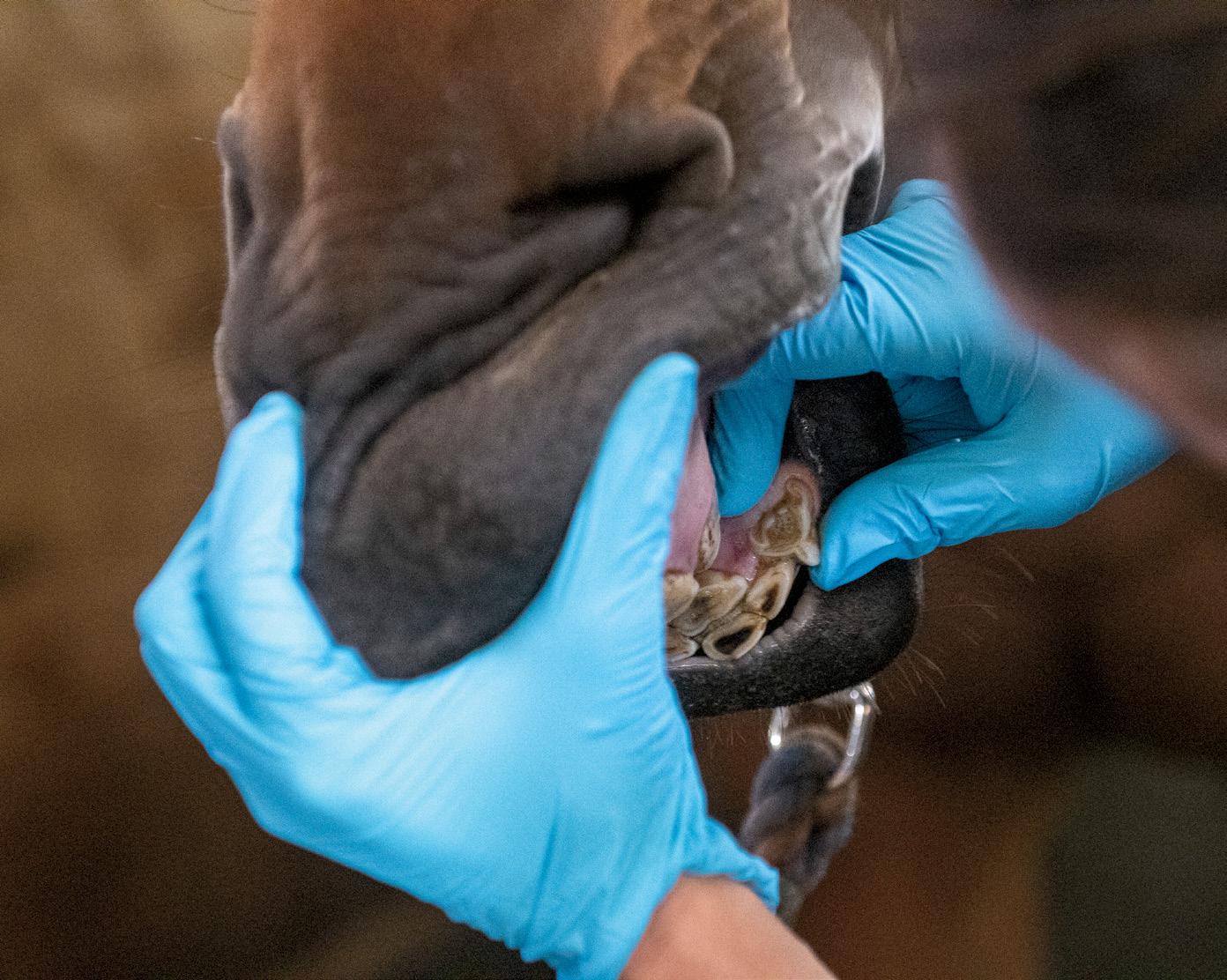
For your horse’s welfare as well as your scores, make sure his teeth and mouth are comfortable
Heather Smith Thomas
Using a well-established marker, researchers are seeking to identify to what degree the horse’s startle reflex is baked into its DNA
Katie Navarra
The Paris 2024 equestrian events will be held at one of the world’s most celebrated palaces By Jennifer O. Bryant
USDF CONNECTION | July/August 2024 3 Columns 4 Inside USDF Springing Forward By George Williams 6 Ringside From the Outside In By Jennifer O. Bryant Departments 18 GMO Let’s Put on a Show By Penny Hawes 22 Sport Horse Bringing up Babies By Natalie DeFee Mendik 28 Clinic We Laugh, We Praise, We Learn By Beth Baumert 32 The Judge’s Box Rider Biomechanics By Jayne Ayers 50 Reviews Put the Horse First 56 Salute Good Chemistry By Katherine Walcott Basics 10 Contact 12 Sponsor Spotlight 13 Collection 52 Rider’s Market 54 USDF Connection Submission Guidelines 54 USDF Office Contact Directory 55 Advertising Index On Our Cover Salvino (with rider Adrienne Lyle at the 2022 FEI World Dressage Championships in Denmark) has retired from competition after many years at the top of the sport. Story, p. 15.
by Jennifer Bryant. Features 34 Are
Taking
Bite out of Your Dressage Performance?
Photo
Dental Issues
a
40 Is the Spook Response Genetic?
By
44 Fit for a King
By
JULY/AUGUST 2024 Volume 26, Number 2 34
Inside USDF
Springing Forward
Exciting developments took shape at USDF’s spring Executive Board meeting
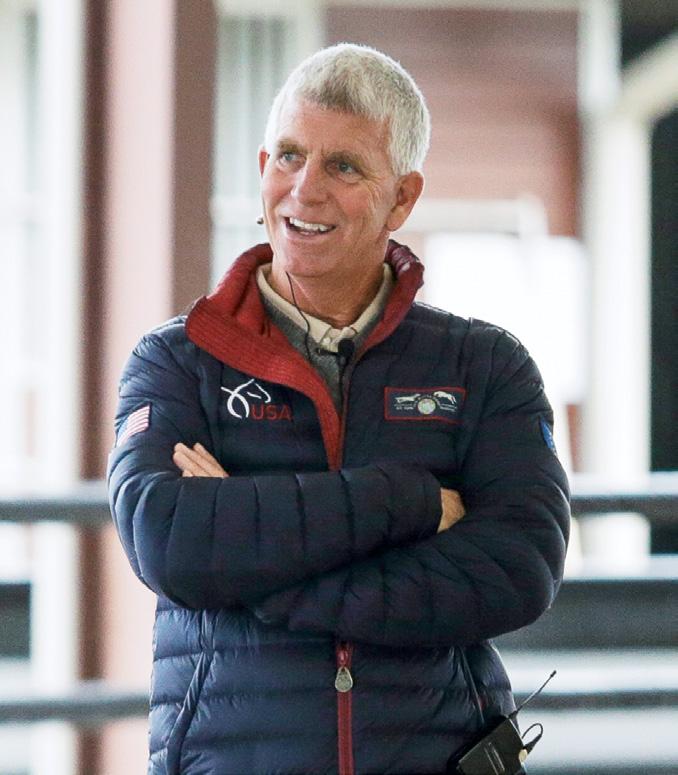
By George Williams, USDF PresidentThe USDF Executive Board meets in person twice a year. As you can imagine, even with numerous conference calls throughout the year, the agenda is pretty full. Our 2024 spring meeting, held in April at the USDF National Education Center at the Kentucky Horse Park in Lexington, was no exception.
As always, the board reviews the financial side of the organization. Basically, the USDF is on solid footing—that is, we’re not in danger of disappearing—but our coffers are not nearly as robust as those on social media sometimes imagine them to be. All of the Executive Board members—nine regional directors and four officers—are volunteers who give their time and effort to our sport without pay. After all, the USDF is a nonprofit organization that is committed to serving the dressage community. That is the spirit in which the Executive Board approaches the day-and-a-half meeting.
Here are highlights of our discussions and decisions.
Para-dressage may join the USDF roster. As you may remember, last year the the US ParaEquestrian Association (USPEA) proposed that the USDF take over as the official US Equestrian (USEF) affiliate organization for the sport of para-dressage. After the December 2023 USDF Board of Governors meeting, we appointed a Para Affiliate Assimilation Task Force. Members included two USPEA officers and several others in the
dressage world who are well-versed in para-dressage.
The task force had several conference calls, and at the spring board meeting it presented recommendations regarding incorporating para-dressage into USDF’s council and committee governance structure. With some tweaking, the Executive Board approved the recommendations. We are now in productive discussions with the USEF, working out some details. As a result, we are several steps closer and are adding clarity regarding how the USDF can position itself to support and grow para-dressage in the US. My goal is to present a fully developed plan to the Board of Governors at this year’s Adequan®/ USDF Annual Convention in Houston.
DEI Task Force renamed to reflect focus. Several years ago the USDF created a Diversity, Equity, and Inclusion (DEI) Task Force. This group, ably chaired by Gwen Ka’awaloa, has been actively working toward its objective: “to expand USDF’s inclusionary efforts
to dispel preconceived notions, highlight the diversity that already exists, and grow interest and participation in dressage though initiatives developed to address concerns related to inclusion, equity, and diversity at all levels of the organization and sport.” The task-force members want to highlight the primary objective of expanding USDF’s inclusionary efforts, and at the spring board meeting they asked for and received approval to rename the group the Outreach, Awareness, and Inclusion Task Force.
Honing judge education.
The Licensed Officials Education Working Group (LOEWG) was created a little over six years ago, when the USDF was charged with the education and preparation of all national-level dressage-judge candidates seeking USEF licensing and promotion. The LOEWG proposed several changes to the Executive Board regarding the education and experience requirements for licensed judges seeking promotion from one level to the next. The working group’s recommendations should help to ensure that we continue to produce good judges. I see these slightly stricter requirements as a positive: Like many of you, I believe strongly that our sport is dependent on high-quality, knowledgeable judges.
New award to recognize judges/ certified instructors. Along those same lines, with the support of the USDF L Program and Instructor/
4 July/August 2024 | USDF CONNECTION
TAYLOR PENCE/US EQUESTRIAN
CONTINUED ON PAGE 8
Challenge Product Support The horse that matters to you matters to us® Simple Solutions, Scientifically Proven® 859-873-2974, KPPusa.com EPM, sore muscles, Elevate® vitamin E Healthy muscle, nerve and immune functions vitamin E deficiencies Needs additional Equi-Jewel® rice bran Cool energy, safe weight gain, energy optimal performance Electrolyte depletion, Summer Games® Electrolyte Electrolyte replacement, stimulates drinking dehydration Hindgut imbalances, Neigh-Lox ® Advanced Balanced pH levels, comfortable stomach, gas colic, ulcers healthy microbiome Daily joint stress Joint ArmorTM Flexible, healthy joints Spooky, tense, Trouble Free TM Calm, focused attitude distracted 24-USDF_Jul/Aug
From the Outside In
Dressage riders are accustomed to being critiqued. We may also need to turn a critical eye on our sport as a whole.
When I watch other horse sports, I sometimes think they look…weird.
The Western pleasure horses shuffle along, barely moving. The park horses high-step in double time, their legs like marionettes on strings. The reiners scrabble-slide to a halt in a spray of footing, hocks nearly scraping the ground.
Do I paint unflattering pictures? Perhaps—but that’s how, viewed through the lens of dressage principles, I tend to see these disciplines. My sport, I tell myself, is kindest to the horses. Dressage is classical training. It’s good for every horse. It’s humane.
Or is it?
Poke around online for references to dressage and it won’t be long before you find plenty of folks who believe our sport is no angel, either. View photos and videos of dressage horses with mouths open, necks tight and short, and you’ll soon realize that some people regard modern-day competitive dressage as a corrupted version of a classically beautiful ideal. That to some, double bridles and spurs are no better than spade bits and weighted horseshoes.
This is what’s known as social license to operate, and it’s a phrase you’re going to be hearing a lot in the future.
In a nutshell, social license to operate is—as USDF executive director Stephan Hienzsch put it at last year’s Adequan®/USDF Annual Convention—“the court of public opinion.” Meaning that in today’s world of instantaneous outrage, a questionable image or video can sink you faster than you can say Instagram.
Remember what happened after the Tokyo Olympics in 2021? After footage of a modern-pentathlon athlete punishing her mount for refusing a jump made the electronic rounds, the resulting outcry swiftly resulted in the equestrian portion of that Olympic sport’s being excised. Permanently, as of Los Angeles 2028.
But what has that to do with dressage, you might wonder. After all, dressage is nothing like that.
Or is it?
“Blue tongue” images, video allegedly showing a US-based dressage trainer using harsh methods—these aren’t exactly good for our sport. The general public does not know or care about the differences between dressage and driving, rodeo and racing. Even the uninitiated spectator can tell if a horse looks wild-eyed, stressed, or exhausted. They can certainly see if a person hits a horse with a whip or jerks on its mouth. Particularly in today’s climate, public outcry can have major effects.
That’s not entirely a bad thing. Horse sports as a whole need to do a better job of scrutinizing their
activities through an outsider’s eyes, and reflecting on what changes might make for improved transparency and for practices beyond reproach. From within our insular breed and discipline silos, we tend to get defensive when others criticize us (I can already hear the protests at my opening statements), but we have to be willing to consider that there might be a kernel of truth in those observations.
Most of all, “social license to operate” compels us to double down on what should already be our top priority: the welfare of our equine partners. Researchers continue to uncover evidence that horses show signs of discomfort and pain in ways previously unrecognized (see “Reviews” on page 50 for some of the books advancing this knowledge). By turns illuminating and sobering, these discoveries point the way toward more horse-friendly methods of training, handling, and management—from horsekeeping practices to tack design. Two areas that we’re learning a lot about are dentistry and the startle reflex, aka spooking. For the latest research and practical implications, check out “Are Dental Issues Taking a Bite out of Your Dressage Performance?” (p. 34) and “Is the Spook Response Genetic?” (p. 40).
I hope you enjoy this horse-health issue of USDF Connection. Please let me know what resonates with you and what aspects of these topics you’d like to know more about. Let’s learn together, for our horses’ sake.
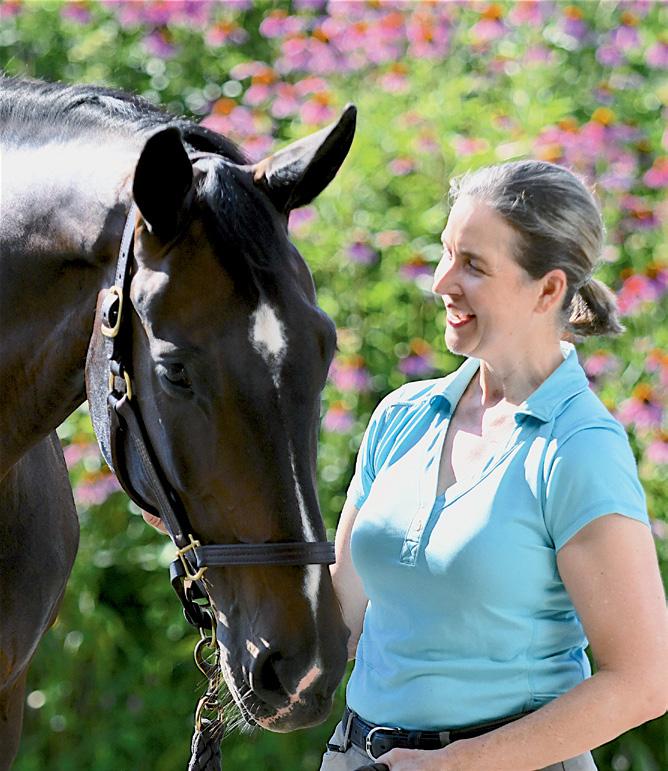
 Jennifer O. Bryant, Editor
MICHAEL BRYANT
6 July/August 2024 | USDF CONNECTION
Ringside

Inside USDF
Trainer Development Program Committees, the Executive Board was asked to consider a proposal to create a “Pursuit of Excellence in Professional Development” award recognizing those who are both L Education Program graduates and USDF-certified Instructors. The board wholeheartedly approved the award, which is scheduled to start April 1, 2025. At press time,
approximately 38 members were slated to receive this recognition. USDF partners in new dressage book club. The Executive Board was also enthusiastic about the proposal to create a USDF Book Club in conjunction with the Dressage Radio Show, the world’s longest-running podcast about dressage, hosted by Reese KofflerStanfield. The twice-monthly show includes interviews covering many USDF activities as well
as other interesting things to do with dressage, and the book-club segments will include interviews with the authors of the chosen books. What’s more, USDF Book Club participants will be able to earn USDF education credit.
USDF UNIVERSITY
The plan is to feature one book each quarter, beginning July 1. The first book will be Debbie McDonald Riding Through by Debbie McDonald with Nancy Jaffer. It will be followed in the fourth quarter by Janet Foy’s Dressage for the Not-SoPerfect-Horse, with an in-person meet-the-author and conversation opportunity tentatively planned for the USDF convention. Great books by great people mean there should be great interviews on the Dressage Radio Show. Check it out at HorseRadioNetwork.com/shows/ dressage-radio-show/. 2025 Regional Championships calendar finalized. At its spring meeting, the board reviews the recommendations of the Regional Championship Site Selection Working Group. The dates and locations of the 2025 Great American/USDF Regional Championships have been approved and are published on the USDF website.
Convention preparations are under way. The board reviewed suggested topics and presenters for the educational sessions at the 2024 Adequan®/USDF Annual Convention this December. It should be a great lineup with some excellent presenters on fascinating topics.
I think I can safely say that all of us on the USDF Executive Board are excited about the new initiatives and are dedicated to keeping the USDF moving forward in the role it plays in the education of all dressage enthusiasts as well as in the field of professional development.
See you in Houston!
8 July/August 2024 | USDF CONNECTION
UNIVERSITY www.usdf.org/education/university
offers a resource library, online courses, recognition for USDF members who strive to continue their education, and accreditation for educational events. •Search the education library •Take online courses •Earn credits and recognition CONTINUED FROM PAGE 4
The Ultimate Digestive Aid
Most performance horses suffer with some level of digestive disturbance, from gastric ulcers to colitis and even colic.
You don’t know how much of your horse’s performance potential has been lost to digestive health issues until you’ve addressed the problem.
Resolving digestive issues helps your horse stay calm and at the top of their game.
Patented and veterinarian approved, Assure Guard Gold provides a powerful digestive support solution for dependable relief and enhanced performance. Our proprietarily procssed psyllium and special enteric coated pellets ensure delivery of beneficial microbes and ingredients to the hindgut, addressing common ailments caused by gastrointestinal inflammation, making it the number one recommended digestive aid of veterinarians.
ARENUS ANIMAL HEALTH
Arenus Animal Health • 866-791-3344 •
P OWE R Y O U R P E RF ORMA N CE WI T H
www.arenus.com
Contact
Be Kind
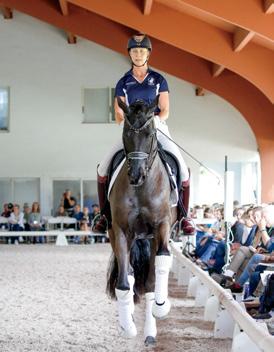
What a wonderful letter you have in the May/June issue of USDF Connection regarding kindness toward horses (“Ringside: Show Compassion”). I, too, have found that so many people—trainers included—are way too


quick to blame the horse for “resistances” that they do not deserve or understand.
Thanks so much for always doing such a good job with Connection. Debbie Riehl Rodriguez Arvada, Colorado
Editor’s note: Debbie Riehl Rodriguez is a USEF “S” dressage judge and “R” dressage sport-horse breeding judge, and a faculty member of the USDF L Education Program.
The Human Side of Respiratory Problems at the Barn
The article about managing horses with asthma was very educational (“Sport Horse: Take a Breath,” May/ June). As a longtime rider, trainer, instructor, and judge, I would like to mention that we need to be aware of the health issues that we ourselves can develop through environmental exposure.
I have taught in so many dusty arenas, both indoors and outdoors, that I have contracted chronic obstructive pulmonary disease (COPD) as a result. Fortunately it is not debilitating, but it’s enough that I need to use an inhaler daily to keep the symptoms under control. It started with some shortness of breath while exercising, then progressed to coughing at night, which kept worsening. I finally got checked out and originally thought that I was having a heart problem. When they couldn’t find anything, they suggested that I see a pulmonologist, and that’s how the COPD was discovered. I have never smoked a day in my life or been exposed to secondhand smoke.
My advice to anyone who is regularly exposed to dust is to wear a good mask. At least they are in style nowadays! I hope that my story helps people to be aware of the dangers of longtime dust exposure before they become sick. If you often teach, ride, or judge in dusty environments, take precautions. Name withheld by request
USDF Connection welcomes your feedback on magazine content and USDF matters. Send letters to editorial@usdf.org along with your full name, hometown, and state. Letters may be edited for length, clarity, grammar, and style.
10 July/August 2024 | USDF CONNECTION Participating Member Delegate Voting Login at www.usdf.org To request paper ballot contact nominations@usdf.org Dressage Competition Is Changing. How Will It Affect You? (p. 38) Go Forward in Your Training with Sabine Schut-Kery and Sven Rothenberger (p. 30) Help for the Asthmatic Dressage Horse (p. 18) Adequan /USDF FEI-Level Trainers Conference demonstration rider JJ Tate on Denali May/June 2024 ANNUAL SHOW ISSUE Official Publication of the United States Dressage Federation
IT’S BE A PART OF IT Submit your dressage stories, content, and photos to yourdressage@usdf.org WE WANT TO SHARE STORIES


For the complete list of clinics scheduled for 2024, visit usdf.org FEI YOUTH CLINIC SERIES funding support provided by YOUR CONNECTION TO DRESSAGE EDUCA TION • COMPETITION • ACHIEVEMENT Sabine Schut-Kery George Williams Lilo Fore Region 1 November 23-24 Hilltop Farm Region 3 November 16-17 Noble Steed, LLC Region 5 October 19-20 Nighthawk Equestrian Center Region 9 November 2-3 Paragon Farm Region 2 October 19-20 Duncan Run Farm Region 7 November 23-24 Weatogue Stables Region 8 June 29-30 B & B Farm Region 4 July 6-7 Providence Farms Region 6 November 2-3 Devonwood Equestrian Centre










THANK YOU FOR SUPPORTING USDF Official Equine Insurance Provider of USDF Title Sponsor Great American Insurance Group/USDF Regional Dressage Championships Supporting Sponsor US Dressage Finals 800-553-2400 www.platinumperformance.com 800-303-7849 www.dressageextensions.com 402-434-8585 www.dressagefoundation.org 800-611-6109 www.dressagearena.net 800-324-2142 www.bigdweb.com 502-585-3277 sterlingthompson.com Official Joint Therapy Sponsor of USDF Title Sponsor Adequan®/USDF FEI-Level Trainers Conference Annual Convention and Awards Presenting Sponsor US Dressage Finals 800-458-0163 www.adequan.com Official Supplement Feeding System of USDF Presenting Sponsor Great American Insurance Group/USDF Regional Dressage Championships Supporting Sponsor US Dressage Finals Official Supplier Great American Insurance Group/USDF Regional Dressage Championship Jackets 800-461-8898 www.smartpakequine.com ProElite/USDF Breeders Championship Series THANK YOU TO OUR SPONSORS. 888-247-8066 www.proelitehorsefeed.com
Collection
Bits and Pieces from USDF and the World of Dressage
★ Kittel Scores Touchdown at World Cup Dressage Final ★ Salvino Retires ★
★ Emory & Henry College Wins Record 8th IDA Championship ★
IN THE FRAME
USDF CONNECTION | July/August 2024 13
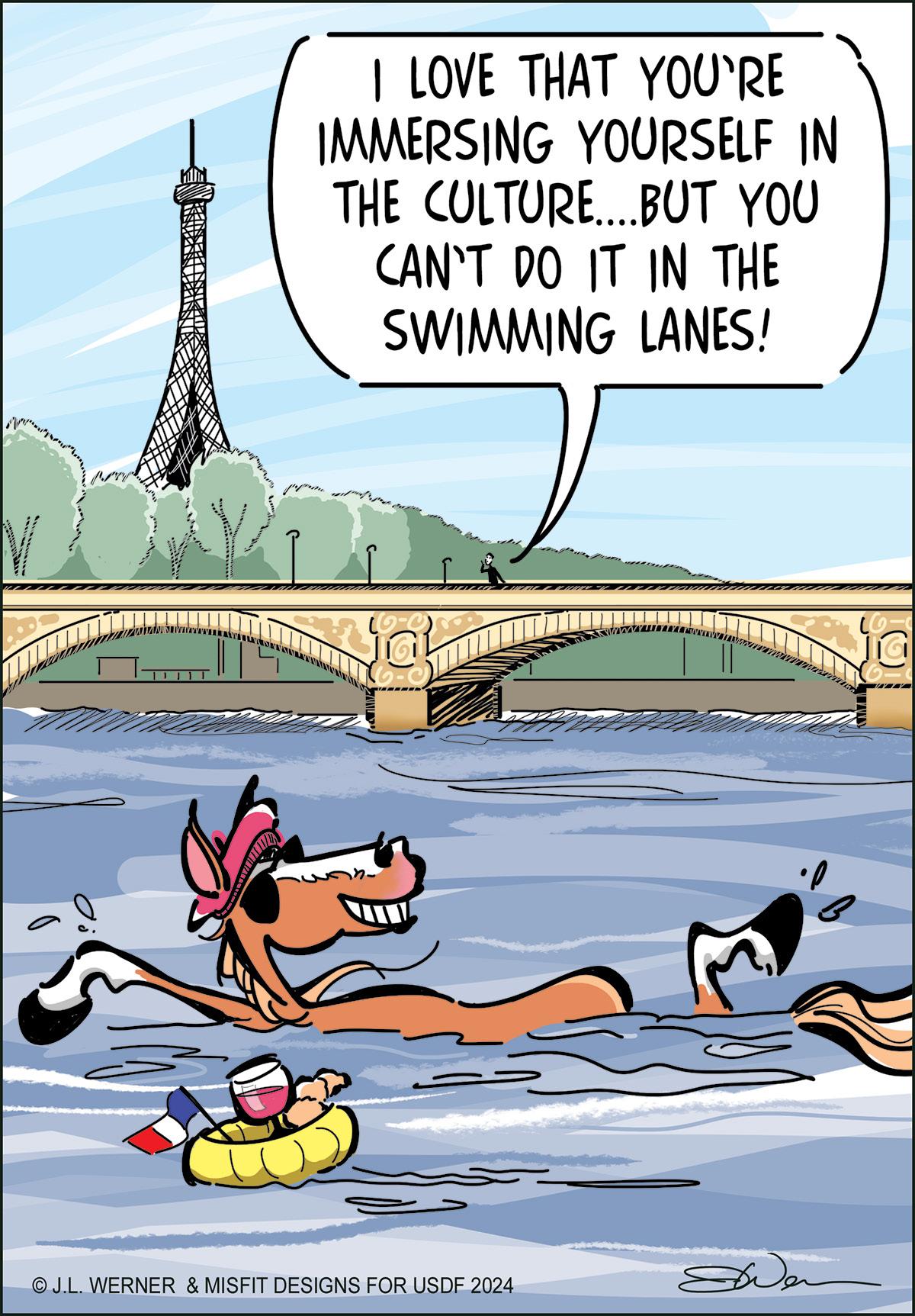
Bon voyage! Good luck to Team USA at the 2024 Paris Olympics and Paralympics. Turn to page 44 for an exclusive preview.
Collection
WORLD CUP DRESSAGE FINAL
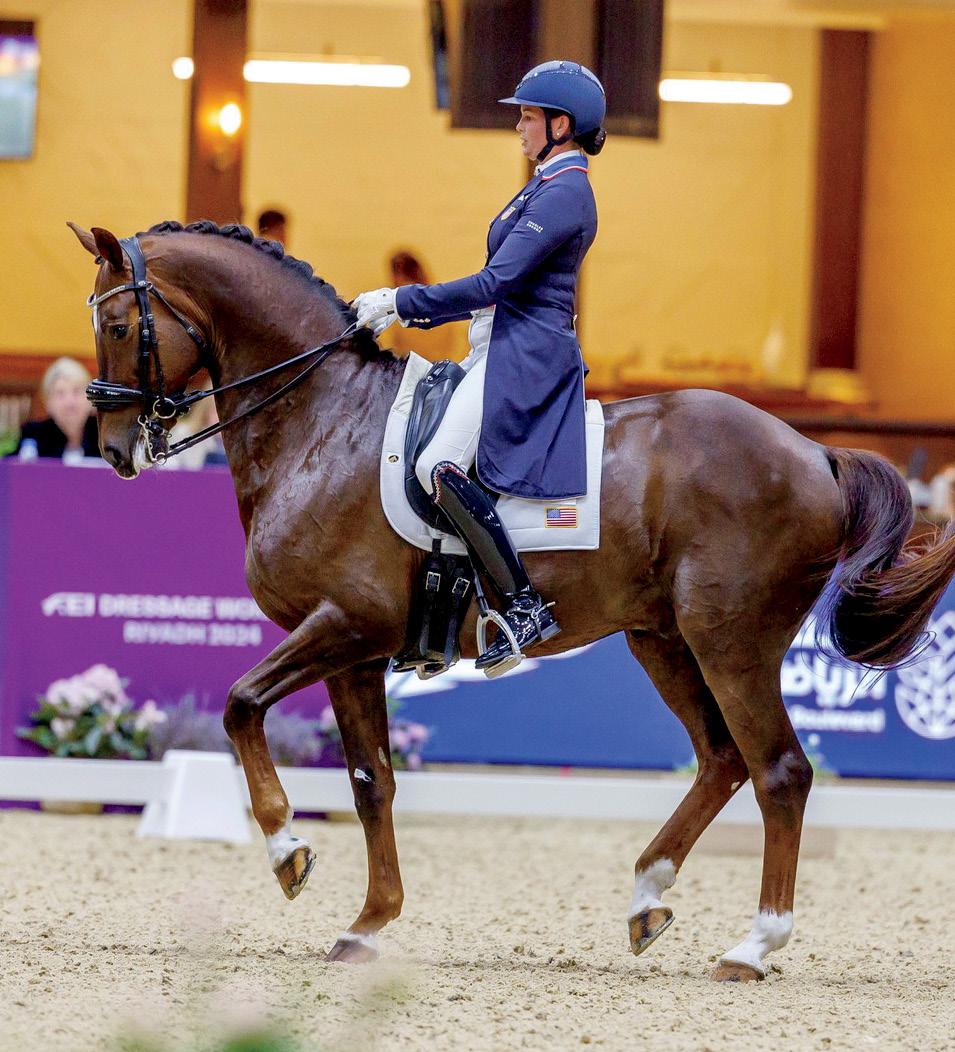
Kittel Scores Touchdown at World Cup Dressage Final Patrik Kittel became only the second Swedish rider in history to win the FEI Dressage World Cup Final. Aboard the 12-year-old Swedish Warmblood gelding Touchdown (Quaterback – La Mour, Sack), Kittel earned a Grand Prix Freestyle score of 81.661% to top the field of 15 for the 2024 title.
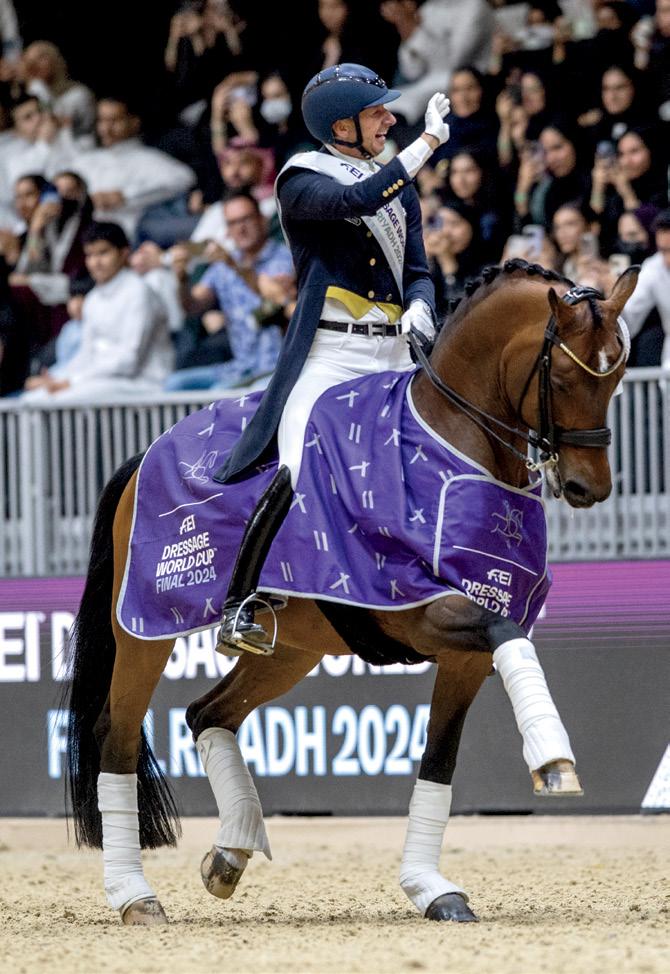
The Final, which was held in conjunction with the FEI World Cup Jumping Final, was hosted by the Kingdom of Saudi Arabia (KSA) and held April 16-20 at the Riyadh International Convention & Exhibition Centre. The event marked the first time that a Middle Eastern nation
PARA-DRESSAGE
hosted a World Cup Dressage or Jumping Final.
The dressage silver medalist was 2022 FEI World Championships Danish dressage team gold medalist Nanna Skodborg Merrald. Her partner in Riyadh was the 16-year-old KWPN stallion Blue Hors Don Olymbrio (Jazz x Olympic Ferro), who finished on a GP Freestyle score of 81.429%. The bronze medal went to five-time World Cup Dressage Final champion Isabell Werth of Germany riding the 14-year-old German Sport Horse stallion DSP Quantaz (Quaterback x Hohenstein 4) (81.404%).
Three horse-and-rider combinations—all World Cup Dressage Final first-timers—represented the USA in Riyadh. The highest placing—ninth in the GP Freestyle, which per World Cup Dressage Final format is the sole determiner of the medals—was earned by 2023 US Pan American Games individual bronze medalist Anna Marek, of Dunnellon, Florida. Her mount in Riyadh was Fayvel, a 14-year-old KWPN gelding (Zizi Top x Houston) owned by Cynthia Davila, who earned a score of 74.518%.
Finishing in thirteenth place was Benjamin Ebeling, Wellington, Florida, on Indeed, a 16-year-old Danish Warmblood mare (Hofrat x De Niro 6) owned by Vantage Equestrian Group II LLC (72.911%). Fourteenth was Kevin Kohmann, Wellington, Florida, riding Duenensee, a 15-year-old
Hanoverian gelding (Dancier x Davignon) owned by Diamante Farms (72.364%).
In the World Cup Dressage Final format, the Grand Prix serves merely as a qualifier for the Freestyle final, although the placings often foreshadow the podium finishers. After winning the Grand Prix with a
decisive score of 75.388%—more than 2 percentage points ahead of Kittel—Great Britain’s Charlotte Fry on the 15-year-old KWPN stallion Everdale (Lord Leatherdale x Negro) looked to be very possible gold medalists. Unfortunately, the British pair was eliminated from the Freestyle when Everdale showed a small amount of blood from his gum during the test. Per FEI dressage rules, blood anywhere on a horse during competition results in immediate elimination.
NJ Facility Named Newest USEF Para-Dressage Center of Excellence
Unicorn Therapeutic Riding, Pennington, New Jersey, is the ninth facility to be designated a US Equestrian Para-Dressage Center of Excellence (COE), USEF announced April 30.
Established in 1988, Unicorn Therapeutic Riding offers
equine-assisted activities for children and adults with physical, cognitive, or emotional disabilities. The USEF launched the COE program in 2015 as a means of growing the sport of para-dressage in the US. COEs function as centers of instruction and technical
dressage training, offering athletes with disabilities the opportunity to discover competitive para dressage at the national and international levels. To learn more, see “Building the Para-Dressage Pipeline” (July/August 2023) or visit usef.org.
14 July/August 2024 | USDF CONNECTION © FEI/MARTIN DOKOUPIL
END ZONE: Patrick Kittel of Sweden takes a victory lap on Touchdown
POLISHED: Anna Marek and Fayvel were the top US finishers
TRANSITIONS
Salvino Retires from Competition, Will Stand at Stud
A stalwart in international dressage competition since the late 2010s under US team rider Adrienne Lyle, Salvino retired from the show ring this spring and would not be making a bid for the 2024 US Olympic dressage team, owner Betsy Juliano and Lyle announced April 4.
Juliano was a member of the five-owner US-based syndicate that purchased Salvino (originally named Sandronnerhall) in 2015 from Europe as a potential US team mount for Lyle, who had previously notched appearances at the 2012 Olympics and the 2014 FEI World Equestrian Games (WEG) aboard Wizard. In early 2018 Juliano became the sole owner of the 2007 Hanoverian stallion (Sandro Hit – Dynastie, Donnerhall)
Salvino’s career peaked in the years from 2018 through 2022. He
YOUTH
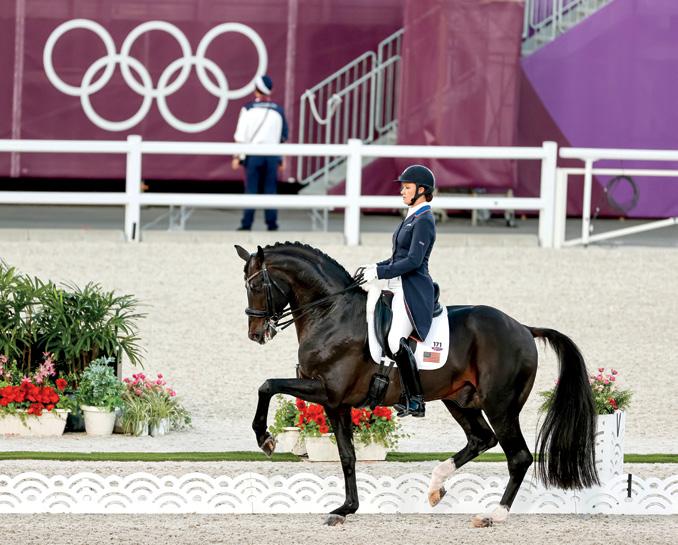
and Lyle won team silver at the 2018 WEG in North Carolina. At the Tokyo Olympics in 2021, the pair helped Team USA win its first Olympic dressage team silver medal since 1948. At the 2022 FEI Dressage World Championships in Denmark, they again represented Team USA
and finished sixth individually, the highest US placing.
In 2022, Salvino was honored as US Equestrian’s (USEF) International Horse of the Year, and Lyle was named USEF’s International Rider of the Year.
Salvino “will soon transition to a life of retirement while still being ridden at home,” Juliano stated in a press release. “We are also very proud to be able to offer Salvino for breeding.”
“This has been a very difficult decision to make, but more than anything we feel it is the right decision for him,” said Lyle. “He continues to be ridden at home; he loves to work and show the other horses how it should be done. He has given us so much, and Betsy and I are committed to making sure he keeps on living his best life.”
Emory & Henry Wins Record 8th IDA Championship
The dressage team from Emory & Henry College, Emory, Virginia, made Intercollegiate Dressage Association (IDA) history by winning a record eighth championship title at the 2024 Diller Equine IDA National Championships, held April 24-27 at the Tryon International Equestrian Center in North Carolina.
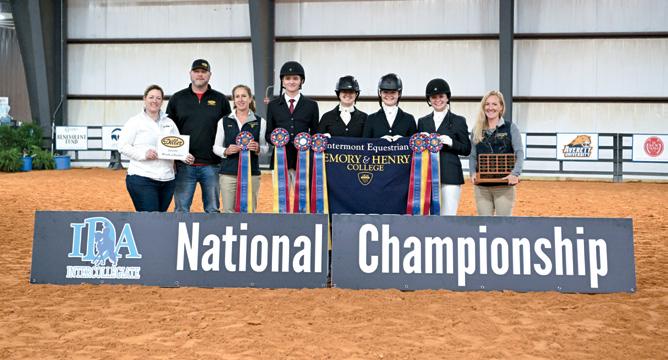
Riding for E&H were Lindsay Shaw, Eleanor Boyle, Remington Sharp, and Brenna Looney. They were coached by Lisa
Moosmueller-Terry and Jessica Deniston.
The reserve championship went to Otterbein University, Westerville, Ohio. Finishing third was the team from Delaware Valley University, Doylestown, Pennsylvania. A total of 11 teams competed.
Winning individual championship titles at the 2024 IDA Nationals were:
USDF/IDA Quiz Challenge
Introductory Level: Evangeline Li, Rutgers University
Lower Training: Alexandra Davis, Averett University
Upper Training: Lily Drew, Johnson & Wales University
First Level: Sami Scigouski, Miami of Ohio University.
Individual
Introductory Level: Caroline Kargenian, Cal Poly – San Luis Obispo
Lower Training Level: Juliette Savignac, University of Connecticut
Upper Training Level: Ellie Linn, Otterbein University
First Level: Abby Fodor, Centenary University.
Dressage Seat Equitation
Introductory Level: Sofia Barrett, Virginia Tech
Lower Training Level: Kaylee Horton, Lake Erie College
Upper Training Level: Lydia McKenzie, Otterbein University
First Level: Madison Waller, Keiser University.
For more about the IDA, visit TeamDressage.com. The IDA partners with the USDF to offer the annual USDF/IDA Quiz Challenge, which tests eligible students’ knowledge of dressage theory and competition rules. Learn more at usdf.org/education/quiz_challenge. asp.
USDF CONNECTION | July/August 2024 15 STEFAN LAFRENTZ; WINSLOW PHOTOGRAPHY
PEAK PERFORMANCE: Salvino and Adrienne Lyle winning team silver at the 2021 Tokyo Olympic Games
DOMINANT FORCE: The 2024 Emory & Henry College IDA team secured that college’s eighth championship title
USDF BULLETINS Collection
2024 All-Breeds Declaration Deadline Approaching
The deadline to declare a horse for the 2024 USDF All-Breeds Awards Program is August 1. Submit your horse’s breed-registry papers and a completed All-Breeds Awards Declaration Form to the USDF office prior to August 1.
Your Feedback Sought on the 2023 USEF/USDF Dressage Tests
The USDF Test Writing Working Group welcomes your input regarding the 2023 USEF/USDF dressage tests. Send comments and suggestions to testfeedback@usdf.org.
USDF Benefit Classes
USDF benefit classes support dressage education in the US though USDF educational programs. Winners receive special USDF awards! Ask competition management to host a USDF benefit class.
Scores Do Not Expire for USDF Horse Performance Certificates
Even if your horse earned the scores last year, you could apply for a USDF Horse Performance Certificate. An easy online application is available on the USDF website under Awards. See the USDF Member Guide for complete award requirements.
USDF Awards and Resources for Breeders
The USDF offers a number of resources and recognition opportunities for sport-horse breeders and enthusiasts.
Search horses by breeder: Find listings on USDFScores.com.
Obtain a breeder’s horse portfolio and dam/ sire reports: USDF participating, group, and business members can access these report for free by logging in to their accounts on USDF.org. For others, a fee is required. Find the report links under the Members/ Horses menu.
Learn about USDF awards for breeders: Find USDF historical awards reports for breeders under the Awards tab on the USDF website (access as above). The same tab also contains the link to the USDF Breeder of Distinction awards.
Adequan®/USDF year-end awards for breeders:
This slate of prestigious awards includes Dressage Breeder of the Year and Dressage Sport Horse Breeding Breeder of the Year.
For more information and all award requirements, see the USDF Member Guide. Interested in USDF Awards?
Check out the USDF Awards Resource Guide under the Awards menu on the USDF website. You’ll find includes information on all the recognition opportunities available to USDF members in an easy-to-navigate format.
Check
out USDFScores.com
Check your scores on USDFScores.com. If you spot an error, e-mail scorecorrections@usdf.org or call 859-9712277. Score corrections must be reported by October 15 at 5:00 p.m. ET
Para-Dressage Athlete Rider Awards
The new USDF para-dressage athlete rider awards are available at three tiers to all para-dressage athletes regardless of grade. See the USDF Member Guide for complete award information.
See You at the Great American Insurance Group/USDF Regional Championships!
Check out the Regional Championship Competitors page on the USDF website to verify that you’ve qualified for the Great American/USDF Regional Championships.
Have You Qualified for the USDF Regional Adult Amateur Equitation Program?
To qualify for a USDF Adult Amateur Equitation Regional Final class presented by Big Dee’s Tack and Vet Supply, riders must earn a score of 70% or above in an applicable dressage-seat equitation class, or qualify at any level (excluding freestyles) for the Great American/USDF Regional Championships. A USDF Adult Amateur Equitation Regional Final class will be held in conjunction with each of the nine Great American/USDF Regional Championships competitions.
Planning to Compete at the US Dressage Finals
Presented by Adequan®?
Be sure to visit USDressageFinals.com as you begin your preparations to compete in the 2024 US Dressage Finals. New for 2024: Prix St. Georges and Intermediate I Junior/Young Rider Finals classes will be offered! The US Dressage Finals prize list is available online, and declarations are open! Horse/rider combinations must declare their intention to participate by completing the Declaration of Intent form by midnight on the day prior to the first day of their Regional Championships competition (including any open class day before the start of championship classes). There is no fee to declare, but horse/rider combinations must declare at the level(s) and eligible division(s) in which they intend to compete.
16 July/August 2024 | USDF CONNECTION



With Funding Support Provided by The Dressage Foundation Visit www.usdf.org for eligibility requirements, application and information. Application deadline is September 30, 2024. Applications will be accepted between October 1-31, 2024 at an increased fee. Developing a Career can be a Puzzle THE USDF/USEF YOUNG RIDER GRADUATE PROGRAM January 18–19, 2025 w West Palm Beach, Florida Can Be Your Key Piece PhotocourtesyofBobTarr.com
Let’s Put on a Show
Is your GMO considering hosting a dressage show? Here’s help getting started. First of two parts.
By Penny HawesToday’s USDF group-member organizations (GMOs) are in a challenging position: They want to serve their members by providing engaging and educational experiences, but membership dues alone often don’t provide enough income to be able to do so.
To supplement their cash flow, many clubs turn to hosting shows. Doing so can be a perfect fit, not only for the organization, but also for the GMO’s members and the local equestrian community.
The Basics
There are two main choices for a GMO considering hosting shows: unrecognized shows (“schooling shows”) and USEF-licensed/USDFrecognized dressage competitions (“recognized shows”). Within each of these broad categories there are numerous subcategories, but let’s start with the big picture.
Schooling shows. Schooling shows are the easiest first step for a GMO that wants to try hosting a
While some GMOs have been hosting shows for decades, others are just looking to dip their toes into the competition pool. Starting a show from scratch can be an overwhelming task, and this article seeks to break down the huge project into manageable steps.
show. They have far fewer requirements than recognized shows, so they’re easier on the bank account. Plus, they’re typically popular enough to add a healthy bit of income to a club’s bottom line.
A schooling show tends to be more of a “grass roots” event, which
is great if many of your GMO’s members don’t fancy the idea of recognized shows, whether because of the expense or because they don’t feel comfortable competing on a larger stage. Schooling shows are also popular with riders who are looking to give young or inexperienced horses show experience, and they’re great for inexperienced riders, too.
Schooling shows offer organizers more leeway in terms of classes, as well. Many GMOs have had success in attracting more entries—and even new members—by offering classes such as Western dressage and gaited dressage in addition to the standard dressage tests.
Another benefit for GMOs is that schooling shows require fewer volunteers. For clubs that offer both schooling and recognized shows, the lowerpressure environment of a schooling show can be an ideal place for newbie volunteers to learn the ropes.
One trade-off is that schooling shows don’t offer competitors the opportunity to qualify for certain national-level achievements, such as USDF rider medals and USDF awards. However, many schoolingshow competitors find it rewarding to pursue their GMOs’ own slates of year-end awards.
Recognized shows. Recognized shows offer more prestige than schooling shows, and they give eligible competitors the opportunity to qualify for awards and championships, such as Adequan®/ USDF year-end awards, USDF rider medals, and the Great American/ USDF Regional Championships. These perks come at a cost, however, and GMO board members need to consider the ramifications should a recognized show lose money.
18 July/August 2024 | USDF CONNECTION JENNIFER BRYANT GMO
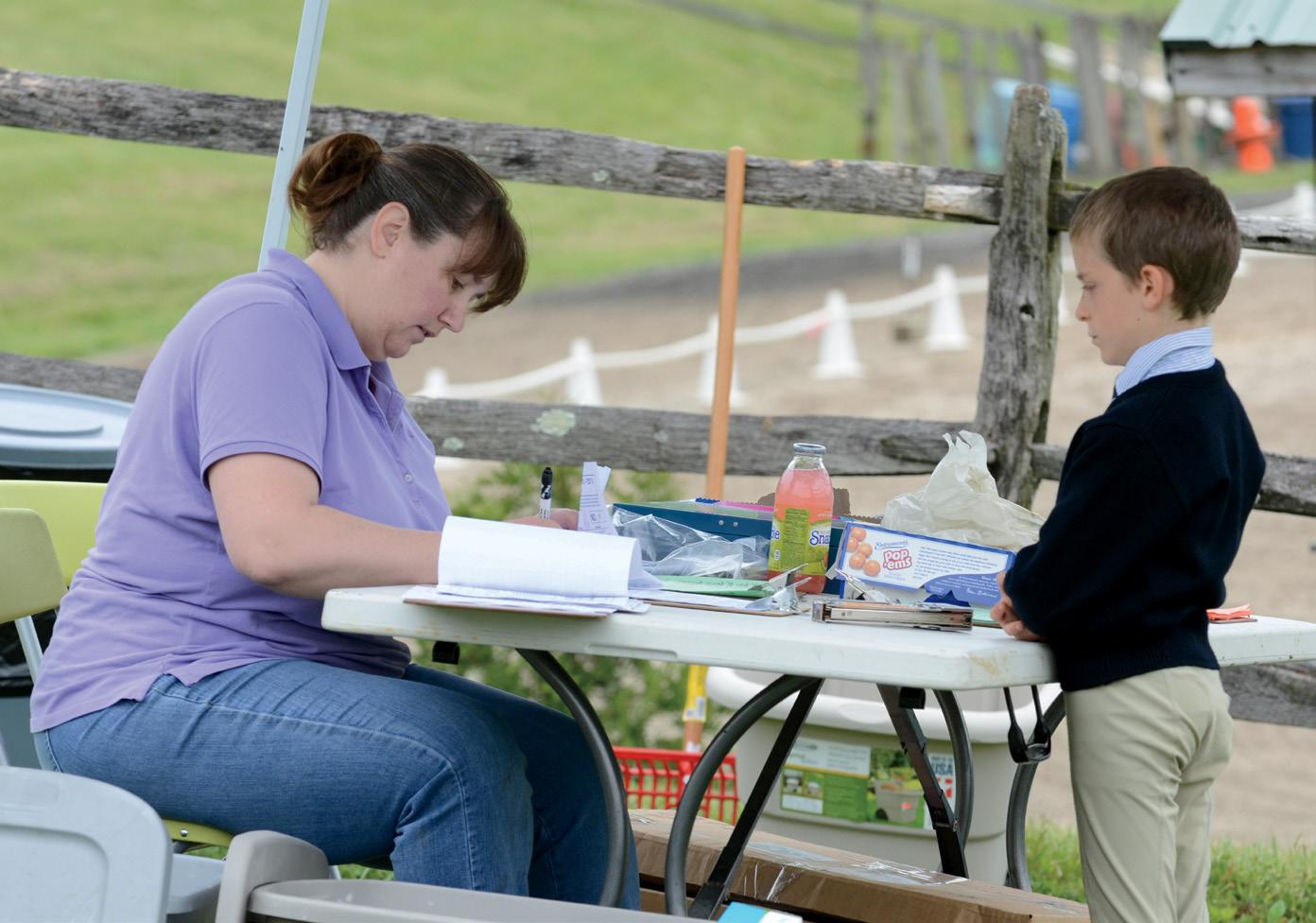
IT TAKES A VILLAGE: GMOs may hire pros to help put on shows, but schooling shows in particular may be all-volunteer efforts. A table serves as the show office at a schooling show in Pennsylvania.
“I think exhibitors need to be aware how expensive it is to put on a show,” says Barbara Harty, president of the Fort Worth (Texas) Dressage Club, which has hosted the annual Cowtown Classic recognized show for nearly 20 years.
Entries for the 2024 edition, held in March, gave the GMO cause for concern. “For the first time,” Harty says, “we were not full with a waiting list. I spoke with our show manager and our show TD [technical delegate], who both manage shows in the region, and they said many shows are not filling up.”
Harty noted that the show’s longtime venue is under new management, and some costs have doubled. “Of course, we’re going to have to pass these costs on to the exhibitors,” she says. “By the time we add in judges’ fees, technical-delegate fees, show-manager and show-secretary fees, hotel fees, airline fees, feeding the show management, team fees, facility fees, and a host of other fees, we are seriously considering not putting on a [recognized] show next year.”
One GMO that’s already dropped its recognized show is the Pennsylvania-based Lehigh Valley Dressage Association, which “traditionally has run both a recognized show and four to six schooling shows per year,” according to GMO president Christine Dickenson.
“Our recognized show has lost money for the past two years,” Dickenson says, “so we are taking a break and only offering schooling shows this year—seven of them.”
In the LVDA’s case, the problem may be too much of a good thing. “At the time we began offering the recognized show there were not many of them in our area,” says Dickenson, “and now there are tons of them.”
Time Is Money
On top of the financial considerations, organizing a recognized show requires a tremendous amount of planning, which needs to begin a year or more ahead of the target
USDF CONNECTION | July/August 2024 19
GMO
competition date, according to the USDF’s Competition Management Checklist (see page 21). Not only does a show need to secure a date on the USEF/USDF calendar; qualified judges, TDs, and other staff also must be hired and an appropriate venue must be secured.
Because of the myriad requirements involved, many GMOs hire professional competition managers to handle their recognized shows. Doing so takes much of the onus off the club’s board but cuts into the profits. Your GMO will need to weigh the pros and cons of each route—but consider that paying for advice, if nothing else, from someone with experience in managing recognized shows will make the process less fraught with questions and obstacles.
Harty, for one, recommends hiring a pro, especially for the first venture. “I would suggest any clubs doing this for the first time hire an experienced show manager and show secretary. There are so many rules and regulations. Of course the technical delegate will be there to see things are done right, but we found a lot of it falls to the club members.”
Taking the Plunge
OK, so your GMO has voted to host a show. Now what?
Barbara Nagle, president of Dancing Horse Dressage and Combined Training in Florida, offers this to-do list overview:
1. Select a show manager who is familiar with running horse shows of any kind. “The fundamentals of show management are pretty much the same across disciplines,” Nagle says.
2. Choose a show secretary who is “very, very computer-savvy.”
3. Use horse-show software that is suitable for dressage competition.
4. Start with a one-day show.
5. Identify all duties to be performed before, during, and after the show. “Assign a resource to all of those tasks.”
6. Use social media to promote
the show and post results.
7. “Find a way to recognize volunteers and show your appreciation.”
Nagle’s list gives the 30,000-feet view, but a project this size requires a closer look. Let’s take a deeper dive into the considerations, large and small, that go into putting on a show.
Job 1: Amass the human resources. If your club can’t rally sufficient volunteers and/or paid staff, there’s little point in pursuing the idea of hosting a show. Recognized shows in particular require hundreds of hours of work. Dickenson recommends making sure that a group of “enthusiastic and committed volunteers” is in place.
How many of these unicorns do you need? For a schooling show, at a minimum:
Show manager: Oversees the entire competition and delegates all required tasks. The show manager may also be responsible for securing the facility, hiring personnel, and ensuring that appropriate insurance is in place.
Show secretary: Responsible for creating the prize list, accepting entries, making sure that all entry requirements are met, securing ribbons and prizes (sometimes), and scheduling the rides. For very small shows, the manager may double as the secretary.
Facilities manager: Secures the venue and works with the facility’s own management team to ensure that all requirements are met.
Hospitality manager: At a minimum, food and beverages need to be provided for judges, staff, and volunteers. (At most recognized shows, they must be available for general purchase, as well.) The hospitality manager (or committee, for a larger show) also coordinates any necessary travel and lodging for officials.
Setup and breakdown manager: In charge of picking up rented or stored equipment (arenas, judges’ booths, signage, decorations, etc.) or arranging for its delivery to the venue, setting it all up, and then
reversing the process at the completion of the show.
Scribes: One scribe per judge. Scribes must have legible handwriting, be able to write quickly and neatly, have a basic understanding of the tests and how scores and comments are recorded, and be prepared to sit quietly. Larger shows may also utilize e-scribes, who enter scores into the show’s computer system.
Stewards: These “ring masters” can be found at the entrance to the warmup ring (or rings), clipboards and walkie-talkies in hand. They help to keep the show running on schedule by advising competitors of any delays or scratches, giving notice of who’s “on deck” (up next), and keeping an eye on equipment and activities. Each show ring needs a steward, as well. If there’s a problem in a ring, the steward will summon the appropriate personnel.
Scorer: This “number cruncher” uses a calculator or an adding machine to tally each test’s final score. This position requires knowledge of dressage’s scoring system.
Runner: This position requires little to no knowledge of dressage. The runner takes the completed, signed test sheet from the scribe or the judge and delivers it to the scorer.
Ring crew: Some show venues provide workers and equipment to drag and water arenas during breaks, possibly for an additional fee. Some volunteer labor may be necessary, such as to remove manure from rings.
Veterinarian, farrier, and qualified medical personnel: Must be contracted to be on the grounds or on call during the show, per USEF rules.
Announcer: Reports who’s competing in the ring, class results, and any important public-address announcements.
For a recognized competition, you’ll want to add more positions to the list, including a treasurer, a volunteer coordinator, an awards coordinator, a publicity person/media liaison, an official photographer
20 July/August 2024 | USDF CONNECTION
and/or videographer, and (if stabling is offered) a stable manager. Be aware that many of these positions have requirements that are set by the USEF.
Job 2: Create a list of all necessary tasks. Running a show is a huge undertaking, and it may be helpful to break down the overall list of requirements into categories, then to list specific tasks for each category, create a schedule for their completion, and assign each task to the responsible person.
One way to begin the taskorganization process is to make three categories: people, places, and things.
“People” would include securing all staff and volunteers necessary for the show. “Places” comprises not only the facility itself, but also where equipment will be sourced and stored, hotels for officials, and so on. “Things” covers all equipment and tangible items—arenas, judges’ boxes, sound equipment, ribbons and prizes, calculators, test sheets, and the like.
Job 3: Delegate. Every task, no matter how minor, needs to be delegated and assigned, and the show manager needs to stay on top of who’s doing what to make sure it’s actually getting done. If possible, appoint assistants to aid the people in charge of the larger tasks, whether administrative, physical setup, or volunteer recruitment/training/management.
Job 4: Schedule. As with delegation, write down every task you can think of and then schedule it. It can help to create a reverse time line: Starting with the date of the show, work backward and mark your calendar with what items need to be completed in the days, weeks, and months before show day. Here’s a sample time line.
One year out:
• Select a date. Dates for recognized dressage shows must be secured with both USDF and USEF. Although USEF requires a new competition to register a date only 60 days in advanced of the show, earlier is better. You’ll
need to determine whether there are other competitions in the area on your target date.
• Hire officials, including judges and TDs. If your GMO plans to hire a show manager, get that person under contract as early as possible, too. Experienced show managers are in high demand.
• Secure the venue. Make sure the facility is available on your date and that it has every amenity required for the competition, from rings and warmup areas with appropriate footing, to stabling if needed, to a central location for a show office. The contract should spell out such details as whether the facility staff will maintain the arena footing during the show and whether the venue will supply dressage arenas.
• Begin looking for sponsors, especially if your GMO is putting on a larger show. Sponsors can be an excellent source of rider and volunteer gifts as well as of much-needed financial support.
• Contract with a veterinarian, a farrier, and emergency medical personnel.
• Decide on show-management software. A professional show manager may prefer a certain platform (and may own a licensed copy). While not necessary for smaller schooling shows, a good program automates a number of administrative tasks required by the USDF and USEF before, during, and after the show. Three to six months out:
• Order ribbons and any prizes.
• Prepare the show’s prize list.
• Finalize all physical requirements, such as portable stalls, portable toilets, signage, office space, vendor space, sponsor banners, and decorations.
• Organize any volunteer training if required.
The list gets longer and more detailed the closer you get to the competition date.
Don’t Go It Alone
Your GMO doesn’t have to reinvent the wheel. There are several resources for show organizers:
• For USEF-licensed/USDF-recognized competitions, the USEF Rule Book (online at usef.org) spells out requirements in detail. Rules that apply to all USEFlicensed competitions are in the sections labeled GR (General Rules). Dressage-specific rules are in section DR, Dressage Rules, including a helpful chart listing what show management must offer at the various tiers of dressage competitions, which range from Level 1 to Level 5.
• The USDF’s downloadable Competition Management Checklist (usdf.org/docs/ShowFlash/web/ GeneralInfo/Before/ManagementChecklist.pdf?v=2020) lists all the required tasks and when they need to be completed.
• For a deeper dive into dressage show management, check out USDF’s Show Biz, a complete guide to everything a GMO needs to do when hosting a show. Download Show Biz at usdf.org/ competitions/show-management/show-biz/show-biz.asp. If your GMO does decide to take the leap, start planning now. Show day will be here before you know it!
In the next issue: Beyond traditional dressage: Considerations in offering Western dressage, working equitation, and other classes at your GMO’s dressage shows.
Penny Hawes is a writer, rider, and coach from Virginia. When she’s not working, you can find her hiking with her daughter, scouting around for antiques with her husband, or hanging out with her assortment of horses and cats.
USDF CONNECTION | July/August 2024 21
Sport Horse
Bringing up Babies
Young-horse trainers are a critical link in the dressage pipeline
By Natalie DeFee MendikHorses develop so much in the time from youngster to competitive dressage horse—from how to be handled by humans, all the way up to learning how to go to shows and perform in the ring. Teaching these skills to a young horse, whether the goal is high performance or being a solid citizen for a client, takes a special touch (and sometimes a dose of courage), which is why good younghorse specialists are in high demand.
whose mounts have won numerous championships, including Adequan®/USDF Horse of the Year titles.
“These two play hand in hand with each other and are key to starting young horses overall, whether handling or riding,” says Mason, a German-trained Bereiter who is the head trainer at TexOver Farms in Conroe, Texas. “This way, the horse understands the expectations in a clear, fair, and positive way. I could break that down into a hundred
In this article, two trainers with a niche in developing young dressage horses share what it takes and how they came to this area of expertise in their own careers.
Keep It Simple
The most crucial qualities in a young-horse trainer are patience and consistency, says John Mason,
sub-bullet points, but patience and consistency are what I preach the most.”
A correct foundation sets the stage, says Mason, who cautions that “mistakes early on can follow a horse forever.” Like many trainers, he has seen his share of “horses that didn’t receive that correct start” and arrive for training “with all sorts of issues.”
“In my opinion, it is incredibly simple to get a horse started the right way, but that doesn’t mean it’s easy,” Mason says. “I think it’s so important that you have someone experienced and unfazed by normal behavioral issues, who can bring the horse through those significant developmental years as smoothly, consistently, and as drama-free as possible.”
Simple everyday interactions play a critical role in starting young horses, says Michael Bragdell, head trainer at Hilltop Farm, Colora, Maryland.
“Horses are very smart, and every time you interact with them, you teach them something, whether good or bad,” says Bragdell. “I spend a lot of time doing ground work with the young horses; I think it’s very important in laying the foundation for them. By teaching them the aids from the ground, you can break down the process of the training into its simplest form: pressure and release. It’s important to make it clear to them that when you apply pressure, you’re looking for a specific response. When they give that response, they get a release. This gives them an expectation and understanding of the work, which in turn gives them more confidence in the rider. When you break questions like this down to the simplest form, that translates later under saddle. It’s about simplicity and clarity. Break each skill down into simple pieces.”
Slow and Steady Wins the Race
Like Mason, Bragdell says that patience is key in training horses—and it’s also a virtue he works to instill in his charges.
22 July/August 2024 | USDF CONNECTION MARY CORNELIUS
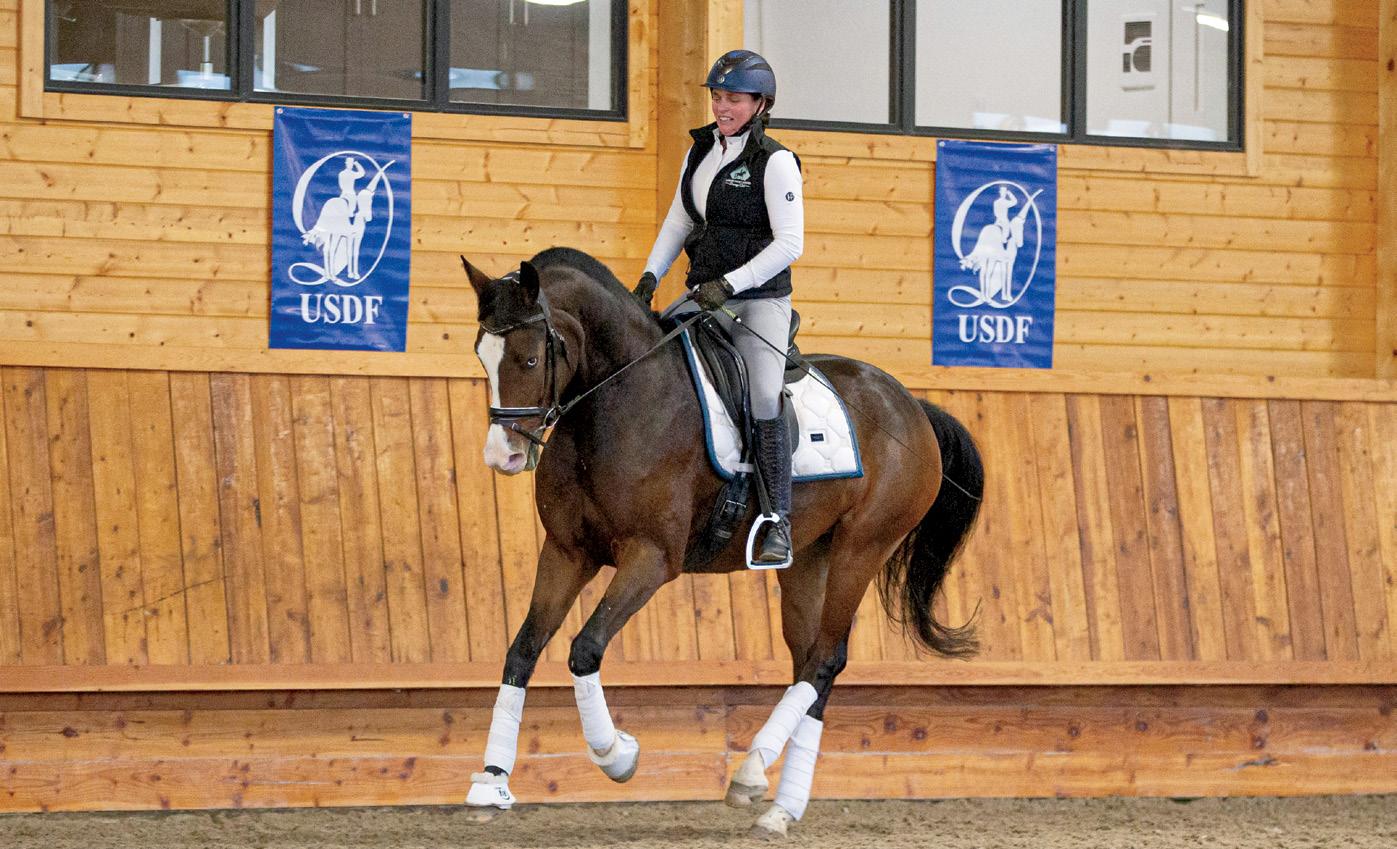
THE RIGHT START: At the 2024 USDF Sport Horse Prospect Development Forum at Sonnenberg Farm in Oregon, young-horse trainer Christine Murray is all smiles aboard her fouryear-old Weser-Ems mare, Fandango (Moviestar – Fanciful, Dancino), US-bred by Kari McClain
2023 Adequan®/USDF
“I emphasize patience with everyone on my team,” he says. “You have to allow the horse to grasp the question, to pause, before you continue with what you are doing. For example, when horses first start wearing a bridle, when you go to un tack, just take a moment. The horse may be impatient to have the bridle off and you may be thinking about all the other horses you have to ride, but just take it slow and easy. This way the horse learns to stand and be patient.”
Most experienced trainers have learned that trying to rush a horse usually backfires. This is why “pa tience is a big thing,” Bragdell says. The slow approach may take a little more time in the beginning, but “just because you are patient doesn’t mean it’s going to be a long process.”
“Don’t have an agenda,” says Mason. “Let the horse dictate what they can do, whether physically or mentally.” He notes that “we live in a culture of immediate success and Instagram posts and following horses on social media,” but “I think it’s really important to not feel any outside pressure on what your horse should be doing compared to what

SUSANJSTICKLE.COM
DRESSAGECOLLECTIONS.COM ~Compose your anatomic Bridle2Fit~ For information please contact info@dressagecollections.com Only The BEST Brands! Bridle2Fit • KASK Helmets • Neue Schule Herm Sprenger • Cavallo • EA Mattes Free Remote Consultations 765-341-5578
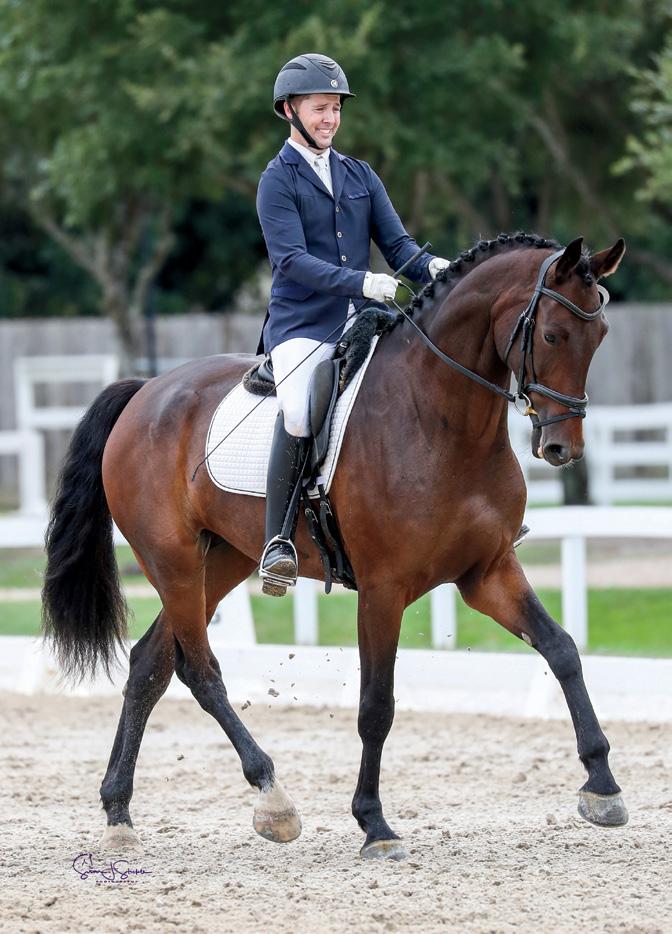
Materiale Horse of the Year American Prestige, a 2018 Oldenburg gelding by American Xpress and owned by Lisa Blackmon, with trainer/rider John Mason
Sport Horse
A Natural Progression
So how did young-horse training become an area of expertise for Hilltop Farm’s Michael Bragdell and TexOver Farms’ John Mason? Like much in life, one thing led to another.
A native of Sweden, Michael Bragdell trained jumpers and young horses in Sweden and England before joining famed Hilltop Farm in Maryland, where he has worked for nearly three decades with countless horses, from foals to stallions, and from handling on up to Grand Prix-level CDI competition.
Numerous of Bragdell’s mounts have earned top placings at USEF Young/ Developing Horse National Championships, in Adequan®/USDF Horse of the Year award standings, and at the US Dressage Finals and in CDIs. As Hilltop’s head trainer, Bragdell is a regular at breed inspections, breed shows, dressage competitions, and in presenter roles in events such as the USDF Sport Horse Prospect Development Forum.
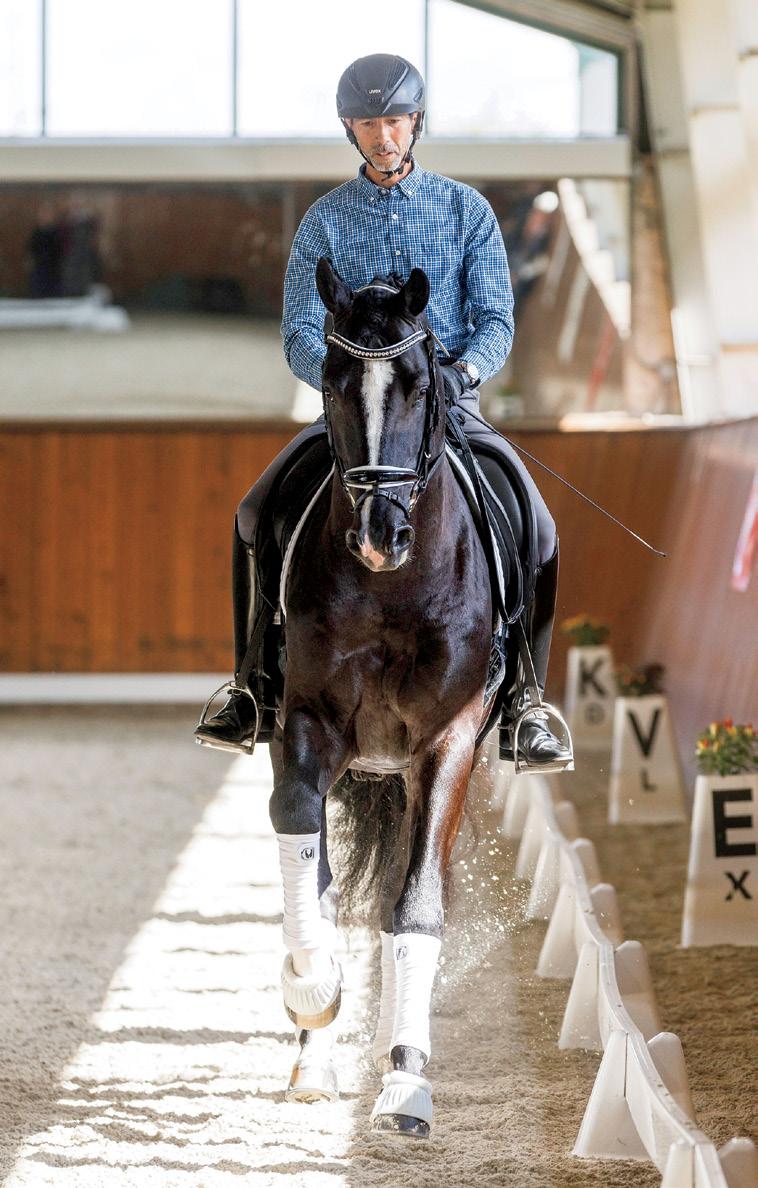
YOUNG-HORSE EXPERT: Hilltop Farm head trainer Michael Bragdell rides the young stallion Denmark HTF
Growing up a self-described “barn rat” in Texas, John Mason took the ride on any horse offered to him, from lesson horses that needed schooling, to boarders’ horses that were being naughty, to youngsters no one wanted to ride. “That taught me to be versatile and willing to get on anything,” he says.
Later, when Mason went to Germany to pursue his Bereiter credentials, “I was the lowest of low on the totem pole in the barn,” he jokes. “That meant starting the babies, riding the ‘feral’ ones, and eventually showing the young horses.” His grit opened doors: “This is where my true passion for the young-horse program manifested. I was lucky to be one of the main young-horse riders in the barn and had opportunities to show in the younghorse classes at some of the more competitive and popular competitions in our region.”
Returning to Texas to launch his own business, Mason partnered with local warmblood breeder Mary Nuttall of Southernwood Farm; training and campaigning her horses solidified his niche with young horses. Most recently, Mason nabbed Adequan®/USDF Dressage Horse of the Year titles in Materiale and Training Level with client horses.
ery horse that can make it to Lamplight [the US Dressage Festival of Champions for the Markel/USEF Young Horse Dressage National Championships], thousands of horses are not ready to do that. That doesn’t mean they are any less quality; that doesn’t mean they are any less talented; that doesn’t mean they are any less of a horse. There are just so many different paths in this sport. In this sport, you are competing against the standard, not against other horses.”
The high-performance ranks are prestigious, and so naturally many owners and riders of young dressage horses dream about competing in the Young Horse divisions. But they’re not for every horse, cautions Mason.
“I think the Young Horse classes are integral to the future of our sport—to promote riders with those horses, to keep the top of the sport alive,” he says. “But I think we have to be very careful as trainers not to put unrealistic expectations on horses. It takes a very special horse in both quality and mentality to compete at that level at a young age. As with any part of the sport, you have to make sure you are doing it the right way. I think we have to be very honest with our clients that we are not cutting corners or sacrificing the well-being of the horse to make success in those classes a reality. Not everyone is going to get into Harvard, and we have to have the same expectation with our horses.”
Likewise, “I see a lot of the pressure on young-horse trainers that if they are not performing at Lamplight every year, they must be doing something wrong,” Mason continues. “I think it’s important that this isn’t the end goal in young-horse training. It’s an added bonus, in my opinion. You can sacrifice so much ridability for the owner—and then, in the end, everyone is out of luck.”
“I think there should be a delineation between young-horse training and young-horse performance,”
24 July/August 2024 | USDF CONNECTION
PHOTOGRAPHY
STACY LYNNE
Sport-Horse
Expert Perspective: Q&A with Kristi Wysocki
In our sport’s earlier days, sporthorse breeders and young horses received scant attention. Today, dressage enthusiasts are keenly aware of bloodlines, and the USDF offers programs and awards geared toward young horses (see “USDF Sport-Horse Resources” on page 26). A good measure of the credit for the changes goes to Kristi Wysocki.
Wysocki, of Coupeville, Washington, is the current chair of the USDF Sport Horse Committee and a US Equestrian “R” dressage sport-horse judge. USDF Connection asked her thoughts on the ever-changing face of the sporthorse industry.
USDF Connection: How have dressage breeding and younghorse training in the US developed and grown in recent years?
Kristi Wysocki: In the time I’ve been involved, the quality of breeding has grown exponentially. The breeding in our country now compared to twenty-five years ago is on a whole different plane. We have breeders in this country who are breeding horses as good as any horse anywhere in the world. How do initiatives like the USDF Sport Horse Prospect Development Forum support the sport as a whole?
This program was created to bridge the gap in education between the USDF Sport Horse Seminar, which is focused on conformation and movement of dressage horses; and the US Equestrian (USEF) Young Horse Program, for four-, five-, and six-year-olds that are advanced in their training and exceptionally talented. The forum was designed to provide consistent education for trainers starting three- and four-year-old horses as future dressage horses.
Tell us about the Markel/USEF
Dressage Emerging Young Horse Program.
This program is for the elite four-, five-, six-, and now also seven-yearold horses. These horses are elite in talent and excelling in their training at an advanced level. As judges we evaluate the horses’ gaits, their submission relative to their age, and their potential as future FEI horses. In contrast, the Materiale classes for three-, four-, and five-year-olds have a much lower standard in training expectation and are more to evaluate the horse’s basic gaits and ridability. These classes are ideal for the younger horses that are not as advanced in their training.
What challenges do American sport-horse breeders, trainers, and owners face?
For breeders, the biggest challenge is the train of thought that USbred horses are not as high quality as European-bred horses. Breeding has also gotten astronomically expensive. I think the day of the big breeder in this country is gone forever. It’s just too expensive to run a farm that has twenty to thirty foals per year.
Another concern for the breeding industry is the lack of young people showing interest in this area. We don’t really have a pipeline for our youth into the breeding world like we do for riders into the FEI ranks. The USDF Sport Horse Committee does have a youth-education program that unfortunately was sidelined for a few years due to COVID; this year we are starting up again at Dressage at Devon (Pennsylvania). Participants will learn about handling and judging. We also do youth programs held at breeding farms.
[Bringing young horses along is] tricky for trainers. There’s a lot of pressure from some of the owners, and even the sport itself, for horses to go into the Young Horse Program. I think trainers have to be very care-
ful about each individual horse, to know whether it is honestly talented and sufficiently advanced in training [to be successful]. A horse might be totally ready for it at five—and even win—but the next year needs to sit it out. Or a horse may be too immature at five and blossom at six. A horse shouldn’t go in just because it’s five, for example. If it doesn’t have exceptional gaits, it should show at First and Second Levels and get high scores there instead.
Let the horse excel wherever it is ready to excel. We need to set these young horses up for success, whether that be the Young Horse Program, lower-level dressage classes, Materiale classes, in-hand classes, or even staying home and maturing more before venturing out.
For owners, the expense is huge. I do worry about the sport because of the expenses involved with the horse industry these days.
Any final thoughts?
The US breeders are the unsung heroes in our sport. We rarely see breeders listed on the day sheets at shows; every other country includes them. I would love to see this become a norm here. It’s important to recognize the breeders at a national level so there is incentive for them to continue. USDF as an organization and [current USDF president] George Williams in particular have really supported the programs developed by the Sport Horse Committee over the years. Their support is greatly appreciated.
USDF CONNECTION | July/August 2024 25 COURTESY OF PENNY HAWES
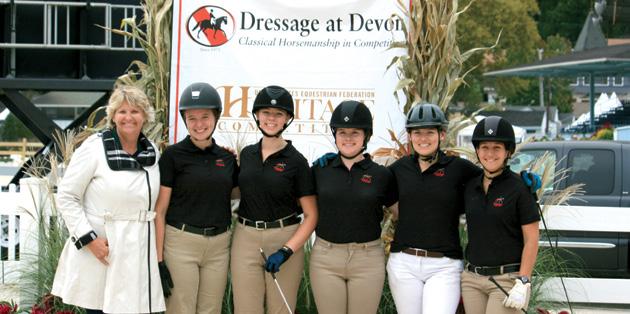
Kristi Wysocki and participants in the USDF Youth Handler Clinic at Dressage at Devon in 2016. The program is scheduled for revival at this year’s show.
Sport Horse
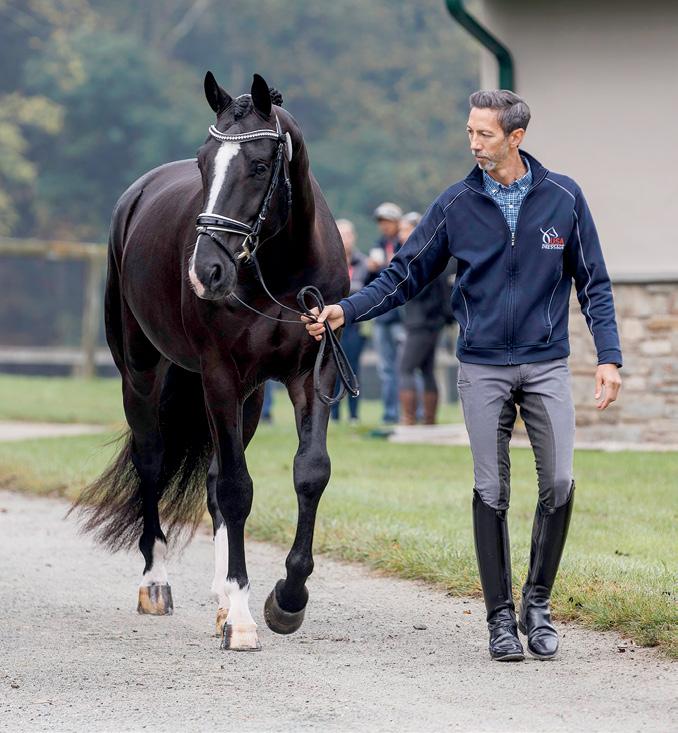
HANDLED WITH CARE: Hilltop Farm head trainer Michael Bragdell is a veteran handler who’s logged countless miles at sporthorse breeding shows and inspections. He’s pictured with Denmark HTF, a 2019 Hanoverian stallion (Desperado – Unicum-D, Negro) bred and owned by Hilltop Farm
Mason adds. “I think much gets lumped under the high-performance umbrella, yet there is a lot of younghorse training going on in the country outside of that distinction.”
TMake Connections
Do you have a young horse and would like to find a reputable trainer? “Talk with people who have worked with that trainer in the past, watch the trainer ride, and look at how they interact with their horses,” Mason recommends. And look deeper than show results: “I think it’s more important to see their success out of the ring—because with young horses, showing is a small part of it. The overall horsemanship is sometimes even more important than the performance part of riding. There are a lot of riders who are very talented at showing, but that doesn’t always translate into the day-to-day interactions. Go and watch them work at home if you can. I have an open-door policy if anyone wants to come and watch me. I think everything needs to be transparent and out in the open.”
For trainers interested in getting started working with young horses, Bragdell suggests connecting with an experienced young-horse trainer
USDF Sport-Horse Resources
he USDF offers an extensive network of educational programs, competition opportunities, and recognition for sport-horse enthusiasts, breeders, handlers, and, of course, breeding stock, young prospects, and young dressage horses. Start your journey here.
Sport-horse education: usdf.org/ education/other-programs/sporthorse-seminars/index.asp
Competition: usdf.org/competitions/competitions-championships/ sporthorse/index.asp
Awards: USDF Breeder of Distinction: usdf.org/awards/breeder-ofdistinction/
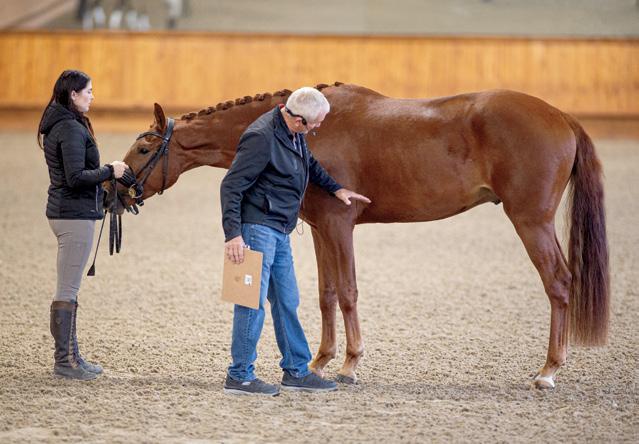
CAREFULLY TAUGHT: Clinician Willy Arts discusses conformation at the 2024 USDF Sport Horse Prospect Development Forum, with the demonstration pair Molly Eastridge and Pandemie D’Amour, owned by Brooke Voldbaek.
Adequan®/USDF year-end awards (Dressage Sport Horse Breeding Horse of the Year, Materiale Horse of the Year, USEF Four-Year-Old, FEI Five-Year-Old, FEI SixYear-Old, Dressage Breeder of the Year, Dressage Sport Horse Breeding Breeder of the Year): usdf.org/awards/performance/year-end.asp
Adequan®/USDF All-Breeds Dressage Sport Horse Breeding year-end awards: usdf.org/awards/all-breeds/dshb-all-breeds.asp.
whose style of handling and riding they admire. Options include going to work for that trainer, taking lessons, or simply having someone willing to serve as a mentor to offer advice and answer questions.
The best places to do this important networking, Bragdell says, are breed-registry inspections and sporthorse breeding shows.
The Future’s Looking Bright
Both sport-horse breeding and training in the US showcase quality, says Bragdell: “I’ve been to so many inspections over the past thirty years, and the quality of foals born in this country just gets better and better.” Bragdell, who attended his first Young Horse Championships two decades ago, says that “every year you see a bigger group of really nice horses that are presented really well. It’s really exciting. You also see more trainers that train young horses year after year, bringing them along and progressing in the training.”
Natalie DeFee Mendik, MA, is an award-winning journalist specializing in equine media. Visit her online at MendikMedia.com.
IN THE NEXT ISSUE
• Youth Issue
• Find your tribe: Connecting young dressage enthusiasts with like-minded others
• Prize money in dressage: Pros and cons
• How to build your confidence in the saddle
26 July/August 2024 | USDF CONNECTION STACY LYNNE PHOTOGRAPHY; MARY CORNELIUS



For over three decades, The Dressage Foundation (TDF) has been making dressage dreams come true Thanks to thousands of donors through those years, TDF has provided opportunities for growth, learning, and achievement to the U S dressage community
You’re invited to join TDF in celebrating 35 years! Visit www dressagefoundation org to read about TDF’s remarkable history, learn more about the impact donors have made on the sport, and read stories from grant recipients, donors, volunteers, and Century Club members.


info@dressagefoundation.org
www dressagefoundation
org
(402) 434-8585 Learn TDF’s History Share Your Story Read the Stories Support TDF
VISIT WWW.DRESSAGEFOUNDATION.ORG OR SCAN THE QR CODE TO LEARN MORE!
Celebrate 35 Years with The Dressage Foundation!
Clinic
CONVERSATIONS ON TRAINING
We Laugh, We Praise, We Learn
Raising the training bar at Carl Hester’s yard in England: A conversation with Shannon Dueck
By Beth BaumertShannon Dueck turned to international dressage competition after years spent eventing and galloping racehorses in her native Vancouver, Canada. In 1999, riding Korona, she won the individual silver medal at the Pan American Games. Since then, riding numerous self-trained horses, she has represented Canada at competitions including the World Equestrian Games and the FEI World Cup Dressage Final. She and her husband, Lorne, are now based in the US, operating Dueck Dressage in Loxahatchee, Florida.
A Canadian Pony Club “A” alum and an Equestrian Canada-certified coach, Dueck holds an MS in equine nutrition from Texas A&M Univer-
sity and has been an equine-science faculty member at Olds College and at Johnson and Wales University. She works with horses and riders from Training Level to Grand Prix. She has coached the Colombian dressage team at several international championships, and a Canadian student earned a top-six finish at the Tokyo Paralympic Games in 2021.
Dueck’s own dressage mentors have included Bert Rutten, Lars Petersen, Robert Dover, and Scott Hassler. She spent six months in England in 2011 training with British Olympian Carl Hester. In early 2023, she returned to Hester’s yard for an anticipated seven-month training stint with the 2015 Oldenburg mare Angelika MW (Franziskus FRH –Ayscha, Welt Hit II). USDF Connection had a longdistance conversation with Dueck, to find out what she’s learned from Hester and to hear about what it’s like training at one of the most famous dressage stables in the world.
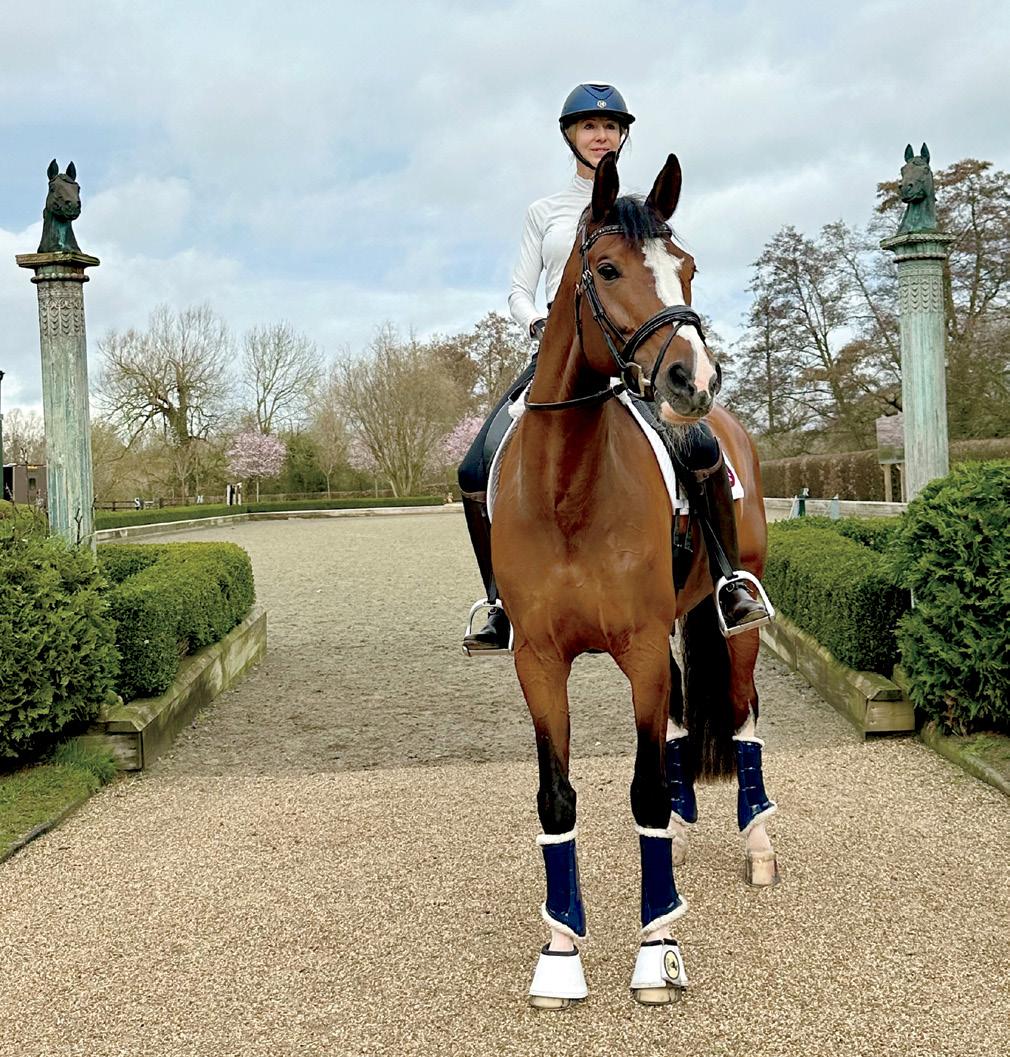
Beth Baumert: Shannon, you’ve been immersed in the culture of Carl Hester’s yard since the end of January. Tell us about it.
Shannon Dueck: The immersion is the most impor-
tant aspect of this experience. Carl and Charlotte’s [Dujardin, Hester’s protégé turned superstar and Olympic champion] training is in a stratosphere above, and it is very inspiring. And Carl is such a gifted teacher— somehow able to say that I’m doing something wrong, but he says it with humor, and we laugh. We laugh at ourselves, we praise our horses, and we all learn and improve. Carl and Charlotte train in this positive way every day, and I have watched the improvement even in horses that have won gold medals.
When you say you praise the horses, is it different from praising in other training settings?
Yes. Praise is a huge motivator in this yard throughout every day, and that’s coupled with extremely refined aids that ask questions in an understandable way. Horses have their challenges, and none of them are born doing this, but praise keeps them trying. Often after a good try, the riders get into two-point and let the horses gallop a little on a long rein. What a wonderful reward.
Is that what drives the quality in this yard?
Yes, but also the standard is different. I think most riders are thrilled to get eights. At Carl’s yard, they’re always working for tens. That’s how particular they are. They’ll say, “That corner wasn’t a ten” or “that center line wasn’t a ten.” That standard of ten is always in their minds. It’s always the goal.
How has that affected your riding? When I left Florida in January, I thought “Angel” and I were ready to
28 July/August 2024 | USDF CONNECTION COURTESY OF SHANNON DUECK
GREAT EXPECTATIONS: Shannon Dueck and Angelika MW at the entrance to the outdoor arena at Carl Hester’s yard in England, where a score of 10 is the benchmark
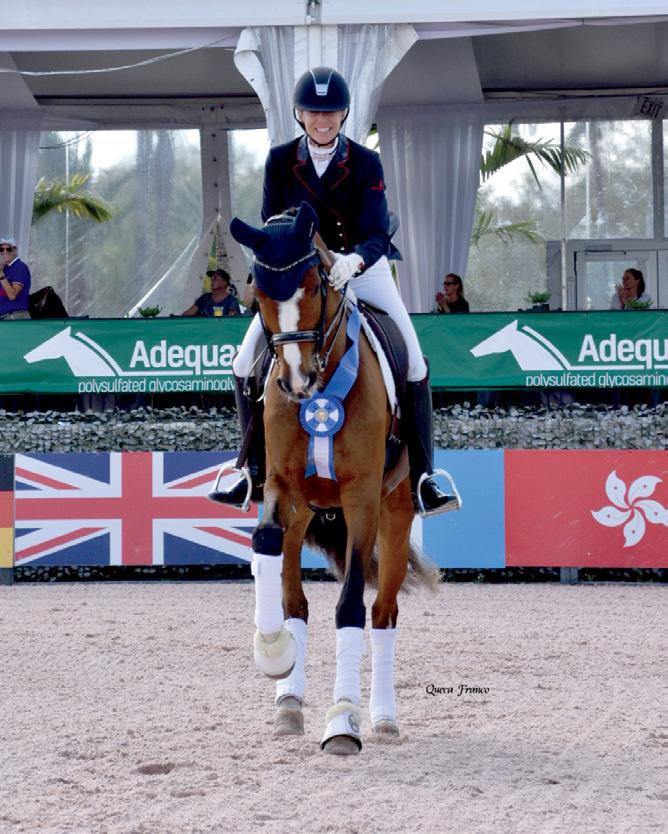
LIFE PARTNERS: Dueck owned “Angel’s” dam and trained her to Grand Prix, so breeding and training her offspring to Grand Prix has been especially rewarding
do a Grand Prix. Then when I came here, I thought maybe I would never be able to show Grand Prix because the expected level of competence is so high. Being here has upped my idea of what I want to be able to show before I get into the ring. For example, I need to be able to prepare for the pirouettes on the center line without the hind leg deviating off the line. And I need to do it with a soft leg and a soft hand. Carl and Charlotte get those top scores because it looks as if the horses do the hard work by themselves.
Tell us a little more about the soft hand.
Your reins have to be soft. Your hands have to be soft. You have to let go and pat your horse, and you do that within the connection. Carl might say, “I want to see movement in the rein.” He means that he wants to see that the horse is in self-carriage. We need to be able to do the movements without holding back. That makes the horse’s job easier too because the lighter and softer your hands are, the easier it is for the horse’s hind legs to be engaged.
Tell us about Angelika MW. I know her history is very interesting.
“Angel” is co-owned by Elizabeth Ferber, Kathy Putnam, and me. She is the daughter of my Grand Prix mare Ayscha, whom I had trained with Carl Hester at his yard in 2011. At the end of Ayscha’s career, with the help of Jen Vanover of Maplewood Warmbloods, we bred her to [German Olympic eventer and dressage rider] Ingrid Klimke’s mount Franziskus, and Angel was the result. She was like one of those girls that you hated in high school because she was always beautiful. Angel never had an awkward phase. As a baby, Angel went to Rachel Ehrlich in Massachusetts, who cared for her for two and a half years, got her started under saddle, and did lots of work in hand with tarps, pool noodles, and garbage pails. I think the work that Rachel did laid a crucial foundation of trust. Angel is very hot and spooky by nature, but she will literally go anywhere with me and never says no.
How did you feel about her as a top dressage prospect?
When I first saw her on a lunge line, I was quite unimpressed. She was beautiful, but she couldn’t move. Her gaits were actually earthbound, and I thought, “Oh well! She’s beautiful and she’s ours, so let’s see what we can do with her.” [
Tip from Shannon
If you’re a rider who has difficulty finding true bend that originates under your inside seat bone, the travers (haunchesin) can help you figure that out. From working on travers, you will eventually feel it and say, “Oh, there’s my inside leg and seat bone in the right place to make the bend.” Then you can start riding travers with your inside leg instead of your outside leg.
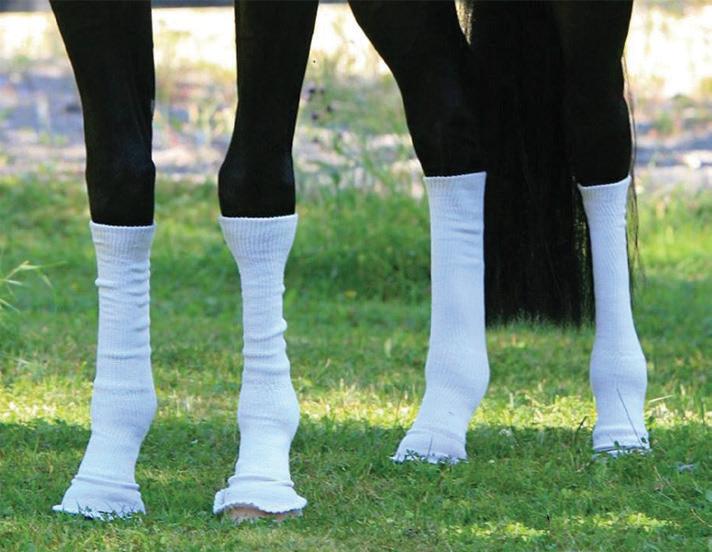
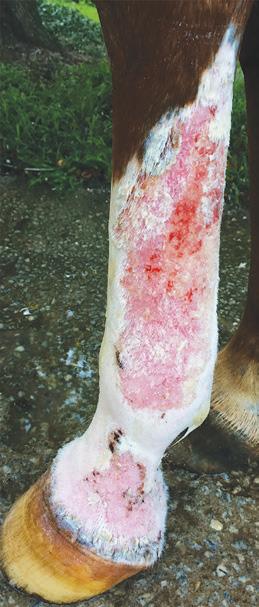

for yourself the comfort and fit that have made us one of the most sought-after boots in the
today to view
USDF CONNECTION | July/August 2024 29 CARMEN FRANCO
® 20% Coupon Code: USDF24 www.soxforhorses.com “This is a fantastic Product!!” Erica Lacher, DVM Custom- Fit Boots For over a century, the Dehner name has been proudly worn by young
old alike. Feel
business!
full line of boots and shoes Tel: (402) 342-7788 * Fax: (402) 342-5444 www.dehner.com Made in the U.S.A
and
Log-on
our
Training
Dueck: Get the Feel
And yet she’s done very well in competition!
Yes. Although she doesn’t have big gaits, her mechanics are very correct—that is, her joints bend the same. She is like a ballerina. So my job as the trainer is to teach her how to use her body to the max. Her trot is getting super-expressive now, and the canter is gaining strength and amplitude. She has a very good show record. As a six-year-old, she scored 78 and 80 percent at Fourth Level, and as an eight-year-old she was alternate for the Pan Am Games.
It sounds like the work was easy. I’ve been really careful that I never overface her. Although the pirou-
Uettes weren’t strong in the Prix St. Georges, I didn’t care. I just thought, “I’m going to go across the diagonal and turn around.” It was good for her because there was no pressure. She just needs to be able to go in the ring and think it’s easy.
I was very proud of her, but I really wanted to work with Carl on the Grand Prix. He is well known for producing amazing horses from normal horses, and hot horses try hard for him. So although he’s busy, he finally said we could come!
And one of your primary goals for Angel is developing her gaits, right? How are you going about that?
The Carl Hester Schedule
S-based Canadian international competitor Shannon Dueck is spending much of 2024 training with British Olympian Carl Hester at his stable in England. She shared Hester’s training routine with USDF Connection:
The horses in Carl’s yard work four days a week: Monday, Tuesday, Thursday, and Friday. Wednesdays and Saturdays are hack days, and Sundays are days off. The horses get turned out unless the field is so wet that their shoes might get sucked off. When that’s the case, I let Angel [Dueck’s mare, Angelika MW] play in the round pen.
HOMETOWN PRIDE: A bronze statue of Charlotte Dujardin’s legendary mount, Valegro, stands in the town square in Newent, Gloucestershire, near Carl Hester’s stable
On those four training mornings, the grooms start each horse with a hack—even if it’s pouring rain—and then a warmup consisting of walk, trot, canter, and stretch. Then Carl and fellow Olympian Charlotte Dujardin ride together—five or six horses each—always helping each other. For every challenge, they have that instant set of expert eyes. Then they stretch the horses at the end and the grooms hack them again.
Next on Carl’s schedule, he trains me and one other lucky person, and then he takes a very short break for lunch. After that, the lorries just roll in for lessons all afternoon, one after another. He also teaches truck-in lessons all day on the Wednesday and Saturday hack days.
As an aside, hacking here is quite the four-mile adventure. I used to be an event rider, and none of this would have daunted me then, but I must admit that I was initially nervous to be on these top, best-in-the-world horses that don their road studs and go out on paved rural single-lane roads, sometimes in the pouring rain. We meet chickens, sheep, horse-drawn carts, bicycles, and cows that sometimes charge us. My courage is improving.
We started with a shoulder-in that is more shallow than the traditional three-track shoulder-in you would ride in competition. We’re not doing a shallow shoulder-in because we can’t do a three-track shoulder-in; we do a shallow shoulder-in intentionally.
Is a shallow shoulder-in the same as a shoulder-fore?
No. In shoulder-fore, the outside legs are aligned, and the purpose of the exercise is straightness. One of the purposes of shoulder-in is development of the gaits, and the shallow shoulder-in gives you a chance to redirect your horse’s inside hind leg. At the upper levels, the angle is less important than riding for the result of gaining more power and amplitude.
Horses would prefer to move away from the leg and make a wide angle as in leg-yield, right?
Yes. In that position, they avoid the bend and the necessity of carrying more weight behind. In the shallow shoulder-in, you can decide how you want your inside leg to influence your horse. Ideally you want him step under himself, lift his shoulders, and carry himself with more amplitude.
Once the shallow shoulder-in is established—with just the right angle and bend through the ribs—then your inside leg can influence your horse to step with more energy up through the shoulders into a bigger trot. The shoulder-in with a milder angle is also less stressful because there is less torque.
How is Angel progressing?
Her “Grand Prix trot,” in which the hind leg pushes upward into collection, was well started when I arrived here, but now she can hold it for a longer period of time and it’s become easy and more expressive.
Going back a step, how do you teach shoulder-in to your students?
First, it’s a prerequisite that your horse moves easily off your leg later-
30 July/August 2024 | USDF CONNECTION COURTESY OF SHANNON DUECK
Clinic
ally. Then, when most riders begin shoulder-in, they are mistakenly inclined to keep their own shoulders facing straight down the track, and they bring the horse’s shoulders in with the outside rein. Instead, imagine that you are in the position of shoulder-in yourself—with your shoulders positioned the same way you want your horse’s shoulders. I tell my students, “Turn your shoulders and head toward the center line.” That way, you’re bringing the horse’s shoulders to the inside with your body rather than with your reins.
Then your inside leg takes the horse into the shoulder-in, bringing his hind leg up through the middle of his body and out through the shoulders and the neck. Then you start to develop more amplitude in the collection because, instead of just going forward, the hind leg pushes upward into collection.
How do you know when it’s right?
When you feel the ability to ride shoulder-in without blocking your horse with the outside rein, you can directly feel how shoulder-in improves collection. Once I can stay absolutely stable and light in my hand through a well-established shoulder-in, I’m ready to do the same thing in a shallow travers.
Training Tip from Shannon Dueck: Training for Longevity
We do very little extended trot at Carl Hester’s stable, which keeps the horses strong. In my second week here, after some nice trot work, I added an extended trot. Carl said, “OK, that’s your one extended for the week.” Carl knows that when your collection has developed in amplitude and power, the extension is in there. You don’t actually have to do it.
How do you start that?
You ride the shallow travers (haunches-in) with the same principle: on three tracks instead of the four tracks needed in competition. Again, the horse must move easily sideways from light leg aids so you aren’t pushing him with your outside leg. Being in balance is superimportant so your inside leg can bring the horse’s inside leg up and under the center of gravity.
You want to feel like you’re developing the middle of the horse and riding the ribs with your inside leg. The power of the inside leg comes up through the ribs and the shoulder into a more expressive gait.
That powerful travers evolves into the beautiful half-passes with expression and amplitude that we see in the top Grand Prix horses.
It sounds like Angel’s gaits are improving beautifully. What’s the biggest change in you as a rider? I’m more focused on my position here because the riders here are almost perfect, which makes me say, “I’m going to ride like that.” I thought I had a good position before I came, but it’s better now, and I’m not going to be satisfied until it’s even better.
How is it better?
I’m stronger in the center of the saddle, and I’m straighter from the side—rarely falling behind the vertical. With that stability, I can be so much more supple in my hand, and my horse can be in better self-carriage because I’m in more self-carriage. It’s unfair of us to expect our horses to be supple, balanced, and in self-carriage if we’re not. I feel like I’m always in control of my balance, and I can offer the rein throughout. Also, I tend to bob my head, and I’m fixing that. It’s amazing how when I control that, I can use other parts of my body with more ease.
You recently visited Florida and did a lot of teaching.
Yes, I’m excited about what I am bringing back to my students. The standard is so clear here: “This is where you need to be; allow with your hand, allow, allow, allow….” As an instructor, I will be so much better.
And your ultimate goal?
My next goal is the 2026 World Championships in Aachen. And then Angel will be thirteen for the 2028 Los Angeles Olympics. That’s my ultimate goal.
Since our interview, Dueck and Angel made their Grand Prix debut with great success. We look forward to seeing them compete on our shores!
BMeet the Expert
eth Baumert is a USDFcertified instructor/ trainer through Fourth Level, a USDF L program graduate with distinction, and the author of When Two Spines Align: Dressage Dynamics and How Two Minds Meet: The Mental Dynamics of Dressage. She is the current president of The Dressage Foundation. For many years she owned and operated Cloverlea Dressage in Columbia, Connecticut, and served as the technical editor of Dressage Today magazine. She divides her time between Connecticut and Florida.
USDF CONNECTION | July/August 2024 31
The Judge’s Box
Rider Biomechanics
How judges evaluate the rider in the dressage tests. First in an occasional series
By Jayne AyersIn the Collective Marks section of all of our national dressage tests, there are two score boxes for the rider. The first of these is for “position and seat.” What the judge assesses to determine this score are elements of equitation that are the foundation for effective communication with the horse. A correct, balanced, and independent seat is necessary for successful training and competition.
The classic illustration of a good seat depicts the rider from the side, with ear, shoulder, hip, and heel in a vertical line. Not every rider’s body fits the elegant lines of the ones in the drawings, but the same principles must apply if the rider is to find the balance and base of support needed to allow the aids to work correctly and independently.
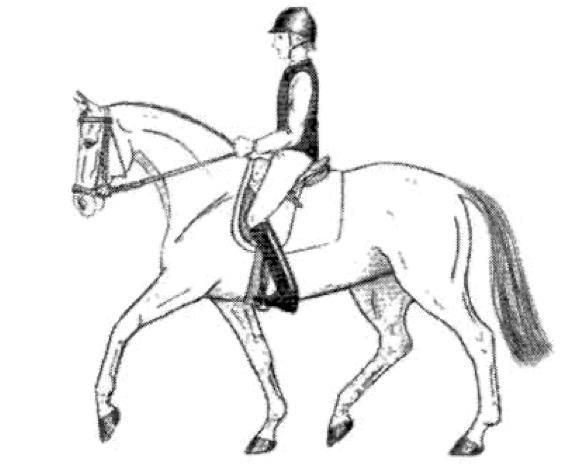
The test sheets list five directive ideas that the judge considers in formulating the collective mark for rider position and seat:
• Alignment
• Posture
• Stability
• Weight placement
• Following the mechanics of the gaits.
In this article, I’ll discuss the first directive idea: alignment
Without correct alignment, the rider cannot develop independent balance. Too often, the reins or a gripping leg are keeping the rider aboard.
Effects of horse conformation and saddle fit. Both the conformation of the horse and the fit of the saddle are key to helping a rider achieve correct alignment. A person with short legs may find it a challenge to get those legs down and around a very wide-barreled horse. The saddle should place the rider’s center of gravity over that of the horse, and allow the rider to sit upright without using muscles to stay there. Judges frequently see saddles that have slid forward onto the horse’s shoulders, moving the rider too far forward to allow the horse to remain in longitudinal balance. If the saddle tips the rider forward or backward, they will be in a constant struggle to maintain a correct position. To feel the effect of a saddle that is tipping the rider backward, sit on a hard chair with your feet well in front of you, then try to stand. A rider whose saddle forces their balance toward the rear will undoubtably be relying on the reins for support. You should never
feel that you need the reins to help you balance; nor should you feel that you’re being forced into an unnatural posture in order to stay vertical or to keep your heels under your hips.
Stirrup length. Stirrup length is another key factor in finding and maintaining correct alignment. When I judge and teach clinics, I rarely see stirrups that are too short unless the rider is fresh from a jumping background. More often the stirrups are too long, which causes the rider’s lower leg to be either too loose or braced forward with the toes down. Stirrups are intended to provide a secure base of support for the leg. Correctly adjusted, they should allow the rider to keep the heel slightly lower than the ball of the foot so that the calf muscle is slightly taut, ready to apply the leg aids in a variety of places and pressures.
Vertical alignment. Viewed from the rear, the rider’s spine should be vertically aligned over that of the horse at all times. Leaning in to steer or bend the horse puts the pair out of balance, with less-than-optimal results. The idea of “using” one seat bone or the other is important in the use of the aids, but it is not achieved by leaning.
Symmetry. Both sides of the rider should match. It is very common to see someone riding with one leg further forward than the other, with one hand higher or at a different angle than the other, or with the torso rotated to one side. All of these position problems result in the rider’s giving the aids differently left and right. One of our goals in dressage is to make the horse equally supple on both sides, but this is impossible if the rider cannot operate the same way in both directions. Horses and riders are all born with left/right differences and asymmetries.
32 July/August 2024 | USDF CONNECTION USDF ILLUSTRATION
THE DRESSAGE SEAT: Illustration from the USDF Teaching Manual shows the ideal dressage position
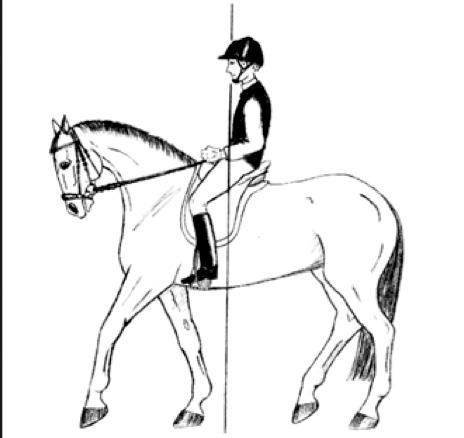
THE “CHAIR SEAT”: A saddle that tips the rider backward may produce this incorrect position. The rider must rely on the reins for balance.
The challenge of the training, like that of a ballet dancer, is to equalize the strength, mobility, and flexibility of the two sides. The rider must take the lead in achieving this. Ask a helper to take video or photos from each side while you ride so you can compare any differences in your position.
Arm, hand, and wrist position. Correct alignment also includes a straight line from the rider’s elbow, along the bottom of the arm and hand, through the rein, to the horse’s mouth. Arm position affects the operation of the back and shoulders, both for strength and for the flexibility and control that together allow subtlety of communication with the seat aids. It is the length of the rider’s arms that determines the correct height of the
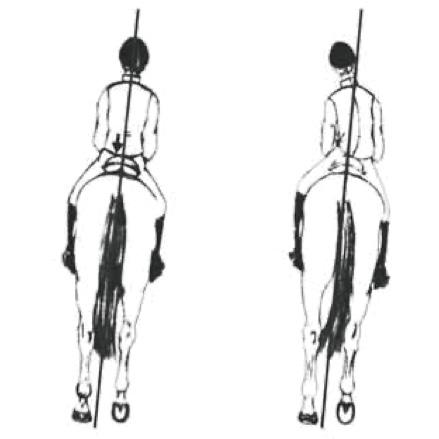
VERTICAL ALIGNMENT: The rider’s spine correctly aligned over the horse’s spine (left) and leaning off to one side (right). The rider’s “collapsed” left hip puts even more weight to the right, further unbalancing the horse.
hands above the withers. In turn, arm length, along with the rider’s body shape, determines the appropriate amount of space between the hands. Riders come in all shapes and sizes! Hand and wrist position is very important in developing clear, subtle rein aids. To achieve a tension-free connection between arm and hand, the wrist must be nearly straight with only the slightest curve to the outside—never broken inward. The top of the hand forms a continuation of the outside of the arm. Why does this matter? This is the natural position of the arm and hand and one that allows the most relaxation of the muscles. Arms and hands in other positions
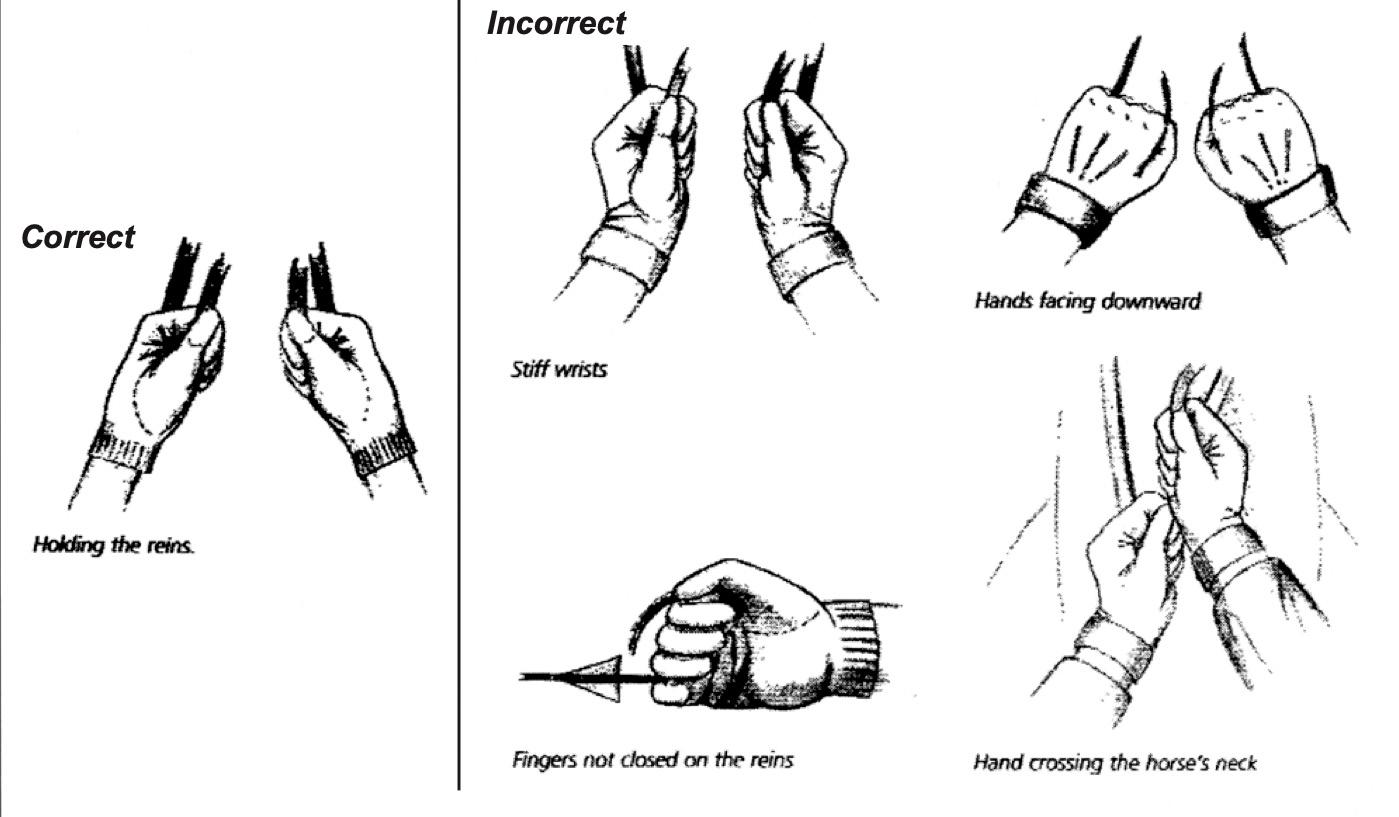
HAND AND WRIST ALIGNMENT: Incorrect hand and wrist position compromises the rider’s ability to follow the horse’s motion and hinders the clarity of the rein aids
are held there by muscular effort. Try walking with your arms swinging with the thumbs pointing toward your body and the knuckles pointing forward. You will feel a tension that isn’t there when you swing your arms in the normal way.
In the saddle, unnecessary tension often prevents the subtle use of the fingers and may interfere with the hand’s ability to gently follow the motion of the horse in walk and canter. From the correct position, the hand can be moved in a number of ways—with strength when required, but also with dexterity and subtlety. The knuckle of the thumb should always be the highest point when the arm and wrist are carried correctly. A wise trainer once described the correct hand as a cozy cottage with closed walls and a peaked roof. The fist should be lightly closed, with the tips of the fingers resting on the heel of the hand. This allows the rider to give a strong aid without pulling, to soften the contact very subtly, and to give a wide variety of aids in between, all without being visible. Another useful concept is that your hand should hold the rein as if there were a little bird’s egg in your fist and you want to neither drop the egg nor squash it. For riders whose hands tend to be like open hooks, practicing with a bird’segg-sized pebble can be of help.
In future articles in this series, I’ll discuss the other “rider” directive ideas: posture, stability, weight placement, and following the mechanics of the gaits.
US Equestrian “S” and retired FEI dressage judge and USEF “R” sporthorse breeding judge Jayne Ayers, of Pewaukee, Wisconsin, has been a USDF L Education Program faculty member since the program’s inception. She is a member of the USDF L Program Committee and a former longtime member of the USEF Dressage Sport Committee.
USDF CONNECTION | July/August 2024 33 USDF ILLUSTRATIONS
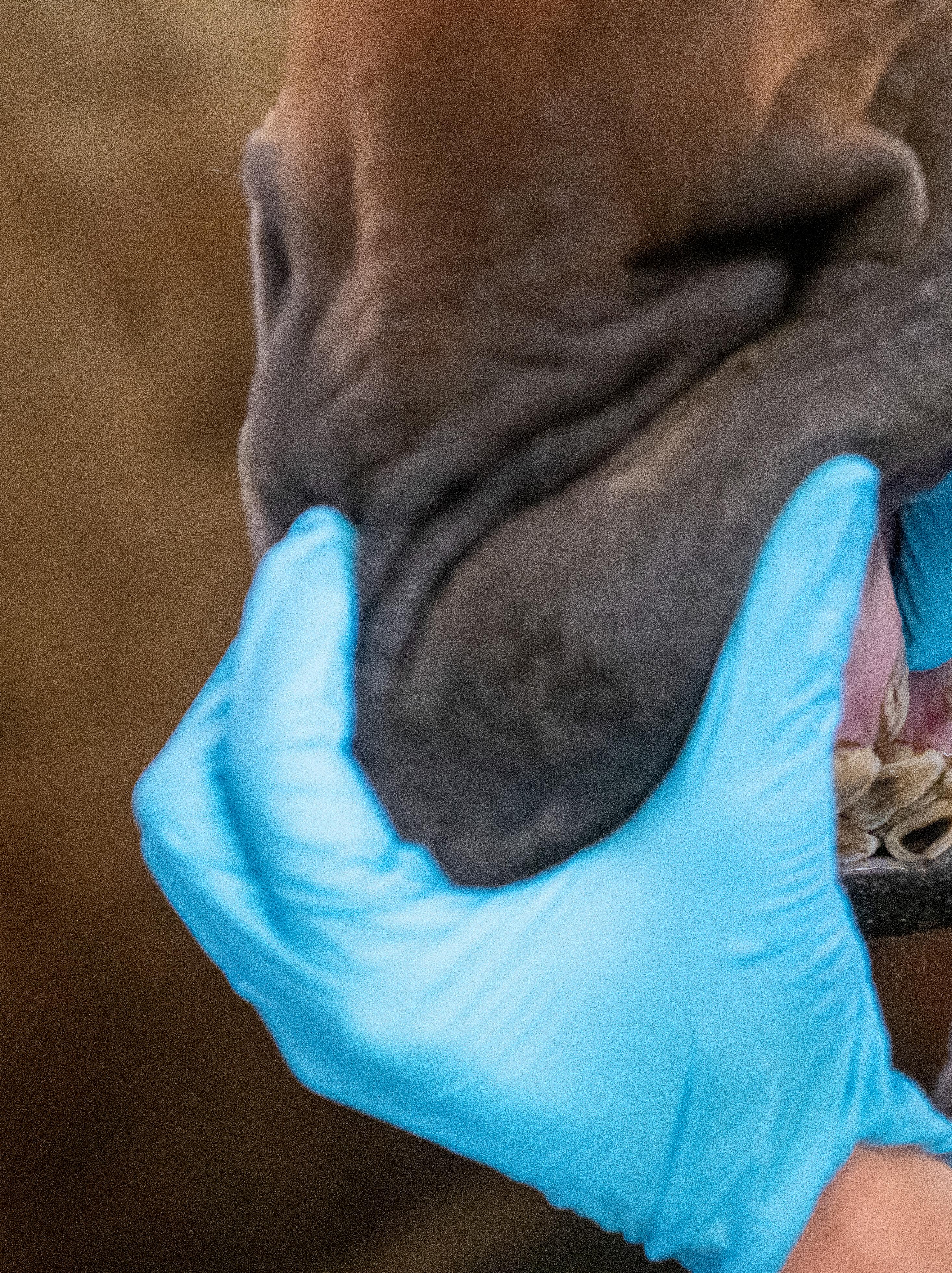
Are Dental Issues Taking a Bite out of Your Dressage Performance?
For your horse’s welfare as well as your scores, make sure his teeth and mouth are comfortable BY HEATHER SMITH THOMAS
34 July/August 2024 | USDF CONNECTION
FROM THE HORSE’S MOUTH: Quality dental care is essential to your horse’s health—and his success in dressage
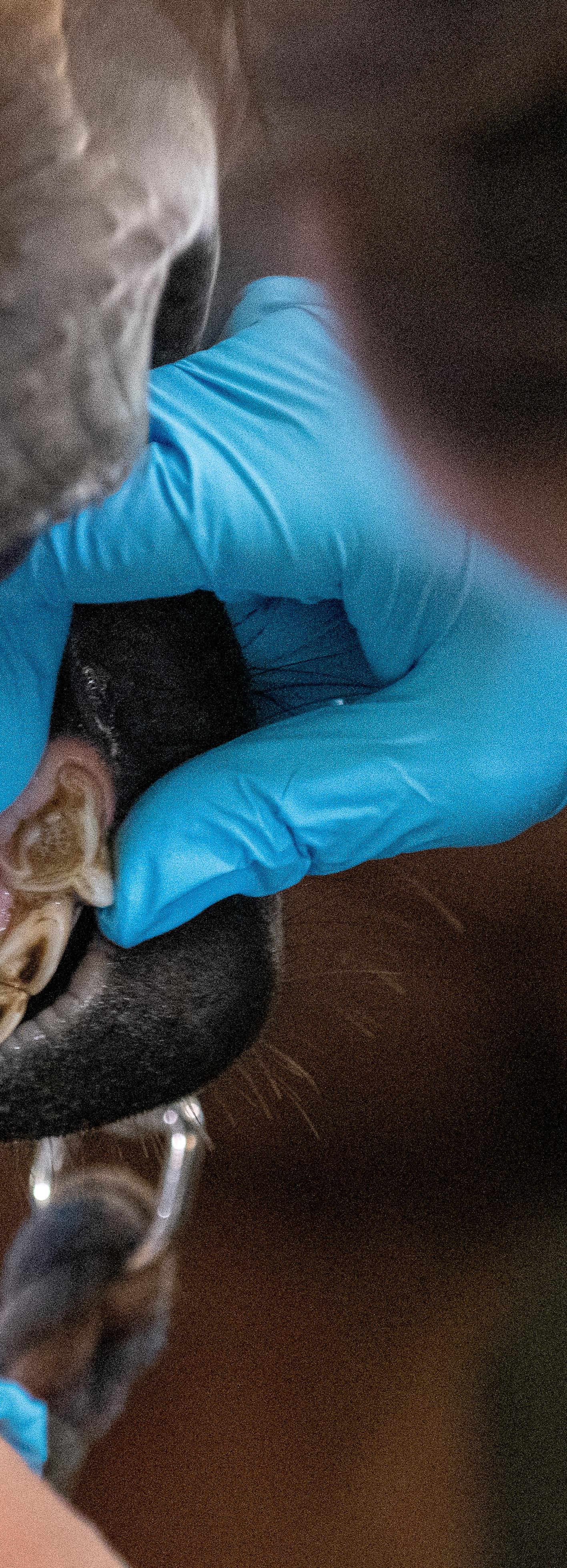
When Antonella Bath purchased Pica, a 13-year-old Hanoverian, she had high hopes for the mare, who had shown up to Fourth Level. But soon the adult-amateur rider and USDF bronze, silver, and gold medalist discovered that her new horse wasn’t as easy to ride as she’d thought.
Pica had passed the prepurchase exam “but was very heavy in the bridle,” says Bath, of New Albany, Ohio. “She was a heavily-built horse, and when she leaned on the bit, it was difficult for me as an amateur rider to put her together and get an uphill balance.”
Some riders might have approached the issue as a training problem, fiddling with bits or doing endless half-halts in an effort to get the mare off her forehand. But in Pica’s case, the cause turned out to be physical.
“Soon after I got her, we were doing routine yearly dental exams,” Bath recalls. Her veterinary dentist, Jeff Reiswig, DVM, DAVDC/Eq, owner and founder of Equine Veterinary Dental Services in Newark, Ohio, “discovered she had a significant wave mouth,” in which the upper and lower molars aren’t correctly aligned, causing the teeth to wear in an irregular waveshaped pattern. “We realized she couldn’t move her jaw normally; it would lock. She couldn’t move her jaw in a way that would allow her to relax her mouth and soften to the bit. When she would try to give at the poll, she could only give a little,” Bath says.
Reiswig, who is board-certified in veterinary dentistry by the American Veterinary Dental College (see “Find a Qualified Equine Veterinary Dentist,” page 39), went to work. After multiple sessions, he got the wave mouth smoothed out and Pica’s lower jaw functioning more normally. “That was the beginning of this mare being able to soften to the bit as she became comfortable in the bridle,” says Bath. “She was a great horse, and this made it much easier for her to do her job. She went on to the FEI levels, showing up through Intermediate I. I don’t think I could have taken her that far without the dental corrections.”
If a horse can’t eat and chew properly because of dental problems, its nutrition and overall health will likely suffer. Dressage enthusiasts have even more reason to be vigilant about their horse’s dental care— because, as Bath’s case shows, tooth or mouth issues can affect a horse’s overall attitude, movement, and performance.
For this article, two equine veterinary dentists
USDF CONNECTION | July/August 2024 35
AKDRAGOOPHOTO.COM
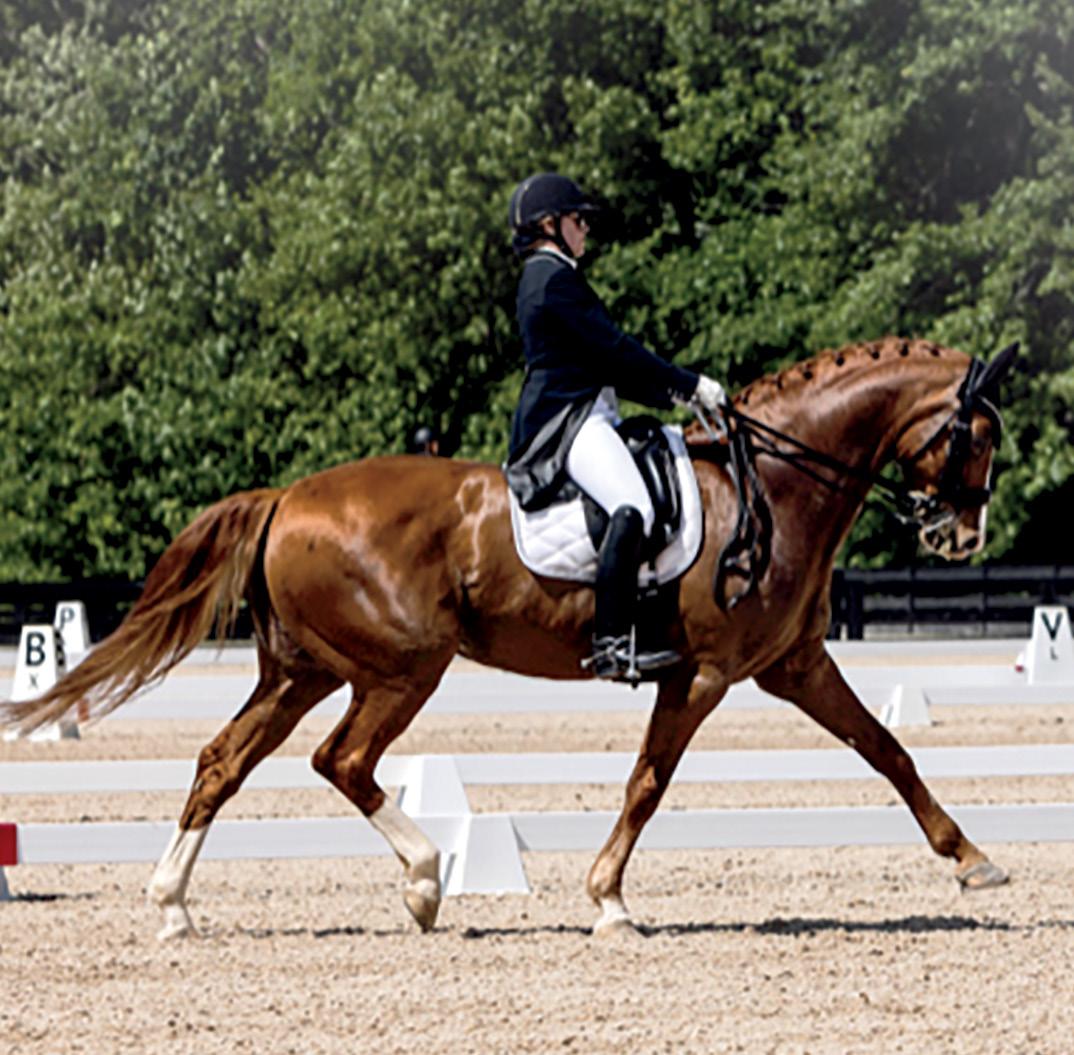
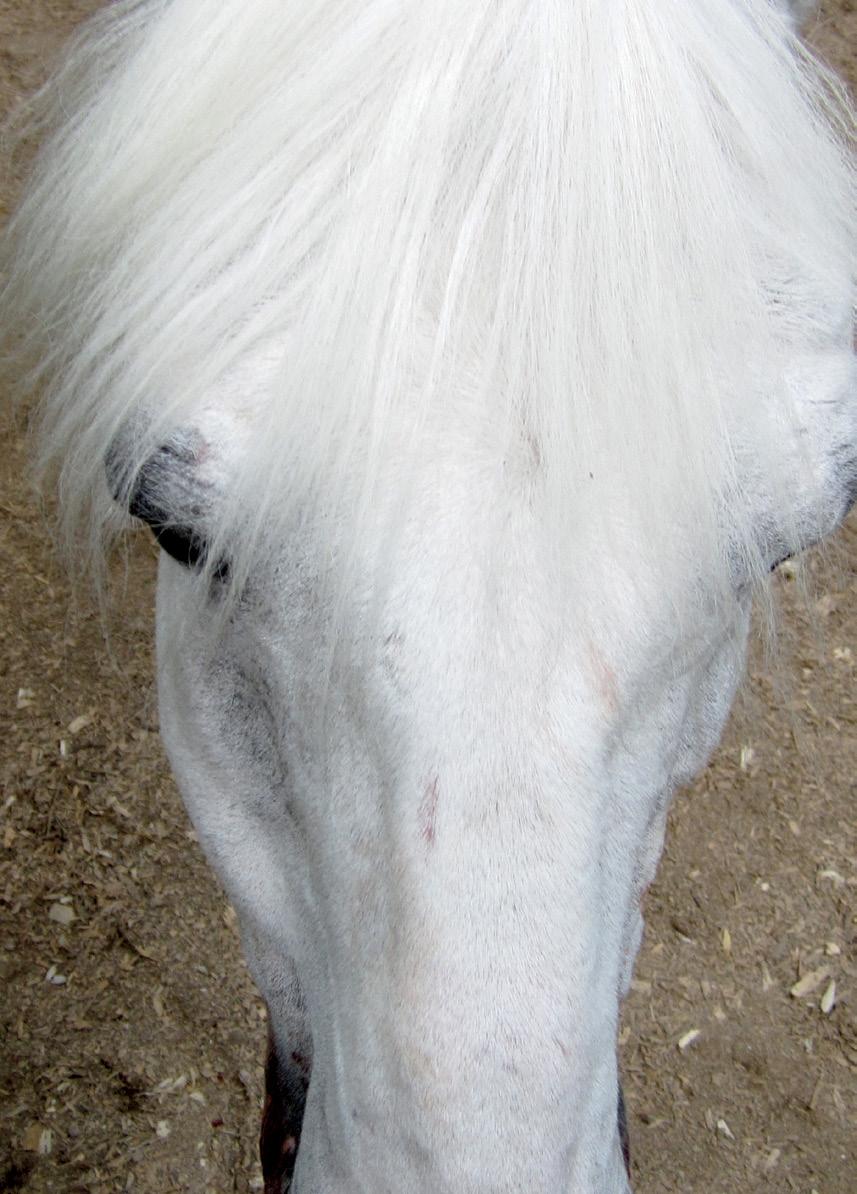
explain how they diagnose and treat common problems that can affect dressage performance.
The Dental Exam:
Much More than Floating
A thorough dental exam consists of much more than floating (rasping) the teeth to remove any sharp points, says board-certified veterinary dentist Travis Henry, DVM, founder of Midwest Veterinary Dental Services in Elkhorn, Wisconsin. When a patient visits his clinic, Henry conducts a five-part oral exam. He starts by looking at the horse’s entire head, to evaluate its anatomy and to look for obvious signs of infection (more on that in a minute). Next, he checks the teeth’s occlusion (whether the top and bottom teeth are aligned and meet evenly). He examines the soft tissues
of the mouth, including the tongue, the lips, and the palate, for signs of injury or abnormality. Finally, he evaluates the horse’s periodontal status (health of the gums and other tissues surrounding each tooth) and endodontic status (health of the live internal components of the teeth).
“In dressage horses, it is important to examine every part of the mouth to find any discrepancies,” says Henry. “If a dressage horse is brought to me because he is fussy in the bridle, I look at external features—to see how his head is put together, and if both jaws are symmetrical. Is there an odor from a nostril or a large lymph node pertaining to the oral cavity, to indicate an infection in the mouth?”
If there are no obvious outward signs of a problem, Henry examines the teeth carefully, checking for sharp points, broken teeth, and other issues. He notes that “the last two teeth on the upper jaw curve inward a little at the back—an area that’s easy to miss if there are sharp points.”
A horse’s teeth continue to erupt until it reaches its late teens. Because the domesticated horse does not have to chew the coarse forage of its wild predecessors, the teeth wear less and sharp points typically form. Henry explains why this can be so detrimental in dressage: “In the head set of a dressage horse, the lower jaw slides forward. This can cause soft tissues at the back of the mouth to contact sharp points of the upper teeth and create a painful response.” He cautions that “I’ve seen dressage horses that had their teeth floated but were still having trouble, and I found small points in that region. Reducing those can help restore a comfortable mouth so they can perform better.”
36 July/August 2024 | USDF CONNECTION
EMILEE HALL GROVER PHOTOGRAPHY; COURTESY OF DR. TRAVIS HENRY
COMFORTABLE ACHIEVEMENT: With her wave mouth corrected and normal jaw function restored, Pica reached the FEI levels with her adult-amateur owner, Antonella Bath
SOMETIMES IT’S OBVIOUS: The swelling on the right side of this horse’s face indicates a probable infection
Next, “I look for periodontal and endodontic disease, and if we find nothing abnormal, I recommend we x-ray the horse’s head,” says Henry. “If the horse is fifteen or older, pain and inflammation could be coming from the incisors.” (See “Dental Concerns of the Older Horse” at right.)
The final step in Henry’s dental detective work: “If we find nothing wrong with the mouth, I often suggest scoping the horse to look in the guttural pouches and checking the hyoid bones for stylohyoid problems. All those bones are related to chewing and have integral association with the tongue and movement of the tongue.”
In Reiswig’s experience, there’s a world of difference between an oldfashioned dental float and a sophisticated dental exam by a veterinary dentist.
“In veterinary school, I was trained to use a rasp to smooth down sharp points on the cheek teeth without looking in the horse’s mouth,” says Reiswig, whose practice today sees mainly sport horses. “I would just listen for the pitch to change on the rasp. Once it went from a high pitch to low pitch, I knew I had the sharp point smoothed off.” But, he says, “that was a huge mistake—doing treatment without thorough examination and diagnosis. I now realize that we need to sedate the horse and do a proper exam, use a dental mirror or a rigid endoscope, and look at every tooth, all the soft tissue, and determine what’s wrong, so we can base the therapy on the diagnosis.”
When the Teeth Are the Root of the Performance Problem
Many of the dressage horses Reiswig sees in his practice are off-the-track
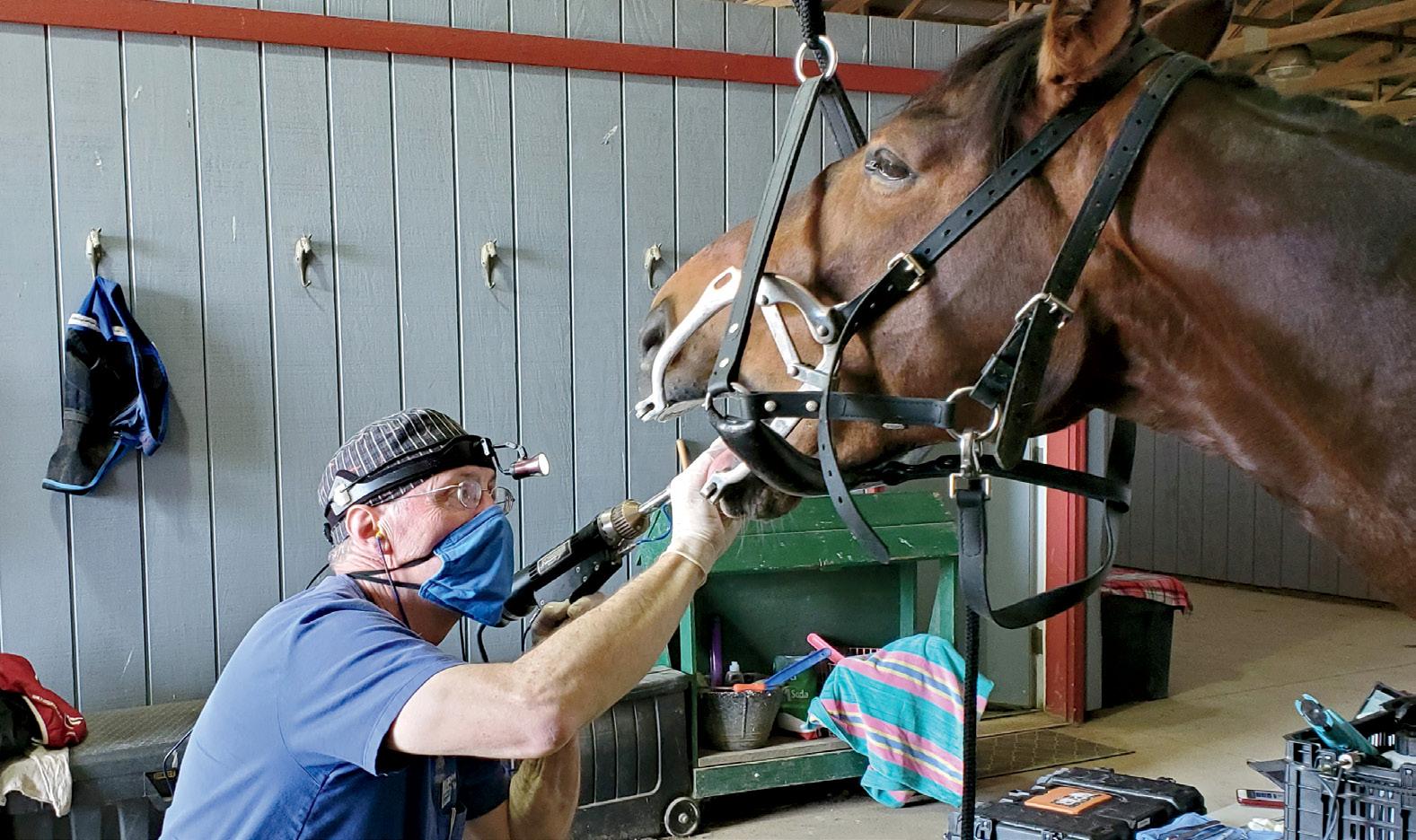
EXPERT DENTAL CARE: Board-certified veterinary dentists like Dr. Jeff Reiswig (pictured working on a client’s teeth) have special training in advanced dental diagnostics and treatments
Dental Concerns of the Older Horse
Horses in their twenties and beyond may require special dental care and possibly also a special diet. Molars worn smooth no longer chew efficiently, and the older horse may lose teeth, as well. Work with your veterinarian and veterinary dentist to stay on top of age-related dental issues and, if needed, to redo your aging partner’s diet, such as by replacing difficult-to-chew hay with soaked hay cubes.
A less well-known dental problem of older horses is known as EOTRH, short for equine odontoclastic tooth resorption and hypercementosis. Horses in their teens and beyond are fairly likely to develop this painful condition, in which the teeth—especially the incisors—are resorbed and there is an excessive buildup of cementum (the calcified surface layer covering the roots of the teeth), says boardcertified veterinary dentist Travis Henry, DVM—“and without radiographs, it often goes undiagnosed.”
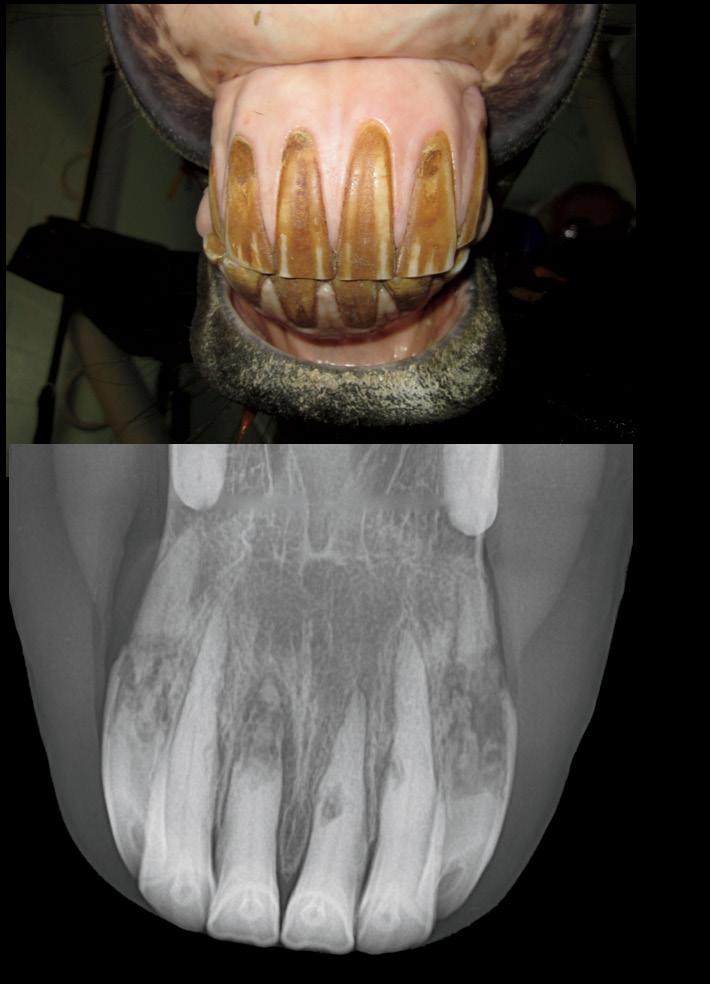
OLDER-HORSE DENTAL ISSUE: A case of equine odontoclastic tooth resorption and hypercementosis (EOTRH) as seen on clinical exam and radiographs
“There is often some resorption in older horses as the body eats away the tooth,” Henry says. “Sometimes inflammatory cells get turned on for some reason, and we don’t know the trigger. It’s probably multiple factors. Maybe the horse has been confined instead of grazing, or maybe there are many other reasons, but sometimes those teeth simply resorb.” When Henry encounters a patient aged 15 or older with dental problems that hasn’t had radiographs taken of its incisors, he fires up the x-ray machine. Removing any affected teeth ends the pain, and horses generally have no problems related to the loss of a few teeth.
USDF CONNECTION | July/August 2024 37
COURTESY OF DR. JEFF REISWIG; COURTESY OF DR. TRAVIS HENRY
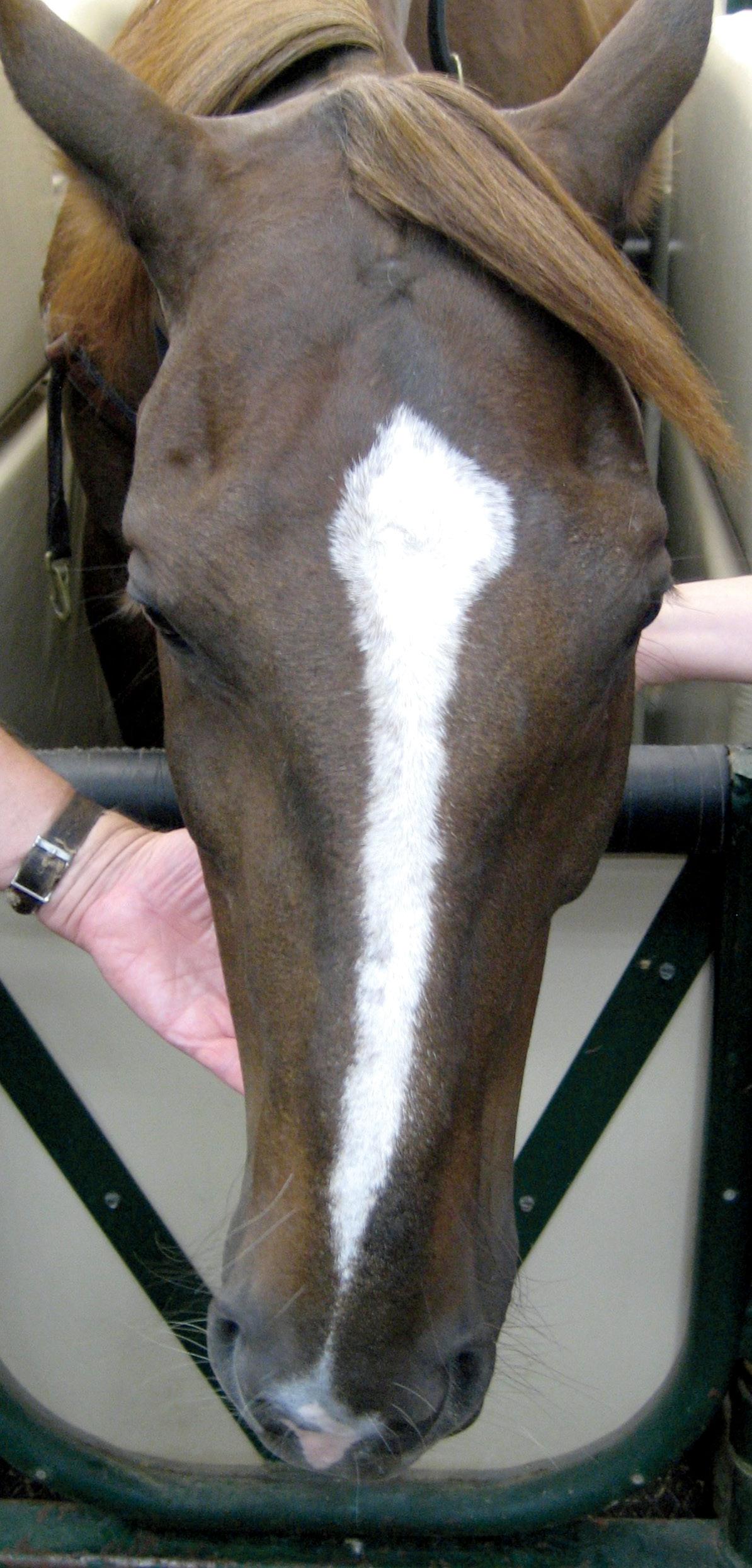
Thoroughbreds. This breed frequently presents a malocclusion, he says, in which the upper cheek teeth sit a little in front of the lower cheek teeth. Why? He doesn’t know. “I joke that it’s because people have bred Thoroughbreds to win by a nose.”
Whatever the cause, the result is that long hooks can form on the upper first cheek tooth and the back lower cheek tooth, which prevent the horse’s lower jaw from sliding as it should when the horse moves its head up and down. “Being able to move the jaw freely, without impingement from overgrown teeth, is very important for a dressage horse,” he explains. “When the rider is trying to collect and the horse can’t do it, the horse starts
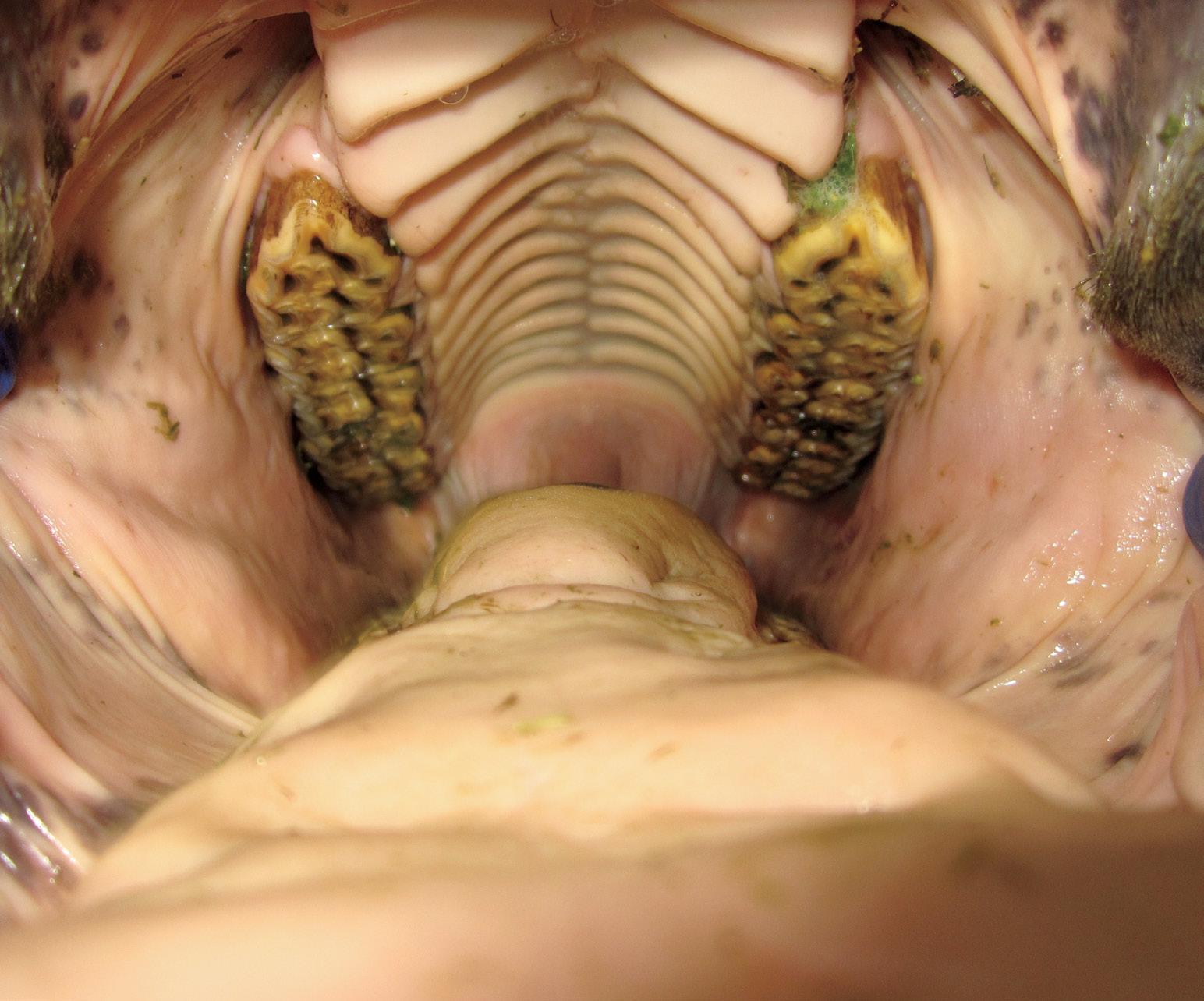
throwing its head to try to relieve that discomfort.”
When riders and owners encounter a horse whose head movement appears restricted, a common course of action is to summon a chiropractor or a massage therapist. “They are concerned about temporomandibular joint (TMJ) issues, but this is generally not the problem,” Reiswig says. “I palpate the TMJ on every horse I look at—every day—and very few have actual swelling or discomfort in that joint. The problem of elongated cheek teeth is much more common and mimics that feeling of limited motion and discomfort the rider finds when trying to collect the horse. People complain about the TMJ when it’s actually a toothovergrowth issue that won’t allow the jaw to move freely.”
For his part, Henry says he’s “dealt with some really bad TMJ problems” but points out that the TMJ “gets the blame for many problems because it is hard to diagnose. To really evaluate that joint, you
need a CT [computed tomography scan].” Fortunately, “we have access to standing CT now in many places, so the horse doesn’t have to be put under general anesthesia to be evaluated.”
Another common response to a horse with issues in the bridle is to try different bits. “There is a lot of experimentation,” Reiswig says. He debunks the oft-repeated advice to check the horse’s palate height and to choose bits accordingly, asserting that “research has yet to show that this is important.
“There is still a lot we don’t know” about bitting, Reiswig continues. He notes that “people can do some things with their dentist present, such as try a bit and have the dentist look at it. Some people take x-rays to see how the bit is sitting, but this may be a little excessive, especially when we put multiple bits in the mouth. It can become crowded in there!” The dental expert can, however, look for obvious signs that the bit is producing discomfort, such as
38 July/August 2024 | USDF CONNECTION
COURTESY OF DR. TRAVIS HENRY
MALOCCLUSION: This horse’s jaw and teeth are markedly out of alignment
THE GOAL: Good regular dental care will help keep your horse’s teeth well-balanced, as shown here, and his mouth healthy for optimum health, comfort, and performance
bruising on the interdental space, where the bit sits; or cheek abrasions.
Once in a while, a dentist spots what Henry describes as “fibrous bumps” on the gums—telltale signs of never-erupted premolars, known as blind wolf teeth, irritated by years of pressure from the bit. A recent client, he says, had a horse with two wolf teeth “that had never erupted through the gum and were lying horizontal where the bit goes.”
Blind wolf teeth, Henry explains, are “a developmental problem: The wolf tooth did not erupt through the gum when the horse was young and wasn’t found when caps are dealt with during juvenile dentistry.
“There are arguments about wolf teeth and whether we need to extract them,” he continues. “The ones positioned right up against the upper teeth are usually not a big deal, but if they are in the lower jaw under the tongue, they need to come out. If they are blind and lying horizontal, they also should come out. Radiographs can be helpful; sometimes we are only feeling the tip of the iceberg. You could have a whopping big wolf tooth under the surface.”
Look Every Horse in the Mouth
A few years after her experience with Pica’s dental issues, Bath imported Donata, a four-year-old Westfalen mare. Lightning struck twice: Dental issues soon cropped up, even in a horse so young.
“She had a good attitude,” Bath says, “but always seemed heavy and tight, leaning on the bit. We discovered that her teeth had a lot of points, causing lacerations in her cheek. Bridle pressure on some
of those spots was likely causing discomfort, resulting in physical tension and resistance to softening in the bridle.” Donata also had some crooked teeth that were digging into her cheek and collecting an abnormal amount of food.
“Once her teeth were smoothed and the cheek lacerations healed, she was much more comfortable and accepted the bit in a positive way. She, too, was able to become an FEI horse,” says Bath.
In Bath’s case, “Due to the severity of the dental issues [in both horses], not all corrections could happen in one appointment. Both of them had dental appointments twice a year for a couple years. They needed smaller, more frequent corrections to accomplish the dental goals.”
Research into the ways horses express pain and discomfort has led to discoveries that may help in detecting dental issues more promptly. Developed by European researchers in 2013, the horse grimace scale (HGS) identifies equine facial expressions associated with pain, including stiffly backward ears, tightened facial muscles, and a pronounced chin. A 2020 study used the HGS to identify pain caused by dental disorders. Trained observers rated the horses using the HGS; then the horses were each given a dental exam, and any abnormalities were treated. The observers re-rated the horses two weeks later, “and signs of pain were less,” says Reiswig. “The things observed in the horses were not major problems, just things like excessive points causing mucosal alterations of the cheek, or retained deciduous teeth, or tooth elongations.”
If something’s not quite right with your horse’s performance,
Find a Qualified Equine Veterinary Dentist
In the US, states have varying laws regulating who can legally perform equine dental work. In many states, an equine dentist must also be a veterinarian.
Using a veterinary dentist has advantages. For one, licensed veterinarians can administer sedatives, which may be necessary in order to thoroughly examine and treat a horse’s mouth and teeth. A veterinarian has broad knowledge about equine anatomy and problems of the head, mouth, and teeth. Those who are board-certified in dentistry, from the American Veterinary Dental College (avdc.org), are specially trained to provide advanced dental diagnostics and treatments.
make sure a qualified practitioner does, in fact, look him in the mouth. You may relieve him of needless suffering—and have more fun in the saddle, to boot.
Heather Smith Thomas and her husband have a cattle ranch in Idaho. She has raised and trained horses for 50 years, written more than 14,000 stories, and published 24 books, including Storey’s Guide to Raising Horses, Storey’s Guide to Training Horses, and The Horse Conformation Handbook.
USDF CONNECTION | July/August 2024 39
Is the Spook Response Genetic?
Using a well-established marker, researchers are seeking to identify to what degree the horse’s startle reflex is baked into its DNA
BY KATIE NAVARRA40 July/August 2024 | USDF CONNECTION
Breeders, trainers, and riders have access to a great deal of information about their horses’ genetic risks and predispositions to specific health problems. But the risk for disease is only one of the criteria many horse people prioritize when buying a horse.
“Everybody wants a sound and sane horse,” says Samantha Brooks, associate professor of equine genetics at the University of Florida’s Institute of Food and Agricultural Sciences (UF/IFAS). “As a horse person, when I sit down and think about the two things we value most in our horses regardless of discipline, it’s safe and sound.”
The realization inspired Brooks to shift her decadeslong genetics-research expertise, which focused on genetic disorders, to focus on the link between genetics and behavior. Specifically, she wants to understand the genetic component behind a horse’s most fundamental behavioral response: the startle reflex or “spook.”
Brooks and a team of researchers developed an experimental setting to measure the reflexive action that initiates a spook—which occurs before riders even realize what the horse is reacting to.
“There is a fairly well-defined physiological response during a spook: the change in heart rate,” Brooks says. “How to measure the change in heart rate is wellestablished from experiments across diverse species. Following the subconscious response of the heart to a spook is a little easier to translate than later, more obvious behaviors, like rearing, bucking, or biting.”
The startle reflex has been studied extensively in laboratory mice, and the findings can be translated to equines, Brooks says.
“Mice have shown us that their subconscious startle reflexes are less influenced by environment and prior lifetime learning, and more by their genetics,” she says. “So there are genetic components from existing research that we can test in horses.”
Identifying these genetic traits would be a first step toward one day selecting or breeding horses for the temperament types trainers and riders prefer. Though Brooks’ team published preliminary findings in 2023, work is “very much ongoing,” and conclusive findings might be a decade away.
“The study is a long-term project, and it is going to take a large group of horses to get to final results,” she says.
Brooks and her research team plan to study 150 horses over the next 10 years. The horses enrolled in the
USDF CONNECTION | July/August 2024 41
SHUTTERSTOCK.COM
EEK! Some horses seem to overreact to, well, just about everything. A genetics researcher is trying to find out why.
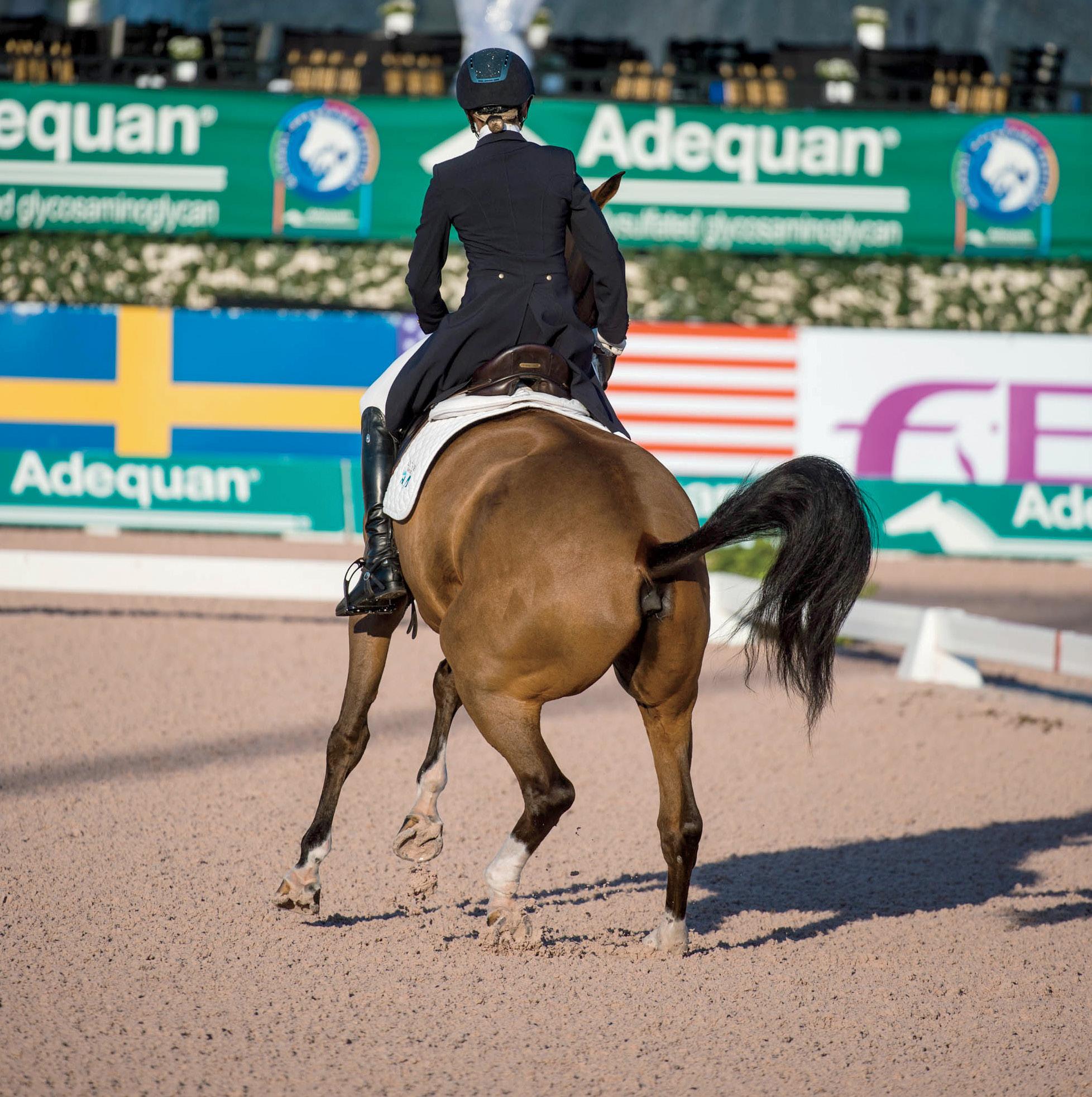
study are all stock horses bred and raised by the University of Florida.
Study Design
For the preliminary study, the horses wore wireless heart-rate monitors while turned loose in a round pen, where they found a pan of grain. While they ate, an assistant suddenly opened an umbrella—which for most horses is a pretty exciting event. The team analyzed the animals’ behavioral response to the surprise appearance of the umbrella, focusing on changes in heart rate throughout and after the initial startle reaction.
The study data showed that the horses could be grouped into two distinct categories of reactions. The first group was startled by the umbrella’s opening, had a spike in heart rate, and maintained a reactive or hyper-alert state, including
more time spent looking and moving away from the umbrella. The second group likewise experienced a heartrate spike but then calmed quickly and returned to eating the grain. These horses perceived the stimulus and found it startling, but they did not go through the behavioral patterns of avoidance and continued fear as shown by the first group.
“When we look at preliminary data, specifically at the first five seconds after the surprise,” Brooks says, “we found that about two-thirds of that reflexive increase in heart rate was genetics, and only around one-third was due to things like the test-day environments or learned behavior.”
The team also measured how far each horse ran away from the surprise stimulus, how long it took to settle down and come back, and how much trotting it took to come back.
“We are optimistic because, while the initiation of the cascade of responses that we interpret as a spook may be strongly heritable, what a horse does with that startle is very malleable,” Brooks says. “Post-startle behaviors seem to be strongly influenced by environment and training.”
Understanding these factors opens the door to better assessing young horses’ temperament. According to Brooks, genetic information can offer trainers additional insights into the most efficient and humane way to help each individual horse reach its training goals.
Using its method of measuring the spook response, the researchers will develop a study to differentiate the genetic components of horses’ fear reactions. They took blood and hair samples from each horse for future analysis.
Benefits of Isolating the “Spookiness Gene”
Although the University of Florida herd consists solely of stock breeds— mostly American Quarter Horses, American Paint Horses, and a few Appaloosas—Brooks hopes that the research will yield a genetic test, similar to those already in use to determine coat color and disease predisposition, to predict heritable behaviors for many breeds, including those that predominate in dressage.
“The great thing about Quarter Horses is that the breed is a melting pot,” Brooks says. “In Quarter Horse ancestry, you have a mix of light-horse and heavy-horse breeds. As a result, they share ancestry with a lot of other types of horse, like the warmblood. Often, when there is a trait caused by one or just a few genetic variations in the stock horse, those variations are shared with the warmblood breeds.”
42 July/August 2024 | USDF CONNECTION
AKDRAGOOPHOTO.COM
ON THE EDGE: Dressage rewards a sensitive, “forward-thinking” horse—which can translate into reactive to its surroundings
Identifying a genetic predisposition to spookiness could be immensely helpful to breeders, buyers, riders, and trainers. It could help trainers and coaches pair riders with more-appropriate mounts, such as a “steady Eddie” for a nervous rider or a “hotter” and more reactive horse for an advanced rider seeking to excel at the highest levels.
“Isolating the fear gene can provide some needed help to trainers who may be looking for a horse for their client or helping in the training process,” says Jennifer Poulin Novaria, who has been training and teaching for 30 years at her Safe Haven Farm in Woolwich, Maine. “It can also be helpful for riders looking for that horse who will be able to take them from Intro to Grand Prix without losing their edge because of a floating napkin during an important test.”
In considering a horse’s suitability for dressage, Novaria evaluates its “flight or fight” response. Anecdotally, she has found that “fight horses,” as she calls them, can make better dressage mounts than “flight horses.”
“As well trained as we can make these [more reactive] horses, the fear never really goes away,” Novaria says. “I’ve found you might have to work harder to convince a fight horse to do something, but once they partner with you, they don’t have that [fear] issue.”
More information about the “spookiness gene” might also be helpful in determining whether a horse might be better off in a different discipline. Novaria once owned a mare with plenty of talent for Grand Prix but that she describes as too “looky.”
“She was constantly looking at everything and carried that tension
within her body,” she says. “Rhythm is the first score on the test, and relaxation is second. If you don’t have those, you don’t have the foundation. That mare did better in the four-foot jump ring than dressage.”
Novaria concedes that an upperlevel dressage horse needs a certain amount of “flair” to perform piaffe, passage, and other challenging movements with sufficient energy. A horse that hardly reacts to stimuli might not be Grand Prix material, and she also doesn’t want to see horses dismissed out of hand simply because they possess “the fear gene.” But learning the genetics of reactivity might have “benefits in the selection process, such as weeding out horses that may be better suited for show jumping rather than dressage.”
Like Brooks, Novaria sees a potential benefit in being able to tailor her training approach to suit a horse’s spookiness level. A flight horse, she says, might need more time to process a scary situation, while its more confident counterpart might need fewer baby steps.
“Sometimes it takes two or three times to figure out if a horse is going to be brave or more scared,” Novaria says. “If you knew that ahead of time, you might be able to modify your training regimen immediately.”
Using Genetic Information to Build Confidence
Early in her career, Amanda Perkowski, who now trains out of Top Meadow Farm in Wellington, Florida, worked first as a rider at a sales barn in Europe, then for Helgstrand Dressage in Denmark and later in the US. At the sales barn, the FEI-level trainer and competitor got the opportunity to ride and observe numerous young horses from similar bloodlines, and to note whether individuals
with “spooky” sires in their pedigrees showed behavioral similarities during their training.
In Perkowski’s experience, “A lot of spooking comes from the horse lacking confidence and being distracted or frightened by external sources.” If a genetic test were created, she says, “it could be helpful to know that a horse needs a little bit more confidence or a little bit more consistency in who is handling them and how they are approached.”
Genetics aside, the deeper the rider’s relationship with the horse and the further it is in its education, the more the horse can relax and focus, Perkowski says. She believes that positive reinforcement is the only way to handle a spooky horse; taking time with a fearful horse instead of pressuring it helps it to build confidence around the scary object or situation.
“The more we can identify, the more we can help those horses that are spooky,” says Perkowski. “Knowing about a predisposition [to a strong startle reflex] is helpful in the way we approach training and handling them every day, especially if you’re looking at unbacked horses that you’re evaluating a career for. It would be great to know what kind of rider and what kind of circumstances they need.”
Katie Navarra is an award-winning journalist and author in upstate New York.
USDF CONNECTION | July/August 2024 43

Fit for a King
The Paris 2024 equestrian events will be held at one of the world’s most celebrated palaces
BY JENNIFER O. BRYANT44 July/August 2024 | USDF CONNECTION
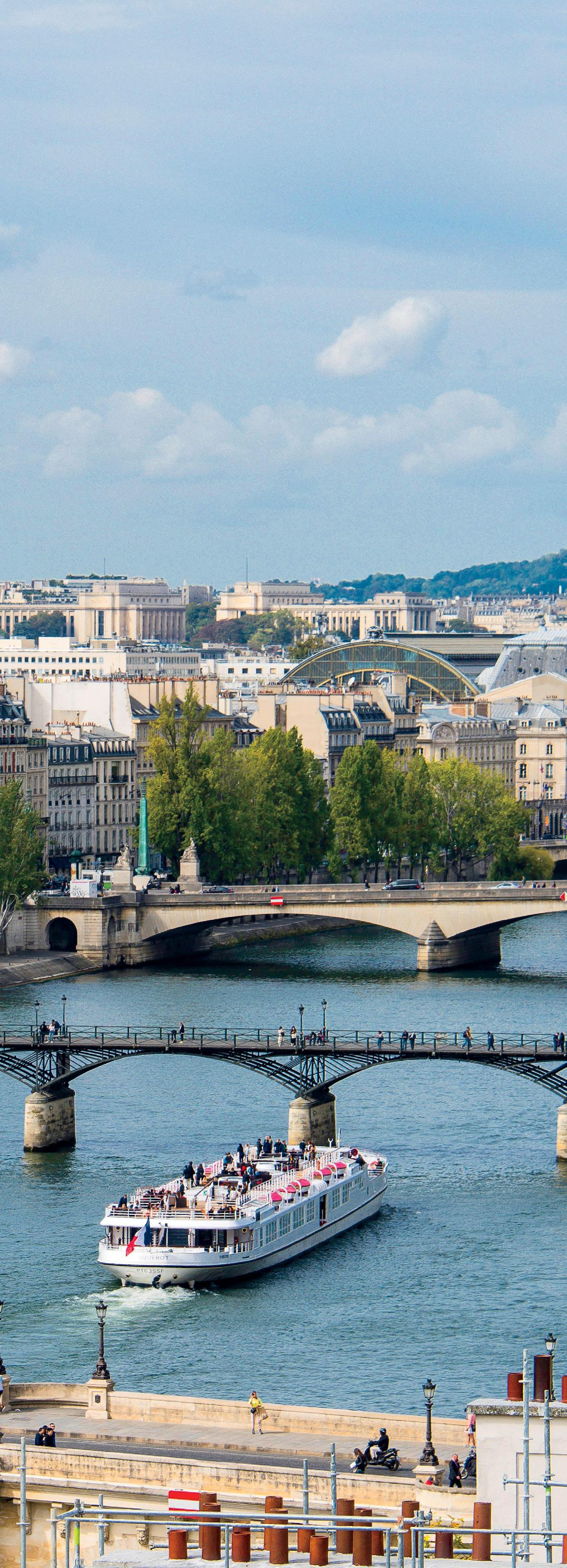
In championing her city’s bid to host the 2024 Olympic and Paralympic Games, Paris mayor Anne Hidalgo’s pitch hinged on incorporating many of the City of Light’s iconic sights into the Games and not just as scenic backdrops. Most audacious is her plan to stage the Olympics opening ceremony along the river Seine, with boats carrying each nation’s delegation—and then to hold the swimming events in the Seine, which hasn’t been clean enough for swimming in 100 years.
Another Parisian treasure will host Olympic competition: Versailles, whose flamboyantly gilded opulence was the showpiece and playground of the “Sun King,” Louis XIV, and later of the ill-fated Queen MarieAntoinette. There’s plenty of open space in the palace’s nearly 2,000 acres of gardens, and the western side is being temporarily transformed into a state-of-the-art equestrian facility that will host the Olympic equestrian and modern pentathlon events, and later the Paralympic para-dressage competition.
Read on for a sneak peek at the venue and a preview of what dressage and para-dressage enthusiasts can expect at Paris 2024.
Golden Era
Not yet crowned Louis XIII, the future king of France discovered the area known as Versailles in 1607. With its forests, meadows, and plenty of game, it was a perfect hunting ground. As king, Louis built a hunting lodge on the grounds in 1623 and began rebuilding it into a chateau (palace) in 1631; he also bought up surrounding land.
Louis XIII’s son, Louis XIV, also an avid hunter, was equally enamored of the site. Beginning in 1661 he began adding to the chateau, one project after another, with work continuing until his death in 1715. Arguably Louis XIV’s most famous creation is the Hall of Mirrors, whose 73-meter length is resplendent with 30 paintings on a vaulted ceiling, bronze-gilded pilasters, and 357 mirrors.
The Gardens of Versailles stretch west of the palace for a magnificent view from the Hall of Mirrors. Visitors can stroll the seemingly endless acres of paths, groves, fountains, the elaborately designed Orangery, and the man-made Grand Canal.
The Estate of Trianon will forever be associated with Queen Marie-Antoinette, the wife of Louis XVI. In its own corner of the grounds, far from the palace of Ver-
USDF CONNECTION | July/August 2024 45
VILLE DE PARIS
THE SCENE: Many 2024 Olympic and Paralympic events will be set in the heart of Paris, including a floating opening ceremony on the Seine river

sailles, the estate actually contains two additional, smaller palaces, called the Grand Trianon and the Petit Trianon. Louis XIV built the Grand Trianon in 1687 as a private getaway for himself and his (unknown to the public) wife, Madame de Maintenon. Louis XV built the smaller Petit Trianon in 1768 to host his own amorous liaisons with his mistress. Louis XVI gave the Petit Trianon to his young queen, MarieAntoinette, in 1774, and the former Austrian princess added gardens and the Queen’s Hamlet, a faux rustic village containing a windmill and a dairy, and where the queen and her guests infamously relished dressing as shepherdesses and playing at country life—a carefree royal lifestyle that ended with her arrest in 1792 and execution in 1793.
Transformation
At the western end of the Grand Canal is a vantage point known as the Étoile Royale (Royal Star), and this is the area that is being turned into
an equestrian facility for the Olympics and Paralympics. As with London 2012, which built temporary stables, arenas, and grandstands in historic Greenwich Park, all of the changes to the Versailles grounds will be erased after the conclusion of the Paralympics.
Three grandstands accommodating more than 16,000 spectators are being erected at L’Étoile Royale, site of the main competition arena. Closer to the palace—and named for a long-defunct “animal kingdom” housing elephants and other exotic animals—the area known as the Menagerie will be the site of the 220-stall stables, a galloping track, a veterinary clinic, and more. Eventing competitors will run cross-country along the banks of the Grand Canal, even using a fountain as a water jump during the 5.3-kilometer course.
Dressage Competition
A total of 60 horse/rider combinations may take part in the 2024
Olympic dressage competition, three slots of which are allocated to the host country, France. Teams will consist of three pairs; each team may have one alternate athlete and one reserve horse.
The USA qualified for Paris 2024 by virtue of its sixth-place team finish at the 2022 Dressage World Championships.
The Olympics will be held July 26-August 11. The dressage schedule is as follows:
July 26: Horses arrive on site
July 28: First horse inspection
July 30-31: Grand Prix (30 pairs per day)
August 3: Grand Prix Special (30 starters)
August 4: Second horse inspection, followed by the Grand Prix Freestyle (18 starters).
The Grand Prix will serve as a qualifier for both the team medal final (the Grand Prix Special) and the individual medal final (the GP Freestyle). Only teams will ride the GP Special. The top 10 teams
46 July/August 2024 | USDF CONNECTION
SHUTTERSTOCK
INTERNATIONAL TREASURE: Versailles’ palace and gardens are a UNESCO World Heritage Centre
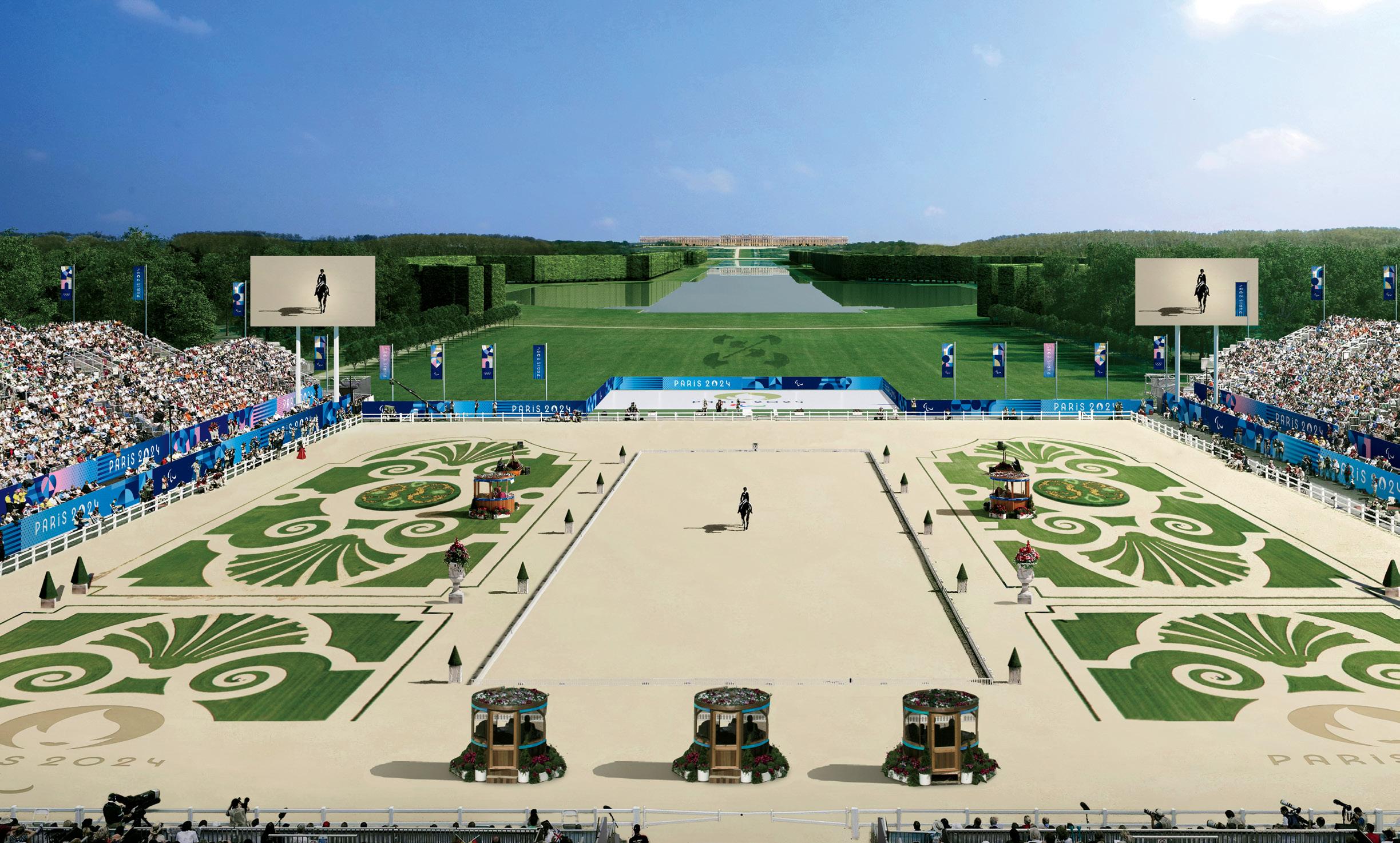
from the Grand Prix will contest the Special, and the results of the Special alone will decide the team medals.
The top 18 individual finishers in the Grand Prix will advance to the GP Freestyle. As with the team medal final, it is the Freestyle alone that will decide the individual medals.
Several US officials will be represented at the Paris 2024 dressage competition. The US member of the ground jury is Michael Osinski of Washington state, who is also a USDF L program faculty member. He will serve on a seven-member panel headed by Raphael Saleh of France.
The FEI foreign veterinary delegate is Emily Sandler of California. Diane Pitts, who is a past president of the US Eventing Association, is a member of the FEI Tribunal. And the USDF’s own Lisa Gorretta, a past USDF president, will be serving as an FEI dressage steward.
Paralympic Dressage Competition
A total of 78 athletes may compete in the Paris 2024 Paralympic paradressage competition. They will contest three sets of medals: team, individual, and individual freestyle.
Para-dressage athletes are classified as one of five grades (I-V), based on degree of physical impairment. In the individual and individualfreestyle competitions, a set of medals will be awarded for each grade.
Only one set of team medals will be awarded. Teams may consist of three or four horse/rider combinations, but only three may take part in the team competition, with the teams to be declared after the individual competition. Each team must have at least one athlete in Grade I, II, or III, with no more than two from any single grade. There is no drop score in the team competition.
All athletes ride the Para Grand
Prix Test A (formerly the team test) from their respective grades. This test is the individual medal event as well as the qualifying competition for the freestyle.
The three athletes selected to compete on each nation’s team will then ride their grades’ Grand Prix Test B (formerly the individual test). Results of the Grand Prix B test will determine the team medals.
The top eight combinations from each grade’s Grand Prix A test will advance to the freestyle medal final, the Grand Prix Freestyle test. Individual freestyle medals will be awarded in each grade.
The Paralympic Games are held separate from the Olympics. For Paris 2024, the Paralympics are scheduled for August 28-September 8. Here’s the para-dressage schedule:
September 3: Individual competition (Grand Prix A) for grades I, II, and III [
USDF CONNECTION | July/August 2024 47
PARIS 2024
GRAND VENUE: Artist’s rendering of the 2024 Olympic and Paralympic equestrian venue at Versailles, with the Grand Canal in the background and the Palace of Versailles in the distance
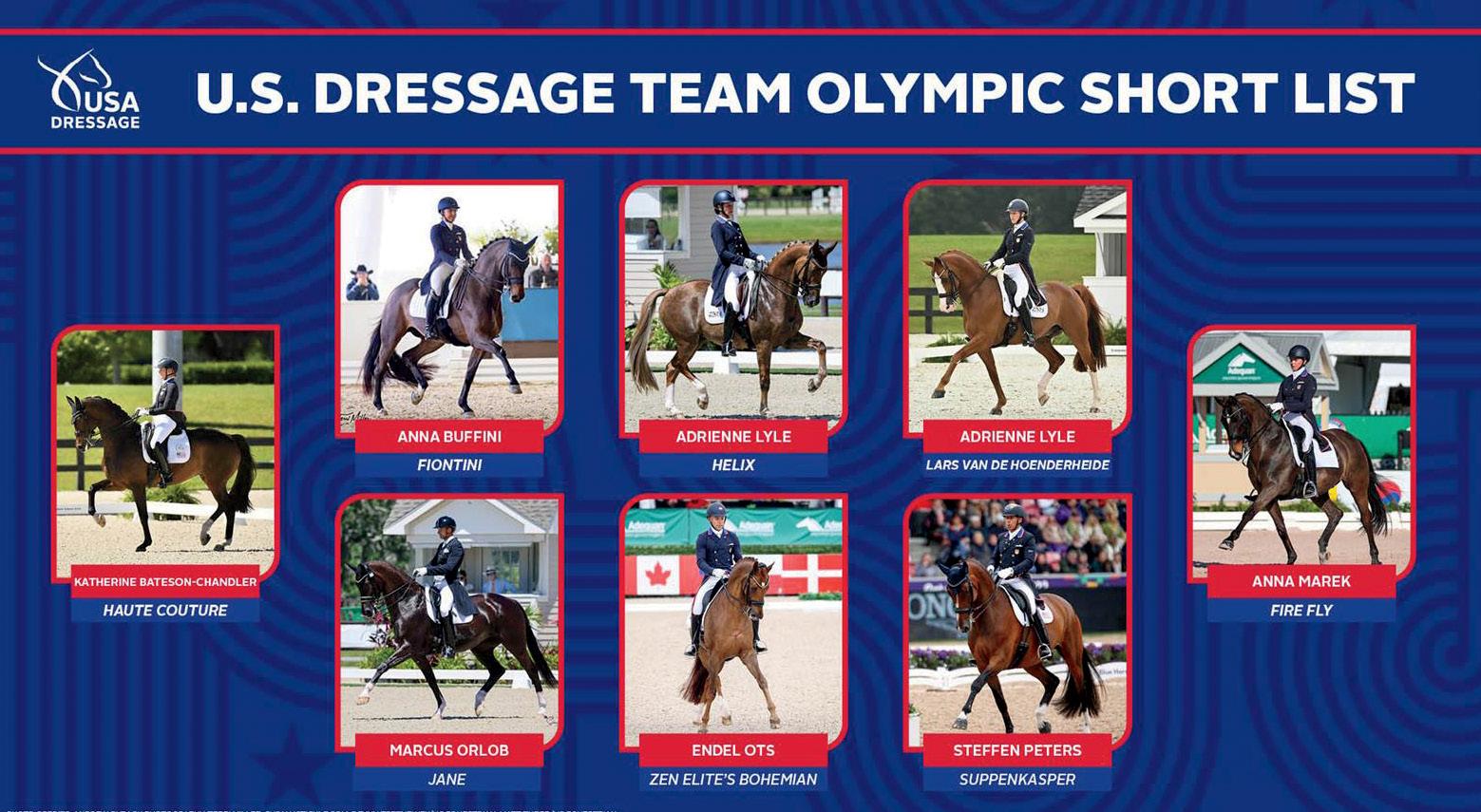
September 4: Individual competition (Grand Prix A) for grades IV and V
September 6: Team competition (Grand Prix B)
September 7: Individual freestyle competition for all grades.
FEI para-dressage judge Kristi Wysocki of Washington state will be
a member of the 2024 Paris Paralympic dressage ground jury. The ground-jury president is Anne Prain of France.
Who Will We Be Watching?
At press time, we don’t know for sure yet. US Equestrian (USEF) on
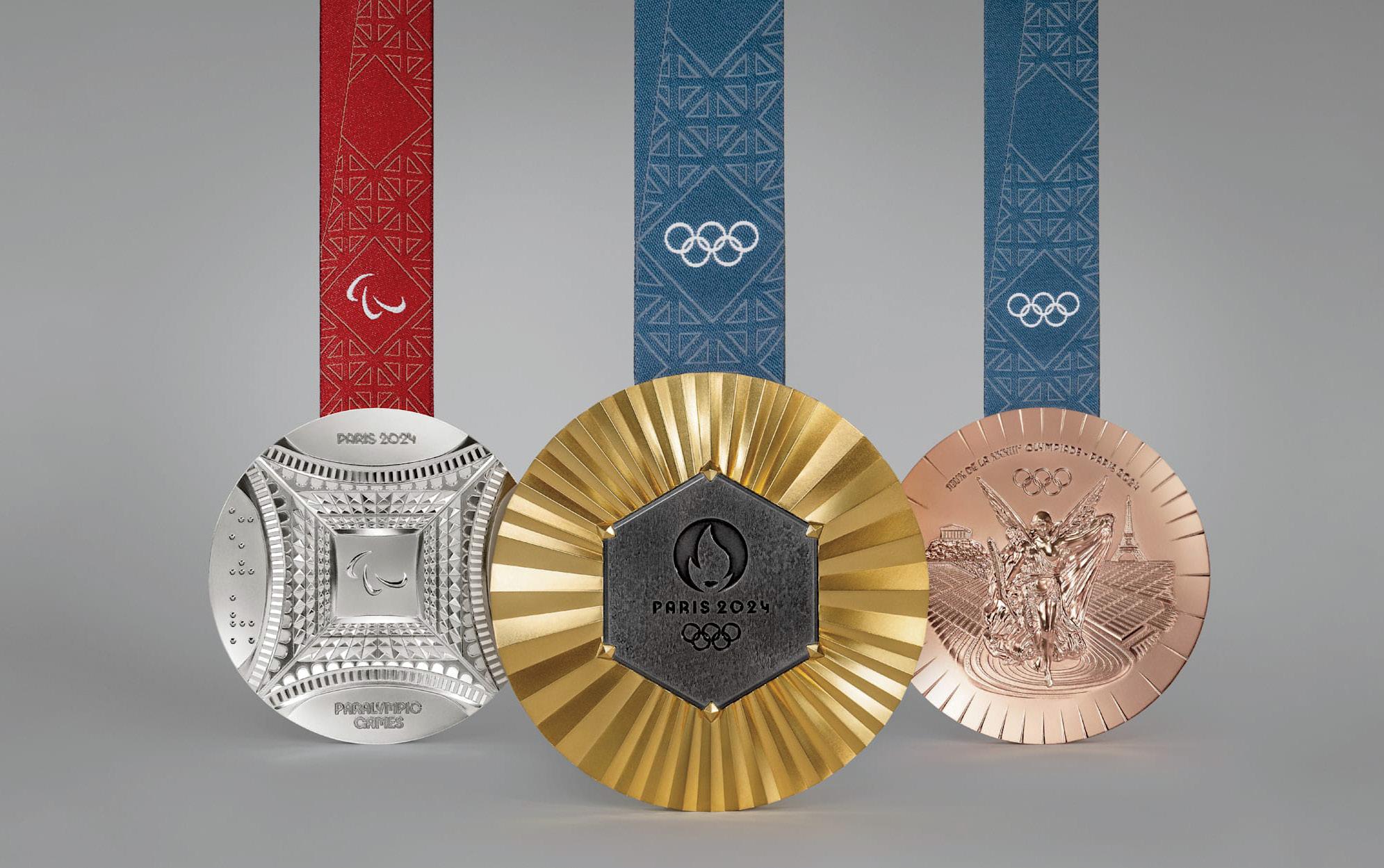
May 8 announced the Paris 2024 dressage US short list, in alphabetical order:
Katherine Bateson-Chandler, Wellington, Florida, and Haute Couture, a 2012 Dutch Warmblood mare by Connaisseur, co-owned by Jennifer Huber and the rider
Anna Buffini, Rancho Santa Fe, California, and her own 2010 Danish Warmblood mare, Fiontini (by Fassbinder)
Adrienne Lyle, Wellington, Florida, with two horses: Helix, a 2012 Dutch Warmblood gelding by Apache; and Lars van de Hoenderheide, a 2011 Belgian Warmblood gelding by Negro. Both horses are owned by Zen Elite Equestrian Center.
Anna Marek, Dunnellon, Florida, and Janet Simile’s KWPN gelding Fire Fly (by Briar Junior)
Marcus Orlob, Loxahatchee, Florida, and Jane, a 2014 Dutch Warmblood mare by Desperado, owned by Alice Tarjan
Endel Ots, Wellington, Florida, and Zen Elite’s Bohemian, a 2010
48 July/August 2024 | USDF CONNECTION
US EQUESTRIAN GRAPHIC;
DE PARIS
VILLE
EYES ON THE PRIZES: Silver Paralympic medal and gold and bronze Olympic medals for Paris 2024
THE FIELD: The dressage athletes and horses short-listed for Team USA in Paris

Westfalen gelding by Bordeaux, owned by Zen Elite Equestrian Center
Steffen Peters, San Diego, California, and the 2008 KWPN gelding Suppenkasper (by Spielberg), owned by Four Winds Farm and Akiko Yamazaki.
The short-listed riders and horses must compete in mandatory European CDIs designated as observation events. Final team selection will be announced by June 25. Olympic team bronze medalist Christine Traurig, the current USEF dressage development coach, will serve as the US dressage chef d’équipe for Paris.
The 2024 US Paralympic paradressage short list will be announced no later than June 19, according to USEF, with final team selection to be made no later than August 5. The US para-dressage chef d’équipe for the Paris Paralympics is Michel Assouline, USEF’s head of paraequestrian coach development and high-performance consultant.
How Can I Follow the Action in Paris?
USDF will be bringing you exclusive on-the-scene reports and photos from both the Olympic dressage competition and the Paralympic para-dressage competition. Check USDF’s websites, usdf.org and YourDressage.org, for details and links.
The NBC Universal family of networks holds the Olympic and Paralympic broadcast rights for the US. In addition to the traditional NBC-TV coverage, you’ll find select sports being aired across the broadcast platforms, including CNBC and USA Network (learn more at NBCOlympics.com). Telemundo will offer Spanish-language coverage.
Your best bet for catching all the equestrian action, however, may be to pony up for a subscription to NBC’s streaming service, Peacock (PeacockTV.com). Peacock will stream every Olympic event live,
plus the Olympic opening and closing ceremonies. Live coverage will also stream on NBCSports.com and the NBC Sports app.
NBC Universal also plans extensive Paralympic coverage, with about 1,500 hours of live streaming coverage on Peacock across the 22 Paralympic sports. Select Paralympic coverage will air on NBC-TV, CNBC, and USA Network, as well. Telemundo will offer Spanishlanguage coverage.
Bon voyage to all, and best of luck to all Team USA horses and riders!
Jennifer Bryant is the editor of USDF Connection.
USDF CONNECTION | July/August 2024 49
VILLE DE PARIS
OLYMPIC FEVER: The Olympic rings in Paris with the Eiffel Tower in the background
Put the Horse First
New books bring fresh focus on our equine partners’ well-being
By Jennifer O. BryantToward Improved Equine Welfare
“Social license to operate”— succinctly defined by USDF executive director Stephan Hienzsch as “the court of public opinion”—is one of the greatest challenges currently facing the equine industry. Driven by social-media exposure, images and videos of horses appearing to be suffering from rough handling or questionable practices can (and already have) provoked outrage from both the horse community and the general public, with potentially far-reaching consequences.
Strengthened rules and stronger self-policing are in the works, but horse people can’t guard against unintentionally causing their animals stress if they don’t know what the signs are. Enter an important new book that I’d advise all industry stakeholders to read: A Horse by Nature: Managing Emotional and Mental Stress in Horses for Improved Welfare (Trafalgar Square, 2023, 409 pp., TrafalgarBooks.com).
Author Mary Ann Simonds is a researcher who has studied wild horses, horse-human interactions, and minimizing stress in humans and horses with an eye toward improving the welfare of sport horses. A Horse by Nature presents her knowledge and many takeaways, in three parts: a look at the instincts and behaviors of wild horses; applying what we know about wild horses
to improve communication and reduce stress in our interactions with our own equine partners; and benchmarking the many signs of equine stress against the practices of modern horse sports and equine management, for a new perspective on the ethics of equine activities.
Read this book. For your horse’s sake, for your own desire to be the best rider and trainer you can be, and for the sake of the entire horse industry.
A Seminal Time in US Dressage
wife, the dressage rider and judge Helen “Sis” Steinkraus. Among the well-known US dressage competitors Ostergaard successfully trained and coached was Ellin Dixon (later Miller), who went on to become a USDF president.
Life as a Dressage Trainer in Three Countries is an enjoyable look at one man’s journey through not only three nations’ dressage systems, but also the people, horses, places, and events that laid much of the ground work for our sport as we know it today.
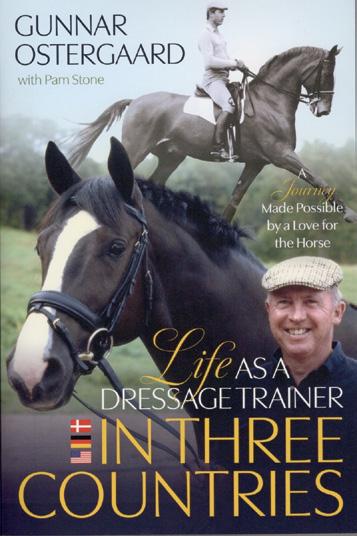
When US dressage was in its developmental phase, a number of expatriate European trainers did much to establish quality training and quality sport horses in this country. One, the Denmark native Gunnar Ostergaard, shares his experiences in his new memoir, Life as a Dressage Trainer in Three Countries (Four-in-Hand Press, 2023, 246 pp., TrafalgarBooks.com).
After apprenticing in Germany for six years beginning as a teenager, Ostergaard immigrated to the US in 1976. His first US-based connection was future top FEI dressage judge and Roemer Foundation/USDF Hall of Fame member Linda Zang, at whose Maryland farm he gave early clinics. Having crossed the pond, he soon made the acquaintance of such notables as Olympians Jessica Ransehousen and William Steinkraus, as well as Steinkraus’s
The Power of Kinetic Energy
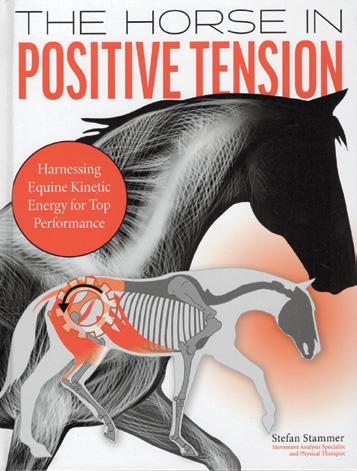
Tension, explains human and equine physiotherapist Stefan Stammer, is not inherently a bad thing. Without any tension, you and your horse would flop around like overcooked noodles. On the other hand, clenched, rigid muscle tension is counterproductive to athletic performance. What’s needed is positive tension, that Goldilocks state that balances engagement and relaxation for optimal performance.
Stammer explains these concepts and more in The Horse in Positive Tension: Harnessing Equine Kinetic Energy for Top Performance (Trafalgar Square, 2023, 180 pp., TrafalgarBooks.com). Many excellent illustrations and helpful photos show how the presence or absence of positive tension influence the horse’s way of going and potentially affect performance, longevity, and soundness.
50 July/August 2024 | USDF CONNECTION
Reviews
The Mental Game of Riding
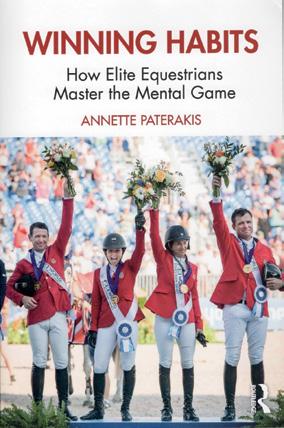
Equestrian mental coach Annette Paterakis could have called her book The Eight Habits of Highly Successful Riders. Through interviews with numerous top modernday jumper riders, Paterakis identified the similarities in their approaches and presents eight shared characteristics in Winning Habits: How Elite Equestrians Master the Mental Game (Routledge, 2022, 162 pp., Routledge.com).
A jumper rider herself, Paterakis presumably was most interested in finding out what makes that discipline’s stars tick. Winning Habits contains insights and quotes from the likes of McLain Ward, Laura Kraut, and Cian O’Connor. In a clear and systematic fashion, the book presents these top riders’ mindsets and methods of achieving a peak-performance mental state. Those methods entail, as Paterakis points out, a lot of work. But it sets them up for success, even in the face of the inevitable failures.
It would have been interesting, and perhaps broadened the book’s appeal, if Paterakis had interviewed riders from a cross-section of equestrian disciplines—although beyond the namedropping, the substance of Winning Habits probably wouldn’t have changed much. Her book shows that it’s deliberate practices, not raw talent, that determine the odds of success.
What Our Horses Show Us
Tamara Williamson is best known in dressage circles as the owner of Kurboom, a Canadian freestyledesign company whose clients include such well-known riders as Canadian Olympian Jacqueline Brooks. In music circles Williamson is known as a songwriter, performer, and producer. But at her core she’s a horse person, and she bares her psyche in her memoir, Mirror Horse (Douglas & McIntyre,
2023, 257 pp., DouglasMcIntyre.com).
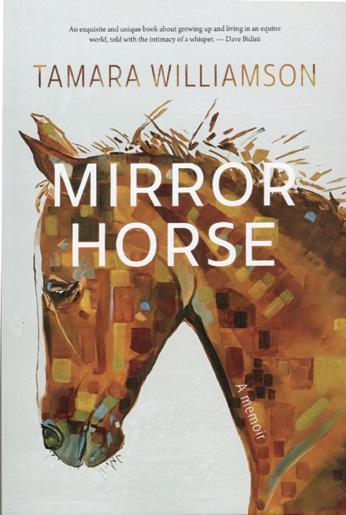
Born in London to horse-loving parents, Williamson had a quintessentially British equestrian upbringing—knocking around the countryside on ponies, jumping crosscountry, getting involved with Pony Club and showing. Along the way she fell in love with dressage. But a nearly disastrous riding incident that happened when she was in her teens instilled a deep and abiding sense of fear—she calls it the Crow—that ebbs and flows during a lifetime with horses but never entirely flies away.
Williamson tells each chapter of her story through her experiences with a different important horse in her life. Any equine enthusiast who has recognized the power of a horse to reveal truths about themselves—especially about fears—will catch glimpses of themselves in Mirror Horse.
Teamwork Approach
What do a polo player and a sporthorse veterinarian have in common? More to the point, what does polo have to do with dressage?
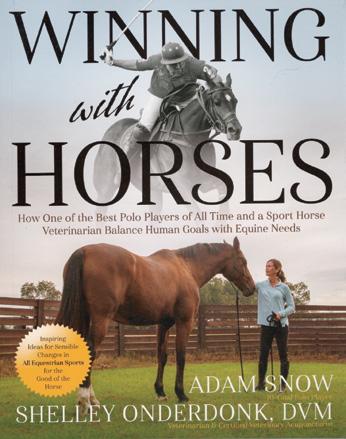
Quite a bit, it turns out. Adam Snow is a legendary now-retired polo player, and he’s married to a vet, Shelley Onderdonk, DVM. The couple worked together to keep Snow’s string as healthy, happy, and successful as possible, much of the time employing equine-centric, commonsense approaches they believe to be beneficial to equine welfare. They reminisce, advise, teach, and sometimes chide the horse industry in their new book, Winning with Horses
(Trafalgar Square, 2023, 231 pp., TrafalgarBooks.com).
The book’s subtitle explains that the authors’ goal was to explain how they “balance human goals with equine needs.” It is no secret that horses at the elite performance level work hard. They are athletes, they get sore, and they can get hurt. Balancing human ambitions with welfare considerations is a juggling act that even the best horse people can get wrong, and Snow is candid about his own mistakes. Both Onderdonk and Snow share lessons learned and strategies they’ve found successful. Their message is one that all equine enthusiasts should take in, even if you don’t know a chukker from a mallet. As Snow writes, “Ultimately, the discipline itself matters little.”
Jennifer Bryant is the editor of USDF Connection


USDF CONNECTION | July/August 2024 51
Testpro: USDF App On The Levels US Dressage Tests Booklet 2023 US DRESSAGE TESTS


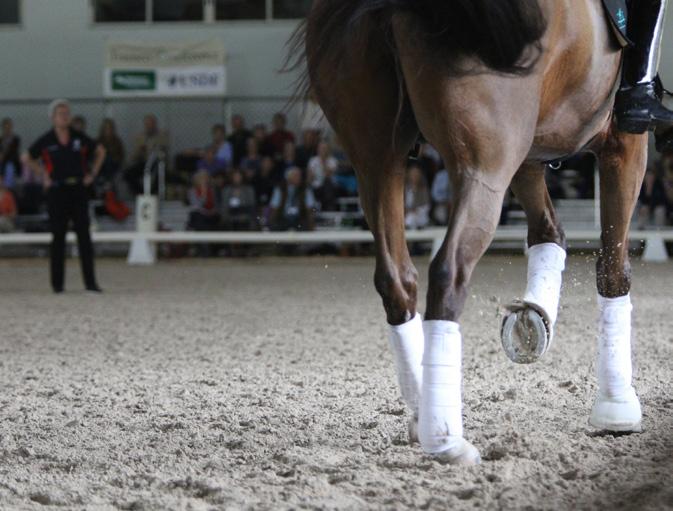







52 July/August 2024 | USDF CONNECTION RIDER'S MARKET APPAREL & ACCESORIES HORSE BEDDING BREED REGISTRY BREED REGISTRY HORSE HEALTH EDUCATION EDUCATION DRESSAGE TESTS YOUR CONNECTION TO DRESSAGE EDUCA TION • COMPETITION • ACHIEVEMENT www.usdf.org T aylor S elec T H or S e B edding S elect the B e S t 815.601.3002 www.taylorselect.com call / text / email SHIPPING NATIONWIDE Mention this ad and receive $100 off of your first semi load LARGE FLAKE l BLENDED FLAKE MINI FLAKE l PINE PELLETS CHOPPED STRAW The Art ofDressage FreeGift! FREE Sterling Mini-Horseshoe Charm with your $195 jewelry purchase - Add “Horseshoe” in Notes at Checkout 602 300 5148 janeheart.com ART & DESIGN PHOTOGRAPHY SALE HORSES HORSE BEDDING JEWELRY SALE HORSES




USDF CONNECTION | July/August 2024 53 Demos and more info about the FREE Online Coaches Course available on our website Achieve lightness and symmetry with the Ipos Rein Sensors, and quantify the ‘equestrian feel’! The Ipos Rein Sensors measure rein tension on the left and right side, giving equestrians insights to improve performance. www ipostechnology com TACK TACK SALE HORSES USDF 50th Anniversary Beat the Heat Beat the Heat US Dressage Finals Water Bottle– $34.95 USDF Nike Baseball Cap –$44.95 www.usdf.org/store LET USDF KEEP YOU COOL
USDF OFFICE CONTACT DIRECTORY
Phone: (859) 971-2277, Fax: (859) 971-7722, E-mail: usdressage@usdf.org
Accounting (859) 271-7891 accounting@usdf.org
Address and E-mail Updates (859) 971-2277 changes@usdf.org
Adult Education Programs (859) 271-7894 education@usdf.org
All-Breeds Awards ....................................................................... (859) 971-7361 ............................ allbreeds@usdf.org
Applications Submitted at Competitions ................................ (859) 271-7880........................... affidavits@usdf.org
Breeder Championship Series (859) 271-7878 sporthorse@usdf.org
Demographics and Statistics (859) 271-7083 stats@usdf.org
Donations (859) 971-7826 donate@usdf.org
FEI Youth Clinics (859) 271-7894 jryrclinics@usdf.org
GMO Education Initiative (859) 271-7894 education@usdf.org
Group Membership (859) 971-7048 gmo@usdf.org
Hall of Fame and Lifetime Achievement Awards ................. (859) 271-7873 ........................ halloffame@usdf.org
Horse Performance Certificates ............................................... (859) 971-7361 .......... horseperformance@usdf.org
Horse Registration (859) 271-7880 horseregistration@usdf.org
Human Resources/Career Opportunities (859) 271-7885 hr@usdf.org
Instructor Certification (859) 271-7877 instructorcertification@usdf.org
Insurance Certificates for Competitions (859) 271-7886 compins@usdf.org
L Education and Continuing Education (859) 971-7039 lprogram@usdf.org
Licensed Official Education (859)-971-7360 loeducation@usdf.org
Mailing Lists (859) 971-7038 mailinglist@usdf.org
Musical Freestyle .......................................................................... (859) 971-7039..............musicalfreestyle@usdf.org
NAYC Criteria and Procedures ................................................. (859) 271-7894 ................................... nayc@usdf.org
Nominations – Delegates, Regional Directors (859) 271-7897 nominations@usdf.org
Participating and Business Memberships (859) 271-7871 membership@usdf.org
Prize List Questions (859) 271-7896 prizelist@usdf.org
Regional Championships Program (859) 271-7886 regchamps@usdf.org
Rider Awards (859) 971-7361 riderawards@usdf.org
Safe Sport (859)-271-7877 safesport@usdf.org
Score Corrections (859) 271-7895 scorecorrections@usdf.org
Secretary/Manager Services .................................................... (859) 271-7895.................... competitions@usdf.org
Show Results ................................................................................. (859) 271-7895................................ results@usdf.org
Sponsorship Opportunities (859) 271-7887 sponsorship@usdf.org
Sport Horse Education and Programs (859) 271-7360 sporthorse@usdf.org
Store Merchandise (859) 971-7828 merchandise@usdf.org
University Accreditation and Credit Check (859) 271-7882 university@usdf.org
USDFScores.com (859) 271-7878 reports@usdf.org
USEF/USDF Dressage Seat Medal Program & Semi-Finals (859)-971-7886 youth@usdf.org
Year-End Awards .......................................................................... (859) 971-7361 ................................awards@usdf.org
Young Rider Graduate Program................................................ (859) 271-7894 ..................................youth@usdf.org
Youth Education and Programs (859) 271-7894 youth@usdf.org
For specific staff contacts visit the USDF Web site.
MAKE THE CONNECTION

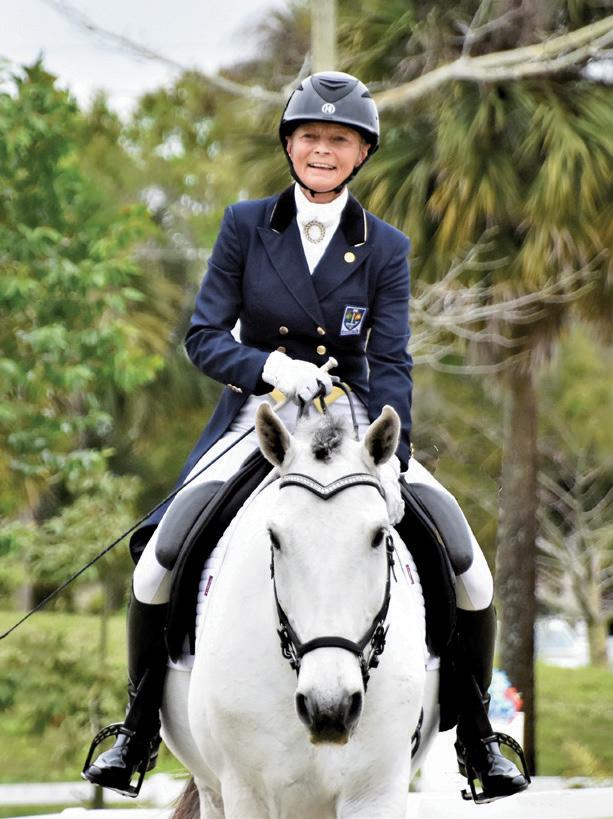
USDF Connection wants YOU to be a contributor.
Here’s how.
Air Your Views
USDF Connection welcomes letters to the editor. Please send your digital submission by e-mail to jbryant@ usdf.org. Please include your hometown, state, and daytime telephone number. We’ll publish letters as space allows; all submissions are subject to editing. Unsigned letters will not be considered, although writers may request that their names be withheld. All letters become the property of USDF.
Ask a Question
Do you have a dressage- or USDFrelated question? Send it to “FAQ” and you may get an expert response in a future issue of USDF Connection.
Send your question, along with your full name, hometown, state, and daytime telephone number to editorial@usdf.org. Include “FAQ” in the subject line of your message.
54 July/August 2024 | USDF CONNECTION NONPROFITORG. U.S.Postage PAID Dr. Hilary Clayton on Donzi MC July/August 2021 Official Publication of the United States Dressage Federation FOCUS ON HORSE HEALTH Buyer’s Guide to the Prepurchase Exam (p. 44) Handling GMO Conflict (p. 20) Raise Your Training Standards with Sue Blinks (p. 30)
USDF CONNECTION | July/August 2024 55 ADVERTISING INDEX Auburn Laboratories, Inc. ................................. auburnlabs.com........................................................ 19 Arenus arenus.com inside front cover, 2 American Warmblood Society & Sporthorse Registry ....................................... awssr.org................................................................... 52 Equine Design ...................................................... stradi.us ...................................................................... 52 Dehner Company ................................................ dehner.com .............................................................. 29 Dressage Collection ............................................ dressagecollections.com....................................... 27 Great American Insurance Group .................... greatamericaninsurancegroup.com ....................... 7 IPOS Technology ................................................. ipostechnology.com ............................................... 53 Kentucky Performance Products...................... kppusa.com ................................................................ 5 Lemke Saddle Services lemkesaddle.com 53 Lindinhof Equine Sports Zentrum lindinhof.com 52 Platinum Performance ........................................ platinumperformance.com..................... back cover Shooting Star Farm ............................................ shootingstarfarm.com ............................................ 53 Sporthorse Auctions.com .................................. sporthorseauctions.com ........................................ 52 TaylorSelect Horse Bedding.............................. taylorselect.com .................................................... 52 United States Lipizzan Federation ................... uslipizzan.org ......................................................... 52 Sox for Horses ...................................................... soxforhorses.com ................................................... 29 The Dressage Foundation ................................. dressagefoundation.org ........................................ 27 USDF Convention .............................................................................................................................................. 1 Junior/Young Rider Clinics 11 Store Merchandise 51, 53 University ................................................................................................................................................ 8 Young Rider Graduate Program ........................................................................................................ 17 YourDressage.org............................................................................................................................ 2, 10 United States Dressage Federation Official Page USDF Vimeo @USDF @USDFOfficial GET CONNECTED with #USDF YOUR CONNECTION TO DRESSAGE EDUCA TION • COMPETITION • ACHIEVEMENT
Good Chemistry
Aided
by
her late husband, Maryanna Haymon grew Marydell Farm into a producer of top dressage horses
By Katherine WalcottMaryanna Haymon began breeding sport horses not for lofty purposes, but as a way to help fund her riding.
Her late husband, Wendell Haymon, PhD, was a chemist and food scientist who helped to develop Lipton Cup-A-Soup and canned iced tea, among others. When his career took the family to Georgia in 1990, the couple bought a small farm and their first broodmare. After a job move to Greenville, South Carolina, in 1997, Maryanna Haymon insisted on living over the state line in North Carolina for access to better schools. There they established Marydell Farm on 33 acres in Columbus.
Although horses were Maryanna’s passion, Wendell’s scientific mind enjoyed the study of genetics and pedigrees, and together the Haymons did research and attended breeding seminars. By 2003 they decided they needed their own stallion, and they found the Hanoverian Don Principe (Donnerhall x Prince Thatch xx) as a two-year-old in Germany.
“‘Prince’ was always the foundation,” Maryanna Haymon says. “He
was my heart horse, and no one is allowed to say anything negative—but his sons and grandsons are better.”
No slouch in the arena himself, Don Principe competed through Grand Prix and earned or contested national titles under several well-known riders. He is sire or grandsire to numerous successful horses, among them the current international Grand Prix mare Serenade MF (Sir Donnerhall I – Duet MF, Don Principe) and Wendell Haymon’s “namesake,” the approved stallion Doctor Wendell MF (Don Principe – Stellar Hit MF, Sandro Hit).
For all of her accomplishments, Haymon wasn’t born into privilege in a horsey family. She was raised on a potato farm in New Jersey, where “if an animal did not have a job, it did not stay.” Horse-crazy from the start, she saved her money and bought her first horse at the age of 11. She had to do all the work, including building a paddock and a lean-to.
Haymon started out doing barrel racing, pole bending, and competitive trail, then progressed to jumpers, “at which point I was married and had three kids.” She was going through a divorce from her first husband when, after one hair-raising ride, “it occurred to me, if something happened to me, my ex would get the kids. I got off the horse, handed the reins to the barn owner, and said, ‘Sell her.’”
Later, Haymon saw the late Dr. Reiner Klimke ride a dressage freestyle. “It was my lightbulb moment,” she says. “I switched to dressage the next day, and I’ve never looked back.”
Physical issues eventually forced Haymon to hang up her spurs. While being measured for her first pair of tall riding boots, she discovered that her left leg is two and a half inches
shorter than her right. She didn’t walk with a limp, but the imbalance led to back problems and multiple surgeries, with doctors warning her in 1992 that she’d end up in a wheelchair in two years. Five years later she was still riding, but not well. After one show, Haymon recounts, a judge she respected “came to me and said, ‘You need to stop riding. You’re bouncing around like a sack of potatoes, and you’re hurting your horse.’ She was right…. That was when I devoted myself a hundred percent to breeding.”
Recent years have not been kind to Haymon, who lost her husband in 2020 and her “heart horse” in 2021. In April 2023, at the age of 67, she suffered a stroke that left her needing a walker and an electric wheelchair to get around.
Haymon still owns several horses, some out with trainers and two at the farm. She notes ruefully that she had to hire help, explaining that “prior to my stroke, I did everything. I took care of the farm, I cut the grass, mended fence, took the horses to the vet.” (Of her total of five children, the three girls rode as kids but grew out of it. None of the kids is involved with horses now, although one son lives on the farm.)
Haymon is still involved in the breeding and dressage worlds. She wants to write a book on breeding. An active presence on social media, she frequently speaks her mind on breeding and other issues. We’re glad her voice—and her efforts on behalf of our sport—remain strong.
Katherine Walcott is a freelance writer living in Alabama.
56 July/August 2024 | USDF CONNECTION
SHARON PACKER Salute
POWER TRIO: Marydell Farm’s Maryanna Haymon (right) with her late husband, Dr. Wendell Haymon, and their late foundation stallion, Don Principe, in 2019
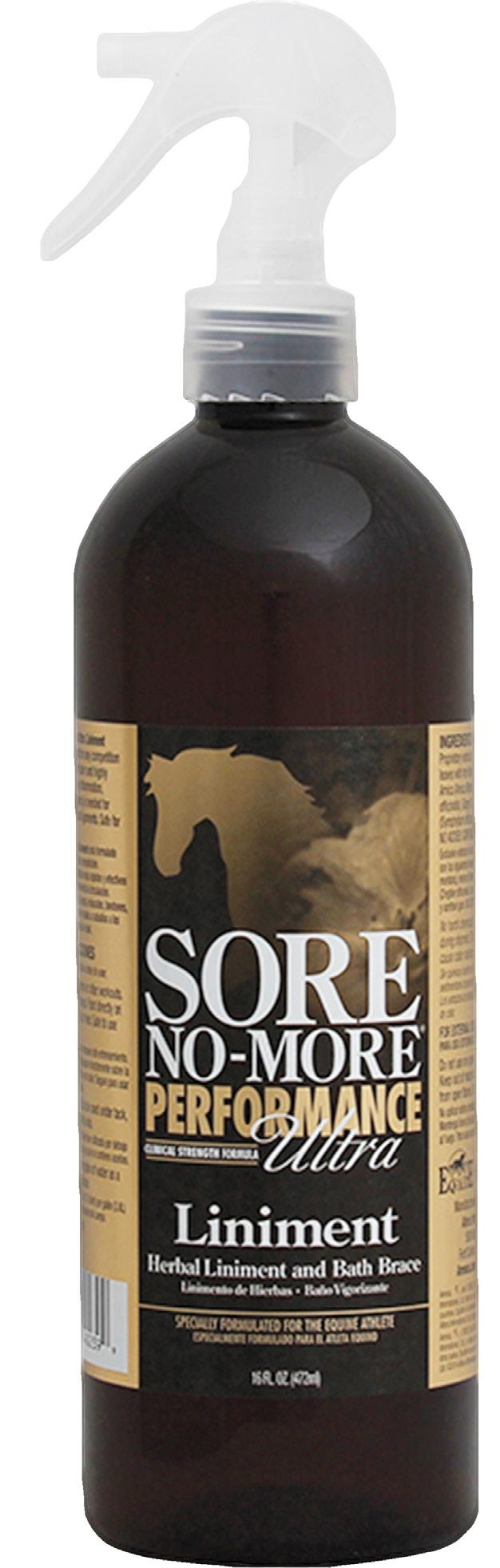
Looking For Pain Relief That Packs A Punch? NATURALLY CLINCALLY RESEARCH Proven Pain Relief ARENUS ANIMAL HEALTH Arenus Animal Health • 866-791-3344 • www.arenus.com
Go with the Gut
To Support Digestion & Immunity
Complete Wellness
A wellness formula with all the benefits of Platinum Performance® Equine, designed to support all aspects of horse health from head to hoof.
Research
More than 30 veterinary research projects have supported the effectiveness and development of Platinum formulas.
Show Safe
All Platinum formulas are subjected to extensive testing for over 200 banned substances for athlete protection.
Platinum Performance® GI
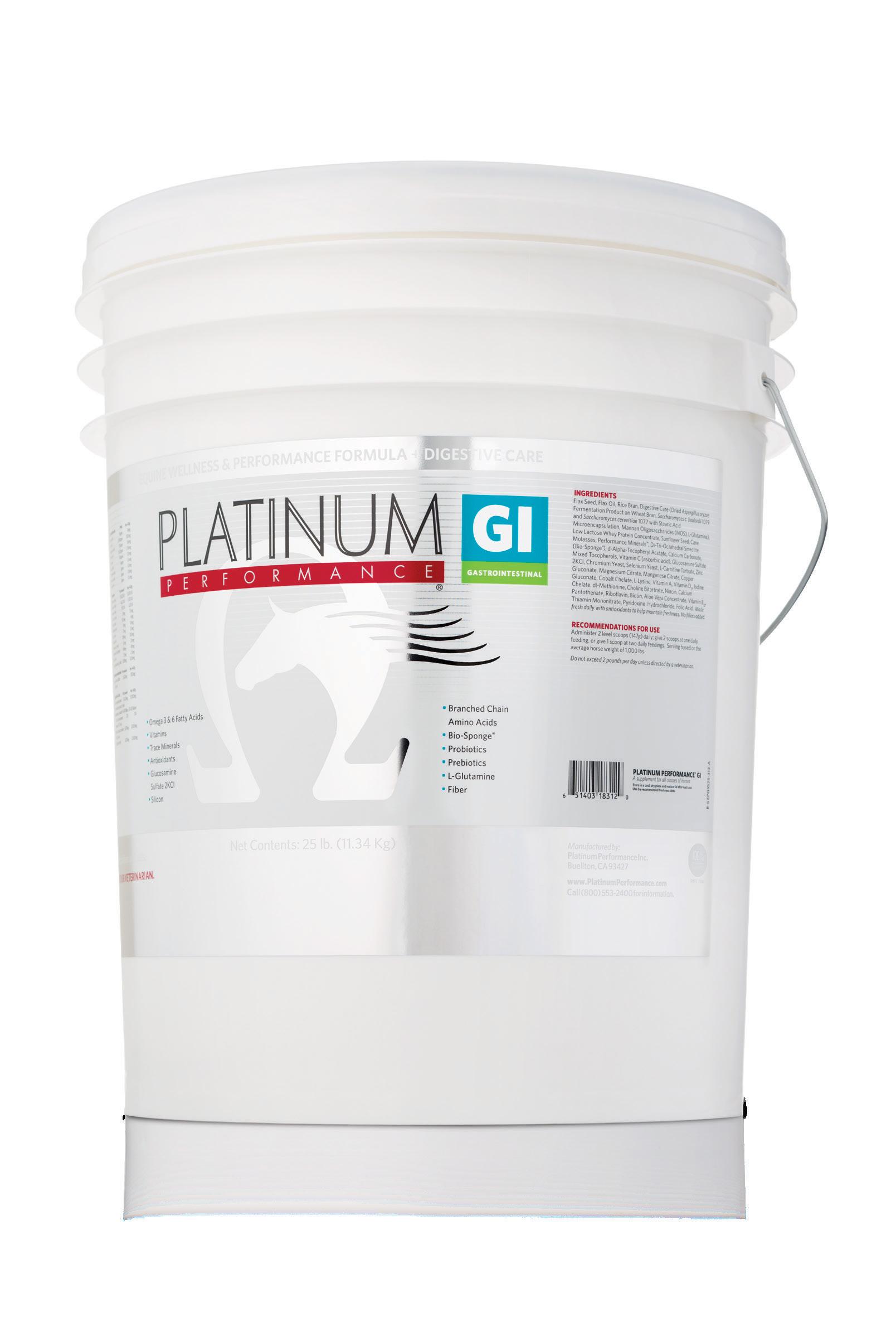
Proven Wellness + Digestive Care
It’s estimated that 70-80% of the immune system lives in a horse’s gastrointestinal system. Also closely correlated to gut health is allergic response, reproduction, metabolism, bone health, gastrointestinal function and more.
Platinum formulas are only available from your veterinarian or direct from Platinum Performance ®
Recommended for horses:
• In training or competition
• For wellness
• With digestive health concerns
Advanced GI Support
Platinum Performance ® GI includes a powerful combination of probiotics, prebiotics and glutamine to support healthy equine digestion and immunity.
Quality
We choose quality and efficacy over low-cost ingredients, ensuring formula protection, potency and purity.
Results
Developed by our veterinarians based on university research and trials in clinical practice to ensure results.
Colic Coverage™ Eligible
• With difficulty maintaining weight
• With loose stool
• During travel
• Also helpful to senior horses
Platinum Performance® formulas are only available from your licensed equine veterinarian or direct from Platinum Performance®.
800-553-2400 © 2024 PLATINUM PERFORMANCE, INC.
PlatinumPerformance.com
Platinum