For Alumni, Friends and Donors of the USC Suzanne Dworak-Peck School of Social Work
Fall 2016
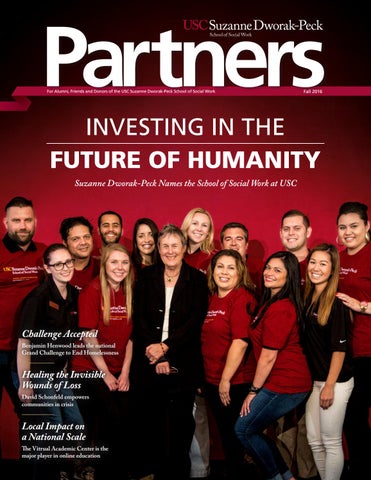
INVESTING IN THE FUTURE OF HUMANITY Suzanne Dworak-Peck Names the School of Social Work at USC
Challenge Accepted
Benjamin Henwood leads the national Grand Challenge to End Homelessness
Healing the Invisible Wounds of Loss David Schonfeld empowers communities in crisis
Local Impact on a National Scale
The Vitrual Academic Center is the major player in online education 1
FROM
The Dean W
e are experiencing a once-in-a-lifetime moment. I am humbled to be leading the school through the most exciting and important transformation in our 96-year history as we become the USC Suzanne Dworak-Peck School of Social Work. To receive an endowment is the highest honor any school can hope to attain. Such a gift cements its future in perpetuity, protects it as a standalone entity, increases its visibility, and opens the doors to endless possibilities and opportunities for growth within its profession. Our school has been doubly blessed as we have received this endowment from one of our own alumnae, Suzanne Dworak-Peck, MSW ‘67, who is also one of the most recognized and respected social workers in the world. It speaks volumes that someone of her stature believes that this is a school like no other and a leader in creating great social good.
Suzanne sees the endowment as “a gift for the generations,” and we believe she will serve as a model of achievement, influence and professional dedication for all our current and future students.
Photography by Tracy Boulian + David Ahntholz
This new school year has begun with a bang – a new name, welcoming our first class of Nursing@USC and DSW@USC students, the launch of the Grand Challenge to End Homelessness, and the release of a transformational study on Alzheimer’s by our Edward R. Roybal Institute on Aging, to name a few. I hope you will enjoy learning more about all of these programs and projects in this issue of Partners. As I begin my 20th year as dean, I could not be more proud of our alumni, faculty and students, or more appreciative of our loyal donors, who have made this school the most respected and innovative institution of social work and nursing education and research in the world. Fight On! Sincerely,
Marilyn L. Flynn, PhD 2U Endowed Chair in Educational Innovation and Social Work Dean and Professor of Social Work
2
16 12
Inside THIS ISSUE 4
15 8
Cover Photo by Tracy Boulian + David Ahntholz
FEATURES INVESTING IN THE FUTURE OF HUMANITY....................................................4 20 YEARS: A CONVERSATION WITH DEAN FLYNN..........................................8
16
CHALLENGE ACCEPTED................................................................................12
RESEARCH AND INNOVATION PRICE OF ALZHEIMER’S.................................................................................15 LOCAL IMPACT ON A NATIONAL SCALE........................................................20
COMMUNITY IMPACT HEALING THE INVISIBLE WOUNDS OF LOSS..................................................16
NEWS BRIEFS ALUMNI....................................................................................................... 10
20
POINTS OF PRIDE..........................................................................................19 NURSING FACULTY...................................................................................... 22
IN MEMORIAM PENELOPE K. TRICKETT............................................................................... 27 JUNE BROWN.............................................................................................. 27
THE USC SOCIAL WORK INITIATIVE.................................... 23 OUR PARTNERS................................................................................ 24 3
INVESTING IN THE
FUTURE OF HUMANITY Suzanne Dworak-Peck Names the School of Social Work at USC by Joanna Scott
“ Endowing the school of social work is my expression of how much my USC education and the profession of social work mean to me, and I am grateful that my education has made it possible for me to give back.” Minutes after Suzanne Dworak-Peck spoke these words in front of the Social Work Center on September 14, her name became forever intertwined with social work at USC.
Photography by Tracy Boulian + David Ahntholz
She built a career dedicated to making a difference in the lives of others, at all levels of society. An inspirational trendsetter, she recognized opportunities for the profession and led it over new horizons. Suzanne’s historic gift is an investment in the future. Transforming society begins with the education of those who study the effects of social determinants and apply best practices to the most pressing issues of our time. For her, the school that produces many of the most respected professional social workers – and now also nurses – is at USC. “As a society, we can’t afford not to invest in social work education,” Suzanne said. “It is time for us to be more strategic about where we direct our energy and our resources, deriving solutions rather than putting expensive band-aids on the problems of the world.”
A double alumna of USC, Suzanne received her Bachelor of Arts in Psychology in 1965, and her Master of Social Work in 1967. She has always credited her education from USC as providing the knowledge, ethics and values that became the cornerstones of her successful career. Observing the tremendous growth of the school under the vision and leadership of Dean Marilyn Flynn over the past 20 years, Suzanne was inspired by how it has proven itself in innovative ways. She feels now is the time to take that innovation to the next level and provide an opportunity for the school and its students to continue to flourish. “The school deserves to have its future secured in perpetuity,” Suzanne said. “Dean Flynn has been a role model for leadership, and this is reflected in the CONTINUED PAGE 6
4
5
President C. L. Max Nikias congratulates Suzanne Dworak-Peck.
Photo by Steve Cohn
commitment of faculty, staff and students to both the school and the further development of the profession. It is important to foster creativity with knowledge and new ideas, and I feel our school does this exceptionally well.” As a professional social work practitioner herself, Suzanne is acutely aware of the challenges that social workers face when they choose to follow their passion and enter this particular profession. It can be one of the most rewarding careers, but it often takes tremendous drive and ingenuity. At one point in her career she worked for an agency, taught a class and had a private practice, all at the same time. “There are multiple ways to work within and influence the profession,” she said. “When you take your social work education and apply it in new and unique ways, it gives you the opportunity to apply your social work values to different sectors of society.”
Mark Ridley-Thomas, Dean Marilyn Flynn, Suzanne Dworak-Peck, President C. L. Max Nikias.
Suzanne encourages social workers to get involved with their professional associations, and to even consider running for office within them. In her experience, many influential people in the profession have an interest and body of knowledge in many diverse areas. Some of her most rewarding leadership initiatives have been when she has collaborated with other disciplines. She was pleased when the school announced it would launch a Department of Nursing and open the doors to an interdisciplinary approach to health care. “Social work and nursing are complementary to one another in so many ways,” Suzanne said. “Combining our strengths can only result in a positive outcome for both individuals and communities that are often marginalized by the social determinants of their background, economic standing or daily surroundings. What the school has embarked on is a very innovative approach, and I believe it will be a game-changer for health care in this country.” 6
The new name of the school is revealed.
Photo by Steve Cohn
INVESTING: CONTINUED FROM PAGE 5
Suzanne’s endowment is about recognizing and celebrating social work as a focus for learning and research and as a profession. Today, social work impacts the highest levels of local and global communities, and she hopes future students will recognize the school as the destination for learning and preparing for important leadership roles within the field and beyond. “We must always look for ways to move beyond our profession to discover and understand others’ views,” she said. “Find ways to relate to the public’s issues and concerns and identify how they can be approached from a social work perspective. My vision is that our school, alumni, students, faculty and staff will always be an influential presence, demonstrating how social work expertise brings essential value to the dialogue and decision making wherever we practice.” n
A HISTORIC CELEBRATION A crowd of approximately 1,600 gathered outside the Social Work Center on the campus of USC at 10 o’clock on the morning of September 14, 2016. They came to witness history. The banner was revealed, the confetti released, the Trojan Marching Band played “Conquest” – and a new era was ushered in as the USC Suzanne Dworak-Peck School of Social Work was officially named.
Photo by Steve Cohn
President C. L. Max Nikias proclaimed it was a great day to be a Trojan and praised the school of social work for its enduring history and extraordinary achievements.
Students, alumni, faculty and staff gather for the announcement.
Students enjoy the celebration picnic in Founder’s Park.
“This school rises on a foundation built of courage and hope,” he said. “But it truly takes flight in the hearts of its graduates, Trojans who become warriors for social good and social justice. Suzanne Dworak-Peck is one such warrior.” The president’s remarks also reflected on Suzanne’s dedication to her profession and that she had received almost every conceivable honor in her field. “She knows what it means to live a life of purpose,” President Nikias said. Following the unveiling ceremony, the celebrations continued at two luncheon events, a picnic under the trees of Founder’s Park and a formal lunch in Town & Gown, where Provost Michael Quick stated that every day the USC Suzanne Dworak-Peck School of Social Work aims to make the world significantly better tomorrow than it was yesterday. “Ms. Dworak-Peck’s life has been marked by impact and innovation, and so I can think of no other school worthy of carrying her magnificent name than this one,” he said. This is an event that few schools of social work in the world have experienced, even in some of the oldest and most distinguished programs. It is a moment to be proud of what the school has accomplished and where it can go from here. Thanks to the generosity of Suzanne DworakPeck, social work will remain its own school on the campus of USC in perpetuity, to inspire generations of individuals who want to change the world. n
7
A CONVERSATION WITH THE DEAN Marilyn Flynn has served as
dean of the USC Suzanne DworakPeck School of Social Work for the past 20 years. When she first arrived in 1997, the student body numbered fewer than 400, and all faculty members could be seated around a conference room table.
She has been reappointed for another five-year term by President C. L. Max Nikias, and Provost Michael Quick praised her for helping to redefine the field by being unafraid to assume the risk of first-mover in the academic marketplace while remaining committed to core values of intellectual life. 8
Photo by Andrew Taylor
Under her leadership over the past two decades, the school has achieved unprecedented growth, becoming the largest school of social work in the world. Today, student enrollment is 3,200 with over 600 faculty members.
2015: Provost Michael Quick installs Dean Marilyn Flynn as the 2U Endowed Chair in Educational Innovation and Social Work.
When I became dean in 1997, my highest priority was to build our scientific capacity and not just to catch up, but to surpass others in our field. The university had begun its transformation into a global research institution in the late 1970s, and social work was among the stragglers in making this shift. To achieve it, essentially building from the ground up, we created a pre- and post-infrastructure to support faculty; hired established senior faculty in priority position; obtained consultation and access to a statistics core; changed the culture and performance review criteria; and secured additional space for project activity. How has building the largest cadre of social work researchers contributed to the profession on a larger scale? Since 1997, the school has generated more than $110 million in external research awards, with annual grant levels now approximating $20 million. We are one of only two units at the university with increasing research expenditures at a time when federal awards are particularly difficult to obtain for all fields. You’ve recently been reappointed as dean for another five-year term. What do you think are the important next steps for the school?
Social justice lies at the heart of values in our profession. Beyond our scientific work, we will seek to lead the campus in actions that promote, support and maintain faculty and staff diversity. Our Latino, African-American and Asian faculty members have fueled our energy and perspectives on a number of current issues, and we must continue these internal and external dialogues. What does it mean to you to have an alumna name the school? It means a great deal to have an alumna provide an endowment of this kind because there is nothing more inspiring than someone who truly understands who we are. And Suzanne Dworak-Peck understands this in a special way because her national and international experience has allowed her to recognize the way in which we are particularly distinctive. It’s also an inspiration for us to have someone name the school who is so successful. Our students and faculty need this kind of inspiration, and frankly, so do I! It’s wonderful to see what Suzanne has been able to do with her MSW from USC. How has the endowment of the school impacted your vision for the school’s future? After 20 years as dean of a great school of social work, one might think that this is the pinnacle. But I’ve suddenly found that it is a lot like the hikes I’ve done in the Sierra Nevada mountains. You’re climbing and climbing, it’s hot, your feet hurt, and all you can see is the pass and this becomes your fixation for the entire journey. Then you reach the top of the pass, you look out and all you can see is a vast range in front of you stretching out to the horizon. That is how I see this endowment for the school – a vast range of possibilities that I literally never saw before but can now fully imagine. n
Photo by Steve Cohn
In the next five years, it will be imperative to unleash the full capabilities of our clinical, part-time and adjunct faculty. They represent an integral aspect of our ability to inspire the next generation of professionals and continue the education of those in practice. We also need to strengthen our ability for outreach and discourse in the public, nonprofit and business worlds to maximize our benefit to society.
You often talk about the importance of diversity. How should the school be leading in this area?
2013: Dean Marilyn Flynn wins Volunteer Service Award from President Barack Obama.
2011: Dean Marilyn Flynn and President C. L. Max Nikias present actor Gary Sinise with the school’s Crystal Heart award.
1997: Marilyn Flynn becomes dean for the school of social work at USC.
9
Photography by Tracy Boulian + David Ahntholz
When you first became dean, what was your vision for the school?
ALUMNI
NEWS BRIEFS
SOCIAL WORK ALUMNI ASSOCIATION As the largest school of social work in the world, the Social Work Alumni Association (SWAA) seeks to maximize the potential of our social work Trojan Family, providing opportunities to connect with the school, students and one another.
RECENT EVENTS •• SWAA hosted a film screening and presentation with the NASW-USC Unit discussing trauma-informed communities and the impact of this evidence-based practice in Southern California, March 2016 •• SWAA partnered with the USC Alumni Association for its annual Day of SCervice, providing aid to homeless populations in Los Angeles, Orange County and San Diego, March 2016 •• SWAA joined Dean Marilyn Flynn and students, faculty and friends in celebrating the legacy of the Skirball Academic Center, June 2016
Members of SWAA and the USC Alumni Association partnered with the Dream Center in Echo Park for Day of SCervice. Raymond Lamb, Sherri Nader, MSW ‘10, Alyson Mischel Ein, MSW ‘00, and Judith Axonovitz led the farewell program at the Skirball Academic Center.
KEEP IN TOUCH Let us know what SWAA can do for you! swalumni@usc.edu Update your contact information on our Class Notes page and learn more about your alumni benefits. sowkweb.usc.edu/alumni Follow us on Facebook for all upcoming alumni activities. facebook.com/USCSWAA
Alumni and members of the Trauma Informed Care Task Force of Greater Los Angeles at the film screening. Back L-R: Tracey Milligan, Kim Rozek. Front L-R: Ashley Blum, MSW ‘15, Darlyn Cardenas, MSW ‘15, Carrie Slick, Elizabeth Leal.
10
Visit the events page on the school’s website. sowkweb.usc.edu/ alumni-events
UPCOMING EVENTS 2016 NOV
04 NOV
05
Reunion Weekend Undergraduate alumni from the classes of ’66, ’76, ’86, ’91, and ’96
Annual Homecoming Celebration
NOV
16
Resilience Film Screening and Panel Presentation
2017 FEB
15 MARCH
22
All School Day Livestream and Presentation - Human Dignity: How Poverty Affects Human Rights Annual Alumni Day of SCervice
ALUMNI
AlumniMAKING A DIFFERENCE Alumni of the USC Suzanne Dworak-Peck School of Social Work make life better for individuals, families and communities. Meet two alumni who are making a difference for society every day.
EstHer Lim MSW ’10
Esther Lim is the director of jails and deputy director of advocacy for the American Civil Liberties Union (ACLU) Southern California. In her first role, she monitors Los Angeles County jails for civil rights violations, including excessive use of force on inmates; LGBT classification; access to religious services; and ADA compliance. Her second role focuses on advocacy with regard to litigation, community education and policy as part of a leadership team that works within the community to tackle issues in criminal justice, immigration, education, LGBT, gender equity, reproductive justice, policy practices and economic justice.
I strongly believe that people should be treated fairly and equally. “I have dedicated my career to criminal justice reform and advocacy because I strongly believe that people, despite their background, should be treated fairly and equally. It allows me to interact with individuals from incredibly diverse backgrounds, and it’s rewarding to see the impact my role has on the population I advocate for. My work is viewed as non-traditional social work because I don’t conduct any therapy, but instead empower those that I interact with and create reforms in the jail system. USC was the only school that had a concentration focused on macro social work, which allowed students to understand how advocacy works on a large scale. It opened my eyes to another side of my field, and I learned that I could effectuate change that impacts the community and the system it is part of.”
Nhu TRan BSN ’01, MSN ‘03 Nhu Tran is a clinical research registered nurse in cardiothoracic surgery at Children’s Hospital Los Angeles, which serves the most critically ill children of Southern California, as well as parts of Nevada, Arizona and Guam. Her career has seen her at the bedside, in administration, research and teaching. “Since I was a kid I enjoyed helping others. I chose nursing because I knew I wanted to be in the health care profession. I discovered that I enjoyed the critical thinking of intensive care and tending to children, and this passion guided my career to the Neonatal Intensive Care Unit. My inquisitive nature for evidenced-based practice led me to be the principal investigator for a comparison study on calf and brachial blood pressures, the results of which have validated the
I learned the importance of working closely with the community. current practice of bedside nurses who routinely perform calf blood pressures in the pediatric population. The nursing program at USC exposed me to many fields and options I could pursue. I learned how to critically analyze situations in order to offer the best care for my patient and their family, and the importance of working closely with the community.” 11
Photography by Tracy Boulian + David Ahntholz
GRAND CHALLENGE
by Joanna Scott and Maya Meinert
Is it possible that the social work profession could eliminate the homelessness crisis in our lifetime? From Assistant Professor Ben Henwood’s perspective, homelessness is a solvable problem on a national scale, and social work is uniquely qualified to lead the charge.
12
B
en is one of nine professors from universities around the United States whose working paper proposing an end to homelessness was chosen as one of the American Academy of Social Work and Social Welfare (AASWSW) Grand Challenge initiatives. AASWSW then approached Ben to help lead the national effort, and he accepted the challenge. “If you look at the evidence, there’s a road to ending homelessness. We’re trying to figure out how the profession can close the gap, where people can see the path and then push to actualize it,” he said. “Our intent is not to create a new initiative so much as to leverage our profession and advance what has clearly been articulated by many people as a real possibility, even though it is hard to imagine.” The ultimate goal of the Grand Challenge to End Homelessness is to wipe out homelessness in 10 years. There has already been a fundamental shift in focus towards ending the problem, as opposed to mere management of the problem that was prevalent throughout the 1980s and 1990s. Eradicating homelessness will involve addressing systemic issues related to poverty and income inequality at the federal government level. It will require policy changes to increase affordable housing, the minimum wage and disability benefits. These issues vary dramatically from state to state and region to region.
within different subpopulations. For example, how do the circumstances surrounding family homelessness differ from chronically homeless single adults? What needs to be considered among the aging homeless population with long-term health care needs? The third, and the most important in Ben’s opinion, is raising awareness and getting people involved in a way that they begin to think and talk about homelessness and other social problems differently. “We need a well-educated public,” Ben said. “I don’t think there’s been enough done in terms of promoting more discussion and debunking the myths around homelessness, and I think that’s a huge issue.” Ideally, Ben sees the Grand Challenge to End Homelessness as a catalyst for multiple initiatives. “I think people will be swept up in effective ways to end homelessness, and that’s what we want,” he said.
Homelessness is not the social illness itself – it’s the symptom.
While the argument is often made that these solutions are too great a tax burden on the American public, it also has been widely publicized that the cost to the taxpayer is far greater in keeping people on the street than in finding permanent solutions. “The idea that a homeless shelter should be a temporary solution has not been the discourse,” Ben said. “We’ve relied on shelters to serve as permanent residences for people, and no one even noticed.” For Ben, ending homelessness means focusing efforts in three core areas. The first is to better support the development of effective service delivery by expanding the education of social workers and exploring innovate ways of delivering care to homeless populations. The second is a comprehensive research agenda to answer questions on what prevention should look like
Joining Ben in leading this national effort are Deborah Padgett, a professor at New York University Silver School of Social Work, and Brian Redline, the national coordinator for this Grand Challenge at the USC Suzanne Dworak-Peck School of Social Work.
“Homelessness is not the social illness itself – it’s the symptom,” Brian said. “Social work is in a good position to address this issue because social work schools are training the workforce.” Initiatives are already underway to advance the Grand Challenge to End Homelessness. The USC Suzanne Dworak-Peck School of Social Work will launch an enhanced field placement project this fall in which 15 to 20 MSW students will participate in a practicum on policy and clinical practice to combat homelessness. This past spring, the school formed a partnership with the USC Caruso Catholic Center and PATH Ventures to start the Nourished Project, a program that brings students to a PATH permanent supportive housing site for meals and conversation with former homeless residents, as well as to collect oral histories to document the experience of homelessness. A recent pilot program supported by the Los Angeles County Department of Health Services, with funding from Citibank, will provide the services of USC Telehealth to tenants in Skid Row Housing Trust programs in Los Angeles. The pilot study will provide 100 formerly homeless residents with weekly mental CONTINUED PAGE 14
13
Ben Henwood introduces new students to the Grand Challenge to End Homelessness during Welcome Week.
GRAND CHALLENGE: CONTINUED FROM PAGE 13
health services via an iPad to help address issues associated with transitioning from homelessness to permanent housing. It was recently announced that USC will partner with the Los Angeles Homeless Services Authority (LAHSA) to conduct and analyze the 2017 Los Angeles County Homeless Count.
she said. “The Grand Challenge to End Homelessness puts the profession of social work at the vanguard as we move forward now and in the future to meet this significant goal.” The United Nations adopted the Declaration on Human Rights, which proclaimed housing a basic right that should be attainable by all, nearly 70 years ago. Yet during the course of any given year, nearly 1.5 million Americans still experience homelessness for at least one night, according to the U.S. Department of Housing and Urban Development. The good news is that national homelessness has seen a significant decrease in recent years due, in part, to focused efforts across the nation for particular subpopulations, such as veterans.
We do believe homelessness can be ended in 10 years and that the Grand Challenge will be a pretty significant part of that story.
As the second author on the original position paper that began the Grand Challenge to End Homelessness, Suzanne Wenzel, the Richard M. and Ann L. Thor Professor in Urban Social Development and a recently appointed member of the committee on homelessness and housing for the National Academies of Science, Engineering, and Medicine, understands there is much work to be done but is confident that social work can achieve it.
“There is no profession more worthy or capable of taking up this charge, given our training and capacities for leadership, service, bridge building, and interdisciplinary and community collaboration,” 14
“This isn’t an ephemeral goal,” Ben said. “We do believe homelessness can be ended in 10 years and that the Grand Challenge will be a pretty significant part of that story.” For more information visit aaswsw.org/grand-challenges-initiative. n
RESEARCH AND INNOVATION
The Price of Alzheimer’s by Vincent Lim
Alzheimer’s is now the sixth-leading cause of death in the United States and the only disease in the top 10 causes of death that cannot be prevented or cured. The most common form of dementia, it is characterized by a significant deterioration in memory, language, communication and problem-solving capabilities that affect an individual’s ability to perform daily activities.
W
ith Americans living longer than ever, an increasing number of older adults will face the challenges of living with Alzheimer’s, most significantly the aging Latino population, which is anticipated to grow 224 percent by 2030. A new joint report released by the USC Edward R. Roybal Institute on Aging at the USC Suzanne Dworak-Peck School of Social Work and LatinosAgainstAlzheimer’s, a network of UsAgainstAlzheimer’s, projects the number of Latinos with Alzheimer’s will increase more than ninefold from 379,000 in 2012 to over 3.5 million by 2060. The report is also the first to outline the economic impact of Alzheimer’s on the Latino community. Supported in part by Eli Lilly, it states the cumulative costs for Latinos with Alzheimer’s will total a staggering $2.35 trillion through 2060. This includes the cost of unpaid in-home care and earnings lost by individuals with Alzheimer’s. “Alzheimer’s is a tremendous cost to Latino families today, and the impact will be even more dramatic in the future,” said Bill Vega, executive director of the USC Roybal Institute and the Cleofas and Victor Ramirez Professor of Practice, Policy, Research and Advocacy for the Latino Population. Another recommendation in the report is the further development and greater access to Alzheimer’s caregiving resources and training for Latino family caregivers.
Findings from several studies suggest that many family caregivers often suffer from mental health problems themselves, due to the stresses of caregiving. Bill knows first-hand about the challenges faced by dementia caregivers from his late mother-in-law, who cared for her husband suffering from dementia. She was once hospitalized for exhaustion, and during her stay she told Bill that she actually enjoyed being in the hospital because it provided a reprieve from caregiving.
We owe it to ourselves, our families and our communities to find effective solutions and prepare for the future.
The majority of in-home care for Alzheimer’s is provided by family members, and research shows that Latinos are more likely to choose the most affordable family caregiving options.
“We must prepare families for the major challenge of caring for someone with serious cognitive issues that will impact day-to-day life,” he said. As a member of the Medical & Scientific Advisory Council for Alzheimer’s Greater Los Angeles and an elected member of the National Academy of Medicine, Bill views this data as the quantification of a rising public health crisis.
“Now that we know the gravity of the Alzheimer’s challenge for the Latino population, we owe it to ourselves, our families and our communities to find effective solutions and prepare for the future,” he said. Read the full report at bit.ly/alzheimersreport. n
15
COMMUNITY IMPACT
by Joanna Scott
On July 20, 2012, a single, tragic event changed the peaceful city of Aurora, Colorado, forever. A lone gunman entered a movie theater and opened fire on the audience, leaving 12 people dead and 70 others wounded. The next day, David Schonfeld, director of the National Center for School Crisis and Bereavement (NCSCB) received a phone call. “
T
he superintendent for the district asked me if I ever come out to schools in person,” David said. “I told him I did, and he said, ‘Can you come today?’”
Photography by Tracy Boulian + David Ahntholz
David, a developmental-behavioral pediatrician and professor of practice, social work and pediatrics at USC, has been providing consultation and training on loss and grief for 30 years. Recognized as one of the foremost experts on the subject in the world, he established the NCSCB in 2005, which became part of the USC Suzanne Dworak-Peck School of Social Work in 2015. The movie theater shooting in Aurora is an example of how a community crisis can also be a school crisis. Among those in the Century 16 complex that night, 150 were current students, staff members and recent graduates of the local high school.
Our goal is to proactively empower school communities to be able to respond and sustain support for their students themselves.
“Everyone ran out of the building and were standing around in a parking lot in the middle of the night, worried about their safety,” David said. “So they opened up the nearby high school and transported everyone there. All of the initial response was done at the school – death notification, counseling, support. It was treated like a school shooting because there were students who had died and students who had lost friends, and the school needed guidance on how to handle this.”
16
Mass shootings, terrorist attacks, war and devastating natural disasters have become an unfortunate recurrence in modern society all around the world. At times, barely a week will pass without news of a community torn apart by forces outside their control. While those who are unexpectedly taken from their families and friends are publicly mourned, what is often overlooked is the frightening and inconsolable reality that lies ahead for the survivors. “When people are initially in crisis, if you’re empathic, articulate and knowledgeable, people are grateful because you’re there to help,” David said. “But the really hard work follows. It’s when people are ready to talk. When they have to deal with the longer-term issues and make complicated decisions.”
The NCSCB has responded to disaster and crisis events in school and community settings where children and young adults are involved both nationally and globally. Despite providing consultation for many of the highprofile crises over the last decade, including the shootings at Sandy Hook Elementary School, hurricanes Sandy and Katrina, and the tornado that leveled Joplin, Missouri, the work of the NCSCB remains largely unknown to the public. This is because when the NCSCB responds to a crisis, it generally does its work behind the
scenes, often in highly emotional atmospheres with individuals who are desperately seeking answers. Consultations could range anywhere from an hour phone call with a school administrator or mental health provider, to spending a week working with teachers and other school professionals, parents and community members on how to support students who have experienced crisis or loss. “Our goal is to proactively empower school communities to be able to respond and sustain support for their students themselves,” David said. “We don’t promote ourselves or the center. For instance, when I responded to the shooting in Aurora I was asked to speak at the press conference, and I declined because it was better that I help prepare the superintendent to answer the questions, allowing the community to know that the school is able to respond and sustain the response.” The NCSCB is unique in that it will also stay in touch with schools and communities it has helped through a crisis for several years after the initial event. Much of the follow-up work involves helping schools more optimally structure their mental health services and preventive efforts to meet longer-term recovery needs. The center may be asked to assist with how to acknowledge the first anniversary of an event or work with the school and broader community to plan a formal memorial. It also produces free materials on how to provide support to children following a crisis or loss. “We developed materials on how to talk to kids about the nightclub shooting in Orlando,” David said. “I sent it to the American Academy of Pediatrics, and they sent it to the Florida chapter, which sent it out to all pediatricians in Florida for distribution to parents.” When the recent shootings of police happened in Dallas, the NCSCB shared materials it had developed with Concerns on Police Survivors (COPS) to address how schools can support children who have experienced the line-of-duty death of a family member or friend. Operating with a professional advisory board of eight members located throughout the United States, half of the center’s members have clinical training in social work, psychology and psychiatry, and respond to crisis events with David. One member of the advisory board who has worked with David since the attacks on CONTINUED PAGE 18
17
AP Photo/Ted S. Warren
Students hold a vigil for friends lost in the shooting at the Cinemark 16 movie theatre in Aurora, Colorado.
HEALING: CONTINUED FROM PAGE 17
September 11, 2001 is Clinical Professor and Senior Associate Dean of Field Education Marleen Wong. An internationally respected expert on mental health and trauma, Marleen has responded to crisis events with David both as a colleague within the NCSCB and as a representative of other organizations, such as the U.S. Department of Education. “The NCSCB doesn’t go into a crisis situation with a program or plan that they impose on the school or district experiencing a traumatic event,” Marleen said. “We listen to what the school and district faculty and administrators have experienced, assess their efforts and the needs of the students, faculty and parents, and then propose what the next steps might be. We start where our client needs begin, and that is the social work approach to promoting resiliency in children and families after crisis and loss.”
“I look forward to working with David to infuse his expertise into the school’s curriculum and field placements of our students,” she said. “Developing specific skills for crisis intervention is so important during this time of climate change, and local, national and international conflict.”
For children and young adults, a loss can have a lifetime effect on their development if they are not provided with the tools they need to understand their complex emotions. By the time children complete high school, almost all will have experienced the death of a family member or friend, and by age 16, one in 20 will have experienced the death of a parent.
The really hard work follows... when people are ready to talk.
Marleen traveled with David to Chengdu, China, to help survivors of the Wenchuan earthquake in 2008, and to assist students after the shooting at Platte Canyon High School in Bailey, Colorado, in 2006. She was also a key player in bringing the NCSCB to USC, where she hopes it will finally be able to develop the resources and support it needs to expand. 18
“The center needs to grow to the point where it can be a larger resource for the country, where people know about it,” David said. “I’m hoping to start by bringing more faculty on board to do the work of the NCSCB and contribute to the training of social workers and other disciplines in crisis and bereavement. This school is particularly well-suited to doing that because it’s incredibly interdisciplinary. As someone who is not a social worker, my presence here already suggests that.” For more information visit grievingstudents.org. n
FACULTY
NEWS BRIEFS
POINTS OF PRIDE Rosemary Alamo, clinical assistant professor of field education, has been appointed to the board of directors of the National Association of Social Workers-California Chapter. In her new role, she will lead NASW members in Region I, which represents cities in central, south and east Los Angeles, including Inglewood, Downey, Pasadena and Pomona, to name a few. Region I also encompasses the USC University Park Campus.
Ann Nguyen, a postdoctoral scholar at the USC Edward R. Roybal Institute on Aging, received the Early Career Excellence in Research Award from the Program for Research on Black Americans at the University of Michigan’s Institute for Social Research. The honor recognized Nguyen for her significant contributions to scholarship on the mental health of African Americans and Caribbean blacks in the United States.
Tory Cox, clinical associate professor and assistant director of field education, has been appointed to the National Association of Social Workers’ Children & Schools editorial board. The board consists of four individuals from across the country who work closely with the editorin-chief to ensure quality of the journal. Cox was chosen for his track record as a contributing editor in peer reviewing, which is considered a critical component of being a member of the board.
Eugenia Weiss, PsyD, clinical associate professor, has been appointed a member of the Council on Social Work Education’s Council on the Role and Status of Women in Social Work Education. The council works to develop educational resources relevant to women’s issues within social work education and aims to eliminate all procedures within academia that hinder the full participation of women.
Karen Lincoln, PhD, associate professor and senior scientist at the USC Edward R. Roybal Institute on Aging, has been appointed to the California Task Force on Family Caregiving. The task force examines issues relative to the challenges faced by family caregivers and opportunities to improve caregiver support; reviews the current network, services and support available to caregivers; and makes policy recommendations to the California Legislature.
Michalle Mor Barak, PhD, Dean’s Professor of Social Work and Business, was recently honored by the Academy of Management’s Gender and Diversity in Organizations division with the Scholarly Contributions to Educational Practice Advancing Women in Leadership Award. The annual accolade honors a scholar-teacher who is creating cutting-edge thinking and research that contribute to educational practices supporting the advancement of women in leadership.
Suzanne Wenzel, PhD, the Richard M. and Ann L. Thor Professor in Urban Social Development, was invited to serve as an expert on a newly formed National Academies of Sciences, Engineering, and Medicine committee on homelessness and housing. Through the end of 2017, she will help assess interventions and policy options for addressing urban homelessness in the United States.
The Service to Humanity Award was received by the USC Suzanne Dworak-Peck School of Social Work “in recognition for its leadership and dedicated commitment to society, clearly demonstrated in its different programs and projects that are representative of the excellent model of management that demonstrates the efficiency an organization can demonstrate when it conducts itself toward the road to innovation, ethics and service to humanity.” The award was presented at the Third Annual World Summit on Social Work at the University of Medellin in Colombia by the Assembly of the Worldwide Council on Social Work.
19
RESEARCH AND INNOVATION
by Joanna Scott
O
livia Tucker is an MSW@USC student currently completing her field placement with Catholic Charities in Flint, Michigan. She has been working on the front lines with families dealing with the ongoing water crisis. “I have witnessed a mother walking down the street, in the dead of winter, carrying a case of water and trying to hold on to the hands of her two children,” Olivia said. “This is pretty common. A lot of them don’t have vehicles or access to public transportation. It’s like looking at the population of a third world country.”
Olivia’s ability to share her first-hand experiences in Flint with her fellow students who are based in other parts of the country is the signature pedagogy of the Virtual Academic Center (VAC) and allows the USC Suzanne Dworak-Peck School of Social Work to have impact locally.
20
A great benefit of having a national virtual classroom is that discussions can take place between students and faculty living in different regions. According to June Wiley, director of the VAC, this geographic diversity brings various local perspectives on subjects into the classroom, which enlarges and enriches the education that students receive. “It demonstrates to students that you always have to take the unique viewpoint of the individuals as it relates to their environment, which is a key element of social work,” she said. Six years ago when the school began its online Master of Social Work (MSW) program through the VAC, the goal was to make a master’s program from USC accessible nationally. Using an innovative platform that allowed faculty and students to convene in a truly virtual classroom, the school took online education to a completely new level.
“Social work education is now available to students across the nation who otherwise would not have an opportunity to participate in an MSW program from USC,” June said. “It has really opened up the doors for graduate education, particularly for non-traditional students who are eager to get an MSW but have to juggle home, family and work responsibilities.” When Ashley Rhodes-Courter, MSW ’12, decided she wanted to take the next step professionally and academically in her career, she faced a dilemma. Following the publication of her first book, Three Little Words, about her experience as a child in the foster care system, she was on the road educating others about foster care and adoption. Should she continue to actively help people all over the world, or stop everything and go back to school?
“Luckily, I found the MSW@USC program, which provided me with a top-tier, prestigious, reputable education with the flexibility to learn, explore and connect from anywhere my work was taking me,” Ashley said. “There were times when I even attended classes while working in Europe.” The VAC currently offers online education programs in all 50 U.S. states, with students in places as remote as Moose Pass, Alaska. It has increased the school’s underrepresented minority student population by 96.5 percent, which leads to a higher number of trained minority social workers who can positively impact the communities that are often the most in need of social workers. In August, the VAC launched two new online degree programs. The DSW@USC is a doctorate degree program for working professionals CONTINUED PAGE 26
21
NEWS BRIEFS
MEET OUR NEW NURSING FACULTY Our new Department of Nursing welcomed its inaugural class of students in August pursuing their Master of Science in Nursing (MSN), preparing them to become Family Nurse Practitioners (FNP). We are also proud to welcome our new faculty members who bring a wealth of knowledge, experience and perspective that will inspire our nursing students to reach new heights in health care. ELLEN OLSHANSKY Chair
Comes to USC from UC Irvine where she was the founding director of the Program in Nursing Science. She holds a BSW from UC Berkley and a BSN, MS and PhD in Nursing Science from USC San Francisco.
We are in a fantastic position to change the way health care is delivered by collaborating with social work, and able to address not only the 20% of health care that is affected by biomedical approaches, but also the 80% of health care that is due to social determinants. SHARON O’NEILL Vice-Chair, FNP Program Director, Clinical Associate Professor
Served as the program coordinator for the family nurse practitioner program at Johns Hopkins for seven years.
Nursing and social work have a long history of advocating for persons across the social spectrum. The opportunity to work in a forwardthinking environment enables faculty, staff and students to work on issues related to health outcomes and disparities. BENITA WALTONÂŻMOSS Clinical Associate Professor
A registered nurse for over 35 years and a family nurse practitioner for more than 30 years.
I am so excited to be part of a program that will model and teach the next generation of family nurse practitioners!
22
JOSEPHINE FAVA HOCHULI Clinical Placement Director, Clinical Assistant Professor
Joins us from Johns Hopkins where she was the director of clinical partner relations and placement. I am excited to be a member of a faculty that embraces innovation, creativity, and supports interprofessional education, practice and research to improve lives and health care outcomes.
KATHLEEN BECKER Clinical Assistant Professor
A Distinguished Practitioner and Fellow of the National Academies of Practice, and recognized for her work to enhance diversity in education. Nursing@USC represents an innovative and interdisciplinary approach to patient care, combining best practices of nurse practitioner education and social work. THERESA GRANGER Clinical Assistant Professor
A registered nurse and family nurse practitioner for more than 20 years, and considered a specialist in adolescent high risk behavior. The effects of this program will be longlasting and have global influence. Nursing will be forever changed!
KATHLEEN WOODRUFF Clinical Assistant Professor
Identifies herself as a clinician, educator and researcher whose clinical focus has been HIV, substance abuse, and frequently occurring co-morbid conditions. The opportunities for interdisciplinary collaboration in this program will be exciting for both faculty and students.
MICHELLE ZAPPAS Clinical Assistant Professor
Most recently a clinician to the health sciences students at Columbia University Medical Center. Previously a family nurse practitioner and director of nursing for a clinic in South Bronx. I am passionate about empowering patients to take ownership of their health and students to take ownership of their education. I believe in collaboration with students and patients alike. NANCY TKACS Adjunct Professor
Over 25 years of experience teaching science courses to advanced practice nursing students.
Advanced practice nurses studying in the Nursing@USC program have an opportunity to learn in a transdisciplinary, holistic environment and to improve outcomes for their patients. TRACIE KIRKLAND Part-time Lecturer More than 25 years experience as a registered nurse and 20 years as an adult and pediatric nurse practitioner.
Delighted to work with outstanding faculty members poised to train our next generation of nurse practitioners.
Supporting THE USC SOCIAL WORK INITIATIVE Throughout 2016 the school has held a series of gatherings for friends and donors to meet with school leadership and faculty to learn more about the school’s work, its vision for the future and how they can participate in supporting these efforts.
A
n evening of discussion on how together social work and nursing will provide the next step in health care was hosted by Elaine and Don Lomas on April 30 at their home in Pasadena. Dean Marilyn Flynn was joined by guest speakers Ellen Olshansky, chair for the Department of Nursing, and Hortensio Amaro, dean’s professor for social work and preventative medicine, to highlight the school’s new nursing program. Don Lomas, MSW ’69, DSW ’79, is an alumus of the USC Suzanne Dworak-Peck School of Social Work, and also the nephew of the late Frances Feldman, a pioneer in the field of social work and an iconic USC faculty member for 36 years.
Ellen Olshansky and Hortensia Amaro Dean Marilyn Flynn, Elaine and Don Lomas
Jennifer Lynn Hogan, Elizabeth Blu Bamgbose and Jennilyn Casalme Ashley Barbie and Betsy Mayberry
O
Diane Meadow Paula Neal-Reza and DeVida Bell
Jim Wind, Lois Bregman and Morris Meadow David Schonfeld
range County was the setting for a brunch highlighting the inspirational work of the National Center for School Crisis and Bereavement (NCSCB), hosted by Diane and Morris Meadow on August 6. David Schonfeld, director for the NCSCB, provided a moving account of the center’s involvement with schools and communities around the world following a tragic event. Alumna Diane Meadow, PhD ’82, is an adjunct professor for the school and oversaw the development of the MSW program for the USC Orange County Academic Center. 23
OUR
Partners
The USC Suzanne Dworak-Peck School of Social Work thanks its generous donors for their new gifts and cumulative giving of $250 or more from January 1, 2015, through June 30, 2016.
$60 Million Endowment
$10K - $49,999
Suzanne S. Dworak-Peck
Albert and Elaine Borchard Foundation, Inc. Bank of America BBCN Bank Berman Family 1989 Trust The Boeing Company Buddy Taub Foundation Frances and Fred Caple Michelle and Phillip Chang / Yogurtland Francising, Inc. Kyung-Hee Choi / Holy Name Medical Center Claire and Theodore Morse Foundation Driscoll Foundation Kathleen and Larry Ell Feeding America Alma F. Fowlkes Elizabeth and Richard Fullerton Gary Sinise Foundation The George H. Mayr Foundation The Greenwall Foundation Goldman Sachs and Company Ron Hartwig Pei Ngor and Shou-Chong Al Hsia The J. Paul Getty Trust Judith and Ken Kamins Samgoo Kang Won Kang Korea Foundation Salvo Lavis Jongchan Lee Abby and Alan Levy Maurice Amado Foundation Yong Na Suok Noh Partners In Care Foundation Russell Sage Foundation Senior Care Action Network Dae Keun Shin Barbara and Donald Solomon Amy and Charles Spielman / Spielman Family Foundation Mark Spratt and Matthew Holland John Suh UsAgainstAlzheimer's USC API Social Work Caucus Volunteers of America, Inc. WM CA-Philanthropic West
$1M+ 2U, Inc. Anonymous Cohen Veterans Network, Inc. Wendy Smith and Barry Meyer Foundation
$500K - $999,000 John Templeton Foundation May and Stanley Smith Charitable Trust New York Life Foundation Prudential Financial / Prudential Foundation, Inc. Daniel and Irene Tsai / Taipei Fubon Bank Charity Foundation
$250K - $499,999 Conrad N. Hilton Foundation Robert R. McCormick Foundation Robert Wood Johnson Foundation Watt Companies, Inc. J. Scott and Obaida Watt
$100K - $249,999 Anthony and Jeanne Pritzker Family Foundation Blue Shield of California Foundation Deloitte Consulting, LLC / Deloitte Foundation Hutto-Patterson Charitable Foundation Bill Hwang / Grace and Mercy Foundation, Inc. Laura and John Arnold Foundation QueensCare Foundation Seneca Family of Agencies Syracuse University The Trevor Project, Inc. Wells Fargo Foundation
$50K - $99,999 The Ahmanson Foundation The California Wellness Foundation Gerontological Society of America TheJay and Rose Phillips Family Foundation of California Newman's Own Foundation Norma and Harold Norriss Trust Ralph M. Parsons Foundation Judith and Elliott Wolfe 24
William S. Wood Katherine Wright and Dwight Tate
$5K - $9,999K Bank of America Charitable Foundation Jitae Cha Roy Choi / Knighted Ventures Sungwook Chung Citadel Karen and Soo Young Ha Jewish Community Foundation of Los Angeles Eliot Kang / Inmost Partners, LLC Bum Soo Kim Stewart Kim Susan Kim and David Lee Korean Consulate General Lisa and Richard Kring Helie Lee and Kenneth Mok Renee Masi Robin and Peter Mindnich Pamela and Mark Mischel Jinha Park PricewaterhouseCoopers, LLP The Randall Family Foundation Andrea and Bruce Rosenblum Mimi Song / Super Center Concepts, Inc.
$1K - $4,999K American Endowment Foundation AT&T Foundation Renee and James Bogenreif Reyna and Ronald Brown California Community Foundation Care 1st Health Plan Caremore Health System Brunilda Chavez Chicago Foundation for Women Kyong Chul Chun Columbia University Press Council of Korean Americans Areta Crowell ExxonMobil Foundation Fidelity Charitable Gift Fund Fiduciary Conselling, Inc. Sandra Fisher Dorothy Fleisher
The Gabe W. Miller Memorial Foundation Jessica and Andrew Goodman Heather Halperin Sonny Hong Tim Dail Hur Michael Hurlburt Ivy Heritage Foundation Jeffrey Jagels Jewish Community Foundation of San Diego Jinny Jung Sun Min Jung Kahng Foundation Julie and John Karns Peggy Kauh and Mark Cabana James J. Kelly Shanti Kumar Khinduka Kevin D. Kim Jessica Lehman Kenneth McClain Meadowview Foundation Mirae Foundation Glenn Moeller Northwestern Mutual Foundation Sally and Howard Oxley Elaine C. Pang Nadine and Rino Patti Helen and Robert Roberts Cheryl Rode Judith and Robert Rubenstein Sharon and Ramon Salcido Justine Schreyer and Howard Lewin Schwab Charitable Fund Social Work Black Student Caucus Min-Sun Son Alice and George Sortino State Farm Companies Foundation Christina and Greg Stoney Timothy Haahs & Associates, Inc. University of California, San Diego William M. Keck Foundation Jill and David Wolfe Richard Woo Evelyn Rhaney Wright
$500 - $999 American Jewish Committee Priscilla Eunkyun Baek Maria and Joseph Di Massa The Dimassa Family Foundation Georgina Escamilla Stephen Fleisher Lucia and Gary Furuta Andres Gonzalez
Blanca Gurrola Sandra Heib Margaux and Gregg Helvey Barbara Hitchcock Loretta Huahn and Paul Kato Dorothy Hutchinson Marie Jackson Petra Jelonnek and Donald Thoma Jennifer Joseph Sonoko Kamidoi Samuel Kim Phillip J. Kim Mitchell Mason Latricia McConnell Mitsui USA Foundation Molina Healthcare Inc. Linda Orrante Jeannie Park Marvin Park Kristen and Tim Phillips Carlos Romo Nancy and Allen Satenberg Jessica Shim Elisabeth and Fred Shima Silicon Valley Community Foundation June Simmons Constance and Russell Striff Dianne Trevino-Pales Monika White and Roger Goodman Charles Yook Kay Yu
$250 - $499 Amy Ahn Kelcy Allwein Manuel Ares Hatsuko Arima-Stenzel and Reiner Stenzil Daniel Aum Tobi Balma Because I Said I Would Beth Becker and David Lash Nicholas and Agatha Borelli Bruce Boyd Cal State University, Los Angeles Jennifer Cha Michiko Chikahisa Akua and Amar Cleveland Sandra Cox CS Craig Family Foundation Drew Child Development Corporation David Fraser Harmony and Jason Frederick Colleen Friend
Phyllis and Gary Gould Maria Guzman-Soydan and Ismael Haluk Soydan Peter Hyun Kristen Kavanaugh Jennifer Kerr-Boyd Jennifer Jihyun Kim Michael Kim Atsuko Kowta and Tadashi Alice and David Kuroda Hera Kwon Joan Landguth Nadine Lavender Esther Lim Yuriko Livingston Shirley Lockery Carolyn and Arnold Maddox Mark 1 Real Estate, Inc. Phyllis and Bertram Massing Helen and William Maxwell Ramona Merchan Priscilla Minn Roberta and Donald Mirisch Laureen Montgomery Elvira Munoz and Robert Geoghegan Jan Nissly Joseph Nunn Christine Oh Christie and Richard Parkhurst Joanna Port Christie Reppart Judith and Merle Rothman Jon Sager Tina Sarafa Margarita and Carlos Sosa Wendi Tovey University Heights Montessori Vanessa and Blas Villalobos Lugena and David Wahlquist Susan and William Wennerholm Marcia Rene Wilson Gary J. Wood Jane Yoo If you wish to report a correction, please contact Sue Habuni, donor relations and stewardship officer, at 213.821.6423 or sowkadvn@usc.edu.
25
LOCAL IMPACT: CONTINUED FROM PAGE 21
with an MSW and substantial experience that can be completed part-time. Nursing@USC is a Master of Science in Nursing program that prepares registered nurses to become family nurse practitioners. “We are the major player in online social work education,” June said. The VAC’s unique teaching platform has attracted some of the top educators in the nation to join the faculty. Clinical Professor Eileen Abel is based in Baltimore, Maryland, and St. Petersburg, Florida, and has taught classes at the VAC for the past three years. She enjoys the virtual environment because of the small class sizes, which allow her to really connect with her students. Plus, she says, having students logging in from different areas of the U.S. makes for very dynamic, and often personal, discussions.
The virtual platform has also proven popular with students currently serving in the military, who can continue their education if they are moved around within the U.S. or even deployed overseas. Active-duty military students stationed abroad are able to utilize another of the school’s innovative programs for their field placements. USC Telehealth, a virtual telemental health clinic that delivers private therapy services online, allows for a rigorous, American-based clinical and cuttingedge field placement.
We are the major player in online social work education.
“The online classroom makes all news local news,” Eileen said. “For example, the mass shooting in Roseburg, Oregon, directly impacted one of my students and thus affected the whole class. Similarly, a student experienced the damaging Colorado floods in 2013. We all heard about these two events on the news, but the impact, devastation and community needs that followed were much more real because someone in the class was directly involved.”
Over the course of just a few years, the VAC has helped to grow the USC Suzanne DworakPeck School of Social Work into the largest school of its kind in the world, with 8,000 agency partnerships nationwide. So what does the future hold?
“We’re beginning to do research on what distinguishes online learning and outcomes for students,” June said. “Because of the unique position we are in with students and faculty being located all across the country, I’d like to see the VAC form ‘think tanks’ to really hone in on addressing some of the major social issues that continue to crop up in our society. For example, violence and how this issue is perceived and handled in different regions. I’d like the VAC to be seen as a leader in terms of how to resolve these issues.” To learn more about the VAC, visit msw.usc.edu. n
Seated: L-R: Connie Chang, Rhesa Melvin, June Wiley, Jennah Crotts, Tory Cox Standing: L-R: Romulo Tolentino, Otis Clarke, Christopher Richmond, Maricel Veluz, Adriana Granados, Ivana Vento, Jenny Kim, John Paul Alferos, Lois Rosby, Necole Yaacoub
26
Photo by Andrew Taylor
June Wiley, director of the VAC, attributes much of the VAC’s success to her dedicated team, most of whom have been with the online program since its inception. “They are like little elves,” she said. “Quietly working behind the scenes to ensure that things run so smoothly. It’s a wonderful collaboration of individuals who are really committed to serving students and faculty well.”
IN
Memoriam Penelope K. Trickett Penelope Trickett, the David Lawrence Stein/Violet Goldberg Sachs Professor of Mental Health at the USC Suzanne Dworak-Peck School of Social Work, died July 15 in San Pedro, California, of complications from heart failure. She was 73 years old.
A
professor of social work and psychology and a developmental psychologist, Penelope was best known for her groundbreaking research on the psychobiological impact of familial sexual abuse on female adolescents and young adults. Penelope joined the USC Suzanne DworakPeck School of Social Work in 1989 and provided 27 years of service. She directed
a university-wide interdisciplinary violence research initiative, and in 2013, she served as lead faculty for the first national immersion program for the school in Washington, D.C., focused on child development and social policy.
APA’s Division of Child, Youth and Family Services. Among her many accolades were the Independent Scientist Award from the National Institute of Mental Health and the Sterling C. Franklin Faculty Award for Research and Scholarship from USC.
She served as chair of the American Psychological Association’s Committee on Children, Youth and Families and was member-at-large of the executive committee of the Section on Child Maltreatment of
Penelope is survived by daughters Katechen Trickett and Jennifer Trickett and was preceded in death by husband John Horn, a professor of psychology at USC, in 2006.
June Brown June Brown, associate professor emerita at the USC Suzanne Dworak-Peck School of Social Work and a longtime advocate for child welfare issues, died September 11 in Culver City, California. She was 88 years old.
B
rown joined the social work faculty in 1969 and served as chair of the Family and Children’s Services concentration, now called the Department of Children, Youth and Families. She helped develop a comprehensive curriculum based on a family practice model, which combined traditional child welfare methods for placement services with
theories and methods for family-centered interventions. She remained at USC for more than two decades, where she taught multiple cohorts of aspiring social workers and left a lasting impression on their professional and personal lives. In addition to her ties with USC, Brown was a member of the Council on Social Work Education’s Black Task Force, a unit aimed at addressing the implications of diversity for
the profession and social work education and making subsequent recommendations. During her years with CSWE, she wrote articles for the Black Task Force Reports on the subject of diversity from the black perspective. She also wrote articles and book reviews from a child welfare perspective. Brown rose to the position of assistant dean for academic affairs in 1987, and retired from USC in 1992.
FALL 2016 EDITORIAL Scarlett Powers Osterling Joanna Scott Maya Meinert Brian Goodman
CONTRIBUTING WRITERS Joanna Scott Maya Meinert Vince Lim
PRINTER ColorGraphics GRAPHIC DESIGN Peter Clifford petercreates.com
PHOTOGRAPHY Tracy Boulian + David Ahntholz Steve Cohn Ted S. Warren Andrew Taylor
©2016 USC Suzanne Dworak-Peck School of Social Work Photography and artwork may not be reproduced without permission. If your name or address is incorrect on this mailing, or if you received duplicate copies, please contact: 213.821.6423 | sowkadvn@usc.edu. 27
Non-Profit Org U.S. Postage PAID Los Angeles, CA Permit No.2075
Now proudly the…
DworakPeck.usc.edu