U
S
A
T
R
I
A
T
H
L
O
N
M
A
G
A
Z
I
N
E
USATRI Fall 2026
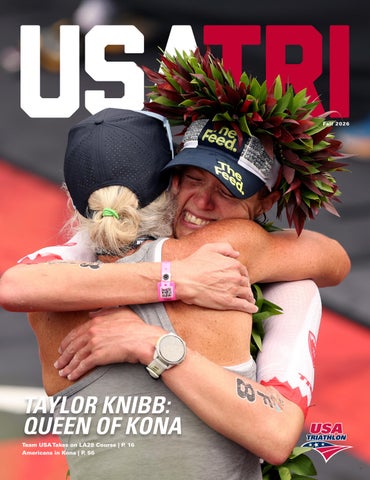
TAYLOR KNIBB: QUEEN OF KONA Team USA Takes on LA28 Course | P. 16 Americans in Kona | P. 56
USATRI
TA B L E
O F
C O N T E N T S
Chris Nikic runs down the blue carpet toward the finish line at the 2026 USA Triathlon Nationals in Milwaukee.
Features 8 Taylor Spivey Strikes Silver
36 Qualifying for Age Group Team USA
Taylor Spivey knows what it takes to conquer World Triathlon Championship Series.
A guide to qualifying for Age Group Team USA.
16 Team USA Takes on the LA28 Course
Join coaches, race directors, club leaders, and athletes at 2027 Endurance Exchange, January 8–10 in Orlando, Florida.
With less than two years until the Olympic and Paralympic Games, Team USA got an early look at the Venice Beach course, putting the swim, bike and run to the test.
22 3,300 Miles Across America The triathlon challenge that took Paralympian Mohamed Lahna 3,300 miles across America.
2
FALL 2026
43 2027 Endurance Exchange
54 Americans in Kona This year, the men and women returned to a one-day combined IRONMAN World Championship race in Kona, on the Big Island, for the first time since 2019.
Break the Tape USA TRI Elite Kyle Stepp breaks the tape at the 2026 USA Paratriathlon Nationals in Milwaukee. Through the Jarrett Sepulveda Paratriathlon Prize Purse, the top three finishers in each classification earned prize money in recognition of their performances.
U S A T R I AT H LO N M A G A Z I N E
3
USATRI
F R O M
T H E
C E O
Progress We Built Together By Victoria Brumfield In our spring issue, we shared our 2025 Impact Report and the progress behind it. As we close out 2026, I want to begin with something I believe deeply: that progress belongs to all of us. Triathlon in the United States is growing and, most excitingly, it's getting younger! I’m getting to the age where everyone starts to look younger, but in triathlon, it isn’t just perception – its reality! The number of athletes ages 20 to 29 grew 20 percent last year, and that group has grown another 25 percent this year. More people are discovering multisport, and more of them are engaging, connecting and coming back for the next start line. That momentum did not come from any one organization. It came from race directors who kept great events on the calendar, coaches who helped new athletes believe they belonged, clubs that turned first-timers into training partners, officials who kept every race safe and fair, volunteers who showed up before dawn, partners and industry leaders who invested in the sport, and athletes who signed up, showed up and brought their friends along. USA Triathlon is proud to work alongside you, and through continued work on our Strategic Plan, Elevate 2028: Focus Forward, we are committed to supporting the work at every level. Inside this issue, you will see the efforts of our collective community. We celebrate grassroots racing in 2026, the lifeblood and heart of our sport. Every local sprint, youth race and community event is where someone gets their first chance to tri, and where so many lifelong stories begin. We celebrate an incredible Sprint and Olympic National Championships that we had in Milwaukee this past August – with performances and memories that will last far beyond the finish line. We share the progress and success of USA TRI, the brand that brings our entire elite pipeline together, from developing
4
FALL 2026
athletes to those chasing Olympic and Paralympic dreams in Los Angeles. We also celebrate Taylor Knibb’s remarkable season, in which she won both the IRONMAN 70.3 World Championship and the IRONMAN World Championship. It was a historic year for an athlete who continues to show the next generation what is possible in our sport. We honor our 2025 award recipients, recognizing the athletes, coaches and race directors whose dedication and excellence set the standard for our community. To each of them, congratulations, and thank you for the example you set. And we look ahead to Endurance Exchange in January 2027, where race directors, coaches, clubs and industry leaders will come together to share ideas and shape what comes next for endurance sport. As proud as we are of this progress, the work is not done. LA 2028 is less than two years away, and it will be the most visible moment our sport has had in this country. It will bring more people looking for their way in than ever before. Let’s be ready for them. Race directors, keep building events that welcome first-timers and challenge our loyalists. Coaches and clubs, keep making room for one more. Industry partners, keep investing in the products and experiences that bring people back. And athletes, sign up for one more race, bring a friend to the start line or volunteer at a local event. Every one of those choices moves our sport forward. Thank you for everything you do for multisport and for the lives it changes. Together, we will keep giving more people a chance to tri. Victoria Brumfield is CEO of USA Triathlon.
USATRI
M E M B E R
R E S O U R C E S
Robert "Bob" Plant at the World Triathlon Age Group Championships Abu Dhani in 2022.
USATRI Magazine Staff Editor-in-Chief: Mackenzie Brown Editors: Paul Smith Design: Mackenzie Brown Contact: communications@usatriathlon.org
Still Chasing Kona At 84, Robert “Bob” Plant headed back to Kona. It all started in 1989, when Plant volunteered at the IRONMAN World Championship and left inspired to race it himself. One year later, he returned as an athlete and finished fifth in his age group. More than four decades later, he was still racing.
Contact USA Triathlon Membership service@usatriathlon.org
Plant earned seven age-group podium finishes at the IRONMAN World Championship, 20 USA Triathlon National Championship titles and a place in the USA Triathlon Hall of Fame. He also still held the Kona 75-79 age-group record, set in 13:06:03.
USA Triathlon Foundation info@usatriathlonfoundation.org
Plant returned to Kona as the oldest male athlete in the field.
Clubs & Collegiate clubs@usatriathlon.org
When he wasn’t swimming, biking or running? He was still working full-time as a dentist.
Coaching Education & Resources coaching@usatriathlon.org
Some stories began in Kona. Bob Plant’s was still being written there.
Race Directors & Sanctioning eventservices@usatriathlon.org Team USA teamusa@usatriathlon.org Youth youth@usatriathlon.org Officials officials@usatriathlon.org Paratriathlon paratriathlon@usatriathlon.org High Performance elite@usatriathlon.org
6
FALL 2026
Find Your Next Race Use the USA Triathlon Events Calendar to find your next race. Visit member.usatriathlon.org/events to check out the USA Triathlon Events Calendar and plan your 2027 race schedule.
Hire a Coach Check out member.usatriathlon.org/coaches to find a USA Triathlon Certified Coach who can help you chase your 2027 dreams! Search for a coach in your area and by their specialty and start training today!
USATRI
U S A
T R I
TAYLOR SPIVEY STRIKES SILVER IN KARLOVY VARY Taylor Spivey knows what it takes to conquer Karlovy Vary. On one of the toughest courses on the World Triathlon Championship Series calendar, the USA TRI National Team athlete delivered another standout performance, earning silver for the second consecutive year in Czechia on Sept. 12. The Redondo Beach, California, native crossed the finish line in 2:03:41, finishing behind Great Britain’s Georgia Taylor-Brown, who claimed the victory in 2:03:05. Germany’s Lisa Tertsch rounded out the podium in 2:04:33. Known for her strength on hilly courses, Spivey made her move on the demanding bike leg, working alongside Taylor-Brown on a steep ascent to break away from the field. The pair helped establish a lead of more than two minutes over the chase pack by the end of the 40.8-kilometer ride. The technical course challenged athletes with steep climbs, fast descents and cobbled roads through the historic town. Wet, slippery conditions made the bike leg particularly treacherous, with more than 10 women retiring because of crashes or mechanical issues. Despite the difficult conditions, Spivey delivered a strong performance across the 1.5-kilometer swim, bike and 10-kilometer run to secure her second straight silver medal at the event. “I always love this course, and I love being on the podium. It’s bittersweet to not get that win that I really want,” Spivey said after the race. “But we worked really well on the bike together, and I think it was an honest race from start to finish, so I’m proud of what I put together.” With another podium finish in Karlovy Vary, Spivey continued to demonstrate her ability to compete at the front of the WTCS field, adding another silver medal to her international racing résumé.
8
FALL 2026
U S A T R I AT H LO N M A G A Z I N E
9
USATRI
U S A
T R I
GWEN JORGENSEN RETURNS TO THE WTCS PODIUM Gwen Jorgensen returned to the World Triathlon Championship Series (WTCS) podium for the first time since 2016, earning bronze at the 2026 WTCS Abu Dhabi to lead the U.S. team in the final WTCS race of the season. Jorgensen delivered the fastest run split in the women's field, clocking 16 minutes, 26 seconds over the 5-kilometer course to secure third place in 56:23. The result marked her first WTCS podium since the 2016 Grand Final and her first podium finish of the 2026 season. The milestone carried added significance in Abu Dhabi, where Jorgensen first won the ITU World Triathlon Abu Dhabi in 2015. Eleven years later, she returned to the podium at the same venue, adding another memorable moment to her decorated career. After exiting the water in fifth, Jorgensen remained in pursuit of the leading group throughout the bike portion of the sprintdistance race. Heading into the run, she found herself more than 30 seconds behind the leaders but steadily worked her way through the field with the fastest run of the day. "I was really thankful that I had this opportunity," Jorgensen said. Despite the gap, Jorgensen continued to focus on her race, even when a podium finish seemed unlikely. "When you have a 30-plus-second gap in a sprint, that's really, really hard to make up, and there were some good runners in the front pack," Jorgensen said. "I felt like my day was over. I just tried to stay present and give my best race." It wasn't until her USA TRI Elite Coach, Parker Spencer, told her she was in third place that Jorgensen realized what she had accomplished. "Parker [Spencer] said I was in third, and I held up three fingers right there. I was like, 'Third?' I just almost didn't even really believe it," Jorgensen said. Diana Isakova (RUS) claimed the victory, followed by Jeanne Lehair (LUX) in second. Gina Sereno also represented the United States in the women's race, finishing 18th in 57:32.
10
FALL 2026
U S A T R I AT H LO N M A G A Z I N E
11
USATRI
PONTEVEDRA WORLDS
Pontevedra, Spain, set the stage for the culmination of the 2026 World Triathlon season, showcasing Junior, U23, Elite and Elite Para competition.
12
SA F PL R LI N2G0 2260 2 6
Taylor Spivey Secures Top-10 World Ranking Taylor Spivey capped her 2026 World Triathlon Championship Series campaign with an eighthplace finish in the final season rankings.
Kasper Leads U.S. Charge at World Finals Kirsten Kasper led the U.S. women with a sixth-place finish at the 2026 World Triathlon Championship Finals in Pontevedra, Spain. Kasper finished the Olympic-distance race in 1:53:10, remaining in the top 10 throughout the early stages and riding in the front bike pack alongside teammate Taylor Spivey.
Naomi Ruff Rallies to Fourth at Worlds Naomi Ruff led the U.S. U23 women with a fourth-place finish at the 2026 World Triathlon U23 World Championships in Pontevedra, Spain. After entering the run in 26th place, Ruff clocked a 34:46 10K, surging through the field and edging Great Britain’s Bethany Cook by seven seconds at the finish.
At 16, Brice Allen Makes His Mark At just 16 years old, Brice Allen placed 10th at the 2026 World Triathlon Junior World Championships in Pontevedra, Spain, leading the U.S. junior men. After starting the run in 30th place, Allen surged through the field with a 15:17 5K, climbing 20 positions to become the youngest athlete in the top 10.
U S A T R I AT H LO N M A G A Z I N E
13
USATRI
U S A
T R I
THREE-PEAT! USA TRI ELITE PARA STRIKES GOLD AT WORLDS The United States has never lost a Paratriathlon Mixed Relay World Championship, and in Pontevedra, Spain, Team USA continued its historic run. Kendall Gretsch, Carson Clough, Grace Norman and Owen Cravens, guided by Kevin McDowell, captured the United States’ third consecutive gold medal in the Paratriathlon Mixed Relay World Championship on Sunday, Sept. 27, at the 2026 World Triathlon Championship Finals. Since the event debuted at the World Championships in 2024, the United States has won all three editions. No other nation has claimed the world title. The relay features four athletes from different classifications, each completing a 125-meter swim, 3.8-kilometer bike and 800-meter run. Despite a 10-second penalty, the U.S. crossed the finish line in 48
14
FALL 2026
minutes, 43 seconds, edging Australia by six seconds. Brazil finished third in 49:01.
A Team Effort From Start to Finish Gretsch (PTWC) opened the relay, completing the first swim, bike and run with the Americans in fourth place. With no requirement for a specific gender to race a particular leg, Gretsch started alongside mostly male competitors. “It’s so much fun to start everyone together, and always just to stay as close to the guys as I can,” said Gretsch. Clough (PTS3) took over for the second leg, pushing through his bike and run to move the U.S. closer to the podium. “I don't know if I passed anyone, I don't think I got passed by anyone, but
I went as hard as I could...thank goodness Grace, Owen, and Kendall pulled us through,” said Clough.
Cravens embraced the final 800-meter run, using his strength over the shorter distance to hunt down the competition.
Norman (PTS5), undefeated in World Triathlon racing since 2021, took the third leg. Her powerful bike and run moved the Americans into third place, but she also had to account for a 10-second dismount penalty.
“I haven’t run like that in awhile, so I just saw the people in front of me and wanted to hunt them down, and this is my best distance, the shorter the better for me. I can always rip a 700 or 800 [meter run],” said Cravens.
“I knew before I started that I would have to serve a penalty, so I was trying to keep that in mind...when I saw the leaders, I was trying to make up on them but also give myself enough cushion so I could stop...but yeah redline all the time, and it was just so fun,” said Norman. That left Cravens, guided by Tokyo Olympic silver medalist McDowell, with the anchor leg. The pair began more than a minute behind the leaders but quickly started closing the gap.
With McDowell guiding him through the final stretch, Cravens continued chasing the leaders and brought the U.S. to the front of the race. “I mean I love this team. It’s fun, and I knew we had to back it up and bring it home, and I was just keeping [Cravens] going...so, I don’t know, gotta be the cheer support too, while on the team,” said McDowell.
The Chase to Gold
The effort secured the United States its third consecutive Paratriathlon Mixed Relay World Championship, extending the nation's undefeated record in the event.
Cravens and McDowell exited the water in fourth before passing Australia's Jack Howell on the bike. They entered the second transition alongside Howell and Brazil's Sergio Silva, but a quick transition cut their deficit in half and put the Americans within striking distance of the lead.
The USA TRI Elite Program is supported by the USA Triathlon Foundation and generous donors. To support elite paratriathlon and Elevate28, visit the USA Triathlon Foundation website to get involved.
A Historic Moment for U.S. Paratriathlon The relay victory capped an outstanding week for Team USA in Pontevedra. On Friday, Sept. 25, U.S. Elite Paratriathletes Grace Norman, Chris Hammer and Hailey Danz won individual world titles at the 2026 World Triathlon Para Championships, leading the team to a historic medal haul. Team USA won eight individual medals, the most individual medals ever won by the United States at a Para World Championships. Five additional U.S. athletes reached the podium. Mohamed Lahna earned silver in PTS2, Kendall Gretsch claimed silver in PTWC, and Emi Perry (PTWC), Kelly Elminger (PTS4) and Kassandra Case (PTS3) each won bronze. From three individual world champions and a record-setting eight individual medals to a third consecutive mixed relay title, Team USA showcased the depth of talent across its paratriathlon program. The achievements in Pontevedra mark another milestone as athletes continue their journey toward the Los Angeles 2028 Paralympic Games.
U S A T R I AT H LO N M A G A Z I N E
15
USATRI
U S A
T R I
Scott Schnitzspahn, USA Triathlon High Performance General Manager, sees plenty of opportunity for athletes who can adapt. "You can't just take the results of the previous [Olympic Games] and know who's going to win," Schnitzspahn said when speaking with Triathlete. "This course could really shake things up." The Olympic-distance swim will begin on the sand near the Venice Breakwater. Athletes will complete two laps, with ocean conditions and surf potentially making positioning and sighting decisive. "The swim could be decisive," Schnitzspahn said. The eight-lap, 40-kilometer bike course follows the beachfront before heading onto neighborhood streets and past the iconic Venice sign on Windward Avenue. The narrow opening stretch will reward athletes who establish good positioning early. "It will really stretch out here," Schnitzspahn said. "If you aren't ahead going into that section, you could find yourself way back." The four-lap, 10-kilometer run takes athletes along the beach and through the Venice Canals, crossing arched footbridges before returning to the coast. Though largely flat, the bridges introduce short climbs that will require athletes to adjust their cadence. "You can't just be a track runner," Schnitzspahn said. "You just don't see hills like this. [Athletes] will have to change cadence quickly."
FIRST IN: TEAM USA TAKES ON THE LA28 COURSE By Mackenzie Brown and Paul Smith With less than two years until the Olympic and Paralympic Games, Team USA's top triathletes got an early look at the Venice Beach course, putting the swim, bike and run to the test. The road to LA28 has a starting line, and Team USA has already experienced it firsthand. In September, World Triathlon and LA28 unveiled the Olympic and Paralympic triathlon courses, bringing the sport to Venice Beach for the 2028 Games. Just weeks later, USA Triathlon brought its Olympic and Paralympic athletes to Los Angeles for an opportunity to become the first national team to train on the course.
16
FALL 2026
From Oct. 1-9, athletes took to the Pacific Ocean, navigated the bike route and explored the run course, beginning the process of turning an unfamiliar venue into a competitive advantage.
A Course With Its Own Character The move from Long Beach to Venice introduced a new setting and a different set of challenges. The combination of open-water conditions, narrow stretches of pavement and technical turns could make for unpredictable racing.
The Paralympic race will feature a 750-meter swim, 20-kilometer bike and 5-kilometer run, presenting its own technical considerations for athletes across six sport classes.
Learning the Course, One Lap at a Time USA Triathlon organized two consecutive camps, with eight Paralympic athletes training October 1-4 before nine Olympic athletes arrived Oct. 5-9. Many of the Olympic athletes traveled directly to Los Angeles following the World Championships. For the Paralympic athletes, the focus centered on open-water skills. Sessions at Venice Beach and in the pool in El Segundo, California, covered sighting, paceline drafting and dolphining through the surf. On October 3, Venice Beach lifeguard Jay Butki briefed athletes on beach and water conditions before leading a longer swim. Athletes practiced navigating the break, exiting the water and
catching waves. The group also rode the bike course together, stopping at key sections to discuss positioning and race strategy with bike specialist Ingmar Jungnickel. The Olympic camp expanded on that work with additional race engineering and cycling tactics. Jungnickel and bike specialist Mike Sayers joined athletes for rides along the Venice course and in the hills above Malibu. Athletes also trained at Venice Beach and completed a rough-water swim at Manhattan Beach, California, with swim coach Gerry [Rodrigues. On October 7, they rehearsed the swim-to-bike transition at the actual LA28 transition location. The camp concluded with a race-specific swim at Venice Beach. For Morgan Pearson, the opportunity to compete in a home Olympics is a motivating goal, but one that requires taking the qualification process one step at a time. "I really want to make the team. I really want to go to the home Olympics. It's like, it would be a huge deal to me," Pearson said. Having competed at two Olympic Games, Pearson knows previous experience doesn't guarantee another opportunity. His focus is on continuing to improve and bringing everything
together when it matters most.
competitive journey continues.
"I have all the tools. I just haven't had them all at the same time," he said. "I think I know what I need to do to just be really ready."
After Paris, Hammer could have viewed his gold medal as the perfect ending. Instead, the opportunity to race on home soil gave him another reason to keep going.
More Than Another Olympic and Paralympic Games For athletes, competing in Los Angeles carries significance beyond the course itself. The opportunity to represent Team USA in front of a home crowd is already shaping how they view the next two years. "When they announced LA, the appeal of being able to race home is such a unique experience," said Kirsten Kasper. After experiencing the energy and support of the crowds in Paris, Kasper can only imagine what that atmosphere might feel like in Los Angeles. "To be able to do that in the United States, like in LA, in front of the home crowd, which I can't even explain what that would mean to me," she said. For Paralympian Chris Hammer, the opportunity to compete in Los Angeles is a major reason his
"I have more to prove, and I think that's going to be the mindset through LA28. I'm not done yet," Hammer said. "That's the reason I didn't walk away after Paris, because otherwise it would have been the perfect ending. But it's not, because we have this opportunity to compete on home soil." Hammer said the opportunity is something he will take pride in and hold dear for the rest of his life. The experience in Venice marked an early step in a much longer journey. The surf, roads and bridges are no longer just features on a course map. Team USA has experienced them firsthand, and the lessons will help shape the work ahead. In 2028, the world's best triathletes will gather on the sands of Venice Beach to compete for Olympic and Paralympic medals. For Team USA, the road to that moment is already underway.
U S A T R I AT H LO N M A G A Z I N E
17
USATRI
U S A
T R I
GET TO KNOW USA TRI ELITE The journey to the Los Angeles 2028 Olympic and Paralympic Games starts with the athletes who bring U.S. triathlon to life. Years of dedication, countless miles of training and unforgettable moments in competition have shaped the journeys of the athletes representing USA TRI Elite. From the experiences that first sparked their passion for the sport to the milestones that have defined their careers, each athlete has a unique story to tell. Get to know the personalities behind the performances, the challenges they have overcome, the people who have supported them along the way and the ambitions that continue to push them forward. With Los Angeles 2028 on the horizon, these athletes are building on their experiences, chasing new goals and helping shape the future of U.S. triathlon.
MORGAN PEARSON
TAYLOR SPIVEY
2X OLYMPIC SILVER MEDALIST
OLYMPIC SILVER MEDALIST
Morgan Pearson has established himself as one of the top U.S. men in international triathlon. Before transitioning to the sport, he competed in cross-country and track and field at the University of Colorado Boulder, where he was a seven-time All-American and helped his team win the 2014 NCAA Division I Cross Country Championship.
Born and raised in Manhattan Beach, California, Taylor Spivey began her athletic career as a competitive ocean lifeguard, winning national titles in 2011 and 2012. She went on to swim at California Polytechnic State University, where she earned a degree in architecture. After joining Cal Poly’s collegiate triathlon club, Spivey won the women’s draft-legal title at the 2014 USA Triathlon Collegiate National Championships and was recruited to the elite level through USA Triathlon’s Collegiate Recruitment Program.
Pearson’s triathlon journey began through USA Triathlon’s Collegiate Recruitment Program, which helped him transition from collegiate distance running to the sport. In 2017, he won the overall men’s title at the USA Triathlon Age Group Sprint National Championships before making his elite debut in 2018. A two-time Olympian, Pearson helped Team USA earn mixed relay silver medals at Tokyo 2020 and Paris 2024. In 2024, he also won the World Triathlon Championship Series race in Yokohama, Japan, becoming the first U.S. man to win a WTCS race since 2009. He continues to represent USA TRI on the world stage as he pursues the road to Los Angeles 2028.
18
FALL 2026
Since making her international debut, Spivey has become one of the sport’s most consistent competitors, earning multiple World Triathlon Championship Series and World Cup podiums. She made her Olympic debut at Paris 2024, finishing 10th in the individual women’s race before helping Team USA earn mixed relay silver. In 2026, Spivey continued her strong form with a silver medal at WTCS Karlovy Vary, strengthening her position among the world’s top triathletes as the road to Los Angeles 2028 continues.
MARK YOUR CALENDARS Olympic Triathlon • Women's Individual: July 15, 2028 • Men's Individual: July 16, 2028 • Mixed Relay: July 20, 2028 Paralympic Triathlon • Paratriathlon: August 18–19, 2028
CHRIS HAMMER
GRACE NORMAN
PARALYMPIC GOLD MEDALIST
4X PARALYMPIC MEDALIST
Born with one hand due to a congenital condition, Chris Hammer has built a career defined by perseverance and a willingness to push boundaries. A standout distance runner at Grand Valley State University, Hammer became a four-time NCAA Division II Track All-American and made his Paralympic debut at London 2012, competing in the 1,500 meters and marathon.
Grace Norman has become one of the most accomplished athletes in U.S. paratriathlon. Born with a congenital condition affecting her left leg, Norman grew up playing multiple sports before finding her stride in running and swimming. In high school, she became the first female amputee in Ohio to earn a podium finish at the state track and field championships. She continued competing in track and cross country at Cedarville University, where she earned a nursing degree in 2020.
In 2013, Hammer transitioned to paratriathlon, drawing on his running background despite having no prior swim or bike training. He quickly became a force on the international stage but narrowly missed the podium at both Rio 2016 and Tokyo 2020, finishing fourth at each Games. Hammer’s persistence paid off at Paris 2024, where he captured Paralympic gold in the men’s PTS5 classification, fulfilling a longtime goal. He followed that achievement by winning backto-back PTS5 world titles in 2025 and 2026. Beyond racing, Hammer holds a Ph.D. in sports psychology and is a husband and father of two.
Norman’s triathlon journey began with a local mini-triathlon alongside her father, eventually leading to her elite debut in 2014. She made history at Rio 2016, winning gold in paratriathlon as the sport made its Paralympic debut, and also earned bronze in the 400-meter track event. She added a silver medal at Tokyo 2020 before returning to the top of the podium with Paralympic gold in the women’s PTS5 race at Paris 2024. In 2026, she earned her eighth career world title, becoming the most decorated female PTS5 paratriathlete of all time. Norman continues to set the standard in the sport.
U S A T R I AT H LO N M A G A Z I N E
19
USATRI
U S A
T R I
THE NEXT GENERATION TAKES THE STAGE AT USA TRIATHLON YOUTH & JUNIOR NATIONALS The future of U.S. triathlon was on display July 31-Aug. 2 as athletes ages 7-19 gathered at Voice of America Park in West Chester, Ohio, for the 2026 USA Triathlon Youth & Junior Nationals. Marking the event’s 12th year in West Chester, Nationals brought together emerging talent from across the country for a weekend of competition and community. With a protected swim in calm lake waters, a scenic bike loop and park trails for the run, Voice of America Park has long provided a welcoming setting for athletes and families. “West Chester and Butler County have been incredible partners for more than a decade, and this year was no exception,” said Brian D’Amico, USA Triathlon Director of Events. “From the local race organizers to the volunteers to the broader community, everyone came together to put on a fabulous event for our youth and junior athletes. We’re grateful for their continued support.” For junior athletes pursuing the elite pathway,
20
FALL 2026
this event offered more than a chance to race for a national title. Several past and present members of the USA TRI National Team began their careers on the youth and junior draft-legal circuits, including Paris 2024 Olympic medalists Seth Rider and Taylor Knibb, who both won the USA Triathlon Junior National Championships in 2015. Athletes qualified for the draft-legal championships by earning points through the USA Triathlon Junior National Series, a series of races held nationwide during the spring and summer. The competition provides valuable head-to-head experience in the same format used at the World Triathlon level and the Olympic Games. "This event brought together the top U19 triathlon talent in the U.S., and the quality of racing did not disappoint. A six-race series provides athletes and coaches an opportunity to develop consistencies in their preparations, while also ensuring enough head-to-head matchups for USA TRI to make selections for
the upcoming Junior World Championships,” said Steve Kelley, USA TRI High Performance. “West Chester has a long history of helping us identify the next generation of elite triathlon talent. I hope it inspires many of the youth athletes who travel to Ohio to consider racing in the series next year." Youth age group races also welcomed athletes without qualification, offering a fun and competitive introduction to the sport. “Watching this event never gets old,” said Zoe Da Silva, USA Triathlon Youth Pipeline Manager. “From the draft-legal races, where you can see the future of our USA TRI pipeline taking shape, to the youth age group races, where 7-year-olds are crossing the finish line with the biggest smiles on their faces, this weekend was a perfect reminder that triathlon is for everyone. Anyone can do a triathlon, and West Chester showed just how much fun that can be.”
Champions Emerge in Draft-Legal Racing Saturday, Aug. 1, featured the Youth & Junior Draft-Legal National Championships. Junior athletes completed a 750-meter swim, 20-kilometer bike and 5-kilometer run, while youth competitors raced a 375-meter swim, 10-kilometer bike and 2.5-kilometer run. With drafting allowed on the bike, athletes worked in packs before battling for position on the run. Graham Hummel of Caliber Endurance won the male junior title in 53:53. Teammate Nathanael Hamilton finished second in 54:22, followed by Lucas Wright) of MC Elite in 54:40. Amelia Avila captured the female junior title in 1:01:15. Alexis Hergenreter of Z3 Triathlon Team placed second in 1:01:51, with teammate Sarah Gilhooly third in 1:02:00. In the female youth race, Kaelyn Allen won in 32:57, finishing just seven seconds ahead of her sister, Elizabeth Allen, in 33:04. Brianna Reilly placed third in 33:23. Ryan Clancy claimed the male youth title in 29:59. George Hamilton finished second in 30:07, and Jonathan Peri took third in 30:43. Sunday’s Youth & Junior Mixed Relay brought the weekend’s team competition to a close. Teams of two boys and two girls each completed a 200-meter swim, draft-legal 5-kilometer bike and 1-kilometer run. Endorphin Fitness Gold, featuring Ellie Harlow, Jonas Yiengst, Joren Aardema-Gagnon and Josie Nunziata, claimed the overall victory in 1:07:41. Caliber Endurance Red finished second in 1:07:52, followed by Z3 Gold in 1:08:15. Z3 Triathlon Team of Des Moines, Iowa, also won the High Performance Team championship.
A Place for Every Athlete The non-drafting championships extended the weekend’s competition to athletes across a range of ages and abilities. Saturday’s Youth & Junior Nationals featured athletes ages 13-18, while athletes ages 7-12 competed Sunday. Athletes ages 11-12 completed a 200-meter swim, 10-kilometer bike and 2-kilometer run, while those ages 7-10 raced a 100-meter swim, 5-kilometer bike and 1-kilometer run. Champions and the top five finishers in the Youth & Junior Nationals were recognized for their performances. From close finishes and team victories to the youngest athletes crossing the finish line, the 2026 USA Triathlon Youth & Junior Nationals celebrated the sport’s next generation and the community supporting them. For some, West Chester was another step toward international competition. For others, it was the beginning of a triathlon journey. View the full list of results.
U S A T R I AT H LO N M A G A Z I N E
21
THE TRIATHLON CHALLENGE THAT TOOK PARALYMPIAN MOHAMED LAHNA 3,300 MILES ACROSS AMERICA By Kennedy Terry
22
SA F PL R LI N2G0 2260 2 6
Nordica Photography
After 47 days, 3,300 miles and three disciplines that pushed his body and mind across the country, Mohamed Lahna finally reached Venice Beach. Just after 1 p.m. on July 29, Lahna completed the final 300-mile running stage from Las Vegas to Los Angeles, crossing a finish line that had been nearly two years of planning in the making. In doing so, he became the first person with a prosthesis to swim, bike and run across the country, a challenge Lahna called the “Triathlon Across America.” When Lahna arrived at Venice Beach — the location of the triathlon races at the LA28 Olympic & Paralympic Games — he not only completed one of the most ambitious endurance challenges ever attempted by any athlete, he also demonstrated how one athlete’s journey can help create opportunities for countless others.
A Challenge Years in the Making A two-time Paralympic medalist, Lahna has spent much of his life pushing the boundaries of what is possible. Born in Morocco without his right femur, Lahna wouldn’t receive his first functional prosthesis until he was 20. He rode his first bike at 25-years-old and completed his first marathon at 27. An accomplished elite endurance athlete, he has won multiple World Triathlon Para Series and World Championship titles along with becoming the first, and only, adaptive athlete to complete the Norseman Xtreme Triathlon in Norway. But his Triathlon Across America presented an entirely new set of challenges. Lahna's challenge began in June with a 28.5mile swim around Manhattan Island. From there, he climbed aboard his bike for roughly 3,000 miles through 16 states, gaining more than 100,000 feet of elevation along the way. Then came the final test: 300 miles on foot from Las Vegas to Los Angeles, including miles of desert heat, deep sand, and the physical toll of running with a prosthesis. But Lahna never set out to simply chase a finish line. This time, the finish line was only part of the goal. He wanted the journey to have an impact — to give back to the organizations that helped shape his own path and to help create opportunities for children who may be waiting for their own chance. Save the Children helped fund the school Lahna attended as a child growing up in Morocco, providing an educational opportunity that was
not readily available to many children with physical disabilities. After moving to the United States, the Challenged Athletes Foundation (CAF) helped him find his way into triathlon and gave him a community within the sport. So, Lahna set out to give back to both. To get there, he would have to swim around Manhattan, ride across the country and run from Las Vegas to the Pacific Ocean—one leg, one day and, eventually, one difficult mile at a time.
The Swim Precision, pressure, and uncertainty. Lahna began his Triathlon Across America on June 13 with a 28.5-mile swim around Manhattan, completing the iconic 20 Bridges Swim in 7 hours, 44 minutes, and 58 seconds. The swim had to be carefully timed around the tides, with Lahna given a narrow window to reach certain points along the course. A kayaker, safety boat and observers accompanied him, and if he missed the window, there was no way to keep going. He would have to wait up to a week for the next opportunity. The swell in the Hudson River was enough to leave Lahna seasick, and for the first three hours of the swim, he was vomiting while continuing to move forward. He had little left in his stomach, but stopping wasn't an option. “It was very stressful for me, the swim,” Lahna said. “You have one shot. If you miss it, you can't start again the next day.” He didn't miss it. After nearly eight hours in the water, Lahna completed the first leg of his journey.
The Bike Where the scale of the challenge became apparent. From Manhattan, Lahna turned west. The next 3,000 miles would take him across some of the most varied terrain in the country. Mountains, farmland, highways, storms, wind, and endless stretches of road. Unlike the swim, where the challenge was condensed into one day, the bike presented a different kind of test: the accumulation of fatigue that comes with doing the same thing every day. Long days left little room for recovery. Lahna would ride for hours, sometimes finishing around 8 p.m., then eat, recover, sleep and wake up around 6 a.m. to do it all again. Every day meant packing and unpacking. There were plenty of moments that demanded something extra from him. Days of cycling with more than 1,000 feet in elevation. Four straight days of relentless Kansas winds made cycling with one leg even more taxing, forcing Lahna to rely heavily on his upper body and hands. He navigated traffic and stretches of highways where fast-moving vehicles added another layer of stress. In Colorado, smoke from wildfires drifted toward the route. Some days were physically difficult; others simply felt endless. Then there was the mental weight of the map. “Two weeks in, I was looking at Google Maps and at the blue dot for my location,” Lahna said. “And I'm far away from Las Vegas. Like, this is going to be hard.”
U S A T R I AT H LO N M A G A Z I N E
23
USATRI
U S A
T R I
it from becoming overwhelming. Instead of thinking about the 300 miles ahead of him, Lahna decided to focus on the next two. His support vehicle and team would meet him every two miles with cold water, nutrition, hydration, and everything he needed to manage his body and prosthesis. He would make it to the truck, stop, reset, and start again. “Just think about the next two miles,” he said. There were long stretches where the road seemed to disappear into the horizon. After weeks of swimming and cycling across the country, Lahna was already carrying an enormous amount of fatigue. At one point, on a particularly difficult stretch of the route, he didn't want to move forward, but Ru reminded him why he was there. “Think about the kids who could benefit from this. Think about the lives that might be changed,” she told him So, he kept going. Two miles. Then another two. Then another. And in many ways, that became the philosophy of the entire journey. But no one crosses America alone. Ryan Goldman was a key part of the bike leg, volunteering to ride alongside Lahna after hearing about the project over a year ago. The two had gotten to know each other through the CAF community in San Francisco, but they had never spent more than a few hours together at a time. Suddenly, they were spending weeks side by side on the road. “Can I come with you? I will do it with you,” Goldman told him. A cyclist himself, Goldman helped Lahna manage the physical demands of the ride, including taking turns blocking the wind, while also helping with fundraising to support the expedition. For Lahna, the riding partner quickly became much more. “He was like an angel with me the whole time,” Lahna said. Behind them was Marty Beene, driving the support vehicle and helping keep the pair safe on the road. His job was often invisible, but no less important. He protected Lahna and Goldman from traffic, managed the support vehicle and kept moving with them day after day. At the center of the entire operation was Lahna's family. His wife, Ru Chen, managed the logistics of the expedition for two years beforehand, then traveled in an RV during the
24
FALL 2026
challenge with their three children. Friends helped with fundraising. And along the way, strangers repeatedly stopped to offer food, water and encouragement. The further Lahna traveled, the more the journey became a collective effort. While one person could be seen crossing the country, there was an entire community moving with him. Still, there was no shortcut through the miles. The bike had to be ridden one day at a time, and eventually Lahna reached Las Vegas.
The Run You don’t run it all at once. You run it two miles at a time.
You don't cross America all at once. You cross it one stretch at a time. For Lahna, the next two miles represented a finish line close enough to reach. Beyond those two miles was another two. And behind every mile was the reason he had started in the first place: the opportunity to give back to the organizations that had helped shape his own life and to help create opportunities for children who may not otherwise have them. By the time the desert gave way to Los Angeles, Lahna had endured blisters, heat exhaustion and moments when his body simply didn't want to cooperate. But he kept moving. Two miles at a time.
The Finish
“Each discipline has its own challenges…but if I wanted to compare swim, bike, run, I would say the run was the hardest,” he said.
At long last, Lahna was finally in Los Angeles. Or at least, he thought he was.
The 300-mile route included over 100 miles of dirt and off-road terrain through the desert, where a heat wave, humidity and an unforgiving landscape turned every mile into a negotiation.
As Lahna made his way through Cajon Pass, he had the feeling that the finish was finally within reach. He had spent weeks moving west, and now he was in L.A. But he still had 80 miles to go.
By day three, sweat started to build up inside his prosthesis, creating friction, leading to blisters and boils. At times, Lahna had to use crutches to keep moving. The physical pain was unavoidable. The key was finding a way to keep
The realization was deflating. After everything he had already endured, it was just another reminder that the final miles would have to be earned like all the others.
Eventually, the landscape began to change. Sand turned to pavement, and the miles began to feel different. Lahna even decided to tackle part of the final stretch at night, starting at about 6 p.m. and running 11 miles toward the Los Angeles Memorial Coliseum.
that it's all over and make it happen.”
He finished at the Coliseum — the venue for track and field at the LA28 Olympic & Paralympic Games — then returned the following morning for one final push toward the coast. Then, something happened that Lahna didn't expect.
For now, though, his focus isn't on dreaming up the next impossible endurance challenge. It's on finishing what he started.
“We started around 9 a.m. and then, I just, I had this second gear that I don't know where I was hiding...I just kept going, flying, and I'm just waiting for it...listening to the navigation for the turns and stuff...when it finally said, ‘turn left to Venice Beach Boulevard.'” Lahna knew he was there. At Venice Beach, friends, CAF supporters and members of the community were waiting. The celebration continued toward Santa Monica Pier, where Bob Babbitt, co-founder of the Challenged Athletes Foundation, took the microphone and helped turn Lahna's arrival into a finish-line celebration worthy of the journey that had brought him there. For Lahna, the relief was overwhelming. “It was just so awesome,” he said. “It's just such a relief
Lahna already knows what it means to stand on a Paralympic podium. With LA28 on the horizon, the next chapter of his career is already taking shape.
Lahna is working to reach his $250,000 fundraising goal for CAF and Save the Children, with more than $171,000 raised as of his arrival in Venice Beach. He will also turn his attention back toward competition, with the 2026 World Triathlon Championship Finals on the horizon and LA28 firmly in his sights. The Triathlon Across America may be over, but the purpose behind it isn't.
Don't Be Afraid to Fail For all the planning that went into his Triathlon Across America, Lahna never had a guarantee he would make it to Venice Beach.
had already considered what would happen if it took longer than expected. If they had to leave, he would continue. If something happened to his running leg, he would use crutches. If circumstances changed, he would adapt. The goal was never to control everything, but to control what he could. “I think the main thing that's stopped people from doing something big is fear of failure,” Lahna said. “People are afraid of failure. People are afraid of what other people think of them.” For Lahna, the answer was simple: give it everything you have, prepare for what you can, adapt when things go wrong, and don't leave yourself with regrets. “If I fail, I don't care,” he said. “I did my best and I tried it.” Lahna didn't cross America simply to prove he could. He crossed America because two organizations helped change the trajectory of his own life, and because he believes the next child waiting for an opportunity deserves the chance to discover what they can do, too.
He knew he might fail, and he made peace with that before he started. His wife and children had planned to travel with him for much of the journey, but Lahna
U S A T R I AT H LO N M A G A Z I N E
25
USATRI
F O U N D AT I O N
A FUTURE FUELED BY OPPORTUNITY By Kennedy Terry On May 16, 19-year-old Blake Bullard stepped onto the start line at the World Triathlon Championship Series Yokohama facing two challenges: this was his first-ever World Triathlon Championship Series race and his first-ever Olympic-distance triathlon. The morning of race day, Bullard woke up in Japan with both nerves and excitement. “I live for the nerves and the excitement of racing,” Bullard said. “I viewed this as a huge opportunity for me to show that I can perform on the big stage.” Before the race, Bullard’s coach, Parker Spencer, gave him one clear instruction: do not lead the swim. Bullard, who grew up swimming, dove into the water and immediately put himself at the front of the race. Oops. Blame it on youthful enthusiasm and nerves. Three-hundred meters into the swim, Bullard found open water around him and started working his way to his right to get on the feet of the lead athlete — none other than 2025 world champion Matt Hauser of Australia. Welcome to the world’s highest level of draft-legal racing. After the first lap, athletes completed an Aussie exit before diving back in for the second lap. It was that moment when Bullard realized the race was beginning to split apart. “I snuck a look around before diving back in and realized that a breakaway group was forming,” he said. “That added extra motivation.” Midway through the second lap, Bullard had settled into the lead pack. “I was pretty comfortable in the group, so I was able to look around and I knew I was swimming well,” he said. Bullard exited the swim with the third-fastest swim split of the day, leading out of the water alongside some of the biggest names in the sport, including Hauser and Brazil’s Miguel Hidalgo. For a teenager making his debut at the sport’s highest level, it was the kind of performance that turned heads across the triathlon community. “When we got out of the water, I looked back and realized I was in a small group and we had a big gap on the field,” he said. “It was surreal running into T1 at a WTCS with Hauser and Hidalgo.” Yokohama still demanded plenty from Bullard beyond the swim. The Olympic-distance format doubled the distance of any race he had previously completed, creating both physical and mental challenges throughout the day.
26
FALL 2026
“[The race] challenged my mental strength by pushing me out of my comfort zone,” Bullard said. “At 25 kilometers into the bike, I realized I was already farther than I had ever ridden in a race, and I still had to run a 10k off it.” But Bullard never faded from the fight. He crossed the line 20th overall — an impressive result for a 19-yearold competing in both his first WTCS race and first Olympic-distance triathlon. More importantly, the performance reinforced his belief that he belongs at the highest level of the sport.
with Audra how much their support impacted my decision to focus on triathlon,” Bullard said. “The impact donor support has on our development pipeline is huge, and the athletes are truly grateful for the opportunity it provides us to represent our country internationally while growing the sport at home.” Bullard now looks ahead to the next stages of his development with his long-term goals firmly centered on representing Team USA at the Olympics. “My goal will always be to make the U.S. Olympic Team and represent my country,” he said. “Every six months over the last few years, I feel like I’ve taken steps forward in the swim, bike and run. I’m excited for what’s ahead.”
“This race showed me that with a bit more experience and development, I can be very successful at this level,” Bullard said. “My physiology is built for the longer distances, and I really "THE IMPACT DONOR SUPPORT HAS enjoyed doing it.” Bullard’s performance served as another major step forward, but his path to the WTCS start line began years earlier through the support of the USA Triathlon Foundation and the USA TRI Mallow U25 Development Team, named in honor of Michael and Audra Mallow, who fund the team.
ON OUR DEVELOPMENT PIPELINE IS HUGE, AND THE ATHLETES ARE TRULY GRATEFUL FOR THE OPPORTUNITY IT PROVIDES US TO REPRESENT OUR COUNTRY INTERNATIONALLY WHILE GROWING THE SPORT AT HOME.”
Bullard says making the team at 16 years old helped shape the direction of his athletic career at a critical moment. “I was really debating between dedicating myself to triathlon full time and swimming or running track and cross country in college,” Bullard said. “Making the team helped me realize that there was a viable path in triathlon.” That support extends beyond race opportunities and funding. It reinforces the belief that athletes like Bullard could develop into future international contenders.
The pathway that helped bring Bullard to the World Triathlon start line is the same pathway the USA Triathlon Foundation continues to build for the next generation of U.S. elite triathletes.
The USA Triathlon Foundation helps support youth participation, access and inclusion initiatives, and Olympic and Paralympic development opportunities through grants and athlete programs like the USA TRI Mallow U25 Development Team. Through Elevate28 — the Foundation’s movement to support U.S. athletes as they prepare to compete on home soil at the LA28 Olympic and Paralympic Games — donor support is helping athletes like Bullard pursue international racing opportunities while inspiring the next generation of Team USA athletes. As Bullard’s breakthrough performance in Yokohama showed, those investments are already helping shape the future of U.S. elite triathlon. Make an impact today.
“I was able to spend time with the Mallows last November and shared
U S A T R I AT H LO N M A G A Z I N E
27
USATRI
F O U N D AT I O N
INVESTING IN ATHLETES, EMPOWERING FUTURES By Kennedy Terry Developing the next generation of Olympic and Paralympic athletes takes more than talent; it takes a community willing to invest in their future. Through their partnership with the USA Triathlon Foundation, the philanthropic arm of USA Triathlon, the Bohler Family Infinity Foundation is helping create new opportunities for the national governing bodies’ elite athletes while demonstrating how one family’s philanthropy can inspire others to invest in the future of U.S. elite triathlon. For several years, the Bohler Family Infinity Foundation’s generosity, advocacy, and commitment to athlete success have helped strengthen USA Triathlon’s elite development pathway. Their support has expanded access to critical resources, created new opportunities for U.S. athletes, and demonstrated how philanthropy can directly shape Olympic and Paralympic success, an example that has inspired others across the triathlon community to invest in the future of USA Triathlon athletes through the USA Triathlon Foundation.
28
FALL 2026
Their connection to USA Triathlon began through a shared belief in service, leadership, and representing the United States at the highest level. In 2023, the president of the Bohler Family Infinity Foundation, Jen Bohler, was looking to make an impact in highperformance sports, providing educational and character growth opportunities for athletes dedicating themselves to the pursuit of Olympic and Paralympic gold. The Bohler’s determined that supporting Parker's USA TRI Development Team, made up of college male athletes, would have the greatest impact. What began as a conversation quickly evolved into a meaningful partnership. Their hope was not only to support athletes, but also to demonstrate how strategic philanthropy can strengthen the Olympic and Paralympic triathlon pipeline, while encouraging others to make a lasting impact.
National Team athlete, Tim O'Donnell, to speak with the team during a training camp in Park City, Utah.
In 2024 ahead of the World Triathlon Championship Finals, USA TRI Development Team Coach Parker Spencer invited U.S. Navy SEAL and USA Triathlon Board of Trustees member, Nathan Stuhlmacher, and former U.S.
While elite athletes dedicate years to chasing Olympic and Paralympic dreams, Stuhlmacher believes they should never have to choose between athletic development and preparing for life beyond competition.
Today, the Bohler Family Infinity Foundation and Stuhlmacher, CEO of the Bohler Foundation, remain dedicated supporters of the USA TRI Elite Program, helping young men pursue excellence in sport while building a foundation for success beyond competition. "When I talked with Parker, we agreed that we don't want to just develop athletes — we want to develop the whole individual," Stuhlmacher said. "The mission isn't only to help these men become professional triathletes and represent the United States on the world stage, but to help them earn a degree, grow as people, and prepare for whatever comes after sport."
Trevor Witt
"We don't want them to sacrifice their college years only to be left without options if something happens," he said. "Success is giving these athletes every opportunity to become Olympians while also helping them become productive citizens who can continue contributing long after their racing careers are over."
impact on our ability to develop athletes every day,” said Spencer. “Their generosity helped us expand our coaching staff, improve access to performance resources, and create an environment where athletes can focus on reaching their full potential, while receiving a quality education."
The Bohler Family Infinity Foundation’s commitment to the USA Triathlon Foundation has also helped equip USA TRI athletes with access to world-class technology and equipment necessary to compete at the highest level. In addition to supporting Spencer’s athletes with resources such as elite racing bikes, altitude tents, and advanced metabolic testing equipment, the Bohler Foundation also provided direct support to several elite paratriathletes preparing for the Paris 2024 Paralympic Games through Sport Performance, Senior Manager, Lindsey Jerdonek. That support included Chris Hammer's Speed Concept race bike, along with adaptive equipment and cycling accessories that helped multiple paratriathletes compete on the world stage.
This support and access to performance resources have shown its impact on race day for USA TRI Development Team athletes. Recent standout performances include Reese Vannerson’s silver medal performance at the 2024 Junior World Championships and gold and silver medals, respectively, for Braxton Legg and Blake Bullard at the 2025 Junior Pan American Games Asunción.
"The Bohler family's support has had a direct
Stuhlmacher also sees strong parallels between the Development Team environment and the military team he served on during his 20-year Navy career. "Triathlon is largely an individual sport, but what impressed me about the USA TRI Development Team was the culture," he said. "These athletes are pushing one another every day toward a
shared goal. They're competing for themselves, but they're also representing something bigger than themselves when they put on a USA uniform." The Bohler Family Infinity Foundation's partnership demonstrates how philanthropy can directly shape the future of triathlon in the United States. Investments in athlete development, education, equipment, and performance resources create opportunities that extend far beyond race results, helping athletes pursue their dreams while preparing for successful lives beyond competition. Just as importantly, the Bohler Foundation hopes its investment encourages others to recognize the difference philanthropy can make and become part of that mission. Through the USA Triathlon Foundation, supporters can invest in that same future, ensuring the next generation of USA TRI athletes have the resources to succeed on the world stage and beyond.
Investing in the Road to LA28 Preparing for LA28 means more than getting athletes to the starting line. Through Elevate28, the USA Triathlon Foundation aims to raise $28 million by 2029 to elevate the entire triathlon community by supporting elite Olympic and Paralympic performance, inspiring future generations, expanding access and inclusion, and building a stronger future for the sport. The campaign focuses on four key areas of giving to help triathlon thrive at LA28 and beyond. Learn more about Elevate28.
Meet the Elevate28 Team Jason Rizzi | Chief Development Officer jason.rizzi@usatirathlon.org Augie Farwig | Director, Major Gifts augie.farwig@usatriathlon.org Megan Zablock | Senior Manager, Annual Leadership Giving megan.zablock@usatriathlon.org Alex Wagner | Senior Manager, Foundation Operations alexander.wagner@usatriathlon.org
U S A T R I AT H LO N M A G A Z I N E
29
USATRI
F O U N D AT I O N
A BIKE CAN CHANGE EVERYTHING For a young triathlete, the right equipment can make all the difference. A new bike can mean more than a faster ride or a better race. It can mean the chance to compete alongside peers, pursue ambitious goals and see a future in the sport that once felt out of reach. That opportunity is at the heart of the Gwen Jorgensen Scholarship Fund, which is welcoming its second class of recipients in 2026. Through a partnership between USA Triathlon and the USA Triathlon Foundation, this year's recipients will receive Canyon race bikes to help them develop their skills, pursue competitive opportunities and continue their journeys in triathlon. Created in 2025 by Jorgensen and her husband, Patrick Lemieux, in collaboration with community philanthropist Scott Filion and the USA Triathlon Foundation, the scholarship fund supports underserved children and youth entering the sport. For Jorgensen, a 2016 Olympic gold medalist who has spent more than a decade inspiring the next generation of triathletes, the mission is deeply personal. "One of the biggest challenges I faced when starting triathlon was gaining access to a bike,”
30
FALL 2026
said Jorgensen. “The support and generosity of USA Triathlon helped me enter the sport, and I’m grateful to be part of an initiative that helps create similar opportunities for young athletes today. Thank you to Canyon Bicycles and Scott Filion for their partnership in making this possible." By providing Canyon race bikes, the fund is helping address one of the sport's most significant barriers: the cost of equipment. For young athletes pursuing junior elite and draftlegal racing, access to a race-ready bike can open new doors, giving them the tools to train, compete and reach their potential. The impact is reflected in the words of this year's recipients. From pursuing elite-level competition to building confidence and developing their skills, these young athletes are looking ahead to what might be possible with the right support. “The Gwen Jorgensen Scholarship Fund continues to create meaningful opportunities for young athletes to discover and thrive in triathlon,” said Jason Rizzi, USA Triathlon Foundation Chief Development Officer. “As we celebrate our second class of recipients, we are
inspired by their enthusiasm, determination, and potential. Thanks to Gwen’s leadership and the support of our donors, we are helping remove barriers to participation and ensuring more youth have the chance to experience the life-changing benefits of our sport.” Meet the 2026 Gwen Jorgensen Scholarship Recipients.
Opening Doors for the Next Generation Each of this year's recipients has a different journey, but their stories share a common thread: the opportunity to pursue their goals with the support and resources they need to succeed. Through the Gwen Jorgensen Scholarship Fund, USA Triathlon and the USA Triathlon Foundation are working to ensure the cost of equipment doesn't stand between young athletes and their potential. With the support of Jorgensen, Canyon Bicycles, Scott Filion and the broader triathlon community, the fund is helping more young athletes find their place in the sport and discover where their ambitions can take them.
U S A T R I AT H LO N M A G A Z I N E
31
USATRI
U S A
T R I AT H L O N
NATIONALS TAKES OVER MILWAUKEE Cheers echoed along Lake Michigan as athletes crossed finish lines, teammates waited for their turns and spectators lined the run course. From Aug. 7-9, Milwaukee welcomed more than 4,500 athletes for the 2026 USA Triathlon Nationals, a weekend celebrating championship racing, personal achievements and the community that brings the sport together. USA Triathlon’s largest and longest-running National Championship event, held annually since 1983, expanded to three days this year with the addition of the Draft Legal Sprint Triathlon National Championships on Friday and the Mixed Relay Triathlon National Championships on Saturday. Athletes competed for national titles and the opportunity to represent age group Team USA at the 2027 World Triathlon Age Group World Championships in Hamburg, Germany.
A Weekend of Champions Friday's racing opened with the Draft Legal Sprint Triathlon National Championships. Gus Platt of Oreland, Pennsylvania, claimed the men's title in 59:15, while Addy Laughlin of Cary, North Carolina, won the women's race in 1:04:43. The day also featured the Open Water Swim Competition presented by Synergy, won by Sebastian Wrona and Kennedy Rainwater. On Saturday, Heather Lendway of St. Paul, Minnesota, captured the women's Olympic Distance National Championships title in 2:06:09, earning her fourth overall title in the event. After winning in Milwaukee in 2013 and 2014 and again in Atlantic City in 2024, Lendway returned to the top of the podium in a city where she has enjoyed years of success. For Lendway, the sport's connections matter just as much as the competition. “Every time I do a triathlon, I meet somebody new or make a friend," she said. “This morning, someone needed a part to pump up their disc wheel. People share. People are nice. Somebody didn’t have their bike, I was like ‘I can get you a bike tomorrow.’ It’s just friendly people. People are happy for each other and supportive.” Emerson Kiefer of Salisbury, Connecticut, won the men's Olympic Distance title in 1:53:14. A former NCAA swimmer at the University of Massachusetts-Amherst, Kiefer built an early advantage with the fastest swim split in the field. “I’m stronger on the bike than on the run, so I just had to hit it hard from the start and build my lead. The run was survival mode,” Kiefer said. The weekend also showcased the inclusive spirit of triathlon. Chris Nikic, the first person with Down syndrome to finish an IRONMAN triathlon, completed Saturday's Olympic-distance race to enthusiastic applause. He was among more than a dozen athletes with intellectual and developmental disabilities representing the nonprofit 1% Better, which works to make physical activity more accessible to people with intellectual and developmental disabilities.
32
FALL 2026
Trevor Witt (above), Archi Trujillo (left), World Triathlon (right)
U S A T R I AT H LO N M A G A Z I N E
33
USATRI
U S A
T R I AT H L O N
Paratriathletes Take Center Stage Twelve U.S. paratriathletes earned national titles Sunday, Aug. 9, at the 2026 USA Paratriathlon National Championships. More than 70 paratriathletes from across the country competed on a sprint-distance course featuring a 750-meter swim, 20-kilometer bike and 5-kilometer run, with national titles awarded across six classifications. Among the competitors was Wisconsin native and threetime Paralympic medalist Hailey Danz. The top three finishers in each classification received prize money through the Jarrett Sepulveda Paratriathlon Prize Purse, with sighted guides competing alongside athletes with visual impairments receiving equivalent prize money. Named in honor of longtime Age Group Team USA members and USA Triathlon Foundation supporters Rosalind Jarrett Sepulveda and Lamar Sepulveda, the purse is fully funded by the couple through 2029. The commitment marks the first time donors have named and funded a paratriathlon prize purse through philanthropy, reinforcing the Foundation's effort to grow the sport while ensuring elite paratriathletes receive recognition on the national stage. With limited opportunities globally for paratriathletes to compete for prize money, the fully funded
34
FALL 2026
purse creates a meaningful chance for athletes to race for financial awards on home soil while strengthening the United States' leadership in elevating elite para competition. "Paratriathlon represents everything we love about multisport — determination, resilience, and the pursuit of excellence," said Rosalind Jarrett Sepulveda and Lamar Sepulveda. "We are proud to support these incredible athletes and to help ensure that paratriathletes receive the recognition and visibility they deserve at the national championship level. We hope that this commitment not only honors today's competitors but also inspires future athletes to see a place for themselves in our sport." "This historic gift marks the first time donors have named and funded a paratriathlon prize purse through philanthropy," said Jason Rizzi, Chief Development Officer for the Foundation. "It also signals a powerful way forward — through individuals stepping up to elevate our athletes and unlock new levels of performance and opportunity. In honor of Rosalind and Lamar's generosity, beginning in 2026 the Jarrett Sepulveda Paratriathlon Prize Purse will provide a fully funded national championship prize purse for the next four years — supporting competitive excellence while continuing to grow and elevate paratriathlon across the United States."
Sunday Sprint Champions Sunday also brought the Sprint Triathlon National Championships, where Cheyenne Nixon of Sunbury, Ohio, claimed the women's title in 1:04:12 after finishing second overall in Saturday's Olympic-distance race. Kyle Berg of Erie, Colorado, won the men's title in 56:30, using a 15:28 5K run to secure the victory. “I love this venue,” Nixon said. “It’s so beautiful being right on Lake Michigan. “I feel like the community support has been great," she said. "Like out on the run course, so many people were cheering, and that really helped get me through to the finish line.”
Mixed Relay Makes Its Nationals Debut Saturday evening brought the first Mixed Relay Triathlon National Championships to USA Triathlon Nationals. Teams of two women and two men competed in a woman-man-womanman order, with each athlete completing a short triathlon before tagging the next teammate. Spectators and fellow athletes lined the shoreline near Discovery World, cheering through each leg of the race. The Good, the Bad and the Sweaty, featuring Michelle Christine, Jason McCormack, Kirsten Sass and Elliot Feng, claimed the national title in 1:04:47 among 60 competing teams. From first-time competitors to seasoned champions, athletes of all abilities made their mark in Milwaukee. Three days of racing reinforced what makes Nationals special: the pursuit of personal goals, the thrill of competition and a community that celebrates every athlete. View complete results from the 2026 USA Triathlon Nationals.
U S A T R I AT H LO N M A G A Z I N E
35
36
FALL 2026
U S A T R I AT H LO N M A G A Z I N E
37
USATRI
38
FALL 2026
U S A
T R I AT H L O N
U S A T R I AT H LO N M A G A Z I N E
39
40
FALL 2026
AGE GROUP TEAM USA SHINES ON THE WORLD STAGE Age Group Team USA athletes earned 37 medals across the 2026 World Triathlon Age Group Championships in Pontevedra, Spain, and the Powerman Long Distance Duathlon World Championships in Zofingen, Switzerland. More than 500 U.S. athletes competed in Pontevedra, earning 34 medals, including eight golds, across four events from Sept. 23-27. Earlier in the month, Team USA secured three podium finishes in Zofingen, where athletes tackled one of the toughest challenges in multisport. Together, these performances showcased the dedication and competitive spirit of U.S. age-group athletes on the international stage.
U S A T R I AT H LO N M A G A Z I N E
41
USATRI
U S A
T R I AT H L O N
RUDY PROJECT
SYDUS
$209.99
www.rudyprojectna.com/USAT
Tested by Tonia Holmes · 34 · Civil Engineer · 14 Years in Multisport
USED SIMILAR BEFORE Yes
EASE OF USE Very Easy
Rave About It I’m really impressed with the Rudy Project SYDUS sunglasses. My favorite feature is the moldable nose piece, which allows me to customize the fit for a very comfortable and secure feel. It’s a small detail that makes a big difference, especially when wearing them for extended periods. I also really like the large field of view, which provides excellent visibility without the frame getting in the way. The changeable lenses are another great feature, making it easy to switch between lenses for different lighting conditions and activities. Overall, the SYDUS sunglasses offer a great combination of comfort, visibility, and versatility. They’re a great choice for anyone looking for high-quality performance sunglasses with a customizable fit. What makes this product unique? The most unique feature of the Rudy Project SYDUS is the moldable nose piece, which allows you to customize the fit to your face for improved comfort and stability. These are some of the most comfortable sunglasses in this style that I’ve tried. Best Benefit from This Product The moldable nose piece, which allows me to customize the fit for a very comfortable and secure feel.
42
FALL 2026
HOW OFTEN During Workouts
USE FOR Training
U S A T R I AT H LO N M A G A Z I N E
43
USATRI
44
FALL 2026
U S A
T R I AT H L O N
U S A T R I AT H LO N M A G A Z I N E
45
USATRI
U S A
T R I AT H L O N
OPEN WATER SAFETY: WHY IT MATTERS By Restube
Why the smartest piece of swim gear you can own is the one you hope never to use. Every triathlete knows the feeling: the start horn sounds, hundreds of arms churn the water, and for a few minutes the swim is pure chaos. Most of us come out the other side with nothing worse than a kick to the goggles. But open water does not forgive. And water safety is a matter of life and death.
A Global Problem Hiding in Plain Sight According to the World Health Organization, around 300,000 people drown every year worldwide. That is more than 800 lives lost every single day. Drowning is the third leading cause of death for children aged 5 to 14, and more than half of all victims are under 30. Drowning is fast and usually silent. A swimmer in trouble rarely waves or shouts. They struggle to keep their mouth above the surface, often for less than a minute. That is why prevention, not rescue, is the first line of defense.
Why the Swim Deserves Extra Respect Our sport is not immune. Research shows that the swim is the part of a triathlon where serious
46
FALL 2026
medical emergencies are most likely to happen. A long-term study of U.S. triathlons published in the Annals of Internal Medicine found that most sudden cardiac arrests and deaths occurred during the swim, even though it is the shortest leg of the race.
swimmers off their feet, and swallowing salt water can trigger coughing or nausea. Currents can push you off course without you noticing. A rip current, a narrow channel of fast-moving water flowing away from the beach, can exhaust even strong swimmers who try to fight it.
The good news: understanding why helps us prevent it. Most incidents have little to do with swimming ability. They are usually triggered by a cardiac event, a panic attack, cold-water shock or a sudden muscle cramp. In open water, any of these can turn serious within seconds. A crowded start, cold water and raceday adrenaline all push the heart rate up at the same moment. Athletes over 40 and those with undiagnosed heart conditions face the highest risk.
Every triathlete can lower these risks:
Ocean swims add their own challenges. Waves and chop make breathing and sighting harder and drain energy faster than a calm lake. Breaking surf at the start or finish can knock
• Get checked. A pre-season medical exam
is a smart investment, especially if you are over 40 or have a family history of heart disease. • Train in open water. Practice sighting, swimming in a group, and handling waves, cold water and low visibility before race day. • Respect the ocean. Study the course and conditions beforehand and practice entering and exiting through surf. If you are caught in a current, don’t fight it. NOAA advises staying calm and swimming parallel to the shore, or floating and signaling for help.
• Warm up and seed yourself wisely. A few
minutes in the water before the start helps your body adjust to the temperature and reduces the risk of cold shock. Then choose a start position that matches your pace, or start at the side or back to avoid the crowd. • Have a cramp plan. Stop swimming, roll onto your back and gently stretch the muscle, for a calf cramp by pulling your toes toward you. Staying hydrated and warming up properly make cramps less likely. • Know it’s okay to pause. If you feel panic coming on, roll onto your back, breathe and raise an arm for help if the panic does not go away. • Never swim alone. In training, swim with a partner or where someone on shore can see you. And there is one more habit worth adopting, one we already take for granted on the bike. You would never ride without a helmet Picture this: you roll up to transition without a helmet. No race official would let you start, and none of your training partners would ride with you. The helmet is non-negotiable, not because we expect to crash, but because we know that if we do, it can save our life. Yet in the water, the leg with the highest risk, many of us still swim with nothing but a cap and goggles. We train alone, far from shore. Strong swimmers are not exempt. A cramp, a heart rhythm problem or a sudden wave of panic does not care about your 100-meter pace. It is time we treated open water safety gear the way we treat a bike helmet: as standard equipment, not an admission of weakness.
Safety Gear is Not Only About You There is a second reason to carry safety equipment, and it is easy to overlook. In a race or on a group swim, you are often the person closest to someone in trouble. Kayakers and lifeguards may be 50 meters away. You are right there. But trying to help a panicking swimmer with bare hands is dangerous. A person fighting for air will grab whatever they can reach, and that might be you. Lifeguards learn this on day one: never go hands-on without something that floats between you and the victim. With a buoyant aid, you can hand the swimmer something to hold instead of your shoulders. You keep a safe distance, they get support, and both of you stay on the surface until help arrives. Carrying safety gear turns you from a bystander into a first responder.
USA Triathlon's official Swim Safety Buoy Partner. Always check the rules of your specific event.
• No drag. Packed, it stays out of your way through the swim start, buoy turns and T1.
• Help on demand. It inflates in seconds,
exactly when you need it, whether for you or for a struggling athlete beside you. • Signal for help. A built-in whistle and the high-visibility color alert lifeguards and kayakers. • Reusable. After use, simply swap in a new cartridge and pack it again. The pattern is simple: use the swim buoy for training, and take the safety buoy to the start line.
Two Systems, Two Jobs Open water safety gear comes in two basic forms. The Swim Buoy: Your Training Partner A swim buoy such as the RESTUBE Swim Buoy Pro is an inflated float that trails behind you on a leash attached to a waist belt. It creates barely any drag. For training, it offers clear advantages:
• Visibility. A bright buoy makes you easy to
spot for boats, paddleboarders and people on shore. • A place to rest. Feeling a cramp or just tired? Grab the buoy, catch your breath, then keep going. • Confidence. Knowing you have support close by lets you focus on technique and longer distances. • Storage. Many models double as a dry bag for keys, phone or a snack. In a race, however, a trailing float gets in the way. The Safety Buoy: Built for Race Day This is where a compact safety buoy like the RESTUBE ACTIVE comes in. It sits in a small pouch on a waist belt and weighs only 195 grams. If you need it, one pull on the trigger releases a CO2 cartridge. Within seconds a bright yellow buoy with 75 newtons of buoyancy floats next to you.
Make it Part of Your Kit We buckle our helmets without thinking twice. Open water safety deserves the same routine. A swim buoy or a safety buoy costs less than a set of race wheels, and it can make the difference between a scary moment and a tragedy, for you or for the athlete next to you. So next time you pack your bag for the lake or the race, ask yourself one question: would I ride without my helmet? If the answer is no, don't swim without your buoy. Exclusive for USA Triathlon Members: Use code USTRI30 to get 30% off your purchase at restube.us.
For racing, the ACTIVE offers what a trailing float cannot:
• Race legal. The RESTUBE safety buoy
is permitted in all World Triathlon race formats. Since April 2026, RESTUBE is also
U S A T R I AT H LO N M A G A Z I N E
47
USATRI
U S A
T R I AT H L O N
YOUR BIKE FIT BEGINS WITH YOUR SADDLE By Wove
What even is a bike saddle? When we stand up while riding our bikes, we can better transfer our mass onto the pedals. The problem is, there is a high metabolic cost to switching from one pedal to the other. What a saddle does is reduce that switching cost - a saddle is a fulcrum that we can use to make transferring our mass from one pedal to the other more efficient. A good bike fit finds the balance – with the saddle as a fulcrum – between maximizing the transfer of mass to the pedals and minimizing the switching cost of changing from one leg to the other. So, let’s talk about using the saddle to find this balance:
48
FALL 2026
1. Hip Rotation
See how Wove’s pros address this in the Finding Balance section below.
When on a road or TT saddle with a saddle nose that is of the right width, set at the right angle, and that provides soft tissue relief, we see riders’ hips aligned with their forward leaning torso. In this position, the rider can ground their pubis bones into the nose of the saddle/fulcrum and better transfer their mass vertically onto the pedal.
4. Hip Angle In addition, when our hip angle (between our torso and our thighs) is more open, we better recruit our glute and quad muscles. There are three ways to open our hip angle: 1) shorter cranks; 2) higher front end stack height; and/or 3) a saddle position that is further forward.
5. Aerodynamics I’ve purposely left aerodynamics last due to a belief that rider comfort and power should be maximized first.
If a rider's hips are posteriorly rotated and out of alignment with their torso, there’s a good chance they are trying to reduce soft tissue pressure caused by their saddle nose, and they transfer their mass onto the pedal at a less efficient forward and down angle.
We can make changes to our position on the bike to lower aerodynamic drag by reducing our frontal area. These changes include: lowering the head and torso, though this reduces both the hip angle and power production; moving the saddle and body rearward to lower the body, though this closes the hip angle and reduces mass over the pedal; narrowing our shoulders, elbows and hands; and closing the space between our hands and our head.
Finding Balance To find balance between the 5 factors above, Wove’s pro triathletes race on our V8 tt + tri saddle:
• • Note that riders using single nose saddles can align their hips with their forward leaning torsos and avoid soft tissue pressure by grounding a single pubis bone into the saddle’s nose.
•
2. Position of Mass
•
When we position our saddle forward, our center of mass is more over the pedal, allowing us to transfer that mass vertically onto the pedal. Note: this does not mean gravity is giving us free energy - it is a biomechanically more efficient way of putting force onto the pedal.
•
Today’s progressive bike fits position the saddle forward so that the effective seat tube angle (measured from the bottom bracket to where the rider's pubic bones are in contact with the saddle) is between 74° and 76° for road riders and, for TT/tri riders, 82° when at lower power and between 84° and 85° when at race power. We’ve included an image in the Finding Balance section below.
•
3. Muscle Recruitment How much we recruit our quads vs. our glutes is determined by the distance from where we sit on the saddle to the pedal in its forward horizontal position. The shorter this horizontal distance, the more we recruit our quads. The further this distance, the more we recruit our glutes. While the zeitgeist is to use shorter cranks to open the rider’s hip angle, shorter cranks require the rider to scoot rearward to lengthen the distance discussed above to keep the glutes engaged. That rearward scoot reduces the rider’s mass over the pedal and closes the hip angle.
Angle their saddles down between -3° and -7° so they can align their hips with their forward leaning torso and transfer their mass vertically onto the pedal. To set themselves up to transfer their mass vertically onto the pedal and perpendicular to the ground, they set their saddle fore/ aft so their effective seat tube angle is between 84° and 85° for TT/ tri and between 75° and 76° for road. They use 172.5 to 175mm cranks to create a longer distance from where they sit on the saddle to the pedal in its forward and horizontal position, to better engage their glutes (they are over 6’1” and crank length : height is a relationship worth considering). For aerodynamic benefits, our pros close the gap between their hands and their head with 15-30° aerobar angles, while raising their aerobar pad stack height to open their hip angle to maximize power production. Wove’s pros reduce a falling forward feeling by increasing their pad reach so their arm angle is between 100° to 115°. In addition, the increased leverage of a longer crank arm further counteracts that falling forward feeling. Last, as part of optimizing the saddle as a fulcrum for switching from one pedal to the other, our pros’ knee angles are between 144° and 146° for TT/tri and between 146° and 148° for road riding.
This article discusses both road and TT/tri positions, but the emphasis has been on TT/ tri positions. This emphasis is warranted because road positions are increasingly looking like TT/tri positions due to benefits in aerodynamics and producing power.
U S A T R I AT H LO N M A G A Z I N E
49
USATRI
U S A
T R I AT H L O N
Triathlon 20 and Under Male: Isaac Lamprecht Female: Ellie Harlow 20-39 Male: Jacob Capin Female: Jenna Campbell Masters (40-59) Male: Kevin Konczak Female: Kirsten Sass Grand Masters (60+) Male: Eben Jones Female (Karen McKeachie Award): Kelly Dippold Cross Triathlon 20 and Under Male: Lucas Wright Female: Allison Hofstra 20-39 Male: Zachary Pigg Female: Natalie Hydcock Masters (40-59) Male: Andy Lee Female: Kristin Kurokawa Grand Masters (60+) Male: Michael Pierce Female: Jo Garuccio Duathlon 20 and Under Male: Alexander Profumo Female: Myla Kelly 20-39 Male: Colin Catlin Female: Julie Cushen Masters (40-59) Male: Stephen Eles Female: Steph Popelar Grand Masters (60+) Male: Jim Huguenard Female (Anne Viviani Award): Heather Leach Aquathlon 20 and Under Male: Hunter Dorrill Female: Kennedy Rainwater 20-39 Male: Samuel Wen Female: Kayla Weatherman Masters (40-59) Male: Ramses Rodriguez Female: Julianna Batizy-Morley
2025 ATHLETE OF THE YEAR AWARD WINNERS USA Triathlon announced the winners of the 2025 Athlete of the Year Awards across the Triathlon, Cross Triathlon, Duathlon, Aquathlon, and Aquabike categories. Each category includes Male and Female awards across four age divisions: 20 and under, 20-39, Masters (40-59), and Grand Masters (60+), recognizing standout age group performances from throughout the 2025 season. Two of this year's Grand Masters honors carry special distinction. The Female Grand Masters Triathlete of the Year Award, presented in memory of Karen McKeachie, was awarded to Kelly Dippold. The Female Grand Masters Duathlete of the Year Award, presented in memory of Anne Viviani, was awarded to Heather Leach.
50
FALL 2026
Grand Masters (60+) Male: John Myers Female: Colleen Burns Aquabike 20 and Under Male: Yan Berezitsky Female: Ariana Burge 20-39 Male: Timothy Broadenax Female: Sarah Hess Masters (40-59) Male: Jared Gentile Female: Lauren Jensen McGinnis Grand Masters (60+) Male: Drew Magill Female: Catherine Frye
2025 RACE DIRECTOR OF THE YEAR AWARD WINNER USA Triathlon’s Race Director of the Year presented by TicketSocket, Kathleen Walker is the founder and race director of New England Endurance Events — a Massachusetts-based multisport race management company that produces seven annual events across New England. Walker’s path to race directing began in 2014, when a local camp serving seriously ill children needed help raising funds. She stepped in to organize the GutCheck Adventure Triathlon, a benefit sprint event that remains on the calendar to this day. Other race directors noticed, and over the past decade, have asked her to take over five triathlons. She manages the oldest continuously running triathlon on the East Coast (the Hyannis Triathlon) as well as one of the most difficult one-day triathlons in the sport (Sea to Summit Triathlon). Last year, New England Endurance Events added the first SwimRun race in southern New England to its annual schedule (SwimRun Cape Cod). A USA Triathlon Level II Certified Race Director, Walker is also a Red Cross certified open-water lifeguard. She is the president of a regional bicycling advocacy organization and a member of a development and expansion committee for the YMCA. She is also the founder of a women’s open-water swimming organization with over 100 members. Last year, five of New England Endurance Events’ seven races reached full capacity ahead of race day, and five saw fields split evenly between men and women. Walker’s contagious enthusiasm for the sport — along with a hand-built team focused on safety, newcomer comfort, and maximizing every athlete’s experience — has been a major reason for this success.
2025 COACHES OF THE YEAR AWARD WINNERS Non-Draft Elite Coach of the Year Dan Lorang Dan Lorang, widely regarded as one of the most accomplished triathlon and cycling coaches in the world, has more than 20 years of experience coaching Olympic medalists, world champions, and top professionals in both cycling and triathlon. He coaches two-time U.S. Olympic medalist and threetime IRONMAN 70.3 and IRONMAN World Champion Taylor Knibb, and IRONMAN world champion Lucy Charles-Barclay of Great Britain. Throughout his career, Lorang has played a significant role in the success of some of the world’s top endurance athletes. His coaching has contributed to more than 12 world championship titles across cycling, triathlon, and other endurance disciplines, as well as multiple Olympic medals. Prior to joining Red Bull – BORA – hansgrohe, Lorang served as Head Coach of the German National Triathlon Team and as a sports scientist with Cervélo TestTeam. Collegiate / NCAA Coach of the Year John Hansen John Hansen is head coach of the UC Davis Collegiate Club triathlon team, one of the strongest programs in the country with five top-10 finishes in the Mixed Relay at Collegiate Club National Championships over the past eight seasons. A USA Triathlon Level II Certified Coach, Hansen also holds coaching certifications with USA Swimming, USA Track and Field, and USA Cycling. Hansen is Chair of the Collegiate Club Coaches Association and is an active member of the USA Triathlon Collegiate Club Committee. In his role as Chair, he is leading the creation of a national ranking system for collegiate club triathletes. Youth and Junior Coach of the Year Noah Lam Noah Lam is president of the Long Island, New Yorkbased youth triathlon team, Lightning Warriors, which is focused on making the sport of triathlon available to all young athletes. Lam is a USA Triathlon Level I
Certified Coach, Youth and Junior Elite Level II Coach, and Road Runners Club of America Running Coach. Lam believes every athlete is unique and has capabilities that are waiting to shine. He wants each athlete to excel beyond their current abilities and by providing a foundation that creates strong, successful leaders and helps them excel at all levels of life. Athletes Lam has coached through Lightning Warriors have gone on to become All-Americans, world champions, and earned college triathlon scholarships. Paratriathlon Coach of the Year Kris Swarthout Kris Swarthout has been a competitive presence in triathlon since 2001, first as an athlete and now as a coach. He currently coaches with the USA TRI Development Team, teaching para triathlon to the next wave of elite paratriathletes, and also assists with the USA TRI National Team. Swarthout has coached athletes ranging from professional competitors to first-time amateurs, and he strives to help his athletes find the ultimate balance of family and sport. He holds a USA Triathlon Level III Certification, as well as Coaching Certifications in Paratriathlon, and Youth and Junior, along with a USATF Level 1 Coach certification and a USAT Level 1 Race Director credential. Age Group Coach of the Year Maria Simone Coach Maria Simone is the founder and head coach of No Limits Endurance Coaching. An enthusiastic ambassador for endurance sport, Simone has found that it teaches her to fear less and live more, and she thrives on the competition and camaraderie the community provides. She takes a holistic approach to coaching, considering each athlete's physical ability, history, and goals alongside mental fitness, nutrition, and life-work-training balance.
her athletes accountable for the hard work required for big dreams, whether they're chasing a first finish or a personal best. Draft-Legal Coach of the Year Mark Saroni Mark Saroni is an accomplished endurance athlete and the founder and head coach of Paragon Training. A USA Triathlon Level II Certified Coach, Saroni has been involved in triathlon since 2003 and coaching since 2005. A former professional triathlete, Saroni's unique coaching style and knowledge is built on his educational background, as well as years of experience racing in the endurance world. Saroni coaches Junior draft-legal development athletes and has coached athletes who qualified for World Championships at U23 Elite, IRONMAN, IRONMAN 70.3, Xterra, and World Triathlon Age Group Worlds. Coach Educator of the Year Alison Freeman Alison Freeman is a USA Triathlon Level III Certified Coach and co-founder of NYX Endurance, where she specializes in coaching beginner and intermediate long-course triathletes — the middle- and back-of-thepack athletes who are chasing goals that are every bit as meaningful as anything happening at the front of the race. Over the past 10-plus years, she has coached over 100 athletes across more than 400 finish lines — from first-ever sprints to full-distance IRONMAN finishes. A contributor for Triathlete Magazine, Freeman has written more than 50 articles featured on Triathlete. com, covering training, skill development, and the athlete mindset. Her first book, “Unlocking Triathlon” is set to be released this fall.
A USA Triathlon Level III Certified Coach, Simone coaches athletes of every level, from beginners learning to swim, bike, and run to elite competitors, always emphasizing that belief comes before achievement and process before outcome. She holds
CLASH Endurance
U S A T R I AT H LO N M A G A Z I N E
51
USATRI
U S A
T R I AT H L O N
2025 MULTISPORT AWARDS AWARD WINNERS USA Triathlon today announced the winners of the 2025 USA Triathlon Multisport Awards, annual honors that recognize USA Triathlon members who help fuel the multisport lifestyle through service, sportsmanship and community contributions. Lifetime Achievement Award Wyndell Robertson and Pam Routh The Lifetime Achievement Award recognizes individuals who have made significant contributions to USA Triathlon and the multisport lifestyle through their performance, leadership, volunteerism or mentorship. This year’s honorees, Wyndell Robertson and Pam Routh, are recognized for more than four decades of service to triathlon and multisport as race directors, event managers and volunteers. For over 40 years, the pair has served as race directors for Memphis in May, one of the nation's marquee triathlons, along with numerous other triathlon and multisport events across the Mid-South region. Robertson and Routh were instrumental in coordinating the U.S. Olympic Triathlon Trials in Dallas ahead of the 2000 Olympic Games in Sydney, Australia — the first time triathlon appeared on the Olympic program — and again ahead of the 2004 Olympic Games in Athens, Greece, and worked with USA Triathlon to develop and implement drug-testing protocols for the Trials. Their service also includes time on the USA Triathlon Southeast Region Board, as founding board members of the Susan G. Komen Memphis-Mid-South Race for the Cure, and in leadership roles with Club Tri Memphis. “Triathlons have been our love and lifestyle since 1984. We are so very honored to be recognized by our peers with the USA Triathlon Lifetime Achievement Award. It really means a lot to us both,” said Wyndell Robertson and Pam Routh. Volunteer of the Year John Hansen The Volunteer of the Year Award recognizes an individual or organization whose volunteer leadership has been transformative and has mobilized and unified athletes, programs and organizations in the multisport community. The recipient of the 2025 Volunteer of the Year Award is John Hansen, who has volunteered
52
FALL 2026
extensively with the UC Davis collegiate club triathlon team and has played a central role in the success of Collegiate Club Nationals. As Chair of the Collegiate Club Coaches Association, and an active member of the USA Triathlon Collegiate Club Committee, Hansen has worked to increase communication among collegiate club coaches nationwide and is leading the creation of a national ranking system for collegiate club triathletes. “To be recognized in this way by USA Triathlon and by those within the multisport community means a great deal to me,” Hansen said. “One of the most rewarding parts of being involved in this sport has been the opportunity to help build the collegiate club community, support athletes and coaches, and work alongside so many passionate individuals who continue to make collegiate club racing such a meaningful experience.” Most Inspirational Comeback Nancy Rehm The Most Inspirational Comeback Award honors an athlete who has made a comeback to the sport after a traumatic or troublesome personal situation. This year’s honoree, Nancy Rehm, is recognized for her recovery after being struck by a car during a cycling event, an incident that resulted in severe injuries. Less than a year later, Rehm returned to competition, racing for Team USA at the World Multisport Championships in Pontevedra, Spain. "As a lifelong multisport athlete, I learned early on that meaningful progress only comes through relentless, intentional consistency - one day, and sometimes even one minute, at a time. After my crash, that approach became the blueprint for my recovery. I never imagined those decades of training were actually preparing me for the most important and challenging endurance journey I’d ever undertake," Rehm said. "While the sport gave me the mindset and tools to keep moving forward, the multisport family reinforced that no finish line is ever reached alone. Even in a largely individual sport, it takes a team… and the team showed up big for my family and me, as they always do. Celebrating the comeback with USAT at Multisport Worlds in Spain was the 'impossible' goal
on the horizon every day throughout recovery, and we did it — together! I’m incredibly honored to receive this award and even more grateful to be part of the community it represents." Jeff Jewell Service to USA Triathlon and Sport Lisa Thomas This award honors Jeff Jewell, a massage therapist for Team USA from 2001-2009, and recognizes individuals of impeccable character who demonstrate unwavering dedication through selfless service. This year’s honoree, Lisa Thomas, has served for many years as an ambassador for the USA Triathlon Foundation and has brought energy and enthusiasm to Team USA. Thomas has inspired countless young women to get involved in sport, and she has been an advocate for combating discrimination and challenging inequities, including her role as a member and organizer of triathlon’s first Adaptive Athlete Mixed Relay Team. Mike Greer Spirit of Multisport Allison Tuck This award, named in honor of Mike Greer, recognizes individuals who illustrate the principles of the positive spirit of the sport as displayed through acts of sportsmanship and leadership in multisport. Greer dedicated his life to multisport as an athlete, race director, official, volunteer, author, speaker, coach and innovator across a nearly four-decade career. This year’s honoree, Allison Tuck, is recognized for her work supporting athletes of differing abilities, including her efforts on behalf of disabled veterans. Tuck’s selfless spirit and helpfulness have made it possible for many athletes to participate in multisport who otherwise may not have had the opportunity. “I am incredibly overwhelmed with gratitude and humbly honored to be the recipient of this award,” Tuck said. “It serves as a reminder of the incredible opportunities I have been given all while being a part of this amazing community of triathletes. I never saw the journey I was embarking on 12 years ago when I answered a simple email by clicking ‘sign up here.’”
SIDNEY CLEMENT NAMED 2026 THE ALEXANDER RECIPIENT USA Triathlon and the USA Triathlon Foundation named Arizona State's Sidney Clement the 2026 THE ALEXANDER recipient. Supported by the TriDave Legacy Trust, THE ALEXANDER honors longtime triathlete and passionate supporter of the sport Dave Alexander. Since completing his first triathlon in 1982, Alexander has competed in 287 triathlons across 37 countries and has played a significant role in advancing the future of the sport. Through the TriDave Legacy Trust, Alexander has been instrumental in supporting USA Triathlon's efforts to establish women's collegiate triathlon as an official NCAA Championship sport. The award recognizes a well-rounded student-athlete whose impact extends beyond the race course, celebrating athletic achievement, academic excellence, commitment to teammates and meaningful contributions to their community. Finalists were Robyn Hunt (Duquesne) and Abbey Staniec (Willamette). 2026 THE ALEXANDER Recipient Sidney Clement | Arizona State University Clement has 32 World Triathlon starts, five podiums and one victory. She raced the opening leg of Canada's silver-medal mixed relay at the 2026 World Triathlon Cup in Edmonton. She improved from 37th at Nationals in 2023 to fifth in 2025, earning CTCA First Team All-American honors. A Biomedical Science major, she has a 4.0 GPA, CTCA Scholar All-American honors and is team captain. Her 429-plus service hours include founding and coaching a youth triathlon team, tutoring, 270 hours as a medical research assistant, mentoring young athletes, supporting families navigating addiction and fundraises for North Shore Rescue. 2026 THE ALEXANDER Finalists Robyn Hunt | Duquesne University Duquesne captain and Atlantic 10 SAAC representative, Hunt once stayed alongside a Delaware State freshman during her first NCAA bike leg. A summa cum laude graduate with a 3.91 GPA, Hunt is pursuing her MBA while working and won the 2026 draft-legal aquabike national title. She has completed 320-plus service hours and led campus food and shoe drives and a Dance-A-Thon. Abbey Staniec | Willamette University Willamette's 2025-26 SAAC president, Staniec championed student-athlete mental health through The Hidden Opponent and the university's JED Taskforce. A dualsport athlete, she was a four-time conference champion swimmer, seven-semester CSCAA Scholar All-American and four-time collegiate qualifier. As captain, she helped Willamette place fourth nationally in 2024 and 2025. She double-majored in Public Health and Environmental Science and completed 200-plus service hours. More than 40 schools offer women's collegiate triathlon across NCAA Divisions I, II and III as the sport works toward full NCAA Championship status. Learn more about NCAA triathlon.
Tyler Kovak
U S A T R I AT H LO N M A G A Z I N E
53
USATRI
U S A
T R I AT H L O N
AMERICANS IN KONA RETURN TO THE ISLAND By Kelly O’Mara This year, the men and women returned to a one-day combined IRONMAN World Championship race in Kona, on the Big Island, for the first time since 2019. And among the 2,548 athletes were 589 Americans — led by Taylor Knibb, taking a dramatic last-minute victory in the women’s race, and Matthew Marquardt, a full-time medical student who pulled off a third place in the men’s race before flying to L.A. a few days later to present a medical research paper. U.S athletes made up the largest contingent of any country and 49 different states were represented. (Only North Dakota didn’t have an athlete on the start line.) That ranged from 18-year-old Francesca DelPresto, of Florida, who was the youngest athlete competing, to California’s 83-year-old Robert Plant, who was the oldest athlete in the race. On the sidelines, with so much homage to the old pre-pandemic days, throwback vibes ruled the race from Precision Fuel & Hydration’s retro expo set-up to Ironman’s 1980s poster designs printed on t-shirts in the merchandise tent. There were concerns and complaints about the female age-groupers being swallowed up in the men’s racing, but at the front it was the drama in the women’s race that dominated the day. First came the men’s race, with its own share of drama as race leader Magnus Ditlev started walking with less than 10km to go, eventually getting passed by Kona rookie and two-time Olympic-distance world champ Vince Luis — who said it’d be his first and last Kona, his final race before retirement. Behind him came 2022 champ Gustav Iden, after a tough few years, and fan favorite Marquardt leading the Americans. After that, we appeared destined for a calmer women’s race once last year’s winner Solveig Løvseth took the lead on the run. It couldn’t get crazier, right? Wrong! Last year, Lucy Charles-Barclay collapsed while in the lead in the Energy Lab — the same spot where she succumbed to the heat and toll again this year. Last year, Løvseth passed Taylor Knibb in the final mile, as Knibb also collapsed and fell to the ground. But this year the roles were reversed and the finish line even closer. Within sight of the famed Ali’i Drive, Løvseth started to wobble and sway. With a half-mile to go she, too, fell to the ground. She fell and stood, fell and stood, eventually able to walk it in for 8th place amid cheers from the crowd — but not until after Knibb had passed her and claimed the elusive crown. At the finish line, having moved into the lead just minutes before, Knibb was momentarily speechless. “Solveig and I need to stop doing that — the collapsing part,” she said. “Holy smokes, I’m stunned.” Us too, Taylor.
54
FALL 2026
Straight from the champion’s mouth: A Q&A with Taylor Knibb Taylor Knibb had quite the September and October. On Sept. 12, she won her fourth Ironman 70.3 world title — dominating on the hilly bike course in Nice, France and winning by over four minutes. On Sept. 20, in Montreal, she then took 13th and was the first American woman at the UCI Road Cycling World Championships in the 39km time trial race. And, lastly, on Oct. 10, with less than a half-mile to the finish, as last year’s winner Solveig Løvseth wobbled and collapsed, Knibb moved into the lead of the Ironman World Championship in Kona, Hawaii. When she crossed the line and lifted the tape as the new Ironman world champion, the 28-year-old American capped a remarkable month. We talked to Knibb less than a week after that victory about what it meant to achieve a childhood dream she’s had since she saw her mom race on the island when she was a kid, and what she learned that helped her after last year’s race. The following conversation’s been edited and condensed for clarity. You had a crazy month: 70.3 Worlds, the UCI Time Trial World Championship, and Kona. How did you adjust training for all of that, or did you just train the same the whole time? I did not train the same the whole time, don’t worry. Dan [Lorang, my coach] never puts in training after a race — he wants to see how I’m doing after — but I know he has a plan. He always has a plan. I’m sure he could map out five years depending on my goals. And once we set the season’s schedule, he has a big plan that goes back through the year. I raced WTCS London less than three months ago, which is kind of crazy to think about because that was my best sprint-distance race ever. Then, after that, we really went back to a lot more base training. So going into 70.3 Worlds, I would say it didn’t feel like I did specific 70.3 or specific Ironman or specific time trial training. Maybe I had one to two sessions, but it was very much like, ‘OK, you’re very fit, how do we fine-tune that and have a good race.’ After Nice, I was home for three days and then went to Montreal [for UCI Worlds]. And then after Montreal, I went back into training really quickly, which was nice. Do you have Ironman staple workouts or big massive weekends ahead of an Ironman? Remember this is only my fifth Ironman ever. My first, I was severely undercooked. My second one, too. So my first really prepared Ironman I would say was Kona last year. Then I did Ironman Texas this year, and Kona this year. I would say, compared to Texas this year, I felt less prepared for Kona. But that’s because I had done a run progression going into Texas that I really enjoyed. Going into Kona, my longest run was the Thursday after the [UCI] time trial, I did 30 or 31km. It was just easy and I did it on a trail and it was fun. And then I did a 24km workout that Saturday and then either Monday or Tuesday I did another 24km workout. And that was probably the extent of my run build. Last year, my longest ride leading into Kona was four hours and 32 minutes. And I was like, “Dan, when are the big rides going to come?” And he said, “Well, obviously you don’t need more.” Actually, I did a longer ride by accident this year; I got lost. Two weeks before Nice, I had a ride that was supposed to be four hours and I did this loop because I thought I had time for the loop and I did not have time for it, which I learned midway through. So I’m trying to get back and I took this cut-through and it was gravel and I was on my TT bike, and I got a flat. I did not even have a tool to change it, I forgot all my spare kit stuff. Somehow I reached my dad, my new phone had cell reception, and he came and saved me and picked me up. That ride was four
hours and 45 minutes, which was going to be a very long ride if I had made it all the way home. So, no, I do not do crazy sessions. I did do a brick the weekend before Kona that was a three-and-a-half-hour ride with efforts into 15km running at race pace and 3km easy. The biggest thing I learned from Dan is he’s very conservative. The amount of fatigue it will add, from a six-hour ride, would be greater than what I could gain from it. It’s a lovely balance and I can probably get in more training overall because I don’t do super huge epic days. It’s very consistent with progressive overload. I think Dan’s consistency is one of his secrets to success. How long have you been with your coach, Dan Lorang? [Dan also coaches Lucy Charles-Barclay, coached Jan Frodeno, and coached Anne Haug.] Three years. And he said it’s in his third year that the athlete wins Kona. After last year’s collapse, when you were leading in Kona, did you guys change or adjust anything in your Kona build this year? Well, I collapsed last year, in part, because I was sick. My core temperature was elevated from the start, which if you think about all the illnesses going around in Kona, you don't necessarily know if you're sick and you don't know if you're fighting something off and you don't know when something's going to hit you. The brick that I talked about — three-and-a-half hours biking into 18km running the weekend before the race — last year I did that at the Mauna Lani and it was really hot, way too hot. And I think that cooked me a little bit before the race. So this year, number one, when I did that brick I had probably four people out with me on the run and I was taking a bottle every six minutes. Secondly, I did it on the course this year because I think it’s a little cooler there. But also, it was really important for me to run by the section where I’d gone down last year, to run by it while feeling good and while running so that I had a new memory in my head that this isn’t a place of danger. Because your brain will shut down and protect yourself far earlier once something’s happened before. So when I reach that spot in the race — when I’m probably going to be hot, really destroyed, wanting to stop, everything — I can’t have that be the first time I’m going by that corner, because then I’m probably going to collapse. Instead, I wanted to feel a little bit good, that was really important to me, to be running past that spot in training and re-wire my brain for safety. You’ve talked about what Paula Newby-Fraser told you after last year about needing to take care of yourself, and you’ve said you used that in this year’s race. Was focusing on taking care of yourself something you used throughout the race or just at the end? No, it started at 23K, because as I was heading into the Energy Lab I thought, ‘Oh, I might have taken that too hard.’ Dave Scott sent me an email last year. He said Ali’i Drive is one of the most deceptive parts of the race, because it’s really humid, it’s really hot, it’s deceptively hilly. A lot of athletes leave their race in that section. There’s a lot of crowds, it’s easy to get carried away. So I was very conscious that I wasn’t concerned with anyone pulling back time on me there. I was really conscious of taking it conservatively. But then when I got to the Queen K, I probably opened up a little bit too much, based on my splits. So then I was very cautious and careful. Last year, coming out of the Energy Lab, I was really destroyed. So this year, I was like, ‘OK, that was probably a bit too much of an effort.’ That’s why I walked the aid station then. And then I started vomiting. But I actually felt better this year vomiting than I had last year, which tells you something. You know what [my agent] Patrick’s whiteboard said after he learned I vomited? It said, “Vomiting is normal.” The first half of the run was great. The second half I struggled a little bit, but I think it’s tough because you have to have an
U S A T R I AT H LO N M A G A Z I N E
55
USATRI
U S A
T R I AT H L O N
In 2013, then, there was a youth elite series race in Richmond, Virginia, which thankfully was just a twohour drive away. And in that race I got second, and that’s what got me in touch with Jennifer Hutchinson and I started working with her. I went to a camp in Florida and ended up doing a race in Iowa then because my parents were like, ‘OK, you’re actually kind of good at this, you earned it.’ Then I did well enough in my first juniors race that it gave me a lot of opportunities. I qualified for my first Junior Worlds [for 16- to 19-year-olds] in 2014. That was a big year. Those Junior Worlds were won by Laura Lindemann [a 2024 Olympic mixed relay gold medalist] and Cassandre Beaugrand was second [the individual Olympic gold medalist and two-time world champion]. Do you have any tips for young triathletes? For youths and juniors, I give a lot of credit to my youth coach, Jennifer Hutchinson, who got me on a good path, and Neal [Henderson, who I worked with in college]. People think that the stereotypical coach motivates you and pushes you, but I think, with certain athletes, it’s actually more about holding the athlete back. When I first met Jennifer, I was listing off everything I was going to do: I’m going to do a half-Ironman this year. And she was like, ‘No, you’re not.’ She was in it for the long haul, and my run was still very much developing. I give a lot of credit to her and to all the coaches who want to develop youth athletes at a good rate that’s age-appropriate. Because of my bike, I was kind of outperforming my development. I had this engine without anything to support that. So it was a long, step-by-step process, it was having a lot of coaches who were very patient and willing to see the big picture, and they saw that I wanted to go a long way. Do you have any other tips for age-groupers at Kona? Number one is Kona is brutal. I think we’re all reminded of that. Why don’t we just know that already! Number two is the importance of taking care of yourself and listening to yourself. Anything is possible, anything could happen, so the best thing is to get yourself to the finish line as fast as possible and then see where the cards lie.
awareness of the splits and gaps to other athletes to some degree but not let them change your decisions too much. There’s so many paradoxes within the race. The quintessential stereotypical athlete is like, ‘OK, I tried harder, I worked harder, and I got it.’ But I think it’s a little ironic that I had to let go of the win in order to win. Last year, I clung so tightly and I wanted it so badly, and then it cracked. This year, it was more important to take care of myself. It was quite tough too, because once Solveig passed me, some people on the sidelines were yelling, “This is your dream. She’s 30 seconds up the road, you’ve still got this.” And I had to say no, I need to listen to my body, I’m very much at a limit and I need to make it to the finish line. I don’t want a repeat of last year. Let’s say we extinguished the 2025 race from my life. If I didn’t race 2025, there’s no way I would’ve won 2026.
56
FALL 2026
You talked in your victory speech about growing up watching Kona and your mom racing here. How young were you when you first realized this thing existed? I feel like I first started learning about it when I was eight or nine. I was just infatuated, I thought it was the coolest thing on Earth. My mom raced Kona when I was 11 or 12. She’s done it six or seven times, but we came with her as kids that first time. When did you first want to do triathlon? What made you keep doing it? My first triathlon was in 2009. It was the TriColumbia Kids Triathlon. I loved it. It’s addicting. I wanted to be like my mom; at races she’d get her wristband and body marked, and this kid’s race had all those little things.
Alongside the pros, there are over 2,000 amateur athletes racing in Kona. One of the best things about triathlon is that the everyday athletes compete alongside and on the same course as the best-in-theworld professionals — and often their stories are even more remarkable.
they would be toeing the line together in Kona. As for the tough conditions on the island this year? It didn’t stop him from finally achieving his goal in 14 hours and 29 minutes. “I’m at my strongest when the conditions are the worst,” he said.
On a tough day in Hawaii this year, these are just three of the U.S. athletes who persevered and crossed that famous finish line.
excited about the Ironman 70.3 World Championships nearby in Chattanooga, Tennessee. Plus, she thinks there’ll be more young people with her on start lines soon. “It’s already getting more popular,” she said. Dana Bullard, 49, Texas When Dana Bullard crossed the finish line in Hawaii it wasn’t her best finish ever, but it was her 33rd Ironman and her 8th Kona. After running track and cross-country at the University of Texas at Austin, Bullard was running semi-professionally, back in 2004, when a friend suggested a sprint triathlon. She didn’t own a bike and didn’t swim, but she got “hooked,” she said, and soon was all-in on tri. She did her first 70.3 less than a year after having her first kid and her first Ironman less than two years after having her second kid. And then it took seven Ironmans before she qualified for her first Kona race. Along the way the kids must have picked up the bug. While her younger daughter is a ski racer in college, her older son, Blake, is now part of USA Triathlon's Development Team and racing triathlon at an elite level all over the world. He came along to Kona this year — and, because he hadn’t been since 2019 and is racing professionally now, he got to “see the experience through different eyes,” she said.
Scott Christmas, 57, Alabama In 1996, Scott Christmas was in a plane crash that killed his close friend, Captain Owen Duke, USMC, and left Christmas with a less than 3% chance of recovery. When he came out of his coma, Christmas made three promises to himself: that he’d return to triathlon riding the bike he named “the Dukester,” that he’d run the Marine Corps Marathon and lay his medal at Duke’s resting place in Arlington, and that he wouldn’t set foot in Hawaii, where Duke had been stationed, until he raced the Ironman World Championship there.
Francesca DelPresto, 18, Florida
While the kids used to come to all of her destination races, she or her husband now travel to 90% of Blake’s races all over the world. And she hopes both of her kids picked up some lessons from her and her husband along the way.
He achieved those first two goals — though getting back to running was hard and required an extra push from friends — and then he raced the old Ironman in Oceanside and later Ironman Texas. But when his wife was diagnosed with brain cancer, triathlon took a back seat.
At 18 years old, Francesca DelPresto was the youngest athlete in Kona. Earlier this year, when she was still in high school and homeschooled, and just four months after turning 18, she completed her first Ironman in Texas in 10:18 and qualified for the world championship.
“They’ve grown up watching that I’ve been training consistently,” she said. She’s had to come back from major surgery. She’s spent years putting in consistent work and it’s paid off. And this year she knew she was going into Kona nursing a hamstring injury, but she still wanted to finish.
This year, a friend connected to the Ironman Foundation called him up and asked, “Are you ready to keep that third promise?”
“It’s definitely different than most kids my age,” she said.
“Sometimes the goal is performance and sometimes it’s finishing, and both are valid,” she said.
Christmas came out to the island with over 20 friends and family, all in custom “Team Christmas” t-shirts. They got the DJ to play the family song “Don’t Sop Believing” as he ran down the finish line in Kona and surprised him with a flag that had a picture of Duke on it. The friend who first got him into triathlon over 30 years ago raced too and came back out from the med tent to greet him. Back in the late-1990s, when Christmas was first returning to the sport after the crash, he did a local race in Florida and was awarded the firstever “Scott Christmas Comeback Award,” which the race then gave out annually. This year, another athlete reached out to tell Christmas that he later won that comeback award in 2004 after a ski accident — and now
Growing up playing softball, DelPresto had started to fall out of love with the sport and was looking for something new. She tried running and Crossfit, but when she saw triathlon on Instagram she was intrigued. “I didn’t really know what I was doing,” she said. But she loved the training, being outdoors, and that you had more control over your success and your schedule. “It’s about how much work you put in,” she said. She got more and more invested, working with a coach (pro triathlete Trevor Foley) this year and moving from Olympic-distance races to longer distances. In Kona, she flatted on the bike coming back from Hawi and swerved all over the road. She was lucky she didn’t crash, she said, and then she had to wait for a mechanic to come help. It wasn’t the race she’d hoped for, taking 15th in her age-group, “but the finish line felt great.” And she’s still got big goals ahead of her. Next year, she’s
U S A T R I AT H LO N M A G A Z I N E
57
USATRI
58
FALL 2026
U S A
T R I AT H L O N
TAYLOR KNIBB DOMINATES 2026 IRONMAN 70.3 WORLD CHAMPIONSHIPS Taylor Knibb (Boulder, Colo.) delivered a dominant performance at the 2026 IRONMAN 70.3 World Championships on Saturday, Sept. 12, to earn her fourth world title and a new course record in Nice, France. Knibb crossed the finish line in 4 hours, 19 minutes and 24 seconds, smashing Daniela Ryf’s (SUI) previous course record of 4:23:04. After exiting the swim in the lead pack, Knibb built an insurmountable lead on the bike before closing out her victory on the 13.1 mile run. Julie Derron (SUI) finished second in 4:23:30 after a blistering 1:13:04 run split, and Alanis Siffert (SUI) rounded out the podium in 4:25:10. Knibb was among the leaders from the start, joining fellow American Kirsten Kasper (North Andover, Mass.) in the front swim pack. Kasper was an early leader on the bike, but it was Knibb who quickly turned the race into a showcase of her bike strength. Knibb and Siffert initially pulled away from the field, but by the 25-kilometer mark, Knibb had put more than two minutes between herself and the Swiss athlete. As the course climbed toward the Col de Vence, Knibb continued to extend her advantage, setting a new ascent record of 29:48. Siffert was the second athlete to reach the summit but now trailed Knibb by more than six minutes. Marjolaine Pierré (FRA) was more than eight minutes back, while Derron and Kat Matthews (GBR) were more than nine minutes behind. Knibb entered the second transition with a lead of more than four minutes over Pierré and Imogen Simmonds (SUI), setting herself up for a run largely on her own terms. Maintaining her advantage through the half marathon, Knibb ran a 1:17:56 split. Derron charged from behind with the fastest run of the day, setting a new IRONMAN 70.3 World Championship run record in 1:13:04. Even with Derron closing, Knibb still held a 5:34 lead with five kilometers remaining. The gap narrowed, but the outcome never truly came into question. Knibb reclaimed the IRONMAN 70.3 world title after finishing second in 2025 behind Lucy CharlesBarclay (GBR). Her performance in Nice marked another strong statement as one of the world’s most dominant all-around triathletes. Kasper, racing in her first IRONMAN 70.3 World Championship, finished 19th overall. In the men’s race, Hayden Wilde (NZL) claimed the world title in 3:50:51, holding off Kristian Blummenfelt (NOR) by 18 seconds. Reigning 2025 IRONMAN 70.3 World Champion Jelle Geens (BEL) rounded out the podium in 3:52:40. Wilde’s victory came after a determined charge through the field. The New Zealander exited the swim in 22nd, 16 seconds behind the leader, Seth Rider (Germantown, Tenn.). Wilde steadily moved up the field on the bike, reaching the top of the Col de Vence in seventh, just 37 seconds off the lead. He continued his charge on the descent, joining the front five before returning to Nice. With the second-fastest bike split of the day, Wilde entered T2 in second, just 11 seconds behind the leader. He quickly erased the deficit on the run and held off a late challenge from Blummenfelt to secure the win. Rider, who led the men’s race out of the water with a 23:28 swim split, finished 14th overall to lead the American men. U S A T R I AT H LO N M A G A Z I N E
59
USATRI
U S A
T R I AT H L O N
THE TRIATHLETE GIFT GUIDE
A collection of must-have gear, training essentials and thoughtful finds for every athlete on your list. Finding the perfect gift for the triathlete in your life means finding something that celebrates their passion for the sport and supports the goals they're chasing. Whether they're training for their first race, working toward a new personal best or simply finding joy in the swim, bike and run lifestyle, the right gift can make every step of the journey a little more enjoyable. From the latest gear and training technology to recovery essentials, everyday favorites and thoughtful surprises, we've gathered a collection of ideas to inspire your holiday shopping. No matter where their triathlon journey takes them, there's something here to make their next season even better.
The Power of Choice $18.99 | amazon.com
On April 13, 2004, Melissa Stockwell lost her leg to an IED during a routine patrol in Iraq, making her the first female soldier to lose a limb in the Iraq War. This was just the beginning of her inspiring story of perseverance and triumph. “I have had the chance to meet Melissa and hear her amazing story in person. In this book, Melissa shares insight on how she became a warrior and fought back to become the champion she is today."
Finding Your Finish Line $18.99 | amazon.com
For more than four decades, Mike Reilly has witnessed hundreds of thousands of life-changing moments as the legendary "Voice of IRONMAN." His iconic declaration, "You are an IRONMAN!" has welcomed athletes from around the world across one of the most challenging finish lines in sports. But through those unforgettable moments, Mike discovered a deeper truth: The most important finish lines aren't always marked by banners, medals, or cheering crowds.
Across the Line $21.95 | amazon.com
A case study of world-class performance that examines elite coaching, ambition, and the systems that make and break athletes. A latecomer to sport, Sue Reynolds ventured into the world of endurance in an effort to lose weight. Over several seasons, she dropped 200 pounds, evolved into a worldclass masters triathlete, and wrote an inspirational book about her transformation. But her curiosity wouldn't let her stop, so at age 67 she began working with elite coaches.
60
FALL 2026
Protein Optimizer $42.99 | thorne.com
Thorne® Protein Optimizer helps you get more out of every gram of protein you consume. Its targeted, shelf-stable probiotic and enzymatic formula features two clinically studied probiotic strains to support healthy protein digestion, amino acid absorption, and digestive comfort.* *These statements have not been evaluated by the Food and Drug Administration. This product is not intended to diagnose, treat, cure, or prevent any disease.
The Triathlete Pack $49.99 | thefeed.com
Swim. Bike. Run. Fuel it all. The Triathlete Pack is 14 products curated for multisport racing, from Olympic to Ironman distance. Gels, chews, bars, and waffles for fueling. Hydration that works on the bike and the run. Recovery nutrition to prep you for tomorrow’s session. Anti-chafe creme for wetsuit exits and all-day racing. Plus a creatine supplement for training volume. Includes The Feed’s 950ml Race Day Bottle and Musette Bag, with brands like Skratch Labs, Precision Fuel & Hydration, SiS, Amacx, Honey Stinger, Tailwind, Clif Bloks, Mortal Hydration, and Momentous. Test in training,
Synergy USA Triathlon Training Essentials Bundle $149.99 | synergywetsuits.com
Give the triathlete on your list a head start on next season. This USA Triathlon exclusive bundle pairs a USA Triathlon Transition Bag to keep gear organized, matching hand paddles to help develop stroke technique, and Trisight Silicone Goggles for comfort and clarity in the water. Choose Small or Medium paddles and Teal/Blue or Blue/Pink goggles to personalize the set. A $245 combined retail value for $149.99—that’s $95.01 in savings on three essentials they’ll use long after the holidays.
Garmin Forerunner® 970 $749.99 | garmin.com
Forerunner® 970 is a premium running & triathlon watch with enhanced durability, a built-in flashlight, bright display, a speaker & mic, built-in maps, training features, & up to 15 days of battery.
U S A T R I AT H LO N M A G A Z I N E
61
USATRI
C O L U M N
WHAT'S NEXT? By Kelly O'Mara The last finish line of the year has been crossed; the 2026 tri season has come to a close. (Probably, for most of us, given winter in North America.) So, what’s next? I used to subscribe to the school of triathlon thought that dictated an end-of-season review: What went well? What didn’t? One or two weeks completely off of training, then a month or so of “exercising” and fun stuff. The off-season was a time to work on weaknesses or play around with strengths, to try different things and build a base for the new year. And if you are looking to be best set up for success in your 2027 triathlon season, then that’s still the way to do it. Celebrate your accomplishments. Take time off to recharge, rebuild, recover, and then regroup and make new plans. What did you do well? What do you want to improve on? What are your goals for next year? But. If you’re at a different phase in your triathlon life, then there are other ways to approach this question and this winter, too. For example: What sounds fun? A short list of things I have signed up for this winter that sounded “fun:” A Hyrox, a different kind of Hyrox-style event created by Spartan, a couple of trail races, a spring marathon, probably a beer-focused SkiMo event in the mountains. Why haven’t I signed up for an A-race target triathlon yet? Because I’m waiting to be inspired, waiting for my gut reaction, waiting to see what jumps out to me. It might not be the most Type A way to triathlon. But let’s call it Type F for Fun. Back when I subscribed to the school of thought that meant I had to stay somewhat focused, there was also a process to picking races for the new year. What made sense logistically and financially? Which races was I most suited to do well at? Where, potentially, was my best shot at qualifying for this championship or podiuming in that series? And if you’re a pro triathlete, then the considerations and the stakes multiply. But there’s still something to be said for picking events that speak to your soul. Even for the pros. In reality, the races I’ve done best at were always the ones I was most excited to do. Sometimes those were “smart” choices, but sometimes they weren’t. Yes, if you have big goals you have to have big processes to achieve those goals. Yes, consistency and progress is built block by block. Yes, you should consider all the factors as you close out this year and look ahead to next year. But. In the end, you’re the only one (usually) who has to get up every morning and do the training. You’re the one who has to want to chase that goal. You’re the one who will line up on the start. All of that means you’re the one who has to be excited. So when you think about what’s next, maybe also ask yourself: What do you want to do? What sounds like fun?
62
SPRING 2026