A N
O F F I C I A L
P U B L I C A T I O N
O F
A S P P A
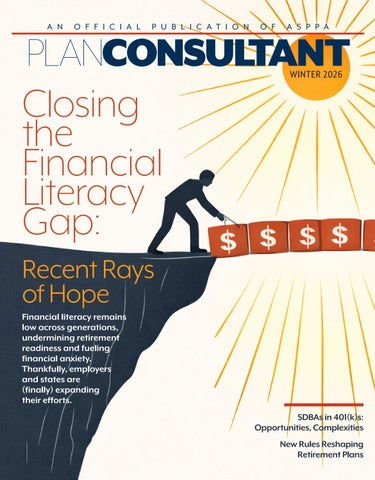
PLANCONSULTANT Closing the Financial Literacy Gap: WINTER 2026
Recent Rays of Hope Financial literacy remains low across generations, undermining retirement readiness and fueling financial anxiety. Thankfully, employers and states are (finally) expanding their efforts. SDBAs in 401(k)s: Opportunities, Complexities New Rules Reshaping Retirement Plans
WEBCASTS
Education On Your Time ON-DEMAND WEBCASTS
01|PLANCONSULTANT WINTER2026
AI Generator / chatgpt.com
INSIDETHISISSUE
18 COVERSTORY
18|CLOSING THE FINANCIAL LITERACY GAP: RECENT RAYS OF HOPE Financial literacy remains low and uneven across generations, undermining retirement readiness and fueling financial anxiety. Thankfully, employers and states are expanding financial education efforts, offering hope for stronger retirement preparedness in the future. By John Iekel
FEATURE 24| FINANCIAL LITERACY WITH MR. 401(K) If the next generation enters the workforce with better money habits and a clearer understanding of ‘own vs. owe,’ every plan we touch will work better. By Petros Koumantaros, QPA CPFA
02|PLANCONSULTANT WINTER2026
ASPPA IN ACTION 08|FROM THE PRESIDENT
Making Waves, Making Progress By Shannon Edwards
11|NEWLY AND RECENTLY CREDENTIALED MEMBERS 54|INSIDE ASPPA
Making Waves in San Diego: 2025 ASPPA Annual Reimagines the Future of Retirement By Krisy Dempewolf & Julie Altig
COLUMNS DOL’s Plot Twist in a Never-Ending Sequel By John Sullivan
48
10|REGULATORY / LEGISLATIVE UPDATE
36|STATE-RUN PLANS
By Brian H. Graff
By John Iekel
TECHNICAL ARTICLES
58|GOVERNMENT AFFAIRS UPDATE
Reining In ERISA Abuse: Protecting Retirement Security Through Litigation Reform
Little States, Big Results: Up Close with the Connecticut and Rhode Island Auto-IRAs
12|ACTUARIAL / DB
Closing Out 2025 with Bipartisan Retirement Policy Wins
By Ellen Kleinstuber, Josh Shapiro, and Ted Goldman
PRACTICE MANAGEMENT ARTICLES
The Corporate Pension Revitalization Initiative: Breathing New Life into Private Sector Retirement Plans
16|REGULATORY
What Plan Professionals Need to Know Now: Jason Bortz on New Rules Reshaping Retirement Plans By Rickie Taylor and Amy Garman
30|RECORDKEEPING
The Complexities and Opportunities of SDBAs in 401(k) Plans
By Josh Oppenheimer
By Travis Jack, CPA, QKA
48|TECHNOLOGY
A Generative Shift: How AI is Redefining SEO for Professional Service Firms By Travis Jack, CPA, QKA
52|WORKING WITH PLAN SPONSORS
How to Legally Handle a Client Who Refuses to Fix a Plan By Brandon Long
Automatic Enrollment: The Pros, Cons, and New Realities After SECURE 2.0
QR Code to Digital Version*
By Theresa Conti, QKA, APR, ERPA, CPFA, and Shannon Edwards, ERPA, CPC, QPA, QKC, QKA
Use your phone to link directly to the Online Version!
42|SECURE ACT
Are Tax Credits Really Benefiting Clients?
34|STATE-RUN PLANS
By Megan Crawford
By John Iekel
Future-Proof: How TPA Firms Can Win the War for Retirement Talent
40|SECURE ACT
By Linda Chadbourne and Chad Johansen
The Big 3 State Auto-IRAs: A Mid-Year Report Card
44|BUSINESS PRACTICES
Wright Studio / Shutterstock.com
06|LETTER FROM THE EDITOR
The trusted, single source of intel and insights every
retirement plan professional needs.
THE FINAL PRINT EDITION
04|CONTRIBUTORS WINTER2026
Plan Consultant is Published by
ALTIG
CHADBOURNE
CONTI
CRAWFORD
DEMPEWOLF
EDWARDS
EDITOR IN CHIEF
Brian H. Graff, Esq., APM
PLAN CONSULTANT COMMITTEE
GARMAN
GOLDMAN
JACK
JOHANSEN
KLEINSTUBER
KOUMANTAROS
Mary Patch, QKA, CPFA, Co-chair; David J. Witz, Co-chair; Lee Bachu; R.L. “Dick” Billings, CPC, ERPA; Gary D. Blachman; Katie Boyer-Maloy; Jason D. Brown; Linda Chadbourne, QKA; Theresa Conti; Megan Crawford; Sara DeFilippo, E.A.; Shannon Edwards, ERPA; John A. Feldt, CPC, QPA; Emily Halbach; Travis Jack; Chad Johansen; Jim Racine; Olivia Schwartz; Rickie Taylor
EDITOR
John Sullivan jsullivan@usaretirement.org
SENIOR WRITERS
Ted Godbout, John Iekel LONG
MURELLO
JOHANSEN
SHAPIRO
TAYLOR
ADVERTISING SALES
Tashawna Rodwell trodwell@usaretirement.org
Julie Altig, QKA, QPC, CPC is Owner/Partner with Atlantic Pension Services, Inc. Linda Chadbourne, CPC, QKA, APR, APA, AKS is Vice President of Client Compliance and Strategic Operations with Definiti. Theresa Conti, QKA, APR, ERPA, CBFA has been involved in the retirement plan industry for more than 35 years, she started her firm Sunwest Pensions in 1998 and sold it to July Business Services in 2023.
Megan Crawford is President of the Crawford Retirement Group.
Krisy Dempewolf, CPC, QPA, QKC, QKA®, TGPC is a Senior Actuarial Consultant with Empower. Shannon M. Edwards, ERPA, QPA, QKC, QKA, is the President of TriStar Pension Consulting. She is a member of the ASPPA Leadership Council and the Plan Consultant Committee.
Amy Garman Amy Garman, QKA® is an
Internal TPA Retirement Plan Counselor with Capital Group. Ted Goldman recently retired from the Pension Benefit Guaranty Corporation as the Director of Policy, Research, and Analysis after many years as a pension consultant. Travis P. Jack is the Managing Member of Metz & Associates, PLLC and oversees the employee benefit plan audit practice. Jack is a member of the Plan Consultant Committee.
Chad Johansen is a Partner and Director of Retirement Plan Sales with Plan Design Consultants, Inc. Ellen Kleinstuber, FCA, FSA, MAAA, EA, FSEA has more than 30 years of experience as a consulting actuary and is the founder of Infinity Actuarial Consulting LLC.
Petros Koumantaros is Managing Partner
with Spectrum Pension Consultants. He is also Daybright Financial’s Managing Partner and Chief Revenue Officer, Private Sector Retirement.
Brandon Long is an attorney with McAfee & Taft.
Jon Murello, FSA, EA, MAAA, CERA is the Lead Actuary with Pittsburgh, Penn.-based Dunbar, Bender & Zapf. Betsy Schaaf, APM is an ERISA Attorney with Definiti, LLC in the Cincinnati area with more than 25 years in the retirement industry. She has worked with TPA firms, bundled providers and as a consultant. She has worked extensively in document drafting and EPCRS. Josh Shapiro is a Senior Actuarial Advisor at Groom Law Group, Chartered focusing on multiemployer, single-employer, and governmental retirement plans.
Rickie Taylor is Vice President of National Accounts with CEP Consultants, Inc.
TECHNICAL REVIEW BOARD
Rose Bethel-Chacko, CPC, QPA, QKA; Marianna Christofil; Michael CohenGreenberg ; Sheri Fitts; Drew Forgrave, MSPA; Grant Halvorsen, CPC, QPA, QKA; Jennifer Lancelot, CPC, QPA, QKA; Robert Richter, APM
COVER
Anton Watman / Shutterstock.com
2025 ASPPA OFFICERS PRESIDENT
JJ McKinney IV, CPC, QPA, QKA
PRESIDENT-ELECT
Shannon M. Edwards, ERPA, QPA, QKC, QKA
VICE PRESIDENT
Manny Marques, CPC. QPA, QPFC, AIF®
IMMEDIATE PAST PRESIDENT Amanda Iverson, APM
Plan Consultant is published quarterly by the American Society of Pension Professionals & Actuaries, 4401 N. Fairfax Dr., Ste 600, Arlington, VA 22203. For subscription information, advertising, and customer service contact ASPPA at the address above or 800.308.6714, customerservice@USAretirement.org. Copyright 2025. All rights reserved. This magazine may not be reproduced in whole or in part without written permission of the publisher. Opinions expressed in signed articles are those of the authors and do not necessarily reflect the official policy of ASPPA.
Expertise That Elevates
ASPPA-NET.ORG/CERTIFICATES-CREDENTIALS/CBS
06|EDITOR’SLETTER WINTER2026
DOL’S PLOT TWIST IN A NEVER-ENDING SEQUEL Another fiduciary rule pendulum swing leaves supporters frustrated, pundits perplexed, and everyone wondering what’s next. By John Sullivan
We once compared attempts to implement the Department of Labor’s (DOL) fiduciary rule to Friday the 13th’s Jason Voorhees, noting it won’t
(and seemingly can’t) die, with introductions, repeals, reintroductions, and lawsuits taking place for almost two decades. In keeping with the horror genre metaphor, an announcement at the beginning of December may have put the proverbial nail in the coffin, but with 12 movies in the Friday franchise, we won’t hold our collective breath. Recognizing the Trump Administration’s fiduciary rule animus, it wasn’t entirely unexpected when the U.S. Court of Appeals for the Fifth Circuit (yes, THAT Fifth Circuit) granted the DOL’s motion to withdraw its appeal of a court challenge to the rule issued during the Biden administration. The always excellent reporting from NAPA’s Ted Godbout noted that the one sentence order from the clerk’s office of the Fifth Circuit simply stated that, “Under Fed. R. App. P.42(B), the appeal is dismissed as of November 28, 2025, pursuant to appellant’s motion.” DOL’s Employee Benefits Security Administration (EBSA) filed a motion withdrawing its appeal on Nov. 24. The motion to dismiss the appeal was unopposed by the other parties. Fiduciary rule supporters were (once again) understandably frustrated, with former DOL Assistant Secretary for Labor Lisa Gomez writing, “This saga has gone on for far too long without resolution, and the continued
uncertainty doesn't help anyone. The amount of work that went into each of the exercises in the rulemaking process is extraordinary. The Department says it is going to take another swing at it. I am interested to see what they will do, but rule or no rule; we need to work together to find a solution that everyone can accept and move on with. Retirement investors and the people who serve them deserve no less.” As background, the Biden administration finalized the Retirement Security Rule, a new investment advice fiduciary rule, in April 2024. The focus of the rule was to extend ERISA fiduciary duties to one-time professional retirement investment recommendations, such as rollovers, annuity purchases, or plan menu design. Godbout noted that it was set to go into effect in September 2024, but its implementation was put on hold as a result of a lawsuit filed by the Federation of Americans for Consumer Choice (FACC), as well as James Holloway, James Johnson, TX Titan Group, ProVision Brokerage, and V. Eric Couch. A second suit was also filed in a Texas federal court (Am. Council of Life Insurers v. DOL, N.D. Tex., No. 24-00482, 5/24/24), but by different plaintiffs, albeit arguing similar issues against the Labor Department’s Retirement Security Rule — led by the American Council of Life Insurers (ACLI). After the district courts stayed the rule, the DOL, under the Biden administration, appealed the decision to the Fifth Circuit in September 2024. The suits, which were consolidated, sought to vacate the 2024 fiduciary rule and amendment to PTE-84-24 under the Administrative Procedures Act (APA) on the grounds that they are “contrary to law and arbitrary and capricious.” They also sought “preliminary and permanent injunctive relief to prevent the DOL from attempting to enforce these unlawful rules and regulations.” Meanwhile, Godbout added, the DOL’s Spring 2025 regulatory agenda indicated that the Trump administration plans to issue a new final rule on the issue by May 2026, but what it will look like is anyone’s guess, since the agenda did not provide substantive details on what the new rule might change. However, it did say that it “will ensure that the regulation is based on the best reading of the statute,” and is responsive to an executive order calling on departments to deregulate. As always, we’ll keep you posted. PC
John Sullivan Editor-in-Chief
Follow the Discussion…
@ASPPA
groups/796907
@ASPPA1
Elevate Your Potential This Fall
ASPPA-NET.ORG/CERTIFICATES-CREDENTIALS/QKC
08|PRESIDENT’SLETTER WINTER2026
MAKING WAVES, MAKING PROGRESS Here’s to a year of education, advocacy, community, and meaningful progress. Here’s to making waves and making a difference. By Shannon Edwards
As I step into the role of ASPPA President for 2026, my heart is absolutely overflowing with gratitude, excitement, and a profound sense of responsibility. I’ve spent many years volunteering for ASPPA — from
committees and councils to task forces and conference planning — and every step of that journey has led to this incredible opportunity to serve. ASPPA is home. It is where I grew up in this profession, where I built lifelong friendships, and where I learned that the work we do truly changes lives. Because that’s what this industry does, and every plan we design, every test we run, every correction we navigate, every participant we educate, each of these moments helps a hardworking American retire with dignity. That mission matters more today than ever. If you joined us in October, you know ASPPA Annual 2025 in San Diego was one for the history books. Our Yacht Rock theme set the tone, but you made the waves. We had a record-breaking 300+ first-time attendees (a milestone that still makes me smile), and an extraordinary energy that reminded all of us why ASPPA is so special. Just as our industry is transforming, so is ASPPA. I am thrilled to share that the ERISA Outline Book, the resource many of us call our “industry bible”, has undergone a complete modernization. It is now faster to search, more streamlined, and more intuitive than ever before. Simply put, it is the industry’s superior research tool. If you haven’t explored the new format yet, prepare to be impressed. We all know the growth of pooled employer plans and multiple employer plans is changing the landscape. To meet that need, ASPPA is launching a brand-new education program that will culminate in a new designation, the Qualified Pooled Plan Professional (QP3). This program will focus on specialized design, governance, operations, and compliance elements unique to PEPs and MEPs. New educational content is already being developed, and we will proudly introduce the designation at ASPPA Annual 2026 in San Antonio. This is the kind of innovation that keeps our organization relevant, forward-looking, and ready for what’s next. Our industry looks very different from what it did even five years ago, and it continues to change rapidly daily. Consolidation has reshaped the TPA landscape. Technology is advancing at unimaginable rates, making it necessary for everyone to be aware of the new options becoming available. At the same time, micro-plan formation is exploding thanks to new tax credits and state mandates. Depending on whose projections you follow, we may see 400,000 to 500,000 new retirement plans created in the coming years. That growth will require something essential: more trained, passionate professionals entering our field early in their careers. This is one of the most important challenges and opportunities facing us today. ASPPA will continue investing in education, credentials, and outreach to ensure our profession has the talent it needs to thrive. I am truly honored to serve as your ASPPA President this year. I promise to: •C hampion the private retirement system • S upport our members with meaningful education and resources • Advocate fiercely in Washington through the ARA and the PAC • Welcome new professionals into our community •C elebrate your work, your service, and the lives you impact every single day
Our mission is too important to take lightly, and our momentum is too strong to slow down now. If you take one thing from this letter, let it be this: ASPPA needs you. Not someday. Not eventually. Now. Say yes when asked to volunteer. Say yes when asked to provide feedback or ideas. Say yes when asked to join a committee. Every voice strengthens our community. Every member makes us more powerful. And together, we can ensure that every American has the opportunity to retire with dignity. As we look toward the year ahead, toward new designations, new legislative challenges, new professionals entering the field, and a new ASPPA Annual in San Antonio, I am filled with optimism. The ASPPA Nation is strong and will continue to grow and become stronger. ASPPA has always been more than an organization. It is a movement. A community. A family. And I am immensely proud to serve as your President. Here’s to a year of education, advocacy, community, and meaningful progress. Here’s to making waves and making a difference. PC
Success Starts Here
®
ASPPA-NET.ORG/CERTIFICATES-CREDENTIALS/QKS
10|REGULATORYLEGISLATIVEUPDATE WINTER2026
REINING IN ERISA ABUSE: PROTECTING RETIREMENT SECURITY THROUGH LITIGATION REFORM Thoughtful reform can preserve participants’ rights while reducing abusive litigation practices that impose unnecessary burdens on compliant fiduciaries. By Brian H. Graff
The American Retirement Association (ARA) supports ERISA litigation reform, believing a flood of “cookie-cutter” lawsuits brought by the
plaintiffs’ bar in recent years is detrimental to plan participants, sponsors, and the country’s private retirement plan system overall. I want to inform ARA members of recent developments and the association’s involvement in the efforts. In mid-November, Rep. Randy Fine (R-Fla.) introduced the ERISA Litigation Reform Act (H.R. 6084), legislation that would strengthen the pleading standards for lawsuits brought under the Employee Retirement Income Security Act (ERISA). The bill seeks to ensure that retirement plan fiduciaries, employers, and participants “operate under a more predictable, fair, and efficient legal framework,” according to the Congressman. If enacted, H.R. 6084 would clarify the burden of proof in certain fiduciary-related claims and establish a targeted stay of discovery during the early stages of litigation. The targeted stay would bring ERISA more in line with established federal court practices designed to deter frivolous lawsuits. Coincidentally, strengthening the pleading standards for lawsuits brought under ERISA was one of two recommendations (limiting premature discovery being the other) included in ARA’s statement for the record submitted to a House Education and the Workforce Subcommittee before a hearing in early December. Titled “Pension Predators: Stopping Class Action Abuse Against Workers’ Retirement,” the hearing examined the surge in formulaic ERISA class action litigation and its chilling effect on innovation across the retirement plan landscape. In addition to our legislative advocacy, we’ve actively engaged in regulatory initiatives aimed at addressing ERISA litigation challenges. Our regulatory efforts focus on supporting the Department of Labor (DOL) in providing clear, practical guidance to fiduciaries, particularly as case law continues to evolve. For example, the DOL’s tip sheet on target date funds has proven to be a durable, widely used resource for both fiduciaries and courts. Recent case law has emphasized the importance of comparing plan funds against reasonably available, comparable alternatives or meaningful benchmarks. We believe the DOL could further assist fiduciaries by providing guidance like the TDF tip sheet that clarifies what constitutes a comparable alternative or a meaningful benchmark. Such guidance would offer greater certainty, reduce ambiguity in decisionmaking, and support courts in evaluating plaintiffs’ comparisons, thereby helping to limit repetitive, “cookie-cutter” lawsuits that do not serve participants’ best interests. Additionally, the DOL’s ability to submit position statements or amicus briefs in significant ERISA litigation reinforces consistent legal standards. We commend the DOL’s recent submission of an amicus brief in Hutchins v. Hewlett-Packard, a notable ERISA forfeiture case. Expanding this type of engagement would further deter frivolous lawsuits by promoting judicial clarity and reinforcing the principles that protect both plan sponsors and participants. It goes without saying that litigation remains essential for addressing genuine fiduciary failures. Yet, the volume, copy-and-paste nature, and inconsistent
Brian H. Graff, Esq., APM, is the Executive Director of ASPPA and the CEO of the American Retirement Association.
standards in recent cases have led plan sponsors to avoid beneficial optional features simply to reduce litigation exposure. Simply put, without reform, the current trajectory threatens to impose increasing costs on retirement plan sponsors, discourage employers from offering or maintaining plans, and ultimately diminish retirement security for American workers. The chilling effect on innovation will only intensify as sponsors become more risk-averse in the face of unpredictable litigation exposure. Thoughtful reform can preserve participants’ rights while reducing abusive litigation practices that impose unnecessary burdens on compliant fiduciaries and divert resources that could otherwise enhance retirement outcomes. ARA’s Government Affairs Committee will continue to monitor the issue, engage with legislators and regulators on your behalf, and provide updates as events unfold. PC
WELCOME NEW & RECENTLY CREDENTIALED MEMBERS! Brianna Lee-Grandstaff
Ashley Fairchild
Melissa Wetzel
Christian Llerena
Neenah Favela
Ashlee Wochholz
Claudia McPherson
Matthew Fritz
Leaha Zakowski
Mary Miller
Shivraj Garmode
Susan Phengnoi
Alexis Glessner
Shannon Potter
Isaiah Hedberg
Champawattie Ramgopal
Logan Hietpas
Joseph Rich
Kimberly Johnson
Evan Richard
Heidi Kelley
Ronda Robertson
Sarah Kotula
Benjamin Siegel
Emily Kralles
Chase Smith
Brianna Krejci
Patrick Spieler
Andrew Krumbholz
Margaret Tieber
Kurt Larsen
Brandon Tomson
Jesse Lubow
Jonathan Treadway
Navada Lujan
Joy Vieng
Jessica Martinez
Michael Thomas
Geoffrey White
Elijah Martinez
QPA™
QKA®
CBS® Jill Casey Tina Coleman Krissie England Megan Gunderson Scott Hannan Joni Harmon Jason Krech Christian Llerena Joel Moskowitz Terry Murphy Heather Nicassio Jak Ninyo Autumn Robson Karis Schwent Kristin Smevold David Thayer
Kimberly Benjamin Michael Carr Linda Kasen Misty Partello Bradley Pitawanakwat Alex Smith
QKC® Nathan Alexander Tristan Barton Jacob Bourgeois Donita Brown Lisa Brown Justin Cottrell Kareen Dunn Nickle Logan Goldsby Ellen Heine Rachel Karp
Jessica McAdam Brittany Aldridge Carolyn Altig Crystal Amendola Karla Auxier Daniel Basso Jessica Blasczyk Susan Boucher William Brandimarte Courtney Campbell Eric Cortes Elisabeth Darnall Rosalyn Davis Genava Deckert Christopher Dewsnap Brooke Dutton Ferrecia Edwards Joseph Ekizian Michele Equale Jessicia Erfurt
Cole McCulley Alecia Mellor Maegan Miles Ryan Murphy Dominic Ninh Festus Obioha Ashley Pantoja Brandi Parker Steven Peranio Susan Phengnoi Thomas Price Eric Ray Aleah Reedy Sienna Sakich Heather Semenyuk Larry Shaub Troy Takeshita Larissa Todd Atiya Vickerman Amanda Webb
QKS® David Baer Kelley Ballas Julia Capo Akeil Davis Mason Dickerson Vanessa Doobay Jared Ferrell Nathan Filip Bernard Gmitter Kaitlynn Greenawalt Taylor Harman Babs Harmon Shayanne Howe Paula Iannello Tina Jordan Alex Juneau Christian Llerena Allison McGlynn Steve McNeill Ashley Mello Mike Newhart Renee Nolen James Owens Matt Pfaendler James Ruckman Greg Sanders Marlene Schaefer Amy Thomas Karis VanderMolen Thomas Wilke Justin Wood
12|ACTUARIAL / DB WINTER2026
THE CORPORATE PENSION REVITALIZATION INITIATIVE: BREATHING NEW LIFE INTO PRIVATE SECTOR RETIREMENT PLANS By combining the best elements of defined benefit and individual savings plans, this new approach can transform retirement security outcomes. By Ellen Kleinstuber, Josh Shapiro, and Ted Goldman
Over the past several decades, the decline of traditional defined benefit (DB) pension plans
has been well established, as fewer private-sector employers are willing to assume the long-term funding obligations inherent in these plans.draw’ funds from the plan’s assets without implication. In their place, retirement savings accounts like 401(k) plans and individual retirement accounts (IRAs) shifted the responsibility for retirement planning almost entirely onto individuals. Without adequate professional guidance, millions of individuals are left to their own devices in determining how much to save, how to invest over time, and how to draw down their savings in retirement. This complex set of decisions demands financial literacy, time, and resources that many workers simply don’t possess. Even for those with high levels of financial literacy who make sound choices, factors such as market volatility, changing interest rates, changes in health and employment status, and uncertain life expectancies make it impossible to determine the exact strategy that optimizes the desired amount of income during retirement. While 401(k) and IRAs have increased access, flexibility, and financial well-being for some, they also have fundamental structural shortcomings. Neither the traditional DB nor the 401(k)/IRA retirement savings account model provides an adequate solution to retirement security. Recognizing this reality, a group of leaders in the retirement community formed the Corporate Pension Revitalization (CPR) Council, an independent coalition dedicated to reimagining private retirement plans. The Council brings together approximately 20 experts from diverse backgrounds, including consulting actuaries, attorneys, employers, industry and policy organizations, and former government officials. Collectively, this group
has a deep understanding of the interplay between policy, finance, regulation, and participant behavior that defines the retirement system. The Council’s mission is to develop a new retirement plan structure that restores the promise of lifetime income while helping workers accumulate savings tailored to their personal needs and goals. The objective is ambitious yet practical: to make a real difference in retirement security by offering a scalable, implementable solution that employers, workers, and policymakers alike can support.
OUR APPROACH
The Council began by examining retirement models worldwide, analyzing demographic and economic trends, and identifying gaps in current benefit offerings. This research led to a set of core principles for a new retirement design. Primary Objectives • Lifetime Income: Stable payments for life for retirees and surviving spouses, with flexibility to accommodate individual needs. • No Unfunded Liabilities: Thoughtful funding and transparent benefit variability to avoid the possibility of funding shortfalls and withdrawal liabilities. Essential Elements • Simplicity: Plans must be sufficiently easy for employees to understand and for employers to implement. • Professionally and Collectively Managed Assets: Asset pooling and professional oversight minimize risk for both employers and employees. • Minimized Fiduciary Liability for Employers: Reduced fiduciary and tax qualification risks for employers while continuing to protect participants. • Pooling of Risks: Investment, demographic, and inflation risks are shared among participants, offering protection from devastating individual risks.
13|ACTUARIAL / DB
Puttachat Kumkrong / Shutterstock.com
WINTER2026
• Shared Responsibility: Employer contributions are fixed percentages of pay, with optional employee contributions and employer matches. Other Priorities • Flexible Sponsorship Model: Allows for both single and multiple employer plans, without a common nexus requirement. • Portability: Employees can easily track benefits from different employers, without any penalties for changing jobs. • Incentives: Maintains current tax benefits for both employer and employee contributions. These pillars combine actuarial principles, behavioral insights, and practical public policy to guide the Council’s design process. Achieving the best solution will involve balancing conflicting goals and making compromises. The Council is actively seeking input from a broad range of stakeholders, including employers, employees, plan administrators, investment professionals, and policymakers, to refine our model plan.
THE MODEL: A NEW RETIREMENT ARCHITECTURE
The Council’s proposed model features two complementary components, one that generates a lifetime income stream and one that encourages informed personal savings.
Our model incorporates elements from variable benefit plans and collective defined contribution structures used in the U.S. and internationally, tailoring them to U.S. workforce needs and cultural and regulatory contexts. It also builds on the success of savings defaults, such as automatic enrollment and escalation.
Lifetime Income
This component provides retirees with a steady income stream that is funded by employer contributions structured as a fixed percentage of compensation. It is designed to deliver lifetime payments without creating unfunded liabilities. Participants receive a monthly base payment plus annual adjustments (“dividends” in strong years, modest reductions in lean years) based on plan performance. The majority of employer contributions fund the base benefit, with the remainder supporting dividends and serving as a buffer against market downturns. Experience is gradually shared with participants, and the plan’s self-correcting mechanism ensures benefits remain sustainable and fullyfunded over time. If the plan is moderately overfunded, non-retired participants receive increases to their benefits that reflect a portion of the overfunding, and retired participants receive one-time dividend payments. If the plan becomes significantly
14|ACTUARIAL / DB WINTER2026
overfunded, all participants receive increases to their base benefits that fully reflect the excess funding. Similarly, moderate underfunding results in a partial sharing of the shortfall in the form of benefit reductions, and significant underfunding results in benefit decreases that fully reflect the funding gap. If base benefits have been reduced for retirees, any gains are used first to prospectively restore base benefits before dividend payments resume. The specific experience-sharing thresholds will be informed by financial modeling that is currently underway. There will be enough conservatism incorporated into the benefit levels and funding thresholds to ensure that positive adjustments are far more common than negative adjustments, and the likelihood of substantial benefit reductions is extremely low. Participants are fully vested from the start and can begin receiving benefits between age 50 and the required minimum distribution age, including taking in-service distributions after age 50.
knowing they can access savings to meet financial challenges along the way, while taking advantage of the benefits of employer matching contributions. • The flexibility to access retirement benefits independent of their lifetime income benefits. • Distribution options that allow participants to convert savings into additional lifetime income benefits (using in-plan pricing) or choose from flexible drawdown options, including a lump sum and installment payments from the savings account that adjust based on future experience. This new model combines the efficient delivery of lifetime income, the hallmark of a DB plan, with the flexibility of a 401(k) plan under one umbrella. Together, these two components form a comprehensive retirement model that combines long-term security with short-term resilience to help employees achieve their retirement security goals.
The Personal Savings Account
This new approach offers a cost-effective, practical option for organizations unable or unwilling to assume the financial and fiduciary risks of providing lifetime income through a traditional DB pension plan. Contributions that fund lifetime income are predictable and fixed, with no exposure to unfunded liabilities or PBGC premium costs. Employers can opt for a multiple-employer framework that shifts fiduciary risk to professional plan managers. In addition, employers have a stronger tool than the current 401(k) plan to attract and retain talent. For employees, it restores confidence in a reliable, lifelong paycheck. Benefits are clear, professionally managed, and portable. Participants gain the peace of mind of a lifetime income stream while retaining the ability to add to or withdraw from personal savings when needed. The plan also offers built-in financial education and behavioral nudges to boost savings outcomes.
The individual savings component of the model plan takes a holistic approach to educating individuals about the savings needed to meet their goals. The key to the personal savings component is the use of “smart defaults” that tailor a participant’s savings journey to their individual circumstances and retirement goals. Automatic enrollment at a Personal Contribution Rate, using estimates of Social Security, projected lifetime income benefits, and default assumptions (e.g., investment returns and other economic factors, marital status, retirement age, standard of living, etc.) guides participants toward optimal savings behavior. Individuals can adjust and supplement the plan’s smart defaults used for the Personal Contribution Rate calculation. The Personal Contribution Rate adjusts annually based on progress toward the defined goals. Participants may opt out of annual updates or select an alternative savings rate at any time. This individualized and responsive approach to savings serves as a powerful educational tool to guide individuals toward reaching their savings goals and understanding the impact of financial decisions (such as reducing their savings rate or accumulating debt) on long-term savings. The savings account design includes a variety of features to support participants in their savings journey, including: • Pooled, professionally managed investment funds where participants give guidance on their risk tolerance or investment goals. • Early access to a portion of the Personal Savings Account to help manage unexpected expenses and fund large expenditures, such as the purchase of a new home. This encourages individuals to save for retirement,
WHY IT WORKS FOR EMPLOYERS AND EMPLOYEES
PATH TO IMPLEMENTATION
Launching a new retirement model of this scale will require legislative and regulatory support. The Council has prioritized working within existing legal frameworks to facilitate adoption and is building stakeholder consensus to encourage action by lawmakers and regulators. Our proposal is a pragmatic blueprint for “breathing new life” into private sector retirement plans and improving retirement security in America. By combining the best elements of DB and individual savings plans with innovative “smart defaults”, responsible funding, professional plan management and fiduciary oversight, and clear communication, this new approach can transform retirement security outcomes. PC
Join the QKA® Class of 2026 this Spring QKA-� Classroom starts 2/�7/26 QKA-� Classroom starts 2/�9/26
16|REGULATORYISSUES WINTER2026
WHAT PLAN PROFESSIONALS NEED TO KNOW NOW: JASON BORTZ ON NEW RULES RESHAPING RETIREMENT PLANS Jason Bortz, Legal Counsel for Capital Group, fields frequent TPA questions about the legislative environment and its implications for our businesses and clients. By Rickie Taylor and Amy Garman
Retirement plan sponsors and advisors are navigating a rapidly evolving landscape shaped
by recent legislative and regulatory developments. With SECURE 2.0 ushering in significant changes and further proposals on the horizon, it’s essential to stay informed about the rules and trends that will impact retirement plans in the coming years. We sat down with Jason Bortz, Legal Counsel for Capital Group, to discuss frequent TPA questions about the legislative environment and its implications for our businesses and clients. Plan Consultant Magazine: What are the significant SECURE 2.0 rules coming into effect in 2026 and 2027 that we should be aware of when speaking with plan sponsors? Jason Bortz: The big new rule coming into effect in 2026 is mandatory Roth catch-up for highly paid individuals (employees who earned more than $150,000 in 2025). This provision was the primary revenue raiser that paid for SECURE 2.0. It’s a very complicated provision to implement because it requires extensive coordination between employers, payroll providers, TPAs, and recordkeepers. Thankfully, the IRS has issued rules that lay out fairly flexible correction procedures and provided a good-faith compliance standard for 2026. But I wouldn’t be surprised if it’s a somewhat chaotic rollout. The other upcoming change I think is worth watching is the new Saver’s Match, scheduled to go into effect in 2027. It will create a government-matching contribution for rankand-file employees who contribute to a plan or an IRA. It’s a very expensive provision, and I was worried that it would be repealed as part of the Big Beautiful Bill. But happily, Congress chose to keep the Saver’s Match. There’s a lot of work going on to figure out how Treasury is going to get the matching contributions into defined contribution (DC) plan accounts and IRAs. It’s a big lift.
PCM: Is there a SECURE 3.0 on the horizon, and if so, what regulations might it include? JB: On the very distant horizon. It will be some time before Congress seriously considers another retirement bill. But there is work being done to start pulling the cornerstones of a future package together. Three broad topics come to mind. First, something needs to be done to get gig workers into the system. Independent contractors tend not to have access to a payroll-based savings program, and this is a big part of the coverage gap. Second, there’s widespread dissatisfaction with plan-to-plan rollovers. It takes way too long and is far too complicated to roll from one plan to another plan, and there’s a perception that this is a factor in why so many rollovers are to IRAs. Third, there’s interest in revisiting automatic enrollment and, in particular, automatic escalation. When an employee changes jobs, they typically reset to the initial automatic enrollment rate, even if they had been escalated to a higher rate at their former employer. But again, it’s going to be some time before we see movement on SECURE 3.0. PCM: Could you explain how the recent legislation, “The Big Beautiful Bill”, impacts qualified retirement plans? JB: The Big Beautiful Bill doesn’t impact qualified retirement plans, and that’s good news. The tax incentives for qualified retirement plans are among the largest tax preferences. And there was a very real risk that Congress would try to reduce the cost of the legislation by changing those incentives. But that’s not what happened, and it’s a testament to the success and popularity of the employer-provided retirement system that Congress chose to leave the system alone. PCM: Can you provide insights into the executive order that permits alternative investments in 401(k) and other defined-contribution retirement plans? On a related note,
17|REGULATORYISSUES
Anton Vierietin / Shutterstock.com
WINTER2026
what should advisors discuss or caution their clients about when it comes to investing in alternative investments? JB: Defined benefit plans have invested in alternative assets like private equity and private credit for decades, often with meaningful allocations. DC plans may invest in these assets, but adoption has been low due to liquidity concerns, complex structures and fees, and the litigation risk that can arise from these factors. Also contributing to the lack of private market DC options is a limited product set of professionally managed solutions, such as target date funds (TDFs) that include private market allocations. Private market assets have the potential to enhance investment returns and provide diversification benefits to participants. Only 15% of all U.S. companies with revenues in excess of $100 million per year are publicly held, so there’s a large swath of the investable universe that isn’t easily accessible to DC plan participants today. The president’s executive order instructs the Department of
Labor and SEC to eliminate barriers to including private assets (as well as other alternative assets like digital currencies) in DC plans. To be clear, you shouldn’t expect to see, for example, a private equity option on a DC plan menu. Instead, the idea is to make it easier for plans to offer target date funds and managed accounts that include a modest allocation (e.g., 0-15% along a TDF glidepath) to private assets. To this end, the Department of Labor is working on a proposed regulation that would create a fiduciary safe harbor to help plan fiduciaries evaluate the unique considerations associated with private assets (liquidity, valuation, and feefor-value) and provide comfort against the risk of litigation. Rulemaking, however, takes a while, so it will likely be 12-18 months before we see a final rule. So, it’s early innings on alternative assets in DC plans. We’re starting to see new target date funds and managed account offerings with private asset exposure come to market. I would encourage plan advisors to stay abreast of marketplace developments – it’s a fast-evolving space. PC
18|COVERSTORY WINTER2026
Closing the Financial Literacy Gap: AI Generator / chatgpt.com
Recent Rays of Hope
19|COVERSTORY WINTER2026
Financial literacy remains low and uneven across generations, undermining retirement readiness and fueling financial anxiety. Thankfully, employers and states are expanding financial education efforts, offering hope for stronger retirement preparedness in the future. BY JOHN IEKEL
20|COVERSTORY WINTER2026
K
nowledge is power, it is said. It certainly is central to retirement readiness, but there has been much discussion of troubling gaps in understanding what it takes to build a financially secure retirement. But there’s good news! Widespread steps are underway to fill those gaps — and they are rays of hope for retirement plans as well as current and future participants.
GLASS HALF FULL OR HALF EMPTY?
Literally both. In the 9th Annual Personal Finance Index, which TIAA prepared in 2025, adults in the study answered almost half of the financial literacy questions correctly — 49%. It was the third consecutive year in which they got almost 50% correct. FINRA reported similar findings from its 2024 Investor Survey. They said that, on average, 2,861 respondents answered 5.3 of 11 questions correctly about investing.
LOOK CLOSE
Averages are informative and useful because they show overall trends, but they only tell part of the story — drilling down provides more focused data that can help pinpoint actions to address a problem. For instance, TIAA found in its 2025 study that while the level of financial literacy among respondents who belong to the Baby Boom generation stood at 55% — not at all impressive, but at least above the 50% level — that was 17 percentage points higher than the level evinced by members of Gen Z. These results suggest two things: 1. The need to boost knowledge is urgent among older employees, since they are the closest to retirement age. 2. It’s crucial to boost the knowledge of the members of the younger generation, since many of them lack a good grasp
of financial matters, and the sooner they collectively show increased knowledge, the better — in part because that suggests better prospects for effective retirement saving. TIAA also found sharp gaps between those who have a very low level of financial literacy, which they define as 25% or fewer answers correct, and those with a very high level, defined as 75% or more answers correct. They found that those with very low financial literacy were (1) twice as likely to be constrained by debt as those with very high financial literacy, and (2) five times more likely to be unsure whether they have sufficient savings to cover one month of living expenses. An example. In a presentation at the 2025 National Tax-deferred Savings Association conference, Dr. Randy Mahlerwein illustrated the need for greater financial literacy — at least regarding retirement savings — in a particular segment of the economy. Mahlerwein serves as Assistant Superintendent of the largest school district in Arizona — Mesa Public Schools — and has served in the education system in a variety of capacities. He offered his insights and expertise in reaching those who have not prepared for retirement in the education community. Mahlerwein said that the publicschool administrators with whom he has worked and studied have no understanding of inflation or the future value of the dollar. They may know how they want to live in the future, he said, but have “zero understanding” of what it will cost to do so.
Teachers and school administrators need help quantifying financial goals, Mahlerwein said, and need to know how to assign a dollar amount to broader objectives. And they need to know the basics about 403(b) and 457(b) plans, he added. Why? Why is there a dearth of financial literacy for many? Mahlerwein suggested a notion applicable not only to teachers but also to others, such as caregivers. It is this — activities on behalf of others sometimes leave one too busy thinking about others to take care of oneself. And that includes taking care of oneself financially in the short term and the long run. Mahlerwein offered attendees a look at what he learned from his discussions with two school principals in particular. A 42-year-old principal with children between the ages of 4 and 11 told him that he had saved nothing for retirement due to: · lack of understanding. · fear of the unknown. · a feeling of intimidation. · lack of trust in financial professionals; and · a sense that life is paycheck-topaycheck. A 62-year-old principal with five children between the ages of 20 and 27 told him that nothing had been invested, and he had the feeling that he couldn’t stop working. The reasons for this include: · ignorance of access to means to save for retirement. · a feeling that the ability to retire is unattainable. · making family stability the top priority, leaving little margin for long-term investments; and
21|COVERSTORY
AI Generator / chatgpt.com
WINTER2026
· already allocating money to church and faith-related commitments. Money dysmorphia. Credit Karma has cited another factor underlying financial illiteracy. It says that late in 2023, a phenomenon called “money dysmorphia” — a condition in which an individual feels insecure about their financial condition regardless of how things really may stand — became more pronounced. This, they say, adds to the weight of statistics showing lower levels of financial literacy among younger generations. Credit Karma says that money dysmorphia is having an especially significant impact on them; they cite a study that Qualtrics conducted on their behalf, which found that 41% of millennials and 43% of Gen Z experience the condition. Further, they found that 48% of Gen Z and 59% of millennials reported feeling financially behind. Not just the young. Gloom is not reserved only for younger generations. In the March 2024 study “Retirement Planning & Health Care Costs,” eHealth and Retirable report that most respondents don’t think their money will last through retirement. More than 70% of those who have not retired expect to outlive their retirement savings. And there is pessimism even among those
who have already retired — just over 40% think their savings will be depleted during their retirement. Not only that, say eHealth and Retireable, while just over half of the people in their study said they are satisfied with their current financial situation, a mere 17% are very satisfied. Similarly, SoFi at Work found in its research that 45% of the employees it studied feel stress about having insufficient retirement savings.
THE TO-DO LIST
What can and should be done to increase financial literacy (and in the process, retirement readiness)? “It starts with acknowledging that employees’ retirement contributions don’t exist in a silo and seeing their personal finances holistically — from the burden of student loan repayment to building an emergency fund,” argues Harlyn Croland, Head of Business Operations & Strategy, at Betterment at Work. Education is key. Educational initiatives (such as workshops, seminars, and online resources) “will have a meaningful impact on their employees’ financial literacy,” says Croland, since it can put them on a path “toward better understanding of investing concepts as well as informed decisions of retirement planning.” Paul Daneshrad, Founder & CEO of the investment and real estate firm
StarPoint Properties, has expressed a similar sentiment, asserting that employers and administrators need to devote more time and attention to financial literacy. Further, he says, “Employers should require all employees to take a financial education and planning course. This course should be mandatory and taken every three years.” Start Young. It is not enough to reach people when they are employees, Daneshrad argues. “It actually should start early, in high school, and be reinforced at all levels as people age,” he says. “Start very young, high school or earlier,” Daneshrad advocates. “Have it start within the family and be taught and emphasized by the family: parents and grandparents. Reinforced in school by teachers, and a specialist comes in once a year to educate in more depth. Every child should have a retirement account set up by the time they are 18,” he continues. That education entails more than seminars, online instruction for employees, and conferences for professionals and plan administrators. An increasing number of states are not content to limit that to people who can vote. In the States. An increasing number of states are expanding their conception of literacy to incorporate personal finances, and part of that
22|COVERSTORY WINTER2026
is not limiting education concerning retirement readiness to only people old enough to vote. That, in turn, will help lay the groundwork for young people now to prepare for a financially secure retirement. Financial literacy classes are intended to inculcate skills meant to last a lifetime. The Virginia Department of Education, for instance, in discussing its economics and personal finance education programs, says, “Instruction in economics and personal finance prepares students to function effectively as consumers, savers, investors, entrepreneurs, and active citizens.” Officials also see such programs as investments in the future — and not just for students, but also for communities and society at large. In her message in the revised Wisconsin Standards for Personal Financial Literacy, Wisconsin State Superintendent of Education Carolyn Stanford Taylor wrote, “The personal financial literacy skills and knowledge learned in Wisconsin schools support all students in becoming college and career-ready. Wisconsin communities are made stronger through these positive results for students.” More than half the states have enacted requirements that high school students take a class that includes instruction in some form of financial literacy. The first state to require high schools to put that in their curricula was Utah in 2008. The year after, Virginia enacted a measure setting personal finance requirements for high school graduates; it went into effect for the class of 2015. Alabama was another early adopter; its requirement that students receive financial literacy instruction took effect in the 2013-2014 school year. Tennessee established its in 2013; Missouri did so in 2017. Twenty-two sister states have joined those first five and either have such
requirements in place now or will within the next five years. Reach of the mandate. Most states with financial literacy requirements explicitly require public schools to implement curricula to impart that knowledge. Some, like Nebraska, are explicit in saying that. Ohio, however, is not; rather, it implies that students in private and charter schools are not required to take financial literacy classes. Others, however — like Indiana — require that students in both public and private schools receive education in financial matters. The states also vary regarding the age levels they target in the financial literacy classes. Mississippi’s financial literacy classes, for instance, are part of the College and Career Readiness course. Florida, however, is not content to limit such instruction to only high school students; it starts with kindergarten. Credit where credit is due. The amount of credit students earn for taking financial literacy-related classes varies. Some states mandate how much credit a student earns taking the required coursework, but Minnesota leaves it up to the individual school districts to determine that, calling it “a locally determined decision” and giving them the flexibility to consider “local factors” such as trimester vs semester scheduling, block schedules, and virtual instruction. In Connecticut, Florida, Georgia, Iowa, Kansas, Kentucky, Michigan, Missouri, Ohio, Oregon, South Carolina, Tennessee, West Virginia, and Wisconsin, students will satisfy the financial literacy requirement with a half-semester class. Curricula. There is no uniform curriculum across the states that requires students to take financial literacy classes. Rather, like the variations that distinguish each state, their systems have nuances unique to
them and the way officials determine it best to instruct their students. Rhode Island is flexible. It makes financial literacy proficiency a graduation requirement, but it also affords students a variety of ways to demonstrate it. Florida gives school systems, schools, and teachers considerable latitude in the materials they provide and use with students. These include text or narration, visuals, assignments, and assessments that are provided via print, audio, or visual media; CDs; DVDs; PowerPoint presentations; or software adaptable for interactive whiteboards. But no state is as creative as Alabama in giving the subject matter some extra zhuzh. One of the tools it uses to provide financial education to students is Financial Football, a football-themed game developed by the state Treasurer’s office, Visa Inc., the National Football League, and Regions Bank. And Minnesota means business. The Land of 1,000 Lakes is not content to leave financial instruction to just anyone. A teacher of a personal finance course must have a field license or out-of-field permission in agricultural education, business, family and consumer science, social studies, or math. What’s in the Curriculum? It depends on which state one is in. Here’s a sample. Alabama: managing finances and budgeting, saving and investing, banking and financial institutions, credit and debt, and risk management and insurance. Florida: saving, investing, filing taxes, loan applications, contracts, money management, opening bank accounts, computing interest, insurance policies, and budgeting. Kentucky: saving, budgeting, investing, insurance, risk management, taxes, debt management, and credit.
23|COVERSTORY WINTER2026
Mississippi: how to pay for college, choosing a career, setting financial goals, controlling and managing credit and debt, and building wealth. North Carolina: the true cost of credit, choosing and managing a credit card, home mortgages, credit scores, credit reports, and borrowing money. Virginia: personal finance and economics. Wisconsin: money management, credit and debt, risk management, insurance, financial mindset, employment, saving, and investing. Looking ahead. A majority of the states may have financial education requirements in place, but not all have kicked in just yet. In 14 of those, that will take place in the next five years. SoFi at Work suggests that employees are receptive to efforts to increase their financial literacy. A survey conducted by CITE Research of 750 human resources leaders and 750 full-time employees found that respondents expressed a “tremendous opportunity for employers to offer financial education” to employees. And the chances that their employees will take advantage of that are increasing, SoFi adds. They report that employees' interest in increasing financial literacy was twice that in their previous study. T. Rowe Price, too, has found strong employee support for education. In their “Reference Point” report on participants’ behavior and attitudes regarding retirement plans in 2023, they say that participants’ engagement with educational resources on investing surpassed their engagement with any other topic. They add that participants’ interest in financial wellness content also grew in 2023. PC
AI Generator / chatgpt.com
PROSPECTS FOR SUCCESS
%
AI Generator / chatgpt.com
24|FEATURE WINTER2026
25|FEATURE WINTER2026
Financial Literacy with
Mr. 401(k)
%
If the next generation enters the workforce with better money habits and a clearer understanding of ‘own vs. owe,’ every plan we touch will work better. BY PETROS KOUMANTAROS, QPA CPFA
26|FEATURE WINTER2026
C
hildren don’t learn about money in school. Yet money is something everyone uses every day.
Those kids grow up to be the workers we serve as TPAs, advisors, and retirement plan consultants. They show up at our enrollment meetings trying to make decisions about deferrals and investments, even though their money today is already a mess. They know how to spend. They know how to swipe and tap. Many don’t know how to budget, avoid debt traps, or distinguish what they own from what they owe. Three years ago, I stopped simply complaining about this knowledge gap and started teaching a course called Financial Literacy with Mr. 401(k) to 7th and 8th graders. The tagline is simple: Learn. Save. Grow. The aim is simpler: build a financial foundation earlier in life, in partnership with families. This article shares what I’ve built, what’s working (and what isn’t), and how TPAs can turn a classroomtested model into a practical 12-week playbook to move the needle on financial literacy.
WHY I DEVELOPED “FINANCIAL LITERACY WITH MR. 401(K)”
I’ve owned and operated TPA firms, a retirement plan platform provider, and an IRA solutions company. I continue leading those businesses, which today are part of a larger organization serving 3.6 million plan participants. I serve on the Washington Saves Governing Board, which oversees the design and rollout of Washington State’s automatic IRA program. I’ve testified before Congress
and state legislatures on retirement savings gaps. I see the data and the human stories behind those gaps. The story is remarkably consistent: American workers struggle to focus on tomorrow’s money if today’s money is a mess. Employers and workers pay the price in financial stress and distraction. Tragically -- our profession often meets people late in the game. At the same time, I am the son of a small business owner and a schoolteacher. I grew up between the kitchen-table reality of cash flow and payroll, and classrooms where we learn so much, except how money works. So, when a Seattle-area private school offered the chance to design a middle school elective, I saw an opportunity. I could take what we see in retirement plans, translate it into age-appropriate language, and give students a jumpstart that most of their parents never had. The knowledge gap I wanted to fill was not “how to do algebra with interest rates.” It was: • How to think about money: what is money? • How to think about own vs. owe. • How to separate needs vs. wants. • How to see money as a tool. • How to get parents involved. Financial Literacy with Mr. 401(k) is my attempt to build that bridge: between classroom and kitchen table, between today’s teenagers and tomorrow’s plan participants, and between TPA technical work and real human behavior.
INSIDE THE CURRICULUM
From the beginning, I made one design choice that shaped everything else: Teach concepts first. Math second. Students don’t need to derive annuity formulas to understand why starting early matters. They need to see that money can grow over time, and that debt can grow too. The course runs for 12 weeks, three days a week (Monday, Wednesday, and Thursday). Each week follows a simple rhythm: a Monday Money Matter$ current-events segment, a core lesson, small-group work, and time on the Money Mavericks Business Plan Project. The modules span money foundations, making and spending, assets and liabilities, digital asset basics, time value and compounding, investing, and simple planning. We spend one to two weeks on each, always coming back to a student’s world: work options for teenagers, phones and entertainment, savings accounts, and future college or career choices. Every module tries to answer one question: “So what? Why should I care about this today?”
MONEY MAVERICKS WORKGROUPS AND THE BUSINESS PLAN PROJECT
Students are assigned to Money Mavericks Workgroups for the term. These groups discuss key questions, work through Money Journal exercises,
27|FEATURE WINTER2026
Article Graphic (also separately attached via email)
and develop a business plan that they present in the final week. Projects have ranged from childcare services to AI-driven book recommendations and sneaker resale. The entrepreneurship lens pulls the course together. When students think like business owners, concepts like cash flow, costs, pricing, and competition suddenly matter.
You can use these materials to: • Partner with a school to run a financial education elective. • Offer an after-school financial literacy program through a community center or youth group. • Provide a “kids academy” for children of plan participants as part of a broader financial wellness strategy. The goal is not to brand another product. The goal is to give our industry a shared, scalable framework to teach money basics well.
CASHFLOW, MONDAY MONEY MATTER$, GUEST SPEAKERS, AND PARENTS
For several weeks, workgroups play Cashflow, the board game created by Robert Kiyosaki. The game turns abstract ideas like budgeting, investing, and passive income into concrete decisions. Students see the difference between buying “stuff” and buying assets, and how poor financial choices limit future options. Every Monday starts with Monday Money Matter$. We might look at inflation, student loans, or a stock chart of a brand they recognize. The goal is simple: connect concepts to real-world events in near real time. Guest speakers join us to discuss career paths in finance, the basics of real estate, digital assets, and entrepreneurship. Students prepare questions in advance. We treat guests as live case studies. One more design choice matters: loop parents in. After each class, I send a short summary email to students and parents with what we covered, three key takeaways, and “where to learn more” suggestions. These summaries turn the course into family conversations. Parents have written notes like: “Thank you from the bottom of my heart for your time, knowledge, and generosity! [My child] thoroughly enjoyed you and your class! I can’t express my gratitude! We can’t wait to play that very awesome board game!” and “Thank you for this well-written summary of the class instruction today. I am a big fan of financial literacy
education and appreciate that you’re stepping in to provide this to our kids.” On the final day, students complete a reflective questionnaire that asks them to describe what they learned, how their views on money changed, and where they still feel uncertain. Those responses drive the next iteration.
OPEN-SOURCING TO TPAS — WHAT I OFFERED AND HOW TO ADAPT IT
From day one, I knew I couldn’t teach every classroom in America. But our industry can reach far more students if we work together. So, I made a decision that may sound odd coming from a business owner: I’ve open-sourced the program. The core materials for each term are posted on my personal website. The syllabus, slide decks, and worksheets are available for anyone to download and adapt for educational use. There is no licensing fee. My only request is that users maintain the program’s educational spirit and avoid turning it into a pitch. What is already turnkey for a TPA or advisor? • A tested 12-week syllabus and course schedule. • Module-by-module slide decks. • Student handouts and Money Journal prompts. • A business plan project template.
EARLY OUTCOMES — WHAT WE’RE SEEING SO FAR
Over three terms, feedback has been consistent and positive. In post-course questionnaires, 92.3% of students in 2024-2025, and 100% of students in both 2023-2024 and 2022-2023, agreed that “Financial Literacy with Mr. 401(k) improved my knowledge of money and financial concepts.” I will describe additional results as early indicators, drawn from classroom observation, student input, and parent emails. A few consistent themes: • Confidence in talking about money. Students report feeling more comfortable discussing money choices with their parents and peers. • Understanding “own vs. owe.” Many describe the assets/liabilities module and Cashflow sessions as “eye-opening” in how they think about debt and purchases. • Interest in entrepreneurship. The business plan project is often cited as a highlight; students see business ownership as a concrete path, not some abstract idea. • Parent engagement. Parents reply to class summaries with thanks, follow-up questions, and examples of family conversations the class has sparked. This program is a structured, repeatable, classroom-tested approach that is producing encouraging signs of deeper understanding and better money conversations at home.
28|FEATURE WINTER2026
A workforce whose kids grow up with better money habits is a workforce more likely to engage with retirement planning and use the plans we work so hard to design.
WHAT I’VE LEARNED (SURPRISES AND PIVOTS)
Gorodenkoff / Shutterstock.com
Three years of teaching have humbled me. Some things landed as planned. Others needed simplification. On the “what works” side, four things stand out. The entrepreneurship lens pulls the course together. When students design a business, they start thinking about margins, taxes, and cash flow. Concept-first teaching beats mathheavy lectures. Monday Money Matter$ keeps the material tied
to real headlines and brands in students’ lives. Cashflow is the great equalizer: students who struggle with lectures can shine when concepts are embedded in gameplay. On the “what to simplify” side, I scaled back annuity math and cryptocurrency technicals. Middle schoolers don’t need extensive formulas or details about blockchain protocols. Instead, they need to see that steady contributions over time add up, and that money itself is a human system that can change. I also became more ruthless about financial jargon. We start with plain language and then introduce formal terms once the idea lands.
A PLAYBOOK FOR TPAS: MOVE THE DIAL IN 12 WEEKS Here is a practical action
framework you can adapt in a single quarter.
1. Start Small, Ship Fast
Pick one school, youth group, or club. Commit to a 12-week pilot, meeting once or twice a week, and use an existing elective slot or after-school window. Build a simple parentsummary email template you can reuse every session.
2. Teach Concept > Math
Anchor your syllabus around budgeting, assets vs. liabilities (“own vs. owe”), time value of money, and basic investing. Keep formulas light and use stories, charts, and simple scenarios.
3. Make It Social
Form student workgroups of three to four and give them a
29|FEATURE WINTER2026
capstone project that runs the length of the program. Money carries emotion and culture. Students can learn as much from peers as they do from slides.
4. Game Time
Use Cashflow or a similar game for several sessions. After each game, debrief: What choices helped? What hurt? What could have been done differently? Let students learn from the game experience.
5. Engage the Community
CC parents or guardians on summaries. Invite guest speakers: a local real estate professional, small business owner, fiduciary advisor, or someone in digital assets or technology. Encourage families
MY ROADMAP IS STRAIGHTFORWARD: KEEP REFINING THE MIDDLE SCHOOL CURRICULUM EACH TERM, EXPLORE VARIATIONS FOR HIGH SCHOOL AND EARLY-CAREER WORKERS, AND TRACK OUTCOMES MORE SYSTEMATICALLY SO WE CAN MOVE FROM EARLY INDICATORS TO ROBUST, SHAREABLE DATA.
to play money games at home.
6. Share & Scale
Once you have a pilot, package your slide decks, facilitator notes, and printable workbooks. Offer them to partner TPAs, advisors, or plan sponsors in other markets. Keep the ground rules simple: vendor-neutral, no product pitches, no plan-specific advice. If dozens of TPAs each run one or two programs a year, our industry will reach more students in a few years than any single firm could in decades.
WHAT’S NEXT — EXPANSION ROADMAP AND AN INVITATION
Financial Literacy with Mr. 401(k) is still evolving. The core structure is stable, but we will keep improving as students, parents, and partners give feedback.
My roadmap is straightforward: keep refining the middle school curriculum each term, explore variations for high school and earlycareer workers, and track outcomes more systematically so we can move from early indicators to robust, shareable data. But I can’t and shouldn’t do this alone, so consider this an open invitation. Take the framework. Adapt it. Improve it. Run a pilot with one school, one parish, one community center, or one employer group. Our industry spends enormous energy debating plan design features and investment menus. Those matter. But if the next generation enters the workforce with better money habits and a clearer understanding of “own vs. owe,” every plan we touch will work better. Learn. Save. Grow. And let’s teach the next generation to do the same. PC
30|RECORDKEEPING WINTER2026
THE COMPLEXITIES AND OPPORTUNITIES OF SDBAS IN 401(K) PLANS The right approach transforms SDBAs from a potential liability into a valuable tool: one that gives participants greater freedom while maintaining the plan’s integrity and compliance. By Linda Chadbourne and Chad Johansen
Self-Directed Brokerage Accounts (SDBAs) are increasingly common in 401(k) plans. They allow
employees to invest in a broader range of securities beyond the plan’s curated menu, such as stocks, ETFs, and additional mutual funds. For financially savvy participants, this flexibility is appealing and can provide more tailored investment strategies. For employers, offering an SDBA can enhance the competitiveness of their retirement benefits package and help attract and retain talent. Yet, with greater choice comes greater complexity. Fiduciary oversight, compliance testing, administrative burdens, and participant education all present challenges that plan sponsors must weigh carefully. With the release of the 2025 Executive Order encouraging broader access to alternative investments, SDBAs are poised to become even more relevant, but also more complicated. Let’s explore the complexities of SDBAs, the challenges for plan sponsors, the policy changes shaping the landscape, and how TPAs can partner with advisors to turn these challenges into opportunities.
WHAT IS AN SDBA?
An SDBA is a self-directed investment brokerage window for retirement plan participants. Instead of being limited to a pre-selected
menu of mutual funds and targetdate funds, participants can deposit money into an SDBA and access a much larger investment universe through brokerage platforms like Charles Schwab, Fidelity, or TD Ameritrade. There are two types of brokerage window access, integrated within the 401(k) program or a stand-alone offering. A stand-alone brokerage window does not link to the 401(k) program, has its own account statements, requires a separate deposit process for contributions, and often results in manual trust accounting for annual compliance work. This tends to be the path for owner-only plans or closely held, financially savvy businesses. Today, a more common approach is an integrated brokerage window that links to the 401(k) recordkeeper. This allows the plan sponsor to maintain a single contribution process with their selected recordkeeper while permitting a participant to transfer their dollars into the brokerage window for broader investment access. The recordkeeper maintains account balances and a single account statement and processes contributions, while detailed trading activity occurs within the brokerage platform. This creates oversight challenges, since recordkeepers often receive only summary balances rather than transaction-level data. For
participants, the SDBA represents freedom of choice. For employers, it means additional risk and administrative work. For the remainder of this article, we will focus on integrated SDBAs.
CURRENT CHALLENGES FOR PLAN SPONSORS • Fiduciary Risk
Even though employees direct their own SDBA investments, plan sponsors remain fiduciaries under ERISA. They are expected to prudently oversee the arrangement, including fee reasonableness, participant disclosures, and ensure the feature is structured responsibly. If participants lose money in unsuitable investments, employers can still face scrutiny for allowing broad access without sufficient guardrails.
• C ompliance Oversight
It is difficult to monitor prohibited transactions or inappropriate investments inside an SDBA. Employers cannot easily see what employees are buying, yet they remain legally accountable for ensuring the plan operates within ERISA guidelines.
• A dministrative Complexity
Transfers between the core recordkeeper platform and the brokerage window require reconciliation and careful coordination. If processes are not
31|RECORDKEEPING WINTER2026
well-managed, contributions may be misapplied, sources may not be tracked correctly, or distributions may be delayed.
Omelchenko / Shutterstock.com
• H igher Costs
Due to the complexities and additional buildout of these SDBAs, recordkeepers often charge additional fees for maintaining brokerage window access. Brokerage providers may layer on transaction or account maintenance fees that can and do change over time. Sponsors must decide whether to absorb these costs, pass them to participants, or share the expense.
• E ducation Burden
Participants often misunderstand SDBAs, assuming they can invest in anything without limits. Employers must strike a balance between providing clear education while avoiding direct investment advice, which creates liability. One of the biggest mistakes we have seen in these SDBAs is a participant who can access an institutional share class of investment; however, they choose the same mutual fund in a loaded, more expensive share class. Education on this topic is tough and requires a knowledgeable participant as well.
CURRENT CHALLENGES FOR PARTICIPANTS • O verwhelming Choice
Most retirement investors are not professional money managers. With thousands of securities available, SDBAs can lead to poor diversification or risky speculation. Too many options can paralyze decision-making or encourage performance chasing.
• H igher Fees
Unlike most core menus that offer institutional share classes, brokerage accounts provide access to all investment share classes. This often leads to confusion
32|RECORDKEEPING WINTER2026
• L ack of Guidance
Curated plan menus often include target-date funds or managed accounts designed to promote diversification. SDBAs remove those guardrails, leaving participants to make decisions on their own.
• L iquidity Delays
Moving money from a SDBA back into the core account to fund a loan or distribution can take several days. This frustrates participants and creates additional service requests.
• V isibility Gaps
Brokerage assets may not display
clearly on plan statements, making it difficult for participants to see their total asset allocation and retirement readiness picture.
COMPLIANCE COMPLICATIONS
SDBAs add significant complexity to nondiscrimination testing and reporting.
• D ata Aggregation:
Recordkeepers may only receive aggregated totals from brokerage accounts, making it hard to identify contribution sources (pre-tax, Roth, match, or aftertax). Without this, compliance testing becomes difficult. • V aluation Timing: Core assets are valued daily, but brokerage accounts may only be reconciled monthly or quarterly.
Mismatches create compliance risks when testing snapshots are taken. • H CE Concentration: SDBAs are disproportionately used by Highly Compensated Employees, inflating their deferral rates and increasing the risk of failed testing. • Form 5500 & Audits: SDBAs can turn a manageable fund lineup into thousands of securities, greatly increasing audit time and cost. • L oans, QDROs, and RMDs: These events are harder to process when assets sit in SDBAs, since securities must be liquidated and transferred back to the core plan first. Delays or errors are common if processes aren’t tight.
AI Generator / Shutterstock.com
and investment in a more expensive fund than needed. Add in brokerage fees, trading commissions, or advisory charges, and returns can erode quickly.
33|RECORDKEEPING WINTER2026
“EMPLOYERS WILL NEED TO REVISIT POLICIES, DISCLOSURES, AND OPERATIONAL PROCESSES TO ENSURE THAT EXPANDING CHOICE DOES NOT TRANSLATE INTO GREATER LIABILITY.”
WHAT’S CHANGING NOW: THE 2025 EXECUTIVE ORDER
In August 2025, a new Executive Order directed the Department of Labor and the SEC to broaden access to alternative investments in retirement plans. At the same time, the DOL rescinded its 2022 “extreme care” warning against cryptocurrency, signaling a shift toward a more open stance on nontraditional investments. For SDBAs, this means access to alternatives such as listed real estate funds, private credit vehicles, and digital asset ETFs will likely increase. While this creates exciting opportunities for diversification, it also raises the stakes for compliance and fiduciary oversight. Employers will need to revisit policies, disclosures, and operational processes to ensure that expanding choice does not translate into greater liability.
OPPORTUNITIES FOR TPAS AND ADVISORS
With the changing legislative stance and additional publicity to alternatives, more sponsors are starting to consider the benefits of SDBAs. Thus, TPAs and advisors should consider positioning themselves as the solution provider who simplifies the complexity. • D esigning Guardrails: TPAs can help sponsors set limits on illiquid holdings, require minimum balances in the core plan, and establish monitoring processes. This prevents liquidity bottlenecks and improves compliance. Guardrails don’t stop people from driving, but
they keep cars from going off the road. In the same way, TPAs can set up the rules for SDBAs so employees have freedom, but within safe limits. • C ompliance Support: TPAs can deliver quarterly SDBA compliance reports, ensuring accurate source-level tracking and helping sponsors prepare for testing. • P articipant Education: Clear, plain-language guides and webinars can explain the risks, fees, and mechanics of SDBAs, empowering employees while protecting employers.
• M arketing Differentiation:
Advisors can position SDBAs as a competitive plan feature, while TPAs reinforce that strong oversight and documentation keep the plan safe. Together, they offer choice without chaos. • P olicy Alignment: TPAs can draft “SDBA policy addendums” that document restrictions, reporting processes, and participant communications. This helps sponsors align with evolving DOL and SEC guidance while reducing litigation risk. The partnership between TPAs and advisors is powerful: advisors bring the client relationship and investment positioning, while TPAs provide the technical, compliance, and administrative backbone that makes SDBAs workable.
SPONSOR TALKING POINTS
For quick conversations with
plan sponsors, here are five points to emphasize: 1. SDBAs expand investment choice and help in hiring/ retention of savvy investors looking for greater access. 2. Contribution tracking is critical as errors create compliance risks. 3. Clear disclosures reduce confusion and protect sponsors. 4. Fiduciary responsibility doesn’t disappear; oversight and documentation remain key. 5. Audits and annual filings will take longer and cost more with SDBAs.
BALANCING BENEFITS AND RISKS
SDBAs offer flexibility and can enhance the competitiveness of a retirement plan, but they are not a simple add-on. Sponsors must balance the appeal of expanded investment choice against the reality of greater complexity, compliance risk, and cost. The 2025 Executive Order signals that alternative investments will play a growing role in retirement plans, and SDBAs may become the gateway for this expanded access. By partnering with TPAs and advisors who provide education, compliance support, and guardrails, sponsors can responsibly offer SDBAs while protecting both themselves and their employees. The right approach transforms SDBAs from a potential liability into a valuable tool: one that gives participants greater freedom while maintaining the plan’s integrity and compliance. PC
34|STATERUNPLANS WINTER2026
THE BIG 3 STATE AUTO-IRAS: A MID-YEAR REPORT CARD The big picture overall was incremental growth, which really is not surprising. By John Iekel
Choice, and CalSavers — would be the upperclassmen, setting the pace and giving an example and precedents for their younger counterparts in Connecticut, Rhode Island, Delaware, and elsewhere. So, what was on their report card? How are they doing? Their performance in the first half of 2025 provides a great illustration of that. And how they’re doing, in turn, is an indicator of how this genre of retirement program is doing. After all, they are the programs that are the longest-lived and so far, the largest in registration, participation, and assets. Accordingly, here’s a peek at how the programs in Oregon, Illinois, and California were doing by midsummer of 2025.
PARTICIPATING EMPLOYERS
In the Land of Lincoln, the Office of the State Treasurer reports that the number of employers registered with Illinois Secure Choice actually dropped a little from Jan. 1 to June 30. This could have happened because businesses that had not been offering a plan started to offer one of their own, which would make them exempt from the requirement to participate in the state program. In addition, the slight drop might reflect the effect of business closures; if businesses that had been participating in Illinois’ Secure Choice closed their doors, they too would no longer be participating.
Still, the number of employers participating in Illinois Secure Choice did not drop by much in the first half of 2025. It fell by just 38, from 27,453 to 27,415. OregonSaves, the first to begin operation, grew only a little during the first half of 2025. It started the year at 31,723 employers registered; according to the Oregon Retirement Savings Board, by July 31 it had grown by 1,132 to 32,854. In employer participation, CalSavers was golden. CalSavers may have had a slower start in getting into operation than its counterpart to the north, but age doesn’t have anything to do with size, nor pace of growth. The California Office of the State Treasurer reports that CalSavers’ employer registrations not only rose, but they did so at a faster clip than the other two of the big three. That could be, at least in part, because during the first part of 2025, there still was an employer group whose members were registering for the first time. The smallest employers, those with 1 to 4 employees, had until Dec. 31, 22025, to register. In absolute numbers, CalSavers started 2025 with 145,839 employers registered; they were joined by 14,847 more, bringing the total to 160,686 by July 31.
EMPLOYEES
Oregon Saves, the most senior of the state auto-IRA seniors, grew in the first half of 2025 from 133,044 employees to 138,276 — an increase
of more than 5,000 by July 31. The number of employees participating in Illinois Secure Choice rose by almost 2,000 during that period. There were 156,347 of them on Jan. 1, and it grew gradually to 158,318 by June 30. And as with employer registrations, CalSavers’ employee registrations also grew at a faster pace than those of Oregon and Illinois. That could largely be due to three factors: 1. C alifornia is the most populous state. 2. C alifornia has the largest economy of any state. 3. At that time, there still was an employer group that had a deadline pending by which they had to either offer a retirement plan of their own or register with CalSavers: employers with five or less employees, and they had until the end of 2025. Whatever the reason, the growth in the number of employees who participated in CalSavers exceeded the total increase in the number of participants in the programs run by Oregon and Illinois combined. On New Year’s Day, there were 539,110 employees participating in CalSavers; by July 31, there were roughly 23,000 more, and the number stood at 562,147. The Boston College Center for Retirement Research provides some fine details about the pace of growth, with data concerning registrations at the end of the first quarters of the year.
35|STATERUNPLANS WINTER2026
“THE FIRST, AND LARGEST, OF THE STATE AUTO-IRA PROGRAMS MAY NOT BE GROWING EXPLOSIVELY, BUT THEY ARE GROWING NONETHELESS — IN EMPLOYERS AND EMPLOYEES THAT PARTICIPATE AND IN THE REVENUE THAT IS BEING AMASSED THROUGH THEM. ” EMPLOYEE REGISTRATIONS, END OF THE 1ST AND 2ND QUARTERS Quarter
OregonSaves
Illinois Secure Choice
Q1
134,515
157,015
552,300
Q2
137,765
157,472
562,147
Increase, Q1 to Q2
+457
+3,250
+9,847
ASSETS
The big three state auto-IRAs collectively boasted more than $1.8 billion in assets by July 31. Illinois Secure Choice accounted for $269.8 million of that total. Its assets grew by $75 million from $224.3 million on New Year’s Day to July 31. OregonSaves contributed $390.6 million to $1.8 billion. Its assets stood at $329.2 million on Jan. 1, and there was another $61 million by the end of the period.
CalSavers
And then there’s CalSavers, whose assets by July 31 stood at $1.368 billion. That’s $257 million more than how it started the year, $1.111 billion. Its increase outstripped the combined amount by which the assets of OregonSaves and Illinois Secure Choice grew. The Boston College Center for Retirement Research provides a look at where each of the programs’ assets stood at the end of the first quarters of the year.
Mega Pixel / Shutterstock.com
PROGRAM ASSETS, END OF THE 1ST AND 2ND QUARTERS Quarter
Illinois Secure Choice
OregonSaves
CalSavers
Q1
$232.2 million
$341.3 million
$1.170 billion
Q2
$264.8 million
$384.3 million
$1.368 billion
Increase, Q1 to Q2
+$32.6 million
+$43 million
+$198 million
THE BOTTOM LINE
The big picture overall was incremental growth, which really is not surprising. Since these programs are not brand new, their days of sharp increases in registration and participation are over. But there’s plenty of room in other areas for growth to be on the dramatic side. The first, and largest, of the state auto-IRA programs may not be growing explosively, but they are growing nonetheless — in employers and employees that participate and in the revenue that is being amassed through them. That ultimately means that retirement coverage is growing, either through the programs themselves or through employers that had not been offering a plan but instituted one rather than participate in the state plan. Regardless of how it takes place, that means more people are on the road to greater financial security in retirement. PC
36|STATERUNPLANS WINTER2026
LITTLE STATES, BIG RESULTS: UP CLOSE WITH THE CONNECTICUT AND RHODE ISLAND AUTO-IRAS Let's take a close look at two of the most recent early recruits in the state auto-IRA revolution. By John Iekel
On a map, they are lilliputian — after all, Connecticut and Rhode Island ARE the third smallest state, and THE smallest state, respectively. But in the world of state activity to expand retirement plan coverage, they loom large.
The New England neighbors have enacted and put in place state autoIRAs, numbering themselves among the early adopters. And they have some interesting takes on what their programs mean and how they go about it. Let’s take a close look at two of the most recent early recruits in the state auto-IRA revolution.
THE NUTMEG STATE
Connecticut may be lacking in square mileage, but its auto-IRA program, MyCTSavings, is getting big results. And fast. How big? In 2025, the number of employers registered with MyCTSavings is 11 times larger than it was just three years ago. Eleven times. And collectively, the accounts established through those registrants contain $55 million. That’s five times larger than the balance just two years ago.
GO, STOP, GO
The Nutmeg State’s program was the fourth to be established. It took a while, but once it was, it came to fruition faster than its predecessors in Illinois, Oregon, and California.
The law establishing MyCTSavings was enacted in 2016; its pilot was launched in September 2021. But while that took five years, the launch of the program itself came just six months later in March 2022. But the speed with which the program grew did not match that of its rollout after the prep work was finished, at least initially. Why? The pandemic intervened to complicate and slow matters, but “given the restraints of the time, it went fairly smoothly,” said Jessica Muirhead, Executive Director of the Connecticut Retirement Security, in an interview with Plan Consultant. Things have accelerated since then, said Muirhead, and there is a steady increase in the number of employers registering. Revenue saved through the program has also increased steadily. Connecticut Comptroller Sean Scanlon reported in October 2023 that at the end of December 2022, around $9 million had accumulated; in October 2023, the collective funds stood at almost $11 million. Two years later, that was 5 times larger, $55 million. And the pace of growth in funds accumulated through MyCTSavings is likely to accelerate. This is because in June 2025, the default contribution rate was increased from 3% of compensation to 5%.
HEAVY LIFTS
Connecticut’s auto-IRA may have come about and grown quickly, but that doesn’t mean that it was all smooth sailing.
There were some challenges in setting up MyCTSavings, Muirhead indicated. For instance, with data accuracy. Sometimes corrections had to be made on the “back end” to correct information about and from an employer, she said, such as information concerning whom to contact at the employer about the program.
GET PERSONAL: IT WORKS!
Why the increase and faster pace of registrations in MyCTSavings? Muirhead attributes it, at least in part, to hands-on outreach to the business community. Muirhead noted that since Comptroller Scanlon took office on Jan. 4, 2023, he has embarked on personal outreach to boost the program and registrations. He visits businesses and events “to build a positive relationship and trust with the business community,” according to Muirhead. She added that it also gives them an opportunity to provide feedback to Scanlon. “I am committed to the success of MyCTSavings by enrolling more employers and employees so that all Connecticut workers have the chance to enjoy the dignified retirement they deserve,” said Scanlon in a May 28, 2025, statement. He also discussed his outreach to employers and employees concerning MyCTSavings, saying, “Over the past three years, since MyCTSavings launched, I’ve toured hundreds of small businesses to hear from employers and employees. They’ve taught me a lot about how
37|STATERUNPLANS
esfera / Shutterstock.com
WINTER2026
38|STATERUNPLANS WINTER2026
we can continue to strengthen this program and how much it means to business owners to provide their employees with the opportunity to save for retirement.” But MyCTSavings does not rely on just Scanlon to reach out to employers, however. Muirhead said that the program’s leadership does an annual outreach to employers.
Rhode Island’s auto-IRA program came into being in June 2024 when Gov. Daniel McKee (D) signed into law the measure that created it.
RHODE ISLAND MEANS BUSINESS
How does Connecticut’s program stack up against its peers? MyCTSavings has shown an “average amount of growth,” Muirhead reported, compared to the other states with such a program. In absolute figures, it may not compare, but she reminded that relative to the size of the state vs. the others with an auto-IRA program, Connecticut’s does compare with theirs.
Rhode Island is intent on coverage being expanded through the program broadly and with dispatch. The legislation calling for the creation of RISavers was introduced in the state House of Representatives on Jan. 10, 2024, and in the state Senate two days later. It took only five months to pass it, and after both chambers did, it went to McKee right away, who quickly signed it into law just weeks after its passage. In less than six months, RISavers went from being proposed in bills dropped into their respective chambers’ hopper to being the law. Rhode Island is similarly in a hurry regarding the establishment and implementation of RISavers. Registration is to be phased in by waves, but within just three years’ time: • Employers with 100 or more eligible employees, Oct. 15, 2026 • Employers with 50-99 eligible employees, Oct. 15, 2027 • Employers with 5 to 49 eligible employees, Oct. 15, 2028 So, less than five years after the program was initially proposed, all private-sector employers that do not have a retirement plan of their own and that have five or more employees will be registered. What Rhode Island lacks in size, it makes up for in speed.
THE OCEAN STATE
BROAD COVERAGE, BUT…
‘STARTER’ PLAN
For some, MyCTSavings is the retirement plan they stick with. But for others — employers and employees — it functions as a “starter” plan. For instance, Muirhead said, for businesses that are growing, it can be a “great stepping stone.” She continued, “Maybe they were too small before, but now they are big enough” to offer their own plan. And that goes for employee participants too, Muirhead indicated, commenting that “by and large, these are first-time savers” — people who would not otherwise have been saving.
ECONOMIES OF SCALE
Private-sector employees in Rhode Island whose employers do not offer a retirement plan will soon have coverage courtesy of RISavers, which is on the brink of becoming the newest state-run program to provide such coverage. As with its sister programs, Rhode Island will provide retirement plan coverage for eligible employees age 18 and over who work for an employer that does not offer a plan.
RISavers has a broad reach in terms of the employers that are required to register, but there’s a caveat. The rules for RISavers state that “eligible” employees will participate in the program. This translates to coverage not being universal for private-sector employees whose employers are plan-less. RISavers will not be available to all employees. How can that be?
The Rhode Island program has an income threshold. “Simply put, if you make over a certain amount of income in a given year, you may not be eligible,” the program notes on the employee Q&A part of its website. The reason actually is simple. Since the program entails contributing to a Roth IRA, it entails applicable federal income limits. On the employee Q&A section of the program’s site, it explains, That makes the income threshold for participation a bit of a moving target, since the IRS sets the limits every year and bases them on modified adjusted gross income. This figure is determined by certain deductions that are removed and, in some cases, added back into one’s gross income.
HELPING HANDS
Both of the New England neighbors are making an effort to help employers and make the process of participating in their programs easy and seamless. Muirhead said that the organizers of MyCTSavings have endeavored to make it easier for employers to register and participate in the program. She said that MyCTSavings made a “big effort” to not burden employers regarding registration and in getting set up with the program. Part of that effort, she said, was preparing educational videos and tutorials. Rhode Island, too, seeks to alleviate employers’ stress and administrative burdens. Program administrators promise employers that the program will be easy for them to set up and that there is not only “no complex administration,” but also “minimal ongoing responsibilities.” They add, as do the administrators of other such state auto-IRA programs, that RISavers does not require employers to make matching contributions and that no fiduciary responsibility would arise because of their participation. Rhode Island officials also appeal to employers’ better natures, arguing that participating in RISavers “makes
39|STATERUNPLANS WINTER2026
it easy for you to help your employees close the retirement savings gap.” And RISavers will provide education, counseling, and objective employee-specific plan advice to participants to boot.
SevenMaps / Shutterstock.com
JOINING HANDS
There’s another connection between Connecticut and Rhode Island beyond a common border — on Nov. 20, 2025, officials from each announced they are joining forces on offering coverage through their state auto-IRA programs. “Partnering with the state of Connecticut’s Comptroller and Vestwell Retirement Savings will put thousands of our residents on a path to a financially secure future,” Rhode Island Gov. Dan McKee (D) said in a press release. The Ocean State’s General Treasurer James Diossa struck a similar tone, remarking, “Through this interstate agreement, we gain an experienced partner that will help Rhode Island implement RISavers quickly and administer the program efficiently.”
Connecticut Comptroller Scanlon, in Nov. 20 comments, said, “After a lifetime of hard work, everyone deserves access to a dignified retirement. Today’s historic partnership between Connecticut and Rhode Island will help make that a reality for the residents of both states. Since the launch of Connecticut’s program in 2022, we have helped tens of thousands of residents begin saving, and I look forward to Rhode Islanders having the same opportunity.”
THE BIG PICTURE
The response to the MyCTSavings has been very positive, says Muirhead. She said that among employers, small employers are especially positive since the program gives them a way to make retirement plan coverage available to employees that they could not make available to them. Typically that means those that are not able to offer a 401(k) plan or other type of plan for a variety of reasons; perhaps they could not afford to set up their own, they had too small a profit
margin to be able to offer a plan, or did not have enough staff that would qualify to participate in a plan if they offered one. “A lot of businesses have been really happy that they can offer their employees something at no cost,” said Muirhead, and those with initial misgivings have changed their minds. Employees, too, are “very happy” with the program, she said, adding that studies show that a majority of them are satisfied. Rhode Island officials are keeping mindful of the fundamental reason for setting up such a program. On the RISavers site, they specifically state that they seek to help employees by alleviating their difficulties in setting aside funds for their retirement. “Saving for retirement is an increasingly difficult dilemma for American workers,” it says, adding, “The Rhode Island Office of the General Treasurer recognizes this as a challenge for many workers across the state and created RISavers to help employees achieve greater financial security.” PC
40|SECUREACT WINTER2026
AUTOMATIC ENROLLMENT: THE PROS, CONS, AND NEW REALITIES AFTER SECURE 2.0 Automatic enrollment is the new reality for new plans, and as we look ahead to SECURE 3.0, it may become the new reality for existing plans as well. By Theresa Conti, QKA, APR, ERPA, CPFA, and Shannon Edwards,
What is one of the most complicated changes introduced by SECURE 2.0 —
yet also one of the most powerful tools we have for closing the retirement savings gap for working Americans? Automatic enrollment. For years, automatic enrollment has been available to plan sponsors as an optional feature. But in the small and micro-plan market, many employers hesitated to adopt it. They feared employees would view automatic enrollment as “forcing participation,” even when we explained that participants retain complete control and can always opt out. Many small employers were also concerned about the administrative burden — especially
those without dedicated HR staff or sophisticated payroll systems. As a result, automatic enrollment often felt like more trouble than it was worth. SECURE 2.0 completely changed that conversation.
AUTOMATIC ENROLLMENT IS NOW REQUIRED FOR MOST NEW PLANS For employers adopting new plans after December 29, 2022 — with more than ten employees and more than three years in business — automatic enrollment is no longer optional. It is required. In our practice, we’ve taken the approach of treating automatic enrollment as the default for all new
plans unless a specific exemption applies. Only one employer has pushed back, insisting they will never exceed ten employees. Everyone else has accepted the requirement, and for brand-new plans, many sponsors simply assume automatic enrollment is part of modern plan design. Interestingly, new plans have no comparison point — they have never known a world without automatic enrollment. And for the industry as a whole, that shift in mindset is incredibly positive.
THE ADMINISTRATIVE CHALLENGE: THE HARDEST PART OF AUTO ENROLLMENT Let’s be honest: implementing and
Jack_the_sparow / Shutterstock.com
ERPA, CPC, QPA, QKC, QKA
41|SECUREACT WINTER2026
administering automatic enrollment is the most challenging aspect for plan sponsors. The difficulty lies in operational execution: • Identifying when employees become eligible • Ensuring payroll properly starts deferrals at the default percentage • Coordinating between payroll providers, recordkeepers, and HR teams • Tracking opt-outs and participantinitiated elections • Avoiding missed or delayed deferrals This is true whether the plan is a private-sector 401(k) or a statesponsored auto-IRA. The mechanics are hard — especially for small employers juggling multiple responsibilities. When we design a plan with automatic enrollment, we spend significant time educating the plan sponsor on what this process entails and helping them build internal procedures to avoid common pitfalls. This proactive education is where plan advisors, TPAs, and payroll partners truly add value.
EPCRS RELIEF: CORRECTING AUTO ENROLLMENT ERRORS IS NOW EASIER
One of the biggest reasons employers resisted automatic enrollment in the past was fear of costly errors. A missed automatic deferral used to be an expensive mistake, often requiring Qualified Nonelective Contributions (QNECs) to make participants whole. SECURE 2.0 and recent EPCRS updates have dramatically improved this situation. The IRS now offers more flexible, less punitive correction methods for missed automatic deferrals, meaning the consequences of getting it wrong are no longer as frightening. This change alone makes automatic enrollment far more attractive to employers — and is essential, given that it is now required for most new plans.
THE BENEFITS: PARTICIPATION AND SAVINGS GO UP
The benefits of automatic enrollment are well-documented and far outweigh the challenges.
Participation increases dramatically. According to the PSCA survey: • Participation in plans with automatic enrollment: 92% • Participation in plans without automatic enrollment: 78.5% These numbers align with what we’ve seen firsthand. One of the largest plans we administer has over 1,100 participants and a multilingual workforce where English is not the primary language. Before adding automatic enrollment, participation lagged. After implementation, participation soared to over 90%. Automatic enrollment works—and it especially benefits workers most at risk of undersaving. PSCA data also show that savings rates improve the retirement outlook. • Average participant savings in plans without automatic enrollment: 8.2% • Average participant savings in plans with automatic enrollment: 7.5% While the average deferral rate may be slightly lower, automatic enrollment gets people saving who otherwise might not participate at all. And getting workers started earlier reduces the long-term savings shortfall — some analysts estimate the shortfall reduction could be up to 10% simply from the presence of automatic enrollment.
LARGER PLANS LEAD THE WAY
Both Vanguard research and PSCA survey results show that larger employers are substantially more likely to use automatic enrollment. Among plans with fewer than 49 participants, only 34% use automatic enrollment compared with 64% of plans overall. The trend is clear: larger employers embrace automatic enrollment, and smaller plans are gradually — but steadily — following.
DEFAULT RATES ARE INCREASING While 3% was once the standard default rate, survey data show more employers now default at 6% or higher. This trend reflects a growing understanding that higher defaults
produce meaningful savings trajectories without significant opt-out rates. In fact, in my firm, almost every small employer is using a default rate of 10%.
WHY SMALL EMPLOYERS STILL RESIST — AND HOW TO ADDRESS THEIR CONCERNS
Even with strong evidence of success, many small employers still resist automatic enrollment. Their reasons typically fall into four categories. 1. “Our participation is already fine.” 2. “We don’t want to tell employees what to do.” 3. Cost concerns 4. Administrative workload Employee resistance often stems from fear of reduced take-home pay, but with proper education — especially around pre-tax deferrals — most employees appreciate the value once they understand it.
CONCLUSION: THE BENEFITS FAR OUTWEIGH THE CHALLENGES
Automatic enrollment is no longer a niche plan design feature—it is the future of the American retirement system. •P articipation increases. • S avings improve. •R etirement shortfalls shrink. • Administrative burdens are easing. • S ECURE 2.0 requires it for most new plans anyway. Most importantly, automatic enrollment is one of the most effective tools we have to close the retirement savings gap for working Americans. Its benefits — for employers, for employees, and for the long-term health of the private retirement system — far outweigh its challenges. Automatic enrollment is the new reality for new plans, and as we look ahead to SECURE 3.0, it may become the new reality for existing plans as well. It is time for us to embrace automatic enrollment as an industry and begin educating plan sponsors on how the benefits to their employees far outweigh the challenges of administering auto enrollment, especially as service providers have begun to vastly improve their offerings to make auto enrollment easier. PC
42|SECUREACT WINTER2026
ARE TAX CREDITS REALLY BENEFITING CLIENTS? One of the central goals of the Setting Every Community Up for Retirement Enhancement (SECURE) Act of 2019 and its follow‑on legislation, the SECURE 2.0 Act of 2022, was to address the growing retirement savings gap facing American workers. Policymakers sought to expand access to workplace retirement plans by incentivizing small and mid‑sized employers to adopt and maintain retirement programs through enhanced tax credits. Research has consistently shown that access to a workplace retirement plan significantly increases the likelihood that individuals will save for retirement. Workers with access to employer‑sponsored plans are far
more likely to contribute regularly compared to individuals who must save on their own through IRAs or other individual arrangements. Congress viewed employer‑based plans as a critical mechanism for improving retirement readiness and designed SECURE and SECURE 2.0 with that goal firmly in mind. (Pew Charitable Trusts, 2024; NBER, 2024)
THE STRUCTURE OF THE SECURE AND SECURE 2.0 TAX CREDITS The SECURE Act initially introduced a startup tax credit designed to offset the costs associated with establishing and administering a new retirement plan. This credit was enhanced and expanded under SECURE 2.0. Today, small employers
with 50 or fewer employees may qualify for a startup credit equal to 100% of eligible plan startup costs, capped at $5,000 per year for up to three years. SECURE 2.0 also introduced an employer contribution tax credit, which applies when eligible employers make contributions to a retirement plan on behalf of employees. This credit is calculated on a per‑employee basis, up to $1,000 per eligible participant, and is available for up to five years, subject to a phase‑down schedule. In addition, employers who adopt automatic enrollment features may claim a separate $500 tax credit per year for three years. Other targeted credits, such as the military spouse participation credit,
Hanna-J / Shutterstock.com
We take a critical look at retirement plan incentives under SECURE and SECURE 2.0 By Megan Crawford
43|SECUREACT WINTER2026
further reflect Congress’s intent to expand retirement plan coverage among underserved populations. Collectively, these credits can significantly reduce the cost of starting and funding a retirement plan during its early years. In theory, this structure should encourage employers who were previously hesitant to offer a plan due to cost concerns.
UTILIZATION OF TAX CREDITS IN PRACTICE
Despite the availability and generosity of these credits, real‑world utilization has been surprisingly low. Studies analyzing IRS data indicate that fewer than 6% of eligible small employers claim the retirement plan startup credit in any given year. Even among employers who do claim the credit initially, many fail to continue claiming it for the full period for which they are eligible. (Georgetown Center for Retirement Initiatives, 2023) Survey data further suggests that lack of awareness is a major contributing factor. Many small business owners are unaware that retirement plan tax credits exist or misunderstand the scope and duration of the available incentives. Others may incorrectly assume the credits are automatically applied or that they only apply in the first year a plan is established. (ASPPA, 2024) The administrative complexity of the credit rules may also play a role. Eligibility thresholds, aggregation rules, filing requirements, and coordination with deductions can create confusion for employers and their CPAs. As a result, tax credits intended to reduce barriers may be effectively inaccessible to many of the employers they were designed to help.
DO TAX CREDITS INFLUENCE PLAN ADOPTION?
A critical measure of the success of the SECURE and SECURE 2.0 tax credits is whether they actually increase the number of employers sponsoring retirement plans. Economic research suggests that when tax credits are underutilized,
their impact on employer behavior is necessarily limited. Researchers examining the Section 45E startup credit have concluded that low take‑up likely reduces the overall effectiveness of the credit in driving new plan formation. In other words, while the credit meaningfully benefits those who claim it, it does not appear to be a primary driver of employer decision‑making on a broad scale. This finding highlights a disconnect between legislative intent and behavioral outcomes. Financial incentives alone may be insufficient if employers are unaware of them, do not fully understand how to claim them, or perceive other barriers as more significant than cost.
EMPLOYEE OUTCOMES AND THE IMPORTANCE OF ACCESS
From an employee perspective, the availability of a workplace retirement plan remains a powerful determinant of savings behavior. Numerous studies show that employees are substantially more likely to participate in retirement savings when contributions can be made directly through payroll. Automatic enrollment, in particular, has been shown to dramatically increase participation rates. Research published by the National Bureau of Economic Research demonstrates that plans with automatic enrollment features achieve significantly higher participation compared to voluntary enrollment designs. Employees tend to remain enrolled once defaulted into a plan, even if contribution rates start at relatively modest levels. (National Bureau of Economic Research [NBER], 2024) SECURE 2.0’s emphasis on automatic enrollment — both through incentives and mandatory requirements for certain new plans — reflects strong empirical evidence that plan design can meaningfully improve retirement outcomes. While tax credits may not be the sole factor driving plan adoption, features supported by those credits can materially benefit employees once a plan exists.
WHY CREDITS ALONE ARE NOT ENOUGH
While tax credits address cost concerns, they do not eliminate all challenges associated with offering a retirement plan. Small employers often cite administrative burden, fiduciary responsibility, and ongoing compliance obligations as significant deterrents. Even with credits available, employers may remain hesitant without trusted guidance from advisors, TPAs, and service providers. Additionally, tax credits are inherently retrospective; employers must incur costs upfront and then claim the credit later through their tax return. For some businesses, cash‑flow considerations may outweigh the promise of future tax savings.
ARE TAX CREDITS BENEFITING CLIENTS?
The answer depends on perspective. For employers who understand and fully utilize the credits, the benefits are tangible and meaningful. For employees who gain access to a workplace plan, particularly one with automatic enrollment features, the impact on retirement savings behavior can be substantial. However, from a policy standpoint, the full potential of SECURE and SECURE 2.0 tax credits has not yet been realized. Low awareness and utilization limit their effectiveness in expanding retirement coverage at scale.
LOOKING AHEAD
To maximize the impact of these incentives, increased education and proactive guidance will be essential. Advisors, TPAs, and recordkeepers play a critical role in identifying eligible employers, communicating available credits, and ensuring credits are claimed accurately and consistently. The SECURE and SECURE 2.0 Acts provide powerful tools—but tools only work when they are used. Bridging the gap between legislative intent and real‑world adoption may be the key to determining whether these tax credits truly benefit the clients they were designed to serve. PC
44|BUSINESSPRACTICES WINTER2026
FUTURE-PROOF: HOW TPA FIRMS CAN WIN THE WAR FOR RETIREMENT TALENT The mission to attract and retain top TPA talent can be realized with a strategic and repeatable hiring methodology that involves taking a new perspective on what attracting key talent means. By Travis Jack, CPA, QKA
The operational landscape for Third Party Administrator (TPA) firms has been dramatically reshaped over the last five years, fueled largely
by regulatory shifts from SECURE Act 1.0 to the complex, multi-year implementation of SECURE 2.0. This is compounded by the lasting structural changes of remote work and rapid technology integration (including nascent AI) paired with a prolonged talent shortage all combine to provide the perfect storm. Thankfully the mission to attract and retain top TPA talent can be realized with a strategic and repeatable hiring methodology that involves taking a new perspective on what attracting key talent means. Attracting the right people armed with the right tools is the only recipe to future-proof your firm. Success in hiring is not just about filling seats; it is about building highperforming, regulatory compliant, and client-centric teams. The stakes are immense: A recent John Hancock/ Manulife survey highlighted that over 80% of TPA firms anticipate hiring in the current year, all while firms are dedicating a substantial amount (approximately 55% of their revenues according to the 2025 Manulife survey) to team member compensation and benefits.
The decisions made today from incorporating AI development timelines to strategic hiring and growth plans such as establishing or growing strategic offshore operations form a complex ecosystem that will determine a firm's market leadership and long-term sustainability.
THE HIGH COST OF THE WRONG HIRE
In a high-stakes environment where operational complexity in a highly regulated industry meets a substantial payroll investment, the cost of making a “miss-hire” is nothing short of catastrophic. It's often misunderstood as merely a lost salary, but the true impact extends far deeper into the firm's finances and morale. Empirical studies, such as those popularized in "Who: The A-Method for Hiring" by Geoff Smart and Randy Street, quantify this mistake in sobering terms: a single failed hire can cost a company up to 15 times the employee's annual payroll when the wholistic impact to the industry is factored in: • Direct Hiring and Separation Costs: This includes external recruiter fees, search firm costs, job advertising expenses, and significant administrative time spent by HR and hiring managers
during the entire sourcing, interviewing, and onboarding process. At the back end, it involves severance pay, potential legal fees, and the administrative burden of termination. • Wasted Compensation and Training: Every dollar spent on salary, bonuses, benefits, and internal training programs for an employee who ultimately fails is a sunk cost that yields no return. • The Overlooked Productivity Drain (Wasted Time): This is often the largest, yet most invisible, component. It accounts for: • Management Overload: Lost hours spent by high-value managers and colleagues overseeing, correcting, or completely re-doing the poor hire's work. • Missed Opportunities: The business, revenue, or efficiency gains that an "A-Player" would have brought but were lost due to the vacancy or poor performance. • Team Morale Damage: The negative ripple effect on existing team members' productivity, engagement, and morale when they must compensate for a struggling colleague. Given that TPA firms invest over
45|BUSINESSPRACTICES WINTER2026
half their revenue into their human capital, adopting a rigorous, defensible hiring strategy is no longer a luxury— it is a fundamental fiduciary duty to the firm's bottom line.
TPA HIRING TRENDS: THE MULTIPLE DRIVERS OF DEMAND
SvetaZi / Shutterstock.com
The current hiring wave is being shaped by three powerful, interconnected forces: regulatory complexity, pervasive shortage of talented team members with industry experience and technological necessity. 1. SECURE 2.0 Fuels Demand for Specialized Compliance Talent The ongoing interpretation milestones and effective dates of the SECURE 2.0 Act is a significant demand driver of specialized talent. This sweeping, multi-year legislation introduces new rules for emergency
savings accounts, student loan matching, updated RMD rules, along with other provisions that increase the regulatory and administrative complexity for plan sponsors. This, in turn, boosts demand for highcaliber TPA services and individuals that thrive in a rapidly changing environment. • Hiring Upswing: The reported statistic that over 80% of TPA firms are adding employees directly correlates with the need to handle this influx of compliance-heavy work. • Advisory Focus: The key shift is that firms need talent that can do more than just process forms; they require individuals who can consult and strategically advise clients on navigating these new rules and more complex operational environment. TPA
roles are moving deeper into strategic consulting, away from pure administrative and compliance related tasks. • Complex Structures: TPAs are often involved in Pooled Employer Plans (PEPs) and other more complex plan types. This further drives the need for deep, specialized industry knowledge on leading TPA teams to manage these sophisticated plan structures. 2. The Automation and AI Integration Imperative While AI and enhanced software are rapidly being adopted to manage increased volume and complexity, this trend does not reduce the need for people — it changes the type of people needed. • Role Transformation: Routine, manual processes like data entry
46|BUSINESSPRACTICES WINTER2026
and basic administrative tasks are being automated. This creates a critical demand for talent skilled in data management, process optimization, and sophisticated technology platforms. • The "Tech-Fluent" Employee: TPA firms are prioritizing candidates who don't just use software, but can leverage new tools for payroll integration, advanced compliance testing, and enhanced participant engagement. The ideal hire is both a retirement expert and a technology power user. 3. The Enduring Talent War (Especially for Experience and Tech Proficiency) The competition for experienced TPA professionals — those with specialized knowledge in plan design, ERISA compliance, and administration — remains fierce. • National Competition: The widespread adoption of virtual work has removed geographic hiring barriers, forcing local TPA firms to compete nationally (and sometimes globally), pressuring local salary and benefits structures. • High Retention Risk: Retaining top employees demands more than just competitive pay. Firms must proactively cultivate a compelling culture, provide clear career paths, and offer the flexibility that experienced professionals now expect as standard.
OPTIMIZING RECRUITMENT: A STRATEGIC APPROACH TO GROWTH
Successfully recruiting top talent in this sector requires moving beyond simple, reactive job postings and adopting a methodical strategic approach focused on differentiation, precision, and optimizing candidate experience.
Strategy Component 1: Define Precision Hiring with the Scorecard
The most crucial step is defining the role with a high degree of precision, moving far beyond a generic job description. This provides a deeper understanding of what success in the role looks like. • Create a Scorecard, not a Description: Borrowing from best practices, clearly define the job by the measurable outcomes the new hire must achieve in their first year. For example, instead of listing "perform compliance testing," the scorecard should clearly articulate: “Successfully manage a block of 50-75 retirement plans with zero material compliance errors and a Net Promotor Score above a 9” or " Integrate 45 new client payroll systems by Q2." This shifts the hiring focus from daily activities to tangible results. • Prioritize Soft Skills for Service: Technical proficiency (ASPPA Credentials, technical proficiency in applicable software utilized in the Firm) is merely the table stakes. The true differentiator is behavioral fit. Screen rigorously for essential professional service soft skills: high-level client communication, complex problem-solving, meticulous attention to detail, and demonstrated integrity/ trustworthiness. • Embrace Skills-Based Hiring: Look beyond specific degrees or years of experience. Utilize skills assessments or technical case studies relevant to the TPA environment to verify core competencies. This opens the talent door to high-potential candidates from varied backgrounds who have the aptitude, even if they lack the typical pedigree.
Strategy Component 2: Differentiate Your Employee Value Proposition (EVP) Top TPA candidates are perpetually sought after. Your firm must market itself as an employer of choice effectively. • Competitive Compensation and Flexibility are Non-Negotiable: Regularly benchmark salaries, especially for experienced roles like Senior Plan Administrators or Client Service Managers, against the national market. Critically, hybrid or fully remote work options are a near-universal expectation in the professional services labor market and must be incorporated into your EVP. • Highlight Career Progression: A-Players are driven by growth. Clearly articulate the training, mentorship, and certification support your firm provides (e.g., covering QKA, QPA and other credentials, review costs, continuing education credits). For TPA firms, emphasize the opportunity to transition from an administrator to a strategic consultant or subject matter expert. • Showcase Your Culture: Use your career site and social media channels to provide an authentic "window into your culture." Share employee testimonials that highlight work-life balance, team collaboration, and the firm's values, emphasizing client impact and social responsibility.
Strategy Component 3: Continually Cultivate the Candidate Pool
Great hiring is a continuous discipline, not a sporadic, panic-driven reaction to an opening. The goal is to generate a steady, high-quality flow of potential A-Player candidates. • Systematic Sourcing Program: Managers should dedicate time— perhaps 30 minutes weekly—to proactively connecting with
47|BUSINESSPRACTICES WINTER2026
referred A-Players, even when no immediate openings exist. • Asking Constantly: Regularly ask their professional network, partners, and high-performing employees, "Who are the most talented people you know that I should be building a relationship with?" • Strategic Drip Marketing: Stay top of mind with prospective team members through regular, nonsales-focused communication: o Add them to internal newsletters and company update lists (with permission). o Invite them to firm-sponsored social or networking events. o Celebrate their professional development milestones on relevant social media platforms, demonstrating a genuine interest in their career, not just your hiring needs. This proactive trust-building paves the way for future collaboration.
Strategy Component 4: Optimize Candidate Experience
A streamlined, respectful process is essential to landing top talent, who often receive multiple competing offers. • Leverage Employee Referrals: Referrals are statistically the single most effective source for A-Players. Implement a generous and easy-to-use referral program; employees naturally refer people they trust, which increases the quality of hire and long-term retention • Use Structured Interviews: Eliminate chaotic "gutfeeling" interviews. Implement a structured, chronological interviewing process (like behavioral questions) where different interviewers focus on specific, pre-defined competencies outlined in the scorecard. This reduces bias and provides consistent, predictive data.
• Speed and Transparency: “Time kills all deals” with A-Players. Ensure your hiring process is efficient, provide clear timelines to candidates, and commit to timely feedback after every stage. Treat every candidate—even those you don't hire—like a valued client to protect and enhance your firm’s professional reputation. • Integrate Technology Wisely: Use AI and automation for low-value, repetitive tasks (initial resume screening, interview scheduling) to free up recruiters and hiring managers to focus on highvalue candidate engagement and relationship building.
Strategy Component 5: Strategic Offshoring & Innovation Initiatives: Right-Shoring for Scale
To effectively optimize and scale the firm's overall capacity, TPA firms are increasingly turning to strategic offshore operations. This is about "right-shoring,” placing work where it makes the most sense. • Process Standardization: Focus on leveraging the offshore team for functions that maximize onshore capacity. This involves automating workflow handoffs and defining modular, repeatable processes where offshore teams own the full lifecycle of specific, non-client-facing tasks (e.g., trust reconciliation, non-discrimination testing setup support). • Integration and Compliance: Scaling success depends on deploying robust, centralized technology platforms and maintaining strict adherence to evolving data compliance standards (like HIPAA and other data privacy regulations) throughout the expansion. • Elevate Expertise: Use continuous training to elevate the offshore team from basic data entry to specialized back-office expertise, allowing your domestic team
to focus purely on complex consulting and client relationship management. • The base preparation of organizations for offshore team success mainly standardizing and documenting core organizational processes are the same core building blocks for preparation for offshore team success or scaling organizational process automation initiatives. Likely you may be looking to incorporate both automation (Agentic AI) and scaling offshore initiatives into your strategic organizational plans, as they are not mutually exclusive. Many geographic locations that have a significant concentration of potential technical and administrative team members also have significant concentrations of IT and software development talent. Oftentimes other geographic locations may offer the potential salary savings.
CONCLUSION: THE FUTUREPROOF TPA
The developments and trends within the retirement industry are undeniable. However, the foundational truth remains: the organizations that successfully manage to attract and retain the best team members will lead the industry and capture market share at an accelerating pace. The key skill set required to win in 2026 and beyond is shifting rapidly. The future-proof TPA team member is no longer a purely technical compliance administrator but an individual who is tech-forward, possesses strong client service skillsets, and operates with advisory-level knowledge. By embracing a methodical, peoplecentric, and outcome-driven hiring strategy, TPA firms can not only mitigate the devastating costs of the miss-hire but successfully build the agile, high-performing teams necessary to thrive in this new era of complexity and opportunity. PC
48|TECHNOLOGY WINTER2026
A GENERATIVE SHIFT: HOW AI IS REDEFINING SEO FOR PROFESSIONAL SERVICE FIRMS There is a massive shift from search engine optimization (SEO) to answer engine optimization (AEO). How do you optimize your digital presence in this new environment? Expert Daniel Pile explains. By Travis Jack, CPA, QKA
The digital landscape of search optimization for professional service firms, including TPAs, is undergoing
a profound transformation, driven by the introduction of Generative Artificial Intelligence (AI) utilization in search functions. For professional service firms, a significant component of ongoing success hinges on their online visibility; this is more than an update — it’s a gravitational shift. Daniel Pile, Digital Marketing Director of Avenue 25 Marketing Agency, emphasizes that AI has already fundamentally altered how customers search for and discover businesses online. It is impacting everything from content generation workflows to the very mechanisms that serve up search results. This evolution of SEO and AI’s impact has been significantly driven by Google and its parent company, Alphabet, which handles 90 percent of the world’s search volume, equating to roughly 8.5 billion searches per day or about 3.1 trillion searches per year (https://thunderbit.com/blog/topgoogle-search-statistics). The introduction and implementation of Google’s AI Overviews (formerly Search Generative Experience, or SGE) were among the most impactful changes, transforming the traditional landscape
of Search Engine Optimization (SEO). The focus is rapidly shifting away from the pursuit of traditional ranking positions toward a more sophisticated goal: optimizing for AI-generated summaries and citations. This strategic shift marks the rising impact of Answer Engine Optimization (AEO) in a company’s online presence and visibility. Additionally, as we will highlight in more depth below, users gather data and answers directly via large language models such as ChatGPT and Gemini, oftentimes without clicking through to a company’s webpage. We will look at key impacts, new measurements associated with the shift from SEO to AEOfocused inputs, and how to optimize your digital presence for this new environment.
KEY IMPACTS AND STRATEGIC SHIFTS: 1. Rise of Zero-Click Answers:
AI-generated summaries (AI Overviews) now appear at the top of Google and other search platforms, providing direct answers that reduce the need for users to click external links. This has led to a predicted decline in traditional click-through rates (CTR) for organic listings, making inclusion in the AI summary a new, highly valuable position. This trend has been
analyzed at a global level by International Data Corporation (IDC) with a large sample of underlying supporting data in the article: “The New Reality of Digital Engagement in the Era of GenAI Answer Engines” by James McCormick, Senior Analyst at International Data Corporation (IDC). It summarizes the trend and links the trends to specific data. Overall, generative AI answer engines like ChatGPT, Perplexity, and Gemini are disrupting the traditional digital engagement models, creating a shift, replacing the linear funnel with a new model of search driven by upstream discovery and intent filtering. The result is that, instead of entering through branded home pages, users increasingly arrive at deep content — such as product detail pages or FAQs — surfaced directly by GenAI interfaces. While total website traffic is declining, the visitors who do arrive are better informed and more intent-driven, resulting in significantly higher conversion rates mirroring what traditional marketing agencies see with their client bases. Pile concurs with the facts outlined in the study. Further, he elaborates on the statistic, despite a significant decline in click-through rates,
Andrey Suslov / Shutterstock.com
49|TECHNOLOGY WINTER2026
50|TECHNOLOGY WINTER2026
Daniel Pile is the Digital Marketing Director and oversees Avenue 25 Marketing’s SEO, content strategy, and paid media. He has evolved and optimized the firm’s content strategy, which often outranks industry giants, leading Avenue 25 to a Top 10 ranking as an SEO Marketing Firm in the United States. He holds over a dozen Google certifications in Digital Marketing & E-commerce. He earned his bachelor’s degree in economics from Arizona State University. Outside of work, his passion for travel led him to spend a year living and studying in Italy, where he became fluent in Italian and developed a lifelong love of global culture.
satisfies human users but is also easy for sophisticated AI systems to trust, summarize, and cite as an authoritative source.
Avenue 25 has observed an improvement in traffic quality, leading to higher conversion rates in the reduced traffic volume that does arrive at companies’ websites.
2. Focus on Authority and Structure: To be cited in AI
summaries, content must demonstrate high E-E-A-T (Experience, Expertise, Authoritativeness, and Trustworthiness). AI prioritizes sources that offer original research, verifiable data, and clear, well-structured content (using clean HTML, clear headings, and structured data). This emphasis on quality and credibility is paramount. AI models value SEO-friendly content that is part of an interconnected ecosystem, with clear relationships and topical depth. Structured content optimization using internal linking, pillar pages (long-form content pages typically 2,000+ words), and topic clusters (small, concise pages) that link
back to the pillar page all help boost relevance in search engine algorithms.
3. AI as an Efficiency Tool:
Companies and marketing firms are increasingly using AI to automate and accelerate key SEO tasks. This includes faster keyword research (identifying conversational, long-tail queries), generating content outlines, optimizing meta tags in bulk, and conducting deeper data analysis to uncover performance gaps. AI functions as an accelerator, freeing up SEO professionals to focus on strategy and human-led insights. Contextually, Pile offers the cautionary advice that while most current models are advancing rapidly, their outputs still need significant human oversight for search optimization-related tasks outlined above. In essence, AI isn't killing SEO; it's evolving it. Success now depends on creating content that not only
Practically SEO/AEO optimization revolves around (1) structuring content to answer intent comprehensively (so it’s quotable in Overviews), (2) adding first-party evidence and expert review (to bolster Experience, Expertise, Authoritativeness, and Trustworthiness signals for the AI models to pull from), and (3) optimizing for post-click value— because fewer but more qualified clicks are likely as AI filters basic information needs. Industry analysts summarize the moment well: AI is rewriting discovery; fundamentals still matter, but formats, measurement, and expectations must evolve. Businesses should approach content, favoring concise answers to specific queries. Frequently Asked Questions on relevant prospective topics, organized in a question-and-answer format, often perform well in the new AEO environment.
AEO IN PRACTICE
The rise of Generative AI is profoundly shifting how marketing firms and other professional service
Wright Studio / Shutterstock.com
OPTIMIZING THE NEW ENVIRONMENT
51|TECHNOLOGY WINTER2026
Metric Category
Traditional SEO Focus (Visibility/Volume)
Emerging AEO Focus (Inclusion/Authority/Intent)
Ranking/ Position
Keyword Ranking Position: Measuring where your link ranks (e.g., Position 3) for a specific, often short-tail, keyword.
AI Overview Citation Rate: Measuring the frequency with which your content is cited as a source within Google's AI Overviews or similar Generative AI answers.
Traffic
Organic Click-Through Rate (CTR): Measuring the percentage of users who clicked your link from the Search Engine Results Page (SERP).
Qualified Visit Rate: Measuring the percentage of traffic that clicks through and immediately engages with high-intent content (e.g., downloading a compliance guide, starting an inquiry form).
Content Performance
Total Organic Traffic Volume: Measuring the sheer number of visitors arriving from organic search.
Authority/E-E-A-T Score: Tracking internal or thirdparty scores related to the expertise, authoritativeness, and trustworthiness of your content. This includes verifying expert author credentials and data structure compliance.
Conversion
Overall Conversion Rate: Measuring the percentage of all organic visitors who complete a goal (often including low-intent conversions).
Intent-Based Conversion Rate: Measuring the percentage of high-intent visitors (e.g., those landing on a dedicated service or pricing page) who convert into leads, reflecting the superior filtering capability of AEO.
Engagement
Bounce Rate/Time on Page: Measuring how long users stayed and if they left immediately.
Answer Relevance & Retrieval Success: For internal/ client-facing AI, tracking the accuracy, speed, and helpfulness of the AI's response to a conversational query (e.g., "Was the AI answer marked as useful?").
organizations approach online engagement. Moving from traditional SEO (focused on keyword ranking) to Answer Engine Optimization (AEO) needs to be a firm-level imperative. For example, 401KInABox has invested significantly in building out AI-powered workflows and innovating to optimize internal processes. A significant component of their success in AEO is built on their leveraging the internally developed codified regulatory knowledge database, originally intended to serve as the backbone of AI-powered chat interfaces for clients and internal team members to source the necessary data in a concise format, intended to enhance performance in the area of Answer Engine Optimization.
CONCLUSION
The rapid, exponential advancement of AI and related technologies makes standing still an unviable option for professional firms. Businesses must recognize that the digital landscape has fundamentally changed. Investing in optimizing for this new shift is becoming essential for continued success. As James McCormick, senior research director, Digital Experience at IDC, states: “Digital engagement no longer begins at your home page — it begins inside GenAI tools. Brands that fail to structure, refresh, and expose their content for GenAI will have lost before the customer journey even starts.” For retirement plan consultants and business owners, balancing client service and daily operations with the need to keep pace can be challenging. However, to remain relevant, carving out dedicated time for professional development, continual learning, and upskilling in AI and innovation is now a minimum requirement for every business, regardless of where they are on the adoption curve. PC
52|WORKINGWITHPLANSPONSORS WINTER2026
HOW TO LEGALLY HANDLE A CLIENT WHO REFUSES TO FIX A PLAN Years ago, just after helping a client work through a 401(k) plan self-correction issue, I got a call from their excellent general counsel who wanted to understand what happened and how it was being corrected. At the end of our call, he said, “I really just want to make sure we never have another problem with the plan.” My response was, “Then you should just get rid of it – because every plan has problems from time to time.” Retirement plans are complicated and involve many moving parts. The good people who oversee these plans are typically high performers who pay
close attention to detail and rarely make mistakes – on anything. When mistakes do happen, part of our job as consultants and lawyers is to help them understand that the IRS and DOL know mistakes happen from time to time and have created great programs to encourage correction. It is, of course, essential to correctly identify an error and the appropriate correction method for a client. Still, I find an important part of our job is also to help put the client at ease so they do not lose sleep over the issue. I routinely tell clients to make the decision that is the right thing to do because it’s the right thing to do – but
also because it will help us all sleep better. But what about the occasional scenario where a client decides to either ignore an issue or just “kind of” correct it? There really is no such thing as a “kind of” correction with a qualified retirement plan. An error is either fixed or it’s not. A plan either remains qualified or it doesn’t. There is nothing in between. Some people do not understand this or choose to ignore it, putting their company’s entire qualified retirement plan (and all the employees’ money in it) at risk of taxes and penalties. So, what’s the best way to handle these situations?
Natee Meepian / Shutterstock.com
Fortunately, situations in which the client ignores good advice are rare, but they do occur. By Brandon Long
53|WORKINGWITHPLANSPONSORS WINTER2026
There are different versions of this scenario, and I’ll attempt to divide them into a few different categories:
SCENARIO 1: COMPLICATED PROBLEM, EDUCATED CORRECTION
One of the most common 401(k) mistakes we encounter is when a plan administrator discovers the plan has not operated in accordance with the document, and the problem, we think, goes back many years. It could be, for example, a scenario where the plan’s definition of compensation includes some source of taxable compensation (such as a bonus) for which the plan administrator has never – again, we think - considered for deferral or contribution purposes. The client is not really sure how far back the problem goes because maybe they’ve changed recordkeepers or third-party administrators, or maybe something has happened (e.g., a fire), or maybe people have changed, or maybe several of the above, and thus they do not have data going back to the beginning of time. They just think the plan “has always operated this way.” But the client knows, for sure, that the plan has not operated correctly for a clear period of time (e.g., 7 years) and “maybe” beyond that (e.g., 10 more years), but we are not completely sure because of a lack of data. In this scenario, it’s perfectly normal and likely appropriate to think about (a) how far back we can be certain that we have a problem, and (b) fix that period. If the IRS looked at it, they might even agree that, beyond the period for which the plan has data and is certain the plan had an operational failure, there may be nothing to correct. In this situation, I have occasionally advised a client to file a voluntary correction program application with the IRS and just tell the IRS what we know and don’t know. Sometimes, when we have taken this approach, they have required us to amend our application to remove any reference to periods where we are not certain an error occurred. So, if the client in this kind of situation thinks through the problem
and decides “let’s self-correct and fix what we know and not worry about what we don’t know,” I personally do not think there is anything wrong with this approach, as long as the client knows the risk (even if theoretical). Clients make decisions about risk and money and balance a number of considerations all the time. This is very normal.
SCENARIO 2: CLIENT WANTS TO IGNORE THE PROBLEM
As opposed to scenario #1, what about the situation where the client discovers a problem impacting the plan, you advise them of the appropriate correction, and the client contact comes back and says: “Let’s ignore it and just move forward”? What do you do? You need to make sure the client fully understands (a) the concept of plan qualification, if it’s a qualification issue; (b) the consequences of plan disqualification, including financial and other risks to the plan participants; and (c) their fiduciary obligations and personal liability associated with these obligations. It’s self-serving for me to say this, but you should encourage them to discuss the issue with ERISA counsel so they can get good advice, and you do not risk practicing law without a license. I frequently talk to the client about prior scenarios in which issues were ignored and later discovered during an audit, and the significant financial penalties imposed in these cases, to emphasize the seriousness of the matter and why they should fix it. If that still doesn’t work, you need to remember that if you work for a company or a plan committee, your obligation is to the entity: the company and/or the plan. You should then recommend – and even insist – that they discuss the issue with the bigger group at the next committee meeting, which they should do anyway. You likely have an obligation to try to reach a larger audience so the collective group (whether that’s a committee or a company’s board of directors) understands the issue and can make the final decision.
Finally, and I hate to say this, but stating the obvious: if the client chooses to ignore a problem, you need to be sure that all of your advice has been communicated back to them in writing. It helps to outline and document the issue, but it will also protect you if it comes up later, because sometimes people have very bad memories of bad things. This scenario stinks and can create relational risk with the client, but ultimately, if you approach it delicately and emphasize that you are only making a big deal of it because you care about them and the participants, that might help.
SCENARIO 3: CLIENT HAS DONE SOMETHING BAD
The final scenario arises when the client has done something terrible and wants to ignore the rules and manipulate the situation to benefit them personally. For example, from time to time, I receive a call from a potential client who admits to withholding 401(k) deferrals from employee paychecks and using those dollars to run their business. It’s not typically because they are criminals, but because something bad has happened to their business, and they have assured themselves they will “get caught up” very soon. In this scenario, I tell the potential client, “I will help you with this, but you are going to do exactly what I tell you to do, or I’m not going to help you.” If you have an established relationship with the client, then something like the approach suggested in scenario No. 2 should similarly be followed. If the client chooses to ignore the problem and continue their bad behavior, you should resign and send them a written explanation. In closing, the vast majority of the people we work with are truly wonderful. Fortunately, the scenarios where the client ignores good advice are rare, but they do happen. Ultimately, we can’t force people to do anything. We can just do the best we can, which includes giving candid, honest feedback when the client needs it the most. PC
54|INSIDEASPPA WINTER2026
MAKING WAVES IN SAN DIEGO: 2025 ASPPA ANNUAL REIMAGINES THE FUTURE OF RETIREMENT If San Diego made waves, San Antonio is sure to make a splash of its own — bigger, bolder, and filled with the same unbeatable mix of insight, connection, and fun. By Krisy Dempewolf & Julie Altig
“Making Waves” wasn’t just the theme — it was a promise. And the 2025 ASPPA Annual Conference delivered, sending a surge of energy through the retirement plan community. From the sunlit waterfront of San Diego to the buzzing energy of the exhibit hall, the 2025 conference delivered four unforgettable days of deep learning, spirited debate, and genuine connection. Whether you were an actuary, attorney, recordkeeper, or TPA, one thing was clear: if you weren’t there, you missed something special. The TPA Growth Summit (TPAG) kicked off the pre-conference early Sunday, setting the stage for an energizing start filled with insightful discussions and genuine camaraderie. More than just a series of sessions, TPAG creates a space where long-standing connections are renewed and new relationships begin to flourish, truly making waves in the professional community. TPAG gives third-party administrators a powerful advantage in an industry that’s evolving at breakneck speed. By carving out dedicated time for critical TPA topics, these sessions ensure participants can dive deep without missing the broader insights offered throughout the main conference. This focused approach helps TPAs stay ahead of the curve, Making Waves in how they adapt, innovate, and lead. The topics covered included: • Building Smarter sales and Marketing Engine • S treamlining Plan Implementation and Onboarding •E levating Compliance Work through People, Process and Technology •C onsulting, communications and client Experience • Tech that Transforms: Tools & Tactics for driving TPA Growth We closed TPAG on a high note with an inspiring keynote from Brian Graff in his session, Graff on Growth. His insights offered a clear roadmap for organizations looking to expand while preserving a strong, thriving culture, an essential challenge in today’s post-COVID
landscape. Brian’s perspective encouraged attendees to think boldly and embrace change, making waves in how growth and culture can coexist successfully.
DAY ONE: SETTING SAIL
The adventure began with the First-Time Attendee Brunch, a tradition that embodies what makes ASPPA unique — an open, welcoming community where even newcomers are instantly part of the crew. Seasoned pros shared insights over coffee while new members mapped out which sessions to hit first. That afternoon, pre-conference workshops helped participants ease back into “conference brain.” Topics ranged from alternative investments to PEPs and DB plan corrections to nonqualified plans for DC administrators, and everything in between. By the end of the day, conversations in the hallways were already spilling over with ideas. Then came the official kickoff: the General Session and Washington Update, led by Brian Graff, Kelsey Mayo, and Josh Oppenheimer of the American Retirement Association. This year’s update dove headfirst into the policy ripples from the second Trump Administration, assessing how shifts in leadership and legislative priorities are likely to impact plan design, compliance, and administration. Graff outlined the new policy tides in Washington — potential proposals for expanding small business coverage, simplifying operations, and redefining fiduciary boundaries — while Mayo and Oppenheimer detailed how ASPPA and the ARA are advocating to keep retirement security on course. The trio navigated everything from emerging tax reform chatter to agency rulemaking strategies with their trademark mix of clarity, candor, and wit. The audience left armed with both practical insights and a sense of purpose: to help every working American save for a secure, dignified retirement. As the sun set over the marina, the crowd flowed into the President’s Reception in the exhibition hall. Laughter echoed between sponsor booths, attendees made their first
guiklaime / Shutterstock.com
55|INSIDEASPPA WINTER2026
56|INSIDEASPPA WINTER2026
DAY TWO: REGULATORY RIGOR MEETS REAL-WORLD RELEVANCE
Day Two dawned with breakfast sessions hosted by sponsors and a flurry of caffeine-fueled conversations. Attendees then dove into an impressive lineup of workshops covering controlled groups, remote workforce, selfemployed compensation, and a DB regulatory update. The first general session of the day — featuring industry favorites Bob and Robert—was a masterclass in regulatory updates. Equal parts educational and entertaining, they dissected recent guidance with precision and humor, urging practitioners to “document, adapt, and stay nimble.” Between sessions, the exhibit hall buzzed like a hive. Conversations ranged from data integrations to testing methodologies, and everywhere you turned, someone was sharing a success story, a clever fix, or a hard-earned lesson. The day continued with more workshops, including topics like SECURE 2.0 amendments, Cycle 4 restatements, nondiscrimination testing, plan terminations, participant communications, and a lively chat with hosts of the Nevin & Fred podcast, Nevin E. Adams, JD, and Fred Reish.
It ended on a forward-looking note with Dan Chuparkoff of Reinvention Labs, LLC. His presentation — “AI & the Future of Retirement Planning” — was both energizing and grounding. Rather than treating artificial intelligence as a threat, Chuparkoff reframed it as an opportunity to upskill workers, enhance client service, and streamline data-heavy processes. His message resonated: AI will change our work, but it will not replace the uniquely human expertise that defines this profession. By the final applause, one sentiment echoed across the ballroom: the future isn’t coming—it’s already here.
DAY THREE: BUILD, BATTLE, AND BELONG
If Day Two was about insight, Day Three was about interaction. Morning sponsor breakfasts and workshops on eligibility, successful client conversations, audits, and ethics and professionalism in actuarial practice kept attendees engaged all morning long. The hands-on “Build a Bill” session with Kelsy Mayo is an interactive deep dive into the legislative process. Attendees became policymakers for an hour, drafting, debating, and amending a mock retirement bill. The exercise not only showcased how advocacy happens but gave participants a tangible sense of how their expertise shapes real-world policy.
Sean Pavone / Shutterstock.com
swag grabs, and colleagues reunited after another fastmoving year. It was a joyful, high-energy start—equal parts networking, nostalgia, and anticipation.
57|INSIDEASPPA WINTER2026
“UNDER TWINKLE LIGHTS IN THE COURTYARD, ATTENDEES ENJOYED MUSIC, LAWN GAMES, AND THE SAN DIEGO BREEZE. AFTER THREE DAYS OF INTENSE TECHNICAL FOCUS, IT WAS THE PERFECT WAY TO UNWIND— CASUAL, CELEBRATORY, AND UNMISTAKABLY ASPPA.”
The afternoon brought more workshops, including topics like EPCRS, Roth catch-up, RMDs for DB plans, and cash balance plans for DC administrators, just to name a few. The afternoon closed with the fan-favorite edutainment session, and the room was electric. In this year’s game show, It’s ASPPA-demic hosted by Kizzy Gaul and Melissa Terito, teams of Actuaries, Attorneys, and Administrators battled it out in a high-energy, quiz-bowl-style showdown, packed with technical trivia, policy stumpers, and plan design brainteasers. With cheers and laughter filling the ballroom, the Actuaries ultimately took home the title — and bragging rights until next year. For everyone watching, it was equal parts review session and comedy show, proving that ASPPA knows how to make learning fun. That evening, the conference transformed once again for ASPPA @ Night, this year themed “Yacht Rock.” Under twinkle lights in the courtyard, attendees enjoyed music, lawn games, and the San Diego breeze. After three days of intense technical focus, it was the perfect way to unwind— casual, celebratory, and unmistakably ASPPA.
DAY FOUR: THE FINAL WAVE
Even on the last morning, the momentum didn’t fade. Sponsored breakfast sessions fueled another round of workshops covering DOL’s Lost & Found, top-heavy rules, and a DB consulting grab bag. The flagship closing general session — Ask the Experts — once again drew a full and highly engaged audience as industry experts fielded real-world questions submitted by attendees throughout the week. The esteemed panel included Robert Richter, Mickie Murphy, Kelsey Mayo, Lynn Youn, and Frank Porter. From nuanced testing scenarios and EPCRS corrections to fiduciary gray areas, no topic was off limits — but the hottest issue of the hour was Roth catch-up. The candid, wide-ranging discussion underscored just how deep the collective expertise of the ASPPA community truly runs. And for the die-hards? They stuck around to catch one last wave of workshops after the closing general session, finishing strong with sessions on Social Security, a SECURE 2.0 Grab Bag, and a Walk on the Beach with DB Experts.
By the final session’s end, attendees weren’t just packing up notes and swag—they were leaving with a sense of clarity, confidence, and connection.
WHY “MAKING WAVES” MATTERED
Every ASPPA Annual Conference delivers technical excellence. But San Diego 2025 offered something more—a reminder of why this community matters. •T he Learning: With sessions spanning everything from AI to year-end testing, attendees left sharper and more future-ready. •T he Leadership: The Washington Update and Build a Bill sessions put advocacy front and center, underscoring ASPPA’s vital role in shaping policy. •T he Inspiration: Chuparkoff’s AI keynote and the energy of the ASPPA-demic game show left everyone recharged for the year ahead. •T he Connection: From the first-time brunch to the Yacht Rock party, there was time and space for genuine conversation — those hallway moments that turn peers into partners. In an industry that thrives on precision and compliance, ASPPA reminded its members that creativity, curiosity, and collaboration are just as essential.
REFLECTIONS AND RIPPLES
As attendees departed under the warm California sun, one thing was certain: this year’s conference made waves that will keep rolling long after the badges are packed away. For those who were there, it was a reminder of how invigorating it feels to learn alongside the brightest minds in the business — to laugh with colleagues who understand the same acronyms, to debate SECURE 2.0 in one breath and belt out “Brandy” in the next. And for those who missed it? Consider this your personal invitation to join us in San Antonio, Texas, for the 2026 ASPPA Annual Conference. If San Diego made waves, San Antonio is sure to make a splash of its own — bigger, bolder, and filled with the same unbeatable mix of insight, connection, and fun. See you in San Antonio, ASPPA Nation! PC
58|GACUPDATE WINTER2026
CLOSING OUT 2025 WITH BIPARTISAN RETIREMENT POLICY WINS Beneath the partisan noise, there is genuine bipartisan energy around strengthening America’s retirement system. By Josh Oppenheimer
As Washington emerges from the 53-day government shutdown — and as I write this looking out at the season’s first snowfall — spirits inside the Beltway are noticeably brighter. With federal agencies funded (at least through January 30) and Congress back at work, the retirement policy world has plenty to celebrate heading into the new year. The past several weeks have brought renewed focus in both chambers of Congress on curbing frivolous ERISA litigation, strengthening the long-term retirement savings landscape, and advancing long-stalled parity for 403(b) plans. Add in a burst of bipartisan bill introductions following the restart of government operations, and it is safe to say that retirement policy will close out 2025 on a high note. Before policymakers head home for the holidays, here is a breakdown of what has been happening and what lies ahead.
HOUSE AND SENATE SPOTLIGHT RETIREMENT SECURITY
On December 2, the House subcommittee responsible for writing ERISA updates held a spirited hearing examining how persistent litigation threats are affecting plan sponsors, service providers, and participant outcomes. Witnesses and lawmakers debated the scope of the problem, whether certain lawsuits should be considered frivolous, the role of the Supreme Court’s Cunningham v. Cornell University decision, and how litigation pressures may be discouraging plan innovation. The American Retirement Association (ARA) submitted a Statement for the Record urging Congress to take meaningful steps to curb abusive litigation practices. Specifically, ARA called for modernizing pleading standards so plaintiffs must address statutory exemptions in their complaints, as well as restricting discovery until courts rule on threshold legal questions. These reforms would help reduce unnecessary litigation risk and support employers striving to offer high-quality retirement benefits. Across the Capitol, the Senate Health, Education, Labor & Pensions (HELP) Committee is preparing for a hearing aptly titled “The Future of Retirement.” HELP Chair Bill Cassidy (R-La.) is expected to highlight two bipartisan bills he leads with Sen. Tim Kaine (D-Va.), both strongly supported by ARA. The first bill, the Helping Young Americans Save for Retirement Act (S. 1707), would allow workers to begin saving at age 18 rather than 21, unlocking years of compounding growth. By lowering the minimum eligibility age, millions of earlycareer workers, especially in industries where people start young, would gain earlier access to tax-advantaged savings. The second bill likely to be discussed is the Auto Re-Enroll Act (S. 1831), which would give workers who previously opted out of their workplace plan fresh opportunities to participate. Research consistently shows that large shares of workers who previously declined to participate will choose to enroll when given a new default opportunity. By periodically resetting the default, the legislation leverages
Josh Oppenheimer is the American Retirement Association’s Senior Director of Federal Legislative Affairs.
the proven power of inertia to nudge workers into stronger savings behaviors. Taken together, these bills address two critical ends of the coverage gap: ensuring young workers can start saving earlier and ensuring those who opted out get a second chance to participate.
BIPARTISAN RETIREMENT BILLS SURGE AFTER SHUTDOWN
With the government funded again, lawmakers wasted no time rolling out new bipartisan proposals. In the weeks following reopening, several new bills were introduced that aim to simplify retirement savings and increase portability. Retirement Rollover Flexibility Act (S. 3352 | H.R. 6450): Led by Reps. Darin LaHood (R-Ill.) and Linda Sánchez (D-Calif.), along with Sens. John Barrasso (R-Wyo.) and Michael Bennet (D-Colo.), this legislation would finally allow savers to roll over Roth IRA balances into designated Roth accounts within employer plans.
59|GACUPDATE
Lightspring / Shutterstock.com
WINTER2026
Given the rapid growth of state auto-IRA programs — almost all of which default to Roth IRAs — this change would dramatically improve portability and reduce the risk that small balances are lost or cashed out when workers change jobs. ARA CEO Brian Graff endorsed the legislation as “a smart, timely, and sensible solution” for workers navigating an increasingly fragmented savings system. Emergency Savings Enhancement Act (S. 3333 | H.R. 6417): This bill aims to make pension-linked emergency savings accounts, or PLESAs, more appealing for adoption by retirement plans. PLESAs, sometimes called side-car accounts, were created by the SECURE 2.0 Act and permit employees who are not highly compensated employees (HCEs) to open emergency savings accounts connected to their retirement plans. The idea is to help workers save for retirement while addressing liquidity concerns. Championed by Sens. Cory Booker (D-N.J.) and Todd Young (R-Ind.), along with Reps. Eugene Vindman (D-Va.) and Glenn “GT” Thompson (R-Pa.), the legislation would double the maximum account limit of PLESAs to $5,000 and reduce their administrative burden by allowing HCEs to participate. Retirement Simplification and Clarity Act (H.R. 6324): Led by
Reps. Jimmy Panetta (D-Calif.) and Darin LaHood (R-Ill.), this legislation would streamline rollover communication and provide new flexibility for workers approaching retirement. The bill would allow workers aged 50 and older to roll over part of their 401(k) savings into an annuity while remaining actively employed, and implement recommendations made in a government report to simplify 402(f) notices during distributions. Together, these reforms would reduce confusion, improve portability, and empower older workers to secure guaranteed lifetime income.
CIT ACCESS FOR 403(B) PLANS MOVES TO THE HOUSE FLOOR
A major parity effort years in the making is finally reaching a milestone. The Retirement Fairness for Charities and Educational Institutions Act (H.R. 1013) will receive a House floor vote as part of the broader INVEST Act (H.R. 3383). Today, 14.5 million Americans depend on 403(b) plans but remain unable to invest in collective investment trusts (CITs) because of outdated securities laws. For many savers — teachers, charity workers, and other nonprofit employees — CIT access would mean: • Fees up to 53% lower than comparable mutual funds • Average lifetime savings of up to $28,000, based on a modest 0.08% annual fee reduction • Access to more diversified and flexible investment structures. The INVEST Act is expected to pass the House with broad support. In the Senate, attention will then turn to Senate Banking Committee negotiations, where Chair Tim Scott (R-S.C.) and Ranking Member Elizabeth Warren (D-Mass.) will shape the contours of their own, broader capital formation package. ARA continues to elevate the importance of CIT parity as part of that debate.
LOOKING AHEAD
As policymakers prepare for a brief holiday reset, Congress faces a familiar challenge when it returns: avoiding another federal funding showdown. Negotiations over expiring Affordable Care Act premium subsidies will dominate early-January headlines, and another shutdown remains a real possibility. But beneath the partisan noise, there is genuine bipartisan energy around strengthening America’s retirement system. From expanding access and portability to modernizing investment options and reducing litigation risk, Members on both sides of the aisle recognize the importance of retirement security as a unifying policy area. With continued advocacy — and a bit of holiday optimism — 2026 may bring even more momentum for the next generation of bipartisan retirement reforms. PC
WEBCASTS
Education On Your Time ON-DEMAND WEBCASTS