THE OFFICIAL TECHNICAL PUBLICATION OF THE UNITED STATES GYMNASTICS FEDERATION
APRIL,1985
Vol. 5, No.1
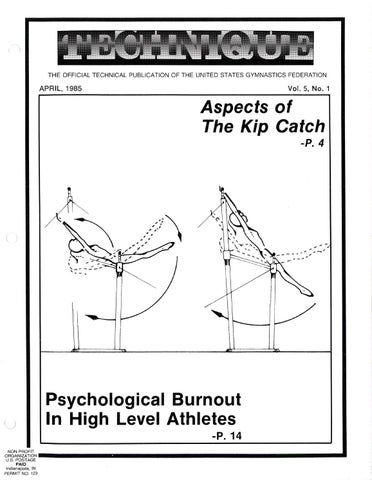
Aspects of The Kip Catch -P.4
.
, ,.' ~;'\ ,
,
,
,, ,
I
,,
,
,." ",,-'
,
Psychological Burnout In High Level Athletes -Po 14 . ORGANIZATION NON PROFIT _ _ _ _ _ _ _ _ _ _ _ _ _ _ _ _ _ _ _ _ _. .
u.s. POSTAGE PAID Indianapolis, IN PERMIT NO. 123
Vol. 5, No.1
APRIL,1985
Inside This Issue 4-6
Aspects of the Kip Catch
8-11
Conservation of Angular Momentum
14-17
By Bill Sands Univ. of Utah By Hardy Fink Univ. of British Columbia
Psychological Burnout In High-Level Athletes
By David A. Feigley Ph.D. Rutgers Univ.
18-19
USGF Eligibility Code
20
Women's Qualifying Procedures for Championships of the USA
21
1985 Men's Team Qualifying Procedures Calendar of Events
Cover Illustration by Jim Stephenson taken from "The Biomechanics of Women 's Gymnastics" Prentice Hall 1980 By Gerald S. George Ph.D.
CHANGE OF AD DRESS AND SUBSC RI PTION INQUIRIES: In order to ensure uninterrupted delivery of TECHNIQUE magaz ine, notice of change of address should be m ade six to eight wee ks in advance . For fastest ser vice. please enclose your present mailing label . Direct all subscription mail to TEC HNI QUE SU BSCRIPTIONS.
1099 N. Meridian 51.. Su ite 380. Indianapolis. IN . 46204 . POSTMASTER: Send add ress change to TECHNIQUE. 1099 N. Meridian St .. Indianapolis. IN 46204 . TECHNIQUE is published quarterly for S12.00 by the United States Gym nast ics Federation . 1099 N. Meridian St .. Suite 380. Indi a napolis. IN. 46204 (Phone: 317-638-8743) . Third class postage paid at Indiana po lis. IN . Subscrip t io n pr ice: $12.00 per year in United States ; all other countries 524 .00 per year . Back issue single cop ies S2.00 plu s $1 .00 postage / ha ndlin g . Al l reasonable ca r e will be taken. but no responsibility can be assumed for unso li cit ed material: enclose relurn poslage . Š 1985 by USGF and Technique. All rights reserved . Printed in USA. Technique Preparation of Articles for Suqmission : Please follow a uniform format of preparing ar ticles for su bmission in order to provi de the most efficient channel thr ough the evaluation and review process . The following should be included in submissio ns: 1. A n o ri gi nal t ype copy. doubled spaced on 8V2 x 11 .in ch paper . 2. A n abstract . on a separate page , a short su mm ary of procedure an d explanation of study o r ar ticle conte n t (not more than 150 wo rd s) . 3. A short biographical paragraph on a separate page of the author or au tnors accompan ied by a small photo (2 Y2 x 3W ') o f th e aut hor. 4. References on a separate sheet double spaced in consecutive order , using Index Medicine sty le (author's name-last name first , nameol book . city , publisher . yea r. page numbers) journal references . s hould fo llow same format (author. name a! a r~icle . Journal name. volume . pages . year). 5. Duplicates of p ictures and diagrams or figu r es (black and wh ite preferred) with sharp detail. Also include expl anations (captions) of pictures and diagrams on a separate sheet. Photograph release-a letter of release from any identifia bl e subject in photos that are included in the art icle unless the (ace o r eyes are obscurred . Letter shou ld be signed by subject. parent or guardian .
2
EducationJSafety Editor Dr. Gerald George Production Michael G. Botkin USGF Member Organizations A mateur A thletic U nion; A merican Soko l Organiza ti on;
American Turners; Associa tio n fo r Intercollegiate A thleti cs for Women; Na tional Associa ti on for Gi rl s and Women 's Sport s; Na tio nal. Assoc. o f College Gy mnastics Coaches;
Depa rtments
23
Publisher Mike Jacki
6. Titl e page co nSist in g of an informative title. author's name and complete institutional or professional address. Submission of Articles for Publication: Written articles will be accep ted for review and possible publication in the following procedure . First the articles are sent to USG F Department o f Pu bli cations
1099 N. Mer idian SI.. Suite 380 Ind ianapolis. IN 46204 Upo n receipt of the article. to the USGF office. the reo searc h coo rdi nator wi ll review and forward copies to th e appropriate U SGF Sports Advisory Committee member s for rev iew. On receiving the ir review. copies of the art icle will go to the Managing Editor and Executive Diractor for final approval for pu blicalion . If it is necessary for the art icle to be edited or revised in o rder to improve the eff ectiveness of cOl)lmunicat ion to a w ide va ri ety-level of readers . the author will r eceive the edited article prior to publishing for their approval. 'I f the article or parts of have been subm itted andl or published by another publication . a complet e name and address of the Ed itor and Publication should accompany the article upon su bmission 10 the USGF in o r der to follow proper procedures of publish ing and to receive approval to reproduce the article in the USGF publication .
NACCC-Wo me n; Nil- tio na l Assoc. of Women Gy mnas tics Ju dges; NCAA; N ational Federati on of Sta te H igh Sc hool Assoc.; Natio nal Gy mn as tics Jud ges Assoc.; Na tio na l H igh School Gymnas tics Coaches Assoc.; N ational Jewis h We lfare Boa rd; Na tiona l Junior Co llege A thletic Assoc. ; Un ited Slates Assoc. of Ind epend e nt Gymnastics Clubs; Un ited States Gy mn as tics Safety Assoc.; Young Men's Christia n Assoc.; Elite Coach es Assoc.; Me n' s El ite Coaches Assoc.; Wo m en's Eli te COelehes Assoc.
United States Gymnastics Federation Board of Directors: Executive Director, Mike jacki. A thlete Representatives: Na ncy Ma rs hall; Bre nt Simm o ns; La rr)' Gera rd; Tom Beach; Ly dia Bree; Kat h y jo hn son; Dia n e Bijesse; Tim Lafleur. Amateur Athletic Union: jerry Hard y. American Sokol Organization: Nor m a Za bka. American Turners: H arr y Warnke n . Members at Large: Sue A mm erman a nd Linda C he ncinski . NCAA Gymnastics CoachesMen: Rus ty Mitc hell, Uni ve rsity o f New Mexico. NCAA Gymnastics Coaches-Women: judy Avene r, Pen n State Univers ity. National Association for Girls and Women in Sports: Dr. M imi Murra y, S prin g fi e ld Co ll ege. National Association of
Women's Gymnastics .Judges : Da le Brow n . NCAA : Sylv ia Moore, Orego n Sta te U ni ve rsity; G reg Marsden, U ni ve rsity aT Utah; je rry M iles, 'j, NCAA; Wayne Yo ung, Brig ham Young Uni ve rs ity. NAIA: Bo nnie Morrow. NHSGCA : Jo hn Brin kwo rth . National Federation of State Hig h School Athletic Assoc.: Sharo n Wilch; S usa n True . National jewish Welfare Board: Courtn ey S hanke n . NJCAA: Da ve Rowla n ds, Truman Coll ege; Arle ne Crossman , Linn Bento n College. NGJA :M ike Milid onis . USAIGC: Ed Knepper. Men 's Elite Coaches Assoc.: j im Howa rd , Uni ve rs ity o f Nebras ka . USECA for Women: Roe Kreutzer; S teve W hitl ock. Young Men's Christian Assoc.: Bud Wi lkin so n . Jr. Boy's Gym. Coaches Assoc.: Robert Cowan. President: Mike Dona hue. Associate Content Editors SPORTS MEDICI NE COMMITTEE Merrill A. Ritter, M.D. SAFETY COMMITTEE Dr. Marc Rabinoff EDUCATION COMMITTEE Dr. Ga rl and O'Q uinn BIOMECHANICS COMMITTEE
Dr. Marlene Adrian, Director SPORTS PSYCHOLOG Y COMMITTEE Dr. Keith H en sc he n. Ph .D . EXERCISE PHYSIOLOGY COMM ITTEE Dr. Pat Eisenman, Ph.D.
Unless expressly identifie d to the contrary, all art icles, statements and views prim ed herein ar e attribut ed soley 1O th e auth or and the United
States Gym nas ti cs Federation exp resses no o pinion th ereon and ass ume s no r espons ibilit y thereo f.
Technique
New From the USGF Bookstore s.,1nIc...m
ICOA C HI NG
PHl'SIOLOGY OF
YO 'U'N'G
THLETE S
Coaching Young Athletes
FITNESS
Coaching Women's Gymnastics
Physiology of Fitness (2nd Edition)
BRIAN I. SHARKE'I'
Rainer Martens, Robert W. Christina, John S. Harvey, Jr., & Brian J. Sharkey Becoming a successful coach is what Coaching Young Athletes is all about! And being successful doesn't just mean winning meets ; it means helping young athletes to enjoy mastering new skills , to enjoy competing with others , and to feel good about themselves . You'll be challenged to develop a coaching philosophy and to learn the essentials of sport psychology , sport pedagogy, sport physiology , and sports medicine-all in a fun and interesting way!
Brian J. Sharkey
Bill Sands
Here's a fitness book that's different. One that's comprehensive , well-written, and easy to use. And , it's written by one of the foremost authorities on fitness. In addition to covering the basics of aerobic fitness , fitness arid weight control , and fitness and lifestyle , this second edition includes new views on the causes of overweight and obesity , and a revised section on muscular fitness training. Sharkey also provides 100 pages of helpful appendices with tests , programs , and information on caloric intake and expenditure.
Finally! A common-sense approach to coaching women 's gymnastics. The four-part book is directed at both novice and experienced coaches and includes the following chapters:
1984 • Paper • 384 pp • $12.95 - US & Canada
1981 • Paper • 200 pp • $12 .00 - US & Canada
ADDITIONAL BOOKS OF INTEREST. Coaches' Guide to Nutrition In Pursuit of Excellence Terry Orlick and Weight Control Find out how psychological tools such as relaxation , mental imagery , and concentration can help both athletes and coaches in their pursuit of excellence. '/80· Paper· 326 pp • $10.95-US & Canada
Patricia Eisenman & Dennis A. Johnson Contains the most up-to-date information on the "whys" and "hows" of high octane diets , food fads and myths , achieving ideal weight , and more!
Joy and Sadness in Children's Sports
1982. Paper. 255 pp • $9.95-US & Canada
Edited by Rainer Martens
Edited by Richard A. Magill, Michael J. Ash, & Frank L. Smoll
A unique blend of informative and entertaining articles by well-known writers and athletes concerning major issues in children's sports. 1978· Paper· 375 pp • $11.95-US & Canada
Children in Sport (2nd Edition) Twenty articles examine the current state of youth sports research and offer guidelines to be applied in sport settings . 1982. Paper. 327 pp • $10.95-US & Canada
Living Anatomy
I. 1. 2. 3. 4.
Philosophy Why Coaching? The Role of the Coach Commitment Setting Reasonable Goals
II. 5. 6. 7. 8. 9. 10.
Program Schedule and Training Load Facility and Equipment The Support Staff The Selection Process Talented and Enthusiastic Coaches Research
III. 11. 12. 13. 14. 15.
Preparation Physical Preparation Psychological Preparation Technical Preparation Tactical Preparation Theoretical Preparation
IV. 16 . 17. 18. 19. 20. 2l.
Applications Looking at Two Skills The Full-In: A Methodology The Gymnast and the Warm-up Overtraining Compositional Analysis: Uneven Bars Observations of Training: Female Foreign Gymnasts at the 1981 American Cup
Joseph E. Donnelly
Ergogenic Aids in Sport
This "nontraditional" approach to learning anatomy uses a "hands on" approach instead of relying on rote memorization. The living anatomy technique is fun-and it really works!
Learn about the latest research on 13 common substances or treatments used by athletes today in an effort to gain the "winning edge. "
Additional Information Epilogue • Daily Training Diary • Computer Programs • Associations • Magazines and Journals. Recommended Books • Bibliography
1982 • Spiral· 207 pp • $13.95-US & Canada
1983 • Hard · 395 pp • $23.95 - US & Canada
1984 • Hard • 288 pp • $17.95-US & Canada
Edited by Melvin H. Williams
Quantity
ORDER FORM Enclose check or money order payable to USGF Bookstore. Payment must accompany order. Return order to USGF Bookstore, 1099 N. Meridian St. , Suite 380, Indianapolis, IN 46204. Amount enclosed _ _ _ _ _ _ _ _ __
Title
Price
Coaching Women 's Gymnastics
$17 .95
Physiology of Fitness
$12.95
Coaching Young Athletes
$12 .00
In Pursuit of Excellence
$10 .95
Joy and Sadness in Children 's Sports
$11.95
Name
living Anatomy
$13 .95
\ddress
Coaches' Guide to Nutrition and Weight Control
$ 9 .95
City _ _______________ __ _ ___ State _ _ __
Children in Sport
$10.95
Ergogenic Aids in Sport
$23.95
SEND TO:
Zip ___________
Phone _ _ _ _ _ _ _ _ _ _ _ _ __
Total
Total
Technique
3
Aspects of the Kip Catch 1988 Compulsory Women's Uneven Parallel Bars By Bill Sands University of Utah Salt Lake City
T
he prec ision and ampl itude o f the compulsory exe rcise wi ll in large part determine the final score. My limited experience has shown that one of the m ost o ften neg lected ski ll s on th e uneven bars is th e backswing of th e ki p catch . The backswing of the kip catch shou ld be quite high for proper amp li tude . Whi le perhaps more pragmatic , the increased height of the backswing , in this particular compulsory , can greatly aid th e swing of the pendular kip on the high bar . Th e cast that follows the pendular kip will then receive the benefits of obtaining a large amount of swi ng prior to the cast. Since other communications have described the g li de and kip act ions this project wi ll refer on ly to those fac tors assoc iated w ith enhanc in g th e backswing of th e kip ca tch. Methods The co mpul so ry exercise was filmed in sect io ns during th e Elit e Coaches Association N at iona l Sympos ium in Tu cson, Arizona during Jun e of 1984. The gy mn ast depicted here is Lisa Wittwer who shows exemp lary exec ution, technique , and virtuosi ty . Th e compulsory was sti ll re lati ve ly new at the tim e of the filming and L isa was perform ing on ly sec tions during training . In this case th e gymnast was performing th e section starting fr om the glide kip and continui~g through to the handstand pirouette on the high bar. T he kip catch for th is analysis was extracted from the film of this secti on. At the time of the filmin g this gymnast we ighed 45 .45 kg (100 Ib) and was 157 .5 cm tall (5 ft 2 in) . Th e film was shot at 80 frames per seco nd from a pos iti o n in lin e with th e rea r uprights 10.4 m (34 tt ) from the cente r of the bars. Th e came ra was 2.3 m (7.5 tt ) from th e fl oor to th e ax is o f the film plane . Th e 400 ASA black and w h ite rev ersal film was exposed at F1 .4 . A conical timer to determine film speed , and a reference meter distance were plac ed in th e field of view of the camera. The AMF bars were set at regulation height and ma x imum widt h. Fo ll owing processing , the f ilm was d ig itized and ana lyzed by two dimensional kinemati cs using a Numonics Di gibit d igitizer and TRS-80 Model IV microcomputer. Th e center of mass was determined by th e model developed by Kjeldsen for female gym nasts (Pl age nh oef , 197 1), and ca lcu lated by th e meth od described by H ay (1973). Software for the compu t er ana lys is was developed by th e investigator. Results and Discussion
T
FIGURE 1
Legs Swinging Toward the l3ar
(Showing Every Second Frarre)
~_fu' , Torso Desccndi !1g
'--~~~~~-----'- ------.--~-- ---.-~------'-------'
Phase t wo , th e hip extension or pull phas e, is shown in Figure 2. Figure 2 begins w ith the first fr ame of th e ex tens ion and ends with the first fram e of the re lease . It is important to note that at release the hips and torso are not fully extended and the shou ld ers are be low th e low bar. Thi s wou ld indicate that the upswing act ions during the latter part of thi s phase are every exp losive. Th e gymnas t's ea rl y release , with the body still flexed forward and legs in a high position , wi ll later serve to enhance th e backswing.
FIGURE 2
Release
Frarre ~~ L.,.; r Low Bar
(Showi ng Ever y Second Frane)
~
"'c:-=-:-:-
Belease Frame
~
he nna lysis begins with the highest frame at th e end of th e glide portion of th e glide kip. Th e first phase o f the skill is depicted in Fi gure 1. The gymnast is moving from left to right and Figure 1 shows the portion of th e sw in g whi le the gymnast f lexes at the hip and brings the feet nea r to the bar prior to the hip extens ion and pull phase . Th e most noteworthy parts of thi s phase a re show n by th e descent of the to rso w hil e th e legs are sw in g in g toward th e bar.
4
Technique
Figure 3 shows phase 3, the release phase . T h is phase begins w ith the first frame o f rel ease and ends wit h t he first f rame o f regrasp. Note th e position of the body at th e regrasp of th e high bar with fe et sti ll under th e low bar. Th e fin al fr ame posit io n provid es the gymnast w ith a high startin g pos iti on to proceed into th e backswing. Moreover, the gymnas t has not reached full hip extens ion by the regrasp fram e. Th e retent ion of some pike in th e hips w ill also help the gym nast in th e backswing by al low in g her th e opportu nity to swing her legs bac k forcefully from th e hip .
fIGlHlE]
(Showing Every Second Frarre)
\-. Regrasp FranE (Note the feel StU] lUlder the low hal')
[~~~~~~.--~.--~~,-.---- --~--
Figure 4 shows th e backswing phase. The gymnast has grasped th e hi g h bar and is sw ingin g backwa rd in preparat ion for the pendular kip that follows. Note that th e gymnast is not sw ingin g in a pure pendulum sin ce th e should ers do not follo w th e same ran ge o f sw in g as the rest of th e body. The " enh anced " pendular action of th e backswing is perform ed largel y by a viol ent hi p ex tension that is set up or initiated by retention of some fo rw ard hip fle x ion during th e relea se and ea rl y reg rasp phases. Th e retained pike during
th e ear ly regrasp phase is used to he lp th e gymnast apply th e vio lent hip ex tens ion ove r a large distance during th e latter portions o f th e bac kswing. Th e most intense acti o n of th e vio lent hip extens ion can be see n directly below th e high bar where the density of th e torso lin es of th e stick figure are th e greatest. On comp leti on of the hip exte nsion th e gymnast Si mpl y rides the backswing to maximum height while attempt in g to arch more. Th e in crease d arch serves to raise th e legs hi gher and encou rage th e body to sw ing bac kward as we ll as up. Th e heig ht o f th e backswing se rves to en hance the rear end of the pendulum so th at the forward swing int o th e pendular kip wil l also be large.
B
eyo nd the grap hi c representation o f th e body during the execu tion of th e ski ll , furth er ev iden ce ex ists to co nfirm th e hy pothesis that th e viol e nt hi p extensio n is respo nsibl e for supe rior tec hniqu e. Figure 5 shows the stick figures of seve ral se lected fram es an d th e path of th e center of mass super imposed over th em, represented by th e thick curved line . Th e right most portion of the path of th e center of mass shows th e upward portion of the backswing. One can see that th e lin e is nea rl y str aight due to th e e nh anc ed pendular sw ing o f the body, ie. th e sw in g of the body primarily from the sho uld ers to the feet. Moreover, the heights of th e pea ks of th e ce nter of mass durin g th e re lease and latter reg rasp phases show that th e ce nter of mass is high er during the end of th e reg ras p phase th an du r ing the release phase. Thi s wo uld be impossible if the gymnast we re rel y ing on a true pendular sw in g alone. Th e vio lent hip ex tensio n enhances th e backswing so that th e body actually sw ings to a hi g her point than its starting position.
FIGlJllE 5
(Showing Selected Franes and (
peak of Regrasp Phase
Center of Mass)
;r I
Cen t e r of
~hs s
Fl GlJllE 4 (Showi ng E\'ery Frarre ) " Top of Backs\ving
Rearasp
~~
(Note Density of Torso Lines) ~----~-----~--'
Figure 6 shows three Single frames offering further ev idence of th e viol en t hip extension an d th e enhanced pendulum . Figure 6a shows the gymnast directly under th e high bar. Th e lin es drawn off th e figure of th e gymnast are resultant ve loc ity vec tors of each body part. These vectors represent th e direction of the body part while th e length of the line depicts its ve locity. Not e that th e foot , ankle , kn ee , and hip all have obvious vec tor s showin g m ove ment rearward. Interestingl y , with the exce pti o n of th e center o f (Aspects of the Kip Catch continued on page 6)
Technique
5
FIGURE 6b
mass and head , the vectors above the hips show no movement. This indicates that the lower body has accelerated and the upper body has compensated to maintain a constant angular momentum by decelerating to zero . In terestingly , the head is even moving forward . Figure 6b shows a simi lar condition later in the backswing. The final frame in Figure 6c shows that the lower body has decelerated and all the body parts are now moving at nearly equal speed and direction .
Torso_ Cen t er
( ~bverrent
of t be lD\\er Body Landrmrks)
FIGURE 6a
Head is lIDving Fo rward ~
~
IGURE6C
Cemer o f Mass Hip
Knee
-
( Note t be vectors showing lIDV8rent of lower body landmarks)
(End of the Back Swing )
~
Note that the lo""r body vectors are very nearly the 53m3 length and direction
~
F
in all y, Graphs 1 and 2 offer more evidence of the vio lent hip extension during the reg rasp phase . Th e Angles of Joints , Graph 1, depicts the acute angle of the hip in degrees per frame . Note that there is a pronounced upward " bump" in the line during the central portion of the reg rasp phase ; this is the hip extension . Graph 2 shows the resultant velocity of the foot during the skill. There is a very pronounced increase in velocity of th e foot during the central portion of the reg rasp phase . Conclusion
I
believe that one of the easier deductions to receive in the 1988 compulsory uneven bar routine is for lack of amp litud e during the backswing of the kip catch. The technique demonstrated by Li sa is quite emp lary and most gymnasts shou ld attempt to model their execution of the ski ll along the lin es of the technique demonstrated by her.
Moreover, the higher backswing of the kip catch will enhance the ease w ith which the gymnast performs the succeeding element , the pendular kip. Since the pendular kip is followed directly by a cast with no connecting front hip circ le the gymnast must perform this skil l very efficient ly . Fai lure to achieve the handstand after the pendular kip and cast may be directly related to the inability of the gymnast to swing the pendular kip efficiently . In creasing the height of the swings not only serves the gymnast in terms of amplitude , it al so caus es the suceed ing skills to be performed with great er ease and confidence .
(
References Hay. J .G . (1973) . Biom ec hani cs o f spo rt s tec hn iques. Englewood Cliff s, NJ : Prent ice Hall. Pl age nhoef , S. (1971). Patt ern s of hum an motion: a c in ematograph ica l analysis. Englewo od Cl iff s, NJ : Prent ice Ha ll.
l
f~- -.-.-'~~'.-~<--.---~
--- " ' \
\,
/ .
\\.\
/t
l'bte this area
..of hip 路~,cte~~i~~ ....
GRAPH 2
GRAPH 1
Re turn Swing
Pull o r
..
Pull or Rel ease
II
Note this large i ncrease in speed
I~
Regrasp
Hip Extens .
..I Franes
6
i
Hip Extens .
Ang l e of the Hip
..... \.\.:: ' / ... Ret urn Swing
Veloc ity Q,! t he Foot
Regrasp
Release
/
./ -\
'\ / -..+I.----.. ~j '.!
"'' ' ' .llJ
\
JI
" Fr
s
w"",J..l!illJ.ll!WJllll!Jlll!W'k " U!J ' lLL'U!JlI.L"lwlll l'lWlLLmlwWllllll.LU!JlI.LU!JJ.ll!WlI.LlI.LlI.LlI.L ' 'Llli '' lwllllJjJ ''"'' .1lllllJll.Llll!WlWlLLUllll!Ullll!WllllWllllJJ!.''' ""
Technique
'
,
COLLECTORS ITEMSIPOSTER SERIES
85-88 TECHNICAUCOMPULSORY MATERIAL #1108
85 \Vome n's Rules and Policies
SIO.OO
( 1.50 )
#41 11
Mary Lou Renon Poster
5500
( 1. 50)
#1208
85 Men's Rules and Policies
5 10.00
( 1.50 )
# 4 112
Mi tch Gaylord Poster
( 1.50)
#2103
85-88 Elite CompoFloor Music Cassette
5 12_95
#41 13
Bart Conner Poster
#21 12
85-88 Elite Comp_ Viden, Women (VHS)
539.95
( 1.00) (2_00)
S5.00 55_00
# 4 22 1
FIVE O lympic Men 's Team Postcards
53_50
(.50)
#2212
85-88 O lympic Compo Video, Men (VHS)
S29_95
(2.00)
#4 12 1
FIVE O lympic Women's Team Postcards
53_ 50
(.50)
#1109
85-88 Elite Compo Text, Women
515_00
( 1.50)
#4201
51.50
(.50)
#1209
85-88 O lympic Comp_ Text, Men
S15_00
( 1. 50)
#4202
USGF Logo Pin "USA GYMNASTICS" Commemorati ve Pin for
# 1202
84-88)r. O lympic Age Gro up Compulsory
OUf \V inning Teams in Los Angeles
SI.50
(.50)
Exercises for Men
S15_00
( 1.50)
#440 1
"I Love Gymnastics" 8umpersticker
(.25 )
# 130 1
84-88 FIG Code Points for Rhythmic
520_00
( 1. 50)
#4402
USGF Frisbie
-99 5.99
#1302
84-88 Rhythmic Class II & III Com pulsory
USGFDecal
5_50
S25_00
( 1.50)
# 440 3 #7201
52 .00
(.25 ) (.50)
529_95
(4.00")
Manual
USG F t ogo Patch T-SHIRTS, CASUAL & SPORTSWEAR #5002-7 " The O lympic Leotard
OLYMPIC GAMES VIDEOS!
( 1. 50)
(.75 )
#2101
VHS/#2 102 Beta
\Vorn en 's Optionals
585_00
(2.00)
#5 1 I 1-1' - USA Gym nastics Long Sleeve T-shirt
59.95
( 125)
#2201
VHS/#2202 Beta
Men's Optionals
585.00
(2.00)
#5 12 1-l' - USG F Logo Long Sleeve T-shirt
59_95
(125)
European Artistic)r_ Champio nship VHSO nl y \ Vomen 's Finals
#5 131-1'- USGF Logo Short Sleeve T-s hi rt
55_95
( 125)
#2111
532_00
(2_00)
57_95
( 1.25)
#2211
#5 151-1'- Year of the Gold Commemorati ve T-shirt
VHSOnly
S32.00
(2.00)
55_95
( 125)
#2311
8 4-88 Rhythmic Class II Music Cassette Tape
5 10 .00
#5 16 1-1'- USA Gy m nastics Sho rt Sleeve T-shirt
( 1.00 )
59.95
( 1.25)
#2312
84-88 Rhythmic Class III Music Cassette Tape
5 10_00
( 1.00)
#23 13
84-88 Rhythmic Class II & III Music Cassette Tapes
S 18.50
(2_00)
#2321
84 -88 Rhythmic Video Tapes Class II VHS/ #233 I Beta
S60_00
(2_00)
#2322
VHS/ #2332 Beta
560.00
(2_00)
#54 11
USGF Tote Bag
#2323
Class II & III VHS/#2333 Beta Reference Set (2 Books) 1) History of Development of the USG F 2) 100 Years oflnternational Gy mnastics
S100.00 55_00
( 4_00 )
#542 1
Official USG F Work-ou t Bag
(2 .00 )
#549 1
ASICS Travel Bag
#6101 #6102
#3101
Men's Finals
Class III
#5 17 1-7
Federation
#3601
"Biomechanics of \Vo m en's Gymnastics"
#4101
Official USGF Photo Album
520_95
(2.00)
5500
( 1.50)
American Cup Lo ng Sleeve T-shirt
#5201 -4 - - Classic Casual Shirt
5 19.95
( 1.50)
#530 1-4 -- V-neck Velo ure
529_95
(3 .00)
#540 1-4 -- White Satin)acket
534_95
(3.00)
#550 1-4- - USGFOfficial Warm -Up
579.95 56_99
(3.50)
5995
(2.00)
5 15_99
(2 .00)
Safety Poster I
54 .25
(.75)
Safety Poster II
54_25
(.75)
(2.00)
"Size Chart-last digit of order II determines size XL L M S YL YM YS
1
Allow 4 -6 weeks for delivery
234
567
------------------------------------------------SOLD/SHIP TO: NAME
SEND ORDER FORM
ADDRESS
TO:
CIIT
USGF Merchandising P.O. Box 5562 Indianapolis, IN 46255-5562
STATE ____________________~Z~I~P AlTN
ITEM #
QIT
- -
welcome here
Technique
Charge My
DESCRIPTION
0
UNITED STATES GYMNASTICS FEDERATION
VISA
Card No_ My Card E xpi res _ _
o
Master Card
SHIPPING &HNDL
TOTAL
TOTAL PMT
For credit card order only, Call 317-638-8743
7
Conservation Of Angular Momentum • •
.And Its Application To Gymnastics
By Hardy Fink
T
here are numerous principles that have application to athletics and whose understanding can be used to enhance performance. One of the most frequently appearing yet most poorly understood of these concepts is the principle of the conservation of angular momentum . Any athlete who wishes to rotate about some axis in any manner is concernedalthough maybe not conscious ly- with this concept. For any ath let e who becomes airborne during the course of his endeavours , effective utilization of the principle of the conservation of angular momentum is vital. Athletes of most sports become at l east i liO l tre llidlii y ai ' Du llle de vdrious iillies and could therefore benefit by an understanding of the mechanical principles that app ly . For divers , jumpers, gymnasts and trampolinists, the essence of whose sport is unsupported flight , an understanding of the principles is not only beneficial but essential. It srlould be stressed , however, that the principles of the conservation of angular momentum is also useful for an understanding of supported and suspended angular motion as occurs during normal swing on most gymnastics events. Th e conservation principle does not quite app ly for many of these cases because of considerab le frictional and other forces that may act at the point of support. Another difficulty is that the principle axis of rotation may no long er pass through the center of gravity. These difficulties do not, however, deny the usefulness of the concept to such movements. The principles of the conservation of angular momentum is given by the angular analogue of Newton 's First Law of Motion . It may be stated as follows: A rotating body will continue to turn about its axis of rotation with constant angular momentum , unless an external couple or eccentric force is exerted upon it. (Hay , p. 154) Interpreted th is law states that the angular momentum of a body can be altered only by externally app lied forces
8
that do not act through th e center of gravity. Thu s, it is apparent that the angular momentum that an unsupported person acquires during " take-off " cannot be altered by that person , ju st as the path of his center of gravity cannot be alt ered by him after take-off . The picture is not as bleak as it seems however . Although the angu l ar momentum cannot be altered , a gymnast is not powerless. There are two aspects to angular momentum and one of these can be altered to effect a desired cha ng e in the other. It is useful first to define momentum and then to extend that d efinition to gain an understanding of angular momentum . Momentum , essen tially , is a property of any moving body that has mass. It is proportional to the ve locity of ii.e
~vciy din"; ~ ;,e I l ra5~ v~ ~: i e
body alld i5
stated mathematically as: Momentum = mass x velocity Mass shou Id be considered as a measure of th e inertia of a body ; that is, the tendency that a body has to resist any change in its state of rest or of motion. In angular terms the velocity becomes angular velocity which is defined as the angular distance (in degrees or radians) moved through per unit time . Th e angular measure of in er tia corresponding to mass in the lin ear case-is known as the moment of inertia and can be viewed as a measure of how the mass of a body is distributed about the axis of rotation. Angular momentum , then , is mathematically represented as : angular momentum = moment of inertia x angu lar ve locity
It is important to realize that the angular terms reall y have no meaning unless the axis of rotation is specified. The moment of inertia , for instance , is actual ly defined with respect to the axis of rotation . A full discussion of axes is beyond the scope of this discussion . Suff ice it to say that , usually it is convenient to consider an unsupported rotating movement as rotating abou t an axis of momentum passing through the center of gravity. A gymnast performing a double somersau lt, or any other freely rotating movement would be considered to be rotating about an axis passing through his center of gravity.
I
t is difficult for a performing gymnast to think in term s of hi s angular momentum or even hi s mom ent o f inertia . However, he readily recognizes a change in hi s angular ve locity- the speed with which he rotate s. Thi s aspect-angular velocity-is , of course , what a gymnast usually wishes to alter , but it is obvious (since the angular momentum must remain constant) that angular ve locity cannot be altered without a corresponding change in th e moment of inertia . As a matter of fact , once airborne , the gymnast can increase hi s angu lar ve locity only by descreasing his moment of inertia and vice versa . Since the moment of inertia is proportional to the distribution of mass about the axis of ,otatio " , it 10110,,3 ~I,a~ Eli,gu lai .GICGit, can be alt ered only by a redistribution of this mass . Th e moment of inertia increases as the mass is moved further from the axis (in unsupported flight , the center of grav ity) and decreases as the mass approaches the axis. Effect ive ly , this means that a gymnast can increase his " speed of rotation " by pulling his body parts closer to the axis of rotation (tucking) and decrease his angular velocity by placing his body parts further from th e axis of rotation (extend ing). Thi s of course requires that some angular velocity exist to begin with . During th e process of becoming airborne the gymnast is concerned with either acquiring a certain amount of angular momentum about one or more of his three principal axes or avoiding angular momentum altogether . In order to obtain angular momentum during the take-off phase , an eccentric force must be appl ied to the body ; that is, a force that does not pass directly through th e cen ter of gravity as this will cause only translation and no rotation . For example , a force applied behind the center of gravity will cause forward rotation and one applied in front of the cen ter of gravity will cause backward rotation . Forces can also be applied to cause twisting (rotation about the longitud inal axis) or sideward rotat io n. The quantity of angular momentum the body is given initially depends on: 1. The magnitude of the applied
Technique
fo rce. A large force w i II have a greater eff ect th an a sm all one. 2. Th e di rec ti on of th e app li ed force . 3. Th e du rati on of th e ap pli ed force. W ithin cer tain phys iolog ica l limits, th e lo nger a fo rce ca n act th e m o re effec ti ve it wi ll be. 4. Th e po in t of appli ca ti on o f t he force . Th e furth e r f ro m th e axis of rotatio n that th e fo rce is ap pli ed th e mo re eff ec ti ve it w ill be. Th e mo m ent of in erti a of th e body at ta ke- off is also of imp o rt ance. If th e ang ul ar m o men tum impart ed by a force is th e sa me it is obvio us t hat a body th at beg in s w ith a large m o ment o f in erti a has m o r e p o t e nti a l f o r dec r eas in g it s mo ment o f in erti a and thu s in creas in g angul ar ve loc ity . As a matte r o f fact, Dyso n states t hat in re lati o n to th e tr ansverse ax is (so mersa ultin g) , a to tall y ex tend ed pos iti on has abo ut three and o ne- half tim es the m o ment of in erti a of a ti ghtl y tuc ked pos iti o n. It fo ll ows th at th e ang ul ar ve loc ity ca n be in c reased by as mu c h as three and o ne-h alf tim es mere ly by tu ckin g. For m ove ment s w here hi gh angu lar ve loc iti es are essen ti al (ie. th e gy mn ast's qu est fo r o ne ext ra tw ist o r o ne mo re so me rsau lt) , it is wise to max imi ze th e mo m ent o f in erti a whe n th e ecce nt ric fo rces are ap pli ed durin g th e take- off phase. In multi p le some rsa u lts, fo r in stance , it is best to beg in rotatin g in as full y st re tched a pos iti on as th e moveme nt all ows . O u r spo rt is suc h th at in so mersa ultin g m ove me nt s we dem and he ig ht as we ll as ro tati o n. Thi s deni es th e poss ib ility o f m ax im izin g ecce nt ric thru st. In th ese cases , howeve r, one can happil y sac rifi ce so me in iti al an g ul ar m o mentum fo r height. Increased he ig ht is th e o nl y fact or th at ca n in c rease o ne's tim e in th e air and thu s o ne 's tim e to utiliz e on e 's ang ul ar m om entum . It is useful at thi s po int to loo k at seve ral oth er exa mpl es in w hi c h the prin c ipl e o f th e co nse rva ti o n of ang ul ar mo mentum appli es in gy mn asti cs.
..
Co nse rvati on of angul ar m omentum is manifest in a ll twi stin g and so m ersau ltin g m ove m e nt s. Th e f o rw a r d so m ersa ult in tumblin g is a case in po int. Th e hurdl e st ep a ll ows th e gy mn ast to pl ace hi s feet in fr ont of hi s ce nter of g ravi ty and th ereby chec k hi s forwa rd m o m entum . Thi s c hec kin g pro vid es rotati o n (topplin g) ab o ut th e feet as th e body wa nts to continu e in its fo rwa rd moti on. Th e arm acti o n also con t ributes to th e ro tati o n and th e fin al ex tensio n of th e legs at take- off occ urs as th e bod y is t ilted slightl y forward . Th e res ultant verti ca l fo rce acts sli g htl y behind th e ce nt er of g rav ity and ca uses c on sid era ble rotati o n. At th e m o ment o f take-o ff (Conservation of Angular Momentum continued on page 10)
Technique
Attention Gymnastics Professionals the
OFFICIAL USGF GYMNASTICS SAFETY MANUAL
ONLY $14.95 plus postage and handling * Edited by Gerald George , USGF Director of Educalion and Safety
A comprehensive guide for the promotion of safe learning environments for gymnasts at all levels. Designed to raise the level of safety awareness of the entire gymnastics industry. Will serve as the official manual for the USGF Safety Certification Program. Covers major safety areas of concern including: Legal and medical responsibilities Environmental safety factors Spotting and gymnastics safety Performer readiness Trampoline safety Gymnastics skill progressions Educational and safety materials
* * * *
* *
*
A MUST for every serious gymnastics professional
ORDER FORM
o Enclosed is my check or money order in the amount of for
$
copy/ies of the
OFFICIAL USGF GYMNASTICS SAFETY
MANUAL
*Include $1 .50 per book for postage and handling . Allow four to six weeks for delivery. Name __________________________________________ Address _______________________________________ City __________________ State ___ _ _ __ Zip _ ___________ _ _ _ _ Phone _ _ _ __ Check one: 0 Gymnast/Age _ _ , Coach 0 , Parent 0 , Other
째
Mail orders to: USGF Department of Education and Safety; 1099 N. Meridian St. , Suite 380, Indianapolis, IN 46204.
9
the gymnast is tota ll y stretch ed to max imize h is moment of inertia . H is angu lar veloc ity is sma ll at th is point but there is cons id e rabl e poten ti a l for increasing it. By th e tim e he reac hes his maximum height his body is comp lete ly tucked and the speed of rotat io n is at its greatest. In preparation for land in g the mo m ent o f inertia is again increased and the angul ar ve locity reduced. Th e princip le remains the same for any so mersau lting action . One begins w ith a large amou nt of inertia and then decreases it to give an appropr iate amount o f rotation. T wisting movements also follow th e same princip le. T wis tin g , as the term is norm a ll y used , is merely " somersau lting " about a different ax is. Wh en hanging onto a bar (th e ax is of rotation ) with the hand s and ro tating o ne can increase the angu lar ve locity about the bar by decreasing th e mo ment o f in erti a with res pect to th e bar . In g iant swi ng s, this always invo lves th e b ringing of th e cen te r o f gravity c lose r to the bar during the up phase by be ndin g at the hips and the decreasing of the trunkshould er angl e. Beginn ers are o ft en seen be nding kn ees and arms to assure completion of the giant swing by further increa si ng their angular ve locity in thi s way. On th e down phase it is impo rtant to ma x imize th e moment of in ertia in order to increase angul ar mome ntum . Th e force of gravity constantly increases th e angular ve locity during th e down phase and for this effe ct to be maximal th e cen ter of grav ity should be as far as possible from the bar. Thi s comb in at ion of maxmimized moment o f inerti a and ma ximized angular ve locity resul ts in the greatest po ss ibl e angular m omen tum and co ns equentl y requir es ve ry littl e body adjustment on the up phase. Suc h giant swings are , of course , aesthetica ll y most p leasing as we ll. Th e principle of the conservation of angular momentum may be used to preve nt or , in so m e cases , to reverse und esired rotation of the body. Th e principle requires that the to tal angula r momentum of the body or of any sys tem free of ex terna l forces rem ain constant in each direction. It is therefor e possible to redu ce the angular momentum of th e trunk by increas in g th e angular momentum of th e extremiti es as long as th e sum (the total) is unchanged. For example , a person who beg in s to toppl e gains angular momentum . A person who topple s bac kw a rd w ill reflexly ki c k a leg up and rotate his arms in th e direction of his fal l. Since the limbs move in the same direction as th e fall , th ereby esse nt ia ll y increasing th e angular mom e ntum of th e system , th e trunk must respon d in a mann e r th at will co nserve th e tot al quantity of ang ular mom entum . It fo ll ows that th e trunk wil l slow down or possibl y reve rse th e direction o f rotation. Two sim plifi ed ex plana-
10
tions , but bo th qui te adequate refer to th i s as " action-reaction " or th e " conf ini ng th e angular momenum of the body to the limbs". I n gymnast ic s we see occas iona l in stan ces of the foregoing at wo rk. In vau lt s th at are ou t o f cont ro l because of forward r o t atio n a gym n as t will character isti ca ll y rotate hi s ar ms in th e direction o f the undes ir ed rotation. Du rin g th e after-f li ght phase of a hecht vau lt the arm s usually com pl ete two forward rotations to ass ist backward rotation or to partially prevent forward rota tion of the trunk . A gymnast ha vin g difficulty in comple tin g a back layout somersau lt is often we ll advised to rotate hi s arms forcefu ll y downward (forwa rd) after th e tak e-o ff. T o keep th e angular momentum of th e total bo dy unchang ed the trunk-l eg seg me nt wi ll respond by ro tating more qui c kl y backwards. On th e balance beam a s id ewa rd s loss of balance can be partially cou nt eracted by rotating the arms in the direction of the imbalan ce. It should be noted th at the altering o f the trunk angu lar momentum in thi s manner is acco mplished m ost effecti ve ly if done qui ck ly (max imum angular velocity) and with straight and large limbs (maximum m om ent of in ert ia w ith res pect to the axis o f rotat io n) . T ogether th ese ma xim ize the angul ar momentum of th e limbs and require th e tru nk to make a maximal respo nse in order to conserve the or igina l to tal body angul ar momentum . It is also possible to think in terms o f th e angular momentum of one body part being tran sfer red to th e entire bod y (even though thi s exp lanation may not be fully acceptable). In esse nce, the idea is not different from that of con fining the angular momentum of th e body to the limbs alth ough lin ear mom entum may also playa part. H ere a rapidly moving body part (thi s alw ays in vo lves rotation) or limb i s sudden l y sto pped . In gymnastics thi s action is see n in al l of th e num ero us kip type of move ments. Since th e angular mom entum of the sys tem mu st remain cons tant the angular mom en tum o f th e stopped body part is tran sferred to th e whole body. This transfer can on ly occur if some part of the body is in contact with an external object otherwi se th e " act ion-reaction " law will alter the effects. Since external co ntact exists so me of the tran sfer of momentum resu lts in a linear shift of th e center of gravity which , after all , is as much the purpose o f a kip as is th e tr ansfer of th e leg ang ul ar momentum to the trunk . The singl e bar kip will serve as a useful examp le.
T
he kip acti on is done from a deepl y piked position . Th e hips are ex tend ed quickly and with stra ight legs to maximize angu lar momentum . For an effective tr ansfer o f momentum to occ ur th e leg s must be stop ped quickly. Th is ass ures th at the legs ha ve minim al residua l angular m om en tum as early as possible during th e tr ans fe r phase and th at alm ost all of the monentum has been transferred . Th e place at w hi ch the legs are stopped determin es th e direction in whic h the center of grav ity will be sh ift ed . Here the legs stop sligh tl y above the bar and the cente r o f g ravi ty is shift ed upward to th e bar. Th e upper bod y al so ac quire s some angu l ar mom entum and ro tates abo ut th e bar to co mpl ete th e kip. In initi ating a so m ersault o n th e fl oo r th e angular momentum of th e arm s is tran sfer red to th e body. T o effect a vert ica l shift only of th e center of grav ity the arms must be stopped at th e hor izonta l during take-off sin ce th e sh ift occurs at a tangent to the arc descri bed by th e arm as it stops . Th e arms should swi ng quick ly and straight and be stopped quickly. Th e same considera ti o ns app ly to th e back somersault. A ve ry int eres ting phenom enon which seems to contradict th e principle of the co nse rv ation of angular monentum is th e rightin g reflex of a cat. It is possib le to drop a cat, back first , and fo r th e cat to land on its feet comp leting a 180 0 twi st without any ex ternal forces being appl ied . Similarily, skilled tr ampolinists ca n perform a limited twi st in th e air witho ut initiating that twi st from th e tramp o lin e bed-but the y rarely do so . Und er these circumstances th e principle of th e co nserva tion o f angu lar monentum is not transgressed: It ca nnot be l In fact th e total body angul ar mom en tum remains zero.
Bas ica ll y , th e answer li es in th e reducing o f th e moment of in ert ia in o ne body part whi le maximizing it in anoth er sig nifi can t body part with respect to the sa me axis of ro tat ion . As th e ca t begins to fall it w ill pike and bring its front paws c lose to its hea d . The mom ent of in ertia o f th e upper body about a longitudina l axis through the upper body is th ereby minimized whi le that of the lower body about th e same ax is is maxi miz ed . Th e cat wi ll th en twist its upper body throug h 180 0. To m a intain th e ang ul a r momentum of the body at zero th e lower body must twi st in the opposite direction (action -reaction ). However , because of th e grea ter moment of in ert ia, it will rotate throu g h a much smaller angl e (only abo ut 5 0 ). In o ther words , sin ce the angu lar ve loc ity of the lower body is considerab ly less than that of th e upper body , it wi ll turn through a small er angl e in th e same tim e.
Technique
. r\
T o comp lete th e rotation , the ca t then brings its lowe r bod y close to th e longitudina l ax is thr ough that part of the body and tw ists abou t it. Now it is the moment of ine rti a of the upper body that is larg e with respect to th e ax is. Th e uppe r bod y w ill , therefore , rotat e on ly slightl y in th e oppos ite directi on. On complet ion of the twist the ca t is in an ex t ended and arched pos iti o n . It remains onl y to pike in order to come to a proper landing position . Some have suggested that th e ca t also makes correct ive motions wit h it s tail during the final stages. In cases of thi s type it is important to realize th at the angular momentum o f one body part is always eq ual to an opposite angula r momen tum of another body part. In thi s w ay th e total angular m o men tum o f th e body remains at ze ro . Th e application of thi s " tri ck " to athletics is not so common . H owever , w ith training and in eve nt s such as tramp o linin g and div in g , w h ere su ffi cient time is ava ilabl e, it is possible for a man to initiate a twi st in th e air . In thi s regard it is interest in g th at Leigh and Ban ge rt e r stud yi ng twisting back w ard and forward so mersau lts in diving and trampolining found that the twi st was in va ri ab ly initi ated on th e spri ngin g medium contrary to th e beliefs (de termin ed by questionnaire) o f " expe rt " coac hes. If a twist is initiated in th e air it is alw ays fac ilit ated if th e person start s in a pik ed or arch ed positi on. Generally an arc hed position is less effecti ve beca use of norm al limitati ons to sp in e fl ex ion . Neve rth e less , Eaves stat es that , for sma ll amounts of fl ex ion, sp inal fl ex ion resu lts in a more efficient twist me cha ni sm th an hip fl ex ion . In any case , for most eve nt s , it is more effective to initiate th e twist from the ground or the suppo rting surface and to hide that fact fro m th e judg es by starting in a full y stretch ed position ; thi s being necessary both mec hanicall y and aesthetically. It is obv ious from th e for ego ing discussion that the concept of the conservation of angul ar momentum has ex ten sive application in gymnastics. Gy mnasti cs coaches wo uld do well to recogniz e and apply thi s principle where approp ri ate and to study further its far reac hin g impli cation s. 1. 2.
3.
4. 5.
References Biesterfeldt , H ., ··Sa lt o mec hanics I: Moment of inertia "· Gymnast , March , 1975 . Byers N .. et. al. ··On the origin of ang ul ar momentum in tw ist dives. ·· Journal of Physical Education , Volume 43 , July , 195 1 Calkin , G . ··Some praclical aspects of theo relical biomechanics in gymnast ics ,·· Gymnastic News , May/Jun e, 1979. Dyson . G. The Mechanics of Athletics . London : U niversity of Londo n Press, 1970 . Eaves, G . Diving: The Mechanics of Springboard and Firmboard Techniques , New York : A.S . Barn es & Co .. 1969 .
The USGFInstmmce IJ<?grnm reduces the risks, the costs and tre llIPffWOtk. Liability and Medical Benefits The benefits for you, your staff and your members include: • $1,000,000 comprehensive general liability coverage • $50,000 excess medical coverage with $25 deductible ( $100 deductible for physical therapy or chiropractic care) • $10,000 accidental death and dismemberment coverage • Owners, landlords and tenants liability coverage • Full trampoline coverage • Hired and non-owned auto liability • Personal injury liability • Incidental medical malpractice • Extended bodily injury liability coverage
Join the Winning Team With the USGF Insurance Program or the USGF Gymnastics Club Membership Program, you'll have the security and peace of mind for confident teaching or club operation, For all the details on coverages, call or write:
Bay/)<
Mar~1ft.ncy
Inc
of San Antonio
(References continued on page 23) I'D. Bo x 17HOO ' San Anton io , Texas 7H2 17 • 5 12·54 1-<) 11 7 ' I -HOO-551 -7 22 4 (Na tional ) ' t -HOO-292- 572 I ('lexas onl y) Bayl y, M artin & Fa y/San Antonio is rhe o nl y insurance agency endors",J by USG F
Technique
11
Psychological Burnout 0 In High-Level Athletes Editor's Note: T his artic le first appeared in the October 1984 ed ition of The Physician and Sports medic i ne magazine published by McGraw-H il i. Inc. T he editorial staff of T echn ique would like to thank McGraw-H il i. Inc. for all ow ing us to repr int this arti c le. By David A . Feigley , Ph.D. Department of Leisure Sciences Rutgers University ABSTRACT
p
sycho logical burnout causes many high-level ath letes to quit their sport before they ach i eve their potent i a l . E nerge t ic pe rf ection i sts who are strong ly influenced by others and who lack assertive interpersonal ski lls are part i cularly susceptible to burnout. D emo ti vat i ng f ac t ors i n c lu de t h e chang ing nature of feedback (because the athlete is refining skills rather than learning new ones) , the increasing need for pe rsona l au tonomy , and increasing awareness of the physica l, competitive , and socia l consequences of intense participat ion . T he onset of symptoms is gradua l but predictable and avo idab le if high-risk personal charactel'ist ics and demotivating factors are identi f ied . Psychological burnout is a major prob lem confront ing many hig h- level ath letes and their coaches. Athletes , particu larly female athletes , often retire from their sport dur ing their midteens , long be fore they have reached t heir physica l and psycho logica l prime. ' T he losses created by this high ear ly attrition rate are great in terms o f unfulfil led human potentia l and a lowe red quali ty of our nat iona l team programs . T hese losses are especially unfortunate because psychologica l burnout does not appear to be inev itab le. Outstanding at h letes have competed in virtual ly every sport until their skil ls have dimin ished with age , not psycho logica l staleness. DEFINING BURNOUT
N
ot everyone retires from a sport because of negative psycho log ica l factors . Often athl etes move on to other sports and activ it ies because they
J4
believe that they can achi eve more or enjoy mo re. Such chang es are more appropriately described as growth , not burnout. On the othel' hand . wh en athletes are more repelled by th eir former activities than attracted to new activit ies , the concept of burnout becomes more applicab le. especially when those former activities had been a longterm source of joy , invo lvement. and personal satisifact ion . The most systematic studies of burn out have come from researchers of job stress . Many of their findings appear to be d irec tl y app licab le to bur nout in young athletes . The circum stances of job stress and athletic stress show remarkable parallels , even when compa risons invo lve chi ldren as yo u ng as 10. Sage? and Leonard" compared organized youth sports programs with bureaucratic management organizati ons and found many startl ing sim il arities. As Sage? noted , one of the highest compliments that a coach can give an athlete is that he or she is a hard worker . Burnout has been characterized as a " condition produced by working too hard for too long in a high-pressured situation ,"" and it is accompanied by " a progress ive loss of idea lism , energy , and purpose " ~' that is often paral leled by a feeling of being locked into a rout ine . T he individua l disp lays a pattern of " p h ysical and emotiona l ex haus t ion invo lving the deve lopment of negat ive self-concepts and negative attitudes towards work , life, and other people '" Burnout appea rs to be a progressive disorder, alt hough some symptoms may manifest themselves quite suddenly , part icular ly in the late stages .6 In the early stages , th e indiv idua l experiences a growing state of fatigue , increased irritability, and loss of enthus iasm. H e or she shows phys ica l distress inc lud ing m in or body ac hes , stomach upsets , headaches , and overeating or undereating . T he person has growing fee l ings of incompetence , fragmen tati on , ali enat io n, and oft en an unvoiced anger and frustration that things are not the way they shou ld be . By the intermediate stages , the indiv idual has become withdrawn and si lent even when direct ly spoken to .
Answers. when given . are frequently sul len and angry . Often the athlete be littles the be li ef that he or she cou ld be succ essful. Physical symptoms inc lude prolonged cold s. shortness of breath . shallow breathing patt e rns. se vere fatigue . and weigh t gains or losses produced by excessive eating behaviors . Th e advanced stages of burnout are evidenced by the athlete becoming convinced that he or she is just not good enough . Cynici sm. alienation . and withdrawal have become so incisive that the individua l often becomes obnoxious to ot hers . Escap ist be havior is commo n . and the individua l has an almost to tal lack of energy regarding the perceived demands of th e tasks. At this stage , it is not uncommon for the ath lete to u ndergo sudden and dramat ic changes in values and beliefs ' T he O lymp ic goal for which one has trained for years sudden ly is seen as attain ab le o nl y w ith the right coach and the r ight team and influential Judges or officials . SUSCEPTIBLE PERSONALITIES
N
Ot everyone who works long and hard under pressure exper iences burnout. Solut ions lie . in part . in early recognition of peop l e who are particularly susceptible. Shank " ident ified several characteristics that distingu ish peop le who like ly to develop burnout. T he first cluster o f t raits relate to perfect i on ism. Perfect i onists set hi g h (sometimes unrealistic) standards for themselves and others and are general ly overachievers who invest more t ime and e f fo r t t h an necessa ry. Suscept i b le at hletes are often guided by a strong interna l ized set of " shoulds " and " oughts. " T hey often express a st rong need to be in con t ro l of a situa tion , not so much because of a need to dominate others but more because of an attitude that says, " If I want it done right , I'll have to do it myself. " Coup led w ith this perfect ion ism is a h igh energy level. T he individua l is always active , often attacking several tasks at once . T h is person rare ly sets prior ities concerning these tasks and t hus lacks a mec han ism for
Technique
rationing and allocating energy among ta sks. High-ri sk individuals tend to be oth eroriented : Th ey have a strong need to be lik e d and admired and are often extremely se nsitive to criticism . Th ey are often generous to everyone but th emse lves . Th ey frequently over-ident ify w ith and internalize the hurts of others. They often take on a rescu er ro le, offering help where it has not been requested . These other-oriented peop le frequently al'e motivated by social and interpersonal rewards rather th an by impersonal external reinforcers such as money or material possession s. Finall y, susceptible burnout victims lack assertive interpersonal skill s. Such individuals often find it difficult to say no or to express negative feelings especial ly anger-without experiencing strong feelings of gui lt. Th ey may actua ll y be quite articulate but are reluctant to act assertively because they confuse assertiveness with aggressiveness. I ronically , these quiet , concerned , energetiC perfection ists exhi bit those very characteristics that coaches often find most desirable. As Shank 6 pOints out , the essential point is not persaude these people to curtai l their intense in vo lvement, " but rath er to incorporate balance and perspective into li ving. " While dedication to a sport is essentia l for high-level success , if one 's focus is tool narrow, too intense, or too prolonged at too ear ly an age , the likelihood of burnout increases dramatically. COMBATING DEMOTIVATORS
B
urn out is more than a internal fire that consumes the ath lete's motivation . Often burnout ca n be traced to spec ific env ironmental demotivators that develop as a result of intense participation . Many of these demotivators occur predictably , and as awareness of these factors grows, practical steps can be taken to sustain and nurture the athlete 's motivation . Th ere are severa l sources of demotivation relevant to high-level ath letes . Feedback and the Law of Diminishing Returns . Perhaps the most potent source of demotivation is the changed nature of the feedback that advanced athletes receive about performance. Young , intermediate ath letes experience obvious improvements after moderate in vestments of training tim e and effort; but at higher ski ll levels, this feedback changes in both quantity and quality. Learning procedes in smaller , less obvious steps , often coming only after sUbstant ial effort on the part of the elite ath lete (figure 1). Furth ermore, elite at hl etes often work at improving consistency and making detailed, fine improvements of previously learned
Technique
skills rather than learning new ski ll s. Feedback about such gradual improvement is often subtl e, providing less exci tement and awareness that learning is , in fact , occurring . These subt le improvements are esse ntial for the athlete to compete at the elite level. However, if the athlete perceives that I ittle is being learned , boredom and loss of enthusiasm wi ll follow . How can this inevitable prob lem of diminishing returns be combated? One way is to heighten th e athlete 's awareness of subtle impro ve ments . For example, consistency charts can be used to make certain that the ath lete notes that improveme nts have occurred. Second , the coach ca n acknowledge that those improvements are important and praiseworthy . The ath lete 's name can be placed on a record board or the coach can praise the accomp li shment in the same way that the learning of a new skil l is praised. Third , and perhaps most important , the coach and the ath lete should jO intl y agree that such detailed improvements are , in fact , clearly stated and mutually accepted goals. To perform an already-learned ski ll in a higher, better, faster , or more consistent manner when such an improvement is a spec ified , mutually agreed-on goa l is an extremely effective technique t o increase the athlete 's awareness of a significant progress . Without such mutual planning , the coach may know that performing higher and faster is a major goal, but the athlete may have an entirely different perception . What the coach perceives as progress may be sheer drudgery to the ath lete unless those goals have been mutually emphasized and agreed on. This relates c losely to th e next major area of concern. Increased Need for Self-Determination. With increased maturity comes the need for increased autonomy . With th e teenage years, but by no means res tri cted to this period , comes the desire to make decisions for oneself. Th e sensitive adult can gradual ly help an ath l ete develop more contro l by involving him or her in the decisionmaking process. The traditional coach ing model has the coach as the leader and the ath lete as th e follow er with littl e or no intermingling of the roles. Toda y, suc h a model is no lon ger desirable, acceptable , or workable . I think that coaches who systematica ll y develop a sense of ind ependence and responsibi lity in their athletes are most likely to counteract physocological burnout of both their athletes and themselves . Motivation is highest and sustained the longest when the individual has substantial input and control over determining his or her goals as well as the procedures for attaining them '" Thi s fact does not mean that the
coach relinquishes all control. (The coach 's motivation must be nurtured also l ) Coaches must use the ir expe rience, wisdom , and perspectives to help ath letes mak e informed choices that lead to those mutually agreed-on goa ls. Perceived contro l is crucial in sustaining motivation in sports such as gymnastics where fear is a major demotivator during the learning of high risk skil ls. For examp le , athletes who are afraid to try a skil l frequently are confronted with a second fear due to a demanding often irate coach who insists that the gymnast " go for it or else. " One fear is confronted with another. I f the wrath of the coach (or the athlete 's fear of losing face) outweighs the fear of the sk ill , perhaps the risky move will be attempted. Often , however, the ath lete is lo cked int o a no-win situation where no decision is made and thus no attempt is initiated . If such a c ircum stance occurs regularly , it detracts substantially from th e enjoyment of the activity and fosters the athlete 's perception that he or she is powerless to improve the situation. Perceived helplessness leads directly to feeling s of anger, followed by depression and apathy, al l of which are primary character istics of pshycological burnout. An alternative approach , designed to foster feelings of se lf- con trol , emp has izes the athlete 's inputasa major factor determining the number and the nature of the progressions as well as th e rate of progress through those progressions. Und erstanding and responding to an athlete 's need for self-determinism does not deny that athletes often need and even seek out an authority model. Sometimes an ath lete works through adversity because of the tough , unyielding coach. At times , conflict and confrontation bring out the best in an athlete. However, coaches who adhere inflexibility to harsh techniques should und ersta nd that many athletes succeed in spite of such author itarian approaches , not because of them. Strictness and demands are not the defining character istics of authoritiarianism . Infle xibi lity is what sets authoritarian i sm apart from authority and discipline. I strongly believe that the inflexible use of authoritarian methods is a major contributor to psychological burnout. Successful elite coaches can vary their coaching style depending on the demands of a situation . They are sensitive to the implications of each coaching style for the behaviors and motivations of their ath letes. Increased Awareness of the Physical Consequences of Participation. With increasing years of participation comes an in creased awareness of the physical (Psychological Burnout continued on page 16)
15
consequences of participation . Older ath letes are more lik ely to have experience , and therefore , be wary of , the consequences of physica l injuries. The hourse of rehabilitation , the loss of progress beca use of lost training , the pain of the injury itself , and the anx iety of performing s kill s associated with previous injuries are only a few of the demotivating aspec t s of tr aumatic injuries. At a more subtl e leve l, the constant physical aches and pains endured at the e lite level are su bstantia ll y harsher than those experienced during the first few years of an athlete 's career when the ski ll s were easier and the training less demanding. Continued training in the face of pain , especia ll y th e pain from overuse syndrome , can do much to demotivate athl etes. Th e joy of sport can be replaced by the daily grind when everyth in g hurts. The locker room slogan " No pain , no ga in " has just enough truth in it to be dangerous ly misinterpreted by both coaches and ath letes. Such an attitude can be used to justify continued training in spite of painful warning signals of impending problems or injuries that need rest for recuperation. Driving onese lf through cardiovascu lar conditionin g or st reng th drills may be beneficial , but working on a partially sprained ank le or ignoring the symptoms of tendinitis is harmful. Perhaps a lesson can be learned from the experiences of elite marathoners. Or i ginally , coaches and runners be li eved that the best way to endure a marathon was to dissociate one 's awareness from the pain and stress of running long distances. Ignoring the pain by focusing on some thin g e l se was advocated as a good psychological technique. How ever , int erv iews with successfu l marathoners revealed that the best runners did ju st the opposite 9 These runners heightened their awareness of their bod ies' responses to stress and close ly monitored their physica l sensa ti ons so that they cou ld constantly readjust their pace and runn in g sty les to cope with imm ense stresses of the marathon. Th e idea is not to develop a hypochondriac-like attitude but rather to sensitize th e athletes to warning signals so that the y can make adj ustments before minor problems become chronic or major because of neglect or lack of awareness. Furthermore, coaches shou ld serious ly re-evaluate whether they overwork advanced and elite ath letes. Train in g four to seven hours a day may positively affect ski ll acqu isiti on in the short run but undermine the athlete's enjoyment of participating. It is possible that reducing the number of hours trained per day might lead to higher performance leve ls if ath letes' careers
16
were prolonged by years . For example , the oldest elite gymnast in the United States trains the fewest days . Her workouts are intense , purposeful , and focused ; but they have become much less physically grinding as she matured (personal communicat i on with the coach of Kathy Johnson , August , 1982). Increased Awareness of the Competitive Consequences of Participation. With increasing experience and skill come an ability to more realistically evaluate the likelihood for success in competition . Since success is relative to one 's goals, the coach and the athlete must be aware of the interaction between goal setting and motivation. Establishing clear, focused goals is important for directing and sustaining motivation . H owever , if those goals are too narrowly defined or too few in number, serious long-term demotivating effects can resu lt. Competition indicates that some athletes will not make the Olympic or national teams . Their youthful , naive enthusiasm to be an Olympian is replaced by a realistic appra isal of who is lik ely to make the team . If they find that they are unlikely to make it, their enthus iasm is likely to wane in direct proportion to the degree to w hi ch that goa l is their on ly goal. Thi s ent hu siasm cannot be rekindled by the coach 's encouragement alone. When goa ls are extreme ly high and narrow, motivation will be sustained only if the athlete believes there is a rea li stic chance to achieve those goals in the foreseeable future. For most gymnasts such goals are not likely . For example , 3 163 gymnasts compete at the advanced and el ite levels during the pre-Olympic year (persona l communicat ion with C. Grace , USGF National Office , April , 1983). Thu s, the probability of being one of the seven gymnasts who made the team was 0.0022 (7/ 3, 163). H owever , even making the team does not seem to enhance the likelihood that an ath lete will continue to participate. For example , the attrition rate for the USGF Women 's National Team after international competitions is phenomenonally high. It averages 76 percent across the four year Olympiad and 77 percent across the year between the Pan American Games and the Olympics (tab le 1) . The dimension of achieving vs. failing at the goal does not seem to have as much imp act on co ntinu ed participation as does the narrowness of the goal. Broader goals , coupled with more focus on the participation process , might blunt the demotivating effect of goals that are too narrow. Some alternative goals are obvious and concrete. E arning a col l ege scholarsh ip , compet in g in meets which provide the opportunity to travel , and representing
th e high school team . More abstract goal s include enjoying the act of pe rforming , providing a model for younger gymnasts , cr e ating and designing personal competitive routines , and developing selfconfidence and poise. Coaches often view these latter goa ls as a means to an end rather than an end in themselves . I believe that if coac hes would counsel their athletes to perceive the process of sport as part of their personal goals , the athlete 's enjoyment of the sport could be decidedly enhanced . Again , mutua l goal setting could define and emphasize goals to which athletes might otherwise be obliviou s Another aspect of the increased awareness of competit ive consequences is the " looking over your shoulder" syndrome . Even during the midteens , a genuine generation gap can exist in ski ll leve l s. Older gymnasts often see younger gymnasts learning intricate skills that the older gymnast may have little chance of learning. This awareness can be demotivating. Furthermore , the generation gap may be exaggerated if the older competitor has been sidelined because of injury or illness . Severa l strategies can minimize these potential threats. Whenever possib le, avo id direct compa r isons or competition within the training situation. If comparisons must be made , place a premium on maturity ski ll s and use the older athletes as an example of correct body position , elegance , consistency , or whatever is applicable. Second , the o lder athletes can assist in areas where experience is an asset: Coping with fear, dealing with peer pressures , preparing for competition , and team morale. Thi rd, all athletes can be taught to avoid making comparisons in wh ich their weaknesses are com pared with the streng th s of oth ers. This type of se lf-d efeat in g comparison is characteristic of perfectionists and high achievers . Finally , acknowledge that there are times when the older athletes have earned the right to be privileged . For example , they can be given key roles in exhibitions and demonstrations, and they may not have to compete in headto-head compet itions with younger teammates for a place on the traveling squad. Increased Awareness of the Social Consequences of Participation . With increasing age and maturity, athletes deve lop an increased awareness of other social activities. Their interests become more complex and diversified ; and conflicts may deve lop between their desire to train and the desire to participate in other activities. There are two aspects-objective and su bjective-of the restrictions placed on the socia l involvements of ath letes training in high-level prog rams. For examp le, the objective restrictions of time limit a-
Technique
tions and schedu lii lg con flicts are a substantial problem when an ath lete trai ns four to seven hou rs a day five to six days a week on a year-round schedule. Socializing with friends after school may be almost eliminated by such an intense training regimen. Even athletic friends may be left behind as the elite ath lete progresses through the skill levels at a more rapid rate. Close friendships with other elite athletes are often difficult to maintain because , by definition , they are few and far between . Objective restrictions can be partially dea lt with by rearranging training schedules. For example , in one elite program the older athletes train in the early afternoon and the younger ch ildren train l ater on Frid ays. Thi s frees Frida y evenings for social act ivit ies for the older athletes. Since the younger at hl etes have no schoo l on the next day, the later hours on a Frid ay are not too demanding. Social occasions can also be given a higher priority during the off season. Both parents and ath letes shou Id be alerted to the need for such diversity. Subjec ti ve restrictions are somet im es more difficult to resolve. Th e perception that one is somehow losing out on what others can have can be quite demotivating . What you cannot have often becomes even more desirable . One approach to this " forbidden fruit " problem is to combat the perception that elite-level sport and enjoyable soc ial life are mutually exc lu sive. Although restrictions exist, the choice is rarel y all or non e. Th e attitude that success requires dedication to the point o f sacrificing
everything else is a stereotype. The fact that some athletes perce ive involvement in sports as lead in g to a better social life and more friends attests to the fact that the problem may be more one of attitude than of actual restrictions .
CONCLUSIONS
p
sycholog ical burnout is major factor in the attrition of highlevel ath letes , but it need not be an inevitable consequence of intense participation . Early diagnosis of the symptoms , accurate identification of susceptible personalities , and increased awareness of demot ivat in g env ironmenta l influences can lead to effect ive preve ntion and correction of th is disorder. Thi s can save ath letes who would otherwise be dr iven from the sports they love long before they achieve their full potent ial.
6.
Shank PA : Anatomy of burnout. Parks Recr eat ion 1983: 17 ( March ): 52-58 . 7. Carro l l JF . White W L : T heo ry bui ld ing : Integrating i ndiv i dua l and en v ironmental factors wit h in an ecolog ical framework , in Paine WS (ed ): Job Stress and Burnout: Research . Theory and Inter vention Perspecti ves . Beverl y H ills, CA , Sage Publications Inc, 1982 . pp 41-60 . 8. S inger RN : Ach ievement mot ivation . JOPER 1979 : 50 (February) 37-38 . 9. Morgan WP . Pollack ML : Psyc h ological character izat ion of the elite distance runner . Ann NY Acad Sc i 1977 : 301 (October ) 382-403 .
TABLE 1 ATTR ITION RATES OF EL IT E FEMALE GYMNASTS A FTER MAJOR COMPET ITI ONS' OLYMP IA D YEARS
ATTRITION RATE (%)
1960-1964 1964-1968 1968- 1972 1972-1976 1976-1980 1980-1984
83 83 67 83 100 50' .
MEAN
77
REFERENCES Seefeldt VD . G ill iam T , Blie vernicht D , et al: Scope of youth sports programs in the state of Michigan . in Smoll FL . Smith RE (eds ) : Phychological Perspecti ves i n Youth Sports. New York City. John W iley & Sons Inc. 1978. 2. Sage GH : American values and sport: formation of a bureaucratic personality . JOPER 1978 : 49 (April ) 42-44 . 3. Leonard WM II : A Sociological Perspecti ve of Sport. Minneapolis. Burgess. 1980 . pp 41-43 4. Maslach C: Understanding burnout: def i nitional issues in ana l yzing complex p henomenon . in Paine WS (ed) : Job Stress and Burnout: Research. Theory. and Int er vention Perspectives . Beverly Hills. CA . Sage Publica tions Inc , 1982 . pp 29-40 . 5 Freude nberger HJ . Richelson G: Burnout: How to Beat the H igh Cost of Success . New York City : Bantam , 1981
PAN-AMERICAN YEAR TO OLYMPIC YEAR 1963- 1964 1967- 1968 1971- 1972 1975- 1976 1979- 1980
67 67 67 83 100
MEAN
77
'Source : Richard Mul v ilhill. director of the National Academ y of Artistic Gymnastics. Eugene. Oregon . . 路Interestingly . the lowest attrition rate in vo lv ed the 1980 Olympic Team which was selected but not permitted to compete because of the boycott ordered by President Carter . The mean . if th is Olympiad is not included , is 83%.
Figure 1 small, but important
B gal" 10 ,,,/ocm,,,, ~ I
I
relativel y long time
I
i-
Amount of Learni ng
relatively rapid improvement
I
,
I
___ J relatively short time
Training Time Figure 1. The classic theorteticallearning curve in which the amount of learning is plott ed as a fu nction of the amount of t raini ng time. Beginner or int ermediate athletes are often at point A o n the learni ng curve. With mode rate amounts of training . They show relative rapid gains in learning . The elite athlete is much more likely to be at point B . w here the learning cur ve has flattened out. Additional imp ro vement. while possible and necessary, will require substan tially more training time .
Technique
17
April 1985*
ELIGIBILITY CODE OF THE U.S. GYMNASTICS FEDERATION PREAMBLE
he United States Gymnastics Federation (" USGF") is th e sole national governing body for ama teu r gy mnastics in th e United Sta tes (36 USC 搂 391 et seq .). As such, the USGF is charged wi th the responsibility for (1) assisting gymna sts to pre pare fo r and becom e eligible to compete in amate ur athle tic competiti on at all levels, including nation al, intern ati onal and Olympic competition, and (2) certifyin g the ehgibility of gymnasts to co mpete in such events. In furth era nce of that res ponsibility, the USGF ad op ts the foll owing Eligibility Cod e . The purpose of the Eligibility Cod e is to es tablis h rules to be followed by any gymnas t wishing to remain eligible to compete in eve nts co nducted , s po nso re d ; sa nction ed o r a pp rove d by th e USG F. Th e Eli g ibility Cod e is a lso inte nded to re fl ec t a nd be co n s is tent w ith th e eli gibility rul es es t a bli s h e d b y th e Int e rn a ti o n a l Gymnas tics Federa tion (" FIG" ), the Inte rn a ti on a l Ol y mp ic Co mmitt ee ("IOC") and the United States O lympic Committee (" USOC"). In co mpli an ce w ith th e req u irem e nts of fed era l law th e Eli g ibility Cod e: (1) is not more res tricti ve th an the eligibility code of th e FIG, and (2) recognizes that an y ama teur s por ts orga niza tio n w hich condu cts athletic competition, participa ti on in w hich is restricted to a specific class of amate u r athle tes (such as high school stud ents and college students) has exclusive jurisdiction over such co mpetition . The gymnast is ca utioned , therefo re, tha t co mpliance with the rul es of th e Eli gibility Cod e may not be relied upon to p ro tect his or her eligibility to com-路 pete in events sa nctioned by orga ni za ti o n s s u c h as co ll ege a nd hi g h sc hoo l a thl e tic assoc ia ti o n s. Q u esti o n s regardin g th e e li g ibility s tan d ard s of those orga n iza tio ns s ho uld be addressed directly to th ose organiza tions. RULES AND GUIDELINES I. AMATEURISM A. A n amate ur gy mnas t is one wh o tra in s a nd p e rfo rm s with o ut sea rchin g fo r or acceptin g personal financial reward or material benefit in
T
18
connecti on with hi s or her sports participation . (FIG Rul e of Eligibility 1. 6, IOC Rule 26) II . FINANCIAL AND MATERIAL BENEFITS A. Any gymn ast taking part in a com petition or oth er even t for w hich he or she is paid, loses imm ediately hi s or her amateu r sta tu s. (FIG Sta tutes, Art. 38) B. N o gy mn as t m ay g ive auth o rit y to or a ll ow a p ro fess ion a l agent to re prese nt the gy mnast in nego tiations rega rdin g hi s or her participation in competition . No gymnast may give auth ority to or all ow anyone to re present the gymnas t in nego tiations regarding receipt of money in exc h a n ge for p ar ti c ip a ti o n in competiti on . C. No gy mnast may accept, directl y or indi rec tl y, a n y m o n ey o r other consid era ti on for ex penses or loss of earnings, exce pt that during the prepara ti on for gy mnastics competition condu cted, sponsored , sa ncti o n e d o r a pp rove d b y th e lO C, USOc, FIG or USGF, or th e competiti on itself, a gymnast may receive the following types o f financial and material benefits, p rovided such support is received th rough th e USG F: 1. Board and lodgi ng expenses. 2. Tra nsportati on ex penses. 3. Sportswea r a nd s p orts equipment. 4. Pocket money in an amount per d ay to be fi xed by th e USGF. 5. Ex p e n ses for m e di ca l tr ea tmen t, ph ys io th era p y, medi ca l services and med icin e. 6. Ex penses for trainin g facilities or ins tru ction . 7. Premiums for insurance . 8. Edu ca ti onal expenses . 9. Comp e nsa ti on to cove r fin ancial loss res ulting fro m a gy mnas t' s a bse n ce fro m wo rk or bas ic occ up a ti o n in o rd e r to tra in for or par ti cip a te in a n eve nt co ndu cted , s p o n sore d , sa nctio ned or a p proved by th e IOC, USOc, FIG or USGF. A gy mn as t may not receive such " broken tim e pay ments" in an amount in excess of w hat th e gy mn as t wo uld o th e rw ise re ceive fro m an empl oye r during th e sa me period. (FIG Statutes,
Articl e 38; FIG Rule of Eligibility 1. 7) 10. Muni cip al, s ta te and fe d era l taxes. D . A gy mnas t may be an employee paid by a sports orga nization, incl uding but not limited to employmen t as a coun selor or instructor, provided any compensa tion received by the gy mnast (1) is not in re turn for hi s or her athletic perfo rmance and (2) is not excessively out of p roportion to th e p ay m e nt n o rm a ll y rece ive d fo r like work in th at area of the country. (FIG Rul e of Eligibility 1. 7.2. B) III. SCHOLARSHIPSIDEVELOPMENTFUNDS A. A gy mn as t m ay acce pt scholars hips a) given to support his or her pre paration for and participa tion in gymnas tics compe titions a pproved o r sa n cti o n e d b y th e USGF, or b) gra nted on th e basis of and ful fi llment of scholas ti c obligation s. IV. AWARDS, GIFTS , UNIFORMS A. In any competiti ve eve nt, a gy mn as t m ay n o t a cce pt m o n e tary p rizes, and any oth er p rizes or award s rece ive d m ay n o t exceed th e m ax imu m va lu e d esignated by the USGF. (FIG Statutes, Art. 38) B. A gy mnast may receive unifo rm s, travel a pparel and accesso ries fro m th e USGF, FIG, IOC or USOc. Uniform s, a ppa re l and accessor ies d onated to e ntra nts in USGF events by sponsors are also allowable insofa r as they are presented to all entra nts and carry personalized markin gs to s pecify the event. A gymnas t may no t con vert into cas h any award , gift or uni for m received fro m th e USGF, FIG, IOC, USOC or competiti on sponsor. V. ADVERTISING & PROMOTION A. A gy mnast may not au thorize any indi vidu al or o rga ni za tion to use th e gy mn as t' s p e rso n , n a m e, li keness, picture or sports performance in such a way th at hi s or her positi on or re putati on as a gymn as t is u se d to a d ve rti se or pro m o te a n y commercia l service, acti vity or enterpri se unl ess th e USGF has e nte red int o a co nt rac t fo r s p on so rs hip or equi p ment makin g that indi vidu al or orga ni za tion a USGF sponso r. A gym-
Technique
nas t may enter into a n agreement with a USGF sponso r for th e use of a gymnast's p erso n , nam e, liken ess, picture or performance in advertising o r prom o ti o n provided that agreement complies with the terms of the USGF Spo n sors hip Program. (FIG Rule of Eligibility 1.8; IOC By-Law to Rule 26) B. Agy mnast may permit hi s or he r na me, photograph or personal a ppeara n ce to be used for news reports or to publicize a competition or exhibition conducted, sponsored, sanction e d or approve d by th e USGF, provided su ch use is n o t also direc tly associated w ith commercial advertising in a manner in co nsiste nt with the USGF Sponsorship Progra m . VI. DRUGS A. T h e u se of a n y drugs appearin g o n th e IOC's li s t of prohibited drugs is s tri ctly forbidden . Any gymnast who, a t any competition conducted , s pon sored, sa n c tioned or approved by the USGF, (1) refu ses to submit to a medical exami nation d esigned to detect th e use of such dru gs, (2) refuses to sign a sta te ment represe ntin g th at he or she has not used such drugs, or (3) uses such dru gs shall be disqualified from co mpetition pending an in ves tiga ti o n by the USGF Eligibility Com mittee. (FIG Rul e of Eligibility 1.8; IOC Rul e 29) VII. PROFESSIONALISM A. A gy mn as t m ay not be o r ha ve been a professional in a ny sport or have sig ned a contract for tha t pu rpose. (FIG Rule of Eligibility 1. 8: IOC By-Law to Rule 26) B. A gy mna s t m ay not b e or have bee n a professional coach in any sport. (FIG Rule of Eli gibility 1.8) C. A gym nas t may not knowin g ly take part in a co mp e titi o n or o th e r even t w ith profess io nal gy mna sts. (FIG Sta tutes, Art. 38) VIII. MEMBERSHIP A. A gy mnast ma y not participate in a ny eve nt co ndu cted , s po nsored, sa ncti oned or approved by the USGF unl ess he or she is a me mber in good sta ndin g w ith th e USGF. B. A gy mnast may not compe te against a ny oth er gy mn ast he or she knows to be ineli gibl e to co mpe te unde r USGF rules . IX. ELIGIBILITY COMMITTEE A. There shall be a Co mmittee on Eligibility consis tin g of th e Execu tive Director of the USGF a nd an eve n numbe r of additi ona l members numbe rin g not less than 4 w ho s hall be
Technique
a ppointed by th e Executive Director and a pproved by the Executive Committee of th e Board of Directors. At least '/ 4 of th e members of the Committee on Eligibility shall be a thle te re presen ta ti ves. B. The Committee on Eligibility shall be charged with th e responsibilityof: 1. O verseeing compliance with the rules of eligibility as defined by IOC, USOC, FIG and USGF. 2. Recomm e nding to th e Executive Committee of the Board of Directors of the USGF revisions of th e Eligibility Code. 3. Res p o ndin g to inquiries from gymnasts, or th eir coaches, parents or representatives, concerning th e Eligibility Code. 4. In vestiga ting alleged violations of th e Eligibility Code a nd recomm e ndin g to th e Exec uti ve Committee sanctions to be imposed for violations of the Code. X. ENFORCEMENT A. The Eli g ibility Committee s h all act o n a n y complaint a llegin g that a gymnast ha s viola ted th e EligibilityCod e provided th e co mplaint (1) is in writing, (2) is signed by the p erson or persons filing th e co mplaint, and (3) alleges conduct w hich does in fa ct violate th e Eligibility Cod e. B. Upon receipt of a co mplaint, the Eligibility Committee shall notify the nam ed gym na st in wri ting by certified mail of the alleged violation and appoint one of its members to condu ct an in vestiga tion of th e und e rl y in g facts. That in ves tigation sh all at leas t includ e a n interview (or a tte mpted interview) wi th th e gy mn ast, th e perso n or persons filing th e complaint, a nd oth er perso ns w h o may ha ve direct kn ow ledge of th e a lle ge d violatio n . C. A wri tte n summary o f the inves ti gation a nd the Committee me mbe rs' conclusion as to w hether th ere is reasonable ca use to believe th e alleged violation occurred will be sent to the gy mnast and each membe r of the Eligibility Co mmittee. 1. In th e eve nt th e Committee member co nclud es that reason able ca use does not exist, no furth e r action will be take n on th e complaint unl ess a ma jority o f the me mbe rs hip of th e Eligibility Committee vo te to conduct furth e r in ves tiga ti on . 2. In th e eve nt th e Co mmitt ee me mbe r co nclud es th a t reaso nable ca use does exist th e gym-
nas t w ill be asked to provide a written response to th e complaint and th e evidence as summari ze d in th e Co mmitt ee member's report. In addition th e gym nast may request a hearin g befo re th e Eligibility Committee. No less th an 10 days prior to his or h er ap p ea ran ce b e for e th e Committee, th e gy mn as t s h a ll receive a wri tten cop y of the procedures to be followed durin g the h ea rin g . Those procedures shall include the ri ght to be represented by another, present witn esses a nd cross exam ine any adverse witnesses. D. At the conclusion of its investigation the Eligibility Committee will prepare written findings of fact and, in ins ta nces where a violation is found, recommend sa nctions in the for m of: reprimand, restri ction of participation, probation, suspension or loss of eligibility. E. A determination by the Eligibility Committee that a gym nast ha s violated the Eligibility Code will be reviewed by th e USGF Executive Committe e. After review of the entire record in th e case, the Executive Committee may reverse or affirm th e Eligibility Committee's determ in a tion . If th e Executive Committee affirms a finding of a violation, it may (1) instruct th e Executive Director to impose the sa nction recommended by the Eligibility Committee or any other less severe sa n ction, or (2) request th a t the Eligibility Committee reconsid er its recommend ed sa nction . XI. REINSTATEMENT A. An athlete declared ineligible by the USGF may apply for reinstatement to amateur status by filing a petition for reinstatement with the USGF Executive Committee . A petition for reinstatement (1) may not be filed within six months of the time a gymnast has first been declared ineligible, and (2) must include a concise statement of the circumstances supporting petition. B. A pe tition for reinstatement s h a ll b e referred b y th e Exec uti ve Committee to th e Eligibility Committee for process in g in a ma nn er similar to the processin g of complaints .
'The USGF Eligibility Code is s ubj ec t to change . Please consult USA Gymnastics for notification of revisions in the Elig ibility Code.
19
Women's Qualifying Procedures 1985 Championships of the USA I. Qualification-Championships of the USA (Seniors) A. All athletes must be registered athlete members with the USGF prior to competition. B. Zone Meets 1. To be eligible to compete in a Zone Meet, the gymnast must have scored 70.00 or higher in the Junior Olympic (Class I) Regionals, East/West Championships or Junior Olympic Nationals or by petition. 2. Qualifying score to the American Classic is 72 .00 using Competition III Rules. 3. Scores are counted 50% Compulsory and 50% Optional. 4. Seniors who scored 72 . 00 or higher at the 1984 Championships of the USA or Olympic Team Trials may by-pass Zone Meets. C. American Classic 1. The American Classic is scheduled for May 9-11, 1985, site to be determined. 2. Gymnasts scoring 72.00 or higher at a Zone Meet are eligible to compete at the American Classic. 3. The top twenty-four (24) in all around ranking will qualify to Championships of the USA. 4. All around ranking will be determined from the combined Compulsory-Optional session. Scores will be counted 60% Compulsory and 40 % Optional to qualify to Championships of the USA. 5. No injury petitions will be accepted for the American Classic. C. Championships of the USA 1. Championships of the USA are scheduled for June 6-9, 1985 in Jacksonville, Florida. 2. The top twenty-four (24) in all around ranking will qualify to Championships of the USA, plus eight (8) from the 1984 Olympic Team. Olympic Team members must enter by May 1,1985. Olympic Team positions which are not used will be filled in rank order from the American Classic up to 32 places. 3. All around ranking will be deter-
20
mined from the combined Compulsory-Optional session. Scores will be counted 60 % Compulsory and 40% Optional. 4. For Individual Event Finals there will be no new life. Scores to be carried from CompulsoryOptional session. Scores to count 50 % Compulsory and 50 % Optional. 5. Injury petitions will be accepted for review by the WI PC if a gymnast can reasonably show, through past meet results, that if she had been able to compete she would have qualified. Any approved petitions will not replace the 32 places . II. Qualification-USA Championships (Juniors/Children) A. All athletes must be registered athlete members with the USGF prior to competition. B. Zone Meets 1. To be eligible to compete in a Zone Meet, the gymnast must have scored 70.00 or higher in the Junior Olympic (Class I) Regionals, East/West Championships or Junior Olympic Nationals or by petition. 2. Qualifying score to Classics is 70.00 for Juniors and 35.00 for Children, using Competition II Rules. 3. Scores are counted 50% Compulsory and 50% Optional for Juniors. Children is Optional Only. 4. Juniors may not by-pass Zone Meets. Children who scored 35.00 at 1984 Championships who are still in the Children's Division may by-pass Zone Meets. C. American Classic and US Classic Qualifying Meets 1. Juniors/Children will qualify to USA Championships from the American Classic to be held on May 9-11,1985 and the US Classic to be held on August 22-24,1985. 2. Juniors scoring 70 .00 or higher at a Zone Meet are eligible to compete in the Classics . Children scoring 35.00 or higher at a Zone Meet are eligible to compete in the Classics.
3. Juniors-Qualify to USA Championships a . Top eight (8) from American Classic b. Top eight (8) from US Classic 4. Children-Qualify to USA Championships a. Top twelve (12) from American Classic b. Top twelve (12) from US Classic 5. All around ranking for Juniors will be determined from the combined Compulsory-Optional session. Scores will be counted 60 % Compulsory and 40 % Optional to qualify to USA Championships. For Children scores will be counted 20% for PSF Testing and 80% Optional to qualify for USA Cham pionshi ps. 6. No injury petitions will be accepted for Classics. C. USA Championships (Juniors/ Children) 1. USA Championships are tentatively scheduled for September 12-15, 1985 in Salt Lake City, Utah. 2. Juniors-Eligible to compete at USA Championships a. Top eight (8) from American Classic b . Top eight (8) from US Classic 3. Children-Eligible to compete at USA Championships a . Top twelve (12) from American Classic b. Top twelve (12) from US Classic 4. All around ranking for Juniors will be determined from the combined Compulsory-Optional session . Scores will be counted 60 % Compulsory and 40 % Optional. 5. For Individual Event Finals there will be no new life. Scores to be carried from CompulsoryOptional session. Scores to count 50 % Compulsor y and 50 % Optional. 6. Injury petitions will be accepted for review by the WI PC if a gymnast can reasonably show, through past meet results, that if she had been able to compete she would have qualified.
Technique
1985 Men's Team Selection Procedures I. Championships of the USA-
Qualification A. The 1985 Championships of the USA are scheduled for June 6-9, 1985 in Jacksonville, Florida. B. Athletes will qualify to the USA Championships from four (4) qualifying meets to be held on May 34, 1985. Exception: Those who score 110 in an approved meet other than the Regional Qualifying Meet are automatically qualified. The Men' s Program Administrator, Robert Cowan and the Chairman of the Men's Program Committee, Fred Roethlisberger will certify qualification meets. Certification requires that all athletes be registered with the USGF prior to competition, that at least two (2) National certified judges are used per event, that Competition III rules are used, that at least three (3) different clubs or programs are entered, that Compulsories and Optionals are on separate days and that the event must be sanctioned at least six (6) weeks in advance. All qualification scores will be sent to the Men's Program Administrator, Robert Cowan and Cheryl Grace , USGF Director of Special Events . The Men's Program Committee shall select the sites of the qualification meets. Announcements of qualifying meet bids and proposals should be directed to Cheryl Grace at the USGF. e. For Compulsories and Optionals in the Championships of the USA there shall be seventy-two (72) gymnasts. There will be two (2) sessions of thirty-six (36) gymnasts each by random draw from the Compulsories. For Optionals, the gymnasts will be seeded into two (2) groups, with the highest thirty-six (36) competing in the later session. In case of a tie for 36th, the higher event Compulsory score shall compete in the second session. Competitive numbers will be assigned at random. D. All qualifying meets to Nationals must be under Competition III Rules. E. All-Around ranking will be determined from the combined Compulsory-Optional session . There will be an Individual Event Finals with eight (8) gymnasts per event. Scores from the Compulsory and Optional rounds will carry into the Finals . F. The National Team shall be the top twen ty-four (24) from the first
Technique
Compulsory and Optional session. Ties will not be broken . G. In case of an injury, a gymnast can be petitioned on to the National Team by the Men' s Program Committee, after approval of the USGF Executive Director. H. Petitions to the Championships of the USA will be accepted and should be sent to the Men's Program Administrator for review with the Chairman of the Men ' s Program Committee . II. World University GamesQualification A. The National Sports Festival wi ll be the World Universi ty Team Trials IF approved by the USOe. If approved, the top twelve (12) Senior gymnasts from Championships of the USA in rank order who are eligible for World University Games, will compete in a Trials situation. B. The Compulsory and Optional exercises will decide the Team . The highest four (4) gymnasts plus one (1) non-competing team member will comprise the team. e. The National Sports Festival is scheduled for July 26-August 4, 1985 in Baton Rouge, Louisiana. D. Injury/illness petitions should be sent to the Men ' s Program Administra tor. E. If the National Sports Festival is NOT World University Games
Trial s, then Senior National Team members from Championships of the USA will be selected in rank order. III. World Championships Trials A. The World Championships Trials are scheduled for September 2629, 1985 at a site to be determined. B. The National Team (24 members) selected at Championships of the USA will participate in the World Championships Trials. e. Injury/illness petitions should be sent to the Men's Program Administrator for consideration by the Men's Program Committee. D . If a petitioned gymnast into final Trials should place within the National Team ranking , he will be added. No team member from Championships will be dropped. E. Team Selection 1. The all around scores from the 1985 World Championship Trials will be the sole determining factor in making the World Championships Team. The top six (6) will be the competing team and 7th place will be the non~ team mem b er. competmg 2. No athlete will petition on to the World Championships Team. 3. Final Trials will be Competition III. 4. Replacement of a team member will occur only in the event of a serious injury.
1985 Senior National Team Women's Selection Procedures The Senior National Team will consist of the top ten (10) gymnasts from the 1985 Championships of the USA and the top ten (10) gymnasts from the 1985 US Classics, plus any petitioned gymnasts. 1. The final National Team ranking is determined from the World Championship Team Trials . 2. If a National Team Member (from Championships or US Classic) is not in the World Championship Team Trials, she will remain on the National Team un-ranked. For Example: a. A gymnast who places in the top ten (10) at Championships of the USA, but is injured and does not compete in the World
Championship Team Trials. She is a member of the National Team by virtue of the Championships of the USA. b. A gymnast who was not in the top ten (10) at Championships of the USA or US Classic but is allowed to replace another gymnast a t World Championship Team Trials; if she places in the top twenty (20) at World Championship Team Trials, she is a National Team Member. (Otherwise she is not.) c. A gymnast who is petitioned into World Championship Team Trials and places in the top twenty (20) at World Championship Team Trials is a National Team Member.
21
NOTICE!!! The USGF Membership Program Is Moving To Indianapolis, Indiana May I, 1985 Bayly, Martin & Fay Insurance . Agency of San Antonio, Texas will no longer handle the USGF . Membership. They will continue to administer the insurance program for the USGF. .
•
Please direct all Please direct all Insurance related . Membership related questi~ns to: questions .to: . Jan Claire ., . Vernon Southerland · , . 1099 North Meridian Bayly, Martin & ~ay : Suite 380 . ' Insurance 1-800-531-7224 ' . Indianapolis, .Indiana 46204 .'. \ . " . .,._;.{]-800~345~4719 . .,-. .
.
!
".'~:~;,)J~·~'~:'~-~:~;'~~i~~!£(~~j!i;7:~~·~_;:_~·::7::~« ::.~;
22
Technique
•
~AI..NDAR.
APRIL 20-21
Macabiah Game Tria ls (M/W)
Rockville, MD
26-28
Rh y thmic Championships of the USA
Pisca taway, Nj
Second Elite Zone Meet (W: c,j,S)
Various Sites
27-28
UNITED STATES GYMNASTICS FEDERATION 1985 PROPOSED SCHEDULE OF EVENTS (Dates & Events subject to change or cancellation) Updated: March 12, 1985
MAY
'USA vs. China (MIW)
TBA
"TBA "j unior Boys European Tour
TBA
8-12
USGF Nationa l Gymnastics Coaching Seminar
Norman, OK
9-16
"Mexico Inv ita tiona l (R; )) Mexico Ci ty, Mexico
12-15
USGF Na tional Congress
Salt Lake City, UT
13-14
junior/Chi ldren USA Cham路pionships (W)
Sal t Lake City, UT
4-5
Class I Eastern Champion- Staten Island, ships (W) Y
4-5
Class I Western Champion- Mountain View, ships (W) CA
14-26
Grassroo ts Development Camp Or. Boys)
TBA
23Oct 6
" RSG World Championships Training Camp
Colorado Springs, CO
17-19
junior Olympic Nationals (W)
15-25
12th Maccal>iah Games (M/W/R)
Israel
26-29
World Champions hips Team Trials (MIW: 5)
TBA
20-21
World University Games Trials- Women Only
TBA
28-29
7th In t'I Tournament in City of Catane (W)
Catane, Sicily
22National Sports Festiva l Aug4 (M/W/R) Rh ythmic World Championships Tria ls and World University Games Trials (Men) at Na tional Sports Festi val
Baton Ro uge, LA
10-13
Rhyth mic World Championships
Va llad olid, Spain
25-31
FIG Congress
Montreal, Canada
27-29
TBA
3-10
World Championships (M/W)
Montreal , Canada
TBA
'Chunichi C up (MIW)
japan
4-12
junior Boys Development Camp
TBA
TBA
'Coca-Cola Invitational Tourname nt (MIW)
London , England
6-8
'DTB Poka l Cup/Sw iss Cup (MIW)
Germany/ Switzerland
13-15
Brussels International Gym nastics Cup (MIW)
Brussels, Belgium
26-31
Jr. Boys Na tional Testing & Training Camp
TBA
9-11
Boca Raton , FL
American Classic Na tionals Colorado Springs, CO
(W: c,),S)
'10-11 'Bulgarian Inv itational (R)
Sofia, Bulgaria
"*25
South Korean junior Invi tationa l
Seoul, Korea
25-26
Brother Cup (R)
japan
JUNE 3-7
6-9
USGF Nationa l Gymnastics Coaching Seminar McDona ld's Championships of the USA (MIW: Sr Only)
Stroudsburg, PA
5-15
"RSG Elite Deve lopmen t Training Camp
Colorado Springs, CO
10-1i
Fourth Elite Zo ne Meet (W: c,),S)
Va rious Sites
USGF Na tional Gym nastics Coaching
Cable, WI
U.S. Classic Nationals (W: c,),S)
Atlanta , GA
USGF Nationa l Gymnastics Coaching Seminar
Sa lt Lake Ci ty, UT
19-23
Gra nd Prix Rome
Rome, Italy
20-22
Junior Boys Nationals
Columbus, Ohio
23-29
Junior Boys National Tra in - Columbus, O hio ing Camp
19-23
23RSG Age Group Developjuly 7 ment Training Camp
Colorado Springs, CO
"28-30 "USSR vs. USA (R)
Minneapolis, M
References Frohli c h , C. "Physics of somersaulting and twisting ," Scientific American , March , 1980. 7. George , C . Biomechanics of Women ' s Gymnastics , Engl ewood Cliffs, N .J.: Prentice Hall In c., 1980. 8. Hay , J . The Biomechanics of Sports Technique, Englewood C li ffs, N.J.: Prentice Ha ll Inc ., 1973. 9. Kane, T . and Sc her, M. "A dynamical exp lanation of the falling cat phenomenon,"' In!. J , of Solids and Structures, 5:663, 1969. 10. Le igh , L. and Bangerter, B. "A cin ematograph ic a n alysis comparing techniques and mechan ics of selected forward and backward twisting somersau lts in competitive diving and rebound tumblin g ," Pap er p resented to research section of AAHPER , March 13 , 1967. 11. Schmidt , D. A Scientific Approach to Women 's Gymnastics , Salt Lake City: Brighton Pub . Co, 1980.
Technique
22-24
OCTOBER
NOVEMBER
Jacksonville, FL
17-21
6.
Third Elite Zone Meet (W: c,),S)
AUGUST
(from page 11)
)
SEPTEMBER
JULY '2-10
24Worl d University Games Sept 4 (M/W)
Kobe, Japan
31Junior Mens & Womens Sept 3 Competi tion (MIW)
Japan
DECEMBER
,
-Tentative TBA-To be announced " -Proposed event (M)-Men (W)-Women
(R)-Rhythmic (C)-Children OJ-Junior (51- Senior
1985 McDonald's Chatnpionships of USA Men and Women
Jacksonville, Florida
June 6-9
The 1985 McDonald's Championships of the USA for Men and Women offers gymnastics excitement, head-to-head competition at its finest. As a direct result, the 1985-86 USGF National Team will be selected.
hosted by the US Gymnastics Federation 23
1985 USGF National Gymnastics Coaching Seminars There is a limited regis tration on a first come first serve basis
FEATURING:
• These National seminars are part of the USGF's new educational coaching series and will serve as the basis of our forthcoming National Coaches Certification Program! • Experts in sports medicine , biomechanics , exercise physiology and sports psychology will present "what research tells the coach " from the practical gymnastics standpoint! • Leading International and Elite coaches and gymnasts will present lecture-demonstrations on the latest movement techniques and teach ing methods in gymnastics! • Three (3) hours undergraduate/graduate credit can be earned by participating in anyone of these seminars!
REGISTRATION FORM Date of Application _ _ _ __ NAME
CIRCLE ONE: MALE/FEMALE
ADDRESS _ _ _ _ __ _ _ _ _ _ _ _ _ _ _
TELEPHONE ~(_~)_
_ _ _
CITy _ _ _ _ _ _ __ STATE _ _ _ _ __ _ ZIP _ _ _ _ _ _ _ _ __ ORGANIZATION REPRESENTED _ _ _ _ _ ___ TELEPHONE -'---(_--'-_ _ __
SEMINAR DATES AND LOCATIONS Please check applicable box:
D June 3-7, 1985 International Gymnastics Camp, Stroudsburg, PA. D June 17-21, 1985 University of Utah, Salt Lake City, UT. D July 8-12, 1985 University of Oklahoma, Norman, OK. D August 19-23, 1985 Tsukara Camp, Cable, WI. PAYMENT METHOD* $20 Discount for USGF professional members! Please check applicable box:
o $110.00 No Credit/No Lodging & Meals o $150.00 3 Hrs. Credit/No Lodging & Meals o $260.00 No Credit/Lodging & Meals
o $300.00 3 Hrs. Credit/Lodging & Meals Lodging request must be received by May 17, 1985
*NOTE: A minimum nonrefundable deposit of $50 must accompany this registration form. The remaining balance will be due the first day of the seminar.
Enclosed is my check for $_ _ _ __ (circle one: Deposit/ Full Amount) made payable to: United States Gymnastics Federation. Return to: Department of Education and Safety United States Gymnastics Federation 1099 North Meridian-Suite 380 Indianapolis, IN 46204
Featured Clinicians DON PETERS
BELA KAROLYI
1984 Women 's Olympic Gymnastics Coach
International Coach
Coach of Kathy Johnson, Pam Bileck and Michelle Dusserre
Coach of Nadia Comaneci , Mary Lou Retton and Julianne McNamara I
I' ABlE GROSSFELD Former Olympian 1984 Olympic Gymnastics Coach International Coach
SCOTT CROUSE Member of the U.S. National Gymnastics Coaching Staff for Women Coach of Numerous National and International Competitors
GREG WEISS U.S. National Elite Coach Former Olympian International Judge