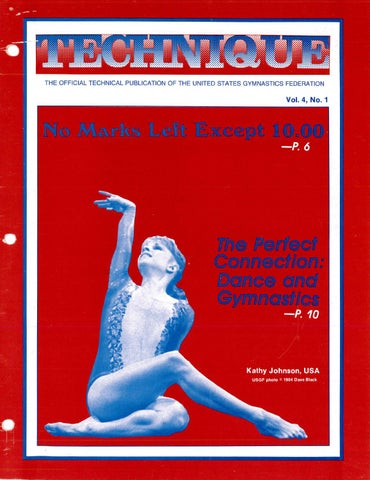
THE OFFICIAL TECHNICAL PUBLICATION OF THE UNITED STATES GYMNASTICS FEDERATION
Vol. 4, No.1
ATTENTION GYMNASTICS FANS .. .
da n's miss this special AUTOGRAPH offer! Order an Official USGF Scrapbook before June 1, and we'll send you an ORIGINAL autOgraphed picture of a US International Gymnastics Star. Names like: D1;U11le 0
.J l1 iJ;UJlle M MichelJe 8 l1rh;ul} t N i/lll;u-a erl1!Jt.
Valerie Zimring M· Tracee Talaven Itch Gav/orcJ • oett Retton N\;\I'.' LOU '\\\"\"\ D\\'j!;" Bart Conner Others Please indicate autOgraph choices I.
2.
3. (C hoices n OI gl.laran ll't'd )
Printed Material
Cost
Code of Points for Women 1981 FIG Supplement to the Women 's Code of Points 1982 FIG Supplement to the Women's Code of Points USGF Supplement to the Women 's Code of Points National Compulsory Routines for Women Women 's Olympic (Elite) Compulsories Women's Elite Compulsory Cassette Tape
$14 .00
USGF Rules and Policies and Elite Program Book for Women Code of Points for Men Jr. Olympic Age Group Compulsory Exercises for Men USGF Jr. Boys Age Group Compulsory Film Men's Olympic (Elite) Compulsories Men 's Program Guidelines and Coaching Manual Code of Points for Sponive Rhythmic Gymnastics Rhythmic Compulsory Exercises Reference Set (2 Books) 1) History of the Depanment of the USGF (71) 2) 100 years of International Gymnastics Federation (1881 -1981) 8 assoned back issues of the USGF Magazine
Quantity
United States
u·
$ 2.00
~
Responsibilities of the
\:Ii Gymnast '-\\
$ 2.00
S
ct
A F
$ 2.00 $ 6.00 f, 4.00 $ 900
T y
$ 6.00 $14.00
o
$ 6.00 $35.00 $ 4.00
E R
E
p
S T
$ 995
,. . . _Jo
___ WTn . ....... <.of1O'\ .....
$20.00 $ 6.00 $ ').00
'_
Long Sleeve USA T-Shin (please circle size) XL L M S Adult: Child: 1. M S
$13 00 $11.00
USGF Long Sleeve T-Shin (please circle size) Adult: XL L M S Child: L M S
$ 13.00 $ 11.00
''''' ...''''
Un ited States Gy m nastics Federation 101 West Washingto n , Suite 11 44E Indianap olis, IN 46204 .. . 31 7-638-8743
$ 6.00
Apparel, Accessories
USA Sweatshin (please circle size) XL L M S Adult: L M S Child: Gymnastics Signature Barre l Bag Gymnastics Signature Tote Bag Official USGF Gymnastics Scrapbook 1984 Olympic Gymnastics Calendar USGF "New Logo" Pins "I Love Gymnastics" Bumper Stickers First USGF Safety Poster
Total
Name Address
City
$ 15.00 $ 1300 $22.00 $14.00 $ 14.00 $ 2.50 $ 1.50 $ 1.00 ea. 12/ $ 9.00 $ 2.2')
State
Zip
POSTAGE AND HANDLING CHARGE INCLUDED IN LIST PRICE Order Fonn ExpiresJuly 1, 1984
= = -== ==-_ _ _ _ _ _ _ _ _ _ _ _ _ _ _ _ _ -I___ IL_____________________________________________________ 2 Total Price Technique I
1-- - - -I- Second-lJSGF--Safety-Post@1'
$ ... 2 -" 22 5 _~_
_
~
_
USGF
BOOKSTORE
~~~ Educational Reference Books! CHILDREN IN SPORf We ll -known authorities in the area write about readiness for participation , anatomical and physiologica l concerns , psychological issues , soc ial processes, and the history and future direction of youth sports. In addition to articles reviewing the current state of youth sports research in certain areas, the editors include articles that help bridge the gap between research and practice by prOViding useful guidelines to be applied in the sport setting. 1982 • Paper· 327 pp $10.95 -- US & Canada
JOY AND SADNESS IN CHILDREN'S SPORfS
ERGOGENIC AIDS IN SPORf Are ergogenic aids helpful to athletic performance? What is known about the effects ofvarious nutritional, pharmacological, physiological, psychological, and mechanical ergogenic aids on performanc'e? In Ergogenic Aids in Sport, wellknown au thorities report the latest research o n 13 common substances or treatments used by athletes today in an effort to gain the "winning edge." 1983 • Hard· 395 pp $23.95 -- US & Canada
to locate a structure and then manipulate their partner's movement to demonstrate the function. Learning the funda mentals of anatomy is fun when s t udents use the practical "hands on" method for learning instead of relying on rote memorization. 1982 • Spiral· Illus • 207 pp $13.95 -- US & Canada
PHYSIOWGY OF FITNESS
From students at the military academies to housewives in fitness classes, the message is the same: Physiology of Fitness is the most comprehensive, yet easy to use book ever written on the subject. In clear, concise LIVING ANATOMY language, Sharkey describes the See how fast your students "hows" and "w hys" of fitness will learn anatomy w ith this and explains the total fitness " nontraditional " approach! concept. Through living anatomy stu- 1979 • Paper· Figures dents learn about human move- • Tables· 430 pp ment by working with a partner $10.95 -- US & Canada
Read what the "experts" have to say about the pros and cons of children's sports, the nature of competition , cutting kids , ORDER FORM sandlot vs. organized sports , matching kids for competition, Please and the role of coaches and parcheck("') ents in youth sports . This book uniq ue blend of informat ive ordered and entertaining articles by well-known writers and athletes, combined w ith extensive introductory and closing comments by the editor, helps to focus the reader's attentio n on the key points and to provide an excellent framework for class d iscussion. 1978 • Paper· 375 pp $11.95 -- US & Canada
IN PURSUIT OF EXCELLENCE by 1erry Orlick, Ph.D. Based on his own experiences as an athlete, coach, and sport psychologist , author Terry Orli ck has writte n an applied sport psychology book used worldwide by students, athletes, and coaches. 1980 • Paper· 326 pp $10.95 -- US & Canada
COACHES' GUIDE m NUTRITION AND WEIGHT CONTROL
Coaches' Guide to Nutritio n and Weight Control is not just for coaches! Teachers and students in fitness and weight control classes w ill find an abundance of information on th e "whys" and "hows" of weight control, muscle fue ling, and hydration . 1982· Paper· Illus· 255 pp $9.95 -- US & Canada
-----------------------------------------
COACHING YOUNG ATHLETES by Rainer Martens, Ph.D., Robert W. Christina, Ph.D.,John S. Harvey, Jr., M.D., and Brian J. Sharkey, Ph.D. Becoming a successful coach is what Coaching Young Athletes is all about! Readers learn that being successfu l doesn 't just mean winning games; it means helping young athletes to e njoy masteri ng new skills, to enjoy competing wi th others, and to feel good about themselves. 1981 • Paper· Illus • 200 pp $12.00 -- US & Canada
Technique
Q uantity
Title
Price
Coaching Young Athletes
812 .00
In Pursuit of Excellence
510.95
Children in Sport
S10.95
Jov & Sadness in Children'S Sports
811.95
Coaches' Guide to Nutritio n and Weight Control
5 9.95
Phvsiology of Fitness
510.95
Living Anatomv
513.95
Ergogenic Aids in Sport
523.95
TO ORDER: 1) Fill o ut ORDER FORM 2) Enclose Ch eck o r money orders payable to: USGF Bookstore ( p ayme nt must accompany o rder)
Total
Total 10 1 W. Washington SI., Suite 11 44E Indianapolis, IN 46204
SENOTO: Name: _ ___________________________________________________________ Address: _ _ _ _ __ _ _ _ _ _ _ __ __ __ _ _ _ _ _ _ _ __ __ _ __ City : _____________________________________ State'__________________ Zip: _ _____________________ Ph o n e:---------------------------------~
3
Techn ique Preparat ion of Artic les for Subm ission: Please follow a uniform format of preparing articles for submission in order to provide the most efficient channe l through the evaluation and review process. The following should be inc luded in submissions : 1. An original type copy , double spaced on 8 Y2 x 11 inch paper. 2. an abstract , on a separate page , a short summary of procedure and explanation of study or article content (not more than 150 worlds) . 3. A short biographical paragraph on a separate page of the author or authors accompanied by a small photo (2 Y2 x 3'h" ) of the author. 4. References on a separate sheet double spaced in consec utive order, using Index Medicine style (author's name-last name first , name of book , city, publisher, year, page numbers) journal references , should follow same format (author, name of artic le, Journa l name , volume, pages, year) . 5. Duplicates of pictures and diagrams or figures (b lack and white preferred) with sharp detail. A lso i nclude exp l anat i ons (captions) of pictures and diagrams on a separate sheet. Photograph release-a letter of release from any identif iab le subject in photos that are included in the article un less the face or eyes are obscurred . Letter should be signed by subject, parent or guardian . 6. Title page cons isting of an informative title , author's name and comp lete institutiona l or professional address . Su bmission of Articles for Publi cation: Written artic les will be accepted for review and possible publ icat ion in t he follow ing procedure. First t he artic les are sent to: USGF Department of Publications 101 West Washington St. , Suite 1144E Indianapolis , IN 46204 Upon receipt of the article, to the USGF office , the research coordinator will review and forward copies to the appropriate USGF Sports Advisory Committee members for rev iew. On receiving the ir review , copies Of the article will go to the Managing Editor and Executive Director for final approval for publicat ion . If it is necessary for the article to be edited or rev ised in orde r to improve the effectiveness of communication to a wide variety-level of readers , the author will receive the edited article prior to publis hi ng for t heir approval. ' If t he article or parts of have been submitted and / or pub l ished by another publication , a complete name and address of the Editor and Pub li cation shou ld accompany the art icle upon subm ission to the USGF in order to fo ll ow proper procedures of publishing and to receive approval to reproduce the article in the USGF publication .
THE OFFICIAL TE CHNICAL PUBLICATION OF THE UNITED STATE S GYMNASTI CS FEDERATION
Vol. 4 NO.1
Table 01 Contents 5
6 "10.00" 8 New Skills and Trends
4
Mike Jacki Jackie Fie Jim Howard Kimberli J. Lewis
10
The Perfect Connection
12
Vaulting Board Analysis
14
Abdominal Strength
17
Psychological Profiles Keith Henschen Steven Edwards Richard Gordon Kenneth R avizza
21
Achieving Maximum Performance
Editorial Staff Mike Jacki , pub lisher, Debbie Forsten / Managing Ed itor, Mike Botk in/ Production Director, Dr . Gerald George/ Educationa l Research Editor. Un less expressly identified to the contrary , all articles, statements and views printed herein are attributab le solely to the author and the United States Gymnastics Federation expresses no opinion thereo n and assumes no_responsib lity t herefor.
Editorial
Dave Hen ley
Dan Bernardot Jan Anthony Technique
USGfII ISlJlTtJRIAL
Learning, A Never Ending Task Learning is the master force behind progress. No decision can be made , no solution can be envisioned , no hypothesis can be formulated until the approp riate learning has taken place . Once we stop learning , everything else ceases . We are only as effective as the information we have to work with . The more information we have , the better our background on which to base decisions , solve problems and substantiate theories . The USGF is pleased to present "Technique" , our publication for the students of the sport of gymnastics. "Students" applies to all of us who still have the desire to learn about our sport. Since progress stops when learning ceases , we are all encouraged to continue this vital involvement.
This publication will present valuab le information fo r all of us. The " State of the Art" in research , information , concept and th eories will be presented . We sincerely hope all gymnastics coaches , judges , parti c ipants and enthusiasts will support this project and recognize its importance . We should never ho ld back the advancement of our sport or the talent of our athletes because we have failed in the most fundamental area of progress . .. Iearning . For the
United States Gymnastics Federation,
Mike Jacki
o~
UNITED STATES GYMNASTICS FEDERATION
Can YOU ~~~il~appropria'df' IoII-' >«<f"nI"""""'P pn<tic~ anl"~
0 rnpg~ in Ih~ xtin,y
:T.
- c~
8tfOl~
direcllr c"",ginl'" '''1 r l''''I'U> ';Q
, ,,, ..s;u.ccd>nd>«wcdpropcrl r 1ndtlu,~,c
1II~f:#~ >('I~i"'~' i> inllK """"""'poo<"on. rxOT 8E TOLERATED. G )' I'DnU. iQ .. ~n ,ro ri. y (cqulri ...
..
~"""IIiiIt~ ti.!"'''':'1=7"!:!,,O~I~'!'::' ~::"~otnrcltMn"'" C
nnno. be
ROPER SKI Ll. PRIX>RESS IO:<iS. A We I""ming c"'_ · ~, IndudQ I u""croundlng 01 ,lie .kill bnng p .. , forMed and fo llo. i "8 p.ope •• kllI .....- . "'l'>min doubt...J ..... r>con.ult )"OU . inolNnot
~~G BASI C SKIlLS. !We Icuning prKtlCQ dc ....nd I1U$tning baoic okiLb bdo«JIf"ll'",....;njj:'''nc.o.· ....uot mo<cdilli<'uhl .....·cb. 9. AlT£){P'J1:-.'G !'IE\!;' A....-o:OR DtfFI OJLT SKIllS. Thc .""dlMO.!. 1nd 1bI~'\' I""d 01 the pnfotmn. the """,... d,h.. ,...... ~nd "'~ rompn<1>C}' 01 "'.. """,.n >II II"N", be
uJ,;m tn,oCO<l>JdnOlfon .. h .. n." .. mpunganoo' otdd6cuhmU 10 PROPER lA.."DU"'G TEO I1II1 Q UL S:af~ di,moun .., '" ..·.. 11 '" unin ... n.iOtl>l '>lb, .equ l... p<opcr l,andillJl ..... hrliquo No .moun. d "''''iRjl: nn be. ,........r... AHlid landingOtlhnd ur n ....It .... , Co>" "'...,;ou........... ophlc InjIJrinm.o y .nu'L
(~et~;.@o&t~ )
Afford To Be Without
p
o S
T E R
THESE??? (
)
The USGF has Issued the Second in a Series of Safety and Instructional Posters Dr. Gerald George, Educational Research Editor Says . .. "On behalf of the United States Gymnastics Federation, I strongly urge all of you to further enrich the safety environment of your gymnastic programs by posting a series of these official safety guidelines in your facilities. Always remember that safety is a fundamental cornerstone to gymnastics success."
Technique
See page 2 for ordering instructions 5
By Jackie Fie Women's Technical Committee Representative to the FIG on behalf of the USGF
B
y now all avid gymnastic enthusiasts must be aware that the Code of Points is an "objective " set of rules, which serves as a basis for the " subjective " eval uation of gymnastic exercises . This set of "evaluation regulations " was written during 1978 and 1979 and became valid in February of 1980. Subsequently, th is 1979 Code was first utilized at the XX II Olympic Games in Moscow in 1980. As dec ided by the FIG WTC , it will remain in force through the XXI II Olympic Games of 1984 in Los Angeles . Ha ve the top gymnastics performances outgrown and exceeded th e requirements and regu lations of the 1979 Code during it 's five years of va lidity? Is it possible within the conf in es of this Code to distinguish between the levels of perfection that have been accomp路lished? Were the numerous high marks, especial ly the 1810's in the women 's competitions, justified? Let's examine the many influenc in g 路factors and statist ics beginning with 1980, the bi rth year of the 1979 Code on a world level. In the 1980 Olympic Games with only 8 teams (all from "eastern " countries) and 14 individual compet it ors, the mark of 10.00 was already awarded 7 times in the women 's competition as follows: Competition Vault Bars
Beam Floor
Ib la 1 Shaposnlkova U RSl Ruhn RO M 2 Gnauck GDR Eberle ROM 1 Comaneci ROM 0 1 Davydova URS 0
0
II
III
0 1 ComaneCl
0 0
0 0
0 0
Note , however, that only two 10.00's were given for compu lsory exercises which were in their fourth and last year of va lidityl The judges had their first experience applying these new optiona l ru les at a world competition . Th e prestigious Olympic Games cu lmin ated the four year cycle of ath lete readiness and preparation . In 1981 the four year competitive cycle began again . This was the first year for the new FIG 1981-84 Compulsory Exercises. The top gymnasts were developing new routines. The 1980 junior gymnasts, now seniors, were making their debut. The judges, through courses and practical experience , also had more knowledge of the Code . Of most significance was the fact that 1981 was not a qualification year for the Olympic Games, although the top 10 teams wou ld automatically earn a judge placement on the floor during competition 1a of the 1983 World Championships. It was not a surprise that , out of the 19 team s (135 total participants) , at the XX I World Championships in Moscow, only two 10
6
Nadia Comanecl waves to the crowd after receiving a perlect 10. 00, her first In the optionalsat the 1976 Olympics in Montreal. (photo by Tom Salvas)
point exercises were performed , one by the All Around champion Bicherova on vault in competition two , and one by Maxi Gnauck on bars in competition three . Then came Budapest in 1983. The 1979 Code had now been in forc e for optionals for four years . The exercises were consequently better constructed to fulfi ll the requirements . Th e level of difficulty had increased markedl y , especially among the middle teams. The scores of these middle teams , performing in seeded order based upon compulsory performance , served to push the scores of the best teams to unparalled heights . For the top exercises , there were often no marks left except 10.00 1
T
o add to the tension , this was the qualification for the 1984 Olympic Games for both team and individu al. The fiercest competition was among th e middle teams, since only twe lve would qualify. During the World Championships prior to the Olympic Games there exists an enormous pressure , a stained atmosphere , rivaled only by the Olympic Games itself. Here the world team rankings , as well as qualifications are determined after Competition la & lb . Th e AIIAround (Competition II ) and Event Finals (Compet ition III ) establish the world champions and resulting world ratings with reputations being strengthened or weakend for the forthcoming Olympic Games . The World Championship is not ju st an invitational. Each team spends tens of thousands of dollars to travel there and attempt qualification . Many National Olympic Committees base future funding allocations on team
Technique
and individua l placement . Many sponsorships are won or lost at thi s co mp eti tion . Fo r man y teams it is a matter of program survival in future yea rs. Occasionall y, an NOC due to budgetary co ncer ns for all sports, will disapprove it's team 's part icipa tion in the Olympic Games , even if qualified , when a predetermined placement is not met.
Given todays concept of what is the "ideal", that is physically possible within the limits of the body, the apparatus, and the strict rule interpretation, very few gymnasts, if any, are "perfect." Often officials , train ers , coac hes , and judges are evaluated by their respective federations as to th eir effectiveness, ability to abide by the rules , as well as accomplish the ma ximum possible for their own team through training , performan ce , strategy , and influen ce. All of th ese factors co ntribute to the esca lation of scores as occurred at the XX II World Championships in Budapest, where a record 28 teams (a total of 176 competitors) took part. Th e perfect mark of 10.00 points was awarded 18 times during th e women 's competition with the following distribution: Competition Va ult
0
Bars
0
Beam Floor
0 0
la
Ib 4 Ba rba lala AD M Yurlchenko UAS Biche rova U RS Mos tepanova U R S
3 G nauck GO A Ag ache ADM Szabo RO M 1 Yu rlchenko URS 1 Szabo RO M
II
III
3 Yu rtchenko Mostepano va
0
Szabo 1 G nauck
1 G nauck
0 2 Yurtchenko
0
Szab o
2 Szabo Mastepano va
It is of interest to note th at no " 10s" were awarded in the compulsory program , which had now been performed over a three yea r period. Imperfec tion s in compulsories are quite readily seen and th erefo re compu lsory perfection in comparis on to the " known limits of achieve ment " is more difficult to obtain . The compu lsories are always judged w ith less leniency , than optionals. Nine of these perfect marks were awa rd ed during the hotl y contested optional team competition (Ib) , five in competition II , and only three in Competit ion III.
A
summation of the outside forces brought to bear o n the judgin g situation has been exam ined . No w let us treat the judgin g and app li cat ion of the Code itse lf, influe nced by the philosophy of the FIG . Th e FIG Statutes encourage participation of all member federations in the World Championships by estab li shin g open entry regulations with only the recomm end ation th at an average score of 8.50 be achievable by the team or individual participant . Hence , the difficulty requirements for the team competit ion Ib are not set very hi gh in comparison to those difficulty requirements for Competition II and III. For examp le, in Compet ition Ib : a. an impeccable exerc ise wit h 1 " C" , 3 " Bs" , 6 " As " and one extra " C R" with OV (origina l value) gives a starting score of 10.00 points, and b . a faultless exerc ise that fulfills the difficulty requirements of Compet ition III with 3 " Cs " (possib ly even 2 of which are " CRs" ), 2 " Bs ", and 2 " As " and fu ll Bonus (ROC) also starts from 10.00 points. A we ll performed exercise, as in examp le a will cause
Technique
escalation of scores for impressive exerc ises as in examp le b . The curren t diffi cu lt y, compos ition al, virtuosity , and execution requirements and accepted trends do not allow for su ffici en t differentiation between th e various levels of performance. Thus th e " bunching " of scores and the tendency to have " no where to go " . Yes , the gymnasts ha ve exceeded the requirements of today's Code of Points , in particular , as evidenced by th e len ient interpretation of man y of the faults and penalties , as recorded or not recorded by num erous international judg es . Given todays concept of what is the " ideal " , that is physically possible within the lim it s of the body, the apparatu s, and strict rule interpretat io n , very few gymnasts, if any are " perfect" . If all deductions for eve n the slightest fault in compos ition , exec ution , or virtu os ity were taken , virtually no gymnast should receive a score of 10.00 points . At times it would seem desirable to be ab le to score in hundredths , such as awarding a 9.65 instead of deciding between 9.60 or 9.70 . Thi s would better differentiate between the performances and be feasib le in th e age of computer scor ing . Seating 6 judg es on a panel , and averaging th e middle four sco res , wou ld in some way help to better rank the gymnasts , eliminating ties, even though th e point differences would be very sma ll. All judg es selected for World Championships should be frequently exposed to the " world 's best " . Th ey shou ld con tinu all y study film s especially after major world level compet iti ons , analyzing execut ion and compositio n in order to supp lement or re-adjust their "idea l" or " max " concept in lin e with what is currently possible . Ideal ly the rules demanded by the Code of Point s and their interpretation should be app lied uniformly by all judges to all gymnasts irrespective of. . . i. the ind ividual and her previous compet iti ve record and reputation , and ii . the team and its previous co mpetit ve record and reputation , rank position compared to their own team , and relationsh ip politically to their federation . Let the judges be influenced or motivated not by the scores , but rather by the performances of the gymnasts, who have devoted years to the development of their exercises . It is of most importance that th e best gymnasts are ranked properly , not that the best gymnasts receive 10.00 points . " Best " and " 10.00 " are not synonomous .
I
n th e 1984 Olympic Games , sim ilar forces and tensions wil l aff ec t th e evaluat ion of the competit ion . Strict applicat ion of the Code can be emp ha sized during the Judges ' Course prior to the competit ion through lecture and practica l evaluation . But what actua ll y happens during the competition is again the " sub ject ive " app li cat ion o f the " ob ject ive " set of rules.
T
he next Code of Points , effect ive for 1985 and after , has already been through its final draft . Will it direct , influence and change the trends in gymnastic composition and execution and its resulting eva luat ion ? Hopefu ll y, it will encou rage: 1) development and progress in the gymnastic elem e nt s, as well as the acrobatic elements , especia ll y in combina tion , 2) the uniform app li cation of precise and spec if ic penalties for compos ition and execution , 3) the appropriate rewarding of unique and original combi nation s and e lements o f not o nl y " C " and " CA" value , and 4) th e proper apprec iat ion of th e elegant , faultless , and truly virtuou s performan ce.
7
New Skills, Trends In Men's GYITlnastics Events Ideally, the parall el bar giant swing begins from a handstand position . The initial swing or " bail " from the handstand sho uld be very straight and the body should be firm throughout. This " bail " could be compared to the technique used to execute a horizontal bar type " bail " on rings . The body should stay stretched as long as possible. Unless you are an extremely short gymnast, the knees should flex prior to swinging through bottom. There is a slight "topping " action prior to the bottom of the swing which is an arching of the chest and shoulders. This "tap " should be executed as late as possible , similar to a " tap" for a fly-a-way recatch on horizontal bar. An early "tap" will make the turnover more difficult. The "tapping" position (chest arch) should be held well past the bottom making the initiation of the turn over as late as possible. The turnover begins by decreasing the shoulder and hip angle. In slow motion , this looks like the gymnast is going from an arched hang to a tucked inverted hang. The chest should remain down or hollow throughout the turnover. Very simply turnover, then pull up. This aspect of the giant swing is similar to the turnover and pull-up technique used to execute a " locked " arm shoot on rings. If all of the aforementioned mechanics are adhered to , the gymnast should be able to maintain a firm grip. Easier said than done! The Japanese gymnast, Gushiken, swings around to an "eagle" grip!!
By Jim Howard University of Nebraska Pommel Horse
U
until recently , the pommel horse event was not real popular with your average gymnastics fan . Although pommel horse routines are escalating in the difficulty of skills being performed, they lack a dimension that would make that event exciting for the spectator. The thought of doing a handstand on the pommel horse seems , at first, to be gymnastically incorrect. Handstand positions are usually achieved through forward and backward pendular swing or strength , both of which are foreign to pommel horse. The basic swing on pommel horse is circular in nature, so how do you change angular momentum into an upward direction leading to a handstand? Mechanically, several things should occur: 1. The gymnast's hips should counter-rotate in the front half more sharply than they would in the normal execution of a double leg circle. 2. Right hand placement (cloc kwise circle) should be much faster than in a normal double leg circle. 3. If the above hand-placement is correct, the gymnast's hips should begin to rise (pike) before swinging through a front support. 4. The shoulders should remain well forward during the first phase of the swing to handstand. For most gymnasts the handstand skill is first learned as a dismount and is executed from a "flair" circle. The " flair" circle tends to have a more severe counterrotation due to the downward force of the left leg (clockwise circle). The wide straddle in a " flair" circle makes it easier to elevate the hips , much the same as it's easier to execute a straddle press versus a pike press. To increase the difficulty of this skill , the gymnast need only change the circle position , i.e. double leg circle with a straddle up to handstand or double leg circle and pike up to a handstand . Another means of escalating the difficulty of the pommel horse handstand is to have the gymnast work down from the handstand into another skill. This is extremely difficult to perform without breaking rhythm or hitting the horse. The last skill to radically influence pommel horse work was the "flair" . . . although not an event requirement, it quickly became so popular it was expected in order to score well. The handstand skills are growing so popular, so fast, they are close to becoming an event requirement.
-'"
u
~
CD Ql
Parallel Bars
T
>
OJ
o
"
co
he "Giant swing " and " Healy spin " are 0> notrecent innovations to parallel bars, but are just ~ now being performed by a considerable number .2 of gymnasts of various skill levels. Variations a. of these skills are beginning to be developed so it ~ would be worth while to take a look at the basic ~ mechanics of these two skills .
8
Giant to" h andstand on the end of the p arallel bars!
Technique
The teach ing progression goes something like this: 1. Long hang swings under the bars. 2. Long hang swing and turnover (tucked "skin the cat" ). 3. Long hang swing and turnover, elevating the shoulders (tucked fly-a-way , hanging on as long as possible). 4. Repeat #1 , #2, and #3 , starting in a support swing execut ing a " baby bail" . 5. When #1, #2, and #3 , can be executed from a horizontal " bail ", the gymnast is ready to comp lete the g iant swing ending in a straight arm support. At this point, an overhead belt is used to assist the gymnast in arriving in the support pos ition. Two teach ing hints that I might suggest wou ld be: (1) work with over-rotation in mind and (2) regrasp w ith locked arms, hands behind shoulders. T he " Healy " spin is not a new ski ll, it was reported in sequence photos in the November 1964 issue of Modern Gymnast! The skil l is just now becom ing popular, probably because it's now be ing performed by a few world-c lass gymnasts. Everyone wants to copy a world champ ion, no one wants to imitate a "rook ie" even if he did orig inate the trick! The " Hea ly" spin is the reverse of a Diamidov, which basically is a full turn on one arm. Mechanically the "Hea ly" is more d ifficu lt because the gymnast is swing ing down from a handstand , therefore te nds to accelerate. Second ly, to reg rasp in stra ight arm support is somewhat blind, similar to a back stutz. Mechan icall y, the skil l begins as a sw inging forward pirouette. As the we igh t shifts over the shou lder of the support arm , the turn (sp in) is initiated by extending from the shoulder. This extension should be re lative ly late in the swing, as an ear ly extens ion w ill slow the swing and prevent the center of gravity from pass ing over the supporting shou lder. Most of the mec han ica l emphas is shou ld be placed on keep ing the gymnast's weight balanced over the support arm as the body descends from the handstand. T he body pos ition during the downward sw ing should be somew hat sideways, similar to that of an upward stutz sw ing. Regrasp of the bar should be prior to the hips pass ing through the bottom of the swing. The earli er, the better! The body position at the moment of reg rasp shou ld be one in wh ich the shoulders are slight ly behind the hands, chest is down and the hips are f irm and stra ight. Ideal ly, this pos itio n should simu late the downwardbackward port ion of a good cross support sw ing. T hi s ski ll should first be practiced from a pirouetti ng motion on the floor with soft mats for the body to land on. The next step is to practice the "sp in" on a low set of para ll el bars w ith a coac h slid ing a mat on top of the ra il s as the gymnast begins the downward portion of the sk il l. As the gymnast becomes more prof icient in his execution, a mat can be he ld under the rai ls to slow the le'gs as the dow nward swing is comp leted . Floor Exercise
W
ith advent of the spring and foam floors, we are see ing male and fema le gymnasts executing ski ll s that were at one time witnessed on ly in the world of div ing and trampol ining . These skil ls are the tw isi ng, mu ltip le somersaults. The first of these ski ll s to be executed on floor was the "fu ll - in" variety of twisting double-back somersault. This sk ill saw the gymnast initiate two rotat ions at the same time, One somersau lting and one tw isting . If executed proper ly, this poses no problem, but, if the twist is initiated too early , somersau lting
Technique
rotation will be slowed mak ing the second half of the doub le-back more difficu lt. More recently, we are see ing gymnasts perform the "ful l-out" var iety of the ful l-twist ing doub le-back somersault. Th is technique requires the gymnast to initiate a strong backward rotation and then use some of that momentum to initiate a twist in the second half of the doub le-back somersault. Regard less of the technique se lected to use in perform ing a fu ll-twisting double, the gymnasts prime object ive is to initiate strong backward rotat ion , To help achieve this objective, here are some mechan ics the gymnast and coach shou ld emphasize: 1.Speed, accelerate through the round-off, back handspring, 2.00 not over block the back handspring. 3.Before the feet leave the floor, the arms and chest shou ld be stretched past verticle , thi s wou ld be an idea l posit ion from wh ich to generate maximum pos it ive rotat ion . If the ski ll is a "fu ll -in " tucked, the knees shou ld come up into the di rect ion of rotation very qu ickly and ma intain consta nt pressure throug ho ut t he exec utio n of the sk ill. " Constant press ure" simp ly means the body should maintain the same tuck posit io n until t he sk ill is complet ed . T he "fu ll -in" executed in the pike pos it io n prese nts a little difficu lt skil l execution. The take-off pos itio n for both tuck and pike "fu ll - in s" is the same. As t he gymnast initiates the twist, the re shou ld be a tota l body pressure exerted in the rotatio nal d irect io ns, somersaul t and twist. The body is in a lo nger pos itio n so it is mechan ica ll y advantageous to comp lete or "square " the twist before turning the last portion of the doub le somera ult. Somersau ltin g before complet in g the twist causes the gymnast to rotate at an ag le to his somersau lti ng ax is or more simply stated, there wi ll be a " wobb le in your fli p" ! To prevent the "wobble," do not drop the arms down to the legs to ach ieve the pike position until the tw ist has been comp leted. T he late tw isti ng double back or "fu ll -out" tec hniq ue is the most recen t va ri at ion be ing performed by we ll sk ill ed gymnasts. If I had to pin-point a sin gle phys ical characteristic that al lows a gymnast to perform the " f ull -out" it wou ld be total body qu ickness, T he "f ull out" acce lerates at the initiati o n of the ski ll, whereas, the " fu ll -i n" demonstrates an acce ll eratio n in th e fin al phase due to the c losing of the turn in g rad ius. The take-off position wou ld be the same as the prev ious two sk ill s, but the knees and feet shou ld come up into the rotat ion muc h qu icker, As the body beg in s the first rotat ion, the arms w ill shorte n, but the hands should not drop below shou lder leve l. A ll body parts should exe rt pressure in the d irection of t he somersau lt. The twist shou ld be in itiated not earli er than 1 V. rotat ion and not late r than 1 Y2 rotat ions . At the moment the tw ist is started, it is very important that the head be neutra l and al l body parts should exert pressure in the tw isting directio n, My personal coach ing adv ise to the gymnast is to ini tiate the tw ist with the knees , not the shou lders as in a stra ight body tw ist. Because of the many angles in the tuck positio n, tota l body pressure is an absolute necessity, If o ne-ha lf of the body re laxes as the other ha lf initi ates a tw ist, the opposite ha lf wi ll slow down or twist in the opposite d irect ion. Newton d id it to us again!!! From a learn ing standpo int, there is one prereq uisite sk ill the coach shou ld contin ually stress, That is, t he "open" tuck and "open" pike doub le-back so mersaul ts. More than anything, these ski ll s teac h the gymnast t o in itiate qu ick rotation and ma inta in consta nt body pressure throughout two somersau lts.
9
•
Dance And Gvmnastics The Ultimate Connection By Kimberli J. Lewis
With an increased number of skilled gymnasts and a more concentrated understanding of biomechanics, it is vital to perfect expression and execution as well as skill. Virtuosity , the ultimate in body discipline as well as expression and execution, are valuable components of gymnastics which can be improved through dance training . Becaus~ these components are related directly to a skill, gymnasts of any level can increase performance by improving execution and virtuosity. Dance improves virtuosity through building a mind/ body connection, and helps to improve execution through improving balance , spacial range of movement , fluidity of movement and movement control.
B
ecause both dance and athletics are based on human movement , the rational that dancers are really athletes and athletes are really special ki nds of dancers, is not new to any observer of both activities (Pruett, 1981 , p. 27). What better example of this statement can be found than in the sport of gymnastics which developed through the desire of humans to move, to dance. The movements of gymnastics evolved through ancestral motions of dance, the two often being referred to as gymnastics-dance or dance-gymnastics . Then what occurred? While the two continued to develop, this development was performed in isolation. Dance excelled ; and those who wanted to dance became dancers. Gymnastics excelled ; and those who followed that path became gymnasts. Soon each had its separate identity. Today in a world of high-risk sport , many gymnasts and coaches find themselves peering over their shoulders toward the origins of their sport-human movementprimitively recognized as dance. Although dance is thought of in a sophisticated manner, its foundations are based on a wholistic body discipline which provides the unique body/ mind connection often found lacking in gymnastics training.
B
alance errors in gymnastics are frequent, evident and often unnecessary. Balance, basically the ability to maintain equilibrium, is a concern to both the dancer and the gymnast and can be improved through proper dance training. Gymnasts who decrease balance errors through constant repetition of routines can enhance balance performance through appropriate dance technique training. Various techniques help the gymnast build a conceptual understanding of body parts and their roles in maintaining equilibrium , as well as the entire body's relation to gravity. Such training perfects balance skills and, through drills, defines the laws of gravity and how these affect equilibrium. As gymnasts increase the understanding of body parts , the ability to maintain equilibrium increases spacial range of movement , and in turn, performance. Spacial range of movement refers to the ability to initiate
'Gymnastics is not only a sport but also an art of body expression.' Gymnastics is not only a sport but also an art of body expression which requires exceptional form. This expression and form is becoming increasingly important in competition , and gymnasts who have reached this height in skill level often find this is the differentiating factor which separates them from other gymnasts in competition. But how can our gymnasts be taught the art of expression and form? Dance provides the fundamental learning skills which increases the body's capabilities in logical order; yet many gymnasts are not being trained in dance . Current literature on gymnastics often provides coaches and gymnasts with basic dance warmups to be used , but th is is not incorporating dance training into the program . Coaches require a conceptual understanding of dance content and how this can enhance the gymnastics skill. Dance training must become an integral part of a gymnastics training program , as noted in many of the United States ' gymnastics competitors training programs and even national programs. Here, gymnasts are not only drilled in dance skills but are also trained in the philosophy of dance technique. Americans have stood in the shadow too long. After sporadic flourishes of interest, the issue of dance training often fades like sunbleached clothing; but the time has come where coaches will be required to make a commitment to dance in order to remove themselves from that shadow.
10
@
o
o
.c
Q.
IL
oen
::l
Elena Davydova, URS Technique
(
and complete a movement to its fullest , i.e. within the physical limitations of the body, and to utilize the max imum kinespheric space available to that movement. This is a combination of two elements-the range of movement which can be increased through flexibility training and spacial awareness which results from an, understanding of movement. Proper dance training provides flexibility training while increasing the intellectual understanding of movement. This physical conditioning and intellectual comprehension improves gymnastics performance ; but the ultimate in performance can be achieved only through a combination of balance , spacial range with fluidity and overall movement control.
'Fluidity of movement is the continuous successful motion throughout a movement. ' Fluidity of movement is the continuous successfu l motion throughout a movement, often observed as gracefulness, and giving an aesthetically pleasing quality to movement. Even the most dynamic movements must contain a fluid base if they are to transcend smoothly into the next movement. Gymnasts often lack fluidity , such movements at times appearing discontinuous, disjointed and containing unnecessary pauses and stops . Fluidity is found in the lyrical combinations of dance. The constant success of motion is practiced during dance training ; yet this successive motion often is overlooked in gymnastics training. Fluidity of movement can be mastered only through time as gymnasts gain better balance , spacial range and movement control. It is a myth gymnasts gain only at the risk of faulty execution . The two elements go hand-in-
hand-the improvement of one can only help , not hinder, the other . . Overall movement control is the final step in gymnastics performance-often the ultimate extra which officials call virtuosity. The control of movement has its base in understanding the functions of muscles and the ability to master individual mu sc les in isolation . In dance training , gymnasts become aware of errors in movement control and learn the appropriate use of muscles . Exercises increase not only isolation of the muscles but also strength. "The gymnast who maintains a good tight body through isometric concentration will always make it tough for a judge to deduct faulty execution" , (Oldham, 1978, p. 75) . Maintaining this good tight body through isometric contraction can result only through increased body awareness , muscle control and muscle strength gained through a dance training program yet lacking in a gymnastics training program . Dance training has more to offer gymnasts than series of choreographic steps to include in beam or floor exercise routines , but it is dependent upon gymnasts, coaches and officials to extricate themselves from their rigid parameters established over time and review their priorities to incorporate dance training into their gymnastics preparation . To make this economically feasible , educators must include dance training in their own formal preparation , thus extending individual capabilities as well. The onl y question left to answer is " when?" BIBLIOGRAPHY Oldham . S. " Tig h t Body Control Concept in Gymnastics." Scholastic Coach. Ma rch 1978, 47, pp . 75 -76 . Pruett, D.M. "Athle tes and Dancers- T rai ning and Moving Together". Journal of Physical Education, Recreation and Dance , May 1981 , pp. 27-28 . Pruett, D.M . "Bal let for Divers", Journal of Physical Education , Recreation and Dance, May 1981 , pp. 35 -37 .
c
en
G)
"::r
'0
0
0 @ CD CD
'"0 0>
<
(1)
OJ 0>
()
'"
Technique
11
't FI.:::I.-..,=_'_. In \ia u 1 t i nl;] E:Da t-路 d Ana 11::.j ::::; i :::; Editor's Note: This report was submitted 1982 to FIG by Jackie FIe, Project CoordInator, FIG-WTC member.
T
he study of the vaulting boards has brought to light many very interesting results. The hypothesis was proven and very strongly substantiated . This study allowed for further evaluations and additional observations to be made. Let us first present the hypothesis, release the data, summarize , and evaluate.
HYPOTHESIS:
W
ood vaulting boards do not provide the most essential characteristics required of a piece of gymnastics apparatus , i.e. : first , that the apparatus be safe and durabl e, therefore dependable, and second , that the apparatus provides skill performance facilitation , and third, that composite type vaulting boards (those made of synthetic materials) such as fiberglas , steels , aluminums, p lastics , and other such materials) will be superior in both criterias . Therefore, composite boards should be the only apparatus all owed to be used in world class gymnastics competition .
THE TEST:
I
n order to eval uate the performance characteristics , a test was devised to record specific properties of vaulting boards. It was determined that since a vaulting board is a propelling or rebounding device , that the most significant feature of the board would be how much force the board will provide given a specific in put force . The coeffic ient of rest itution or the measure of res iliency of the board was determined. This was done using a n umber of boards. The final results show three boards evaluated. The boards listed as A and B were reuther style wood vaulting boards. The board li sted C was a composite style vaulting board constructed primarily of steel base with a fiberglas spring system . The boards were completely compressed and the number of compressions (cycles) were counted . The coefficient of restitution was measured and determined after similar intervals on all boards . Rather than dealing w ith percentages, whole numbers were used w ith a base of 100 being set. The fact that the composite board was more resilient to begin with was not taken into the results . All boards were started with a base of 100. It should be mentioned that almost all wooden style boards will have variations in the restitution prior to the first compressions due to the very nature of differing wood characterist ics . Th is is not true with composite type boards. The coefficient of resitution is given by the formula: C of R = V Out V In Where this is a comparison of the velocity of an object as it makes contact with another object as compared to the
12
ve loc ity of th e same object as it leaves the contact object . .. otherwise stated , th e entry velocity as compared to the exit velo c ity. This is an approp riate re lationship to evaluate, since it can be assum ed that a perfect vaulting board would provide the same velocity from the board as the gymnast provides upon contact with the board . Also , it should be mentioned again for clarification , that the absolute resiliency of each board is not being compared . Th e resiliency of different boards with prolonged use is the subject for comparison. Each board was subjected to compressions and measurements of the C of R were taken at 500, 1,000 , 1,500 , 2,000, 3,000, 4,000,5 ,000, 7,500,9,000, 10,000 , and 12 ,000 cycles respectively. The same test procedure in a controlled situation were utilized throughout .
APPENDIX A RESULTS OF RESTING: The measurement of the coefficient of restitution is a determination of the relationship between the entry velocity as compared to the exit velocityC of R = V Exit V Entry Rather than comparing the boards directly, the standard was set using a base of 100. Th e difference in the C of R was compared after compressions were completed on each board, to see if use and fat igue entered into the consideration. It is mentioned again that the board listed as Board C has a much higher initial coefficient of resitution and also a greater distance of force applicat ion . The refore, its performance characteristics are substantially higher from the start. The two boards listed as Board A and Board Bare standard wooden reuther type boards. Board C is a newtype composite board with a suspension system made up of a sol id fiberglas spring . Us ing a tolerance of about on e percent , there was no significant change to Board C at all during the cycles from one to 12,000. Any change would be listed once the board changed from the base of 100 to any number below 99. Compressions were rapid and complete . The board would undergo simulated force appropriate to its intended use. BOARD A CYCLES 500 1000 1500 2000 3000 4000 5000 75009000 10,000 12,000 Coeffi c ient of Restit utio n (base-100) 78 90 96 93 90 97 86 85 84 82 81
BOARD B CYC LES 500 1000 1500 2000 3000 4000 5000 7500 9000 10,000 12,000 Coeffi c ient o f Restitu tio n (base- 100) 79 81 97 94 91 89 87 86 85 83 82 BOARD C CYC LES 500 1000 1500 2000 3000 4000 5000 75009000 10,000 12,000 Coefficient o f Restitutio n (Base-100) NV NV NV NV NV NV NV NV NV NV NV
Technique
(
DATA ANALYSIS: As we look at the data that was obta in ed , we see a stead il y diminishing C of R for both boards A and B. At the same time, we also see that these results are not exactly the same, even though the two boards are made by the same manufacturer and are listed as the same product. In the case of Board C , we see the results show no variance. This means that there was essentially no difference between the C of R starti ng with a base of 100, at zero cycles (initial test), and 500 through 12,000 cycles. The tolerance used was one unit out of 100 or a one percent variance allowed. DATA EVALUATION: After the results were tabulated , some important deductions were made: 1. It is obvious from the results that the wooden boards have a lower C of R than the composite boards. 2. The coefficient of restitution decreases more abruptly with a wooden board , as compared to a composite board. The greatest decrease occurs in the early use of the board and continues to decrease with repeated use. 3. Through photographic analysis , it is evidence that the wooden boards not only have internal changes during use, but also external changes . The fact is that when secured , and jumped on, a wooden board will in fact move backwards. This is not true with the use of a steel frame board. 4. Different wood boards will react differently under stress and there is virtually no consistency of performance from one wood board to another. However, this is not true with the composite boards , of the same design from the same manufacturer, where these two different boards will also have exact features and performance profiles. 5. The wood boards are much more susceptible to fatigue than the composite boards. This affects durability, performance, and safety. The above results support the determination that a composite board will be more consistent in performance , provide better elasticity and restitution , and will resist fatigue. SEE CHART-APPENDIX B APPENDIX B VAULTING BOARD CHARACTERISTIC COMPARISON BOARD C
BOARD A & BOARD B
Fiberglas Spring No external board movement Tilted spring-pivot. to accomodate contact variations High etasticity coefficient High restitution coefficient High resistance to fatigue High consistency of deflection Greater distance of force application Greater impulse velocity""
Woodleaf spring Externa l board movement No accomodating spring position changes Low elasticity coefficient Low restitution coefficien t Low resistance to fatique Low consistency of deflection Lesser distance of force application Lesser impulse velocity
"" "Described in results and analysis
RESULTS AND ANALYSIS: It has been observed and determined that the coefficient of restitution decreases during the use of the wooden vaulting boards. It can be assumed that this same effect will take place during the time span from the start of training and during the entire length of competition of a world class gymnastics event such as the World Championships or the Olympic Games. Since there is a
steadi ly decreasing C of R with the greatest changes being seen in the initial phases , the greatest effect will be on those vaults held during the Finals, when the C of R is approaching its lowest point. The effect on the vault is determined through the investigation of the impulse force. The impulse force is essentia ll y the force the gymnast derives from the run and the jump off the board. This is the force and energy that is utilized by the gymnast to perform the vault. We know the impulse force formula to be: I = Force X Time To maximize the impulse force , we would maximize the force over the greatest period of time. Therefore , I Max = F Max X T Max Using figures, for an example, with a force of five hundred pounds over a one second time periodI = 500 X 1 = 500 Now, in the case of the vaulting boards, we know that if the coeff icient of restitution goes up, the time on the vaulting board will decrease. This is to the advantage of the gymnast when determining the impulse force . The fact is that because of the reactivity of muscle tissue, as the time span decreases, the athlete is able to generate greater amounts of force for shorter time intervals. So, instead of creati ng five hundred pounds of force during the board time of one second , as the time factor is cut by one half second, we find the athlete can then generate one thousand two hundred pounds of force . Inserting the equation, 1 = 1,200 X .5 = 600 Thus , the gymnast, during the shorter duration has acquired a greater impulse force and has more power and energy to perform the vault. This is in itself the most important reason for the vaulting board to have a high coefficient of restitution and a more important reason that it remain constant and unchanged throughout the duration of the competition. SUMMARY AND CONCLU SION: It should be the concern of the 'gymnastics federations' that the apparatus is always preceding the athlete in terms of performance. If the athlete can out-perform the equipment , two results are probable-one is poor performance and the other is the possibility of injury. The 'gymnastics committee' has attempted to concern itself with addressing this problem by allowing the advancing technologies to be introduced, tested , and approved where the criteria were determined to be appropriate. The vaulting board issue is now at a critical stage and action is necessary in order to remain consistent with the purpose of apparatus modifications, i.e. , safety and skill/ performance facilitation . As shown in the results, the wood boards performed below the standards necessary for world class competition. The nature of the materials brings about inherent problems in terms of durability, consistency, and homgeneity. New high technologies and the newer sophisticated materials eliminate these problems while, at the same time, introduce much higher performance standards. The coefficient of restitution tests are the strong basis for the eva luation . Other such tests need to be developed and the testing procedures must become an integral part of apparatus modification evaluation. The final determination is accurately stated in the comparison of wood , and its characteristics, as opposed to new synt hetic materials. The wooden spring system contains certain properties inherent to its composition that are inappropriate and unsuitable for its use. The fact (see Vaulting, page 19)
Technique
13
Abdominal Strength Linked With Better Performance
s
By Dave Henley Oklahoma State University
uccess in comp letio n of many movements performed by a gymnast depends on the strength of the abdomina l area. Many times slow rotation or lack of rotat ion in tumb ling or va ulting can be traced to abdom ina l weak ness. This ca n also be see n thro ug h an inabi lity t o hold body pos itions necessary for circling movements around the ba r. The abdom in al mu scles connect and help coordinate move ments of the upper and lower body . Decreased strength in these muscles can lim it sk ill execution and eve n cause lower back injury. Rotation of th e body comes from a sequence of mu sc ul ar co ntract io ns of different body parts. A weak area in the sequence causes one or more body parts to compe nsate, ca using poor exec ution of a ski ll. In creasing the streng th of the weak body part can restore the muscular ba lance needed for effective move ment coordi nation. There are many abdom inal exercises which wi ll streng t hen the abdomina l area. The traditional situp is a good exerc ise. Leg ra ises are another classic exercise, but sometimes causes lower back inj ury. Each musc le has two places for attachment. The abdom inal muscles connect at the upper portion of the rib cage and at the pubic bone. When the abdom ina l m uscles contract, the direction of body movement depends on which end of the muscle is stabi lized . For instance, if the hips are stab ilized , as in situps , the shou lders will move forward. If the shoulders are immovable, the hips w ill rise . The abdomina l muscles also act to jo in the upper and lower body together as one un it. Exercises wh ich strengthen the abdominals shou ld be bas ic and fo ll ow the natural movement patterns of the musc le. The abdomina l muscles react the same as any other musc le to stress. Over 15 repet itions per set wi ll not show any sign ificant strength gains. Increasing the amount of sets will be more beneficial. The description of the fo ll owing three exercises and (Photo 1)
14
n
prog ress io ns will enable the gymnast to strengt hen the abdominal musc les without risking back injury. Once the gymnast has attained the strength to perform these exercises correct ly many other exercises can be safe ly administered . The sit up strengthens the abdom ina ls for a forward pull ing act ion . To prepare for the situp , the gymnast shou ld lie on the back with the knees bent at a 45 degree angle . (Photo 1) The feet should remain in the f loor but not supported to eliminate muscu lar assistance from the legs. The arms shou ld be held across the chest and the lower back pressed down to the floor. Performing the situp beg ins by li fting the chin to the chest and curling the upper body to an upright sitting position . (Photo 2) When return ing to the beginning pos ition the action is reversed mak ing sure the back does not arch. When three sets of 15 can be performed correct ly more resistance will need to be added . Resistance can be increased by placing the arms behind the head. The arms shou ld not be used to he lp the body get started. Even more res istance ca n be added by placing a pole beh ind the head and grasp ing it with a wide grip. (Photo 3) Twisting to both sides can be added to strengthen the accessory muscles of the abdomen. The twists should in itiate from the starting position . When three sets of 15 repetitions can be performed correctly , the situp can be performed by allowing the shoulders to hang off the end of a bench. (Photos 4 & 5) The arms should be crossed over the chest and the feet secured . The knees should be bent to a 45 degree angle which el iminates assistance from the leg musc les. To perform the situp , the shoulders shou ld drop down below the bench level and then return to a sitting pos ition by curling up as in the bas ic situp. Th is exercise should only be used after sufficient abdom inal strength is achieved through the previous situp exerc ises . The " Hip Lift" is performed by stabi lizing the shoulders which cause the abdominals to pull the hips upward . The resistance against the abdominals is (Photo 2)
Technique
increased or decreased by the distance of the legs from the upper body. The position for least resistance is Iyi ng on the back with the arms extended on the floor, overhead. This places the abdominals in a stretched position for a more efficient contraction and helps balance the body. The legs are lifted to a 90 degree ang le to the body with the knees slightly bent. (Photo 6) To perform the hip lift, curl the hips up to a shoulder stand position . (Photo 7) When returning to the starting position , the legs must first move away from the body . This places a greater resistance against the abdominals for added strength gains. As the hips reach the floor the abdominals should remain tensed to prevent the lower back from arching . When three sets of 15 hip lifts can be performed correctly, resistance should be increased by using an incline bench. (Photo 8) The gymnast should hold on to a support at the top of the bench to keep from sliding and to stabilize the shoulders and chest. The legs are positioned at a 90 degree angle to the body with a slight bend at the knees. Perform the hip lift the same as the movement on the floor. The resistance can be increased by the angle of the incline bench and the position of the legs. The maximum amount of resistance can be realized when the gymnast hangs from a bar with a support at the shoulders . From a hanging position, the knees should lift to a 90 degree angle with the body. During this time the abdominals are stabilizing the hips and no arch should appear. When the legs reach the 90 degree angle the hips should lift out and up. (Photo 9) When the hips reach a horizontal position the movement should be reversed and returned to the starting position. The speed of the lift should remaiR constant. Starting quickly and letting the legs drop on the descent reduces the effectiveness of the exercise and could cause injury to the lower back. When deciding on the angle of the legs for resistance , it is important to remember that the number of repetitions performed and correctness of the movement determine the intensity. The knees should be placed at an angle to allow the gymnast to move the hips through the full range of each lift. The last exercise in the series is the " Rocker. " This exercise uses the abdominals to stabilize the upper body and lower body as one unit. To perform the rocker, the feet and shoulders should raise si x inches off the floor with the lower back pressed against the floor . (Photo 10) The shoulders and hands should be stretched forward to an area over the middle of the thigh. Begin the rocking action by either pulling the chest forward or feet up. The rocking action should continue for 20 cycles. Resistance can be added by raising the arms over the head. It should be remembered on each of these exercises that the lower back should never be arched. If an arch occurs the abdominal muscles have become fatigued or too much resistance has been added . These exercises can be performed in any order. A suggested method is to perform one set of each exercise in the order of situp , hip lift, and th e rocker. Repeat the sequence with two more sets. When performing these exercises, the correct form is more important than the amount of resistance. As the abdominals become stronger more resistance and a variety of other exercises can be added. (Editor's Note: Dave Henley serves as an assistant gymnastics coach at Oklahoma State University while working on a doctorate in Health Science. He also teaches gymnastics , swimming and physical fitness classes at OSU.)
Technique
(Photo 3)
(Photo 4)
(Photo 5)
(Photo 6)
Photos continued on page 16
15
(Photo 7)
(Ph oto 8)
(Photo 10
(Photo 9)
16
Technique
Analysis of Psycholog ical Profi les Comparing Male and Female NCAA Championship Gymnasts Figure 1
By Keith P. Henschen University of Utah Steven W. Edwards Oklahoma State University Richard D. Gordin Utah State University Kenneth Ravizza Cal State Fullerton Abstract
T
he purpose of this investigation was to evaluate and quantify psychological differences between male and female championship gymnasts . T he subjects included 84 female and 58 male gymnasts who competed in their respective 1982 NCAA National Collegiate Gymnastics Championships . Psychological variables included the tension , depression , anger, vigor, fatigue and confusion sub-sca les of the Profile of Mood states (POMS) and the masculine, feminine and neutral sub-scales of the Bem Sex-Role Inventory (BSRI). Discriminant function analysis was used to evaluate the strength of the discriminant analysis . The results indicated that the POMS alone, the BSRI alone and the POMS and BSRI together were ab le to significantly discriminate between the males and females . The best discriminant function was able to correctly classify 75 .2 percent of the cases . It was concluded that the male and female intercollegiate gymnasts exhibit similar psychological profiles of mood states and possess sex-role orientations consistent with traditional sex stereotypes.
H
istorically the preparation of athletes for competition has emphasized the development of physiological variab les which underlie success for a given competitive performance. The research literature is replete with studies which have formed the basis for the development of training regimens in such areas as muscular strength and endurance , cardiovascular endurance and techniques for skill acquisition. Until recent ly psycho logical preparation for competition has received proportionately less emphasis . This is in part due to the complexity of the human psyche alone and in concert with a plethora of other intrinsic as well as extrinsic factors which impinge upon athletic performance at anyone moment. As can be seen in Figure 1, even the most fundamental paradigm of human performance provides
Technique
EXTRINSIC FACTORS
Situational Variables Display Characteristics Etc.
PERFORMANCE
LABI LE Psychological and Psychological Variables
STABLE
I NTRINSIC FACTORS
a comple x interaction of factors both internal and external to the athlete's performance. Additionally , physiological and psychological characteristics exist in enduring, relatively stable forms referred to as traits or in temporary , readily labile states which are subject to immediate change in the moments which surround a competitive performance. Certainly physiological characteristics also exhibit trait- and state-like di mensions but the stable traits seem to predominate in the face of no deterring injuries or traumatic physical occurrences . Therefore , the moments which surround athletic performance are most influenced by psychological variables such as personality have been studied and some differences among athletic groups have been noted. During the 1960's, a number of researchers attempted to study el ite performers via personality characteristic assessments (A lbaugh 1970, Kane 1964, Kroll 1967, Lakie 1962, Ogilvie Johnsgard 1967, Slusher 1964, Werner and Gattheil, 1966, Wright 1973) . The intent of these research studies was to identify the personality profiles of superior performers with the basic premise being the existence of an athletic personality. These studies tended to show that although a part icular personality trait or profile may be associated with enhanced probability for success in a given sport, it is by no means necessary. The opposite would seem to be true for the more labile psychological states which can change rapidly as one approaches a competitive event. William P. Morgan has taken this theoretical approach and his research indicates that total personality is not the answer to overall athletic competence; but rather emotional disposition at the time of competition might be most influential on immediate performance (Morgan , 1978, 1980). Stress , anxiety , concentration, expectation , (continued on page 18)
17
aspiration level and many other psychological determinants of success must exist in optimum fashion in order for the highest levels of performance to be expressed . It is hypothesized that there is a psychological profile of these more labile states, moods if you will , that exists across the athletes who exhibit the highest levels of success. The purpose of this study was to determine if such a profile of moods existed in a group of elite collegiate gymnasts. Additionally, these male and female gymnasts provided the opportunity to investigage one of the more stable psychological traits, sex-role orientation, and its possible influence in a sport which is interlaced with such masculine qualities as strength and power and such feminine qualities as grace and poise. Method
T
he subjects for this investigation included 142 collegiate gymnasts who competed in their respective 1982 NCAA National Gymnastics Championships. All of the male and female gymnasts who qualified for their 1982 championships were asked to participate in the study. One hundred and sixty-nine gymnasts were initially contacted and 84 percent of the subjects, 84 females and 58 males, volunteered to participate . In the hours prior to their first performance at the national championships two standardized instruments were administered; the Bem Sex-role Inventory (BSRI) (BEM, 1974), wh ich assessed sex-role orientation , and the Profile of Mood States (POMS) (McNair, Lorr & Droppleman , 1971), which was used to assess emotional disposition . Approval to conduct the study was received from the NCAA Research Committee, the athletic di rectors and coaches of the represented institutions, and the University of Utah Human Subjects Research Committee. All of the subjects signed statements of informed consent indicating their voluntary participation. Discriminant function analysis was used to determine if the scores on the POMS sub-scales (tension, depression , anger, vigor, fatigue and confusion) and the sub-scales of the BSRI (masculine, feminine and neutral) were able to significantly discriminate between male and female elite collegiate gymnasts. I ndependent variables were selected for inclusion in the discriminant function according to the method of ma x imizing the minimum Mahalonobis distance. The significance of the discriminant function was determined by use of Wilk's lambda and its associated chi-square test of significance (Klecka , 1980) . Results
W
hen the si x sub-scales of the POMS were entered as independent variables in the analysis , three of the sub-scales were able to Significantly discriminate between the males and females, !'::, = .8985 , X2(3) =13.863, (p < .01). The subscales and standardized coefficients are: Fatigue (.8309) , tension (.7276) and anger (-.7381). Each of the sub-scales contributed approx imately equally to the discriminate function . Classification analysis determined that the linear combination of variables was able to correctly classify 62.4 percent of the cases. The canonical correlation coefficient associated with this function is .319. When the three sub-scales of the BSRI were entered as independent variables in a separate analysis, all three were able to significantly discriminate between males and females , !'::, = .8081 , X2(3) = 27 .959 , (p < .001) . The subscales and standardized coefficients are: Feminine
18
(1 .0742), mascul ine (-.3342) and neutral (-.4410). The femin ine sub-scale contributed approximately three times more to the discriminate function than either of the other two sub-scales . Classification analysis determined that the linear combination of variables was able to correct ly classify 69 .8 percent of the cases. The canonical correlation coeffic ient associated with this function is .438. When the six sub-scales of the POMS and the three subscales of the BSRI were entered as independent variables in the combined anaysis , five variables were able to Significantly discriminate between the males and females, _ = .7265 , X2(5) = 41.058, (p .001) . The subscales and standardized coefficients are: BSRI-feminine (1.0197) , POMS-tension (.6083) , BSRI-neutral (-.5591) , POMSfatigue (.3994) and POMS-anger (-.3621). The greatest contribution to the discriminant function was the feminine sub-scale of the BSR I followed by the tension' sub- scale of the POMS . Classification analysis determined that the linear combination of variables was able to correctly classify 75 .2 percent of the cases. The canonical correlation coefficient associated with this function is .523. To further elucidate the differences between males and females regarding the sub-scales of the two instruments, t-tests were used to compare the two groups on each of the sub-scales. Table 1 lists the significant differences between males and females for each of the perti nent subscale scores. Figures two and three graphically illustrate the profiles of the male and female athletes for the POMS and BSRI sub-scales. Table 1 Means and standard deviations lor sign iii cant t·tests. Variable POMS-Tension POMS-Fatigue BSIR-Masculine BSRI-Feminine
Males
Females
48 .8 ±8.42 43 .3 ±7.52 105.1 ±14.82 90.7 ±10.80
52.4 ±9.23 47.4 ±8.83 99 .9 ±12.74 99.7 ± 10.63
5 2.3t · 2.80" 2.24' 4.91' "
' p < .05 . "p < .01 . ' '' p < .001
DISCUSSION
T
hese data confirm the hypothesis that a profile of optimum psychological states exists for both male and female competitive performers. Although subtle differences exists in the degree to which males and females exhibit these states, the same pattern of psychological readiness exists for both groups, namely, moderate levels of tension and anger, low levels of depression, fatigue and confusion, and a high level of vigor. The result of this study roughly coincides with the "iceberg profile" reported by Morgan (1980). While tension levels are above those of the iceberg, and vigor is a little lower, the approximation is along the lines expected. Interesting to note was the fact that the females demonstrated significantly greater levels of precompetition tension and fatigue than did their male counterparts. Although beyond the scope of this study , it might be conjectured that tension is a product of cultural conditioning and likewise the fatigue variable might be attributed to training and / or peaking factors utilized by different coaches. The moderate level of pre-competition tension exhibited by these subjects is consistent with the prevailing notion that an optimum level of arousal exists for competitive performers and , according to inverted-U hypothesis suggestion, it is neither too high nor too low
Technique
n
Figure 2.
POMS sub-scale scores for males and females.
BEM SEX-ROLE INVENTORY SUBSCALES NV
NV
NV
NV
NV
NV
--Females
NV
NV
NV
NV
NV
Raw Scores
60.............. Ma les
--Females .............. Males 55-
•• •• ••
105-
•• ••
50-
•• •• •• •• ••• •••• 45•••
95-
•• •• •• •• •• •• •• ••••••••••••••••
9040-
85Tension
Depression
Anger
Vigor
Fatigue
PROFILE OF MOOD STATES SUBSCALES
Conlusion T-scores Masculine
but moderate in its expression . In deed these results suggest that psycho logical traini ng programs need to be implemented for the purpose of teach in g athletes how to achieve and ma inta in these optima l states of psycholog ica l readiness just pr ior to and during a competit ive event (Krenz , Gordin & Edwa rds, 1982). The sex-ro le orientat ion of these gymnasts is cons istent with a lack of c lear gender ident ifi cat ion assoc iated with gymnast ics. Apparently the male gymnasts assoc iate themselves with the more mascu line qualities inherent with gymnast ic activity and females do the same for the more femin in e qua li ties . Even though gymnastic performance may seem to require opposite-sex behavior (i .e. the graceful dance-like elements of male floor exercise and, conversely , the powerfu l tumb l ing associated w it h female floor exerc ise), the more dominant features of one's sex-role orientat ion prevail and , thus , permit expression of the more traditiona l sex stereotype. The contribution of stab le and labile psychological characterist ics to the psycho logica l prof il e of a successfu l male or female gymnast appears to be about equal. Of the five variab les which composed the most discrim in ating linear comb ination , two were stab le characteristics and three were labile characterist ics. Further research needs to be conducted in order to determine the pred ictabi lity of such a profile regarding the recruitment and se lect ion of championship co llegiate gymnasts. BOARD A CYC LES 500 1000 1500 2000 3000 4000 5000 7500 9000 10.000 12.000 Coeificient of Restitution (base-l00) 96 81 78 93 90 87 86 85 84 82 80 BOARD B CYCLES 500 1000 15002000 3000 4000 5000 75009000 10.000 12.000 Coefficient of Restitution (base-l00) 79 97 94 91 89 87 86 85 83 82 81 BOARD C CYCLES 500 1000 1500 2000 3000 4000 5000 7500 9000 10.000 12,000 Coeificient of Restitution (Base-l00)
Technique
Vaulting
Feminine
Neutral
(from page 13)
that is has a lower coefficient of rest ituti on , inconsistent character, and a high fatigue and deterioration rate makes a wood board c lear ly out of c haracter to be used with world class compet iti ons. It becomes the respons ibiliti es of the gymnast ics commun ity and its co mmittees and the manufacturers to find the best and most appropriate substitutes . There are such boards ava il ab le today. This is not to say that even the cu rrent models cannot and wi ll not be im proved in the future . The fina l issue is the determ in ation that when a board has a lower coeff ic ient of restitution , the time duration on the board increases. The fact t hat a wood board performance profi le indicates that the coeff ic ient of rest itut ion changes sign ifi cantly during a competi tion , means that the ath letes are in effect using a d iffere nt board during each new da il y schedu led competition. We also know that the board with a lower coeff ic ient of restitution w ill not allow the at hl ete to generate the same amount of power from the board . In multiple somersau lting vaults, this is not to say that the rate of rotation w ill slow down . The fact is, it will not. However, w ith less energy and power produced by the ath lete, there wil l be a defini te decrease in the height and distance of the performed vault. This means a poorer performance and the possibility of in ju ry. In essence , this is in oppos ition tothe most important reasons for modificat ion of standards . Consistent with the above proven results it is t he conclusion of this eva lu at ion committee that the wood boards be substituted with the new high performance vau lt in g boards. The addit ional crown height means greater distance of force appl icat ion which w ill help guarantee a higher coefficient of rest itution . Th is is also a factor that the manufacturers can utilize in the development of new products that w ill aid both t he performance and the safety. Periodic eva luatio ns shou ld be encouraged to make sure that the ath lete is never put at a disadvantage so as to jeopardize his performance or his safety.
(see Vau lting II, page 23 )
19
USGIF "'fI"'.flR ASSOCIATION United States Gymn astics Feder ation Meeting of the Executive Committee Minutes December 3-4. 1983 Downtown Hilton Indianapolis. IN The meeting was called to order by President Bud Wilkinson at 9:35 AM . President Wi lkinson we lcomed the members and guests to the meetings of the USGF Executive Committee and Board of Directors . Members Pr esent: Mr. Bud Wi lkinson-President Mr. Les Sasvary-Vice President for Men Mrs. Roe Kreutzer-Vice President for Women Mr. Mike Milidonis-Secretary Mrs . Sue Ammerman-Member at Large Mr. Bill Roe tzhei m-US GF Delega te to the FI G Men 's Technical Assembly Dr. Andrea Schmid- USGF Delegate to the FI G Rhythmic Gymnas tics Committee Mrs . Nancy T. Marshall-Ath lete Representative Mr. Larry Gerrard-Athlete Representative Guests Present: Mr . Mike Jacki-USGF Executive Director Mrs. Linda Chencinski-USGF Women's Co mm ittee Chai rperson President Wil kinson introduced Mr. M. Jacki and reques ted the report of recent office po licies and procedures. Mr. M. Jacki presen ted the revised USGF Athlete Eligibi lity Po licies . The proposed po licies are being evaluated by the legal firm in regard to the interrelationship with eligibility policies of the IDC. FIG . USOC. the Amateur Sports Act, and other National Governing Bodies. Mr. M. Jacki explained the recent rev ision of the Athlete's Foundation and the conversio n to a proposed USGF Athl ete Trust. Mrs . S. Ammerm an propo sed th at the USGF Offi ce co mplete the fi nal USGF Eli gib il ity Code and USG F Trust document and submit the policies to the Execut ive Commi tt ee and At hlete Representatives for approval. Second By Mrs. R. Kreutzer Motion Passed . Mr. M. Jacki explained the 1984 proposed budget revenues and expenses. The events shall be projected based on approved contracts . The addi tional revenues availabl e shall be directed to program development. The office staff budgets have been departm entalized based on revenues and forecasts. Th e offi ce has beco me organi zed and the departments co ntro l able. Th e mos t difficu lt problems arise from comm ittee structure, ac tions, powers, procedures, involvement in the office and program decisions , etc . From a bus iness standpoint the committees genera te much add itional work and expense. and there is concern of the legal defensible posit ions . The members discussed the di ffi cu lties crea ted by comm ittee ac tions and involve ment in offi ce program decisions. Th e members discussed the procedures of co mmittee minutes and their impl ementati on, pu blica ti on, an d co mmunica ti on.
20
The members discussed the comm ittee organization of the USGF. There are co mmittees which are curren tly not active or confict with the responsi bilities of other committees. Proposed by Mr. M. Mi lidonis that the fol lowing committees be dissolved : Ad Hoc Advisory Equipment and Liabi lity Comm ittee Ad Hoc Advisory Sanctioning Committee Contract Committee Finance and Accounting Committe e Membership Committee Credentials Committee ByLaws Committee Seconded by Mr. L. Sasvary Motion Passed. Mr. L. Sasvary presented the Men 's Program Committee report. a. The performance of the men 's team at the world championships was excel len t. b. The program needs improvement in the areas of difficulty improvement. more strict application of the rules (execution ) and international exposure. c. The MPC Minutes of October 8. 1983 were discussed regarding the selection of judges to the USA Championships. The members discussed the selection procedure . financial considerat ions. etc. Mrs . S. Ammerman proposed that an Advisory Committee for Judges Selectio n be charged with the responsibility of the selection of judges to the National Cha mpions hips and International Competitions. Th e committee shal l be chaired by the Na tional Technical Director and includes as members the Men's Program Committee Chair and the President of the National Gymnastics Judges Association. Second by Mr. M. Milidonis Motion Passed. Proposed by Mrs. S. Ammerman to delete paragrap h VII of the MPC Minutes of October 8. 1983 and renumb er the re mainin g paragraphs acco rdingly. Th e min utes shall be accepted as corrected . Seco nd by Mr. M. Mi li don is. Motion Passed. Mrs. S. Ammerman presented a report on the recent meetings of the Women 's International Program Committee . Proposed by Mrs. S. Ammerman that the Executive Committee accept the appo intments of Mr. Don Peters, National Coach . and Mr. Jim Gault, Elite Coaches Assoc iat ion as non vot ing members of the WI PC. Second by Mr. L. Sasvary. Motion Passed. Proposed by Mrs. S Amm erman that the qualification for th e 1984 Women 's National Team and final Olymp ic Trials be based on a co mpu lsory score worth 60 percent and an optional score worth 40 percent. Second by Mrs. R. Kreutzer. Motion Passed. Proposed by Mrs. S. Ammerman that the Executive Com mit tee accept the recommendat ion of the WIPC to qualify the six gymnasts who co mpeted at the Wor ld Championships to the Championshi ps of th e USA. 1984. Second by Mr. L. Sasv ary . Motion Passed.
Proposed by Mrs. S. Ammerman that Ms. Tanya Service be added to the USA USGF National Team and receive all apparel. Second by Mrs . N. Marshall. Motion Passed. Proposed by Mrs. S. Ammerman that any ath lete who competes for the USA / USGF be supplied with competitiv e apparel and all necessary accessories and be permitted to retain distri buted items. Second by Mrs. N. Marshall Motion Passed. Dr. A Schmid presented a report from the Rhythmic Gymnastics Committees . The communication between the USGF Office and committes has improved . The performance of the individuals at the recent Wor ld Championships was good but the group rou ti ne perform ance was a disapPo intment. The co mmi ttees are co ncer ned with the preparations for future competition s and budgetary needs for the developmen t of the program . President B. Wi lkinson recessed the meeting of the Executive Committee and requested the committee to reassemble at the conclusion of the meetings of the USGF Board of Directors . 12:40 PM Recess. Sund ay. December 4, 1983. 1:50 PM President B. Wi lkinson reconvened the meeting of the USGF Executive Commit tee. The Presiden t welcomed the members elect to the cont inuat ion of the mee tin g. Members Elect Present: Mr. Rusty Mitchell-V ice President for Men Mrs. Judy Avener-Secretary Mrs. Linda Chencinski-Member at Large Guest Present: Mr. John Traetta- High Bar Produc tions and USGF Agent for Television Promotion. Mr. M. Jacki exp lained the need to develop a fringe benefit package for the USG F Off ice to include pension program for USGF staff and the need to increase salaries to compensate for the increase in the 1984 Social Security Act. Proposed that the Execut ive Director have permission to crea te the position of Ed uca tion Director with the guarantee of creating the revenue for the new position from new sources or grant. Proposed by Mrs. S. Ammerman . Second by Mrs. N. Marshall Motion Passed. Proposed by Mrs. N. Mars hall th at the Exec uti ve Co mmitt ee support the philoso phy and pro posals for the 1984 USGF Budget di rect ion and expendi tu res. Seco nd by Mrs. S Ammerman .
Name
Motion Passed. Mr. John Traetta presented an updat e on the USGF event negotiations for television contracts . The history of the past year was explained in relation to the strategy for the coming events. The USGF must improve coma. municat ions to the sponsors and networks. b. The USGF must stabi lize a media package of events and dates to promote long contrac ts. The poten tial contract for the USA Championships is a three year proposal wit h NBC including excellent sponsor involvement. c. The USGF must develop a standard procedure for planning and promotion of events. including media promotion . d. The USGF shou ld develop a three yea r plan to schedule even ts. sites. dates, pro motion an d program development. The possibi lities include a Post Olympic tour, Dual Meets. American Cup, National Championships. FIG events. etc . The USGF shou ld develop the e. market for professional educationa l materials to include video instructions. books, fi lms. charts, etc. Mr. J. Traetta expressed the desire to perform to the best of his abi li ty during the period allotted an d requested considerat ion for an ex tension of the orig in al perio d. Mr. M. Jacki explained the planning of th e upcoming events in relat ion to potential contrac ts. The members discussed th e possible schedul ing of even ts. The members suggested that the good faith agreement be cont inued with Mr. Traetta. Mrs . Joann Aschenbrenner of the National Ass ociation of Women 's Gymnas tics Judges pr esented in formation to the Exec utive Com mittee co ncerning curren t litigati on invo lvin g th e judges association. The association is currentl y work ing with co ntr act law inter pretations and th e responsibili ty of the ju dge. The me mbers asked to be kep t informed of the situatio n and suggested that the USGF Legal Firm aid the association if possible. On motion duly made and seconded the meeting of the USGF Executive Committee was ad journed at 2:10 PM. Submitted for Consideration by: Michae l J Mil ido ni s, USGF Secretary Executive Committee Approval
Date . .. . .. . . . . . . . Exec utive Directo r _ _ _ _ __ _
(PI •• e. Print)
Naw Address.s_ _ _ _ _ __ _ _ _Apt. No._ _ _ __
City
Zip,_ _ __ _
Stata to: 1D1
West Washington Streetl Suite
11 ~4!'
1ndianapolis, In 46204
Technique
Achieving Maximum Performance Through Specialized Nutrition And Fitness Program By Dan Benardot, Ph. D., R.D. and Jan Anthony, M.S. INTRODUCTION:
M
)
aintaining optimal nutriture has increasingly become viewed by coaches of all sports as an important factor in athletic performance . Yet, many problems still exist in helping athletes alter existing eating behavior in a positive way. Some of these problems occur because of common misunderstandings about what nutritional factors actually impact on performance. Another problem is the common use of less than adequate educational models for helpi ng athletes understand how best to eat. One of the major nutritionally related problems is the common misunderstanding of how " weight " might have an impact on . performance. This is particularly true of sports such as gymnastics, where there is a combin ed emphasis on esthetic beauty as well as strength . Yet weight measurement by itself is an extremely misleading figure. Since it is so often the only regular measurement taken as an indicator of fitness , many athletes are being asked to follow inappropriately low caloric intakes . In addition , this constant emphasis on weight alone frequently leads to compulsive eating behaviors that may initiate long-term health concerns as well as less than optimal performance. The reason weight measurement by itself is misleading is that it does not differentiate between lean (muscle) and fat mass. Most coaches would like their athletes to have relatively less fat , but certainly would not like to see a decrease in muscle mass . The effect on performance of losing muscle mass is two-fold . It leads to weakness and premature fatigue, plus it decreases the athletes' ability to use calories. This lowered energycalorie metabolism actually
Technique
in c reas es the c hance for weight gain. Nevertheless, loss of fat as well as lean mass is precisely what usually occurs with individuals who are severel y restricting calories as the major method for achieving weight loss. In addition , a severe restriction of calories is typically coupled with an equally severe decrease in other nutrients. Therefore , the usual daily or weekly weigh-in may initiate weakness , poor health , and unhealthy eating behaviors (such as fasti ng for 24hours before the weigh -in to make weight , or Bulimia) . In an attempt to overcom e these problems , we have initiated a program of nutrition couns eling and personal' fitness with the Illinois State University Womens ' Gymna stic s team . This program includes the following and is described in this paper: 1. 2. 3. 4.
Assessment of Percent Bodyfat Individualized Di et Anal ysis and Counseling Daily Aerobic Exercise Strength Training Program
PERCENT BODYFAT ASSESSMENT:
A
ssessing the ratio of lean to fat mass is a very useful indicator of fitness . A computerized skinfold caliper, programmed to use a sum of skinfolds formula (Jackson and Pollock) adjusted by age , is the method we are using to determine this ratio. Since skinfold measu rements are pronte to between - measurer error, the same individual takes the measurements on the athletes each time to increase accuracy. The advantage of regularly measuring percent bodyfat as an indicator of fitness , rather than relying solely on weight is that the emphasis is taken off " weight" and placed on muscle-a much more positive performance indicator.
The desi rable range for ideal bodyfat in gymnasts appears to be between eight to 18 percent. ~ e e ping this range in mind , and vv ith the aim of developing national ca liber gymnasts we are striving for a percentage of bodyfat at the lower end of this spectrum . As you can see by the data in Table 1, we have been successful in reducing bodyfat in a rel atively short period of time . T abl e 1: C hang es in Perce nt Bod yfat- Illinoi s State Uni ve rsity Wo men s G ymnastics Team (N=10) T im e Interval Ave. & Body Fat Standard Deviation Range (Low· High)
<· .. · ·· · · ·6 Weeks .. •· .. .. ·> 16 .67 15.84 15.02 207 208 2.01 12.2·19.51 1.7·1 9.41 1.0· 17.7
Using this method we are able to carefully monitor changes in muscle. For instance, a team member with a beginning weight of 112 pounds and 16 percent bodyfat has a metabolic mass or lean tissue weight of 94.08 pounds (total weight less Ibs of fat). This represents the tissue capable of burning up calories. Using a formula which uses this information plus activity level , we can fairly accurately determine the amount of calories individuals require to keep their weight the same. In addition, by monitoring pounds of lean, we are able to determine if any change in weight has resulted in a negative change in muscle. The emphasis is taken off weight and directed toward the maintenance or increase in muscle mass. One of the benefits of using this technique is that the individual team members can clearly see that a loss of lean must also lead to a lower caloric intake. (Only lean mass uses calories. Therefore , the lower the lean, the less a person can eat to avoid weight gain.) Since no one wants to be on a restricted calorie diet, they are motivated to keep lean mass at a reasonable level. This requires that the athlete has a regular vigorous exercise routine, plus a balanced and regular intake of nutrients. Eating behavior is improved .
IND IVIDUALIZED DIET ANALYSIS:
T
he food intake of each athlete is analyzed for nutrients with a computer. This analysis is performed on a regular basis , and provides the gymnasts with precise information on their actual nutrient intake, and recommendations which indicate (see Nutrition, page 22)
21
Nutrition
DAILY AEROBIC EXERCISE
(from page 21)
what foods should be eaten to bring nutrient intake up to at least the level of the Recommended Dietary Allowances adjusted for age and sex . Special emphasis is placed on the distribution of Calories derived from Protein , Fat and Carboydrates. Most athletes have protein and fat intakes which far exceed actual requirements, and carbohydrate intakes which are inadequate. The goal is to have the gymnasts obtain approximately 58 percent of ca lories from carbohydrates. Since carbohydrates are much more efficiently metabolized for energy , having sufficient carbohydrates becomes a critical factor in gymnast endurance. (See Figure 1)
Dan
Bena~dot.
T
he activities and exercises usua lly practiced by gymnasts are typically not aerobic in nature. Yet, aerobic exercise is very important in increasing the physiological ab ility to metabolize fat. Since fat is only catabolized via the Beta-Oxidative metabolic pathway-a route that is extremely oxygen dependentincreasing aerobic activity has the tra ining effect of increasing the ability to use oxygen. Therefore, the potential for using fat for energy is increased. Aerobic activities are those that
increasing endurance. Although many gymnastic routines require a great deal of endurance , it is not often emphasized in workouts. This affects the way gymnasts plan their routines . For example, it is fa irly typical for many gymnasts to use their most difficult tumbling passes at the beginning of their floor exerc ise because they know they will be too exhausted to execute these passes correctly at the end . However, judges prefer to see routines that are well balanced. An aerobic training schedule will greatly enhance overall endurance. This will increase the possibi li ty of using a higher level of difficulty throughout a performance. It is not necessary to use the tradit ional methods of aerob ic
Ph.D., R.D . Figure 1
...... NUTRITIONAL ANALYSIS SUMMARy· .. • .. <AVERAGE INTAKE FOR NUMBER OF DAYS ANALYZED> NAME: SAMPLE AGE: 18 CALORIES: PROTIEN: TOTAL FAT: SATURATED FAT: OLEIC ACID: LINOLEIC ACID: CARBOHYDRATE:
DATE: 11 / 11 / 83 DAYS ANALYZED
· ····· NUTRITIONAL ANALYSIS SUMMARy······ < AVERAGE INTAKE FOR NUMBER OF DAYS ANALYZED> 1
(ACTUAL) (RDA) 2293 • CALCIUM: 109 46 • PHOSPHORUS: 79 • IRON: 23.7 • POTASSIUM: 28.6 • VITAMIN A: 14.9 • THIAMIN: 294 • RI BOFLAVIN: • NIACIN: • VITAMIN C:
(ACTUAL ) 571 1316 17.2 3110 11000 1.60 2.00 35.5 268
(RDA) 1200 1200 18 800 1.1
1.3 14 60
NAM E: SAM PLE AGE: t8
(ACT UA L) ( RDA) 2293 CALOR IES: PR OT EIN: 109 46 TOTAL FAT: 79 SATURAT ED FAT: 23.7 28.6 O LEIC AC ID: 14,9 LI NOLEI C ACID: CARBOHYDRATE: 294
NOTE: SODIUM should be belween 1.100 and 3,300 mg. YOUR INTAKE IS: 2062 CHOLESTROL should average 300 mg or less. YOUR INTAKE IS: 227 FIBER should average 4 10 5 gms or more YOUR INTAKE IS: 7.73 PROTEIN should conlribule aboul .12 of lolal Calories YOUR INTAKE IS: 0.19
NOTE:
• • • • • • • • •
1
CAL C IU M: PHOSPHORUS: IR ON: POTASSIU M VIT AM IN A: T HI AM IN: RIBOFL AVIN: NIACIN: VITAMI N C:
C HO LESTERO L sho uld average 300 mg or less. YOU R INT AK E IS: 227
CARBOHYDRATE should conlribule aboul .58 of lolal Calories. YOUR INTAKE IS: 0.31
FIBER s hould average 4 to 5 g m s or more. YOUR INT AKE IS: 7.73
" 'RECOMMENDATlONS'"
Accord ing to this nutritional analYSis, your intake of IRON is below recommended levels. You should consider ealing more of some of the following foods: Meats. Whole·Grain and Enriched Breads and Cereals. Dried Fruils. and Dark Green Vegelables.
One c lear advantage of using direct feedback about an individual's actual nutrient intake is that it allows a great deal of flexib ility for individual food likes and dislikes. No one is asked to eat like everyone else. In addition, provid i ng feedback on actual intake avoids the use of genera l eating mode ls, such as the Basic Four Food groups, which many athletes find overly simplistic and unconvincing . Ultimately our aim is to "fine-tune" a food intake that is acceptable for each individual on the team .
(ACT UA L) 571 1316 17.2 3 11 0 11 000 1,60 2.00 35 ,5 268
(RDA) 1200 1200 18 800 1.1 1,3 14 60
SO DIU M should be between 1,100 a nd 3,300 mg , YO U R INTAK E IS: 20 62
FAT should conlribule aboul .30 of 10lal Calories or less. YOUR INTAKE IS: 0.31
According to Ihis nulritional analysis. your intake of CALCIUM is below recommended levels. You should consider ealing more of some of Ihe following foods: Dairy Producls, Dark Green Leafy Vegelables, Cabbage, Broccoli, and Canned Fish.
22
DAT E: 11 / 11 / 83 DAYS A N ALYZED :
PRO ETI N should contribute about .12 of total Ca lo ries YOUR I NT A KE~ :Q19 FAT s ho uld con tribut e abo ut 30 of total Calo ries or le ss . YOU R INT A KE IS: 0 .31 CARBO HY DR ATE sho uld contribute a bou t .58 of tot a l Calo ries. YO U R INTA KE IS 0 .51
follow these basic princ iples: 1. The person shou ld have constant movement for approximately 20-30 minutes . 2. The act ivity should not lead to exhausion. 3. Heart rate shou ld reach but not surpass 80 to 85 percent of cardiovascular maximum adjusted for age. 4. The large musc le groups (legs) should be the center of the activ ity. Because aerobic exercise increases the ab ility to metabo lize fat, it also has the effect of
activity (aerobic dance, jogging, etc .), although these methods certainly could be made a part of whatever is developed. Since an activity requires on ly a very few ru les to be cons idered "aerobic", it takes very li ttle work to develop an aerobic activity that meets the particular requ irements of your specific team members. The aerobic warm-up developed for this team enhances aerobic capacity and also improves specif ic gymnastic skil ls. Besides (see Continue, page 23)
Technique
Subscribe Now
$3 OFF Regular Price of $12.00. Now Four Issues For $9.00 Vaulting II
(from page 22)
continuous movement, the warm-up includes many d irection and leve l cha nges wh ich be nefit leg coordination and strength. The design of the warm-up includes a variety of loco-motor movements such as hopping forwards and backwards. These movements, which c hange approximately every 30 seconds , provide practice for gymnastic take-offs and landings. To maintain interest, we have also developed basic dance steps coordinated to music which achieve the same results .
(Editor's Note: Dan Benardot is Assistant Professor and Coordinator of Nutrition/Dietetics at Illinois State University. Jan Anthony is Head Coach of the Women's Gymnastics Team at Illinois State University.)
Technique
Se nd
to :
USGF
Offer exp ir~s April .'lO. 1984
101 W . Washington St. Suite 11 44E
O ' Chec k enclosed- no bill me or COD accepted
Indianapolis. IN 46204
Mr .lMrs.lMi ss _ _
_ __
_ __ __
_ __ _ _ _ _ _ __
Address _ _ _ _ ._ _ _ _ _ _ _ _ _ _ __ C ity _ __
_ __
Z ip _ _ _ __
Check one:
0
_
_ __
_ __
_
G ymnast/ Age _ _
_
_
0
_ __ __
_ _ State _ __ Phone _ _ __ Parent
0
Coac h
0
_
_ _ __
_ _ _ _ __ Ot her : _ __
(from page 19)
Gymnastics apparatus has undergone comprehensive mod ificat ion over the past two decades in order to stay abreast with the demands inherent in complex ski ll development. Notable examp les include: 1. Fiberglas uneven bars, paral lel bars, and rings 2. Rail size in smal ler and shape is more towards round 3. Mat and landing mat modifications 4. Springier-more elastic floor systems 5. Carpet on floors and vau lting boards 6. Padded beams 7. Aluminum beams 8. Use of new stronger, lighter, and more durable materia ls The primary purposes of such equipment modifications are: 1. To increase the safety and safety features of the
Continue
Please enter my subscription immediately. o Encl osed is $9 .00 check or mo ne )' o rde r fo r 4 issues
equipment, thus reduc ing injuries, and 2. To facilitate skill performance, whereas the equipment should never be a limiting factor for the gym nast.
ANALYSTS AND CONSULTANTS: Dr. Charles Johnson-Professor of Physica l Edu cation and Sports Psychology-Southwest Missouri State University Mr. Greg Marsde n-Assoc iate Professor of Health , Science and Sports Psycho logy-University of Utah Mr. Mike Jacki-Director of UnitedStatesGymnastics Federation RESPECTFULLY SUBM ITTED: Mrs. Jackie K. Fie- FIG/ WTC Member Project Coord inator
STRENGTH TRAINING PROGRAM:
A
Nautil us circuit program is included in the training schedule at the end of practice three days per week . The entire circuit involves approx imately 30 min utes inwh ich the bas ic Nautilus principles are followed . This involves the athlete exercising different musc le groups to the point of exhaustion. In the remain ing two training days (of our academic 5-day week), a series of exerc ises specific to gymnastics conclude the strength program . For example these exercises include leg lifts, handstand push-ups , planche dips , hollow body holds, and stationary handstands.
O
SUMMARY
ne of our major goals is to develop lean, strong, and hea lthy individua ls who are capable of enjoying the sport of gymnastics at a high sk ill level throughout their college years. To achieve th is goal we are using a combination of ind ividua li zed nutrit ion counse ling, aerobic exerc ise, strength exercises, and using percent bodyfat assessment rather than weight. Statements by gymnasts on the ISU team typify our ultimate goal: "I've learned that nutrition is very important in an athlete ... Working with a nutritionist has given me knowledge of what kinds of foods will help produce the best results in sports. This program has he lped me appreciate myse lf and what I ca n do to make myse lf fee l hea lthier."
23
NON PROFIT ( ORGANIZATIO N U.S. POSTAGE PAID Indianapo lis, IN PERM IT NO. 6466
"More outsta nding young gymnasts have trained on our equ ipment than on a ll other brands combined! We at Nissen are proud to have p layed so great of a role in America's athletic heritage. We w ill continue to set and maintain the highest standards in gymnastic achievement."
NISSEN, Box 1270, Cedar Rapids, Iowa 52406. Ca ll (319) 365- 7561 or 1-800-553-7901. Ca ll To ll Free.