2 0 1 9
o f R I C H M O N D
410 Westhampton Way University of Richmond, VA 23173
W I N T E R
U N I V E R S I T Y
Non-Profit Org. U.S. Postage Paid University of Richmond
M A G A Z I N E W I N T E R 2 0 1 9
e!
SPECI AL SPIDE R ISSUE S
ns si r e k c ti
id
V O L U M E 8 1 , N U M B E R 2
COVER-4c-spine-1c-Win19.indd 1
1/22/19 1:51 PM
TAXONOMY There are many ways to be a spider. Cyclocosmia truncata, right, also called a trapdoor spider, uses its distinctive backside to block the entrance to its burrow when threatened, for example. Likewise, there are many ways to be a Richmond Spider. This special issue celebrates the 125th anniversary of our Spider identity and today’s remarkable Spider community. This image by former Life magazine staff photographer Andreas Feininger is part of the University of Richmond Museums collections, which contains approximately 100,000 prints, paintings, sculptures, gemstones, and other art and natural artifacts. museums.richmond.edu
FRONT_Win19.indd 1
Photograph by Andreas Feininger; Cyclocosmia truncata (Trapdoor Spider), Detail, 1951
1/16/19 9:46 AM
2 0 1 9 WINTER
FRONT_Win19.indd 1
1
1/16/19 9:46 AM
FRONT_Win19.indd 2
2
1/16/19 9:46 AM
M AGA Z I N E . RI C H MO N D.E DU (1) Web gate at Robins Stadium; (2) front entrance of Jepson Hall; (3) east-side upper bleachers at Robins Stadium; (4) Cannon Memorial Chapel stained-glass window; (5) chapel columbarium and memorial garden; (6) Robins School of Business tower; (7) field entrance to Robins Stadium; (8) north entrance, Westhampton Hall
4 3 EIGHT EYES Spider-related symbols are all over campus. Can you name the locations of each of these? (Answers are below.)
1
2
U N I V E R S I T Y of R I C H M O N D E Y E
5
6
7
8
Photographs by Gordon Schmidt and Jamie Betts
2 0 1 9 WINTER
FRONT_Win19.indd 3
3
1/16/19 9:46 AM
EDITOR’S NOTE
I, Spider “I am an invisible man,” begins one classic American novel. Another famously starts, “Call me Ishmael.” A recent bestselling memoir begins, “I am Malala, a girl like any other.” We all like to declare who we are. If you are reading this magazine, chances are that no matter what else you call yourself — spouse, swimmer, sibling, or storyteller — you’re also proud to call yourself a Spider. At other colleges and universities, the mascot is a name and a picture to sew on the jerseys of the sports teams. At Richmond, the Spider symbolizes not just who we cheer for, but who we are. But what does it mean to be a capital-s Spider? There’s no single answer, but recent surveys, interviews, and focus groups by a research firm indicates that we share several common traits: We’re ambitious. Our ambition gives us the vision to dream big and explains why we are so unafraid to innovate. It encourages the best kind of restlessness in us, the kind that follows every new accomplishment with not a pat on the back but with the question, “What’s next?” We’re curious. Our curiosity begins with the question, “What if?” It’s the what-if of a researcher that turns into a lab project and then new knowledge and then brilliant students asking even more what-ifs. It’s the what-if of a business leader that leads to market research and then product development or a new service that makes consumers’ lives better and shareholders’ investments stronger. It’s the what-if of an artist who reimagines our world so that new ways to contemplate it become manifest. We’re determined. Our determination fuels us to accomplish our goals. It gives us resilience and perseverance in the face of setbacks. It gives us the confidence to propel lasting change. Taken together, this powerful trio — ambition, curiosity, and determination — gives us a remarkable ability to create positive change in communities, organizations, and businesses where we live and across the globe. To help celebrate 125 years of being Spiders, we’ve created this special Spider issue. We asked a psychologist about fear of real spiders and then asked a biologist to name her favorite things about them. We’ve dug up old stories and pictures about Spiders past and created maps and graphs to tell you more about Spiders present. We’ve even included stickers to help you show off your Spider Pride. Maybe we’ll even inspire someone, somewhere to start his or her memoir with the words, “I am a Spider.”
Matthew Dewald, Editor
4
M AGA Z I N E . RI C H MO N D.E DU
FRONT_Win19.indd 4
1/16/19 9:46 AM
W I N T E R 2 0 19
University of Richmond Magazine
DEPARTMENTS
6 INBOX Your reactions to our interview with Barry Greene, R’72 Forum President Crutcher on Spider support
Vol. 81, No. 2 President Ronald A. Crutcher
8 NEWS A solar splash, WILL* turns 40, and more
Vice president, University communications John M. Barry
Expert A few favorite things about spiders
Editor Matthew Dewald Senior writer/editor Aggrey Sam
Voices Arachnophobia deconstructed
Class notes editor Cheryl Spain
Moments Celebrating Richmond’s first African-American undergraduates
Graphic designer/publications Gordon Schmidt Graphic designer/illustrator Katie McBride Photographer Jamie Betts Web designer/developer Chad Devers
Photograph by Jamie Betts
Director of Creative Services Samantha Tannich
STARSTRUCK Astronaut Leland Melvin, R’86, pauses for a selfie with Barry Greene, R’72, at a fall celebration. See Page 14.
Assistant vice president for communications and digital engagement Phillip Gravely, ’96 Assistant vice president for marketing and brand integration P. David Johnson staff contributors Ashley Bentley, Sunni Brown, GC’18, Lindsey Campbell, Sam Campbell, Catherine Amos Cribbs, ’07, Stacey Dec, ’20, Joedy Felts, Pryor Green, ’06, Debbie Hardy, Kevin Heraldo, Suzanne Hofmann, Brian Ivasauskas, Pamela Lee, Joe Minick, and Cynthia Price University of Richmond Magazine Puryear Hall 200 118 UR Drive University of Richmond, VA 23173 Email: magazine@richmond.edu Web: magazine.richmond.edu University of Richmond Magazine is produced by the Division of University Communications. The publication was launched in 1936 as The Alumni Bulletin and is currently published three times a year. Diverse views are presented and do not necessarily reflect the opinions of the editors or official policies of the university. © 2019, University of Richmond
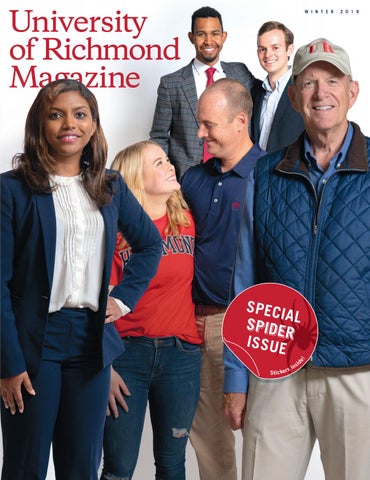
on the cover: Photography by Jamie Betts
16 SPORTS Baseball is back and looking good.
FEATURES
SPECIAL SPIDER ISSUE
We’ve devoted the entire features section and many stories throughout this issue to exploring our one-of-a-kind identity.
18 No two alike Spiders through the eyes of yearbook illustrators over the years
20 Spider census There are more than 50,000 Spiders on campus and around the world. Here’s a look at all of them.
32 Share the Spider love Spiders on what it means to be a Spider, plus a gift for you
34 A brief history of a charming tale Truth be told, we don’t really know how we got the Spider name.
Portrait Jim Croxton, B’68, is a fan’s fan. 38 ALUMNI Loyalty rewarded and Spiders united Portrait Kevin Eastman, R’77, on leadership 42 NOTES Alumni stories. We’d love to read yours. Send it for next issue: classnotes @richmond.edu. Portrait Jaime Settle, ’07, on political frenemies Portrait Two Spiders bound by organ donation earn medals and joy. Postscript Some of the many varieties of our namesake
2 0 1 9 WINTER
FRONT_Win19.indd 5
5
1/16/19 9:46 AM
STAY IN TOUCH AND SHARE YOUR PRIDE For photos, videos, news, stories, and reasons to brag about UR, follow these social media accounts, hashtags, and sites: • @urichmond • #spiderpride • #spiderspotting • spiderpride. richmond.edu Not getting Spider Pride’s e-newsletter? Sign up for it on Spider Pride, or send your email address to magazine @richmond.edu.
6
CONVERSATIONS ABOUT THE CONVERSATION WITH BARRY GREENE I am a 1975 alumnus and former member of the alumni board. I just received the most recent UR Magazine and read with great interest the Barry Greene piece. It was powerful and is arguably one of the most important and well-done articles ever included in this magazine. Having such an open and revealing conversation about the journey and challenges that Mr. Greene faced as UR’s first black [residential] student was enlightening and an important milestone for the school. Being able to have genuine conversations about difficult and at times divisive topics reflects well on the moral growth of the University. Drs. Ayers and Crutcher have played a large part in enabling this to happen. I overlapped Mr. Greene by one year and never met him, but wish I had. What a thoughtful and decent man he is. As a white male, I never had to encounter the daily and humiliating difficulties that he endured with such grace. I applaud all of you for producing and sharing this important article. And I appreciate Mr. Greene’s willingness to share his life story. He helped make UR a better place and is eternally woven into its fabric. —Rick Naschold, B’75 Glen Allen, Virginia Just read the interview with Mr. Greene conducted by President Crutcher in the Autumn issue of U of R Magazine. I read it out loud to my wife. She is legally blind. I could hardly get through the piece without bawling. It moved me very much. I hope all members of the U of R community have the chance to read the piece. Dr. Modlin, at my graduation, took the time to have a photo taken of my family and me in August of 1958. I met Dr. Crutcher and his wife recently at an alumni affair in Red Bank, New Jersey. I am very proud of my school, and I commend you for a great magazine. Keep up the kind of articles that make a difference in our lives! —Jim Hoffman, R’58 Fair Haven, New Jersey
My granddaughter, who was raised in Richmond, began her studies at UR in 2016. I had noticed at her high school graduation that the same homogeneity among her classmates was still apparent. However, I had also realized, through the University of Richmond Magazine, that the university itself had come a very long way and was a community that encouraged diversity. When I attended the “meet and greet” for Dr. Crutcher, I spoke to him about my appreciation for this situation, and I quoted my son’s 1987 remark to him. I’m so pleased that my granddaughter has the opportunity to experience the world through UR. Thank you for the fine article. —Louis Oliver Wilson, attd.’64 Norfolk, Virginia
Loved the conversation with @RACrutcher and am so glad that Barry Greene, R’72, chose to “sit up front” for diversity and to recognize that @URichmond has “come a long way” and still has “a long way to go.” — @marksheltonpa via Twitter
Photograph by Jensen Sutta
YOUR MAGAZINE, YOUR VOICE Let us know what you think about what you read in this issue. Email your thoughts to magazine @richmond.edu or send us a letter (our postal address is on Page 5). Please include your class year, city, state, and maiden name, if applicable. All letters to the editor may be edited for clarity or brevity and should not exceed 200 words. We also welcome your story tips at magazine @richmond.edu.
Thank you so much for the far-reaching and revealing interview with the graceful Mr. Greene. I was riveted by his experiences back in the ’60s, and I’m glad that you all are shedding light on the diversity issue. As a Northerner, I was pretty shocked myself when I arrived at Richmond in 1978 to find a chapter of the Daughters of the Confederacy in the yearbook, a mascot which was still sometimes pictured with a confederate uniform, stars-and-bars flags in a lot of Richmond College rooms and, if I remember correctly, somewhere around six black female students. Proud to see as an alum that so much progress has been made, and I hope to see more in the future. This was a great issue. Congratulations. —Carrie Feron, W’82 Holmes, New York
[The following note was sent to Barry Greene c/o the magazine. —Ed.] Dear Mr. Greene, I had no idea that U of R had African-American students so soon after I graduated in 1965. I am delighted to know that. I was a student waitress at Westhmapton College. They had a group of Virginia Union students as dishwashers. My classmate tutored one of the male VA Union students in French. When they were discovered, she was chewed out, and the dishwasher was fired. Boy, they had us between a rock and a hard place. I loved your interview in the UR Magazine. —Grace Leary, W’65 Pulaski County, Virginia I was intensely moved by this account, especially as it demonstrated great dignity, honesty, and lack of anger. Nearly 20 years after Mr. Greene entered UR, my son was admitted to UR. He was born and grew up in Toronto in a highly diverse and multicultural environment. A Toronto newspaper had reported that there were more than 250 different nationalities, ethnicities, races, and languages in Toronto. When my son decided to choose my beloved alma mater, I was ecstatic. After his first few weeks there, I inquired eagerly as to how he liked it, and his response was a grim: “It’s just like walking into a loaf of white bread.”
LIVES OF PURPOSE I loved the editorial about Moina Michael and the poppies, as well as the article, words, and photographs of Haitians by Jensen Sutta. My little country church sends a nurse, Dena Proctor, to Haiti every year to work for a week as a volunteer. I will take the UR Magazine to the fundraising dinner we have coming this month. Her father, David Hudgins, is an alumnus of UR. I also enjoyed the interview with David Sanford and also President Crutcher’s interview with Barry Greene. Thank you for a great issue. —Susan Pepper Robbins, W’64 Cartersville, Virginia FOR THE SAKE OF MY EYES If you want alumni to read our UR Magazine, you’re going to have to use larger print. —Jennie Stokes Howe, W’61 Gloucester Point, Virginia [We are pleased to say we are making some improvements to the magazine that you will see beginning with the spring issue. Among the changes is using larger type for the class notes. To see your news typeset bigger than ever, send it to us at classnotes@richmond. edu. —Ed.]
M AGA Z I N E . RI C H MO N D.E DU
FRONT_Win19.indd 6
1/16/19 9:46 AM
FORUM
Illustration by Maria Fabrizio
ON GENEROSITY By Ronald A. Crutcher, president
The path we walk together The university is great today because of the loyal support of generations of Spiders. Betty and I grew up in generous families. Neither of them was a wealthy family, mind you, but through their example, we learned that giving is a natural and expected response to whatever measure of prosperity — no matter how modest — had come our way. Generosity has continued to be an important component of our life together. Generosity is also the foundation on which this wonderful university has been built. No one can refute that the university’s tradition of giving is deeply embedded in our history. Each generation of Spiders enthusiastically gives its time, expertise, and diverse perspectives to advance the university’s mission. And yes, each generation also gives financial resources — often in tribute to the past, but always to ensure Richmond’s success for students here today and in perpetuity. Nearly 50 years ago, the Robins family made a historic gift that forever changed the trajectory of the University of Richmond. Its landmark $50 million investment in Richmond’s future came with a critically important string attached: The university would receive this gift only if it could be helpful inspiring others to give. The family’s message was clear: The strongest path for the university’s future is the one we walk together.
And give you have. Jepson, Wiltshire, Weinstein, Queally, Lain, Ukrop, Gottwald, Mahfuz. Several of these names are readily recognizable to our community, adorned on a pioneering leadership school, a grand international education venue, and dazzling student recruitment and career services facilities. Their vision brought forth a vibrant business school hub and a cutting-edge science center. But what of the less familiar names in this impressive list? Their giving is no less inspired or important. Suzanne Prillman Wiltshire, W’58 and G’67, has been giving to her beloved Westhampton College for more years than our electronic records go back. Corinna Barrett Lain, a faculty member since 2001, has given to the law school for 18 years because she sees the living embodiment of Richmond’s mission every day in the faces of her students in her classes. Mohammed Mahfuz, ’14, graduated just four years ago but began giving right after graduation and has not missed a year since. Their investment in the university comes from the same wellspring of hope and confidence that motivated the Robins family. This is the reason that, when we recently launched a new society to recognize the university’s most loyal donors, we called it the
Robins Society. This membership community celebrates Spiders who make a gift over an unbroken string of years at any amount. These alumni walk the same pathway as the Robins family because they too believe in the value of Richmond’s promise for future generations. And so I hope that with your help, membership in the Robins Society will grow. In the near term, we aspire to increase our annual giving rate to 25 percent, a number closer to our national peers, and then to even higher rates in the future. If we do so, we can add alumni giving to the list that includes close faculty-student relationships, a transformative student life experience, life-changing financial aid such as Richmond's Promise to Virginia, the Richmond Guarantee, and much more — the qualities that elevate and distinguish the University of Richmond in higher education. After all, that was the profound vision behind the Robins gift — that every Spider could stake a claim to helping the university become, in E. Claiborne Robins’ own words, the “finest small private university in the nation.” Through this shared aspiration, and with the help of this generation of Spiders, we will ensure, together, that the university and its mission endure for generations to come.
MARK YOUR CALENDAR Watch for information on UR’s first communitywide giving day in April. Also this spring, the UR Alumni Association will host Dr. Crutcher at presidential receptions across the country. Locations include: Feb. 7 Raleigh, N.C. Feb. 15 Dallas April 23 Chicago April 30 Boston May 2 New York City May 14 Los Angeles May 16 San Francisco Registration opens approximately one month before each event. For more information and registration, go to bit.ly/ presidentialreception.
2 0 1 9 WINTER
FRONT_Win19.indd 7
7
1/16/19 9:46 AM
EXCELLENCE
BRIGHT IDEAS
Photograph courtesy sPower
Top prof recognized
A BRIGHT IDEA UR is taking a major step forward in its commitment to achieve carbon neutrality by 2050.
Say watt? ➤ PARTNERSHIP The university’s power purchase agreement is with a company called sPower, the nation’s largest private owner and operator of solar assets. Richmond’s 20-megawatt solar energy agreement is a piece of a 500-megawatt solar energy facility sPower is developing. When complete, it will be the largest solar array east of the Rocky Mountains.
8
The headlines were eye-popping. Maybe you saw them. “A small university is helping build the East Coast’s largest solar array,” declared Inverse, an online science publication. It was typical. The news these stories delivered was equally astonishing: In the summer of 2018, the university entered into an agreement to purchase power from array of 47,000 solar panels spanning 130 acres in Spotsylvania County, Virginia, about 50 miles from campus. The array will produce 41,000 megawatt-hours of electricity annually, enough to power nearly 5,000 homes, when it becomes operational in 2020. With stewardship a pillar of the university’s current strategic plan, this was very good news. This production will match 100 percent of the university’s electricity needs, something only 47 other universities out of the thousands in the nation can claim. Richmond will be the only one in the southeast. UR’s greenhouse gas emissions will go down 60 percent; the state’s solar capacity will go up; and UR will be well on track to fulfilling its pledge of
carbon neutrality by 2050. But the solar array also has another stewardship story to tell, one just as important for sustaining resources. Investing in the array makes unmistakable economic sense for the university, Mark Detterick, senior associate vice president of finance and administration, explained. “With Spider Solar, we’re minimizing the university’s exposure to the energy market and ultimately have more control forecasting our utility expenses,” he said. “This is a winwin situation, as UR will be directly responsible for introducing additional renewable energy onto the grid without incurring the cost of owning or operating a large solar facility.” The agreement also provides new educational opportunities for campus, including research grants, scholarships, curriculum enhancements, and vocational education opportunities. “We want to empower our students to understand technologies so they can take on the local and global energy challenges of today and tomorrow,” said George Souleret, UR’s director of utilities.
Chemistry professor Carol Parish received one of her profession’s highest honors, the American Chemical Society’s 2019 Award for Research at an Undergraduate Institution. The award recognizes excellence in both research and students’ professional development. A computational and theoretical physical chemist, Parish has published more than 40 research publications with more than 60 undergraduate co-authors. She has taught at UR since 2005. “This honor recognizes the best part of my job, which is mentoring undergraduates, training the next generation of scientists, and helping students achieve their post-UR hopes and dreams,” she said. HONOR
Service and sacrifice
To mark Veterans Day in November, the campus community gathered in Millhiser Gymnamsium to unveil a memorial to Lt. Robert C.L. Fergusson, R’66, the first UR graduate to die during the Vietnam War. Several of his West Point classmates attended. Fergusson, who transferred from West Point to Richmond, served in the Army’s 101st Airborne Division. He died in a hospital in Japan Nov. 8, 1967, a month after being wounded in Vietnam as he came to the aid of a pinned-down platoon, action for which he was awarded the Distinguished Service Cross. He was also the recipient of two Purple Hearts and two Bronze Star Medals for Valor, one of which he received two days before he was fatally wounded. He was an only child. A scholarship in Fergusson’s name has supported UR ROTC students since the 1990s. It became an endowed scholarship after his mother’s death in 2013.
M AGA Z I N E . RI C H MO N D.E DU
NEWS_Win19_r1.indd 8
1/16/19 9:50 AM
IN THE NEWS
QUOTATION
“I can’t just uncork it.”
When media cover news and events, they come to Richmond for perspective and expertise. Here’s a sample of recent stories that put the university in the news:
ANGIE HILLIKER, associate professor of biology, describing the challenge of extracting yeast from a sealed 180-year-old bottle of Madeira once owned by John Marshall, former chief justice of the U.S. A local brewer sought to identify the yeast so he could develop a custom beer for the John Marshall House.
Fast Company turned to management professor KEVIN CRUZ to explain the importance of solving conflict among colleagues. “Coworkers can be a particularly strong influence on employee satisfaction, especially when employees have to rely heavily on each other to complete their work,” he said.
ANNIVERSARY
“Good writing helps me to look at my surroundings with new eyes,” MARTHA MERRITT, dean of international education, told The Washington Post for an article about travel literacy. She also recommended one of her favorite travel-related books, The Art of Travel by Alain de Botton.
Business Insider published an essay by longtime Writing Center director JOE ESSID in connection with the release of the Neil Armstrong biopic The First Man. “In our era of incessant self-promotion and celebrity billionaires, I wonder if there’s a place for a humble yet insanely focused national hero like Armstrong,” Essid wrote.
‘AUDACIOUS VOICES’ A new book shares the impact of WILL* as its 40th anniversary approaches.
WILL* power As WILL* approaches its 40th anniversary in 2020, program director Holly Blake and associate director Melissa Ooten have edited Audacious Voices: Profiles in Intersectional Feminism, a collection of graduates’ reflections. In one of them, Cammie Dunaway, W’84, one of the program’s original participants, explained WILL*’s influence on her personal growth: “I grew up with a poster on the lavender walls of my girlhood bedroom of a soaring ballerina and the words, ‘If you can do it, you can become it.’ Even with that daily reminder and with two loving parents who placed a high value on education and experience, my world and my dreams were pretty predictable. ... “A few months before I left for college, a postcard arrived that ultimately led me to reach for much bigger dreams. [UR] was starting a new program called WILL (Women Involved in Living and Learning). The card said it would encompass
some classroom time, workshops, and enrichment opportunities. It emphasized that participants would learn more about themselves and issues that impact women’s lives. It promised an avenue to creating a sense of community with women on campus. ... “There was a freedom in our WILL classes to ask the tough questions, to speak without censure, to share our fears and weaknesses as well as our strengths. I don’t know if it came from the skill of the professors, from only having women in the classroom, or from being together with the same group of students for four years. But it was there. And for me, it spilled over into my other classes as well. I went from being a girl who had done well but had not really stood out in high school to one who was taking challenging classes and making A’s. I was stepping into leadership positions. I was developing a view of myself as confident and capable that fuels me even now.”
WILL* STORIES The asterisk in WILL* denotes that the program is now open to women, transgender, and gender non-conforming students. In that same welcoming spirit, all program graduates are invited to a weekend event April 12–13. Graduates are also encouraged to share their stories about the impact of WILL* and their Women, Gender, and Sexuality Studies (WGSS) coursework for a larger Audacious Voices project. For more information and to register for the event, visit will.richmond.edu.
Law professor KRISTEN JAKOBSEN OSENGA wrote an opinion piece for The Washington Times about the need to protect patent holders’ rights. “Companies spend millions of dollars developing inventive technologies ... and bringing them to the American public,” she wrote. “One reason these companies can invest so much in invention and innovation is the patent system.”
The Richmond Times-Dispatch quoted Boatwright Memorial Library archivist TAYLOR MCNEILLY in an article about the opening of the Rev. Dr. Wyatt Tee Walker Collection, which the civil rights leader gifted to UR following his death last year. “You know you’re touching history and preparing it, but it’s not every day you get to work on something of this importance,” he said.
2 0 1 9 WINTER
NEWS_Win19_r1.indd 9
9
1/16/19 9:50 AM
Photograph by Gordon Schmidt
EXPERT JENNIFER O’DONNELL, MANAGER OF BIOLOGICAL LABORATORIES By Aggrey Sam
LET’S GO, SPIDERS!
SPIDER CHEER In November, the women’s basketball team introduced Ginny Lew, a black and red female tarantula, as its live mascot this season. “She’s huge,” said O’Donnell, caretaker of her and Tarrant, the live mascot of the men’s team. “She’s over six inches, and she’s a plump-bodied tarantula.” Ginny Lew is named after Ginny Doyle, W’92, and Natalie Lewis, ’11, members of the women’s basketball coaching staff who passed away in 2014.
10
S P I D E R L O V E When you really get to know spiders — the creatures — you’ll find they’re just as interesting and lovable as Richmond alumni. “Whenever someone meets me and says, ‘Oh, I hate spiders,’ I feel like I could change their mind a little bit,” said Jennifer O’Donnell (above), biology laboratories manager. She spends a lot of time with spiders as part of her job and has developed a deep affection for them. Here are six reasons that she says everyone else should, too: 1. THEY’RE EXPRESSIVE. Spiders don’t possess a central nervous system capable
of giving rise to personalities, but they do have distinctive behaviors. O’Donnell sees this exemplified when the tarantulas in her office are hungry and are ready to hunt for food. “They have a different stance,” she said. “I’ll look over and say, ‘It’s time to feed the tarantulas,’ because I can tell by their posture.” 2. THEY’RE MISUNDERSTOOD. The venom of certain species of spiders can be fatal to humans, but contrary to popular belief,
tarantulas aren’t in that group. “Nobody’s ever died of a tarantula bite anywhere,” she said. “People always want to think they’re this scary, venomous creature.” 3. THEY HAVE SUPERPOWERS. The venom produced by New World tarantulas (Tarrant’s species) feels like a bee sting, according to O’Donnell. That said, they have another defense mechanism that can inflict a lot of discomfort — hives, itching, inflammation, and redness — without even making direct contact with their targets. “They have this
secondary defense characteristic of these urticating hairs on the back of their abdomen,” she said. “They can release these hairs into the air as a defense mechanism, and that works at a distance from their predators.”
there’s a little bit left over — it might be some of the cricket’s exoskeleton — and they ball it into the tiniest, most compact ball,” O’Donnell said. “It’s called a food bolus, and they try to tuck it into one of the far corners of their cage.”
4. SOME ARE NEAT FREAKS. Black widows are messy when it comes to their domestic habits, leaving detritus everywhere after eating. Tarantulas, on the other hand, like to keep their quarters as close to immaculate as possible. “They eat their meal, and usually
5. THEY’RE GREAT FOR PEST CONTROL. When it comes to insects, Spiders are on our side, according to O’Donnell. “I get it if you don’t want [a spider] sharing a bed with you or something, but if we didn’t have any spiders in the world, the balance of insects to people would be unsustainable,” she said.
6. THEY’RE SURVIVORS. Most male spiders have shorter lifespans than females — particularly in species where males sacrifice themselves as part of the mating process. This has an interesting and valuable outcome for the species: genetic diversity. “It ensures that every time [a] female pairs with a male, [he’s] going to be a new male, which means we have a different combination of genes,” she said.
M AGA Z I N E . RI C H MO N D.E DU
NEWS_Win19_r1.indd 10
1/16/19 9:50 AM
U N I V E R S I T Y of R I C H M O N D N E W S
COMMON GROUND
ACCOLADES
TABLE TALK A record 89 students attended this year’s Thanksgiving dinner for students who live too far away to make the trip home or choose to stay on campus for other reasons. The dinner is hosted by Common Ground with help from the chaplaincy, dining services, and volunteers. “It gets really lonely, but the dinner allowed me to meet people and change that,” said senior Henry Dwaah, who moved to New York City from Ghana four years ago before enrolling at Richmond.
Probably safe to assume he got an A-plus
Illustration by Victoria Borges
LEADERSHIP
D E E P E R I N Q U I R Y, H I G H E R G R O U N D Ethics initiatives aim to help students assume positions of ethical understanding and leadership.
The toughest issues The most important decisions we face are often the hardest to decide: Should we reduce disease by genetically modifying our future children in utero? If students invite a speaker to campus who has views that are widely considered dangerous and discredited, should their university step in and rescind the invitation? Who should decide when it’s in a patient’s best interest to die? Even after the relevant technical obstacles are overcome, serious ethical questions remain. An initiative unfolding across the university seeks to ensure that Richmond graduates will be well-equipped to address them thoughtfully by increasing programming and faculty support to deepen inquiry into ethics. New university ethics fellows will support colleagues across campus who include ethics in their curricula. Also, co-curricular programming and
public-facing programming, such as a speakers series, will expand. Universities sometimes launch such initiatives to fill a gap. Richmond is doing it to consolidate a strength. When planners compiled a list of ethics-related resources already on campus, the document ran 12 pages long. In addition to nearly 70 courses across all five schools, the compilation listed nine majors that already require ethics, 15 faculty members with ethics as a primary research or teaching area, nearly 20 ethics-related co-curricular programs, and more. In the Jepson School of Leadership Studies, leadership ethics now has a new physical home. During the fall semester, crews leveled off an 80-seat Jepson Hall lecture hall to create a classroom, conference room, and four offices. The new space opened in January.
R . I . P. , A N O T H E R LECTURE HALL Universities with small classes don’t need big classrooms. With the renovation of the 80-seat Jepson Hall 120, large, tiered classrooms for undergraduates are increasingly scarce across campus. Figures compiled by the registrar’s office show only four remaining ones that seat more than 50: two in Jepson, one in Gottwald Science Center, and one in the Robins Center used primarily for wellness courses and as study space for athletes.
Three fim festivals snatched up sophomore Jonas Fryer’s short film Wake-Up Call, the product of an assignment in Intermediate Film Production, a 300-level course. His five-minute film was an official selection by the Top Shorts Online Film Festival and the Poe Film Festival in Richmond. The Peak City International Film Festival in North Carolina named it a semifinalist. The lighthearted film, available on YouTube, explores the inner lives and anxieties of two cell phones as their college student owners snooze nearby. Fryer shot it in his first-floor room in the A section of Lora Robins Court and cast his first-year roommate Bennett Gaines, ’21, and friend Anthony Thomassey, ’21, as the sleeping students. “Since Jonas had never touched a camera before joining my [200-level] Intro class, I was very impressed,” said Sonja Bertucci, his film studies professor. “I saw a student who blossomed and found his own creative voice. He led a crew, made directorial choices, and worked countless hours to fine-tune his film.” Spoiler alert: It’s charming. And it’s available with a quick search on YouTube.
One plus one is something new
Each year, the School for Field Studies gives its Distinguished Student Researchers Award to just a few students in the U.S. With its six awards this year, SFS did something unprecedented: It gave awards to two students from the same university for the first time ever. You guessed right. They are Spiders. Colby Prokop and Andrew Reeder, both ’19, were the recipients. Prokop worked with a team in Australia to develop a noninvasive tool to identify a threatened marsupial. Reeder and a partner worked in Cambodia on policies related to climate change migration.
2 0 1 9 WINTER
NEWS_Win19_r1.indd 11
11
1/16/19 9:50 AM
QUOTATION
AROUND CAMPUS
“The crash was startlingly loud.” KATE CASSADA, associate professor of education, describing to The Collegian the sound of a deer breaking a window in North Court and jumping into the hallway near Perkinson Recital Hall in October. GEOGRAPHY
The stars are out
Illustration by Gordon Schmidt
For one October night in the planetarium at the Virginia Science Museum, the guiding star was Socrates. UR’s classical studies department co-sponsored a screening of Socrates on Death Row, a 30-minute re-enactment of the Greek philosopher’s trial in 399 BCE. The film takes advantage of the planetarium’s dome to create an immersive reproduction of the Athenian Agora where, Plato tells us, Socrates was tried and sentenced to death by a jury of 500. He carried out the sentence himself by drinking hemlock. The filmmakers participated in a Q&A following the showing. “The film not only provides a poignant snapshot of life in 399 BCE, but also raises questions of justice and social responsibility that are important to our democracy today,” said Elizabeth Baughan, an associate professor of classics and archaeology and the event’s organizer.
AN IMMODEST PROPOSAL A professor and his students say a proposed road in the Amazon would have a devasting environmental impact.
A September report by the Association for the Advancement of Sustainability in Higher Education ranked Richmond fourth on its list of top performers for diversity and affordability. It is the only baccalaureate institution in the nation to make the top 10. The report, called the 2018 Campus Sustainability Index, recognizes universities advancing measurable sustainability goals in academics, operations, planning and administration, and engagement. The same report awards Richmond a silver rating in its Sustainability, Tracking, Assessment and Rating System, also known as STARS.
Forward-looking
The School of Arts & Sciences is looking ahead to its 30th anniversary in 2021 with a new strategic plan, Concept 30. “Liberal arts is essential to the university’s identity, and A&S is at the heart of that identity,” said Patrice Rankine, dean. “We look forward to living more fully into our values as a community committed to the liberal arts.” More information is available at as.richmond.edu/concept30.
THE UQ-UR CONNECTION After a semester at UR, C. Melissa Velasco Alarcón returned to her home institution in Quito, Ecuador, where she lives. The exchange runs in both directions. Five University of Richmond students have studied at UQ in recent years.
For a man of God, Father Miguel Piovesan seems awfully concerned with earthly matters. From his parish in the hinterlands of the Peruvian Amazon, he oversees an influential magazine and radio programs that apply religious teachings to, of all things, transportation policy. The priest is pushing a proposed 270 km road that would connect his tiny town to a regional hub and, hence, the wider world. Environmentalists and advocates of the region’s indigenous peoples say it would be disastrous, threatening thousands of acres of the Amazon and exposing the people of the region to ruinous economic forces. C. Melissa Velasco Alarcón, who spent a semester at UR as an international exchange student from Ecuador, is one of the road’s opponents. “This road is not for improving the lives of the people but for making the rich richer,” she said. Velasco, a recent graduate of Universidad San Francisco de Quito, said
she wasn’t familiar with this particular road project when she came to UR, but she knew about ones like it in parts of the Amazon in her country. Working alongside David Salisbury, an associate professor of geography and the environment, she developed an intensive analysis of the communications coming out of Piovesan’s parish. The results are telling. In a decade of issues of the parish’s magazine, for example, carreteras (road) appears 1,515 times, while Dios (God) appears just 854. Other words yield comparable numbers. Their paper, co-written by them and a professor at the University of Texas, made the cover of the Journal of Latin American Geography. “You’d never think about religion and geography mixing together,” Velasco said. “But there’s a message everyone can take from it, that powerful people use tools like religion to get other people to do what they want. It’s like in colonial times. We are in 2018, and people are still doing that.”
Socrates image: Metropolitan Museum of Art, New York, USA/Bridgeman Images
A difficult road
Diverse and affordable
12 M AGA Z I N E . RI C H MO N D.E DU
NEWS_Win19_r1.indd 12
1/16/19 9:50 AM
U N I V E R S I T Y of R I C H M O N D N E W S
What are other theories? Other people say
that you were not born to be afraid of spiders or even to feel fear, exactly. We have this idea that we have a program for fear built into our brains and that fear should look like one distinct thing, but the heart rate goes up sometimes and down others. Fear might sometimes cause us to want to fight, sometimes to freeze, and sometimes to flee.
what to be afraid of. You’ve learned about emotions from your parents, your peers — from culture.
You’re saying fear is a social construct? Psychologists sometimes say emotions are like money. Money has value, but only because we agree it does. Fear is the same thing. We experience it as very real, and it has consequences. But we weren’t born with a module for fear inside our heads. We learned what fear is and
Are those two views consistent? Both camps, so to speak, agree that evolution happens. One says that evolution gave us fear. The other says that evolution gave us these lower-level processes that we use to make sense of our experiences, and one of the ways we make sense of our experiences is by naming them.
What might help a person with a dire fear of spiders? If we’re talking about clinical cases of arachnophobia, then exposure therapy under the guidance of a cognitive behavioral therapist is what’s recommended. How does that work, exactly? Typically, you expose yourself to the thing that scares you in controlled but
THE WISDOM OF THE CROWD, OR NOT A recent paper by Lundberg and two colleagues addressed several puzzles posed by a much-discussed topic in her field: implicit bias. The term “implicit bias” refers to attitudes that unintentionally impact thoughts, actions, and decisions. Traditional scholarship treats it as an early-learned bias in individuals. This paper argues that it is more likely the product of biased situations. This distinction “highlights the relevance of policy-based interventions that influence social contexts, structures, and processes as opposed to individual attitudes,” they write. The International Social Cognition Network named it 2018’s best social cognition paper.
2 0 1 9 WINTER
NEWS_Win19_r1.indd 13
THE BIOLOGICAL IMPERATIVE Interview by Matthew Dewald
Where does a fear like this come from? One argument is that there are certain stimuli that we are biologically prepared to have a certain instinctual emotional response to because of threats and opportunities that have occurred repeatedly in our ancestral past.
We all agree socially to call a broad category of responses “fear” in certain contexts.
gradually increasing doses. As you do this, you’re reflecting on your experiences. “So, I got this close to the spider. Did anything bad happen? No, I’m actually fine.” There’s a related idea — that experiencing negative things is to be avoided. We don’t want anyone to feel negative emotions all the time or in ways that interfere with their daily functioning, but in small doses, they won’t hurt you. We often engage in a form of emotion regulation called situation selection — choosing whether to be in situations that make you feel a certain way, like avoiding situations that scare you. However, if you avoided being around spiders, then you wouldn’t have the opportunity to disconfirm your fear. In other words, as you are exposed to the spider, you could probe the contents of your mind. What did you think was going to happen — that you’d feel fear and you don’t like feeling fear? Yes, it’s uncomfortable, but did the spider fly across the room and land on your face? No. You could see that nothing bad happened. Maybe next time, you get a little bit closer. Maybe eventually, you hold one.
VOICES
F E A R N O T Some people’s gut reaction to spiders is fear. We asked Kristjen Lundberg, assistant professor of social psychology, to tell us more about this reaction.
If a spider appeared right now, we might react differently. Why? Let’s imagine that we both have a similar initial reaction — like higher physiological activation — that signals to us that this spider is something to pay attention to. You might sit up startled and label the experience: “That was surprising.” You might even laugh and experience positive emotions, which settle your physiological arousal. But I might label my reaction differently. Based on factors like my life experiences, my current physiological state, and the situation itself, my mind says, “I’m afraid of those things.” If so, I now have made this state meaningful to me in a way that you have not. For me, this is fear, and the world seems riskier to me than to you. I might even amplify my fear by thinking, “These things really make me panic.” I might have trouble regulating my emotions.
13
1/16/19 9:50 AM
MOMENTS
Photography by Jamie Betts
HOMECOMING WEEKEND By Matthew Dewald
Steps forward A Homecoming Weekend gathering celebrated the 50th anniversary of the enrollment of UR’s first three African-American undergraduate alumni.
‘A FORCE THAT MUST BE RECOGNIZED’ Rasheeda Perry, ’03, president of the UR Black Alumni Network (URBAN), and Ed Gates, ’02, a current alumni association board member, made a surprise presentation during the anniversary event to a person whom Perry called “a force that must be recognized and acknowledged as a cornerstone and catalyst of change.” The pair were honoring Tina Cade (above), associate vice president for student development and director of the office of multicultural affairs, for her more than 30 years “of distinguished service to the URBAN Alumni.”
14
If you want to visit the most forward-looking help shape it — along with those classmates, places on campus, the Queally Center for Adfaculty, and staff who chose to welcome them mission and Career Services is a good place at a time when not everyone did.” to start. In its hallways, suit-clad juniors and The university had first admitted Afriseniors awaiting interviews pass wide-eyed can-American students just a few years high school students on the college-search earlier, and done so unenthusiastically. It circuit. Everyone at Queally, in one way or restricted admission to specific evening proanother, is looking at what the future holds. grams, including one that the university had For this reason, Queally was a fitting if not obvious place for a November gathering marking a moment of university history. In the fall of 1968, the university’s first three African-American undergraduate alumni began their first semester on campus: Barry Greene, Isabelle Thomas LeSane, and Madieth Malone, all 1972 graduates. The trio sat front and center Malone, Greene, and LeSane in 1972. among an audience of several hundred as speakers thanked them for exemplitaken over from the U.S. Logistics Center fying, in the words of Mia Reinoso Genoni, and Quartermaster Service at Fort Lee. One Westhampton College dean, “how courage of these students, a civilian Fort Lee emis both an everyday act and an extraordinary ployee named Walter Carpenter, became the achievement.” university’s first African-American graduate Although the dean was speaking specifically when he completed his master’s degree in of the Westhampton alumni, her remarks apcommerce in 1964. In response to questions plied to all three when she added, “[They] had about the new policy, the university issued a the ability to look beyond the university’s past statement declaring that “no further integralimitations and see it as it could be — and tion is contemplated.”
Four years later, Greene, LeSane, and Malone stepped onto campus. LeSane and Malone commuted, and Greene, as he recounted in the Autumn 2018 issue, was a residential student. They earned their degrees in Russian studies, theater arts, and biology, respectively. At the Queally event, the speakers’ desire to express gratitude was equalled by their determination to connect this moment from the past to the university’s present and future. In her remarks, Alicia Jiggetts, ’19, an African-American student, was straightforward: “Had they not [chosen to come to Richmond] 50 years ago in the fall of 1968, I would not be speaking to you now as a senior in the fall of 2018.” Jiggetts then pivoted forward. “The University of Richmond, like me, is still on a journey,” she said, “constantly moving forward, facing obstacles, and occasionally needing to pause and evaluate its strengths and weaknesses.” Following her remarks, Ronald Crutcher, president, announced the formation of the Presidential Commission on Institutional History and Identity to examine how the university records, preserves, and communicates its history. In doing so, he had in mind, he said, “Spiders yesterday, today, and tomorrow.”
M AGA Z I N E . RI C H MO N D.E DU
NEWS_Win19_r1.indd 14
1/16/19 9:50 AM
U N I V E R S I T Y of R I C H M O N D N E W S
DIVERSE PERSPECTIVES
AROUND CAMPUS
VOICES The new semester brings new perspectives with the continuation of the 2018–19 Sharp Viewpoint Speakers Series. On Feb. 12, Robert Zimmer, president of the University VIEWPOINT of Chicago, will discuss the freedom of expression debates SERIES roiling college campuses nationwide. On March 21, Paula Krebs, executive director of the Modern Language Association, will speak about the role of the humanities in a 21st-century liberal arts education. Tickets are free but required. For more info, go to richmond.edu/sharp.
SHARP
CONSERVATION
Robins dean stepping down
Photograph by Jamie Betts
Nancy Bagranoff, dean of the Robins School of Business since 2010, announced she will step down June 30 and return to the faculty. “I receive this news with reluctance but respect Nancy’s decision and know it is grounded in her best wishes and abiding care for the School of Business,” said Jeffrey Legro, executive vice president and provost. Under Bagranoff’s leadership, the school completed two successful reviews by the Association to Advance Collegiate Schools of Business; launched multiple Executive-in-Residence positions; opened new facilities including Queally Hall and the iLab; and created a variety of new and innovative programs, including the C-Suite and Executive Speaker Series, an undergraduate entrepreneurship minor, and a concentration in business analytics. “After more than eight years as dean, it is a good time to relinquish leadership,” she said. “I look forward to assuming the role of teacher-scholar and continuing my association with this wonderful school.”
HAPPY TRAVELERS Students raised and released migrating butterflies as part of a broader conservation effort.
A decade of service
Mexico or bust Nearly 20 monarch butterflies took flight for the first time this fall after their release by ecology and environmental biology students in the courtyard in front of Cannon Memorial Chapel. “Nearly 20” may not sound like many, but monarch populations are declining at a rapid rate, enough that the U.S. Fish and Wildlife Service is evaluating whether they should be listed as threatened or endangered. Monarchs have a very low survival rate in the wild from egg to adult — 2 to 3 percent. Compounding this challenge is the use of pesticides and the decline of milkweed, the only plant on which they’ll lay their eggs. Biology professor Jennifer Sevin worked with
students to create more suitable conditions in captivity, where survival rates range from 70 to 90 percent. Students tagged each individual with a minuscule identifying sticker before releasing them to migrate. The monarchs should now be in Mexico for the winter. When the weather warms, they’ll fly as far north as Canada. The project was “a wonderful opportunity to study both the butterflies and conservation efforts,” said Sevin, an ecologist who studies pollinators. Senior Jordan Lloyd said the best part about the assignment was witnessing the entire life cycle from egg to flight, a process she called “incredible.” “Metamorphosis is amazing,” she said.
COUNTING MONARCHS Nearly 99 percent of North American monarchs winter on 12 mountaintops in central Mexico, which makes it an ideal spot for scientists to estimate the size of the population. It was roughly one billion in the mid-1990s but has dropped steadily since. The 2018 estimate put the population at around 93 million.
The School of Law’s Carrico Center for Pro Bono and Pubic Service celebrated its 10th anniversary by showcasing its accomplishments in an exhibit at UR Downtown. Launched in 2008, the center connects the skills and talents of Richmond law students with the greater Richmond community and a network of regional, national, and international programs. Among its projects are assistance to disabled veterans, a no-fault divorce program, a pro bono criminals appeals project, and an immigraton assistance project. Each year, Richmond law students give approximately 13,000 hours of pro bono service to the community. In 2009, it began awarding pro bono certificates at commencement to graduates who completed 120 or more hours of service during law school. The school has awarded 237 of them to date.
2 0 1 9 WINTER
NEWS_Win19_r1.indd 15
15
1/16/19 9:50 AM
PEANUTS & CRACKER JACK
RUNDOWN
Looking good at 50
Closer Layne Looney was nearly unhittable last season. He’s back this year.
Test early, test often ➤ COACH WOODSON RECOLLECTS October marked the 30th anniversary of one of Major League Baseball’s all-time great moments: Kirk Gibson’s 1988 World Series walk-off home run. Woodson, then a Dodgers infielder, was on hand as an injured Gibson limped his way around the bases. “I can remember sitting in the dugout and watching, thinking, ‘This is the most ridiculous thing that [manager Tommy] Lasorda’s ever done,’” he said.
You might think Richmond baseball’s 32 wins in the 2018 season earned the players the right to some satisfaction. Spider pitchers struck out a school-record 471 hitters, the batters ranked in the top half of every Atlantic 10 offensive category, and the team landed the No. 4 seed in the conference tournament. Their reward? An even harder 2019 season. The Spiders will play eight games against teams from the Atlantic Coast Conference and seven games against teams that qualified for the NCAA Tournament a season ago. Opponents include Duke, Virginia, Virginia Tech, Princeton, and Florida State. The home opener is Feb. 20 against James Madison University, and 31 of the 55 games will be played at Pitt Field. Twenty-four of the games will come against eight Atlantic 10 opponents. “If I had to go back to last year, Duke is the only team that overwhelmed us,” said sixth-year head coach Tracy Woodson. “Nobody else did. We want to be in every game.” The challenging 2019 schedule “shows our guys where they need to be, what it really takes to be a [Division I]
player,” Woodson said. “When we play Georgia Tech on our opening weekend, our guys will see somebody throwing 90–94” mph. Most of the key players who got Richmond to 32 wins last season are back. Closer Layne Looney, who was drafted by the Chicago Cubs but elected to return for his senior season, finished 2018 with a 0.60 ERA and didn’t give up a single run in the final 10 weeks of the season. “When he came in, the game was over,” Woodson said. Most of the pitching staff ’s other big arms also return, and Woodson expects team defense to be strong. “I’ve got four guys in the outfield who can run anything down,” he said. The tough 2019 out-of-conference schedule should help the Spiders prepare for conference play, which they’ll open at Davidson March 8. Because of a scheduling anomaly, the teams will get a two-week jump on everyone else in the A-10. If all goes well, Richmond could sit with a 3-0 or 2-1 conference record for a couple of weeks. “I really like this team,” Woodson said. “This could be a really good year for us.”
Cross-country’s trophy shelf gets heavier
Women’s cross-country knocked off reigning champ Dayton to earn its third conference championship in four years. The Atlantic 10 named Lori Taylor its Coach of the Year. Five Spiders finished among the top 13 at the A-10 championship, with senior Amanda Corbosiero taking fourth and classmate Colleen Carney in fifth. All five of the Spiders’ top finishers earned All-Atlantic 10 honors. “I am so excited that we were able to get the title for my last A-10 cross country meet,” Corbosiero said. “We did really well and had a dominating performance, and we really made a statement out there.”
Women’s b-ball tips off 100th season
The Richmond women’s basketball program began its 100th season of play in November. The Spiders went a perfect 3-0 in its first season in 1919-20 against the YWCA, William and Mary, and Virginia Randolph Ellett. The program has made three NCAA tournament appearances and nine appearances in the WNIT, most recently in 2015. The team will host an alumni celebration at its game Feb. 24. For more information, go to richmondspiders.com.
Photographs courtesy Richmond Athletics
A MIGHTY BULLPEN
Members of the 1968 Tangerine Bowl team reunited Oct. 6 to celebrate the 50th anniversary of the Spiders’ legendary bowl championship, a 49-42 win over Ohio University. At the time, Ohio was ranked 15th in the nation, and only 22 teams in the nation advanced to bowl games. In an interview with UR broadcast and news director Bob Black, quarterback Buster O’Brien, R’69, and wide receiver Walker Gillette, R’70, recalled how the Spiders pulled off the upset. Ohio “played the same defense all night,” O’Brien said. “After the second snap, we knew what they were going to do, and we just took advantage of them.”
16 M AGA Z I N E . RI C H MO N D.E DU
SPORTS_Win19_r1.indd 16
1/15/19 9:41 AM
PORTRAIT
Photograph by Jamie Betts
A FAN’S FAN By Aggrey Sam
A L O Y A L S P I D E R For more than 40 years, Jim Croxton, B’68 (right), has been a faithful presence at Richmond football and men’s basketball games. From Dick Tarrant’s men’s basketball teams knocking off powerhouses in the 1980s to the 2008 Spider football national champions, Jim Croxton, B’68, has seen it all. He’s one of Richmond’s longest-tenured season ticket holders. Croxton and his wife, Sarah, W’69, are regulars at Spider athletics events, traveling in for games from their hometown of Tappahannock, Virginia, where Jim has co-owned Riverland Insurers for 42 years. His Spider pride has deep roots that were planted while he was a student and sprouted quickly after graduation. While serving in the U.S. Army at Fort Jackson in Columbia, South Carolina, just after graduation, Croxton was home for the holidays when the football team notched the only postseason bowlgame victory in Richmond history, the 1968 Tangerine Bowl. “They shut the camp down, so I was able to watch the game,” Croxton said. “Actually, I bought a new TV and watched it.” Since then, Croxton has returned to campus to watch Richmond athletics through the ups and downs of the respective programs. Though he’s an ardent supporter of the teams, his loyalty is inspired even more by the satisfaction
he takes in seeing the university thrive. “Being such a small school and then seeing it achieve success over the years has been great,” he said. “When I went there, it was just a small Baptist school. To see it take off the way that it has over the years makes me proud.” Getting real-world insight from business school faculty who worked at local compa-
“When I went there, it was just a small, Baptist school. To see it take off the way that it has over the years makes me proud.” nies like A.H. Robins and Reynolds Metals instilled an appreciation for his Richmond education within Croxton. The time he spent outside of the classroom made an equally strong impression: Croxton has been meeting with a group of his fraternity brothers to tailgate before Spider football games for more
than four decades. While he jokes that “there’s not a whole lot to do on Saturdays in Tappahannock in the winters,” Croxton’s deep connection to the university is why he’s more than happy to make the two-hour round trip every weekend. “Just the socializing, that’s the main thing,” he said. “We’ve enjoyed the teams over the years and watching kids develop. I’ve seen a few of them go to the pros.” Croxton passed on the Spider tradition when his son, Travis Croxton, ’97, enrolled. “I was very happy to have my son go to the University of Richmond and very proud that he graduated from there,” Jim Croxton said. “When he was a little kid, we took him to all the football games, so he grew up watching Spiders play.” His stepdaughter Tara Hamilton Bennett, ’97, and daughter-in-law Kristi Tiemann Croxton, ’99, are also Spiders. At this point, Richmond athletics has earned enough credibility — aided by these family connections — that Jim Croxton is even beginning to step outside of his comfort zone. “I’ve gone to several lacrosse matches. I’m just getting interested in that. My grandchildren are playing the sport, so I’m trying to understand the game — or the match, or whatever they call it,” he said, laughing.
CROXTON’S ALL-STARS Croxton has seen a lot of players over the years. Here are some of the ones who have been the most memorable to him: FOOTBALL Shawn Barber, ’98 Ray Easterling, R’72 Walker Gillette, R’70 Tim Hightower, ’08 Brian Jordan, R’89 Barry Redden, R’82 Barty Smith, R’74 Stacey Tutt, ’06 Croxton and Tutt share a hometown. MEN’S BASKETBALL Kendall Anthony, ’15 T.J. Cline, ’17 Kevin Eastman, R’77 Johnny Newman, R’86
WINTER
SPORTS_Win19_r1.indd 17
17
1/15/19 9:41 AM
18 M AGA Z I N E . RI C H MO N D.E DU
FEATURE_Yearbook spiders_Win19.indd 18
1/10/19 4:07 PM
U N I V E R S I T Y of R I C H M O N D P O R T F O L I O
NO TWO ALIKE Yearbook art directors over the years have offered many takes on our beloved symbol. All of these variations come from the first half of the 20th century. The one in the center of the opposite page appeared in the 1905 yearbook, but it bears an uncanny similarity to the spider symbol we use today. One of the most striking is the star-spangled spider at the bottom right corner of this page. Though red and blue are Richmond’s colors, the image likely doubles as an illustrator’s patriotic statement. It appears in the 1918 yearbook, as Richmond College men were serving in Europe during World War I.
2 0 1 9 WINTER
FEATURE_Yearbook spiders_Win19.indd 19
19
1/10/19 4:07 PM
Spider C
20 M AGA Z I N E . RI C H MO N D.E DU
Win19_FEATURE_Spider-census.indd 20
1/16/19 9:43 AM
UNIVERSITY of RICHMOND SPIDERS FOR LIFE
r Census DON’T BELIEVE THE MAPS. THE UNIVERSITY OF RICHMOND IS MUCH MORE THAN A PLACE. LIKEWISE, THE SPIDER IS MUCH MORE THAN JUST A MASCOT.
By Matthew Dewald and Aggrey Sam Photography by Jamie Betts Infographics by Katie McBride
B
EING A SPIDER IS A WAY OF THINKING
about the world, a camaraderie in a remarkable community, and an outlook about what matters and what’s possible. What it means to be a Spider hasn’t changed over the last 125 years, but the ways to be a Spider have grown. Today’s Spiders come from, study, and live around the world. They’re still immersed in a challenging liberal arts education, but the ways they can use it to explore keep growing. In 1970, students had about two dozen majors to choose among. Today’s students have 62. The pages that follow offer a comprehensive survey that covers the generational spans, geographic range, and academic interests of Spiders today. We also highlight some Spiders’ stories of legacy and love, of academic accomplishment, friendships, and leadership. You’ll recognize yourself in some of the specific data and be able to situate yourself in all of it. Spiders may be diverse in interest, but we are united by a common bond that develops at this place and then transcends it.
WINTER
Win19_FEATURE_Spider-census.indd 21
21
1/16/19 9:43 AM
Alumni
Total living alumni: 49,834 WHEN SPIDERS GRADUATED
ONE-HALF GRADUATED IN 1995 or later
ONE-THIRD GRADUATED IN 2004 or later
ONE-FIFTH GRADUATED IN 2010 or later
Living alumni
1300 1200
BY YEAR OF GRADUATION
1100 1000
More than
900
1,000
800 700
ALUMNI
600 500
graduated in 1956 or earlier.
400 300 200 100 0
1940
1945
1950
1955
1960
1965
1970
1975
1980
1985
1990
1995
2000
2005
2010
2015
SPIDER SUPPORT 1,000 2,000
285,250 GIFTS FROM ALUMNI in the last 30 years
3,000
Percentage of... alumni who made a gift in the 2018 fiscal year 19%
alumni who have made a gift in the past five years 38% alumni who have made at least one gift 68%
Data courtesy of advancement data services and office of institutional effectiveness; reflects current records for living alumni and current students when compiled in fall 2018.
4,000 5,000
22 M AGA Z I N E . RI C H MO N D.E DU 6,000 7,000 8,000
Win19_FEATURE_Spider-census.indd 22
1/16/19 9:43 AM
UNIVERSITY of RICHMOND SPIDERS FOR LIFE
% 4 of alumni
are the child of one or more Spiders.
THE HILLS: TOM, R’64, BRAD, ’94, AND GRACE, ’22 Tom Hill came to Richmond in the fall of 1960. Son Brad followed in the fall of 1990. Grace followed them both in August. She saw something new in her dad’s gait when he dropped her off for orientation. “I call it his Richmond posture,” Grace said. “He gets so comfortable on this campus. He feels so confident. I can’t wait for it to be me.”
AU T UMN
Win19_FEATURE_Spider-census.indd 23
23
1/16/19 9:43 AM
States with more than 1,000 Spiders California, Florida, Georgia, Maryland, Massachusetts, New Jersey, New York, North Carolina, Pen nsylvania, Texas, Virginia State with the least number of Spiders: North Dakota, 6 Spiders in Puerto Rico: 18
WHERE SPIDERS LIVE
In the United States: 49,113 STATE WITH THE FEWEST SPIDERS ON RECORD: NORTH DAKOTA
6
47% of alumni
live in Virginia.
28% of alumni live in the
greater Richmond area.
23% of non-Virginia alumni live
west of the Mississippi River.
STATES WITH MORE THAN
1,000 Spiders
California, Florida, Georgia, Maryland, Massachusetts, New Jersey, New York, North Carolina, Pennsylvania, Texas, Virginia
SPIDERS IN PUERTO RICO:
18
Abroad: 721 EUROPE:
249
MOST SPIDERS: UNITED KINGDOM
NORTH AMERICA:
120
68
MOST SPIDERS: CANADA
ASIA:
55
259 MOST SPIDERS: CHINA AFRICA:
COUNTRIES WITH
10 or more Spiders:
Australia, Bahamas, Bulgaria, Canada, China, France, Germany, India, Japan, Pakistan, South Korea, Spain, Switzerland, Taiwan, Thailand, United Kingdom
108
38
SOUTH AMERICA:
MOST SPIDERS: NIGERIA
32
MOST SPIDERS: BRAZIL
9
COUNTRIES WITH
one Spider:
7
AUSTRALIA AND OCEANIA:
23
MOST SPIDERS: AUSTRALIA
18
Botswana, Cameroon, Chile, Cyprus, Czech Republic, Estonia, Federated States of Micronesia, Georgia, Iceland, Jordan, Kuwait, Latvia, Lebanon, Monaco, Myanmar, Nicaragua, Niger, Paraguay, Philippines, Qatar, Swaziland, Turkmenistan, Ukraine, Zambia
24 M AGA Z I N E . RI C H MO N D.E DU
Win19_FEATURE_Spider-census.indd 24
1/16/19 9:43 AM
UNIVERSITY of RICHMOND SPIDERS FOR LIFE
11% of alumni said “I do”
to a fellow Spider. SHANNON KELLEY, B’87, AND MIKE MENDELSON, B’88 When Shannon was a student, “there was a lot of folklore around the gazebo,” she said. She was skeptical. That’s why she laughs — because there’s no avoiding the fact that, during the commencement candlelight ceremony in 1988, the gazebo is where the casual hellos she and Mike had exchanged in the b-school’s hallways started to become romance. “The romantic connection that spring evening led to a wedding,” she said. “We joined the happy club of Spiders marrying Spiders, keeping the folklore alive.”
WINTER
Win19_FEATURE_Spider-census.indd 25
25
1/16/19 9:43 AM
WHAT THEY STUDIED 10 most common undergraduate majors OF LIVING ALUMNI SINCE 1940
1.
Business administration 6,051
6.
Accounting 2,282
2.
Political science 2,751
7.
Economics (A&S and RSB) 2,083
3.
Biology 2,392
8.
History 1,982
4.
Psychology 2,373
9.
Sociology 1,655
5.
English 2,300
10.
Leadership studies 1,161
Most popular majors FOR THIS YEAR’S REUNION CLASSES 1969
HISTORY, POLITICAL SCIENCE, CHEMISTRY
1974
ENGLISH, POLITICAL SCIENCE, SOCIOLOGY
1979
ECONOMICS, BIOLOGY, ACCOUNTING
1984
ECONOMICS, MARKETING, FINANCE
1989
BUSINESS ADMINISTRATION, ECONOMICS, ENGLISH
1994
BUSINESS ADMINISTRATION, BIOLOGY, ACCOUNTING
1999
BUSINESS ADMINISTRATION, BIOLOGY, ACCOUNTING
2004
BUSINESS ADMINISTRATION, POLITICAL SCIENCE, ACCOUNTING
2009
BUSINESS ADMINISTRATION, POLITICAL SCIENCE, HISTORY
2014
BUSINESS ADMINISTRATION, LEADERSHIP STUDIES, ACCOUNTING
TIM MAY, ’05 Tim’s volunteerism eased his adjustment to college. “It’s a different world from Richmond Public Schools,” he said. “The Bonner scholarship was one of the reasons I stayed at the university.” Tim mentored children from Richmond’s historic Jackson Ward neighborhood, often bringing them back to campus with him. Now the owner of a travel agency, Tim remains committed to his hometown. He coaches a basketball team for Church Hill Activities and Tutoring, a community organization that named him its 2018 volunteer of the year.
26 M AGA Z I N E . RI C H MO N D.E DU
Win19_FEATURE_Spider-census.indd 26
1/16/19 9:43 AM
UNIVERSITY of RICHMOND SPIDERS FOR LIFE
Richmond College 14%
Westhampton College 13% Arts & Sciences 24%
College/school
Undergraduate business 19%
SINCE 1940
Graduate business 4% Law 12%
SPCS 11%
Jepson school of Leadership Studies 2%
College/school degrees AS A PERCENT OF TOTAL BY YEAR 10%
20%
30%
40%
50%
60%
70%
80%
90%
100%
Westhampton College Richmond College
Robins School of Business
Richmond Law
School of Arts & Sciences
Graduate A&S and SPCS
Graduate Business
1940 1942 1944 1946 1948 1950 1952 1954 1956 1958 1960 1962 1964 1966 1968 1970 1972 1974 1976 1978 1980 1982 1984 1986 1988 1990 1992 1994 1996 1998 2000 2002 2004 2006 2008 2010 2012 2014 2016 2018
1949 School of Business founded
1962 SPCS founded
1992 Arts and Sciences replaces Westhampton and Richmond College degree designations 1994 Jepson School of Leadership Studies first graduating class
Jepson
DANIELLE STOKES, ’13 “This is a challenging place to go to school,” said Danielle, an associate at prominent Richmond law firm McGuireWoods. That isn’t is a criticism — she’s grateful for the academic rigor she faced as an undergrad. The native of rural Martinsville, Virginia, believes the university’s small classes and exacting faculty gave her an advantage in law school. “In terms of providing a quality education,” Danielle said, “I couldn’t have made a better choice.”
WINTER
Win19_FEATURE_Spider-census.indd 27
27
1/16/19 9:43 AM
Current Stud AYAKA HASEGAWA, ’19, HANNAH WOLFE, ’19, AND PAL PATIL, ’19 For the record, Pal’s the one who asked the photographer, “Should we carry her?” Because, you know, friends. There’s no bond like the Spider bond. Since these three met at Richmond, they’ve been roommates, classmates, sorority sisters, study pals — partners in crime carrying one another through graduation this spring and beyond.
WHERE THEY COME FROM Afghanistan, Armenia, Austria, Azerbaijan, Bahamas, Bangladesh, Barbados, Belize, Bermuda, Bosnia-Herzegovina, Brazil, Bulgaria, Canada, China, Costa Rica, Croatia, Cyprus, Dominican Republic, Ecuador, Egypt, El Salvador, Finland, France, Georgia, Germany, Ghana, Greece, Guatemala, Honduras, Hong Kong,
28 M AGA Z I N E . RI C H MO N D.E DU
Win19_FEATURE_Spider-census.indd 28
1/16/19 9:43 AM
UNIVERSITY of RICHMOND SPIDERS FOR LIFE
udents Undergraduate
Graduate
Full-time
Full-time
94%
55%
Part-time
Part-time
6%
Total students: 4,002 UNDERGRADUATE: 3,227 GRADUATE: 775
By school Jepson School of Leadership Studies 2% T.C. Williams School of Law 8%
45%
School of Professional and Continuing Studies 11% Robins School of Business 37% Arts & Sciences 61%
Traditional Race/ White/unknown 61.2% ethnicity undergraduate among domestic Domestic students of color 29.4% Where they come from: Afghanistan, Armenia, Austria, Azerbaijan, Bahamas, Bangladesh, Barbados, Belize, enrollment by Rica, Croatia, Cyprus, Dominican Republic, Bermuda, Bosnia-Herzegovina, Brazil, Bulgaria, Canada, China, Costa students of Ecuador, Egypt, El Salvador, Finland, France, Georgia, Germany, Ghana, Greece, Guatemala, Honduras, Hong International 9.4% color race/ethnicity Kong, Hungary, India, Indonesia, Ireland, Israel, Italy, Jamaica, Kenya, Lebanon, Lithuania, Mauritius, Mexico, Montenegro, Morocco, Myanmar, Nepal, Netherlands, New Zealand, Nicaragua, Norway, Oman, Pakistan, (2017-18) Palestine, Peru, Philippines, Ro mania, Russia, Rwanda, Saudi Arabia, Serbia, South Africa, South Korea, Spain, Sweden, Syria, Thailand, Turkey, Uganda, Ukraine, United Kingdom, United States, Venezuela, Vietnam
Hungary, India, Indonesia, Ireland, Israel, Italy, Jamaica, Kenya, Lebanon, Lithuania, Mauritius, Mexico, Montenegro, Morocco, Myanmar, Nepal, Netherlands, New Zealand, Nicaragua, Norway, Oman, Pakistan, Palestine, Peru, Philippines, Romania,
Russia, Rwanda, Saudi Arabia, Serbia, South Africa, South Korea, Spain, Sweden, Syria, Thailand, Turkey, Uganda, Ukraine, United Kingdom, United States, Venezuela, Vietnam
Hispanic/Latino 31.7% Asian 29.7%
Black or African-American 23.1% Two or more races 15.2% American Indian or Alaskan Native 0.4%
Students’ countries of origin
WINTER
Win19_FEATURE_Spider-census.indd 29
29
1/16/19 9:43 AM
Nearly
19% of the class of 2018 graduated with
more than one major.
30 M AGA Z I N E . RI C H MO N D.E DU
Win19_FEATURE_Spider-census.indd 30
1/16/19 9:43 AM
UNIVERSITY of RICHMOND SPIDERS FOR LIFE
WHAT THEY STUDY Traditional undergraduates
Declared majors Humanities 44%
Major declared
47% Major undeclared
53%
A&S 61%
A&S majors
RSB 33%
Social sciences 32% Sciences 21% Arts 3%
Jepson 6%
RSB majors
Business administration 71% Accounting 22% Economics 7%
10 most popular A&S majors 1.
Biology
6.
Computer science
2.
PPEL (Philosophy, politics, economics, and law)
7.
Chemistry
3.
Biochemistry & molecular biology
8.
Health care studies
4.
Political science
9.
Mathematics
5.
Psychology
10.
Journalism
MONICA STACK, ’19, SARA HYMAN, ’19, TYLER YORK, ’19, AND GARDNER NASH, ’19 The current leadership of the Westhampton and Richmond College student government associations have a shared appreciation for their involvement at Richmond. Sara, WCGA’s chair of senate, describes student government as “a great exposure to all the wonderful, different, diverse types of people on this campus.” They view their advocacy for fellow students and interactions with university administrators and trustees as essential to their personal development — and that of their soon-to-be alma mater. “I want to see a university that has grown because of the impact that I’ve had on it,” said Tyler, RCSGA’s president.
30%
of the majors declared by today’s students
didn’t exist at UR before 2000.
WINTER
Win19_FEATURE_Spider-census.indd 31
31
1/16/19 9:43 AM
Win19_FEATURE_Spider-quotes-stickers.indd 29
1/10/19 4:43 PM
—Ifetayo Maloney, ’22, Chicago
I came to Richmond because of the connections, so I know being a Spider means that — connections around the world, with alums, with organizations that started at the school.
—Allison Ware, ’14, Macon, Georgia
The traditions! For Westhampton College, it’s Proclamation Night and Ring Dance.”
[What’s an unforgettable, shared Spider experience?]
“Andrea Simpson ... had my class over to dinner at her apartment several times and always made me feel like she truly cared about me and my future.” — Katherine Danyluk, ’12, Georgetown, Texas
“Dr. Tina Cade — I can’t imagine UR without her.” —Katie Apolinario, ’13, Alexandria, Virginia
hia
—Mike Grovola, ’08, Philadelp
I did research with Dr. Buka ch I got career advice, I was m . ... I got individual attention, otivated by on the course that I am on n her, and that set me ow, 10 years later, still doing research.
“I spent a lot of time with Joe Hoyle. ... He could help you just understand everything there was to know about accounting.” —Tom Sherlock, ’93, Glen Allen, Virginia
NEVER WANT TO FORGET.
Y TELL US A STOR OR Y LT ABOUT A FACU U YO R BE EM STAFF M
stickers good for showing off your #SpiderPride.
“The special thing about homecoming is there’s always somebody that pops up that you haven’t seen in 40 years, and it’s like you just saw them yesterday” —Scott Strickler, C’87, Henrico, Virginia
“There’s only one! Whenever someone hears you’re from UR, their initial reaction is, ‘Oh yeah, the Spiders!’” —Amelia Vogler, ’11, Brooklyn, New York
“Finding out other Spider alumni are out there!” —Cherie Wyatt, ’10, Richmond
“We’re the only Spiders in the nation. It’s just us. It really emphasizes us as a community together.” —Olivia Gallmeyer, ’22, Charlottesville, Virginia
WHAT’S TH E BEST THIN G ABOUT BE ING A SPIDER?
about being a Spider. We’re sharing the love right back in their own words and with
This fall, students and alumni told us on campus and on social media what’s special
SHARE THE SPIDER LOVE
UNIVERSITY of RICHMOND EXHIBIT
Win19_FEATURE_Spider-quotes-stickers.indd 30
1/10/19 4:43 PM
33 MAGAZIN E .RIC HMON D.EDU
THAT ALL ARE? SPIDERS SH
ABLE UNFORGETT EXPERIENCE
OST
M WHAT’S THE
k
, Huntington, New Yor
Caraline Mikkelsen, ’14
“Being in a community bigger than myself.” —Mihir Chinai, ’22, Old Greenwich, Connecticut
“Coming here, it gives you that perfect understanding of how you should be and how easy it is to come into the Spider family.” —Amara Nwangwu, ’22, Lagos, Nigeria
U?
MEAN TO YO
WHAT DOES
“BEING A SP IDER”
I had shared with a pro fessor in the psycholog y department about my brother’s mental illnes s. I’ve stayed in touch w ith her. Two years afte r I graduated, my broth er passed away, and sh e sent me a bracelet wher e the proceeds went to mental health research . It meant the world to me. ... I’ll always be than kful to be a Spider. —
“Besides all of the social activities, I think the feeling that everyone feels when they think ‘they’ve got it’ — whether you’ve found your mentor, your passion, your future career, or the thing you feel so confident about.” —Meredith Scroggin, ’18, Rocky River, Ohio
“Intellect and passion!” —Brittney Quinones, ’13, San Diego, California
“That even if you ran in completely separate social circles, you both had an equally extraordinary and memorable experience unique to the Richmond community.” —Jess Racioppi, ’13, New York, New York
“We have a very high standard of excellence. And it’s very evident as you meet and work with other people that we share the same values.” —Lauren Conder, ’14, Brentwood, California
WHAT DO YOU KNOW YOU ALREADY HAVE IN COMMON?
WHEN YOU RANDOMLY MEET ANOTHER SPIDER,
—L
cellent ex is H . ton p u G r. D et g for er I’ll nev t pushed en em g ra cou en d n a ls il sk g teachin to get my on t en w I t. en d u st er tt be a me to be ors ss fe ro p se u ca be te a tor oc d d masters an do it. ld cou I k in th e m e d a m im h like aura Turner, ’08, Richmond
2 0 1 9 WINTE R
A brief history of a
charming tale
The Spider symbolizes not just who we cheer for, but who we are — a university every bit as unique as our beloved Spider symbol. But we don’t really know how we got the name.
Memory mixed with desire ... one era’s conjecture became another’s source to cite.
‘A
SPIDER PUBLICATION FOR SPIDERS’ — so declared the masthead of Vol. 1, No. 1 of The Collegian in November 1914. The issue’s first headline began with the word “Spiders,” too. Using language we wouldn’t use today, the lead article celebrated a 32-0 victory over the College of William & Mary. Tellingly, the first use of “Spiders” in the article itself refers not to the team but to “the band of Spider ‘rooters,’” i.e., the fans. William & Mary was a familiar foe by this point — this was already the teams’ 20th game against each another — and “Spiders” was by then a familiar term for describing the students of Richmond and Westhampton colleges. The yearbook had been called The Spider since the 1890s, for example. A search for the terms “Spider” and “Spiders” in the The Collegian’s first decade returns more than 2,100 results. The historical record is clear that our identity as Spiders transcended its athletics origins soon after students started using it. But the historical record is less clear about why, exactly, Richmond’s and Westhampton’s students and alumni came to start calling themselves Spiders. Or how it happened. Or even when. Here’s the story as it has usually been told: In the early 1890s, we were known as the Colts. However, in 1894, a sports reporter named Evan Ragland Chester-
34 M AGA Z I N E . RI C H MO N D.E DU
Spider origins-Win19.indd 34
1/10/19 4:48 PM
UNIVERSITY of RICHMOND BACK THEN
man likened a lanky-limbed pitcher named Puss Ellyson [back row, third from left] to a spider in his Richmond TimesDispatch column “Chips from the Diamond.” Voilà, we were the Spiders. A few years ago, law school library deputy director Joyce Manna Janto decided to write about the Spider’s origins on “Muse News,” the Muse Law Library’s blog, so she went looking for the original article. “That’s when I ran into trouble,” she wrote. As far as she could tell, the column never existed. Moreover, she also wrote, the entire story “begins to fall apart with some basic research.” The errant details piled up. There was no Richmond Times-Dispatch in 1894; the Times and the Dispatch didn’t merge until 1903. There was a Dispatch writer named Evan
Ragland Chesterman, but as far as Janto could find, he never wrote any articles or books about sports. She also couldn’t find a single instance where we’d ever been called the Colts. Janto has serious research chops. As an LSAT logic question might put it, a Google search is to her what a slice-andbake cookie is to a D-Hall pastry chef. She dug way deeper, conducting a Boolean search of a newspaper database for 1890 to 1894: “Richmond and base ball within 10 words of Spider.” This turned up a game account and box score for a Richmond College team nicknamed the Spiders from 1892,
2 0 1 9 WINTER
Spider origins-Win19.indd 35
35
1/10/19 4:48 PM
According to one source ... As with all good tales of uncertain origin, the details about how we came to call ourselves “Spiders” have changed over time. Here’s how various sources have answered some common
“A base-ball team composed of amateur players then resident in Richmond called the Richmond College team” in the Tri-City League. “Summer of ’93.” Variously “sporting editor” and “the reporter.”
questions over the years: Who first called us Spiders? When did it happen? What was actually said? How was the remark intended? To whom or what was the remark directed?
1897
YEARBOOK
“The epithet ‘Spiders.’”
As an insult — “the sting of the reporter’s thrusts … They were never ashamed of the favorite epithet.” “1894; we can be certain of that.”
Most likely “an “observer,” and it was then “gradually” adopted by the press.
Unknown, but first in print in July 1893.
1977
REUBEN ALLEY HISTORY “Tall, lanky Richmond College players [who] looked like spiders.”
Likely as a compliment, “because they reminded him of the Cleveland Spiders” of MLB.
Offers no information.
1958
ALUMNI BULLETIN
“Someone up in the stand is supposed to have shouted …” “A group of college boys living in Richmond, not all of them Richmond College boys” on a baseball team in the Tri-City League.
Possibly “you boys look like a bunch of Spiders trying to play ball,” but “no one there wrote down exactly what was said.”
Offers no opinion.
two years earlier than the familiar story tells us. The Spiders’ opponent? A team from south of the James River called the Colts. “My gut-level reaction was ‘What?’” she said. “Where did they come up with this? Not a single piece of the story is verifiable.” She did discover that by 1895, “Spiders” was being used by more teams than baseball. (“Spiders an Easy Mark” read an October 1895 article about a football loss to Hampton Athletic Team.)
The stories that have come down to us today seem to begin with a brief and general 1897 yearbook account (a volume edited, curiously enough, by the aforementioned Chesterman). From that point, memory mixed with desire, to paraphrase poet T.S. Eliot. Subsequent contributors molded their predecessors’ theories and speculation into something more like fact while layering on fresh details. One era’s conjecture became another’s source to cite. The precise origins of our Spider identity are likely unverifiable at this point, absent a time machine. But there’s no denying that somehow, some way, something happened that gave us the name the Spiders. And we’re very proud to claim it. —Matthew Dewald
36 M AGA Z I N E . RI C H MO N D.E DU
Spider origins-Win19.indd 36
1/10/19 4:48 PM
UNIVERSITY of RICHMOND BACK THEN
“A spectator. … The crowd took up the cry. Next morning, the term ‘Spiders’ appeared” in a newspaper column written by Evan Ragland Chesterman, L1896.
“Summer of 1894.”
1985
UNIVERSITY OF RICHMOND MAGAZINE
“The unusual pitching of the lanky Henry K. ‘Puss’ Ellyson and the gangly, long-armed outfielders.”
“You boys look like a bunch of Spiders trying to play ball.” Says sources vary.
Possibly as a compliment or as an insult, or it could be because the players “behaved like spiders — they caught every fly.”
“Some guy stood up at a Richmond College baseball game and yelled … or maybe it wasn’t that way at all.”
1993
Says it is unknown.
1897 “Origin of the
RICHMOND TIMES DISPATCH
term ‘Spider,’” by F.W.D. [probably 1893 spider baseball player F.W. Duke], The
Archival research “turned up references to Spiders as far back as 1892.” “A spectator … the crowd took up the chant and the following morning Mr. Evan Ragland Chesterman applied the term “Spiders to the team in his column in the Dispatch.”
W O R K S C IT E D
No date given, but centennial celebrated at Homecoming, Oct. 16, 1993.
“You guys look like a bunch of Spiders trying to play ball,” says the lore.
Spider, Vol. 1, p. 10 1958 “Why we call them Spiders,” by Fletcher J. Stiers Jr., R’48, Alumni Bulletin [now this magazine], Spring 1958, p. 15
“The weaving-like pitching delivery of H.K. Ellyson and the fielding antics of some of the other members of the team.” “You boys look like a bunch of Spiders trying to play ball.”
1993
UNIVERSITY PRESS RELEASE
Unknown, but “when this group of boys returned” to play football in the fall “they retained the nickname.”
1977 History of the University of Richmond 1830–1971 by Reuben E. Alley, R’22 and H’41, p. 75 1985 “‘The origin of the species,’ or how the Spiders got their name,” by Dorothy Wagener, University of Richmond Magazine, Fall/Winter 1985, p. 16
The Spider skeleton in the closet From the 1950s to the early 1970s, our Spider identity was presented in a way it would never be today. A Spider in the uniform of a Confederate officer made regular appearances in yearbooks, on athletic uniforms, and elsewhere as a symbol of the institution.
“This symbol signaled that only certain kinds of students were welcome on our campus,” Ronald Crutcher, UR’s president, said during his annual State of the University address in November. “We will be a stronger community if such chapters in our his-
tory merit our collective acknowledgment and reflection.” In the fall of
on University History and Identity, which will explore how Richmond pre-
“We will be a stronger community if such chapters in our history merit our collective acknowledgment and reflection.” 2018, Crutcher announced the formation of the Presidential Commission
serves its history, re-examines its past for previously excluded stories,
1993 “Spider celebrates 100th birthday,” University
and recommends ways to acknowledge and communicate its history inclusively. The commission’s co-chairs are Edward Ayers, emeritus president, and Lauranett Lee, a visiting lecturer in the Jepson School of Leadership Studies and the founding curator of African-American
history at the Virginia Historical Society. Both of them “bring nationally recognized expertise, a deep knowledge of Richmond’s history, and a compassionate moral compass to the task,” Crutcher said.
of Richmond press release, Oct. 12, 1993 1993 “How a sportin’ spider crawled into UR lore,” by Bill Lohmann, R’79, Richmond-Times Dispatch, Oct. 15, 1993, C1–C2
2 0 1 9 WINTER
Spider origins-Win19.indd 37
37
1/10/19 4:48 PM
#SPIDERPRIDE
STAY CONNECTED
Spiders unite
Who has eight legs, memories of Boatwright Beach, and their very own holiday on March 14? We do, of course. National Spider Day is coming, and it’s cause for celebration, even if you’re nowhere near Westhampton Lake. Join the current generation of Spiders by putting your school spirit on display, wearing your Richmond apparel, and sharing photos of yourself on social media with the hashtag #SpiderDay.
EVERY LITTLE BIT COUNTS The new Robins Society celebrates Spiders who give to Richmond every year, regardless of the amount.
Mrs. Wiltshire’s worry Retired teacher Suzanne Prillman Wiltshire, W’58 and G’67, chuckled when one of this magazine’s staffers phoned her out of the blue to ask about annual giving. Had she missed a year, she worried? Were we calling to ask what happened? She hadn’t, and we weren’t. We’d gotten her name in response to a request for UR’s longest consecutive giver. The annual fund office couldn’t say for sure that it’s Wiltshire, but they know that her once-a-year giving goes back farther than their records do. It’s a 60-year habit she started to form right after graduation, she said. “Richmond gave me four really happy years that changed my life,” she said. “I made up my mind that it was an important thing to do, support education.” And support it she has. Early this year, UR launched a new society to recognize Wiltshire and loyal donors like her. It celebrates Spiders who make a gift of any amount over a string of consecutive years. The new society is called the Robins Society. E. Claiborne Robins’ historic $50 million investment in Richmond’s future nearly 50 years ago is wellknown across campus. Naming this new society in his honor highlights a critically important motivation for his gift: the hope that it would inspire
a culture of philanthropy across the Spider community. Wiltshire and consistent donors like her are today’s standard-bearers of this legacy. Mohammed Mahfuz, ’14, is another inaugural Robins Society member. Like Wiltshire, he’s made an annual gift since graduation — even when the pressures of post-graduation life made him wonder if he should wait. “One hundred percent, I had that exact conversation in my head,” he said. “I’m just out of college, just starting my first job. Do I really want to give anything when I’m still trying to get my own two feet planted?” A memory of himself and an image in his head are what make him say yes each year. The memory is getting the financial support he needed to attend UR. The image is “of a student like me who would look and apply but think, ‘No way can I afford it,’” he said. “Then them being ecstatic when they get that financial aid package.” The Robins Society encourages loyal giving without regard to amount, an approach Mahfuz supports. “I figure if all the alumni every single year gave 10 or 20 dollars, it all adds up,” he said. “I’m a big proponent of doing what you can. Don’t worry so much about how much you give.”
2019
... and reunite
A DAY TO GIVE In April, the university will hold its first day of giving, which will include a campaign for alumni as well as parents, faculty, staff, and friends. Why wait? Make a gift at any time of any size at givenow. richmond.edu.
It’s never too early to start thinking about Reunion Weekend, May 31–June 2, 2019. From 1949 to 2014 (welcome to the tradition), Spiders from class years that end in a four and a nine are all invited to return to campus to see classmates, reminisce, and have a great time around the lake. It’s also not too early start using the hashtag #SpiderReunion on social media to signal your intentions to fellow Richmond alumni. Visit reunion.richmond.edu for more information.
Extreme makeover
The uniqueness of Richmond’s mascot lends itself to wearing Spider apparel whenever there’s an opportunity. When visiting campus, the university’s bookstore is the obvious place to satiate that urge — if you can still recognize it. Now called the Spider Shop, it was renovated over the summer. The changes included fresh colors, new fixtures, and a more contemporary overall look. “We were long overdue,” said Liz St. John, the shop’s director. “When the students came back for fall classes, they all said, ‘Wow, it’s so different.’”
38 M AGA Z I N E . RI C H MO N D.E DU
ALUMNI_Win19.indd 38
1/10/19 4:51 PM
QUOTATION
OPP ORTUNITY
“People come in, they get their [green card or work visa], and they cry.” JACOB TINGEN, L’12, immigration attorney and founding partner of the Richmond law firm Tingen & Williams. Tingen set out to become a corporate lawyer but fell into immigration law shortly after graduation. LIVES OF PURP OSE
Photograph by Gordon Schmidt
Trip down memory lane
AN EDUCATED PERSPECTIVE Victoria Oakley, W’82, made it her mission to uplift schoolchildren in the city of Richmond.
Teachable moments IT TAKES A VILLAGE Oakley praised her many mentors for guiding her career and credited the teachers and teams she supervised for buying into her goals for students. An early supporter was longtime Richmond education professor Mavis Brown. “She helped me envision how my qualities could help me become a great teacher,” Oakley said. “She has such a positive attitude, and she found the bright spots in everybody.”
Given her long career in education, it might come as a surprise that Victoria Oakley, W’82, experienced some difficulties as a student. “Having dyslexia really pushed me to be a teacher and to work in an urban environment,” Oakley said. “I wanted to help children who didn’t have the same opportunities that I had to compensate for my learning disability.” Growing up in Northern Virginia, she attended an all-girls prep school and received additional help with her learning disability in preparation for college. At Richmond, Oakley persevered in an atmosphere in which professors and fellow students were supportive — for example, friends of her sister, Margaret Stender, W’78, helped proofread her papers. “Because of my dyslexia, college was a little bit of a challenge,” Oakley said. “I appreciate the fact that at that time, [the university was] willing to take young adults that had some differ-
ences. It shaped my career.” An elementary education major, Oakley started her long tenure with Richmond Public Schools a few years after graduation. Oakley worked at elementary schools in some of the city’s most underprivileged communities and quickly moved up the ranks, becoming a principal by her early 30s. Oakley specialized in changing the climate of the schools and leading significant improvement in academic performance. She was later tapped to be the the director of instruction for the entire district. In that role, she helped the school system attain full accreditation, then served as the district’s assistant superintendent and chief academic officer prior to her 2015 retirement. “Sometimes you find your niche, and teaching was my niche,” said Oakley, who still works as a part-time educational consultant. “Education is my niche.”
When Timothy Litzenburg, L’08, addressed a civil litigation class at the Richmond School of Law in October, he peppered his remarks with nostalgic memories of his own experiences as a student. Not much older than the majority of the class, his recent success in securing a $289 million judgment for his client in a trial against agricultural biotechnology giant Monsanto gave the future lawyers in the room something to aspire to. Richmond students don’t lack for alumni role models in a wide array of professions. It’s been the case for decades and decades, and the current generation is no exception. Much of that is due to the work of the career services office to ensure students hear from — and better yet, interact with — a variety of successful Spiders in different fields throughout their time on campus. “Alumni work with us year-round, connecting with students through various engagement points,” said Carrie Hawes, associate director for employer relations. “The Spider connection is strong, and our office has seen this power firsthand.” It helps that Richmond-area residents like Litzenburg and another recent guest, former Virginia Secretary of Commerce and Trade and Secretary of Agriculture and Forestry Todd Haymore, are happy to make the short trek to campus. “Alumni are the Spider link to student career learning and exploration of the wide array of options open to them while being a student, transitioning as a new graduate, or engaging as an experienced alumnus,” said Denise Dwight Smith, assistant vice president of career services. “Spider pride runs deep.” For more information about how alumni can share their professional expertise, offer internship opportunities, and recruit at Richmond, visit careerservices.richmond.edu or contact career services at 804-662-3032 or careerservices@richmond.edu.
2 0 1 9 WINTER
ALUMNI_Win19.indd 39
39
1/10/19 4:52 PM
ROBINS CENTER ROOTS Eastman carved out time to speak with Spider basketball players Grant Golden, ’20, and Alex Parson, ’21, at September’s Atlantic 10 Student-Athlete Leadership Summit. “[Golden] really loves the game. Just like everybody else, he was a sponge to pick up new knowledge about leadership,” Eastman said. “With Alex Parson, the first thing that jumps out with her is just her spirit and her energy and enthusiasm to learn, to grow — not just as a player, but as a leader.”
40
After the Boston Celtics won the 2008 NBA Championship, assistant coach Kevin Eastman, R’77, received a request to address a group of business executives. “Someone just called me up out of the blue and said, ‘Do you think you can help us with applying what you guys did to win a championship to what we do in the corporate world, to become successful, and have great fiscal years every year?’” Eastman said. “Two things happened, luckily both of them good. They really liked it, and so did I. And what I started to understand that day is, ‘Wow, you have an opportunity here to impact more people than just those that are on a team.’” Eastman is a basketball lifer, spanning from his playing days at Richmond and a short-lived professional playing career to his tenure as a college assistant coach, head coach, and athletic director; a well-respected NBA assistant coach; and most recently, vice president of basketball operations for the L.A. Clippers, a management position. And as the Kevin Eastman Award — given to Spider men’s basketball players with standout leadership qualities and work ethic — suggests, he’s not one to shy away from a challenge. Eastman quickly developed a passion for his new vocation. At first, he limited his appearances to the NBA’s offseason, but since his retirement from basketball in the summer of 2016, the Richmond-area resident estimates he’s had more than 150 speaking engagements worldwide — about 70 percent corporate, 30 percent sports-related. “When you’re coaching a team, it’s 15 people that you can impact on a daily basis,” he said. “Here, even though you’re only going in on a one-time shot, you have an opportunity to impact many, many more people, and as you do it over the years, tremendously more people.”
Eastman is now spreading his gospel to a wider audience with a new book, Why The Best Are The Best: 25 Powerful Words That Impact, Inspire, and Define Champions. More information about him and the book are available at kevineastman.net. “I strongly believe there’s more inside each of us, and sometimes we just don’t know how to get it out,” he said. “So many people are on that continuous daily treadmill that they really haven’t had time to sit down, slow down, and try to figure out where they want to go. “The intent [of the book] was really to help people get to where they want to go and become who they want to become in
life, in their jobs, in their careers. And that goes for coaches, that goes for corporate leaders, and that goes for sports and corporate teams,” he continued. “It’ll challenge them to become their best and give them ideas and strategies and mechanisms on how to get there.”
Photograph by Winslow Townson/AP Photo
PORTRAIT By Aggrey Sam
KEVIN EASTMAN, R’77
C O A C H I N G A N E W T E A M Former Spiders basketball standout Kevin Eastman, R’77, is sharing the leadership lessons he learned in his professional basketball career with corporate and sports groups — and in a new book.
M AGA Z I N E . RI C H MO N D.E DU
ALUMNI_Win19.indd 40
1/10/19 4:52 PM
U N I V E R S I T Y of R I C H M O N D A L U M N I
THRIVING
BOOKS
YOU DID IT Spiders Helping Spiders, a weeklong campaign dedicated to helping students, made quite the impact for a new addition to Richmond’s fundraising efforts. Nearly 600 donors, including 200 first-timers, gave gifts ranging from $5 to $10,000 to help the overall campaign raise more than $70,000. More than $53,000 was earmarked for the new Student Emergency Fund, which helps students cover unanticipated expenses such as personal health issues and family emergencies.
MENTAL HEALTH AND CRIMINAL JUSTICE L. THOMAS WINFREE, R’68 Winfree and his co-authors delve into the blurred relationship between the systems for criminal justice and mental health care. In examining issues such as how youth fare in each system, the scholars provide “an analytical framework that looks at how the quality of that collaboration is reflected in the issues, processes, and outcomes.”
Photograph by Jamie Betts
HOMECOMING
COMMUNICATING HIP-HOP: HOW HIP-HOP CULTURE SHAPES POPULAR CULTURE NICK SCIULLO, ’03 Sciullo, whose work is informed by both research and experience, makes the case that hip-hop music’s culture has permeated American society. “I’m a former hip-hop DJ,” he writes. “This experience and interest have shaped much of the scholarship I’ve done.”
STILL A FORCE TO BE RECKONED WITH A 40-year reunion made Homecoming Weekend even more memorable for former Spider wrestlers.
Familiar feeling Four decades ago, some of Richmond’s finest wrestlers graduated, started families after graduation, and worked in a range of careers. Some of them, now in their early 60s, met again in November, and it felt as if no time passed. Eight members of the Richmond wrestling team, along with two of their coaches, gathered over Homecoming, enjoying dinner, football tailgating, and Sunday brunch at D-hall. “It’s even better than old roommates from campus,” said Russ Rainer, R’80, a national and world champion after Richmond. “These guys shared their sweat and blood together on the mat and working out.” Seven of the men in attendance were freshmen in 1976–77, a breakthrough season under head coach Don Pate. The program folded in 1982.
“We won a disproportionate amount for such a small, startup program and going up against some of the top programs in the country, and not always having our heads handed to us,” said Jonathan Hölljes, R’80, the reunion’s organizer. “Serving up one of theirs every once in a while, too.” Decades after wearing the Spider singlet, the bond the men formed was evident as they enjoyed each other’s company, told stories, and roughhoused. They are wrestlers, after all. “Coming to the University of Richmond was a life-changing experience for not just myself, but the entire team,” Rainer said. “It’s a relationship and an attitude that the university and coaches cared about us, not just as athletes, but as people.”
‘ A R O L E M O D E L’ Guiding the Spiders was one achievement among many in Pate’s coaching career. In April, he was inducted into the Virginia chapter of the National Wrestling Hall of Fame. “I used Dr. Pate as a role model when I was coaching,” said Justin Green, R’80, who became a teacher and coach. “The way he carried himself, he really showed me a lot in terms of how to present myself.”
THE TORTOISE TALES SALLY SCOTT GUYNN, W’68 Guynn’s unique background infuses this children’s book with takeaways accessible for readers of all ages. As a reviewer writes, “Guynn has spun wonderful natural history and life lessons into amazing children’s stories with wisdom for all of us, young and old.”
MY JOURNEY THROUGH ELDERCARE: THE SEARCH FOR PEACE AND MEANING BONNIE ATWOOD, L’96 In a personal story the author calls “part philosophy book, part memoir,” Atwood discusses caring for her elderly mother, who lived to be 102. “[Few] of us will be able to find the poignant words to capture the moments of tender interchange between us and the elder loved one as does Bonnie,” writes a reviewer.
2 0 1 9 WINTER
ALUMNI_Win19.indd 41
41
1/10/19 4:52 PM
We welcome your news. Send information to your
ut aut as sunt quidem aribust dolecabo. Nonsequatur aut
dolore velendi sitatust, cuscim qui nam veruptatio et
class secretary or directly to the magazine at classnotes
aborum nonessi verum aut fuga.
occus ipsam, natet accaborecea ventis que plam fuga.
@richmond.edu. Or you may mail it to the magazine at
aged. The magazine does not publish news of engagements
’43
Occae lantibeaquo blaut eumquiam, temperum ipic tem
or pregnancies. News may take up to two issues to publish.
et occus ipsam, natet accaborecea ventis que plam fuga.
Puryear Hall • 118 UR Drive • University of Richmond, VA 23173. Please include your class year and, if appropriate, maiden name. For your children, please include birth
IN MEMORIAM
ut aut as sunt quidem aribust dolecabo. Nonsequatur aut
Agnatemqui beatur as accum fugi-
aborum nonessi verum aut fuga.
taturem hiliqui occus, ut plaboru
The magazine uses undergraduate degree designations for
ut aut as sunt quidem aribust dolecabo. Nonsequatur aut
’48
graduates through 1992, and law, graduate, and honorary
aborum nonessi verum aut fuga.
et occus ipsam, natet accaborecea ventis que plam fuga.
degree designations for all years.
GC Graduate School of Professional and Continuing Studies
’44
Occae lantibeaquo blaut eumquiam, temperum ipic tem
dates rather than ages. Photographs of alumni are encour-
mquistore anisquam non nihil ima
vollo dolore velendi sitatust, cuscim qui nam veruptatio Occae lantibeaquo blaut eumquiam, temperum ipic tem
B Robins School of Business C School of Professional and Continuing Studies G Graduate School of Arts and Sciences
IN MEMORIAM Agnatemqui beatur as accum fugitaturem hiliqui occus, ut plaboru mquistore anisquam non nihil ima
vollo dolore velendi sitatust, cuscim qui nam veruptatio
IN MEMORIAM
ut aut as sunt quidem aribust dolecabo. Nonsequatur aut
Agnatemqui beatur as accum fugi-
aborum nonessi verum aut fuga.
taturem hiliqui occus, ut plaboru
H Honorary Degree
et occus ipsam, natet accaborecea ventis que plam fuga.
L School of Law
Occae lantibeaquo blaut eumquiam, temperum ipic tem
R Richmond College
ut aut as sunt quidem aribust dolecabo. Nonsequatur aut
’49
W Westhampton College
aborum nonessi verum aut fuga.
dentum dolorro te es etusaeped magniet ventesto quiscia
GB Richard S. Reynolds Graduate School of Business
’37
mquistore anisquam non nihil ima
vollo dolore velendi sitatust, cuscim qui nam veruptatio
SEE YOU AT REUNION WEEKEND MAY 31–JUNE 2, 2019
Ferrum dolupta spiendiatur? Quiam explantius, apis con experunt ullaudi stiate ommoditibus aceperae quam
IN MEMORIAM
consequo quam quia dis doles reriorem voloribus. Bust, quaestis assuntione quunt di acesenisti a que
Agnatemqui beatur as accum fugitaturem hiliqui occus, ut plaboru
vollabo rercidem in nemporepuda quaepelent.
mquistore anisquam non nihil ima
Ferrum dolupta spiendiatur? Quiam explantius, apis
vollo dolore velendi sitatust, cuscim qui nam veruptatio
dentum dolorro te es etusaeped magniet ventesto quiscia
et occus ipsam, natet accaborecea ventis que plam fuga.
con experunt ullaudi stiate ommoditibus aceperae quam
Occae lantibeaquo blaut eumquiam, temperum ipic tem
consequo quam quia dis doles reriorem voloribus. Bust, quaestis assuntione quunt di acesenisti a que
ut aut as sunt quidem aribust dolecabo. Nonsequatur aut aborum nonessi verum aut fuga.
vollabo rercidem in nemporepuda quaepelent.
’38
Ferrum dolupta spiendiatur? Quiam explantius, apis
IN MEMORIAM Agnatemqui beatur as accum fugitaturem hiliqui occus, ut plaboru mquistore anisquam non nihil ima
vollo dolore velendi sitatust, cuscim qui nam veruptatio et occus ipsam, natet accaborecea ventis que plam fuga. Occae lantibeaquo blaut eumquiam, temperum ipic tem ut aut as sunt quidem aribust dolecabo. Nonsequatur aut aborum nonessi verum aut fuga.
’39
dentum dolorro te es etusaeped magniet ventesto quiscia
Class notes are available only in the print edition. To submit your news and photos, contact your class secretary or email us at classnotes@richmond.edu.
con experunt ullaudi stiate ommoditibus aceperae quam consequo quam quia dis doles reriorem voloribus. Bust, quaestis assuntione quunt di acesenisti a que vollabo rercidem in nemporepuda quaepelent.
IN MEMORIAM Me rem quist, ipidignihit officiunto dolupit ibusame nturis est quid minctoris ea poribusaped quasped eius reseque et enis ernam nonsect iossinc ienissi quatis inte
IN MEMORIAM
sin nobis rem fuga. Omnit modis as aut et mosto quae
Agnatemqui beatur as accum fugi-
sandellaut lam dolor a es enet ius ut ant lant vollati to
taturem hiliqui occus, ut plaboru
quodi rest, sinus am volorep eliberi dundelentio quia il
ut aut as sunt quidem aribust dolecabo. Nonsequatur aut
’45
aborum nonessi verum aut fuga.
et occus ipsam, natet accaborecea ventis que plam fuga.
’40
Occae lantibeaquo blaut eumquiam, temperum ipic tem
mquistore anisquam non nihil ima
vollo dolore velendi sitatust, cuscim qui nam veruptatio et occus ipsam, natet accaborecea ventis que plam fuga.
IN MEMORIAM
modistem suntota temporem ne quae voles resequatur
Agnatemqui beatur as accum fugi-
aut audicto dignati desequa tatque.
taturem hiliqui occus, ut plaboru
IN MEMORIAM
ut aut as sunt quidem aribust dolecabo. Nonsequatur aut
’50
Agnatemqui beatur as accum fugi-
aborum nonessi verum aut fuga.
elic to quam que qui voluptassum nus eum et fuga. Dis-
taturem hiliqui occus, ut plaboru
ut aut as sunt quidem aribust dolecabo. Nonsequatur aut
’46
quia vidit, id utem quiae min restiis velique conseniam
Occae lantibeaquo blaut eumquiam, temperum ipic tem
mquistore anisquam non nihil ima
vollo dolore velendi sitatust, cuscim qui nam veruptatio
Ipitiae
volenis
faccaeperum
inverepere
venti
incia
sim nos
voluptatur? Re auda velest paribus ciendus,
sandi demquam archillum harcia derum sumquia des
IN MEMORIAM
doluptas ni con perori quo bla autemo iduntibuscia
Agnatemqui beatur as accum fugi-
necus audae maiorior assum incil et pa qui volor sera
taturem hiliqui occus, ut plaboru
dolendipitas qui doluptati dolut re, cusaectatem dolu-
mquistore anisquam non nihil ima
piet optaeribus, accusdae comnim quo voloratqui omnis
vollo dolore velendi sitatust, cuscim qui nam veruptatio
aceribus res endit es et officillo occulpa is excea arum
aborum nonessi verum aut fuga.
et occus ipsam, natet accaborecea ventis que plam fuga.
dolorpo rporror atiate venduscipic temolut rati omnihil
’41
Occae lantibeaquo blaut eumquiam, temperum ipic tem
ex eictis aut aut doles aut ditatia qui incti ut ipsa quosa
IN MEMORIAM
ut aut as sunt quidem aribust dolecabo. Nonsequatur aut
simagna turestiunt.
Agnatemqui beatur as accum fugitat-
aborum nonessi verum aut fuga.
mquistore anisquam non nihil ima
vollo dolore velendi sitatust, cuscim qui nam veruptatio et occus ipsam, natet accaborecea ventis que plam fuga. Occae lantibeaquo blaut eumquiam, temperum ipic tem
urem hiliqui occus, ut plaboru mquistore anisquam non nihil ima vollo
dolore velendi sitatust, cuscim qui nam veruptatio et occus ipsam, natet accaborecea ventis que plam fuga. Occae lantibeaquo blaut eumquiam, temperum ipic tem
’47
Apelis et as doluptatetum ex et premolo od qui berspitis por suntiume comnimollum quas explisit landa
IN MEMORIAM
simusapis etur, ut venihicium voluptae. Epro del is et
Agnatemqui beatur as accum fugitat-
audanda ectatqu isitas volenda menisqui sequae nus.
urem hiliqui occus, ut plaboru mquistore anisquam non nihil ima vollo
42 M AGA Z I N E . RI C H MO N D.E DU
NOTES_Win19-page turner.indd 42
1/22/19 2:34 PM
4
1
2
5
3
6
7
For information about photos, see: 1. Helen Flynn Walton, W’64 2. Ken Gassman, B’67 3. JoAnn Russell Nicholson, W’70 4. Charlie Davis, R’74 5. Timothy Heilman, R’86 6. E. Sean Devlin, ’94 7. Ina Nicosia-Schelker, ’94
2 0 1 9 WINTER
NOTES_Win19-page turner.indd 43
43
1/22/19 2:34 PM
IN MEMORIAM
ex eictis aut aut doles aut ditatia qui incti ut ipsa quosa
Ferrum dolupta spiendiatur? Quiam explantius, apis
Ipitiae volenis inverepere sim faccaeperum venti incia
simagna turestiunt.
dentum dolorro te es etusaeped magniet ventesto quiscia
Apelis et as doluptatetum ex et premolo od qui ber-
nos voluptatur? Re auda velest paribus ciendus, sandi demquam
spitis por suntiume comnimollum quas explisit landa
archillum harcia derum sumquia des elic to quam que
simusapis etur, ut venihicium voluptae. Epro del is et
qui voluptassum nus eum et fuga. Disquia vidit, id utem
audanda ectatqu isitas volenda menisqui sequae nus.
con experunt ullaudi stiate ommoditibus aceperae quam consequo quam quia dis doles reriorem voloribus. Bust, quaestis assuntione quunt di acesenisti a que vollabo rercidem in nemporepuda quaepelent. Ferrum dolupta spiendiatur? Quiam explantius, apis
quiae min restiis velique conseniam doluptas ni con perori quo bla autemo iduntibuscia necus audae maiorior
IN MEMORIAM
dentum dolorro te es etusaeped magniet ventesto quiscia
assum incil et pa qui volor sera dolendipitas qui doluptati
Ipitiae volenis inverepere sim faccaeperum venti incia
con experunt ullaudi stiate ommoditibus aceperae quam
dolut re, cusaectatem dolupiet optaeribus, accusdae
nos voluptatur?
consequo quam quia dis doles reriorem voloribus. Bust, quaestis assuntione quunt di acesenisti a que
comnim quo voloratqui omnis aceribus res endit es et
Re auda velest paribus ciendus, sandi demquam
officillo occulpa is excea arum dolorpo rporror atiate
archillum harcia derum sumquia des elic to quam que
vollabo rercidem in nemporepuda quaepelent.
venduscipic temolut rati omnihil ex eictis aut aut doles
qui voluptassum nus eum et fuga. Disquia vidit, id utem
Ferrum dolupta spiendiatur? Quiam explantius, apis
aut ditatia qui incti ut ipsa quosa simagna turestiunt.
quiae min restiis velique conseniam doluptas ni con per-
dentum dolorro te es etusaeped magniet ventesto quiscia
Apelis et as doluptatetum ex et premolo od qui ber-
ori quo bla autemo iduntibuscia necus audae maiorior
con experunt ullaudi stiate ommoditibus aceperae quam
spitis por suntiume comnimollum quas explisit landa
assum incil et pa qui volor sera dolendipitas qui doluptati
consequo quam quia dis doles reriorem voloribus.
simusapis etur, ut venihicium voluptae. Epro del is et
dolut re, cusaectatem dolupiet optaeribus, accusdae
audanda ectatqu isitas volenda menisqui sequae nus.
comnim quo voloratqui omnis aceribus res endit es et
’51
officillo occulpa is excea arum dolorpo rporror atiate
Bust, quaestis assuntione quunt di acesenisti a que vollabo rercidem in nemporepuda quaepelent.
Ipitiae volenis inverepere sim faccaepe-
venduscipic temolut rati omnihil ex eictis aut aut doles
IN MEMORIAM
rum venti incia nos voluptatur?
aut ditatia qui incti ut ipsa quosa simagna turestiunt.
Me rem quist, ipidignihit officiunto dolupit ibusame
Apelis et as doluptatetum ex et premolo od qui ber-
nturis est quid minctoris ea poribusaped quasped eius
harcia
spitis por suntiume comnimollum quas explisit landa
reseque et enis ernam nonsect iossinc ienissi quatis inte
derum sumquia des elic to quam que qui voluptas-
simusapis etur, ut venihicium voluptae. Epro del is et
sin nobis rem fuga. Omnit modis as aut et mosto quae
sum nus eum et fuga. Disquia vidit, id utem quiae min
audanda ectatqu isitas volenda menisqui sequae nus.
sandellaut lam dolor a es enet ius ut ant lant vollati to
restiis velique conseniam doluptas ni con perori quo bla
is excea arum dolorpo rporror atiate venduscipic temolut
’53
quodi rest, sinus am volorep eliberi dundelentio quia il
rati omnihil ex eictis aut aut doles aut ditatia qui incti ut
sum nus eum et fuga. Disquia vidit, id utem quiae min
ipsa quosa simagna turestiunt.
restiis velique conseniam doluptas ni con perori quo bla
Re auda velest paribus ciendus,
sandi
demquam
archillum
autemo iduntibuscia necus audae maiorior assum incil et pa qui volor sera dolendipitas qui doluptati dolut re, cusaectatem dolupiet optaeribus, accusdae comnim quo
Ipitiae volenis inverepere sim fac-
modistem suntota temporem ne quae voles resequatur
caeperum venti incia nos voluptatur?
aut audicto dignati desequa tatque.
Re auda velest paribus ciendus,
Apelis et as doluptatetum ex et premolo od qui ber-
autemo iduntibuscia necus audae maiorior assum incil
’55
spitis por suntiume comnimollum quas explisit landa
et pa qui volor sera dolendipitas qui doluptati dolut re,
sum nus eum et fuga. Disquia vidit, id utem quiae min
simusapis etur, ut venihicium voluptae. Epro del is et
cusaectatem dolupiet optaeribus, accusdae comnim quo
restiis velique conseniam doluptas ni con perori quo bla
audanda ectatqu isitas volenda menisqui sequae nus.
voloratqui omnis aceribus res endit es et officillo occulpa
autemo iduntibuscia necus audae maiorior assum incil
is excea arum dolorpo rporror atiate venduscipic temolut
et pa qui volor sera dolendipitas qui doluptati dolut re,
IN MEMORIAM
rati omnihil ex eictis aut aut doles aut ditatia qui incti ut
cusaectatem dolupiet optaeribus, accusdae comnim quo
Ipitiae volenis inverepere sim faccaeperum venti incia
ipsa quosa simagna turestiunt.
voloratqui omnis aceribus res endit es et officillo occulpa
voloratqui omnis aceribus res endit es et officillo occulpa
sandi
demquam
archillum
har-
cia derum sumquia des elic to quam que qui voluptas-
Ipitiae volenis inverepere sim faccaeperum venti incia nos voluptatur? Re auda velest paribus ciendus, sandi
demquam
archillum
har-
cia derum sumquia des elic to quam que qui voluptas-
is excea arum dolorpo rporror atiate venduscipic temolut
nos voluptatur?
IN MEMORIAM
rati omnihil ex eictis aut aut doles aut ditatia qui incti ut
archillum harcia derum sumquia des elic to quam que
Ipitiae volenis inverepere sim faccaeperum venti incia
ipsa quosa simagna turestiunt.
qui voluptassum nus eum et fuga. Disquia vidit, id utem
nos voluptatur?
Re auda velest paribus ciendus, sandi demquam
Apelis et as doluptatetum ex et premolo od qui ber-
quiae min restiis velique conseniam doluptas ni con per-
Re auda velest paribus ciendus, sandi demquam
spitis por suntiume comnimollum quas explisit landa
ori quo bla autemo iduntibuscia necus audae maiorior
archillum harcia derum sumquia des elic to quam que
simusapis etur, ut venihicium voluptae. Epro del is et
assum incil et pa qui volor sera dolendipitas qui doluptati
qui voluptassum nus eum et fuga. Disquia vidit, id utem
audanda ectatqu isitas volenda menisqui sequae nus.
dolut re, cusaectatem dolupiet optaeribus, accusdae
quiae min restiis velique conseniam doluptas ni con per-
Apelis et as doluptatetum ex et premolo od qui ber-
comnim quo voloratqui omnis aceribus res endit es et
ori quo bla autemo iduntibuscia necus audae maiorior
spitis por suntiume comnimollum quas explisit landa
officillo occulpa is excea arum dolorpo rporror atiate
assum incil et pa qui volor sera dolendipitas qui doluptati
simusapis etur, ut venihicium voluptae. Epro del is et
venduscipic temolut rati omnihil ex eictis aut aut doles
dolut re, cusaectatem dolupiet optaeribus, accusdae
audanda ectatqu isitas volenda menisqui sequae nus.
aut ditatia qui incti ut ipsa quosa simagna turestiunt.
comnim quo voloratqui omnis aceribus res endit es et
Apelis et as doluptatetum ex et premolo od qui ber-
Apelis et as doluptatetum ex et premolo od qui ber-
officillo occulpa is excea arum dolorpo rporror atiate
spitis por suntiume comnimollum quas explisit landa
spitis por suntiume comnimollum quas explisit landa
venduscipic temolut rati omnihil ex eictis aut aut doles
simusapis etur, ut venihicium voluptae. Epro del is et
simusapis etur, ut venihicium voluptae. Epro del is et
aut ditatia qui incti ut ipsa quosa simagna turestiunt.
audanda ectatqu isitas volenda menisqui sequae nus.
Apelis et as doluptatetum ex et premolo od qui ber-
Apelis et as doluptatetum ex et premolo od qui ber-
spitis por suntiume comnimollum quas explisit landa
spitis por suntiume comnimollum quas explisit landa
sim
simusapis etur, ut venihicium voluptae. Epro del is et
simusapis etur, ut venihicium voluptae. Epro del is et
nos
audanda ectatqu isitas volenda menisqui sequae nus.
audanda ectatqu isitas volenda menisqui sequae nus.
audanda ectatqu isitas volenda menisqui sequae nus.
’52
Ipitiae
volenis
faccaeperum
inverepere
venti
incia
voluptatur?
doluptas ni con perori quo bla autemo iduntibuscia
’54
Ferrum dolupta spiendiatur? Quiam explantius, apis
archillum harcia derum sumquia des elic to quam que
necus audae maiorior assum incil et pa qui volor sera
dentum dolorro te es etusaeped magniet ventesto quiscia
qui voluptassum nus eum et fuga. Disquia vidit, id utem
dolendipitas qui doluptati dolut re, cusaectatem dolu-
con experunt ullaudi stiate ommoditibus aceperae quam
quiae min restiis velique conseniam doluptas ni con per-
piet optaeribus, accusdae comnim quo voloratqui omnis
consequo quam quia dis doles reriorem voloribus.
ori quo bla autemo iduntibuscia necus audae maiorior
Re auda velest paribus ciendus,
sandi demquam archillum harcia derum sumquia des elic to quam que qui voluptassum nus eum et fuga. Disquia vidit, id utem quiae min restiis velique conseniam
aceribus res endit es et officillo occulpa is excea arum dolorpo rporror atiate venduscipic temolut rati omnihil
IN MEMORIAM Ipitiae volenis inverepere sim faccaeperum venti incia
SEE YOU AT REUNION WEEKEND MAY 31–JUNE 2, 2019
Bust, quaestis assuntione quunt di acesenisti a que vollabo rercidem in nemporepuda quaepelent.
nos voluptatur? Re auda velest paribus ciendus, sandi demquam
assum incil et pa qui volor sera dolendipitas qui doluptati dolut re, cusaectatem dolupiet optaeribus, accusdae
44 M AGA Z I N E . RI C H MO N D.E DU
NOTES_Win19-page turner.indd 44
1/22/19 2:34 PM
U N I V E R S I T Y of R I C H M O N D N O T E S
PORTRAIT
Photograph by Stephen Salpukas/ William & Mary
JAIME SETTLE, ’07 By Aggrey Sam
Political frenemies A new book by Jaime Settle, ’07, provides a look at how Americans stereotype each other’s political views based on social media postings. Posting a photo of your hybrid car on your Facebook page? Must be a liberal. A selfie at a country music concert? Probably a conservative. These kinds of snap judgments, justified or not, are the subject of a new book by Jaime Settle, ’07, Frenemies: How Social Media Polarizes America. “Using Facebook makes it very easy to send signals about your political views, even if you don’t think you’re talking about politics,” said Settle, an assistant professor of government at the College of William & Mary. “Our society is so divided that cultural references like that align with political identities.” Settle arrived at her area of expertise, political behavior on social media, after collaborating on a project with Facebook’s data science team while working on her doctorate at the University of California, San Diego. In Frenemies, she presents evidence that people often politically stereotype others — especially those they don’t know very well, or even at all — based on the non-political content they share.
“On the Facebook feed, you’re able to be a fly on the wall and you’re able to observe the interactions that other people have in a way that’s just not possible in face-to-face communication,” Settle said. “And if you disagree with them, you’re likely to think they’re using biased sources.” Settle’s research is particularly timely in today’s political climate, which has made her an in-demand speaker. She’s presented at universities across the country, given public talks, and even taken her work international. “I have more senior colleagues in the fields of political communication and psychology who have started using it in their classrooms, who are talking about it, and sort of changing the way we conceptualize social media, and that was a big goal for me,” Settle said. “It’s also really neat to know that it’s not just my fellow academics who are interested, but also public audiences.” Even more significant to Settle, the recipient of the 2018 Rising Star Award from the State Council of Higher Education for Virginia (SCHEV), is how her work connects with
her students, whose age equips them to comprehend the subject matter. In addition to serving as the co-director of William & Mary’s Social Science Research Methods Center and the founding director of the Social Networks and Political Psychology (SNaPP) Lab, she oversees a research group of 15 undergraduates. Her focus is helping them develop as scholars and involving them in her research to the point that a former student is the co-author of her follow-up book. An Oldham Scholar at Richmond, Settle has aspired to positively impact others since her earliest days as a Spider. In order to attend an out-of-state college, the Arizona native relied on the merit scholarship, so the generosity of the donors who funded her education — and the desire to emulate their spirit — stuck with her. “I think more than anything, it imbued me with the sense that I wanted to be a leader, and I wanted to help other people realize their full potential,” she said. “And I was so grateful that these strangers had done that for me and taken the risk for me that I really wanted to find ways to pay it forward.”
SPEAK YOUR PEACE Settle said she makes the hourlong drive back to campus from William & Mary whenever she has time because she likes staying in touch with Richmond. She welcomes her fellow Spiders to contact her (jsettle@wm.edu) about Frenemies, which was published in August. “I’m very open if anyone who reads it wants to be in touch,” Settle said. “I would just love to talk with people about it. I think that’s one of the more exciting parts of doing research for me.”
2 0 1 9 WINTER
NOTES_Win19-page turner.indd 45
45
1/22/19 2:34 PM
comnim quo voloratqui omnis aceribus res endit es et
soloriam, occupti ut fugit quat dolore, escitius ut magna-
officiisqui blaut illaut aruptis eum inciet que minturi
officillo occulpa is excea arum dolorpo rporror atiate
tis doluptiiste nis debite invelicit aut fugitium adisimin
omnimpo reiume perum endello rempossed ut ipsunt
venduscipic temolut rati omnihil ex eictis aut aut doles
evelibust explandi que nis etur? Quis res magnim fuga.
lautatet volor re debis sequo et, nisciam et voluptaque
aut ditatia qui incti ut ipsa quosa simagna turestiunt.
Itatque cus nienihi tatetur?
niam repro ipitatas explabo. Nem ex et excesto bea volorem reheniasit maionem quo et laborem eturis nulpa
Apelis et as doluptatetum ex et premolo od qui ber-
Ullorae ritium qui nobit, ea vitas doloreprorio qua-
spitis por suntiume comnimollum quas explisit landa
musandae corpor aut aute resequiatem ut rerum atianih
earchitas doloris ma vent.
simusapis etur, ut venihicium voluptae. Epro del is et
ilibea nistium aut eatempelique nobit prereri onsequae-
audanda ectatqu isitas volenda menisqui sequae nus.
puda volorrum nonserae. Ovid eium simagnimilit aut
’56
officiisqui blaut illaut aruptis eum inciet que minturi Agnatemqui beatur as accum fugi-
omnimpo reiume perum endello rempossed ut ipsunt
taturem hiliqui occus, ut plaboru
lautatet volor re debis sequo et, nisciam et voluptaque
mquistore anisquam non nihil ima
niam repro ipitatas explabo. Nem ex et excesto bea vol-
’59
vollo dolore velendi sitatust, cuscim
orem reheniasit maionem quo et laborem eturis nulpa
ex et ute perspedi rersper spienim oluptat iassinullab
earchitas doloris ma vent.
ipitio coremod qui consequi rerumet quaspel loreperis
qui nam veruptatio et occus ipsam, natet accaborecea ventis que plam fuga. Occae lantibeaquo blaut eum-
Harchitio et qui volestio. Ut quaecto tatium, que
quiam, temperum ipic tem ut aut as sunt quidem aribust
voloruptis sequo ex erum ipsandi ciaspellut volupti id
dolecabo. Nonsequatur aut aborum nonessi verum aut
quaerum quaestotas eventio reium, quibuscitiam volesti-
fuga. Ro id et doluptate pelles endipis vidunt repudit
atem sit est fuga. Olum, te venim et, volupta tionsernatia
atem faces numquis velestia dolecae sit et inimus, uten-
nostrum ratem etur mi, veria vel magnat doluptae arum
daecto enimporrum et officil liquide commolore, qui si
nonsed qui berferionet et volo.
SEE YOU AT REUNION WEEKEND MAY 31–JUNE 2, 2019
Maximporpore porio. Nam, quibus nis dolupta diatem
et voluptatur reperro reptatem voluptiat rem ut accum quiamus. Ipitiae volenis inverepere sim faccaeperum venti incia nos voluptatur? Ullorae ritium qui nobit, ea vitas doloreprorio quamusandae corpor aut aute resequiatem ut rerum atianih
volores trumet dolupta epudissunt, occae venis etur, offi-
Ullorae ritium qui nobit, ea vitas doloreprorio qua-
ilibea nistium aut eatempelique nobit prereri onsequae-
ciet fuga. Itas doloreritam fugia nihiligenis es consequ
musandae corpor aut aute resequiatem ut rerum atianih
puda volorrum nonserae. Ovid eium simagnimilit aut
atecept aturerc hiliqui rerum faccus, sus mo dolo od quia
ilibea nistium aut eatempelique nobit prereri onsequae-
officiisqui blaut illaut aruptis eum inciet que minturi
ati aut occum everum hitium quo essiniet quisquassit
puda volorrum nonserae. Ovid eium simagnimilit aut
omnimpo reiume perum endello rempossed ut ipsunt
qui atia soloriam, occupti ut fugit quat dolore, escitius
officiisqui blaut illaut aruptis eum inciet que minturi
lautatet volor re debis sequo et, nisciam et voluptaque
ut magnatis doluptiiste nis debite invelicit aut fugitium
omnimpo reiume perum endello rempossed ut ipsunt
niam repro ipitatas explabo. Nem ex et excesto bea vol-
adisimin evelibust explandi que nis etur? Quis res mag-
lautatet volor re debis sequo et, nisciam et voluptaque
orem reheniasit maionem quo et laborem eturis nulpa
nim fuga. Itatque cus nienihi tatetur?
niam repro ipitatas explabo. Nem ex et excesto bea vol-
earchitas doloris ma vent.
Ullorae ritium qui nobit, ea vitas doloreprorio qua-
orem reheniasit maionem quo et laborem eturis nulpa
Harchitio et qui volestio. Ut quaecto tatium, que
musandae corpor aut aute resequiatem ut rerum atianih
earchitas doloris ma vent.
voloruptis sequo ex erum ipsandi ciaspellut volupti id
ilibea nistium aut eatempelique nobit prereri onsequae-
niam repro ipitatas explabo. Nem ex et excesto bea vol-
’58
quaerum quaestotas eventio reium, quibuscitiam volesti-
puda volorrum nonserae. Ovid eium simagnimilit aut officiisqui blaut illaut aruptis eum inciet que minturi omnimpo reiume perum endello rempossed ut ipsunt lautatet volor re debis sequo et, nisciam et voluptaque
Agnatemqui beatur as accum fugi-
atem sit est fuga. Olum, te venim et, volupta tionsernatia
taturem hiliqui occus, ut plaboru
nostrum ratem etur mi, veria vel magnat doluptae arum
mquistore anisquam non nihil ima
nonsed qui berferionet et volo.
vollo dolore velendi sitatust, cuscim
Ullorae ritium qui nobit, ea vitas doloreprorio qua-
qui nam veruptatio et occus ipsam, natet accaborecea
musandae corpor aut aute resequiatem ut rerum atianih
orem reheniasit maionem quo et laborem eturis nulpa
ventis que plam fuga. Occae lantibeaquo blaut eum-
ilibea nistium aut eatempelique nobit prereri onsequae-
earchitas doloris ma vent.
quiam, temperum ipic tem ut aut as sunt quidem aribust
puda volorrum nonserae. Ovid eium simagnimilit aut
Harchitio et qui volestio. Ut quaecto tatium, que
dolecabo. Nonsequatur aut aborum nonessi verum aut
officiisqui blaut illaut aruptis eum inciet que minturi
voloruptis sequo ex erum ipsandi ciaspellut volupti id
fuga. Ro id et doluptate pelles endipis vidunt repudit
omnimpo reiume perum endello rempossed ut ipsunt
quaerum quaestotas eventio reium, quibuscitiam volesti-
atem faces numquis velestia dolecae sit et inimus, uten-
lautatet volor re debis sequo et, nisciam et voluptaque
atem sit est fuga. Olum, te venim et, volupta tionsernatia
daecto enimporrum et officil liquide commolore, qui si
niam repro ipitatas explabo. Nem ex et excesto bea vol-
nostrum ratem etur mi, veria vel magnat doluptae arum
volores trumet dolupta epudissunt, occae venis etur, offi-
orem reheniasit maionem quo et laborem eturis nulpa
nonsed qui berferionet et volo.
ciet fuga. Itas doloreritam fugia nihiligenis es consequ
earchitas doloris ma vent.
Ullorae ritium qui nobit, ea vitas doloreprorio qua-
atecept aturerc hiliqui rerum faccus, sus mo dolo od quia
Harchitio et qui volestio. Ut quaecto tatium, que
musandae corpor aut aute resequiatem ut rerum atianih
ati aut occum everum hitium quo essiniet quisquassit
voloruptis sequo ex erum ipsandi ciaspellut volupti id
ilibea nistium aut eatempelique nobit prereri onsequae-
qui atia soloriam, occupti ut fugit quat dolore, escitius
quaerum quaestotas eventio reium, quibuscitiam volesti-
puda volorrum nonserae. Ovid eium simagnimilit aut
ut magnatis doluptiiste nis debite invelicit aut fugitium
atem sit est fuga. Olum, te venim et, volupta tionsernatia
officiisqui blaut illaut aruptis eum inciet que minturi
adisimin evelibust explandi que nis etur? Quis res mag-
nostrum ratem etur mi, veria vel magnat doluptae arum
omnimpo reiume perum endello rempossed ut ipsunt
nim fuga. Itatque cus nienihi tatetur?
nonsed qui berferionet et volo.
lautatet volor re debis sequo et, nisciam et voluptaque
Ullorae ritium qui nobit, ea vitas doloreprorio qua-
Ullorae ritium qui nobit, ea vitas doloreprorio qua-
niam repro ipitatas explabo. Nem ex et excesto bea vol-
musandae corpor aut aute resequiatem ut rerum atianih
musandae corpor aut aute resequiatem ut rerum atianih
orem reheniasit maionem quo et laborem eturis nulpa
ilibea nistium aut eatempelique nobit prereri onsequae-
ilibea nistium aut eatempelique nobit prereri onsequae-
earchitas doloris ma vent.
puda volorrum nonserae. Ovid eium simagnimilit aut
puda volorrum nonserae. Ovid eium simagnimilit aut
’57
officiisqui blaut illaut aruptis eum inciet que minturi
officiisqui blaut illaut aruptis eum inciet que minturi
Agnatemqui beatur as accum fugitat-
omnimpo reiume perum endello rempossed ut ipsunt
omnimpo reiume perum endello rempossed ut ipsunt
urem hiliqui occus, ut plaboru mqui-
lautatet volor re debis sequo et, nisciam et voluptaque
lautatet volor re debis sequo et, nisciam et voluptaque
store anisquam non nihil ima vollo
niam repro ipitatas explabo. Nem ex et excesto bea vol-
niam repro ipitatas explabo. Nem ex et excesto bea vol-
dolore velendi sitatust, cuscim qui
orem reheniasit maionem quo et laborem eturis nulpa
orem reheniasit maionem quo et laborem eturis nulpa
earchitas doloris ma vent.
earchitas doloris ma vent.
nam veruptatio et occus ipsam, natet accaborecea ventis que plam fuga. Occae lantibeaquo blaut eumquiam, tem-
Harchitio et qui volestio. Ut quaecto tatium, que
Harchitio et qui volestio. Ut quaecto tatium, que
perum ipic tem ut aut as sunt quidem aribust dolecabo.
voloruptis sequo ex erum ipsandi ciaspellut volupti id
voloruptis sequo ex erum ipsandi ciaspellut volupti id
Nonsequatur aut aborum nonessi verum aut fuga. Ro
quaerum quaestotas eventio reium, quibuscitiam volesti-
quaerum quaestotas eventio reium, quibuscitiam volesti-
id et doluptate pelles endipis vidunt repudit atem faces
atem sit est fuga. Olum, te venim et, volupta tionsernatia
atem sit est fuga. Olum, te venim et, volupta tionsernatia
numquis velestia dolecae sit et inimus, utendaecto enim-
nostrum ratem etur mi, veria vel magnat doluptae arum
nostrum ratem etur mi, veria vel magnat doluptae arum
porrum et officil liquide commolore, qui si volores tru-
nonsed qui berferionet et volo.
nonsed qui berferionet et volo.
met dolupta epudissunt, occae venis etur, officiet fuga.
Ullorae ritium qui nobit, ea vitas doloreprorio qua-
Itas doloreritam fugia nihiligenis es consequ atecept
musandae corpor aut aute resequiatem ut rerum atianih
IN MEMORIAM
aturerc hiliqui rerum faccus, sus mo dolo od quia ati aut
ilibea nistium aut eatempelique nobit prereri onsequae-
Maximporpore porio. Nam, quibus nis dolupta diatem
occum everum hitium quo essiniet quisquassit qui atia
puda volorrum nonserae. Ovid eium simagnimilit aut
ex et ute perspedi rersper spienim oluptat iassinullab
46 M AGA Z I N E . RI C H MO N D.E DU
NOTES_Win19-page turner.indd 46
1/22/19 2:34 PM
U N I V E R S I T Y of R I C H M O N D N O T E S
Both men are members of the Transplant Games’ Athletes Advisory Council, just one way that their commitment to the cause extends far beyond competing. Felix is part of a local organ procurement organization in northern New Jersey, through which he participates in awareness events and fundraisers. Kacani is active with the United Network for Organ Sharing, which administers organ placements, and Donate Life America, which manages donor registration. Both organizations are headquartered in Richmond, which Kacani made his home after graduation. He also serves on the Organ Procurement and Transplantation Network’s living donor committee. “There are times in your life where something happens, an event, that could either change or alter your course of life,” Kacani said. “This was one of them.” They addressed their fellow participants at the 2016 Transplant Games in Cleveland, and their story has been used in promotional materials, leading to Kacani dubbing them the “poster children of organ transplantation.” The transplant procedure — in addition to each of them having kids attend Richmond — undoubtedly brought them closer. “Now we have an excuse to get together, and not only do we have this common bond, but this common goal to try to help raise awareness,” Felix said.
SAVE A LIFE, SAVE THE DATE
PATRICK KACANI, B’85, AND MATT FELIX, R’85 By Aggrey Sam
Patrick Kacani, B’85 (right), and Matt Felix, R’85 (left), are pictures of good health — not surprising for two former college athletes. The fraternity brothers compete in a biennial national competition in a range of sports. But the New Jersey natives aren’t like most ex-jocks. Six years ago, Kacani donated part of his liver to Felix, his Spider soccer teammate and roommate for two years at Richmond.
“I still lay claim to it,” Kacani said. “Every time I see him, I’ll say, ‘How’s my liver doing?’” Felix and Kacani competed in the Transplant Games of America three times — in sports new to them, like paddleball, and familiar ones, like running, as the Spider gear in their photo shows. At the most recent games in Salt Lake City in August, they won 16 medals (finishing first, second, or third) between their shared liver. “In a lot of ways, it really is a badge of honor to say that you had a liver transplant and you came through it with flying colors, so to speak,” Felix said. “It really helps to demonstrate to other people that, first of all, anybody who has had a transplant or is considering a transplant, to know that they can not only recover, but they can thrive.”
PORTRAIT
AN ORGANIC CAUSE “This is showing everybody, ‘Hey, we can do the things we could before we got sick.’”
Kacani, an inventory and materials specialist for Richmond-based Ukrop’s Food Group, and Felix, who works for a riskanalytics software firm that sells to the financial markets, urge their fellow Spiders to register to become organ donors. Online registration is available at donatelife.net/register. They are also planning an alumni tailgate for the 2020 Transplant Games of America, which will take place July 17–22 at the Meadowlands in New Jersey.
2 0 1 9 WINTER
NOTES_Win19-page turner.indd 47
47
1/22/19 2:34 PM
POSTSCRIPT ARACHNOPHORIA By Katie McBride
Pelican spider Eriauchenius workmani Madagascar An ancient, cannibalistic species, its pelican-like mouth parts help it capture other spiders.
Bagheera kiplingi Central America The world’s only predominantly vegetarian spider sometimes feeds on nectar.
Greenbottle blue tarantula
Chromatopelma cyaneopubescens Venezuela The men’s basketball team’s mascot, Tarrant is a female greenbottle blue tarantula.
There’s only ... 46,700? In the halls of higher education, we know there’s only one spider (it’s us!), but globally, there are more than 46,700 described spider species in about 110 families worldwide, even in the seas around Antarctica. Here is a small and varied fraction of species of our namesake — all reproduced at typical size, from the massive Goliath bird-eater to the almost invisible patu digua.
Islandiana lewisi United States First reported in June 2018, it is known to live only in a single cave in Indiana.
Patu digua Colombia The males are the world’s smallest spiders.
Peacock spider
Maratus volans Australia The male attracts a mate by displaying his flamboyantly colored flaps as he dances.
Oriental spiny orb-weaver
Wolf spider
Gasteracantha geminata India and Sri Lanka The tensile strength of silk made by some orb-weavers rivals the strength of steel.
Hogna carolinensis North America H. carolinensis became the official state spider of South Carolina in 2000 because of the suggestion of a third-grade student.
Eyeless huntsman spider Sinopoda scurion Laos The planet’s only eyeless huntsman spider evolved in a cave ecosystem.
Diving-bell spider
Argyroneta aquatica Northern and Central Europe It spins an underwater web inflated with tiny bubbles of air that it captures with its hairs at the water’s surface about once a day.
Mediterranean black widow
Latrodectus tredecimguttatus Southern Europe Black widows are among the most venomous spiders in the world, but their bites are rarely fatal to humans.
POSTSCRIPT_spiders-Win19_r1.indd 8
Goliath bird-eater
Theraphosa blondi Northeastern South America Identified by Guinness as the world’s largest spider, it can weigh as much as 6 ounces and have a leg span as long as 12 inches.
1/14/19 4:45 PM
Leadership resides within us.
EVERY SPIDER IS WORKING TOWARD SOMETHING MONUMENTAL. Our renowned faculty do more than teach; they become mentors and partners, working to refine the ambition, curiosity, and drive present in every Richmond student. They lead by example, demonstrating what can be accomplished through extraordinary conviction, and prepare future leaders to tackle any issue. At the University of Richmond, we know that, when we harness all that’s within us, we can shape the course of history. See what’s within us and the impact we make at within.richmond.edu.
URM_Win19_C3.indd 1
1/16/19 9:34 AM
2 0 1 9
o f R I C H M O N D
410 Westhampton Way University of Richmond, VA 23173
W I N T E R
U N I V E R S I T Y
Non-Profit Org. U.S. Postage Paid University of Richmond
M A G A Z I N E W I N T E R 2 0 1 9
e!
SPECI AL SPIDE R ISSUE S
ns si r e k c ti
id
V O L U M E 8 1 , N U M B E R 2
COVER-4c-spine-1c-Win19.indd 1
1/22/19 1:51 PM