UNTVFRSJTY
RJCi-iifJiOND ~
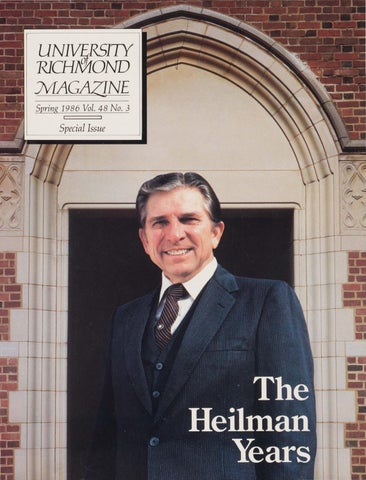
Whm Dr. E. BruceHeilmmi mmounrcd011 Ort. 11, 1985, that he wouldlenvcIlicprcsidmcylo liccoml' Chm1rl'llor, he signnlledthe doseof mi em i11which!he Universilywns mpidly fulfil!h1gthe Robi11s fnmily drmm of hffoming"oneof thefi11es/ smnll universiliesi11 Ilic1wlio11 ." Dr. Hrilmm1is 011/ythefiflh UR Presidmfsi11Cl' !hi'U11ivnsifybegn11 i11 1830. /11becomingChm1cellor, he will suml'd Dr. GeorgeM. Modlin, whom healsosucmdedns Presidnilin 1971. Dr. Modlin, who will liecomrClwncellor Emrrifus,wns Presidmlfor 25 ymrs begi111ii11g in 1946 nfterDr. FredericW. Bonfwrighlconrlwfrdhis 51-ymr presidmcy nnd becnmethe U11iversity's first Chnnrellor . This issuefakesn looklincknf some of the remnrkn/Jlc ncco111p/isl1111e11ts of tlir pnslderndeand n half n11dn lookforwnrd to new visions.It is n trilmtelo Dr. Hcilmnnmid nil the University fnmily midfrimds who mndethe Hcilmmiem 011e of the mostdrmnnlir inn proud 156-yenr history.
CONTENTS 3
1971 ... lnauguration
4
President's Perspect ive: The Dre.im Becomes the Reality"
7
Rectors: Tt>amSpirit
9 Trustee s: Decisions of Consequence 12
Robin s Family: Strength Upon Strength
15
1971•1986 Chronolog y: Years of Progress
20
Development: Building on Optimism
24
Academic s: Academic Ambition Fulfilled
28
M.1p: Ye,i rsofCrowth
30
Athlet ics: A Winning Strategy
... 1971- 1986
34
Virginia Baptist s: A Growing H.irmony
36
Chaplain cy Chair: Commitment to Spiritua l Growth
37
Perspectives Faculty : "Responsive to Our Needs" Administrator s: "He Dicm,1nds the Best" Student s: "A President Who Listens" Alumni: "Enjoying UR's New Prominence"
46
Governance: Getting in Touch
48
Th e Heilmans: A F,1mily Portrait
50
Dr. and Mrs. Heilman's Scrapbook
56
1986 ... Looking to the Future
Photo Credits Eric Dobbs, front cover, pages 19, 51; Taylor D,1bney, back cover; Bernhard H. Schopper, page 2; Marsha Polier Photographs, p,1ges 7, 36, 48; Thomas L. Williams, pages 7, 53; Bob Hutchinson, pag es 10, 11; Bob Hart, page 12; 0. Dille Hargrove, page 16; Whitney Cox, pages 16, 19; Barry Fitzgerald, page 16; Tripp Sheppard, page 31; Debbie Holman, page 35; Joel Archibald, page 36; Forrest Hughes, pages 19, 37, 38, 39, 40, 41, 49, 54; Do rothy Wagener, pages 17, 40, 42, 43, 44; Bill Sublette, p,1ge 43; Mark Williams, page 51; FrederickJ. Kozub, page 52; Richmond Newspapers Inc., page 53; Bob Smith Photograph, page 55 Editor Evelyn Fouraker Assistant Editor Forres t Hughes C ontributing Editor Randy Fitzgera ld, R'63 and G'64 Editorial Assistant Do rothy Wagener C ontributors Forrest Hughes, Randy Fitzgerald, Dorothy Wagener, E. Bruce Heilma n , H . Geral d Qu igg, D. Chr is Wit h ers, Mary Maxw ell, Kim Bra m, Herber t C. Peterson, James E. Gwin, T homas N. Pollard Jr., Patricia Teachey, Elizabeth Carpente r, Zed d ie Bowen, Barry Barnum, William L. Lumpkin, John A. Roush , Nancy Wright Beasley, Debbie Holman Art Direction AT LS~ Lisa Cumbey
r
Th e Unirnsilyof RirhmondMngnzine,of which t his is Volum e 48, Nu mber 3, is publi she d q uarterly for th e alumn i and frie nds of the University of Richm ond , Virginia 23173. ~1986 Univer sity of Richmond
ince my first contact with the Presidential Selection Committee, I've heard over and over again from many
sources that this institution aspires to be a great University...
U .
But aspirations are only emotions put into words unless we discover the
mgredients necessary to success in bringing about the greatness of which we speak. Certainly it won't be money
alone, although that provides a measure of p:>Ssibilitynot beforeattained. It won't be human resources alone, because people can create or perpetuate
weakness as well as strength. It won't be more students, because size doesn't make greatness. It won't even result from a winning footballor basketball team. A university's greatness depends
neither upon the presence nor upon the absence of any particular thing at any particular time. Rather, it depends upon an attitude, a spirit, and a posture of a kind emoodied in confidence. I believe confidence to be the only certain ingredient that will bring us toward , and carry us into, a new level of greatness. Wemust have a new confidence, a clear confidence and a confi¡ dence far beyond that achieved prior to this time ... This confidence should say to us, "If you are going to be something, be something special." Dr. L BruceHeilman,ln,m:,:umti<m Sp,rch, Cktober.30,1971
young men see visions. Dreaming is a very importnnt aspect of life. Visualizing those dreams when awake is even more important. One can dream without visualizing, and one can see visions without the benefit of dreaming. My tenure at the University of Richmond has provided the occasion for both. Somewhere in between the immaturity and uncertainty of youth and the rigidity and stability of old age is a window of opportunity when both dreams and visions can be applied. After 15 years as President, it is possible that l have exhausted some of that flexibility. My change in status and the appointment of my successor will bring assurance that both dreams and visions can be applied far into the future. When I came to the Universi ty, I was totally oblivious to its history, its commitments and its spirit, except for a very objective perusal of its past, its purpose and its potentialities. I certainly had not dreamed about its future, even if I had visions of what might transpire. However, I was rea d ily caught up in the dreams of others, and soon saw visions
President's Perspective By E. Bruce Heilman
of how those might be accomplished. In time, I came to dream for myself of great opportunities and possibilities so that my dreams, as they coalesced with others, added impetus to the excitement and anticipation essential to high success. The term of my presidency has truly embodied years of dreaming dreams, seeing visions and pursuing both to the limit of my capabilities. In many ways, the visions which were mine and those of most others in the early days of my administration have been fulfilled. Thus, they are no longer dream s and visions; they are reality. Above all else, I am reminded that 15 years is a very short period of time. It seems only a matter of days since I barely made it from Raleigh to Richmond through 13 inches of snow on the 27th of March, 1971, to accept my election to the presidency. The inten sity and the stimulation were immediate and continuing. All of that provided excitement and satisfaction far beyond the limited frustrations and
"Translatingour dreams into reality has beenfar rrwresatisfying than we even dreamed it would be."
distractions which inevitably accompany change and progress. I recall that during these years the extremes extended from cries for my impeachment to praise for dramatic accomplishments obviously brought about by a host of excellent people. Within these fluctuations of emotion, I have sought to remain aware of the fact that neither end
of the continuum determines one's place in history or tells the true story of success or failure. Thus, my overriding motivation has been to do what, within the policy of the University and its Board, was judged proper under all considerations of the moment. Overwhelmingly, voices of support for quality and credibility have won the day so that a University of integrity broadly conceived has been maintained. I remember the high expectations growing out of the Robins gift when I arrived on the scene. I was thrilled along with everyone else at the tremendous prospects. I felt we could accomplish them all if our ambitions could be translated to concerted actions. Today, the evidence substantiates that our expectations were reasonable and our goals achievable. In retrospect, it all looks much more plausible than it did from our starting point 15 years ago. Translating our dreams into reality has been far more satisfying than we even dreamed it would be. Today, I still dream and I still
PRESIDENT CONT. see visions; but now memories are co-mingled with both, perhaps even to excess. l remember most everything in my relationship to the University in a positive way, even if some might have had negative connotations at the particular period in time. Overall, my memory tells me that my opportunities have been un precedented. Few in history have been given the charge and the challenge that have been mine during these years. Certainly the response to the charge and the reaction to the challenge have not been mine alone. Far from it. It has been my privilege to be a part of all those wise and willing workers w h o h ave made possib le the giant strides toward new levels of educational quality. As I look to the future and contemplate my dreams from this point forward, I acknowledge that they will, for the most part, be accomplished by others. My visions are not apt lo be projected as far into the future as a young er, fresher perspective in the person of the next president will project them. I am confident he or she will elevate the University to even loftier heights than my ¡ leadership has allowed.
In my role as Chancellor, I would hope lo reflect other qualities and characteristics than those required as President. From a posture of maturity and experience, one might be considered more a prophet and seer than a visionary . Rather than being the actor of one's own volition on the stage, one might become a reactor, positively reinforcing those chosen to take center stage. The voice, the mind, the presence of a former president ought to become a stabilizer, an influence for good and a spirit of affirmation for the one who is currently President and for those who are the responsible actors of the moment. In the new administrntion, I look forward to working from the wings and waiting for the call, as well as fitting in and filling in with the actors as a part of the action. I will not be retired and inactive, but I will be more retiring and reflective. My service will be defined by events and refined by the Board, the new President, and myself, in concert with each ot her. ! end th is chapter, which was assigned to me and defined for me by my staff as a reflection on dreams, memories and pcrspec-
tives, by citing the closing pas sages of a verse which has mean ing for the accomplishments of the University under my leadership and the determined possibilities for me as chancellor. Tennyson's "Ulysses" was a reflection of all this great leader and his armies had accomplished and, in the latter lines, a recognition of his changing role in the battle without acquiescence of determination and commitment.
Come, my friends, 'Tis not too late to seek a newer world. Push off, and sitting well in order smite The sounding furrows; for my purpose holds To sail beyond the sunset, and the baths Of all the western stars, until I die . It may be that the gulfs will wash us down; It may be we shall touch the Happy lsles And sec the great Achilles, whom we knew . Tho' much is taken, much abides; and tho' We are not now that strength which in old days Moved earth and heaven, that which we are, we are, One equal temper of heroic hearts, Made weak by time and fate, but strong in will To strive, to seek, to find, and not to yield.
RECTORS
TEAM
SPIRIT ~..A
By Forrest Hughes As the head of the group which
legally owns the University of Richmond, the Rector of the Board of Trustees has an interest in the well-being of the institu-
tion as well as the responsibility for its continued vitality. At the same time a dose association with the University affords the Rector an intimate view of its
strengths and the peopl e who make it strong. Dr. E. Bruce Heilman in his 15-year term has served with three distinguished Rectors. Robert Thornton Marsh Jr., R'22, was Rector from 1958 to 1973. He chaired the selection committee which recommended Dr. Heil man as the fifth president of the University, and he launched the Our Time in History development campaign. He died in 1981. Lewis T. Booker, R'S0, was Rector from 1973-77 and from 1981-85. F. Carlyle Tiller, R'48 and H'76, served as Rector from 1977-81 and began his second term in 1985. All three Rectors shared several characteristics which made them successful in that position, says Vice President for Development /University Relations H. Gerald Quigg. "All three were tremendous givers in terms of both their time and resources," he says. All th ree were close to
UR- besides all three Rectors being graduates, Booker's mother, father and brother all went to school here, and Tiller has a son who is a senior here. "All three have been church leaders and have had a deep appreciation of the University's Baptist heritage. And all three have had the respect of other Board members and would be listened to," Quigg co n cludes.
RECTORS CONT Quigg gives yet another reason for the success of the Rectors serving during Dr. Heilman's administration: their attitude toward work. "All three Rectors and Dr. Heilman have been hard work-
ers," he says. "They worked all the time and never considered it work. This attitude gave them an enormous respect for each other that made them work together
very, very well." The viewpoint from a member of that team supports Quigg.
tion of the physical plant totalling some $65 million. Tiller says the Governance Study; the successful completion of the S50 million Our Time in History campaign and the $5 million Athletic Endowment Fund campaign; the initiation of the Winter Business Forum; and the impending successful conclusion of the $55 million Cornerstones for the Future development campaign are some of the events indicating Dr. Hei!man's success at
!:s~e~/~~: ~?~~t::~r~~~;i~tnce 1-----------7 0
and trust." He also points to the need for constant communica,
tion. "We'd be on the phone two ,
to three times each week, and if one of us was out of town when something came up, we'd track the other down." That team spirit has its advantages. ''We've learned how the other thinks," Booker says. "On the few occasions when we couldn't reach the other and a decision had to be made, we could r;;?,ict how the other would re-
Tiller sees the Rector's role as a supportive member of the team. "The Rector rallies support for the President, backs the President as he executes and administers policy throughout a very complex institution and supplies advice and counsel to the President. " Both Booker and Tiller acknowledge that the outstanding achievement of Dr. Heilman's administration has been the forging of UR's heightened visibility and national prominence. "Looking back," Booker says, "people will say there was a time when we went from being a regional institution to a national one. There was a time when we turned." Indicators of UR's increase in prominence, he says, include the perception by other educators of UR's high academic status, as evidenced by UR's high marks in U.S. Nws & World Report surveys in 1983 and 1985. He also points to the initiation of the Oldham, University and CIGNA Scholars programs, the increase in the endowment from $51 million to $181 million over the 15 years, and the construction and renova-
"Lookingback, peoplewillsaytherewasa tim£whenwe wentfrom beinga regi.onal instit~; tion to a nationalone.
/.,ewisT &Joker
Another challenge, Booker says, has been the University's loss of promising leaders to other colleges as presidents. Dr. Stephanie Bennett, former Dean of Westhampton College, became President of Centenary College in Hackettstown, N.J., in 1985. Dr. Melvin Vulgamore, former Vice President for Academic Affairs and Provost, became President of Albion College in Michigan in 1983. Dr. Gresham Riley, formerly Dean of the Arts and Sciences Faculty, became President of Colorado College in Colorado in 1981. Dr. Charles Glassick, former Vice President for Academic Affairs and Provost, became President of Gettysburg College in Pennsylvania in 1977. "And Dr. Heilman has always been able to replace them with other promising leaders," Booker says. The University's future brings new challenges. Primary, Tiller says, is to assure continuing
1.~-••·=._.,,,.,....,.-.,,,,,.,,.,,,,,,.,....,1 ~~~;~~~:.e~,i~~1~i~si~~~:o~~::ne increasing the visibility of the University. Being a strong leader has enabled Dr. Heilman to make these accomplishments. "His leadership ability stems first from confidence in himself, derived from his great inner strengths," Tiller says, "and secondly from his confidence in his fellow man." Booker puts it simply: "He picks the best people he can find, inspires them and leaves them alone to do their job." Tiller says that Heilman's strongest attribute is his indomitable spirit. "I have never witnessed him doubtful or dispirited, critical or resentful, or lacking in his total enthusiasm for the University of Richmond." But Dr. Heilman has had his challenges too. "I think some of the challenges he's faced have centered on bringing all aspects of the University into consonance," Booker says. For example, the Spider Club, once a semiindependent organization, is now part of UR. "And he's done it all, brought it all together, without causing assets to be spent in the wrong direction," Booker says.
with exactly the same style," he says, "but with the same basic characteristics. " Booker looks to the more distant future for challenges. "The declining applicant pool, the uncertainty of government influence on education . these are concerns of any institution of higher education. That UR will have these challenges shows how far it has come from worry about more day-to-day concerns." Meeting these challenges will take strengths that UR has built up through Dr. Heilman's personal leadership and hard work. Tiller says the materially enhanced resources will help UR succeed in the future. Booker points to a strong faculty (faculty members holding terminal degrees increased from 60 to 90 percent during Dr. Heilman's administration), excellent physical facilities and a good working relationship with Virginia Baptists.
ForrestHughes is the Assistant Directorof Com1111micatio11s al the University and is Assistant Editorof tile UR Magazine.
A university board of trustees formulates policy; the president carries out that policy in the dayto-day running of the university. A university cannot accomplish much without the two working in concert. Few colleges can rival the relationship worked out over the years between Dr. E. Bruce Heilman and the Board at UR. All the accomplishments of the Heilman years, the $65 million of construction, the increases in the numbers of faculty with terminal degrees, the increase in endowment, the new academic chairs, the jump in SAT scores, new scholarships, the national rankings of the football and basketball teams - just to name a few-have been accomplished under the direction and with the full support of the Board of Trustees. Looking back to the beginning, Dr. Heilman told the Board: "When I joined you in 1971 .
we agreed with Daniel Burnham that we should make no little plans, which have no magic to stir men's blood and which probably would not be realized. We decided to make big plans and to aim high. We did not make the mistake of asking ourselves and others to do miserable little things. We expected great things and attempted great things, and the results speak for themselves. "We have climbed more mountains than we knew existed and we have exceeded our dreams, our visions and our plans of just a few years ago. By virtue of my relationship with you, that I have been a successful president is not in doubt. That I could not have been with a lesser Board is just as clear. The Board selected me, allowed me to lead and supported me in that leadership. As a result, we have shared the responsibility of building a finer University." Dr. Heilman and the Board were committed to that vision
"The Board selected mR, allowedmÂŁ to lead and supportedmÂŁ in that leadership." E. Bruce Heilman
1
10
from the beginning. That commitment was to nothing less than the fulfillment of the Robins dream for UR "to become one of the finest small private universities in the nation." That was what E. Claiborne Robins and his family expected as a return on their $50 million gift in 1969, then the largest ever given to a college by a living benefactor. To achieve the dream, Dr. Heilman and the Board decided to raise even more money. In launching the Our Time in History campaign, the largest ever at that time in the Commonwealth, Or. Heilman said: "Surely the University can raise $50 million from all its sources if one family can give $50 million." The Trustees were to play a major role in that and later campaigns. Dr. Heilman told them: "Trustees of this University, if they ever have assumed such a role, must abandon the role of being the mere conservator of the financial resources of this institution and must adopt as a first and overriding responsibility the increase in very substantial amounts of these resources." The combination proved unbeatable. Or. Heilman provided the leadership; the board provided the wherewithal. "The Board in every sense was superior," Dr. Heilman said. "They were superior givers. They were superior workers .... Furthermore, they faced head on hard issues, like academic freedom, the role of athletics and cutting down trees to build buildings. They have done everything they have been asked to do." Joseph A. Jennings, 8'49 and H'80, Chairman of the Executive Committee of the Board, says of the current Board and other Trustees during the Heilman era: "They demonstrated a willingness to make decisions and then move on. They don't debate forever." Of Dr. Heilman, Jennings says, "He has boundless energy, an elephantine memory, and he is a superb fund-raiser who uses volunteers until they drop."
Dr. David C. Ekey, Professor of Business Administration in The E. Claiborne Robins School of Business, describes Dr. Heilman's relationship with the Board: "One of the things the University has always had has been outstanding community leadership on our Board. We've been blessed. What we found in Heilman was a catalyst to u;e those tremendous resources Dr. Heilman not only asked for "wealth, work and \Visdom" from the Board, he and the Board asked for those resources from other supporters and potential supporters of the University. "What Bruce did," according to Board of Associates Chairman Robert L. Burrus Jr., R'SS, "was to open the University up to the community, and the community has responded to that approach." Burrus says Dr. Heilman approached mayors and chairmen of large companies. He invited community leaders to breakfasts at his home on campus. He created the Board of Associates, a public relations arm of the Board of Trustees. ''He made contacts by the score, political, social and corporate," Burrus says. "The desire to contribute was only one result of that approach. The community no longer sees UR as an isolated academic institution in the West End of Richmond." Another former Board of Associates Chair, Virginia Carter Smith, W'53, says she saw that one-to-one approach dose up. "I had been working at UR and had decided I was going to Washington to work [she is now Vice President of the Council for Advancement and Support of Education]. He eyeballed me. I understood how persuasive he was. He was personally interested in me and made a compelling case for the University. I saw then why he is such a successful fundraiser." Mrs. Smith says Dr. Heilman is "a textbook example of a good college president. "He constantly articulates the mission of the University. He
constantly hammers at what the University is about. Also, he is personab le and approachable but not everybody's buddy. He holds the mantle of the presidency very well." He embodies the qualities of leadership James L. Fisher describes in his book, Power of the Presidency, according to Mrs. Smith. Another Trustee, Charles H. Ryland, R'36 and L'39, whose great-great uncle Robert was the University's first president, says the Heilman era has been "magnificent." "There are a number of eras in the history of the Univer sity," Ryland says. "The school opened as a seminary for teaching ministers. Uncle Robert got it into a college. After the Civil War, there was no president for 25 years. Boatwright arose as a young strong administrator. He took it from a small downtown college and moved it physical!y. Dr. Modlin doubled its size. The Robins gift allowed the University to move from local to regional." Ryland says the gift alone "couldn't have done it." "Bruce had the key to ... making the financial future of the University safe." The results of the dreams to which Dr. Heilman and the Board committed themselves are staggering, even when looked al in a brief summary. F. Carlyle Tiller, twice Rector during the Heilman years, said in his announcement to the media about Heilman's plans to leave the presidency: "His tenure has been marked by unprecedented growth in the University's national reputation, its academic programs, its physi cal plant and its endowment. "The number of faculty members holding doctoral or terminal degrees has risen from 60 percent in 1971 to 90 percent today. Faculty publications have more than doubled, and faculty salaries have risen dramatically. In recent years eight distinguished faculty chairs have been crea ted. The average student SAT scores have risen to some 235 points above the na tional average. The Heilman
years also have seen an increase in merit-based scho larships with such programs as the Oldham Scholars, the University Scholars, the CIGNA Scholars and the newly created Virginia Baptist Scholars. "The most visible changes during Dr. Heilman's administration have occurred in the Univer sity's physical plant. In the last 15 years about 565 million has been spent on new buildings and the renovation of all existing build ings. Those 15 years have seen the openings of the $10 million Robins Center, the 58 million Gottwald Science Center, the $5 million Tyler Haynes Commons, the $5 million addition to the Boatwright Library, the 55 million dining hall, two new residence halls, Lora Robins Court and Gray Court; the M. M. Long addition to The T. C. Williams School of Law; a new President's Home; an addition to The E. Claiborne Robins School of Business; and the renovation of Sarah Brunet Memorial Hall for an alumni cente r; and renovation of the former science buildings to create The Sophia and Nathan S. Gu menick Academic -Administrative Quadrangle. 'The University's endowment today ranks in the top two percent of all universities in the country." Dr. Heilman told the Board that success was realized "because of the Robins family, because of this Board, because of my administrators . today and those who have served these years and because of our outstanding faculty. "With all of this support and reinforcement, how cou ld a president fail: I could not, and I have not."
Dr. Randy Fitzgerald, R '63 and C '64, is Director of the News Bureau at the University and Contributing Editor of UR Magazine . 11
ROBINS FAMILY
"Thehighest compi-' \i mentI.canpayBruce ' J/ei{ma . ~-my dream' ~\ho§ befnachieved and ,¡theaccompl~hments , havesurpassed my highest hopes."
1
n
E.C/aibonie Robins
Strength
vpon
trength 12
By Dorothy Wagener Town and Country magazine two years ago included E. Claiborne Robins, R'31, among the top five "most generous living Americans." The over-S100 million he and his family had given the University since 1969 had made It "a major institution," the article said. That certainly was the dream Robins expressed when he announced in 1969 the $50 million gift from himself and his family. The gift at the time was the largest a living benefactor ever had given an American university. The money was to be used, he said, to help UR become "one of the finest small universities in the nation."
The Town and Country assess ment and two rankings of UR in U.S. News & World Report as "one of America's best colleges" suggest that the University has achieved the national prominence Robins hoped for. Robins himself acknowledges the fulfillment of the dream he shared with Dr. E. Bruce Heilman upon his arrival as president of the University: "I shared with him my dream of seeing this fine school become one of the foremost educational institutions in the nation. The highest compli ment I can pay Bruce Heilman is- my dream hus been achieved and the accomplishments have surpassed my highest hopes. How wonderful it is to see in one's lifetime a dream of this magnitude come true." In addition to academic excellence , another part of the Robins dream was that a l.:1rgegift would inspire other donors. Robin s said he has been pleased to see "how others are now caught up in the excitement of the University. We're now getting major donors who had no previous ties to UR." Dr. Heilman came to the University in 1971 committed not only to making the best use of the Robins gift, but also to campaigning to raise another $50 million in ten years. In the 15 years of Heilman's presidency, the University will have raised about $110 million in two major devel opment campaigns. E. Claiborne Robins Jr. has also paid Dr. Heilman tribute. He said Dr. Heilman began by building on the University' s past strengths; surrounded himself with experienced administrators and faculty and delegated responsibility to them; then turned his attention to the Board of Trustees and "created one of the strongest, most active and most responsible Boards serving any college or university. "We have seen strength added upon strength. We have seen the rising of new facilities und the refurbishing of the old. We have seen faculty salaries advance from the 50th to well over the 70th percentile. We have seen our academic offerings increased and
strengthened. And we have seen our applications for admission climb steadily during a period when other universities have experienced declines. "It should be dear to all, even those who search constantlv for controversy and problems, , that dramatic progress has been made at the University." E. Claiborne Robins' original idea to make the S50 mil!ion gift took shape us a timely merger of two separate concerns Robins had. He had been pondering the future of the University and at the same time had decided to make some kind of gift on a grand scale. "In early 1969 I realized that while I had been contributing anonymously to hundreds of organizations , the amounts were not large enough to have significant impact on many of them. I should pick one, I felt, and I chose the Univ ersity of Richmond." I [e thought the University had "the greatest potential of any institution with which I am famil iar" because of its "firm base
through heroic economies, a fine faculty, a distinguished heritage," but it lacked "the one thing essential - it Jacked enough resources to accomplish this goal." Robins had an appreciation of the heritage of the University from personal experience because he himself, his fath er, his son and daughters were all alumni. However, Robins realized, "the 'good old days' at the University of Richmond weren't 'good old days' either, because as a university, every program was literally starving to death." The University was also important to him because "I've always believed that education is the greatest investment any individual or corporation could possibly make." From his perspective there is a vital relationship between business and educntion. As the idea to ma kc a large gift became clear, he said his first inclination was to give $25 million, but "I soon realized that $25 million was not enough to do the job well. If it was worth doing at all, it had to be done right." Even the amount of S50 million he was considering would be "just the foundation and the job would require much, much more."
13
Gathered in May 1980 for the dedication of Lora Robins Court arc, from left, Mrs. Belly Heilman; E. Claiborne Robins fr. and /1is wife, Mary Ellen Wessells Rollins; Ann Carol Marchant; E. Claiborne Ro/Jins and his wife, Lora McGlasson Ro/Jins;Juliet Shields, daughter of Betty Robins Porter; Ro/Jeri E. Porter, M.D., and his wife, Betty Rollins Porter;and Dr. E. Bruce Heilman.
Although the Robins gift changed at a single stroke the destiny of the University, the Robins family specified that the $50 million should be treated not as the answer to all the Universi ty's financial needs but as a "nest egg" to be multiplied many times over in order to maintain progress and stay ahead of inflation. At the time he gave the S50 million gift in 1969, E. Claiborne Robins said he wanted to give it in his lifetime in order to enjoy the results. "It's a mystery to me why so many folks wait until they die to do what they really wanted to do all along, such as giving a large gift to a university," he said. "It is good to see some good done whi le you are living. This way, I can watch." But Robins and his family have done much more than merely watch. Although they would not take the credit, the "dramatic progress" that E. Claiborne Robins Jr. speaks of is due in part not just to the magnificent gift of the Robins family in 1969 and their subsequent giving but also to the work the family devotes to the University. E. Claiborne Robins Jr. has been National Chairman of the Cornerstones for the Future development campaign that is on schedule to raise $55 million one year ahead of the July 1, 1987, target date. "E. Claiborne Robins and his
family are the reasons why the University of Richmond is flour ishing rather than floundering," Dr. Heilman says. In his Oct. 11, 1985, speech to the Board, Dr. Heilman said: "Making everything possible by laying the foundation and maintaining the challenge have been members of the Robins family setting the example, leading the way and creating the momentum. Never have I known a family or individuals within a family who are so selfless and, along with that, so certain of their responsibility and committed to fulfillment of that responsibility. "I am here because the Robins gift influenced my coming. That 'seed money' has been the reason I can turn over a successful administration to a successor president." E. Claiborne Robins is "the University's greatest living pa tron," Heilman said in 1979 when the School of Business was named for Robins. E. Claiborne Robins' wife, Lora McGlasson Robins, H'73, has made her own impact on the University. In recognition of her numerous contributions of time and resources, the Trustees bestowed on her an honorary Doctor of Humanities in 1973. Mrs. Robins in 1977 estab lished the Lora Robins Gallery of Design from Nature with a gift of natural history specimens. The
Gallery's collection of rocks and minerals, gems and jewels, sea shells and corals, fossils and cultural artifacts has earned it an international reputation. Also bearing Mrs. Robins' name is the Lora Robins Court, a residence hall made possible by a gift from her. Built in 1979 at a cost of $4 million, it is the campus home of 250 women students. Robins has been a Trustee since 1951, while his son, E. Claiborne Robins Jr., 8'68, has served on the Board since 1969. His younger daughter, Ann Carol Marchant, W'67, is also a member of the Board of Trustees. Mrs. Robins and the older Robins daughter, Elizabeth Robins Porter, J-1'78,both serve on the Board of Associates. Finally, says Dr. Heilman, Robins and his family "have never taken from the University its freedom and flexibility and that is as much a credit to them as the gifts themselves." It has been a mutually beneficial relationship: the Robins family generosity and the Heilman administration.
DorothyWageneris a writer and edi tor in Richmond, Va. She has served as public informationofficerfor two Virginiacommunity collegesand has written freelancenewspaperand magazine articles.
1971-1986 CHRONOLOGY ~~}..,
···\'.~:··,
J?rigress Editor's Note:
This chronologyof the Heilman years includes an abbreviated version of the listing compiledby Dean Emeritus C.J.Grayfor the Fal/ 1981 'Decade of Progress" special issue of UR Magazine and a more completelisting for events of the last five years.
1971-72 • Dr. E. Bruce Heilman is elected by the Board of
Trustees on March 26, 1971, and officially inaugurat ed as the fifth President of the University of Richmond on Oct. 30, 1971. • Development highlights include initiation of a ten -
year Our Time in History development program for improving the physical facilities and the educational program. • Numerous campus buildin gs and facilities are carpeted, repainted, air condition ed, and refurbi shed; tennis courts rebuilt; and parking areas resu rfaced.
1972-73 • The $10 million Robins Center, begun in August 1970, opens in December 1972. The gift of the E. Claiborne Robin s family, the Center was dedicated on Feb. 24, 1973. • M. t\.:1-Long addition to the Law School building and the renovation of the original building are completed and the addition is dedicated on April 14, 1973.
• Newly constructed President's Home on the southwest corner of the campus is completed. • Board of Associates, an extension of the Board of Trustees, is estab lished. • Frederic William Boatwright Society of Alumni is established to honor annually those alumni who have been graduated 50 years or more. • Renovation of Thomas Hall (men's residence hall)
and North Court (women's residence hall) is completed . • Lakeside residence hall for men, opened in 1970, is named in honor of Rector Robert T. Marsh Jr., with dedication ceremonies on May 13, 1973.
1973-74 • Board of Trustees approves the merger of Univer sity College and the Summer School, combining all the continuing education activities. The Day Division of University College is discontinued. An Academic Skills Project begins on the main campus. • University tenure policy is formulated and adopt ed. • Outdoor Chevron track and eight new tennis courts are completed. • Separate infirmary-dispensary facilities of Richmond College and Westhampton College are consolidated and expanded in Robins Hall. • Law library is dedicated to the memory of the late Dean Wil!iam Taylor Muse, a member of the law faculty for 40 years, including 24 years as Dean.
1974-75 • A Chaplain to the University, reporting directly to the President, is appointed. • Gray Court, the $2 million residence hall for women, is completed and officially dedicated. Housing 280 women, this facility is made possible by a gift from Trustee Garland Gray in memory of his late wife, Agnes Taylor Gray. • Renovation of Ryland Hall is completed and the building reoccupied as a classroom and office facility. • The Board of Trustees approves a Bachelor of Music degree program and a Master of Education in Physical Education degree program. • The Board of Trustees approves withdrawal of the University from the Southern Athletic Conference.
15
CHRONOLOGY CONT. Left, faculty are honoredwith Distinguished EducatorAwards beginning in 1975. Secondfrom left, Boatwright Libraryexpansion.
1975-76 • University's accreditation
is reaffirmed for ten
years without reservation by the Southern Association of Colleges and Schools. • Board of Trustees establishes an endmved program of University of Richmond Distinguished Educator Awards to be given annually for leadership in
teaching and learning. • .woi:nen's Resource Center, the only one of its kmd m central Virg!nia, is established in University College to provide ltfe planning seminars and career
counseling for community women. • Board of Trustees approves Master of Business Administration degree program to start in September 1976. • Jeter Hall and Thomas Hall, residences for men, are renovated.
1976-1977 • The $4.6 million expansion of the Frederic William Boatwright Memorial Library is completed in 1976 and rededicated on March 3, 1977. The 70,000square-foot addition more than triples the library space. Newly designed areas include the Theodore F. Adams Auditorium, Jacob Billikopf Learning Resources Ce n ter and Lora Robins Callery of Design from Nature. • Lora Robins Gallery of Design from Nature, given by Mrs. Lora M. Robins, officially opens on April 24, 1977. Includes shells, minerals, gems, meteorites, fossils and other artifacts. • The $4.7 million University Commons, is dedicated on April 22, 1977. • The $30 million Phase I of the Our Time in His~~Ja~eit~~h~eu~:~ampaign is completed one year
• Phase II of the Our Time in History campaign for $20 million is launched. • Three new i~terdisc!plin~ry majors (America_n Studies, ClassKal Civ1hzahon and Urban Studies) are combined to form the Area Studies program. • The T. C. Williams School of Law institutes a dual-degree program in cooperation with Virginia Commonwealth University School of Social Work, enabling a student to pursue the Juris Doctor degree and the Master of Social Work degree concurrently. • The 100th birthday of the first Dean of Westhampton College, Dr. May L Keller, is celebrated. • South Court and Kelle r Hall are renovated.
1978-79 • Remodeling and renovation of the former science complex - Maryland Hall, Richmond Hall and Puryear Hall-is completed, providing centralized quarters for the general administrative offices and for additional classrooms and faculty offices. • Gottwald Science Center is named and rededicated in honor of Trustee Emeritus Floyd D. Gottwald in July 1979. • UR grants resources to one-fourth _of the faculty for th~ support_of research. In addit10n, seven faculty projects receive grants from external agencies for a total of approximately $170,000. • The first 15 freshman participants in the University Scholars Pro_gram are selected to begin the program next session. • Three students are awarded AH-American honors: Ingrid Brustad (s\~imming), Jeff Nixon (football), and Hillary Tuwe1 (track).
• Henry Mansfield Cannon Memorial Chapel, originally built in 1929, is renovated. • Alumni of the University of Richmond Award for Distinguished Service is instituted. • University becomes associated with the Eastern College Athletic Conference, a voluntary association of over 200 colleges and universities.
1977-78 • New $8 million Science Center opens and is dedi~ated - housing the Departments of Biology, Chemistry, Physics and UR's Virginia Institute for Scientific Research library. • The Graduate Division of the School of Business is named in honor of Richard 5. Reynol d s.
16
GottwaldScienceCenter
1979-80
..
• $50 million Our Time in History campaign 1s concluded two years ahead of schedule and $4 million over the goal.
• Sesquicentennial is celebrated with special_con~ocations featuring lectures by college and university presidents, concerts and plays, departmental lectures, city celebrations and first community day on campus (Sesquifest), chaired by Trustee Charles H. Ryland. • The school of business is named The E. Claiborne Robin s School of Business.
• Trustees give final endorsement of a Five-Year Plan in which the University's mission is reaffirn:ied, and a dual commitment to excellence in academics and athletics is undergirded by new allocations of resources which will build to $2.25 million in the fifth year. • Lora Robins Court, a residence hall for 250 women students, is dedicated.
1980-81 • At Commencement meeting of the Board, retiring Rector Tiller announces that President Heilman has agreed to remain as UR chief executive for five more years . • Development launches 55 million Athletic ~ndowment Fund campaign at campus luncheon with former President Gerald Ford making guest appearance . • Addition to the law school library is completed . • Six faculty members are appointed to historic endowed chairs in the Arts and Sciences. • Challenge Grant for Visiting Professors ($160,000) is received from the National Endowment for the Humanities. • After renovations are completed, the Deaner y is dedicated and becomes the new home for the Westhampton Dean's Office and Alumnae Association. • The Board of Trustees agrees to undertake a University-wide governance study.
• The Women Involved in Living and Learning (WILL) program at Westhampton College is initiat ed with 20 freshmen.
1981-82 • Board of Trustees approves a new development program, Cornerstones for the Future, to begin fall 1982. It will provide endowment resources for scholarships, faculty development and academic improvements . • Board of Trustees approves an Executive M.B.A. program, the only one of its kind in Virginia, for The E. Claiborne Robins School of Business. • Winter Business Forum is initiated in February as part of Annual Giving prograr1_1to highlight the role of free private enterprise in private higher education. • The Chapel Guild, a support group dedicated to strengthening the chaplaincy program and programs related to Cannon Memorial Chapel, is founded by Mrs. F. C~rlyle Tiller. , • Spider football runnmg back Barry Redden, R 82, is the third leading rusher in college football for . 1981 and is selected in the first round of the Nation al Football League draft by the Los Angeles Rams. • New library wing is completed for The T. C. Williams School of Law.
Left, The E. Claibor~eR?bins Sc~oolof Business. '.4-bove, first NEH visiting professorKwas1 Wiredu. Right, Spider runmng back Barry Redden, R'82. 17
CHRONOLOGY CONT.
1982-83
1984-85
• Five-year Cornerstones for the Future development campaign lo raise $55 million by 1987 is announced in the fall with some $20 million already committed. • The Oldham Scholars Program is announced. It will be made possible with a gift of $2 million, one of the largest gifts ever made to the University, from Mr. and Mrs . W. Dortch Oldham of Nashville,
• Board of Trustees establishes the E. Claiborne Robins Distinguis hed University Chair, at $1.5 million the most heavily endowed professorship at the University. The Chair will bring to campus nationally and internationally known figures in the humanities, theology or public service. • Addition to The E. Claiborne Robins School of Business is dedicated in October. • Tyler Haynes Commons is named an d rededicated in honor of Trustee Dr. W. Tyler Hayne s in December. • The Ruth Wallerstein Thalhimer Cottage, a refurbished garage at the Deanery that will now serve as a guest house, is dedicated in January. • Refurbished Sarah Brunet Memorial Hall is rededicated in June to serve as an Alumni Center and as space for the Institute for Business and Community Development and the Women's Resource Center. • The Athletic Endowment Fund campaign is concluded with $5,500,000 pledged and a $2,000,000 challenge gift. • The first Douglas Southall Freeman Symposium, entitled "Women in Southern History," is sponsored by the History Department. • The University Players' production of "Hiawatha"
Tenn. • The new $5 million Central Dining Hall opens and serves its first meal on Sunday, Aug. 15, 1982. The
University Forest Apartments open in Aug. 1982. • UR football becomes division I-AA when the NCAA football structure is reorganized.
1983-84 • U.S. News & World Report ranks the University as one of the 14 best comprehensive universities in the nation in a survey of college presidents. • Study of University Governance is concluded and final reports approved by the Board of Trustees in May. • The student fund-raising effort, the Campaign for Prominence, is successful in raising ha!f the
Left, Cannon Chapel Rose Window. Second from left, Sp(der basketba/1team, participants 111 1984 NCAA Tournament. $126,000 endowment. The funds are matched by Mr. and Mrs. Gottwald to establish The Floyd D. and Elisabeth S. Gottwald Student Speakers' Endowment to bring nationally prominent speakers to campus. • The Jessie Ball duPont Religious, Charitable and Educational Fund pledges $750,000 as a challenge to establish the Chair of the Chaplaincy. • New academic major in computer science is approved and the department name is changed to the Department of Mathematics and Computer Sciences. • Stained glass Rose Window, a gift from Trustee F. Ca1lyle Tiller and his wife Martha for the Cannon Memorial Chapel, is dedicated in April. • The University of Richmond Stadium is renovated. • The Spider basketball team posts a 22-10 record, wins the ECAC South Championship and advances to the second round in the NCAA Tournament.
18
is selected as one of seven national finalists in the 1985 American College Theatre Festival competition and performed in the Kennedy Center in Washington, D.C. • The first production of Handel's "Messiah" in recent years is presented in December. It is jointly sponsored by the Chaplain's Office, the Department of Music and the Chapel Guild, with funds from the Chapel Guild Christmas House Tour of 1983. • The first Emanuel Emroch Lecture in The T.C. Williams School of Law is presented in April by Harvard Law Professor Arthur Miller. • The University may be the first institution in the country to use direct distribution of videocassettes for recruiting purposes. The cassette is a 20-minute film entitled "Faces" and is requested by 2,400 prospective students. • Thirty-five faculty members are first to take advantage of a UR shared-purchase plan for academic-in -
structional microcomputers. • Spider football has one of the most successful seasons ever with a 7-3 regular season record, an NCAA I-AA division play-off bid and a top-10 ranking. • Spider basketball team has more than 20 wins for the second year in a row with a 21-11 overall record and an advance to the second round of the National Invitational Tournament. • UR and seven other institutions in the ECAC South form the Colonial Athletic Association for basketball and 11 other championship sports for men and women.
1985-86 • Dr. E. Bruce Heilman announces on Oct. 11, 1985, that he will leave the office of President on Sept. 1, 1986, to become Chancellor. Dr. George M. Modlin, President from 1946 to 1971 and Chancellor from 1971 to 1986, will become Chancellor Emeritus. • The academic and administrative complex-Maryland Hall, Richmond Hal! and Puryear Hall-is named The Sophia and Nathan 5. Gumenick Academic-Administrative Quadrangle following the gift of $1.2 million by Mr. and Mrs. Nathan Gumenick. • The University is again named one of "the best colleges in America" in a survey of college presidents by U.S. News & World Report. UR lied for ninth in the regional liberal-arts colleges category, which included 189 colleges nationwide. • Mrs. Helen F. Boehm, sole owner of Edward Mar-
shall Boehm In c., presents the University with 75 porcelain sculptures valued at about $75,000. • For five weeks in the fall of 1985 the UR Spiders football team is ranked number one in the nation in the NCAA's Division I-AA poll. Final season record is 8-3, one of UR's best ever, and the final regularseason poll ranks the Spiders number 18. • The 1985-86 men's basketball team earns a bid to the NCAA tournament after winning more than 20 games for the third season in a row and briefly ap pearing in the AP top-20 poll. The 23-7 mark equals the 1953-54 team's school record for most wins in a season. • Dr. Patricia Clifton I farwood, Dean of Student Services at the North Carolina School of the Arts in Winston -Salem, N.C., is named the new Dean of Westhampton College, assuming office in February 1986.
• All 19 stained glass windows in the Cannon Memorial Chapel have been given by donors and installation is scheduled to be completed by 1987.
19
DEVELOPMENT
QBuilding on
PTIMISM
By H. Gernld Quigg and D. Chris Withers He was introduced to the University community amid a snowstorm, that late March day 15
years ago. Even then, you could feel the enthusiasm, sense the unbridled optimism so much a part of the makeup o f E. Bruce
Heilm,m -U R's new President. Seven month s later at his first Board of Trustees meeting he challenged the Board to "put this University next in your life after
your family, your church and your job. We will have to raise our sights; ask others lo give more and give more than ever be-
fore ourselves." The stage was set. Fund raising at the University would never be the same. Fund raising is not very pop-
ular with alumni, faculty and students. For many alumni, the quote is often, "All you do is ask for money"; for the faculty, there are reservations that intellectual pursuits must be marketed and so much time spent on fund raising; and, for the students, there is just a general lack of kno\vledge and understanding of the role of resources in a university after all, "Don't we pay enough tuition?" But fund raising is central to the life of a university president, and exceptional success at this misunderstood art is one of the major hallmarks of the Heilman administration. "There is nothing on the campus that is considere d where
20
resour ces do not play a major part," Dr. Heilman, an acknowledged, superb fund-raiser, is often quoted as telling audiences as he has traveled far and wide garnering resources during the two $50 million-plus campaigns in his 15 years as President. The fact that Dr. Heilman faced squarely and without apology the job of providing gift resources over these years accounts in large measure for the current national and enviable stature of the University Early in his administration, a massive physical rehabilitation of existing facilities and construction of several new academic, residen tial and recreational facilities brought about the Our Time in History campaign. This campaign, the largest ever in the history of the University, raised $54 million in eight years-two years ahead of the projected schedule. During that period Dr. I leilman gave time, energy, boldness and superb salesmanship. Corporations, foundations, alumni and other friends were seen personally and influenced by the Heilman charm and persuasivene ss. It became known around Richmond that if you were invited to UR for lunch it could be costly. However, prospective donors learned so much about URits great impact on the city and state; its important role in suppl ying leadership in all areas over
the years; and the tremendous opportunity ahead stimulated by the Robin s family philanthropythat donors responded beyond wildest expectations. During the early campaign years, 37 corporations responded with an c1verage gift of $102,000-an astounding record in Virginia. "Dr. Heilman's greatest contribution in fund raising," says F. Carlyle Tiller, R'48, Chairman of the first phase of the Our Time in History campaign, "is his boundless optimism. He just knows everyone is eventually going to suppo rt the University - and, for the most part, they do!" UR's resources grew from a cash flow of 52 million in 1971-72 to over $10 million at the end of Heilman's 10th year. To carry on the campaign momentum, other prominent alumni with i1 contrasting style to Dr. Heilman were enlisted. Joseph A. Jenning s, (3'49 and H'S0, headed Pha se II of Our Time in History and completed the effort successfully at the 150th Anniversary Celebration of the University in 1980- Heilman' s 10th year. The record of giving over the 10 years is truly am,tzing. Consi d er that the number of $1,000-plus
.. LllJ
donors grew from 19 in 1970 to 695 in 1985; and that the Annual Giving program grew from $227,000 in 1971 to $1.9 million in 1985. Jack Jennings, the first Annual Giving Chairman, stated he never believed "we would get our seed corn back but I was pleasantly surprised." frustees over the years have been instrumental in Heilman's success in fund raising because, as Lewis T. Booker, R'50, and twice Rector, said, "Dr. Heilman has the ability to galvanize the Board into action so that it's not his campaign, but ours, and we don't want to fail." In 1982 the new campaign, Cornerstones for the Future, was launched. Some said, "It's too early to top the last effort," and again some said, "You are going to the well too often." But, as Dr. Heilman has repeatedly stated, "business never slacks off after it's had a good year. They keep pushing forward. So must we if the University is going to achieve the educational goals it has set for itself. We don't raise money just for the sake of raising money or to please ourselves. Rather, we seek resources to provide a continuing better quality of education for the students who come here." The campaign began only after an extensive two-year planning process that started in late '79, even as Our Time in History was still in progress. Deans, faculty representatives and key administrative staff brought '\vish lists" totalling over $67 million. The difficult trade-offs and cutbacks were made while still assuring that the University's mission and priorities had unanimity of purpose. The Board of Trustees approved the five-year campaign for $55,030,000, noting that Our Time in History had the goal of raising $50 million over 10 years and this one had a $55 million goal over five years. The constant voice of challenge and support through it all was Dr. Heilman. His vision of the kind of student UR needed to att ract in the future made the
$15.5 million portion for scholarships and student aid the largest in the Cornerstones goal. His concern for attracting and retaining the very best faculty identified $14 million as the next largest unit. Together they account for nearly 55 percent of the total campaign. The Heilman fund -raising message has personally gone from coast to coast. It has been converted to videocassette and mailed to thousands. There have been three Metro Richmond campaigns during his tenure as presi dent, over 70 area campaigns and literally hundreds of VIP luncheons - a!! intended to seek those resources so vital to undergirding UR's quest for quality academic growth. Cornerstones for the Future will be successfully completed one year ahead of schedule as the Heilman administration concludes this year. During the 15 yea rs, Dr. Heilman has helped the University raise $200 million in outright gifts and bequest expectancies. It is an astounding feat for a university whose largest campaign prior to 1971 was $1.5 million. What has all this meant for UR? A major addition to and renovation of F. W. Boatwright Library; the F.D. Gottwald Science Center and the Tyler Haynes Commons; the Sophia and Nathan S. Gumenick Academic-Administrative Quadrangle; 12 new chairs and 140 new endowed scholarships for students, including the Oldham Scholars and the Jessie Ball DuPont Chair of the Chaplaincy; an endowed football scholarship program; renovation of every residence hall and academic classroom; improved and expanded faculty offices and a central dining hall. These are a few of the more visible and significant results of the Heilman era.
The Heilman fund-raising years have been characterized by aggressiveness, persistence, risktaking, boldness and unprecedented success for the University. Perhaps it will end with the conclusion of this administrationthe style may change, the projects may be much different, the goals may be even larger, but fund raising will continue to grow and expand as the University's stature increases and its influence widens throughout the nation. You hear it everywherepeople feel good about UR. Feel good about the adherence to the values laid generations ago. Feel good about the consistent architecture that has helped make the UR campus one of America's most beautiful. Feel good about the national reputation for superior education. As this good feeling continues, remember that it was started by the man with the big smile, iron will and great expectations-E. Bruce Heilman.
H. Gerald Quigg is Vice President for University Relations. D. Chris Withers is Associate Vice President for Deve/op111e11t at the University.
-r.;on~e Jto11es for the - - llflllT - - -
DEVELOPMENT CONT. OVERALL GIFT AMOUNTS
MEMBERSHIP IN RECTOR'S CLUB
FUNDING FROM VIRGINIA FOUNDATION FOR
r'; IN~O~EP :;E::N~O~EN :;T:;C :;O:;L~LE :;G::E::Sf"" ='" -
F-~~===::~::,...= -J :;:~•\.a ii~li~li=il 7
Some UR Campaign Leaders Over the last JS years literally thou· sandsofvolunteershavebeen involved in thefund-raisingeffortsofUR. The leadership of UR campaigns looks!ikea "Who's Who" of Virginia and the nation.Consider: F. Carlyle Till e r. Chairman and Chief Executive Officer, Wheat, First Securities, Richmond, Va-Chair, Our Time in History, Phase I Jo se ph A. Jennings, Chairman of the Board, United Virginia Bankshares, Richmond, Va.-Chair, Our TimeinHistory,Phasell E. Oaibornc Robins Jr. , President and Chief Executive Officer, A.H. Robins Co .. Richmond, Va.-National Chair,CorncrstonesfortheFuture
William B. Graham. President. The Consulting Co .. Irvington, Va.Annual Fund Chair 1973and0ur Time in History Steering Committee \Varrcn M. Pace, Investment Hanker, Alex. Brown & Sons. Richmond, Va.-Our Time in History Steering Committee William B. Thalhimer Jr .. Chair • man and Chief Executive Officer. Thalhimer Brothers Inc .. Richmond, Va.-Our Time in History Steering Committee Carroll L. Saine, Chairman and ChiefExecutiveOfficer,Central Fidelity Banks Inc .. Richmond, Va.Former Annual Fund Chair
(R;°'.: EV ~E~N~U::'.: ES'.::;::;;;=::;;;=';S
___
ANNUAL GIVING TO THE T. C. WILLIAMS SCHOOLOF LAW
$42,085,447 $145,6()4*
$39 ,419 $19,435
kFiguresaveragedovertime periods shown
Max H. Good loe, Chairman, Health care Venture Corp., Richmond. Va.Former Annual Fund Chair C-arle E. Davis, Senior Partner, McGuire, Woods& Battle, Richmond. Va.-Cornerstones Steering Committee William K. Howell, President and Chief Executive Officer.Miller Brewing Co., Milwaukee, Wis.Cornerstones Steering Committee Leo nard Kamsky, Economic Counsellor, W.R. Grace & Co., New York. N.Y.-Cornerstones Steering Committee Robert D. Kilpatrick, Chairman. President and Chief Executive Officer, CIGNA Corp., Philadelphia, Pa.-Cornerstones Steering Committee
Simon Moughamian Jr., Managing Partner, Arthur Andersen & Co., Chicago, 111.-Cornerstones Steering Committee W. Dortch Oldham, Dortch Old ham Investments, Nashville, Tenn .Cornerstones Steering Committee John L. Roach , Attorney, John L. Rmichlnc.,Dallas,TexasCornerstones Steering Committee Gil~rt M. Rose nthal, President, Standard Drug Co., Richmond, Va.Cornerstones Steering Committee B. Franklin Skinner, President and Chief Executive Officer, Southern Bel! Telephone & Telegraph, Atlanta, Ga. -Cornerstones Steering Committee
Virginia Ca rte r Smith , Vice Presi· dent,CouncilforAdvancementand Support of Education, Washington, D.C.-Cornerstones Steering Committee Henry F. Stern, Chair man of the Board and Chief Executive Officer, Stern-Arenstein Properties, Rich• mond. Va.-Cornerstones Steering Committee Suzanne Foster Thomas, Alexan dria, Va.-Comerstones Steering Committee
' ACADEMICS
Academic Ambi tion Fulfilled By Zeddie Bowen What has happened to the University of Richmond's academic program over the 15 years Dr. E. Bruce Heilman has been President? By almost any measure, the University has been successful and has fulfilled the prophecy of becoming one of the best small private universities in the nation. While universities never become great through the work of one individual, the success of the University of Richmond over the past 15 years has been shaped largely by Dr. Heilman's leadership and vision and the resources he has attracted. The latest acco lade to the University of Richmond as one of" America's Best Colleges" by the U.S. News and World Report, the magazine's second such recognition of UR in two years, is a vvell-carned tribute to Bruce Heilman coming as it does at the end of his presidency. Some of Dr. Heilman's vision and philosophy are embodied in an expression he often uses: "Be not the first for whom the new is tried nor yet the last to lay the old aside." While not holding onto the past beyond its useful limit and not taking up fads for the sake of change, the University is a successful blend of the cherished old and the exciting new. Today, as in 1971, the University remains small. Enrollment in Richmond College has actually decreased from 1,399 in 1971 to 1,228 in 1986, while that in Westhampton College has increased from 645 to 1,255. Enrollment in The E. Clai borne Robins School of Business and The T. C. Williams School of 24
LaW"has increased, too, but total rcgiSJration in all divisions has changed little in 15 years. The University remains small enough to be personal and friendly, yet it is large enough to have the diversity of a real upiversity . While the number of students has not changed significantly, the nature of the students reflects our new status as a competitive national university. Holding onto its historical student base in Virginia, the University has attracted ever-increasing numbers of highly qualifie d students from across the nation. New merit scholarship programs developed during Heilman's administration have helped to attract more and more outstanding students. The University
Page from Sunday, April 7, 1974, Rich-
mond Times-Dispatch
Scholars Program begun in 1980 offers one-half tuition scholarships to 20 unusually gifted fresh men each year on the basis of their potential for contribution to the academic and intellectual life of the University. CIGNA Schol arships, initiated in 1982, are awarded on academic merit to minority students from metropolitan Richmond. The Oldham Scholars Program, begun in 1984, is the University's premier merit scholarship award for four new students each year based on scholarship, character and leadership. The newest are Virginia Baptist Scholarships awarded on academic merit and character for Virginia Baptists. These programs combined with the University's needbased financial aid program totaled more in 1985 than the entire University budget in 1971 and reflect the University's commitment to attracting the best students from all over the nation. Nowhere else has the University's success been more dramatic than in admissions. In 1971, a total of 1,679 students applied for admission to undergraduate study. In 1986, that number is about 5,200, a robust number for any institution our size. The combined SAT scores, widely viewed as a measure of student quality, rose over the same period from 1,085 in 1971 to 1,135 in 1985. For those offered admission for 1986-87 the score was 1,191. To understand better the significance of these scores, consider that the national average in 1971 was 937, while in 1985 it was 897, and fewer than 20 percent of the
l
national test-taking population scored higher than the Unive rsity of Richmond's averagein 1985. The University's dramatic increase in SAT score s and success in admissions when many universities are struggling to attract stu dents has not gone unnoticed. The current Select Guide to Colleges by the New York Times includes UR and gives it high marks. The Washington Times in a page-one article last summer called UR one of America's "hot college s." Thomas N. Pollard Jr., Dean of Admissions in Richmond and Westhampton Colleges, believes that part of the reason for UR's recent success is an aggressive national marketing campaign that include s the use of a 20-minute videocassette narrated by Earl Hamner, R'41. UR may have been the first college in the country to send an admissions videotape directly to any prospective student reque sting it, Dean Pollard believes. The faculty also is a blend of old and new . Alway s dedicated to good teaching as their first responsibility, they have also become more widely recognized as scholars. In two articles in recent issues of the fo11rna/of Legal Education regarding scholarly productivity by faculty members at law schools across the country, The T. C. Williams School of Law faculty ranked fortieth among all law schools in the country in publications appearing in 23 prestigious legal periodicals, and fifth among 36 law schools with similar number s of full professors. In Arts and Sciences and Business, the percent of faculty holding the terminal degrees has increased from 60 percent in 1971 to 90 per cent in 1985, and the number of professional citations, books, articles, papers and presentations increased from 92 to 500. As the annual budget has grown nearly six-fold since 1971 from $7,058,000 to $40,145,000 in 1985, and the endowment by nearly three and one-half times from $51 million to $181 million, resources to support the faculty in their teaching and scholarship have increased dramatically. Funding for the Faculty Research Committe e grew from
$17,000 to $81,000. The Program for the Enhancement of Teaching Effectiveness, a faculty-administered program for the enrichment of teaching started in 1976, received $25,100 in 1985. The shared-purchase plan for faculty microcomputers further illustrates the point: over half of the faculty have been assisted in buying their own sophisticated microcomputers for use in their teaching and scholarship in the past three years. Library growth and expanded services, including a Learning Resources Center to serve the entire campus, have been equally impressive, as can be seen on p. 27. New academic programs, while added sparingly, have kept the University fresh, modern and competitive during the Heilman era. The University did not lay the old aside in the early 1970s when other institutions turned away from rigorous liberal arts graduation requirements in English, history, foreign languages, mathematics, laboratory science, and phy sical education. Those requirements remained strong during Heilman's years. Majors in history and English are still among the most popular. However, new programs, especially under Area Studies (including criminal justice, Russian studies, third world studies, urban studies, and women's studies) have enriched study opportunities for undergraduates. The computer science major added in 1984 was the last new major added, but consideration is currently being given to a proposal for a new major in international studies two areas in the mainstream of modern curricular and societal concerns. The computer has given us new approaches to teaching one of the oldest subjects in the curriculum: writing. A new specially equipped computer classroom for teaching freshman English is busy daily from 8:00 a .m. to 3:30 p.m. with innovative new classes teaching writing at the keyboard of a microcomputer. The T.C. Williams School of Law, founded 100 years before Dr. Heilman became president, had its most impressive growth
U.S. News & World Report, November 25, 1985
during this administration. Enrollment was more than doubled (from 192 to 426) and the faculty increased from six in 1971 to its current 19. Additions to the law building occurred in 1973 and 1981, doubling the library space. Growth allowed the addition of a significant number of new courses, clinical placement, a strong first-year writing program, computerized legal research and other changes which have helped to provide our students with an excellent legal education. The E. Claiborne Robins School of Business, long a major part of the undergraduate opportunities at the University of Richmond, especially for males, grew impressively in size and reputation at both the graduate and the undergraduate levels during Dr. Heilman's years. Undergraduate majors increased by 30 percent, and female majo rs increased from a handful to 50 percent of the current class. Economics, a part of both Arts and Sciences and the Business School, has become the most popular Arts and Sciences major in 1985. The Richard S. Reynolds Graduate School began offering an MBA degree in 1976 and now also offers an Executive MBA program, as well. The Institute for Business and Community Development although begun in the 1960's expanded during the Heilman era to serve the business community on a year-round basis, and its revenues will exceed one -half million dollars in 1985- 86. Over 100 25
ACADEMICS CONT. FULL-TIME ENROLLMENT
NUMBER OF FULL-TIME FACULTY
I 3.45$ 3 ,403
3.301 3,113
J
---
,, I
197 1
1976
1981
1986
228
I I
I
2 11
.'.2-4
j
' 197 1
,
--..
1976
__
1981
1986
ROOM AND BOARD
TUITION AND FEES $7.155
$4,845
$2.600
$1,365
197 1
1976
1981
workshops and .seminars are offered annuaU~t;.for middle- and
upper-level management people from local business, industry and
government. University College, the continuing education branch of the academic program serving nontraditional students, has changed in nature and location since 1971 when 399 full-time students were enrolled among the largely parttime student body. Total class
1986
registrations numbered over 5,700 ol"lthe main campus and the downtown branches. Since 1975, University College has offered a!l its programs on the main campus and has served over 2,000 in non~ credit programs through the Women's Resource Center. The Women's Resource Center, begun small in 1976 to provide support and programs specifkally directed toward the oo~ ¡of women, has grown foto
a regional resource, a vibrant, exciting place where women in the communitv - and men too- can be assisted with educational, career and personal concerns and development through non-credit courses, workshops, support groups, counseling and informational resources. Housed with the Institute for Business and Com munity Dcvclopm(-nt in the newly renovated (1985) Sarah Brunet Memorial Hall, these tw"o modern
LIBRARY HOLDINGS
LIBRARY EXPENDITURES
$9 1,000
1971
1976
1981
1986
197 1
SAT SCORES
1976
1981
1986
ADMISSIONS APPLICATIONS RECEIVED
4.942
3.199 2,098 1,679
197 1
1976
1981
outreach programs are comfort · ably embraced in the architecture of another era amid the memories of the old Richmond College Refectory.
Or. Heilman's influence has been broadly felt in the entire academic enterprise of the University through major improvements in the physical facilities. Enhanced by new, expanded or renovated building$ for every department in the last ~5 years, the
1986
campus retains its old beauty and charm, preserving the motif of the collegiate gothic architecture even in its most modern additions; It is one of the most attractive learning environments in the nation. The University of Richmond was a good institution educating its students welJ when Or. E. Bruce Heilman became President in 1971. It has become a better one under his leadership and
1971
1976
198 1
1986
many would say he has led it tb the fulfillment of the dream of be· coming one of th~ best small pri· vate universities m the nation. Tod.\y's success is tQmorrow's starting point and Heilman leaves behind a solid foundatio1'Jor an even more successful future.
Dr. Zeddii!P. Bbwenis Vice Preside11tand Provostat the University.
New Buildings 1 E. Bruce Heilman Dining Center 2 Gottwald Science Center 3 Gray Court 4 Lora Robins Court 5 President's Home 6 Robins Center 7 Tyler Haynes Commons 8 University Apartments
Other New Facilities 9 Intramural athletic fields 10 Pitt Baseball Field 11 Tennis courts 12 Track
Building Additions 13 Boatwright Library addition 14 The E. Claiborne Robins School of Business addition 15 Law School Library addition 16 M. M. Long addition to the T. C. Williams School of
Law 17 Physical Plant addition Renovations 18 Boatwright Memorial Library 19 Cannon Memorial Chapel 20 Charles H. Ryland Hall 21 Deanery 22 The E. Claiborne Robins School of Business 23 Infirmary 24 Jeter Memorial Hall 25 Keller Hall 26 Law Residence I Law Residence II 27 Millhiser Memorial Gymnasium
28
28 North Court 29 Power Plant 30 Ruth Wallerstein Thalhimer Guest Cottage 31 Sarah Brun et Memorial Hall
32 The Sophia and Nathan S. Gumenick Academic• Administrative Quadrangle (Maryland Hall, Richmond Hall and Puryear Hall)
Yearsof Growth
1971-1986 ~~~
33 South Court 34 Special Programs Building 35 The T. C. Williams School of Law 36 Thomas Memorial Hall
29
ATHLETICS
By Barry Barnum, R'76 It seems as if the stories come almost daily now. They are stories which reveal and decry the fact that much has gone wrong in the world of intercollegiate athletics. The stories tell of fraud and deceit; they tell of shattered dreams and broken promises, and their telling frightens parents, students, faculty and alumni and causes great embarrassment and pain for the institutions they touch. Inevitably, after each story is told, the cry grows louder nationwide, urging the presidents of institutions of higher learning to regain control of their athletic programs and to set them on the right course once again . The cry has been heard, and the nation's presidents are falling in line to attempt to restore order to the intercollegiate athletic structure. At the University of Richmond, however, the story is distinctly different. President E. Bruce Heilman is not just now getting involved in the workings of UR athletics. He has been involved since his first days on the UR campus. In fact, in the early days of his presidency, there were those who claimed his involvement too great. They reeled
30
at his insistence that the athletic department operate withif\ the frai:new<:'rkestablished by t"he University, a framework which demands that student athletes be just that - students first and athletes second. Such an atmosphere was stifling, claimed the critics. Such an environment would certainly lead to the demise of the program.
Today it is clear that the doom which was predicted never came. Whal has come is the excellence in athletics which Dr. Heilman, the Board of Trustees, Athletic Director Chuck Boone and the entire University has so long sought. And it has come without the University compro mising its ideals and principles. It has come because 15 years ago the University of Richmond hired a president who cared enough lo become involved and wa s dedi cated enough to see ii through. The stories about corruption in college athletics told by the na tional media come from institu tions where different choices were made.
March of 1984. With the opening of the Robins Center in 1972, the University ma de clear its intent to develop a nationally recognized Division I basketball program, and it was in 1982 when Dick Tarrant led the Spiders to the first post-season appearance in UR's basketball history that the longawaited recognition began to come. The 1984 NCAA tournament bid soon followed, as did another NIT in 1985 and a second NCAA in 1986.
To earn the 1986 bid , the Spiders equalled the record 23 games won in a season set by the 195354 team and cracked a na tional top-twenty poll for th e first time since the 1954-55 seaso n. The 1985-86 team was playing as a charter member of the ne wlv-created Colonial Athletic Asso~iation, a conference formed by the eight members of the old ECACSouth for more effective regional identification and expanded marketing possibilities.
BASKETBALL March 17, 1984. The wait wa s over. From this date forward, there would no longer be any que stion of the University's abili ty to capture its share of glory on the national stage. The setting on this day was the Charlotte Coliseum, in Char lotte, N.C., \Vhere a capacity Coliseum crowd and a national tele vision audience wcllched a tena ciou s UR squad battle the Indiana Hoosiers in the NCAA Tourna ment. The Spiders won the right to face Bobby Knight's powerful squad by defeating Rider College and upsetting Auburn in early tournament play. On the 17th, however, there would be no upset; and, with only 30 seconds remuining and the score clearly in the fovor of Indiana, the Richmond fans in the arena began lo chant, "WE ARE UR," as a national audi ence watched and listened. On the surface, an incredible journey had ended; yet, in reality, a neiv dawn had broken for University athletics. In an intervie\v immedi ately following th<' gume, it was Dr. Heilman who captured the essence of the moment when he said, "In the past week, our basketball team has done more to highlight the University on a national scale than anything in the 154 years of its history. What happened has made us all proud." The journey which took UR to Charlotte began long before
31
Undo ub tedly, Spider fans of the '80s w ill long recall the spectacular p erf ormances of such ath letes as Mirhael Perry, John Schweitz , Bill Flye and John Newman ; ,ind they, too, will remember the strides made in women' .., basketball with Karen Elsne r rewriting the UR record book and bringing new vitality to the women's program. While the '80s have truly been glory days for UR basketball, the '70s were not without magical moment s . Bob McCurdy and Aron Stewart thrilled the fans of the '70s, with McCurdy leading the nation in scoring in 1975 and both winning All-American honors. /\nd not to be forgotten were the performances of Kevin Eastrrnrn, who hu stled and scrapped h is way into the hearts of UR fans and, in doing so , helped estublish the standard for players of the future-a future which looks very bright. FOOTBALL At a three -dav retrcut in Nor folk in 1979, UR's , Board of Trustees reached the unanimous deci sion that the Univer sitv would continue to field and s¡upport a Div ision I football program . The announ cement ended month s of speculation that the institution planned to drop football. The Board ,1lso announced that the Universi1v would under take a cumpuign to provide u minimum of 55 million for foot bu!! scholarships. The campaign would be culled the Athletic En-
dowment Fund, and Warren Pace, R'43, would serve as its chuirman. Th e campaign was further evidence of the University's support of its football program. The announcements, however, did not change the program's fortunes overnight, and the 1979 squad posted an 0-11 record. ln 1980, Dal Shealy was brought in to lead the Spider progmm, and he brought with him new hope und new optimism. As UR fought to a 5-6 mark, a running back named Barry Redden began to emerge us one of the nation's best. In 1981, as Redden brought national allention to the University in a run for the 1-ieisman Tro phy, the NCAA completed a sweeping reorganization of its football structure. Richmond was given I-AA status. The new status reduced the Spiders' number of scholarships und raised ques tions about the program's prospects for future success. For two season s, the Spiders struggled with their new identity, and many fons c1nd alumni bris tled at th e wrong the y believed done to the UR program by the NC/\A realignment. But, during these two year s of 0-10 and 3-8 season s, Dr. Heil man and Boone worked tirele ss lv behind the scenes to put the rnc•: chanics in place to en sure this institution of having a quality Division I-AA program. In the summer of 1983, the University acquired possession of City Stadium and immediately
changed the facility's name to University of Richmond Stadium. A thorough renovation of the stadium was completed in less than il month's time, und UR Stadium became one of the finest facilities in I-Al\ football. In the winter of !hut year, Dr. Heilman and Boone unnounced the University's inclusion in the Yankee Conference, one of the premier Division I-AA conferences in the nution. The program now had J clear, new direction, and Dr. Heilman and Boone assured the program's followers that good days did uwait. Those good duys were not long coming. In mid -season of 1984, the University announced the successful conclusion of the Athletic Endowment Fund, ending one of the most ambitious fund -raising camp,1igns ever attempted by a small, private university. When the season was over , the Spiders had compiled an 8-4 record and had participated in the 1-/\A playoffs. Picked as one of the lop football teams in I-AA by Sports Illustrated in its pre -season poll in 1985, the Spider s lived up to their advance billing by reeling off seven consecutive victorie s to begin the season, including a seasonopening victory over Virginia Tech in 131acksburg. For five consecutive weeks the Spiders were ranked the number one team in the nation, Richmond footbull's first nationul ranking since 1973, and UR supporters turned out in record numbers at UR Stadium, ending all speculation that UR alumni und the Richmond community would not support I-AA football. The fans came to see suc h athletes as Bob Bleier and Leland Melvin, just as the fans of the '70s h,1d come to see Barty Smith and Jeff Nixon. And perhups the proudest fans of all were the players of years past-the players who gave so much so that one duy their program would be on solid ground. NON-REVENUE SPORTS While football and basketball have garnered most of the heud lines during Dr. Heilman's tenure as president, the non -revenue programs have not gone unno-
32
!iced or unheard from. In fact, never in the history of Richmond athletics has the total non-revenue sports picture looked brighter than it does today. Under a plan approved by the Board of Trustees in March 1985, the University offers seven non-revenue sports for men and seven for women. The men's programs are baseball, soccer, tennis, golf, swimming, cross country and water polo. Programs designated for women are basketball, tennis, lacrosse, field hockey, swimming, cross country and synchronized swimming. During the last decade and a half, both individual and team success have been a part of UR's non-revenue programs. A national championship, national rankings and contests between national-caliber teams and players have highlighted UR performances in recent years. In 1982, the women's tennis team captured the AIAW national championship in Greeley, Colo. The Aquanettes have performed award-winning routines in natatoriums nationwide and have competed against Olympic medalists. The men's water polo team, traditionally one of the top teams in the East, has cracked the Top 20 for the past two seasons and last year won more matches than any other sq uad in the country. The soccer team has improved tremendously in the last few years and has done so while facing Top Ten teams on a regular basis. The UR baseball team boasts a totally renovated Pitt Field, two recent All-American selections and a host of players in the professional ranks. The successes of all the nonrevenue squads as well as each of the students involved, have been many, far too many to chronicle succinctly. In all areas, financial assistance has increased, facilities improved, and support services strengthened, creating a positive experience for the athletes who participate. Each and every program has become a significant part of the University community and each and every student-athlete has contributed in his or her own special way.
Neverin thehistory of Richmond athletics has thetotalnon-revenue sport,picturelooked brighter thanitdocstoday.
STUDENT-ATHLETES
"Excellence in athletics is sometimes hard to measure. Many institutions which are considered to have excellent athletic programs because of fine win-loss records seldom graduate their students. To me, this is by no means excellence. I am committed to having winning teams comprised of student-athletes who will be a credit to Richmond." Dr. E. Bruce Heilman, August 1985. At UR, the term "studentathlete" has never been used loosely; the words have always had real meaning and great importance. To help ensure that this is always the case, the institution in
1982 created the position of Academic Adviser for Student-Athletes. Though the graduation rate of UR's athletes was good before the creation of the position, the success rate since its inception has been phenomenal, with nearly 100 percent of the student-athletes who have completed their athletic eligibility at UR receiving degrees. It is only fitting that, as Dr. Heilman concludes his career as president of the University, for the fourth consecutive year 100 percent of UR's senior athletes are on track for graduation.
Barry Barnum is Directorof Athletic Marketing/MediaRelationsat the University. 33
VIRGINIA
BAPTISTS
A Growing
HQ,rm9ny
Joi~ing togetheron Feb. 27, 1977, for a chapelservicelo c~lebrates_uccessful_ conclrisionof PhaseI of the Our Time in His_torycampmgn a_re,from le/~, Dr. Theodore F. Adams, Pastor Ementus of First Baptist Clwrch, Richmond, and UR Tmstee Emeritus; UR Chap/am Dr. Damd D. Burhans; President E. Bruce Heilman;and UR Trustee F. Carlyle Tri/er, R'48 and H76, Charrman of the Development and University Relations Committee.
By William L. Lumpkin
R' 37 and H '66 The past 15 years have been a period of mutually profitable and happy relationships between the University of Richmond and Virginia Baptists. The fact is due in large measure to the personality, devotion and leadership of President E. Bruce Heilman. When the Heilman presidency began, some denominational leaders were apprehensive regarding relations with the University, and individual spokesmen regularly aimed criticisms at UR, especially concerning student matters. During the administration, however, Virginia Baptist
confidence in the relationship of University and denomination has stea d ily strengt hened while criticisms have diminished . The year 1986 finds a most harmonious and healthy relations hip existing between the University and Virginia Baptists who cooperate through the Baptist General Asso ciation of Virginia and the Southern Baptist Convention. Presi d ent Heilman was fitted bot h by background an d training to understand the special character of a Baptist-related school. Born and nurtured in a Kentucky Baptist family, the son of a dea con, he early learned how
churches function. The voluntary and complementary nature of activities between and among Baptist institutions was a fact he learned to appreciate. Therefore, from the beginning of his administration he enthusiastically stressed the spiritual dimension of the University and the importance of the d enomination to the fulfillment of the University's appointed mission. He unabashedly asked the churches for support, and he pledged to expand the services of the University to them. Clearly he cherished the mandate the Board of Trustees gave him to
maintain and build upon the institution's history and character as a church -related university. The President has not appeared to be confined by the University's tradition of a denomina tional relationship. Indeed, he believes the relationship provides idenls and strengths town rd fulfilling the goals of liberal education. As he moved about the Commonwealth of Virginia, attending church meetings and getting acquainted with church leaders, Dr. Heilman spoke of his dreams for his school and at the same time represented the larger claims of Christian education in the state. Never defensive, always positive and enthusiastic, he has consistently reported on the splendid progress and promise of the University. Virginia Baptists have watched with interest UR's growth and development under the Heilman administration. They have seen amazingly successful fund-raising campaigns, unprecedented building programs, rising academic standards, and evidences of unequalled reputation of the University. They have been pleased to see special scholarships established for ministerial students and others provided for Virginia Baptist students. In the area of religious matters, Virginia Baptists have seen a University Office of the Chaplaincy established under direct aegis of the President; and recently the Trustees voted to endow a Chair of the Chaplaincy, thus guarantee ing perpetuation of the Office. Under the supervision of the Chaplain's Office, campus religious organizations are flourishing. Regular Sunday morning worship services in the University Chapel with the popular Chaplain David Burhans presiding are a fixture. Staff members of the Virginia Baptist Historical Society are working to order and preserve the University archives. The work of the excellent Religion Department, also, is often accorded recognition. When the denomination moved to a programmatic method of d istributing its funds to educational and other service institu-
A.Ivor, Virgi"i• s.,,,1,st HjJtorjc•I Society J/orrJ •rclniorJo,i ni111pus.Ri.t•t. Prn11ir,1t Htilm•n rlfttrl•iu•grou1' 111dwii"l tl!T>rr•IVirgi,u• B•pl11tmrmJ/tr,. 51101.on•rt,lq'I tori_t•tftr•t ro•,: Prt11i1•11tHri/111111; Dr. /•mes F/11nnii"l• P•stor ofFirJt 8111'/istChwrclr of Ric•mo,u/; UR C/111rctllorG<"07lt M. Motlli,r. s~oni row: Dr. Tliom,u C. s.,r,ler,, Proft111orin Tire t. Cl•illlornt /1(.o~i,iJSc/100/ofBw1i11ru; L. /lou•rtl fruhlfJ, RJ7, H11 •ntl UR Trn,lrt. T/uri raw: /ht ~tv. I Ruu,.-11Co111rr,R '.53,A..•s11t•nt Pntor of Frr1t t,•1'tisl; /lit Rtv. P/11/ipL. Cur/11•, R'.53 11i,l H70, A.ui1t•1i/ Pnlor uf FirJ/ lk1'li1t; UR C••1'l•in D•pit/ D. B11r/i1111; 111,lF. C•rlylr Ti/Irr, ~'4,! •ntl H76, UR Trnstu •ni R,-rlor.
tions, the President cooperated fully with the new plan. Thus, contributions are designated for use in specific areas concerned especially with religious ministries (such as the chaplaincy). This arrangement has served to encourage and increase denominational support of University life. The Virginia Baptist leader ship would say without hesitation that the presidency of Dr. Heilman has been one of the most significant eras in the history of the University from many stand points, not least being in the area of increasingly congenial relations with the denomination. Many
churches, as well as denomina tional leaders, have come to feel that under his administration they have been pMtners in the great task of fulfilling the Robins' dream of making "a more excellent, more effective and more significant University of Richmond."
Dr. William L. Lumpkin, /~37 a11d H'66, is Pas/or Emeritus of Freemason Street Baptist Church in Norfolk, Va. He has served as a 111e111/Jer of UR 's Board of Trustees from 19791983 and as a member of /he Board of Associates since 1983.
35
When Dr. E. Bruce Heilman came to UR in 1971, he said: "Part of my job description was developing spiritual potential and I felt I needed a senior administrator to be responsible for this area." Accordingly, the Board of Trustees created the Chaplain's Office in 1973 and Dr. David D. Burhans became Chaplain to the University in 1974. A member of the President's Executive Cabinet, he reports directly to the President. The Chaplain's Office supervises the work of a Baptist Student Union Director and six other campus ministers; conducts regular chapel worship services; and provides counseling and pastoral care to students, faculty and staff. The Chaplain's Office also works closely with the Virginia Baptist General Board to hold the annual Pastor's School, and in recent years has received special support from the Chapel Guild. The University has further committed itself to spiritual growth by creating a $1.5 million Chaplaincy Chair. Half the goal was met in 1984 by a $750,000 challenge grant from the Jessie Ball duPont Religious, Charitable and Educational Fund of Jacksonville, Fla. The total committed as of March 1 stands at $1.4 million. Included are a commitment from the First Baptist Church of Richmond Endowment Fund in memory of Mr. and Mrs. Malcolm U. Pitt Sr.; a gift from Mr. and Mrs. J. Harwood Cochrane; and an endowment in honor of Joseph and Jacquelin Ukrop given by Mr. and Mrs. Robert S. Ukrop, R'69. Other gifts are being sought in honor of Virginia Baptists such as Dr. Chevis F. Horne, H'78, of Martinsville, Va.; the Rev. William J. Cumbie, H'73, of Alexandria, Va.; Dr. William L. Lumpkin, R'37 and H'66, of Norfolk, Va.; and Dr. Ira D. Hudgins, R'41 and H'65, of Franklin, Va.
"The endowed chaplaincy chair may be unique among U.S. colleges and universities," says Dr. Burhans. "It is a tribute to the Trustees who created it and to Dr. Heilman for his commitment to developing spiritual values at the University." DW
36
CHAPLAINCYCHAIR
Commitment to Spiritual Growth
PERSPECTIV FACULTY
stage und looked ou t at the front row of honon:J guests. The little chairs with m ...•t,11feet kept sinking lower and lower," Dr. Peple laughingly rerncmbl'rs. That early display of confidence in lhl' face of seC'ming dis appointml'nl set the lune fur his inauguration speech, "C.1pita!izing on Confidence for Our Time in l listorv," and for his entire ad ministrutiun. "From the \\"Prd 'go' Dr. Hl'ihrnrn showed absolute confidence," according to Dr. PL'ple. "] h.¡ s.iid e.irly in hi-, admin istraliun not to be surprised if vou c,1me tu his office and he \\ 'JS ~ot thl're. Ill' said he would be out doing what ,1 college president should be doing: raising monev. I le was a wizard Jt that." Nearly 15 years after Dr. Heilman 's inauguration, Dr. Barbara J. Griffin, Associate Profes sor of English, in a speech to the Alumni Leadership Conference explained what the Rubins gift and two m<1jor fund raising campaigns under Dr. Heilman's lcud ership mean to many faculty members: "What this means in concrete terms, is something like this. There was a time in the nottoo -distant past when, if you as a faculty member thought of a new way of doing something, or some new dimension you wanted to add to the experience your students were having in a particular course, your second thought was, 'But that will cost money and thut probably means ii isn't possible.' And you were prububly right. The mDney just wasn't there. "Now, the money to do exciting things is there. .Over and over again we're going to our chairpersons, deans, and the provost, excited about the possibility of trying something new. And, whereas in the past, the answer might have had to be, 'We're sor-
"Responsive to OurNeeds" Dr. Edward C. Peplc, Emeritus Professor of English, remembers \Veil the inauguration of Dr. E. Bruce I leilman. As General Chairman of the Inauguration
Committee, Dr. Peplc
WilS
fret-
ting over the early-morning downpour that had soaked Jenkins Greek Theater and was
threatening to send the ceremonies indoors " I believe the man had a direct pipeline to Heaven," Dr. Pep!c st1ys. "I le kept telling me, 'Don't worry. It'll clear off.' " Clear off, it did; and the inuuguration was held in the outdoor splendor of the amphitheall'r, as planned. "I was sit tin g on the
Edward C. l'<'Ple,R 32
Rvbcrt 5. Alley, R'53
ry, the money isn't there,' now the an'>\\"l'r is often, 'Tell me more about this. That sounds interesting. Let's give it a try.' Dr. William 5. Woolcott, D. A. Kuyk Professor of Biology and former Chairman of the Fac ulty lk scu rch Committee, says the University has always had fine teachers but that the Robins gift and the subsequent monies raised and policies carried out during the Heilman era have enabled UR to attract a more diverse and excellent faculty from all over the nation. In early yeJrs, says Dr. Woolcott, who has been here for 30 years, many professors interested in research quickly left. Now those who do research are rewarded with grants, with release time and with sabbaticals. The University also ha s an effective merit-pay program that rewards excellence in teaching and research, ,iccordrng to Dr. Wool cott. Dr. Frances A. Underhill, Professor of History, has also seen the rL'Sults of the infusion of
PERSPECTIVES CONT.
Bar/ma}. Griffin
money into academic programs: "Dr. I leilman has done a magnificent job in supplying the University with money so the facultv can go on with programs. He's a master there. There certainly has been a lot of material progress to make academic progress." Dr. Robert S. Allev, Professor of Humanities and Di;cctor of
Arca Studies, points to another benefit of the fund-raising abili ties of Dr. Heilman: "Clearly the facilities, offices, various niceties like telephones, which we never had until I leilman came " made the environment better for profes-
sors and students. But beyond providing amenities , Dr. Heilman put in writing the University's tradition of academic freedom and put together
/ohn R. Rilling 38
"the strongest academic adminis trative leadership" perhaps in the history of the University, Dr. Alley says. Developing strong academicadministrative leadership included strengthening the role of the Provost, according to Dr. Robert E. Shepherd Jr., Professor of Law. Dr. Shepherd, who worked closely with Dr. Heilman during the governance study, notes the President's "willingness to move in a direction which he perceives in the long-range best interests of the Uniwrsity, " even though it might erode the powers of the presidency. "It is not often a person of responsibility readily countenances any invasion of their turf," Shepherd says. Dr. Alley sums up Dr. Heilman ?.s "a good and decent man "Faculty will always have
"He really achieved the respect of thefaculty rather completely.I'm glad he stayed 15 years instead of ten." j ohn R. Rilling conflicts \vith administrators," Dr. Alley says. "But when it occurs and you know you can count on the person to be decent, it kind of gets you through it." Dr. John R. Rilling, Professor of History, agrees: "He real!y achieved the respect of the facul ty rather completely. I'm glad he stayed 15 years instead of ten." Dr. James H. Ha ll, the James Thomas Professor o f Philosophy, in a speech he delivered at Open ing Convocation 1984, summarized what he-and many other faculty members - think of the present climate at the University: "Today there are no longer any major institutional rocks in our path. The community is open and its governance is rational. Our standards for hiring and retention are objective, legitimate, unhidden, and high. Ou r academic freedom is secure. The administration and trustees are increas -
David C. Ekey
ingly responsive to the needs of an intel lectual community. The facilities and resources are good. The students come freely . Indeed, they demand each year that we demand more of them." Dr. David C. Ekey, Professor of Management Systems, assesses the presi dent as a leader: "The man can really make decisions. He's very aggressive .... The fact that this guy is an ex-Marine tells us a lot more than we give credit for. He really is a gutsy decision ma ker. .He could made a fortune in the business world. He's decisive, a man of action, and he knows where to go. It's hard to get all that together in a leader." Dr. Ekey didn't always think so highly of Dr. Heilman as a de cision maker. Of Dr. Heilman's
JamesH. Hall
early decision to build more buildings: "l thought that was the most stupid thing strategywise to start out with lots of buildings, but that decision has turned out to be brilliant." Even though he opposed at first the ambitious building pro gram, Dr. Ekey remembers that "one of the first things Dr. Heilman did \Vas to double our library. You can't get much more academic than that." Furthermore, "He's extremely alert about events related to academia. If we need a new dean, he'll end up at some airport somewhere, call up a good candidate, have breakfast with him, and we've got a new dean." Today Dr. Ekey ranks Dr. Heilman "first" in many areas, such as fundraising, recruiting and marketing, and a "fast second" in others. "I haven't seen him third. Dr. Robert S. Alley, who helped his father, the late Dr. Reuben E. Alley, with the History
of the University of Ric/1111011d, 1830-1971, makes the following assessment of the Heilman era: "The University in the early part of the century [during the admin istration of Dr. Frederic W. Boatwright] was one of the finest private universities in the na tion . ln the history of the school Heilman's administration will be seen as equal in significance as the Boatwright Era, even though Boatwright was president over three times as long." RF
Robert E. Shepherd fr
William S Woolcott
ADMINISTRATORS
"He Demands theBest" By John A. Rou sh
New President E. Bruce Heilman and his Board of Trustees agreed from the outset that the Universi ty "should have the best manage ment available." In his 15 years as President Dr. Heilman has blended the talents of administrators who were here before him with those of new executives . The talent has been so outstanding, in fact, that two chief academic officers and two dea n s who served under Dr. Heilman have moved from the University of Richmond lo accept college presidencies. In the group of those who have worked directly for the President, there has been a good blend of constancy an d change.
C.J."Bus ' Gray, R'33 and H79 39
PERSPECTIVES CONT. Dean Emeritus C. J. "Bus" Gray has been associated \Vith the University for over 55 years. He served as Dr. Heilman's first Executive Assistant and Dean of Administration until retiring from active service in 1979. Dean Gray describes the President: "Bruce Heilman is guided by a bright and positive outlook, upbeat,
confident, and enthusiastic. He is also flexible and not averse to taking an occasional risk. He inspires others to reach beyond their own expectations. He is a master in the art of delegating re-
sponsibilities, always coupled with accountability for achieving results." Charles Patterson, former Assistant to the President and Director of Estate Planning, came to the University from Meredith College in 1971, served for three years and has maintained his close association and friendship with Dr. Heilman throughout the years. He, too, remembers the intensity of Dr. Heilman's leadership. "His enthusiasm, energy, and commitment to his University arc contagious. He sought to spend every waking hour on University matters. I have seen him dictating letters and memos while waiting in airports, driving his car and even at ball games. Improving the University is always on his mind." H. Gerald Quigg, Vice President for Development /University Relations, was here when Dr. Heilman arrived. He became the
Louis W. Moe/chert fr
40
President's closest colleague in the two most ambitious - and successful - fund raising campaigns in the University's history. The ten-year Our Time in History campaign, launched shortly after Dr. Heilman took over as president, was the largest ever begun in the Commomvea!th of Virginia. The current campaign, Cornerstones for the Future, is nearing completion one year ahead of schedule. The over $200 million committed in those two campaigns and related fund raising, along with the Robins family gift of $50 million in 1969, put the University of Richmond in the top two percent of all universities in the country in terms of endowment. While Richmond was growing and dreaming in the Heilman
"Heinspires others to reachbeyond their own expectations." C.]. "Bus"Gray years, other institutions folded because of inflation. The Heilman legacy, in Quigg's view, is that the thousands of donors who responded to his leadership with gifts and other support have put UR on a firm financial foundation. Private universities will continue to need larger and larger amounts of money to survive, but "those schools that have strong financial backing to begin with wi!l continue to attract that backing," Quigg says. Dr. Heilman's success Quigg attributes to three major factors: "his boldness - he thinks big; his ability to work with his Board and the Robins family; and his intensity - he does nothing but UR work." Dr. William H. Leftwich,
Vice President for Student Affairs, has been at UR for 25 years. He was a member of the Search Committee that chose Dr. Heilman as the University's fifth president and is a special adviser to the Search Committee to find a successor. Dr. Leftwich was convinced in 1971 that Dr. Heilman was the right man at the right time and has seen nothing in 15 years to change that opinion. "He told us right away that he was going to raise money. At that time many of us in the academic world were not used to hearing college presidents choose that as a major priority." The ever-increasing emphasis on fund raising in colleges and universities today has proven Dr. Heilman to have been correct and ahead of his time, Dr. Leftwich feels. "Dr. Heilman recognized that we could never become the high quality, national institution we all dreamed about without significant financial resources," Dr. Leftwich says. The results of the fund raising campaigns that can be seen in Dr. Leftwich's area are just "as dramatic as the increase in the endowment," he says. A 52 million gift from Mr. and Mrs. W. Dortch Oldham created the Oldham Scholars Program, which enabies UR to attract the best and brightest students from all over the country. Other merit-based scholarships such as the University Scholars, the CIGNA Scholars
and the Virginia Baptist Scholars allow UR to attract "a diverse and talented" student population, Dr. Leftwich says. Louis W. Moelchert Jr., Vice President for Business Affairs, has been at UR 11 years. He sees the two most important accomplishments in his area during the Heilman years as the $65 million to S70 million worth of new buildings and renovations and the increase in the endowment from about S50 million to about $181 million, putting UR in the top two percent of all universities in the nation. Moelchert considers as very important also the development of a campus master plan, done under Dr. Heilman before Moelchert arrived. Moelchert says of Dr. Heilman: "When I think of Bruce Heilman as a leader, the words that come lo mind are aggressive, persistent, driving and exacting. He demands excellence of himself first and secondly from those who are around him. He sets a standard which is difficult to exceed. His ability to work with people is exceptional, and his knack of being able to come out of a briar patch unscathed and smelling like a ro:ie is awe-inspiring." Dr. Zeddie P. Bowen, Vice President and Provost, represents some of the new leadership that has complemented Dr. Heilman's tenure as President. Now in his third year, Dr. Bowen sees as Dr. Heilman's chief reasons for success: "He is personally involved in hiring key staff- deans, directors and others-and he is a good judge of people. He does his homework on strong candidates and travels to interview them. He works all the time. He loves to raise money and do the travel associated with fund raising." Dr. Bowen sees UR as evolving during the Heilman years from "a good, small liberal arts college with a Virginia orientation to being an outstanding libnal arts college with profession ll and graduate programs that has a regional and national reputation." Dr. Bowen describes UR as an institution which has main-
tained its historic tradition for liberal learning by way of a core curriculum which includes English, mathematics, history and
==----__j
foreign language requirements. To this strong core program have been added exciting new programs designed to strengthen teaching and scholarship for students and faculty alike." And thanks to the Robins gift and the successful fund raising campaigns during the Heilman years, "We are a University which continues to ask how we can improve our already-strong programs, not whether we can afford to do so." I have been Dr. Heilman's Executive Assistant for four years. I can say that his willingness to share himself and his dreams with others has been a trademark of his presidency. He feels no need to claim "ownership" for the countless good ideas and programs that have emerged during his presidency. On a lighter note, I have admired his ability to conduct meaningful business by telephone. It is pure magic. In less than 30 seconds he can take the "sting" out of an angry parent, establish the framework for an important committee or express a sincere thank you to a supporter for a recent gift. Finally, he is an "accomplisher." When he says he will get something done, he means it, and he almost always succeeds. You don't have to be around him very long to believe that you can be an "accomplisher" also. That positive attitude is what has helped make the achievements of the past 15 years possible.
Dr. JohnA. Roush is ExecutiveAssistant to tile Presidentat tile University.
Jolin A Roush
Special Note: During preparation of this issue, Dr. William H. Leftwich, Vice President for Student Affairs at the University since 1973, died of a heart .1ttackonMarch 14, 1986 Dr. Leftwich, R'52 and G'56, had been ,1tthe University for 25 years. He w,1sa member of the Search Committee that chose Dr. E. Bruce Heilman as URS fifth President and w,1s serving as a spe<ial advisor to the Search Committee to find ,1 successor.
41
PERSPECTIVES CONT.
STUDENTS
¡~President Who Listens" The students who best know President E. Bruce Heilman are the student leaders who have worked with him from 1971 to the present. Six 1985~86 student leaders interviewed recently describe Dr. Heilman as a president who listens to and interacts with students. "He's very approachable and available," says J. Michael Fuller, R'86, Chairman of the Honor Council. Bart Chucker, R'86, President of the Richmond College Student Government Association, agrees, "Dr. Heilman has been very, very receptive to me." Joyce Dorris, W'86, Chairman of the Speakers' Board and student representative to the Board of Trustees Committee on Academic Programs, tells how she and other student leaders in 1983 asked Dr. Heilman if they could come to the President's house for a "fireside chat" with him. "He was very willing," she says. "We met at his house and were able to ask questions that most students just don 't have the opportunity to ask him directly." Student leaders say Dr. Heilman is more than merely willing to meet with them; he himself takes the initiative by scheduling meetings with them. "He regularly invites us all to breakfast. I really appreciate his effort," says Dawn Bonham, L'86, President of the T.C. Williams School of Law SCA. Because he makes an effort to listen to student leaders, Dr. Heilman "is aware of what stu-
Left, /. Michael Fuller, R '86. Right, Lisa Levan, W'86. 42
dents are concerned about," says Fuller. The President's concern sometimes translates to action on the students' behalf. Chucker cites Dr. Heilman's role in recent negotiations with the City of Richmond over improvements on Boatwright Drive, also known as "Snake Road." Richmond College SCA members had asked the city Traffic Engineering Department for guardrails and lights and had been discouraged when the city offered only reflectors and warning signs. "We met with Dr. Heilman at breakfast and discussed the project with him. We asked if the University would be willing to help pay for improvements if the city would undertake them, and he offered to write a letter to the Mayor of Richmond if that would help," Chucker says. Dr. Heilman's backing was also important several years ago when the Speakers' Board was formed, according to Dorris. "When he saw how hard we were working to bring outstanding speakers to campus, he really helped. The funds might have gone elsewhere, but he saw that they went to our student organization," she says. If the students have made
their concerns clear to the President, he has also communicated to them the perspective he has as a University administrator. One student refers to that perspective when he defines the student leader's role as a liaison between the administration and the students . "As students, we're just a generation, we're only here four years," says Chucker. "Dr. Heilman and the others are administrators and the University is their life. Everything they do ha s to be in the long -range best interest of the University." Along with an appreciation for the President's perspective comes a realization for the students of the broad role Dr. Heilman has as the top administrator. "Dr. Heilman sees students as a real priority and interacts with them even though he has a very busy and demanding schedule," continues Chucker. "He not only runs the University extremely well, he also travels." A student leader who identi fies with Dr. Heilman's leadership role is Lisa Levan, W'86, President of the Westhampton College Government Association. "He's certainly been a good model for me," she says. "I've learned a lot from him about how
to deal with people. He is reassuring and supportive but yet he knows how to turn a conversation around. He's very directed, very attentive and constructive when conducting a meeting." Student leaders attribute lo Dr. Heilman many of the changes they have noticed in their years here . "Those of us who are seniors are aware that our national reputation is increasing and we believe that has to do with his administration," says John Lehning, 8'86, President of The E. Claiborne Robins School of Business SCA. Levan agrees, "Dr. Heilman has certainly left his mark on UR with all the growth in quality." "You can look at the academics, the requirements for admission, the facilities .... I've seen tremendous growth since I came here," says Chucker. The student leaders are aware that most of their fellow students don't know Dr. Heilman as well as they do. "Students who don't know him might be critical of him. He isn't the kind of person who wanders around the dining halls to socialize with students. But to the students who know him, he's very approachable, available and supportive of us," says Fuller. The six believe that most oth er students respect the president for his achievements. " He's very respected by the students, and they think he does a good job of promoting the University. He's just doing a super job," says Lehning. "Law students are somewhat separate from what goes on at the rest of the University, but still they have the impression that Dr. Heilman is a good president and they look up to him," says Bonham. Student leaders from earlier yea rs of the Heilman administration also report that they found him supportive of student con cerns, interested in them personally, and accessible to students. Steven Nock, R'72, now an Associate Professor of Sociology at the University of Virginia, was Richmond College SCA President in 1971-72, Dr. Heilman's first
Left, john P. Lehning, 8'86. Center, Joyce L. Dorris, W'86. Right , G. Bart Clwcker,
R'6
year as UR presi dent. He recalls that during the summer of 1971 before he had even arrived on campus, Dr. Heilman called him at home in Norfolk, Va., to say, "I know we haven't met yet, but I really think we should meet and 1 don't want to wait," asking Nock to join him for lunch in Virginia Beach where he would soon be on business. Nock describes Heilman that first year as "a young, enthusiastic, energetic leader at a time when there was a new air of tremendous excitement about the future." He remembers that Dr. I leilman really sought out the opinions of student leaders as he was getting to know the University community. Former student leaders Nock
Above left, Steven L. Nock, R 72. Above rig/rt, Anne Edmonds Ramsay, 8 '81. Below, Robert D. Seabolt, R 77
and Robert Seabolt, R'77, Richmond College SCA President in 1976- 77, recall Dr. Heilman as a "master of diplomacy" when handling the big stu dent issue of the early l970s - dormitory visita tion privileges.
Seabolt, now an attorney with Mays Valentine Davenport & Moore in Richmond, recalls a
student march on the President's house in 1973 at which Dr. Heilman "came out and spoke to us, then he kept his word" by setting up a committee of faculty, students and administrators to address the matter of "lifestyle op tions." A plan for dorm visitation was then presented to the Board of Trustees, approved and in place by the fall of 1974. "Dr. Heilman addressed an issue that was sensitive and volatile, but he didn't bend under pressure," Seabolt says. Anne Edmonds Ramsay, 8'81, recalls the leadership opportunities given her by Dr. Heilman during her year as president of The E. Claiborne Robins School of Business SCA. Once Dr. Heil man unexpectedly called on her to speak during the dedication of the Richard S. Reynolds Graduate Division of The E. Claiborne Robins School of Business "in front of all the Reynolds brothers ." "He had the faith in me that I could do it. I began to develop an image of myself as a leader in front of business leaders of that calibre and I began to have a lot mo re confidence in myself," she says. Today she is Vice President for Marketing for Executive Ad venture, a management development and team-building organization in Atlanta, Ga. Both Ramsay and Seabolt say the personal interest Dr. Heilman develops as he gets to know his stu dent leaders carries over after they graduate. "He's still involved with many of us as alumni . We see him at alumni functions and he remembers something we did when we were students. He has an incredible memo ry," says Seabolt. OW 43
PERSPECTIVES CONT.
ALUMNI
"Enjoying UR~ NewProminence" "The campus has always been hallowed ground to me, and it seems more so today with a spirit which bespeaks of the good and noble programs which the president, administration and professors have developed. . I am proud of the accomplishments of my alma mater over the last 15 years .... My friends and acquaintances far and near speak of the University as 'a fine school' with a high rating." The pride, evident in the
I
statement above by Emanuel Emroch, R'28 and L'31, is evident in thousands of UR alumni, who cherish their memories of an already-good school but who are enjoying the benefits of the building boom of the 1970s and the na tional attention the University has received in the past five years. "My mother went to Westhampton," said Virginia Carter Smith, W'53. "We've always been proud to be Westhampton College graduates . but we're all
much prouder today than when we graduated." "I received a good training in the law, although the facilities and the tools were limited," Emroch said. The encouragement that he and others received from such professors as Dr. Samuel Chiles Mitchell, Dr. Rolvix Har land, Dr. Garnett Ryland and others "gave me the courage and fortitude to enter the marketplace," Emroch said. What the Heilman administration has accomplished, according to Emroch (and other alumni as well) was to "concentrate on the financial growth and assets of the University, which has assured the maintenance of the high standards which have been set for all of the programs of the Universi -
ty." Another source of pride for many alumni is the national recognition the University has achieved in the last five years. William H. Shawcross, R'SS, says "Dr. Heilman brought the University of Richmond national acclaim by seeking further endowments for the University and managing the funds with excellence." Joy Winstead, W'SS, says of the Heilman years: "Dr. Heilman is leaving the University on a sound financial footing, with an expanded physical plant and na-
.,.,.,,,..,,,. ,,.---,
44
tiona! recognition for academic excellence among the faculty and students." Mrs. Winstead says she is pleased to see the number of women and men students are now nearly the same. "The greatest changes in the campus are in the new buildings, the dormitories, the Commons, the science buildings, tremendous changes." But "I'm glad the administration kept the architectural purity of the campus. That contributes greatly to the overall beauty." Robert F. Brooks, R'61 and L'64, makes the following assessment of the Heilman years: "When I was at the University in the late 'SOs and early '60s, one could see the potential of the institution, but, at the same time, the needs were equally obvious. At that time the University simply did not have the financial wherewithal to address those needs. Continued great leadership and generous benefactors have since then provided the means for dealing with the requirements of an outstanding educational institution. As a result it seems to me that the University is now in a position to be an exceptional, almost unique, private university. "The Heilman era will likely be regarded as the watershed period in the history of the University. His tenure has seen UR move from a university with a regional focus to one with a national focus. This occurred in trying times for private education in this country. Many similarly situated institutions struggled simply to exist and saw no realistic opportunity for growth. In bright contrast, the University, under the stewardship of Dr. Heilman, prospered and achieved such sta-
Robert F. Brooks, R '61 and /.'64
Emanuel Emroch, R 28 and I. JI
bility that its future is assured." "I don't know what he could have done that he didn't," says Dr. Edward H. Pruden Jr., R'72 and G'74. "He was just the type of President the University need ed to get the full benefit from the Robins gift." Aware as he is of Dr. Heilman's achievements on a grand scale, Dr. Pruden remembers a smaller-scale incident that for him typifies UR's fifth President. "l was President of my senior class. We wanted a project and decided on putting a bulletin board in front of Ryland Hal! across from the old student center. I went to Dr. Heilman's office for advice. He called somebody to draw up the plans; he called up a lumber company; he helped with the contractors. It was a big project to us, and he helped me go to work right there in his office." Donald B. Williams, 8'53, says of UR in 1986: "In my travels, particularly from here to New York, it's amazing the reputation the University now has. It is a prestigious institution. People aspire to get in. I know two young men who could go anywhere, Harvard included, and they don't want to go anywhere but UR." Williams says 1-ieilman's leadership has been superb: "I just admire his leadership. He could have been a success at anything: running a bank, university or large company. He is a marvelous chief executive. I'm a great admirer of George Modlin. Each in his own right and his own time did an excellent job. . Each had his own opportunity to serve the University under varying traditions and circumstances. I remember Boatwright, the legend himself. We've always been blessed with wonderful leadership at the top." RF
45
Getting inTouch One of the more significant fea~ tures of President Heilman's administration has been the Governance Study. Started in 1980 and concluded in 1984, the study examined how UR is governed and whether that way is best for the University. The need for the Governance Study grew out of the University's changing from a small, family-oriented university to one of national stature, a change precipitated by the Robins dream of making UR one of the finest small private universities in the country. "The questions facing a smaller institution" had been an-
swered, says H. Gerald Quigg, Vice President for Development/ University Relations." As UR reached its maturation as an educational institution, the feeling arose that there was a need for
46
more communication between the groups most involved in those ch.:inges: the faculty and the Bo.:ird of Trustees." Dr. John Roush, Executive Assistant to the President, points out two re.:isons for the study. "The faculty had become concerned with. how they were being kept informed on m.:itters that affected them, and President Heilm.:in's personal commitments for .:idvancing the University required that the University's Trustees rekindle their relationship with the faculty. The process worked." Robert E. Shepherd Jr., a Professor in The T. C. Williams School of Law, who served on one of the Governance Study t.:isk forces, says, "Historic.:illy the University had been the prototypical trad itional university with a very strong chief executive who governed with significant power .:ind with minima l invo lvement by faculty and other constituencies. UR had a tradition of strong presidents and those presidents had long tenures. "One o f the most significant aspects of the study was there was no precipitating event. It was a voluntary determination that we needed to look at what
UR will be in the future. Call it a confluence of consensus " Stanley F. Pauley, the Trustee who chaired the Trustees Governance Study Steering Committee, says there was simply "a general feeling that it was time to bring people together " The faculty requested the Governance Studv in 1979. A Trustees Commitiee on Governance was appointed in 1980 ,1nd examined how the studv should be done. In 1981 F. Carfvle Tiller, then Rector, asked Paulev to chair the Trustee Govern:1nce Study Steering Committee, which set up task forces examining six areas of UR life: the Office of the President, the Role of the Faculty in Governance, Tenure and Promotion, the Role of Trustees, Admissions Policies and Procedures and the Role of Other Constituencies. A task force was later added to examine University College Govern.:ince. In all, seven groups consisting of Trustees, faculty and administrators set about studying governance at UR. As the task forces proceeded, openness and a free exchange of ideas characterized the entire study, according to Dr. Roush. Minutes of task force meetings were mailed to task force members for review, and all task force minutes were kepi in a book in the President's Office, open lo any faculty member who wanted to read them. A summary of each task force meeting was published in /nteraction, the weekly faculty newsletter, nnd \Vas also made available for perusal in the Presi-
dent's Office. If the interim and fina! reports from the task forces showed a split opinion, reports were submitted as the minority and majority opinions and in one case additionally as a consensus opinion. Four students, both graduate and undergraduate, were invited to attend all steering committee and task force meetings as advisers. Task force reports were presented to the Trustees Governance Steering Committee, concluding in May 1984. The Committee on Governance recommended to the Board what should be done, and the Board voted on those recommendations Some of the more important specific changes brought about as a result of the study, according to Shepherd, include the regularization of the promotion and tenure process, the elevation of the role of the Provost, the creation of the Faculty Council and its ability to meet in Executive Session, and the creation of the Committee on Committees, which appoints members of the various facu lty committees. Other specific changes include the reaffirmation of admissions policies and procedures; the addition of a second student to each Board of Trustees committee, and a clarification of the role of the Baptist General Association of Virginia, alumni, students and parents in the governance of the University. Most of the people involved agree, however, that the study's significance lies in the changes it wrought in the attitudes of Trustees, administrators and faculty. Pauley says, "The changes came not in the major way the structure of the University
changed, but in morale. It drew us all a lot closer together. Faculty members realized that Trustees give of themselves because they love the University and make the decisions they do through hear ing both sides, not for selfish rea sons. The Board, on the other hand, paid attention to faculty members and their concerns at a new level." Shepherd says, "Although the process was slow, and some of the sticky issues were not resolved to the satisfaction of all, the result was a greater sharing of decision -making and collegiality within the whole campus, not just with the faculty. The Gover nance Study has contributed to a sense of satisfaction, a sense of UR being on the brink of becoming something better. There is no longer the adversarial relationship between faculty and administrators; or at least there's much less now. It's more a collaborative approach. The changes in structure at UR are not nearly as important as the feelings, the attitudes that came out of the study.
That's not in the report of any single task force." Benefits of the study continue today as recommendations are acted upon. "The President .:ind the Provost have continued to implement the spirit as well as the process of the Governance Study," says Shepherd. "That's the healthiest benefit of all." The true value of the study .:ind its continuing benefits may be seen in the preamble to the Trustees' final report in 1984. "The Board dedicates itself, within the framework of its under standing of its authority and responsibility, to continue to work with all constituencies of the University in the fine spirit of coop eration which has epitomized the Governance Study, to the end that the University's interests as an outstanding center of learning and collegiality are constantly advanced." FH
47
THE HEILMANS
Family Portrait
Her quiet strength flows from her belief that she is fulfilling her calling to a life of service; growing up, she thought she would be a missionary or minister's wife. She weathered tragedy and adversity in her early life, developing courage and an inner calm. Then Betty June Dobbins met and married Bruce Heilman at a small Baptist college-she the railroad mechanic's daughter from Louisville and he the farmer's son and former
Marine from Kentucky. Since then she has known her calling to be his partner, to be a supportive wife and a nurturing mother. Betty Heilman has worked hard during her 15 years at the
48
Fourgenerationsof the Heilmanfamily shown hereare, top to bottom:daughters,fr_omleft, Terry H. Sylvester, B76; Nancy Heilman-Davis, W73 and G?l; BobbieH. Murphy, W75; and SandraJ. Heilman, W?l and G'86, Son, Timothy B. Heilman, R'86. Dr. Heilman's pnrents, Earland Nell Heilman, on their 60th wedding anniversaryin November1982, "!ith great--grandson Matthew Hudgins: Hellman grandchildren,from left, Whitney Sylvester, ChristopherHudgins, Matthew Hudgins, Natalie Sylvester, Hilary Sylvester and CoreyJune Heilman. Dr.and Mrs.Heilman with
University. As First Lady, she has served as hostess countless times, not only for scheduled breakfasts, luncheons, dinners and receptions for 1,000 in the President's Home, but also for impromptu guests, occasions on campus and out of town. She supervises all functions in the President's Home and does much of the work herself, from cooking to cleaning. She travels with Dr. Heilman most of the time, acting as chauffeur so he is free to work on speeches or reports. She is unfailingly friendly and gracious. At the heart of her life is her family, the four Heilman daughters and one son who grew up at and attended the University of Richmond: Nancy Heilman-Davis, W'73 and G'77; Mrs. Terry Heilman Sylvester, B'76; Mrs. Bobbie Heilman Murphy, W'75; Miss Sandra J. Heilman, W'77 and G'86; and Timothy B. Heilman, R'86. Of their own role as "children" and UR students growing up in the President's Homethey ranged in age from 12 to 20 when the Heilmans arrivedMrs. Murphy says: "I think having five children who were students during his administration helped him have more insight into student relations. At one point there were four of us at the University at the same time, and
he often questioned us about student attitudes. Not everyone, including us, always agreed wit h his decisions, but he felt he was doing what was best for the University as a whole." Now there are seven grandchildren to fulfill again Mrs. Heilman's love of working with children. In her 15 years as the President's partner here, Mrs. Heilman has succeeded in making a private family home in a public setting and at the same time bringing a homey touch to official functions. The University community has become her larger
family as she has managed a home at the very center of University life-the President's Home. NB, OW 49
.Ill -
lure
T
ogether we have dreamed dreams and we have seen visions. Dreamers look back as well as forward, but a
visionary has ey.es only to the front In
1971 I was a dr eamer and a visionary . . . . But from this place, which is a kind of short-term anchor in history, there must be other visions and other visionaries. There must be new dreams and new dreamers. I cannot claim today that my dreams or my visions are as sharp, as strong, as convincing, and as sure as they were in 1971.Thus, no matter how well meaning or how successful, I must not risk being in the way of progress. The next dream must be as exciting and challenging as the one we have pursued during these years ... Dr. E. /Jr"" Hti /man. ,mnoam, mn, I of Iii, changeofsM.,; to th, &'"'J rf Tras/"' 0. lo/vr/1,/985