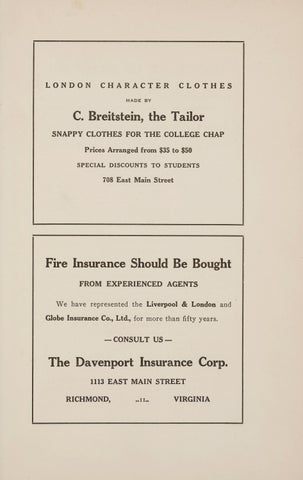
LONDON
CHARACTER MADE
CLOTHES
BY
C. Breitstein, the Tailor SNAPPY CLOTHES FOR THE COLLEGE CHAP Prices Arranged from $35 to $50 SPECIAL
DISCOUNTS
TO STUDENTS
708 East Main Street
Fire Insurance Should Be Bought FROM EXPERIENCED AGENTS We have represented
the Liverpool & London and
Globe Insurance Co., Ltd., for more than fifty years.
-CONSULT
US-
The Davenport Insurance Corp. 1113 EAST MAIN STREET RICHMOND,
........
VIRGINIA
UNIVERSITYOF RICHMOND INCLUDES
1. Richmond College, a College of Liberal Arts for Men.
2. Westhampton College, a College of Liberal Arts for Women. 3. The T. C. Williams School of Law, a Professional School of Law, offering the Degree of LL. B. 4.
The Summer School. W. L. Prince, M . A., Director. Richmond College for Men W. L. PRINCE,
M. A,. DEAN
Richmond College for Men is an old and well-endowed College of Liberal Arts, which is recognized everywhere as a Standard American College. Its degrees are accepted at face value in the great graduate and technical schools of America. Its alumni are so widely scattered through the nation that the new graduate immediately joins a large and friendly group of men holding positions of power and influence. The College occupies modern and well-equipped buildings, on a beautiful campus of 150 acres in the western suburbs of Richmond .
Westhampton College MAY LANSFIELD
KELLER,
PH. D.,
DEAN
Westhampton College for Women, co-ordinate with Richmond College for Men, is housed in handsome buildings on a campus of 140 acres, separated from the Richmond College campus by a beautiful lake of about nine acres. All degrees are given by the University of Richmond, and those conferred on women are, in all respects, equivalent to those conferred on men. While the two institutions are co-ordinate , they are not co-educational.
The T. C. Williams School of Law J , H . BARNETT,
B., SECRETARY
JR , , LL.
Three years required for degree of LL. B. in the Morning Division, four years in the Evening Division. Strong faculty of ten professors. Large Library. Moderate Fees. Open to both Men and Vfomen. Students who so desire can work their way. For catalogue, ing entrance
booklet,
into any
or views,
College,
or other information
address
F. W. BOATWRIGHT
-
the Dean
concern-
or Secretary.
President
THE
MESSENGER
Students' Literary Monthly since 1876
VOL.
EDITORIAL DEPARTMENT W. E. SLAUGHTER • • Richmond JEAN MAcCARTY • • • • • • • Westhampton
College College
BUSINESS DEPARTMENT JAMES H. GORDON • Richmond GRAY ROBINSON • • • • • • • Westhampton
College College
LIi
MAY-JUNE,
1927
No. 7
CONTENTS THE Music
Box
(Poem)
4
R.H. Bowen AT THE FooT OF THE CROSS (Short Story) Ben Sowell FAILURES (Essay)
.
Joseph E. Nettles CAMPUS PORTRAITS No. 3: LESLIE LEFTWICH JONES THE MAN WITH THE GOLDEN BRAIN (Translation) Leslie L. Jones THE FISHERMAN'S RETURN (Poem) R. Haddon Dudley CONFLICT (Play) Elinor Underwood Physioc THE FLAPPER (Poem) . R.H. Bowen THE GETTIN' HAPPY OF UNCLE EPHRAIM (Sketch) Catherine Branch WILLOWS (Poem) . Cecyle Loving THE BURGOMASTER OF WEIMAR (Short Story) Elmer Potter ECONOMICS EDDIE (Sketch) W. E. Slaughter FoR MAY DAY (Poem) Cecyle Loving INTELLECTUAL ATTAINMENTS (Play) M. S. Shockley BooK REVIEW: Copy-1927 EXCHANGES THE EDITORIAL PEN
$2.00 THE COLLEGE YEAR
11 12
13 16 17 19 20
23 24
28 31 32
36 37 39 35 CENTS A Copy
THE MESSENGER is published every month from November to June inclusive by the students of the University of Richmond in Virginia. Contributions are welcomed from all members of the student body and from the alumni. Manuscripts not found available for publication wi1l be returned. All business communications should be addressed to the Business Managers. Entered as second-class matter at the postoffice at the University of Richkir:nnd, Vi,,Snfa. Cno,<igh<, '926, by W. E. Sfaogh<~.
...JII
THE MUSIC BOX -<:::::,,
June had been set for the wedding, and so They thought they must build a bungalow; Went crazy about a plan they'd seen, Called The Music Box, in a magazine; Sent for the blueprints; you'd have thought 'Twas specifications for heaven they'd got; Studied them out by the big lamp thereBoth of them parked in one arm-chair; Prattled of red tile and hollyhocks, And that blamed little house called The Music Box. And they ranted on, about rugs and floors And chintz and roses and little green doors. Mother sighed: "Don't it mind you of all the ways We used to plan in our young days? The children might give us a lot worse shocks Than by building a house called The Music Box." June is here now, the wedding is past; They are off honeymooning since Tuesday last; The Music Box with the elm trees over, Looks down on a valley nodding with clover; The windows are open, the curtains blow, The table is set with a cloth of snow; Mother and I watch the block, and wait For the honk of a horn-the click of a gate; The path is bordered with hollyhocksThe path to a dream called The Music Box.
-R.
H. Bowen.
AT THE FOOT OF THE CROSS BEN
SOWELL
High up in their hermit tower, the iron bells of "The Church of the Baby God" began to give to straining rope and wrenching axles. As pigeons before lifeless, stirred, then whirred and circled in a restless, nebulous wreath around their skeletal roost, the clear, incisive tolling rifted the peaceful dawn, and plunged like drops of icy water clean to the very heart. Yes, to the very heart. For to the people of the little patriarchate in Paraguay in which Fray Ramon Cruz was the fountain-head from which flowed judgment, legislation, and execution, those vibrant notes were the imperial herald and emblem of the Inquisition. They were the rise and fall of the guillotine. For well they knew that in a moment or so Fray Ramon or one of his two young vassals would pull aside the tucum shades of their one-room dwellings and poke a_ dark, cynical face into the still darker openings, to emphasize with gritted teeth and guttural voice the summons of the bells. Soon the priests did come. They came in their faded, unwieldly black robes, driving everything before them, snorting, fuming, strik- __ ing the terror of an elephant stampede into the hearts of the natives. And all the inhabitants of the little pueblo knew then that another day of fiesta had come, and that they must lose no time in gathering in a flock by the steps of the Church. This time it happened to be "the day of Mary, Holy Virgin, conceived without sin," and the the priests were determined that it should be a real fiesta-''that the of round the made Virgin might not feel slighted." So they village, poking a vicious face in one adobe hut to scowl a threatening scowl, waving the arms wildly at a cowering mulatto who lingered by the rotting top of a well, shouting into the street: "Va-mos, a . today is the day for the prisa . . . you lazy heathen . pilgrimage." "What's this!" Fray Ramon had lifted a straw curtain to find the slender form of a woman sitting on a cot, swaying from side to side as she crooned the sickly baby at her breast. For a moment he stood and frowned upon the mother. Instinctively she placed the little body upon the cot behind her, while she searched in the coldsteel gleam of his eyes for a sign of mercy. "Padre, my baby's so sick . . . padre, I cannot travel in the pilgrimage . . ." she cried half hopefully.
6
THE MESSENGER
"He isn't going to walk, is he?" Fray Ramon leered, and held up the curtain with one hand while with the other he motioned for her to gather the baby in her arms and join the mass. "Where's your offering!" he thundered, grabbing her roughly by the arm and jerking back. The little woman cowered. With a push he sent her up the street, and flowed by in a rapid stride. As he passed more stragglers he hurried them on, and now he carried a whip , which sang through the air as it cut into their thinly covered backs, or even into the face of one who dared to call for "merced / ' The two clericals were dashing around Fray Ramon like tugs to their battleship. One of them came across an Indian, sliding stealthily under a black poncho. "Miguel !" the young priest called him. Miguel came, whimpering, and grovelled at the side of a hut, waiting for his sentence. "Where's your offering ?" the prie st began. "I was hungry, padrecito . . ." "Do you place your carnal needs before the Virgin Saint?" was the austere reply. "But I have no food . . . I have none . . .", the fellow begged for mercy on his knees. "Well, I warn you. Take care that you do not have to do penance for not having an offering." With this he pushed the man aside, and turned his attention to another. Miguel went up the street towards the church. As he mingled with the others that were being routed he looked desperately at the baskets and bundles that they were carrying. One man he passed held a loaf of brown bread · tightly under his left arm, safeguarding it further with his right hand. A woman, her children toddling at either side, was laboring up the street with a basket covered by a cloth. She saw Miguel looking at it, and hurried to the other side of the road, tightening the hold on her basket. As Miguel passed one low-thatched home he espied a dirty child by its doorway, and by the child a bundle. He made a dart, and before a straggling hand could save it, Miguel had lost himself among the pilgrims-clinging tightly to his bundle. In a little while they had all poured into the rough, cobble-stoned way, and reluctantly assembled before the crumbling steps of the church. Their small, hungry bodies were covered in tattered, non-
AT THE FOOT OF THE
CROSS
7
descript textiles, garments they never changed ; their legs thin and feet bare; their faces dark and wrinkled with the thousand valleys of shadows through which they had passed. The priests spent a long time whipping the people into some semblance of a formation. In a column of four by fours they placed them, men, women and children. Into the hands of one trembling youth Fray Ramon thrust a staff, and its point was the image of Christ crucified. Into the hands of another he forced a heavy pole which bore a white banner with the inscription: "Come unto me all ye that are heavily laden, and I will show you the way," and the point of this staff was an image of the Virgin Mary. Fray Ramon knelt before the church, and with precise and pompous movement went through the sign of the cross-as if he were the appointed minister to fulfill the "in hoc signo vinces" of Constantine. This done he placed himself at the head of the column, while his vassals ranged themselves at widely separated points. With bowed heads, the procession moved. Like a long, flowing caterpillar, the figures of Christ and of the Virgin swaying like antennae at its head, the pilgrimage followed the undulations of the hot earth, now on a hill in plain view of all the arid desert, now hidden behind hills of stone. Feet toughened as they were soon began to bleed from the cuts of the sharp rocks. Those that before walked now dragged their feet over the ground. But Fray Ramon did not look. He was walking placidly along, humming mechanically to his beads, with his "Ave Maria" for each small bead and his paternoster for every tenth. A strange heap of stone came into view. Naked pillars stood out in front, as sentinels to guard the hideousness of the god whose yawning mouth still craved the taste of human flesh. Above the mouth, the nose curved in fearful spirals, like the horns of a ram, and in each nostril was a hole where costly jewels once reposed, and which now told the story of the centuries. The forehead of the figure was an immense frieze, in which the worshippers one by one approached the altar and placed their offerings at its base. Not long after the procession passed this place a woman fainted, and lay in a heap in the dust, while the rest moved on. A little boy tried to help her up, but the priest pushed him back. Another woman gave a cry, and stifled it. In a few seconds she pushed out of the column, and tried to hasten past the long line, but
8
THE
MESSENGER
the bundle in a dark blanket which she held to her breast held her back, for her strength was insufficient. "Fray Ramon! Fray Ramon! . . . my baby's dying Fray Ramon!" she cried, extending the baby in his direction. "Hush that woman," Fray Ramon ordered his vassals. "Baptize my baby . . . he is dying . . .", and her wails seemed to exhaust her strength. Fray Ramon looked back impatiently shaking his head, and started to go back to her, but changed his mind. "Tell her to sprinkle some water on it in the name of the Father, the Son, and the Holy Ghost," he ordered someone to tell her, turning to his beads. But no one heeded, and the rending cry of: "Oh, my baby's dead . . . my baby's dead" was suffocated in the dust. High up a barren hill a grotesque cross of rough-hewn wood reared its arms above the stones, so grimly symbolic of the priest as he indifferently raised his arms above the bowed heads of his neglected people. Or-can it be that yonder gibbet seemed to mock another cross of long ago? The pilgrimage had reached its shrine. One night two men tottering in the hold of "guaripola," most fateful of drinks, had drifted far into the abandoned fields of weeds and stone, to finish a drunken argument in a knife duel. In the same spot the body of one of these was buried, and over it, just one more shrine among the thousands in Paraguay, was erected. Some faithful being had woven with ceaseless labor a beautiful textile, such as only Paraguay can produce, and the long, white scarf had been entwined around a wreath of flowers encircling the center of the cross. The weather had soiled and torn the scarf, and in the curling heat of the trophies the wreath was a brown cinder, but both remained. At night a candle burning in a rude bracket at the junction of the cross-pieces cast sinister, vacillating shadows. At the base of this cross was a strange assortment of rusted tin cans, and each one bore what remained of a white candle, which at night flickered swaying obeisances, sending up breaths of liturgical tallow to entice a special concession from a San Antonio or a San Cristobal.
AT THE FOOT OF THE
CROSS
9
But-surely ! Have the Saints not heard ? Why has the tallow trickled down each small ravine and heaped a clogging mound around the base? For each succeeding year of this incessant vigil had swelled the pool of grease at the base of the cross until it seemed like a marble tomb. And still the tallow flowed. The worshippers one by one approached the altar and placed their offerings at its base. A mess of white, tasteless tapioca, a loaf of bread, a portion of ground corn, and then they would kneel reverently, and do as they were taught to do. A cross over the forehead of the Father, one over the face for the Son, and one over the face and breast for the Holy Ghost, and then they rose and made their way with bowed heads to gather in kneeling clusters on the sides of the hill. Miguel's turn came, and he did likewise. The woman whose offering had been stolen prayed, but before she could recede, Fray Ramon's watchful eye had seen her. "And your offering?" he queried . "Padre, someone stole it. . . . I had it . . .", she pleaded. "And you expect the Holy Virgin to accept such excuses?" he demanded of her. "You shall do penance. Fast for seven days, and each morning appear at the confessional, doing the crosses, and kissing each step as you ascend." The priest glared at her as she, also, moved tremblingly away. The woman with a burden at her breast approached the cross, and with her last step her knees bent forward, and she fell half prostrate, holding the lifeless body of her starveling as high as she could to the wooden cross before her. And she prayed as one in delirium, her eyes too hollow and dried to weep or see, but fixed on the cross as windows of the thirsty soul within. With wavering body she strained her throat to whisper to her Virgin that she save her child-that "though her child had died without baptismal she would save her child just the same." Fray Ramon broke in harshly. "Woman, quit your raving. What ails you? Get out of the way so people behind can say their prayers." "My ·baby's dead . . . died without being baptized . . . is he lost, padre, is he lost?" she wailed, her eyes still on the cross, her arms relaxed again to hold her baby closer. "Yes, your child is lost, unless . . .
10
THE
MESSENGER
The creature strained no longer, and toppled in a heap, and the little body cuddled m a dark blanket lay . at the foot of the cross. * * * * * * * That night a shadowy cavalcade of donkeys passed by the side of the church, and dark bundles disappeared from their backs one by one. "I guess this will last us till the next day of fiesta," laughed a deep, harsh voice. Then a door closed , and steps grew fainter and fainter. From somewhere way down in the bowels of the earth an occasional, incoherent sound struggled up and faintly reverberated the dark murals of the church-and it seemed that the stern face of St. Anthony, who stood with a halo around his head in a large niche, slightly winced. Once a sound louder than the rest came clattering cacophonously up the dungeon steps, and the walls took it up in a thousand contending vibrations; and beneath the chaos ran an undercurrent of harsh laughter, like the jarring of a low-toned portal.
TIDE "'0-
High tide and low tide and, after each, ebb tide and flow. Life is like the tides. Flow tide: laughing breakers in a merry race to see who shall be first to kiss the topmost pebble on the sandy beach. High tide: a moment of the joy of achievement-or is it a moment of vain battering against an unseen barrier, an unexpected limit? A brief moment, whatever it is. Ebb tide: green salt water fuming in discontent as it clutches and clutches for a hold on the sand, and continues to slip. Low tide: dissatisfied failure; the depth of abject despair. I could be happy at flow tide if I did not know that after high tide come ebb -tide and low. -S. S.
FAILURES JOSEPH
E. NETTLES
"A 111,an'sreach should exceed his grasp, Or what's a heaven for?"-Browning. With a feeling of pity interspersed with contempt, we say: "He is a failure." Such is the term we use to designate those who have failed to fulfill their ambition-failed to reach their goal. A man without ambition is forgiven; a man who has aspired and failed is damned. It remains for posterity to recognize the greatness of the defeated. It is not my purpose to justify failure. It needs no justification. The only truly great men are those who have experienced the sting of def eat, the pangs of ambition unrealized. All successful men have been failures ! Napoleon, as he paced the rock-bound shores of St. Helena, with the British gunboats lying at their anchors in the sea, as he saw his hopes of a world empire fade into nothingness, humiliated and chagrined, he exemplified failure in its bitterest conception. The French, his people, who had cheered him at Austerlitz, at Waterloo hurled at him the vilest of epithets. They were to call him the man of destiny! There was a man whom we call "the Dreamer," a singer of songs. To him the Muse spoke in a language melancholy and sad. The Eldorado of his dreams lay always "over the mountains of the moon, down the valleys of the shadow." He was criticized, he was abused, he was scorned. Those who jeered at his failure are forgotten. Poe will live always in the hearts of those who love the beautiful, the mystic, the pure. There was a man who had a vision. He saw the peoples of the earth living together without war, united by the bonds of brotherly love. He gave his time, his intellect, his health in the hope that throughout the world the olive leaf might supplant the sword of Mars. Abroad, he was hailed as the Prophet of Peace; at home, he was repudiated. He died a failure ! At Newport News, in the office of the high school principal, one will find this simple verse : "For when the one Great Scorer comes To write beside your name, He writes-not that you won or lost, But how you played the game."
CAMPUS PORTRAITS - No. 3 LESLIE LEFTWICH JONES
has been called the only creative literary genius on the campus. Those of us who have seen him write under pressure marvel -at his flow of thought, brilliant ideas and ready wit as they transmit themselves through his trusty Corona. To write at all is a blessing, but to be able to turn out so consistently work of such merit is indeed reflective of a divine spark. Two years ago Leslie Jones took over the reins of THE MESSENGERwhen it was in the mire of mediocrity. With the hand of an artist he left the remains of the "old" magazine to the dust of memory, revised the size, cover and technical arrangement, set a new standard of literary quality to the accepted articles, and with an able co-editor put out the first issue of the "new" MESSENGER.The nine following issues · under his regime have been lauded by every exchange and pay a lasting tribute to his ability and service. As a columnist in The Collegian he has made "The Situation in Particular" an institution, which all eyes first seek for a stimulating literary draught to leave refreshed and merry, having found a happy, healthy thought. His charming personality and buoyant, optimistic outlook upon life dominates all of his friends-and he has no enemies. It is an education to talk with him-a mind of ideas and surprising knowledge. Always an ardent champion of Westhampton College he has sponsored many movements for the social development of the two colleges, jointly and separately. In all worthwhile campus activities he has taken a leading part, and his loss through graduation will be greatly felt next year. We cannot pay him too high a tribute.
THE MAN WITH THE GOLDEN BRAIN By ALPHONSE DAUDET (TRANSLATED
BY LESLIE
L. JONES)
To the Lady who asked for cheerful tales. Having read your letter, my dear madame, I am filled with remorse. The rather too dismal color of my little histories becatpe quite distasteful to me, and I promised myself that, today, I would offer you something in a lighter vein, something most foolishly gay. For, after all, why should I be sad? Do I not live a thousand leagues from the fogs of Paris? Do I not dwell upon the crest of a sun-kissed hill in the land of tambourines and muscat wine? . . . All about me is sunshine and music. Orchestras of warblers, and choirs of tomits. In the morning, there are the curlews with their shrill, "courelee, courlee !" And at noon the cicadas commence. Then the shepherds playing sweetly their fifes, and pretty, darkeyed maidens laughing in amongst the grape vines. . . . Truly, the place is ill-suited to the confection of unlovely things. I ought, really, never send the ladies anything but rose-colored poems, and great sheaves of gallant romances. . . . And yet, . . . and yet, no ! I am still too close to Paris. Every day, even here in my far-off retreat, come splashes of Paris gloom. . . . At the very hour I write these lines I learn of the miserable death of poor Charles Barbara; and all my mill is in mourning. Farewell to the curlews, farewell the cicadas. No longer is my heart attuned to gaiety. . . . And that is the reason, madame, that instead of the playful little tale I promised you, you shall only receive, this morning, a wistful, melancholy legend. Once upon a time there was a man who had a golden brain. 0, yes, madame, a brain of solid gold. His head was so heavy, and his skull so enormous, that when he first arrived in this world the physicians were all certain that he could not possibly live. He did live, however, and grew up in the sunlight like a sturdy olive tree; only his tremendous head never ceased to bother him. It was pitiful to see him toppling against the furniture as he walked about; and of ten he would fall. . . . One day fie rolled from the top of tall staircase and gave his forehead such a lick against a marble step that it rang out like a bar of metal. They were certain he was dead ; but when they came to pick him up only a slight wound could be found with one or two drops of clabbered gold sticking to his yellow hair. It was thus the parents discovered their child's golden brain.
a
The secret was closely guarded; not even the poor, little chap himself suspected anything. From time to time he would ask why he was not allowed to run out and play with other boys in the street.
14
THE
MESSENGER
"Oh, my lovely, little treasure," his mother would reply, "somebody will steal you." And then the little chap would have a great fear of being stolen. He would come back and play all alone without saying a word, toddling heavily from one mom to the other. . . . When he was eighteen years old his parents finally revealed to him this monstrous gift which he had received from Destiny; and as they had raised and cared for him all these years, they asked that, in return, he give them a little of his gold. The child did not hesitate an instant; within the very hour (how and by what means, the legend does not say) he plucked from his skull a large morsel of pure gold, a morsel of pure gold as big as a walnut. And this he tossed proudly into his mother's lap. . . . Then, dazzled by the wealth he carried in his head, crazed with desires, drunk with power, he left the paternal roof and went forth into the world, squandering his treasure. From the manner in which he lived, royally, prodigally, you would have said that his brain was inexhaustible. . . . But it was exhaustible; gradually his eyes became dull, and lines appeared in his face. And finally one day (it was the morning after a senseless carousal) the unfortunate man, all alone in the midst of the revel's remains, became terrified at the tremendous hole he had already made in his golden ingot. It was time to stop. From then on, he led a new existence. This man with the golden brain went off by himself, and lived solely by the labor of his hands, suspicious and fearful as a miser, fleeing temptations, trying to forget those fatal riches he dared not touch again. . . . By mischance, a friend had followed him into his solitude, and this friend knew his secret. One night the poor man was suddenly awakened by a pain in his head, a frightful pain. He leaped up in terror, and by the pale light of the moon saw his friend fleeing through the door, with something hidden beneath his cloak. . . . Another bit of the golden brain gone forever! A short time after that, the man with the golden brain fell in love, and this time all was over. . . . From the very bottom of his soul he loved a pretty, little blond woman, who also loved him very much, but who still cared for fine silks, and jewels, and little gilt tassels hanging from her shoe laces.
THE
MAN
WITH
THE
GOLDEN BRAIN
15
Between the hands of this dainty little creature-half bird, half doll-the pieces of gold vanished like snow in a desert. She had every whim and caprice possible; he had never learned how to say no. Besides, for fear of giving her pain, he hid from her, carefully, the melancholy secret of his fortune. "We are very wealthy, then?" she would say. And the poor man would reply: "Oh, yes, . . . very wealthy, very wealthy!" And he would smile affectionately at this little blue-bird who, innocently, was devouring his brain. There were times, however, when fear would seize him, and he would try to be economical; but then the little lady would flutter up to him and lisp, "My dear, dear hubby, who ith tho wich ! Flee-us, plee-us, buy your ittle wifey sumpfin, weal, weal costly . . . " And he would buy her something "weal, weal costly." This went on for more than two years, and then, suddenly, one morning, the dainty little woman died without a word of explanation, just like a bird. . . . The trensure was almost at its end. With what was left the widower had a beautiful funeral for his dead wife. Tolling bells, the finest carriages drawn by black, plumed horses, silver-trimmed velvet-nothing was too fine or costly. What good was his gold to him now? . . . He gave it freely; to the church, to the porters, to the flower-sellers; he gave it freely everywhere, without bargaining. . . . So, when he left the cemetery, none of his marvelous brain remained. Or, at the very most, only a few scraps clinging to the walls of his skull. He went aimlessly about the streets, distracted, his hands stretched out before him, like a blind man. Towards evening, about the hour when the shops were being lighted, he stopped in front of a window which was all filled with fine cloth and jewels, and other costly goods. For a long time he stood there looking at a pair of lady's boots made of blue satin and trimmed with swans' down. "I know someone who would like to have those boots," he murmured to himself, smiling; and forgetting already that his little wife was dead, he went into the shop to buy them. In the little back room of her shop the merchant heard a loud cry. She ran into the store, and stopped, in fear, when she saw a man leaning against the counter looking at her with a dismal air of distraction. In one hand he held the blue satin boots trimmed in swans'
16
THE
down. blood nails.
MESSENGER
The other hand, which he held out to her, was a:11red with and little scraps of gold were hanging from the finger
Such, madame, is the legend of the man with the golden brain.
In spite of its fantastic air, this legend is true from one end to the other. . . . There are certain poor chaps in this world who have been condemned to live by their brain, and must pay in fine, pure gold, with their very bone and marrow, for the smallest things of existence. For them it is daily agony; and then, when they are weary of suffering. . . .
~
THE FISHERMAN'S
RETURN
.-;;:::,..
Damp aft; Dripping morn; Opalescent vision; A fog horn. Gnawing insides, Incessant craving; Leaden eyelids, Sleep o'ertaking. Misty outlines; Concatenate roars; Spume-topped breakers; Rugged shores. Weary plodding; Home again. Ravenous eating; Pleasant pain. -H.
Haddon Dudley.
CONFLICT ELINOR
UNDERWOOD
PHYSIOC
"O love, my love! if I no more should see Thyself, nor on the earth the shadow of thee, Nor image of thine eyes in any spring-" The stage is brilliant with the mellow sunlight of an afternoon in late spring. The glow which pours in thru the tall windows and splashes in golden spangles upon the floor is oddly at contrast with a sombre fireplace in the center . On the low mantle is placed the picture of a young man. He is very handsome. His dark eyes laugh into yours, his lips curve in a whimsical smile. Beneath the picture are pale pink roses in a luster-ware bowl. It is plainly a woman's room. On the left is a divan heaped high with silk cushions in pastel shades, a floor lamp, and a small wicker table . On the table is a work-basket, and a carved box such as one would use for letters of more than momentary value. Behind the table is a chair. On the right is a serviceable oak desk on which rests a portable typewriter , and nearby is a bookcase surrounded by a scattering of papers. There are two women on the stage . One is seated on the divan, embroidering. She is dressed in a lavender tea-gown. The other woman sits at the typewriter, checking over the pages of a manuscript. She wears a rather prim tailored dress, with white collar and cuffs. You notice suddenly the physical identity of the two . The woman in lavender lets her sewing fall into her lap and leans back against the cushion. A wistful expression plays upon her face.
If you would stop your typewriting and listen to me . (pausing). You know, I've been thinking about him all day .. ( The woman at the desk answers without looking up from her work.) Yes, I know you want me to listen. But I don't want to listen. I have felt your thoughts all day. They disturb me. I hate spring . . . now. Oh, it hurts to see the smiles of lovers, and to smell the flowers honeysuckle. . . . It hurts (softly) hurts. . . (She sighs.) (Roughly): If you would only stop being so sentimental and help me with my story, we would both be better off. Don't, dear. I know I bother you . . . but we've been so lonely now-for so long. Yes, long enough for you to forget. And if I say I can't forget? You ridicule me. But it is so, just the same. You must find someone else. Oh, you forever push me on, force me, to look at other men. But you can't make me love them.
18
THE
MESSENGER
The same old story. Will you never stop? I have so many things to do. If you would only leave me alone perhaps I could be famous I (She rises from the desk, despairingly.) But fame . . . without him. . . . (Both women have risen. Thew eyes are fixed upon the picture.) Yes. If he were only here I could give myself up as completely as you. (She sobs.) He loved you and admired me, and his approval was all that I desired of fame. (The woman in lavender puts her arm around the other.) I knew you felt that way-and I know that you still do. Oh, how you hound me! You give me no rest, you . . . (Half angrily she returns to her desk and stands there.) Please let me take his picture down. It is too precious - too sacred for other eyes than ours. (She says this wistfully, standing at the mantle.)
(The woman at the desk almost shrielis in reply) : No, no, I tell you. Keep it there. It hurts. But it must hurt and hurt until the pain is so deep the heart is numbed. We must go on living, and we must overcome this thing which has made life unbearable. You must look at him until there is no pain. (The woman in lavender sinks upon the divan. She is pale and trembling.) You are killing me, I tell you. Not content that illusions should be torn away by his death, you try to kill even the memory of him. That memory is my life. I hate you! So we've come to it at last, have we? Yes, I mean to kill you. I mean to choke out your existence-to obliterate you as a part of my life which were better buried in some forgotten grave. You are so hard . I'm sure you never loved. When we first met him, you told me that you admired him, but love was a nuisance. No. I have never wanted love. But come it must, and when it came you cannot say that I denied it anything. While he lived, love overshadowed my ambition. But now-now-I can be free once more. If you put me out of your life, it will be forever. realize . . . ?
Do you
I will no longer be blinded by your wheedling; I must destroy everything that will interfere with my career. (She goes to the table and takes up the box of letters.)
19
CONFLICT
Don't. For God's sake leave his letters! will mean to destroy them ?
Do you realize what it
( Unheeding, the woman takes the letters out and burns them slowly, one by one. She finishes and turns to her companion, who lies fainting, pale and seemingly devitalized, upon the divan.) And yet, I hate to see you slip away from me. You for whom I would once have given up my being. I hate to go, dear. But I can't stay. As long as love held us together we could dwell in peace. Now there is no path but this . . . ( she dies.)
( The other woman bends over her, then straightens and crosses again to her desk, shaken, weeping quietly. She arranges the papers, growing calmer. Finally a cynical expression comes to her face as she begins to typewrite.) ( CURTAIN)
THE FLAPPER ~
A flash of silk on the street, sheerest of silken hose; Girlish laugh and odor sweet, of wild exotic rose. A breath of youth, the winds of spring. She's such a sparkling, daring thing ...
No wonder the aged sigh .... the Flapper passing by.
Cheeks of red and lips that pout; eyebrows but a line; Skirts to the knee ... or thereabout: spirit of Columbine. Boyish bob, bizarre, yet neat; figure of vital health; Pattering heels and twinkling feet ... syncopated wealth. Forget the mode and lipstick preen; youth's not made for sorrow; What matters style if the heart be clean? She's the mother of Tomorrow.
-R. H:Bowen.
THE GETTIN' HAPPY OF UNCLE EPHRAIM CATHERINE
BRANCH
"Down by de ribber side, down by de ribber side," sang the congregation . The little church was filled with darkies, gaily bedecked in their best Sunday clothes, with startling and dashing combinations of colors. Red and pink vied with each other in Mary Martha White's satin dress. The red and pink were the waist and skirt respectively of two dresses of "Miss Anne, " the young mistress of the planfution. And Emma, who on week days did washing, was wearing an unusually striking dress for a church service. It was of yellow silk and dingy embroidered net, probably given her by one of the ladies for whom she washed clothes. Her big brown arms were bare almost to the shoulder, from which hung a cap of net. A black hat with a large yellow rose added to her costume. She had gone to the next verse of the hymn): "Ah ain' gon' study war no mo', Ah ain' gon' study war no mo'," she sang lustily and, seemingly, with great emotion, for her body rocked from one side to the other, and the yellow rose on her hat shook violently. The singing ceased and the preacher stood up behind a table covered with red cheese cloth. He was beginning to speak. "And now, bredren and sistren," he addressed them in deep rolling tones which vibrated and echoed from the low-raftered ceiling. "We hab befo' us a bery difficult problem. One of our congregashun is backslidin'. An' still, I don' know as you'd say he's backslidin'; cause he ain' never upslided. He hab kermitted de awful crime. Right now, he is sebenty-fo' years ol', an' he ain' never got happy and jined de chu'ch. An' yet, he is a law-abidin' citizen . . He am de husban' ob one ob our best sistren." "Yeah, he am," groaned Emma. "An' now," went on the preacher's voice, "ef'n he don' get de holy ghos' in 'im and git happy like de res' ob us done, we be oblige to discommunicate 'im from our chu'ch. He'll be ostracibed by his own people and insolated from we-all. \Ve done all had our experences in gettin' happy and seein' visions sent from heben. I asks you : What else can we do wid dis sinner? He gwine be driven from de chu'ch de berry next time he come here, unless'n he get happy fo' then!" On the back bench sat an old man. He was very black, with a great deal of white kinky hair. His face was wrinkled and there
THE GETTIN'
HAPPY
OF UNCLE
EPHRAIM
21
were many lines and furrows in his forehead. His clothing was rather shabby and nondescript. He leaned forward, supporting himself by placing his hands on the back of the wooden bench in front. An expression of dismay and hurt surprise showed on his face. For he was surprised, even though he had suspected that Emma, his wife, would try to use this as a last resort for getting him into the church. She had always worried him about "gettin' happy" as she called it. And he sometimes wondered why he was made so differently from other darkies. He was never emotional; he would have had the surprise of his life if he had ever found himself shouting. In fact, it was repulsive to him to see his f ellow-darkies going through wildly excited gestures and contortions and profaning the thought of the glory of God with the shouting of unnatural voices. He had been sexton for the "white folks' " little country church for thirty years. And now, that he was too old for their service, he still enjoyed sitting in the back pew of their church and hearing impressive services read in peace and quiet. He loved the candles that burned on the simple altar at Christmas; surely their flame gave off a light holier than that of ordinary candles. They were so tall and white; to him they signified purity and goodness. At other seasons he felt the beauty of the flowers placed on the altar. Once he recalled with exquisite happiness, he had even been asked to change the altar flowers. He remembered how carefully, how respectfully he had touched them. He had them now, faded yellow and dried in crumpled tissue paper, put away as sacred relics. Indeed, he guarded these flowers as a priest of the middle ages guarded his sacred relics. No one, not even Emma, the young mulatto woman who had married him for his money, had ever seen his treasures. The secret ambition of his life was to lay upon the altar some flowers that he himself had gathered. He was thinking of this now, and enjoying his dream. He had forgotten that there were other persons in the noisy, crowded little church. The last words of the preacher brought him back to consciousness and realization of all going on around him: "He gwine be driven out de chu'ch." The words of the negro preacher re-echoed in the ears and heart of the old man. He sat there wondering. How could anyone, especially a peaceful, serenely happy old man like himself, be driven from a church? Ah, well; they might drive him from their ugly and ill-constructed wooden building, but the outdoors was his real church. There he came m contact with the glorious accomplishments of God. Mr. Matton,
22
THE
MESSENGER
the "white folks'" minister, had long ago explained to him the presence of God in nature and all things beautiful. And old Uncle Ephraim was happy when he could get out of doors and look up through hot shimmering air at a clear blue sky, and say, "God made dat." Or gaze at a gorgeously colored winter sunset and think, "Dat what heben gwine look like. God des gib us dat much to incourage us." There was a stir in the church. Everyone was turning around to gaze cruelly at Uncle Ephraim. The old man removed his hands from the back of the bench and looked around in amazement. "And now," the preacher began again. "Bruder Ephraim, we gib yo' one mo' chance. Eben efen yo' can't get happy now, we asks yo' to come up an' sit on the mourners' bench and be prayed fer. Come on, Bruder! It's yo' las' chance!" The old man wiggled in his seat. "And ef'n yo' don' come, yo' won't hab no wife no longer," shrieked Emma. Ephraim rose and swayed between the benches. He made a pitiful sight with his stooped back, rounded shoulders, and bent head. Should he go against his will and live in peace ever afterward? If he did, Emma would be appeased, and he would have the rest of his life in comfort-for Emma was a good cook and housekeeper. But no! He wasn't! God wasn't waiting for him on the mourners' bench. Outside was the warm blue sky and beauty of growing plants and flowers in bloom. There he could find God. There he would go and search for flowers to lay on the altar in the "white folks' " church. There he would feel the peace and calm holiness of God. He turned and staggered out into the church aisle. Slowly, followed by the eyes of every negro in the church, he made his way to the door and stumbled down the steps. The "white folks'" church was two miles away; it seemed a hundred to him . The sun above was beating down mercilessly. He wondered why he felt half-blind and had such great effort to keep from staggering and falling in the hot white sand of the road, which retarded his steps.
It was better now; he had cut across by the pathway through the woods. All was deliciously cool here, and calm and beautiful. He stopped a moment by a running stream of icy cold water. Leaning against the trunk of a gigantic pine tree, he heard the soft low call of a wood thrush, and then, the clear song of an oriole. But he must
THE GETTIN'
HAPPY
OF UNCLE
23
EPHRAIM
not waste time here. There were the flowers to be gathered. It must be about 2 o'clock, and each minute the sun was getting more cruel with its heat. He started climbing the hill, at the bottom of which ran the clear, cold waters he had just felt with hot hands. The lapse of time between the steps up was an eternity to him. As he gained the hillside, a pleasingly beautiful sight met his eyes. It was covered with flowers-white and yellow daisies growing ·wild just for him. "Dese putty Iii flowers, dey'll do . . . dey'll do . . ," he murmured, and sank down among them, exhausted. He lay there in the daisy field, happy in a dazed manner, two short-stemmed flowers clutched tightly in his hands. He was breathing slowly and more slowlynot laboriously, only with very gentle lifts of his body.
*
*
*
*
*
*
*
The shadows on the hillside were beginning to slant. Soon they would be almost parallel to the ground. In the West the sun, an enormous shining ball, passed from one world to another with a glory of golden rays and light. The flowers on the hillside were becoming very faint images. The old man turned his head, clutched tightly the two daisies in his hand, and sighed for the last time: "Dese putty lil flowers. Dey'll do . . . dey'll do . . ." Uncle Ephraim was at last laying his flowers before the altar of his Goel.
WILLOWS ~
Willows that touch with finger tips The surface of deep waters, Sing to me of the green coolness you know. Brus/1 across my face and let me feel The quietness that comes from The depth of still waters. -CECYLE
LOVING.
THE BURGOMASTER OF WEIMAR ELMER
POTTER
The . fat and highly respectable Burgomaster of Weimar rose unsteadily to his feet, cup in hand. "Fate," said he, "is immutable." And he rolled his great fish eyes about the taproom. "Here's to fate!" There followed a loud clattering of tin cups, and the entire City Council of Weimer drank to fate the immutable-the most of them without clearly perceiving Herr Burgomaster's meaning. Herr Burgomaster smiled blandly. Said he: "My lads, it is undeniable that fate has dealt out fortune to me with a particularly lavish hand. You behold before you the former sausage-maker of Nuremburg-now Burgomaster of Weimar. Would you know my secret?" But the City Council of Weimar was, at the moment, engaged with the buxom barmaid and failed to hear Herr Burgomaster's question. Schlossenburg the vintner came to the rescue. "Ay ! Ay !" he shouted. "It is this," continued Herr Burgomaster, "fate is inexorablehence immutable. It is folly to clutch at the strings of destiny in a vain and foolish attempt to mutate the unchangeable orbit of fate, for the road to glory is the path of contentment. Fate is immutable." Herr Burgomaster swayed toward the door. He bade a hearty good-night to his fellows. "For you must know," he concluded, "even the Burgomaster of Weimar has duties." With that, he left the cellar of Schlossenburg the vintner and climbed the short flight of steps to the clear night air of the Koenigstrasse. At the head of the steps sat a cripple. Herr Burgomaster eyed him curiously. "Alms!" cried the unfortunate. "You seem in no wise well favored," remarked the Burgomaster. "That is true," said the beggar bitterly. si_ngle mark since morning.
heart."
"I have not collected a
The people of Weimar are hard of
THE
BURGOMASTER
OF WEIMAR
25
"Tut! Tut! You are mistaken, my good fellow. Blame not the hearts of your fellow citizens, but rather the hand of fate that you starve at the door of Schlossenburg." The beggar growled. "If that be true, then cursed be fate!"
"Now are you speaking foolishness. Can fate, who allots curses and such things, vent upon itself the spleen of a beggar who sits at the door of Schlossenburg? Moreover, fate is immutable and destiny inalterable. Man commits the height of folly when he attempts to mutate and unchangeable orbit of fate, for the road to renown is the path of contentment. It is for Man to be satisfied." The beggar snorted. "I should be satisfied with a pfennig." "No, my good fell ow, I have no pfennig for you. One plainly perceives that your destiny is to starve at the door of Schlossenburg the vintner. I have too high a regard for the ]_)Owersthat be to attempt to alter by so much as a hair's breadth the preordained course of destiny. But I see the hour is late. Farewell, Mein Herr, I leave you in the hands of fate !" Herr Burgomaster chuckled and considered as he strolled down the Koenigstrasse how much more eloquent was the rhetoric of the Burgomaster of Weimar than the curses of the beggar who hurled malediction at him from where he sat at the door of Schlossenburg the vintner. Now at that time, Phillip of Hesse was encamped in the fields contiguous tb the t0wn of Weimar, and the soldiers of Phillip of Hesse made merry in the public houses of the town and ran riot in its streets. Astonishing tales are told of what these soldiers did to the wives of certain perfectly respectable citizens of Weimar while Phillip was encamped just outside the town. Such tales are best left unwritten. However, there is no harm in telling of how a party of drunken Hessians robbed a wealthy citizen of Weimar and, after beating him almost into insensibility, left him groaning on th~ Koenigstrasse, where he was shortly afterward discovered by the fat Burgomaster on his way home from the cellar of Schlossenburg the vintner. "For God's sake! Help!" cried the citizen. "You are hurt?"
26
THE
MESSENGER
And the fat Burgomaster knelt on the street beside the injured man. "My leg is broken." Herr Burgomaster rose. "Then you are unable to walk." "Of course, I cannot walk! You must help me home." "And defy the hand of destiny?" "What are you saying?" Herr Burgomaster pondered. "You would have me, Herr Citizen, attempt to mutate the unchangeable orbit of fate." "You are drunk," growled the injured man. "I have been drinking; that is true. But my head is clear enough to permit me to realize that you are requesting me to commit the height of folly. No, Mein Herr, I am not so drunk as to attempt the impossible. A good night to you, Herr Citizen, and may the Lord be merciful unto you!" The hearty laughs of Herr Burgomaster drowned out the curses of the injured man. The spirits of Herr Burgomaster waxed high as he strolled down the Koenigstrasse beneath the light of the moon with a song on his lips and a belly full of wine. "These foolish men!" he mused, "forever essaying to alter the course of the universe to benefit their pigmy selves! How much better to leave tomorrow and the next day to fate and be content! How much better to be the respected Burgomaster of Weimar with nothing to do but eat, drink, and be reasonably honest!" The wail of a child broke upon Herr Burgomaster's musings, and the Burgomaster of Weimar sniffed about until he discovered a tearful and very dirty little boy crouched in the darkness of a doorway. "Ah, little man!" quoth Herr Burgomaster heartily, "it is late for such as you to be crying in doorways. Do you live here?" The little fellow stopped crying, but only shrank farther from the Burgomaster's advances. "Do you live here?" the Burgomaster repeated. The child sniffed. "Come, come, little man. live here?" "No."
I'm not going to hurt you.
Do you
THE
BURGOMASTER
27
OF WEIMAR
"There's a good boy. Now, tell me, where does my little man live?" "I-I don't know." "Well, now that is unfortunate, I must allow. What 1s your name?" "Karl." "Karl?
So!
A fine name!
There-there-stop
crying."
And Herr Burgomaster took the grimy little form tenderly in his arms . "My little man is lost, not so?" "Yes." "Well, well. We'll soon have Karl back with Papa and Mamma. Tell me, what is Papa's name?" "I have no papa, Mein Herr.
My mother is the Frau Schmidt."
"So! Then we shall find Mamma at once, and little Karl shall have cookies!" The child nestled its tear-streaked face upon the fat shoulder of Herr Burgomaster, who proceeded down the Koenigstrasse in the merriest of moods, for the wine made his head light and his stomach warm. At a corner he came to a sudden halt. The child was asleep in his arms. Herr Burgomaster reflected. "Ah, Fate," he mused, "how frail is man, so soon to forget the quintessence of his profoundest philosophies in the face of circumstance! Behold me clutching at the strings of destiny! Ho! Ho! Laughter of the gods! The same Burgomaster of Weimar who discourseth philosophy in the cellar of Schlossenburg the vintner, who propoundeth the essence of his doctrnne to the beggar of the Koenigstrasse, who bendeth to the immutable will of the fates upon encountering the injured citizen of Weimar, now braves the Masters of the universe for the comfort of a sniveling infant! Ah, me! What a tempest is there in the breath of a sleeping child! To turn blood into water and water into blood ! Ho! Ho! With a sleeping infant for my shield, I dare shake my fist in the face of Atropos!" Herr Burgomaster proceeded down the Koenigstrasse holding the small, grimy form close to his breast. "Sleep on, little one, for at the house of the Frau Schmidt you shall have cookies!"
ECONOMICS EDDIE W. E. SLAUGHTER Eddie Johnson dead? Say, that's too bad! . . . . What? . . . Why sure I knew him. Sure. Was in college with me-Richmond College. Yes, graduated a year before him. . . . To think he'd die so young-and him so industrious and ambitious. You say you didn't know him so well-knew his wife? Well, Eddie was one peculiar chap. He-just a minute-hey, waiter! (Let's have some coffee with our dessert, Mac). Two more coffees. As I was saying, he was one peculiar chap. From the moment he was first seen striding across the campus on his way to classes, he was an object of attention. Great long steps he took and walked swiftly-often he ran-it was his only exercise so far as I know. . . . Bookworm! was our first impression. . . . No, he wasn't strong. Tall, lean, lithe, and held his head defiantly upon narrow, stooped shoulders. Had a peculiar expression, too, Mac. Piercing gray eyes which glared coldly and expressionless at everyone. I don't believe I ever saw him get emotional or sentimental. . . . What? -well, no, I never saw him on a date. But wait! I want to tell you about his attitude toward dates in general, later. Eddie wasn't even sympathetic. He always seemed a delicate, high-speed, silent machine, deliberately grinding out his day's routine of habitual activity. . . . And, say, he was quick at things, Eddie was. Oh, he was bright. He did everything in a hurry as though every moment counted. . . . Cigarette? Sure, I'll take one. What 1 Piedmonts. Ye Gods, Mac. Have you come to this? . . . As I was saying, some of the boys who knew him most intimately gave him the affectionate nickname of Economics Eddie. Well, I thought Eddie rather queer and unapproachable until one day I knew him better, more intimately. And I found that he was living-or better, operating under an economic complex-yes, that's a new one, I guess, but I called it that. One November noon-Thanksgiving it was-a group of us were thrown together in a little restaurant to catch a quick meal before the train le£t for the game at Williamsburg. I was rather suprised when I saw him at the table with us-thought he'd be back studying. Well, we had just ten minutes to eat. I gnawed on my sandwich and watched him gulp down his special dinner. As we arose I held his coat ( sophomore courtesy, Mac) I heard him mutter, "My God! 75c in ten minutes. That's eating at the rate of $4.50 an hour. Pretty high. Pretty high."
ECONOMICS
EDDIE
29
He rushed out of the ca£e and into the station with me at his heels. . . . I don't know why I should have done it, but I did, Mac. I threw up seats beside charming gals to sit down and talk with this social outcast. But I'm glad I did. He turned out to be very interesting. On the way down we talked and here it was that I discovered he had an economics complex. "I've got five dollars on this game, Johnson," I began as a starter to test his school spirit. But his reply surprised me. "Don't you know," he mused, "it takes us an hour to go to Williamsburg. That's $7.49, plus $1.80 for the ticket-makes $9.29 each way, or $18.58 total. Pretty high for one football game." That was his old expression-"Pretty high!" I can hear him now. "Pretty high" and he'd rub his pointed chin dubiously. "How d'ye get that?" I led him on. But he had the dope. "Well, it has been estimated that every hour one spends studying in college is worth $7.49 to him. That's how I get it. You see, you gotta figure in these things. Life is an economic problem in this day and time. This is a four-year investment down here in Richmond College. And into these four years I put the best years of my life. The increased income a college man gets over the ordinary laborer apportioned out over his days of study make them worth $7.49 per hour. Every minute, therefore, is a 12.¼ cent investment, and when you waste two of them, you throw away a pack of Herbert Tareytons you could enjoy in your coming years of prosperity. You see.... Now I ought to figure in also the time sper:t in watching this game, but that's not fair." He waxed enthusiastic and I figured that I had punctured his tender spot. At least I had broken his reticence. He orated on, "Some of the fellows at college don't seem to realize how serious this short !if e is, the way they lounge around and do nothing. Don't ypu know that if you live to be sixty you'll only have actually lived ten years at the most liberal estimate?" Well, Mac, that got me right. Because in college it was for me one great loaf and I did while away the hours and waste my substance in riotous living. . . So I called him. But he had the facts. He got out a piece of paper and authoritatively scribbled down these estimates. Out of every day the average man spends eight hours unconscious-sleeping; he also smothers eight hours of beautiful daylight chained to a task-working, where his time is not his own and where he usually is at the beck and call of his boss; he said you could figure on one hour every day in eating; one hour for
30
THE
MESSENGER
dressing several times ; one hour for bathing and other necessary duties incidental to the day's activities, and an average of an hour a day for sickness and disabilities. Oh, he had it down to a science. These make, let's see, twenty hours. Twenty hours spent in doing things necessary to life-which leave four hours for Life, itself. Twenty hours out of every twenty-four in the day during which time one is not free to do just as he wishes-"to bask in dreams, to play in ideals, or just to play," as he expressed it. Well, Mac, they's truth in them figgers. . . . I admitted his point, but if he were still alive I could prove to him that we don't live at all-because the other four hours of the day I'm married. . . . Yeh, what does that make me, now? . . . Say gimme another Piedmont if it kills me. Thanks ! Gotta match ? Thanks.
In spite of his limited Say! he had another hobby-statistics. time, he had found leisure enough to figure up some foolishness. He -Eddie had figured up that in a life time of forty shaving years, a man scraped off his face five miles and 485 yards of whiskers. Can you imagine that? . . . What a beard that would make, eh? . . . No, I haven't checked up on him. Poor fellow, his figuring is over now, though. When they gonna bury him, did you say? ... Wednesday? Well .... But say, don't go yet! Sit down, I want to tell you some more about Eddie. I often ate with him after this day, and he'd now and then give us a lecture on the well-balanced meal. Meat, vegetable, salad, drink and a little sweets. He had worked out one night in his sophomore year-he took physics in his sophomore year-he had worked out a schedule of caloric values of certain common foods. He got the figures from some book he had. Then it took him about two days to figure the total expenditure of ergs of energy in the day's actlv1ttes. He had a kind of cash book in which he put down on one side the estimated expenditures made during the day in the form of caloric energy. On the opposite page he put down the income from his meals. . . . What say? Work? Of course it didn't work, and he gave it up reluctantly after a few days. But he always kept his theory and claimed that it could be made applicable if developed far enough, only he didn't have the time to develop it. Eddie was a queer one, he was. But listen, Mac. Talk about the ere.am of ideas ! Eddie maintained that girls were economic commodities-incidentals to life. Oh, he had a fond eye for trim legs and silk hose, all right. But he believed that a date with a girl was purely an economic investment.
ECONOMICS
31
EDDIE
And like an investment should pay dividends. And if it didn't pay dividends it was a waste of time and a bad investment and she shouldn't be seen again. Can you beat that? Poor Eddie, statistics had gone to his head. Can you imagine seeing love through economic eyes, Mac? Well, he did. I argued with him a lot on that point. Necking and wild dates and women in general were always matters of interest to me, you know . . that is, in them good old days. Feature my considering Ruth's dates in an economical light. Dividends? Ye Gods, when I took her out I used to pay premiums for the privilege! . . . I asked him for a better way to spend our four hours a day that he had allotted us to live than in a pretty girl's arms. But he said that dividends from the invested evening were measured in terms of the gratification of one's desires. And if one decided to invest the evening with a girl who did nothing but sit quiet and look dumb, and if one came away satisfied and joyful, then he had received dividends in terms of satisfaction-and the investment was a success£ul one, whereas . . . What? You've gotta go? Well, Mac, guess I'd better run along, too. It's past two now and I have to meet the wife at one-thirty. . . . Thanks for telling me about Eddie. I hadn't heard about it. Poor chap. He was a good old scout, but he was peculiar. . . . Hey, Mac, wait a second! Let me tell you about his first real good What? Haven't got time? Well, next date. It was funny .... for the dinner. So long ! Thanks time. Come see me.
FOR MAY DAY ~
Give me for music a brook · With five cascades, and beeches dripping coolness From new green leaves, Wherein is hid a thrush 11ccustomed to this spot . For a resting place, I ask 11 granite boulder smooth and covered with Soft moss, where I may lie And watch with dew-bathed eyes The movement in the grass. -CECYLE
LOVING.
INTELLECTUAL ATTAINMENTS (A Tragedy in One Act)
M. s. SHOCKLEY SCENE I. The scene is a class room typical of any one in a hundred or more colleges. There are twenty-five or thirty varied students in the seats. Some are whispering, some reading, some merely looking bored. One man on the third row is listening attentively to the professor as he explains the different diagrams which he is drawing on the blackboard. The professor, with eraser in one hand and chalk in the other, quickly rubs out one figure and draws another. He continues: "We must now consider the effect of interchanging the two adjacent integers a and b. Every integer that preceded a and b in the original arrangement will precede them in the new arrangement. Moreover, the only relative positions that are changed are those of a and b, and the effect of this change of relative positions is to increase or decrease the number of inversions by one. Is that perfectly clear to you, Mr. Sandison ?" Mr. Sandison (who doesn't know what it is all about): sir."
"Yes,
The professor rapidly draws another figure on the board. "Now then, suppose that there are k integers between a and b. Then b can be brought to the original position of a by k 1 interchanges of adjacent integers, and after this has been done a can be brought to the original position of b by k interchanges of adjacent integers. These interchanges do not effect the relative positions of the integers other than a and b. The desired interchange of a and b has been brought about by 2k 1 interchanges o·f adjacent integers. In general x of these interchanges have each caused an increase of one in the number of inversions, and the remaining 2k 1 - x have caused a decrease of one each. The result has been an increase or a decrease of the number of inversions equal to the difference of these two numbers. But this difference which is either 2k 1 - 2x or 2x - 2k - 1 is an odd number for all possible values of x. The theorem is therefore proved. Are there any questions?"
+
+
+
+
There were no questions.
The class was dismissed.
INTELLECTUAL ATTAINMENTS
33
SCENE II. The scene is a room in a college dormitory. In the room are two chairs, an unmade bed, a disarranged desk, and a littered bureau. There are numerous pictures of scantily clad feminine pulchritude pasted on the walls. There is also a large poster bearing the words, "U. of B., 13; W. & N., 7." Four students are in the room: PAUL HYLTON, a serious looking young man with a cigarette in his mouth. He wears a dark blue suit which is sadly in need of pressing. His hair is mussed and his tie crooked. Between puffs on his cigarette he regards intently the pictures on the walls. AL RICHARDS,a short and fat fell ow with an innocent expression and baby blue eyes. He has his coat off and is vociferously studying a book which he holds in both hands. MAC RADCLIFFE,a loudly dressed youth with curly hair, which is combed meticulously. He is chewing gum with evident relish. BILL SANDISON,a rather tall boy in a soiled sweater. . mg a pipe.
.
He is smok-
Paul and Al are draped over the two chairs in the room. and Bill wallow on the bed.
Mac
Paul : "\V' ell, the sooner we start with this stuff the sooner I'll get to sleep, so let's go." Bill: "Suits me.
Who knows anything about it?"
Mac: "You ought to. You made a B on it last month." Bill: "A hell of a lot that means!" Paul:
"What's that book you've got there, Al?"
Al: "It's a history I used in the third grade. better than the one Professor Brooks uses."
It's a whole lot
Mac: "All right, if you know so damn much about it tell us about the West Florida Compromise. I never did see what that was all about." Paul: "Aw, that's practically a cinch. All there is to it is that Spain tried to put one over on us and get the land, but Jefferson told 'em up their leg." Bill: "Wait a minute. Let's get this -straight now. You say Spain tried to get the land, but Jefferson stood up for our rights and wouldn't let 'em have it. As I see it, that's about right."
34
THE
MESSENGER
Al: "It says here, 'President Jefferson was an upright and noble man. He knew what was best for the country, and his faith in his ideals never weakened. He was firm in his beliefs, and in spite of all hardships he remained true to what he knew was right. He was a tall man with gray hair and a noble countenance. His appearance was-'" Mac: "That don't tell a damn thing we want to know. a lot I care for what old Thomas looked like."
A hell of
AI : "But it says right here--" Paul: "We've practically covered that anyway. thing we want to notice ?"
Any other little
Bill : "Who's got a cigarette ?" Mac: "They're sellin' Chesterfields for fifteen cents a pack this week." Al fishes in his coat pocket and produces a package of cigarettes. Bill lights one and the talk is resumed. Paul:
"What about Jay's Treaty?"
Mac: "That's easy. They sent Jay to England to make a treaty, but he hung around over there and didn't do anything so they told him to go chase himself." Bill: "As I see it Jay was supposed to make a treaty with England, but he never did. Why didn't he? Let's get this straight now." Paul: "Some of those old English birds beat him to it. were practically the best things going at that time anyway."
They
AI: "It says here, 'Jay was well received in England. All of the Lords entertained him at their homes and the king was very nice to him. Jay was a tall and distinguished man ,with a noble countenance--' " Mac: "Your history ain't worth . a hoot anyway. about is how good looking they all were."
All it talks
AI: "That's all right about my history. It's better than any you've. got. I bet I learn enough from it to pass this exam tomorrow." .
Bill: "As I see it he's going to make this exam easy. straight?"
Is that
Mac : "The hell he is !" .Paul: "Let's go to the student shop and get a dope. We practically know this stuff anyway."
INTELLECTUAL
ATTAINMENTS
35
Everyone seems to agree with this. They get up with a great deal of stretching and yawning. All four go out. SCENE III. Seventeen dignified professors in full regalia of their offices are seated in a semicircle on the stage. On the front row of the audience are twenty-three nervous and more or less awkward young men in caps and gowns. They are listening patiently to the speaker, a fat man with a bald head. He is also attired in cap and gown. The address has evidently been going on for some time, for both the audience and the young men on the front row seem more than a trifle weary. The professors' appearance is one of strained dignity. There is a slight but appreciable stir as the speaker reaches the beginning of the end. "I have this to say in closing." He adjusts his spectacles, peers again at his notes, and continues: "These men before you are going out into the world prepared to meet and conquer all obstacles which stand between them and their ambitions. They are ready now for the call to battle. During their four years here they have by close application and untiring energy laid the foundations of success. We send them forth with our best wishes and our blessings. May they always stand true to the high and noble ideals which have led them ever onward in their pursuit of knowledge. May they continue the efforts which they have put forth during their stay amid these surroundings, and may they attain to even greater heights of knowledge and Christian character. "To you, seniors, I say: you are ready now to go out into the world to represent your grand old Alma Mater. You are her finished products. By your works, by your achievements, will she be known. She has done everything she can for you. It is for you now to grasp the torch of learning and hold it high before the world. It is for you to exemplify the high ideals which have been inculcated here. You are now qualified for leadership. 'Knowledge is power.' You have acquired that power; there remains before you the task of using this power wisely for your own good and the glory of God. "I say to you then, be ye 'Strong in will to strive, to seek, to find, and not to yield.' " The speaker resumes his seat and the audience applauds dutifully. Another much bedraped gentleman steps forward to present the diplomas. He speaks briefly. Then at an understood signal the seniors rise. As his name is called William McPhierson Sandison walks forward and with an awkward bow of acknowledgment receives a rolled sheepskin in recognition of his intellectual attainments.
BOOK REVIEW Cop:y-1927: Anthology of the published work of Students of the Writing Courses of Columbia University. D. Appleton & Co. ($2.00). In 1924 the first volume of Copy appeared, containing stories, essays, plays and poems written as class exercises in the special writing courses given at Columbia University, all of which had previously been accepted for publication in widely read magazines of the country . Every year since then this anthology has appeared. Copy1927 is the fourth volume of the series. A capable faculty committee of the university acted as judges in selecting the best work that had seen previous publication during 1925 and 1926, and as a result of their: wise choices fifteen splendid short stories, five interesting essays, seven poems of rare charm, and two effective one-act plays make up the present volume. Students of writing in other colleges will find this book interesting for comparison with their own work. None of the articles in the present anthology can boast of literary perfection. Some of them smack of immaturity and the critical reader may sense the amateur touch. Indeed, more could hardly, yet, be expected of the authors, and it is this fact that makes the reading of the book curiously interesting. Several of the short stories have outstanding merit: "I Just Couldn't Stand It" is an appealing portrait of the middle-aged home life of three former college girls; "When Christmas is Toward" is a ·captivating description of the holiday rush at a busy bookstore woven around a romance; while "A Husband for George-Anne" is a cleverly written comedy of a he-girl's campaign for a mate. Of the humorous stories, the best is "The Sub-Dub," which is told in such an exquisite way that it was, to us, the piece de resistance of the whole book. The essays are especially well done, and "Hurricane" impressed us most, being a description of the recent devastating storm in Florida told in a delightful style . While every one of the articles in the book have merit and are well worth buying, the two plays, "Close to the Wind" and "Yellow Roses" are outstanding as being especially well worked out. "Close to the Wind" is a bit of naturalistic pathos with an appealing dialogue between two children. "Yellow Roses" treats of a pitiable mental development in an affectionate but neglected wife. Both plays have been produced in New York. In making up this interesting volume, the committee had in mind two objects: first, the article must have quality of workmanship;
BOOK REVIEW
37
and second, there must be a variety of subject matter. It succeeded in assembling articles of merit and the stories cover themes from banditry in the Far West to the trials of an artist at Nice. The volume has been placed in the Library and is available to any student who would enjoy several hours of interesting and light reading.
EXCHANGES In a small colh;giate circle like ours, we are apt to consider the name of Harvard with a certain degree of awe. After reading the Harvard Advocate we are not awed particularly, however. The articles and stories are well written, but rather ponderous. "The Transfiguration of Mr. Weatherhead" in the April number is commendable from the point of style, but is not very convincing as to plot. In the same issue is to be found a book review of "Elmer Gantry." This, together with a clever review of the theatre in Boston, is very much worth reading. A sense of humor, not caustic, is a great help to criticism, and Mark Howe in his review displays a delightful appreciation of the true worth of "all this religious bunk." John Egger Barnett in his theatrical review touched a responsive chord in speaking of the Harvard Dramatic Oub's presentation of a modern version of "The Taming of the Shrew." He said, "and what they will do to that play, God knows." Another number of the Wells College Chronicle comes to pass. We appreciate their compliment, coming as it does from such a welledited periodical. The very fine edii0rial by J. F. W. on campus activities expresses some ideas soon to be set forth in this magazine of ours, if we do not err. "The Proof," by E. F. Boyd, is written in an interesting manner. The plot is rather ridiculous, but is soon forgiven, because of the style in which it is presented. A poem called "Spring," which Elaine Hilmer fabricated, called for re-reading. We agree with L. A. R. concerning the "fewness" of poets, and agree also in saying that every now and then a good line or two is as much as can be expected. We congratulate Wells on her "grown-up" attitude. We have just been reading some back numbers of The Carolinian. This magazine contains a variety of excellent work that would be a
38
THE
MESSENGER
credit to any university. We highly approve of the editorials, especially the ones on "College Poetry" and "Religion," subjects aptly and tactfully handled. Of the stories, we think that "Lorelei's Fiasco" is outstanding on account of the well-developed plot, easy style, and surprise at the end. We appreciated immensely the bit of Horace as Longfellow would have done it. The ideas in "Silence" and "Mute" are admirably sustained and well expressed. It is too bad to spoil the vivid poem "Liebesfreud" by the anticlimax in the last two lines. We like Gennie Gergel's poems, especia lly "April 4, 1926." The frontispieces prepare the reader for a most interesting magazine. The last number this year of the Mary Baldwin Miscellany is in our hands. We always read with admiration this quarterly. It is one of the neatest magazines we receive. Its consistent well-balanced make-up deserves congratulation. After the sensible editorials we recommend "The Deserter" and the article on "Southern Literature," as pieces of merit. We wish to thank also for the pleasure of exchanging with them during this year, The Frontier, from the University of Montana; The Hampden-Sidney Magazine; The Archive, from Duke University; The William and Mar)' Literary Magazine; The Arch, from New York University; The Barnacle Quarterly, from Barnard College; The Aurora, from Agnes Scott College; The Echo, from Furman University.
THE MESSENGER COLLEGE
RICHMOND
W. E.
SL AUGHTER,
JAMES H. GoRDON, M. S. SHOCKLEY, Assistant Editor H. G. KINCHELOE, Exchange Editor LLOYD CASTER,
WESTHAMPTON JEAN
MAcCARTY,
GRAY ROBINSON, ELINOR PHYSIOC,
Assistant Editor
Editor-in-Ch ief Business Manager Asst. Bus. Mgr. Bus . Mgr.
WELLFORD
TAYLOR,
REGINALD
TATE , Jlsst.
Staff Artist COLLEGE
Editor-in-Chief Business Manager MILDRED ANDERSON,
As_st. Bus. Mgr.
THE .EDITORIAL PEN THE SIGIL "And I reflected that it is only by pre serving faith in human dreams that we may, after all, perhaps some day make them come true," writes Mr. Cabell. Often, upon a summer evening we lie on our couch and sta re out into the darkness. As usual our eyes seek the poplar tree acro ss the field. The moon, full and brilliant , is glimp sed between th e shimmering leaves. These leaves, turned to gold, sparkle and flash like waves when the sun touches them at early morning. Perhaps as we lie there we think of things we should like to do, or far places we should like to visit. Perhaps, like Marco Polo, we have a Golden Bells, whose tinkling voice we hear in the windtossed poplar leaves. But we only think and desire. Never in our heart do we believe we shall create the symphony or the perfect poem. This is where we are unlike Marco Polo, for he had it in his soul to believe in his task of converting the heathen and of winning Golden Bells. How easy it is to dream , and how pleasant! But how glorious for our dream to come out of the nebula and stand before us, a reality. A great many delightful things happen to us quite by chance, but many more might happen if only we believed. If we want a thing very badly we come to believe in it. Soon others believe with usand lo! it is true. This happened to a friend of mine whose ambition it was to edit an excellent Southern literary magazine. She was all enthusiasm and belief. She interested her friends and for a number of years famous writers from this country and Europe contributed without any recompense other than the honor of having their work
40
THE
MESSENGER
appear in her magazine. This magazine became one of the most successful Southern magazines of its time. A magazine is such a very small dream when we consider all the marvelous discoveries and creative masterpieces which have been accomplished. Weren't they all at one time dreams in which some strong soul believed? Beethoven composed his wondrous Moonlight Sonata one night far away in the heart of a wood, in the hut of a little blind girl. The night was luminous with the moon's radiance. He had a great dream-a dream of bringing the comprehension of the moon 's ineffable beauty into the soul of the little blind girl, and into the souls of all the people in the world that they might experience it yet more deeply. Beethoven bent over the spinet in a room illumined only by the flood of the moon's rays through the window. As he played on and on the potent thrilling melody to the accompaniment of tranquil, oft repeated triplets, the fair-haired blind girl rose from her low rocker and cried in ecstasy, "I understand." What has the unfolding of science been but a dream? For centuries men believed there must be a way in which man could fly. The waxen wings of the ill-fated Icarus stirred the thoughts of men. Many a great mind believed in the possibility of flying. Leonardo da Vinci spent a great many nights and days fashioning wings. When he took them to a high mountain and tried them they failed, but he never lost faith and continued to experiment until his death. Others followed the dream. Today it is a reality for all men to participate in. To achieve a man must labor, and he will not labor unless he believes in the hopefulness of his task. And now that many of us are about to enter upon that great "Commencement," let us all cherish our dreams more ardently. We have all been building dreams during the four years which were given us for that purpose. They are dreams of what we are to make of ourselves with our knowledge; of how we are to pass our lives. Let us believe in our ideals and cherish them. It is for us to remember the college which has given us so bountifully of its priceless gifts. We can help it to extend its influence to many others so that they, too, can weave a dream. A mighty institution of the future is one of our most absorbing dreams. We have the vision. All creative work, work of construction, is a dream, a divine vision. The most far-reaching influence in -the world can spring from the vision of a tiny group of enthusiasts. What has the tale of Christianity been but this? What is the flowering of Mohammedanism? The dream of a single prophet which came true because of his lilelief.
THE
EDITORIAL
PEN
41
Because dreams are usually more perfect than the ordinary things which happen to us, why shouldn't we cultivate them so as to make life more ideal? They lift us from the commonplace and draw us nearer to perfection. We can all believe in the sigil-the seal of occult power. If we believe strongly enough we can attain our goal. To quote Mr. Cabell again, "Everything in life is miraculous. For the sigil taught me that it rests within the power of each of us to awaken from a dragging nightmare of life made up of unimportant , tasks and tedious useless little habits, to see life as it really is, and to rejoice in its exquisite wonderfulness." -J. MAcC.
HONEST HONORS Someone has said that there is a deplorable lack of both school and class spirit in Richmond College. If this be true, perhaps there is too much diversity of interest-too many organizations for a school of its size-no unity of sentiment. But perhaps the greatest cause is that a chosen few control all the activities. These few deserve credit for their energy, however, for it is those who are most busy who always find time to do something else for the Alma Materwitness, the Campaign teams. However, there is not a position of honor on the campus that the most backward freshman in time could not attain with a little effort. The deplored fact is that these positions are too easily secured. The standard is not high · enough. It is natural that men should desire honors and college men are no exceptions to the rule. So anxious in fact are some that they are desirous of places which they have neither the time nor ability to fill. And their mates and fell ow politicians unwittingly bestow-or dumpthese offices upon them. This is the sad part-that the devious path of politics leads to any office. Another unfortunate part is that too often many other duties keep a man from devoting enough time to an office to efficiently fulfill the trust placed in him.. Then he is dishonest. For rather than acknowledge his inability and be honest and let a better man do the job right, he holds tenaciously on through selfishness and the organization suffers. He has not been true to his trust nor -has he reflected credit upon himself. If the place is not worthy of his best time then he has sought something which is not an honor. Whatever is worth doing is worth doing well. What is the result of such greed? We find some student organizations badly served and the student body betrayed of their trust by the selfishness of a few students who secured an honor for a man whose incapacity and indifference is equaled only by his ingratitude. Is this true in Richmond College ?
For Your Spring ...
Fraternity Club Parties and Dances SAIL POWN THE JAMES TO THE YACHT CLUB
With TOM KERSE Randolph Capacity 60 Passengers
5236-J Special Prices to College Parties
Top-Flite The World's Fastest Racket With this new bat you can put them over with the speed you've always wanted.
1338 G St., N. W.
Washington,
Hunter & Co., Inc. 105 East Broad Street, Richmond, Va. BOOKS
STATIONERY PRINTING
ENGRAVING
D. C.
The Student OF THE UNIVERSITY
OF RICHMOND
Will enjoy "browsing" in our store; there is no obligation to make a purchase; you are welcome here at all times. THE SOUTH'S LARGEST BOOK STORE
Methodist Publishing House GRACE
•
AT FIFTH
STREET
Meister & Smethie BOOKBINDERS
Nos. 105 - 107 Governor Street RICHMOND, VIRGINIA
OF THE
Estimates
Cheerfully Given
Long
Distance
Telephone
Madison
3910
ALL THE STUDENTS UNIVERSITY OF RICHMOND
Will Always
Receive
a Warm Welcome
at
All the Services at the
Second Baptist Church FRANKLIN AT ADAMS SUNDAY
SCHOOL
PUBLIC
WORSHIP
B. Y. P. U.
•
• •
9 :30 A. M. 11 A. M. and 8:00 P. M.
. .......
•
•
•
•
7:00 P. M.
SOLON B. COUSINS, Minister
COTTRELL & COOKE N
C
O
R
P
O
R
A
T
E
D
P·r·i·n·t·e·r·s OF
THE
MESSENGER
1308-10 EAST FRANKLIN, RICHMOND, VA.
Crozer Theological Seminary Tuition and room rent free. Scholarships available to approved students. Seminary within 13 miles of Philadelphia. Metropolitan advantages. Seminary's relations to University of Pennsylvania warrant offer of the following courses: 1. Regular Courses for Preachers and Pastora. Seminary. Degree of B. D. or Diploma. 2. Training for Community Service. Seminary and University. Degrees of B. D. and A. M. 3. Training for Advanced Scholarship. Seminary and University. Degree of Th. M. at Seminary, or Ph. D. at University. For Information
Address
REV. MIL TON G. EVANS, LL D., President, Cheater, Pa.
The University of Virginia EDWIN THE
TRAINING
A. ALDERMAN, GROUND
President
OF ALL THE
PEOPLE
Departments represented: The College, Graduate Studies, Education, Engineering, Law, Medicine, The Summer Quarter, The Extension Division . Also Degree Courses in Fine Arts, Architecture, Business and Commerce. Tuition in Academic Departments free to Virginians. All expenses reduced to a minimum. Loan funds available for men and women. Address
THE REGISTRAR, University, Va.
GOOD FOR THE EYES
!!!!S. Galeski
Optical Co.
LEADING - LARGESTOLDEST OPTICAL HOUSE SOUTH
Main and Eighth Streets
223 East Broad Street
KODAK FILMS DEVELOPED FREE When Purchased of Us and Prints Are Ordered MAIL
ORDERS
GIVEN
PROMPT
ATTENTION
Fulton Brick Works Manufacturers
of BUILDING
MATERIAL
and
BUILDING CONTRACTORS Richmond
Virginia
Whittet & Shepperson 11-13-15 North
Eighth
Street,
Richmond, Va.
PRINTING COLLEGE
ANNUALS FRATERNITY
DANCE
PROGRAMS
LITERATURE
uCOAL FROM SILOS" Quality Coal
: Screened Clean
: Personal
BY
Massey & Wood IVOR
MASSEY
KENNETH
WOOD
Service
Chartered 1832
Virginia Fire and Marine Insurance Company ASSETS
. . . . . . $3,398,462.00
The Religious Herald Organ of Virginia Baptists
Subscription price $2.50. It stands in the old paths, but does not stand still; it also walks therein. Ninety-six years young.
REAL FLOWER SERVICE When you order flowers from this good Flower Shop you get the utmost in service that modern facilities and careful attention to details can produce. Mail or telephone orders receive the same attention that you would get if you came personally to the store.
Ratcliffe & Tanner, Inc. 519 E. GRACE STREET "WE
GROW
Phone Mad. 6080-6081 THE
pid
11
oeo~~1'£S
___
,M
FLOWERS
WE
SELL"
Stuart & Betts Incorporated
WHOLESALE
CONFECTIONERS 1313 East Main Street Phone
Madison
474
2 blocks south of Floyd Ave.
Boulevard 7680
ON THE WAY DOWN TOWN STOP AT
Dinty Moore's 3009 WESTHAMPTON
A VENUE
TO EAT SPECIAL
RATES
TO COLLEGE
LUNCHES,
FRATERNITY
LUNCHES
DELIVERED
"SAY
204 5TH
NORTH
IT WITH
BANQUETS,
ETC.
ANY TIME
FLOWERS"
B. L. NAUMANN CO. TELEPHONE
ST.
MAD.
FLORIST
FLOWERS FOR
OPPOSITE
EVERY OCCASION
OTTO B. NAUMANN,
& RHOADS
MILLER 5TH
215
ST.
ENTRANCE
REPRESENTATIVE
THE YOLKS OF FRESH EGGS Are used in Kroog's
(formerly
made flavor and golden color. handle Kroog's (formerly
9 East Grace Street
Abrams')
Cakes to give it that delicious home-
Demand the genuine of your dealer-if
Abrams')
he doesn't
Cakes, phone us .
Randolph 4291
New EnglandMutualLife InsuranceCo. WALTER W. BARROW, General Agent State-Planters
RICHMOND
Bank
-
Building
- - VIRGINIA
Virginia Engraving Co., Inc. ARTISTS
PHOTO ENGRAVERS
101 Governor Street
DESIGNERS
-: - Phone: Randolph 318
RICHMOND, VIRGINIA
The First Baptist Church Corner Broad and Twelfth Streets REV.
GEORGE
W.
McDANIEL,
D. D.,
PASTOR
CHURCH SERVICES: Preaching Sundays 11 :00 A. M. and 8 :00 P. M. Prayer Meeting ' Wednesday 8 :15 P. M. SUNDAY SCHOOL: Meets at 9 :30 A. M. Baraca, Westhampton and other organized Bible Classes. B. Y. P. U.'S: Meet at 7 :00 P. M. Sundays. Fellowship Union meets in Baraca Room; Fidelity meets in Sunday School Auditorium; Loyalty meets in Church Parlor. Service meets in Primary Room.
EasternBaptistTheologicalSeminary Centrally located in the city of Philadelphia, 1812-1814 South Rittenhouse Square. TUITION AND ROOM RENT FREE. Opportunities for self-help. Student Loan Fund available. Great libraries and museums in the city available to students.
High Educational Standards. Strong and Scholarly Faculty. Four Schools: THEOLOGY, including the courses of study usually offered in theological seminaries. MISSIONS. RELIGIOUS EDUCATION. RELIGIOUS MUSIC. Ten minutes from University of Pennsylvania. Session opens September 21, 1926. Write for new bulletin.
CHARLES T. BALL, President.
Medical College of Virginia State Supported Institution-Co-Educational
mm Medicine
Dentistry Nursing
Pharmacy
W. T. SANGER, Ph. D., President ♦
♦
♦
Well-equipped Laboratories under the direction of full-time teachers. The Memorial Hospital, Dooley Hospital, St. Philip Hospital, 424 beds, and large clinic for ambulant sick, owned and operated by the college, offer every facility for thorough Clinical Teaching in medicine and dentistry, for dispensing in pharmacy and practical experience in nursing. Additional Clinical Facilities are provided through other institutions of the City of Richmond. ~
~
♦
REQUIREMENTS FOR ADMISSION School of Medicine: Two years of college work including Biology, Physics, Chemistry and English. School of Dentistry: One year of college work. School of Pharmacy: Four years of high school work. School of Nursing: Four years of high school work. ♦
♦
♦
For Catalogues and Other Information ADDRESS
J. R. McCAULEY, Secretary Richmond, Va.
Comfortable Convenient
Safe
THE BOYS' MEETING
PLACE, AS WELL
AS THE OLD GRADS RICHMOND HOME.
BROAD STREET AT EIGHTH