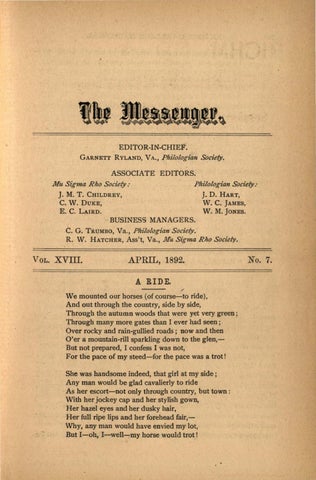
EDITOR-IN-CHIEF. GARNETT RYLAND,VA., Philologian Society. ASSOCIATE EDITORS. Mu Sigma Rho Society: Philologian Society: J. M. T. CHILDREY, J. D. HART, C. w. DUKE, W. C. JAMES, E. C. LAIRD. W. M.JONES. BUSINESS MANAGERS. C. G. TRUMBO,Va., Philologian Society. R. W. HATCHER, Ass't, Va., Mu Sigma Rho Society.
VoL. XVIII.
APRIL, 1892. A RIDE. /
We mounted our horses (of course-to ride), And out through the country, side by side, Through the autumn woods that were yet very green; Through many more gates than I ever had seen ; . Over rocky and rain-gullied roads ; now and then O'er a mountain-rill sparkling down to the glen,But not prepared, I confess I was not, For the pace of my steed-for the pace was a trot! She was handsome indeed, that girl at my side ; Any man would be glad cavalierly to ride · As her escort-not only through country, but town : With her jockey cap and her stylish gown, Her hazel eyes and her dusky hair, Her full ripe lips and her forehead fair,Why, any man would have envied my lot, But I-oh, J-well-my horse would trot!
No. 7.
RICHMOND COLLEGE MESSENGER.
220
'
Her song trilled out on the autumn air; I tried to sing "seÂĽond" (also to sit square) ; My voice had a tremolo ne'er known before; Perhaps 'twas effective-I tried it some more: Then her laugh rippled out just as fresh as her song, And I felt, as I rode, that something was wrong, And I felt that she knew it, and then I grew hotTo know that she saw that my horse would trot ! Her mare had a canter, like cradle a-rockA "rack," as she called it, devoid of all shock, Too fast for a walk, for a gallop too slow ;So what was left me but a-trotting to go? I tried to look cheerful, as sometimes one can , Though life seemed then but a racking span ; And I vowed that next time, at the mounting spot, I'd learn, ere I rode, if my horse was to trot ! Who knows what had happened that autumn day . As we rode (and forever it seemed) away Through the mellowing woods, 'neath the purple above,Who knows but we might have spoken of love? For the fair young moon was overhead, And the sundown was violet, saffron, and red, Who knows, I say, but that Cupid had shot, If that miserable horse had not chosen to trot? L. R. HAMBERLIN.
THE TRUE OHARAOTER OF OOLUMBUS. The day of unquestioning assent to conventionalized belief is passed. No longer are the traditions of our ancestors, or even the verdicts of history, accepted as implicitly as they were by preceding generations. All things must be proven anew if they are candidates for our credence. The very foundations of our faith must be uncovered and re-examined to see if they can support the lofty structures that have been raised upon them. If this spirit has not spared even the religious beliefs of men, it is no wonder that every historical character of prominence has been the object of fresh investigation. Many a figure that maintained its high eminence for centuries has been stripped of the mantle that imagination and credulity had woven, and presents the image of common, ofttimes faulty; humanity under the light of recent study. It may be seriously questioned whether, after all, it would not be
•
THE TRUE CHARACTER OF COLUMBUS.
221
better for the world to keep its heroes, fictitious though they be. The fact that they have been in so large measure the creations of men's minds shows our desire for some one to lead us up to a higher life and broader sphere than man has ever actually attained. Will it incite the Swiss to greater bravery and patriotism to know that the hero and model of her sons for many generations never had any real existence? Is our pride in the early history of Virginia enhanced when we acknowledge that the story of Smith and Pocahontas is simply a fabrication? And so does it seem timely or otherwise that on the quadrocentennial of that voyage, the most daring in purpose and wonderful in result in the world's history, we should learn that for four hundred years we have been mistaken as to the true character of Columbus?' But, however we may regret it, we are compelled to acknowledge the existence of a darker side to his life than has been hitherto, revealed. Several historical students, the most noted being Mr. Justin Winsor, have recently published the results of new and thorough search into the circumstances of the discovery of America. While they do not agree in all details, they unite on sufficient points to, make up an outline sketch in strong contrast to the inspired hero and _saintly martyr depicted by Prescott and Irving. According to some of the later biographers, Columbus was not the son of the wool-comber of Genoa, but was of Greek descent, and ¡.took his name from that of Colombo, a noted pirate of the Mediterranean, in whose vessel the youthful Christopher first sailed the seas_ The real history of these early years is very difficult to obtain, because of what Mr. Winsor calls " his talent for deceit," of which Columbus himself often boasted; but his record seems to have been by no means an honorable one. A reckless sea-rover, he participated in the attacks of the corsairs on the rich commerce of the Italian seaports, or sold his services to France, Spain, or Genoa with equal readiness. It was in one of these piratical encounters that Columbus' vessel was sunk, and he barely escaped to the shores of Portugal. About this time the theory of the sphericity of the earth was finding general acceptance in Europe, and an Italian (Toscanelli) had developed and elaborated the route of a voyage to the coast of Asia, which he conceived to lie over against Spain. The merit, if any
222
RICHMOND COLLEGE MESSENGER.
there be in this conception, which we now know to be so grossly false, belongs entirely to Toscanelli, who communicated his theory to Columbus, of whom he had heard as a bold aaventurer then seeking .employment. After the rejection by .the king of his request for means to test this new theory, Columbus left Portugal with a secrecy that was necessary to avoid arrest for debts he had contracted, and sought the Spanish court. But here, when he was on the verge of success, the same arrogant and grasping spirit that had driven him from Portugal prompted him to make such extravagant demands of the king that he was at first refused. And when these demands were afterwards acceded to, it was because F er9inand never dreamed that an accident would change Columbus' error of geography into a glorious discovery, and enable him to fulfill the conditions affixed to the royal concessions. This same greed was strikingly displayed when Columbus deprived a poor sailor of the reward promised for the first sight of land, claiming that he himself had seen a faint light in the distance on the preceding night, although he had k ept it a secret at the time. The utter deceitfulness of the whole pretense was subsequently fully proven. His reckless use of power was also shown when he imposed an oath on his men to the effect that they had reached the coast of Asia, under penalty of having their tongues wrenched out if they recanted. When this geographical blunder had revealed a new world, which Columbus refused even to the time of his death to believe was not a part of Asia, he demanded of his sovereigns the territorial power which in an evil day they had promised. This was bestowed upon him. But for the position of governor, Columbus was most unfitted. "No man," says a distinguished historian, "ever evinced less capacity for ruling a colony.'' He succeeded in attaching to himself but few men who loyally supported his cause. Those under him were always mutinous and constantly in rebellion, while his superiors found him visionary and unpractical. His sole idea was to make the Indies a paying investment. The object of every search was -gold-more gold. And when he could not find the precious metal in the earth in sufficient abundance, he spared no sacrifice of the innocent natives to obtain it by other means. He had come ostensibly to convert to the true faith the benighted Indians, whom he at first describes as a most gentle, friendly, and peaceful people. But when this passion for wealth could find no other immediate means o{
.
CHAUCER.
223
satisfaction, ¡ Columbus became the first slave-driver of the New World. He claimed that the Caribs, whom he first sold to Europe, were cannibals, whereas they lived entirely on fruits; afterwards his plea was that slavery was the fittest punishment for making war upon the Spaniards; and he finally took the Christian view that slavery was necessary to prevent those whom the Church had once converted from returning to their idolatry. He compelled the Caciques to furnish a quota from each tribe for hard and unaccustomed labor in his gold mines, and boasted of his policy of slitting their noses and tearing off their ears as a means of keeping them in subjection. So destructive was this policy that in two years it had killed a third of the native islanders, and the Spaniards themselves were exuberant at their relief from Columbus' misrule. If his latter days were clouded and his death pitiable, no one was so much to blame as himself for his lost chances. When the opportunity was given him to win a place among the greatest benefactors of the human race, he failed to rise above the avarice and cruelty that marked his times. He was the discoverer of a world of which he had never dreamed, but instead of being its protecting genius he chose to go down in history as the first despoiler of it~ virgin shores. _________ G. R.
OHAUOER. On Thames street, London, about the middle of the fourteenth century, was born the father of English poetry, Geoffrey Chaucer, who in his happy use of the English language was destined to reveal its yet unknown wealth and beauty. His father, John Chaucer, was a vintner in London, and had accumulated some wealth. When about seventeen years of age Geoffrey became page to the wife of Lionel, Duke of Clarence, and remained in this position until 1359, when he joined the English army in France. During this year he was taken prisoner, but was ransomed by the King before the treaty of Bretigny in the following year. Of his life for the ensuing six years nothing is known, but from 1366-'72 he was again connected with the King's court, being one of the "valets of the King's chamber. He discharged his duties with so much fidelity as to gain distinction~ About this time he began to write, and his first work seems
224 ,
RICHMOND COLLEGE MESSENGER.
to have been to translate a prayer from French into English, at the request of the Duchess Blanche. After her death, i~ 1369, he wrote his '' Complaynte of the Black Knight,'' his ''Dream,'' and his '' Book of the Duchess.'' During this periqd he was married .to Philippa, a sister-in-law of the Duke of Lancaster. In 1369, he engaged in another battle against France, showing that he was not only a courtier and scholar, but a soldier also. Between 1372 and 1384 he was sent by the King on not less than seven diplomatic missions, .three of which were to Italy. At this time the great Italian literature, which so thrilled the hearts of the Europeans, and is a source of so much profit and pleasure to us at the present time, had reached its full growth. This opened to Chaucer such a wide field of literature and art that all of his subsequent writings were filled with a different spirit-so different that he even laughs at his former productions. Among his best works we may mention "House of Fame," "Angelida," "Legend of Good Women,'' and, above all, the '' Canterbury Tales.'' In the last, he pictures a number of pilgrims-men and women of every dass of society in England-gathered around the jovial host of the Tabard Inn. He puts them on horseback to ride to Canterbury, and makes each of them tell a tale. He describes each character with such astonishing vividness that Dryden said : '' I see all the pilgrims, their features, and the very dress, as distinctly as if I had supped with them at the Tabard Inn in Southwark.'' He was appointed clerk of the work at Westminster, Windsor and other palaces, and continued in charge of these offices until 1391. From this time until his death he lived on pensions allotted to him by Richard II and Henry IV. At his home, near Westminster Abbey, in 1400, his sun went down with the mildness, serenity, and continuing benignity of a summer's day, and he sleeps sweetly within the walls of the Abbey church. Geoffrey Chaucer was a true gentleman, endowed with a happy disposition, tender, kind-hearted, humorous, and satirical without being overbearing. Although he lived in aristocratic society, and held many official positions, he went about in so studious a manner, and with such an air of meekness, that the hostess in the tales makes fun of it by saying: " Thou lookest as thou wouldst find a hare, And ever on the ground see thee stare."
HER POWER
225
Although he was quiet and meek, yet his writings embody enough self-consciousness to give them a manliness of tone. Again and again he disclaimed all pretension to pre-eminence as poet, acknowledging the great superiority of the poets of classical antiquity in such words as these : "--Little book no writing thou envy, But subject be to all true poesy, And kiss the steps where'er thou seest space Of Virgil, Ovid, Homer, Lucan, Stace."
He took the shattered fragments of a language which had been for two hundred years abandoned to the mutilations of the unlearned, and incorporated them into a literature of such lofty tone and dignity as to win the respect and admiration even of men steeped in prejudice against the tongue in which he wrote. He was the first to make the study of n~ture an element in our poetry. His chief delight was the beauty of the morning, the woods, the streams, and flowers, together with the music of the little birds. He wrote for pleasure, and hoped only that others might receive the same pleasure in reading his poems that he had in writing them. He had a fine earfor rhythm, and the sentiment and verse are in complete accord in his poems. '' Indeed, so softly flowing and bright are they that to read them is like listening in a meadow full of sunshine to a clear stream rippling over its bed of pebbles.'' He was indeed a poet, and shall ever shine as the bright morning star of English literature. E. E. D.
HER POWER. She's such a modest little maid, She wonders why I love her, And why, of all the girls I know, There's none I hold above her. And I? I hold her little hand And bless the day, the hour, When first I looked upon her face, Acknowledging her power. For some will seek for golden store, And some for beauty's dower ; But I for worth-how could I not Acknowledge then her power?
Marek 26, 1892.
226
RICHMOND COLLEGE MESSENGER.
HAMLETWASINSANE. Tlie poet Campbell is supposed to have said : " Shakespere himself, had he been as great a critic as a poet, could not h~ve written a regular dissertation upon Hamlet.'' So subtle and mysterious a character has never 'been accurately analyzed, and, it seems safe to say, will never be. Two of the greatest German critics have come to almost exactly opposite conclusions as to his character. In the midst of such hopelessly contradictory criticism upon a character itself so full of contradictions, the surest verdict, and that which most nearly explains the great variety of opinions, is that Hamlet was insane. Assuming sanity for him, there is no ground ¡ for explanation of all his deeds and words. If he was insane, no explanation is necessary, or to be expected. Let it be understood, then, that they who take the former view assume the greater burden, for while we cannot demand a certain explanation of all the phenomena, we are warranted in asking that a possible harmony be presented. It cannot be objected that the plea of insanity is a short -cut to the solution of the problem of our hero's lite. It is rather the last resort after utter and repeated failure to explain it on any other basis. We do not seek it to avoid labor, but resort to it as the only reward of laborious effort, and, however much dissatisfied with the result, fee-Icompelled to accept it. It is no Alexandine stroke at the Gordian knot, but the final necessity forced upon us after hopeless failure in every effort to unite it. To hold that Hamlet was insane is a necessity. Let us understand just what our position in regard to Hamlet is. We do not hold that he was a raving maniac, requiring half a dozen strong men to control him; nor that he was a wild and utterly insensible unfortunate, such as a clegraded illiterate would make if driven by debauchery into insensibility ; nor yet that he was at all 'times insane in any sense. Most mad men have lucid periods, and Hamlet certainly had his; but our difficulty comes ¡when he was not lucidwhen he was so dark, indeed, that we search in vain for some illumination as to why he did and said thus and so. All we claim is enough insanity and of such periodic occurrence and continuation as is necessary to explain him. If it wer.e sufficient for the purpose, we , should say he was a monom _aniac, but he seems ¡ to have been
I
HAMLET WAS INSANE.
227
insane on at least two, and most likely on three, subjects. On the whole, his n;iind seems to have been overbalanced and uncertain in its operations on any subject, except when he was able, for a time, to regain control of himself, which control he always lost before he could execute his purpose. It is suggested that his insanity grew on him. His periods of self-control grew shorter and less frequent until lost almost entirely. As Dr. Jekyl, in Robert Louis Stephenson.'s story, begins by s9metimes assuming the role of the villian, Mr. Hyde, and ends by being Mr. Hyde, so Hamlet started in by playing the madman at pleasure, and ended in being the madman. It is not possible to say just when he is feigning madness and when madness possesses him in each case, but the facts seem to accord with the theory proposed. Let us see what circumstances we can find that would naturally tend to produce insanity, and so will furnish argument that he was msane. Of course, how far these considerations would operate toward producing insanity would, in any case, depend upon the character of the individual. A burden too great for the individual who has a morose or gloomy spirit is apt to unbalance the mind. That Hamlet had a burden too great for his ability scarcely needs to be stated; that he was gloomy and morose and full of indecision is quite as evident. If he was naturally so, then he was just the ckaracter to be driven into insanity such as is claimed. If not naturally so, th en this was the result of the circumstances thrust upon him, and being so utterly abnormal ¡constitutes in itself a large part of the insanity we claim for him. Among these circumstances we note : He was a young man, reared in luxury, with little or no idea of responsibility, and, withal, a devoted student, to whom his books and college life were dearer than prospective royalty. Any grave responsibility upon such a youth would make him or ruin him. It did not make Hamlet anything noble. Such a youth is called to see his father buried. New, and, to him, unwelcome thoughts crowd in upon his mind. To increase his trouble, within the short space of two months his mother, whom he looked upon as the very embodiment of all that was noble and true and loving in wife and mother, committed what seemed to him the unnatural enormity of marrying a man whom he considered utterly unworthy his father's place. To a man of delicate and refined ideas,
228
RICHMOND COLLEGE ,MESSENGER.
a man ¡naturally disposed to brood over a conceived wrong, this was a terrible stroke. If it be claimed by any that some one. thing is the turning point in the equilibrium of mind-a claim which I will by no means admit-it seems to me that when we associate with his mother's unnatural marriage his confirmed suspicions that she had not be~n innocent of his father's "taking off," we have all that is needed to finish the work. How much this hacl to do with his madness, feigned or real, is seen in the great agitation that thought of it always occasions. If .l;iismother's name is mentioned he grows furious; at thought of it his blood curdles, and he is afraid to trust ¡ himself in her presence lest he stain his hands with her blood. This looks like real insanity. If it be suggested that, if crazy, he would wi~h to kill his mother, I reply that this would depend upon whether his master passion was anger or grief, as this would move him when he lost his control. Let us add the influence of the sight and terrible words of his father's ghost. The thought of a father sent unprepared and unpar<lon_ed to the judgment was kept constantly before him by the charge, "Hamlet! remember me!" spoken after a most awful citation of crime. And Hamlet did remember the words of the spectral form. The agony of that father's untold secret calling for revenge, and the recollection of his constant suffering, were almost enough to make any man mad. No wonder Hamlet exclaims: "O, all you host of Heaven! 0 earth! what else? And shall I couple hell? 0, fie! Hold, hold, my heart: And you, my sinews, grow not instant old, But bear me stiffly up."
Finally, the burning desire for revenge that he dared not wreak and shrank from, showed to himself the coward in him, and added more than enough, if anything was yet lacking, to drive him wild. Let us consult the critics. As to this great burden of avenging his father's death laid upon a soul unequal to its performance, Goethe has well said : "Here is an oak tree planted in a costly vase which should have received into its bosom only lovely flowers ; the roots spread out, the vase is shattered to pieces.'' How true the picture of the boy Hamlet and the wreck Hamlet. Coleridge, if I may quote him at some length, says: "In Hamlet he (Shakespere) seems to have wished to exemplify the necessity of a due balance between our attention to the objects of our senses, and our medita-
HAMLET WAS INSANE.
229
tion on the working of our minds-an equilibrium between the real and the imaginary worlds. In Hamlet this balance is disturbed; his thoughts and the images of his fancy are far more vivid than his actual perceptions, and his very perceptions, instantly passing through the medium of his contemplations, acquire as they pass a form and color not naturally their own.'' Here he presents us his -conception of Hamlet, a dreamy, imaginative, and unbalanced mind, whose perceptions have acquired a '' color not naturally their own." What is this but madness? Coleridge says again : "The effect of this overbalance of imaginative power is beautifully illustrated in the everlasting broodings and superfluous activities of Hamlet's mind, which, unseated from its healthy relation, is constantly occupied with the world within and abstracted from the world without-giving a substance to shadows and throwing a mist over all commonplace activities.'' Dowden finds himself unable to determine whether '' Hamlet finally attains deliverance from his'' recognized ' ' disease of will. ' ' Now let us look at the internal evidences. It is claimed that Hamlet feigned insanity to secure his purpose, but it needs to be pointed out what purpose his feigned insanity, if such it was, served. To say that his plans miscarried is too bold, when those plans are nowhere unfolded to us, and he never, except by a series of accidents entirely unexpected by him, really did anything to secure that vengeance which he is reputed to have sought. Then, too, to claim that a man with a skill to plan and execute so perfect a counterfeit on insanity that no one was able to detect it, and that, too, with a definite purpose in view, should utterly fail to execute that purpose, when clearly he might have done it, is too inconsistent to be believed. If it be claimed that he was waiting for an opportunity to kill the King under circumstances by which the people would justify him, it needs only to be remembered how he killed Polonius, and to call to mind that nowhere is he concerned for his own welfare or for popular favor, but professes a desire only to send his uncle to hell. If he feigned insanity as an excuse for his cowardice, this very thing proves insanity. His success, too, was too great for any man unless he had made a systematic and prolonged study of madness-especially for a man who shows such weakness at other points as does Hamlet. That he sometimes took a delight in appearing insane is admitted, and falls in with ¡ our
230
RICHMOND COLLEGE MESSENGER.
theory, but the opposite would not, unless his madness had displayed more "method" than we can find in it. In II, I, 77 ff., when in the midst of his wild soliloquizing about self-murder, and abstract philosophizing, such as no sane man with a purpose would indulge, Ophelia comes into his sight. It turns the tide of what seemed deep thoughts into entire attention to her-just like a crazy man, to tum from intense thought on one imagined ill to complete concentration on another. His treatment of Polonius' dead body, dragging it around like some wild hyena, and cracking huge jokes about it, was entirely unnecessary even for the most weighty purpose. What part did all his wild fancy and foolish conduct toward Ophelia have to do with avenging his father's death? or what could he imagine he had to gain by it? If he loved Ophelia, and saw in the course before him the loss of his love, then there is some explanation of his crazy conduct. His foolish and idle .talk when alone with Horatio, who knew his secrets (V, I, 20 ff.) is especially significant. His fight with Laertes in the grave of Ophelia means much, and in V, II, 75 ff., when he has g~own calm, he confesses to Horatio the folly of it. In his soliloquies, as a rule, he is abstract, sometimes almost wild, in his imaginations, and certainly he was himself when alone, if ever. He was bright and sensible when with companions who called him down from his heights of imagery or from his depths of philosophy. In II, II, 260 ff., he says¡: "0 God! ' I could be bounded in a nutshell and count /Ilyself a king of infinite space, were it not that I have bad cfreams." His dreams must have been awful in the extreme. His disquiet at the entrance of the ghost during his conversation with his mother may have some bearing here. In other plays of Shakespeare, where any character feigns madness, it is always made very plain that it is only feigned, and the victim always recovers. Here there is only the intimation of Hamlet himself that he may have occasion to play the madman, and he never recovers his madness, but rather becomes confirmed in it, when it would have utterly defeated hi. ends but for his capture by the pirates. He should have thrown off the mask in time if he were a man, and not left an accident to do his work for him. Some of the passages that will be urged against this position need some notice.
ANCIENT VS. MODERN EDUCATION.
231
In I, V, 168 ff., he tells Horatio not to think it strange if he plays the madman . But, alas ! he played it too much and too far for this warning to forestall suspicion. · Polonius' words in II, II, 208, 209, "Though this be madness, yet there is method in it.' '·might seem to indicate a suspicion unless you also read his words in 211 ff., where he explains that this is '' a happiness that madness often hits on, which reason and sanity could not so prosperously be delivered 0£'' His devising the play and his instructions to the players may be explained in two ways : His hopefulness had now overcome for the time his gloomy abstraction, and his mind for a short time was clear •and strong; or it is not impossible that knowing what he did, his conduct was only the desperation of madness. This play was no invention, but only the natural application of knowledge. Other points may be explained in the same way. The point of greatest difficulty is in the two letters he wrote from sea-one to the king, full of mad talk; the other to Horatio, his confidant, clear and skillful. If we hold that this was the happy stroke of the lucid hour of a madman, who knew he was considered insane, then we can explain his conduct immediately preceding and following this. But if it was the plot of a mind always keenly alive to his situation, we despair of any harmony of some of his conduct. If it be asked why Horatio clung to a madman, the answer is brie£ After Hamlet's warning, he would naturally be the last to be convinced of real madness, and when convinced he would still hope that final vengeance would return Hamlet's mind, and place him on the throne, with himself prime minister. · Horatio struck the keynote when, in I, IV, 69 ff., he prophesied that if Hamlet followed the ghost he would be deprived of reason and drawn into madnes!;, for the sequel shows that Horatio was right. ______ ___ W. 0. C.
ANOIENTVS,, MODERN EDUOATION. There are two relatively varying but always present factors in any education, however meagre or extensive it may be. These two are the "putting in" of knowledge and the "drawing out" of power. To illustrate, a child learns many facts in geography or history without thereby greatly increasing his mental powers, while a student may follow some mathematical demonstration, and although his store
232
,RICHMOND COLLEGE MESSENGER.
of knowledge is not much increased he gains greatly m mental training. Between ancient and modern systems the difference is chiefly one of emphasis. They emphasized the in-struction, we the e-ducation. They, of course, obtained some mental discipline while learning, but the thing learned was the main end. Memorizing large portions of what had been said by the wise men of ages past constituted the chief part of their instruction. Among the Jews, in the time of Christ, to be learned was to ,be able to repeat a large part if not the whole of the Old Testament and the commentaries upon it by preceding rabbis. The ancient system yet remains in China, where learning consists largely in the ability to quote from the writings of the great Confucius and other sages. In this, memory plays a most important part. Hence it was trained to an extent with us unknown. This state of things was in great part necessitated by the fact consequent upon the scarcity of books ; that what a man had at his command was little else than what he had stored up in his memory. With us the avowed object, especially in higher institutions, is to learn, not facts, but methods of inquiry. Of old, men were content to possess themselves of the rich legacy of knowledge and wisdom left them by their fathers, while we, little inclined to accept anything on testimony, attempt rather to rediscover everything for ourselves. Their methods, since they rather discouraged originality, were perhaps not the best for 'awakening genius, but when there did arise an intellect not content to be bounded by the attainments of previous generations, but pushing forward from the vantage ground gained by a thorough knowledge of what had been done, its achievements, grand and glorious , have lasted, and will last as a "treasure forever." Our method, while perhaps best upon the whole, has been productive of some results not desirable. Largely ignorant of previous thought, we have become somewha ( conceited as to our own abilities of discovery, choosing in the broad fields of research to be pioneers rather than settlers. In consequence of this tendency the the noble faculty of memory has been sadly neglected. People even seem to pride themselves on having poor memories, as if a good memory were in the least inconsistent with the highest development of other powers, and were not a great aid even to original research. Could not the highest results, then, be obtained by a better union of the two methods? If the ancients trusted too much to memory, -do we cultivate it with sufficient diligence? ZoTE.
DREAMING.
DREAMING. Down through the gateway of pearl and of jasper Cometh the angel of love, And sheds o'er my .spirit soft dews of the morning, And peace, blessed peace, from above. Lying in sleep on my wearisome pallet, Dreaming of tasks to be done, Oh, sweet is the thought that the love-angel whispers, That love never dies with the sun. Sweet is the music the love -angel whispers, Gently it speeds on its way, And lovingly bends o'er the toil-wearied dreamer, And thrills like the sunshine in May. Waking in rest in the life-giving: morning, Strong for the battle oflife, I keep in my heart all the words of the angelThey comfort me during the strife.
SILVIUS~
THE USE or SLANG. One of the greatest, and at the same time one of the most common, faults to be found in the language of young people of the present day, is the use of slang. And this use is not confined merely to the un ducated and to those in the middle classes, but it has penetrated even into the higher circles of society. It is an evil which affects all classes. •The politicians have their slang expressions. The merchants are not lacking in this line. The devotees of society have their little pet words which are used quite extensively, regardless of the fact that they are not in good taste. But it is among college students that this pernicious habit prevails more extensively, perhaps, than among any other class of people. It is a sad fact, but a fact nevertheless, that the very people who, above all others, ought to use good, simple, pure English, are so. constantly perverting and disfiguring it with slang. It is painful, positively painful, to an educated and refined ear to hear from col-lege students-from those who are trying to learn the English language and to be able to speak it in its purity-such vulgarisms as '' He's in it,'' '' Down him, Pete,'' ''She's a daisy,'' '' Do you catch_
234
RICHMOND COLLEGE MESSENGER.
on?" and especially that sickening, disgusting, abominable "I smeared on him." Another thing about this habit of using slang is that it grows so rapidly and gains such a firm hold on a person that he may often use it where it doesn't sound anything like as well as it does (to him) on the play-ground. The tendency among those who use slang is to use the same phrase to express _several different ideas, determining the meaning by the connection in which it is used. In this way their vocabulary becomes narrow and contracted, and they are sometimes much perplexed as to what word to use to express a certain idea. One who is addicted to the use of slang can hardly express himself as freely and elegantly as one who does not use it. And the alarming feature of this practice is that, instead of abating, it is on the increase. At present there is no indication th at it will ever stop unless something is done to check it. The stock of slang phrases seems to be larger now t);ian heretofore. And why is this so? Why is it that so many students at college are apparently so fo~d of using slang? The reason seems to be this : The young man comes to college usually impres sed with the idea that tho se who have been there a year or two before him are thoroughly acquainted with the ways of the college, and that he must watch them and learn from them the way to conduct himse1ÂŁ He hears them using slang, and naturally he falls into the use of it hims ~!ÂŁ Gradually, perhaps, at first, but more and more rapidly, he begins to adopt their manner of speaking, and soon he is familiar with all the slang expressions current among the students. Many, perhaps, use th_em unthinkingly, when if they would stop a moment for reflection they would not do so. At any rate, the extent to which slang is used is great, and apparently little or nothing is being done to lessen it. How may we eradicate this evil? Various ways have been tried, with different degrees of success. In some places anti-slang societies have been formed, the members of which pledge themselves not to use any slang word or expression under penalty of a small fine. Each member has to watch himself closely, and note every failure on his own part to comply with the agreement. These he is to report at the meetings of the society. This plan has been put into operation with some success, and has been a source of benefit to those who have tried it. , A very good way to overcome the habit is to be particular about
OUR MARKS.
235
one's expressions, to guard as much as possible against the use of slang, to associate with those whose speak simple, pure English, and watch their language and model one's own speech after theirs. In this way, if one is persistent and careful, the use of good English may be readily acquired and this pernicious habit of using slang overcome. _ __ _ __ ___ ALius.
OURMARKS. Did you ever know a student who stood well on Latin to say that '' the professor of Latin does not know how to teach,'' etc. ? I do not remember hearing anything of this sort from the leader of tne class. If you have, note it; it is rare. Well, did you ever hear one who made a grade of 65 per cent. last month say that if he didn't ¡ know more, and couldn't teach better than that professor, he would quit the business and, in fact, that he wondered that the trustees ever chose such man for a teacher? I have heard such remarks many a time, and so have you. You may have heard me make them ; no doubt you have. '' I declare, I do think he is the most partial man I ever saw. He doesn't know a good recitation when he hears it. Just think of it! He gave J. 92 and me only 80, when I know I recited well, and my exercises were exactly like J. 's." Let the Logic class look at this syllogism. He gave me a low , mark ; therefore he is partial. What professor is just, rightly dividing the answers of the student, and shrewdly divining where he got that smooth translation? Who is he whom you can't fool, and who is always impartial? He is the one in whose class I stand at or near the head. This principle explains why our teachers get so much more blame than praise. The Greek medal is up. The professor has to decide, ¡ and by arduous fate he is compelled to displease twenty out of a class of twenty-one! How pleasant the teacher's calling; how just would he be considered could he but honor all ! How his school would flourish ! How his gray hairs would go down in peace to the grave, followed by the benedictions of hundreds of ignorant graduates and medalists ! Now, my dear friend (and you are dear if you are the one to whom I am going to send this MESSENGER), you may like to hear what ''marks'' are. Well, from the observation and experience of ~n
a
236
RICHMOND COLLEGE MESSENGER.
already long (and I fear not soon to terminate) residence here as a poor student, I will try to -explain. To do so fully I must make a division, thus : Good marks are the correct averages of the just valuations of our daily recitations, and as such are the honest earnings of hard and wise study. Bad marks are what the arbitrary hearer of lessons gives us when we know we recited just splendidly, or are what the near-sighted professor put opposite our name when some one else failed on the lesson. Did you ever get a low mark? I have, and I fussed about it, too. I claim I had a right to fuss. Of course I ought to have good ones always. I ought to stand at the head of my class, and it is the teacher's fault if I do not. Suppose he did catch me unprepared three times in the month. I always had an excuse. One time I was detained down town the night be"fore. Some people say it is a bad thing to go calling more than six nights in the week, but I think a student should have some society. Again, "I lost my book" (i. e., my translation, though I didn't tell the professor that). The other time I received a letter from Miss -the day before, and felt somewhat--, you know. The professor should have known all this, and not have called on me on those days. Anyway, it always happens curiously in my case. The very thing the professor calls on me for, and I miss, is the only part of the lesson I had failed to study. I really intended to do so, but the bell rang just as I was beginning. And what is still more curious, if another question is asked me, it also is just the thing I hadn't studied. I have noticed this fact about others also. This is the way I write home the day after reports are sent : '' I really cannot understand how I got such a low grade ; and these unexcused absences, I am sure I explained them all" (satisfactorily?). From long observation, I do not hesitate t¡o affirm that in many cases a surprisingly accurate estimate of a student's standing and attainments in any class can be gained by noting that student's expressed opinions of his teacher. In general, what a professor thinks of me I think of him. If I do well in his class, and he honors me for it, I say he is a good teacher, and per contra. . Then, again, who is he that says '' examinations are unjust'' ? Often it is the man who, by the use of a translation and by '' comparing exercises" with his room-mate and others, obtains a good grade in recitations, but who comes up wanting in the surer test where no help is allowed. _
THE POET'S POET.
237
In these, as in other things, we are prone to transfer our own defects and deficiencies to any system, book, or professor that may be at hand. In short, we have a propensity for denominating the wrongindividual a male specimen of the long-eared tribe of the genius . Equidce. Em KLANGENDER. "THE POET'S POET," As not all men in any single age are equally distinguished, so not every generation produces men who rise to the same degree of excellence. Especially do we find this to be true in the history of literature. Men of great literary genius are few in number and are often far between. Chaucer marked an epoch in the history of English literature, and at his death there settled over our literature a dark and gloomy night which lasted for nearly two hundred years, and which was at last dispelled by the rising of a brilliant sun-the illustrious Edmund Spenser. He was a man of extraordinary genius, and stands as the only non-dramatic poet of the Elizabethan age who merits distinction. Spenser was born in the city of London in the year 1553. Some have claimed for him noble ancestry ¡, but most probably without sufficient evidence. This, however, should not diminish our admiration for his works, nor cause surprise at his remarkable genius, for surely noble ancestry is not an essential prerequisite to true greatness, and offers no certain road to honor and fame. Little is known of the poet's early life, except that he was born in humble circumstances, was educated at the University of Cambridge, and very early in life began to exhibit decided poetic skill. Some of his shorter poems were composed while he was at school, perhaps when he was not more than seventeen or eighteen years of age. These, whenever published, were read with interest, and sometimes elicited the highest praise. He obtained his master's degree in 1576, and, leaving the university at once, he entered upon his brilliant career as a man ot letters. , For more than two years he lived in the north of England, and while there he was chiefly engaged in the preparation of the Shepherd's Calendar, which was his first important production. This is
2'38
RICHMOND COLLEGE
MESSENGER.
a sweet and charming poem, consisting of a series of pastorals divided into twelve parts, in which the imaginary interlocutors dis,cuss questions of morality and of politics . .During his residence in the north of England, or possibly before ¡this time, he worshipped .a fair young lady whom he celebrated under the anagram of Rosalind. She, however, trifled with his affections, and at last avowed her preference for another man. Perhaps in the composition of his Shepherd's Calend ar he found some solace for his disappointment and grief. While at the univer.sity Spenser formed a friendship for Gabriel Harvey, who was a man ,of some literary reputation and political influence, and through hi's kindly intervention the poet was brought to the notice of the Queen. In 1580 he received an appointment as secretary to the lord deputy .of Ireland. Then a grant of 3,000 acres of confiscated land was co nferred upon him, and he resided in Kilcolman Castle. But in 1598, during Tyrone's Rebellion, his house was attacked and des troyed by fire. His infaht child perished in the flames, and he bimself was compelled to flee to London for safety. He never :recove red from the shock caused by his sad misfortune. He died in January of 1599. He was buried near by the tomb of Chaucer, in th e '' Poets' Corn er '' of W estm inster Abb ey. It was at his pleasant country hom e, while surrounded by the cha rms of exquisitely lovely scenery, but heartily despised by his Irish neighbors, that he prepared his most important and charming literary work-the Faerie Queen. It is a most brilliant and delightful poet ical expression of the sentiments of chivalty. No poet of the English tongue has so beautifully and aptly united all the charms of allegory, all the beauties of graphic narration, and a ll the splendor of grand description as did Spenser in this extended poem. The original plan proposed twelve books, each recounting the exploits of a single knight, and exhibiting the final triumph of virtue. The first three books were completed long before their publication, which was postponed because of the unfavorable criticisms of 'his friend Harvey. He was at last induced by the enthusiastic applause and earnest solicitation of Sir Walter Raleigh to visit England and offer to the reading public the p,ortion which had been completed. It was at once hailed with . g~neral praise, and even to-day it has continued to charm and delight the resthetic soul. No regret need be felt
THE POET'S
POET.
23~
because the original plan was not executed, for it is generally admitted that the vigor, beauty, and invention found in {he first three books are to some extent wanting in the fourth, fifth, and sixth. No one of our great poets has received such unanimous praise and been held in such undiminished esteem through so many changes of taste. Spenser was a delight even to Pope, as much in his old age as in his boyhood days. Truly was Spenser "the poet's poet." No poetry can be more exquisitely beautiful and uniformly musical than his. There are no blazing passages of passion such as we find in Homer, but there are no long and monotonous enumerations of forces such as we find in the Iliad. His poetry is not like the great ocean, which surges and roars under the violence of the winds, but rather resembles the quiet and beautiful lake, which ripples und er the gentle breezes and glitters in the glowing sunshine. The richness of the sound, the sweetness of the rhythm, show the magic to~ch of a master hand, which modulates the sound and paints the pictures for the fancy. The secret of his enduring popularity with poets and lovers of poetry has been attributed to '' his excellence in the poet's peculiar gift-the instin ct of verbal music." Shakespeare felt and expressed this in his parallel between music and sweet poetry: "Thou lovest to hear the swee t melodious sound That Phcebus' lute, th e queen of music makes; And I, in deep delight, am chiefly drowned When as himself to singing he betakes."
C. W. D.
240
RICHMOND COLLEGE MESSENGER.
QE-bitoriaL With this number a new board of associate editors take control of the MESSENGER. The several departments have been allotted to the supervision of these gentlemen as follows : Literary Department-]. M. T. Childrey and C. W. Duke; Editorial-W. C. James; Locals-E. C. Laird; Alumni 'Notes-J. D. Hart; Exchanges-W. M. Jones.
*
*
*
*
*
*
*
*
There are many traits common to all men of gentle breeding, and since they are the inevitable ac:;.companimentsof every refined person, it is right then to conclude that their presence, or the possession of any one of them, is a sure sign of refinement, and along with the apprehension of this there should go a strong desire on the part of those whom they do not characterize to come into a possession of them. One of these is a scrupulous regard for the little things of daily occurrence; and by this is meant not a disposition to be close to the point of being penurious, nor peevish and exacting- even to being old-maidish, but by it is meant a diligent regard for those little things the doing of which gives pleasure to them in whose behalf they were done, and satisfaction to the one that did them. To illustrate : Two students, Smith and Jones, together buy a book. Smith, perhaps, is the first to secure it, and proceeds to write in it the name -0f the joint owners. How shall he write them? Will it be Smith and Jones, or Jones and Smith f Which? If he possesses a disposition such as intimated above it will be the latter. Another: We knew of two men, A and B, who on a certain occasion made public addresses. A third person, whom we shall call C, and who had only a slight acquaintance with the other two, was rude enough on meeting with B, after the addresses were over, to say to him, not once, nor twice, but three times, that A had made the finest speech. Did not he by that act betray an ignorance of or an indifference toward those little things which invariably mark a man of refined sensibilities ? Should any be inclined to satirize such sentiments, let them remember that " Despise not the day of little things," "Straws show which way the wind blows,'' '' Take care of the dimes and the dollars
EDITORIAL.
241
will take care of themselves,'' and many other expressions of like import afford us proof that little things are not altogether disregarded.
*
*
*
*
*
*
*
*
*
*
*
*
*
*.
*
*
The recent remarks of Dr. Robinson as to the study of English prompt the following: The study of English literature in high schools and colleges particularly is desirable for two reasons. The first is that it gives the student an idea of wh~t style is. The methods of teaching-at present are not as much of the introspective as of the objective order; they are almost entirely objective. Were you to ask anyone for the definition of a button, he would hardly attempt to explain to you the size and shape of a button, or the material of which it is made, but would offer you a button and ask you to examine it and see for yourself. It would tax one's powers of description to describe a trapezoid, or to unfold the nature of electricity, but let a trapezo.id be represent ed on a blackboard and you will have a good idea of it, and let an electric shock be given to you and a conception of the nature of electricity will be conveyed to the mind in a manner unmistakable. So, then, in the lecture room, instead of telling students what style is, instead of collating and having them to memorize the definitions of Hart, Quackenbos, and Hill, of Bain, Bardeen, and Herbert Spencer, would it not be better to take them straightway into the place where style is and let them come in contact with the thing itself? Instead of tantalizing the students with descriptions of the beauty, richness, and fragrance of the grass, would it not be better to pull down the bars and turn them loose like flocks upon the pampas, to go as their pleasure directs ? Here is a corollary to the above. If students are thus made familiar with English literature, if they are thus brought into vital contact with the men who have made our '' well of English undefiled,'' then abundant material will be furnished them for essay work. It is, perhaps, not a very wrong supposition that the writing of essays is, to professor and students, one of the least satisfactory exercises connected with college work. Now, knowledge is the essential in writing an essay. If that be wanting, how can a student compose? Noah Webster was accustomed to open his library to his children, and say to them : "Read and you shall know." So let the professor open the vast and rich pastures of English literature to his
RICHMOND COLLEGE MESSENGER.
242
students; let him lead them in, aid them in their incursions, limited though they be, and then, instead of '' cramming'' a sketch out of an encyclopedia, they will have suggested to them proper, suitable , themes for the expansion and development of their mental powers.
*
*
*
*
*
*
*
*
One fact which seems to argue in favor of re-instituting the office of President as a controlling or rather supervising force in Richmond College is the success which has attended the same plan elsewhere. 'Tis true there ar.e some institutions whose preside~ts do not seem to have given increase to numbers, neither to have added to the efficiency of the teaching force, nor in any way to have brought about more thoroughness in the quality of the work done. Such institutions, however, have a local influence and draw their patronage from an area commensurate with it. Richmond College, on the other hand, is known far and wide ; her alumni are to be found in all quarters of the globe, and by their success bear ample testimony to the value of the training here received. For the presidency of an institution a specialist is not required. Let him be a man of broad and liberal education, of polished, refined manners, but, above all, possessed of organizing power and executive ability ; who will see that the offices of the college are properly managed, that every chair is occupied by a competent professor, and that each department is well equipped for its work. In an institution such as this the professors are engaged too closely during the session to be reqnired, or rather to find it necessary, to travel over the State and work for an increase of patronage ; but with a president active and energetic, . who will be frequently traveling in the interest of the College, we can readily and reasonably conceive of the professors as indulging in needed repose during the summer months, drawing larger salaries, teaching larger classes, and having .a wider influence. The College, too, will enjoy an increased endowment. There may be some who think a change in re;rime unnecess.ary because of our prosperity under the present system. The reply to such an objection would be that for the same reason a planter might refuse to make use of the immense improvements in modern farming machinery on the ground that his old way had been tolerably successful and he would be content with it.
EDITORIAL.
243
Popular audiences, as a rule, contain very few who are possessed of a liberal education, or whose minds have been invigorated and strengthened by the discipline of books. Howev er much we may strive to popularize education, and however zealously university extension work may be urged, it will be yet some time before men, women, and children in America will talk of and discuss literature, art, science and philosophy as, it is said, they did during the period of Athenian glory. It is surprising to see with what indifference many so-called intelligent people regard a discourse or a lecture marked by any depth of thought. In this connection we are reminded of a series of lectures delivered about three years ago at the College by H. Newell Martin, of Johns Hopkins, on "Vital Principles,'' '' Living Matter,'' and cognate subjects. Th e first lecture was attended by an immense audience, at the second the numbers were much diminished, while on the occasion of the last lecture the audience was decidedly small. It may be, though, that all blame does not attach to the audience. One of two things is desirable-either that a more scholarly audience greet the lecturer, or that the lectures be not so profound. ;fo hear such men as Joseph Cook, W. C. P. Breckenridge, Henry Watterson, or ex-President White would be a source of wonderful inspiration to the young men of the College. Can't we have such men as they are once in a while ? But ~e forget : the Thomas Lectures are for the public, and not for the students. The former may need instruction in science, but it is quite certain that we boys need inspiration now and then.
*
*
*
*
*
*
*
*
Th e Devotional Committee has acted wisely in arranging for the delivery of a sermon once each month in the College chapel. There are some able preachers in our faculty, and we are confident that Professors Harrison and Thomas, Har~is and Pollard, after associating with th e students daily, becoming familiar with their peculiar dispositions, tastes, and trials, will be able to say something from the pulpit which will prove effective and stimulating to them. The members of the faculty are always heard with pleasure, yet none listen to them with more eagerness than do the College students . The recent effort of Di;. Pollard, on "Faithfulness in Present Duty a Condition of Future Promo_tion," was very fine. We understand, though, that that is the way the Doctor has of doing.
244
RICHMOND COLLEGE MESSENGER.
We do not know how better to conclude this department than by asking the faculty to provide some means by which lunch can be served to '' us boys" each day at 12 or 12: 30 o'clock. It is a "mighty long time" from 8 till 3 P. M., and then besides the present plan compels us to buy so many cakes, pies, and puffs. Will you not consider this, kind sirs ?
INTRODUCTORY. The new Editor, who with this issue begins to wield the local pen, can perhaps best introduce himself by stating two rules to which he shall studiously adhere in the conduct of his department. One of them is in the form of a complete innovation, viz : that jokes gotten off on persons other than one of those persons indicated by the initials used below will be declined publication in these columns. Though our preference is decidedly against anything of the kind, we will not require ¡ that they be gotten off by these persons exclusively-only that they must be on them. The campus people will demand no vindication of this restrictive measure. To outsiders, it is sufficient to say that jokes on other characters would not entertain them as we would like. Puns, however well recommended, will in all cases be rejected. The other rule is not in the nature of an innovation, neither is it a departure from any custom hitherto employed. It is a voluntary agreement to strenuously uphold a plan adopted by all local editors in the arrangement of the matter of this department, viz : that of beginning small at the top and gradually widening out as the bottom of the page is reached. We are aware that this plan has suffered much censorious criticism at the hands of the public. Such criticism is grounded, for example, on the hypothesis that the plan is belabored, arbitrary, etc. Experience reveals the error of this view. Indeed, upon examination of the matter in hand, we find that it spontaneously crystallizes in this shape, and the machinery of art is powerless to mitigate the process of its coagulation.
LOCALS.
245
The weather.
If you wish to learn the latest break, apply to the Local Editor. Professor of L~tin : "Mr. B., have you a pony"? Mr. B.: "No, sir, Professor; I use my room-mate's." Mr. S. has reached the grave conclusion that a mice is nothing more than a young rat.
A rat to H., who was playing solitaire : '' What are you playin' ? Solitaire ! Deal me a hand ; I' 11play you.'' ¡ Mr. J. (and there are many J(ays) among us), reading the announcement cards for the recent Democratic primaries, was thunderstruck to observe that no Republican candidates were announced. Professor of Phil. (subject of lecture, Volition): _ "When you arise in the morning the first thing you do is to take a bath. Now, Mr. D., will you tell us what power of mind is here brought into play?" Mr. D. : " Courage."
- -----
---
A point in parliamentary practice as interpreted by Mr. 0. in the Mu Sig. hall.-Mr. 0.: "Mr. President, I appeal from the decision of the chair." Mr. President : '' The appeal taken by the gentleman must be sustained by at least six seconds.'' Mr. 0. (after a deliberate pause) : "Mr. President, if six seconds have elapsed I will now proceed with my remarks.'' Mr. C. (in Sen. Eng.) : '' Professor, I don't see how any one could learn a language that was not spoken unless it was written.''
THEBOX, I've heard of many a boxing-match, And boxes to match many things, And of people who got themselves in a box, And of the box that with music rings.
• 246
RICHMOND
COLLEGE
MESSENGER.
Here's the box that borders the flower-bed, And the boxing around the house-eaves, Here's the box that the small boy's ears have felt, To whose tingle his memory cleaves. And its queer what a curious junction of things Will make a perfect boxAn imect and an animal, An humble bee and an ox. But the best of all boxes a boy may know, On land or ocean's foam, Is a box a mother's hands have filledThe box that comes from home.
THE BOATCREW. Our boat crew seems destined to another victory. There is no departmen~ of athletics in which so intense interest is being manifested on the part of students and faculty alike. The efficient committee, consisting of Messrs. J. L. McGarity, S. J. Young, and M. Anderson, have secured the use of the Warwick Transportation Company's shed for three months, and everything is in readiness for the boys to begin training on water. As to selecting the members of the crew there will be no difficulty. Two of the old members, Messrs. Clement and Reid, remain, and only two vacancies are to be supplied. The names of such stalwart men as Allen, Taylor, Warren, De Vault, Bosher, Grove, and others are among the applicants for these places, from which it may be concluded that they will certainly be filled by men of the proper size. It only remains now to see which of these can best subdue the riotous waves. and the crew will be complete. We are glad to announce in this connection that since the proposed jollification has been discountenanced by the faculty the gentlemen in charge have decided to give instead an entertainment (we dare say of a humorous character) for the benefit of the boat crew. It will take place in the College chapel, and at some suitable time before the close of the session. The gentlemen who propose ~his plan were mentioned in the various jollification committees in the last issue of the MESSENGER. We are exceedingly grateful to them for its origination, as well as confident of their ability to carry it to its merited perfect~on. And we are doubly thankful to the faculty for the liberal endorsement that it received from them .
...
LOCALS.
247
THE THOMASLEOTURES, The committee in charge have engaged the distinguished president of Johns Hopkins Univ.ersity, Dr. 9. C. Gilman, to deliver these lectures. They will take place on the evenings of May 3d, 4th, and 5th. The subject of all three lectures will be the Mediterranean Sea, considered geographically and historically. Dr. Gilman is a master in various departments of science, but he owns a decided preference for study in the particular department to which this subject is assigned. He has spent much time and travel in that part of J:he world, and these lectures may be expected to embody the outcome of diligent study and investigation of the subject. We are fortunate in securing the services of Dr. Gilman, and feel certain that the large audiences that usually attend these lectures will be fully entertained by him.'' _________ -
BASE-BALL.
✓
The prospect for an active season in base-ball is very encouraging. At a meeting of those interested, held on March 29th, Mr. S. J. Young, of Manchester, was eiected business manager, and Mr. W. D. Duke, of Richmond, captain pro tempore. A permanent captain was not elected. Challenges have already been received from Washington and Lee, Vanderbilt University, Wake Forest, N. C., Randolph-Macon, ~nd others. ¡ The inclemency of the weather has prevented much of the practice that otherwise could have been had, but we now deem it reasonable to predict that this cause will not operate against us much longer. From the material we have a first-rate nine may be selected, and while it would be difficult to eclipse our record of two years ago, we may reasonably hope to equal it.
SOOIETYELEOTIONS. The regular third-term elections in the Mu Sigma Rho and Philobgian literary societies were held on Friday night, April 1st, with the following result : Mu Sigma Rho-Final President, James C. Harwood; President, T. C. Skinner; Vice-President, W. E. Thayer; Censor, H. M. Luttrell; Recording Secretary, W. D. Duke; Corresponding Sec-
248
RICHMOND COLLEGE MESSENGER.
retary, F. A. Jones; Treasurer, H. L. Norfleet; Chaplain, G. N. Cox ; Sergeant-at-Arms, C. W. Duke ; Critic, H. Hatcher. Philologian-Final President, Garnett Ryland; President, W. M. Jones; Vice-President, E. E. Reid; Censor, J. S. Ryland; Recording Secretary, H. T. Harris; Corresponding Secretary, W. R. Flannagan ; Treasurer, C. Clement ; Critic, E. M. Whitlock ; Chaplain, J. M. Street; Sergeant-at-Arms, F. E. Scanland; Monthly Orator, Littleberry Stuart. ¡ At a joint session of the two societies it was decided that the winner of the "Joint Orator's Med.al" should be our representative in the ' intercollegiate oratorical contest to be held in Richmond some time next June.
THE REVIVAL. The religious services held under the auspices of the Y. M. C. A., and conducted by Dr. Hatcher, proved a source of great spiritual awakening among the students, and resulted in the conversion of several. Owing to the Doctor's illness the meetings were closed earlier than was expected, but it is hoped that their influence will continue.
PUBLIODEBATE-MU SIGMARHO SOCIETY. The annual public debate of the Mu Sigma Rho Society was held in the College chapel on Friday evening, March 18th. Despite the elements, which during this month have been a barrier to every kind of pleasure, a large and appreciative audience was in attendance, and the occasion reflects unusual credit upon the society. The exercises were opened with prayer by Rev. H. F. Williams, after which the presiding officer, Mr. R. E. Chambers, of Baltimore, in an appropriate speech, assured the audience of the cordial welcome which they received, and introduced the reader of the evening, Mr. J.C. Harwood, of .Richmond. Mr. Harwood rendered a selection, "Bro. Watkins," in a manner so pleasing that caused him to be encored. In response, he read "Dat Baby," which was very entertaining. Mr. S. J. Young, of Manchester, was next introduced. He declaimed an extract from Shakespeare's '' Merchant of Venice.'' The piece was very difficult, and Mr. Young deserves especial credit for the masterful manner in which he rendered it.
I
'1
LOCALS.
249
The presiding officer then stated the question for debate : '' Resolved, That the Greatest Glory of Virginia is in the Future," and introduced the first gentleman on the affirmative, Mr. C. W. Duke, of Virginia. Mr. Duke supported his side of the question ably, and without disparaging the greatness of Virginia's past. He was followed by Mr. T. Clagett Skinner, of Virginia, the first representative of the negative, who left the audience in much doubt as to whether Virginia would ever surpass herself. Mr. M. L. Dawson, of Virginia, the second speaker on the affirmative, was next introduced. This gentleman fully sustained his reputation as a skillful debater. The discussion was then drawn to a close by the second gentleman on the negative, Mr. E. C. Laird, of Georgia. The programme was interspersed with delightful music by the Richmond Theatre orchestra. To those p_resent the occasion was highly entertaining, and we regret exceedingly that the condition of the weather precluded the attendance of many more.
"THE MAN GOETHE." On Tuesday evening, March 15th, a very good audience, considering the state of the weather, assembled in the chapel to hear Professor Boatwright's lecture on "The Man Goethe." The Professor dwelt mainly upon the attainments of Goethe in other lines than that of poetry, where he is the acknowledged leader in his language, and by some considered the greatest literateur of the nineteenth century. He showed that Goethe's attainments in biology, physical science, and botany were of no mean order by the citation of valuable discoveries and experiments made by him in each, and that he continued these studies throughout his whole life. The problem of Goethe's life has never been solved. The lecturer set forth a full and connected account of his life and attainments, without attempting to explain his motives. His variety of talents was shown at an early age. He first attended college at Leipzig, where he dabbled in every science and art that presented itselÂŁ He seemed to think that anything his friends studied should not be unknown to himself, and so he mastered '' jurisprudence, medicine, logic, rhetoric, philosophy, &c.'' He studied anatomy to accustom himself to the sight of repugnant
•
250
"
RICHMOND COLLEGE MESSENGER.
objects. He ever shrank from the perception of discord and misery. He afterwards continued his study of law at the University of Strasbourg, where he formed the attachment with Frederika Brion, of Sesenheim, which, although within a year Goethe talked of love to Charlotte Buff, affected his whole life and caused her, true to her betrothal, to die unmarried. He left Strasbourg with the intent of marrying Frederika as soon as he should be able ; but for some cause, which he never sought to vindicate, he neglected to visit her again ; saw her only once more, and then accidentally. He was ever a general favorite, the leader of every frolic and the centre of every social gathering. He was a man of fine physique, large head, broad shoulders, and a noble bearing withal. A few years after leaving Strasbourg, and while practicing law at Wetzlar, he published a novel, "Die Leiden des Jungen Werther," which immediately turned to him the attention of the literary world. ¡ Soon afterwards he was invited by Charles, Duke of Saxe-Weimar, to reside at the court in Weimar, where he lived until his death, in 1832, at the age of eighty-three. His first years at this court were spent in wild dissipation, but he was always the centre of attraction among the circle of artists there gathered together. However he settled down to quiet, peaceful study again, and soon gave to' the 'Yorld his " I_phigenie au~ Tam:is." He co!1tinu~~ assiduously in literary_Pursmts, and at this penod we find him wntmg many of his fin~st pieces. The gr~at_poet died e~hoing h!s ever-p~esent thought, the exponent of his ~1fe,"More light, !et 1~ more light." For "more light" had he sacnfic_ed ~he tenderest feelmg_sof woman ; for '' more light'' had he used his fnen1s to su~se:ve his own purposes. . His writings are the grand confession of his life. In them we see his exceedingly great depth of thought and of feeling. The lecture was greatly enjoyed by the audience, and Professor Boatwright was complimented by the request to deliver it again in the city.
THE GHOST!HAVE YOU StEN THE GHOST 'l It is not often in one's lifetime that one has the opportunity of gazing upon a veritable ghost. In fact, it is asserted by certain dusky-skinned philosophers of spookish lore that the gift of being able to see ghosts is granted only to those individuals who are fortunate enough to have ,been born with a "film over their eye-balls," and those who possess this unmistakable evidence of divine favor are regarded with envy and awe by the "common herd." According to this theory, our friends Messrs. R. H. and C. W. must have made their advent into this vale of tears with their ocular
LOCALS.
251
spheres covered multo membrana: amictu; for one Sunday night lately, while the former of these gentlemen was innocently wend-ing his way homeward from worship at Grove Avenue, his pious , meditations were suddenly interrupted by the appearance of a vague, shadowy something, which glided noiselessly and swiftly to the side of the spell-bound youth and gave him an affectionate embrace. As soon as he was released from the grasp of this bloodcurdling Molock, our friend proceeded homeward at a pace which would have put to shame our champion sprinter, who goes by theappropriate soubriquet of " Sawed-off." The other gentleman above referred to, while returning to his peaceful couch the following Tuesday night from an errand, let us hope, equally as conscience-soothing as that on which our other friend had been, got a glimpse of this '' spirit, doomed for a certain term to walk the night, and" (so the sufferers from his [or her] misguided notions of affection hope) "for the day confined to fast in fires." Mr. W; did not wait for any heart-rending and enervating demonstrations of affection, but at the '' no common'' sight received a sufficient "helper" to enable him to escape those deadly clutches. The mystery remains. The bold residents of the campus, who refused to brook such intrusion upon the peace of mind of any of their number, and who were anxious to display their prowess and strengthen their disbelief in the mysterious appearance, repaired to the haunted spot with shillalahs and other appropriate weapons to annihilate the shade. Mr. G., of the big feet, who is peculiarly favored by spirits on account of the vitreous film which he wears over his', eyes, saw the apparition, and all the testimony of his comrades that the white object he saw was nothing more nor less than our esteemed cow-chaser, Carlo, could not alter his honest conviction that "his 'old lady' told him to come in early to-night." The spook has up to this time escaped capture. Some assert that it is a crazy woman, and the theory that, (wo)" man or devil," its mind is affected, seems to be proved by its insane desire to hug Mr. H. To all who fear the apparition, however, we give the comforting assurance that you can avoid the disagreeable consequences of a contact with the ghost if, when it approaches, you will employ the never-failing talisman for getting rid of over-affectionate friends : " Mister, lend me fifty cents."
252
RICHMOND COLLEGE
~lttmni
MESSENGER.
~totÂŁ~.
'1. W. Norwood (' 89) is president of the Greenville Savings Bank, : South Carolina. H. A. Tatum ('88) is book-keeper for the Old Dominion Building and Loan Association, Richmond. J. G. Paty ('86) is professor in Soule Female College, Murfreesboro, Tenn. . Gavin Rawls ('70) is the efficient superintendent of public schools -of Isle of Wight county. He enjoys, also, quite an extended repu.;t;ation as a practicing physician of his community. I. M. Mercer, M. A. (' 79), is the popular pastor of the Baptist ( Church , of Greenville, S. C. We extend to him our sympathy in his i bereavement in the recent death of his wife. Samuel Hearon (' 89) is partner in a successful hardware firm in :Pa ris, Texas. ¡ C. T. Herndon ('70) is to succeed the lamented Dr. C. C. Tyree :in his pastorate at Salem, Va. C. C. Yarbrough ('89), professor of chemistry in the State Medical College, of Tennessee , has gone to London to take a course in hygienic chemistry. C. L. Laws (' 88), has been invited to become pastor of Centennial -church, Philadelphia, Pa. Hon. Conway R. Sands ('75), has won the heart and hand of one -of Albemarle's fairest daughters. We extend our congratulations. Edwin Barbour (' 87), is editor of the Big Stone Gap Post. This -paper has had a very successful career under his charge, and he is -considered one of the most promising young newspaper men of the .State. W. A. Goodwin ('90), called on his friends at College as he re1:urned to the Episcopal Theological Seminary from a visit to William .and Mary College in the interest of relijious work among the stu<lents. , H. R. Pollard,.Jr. ('89), is the junior member of the firm of Apperson & Pollard, real estate agents, Richmond, Va. R. C. Williams, M.A. ('90), is associated with his father as banker :and broker in the city. 1
/
/
EXCHANGES.
Among our earliest visitors this month is the Lehigh Burr. It stands high in college journalism, and the character of its literary department speaks well for its present management. Judging from the following editorial the Burr seems to have met with a species of difficulty that is common to us also : '' Financial matters are never the most pleasant things to think about and discuss, and when it becomes an absolute .necessity for a large number of men to go into their pockets rather deeply, theproblem is a hard one to face. But such is unfortunately the case in college affairs. To keep on a firm basis the v'arious organizations it is imperative that the students should with the best grace at command give often and liberally. * The writer judges that a. dollar is worth more to the organization, the training, and the maintenance of any athletic team early in the season than ten dollars at the time it quits training.'' The Journal of the University of Alabama has a very interestingarticle on " Christendom's Indebtedness to Islam." We give a fewquotations : "It is we111to know that contact between two peoples is always improving, especially to the least civilized; so that the exchange of ideas and customs that resulted from the contact of the two faiths was quite profitable to the Christian, for in the crusading age European intelligence was at its lowest ebb. * Thus we see we are indebted to Islam for rescuing the literature of the world from oblivion, and tiding it over, so to speak, until Christians were able to receive and appreciate it.'' We heartily agree with the Journal when it says : '' Life is to<>short to spend a .decade of our best years digging for Greek roots. and delving for Greek accents." We feel that three or four years is a rather long time for us to study Greek, but we offer our sympathies to the man _who has to spend a decade in '' digging and delving," and w!u ld advise him.to give up at least a portion of his time to something more cjl:genial, unless he intends to make Greek a specialty. It may, perhaps, be difficult to see the immediate fruits which arise from such studies as Greek and Higher Mathematics, yet apart from their influence the mental training which we derive from them will prove an invaluable adjunct to our '' symmetrical development as all-around intellectual athletes.''
* *
* *
~
I
:254
RICHMOND COLLEGE
MESSENGER.
The Hampden-Sidney Magazinf has this month kept up its former reputation of coming in on time with its columns full of good reading matter. sa ¡ys the Magazine: ''We have read with a good deal of pleasure the January number Qf the Richmond College Messenger. This excellent magazine has succeeded, we think, as well as any other that we know of in mingling the grave and the gay in their due proportions, and the result which it has achieved is worthy of the emulation of its contemporaries.'' We appreciate the compliment, coming as it does from one who has knqwn us as long as our old friend the Magazine, and we feel that we can safely and with pleasure return the compliment. The Lantern, of th!! Ohio State University, enjoys the rare privilege among college magazines of being published weekly. We think, however, that the Lantern, with its present editorial staff of ten, might rise to a higher standard of college journalism than it is holding at present. The issue of March 10th comes to us with three pages of general literature (and th ai: not of a very high order), and .about six pages of locals, etc. We would suggest to the Lantern to change the order of things a little-give a more prominent place to the literar y department, increase the interest in your paper among the students, try to secure a higher grade of contributions for its lit,erary columns. The last issue of the Hesperian, of the University of Nebraska, is well gotten up, both as regards its mechanical execution and its litery character. In one of its editorial notes there is an able review of the negative side of the question of secret societies. The Student Life of Washington University is a bright and newsy little paper, but upon reading in it an article on '' River "Surveying :in Montana," we felt inclined to believe that its author had been ¡reading Baron Munchausen for some time past, and was stjll under its influence when he wrote the above-mentioned article. We recommend it to a few of our own students, whose talents in the same -direction are well known.