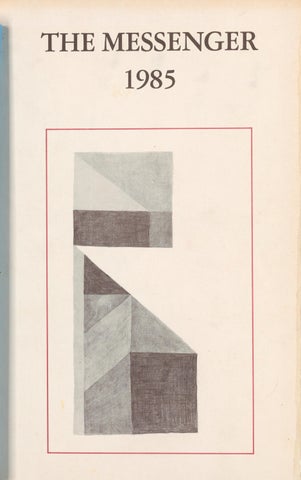
THE MESSENGER 1985
THE MESSENGER 1985 University of Richmond Literary Arts Magazine EDITOR-IN-CHIEF ASSOCIATE EDITOR ART DIRECTOR
Gregory A. Lawrence Susan D. Bland Elizabeth C. Alexander Jennifer E. Bostock
STAFF
Charles M. Dwight Tamera K. Erskine Theresa L. Gray D. Douglas Grider Janine M. Hummel
"Touches of Gray, # 1"
Catherine A. Patton
BACK COVER "Touches of Gray, #2"
Catherine A. Patton
COVER
Copyright 1985 by the University of Richmond
L
We gratefully acknowledge the financial assistance given us by the following people and organizations at the University of Richmond. E. Bruce Heilman F. Sheldon Wettack Thomas L. Reuschling Stephanie M. Bennett Jane S. Thorpe E. Claiborne Robins School of Business Student Government Westhampton College Student Government Richmond College Student Government The University of Richmond Board of Publications We also wish to thank those who gave us counsel during this project: Irby B. Brown Suzanne W. Jones Joyce B. MacAllister Herbert C. Peterson Welford D. Taylor and Evelyn S. Fouraker, who served as mentor, sounding-board and patient friend.
TABLE OF CONTENTS POETRY AD VERBIAGE, S.D. Bland
1
BLACK AND WHITE, M.A. Mahue
2
PNEUMONIA, N.J. Garnett
6
LONG, COLD NIGHT BEFOREMORN, D. Hughes
17
UNTITLED, S.A. Clark
18
1953, F.K. Cylke
19
REFLECTIONS ON BREECE PANCAKE, H. Ott
29
EARLYMORNING, J.M. Hummel
34
NATHAN AND ELLIOT, S.D. Bland
35
UNTITLED, M.A. Mahue
42
FOR TRICIA, J.M. Hummel
43
DEATH RIDES A PALE HORSE, A.H. Hershey
44
SORRY, J.M. Hummel
47
UNTITLED, J.E. Bostock
52
UNTITLED, M.A. Mahue
55
UNTITLED, A.J. Ford
56
VIEW FROM THIRD FLOOR WINDOW, H. Ott
57
THE FARMER, M.W. Bishop
58
FICTION TRAINS GONE BY, A.J. Ford
7
THE CHILD, E.J. Orloff
20
A SONG FOR SUSAN, R.M. Nelson
36
TUESDAY THE THIRD, W.A. Frye
45
"YOU'RE MY ROOMMATE?", S.D. Bland
53
ART CREDITS Michael L. Kerbow
4
Debra K. Mueller
5 30 31 32 33
William G. Holweger Catherine A. Patton Robert M. Cooper Michael L. Kerbow William G. Holweger T. Whitney Cox Debra K. Mueller Diane L. Barrett
48 49 50 51
Ad Verbiage Flashin' IMAGES- 30 seconds Do I hear 60? SOLD! To the housewife in the Midwest . WHITER, BRIGHTER, NEW , IMPROVED 36-24-38 HYPE! It's that time of day, aren't you glad you used Dial? Oh, what a feeling, I'm Sure, And just one calorie. You can't get me outta your head . Stay tuned, we're on a vertical roll. When will this vidiocy end? What am I doing to the children 's minds? What affair is that of mine? In nationwide testing, four out of five doctors Recommended survey That two out of three prefer Broiling over frying over any other leading brand Twice as much. You choose , you choose , you choose , You take it all in, Mindlessly, Endlessly , 24 hours a day, The children? They want me. Hey kids, tell Mom! I do nothing to their minds. It is they who mind nothing. It is better to give than to receive. And I do-For you -This one 's for you.
- Su san D. Bland
1
Black and White Eight girls decked out In trendy clothes And fourteen karat Orthodontic teeth Filed to the back of the bus As we passed St. Catherine's. A withered old black woman Limped to her seat On feet that danced A long time ago. Before we got to the next stop Her chin had dropped to her chest. We passed the pawn shops The grocery stores And the slimy bars Where men leaned on cars Or sat on the curb. And still the girls With clear skin And painted nails Giggled and squealed About last night's party Or tomorrow's date. More blacks got on, An old man Whose yellow eyes Peered out at The dirty buildings. And a girl So long and slim That every move was angular Like a cat.
2
The Debs would shout And laugh too loud But the blacks stared straight Only I turned to look. A little girl With black cotton hair Sat in front of me And growled. I growled back And we grinned. Her whole face was bright Like a doll Her eyes fluttered And her mouth Opened up half her face. When I left the bus I left the blacks In their seats Watching their world go by And the girls from St. Kat e's Screaming through it.
- Miche lle Mahu e
3
Pneumonia They took her late husband's black-brown wooden cigar box. (it had held a wet sponge on the top shelf to maintain the dampness of the fat stogies) and the freckled mirror, stained from age like her hands , now lays against puffed insulation. African violets that bloomed only in her south window are placed on the cold, white radiator by the west pane facing the brick nursing home wall. The afternoon fall beneath buckled knees and drained veins left her with twisted bones - joints that just don 't fit together. Marrow struggles in vain to regain the lost youth needed to mend the cracked enamel. She has me touch the moist, flabby arm: a knot, but no connection. Her hands ache for the clasp on a measuring cup for the kneading of warm, roll dough. She dreams of making lemon ice -her favorite -garnished with a 5 cent box of vanilla wafers. She yearns for an easy breath. A mist of dust collects on her shiny, black Bible opened to the twenty-third Psalm: "The Lord is my Shepherd; I shall not want ..." She lies in pink grace and waits for her mansion.
- Natalie]. Garnett
6
Trains Gone By It was cold in his apartment. The unseasonable heavy rains slammed hard against the window and jarred Parker from his sleep. He lay motionless on the bed, staring at the cracked ceiling which captured the distorted shadows and lights from the streets below. Water gushed through the aluminum gutters and spilled over onto Parker's window. Streams of water ran down the window; their shadows, across the ceiling. He waited until the water barely trickled through the aluminum piping and then rose from the bed. Already dressed in jeans and two heavy shirts, he put on his hiking boots and an old wool coat and opened the bedroom window. As he began to climb out onto the fire escape, his right leg slipped and fell between two iron bars. He grabbed a breath of apprehension and stood up again. The weight-operated fire escape lowered Parker to the cobblestone streets of the old section of town. He was chilled by the cold, now gentle night wind. His slow and pensive pace, though, was unaffected. Every street in the town of Whotin was lined with oak trees, trees bared of leaves by the fall winds and recent storms. He was headed toward the west end of town. As he walked he developed a slight limp. He had had this limp for twenty years--since he played pretend as a child. It returned easily whenever Parker wanted it to. A mile from his apartment, he turned left onto Shallow Creek Lane, the street on which he grew up. In the distance, he heard a trashcan fall over and roll against a curb . Its top spun slowly to a rest with a tinny sound. A cat screamed in annoyance at the trashcan, and a dog barked his response to the cat . Parker turned away from where the trashcan had fallen and walked on. Ahead, Parker saw a pair of headlights turn the corner and come towards him . His imagination was enlivened. His limp worsened, and he allowed his heart to pound with excitement. He imagined that the car was after him. He turned away from the blinding lights and tried to run to safety. The dog barked louder at the oncoming car. Parker's bad leg straggled obliquely behind. He could run only half a block. The car was right behind him . He jumped the metal fence of someone's yard and landed behind a line of bushes. "The car would not stop with me so close to a house," he thought. The 1974 black Continental Town Coupe continued down the road. Parker got up off the wet ground and looked down at his now muddy pants . He smiled. His limp was gone, and his thoughts began to turn to the events of the past week. It has been less than four days since the teachers' strike had begun, and, already, he was so thoroughly self-
7
reflective that he knew he would not be able to pull himself from the ensuing depression . At twenty-five, Parker knew he could not continue in the teaching career he had chosen for himself. Parker had become a teacher only a year after college. He was half a semester into his master's work when he was offered the job. Now, three years later, he had done very little work on his Master's degree and was not even putting his energy into teaching. As he walked down the main street of his old neighborhood, all he saw were the houses of his friends' parents, his friends having moved up to Washington, D.C. "Bobby," he thought, "whoops, he goes by Robert now. I haven't heard from him in two years. You make a man vicepresident of a state-wide plastics company and he's a totally different person. Hell, his mother hasn't even seen him; he 's only two hours away. What about Linda. Everybody thought she would be here forever. She was always the easiest girl in town, and everyone always thought she would stay that way." Parker kicked an empty soda can into a gutter. "Dammit, there's no reason for me to be so damn condescending. I should be proud of her for getting enough courage to go out an make herself someone. The night before she left, some jerk was beating up on her because she charged too much. She would have bit off a good chunk of his jewels if the police hadn 't showed up! Ohh! Hah, anyone that intense will certainly do well. Only one left in town is Steve Reilly, and he never comes out of his house. He sits in there and programs computers for a town he doesn 't even know anymore. 'All I want to do,' he once told me, 'is keep busy and stay in Whotin .' Well, he keeps busy all right. But he's no more a part of Whotin than I am." Just past Steve's house was Suzy's . As he walked toward it, he could hardly make himself think about her. He and Suzy had dated for almost six years. In high school they had planned to marry and both be teachers . She was the one who had always kept Parker interested in teaching. He had wanted to be a writer --fiction, essays, articles . She convinced him that teaching would be a perfect job to complement his work. However , he had always thought she would be there with him. After college, Suzy failed to be certified to teach, and she left for Washington to get a job. Originally, she was going to support both of them while Parker studied for his Masters . They lasted only half a year after she moved. Parker got over the relationship, in part. He even dated some other girls, but he was never able to renovate her old plan for his life. The last house on the block was his. When he had left his apartment he only half-thought he woul truly run away. He was sure now, as sure as he would ever be. He walked up to the porch of his parent 's house and
8
pulled the note from his pocket he had written almost a day ago. It read simply, "I'm safe. Love, Parker." He placed it between the door and the door knocker and walked down the steps of the porch. At the foot of the porch he looked at his wrist watch. He took it off and ran quickly up the steps. He hooked it on the top of the door knocker and left. Shallow Creek Lane ended a block past Parker's old house and was replaced by a dirt path leading to woods. He followed the path until he could no longer distinguish it from the surrounding weeds and leaves. He would soon pass Whotin Creek and climb the hill where the railroad tracks were. He guessed it to be about 5: 30. The freight train with the empty cars, waiting to be filled with coal from the mountains, would be by before 6:00. Parker knew the early morning whistle well. It never really was a whistle, though. It was more like the horns ships used in fog. The horn's echo would reach Parker whether he was in bed in his parents ' house or in his apartment. The sound would always resonate in his ear for minutes after the train had passed. Run and jump . That's all I need to do. Parker stayed at the edge of the woods so as not to be seen. Then, after the two engines had passed he started to run. The train was traveling about twenty miles per hour. His stride increased until it was as wide as the distance between the railroad ties. When he felt he had gained enough speed, he reached out for the metal rung of the ladder on a black and yellow boxcar. He grabbed hold and pushed off the ground, away from the car so he would not be sucked under. His lanky body snapped like a whip away from the train and then came back to the ladder. Satisfied with his stability, he breathed deeply and slowly exhaled. After a few seconds, he reached to his right to grab hold of the latch on the door to the boxcar. There was a small rim of metal for him to slide his feet across. As he came closer to the door, he dropped his hold on the ladder. The door, though , was too heavy for him to slide open in his position. He placed both hands on the latch and tried to use his right foot to push the door open. He pried the door open just enough for him to slide one arm in and then the rest of his body. Once inside, he walked to the front left corner of the empty car and sat down. Within minutes of listening to the clickety-clack of the train he was sound asleep. "Boy! Get ya' self up and outta me train." A large, hairy man stood in front of Parker and gave him a light kick in the side. "Boy! Get ya' self up." Parker was not sure if he was awake or not when he saw the powerful man looming above him. Parker inched back against the wall of the boxcar.
9
Slowly he pulled himself up, careful to stay as far in the corner as he could. "What d'ya' have for me, Boy?" The man's voice was as deep as a foghorn, but scratchy with the tar of 100,000 cigarettes. "I don't know what you want." Parker said. "Boy, there's only one thing Diggs ever wants." .Parker thought about that for a second. He only then realized that the train was still moving. He looked up at the roof and saw the small hole of a door through which this man had come. The hole hardly seemed large enough. "Boy!" "I don't have any money," Parker said. He had only five dollars and did not want to give it up. Parker looked up again and saw the sun high in the clear, blue sky. "Well Boy ya' better think of somethin' to give ole Diggs. Or I'll throw ya' out." Parker looked down from the sky and on to the door of the boxcar. Diggs walked over to it and easily slid it all the way open. "Boy, I'll take that coat of yaz and let ya' ride the train til the next stop." Parker did not say a word. Diggs walked back to his original spot. Parker, now standing erect, received the full force of the hot nasal air snorting down from the burly man. "I won't give you my coat." He picked up Parker with one hand and tried to pull off his coat with the other. Parker began to kick and yell. Diggs pushed his forearm into Parker's neck and kept him from yelling. Parker scrambled with his arms to free himself. Diggs answered by slamming the bony young man against the wall of the car. Diggs soon tired of trying to get the coat off Parker and dropped him to the floor. "Take off yaz coat, Boy!" Parker scrambled to the other end of the car, near the door. He put his hand to his throat to feel if there was damage. "Boy!" Parker stood straight against the door. "I won't give you the coat." The man walked right up to Parker and without warning swung a small lead pipe against Parker's collar bone. The force of the blow pushed him back, out the door of the boxcar. He flipped and fell on the side of a small hill and rolled against a tree. "Young fella, ya lookin' kinda helpless." A man about sixty years old leaned over and looked into Parker's reddened eyes. "Ya been out for
10
almost an hour. Ya keep nappin ' like this , and you'll never get to sleep tonight." "What?" "I said if you keep asleepin' in the daytime, ya won 't sleep at night. It's a medical fact." Parker rubbed his eyes and sat up to see more clearly who was telling him about medical facts. The old man had gray hair. He probably did not stand mor e than five and a half feet. His face was gentle, though it was covered with scruff . His eyes were a light blue. They looked as if their depth was endless. "Who are you?" 'Tm Riz , and you're hurt. " Riz looke at the right side of Parker 's neck. Parker tried to look at what Riz saw but couldn't see the deep , purple bruise extending down the collar bone . Instead, he reached up and began to feel -the area. It stung when he touched the bone. The muscles of the neck were sore. "Put ya hand down and let a profess 'nal look at it . Put ya hand down ...That's it ." "Come on , my neck is fine ." "Ya look like a college boy." "Yeah." "Well, then that 's all the more reason for me to be the doctor. Ya college boys are too stubborn to know anything worth anything--that's why y'ere in college." "Awwweeaa! That hurts , stop it ." "Oowwee! Yessirree , that's the spot . Ya got ya' self a good bump. Don 't ya worry, though. The bone just bruised , d'ain 't broken ." "Yeah, well just stop touching it." Riz continued to examine the collar bone but was more gentle. "So, who are ya?" "Oh. Ah . My name is ..." " .. .I didn 't ask ya what yaz name is. I asked ya who ya are." Parker did not think about what the man had just said . "Parker. Parker Wilson." "Parker. That's a name that don 't tell me a thing about ya--'cept maybe that ya borin '." "What? " "Parker. Par ...Ker. Nope! Can 't make nothin' excitin' outta that. " "What d'you mean you can 't make anything out of Parker. Parker 's my name. " "But I said I don 't want to know ya name. I asked who you were ... I'll start over. I'm Riz. Riz is who I is. I'm lucky 'cause Riz is also
11
my name. I got this name years ago. Riz is 'Sir ' spelled backwards. I'm Riz, Riz is who I is. Und 'stand? " "Yes, I guess. But why 'Sir' spelled backwards?" "Because many years ago I thought myself a 'Sir.' Trouble was other people thought me that, too. Then one day I started jumpin' trains. I hadn't really planned to, but I was quite good at it. I figured jumping trains was just about the op'sitest thing to a 'Sir.' We gotta give ya a name that says who ya is. Maybe if ya tell me what ya runnin ' away from I be able to make ya come up with somethin'? Wait, I take that back, don't tell me why ya runnin' away. And with a name like "Parker" ya better not tell me what ya do. It 's li'bel to be just as borin'.' ' "Wait a second. I'm not boring!." He tried to raise up higher but was stopped by the sharp pain in his neck . "Besides , I'm a teacher, and I'm not runnin' away." "Now I told ya' not to tell me what ya' do. I can 't be 'spected to come up with anythin' now ... With your job, I guess "Parker " is the best name for ya. Of course , if y'ere runnin 'away, then I'd be able to start fresh 'cause ya woun 't be the same." "Well, you're sorta right. I'm running away for awhile . I don 't need a new name, though ." "Well, young college boy, have it ya' way. I s'pect it 's probably better if ya come up with one ya' self." Parker got up off the ground and started to look around . The area was very hilly. He must have traveled for about six hours. Heading west, he figured he was in an Appalachian state . Parker came back to where the old man was sitting. "Excus e me, Riz . But where am I?" "Ya in Cumb'land , Maryland, young man. " "Cumberland? But I was sure I was on the train longer than that." Parker explained to Riz the type of train he had jumped. Th en , he told the old man how he was tossed from the train. Riz knew of ole Diggs. Every train jumper in the eastern states had come across a Diggs' train at least once. Evening came quickly and by seven , Riz had led Parker to a nearby camp. The camp was just east of the city. It was small- a couple plywood lean-to 's and a small tent . Parker and Riz were the only ones there, so they used the tent. They gathered some twigs and anything dry enough to burn and started a fire. By ten, all of Parker 's body was sore from the fall. His right leg was especially sore and didn't follow the rest of his body easily. For only the second time that week, sleep came easily to him.
12
The morning sun shone directly in Parker's eyes. He got right out of his dirt bed and saw the mass of bodies which had come during the night. He walked carefully among the bodies looking for Riz. Near the barely burning embers of last night's fire, he found Riz awake with his eyes staring right into Parker's. "Good mornin' young man without a name." He smiled. "Momin ' Riz. I just wanted to thank you for your help; I'll be going now." "Whoaa. Now just how do ya' 'spect to find ya way 'round, young man? Ya' been on ya' own for a day and all ya' got to show for it is pain 'n' bruises. Why don't ya' come in town and get somethin' to eat." "Well, that's where I planned to go." Parker began walking to the east. His body was sore and stiff, and the fall had made him favor his right leg. Riz got up off the ground and walked as fast as he could to catch up with Parker. Slowly, Riz got them both headed west towards the city, though he didn't bother telling Parker his mistake. On the way into Cumberland , Riz explained to Parker how he planned to get the money for food. Parker was more aware of Riz 's appearance today. He noticed that Riz always smiled. It was a full smile with small wrinkles around the mouth and eyes that made it sincere. Riz wore a dirty pair of work pants , a t-shirt with the "Keep On Truckin" ' logo on its front, a heavy chamois shirt and a long wool coat. The shirt and coat were open, however, because the weather was surprisingly warm. Wrapped in a belt and hanging from his waist were a pair of pants. As Parker and Riz reached the edge of the woods, just before the city, Riz stopped and unhooked the small pack. He unrolled it on the ground to reveal not only pants , but a well-pressed blue workshirt with "Bob" sown on the upper-left corner. In the right pants pocket was an old leather wallet. Riz changed into the shirt and pants and hid his old clothes. He held the thick leather wallet in his right hand and did not put it down again until nightfall. Riz walked quickly once on the streets of the town. He surveyed the area 's houses carefully and soon found the house which would pay for their breakfast. Parker watched with great interest, never mentioning the five dollars he had in his pocket. Riz walked behind the house. While Parker waited on the street, Riz crawled under the onestory house and shut off the gas. Carefully, he replaced the access panel and met Parker in the street. The plan was to wait twenty minutes and then knock on the door of the house pretending to be a repairman.
13
He
opened
the
wallet
and pulled out a card which read: Douglas Robertson Howe's Gas and Light 1435 Cumberland, MD. ( 301) 454-3600 This was not the only card in the wallet. There were at least a hundred. All were from different parts of the country, and all were different occupations. They walked up to the house together and said they were from the gas department. Parker was instructed to go inside and look over the stove and the furnace. In the meantime, Riz would turn the gas back on. At the end of twenty minutes, Riz explained the problem and billed the owner of the house a small service charge of ten dollars. He pulled from his back pocket a small receipt book and wrote out the bill. The money paid for two meals that day. Riz kept two dollars in the wallet. Riz and Parker stayed in Cumberland for another day. During that time they repeated the repair skit twice. Then, they both agreed it was time to move on. Riz hoped to go south and beat the cold weather. The strike was probably over by now, but Parker did not feel it was time to go back. He had grown to like Riz and figured he would follow him for at least a couple of weeks. On the second night, Riz had told Parker something that he could not get out of his head. He said there are two good reasons to run away. One is to take a break from what you are doing because you are losing control. For this reason you can run away only once. The other reason is to start over again. He warned Parker to know which reason was his. "If ya' don't," he said, "and it is the first, ya' got to start immediately or you'll always be runnin' away." They went through the woods and past the camp to the railroad tracks. It was almost 10:00 at night when they heard the whistle of the train and took cover in the brush. The train was loaded down with coal and moved very slowly. Three engine cars went by before they began to run. Riz went first. They both grabbed ladders on opposite ends of the same coal car. Riz was surprisingly agile, but still somewhat slow. Parker began to climb the iron ladder to find a place for the two of them to sit. As he climbed, he looked over at Riz. "Don't ya' be watchin' me, nameless," said Riz. "Watch what ya <loin'." 'Tm not nameless anymore," Parker yelled back. 'Tm just Parker, boring or not boring." Parker began to laugh. "What ya' laughin' 'bout, Mr. Parker?"
14
"I don't know. I'm just havin fun." Parker smiled and leaned back from the ladder with one arm extended. "Look, Riz, one hand! " He yelled to the old man. He bent his head back and looked at the moon. "Look how nice it is up there. Look at the moon. The moon, Riz." Parker tilted his up again and then glanced down at Riz. Riz was turned away from the train and looking up at the sky. Above his small frame on top of the coal, Parker saw a large dark shadow bending down towards the old man. "Riz ! Watch out." Riz looked over at Parker. "Beaut'ful it is, nameless ." Riz could not hear Parker. "Riz!" Diggs swung the small lead pipe at the back of Riz 's neck. Riz 's head fell between the rungs of the ladder. "No, you bastard!"Parker yelled. Riz 's legs were hooked at the knees around a rung of the ladder. His upper body fell back and his arms dragged and bounced along the gravel. His right arm fell beneath the steel wheels of the train and was torn off at the shoulder. The legs were pulled loose by the force of the train; the body flopped to the ground . Parker jumped from the top of the ladder and landed on the grass fifty yards from Riz's body. Riz was not dead ; the muscles of the shoulder without an arm were twitching the remaining bone and flesh. Parker knelt beside the torn and beaten body. Riz 's eyes were open, but the life once in them was being drowned by tears . After a few seconds, the shoulder stopped moving. A full smile of respect and love appeared on Parker's face. He picked up the body and walked back to camp. On the ground near the tracks there lay an open wallet. Around it for many yards were small calling cards.
The influence of the morning light could not rectify the hours which had just passed. Nor could the frosty dew of fall wash away the marks of fear and apprehension on Parker's face. He breathed deeply when he reached the camp. The air was cold, and it wheezed through his tired lungs . He ran his hand through his thick brown hair as he surveyed the campsite. In front of him, there stood a village of leanto 's with stiff, dirt-covered bodies scattered about as if they had been laid out for Vesuvius. Behind him, deeper in the woods and in a shallow grave, lay the lifeless body of Riz. Parker's eyes darted away from the men and towards the direction
15
of the tracks. Parker judged by the sun that there would be a train by soon. He had a lot to do. He would have a lot of writing to do. The first item was his resignation. Then , he would have to leave Whotin again for a short time or maybe even move to a new city. He walked slowly to the place his eyes had marked. Run and jump. - Andr ew]. Ford Winner : Short Story Division
16
Long, Cold Night Before Morn Dance upon false airs of unimaginative lines and let flow the ink of frustration Let the dam only trinkle with thoughts at the seam and relieve the mind with a false sense of elation. Poised like a venomous cobra at the ready or a runner awaiting the gun The plume awaits an inspiration divine as a seed, under snow, awaits sun. Serenity is tossed violently about in the mind like a skiff in the grasp of a storm Patiently enduring till the impending calm as a long, cold night before morn. Imprisoned by bindings of rational thought creativity strives to break free As "fancy's child" whose immortal hand flows smooth so should the process be. With bold arrogance one word is penned as the barriers of rationale fall Consistent with one man's emotions and thoughts the word is captured for all. Neither divine, nor genius in nature the word celebrates the circumstance of creation Dance not upon false airs of unimaginative lines instead upon those of elation.
- David Hughes
17
He treats her as a long-lost lover. Easily his tongue slips over her name, caressing each luscious syllable. He can picture her still , as he last saw her, as he stands before the vacuous class , pelting equations at vacant clear eyes. Classes come and go, students drift by or drown unnoticed , but she will never leave, never change, never die. She is at once his goddess and his possession, and he alone can summon her at will. Onl y he has obtained the secret to her existence .... as the class shuffles out , cautiously, almost imperceptibly , he utters her name: "Ammonia. " - Susan A. Clark
18
1953 Existential flip flop look at the silent bells of Sarna Harlem Ren i science , long silent Tea, yeah man dig that tea Tea, from my sordid past House rent parties yes we have poverty for you Escape, thru the blue smoke Fats Waller what a guy Men eating beans Fat Man , Little Boy, Trinity He's unemployed .
- Frank Kurt Cylke
19
The Child The phone rang at three in the morning. I picked up the receiver and said a groggy hello. "Hello, honey. Sorry to get you up in the middle of the night, but with the time difference, it's the only hour I can reach you." "That's all right. How's Egypt?" "Hot. And the deal's moving a little too slowly. These guys are shrewd." "So are you." "True." "When are you coming home?" "No telling. I have to proceed very carefully. You understand." "Yeah .. .I miss you." "I know you do. But business is business." "I know." "Well, I better let you get back to sleep. Just wanted to check in with you. Be a good girl." "I will...Bye." "Bye." I hung up the phone, and flicked on the nightstand light. "Be a good girl," he said. I hated that expression. Sometimes Jim made me feel too much like a child. I lit a cigarette and watched the smoke swirl up to the ceiling. I was wide awake now. Restless, I got out of bed and padded to the living room. It was my favorite room in the apartment. I looked around at the mahogany floors, white couch, oriental rugs and glass tables. A priceless oil painting hung above the marble fireplace, and a baby grand piano stood in the corner near the window with a view "only money could buy," as Jim put it. I sat down at the piano and started to play "Beautiful Dreamer." The sweet melody often made me cry. I felt very melancholy that night. Three in the morning and I was all alone. Yet even when Jim was home I was often lonely. His mind was always elsewhere, on his work. I sometimes wondered what I had given up by marrying him. Before I met Jim, I had been in love with Danny, a guy I'd met in college. It was a relationship that was natural and honest. We took all our classes together, made each other laugh. We cried together. Most of all we talked. He knew me better than anyone. Knew my dreams, and I knew his. "I want to be the best teacher possible," Danny had said. "I love being around kids, and they seem to respect me."
20
"I don't know what I want to do. I'm sort of floating through school, waiting to see what I'm really good at." "You could do lots of things. You could teach English. You always get "A's" on your papers." "Not me, Danny. I'm out to get rich. I want a big house, and I want to travel. Can't do that on a teacher's budget. I want to go places. I don't want to die and feel that life has passed me by." "You worry about money too much. But there's a price you pay for dreams like that, you know." "Oh really?" "Yeah, your soul." "Quit being so dramatic. Everyone wants money." "Not like you. You'd do anything to go in style." "Not true." "You'll see. You're a crazy mixed-up kid, Sara. And I love you." "I love you too. Now will you quit being so serious." "Why? I read you too well?" I loved Danny, but he could make me squirm sometimes because he'd always know what I was thinking. He was my refuge too, though, because he accepted me for all my faults. As easily as he could make me squirm, he could make me smile through a flood of tears. "C'mon, babe. A lot of people don't know what they want to do when they get out of school," he tried to confort me once. "You do. It's just not fair. I feel so lost," I wailed. "How can you be lost? Where are you right now?" "In your room." "With who?" "You," I sniffed. "And who am I?" "Danny." "What else?" I shrugged. "I'm your buddy. Your best friend ... the terrific guy who made love to you an hour ago. Now how can you possibly cry? Am I that bad?" "No."
"Say it with more feeling, more passion, like an hour ago." "Danny!" "Better ... but you still need some more feeling." "Stop it!" By now I was giggling. "A smile! See that, ladies and gentlemen. A smile." "You're crazy." "So are you."
21
As the end of senior year approached, I felt more and more lost. Danny was going to move on. He knew what he wanted to do. He was going to save the world one kid at a time. I was still floating, graduating with an English degree and no real hopes of putting it to use. At night I would make love to Danny, but I was far away. 'Tm losing you." "Why do you say that?" "I touch you and love you and it's great. Our bodies are made for each other. But when the loving 's done you're already a million miles away. Where are you, Sara?" "I don't know. Just trying to find me. Somewhere inside this mixedup kid, there 's a sane adult trying to get out." "I love you." "Love you too. Just wish I was as sure as you. You believe in all your causes and classes and people. I don 't know what to believe in." "Believe in me. Marry me, Sara." "You always bring that up at the worst times." "Is there ever a right time with you?" "Yeah, right in the middle of making love, in that instant where it all makes sense, and I'm sure you're the only person on earth who's perfect for me." His eyes flashed a hurt look at me and he turned to stare at the window. I looked at hi111and my eyes filled up with sorry, heavy tears . I couldn 't tell him that when the loving was done I was so far away because I realized I wanted no part of his simple, idealistic world. I wanted to go places. He was my best friend but I aspired to greater things. I looked around my perfect living room with a heavy heart. All I had aspired to had come to more loneliness in a big city penthouse , marriage to a man whose loving was every bit as distant as my own. After graduation, I moved back to my parents ' house in New York. Danny started teaching in Pennsylvania. We called frequently. Actually, nearly every day I called him , to cry and tell him how lost I felt. We visited each other every month or so, and I felt safe at those times, a little less lost. But I couldn 't bring myself to marry a teacher in a small, dreary Pennsylvania steel town. My calls to Danny became less frequent after I met Jim. I had gotten a decent-paying secretarial job for a consulting firm, while I tried to figure out what to do with the rest of my life. Jim was a top executive in the firm. I was supposed to work closely with him, and he asked me to lunch in order to get better
22
acquainted. We went to an expensive French restaurant, and he commanded my attention with stories of his travels and connections. I was impressed. Jim was thirteen years my senior, and seemed to know everyone and everything. He dressed impeccably, and spent money freely. We started eating dinner together several times a week. When Danny called he seemed so far away. So different. So boring. For once, I started to think I had a direction in life. A man like Jim could really take me places. My direction was up. After a month of dinners, I went to bed with Jim. The loving wasn't exciting. He didn't make me feel wild like Danny did. It was more restrained. But I no longer felt like I was floating. The next time Danny called I told him about the affair. Looking back, it was typical. I wanted so much to be an adult, and to have direction, but I didn't have the nerve or maturity to break up with Danny in person. "After all we've been through Sara, how could you? Honestly, how could you do this to me?" "All I want is to be happy. If I thought I could be happy married to you, I would do it in a minute. But I think this is what I want. I don't want to hurt you and I'm sorry." "Sorry? You betray my trust, and you're sorry?" "Please don't hate me. I couldn't handle this if you hated me." "I don't hate you. I'm furious with you, but I don't hate you. I feel...damn you, I don't know what to say. Do you love him?" "Danny ... l. .." "Do you love him? Answer me honestly, because I'll know if you're telling me a lie. You know that too." "God, I hate you for knowing me so well. I don't love him like I love you, but I think this is what I want. "You think? We agreed not to see other people unless we discussed it first. We may not be married but there was a real commitment there, at least on my part. We've been together for three years, and you throw that all to hell on something you're not sure of? Something you think you want? Do you want this man? Yes or no." "Yes." There was a long silence, and then he said, "Do you still have my phone number?" "Yes," I said, confused. "Don't throw it out." "I don't understand." "You'll be back, Babe. Maybe not for a while, but you'll be back because someday you'll realize that I love you more than anyone else possibly could."
23
"How can you love me after what I've done?" "I just do. You're like a child. You see this flashy new toy and you want it. But you 'II become bored with it someday. And when you do, I want you to call me." "But ..." "I love you, Sara." He hung up and I sat there stunned. I was afraid too, because I was convinced that he knew me better than I knew myself, and suddenly I did not have the confidence in my decision that I had had before our phone call. I felt like I had plunged head first into a deep, dark pool and I knew nothing about the currents. I was swimming directionless again. If my relationship with Jim did not work out, I was back where I had started from. Frightened, I became Jim's ideal woman. I did everything I thought he wanted, determined to marry the man. I dressed stylishly, wore my hair the way he liked it, never disagreed with him, and always seemed cheerful and happy. After several months, he proposed, and I readied myself to become the perfect bride and the perfect wife. I thought of Danny frequently in the months leading up to the wedding; however, I had rationalized my decision. I was traveling to Europe for my honeymoon, and I had made so many plans. Jim had given me free rein to redecorate the apartment. My parents adored Jim, and in his own way, I think Jim adored me. There wasn't any real passion, but my childlike acceptance of everything he did and said made him protective of me. He spoiled me. With all these positive aspects to the relationship, I reasoned that there was no guarantee I'd be any happier if I married Danny. Love was impractical in many respects. There was no proof that it would last a lifetime. And if it didn't, I'd have nothing to show for my life but a small Cape Cod house in a row of small Cape Cod houses, in a rotten Pennsylvania steel town I held no affection for. I went ahead with the marriage. In the weeks following the wedding, I was too busy to feel regrets. The honeymoon was idyllic, and I was pampered and cared for in Paris, London and Rome. When we returned to New York, I had gifts to sort out and an apartment to redecorate. Several weeks after our return from Europe, a package arrived from Danny. It was a wedding present for me. He sent a beautifully polished, hand-carved music box that played "Beautiful Dreamer" in bell-like tones. Danny always called me his dreamer, and knew I loved the song. My first regrets arrived with that package as well, because Jim would never know that music box was something I had wanted since I was a child. He would not ask such an impractical question and I probably wouldn't reveal the answer.
24
In the six years of my marriage, I had come to wonder if I really had sold my soul for so much money and a second home in Palm Beach. It was four in the morning. I went over to the music box on my antique rolltop desk and lifted the lid. Strains of "Beautiful Dreamer" brought tears to my eyes. I reached into the box and took out the piece of paper with Danny's telephone number and address on it. Inside there were also six Christmas cards and six birthday cards. We did keep in touch twice a year. He had never married, was still teaching in Pennsylvania, and still signed his cards "I love you." I had not spoken to Danny in the last six years. I think I was afraid of what might happen if I heard his voice. I thought of him when I was loving Jim though, and whenever I was lonely. But that night I needed to talk to him. After hours of internal arguments, I called Danny sometime after dawn. "Hello," a sleepy voice answered the phone. "Danny? ... This is Sara." "Jesus, Sara, are you okay?" "Yeah, fine." I still had no idea of what I was going to say, because I wasn't exactly sure why I so desperately needed to talk to him. "What time is it?" "Around six o'clock." "What's wrong? Are you in trouble?" "No . I was just thinking about you and wanted to hear your voice." "I'm shocked, to say the least." "I'm kind of surprised at myself too." "So, how've you been? God, it's been six years now." 'Tm doing all right...yourself?" "Okay." "Look, I'm sorry about waking you up like this ." "It's okay, really. I'm just surprised. Can't believe I'm talking to you." "I've missed you." "You know I've missed you." There was a silence for a few moments, and then he said,"Can I see you sometime? For old times sake?" ''I'd like that. Maybe you could take a train to New York this weekend." "Will that present a ...problem?" "Jim's in Egypt. And I really do want to see you ... for old times sake."
25
"Address the same?" "Yes." "See you Friday night." Hanging up, I was shocked at the simplicity of the conversation. Shocked that he'd come after all the hurt I'd caused him. For three days, my mood lifted. I was nervous, happy and excited, all at once. Friday, I had my hair done, took a long bath and spent the day getting ready. I wore a simple black angora sweater, a strand of pearls, and a gray wool skirt. When the doorbell rang, I jumped. At twenty-seven, I felt no more grown up than I had at twenty. All the sophistication I thought I had learned from Jim was forgotten as I threw open the door. "Danny!" We hugged and then stood back to look at each other. He had grown a beard, but .had still stayed lean and ruggedly handsome. "You look beautiful, Sara." As I showed him around the apartment, he looked angry, as if assessing what I had gained by giving him up. However, he said nothing. "Beautiful apartment. You've acquired impeccable taste." "Thank you. Have you eaten?" "Yes."
"Would you care for a drink then?" "Glass of wine if you have it." I opened up a vintage bottle of white wine. As I handed him his glass, I noticed him staring at my hand. I had on my engagement ring with its beautiful and large pear-shaped diamond, and a sapphire and diamond ring Jim had given me for our first anniversary. I was also wearing a matching bracelet. I suddenly wanted to hide these signs of wealth, to bury my hand in my pocket. I turned, and we looked out the window and sipped our drinks. We laughed about old times, and everything felt so natural. I found myself wishing I could have all the privilege of money plus the man I loved. My life would be complete, I thought, if Danny lived with me in the penthouse. "So, when's Jim returning?" "I don't know. He's away so often. Sometimes for weeks at a time." "Do you miss him?" "I miss having someone around to talk to. I hate being alone." "Why haven't you called me before now?" "I was afraid to."
26
"Afraid of me? Good ol' Danny?" He said with a boyish grin. "No, afraid of what would happen if I saw you again." "You know I still love you." He was inches away from me, and my heart was beating wildly. I felt like a teenager expecting her first kiss. When he did kiss me, I moaned softly, remembering how good it had been in school. We made love in Jim's and my brass bed, underneath soft blankets. It was better than it had been years ago, because it was like coming home again, warm and comforting. Jim was 40, and in great shape, but there wasn't any of the playfulness I had with Danny. Afterwards, I fell asleep contented. We spent Saturday like honeymoon lovers. I had never cheated on Jim, but this did not seem like an affair. Danny had been in my life first. I spent the day pretending I was married to Danny. I just blotted my true husband out of my mind. Saturday night, lying in bed, I said, "I wish you didn't have to go back tomorrow. I do love you so much." "Come back with me then." "You're always so simplistic." "Because the solutions to your problems are so simple. I've always loved you. You've loved me for years. We are meant to be together." "I can't just leave my life here." "Why not?" "Because I'm married. I've been married for six years." "No ... you're afraid of conflict. You couldn't even break up with me in person, you had to do it over the phone. It's not Jim you're afraid to leave either, it's the money you don't want to give up." I turned away. "Why do you love me so much?" "You are beautiful. We make perfect love together. And sometimes I feel like you can read my mind. We were so close in college, and no relationship since has even compared to us. You've set a wonderful, impossible standard in my life. I want to love you all the time." "But I hurt you so much, and you still came back to me this weekend." "I don't know, Sara. As childlike as you are, you're dangerous. Any man who loves you has to realize that like a child you don't stop to think of the consequences of your actions all the time." He stroked my hair, and rolled over to look me in the eye. ''I'm a simple man, Sara. I'm a teacher, and I basically lead a straight, boring life. You are my one vice. You're not bad, that's not what I mean. You are the one wild edge to my existence. You are the one thing I can't get out of my system. And I don't know why. I just wish you were leaving with me tomorrow."
27
"You're angry, aren't you?" "No, I do believe that deep down inside you really love me. I just wish you'd grow up." "Do you think I ever will?" "Yes, when you stop living for money and playthings and realize what's important in life." I sighed and we didn't say anything, and fell asleep. Sunday we ate breakfast in silence, and Danny got ready to leave. Finally, he stood with his bags packed, at the door, ready to leave. "Will you ever come back to visit me again?" "Not as another plaything. When you're ready to leave with me for good though, I'll come running. And I'll always be a phone call away if you ever need a friend to talk to." I nodded and hugged him. My loneliness was returning with intensity, and I started to cry. "Part of me wants to run away with you right now. But part of growing up means cleaning up after your mistakes and I can 't just write him a letter or call him and say it's over." I was shocked at the words I'd just spoken , but I realized I had known I had to say them all weekend. My affair with Danny had shown me what my life was missing. I was like a rich princess in an ivory tower, locked away with all of life's comforts but non e of the joys of its emotions . "You're leaving him? " "Yes. I didn 't even admit it to myself until now when I saw it was time to say good-bye to you again . I can 't lose you a second time ." "I love you." "I love you, too." I cried some more while he held me. "Promise you'll come when it's all over? " "You know I will," he said hoarsely. We held each other another moment and then he headed down to the elevator. "I'll be calling soon." I said to him as he walked down the hall. I shut the door and went over to the music box and opened the lid. It started playing "Beautiful Dreamer. " I was still crying , but looking around my perfect living room I sensed that even the view seemed cold and lonely without Danny, and I couldn't wait to leave.
- EricaJ. Orloff
28
Reflections on Breece Pancake Some folks like to make what's plain glamorous. A car up on cinderblocks in a front yard is the stuff of poetry to them. We don't do much of that where I come from. It eats at me to see those who do. I don't imagine dust ever stuck to the roof of their mouth. But they knock themselves out pourmg me tumblers full of their best bourbon while we stand talking fiction. We all think we're so smart. A kid I knew in high school had a tumor in his brain. "My mind hurts so bad," he'd said to me. "You mean your head?" "Uh uh ... my mind." My mind hurts too. The cancer ate his up. I think I'll put a gun to mine.
- Heather Ott
29
l
,.;
'~
-I'
;_,.,.tr*•~1:
~--•r 'JI ' ' ,,
,
,,..
j1'> --..~.,,.
,, .
,t 1t ,...,<1"1' ,v...,-.,.,..
---
-·
'.r, V ,1 I f• ,,AJJ•
i{
",
I t
fi
r
! \' 3il(i
( J. -I, ''ff ·,, '';
1
1
l
'l
''f ,),~1I
r
"".I
Ji f'
l' l,
'i'
td '/', ---,tf 1 -...... ~."'/1., I 'l , 1'(• (•''i I'\ ,y t ,.)ff)!, \('·)! ~. ~ f/
if . , ifl; l, f:i!~f, t) ... ,k,\';f ~ l,,fr'~\.,~,
, hf\
f
1.
~·
t¼''' ,,'
~.}f
I
1,c,•j·
,; -'
.
r
~
.... . (
\. \.
,,;~-;:,.;,,f
---
~ ._
/ ......_,"""'-\.
""-.; ,,
:J I
.... •
\ '
~-'
l't..*..
, ,; e Ji' I '1:.,, ; ✓ -"11
;.p-.., <c;f,.,1 .'
,.;1.,~t.-:...:,...,....,,....,.,..
--
/ ~q '}
I
)~
l
\
:,1,1/l 1tl; I
·r, I
)
I
◊
I
Early Morning Fat little hands take The TALKING CEREAL out of the closet Fat little hands dig down Inside For THE PRIZE. The cereal is
p 0
u R
E
D Down into the bowl. "Talk" screeches the GOLDEN HEAD. "Say something!!!" But all is quiet (sshh.) Fat little hands hit the bowl. It spirals to the floor. Broken ceramic slices The TALKING CEREAL's broken bodies. Now they talk . "Help!! " They yell. "Help us!!" Fat little hands and GOLDEN HEAD walk away.
- Janine M. Humm el
34
Nathan And Elliott Nathan and Elliott: Explorers The day: Cold, foggy. Not at all comforting, Not unlike all the days Since their arrival. In fact, _Elliott and Nathan swore, That had they not found each other, Existence wouldn't have been bearable. But -- the adventure: Blue eyes wide with anticipation, Nathan and Elliott looked at the steep incline, Into the still blackness above them. Elliott and Nathan looked at each other And both took a deep breath. Nathan and Elliott began their ascent, Around one obstacle, Over the next -If Elliott hadn't been there Nathan would never have made it, Being younger and less experienced. Elliott's shoe, suddenly loosening, Falling and crashing, Indeed disappearing, Into the black stillness below them, Made them think twice. Then shaking their heads, Determined to go on, Nathan and Elliott continued climbing. They made it, you know, to the fifth stair Before mother came and fetched them .
- Susan D. Bland
35
A Song For Susan Some ghosts are more amenable to recall than others. Some so resist the recall that they refuse to be disinterred , and all we can do is point to where they're buried , or where they 're encased in some scar tissue of memory, flies in amber laid. I cannot get this part into the present tense. I've tried, really I have, but it refuses to come wholly back. But there are pieces of it, enough of them to make me think it all happened . Here in the past tense , then, are some frozen fragments which have clustered about a ghost who refuses to be redeemed , fragments stilled it seems forever in their casings of amber adamance. Perhaps it is the adamance to recall of this ghost , whose name was Susan , which has by some strange self-extension petrified (as in the presence of some snakeless Medusa) the images which cluster about her whenever I press the memory of her hard enough. While this is not exactly another Bucknell story, it 's a story that puts, somehow, those other Bucknell stories in their final properest perspective; for the treeman , you see was in love: in love with the image of his newly white-helmeted self; in love with the rope and the belt which supported the self-image ; and in love past all redemption with his version of Susan Carroll Harrison. No doubt he should have kept these two love affairs separate, should never have presumed to try to conflate these two selves, the one who loved Susan and the one who loved the treeclimber. But of course he finally did try to have his two worlds at once. And that's when both Susan and Bucknell disappeared behind the scar tissue Ah, Susan. Dead to the world and to me now, then you seemed its essence. You completed the image; you were a man's woman. There was a time I thought you'd got out of my life, but then just about the time I'd resigned myself to seeing the world with you at its center you reentered it without permission or warning by sending that letter you sent. And of course I was rehooked by it, and by you. But I could still remember your voice then , and the uncanny glitter of your graygreen eyes, and the ferile downy texture of your arm along my cheek, and these traces obsessed me. And now in the summer of my first foreman year you were in Atlantic City holding down a meaningless job and , you said, as lonely as I. And from March, when you wrote, until June, this past-tensed present I'm now re-wrestling with , I thought of you constantly. A year before, when I'd heard you'd come back to town for a few days, I'd screwed up all my newfound treeclimber 's courage and
36
called you on the phone, and one Sunday I'd taken you out into the Caledonias to show you a place in the mountains I'd known you'd love too, a powerlined stretch of right-of-way, a place of glades and rockfalls and fern that was breathtakingly green, lush and damp and deserted. And on the way back we had stopped by a field of rye grass bordered by brush grown high and recumbent with wild rose vines; I knew what you saw there, and so I handed demure you three or four of those sweet wild roses, and I sat by the vines while you walked, wild corsage in your hands, slowly across the field away from me and then back to me in your light blue dress, momentarily tamed amberhaired kitten. Oh Susan. Why I ever let you just walk away into your house alone that night I'll never know, but in you went, suncolored summer dress and amber hair in the night, leaving me with the feel of your hair on my neck and that trace of your cologne redolence of muted spice, of sunshine and Polynesia and sandalwood perhaps - to haunt the emptiness you left when you left. And then you were gone, for a year. Oh Susan. And so when it turned out that you weren't through with me yet and you wrote that letter which shattered the equilibrium of my sophomore spring and put me back on the hook, Susan, I obliged my renewed need to see you again later that summer by announcing I was taking a long weekend during the upcoming two-week Bucknell stint, climb without me Friday, I'll be back Monday afternoon. All the way on the ride up to Bucknell they teased me about that and about my new white helmet, and really I didn't mind, Susan, I teased them back by saying I'd be climbing with caution this week, I'd be taking no new scars or ropeburns or bruises to Atlantic City with me, just save the big ones for when I get back. I must have been dazed by my own audacity and/or by the prospect of my coming journey perilous, too dazed to record any of that week for memory, because most of that week is lost now. As is most of that ambered weekend. Sorting through the rubble of my past in search of the broken fossils of that time, here's all that's now recoverable, flies in amber laid: Thursday afternoon: the rest of the crew's finishing up the day in the trees; I have gone into town, to a bank. Something to do with money - am I buying traveler's checks? - and studying busline schedules with the Trailways ticketseller. It will be a long trip, three or four changeovers en route, a three-hour layover somewhere Lancaster, perhaps; at any rate, an all-day sojourn; half a weekend to be spent just getting there. Friday night - no, Saturday morning, really: nearly 2:00 in the morning. Lugging my suitcase, I have walked the brick-walled half
37
mile from the bus stop in Atlantic City past active alleys and redlit all-night bars to the tawdry rooming house where Susan lives now. An old spectacled lady in a floppy housecoat has let me in, has grudgingly handed me a big copper key in exchange for a few days' rent, and as grudgingly has given out Susan 's room number. Top of the stairs and then to the right , end of the hall. I walk the poorly lit way to her door. It is late; perhaps I should wait until tomorrow morning; for several minutes I stand before that door wondering whether or not to knock. Defeated by my own timidity and by the heartless shabbiness of this place I give up and head back down the corridor to my own room, stow my suitcase, look over this room - devastating with its yellowish overhead bulb, yellow-andgreen flowerprint bedspread, single rickety chair, bedside lamp with stained shade and pullstring switch, single window with flaking white paint -and then go out of the room, back down the corridor to her door, pause, and knock, softly; then, after a few seconds, again, softly. It is a stupid thing to be doing. From the other side of the door comes the sound of sheets rustling, and after a moment Susan's sleepy voice, and a moment later I open the door. The room is dark, but the poor light of the hall shows me Susan's room in vague silhouette, done in blues and purples, surprisingly civilized by the girl-things on vanity table and on dresser beside bed; among them is the pink kitten I gave her out on the porch at Caledonia Lodge two years ago for her birthday (an echo of sadness - you understand, don't you Bob ? ) : she is propped up on one elbow now, not really awake but really there , here, oh Susan, hello stranger, seems like a mighty long time. It lasts just a moment, no touch no kiss just us in the darkness separating us, and then I'm telling her softly to go back to sleep, we'll talk in the morning, I'm just down the hall, and I pull the door to, head back to my room. Finally I fall asleep wreathed in fantasies of Susan, fall asleep still waiting for a knock on the door that never comes. For the rest, there are just still shots: s1ttmg out on the tarpapered terrace of the rooming house in the early morning, Susan beside me in a beach chair for a few minutes before she gets up to go somewhere for several hours ; breakfast alone in a diner across the street, gluey pancakes and underfried eggs; Susan's girlfriend , blackhaired and smelling of some overpoweringly sweetish perfume in the sunlight, escorting me to a friend's pad to while away the hours of Susan's absence (the friend, it turns out, a fat fag lying recumbent in his skivvies in his harlotish boudoir, all silk pillows and grease); an afternoon in there somewhere of us, out on the beach, lying side by side on our stomachs, heads on our own arms, talking slowly about something, perhaps about her future rich Air Force
38
husband in Philadelphia; an evening in there somewhere when I drop by at night where Susan is working as a ticket seller in a movie theater on the Broadwalk: Susan inside her glass booth, a light blue fluffy sweater draped over her otherwise bare shoulders, amber .haired kitten looking spectacularly, unattainably beautiful behind the translucent glass mottled by reflections of varicolored neon light . Oh Susan, I think I went in then to sit down and watch your movie (if I did, I've forgotten what it was about) to pass the time and to wait for you to slip in after you were through to fetch me. I think that was the night, last night there, when we walked from the theater down the Boardwalk and off towards the ocean in the breezy pellucid night, walked along the waterline's glittering bluewhite edge in bare feet while you talked quietly, and I listened, and things began to shatter and disintegrate inside me. There is this image then - maybe the only one of that time engraved too deeply in memory to need reconstruction or counterfeiting - involving me, sitting in the sand maybe twenty feet back from the water, and you, walking out on a jetty as though into the blueblack ocean itself, your back hardly discernible against your backdrop of rolling ocean and night sky. My senses are filled by that salt smell of oceans everywhere , my ears are buffeted by the snaking onshore winds that carry the sounds of the sea, folding and breaking and recoiling , shorewards. Though I can see you out there, I'm alone, as surely alone as I'll ever be, and it occurs to me then, and then again and again in those moments I'm watching you go out, out to the end of the jetty (why am I sitting here? Why don't I follow you out there, bring you back!) that this is, always has been, our story: Little Miss Life, a child of the sea, and the wanderer, son of the shore, touching only in the spindrift chaos where land must meet water and each must bruise the other. Later there is this moment when I'm holding you, just holding you, after you've come back from the edge of things and I've come out to meet you; and for now we're just standing there in the night and the wind and the rush of things, your hands tucked up for warmth against your throat and my chest and your head of soft amber hair pillowed between my cheek and shoulder, hair smelling even in the wind · as always of muted spice - Polynesia, perhaps, and sandalwood - as wordlessly I cradle you, Susan, as I hold you quietly, quietly at last. Of the ride back to Bucknell and of the week that followed I can remember only walking into the empty campus soda shop the morning I got back, sitting in that deserted place drinking out of a cup of root beer and ice and looking vaguely forward to the afternoon and the rest of the crew's return from Chambersburg. I remember considering seriously just going to the truck and hauling
39
out my gear and spending the rest of the morning doing trees. I want to hide somewhere from these past three days which have left me shaken and feeling helpless, bumbling and inept; I need badly to reestablish some sense of calm control over things . I want to lose myself among all those trees out there , I want the familiar feel of climbing boots on my feet and a saddle around my waist and a rope in my hands already going soft after three days' disuse. And still I sit there , memories of Susan clinging to me like stinging nettle tentacles and leaving me numb but not numb enough to be oblivious to the pain and the swelling I'm nowhere near recovered from . A scared, psychologically fatigued young man very hungry for self-reassurance is what I am. Save for one other image, those two weeks at Bucknell are all like that: a smear of impressions shored up by a small handful of fragmented, disconnected images. Just one more image to go, and then I'm done with this ghost. Oh Susan. A fly in amber laid: A hot dry afternoon near the end of the first week at Bucknell that year; I one of five Bartlett men here , all of us white helmets . A rare crew enjoying a rare dry week in June, good weather for treework. This morning I played around in the poplar maples out by the golf course while Rip and Goof were taking down the dead trees near the center of campus, and this afternoon , an hour or so before I will hang it up and go into town to the bank and the bus station before closing time, I'm following up behind them with nothing but a powersaw, bucking up the dropped trees and tangled masses of topped-out limbs into firewood-sized logs. I want no ropework this afternoon ; my gear's already stowed for the weekend aboard the truck , and already I'm moony with anticipation of the coming weekend - foggy-headed with thoughts of you, Susan following my powersaw through the tangles of brush and the anteaten trunks of dead trees . And now I find myself working on a downed tree the likes of which I've never seen before; its bark makes it look something like a white oak, and that 's what I indifferently suppose it is until, somewhere behind me or underneath the bright hot gassy smell of the straining powersaw, comes this faint odor, too faint to identify consciously but nonetheles s electrifyingly rich in its evocations of you, Susan, and I'm stunned for a moment by the overwhelming sense of your presence here at the deserted center of the Bucknell campus . And I switch off the powersaw and, carefully, hunt about the shattered limbs on the ground around me for the source of these intimations of you. And the source is the wood itself. I smell it now, Susan : that spicy pungency, dim but distant
40
across the years. It is the odor of nutmeg wood, wood bruised by the fall of the tree or heated and vaporized by the powersaw blade. Each log cut yields a little mound of sawdust, and I find myself pausing frequently in my cutting to scoop up a double handful of this soft dry sawdust and bring it close to my face and close my eyes and inhale, and sure enough in there somewhere is a part of you, Susan, redolence of muted spice, of sunshine and Polynesia and perhaps sandalwood. And it almost breaks my heart again, Susan, to think that now, after seventeen years, I can recall this dead tree so clearly but can conjure no such clear and convincing image of the only reason it ever mattered. - Robert M. Nelson
41
Oh you sullen blacks So life has dealt you A sorry hand. ( Could I see your public aid card , please?) You look around And see what money Could buy. But it's beans for dinner, And your baby Had to quit school To have a child Of her own . You live nailed To a grey block wall In the projects Where the stairs Lead nowhere Worth going. (If you have no phone , is there anywhere we can reach you?) Nope. (It shows here that you have a past balance.) Nope. Shake your head again. Suck your pink thumb Like the sweetest candy. They said the green card Would take care of it. Oh you sullen blacks Squinting at Life's bitter taste. Swallow hard, It 's a long walk From Eden.
- Michele A. Mah ue
42
For Tricia On star filled nights I think of you And feel that I need to talk to you and no one else. When you cried Your blistering pain Burnt my skin Your scars are mine Still. On windy grey nights I think of you; Of the oceans of tears we shared, The enveloping down-filled Blankets of thought We wrapped around us When cold seared our bones. You are you and I am I But we were once us, Together. On sunny humid days When air hangs so still Around my sweating body I think of you; Of the days when we acted out Our joys and fears in the deep wood , Still water, So dark and clear and blue, Rejoicing as we splashed, Destroying its serenity. On foggy rain filled days I think of you. As I walk down an empty, water stained road I wish for your presence. Stagnant puddles reflect your face Smiling at me, Urging me to live life to the fullest, To try not to think back to the days When we were us.
- Janine M . Hummel
43
a .l
Death Rides A Pale Horse Death riding on his pale horse, visits all with his blade raised high. There exists nothing to stop his force. With a downward stroke he casts the die, and in the final toss we all must pay, For riding the winds of time, he spares no man, not even I. He has not a favorite time, nor season. He rides at will and reaps his rye, which is man his favorite prey. For men profess such greatness that he must show us that no one is greater than He. I see a pale horse ...
- Andrew H. Hershey
44
Tuesday the Third The dry buzzing of an alarm clock rasped across the cold room . John awoke, shivering; he quickly switched off the clock and headed for the bathroom. By the time he finished washing and shaving, the water was almost warm . After half a teaspoon of instant coffee, mixed with lukewarm tap water, and two slices of week-old white bread, John looked for his coat. Beneath the Armysurplus jacket, he found his wool cap. On the way to the bus stop, the clouds promised more rain, maybe even snow. The bus was empty, except for the old woman who sat in the first seat directly behind the driver; she was in the same seat every morning. John wondered where she came from and why she never spoke. He had noticed the people who got on the bus at other stops never sat with her. After his second transfer , John could smell the heart of the city; more automobiles and less trash. At quarter to eight, he left the bus and walked the last two blocks to the parking lot where he worked. Two cars were waiting for him to lower the chain across the entry. They both had monthly stickers and should have known he didn't open until eight. The business man who drove a red Volvo rolled down his window and stopped as he came by. "Good morning." "Morning, Sir." "When will they let me buy my sticker from you, instead of having to mail in my fee ahead of time?" "I couldn't say," John replied, "told the manager and he said it was against policy." "Ask him again, if you get a chance." ''I'll do that, sir." The red Volvo slipped into gear and headed for the far end of the lot. The radio in his booth played the same songs again as the regular customers slipped into their regular parking spots and the cold sky began to drizzle. Most of the drivers didn't even notice that the attendant was there. Soon, women from the suburbs and businessmen from out of town began to trickle into his remaining spaces. Most took the little parking slip without a word as they hurried off to an urgent appointment or important sale. When they came back, John took their three or four dollars, added them to the slowly swelling wad of bills in his pocket and waited for someone else to fill the small void in his crowded lot. A little after three, the blue van pulled up next to his booth; the manager asked if he had had any problems. "No, sir." was the quiet reply.
45
The manager took most of John's cash and drove on to the next lot on his route. By half past five, only a few cars were left; John guessed they belonged to businessmen on a trip or at a late meeting. The manager came again, just after six. "Fred called in," the manager said, "he missed his bus and will be late." "That's O.K." "I'll take in what you have now and when Fred gets here you can have him take care of the rest of your money." "Yes, sir. Good night, sir." "Good night, John; hope you don't mind working late." "No problem." Fred walked up about seven; John gave him the cash and headed for the bus stop. The light rain was slowly turning to sleet while John stared out at the lights of the city, blurred by the dirty slush on the bus window. He stopped at the Seven-Eleven to buy a package of bologna, a Butterfinger and two beers; dinner. At his apartment , he wrung out his cap and hung his coat to dry. John tuned his radio to the "All News, All The Time" station while he ate. Somewhere , a plane had crashed, no survivors. In the Middle East, one Arab had shot another Arab and the Israelis were upset about it. In Washington, the government had decided to spend some money on a program to develop a program to do something. John shut off the radio. "At least my bus didn't slide on the ice and crash." Just before he climbed into bed, the telephone began to ring. "Hello?" "Hi, John." The voice on the line was faint, muted by static, but it was definitely a woman. "How are you?" 'Tm fine, are you still working at the parking lot?" "Yes, but I'm thinking about looking for a new job. How are your kids?" "You said you were going to get a new job last year. Billy and Kim are fine. Johnny had pneumonia but he's all right now. When are you going to come visit? You still haven't been to see mother's grave." ''I'll come when I get enough saved up, maybe when I get a new job." "I understand. Take care of yourself .... Johnny?" "Yes?" "Happy Birthday." "Thank you." "Oh, well, I've got to go, call me soon, O.K.?." "O.K., goodbye." - W Andrew Frye
46
Sorry I always seem to be apologizing for something Whether it's just for the fact that you had a bad day (As if it were my fault that you were rained on) Or because you didn't want mayonnaise on your sandwich Or you really hated the movie we just saw I say i'm sorry When you stub your toe As if I'm the dresser into which you hit I say it when you're bored And when you feel tired As if I wish I could give you a down comforter and pillow To sleep with Do you think I wish I could? I say i'm sorry When I don't like the music you like And when I haven 't read a book you are fond of I blurt i'm sorry if you comment on the color of my socks whether or not you were only commenting Maybe I just want to cover myself from you To become an extension of you I can be a good chameleon This way you'll think we're Made for each other I'd never admit to you of all people How I feel when you stub your toe To be honest I don't know if I care i'm sorry Do you think I'm being honest now i'm sorry.
- Janine M. Hummel Winner: Poetry Division
47
-,
purple people and shirtless woman no one digs their toenails anymore below that dirt though damnit you superficial new wave babies where 's your mind or don't you use it? neon colors don 't clothe your individuality they shelter and forbid it to really think oh you mindless wimps who conform to that thought be a person manor woman but be it with life because when you 're dead you'll regret you 've lived for you shall find you 've been dead all along
- Jennif er E. B ostock
52
"You're My Roommate?" The Roommate Questionnaire . Remember? One of the millions of forms sent to you after you had been accepted but long before you got to college. I remember, as a Senior in High School, Everything was so Important. "Everything you do affects your future!" So, The Lifestyle Report became Important, too. After all, it would decide my first-whole-year-at-college-roommate. But the possible answer choices left alot to be desired . Frustrated, I wrote my own report to see if I could do any better . Now, as a Senior in College when Everything I do is Important again, (we are talking about the future here) I offer my satire as a reminder that no Report can guarantee happiness but being able to laugh during the critical moments just might.
Lifestyle Report 1. Do you smoke? a. Yes, like a chimney. b. No, I am overcome by matches, incense and candles. 2. Do you object to others smoking? a. Yes, except in other states. b. No, my clothes have no meaning for me, I consider burn marks a symbol of being "cool." 3. How concerned are you with keeping your room neat and orderly? a. Must be able to eat off of the floor. b. Have a phobia of dirty laundry. c. Utter chaos is okay. d. Not afraid of being condemned. 4. What sleep schedule would you like your roommate to follow? a. Prefer one who annoys roosters (6 p.m. to 4 a.m.) b. "Normal" schedule . (9 p.m. to 6 a.m.) c. Prefer an insomniac who is afraid of the dark. ( -p.m. to -a.m.) 5. Do you like to study with music playing? a. Live, in-room concerts by the Grateful Dead. b. Roommate practicing first year instruments is acceptable. c. Plan to sound-proof room. d. Plan to communicate in sign language only.
53
6. Do you want your roommate to be: a. your best friend. b. your mother. c. fond of practical jokes. d. psychopathic/deranged. 7. In terms of gregariousness and socializing , do you prefer: a. Someone unable to shut up. b. Someone who brings home strays, addicts and runaways. c. An introvert who is unable to make eye contact. d. A hermit. 8. Concerning artistic interests (music ,drama) do you want a roommate who is: a. dedicated to the exclusion of all other conversation. b. extremely aware of how talented she is. c. a Happy Days reruns fan. d. under the impression that art is a guy. 9. Concerning athletics , do you want a roommate who is: a. an Olympic hopeful. b. into contact sports. c. a Phys. Ed. major. d. a World Chess Master. 10. How would you feel about your roommate having a guest of the opposite sex in the room at a late hour? a. I would consider it a threat to my reputation / purity. b. Unwanted. c. Jealous. d. Bring two. 11. Do you sleep:
a. in a tropical jungle setting. b. with the windows open regardless of weather. c. hanging upside down. d. with anyone. 12. What views would you prefer your roommate have on alcohol use? a. The Mormons are too tolerant. b. Drinking is for the maladjusted lower classes. c. Continuously and copiously. d. Double vision, memory loss and hatred of loud noises. e. Must believe that coffee, a shower or a long drive will sober you up. - Susan D. Bland
54
Through bright blue eyes Sparkled something very young. Even though the wrinkled skin Lay in folds on his face And his belly sagged Over his shorts, Something twinkled in his eyes. Memories of pretty girls And dark wartime bars He recalled In happy stories. The crinkled brow twisted Under a film of silver hair. So many books read, So many more to read. A mind stored to infinity With causes and cures Spewed out facts and figures Wide-eyed in an earnest voice, Sounding quite sorry There wasn't more he could do. He sipped his beer And chewed his cigar. Wet blue eyes Stared off in space And a soft voice Told the story Of how his only son, So young and strong, Didn't wake up one morning. How his father found him Blue on one side. His watery blue eyes blinked And he put down his cigar. Joking about his Butterfinger habit, He fumbled through his bag Hoping to find some lost time Before life had to hurt. Before war blew young men apart. Before boys died in their sleep. Before he had to see it.
- Michelle A. Mahue
55
Storm at Sea gulls free to leave. Flying onward, backwards with ease. Sustenence, enough to stay. Spirit to return. Terms of life beginning with The Sea.
- Andrew]. Ford
56
View From Third Floor Window We talk of newspaper headlines and point with scepters to chalked truths on black slate. The real miracle is the child (with fluff for hair) teeter-tottering outside of my window. His wobbly survey of the lawn, his careless examination of a daffodil has me dizzy and absorbed. Lying in the grass my face deep in clover he just towers over me. Imagine my delight at touching his tiny toes.
- Heather Ott
57
The Farmer Stands straight under the dim lights. (The air around him is wet and warm with cows) A smile wrinkles his face when I show him my new Nikon. Turning back to his work, His hands move confidently Among the black and white Drooping udders. When my task is finished, he pauses And wipes his hands carefully before shaking mine. His grip is firm, But coaxes only perspiration from my pinkish hand.
-Martin W Bishop
58
UNIVERSITY OF RICHMOND LITERARY ARTS MAGAZINE __