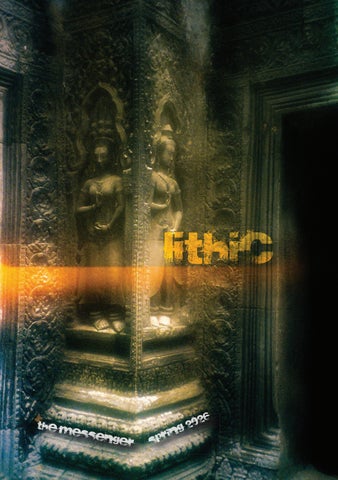
Lithic
the m
esse
nger
rin
sp
26
0 g2
About the Publication The objective of The Messenger is to encourage the appreciation and exploration of the creative arts on the University of Richmond campus. Since 1876, The Messenger has celebrated student work by publishing submissions in a literary and visual arts magazine. More information on the magazine, as well as past publications since 1987, can be found on messengerur.wordpress.com.
Acknowledgements The Messenger staff would like to thank Dr. David Stevens for his continued support and guidance as our faculty sponsor. We are also grateful for the University of Richmond’s English and Visual and Media Arts Practice departments, who continually encourage students to create and submit their works, and the authors and artists who never fail to amaze us with their talent. Finally, we would like to thank our readers for their interest in our magazine. Without you all, we wouldn’t have this publication.
Staff Co-Editors-in-Chief Julia Abcug Will Sheets Assistant Editor Helen Mei Treasurer Reece Steidle Social Media Chair Jessy Taylor Poetry and Prose Editors Virginia Thompson Amy Ogle Neve Naktin Allison Miller Marcela Pizzato Kevin Liu Lily Hamlin Elizabeth Cocchiarale Fairouz Bsharat Art and Design Editors Olivia Park Alice Wu Hillery Wynn
Letter from the Editors The word “lithic” is an old one, imported and anglicised from Greek. It relates to stones: the pebbles scattered in parking lots, the ancient stone of snowcapped mountains, the red brick that characterizes our campus. Try to remember the last time you held a stone — pick one up now if you can. Feel the heft of it, the way it sits heavy in your hand. Look at its striations, notice its facets and imperfections, trace its smooth faces and sharp edges. You will quickly see that the simple stone you’re holding is dynamic, layered, and complex. The pieces featured in this issue of The Messenger made us see the same qualities. These works are unafraid to explore their own depths, happy to embrace and display their complexities. They bear their striations proudly in moments of gravity and humor. We found in all these pieces a distinct and lasting impact, moments of mountainous importance, and ideas that demand we feel their weight. This magazine is born from the talent and passion of a small campus community. However, The Messenger is far from, and has never been, monolithic. One of the greatest joys that comes from crafting this magazine is interacting with the myriad of unique voices, ideas, and styles that come from all corners of our community. These pieces, and the writers and artists behind them, are in equal parts thoughtful, creative, brave, funny, and so much more. These are the textures of our community and the variations that allow this magazine to be what it is. We hope, as you read and view these fantastic pieces, you can feel the weight of them and see the wonderful and varied striations that make our community as personal and individual as the smallest pebble, the oldest mountain, or the stone in your hand. Warmly, Will and Julia Co-Editors-in-Chief
Award Winners The Margaret Haley Carpenter Award for Poetry This award is presented to a student who has had an outstanding poem submitted for publication in The Messenger. The winner is chosen by a panel of English faculty members.
Satan and I Coexist in a Town by the Sea Marcela Pizzato
Honorable Mentions Seeking Motherly Advice Fairouz Bsharat
And You Just Can’t Get it Out! Virginia Thompson
Ballad of Baikonur Jeffrey Yao
The Margaret Owen Finck Award for Creative Writing This award is presented to a student who has had an outstanding creative work submitted for publication in The Messenger. The winner is chosen by a panel of English faculty members.
Dwarf Plecos and Other Indoor Fish Jessy Taylor
Honorable Mentions Loony for Boomwhackers Maddox Lowe
Splatterpaint
Virginia Thompson
A Toe Story Kevin Liu
Green Grass of Tunnel Jeffrey Yao
Sporadic wildings Up-hanging-side down Slip/seep/sleeping, in/out/back, into, O, distance Drizzl’afte’rain The day after tomorrow Mud of appropriate measure steals into a flowing morning The body as vocation Becoming be eternity Hyper-intermittentational-override o, my forever spring O, her forever spring March toward boundless, en-blast, far-flung horizon O, now, our everlasting spring All Hail Resurrection! Brand-new, the subject They who gather the scattered springs, summers autumns and winters, / elsewhere withered—
1
The wind of the mass happens Strumming me, limpid; The air passage, lucid, fresh, swept O sweep, clean Concussive wintersweet Aflame! Aflame! Die down towards a euphoric spring My dear early spring Occasional wildlings: Once have had// could/would come yes, another, an attempt Let us, again from here — I do love you all
2
Reflect
Reese Abromavage
3
Outlast
Lily Nipper 4
5
6
A Toe Story Kevin Liu
When I got home one day from work, there was a six-foot toe in my living room. Yes, a six-foot toe. It wasn’t horrific and there was no blood. It was just on the couch, snug against the armrest beneath the reading lamp, and that was all there was to it. For some reason, my first instinct was to check if I had walked into the wrong apartment. But everything about the place—the setup of the kitchen, the DVDs and books—all suggested this was my apartment, and mine only, since Cora had moved out the week before. It was also a weekday, so I didn’t have any drinks before coming home. I quickly shut the door, hoping no one saw and thought I had a toe-collecting hobby. Was I drugged? It didn’t feel like it. I set my keys down on the counter and inspected the thing more closely. In terms of appearance, it was neither fat nor skinny, light nor dark. It had no hair to speak of and was well-manicured, all of which made it difficult to make out the toe owner’s gender and ethnicity. It was as though someone took the most generic idea of a toe and made it real rather than bringing to life a toe that belonged to a specific person. After staring at it for a while, I decided to leave it alone. Maybe it would disappear by tomorrow. Perhaps I had overworked and this was my brain’s way of saying it was time to rest. If it was still here by then, I would go and see a doctor. Yes, that was it. As I went to turn off the lights, however, the toe floated into the kitchen and poured itself a glass of water. Then it sat on the couch and drank it. Drinking was probably the wrong word, since it didn’t have a mouth. The water simply rose out of the glass and vanished in the air, as though dumped into an invisible pocket. The glass hovered too, like it was held by an invisible hand. After it finished, the toe faced me. “It’s you.” I was startled to hear it speak. “Me?” “You’re the one who dreamt me.” I tried to recall my dreams lately, but none of them featured a six-foot toe. I was sure of it. “Don’t worry if you forgot,” it said. “It’s a normal thing for people to forget their dreams. They might remember the feeling, but they’ll forget the content. That’s how it works.” As confused as I was, I disagreed because I tended to remember my dreams. Yesterday I had one of Cora burning breakfast in the kitchen. But then I woke up and realized nothing was burning. 7
“I don’t care about the dream. I want to know what a six-foot toe is doing in my apartment.” “Believe me, I’m as confused as you,” it said. “Last thing I remember, I was making dinner and my vision got cloudy. When I looked up, I was here. In the real world.” It proceeded to tell me, in fact, the “fake world” was my subconscious, and there was a whole society back there populated by things I had dreamed of over the years. Things that, afterwards, reappeared as actors in more dreams. “Dreams are like plays that happen in your mind. But unlike real life, everything in a dream’s an actor. If you dream of a werewolf, that’s a real werewolf living in your subconscious. If you dream of a wardrobe, same thing. The wardrobe’s probably got a family in a townhouse somewhere. In other words, even inanimate objects are actors in your subconscious,” it said. I massaged my temples and lowered my head. I had a vague understanding that different dreams meant different things. A dream about falling, for instance, could mean the person was stressed. But what about a dream about a toe? Some part of me wasn’t interested in finding out. “Look,” I said. “It’s late and I just got back from work. I should be in bed, trying to fall asleep. I don’t care if you’re from my subconscious. Please leave or stay quiet because I don’t want to deal with you right now.” The toe, though, didn’t seem to understand and went on to tell me about my dream. “It takes place in this apartment and begins with you standing in the doorway of the bedroom.” It made a motion towards the hall where the room was. “And you see your wife trimming her nails on the bed. I sighed and rubbed the bridge of my nose. “My wife?” “Yes. A wife you’re having domestic issues with,” it said. “At one point, the fights get so stormy she visits a fortune teller to find out if you two are going to last. The teller instructs her to watch out for an unevenness on her toenails. If pits appear, it means you—her husband—are cheating. Later, she takes off her socks and notices exactly what the teller described. Pits. So now she’s trimming her nails all the way off to get rid of them. Which leaves you, standing in the doorway, stunned and confused, because you didn’t cheat, and you can’t see the connection between toenail texture and infidelity.” “This is too much,” I said, and made my way to the bedroom. “Wait. It’s getting good.” But I ignored it and closed the door. Eventually the knocking stopped, yet I 8
couldn’t fall asleep. The image of a six-foot toe lingered in my mind, like scraps of food in a sink. I turned myself in all sorts of ways, wrapping the sheets around me, but sleep wouldn’t come. After forty minutes, I tiptoed out of the room in hopes that it was gone, but it wasn’t. It was on the couch, and a book hovered in front of it. Pages turned by themselves. “Welcome back,” it said. I rubbed my face. It was two in the morning. “What will it take for you to leave?” The book snapped shut and fell to the floor. “I’ve been thinking about it. Since I’m from your subconscious, the fact that I’m here must mean something’s wrong with your psyche. The division between reality and dreams is usually defined, like a chalked line on a blackboard. At one point, somebody must have smudged it, leaving a gap. We need to find that gap and restore it. That should put me back where I belong.” I nodded slowly. None of this was making any sense. “Will knowing the dream help?” I asked. “It shouldn’t hurt.” I massaged my temples. Somehow, the toe took this as a sign to continue ranting about the dream. “So, you’re in the bedroom, and your wife accuses you of cheating. You tell her she shouldn’t listen to some scammer fortune teller, but she ignores you. She flips the room upside down, going through your stuff. Bags, drawers, your messages. And when she can’t find anything she buries her head into a pillow and cries, as though not finding anything is in itself a confirmation,” it said. “Later that night, as you lie on the couch because she won’t let you in bed, you picture a toe and an eraser dabbing away the pits, like in Photoshop. But the dream gets hazy before the erasing finishes, and you never see the end of it.” The toe paused, and the room got quiet. I heard my neighbor’s TV switch on, but the volume was too dim for me to tell what they were watching. Was this also a dream? I wasn’t sure. I pinched the side of my leg, which didn’t do anything but hurt. Outside the windows, the sound of an ambulance emerged and faded away. “So you’re the toe I pictured?” I asked. “That’s right.” If it had arms, it might have accompanied that response with a proud sweeping gesture, like showing off a new outfit. “What does my wife look like?” 9
“Straight hair. Slight tan. Big eyes but small hands. Like, baby small.” I listened to this description and noted it was totally unlike Cora, who had big hands and curls. There were many photos of her around the apartment I hadn’t had the chance to put away, but it didn’t seem like the toe noticed them. After a while, the neighbors quit the TV and went for a shower, which for some reason caused a part of my ceiling to leak. There was a bucket on the counter for that, but I didn’t feel like getting up for it. The toe continued talking about its life in my subconscious. It lived an uncomplicated one. Small apartment, no roommates, and its hobbies were reading and cooking. Often, it made dinner and invited its cohort over, comprised of a coffee mug, a fish, a keyboard, and a kid. Out of the five of them, I did remember dreaming of the keyboard. It was going to be Cora’s birthday and I couldn’t figure out what to get her, but the idea came to me in a dream. I was at Best Buy and was looking for a keyboard. When I found it and went to checkout, I realized I had forgotten my wallet. But then I found some chocolate gold coins I had been munching on in my pocket, so I offered them to the cashier. He took it. When I woke up, I went to Best Buy, this time double checking I had my wallet. The kid was the most reused actor in the cohort, and the toe was the least. Apparently, this was because over the years I had a number of dreams featuring kids in the background. They weren’t the focus of the dreams, but their existence added realism to the scenes. The fact that you never really saw anyone’s face in a dream but only felt their presence and knew who they were contributed to the reusability of actors. The toe, however, was created specifically for that one dream, and since then had never been casted again. It had to take up other jobs like waiting tables or washing dishes to get by. “It isn’t fun. But that’s life,” it said. I listened in silence, nodding along. It paused and looked around the room. I was suddenly conscious of the leftover take-out boxes on the kitchen table. The toe must have been judging. It probably thought I never cooked, which wasn’t true. The toe floated from the couch over to the bookshelf. A framed photo lifted. “Who’s this?” it asked. “That’s my ex.” The photo revolved. “Why do you still have her photos on display?” “I’ll put them away soon.” It didn’t say anything and kept looking at the picture. Meanwhile, the dishwasher hummed in the background. 10
Eventually, it asked, “What was the problem?” “Just that we were on different frequencies.” “How so?” I didn’t want to talk about it, so I leaned back and stared at the ceiling. “Do you have any romantic relationships?” I asked. “Sadly, I don’t. Other things find me weird. I’m not a furniture, not a tool, just a blown-up version of a human body part. When other things see me, they avoid me like I smell, even though I shower every day. The four friends I’ve mentioned are the only ones I have, and we’re strictly platonic. It’ll mess up the group’s dynamic if we get together and break up.” “Right.” We sat in silence for a time. Then the toe said, “You know what? Let’s put the pictures away.” “Why?” “Why not? You said you were going to do it.” “Not right now, I’m tired.” “I’ll do it for you.” “No.” After some more arguing, I reluctantly dug out a cardboard box and we started packing her belongings. The toe floated around the apartment, collecting everything related to her— photos, clothes, books, refrigerator magnets. The items flew to me one by one, like asteroids gone out of orbit, and I arranged them in the box. Soon, the box was filled, and I brought out another one. By the time that one was filled, half the things in the apartment were gone. I didn’t realize how many things Cora had left. I wasn’t the kind of person who owned many things, but after being with her, I got used to the visuals of having them. Now the place looked empty. I sealed the boxes with duct tape and stacked them in the closet. Then I made tea and we drank it together in the living room. It was three-thirty. “Do you have a group you hang out with regularly?” the toe asked. “I used to,” I said. “But now they’ve all married off and have kids, so they rarely have time anymore.” “What are their names?” “Raymond, Darcy, Gabbi, and Lee.” “And when was the last time you saw them?” I thought about this. “About a year ago. I haven’t told them Cora and I broke up.” “Maybe you should do that.” I stared at the mug of tea in my hands. I took a sip. 11
At some point, I must have fallen asleep on my chair, because when I woke up, I was slouched and my neck was cramped. The toe was gone. The sky was getting light. I checked the time and realized I had a few hours, so I went to the bedroom and, pulling the covers over myself, drifted off again. When I opened my eyes the second time, sunlight peeked through the curtains, but I didn’t feel rested at all. I laid in bed staring at the ceiling until last night’s events returned. I got up from bed and went into the kitchen. Indeed, Cora’s things were missing. I went to the closet and saw the boxes were there. Then I boiled some water and prepared to make coffee, but after a while decided not to because I had a headache, and coffee tended to make those worse. When the water was done, I poured some into a mug and drank it straight, sitting at the kitchen counter, watching the steam roll towards the ceiling like a smoke signal from far away. I thought about calling Cora. I got as close as typing her number into my phone. But in the end, I didn’t do it. I just sat there with my mug of water until my alarm went off. Then I got ready for work.
12
Sprout of sick seeds Camila Valdman
Still, I crawl, Through the cold bathroom tiles. Deed of ill nature, a pathetic sight, They caress my pulsing corpse, ever ravaging. Tender hands of my youth Cradling me into fetal position As I bare witness: To the poignant, bloody screams of my swollen throat, To the lambent, artificial sun above me and its ethereal warmth, To this withering body, never and forever mine. Sick seeds had sprouted Within the womb that bore me. I am a child of temple and cage, Awaiting for the day betrayal finally devours me whole. And, still, I crawl, Defying the birth of scarred flesh, Grieving for the dream I have yet to dream, forsaken. I ask of you, please, cease the impending rot. For I, too, was born, I, too, seek life.
13
And You Just Can’t Get It Out! Virginia Thompson
14
I bite my nails to mimic anxiety as if a pool of queasiness sloshes in my stomach. Stretchy as taffy, I pull my nails from my cuticles, the pinkish polish like a vat of Silly Putty that’s been bitten, then thrashed. My doughy nails leave a print of glitter and a hazy residue on everything I touch so I wind them up into balls of bandage, like the tips of ballpoint pens that are dried of ink and deplete of impulse. When we play patty cake, my bandage catches your eye and draws it
from its socket. I catch its veiny white sludge on my tongue. It tastes like apprehension all the way down.
15
Modern Augury Reece Steidle
I don't fix the clocks after the blackout. See 10:30 flashing at 1 am. A robin spends all night begging for love in the dark. What's to stop me from crying? No one wants the mouth that bites but lipdeep is too shallow. Clouds arabesque in a sky that is something like honey and a buzzard cuts through like a knife.
god's headache slash love letter Zoé Jacques
16
Voilà que t’est Zoé Jacques
Each star is the dream of a child to be snuffed out with your thumb like a cigarette because each night I see less and less of them. I give blood but I don’t make any soon enough I will turn blue. When I look in the mirror I twitch I hate that I am going nowhere. So why do my legs hurt more every day and it’s harder to get out of bed If I could sleep it off, I would but that would leave only dreams even if you shake me upside down. I look up and there are no stars maybe I never had any. But if so, how come on the hill with my brother in our aunt’s backyard we saw the milky way at 3 a.m.?
17
Splatterpaint
Virginia Thompson The day her mother exploded, Eleanor woke up screaming. Arms gangled around her crumpled and damp sheets, the emotion poured from her gut and out her throat. Body dewed with sweat, she sat upright in her twin bed. Her breath uneven, she scanned the posters and papers that lined the walls of her room, rereading the musician names, album titles, and silly notes she had read so many times before to gain her bearings. Usually a comfort, the colors and shapes of curling papers now warped and twisted around her. Her breath slowed. Her hands grew steady and she lay back. She stayed on her back, eyes pinned to the ceiling, until her alarm sounded, when she rolled over, shut it off, and finally placed her bare feet, rounded from sleep, on the cool wooden floor. She stood and stretched her limbs and scratched at her scalp and cracked her knuckles and brushed her teeth to the sound of her mother rustling around in the kitchen, the bass of the rock song playing trembling the walls. “Little loud,” Eleanor called from the bathroom, mouth foamy with blue toothpaste. “What?” her mother called back. She spit the toothpaste in the sinkbowl, then called again, “That’s a little loud.” Her mother didn’t respond, but the walls ceased vibrating and the song faded slightly. Eleanor left the bathroom and entered the kitchen, her bare feet now chilled on the cold yellow tiles. “I think I screamed in my sleep again.” “Why?” “I don’t know why. It keeps happening. Maybe it has something to do with hearing this godawful music through the wall while I’m trying to sleep,” she teased. Her mother chuckled, “Yeah, yeah, okay, loud and clear.” Eleanor pulled at her clothes, her waistband twisted from sleep, and sat on the bar stool across from her mother. “What’s the update today?” she asked, earnestly this time. “Haven’t checked. Will you turn it on for me?” her mother handed her the remote for the small boxy TV that sat positioned towards their island. Eleanor powered it on, and the morning weather report blasted through the small apartment. She quickly adjusted the volume. “Geez, Mom. Not everything has to be up to the highest volume possible.” Her mother came behind her to watch the screen, mindlessly taking Eleanor’s 18
brown hair in her wrinkled palms and combing through the tangles that sleep created, eyes fixed on the screen as the weather comes to a close and the morning news begins. The blonde woman onscreen, apparently named Sarah Johnson, stated clearly and concisely, “Last night, the United States performed another series of airborne attacks in Western Europe, namely in Southern France and in Berlin. Sources state bombs were dropped on civilian infrastructure in these cities, with current casualties numbering over 230. President Howard has stated he is open to negotiations, yet French, German, and British leaders claim he neglects to acknowledge their requests to meet.” Eleanor flinched in pain from her mother tugging at her hair, both too absorbed on the screen to vocalize. “Leaders in Washington stated they are ready for anything. When asked about future potential attacks on American soil, they simply restated that they had defense preparations in order, if the time came,” Sarah continued. “In other breaking news, Dr. Jana Myers, a professor from New York University, has claimed that unusual isotopes have been found in American air. She and her team traced these isotopes to a minor leak in a power plant in Northern Scotland. Whether this update is connected to the war remains unclear. This is a devel–” Eleanor’s mother shut the television off. “I can’t listen to any more of this.” Eleanor shrugged and hopped off the wooden stool she sat on, striding back towards her room to get ready for the day. Her mother leaned her back against the kitchen island, winced, and readjusted herself. Her heartbeat echoed in her ears like a drumline behind her. She ran her fingertip over her thigh, tracing the snakelike form beneath yesterday’s stretchmarks. She turned quickly to switch the music back on, the way she liked it. *** The day her mother exploded, Eleanor took a math test she didn’t remember she had. She watched the numbers dance across the page for an hour. “Seriously, I failed that. I am not kidding,” she said. “Do not laugh at me!” Her friend Lydia giggled from the seat beside her, chewing her banana. “I’m just saying, you say that every time. And every time it ends up fine.” Eleanor shook her head but smiled into her lunch tray, shrugging. She flecked dust off the corner of her plastic blue tray and fiddled with the pepperoni laying on her cold pizza. All around her, conversation had erupted. It bursted in ebbs and flows, moments of excitement and careful listening. Circular tables had been 19
packed into the room to accommodate the ever-growing student body. Each year, the tables switched their pattern to fit at least five extra tables. Eleanor had begun keeping track in her notebook of the many formations she had witnessed when she first entered the cafeteria her second year, and felt like she had been slapped cold in the face by a new extension of tables into the walking area. That day, when she sat down, she mapped them out as circles on her rectangular page and drew lines marking where each person was sitting. Each day after, she did it again. Eleanor had probably gone through four notebooks since. Throughout it all, all the movements of where people sat, all the conversations that bubbled around her like water in a fountain, Eleanor and Lydia never moved. Sometimes people sat with them, and sometimes they didn’t. Eleanor and Lydia didn’t have much control over it. They were generally well-liked, but uninterested in the networking and constant chatter it required to be considered good friends with anyone beyond the two of them. That day was a day where their table, on page 35 of Eleanor’s fifth notebook, bloomed like a sunflower of names. The group of people that had sat at their table was a group that argued about everything. Today they were arguing about country capitals and communism and nuclear bombs. One was very staunch in his opinions against communism, but wavered on his stance on nuclear bombs. Another was confident he knew the country capitals and confident that communism was net positive. Eleanor chewed her pizza, drawing the familiar circles of the room, and populating them with the names she knew so well. She had contributed a thought or two towards communism, but that was immediately shut down by the rest of the table, so she resolved herself to her usual silent work, occasionally slightly raising an eyebrow at Lydia upon hearing some opinions of those at the table. When she reached the third table on the sixth column, though, a boy with long hair she didn’t recognize sat at the fourth seat. “Do you know who that is?” she asked Lydia, pointing to the boy. “No idea.” “Hm,” Eleanor furrowed her brow. “But it’s February. New students aren’t allowed after November.” “Huh. Maybe you just missed him before,” she said, shoveling whole grain mac and cheese into her mouth. Eleanor raised an eyebrow. “Seriously? This is my fifth year mapping the room. I think I would know if he had been here before.” “Okay, then maybe he usually eats lunch somewhere else. Off grounds. Or in 20
the bathroom or something,” Lydia replied passively. “No, there’s no way,” Eleanor insisted. “We would have known.” “Known what?” The girl across from her who wore a black knit beanie interrupted. “There’s a new guy,” Eleanor explained. “Where is he?” the girl with the beanie asked. Eleanor pointed towards the unknown boy with the long hair who sat across the room, now panning the room. He locked eyes with Eleanor before she dropped her hand and quickly turned back around to face the table. “He was in my class this morning,” another table member interjected. The streaks of pink in her hair were slightly faded. “Janie told me she asked him how he was here and he said his dad died, so he moved here to live with his cousins.” “But we would have heard about someone dying,” Lydia said, suddenly interested. “Exactly,” the girl with streaked-hair replied in a low voice, “So Janie asked about that, too. He said his dad …,” she scanned the room and dropped down into a sharp whisper, “exploded.” “Like a bomb went off?” “No, like his organs got too big for his body and it fucking exploded,” the girl with pink streaks replied. The table immediately launched into a discussion over whether or not this story was true, how it could be possible for a person to explode, and why the local government wouldn’t have shared a death report with the town as usual. Eleanor looked over at Lydia, perplexed. Exploded? *** The day her mother exploded, Eleanor nearly slipped on the ice by her apartment complex’s front door. It spread from the door to the parking lot, following the shape of the concrete path that lay below it. No one had bothered to shovel it when it had snowed a week ago, and everyone continued to walk on it, so now it was a sheet of slick ice browned from the dirt on people’s shoes. She walked up the four flights of wooden stairs to her door, on which hung a metal number 42 that was screwed to the door. On either side of the number, two mosaic tiles her mother had made from old colorful plates and wine glasses hung, strung on wooden strings on nails on the door. She pulled her key out from her bag and unlocked the door. Her mother sat on the couch, staring at the TV. When Eleanor walked in, her face broke into a smile, and she reached out towards Eleanor for a hug. Eleanor giggled and walked over, wrapping her arms around her mother 21
the best she could while her mother stayed sitting. When she did, she could feel her mother’s heart pounding. Even just touching her back, she felt the beat of her mother’s heart on her hand. It pulsed out of her, like her mother’s body was expanding and shrinking a hundred times per minute. She felt it on her chest, too, pushing back towards her while they hugged. Eleanor pulled away and sat beside her mother on the couch. “Are you, like, on something right now, Mom? ” “Nothing but the bliss of having a day off,” she responded. “Your heart is pounding. It’s like I can feel your heartbeat from touching you.” “It’s probably just my body reacting to having a moment off. I’m not used to non-stressful situations at this point,” her mother teased. “No, like I felt it with my hand,” she insisted. “Shh, honey, it’s okay. I promise,” she said, squeezing her daughter’s arm. “I am okay. I’m not Dad, I’m not related to Dad, my heart is healthy.” Turned towards one another, their knees grazed each other slightly, and, even then, Eleanor could feel her mother pulsing. “I’m sorry, this is going to sound weird,” Eleanor prefaced. “Can you take off your shirt?” “What?” “I can feel it in your leg. I need to know you really are fine.” “No, Eleanor,” her mother said. “No, I can’t.” “Please, Mom,” she said. “I need to know you’re safe.” “I can’t,” her mother said, now at a sharp whisper. “What? Why not?” Her mother swallowed, “I’ve been having weird symptoms. I don’t know what they are. At work yesterday I asked Dr. Alvarez about it, and he didn’t recognize them at all. He said it was probably just exhaustion, so I’ve been trying to take it easy today.” “Show me.” “No, Eleanor.” “Show me.” Her mother peeled off her white T shirt and stood from the couch in her bra and sweatpants. Her mother’s chest was pulsating to the rhythm of her heartbeat. Something pushed against her ribs. A few times per second, it pushed itself out between the slits in her ribcage like it was a stress ball being squeezed in someone’s hand. Eleanor watched the ventricles pump from just below her collarbone and at the base 22
of her stomach. Her neck swelled with each pump, her hands expanded, her face reddened. She watched the beat get faster the longer she looked. What looked like her mother’s intestines snaked down beneath the waistband of her sweatpants. Her lower stomach bulged like a balloon about to pop, organs pressed so tightly against each other that they squished. Her mother slowly turned around. Each breath she took, she watched her mother’s lungs flatten and squeeze between the slits of her ribcage. Just below, the same bulge as from her mother’s front—organs pressing against her spine, tightly packed and squeezed, pouring over her tailbone. “It’s okay, honey. Really I’m fine,” her mother said to Eleanor, whose mouth was hanging agape, horrified. “I’ll get it figured out when I go in tomorrow. I mean, I work at a hospital.” Eleanor tried to form words, but nothing came. “Really, honey, I’m f—” All at once, skin and blood and hair showered on Eleanor’s face and drenched the room in gooey redness. It painted the walls, the couch, the TV, the coffee table, the kitchen, Eleanor. Intestines smacked against the wall behind her and slowly slid down the drywall to the floor. Her mother’s stomach, or part of it, smacked her in the chest, flinging her back against the couch. Blood seeped into her nailbeds, into her open mouth and down her throat, between her teeth, into her ears, behind her eyes, caking onto her eyelashes and eyebrows and hair. Flew from all angles, clattered against the walls, broke the overhead light, shattered the TV. Chunks of her mother’s engorged heart splattered on the pictures on the wall, on the slick wooden floors, on the oriental carpet, on the cool yellow tiles in the kitchen, on the kitchen knives and bowls and napkins and dirty dishes left to be washed later. The rain of blood came quickly and all at once but slowly and continuous, as if Eleanor had put her body in a washing machine of warm, red, chunky blood, and was gasping for air for what felt like hours, long after the barrage of blood had stopped. *** After her mother exploded, Eleanor was left to take care of the mess of what was once her body and the mess of what her mother had left behind: her job, her debt, her unanswered texts, her friends that Eleanor never knew. She was left to organize a funeral, scrub blood from the grout between her kitchen tiles, and cremate the remains the police had returned to her in a plastic bag small enough to hold two days later. She listened to a woman she never met drone on about how incredible her mother had been. How close they had been. How they bonded over rock music 23
and patterned wallpaper. How much it meant to be her maid of honor all those years ago. And so on. The small box of a casket was closed. Eleanor stood in her black dress, the one she had had to buy for the occasion. Her mother had always been the seamstress of the family, so it pulled around the stomach and sagged around the top.. Her hair lay flat across her back, slightly tangled from trying to sleep and crying and screaming and scrubbing. It was pinned on one side with a bobby pin. Her nails were cleaned and stripped of polish. She wore black heels that sunk in the ground, even in February. Her skin rippled in goosebumps, and she would have been shivering if she was at all present. Lydia stood to her right, holding her right hand. Eleanor didn’t hold hers back, but let her squeeze it every now and then. In her mind, she replayed the scene on a loop. How it felt to drown in her mother’s blood. The sound of breaking ribs and exploding flesh. The struggle to breathe after inhaling so much blood. The silence after. The stillness. The stillness had been the worst part. She had sat in her spot on the couch for what she thought was probably 2 hours, but time had evaded her. Minutes had passed by like seconds, and seconds like minutes. Scared to open her eyes to what she might find, she sat hidden behind her forearms and only finally opened them after she had felt her way on the floor and crawled back into her room. It had taken her another few hours to calm herself down after that and call the police. Lydia squeezed her hand again. “God, your heart is racing. I can feel it just by holding your hand,” she whispered to Eleanor.
24
Indigo Vision Xinran Wu
Loon
Connor Beasley Some nights he reads Revelations like it’s a confession. Some nights he thinks the serpent was the only one telling the truth. But the robe stays. So do the sermons. His voice hasn’t cracked yet. Only his faith has.
The water is wide. But not forgiving. He wears the collar still. Tight. He walks the chapel aisle like it’s a plank. He preaches. He hears himself echo. The pews do not reply. On Sundays, he reads from Job. The whirlwind speaks. But not to him. He prays for a voice, Gets static. He prays for a sign, Gets mildew. He prays for silence, Gets the scream of a loon. Was it ever real? The feeling, the call, the hand on the shoulder? The warmth of it— was that God, or just need shaped into something sacred? He buries another child, dirt soft with rain. He says ashes to ashes and it tastes like chalk. Did God make loons? Did He give them voices like breaking glass so we would hear ourselves in them? Did He make the sound of grief and say sing? 28
The loon calls again. He closes his eyes. He tells himself it’s enough.
Stone Guardian Lily Nipper
29
Consumption
Mackenzie Proukou Father took the carcass from the counter after the carving was finished. He carried it out the back door, down the staircase, and across the lawn. He stopped upon reaching the fence. Focusing his gaze on the center of the cranberry bog, he hurled what remained of the Thanksgiving turkey into the marsh before jogging back inside, licking his fingers as he ran. I woke the next morning to Father at my bedside, his eyes hidden behind a pair of giant binoculars. He beckoned me to peer out the window. There it was. Tearing meat from the bones Father chucked the night before, the coyote pawed at the remains of our bird aggressively. Our little viewing party lasted an hour before the canine dragged the rest of the turkey deep into the woods out of sight. Father and I spent the rest of the day lounging around the house, putting our efforts towards nothing but consumption. If it was in the fridge or on our phones, we indulged in it. By evening, we felt more than ready to retire for bed. Little time passed before the coyotes woke us. We did our best to ignore their barking but met in the kitchen to discuss what to do when the howling began. While shoveling turkey, mashed potatoes, and stuffing down our throats, we strategized about how to stop the racket. Then the doorbell rang. I expressed slight suspicion, but my father chalked it up to another annoyed neighbor looking for someone to sympathize with about the noise. He walked to the front of the house, and I followed. He unlocked the door and opened it. A turkey lay across the doormat. In a semi-circle around it, its hunters sat composed, presenting their kill. Father held up a finger to the coyote and his pack, motioning for them to wait. He walked back to the kitchen, searched through a drawer, and returned with an apron. He threw it over his head and tied it around his neck before carefully lifting the wild turkey and carrying the kill to the kitchen. He nodded to the canines in compliance, knowing full well the role they had assigned him. They, the butchers and consumers. He, their cook.
30
To Brown Poets
Aung Zarni Kaung The classroom’s leaky roof had to let in some rain. A cheeky bomb came along too. A woman hugs a bleeding Elsa backpack. “Why did I let my child study?” She cries beating her chest to push down her soul. Her little one is in a pile of little ones. A pile of a little Malalas. Of less lucky Malalas. Let’s give a hand to Brownguy Mcfullride. Great stuff right there, man. It’s really powerful and we have much to reflect on. The parents also thank you for something to put on their kids’ graves and the little ghosts like it too. Even if they can’t read English. They think it’s real neat. Except for one mom, she made me say that words don’t wash guilt and one kid told me, he didn’t want to be Malala, he wanted to be Ronaldo. Thanks for reading today but please make way, as we don’t have all night and there are plenty in line of brown guys and gals who write in blood.
31
Tim Himlen
Hillery Wynn 32
The Ram
Sarah Ebinger The first thing that I noticed on the Green Ram Truck, which we always called “the Ram,” was the black and orange “For Sale” sign in the windshield. It wasn’t that all four of the wheels were mostly deflated and sunk into the sand in a semi-purgatorial state, or that the rusted windshield wiper blades were half broken off. It was the death toll of an embarrassingly low sum scrawled in Sharpie, probably by my uncle, on the sign that covered up what I knew to be a baseball sized web of cracks. Despite this sentence, the Ram sat as it ever did, lazily under the grove of white oak trees. It was crowned with all the leaves that had fallen in seasons past, a mess of brown and orange fragments amongst a few new green ones. The Ram once belonged to my mom’s older brother, who would have never allowed it to be mistaken for some machine abandoned by ancient civilizations. My mom didn’t talk about her other brother all too frequently, only with her sisters when they joked about the good old days and all the fun they used to have, before their fun turned to early morning hockey tournaments and picking up extra shifts at the hospital. They still had moments, of course where they lived freely as in their youth, but when the topic of their oldest brother arose, his name was used almost as a reminder of what fun used to be, how fun could turn to maturity or burn in a blaze of recklessness. Sometimes, we asked our mom and aunts about their oldest brother, the uncle we never knew, and how he could have died at so young an age. As kids, their coordinated answer was a heart attack – it was serious and common enough to young minds that wouldn’t think thirty-year-olds didn’t usually have heart attacks. They were probably right to keep the truth from us until we got to an age where substances were used casually amongst our peers, and not only as things to villainize addicts in DARE presentations. When my mom did voluntarily talk to us about her older brother, one of her recurring stories was the time he saved her life in the Ram. She had just come home from college when her beloved older brother bought the Ram off a family friend who owned a chicken farm and a gun range – two businesses that rendered the truck a dignified vehicle for the heir to a farm, old and battered even in its fifth year of life. It was as if it had never been new, even in its earliest days. Working vehicles often had their issues – a faulty transmission, dim headlight, mysterious squeaks. My mom offered to drive him to his girl33
friend’s or the liquor store or God knows where; she had no qualms driving the truck, as she was experienced with the little issues that could only slightly hazardize the driving experience. One of the exits from the farm is a steep path that leads out to one of the busier roadways around the property. Her brother never alerted her that the brake pedal was tricky, that the truck would sometimes needed incredible additional pressure. My mom always drove fast out of the driveway, barreling down the dirt paths, whether or not she had somewhere to be. It was only at the top of this path that my mom started to pump the brake, but the Ram wasn’t slowing from the rapidity with which she left the wide driveway in front of the house. The cars beneath went forty miles per hour on a slow day, and sixty on a normal one. Every time my mom tells this story, it’s like she’s possessed by the adrenaline she felt the moment that her older brother threw his bagel and glass of milk out the passenger window and stomped on the brake with his steel-toe boots over my mom’s sneakers. I’ve never seen her drive the Ram myself. My grandparents had a big farm, so there were a lot of trucks floating around, all in different states of disrepair. I was young when my grandfather bought the shiny red Toyota. Amongst the other trucks and station wagons, it seemed like a Maybach in its pristine newness. Its novelty had worn off, though, when the time came for me to learn how to drive on the farm’s dirt roads. We took a few cautious loops around the property, stopping so that my grandfather could yell at my mom’s younger brother or investigate one of the tractors in the garage. I was soon ready to contribute, more excited than my uncle or the workers who found no novelty in work. My job was easy – inch the truck up a few feet without even touching the gas pedal, and then step on the brake again. My grandfather just had to watch the men unravel the irrigation drip tubing, run it down a long row that would eventually become tomatoes and peppers, and run back to the truck to cut the next piece. The tubing reminded me of one of those spools of thread you’d find in a cookie tin turned sewing kit at your grandma’s house, except it was a lot bigger, and made the tailgate of the truck shudder under its weight. I liked to do odd jobs around the farm during my summers, when my siblings and cousins and I would all be dropped off at my grandma’s house while my dad helped my grandfather and the men in the fields. We would make up games, run around the woods with our bows and makeshift machetes. At a certain point, we learned to intersperse work with play, and became very dedicated sweepers and waterers, and later cashiers at the garden center and farm market. 34
I loved waiting for my dad to drive into the store’s loading dock from the fields with the Ram full of the green bushel baskets. He’d always be happy to see me and pretend like my ten-year old ability to lift 10 cantaloupes a short distance was as helpful as any of the workers’ exertions. In his brother-in-law’s absence, my dad used the truck. Sometimes, instead of playing cops and robbers, I would stand outside my grandma’s house at the edge of the fields, waving for him to pick me up. I’d ride around in the truck cab with him, listening to whatever rock station he had tuned the radio to, the sound of his hand drumming to the beat against the side of the truck door. I remember the clinks of his wedding ring, making a rhythm against the sun-bleached metal as distinctive as the drums in the songs. Inside the cab, the ceiling was held together with duct tape, and the floor was covered in dirt, sand, and cigarette butts. My dad never smoked, but my mom’s younger brother, who drove the Ram when he didn’t feel like putting gas in his Ford (my grandfather only paid to fill working vehicles) smoked a pack a day. There were peaches and Gatorades and sunscreen in the cupholders, and one of those little fragrance trees hanging from the mirror. It didn’t do much to counteract the scent of the cigarette remnants, the sweat of the workers from the August heat, and the fresh and rotting tomatoes in the back. It smelt more like summer than the breezes coming off the beaches and boardwalks we enjoyed after long days of work. I glared at the “For Sale” sign. I would have bought the Ram myself, if it wasn’t such a crap investment and if I hadn’t already inherited the red Toyota a few years earlier. The Ram’s engine had gone a long time ago – my grandfather said he had predicted it, had always said that American steel never lasts - but he also insisted we not sell it, especially not for scrap metal. He never said so explicitly, but he couldn’t bear to lose the last piece of his firstborn son, even more than he could never bear to drive his truck. Eventually, the Ram was sold for scrap metal, after which the relatives pounced, auctioning acre-by-acre the farm that had sustained our family since ancestors came to America without literacy or money, only dreams of a better life. Deeds were exchanged, checks cashed. The local paper wondered how another area family could give up, betraying the green space that had been our community. Before the store at the corner of our property shut its doors for good, elderly customers came to grieve its closing, complaining in the same breath about the price of tomatoes. They asked where the man was who had always given them a good deal, then shook their heads when they learned of his passing. 35
Fourteen Reciepts I Kept Grace Hoegler
1. $6.86 – Starbucks Coffee “Treating myself” turned into a three-times-a-week habit. The baristas know my name better than my math professor. 2. $10.51 – Uber split with friends A party I didn’t even want to go to. 3. $11.32 – Three used books Three paperbacks I wasn’t interested in reading. All of them had underlined pages that made the stories feel borrowed. 4. $1.19 – Grocery store apple The healthiest choice I made all week. It sat in the bag until it wrinkled like a forgotten thought. 5. $18.75 – Movie ticket & popcorn A horror movie I didn’t even flinch at. I held my breath for the jump scares, but none of them bothered to show up. 6. $200.00 – Therapy copay I told her I wanted to feel more like myself again. She said maybe admitting that was the first step. I didn’t know whether to be relieved or afraid. 7. $5.99 – Spotify student discount Cheaper than my therapy. 8. -$14.00 – Return processed I bought a planner swearing it would change my life. It didn’t, but getting the refund felt like reclaiming a tiny piece of it. 9. $4.59 – Pack of pens They leaked blue ink onto my fingers. It felt like proof that maybe I’m still trying to leave a mark somewhere.
36
10. $16.20 – Candle, “Ocean Mist & Sea Sage” It smelled like somewhere I’d never been, but wanted to go. 11. $13.49 – Pack of cigarettes I don’t even smoke. The lighter still lives in my bag like a bad habit I never earned. 12. $100.00 – Pilates membership trial I just wanted to look like the kind of person who did pilates. 13. $60.00 – Wristwatch (secondhand) I bought it thinking it would help me manage my time better. It just reminded me of how fast time keeps moving. 14. $7.99 – Trader Joe’s flowers I told the cashier they were for my roommate’s birthday. They were actually for myself.
37
Trail to Cannon Beach
Julia Abcug
Satan and I Coexist In a Town By the Sea Marcela Pizzato
Satan wants coffee and the feeling of having my soul between his teeth again. My brown hair reminds Satan of Lillith. Except mine is shorter and wilder. Satan wants to feed me potatoes and comb my hair. 38
“Argh!” I yell as he runs his fingers through the knots. The wind tells me not to worry. It loops and threads my strands. It makes my mane look like a willow tree, its howling voice booms my pet name, “Savage little creature.” When I was a youth, Satan offered me an apple from his neck It was so crisp I had to take it, “It’s a metaphor for sin,” he said. The apple let out a green fume shaped like a skull. I sighed, “Yes, I figured.” I drink a mouth full of salt water. I get dry to the bone and open my ribcage to another being. My skeleton becomes a xylophone for Live Music Friday’s at Aikman’s Bar and Bistro. Satan dances the bossa nova. 39
40
Loony for Boomwhackers Maddox Lowe
Harold Loony adjusted the boomwhackers scattered across the floor for the fifth time. The multi-colored tubes of plastic formed a circle around the dingy classroom, each accompanied by a small chair. Harold inspected, lining them up perfectly to form a sort of arched rainbow on the yellowed linoleum flooring. As he straightened a pink C#, his palms left a streak of moisture on the plastic. Harold steadied himself. “They’re just kids,” he muttered. “They don’t even know you.” But he had a bad feeling about this bunch. Earlier in the teacher’s lounge (if you could even call it that— a coffee maker and a lonely armchair in an attic hardly invited lounging), the principal, Mr. Sharp, had commented on the nature of the modern third grader. “They’re an interesting and somewhat troubled bunch,” he’d said in his signature southern drawl that Harold had started to despise. “But I have complete faith in your abilities. Don’t you fret now.” He’d departed then, leaving notes of cheap cologne in his wake. Of course, he’d fretted. See, Harold Loony is a fretter by nature, an ironic disposition for a bassist. For Harold, fretting often looks like scratching his scalp, which seemed to grow more visible by the day. So, an hour after his Mr. Sharp pep talk, Harold scratched, paced, and sweated his way across his music room. The space was bleak. Located in the basement of the school, the faint scent of mildew hung in the air. The white cinder block walls and yellowing ceiling panels reflected the fluorescent lighting with a nauseating hue. Brown water stains blemished a few of the panels. Other than Harold’s meticulously arranged rainbow circle, the room was empty. Harold’s pacing eventually led him to the whiteboard, where he scrawled Mr. Loony in large, shaky letters. The bell rang, signaling the end of the period. Panic rose in Harold’s throat, and his hands began to shake violently. But he checked himself, taking a series of deep breaths, and pinned his hands in his pockets. A tremendous pounding ensued as the first few children bounded their way down the stairs to his lair. They started to trickle, but soon began to pour through the open door, a raucous blur of bright-colored garments and boisterous voices. All at once, the small room was full of bodies, milling about and shoving one another. Harold just managed to seat them, guiding the aimless and scolding the violent. However, many of the children, seeing the boomwhackers, turned to swordplay, hitting one another and themselves. In a matter of seconds, Harold’s beautiful design had become the 41
stage of an all-out brawl. “Welcome to music class!” Harold shrieked over the chaos. One particularly large boy’s orange tube met Harold’s face with a resounding G note. Harold yelped, leaping back. The room had devolved into chaos, and he was a hapless bystander, ignored and powerless. He rushed around the room, prying boomwhackers from little hands and dodging attacks from all sides. In his mind, he seemed almost acrobatic, the epitome of efficiency and amnesty, a paragon of peace in a world of violence. He eventually collected all of the weapons, his arms awkwardly clutching twenty multi-colored tubes. Managing to conceal them under his desk, Harold assessed the situation. Deprived of purpose, his students milled around, mumbling about previous music teachers. Harold spent the rest of the period trying to restore order, passing out the sheet music to his favorite song, “Happy,” but his efforts were in vain. The children had no interest in Pharrell Williams, choosing paper aviation over melodic genius. The bell rang mercifully, signaling the end of class, and the children were gone just as quickly as they had arrived. *** Harold was awkwardly loading the boomwhackers into the back of his car when he caught a whiff of a certain cheap cologne. He looked up to see Mr. Sharp trotting up to him. The principal was short and portly, and beads of sweat clung to his brow above watery eyes. Dark wet spots stained the underarms of his tightly fitting yellow dress shirt. He wore cowboy boots, and the heels clicked against the pavement with each short stride. “Easy there,” Mr. Sharp gasped as he reached Harold. He doubled over to catch his breath. Soon, the alarming redness in his face began to subside. “In a big hurry, aren’t yah.” “I have a gig tonight,” Harold said. It occurred to him that he’d never have to hear Sharp’s drawl again if he could start booking consistently. The thought made him smile. “Okay, I’ll make this quick then,” Mr. Sharp said, far too slowly. He glanced at the boomwhackers sticking out of Harold’s trunk haphazardly. “I heard about your incident today.” “Look,” Harold sighed. “Lesson learned. I thought it might be fun to have some instruments in the classroom. There weren’t any, so I brought these. They weren’t well received.” Sharp looked up at him. For a moment, Harold thought he saw something behind those bleary eyes— maybe pity? “I know how hard first days can be,” he said. “Let me know if you need any advice. There’s a steep learning curve when it comes to them chitlins. We strive 42
for quality teaching here at Sunnydale, and that takes time and patience.” Harold doubted Sharp would recognize quality if it slapped him in the jowls. After all, he’d hired Harold. Sharp turned and started to walk away but soon stopped and looked back. “The instruments are gone for a reason. We had to get rid of all of them after our last music teacher went deaf. Besides, you don’t seem like the type to keep your cool up there when it gets real crazy.” Mr. Sharp grinned, revealing a set of coffee-stained chompers. “A little a cappella never hurt nobody.” *** Harold drove home in silence. The tiny private school was in the middle of nowhere, surrounded by cow farms and the accompanying stench of manure. The forty-minute commute back to his mediocre condo provided far too much time for contemplation. Harold knew he wasn’t good with kids, but the issue seemed bigger. They could smell his weakness from the moment he arrived. Harold didn’t consider himself a particularly weak person, but he was hardly resolute. Worse, he was unsurprised. Somehow, Harold had expected the class not to respect him. Although it hurt to admit, he needed this job. He would tell anyone who asked that he was only teaching for the health insurance, the meager pay just what he needed to start producing on his own. The truth was, Harold was stuck and sick of being so. The starving musician’s career just wasn’t very rewarding, and he was tired of his parents’ patronizing tones. This teaching thing had to work out. He scratched his head and gripped the wheel. *** Harold gazed into the microwave. His mini burrito turned lazily in the yellow glow. It was a meager meal, one befitting his mood. He opened the microwave before it was done. He thought that a meal with an icy center would better reflect how he felt. He chewed slowly, staring out the window across the parking lot of his residence community, where hints of a pink and yellow sunset peeked out from behind the overcast horizon. He collapsed on his couch, his burrito even icier in the pit of his stomach. He was in a crowded concert hall. From his position on the stage, red curtains framed a sophisticated, well-dressed audience. He’d been there before. Instead of his bass, boomwhackers of all different sizes and colors were strewn about the stage before him. Harold didn’t panic; this was where he belonged. He expertly moved among the tubes, hitting them against the stage. He lost himself as the melody seemed to rise around him, filling the concert hall. He threw himself across the stage, reaching for the final yellow tube that would finish his song and 43
reserve his place in history. He grasped it, slammed it down, and quiet fell. The silence surged as the crowd went wild for Harold Loony. Even after he awoke, Harold could still hear them cheering his name. *** “Your hair looks funny,” said a little girl in the front. Harold felt himself redden. He had changed up the seating since the previous day’s catastrophe. He’d replaced the circle with neat rows; the boomwhackers wouldn’t be making a return. The children seemed calmer today, taking their seats with less corralling. Harold ignored the girl and picked up his bass. “This is an electric bass,” he said. “It works by plugging it into an amplifier.” He motioned across the room to the amp he’d lugged from his condo. “Loony’s a dumb name,” said the boy who’d hit him yesterday. “Musicians are supposed to have cool names.” Harold’s palm felt slick against the neck of his bass. “When are we going to play music?” said a voice from the front. “Can you even play that?” asked another. Harold tried to pluck a few notes, but his hand slipped, and his fingers fumbled the strings. A horrible vibration issued out of the amp, and the children shrieked in response. “I don’t think he can even play,” said the violent one. “Do you even make any money?” asked Harold’s father from the back. No, that couldn’t be right. Harold squinted in the direction of the voice, but his face felt hot, and his vision swam. “Aren’t musicians supposed to make money? Not teach?” repeated the voice. Suddenly, the whole class began to speak at once, their little voices reverberating around the small room. Harold’s head was pounding, and he felt alone and exposed, his audience aggressive and solely focused on him. The fluorescents beat down as he clutched his ears, trying to stop the roaring. He felt tears streaming down his face as he fled, bounding up the stairs, triumphant howls echoing behind him. *** Harold clutched his beer, tucked away in a corner booth. It was open mic night at Strum n’ Suds. Harold knew because he used to attend weekly, looking for potential band members and hidden talents. But with watery beer and the same three regulars, Strum n’ Suds never ceased to disappoint. Tonight, Harold would drown his sorrows in Busch Light. Peanut shells crunched beneath his shoes, and his pants stuck to the booth, dried beer rooting him in place. The stale Strum n’ Suds aroma was broken only by something vaguely familiar and 44
artificial. Next to Harold, a man sat on a stool under a sign that read in big block letters: YOU CAN’T DRINK ALL DAY IF YOU DON’T START IN THE MORNING! He was short and thick, and his boot-clad feet barely touched the ground. He wore a tan suit. A large silver belt buckle strained against his bulging waist, and a wide-brimmed cowboy hat completely hid his face. The man held an acoustic guitar on one knee. It was vintage, and Harold recognized it as a Taylor. The fine craftsmanship seemed out of place in his small, pudgy hands. He was still tuning when he looked up, and Harold caught his breath. The cologne hit him like a truck. “Well, well,” said Mr. Sharp in his signature twang. “Didn’t peg you as Strum n’ Suds clientele.” Harold didn’t know what to say. Panic rose in his throat. “I was just admiring your guitar, Mr. Sharp,” said Harold sheepishly. Sharp smiled and went back to tuning. “Does this look like a school?” Mr. Sharp gestured at their dismal surroundings. “Call me Donnie. This here was my mother’s guitar.” Harold had never been a strong conversationalist, and Sharp’s appearance had brought the day’s horrors back into vivid clarity. He scratched his head and turned back to his beer. “What’s on your mind, son?” Donnie asked without taking his eyes off his tuning pegs. Harold couldn’t spot a tuner. Donnie must have had a good ear. “I cried in class today,” Harold said before he could stop himself. He didn’t know why he’d said it; Donnie had surely already heard. Harold imagined Donnie had orchestrated this whole absurd disguise and situation just to fire and humiliate him publicly. But there was something cathartic about saying the truth out loud, the embarrassing reality more palatable when aired out. Donnie just smiled and shook his head. “Lemme tell you a story.” Donnie twisted the peg one last time and strummed a chord. The guitar rang out smooth and clear. Donnie began to speak, strumming every so often. The sound cut through the Strum n’ Suds ruckus, and several hatted heads turned from the bar to listen. “My mama was the toughest lady I ever knew. She was a teacher like you.” He looked off somewhere above Harold’s head, apparently interested in the bright yellow Gadsden flag hung there. “I remember when she took custody away from my papi. You see, he was a fairly violent individual. That day, he knifed her in the neck right there on the courthouse steps.” Donnie strummed a minor chord, and his eyes met Harold’s shocked expression. “But my mama, tough and clever as she was, reached into her purse, grabbed a tampon, shoved it in her wound, and she and my aunt Tina kicked the shit out of my papi right there on those steps.” 45
Donnie paused and smiled. “My mama always could solve a problem.” Harold couldn’t help but laugh, and Donnie joined in. “You see son, my mama knew one thing… There ain’t no problem a little cotton and grit can’t fix.” *** Harold staggered into class the next morning with five minutes to spare. He lugged two trash bags behind him. The instruments had been exactly where Donnie had said; locked in the attic, where they would never cause deafness again. But Harold had a plan. As the bell rang and the first few children arrived, Harold met them at the door. He reached into his bags, pulling out drums, maracas, tambourines, and ukuleles. Harold danced among his students, giving each a musical instrument. Angry shouts became murmurs of confusion and excitement as the class inspected their new trinkets. Harold bounded across the classroom and grabbed his bass. He reached into his pocket and pulled out a bit of cotton. Ripping it in two, he shoved the pieces into his ears and picked up a country bassline. He danced across the classroom, beaming at the rows of little faces. Slowly, the class began to join in, the resulting cacophony filling the small room. But Harold didn’t mind. He felt the music swell around him as he drove the melody. The cotton drowned out his surroundings just enough, and he found his rhythm and set the pace. He found space, filling that pocket of time, leading… and the class followed. Harold danced and smiled, and he could have sworn that by the end, they were cheering for Mr. Loony.
46
Come Over
Grace Hoegler Come over. Open my front door without knocking, and walk down the creaky hallway like this place has always belonged to you. Toss your jacket onto my janky kitchen chair. Take a glass from the shelf, and listen to ice cubes crack as they hit the bottom. Pour yourself a drink to leave sweating on my nightstand, a wet ring blooming there like something alive yet temporary. Your wallet lands on the coffee table, your clothes drift across my floor. You put on the shirt you left here last time; I watch as it stretches wide across your shoulders, brushing softly against your skin in the same way I do. You take the good pillow, the softer blanket, the cooler side of the bed. I let you. I always let you. Your wrists move delicately as you trace the stars on my shoulders, slow enough to feel holy and fast enough that I know you’re memorizing nothing. Your breath moves the air between us, and for a moment I let myself believe closeness is the same thing as staying. In the morning you take the last of the milk for your coffee, leaving the carton hollow in my hands when I lift it. You leave your belt behind on purpose. You’ll come back for it, I know, but not for me– for a quick retrieval, a quick goodbye, a quick undoing. So I turn you into poetry, press the memory of you into sentences that hold you longer than you ever stayed. The water ring on my nightstand fades sometime later, and this time I don’t bother watching it go.
47
Méduses Dorées Zoé Jacques
there was a little house on the hill no, screw that. I was kidding it was actually on the beach it was called the golden beach because the cliffs were gold and this little neighborhood of old people looked right onto the sea they argued for years over the sand pit which was a big hole in the grass between the houses and the cliff, just seven yards and near the bushes at the end and the little wooden fence was a twenty-foot hole, filled with sand that all the kids played in but the old people didn’t like it for some reason so they finally filled it in the paths looked just like the fences two-foot pieces of wood tied together with metal yarn flat on their side. They hurt your feet just as much as hot sand but you ran down them just the same until your toe hairs touched the water and I did headstands in the dry part got it in my hair, thought the itchiness was lice watched you cartwheel on the sun
48
the best part was low tide. That brought the best sand our dad taught us to make sandcastles with it they looked like piles of turds. But I dug holes and you helped me once and we made a bathtub you showed me how to draw a tree to make it self-filling and I would rinse my hands and feet in the clear puddle before getting all dirty again throwing piles of muck it was the best bath I ever had. And the best day the worst day was the seaweed infestation one step and my ankles were shackled by the arms of invisible sea monsters wrapping around to pull me down sinking into the wet sand to meet the skeletons and to this day I don’t swim in water I can’t see into and don’t forget the jellyfish it was like Christmas, or Easter, in that when we woke up there was magic one cousin called us to see hundreds of giant jellyfish strewn evenly across the beach. we poked one with a stick they were pink, the size of tires, and dead.
Blue Crab
Hillery Wynn
49
Awake
Brigid Flanagan They take so long to bury me that my soul wakes back up and sits in my inert, decaying form, and I become woefully aware of everything happening around me. I do not open my eyes, nor do my ears hear, nor does my nose smell, yet I know myself to be in a small room—above ground, hideously above ground—dressed in my funeral clothes, lying prone as people file in to look at me. Before long, I realize it is my wake. At least that means the burial is coming up soon. My mother enters and cries, and my father enters and does not cry. He will cry later, once my mother has recovered, for they like to take turns in feeling grief. My brother stares silently at my body. A small cousin enters the room and runs out screaming at the sight of me, and a less-small cousin ducks in when no one else is here to crouch on the floor and steady her breathing. I’m sure this place has a bathroom where she could calm herself down from whatever is happening in the main room, so I am not sure why she came here. We did not know each other well. Some people talk to me like I am right here with them, some people talk to me like I am not here at all. They would never say these things to my living self. I muse about what may happen if I managed to open my eyes during one of these confessions—just how would they react? Then again, I wouldn’t want to cause trouble that would delay my burial. So I make no attempts. My grandmother reaches down to brush a wisp of hair off my face, and for a startling moment I feel her touch. Her fingers are warm and careful, scooping the stray strands away from my eyes that do not feel them, untangling them from my eyelashes that no longer flutter. She takes great care with my dead body and I am overwhelmed and guilty. She should not have attended another funeral so soon after my grandfather’s. Her fingers pull away and I am cold again, and she softly says to me, “Good night.” Like any disobedient child, I stay up much later than the bedtime she gives me. Several more people entering my room, several more hours, a body I cannot move and do not want to move and desperately wish to leave, keeping me lashed to this place like heavy chains. I have always hated wakes. No one else touches me again, until a cousin steals the bracelet off my stiff wrist. If I cannot go to sleep soon, I will haunt her. This is probably how ghosts are made. 50
Københavns Broer Hillery Wynn
51
Seeking motherly advice Fairouz Bsharat
ىوهلا ليوم اّمايis sung before this piece Mother tongue, this wind is questioning me beyond correspondence. I’m sitting in this reign of daggers and It’s telling me to breathe with punctured lungs. I’m obeying The cold wind and rain where it meets my skin And opens old wounds. Mother tongue, I was told this language of mine is Purposeless and Palestinian and Purgatory upon those who matter. This world is lit up with devils That dabke in my skin when I’m othered. A mockery of my worn persistence. Of this worn wind. Of these worn wounds. Mother tongue, this wind is wisping by and It almost sounds like war. How can I find comfort in a sound so foreign? Land so desert and different? Home so destroyed that it’s almost confidently colonial In the way that it stands? How can it be that home is only ever the destruction? Never the resort, never the aftermath, never the rebuilding. How can it be that sandstone crumbles so oppressively, That cement is all that can hold me together?
____________________________________________________________ Go to https://lyricstranslate.com/en/yamma-mwel-el-hawa-oh-mother-what-wind.html for the lyrics and translation of the song 52
Kitchen Game Jessy Taylor
I. I don’t spend summer afternoons spent, pockets spread-out on your bedside stand, bathing in the sun anymore. II. We still talk through the poetry in our inbox. I think us up a new game we could’ve played. What item are you? Today’s room is the kitchen. You would ask the question, and I’d respond feeling quite spoon. I’m spatula, really. Too angular to fit my drawer, easily melted out of form. You’d think me cute and pull me tighter. You’d respond I’m almost rubber-band. But how can you be almost? I could cling onto one thing, or close another, but the center remains open. I could not respond. I let you hold me close. III. I don’t spend summer afternoons but I have an ouroboros on my arm that says no circle opens without ending itself anymore.
53
Beautiful Spiders in my Area Brigid Flanagan
Hey girl, spider girl It’s a good thing you have eight legs cuz you’ve been running through my mind all day Wow I just love your venomous fangs, They make you look so mysterious Do you wanna hang out sometime? It’d be totally chill, yeah, we don’t even have to go out Maybe you can come to my house and like build a web in the corner if you want Are you feeling okay you’ve been really quiet I’m not trying to scare you or anything I’m just Oh god Oh fuck I’m so sorry I didn’t mean to step on you Did you oh yeah you’re totally squished Fuck. I’m uh I’m oh god this is embarrassing You’re uh. Sorry I’ll go now Don’t tell anyone about this please
54
Omelette
Zoé Jacques It’s funny that we say You would crack your head open As if it were an egg And what would be born of it? My head is not a fishbowl That would spill wet goldfish I am not a Christmas ornament That would shatter if you dropped me The stars tonight are the same I will see out of my skull when it is on the ground, the fullest my head will ever be Maybe it’s not about dreams But about the conversations we don’t remember When it cracks my last wishes will leak out Just like the blood in the pool And that’s when everything will be right
55
Candy Floss
Aung Zarni Kaung My parents called me back with the faces Mike’s parents made when I broke their chopsticks. My mom said it was a jet flying over the house. My dad said it’s to bomb Kyaut Phyu. His mom and his hometown. And they showed me the new curtains they bought. Before the call, my professor flailed his arms and sighed to say he wanted to kill himself because the projector wouldn’t work I imagine if his dog who lives a better life than my parents licks him too hard, he would melt because he is made of candy floss But there’s no difference with Mike’s chopstick less parents, my parents, my professor, his dog, little old me,the jet pilot, and the people below. We all die when we are bombed.
56
Seeing Snow (01) Xinran Wu
57
Inventory Marcela Pizzato The matter is desire, how we admit to it the coy grin and faux blasé after the fact, the revolving door, the sweaty discotheque, the subtle hinting at how I smoke now. The problem is intimacy, and the taking off of clothes, the academics, the aesthetics inside a coffee cup. The bed will always be too small, the hours always pass differently, the plan to visit Bucharest will fall through. In between are galleries, mandarins, Leonard Cohen sea glass, Magritte, Miró, and gin. You write down every book I mention. We look at the beach stones, I say “it’s all so colorful” you say “It’s different shades of beige.” How attractive nouns are, the missing pieces of information. 58
It all sums up to a frame, another night on my floor another language in which to say “oat milk” to say “please,” to think about the veil between the mouth and the brain, the space between your iris and your sclera being where I want to live, when you’ll realize it could always be a when never an if for us.
Etched
Lily Nipper 59
Ballad of Baikonur Jeffrey Yao
If, I were to lift off from the Baikonur Cosmodrome: off off
off
off towards… over there, could I, with words, calibrate my fringe? Multi-image resubmersion. A grieving cosmos to still the bone-itch of alive? If, a hundred thousand people sail and sore with the same imagining— you offer me back to myself: dazzling streams of liquid light. Rules overturned, dreams coming-true. To win back a heart— and so, to become human, leaping beyond the cradle’s skin. Mother’earth, oh, outside the porthole— cannot hear the launchpad’s roar in dream; tears hidden high inside thunderclouds. Yet
green grass, oh, beside the house— is the only of I think.
60
61