'
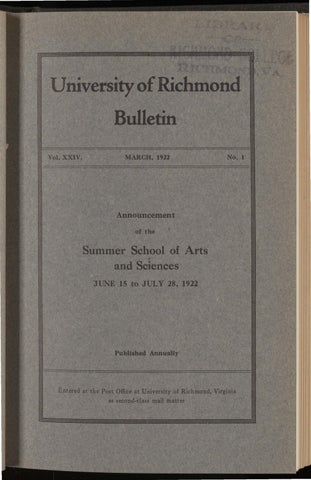
Universityof Richmond Bulletin MARCH, 1922
Vol. XXIV.
No. 1
-
Announcement of the
.
Summer School of Arts and Sciences JUNE 15 to JULY 28, 1922
Published
Annually
-Entered at the Post Office at University of Richmond, Virginia as second-class mail matter •
1;
cllnnouncement OF THE
of Arts
Summer School
and Sciences June 15 to July
University
28, 1922
of Richmond
Virginia 1922
WA$1!INGTQN
MON{JMENT
What We Offer Besides Classes The University of Richmond Summer School offers exceptional advantages to the student who desires something more than mere class work during the summer months. The student may combine happily the features of a summer school course and a delightful vacation and there are a variety of pastimes to relieve the drudgery of class work ordinarily so trying during the hot weather period. The University is justly proud of this.
In its suburban situation, almost rustic in its seclusion, the Summer School would appear to the casual observer more a summer resort than an educational institution. The temperature of the campus always is several degrees lower than that of the neighboring city and the buildings, being constructed almost wholly of brick, are delightfully cool and comfortable except in extremely hot weather. The beautiful lake on the campus, the adµiiration of visitors, offers unusual facilities for boating and swimming. Picturesque James River nearby ever calls to the student who loves the great outdoors. There are fishing, camping, and boating parties for those who like to read the poetry of nature's great spaces. Professors and students mingle freely on the campus after the fashion of a summer colony. Everybody comes to know everybody else and a delightful comradeship and freemasonry is developed that adds a social distinction to the school impossible to institutions where there is a large attendance. The summer school soon becomes as one large family. The proximity of the school to the city of Richmond affords an education in itself. The glow of the lights of the ancient capital of the Confederacy ever tint the summer skies to the eastward by night and there a thousand things of interest await the student on Saturdays and in the afternoon. Every street is
4
UNIVERSITYOF RICHMONDBULLETIN
freighted with the romance of the making of a Nation. There are the giant industrial plants, the State Library, the Capitol, the penitentiary, the Medical College, the literary shrines, magic with the spirit of a Poe, a Thompson, a Bagby, the monuments, the museums. All these await students interested in history, business administration, government, sociology, literature, and make a lasting impression upon the student to whom "a thing of beauty is a joy forever." It is the policy of the director of the summer school to aid students in their efforts to see the things worth while ;n and about Richmond. Points of interest are discussed in the weekly assemblies and expeditions to the battlefields with members of the faculty are offered. This prevents the hap-hazard and illogical wanderings into which students who are comparative strangers to Richmond, naturally would fall. A six weeks residence in the midst of these scenes under the direction of men and women who know Richmond, is worth immeasurably more than the mere transient and hurried sojourn of the tourist. There is the lure of the wilds, a delightful comradeship upon the campus, the voice of a big city that ever calls, along with class work. The University of Richmond is glad to offer these inducements and believes them well worth considering when the student comes to select a summer school.
Calendar JUNE 15, THURSDAY-Registration. JUNE 16, FRIDAY-Class work begins. JULY 27, 28, THURSDAYAND FRIDAY-Examinations. JULY 28, FRIDAY-Summer
School ends.
Officers of the Summer School of Arts and Sciences ADMINISTRATIVE
OFFICERS
FREDERICKvVILLIAMBoATWRIGHT,M. A., LL. D. President
WILLIAM LOFTIN PRINCE, M. A. Director
BENJAMINWEST TABB, B. A. Treasurer
MARION GARNETTRYLAND,B. A., B. A. Librarian
LucY TEMPLE THROCKMORTON, Assistant to Librarian
MARY LIGHTFOOT, Secretary to the Director
FACULTY
OF INSTRUCTION
HORACEE. HAYDEN, M. A., Professor of Biology. PAULR. MERRIMAN,A. B., M. S., Associate Professor of Biology. GARNETTRYLAND,M. A., Ph.D, Professor of Chemistry. HAYNIE H. SEAY, JR. M. A., Professor of Economics SYDNEYS. HANDY, M. A., Professor of English and Education. St. John's College, Annapolis, Md. WILLIAML. PRINCE, M. A., Professor of Education. FRANCISP. GAINES, M. A., Professor of English Literature, Miss issippi A. and M. College. GEORGEB. VILES, Ph.D, Professor of French and Spanish EARLYL. Fox, A. B., M. A., Ph.D. Professor of Histor~· and Government, Randolph Macon College, Ashland, Va. WILLIAMA. H ARRIS, M. A., Ph.D, Professor of Latin and Greek. ROBERTE. GAINES, M. A., LITT.D. Prof essor of Mathematics. ROBERTE. LOVING, Ph.D, Professor of Physics. CONSTANCE M. GAY, M. A., Associate Professor of Spanish. FRANK M. DOBSON, Director Athletic Training.
Summer Session A course of study lasting six weeks is offered. Various courses suitable to meet the needs of conditioned students, of teachers who wish to obtain the Collegiate Certificate and Special Certificates will be offered. Certain classes will be formed to enable pre-medical students advantageously to complete preliminary requirements.
ENTRANCE During the summer quarter students may be admitted, without formal entrance requirements, to any course which they are competent to pursue with profit. Each individual entrant must be certified to after consideration by a Committee on Entrance. Students who wish credit toward a degree must meet the usual college entrance requirements before receiving such credit.
DEGREES :. p ii
The College confers the regular degrees of Bachelor of Arts, Bachelor of Science, and Master of Arts. The requirements for these degrees are set forth in detail in the regular sessional
"'
bulletin.
< f-
CREDITS All courses count toward degrees. Work taken in the summer counts for certificate credit, renewal of certificates, and for College entrance requirements.
REGISTRATION Students should register on Thursday, June 15, in Room L of the Administration Building. Late registration is a senous hindrance to efficient organization of classes. After registration has been completed, no student is permitted to change from one course to another without the approval of the Director. No such change will be allowed after June 21.
CAMPUS
SC ENES
SUMMER
SESSION
9
The first assembling of cla sses will occ ur Friday morning, June 16 and all cla sses will meet on Saturday, June 17. Th ese two cla ss da ys will tak e the place of the la st two days of the session which will be give n to exa minati ons . Consult bull et in board for sched ule and room locat ion. Class rooms will be in the Administration building.
TUITION AND FEES Mat ricu lation fee (a ll st ud ent s pay this) Each sing le course .. Each double course (lecture and labo rat ory). Laboratory fee ( each laboratory course Three sin gle cour~es .. Ath letic coaching course For char ges in Law Sch ool see Law School announcement.
5.00 10.00 20.00 5.00 25 .00 15.00
ROOM RENT AND BOARD A section of J et er Hall will b e u sed for the women's dormitory. This h all is located just a short distance fr om t he Cafeteria and Admin ist ra tion Building. Each room will be furnished with bed, bureau, table and chairs. Light a nd jan ito r service are furnished. Bed lin en, towe ls, etc ., must b e suppli ed by the st udents. The cost will be: Two in a room, $10.00 eac h person; single roo m , $20.00 for the sessio n. A section of Thomas' Hall will be u sed as th e dormitory for men, the same eq uipm ent b eing furnished a nd the sa me charges prevai lin g. Rooms may be occ upi ed Jun e 15th. The Cafeteria will be conducted throughout the Summer School term under it s regular management. It will b e open daily to serv e meals at suitabl e hour s to st ud ent s who wish to avai l themselves of obtaining board in thi s manner.
COMMITTEE ON APPOINTMENTS There is an established Bur ea u of Appointments at the Un iv ers it y of Richmond. It is design ed to a ssist graduates to
10
UNIVERSITY
OF
RICHMOND
BULLETIN
be satisfactorily placed in the school system of this and other States. This committee will freely render assistance to anyone desiring to make use of its knowledge and facilities.
BOOK-STORE AND POST-OFFICE The sale of book s and conduct of the college po st-office are both under the direction of a representatve of Hunter & Co. Prompt attention and efficient service are thus a ssured. The post-office address is University of Richmond, Va.
EXAMINATIONS AND CERTIFICATES As in regular session, to obtain credit for any course examination is necessary. The dates for these final tests will be July 27 and 28. Successful completion of a course of study, all class-room requirements as well as examination, will be rewarded by credit and certificate.
SOCIAL DIVERSION AND HISTORICAL ENTERTAINMENT Richmond and vicinity offer unusual opportunities in the way of historical education and social diversion. Nearby excursions to well-known places of interest will be undertaken; many entertainments in the way of special speakers, choral music, dramatic performances, and outdoor pageantry are planned. Tennis, baseball, swimming, boating, and other athletic activities will be offered without fees. For further information, DIRECTOR
address SUMMER
SCHOOL,
Unii-ersity of Rfrhmond,
Virginia.
Courses of Instruction BIOLOGY PROFESSOR HAYDEN ASSOCIATE PROFESSOR MERRIMAN The summer courses in Biology are designed primarily to meet the n,~eds of premedical students. Biology Sl and S2 will satisfy requirements in this subject for entrance to standard medical schools.
S1. GENERAL ZooLOGY. A survey of the animal kingdom, with a laboratory study of type animals. One lecture and one laboratory period of two and one-half hours daily. Credit, two and one-half hours. Equivalent to one-half of Biology 1. S2. COMPARATIVEANATOMY. An intensive study of the vertebrates, with dissection of exam pies of the chief classes. One lecture and one laboratory period of two and one -half hours dai ly. Credit, two and one-half hours. Equivalent to one-half of Biology 2. S3. BoTA Y. A study of the Comparative Morphology or nature and development of a series of twenty-five plant-types. Consists of the Botany half of Biology 1 in the regu lar college year. One lecture and one laboratory, Credit, two and one-half hours.
S4. Frnw BOTANY.
A study college campus.
daili
of the flora in and about
the
One lecture daily on the characteri _stics and identification methods of common wild plants. One laboratory woods.
period daily, spent mainly in the -·
Credit, two ~nd one-half hours.
}2 S7.
UNIVERSITYOF RICHMONDBULLETIN METHODS OF TEACHING BIOLOGY. A lecture course on methods of presenting and illustrating biologica l facts; collecting and preserving material; maintenance of cultures and aquaria; equipment and care of laboraatories, etc. One lecture daily.
Credit, one hour.
CHEMISTRY PROFESSOR RYLAND
SI.
GENERAL CHEMISTRY. A review of the fundamental facts, theories and principles with especial emphasis on the more difficult parts of the subject . For students who have had a course in General Chemistry and who wish to remove conditions, make up deficiencies, or get a better grounding. 11 :00-1'2 :00 daily.
S2. ORGANIC CHEMISTRY. The
paraffin series . This taken with S4 meets the entrance requirements standard medical colleges . 8 :00-9 :00 daily. Credit, one session hour.
course of the
S3. INORGANIC LABORATORY. For students
needing addit ional laboratory work in general chemistry to meet the requirements of professional or technical schools. 9:0011:00 daily Credit, one session hour.
S4. ORGANIC LABORATORY.To accompany
S2. 9 :00-11 :00 daily, credit, one session hour, or 9:00-1 :00 daily, credit, two session hours.
S5. ANALYTICAL
CHEMISTRY. Special work in qualitive and quantitative analysis to meet the purposes of the individual student. 8:00-12 :00 daily. Credit, two session hours.
A laboratory fee of five dollars will be charged for courses S3, S4, and S5, and a contingent deposit of five dollars must be made to cover excessive breakage. The latter will be returned at the end of the course after the cost of breakage has been deducted.
COURSESOF INSTRUCTION
13
ECONOMICS PROFESSOR SEAy SI. THE PRINCIPLES OF EcoNOMICS. This course is designed to give a comprehensive knowledge of some of the underlying principles of Economics. Especial attention will be given to the Economic Development of the U. S., Production, Consumption, Value, Price, Monopoly and Business Organization. Problems explaining the determination of Market and Monopoly Price will be required as well as the preparation of a number of business balance sheets. S2. THE PRINCIPLES OF EcoNOMICS CONTINUED. This course is a continuation of the work outlined in Economics .I. It will be confined mainly to a discussion of Distribution, i. e., Rent, Wages, Interest, Profits. It is expected also to give some time to the study of the Tariff and problems involved in International Trade. S3. MoNEY AND BANKING. This course is a study of the Monetary and Banking History of the U. S., with especial attention given to the National Banking and Federal Reserve Systems. The Quantity Theory of Money will be considered in its application to past and present conditions. The latter part of this course will be devoted to the Princi pies of Foreign Exchange and causes which have led to the present condition of commercial rates.
EDUCATION PROFESSOR HANDY, PROFESSOR PRINCE Assoc1ATE PROFESSOR GAY, PRoFEssoR HAYDEN
SI. PSYCHOLOGYFOR TEACHERS. An application of the general principles of psychology to education. Human behavior will be discussed from the point of view of its origin and growth. Capacities, tendencies and in-
COURSESOF INSTRUCTION
15
stincts of man will be studied in so far as they throw light on some of the problems of educational practice. Lectures, reports and discussions. Strayer & N orsworthy's "How to Teach" and Starch's "Educational Psychology" will be the textbooks used. S2. HISTORY OF EDUCATION. This course will consist of the history of education in the United States, with especial emphasis on the movements leading to state control and support. Cubberley's "History of Education in the United States" will be the text. S3. SECONDARYEDUCATION. The organization and administration of high schools from the standpoint of the social demands and pu pi! needs receive emphasis here. The course is adapted to the needs of teachers and principals of high schools.
S4. METHODS OF TEACHING MODERN LANGUAGES. Consists of a brief survey and study of modern language methods, followed by lectures and discussions on the modified direct method. The teaching of pronunciation, use of phonetics, importance of conversation lessons, teaching of syntax etc. will be especially emphasized. Breu l's Teaching of Modern Foreign Languages and the Training of Teachers, and Wilkins' Spanish in the High Schools, supplemented by other similar books, will be used as text -books. SS. TEACHING ENGLISH IN HIGH ScHOOLS. This course will aim to be equally suggestive to teachers in junior and standard high schools. The teaching of both literature and composition will be treated. S6.
METHODS OF TEACHING BIOLOGY. A lecture course on methods of presenting and illustrating biological facts; collecting and preserving material; maintenance of cultures and aquaria; equipment and care of laboratories, etc.
16
UNIVERSITYOF RICHMONDBULLETIN
ENGLISH PROFESSOR GAINES, PROFESSOR HANDY SL ENGLISH LITERATURE. A consideration of the general development of the literature, with special emphasis upon a few writers important both for their own work and for their relations to certain periods and movements. S2. ADVANCEDCOMPOSITION. Theme writing based on specimens of exposition, description, and narration. S3. SHAKESPEARE. A critical study in class of three plays; parallel readings of several other plays; written reports. S4. AMERICAN LITERATURE. A study of the periods, of the movements, and of the principal writers; special attention to the conditions and the contributions of the South. S5. DEVELOPMENT OF ENGLISH DRAMA with special study of the Elizabethan and Contemporary Drama. Five hours a week. S6. DEVELOPMENTOF ENGLISH PoETRY with especial emphasis upon the Romantic Movement and the major Victorian poets. Five hours a week.
S7. TEACHING ENGLISH IN HIGH ScHOOLS. This
course will aim to be equally suggestive to teachers in junior and standard high schools. The teaching of both literature and composition will be treated.
FRENCH PROFESSOR VILES
SL ELEMENTARYFRENCH. Grammar,
composition, dictation, reading, conversation. Special attention to pronunciation. Fraser and Squair's French Grammar, and some suitable text. Credit for one term's work in French 1 in the University.
COURSES OF INSTRUCTION
17
S2. ADVANCEDFRENCH. Grammar review, composition, dictation, conversation. Special attention to pronunciation. Translation in class. Bouvet's French Syntax and Composition, and suitable texts. Credit for one term's work in French 2 in the University.
GERMAN PROFESSOR VILES SL ELEMENTARYGERMAN. Grammar, reading, conversation. Careful attention to pronunciation. Thomas's German Grammar. Some suitable text. Credit for one term's work in German 1 in the University. S2. ADVANCEDGERMAN. Grammar review. Composition. Translation in class. Thomas's German Grammar (Exercises in Part II.). Sciller's Wilhelm Tell or other, suitable, reading. Credit for one term's work in German 2 in the University.
AMERICAN HISTORY AND GOVERNMENT PROFESSOR Fox
SL The period from 1763 to 1828.
The American Revolution; the formation of the Union the rise of parties, the democratic revolution of 1800, the era of the Virginia Dynasty.
S2. The period from 1828 to 1865. The coming to power of the west, under Jackson; the clashing of sectional interests in the nullification struggle, the Mexican War, and the Kansas-Nebraska issue; the election of 1860 and the secession movement; the Civil War. S3. The period from 1865 to 1920. The Reconstruction Era; the industrial development, social and political adjustment, the campaign of '96, the Democratic victory in 1912, the Wilson program, the United States in the World War.
UNIVERSITYOF RICHMONDBULLETIN S4. AMERICANGovERNMENT will be discussed, ational, State, and Local, both in theory and pract ice. Special topics are assigned for inve stiga tion , and parallel reading is required. Considerable attention will be given to current problems.
(a) NATIONAL GovERNMENT. Origin, colonial experience, Federal Constitution, the Pre side nt, Congress, Judiciary Department, Political Parties, current problems. (b) STATE GovERNMENT. Const itutional ba sis, the Executive, the Legislative, the Courts. Particular attention will be given to the institutions and problems of Virginia.
(c) MuNICIPAL AND RuRAL GOVERNMENT. The
American city, history. organiLation, reform movements, such as the Commission and the City Manager plans; the town, county, village. For Sophomore s and Juniors.
ENGLISH HISTORY PROFESSORFox S 1. The Political and Social Development of England in the 16th and 17th centuries; the expansion of the British Empire; the policies and problems of the 19th and 20th centuries; a brief discussion of causes and results of the Great War; much emphasis on a critical bibliography for each period.
LATIN PROFESSOR HARRIS The courses offered in the Summer Session are adapted to those desiring to teach, make up entrance requirements, or secure college credit. Three courses are offered: SI. CrcERo. (a) First T hree Orations Against Cataline; position . Bennett's, A New Latin Composition, II and III. Exerc ises, 1-16.
ComParts
COURSESOF INSTRUCTION
19
(b) Parallel und er the di rection of the professor, for those desiring to complete entr a nc e requirements. Fourth Cataline, Archias, Manilian Law. Composition as a bove, lin es 17-30. S2. VrnGIL. (a) First three books of Virgil's Aeneid . Bennett's Composition, Parts II. and III., pages 217-226. ( 10 exerc ises . Phil. cic.) (b) Parallel under direction of professor for those desiring to comp lete entrance req uir ements. Aeneid Books, IV. to V I. Composition comp leted. S3. LIVY. This class carries college credit. Selections fr om Books I., II. and XX I. Composition based on Li vy. Conferences in Roman mann ers and customs.
MATHEMATICS PROFESSOR GAINES Sl. COLLEGE ALGEBRA. A cour se designed to follow the work of a good hi gh schoo l, be ginnin g with quadratic equations, and includin g such subject s as the pro gress ions , permutations and co mbin at ions, m athemat ica l induction, bin om ial theorem, in equaliti es, logarithm s, theory of equations, a nd infinit e serie s. S2. SoLm GEOMETRY. A bri ef st u dy of certain portions of plane geo metry will be made, after wh ich solid geometry will b e take n up and completed. S3. PLANE TRI GONOMETRY. Th e subj ect is approached fr om the prac tical sid e, pro bl ems bein g solved at first by graphical m et hod s, and afterwards computed by means of trigonometrical formula s and mathematical tables. S4. PLANE GEOMETRY. An int en sive course for those needing this subj ect to m eet. College entranc e requirement s. , (No College credit).
20
COURSESOF INSTRUCTION
PHYSICS PROFESSOR LOVING SS. (a) A CouRSE IN GENERAL COLLEGE PHYSICS, MECHANICS, PROPERTIES OF MATTER, HEAT, LIGHT, ELECTRICITY AND MAGNETISM. This course, together with SS (b), will satisfy the premedical requirements in standard medical schools. The combined course will also give good preparation to pro~pective teachers of High School Physics. Credit for courses 5 (a) and 5 (6), 4 session hours. Meets 9-11 daily, except Saturday. SS. (b) A LABORATORYCouRsE TO AccOMPANY AND REINFORCE THE WoRK OF SS (a). Embraces quantitative experiments with high grade instruments in the subjects enumerated under SS (a). Open only to persons taking SS (a), or to those who have had its equivalent. Meets 11-1 and 2-4:30, Monday, Tuesday, Thursday, Friday.
SPANISH AssocIATE PROFESSOR GAY SL BEGINNERS' CouRSE. Consists of a study of the elements of Spanish grammar, constant and thorough drill on pronunciation and intonation, and the translation of simple prose. Textbooks: Hills and Ford's Marcial Dorado's Primeras
First Spanish Course. Lecturas en Espanol.
S2. Equivalent to one term of Spanish 2 in the University. Study of grammar, composition and syntax. In addition to the text studied in class, supplementary reading from 19th century Spanish writers will be assigned for written and oral reports. METHODS OF TEACHING MoDERN LANGUAGES. Consists of a brief survey and study of modern language methods, followed by lectures and discussions on the modified direct method. The
UNIVERSITY
OF
RICHMOND
21'
BULLETIN
teaching of pronunciation, use of phonetics, importance of conversation lessons, teaching of syntax etc. will be especially emphasized. Breul's Teaching of Modern Foreign Languages and the Training of Teachers, and Wilkins' Spanish in the High Schools, supplemented by other similar books , will be used as textbooks.
DEPARTMENT OF LAW Beginning June 15, 1922, and ending July 28, 1922, courses in six branches of the law will be offered in the Law Building, from 6:00 P. M. to 9:00 P. M., Monday to Friday inclusive. Costs: $10.00 for matriculation; $20.00 for tuition in any one course; $40.00 tuition for any two courses-payable in advance. Bailments and Carriers, Domestic Relations, Negotiable Instruments, Wills and Criminal Law are given as in the regular school, and full credit may be obtained therefor in the summer session. Commercial Law covers a variety of elementary subjects, is intended for general legal culture (especially for beginners), and for it no credit is allowed toward the law degree. The schedule follows: *Monday-6:00 P. M. to 7:30 P. M. (1) Criminal Law, given by Mr. McNeil! (2) Bailments and Carriers, given by Mr. Herrink (3) Negotiable Instruments, given by Mr. Barnett 7:30 to 9:00 P. M. (1) Commercial Law, given by Mr. McNeil! (2) Domestic Relations, given by Mr. Herrink (3) Wills, given by Mr. Barnett *The same plan is followed on Tuesday, day and Friday of each week. For further information
Wednesday,
apply to
]. H. Barnett, Jr., Secretary, 601 N. Lombardy Street, Telephone Boulevard 4663-J. Richmond,
Va.
Thurs-
22
COURSES
OF INSTRUCTION
SCHOOL OF ATHLETIC COACHING PROFESSOR
DOBSON
The object of this course will be to train capable coaches for high schools and preparatory schools. Athletic and school authorities are realizing more and more each year that the mere fact that a man has been an outstanding athlete in college is not sufficient to qualify him for the responsibilities of the present day coach. He must acquire an intimate knowledge of the theory and technique of the different sports to be able to teach them properly. This course will be of particular value to a man whose duties call for a combination of teaching and coaching and also to the man who is intensely interested in athletic work, but failed to make the varsity teams while in college or high school. Frequently men who have studied Athletics closely make capable coaches, although they have had little or no playing experience.
1. Football Coaching: Fifteen days; Fifteen hours. The theory and practice of the fundamentals of the game will be taught. These will include falling on the ball, charging, tackling, blocking, interference, passing, kicking, catching, and position play. Offensive and defensive styles of play, strategy and systems together with a study of the rules will be included in the course as well as training suggestions. 2. Basket Ball Coaching: Fifteen days; Fifteen hours. Fundamental basketball will be covered thoroughly in passing, shooting, dribbling, stops and turns, as well as individual and team play in offense and defense. Discussion of the rules and different systems of play will be included in this work. 3. Base Ball Coaching: Fifteen days; Fifteen hours. Great stress will be laid upon the fundamentals in this sport, which will include batting, bunting, base running, sliding, and
UNIVERSITY
OF
RICHMOND
. BULLETIN
23
posit ion play and team play, offensive and defensive. Methods practiced by major leagu e clubs and discussion of rules will follow the fundamentals. 4. Track and Field Coaching: Fifteen days; Fifteen hour s. Every event in a standa rd track and field meet will be studied and practiced. The student will be taught the theory and form and will practice the following: shot, discuss, javelin, pole fault, high jump, broad jump, high and low hurdles, starting, sprinting, and distance running. Training methods will also be discussed. In all of these classe s the student will be expected to be supplied with some kind of athletic wear to take part in the practical work required.
PUBLIC SPEAKING PRO FESSOR
HANDY
A course in the principles and practice of Public Speaking is offered. The purpose of this course is the training of students in accuracy of thought and expression and in ease of delivery. The practical matters of clearness in thought and directness in presentat ion are kept constantly in view. Practice in the art of public speaking will be afforded by the delivery before the class of orginal orations and other forms of address. In addition to oral practice, there will be wide reading and critical study of examples of the various forms of public speech-deliberative, forensic, occasional, etc. NoTE.-No course will be offered for which there are fewer than five applicants.
MARION
Lucy
T.
THE LIBRARY G. TYLAND, B. A., B. S., Librarian
THROCKMORTON,
Assistant
to the Librarian
The Library occupies the southern wing of Ryland Hall. The interior is panelled in oak, and the bookcases arranged in alcove plan. It contains about twenty-five thousand volumes,
24
UNIVERSITY
OF RICHMOND
BULLETIN
not including pamphlets, arranged and catalogued by the Dewey System. The most recent and useful bibliographical aids are provided, and the best periodicals and reviews, daily and weekly papers are currently received. As a depository of the United States Government, the Library acquires annually hundreds of publications especially valuable for references in Social and Political Science. The students have direct access to the shelves every day, and the Librarian and assistant are always on hand to give help in any line of reading or research.