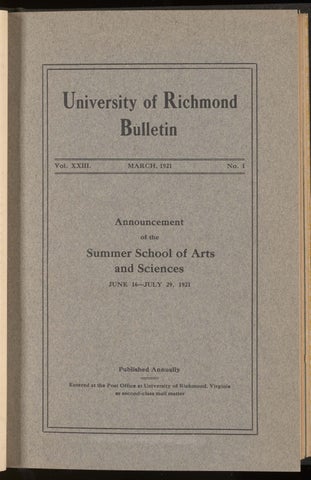
Universityof Richmond Bulletin Vol. XXIII.
MARCH,
No. 1
1921
Announcement of the
Summer School of Arts and Sciences JUNE
16-JULY
Published
29, 1921
Annually
Entered at the Post Office at University ,of Richmond, as second-class mail matter
Virginia
Announcement OF THE
Summer School of Arts and Sciences June 16 to July 29, 1921
University of Richmond Virginia 1921
MWMM
,r
~
'le. ,~i:+a
~·
.. ,It
=•·" .ul!:119--~ -- ....
o...uo,,.
~'
•
PARJ<.=a.dl!
,l
f7;)"
,
~I
•
University of Richmond is j Ltst a thirty-three minutes' ride from Broad Street Station, and but forty-five minutes from Ninth and Main Streets-the heart of the business section of Richmond.
Historical Sketch HE institution now known as Richmond College* developed out of "The Virginia Baptist Seminary," established in 1832, several miles northwest of the City of Richmond. The Seminary at first accepted only candidates for the ministry. Rev. Robert Ryland, the first President, was assisted by two instructors. The number of students the first year was fourteen. The small wooden buildings were bought with the piece of farm land and were sat is factory.
T
In 1833 the Seminary was removed to "Columbia," the Haxall homestead, just west of the city limits. In this eligible location the schoo l grew steadily. March 4, 1840, a charter was granted by the Legislature and the name was changed to "Richmond College." On account of inability to offer immediate adequate courses o.f instruction no degrees were conferred by the College until 1849. Between this elate and 1861, when classes were suspended on account of the war between the States, clegress were granted to sixty-eight young men. Dr. Robert Ryland continued as President until 1866. As a consequence of the war the College endowment was lost, the library destroyed, and the buildings all but wrecked. Nevertheless, the Trustees, encouraged by the gift of $5,000 for maintenance, by James Thomas, Jr. , elected Rev. Tiberius Gracchus Jones, D. D., as President, and reopened the College in 1866. Dr. Jones continued as President for three years. For the next twenty-six years the headship of the College was held by a Chairman of the Faculty. Professor Bennett Puryear, LL. D., was chairman 1869-1885 and again 1889-1895, and Professor H. H. Harris, LL. D., was Chairman 1885-1889. Among the notable men who gave the College distinction during this period were the two Chairmen, and Professors E. B. Sm ith , Edmund • Changed
to "Univers
it y of Richmond,"
September
21, 1920.
UNIVERSITY
4
OF RICHMOND
BULLETIN
Harrison, J. L. M. Curry, A. B. Brown, W. D. Thomas, John Pollard, C. H. Winston and Secretary Charles H. Ryland. In 1873 and again in 1881, there were successful campaigns for money which provided new buildings and gave the nucleus of a new endowment. In 1894 the Trustees re-established the presidency of the College, and elected to the position F. W. Boatwright, at that time the youngest member of the Faculty. Despite many difficulties there was steady growth. A science hall and a large dormitory were erected, and under the leadership of Dr. W. E. Hatcher, President of the Board of Trustees, $100,000 was added to the endowment. In 1898 women were admitted to College classes. The restrictions upon matriculation of women did not prevent a slow but constant increase in the number of women students. It soon became evident that better provision should be made for women students. A five-year campaign undertaken jointly with the Virginia Baptist Education Commission, and with the co-operation of the General Education Board of New York, added half a million dollars to the resources of the corporation. By 1910 the Trustees began to build two co-ordinate Colleges in the western suburbs of Richmond and to prepare for removal. The buildings were completed in 1914 and the first session of the greater College began in September, 1914. The new institution, still called "Richmond College,"* embraces a college for men, also called "Richmond College," and a college for women, named "Westhampton College." These two schools are co-ordinate, having practically the same entrance and degree requirements and doing work of the same grade. There is no co-education in either of the colleges, but a considerable number of the same professors teach classes in both. Each college has its own institutional life and both enjoy many advantages on account of the proximity and co-operation of the other. Among these advantages are economy in administration, a laTger and better paid faculty of instruction, protection against academic isolation, and the enjoyment of a freer social and cultural life. • See note,
preceding
page
HISTORICALSKETCH
5
The campus of Richmond College embraces 150 acres and that of Westhampton College 130 acres. Westhampton Lake, covering nearly ten acres, separates the two colleges. The grounds and buildings of Richmond College and Westhampton College are valued at $1,500,000. The income-bearing endowment enjoyed by the two institutions jointly approximates $1,100,000. The dormitories and recitation buildings of both institutions are fire-proof structures, built of steel, concrete an(! brick. The floors are of reinforced concrete, the partitions of hoPow tile, and the casements of bronze. Stairways are constructed of steel with slate treads. All 1.mildings are heated throughout with hot water, lighted with electricity, and provided with tlie best modern sanitary equipment. Direct communication is maintained with the heart of the City of Richmond by street cars, whid1 entPr the campm and make the trip for a six-cent fare. Faculty and students of both colleges have opportunity to enjoy all the advantages of a ,rnrld-famous capital city and, at the same time, to live and study in the quiet of a beautiful suburban park.
Calendar JU NE 16, 17, TnuRSDAY AND FRIDAY-Registration. JU NE 18, SATURDAY-Class work begins. JULY 28, 29, THURSDAYAND FRIDAY--Examinations. JULY 29, FRIDAY-Surnrner
School ends.
Offic ers of the Summer School of Arts and Sciences ADMINISTRATIVE
OFFICERS
FREDERICK WILLIAM BOATWRIGHT , M. A., LL. D., President WILLIAM LOFTIN PRINCE, M. A. , Dean BENJAMIN WEST TABB, B. A., Treasurer and R egistrar MARION GARNETTRYLAND,B. A., B. S. , Librarian Lucy TEMPLE THROCKMORTON, Assistant to Librarian MARYLIGHTFOOT, Secretary to Dean FACULTY
OF INSTRUCTIO
J
HORACEEDWIN HAYDEN, M. A., Professor of Biology GARNETT RYLAND,M. A., Ph. D., Professor of Chemistry . H. H. SEAY, M. A., "fl+t. D:-;,Professor of Econoniics. SYDNEY S. HANDY.M. A., Profe'ssor of English and Education, St. John's College, Annapolis, Md. ALBERTH . HILL. M. A., Professor of Education, Superintendent of Schools, Richmond, Va. WILLIAM L. PRINc;f, M. A., Professor of Education. ROBERTC. Asrnoi;~!h-sociate Professor of English. 1 . . . . . . . . . . . . . . . . . . . . . . . . . . . . . . . . . . . . . . . . . . . . . . . French and German MAUDEHOWLETTWOODFIN,M. A., Associat e Prof essor History and Po litical Science WILLIAMASBURYHARRIS,M. A., Ph. D., Professor of Latin and Greek. OTTo DUNKEL, Ph. D., Prof essor of Mat hematics, Washington University, St. Louis, fo. ROBERTEDWINLOVING , Ph. D., Professor of P hysics. CONSTANCE MARYGAY, M. A., Associate Profe ssor Spanish.
Summer Session A course of study lasting six weeks is offered. Various courses suitable to rn.eet the needs of conditioned students, of teachers who wish to obtain the Collegiate Certificate and the Special Certificate will be offered. Certain classes will be formed to _enable pre-medical students advantageously to complete preliminary requirements. ENTRANCE During the summer quarter students may be admitted, without formal entrance requirements, to any course which they are competent to pursue with profit. Each individual entrant must be certified to after consideration by a Committee on Entrance. Students who wish credit toward a degree must meet the usual college entrance requirements before receiving such credit .
DEGREES The College confers the regular degrees of Bachelor of Arts, Bachelor of Science, and Master of Arts. The requirements for these degrees are set forth in detail in the regular sessional bulletin. CREDITS All courses count toward degrees. Work taken in the surnmer counts for certificate credit, renewal of certificates, and for College entrance requirements.
REGISTRATION Students should register on Thursday, June 16, or Friday, June 17, in Room L of the Administration Building. Late registration is a serious hindrance to effect organization of classes. A fee of $2.00 is charged for failure to register on the elates mentioned above. After registration has been completed, no student is permitted to change from one course to another without the approval of the Dean. No such change will be allowed after June 22 .
SUMMER
SESSION
9
The first assembling of classes will occur Saturday morning, June 18. Consult bulletin board for schedule and room location. Class rooms will be in the Administration building.
TUITION
AND FEES
Matriculation F ee.-All students pay this charge of $5.00. Tuition Cost.-One course of study may be taken for $10.00; two will cost $20.00; and three ( the maximum permitted ),a' re offered for $25m Whenever one double course is taken, the charge is $2~ Laboratory Fee.- 'Iher-e is no et harge for breakage in laboratory courses. Students are on their honor to report al h.i:.ei!kag_e and damage immediately to the instructor in charge. ROOM RENT AND BOARD A section of Jeter Hall will be used for the women's dormitory. This hall is located just a short distance from the Cafeteria and Administration Building. Each room will be furnished with bed, bureau, table and chairs. Light and janitor service are furnished. Bed linen, towels, etc., must be supplied by the students. The cost will be: Two in a room, $2.00 per week; single room, $4.00 per week. A section of Thomas' Hall will be used as the dormitory for men, the same equipment being furnished and the same charges prevailing. Rooms may be occupied June 16th. The Cafeteria will be conducted throughout the Summer School term under its regular management. It will be open daily to serve meals at suitable hours to students who wish to avail themselves of obtaining board in this manner.
COMMITTEE
ON APPOINTMENTS
There is an established Bureau of Appointments at the University of Richmond. It is designed to assist graduates to be satisfactorily placed in the school system of this and other States. This committee will freely render assistance to anyone desiring to make use of its knowledge and facilities.
IO
UNIVERSITY
OF RICHMOND
BULLETIN
BOOK-STORE AND POST-OFFICE The sale of books and cond uct of th e college post-office are both und er the direction of a representative of Hunter & Co. Promp t atte nti on and efficient service are thus ass ur ed. The post-office address is University of Richmond, Va.
EXAMINATIONS
AND CERTIFICATES
As in regular session, to obta in credit for any cour se examination is necessary . The dates for these final tests will be July 28 and 29. Successfu l comp letion of a course of stud y, all class-room requirements as well as exam inati on , will be rewarded by credit and certificate.
SPECIAL LECTURERS At least one evening a week the Summ er Schoo l management will provide speakers of int ere st and ab ility- lect ur ers of state and national stand ing, men and women who have attained pre -eminent success in th eir chosen fields of end eavor. These entertainments will frequently be held out of doors and the public will be invited.
SOCIAL DIVERSION AND HISTORICAL ENTERTAINMENT Richmond and vicinity offer unusual opportunities in the way of historical education and social diversion. Near by excu rsions to well-known places of int erest will be un dertaken; many entertain ments in the way of special speakers, choral mu sic, dramatic performances, and outdoor pageantry are planned. Tennis , baseball, swimming, boating, and oth er at hletic activities will be offered without fees. For further information, address DEAN
SUMMER
SCHOOL,
University of Richmond, Virginia.
Courses of Instruction BIOLOGY PROFESSORHAYDEN The summ er courses in Biology are designed primarily to meet the needs of premedical students. Biology Sr and S2 will satisfy requirements in this subject for entrance to standard medical schools. Sr. GENERALZOOLOGY.A survey of the animal kingdom, with a laboratory study of type animals. One lecture and one laboratory period of two and one-half hours daily. Credit, two and one-half hours. Equiva lent to one-half of Biology I. S2. COMPARATIVE ANATOMY. An intensive study of the vertebrates, with dissection of examples of the chief classes. One lecture and one laboratory period of two and one-half hours daily. Credit, two and one -half hours. Equivalent to one-half of Biology 2. S7- METHODSOF TEACHINGBIOLOGY. A lecture course on methods of presenting and illustrating biological facts; collecting and preserving material; maintenance of cultures and aquaria; equipment and care of laboratories, etc. One lecture daily. Credit, one hour.
CHEMISTRY PROFESSORRYLAND Sr. GENERALCHEMISTRY. A college course of lectures for students who wish a grounding in the fundamental facts, principles and app lications of chemistry and for those who need to review or make up deficiencies in the subject. Six hours a week.
COURSESOF INSTRUCTION Sz. ORGANIC CHEMISTRY. This course, taken with Cour se S3b, meets in full the entrance requirements of the standard medical colleges. Six hours a week. S3. LABORATORY CHEMISTRY. a. Inorganic. For students taking Course SI, or for those needing additional laboratory work in general chemistry to meet the requirements of professional and technical schools. Four to twelve hours a week.
b. Organic. To accompany Course S2. Twelve hours a week. c. Analytical. Special work 111 qualitative and quantitative analysis ta meet the purposes of the individual student. Twelve to twenty-four hours a week.
ECONOMICS PROFESSORSEAy Sr. THE PRINCIPLES OF EcoNOMICS. This course is designed to give a comprehensive knowledge of some of the underlying princip les of Economics. Especial attention will be given to the Econom ic Development of the U. S., Production, Consumption, Value, Price, Monopo ly and Business Organization. Problems exp laining the determination of Market and Monopoly Price will be required as well as the preparation of a number of business balance sheets. S2. THE PRINCIPLES OF EcoNOMICS CONTINUED. This course is a continuation of the work outlined in Economics 1. It will be confined mainly to a discussion of Distribution, i. e., Rent, Wages, Interest, Profits. It is expected also to give some time to the study of the Tariff and problems involved in International Trade.
RICHMONDCOLLEGE BULLETir MONEYANDBANKING. This course is a study of the Monetary and Bank ing History of the U. S., wit h especia l attention given to the National Banking and Federal Reserve Systems. The Quantity Theory of Money will be considered in its application to past and present conditions. The latter part of this course will be devoted to the Principles of Foreign Exchange and causes which have led to the present condition of commercia l rates.
EDUCATION PROFESSORHANDY, PROFESSORHILL, PROFESSORPRINCE
S1. PSYCHOLOGY FOR TEACHERS. An application of the general principles of phychology to education. Human behavior will be discussed from the point of view of its origin and growth. Capacities, tendencies and instincts of man will be studied in so far as they throw light on some of the problems of educational practice. Lectures, reports and discussions. Strayer & N orsworthy's "How to Teach" and Starch's "Educational Psychology" will be the textbooks used. S2. HISTORYOF EDUCATION. This course will consist of the history of education in the United States, with especial emphasis on the movements leading to state control and support. Cubberley's "History of Education in the United States" will be the text. S3. SECONDARY EDUCATION. The organization and administration of high schools from the standpoint of the social demands and pupil needs re::eive emphasis here. The course is adapted to the needs of teachers and principals of high schools.
COURSESOF INSTRUCTION
rs
ENGLISH PROFESSORHANDY ASSOCIATEPROFESSORAsTROP Sr. ENGLISH LITERATURE. A genera l survey of the literature from the beginnings to the present, with emphasis placed upon the literary leaders of the various centuries. Lectures and parallel reading. S2. ADVANCEDCOMPOSITION. Theme writing based on specimens of exposition, description, and narration. Conferences. S3. SHAKESPEARE. The study of three plays with a view to dramatic technique, the growth of Shakespeare as an artist, and the chief characteristics of the Elizabethan period. A number of other plays will be read as parallel, on which written analyses will be required. S4. AMERICAN LITERATURE. Studies in the chief American poets, with extensive parallel reading in the prose writers, following a rapid survey of the Colonial and Revolutionary periods. S5. DEVELOPMENTOF ENGLISH DRAMA with special study of the Elizabethan and Contemporary Drama. Five hours a week. S6. DEVELOPMENTOF ENGLISH POETRY with especial emphasis upon the Romantic Movement and the major Victorian poets. Five hours a week.
FRENCH PROFESSOR .........
.
Sr. PRINCIPLES OF PRONUNCIATIONAND ELEMENTS OF GRAMMAR AND COMPOSITION. Much oral work and rapid reading of simple prose. Credit for one term's work in French r, in the University. Texts: Fraser and Squair's "French Grammar,'· Allen and Schoell's "French Life."
COURSESOF INSTRUCTION S2. MORE ADVANCEDWORK IN COMPOSITION AND SYNTAX, AND So ME AssrGNED PARALLEL READINGS. Equivalent to the first term of French 2 in the University. Texts: Fraser and Squair's "French Grammar," Dumas' "L 'Evasion du Dus de Beaufort."
GERMAN PROFESSOR.........
.
Sr . A CouRSE FOR BEGINNERS. Elementary Grammar and Composition; specia l training in pronunciation and simple conversational German; reading of simp le texts in class and assigned parallel.
HISTORY ASSOCIATEPROFESSORWOODFIN HrsTORY OF THE UNITED STATES IN lTs SocrAL, EcoNoMrc, RELIGIOUS AND POLITICAL PHASES. Sr. The period front 1763 to 1828. The American Revolution; the formation of the Union, the ri se of parties, the democratic revolution of 1800, the era of the Virginia Dynasty. S2. The period frmn 1828 to 1865. The coming to power of the west, under Jackson ; the clashing of sectiona l interests in the nullification st ruggl e, the Mexican War, and the Kansas-Nebraska issue; the election of 1860 and the secession movement; the Civil War. S3. The period frowi 1865 to 1920. The Reconstruction Era; the industrial development, soc ial and political adjustment, the campaign of '96, the Democratic victory in 1912, the Wilson program, the United States in the World War.
18
RICHMONDCOLLEGE BULLETIN
ANCIENT HISTORY. S4. History of Greece. The Oriental Background of the Aegean. Age; the Aegean Age; the Northern Divisions; the rise of the City States; the Persian Danger; the Athenian Empire; the Peloponnesian Wars; the Rise of Macedonia; the Career of Alexander the Great; the Diadochi. S5. Histor 'y of the Roman Republic. The early history of Italy; Rome under the Monarchy; the Roman Conquest of Italy; the expansion of the Roman State Around the Mediterranean; Civil Strife in Italy; the Fa ll of the Republic. S6. History of the Roman Empire . The establishing of the Principate; the Reign of the Caesars; the Empire at its Height; the Age of Dioclitian; the Religious Struggle in the Empire; the Corning of the Barbarians; the Fall of the Empire.
LATIN PROFESSORHARRIS The courses offered in the Summer Session are adapted to those desiring to teach, make up entrance requirements, or secure college credit. Three courses are offered : Sr. CrcERO. (a) First Three Orations Against Cataline; position. Benett's, A New Latin Composition, II and III. Exercises, 1-16.
ComParts
(b) Paralle l under the direction of the professor, for those desiring to complete entrance requirements. Fourth Cataline, Archias, Manilian Law. Composition as above, lines r 7-30.
COURSESOF INSTRUCTION S2. VIRGIL. (a) First three books of Virgil's Aeneid. Bennett's Composition, Parts II. and III., pages 217-226. (ro exercises. Phil. cic.) ( b) Parallel under direction of professor for those desiring to complete entrance requirements. Aeneid Books, IV. to VI. Composition completed. S3. LIVY. This class carries college credit. Selections from Books I., II. and XXI. Composition based on Livy. Conferences in Roman manners and customs.
MATHEMATICS PROFESSORDUNKEL Sr. COLLEGEALGEBRA. A course designed to follow the work of a good high school, beginning with quadratic equations, and including such subjects as the progressions, permutations and combinations, mathematical induction, binomial theorem, inequalities, logarithms, theory of equations, and infinite series. S2. SouD GEOMETRY. A brief study of certain portions of plane geometry will be made, after which solid geometry will be taken up and completed. S3. PLANE TRIGONOMETRY.The subject is approached from the practical side, problems being solved at first by graphical methods, and afterwards computed by means of trigonometrical formulas and mathematical tables.
PHYSICS PROFESSORLOVING. S5.
(a) A COURSEIN GENERALCOLLEGEPHYSICS, MECHANICS, PROPERTIESOF MATTER,HEAT, LIGHT, ELECTRICITYAND MAGNETISM. This course, together with S5 (b), will satisfy the premedical requirements in the leading medical schools. The combined course will also give good preparation to prospective teachers of High School Physics. Credit for courses 5 (a) and S (b), 4 session hours. Meets TO :30-12 :30 daily, except Saturday.
COURSESOF INSTRUCTION
21
Ss (b). A LABORATOR Y COURSETO ACCOMPANYAND REINFORCE TI-IE WoRK OF S5 (a) . Embraces quantitative expe riments with high grade instruments in the subjects enumerated under S 5 (a). Open only to per on taking S 5 (a), or to those wh have had its equivalent. Meets 8-10 :30 and 2-4 :30, Monday, Tuesday, Thursday, Friday.
SPANISH ASSOCIATEPROFESSORGAY Sr. ELEMENTSOF GRAMMAR , thorough and constant drill on pronunciation and production of Spanish sounds, and reading and tran -lation of easy prose and verse. Credit for the first term of Spanish r. Texts: Hills' and Ford's "First Spanish Course," Marcial Dorado, "Priineras Lectures en Espaiiol." S2. Equiva lent to the first term of Spanish 2. Attention is concentrated on principle of grammar and syntax, and written and oral reports on assigned readings are included. Moratin's "El Si de las Ninas" will be read in class, and the outside reading assignments will include Shepherd's "Latin America;" Hudson's "Far Away and Long Ago," and "Spain of the panish." Texts: Espinosa and Alle:1, Spanish Grammar. Moratin, "El Si de las Ninas."
PUBLIC
SPEAKING
PROFESSORs. s. HANDY A course in the princip les and practice of Public Speaking is offered . The purpose of this course is the training of students in accuracy of thought and expression and in ease of delivery. The practical matters of clearness in thought and directness in presentation are kept constantly in view. Practice in the art
UNIVERSITY
22
OF RICHMOND
BULLETIN
of public speaking will be afforded by the delivery before the class of original orations and other forms of address. In addition to oral practice, there will be wide reading and critical study of examples of the various forms of public speech-deliberative, forensic, occasional, etc. NoTE--No course will be offered for which there are fewer than five applicants.
THE LIBRARY G. RYLAND, B. A., B. S., Librarian THROCKMORTON, Assistant to the Librarian
MARION
Lucv
T.
The Library occupies the southern wing of Ryland Hall. The interior is panelled in oak, and the bookcases arranged in alcove plan. It contains about twenty-five thousand volumes, not including pamphlets, arranged and catalogued by the Dewey System. The most recent and useful bibliographical aids are provided, and the best periodicals and reviews, daily and weekly papers are currently received. As a depository of the United States Government, the Library acquires annually hundreds of publications especially valuable for reference in Social and Political Science. The students have direct access to the shelves every day, and the Librarian and assistant are always on hand to give help in any line of reading or research.