NEUROSCIENCE University of Rochester Medicine | Ernest J. Del Monte Institute for Neuroscience Vol. 30 - 2026
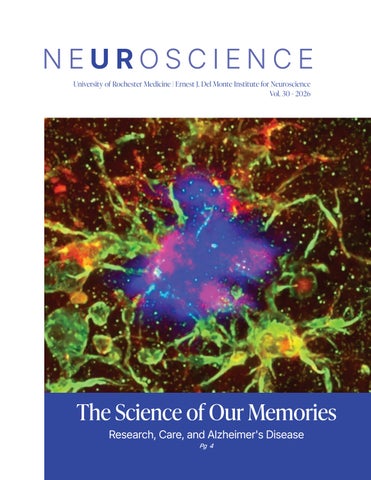
The Science of Our Memories Research, Care, and Alzheimer's Disease Pg 4
FRO M TH E D I R ECTO R ’ S D ES K
A
s the academic year began, a major m ilestone in our research portfolio was delivered to URochester. As part of the Golisano Intellectual and Developmental Disabilities Research Institute, we are now the 6th research institution in the country to have a headonly 3T MRI MAGNUS. This tool will allow for more detailed brain imaging while addressing the unique challenges of conducting research with people with developmental disabilities (pg 1).
John J. Foxe, PhD Kilian J. and Caroline F. Schmitt Chair in Neuroscience Director, Ernest J. Del Monte Institute for Neuroscience Professor & Chair, Department of Neuroscience Director, Golisano Intellectual and Development Disabilities Institute SCAN TO LISTEN TO NEUROSCIENCE PERSPECTIVES WITH DR. ANIA MAJEWSKA TODAY!
ON THE COVER: Brain immune cell, microglia (green), congregate around toxic amyloid-beta plaque (blue) and express a diseaseassociated microglia protein (CLEC7A; red) to protect neurons in an Alzheimer's disease-like mouse brain. / provided by Lia Calcines Rodriguez, Neuroscience Graduate Student, O’Banion Lab.
The needle of research only moves with innovation, and part of that is providing a space for new ideas to flourish. That is the goal of our pilot program, which has supported over 160 projects by URochester researchers across more than 30 departments since 2015. This year, there was no shortage of robust research ideas. There were more than 70 applications, the largest in the program’s history. I’d be remiss not to point out that these pilots are only possible because of philanthropic support. We are grateful for the community’s vested interest, support of our research, and their understanding of its broader impact. The cover story of this issue is a perfect example of how the research pipeline at URochester is translating discoveries into action for patients with Alzheimer’s disease (pg 4). I am absolutely thrilled that Professor Ania Majewska took the time to be a guest on our podcast, Neuroscience Perspectives. In addition to being a
delightful person and a valuable member of our neuroscience community, she has helped change what we know about microglia, the brain’s immune cells, and her mentorship is second to none. She describes how she has created what many see as a level playing field in her lab and how it works. I look forward to sharing this episode with you. In September, we welcomed the EEG & Clinical Neuroscience Society (ECNS) to URochester and co-hosted its annual symposium. It was a pleasure to bring this international society to URochester, inspire new ideas, and build new collaborations. I’m looking forward to seeing familiar faces and hopefully some new ones while we are in Washington, D.C., for the annual Society for Neuroscience conference. Check out the invitation to our annual social on the back page. I hope you are able to join us! We remain steadfast in our pursuit of progress and innovation, despite notable changes in how science is supported by federal funding. We, as a scientific community, will continue to dive into the unknown in pursuit of discovering facts to improve the well-being of all. In Science,
John J. Foxe, PhD
Del Monte Institute for Neuroscience Executive Committee John Foxe, PhD Chair, Department of Neuroscience Bradford Berk, MD, PhD Professor of Medicine, Cardiology Robert Dirksen, PhD Chair, Department of Pharmacology & Physiology Diane Dalecki, PhD Department of Biomedical Engineering
NEUROSCIENCE Jennifer Harvey, MD Chair, Department of Imaging Sciences
Shawn Newlands, MD, PhD, MBA Chair, Department of Otolaryngology
Robert Holloway, MD, MPH Chair, Department of Neurology
Webster Pilcher, MD, PhD Chair, Department of Neurosurgery
Paige Lawrence, PhD Chair, Department of Environmental Medicine
Steven Silverstein, PhD Professor, Department of Psychiatry
Hochang (Ben) Lee, MD Chair, Department of Psychiatry
Duje Tadin, PhD Interim Dean, School of Arts & Sciences
UNIVERSITY OF ROCHESTER MEDICINE | ERNEST J. DEL MONTE INSTITUTE FOR NEUROSCIENCE
Editor/Writer Kelsie Smith Hayduk Kelsie_Smith-Hayduk@ urmc.rochester.edu Contributors Mark Michaud, Jim Miller Feature Photography John Schlia Photography
NEUROSCIENCE VOLUME 30
2
PATH TO SUCCESS
A University and Rochester City School District summer program, designed to improve access to science for high school students, welcomes its first alumni as University undergraduates
8
FUNDING THE NEXT DISCOVERY
15 novel interdisciplinary and collaborative neuroscience-related research projects were selected for year 11 of the Institute’s pilot program
9
FACULTY Q & A: DR. DAVID GREENBERG
4
TRANSFORMING ALZHEIMER'S RESEARCH & CARE
The the Evans Lam Professor of Music and Medicine's research explores how music impacts people and how its effects could be turned into interventions
Celebrating 40 years of translational research. The URochester AD-CARE program sits at the cornerstone of Alzheimer's treatment and care around the globe
NEURO MOMENTS August Delivery day! We became the 6th research institute in the country to have a head-only 3T MRI MAGNUS system. This tool will allow our researchers to explore brain function with exceptional detail.
September We were proud to host researchers from across the globe for this year’s EEG & Clinical Neuroscience Society (ECNS) annual meeting.
NEUROSCIENCE | VOL 30 | 2026
1
Becoming a Yellowjacket: Turning a Summer Neuroscience Experience into a Degree A University and Rochester City School District summer program designed to improve access to science for high school students welcomes its first alumni as University undergraduates. For six weeks each summer, students from the Rochester City School District enter neuroscience research labs at the University of Rochester as scientists. Paired with a bench mentor, they are instantly embedded in lab meetings and data collection. They are also tasked with planning and executing their own projects, which they present to faculty, postdocs, graduate students, and peers at the end of the summer. “No matter how good your high school science classes are, they cannot teach you what scientific research is really like,” Dana Boebinger, PhD, postdoctoral fellow and a bench mentor in the NEURORocHS high school pathway program, said. “Opportunities like NEURORocHS allow students to experience the excitement and challenges inherent to basic research, which is hugely informative as they begin to make decisions about what careers they might pursue during college.”
Journey to URochester Rochester native James Pichardo grew up minutes from the campus and is now a freshman at URochester. Majoring in psychology, on a pre-med track, Pichardo is coming on a full ride
2
“I
became interested in science almost entirely because I seek to have a deeper understanding of the world."
- Pichardo
after graduating as the valedictorian from Padilla High School in the Rochester City School District (RCSD). Jacayla Stewart, a graduate of East High School in RCSD, also entered her freshman year at the University as a history and biology major. She spent her time in NEURO-RocHS working in the lab of Martina Poletti, PhD, studying retinal changes in Schizophrenia. “I am extremely proud of all our students, especially James and Jacayla,” Emily Murphy, MS, research specialist and co-leader of NEURORocHS said. “Our program would not be possible without the unwavering support of the dedicated teachers and administrators in RCSD, including Mariel Spano, Jodi Cook, and Laura Delehanty at East High School, as well as Leslie Grant at Padilla High School. Working closely with these educators
has given me a profound appreciation for all high school teachers, especially those in the RCSD.” Pichardo first came to the University of Rochester the summer after his sophomore year to study optics as part of the Upward Bound STEM-ternship program. The following summer, in 2025, he was one of seven high school students accepted into the Del Monte Institute for Neuroscience Commission’s NEURO-RocHS program. He worked in the lab of Sam Norman-Haignere, PhD, with Boebinger as his bench mentor. “The experience in general was amazing, and I'm both happy and proud to have been able to attend this program,” said Pichardo. “Dr. Boebinger was instrumental in the entire experience. Just her character alone outside the lab was bright, and in the lab, she was a well of knowledge and really put in effort to help me understand many things I will likely find useful in the future at URochester.” “As someone without a ton of formal one-on-one mentoring experience, serving as a mentor for the Neuro-RocHS program was an eye-opening experience,” said Boebinger. “James was a wonderful summer trainee. He demonstrated a genuine enthusiasm for neuroscience and for learning about the research
UNIVERSITY OF ROCHESTER MEDICINE | ERNEST J. DEL MONTE INSTITUTE FOR NEUROSCIENCE
James Pichardo
Jacayla Stewart
process, particularly as it relates to understanding the human mind and behavior.”
Access to the Scientific Community The intensive lab experience is just the beginning for these students. Following their summer experience, they head to the world's largest neuroscience conference, hosted by the Society for Neuroscience (SfN). It brings together tens of thousands of researchers and trainees. “The SfN experience was mesmerizing,” said Pichardo. “I think getting to see hundreds of posters of people who have spent weeks or months of their lives advancing the field of neuroscience left a deep feeling of both amazement and sonder.” The breadth of exposure to a
researcher’s day-to-day and life may have been the most impactful part of the experience for Pichardo, who says the self-reflection he had following his NEURO-RocHS experience had a lasting impact. “I became interested in science almost entirely because I seek to have a deeper understanding of the world,” said Pichardo. “I just want to learn more and more about how everything works. Getting to learn more in general is something I love to do, and when it comes to science, there is no limit to how much you can learn.” Since 2021, 34 students from East High and Padilla High School in the Rochester City School District, and three Rochester Brain Bee winners, have attended the program. Many have gone on to graduate from high school and pursue degrees.
NEUROSCIENCE | VOL 30 | 2026
3
F E AT U R E
The Science of Our Memories How University of Rochester Researchers and Clinicians are Transforming Our Understanding and Care of Alzheimer's Disease
W
hat does it mean to miss a lunch date, forget an appointment, or misplace keys? Are these moments of normal forgetfulness or signs of something more sinister?
While there is overlap between normal forgetting and memory loss associated with dementia or Alzheimer’s disease, Anton Porsteinsson, MD, who has spent decades treating and studying these neurodegenerative disorders, pays close attention to frequency, intensity, and progression as three key areas that tell the difference. “At first it may be subtle, but forgetting that becomes persistent, forgetting things that are important—particularly when reminders do not bring back the memory recall—that is worrisome.” Just five years ago, memory changes like this could take a year or more of clinical evaluations to receive a diagnosis. Today, a blood test can
reveal an objective Alzheimer’s disease diagnosis in just days. And since 2024, URochester has been able to offer patients in the early stages of the disease lecanemab and donanemab, both FDA-approved treatments that can slow symptom progression. “Everything seemed to happen so slowly in Alzheimer's disease research and care until it suddenly didn’t,” said Porsteinsson. “In the last five years, there’s been an incredible acceleration of discovery, including blood biomarkers and new medications. These open new opportunities, and I believe that we’re going to see great advances over the next decade.”
About Lecanemab and Donanemab These are both monoclonal antibodies that clear amyloid beta, slowing cognitive decline in patients with early-stage Alzheimer’s disease. Patients on these treatments must be monitored closely by a physician for possible brain swelling and microbleeds, potentially serious side effects of these treatments. URochester Medicine served as a study site for both the phase 2 and 3 clinical trials of lecanemab and phase 3 of donanemab. Anton Porsteinsson, MD
4
UNIVERSITY OF ROCHESTER | ERNEST J. DEL MONTE INSTITUTE FOR NEUROSCIENCE
From left: Lia Calcines-Rodríguez, M. Kerry O'Banion, MD, PhD
Emily Clark, DO
URochester Research at the Center: AD-Care Celebrates 40 Years In 1986, URochester became a cornerstone of the nation’s Alzheimer’s disease research networks. Led by Porsteinsson, the AD-CARE (Alzheimer's Disease Care, Research and Education) program has advanced treatment and diagnostic tools. Shepherding more than 350 clinical trials over the course of four decades, the work at AD-CARE has been instrumental in pioneering innovations and helping to pave the way for the blood-biomarker and other diagnostic tools as well as current pharmaceutical treatments URochester was part of the clinical trials for both. Porsteinsson, who is the Center’s director, credits the program's longevity to the people who work on it, their URochester collaborators and infrastructure, and philanthropy. “Meaningful philanthropy support has provided us stability over the years,” Porsteinsson said. “It helps even out the fluctuations and allows us to not worry about tomorrow or next week but work towards the greater achievements.” Today, the Biologics Treatment Center, led by Geriatric Psychiatrist Emily Clark, DO, provides patients across upstate and western New
York clinical access to anti-amyloid antibodies. Over 100 patients with early symptomatic Alzheimer’s disease are receiving treatment with anti-amyloid antibodies. “While the monoclonal antibodies against amyloid are really kind of the leaders at this point, it's not all that we're looking at when it comes to treatment,” Clark said. “There's constantly been this search not only for medications or interventions that can modify, slow, or stop the disease, but also ways to try to better treat the disease symptoms.” Preventative measures are also being investigated. It’s well understood that the accumulation of amyloid protein in the brain is one of the earliest indicators of the disease, which can start 20 years before symptoms begin. AHEAD 345 is a current trial that the program is a part of. Working with asymptomatic people who largely have a family history of the disease, researchers are studying prevention methods. PET scans reveal whether a subject has signs of amyloid accumulation. In this four-year, double-blind, placebo-controlled trial, researchers are using lecanemab to determine whether earlier treatment leads to better outcomes. Already working to expand options for Prevention, AD-CARE is launching two
ambitious prevention studies late this year, including using trontinemab, a monoclonal antibody that is attached to a protein called Brainshuttle, which allows the medication to cross the blood-brain barrier more easily.
Back to the Basics: Understanding Alzheimer’s from a Cellular Level How Alzheimer’s disease develops remains largely a mystery to scientists. They understand that age, genetics, and environmental factors can all play a role, but it is a complex mix of brain changes that causes the disease to develop over many years. That mix can involve a buildup of amyloid plaques that clump together over a long period of time and disrupt cell communication, and modifications of tau protein, changing into tangles that destroy the cell’s internal transport system. These eventually lead to cell death, but this process can take decades, and why it starts is still unknown. Inflammation was long thought to promote the disease until Neuroscience Professor M. Kerry O’Banion, MD, PhD, turned this understanding on its head. Twenty years ago, he discovered that inflammation is not always bad and that it can actually improve the
NEUROSCIENCE | VOL 30 | 2026 5
disease's pathology and may hold it at bay. Today, he continues to study inflammation; part of his research aims to understand the role that microglia, the brain’s immune cells, may play in pathology. Recently, a study led by Lia CalcinesRodríguez, a Neuroscience graduate student in his lab, found differences in how these cells behave in male and female brains. “It is well documented that males and females are diagnosed with Alzheimer’s disease at different rates,” said O’Banion, professor of Neuroscience and Neurology. “But we still do not have a great understanding of why this is the case.” His expertise in brain inflammation is also key to understanding potential gene mechanisms in mammalian longevity that contribute to healthy lifespans. He, Vera Gorbunova, PhD, the Doris Johns Cherry Professor of Biology and Medicine, and other researchers are studying comparative genomics of longevity and Alzheimer’s disease. “We are asking whether genes involved in resilience to aging alter the course of Alzheimer's pathology in mouse models,” said O’Banion. “Understanding the mechanisms at play could be cues that become future targets for therapeutics.”
Neta Rosenzweig, PhD
The Role of Our Genes Neta Rosenzweig, PhD, recently joined URochester Medicine as an assistant professor of Microbiology and Immunology and Neuroscience. She investigates interactions between immune and brain cells, how they vary with respect to genetics, and if those beneficial interactions can be therapeutically harnessed while detrimental ones are suppressed. “Up until about 10 years ago, it was a very niche field,” said Rosenzweig, “but now it’s being accepted that the immune system has a very central role in Alzheimer's. These cells are not just bystanders but also play a role in the etiology of the disease.”
6
Understanding the Decline of “Our Mind’s Eye” New research led by Kuan Hong Wang, PhD, is investigating the Frontal-Insular Network (FIN), the area where memories and memory recall are stored, and how Alzheimer’s disease interacts with key features of this network. Wang and fellow researchers, including O’Banion, will investigate structural changes of FIN in mice, how disease-related genetic mutations accelerate FIN degeneration, and whether pharmacogenetics or optogenetics can be used to target and improve cognition.
Rosenzweig is specifically interested in apolipoprotein E, or APOE, a gene that makes a protein necessary to transport cholesterol and other lipids to cells, including the cells of the immune system and the brain. APOE has three common versions, or alleles: APOE2, APOE3 and APOE4, and each person typically inherits one copy from each biological parent. Previous research has found, that about 65% of Alzheimer’s patients carry at least one APOE4 copy. While APOE2 is considered protective, because people who carry two copies are almost never diagnosed with Alzheimer’s. This is also the rarest combination to have of the three common APOE versions. But scientists still do not fully understand why different versions of APOE have such markedly different disease outcomes. “My lab is trying to understand this. Why are these people so resistant to Alzheimer's? Are there beneficial immune interactions that confer resilience to Alzheimer's, and could we potentially harness those mechanisms therapeutically for those who do not have the protective genetic makeup?”
Prevention and the Future of Care The number of Americans faced with an Alzheimer’s diagnosis is projected to double by 2060. David Gill, MD, a neurologist at URochester Medicine, has witnessed a transformation in his clinic over the last decade in how patients are tested and what can be offered in terms of treatment. “We are much more certain of the diagnosis, and that has been a dramatic change. The blood tests we have are over 90% accurate,” said Gill. “We really can be as sure
UNIVERSITY OF ROCHESTER MEDICINE | ERNEST J. DEL MONTE INSTITUTE FOR NEUROSCIENCE
Supporting Novel Research Three projects funded by the Del Monte Institute for Neuroscience Pilot Program will investigate novel research related to Alzheimer's disease. • Rosenzweig and O’Banion are leading a project to investigate neutrophils and microglia in the brain of mice with the protective APOE2 variant. • Margot Mayer-Proschel, PhD, and Arefin Tanzil, PhD, will investigate how treatments affect the brain over time and if treatment efficacy can be monitored using fluid
about Alzheimer's disease as we can about diabetes and other things, and that's a big change.” Gill anticipates new treatments to slow Alzheimer’s symptoms and hopes that new tests for non-Alzheimer’s dementias will be the next wave to change the field over the course of the next decade. “If we can slow [the disease] down by even by 50 percent, I think for the vast majority of patients, Alzheimer's disease will not play a large part in their life,” said Gill. “For most people in their 70s or 80s, if you slow it down enough, they'll be able to follow their regular life as they would normally.” Prevention is also a part of the future. He and his team are starting a Healthy Brain Aging Program to work with and follow patients who may be at risk for memory loss but currently have normal cognition. The small-group-based interventions will primarily focus on four things: being more physically active, being more social, doing more mentally challenging activities, and following a more heart-healthy diet.
biomarkers. • Felix Yarovinsky, MD, O’Banion, and Ania Majewska, PhD, aim to understand how new microglia, which emerge during inflammation, survive in the brain. Learn more about our pilot program on pg 8.
Giving Hope: The Baker Family When Alzheimer’s disease presented itself in the Baker Family, through its matriarch, Natalie Baker, the family learned the devastating breadth and depth of how the disease can slowly affect
Natalie Baker
not only an individual but an entire family. The Baker siblings, through their family’s foundation established by Natalie and Robert Baker, who were connected to the University of Rochester for over 50 years, wanted to find a way to support research that could change the disease course for other individuals and families. “When we learned of Dr. Gill’s Healthy Aging Program, it was the perfect fit,” Natalie’s daughter, Nancy Baker, said. “Supporting research aimed at prevention was the way our family could honor our mother, Natalie, and help others who find themselves stricken by this devastatingly David Gill, DO
cruel disease.”
NEUROSCIENCE | VOL 30 | 2026
7
Del Monte Institute Pilots Support Novel Research
S
ince 2015, the Del Monte Institute for Neuroscience has supported over 160 novel research projects led by researchers from more than 30 departments across URochester. This program is maintained by philanthropic support, and it has generated more than $40 million in external research support to date. Fifteen new projects were funded this year.
Scan to read about more funded projects:
Understanding Head Movements and the Inner Ear Choongheon Lee, PhD, assistant research professor, and J. Christopher Holt, PhD, associate professor, Otolaryngology and Neuroscience, aim to develop a noninvasive way to directly measure how the inner ear detects head rotation. Researchers will use a specialized device to deliver precisely controlled head rotations and identify a tiny scalp-recorded signal that reflects semicircular canal activity within a few thousandths of a second. The goal is to create a research tool to help study how the inner ear detects head rotation and how this function is disrupted in disease.
Listening and Walking in Parkinson’s Disease Karlo Lizarraga-Mendoza, MD, adjunct associate professor of Neurology, and Edward Freedman, PhD, professor of Neuroscience, will explore how walking affects the brain’s ability to process sounds in people with Parkinson’s. Researchers will use mobile brain/body imaging (MoBI) to measure brain activity and body movement while participants sit and walk, and to compare their ability to detect pitch changes and to focus on a single sound when competing sounds are present. The findings could help guide future strategies to support safer and more effective mobility.
Identifying Brain Activity in Coordinated Movements Gabriella Sterne, PhD, assistant professor of Biomedical Genetics, will explore how the brain organizes complex reaching movements, such as picking up a coffee, using the arm-like fruit fly proboscis. Researchers will combine behavior studies, computer modeling, and advanced brain imaging to understand how premotor circuits contribute to coordinated reaching movements. They will also develop a novel imaging approach to look deeper into the fly brain during behavior. This research could improve our understanding of movement disorders and inspire robotic design.
Discovering Biomarkers for Cognitive Changes in Lupus Ilana Abeles, MD, PhD, assistant professor of Allergy, Immunology & Rheumatology, and Ian Fiebelkorn, PhD, associate professor of Neuroscience, will investigate whether electroencephalography (EEG) can detect changes in memory and attention in people with systemic lupus erythematosus (SLE). By measuring brain activity during computer-based working-memory tasks, the team aims to identify objective brain-based markers of cognitive change. This research could advance the development of biomarkers to assess cognitive outcomes in future clinical trials and guide targeted treatments. 8
UNIVERSITY OF ROCHESTER MEDICINE | ERNEST J. DEL MONTE INSTITUTE FOR NEUROSCIENCE
F A C U LT Y P R O F I L E
Q&A with
David Greenberg, PhD
David Greenberg, PhD, is the Evans Lam Professor of Music and Medicine. Greenberg completed his postdoctoral training in Social Neuroscience at Bar-Ilan University in Israel. He has a PhD in Psychology from Cambridge, where he also completed his master's in Social and Developmental Psychology. He attended Rutgers University and the Mason Gross School of the Arts, where he majored in Psychology and Jazz Performance. His research studies how music impacts people and how its effects could be turned into interventions for conditions like pain, depression, and neurodevelopmental disorders.
Please summarize your research. At the Music, Mind, and Medicine (3M) Lab at the Del Monte Institute for Neuroscience, we study how and why music moves us, and how to turn those effects into medicine. We combine large-scale behavioral data with brain imaging and clinical trials to uncover the mechanisms behind music's effects on the brain and to build personalized, musicbased interventions (MBIs) and digital health technologies for conditions like depression, PTSD, and autism. The aim is precision music medicine that is evidence-based, individualized, and scalable.
How did you become interested in your field? I came to science through music first. I’m a trained jazz saxophonist, and I spent years experiencing firsthand how music changes emotion, connection, and states of mind. There's also a personal thread: I spent time in a NICU as a two-week-old infant and was sung to by my grandfather— songs embedded in my memory to this day. Bridging art and science has driven everything since.
How do you use music to unlock/elevate our understanding of the human brain? Music can engage neurological reward, emotion, memory, movement, and social bonding all at once, so a single naturalistic stimulus lets us study many brain systems at the same time. We quantify music using detailed feature extraction models and pair it with everything from largescale behavioral data to physiological synchrony and, here at URochester, intracranial recordings from patients.
By mapping how specific musical features drive specific brain and body responses, we can understand the underlying mechanisms, and then use that knowledge to design targeted interventions.
What brought you to the University of Rochester? URochester is one of the very few places on earth, perhaps even the only one, where a world-class medical center and a world-class music school live inside the same university. The Evans Lam Professorship of Music and Medicine, the Del Monte Institute for Neuroscience, and Eastman Performing Arts Medicine (EPAM) Center gave me a rare opportunity to lead a program that harmonizes rigorous science with musical excellence all under one roof. Add the clinical reach of URochester Medicine and a genuinely collaborative culture, and it is the ideal place to help build the field of music and medicine.
Who do you collaborate with at URochester? We have built collaborations across more than 20 departments at the University of Rochester. Including the Department of Neurosurgery, Department of Psychiatry, Wilmot Cancer Institute, Goergen Institute for Data Science and Artificial Intelligence, Department of Developmental Pediatrics, the Department of Sound Arts and Engineering, and the Eastman Institute for Oral Health.
What is your favorite piece of advice? My favorite piece of advice: “Out of clutter, find simplicity. From discord, find harmony. In the middle of difficulty lies opportunity” - Albert Einstein
NEUROSCIENCE | VOL 30 | 2026
9
University of Rochester Medicine Del Monte Institute for Neuroscience 601 Elmwood Avenue, Box 603 Rochester, New York 14642
Scan to receive the Neuroscience Newsletter Visit us online: delmonte.urmc.edu Follow us @URNeuroscience giveto.urmc.edu/delmonte
SAVE THE DATE 7th Annual University of Rochester Neuroscience Graduate Program Social at SfN Sunday, November 15, 2026 7:00 - 9:00 pm Zaytinya's Mediterranean Cuisine 701 9th Street NW, Washington, DC 20001 Contact for more information: Pam_LaDuke@urmc.rochester.edu
Join us for an evening of networking and celebration!