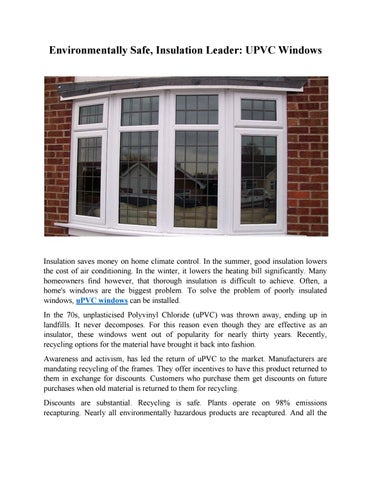
Environmentally Safe, Insulation Leader: UPVC Windows
Insulation saves money on home climate control. In the summer, good insulation lowers the cost of air conditioning. In the winter, it lowers the heating bill significantly. Many homeowners find however, that thorough insulation is difficult to achieve. Often, a home's windows are the biggest problem. To solve the problem of poorly insulated windows, uPVC windows can be installed. In the 70s, unplasticised Polyvinyl Chloride (uPVC) was thrown away, ending up in landfills. It never decomposes. For this reason even though they are effective as an insulator, these windows went out of popularity for nearly thirty years. Recently, recycling options for the material have brought it back into fashion. Awareness and activism, has led the return of uPVC to the market. Manufacturers are mandating recycling of the frames. They offer incentives to have this product returned to them in exchange for discounts. Customers who purchase them get discounts on future purchases when old material is returned to them for recycling. Discounts are substantial. Recycling is safe. Plants operate on 98% emissions recapturing. Nearly all environmentally hazardous products are recaptured. And all the
efforts to recycle would not matter if this composite did not outperform every other material for insulation purposes. None does. The function of uPVC has come a great distance since it was introduced in the 70s. Between incentives and the safe process of recycling that recaptures and reuses emissions these windows can be marketed as a green alternative to wood or metallic competitors. Like a great underdog tale, it has made an ironic return to consumers.