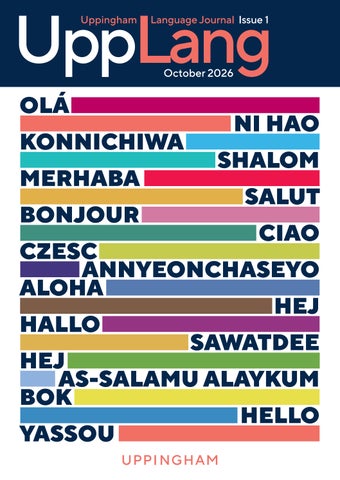
UppLang Uppingham
Language Journal Issue 1
October 2026
OLÁ KONNICHIWA MERHABA BONJOUR
NI HAO SHALOM SALUT CIAO
CZESC ANNYEONCHASEYO ALOHA HEJ HALLO SAWATDEE HEJ AS-SALAMU ALAYKUM BOK HELLO YASSOU
2
UppLang – Issue 1
Table of Contents
5
Letter from the editors
6
Home Languages Survey
7 An interview with… 7 - Mr Addis, former Head of Classics, on his experiences growing up abroad, living in Mexico and with learning languages 9 - Mr Le Brocq, Director of Admissions (OU, Hf 08) on his language journey at Uppingham and beyond 11 - Mr O’Donoghue, Teacher of Geography, on teaching English in Japan 15 - Mrs Knapp, Bursary, on a Welsh upbringing and life in Jeddah 17 17
Where are they now? Updates from OUs Alasdair Judd (OU, WD 20): A post-card from Lyon
18 Individual Research Projects 18 - Sasha Dudakova (J), “To What Extent Is France Still a Great Power Today?” 19 - Isabella Silver (Fd), “Living Together in Spain: What Would a Successful Multicultural Society Look Like – and Is It Achievable?” 21 - Ellie Cross (C), “Was Impressionism Truly an Artistic Revolution in 19th Century France?” 23 - Eloise Roberts (NH), “To What Extent Does Frida Kahlo Reinforce or Break Stereotypes of Mexican Women in Her Art?” 26 - Lydia Maloney (Fd), “Breaking the Silence: Gisèle Pelicot, Visibility, and the Politics of Naming Sexual Violence” 28 EPQs and essays related to other languages and cultures 28 - Wilf Colcombe (WD) Leighton Essay: ‘Was Napoleon Bonaparte a defender or betrayer of the French Revolution?’ 31 - Clara Smith (LKP) EPQ – “The influence and Impact of women during the reign of Augustus” 32 32 33 33 34 35 36 37
Competition entries The Stephen Spender Prize Eloise Roberts (NH) and Isabella Silver (Fd): Soneto Da Mulher Ao Sol, Vinicius de Moraes Anthea Bell - Bogdan Tretiak (B) – Italian level 1 2025 - Benedict Braddock (OU, LH 20) – Russian ab initio 2025 - Deandre Dsouza (Lower School) – German level 2, 2026 - Justin Chan (WD) – French level 1, 2026 - Benedict Briggs (WD) – Spanish level 3, 2026
38
GCHQ National Competition, report by Daisy Dai
39 39 39 39 39 39 39
Fourth Form Acrostic Poems: La Fête du Travail - Marcos Leech López (SH): - Daisy Dai (C): - Joseph Upton (LKP): - Milo Elson (WB): - Charlotte Branton (Fd) : - Megan Bussell (Sa) :
UppLang – Issue 1
3
40 40 40 40 40 40 40 40 40
Origins of modern Romance Languages from Classicists, Ethan Leung (M) Romance languages The Connections of Each Language to Latin - French: - Spanish: - Italian: - Portuguese: - Romanian: What Makes These Languages Unique?
41 41 42 43 45
Where in the world? Trip to La Maison d’éducation de la Légion d’ honneur MELH visit to Uppingham 2025 Burgos Mathilda Garelli (C) and Julianna Whittaker (NH) report on French trip to the British Film Institute, La Haine study day
46 46 46 46
Tutto fa brodo - Topinky (Czech), from Kate O’Donoghue - Belyashi (Russian), from Amaliia Diakova - Cabbage Rolls (Russian), from Amaliia Diakova
47 47 47 47 47 47 47 48 48 48 48 48 48 48
Ones to Watch – social media accounts, playlists and podcasts Podcasts - Modern Languages: Current Affairs - Modern Languages: Language learning - Classical Languages - Linguistics - Other subjects in other languages Social media accounts - Uppingham Languages - Spanish - German - French - Classics - Linguistics
49
Playlists
50
Wordsearch
51
“Not on the vocab list” slang for young people
4
UppLang – Issue 1
Letter from the editors
Dear readers, We are incredibly excited to present to you the inaugural edition of the UppLang journal! It has been a pleasure to look back through this year and revisit the multitude of experiences, projects and extracurricular activities which have greatly contributed to the culture and community at Uppingham. Having the ability to present pieces of work from all year groups has been an invaluable opportunity, and we are incredibly grateful to have been offered this experience. When we started, we were surprised at the amount of engagement towards this journal, which came from a wide variety of pupils and members of staff. Having the opportunity to converse with teachers, pupils and members of staff in all aspects of the school has been the most enriching. Thank you to everyone who has contributed to this edition - we are immensely appreciative of the ability to showcase the cultural beauty of Uppingham. Throughout this process, we have discovered many unique stories and backgrounds which we had never heard about before. This experience has revealed a deep and rich culture of our school which is normally hidden in our daily school lives. In this journal, we are proud to present articles regarding both academics and cultural heritage, ranging from Individual Research Projects to family recipes with a rich history. We hope you enjoy reading this journal as much as we have enjoyed putting it together, Julianna Whittaker, Mathilda Garelli, and Beau Slowey-Dillon
UppLang – Issue 1
5
Home Languages Survey Who speaks what at Uppingham?
222 Uppinghamians
Of 399 Uppinghamians,
speak different languages at home
317
said that English is their main language at home
Of these, there are 41 languages other than English spoken
Shanghainese
Japanese
6
UppLang – Issue 1
Turkish
Punjabi Kazakh Portuguese Bermudain
German
Kreole
Vietnamese Edo
Gujurati
Yoruba
Swedish
Catalan
French
Arabic
Malay Thai
Maltese
English
Mandarin Azerbaijani
Swahili
Chinese
Hebrew
Hindi
Ukranian
Spanish Latin Hakka
Jamaican
Akan
Russian Urdu
Danish
Italian
Cantonese Nepali
Taiwanese
Dutch
An interview with... Mr Addis (former Head of Classics), on his experiences growing up abroad, living in Mexico and with learning languages
Talk to me about your experience with languages - have you ever lived abroad and whereabouts? I grew up in England. I was born Hong Kong, lived in Indonesia, Malaysia, and moved around a lot. My mother currently lives in southern Spain and when I was growing up, we used to have a little place in France. So, I've grown up always trying to communicate lots of different languages, and obviously the language in school: French, Spanish, Latin, Greek GCSE, and then Latin and Greek for A level. And then I went to university and really committed to my Spanish. I spent 3 months working in Mexico to develop my Spanish, working for a bank in Mexico City and doing some travelling. I’ve always tried to keep the languages going.
“To have another language is to possess a second soul.” Charlemagne
What would you say was your favourite part about living in Mexico? The salsa dancing! It was amazing that every Friday night in the university town, they would always have their main square salsa dancing. And it was just a way to get to know people and be immersed in a different culture. And they serve food, there were loads of beautiful empanadas, there were great Mexican foods. And the way you got to meet people, you got chatting, and then you'd do salsa dancing, and it was just fantastic. And the culture was so engaging. In your opinion, what is the most challenging part about speaking a new language or being in a new environment? The most challenging is always frustration, when you know what you mean, but you don't have the word for it, and you're trying to convey something. So, for example, in Spain, I regularly go out and I help my mother. My mother's Spanish is now quite good, but when she was first there, it was quite poor. And she needed a washer - as in the little circle, you put, say, inside a pipe or something. Now, the problem is, if you go on Google Translator, you type in washer, it comes with ‘lavador’, which means ‘someone who washes.’ And that's not what that word is. So, we go into the hardware store, to Manuela, who works there, and we're like, “Necesito una cosa poquita” (a little thing). It's a circle, it's metal. Then they get out something, like a ring, I'm like, “no, UppLang – Issue 1
7
it's not a ring”. And so, you're trying to convey that sense of, ‘I know exactly what I mean and know exactly the word in that language’. It's very hard for me to work out what that word is in a different language. I have to basically articulate to try and convey what that word is. So that's probably the most frustrating thing. That must be really beneficial in the world of communication as well. 100%, you get to think about ‘what do you actually mean?’ Because in English you just grab the word and it comes out and you don't think about conceptually what that actually means. Whereas when you're working another language, you have to think about the context, the understanding of the nature of the way the word operates in that world. I know that you originally were going to go into a medical career. But then you switched to Classics. Why is that? I've realised that was actually very bad with blood. When I was growing up in Indonesia, on Sundays, there used to be a pony ride that would come around and we'd go on the pony and run around the town. But one of the days was Eid, which was one of the festivals, and they, in this rural area, would sacrifice the cattle in the traditional way, which means slitting their throats and the blood just gushing everywhere. When I was about 3 years old, I came back from this utterly traumatised and my mum was like “what on earth has happened here?” because the blood was gushing down the streets. Because in order to be Halal it has to be done. So, I realised that actually I wanted a career that was empathetic. And medicine felt an obvious choice. But actually, Classics is also similar, and any kind of language or culture is empathetic because you are putting yourself in the position of somebody else, whether that's intellectually through reading poetry, or a film, or a book, or thinking about what they might want to say. I think empathy is such an important skill and a lot of people desire empathy. Sometimes, we divorce language from empathy, whereas actually languages is the fastest way to learn empathy, through looking at cultures. And for Classics, it was 2000 years ago. You're trying to think in the mind of someone who's 2000 years old, or 2500 years old if you look at Homer or Sappho. And actually, sometimes it's very similar experience to how we feel now. And you go, okay, well, maybe that's the ubiquitous experience. If you had the opportunity, would you like to teach Classics in another country? Absolutely, I would love to teach abroad! I know I'm moving to London, but originally, I was looking to move to Madrid. I think going abroad is such a fantastic experience and I would encourage anyone to try and do it, like during a 3rd year university course for example. I find that recently a lot of people are on their gap years saying, “I'm going to go to Australia,” and I think “okay, Australia's great”, but actually, be more adventurous! Go to South America, go to Africa, go to Europe, go somewhere where it's more different than Australia is to here. That experience will bring you out of your shell more; it'll be harder, but that makes it more valuable. I would really love to go to Japan. I've been there before visiting a good friend of mine but, unfortunately, they don't do Classics in Japan, so I would have to pick History or something else. But that is such an immersive culture. The Japanese are unapologetically Japanese, and you are expected to be Japanese when you're there. A lot of places, they just don't have English in the road signs, but you go to Greece, say, and they do. In Japan, they say, “we're Japanese, and we're very proud of our culture and heritage”, and being part of it would be amazing.
8
UppLang – Issue 1
An interview with... Mr Le Brocq, Director of Admissions (OU Hf 08) on his language journey at Uppingham and beyond Could you tell us a bit about what your A levels were and why you chose them? So, I did French, Italian, and Music when I was here. And we used to do a thing called AS's. So, in Lower Sixth, everyone did four and then dropped one in Upper Sixth. I did English as well, English literature in Lower Sixth. I love studying languages. Part of the reason it was fun was because the department was a really fun department to be in. They were really fun teachers. It was made interesting because you weren't just studying the language, you studied the history. I remember learning about the mafia in Italian and that was really interesting and I learnt about a load of French history as well. So that kind of thing attracted me to it. I'd really enjoyed doing it at GCSE. I was just allocated Italian, but it used to be when I started here, everybody did French. And then if you wanted to do a second language, you would just give them one. You didn't decide, you were just told which now you were doing. I started Italian, and I’m not sure I was as good as I should have been at it. I used to really enjoy it. And frankly, you know, there's trips and things as well, so that was stuff I would look forward to. And what made you choose to continue languages? Well, we go to France a lot on holiday, and I really love the thought of, even just when you go to a restaurant, being able to order food in French, and understand a bit of what's going on. I really like the idea of doing that. So, I wanted to continue it. Also, I liked, again, as I said, sort of the history side of things, but then also French literature, I really enjoyed that side of it. So, we studied well, so we did ‘Les Belles Images’, and we did a film called ‘La Combustion’. We did French film, French literature, and I really liked the idea of being able to do that. Because I was studying music as well, I was quite often singing in French, so it was nice to be able to still be doing proper French lessons alongside, you know, being able to pronounce the words properly in singing.
Mrs Davies said that she used teach you P8 on a Monday. Which probably wouldn’t make Italian that much fun! That was when that used to exist, that was horrendous. We used to have to do CCF or community service, then we had to get back into their uniform and go and do a lesson at the end of the day. But yes, in Sixth Form I had Mrs Davies and Mrs Lapintana. You spoke about how you go to France a lot. Has there been a time you've ever felt embarrassed by not knowing something? I think I've not found it in France so much, but I found it in other countries I've been. In my job now, I do lots of travelling. I went to Japan recently and I was thinking, I don't know any words - nothing at all. So, I had to learn how to say thank you and please. But I think there is something really special when you go to Europe and are able to understand a little bit of what's going on. I think for a start, it shows respect to people you're going to see, and I think secondly, it also helps you in difficult situations. I had a really interesting time once in France - I was returning a hire car to an airport. And there was a discussion of whether I had scratched the car (which I had not). I then heard that the 2 guys were speaking to each other in French, and they were rude about me. And so in French, I replied to them and said, ‘I do actually understand what you're saying.’ It was brilliant, their faces just fell. Knowing some of a language means you don't end up in those tricky situations, so I think that's really helpful.
UppLang – Issue 1
9
It sounds like you really recommend languages! I think it's one of those subjects that you're always going to find useful, even if you don’t continue studying it, just to be able to know a few words, a few phrases. Now, the trouble with the English is that we're spoiled. In every country of the world, there's some English somewhere, different levels, but of course there's English everywhere. We're too spoiled, and I think that, in a way, it's such a good discipline for us as first language English speakers to really force ourselves to learn a language. We're having a baby in October, and I really want our child to grow up being able to speak two languages. I think, I would really encourage them within 15 years’ time, with their GCSEs, to be able to study any language, whether it’s French, Italian, Mandarin or Spanish. It's such a good discipline, even with that really boring thing of learning vocab, and reciting the tenses. I had this one teacher, and he was absolutely hot on vocab tests; you’d walk into the classroom, and he'd just fire a word at you, and you'd have the reply. If you got it wrong, you were sent out the class, and you would come back in again. But the thing is you don't get that in many other subjects. I know that there's almost a lack of enjoyment in students currently with languages. What would you give as advice to those students to help them find a way to love them? I think sometimes people look at languages and think ‘this is going to be too much hard work’. I think it's partly that our country isn't very good at teaching languages like it used to be. I think it used to be that everybody came to Uppingham with a basic level of French, and I think that has changed a bit now. But you know, I had friends at university who just started a language, you know, who were doing extra courses. And I think the thing to remember, if you look at overseas people, some people come here with a brilliant level of English but they improve so much in that time at school. You can learn a language really quickly. You've got to put in the work, and I think sometimes there is a fear of languages, that it’s just going to be too much. But it's so satisfying when you start getting into it, and when you go to a country with a language, you speak, and you start understanding things, and you realise that actually you can confidently order something if you want to. And I would really encourage people looking to GCSE to think further ahead and to just think, yes, there might be a few years of hard work, but to be honest with you, all GCSEs are hard. I think sometimes people think languages are going to be really difficult but actually, as long as you've got the work ethic, they're great. And finally, when you go to other countries, how do you find you create that social network? It’s really interesting. I have that quite a lot with my job now because I'm going to lots of countries often for short amounts of time. I think taking a genuine interest in the culture is a really important thing. It's quite good to take a real interest in things like the food, the place we're going to, or the religion or the architecture, whatever it is. So, I always try and get a guidebook and know a little bit about what's going on when I get there. And I think particularly in some of the countries I go to, there is making sure that you're polite and that you observe local customs. There can be certain things that we don't perceive as rude, but they might. Learning a few words in the language always goes a long way. You can get out of the taxi and say ‘thank you’ in the language, and I think it makes a big difference. It shows some effort. I think British people have a terrible habit of speaking very slowly in English. That makes no difference at all! So, I think anything you could do makes a big difference. And I do think studying a language, whatever it is, helps you understand how to translate that. Not literally translate the words but translate the culture into different things. And something else I love learning in languages is local food and local culture and traditions and all those kind of things as well.
10
UppLang – Issue 1
An interview with... Mr O’Donoghue, Teacher of Geography, on teaching English in Japan
When did you move abroad and why? So I moved to Japan in July 1999 because I was graduating from university. I didn't really know what I wanted to do next, but I did know that I wanted to do something a bit different and that would challenge me and I had a cultural interest in Japan, from books and films and things that I had read. And so an opportunity to go and live and work there, and to teach, not that at that stage I necessarily had a desire to be a teacher, was an opportunity I thought I would take. So how long did you live there and did you experience any cultural shocks when you first got there? I was there for a year. I left in, I guess, I must have left in July 2000. That sort of time. Yeah, so in terms of culture shocks, initially, yes, culture shock occurs, there’s often a cycle of culture shock. So you have the initial arrival in a completely new place and the sort of shock of that, but most of that shock is excitement. Then things plateau out as you sort of come to terms with your new reality. Then culture shock spikes again, because you start to get sort of frustrated with your new reality. So when I arrived it was the first time that I that I'd visited somewhere where I was functionally illiterate. You know, you could drop me in Germany or France or Italy, and at least the alphabets are the same, and obviously I could speak French and I've done some German. I could work stuff out. Whereas you drop me into the middle of Tokyo and I couldn't tell you what the shops were for. There was definitely that element of surprise, you know when I arrived there. How did the program you went on work? What happened was that you were allocated a location (a town, a city) to then work in schools there, and there was usually this was a global programme. So, you were doing this with people from the UK, people from the USA, people from Canada, people from Australia, anywhere where English was the first language. So
UppLang – Issue 1
11
myself and another Richard (who just happened to be allocated the same town) were sort of paired up. We were on the plane; we were sitting next to each other on the plane flight over. We were sharing a hotel room together in Tokyo for the orientation. And so, I remember Richard and I arriving and we jet lagged and were tired. And we look out the window and we're hungry. And we thought, oh, we've just got to get out there, anyway. We, you know, stepped out of the hotel. It was of those classic Tokyo streets the way you imagine it, you know, it's bright and neon and noisy and everything and we walk down. We are looking at all the restaurants going what does that sell? What does that restaurant do? And there we saw McDonald's. And so, we made a beeline for McDonald's, and then we'd done a little bit of language training. I literally had two days. So, we knew that there were quite a few words in Japanese, which were just basically English words, but said in a Japanese way. So, we got up to the counter and just went ‘hamburger’ And we got all we wanted.
After that we went off to our towns, I was in a small town called Marugame, which is fairly countryside provincial, it wasn't near Tokyo, it wasn't near Osaka or any of these big cities. So I arrived in July. I reckon by that November, I was experiencing that other end of cultural shock in which I was frustrated with why are things like this. I was feeling a bit lonely. I was feeling a bit isolated. I just I would have liked to go home for two days. Then come back again because I was enjoying myself. I was like, yeah, it was that sort of, you know, you, you find certain people's customs and traditions, I guess, rude or just strange and yeah, so there was definitely that element of culture shock.
12
UppLang – Issue 1
Was there a specific time where you felt embarrassed about getting something wrong? Japan's an interesting society. As a foreigner, you did get a certain amount of leeway in terms of your behaviour. So you were just, you were expected to get things wrong. Why would you know any better? There were sorts of little things, like someone handed you their business card, business cards were a big thing then. You had to make a big deal of sort of going, oh, wow, this is interesting. Thank you very much. And you wouldn't just put it straight away. pocket, you have to hold it. I was always went conscious of doing that, the bowing. You know, I'm sure that I didn't bow low enough in certain situations. What are other things I got embarrassed about? One of the things I do remember is (I don't embarrass that easily), but basically, a bird pooed on my trousers. So I had to take them to the dry cleaner. My Japanese was not and was never good enough to explain to a Japanese person that a bird just pooed on my trousers and I needed them cleaned. So I was standing there. And I knew the word for bird so I said that and then was pretending to poo. And somehow I managed to work it out with the dry cleaner! What have you learnt from living and working abroad? It's a very different experience, living and working in a community abroad, different to visiting as a tourist, you know, I mean, I have been lucky enough to travel and visit many places. But you never really in your two weeks, three weeks, even a month that you spend there, you never really get under the skin of the place or the people. So that's a real insight that I will value for the rest of my life. And I always hold a soft spot for Japan and the Japanese because I met lots of wonderful people and it's a beautiful and amazing country in so many ways. Um, You know, you. On a personal level, it changes you because obviously you've bee put in a challenging situation and you've made something of it. At that point I had never really lived alone. I lived with my parents then I went to university. I then lived with friends at university in a house. So, you know, having to look after my own house and manage that. Adapt to a new way of life. It was my first job, really. I'd worked as a barman and I'd worked as a security guard and things like that before then, but I'd never really had a job in which I was expected to turn up, you know, nine to five. I think it taught me to come out of my shell. How did you adapt to living abroad? The way I got out of that culture shock being frustrated was that I joined a martial arts club it was just around the corner and that I think that was the best thing that I did. Not because I, wanted to become Bruce Lee or anything like that, but sort of it plugged me into a community of Japanese people who really embraced me. I was really unusual. I turned up and there were no other Westerners. I had understood from talking to people that the way you did it was you turn up and you would just sit on the side and observe. Then if no one spoke to you, you would come back and next time and you would sit and observe. I sat there and I was observing, and you could tell that I drew attention. Eventually a man came over and he spoke very good English. He asked me what I was doing there. I sort of explained and turns out he was an English teacher. That was a fortunate way in. There was also another instructor, who had lived in America for three/four weeks. They took me in, I spent time with their families, I went out, things like that. So I became part of that community, it was transformational, for my experience. Due to being part of the wider project I was automatically plugged into a Western social network. There was a Canadian living in the town and others on my program. And that was comforting. But at the same time, it can also be dangerous. You’re hanging out with your Western friends who speak English and not really immersing yourself in the culture and not really getting to know the language. I definitely got it wrong I spent too much time in my Western friends, I could have made more of learning the language and things like that. However I managed to integrate and to find that community, which I managed to do through that martial arts club. It's weird though, you are totally innocent about what anything this means. My friend Richard had a friend, Yoshka, a Japanese woman who worked with him at his school. And when we joined the artial arts club Yoshka was really dubious about it. She was like are you sure you want to hang out with these guys?
UppLang – Issue 1
13
Apparently this martial art had an association with a socialist right-wing nationalism in Japan. They didn’t appear like it; it was men, women and children. But what was really interesting was to get that perspective. When you are totally ignorant of a society in a culture, and then you hang out with some people, and you choose to pursue a particular hobby. An unexpected outcome of what was a simple choice as far as we were concerned. How would you recommend students at Uppingham who want to live and integrate themselves overseas go about it? I mean, obviously it depends on the context of which you're going. A person who's decided to go and live and work abroad for X amount of time (let’s say months). That's got to be a certain type of person in the first place. You're likely to be someone who seeks out challenge and wants to make the most of opportunities. That's sort of number one, which is sort of say yes to things when you're invited because you never know who you'll meet and what you will experience and I think as well, be accepting, you know, of what you are presented with, whatever. I found myself in so many situations where I had no idea what I was eating. I could have gone into those situations and declined the food. However, you're just going to offend people and upset people, you know, and that's, that's surely not why you went there. It's sort of being open, accepting, saying yes. Trying new things, being polite. Are there any things you regret doing/not doing? It's remarkable how far you can get with not a huge amount of a local language. But if I had a regret, it was not dedicating enough time and energy to learning it better. I got to a point where I could kind of get by in basic conversations and in the supermarkets and in the shops and at the railway station and things. But my experience was limited by my language, and I couldn't get under the skin of it to the extent that I really could have done or should have done. So that's my regret. If you're going to go and do it. Do it. Wholeheartedly, try to get to grips with the language. Do something formal, you know, get a formal tutor, try and do a full qualification, that sort of thing, hold yourself accountable to it, and you will have a much richer experience.
14
UppLang – Issue 1
An interview with... Mrs Knapp, Bursary, on a Welsh upbringing and life in Jeddah
Talk to us about your experience with languages I was born in Wales, and I went to a Welsh speaking school, not an English-speaking school. So, all my work was done in Welsh - all of physics, chemistry, everything. Even languages, with French to Welsh, no English at all. So, did you learn English at home? Yes, we had English lessons. I spoke it to my parents, who couldn't speak Welsh. But they were very forwardthinking at the time, so they wanted me to carry it on. We started school when I was around three years old. So, it was basically like a nursery with nap time in the afternoon, things like that, you know. And then, of course when I went to the big school, everything then was still in Welsh. What about your careers? How have you used languages? I started working in a bank in Wales, a lot of people didn't speak Welsh then. So, a few customers used to queue up for me because I could speak Welsh to them. They used to wait for me to serve them. But wherever I've gone, even throughout the country, I've always been able to speak Welsh to somebody. Even in Jeddah, UppLang – Issue 1
15
my best friend spoke Welsh. When I went to Jeddah, obviously I couldn’t speak Arabic, but I picked up a lot of words. But Jeddah is basically a melting pot of nationalities. You know, you've got Filipinos, Egyptians, Sudanese, Kenyans, Europeans all working in Jeddah. And, of course, there was a big American consulate, as well, which got bombed when I was there. So, we had security and all sorts of stuff there. So, how did you manage to create a community or integrate within the community in Jeddah? Because I worked at the consulate, it was a very unique kind of thing, because we were a bubble. You were a bubble in Jeddah. You were bubbled where you lived and who you worked with. So, my husband worked for an Arabic airline, so we all lived on this one big compound and we used to mix each other's houses, and things like that, we used to meet up. And then we managed through the consulate to get to know other people on different compounds, and then we could move around and meet other people. Because we were all working in the consulate. Obviously, there were all sorts of people working there, and the one big feast we’d have is after Ramadan. And people would bring all these dishes of all nationalities, and we'd all sit down and eat and share. And that was one of our big events for the time we were there. It was brilliant! What was the sort of biggest cultural shock you experienced coming from Wales to Jeddah? Funnily enough, it wasn't a shock going out to Jeddah, because when I first went out, we didn't really wear Abayas and things. It was quite free; you wore a dress, as long as you were covered and were respectful. But then later on, we had to wear Abayas, but we didn't have to cover our heads. There were also some trips we did. We went out into the desert, and when we stopped there, we saw some camels, and we took some photographs. And on the way to a certain town, you had to go up these mountains. And they were all very windy roads, which was really, really frightening. And when we got to the top, we'd be driving through clouds. It was totally different weather to what we had down in Jeddah. We had sunshine at that time, but they had fog and rain, you know. If there's one thing you could take away from your experiences in Jeddah, and how would, what would you take away? How would you recommend pupils from Uppingham to approach living abroad? I would definitely say that you should get jobs and a background in the UK first. And then spread your wings! Get some experience of working, because it's different. When you go out to work, it's so different from being at school. So, you need that sort of background experience on how to do things. And then when you've got that experience, enjoy yourself! This is a big world, and you never get the chance again. So, if you get the chance, go and do it. I did, and I never regretted it. Nothing! Do you have any closing messages? I've enjoyed my life, and I've especially enjoyed Jeddah, with all the different languages, how they speak - that's so different from anything else you'd experience. Just enjoy it. Enjoy your life.
16
UppLang – Issue 1
Where are they now? Updates from OUs Alasdair Judd (OU, WD 20): A post-card from Lyon
Having finished my A-Levels at Uppingham, I decided I wanted to further my DELF B2 and reach C1 standard. My dad and I found an intensive language course at UCLY (Université Catholique de Lyon) which would allow me to achieve C1, lasting a semester from late January to May. My first and lasting impression of Lyon is that it is a very vibrant city, and very appropriately named the gastronomic capital of France. Family-owned restaurants and cafés line most streets, offering probably the best variety of French cuisine to be found in any city. Lyon also has significant historical roots, from its beginnings as a Roman colony during the RepublicPrincipate transition, to its role as the "Capitale de la Résistance" during the Second World War, so naturally there are many monuments and tourist attractions to explore. As for the teaching, the quality was good and the lessons were as challenging as one wanted to make them, with lots of emphasis on speaking practice. Most of the friends I made in Lyon were from my lessons, and everybody was quite sociable and interesting, which made the experience all the better. There were people from all walks of life, and I was one of the youngest in my lessons, but I still managed to find people around my age to do things with. I also took optional lessons on culture, cinema, tourism and the history of comics which was also useful to further my exposure to the language. Overall, it was an interesting and useful experience, and I would recommend to anyone who happens to be in the region to profit from what Lyon can offer.
UppLang – Issue 1
17
Individual Research Projects For the A Level, pupils complete an individual research project on any area related to their target language country/countries. This results in a extraordinary array of research topics in the target language which they then present and discuss for their final speaking exam. Here, we have produced summaries of their research in English for your perusal.
Sasha Dudakova (J) To what extent is France still a great power today?
But in a rapidly changing international system, how far does this reputation still hold true? By looking at France’s political, diplomatic, military, economic, cultural and linguistic influence, it becomes clear that France remains a significant power, even if its influence has clear limits. Politically and diplomatically, France continues to “punch above its weight”. It is one of only five permanent members of the United Nations Security Council, giving it power of veto and a privileged position in global decision-making. France has shown its independence on several occasions, notably in 2003 when it opposed the United States’ invasion of Iraq. More recently, it has taken part in negotiations on Iran’s nuclear programme and has played a diplomatic role in the Russia–Ukraine conflict. France also benefits from one of the largest diplomatic networks in the world, with over 160 embassies and 90 consulates abroad, placing it just behind the United States and China. However, French political power is not unlimited. The country is often constrained by its alliances, particularly NATO and the United States, and has had to acknowledge that it cannot act alone on the world stage. Within Europe, France remains a key player. It is a pillar of European integration, holds 74 seats in the European Parliament and is the second-largest economy in the eurozone after Germany. Its financial contributions to the European Union allow it to influence reforms and debates. Nevertheless, tensions with other EU member states - especially over migration and economic policy - and the rise of Euroscepticism at home sometimes weaken its authority. Militarily, France is without doubt a major power. It ranks as the sixth-largest military power in the world and the strongest in the European Union. With around 300,000 personnel, a defence budget of roughly €54 billion, a nuclear-powered aircraft carrier and a modernised army, France has significant capacity to project force abroad. Crucially, it is also a nuclear power, with fewer than 300 nuclear warheads, placing it fourth worldwide behind the United States, Russia and China. This nuclear deterrent remains central to France’s strategic independence. 18
UppLang – Issue 1
Isabella Silver (Fd) Living Together in Spain: What would a successful Multicultural Society look like – and is it achievable?
Economically, France is still one of the world’s leading economies and is expected to remain the seventh largest globally despite modest growth. Its strength lies in diverse and high-value sectors such as aviation, energy, luxury goods and agriculture. Tourism is another major asset, as France is the most visited country in the world. However, high public debt and persistent unemployment continue to limit its economic dynamism. Finally, France’s soft power is one of its greatest strengths. Its culture, heritage and gastronomy are powerful diplomatic tools, from Versailles hosting global leaders to the international success of French luxury brands like LVMH. The opening of the Louvre Abu Dhabi symbolises the export of French cultural influence. Linguistically, French remains the fifth most spoken language in the world and is supported by the Organisation Internationale de la Francophonie, although English increasingly dominates international institutions. In conclusion, France is still a great power militarily, diplomatically and culturally but it is no longer a dominant one. Its influence today depends less on raw power and more on alliances, diplomacy and soft power in an increasingly multipolar world.
The idea of Convivencia (living together peacefully) has long been central to debates about integration in Spain. As immigration continues to reshape the country’s social, cultural, and economic landscape, questions arise about what true integration actually means, what obstacles stand in the way, and whether a genuinely multicultural Spain is a realistic goal. This synopsis explores Spain’s current situation, the roots of integration challenges, lessons from history, and possible paths forward. Spain today is undeniably multicultural. Immigration has increased rapidly in recent years, with nearly 9.4 million foreign residents living in the country by 2025 - around 18% of the total population. Many immigrants come from Latin America and Africa, drawn by geographical proximity, historical ties, and economic opportunity. Their contribution is particularly visible in sectors such as hospitality, agriculture, and manual labour, where immigrants are estimated to fill around 90% of newly created jobs. In a country with an ageing population and declining birth rate, this workforce is not just helpful but essential.
For this reason, the scale of immigration comes as little surprise. Spain’s location close to Africa makes it an accessible gateway into Europe, and its economy depends heavily on migrant labour. However, alongside these economic benefits, high levels of immigration have also generated social tension. Some native Spaniards feel that public services are under strain or fear that rapid demographic change threatens social cohesion. These anxieties have been amplified by government decisions such as the planned legalisation of around half a million undocumented migrants in 2026, a move that many see as necessary but controversial. UppLang – Issue 1
19
The challenges of integration are most evident in education and housing. In schools, children from immigrant backgrounds often face significant barriers, particularly when Spanish is not their first language. Although support systems such as welcome or bridging classes exist, they are widely regarded as underfunded. A lack of specialist teachers and overcrowded classrooms can lead to poorer academic outcomes, higher dropout rates, and lower overall attainment. These effects do not only impact immigrant pupils; they can also frustrate other parents and inadvertently reinforce negative stereotypes about migrant communities. Housing presents another major obstacle. Immigrants frequently encounter discrimination when trying to rent property, whether due to accent, nationality, or religious background. In some cases, landlords refuse tenants outright; in others, they charge higher rents based on prejudice. While Spain’s housing crisis affects much of the population, immigrants are often hit harder, facing limited choice and being pushed into overcrowded or substandard accommodation. This lack of access to stable housing makes integration even more difficult and contributes to residential segregation. These problems are not accidental. One underlying cause is the lack of sustained intercultural education, which allows prejudice to persist from one generation to the next. Economic inequality also plays a critical role: when migrant families are concentrated in poorer neighbourhoods, contact between communities decreases and stereotypes are reinforced. In addition, some Spaniards fear cultural change, believing that multiculturalism poses a threat to national identity or traditional values. This emotional response to the “unknown” can be as influential as material concerns.
Looking to the past offers both inspiration and caution. For nearly eight centuries, Muslims, Christians, and Jews lived side by side on the Iberian Peninsula. While far from equal by modern standards, this period of coexistence led to remarkable cultural, scientific, and economic collaboration. Medieval Spain became one of Europe’s most important centres of learning, showing that diversity can be a powerful asset. However, these communities largely remained socially separate, and significant inequalities persisted. As impressive as this model was for its time, it cannot be directly replicated today. This historical example nevertheless suggests an alternative vision of integration; one that does not demand complete cultural assimilation. Some argue that full integration into every aspect of social life is unrealistic and structurally unfeasible. Instead, a more achievable goal may be peaceful coexistence based on mutual respect, where different communities maintain aspects of their identity while sharing public space, economic participation, and civic responsibility. The challenge lies in preventing this balance from tipping into isolation or tension. To move forward, several steps are crucial. Strengthening intercultural education should be a priority. Mandatory school content on cultural diversity, migration history, and coexistence could help foster tolerance and openness among young people. Beyond education, greater investment in integration policies is needed, including free Spanish-language classes, employment support, and
20
UppLang – Issue 1
Ellie Cross (C) Was Impressionism Truly an Artistic Revolution in 19th Century France?
professional guidance for newcomers. These measures would ease participation in society, even if they require significant public spending. Ultimately, the greatest challenge may be changing attitudes. Spanish society is deeply divided on immigration, and meaningful change may take a generation. Some believe that “Spain is for Spaniards,” while others argue that modern Spain has always been shaped by migration. A successful multicultural Spain would not require abandoning Spanish identity but rather redefining it to include diversity. While such a vision may seem ambitious, or even utopian, it remains a goal worth pursuing. Full integration may not be attainable in the short term, but fostering respect, equality of opportunity, and cultural exchange is both necessary and possible.
Impressionism is widely regarded as one of the most important and innovative art movements to emerge in 19th century France. Developing during a period of intense social, technological and cultural change, it challenged traditional artistic rules and transformed the way artists represented the modern world. While it did not entirely reject the past, Impressionism can nonetheless be considered a genuine artistic revolution because of its new techniques, subjects and long term influence. The movement emerged in the 1860s, at a time when Paris was rapidly changing under Emperor Napoleon III and Baron Haussmann. The redesign of the city introduced wide boulevards, parks, cafés and theatres, reshaping everyday life and creating new spaces for leisure and social interaction. These developments provided Impressionist artists with fresh inspiration as they turned their attention to modern urban life, ordinary people and everyday activities rather than heroic or historical scenes.
Technological advances also played a crucial role in the rise of Impressionism. The invention of paint tubes and portable easels allowed artists to paint outdoors, known as plein air painting, instead of working solely in their studios. This made it easier to capture natural light, movement and atmosphere. At the same time, photography began to challenge the traditional purpose of art as a faithful representation of reality. In response, Impressionists sought to create an “impression” of a moment - how it felt to experience a scene - rather than a detailed, polished depiction.
UppLang – Issue 1
21
unfinished, messy and shocking. Financial struggles were common, and few artists gained recognition during their lifetimes.
The Impressionists initially existed outside the established art world. Disappointed with the strict standards of the official Salon, they organised independent exhibitions, beginning in 1874. Artists such as Claude Monet, Pierre Auguste Renoir and Edgar Degas experimented with visible brushstrokes, bright colours and scenes from contemporary life. Monet focused on light and landscapes, Renoir painted social gatherings and leisure, while Degas captured movement in ballet dancers and cafés. Although their styles varied, all shared the aim of portraying fleeting moments of modern life. However, Impressionism was not revolutionary in every sense. Many Impressionist artists were academically trained and influenced by earlier movements such as Realism. Furthermore, their work was initially met with hostility: critics described Impressionist paintings as 22
UppLang – Issue 1
Impressionists sought to create an “impression” of a moment rather than a detailed, polished depiction.
Despite this, the long term impact of Impressionism was profound. Over time, the movement gained public acceptance and inspired future artists, including post Impressionists such as Cézanne, Van Gogh and Seurat. Impressionism opened the door to greater artistic freedom and innovation, shaping the development of modern art. Today, it remains one of the most recognisable and celebrated movements in French culture, offering valuable insights into both artistic change and 19th century French society.
Eloise Roberts (NH) To What Extent Does Frida Kahlo Reinforce or Break Stereotypes of Mexican Women in Her Art?
Frida Kahlo remains one of the most debated artists of the twentieth century, not only for the striking imagery of her paintings but also for the way they challenge or reinforce stereotypes of Mexican womanhood. Some critics argue that Kahlo’s selfportrayals reproduce traditional images of women as passive, suffering, and defined by culture or men. Others contend that her work fundamentally breaks these stereotypes by reclaiming the female body, sexuality, pain, and political identity as sources of agency. Examining Kahlo’s art in its historical, political, and social context reveals that while certain visual elements may appear stereotypical, her work is ultimately subversive and transformative.
Kahlo’s art emerged from the context of postrevolutionary Mexico following the Mexican Revolution (1910–1920), a period marked by efforts to redefine national identity after colonialism. The new ideology of mexicanidad revalued Indigenous cultures, popular traditions, and politically engaged art, rejecting European cultural hierarchies. Kahlo embraced this nationalist turn by incorporating Indigenous dress, pre-Hispanic symbols, and folk-art aesthetics into her work. Although she was not fully Indigenous herself, her indigenismo was a conscious political construction that elevated what had long been marginalized and transformed it into pride and resistance.
One of the most contested examples is Self-Portrait as a Tehuana (1943), where Kahlo depicts herself wearing traditional Tehuana clothing with an image of Diego Rivera painted on her forehead. At first glance, this may suggest emotional dependence and reinforce the stereotype of the submissive woman shaped by Catholic and patriarchal norms. The traditional dress could also be read as defining her identity through culture rather than individuality. However, a closer reading complicates this interpretation. Kahlo’s direct gaze, rigid posture, and control over her own image challenge ideals of feminine passivity. Her adoption of Indigenous dress was not submissive but strategic: she elevated Indigenous femininity into a symbol of national and personal strength, undermining the stereotype of the passive Indigenous woman. Kahlo’s exploration of sexuality further disrupts traditional gender norms. Works such as Two Nudes in a Forest (1939) depict intimate female relationships, openly suggesting same-sex desire at a time when female sexuality, especially bisexuality, was a strict taboo in Catholic Mexico. Although Kahlo never labelled herself as bisexual, her relationships with UppLang – Issue 1
23
women and her diaries reveal a clear rejection of heteronormative expectations. Her androgynous self-presentation, including masculine clothing and hairstyles, also breaks with prescribed ideals of femininity, reinforcing her role as a transgressive figure rather than a compliant one. Another area of controversy is Kahlo’s depiction of suffering and physical vulnerability. Paintings such as Henry Ford Hospital (1932) and The Broken Column (1944) portray her chronic pain, infertility, and disability with brutal honesty. Critics who see her as reinforcing stereotypes argue that such images perpetuate the trope of the “tragic woman” defined by suffering and fragility. Yet this reading ignores the radical nature of her self-representation. By portraying blood, surgical devices, and her own exposed spine, Kahlo refuses to conceal female pain, which society traditionally demanded women endure silently. Instead, she transforms her body into a site of resistance and self-definition. Pain becomes not a marker of weakness but a declaration of presence and agency.
24
UppLang – Issue 1
Kahlo’s political engagement also challenges the idea that women were apolitical or marginal to national discourse. In Self-Portrait on the Border Between Mexico and the United States (1932), she situates herself between an industrialised, mechanical United States and a spiritually rich, Indigenous Mexico. While her static posture might be interpreted as passive, her very presence between these worlds affirms a female voice in political commentary. Similarly, The Two Fridas (1939) juxtaposes a Europeanised identity with a traditional Mexican one, illustrating internal conflict but also conscious self-analysis. Rather than portraying women as excluded from politics, Kahlo inserts female subjectivity directly into debates about nationalism, colonialism, and identity.
Kahlo’s work also subverts dominant artistic traditions. While Mexican muralists like Diego Rivera created large-scale public works centred on masculine historical narratives, Kahlo chose small, intimate formats influenced by ex-votos and retablos. This shift demonstrates that political art does not need monumental scale to be powerful. By focusing on the female body and personal experience, she anticipates the feminist idea that “the personal is political,” even though she was not actively involved in feminist movements during her lifetime. The mixed reception of Kahlo’s work further supports its subversive nature. During her life, her paintings were often considered disturbing or inappropriate for a woman artist due to their explicit treatment of abortion, nudity, disability, and desire. It was only later, particularly from the 1970s onward with the rise of feminism, disability studies, and postcolonial theory,
that her work was more fully understood and appreciated. This delayed recognition suggests that Kahlo’s art was ahead of its time rather than comfortably aligned with existing stereotypes. In conclusion, while Frida Kahlo’s work contains visual elements that can be interpreted as reinforcing stereotypes of Mexican women - such as traditional dress, emotional intensity, or physical suffering - these elements are deeply contextual and symbolic. When examined critically, her art consistently challenges norms surrounding gender, sexuality, disability, and political participation. The real danger of stereotype lies less in her work itself than in its later commercialisation, which often strips away context and radical intent. Ultimately, Kahlo’s lasting influence on feminist thought and visual culture demonstrates that her work breaks far more stereotypes than it reinforces.
UppLang – Issue 1
25
Lydia Maloney (Fd) Breaking the Silence: Gisèle Pelicot, Visibility, and the Politics of Naming Sexual Violence
Gisèle Pelicot’s decision to waive anonymity during her rape trial marks one of the most significant challenges to contemporary norms surrounding female victims of sexual violence in France. In a legal culture where anonymity is often presented as a form of protection, her choice exposed how such measures can also function to silence women, remove them from public visibility, and preserve male dominance over women’s bodies. By publicly naming herself, Pelicot not only reclaimed control over her identity but fundamentally reshaped who holds power, credibility, and dignity within the courtroom.
26
UppLang – Issue 1
In France, fewer than 10% of rape victims report their assaults to the police, and an even smaller number appear publicly. Victim anonymity is commonly framed as compassionate and necessary, yet it often reinforces the idea that survivors should remain hidden, ashamed, or invisible. Pelicot challenged this entire framework when she chose to stand openly in a trial involving 51 men, convicted in December 2024 for repeatedly raping her between 2011 and 2020. Rather than protecting her, silence would have allowed society to turn away. Visibility, in her case, became a political act. Outside the Avignon courthouse, supporters held banners reading “Gisèle, our icon” and “Rape is rape,” transforming an individual trial into a collective reckoning. By refusing anonymity, Pelicot rejected the expectation that suffering should be private. Instead, she turned the courtroom into a space of collective witnessing, compelling French society to confront the realities of organised, repeated rape
rather than dismissing it as an isolated tragedy. Her testimony did not simply narrate personal trauma; it exposed the scale of male violence and the social structures that enable it.
stealthing. Early government data indicating an 11% rise in reported sexual violence after the reform suggests increased trust in the legal system rather than a rise in offending.
Central to this act of defiance was Pelicot’s reversal of shame. One of the most widely quoted moments of the trial came when she stated: “It’s not for us to have shame – it’s for them.” This declaration directly challenged centuries old stigma that positions rape survivors as morally tainted or responsible for the violence inflicted upon them. By refusing to internalise shame, Pelicot reframed rape as an act of power, coercion, and betrayal, not sexual misunderstanding.
What was equally transformative was how the trial dismantled stereotypes about perpetrators. The 51 convicted men were not shadowy outsiders but fathers, grandfathers, retirees, and neighbours; they were men perceived as ordinary and respectable. Many were recruited through online forums and messaging groups, revealing how sexual violence can be normalised, networked, and embedded within everyday male behaviour. By exposing these realities, Pelicot’s case challenged the myth that rape is committed only by deviant strangers, instead revealing it as systemic and sustained by male entitlement.
This shift was particularly potent given the involvement of her husband, who had drugged her and arranged her abuse over nearly a decade. Such cases often intensify victim blaming narratives, with survivors accused of failing to notice warning signs or prevent harm. Pelicot’s visible dignity, supported by crowds and sustained media attention, decisively relocated moral responsibility onto the perpetrators. The shame that once silenced women was publicly returned to the men who committed the crimes. The trial also exposed critical limitations within French rape law. At the time, rape was not legally defined by lack of consent but by proof of violence, coercion, threat, or surprise. This outdated framework created opportunities for perpetrators to deny responsibility, even in cases involving drugging. Several of the defendants claimed they believed Pelicot was consenting - a defence enabled by the absence of a clear consent based definition in law. Pelicot’s case made these legal gaps impossible to ignore. The abuse was organised, filmed, and facilitated within her own home, yet the law struggled to fully reflect the reality of her violation. As a result, the trial became a catalyst for nationwide debate. In March 2024, following mounting public pressure, the French National Assembly voted to introduce a legal definition of consent for the first time. The reform criminalised “sexual penetration without consent,” punishable by up to 20 years in prison, and explicitly banned practices such as
At the heart of this transformation was Pelicot’s reclamation of her name. In a system that routinely anonymises victims, naming oneself is a form of power. Pelicot refused to be reduced to a case number or faceless figure. Her name became a rallying point appearing on banners, headlines, and public discourse, symbolising resistance rather than vulnerability. Through naming herself, she transformed personal trauma into collective action, encouraging other survivors to speak out and demonstrating that identity can be a site of reclamation. Ultimately, Pelicot’s choice to waive anonymity redefined victimhood itself. She did not embody the stereotype of the broken or passive survivor. Instead, she was strategic, vocal, and politically engaged. Her actions showed that victimhood and agency are not opposites, but can coexist powerfully. The trial revealed not only individual crimes but a broader system of male control, sustained through silence, legal loopholes, and social complicity. By stepping into the light, Gisèle Pelicot challenged the norms that keep women silent and exposed the structures that police women’s bodies. Her visibility did not erase harm, but it transformed shame into accountability and suffering into resistance, leaving a lasting impact on law, culture, and the meaning of justice itself. UppLang – Issue 1
27
EPQs and essays related to other languages and cultures Languages and cultures spark interest across the student body and through a range of subjects. Where there are people, there are languages and cultures and here, we have collated the best of this year’s essays from an array of different subjects.
Wilf Colcombe (WD) Leighton Essay: Was Napoleon Bonaparte a defender or betrayer of the French Revolution? Napoleon rose to power in France in a time of great economic and political instability behind the facade built upon the idealistic principles of ‘Liberté, Égalité and Fraternité', however his personal ambition and actions marked a clear shift away from these ideals and the vision of a truly democratic society. This raises the question, was Napoleon truly a defender of the French Revolution, or did he use at as a preliminary step towards his goal of full seizure of power over France, and ultimately Europe.
28
UppLang – Issue 1
Napoleon Bonaparte can be considered a betrayer of the doctrine of the French Revolution. An example such betrayal would be his abolition of popular sovereignty and the destruction of the French Republic, which would be replaced by the French Empire – with Bonaparte at the forefront, crowning himself ‘Emperor of the French.’ The French Revolution was spearheaded by the idea of popular sovereignty and selfdetermination, and by reinstating himself as an autocratic, dictatorial figure, his approach to rule goes directly against the very motivation of the Revolution in the first place. For example, by rigging plebiscites and elections, Napoleon not only ensured overwhelming support for both him and his motives but also diminished the human right to self-determination. Another example of such betrayal would be his reimposition of colonial slavery in 1802. Whilst serving as First Consul of the French Republic, Napoleon was desperate to restore economic prosperity, namely by restoring a highly profitable colonial economy largely built on agriculture, and industries such as the sugar industry were reliant on slave labour to stay afloat – Napoleon prioritised economic recovery, choosing to restore slavery to sustain colonial profits at the expense of the colonised, this was a necessary action to save the collapsing French economy, especially after the loss of the Haitian infrastructure after the years of revolution. Additionally,
Napoleon’s use of nepotism to provide his family and generals with prominent roles in Europe across the conquered territories such as the crowning of Marshal Joachim Murat as King of Naples in 1808 and the crowning of Joseph Bonaparte as King of Spain in 1806. Renowned German philosopher Georg Hegel famously called Napoleon the ‘World Spirit on horseback.’ He formed this phrase after witnessing Napoleon ride through the streets of Jena before the battle of Jena-Auerstedt in 1806. Immediately after seeing the Emperor, Hegel wrote a letter to his friend Friedrick Immanuel Niethammer, stating: ‘I saw the Emperor – this world-soul – riding out of the city on reconnaissance. It is indeed a wonderful sensation to see such an individual, who, concentrated here at a single point, astride a horse, reaches out over the world and masters it ... this extraordinary man, whom it is impossible not to admire1.’ After the French victory, Hegel would continue to write, finishing his book ‘The Phenomenology of Spirit’ during the French occupation of the city. From the Hegelian perspective, history unfolds through stages of increasing freedom, with certain individuals (Caesar, Alexander, Napoleon) acting as instruments of progress. Individuals such as these may violate moral norms but advance the rational development of the state. Thus, from Hegel’s perspective, Napoleon was not primarily a defender or betrayer of the revolution, but rather the vehicle through which the Revolution became institutionalised. However, from a more liberal perspective – like that of Alexis de Tocqueville, Napoleon can be seen as a gravedigger of Republican Liberty, and as an avenue of democratic despotism. However, Napoleon did not restore aristocracy, instead he centralised the bureaucratic state ruling over citizens. Hence, for Tocqueville, Napoleon embodied the paradox of the Revolution; the pursuit of equality at the expense of liberty. He also described Napoleon as both a hero and a despot, who used the spirit of the age to assume power2. The coronation of 1804 accordingly resists simple categorisation – to Hegel it might signal the maturation of the Revolution into stable statehood, whereas to Tocqueville it exemplifies the surrender of political liberty to administrative despotism. Napoleon, in crowning himself was at once the heir to the Revolution and the architect of its transformation. Using these sources, I can come to the conclusion that Napoleon was indeed a betrayer
of the principles of the French Revolution, a man who used the chaos of the era to assume power. Whilst Napoleon’s political actions suggest betrayal, his religious policies present a more complex picture. Although Napoleon restored public worship through the Concordat, he can still be considered a defender of the Revolution – by placing religion under state authority, he transformed revolutionary anticlericalism into institutional sovereignty. For example, using the Organic Articles in 1802, in which Napoleon unilaterally added 77 articles to the Concordat of 1801, Napoleon ensured that the Church would be placed under direct state supervision, notably by his decision to require government approval for all Papal Bulls, and by limiting the ability of bishops to meet. Also, during the Imperial Catechism imposed in 1806, Napoleon forced the church a single, approved catechism throughout French lands, this catechism defined him as: ‘the image of God upon Earth,’ and the ‘Lord’s anointed.’ This catechism forced the church to propagate his regime, ensuring that even those in France who still clung to the words of the Catholic Church and the Pope in Rome would still be loyal to him, regardless of their religious views. Finally, the French annexation of Rome and the Papal States in 1808 allowed Napoleon to take Pope Pius VII prisoner and turn the church into a ‘civil department of the state,’ and he also tried to appoint bishops to vacant dioceses without papal approval, proving that the state had power over the church during his rule. This diminishing of the Church’s power was crucial as it proved that the old Bourbon monarchy which had oppressed the people of France throughout the past centuries. The reduction in prevalence of one of the fundamental pillars of the monarchy proves that Napoleon was indeed a defender of the French Revolution. However, French philosopher, diplomat and theologist Joseph de Maistre was in strong opposition to the actions of Bonaparte, viewing them as an extension of the Revolution’s impious assault on sacred authority. De Maistre developed his opinions of Napoleon whilst serving as a Sardinian envoy in Russia. In his work ‘The St Petersburg Dialogues’, de Maistre analyses the Napoleonic wars in a theological context, viewing them as a ‘religious expiation’ and a punishment for the sins of the era.3 Maistre regarded Napoleon as not a mere dictator, but as an agent of divine punishment designed to UppLang – Issue 1
29
bring order to the chaos of the French Revolution, and subsequently to act as an instrument of providence to devastate Europe as a consequence of societal sins. Although he acknowledged Napoleon’s role in creating stability out of the turmoil of the French Revolution, he simultaneously recognising him as a violent, destructive, arbitrary power, according to his letters.4 Thus, Maistre analysed Napoleon through the lens of human pride, seeing his meteoric rise and eventual fall as a part of the biblical-like calamity of the Napoleonic period. Where de Maistre condemned Napoleon’s treatment of the Church as an assault upon divinely ordained authority, Swiss philosopher Benjamin Constant would have criticised these actions on entirely different grounds – not because it violated sacred hierarchy, but instead because it subordinated religion to personal power. Constant’s critique reinforces the argument that Napoleon betrayed the Revolution, as it highlights how his regime subordinated individual liberty to state power. Although Napoleon’s Concordat restored public worship, it did so by placing the Church firmly under state control. For Constant, this agreement did not represent reconciliation but instead meant political manipulation: religion became an instrument of state control, instead of the independent moral sphere it was intended to be. Constant would see despotism, not a defence of Revolutionary liberty, but its restriction through the consolidation of personal authority. Constant criticises Napoleon’s regime that uses constant war to maintain power in his work ‘The Spirit of Conquest and Usurpation5.’ As a member of the tribunate, Constant gave a speech in 1800 demanding free speech against Napoleon’s growing absolute power, leading to his dismissal. In his work Principles of Politics, Constant analyses why individuals sometimes accept tyrannical rule, discussing the nature of life and oppression under Napoleon6. According to the aforementioned sources, Napoleon can be considered both a traitor to the revolution – using it to consolidate personal control over the state and the empire, but also a custodian who used his power to enforce the ideals of the revolution, abolishing ecclesiastical tyranny. The Napoleonic Code (officially the ‘Code Civil des Français') was established on March 21, 1804, aimed to streamline the French legal system and diverse 30
UppLang – Issue 1
legal customs - such as the custom of Paris as well as the divide between Northern French law (primarily regional laws and legislation) and Southern French Laws - dominated by Roman Law (pays de droit écrit). This incohesion in the French law stimulated the French aristocracy to maintain tax evasion, most notably in the North of France where these customs established feudal privileges that exempted noble households and their land from direct taxation. This caused widespread resentment to build up among the French peasantry and Bourgeoise. By uniting France under one singular unilateral state law, Napoleon solidified the framework laid out in the previous years, and encouraged secularism, freedom of conscience, and the right to choose one’s profession. Thus proving that the Napoleonic Code was certainly a construct used to support the ideals of the French revolution, and not for the personal gain of Napoleon and the nobility of the empire. French Philosopher Stendhal (Henri Beyle) was in favour of the code’s idea of a Meritocracy, valuing the code’s role in replacing the feudal system of France with a more rational, unified legal system7. Having served under Napoleon in Italy having been made an adjunct military commissary in 1806, Stendhal witnessed first-hand the impacts of the Napoleonic Code. Also, he was named an auditor of the Conseil d'état (council of state) in 1810, personally overseeing the implementation of Napoleonic policies. After the fall of Napoleon in 1814, Stendhal moved to the city of Milan, where he would compare the era of Napoleon (which he viewed as a period of modernity and liberty) with the return of old regimes during the Bourbon Restoration (1814-30), cementing his admiration for the efficiency, logic and liberal spirit of the code over the reactionary post 1815 governments8. However, in stark contrast to the prior points, the code severely limited rights on women, making them legally dependent on their husbands, for example, they could not act in court, sell, or buy property without their husband’s written consent. As well as this, the code reinstated colonial slavery for the benefit of the French economy. These drastic violations of human rights were antithetical to the tenets of the Revolution. French Swiss Novelist Germaine de Staël was a fierce opponent of the Napoleonic Code, viewing it as an undermining of the rights of liberty. In a considerable quantity of her works, she pictures Napoleon as a tyrant. For example, in her book De
Clara Smith (LKP) EPQ – The influence and Impact of women during the reign of Augustus
l‘Allemagne (1810-13), Staël praised German culture, literature and philosophy as a liberal alternative to the ‘tyrannical’ and ‘mechanical’ nature of Napoleonic France. In conclusion to these points, the Napoleonic code served to protect and solidify the social gains of the French Revolution but betrayed its political and progressive ideals by favouring authoritarian stability over revolutionary democracy. In my final analysis, this essay has discussed how Napoleon can be considered both a defender and a traitor to the foundational ideas of the French Revolution, I have ultimately come to the conclusion that Napoleon is to a greater extent a traitor. His irrefutable usage of the Revolution to seize personal authority over France, its colonies and its people outweighs his contribution to the individual liberties of the French populace, and the ultimate goal of the Revolution was to strengthen the rights of the individual via the implementation of a democracy, which was discarded under the rule of Emperor Napoleon I. 1 Hegel to Niethammer (October 13, 1806) Georg Hegel - Opening paragraph 2 L'Ancien Régime et la Révolution (1856) Alexis de Tocqueville - Book II Chapter II. 3 The Saint Petersburg Dialogues (published posthumously 1821) Joseph de Maistre - 1st dialogue 4 Letters to the Savoyard government (1805-06) - throughout his letters of diplomatic correspondence 5 The Spirit of Conquest and Usurpation (1814) Benjamin Constant - Part II chapters I through XVI 6 Principles of Politics (1810-15) Benjamin Constant- Book I chapters I-II 7 Vie de Napoléon (1817-18) Henri Beyle – book I - Chapter XXII 8 Vie de Henri Brulard (abandoned 1836) Henri Beyle - Chapters I-V
Caesar Augustus’s reign from 27 BC to 14 AD represents a period of transformation in ancient history, as Rome transitioned from the corrupt late Republic to the more stable period of the early Principate. During this period women were able to achieve some visibility and indirect influence, but their power operated within strict patriarchal constraints and ultimately reinforced imperial ideology. Imperial women such as Livia Drusilla, Julia the Elder, and Octavia illustrate different forms of female influence. Livia, Augustus’s wife, exercised significant informal power through her public image, political proximity, and religious roles, yet her authority was legitimised through ideals of female virtue that supported Augustan propaganda. Julia’s experience demonstrates the fragility of female power: despite her dynastic importance, her exile for adultery highlights the strict enforcement of moral legislation. Octavia embodied ideal Roman femininity through loyalty and sacrifice, her influence largely symbolic and used to reinforce political narratives. Augustus’s moral reforms had profound effects on ordinary women. New laws regulated marriage, sexuality, and reproduction, transforming private life into a matter of state control. These measures limited female autonomy, particularly among lower classes, and reinforced male authority within both family and society. Religion provided limited opportunities for female authority. The Vestal Virgins enjoyed privileges exceeding those of most women, but their independence depended on strict adherence to chastity. Elite women like Livia also held religious roles, though these were tied to male authority and imperial propaganda. More broadly, women’s representation in religious imagery and public monuments reinforced ideals of fertility, piety, and social order. Ancient sources often reflect gendered bias, portraying powerful women as dangerous or manipulative, while modern scholarship seeks to recover their agency. However, this reinterpretation must acknowledge the continued constraints imposed by patriarchal structures. Overall, women in Augustan Rome occupied a paradoxical position: they could wield influence, but only within systems that ultimately upheld male dominance and imperial ideology. UppLang – Issue 1
31
Competition Entries The Stephen Spender Prize The Stephen Spender Prize is a prize supported by Queen’s College, Oxford. This is an annual competition for poetry in translation which celebrates the creativity of young people across the UK. Pupils can choose any poem from any language and include their translation and a creative response to the poem as part of their submission. Isabella Silver and Eloise Roberts took inspiration from the Portuguese spotlight of last year’s competition and were commended for their entry with the translation from the Spanish and Eloise’s painted response. We encourage you to have a go this year! We include here the original poem, Spanish translation, and Eloise and Isabella’s translation into English. Eloise Roberts (NH, U6) and Isabella Silver (Fd, U6): Soneto Da Mulher Ao Sol, Vinicius de Moraes Uma mulher ao sol — eis todo o meu desejo Vinda do sal do mar, nua, os braços em cruz A flor dos lábios entreaberta para o beijo A pele a fulgurar todo o pólen da luz.
Una mujer al sol es todo mi deseo, viene del mar, desnuda, con los brazos en cruz y la flor de los labios abierta para el beso y en la piel refulgente el polen de la luz.
A woman in the sun is all my desire, coming from the sea, naked, with her arms crossed and the flower of her lips open for the kiss and in her shimmering skin the pollen of the light.
Uma linda mulher com os seios em repouso Nua e quente de sol — eis tudo o que eu preciso O ventre terso, o pelo úmido, e um sorriso À flor dos lábios entreabertos para o gozo.
Una hermosa mujer, los senos en reposo y caliente de sol, nada más se precisa. El vientre terso, el pelo húmedo y una sonrisa en la flor de los labios, abierta para el gozo.
A beautiful woman, her breasts motionless and warmed from the sun, nothing more is needed. Her smooth belly, wet hair and a smile on the flower of her lips, open for joy.
Uma mulher ao sol sobre quem me debruce Em quem beba e a quem morda e com quem me lamente E que ao se submeter se enfureça e soluce
Una mujer al sol sobre quien yo me arroje y a quien beba y me muerda y con quien me lamente, y que al someterse se enfurezca y solloce,
A woman in the sun on whom I would throw myself and who would drink and bite me and with whom I would regret, and when submitting she would be enraged and sob.
E tente me expelir, e ao me sentir ausente Me busque novamente — e se deixa a dormir Quando, pacificado, eu tiver de partir...
e intente rechazarme, y que al sentirme ausente me busque nuevamente y se quede a dormir cuando yo, apaciguado, me disponga a partir.
and she would try to reject me, and at my feeling of absence she would look for me once again and stay to sleep when I, pacified, would prepare to leave.
32
UppLang – Issue 1
Anthea Bell The Anthea Bell Translation Prize is a national competition run by the Translation Exchange at the Queen’s College, Oxford, judged by professional translators and students at the University of Oxford. With different levels for each year group, pupils can access the competition right from the beginning of their language learning journey. Indeed, the commended entries for 2025 didn’t even study these languages but took the translation as an exercise of discovery and translation theory. We are delighted to include their entries – Bogdan was commended for his ab initio entry in Italian and Benedict was the area winner for ab initio Russian, both excellent achievements. Deandre, Justin and Benedict have all been commended for their entries this year. Bogdan Tretiak (B, U5) – Italian level 1 2025 This poem by Roberto Piumini greets visitors to the Sala Borsa public library in Bologna. The poem is displayed on glass windows in a part of the library reserved for babies and families. The language is mostly simple, but the rhyme and repetition pose a challenge for the translation.
In un libro (Roberto Piummi)
In a book (Roberto Piummi, tr. B. Tretiak)
In un libro ci si tuffa come un birba nella zuffa, come in mare il cormorano, o un pigrone sul divano, come un bacio sulla guancia, come lingua nell’arancia, come l’ape dentro il fiore o l’amante nell’amore, come avaro nel guadagno, o la rana nello stagno.
Books are where we plunge and fall, Like a rascal in a brawl, Like a sea-bird on the swell, Or a sofa-ridden ne’er-do-well, Like the cheeks our kisses suit, Like a tongue upon a fruit, Like the bee inside the bloom, Or the bride beside the groom, Like the miser in his take, Or the frog upon the lake.
In un libro si sprofonda come pesce dentro l’onda, come verme dentro il prato, come lingua nel gelato, come testa in un cuscino, o cucchiaio nel budino, come naso in fazzoletto, o assonnato nel suo letto, come scimmia nel suo mango, o maiale dentro il fango.
Books are where our selves submerge, Like fish beneath the rolling surge, Like the worms within the dung, Like an ice-cream-licking tongue, Like cushions wherein heads may lie, Or spoons inside the custard pie, Like tissues laced with noses’ snot, Or dreamers dozing in their cot, Like the mangos monkeys scoff, Or the piglet at the trough.
UppLang – Issue 1
33
Benedict Braddock (LH, OU 2025) – Russian ab initio 2025 Daniil Kharms (1905-1942) was a Russian absurdist poet, writer, and dramatist. Despite dying relatively young during the siege of Leningrad, his work has lived on thanks to its imagination and depth. This poem is a good example of Kharms's playful style. Not just now (Daniil Kharms, tr. B. Braddock) This is this: That’s that. All’s that – or not. That’s not this and that, this ain’t that and this. That’s that and this, that’s the thing itself. That’s “thing itself”, perhaps it’s that – O! but not this – or this, but o! not that. This lost in that, and that lost in this. We say: God blew. This lost in this this, and that lost in that. We’ve nowhere to leave from, nowhere to settle. This lost in this. We queried: where? To us they sang: here. This came out of Here. What this? That This. This is that. That is this. Here is this and that. Here lost in this, this lost in that, And that lost in here. We watched, but didn’t see. But there stood this and that. There’s not here. That’s there. Here’s this. But now there’s this and that. But now here’s this and that. We mope and yearn and think. Where, indeed, is now? Now’s here, and now’s there, and now’s here, And now’s here and there. This is that. Here is there. This=that=here=there. I. We. God
34
UppLang – Issue 1
Deandre Dsouza (LH, Y8) – German level 2, 2026 This passage is from ‘Die Burg’ (2023), a book for young adults by Gina Mayer with illustrations by Clara Vath. A girl nicknamed Lizard is waiting to meet a friend when she hears a voice which seems to belong to a talking seagull… Auszug aus ‚Die Burg‘ (Gina Mayer)
Excerpt from ‘The Castle’ (Gina Mayer, tr. D. Dsouza)
Mitten auf dem Hof lag eine aufgerissene Pappschachtel mit kalten Pommes und einem halben Burger. Davor landete gerade eine riesige Möwe und beäugte das Essen mit schief gelegtem Kopf, dann warf sie Lizard einen schnellen Blick zu. „Stört es dich, wenn ich nebenher esse?“ Die Stimme klang heiser. Lizard war sich sicher, dass sie sie noch nie gehört hatte. Aus welcher Richtung kam sie? Lizard hatte das unangenehme Gefühl, dass sich die Sprecherin direkt in ihrem Kopf befand. „Ich hab tierischen Kohldampf. Und das sieht echt lecker aus.“ Die Möwe zerrte eine lange Pommes aus der Packung und begann, sie zu verschlingen. […] „Das ist gar nicht mal so schlecht. Willst du auch was abhaben?“ Lizard fuhr sich mit beiden Händen durch die hellgrünen Haare. Es wirkte wirklich so, als ob die Möwe mit ihr spräche. Verrückt! „Fast Food“, gurrte die Stimme. „Manchmal braucht man das einfach.“
In the middle of the yard, laid a ripped open cardboard box with cold pomegranates and half a burger. Just then, in front of it, landed a seagull, and it eyed the food with its head tilted, then it glanced at lizard. “Does it disturb you if I eat beside you?” The voice sounded hoarse. Lizard was sure that she had never heard it before. Where did it come from? Lizard had an uncomfortable feeling, that the speaker was right inside her head. “I have a ravenous hunger. And that looks very tasty.” The seagull pulled a long pomegranate from the box and began to devour it. “That is not bad. Will you have one?” Lizard ran both hands through her light green hair. It really felt as if the seagull was talking to her. Crazy! “Fast food,” Cooed the voice. “Sometimes, you need it easy.”
UppLang – Issue 1
35
Justin Chan (WD) – French level 1, 2026 This poem by George Sand, titled ‘À Aurore’, was originally published in her collection Contes d'une grandmère (1873). Have a go at reading the poem aloud: can you hear the rhymes?
À Aurore (George Sand)
To Aurora (George Sand, tr. J. Chan)
La nature est tout ce qu’on voit,
The nature is all that we see, All that we want, all that we like. All that we know, all that we believe, All that we feel within ourselves.
Tout ce qu’on veut, tout ce qu’on aime. Tout ce qu’on sait, tout ce qu’on croit, Tout ce que l’on sent en soi-même. Elle est belle pour qui la voit, Elle est bonne à celui qui l’aime, Elle est juste quand on y croit Et qu’on la respecte en soi-même. Regarde le ciel, il te voit, Embrasse la terre, elle t’aime. La vérité c’est ce qu’on croit En la nature c’est toi-même.
36
UppLang – Issue 1
She is beautiful for those who see her, She is good to the people who like her, She is fair when we believe in her And respect her within ourselves. Look at the sky, it sees you, Kisses the earth, she likes you. The truth is what we believe In nature, it is you yourself.
Benedict Briggs (WD) – Spanish level 3, 2026 This passage has been adapted from the opening section of a novel called Escape Book by the Spanish writer, Jordi Sierra i Fabra.
Escape book (Jordi Sierra i Fabra)
Escape book (Jordi Sierra i Fabra, tr. B. Briggs)
El teléfono sonó a las tres y cinco de la tarde. Elisabet tuvo un pequeño sobresalto. Estaba muy concentrada. Apartó la mirada de la pantalla del ordenador y la deslizó hacia el móvil, a su lado. En la pantalla leyó el nombre de Alicia. Resopló. Luego alargó la mano, cogió el teléfono y contestó. —¿Qué pasa? —¡Eso tú, petarda! —oyó la voz aguda y siempre enérgica de su amiga—. ¡Se te van a caer las pestañas de tanto estudiar! —¿Pestañas? ¿Qué pestañas? —rezongó molesta, pasándose una mano por los ojos repentinamente irritados. —¿Has comido? —Sí, hace un rato. —¿Cocina o descongele? —Descongele. —A mi madre no se le ha ocurrido nada mejor que hacer una fabada. ¿Te imaginas? —Estás llena. —A tope. Alicia cambió de tema de golpe. —Es sábado. —Ya, ¿y? —Es sábado —repitió la chica—. Estamos en primavera, hace un día fenomenal y si no vienes tú, voy yo y te arranco de casa. —No fastidies, va. Te dije que me quedaba a estudiar. —¡No seas pesada, tía! —Alicia, que necesito un ocho y medio de promedio, y voy justa. —¡A mí con un seis me vale! —gritó—. ¡Y si me saco un siete ya doy saltos de alegría! ¿Por qué eres tan exigente? A veces se lo preguntaba.
The telephone rang at 3:05 in the afternoon. Elisabeth was taken by a small surprise. She was very absorbed. It distracted her from the view of the screen of the computer and brought the mobile to her side. On the screen lay the number of Alicia. Huff. Then the alarm went, I grabbed the telephone and answered. -What’s happening -Is that you, boring person! –Listen to the sharp and energetic voice of your friend-! Are you going to go lose your eyelashes after so much studying. -Have you eaten -yes, I have done -To cook or defrost -Defrost -my mother does not know that I can’t make anything better than a stew. Can you imagine? -are you full -To the top Alicia changed the topic of conversion suddenly. -It is Saturday -yes, and? -It is Saturday-repeats the girl-. In spring we are going to have a brilliant day and if you don’t come, I will go and snatch you from your house. -No messing around, come on, Don’t talk to me I have to study. -Don’t be boring, auntie. -Alicia, That needs a 8 and a half average, and I go just. -And me with a six I’m okay with it. – shout-! And if you leave at 7 I will give a jump of joy. Because you are so demanding. Sometimes you would ask. UppLang – Issue 1
37
GCHQ National Competition A report by Daisy Dai
When my team first signed up, we thought it would just be some fun puzzles to mess around with after school. But then the clues got harder and suddenly we were spending our evenings cracking codes and learning new languages. One of the coolest parts was this cipher challenge where the letters looked totally random. I spent ages doodling patterns on a piece of paper until I realized the numbers were lining up like coordinates. When it finally decoded into a full message. I felt like a real spy, I felt like Sherlock Holmes! There was also this logic puzzle that nearly made my brain explode. I kept getting it wrong until I noticed a tiny detail everyone else in the leaderboard had missed. When the system accepted my answer, I literally yelled loud enough that my roommate thought something had broken. We enjoyed this challenge so much that it didn’t just help us bond but also made us work together and have fun. Shout out for the team captain Daisy Dai for scribing.
38
UppLang – Issue 1
Fourth Form Acrostic Poems: La Fête du Travail
La fête du Travail – Labour Day – is an important holiday in France. Celebrated on the 1st May, the tradition dates to 1889 and marks the memory of those who died in protest for an 8-hour working day in Chicago. In Paris, workers held a procession through the streets in memory of these workers and also demanding that the day be divided into 3 equal parts – work, sleep and leisure (the origins of “eat, sleep, work, repeat”?). This has become an annual, paid holiday where workers hold demonstrations for better working conditions and families and friends spend time together, with the tradition of exchanging Lily of the Valley (le muguet) which marks springtime and renewal. The Fourth Form learnt about the Fête du Travail this year, and wrote acrostic poems to mark the occasion:
Marcos Leech López (SH): Travail en mémoire des morts Représenter leurs revendications A Paris aussi Véritablement divertissant Aimer les amis Ils portaient un triangle rouge La famille et les amis pour célébrer
Joseph Upton (LKP): Today you don’t go to work Real cash keeps on coming Are you having fun? Vingt-quatre heures de divertissement All the people celebrate It’s the first of May! Live and love today!
Daisy Dai (C): Today is the day, the day to celebrate Revolutionary change, hours 14 to 8 All are cheering with joyful tears Very pleasant indeed, double the pay Actually, another surprise It is all that we wish for Look at that, a day to celebrate
Milo Elson (WB): Today is la Fête du Travail Rest, rest, recharge at home Alarms are gone, it’s time to sleep Very good for you and me All because of the workers in the big 18s I don’t have to go to school, I like what they did, it’s pretty cool Let’s rest, but don’t forget what people did for us
Charlotte Branton (Fd) : Travailleurs Remplacé Amis Victoire Aime Instaurer La fête du Travail
Megan Bussell (Sa) : Travailleurs Représenter À Paris Victoire Au bout de la rue Il y a Les travailleurs
UppLang – Issue 1
39
Origins of modern Romance Languages from Classicists Ethan Leung (M) Romance languages Modern Roman languages, also known as “romance languages” are a group of related languages that have derived from Vulgar Latin. (a common, colloquial language spoken by ordinary citizens in the Roman Empire) The languages that are wellknown within this family are: • Spanish • French • Italian • Portuguese • Romanian Amongst the Roman empire, there were two types of Latin; classical and vulgar Latin. Classical Latin was more heavily written amongst the government and the elite; who had more literary capabilities. Between the 5th and 8th century when the Roman Empire split; most well-known being into the East and West regions, this caused differing regions to develop increasingly different accents or vocabularies. However, since all the languages derived from vulgar Latin, many similarities can be observed throughout their language. For instance, the word for night in Latin; “nocte,” is “noche” in Spanish, “noite” in Portuguese, “notte” in Italian, “nuit” in French, and “nopate” in Romanian. As observed, each word has undergone some changes respective to each region, but the core structure from Latin still remains. The Connections of Each Language to Latin French: French has a melodic tone, and shares many similarities with Latin. It actually was first spoken by Gauls; a Celtic tribe that was later integrated into the Roman empire. Therefore this caused Latin to blend with Celtic and Germanic languages, causing the emergence of old French, which developed into middle French, and ultimately modern French, while retaining influence from Latin grammar, speech, and vocabulary. Spanish: Spanish unlike French has a more passionate rhythmic structure. It has its roots on the Iberian Peninsula, in which Latin as a language spread throughout during Roman rule. The dialects that evolved from this such as Visgothic (from the Visgoth 40
UppLang – Issue 1
tribes) to form the foundation of old Spanish. Then, through integrated languages such as Arabic and Hebrew, it then caused it to evolve into the Spanish language that we are familiar with today. Italian: Italian is known for its expressive nature, and has its roots in; unsurprisingly; Italy. Italy directly evolved from the old vulgar Latin dialects, then turned into Tuscan dialect. It was then after the Renaissance period in the 14th century that directly lead to the foundation of modern Italian: a language known for its clear poetic elements. (similar to Latin) Portuguese: Similar to Spanish, Portuguese is also considered a poetic language. Vulgar Latin was firstly introduced to Iberia. Within the North-Western area of Iberia, Latin stabilised into Galician-Portuguese, which then became highly prestigious in poetry throughout Iberia. Later on, following the political independence in 1139 AD, when Portugal became its own independent kingdom, this caused a split in Gaelic and Portuguese languages, leading to modern Portuguese. Romanian: Romanian perhaps developed the most; with many unique phonetics and vowels added to the language. Vulgar Latin was once spoken in the ancient Dacian region, as the Roman emperor Trajan conquered the region in 106 AD. Later on, as the Western Roman empire fell, this caused Slavs from the Roman empire to settle in the Balkans. Due this isolation, and being surrounding by Slavic tribes, the proto-Romanian absorbed massive quantities of Slavic vocabulary, and caused the Romanian language to develop into its modern shape. What makes these languages unique? Since these languages have derived heavily from vulgar Latin, this makes them unique in a multitude of ways. For instance, romance languages tend to contain significantly more vowels, and are found in more consistent places as opposed to other languages such as English, German, and Dutch. This addition along with the consistent patterns stress placed on the last syllable of the word causes romance languages to have a smoother and more consistent sound.
Where in the world? Welcome to the ‘Where in the World?’ section, where we report on Uppingham’s MCL trips and adventures. Where will we go next? Trip to La Maison d’éducation de la Légion d’ honneur During the Easter holidays, our Lower and Upper Sixth French pupils travelled to Paris for their exchange with our French exchange partners, Maisons d'éducation de la Légion d'honneur (MELH), follow their pupils' exchange visit to Uppingham last October. After travelling from London to Paris via the Eurostar, our pupils took turns planning each day's journey on the Métro. After travelling from La Gare du Nord to Saint Denis, they were greeted by their exchange partners in the beautiful setting of MELH. During the trip they spent time in Le Marais and Montmartre and took part in a 'Rallye' (scavenger hunt) on the Île de la Cité. Their visit to Notre-Dame coincided with a visit from the King of Denmark, and pupils were able to watch as the motorcade passed through.
Other cultural visits included the Centre Pompidou and the Musée d’Orsay, where the pupils enjoyed an art hunt organised by Mr Jarvis. They also had a guided tour of the Palais de Salm - the seat of the Légion d’ honneur - where they saw rooms not normally open to the public.
The pupils attended classes with la classe Euro at Maison de l’éducation de la Légion d’ honneur in the lycée in Saint Denis. They also enjoyed the opportunity to attend a formal reception with Madame la Surintendante.
Many thanks to MELH for their hospitality - this was an excellent opportunity for our pupils to practice their French in an immersive environment while continuing to build their friendships with their French peers.
There were plenty of opportunities for the Uppingham and MELH pupils to socialise, including a pizza party and a brilliant game of ultimate frisbee with mixed French-English teams. UppLang – Issue 1
41
MELH visit to Uppingham 2025 Uppingham has a long-standing relationship with MELH – Les Maisons de l’Education de la Légion d’Honneur, a prestigious school in Saint-Denis, Paris. In October, 16 of their pupils and 2 teachers came to visit us. A level French and DELF students were delighted to meet the penfriends with whom they had exchanged letters. The pupils were fully involved in lessons and Uppingham life during their stay and also visited the local area with trips to Burghley House, Stamford, Rockingham Castle and Cambridge. One of their teachers told us that he took part in the very first exchange in 2003 and was delighted to be back in Uppingham. Many thanks to Mrs Hunter for getting this up and running and we look forward to many more exchange visits. A level French student, Eloise Roberts U6 NH, said: Although the MELH girls stayed at Uppingham for under a week, we ensured that all of us involved in the exchange made the most of this incredible experience. Since the French students attended our lessons, ate meals with us in House and did activities with us, they were able to experience the Uppingham lifestyle to the fullest. Considering the exchange had not been possible for many years, we feel very lucky to have had this opportunity and hope that it takes place again in the years to come.
42
UppLang – Issue 1
BURGOS
Mrs Gadd (Teacher of Spanish) reports on the Spanish linguistic and cultural trip We took 11 pupils to Burgos, Spain over the Easter holidays for a linguistic and cultural enrichment trip. Burgos, located in northern Spain in the historic region of Castile and León, is a city known for its rich medieval heritage, impressive architecture, and strong cultural identity. It provided an ideal setting for students to experience authentic Spanish life beyond the classroom.
During the visit, students met their Spanish penpals and had the opportunity to shadow them throughout the school day. This was a particularly valuable experience, as it gave pupils a real insight into the Spanish education system and allowed them to make friends from different backgrounds. It also encouraged them to communicate naturally in Spanish, helping to build confidence, spontaneity, and listening skills in a real-world environment. Forming connections with their penpals made the language feel more meaningful and personal, and many pupils formed friendships that they hope to maintain. We also visited the Atapuerca Caves, a UNESCO World Heritage Site and one of the most important archaeological locations in Europe. Here, students learned about the earliest human inhabitants of the region and the significance of the discoveries made there. Afterwards, we visited the Museum of Human Evolution, where students explored interactive exhibits that brought the findings from Atapuerca to life.
UppLang – Issue 1
43
Another highlight was a visit to Burgos Cathedral, an outstanding example of Gothic architecture and one of Spain’s most famous landmarks. Students were able to appreciate its scale, detail, and historical significance while learning about its role in Spanish history. Of course, no visit to Spain would be complete without sampling local cuisine, and students enjoyed churros con chocolate in a traditional café.
44
UppLang – Issue 1
Overall, the trip provided pupils with the opportunity to significantly develop their language skills, particularly in speaking and listening, as they were constantly exposed to native speakers. In addition, they gained independence, confidence, and a greater appreciation of Spanish culture.
Mathilda Garelli (C) and Julianna Whittaker (NH) report on
French trip to the British Film Institute, La Haine study day In November, the A level French students took a trip to the British Film Institute in London to have an actionpacked day of educational activities based on La Nouvelle Vague (the ‘New Wave’ of cinema in France). In the morning, we attended an interactive, analytical talk about various films and their cinema and audio techniques. Some of our pupils even answered some questions on the microphone. After a lovely lunch in London, we had a screening of our A level film, La Haine. It was wonderful to see it with the surround sound and on the big screen. Overall, the day was educative and enjoyable. Thank you to Miss Fritschy-Haramburu and Mrs Turney for bringing us there and to the BFI for hosting such a great event.
UppLang – Issue 1
45
Tutto fa brodo
Favourite recipes from other lands
Topinky (Czech), from Kate O’Donoghue 1. Fry bacon in vegetable oil: ensure the oil is at medium - medium high heat. 2. Whilst it is frying, place bread slices in the pan with the bacon (the thinner the slice the more flavour and the faster it is finished!) If the juices from the fat get too soaked up by the bread, then add more oil 3. Flip the Topinky as it is frying to ensure an even finish, when it goes a golden brown it is finished.
Belyashi (Russian), from Amaliia Diakova Take the yeast dough and minced meat. Cut the dough into medium-sized pieces and make balls out of them and then roll out and make tortillas half a centimetre thick. Add salt and pepper to taste to the minced beef and dilute with cold water; mix well! Then spread the finished minced meat on a flatbread and wrap the edges, leaving the centre open. Fry the Belyashi in sunflower oil in a frying pan on both sides. The whole dish is ready; enjoy your meal!
Cabbage Rolls (Russian), from Amaliia Diakova Prepare the filling: Boil the rice in salted water, add minced beef, salt, pepper to taste and dilute with cold water; mix well! Mix the ingredients in equal quantities. Boil the leaves of fresh cabbage until soft, remove from the water and cool. Then put the prepared filling in the cabbage leaf and wrap it on all sides. Fry cabbage rolls in a frying pan until golden brown and then transfer to a saucepan. Pour in
46
UppLang – Issue 1
the broth and add spices, sour cream and simmer for 20 minutes. All the cabbage rolls are ready. They turn out delicious and tender!
Ones to Watch
Social media accounts, playlists and podcasts
Classical Languages Quomodo Dicitur: Colloquium Latinum hebdomadale de quolibet. A weekly Latin podcast about anything. The Rest is History: Tom Holland and Dominic Sandbrook are interrogating the past to de-tangle the present.
Podcasts
Modern Languages: Current Affairs Hugo Décrypte: Hugo Décrypte est un journaliste nouvelle génération : chaque jour, il résume et explique l'actualité de manière à la rendre claire et abordable pour tous. Les actus pop: Chaque jour, retrouvez l’actu pop résumée et expliquée en moins de dix minutes, par l'équipe HugoDécrypte. Un tema al día: ‘Un tema Al Día’ es el podcast diario de actualidad de elDiario.es que, en episodios de 15 minutos, explica cada día un asunto de actualidad. Está presentado y dirigido por Juanlu Sánchez, subdirector de elDiario.es. The Wild Project: cada martes y jueves nuevos episodios, el podcast de Jordi Wild. Charlas con los invitados más interesantes, actualidad, ciencia, deportes, filosofía, psicología, misterio, debates y tertulias... y muchísimo más. Cada semana hablando alto y claro sobre el mundo que nos rodea. ¡No te lo pierdas! Modern Languages: Language learning Notes in Spanish: Intermediate: Real Spanish conversations for Advanced and Inspired Intermediate Spanish learners, to help you learn all the real Spanish you'll never find in a classroom. Ben and Marina cover culture, news, life, Spain and more to help you progress fast with your Spanish.
Linguistics The Language Neuroscience Podcast: A podcast about the scientific study of language and the brain. Neuroscientist Stephen Wilson talks with leading and up-and-coming researchers about their work and ideas. This podcast is geared to an audience of scientists and future scientists who are interested in the neural substrates of language, from students, to postdocs, to faculty. Other subjects in other languages Concordance des temps (History): Par Jean-Noël Jeanneney. Cette émission offre sur l'actualité l'éclairage des précédents historiques, rappelle des épisodes et des mutations qui trouvent, par les temps qui courent, des résonances inattendues. Les Cartes en mouvement (Geography): Par Delphine Papin. Tous les thèmes et toutes les échelles pourront être mobilisés pour décrire comment les cartes racontent le changement. Une chronique en partenariat avec Le Monde. Affaires culturelles (Art and Culture): Par Arnaud Laporte. "Affaires Culturelles" s’engage pour la culture et la création en se rapprochant des artistes, en montrant comment la culture est DANS la société, qu’elle en est le reflet, la vibration, parfois même la prémonition. L’instant poesie (Literature): C'est une expérience immersive et poétique, une bulle pour rentrer doucement dans la nuit, la contemplation et les images. Chaque mois, une vingtaine de poèmes, classiques ou contemporains sont lus par des comédiens, choisis et présentés par un passeur qui partage ainsi son goût pour la poésie.
UppLang – Issue 1
47
Le Pourquoi du comment (Philosophy): Le "Pourquoi du comment", c'est le bouquet de podcasts de culture générale de France Culture : retrouvez ici tous les invité(e)s de ce programme, qui répondent à de nombreuses questions dans tous les domaines. Plan large (Cinema): Par Antoine Guillot. Une heure qui fait rimer la connaissance cinéphilique et le plaisir de la découverte, pour les initiés comme pour les novices. La Science, CQFD (Science): Par Natacha Triou. Une heure dédiée à toutes les sciences, et à leurs problématiques éthiques, politiques, économiques et sociétales qui font l’actualité. Lecture d’actu (Novels, novellas): En résidence dans l’émission « le Book Club » pour quelques semaines, une grande figure de la littérature contemporaine fait dialoguer une actualité, fugace et évolutive, avec le temps long de la littérature, en extrayant un livre de sa bibliothèque en lequel il ou elle trouve un écho contemporain. Les Enjeux internationaux (Geopolitics): Par Guillaume Erner. Un éclairage quotidien sur les événements de l'actualité internationale, les tendances durables de la géopolitique, de la diplomatie, de l'économie ou de la démographie. Orthodoxie (Religion, spirituality): Par Alexis Chryssostalis. Une émission religieuse placée sous l'égide de l'Assemblée des Évêques Orthodoxes de France et proposée par Alexis Chryssostalis. Un Libro Una Hora: Dirigido por el crítico y escritor Antonio Martínez Asensio, este programa condensa grandes clásicos de la literatura universal en episodios de una hora. Es una excelente manera de redescubrir obras maestras. Grandes Infelices: Conducido por el escritor Javier Peña, este pódcast repasa la vida y obra de novelistas famosos, revelando que a veces sus historias reales son más dramáticas que sus propias ficciones. Sesión Continua: Repasan la actualidad de
48
UppLang – Issue 1
Hollywood y comentan las películas más taquilleras. Coffee Break: Señal y Ruido: Un podcast de tertulia y divulgación científica donde un grupo de investigadores discute las últimas noticias de la ciencia con un tono muy ameno y crítico.
Social media accounts Uppingham Languages @Upp_Languages Spanish @BBCMundo @netflixes @spainsays German @learn.german.fast @germanwithniklas @Germanium_Online French @frenchteachercarlitoo @majmonactu @french_estudy Classics @QDicitur @restishistorypod @InstantClassicsPod Linguistics @etymologynerd @thelingotter
Playlists
From Mme Gosselin Album: Voyou - Le Royaume des Miniscules Sam Descoter - Sortie 21 Songs Theodora - Melodrama Ichon - La Vie En boucle - Adele Castillo Mai - Videoclub Pomme - Ceux Qui Revent Old Friend - Zaho de Sagazan Superstar - Johny Jane Laisser Tomber Les Fille - France Gall Rome - Solann Thelma et Louise - Solann Elle Ne T'aime Pas - La Femme Au Autre Monde - Telephone L'aventurier - Indochine Ecoute Cherie - Vendredi sur Mer Soleil - Vanille Jour Meilleur - Orelsan Superstar - Therapie Taxi Aline - Therapie Taxi
UppLang – Issue 1
49
Wordsearch
CAPIRE DISCITE ENTENDER IMPARARE CIBUS VOYAGER VIAJAR REISEN 50
UppLang – Issue 1
COMPRENDRE COMIDA ITINERANTUR APRENDER ALIENA PAYS ESSEN PAIS
LERNEN INTELLUGERE CIBO TERRA VERSTEHEN PAESE APPRENDRE LAND
“Not on the vocab list” slang for young people Language focus: French C'est ouf - that's crazy Un mec - a guy Crapoter : to smoke without inhaling the smoke Des balivernes : false stories Un Asticot : a worm La thune : money Péta : to hit Reusta : a star Grailler : to eat Cailler : to be cold Jaja : wine Pieu : a bed Brayette - fly Chicon - chicory in the north (the rest of france calls it endive) Bout d'an - end of the year in the South (la fin de l'année in the rest of France) UppLang – Issue 1
51
Uppingham School is a charitable company limited by guarantee registered in England and Wales. Company number 8013826. Registered Charity number 1147280. Registered Office: High Street West, Uppingham, Rutland LE15 9QD