for the C R E A T I V E and C U R I O U S
FIND YOUR PATH TO INSPIR ATION
71
PRE-ORDER
encyclopediaofinspiration.com
ENCYCLOPEDIA
F R O M T H E E D I T O R’ S D E S K
Janine Vangool PUBLISHER, EDITOR, DESIGNER
Receive my weekly musings, delivered to your inbox! uppercasemagazine.com/free
This issue’s letter is a bit different! I decided to interpret the open call graphically; this is my own path to inspiration. See page 40 to find out more! uppercasemagazine.com
|||
3
M AST H E A D
UPPERCASE 1052 Memorial Dr NW Calgary, Alberta, Canada T2N 3E2
™
Janine Vangool PUBLISHER, EDITOR, DESIGNER
janine@uppercasemagazine.com
for the C R E A T I V E and C U R I O U S ™ ™
CUSTOME R SE RVICE
shop@uppercasemagazine.com
Correy Baldwin COPYEDITOR
Core Contributors Tamisha Anthony Correy Baldwin Andrea D’Aquino Joy Vanides Deneen Arianne Foulks Brendan Harrison Marnie Hawson Andrea Jenkins Emily Joyce Kerrie More Meera Lee Patel Lydie Raschka Lilla Rogers PRINTED IN CANADA BY THE PROLIFIC GROUP
Interior pages are printed on 100% post-consumer recycled Rolland Enviro 100.
Sustainability Initiatives Through the Wren Trailblazer fund, UPPERCASE pledges $250 per month towards offsets. This pooled fund goes towards technologies that permanently remove carbon from the atmosphere, as well as traditional offsets. Please join fellow readers in the Wren Impact forest. wren.co/groups/uppercase uppercasemagazine.com/eco
In the spirit of reconciliation, we acknowledge that we live, work and play on the traditional territories of the Blackfoot Confederacy (Siksika, Kainai, Piikani), the Tsuut’ina, the Îyâxe Nakoda Nations, the Métis Nation (Region 3) and all people who make their homes in the Treaty 7 region of Southern Alberta. 4
|||
U P P E R C A S E
PUBLISHED I N D E P E N D E N T LY SINCE
2009
SUBSCRIBE This independent magazine thrives because of you— its loyal subscribers! uppercasemagazine.com
Thank you to all of the talented writers, illustrators, creative collaborators and loyal readers who contributed their talents to this issue of UPPERCASE.
Thank you to everyone who submitted to the open calls for this issue. Even if you weren’t featured within these printed pages, your effort was noticed and appreciated!
SUBSCRIPTIONS
RENEWALS
QUESTIONS?
SUBMISSIONS
This quarterly magazine is released in January, April, July and October.
You will receive a notice by email when it is time to renew. Renew online anytime to add issues to your current subscription.
Have a question about your subscription or a change of address? Email us:
UPPERCASE welcomes everyone and all identities, ages, talents and abilities. We share an inclusive, positive and community-minded point of view. Everyone is welcome to explore our creative challenges and submit to the magazine. Pitch your own work, propose an article or suggest a topic through the Open Pitch submission form. Be familiar with the magazine and its writing and visual style.
CANADA
CAD
$96
UNITED STATES
USD
$80
INTERNATIONAL
CAD
$144
Our shop will do the currency conversion for you.
GIFTS Simply enter the recipient’s name and address in the shipping information and your name, email and billing address during checkout.
STOCKISTS To view our list of stockists or to carry UPPERCASE in your shop: uppercasemagazine.com/ stockists
shop@uppercasemagazine.com
NEWSLETTER Sign up for the UPPERCASE newsletter to receive free content and behind-the-scenes peeks at the making of the magazine— plus a welcome discount on your subscription! uppercasemagazine.com/free
uppercasemagazine.com/participate
Magazines are not reprinted— get our back issues while you can! Out-of-print issues are available digitally in the Archive. uppercasearchive.com
uppercasemagazine.com
|||
5
CONTENTS 71
OCTOBER
NOVEMBER
DECEMBER
2026
3 5 8
10 12
Editor’s Letter Subscriptions Snippets
Jennifer Lu, Ilanca Roman
STORY BY JANINE VANGOOL
BEING Learn, Make, Find
WORTHWHILE Stitching Communities Together
Fine Print
60
STORY BY ARIANNE FOULKS
66 70
CIRCLE Join our online community
80
EPHEMERA Where We’ve Been: Maps & More
84
36
NOTICING Brickolage STORY BY RACHEL ZYLK A PHOTOS BY ASHLEY DERRY
PERSPECTIVE Copy Right
MUSING Among the Stacks: Books, Reading & the Creative Life
TEA WITH T Sculptor Augusta Savage S TO RY A N D I L LU S T R AT I O N BY TA M I S H A A N T H O N Y
88
ASK LILLA Mentoring STORY AND LET TERING BY LILLA ROGERS
ARTICLE BY MELANIE ROLLER COLLECTION BY MARK E. SACKETT
Explorations: Inside the Sketchbooks and Journals of Abbey Sy
S TO RY, A R T A N D P H OTO S BY KERRIE MORE
STORY AND PHOTOS BY MARNIE HAWSON
26
SKETCHBOOK
S TO RY A N D I L LU S T R AT I O N S BY JULIEANNE STEEDMAN
ECO Correcting Course: Why No Creative Path Runs in a Straight Line
DISCOVERY From Guarded Guilds to Casual Crafternoons: How Art and Craft Became for Everyone
BY JANINE VANGOOL
76
90
PARTICIPATE From There to Here: Readers Reflect on Their Creative Paths BY UPPERCASE READERS
Misc. 122
COLLECTION Spray-Painted Rocks STORY BY FINLEY DRESSER
B Y E M I LY J OYC E
I L LU S T R AT I O N BY AND RE A D’AQUIN O
23 24
“The Path Is Made by Walking” BY CORREY BALDWIN
BUSINESS Masterminds: Finding Support and Growth in a Like-Minded Group
ORIGIN
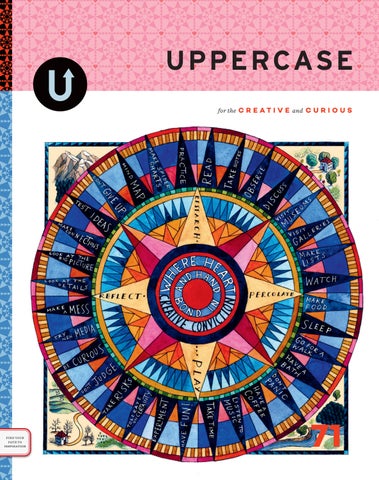
COVER ARTIST Mapping the World with illustrator Helen Cann BY JOY VANIDES DENEEN
102
GALLERY The Path to Inspiration BY UPPERCASE READERS
LIBRARY Creative Paths: Learning As You Go RE VIEWS BY JANINE VANGOOL AND FINLEY DRESSER
20
42
92
PROCESS Where and How Do You Find Inspiration?
STORY BY STITCH BUFFALO
18
40
FRESH
STORY AND PHOTOS BY M E E R A L E E PAT E L
16
Art & Design
ABECEDARY The Creative Path: The A to Z of Becoming a Creative Person C O M P I L E D B Y LY D I E R A S C H K A
124
HOBBY A Lineage of Learning BY BRENDAN HARRISON
126 128 129 130
STUDIOS Susan Borgen, Emily Marbach
ARCHIVE UPPERCASE Digital Editions
KRAFT Upcycle Your UPPERCASE
COVET Where You Are Going STORY AND PHOTO BY ANDREA JENKINS
East Meets West Cathy Edwards H O B A R T, TA S M A N I A , A U S T R A L I A
My path to inspiration starts early. Between 4 and 5am, I wake, unable to sleep. I rise to fiddle with the latest artwork project; a map of my hometown, Hobart, a city nestled around a river. This project is about my interest in nostalgic toys, social divides and mapping. What I enjoyed about creating this artwork was the connection to former owners of the toys, the memories, the fingerprints, the embodied nostalgia and the traces of play. I raided my friend’s toyboxes, looking for the “toybox crumbs” down at the bottom. For four months, this map became my pathway to inspiration. cmdesign.net.au @cathyedwardsart
SNIPPETS
Lettered in Thread In her beginner-friendly new book, Ciara LeRoy (aka Pretty Strange, a CincinnatiSTITCH IT based artist and muralist) shares techniques for pairing hand lettering with embroidery to stitch uplifting phrases. “Be kind to yourself as you look around for inspiration and a place to start,” she says. There is no “right place” to start, just begin. When it comes to creativity, you don’t have to have everything mapped out before you begin the journey. prettystrangedesign.com
8
|||
U P P E R C A S E
STOCKIST
Textil Portal: A New European Stockist for UPPERCASE Books Gabriele Brandhuber has been a longtime reader of UPPERCASE magazine. She recalls the cover of issue 11, featuring carved crayons by Diem Chau, as the first to catch her eye. “I was so fascinated by it that I’ve been subscribing to this Canadian magazine for creative and curious people ever since.” Also a fan of UPPERCASE’s Encyclopedia of Inspiration book series, Gabriele was concerned at how difficult it was to purchase these books, especially after Brexit made ordering from the UK distributor more complicated with customs and surcharges. So she took matters into her own hands. “I got a business license and now I’m importing these books myself.” You can peruse her website, Textil Portal, to see what’s available from UPPERCASE and fellow Canadian publisher Nine Ten Publications. “I also carry books from other small publishers, and in the future, I expect to offer regional yarns and fabrics produced in Europe.” shop.textilportal.net
Gabriele’s “warehouse” is a shelf in a previously unused window niche in her apartment. “One has to start somewhere,” she says.
Heartell Press’ “We Find Our Path by Walking It” letterpressed card is inspired by a phrase from Spanish poet Antonio Machado: “Se hace el camino al andar.”
SEND IT
Good Greetings Printmaker and illustrator Rachel Kroh and her team at Heartell Press in Fort Wayne, Indiana, produce greeting cards and art prints that will make you and your recipient feel good. With pretty woodblock-printed artwork for all occasions to celebrate, uplifting messages in the Everyday Inspiration collection, art for social change and a sensitive series of cards that honour the complexity of grief, Heartell (pronounced “hear, tell”) has created a holistic line of products worth giving and collecting. Profits from their Art for Change series are donated to good causes. “Change starts with a vision of a better future, and we hope these products will help inspire you to dream and take action to create the world we all deserve to live in. Profits from the sale of these items will be donated to Crafting the Future, an organization that supports BIPOC artists with resources to thrive by funding scholarships to craft schools, nurturing the next generation of changemakers and craftspeople.” heartellpress.com
uppercasemagazine.com
|||
9
FRESH
Jennifer Lu Art Jennifer Lu SAN FRANCISCO, CALIFORNIA , USA
I am an illustrator and writer based in San Francisco, recently represented by Chelsea Hensley at Mad Woman Literary Agency. When I’m not drawing, you can usually find me on a city hike or roller skating. I like creating art that is heartwarming, funny and relatable. I am inspired by street fashion and street pigeons (for my comics). Outside of digital work, I enjoy experimenting with cutpaper collage as well as mixed media in my travel sketchbook, where I especially like drawing people, food and nature. Last year, I was laid off from my software engineering position of seven years and am now working to fully pivot to illustration. My goal is to be a published illustrator for picture books and cookbooks/ food editorials. I didn’t go to art school but I’ve loved drawing my whole life and creating stories through art. I found my way back to it during the early part of the pandemic and started seriously building my portfolio during that time. jenniferluart.com @lunaludraws
fresh talent Whether you’re a fresh graduate or mature artist, it is often a dream to be published for the first time! You are welcome to submit your art for consideration. uppercasemagazine.com/participate
10
|||
U P P E R C A S E
Atelier Bobina Ilinca Roman LONDON, UNITED KINGDOM
I took a slightly roundabout route into illustration. I studied computer science because I thought I would become a programmer. Then I found my way into UX design, where I’ve spent most of my professional life. Illustration happened alongside that, through self-teaching, experimentation and a lot of trial and error. I’m now at a point where I want to take illustration more seriously and develop it into a sustainable career. For now I want to put myself out there, be more visible. For me, getting out of my shell is what makes me “fresh.” atelierbobina.com @atelier.bobina
uppercasemagazine.com
|||
11
BEING
learn, make, find How graduate school was an education in confidence ||| ARTICLE AND PHOTOS BY
M E E R A L E E PAT E L
|||
W
hen I first applied to graduate school in 2020, it felt like a massive leap forward. My entire career thus far had been built on trial and error, a series of attempts that sometimes worked out, and most of the time didn’t. As a self-taught artist and writer, I floundered to understand my own creative voice and struggled to build a business that would be supported by it. When I did land a project or secure a client, it felt more like a fluke than the result of a well-executed plan. When I faced rejection, it felt more comfortable than success. I was familiar with rejection, and it provided with me a sense of relief—if there was no opportunity, there was no chance of failure. My discomfort with failure meant that I moved in various directions, lacking the confidence and clarity necessary for staying on the same path. I became accustomed to the story I kept telling myself: I am hardworking and determined, and if I keep going, someone will guide me in the right direction. What I really wanted was for someone else to tell me what to do next. And then, it seemed like someone just might. In early 2021, I received notice that I had been granted the prestigious Olin Fellowship to pursue an MFA in illustration and visual culture at Washington University in St. Louis, Missouri. Accepting the opportunity meant moving with my husband and eight-month-old daughter to a new state and shuttering much of the business I had spent the past decade developing. It also granted me validation—that someone out there had seen my efforts and decided they were worthy of acknowledging. Despite this, a familiar lack of self-assurance kept cropping up, made evident by my strong desire for clear direction, mentorship and community—all things I believed graduate school would provide.
12
|||
U P P E R C A S E
|||
Confidence Is Built I entered graduate school believing I needed clarity, but what I really needed was some confidence. I wanted someone to tell me, quite plainly, how to create the artwork I wanted to make, what kind of artwork I should want to make and how to build a solid career that would never careen or shift. Of course, no one had answers for me, including the admired professors I was privileged to learn from, the working artists who came to visit and do workshops with us, and the peers with whom I shared intimate spaces. After all, they struggled with the same issues that I did. The message from all my professors was the same: Make mistakes. Get messy. Try new things. Don’t be afraid to discover what you don’t like as much as you discover what you do like. And I did. I wrote poems, essays, books. I made hundreds of sketches, drawings, paintings and collages. I interrogated myself through my work: What am I drawn to? How does line and shape make me feel? Why does a certain painting stay in my mind? How do I want to use my voice? What do I want to say? If no one is listening, do I still want to say this? I didn’t gain confidence or clarity after each of these projects as I imagined I would. Rather, after making dozens of pieces, I realized I was gaining confidence while making them. It was in the doing, in the making itself—and it was all within me.
Looking back now, I find myself thinking of the shy, unsure student I was, and wondering: Why was I so desperate to avoid failure? Why was I uncomfortable with practice, and so impatient with my own progress? Who was I trying to impress? What did I really want? In my own practice and career, I understand the most common five pillars of confidence as follows: competence (the ability to express my thoughts in the written or visual form), clarity (knowing what my values are and what I would like to say), commitment (to my practice), courage (to fail and try again) and connection (to my work, myself and my community). Graduate school didn’t hand me clarity and confidence, but it did provide me with the structured environment necessary for building them.
uppercasemagazine.com
|||
13
|||
Community Is Made
Meera Lee Patel Meera Lee Patel is a self-taught artist, writer and internationally recognized bestselling author who writes books that help people connect with themselves, each other and the world around them. Her work advocates for greater mental health awareness in children and the grown-ups who care for them. meeralee.com @meeraleepatel
Our childhoods are spent in spaces created to foster community: playgroups, classroom environments and extracurricular activities. I approached graduate school assuming it would be the same way: I would be thrust into a creative environment where my peers, interested in the same culture as me, would be magnetically drawn to me. We would connect immediately, build strong friendships, and I would graduate with a close creative community with whom I would regularly swap ideas and collaborate. I was mistaken. My graduate school cohort was in a different stage of life than I was: while they attended happy hour, I bathed my baby. While they communed at the school studios late into the night, I worked to meet my work deadlines so I could then begin my schoolwork. Like two ships passing each other in the night, my cohort and I missed each other—simply put, we were never in the same place at the same time. Understanding the situation didn’t make it easier; even the most introverted part of me felt hidden away. It took me a year after graduating to realize that we make community ourselves. I had created a clear direction for my work and career—could I also create community for myself ? I decided to give it a try, in both my online and offline lives. Online, I reached out to three South Asian picture book creators who I admired and asked if they would be interested in joining a creative accountability group I wanted to put together. I was deliberate in choosing people who shared my background culturally and professionally, who I could speak freely with and who would understand the work I was interested in making, with nuance. Once a month, we’d meet to share our current projects, provide and receive feedback and simply be in community with one another. To my surprise, all three women said yes; we’ve now been meeting monthly for over two years. These are friendships that would never have formed if I hadn’t worked up the courage to simply ask. I replicated the same process offline. I reached out to four women from graduate school who still lived in the city: a peer from my cohort, two of my former professors and a visiting artist I had met while in school. All four women also said yes. Now, I host a monthly creative salon in my home where we critique each other’s work, catch up on life and support each other in our highs and lows. Again, I showed myself that community isn’t waiting to be found—it’s waiting to be made.
Community isn’t waiting to be found—it’s waiting to be made. 14
|||
U P P E R C A S E
|||
Mentorship Is a Two-Way Street As someone who believes in being a lifelong student, I can often talk myself out of situations in which I would be advising others. I have turned down opportunities to lead workshops, teach classes or participate in speaking events because I believed that I had more to learn before I would be able to teach others. It’s true: I have a lot to learn, and I always will. However, it’s also true that I have amassed a wealth of knowledge and experience that can help others. It isn’t a lack of education that’s preventing me from teaching; it’s a lack of confidence. I regularly receive requests for mentorships and turn them down. A few months ago, I decided to say yes. Let’s see, I told myself. Maybe I can help someone else. Half a year into our mentorship, I am impressed by both my student’s progress and my own ability to engage and support her. Similar to my experience in graduate school, I’m realizing that confidence is built by doing (competence) and that it requires a willingness to fail (courage) in order to solidify. I hold my graduate school professors in such high esteem: I am impressed by all they have accomplished, but I also deeply admire how they guide their students with genuine compassion and investment. I feel this way about my own students: though I am the mentor, I learn so much in my work with them about how they think and respond. I am a more patient, interesting and committed creative because of our work together, too. Now that it’s been a few years since graduate school, I’m beginning to see how my path to—and through— graduate school has shaped my current life and is beginning to trickle into my future. Life moves in full circles. As I step into my role of mentor with the confidence I’ve built over the past few years, I’m grateful for the chance to help young artists do the same.
SHOP
Visit our shop for books, back issues & more.
UPPERCASE ENCYCLOPEDIA OF INSPIRATION
2025
2024
2023
2022
2021
2020
2 019
2 019
2 019
2018
All sales of Little U go to UNICEF
2017
2017
2016
uppercasemagazine.com uppercasemagazine.com
|||
15
WORTHWHILE
stitching communities together A TEXTILE ART CENTRE EMPOWERS REFUGEE AND IMMIGRANT WOMEN THROUGH HANDCRAFTED GOODS
16
|||
U P P E R C A S E
These women are members of Stitch Buffalo’s first paid training program. They learned about indigo dyeing and resist techniques for six weeks. At the end of their training, Stitch Buffalo launched a line of their products called The Blue Edition. In this photo, the women are wearing hand-dyed garments made during the program.
A
t Stitch Buffalo, creativity is how we build something lasting: dignity, connection and economic opportunity, stitched together one project at a time. We are a nonprofit textile arts centre in Buffalo, New York, and at our heart is the Refugee Women’s Workshop: a community of talented artists who bring generations of skill and cultural heritage into every piece they make. We invest in that skill directly. Through paid training programs, mentorship and drop-in workshops, refugee women can deepen their skills in embroidery, sewing, dyeing, weaving and more—while simultaneously preserving their cultural traditions and earning money to support their families. Their pieces, which range from hand-embroidered pins and ornaments to custom garments and table linens, are sold through our retail space and website. Every sale puts income straight back into the hands of the artist who made it. For many women, this is just the beginning. Some go on to become teachers within our programs, passing on their skills to the next artist who walks through our doors. Others build toward full-time work as seamstresses, turning a craft they have practised their whole lives into a stable career, here in Buffalo. That’s how we “make it worthwhile.” We don’t ask these women to trade their heritage for a fresh start. We help them build a life here while getting paid for exactly what they already know how to do or want to learn. Creativity moves through the rest of Stitch Buffalo, too. Our Second Stitch creative reuse shop keeps fabric, yarn and notions out of landfills and puts them into the hands of makers across Buffalo, often becoming someone’s very first connection to our organization. Our community classes open the door even wider, offering instruction in embroidery, dyeing, sewing and weaving to anyone curious enough to pick up a needle.
The buffalo ornament is by Freshta, who is originally from Afghanistan.
The impact we are striving to make is simple to state, but harder to build: a place where skill turns into income, income turns into independence, and creativity is treated as real, valuable work.
This mini heart pin was embroidered by Dau, who is originally from Myanmar.
stitchbuffalo.org @stitchbuffalo
Using our creativity for good is one of the best ways we can make a difference. Through design, art and craft—and with our hands and hearts—we can effect change. However small it may seem at first, each incremental effort is still significant. Share your Make It Worthwhile projects to be featured in the magazine or the UPPERCASE newsletter. uppercasemagazine.com/participate
uppercasemagazine.com
|||
17
THIS IS A LOW RES PREVIEW OF A HIGH QUALITY Q U A R T E R LY P R I N T M A G A Z I N E PLEASE SUBSCRIBE
BUSINESS
STORY BY
A R I A N N E FOU L K S I L LU S T R AT I O N BY
A N D R E A D ’A Q U I N O
T
hough I started my business alone, last year I found myself pouring out all my worries about an employee problem to six friends (who also run their own businesses) over drinks and French fries in Vegas. Instead of guessing at what to do, I got to hear their stories and advice, and make an informed decision. And then we all rode the monorail to see the Michael Jackson Cirque du Soleil show. One thing I have stuck with over the last decade of growing my business is participating in peer groups to learn, share and get general support. This has been great for Aeolidia, my web design agency, and I have also made some real friendships with people I relate to. You don’t have to be a lone wolf if you run a business. In fact, creating your own wolf pack can make everything better. Entrepreneurs, artists and makers are usually figuring out how to do everything on their own, often the hard way. There is a lot you can miss by going it alone. That is where mastermind groups come in.
Masterminds FINDING SUPPORT AND GROWTH IN A LIKE-MINDED GROUP
20
|||
U P P E R C A S E
Fun fact! Today I learned that the name “mastermind group” comes from a concept by self-help author Napoleon Hill, from 1925, that two or more minds coming together create a “master mind”—a third, intangible force. I’m in! |||
THIS IS A LOW RES PREVIEW OF A HIGH QUALITY Q U A R T E R LY P R I N T M A G A Z I N E PLEASE SUBSCRIBE
on all the above makes it easier to prioritize the meetup. Even pulling this information together on a regular basis is healthy for your business. Having some trusted people to run it by adds another layer of value. |||
How to Evaluate There are two groups that I have been in for more than six years each. I have also been in a handful of other groups that didn’t last more than a few months. Not every group will work out, and your time is valuable, so it helps to evaluate the mastermind group after a while. You need to give it a chance—it takes a while to get into a rhythm and trust each other. Things should be clicking by your third or fourth meetup. When I get on the call with my agency buddies, the time flies by, and we have more things to talk about than time to talk, so that group feels healthy and useful. The people in my 10KSB group, who helped me fire an employee over drinks and fries, would rescue me from a burning building. In other groups, it can be hard to get everyone to even show up, or you may run out of things to talk about. It helps to have a goal or purpose for the group. Is there a specific problem you are working on, or an ambitious business goal you would like support with? Maybe you are trying to build accountability into a freelance lifestyle, or just want a group of people who get it, that you can rant and rave to. Is your group meeting those needs? Does it feel like each member is contributing equally? I have been in a group with three experienced founders, and a fourth person who was brand new. It felt like he did not have anything to share that helped us and was just taking notes on everything we had learned the long and hard way. As long as everyone can contribute helpfully, a disparity can be fine. If not, imbalances can lead to resentment, leaving some people feeling like they are giving much more than they are receiving. Do your values match with the group’s? This is an area of misalignment that usually does not work well in a mastermind group. For me, it is important that my groups stay generally positive. It is okay to complain now and again, but I did not sign up for pessimism or bad attitudes. I have heard that you end up being the average of the five people you spend the most time with. I want to surround myself with positive, motivated people who are interested in learning and growth. Remember, this is a two-way (or four- or six-way) street. Lead the way by giving, sharing, being open, focussed and not hiding your mistakes. What can you offer, and what can you be generous with? What kinds 22
|||
U P P E R C A S E
of partnerships or collaborations might arise from your group? Like any worthwhile relationship, it takes regular and purposeful work to build trust and create a collaborative environment. It does not just magically happen because you get five people in a room together or on a Zoom call! After giving it a solid chance, you can quit if the group does not suit your needs. If everyone else is getting something out of it, you could suggest a replacement for yourself and exit the group. If it is not working overall, you can thank everyone for giving it a chance, and call it. |||
A Little Encouragement Following your competitors’ businesses on social media can feel disheartening. You see their highlights and successes—but everything’s different behind the curtain. Why not join them to support each other? You’ll then get insider access to all the mistakes and hard work that goes into what looks so easy on Instagram. I really could have used a group like this earlier on in my career in business. I often feel like I am humblebragging when celebrating my success or complaining about my work with laypeople. But my founder friends just get it. My advice to my past self (and you!) would be to not wait for these groups to come to you—take the initiative to form them, and you will likely find grateful people who are looking for this exact thing. aeolidia.com @aeolidia
ECO
M correcting course W H Y N O C R E AT I V E PAT H R U N S IN A STRAIGHT LINE ||| STORY AND PHOTOS BY
M A R N I E H AW S O N
24
|||
U P P E R C A S E
y undergraduate science degree finished with an extra year of fulltime research, the kind that’s standard practice in Australia. It is less a test of research ability than a test of whether you can stick something out. Mine was a year studying sexually transmitted diseases in wild bird populations, on the way to a career in environmental science. That was the plan. Then I applied for around 70 graduate jobs and the one reply was for a job in soil and groundwater contamination and remediation. I hadn’t studied hydrology or soil in the four years I had just spent studying science. The path corrected itself before I had even started walking it. I spent the next decade in the field of environmental science, then changed direction completely and picked up a camera. When I decided to become a photographer, I went looking for someone to teach me, something I assumed everyone did. I interviewed anyone I knew who had made a career of it, asking them what formal study or apprenticeship had got them there. One conversation stuck: someone mentioned a whole unit of study they had done just on risk assessments. I had already spent 10 years writing risk assessments, and I didn’t want to waste my time learning something I already knew. So I taught myself the rest, mostly from the Internet, and never had a single day of formal photography apprenticeship. No one showed me what to do. I made it up as I went.
I now mentor other photographers myself, mostly on business and workflow rather than craft. As a consultant in my first career, I had to account for every 15 minutes of my day and bill for it, so I got good at running an efficient practice long before I ever picked up a camera. That is the thing I actually pass on now— not so much knowledge about lighting or composition, but the discipline of a tight workflow, because it turns out the decade in environmental science was the mentorship all along. It just didn’t look like one at the time. None of the people I interviewed described it this way. We talk about apprenticeship and mentorship as if they only run in straight lines, person to person, skill to skill. Yet often they run sideways, from a career you have left into a career you have not started yet, and you don’t see the connection until much later. The same correcting instinct applies to sustainability, and this is the bit I think people skip past too quickly. You don’t need to have started your business with a fully formed ethical framework. Almost nobody has. What you need is the willingness to keep correcting as you learn more, the same way I corrected from soil contamination into photography, and then kept correcting once I was in it. Early on, I took whatever client work paid the bills, the way most photographers do. As I learned more, I
narrowed this approach. Then I narrowed it again. The clients I work with now are not the clients I worked with 10 years ago, not because I had a five-year plan, but because each year I knew slightly more than the year before about where my work could have the greatest impact, and I let that knowledge change who I said yes to. You can do the same thing without overhauling your business overnight. Look at one supplier you have used for years out of habit rather than from doing research, and check if there are other suppliers that are better aligned with your business. Look at one part of your workflow—travel, packaging, printing—and ask if it is still necessary or if you are just using it because it is familiar. You don’t need anyone’s permission to make that change, and it isn’t necessary to have started out doing it right. Nothing about my path was planned—not the soil contamination job, not the self-taught photography, not the slow narrowing of who I work with. Each correction just made the next one easier to see. That is the actual shape of a creative path, and it’s also the actual shape of getting better at sustainability: not a straight line you commit to once, but a series of corrections that you keep making as you learn more, for as long as you are in business.
Marnie Hawson Marnie is a former environmental scientist using photography, business tools and industry pledges to help the built environment restore nature. Together, her work is about changing the story and the system— showing what good work looks like, and helping others to make it the norm. marniehawson.com.au @marniehawson
Wild Houses One project for people = one home for wildlife wildhouses.com.au
uppercasemagazine.com
|||
25
EPHEMERA
maps WHERE WE’VE BEEN
S P EC I M E N O F TO P O G R A P H I C A L WO R K F RO M P R A N G ’ S S TA N DA R D A L P H A B E T S
& more
||| ARTICLE BY
M EL A N I E ROL L ER F E AT U R I N G M A P S , AT L A S E S A N D T R AV E L E P H E M E R A F R O M T H E C O L L E C T I O N O F
M A R K E . SACK ET T
|||
26
|||
U P P E R C A S E
T
he compulsion to categorize, organize and lay out knowledge concisely for oneself and others to then navigate is a deeply human one. As we travel through space and time, as well as across the physical world, some concrete account becomes necessary to describe and chart the paths we follow, and to represent our own internal guidance systems. Maps are one of the ways we make meaning of the places and locations we encounter, while simultaneously connecting us back to those spaces. At a metaphorical level, the map exists both within and without us, internally directing us forward based on our own understanding of the world while also serving as an external reminder of where we are physically going and where we have been. On the surface, the concept of a map is not as standardized or as straightforward as it may seem; maps can take many different forms depending on their use. Apart from strict geographical understanding and wayfinding, maps are used to chart the stars, track the weather, interpret historical events and even delve into the complex mechanisms of the human body and brain. A combination of visual art married to scientific and concrete facts—a mixture of right-and-left-brain faculties—maps remind us that there are many ways to view the world and survey one’s surroundings.
Maps have existed in one form or another throughout human history, with early examples traced back to ancient China, Greece and Rome. The contemporary idea of the map would have been foreign to the majority of Western society prior to the early modern era. With much of the populace illiterate, lacking formal education and largely ignorant of the broader world, maps would have been mystifying and rather useless in their day-to-day lives. Before the Renaissance, the idea of modern statehood itself was non-existent, and the world at large was loosely defined at best. The most common place to find the predecessor to the modern map would have been within a cathedral or seat of power, in the form of a mappa mundi, translated as a cloth or chart of the world. These intricately decorated hangings were illustrated with general, navigational and biblical knowledge, with Jerusalem noted as the centre of the world, and often featuring illustrations of creatures both real and mythical. By our contemporary standards, these early iterations would not have been viewed as evidence of scientific fact or as a truthful record of history. Still, they nonetheless served as charts for understanding the larger world—as maps do today. A legitimate and steady discipline began to take shape during the Renaissance in the form of a flourishing interest in cartography—the study and art of uppercasemagazine.com
|||
27
28
|||
U P P E R C A S E
THIS IS A LOW RES PREVIEW OF A HIGH QUALITY Q U A R T E R LY P R I N T M A G A Z I N E PLEASE SUBSCRIBE
32
|||
U P P E R C A S E
individuals and families to travel for pleasure—often for the first time. Personal transportation, such as bicycles and automobiles, was also becoming increasingly common, allowing for longer journeys to further destinations. These road trips and holidays necessitated the use of paper maps and guides for wayfinding to and through unfamiliar locations. And savvy distributors were quick and eager to fill this need. Aside from their practical use, many of these commercial maps and pieces of travel ephemera are notable for their elements of humour, novelty and camp. Divorced from the straightforward, academic maps displayed in state buildings or school houses, novelty maps with cartoon illustrations, cheeky references to localities and landmarks, and colourful typography became lighthearted souvenirs for the tourist’s scrapbook, as well as popular promotional items circulated within broader social groups. Although these maps could be sparsely decorated, with locations that were more approximate than precise, they helped highlight the best and most notable aspects of a state or area, connecting people back to cherished memories and making these maps favourites among tourists and locals alike. In humanity’s quest to make meaning of the world around us, maps have been indispensable tools for learning and understanding. But aside from merely being bird’s-eye views of the spaces we occupy, they also allow us to reorient ourselves within the deeper subtext of life and the reality we all inhabit, connecting us back to where we have been, driving us forward towards where we would like to go and reminding us that we are all small pieces rooted in the collection and landmasses that make up our globe.
theboxsf.com @theboxsfmercantile
uppercasemagazine.com
|||
33
34
|||
U P P E R C A S E
36
|||
U P P E R C A S E
NOTICING
brickolage
M
y practice keeps returning to the same quiet act: noticing. The Brickolage series grew from walks along Calgary’s historical Alyth train yard, where paint chips shed from piles of vintage bricks collect in the gravel and along the edges of things. My studio is nearby, at Workshop Studios, and I often walk the industrial yards in the space between working on things, while I am waiting for clay to dry or when I have reached the point in a project when staring at it any longer will not make it better. Picking up these chips became a kind of meditation, a reason to slow down and be present. The industrial yard is not an obviously beautiful place. There are old brick buildings, gravel, weeds, drums of discarded clay, and prickles that attach themselves determinedly to the legs of my pants. Over time, I began noticing small pieces of colour scattered across the ground. Some are mint, ochre, rust, black or ultramarine. Others are cream and worn-white, cracked and crazed like old ceramics with tea stains settled into the glaze. My favourites are the red ones, scattered through the gravel like little rubies. Their surfaces are weathered, their shapes irregular, each layer holding a small story of the wall it had once belonged to and the years it had spent exposed to sun, wind and snow. I started picking them up. At first, I collected only a few. Then I began looking for them deliberately, crouching beside buildings and searching through the gravel. Back in the studio, each piece is carefully cleaned and sorted, then affixed to a prepared canvas, arranged through a process that feels less like painting and more like tending to a garden. I think of myself as a modern-day bricoleur, someone who moves through the world with an eye for what has been overlooked, finding meaning and beauty in fragments that others walk past. The word “bricolage” comes from the French verb bricoler, meaning to tinker or putter about. A bricoleur makes something from the
STORY BY
R ACH EL ZY L K A PHOTOS BY
A S H L E Y D E R RY
uppercasemagazine.com
|||
37
materials already at hand, adapting remnants, tools and ideas rather than beginning with a perfectly ordered set of supplies. I like the idea of puttering about. There is freedom in it. Puttering leaves room for one thought to lead unexpectedly to another. It creates space for distraction, creativity and unexpected connections. My mind has always worked this way. I accumulate seemingly unnecessary knowledge, visual fragments and half-formed ideas. At times, this can feel scattered or frustrating. But it is also how I make things. My friend Trevor was the person who first sent me the word “bricolage.” He told me it made him think of me. He had a gift for making do. At his home on Vancouver Island, he repurposed corrugated sheet metal from the dump as a wall in his shower. Old fishing buoys became hanging strawberry planters. Lengths of ship rope became parking space dividers. His projects were practical, but they were also playful. He did not see discarded materials only as evidence of what they had been. He saw the possibility of what they could still become. When Trevor became sick with cancer and spent four months living in hospital, that resourcefulness became part of his daily life. He was constantly solving ordinary problems with whatever materials he had on hand. He died recently, and the word now carries him with it. When Trevor shared the idea of bricolage with me, I immediately thought of my dziadziu, my grandfather, who came from Poland after the war and kept a glorious garden. His French gourmet pole beans seemed to touch the sky. He grew Malinówka tomatoes, a pink Polish heirloom variety with a sweet flavour and aroma that reminds me of summer, the memory of holding my grandfather’s hand, the crinkle at the corner of his eye and the way he said “huh” in his soft Polish lilt when he was proud. At the end of each season, he moved through the garden slowly, collecting seeds for the coming year. When I was small, he would lead me beneath rows of hanging laundry and down into his basement workshop, greenhouse and makery. He was always proud to show me what he was growing, repairing, saving or building next. No empty peanut butter jar was ever simply an empty peanut butter jar. It became a container for screws. A shoebox became a place for safekeeping spare locks. Mustard jars became seed containers, with ventilation holes carefully punched into their metal lids. He survived the Second World War by scraping together what he could. A piece of stale bread mattered. A discarded object mattered. A fragment of overheard conversation might contain information that could keep you safe. 38
|||
U P P E R C A S E
ART & DESIGN Where and how do you find inspiration?
How can a feeling be a place or destination?
SKETCHES BY
J A N I N E VA N G O O L
T
his is the question readers explore in an open call for submission in this issue of the magazine. My creative brief asked, “If inspiration were a place, draw a map or create a diagram about how to find it.” When I come up with ideas for the open calls, I have a general concept in mind, but I’m never sure what I’m going to get! The interpretation of the open calls is always up to readers’ imaginations.
I hosted an online presentation to walk through the theme and offer some insight into my own way of thinking. My presentation sketches and notes are published here; refer to them while you watch the replay! The cut-and-paste diagrammatic poem on page three is my interpretation, and on the pages that follow, you will find readers’ responses. Create your own map or diagram so that you will always have a path to finding inspiration.
Can inspiration be a place within ourselves?
uppercasemagazine.com/issue71
Is finding inspiration a linear path?
Or something else? 40
|||
U P P E R C A S E
GALLERY
the path to inspiration
Where and how do you find inspiration? If inspiration were a place, draw a map or create a diagram about how to find it.
Joining Threads Brianne Burnell K I T C H E N E R , O N TA R I O , C A N A D A
The way the light trickles through the leaves intersects with the rock I found at the lake, which overlaps with the desperate homesick feeling I have on the plane. The path to inspiration is a series of threads, coming from many directions, overlapping with one another and picking up bits along the way. The strands converge to create artwork that could only be made with those specific colours and marks because of the million tiny collected moments and the way they choose to intermingle in my mind. brianneburnell.ca @briannedonut
42
|||
U P P E R C A S E
I
INTUITION — Tapping into my knowing
N
NOTES — Jotting down creative ideas as they come to me
S
SIGHTS, SOUNDS & SENSATIONS — In my daily life
P
PAINTS, PENS, PENCILS & PAPERS — Love ALL art supplies
I
INSIGHT — Drawn from personal experiences
R
READING — Art books and poetry
A
ATTENTION — To large and small
T
THRIFT STORES — A treasure trove of goodies
I
INTENTION — In all that I do and create
O
ORGANIZATION — A key component in ALL areas
N
NATURE — Getting outdoors
XYZ Andi Williamson E D M O N T O N , A L B E R TA , C A N A D A
Figure XYZ depicts a three-dimensional path to inspiration with six stages: 1) basic shapes and combinations, 2) mark making and value, 3) a study of anatomy, 4) free space, 5) exploration, and 6) lived experience.
Angela’s Way Angela Giaimo CHARDON, OHIO, USA
The act of creating has been with me since childhood. I am self-taught, and, in most cases, my creative expressions have been a medicine for helping me cope with and heal from the difficult times in my life. I create every day, including the meals I cook for my family. I am inspired by the world around me and am simply happy to have been given another day of life. Gratitude is essential.
Creative Trajectory Merrilee Anderson P O R TA G E , P E N N S Y LVA N I A , U S A
This prompt led me to reflect on my inspiration for quilting. I enjoy keeping it as my side hobby and I’ve sampled many techniques during the 20-plus years I’ve been learning to quilt. I never tire of looking at the work of others and I’m grateful to be a part of several guilds with incredible quilters. Recently I’ve been playing with watercolours and finding inspiration everywhere! @driftedindrive uppercasemagazine.com
|||
43
Wheel of Inspiration Sara Norquay E D M O N T O N , A L B E R TA , C A N A D A
It starts with curiosity about everything because I never know what will inspire me. Then I record observations and spend most of my time mulling over what I have learned. Then I experiment with materials and techniques. Finally, I take action for a creative result. saranorquay.com @norquaystudio
Moving Through Inspiration Carol Ellen Woodside S I LV E R S P R I N G , M A RY L A N D , U S A
My path to inspiration comes from movement—cycling in the hills, hopping on trains, travelling to new places. Inspiration comes from architecture in new cities, biking through covered bridges, swimming in lakes and oceans— always moving when my thoughts jump from one colour to the next, from textile project to painting idea. My path isn’t linear, it’s moving in all directions, trying new mediums, new approaches, with stops all along the way. I’m excited to see where it leads me next!
Observation Bridget Camden RICHMOND, VIRGINIA , USA
Anything non-linear is my jam. As I think about how to bring to life my path to creative inspiration, I am brought back to my source. It all begins with observation. Taking my time to look at things from different points of view, I consider how I can bring a unique story to life. Each observation weaving into the next allows me to grow and try something new. bridgetcamden.com @bridgetcamden
44
|||
U P P E R C A S E
Easy Ride to Find Inspiration Colette Dionne WAT E R L O O , O N TA R I O , C A N A D A
Each time I visit a library, I become an explorer, curious about the universe, and discover new worlds that will lead to ideas. When I browse through a thrift store, I cannot help examine each item, asking, “What else could this be, other than what it is?” It’s a lot of creative mind work, but it trains my brain to expand on a concept and urges me to make something in my studio. Museums are intriguing places. Their lofty inner and outer spaces lead my soul to dream. The architecture always calls me to take photos from curious angles and views, and to play with composition in a way that may end up in a sketchbook later. toucanstudio.ca
5, 4, 3, 2, 1, Go! Cynthia Ryder H A R V E Y S TAT I O N , N E W B R U N S W I C K , C A N A D A
Sometimes I need a pathway out of a creative funk, and a fast exercise can work wonders. I will look about my space and mentally note five objects, then select one and name four alternative uses for it in a little list. The next step is to deconstruct the object into three patterns, making a little sketch of each pattern. Precision is not important here; I let it be loosey-goosey. I think of two possible mediums with which I can recreate a pattern quickly, pick one and go.
Snake Path Bridget Camden RICHMOND, VIRGINIA , USA
My most important point of inspiration has been the teachings of Carl Jung. The uroboros is a symbol of a snake eating its tail. This metaphor for the cyclical process represents how each creative activity becomes fuel for the next one. The act of creating guides my growth, rebirth and self-discovery. bridgetcamden.com @bridgetcamden
@atlanticpewter uppercasemagazine.com
|||
45
46
|||
U P P E R C A S E
Proximity Dawn E. Nguyen SAMMAMISH, WASHINGTON , USA
How To Find Inspiration Daphanie Shaddock
My path to inspiration is like a tide pool. Proximity sparks ideas: when one thing is physically or mentally close to something else I’m working on, looking at, visualizing or thinking about. I often approach inspiration like an experiment, asking, “What if…?,” and starting from something I see that’s near something else I’m working on, or a project I’ve been visualizing or constructing in my mind. Even something as simple as a stack of folded T-shirts can inspire me, with their colours arranged in a way that sparks my creativity.
S A N F R A N C I S C O B AY A R E A , CALIFORNIA , USA
My path to inspiration begins with curiosity. I am always taking photos of anything that catches my eye—from flowers, textures and shadows to interesting shapes, colours and the work of artists who inspire me. That is where I begin. Along the way, I often get distracted, compare my work to others and question my ideas. I am often happily surprised when the best direction appears through a mistake, an old sketch or seeing something familiar in a new way. I try to trust my intuition, keep working and let the process lead me somewhere I could not have planned.
Five Senses Resources Amy Sue Axen S TONY C RE E K , NE W YORK , USA
This phrenology-inspired illustration explains how I seek and find input for ideas. Sight, smell, sound, taste and touch serve as creativity conduits, providing the sensory springboards for art making. The ongoing swirling and whirling of all of the grist that is mindmilled becomes a starting point for research, fuels the endeavour and can yield a workable result. My topographic, roaming trail is a convoluted course. Venturing along it helps me formulate unanticipated solutions that are frequently replete with increased curiosity and wonder. By rambling on these cartographer’s dream paths, I nearly always discover countless concepts to use.
DaphanieDenae.com @daphaniedenae uppercasemagazine.com
|||
47
Creative Meditation Halle Cisco
Inspiration Discovered Joan Folkmann
PORTLAND, OREGON, USA
C O R A LV I L L E , I O WA , U S A
Walking, biking, reading design magazines and swimming are meditative practices that help me work through creative projects. They allow me time to create space for reflection, problem solving and coming up with new ideas for each project.
The search for inspiration leads me down many avenues, and in creating this map I chose a few of my favourite ways that I find it. I was also inspired by the cartographic language of neatlines and graticules, and I incorporated them here for a bit of structure.
hallecisco.com @beeolivestudio
Inspiration Is Not a Faucet Josyan McGregor G R E E N FI E LD PAR K , Q U E B EC , CANADA
Inspiration does not root from only one source. Like with bubbles of energy and pockets of ideas, we collect information from experiences and the beauty we encounter. We hold no power over these bubbles; rather, each bubble is created and stored away until we are open and ready to release it—each bubble waiting for us to make the courageous move: to be whole and show up for it. Only then can it offer us its selfless purpose: to guide us past resistance and open us to the flow. Only by remaining open to the collection of this energy and beauty can we create infinite quantities of bubbles. Essentially, as long as we are alive, we are vessels for creation. Bramble is a mixed media on canvas board that was born of an inspiration bubble that surfaced to help me heal from a time of fear and panic. josyanmcgregorart.com @josyan.mcgregor.art
48
|||
U P P E R C A S E
Ideas Transmutation Isabelle Rowell NORTHERN S A S K AT C H E WA N , CANADA
Maybe because I function with three languages day to day, I connect ideas through unusual associations. I transmute everything I experience through my senses into art, so everything becomes a source of inspiration for me. My drawing here (by hand and scanned) represents a meat-grinder brain that produces magic output from mundane input. eejee.spoonflower.com/ profiles/eejee @eejee_art
50
|||
U P P E R C A S E
Map of Inspiration: Where & How I Find It Keely Hoffman
Finding Inspiration Maryna Salagub
Cayuga Creek Michael Toti
P I T T S B U R G H , P E N N S Y LVA N I A , U S A
O A K V I L L E , O N TA R I O , C A N A D A
AVO N , C O N N E C T I C U T, U S A
My “Map of Inspiration” is a whimsical, cottagecore-inspired peek into my creative world. Rather than a straight line, my path to inspiration is a winding trail through nature, filled with cozy, quiet wonders. It begins at my cozy home—a safe place to create and rest—and wanders past daily walks where I observe and collect ideas. I love stopping to pick fresh flowers, finding endless inspiration in the changing seasons and the tiny miracles all around us. Along the way, inspiration sparks from simple joys: the comfort of books, the vibrant life in gardens and the warmth of family and loved ones. From the music that lifts my spirits to quiet moments of painting and campfire gratitude, this piece is an open invitation to find magic in the little things that fill the heart.
I find inspiration not only when sitting in the studio and painting, but also outside of the studio. I’ll go to the museum or gallery. I’ll pick up a beautiful book in the library. I’ll go for a walk. I’ll listen to music or a podcast, or I’ll let my mind wander while I am cooking or packing lunchboxes. I look at all my life’s activities as foraging for inspiration. I intentionally go to places where I feel naturally inspired. I’ll get lost on an unknown trail. I’ll stumble on a flower I have never seen before. I’ll read an article about square-foot gardening and dream about how many flowers and vegetables I could grow in my backyard in the summer.
My favourite fishing spot was so close to my house that I could be there in five minutes on my bike. As a kid, I was fascinated by the shale creek bed that I saw on almost a daily basis. The shoreline and banks were loaded with layers and layers of grey shale, its broken, uneven edges everywhere you looked. Today, I’m inspired by these layers in the textural aspects of my collage work, excavating through the pages of books and building layers of substrate, image and colour to achieve the effect I’m after: a visual, palpable return to childhood, continually casting out my line for memories of a simpler time.
goodfairyart.com @goodfairyart
behance.net/Keelys_Greenhouse @keelys_greenhouse
uppercasemagazine.com
|||
51
54
|||
U P P E R C A S E
The Path to Inspiration Paige Higginbotham V E R O N A , I T A LY
As I considered my path to inspiration, I began thinking not only about all the beautiful things, but also the pitfalls of day-to-day life. This comparison made me think about childhood board games and how the “positive events” will boost you forward while the negative can actually set you back quite a bit. So when I think about my own path to inspiration, I can’t help but look at it as a slippery slope: the wonderful, joyful things are very important, but we must also be careful not to let the “bad” creep in where it doesn’t belong.
A Concept Map of the Path to Inspiration Nicky Newbury T R O W B R I D G E , W I LT S H I R E , U N I T E D KINGDOM
When there isn’t that instant spark at the beginning of my creative process, it’s often about needing to dig deep and embark upon getting those synapses firing. I begin by noticing and really seeing what’s around me. I especially love being in woodlands and by the sea, as these environments relax me, sparking my curiosity. A germ of an idea will surface and I can begin experimenting by drawing. I can then start connecting with my media of choice. By this point, inspiration is ready to be harnessed for the creating stage. I enjoy both instant and hardfought inspiration, as they lend their own uniqueness to each piece. My Concept Map of the Path to Inspiration encompasses the inside of my head when I seek inspiration! @fieldviewart
paigehigginbotham.com @paigehigginbotham
The Heart of Creation Negru Ana Maria B U C H A R E S T, R O M A N I A
“The Heart of Creation” and its rays are my path to inspiration. The star is irregular because in the process of trying to find my inspiration, the ideas are not always perfect, but in the end, they lead me to the final product. Each ray is represented by a theme, but the drawings overlap on purpose, and each category is represented by multiple sources of inspiration. The stars, the moon and the sun; the waves/flows; and the colourful and childish drawings are my main motivations. I take inspiration from the flowers that are in season, new music I have discovered or how beautiful the moon looked the night before. I try to portray all these ideas in a way that reminds me of how I used to see the world when I was a child.
uppercasemagazine.com
|||
55
56
|||
U P P E R C A S E
Pathway in a Bottle Wendy W. Malinow
Convergence Rebecca Johnstone
PORTLAND, OREGON, USA
Inspiration for me is a convergence of impulses that land in the branches of my mind like birds on a tree. The path is organic, filled with leaves, bracken, nests, twists, turns, tangents, treasure, feathers, clues, synchronicities and serendipities. I wend my way through each tight cluster, unpicking the seed trails I can gather to plant and nurture to explore in detail. It’s a waking, dream-like experience with golden sparks like sunlight, or the aurora: charged, urgent, electrical—the cumulative convergence of everything I’ve witnessed, ingested and experienced, filtered through the lens of my own consciousness.
This map shows my pathway to inspiration. Having been rolled up in a bottle, the map unfurls to show a humanshaped island. To the north is a lighthouse on top of the profile of a head. Mountains are the obstacles. A compass rose shows different directions to find inspiration. Sea monsters abound as obstacles. Nervous systems (rivers) go back and forth. A heart-shaped lake is meant to “fill the well” (The Artist’s Way, by Julia Cameron). @wendy_wallin_malinow
LANARK, SCOTLAND, UK
daintydora.co.uk @daintydora
Beginning Ruby Dosen S A R AT O G A , CALIFORNIA , USA
Inspiration is all around me, almost inescapable. This particular 30-second or less scribble came to me while I was at work handling a bolt of fabric. It will turn into something unrecognizable, grow and evolve as long as I keep showing up. The key is for us to show up. I often shun the visions and ideas that come to me, because I am too busy and engaged in something else, or I will get to it another time. Time is now.
Road Map to Inspiration Corinne Phillips M A LV E R N , W O R C E S T E R S H I R E , UNITED KINGDOM
The tendency is to look for motivation outside oneself, but I have found that the best solution is simply to keep turning up in the studio each day. In A Poetry Handbook, Mary Oliver compares inspiration to the courtship of Romeo and Juliet. Had either failed to keep a “date,” there would have been no romance. Creativity works in much the same way. If you do not show up, nothing happens. But if you are faithful to your practice, the Muse begins to honour that commitment, and you are ready to meet her when she appears. This artwork is a stitched collage on a vintage map, with the Inspiration Shuttle ready to depart. corinne-phillips.co.uk @corinnephillips.fairytalemaker
The Idea Is Where I Work Elaine Wallis N I A G A R A FA L L S , O N TA R I O , C A N A D A
This was a poem I wrote in the early ’90s. At that time in my career as a sign designer and muralist, inspiration and research came from the world around me: looking at nature, poring through books and magazines, and frequent trips to the library. It was certainly a time of pure and original creativity without the influence of online inspiration. Oh, trust me, I would have loved to have Pinterest at my fingertips! The production work was slower and harder, but very rewarding! @elaine_wallis uppercasemagazine.com
|||
57
58
|||
U P P E R C A S E
Little Perfections vashti b moss ALBUQUERQUE, NEW MEXICO, USA
I find inspiration in peculiar juxtapositions: urban/nature, simplicity/elaboration, silence/ noise, semantic/asemic, vast/miniscule, foundations/ abstractions. The paths to and through inspiration may happen intentionally or incidentally; I try to stay open to possibilities. My child once said to me, “look at all the little perfections!” and I try to breathe in that beauty. I find inspiration in inklings of hope shimmering in the midst of heartbreak and disaster. I find inspiration in the curiosity of place, space, time, limitations, whimsy, practicality, imagination, practice and purpose. The wayfinding of my “where” and “how” lives in the layers of this map—built up with bits of studio ephemera, connected with equal parts intention and happy accidents. @vashtiarts
Move Towards Here Gabrielle Higgins AUSTRALIA
The Geology of Inspiration Nicky Newbury T R O W B R I D G E , W I LT S H I R E , U N I T E D KINGDOM
When there isn’t that instant spark at the beginning of my creative process, it’s often about needing to dig deep. I begin by noticing and really seeing what’s around me. I especially love being in woodlands and by the sea, as these environments relax me, sparking my curiosity. A germ of an idea will surface and I can begin experimenting by drawing. I can then start connecting with my media of choice. By this point, inspiration is ready to be harnessed for the creating stage. I enjoy both instant and hardfought inspiration, as they lend their own uniqueness to each piece. The layers and words in this painting were inspired by the amazing geology of the Jurassic Coast and an afternoon spent in our woodland, so you could say it was a perfect destination for my path to inspiration!
Inspiration is found when you go looking for it (and when you least expect it). My discovery of blackout poetry gave me surprising phrases and word images to collage together. What surprised me, after making a series of poems, is that my themes and interests emerged, reflected back to me in the words that stood out on the page. Knowing that we see what we are looking for, I set out to make a series of hopeful poems on the pages of old war novels. mudbrickpoet.com.au @mudbrickpoet
@fieldviewart uppercasemagazine.com
|||
59
approach levelled the playing field. It was common for members to walk away with a deep appreciation for the unique aspects and nuances of both fine art and traditional craft, and the hard work required for both, helping to dismantle divisions between them. Still, this was not a total revolution. The movement remained deeply tied to the old ideas of hyper-specialized skills, and it remained exclusive. The AWG, for example, operated like a private gentleman’s club and barred women from full membership for decades. It turns out the big fight for creative freedom still had a massive “no girls allowed” sign on the door. This prompted William Morris’s daughter, May Morris, to form the Women’s Guild of Arts in 1907. The Arts and Crafts movement helped to crack open the door to creative sharing, but it was still restricted by the elite and by gender bias. |||
Creativity for Everyone: The Post-War to the Modern Day
An Out-of-Doors Study, oil on canvas, 1889, by John Singer Sargent (1856–1925), Brooklyn Museum
from behind closed doors. Both the Impressionists and the Industrial Revolution had effectively cracked open the old fortress: it broke down the material barriers to creation, making art portable, public and beautifully experiential. |||
The Arts and Crafts Movement and Creative Equalizing This rapid industrialization also triggered a powerful counter-reaction: the 19th-century Arts and Crafts movement. Led by figures like William Morris, these creators rebelled against the uniform, machine-made output of factory culture, arguing that it degraded the value of the handmade. The movement fought a two-pronged battle: it championed the necessity of handcrafted objects while simultaneously striving to equalize the division between “high art” (painting and sculpture) and “low art” (the decorative crafts). To help bridge this gap, the Art Workers’ Guild (AWG) was founded in the 1880s to dismantle these rigid hierarchies. Promoting a mantra of “learning by doing,” the AWG offered discussions and occasional hands-on workshops for its members. At the guild, painters and sculptors would occasionally roll up their sleeves alongside manual craftspeople, getting their hands dirty to try trades they had never touched before. By encouraging creators to experience firsthand the messy, tactile nature of unfamiliar materials, this 68
|||
U P P E R C A S E
The belief that creative pursuits should be open to ordinary people finally took root during the mid-20thcentury hobby boom. Post-war automation and new labour laws gave the average household something entirely new: free time. Creative expression was no longer just a gruelling commercial trade; it became a restorative pastime in which anyone could pick up a brush, sell their work and—if they chose to—confidently call themselves an artist. Fuelled by DIY kits and hobby magazines, manufacturers invited ordinary people to experiment with knitting needles, calligraphy pens or a paint-by-numbers set. Craft had officially shifted into a democratic realm of playful experimentation and personal joy. Since then, many aspects of the contemporary creative world have transformed into more open, community-driven ecosystems. We see this beautifully illustrated in modern artist collectives, in which creators of entirely different disciplines, mediums and career stages rent studio space to work side by side. Departing from an era in which guild workers guarded their trade secrets behind closed doors, artists now share communal worktables and utility sinks, cultivating a peer-to-peer exchange that turns the act of making into a collaborative celebration. Now, a master oil painter’s or an expert potter’s lifetime of education and technical trial and error is no longer a hidden secret; it is generously shared through YouTube videos, an accessible blog post or a quick Instagram reel. Whether it is a desk-job professional looking for a relaxing creative outlet or a retiree picking up a brand new hobby, more people than ever can now enjoy
immediate, unvetted access to art lessons that medieval apprentices would have spent years sweeping dusty studio floors to experience. We see this same inclusive spirit in the widespread explosion of organized “crafternoons,” in which friends, family and neighbours carve out dedicated, quality time to gather over embroidery hoops, moodboard collaging or casual sketching. In these spaces, an accidentally lopsided pottery bowl or a painting of a dog that ends up looking more like a cat is enjoyed rather than being something that could end in guild fines! This inclusive spirit thrives both at home around the kitchen table and at informal paint-and-sip nights hosted at the local pub. The modern creative landscape recognizes art making as an essential vehicle for community wellness, in which the primary goal is simply the joyful, meditative act of slowing down and making something with your hands, together. There is an immense and grounding beauty in tracing this historical evolution of craft from an era of guarded knowledge to one of rapidly expanding access. This journey speaks directly to the priority we now place on building community, and our collective recognition of creativity as an essential act of daily mindfulness. In every way, this transformation represents a radical rejection of historical gatekeeping in favour of creative generosity. And how beautiful is that? Ultimately, this story is about the liberating journey of human expression. By celebrating the openness of today’s creative culture, we honour the power of shared skills, the joy of unstructured play and the enduring, magical way in which making connects us all. Of course, to celebrate how far we have come is not to pretend that the work is finished. While tracing this historical journey of creativity, it is essential to also acknowledge that the road to creative freedom is still being paved. Barriers of cost, accessibility, ableism, race and gender identity still exist in art spaces today. Our next great chapter as a community is to actively advocate for an inclusive creative culture in which no one is left on the outside looking in. So go ahead and make space to create today. Others throughout history fought to begin opening the door to accessible creativity; now it is up to us to swing it wide open. emilyjoyceart.com @emilyjoyceartwork
Women in Guilds
Personal “Crafternoons” with friends
While guilds are often remembered as male-dominated spaces, women’s actual involvement in guilds is a much more layered story. A woman’s ability to participate in these medieval trades depended heavily on her location, the era, and her social status. In textile, embroidery, and weaving guilds, women did far more than participate—they ran the workshops with a surprising degree of professional agency, largely because these fields were culturally categorized as “women’s work.” Other guild trades, like painting and sculpting, were more difficult for women to join. In these cases, women often had to rely on family connections to gain entry and train alongside male apprentices. However, the guild system had a fascinating legal loophole for widows: if a male master died, his widow was often legally permitted to take over the management of the entire workshop. These resourceful women managed the business, directed the apprentices, and kept the studios running. Yet, this independence was rarely permanent, and was often treated as a temporary arrangement. As the guild system tightened its grip in the 15th century, holding onto these workshops became increasingly difficult for the widows of masters; they faced heavy restrictions on the materials they could buy and the apprentices they could train. Ultimately, many were pressured to surrender their independence by either marrying a male journeyman to legitimize the shop, or giving up the trade entirely to a new master for the “betterment” of the male workforce.
uppercasemagazine.com
|||
69
SKETCHBOOK
explorations
INSIDE THE SKETCHBOOKS AND JOURNALS OF
ABBEY SY
P H OTO S BY A B B E Y SY, J E N N Y P E Ñ A S A N D VA L E
writing things down. For me it feels like I’m cementing a thought, idea or plan by allowing space to write it down. I like thinking of myself as a reporter of my own life: collecting moments, recording details and paying attention to the things that make up my days.” Regardless of whether she is out exploring the world or simply staying put in her apartment (“I have a journaling tote that I carry around in my apartment”), Abbey has a notebook at the ready. Writing things down is not only a preference, but a necessity: “It scratches an itch in my brain. In a world that moves fast, this is my way of slowing down enough to notice what’s actually happening. It becomes a release and a way for me to process what’s on my mind without feeling like I need to have it all figured out yet at that moment in time. Some days, I find a solution or a way forward; other days, it’s simply a place for ideas and thoughts to exist on paper.” A journal is a vessel for ideas, experiences and feelings. Abbey finds that this “container” allows her to focus on where she is in the moment. “In a world where everything feels overstimulating or demands time and attention, I find the most peace by opening my notebook and writing things down, whether through planning, drawing or journaling. It’s the most natural way I connect with the inner and outer world around me.” abbeysy.com @abbeysy
Favourite notebooks Planning: I use a JIYU Weekly Planner for flexibility, as it’s undated and I can always reach for it when I need to (when I travel, I skip that time period). Note taking: I love pocket notebooks, especially Field Notes. They’re portable and great for instantly capturing ideas. Journaling: I have been using a Hobonichi Techo as a daily report of my everyday life, and very matter-of-fact information, enough to be able to look back and remember that specific day in detail. My travel journal is housed in a TRAVELER’s notebook, passport-sized cover.
Abbey Sy is one of many creatives featured in Jot!, Volume J of the UPPERCASE Encyclopedia of Inspiration.
Sketching: I use a Talens Art Creation sketchbook. The square 12-by-12-cm size is perfect for my creative exercise of on-the-go quick sketches.
uppercasemagazine.com
|||
75
PERSPECTIVE
You’ll know you’ve made it as an artist when someone copies your work.
T S TO RY A N D I L LU S T R AT I O N S BY
J U L IEA N N E ST EEDM A N
Copy (ver b) to make a version (o f somethin that is ex g) actly or al most exac like the or tly iginal: to make a copy or duplic ate (of so mething)
b) no Steal (ver ething that does om to take (s u) in a way that is yo belong to l illega wrong or
DEFINIT
76
|||
IONS, BR
I TA N N I C
U P P E R C A S E
NARY A DICTIO
t
his was a harsh but often true piece of advice shared with me by a friend. I had recently begun selling prints of my artwork at craft shows and in a few shops. At the time her insight seemed so extreme that it made me laugh. However, years later when I sat in my lawyer’s office getting advice about exactly this issue, I felt not only disheartened by the situation, but also burned that her words had rung true. In the art world, copying is not a clear-cut subject. My lawyer informed me that when dealing with written work, “copying” is much easier to define, whereas art and an artist’s “style” are trickier to deal with. Years have passed since sitting in his office, but the situation stuck with me. I have listened to podcasts and read articles about copycats and art theft, and followed stories of big companies stealing artists’ work and of artists fighting back. It has made me wonder: is all copying bad? Picasso is often credited as saying that “good artists copy; great artists steal,” and Austin Kleon wrote a whole book titled Steal Like an Artist. However, when I think about copying or stealing (whether art or otherwise), they both sound fundamentally wrong. All of the stories I read seem to involve someone getting hurt in the end. But is there a way to copy art and for it to not be sneaky and malicious? Is any copying in the art world okay? It turns out that in the art world, copying is not new. Long before social media (we’re talking the Renaissance period), artists like Michelangelo learned by apprenticing with a master. An apprentice’s defining moments of accomplishment did not involve amassing one million views on YouTube but rather were when they could copy their teacher’s work so well that their teacher could not tell the difference. That was—and still is—the point of an apprenticeship (whether art or
THIS IS A LOW RES PREVIEW OF A HIGH QUALITY Q U A R T E R LY P R I N T M A G A Z I N E PLEASE SUBSCRIBE
monographs, home decorating guides and photography compendiums, just to name a few. Rarely will I pass up unique, one-of-a-kind titles focusing entirely on things like glass paperweights, wood type or linen postcards. It’s books like these to which I turn for ideas, whether I am working on a writing assignment, making a gift or embarking on a redecorating project. And recently, after taking a crazy quilting class at my local community college, it was that newly discovered estate-sale find (one of the books that initiated this whole book-purging project) to which I turned for visual inspiration and ideas for layouts, embroidery stitches and embellishments. I admire the painstaking craftsmanship and vibrant, eclectic materials, while brainstorming new ways to interpret the technique. For this former librarian, so much joy lies in having the right book, at the right time. Equally as pleasing are the hours spent looking through books for no particular reason at all. Time spent this way is a non-digital, old-school activity, similar to scrolling Pinterest—but without pop-up ads or the glare of a screen. Careful not to tear the worn dust jackets, I note a faded library stamp or the name of the previous owner, penned on an inside cover, and feel the softness of the yellowing pages. Sticky notes peek out from the edges where I have marked something that has caught my eye—a beautiful afghan to crochet or a piece of art whose colours I find especially captivating. Maybe I can replicate the palette in a painting or in one of my new crazy quilt blocks. These ideas may or may not come to fruition, but the mere possibility that a book may spark a creative journey is justification enough for its place on my shelf. And then there are the novels. How is it that I have not mentioned these, yet? Nothing pleases me more than time spent buried in the latest literary fiction or indulging in a short story before going to sleep. I also love true stories, and my nightstand is filled with narrative nonfiction, history, memoir and biography as well. I have no doubt that reading for pleasure shapes my creative life in countless, subtle ways. When absorbed in stories, both real and fictional, I enter the perspective of another, considering their choices and an endless number of possible outcomes. I am speculating, grappling with uncertainties and learning how to be flexible, innovative and imaginative. With more difficult writing, I must practise the useful skills of concentration, focus and perseverance. Most importantly, reading provides an escape, a chance to relax, recharge and cleanse my mental palette. Time and time again, one small detail in a novel will trigger an idea that will become the subject of a poem, the inspiration for my next article or the beginnings of a collage. It is a gift that comes seemingly out of nowhere—one passion feeding another. 82
|||
U P P E R C A S E
ABECEDARY
the creative path PAINTING BY EMILE ADAN 1914, LIBR ARY OF CONGRESS
T H E A TO Z O F B E C O M I N G A C R E AT I V E P E R S O N COMPILED BY
LY D I E R A S C H K A
Frida Kahlo devoted herself to painting during her convalescence after a bus accident. Creative paths are rarely predictable.
An age-old way to learn a trade or skill by working under the guidance of an expert. Bilderatlas Mnemosyne German art historian Aby Warburg created a picture atlas showing how images are reused across centuries and cultures. Creativity builds on what came before.
Daydreaming
Emma Willard An indomitable educator who transformed history and geography textbooks with maps, charts and diagrams, Emma Willard (1787– 1870) founded a secondary school for women, including subjects usually reserved for men. Failure
T H E T EM PL E O F T I M E BY EM M A W I L L A R D, 1 8 4 6 . DAV I D RU M S E Y.C O M
The possibility of failure is unavoidable on the creative path. Gruen watch (Discipline) W.H. Auden, the author of the famous poem “Funeral Blues” (“Stop all the clocks”), lived by a strict schedule to be productive, with help from his Gruen watch.
Handwork Making with one’s hands is often at the root of a creative practice.
90
|||
U P P E R C A S E
T R A I N W R EC K AT M O N T PA R N A S S E , 1 8 9 5
“As with most daydreaming kids, it wasn’t so much curiosity as a surety that I would make it to some such pinnacle myself.” —George Plimpton, The Best of Plimpton
STOP ALL THE CLOCKS FABER .CO.UK
A BY WA R B U RG : B I L D E R AT L A S M N E M O SY N E , T H E O R I G I N A L , P U B L I S H E D BY H ATJ E C A N T Z
Apprenticeship
S P OT I L LU S T R AT I O N S BY K AT E RY N A H E R M A N C H U K , I S TO C K
Circumstance
THIS IS A LOW RES PREVIEW OF A HIGH QUALITY Q U A R T E R LY P R I N T M A G A Z I N E PLEASE SUBSCRIBE
A Brief History of The Compass Rose
A
key function of any map is to orient and direct the user, and the compass rose is a wonderful example of function meeting form. People originally relied on Polaris, the North Star, to navigate on land and sea, until the invention of the compass. The compass has a magnetized iron needle, which aligns to the north using the Earth’s magnetic field. Illustrated compass roses showing the cardinal directions (north, south, east and west) first appeared on medieval sailing charts, called portolans. Windrose and rhumb lines radiated from the compass rose, allowing mariners to navigate the seas and find ports without using the stars. The first documented ornate compass rose was drawn by Abraham Cresques in the expansive Catalan Atlas of 1375. By the 15th century, explains
98
|||
U P P E R C A S E
scholar Jerry Brotton (author of Four Points of the Compass), “the use of the compass led to the refinement of compass roses on maps showing thirty-two different directions composed of four cardinals directions, eight principal winds, eight half-winds and sixteen quarter-winds. In a more sophisticated form, these connections remain in place in maritime sailing today, understood primarily through European beliefs about direction and orientation.” Helen notes that “compass roses create beautiful additions to any map and can also work as illustration pieces in their own right.” In her book and on her website, she includes a compass rose tutorial that requires “paper, drawing equipment, colouring equipment and a compass to draw a circle.”
Helen loves projects that are connected to nature and has done many maps for nature reserves and environmental projects. “There’s always an agenda with a map and the mapmaker is curating it for a particular reason. So it doesn’t tell the truth. It tells what the mapmaker wants to tell you.” She points out that on our phones, maps focus on roads and retail but not on the entire picture of the land. But in the new children’s book Once Upon an Island (Magic Cat, 2026), by award-winning travel writer Alice Albinia, the maps are chock-full of personal, cultural and ecological significance. The author interviewed 20 women who live in different small islands around the world to learn what is important about the land on which they live. Each island is given a detailed map, illustrated by Helen in ink and watercolour. The colourful spreads are brimming with facts about history, language, plants, animals, food, clothing, queens and goddesses. “It comes from a very female perspective,” says Helen. “In the past, most maps were made by men or commissioned by men, and this is a really nice counterpoint for kids.” Each chapter took about a month to complete, and Helen was fascinated to be “allowed to travel around, vicariously or virtually, and find out about these places” that she will likely never visit in person. She especially loves when maps show shared environments and communicate information about our homes. “It’s important to understand that the land on a map is our animal habitat. We are just another animal in a habitat and ecosystem that needs to be valued in order for us to survive.”
uppercasemagazine.com
|||
99
PART ICI PAT E
from there to here R E A D E R S R E F L E C T O N T H E I R C R E AT I V E PAT H S
Whether it has been winding and unpredictable or you’ve always had a clear direction, our paths to creativity are uniquely personal. What have been the significant points on your creative path? Where did you start out? Where are you now? What did you learn on the way?
How did you get from there to here?
102
|||
U P P E R C A S E
THIS IS A LOW RES PREVIEW OF A HIGH QUALITY Q U A R T E R LY P R I N T M A G A Z I N E PLEASE SUBSCRIBE
The Constant Craving to Create Cheryl Dawdy ANN ARBOR, MICHIGAN, USA
Throughout my life, I’ve been driven by a singular desire: the persistent, ceaseless urge to always be making things. While making is when I have felt my best, my most complete self. I loved art as a child and showed a talent for it. Encouraged by my teachers, I dreamed of being an artist when I grew up. After a long and winding road—four colleges in 10 years, starting with art, pursuing other majors and eventually ending back in art—I finally got my BFA from the University of Michigan. After that, I spent several years exploring (and abandoning) various mediums, including weaving, knitting and other fibre arts. But then, in the midst of my artistic quest, life took a surprising turn. Growing up, art wasn’t my only creative passion. At 17, I discovered Joni Mitchell, and writing poems and songs grew equally enticing.
Joni was all I wanted to be: poet, performer and visual artist! During a break between schools, I’d been actively writing songs, and began singing—first alone and then with others. This led to meeting two remarkable women who would become my “sisters in song” for over 35 years. Our trio, the Chenille Sisters, toured regionally, then nationally, and went on to make 12 albums. We never achieved household-name status, but attained a high level of success, consistently playing to sold-out houses. A favourite moment of mine was creating the artwork for our eighth album, True to Life, uniting my two passions. But even during those years when music was my main focus, the need to create art was always there, and I continued to search for that one visual art form I could connect with and make my own. Finally, I found it. One day, when attending a gallery show by Mignonette Cheng, my former professor at UofM, I was introduced to collage. Immediately, something clicked. What began as a fascination became a passion. As I
produced more work and my comfort level grew, I began entering competitions and had the great pleasure of seeing my work accepted at galleries and museums, and recognized in art competitions. I have been drawn to collage’s unpredictable but extremely satisfying nature for over 25 years, and it has remained my main mode of expression. I love its endless potential. I collect paper, cut it up, and move the bits around until an image comes together. Since I have no preconceived notion of a piece, there’s no disappointment when my creation hasn’t lived up to my expectations. I find contentment in the pure play and discovery—with an actual surprise reward at the end. At this point, now, with “more life behind me, and less before me,” I think of how fortunate I’ve been to have lived the creative life I’d imagined so long ago. I feel like I’ve fulfilled my childhood dreams, becoming my own version of Joni after all: artist, poet and performer! cheryldawdy.com
uppercasemagazine.com
|||
109
I Proved Them Wrong Jutta Schneider D Ü S S E L D O R F, G E R M A N Y
As a child, I used to love drawing. There was just something about getting new markers, journals and notebooks! I used to try them out by filling in colouring book pages. I loved watercolours as well as coloured pencils, and I created crayon scratch-art pictures, too. But then school started, a place where you drew in front of peers and teachers. There was comparison, if not competition, and grades given for something as personal and unique as art. In my school, art classes always had a topic. We learned about a technique, were given a task and had to hand in a finished artwork to be graded. In retrospect, this affected my confidence tremendously. I remember drawing a finch with watercolours. I was so proud of my work; I really had put heart and soul into it. I received a “three” (in a grading system in which “one” is very good and “six” is really bad). Now that I’m over 50 and looking back, this was the moment when I fully internalized that my art was not good enough. And that feeling stuck. All my decisions about the future were attached to this belief. I did not study graphic design: I was told I had no talent, my grades in school would surely prove it and, most importantly, you won’t make money with art anyway, so there is no point. I studied early years education instead. Silently, secretly, I made a lot of art along the way, always ashamed that my art wouldn’t be good enough anyway.
114
|||
U P P E R C A S E
With 30 years of teaching experience, I know now that what happened to me was nothing unusual. Making art is something very personal, and by showcasing our work we make ourselves vulnerable. I saw how many children are daunted by negative feedback and how they strive when given praise and appreciation. In my forties, I fulfilled my dream of studying graphic design, remotely in my off-hours from work, and graduated in 2019. When the pandemic hit in 2020, I discovered Procreate and digital art. Over the past six years, I have drawn almost daily. I dove deep into art styles and techniques, discovered my love for online art classes and eventually started teaching them myself. For three years now, I have been a top teacher on Skillshare; I teach international online art workshops and host a supportive art community called the Wonky Art Society. I’ve developed my own teaching philosophy: I help students to get better at art making, but in a low-pressure way! There is no such thing as a perfect line or shape. Most importantly, there is no failing, just the opportunity to learn what works, and what doesn’t. Making art is a very human need; sadly, the fear of not being good enough keeps us away from expressing ourselves with colours and shapes. It is now my passion to help students overcome their fear of failure and to get back into the joy of making art again. juhesch.art @ju_he_sch
My Life in the Shape of a Circle Kira Garfagnoli NOKIA, FINLAND
I was born in an Italian Finnish family, raised between two cultures, always searching for my place in this world. Being surrounded by different languages, customs and ways of thinking boosted my curiosity and creativity. I inherited my parents’ love for books, music and travel. My grandfathers built wooden furniture and toys, and we had actors and painters in the family. I carry with me all those influences; imagination has always been my place of freedom and comfort, and my greatest strength. I was fortunate to spend my childhood at a Montessori school in an old villa in the heart of Rome, a unique place in the 1970s. Craft and art were part of our everyday life. We studied music and ceramics, practised yoga, cared for the school dogs and cats, and shared our classrooms with children from different countries and abilities. It was a diverse and exciting environment, where generations of students had written and illustrated a story that every new class was continuing. Each year, new chapters and drawings were added, and the possibility that my ideas and my own illustrations might become part of that living book thrilled me. Looking back, that was probably a message to a future me. Like many artists, for a long time I chose jobs that paid the bills. I kept my artistic voice alive whenever possible; I tried writing, painting, ceramics, dance, acting and music lessons, and travelling. As a graphic designer, I thought I could be creative while supporting myself, but when technology took centre stage, I was drawn in the opposite direction: I wanted to make things by hand, loving paper, paint, clay, recycling materials and also the beauty of imperfection. Then I had my child, who has a vivid imagination like me, and one sleepless night he told me a story, and in that moment, I returned to the school in Rome. I rediscovered the joy of storytelling, a new energy to play and experiment, and I understood that I didn’t have to choose between all my artistic voices because they are all one; they are all me. There is a strong connection to the child I was, the woman I became and the child I have now, and this connection gave me the courage to finally start planting the seeds of an artistic career: that of a children’s book author and illustrator. My child’s story became the first of many. All the years spent learning, doubting and changing jobs and countries did not take me away from my path—they became my path. Sometimes we think we have lost our way, only to discover that we have been walking in a circle, returning to where our story truly began. kiracrea.com @kiragarfagnolicrea
uppercasemagazine.com
|||
115
An Engineer-Turned-Artist Jennifer Smelker G R AN D HAVE N , M I C H I G AN , U SA
My creative path has never been a straight line. It feels more like winding roads that kept leading somewhere unexpected. As a child, I was curious and always made things with my hands. I dug clay from our backyard to make pinch pots, built with LEGOs, sewed clothes for stuffed animals and spent hours exploring with my camera. Creating came naturally, but I never thought of myself as an artist. I couldn’t translate what I saw in my head onto paper the way I wanted, and I never took any drawing or painting classes. Instead, I became an engineer. While working for my college newspaper, I was introduced to graphic design software, and I could finally create the images I imagined. I loved the mix of creativity and problem solving, and began freelancing as a designer alongside my engineering work. Years later, I created a large canvas filled with words and icons that told my family’s story. Friends asked for one of their own, and a business was born. I was invited to a local art event, so I took that canvas off my wall and hung it in the show. A shop owner was interested in a similar design celebrating our beach town, which led to a postcard design. This concept grew into hundreds of designs and an entire line of products sold in boutiques and department stores across the United States. Even then, I struggled to call myself an artist. I was running a creative business, selling wholesale and licensing artwork, but still felt like a fraud. I hadn’t gone to art school; I was self-taught. And in my mind, artists painted and drew—I was simply creative. Then, a year ago, I picked up gouache. After years of using digital gouache brushes on my iPad, I tried the real thing. I fell in love with the pigment, the texture and even the imperfections. This year, I committed to painting one gouache piece a day for 100 days. My skills improved, but more importantly, I stopped judging every brushstroke and began to accept the imperfections that make handmade work feel alive. I’ve learned that creativity unfolds over time. Every detour, unexpected opportunity and moment of self-doubt has shaped the artist I am today. My journey wasn’t about finding a destination. It was about learning to trust the process and realizing that sometimes the biggest creative breakthrough is simply giving yourself permission to become the person you’ve been all along. tandemfortwo.com @tandemfortwo
116
|||
U P P E R C A S E
The Artist’s Return Natalie Dadamio E N D I C O T T, N E W YO R K , U S A
I don’t remember a time when I wasn’t an artist, but I do remember the years when I lost connection with that essential part of myself. As a child, I experienced the world through colour, imagery and emotion. I was sensitive, imaginative and deeply attuned to the details around me. Creativity was simply the language through which I understood and experienced the world. But life carried me in another direction. Through difficult experiences, trauma, illness and years of struggling to believe in myself, I became disconnected from my creative voice. My journey back to creativity began in my thirties when I stepped onto a healing path. At the time, I was not searching for art as much as I was searching for myself. Living with Crohn’s disease and carrying years of emotional pain, I began the challenging process of healing my body, my mind and my relationship with myself. Healing was not a single moment of transformation. It was a long and winding journey of reflection, growth, rebuilding and learning to trust myself again. What I did not realize then was that healing would become the pathway back to the artist I had always been. Years later, during an intense period of awakening, I felt a call toward creativity that I could no longer ignore. It was not simply a desire to make artwork; it was an invitation to reconnect with a part of myself that had been waiting to be expressed. Through years of painting, experimenting and following the unknown, I began rediscovering my physical voice. The movement of my body, the gestures of my hands, the rhythm of mark making and the language of colour became pathways back to myself. The studio became a place of transformation.
Slowly, I began to understand that the artist had never disappeared. She had been dormant beneath the surface, waiting to emerge. With every layer, mark and unexpected discovery, I was not only creating artwork, I was reclaiming my presence. I was learning how to trust myself, take up space and allow myself to be seen. The process was raw, uncertain and imperfect, but it was alive. Art became more than something I created. It became a way of returning colour, light, movement and vitality to my own life and offering those qualities back to the world. Art became a meditation, a companion, a sanctuary. Over the past few years, that devotion and return home have led to two solo exhibitions: Beautiful Mistake and Unbounded: Breaking Free from Traditional Constraints, both vibrant expressions of colour, life, transformation and the personal journey that shaped them. My creative path has been a journey back to myself, a reminder that creativity does not disappear. Sometimes it waits quietly within us until we are ready to listen. Through that process, we discover what we are made of. Art was always inside me; I simply had to find my way back home. Healing did not simply create the artist, it revealed her. nataliedadamio.com @natalie.dadamio.art uppercasemagazine.com
|||
117
COLLECTION
spray-painted rocks STORY BY
F IN L EY DR E SSER
C
ollecting things is something that I do for myself. There doesn’t have to be any intrinsic value in the objects that I collect: like a magpie coveting shiny things, it’s an urge to simply gather. The satisfaction comes not only from the accumulation of objects, but also, and maybe more so, from the act of gathering and the simple process of observation. Though, of course, it always helps when the things you collect are beautiful. One of my favourite things to collect are vibrantly coloured small stones and pebbles that happen to have been under the path of spray paint set out for the marking of construction sites. The only way to find these pebbles is to go outside, wander and look. These utility markings, used to map out the underlying pipes and cables under city streets, are so ubiquitous that they can be easy to overlook. That’s the point of collecting them: it’s an exercise in noticing and being aware of one’s surroundings. These insignificant pebbles are examples of urban transformation. Markings appear as streetscapes change. Old pipes are replaced, the road is resurfaced, and buildings are demolished and new ones take their place. These rocks are a small part of the stories of cities and their constant adaptations. But for me, they are also a part of a personal practice of observation. Collecting these pebbles is more interesting if you know what the colours represent. These markings create a rainbow out of the otherwise drab underground networks: red is for electricity; orange, communications; yellow, gas or steam; green, sewers or drains; blue, drinking water; purple, irrigation; pink, survey markings; and white, areas for excavation (with different meanings outside North America). If one happens to be curious and knows the meanings of the colours, they can get a sense of what structures and utilities are hidden underfoot. There is a lot to see in cities, and these rocks are only a small part. These rocks might be simple, but if you have gone looking for them—or happened upon them serendipitously—in your neighbourhood, or in a part of town you have never been to, there is a good chance that you’ve seen something interesting, been inspired and have learned something new.
122
|||
U P P E R C A S E
uppercasemagazine.com
|||
123
HOBBY
a lineage of learning
STORY BY
BR EN DA N H A R R ISON
124
|||
U P P E R C A S E
A
week, that the core lesson took hold: good writing is invisible—it conveys the message clearly and respects the reader enough to get out of their way.
t 18, I was sure of two things: that writing couldn’t be taught, and that I already knew how. I’d fallen so hard for the myth of creative genius that even though many of my favourite writers had come off the MFA conveyor belt, I remained certain that writing was something you either had or didn’t. When I graduated from high school, despite creative writing being my favourite subject, it didn’t even occur to me to study fiction at university. Instead, I packed my bags and moved across the country, hungry for the life experiences I would transform into searing masterpieces. What I found was, in hindsight, meagre fodder for fiction. I had convinced myself that a poorly heated studio apartment in Laval, Quebec, was no different from Balzac’s Paris garret—never mind that mine overlooked a brightly lit karate dojo. And while the guys at my job in the garment district laughed at my stories about struggling to carry bulky rolls of denim and chenille up and down the factory floors, when I tried to write about it, I couldn’t even hold my own attention.
PH HO OT TO O B BY Y R RE EB BE EC CC CA A E ER RO OL L ,, A AL LA AM MY Y P
Reluctantly, I accepted that some kind of formal education would be necessary, if not to help me transform my tales of workplace woe into something more substantial, then a least to find a métier more suited to my bookish physique. I saved up enough money to cover rent for two months and enrolled in an intensive public relations program, delusional in my confidence that all that stood between me and a career in letters was a certificate from a department of continuing education. It became clear, however, that the program had no discernible track record of landing its graduates jobs. And yet I somehow parlayed a thin portfolio of classwork into a job offer from a local finance magazine. This was where my real education as a writer began. I entered the converted rowhouse office on my first day and was given a desk in the basement, tasked with writing an email newsletter rounding up the past week’s news, each story boiled down to a headline and a single clean sentence. I thought I’d done a good job by the end of that first week, proud of my punny headlines like “Atlas at last” and “Isle be back.” Then my editor handed back a printout covered in hieroglyphics. I walked over to his desk, and he patiently described what each proofreader’s mark meant and how the edits would improve the piece. Although my treasured headlines didn’t make the cut, I couldn’t argue that the piece read more clearly without them. My editor saw no reason to hold our little e-newsletter to a different standard than the magazine itself. It was in grinding those six sentences into shape, week after
My editor relentlessly marked up my work until I started to internalize his feedback and could read my own writing at a distance. And when my newsletters eventually came back with fewer marks, he began assigning me articles for the magazine itself—small ones at first, then larger. Throughout it all, he kept passing along the lessons he had learned while writing for small-town papers, correcting the same mistakes that had once been corrected in him. This was my apprenticeship as a writer, and I carried it home with me when I moved back to Calgary.
a writer’s practical education
There, I started writing for a local weekly newspaper called Fast Forward, happy to focus on arts and culture after years of offshore finance. My editor was the same age as me and felt more like a peer than a boss. One week, while playing chicken with my deadline, I began reviewing a poorly written memoir by an infamous small-time smuggler, only to realize I had nothing to say about the book itself. Instead, I wrote about a shambolic acquaintance of mine back in Montreal, a man whose apartment walls were lined with swords, and who could transform any topic into a story about his friendship with the guys in the band April Wine. My editor could have cut it. He kept it, and told me it was the best thing I’d written in months. It was the first time an editor had encouraged me toward my own voice rather than away from it. Not long after, the editor of another magazine reached out. She had come across my work in the paper and asked if I would like to write for UPPERCASE. I have been happily contributing ever since. It was perhaps inevitable that after all these experiences, I ended up being something of an editor myself. After stepping off the journalism-to-marketing conveyor belt, eventually I came to manage a team of writers for a big tech company in Amsterdam. By far, my favourite part of the week is our team critique session, where we gather to pick apart each other’s drafts—line by line. I find myself doing two things at once in that room: pushing writers to find their own way into a piece, the way my Fast Forward editor once pushed me, and drilling home the same unglamorous fundamentals my first editor had beat into my head in that basement office—clarity, precision, respect for the reader’s time. I realise now that the editors who taught me this craft weren’t just teaching me to be a better journalist or editor; they were teaching me how to write—the same thing I’d been so sure, at 18, that no one could teach me at all.
uppercasemagazine.com
|||
125
STUDIOS
subscriber studios My Sweet Little Studio Susan Borgen R O WAY T O N , C O N N E C T I C U T, U S A
I live in a cozy 1925 cottage in the seaside village of Rowayton, Connecticut. I am a designer, collector, stylist and maker who works and plays in my home studio: a happy oasis brimming with all of my favourite things. susanborgendesign.com @susanborgendesign
Susan’s collection of picnic tins is featured in Vintage Life, Volume V of the UPPERCASE Encyclopedia of Inspiration.
126
|||
U P P E R C A S E
Emily used an UPPERCASE subscribe postcard for the substrate of this floral collage.
Mess is More Emily Marbach LONDON, UNITED KINGDOM
A few years ago, I moved into a house along the railway line to Paddington Station. My top-floor studio faces north over the tracks, with a motorway stretching beyond. Surprisingly, I’ve grown to love the view, especially at night, when two trains cross from opposite directions in a small, luminous choreography. We opened up the attic with skylights, which flood the space with light. I couldn’t keep it as an attic anyway; as a lifelong collage-material hoarder, I’d be too tempted to fill it. The studio is a beautiful, perpetual mess. Two years on, I still have one box of scraps left to unpack. I came to collage through painting and printmaking, but now I work mostly with found papers. I’m drawn to old handwriting, photographs, fonts and flowers. I often stencil plants onto portraits. My interests in politics and religion, particularly Judaism, the tradition I know best, inform much of my work. I created nearly 80 collages for Collage Haggadah, a book used in the Passover ritual, and I’ve also made pieces inspired by the Psalms and Proverbs, including imagery related to the original text of “Who by Fire.” In all my work, I look for a narrative thread to anchor the story I’m trying to tell. collagehaggadah.com @collagenottinghill
Share your studio story! uppercasemagazine.com/ participate
If you love collage, discover other artists in Glue, Volume G in the UPPERCASE Encyclopedia of Inspiration series.
ARCHIVE
Discover what you’ve missed with digital back issues.
Enjoy digital editions of long-out-of-print back issues in the UPPERCASE Archive. The Archive is a growing resource of out-of-print UPPERCASE magazine back issues presented as digital flip-through editions. With over 50 out-of-print issues, there is an abundance of inspiration awaiting in this UPPERCASE archive. Read digital editions via your iPad or on a computer. Access is available via monthly or yearly plans.
uppercasearchive.com 128
|||
U P P E R C A S E
KRAFT
NEXT
upcycle your uppercase
NEXT ISSUES
ISSUE 72 Jan-Feb-Mar 2027
ISSUE 73 April-May-June 2027
ISSUE 74 July-Aug-Sept 2027
ISSUE 75 Oct-Nov-Dec 2027
Calls for Submissions Sign up for my weekly newsletter for behind-the-scenes updates and the latest on open calls for submissions for UPPERCASE books and magazines. uppercasemagazine.com/free
Pitch your article ideas and suggestions! uppercasemagazine.com/participate
Have you made something with the kraft envelope, upcycled the magazine or reused the postcards in an interesting way? Share your pictures and stories of U P P E RCA S E books and magazines on Instagram and in our community, the U P P E RCA S E Circle. @uppercasemag uppercasecircle.com
Reuse and upcycle your mailer UPPERCASE subscriptions are mailed in a 100% recycled and recyclable kraft mailer. Give it a second life and make something creative! Visit our website for ideas and project templates.
uppercasemagazine.com/kraft
Gregg Peterson credits UPPERCASE magazine for his creative motivation. He writes, “It’s helped me imagine a new life for myself as a creative person after 45 years of working in research operations.” In this self-portrait, Gregg has collaged a lino print onto a grid of patterns made from UPPERCASE subscription postcards. See more of Gregg’s linocuts on page 107.
Volume J: Jot! Published in whimsical, nonalphabetical order. Thirteen books in this series have been released since 2016: F, S, B, P, E, V, Q, C, Y, A, R, N and, most recently, G. J for “Jot” is in progress! Make sure you are subscribed to the UPPERCASE newsletter to hear about the next volumes and how you can audition to be profiled in them. uppercasemagazine.com/free encyclopediaofinspiration.com uppercasemagazine.com
|||
129
COVET
where you are going STORY AND PHOTO BY
A N DR EA JENKINS
130
|||
U P P E R C A S E
W
e keep a large road atlas in the car, tucked deep beneath the driver’s seat. Long before we relied on the modern GPS systems in our phones for directions, we used it to find our way. Now it functions mostly as a backup, in case technology fails. The truth is, I prefer the old map. I love its soft, expansive paper pages and the way it feels to trace the routes with my fingertips. More than anything, I love the certainty it holds. Phones do the work for us now but I miss a map that can be spread out across the front seat and consulted while the world outside tumbles by. I still find great comfort in knowing it’s there, safely stowed away. As an artist, I used to long for a map like this—a giant atlas I could just pull out whenever I felt creatively lost, with pages that clearly showed my coordinates and revealed, in plain sight, what my next steps should be. What I wanted, essentially, was a map that did not exist. Like everyone else, I have instead relied over the years on a combination of elements to find my way forward: education, experience, collected advice and, sometimes (although probably not often enough), intuition. I guess you could say that when cobbled together, they serve as their own sort of makeshift map.
As a young artist just starting out, I followed my own makeshift map with great diligence. I did all the things I believed would get me where I needed to go. I immersed myself in intensive study and graduated with a college degree in my chosen field of work, dance education. While in school, I found a dance company that was engaged in the kind of community work I ardently believed in, and when I wasn’t studying, I was teaching or performing or filling in wherever they needed me. I said yes to everything, to every open door. After graduation, I was offered a position with the company, and in that moment, my creative path seemed so gloriously clear; I could see the entirety of it stretched out before me, my life as a teaching artist—a bold, sparkling line on a map I had carefully constructed myself. What I could not see, however, was the seismic creative shift I would make just a few years down the road. I was hit with a personal curveball that changed everything for me and suddenly the way forward did not look so clear. The original path I had set for myself seemed to trail off, as if interrupted, mid-sentence. There was no atlas beneath the seat to pull out, of course. No map to show me where I had gone wrong, what steps to take next, no route to trace with my fingertips. Instead, I was left to sit with the great and uncomfortable unknown. What next? Eventually what I felt, deep in my bones, and without the help of any maps or signs, was the pull to start over. To lean into the unexpected turn in my creative career and just keep moving. That’s the thing about maps. They can get you where you are going but they can’t exactly prepare you for the bumps or detours along the way. And even if they could, I’m not sure I would want that, either. Because if I had known when I was just starting out that my path would eventually take such an abrupt creative turn, I might not have pursued the original path at all, and when I think of how profoundly that time shaped me as an artist, how much it informed who I am today, I’m grateful, wildly grateful, that I did not have some magic map with all the answers after all. andreacorronajenkins.com @hulaseventy
ENCYCLOPEDIA
$ 2 4 C A D/ U S D P R I N T E D I N C A N A D A
COVER ART
HELEN CANN
72527486315071 72527486315071 O C T- N O V- D E C 2 0 2 6
BACK COVER
FINLEY DRE SSER
uppercasemagazine.com