1
2
U P G R A D E D L I V I N G M AG A Z I N E O C TO B E R 2 0 2 6
B B L P H O T O FAC I A L
One treatment can start it. A series builds it. BBL Photofacial is a light-based treatment designed to improve the appearance of sun damage, pigmentation, redness, and visible vessels.
Most patients benefit from a series, especially for stubborn pigmentation, persistent redness, and vascular concerns.
Before
After 5 BBLs
START
BUILD
OPTIMIZE
Jumpstart your results with clearer, more even-looking skin.
Build on your improvements and target deeper pigment or redness.
Optimize results for lasting clarity and radiance.
Curious if BBL is right for you? Scan to schedule your BBL consultation 3
Refer -A-
FRIEND
Earn up to $500! 1
when you refer friends and family to Sierra Central. All they have to do is open up a new qualified account and you both get rewarded!
Refer. Reward. Repeat! Scan to start!
SierraCentral.com/refer *The Refer-A-Friend promotion is subject to certain rules and restrictions and subject to change at any time and without notice. Terms and conditions apply and are available at SierraCentral.com/refer. Membership open to all that live or work in any branch location county. Membership and/or participation fees may apply. Sierra Central is an Equal Lender and Federally 4 Opportunity UPGRADED LIVING M AG A Z I N E OInsured C TO B E R by 2 0 the 2 6 NCUA. ReferLive is a registered trademark of CustomerStream, LLC.
5
FROM THE PUBLISHER I’ve been fascinated by the paranormal and supernatural for as long as I can remember. As a child, I devoured ghost stories and loved the rush of imagining a world just beyond our own. But it wasn’t until I had the chance to accompany my mom to a real estate listing outside Oroville that curiosity turned into something harder to dismiss. It was July, well over 100 degrees, and the house sat in the middle of nowhere. More than a century old, it was unlike anything I had seen before. The moment we stepped inside, the front door slammed shut behind us. There was no wind, but old houses shift and pressure changes—easy enough to explain away. I flipped on the foyer light, and we stepped onto a massive tile mosaic covering the entryway. Suddenly, the light went out. Thinking it was an electrical short, I walked back to the switch and flipped it on again. When I returned to the foyer, something bothered me: I had physically flipped that switch back on. I turned just in time to watch it flip down on its own. At the same moment, the entry filled with a bitter cold that seemed impossible in the middle of a blazing July afternoon, especially in a house without air conditioning. Then came the footsteps. The staircase creaked one step at a time as something climbed toward the second floor. A doorknob turned. A door opened. Moments later, another door inside that room creaked open, then shut. The first door closed, and the footsteps began again as they descended the stairs.
Seconds later, we heard a drawer open in the kitchen.
UPGRADED LIVING
We were stunned, but curiosity won. We continued exploring and discovered something strange throughout the home. A more recent owner had attempted to cover the walls with wallpaper, but it had been neatly peeled away in sections, exposing hand-painted murals beneath. It was hard not to imagine that the same artistic hand behind the tile mosaic had painted them.
AVEED KHAKI Owner/Publisher
Later, we learned the home had been built in the late 1800s by a married couple: the husband a doctor and the wife an artist. Their story ended violently, and according to those who knew the home, neither ever truly left. The doctor was said to walk the stairs, visit his room-sized closet— and hat closet within it—upstairs, then make his way to the kitchen for a snack. His wife, meanwhile, seemed determined to keep her artwork uncovered and visible. We experienced much more in that house, and the memory has never left me. It sparked a lifelong interest that has followed me on travels across the United States and around the world, always wondering what might exist beyond what we can see. This October issue feels close to home. It is filled with stories of artists, creatives, history, and more than a few ghosts. I hope you love reading them as much as we loved uncovering them—and that at least one leaves you glancing over your shoulder.
JASON CORONA Sales Director MICHAELA GULBRANSEN Writer and Account Executive SHELLY BRANDON Writer
CONTRIBUTORS DOUG LOVE Real Estate DOLORES MITCHELL Art ALISA LEROUX Gardening ERIK BROWN Cover Design DANNY BALLARD Oroville Ghost Stories DUSTIN VAUGHT Chico Ghost Stories JIM SECOLA Chico Ghost Stories AMY QUINTO Cover Story Photography
ADVERTISING INQUIRIES For advertising inquiries, please contact: Jason Corona (530) 591-2634 jason@upgradedliving.com
Aveed Khaki Owner/Publisher
6
U P G R A D E D L I V I N G M AG A Z I N E O C TO B E R 2 0 2 6
7
CONTENTS | OCTOBER 2026 GHOST STORIES 39 Ghost encounters spark a deeper fascination with Butte County’s haunted history. The tour starts here. 40 A chilling 1871 murder reveals the tragic story of Susie McDanel, her killer, and a community’s grief.
44
41 A skeleton beneath Oroville’s State Theatre revives tales of lost miners, hidden tunnels, and buried gold. 43 Oroville enters the Twilight Zone in one of the creepiest ways possible. 44 An 1884 Oroville ghost sighting resurrects Herman Schmidt’s chilling promise to return from death. 46 The Hotel Colonia’s tragic past lingers as Nellie Dutton’s restless spirit is said to wander its historic halls.
52
49 Brother Isaiah and his Colony of the Saints left Oroville a strange legacy of immortality, faith, and ghosts. 51 A 1923 Biggs murder trial turned bizarre when Mae Murdock claimed a Ouija board convinced her to kill. 52 A young girl’s ghost appears across Downtown Chico, leaving playful encounters and enduring folklore. 54 Chico’s early spiritualists turned downtown into a surprising hub for séances and ghostly encounters.
57
56 The Chicocabra prowls local folklore, blending mythology, campus sightings, and Bidwell Park mysteries. 57 A poisoned groom, vanished evidence, and a ghostly figure keep a Chico love story haunting Fourth and Flume. 58 Whitney Hall’s penthouse and selfriding elevator fuel one of Chico State’s strangest ghost stories. 59 Chico State’s historic theater remains decidedly haunted.
8
59
U P G R A D E D L I V I N G M AG A Z I N E O C TO B E R 2 0 2 6
60 Claudette’s spirit lingers in a Main Street shop, tugging clothes, tossing objects, and seeking recognition.
ART & COMMUNITY 13 At 85, Max O’Neil proves creativity endures, transforming life’s challenges into vibrant paintings filled with color and resilience. 16 Día de los Muertos celebrations across Butte County honor loved ones through altars, music, dance, food, and art. 19 Chico Art Center’s Open Studios Art Tour invites visitors to meet local artists, explore studios, and discover creativity. 24 Handyman Hero shares ten practical fall maintenance checks to prepare your Butte County home before winter weather arrives. 30 Chico High senior Addy Lico conquers endurance riding’s toughest trails, building resilience, partnership, and ambitious goals with Moxy. 62 Discover why winter gardening offers easier growing, fewer pests, forgiving harvests, and fresh vegetables throughout Chico’s cooler months.
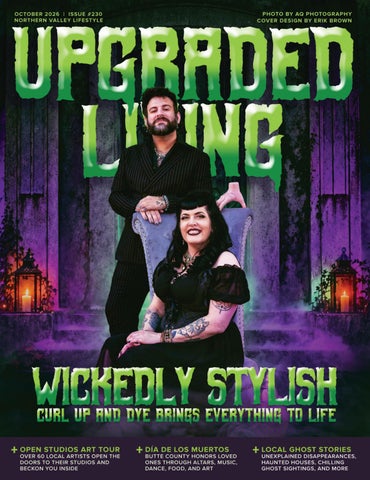
COVER STORY 35 Step inside Curl Up And Dye Salon, where gothic style, vivid color, creepy curiosities, and unapologetic self-expression come together in a welcoming space dedicated to finding beauty in the dark. ON THE COVER CURL UP AND DYE SALON IN CHICO
9
Driving to what she remembers as her ninth appointment, Patricia found herself studying the trees along the way. They seemed different. The colors seemed richer and brighter; she felt as though she could see farther into their branches and foliage, even making out the dust on them as she slowed to look closer. After treatments lasting only minutes each, the change surprised her. “Three days, then three days, then three days. Then suddenly, boom,” she says. “It was a wild and sudden awareness—such an unbelievably pleasing experience. I tell friends it’s either a miracle or magic!” She also noticed practical changes. After her second procedure, Patricia says she no longer needed the accessibility features she had been using on her phone. Reading seemed clearer, and the world around her appeared brighter.
Magic or a miracle For Patricia Green, independence has always been part of life. She has lived in her country home outside Willows since 1967, arriving there during a busy chapter filled with work, children, horses, and a veritable zoo of other animals. Needing a job, she applied at the Glenn County courthouse and became a superior court clerk, a position she held until she eventually retired. Now 85, Patricia still lives there, which means driving is more than a convenience; it is part of remaining independent. That made the gradual changes in her eyesight increasingly difficult to ignore. Patricia had always known she needed to take her vision seriously. Her mother had gone blind, as had an aunt, and she understood that eye disease ran in her family. “I knew I had more problems with vision than an optometrist could handle,” she remembers. When North Valley Eye Care’s Dr. Barthelow opened a satellite practice in Willows, Patricia started seeing him and continued under his care as her eyes changed over the years. First came cataracts, requiring surgery 10
U P G R A D E D L I V I N G M AG A Z I N E O C TO B E R 2 0 2 6
and replacement lenses in both eyes. Patricia vividly remembers the improvement after cataract surgery. Colors that had taken on a tan, dusty appearance suddenly looked natural again. “I felt like I was looking at real white again,” she says. But vision loss can be deceptive precisely because it often happens so slowly. “It creeps up on you,” Patricia says. Glaucoma eventually left her right eye fuzzy, and when macular degeneration began to progress, she noticed that each visit seemed to bring a little more difficulty. With only one eye providing dependable vision, Patricia knew she needed to preserve as much sight from it as possible. When Dr. Barthelow mentioned photobiomodulation treatment for dry age-related macular degeneration at the Macula Preservation Institute, she decided it was worth pursuing. She wasn’t expecting a miracle; she simply wanted to do what she could to protect the vision she still had. Near the end of her first treatment series, something caught her attention.
“The vibrancy was the first thing I noticed after the first session,” Patricia says. “I noticed that things were magically brighter and vibrant. And it’s still the same. It has not diminished. Even reading—the letters were much clearer. They’re not faded like they were becoming.” Just as important to Patricia was how simple the experience felt. “I haven’t done anything easier in my entire life,” she says. “There’s nothing to be nervous of. It’s four minutes of light, and that’s it—no pain, no strain—just four minutes, and you’re in and out. It’s really easy! In fact, I haven’t done anything easier in my entire life!” Now in the post-treatment period, Patricia will soon discover if her macular degeneration has been sufficiently treated or if further treatments could yield even better results. As she’s quick to mention, she couldn’t be more satisfied with the improvement in vision she’s already achieved and would be thrilled to have this level of sight last forever. If you have experienced changes in your vision, call North Valley Eye Care and the Macula Preservation Institute today at (530) 891-1900 to schedule an appointment and see if PBM treatment is right for you.
11
Westmont of Chico
530.287.4125
Independent & Assisted Living • Memory Care
Live Your Way® Today Your Style, Your Choices. At Westmont of Chico we aim to inspire residents daily through fun, engaging and meaningful activities.
Schedule your Tour!*
Monday Social Hour Themes Change Weekly! Live Entertainment • Connection Studio, 1–2– 3:30PM Every Monday • 2:30
2750 Sierra Sunrise Terrace • Chico, CA 95928 westmontliving.com Memory Care #045001756 • Assisted Living #045002620
12
U P G R A D E D L I V I N G M AG A Z I N E O C TO B E R 2 0 2 6
*Terms and conditions apply.
Max O’Neil: Art Beyond Memory At 85 years young, Max O’Neil has spent a lifetime proving that creativity isn’t simply something we do; it’s part of who we are. Whether behind a salon chair, holding a camera, or standing before a canvas, his gift has always been the same: finding beauty and helping others see it. Many in Chico may remember him by another name. For decades, he was known as Satyen, a celebrated hairstylist who spent nearly 60 years in the beauty industry. His artistry led him to work alongside the legendary Paul Mitchell, sharing stages as they demonstrated innovative haircutting techniques. Beyond hair, Max built successful salons, became an accomplished photographer, and cultivated a lifelong passion for visual art. After years in Chico, he later called Marin County and Maui home. Then life changed.
WRITTEN BY MICHAELA GULBRANSEN
Two years ago, after being diagnosed with Parkinson’s disease, dementia, and macular degeneration, Max’s amazing daughter, Amber, brought him back to Chico so he could be closer to family and receive the care and support he needed. Like many living with dementia, Max believed his creative life had come to an end. Today, Parkinson’s affects his movement, dementia impacts his memory, and macular degeneration has greatly limited his vision, making colors and details difficult to see. Even writing a single word is a challenge, which makes the artwork he continues to create all the more remarkable—a powerful testament to resilience and the enduring spirit of an artist. “For a while I just quit making art,” Max says. “And then my daughter introduced me to pour paint.”
13
Today, Max creates vibrant acrylic pour paintings that celebrate movement, color, and spontaneity. Unlike traditional painting, pour art embraces unpredictability, allowing the paint to flow naturally across the canvas. It has become the perfect medium for an artist whose creativity remains untouched by his limitations. “What I like about pour painting is that pour paint creates itself. Mix some colors and we’ll see what happens.” Watching Max work reminds us that dementia doesn’t erase the human spirit. Research continues to show that art can provide people living with dementia opportunities for self-expression, confidence, emotional connection, and joy, even when words become harder to find. Creativity often reaches places that memory cannot. Max’s artwork was recently showcased at Upper Crust Bakery & Cafe, giving the Chico community an opportunity to experience his remarkable work firsthand. If you missed the exhibit, you can still support Max by purchasing his artwork through Art for the Ages on Facebook, where you can also watch videos of his inspiring creative process, or online at ko-fi.com/artfortheages. Every piece purchased not only helps Max continue creating but also serves as a reminder that passion, purpose, and the human spirit can endure even life’s greatest challenges. “It means the world to me that I can continue creating beauty. I allow the energy in my body to move my hands, and when I like what I’ve done, I have a completed pour painting. The expression is fun.” While illness may change many things, it cannot erase a lifetime of artistry or the beauty that continues to flow from Max O’Neil’s hands.
14
U P G R A D E D L I V I N G M AG A Z I N E O C TO B E R 2 0 2 6
15
16
U P G R A D E D L I V I N G M AG A Z I N E O C TO B E R 2 0 2 6
Weekend of the dead Experience a deeply meaningful Weekend of the Dead as Día de los Muertos festivities unite communities across Butte County to honor loved ones who have passed through memory, music, and art. Far from a solemn occasion, Day of the Dead invites families to welcome returning spirits with colorful ofrendas (altars) adorned with marigolds, photographs, sugar skulls, and traditional foods. While gatherings run throughout autumn, one dynamic weekend serves as the regional centerpiece, bringing together three major events anchored in Oroville and Chico. The showcase kicks off Saturday, Oct. 31, in Historic Downtown Oroville (11 AM–5 PM). The free neighborhood event opens with a traditional ceremonial blessing, then moves into an afternoon of display altars, live Mariachi, and energetic Ballet Folklórico dancers offering free lessons. Families can visit the Kids’ Corner for games, piñatas, and a costume contest, sample authentic tacos, pozole, churros, and pan de muerto, or catch a free screening of Disney-Pixar’s Coco at the historic Oroville State Theatre. The celebration continues Sunday, Nov. 1, with two premier Chico events. The 4th Annual Chico Day of the Dead Festival— the largest north of Sacramento—takes over the Silver Dollar Fairgrounds (11 AM–5 PM). Guests can explore a lowrider car show hosted by the Chico Impalas Car Club, interactive scavenger hunts, sugar skull face painting, and live creations from the Colores de Unidad Artist Project. With 20+ food trucks, 100+ artisan makers, pet-friendly grounds, and mainstage entertainment, the fairgrounds offer a full day of cultural immersion. Simultaneously, Chico Cemetery hosts a reflective gathering (1 PM–6 PM) featuring a central community ofrenda sponsored by the NorCal Anti-Racism Coalition (NCAC), Aztec dancers, and youth Mariachi musicians. Beyond this core weekend, the season expands with hands-on learning and artistic showcases running from October through mid-November. Creative workshops across the county invite locals to master marigold garland making, build custom shadowbox nichos, and attend "how to build" ofrenda skillshares designed to pass down altar-building traditions. Families can gather for Noche de Cuentos, an evening of traditional bilingual storytelling, or explore the Colores de Unidad art exhibition, which displays death-centered visual arts. Visitors can also embark on the Butte County Ofrenda Crawl, exploring intimate and grand altar installations at local shops, museums, and cafes—including Chico State’s Meriam Library, the Valene L. Smith Museum of Anthropology, and monca. For the full event lineup, workshop schedules, and an interactive altar map, visit Butte365.com to plan your autumn cultural itinerary.
17
Wickedly GOOD DEALS
ALL OCTOBER THE VELO CO₂ LASER $500 OFF
Turn back the clock and reveal smoother, fresher-looking skin.
Real VELO CO₂ Laser Results
PIXEL FRACTIONAL LASER $300 OFF PACKAGE OF 3 Resurface. Renew. Reveal your glow.
GHOSTLY JELLY MASK JUST $10 With any facial add-on! A hauntingly hydrating treat for your skin.
PCA HYALURONIC ACID BOOSTING SERUM 20% OFF Give your skin a serious hydration boost.
NO TRICKS. JUST TREATS FOR YOUR SKIN.
18
U P G R A D E D L I V I N G M AG A Z I N E O C TO B E R 2 0 2 6
(530) 862-6000 564 Rio Lindo Ave. Ste. 103, Chico AmourMedicalAesthetics.com
Four "far out" artists Now entering its 36th year, the Chico Art Center’s Open Studios (OS) Art Tour has become a beloved tradition, drawing art enthusiasts from across the North State. Visitors can build their own self-guided tour, meeting painters, photographers, sculptors, jewelers, textile artists, woodworkers, glass artists, and other creatives, while viewing—and perhaps purchasing—art at reasonable prices directly from artists. Tour takers may run into old friends, make new ones, and venture into neighborhoods off the beaten path. Art making is a solitary experience, and two annual weekends of feedback from visitors give artists fuel for artistic growth. OS artists are eager to answer questions about their sources of inspiration and techniques. Some offer workshops to
help visitors fulfill their own creative urges. The experience begins at Chico Art Center on Friday, October 2nd (5-7 pm), where a preview of works by OS artists helps visitors plan which studios they want to explore. Tour dates are Saturdays and Sundays, October 10th, 11th, 17th, and 18th (10 am-5 pm). Are you open to adventure? The Center for Brain Health encourages us to try new things, such as cuisine that is foreign to us, because it causes our brains to release dopamine and form new connections. That reveals new possibilities to us. Here’s how to try this at the Open Studios Preview. In your tour guide, circle studios with art that attracts you and then circle one studio where the art puzzles or even irritates you. Visit that studio, look around, chat
with the artist, and see what happens! After all, when we need a break from routines, we take expensive vacations for similar immersions in the expected and unexpected. Open Studios is Chico Art Center’s major fundraising drive. A $15 tour guide purchase helps support CAC’s free art exhibitions and events, such as Community Altars, and the preservation of the historic Southern Pacific RR Depot that houses the gallery. For more information on the tour and where to purchase your tour guide, visit www.ChicoOsat.com/about/. The following are four of the artists on this year's Open Studios Art Tour. They're located further out than Chico's more central studios, and I hope to encourage art lovers to drive the extra miles to visit these and other “far out” studios.
19
Marty Cohen & Margie Reuger This couple creates humorous sculptures from repurposed metal objects. The components of “Grazing” are: chain=forelock; small shovel=forehead; pipe=ears; ball bearings=eyes; horseshoes=eyebrows, jaw, and lip; an old farm implement=muzzle; wrought iron planter=top jaw; expanded steel sheet=face; wire=grass; machinery roller=base. Marty says: “I’ve always been handy at making things. Since I retired 10 years ago, I’ve taught myself and Margie welding. She has a keen eye for selecting parts, such as a broken pitchfork for the tail of a bird.” At first, Marty and Margie bought scraps from estate and yard sales and salvaged 20
U P G R A D E D L I V I N G M AG A Z I N E O C TO B E R 2 0 2 6
metal from the Camp Fire’s ashes. Now people bring them things like the wood chipper, ironing board, and muffler used for “American Gothic.” Marty says, “When making figures, you’ve got to get proportions and postures right. We use ourselves as models to try out poses and make measurements.” Margie adds: “The woman’s hairdo in our 'American Gothic' sculptures resembles how I tuck back my hair when I’m working.” When you visit this far-out studio, you’ll understand what Marty and Margie mean by their motto: “Seeing what others don’t; capturing what others can’t.”
Jim Woronow Take a ten-minute drive south of Chico’s Plaza, and you’ll reach Jim’s studio that holds large-scale and tabletop abstract sculptures and wall reliefs. A recent visitor to Jim’s studio said to him: “I just don’t get what you’re doing in your abstract art.” Jim asked: “Stare at the abstract piece on the wall in front of you and tell me if you can identify anything in it.” The man answered: “I see a train moving down a track.” Jim reminded him that even children find meanings in random patterns—clouds become sheep, castles, or even spaceships. Jim says his “Prediction: the Eclipse” sculpture was inspired by his brother’s enthusiasm for astronomy—he grinds his own telescopic lenses and photographs the night sky. Jim is fascinated by how Aztecs predicted eclipses. Hoping to please his father, an aerospace engineer, Jim took advanced math and electrical theory classes in high school. In college, he majored in philosophy, but after graduation, he turned to custom furniture design to make a living. He then began to use those skills to create sculptures. At the same time, he was reading about Cubism and other forms of abstraction. Jim says: “I aim to explore the relation between the seen and the unseen, the material and the ethereal. All the work and selfstudy I did up to now has prepared me to realize that a few common materials can be transformed to let me express the artistic force I feel within myself.”
21
Tiffany Cleveland Karma is surely in play when an artist named Tiffany makes lamps inspired by Louis Comfort Tiffany. At Tiffany’s studio near Meriam Park, you’ll see some of her custom pieces for homes and businesses in which she uses organic shapes, flowing compositions, and ethereal color. As a UC Santa Cruz art major, Tiffany was fascinated by color theory. She had already acquired stained glass skills through working at Needham Studios on Main Street in Chico from ages 16 through 23. That studio, founded in 1971 by Mike Needham, who passed away last year, created stained glass for countless clients, including names like Sierra Nevada Brewing Co. Tiffany says: “I learned so much from Mick—if I had an idea, he’d listen to it. He understood how stained glass could be used in many styles of architecture and the importance of considering how morning and evening light would affect the colors. I learned about glass selection, structural integrity, and the need to keep designs simple. Whatever commission was on the table, we’d work as a team, although florals became my specialty.” She continues, “For Open Studios, I've made some small affordable items such as earrings using real acorns that I painted to look like mushrooms. They were inspired by a pair of acorn earrings that my son made for me. Visitors can also learn about classes I give for kids as well as ‘Mommy and Me’ sessions. This winter, I will offer stained glass and mosaic making for adults.” You can buy your Chico Art Center Open Studios Tour Guide with photos and maps at the Open Studios Preview on Friday, October 2nd, from 5-7 pm at Chico Art Center. Each tour artist will display one work in the exhibit that runs from October 2nd through 23rd. Artists from nearby communities such as Paradise are also in the Guide and Preview Exhibit. Chico Art Center is located at the corner of 5th St. and Orange St. in Chico. For more information, visit www.chicoartcenter.com
22
U P G R A D E D L I V I N G M AG A Z I N E O C TO B E R 2 0 2 6
Art Etc. Frame Shop & Gallery For Caleb Klungtvet, owner of Art Etc., the store has always been about more than displaying art—it is about helping it look its best. Custom framing remains the shop’s bread and butter, and Caleb encourages customers to bring in their favorite pieces rather than settle for online framing. Beautiful art deserves beautiful framing, and the experienced team at Art Etc. helps make that happen. For the past year and a half, the shop has also hosted rotating mini shows, with themes changing every three months. The current exhibition, Fantastic Worlds, celebrates sci-fi and fantasy, following past shows centered on visual music, shadowplay, and the Bidwell Mansion. Each show features 15 to 20 pieces, costs artists nothing to enter, and welcomes anyone interested in participating—especially younger and emerging artists. 256 E 1st St, Chico | (530) 895-1161 Tues-Fri 10am-6pm, Sat 9am-5pm ArtEtcChicoCalifornia
Art_Etc_Chico
www.ChicoArtEtc.com
Geralyn Sheridan Designs Award-winning gemologist, goldsmith, and designer Geralyn Sheridan has spent 18 years transforming precious metals and gemstones into extraordinary wearable art. At Geralyn Sheridan Designs, she ethically and sustainably handcrafts each piece, from wedding rings and heirloom redesigns to her award-winning Sweet Love collection inspired by candy. On October 10–11, from 10 a.m. to 5 p.m., the public is invited to experience her work firsthand during the Open Studios Tour in her studio at 1334 Mangrove Ave. in Chico. Step behind the scenes to see jewelry being cast, hand-fabricated, sculpted, and created through imaginative techniques, and discover why handmade jewelry becomes a cherished story to celebrate, wear, and pass down. 1334 Mangrove Ave, Chico | (530) 809-1034 Open by Appointment & Seasonal Events Sign up for the GSD VIP email list to be the first to know about gallery events at: www.GeralynSheridan.com 23
☐ 3. Service your heating system Replace the filter, clean around the unit and consider having gas furnaces and other combustion heaters inspected before they go back into regular use. ☐ 4. Check smoke and carbon monoxide alarms Test every alarm and replace dead batteries or expired units. This is especially important when furnaces and fireplaces start running again. ☐ 5. Check doors and windows Look for cracked caulking, worn weatherstripping and gaps around doors and windows. Keeping cold air and rain outside makes winter a lot more comfortable.
Your definitive fall home checklist
Then something remarkable happens— fall arrives. The homeowner emerges cautiously from the air-conditioned shelter after surviving another Chico summer, looks skyward and remembers that, eventually, water is actually going to fall again—quite a lot of it, hopefully. Our homes must suddenly change jobs. The same house that spent summer defending us from heat, dust, and smoke must now stand against wind, rain, cold, and the occasional freezing night. Butte County’s dramatic seasonal swings can be tough on roofs, seals, wood, plumbing, drainage, and just about anything else unfortunate enough to spend its life outdoors. Fortunately, houses usually give us clues 24
U P G R A D E D L I V I N G M AG A Z I N E O C TO B E R 2 0 2 6
before something goes seriously wrong: a cracked bead of caulk, a loose fence board, a gutter packed with leaves, a suspicious shingle quietly considering an escape. Fall gives us a small but valuable window to find those problems while they’re still inexpensive and relatively easy to fix. Discovering a clogged drain on a sunny October afternoon is maintenance. Discovering it barefoot, in the dark, during a December downpour is an adventure and not the good kind. So grab a flashlight, walk around the property, and have a look. Before the rains return, here are ten things around your home worth checking. ☐ 1. Clean and inspect gutters and downspouts Clear out leaves and debris, check for leaks or loose sections, and make sure downspouts carry water away from the house. Clean gutters also help reduce wildfire risk. ☐ 2. Inspect the roof Check for missing or damaged shingles, loose flashing, failing sealant and other obvious damage. The first big rainstorm is a lousy roof inspector because it works from inside your house.
☐ 7. Winterize outdoor plumbing Disconnect hoses, protect exposed pipes and hose bibs, repair leaks, and inspect irrigation systems. Chico isn’t Buffalo, but we still get freezing nights. ☐ 8. Inspect trees and limbs Look for dead or damaged branches that could come down during winter wind and rain, especially those hanging over roofs, fences, or other structures. ☐ 9. Inspect fireplaces and chimneys Before that first fire of the season, have chimneys, flues and wood-burning systems inspected and cleaned as needed. ☐ 10. Walk the property Check fences, gates, decks, stairs, and handrails. Clear leaves and dead vegetation and take care of small repairs before a few months of wet weather turns them into bigger ones. If the list looks too daunting, or you're like most of my clients and simply have too many other things to focus on this season (and which of us doesn’t), feel free to give me a call. You can reach me at Handyman Hero by calling (530) 849-9342.
WRITTEN BY KEVIN HADLEY, OWNER/OPERATOR AT HANDYMAN HERO
Here in Butte County, a house lives a surprisingly adventurous life. For months it sits beneath the relentless Northern California sun, enduring tripledigit afternoons while paint bakes, wood dries, caulking shrinks, and the landscape slowly turns the color of toast. Dust settles everywhere. Leaves collect in gutters. Irrigation systems labor away trying to convince the yard that everything is perfectly normal.
☐ 6. Check exterior drainage Clear yard drains and make sure downspouts and landscaping direct water away from your foundation. Don’t discover a clogged drain while standing ankle-deep in rainwater.
Chico Art Center A year after signing the lease to expand into the rest of the historic train depot, the doors to Chico Art Center's new Digital Arts Lab are open. Director Daniel Donnelly says the upgraded area includes 10 computers, a Risograph printer, multiple printers and a complete bookbinding and bookmaking setup—all available to members and the general public. Rather than requiring a semester-long commitment, artists can take or teach short workshops, attend open lab days, and use specific equipment for modest fees. Next door, Chico Art Center is also developing a community art gallery that will give local artists something rarely available: flexible exhibition space. Artists will be able to rent the gallery, create their own show, and invite the community in. Stop in during the Open Studios Art Tour, Oct. 17-18, 10am-5pm and see it for yourself. 450 Orange St STE 6, Chico | (530) 895-8726 Tues-Fri 12pm-4pm, Sat-Sun 10am-4pm ChicoArtCenter
Chico_Art_Center
www.ChicoArtCenter.com
Chico Paper Company At Chico Paper Company, owner Eric Metcalf and store manager Tamara Peters are working to make beautiful art attainable for everyone, regardless of age or budget. Alongside original works, the shop offers pieces priced at $50 and under, student framing specials, and even commission opportunities. Love an artist’s style but need something within a particular budget? The team can connect with the artist to explore creating a piece specifically for you. Chico Paper Company also hosts free mini art shows featuring works under 6x6 inches and a spring exhibition devoted entirely to young artists. This October, the shop welcomes artist Adonna Khare, with a community reception offering the chance to meet the artist in person. Watch their social media for reception details—and be sure to stop in for their October sale where items and services are up to 50% off! 345 Broadway St, Chico | (530) 891-0900 Mon-Sat 10am-5pm ChicoPaperCo
ChicoPaperCompany
www.ChicoPaperCompany.com 25
Healing Through Art For people facing cancer or a serious illness, healing often involves much more than medical treatments and doctor appointments. Connection with others and opportunities for self-expression can play an important role. At Enloe Health, the Creative Healing Art Group provides a welcoming space where participants can find comfort, community, and creativity through art.
Auburn Menefee, a therapist and breast cancer survivor, leads the Creative Healing Art Group every month. She says the group was born out of personal experience.
The group meets monthly and welcomes participants of all artistic abilities. Each session features a guided art project using provided materials such as watercolors and oil pastels, allowing participants to explore creativity in a supportive environment. Auburn Menefee, a therapist and breast cancer survivor, leads the group. She says it was born out of personal experience. “When I was going through treatment in 2019, I saw a need in our community for more spaces to gather for cancer patients,” Menefee said. “I have found immense joy facilitating this group and incorporating art into my private practice.” Peggy Cawthorn, a breast cancer survivor, attends the group because it offered something she was missing. “Art really helps you relax,” she said. “It teaches you new things, you’re with new people, and you get inspired.” She first learned about the group through a flyer at Enloe Health and decided to give it a try. What she found was more than an art class. “When you have cancer, everything is your schedule. You have to go for blood work, radiation or chemo, and you really don’t have any time of your own,” Cawthorn said. “This group allows you to just be free. You can just be there and do what you want to do.”
Participants of the Creative Healing Art Group create beautiful artwork inspired by mountains, blossoming trees, and other natural scenes. 26
U P G R A D E D L I V I N G M AG A Z I N E O C TO B E R 2 0 2 6
According to Scott Ferris, manager of Enloe Health Cancer Center Supportive Care Services, creative expression can help patients process experiences that are difficult to put into words.
“Creative Healing specifically offers patients an opportunity to express themselves in ways that words may not be able to explain,” he said. Art can also bring people back to the present during a time when life’s uncertainties can feel overwhelming. Cawthorn has experienced that firsthand. “I remember walking into class one day feeling stressed,” she said. “As soon as I walked through the door, I was fine. My stress level just went down to zero.” Just as important as the creative process is the sense of community that develops within the group. “When we go through very difficult situations, it is our natural tendency to think we’re in this alone,” Ferris said. “Doing things you enjoy, in the company of others who know what you’re going through, opens the door to make those connections.” Menefee said one of her greatest privileges is watching new participants “find a home in the little community we have created.” For Cawthorn, programs like the Creative Healing Art Group are an important reminder that no one has to face cancer alone. “Sometimes you need to talk to somebody who has walked in your shoes and knows what it’s like to be there,” Cawthorn said. “To have that support group is wonderful.” October Is Breast Cancer Awareness Month This Breast Cancer Awareness Month, remember that early detection is vital. Ask your provider when you should get your mammogram, or call Enloe Health Breast Imaging at (530) 332-4350 to schedule an appointment. To learn more about the Creative Healing Art Group and other cancer support groups, visit www.enloe.org/support or call (530) 332-3856.
DELICIOUS DECISIONS.
Fun Looks Good on You ROLLINGHILLSCASINO
RHILLSCASINO
ROLLINGHILLSCASINO.COM 27
More than a memory Finding Purpose Through Dementia Care On October 17, our community will come together for the Chico Walk to End Alzheimer’s, joining millions of people across the country in raising awareness and support for those affected by Alzheimer’s disease and other forms of dementia. The need has never been greater. In 2026, an estimated 7.4 million Americans age 65 and older are living with Alzheimer’s dementia, while more than 12 million family members and friends provide unpaid care for someone living with Alzheimer’s or another dementia. Behind every statistic is a person with a story, a family, and a lifetime of experiences that still matter. At The Lighthouse at Chico, memory care is about more than simply caring for someone’s needs. It is about meeting each resident where they are and finding meaningful ways to help them feel engaged, capable, connected, and valued.
The Lighthouse incorporates Montessoribased approaches into memory care, focusing on what residents can still do rather than what dementia has taken away. Familiar, hands-on, and purposeful activities can help residents feel capable and connected to who they are. A former career, hobby, or lifelong routine may offer an important clue. Someone who spent years working with their hands, organizing, caring for others, or completing systematic tasks may still find comfort and purpose in similar activities. 28
U P G R A D E D L I V I N G M AG A Z I N E O C TO B E R 2 0 2 6
At The Lighthouse, meaningful engagement can take many forms. Thanks to guidance from Activity Director Bobbi Covert, residents may participate in sensory activities, stretching, massage, breathing exercises, and social-emotional connection. Transformations for the Soul brings together body, mind, and soul through calming techniques and joyful moments. Even chair volleyball, using balloons and pool noodles, can encourage movement, coordination, laughter, and friendship. But Alzheimer’s and dementia do not affect only the person receiving care. Families and caregivers often carry an enormous emotional burden, which is why support and connection matter just as much. Caregiver support groups and community resources give families opportunities to connect with others who understand, ask questions, and realize they are not alone. Kristin and The Lighthouse team are also available as a resource for families who are beginning to ask questions, exploring memory care options, or simply trying to understand what may come next. And on October 17, Chico has an opportunity to make a difference together. Walk in honor of someone you love, in memory of someone you have lost, or to support caregivers and raise awareness. Even when memories change, the need for purpose, dignity, laughter, and human connection never disappears. For more information on The Lighthouse at Chico and the Chico Walk to End Alzheimer’s, visit The Lighthouse at Chico online at www.lighthouseatchico.com
WRITTEN BY SHELLY BRANDON
For Community Liaison Director Kristin Carter, connecting families with resources and support groups is an important part of the journey. Dementia affects every person differently, and families are often left wondering what comes next and how to best support someone they love. That is why person-centered care is at the heart of what The Lighthouse does.
Rather than expecting the individual to adapt to the environment, the goal is to adapt activities and care to the individual.
"Having worked with Effie purchasing a property in the past, I already knew she was a top-of-the-line professional. She is extremely easy to work with on a personal basis. She is great at communicating. I cannot begin to list her many positive attributes. Bottom line, she gets the job done—and with a positive attitude. I would wholeheartedly recommend Effie to anyone considering buying or selling real estate." - Raymond Eastman, Chico
Tuscan-style residence in the gated Canyon Oaks golf course community, set on nearly half an acre with breathtaking views and elegant living spaces. Soaring ceilings, abundant windows, and laminate wood flooring create a bright, inviting interior. Two spacious primary suites include a main-floor retreat with jetted tub, walk-in shower, and generous closet, plus a private lower-level suite ideal for guests or multi-generational living. The kitchen features custom self-closing cabinetry, granite countertops, a large island, premium appliances, gas cooktop, walk-in pantry, and breakfast nook with picturesque views. A formal dining room and fireplace enhance the interior, while a massive veranda overlooks the golf course. Outside, enjoy a heated Pebble Tec pool with cascading waterfall, multiple dining areas, and a covered patio wired for TV and spa. Bed: 4 Bath: 4 SqFt: 4,361 Price: $1,445,000
Nestled on 6.34 serene acres, this country estate blends charm and modern efficiency with views of an incomeproducing walnut orchard. Picture-frame windows fill the home with natural light, while the living room features flooring, built-in bookshelves, and a fireplace. The dining area offers a custom dry bar, and the breakfast nook overlooks the orchard. The chef’s kitchen showcases a vintage 1940s gas range, maple cabinetry, center island, convection microwave, and walk-in pantry. The primary suite includes separate closets, radiant-heated bathroom floors, and an oversized walk-in shower. A bonus room with private entrance offers flexibility as a third bedroom, office, hobby room, or studio. Additional highlights include landscaping, an owned 54-panel solar system, Tesla charger, and powered shop/barn with attached workspace! Bed: 3 Bath: 3 SqFt: 2,714 Price: $975,000
Set on 5.83 picturesque acres with panoramic sunsets and views of Black Butte Bluff, this charming ranch-style retreat offers peaceful country living near Black Butte Lake. Inside, enjoy laminate flooring, a spacious great room with wood-burning stove, and a well-equipped kitchen. Three bedrooms include a comfortable primary suite. Outside, two dining patios, an aboveground pool, open-bay shop, two-stall barn, two-car garage, and room for horses add versatility. Fully electric with solar, this property blends space, recreation, efficiency, and freedom to enjoy country living at its best. Bed: 3 Bath: 2 SqFt: 1,470 Price: $499,000
SOLD Located in a desirable cul-de-sac near Bidwell Park, this light-filled home offers comfort, style, and modern convenience. The open floor plan features high ceilings, engineered wood flooring, and abundant natural light. The kitchen includes Corian counters, a breakfast bar, pantry, and gas appliances, while the family room offers a cozy fireplace. The primary suite features a soaking tub, walk-in shower, and dual vanities. Outside, enjoy a covered patio, private yard, RV parking, Tesla charger, batteries, and leased solar for efficiency. Bed: 3 Bath: 2 SqFt: 1,853 Price: $490,000
Built in 2017 near vibrant Meriam Park, this charming 3-bedroom, 2-bath home offers modern comfort and an inviting open floor plan. Soaring ceilings and abundant windows create a bright, airy interior, while the kitchen features solid stone countertops, an island, pantry, and gas range. The primary suite includes dual vanities and a walk-in shower. Outside, enjoy landscaped yards and a dining patio. Additional highlights include indoor laundry, owned solar, and a convenient two-car garage, just moments from Meriam Park amenities. Bed: 3 Bath: 2 SqFt: 1,318 Price: $419,000
29
Cool Kid: Addison Lico Some people find their passion in a classroom, on a field, or on a stage. Addison “Addy” Lico found hers on the back of a horse, surrounded by mountain trails and wide-open landscapes. At just 17, Addy is a senior at Chico High School and has made an impressive mark in one of the toughest equestrian sports around—endurance riding. Addy first started riding horses around age five at Light Foot Horse Farm. What began as a childhood birthday party turned into a lifelong passion. She started lessons with JayaMay Kaur, who has been her trainer and mentor ever since. Jaya has taught her much more than riding, including animal first aid and the importance of treating horses with respect. Addy is also inspired by her dad, who she describes as one of the hardestworking and kindest people she knows. His example of dedication, perseverance, and love for his family has shaped Addy’s desire to pursue a career in nursing.
That mindset has helped Addy excel in endurance riding, a sport where riders and horses travel 50 to 100 miles across challenging terrain. Unlike many competitions, endurance riding is centered around the horse’s health and fitness. Veterinarians monitor each horse throughout the ride, checking everything from their gait and pulse to their overall condition. If a horse is not doing well, it is pulled from the competition. In just three years, Addy has earned more than 700 miles on her competition record, along with five Top Ten completions and two Best Condition awards, recognizing 30
U P G R A D E D L I V I N G M AG A Z I N E O C TO B E R 2 0 2 6
One of her biggest tests came during the 2024 Tevis Cup, also known as the Western States 100. Between miles 35 and 40, while riding down a sandy trail, Addy’s horse tripped and was unable to recover, causing a frightening rotational fall. Her horse landed on her leg, but thankfully Addy avoided serious injury. “That fall shook me pretty good, but I knew I had to get back on and keep going because I couldn’t quit there,” she says. Now, one of Addy’s biggest goals is completing the Tevis Cup with Moxy. The 100-mile ride through the Sierra Nevada is considered one of the most difficult endurance rides in the world, with steep climbs, narrow trails, remote wilderness, and thousands of feet of elevation change. When asked where she would ride if she could ride anywhere in the world, Addy chose Costa Rica because of its incredible combination of jungles, forests, oceans, and biodiversity. She loves that riding and hiking allow her to experience places most people never get to see. Despite her fearless outdoor spirit, Addy has a surprising confession: she’s afraid of the dark. That’s especially ironic because endurance rides often mean traveling miles through the night with nothing but the stars above. Her trail must-have? Sour Patch Kids tucked into her saddlebags for a little boost. Looking ahead, Addy hopes to pursue a career in nursing. She is inspired by the people around her who dedicate their lives to helping others, especially her dad and Jaya, who both demonstrate the importance of compassion, hard work, and caring for those around them. Her advice to anyone interested in trying something new is simple: “Don’t be afraid to try. Everyone was a beginner once.”
WRITTEN BY MICHAELA GULBRANSEN
Today, Addy rides Moxy, a 9-yearold Arabian mare she purchased last September. Moxy is Addy’s first horse of her own, and the two have already created a special partnership. “She is the sweetest thing and so much fun to ride,” Addy says. “Some people think you teach the horse, which is sometimes true, but in reality they teach you.”
horses that finish a ride in outstanding shape.
Working with Sherry Calbert was a great experience from start to finish. She was professional, responsive, and genuinely cared about helping us find the right home. Throughout the process, she was always available to answer our questions, explain each step clearly, and guide us with honest advice. Her knowledge of the market and attention to detail made everything much smoother and less stressful. We always felt that she had our best interests in mind, and she went above and beyond to make sure everything was handled properly. We're very happy with our new home and truly appreciate all the effort she put into helping us get here. I highly recommend Sherry to anyone looking to buy or sell a home. -Ghias Naser, Chico
Call me today at (530) 514-4855
Just minutes from Chico, this secluded Mediterranean estate is centered around a breathtaking two-acre manmade lake. Beyond custom gates and a private bridge, the home offers water views from nearly every room, along with a sparkling pool and expansive patios. The grand living room features soaring lake-facing windows and a custom fireplace. The chef’s kitchen includes a dining nook, fireside sitting area, and wine cellar, while the formal dining room opens to a courtyard. Additional features include a pool-view office or den, nearby full bath, and private downstairs bedroom with a half bath. The primary suite offers dual vanities, dual closets, a spa-inspired shower, and a private patio with hot tub. A dock, resort-style pool, tranquil lake, and expansive grounds complete the retreat. You have to see this home to believe it! Bed: 4.0 Bath: 4.0 SqFt: 5,824 Price: $2,645,000
Experience luxury, serenity, and seclusion at this extraordinary Mediterranean estate, just minutes from Chico and centered around a breathtaking twoacre manmade lake. Beyond custom security gates and a private bridge, the home offers water views from nearly every room, along with a sparkling pool and expansive patios. The grand living room features soaring lake-facing windows and a custom fireplace. The chef’s kitchen includes a dining nook, fireside sitting area, and wine cellar, while the formal dining room opens to a private courtyard. Additional features include a pool-view office or den, secluded downstairs guest suite, and a luxurious primary retreat with dual vanities, dual closets, spa-inspired shower, and private hot tub patio. A private dock, resort-style pool, and expansive grounds complete this unforgettable property. Bed: 3.0 Bath: 4.0 SqFt: 4,354 Price: $1,575,000
Welcome Home!!! She's a beauty!! This very popular Windmill Falls neighborhood is close to just about everything !! lakes, hiking trails, and even not far from Bidwell Park! A brand new roof and fresh paint, open floor plan and windows galore!! This relaxed and easy living shows pride of ownership! Sit on the front fenced porch/court yard and listen for the birds and hear the breeze in the trees - ahhhh, this just could be what you've been waiting for! This is NOT a 55 and older community, all ages are welcome! The appliances refrigerator, washer, and the dryer are also included with this one!! Bed: 2.0 Bath: 1.5 SqFt: 904 Price: $229,000
Number One Producer for 2025! (530) 514-4855
Sherry Landis Real Estate, Inc. Serving happy customers for over 35 years.
31
Ghost properties It was eerie how two ghost stories haunted my real estate life within a couple of months, one in the Valley, one in the foothills, both a disclosure dilemma. The one in the Valley was the old Victorian house I listed for sale, where the little elderly lady seller said she had to “ask Mama” if I was the one to hire. When I asked if her mother should sign the listing, the lady laughed and told me, “Mama’s been gone for twenty years and more,” but that “Mama visits.” When I confessed my dilemma about whether to disclose the ghost of Mama, she wheezed, “Don’t worry, honey. Mama’s coming with me, and we ain’t a-coming back.” The ghost story in the foothills was how I got called to see a property on several acres at the bottom of a dirt road in a piney canyon area, with a rustic cabin-type home on it, bordering a stream.
U P G R A D E D L I V I N G M AG A Z I N E O C TO B E R 2 0 2 6
Back at my office, I told an agent about this artist’s heaven I was going to list. Before you knew it, we had arranged a showing; the buyer met the seller, and we put together a contract, all cash. During their inspection period, the buyer said their “spiritual consultant” had detected “unresolved conflict from negative spirits occupying the property,” and they canceled the sale. The contract dilemma: Did the buyer cancel within their inspection rights? Or did they default and forfeit their good-faith deposit? The disclosure dilemma: Is the seller now obligated to disclose the buyer’s inspection results?
As I greeted the seller, she said, “Shhh, hear that?” I had been listening to the Giants game on my car radio, volume turned up because of lousy reception, trying to hear through the static.
There was debate. They fought over the deposit.
Trying to adjust my ears to the complete quiet of this isolated spot, I said, “Uh, the wind?” “Yes, yes, the wind,” she said, smiling, “the spirits are in the wind.”
No more ghost stories, please.
She showed me her paintings and clayware 32
and proudly told me about her property, saying it was a known camp for Native American “runners” who traveled huge distances, visiting distant tribes and bringing back food, clothing, and jewelry.
Suffice it to say, the entire property was later destroyed by fire.
Doug Love is sales manager at Century 21 in Chico. Email dougwlove@gmail.com. Call or text 530-680-0817.
33
34
U P G R A D E D L I V I N G M AG A Z I N E O C TO B E R 2 0 2 6
Finding Beauty In The Dark
The early-morning shadows creep into the inky-black-walled shop and make themselves at home. Risa Flaten unlocks the door, keeps the lights turned off, and stands for a moment just soaking in the atmosphere. It’s her favorite time of day in the salon; the dark and creepy vibes have found their perfect backdrop here. She hears a faint rustling and a quiet tap-tap coming from the back corner. As she peers into the darkness, she sees tiny pink ‘toes’ peeking out from eight black fuzzy legs. ‘Seance’, one of the shop’s tarantulas, roams in his habitat enjoying the silent darkness as well.
Risa says, “I’ve always wanted to open a shop like this, with ceiling-to-floor art in a gothic vibe. I’ve always been a little dark—a little strange and unusual.”
of the unusual. They ran into each other in Downtown Chico eight years ago, and he said, “Wouldn’t it be cool if we opened something witchy?”
The deep ebony wallpaper, embossed with intricate designs, looks as you’d expect in an old home or castle in Transylvania, and it provides the perfect scrim for her art pieces. A purple velvet lounge with a tarantula pillow pulls your gaze into the shop. Just a bit further in, sits a high-back grey chair with a well-coiffed skeleton holding it open for the next guest. Risa says that one of her stylists, Josh Roach, shares her love
Risa agreed and slowly started building on the idea. She sent him a photo of what she had so far, and asked if he wanted to join her. Josh laughs and says, “I said ‘let me think about it,’ and 20 minutes later, I quit my job.” Risa says some of her favorite parts of the shop are her ‘zombie babies’ that peer down from shelves above, the custom-made 35
copper-topped tables, and all of their plants. “There’s something new to look at all the time.” Scattered around the salon are plants with names that definitely fit the vibe; Monstera plants of all sizes and Devil’s Ivy draping down from their pots mingle with the greenery winding its way around the ceiling. Every piece has been discovered, crafted, and placed with intricate attention to detail. You’ll never get bored of the views while sitting in any of the stylists’ chairs. Risa has been doing hair for over 20 years. She shares that she’s learned a lot in that time and feels that you really have to dedicate yourself to your craft if you want to succeed. Spending 70 hours a week at the salon is normal for her. She says it’s become her life, but she loves it. She laughs and says, “We’re focused on bringing goth joy to the masses.” When asked what she would be if she wasn’t a stylist, Risa says, “I’d be a witch. No, I’m just kidding.” She stops and considers, looks at Josh, and reaffirms with a laugh, “Yeah, I’d probably be a witch.” She explains that she doesn’t remember a time when she wasn’t into the gothic vibe. She’s always loved Halloween and, as a kid, wanted to start decorating for it earlier and earlier every year. Now in her salon, she can decorate for Halloween perpetually. She procures much of her decor from local vendors, Spirit Halloween, and online vendors. From the painting of three trick-or-treaters that reminds her of her own three kids to the rose prints that hung in her childhood home, the shop truly reflects Risa and her personality. “Well, everything,” she says, “except the spiders!” Curl Up And Dye Salon is something Risa feels the community needed. She explains, “We’re a safe space. So, if you want to come in looking however you want, it’s totally fine.” They do lots of vivid colors and highlights— greens, blues, purples, and pinks, but also blonde if that’s what the client wants. When you walk into the salon, Risa wants you to feel welcomed, heard, and seen. She says, “If you have an idea, go for it. Nothing is off limits; we’ll shave half your head if you want, and we won’t try to talk you out of it.” From perms and mullets to shaggy cuts, whatever the client can dream up, they can do. They also do waxes and gel nail polish manicures. Risa shares that one of the most difficult things they deal with as a goth salon is misinformation. The skull art on their window, the dark walls, and the unusual decor can sometimes cause people to assume they’re performing nefarious rituals inside. In reality, the only rituals you’ll find here are smudging away the negative energy that comes with their misunderstanding. Finding beauty in the dark offers a unique perspective often lost on others.
36
U P G R A D E D L I V I N G M AG A Z I N E O C TO B E R 2 0 2 6
Curl Up And Dye offers everyone the opportunity to discover their inner goth. The salon hosts pop-ups almost every weekend featuring food trucks, vendors, and even tarot card readers. On October 30th, from 6 pm to 9 pm, they’ll host their own Halloween party. Guests can expect a local DJ, fire dancers, food trucks, and vendors selling jewelry, oddities, and other witchy products. The salon has four stylists and is open Tuesday through Sunday, 10 am to 9 pm. Look for the giant ghost and stop by to check out the salon at 1350 Mangrove Ave #155 in Chico. You can also call (916) 534-4033 to set up an appointment. Visit and follow them on Instagram @curl_up_and_dye_chico or find them on Facebook to keep up to date with all their pixies, shags, and vivid color work, along with their latest pop-ups and featured local witchy talent.
37
38
U P G R A D E D L I V I N G M AG A Z I N E O C TO B E R 2 0 2 6
Butte county haunts My first undeniable paranormal experience happened in that old house outside Oroville, but it certainly wasn’t my last. In many ways, that afternoon set the tone for my adult life. I became more curious about the supernatural, more willing to listen when people shared strange experiences, and perhaps a little more aware of the things happening just outside our normal field of vision. Years later, while preparing to open my clothing store, Formal Education, I discovered that whatever I had encountered as a teenager wasn’t confined to one old house.
basement door suddenly slammed open. There was no knob on the basement side, only a deadbolt upstairs. I went down, looked around, found nothing, came back up, closed the door, and continued my conversation.
Before Formal Education opened, a friend was helping me fold clothes, organize inventory, and fill the racks and shelves. We took a break in the center of the store and started talking about recent life experiences. She sat on a stool facing a large full-length mirror while I stood across from her, facing her. Midconversation, every bit of color suddenly drained from her face. She looked like she was about to faint, so I asked if she was feeling alright.
Minutes later, the locked door unlocked itself and slammed open again. That was enough investigating for one evening, and the feeling was anything but positive, so I closed up shop and left.
“You don’t see her?” she asked. “See who?” I answered. I turned toward the mirror. Reflected behind my friend was a woman in a long white gown with jet-black hair and unusually dark eyes, simply standing there staring back through the mirror. We got out of the building very quickly. Later, I mentioned the experience to a friend of the magazine who operated her business upstairs. At the time, the magazine was also working out of several suites next to her business, and she knew the building well. I asked whether anyone had ever reported anything strange there, like a ghost. Without hesitation, she described the same woman I had seen and mentioned that she was sometimes seen walking the upstairs hallway late at night, often standing silently at the far end of the corridor. Naturally, I decided I needed to see her again. One night, I brought a sleeping bag into the office and stayed there alone. I set an alarm for 2 a.m., and when it sounded, I stepped outside the office. She was standing at the end of the hallway. I froze and stared at her. She stared back. Then her head remained facing me, her eyes never leaving mine, while the rest of her body slowly turned completely around. She began walking away while somehow continuing to look directly at me, disappearing through the wall. The building offered other reminders that we were rarely alone. One late night, while talking with a cousin in Sweden, the
The door slammed open again. This time I took my phone, checked the basement fully with its flashlight, came back upstairs, firmly closed the door, and locked the deadbolt. I made sure it was secure—multiple times.
Experiences like these made me want answers, or at least context. I started talking with local historians and storytellers who had spent years collecting the strange stories attached to Chico, Oroville, and the communities between them. I listened to the tales shared on local ghost tours, including those led by Danny Ballard and Dustin Vaught, where familiar buildings suddenly took on entirely different personalities once you learned what had happened inside them. Those conversations introduced me to stories passed down for decades—apparitions in old theaters, unexplained footsteps in historic buildings, restless spirits in hotels, and tragedies that seemed to leave something behind. The more I heard, the more I wanted to know. I began digging through old newspaper archives, comparing folklore with documented history, and asking people to tell me about the things they had seen but rarely discussed. My own experiences no longer felt like isolated incidents. They became part of a much larger collection of stories woven throughout Butte County. Strange things continued throughout the years we occupied that building, and stories of unusual activity there still surface today. Rather than frightening me away from the supernatural, those encounters did the opposite. They made me curious enough to keep looking. Four local historians collected and offered the following stories. Each has had their own experiences, and two of them—Danny and Dustin—lead ghost tours in Chico and Oroville during the month of October. I hope these stories pique your interest and encourage you to attend these ghost tours yourself. After all, once you’ve watched someone walk through a wall, dismissing every ghost story becomes considerably more difficult.
39
tragedy in cherokee
After leaving the dance, Susie walked with her friend Maria Glass. Ahead of them were Mrs. Alice Davis and her family, who were heading toward the Glass residence. The women were making their way through the darkness when they heard footsteps approaching from behind. Susie told Maria that it must be her father, Samuel Glass, catching up with them. Maria looked back, but it wasn’t him… 40
U P G R A D E D L I V I N G M AG A Z I N E O C TO B E R 2 0 2 6
A man rushed up behind Susie, grabbed her by the hair, pulled her head backward, and plunged a knife into her neck. She staggered roughly a dozen feet before collapsing and dying. The murderer fled, but the Cherokee community was quick to identify the killer as George Sharkovich, a man sometimes known as “Austrian George.” Sharkovich had developed an unwanted fascination with Susie. She apparently showed little interest in him, reportedly barely acknowledging him when they encountered one another. Her rejection did not sit well with Sharkovich. According to the account published shortly after the murder, he became increasingly bitter and told others that he would kill Susie if she refused to marry him. Those words, horrifyingly, would become a prophecy. Susie’s death sent shock waves through Cherokee and the surrounding communities. The Weekly Butte Record devoted highly emotional coverage to the murder, reflecting the anger and disbelief felt throughout Butte County. Her funeral was held at 11 o’clock on the morning of
June 2—barely 32 hours after her death. Authorities captured Sharkovich at the Bidwell Bar Bridge, the same bridge at the Bidwell Canyon Boat Launch. The events surrounding his capture and eventual death became part of the tragic story remembered for generations in Butte County. Oroville historian Jim Lenhoff and his wife, Donna, founded the Cherokee Museum in the middle of what remains of the town, just a short drive from Highway 70. There, he received the only known photograph of Susie, as well as handwritten letters about her engagement to a Mr. Wayland of Chico. Susie was betrothed to 22-year-old pharmacist John Wayland, Annie Bidwell's brother-in-law. Upon hearing of her murder, Wayland wrote, “Icy death ruled, but it was welcomed by my angel with a smile, and to think that I have been so often welcomed with the same smile will only make and keep me a good man so long as I live; then I will see her.”
STORY BY DANNY BALLARD, HISTORICAL OROVILLE WALKING TOURS | PHOTOS COURTESY DANNY BALLARD
In the early hours of June 1, 1871, the mining community of Cherokee was still and quiet. The previous evening had been one of celebration. A wedding reception had brought neighbors and friends together at the home of Samuel Glass, followed by a dance at the community hall. Among those enjoying the festivities was Susie McDanel, a young woman remembered as the “Belle of the Ball.” She was popular, pretty, and well known throughout the Cherokee mining community. At only about 19 years old, she was the stepdaughter of prominent Cherokee businessman Thomas McDanel. That night, however, would be her last.
could pick it up off the streets. This created a unique problem: people arrived by stagecoach and immediately started digging in the roadways, creating potholes. Mining during those years was anything but safe. Men worked along swollen rivers, beneath unstable banks, and inside crudely supported shafts and tunnels where cave-ins or sudden rushes of water could turn deadly with little warning. Fire was another constant danger in towns built largely from wood and canvas. Nearby Bidwell Bar was devastated by fire in 1854, while fires swept portions of Oroville in 1857 and again in 1858, the latter leaving much of the business district in ruins. Flooding presented its own dangers, culminating in the enormous flood of 1862 that inundated communities throughout the Feather River watershed. In such an environment, death could come suddenly, and not every miner who disappeared necessarily left behind someone who knew where to look. It was eventually decided that mining within the city limits would be strictly prohibited. However, people realized the largest gold deposit sat right under Downtown Oroville, where gold from the Feather River Canyon settled.
the Skeleton under the state theatre STORY BY DANNY BALLARD, HISTORICAL OROVILLE WALKING TOURS
On June 4, 1936, a mystery was unearthed while drilling a new well for the Oroville State Theatre. The crew ran across a human skeleton, 5 feet below the surface. The drilling operation also revealed an old mining tunnel. According to Walter Tooley, the theatre manager at the time, the tunnel was discovered 20 feet below the surface. The discovery was an eerie reminder that the streets of modern Oroville had quite literally been built over a much older landscape. Less than a century earlier, the community had been transformed almost overnight by the California Gold Rush. John Bidwell discovered gold along the Feather River at Bidwell Bar in 1848, and within a few years thousands of hopeful miners had descended on the region. Camps sprang up quickly, fortunes were made and lost, and almost every promising patch of earth became a potential mining claim.
For a determined prospector, a law against digging downtown did not necessarily mean the gold beneath it had stopped being tempting. Tunneling in from outside the prohibited area offered an obvious, if extraordinarily dangerous, possibility: follow the ancient gold-bearing gravels underground and quietly work beneath the growing town above. The mineshaft discovered under the State Theatre was widely believed to have started near the shore of the Feather River, where a lone prospector tried to mine under the town until his tunnel collapsed behind him, trapping him there, forgotten. A theatre was later built on top of him. Whether the skeleton uncovered in 1936 truly belonged to that lost prospector may never be known. But beneath a theatre that had opened only eight years earlier, workers had uncovered something unmistakably real: human remains beside a forgotten mining tunnel, hidden beneath Downtown Oroville long after the men who dug there had disappeared.
Many tunnels have been discovered across Oroville, and many tall tales explain their existence. When the first rush of gold seekers poured into the area we now know as Downtown Oroville in the 1850s, stories of this “City of Gold” made their way back to San Francisco, where it was said that Oroville, or Ophir, as it was called at the time, had so much gold that you 41
42
U P G R A D E D L I V I N G M AG A Z I N E O C TO B E R 2 0 2 6
The State Theatre handled the box office hits, and the Empire Theater usually showed the lower-budget films. While working at the Oroville theaters, he kept up his dummy-making, practiced his routine with Oscar, and eventually became famous across the United States and Canada. People from all around wrote to him in Oroville requesting a dummy made by the great Revillo, and one of his creations became famous far beyond Oroville. In the 1940s, while managing the theaters and continuing his work as a magician and puppet maker, he created a ventriloquist dummy named Willie. By the 1960s, Willie’s authentically unsettling appearance triggered an eerie “uncanny valley” response, which made him the prime candidate for the 1962 Twilight Zone episode “The Dummy.” Willie later appeared in the 1964 Twilight Zone episode “Caesar and Me.” For generations of television viewers, Willie became an unforgettable image of the supernatural.
STORY BY DANNY BALLARD, HISTORICAL OROVILLE WALKING TOURS | PHOTOS COURTESY DANNY BALLARD
Oroville enters the twilight zone
Visitors to the Oroville State Theatre are being introduced to a story that connects Oroville to one of television’s most famous supernatural programs: The Twilight Zone.
The story begins with a projectionist named Rolland Petee, better known by his stage name, Revillo the Magician. Rolland got his start in vaudeville in 1917 when he was 20 years old. He was booked at the Old Opera House in Clovis, California. Around that time, he also served two years in the United States military during World War I. After his service, he returned to the stage and performed his magic acts with his dummy, Oscar. For about 10 years, he worked with the Keith, Orpheum, and Pantages circuits.
After his television career, Willie disappeared from public view. For approximately four decades, the famous dummy was kept in a private collection in Connecticut. Eventually, Willie found a new home in the collection of legendary illusionist David Copperfield at the International Museum and Library of the Conjuring Arts in Las Vegas. In the projectionist booth at the State Theatre, you feel a quiet sense that you are not alone; this feeling is amplified beneath the booth, where a hidden room is now accessible only through a crawlspace. That hidden room is where the projectionists would hide out and play cards for a while after they started up a picture. Everything they left in their hideaway is still there, unmoved, and there are more hidden spaces like that around the State Theatre that I haven't dared venture into yet. I highly encourage you to visit the beautiful State Theatre for a performance or a movie very soon; however, keep an eye on the darkened corners, because Willie may be secured in his case in the David Copperfield Museum. However, we don’t know what happened to Oscar and Revillo's other creations.
Rolland's family moved to Berry Creek in 1920. In 1924, he married Meredith Cowhard in Oroville, and they had a daughter, Shirley. By the time the State Theatre opened in 1928, Rolland could see vaudeville declining as the movie industry grew. So Rolland began working as a projectionist at the Gardella Theater and the State Theatre, eventually becoming the manager of the State Theatre and the Empire Theater half a block away. 43
The ghost in the firehouse In March 1884, an early ghost sighting occurred at the old Oroville Fire House on Bird Street.
He said that Schmidt suddenly appeared with his right hand raised as though in the act of swearing. Schmidt’s neck was broken with his head hanging over his shoulder. The apparition walked towards Sam with glassy eyes, then slowly receded into the wall. The newspapers called it a remarkable case because Sam Knott had no way of knowing what Herman Schmidt looked like. This would be the first report of Schmidt’s ghost in the old Fire House, but not the last. Schmidt had moved to Chico in the spring of 1882 with his wife Magdalena and four children, where he opened the Opera Saloon. Magdalena held onto an 44
U P G R A D E D L I V I N G M AG A Z I N E O C TO B E R 2 0 2 6
Schmidt was known to make the remark during his trial and execution in Oroville that he would “come back to this world and cause trouble.” More than a century later, stories of unexplained apparitions still surface around Oroville. Witnesses have described shadowy men, broken-necked figures, and pale faces appearing in old buildings and along historic streets— some bearing an eerie resemblance to Herman Schmidt. Are these later sightings proof that Schmidt kept his promise to return and cause trouble, or are they the restless spirits of other unfortunate souls claimed by Oroville’s turbulent and sometimes tragic past?
STORY BY DANNY BALLARD, HISTORICAL OROVILLE WALKING TOURS
Sam Knott was an inmate sleeping on a cot in the Marshal’s office above the Fire House when, one night, he woke everyone on the block with his cries for help. He said a ghost had appeared in the room. Knott gave his description of the phantom, which exactly matched the appearance of Herman Schmidt, who had been executed for what the papers called “wife-murder.”
inheritance from her first husband, the father of her children. It was said that Herman wanted that money and told his wife not to bring those “brats” with her to Chico when he wrote for her to come up from Stockton with the piano and their furniture. She did bring her children with her, though. She tried to separate from Herman and, fearing for her life, she hired a guard, but Herman emerged from a secret entrance to her room. She was sitting across a table from a younger man who witnessed her murder.
EST.
1978
Carol Munson
FOUNDER
45
Nellie Never Left
Nellie reportedly lived at the hotel, occupying a room on the first floor near the bathrooms, just outside the lobby. It was a strangely public place for such a private space, positioned only steps from guests arriving and departing, conversations drifting through the lobby, and diners making their way into the restaurant. Little is remembered about Nellie’s life before the Colonia, but by 1908, the hotel had become both her 46
U P G R A D E D L I V I N G M AG A Z I N E O C TO B E R 2 0 2 6
workplace and her home. Most days, she moved quickly between dining tables, carrying plates, filling cups, and tending to travelers while conversations filled the restaurant and trains rumbled somewhere beyond the building. Then came a lunch rush that, according to the story passed down through the years, pushed Nellie beyond what she could bear. Nellie and another waitress were serving approximately 30 railroad workers when her coworker suddenly left her to handle the dining room alone. The men were said to be especially difficult that afternoon, calling constantly for food, drinks, and attention as Nellie rushed from table to table trying desperately to keep up. Orders piled upon orders, complaints followed requests, and the crowded room became increasingly overwhelming. In the middle of the lunch rush, with the dining room still demanding more from her, Nellie suffered a nervous breakdown. Dr. Caldwell, not only a physician but also one of the Hotel Colonia's managers, witnessed Nellie’s collapse. Seeing that she could no longer continue, he told
her to leave the dining room and go rest in her room near the lobby. Caldwell assured her that he would telephone Sacramento and arrange for another waitress to come to Biggs to help with the evening meal. Sometime during the hours that followed, however, Nellie made a terrible decision. Before dinner service began, she swallowed ten poisonous tablets inside the hotel. As the afternoon faded and the Colonia once again prepared to serve its guests, Nellie remained behind the closed door of her first-floor room. When the dinner hour arrived and she failed to appear for work, Dr. Caldwell noticed her absence. Knowing how distressed she had been only hours earlier, he went to check on her. What he found inside the room was horrifying. The tablets had begun violently corroding Nellie’s stomach and throat from the inside, leaving her gravely ill and in tremendous pain. Caldwell immediately understood the seriousness of her condition, but the damage was already devastating. The same man who had watched her unravel during lunch and
STORY BY DANNY BALLARD, HISTORICAL OROVILLE WALKING TOURS | PHOTOS COURTESY MARCI SHADD
In 1908, the Hotel Colonia stood proudly in the heart of Biggs, a beacon of modern comfort in a small Northern California town surrounded by orchards, farms, and miles of railroad track. Built only a few years earlier, the imposing hotel offered travelers luxuries that still felt remarkable in the rural Sacramento Valley—electric lights, hot and cold running water, call bells, and rooms filled nightly by businessmen, agricultural workers, railroad men, and families passing through town. Downstairs, staff served meals to hungry travelers, while the upper floors offered quiet refuge from the dust, heat, and constant movement outside. Among those working inside was a young waitress named Nellie Dutton.
sent her away to rest now stood beside her as a doctor, faced with injuries he could do little to reverse. Realizing Nellie might not survive, Caldwell sent word to her only known family member, a brother living in the Bay Area. He hurried north to Biggs, likely traveling at least part of the journey by rail—the same network of tracks that brought countless strangers through town and helped keep the Colonia’s rooms and dining tables filled. By the time he reached his sister’s bedside, however, the poison had done too much damage. Nellie could no longer speak, and whatever final thoughts or words she may have wanted to share were trapped behind a throat destroyed by the tablets. Her brother could do little more than remain nearby as her condition worsened, and Nellie Dutton eventually died inside the Hotel Colonia. More than a century has passed since that terrible day, and nearly everyone who walked the Colonia’s halls during its earliest years has long since disappeared into history. Still, according to those who believe old buildings remember the people who suffered inside them, Nellie may never have completely left. Visitors and occupants over the years have claimed to glimpse a young woman wandering the hallways, appearing only briefly before slipping around a corner or vanishing from sight. Others have reported unexplained noises and the distinct sensation that someone is standing nearby when no one else can be found.
Brushstrokes Art Studio and Gallery Home to Artists of River Town (ART), the 100% volunteer-run nonprofit collective of local artists believes in connecting with other like-minded people. Community stewardship was never more evident than in the Table Mountain Blvd Rainforest Mosaic Project. For three years, every Saturday, the community was invited to create, with more than 1,000 incredible people taking part free of charge. 40–60 memberartists are represented at Brushstrokes at any given time. It’s a place to wander, connect, and perhaps find a little piece of yourself in the art. Brushstrokes is your go-to location for cards, jewelry, treasures, and inspirational art–offering classes, gifts, and parties. Join Oroville’s growing culture of creativity near the iconic clock across from the free parking lot in tree-lined Historic Downtown Oroville’s Riverfront District. 1967 Montgomery St, Oroville | (530) 781-3849 Tues-Sat 11am-4pm (Winter) Brushstrokesartstudioandgallery
Perhaps the most unsettling stories involve the building itself. Doors and windows are said to open and close entirely on their own, sometimes slowly and sometimes with startling force, even when the air outside is perfectly still. Skeptics might blame an old building shifting with age, loose hinges, or pressure changes, but those who know Nellie Dutton’s story sometimes offer another explanation. Near the lobby, just steps from the room where she spent her final hours, perhaps the young waitress is still wandering through the Colonia, opening doors, peering through windows, and searching for the peace she never found in life. 47
48
U P G R A D E D L I V I N G M AG A Z I N E O C TO B E R 2 0 2 6
They called themselves the Immortals, but one problem remained: Brother Isaiah was growing old. Despite his claims of supernatural power, the prophet reportedly received quiet medical attention from Dr. Griggs. Perhaps his followers did not know. Perhaps they chose not to know. After all, what use would an immortal man have for a doctor?
STORY BY DANNY BALLARD, HISTORICAL OROVILLE WALKING TOURS | PHOTOS COURTESY DANNY BALLARD
The immortal man In the late 1920s, an unusual sight appeared over Oroville: a white airplane descending toward the local airfield. Inside, according to local legend, were an elderly prophet dressed in white, several of his closest followers—and a white horse. The man called himself Brother Isaiah. His real name was John Cudney, but ordinary names belonged to ordinary men, and Brother Isaiah believed he was anything but ordinary. He claimed to be the 88th and final incarnation of the biblical prophet Isaiah. He spoke of his ability to heal the sick, gathered devoted followers wherever he traveled, and preached something even more extraordinary: those who truly followed his teachings could escape death itself. Brother Isaiah had already caused a stir elsewhere. Crowds had gathered around him in New Orleans, where thousands reportedly sought his healing touch. He later moved through California, attracting followers and accumulating considerable wealth before wearing out his welcome in communities like Santa Cruz. Eventually, he and his believers found their way to the hills outside Oroville. There, they established what became known as the Colony of the Saints. Near what is now the Foothill Meat Market, followers built a temple and gathered around their aging prophet. His own home reportedly stood nearby, on land later swallowed by modern development around Boss Burger. In those days, though, the property would have felt far removed from the Oroville we know today. Followers lived communally, worked the land, prayed together, and embraced Brother Isaiah’s promise that death need not be the end.
Then, in July 1934, the impossible happened— Brother Isaiah died. But inside the Colony of the Saints, death was apparently considered little more than an inconvenience. According to stories passed down around Oroville, when Dr. Griggs and the county coroner arrived at the property, they discovered a scene that would have looked perfectly at home in a horror film. Brother Isaiah’s followers had not laid him out for burial— they had propped his body upright on the porch. Around him, his disciples sat in meditation and prayer, patiently waiting for their prophet to awaken. To them, Brother Isaiah was not dead. He could not be dead. They had built their lives around his promise of immortality, and somewhere between faith and desperation, they convinced themselves that if they waited long enough, prayed hard enough, and believed deeply enough, he would simply open his eyes. He never did. Authorities eventually ordered that Brother Isaiah be buried. His followers placed him in the ground somewhere on the colony property, but the precise location of the grave has faded into uncertainty. Some accounts say they deliberately disturbed the earth afterward, obscuring the burial site. Whatever marker may once have identified the resting place of the man who claimed he would never die is now gone. The Colony of the Saints eventually disappeared, too. Buildings vanished, followers scattered, and Oroville slowly grew over the strange little kingdom Brother Isaiah had created. But perhaps Brother Isaiah never left. For decades, stories have lingered about an elderly figure appearing around the old colony grounds. Witnesses have described a solitary man wandering near the property after dark, sometimes dressed in pale or white clothing, appearing where no one had been moments before. Then, just as suddenly, he is gone. Maybe they are only stories. Or perhaps the Immortal Brother Isaiah finally found a way to keep his promise. 49 49
Hear the AudioNova difference One simple visit to an AudioNova hearing center can not only help get your hearing back, but part of your life back.
LIMITED-TIME OFFERS
FREE
HEARING SCREENING Try hearing aids
RISK-FREE* 2450 Oro Dam Blvd. E, Suite IC • Oroville, CA 95966
Call today! 760-203-6579 or visit us online at AudioNova.com *
50
Certain types of hearing loss may require a hearing instrument model that is not appropriate for the trial. Hearing evaluation required. See clinic for details. Only available for selected hearing instruments.
U P G R A D E D L I V I N G M AG A Z I N E O C TO B E R 2 0 2 6
and discover what you’ve been missing before making any long-term commitment
CALL TODAY! 760-203-6579
séances but in ordinary homes, marketed somewhere between supernatural instrument and parlor entertainment. Newspapers eagerly printed stories of boards predicting disasters, revealing secrets, solving mysteries, and supposedly passing messages from the dead.
The ouija murder STORY BY DANNY BALLARD, HISTORICAL OROVILLE WALKING TOURS
In the spring of 1923, the small farming community of Biggs found itself at the center of one of the strangest murder cases in Northern California. Robert Murdock was shot at his ranch by his wife, Mae Murdock. Grim, yes, but what was so unusual about that? Mae told investigators that her Ouija board made her do it. By then, the mysterious “talking board” had been unsettling American households for more than three decades. Its roots stretched back to the Spiritualist movement of the 1800s, when séances, automatic writing, table-turning, and attempts to communicate with the dead became surprisingly common. The first commercially manufactured Ouija boards appeared around 1890, and Elijah Bond received a patent for the device in 1891, describing it simply as a “toy or game” capable of answering questions as users rested their hands upon its moving pointer. According to her story, the board had revealed that her husband intended to murder her, and that if she allowed him to live, he would eventually kill her. The Murdocks had reportedly been married for 26 years, and Mae told the court that the Ouija board had become involved in their marriage long before the shooting. She claimed that Robert had attempted to hypnotize her on several occasions and had tried to exert what she described as a kind of telepathic influence over her. She said the board also revealed that Robert was involved with another woman. What might sound extraordinary today was occurring during one of the Ouija board’s greatest periods of popularity. World War I had killed millions, and the influenza pandemic that followed left families across the world grieving still more sudden deaths. Spiritualism offered some people the tantalizing possibility that those they had lost were not entirely beyond reach. By the 1910s and early 1920s, Ouija boards could be found not only in
Mae even kept a diary recording some of the messages she believed she had received through the Ouija board. At the Butte County Courthouse in Oroville, her attorneys introduced the diary in an attempt to demonstrate that her state of mind had been deteriorating for some time. When Mae took the witness stand, she maintained that she had shot her husband because she feared for her own life. The case attracted enormous attention, partly because Ouija boards were becoming increasingly popular in America during the 1920s. Mae’s case was hardly the only unsettling story attached to them. Newspapers reported lawsuits sparked by supposed Ouija revelations and openly debated whether obsessive use of the boards could contribute to psychological distress. One 1921 Washington newspaper went so far as to ask whether Ouija boards were causing “mental troubles” in the nation’s capital. Beginning in the 1910s, St. Louis housewife Pearl Curran claimed that a spirit named Patience Worth communicated through her board, eventually producing poems, stories, and novels supposedly dictated from beyond the grave. Even the board’s commercial history eventually acquired its own eerie footnote. William Fuld, the businessman most responsible for turning Ouija into a household name, reportedly said the board advised him to construct a new factory. In 1927, four years after the Murdock case, Fuld climbed onto that factory’s roof to inspect a flagpole, fell, and later died from his injuries. It was precisely the sort of coincidence that ensured Ouija’s darker reputation would continue growing. The jury ultimately found Mae Murdock guilty of manslaughter rather than murder. She served approximately four years in prison before eventually disappearing from the historical record. Did Mae really believe she had a warning from beyond the grave, or was there something else happening inside the Murdock home that history has never uncovered? Either way, what remains is a truly strange story from the seemingly quiet little town of Biggs. 51 51
She told him she had been walking toward the restroom when she saw a young girl skipping ahead of her. She watched the girl enter the bathroom, but when she followed her inside, no one was there. She was alone. The woman didn't know what the kitchen crew had just heard, and the kitchen crew hadn't seen what she had seen. That's the detail that has always stuck with me. Then there's the former downtown Starbucks.
The Little girl of chico
For years, stories have circulated among Downtown Chico workers about a young girl who seems to turn up in different buildings. No one really knows who she is, or even if all of these stories are about the same girl. But after years of collecting stories for the Chico Haunted Tours, I've heard enough similar accounts that she's become one of my favorite pieces of local folklore. The Diamond Hotel is one of the places where she seems to be most at home. The hotel opened in 1904 and was once one of Chico's social centers, hosting travelers, politicians, and performers. Multiple employees have told me about a young girl who supposedly spends 52
U P G R A D E D L I V I N G M AG A Z I N E O C TO B E R 2 0 2 6
her time in the basement, an area that has been used to store alcohol. The employees have a nickname for her: the "happy girl." The story goes that if you leave the lights on and acknowledge her, she's happy and playful. If you ignore her or leave her alone in the dark, she has ways of letting you know she isn't pleased. Exactly what that means changes depending on who is telling the story, which is usually how a good ghost story works. A few blocks away, I heard a much stranger account from a former kitchen manager at Madison Bear Garden. He told me that one day he and his kitchen crew heard a young girl's laughter coming from somewhere in the restaurant. It immediately struck them as odd because there weren't any children there at the time. Soon after, he walked out onto the floor and noticed a woman who looked visibly distraught. He asked what was wrong.
Eventually, employees pleaded to have the old photographs put back up. A former employee who was there at the time told me that once they were restored, the problems stopped within a day. Whatever strange things happened afterward were described as playful rather than destructive. Is the girl in that photograph the same girl people claim to encounter at the Diamond? Was she the girl skipping through the Bear? I have no idea. There isn't a tragic backstory that neatly ties everything together. We don't even have a name for her. Maybe someone reading this does. If you recognize the story, remember the photograph from the old pharmacy, or have your own encounter with a young girl downtown, I'd love to hear it. Maybe figuring out who she was is exactly what she needs to finally move on. Or maybe she has no interest in moving on at all. Maybe she just really wants to play hide-and-seek.
STORY BY DUSTIN VAUGHT | PHOTO COURTESY DUSTIN VAUGHT
Most ghost stories are attached to a place: a house where someone died, a hotel room where something terrible happened, or a theater where employees refuse to go into the basement alone. But one of Chico's most persistent ghosts apparently doesn't care much about property lines.
I've heard this story from multiple former employees, including someone who worked there when the Starbucks first opened. During the conversion of the old pharmacy space, a collection of historic photographs was taken down. According to the employees, that's when things started getting weird—pipes clogged, sinks overflowed, and bugs and other pests became a problem. These are all things that can happen in an old building, especially during a remodel, but the employees began connecting the problems to one particular photograph that had been removed. It showed a young girl.
53
and passing advertisements for someone upstairs who could read your cards, tell your future, or possibly put you in touch with someone who had died. Then there were the traveling clairvoyants. They came into town, rented a hotel room, advertised their services for a few days, and moved along. Professor Gladstone came up from San Jose and offered consultations from a hotel room. The La Grande Hotel, located in what we now know as the Silberstein Building, was one of the downtown hotels where traveling clairvoyants operated. Over time, the Silberstein Building's basement developed a supernatural reputation of its own. The story goes that so much spiritualist activity and so many attempts to communicate with the dead took place there that the veil between our world and the afterlife became unusually thin. Whether that's true or just a good ghost story, the building has certainly collected its share of strange stories over the years. People have reported unexplained noises, doors closing on their own, and shadowy figures moving through the building.
A little over a century ago, talking to the dead was big business in Chico. By 1912, so many mediums, clairvoyants, palm readers, and other practitioners were around town that the city tried to charge them a $100 quarterly licensing fee. Local newspapers were filled with advertisements for trance mediums, crystal gazers, and card readers, all promising answers to anyone willing to pay. Chico wasn't alone in this. Spiritualism had become incredibly popular across the country in the decades following the Civil War. After years of unimaginable death, people were looking for ways to reconnect with husbands, sons, brothers, and friends who never came home. Mediums offered the possibility that death didn't necessarily mean the end of the conversation. 54
U P G R A D E D L I V I N G M AG A Z I N E O C TO B E R 2 0 2 6
And this wasn't something happening only on the fringes. Mary Todd Lincoln famously participated in séances in the White House after the death of her son Willie. The movement would see another surge around World War I, when another generation of families found themselves grieving loved ones lost far from home. Here in Chico, you apparently had plenty of options. And they weren't just offering conversations with dead relatives. Advertisements promised advice on law, investments, mining and, rather conveniently, "all domestic troubles." Some of the names are almost too perfect. Madame Zazell, Madame Inez, and Madame Hermes were among the spiritualists working in Chico, many of them around Third and Fourth streets. It's fun to imagine walking those same blocks of Downtown Chico a century ago
But that's almost beside the point when looking at this little piece of Chico history. The mediums were here; people were visiting them, and enough of them were doing business that the city apparently decided it wanted a cut. Today you can walk down Third or Fourth Street and never think twice about what used to happen in the rooms around you. A hundred years ago, you might have walked those same streets, handed over a few dollars, and sat down across from someone promising you a conversation you thought you'd never get to have again.
STORY BY DUSTIN VAUGHT
Dead Man Talking
Whether any of those mediums were actually communicating with the dead is another question entirely. Spiritualism had sincere believers and plenty of skeptics, and where there are people desperate for answers, there are inevitably people willing to sell them.
55
Mexico, Central and South America, and eventually the American Southwest, the creature’s appearance changed along the way. By the early 2000s, many U.S. sightings described a hairless, four-legged animal resembling a coyote or dog. Several supposed chupacabra carcasses later tested as coyotes or dogs, often suffering from severe mange, but those explanations did little to quiet the legend. The sightings in Puerto Rico during the 1990s helped turn the creature into the international legend most of us know today. Within a few years, the chupacabra moved from local rumor to a full-fledged pop-culture phenomenon, appearing in books, television shows, movies, and countless stories shared across borders. Here in Chico, though, stories of our own strange creature reportedly go back to 1978, when Chico State students began reporting snarling and rustling around campus. Over the years, Chico State University Police and the Chico Police Department have reportedly received 17 sightings.
Chico has its own version of the chupacabra, the Chicocabra, and apparently it’s been hanging around town for quite a while. Stories of the chupacabra have circulated throughout Mexico and Latin America in various forms for generations. Long before the creature became a fixture of late-night television and supermarket tabloids, rural communities had their own stories of mysterious predators, unexplained livestock deaths, and animals found with unusual wounds. Puerto Rico even experienced a wave of similar reports in 1975 surrounding the so-called “Vampire of Moca,” a creature blamed for killing farm animals decades before the chupacabra name became famous. 56
U P G R A D E D L I V I N G M AG A Z I N E O C TO B E R 2 0 2 6
The name chupacabra translates to “goat-sucker,” coming from stories of strange creatures attacking livestock and supposedly draining them of blood. The modern legend exploded in Puerto Rico in 1995, after reports of goats, chickens, and other animals being discovered dead under strange circumstances. That summer, eyewitness Madelyne Tolentino described a bizarre upright creature with large eyes, thin limbs, and spikes running down its back, an image that quickly spread through newspapers and television. What exactly a chupacabra looks like depends on who is telling the story. Some descriptions are reptilian, others more like a strange or sickly canine. As reports traveled through the Caribbean,
Several stories place the creature around Kendall Hall and Laxson Auditorium, which, of course, led people to connect it to another favorite piece of Chico folklore: the tunnels underneath downtown and campus. Because why settle for one urban legend when you can combine two? Is the Chicocabra a coyote, a stray dog, or some other animal seen under just the right circumstances? Probably. But if you hear something growling in the bushes along Big Chico Creek at night, you can decide for yourself how badly you want to find out.
STORY BY DUSTIN VAUGHT
the elusive Chicocabra
The Chicocabra has been described as about four-and-a-half feet long, with matted reddish-brown fur, large claws, crooked teeth, and a growl that sounds more like a bear than a dog. In 2008, a Chico State student even reported that their dog was attacked by an unidentified animal in Lower Bidwell Park.
screaming. He stumbled into the house in terrible pain and collapsed in the foyer. He was dead from poisoning. What followed did little to clarify things. There was an investigation, questions about Molly, and the decidedly inconvenient disappearance of Riley's stomach contents. Whatever really happened that night disappeared into Chico history along with the evidence. But according to the old stories, Riley did not. Over the years, people around the property have reported seeing a man dressed in clothing from another era. He appears inside or around the old building and then, just as suddenly, is gone. That is where this particular story gets uncomfortably personal for me.
STORY BY JIM SECOLA
Years ago, my friends and I used to hang around behind the building on that corner. There was a table back there where we would sit, smoke cigarettes, and occasionally partake in other activities that were not exactly legal at the time.
The Ghost of Fourth and Flume Some ghost stories begin with rattling chains and slamming doors. This one begins with a glass of pink wine. The story goes back to Chico in 1883 and a young teamster named Riley Strahl, who worked around the lumber flumes. Riley became involved with Molly White, a young woman whose life had taken her into prostitution around Chico's old Junction. At some point, Riley apparently offered her something better: marriage. Unfortunately, Riley was not particularly good at the showingup-for-the-wedding part. He proposed, Molly accepted, and they set a date. Riley did not show. They tried again. Same result. Eventually they arranged another wedding date, but a few nights beforehand Riley visited Molly at the boarding house where she was staying near Fourth and Flume. It is worth picturing that corner as it would have looked then: dirt streets, horses nearby, and oil lamps glowing behind windows. Once the sun went down, Chico became genuinely dark.
One night, four of us were walking toward our usual spot when we saw a man back there. All four of us saw him. Since we were not exactly supposed to be there ourselves, we backed off for a moment. Then we decided to go in anyway. When we reached the table, nobody was there. We looked around and found nothing. Four people had seen the same man standing where we were headed, and now he was simply gone. I have never claimed we saw a ghost. Plenty of reasonable explanations exist for strange things seen at night, especially given what we occasionally did at that table. But that explanation has one little problem: all four of us saw him. Years later, I learned the story of Riley Strahl and the man people have reportedly seen around Fourth and Flume. Was that who we saw? I cannot say. But if I had known the story back then, we probably would have found somewhere else to smoke.
That night, Riley and Molly sat together and shared some pink wine. Around 1:30 in the morning, Riley suddenly began 57 57
The Ghost of Whitney Hall For generations of Chico State students, Whitney Hall was simply the big dorm that towered over campus. But way up on the roof, above the hundreds of students sleeping below, was a place most people never saw—a penthouse. According to one of Chico State's strangest old legends, it wasn't always empty.
Outside, Chico lies beneath the darkness, its streetlights twinkling far below.
Whitney Hall opened in the late 1960s, rising nine stories above campus. The rooftop penthouse had large windows overlooking Chico, and during the 1970s students could actually ride the elevator up there. Former residents remember couches, incredible views, and even a baby grand piano.
The story wasn't merely whispered between freshmen. In 1995, Chico State's student newspaper, The Orion, reported that workers and students had suspected for years that a ghost inhabited Whitney Hall's unoccupied penthouse.
Picture Whitney Hall after midnight— hundreds of students finally asleep, or at least pretending to be. The hallways are quiet. Fluorescent lights buzz overhead. 58
U P G R A D E D L I V I N G M AG A Z I N E O C TO B E R 2 0 2 6
Nobody ever seems to have discovered who it was. There's no murdered bride, unfortunate piano player, or headless professor wandering around looking for his syllabus. There’s just an empty room and an elevator that apparently knew someone was there. Eventually, the reports faded. Maybe somebody finally fixed the elevator. Maybe whatever lived upstairs left. But if an empty elevator starts heading for the roof while you're standing alone in Whitney Hall? Personally, I'd let it continue without me.
STORY BY JIM SECOLA
Then access became restricted, but the elevator apparently kept visiting. For years, students and university employees reported the same peculiar thing: the elevator would travel to the supposedly empty penthouse on its own—no passengers and no one pushing the button. It would simply go up.
Then the elevator machinery comes alive. Floor by floor, it climbs past the dormitories until it reaches that dark glass room on the roof, and the doors open. For whom?
gathered there for concerts, plays, graduations, and lectures. Willie Nelson, B.B. King, and Joan Baez have performed there. Mikhail Gorbachev and Desmond Tutu have stood on its stage. But according to Chico legend, one audience member never left. For decades, stories have circulated about an elderly, white-haired woman seen sitting alone toward the back of the balcony, quietly watching the stage. The strange part comes when someone goes upstairs to find her—nobody is walking away, nobody is coming down the stairs, nobody is there at all. Some versions of the legend claim the woman is Annie Bidwell. There’s one problem: Annie died in 1918, thirteen years before Assembly Hall opened. Of course, once you’ve accepted ghosts, arguing about the timeline seems a little picky. Then there’s the chandelier. During Laxson’s 2006 renovation, longtime Chico Performances employees Dan and Daran Goodsell helped select new carpet. According to the story they later told Chico State, a chandelier light suddenly shattered, sending glass crashing down near one of the carpet samples. Nobody was hurt, but apparently somebody hated that carpet.
The Ghost of
Laxson auditorium STORY BY JIM SECOLA
Some buildings change after everyone goes home. Laxson Auditorium is one of them. During a performance, it’s warm and alive—stage lights glow, music fills the room, and more than a thousand people laugh and applaud. Then the doors close, the lights go out, and Laxson becomes a very different place.
Stand alone on that stage late at night and look toward the balcony. Beyond the stage lights, rows of empty seats disappear into darkness. The old building creaks. Something shifts backstage. A curtain moves slightly. That’s usually when your brain reminds you that you left something very important in your car. Laxson opened in 1931 as Assembly Hall. Since then, generations have
Others who have worked around Laxson have described shadowy figures and strange experiences backstage and around the catwalks. Sure, old buildings creak, pipes knock, curtains move, and theater rigging shifts—it’s perfectly normal. At least that’s what you tell yourself as you walk faster toward the exit. Maybe the woman is Annie Bidwell. Maybe she’s someone who loved the theater and never stopped visiting. Maybe she never existed at all. But if you ever find yourself alone on the Laxson stage after dark, don’t stare too long into the balcony. According to the old stories, sometimes someone is staring back. 59 59
The portrait
She loves spending her time there on Main Street, whether it’s sweeping the sawdust left behind from casket building or showing customers her father’s handcrafted cabinets. She would wile away the hours wandering through the store. That changed when her father opened his first apiary. The bees took so much more work than expected! Claudette’s time was now divided between the shop and the bees. She’d wake at sunrise to check the hives before they arose and started their morning of foraging. Putting on the veil, apron, and gloves before grabbing the smoker was time-consuming, so this morning she excitedly ran out to check the bees without them. She was spending the rest of the day with her father at his shop 60
U P G R A D E D L I V I N G M AG A Z I N E O C TO B E R 2 0 2 6
Claudette grew tired of watching people walk in and out of the store, never even glancing at her as she stood by the brick wall. She drifted closer to the clothing racks, letting her fingers gently caress the hangers and set them swaying…nothing, no one cares. “Fine then,” she says to herself, and roughly tugs at the sleeves, pulling shirts to the floor. This seems to startle a woman across the aisle, who asks her friend, “Did you do that?” Finally, someone is paying attention to her! They laugh, shake their heads, and move on. Desperate to get these dresses, purses, and shirts out of the shop that was supposed to be filled with her father’s woodwork, Claudette flies up the stairs to turn off the lights and toss whatever small items she can find down to the customers below. Why wouldn’t they leave? Why didn’t they understand this was her place? She sat
down dejectedly and sighed. Then she saw a woman look directly at her, not through her this time, and smile. The woman pointed to a portrait that used to hang over their fireplace at home, and Claudette suddenly realized this was still her place, even though it was filled with clothes instead of her father’s cabinetry. The customer steps out from the dressing room and asks the store owner who painted the portrait hanging on the wall, saying the girl looks like one of her employees. She looks at the woman quizzically, turns, and shares that she stumbled upon it at an estate sale and has no idea who the girl in the painting is. “How strange,” the woman says, “because I’d swear she’s working right behind you.” A few weeks later, the owner spots an old photo of her storefront atop an article about the cabinet and casket maker’s shop, and her eye catches on the image of his daughter, Claudette, who died unexpectedly from a bee sting—over one hundred years ago. It turns out it's her portrait that now hangs in the store.
STORY BY SHELLY BRANDON
Claudette sits sullenly near the front of her father’s shop and frowns as she watches strangers bring more and more clothes into her beloved space, cluttering it.
and wanted to get there early. Gently lifting the lid of the first bee box, she was startled by an agitated buzzing followed by several sharp stinging sensations. Why did she suddenly feel so dizzy and faint?
Cozy Reads & Fresh Starts October is the month of fresh starts—when routines shift, the air feels crisper, and we naturally start looking for ways to slow down and settle into something new. From a page-turning book to a clever app that helps you care for your home garden, these picks are worth adding to your fall lineup. TV Binge: Last Seen Last Seen premiered September 9 and is already turning heads. Eleven years after his young daughter disappears, a former detective receives a frantic call from a teenage girl he believes could be her. Dark, emotional and packed with twists, it’s streaming weekly on Apple TV+. Check Out The Commons If you haven’t visited yet, add it to your list! This family-friendly gathering spot is so much more than a taproom and pizzeria; it’s a place to enjoy live music, fun events, unique pizzas (the Chicken & Waffle and Carnitas pizzas are my personal favorites), and a relaxed outdoor atmosphere. This summer, it became our go-to spot to watch historic World Cup matches, enjoy live performances like The Beatles tribute band, and spend easy evenings with friends and family. With a self-pour taproom, kidfriendly patio with games and fire pits, I feel like I can’t keep this place to myself. Podcast Pick: What Should I Read Next? Each week, Anne Bogel sits down with a fellow reader to talk about the books they love, the ones they didn’t, and what they’re reading now before offering personalized recommendations for your next great read. Whether you need inspiration on what to pick up next—or what not to pick up—this cozy, book-loving podcast might just help you find your new favorite. *While the Library remains closed, don’t forget about its temporary satellite location or the free Libby app so you can borrow e-books and audiobooks right from your phone. Perfect for busy schedules when you want to squeeze in a few pages wherever you are. Fall Book Pick: The Book of Magic by Alice Hoffman This book is the perfect escape into a world of family secrets, old curses, and the unforgettable magic of the Owens women. With Practical Magic 2 bringing the beloved original cast back to theaters, there’s no better time to dive deeper into the story. Atmospheric, enchanting, and filled with generations of family history, this is a must-read for fans of the original and anyone looking to add a little magic to their PSL and candle season. App Pick: Planta Fall is the perfect time to reconnect with nature and prepare your garden for the season ahead. Planta is like having a gardening assistant in your pocket, helping plant lovers identify plants, create personalized care schedules, and track watering and plant health. Whether you have a backyard garden, a few favorite houseplants, or you’re simply trying to keep greenery thriving, Planta makes it easier and more enjoyable. October is all about embracing new rhythms, and these picks make it easy to bring a little more cozy fall energy into your everyday life.
61
The forgotten harvest As the weather turns and the leaves begin to transform and eventually drop, many home gardeners have called it quits for the year. Late-summer gardens can cause dread for some home gardeners, to the point that “out of sight, out of mind” beats visiting them just to feel overwhelmed and uninspired. Little do they know that the most enjoyable garden season is right around the corner. A few key points make up this forgotten harvest’s beauty. Winter vegetables in Zone 9 are some of the easier, more manageable crops to grow and are often overlooked but worth noting. With brassicas like kale, cabbage, and cauliflower; root crops like radishes and carrots; and alliums like garlic and onions, there is plenty to keep a winter garden productive. These winter crops are often kitchen favorites, versatile in recipes, and pantry staples that make their way to the dinner table more often. Planting a winter garden in a 60-degree, breezy fall, while the autumn leaves dance above, is an outdoor treat that, in the dead of wet winter, you will be glad you didn’t skip. Weed pressure is lower, the bugs have mostly gone into hiding, and the challenges, while not entirely gone, are much more manageable this time of year. Slugs are your main foe in a winter garden, but battling one hungry pest is far more doable than the onslaught of bugs lying in wait to eat everything you grow all summer. And the harvest? Also wildly more forgiving. Successful gardeners all know the feeling of the summer slam, when it feels like every vegetable you grew is producing at light speed all at once. Most of it needs to be processed, canned, dried, or frozen immediately, or it risks rotting on your counter.
If you have never had the pleasure of enjoying a winter garden, it’s not a summer slam on repeat; it’s actually my favorite season to grow. And don’t unnecessarily stress yourself over seed starting and highlevel planning. Keep your eyes peeled at local nurseries. A trusted nursery, unlike many box stores, knows your zone, puts out what’s ready to go in, and can guide you well on the specifics of any of your favorite winter vegetables. Don’t worry, you won’t be pulling your hair out over a broccoli jungle come February. But a delicious homegrown arugula salad or purple cauliflower side dish is just a little garden prep and a visit to the local nursery away. If you haven’t considered a winter crop, maybe this is the little nudge you needed to get started. 62
U P G R A D E D L I V I N G M AG A Z I N E O C TO B E R 2 0 2 6
WRITTEN BY ALISA LEROUX
Winter crops are much kinder in this respect. Broccoli will sit, happy and stagnant at maturity, for weeks. Arugula simply sits, soaking up winter’s rain, waiting for a pair of scissors to harvest it for a lovely salad well into the beginnings of spring, before bolting and attempting to seed itself for another year’s crop. Most winter vegetables move slower, last longer, and favor the sleepier winter pace we all enjoy.
bring us home Butte County has an inordinately high number of animals in need of adoption due to a number of factors including wildfires, floods, and irresponsible breeding. Please consider adoption as an option for increasing the love in your own household. These cuties can be adopted by calling the Chico Animal Shelter at (530) 894-5630. You can also visit their website at www.chicoanimalshelter.org
Woody
5-year-old neutered male
Sparrow
declan
1-year-old spayed female
1-year-old neutered male
hercules
2-year-old neutered male
Clara
1-year-old spayed female
kevin
1-year-old neutered male 63
64
U P G R A D E D L I V I N G M AG A Z I N E O C TO B E R 2 0 2 6