1
2
U P G R A D E D L I V I N G M AG A Z I N E N OV E M B E R 2 0 2 6
BRIGHTER. SMOOTHER. RENEWED. with HALO® Hybrid Frac tional Laser
BEFORE
AFTER
Visible improvement in tone, texture, f ine lines & sun damage. Individual results may var y.
REVEAL YOUR BEST SKIN Improve the appearance of fine lines, sun damage, uneven
texture, enlarged pores and dullness with minimal downtime.
Your best skin starts here. Book a consultation today!
3
DELICIOUS DECISIONS.
Fun Looks Good on You 4
ROLLINGHILLSCASINO
U P G R A D E D L I V I N G M AG A Z I N E N OV E M B E R 2 0 2 6
RHILLSCASINO
ROLLINGHILLSCASINO.COM
1 in 3
Diabetic Eye Disease Awareness
No Symptoms Doesn't Mean No Damage.
adults with diabetes develops diabetic retinopathy
Diabetic retinopathy often has no early warning signs. By the time vision changes are noticeable, significant damage may already be done — damage that could have been caught and treated with a routine dilated eye exam.
Leading cause of blindness Diabetic retinopathy is the #1 cause of new vision loss among working-age adults.
Silent progression The disease can advance through several stages before you notice any change in sight.
Early detection works Treatment started before significant vision loss is highly effective — most severe vision loss from diabetic retinopathy is preventable.
Annual exams are essential Everyone with diabetes — Type 1 or Type 2 — should have a dilated eye exam every year.
Have diabetes? Schedule your annual dilated eye exam today.
Call (530) 891-1900 Accepting New Patients Most insurances accepted
1700 Bruce Rd., Chico, CA 95928
www.northvalleyeyecare.com
Sources: National Eye Institute · American Diabetes Association · JAMA Ophthalmology 5
FROM THE PUBLISHER Every November, Thanksgiving offers us an invitation to look around and appreciate what we have. There’s the food and the familiar faces that make the holiday special. But after spending time with the people featured in this issue, I’ve been thinking less about what we have and more about who we have. Much of what makes Butte County extraordinary happens quietly. It happens when someone helps a family navigate a frightening diagnosis, makes room for a teenager to feel heard, or helps a neighbor find their way home. This month, we’re shining a light on the people making those moments possible. At North Valley Community Foundation, Dr. Sésha Zinn and the NVCF Cares team help young people find support, connection, and belonging. Work Training Center continues its decades-long commitment to creating opportunities for people with disabilities, while Shelly Baxter-Wetmore and Amputee Outreach help people reclaim their independence, sometimes one wheelchair ramp at a time. Enloe Health’s Cancer Compassion Fund is easing the financial burden of treatment, and VECTORS is helping local veterans secure food, housing, and a fresh start. Community care takes other forms, too. Through Sound Source, Ryan Sanders is filling Chico’s parks with free live music, giving families something wonderful to share. At NorCal Ryze, coaches are using sports to build confidence and character in the next generation. And as Thanksgiving approaches, Mooretown Rancheria and Feather Falls Casino Resort are helping put holiday meals on local tables. There’s plenty to celebrate on those tables as well. Our cover introduces the long-awaited opening of Mittsu, where Chef Kevin Pham is pairing remarkable culinary talent with Butte County’s agricultural bounty. We’re also unveiling the first installment of our two-part Community Cookbook, featuring recipes from local chefs sharing their holiday traditions with us.
UPGRADED LIVING AVEED KHAKI Owner/Publisher JASON CORONA Sales Director MICHAELA GULBRANSEN Writer and Account Executive SHELLY BRANDON Writer
CONTRIBUTORS DOUG LOVE Real Estate DOLORES MITCHELL Art ALISA LEROUX Gardening ERIK BROWN Cover Design
Elsewhere, you’ll meet people like Chris Schaller, whose appetite for adventure remains infectious at 84, and Fran Gist, whose experience with vision treatment offers another reason to look toward the future with hope. Their stories remind us that joy and possibility aren’t confined to any particular chapter of life.
ALEXA BENSON-VALAVANIS Philanthropy
What I love most about this issue is that none of these stories stands alone. They’re connected by people choosing to share their time, skills, resources, and hearts. Gratitude matters, certainly. But it becomes something even more meaningful when we turn it into action.
MELANIE WALSH Cover Story Photography
JIM SECOLA Backpage
From all of us at Upgraded Living, happy Thanksgiving. Thank you for making this such a special place to call home.
ADVERTISING INQUIRIES For advertising inquiries, please contact: Jason Corona (530) 591-2634 jason@upgradedliving.com
Aveed Khaki Owner/Publisher
6
U P G R A D E D L I V I N G M AG A Z I N E N OV E M B E R 2 0 2 6
7
CONTENTS | NOVEMBER 2026 COMMUNITY 10 Fran Gist shares how light therapy improved her vision and renewed her optimism for tomorrow. 13 NVCF leader Alexa Benson-Valavanis reflects on generosity, resilience, and the invisible connections sustaining our community.
14
18 Ryan Sanders brings free live music to Chico, creating unforgettable community connections through Sound Source.
61 Learn how curing, freezing, drying, and canning preserve garden harvests for delicious meals all winter.
25 Shelly Baxter-Wetmore transforms personal adversity into practical assistance, meaningful connections, and independence for amputees.
30 Mooretown Rancheria and Feather Falls Casino donate Thanksgiving turkeys, helping local families celebrate with dignity. 38 At Westmont of Chico, adventurous resident Chris Schaller proves life’s most exciting chapters never end. 40 Tyler Newton’s NorCal Ryze combines basketball, mentorship, and community to inspire future generations of athletes. 42 VECTORS supports local veterans with housing, groceries, and fresh starts, powered by generous community partnerships.
8
47
U P G R A D E D L I V I N G M AG A Z I N E N OV E M B E R 2 0 2 6
58 From thoughtful books to new experiences, discover five favorites worth adding to your November radar. 60 Meet six adoptable pets waiting at Chico Animal Shelter, each hoping to find loving homes.
28 Enloe Health’s Cancer Compassion Fund helps patients afford necessary medications while easing overwhelming financial burdens.
30
57 Explore how concierge medicine may offer patients faster, more personalized relief from persistent back pain.
14 Dr. Sésha Zinn shares how caring adults, mentorship, and connection can transform young lives locally.
21 Chico’s Work Training Center continues evolving, creating meaningful opportunities and support for people with disabilities.
18
COMMUNITY
46 Chico Premier Trimlight makes holiday decorating easier with customizable lighting designed for every season.
63 Jim Secola offers a heartfelt Thanksgiving tribute to Chico’s people, places, memories, and quirks.
2026 COOKBOOK 47 Our favorite local chefs share seasonal recipes, holiday cocktails, and Thanksgiving inspiration in our 2026 Community Cookbook.
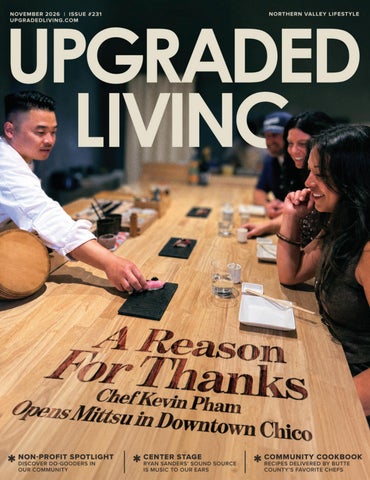
COVER STORY 35 After a long-awaited opening, Chef Kevin Pham brings world-class sushi, inventive omakase, and a passion for Butte County agriculture to the heart of Downtown Chico. ON THE COVER KEVIN PHAM AT MITTSU
9
“It’s getting better all the time,” Fran says. “It’s absolutely thrilling to me!” One of her favorite tests is a small handheld Gideon Bible with type she says is around six-point font. Today, she can read it. Fran says her vision has measured 20/30, and after reviewing her progress, her care team recommended another round of treatment. That progress has only strengthened the optimism Fran brings to nearly everything in life. “What you focus on mentally, spiritually, all of it, is what you give power to,” she says. “I was focused on my eyes getting better, and guess what? My eyes got better thanks to Dr. Barthelow. Your attitude and who you put your trust in changes everything.” Just as important to Fran was how simple the treatment itself felt.
A clearer view ahead Fran Gist made Northern California home in 1978. She found part-time work with the post office carrying trays of letters and later spending more than a decade on a rural delivery route. By then, glasses had already been part of her life for years— though she hadn’t been eager to admit it.
Before she knew she had macular degeneration, Fran was driving down the highway when an approaching vehicle appeared to have two windshields stacked on top of one another. The image improved as the vehicle came closer, but the experience frightened her immensely.
As a teenager, Fran remembers secretly putting on reading glasses in her bedroom so no one would see her wearing them. As the years passed, readers became bifocals, transition lenses, contacts, and ongoing frustration.
“To tell you the truth, it scared the snot out of me,” she says.
“I would send them to North Valley Eye Care. Absolutely, positively,” Fran says. “I have seen Dr. Barthelow and his staff for 14 years now, and I haven’t had even one disappointment on my end.”
Fran was eventually diagnosed with dry macular degeneration. Having friends who received regular eye injections for the more developed form of the disease, wet macular degeneration, she knew how intimidating treatment could seem. When she learned about a new treatment called photobiomodulation, or PBM, she decided she had little to lose by trying it.
Now preparing for her next round of PBM treatment, Fran is excited to see just how much further her vision may improve. After years of glasses, changing prescriptions, cataracts, and the uncertainty that accompanied macular degeneration, being able to pick up a tiny Bible and simply read feels like something worth celebrating.
The improvement wasn’t immediate. Several weeks passed before Fran began realizing that something had changed. She started reading things she previously would have avoided because the effort left her tired or gave her headaches. Then she noticed she was doing it without reaching for her glasses.
If you have experienced changes in your vision, call North Valley Eye Care and the Macula Preservation Institute today at (530) 922-2022 to schedule an appointment and see if PBM treatment is right for you.
“My eyes have been an annoyance for quite some time,” she says. In 2012, Fran began seeing North Valley Eye Care’s Dr. J. Isaac Barthelow and, as she puts it, simply placed her vision in his hands and said, “Here, help.” She has never regretted it. Cataracts eventually caused worsening of her vision, but surgery brought immediate improvement. “It was just night and day,” Fran remembers. Later, however, came something more concerning. 10
“I would suggest you go for the PBM therapy if you have dry macular degeneration,” she says. “You won’t be in pain or inconvenienced in any way. Ten or fifteen minutes out of your day is nothing, and the benefit you get is everything.”
U P G R A D E D L I V I N G M AG A Z I N E N OV E M B E R 2 0 2 6
When it comes to friends and family who might be struggling with vision issues, the choice is clear for Fran.
11
12
U P G R A D E D L I V I N G M AG A Z I N E N OV E M B E R 2 0 2 6
In fact, we often measure a community by what we can point to: its schools, parks, businesses, streets, and public spaces. These matter deeply. But what about knowing there is somewhere to turn when things fall apart? What about knowing you live in a place where people care? We live in that kind of place. Some of the most devoted stewards of this care are the people who work in our nonprofits, schools, and hospitals. They make so much of this possible. They work in spaces where needs are complicated, and progress takes time. The answer is rarely as simple as a check or a single act of kindness. Their work is woven into the ordinary days of our lives, often without our noticing until we or someone we love needs them. Philanthropy helps sustain that work. A gift can become a meal, a safe place, or the resources that allow an organization to keep its doors open. So often, the person giving never knows whose life was changed. The person receiving may never know who made it possible. Still, the thread exists. I have the honor of seeing it and tending to it.
The Thread Between
On philanthropy, community, and the goodness of people WRITTEN BY ALEXA BENSON-VALAVANIS
I have spent my life believing in people. Not in an idealized version of humanity, or in the idea that kindness can make everything right, but in our capacity to care about one another. I have seen this in small moments and in the face of unimaginable tragedy.
opened their homes to strangers. Meals appeared. Donations poured in. Volunteers kept coming long after the flames were out. People who had lost so much themselves found ways to help others. Across our valley, compassion and care became our oxygen.
For months after the Camp Fire, dump trucks traveled out of the forest. I remember the steady procession along the freeway. Amid the enormity of what had been lost, it was hard to imagine what could hold us together. And yet, everywhere I looked, people were reaching for one another.
I think often about what allows us to do this for one another. Perhaps we recognize how fragile life can be. How fleeting. Perhaps we understand that none of us gets through the world entirely on our own.
Church halls and high school gyms became places of refuge. People
Whatever the reason, I have seen this impulse at work far beyond disaster. It is part of the quiet, everyday ways we make life better for one another.
I have had the privilege of rebuilding and leading the North Valley Community Foundation (NVCF) since 2005. During that time, we have raised more than $200 million to care for people and enrich the quality of life here and around the globe. Our work has taken on particular urgency in moments of crisis. During the Camp Fire, NVCF transformed overnight to lead the philanthropic response. Since then, we have helped our community navigate the pandemic and the many fires, droughts, and storms that have followed. I am proud of that work, but what matters most to me is what the numbers cannot convey: the many people who decided that someone else’s well-being was worth their time, resources, and care. Throughout these pages, you’ll meet some of the nonprofits and individuals who hold this thread close. My hope is that we continue to recognize and support them, so they can keep doing the work that holds us all.
13
The Power of One Sometimes, changing a young person’s life begins with something remarkably simple: showing up. It isn’t about having all the answers, but rather being willing to listen, stay present, and remind someone who is struggling that they matter. For a teenager navigating depression, loneliness, or loss, that connection can become an important step toward healing. In Butte County, where families have weathered years of hardship and mental health resources are often difficult to access, a growing initiative is making sure young people have someone in their corner. That initiative is NVCF Cares, a North Valley Community Foundation program that has evolved from an urgent response to youth suicide into a community-wide effort built around belonging and hope. At its center is director Dr. Sésha Zinn, PsyD, a Chicoan convinced that supporting young people isn’t solely the responsibility of therapists or social workers. “It’s all the adults,” she explains. “It could be the yard duty, the coach, the librarian—anyone willing to lift another up.” Sésha grew up in Chico, attending Marigold Elementary, Bidwell Junior High, and Pleasant Valley High School before pursuing degrees in musical theater and research psychology. She worked in university housing and eventually ran Whitney Hall at Chico State. Surrounded by young adults discovering who they wanted to become, she recognized a passion for helping people through life’s challenging transitions. That passion led her into social work with foster youth, where she saw children carrying the effects of trauma while families struggled to find support. After earning her doctorate and becoming a licensed clinical 14
U P G R A D E D L I V I N G M AG A Z I N E N OV E M B E R 2 0 2 6
psychologist, Sésha spent a decade with Butte County Behavioral Health, eventually serving as deputy director. Her work encompassed administration, research, grant writing, and developing programs responsive to the community’s needs. Her commitment was also personal. Sésha and her family opened their home to teenagers in foster care, welcoming about a dozen young people over the years. While some prospective foster parents hesitate to take teenagers, she found joy in helping them through an especially difficult stage of life and on toward college. “They’re the coolest,” she says. “They’re all grown up now, and they’re so fabulous.” Those experiences reinforced a belief that guides her today: children facing significant challenges can flourish with a safe place to land. “It only takes one healthy adult to change their trajectory in life,” Sésha says. She had seen it in her work and in her own home. When the COVID-19 pandemic arrived, Sésha stepped away from county leadership to spend more time with her children. Meanwhile, isolation, disrupted routines, and lasting community trauma intensified pressures on an already strained mental health system. Families confronting suicidal thoughts or attempts faced a frightening maze of emergency care, insurance requirements, and limited treatment options. The warning signs were impossible to ignore. According to local reporting, five Butte County teenagers died by suicide in 2020, more than in the previous two years combined. Sésha recalls that some young people in crisis were handcuffed and transported for emergency care, an experience that could deepen an already frightening moment. These numbers and experiences pointed to a larger problem: families needed not only crisis intervention but compassionate guidance in the days that followed. North Valley Community Foundation President and CEO Alexa Benson-Valavanis recognized the need for a different approach. Although NVCF traditionally supported other organizations rather than providing direct services, the urgency demanded action. 15
Alexa’s team contacted Sésha to study successful programs nationwide and design a response for Butte County. “Everyone was at max capacity,” Sésha recalls. Rather than duplicate existing services, NVCF decided to fill the gaps. Its pilot became the Care Team, now led by Lead Clinician Sara Watts, LMFT, a free youth suicide prevention and response program designed to meet families where they were. The team could sit with a family at the hospital, help parents communicate with insurance companies, connect them with therapy or psychiatric care, and guide them through the transition. Instead of expecting a family in crisis to coordinate everything alone, someone could help make the next step manageable. The program serves young people experiencing suicidal thoughts, those who have attempted suicide, and those grieving a death by suicide. After that initial contact, young people can be paired with coaches chosen to match their interests and needs. Those coaches have included athletes, therapists, artists, and skateboard instructors. NVCF has helped pay for karate, equine therapy, music lessons, and sports, creating opportunities for confidence and connection outside a clinical setting. According to NVCF’s latest annual report, the Care Team has provided one-on-one mentorship to more than 600 young people over five years. NVCF also reports that 96 percent of surveyed participants learned strategies to manage stress, while all said they felt safe with and trusted their Care Team coach. These relationships can make a difference long after the first difficult conversation. As the Care Team developed, young people began asking for something more. They appreciated individual support but wanted opportunities to connect, have fun, and feel part of something positive. The program was designed to meet them in their darkest moments; they were asking for more light. The answer became The Crew, a free social community for Butte County youth ages 12 to 17. Through events in Chico, Oroville, Paradise, and Gridley, teenagers meet peers, build friendships, and enjoy experiences without the pressure of a clinical appointment. It offers belonging, not because something is wrong, but because every young person deserves connection. That commitment to listening also inspired NVCF’s Youth Advisory Council, whose members are employed by the foundation and help shape programs and decide which community projects deserve support. Through a $20,000 Youth Action Project minigrant program, they select local efforts promoting mental health and social connection, from school enrichment to summer camp opportunities. For Sésha, the council gives teenagers a chance to experience philanthropy firsthand and see adults take their perspectives seriously. Rather than assuming that grown-ups know what young people need, NVCF asks them. When youth requested ways to stay connected after the Care Team, The Crew followed. “We are 16
U P G R A D E D L I V I N G M AG A Z I N E N OV E M B E R 2 0 2 6
here to show up for the community,” Sésha says. “We want to take on the things that people and organizations are saying they can’t, to fill in the gaps.” Sésha keeps returning to one belief: young people need caring adults, and those adults need care themselves. Teachers, coaches, foster parents, school employees, neighbors, and volunteers often provide stability without considering themselves part of a mental health response. Many are already stretched thin. Rather than asking more of them, Sésha wants to recognize their contributions and help them continue. That became The Power of One, recognizing adults who have made a meaningful difference in young people’s lives. Community members nominated someone who showed up when it mattered. NVCF plans to celebrate 100 nominees at Sierra Nevada on December 10, bringing often-unseen acts of kindness into the spotlight. Sésha is working with NVCF Engagement Coordinator Morgan Warnock on a journal and workbook to help caring adults address their own needs and avoid burnout. It complements the foundation’s Caregiver Academy, offering resources for people supporting teenagers experiencing anxiety, depression, hopelessness, or suicidal thoughts. Having experienced burnout herself, Sésha believes the community must care for its helpers, too. “Let’s stop putting more on their plate,” she says. “Let’s recognize them.” Five years in, Sésha still writes grants, builds partnerships, and identifies unmet needs. Plans include continuing The Crew’s countywide gatherings, strengthening caregiver resources, and letting the Youth Advisory Council determine where the program goes next. If another organization offers a needed service, NVCF can partner with it. If a gap remains, the foundation can explore how to fill it. Sésha credits Alexa with encouraging that ambition. “Alexa just said, ‘Dream big, and we’ll do that!’” she recalls. For someone whose first degree was in musical theater, the invitation to think creatively feels fitting. She notes that many NVCF colleagues have artistic roots, and she has found a home among people willing to imagine a better future and make it real. Ultimately, the mission isn’t to build the biggest collection of programs. It’s to build a Butte County where young people feel connected, are heard, and have adults ready to stand beside them when life becomes difficult. NVCF Cares cannot remove every hardship, but it can help ensure fewer families face those hardships alone. For anyone wondering whether their kindness matters, Sésha’s message is clear: you don’t need to be a therapist or an expert to make a difference. Sometimes the most important thing you can do is simply be the person who shows up. To learn more about NVCF Cares, visit nvcf.org/nvcfcares. Families can call or text the Care Team at (530) 783-2273 for nonemergency support. For an immediate mental health crisis, call or text 988. 17
More than a concert For Ryan Sanders, a great concert is about more than the band onstage. It’s a family settling onto a blanket, friends recognizing a song, and strangers sharing an experience. Behind the scenes, it’s sound and staging that make the experience memorable. Through Sound Source, the Chico nonprofit he founded, Sanders is making those experiences accessible to everyone, without the cost of a ticket. The centerpiece is Live on the Lawn, a free concert series at Children’s Park in Downtown Chico. Its inaugural May 2026 season brought Northern California musicians to a shaded setting with professional-quality production. Now, Sanders is expanding the series in the community that shaped him. Born in Juneau, Alaska, Sanders moved to Chico in second grade and grew up attending Chico Junior High and Chico High School. He was introduced to music with the flute in fourth grade, followed by guitar at 12. By his senior year of high school, he was taking classes in Chico State’s recording arts program, setting a course for his career. 18
U P G R A D E D L I V I N G M AG A Z I N E N OV E M B E R 2 0 2 6
After graduating from Chico High in 2000, he continued pursuing recording and audio production. An early business development loan from Butte County helped him build a two-story recording studio near the Chico airport with his close friend Preston Pope, an ambitious project for someone with no construction experience. Sanders eventually moved to Los Angeles, where he worked for Roland musical instruments and BOSS effects pedals, even appearing on product packaging. He also worked in live sound engineering—16-hour days that eventually became unsustainable. When he met someone he wanted to build a relationship with, he began reconsidering what the next chapter should look like. He returned to Chico State and shifted into design work. Music, however, never stopped calling. Around three years ago, he reconnected with the Downtown Chico Business Association’s Friday Night Concerts and noticed an obvious challenge. “Why are we doing this in the middle of summer with all the heat?” he remembers wondering. His collaborations with Maker Radio
and other community projects revealed another obstacle. Organizations hosting benefit events needed professional sound production, but paying for that work could reduce the proceeds they hoped to raise. Sanders saw groups navigating grants, donations, and tight budgets, and began considering a different structure: a nonprofit that could secure its own support and contribute high-quality production without undermining another organization’s fundraising. Sound Source took shape in 2025, with help through North Valley Community Foundation. Sanders connected with the Lupine Legacy Foundation, whose early support helped launch the project. Explore Butte County contributed marketing assistance, while city and state arts grants helped support the effort. His goal: free, inclusive concerts with professional production. That mission creates an unusual tension. Sound Source must pay artists, move equipment, assemble stages, and produce professional events while keeping admission free. It’s “running a business that doesn’t have a revenue
model,” as Sanders puts it. The nonprofit also provides paid and donated production services. Support from foundations, grantmakers, and donors makes it possible, but sustaining the work requires ongoing investment. Sanders also wanted to broaden Chico’s musical horizons. Rather than booking only familiar local performers, he looked toward Sacramento, Tahoe, Oakland, Redding, and other communities within reasonable touring distance. “How big of a band can you get?” Sanders remembers asking. Their varied styles bring fresh sounds and new discoveries to Chico. Children’s Park became a natural home for that vision. Sanders remembers attending concerts there as a child and wanted to revive that experience for a new generation. Close to downtown businesses, with grass, trees, and room for families to gather, the location offers an atmosphere distinct from City Plaza’s hard surfaces and summer heat. People can bring a picnic, relax with friends, or introduce their children to live performance without buying a ticket. The inaugural Live on the Lawn season ran every Saturday in May, pairing selected performers with professional sound and an easygoing neighborhood atmosphere. Sanders sees that blend as essential. A concert should be something people participate in, not merely something playing in the background. When families linger, audiences engage, and a public park becomes a shared destination, the benefits extend beyond the stage. For 2027, Sanders plans to grow the series from five concerts to approximately ten, with performances centered on May and September and musicians coming from as far away as San Diego. Additional collaborations are taking shape, including Maker Radio projects, community street fairs, and regional festivals. He has supported events such as Redding Roots Revival and hopes to strengthen relationships across the North State. The challenge ahead is funding that ambition while preserving what makes the concerts special: their accessibility. Sanders is preparing a larger fundraising push to build the resources needed for future events. But the ultimate measure of success isn’t the size of the stage or the number of shows—it’s how many people discover that live music belongs to them, too. For the boy who picked up a guitar at 12, Sound Source represents a return to where the story began, this time with a whole community invited along. When the next band takes the stage at Children’s Park, anyone can pull up a blanket and listen. Learn more at soundsourceav.org and discover 2027’s upcoming artists at www.liveonthelawnchico.com.
19
20
U P G R A D E D L I V I N G M AG A Z I N E N OV E M B E R 2 0 2 6
center, a familiar public face of WTC disappeared. “At the time, it sounded like the Work Training Center went away,” Brett recalls. A different version was taking shape. “After the pandemic, we went back to our roots, really working with people with significant needs,” Brett explains. Today, WTC supports about 200 individuals through adult day programs, independent living services, transportation, recreation, and employment opportunities. Programs are tailored to individual abilities and goals. Through Do-It Leisure, participants also enjoy group outings and individualized coaching in everyday skills, building confidence and friendships through community involvement.
Still here, still growing For generations of Chico families, the Work Training Center was as familiar as its annual turkey dinner. Founded by parents seeking opportunities for their children, it grew into workshops, job programs, and services touching hundreds of lives. Then came the Camp Fire and pandemic. Programs closed, Fair Street Recycling disappeared, and some assumed the organization had gone with them. But WTC never went away. The nonprofit is rebuilding around the needs that inspired its creation, and CEO Brett Barker and Development Director Liz Sheen want the community to know what is happening today. WTC began in 1949, when a small group of parents sought activities, connection, and opportunities for loved ones with disabilities. They gathered in church basements and other available spaces, building programs with volunteers. The organization’s first workshop, in a former barracks building at Chico Municipal Airport, served four people
with one volunteer. As it grew, so did its fundraising. Brett remembers the story of a family member whose husband worked at Safeway’s butcher counter and helped obtain turkeys for a community dinner. That fundraiser became a Chico tradition, raising money while introducing neighbors to WTC’s work. Its offerings expanded to landscaping, recycling, woodshop, sewing, assembly, and social programs. Participants worked alongside supervisors, developing skills and finding purpose. In the years before the Camp Fire, WTC had more than 300 employees and served approximately 600 to 700 people. But the 2018 disaster displaced programs in Paradise, and pandemic restrictions brought further closures. Changes to compensation requirements also reshaped the employment programs. The longtime Fair Street operations closed, and with the loss of the recycling
At Nexus, participants build confidence and practical skills through activities ranging from money management to community outings. Mosaic serves adults with more intensive medical and personalcare needs, supported by a nurse and trained staff. Some participants use wheelchairs, need help eating or managing hygiene, or communicate without speech. Getting everyone to the center requires specialized vehicles and careful coordination. “Just getting them there is step one,” Brett says. Once participants arrive, the focus shifts to meaningful activities, friendships, motor skills, and experiences that might otherwise be difficult to access. Families also count on these safe, engaging spaces. “We are the only ones that have this type of program available for Butte County,” Liz says of the medical-model services, adding that demand has produced a waiting list. WTC is preparing to open a second Mosaic program on Browns Valley Road, with a soft opening anticipated in December and broader operations expected by early 2027. Brett estimates it could serve another 25 people. Employment remains part of WTC’s identity, though its role has changed. Through Inside Out Landscaping & Janitorial, crews serve local customers 21
while generating revenue for the nonprofit’s programs. One crew maintains the northbound and southbound Interstate 5 rest areas near Willows seven days a week. Some former program participants have become employees themselves, reflecting the opportunities that remain possible. These business operations must compete for customers like any other company, Liz explains. Their profits go back into WTC’s mission, helping sustain programs that don’t generate comparable revenue. Expanding the janitorial and landscaping customer base would directly support the people WTC serves.
22
U P G R A D E D L I V I N G M AG A Z I N E N OV E M B E R 2 0 2 6
WTC is also exploring after-school opportunities for children ages seven to 15 on the autism spectrum, an area where he sees a shortage of local options. Grants and community support will help determine what becomes possible. For Brett, the biggest challenge may be reminding the community that WTC is still here. “Unless you know someone with a developmental disability or have a family member, it’s kind of out of sight, out of mind,” he says. That is precisely what he and Liz hope to change.
The organization also faces mounting transportation costs and a complicated system of referrals and funding. Far Northern Regional Center helps coordinate access to services, but Brett says demand continues to outpace available capacity. WTC now has roughly 80 staff members.
Businesses can hire WTC’s landscaping and janitorial crews; residents can donate, contribute useful vehicles, or help spread the word. Every connection strengthens an organization born from a simple belief more than 75 years ago: people with disabilities deserve opportunities to learn, belong, and live with dignity. The buildings and programs may change, but that commitment remains.
Looking ahead, Brett hopes to establish a program for adults whose needs fall between Nexus and Mosaic: people who need substantial support but not the full medical model.
Learn more about this incredible program or donate at www.wtcinc.org. You can also contact Development Director Liz Sheen at (530) 715-1848 for more information.
23
24
U P G R A D E D L I V I N G M AG A Z I N E N OV E M B E R 2 0 2 6
deserve support that respects their individual journey. During her recovery, she discovered how few local resources existed. She couldn’t find the kind of amputee support community she needed across a ten-county region. A surgeon told her that other people had expressed interest in creating something similar, but no one had followed through. Shelly decided to change that. Before the pandemic arrived in March 2020, she had gathered volunteers and built connections with patients in care facilities. Suddenly, those doors were closed to visitors. Determined not to lose the relationships she had started, she created a Facebook group with approximately 20 nurses, prosthetists, and amputees. Today, she says, that community has grown to 15,000 members.
A way back home The day Shelly Baxter-Wetmore ventured out on her own after losing her leg, she had a list of accomplishments to celebrate. She drove herself to get her hair trimmed, then decided to reward her progress with a stop at Dollar Tree. After a few aisles, however, exhaustion caught up with her. Outside, she discovered another problem: someone had parked so close to her car that she couldn’t get through the driver’s door. She waited half an hour, wondering how she would get home. Then came a solution that still makes her laugh—she could remove her prosthetic leg and squeeze into the car. The experience was a lesson in the unexpected obstacles of life after amputation—and in the ingenuity it sometimes takes to overcome them. Today, Shelly shares lessons like that through Amputee Outreach, the Chicobased nonprofit she founded to support people experiencing limb loss and their families. What began as a local effort to
connect people facing similar challenges has evolved into an expansive network of peer support, practical assistance, and a growing commitment to helping amputees return home. Shelly knows how quickly life can change. After a serious illness, two surgeons worked to save her life, but ultimately her right leg had to be amputated below the knee. Her recovery required learning new ways to move through the world, from navigating a parking lot to managing everyday tasks others rarely think about. She also recognized something unusual about her own response. Humor came naturally, and she concentrated on moving forward rather than dwelling on what had happened. “When I have a setback, I don’t do avoidance or denial; I just plow forward,” she says. Over time, she realized her experience wasn’t universal. Many people face periods of profound grief, anger, isolation, and uncertainty after amputation, and they
As the network expanded, Shelly saw that encouragement alone couldn’t solve every problem. Sometimes the obstacle keeping someone from recovering at home was painfully physical: a doorway too narrow for a wheelchair, an inaccessible bathroom, or steps that were impossible to navigate. A grant from Chico’s Discovery Shoppe helped Amputee Outreach launch Ramp Up for Home, an initiative that addresses barriers to returning home after an amputation. Shelly says the program has helped seven people leave care facilities and return home to continue healing. One woman contacted the organization because she couldn’t access her own bathroom and had been using a bedside commode beside her couch. For someone who has lost an upper limb, even brushing teeth or moving hair away from the face can require assistance. These are intimate, everyday realities that rarely enter public discussions about prosthetics and recovery. Solutions often have to be tailored to the individual home. “Everything is handmade. Nothing is off the shelf,” Shelly explains. The nonprofit also maintains a lending program for wheelchairs, walkers, 25
crutches, grab bars, shower chairs, and other essential recovery equipment. Amputee Outreach operates entirely through volunteers, without federal or local government funding. Its current team includes 16 volunteers and four interpreters who help the organization reach more families, including those who speak Hmong or Spanish. Services are free, and the organization offers support meetings, mentoring, and referrals to relevant professionals and agencies. That personal connection remains essential. Someone who has lived through amputation can answer questions and offer reassurance in ways a brochure cannot. But the organization can only reach people who connect with it, so awareness remains a priority. Shelly volunteers to speak at social clubs and community gatherings, recently visiting the Exchange Club, where attendees had no shortage of questions. She hopes more people will join the effort, particularly amputees, their spouses, caregivers, and interpreters. She is also writing a book, Next Steps, on what she has learned about finding a way forward after life changes unexpectedly.
26
U P G R A D E D L I V I N G M AG A Z I N E N OV E M B E R 2 0 2 6
The underlying message is not that recovery is easy or that everyone should approach it as she did—it is that no one should have to figure it out alone. Whether a person needs a conversation with someone who understands, equipment that makes daily life possible, or a safe route through their front door, Amputee Outreach wants to help. Shelly knows firsthand that independence can depend on small, unexpected discoveries. Sometimes it begins with a clever solution in a parking lot. Other times, it begins with a ramp and the simple relief of coming home. Amputee Outreach is a 100% volunteerrun nonprofit providing free support, resources, and essential equipment to individuals experiencing limb loss. With no paid staff and increasing demands on its limited resources, the organization urgently needs community donations and business sponsorships to continue serving amputees and their families into 2027. Every contribution helps ensure that no one faces limb loss alone. To donate, volunteer, or request assistance, call (530) 343-0005 or visit www.myamputeeoutreach.org
Funds for Life Personal Loan • Home Repair
• Major Purchase • Gift Planning
• Travel Expenses and more
Special holiday rates available with up to a 3-month payment deferral!
SierraCentral.com/promotions • 800-222-7228 *Delayed payment of up to 3 months available for a limited time, now through December 31, 2026. Rate, terms, and fees subject to credit approval and can change at any time without notice. Not all applicants qualify for the lowest rate. If approved for a loan, to qualify for the lowest rate, you must have a responsible financial history and meet other conditions. Your actual rate will be within a range of rates and depend on a variety of factors, including evaluation of your credit worthiness, income, and other factors. Membership open to anyone who lives or works in any of our branch location counties. Membership and/or participation fees may apply. All loans subject to credit approval and underwriting guidelines. Sierra Central is an Equal Opportunity Lender and Federally Insured by the NCUA. 27
waiting to start treatment during one of the most frightening times in a person’s life. Now, help can arrive almost immediately. “So far, we have more than 50 patients enrolled,” Yau said. “We’re able to get these patients started on important medications much sooner.” For patients, that speed matters. A cancer diagnosis often arrives with a flood of uncertainty, fear, and difficult decisions. The Cancer Compassion Fund removes at least one of those worries. “It bridges that financial gap,” said Elizabeth Cadd, Director of the Enloe Health Foundation. “Patients shouldn’t have to choose between their treatment and their basic everyday needs.”
Loretta Norberry is thankful for Enloe Health’s Cancer Compassion Fund, which has helped her pay for her medications.
a vital lifeline At 5:30 every morning, before the Northern California heat sets in, Loretta Norberry laces up her shoes and heads out the door with her two dogs, Lucy and Rue Jean. At 76, Loretta stays busy. She tends flower beds and fruit trees in her yard, attends community clubs in the evenings, and treasures the active life she has built. It’s not the life most people imagine for someone living with cancer. Years ago, during a routine blood donation, something didn’t look right. Further testing led to a diagnosis of Waldenstrom macroglobulinemia, a rare blood cancer that affects only a small percentage of the population. Along with the diagnosis came a lifesaving medication and a staggering cost. “The copay was $3,000 a month,” Norberry said. “I explained that I was on Social Security and struggling just to pay bills.” Like many cancer patients, Norberry suddenly found herself facing two battles: the disease itself and the financial burden that came with treating it. No one plans for a cancer diagnosis. 28
U P G R A D E D L I V I N G M AG A Z I N E N OV E M B E R 2 0 2 6
Since January, the medication assistance program alone has provided tens of thousands of dollars in support, helping dozens of patients access the medications they need to continue fighting cancer.
Even fewer are prepared for the costs that can arrive almost immediately: a prescription that can’t wait, a deductible that must be met, a treatment that could mean the difference between stability and progression.
For Norberry, that support meant consistency. There was never a delay in receiving the medication her doctors prescribed. The assistance allowed her to focus less on bills and more on living.
For many patients, the question becomes painfully simple: Do I pay for my medication or do I pay for everything else?
Today, she continues to walk her dogs, care for her garden, and fill her days with the activities she loves.
That’s where Enloe Health’s Cancer Compassion Fund comes in.
Norberry said she is deeply grateful for the support she received.
Through the Enloe Health Foundation, the fund helps cancer patients overcome financial barriers by covering essential expenses, including medication costs. More recently, the fund has become a critical resource for patients who struggle to meet high insurance deductibles for costly oral cancer therapies.
But her story is about more than financial assistance. It is a reminder that behind every cancer diagnosis is a person who simply wants the chance to keep living normally, Cadd said.
“We try to do everything possible to ensure treatment is not delayed due to financial reasons,” said Jocelyn Yau, Specialty Pharmacy Manager at Enloe Health. Before the fund’s medication assistance program launched this year, patients often had to navigate lengthy manufacturer assistance programs that could take weeks to approve. Those delays could mean
“Sometimes compassion looks like a check written by a donor,” she added. “Sometimes it looks like medication arriving on time. Sometimes it looks like one less thing to worry about on one of life’s darkest days.” For patients like Norberry, that compassion can make all the difference. If you would like to support the Cancer Compassion Fund, visit www.enloe.org/donate and select “Cancer Compassion” to make a gift.
"Effie helped us buy a house for about as low as you can get and helped us sell the same house above market value. She is very sharp, knowledgeable, and experienced. She is also a seasoned negotiator. I wouldn’t want to be on the other side. Thanks Effie!" - Joe A. Bill, Chico
This exceptional home blends a 1940s orchard supervisor’s cottage with a 2013 renovation/expansion, resulting in an interesting, well-built house with significant outdoor patio and deck square footage, flexible living space, a large and well-equipped kitchen at its heart, 30 windows that bring in tons of natural light, surrounded by 5 acres of organic walnut orchard, all on 6.34 acres of land. The property offers fully owned, 54-panel solar, a 30’ x 40’ powered shop/ barn, and electric car charging station. The kitchen is spacious, with passages and counter space designed to accommodate many people working at once. It includes a retro O’Keefe & Merritt gas range, refrigerator, dishwasher, custom-built maple cabinetry, pull-out drawers, direct and indirect lighting, island with cabinetry and space for seating, convection oven/microwave, and spacious walk-in pantry. In one corner, a sideboard designed to store linen and tableware includes a 5-foot-deep pull-out drawer for table leaf storage that easily supports dining for up to 18 people. The primary bedroom opens to the deck, includes his-and-her closets, heated bathroom floor, and a large walk-in shower. The original cottage rooms include the 2nd bedroom, 2nd bath (renovated in 2010), covered concrete patio with ceiling fan and dimmable lighting. From the patio, the fully fenced landscaped backyard and orchard view provide a peaceful spot to relax in the summer and enjoy rain showers in the winter. This is a house that you must see to appreciate. It is waiting for you to move in and build memories!!! Bed: 2 Bath: 3 SqFt: 2,714 Price: $795,000
Nestled in a desirable cul-de-sac location near the scenic trails and recreation of Bidwell Park, this light-filled home offers the perfect blend of comfort, style, and modern convenience. The open and airy floor plan welcomes you with high ceilings, engineered wood flooring, and a spacious living room highlighted by large windows that invite in abundant natural light. Designed for both everyday living and entertaining, the kitchen opens seamlessly to the dining area and features Corian counters, a breakfast bar, pantry, pots-and-pans drawers, gas appliances, and a refrigerator. The adjoining family room with a cozy fireplace creates a warm gathering space for relaxing evenings. The generously sized primary suite offers a spacious bedroom retreat and a well-appointed bathroom with tile counters, a separate soaking tub, walk-in shower, and dual vanities. Step outside to enjoy the private backyard, where a covered dining patio with skylight provides the perfect setting for outdoor meals and year-round entertaining. Additional highlights include a new roof, indoor laundry with washer and dryer, a water purifier, water softener, Tesla universal charger with two batteries for modern energy efficiency and leased solar. Bed: 3 Bath: 2 SqFt: 1,853 Price: $490,000
SOLD Panoramic sunsets and breathtaking views of Black Butte Bluff await at this charming ranch-style retreat on 5.83 picturesque acres! Just minutes from Black Butte Lake, the property offers easy access to fishing, boating, water skiing, and camping. Inside, attractive laminate flooring welcomes you into a spacious great room with a cozy wood-burning stove. The well-equipped kitchen features beautiful cabinetry, convenient drawers, a pantry, modern appliances, and a cheerful dining area. Three generously sized bedrooms include a primary suite with skylight, while two bathrooms feature granite countertops. Central heating and air, dual-pane windows, and indoor laundry add everyday convenience. So much to see! Call today! Bed: 3 Bath: 2 SqFt: 1,470 Price: $499,000
29
Giving thanks by giving back Thanksgiving has always been about more than what is on the table. It’s about gathering together, looking out for one another, and reminding our neighbors that they’re part of a community that cares. This November, Mooretown Rancheria and Feather Falls Casino Resort will contribute 200 turkeys to help provide Thanksgiving meals throughout the region, with 100 going to Azad’s Martial Arts’ Thanksgiving Basket Brigade and 100 to the Oroville Resource Center & Rescue Mission. For 34 years, Azad’s Martial Arts Center and the Bright Futures for Kids Foundation have brought thousands of volunteers together through the Basket Brigade, reaching more than 93,000 people across Butte, Glenn, and Colusa 30
U P G R A D E D L I V I N G M AG A Z I N E N OV E M B E R 2 0 2 6
counties. More than providing food, the effort reminds children and families that they are valued, supported, and never alone. “The food we provide may last a day or a week, but the kindness behind it can stay in a child’s heart for a lifetime,” said Grandmaster Azad, 10th Degree Black Belt. In Oroville, the Oroville Resource Center & Rescue Mission supports people facing hunger, homelessness, and other difficult circumstances through meals, shelter, clothing, and connections to additional resources. “Our community events succeed because of our community partners. Thank you, Mooretown Rancheria, for your support
and partnership!” said Allan Dikes, Executive Director of Oroville Resource Center & Rescue Mission. Throughout the year, Mooretown Rancheria and Feather Falls Casino Resort also support local organizations through donations, fundraising events, shared resources, and space for community causes. Last Thanksgiving, they donated 200 turkeys to organizations serving Butte and Yuba counties. This year, another 200 turkeys will help local organizations continue supporting neighbors when it matters most. It’s a reminder of what Thanksgiving is really about: sharing what we can, supporting one another, and making sure everyone has a place at the table.
You won’t find a better realtor than Sherry! She’s an amazing communicator — always kept me in the loop and made sure I felt confident every step of the way. From prepping the house to handling the final details at closing, Sherry had a go-to contact for everything I needed. She truly goes above and beyond to make the deal happen. I’d recommend her to anyone without hesitation! It was such a pleasure to work with her. -Rebekah, Chico
Call me today at (530) 514-4855
Just minutes from Chico, this secluded Mediterranean estate is centered around a breathtaking two-acre manmade lake. Beyond custom gates and a private bridge, the home offers water views from nearly every room, along with a sparkling pool and expansive patios. The grand living room features soaring lake-facing windows and a custom fireplace. The chef’s kitchen includes a dining nook, fireside sitting area, and wine cellar, while the formal dining room opens to a courtyard. Additional features include a pool-view office or den, nearby full bath, and private downstairs bedroom with a half bath. The primary suite offers dual vanities, dual closets, a spa-inspired shower, and a private patio with hot tub. A dock, resort-style pool, tranquil lake, and expansive grounds complete the retreat. You have to see this home to believe it! Bed: 4.0 Bath: 4.0 SqFt: 5,824 Price: $2,500,000
Experience luxury, serenity, and seclusion at this extraordinary Mediterranean estate, just minutes from Chico and centered around a breathtaking twoacre manmade lake. Beyond custom security gates and a private bridge, the home offers water views from nearly every room, along with a sparkling pool and expansive patios. The grand living room features soaring lake-facing windows and a custom fireplace. The chef’s kitchen includes a dining nook, fireside sitting area, and wine cellar, while the formal dining room opens to a private courtyard. Additional features include a pool-view office or den, secluded downstairs guest suite, and a luxurious primary retreat with dual vanities, dual closets, spa-inspired shower, and private hot tub patio. A private dock, resort-style pool, and expansive grounds complete this unforgettable property. Bed: 3.0 Bath: 4.0 SqFt: 4,354 Price: $1,575,000
VA buyer? You could qualify for this assumable 5.5% interest rate and buy this home with owned solar!!! Don’t miss out on this beauty as she’s ready to go!! Open concept living with 4 bedrooms!! Don’t worry about saving money for appliances because they are ALL included: refrigerator, washer, dryer, and they will even leave the water softener!! Close to Hartley Park, and easy access to Highway 99, this perfectly situated home makes an ideal choice for just about any buyer! If you’re a star gazer, you can sit in your own private spa to enjoy! This area is loved by so many, and I just know you’ll love it too! Call today to schedule a showing!! Bed: 4.0 Bath: 2.0 SqFt: 1,561 Price: $539,000
Number One Producer for 2025! (530) 514-4855
Sherry Landis Real Estate, Inc. Serving happy customers for over 36 years.
31
Thanks Here’s a Thanksgiving memory from long after the turkey was eaten and the leftovers gone. I look back to the 1980s, when I helped newlyweds John and Julie buy their first home. They were excited about becoming homeowners and had one important goal: to be settled into their new home in time for Thanksgiving. The house was nothing fancy, but it would be theirs, and they couldn’t wait to begin their new life together. Everything was going according to plan until the lender added a last-minute requirement: the roof needed repairs before the loan could close. The seller refused to pay for anything, and suddenly everything was in jeopardy. Meanwhile, John and Julie had already given up their rental. With nowhere else to go, they moved in with Julie’s mother while we tried to find a solution. One problem: Julie’s mother and her new son-in-law weren’t exactly getting along. Living under the same roof was not making anyone’s Thanksgiving spirit particularly festive. John and Julie were caught between a house they couldn’t move into, a rental they no longer had, and a brewing family brouhaha. Their dream of spending their first Thanksgiving in their own home was slipping away.
32
U P G R A D E D L I V I N G M AG A Z I N E N OV E M B E R 2 0 2 6
Julie told me, “I’m sick of being the referee here. Am I the only adult in the house?” Then came a little Thanksgiving miracle. At the last minute, Julie’s mother stepped forward and agreed to pay for the roof repairs. Just like that, the obstacle was removed, the loan could move forward, and the dream of homeownership was back on track. John and Julie wasted no time. With the help of friends on a rainy, sloppy, messy day, they packed, hauled, and moved into their new-old home just before Thanksgiving. It wasn’t the smooth beginning they had imagined, but they were finally home. On the evening of their moving day, I brought a bottle of champagne to toast John and Julie’s place. “Well,” said Julie, lifting her glass, “I will say I am very thankful to be standing here on these muddy floors in total chaos, with no heat, because we are home.” I asked John if he was thankful. He sighed. “Yes, I am,” he said. “For friends and family.” He paused briefly and added, “Even a certain mother-in-law.” Julie nodded. “Said like a true adult,” she said. Doug Love is sales manager at Century 21 in Chico. Email dougwlove@gmail.com. Call or text 530-680-0817.
Chico Native with 18 Years in Real Estate.
Where there’s a Willman there’s a way!
(530) 966-1296
(530) 680-8962
Lwillmanchico@gmail.com www.WillmansWay.com
LA and Meriam Park experienced! nicolecarterhanna@gmail.com
NICOLE HANNA
LAURA WILLMAN DRE #01931088
DRE #02150386
Helping Buyers and Sellers of Real Estate Achieve Their Goals Through Kind, Quality Service.
PATRICK RILEY DRE #01417492
GARRETT FRENCH DRE #01402010
(530) 514-5555
SandyStonerc21@gmail.com
SANDY STONER DRE #01131795
HIGHLY Recommended for Commercial and Business Opportunity
Helping Achieve Goals and Commitment!
(530) 518-5635
530-570-7111
carolronissc21@sbcglobal.net
CAROL RONISS DRE #00756402
DRE 01363526
Contact me for all your Real Estate needs
Experienced in Estates, Probates, Trust, Residential, Income Properties, Relocation, Horse Properties, Vacant Land.
Search for all homes at GarrettFrenchHomes.com
TERI GARCIA
KimberleyTonge@yahoo.com DRE #01318330
(530) 228-1305
(530) 370-0158
1804 Hwy 99 Ste A, Gridley, CA 95948 Tgarcia@c21selectgroup.com
#1 Agent Chico 2022, 2023, 2024
KIMBERLEY “SOLD” TONGE
Your Real Estate Expert for the Chico and Orland areas!
Centurion Producers Award
Call me anytime for your complimentary market analysis of your home.
(530) 518-5508
(530) 588-6593
Patrick.Riley@c21SelectGroup.com
Serving Butte County for over 20 years.
Lfeatherston@c21selectgroup.com
LARRY FEATHERSTON DRE #00582302
(530) 518-1872
ALICE ZEISSLER DRE #01312354
Providing Quality Service in Chico Areas Real Estate since 1999.
(530) 864-0336
Quality Service Award Winner 2017-2024
JENNIFER PARKS DRE #01269667
Your Goals. My Mission. Every Time.
(530) 520-3169
Olivia.Larrabee@c21selectgroup.com
OLIVIA LARRABEE DRE #02056059
Options that make sense!
Conventional • Jumbo FHA • VA • USDA • HELOC (530) 321-9018
Jim.Heberle@SanfordMortgage.com
MIKE RICHARDS DRE# 00907540
(530) 864-9192
JIM HEBERLE NMLS 252781
MELISSA FINCH DRE# 02091505
(916) 885-3895
Mike.Richards@C21SelectGroup.com
Melissa.Finch@C21SelectGroup.com
Your neighborhood Realtor
Contact me for all your Real Estate needs!
Serving Butte County and Lake Almanor
DOUG LOVE (530) 680-0817 DRE #00950289
We Thankfully Serve SHELINDA BRYANT (530) 520-3663 Our Community! DRE #01726378
©2026 Century 21 Real Estate LLC. All rights reserved. CENTURY 21®, the CENTURY 21 Logo, and C21® are registered service marks owned by Century 21 Real Estate LLC. Century 21 Real Estate LLC fully supports the principles of the Fair Housing Act and the Equal Opportunity Act. Each office is independently owned and operated. DMCA Source: ©2025 Realogy Brands. The accuracy of all data, including measurements, is not warranted or guaranteed. This information is provided exclusively for the use of consumers, for their consideration, purchase, or lease of real estate. It may not be used for any other purpose and is not to be redistributed. Residential properties advertised herein are subject to availability, fees, and terms at each location. Prices subject to change without notice. Real estate services are offered in multiple U.S. locations. Home sales volume reflects 2025 transaction levels. Written, graphic, or text materials are the sole property of their respective owners. The REALTOR® brand is owned by Realtor 33 Group Limited Company (Realty Group), a leading global real estate financial organization. From November 1–December 31, 2025. Stanford Mortgage is Powered By Texana Bank. Company NMLS: 407536. Member FDIC – Equal Housing Lender.
34
U P G R A D E D L I V I N G M AG A Z I N E N OV E M B E R 2 0 2 6
Worth the Wait
After an unexpected journey to opening day, Chef Kevin Pham brings world-class technique, local agriculture, and an exciting new dining experience to Downtown Chico. Good things take time. Great things, as it turns out, sometimes take a little longer. For Chef Kevin Pham, the journey to opening Mittsu, Downtown Chico’s newest sushi restaurant, has certainly been proof of that. When we introduced Kevin and his ambitious culinary vision to readers last November, the restaurant was just weeks away from welcoming its first guests. Everything seemed to be falling into place. After years spent honing his craft alongside some of the world’s most celebrated chefs, Kevin was finally ready to bring his experience, creativity, and passion for agriculture to a restaurant of his own in Chico. Unfortunately, life had other plans. A series of unforeseen circumstances pushed the opening considerably further into the future than anyone anticipated. Yet even as the delays mounted, his enthusiasm never wavered. Neither did his determination to deliver everything he had originally promised. In fact, Kevin found a way to make the additional time count. While preparing for Mittsu’s eventual opening, he continued refining his skills, assisting legendary Chef Thomas Keller of
The French Laundry with his Asian-inspired concept, R.O. Restaurant & Lounge, in Yountville. It was another opportunity to work at the highest levels of the culinary industry, surrounded by extraordinary talent and the exacting standards that have shaped Kevin’s career. It also gave him a chance to keep another promise he shared with us last year: introducing Chico’s agricultural bounty beyond Butte County. Working with Chico Rice’s owner Tom Knowles, Kevin brought the company’s rice into kitchens in the Napa Valley, introducing one of the nation’s most celebrated culinary destinations to a product grown right here at home.
The intimate, 40-seat restaurant offers the atmosphere of a sophisticated sushi destination you might expect in San Francisco or Los Angeles, with the comfortable hospitality and personal connection that make Chico special. Its menu blends traditional Japanese techniques with contemporary creativity, placing extraordinary attention on ingredient quality, presentation, and flavor. Carefully sourced fish, thoughtfully prepared rice milled in-house, seasonal produce, inventive rolls, and small plates come together in a dining experience unlike the typical neighborhood sushi restaurant.
Now, with Mittsu finally open, Kevin and his business partner, JohnWaite Tran, are bringing that same dedication back to Downtown Chico. If the community’s enthusiastic reception is any indication, the wait has been well worth it.
For Kevin, that’s precisely the point. His goal was never simply to open another sushi bar. He wanted to create a place where exceptional food, attentive hospitality, and culinary exploration could exist together without requiring guests to travel to a major city.
Located at 234 W. 3rd Street, just across the street from the Downtown Chico parking structure, Mittsu brings a decidedly metropolitan dining experience to the heart of Chico.
“I’ve always loved it here,” Kevin says. “I love the slow pace. I love seeing people wave hello as I walk down the street. The vibe and agricultural offerings are unlike anything I’ve found anywhere else.” 35
That affection for Chico remains at the heart of the restaurant, reflected as much in its ingredients as in its welcoming atmosphere. Perhaps nothing distinguishes Mittsu more than Kevin’s relationship with local agriculture. In a region celebrated for its extraordinary agricultural production, Kevin sees an opportunity to connect the people who grow our food with those who enjoy it. His philosophy begins with one of sushi’s most essential ingredients: rice. Through his relationship with Tom Knowles of Chico Rice, Kevin sources locally grown rice that he can mill in-house, giving him remarkable control over its freshness, texture, and preparation. It’s an exacting process that takes extra time and effort, but he believes it makes an enormous difference in the finished product. His commitment extends well beyond rice. Locally grown microgreens, seasonal vegetables, and other agricultural products contribute to a menu that reflects Northern California’s richness and diversity. More importantly, Kevin wants diners to understand where those ingredients come from and appreciate the people who produce them. “I want to be their voice,” he says. “I want to be able to really show our guests that Butte County grows great food.” His recent work demonstrates just how seriously he takes that commitment. By bringing Chico Rice to the Napa Valley, Kevin has already begun creating the connections he envisioned when Mittsu was first announced. And he’s eager to make even more. Kevin is extending an open invitation to farmers and agricultural producers throughout Butte County and the surrounding region to stop by Mittsu, introduce themselves, and explore opportunities to collaborate. Although Mittsu has only recently opened, Kevin is already preparing to introduce what may become its most distinctive experience: an exclusive chef’s table omakase program. Expected to launch in the coming weeks, the program will welcome just eight guests for an intimate, 16- to 19-course culinary journey curated personally by the chef. Omakase, a Japanese dining tradition often translated as “I leave it up to you,” invites guests to trust the chef’s expertise and imagination rather than select individual dishes from a menu. At Mittsu, the experience will revolve around the seasons, combining carefully sourced seafood with locally grown ingredients at their peak. Some dishes will be familiar offerings from the restaurant’s regular menu, while others will be created exclusively for the experience. Each course will represent Kevin’s interpretation of the season, celebrating the flavors, textures, and agricultural products that define that particular time of year. The result promises to be something rarely encountered locally: an immersive dining experience in which the chef, ingredients, and guests become part of a shared culinary conversation. For Kevin, it’s an opportunity 36
U P G R A D E D L I V I N G M AG A Z I N E N OV E M B E R 2 0 2 6
to combine everything he loves about cooking—precision, experimentation, hospitality, and storytelling—into one extraordinary evening. For all his accomplishments, Kevin’s greatest motivation has always remained close to home. Mittsu takes its name from the Japanese word for “three,” a tribute to his three children and a reminder of the family that has supported him throughout his career. His wife, Nita Nguyen, has been a constant source of encouragement through countless demanding workdays, lengthy commutes, and the sacrifices required to pursue his ambitions. “Without their support, especially my wife’s, I couldn’t be where I’m at,” Kevin shares. That appreciation extends to his restaurant team, whom he considers essential to creating the warm, collaborative environment he envisions. “Staff is the most important part of the puzzle,” he explained. “To have a successful restaurant, you have to work together seamlessly as a team.” After a journey filled with unexpected challenges, Kevin can finally look around Mittsu and see his vision brought to life. Guests are filling the seats, local ingredients are finding their way onto beautifully prepared plates, and Downtown Chico has gained a restaurant that offers something refreshingly different. The road to opening may have taken longer than expected, but Kevin never lost sight of what he wanted to accomplish: create an exceptional dining experience, celebrate the region’s farmers, and build something meaningful for his family and community. Great things take time. Fortunately for Chico, Mittsu is finally here. Visit Mittsu at 234 W. 3rd Street in Downtown Chico, Tuesday through Sunday, 4:30–9 p.m. Follow @mittsu_chico on Instagram for updates, reservations, and information about the upcoming omakase program.
37
A Lifetime of Adventure, with More Chapters to Come Spend a few minutes talking with Chris Schaller, and it becomes immediately clear: he is the kind of person who makes you want to hear the next story. His optimism is infectious, his humor effortless, and his curiosity seemingly limitless. An avid art collector, archaeologist, and lifelong learner, Chris has spent his life following curiosity wherever it leads. At 84, he has something perhaps even more valuable: the time and freedom to keep doing it. He just returned from Micronesia, a place he and his late wife always dreamed of visiting. Travel has long been a passion, and he has no plans of stopping. Born in Denmark, Chris came to the United States through Ellis Island after World War II. He traveled aboard the Ernie Pyle to the US, eventually spending a year with an aunt and uncle in St. Louis, then Canada, before living in an orphanage in Mount Vernon, attending prep school in Bronxville, and going to college on Staten Island. At 21, while working as a lab technician, he met Diane, a baby nurse. “I was smitten,” he recalls. “She was gorgeous.”
38
U P G R A D E D L I V I N G M AG A Z I N E N OV E M B E R 2 0 2 6
Chris also traveled to India through a U.S. government-funded scholarship program and conducted research for his master’s thesis in India. After Diane passed away, Chris was living nearby on El Monte Avenue in Chico. He loved his home but no longer wanted the responsibility of maintaining it. Westmont of Chico offered something that mattered more: the ability to stay close while letting go of the responsibilities that came with it. When asked what he doesn’t like about Westmont, his answer is simple: “The only thing missing is my wife.” Everything else feels, he says, a little like returning to the luxuries of college: minimal responsibilities, fascinating people, and time to do what he loves. He walks every day, chooses stairs over elevators, watches sunsets, searches for pond turtles, and joins Sunday trivia with fellow residents. With the everyday details taken care of, Chris can spend his time traveling, researching, and connecting with others who have stories of their own. “There are so many intelligent people here with such rich histories and interesting careers,” he says. “There’s never a shortage of people to talk to.”
But law was only one chapter. Chris jokingly calls his pursuit of a master’s degree in anthropology at Chico State his “midlife crisis.” It sparked a passion for archaeology that took him on six expeditions to Peru, including the Nazca lines and Acari Valley.
And that may be Westmont’s real appeal. It isn’t about putting an interesting life on pause. It’s about creating more room for it. Maybe your next chapter could give you more time for the things you’ve always wanted to do, too.
His adventures appeared in the September 3, 1987, issue of the Chico News & Review in the article “Running Out of Water on an Incan Highway: But
To learn more about enjoying life at Westmont of Chico, visit them online at www.westmontliving.com and schedule your tour.
WRITTEN BY MICHAELA GULBRANSEN
They married and drove across the country for their honeymoon. Chris studied economics and business, earned his law degree and MBA, and practiced law for 55 years, retiring in 2019. Diane graduated from Merritt College, became a registered nurse, and worked at Campbell Hospital. They lived in Saratoga for 10 years before moving to Chico in 1981.
There’s Nothing Like Finding Your Own Ruins.” At 45, Chris and his 15-year-old son, Brian, hiked an ancient Incan road through the Peruvian mountains and discovered an old Incan settlement. The expedition nearly became a survival story when the pair ran out of water. Brian ultimately saved him with a can of tuna and helped him find a trail to safety.
39
NorCal Ryze: Building Something Bigger Than Basketball That is the vision behind NorCal Ryze, a Chicobased nonprofit organization built around the belief that sports are a powerful platform for developing character and preparing people for success both on and off the court. Founded by longtime Chico coach and community leader Tyler Newton, NorCal Ryze provides athletes with opportunities to learn, compete, grow, and belong. Through 40
U P G R A D E D L I V I N G M AG A Z I N E N OV E M B E R 2 0 2 6
skill development, training, competition, and mentorship, the organization is committed to helping every athlete reach their full potential. That mission is already taking shape at The Nest, NorCal Ryze’s home at 424 Otterson Drive in Chico. More than a gym, The Nest is becoming a place where athletics, fitness, and community come together. The facility’s expanding vision includes multiple hardwood basketball and volleyball courts, spectator seating, concessions, athlete lounge areas, a strength and performance training center, recovery
WRITTEN BY MICHAELA GULBRANSEN
What if sports could do more than develop great athletes? What if they could help young people build confidence, discipline, and a lasting sense of belonging?
programming continuing to grow. A K–2 developmental class is coming soon, and volleyball programming modeled after the organization’s basketball offerings will be introduced soon. At the heart of NorCal Ryze is a coaching staff that understands that developing an athlete means developing the whole person. Newton brings more than a decade of coaching and youth-development experience, including three CCCAA Coach of the Year honors and more than 160 collegiate victories. Before coaching, he played professionally in Japan, France, Austria, Australia, and Switzerland. His educational background includes master’s degrees in athletic administration, coaching, and exercise science. He is joined by coaches including Fred Blue, who brings more than 20 years of player-development experience; Matthew Copeland, who specializes in basketball skills, speed and agility, and strength and conditioning; AJ Barandeh, a longtime Chico-area youth coach; and Nick Bonacich, a local educator and coach. Together, they bring athletic experience, education, mentorship, and, most importantly, a genuine investment in local families. NorCal Ryze teaches young people to show up, work hard, accept accountability, overcome setbacks, and believe in what they can become.
zone, shooting stations, meeting and classroom space, and a merchandise pro shop. And families don’t have to wait for that vision to be fully realized to get involved. NorCal Ryze already hosts tournaments and leagues and offers its Academy, which provides small-group training for like-minded athletes in grades 3-12. Academy packages are designed to make training accessible.
At The Nest, athletes may arrive hoping to improve their jump shot, but the goal is for them to leave with something much bigger: confidence, friendships, leadership skills, and lessons that will stay with them long after they leave the court. NorCal Ryze is building athletes, families, and a stronger community, and it’s happening now. Get involved from the beginning. Learn more at www.norcalryze.com or follow NorCal Ryze on social media.
NorCal Ryze currently offers youth, men’s, and women’s leagues, with additional 41
transitional housing, food assistance, and connections to essential community resources. Under Executive Director Tony Shafer, VECTORS continues to expand its community relationships, providing a critical safety net for those who have already given so much in service to others. VECTORS traces its roots to 1991, when Chico veteran Jerry L. Knight led a grassroots effort to establish a local Vet Center. Three years later, VECTORS formally organized to help veterans reintegrate into civilian life, opening its first six-bed transitional housing facility in 1996. Continued community support eventually made a larger facility possible, and in November 2005, the Jerry L. Knight House opened with accommodations for 15 residents. Today, it remains the centerpiece of the organization’s efforts to combat veteran homelessness. The house offers far more than a temporary roof. Residents receive furnished accommodations in a clean, sober living environment where they can stay up to 24 months while developing the tools needed for independent living. The program emphasizes employment, financial stability, personal responsibility, and practical life skills, recognizing that the journey toward self-sufficiency looks different for everyone.
Vets Helping Vets
42
For more than three decades, VECTORS has helped local veterans find stability, independence, and a home to call their own. With a growing network of community supporters and an expanding annual fundraiser, the organization is proving that caring for those who served is a responsibility we can all share.
others encounter challenges involving employment, housing, addiction, or access to essential services. Regardless of the circumstances, every veteran deserves the opportunity to build a fulfilling life after military service, and for more than three decades, one Chico nonprofit has made that mission its own.
For those who have served our country, coming home should mean returning to comfort, security, and opportunity. Unfortunately, for many veterans, the transition to civilian life is anything but simple. Some return carrying physical or emotional wounds, while
Veterans Executive Corporation to Organize Rehabilitative Services, better known as VECTORS, has been helping local veterans reclaim their independence since 1994. Built around the philosophy of veterans helping veterans, the organization provides
U P G R A D E D L I V I N G M AG A Z I N E N OV E M B E R 2 0 2 6
For some, the house represents their first stable living arrangement after experiencing homelessness. For others, it provides a fresh start following rehabilitation or a difficult period of readjustment. Whatever brings them through the door, the goal remains consistent: to help each veteran reach a point where they can confidently move forward. VECTORS also works closely with organizations throughout the region, including Nation’s Finest, the local VA clinic, and service providers in Sacramento, to connect veterans with additional assistance. These relationships help residents navigate complicated systems, access benefits, receive specialized treatment, and eventually secure permanent housing. In some cases, VECTORS even helps with
furniture, household necessities, and initial housing expenses, including first and last month’s rent. The organization understands that finding an apartment is only one part of rebuilding a life. Having the resources to make that apartment a home can be equally important. Beyond transitional housing, one of VECTORS’ most visible community services is its weekly food pantry, which distributes groceries and essential supplies to veterans and their families every Sunday morning at the Chico Veterans Memorial Hall on Rio Lindo Avenue. Shafer knows the operation particularly well. Before becoming executive director, he spent two years serving on the organization’s board of directors, regularly helping collect food donations and transport supplies. Those efforts continue today through weekly pickups from businesses including Safeway and Bimbo Bakeries, whose contributions help stock the pantry and keep groceries available to local families. On a typical Sunday, more than 60 vehicles pass through the distribution, reflecting both the continuing need for assistance and the importance of dependable community partnerships. The organization also helps distribute larger donated necessities, including refrigerators and freezers, when opportunities arise. For families struggling with rising living expenses, these contributions can make an enormous difference. A bag of groceries provides immediate relief, but it also frees up limited financial resources for rent, utilities, transportation, and other necessities. While VECTORS has long depended on community generosity, one of its most exciting recent developments is the growing success of its annual Vet Rock fundraiser, an event that combines live music, local camaraderie, and a shared commitment to supporting veterans. The inaugural concert took place on a property near Comanche Creek, 43
welcoming approximately 200 attendees and raising $9,000. In its second year, the festivities moved to the end of Normal Street, increasing proceeds to $12,000. Shafer remembers spending much of that event running back-and-forth to get ice, leaving little opportunity to enjoy the entertainment himself. For the third annual concert, VECTORS partnered with The Commons Social Emporium, and the results exceeded previous years. The event sold out all 400 tickets and raised just over $16,000, marking another milestone for the growing fundraiser. Those proceeds directly support the organization’s food pantry, transitional housing efforts, and veterans facing specific financial hardships. Just as importantly, the concert introduces new people to VECTORS’ mission, creating relationships that extend well beyond a single evening of entertainment. Shafer has also noticed an encouraging increase in donations throughout the past year, suggesting that more local residents are discovering the organization’s work and recognizing the importance of helping veterans close to home. For Shafer, serving as executive director has become a deeply rewarding chapter of retirement. He first became involved with VECTORS five years ago, spending two years on the board before transitioning into his current position. The change came when former executive director Cecily announced plans to become a park ranger and encouraged him to take over leadership of the organization. Three years later, Shafer describes the position as the “best afterretirement gig ever,” a sentiment that reflects the satisfaction of watching fellow veterans regain stability and independence. The community plays an important role in ensuring that work continues. Financial contributions help maintain the Jerry L. Knight House, support the weekly food pantry, and address individual needs that might otherwise prevent someone from moving forward. Donations of useful household goods, food, and other resources can also make an immediate difference, while attending events like Vet Rock helps VECTORS reach new supporters. Perhaps the most meaningful contribution is simply remembering that the obligation to care for our veterans doesn’t end when their military service does. Their sacrifices deserve more than a thank-you, and organizations like VECTORS give our community a chance to turn gratitude into action. To learn more about VECTORS, inquire about current donation needs, or support its mission, visit www.vectorschico.com, call (530) 343-3040, or contact the organization at 171 Rio Lindo Avenue in Chico. Monetary donations can be made by check payable to VECTORS and mailed to the same address. The weekly veterans food pantry operates Sundays from 9–11 a.m. at the Chico Veterans Memorial Hall, 554 Rio Lindo Avenue.
44
U P G R A D E D L I V I N G M AG A Z I N E N OV E M B E R 2 0 2 6
45
A Home for Every Season There’s something special about the holidays in Chico. As autumn settles over the North State, neighborhoods begin their annual transformation. Pumpkins appear on porches, Halloween decorations bring homes to life, and before long, the warm glow of Christmas lights turns familiar streets into something magical. For families, these traditions create memories that last long after the season itself. Of course, creating that magic has traditionally required significant work. Between untangling strands of lights, replacing bulbs, climbing ladders, and navigating rooftops, decorating can quickly become more frustrating than festive. When January arrives, the entire process happens again in reverse.
46
sunset, however, the system transforms ordinary rooflines into brilliant displays of color. The possibilities are practically endless. Homeowners can illuminate their houses with orange and purple for Halloween, red and green for Christmas, or patriotic colors for Independence Day. Birthdays, graduations, sporting events, and backyard celebrations can all have their own customized lighting displays. Even ordinary evenings become an opportunity to accentuate a home’s architectural details with a soft, welcoming glow.
Fortunately, Chico Premier Trimlight offers homeowners a better way to celebrate— not just during the holidays, but yearround.
Best of all, a convenient smartphone app controls every display. With just a few taps, homeowners can select colors, create animated patterns, adjust their lighting, and save favorite combinations for future celebrations. Instead of spending an afternoon on a ladder, transforming a home’s entire exterior takes only moments.
Unlike traditional string lights, Trimlight is a professionally installed, permanent exterior lighting system that blends seamlessly into a home’s architecture. Its patented aluminum channel matches the home’s exterior color, making the lights virtually invisible during the day. After
Convenience is just one of Trimlight’s advantages. Its energy-efficient LED bulbs are rated for 50,000 hours of use, and the system comes with a lifetime warranty. The durable, discreet design eliminates the need for annual installation and removal while helping homeowners
U P G R A D E D L I V I N G M AG A Z I N E N OV E M B E R 2 0 2 6
avoid the risks associated with working on ladders and rooftops. The benefits extend beyond seasonal decorating, too. Exterior illumination can improve nighttime visibility around a property, enhance a home’s appearance, and provide additional lighting that may help security cameras capture clearer footage. Chico Premier Trimlight also offers recessed patio lighting, extending that same inviting atmosphere into outdoor entertaining spaces. Perhaps the greatest benefit, however, is getting back the time that matters most. Instead of spending weekends wrestling with tangled wires and extension cords, families can spend them baking cookies, entertaining friends, and enjoying the traditions that make the season memorable. With the holidays approaching, now is the perfect opportunity to give your home a lasting upgrade. Chico Premier Trimlight makes it possible to celebrate every occasion beautifully, effortlessly, and safely—year after year. Light up your holidays! Contact Chico Premier Trimlight at (530) 384-3007 or visit ChicoPremierTrimlight.com.
Upgraded Living’s 2026 Community Cookbook The holiday season is all about gathering around the table, sharing delicious food, and making memories with the people we love. This year, we’re bringing a little extra inspiration to your celebrations with our 2026 Community Cookbook! Presented in two parts across our November and December issues, this special collection features favorite seasonal recipes from talented local chefs throughout Butte County. From a three-day turkey worth the wait to festive cocktails, Thanksgiving breakfast favorites, crowd-pleasing appetizers, and plenty more, there’s something for every holiday gathering. We hope these recipes bring a little local flavor and plenty of joy to your table!
French Onion Bruschetta From Chef April Kelly at Nic’s
Caramelized Onion Topping Ingredients 4 Tbsp butter 4 small yellow onions, thinly sliced 1/2 tsp kosher salt 1 cup beef broth (vegetable broth may be substituted) 2 Tbsp dry white wine 1 tsp Worcestershire sauce
6 sprigs fresh thyme, leaves removed Cracked black pepper to taste French bread, sliced ½-inch thick Gruyère or smoked Gouda cheese, sliced or shredded, approximately 4 cups shredded Fresh thyme for garnish
Directions 1. Caramelize the Onions: Thinly slice the onions using a sharp knife or mandoline. Keep the slices uniform for even cooking. Heat a large, wide skillet over medium heat and melt the butter. Add the sliced onions and kosher salt. Stir frequently. Cook for approximately 30–45 minutes, stirring regularly, until the onions are deeply golden brown and caramelized. If the onions begin sticking or browning too quickly, reduce the heat slightly. Add approximately 2 tablespoons of water as needed, stirring to release the browned bits from the bottom of the pan. Continue cooking until the onions develop a rich, deep goldenbrown color.
2. Add Wine, Broth, and Seasonings: Pour 2 tablespoons of dry white wine into the caramelized onions. Stir and cook for 1–2 minutes, allowing the wine to reduce almost completely. In a separate container, combine 1 cup beef broth with 1 teaspoon Worcestershire sauce. Add approximately 1/4 cup of the broth mixture to the onions. Stir and allow the liquid to reduce before adding more. Repeat until all the broth has been incorporated and reduced, approximately 10–15 minutes total, or until the desired consistency is reached. Stir in the fresh thyme leaves and cracked black pepper. Remove from heat.
3. Assemble the Bruschetta: Preheat the oven broiler. Arrange the 1/2-inch French bread slices on a broiler-safe baking sheet. Spoon an even layer of caramelized onions over each bread slice. Top with Gruyère or smoked Gouda cheese, covering the onions evenly. 4. Broil and Serve: Place the bruschetta under the broiler. Broil for approximately 4–6 minutes, watching closely, until the cheese is melted, bubbling, and golden brown. Remove from the oven and allow to cool for approximately 5 minutes. Garnish with fresh thyme leaves. Serve warm. 47
The Three-Day Thanksgiving Turkey From Chef Brandon Souders at Butte Creek Country Club
I don’t cook my Thanksgiving turkey whole. I know—that probably sounds like sacrilege. But after years of cooking, I’ve found that the best way to get a great turkey on the Thanksgiving table is to break the bird down before it ever sees the oven. My turkey is a three-day process: Day 1: Break down the bird, brine it, and make the stock. Day 2: Remove it from the brine and air-dry the skin. Day 3: Roast it, make the gravy, rest it, and serve. The result is a turkey with seasoned meat, properly browned and crisp skin, and gravy made from the same bird you’re serving. And there’s another big advantage: it cooks fast. Instead of putting a whole turkey in the oven for hours and hoping the breast and legs finish at the same time, breaking the bird into its individual portions lets you cook each piece much more efficiently. You’re not waiting for a massive whole bird to come up to temperature. You’re cooking the turkey intelligently.
Day One: Break Down the Bird (12-14 pound turkey) Start with a fresh or completely thawed 12–14 pound turkey. Break the turkey down into its appropriate portions: Breasts, Thighs, Drumsticks, and Wings. Don’t throw away the carcass or giblets. Those are going straight into the stock. Breaking the bird down isn’t just about making it easier to cook. It gives you more control over the finished turkey. The breast, thighs, drums, and wings are all different pieces of meat with different shapes and different cooking characteristics. Instead of treating the turkey like one giant roast, we’re treating it like what it actually is: several different cuts of meat.
The Brine 1 gallon total water 4 cups warm water 12 cups cold water and/or ice 1 cup Diamond Crystal kosher salt 1/2 cup brown sugar 4–6 garlic cloves, smashed 3–4 sprigs fresh rosemary 3–4 sprigs fresh thyme
Directions
Turkey Stock Turkey carcass and giblets 1 gallon water 2 carrots, roughly chopped 1 bunch celery, roughly chopped 1 large yellow onion, peeled and roughly chopped 3 bay leaves
and later at Sur La led cooking demon Thanksgivi ng demo when a gue st asked dinner. Tha t single “ into years of private name Rev erent Che f, spent coo king for the Colorado year afte r ye When som eone me ntio Nevada Bre wing Com p Brandon was drawn to gardens, farm-to-tab le c community events. He before see s ing Country Clu an openin b. He inte rvie in August of 2018, app roa with intentio n rather tha n “I knew not to ball,” he say come in like s. Instead , he fo on organi zation, con sistenc listening. He met me mbers, their prefere nces, and systems quiet Brandon behind the Souders’ journey to scenes. satisfaction at Butte Cre the kitc rose, cos ek Country hen ts stabil trust grew. ambition It was exh Club is less and more austing, but Tod about about acc handles eve ay, the kitchen it cement of skills, hum commitme um ed ula nt ryth his tion ility, and to the cra ing from — lived exp dining to ft. He eve that shaped graduated daily erience weddings ntually from the the kind and largeprogram of leader events, incl eventually laude. summa cum he would uding Eas become. ter brunches serving nea and M rly 400 g Born in San From the re, Brando Jose and n sought raised by What set and uncle, environme out s Butte Cre his aunt nts that wo Brandon ek apart, moved with uld sharpe believes, Paradise his skills. Br is consist in the mid He worke n them to ency and -1990s, set d at Ruth’s is baked Paradise Steak Hou car tling nea Chris in-house, Lake as the se and Bea r stocks sim ir home was ch Chalet 80-quart built. He Francisco, me pots, and graduated in San being absorbing nothing is from the disciplin from a pac School in precision Paradise ope required 2004 and kage and e and High at pas enr a finis State, pla returned high leve olled at Chi sed off a hed. Eve to Northe nning to l. He n the club co study bus rn Califor ’s garden just an ide he already at Crush iness, tho nia to coo ,o in 2008, a, now pro knew his ugh k then follow duces tho heart was tomatoes, him toward opportunity ed an usa pulling squash, her the kitchen to Texas, where his bs, and pep the kitchen at Celest took a defi . He got his ino’s, lea career , thanks to ning turn p start rning the . sup club pressure port from ’s rhythm and leadership of restau . rant life whi out his nex At the Fort Worth le figuring t step. Club, Bra Brandon the art of ndon lea is quick to large-scale rned deflect pra execution crediting After thre banquets ise, , plating his team e semest for up to for every ers at Chi 1,200 gue constantly Brandon managing success co State, sts and made a dec humbled teams twic by how har isive call. e his age work,” he his emplo in his ear He told d the while still ly twentie says. “Th yer he was ey make s. He cre done with possible, and headed like Tim Pre all of this dits mento school and we cou fontaine to San Fra rs for teachin ldn’t be a scratch kitc enrolled to lead with ncisco, whe from g in the Le him hen re he clarity and how without all Cordon Ble The pace dining role calm. Mo of them.” u program. re fine was relentle s followed, including ss. His day In a career before daw Chophouse Rick’s s started defined by n, catchin in McKinn g the bus ey, where movement Brandon that ran from and consist for classes has built structure ency bec early mo at Butte Cre , wha ame second rning thro something mid-aftern ek is ugh oon, follow quieter and nature. ed by eve kitchen roo that often more last His path ning shifts eventually ing: a stretched ted led him into late into people, whe in planning, pride, first at Tru the night. teaching, e Food Kitc and re “easy 22 U P G peasy” is hen, whe slogan tha trained acr RADED less a re he LIVING n a reflect oss multip M AG A Z INE FEB ion of wha le location when pre R UA RY t happen s, 2026 paration s meets trus t.
The Long ro
ad home
1/4 cup whole black peppercorns 8 cloves garlic, smashed 2–3 sprigs each of fresh aromatics: Rosemary Thyme Parsley
Directions
1. Add warm water to a large container. Add the kosher salt and brown sugar and whisk until both are completely dissolved.
1. Place the turkey carcass and giblets into a large stockpot. Add the carrots, celery, onion, bay leaves, peppercorns, garlic, and fresh herbs. Add 1 gallon of water, or enough to cover the ingredients. Bring the stock up to a simmer.
2. Add the smashed garlic, rosemary, and thyme sprigs. Then add the cold water and/or ice to bring the brine completely back down to temperature. The brine needs to be cold before the turkey goes in.
2. Once simmering, reduce the heat and allow the stock to slowly simmer until the liquid has reduced by approximately half. This reduction concentrates the flavor of the turkey, vegetables, herbs, and aromatics and gives us a strong foundation for our Thanksgiving gravy.
3. Once chilled, add turkey pieces and refrigerate for 24 hours. The salt seasons the meat during the brining process, while the brown sugar, garlic, rosemary, and thyme add another layer of flavor without overpowering the turkey.
48
U P G R A D E D L I V I N G M AG A Z I N E N OV E M B E R 2 0 2 6
3. Once the stock has reduced by half, strain it. Discard the spent turkey bones, giblets, vegetables, herbs, and aromatics. Save the strained liquid. 4. This concentrated turkey stock is what you’ll refrigerate and use to make your gravy on Thanksgiving Day.
Day Two: Dry the Turkey (The easy part) After 24 hours, remove the turkey from the brine. Pat every piece thoroughly dry with paper towels. Now place the turkey pieces on a roasting rack and put the rack into the refrigerator uncovered. Leave the turkey there for another 24 hours. This is an important step.
We’re intentionally allowing the surface of the turkey to dry. Wet skin doesn’t roast particularly well. Dry skin gives us a much better chance of getting that beautiful, browned, crisp exterior we’re looking for. So resist the temptation to cover the turkey. Let the refrigerator do its work.
Day Three: Roast the Turkey Thanksgiving Day has arrived. Take the roasting rack out of the refrigerator and allow the turkey to sit at room temperature for approximately one hour before cooking. Meanwhile, preheat your oven to 400°F Once the turkey has had its hour to take the chill off, put the roasting rack directly into the 400°F oven. Because we’ve already broken the bird down, we’re not talking about roasting a whole turkey for several hours.
We’re cooking individual pieces. That means dinner gets to the table much faster. Roast until the turkey reaches approximately 160°F internally. Check the meat at the thickest portions of the pieces, particularly around the thigh joint, wings, and drumsticks. Check the breast meat
as well. The goal isn’t to blindly follow a clock.
Cook to temperature. Your oven, your turkey, and the size of your individual pieces will all affect cooking time.
The Gravy
This is where all the work from Day One pays off. Take the homemade turkey stock you made from the carcass and giblets. For the gravy, I use a simple ratio: 1 oz butter : 1 oz flour : 8 cups turkey stock.
Directions
1. Place a saucepan over medium heat. Add the butter and allow it to melt. Add the flour and whisk until the flour is completely incorporated and you have a smooth roux.
3. Keep whisking as the stock comes together with the roux. Bring the gravy up until it thickens and reaches approximately 180°F.
2. Cook just enough to remove the flour taste without taking the roux too far. Slowly add your homemade turkey stock while whisking.
4. Taste it. Season with salt and pepper as needed. And remember: You can always add more; you can’t take it away. The stock may already have plenty of seasoning depending on your brine and how much the stock reduced, so taste before reaching for the salt.
Rest the Turkey When the turkey reaches approximately 160°F, remove it from the oven. Don’t immediately start slicing.
Give the turkey about 15 minutes to rest. The residual heat will continue cooking the meat as it rests, and the juices will have time to redistribute. This is the difference between slicing immediately and giving the turkey a chance to finish properly.
Slice and Serve After the turkey has rested, slice the breast meat. Arrange the breast, thighs, drumsticks, and wings on your serving platter. Then bring the gravy to the table. You’ve now got a Thanksgiving turkey that has been: Brined for 24 hours, air-dried for 24 hours, roasted at 400°F, and finished with homemade turkey gravy. Sure, it’s days of preparation, but very little work on Thanksgiving Day, and that’s really the point.
Thanksgiving shouldn’t be about fighting with a giant turkey in the oven while everyone waits for dinner. Break the bird down, season it properly, dry the skin, cook it hot, make your stock ahead, and on Thanksgiving Day, you’re finishing—not scrambling. Happy Thanksgiving, everyone! May this year be the best one yet!
49
Jive Turkey Sandwich From Chef Jason York at Foodie Cafe
Jalapeño-Orange Cranberry Sauce
Cranberry Sauce Directions
2 lbs fresh cranberries 2 seeded, diced jalapeños 1 orange, zested and juiced 1/4 cup apple cider vinegar 1/2 cup water 2 cups white sugar
Combine all ingredients in a saucepan except orange zest. Bring to boil, then simmer until cranberries have burst. It thickens as it cools. After cooling, finish with orange zest.
Garlic Mayo (mix)
Pickled Onions (combine in jar)
2 cups mayo 2 Tbsp dehydrated garlic 1 tsp chili flake
1 cup red wine vinegar 2 cups water 2 cups sugar 1/4 cup grenadine 1 red onion, sliced
Sandwich Directions Toast two slices of sourdough. Spread garlic mayo on bottom half and cranberry on top. Add roasted turkey, Swiss, tomato, pickled onion and lettuce.
Pumpkin Pie Pomegranate Pancakes From Chef Robin Cripe at Deja Vu Breakfast Company
Pumpkin Pancake Batter
Pomegranate Maple Syrup
2 cups milk 2 cups favorite pancake mix 2 eggs 1/4 cup canola oil 1/4 cup pumpkin purée 2 tsp cinnamon 1/4 tsp ground ginger 1/4 tsp ground nutmeg 1/4 tsp ground cloves
1 cup fresh pomegranate juice 2/3 cup real maple syrup 1 small sprig fresh rosemary
Pancake Directions
2. Remove rosemary before serving.
1. Combine milk, eggs, and oil in mixing bowl (for extra fluffy pancakes, separate egg whites from yolks and whip egg whites in mixer or by hand). 2. Whisk in pancake mix, pumpkin puree, and spices (don’t overmix). If egg whites were separated, fold them in now. 3. Cook on skillet just like you would normal pancakes.
50
U P G R A D E D L I V I N G M AG A Z I N E N OV E M B E R 2 0 2 6
Syrup Directions 1. Combine ingredients in saucepan and simmer for approximately 20 mins (until syrupy consistency).
Serving Directions 1. Garnish pancakes with fresh vanilla bean whipped cream, pomegranate seeds, and powdered sugar. 2. Serve hot with a side of warm pomegranate maple syrup. Makes approx. 6 large pancakes
Apple Cider Crisp
From Dylan Whaley, bar manager at Big Tuna
Ingredients
Directions
2 oz of shochu 1 oz apple cider 1/2 oz lemon juice 1/2 oz honey syrup (1:1 honey and water mixed) Soda water Cinnamon Apple slice (for garnish)
Combine honey syrup, lemon juice, shochu, apple cider, and two dashes of cinnamon to a shaker. Fill with ice. Shake. Strain into glass of ice. Add soda water, and garnish with cinnamon and a slice of apple.
Brown Butter Cornbread From Chef Matt Hunter at Discovery Bar
Cornbread
Voodoo Honey Butter
1/2 cup unsalted butter 1/2 bunch fresh Sage 1/2 bunch fresh Thyme 1 1/4 cups all-purpose flour 1/3 cup granulated sugar 3 1/2 Tbsp light brown sugar 1 1/4 tsp kosher salt 1 Tbsp baking powder 1 1/4 cups yellow cornmeal (finer grind will be better) 2 eggs, whole 1 1/2 cups buttermilk
1 cup unsalted butter, softened 1/4 cup Voodoo Honey 1/2 tsp Maldon salt 1/2 tsp lemon zest
Voodoo Butter Directions 1. Whip butter using paddle attachment for a stand mixer until pale and fluffy. 2. With the mixer on low, drizzle in Voodoo honey. Then go back to mediumhigh until fully combined and airy. 3. Add the flaky salt and lemon zest and gently combine.
Cornbread Directions
4. Roll into a log with parchment, plastic wrap, and chill until firm; slice to serve.
1. Heat cast iron pan in 400ºF oven. 2. Melt butter to beurre noisette. 3. Add sage and thyme to butter and let cool. 4. Whisk together flour, granulated sugar, brown sugar, salt, baking powder, and cornmeal. 5. In a separate bowl, whisk eggs and buttermilk.
6. Remove herbs from brown butter, and slowly whisk in with the buttermilk mixture.
7. Whisk the wet mixture into the dry mixture until completely smooth and combined. 8. Remove the pan from the oven, spray with Vegaline, and add batter, spreading it evenly. 9. Bake for 20-25 minutes, or until a toothpick inserted comes out clean.
51
Japanese Turkey Loco Moco From Chef Matt Janeway at Rawbar
Turkey Patty Ingredients
Gravy Ingredients
1/2 pound ground turkey 3/4 cup shiitake mushrooms, finely diced 2/3 cup onion, finely diced 1 Tbsp flour 1/2 cup panko 2 Tbsp cooking sake 1/2 tsp salt 1/4 tsp pepper
2 1/2 cups shiitake mushrooms, sliced 1 cup dashi 1/2 cup onion, diced 2 cloves garlic, minced 1 Tbsp white miso 2 tsp soy sauce 1 Tbsp cooking oil 1 Tbsp cornstarch 1 Tbsp cold water Pepper to taste
4 Eggs and scallions for garnish
Gravy Directions 1. Heat cooking oil in medium saucepan. Add diced onion and sauté until soft. Add garlic and cook for 30 seconds, until fragrant. 2. Add mushrooms to the pan. Cook until they are golden brown. 3. Pour in dashi and soy sauce. Gently simmer on medium-low for 2 minutes.
4. In a small bowl, whisk cornstarch and cold water to create a slurry. Pour the slurry into the simmering liquid, stirring continuously for 1 minute, until the gravy thickens. 5. Remove pan from heat and stir in miso paste. Season with pepper to taste
Patty Directions 1. In a bowl, combine sake and panko and mix.
3. Cook the patties for 4-6 minutes per side, until center reaches 165°F.
2. Add the rest of the ingredients. Form into 4 patties.
4. Place patty in gravy. Top with an over-easy egg and scallions.
Brie, Jalapeño Peach Jam and Caramelized Shallots in Puff Pastry From Chef Frank Kennemer at Unwined
Ingredients 1 sheet of puff pastry (thawed), about 10” x 10” 2 shallots caramelized in 1 Tbsp salted butter 1/4 cup, or as needed, of your Jalapeño Peach Jam 1/2 wheel of diced brie (rind removed)
Directions 1. Preheat oven to 350ºF and line baking sheet with parchment paper 2. Julienne shallots and cook slowly in butter until caramelized (20 mins.) 3. Cut puff pastry in thirds in both directions to get 9 squares. Score with knife to make smaller square inside to mark the border for the filling. 52
U P G R A D E D L I V I N G M AG A Z I N E N OV E M B E R 2 0 2 6
1/4 cup chopped red walnuts or pecans 1 Tbsp smoked diced pancetta (omit for vegetarians) Fresh thyme leaves Salt as needed 1 egg and 1 tsp water (egg wash) 4. Spoon 1-2 teaspoons of the jam into the center, then add a few cubes of brie, a sprinkle of pancetta, a sprinkle of nuts, and a small spoonful of caramelized shallots. 5. Beat the egg with the water and brush the borders; sprinkle with salt and fresh thyme leaves. 6. Bake for 15 minutes, until the pastry is puffed and golden brown. Serve warm.
Fresh Cranberry-Orange Sauce From Chef Christian Steinbach at Burban Kitchen
Ingredients
Directions
12 oz fresh cranberries 3/4 cup orange juice (use the juice from your 2 zested oranges, top off if needed) Zest of 2 oranges (microplane; reserve for the end) 1/3 cup sugar 4 oz honey 2 oz orange liqueur (Grand Marnier, triple sec, or Cointreau) 1 cup dried cranberries Pinch of salt
1. Soak dried cranberries in orange juice and orange liqueur until plump, 2 hours to 4 hours. 2. Strain the soaking liquid into a saucepan. Set the plumped berries aside. 3. Add sugar, honey, and salt. Bring to a bubble. 4. Add fresh cranberries. Cook 5-6 min, until about half have popped. 5. Pull 1 cup of cooked whole berries and set aside with the plumped dried berries (for texture later). 6. Cook the rest 6-8 min more, until thick. 7. Pull off heat. Stir in the zest and the reserved berry mixture. 8. Chill at least 2 hours. Keeps 5 days.
Zucchini Blossoms Stuffed with Ricotta, Pecorino & Smoked Mozzarella From Rich and Chris Garcia at Rione Italian Restaurant
Blossoms
Fresh Tomato Dressing
12 fresh zucchini blossoms 4 oz ricotta cheese 2 oz Pecorino Romano, finely grated 1 oz smoked mozzarella, finely diced or grated 1 large egg 2 scallions, finely sliced 1/4 tsp freshly grated nutmeg Salt and freshly ground black pepper, to taste 2 Tbsp olive oil, for cooking
8 oz ripe seasonal tomatoes, roughly chopped 1/4 cup extra-virgin olive oil 3 Tbsp red wine vinegar 8 fresh basil leaves, chiffonade Salt, to taste
Finishing Flaky sea salt, as needed Fresh basil, chiffonade, as needed
Directions 1. Gently open each blossom and carefully remove the inner pistil or stamen, along with any debris. Take care not to tear the delicate petals. 2. In a small bowl, combine the ricotta, Pecorino Romano, smoked mozzarella, egg, scallions, and nutmeg. Season with salt and freshly ground black pepper to taste. Mix until thoroughly combined. 3. Using a small spoon, carefully fill each blossom with approximately 1 1/2 tablespoons of the cheese mixture. Gently twist the petal tips to enclose the filling. Set aside.
4. Combine the tomatoes, olive oil, red wine vinegar, basil, and salt in a blender. Blend until smooth, then strain through a fine-mesh sieve into a bowl. Taste and adjust the seasoning as needed. 5. Heat 2 Tbsp of olive oil in a large skillet over medium heat. Once the oil is hot, carefully place the stuffed blossoms in the pan. Cook, turning occasionally, until golden brown on both sides and the filling is set, approximately 8 minutes total. Drizzle tomato dressing onto serving plates. Arrange blossoms over dressing, sprinkle with flaky sea salt and fresh basil, and serve.
53
GG’s Three-Meat Ravioli and Gravy Recipe From Chef Lisa Sereda at Wine Time
GG’s Gravy Ingredients
Three Meat Filling Ingredients
Fresh Egg Pasta Dough
6 small cans tomato sauce 1 medium yellow onion, finely chopped 4 cloves garlic, minced 3/4 cup dried porcini mushrooms (soaked in warm water, drained, and diced) 1/4 cup olive oil 2/3 cup butter 2 cubes beef bouillon 1 tsp browning sauce 1 tsp ground cloves 1 tsp garlic salt 2 tsp salt 1/2 tsp black pepper
2 lbs ground sirloin 1 lb ground pork 1 1/2 lbs ground chicken (or veal) 1 cup dried porcini mushrooms (soaked in warm water, drained, and finely diced) 5 cloves garlic, finely chopped 2 cups fresh spinach, chopped 1/2 cup fresh parsley, finely chopped 2 Tbsp fresh oregano, finely chopped 1 tsp fresh marjoram, finely chopped 12 large egg yolks 2 cups Parmesan cheese, shredded 2 cups breadcrumbs To taste: Salt and freshly ground black pepper
6 cups all-purpose flour (or Type 00 Flour) 2 cups semolina flour 9 large whole eggs 9 large egg yolks 3 Tbsp olive oil 1 1/2 tsp fine sea salt 4–6 Tbsp warm water (only if needed)
Directions 1. Simmer GG’s Gravy: Soak the 3/4 cup of dried porcinis in warm water for 15 minutes. Drain, squeeze out excess water, and dice them finely. In a large pot or Dutch oven, heat the 1/4 cup of olive oil over medium heat. Sauté the chopped onion until soft and translucent (about 5 minutes). Add the minced garlic and diced mushrooms, cooking for another 2 minutes until fragrant. Pour in the 6 small cans of tomato sauce. Melt in the 2/3 cup of butter, and stir in the beef bouillon cubes and browning sauce. Add the ground cloves, garlic salt, salt, and black pepper. Bring to a gentle boil, then turn the heat down to low. Cover and let it simmer for at least 1 to 2 hours.
2. Make the Filling Soak the 1 cup of dried porcinis for the filling, drain, and dice. In a large skillet, brown the ground sirloin, pork, and chicken/veal together until fully cooked (10–12 minutes). Stir in the 5 chopped garlic cloves and the diced mushrooms during the final 3 minutes. Turn off the heat. Stir in the fresh spinach until it wilts from the residual heat. Transfer the mixture to a bowl and let it cool completely to room temperature. Mix in the 12 egg yolks, shredded Parmesan, breadcrumbs, parsley, oregano, marjoram, salt, and pepper. Mix vigorously until the filling cleanly holds its shape. (Optional: Pulse in a food processor a few times for a traditional silky texture).
3. Mix the Pasta Dough Whisk the flours and salt together on a clean counter. Form a mound with a wide well in the center. Pour the 9 whole eggs, 9 yolks, and olive oil into the well. Whisk the eggs with a fork, gradually bringing in flour from the inner walls. Once a dough forms, knead vigorously by hand for 10 full minutes until smooth and stretchy. Wrap tightly in plastic wrap and let rest at room temperature for 30 to 45 minutes to relax the gluten.
4. Assemble & Cook Divide dough into 6 pieces. Roll each piece thin until almost translucent. Place tablespoons of meat filling 2 inches apart on a pasta sheet. Brush lightly with water around the filling, drape a second sheet over it, press out air bubbles, and cut into squares. Drop the ravioli into a large pot of boiling salted water for 3 to 4 minutes. Once they float, cook for 1 more minute, lift them out with a slotted spoon, and ladle GG’s hot gravy generously over the top!
54
U P G R A D E D L I V I N G M AG A Z I N E N OV E M B E R 2 0 2 6
BOOK YOUR FIRST VISIT
Now welcoming new patients
New Primary Care in Chico Friendly, modern primary care clinic with a focus on health, wellness, and longevity — for every stage of life. BHRT for Women & Men Same-Day Visits
530-201-4511 Scan to learn more or request an appointment online. northstatemedicalprimarycare.com
MEET YOUR DOCTORS
Wellness & Longevity
Annual Wellness Visits
Preventive Screenings
Medication-Assisted Treatment (MAT)
Vinay Panchal MD
North State Medical Primary Care
Vinay Panchal, MD · Edward Wilson, DO, MPH Accepting most major insurances — call us! 274 Cohasset Rd, Ste 110, Chico
Edward Wilson DO, MPH
NEW LOCATION
Scan for our new location in 2027
55
Hear the AudioNova difference One simple visit to an AudioNova hearing center can not only help get your hearing back, but part of your life back.
LIMITED-TIME OFFERS
FREE
HEARING SCREENING Try hearing aids
RISK-FREE* 2450 Oro Dam Blvd. E, Suite IC • Oroville, CA 95966
Call today! 760-203-6579 or visit us online at AudioNova.com *
56
Certain types of hearing loss may require a hearing instrument model that is not appropriate for the trial. Hearing evaluation required. See clinic for details. Only available for selected hearing instruments.
U P G R A D E D L I V I N G M AG A Z I N E N OV E M B E R 2 0 2 6
and discover what you’ve been missing before making any long-term commitment
CALL TODAY! 760-203-6579
Concierge Medicine: a faster path to pain relief You hurt your back doing something you probably should not have been doing. You see your primary care doctor, who follows standard insurance protocol and refers you to six weeks of physical therapy. Six weeks pass, and you’re still in pain. Back to your doctor, wait for another appointment, and now - finally - you’re eligible for an MRI. Another two to three weeks to schedule. The MRI shows a herniated disc, so now you wait weeks for a neurosurgery consult. Or, it shows nothing, and you are sent back to acupuncture, chiropractic care, or more physical therapy. Either way, months have gone by, you are still in pain, your life is on hold, and nothing definitive has been done. This is not a flaw in the system: It is the system. Insurance protocols are designed around a standardized progression of care. Each step in the sequence requires documentation, authorization, and time time in which you’re suffering. The result is weeks or months of managed waiting rather than managed pain. A physician working outside of insurance can function more like an urgent care for pain: you come in, you are examined thoroughly, imaging is ordered if it is warranted, a diagnosis is made, and treatment begins, often in the same appointment. No referral chain. No prior
authorization. No waiting to fail one therapy before the next is approved. Experienced pain physicians can frequently arrive at a working diagnosis through physical examination alone, and when imaging is necessary, it can be obtained without weeks of prerequisite steps. The cost is out of pocket, and that is a real consideration. But what if the aftermath of a mild to moderate injury could be treated in one to two affordable appointments, without imaging or other expensive tests, just the assessment of an experienced physician? This is often the case, and for patients who have spent months in pain cycling through required steps toward treatments they could have received in week one, the calculus often shifts. Time matters. Function matters. Getting your life back matters. If you are tired of waiting for permission to feel better, seek out a physician who works outside the insurance framework and can see you as a patient rather than a prior authorization request. The relief you need may be closer and faster than the system has led you to believe. Nerissa Prieto, MD, MS, is board certified in anesthesiology and fellowship-trained in critical care medicine.
57
FIVE THINGS WORTH LOVING The best recommendations aren’t always the ones taking over the headlines; they’re the ones that bring people together and make everyday life a little more enjoyable. Here are five things worth adding to your radar. 1. Gratitude, But Make It Social Gratitude journals have been around for years, but sharing your daily gratitude with friends adds a whole new level of accountability and connection. Gratitude Plus allows you to create private circles where friends can post what they’re thankful for, encourage one another, and celebrate life’s little wins together. It’s a refreshing alternative to endless scrolling. Whether it’s your morning coffee or making it through a tough week, gratitude has a way of changing your perspective, and it’s even more meaningful when it’s shared. 2. Book Club Pick: The Collected Regrets of Clover Looking for an autumn read that will stay with you long after you finish the last page? The Collected Regrets of Clover by Mikki Brammer is a beautifully written story about love, loss, and learning how to truly live. Follow Clover, a death doula who spends her life helping others navigate their final moments while avoiding truly living herself. It’s full of gentle reminders to embrace relationships, take risks, and let go of regrets before it’s too late. It’s one of those rare novels that quietly changes the way you think about life. 3. Now Streaming on Netflix: Voicemails for Isabelle Voicemails for Isabelle is the kind of story that reminds us how powerful words can be. Centered around love, loss, family, and the messages we leave behind, it’s emotional in all the best ways. This heartfelt film explores grief with warmth and hope, making it a perfect movie night choice when you’re in the mood for something meaningful.
Join facilitators MK Winterstein and Michele Richardson-Cross at 140 Amber Grove Drive, Suite 140 in Chico (Evergreen Plaza). Best of all, it’s completely free and open to anyone curious to join the conversation. See their website for upcoming dates. mkwinterstein.com 5. Podcast Pick: Digital Social Hour If you love conversations that go beyond the surface, Digital Social Hour is worth adding to your playlist. Hosted by Sean Kelly, the show explores behindthe-scenes stories people rarely share. Digital Social Hour feels like listening in on an honest conversation with someone fascinating. Guests open up about their challenges, lessons learned, and the moments that shaped who they are today. From gratitude and great books to local adventures and thought-provoking conversations, these picks remind you that whether you’re looking for inspiration, motivation, or simply a great story, there’s something for everyone.
58
U P G R A D E D L I V I N G M AG A Z I N E N OV E M B E R 2 0 2 6
WRITTEN BY MICHAELA GULBRANSEN
4. Out of the Ordinary: Death Café If you’re looking to step outside your comfort zone this month, Death Café offers a refreshingly different experience. Beginning in England in 2011 and now held in more than 100 countries, Death Cafés are informal, judgmentfree gatherings where people share tea, treats, and thoughtful conversations about death, dying, and what it means to live well. It’s not a support group or counseling session, just an open, welcoming space for meaningful discussion and connection.
STORY BY JIM SECOLA
59
bring us home Butte County has an inordinately high number of animals in need of adoption due to a number of factors including wildfires, floods, and irresponsible breeding. Please consider adoption as an option for increasing the love in your own household. These cuties can be adopted by calling the Chico Animal Shelter at (530) 894-5630. You can also visit their website at www.chicoanimalshelter.org
MISSY
2-year-old spayed female
ACHILLES 6-year-old neutered male
3-year-old LUKEY ROOT BEER 2-year-old spayed female neutered male
BOBO 60
U P G R A D E D L I V I N G M AG A Z I N E N OV E M B E R 2 0 2 6
1-year-old neutered male
LINUS
1-year-old neutered male
Garden Math A fuzzy blanket, a good book, slippers, and a woodstove make for a comfortable fall season. It’s the season of soothing soups and hearty flavors, meals that are rich, creamy, and somehow always on everyone’s mind. Most of the staple ingredients for these meals are readily available at a standard grocery store. But for the home gardener, the work began many months ago. Gourds and squash were grown through the summer heat. Garlic and onions were planted some time ago, their harvest still waiting in the pantry. The crops we planted, harvested, and preserved earlier in the year are now feeding us while the garden waits for spring. Butternut squash, garlic, onions, pumpkins, tomatoes, peppers—all the things we yearn to grace our tables throughout this season aren’t coming directly out of the garden right now, aside from some late-season winter squash. Preservation, in one form or another, is the fundamental principle that lets these nourishing foods make their way to the dinner table in late fall and winter. Freezing, canning, drying, or curing extends a crop’s availability and opens the door to culinary enjoyment long after its original growing season. Curing is by far the most straightforward. It alters the crop very little, instead allowing air, warmth, and time to harden and preserve many crops almost exactly as they are. Many squash, pumpkins, and gourds will simply preserve themselves with proper curing.
WRITTEN BY ALISA LEROUX
Onions and garlic, when left to cure in a shady, warm, well-ventilated area for a few weeks, can then be braided, hung, and stored for months. Garlic is planted in the fall and harvested the following summer here in Northern California, but with proper curing and storage, a 4-by-6-foot garden bed can accommodate roughly 150 cloves. That harvest can carry a household through much of the year and provide the seed stock for the next growing season, closing the loop without ever making its way onto the grocery list. Curing is nature’s greatest trick, but not everything is quite so hands-off. Herbs are prime candidates for drying. Basil and lemongrass, in particular, don’t tolerate our winter cold well, making them excellent candidates for preservation. You can turn basil into pesto and freeze it, or tie it into bundles and hang it until crisp before storing it in jars. Lemongrass can be braided, tied into knots, or stored in bundles, ready to toss into a pot of stock on a dreary day when soup is exactly what the soul is begging for. Drying takes something that would otherwise disappear with the seasons and turns it into a pantry staple. A summer herb garden becomes an ingredient for winter cooking rather than a memory of what once grew outside. Then there are the tomatoes. Tomato bisque, lasagna, or a robust and meaty spaghetti sauce all begin with an abundance of tomatoes. By the time crisp fall nights arrive, most 61
tomato cages have been left bare. But homegrown, quality tomatoes can be just a Ziploc bag away if you plan ahead. Tomatoes and peppers are among the easiest crops to freeze. Wash them, quickly remove the tops or stems as needed, and place them into freezer bags. They won’t retain their fresh slicing texture, but sauces will never know their secret slumber in the deep freeze. And that is the beauty of preservation: the finished dish doesn’t have to care how the ingredient got there. Those tomatoes can sit quietly in the freezer for months, waiting for a January evening when they become the foundation of dinner. Instead of rotting on the kitchen counter in July, when they’re arriving faster than anyone can BLT their way out of them, they become future meals. Lastly, on our preservation tour, we come to canning. Canning is a centuries-old preservation technique that turns perishable ingredients into shelf-stable foods you can enjoy long after their growing season ends. Sweet peaches, apricots, and cherries certainly don’t ripen in the middle of winter, but with a little recipe digging and a large canning pot, the harvest can become cobblers, pies, preserves, and fillings that bring summer back to the table months later. There is something especially satisfying about opening a jar of fruit in the dead of winter and remembering exactly where it came from. Preservation does more than store excess; it extends the season, opens the recipe book, and lets the quality a home gardener worked so hard to produce continue into the months when that crop is no longer available. It also changes the way we plant. When you garden only for what you can eat immediately, the question becomes, “How many of these will we eat now?” When you garden for the entire year, the question changes to, “How many will we eat between this harvest and the next one?” That shift changes everything. Suddenly, an extra tomato plant isn’t an excess of tomatoes; it’s winter sauce. An entire bed of garlic isn’t too much garlic; it’s the foundation of a pantry. A bumper crop of basil isn’t something you need to eat before it bolts; it’s pesto for February. This is garden math at its finest—preservation math. It is the math that allows a garden to feed you long after the garden itself has gone quiet, because the goal was never simply to grow enough food for summer. The goal was to grow enough to keep eating homegrown food until it grows again.
62
U P G R A D E D L I V I N G M AG A Z I N E N OV E M B E R 2 0 2 6
Thank you for Bird in Hand and the pleasure of wandering without needing anything. For memories of Melody Records, Lee Pharmacy, and familiar doors we wish we could walk through again. We remember the counters and shelves, but often it’s the person behind them we miss most. Because the people are the best part. And thank you, Chico, for keeping weird cool. For the artists, musicians, free spirits, characters, and people whose personalities simply refuse to fit inside a sensible little box. The unexpected conversations, unusual outfits, and wonderfully individual ways of looking at life. All those different threads weave this community together. Chico would lose something precious if everybody started acting alike. Besides, some of us would have to leave. Thank you for the waitress who remembers your coffee. The teacher whose encouragement outlasted every assignment. The neighbor who shows up with tools, food, or time to listen. The shopkeeper who asks how you’re doing and waits for the answer.
Thank you, Chico, for being Chico November is when we count our blessings, usually right before counting how many people are coming for dinner and whether we have enough chairs. Somebody always ends up on the folding chair with the questionable leg. This year, I want to thank a whole town. Thank you, Chico. For all of it. For fall afternoons when sunlight comes through the trees and makes an ordinary street look like somewhere you ought to stop and appreciate. For leaves crunching underfoot, Big Chico Creek talking to itself, and Bidwell Park giving us room to breathe when life gets crowded. And yes, for the summers. Although I believe we have sufficiently demonstrated
our ability to survive inside a casserole dish. Thank you for the places where we’ve spent pieces of our lives. A meal at Tres Hombres. A shake at Big Al’s. Something sweet from Shubert’s, because apparently dinner wasn’t quite enough. Those places hold conversations, first dates, family outings, and afternoons when we came out feeling better about everything. Thank you for nights at the Towne Lounge and memories of The Graduate. For music, laughter, and friends who remember our younger years with deeply inconvenient accuracy. Somewhere in Chico, somebody still knows what you did in 1987. Hopefully, they’re keeping it to themselves.
For people who grow our food, care for our families, fix what breaks, and quietly keep this community going. For old friends who turn a grocery trip into a reunion beside the frozen peas. And newcomers putting down roots and adding their stories to ours. Chico has changed. So have we. Some of us now make a small noise getting out of a chair. But a familiar face, a certain street, or dinner drifting through an open doorway can still make us feel wonderfully at home. That’s what I’m thankful for. All these lives crossing paths. All these memories, with more being made every day. Thank you, Chico, for giving us so much to love and so many people to share it with. Happy Thanksgiving. Save me a decent chair. And some pie!
63
64
U P G R A D E D L I V I N G M AG A Z I N E N OV E M B E R 2 0 2 6