Learning outcomes are specific, measurable statements outlining what students will be able to do or demonstrate after successfully completing a learning experience, like a course or program. They describe the knowledge, skills, and attitudes learners are expected to acquire and apply.
01 Introduction
Welcome to this Learning Outcomes guide - a practical resource designed to support you in writing clear, purposeful, and inclusive learning outcomes that genuinely enhance the student learning experience.
Learning outcomes are more than just administrative requirements or tick-box exercises. When used well, they help clarify expectations, guide assessment design, and shape meaningful, scaffolded learning journeys for our students. More importantly they are an important part of quality assurance processes and ensure a vital role in curriculum coherence, making sure that what we teach, how we teach it, and how we assess it all point in the same direction.
Suggested Reading
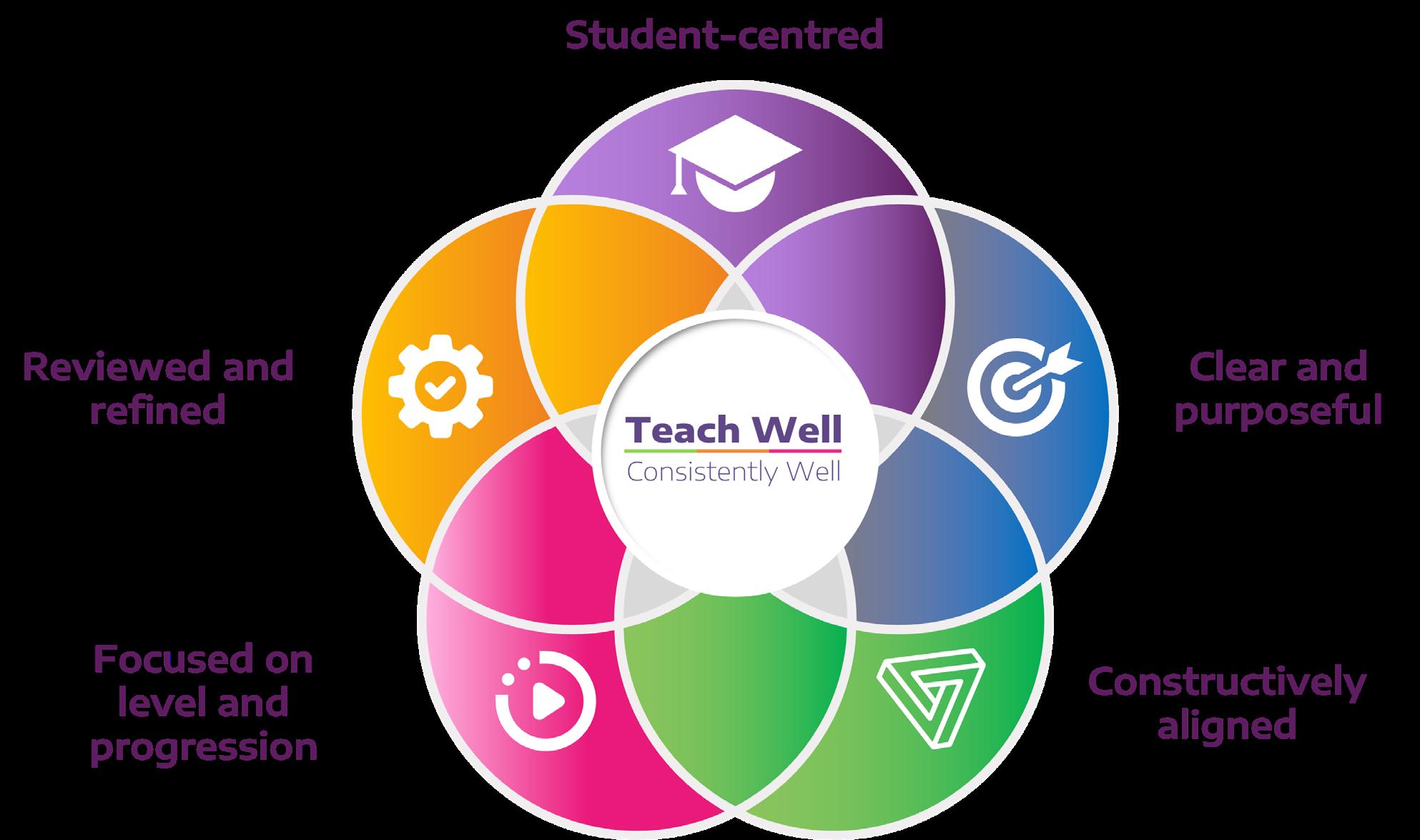
This guide introduces five core principles for writing effective learning outcomes. These principles are not rigid rules, but helpful anchors for thinking through structure, level, alignment, inclusivity, and clarity. Whether you’re writing new outcomes or reviewing an existing module, these principles will help you craft statements that are specific, achievable, and genuinely useful for both you and your students.
Most importantly, this guide is here to build confidence. Learning outcomes shouldn’t be mysterious or intimidating, they should empower educators to design engaging, authentic learning experiences and empower students to understand where they’re going and why.
The UK Quality Code for Higher Education is a key document for all those that work in Higher Education. It sets out the sector-agreed principles and practices that underpin course design, delivery, and academic standards including the importance of clear, measurable learning outcomes.
02 Learning Outcomes Principles Framework
Write learning outcomes for them - not you
Scenario
Subject: Sociology (Level 4)
After mid-module evaluation showed confusion around vague learning outcomes, the module lead rewrote them in plain, accessible language. Instead of ‘critically evaluate sociological frameworks’, students now see ‘Compare different sociological theories to explain real-world issues’.
In class, the tutor talks through how each outcome links to skills they’ll use in research or future roles in policy or education. Students reported that the revised outcomes felt more approachable and meaningful.
Learning Outcomes v Learning Objectives
This guidance emphasises the use of learning outcomes because they place the focus where it matters most - namely what the student will be able to demonstrate as a result of their learning. Learning outcomes are studentcentred, measurable, and form the foundation of constructive alignment, linking teaching, learning activities, and assessment in a coherent and transparent way.
In contrast, learning objectives are often written from the educator’s perspective and describe teaching intentions rather than demonstrable learning. While objectives can be useful for planning individual sessions and providing clarity for specific activities, learning outcomes provide a more consistent and assessable basis for curriculum design, quality assurance, and supporting student achievement.
Scenario
Subject: Business Management (Level 5)
A tutor realised their learning outcomes were too focused on teaching content: ‘understand leadership theory’ didn’t tell students what success looked like. After a review, they reworded it to: ‘apply leadership theory to analyse a case study’.
They introduced this outcome at the start of a session by showing students a realworld dilemma and asking, ‘how would you tackle this using what we’re learning today?’.
The clearer framing gave the students a better sense of purpose and direction.
learning unmistakable
Say what matters simply and make the purpose of
Academic Knowledge, DisciplineSpecific Skills and Transferable Skills
When writing clear and purpose learning outcomes, consider three essential components that ensure students develop a well-rounded skill set that is both academically rigorous and professionally relevant:
Academic Knowledge: The core subject matter or theoretical understanding that students must acquire (e.g. principles of sustainable tourism).
Discipline-Specific Skills: Practical or technical skills directly linked to the subject area (e.g. data analysis techniques in environmental studies).
Transferable Skills: Broader competencies that apply across multiple contexts, such as groupwork, critical thinking, communication, and problem-solving.
Align to design – when teaching, learning and assessment come together
Scenario
Subject: Engineering (Level 6)
A module was restructured using a simple outcomes-activities-assessment matrix. The outcome ‘design and justify a sustainable solution to a technical challenge’ was now directly linked to a collaborative design sprint and a sustainability pitch assessment.
Students were given a checklist mapping how each session built toward the final assessment. The clarity helped students focus their effort and improved confidence in knowing what was expected - assessment scores rose significantly.
‘In aligned teaching there is maximum consistency throughout the system. The curriculum is stated in the form of clear objectives, which state the level of understanding that is required rather than simply a list of topics to be covered.
Teaching methods are chosen that are likely to realise those objectives; you get students to do the things that the objectives nominate. Finally, the assessment tasks are set so that they directly test the students against the stated objectives. All components in the system address the same agenda and support each other’ (Biggs, 2003)
Principle 4: Focused on Level and Progression
As students progress through their studies, learning outcomes should evolve in complexity, challenging students appropriately, whilst reflecting their level of study. Using taxonomies such as Bloom’s and SOLO can help you to write effective outcomes that align with the cognitive level and challenge appropriate for your students.
Top Tips for Getting Started
• Match the level – use taxonomies to align the right action verbs with the desired cognitive complexity of your module.
• Check progression – ensure learning outcomes are appropriately scaffolded with demonstrable progression from lower-order to high-order skills across modules or course.
• Check levelness – use the FHEQ level descriptors, QAA Benchmark Statements and PSRB guidance to frame the level of your learning outcomes appropriately.
• Create a blend – balance cognitive (thinking), psychomotor (doing) and affective (feeling) skills across your learning outcomes.
• Compare across the course - line up learning outcomes from adjacent modules. Can you see evidence that students are being challenged to analyse, evaluate, and create - not just simply recall or describe - as they move through the levels?
Progress with purpose and challenge
Scenario
Subject: Psychology (Level 4 to 6)
The course team noticed that outcomes across levels weren’t showing a clear progression in complexity. Through engagement with an enABLe workshop, they revised outcomes so that students moved from ‘describe basic psychological concepts’ at Level 4, to ‘apply psychological theories to real-world behaviour’ at Level 5, and finally to ‘critically evaluate psychological approaches using current research’ at Level 6.
This structured progression helped students track their development and built a stronger sense of academic growth.
Suggested Reading
For more information on levels in Higher Education please take the time to look through the FHEQ Level Descriptors. The Level descriptors define the level of challenge, complexity, and autonomy expected of a learner on completion of a defined and bounded learning activity such as a module or course of learning.
Principle 5: Reviewed and Refined
Writing learning outcomes is a dynamic and challenging process. Even the best learning outcomes can benefit from a small tweak. Learning outcomes are certainly not set in stone. Ensure they remain clear, aligned and relevant through feedback, testing and iteration.
Top Tips for Getting Started
• Get feedback – work in collaboration with colleagues, students and stakeholders to check the clarity and alignment of your learning outcomes. Ask your students for suggestions on how they could be improved.
• Test in practice – did your learning outcomes actually work as you intended? Are students meeting them? How are you tracking the attainment of outcomes?
• Update and iterate – use feedback and your own reflections to refine and improve outcomes over time. The need for small tweaks often becomes apparent after you have run a module for the first time.
• Follow due process – remember that if you want to change the module learning outcomes you will need to go through MARF (Module Amendment Request Form)..
Write, test, tweak, repeat
Scenario
Subject: Environmental Science (Level 5)
Following an external examiner’s comment, the module lead reviewed whether the current learning outcomes matched what students were actually doing. One outcome, ‘demonstrate knowledge of environmental monitoring techniques’, felt too broad. The team tested it with students and reworded it to: ‘use fieldwork data to produce and interpret environmental quality reports’.
When the module was repeated, feedback highlighted that students better understood how to prepare for their assessment and there was a notable improvement in engagement and performance.
03 Level and Hierarchy
Designing effective learning outcomes requires more than just writing statements for each module or session - it’s about designing a coherent, progressive and connected learning journey for students. One of the biggest challenges staff face is understanding how different levels of learning outcomes relate to each other and contribute to the bigger picture across a student’s collective degree experience. The aim of this section is to explain that hierarchy between course, module and session-level learning outcomes.
Course-Level Learning Outcomes
At the highest level, course (or course/degree) learning outcomes articulate what students should know, understand, and be able to do by the end of their full course of study. These outcomes are often linked to national qualification frameworks, the requirements of Professional, Statutory and Regulatory Bodies (PSRBs) or institutional expectations. They set the tone and direction for the entire curriculum, outlining the graduate attributes and capabilities students are expected to demonstrate upon completion.
Module-Level Learning Outcomes
‘Be mindful of the bigger picture. Understand the role your module plays
in supporting students to meet the course-level learning outcomes on the course(s) it serves,
and reflect this role in the learning outcomes for your module’
Dr Emma Winter Associate Dean, Academic Faculty of Business and Law
Each module contributes to one or more course-level outcomes. That means module learning outcomes must be carefully written to ensure they map directly to the courselevel learning outcomes. Importantly, module learning outcomes must also be appropriate to the level of the module.
Well-structured module learning outcomes serve as a bridge between the broad expectations of the course and the practical learning that happens week to week.
Session-Level Learning Outcomes
This is where we often see most confusion. Session-level learning outcomes describe what students should achieve in a specific class or learning activity - often within a single week of the module. These should not be created in isolation. Instead, each session-level outcome should:
• Directly support at least one of the module learning outcomes.
• Help students make tangible progress toward the module’s goals and assessment.
• Provide clarity and focus for the learning activities and discussions in that session.
For example, if a module-level outcome asks students to ‘evaluate sustainable tourism practices in different regions’, a session-level outcome might be ‘identify and compare examples of sustainable tourism initiatives in the UK and Europe’. This shows a clear link to the higher-level aim in the module learning outcomes.
In Practice: Why This Matters
If session-level outcomes are created in isolation, without reference to the module or course, we risk creating fragmented learning experiences. Students may feel confused about why they’re doing certain activities or how it connects to their assessments. Staff may struggle to demonstrate curriculum coherence or scaffold learning effectively across levels.
Thinking hierarchically helps you design with purpose. Each outcome should be essential - supporting the level above and being supported by what’s below. Fundamentally, the course level outcomes should set the direction and focus of the module learning outcomes which then inform the session-level learning outcomes.
04 Taxonomies
Taxonomies of learning can be helpful tools to classify and communicate the complexity and progression of learning. However, taxonomies are not definitive or universally applicable solutions. They are best understood as frameworks that can support academic judgement - providing prompts to ensure that outcomes are appropriately challenging and aligned to the purpose of the module or course.
While taxonomies can support clarity and coherence when writing learning outcomes, they are not a requirement. In some cases, more discipline-specific frameworks or professional standards may be more appropriate guides.
The key is to ensure that learning outcomes make sense to students, and reflect the purpose and context of the learning.
Bloom and Solo Taxonomies
Two of the most frequently cited frameworks are Bloom’s Taxonomy and the Structure of Observed Learning Outcomes (SOLO) Taxonomy. Each taxonomy offers a different lens through which to consider what learning looks like and how it might develop over time. Both Bloom’s and SOLO offer valuable perspectives for thinking about learning outcomes. However, each has their respective merits and limitations. As such, they should be viewed not as an end in themselves but as prompts to help ensure learning outcomes reflect the complexity of learning, and support meaningful progression through a course.
While both are useful, neither should be seen as prescriptive or comprehensive on their own. They are part of a wider toolkit and should be applied critically and flexibly in context.
Let’s briefly consider each one in turn.
However, Bloom’s Taxonomy does come with a health warning as if applied too rigidly, it can give the impression that learning moves in a strict linear path - where remembering always precedes understanding, and creating always represents the most advanced skill. In practice, as we all know, learning is often messier, more iterative and non-linear. It is important not to treat its levels as a strict ladder. Learning does not always progress neatly from one level to the next, and verbs alone can be misleading if they are not grounded in a clear context or purpose.
In reality, students at all levels of their study will likely engage with more than one level of Bloom’s Taxonomy. It is important to remember that context and complexity matter just as much as the verbs used. It’s important to recognise that the cognitive verb chosen (such as ‘analyse’ or ‘evaluate’) only tells part of the story. The context in which learning takes place and the complexity of the task are equally significant in determining the actual level of challenge.
For example, a learning outcome asking students to analyse at Level 4 might involve identifying differences in a basic data table or categorising information from a survey - both tasks that require analysis but in a relatively guided and structured way. At Level 6, however, the same verb might be applied to a much more complex task, such as evaluating multiple conflicting sources, drawing out deeper relationships, and critiquing the implications.
It is also a misconception that certain levels of Bloom’s must align exclusively with specific levels of study. Not all Level 6 learning outcomes need to involve the verb ‘create’, and conversely, ‘remember’ is not the sole domain of Level 4. Advanced learners may still need to recall foundational knowledge and earlier-stage learners may engage in elements of creativity or evaluation. What matters most is the immediate cognitive demand of the outcome and the depth of engagement it requires aligned to the expectations for each level of study.
SOLO Taxonomy: Depth and Complexity
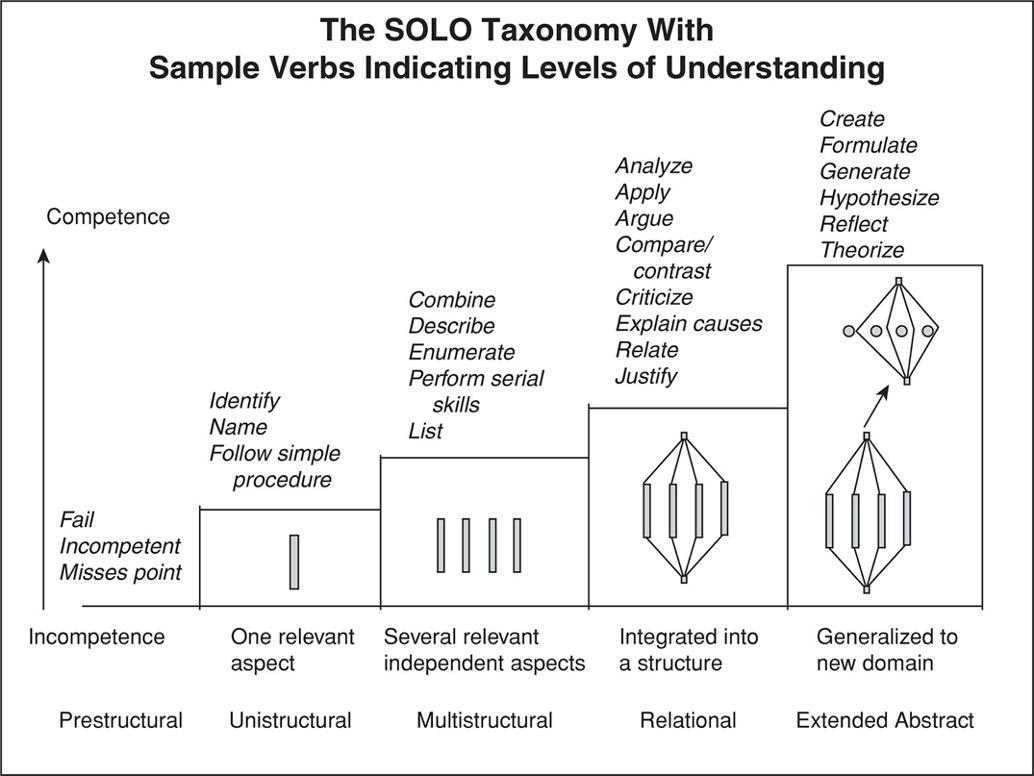
The Structure of Observed Learning Outcomes (SOLO), developed by Biggs and Collis, shifts the focus from what a teacher sets out to do, to the quality and depth of a student’s response. It describes five levels of increasing complexity in understanding: Pre-structural, Uni-structural, Multi-structural, Relational, and Extended Abstract. SOLO is particularly useful for its focus on the progression from surface to deep learning. Rather than emphasising action verbs, it examines the structure of student responses, highlighting both the breadth of understanding and the integration of key elements. This makes it a powerful tool for designing assessments that foster deeper learning and for guiding students in reflecting on their own progress.
Yet, SOLO is less widely understood and adopted than Bloom’s, and some educators find it less intuitive, particularly when designing outcomes for very applied or skills-based learning. Its categories can feel abstract or harder to translate directly into assessment criteria. However, it is a useful framework for you to draw on when writing learning outcomes that are appropriately challenging and aligned to the purpose of the module or programme.
Solo Taxonomy
[with sample verbs indicating levels of understanding]
05 Inclusive Learning Outcomes
Learning outcomes play an integral role in helping set expectations, shaping learning design, and influencing how students see themselves in the curriculum. That’s why it’s important to ensure that your outcomes reflect principles of inclusivity and do not inadvertently exclude or disadvantage any learner.
Here are five indicative ways to think about writing learning outcomes that are inclusive and EDI-informed:
Use Neutral, Inclusive Language
Encourage students to use neutral, inclusive language
Example:
‘Apply principles of inclusive and bias-aware language in written and verbal communication across professional or academic contexts’.
Why it matters: This outcome encourages students to recognise the impact of language and to communicate in ways that are respectful, inclusive, and appropriate for diverse audiences - an essential skill in today’s professional and academic environments.
Avoid Ablest Language and Demands
Steer clear of outcome verbs that imply a specific sensory, physical, or cognitive ability unless essential.
Instead of:
‘Being truly inclusive means designing learning experiences that give all students an equal opportunity to flourish, regardless of differences in abilities or backgrounds, making the experience engaging and accessible to as many individuals as possible’
(Garner-Foy, L. 2024)
‘Verbally present a pitch to a live audience’
Try:
‘Present a pitch to a target audience using an appropriate format’.
Why it matters: This keeps the task open to multiple modes of expression, supporting students who may use assistive technology or alternative communication methods.
Build in Opportunities for Diverse Perspectives
Design outcomes that encourage critical engagement with different world views, cultures, or identities.
Examples:
‘Analyse tourism strategies with reference to global and culturally diverse contexts’.
‘Critically evaluate how social, cultural, or historical factors influence design practice’.
Why it matters: Learning outcomes that explicitly signal openness to multiple perspectives invite more students to see their backgrounds as assets in learning.
Focus on Transferable and Flexible Skills
Frame outcomes in ways that avoid narrow interpretations of professionalism, communication, or engagement.
Instead of:
‘Write a formal business letter’.
Try:
‘Produce professional communication tailored to a specific audience or context’.
Why it matters: This allows for more culturally responsive and inclusive understandings of professional communication and reduces barriers for those unfamiliar with traditional Western formats.
Make Outcomes Transparent and Achievable for All
Avoid jargon or overly complex phrasing. Use plain English and ensure that all students can understand what they are expected to achieve - regardless of background or prior educational experience.
Why it matters: Clarity supports widening participation and reduces unnecessary anxiety or exclusion for students new to higher education or unfamiliar with academic language.
The following section provides examples of learning outcomes for Level 4, Level 5 and Level 6 modules. Some are good, some are not so good.
Level 5 Examples
Analyse how organisations use market research data to inform decision-making.
Write a good essay about marketing.
Compare and contrast different leadership styles in the context of team performance.
Summarise the key principles of project planning.
Learn about customer feedback methods.
Think critically about ethical issues.
Critically evaluate the effectiveness of global marketing campaigns.
Apply motivation theory to a workplace case study.
High-quality analytical verb and practical context. Perfectly pitched at Level 5
Informal and vague; lacks clarity or connection to level descriptors.
Rich context, dual-level thinking, and relevant to workplace scenarios
Appropriately focused; provides a clear and manageable task at this level.
Unmeasurable; doesn’t describe what students will be able to do.
‘Think critically’ is vague and not actionable without further context.
A stretch outcome for Level 5 but achievable with support; might be stronger at Level 6.
Clear task, applicable in context, and well-aligned to Level 5 expectations
How do your learning outcomes compare?
Having read through the learning outcomes provided take the opportunity to review against your own learning outcomes. How do they compare?
As you reflect, consider the following:
Verb clarity - are your active verbs not only clear and assessable but also encouraging higher-order thinking like analysis, synthesis, or evaluation?
Level appropriateness – do your learning outcomes match the expected cognitive level of the module or even better, stretch learners beyond what is expected?
Scope and focus – are your learning outcomes manageable, well-defined and connected to more sophisticated, realworld contexts?
Assessability – can your learning outcomes be easily and clearly measured? Does it prompt your learners to produce work that is authentic, applied, or encouraging deeper engagement and critical thinking?
Relevance - do your outcomes connect meaningfully to your discipline, and where possible, link to professional or real-world applications?
07 Writing a Learning Outcome
OK - now it’s your turn. Follow the guidance template below to create your own learning outcome.
Let’s start by deconstructing a typical learning outcome into its component elements:
To describe the critical success factors underpinning training provision within an organisation
To describe the critical success factors underpinning training provision within an organisation
To describe the critical success factors underpinning training provision within an organisation
Start with a verb that defines a specific action that defines how students will demonstrate their learning. Ensure your verb is aligned to the right level.
Subject of learning – specific subject material you wish the learning to demonstrate
To describe the critical success factors underpinning training provision within an organisation
Context of learning – in what context you want the learning to be demonstrated
Words to Avoid in Learning Outcomes
• Understand | demonstrate | appreciate | know about |become familiar with | learn about | become aware of
08 Quality Assurance
It is important to recognise that learning outcomes sit at the heart of quality assurance in Higher Education. They are a critical mechanism for ensuring transparency and setting standards. Learning outcomes ensure that courses meet national expectations, support consistent standards across modules and courses, and help students understand what they are working towards.
In the UK, clear and measurable learning outcomes underpin key expectations set by the UK Quality Code for Higher Education (QAA, 2024) and are central to how the Office for Students (OfS) assesses quality and standards.
Why Learning Outcomes Matter for Quality
The UK Quality Code for Higher Education provides a framework against which we ensure the academic standards of our courses meet the requirements of relevant national qualifications frameworks and sectorrecognised standards. Within that context, learning outcomes are referenced explicitly under Principle 11 - Teaching, learning and assessment Specifically:
• Students are given clear information about the intended modular and/or course learning outcomes and the purpose of assessment and are enabled to use feedback/feedforward to support further learning.
• Providers design assessments that test appropriate learning outcomes and are fair, reliable, accessible, authentic and inclusive.
Learning outcomes therefore matter as they are the way we articulate required standards. They show that students are working at the right level and that teaching, learning, and assessment are aligned to appropriate expectations.
09 FAQs
1. What is a learning outcome, really?
A learning outcome is a clear statement that describes what a student should be able to do, know, or demonstrate by the end of a session, module, or course. It shifts the focus from what the teacher will deliver to what the learner will achieve.
2. How many learning outcomes should I write for a module?
There’s no magic number, but most modules typically include 4 to 6 well-crafted outcomes. Aim for clarity and depth rather than quantity. Each outcome should reflect a meaningful component of the module that can be taught, practised, and assessed.
3. How do I avoid writing too many outcomes?
Focus on the key capabilities or understandings students should demonstrate by the end of the module. If you’re tempted to write lots, try grouping ideas or using umbrella outcomes with sub-skills embedded.
4. Do I need to write learning outcomes for every individual session?
Not always. While writing session-level outcomes can be highly beneficial in clarifying how each session contributes to the overall module outcomes, it’s not always necessary or appropriate. Let the focus of the session be your guide. For example, structuring a session around key questions or framing it with a specific objective can effectively signal the intended focus without requiring a formal learning outcome. However, where a session has clear, measurable learning intentions, articulating a learning outcome can help structure activities and ensure alignment. Alternatively, session objectives or guiding questions can also signal the intended focus without the need for a formal learning outcome.
5. How do I make sure my learning outcomes are the right level?
Use a taxonomy (like Bloom’s or SOLO) to help guide your choice of verbs. Consider the academic level of the module and reference FHEQ level descriptors. Check your verbs and expectations against the skills appropriate to respective levels.
6. What verbs should I use and which should I avoid?
Use active, measurable verbs like describe, analyse, evaluate, design, or synthesise. Avoid vague or unobservable terms like understand, know, learn, or be familiar with - they’re hard to assess and open to interpretation.
7. What makes a learning outcome ‘measurable’?
If you can design an assessment or activity that clearly demonstrates the outcome being achieved, it’s measurable. Think: How will students show me they’ve done this?
8. Should learning outcomes match the assessment?
Yes! That’s the heart of constructive alignment. Each learning outcome should be something that students can demonstrate through your assessment tasks. If you can’t assess it, then it probably shouldn’t be an outcome.
9. Should every learning outcome be assessed?
Yes. If an outcome is written into your module descriptor, it should be demonstrably assessed. Otherwise, it risks misleading students or creating disconnects in your design.
10. Can a single assessment address multiple learning outcomes?
Absolutely. Many assessments, particularly coursework or projects, are designed to test more than one outcome simultaneously. Just ensure you map these clearly in your assessment criteria.
11. How do learning outcomes link to course outcomes?
Module outcomes should map directly to course-level learning outcomes. This helps ensure coherence across the degree and that students build skills progressively from Level 4 to 6.
12. How do I know if my outcomes are aligned?
Check that your learning activities help students work toward the outcomes, and that your assessments measure them. This is known as constructive alignment - a key principle in curriculum design. Come to a CADI Activity Creator session for more information and guidance.
13. Can learning outcomes support inclusive teaching?
Absolutely. The way we phrase outcomes can influence how students see themselves in the curriculum. Using inclusive, neutral language and designing for accessibility and flexibility helps make sure all students can engage with the intended learning.
14. Can I revise my learning outcomes once a module is running?
No! Official module outcomes are typically locked once approved. However, you can always clarify and interpret outcomes with students during teaching to make them more accessible or meaningful. Once the module has finished you can change learning outcomes via the University’s MARF process.
15. Where can I find support for reviewing my learning outcomes?
A great to way to review your learning outcomes is to share them with colleagues you teach with for a fresh perspective. If you need further support, please contact CADI and visit the learning outcome resources on the CADI website (CADI.port.ac.uk).
Designed and edited by Dr Andy Clegg, Head of Academic Innovation, Centre for Academic and Digital Innovation, University of Portsmouth with contributions from colleagues in CADI and across the University.