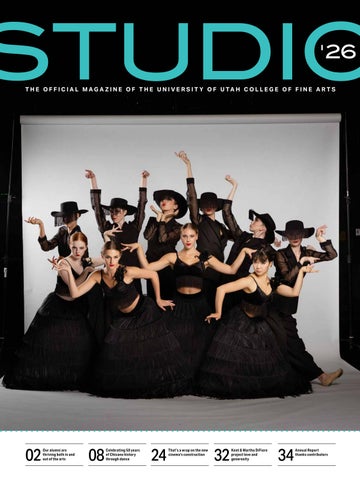
THE OFFICIAL MAGAZINE OF THE UNIVERSITY OF UTAH COLLEGE OF FINE ARTS
Art is not made in a vacuum.
When a person choreographs a dance, writes a score, mounts a play, animates a film, or sculpts a work, these are manifestations inextricably linked to the human condition — to being alive on earth and in relation with the land and people around us.
Art is a response to beauty and chaos — it’s our search for meaning and expression, and it’s our visions and soundtracks of hope for the future. It can be a result of being moved, or it can be a catalyst for movement. It can be how we try to wrangle our minds around the complexities of existence. It can be many things, but it is always intrinsically human and a display of what it means to be alive.
In these and so many ways, art is rooted in community.
In fact, art is community — an act of being part of something larger than us. Even art made in solitude, meant just for the maker, cannot be separated from the artist’s exchanges with their environment.
It is this aspect of the arts that fuels the College of Fine Arts’ work toward achieving the University
of Utah’s audacious Impact 2030 goal of achieving unsurpassed societal impact.
As you will see in the pages of this magazine, our college’s impacts on society take many shapes. It looks like launching alumni into the world ready to lead both in and out of their creative industries. It also looks like the celebration of important cultural histories and the examinations of the land and art we make on it — some that helps us remember, some that celebrates our planet’s beauty, and some that begs our action.
That impact can also be seen in the retrofitting of new spaces, ones made uniquely to gather, connect, and sit side-by-side in shared focus. It’s the way our faculty members honor the individuality of each student, shaping them to be more than just job-ready, but to be influential, productive global citizens. It’s the measurable changes we can have in our public schools when our arts education programs allow students and families to feel welcomed and safe.
Our society is a richer place because of the ongoing efforts within our college. I hope you enjoy reading how and why. ■
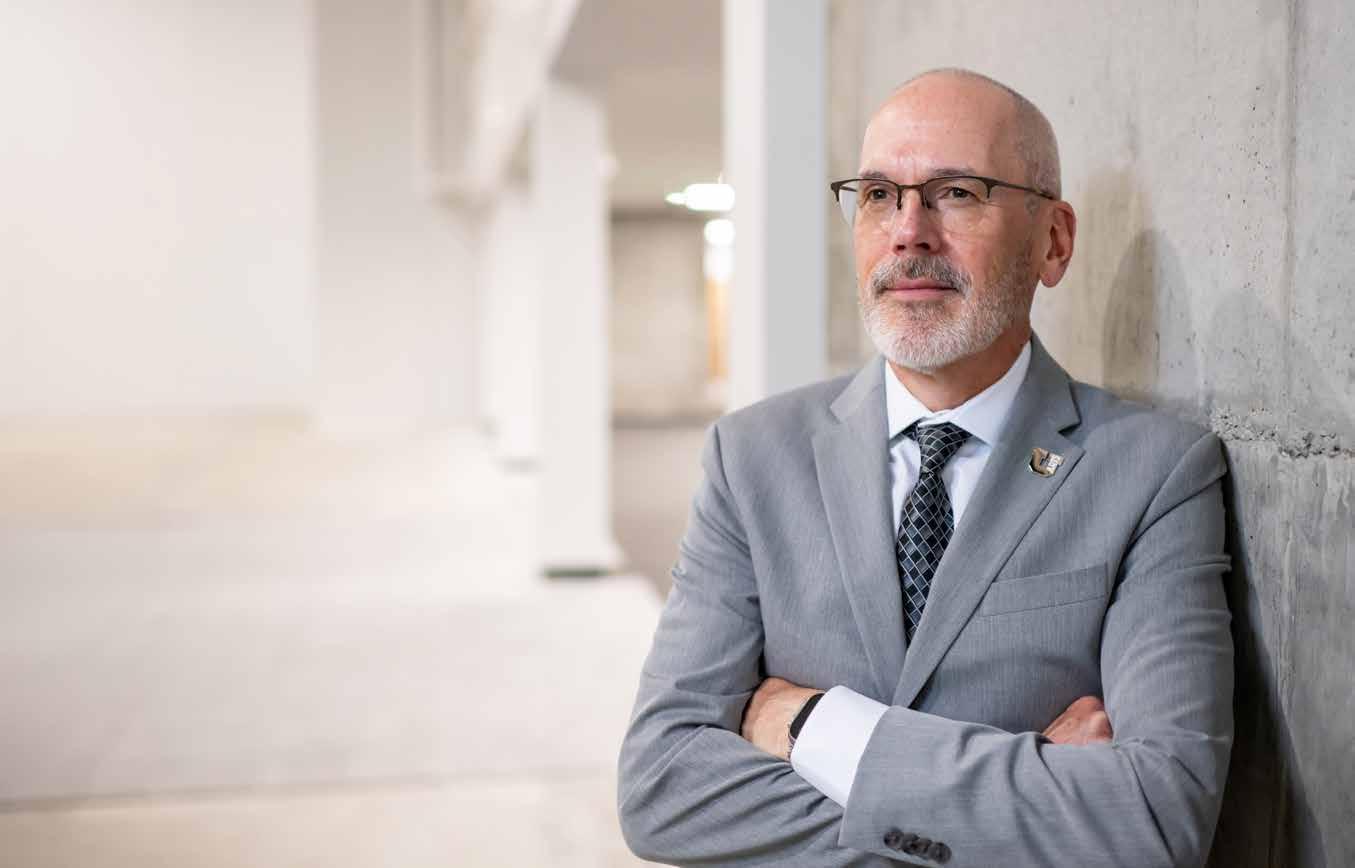
JOHN W. SCHEIB Dean, College of Fine Arts
Photo: Trish Griffee
THE VARIED ROADS OF CFA ALUMNI /
HALF A CENTURTY OF MOVEMENT AND MIGRATION /
Standing on the shoulders of past student organizers, Assistant Professor Kiri Avelar used dance to reflect the resilience, pride, and evolution of the Chicano Movement through a moving concert and exhibition in the School of Dance.
GIVING UTAH ITS BEAT /
Utah’s righteous jazz music scene has influenced and been deeply influenced by the cats who earned their chops the U’s Jazz Studies program. The longstanding program is as burnin’ now under Director Josiah Boornazian as it ever was.
A NEW LENS ON A FAMILIAR JOURNEY /
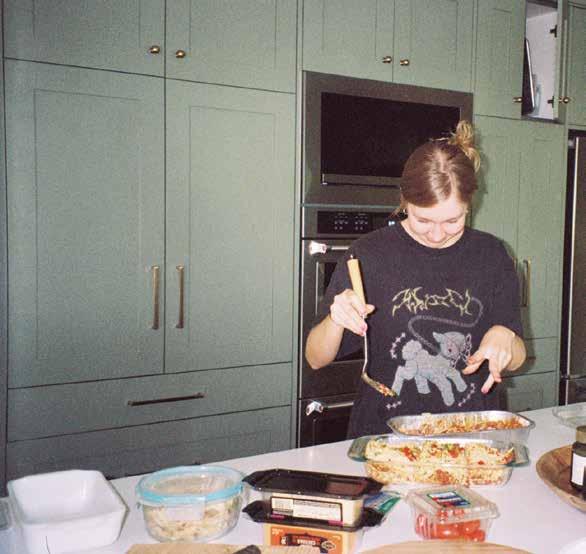
Film alumna Nikki Bullock, with the help of TWIG Media Lab, university funding, and interdisciplinary collaboration turned a school assignment script into a short documentary that is generating new knowledge around recovery from mental health crises.
After graduating, our students succeed across the globe both in and out of the arts; this is an examination and celebration of some of our thriving alumni and how their arts degrees set them up for success. 02 08 12 16 20
LOOKING ANEW AT LAND ART /
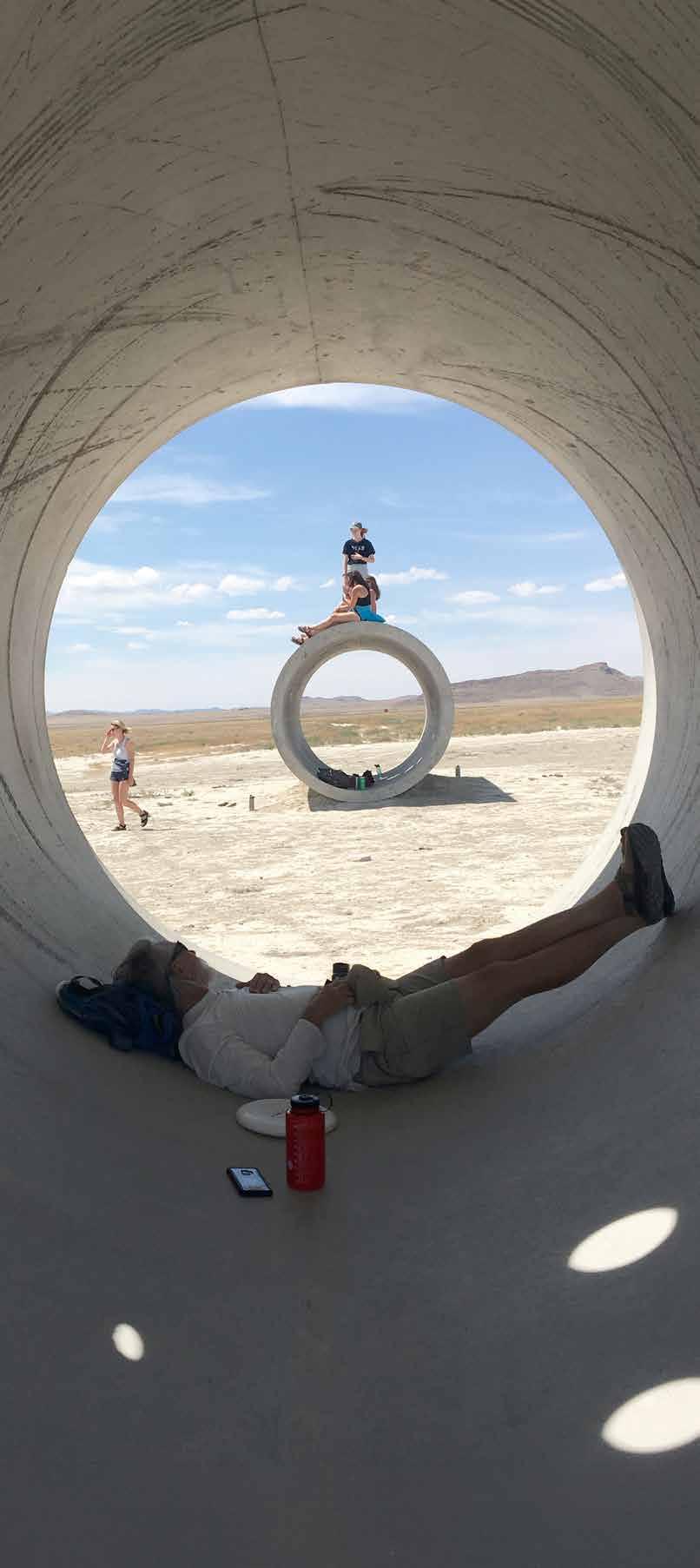
Offered in a place where iconic land art abounds, Art History Associate Professor Monty Paret’s class looks at land not just as a place to house or inspire art, but as the geography of long histories, contested ownership, political conflict, and possible futures.
' 26 24 26 28 30 32 34 37
BUILDING A CINEMA, BUILDING A COMMUNITY /
At long last, the Film & Media Arts’ brand new Kent & Martha DiFiore Cinema is opening its doors to students, industry leaders, and the community at large in what is a state-of-the-art, highly versatile, accessible home for learning, gathering, and viewing film.
SEEING SARAH SHIPPOBOTHAM /
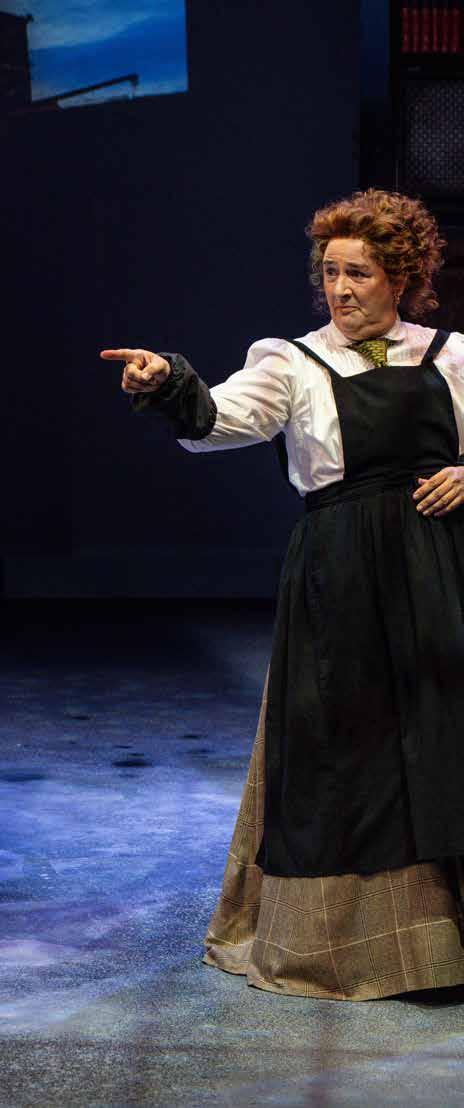
Department of Theatre’s Professor Sarah Shippobotham is known around the world for her acting, voice and dialect coaching, and teaching. And perhaps what has made her an esteemed professional is also why she’s a phenomenal educator.
FIRED UP WITH STEAM /
The Magna STEAM Academy, with its new increased focus to include arts integrated learning, partnered with our Beverley Taylor Sorenson Arts Learning Program and the results have been wildly successful.
EMPOWERING STUDENT VOICES /
With new Film & Media Arts Chair and Co-Editor-inChief Tim Palmer came the first ever undergraduate student-led academic journal, “Film Matters,” now published by the University of Utah.
A CINEMATIC LIFE TOGETHER /
Some years ago, the U brought these two film-loving medical residents together, and now they have helped make possible the Department of Film & Media Arts’ new state-of-the-art space that bears their name: Kent & Martha DiFiore Cinema.
ANNUAL REPORT /
It is with overwhelming gratitude that we name those who fuel the continued success of the College of Fine Arts with their generosity and philanthropy.
CONTRIBUTORS + THANKS
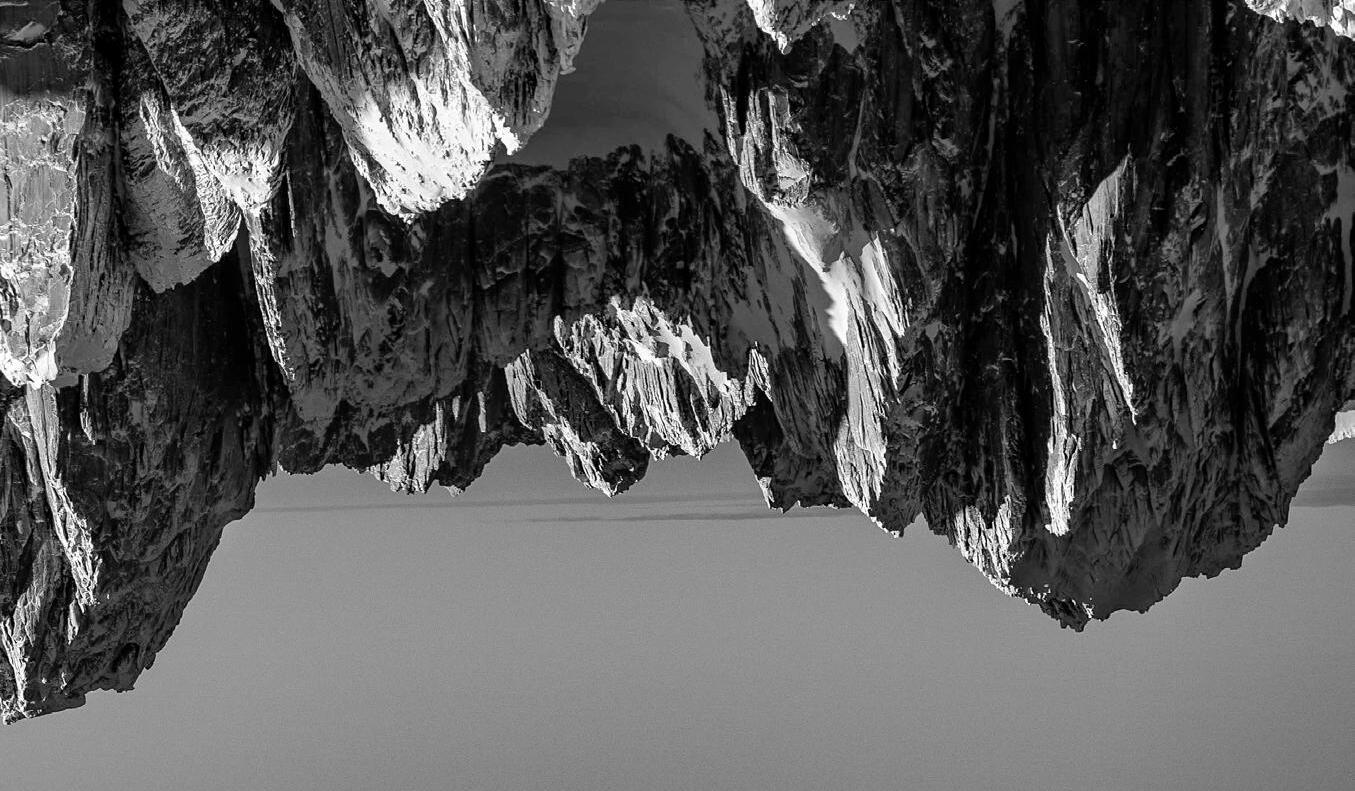
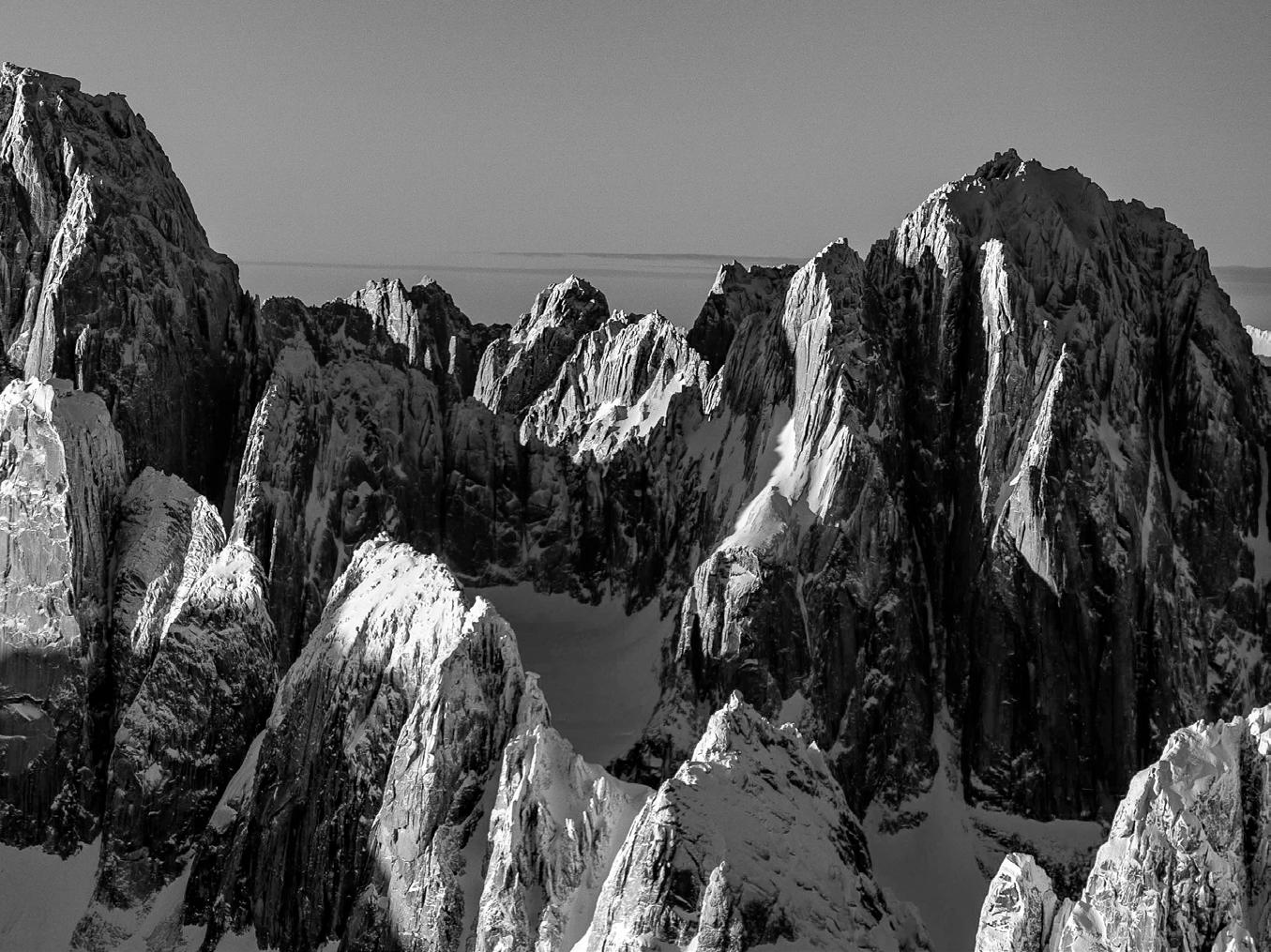
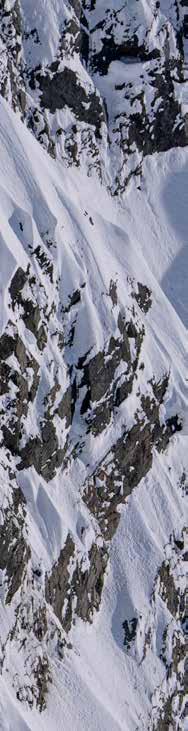
Jed Workman flies helicopters in Alaska for a living, but the photos he takes are used to study avalanches.
Jed Workman (Art & Art History BFA ‘98) is a perfect example of this. While getting his BFA in the ‘90s, he also spent a lot of time on the nearby ski slopes. After graduating, Jed headed off to Alaska, where he now runs a helicopter skiing operation, Valdez Heli Ski Guides. How is he putting his art study to work? Jed focused on photography in his studies and he uses those skills in his business.
“This job and my photography are the culmination of studying and skiing in Salt Lake City. I have been using photography to document avalanches which have appeared in ‘The Avalanche Review’, the publication of the American Avalanche Association that promotes avalanche safety.”
Jed’s partner Leighan Falley is also an artist, a painter who uses Jed’s photographs as a frequent subject. They recently held a joint art show of painting and photography together. Art is woven into Jed’s life while he makes a living by helping people access some of the remotest wilds in America.
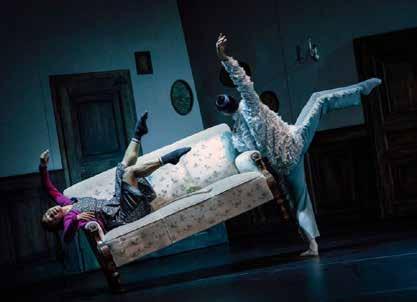
Live performance is a major employer of arts grads, but not always in the ways students may have planned. Bella Dixon (Theatre BFA ’25) came up through the Department of Theatre’s Stage Management program, but rather than run a traditional theatre, she’s just taken a job working at a ballet company in Philadelphia, BalletX. “Dance has always been a huge part of my life,” Bella explained. “I spent years dancing before I fell into stage management — shout-out to 2019’s ‘Something Rotten’ for helping me start that journey. During my time at the University of Utah, I made it a priority to stay connected to the art form however I could. From working with Ballet West, Ririe-Woodbury, and the U’s School of Dance, just to name a few. Now, with this move, I’m facing a big change. I sent out over 300 applications in search of the right fit. Many went unanswered, but this one didn’t, and I’m truly happy to be joining BalletX. Getting the opportunity to work with such a spectacular company less than a year after graduating with my BFA feels surreal. It’s frightening, it’s exciting, and it feels like a leap worth taking.”
Bella’s not the only stage management alum to end up in ballet — Liz Wiand (Theatre BFA ’23) is doing so close to home as the Stage Manager and Production Operations Coordinator at Ballet West in Salt Lake City. And Bella won’t be the only U arts grad in the City of Brotherly Love either. Max VanNocken-Witmer (Dance BFA ’25) is now a stage manager at the Philly Fringe Festival.
Several grads have ended up plying their trades on the high seas. Laney Marsella (Theatre BFA ’21) is a Production Stage Manager for Virgin Voyages, leading a team of technicians and performers aboard a luxury cruise line. She’s not the only one afloat: Chloe McLean (Theatre BFA ‘23) is currently a vocalist with Princess Cruises, Jazmin Viquez Delgado (Theatre BFA ’24) is a performer on Disney Cruises, Abby Davis (Theatre BFA ’22) works with Oceania, and Sydney Stephan (Theatre BFA ’21) with Holland America. Back on solid land, John Michael Peterson (Theatre BFA ’18) is in the national tour of “The Outsiders,” and Alexis Lilley (Theatre BFA ’22) is doing the same with “Back To the Future,” while Erin Diehl (Dance BFA ’22) dances with a production of “The Music Man.” Brooke Heubner (Dance BFA ’18) has performed more than 1400 shows at “Excalibur” on the Las Vegas strip, and Brian Craig Nelson (Dance BFA ’14) is performing in Can Can’s “Ooh La La!” at the New Paris Theatre in Portland, OR.
All of these performers might end up in scenes built by a squad of Theatre-alumni prop builders, including Elizabeth Webb (Theatre BFA ’24), Erin Murphy (Theatre BFA ’22) or Mae Hinton-Godfrey (Theatre BFA ’25).
Sometimes working in the arts means doing the indirect work that makes art happen. Claudia Restrepo (Music DMA ‘18) was recently granted tenure as Assistant Principal Librarian with the New York Philharmonic. Larissa Trout (Dance BFA ’02) may have a modern dance degree, but she works in the arts now through nonprofit management — in March 2025, she was appointed Executive Director of Spy Hop, a Salt Lake City–based organization that serves young people ages 8–25 through mentorship and training in film, music, audio, and design.
Rachel Gates (Dance BFA ’10) followed the nonprofit path as well, as Program Director of the Alabama Dance Council. Katherine Eppink (Dance BFA ’14) not only works as a Principal Dancer for Ballet Vero Beach in Vero Beach, Florida, she also serves as Ballet Vero Beach’s Director of Marketing. David Meikle (Art & Art History BFA ’94, MFA ’06) didn’t go far from home; he’s a celebrated art director right here at the U. He’s also a successful working artist with work featured in Wes Anderson’s film “Asteroid City.” And while Ron Allen (Art & Art History MA ’04) may be retired, he still
contributes by helping to organize the largest gallery tour in Santa Fe, NM.
Alex Bowden (Theatre BFA ’19) makes her mark as a Resident Stage Manager at the Teatro Zinzanni in Chicago. Fusing circus arts, cabaret, and fine dining, the show demands razor-sharp coordination and an adventurous spirit — qualities Alex brings in spades.
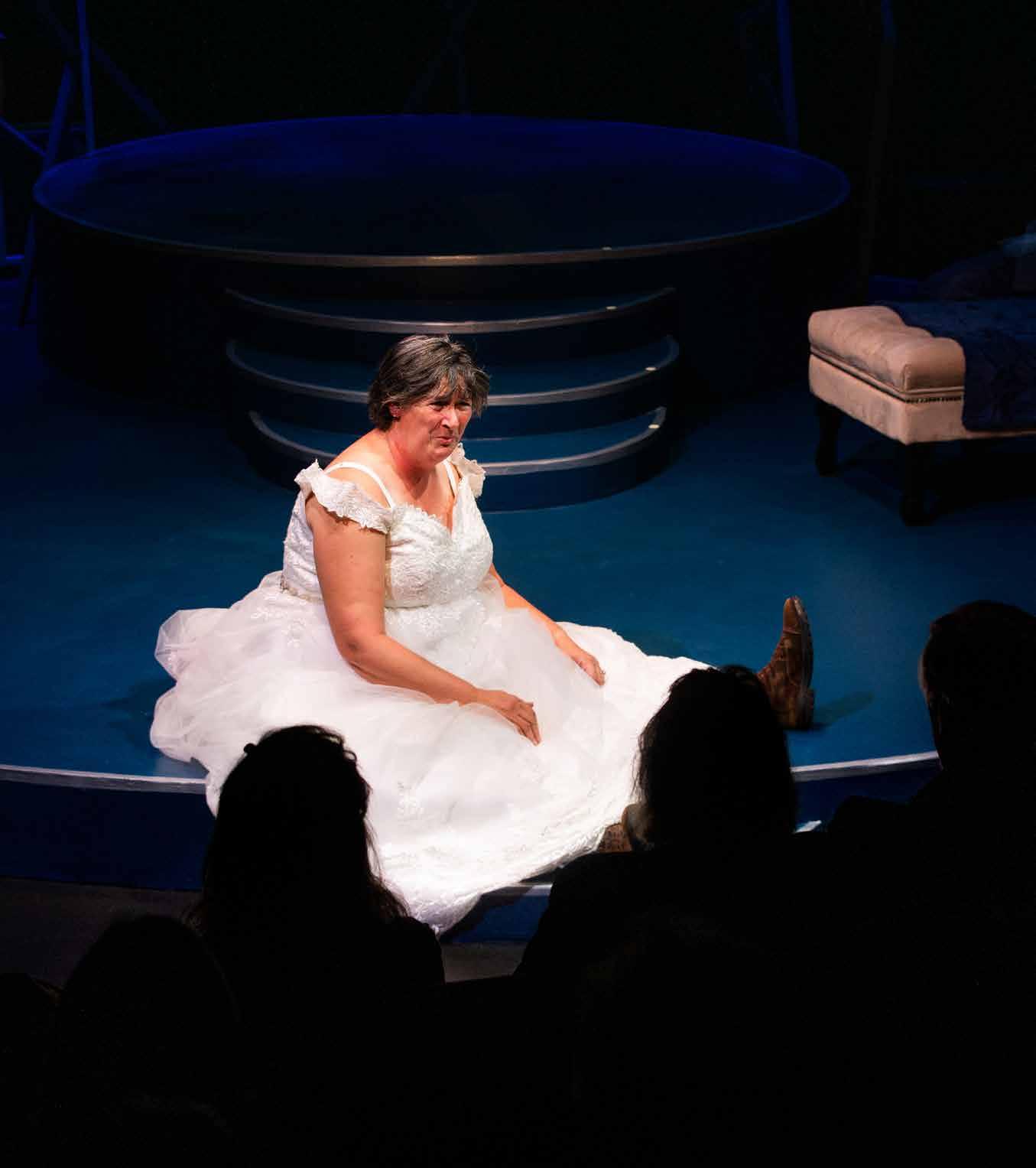
Olivia Custodio (MM ’14) does her nonprofit work for the Sphinx Organization — focused on increasing representation in classical music and celebrating excellence, Sphinx programs serve beginner students, seasoned classical music professionals, cultural entrepreneurs, and artistic administrators by addressing the systemic lack of access within Black and Latino communities. While she’s helping to fund the arts, Olivia is still making plenty of it herself — she works with the Salt Lake Acting Company on their popular summer show, sings with the Salt Lake Symphony, and recently starred in a show she created with fellow U alum Kelsie Jepsen (Theatre BFA ‘06) called “Welcome to Fat School.”
David Meikle’s work is sold in galleries across the Southwest, as well as being featured in “Asteroid City” by Wes Anderson.
In addition to her work with the Sphinx Organization, Olivia Custodio and fellow alum Kelsie Jepsen created the hit show “Welcome to Fat School.”
Olivia Custudio works for the Sphinx Organization, a nonprofit that helps young people from diverse backgrounds learn to perform classical music.
Photo by Brian Hatton of the Sphinx Virtuosi performing at Carnegie Hall.
Art is everywhere, and Chad Pinckney (BFA ’17) has found his niche making it for Hollywood. A 2017 grad in graphic design, Chad’s specialty is making movie posters — he’s designed artwork for movies including “Once Upon A Time In Hollywood,” “Spider-Man: Far From Home,” “Top Gun: Maverick” and many more. He has his own design firm now that specializes in independent films, including many coming out of Utah.
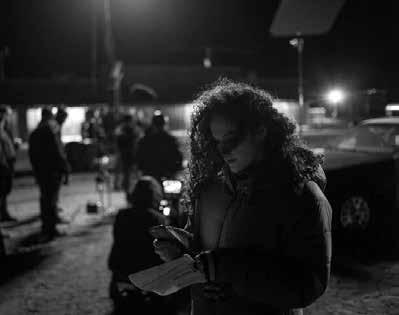
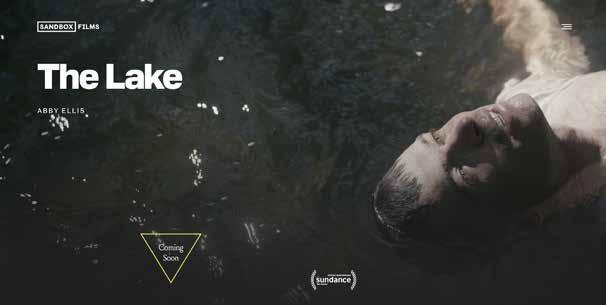
Chad isn’t the only Utah grad working in Hollywood. Elli Legerski (Film & Media Arts BA ’12) has put her film degree to work quite directly as a film producer. In 2025, she produced the Oscar-nominated short film “Jane Austin’s Period Drama.” She’s not the only grad with a career directly tied to the film industry. Abby Ellis (Film & Media Arts BA ’11) was just at the 2026 Sundance Film Festival with the documentary she directed, “The Lake,” which also featured alum Beth Kearsley (Film & Media Arts HBA ‘21) as Assistant Editor. Distinguished Alumni Rick Page (Film Studies BA ‘94) works as a director of photography, currently shooting season 2 of the comedy series “The Paper.”
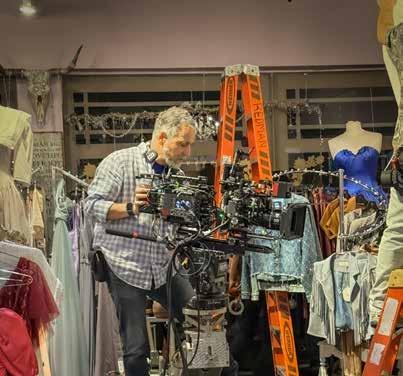
Jordan Overman (Film & Media Arts BA, Spanish BA, ’10) is working on the technical side of things, running OVERRIDE, a specialty camera company focusing on drones, arm cars, gimbals, and robots.
Every year, College of Fine Arts graduates pass on their skills, techniques, and knowledge to others. In addition to working as a dancer and choreographer, Vixy Rader (Dance BFA ’16) teaches dance to K-12 students at the Waterford Dance Academy. Elle Johansen (Dance BFA ’15) is the new owner of her own dance studio, Artistic Endeavors Dance in Millcreek. Shayla Bott (Dance MFA ’06) continues to add to Utah’s dance culture as a professor of ballet at BYU, and Jessica Baynes (Dance BFA ‘19) is teaching at The
Chad Pinckney uses his art BFA to design movie posters, including for 2026’s thriller
“By His Hand.”
Elli Legerski was nominated for an Oscar for her short film, “Jane Austin’s Period Drama.”
Alums Abby Ellis and Beth Kearsley worked on “The Lake,” a documentary about the fate of the Great Salt Lake that was a hit at the 2026 Sundance Film Festival.
Rick Page works as a Director of Photography on the Utah-filmed horror movie “Slay Day,” set for release in 2027.
Dance Academy of Southern California. She recently graduated with her Master of Education with emphasis in Arts & Learning and Human Development from Harvard University and is currently working towards her Dance Performance MFA ‘27 from the Trinity Laban Performing Arts School. Candido Jessee Abeyta (Music BA ‘19, MM ’22), in addition to studio and live work as a saxophonist with bands like Neon Trees, teaches music at Hawthorne Academy in West Jordan, UT. Kaitlyn Crosby (Theatre BFA ’24) is now a Graduate Teaching Associate at The Ohio State University, and Lauren Carn (Theatre BFA ’25) instructs the talented kids at the Salt Lake Arts Academy.
Derek Myler (Music BMus ’18) who is on the tenure track as an Assistant Professor of Music Theory at East Carolina University in Greenville, NC, recently produced a research video about music in the children’s television series “Bluey!”
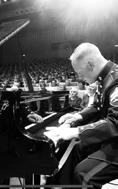
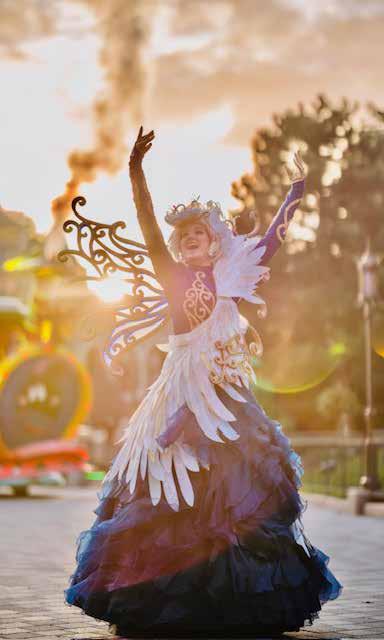
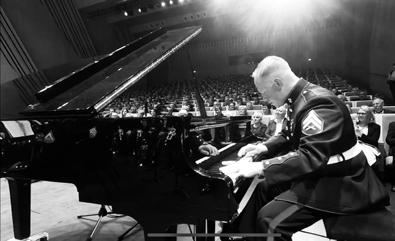
Of course, some arts grads are doing things that sound cool as hell. Mykenna Maxfield (Art & Art History BFA ’24) puts her degree to work every day as a tattoo artist. Haley Kathleen Parsons (Dance BFA ’24) ran off to Paris to perform as a character at Euro Disneyland. Meghan Gibson (Theatre BFA ’23) has also headed out for Europe, starting her own business as a wedding and elopement photographer in Edinburgh, Scotland. Nikayla Nielson (Theatre BFA ’24) is spending the summer in France after being awarded a Chateau d’Orquevaux Artist Residency, and Jessica Liu (Dance BFA ’19) is a dancer with Nationaltheater Mannheim in Germany. Jordan Tolman (Music BMU ‘21) performs in Europe as well, but he performs pretty much everywhere with the Marine Corps Fleet Bands.
Alison Hagen (Theatre BFA ’24) gives Taylor Swiftinspired tours of New York City. Emily Beatse (Theatre BFA ’21) manages a Cirque du Soleil show in Las Vegas. Macey Mott (Theatre BA ’98) works as a travel agent, but she also recently completed her intimacy direction certification training. And Marie Degan Erickson (Theatre BFA ’19) hosts the podcast “Bark, Book & Broomstick,” discussing the intersection of dog training and witchcraft!
It’s not always A to Z with an arts degree. Lots of arts grads go immediately to work in their field of study. Others might work in the arts, but in a capacity they didn’t anticipate. Some take their arts training to work with them in fields far from traditional artistic endeavors. Some save their muse for their off hours.
In the rapidly changing world we live in, there’s something timeless about the arts. Entire fields of work are disappearing and new ones are being born. But those who learn to master a craft, to put on a show, to execute a vision, will always have a leg up in the world. They may end up doing what they dreamed of doing when they found their way to art school. Or they may not. But whatever they do, they can bring that education to bear in their work, their lives, and their community. CFA grads do that every day. ■
Jordan Tolman performs as a vocalist and pianist with the United States Marine Corps Fleet Bands. Here he performs in France.
Haley Parsons ran off to France, where she works as a performer at Disneyland Paris.
Jessica Liu dances with Nationaltheater Mannheim in Germany.
Marie Degan Erickson created a new form of dog training called “Bond Weaving.”
BY JULIA LYON
Photo: Todd Collins
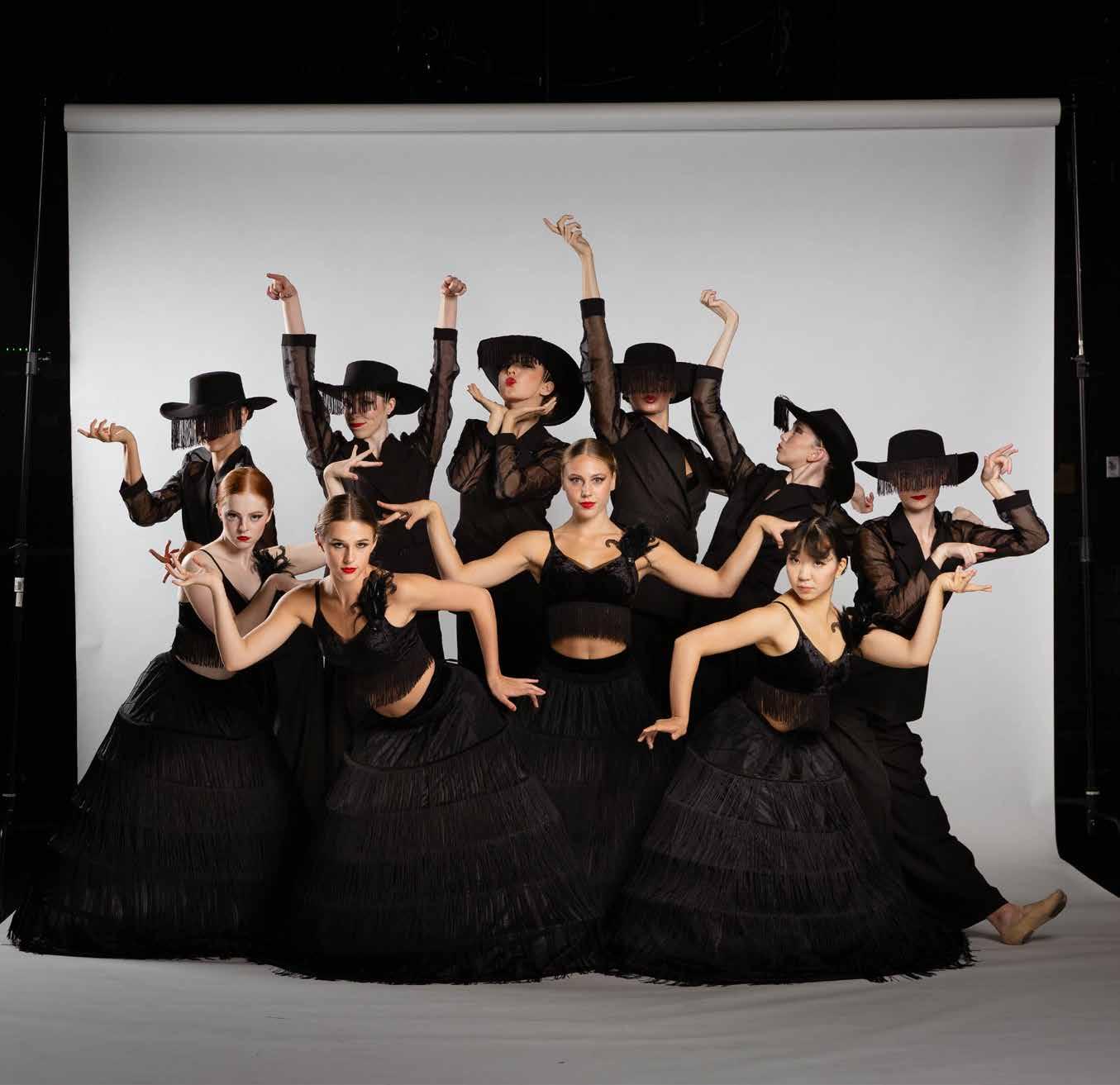
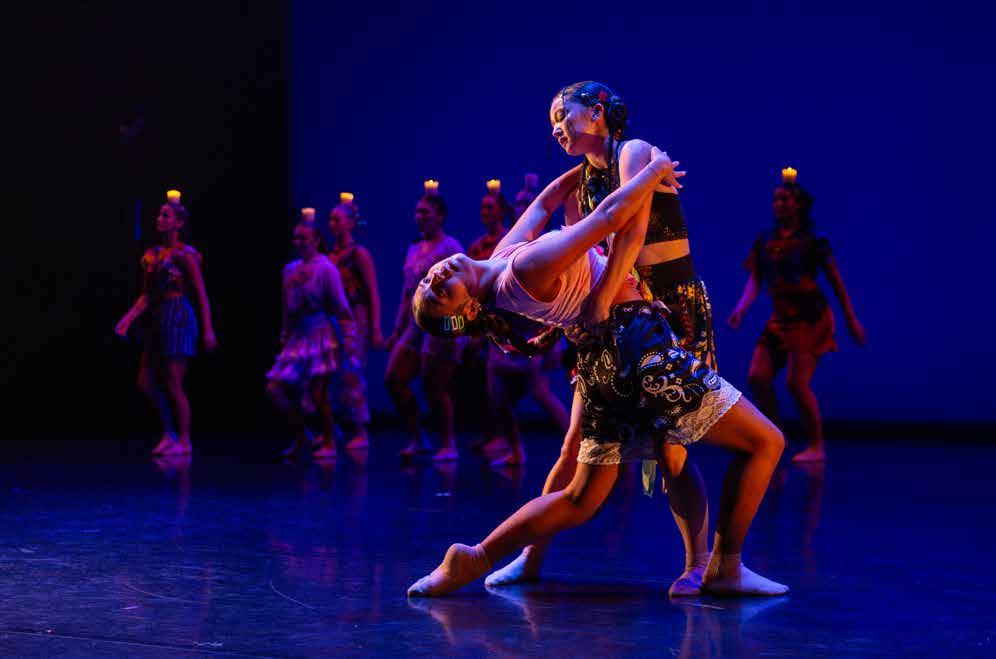
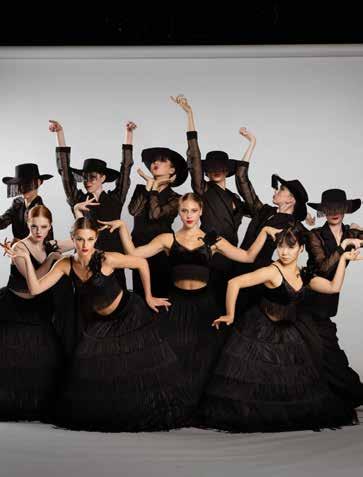
Ella Moore in “Paloma Querida,” choreographed by Michelle Manzanales. Costumes designed by Branimira Ivanova and realized by the School of Dance Costume Shop, with hand-painting by Clover Kelly. Lighting designed by Jared Moore and reimagined by William Peterson.
A AT THE OF HISTORIC
FIRST:
HISPANIC HERITAGE SCHOOL DANCE MONTH
Kiri Avelar had just been hired at the School of Dance when she stumbled across an old pamphlet in the archives. Titled “La Semana de la Raza,” it listed events celebrating Chicano Awareness Week in 1975 at the University of Utah.
“What is this about?” the new Assistant Professor remembers thinking. “Utah does not get a lot of attention in terms of the history of the Chicano movement.”
But here was proof that during the era’s height, U students had been not only participating, but organizing, too. As she continued her research, she understood something that wasn’t obvious at first: the majority of the organizers of the 1975 events were students.
“We’re standing on their shoulders hoping to continue to do that work,” Avelar said.
When she realized the School of Dance had never celebrated Hispanic Heritage Month, Avelar proposed a dance concert and exhibition to celebrate the 50th anniversary of Chicano Awareness Week on campus — and to launch a new tradition in the school’s dance community.
AN EMOTIONAL IMPACT
With only a few months to organize, Avelar collaborated with students and faculty to turn her idea into reality.
Four local Chicana, Latina/x, and Latin American choreographers, one of whom is also a current School of Dance graduate student, were chosen to set their work on students. Two had recently finished U degrees.
In the audience was Maria Garciaz, a former University of Utah trustee who started as a U student in 1975, the same year Chicano Awareness Week was first celebrated at the institution.
“I was deeply moved by this concert and the accompanying exhibition,” she said. “Experiencing fifty years of the Chicano and Latinx journey expressed so boldly on stage and thoughtfully curated in the exhibit was profoundly inspiring. I saw myself reflected in the timeline and in the performances — in the resilience, the pride, and the evolution of our community.”
The celebration affirmed the enduring power of the arts, she added, to foster belonging, elevate voices, and strengthen the university community.
One of Avelar’s goals was for high school kids to come see the Latinx Heritage Celebration Concert and understand there’s a space for them at the U.
“When you don’t see yourself represented on stage or in textbooks or in exhibitions, you don’t feel like you belong or that is a space you can contribute to,” she noted.
Michelle Manzanales, a graduate student at the U who has choreographed for Ballet Hispánico, Paul Taylor Dance Company, and Ballet de Jalisco, set her homage to Frida Kahlo on undergraduate dancers.
“I like to make choreography about people like Frida,” she said. “I’m Mexican American, so it celebrates my heritage as well and hopefully brings about curiosity from the audience.”
Each of the students performing in “Paloma Querida” represented a different aspect of Kahlo’s life though none of them identified as Latinx.
“I felt like diving into the role was another element of their training,” Manzanales said.
All four choreographers had different cultural backgrounds.
“We’re not a monolith — we’re all unique, creative voices,” she said. “For the audience, what’s important is to show that broad range.”
“When you don’t see yourself represented on stage or in textbooks or in exhibitions, you don’t feel like you belong or that is a space you can contribute to.”
SPACE FOR EVERYONE
A curatorial collective made up of faculty, students, and an alumna, coordinated the exhibition “Half a Century in Motion: Honoring Chicanx Dance, Art, and Activism.” The collective invited students and faculty across campus to submit their work for the month-long show in the Marriott Center for Dance lobby.
“It was eye opening for students to see Salt Lake City was one of the sites of resistance and protest and the fight for civil rights at that time,” Avelar observed.
Katherine Boyce, a BFA School of Dance student, was one of the students in the curatorial collective along with Alexia Maikidou Poutrino and Terra Killpack-Knutsen.
“I don’t identify as Latinx, but I have my own personal borderlands I contend with,” Boyce said. “Obviously there’s no escaping the brutality and reality that the things happening to Latinx communities are horrendous right now. I think anyone is emotionally impacted by that.”
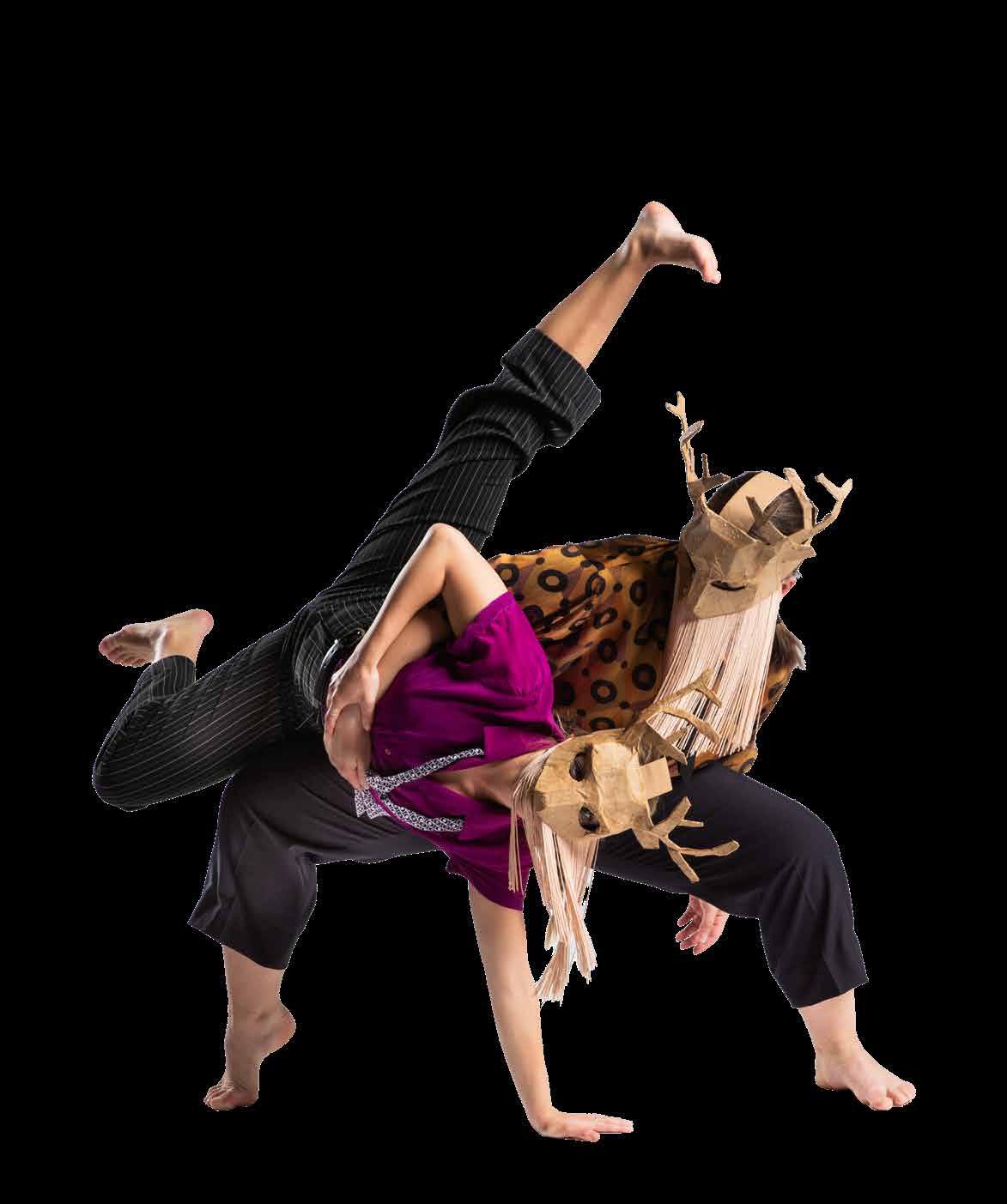
Boyce performed in Stephanie García’s piece, “Niteotl,” inspired by the Deer Dance of the indigenous peoples of Sonora. It felt “really important,” “really powerful,” said Boyce.
The exhibition ultimately included research posters, photographic essays, and visual art from students and faculty from various departments across campus including Ethnic Studies and the
School of Music. PhD candidate Taryn Carvajal Harding shared her research on Spanglish representation in opera and a link to an aria she’d written. Students from a Latinx music class and all of the classes in the School of Dance toured the exhibition in the lobby, which was filled with bright papel picado, detailed research posters, black and white photos, and colorful paintings.
The opening night included a reception of Mesoamerican food, music, and dancing along with a post-performance conversation with the choreographers, moderated by Boyce and KillpackKnutsen, giving audience members an opportunity to ask questions.
One person said it seemed like an act of bravery these days to be making art at all.
Photo: Todd Collins
Emma McKeever and Claire Cheney in “Niteotl,” created by Stephanie García. Maskmaking by the dancers, led by Ramón Ramos. Costumes designed by Christopher Larson. Lighting designed by William Peterson.
A NEW LENS
Pablo Piantino, an Associate Professor at the School of Dance, helped organize both the dance concert and the exhibition.
“Offering all these different perspectives of dance, of art, of movement offered a different lens from which to look at dance and movement for our students and the community,” said Piantino, who is originally from Argentina. “It felt personally meaningful to celebrate people that come from south of the border. I think we can all learn from one another.”
“Mamonas,” choreographed by Ballet West Soloist Vinicius Lima, celebrated the Brazilian rock band Mamonas Assassinas and was the concert’s final piece. Roxanne Gray’s new work, “Rasquache,” opened it.
“As a Tejana artist, I was so moved by the entire experience,” said Gray, who was also on the curatorial collective and contributed research. “I remember during the Q&A following the concert, all of the choreographers sat on stage and discussed how impactful it felt to be able to express ourselves freely in that space, especially during a time when so many people of color, Latinx, and marginalized communities are being silenced.”
Avelar said she hopes to see the Hispanic Heritage Month celebration events continue at the School of Dance in 2026 and beyond.
“I did not realize how important that month was for me until coming here,” said Avelar who worked at Ballet Hispánico for more than a decade, “Where Hispanic Heritage Month is basically every day.” ■
“I remember during the Q&A following the concert, all of the choreographers sat on stage and discussed how impactful it felt to be able to express ourselves freely in that space, especially during a time when so many people of color, Latinx, and communitiesmarginalized are being silenced.”
Photo: Todd Collins
Em Zinn and Ana Sofia Melendez (featured), with Olivia Hartley, Emelie Bishop, Esther Simmons, Keily Tafiti, Meshayla Gardinier, Aria Gree, Anela Ottley, and Giovanna Harris in “Rasquache,” choreographed and directed by Roxanne Gray. Costumes designed by Chrostopher Larson and Enrique Moreno. Lighting designed by William Peterson.
We all know the old chestnut about how the only place you’ll find jazz in Salt Lake City is at the Delta Center, but jazz is everywhere in Utah.
In the 20th century, Salt Lake and Ogden were regular stops for jazz greats touring the country by car and rail. Charlie Parker, Ray Charles, and Count Basie all made their way here, often playing with local legend Joe McQueen. After once being denied service at a Salt Lake City hotel in 1940, Duke Ellington had the good grace to return to the Beehive State and perform at the University of Utah in 1961. Tickets for students cost $1.75.
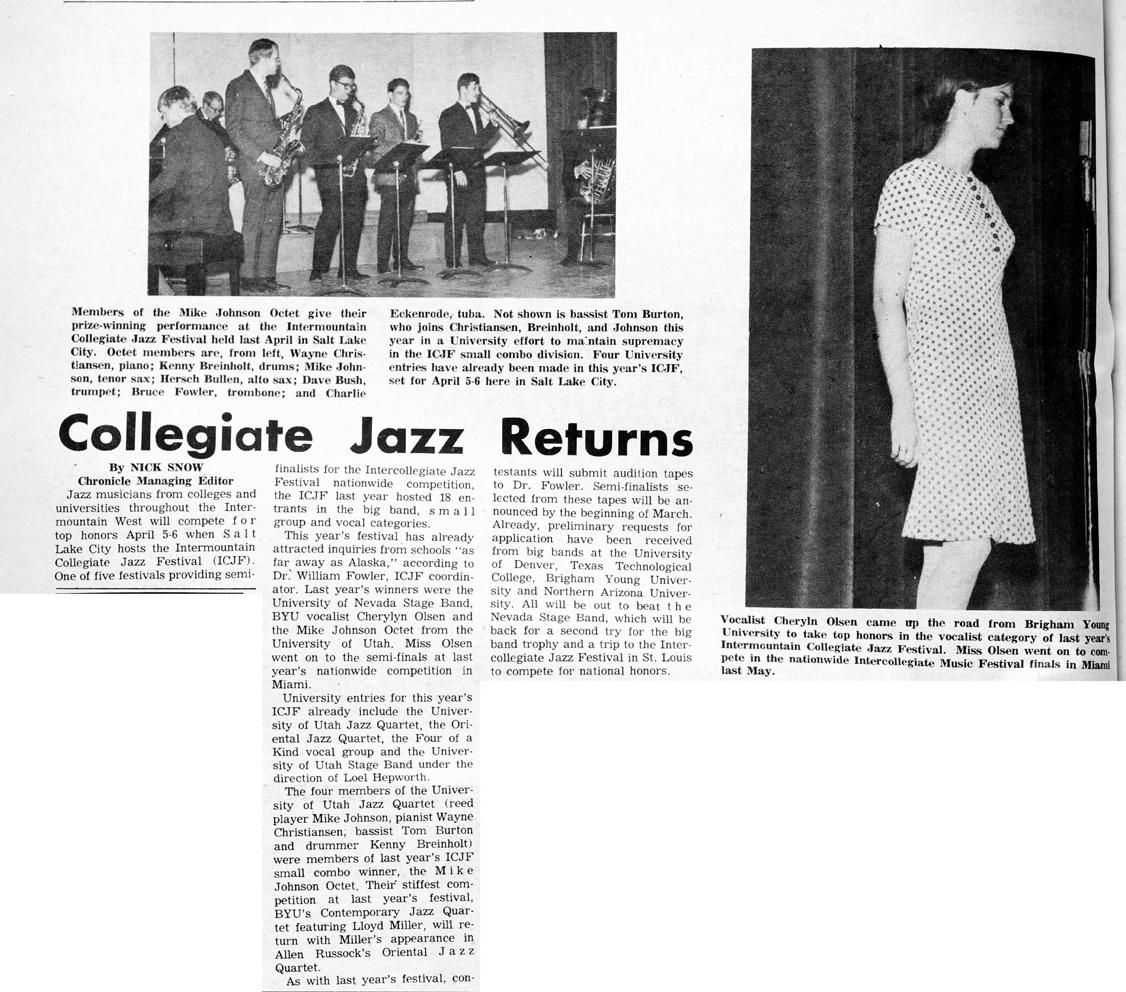
At around the time of Duke’s visit, jazz was making its way into the repertoire at the U’s School of Music. As the Daily Utah Chronicle wrote in 1962, “Jazz has become important enough to be included in the academic programs of universities, and jazz enthusiasts are turning to the colleges for their music education.” For decades, jazz has been heard in the halls of the U, but it’s also made its way out into the community. The U’s Jazz Studies program has given Utah its beat.
It’s a strong beat. According to Josiah Boornazian, DMA, the Director of Jazz Studies, “Utah punches above its weight in terms of the jazz scene and the jazz culture. For the population size, there’s a lot more jazz than most people realize. In the Salt Lake area, you can hear jazz four or five nights a week, every single week, minimum. For decades, Salt Lake City has been bringing world class, absolute top tier jazz artists to sold-out crowds. There’s been a good tradition of blues and jazz festivals in Salt Lake City for decades.”
Boornazian credits the efforts of local musicians and supporters, especially Gordon and Connie Hanks, who have been guardian angels of the Jazz Studies program and worked tirelessly to bring jazz music to Utah. He also mentions Nathan Royal, U music alum and Executive Director at the nonprofit Hot House West, where he also volunteers. “Last year alone, they put on over 300 jazz and blues, bluegrass, and roots music events on the Wasatch front.”
“I had over 150 performances last year!” says Steven Heffner, DMA, Assistant Professor of Jazz Studies at the U. Heffner’s only been in Utah for two years, but he’s been impressed by the amount and variety of jazz music here. “What’s really cool
“ Utah punches above its weight in terms of the jazz scene and the jazz culture. For the population size, there’s a lot more jazz than most people realize.
In the Salt Lake area, you can hear jazz four or five nights a week, every single week, minimum...”
“ It’s a uniquely American music. It’s a wonderful musical melting pot, a wonderful metaphor for America at its best: a blending of cultures that results in a unique cultural offering that’s poW erful.”
is there’s a nice balance of people who are very interested in developing young jazz musicians and bringing in great music to the area.”
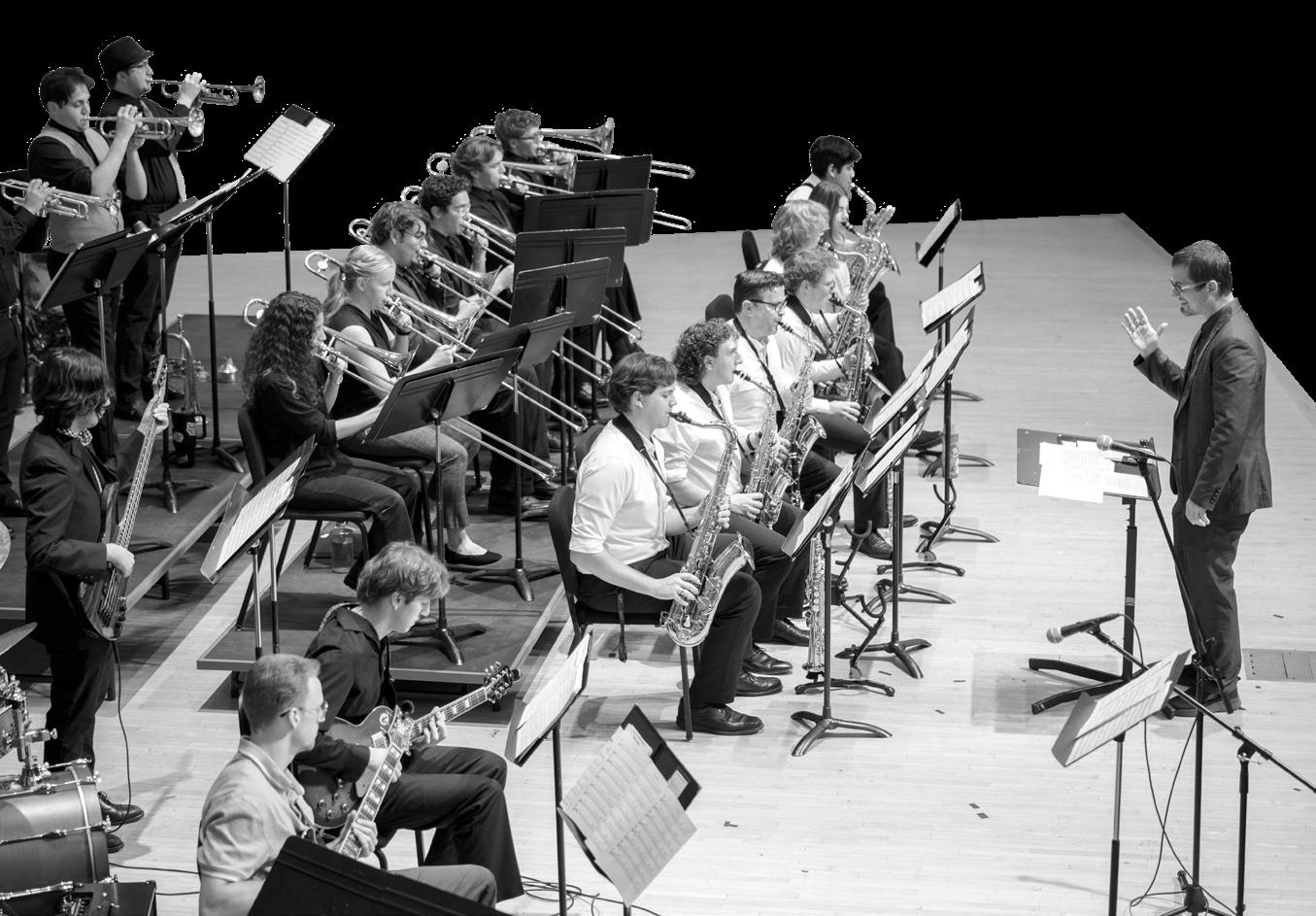
A great deal of this music happens as a direct result of the Jazz Studies program. As Boornazian explains, “We’ve got two big bands and eight small ensembles including a jazz guitar ensemble and an avant-garde ensemble. That means every year at least four big band concerts and eight combo concerts on campus. We do weekly all-ages jam sessions every Monday night. Over the years, we’ve had partnerships with venues where we have weekly University of Utah jazz nights. The students themselves are gigging… my seniors and my master’s degree students, they are all gigging multiple times a week. The students are out there performing professionally at restaurants and clubs and bars in the greater Salt Lake area several times a week.”
The sound of the U’s jazz program carries throughout Utah. It’s also the foundation for all kinds of different music across the state. Boornazian elaborates: “Because jazz is so demanding to learn how to play competently, because it requires improvisation, if you can play jazz, you can basically play any other style of music. There’s a very robust scene in Utah of extremely high paying party band and wedding band gigs. You can make a very comfortable middle-class living in Utah as
a professional musician if you are willing to take on party band gigs, in addition to doing your own music and playing jazz. Studying jazz equips you to play any style of music.”
It equips students for more than just a life as a gigging musician, though. It brings a greater value to their entire education. “Jazz,” Boornazian explains, “is the only style of music that we do in the West, culturally, that requires collective improvisation. It’s a uniquely democratic form of music. A jazz band is negotiating in a democratic fashion — where are we going to go, how many choruses are we going to play, are we going to crescendo or de-crescendo, what harmonic substitutions are we going to do?”
“This fosters in young people a sense of community, a sense of collaboration, a sense of negotiation, a sense of being able to think creatively on your feet, to be able to roll with the punches. Somebody might play something that you didn’t expect, and you have to react to that in real time. It’s a uniquely democratic music that encourages creative risk taking, personal responsibility, and responsibility to the community. It’s not about you as an individual, it’s about making the whole ensemble function as a cohesive unit to make something beautiful, something that’s worth listening to and worth dancing to. Because of that, it’s got incredible cultural and pedagogical value.”
Heffner adds “What I view the role of this program now is not just to prepare students throughout the region to be successful in a career in music and a career in jazz, but it’s also trying to help the community build a jazz culture.”
Why a jazz culture in Utah?
According to Boornazian, “It’s a uniquely American music. It’s a wonderful musical melting pot, a wonderful metaphor for America at its best: a blending of cultures that results in a unique cultural offering that’s powerful. Jazz is America’s music. It’s in our DNA, culturally.”
“I don’t think that I need to advocate for the art,” Heffner muses, “because jazz is dance music. Jazz is a lot of things, and it can be sad and it can be angry and it can be triumphant, but at the end of the day, when it’s played well, it feels good, and people notice and pay attention. ‘Wow, this person is playing music that makes me wanna move my feet.’”
“All music is joy. When I get to make this music with people who are making it authentically, it’s a joyful experience. I do think that that’s a message that jazz has for Utah. It’s not just some ancient music that might be what you are allowed to listen to or that you’re told is good. This music brings joy, if you want to receive it. It’s nothing more than tapping your toes.” ■
“ t his music brings joy, if you Want to receive it. It’s nothing more than tapping your toes.”
The International Association of Schools of Jazz (IASJ) conference is the hallmark gathering of jazz educators and students. The School of Music’s flagship jazz ensemble, the Michie Scholarship Jazz Combo, performed at the conference in Austria in 2025, and will travel to Ulan Baatar, Mongolia, later this year. In 2029, the IASJ conference will be hosted at the University of Utah School of Music.
Photo: Brandon Cruz
Jazz Repertory Ensemble students performing at Libby Gardner Concert Hall
Photo: Yein Ji
Photo: Yein Ji
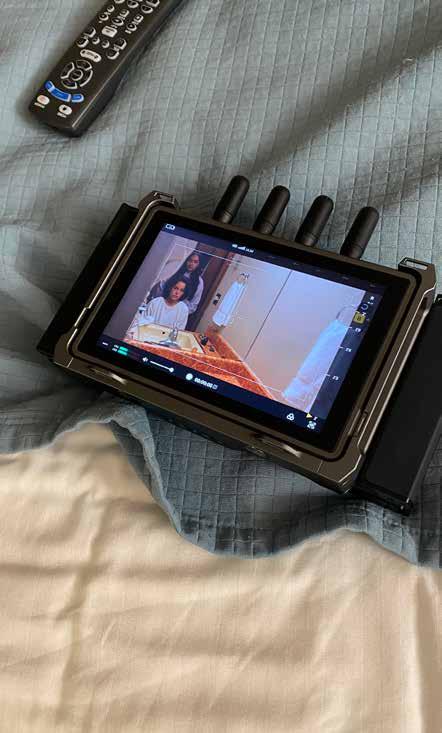
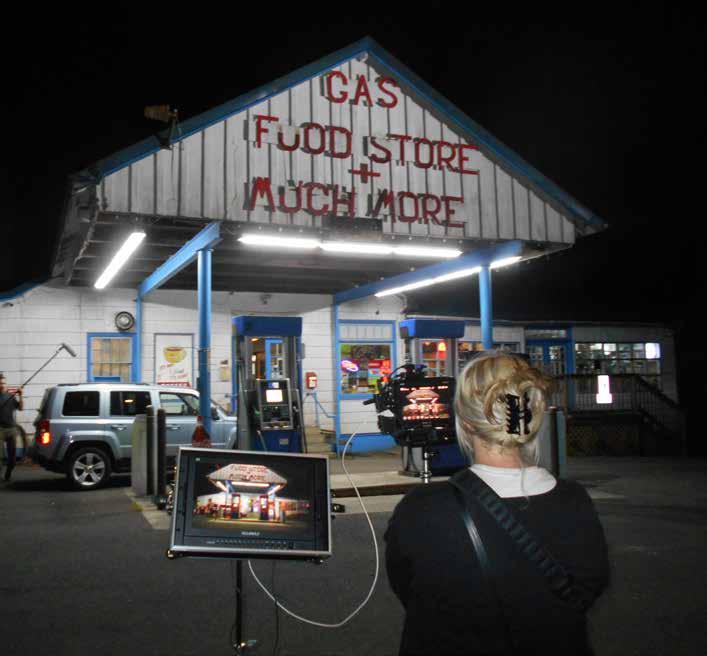
Behind the scenes shot during filming of “After You Get Back” lead actors Akina Yamazaki (left) and Lee Corpuz (right)
Lee (right) behind the scenes
(Film & Media Arts BFA, ‘21), sitting in Professor Emeritus Paul Larsen’s Screenwriting class in the University of Utah Department of Film & Media Arts, and writing from the heart.
Immersed in a creative, safe, inspiring space and armed with knowledge, training, and experience, Bullock decided to write a script based on her experience escaping to the coast with a friend who had recently been institutionalized after attempting to die by suicide.
“Media, as they talk about suicide, all lead up to what happened,” she said. “The movie always ends when they leave the hospital.”
Until now.
She decided to tell a story that fills the gap of what happens “After You Get Back.”
Photo: Yein Ji
Production Designer Mia Hunt on set
The timing for a more holistic understanding of a person’s journey is critical given that mental health concerns are a growing health crisis and, in fact, a leading cause of death and disability among adolescents and young adults in the United States. The Utah Department of Health’s data shows that Utah’s suicide rates are among the highest in the nation.
Bullock’s colleagues and employers at TWIG Media Lab, a Salt Lake City-based film production company founded and run by brothers Chris Lee and Alex Lee who are also U Film alumni, knew she had a powerful project on her hands and cajoled her to finally share it with them.
A year and a half later, after getting consent from the friend whose story Bullock shares and a successful Kickstarter campaign to raise funds to cover the basic costs of casting and shooting “After You Get Back,” her screenplay began coming to life with TWIG on board.
From hiring acting talent from the U Department of Theatre to seeking funding opportunities, the team found themselves appreciating the benefits of being connected to a large R1 Research institution.
With additional post-production costs on the horizon, Chris Lee, Partner and Director of TWIG, who was also an Adjunct Professor of Screendance in the U’s School of Dance at the time, reached out to colleagues across campus to dream about how this film might support research efforts at the intersection of the arts and health. It was his meeting with Becky Zarate, Associate Dean for Research in the College of Fine Arts (CFA) and the Director of the Arts & Health Innovation Lab at the U, that unearthed the potential for the next phase of the project.
“When Chris told me about this film that could so strikingly and poignantly illuminate the plight of young people recently released from having been institutionalized for mental health crises, it begged the question that we could answer anecdotally but would be interested to understand empirically: ‘why is film such a powerful narrative tool to build empathy and understanding?’ That inquiry opened a new realm of questions about how this film — and film as a medium of discovery — might aid in improving our societal and clinical care for vulnerable populations. This seed project warrants being scaled up to perhaps a series. It is shaping opportunities to develop new arts-informed measures for future research with demographic populations and suicide,” Zarate said.
Her call for interested faculty collaborators drew in U Theatre’s Associate Professor Alexandra Harbold and Assistant Professor and the current Arts & Health Faculty Research Fellow Samantha Briggs, who came onboard (Briggs as principal investigator) in what would become a study of the film’s impact as an effective, arts-informed
Photo: Yein Ji
Photo: Yein Ji
On the coast filming the final scene of the film
tool for suicide prevention, education, and policy engagement.
With this charge, Institutional Review Board (IRB) approval to conduct research on human subjects, and strong interdisciplinary collaboration, the team applied for and was awarded a CFA Faculty Arts Research Seed Grant Fund sponsored by the U’s Vice President for Research allowing them to finish the film and begin using it as a tool to engage the community in important discussions about mental health and film’s potential role in addressing the challenges we face.
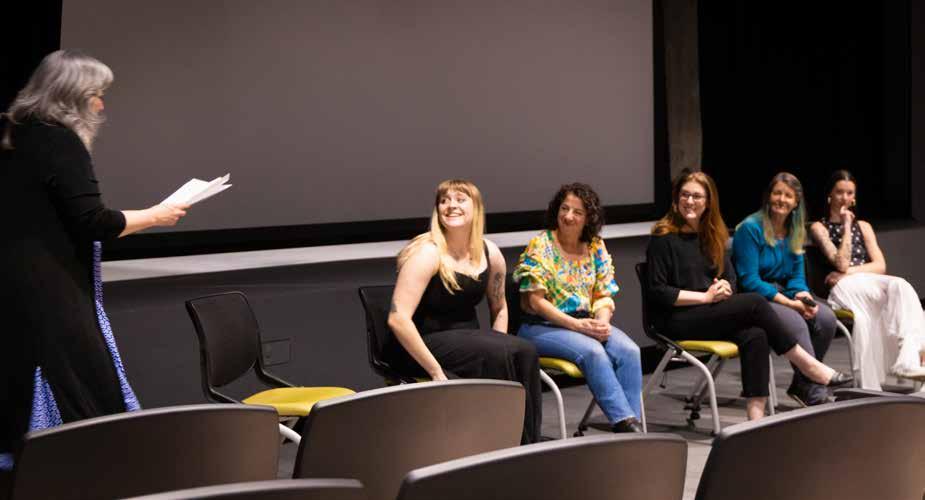
This spring, the film got its first audience at an initial screening and discussion with mental health professionals whose perspectives informed what would become a survey for the general public after future screenings. And on March 28, 2026, an unseasonably warm Saturday evening, the film was screened to the public in the Department of Film & Media Arts’ brand new Kent & Martha DiFiore Cinema, followed by a panel discussion and survey.
At this time of writing, the film is off on an already-successful circuit of film festivals while data are being analyzed. What comes next is a story yet to unfold, but what we already know from the preliminary findings is that the film is shifting the paradigm for parents who try to make everything “normal” for their kids upon return, the critical roles of empathy and connection in suicide-related close relationships, and the interest in a full series of films like this told from the various perspectives of those involved when a person attempts to die by suicide.
And alumna Bullock? She’s grateful for the creative process that helped her process her own experience, proud of her vulnerability, and deeply satisfied that her work is generating new knowledge. ■
Photo: Alex Lee
The panel after the public screening of “After You Get Back” in the Kent & Martha DiFiori Cinema including (left to right) Alexandra Harbold, Nikki Bullock, Amanda Bakian, Lauren Stivers, Hilary Coon, Emily Bergeson
The Origin of a Course Impacting Utah’s Art and Environmental Community
Photo: Monty Paret
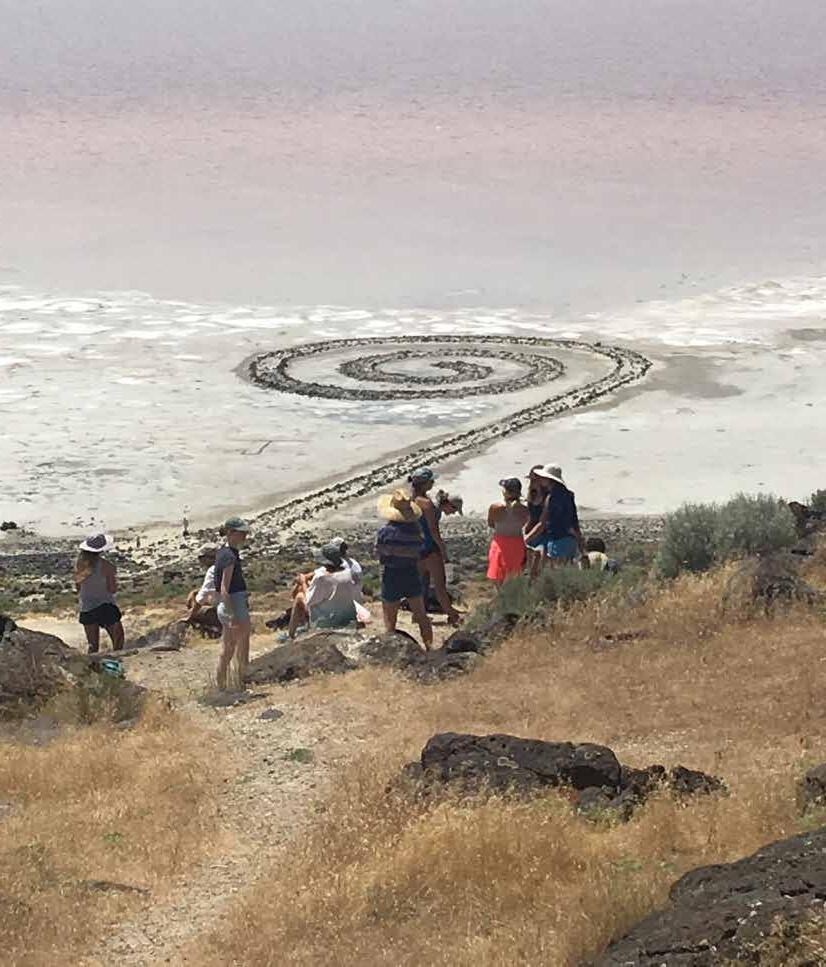
Land Arts students at the Great Salt Lake 2023
By Julia Lyon
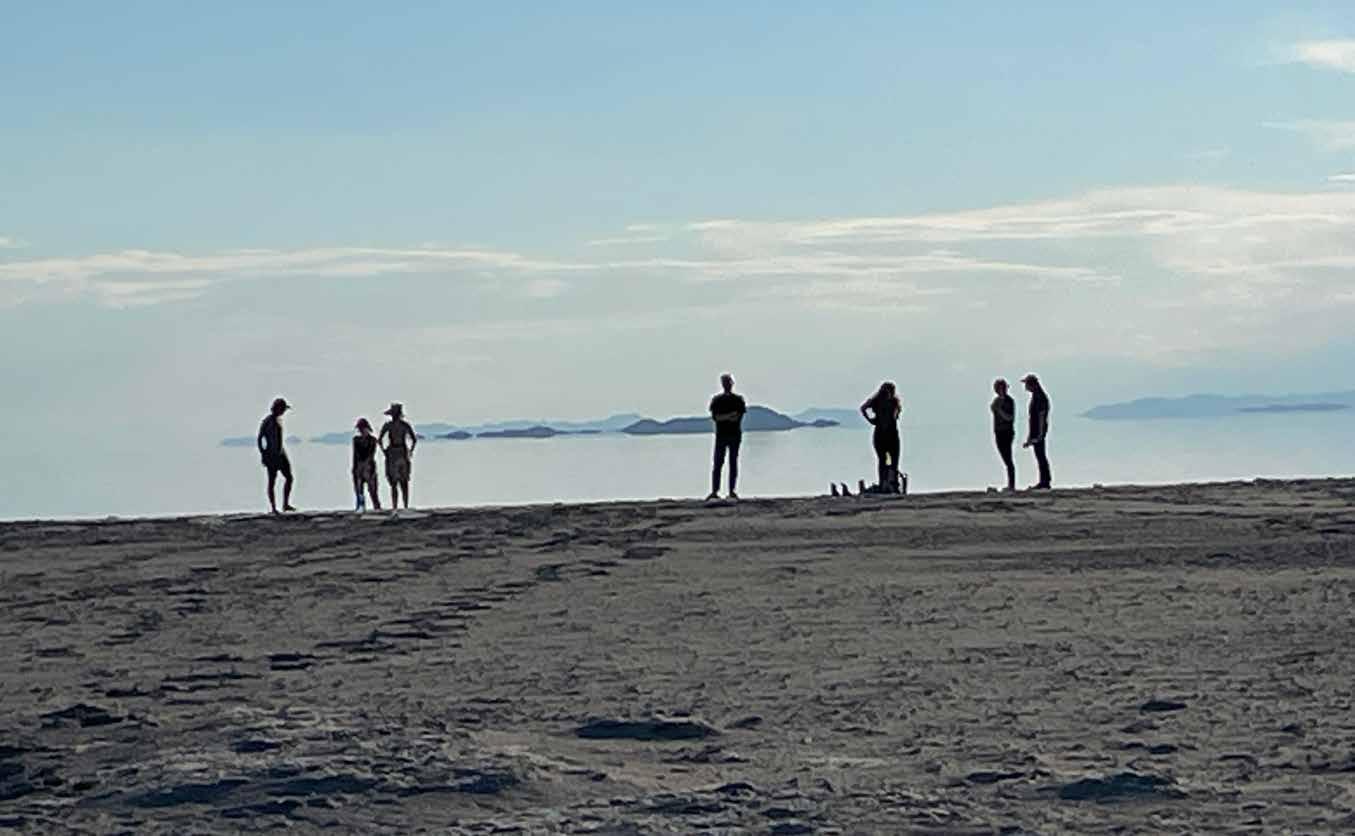
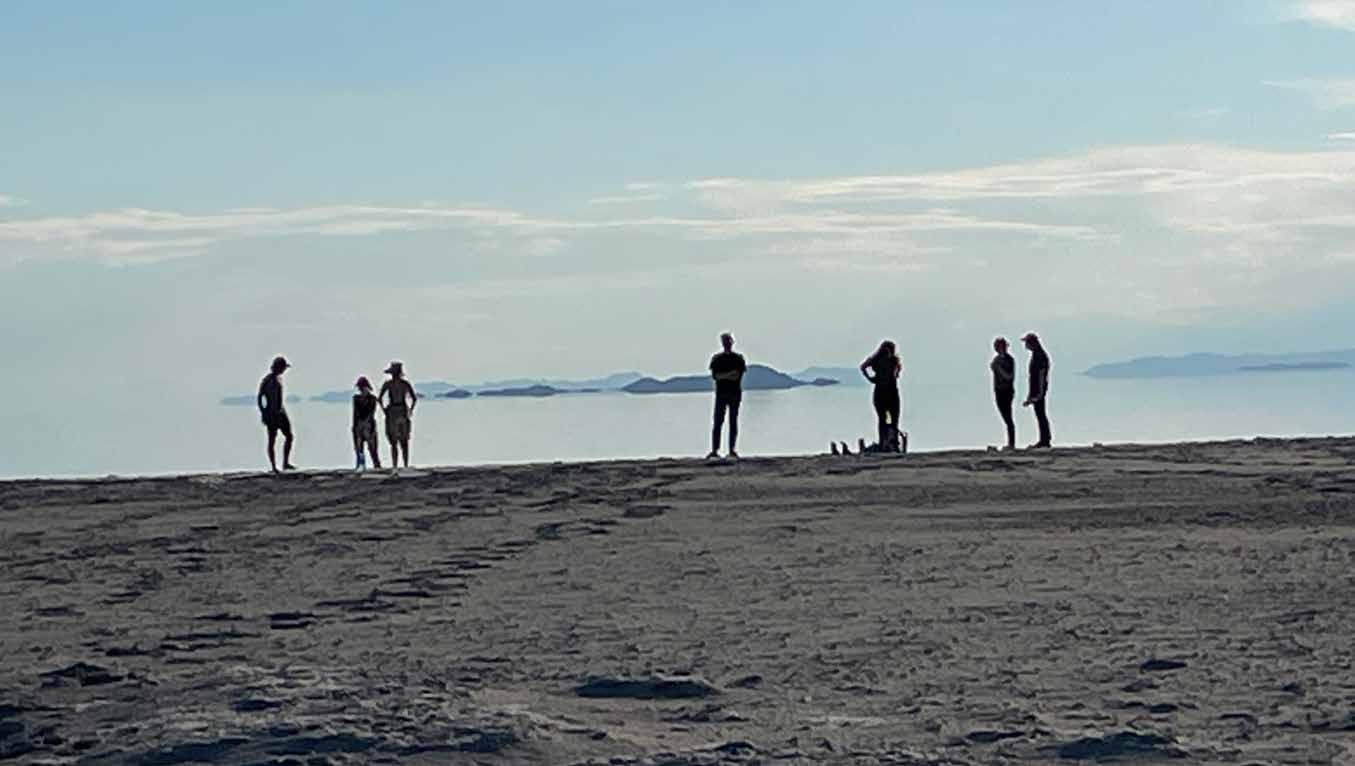
It was during a contemporary art class trip to Robert Smithson’s “Spiral Jetty,” with its swirl of earth and lake, when art historian Monty Paret realized he wanted to share the history of land art with more students.
“I began understanding what incredible local assets we have here,” the Associate Professor of Art History said.
Many Utahns have heard of Smithson’s worldfamous earthwork in the Great Salt Lake and Nancy Holt’s “Sun Tunnels” in Utah’s West Desert. But Paret knew there was so much more to explore.
With nearby resources like the Utah Museum of Fine Arts, The Center for Land Use Interpretation in Wendover, and younger artists creating new kinds of land art — raising questions about the climate crisis, land use, and environmental justice — Paret decided to develop a course focusing exclusively on land art.
He was determined to go beyond stereotypes.
“There’s such a great variety of artistic practices, intentions, and aesthetics at play here,” Paret said. “Students in the class quickly realize that the history of land art and the politics around land use in contemporary art is so much more than a couple of yahoos with a bulldozer.”
Ripple effects
An early influence on the course, which launched in 2009, was artist and geographer Trevor Paglen and his critical approach to thinking about landscapes, power, and the built environment.
“That work opened up new ways of thinking for me — not just art in the land, but artists whose work has social and political implications for how we think about and understand land, how it’s used, its histories and possible futures,” Paret said. “These are important questions here in Utah.”
The course continues to evolve, drawing students from across campus studying studio art, environmental humanities, art history, English, and more. For many, the class impacts them personally and professionally.
“Like all really thoughtful college courses, Monty’s class not only opened my mind to seeing the world differently but also looking at it with more curiosity and with a deep critical eye. His land art course opened the west for me — which I think I felt ambivalent about at
best prior,” said Laura Hurtado, Executive Director of the Utah Museum of Contemporary Art.
“Thinking deeply about the politics of geographies, the history and non-neutrality of seemingly empty spaces, and the way artists have continued to mark the land and ask questions — all started in his course — has continued to yield meaning for me years later as a curator, a writer, and as a museum director.”
Doug Tolman, a visual artist who is now Policy Manager with Save Our Canyons, took the class both as an undergraduate and graduate student.
“Prior to taking the course, I viewed most forms of land art or landscape art as using the landscape as a canvas to paste a concept onto — which I think a lot of people, myself included, found troublesome,” said Tolman.
“Seeing land use and environmental issues through an art lens provided me with a unique way of problem solving and seeing the world,” he said.
“Prior to taking the course, I viewed most forms of land art or landscape art as using the landscape as a canvas to paste a concept onto — which I think a lot of people, myself included, found troublesome.”
Photo: Adelaide Ryder
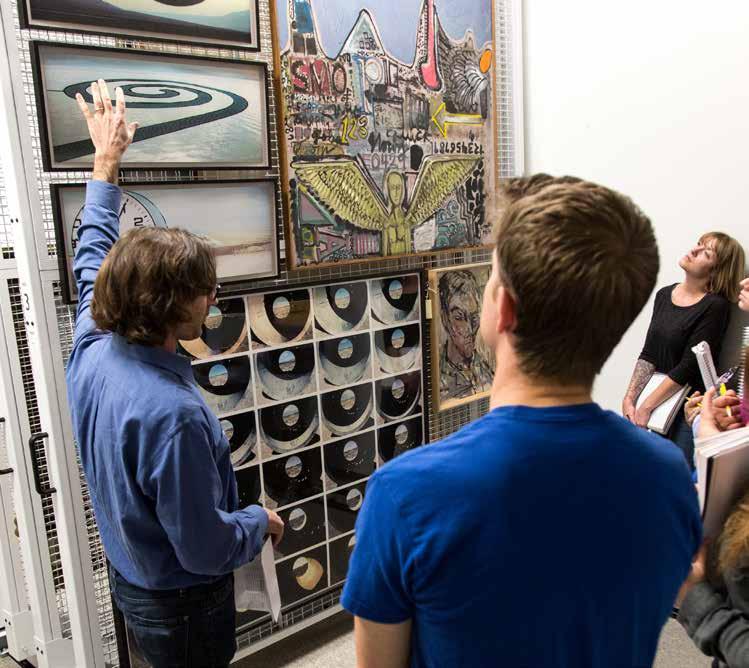
Land arts class led by Associate Professor Monty Paret (left) in Utah Museum of Fine Arts collections storage looking at works by Tacita Dean, Robert Smithson, and Nancy Holt in 2024
A storied land
One of Paret’s main goals is to help students understand land is always contested.
“We have this tendency to think of land and landscape as neutral pre-existing space we make decisions about,” he said. “But it has histories. It’s dynamic and has many different stakeholders.”
Artists, he explains, can play a huge role in highlighting that trajectory.
Though Paret continues to take students to iconic works such as “Spiral Jetty,” he also creates options for site visits closer to campus or farther afield. This winter the class visited collections storage in the Utah Museum of Fine Arts to see drawings by Robert Smithson and photographs by Nancy Holt along with pieces by other land and environmental artists.
Students have also been invited to Powder Mountain, the ski resort near Eden, Utah, to see the growing art collection across the slopes, part of a new project by the Powder Art Foundation.
He and students will tour the “collection” on skis, Paret said, learning more about its purpose and probably asking some hard questions.
“Seeing land use and environmental issues through an art lens provided me with a unique way of problem solving and seeing the world.”
“I love the fact that a lot of the pieces are scattered and almost happy discoveries the skiers are meant to engage with,” said Cuauhtemoc “C-moc” Sandoval, a graduate student in the class. “The more we can get people to engage with art in that way, outside the traditional museum or gallery space, the more you can show the different dimensions art can be.”
Over the years, the land art course has grown to include more indigenous art works and voices, as well as women from all backgrounds.
“There’s been a lot more research into recovering those artistic practices that were produced by women artists, but were not always written about and framed in that way,” the Associate Professor said. “It’s not that they weren’t there — it’s that some of us as art historians were doing a bad job at realizing they’re a critical part of that conversation.”
This year’s course included some of those female artists such as Ana Mendieta, Michelle Stuart, Lita Albuquerque, and Jackie Amézquita.
Photo: Monty Paret
Opening eyes
Paret anticipates the course will continue to change and grow.
In 2025, he spent 10 weeks learning even more about land art by participating in the innovative Land Arts of the American West field program developed by Chris Taylor at Texas Tech University. As a field resident with that program, Paret traveled over 5,000 miles meeting with artists, activists, and scholars, visiting archaeological and ecological sites, environmental and mining ruins, as well as more typical land art sites.
“That was an amazing experience,” he reflected. “I’m now trying to incorporate aspects of it into the classroom and field experiences for students here at the U.”
For Paret’s students, his passion for the topic is clear.
“When you’re really engaged in the material, that comes across,” Paret said. That’s a huge part of a successful class.” ■
Photo: Monty Paret
Land arts class at Nancy Holt’s Sun Tunnels 2019
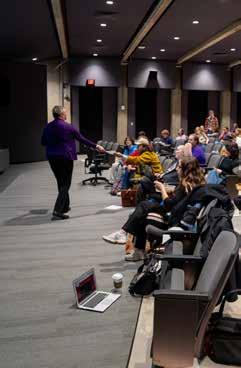
When Professor Kevin Hanson was first teaching at the University of Utah, the available screening facilities were a small room with a 16mm film projector and a home entertainment quality video projector. “I thought that would be pretty much it for the duration,” he recalls.
At that time, the film program was a small division of the Department of Theatre. Today, it’s a thriving department with over 600 students — though it’s taken a while for facilities to catch up. While the department has other state-of-the-art facilities for making films (such as a film studio, sound booth, and editing bays), for a long time, there hasn’t been a great place for students to watch films.
But soon, a project will come to completion, thanks to a generous donation from Kent and Martha DiFiore: the creation of a cinema for the Department of Film & Media Arts, using the pre-existing FMAB Auditorium as its foundation. This endeavor has spanned three separate department chair administrations and has been subject to cancelled plans, unavoidable delays, economic changes, and more. Despite these challenges, the vision for a film theater has remained — and perhaps even grown stronger. “Past and present chairs have been able to maintain a shared vision and communicate with each other effectively,” said Hanson, who served as Department Chair for many years. “It’s not been a bad thing at all to have new thoughts all along the process to guide us to the present, a great example of shared governance succeeding.”
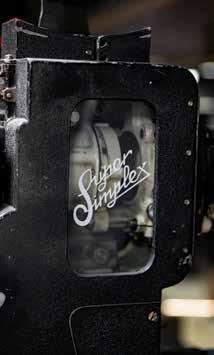
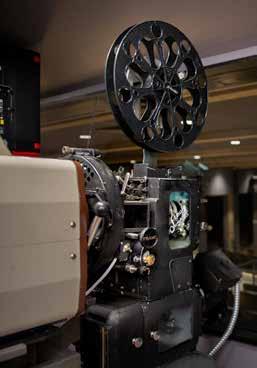
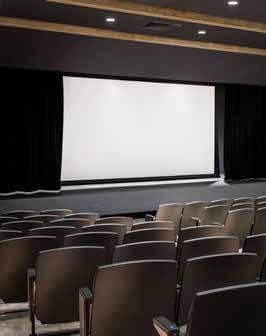
At long last, the Kent & Martha DiFiore Film & Media Arts Cinema will soon officially open. Of course, its technical specs are a point of pride. Along with a new screen, the cinema houses four projectors: a 16mm film projector, two 35mm film projectors, and a professional theatrical grade digital projector (what you would find in most commercial movie theaters). “The sound is the thing that impresses me most,” says Hanson. “Not just the sound system which is first rate, but the overall improvement in acoustics.” More comfortable seating and cosmetic upgrades enhance the experience as well.
Professor Chris Lippard describes the space as “much more like a commercial theatre than a classroom,” and Hanson emphasizes the professional level of the space. “This is the kind of cinema you would find at the headquarters of the Director’s Guild and similar institutions in Hollywood,” he said. “It will be a great asset for instruction, for recruiting, and for just enjoying film.”
This new space is of immense benefit to students. The two film projectors allow students to see their film work projected in its original form, and the system lets students do proper screenings of their work, where they can evaluate how it would look and sound in a film festival or other professional setting — essentially, how their films would play in the places where decisions are made. The higher-quality projection and sound make it easier for students to see and hear any issues in their filmmaking and fine-tune their editing, sound mixing, color-grading, and more.
The improved viewing experience also affects how students understand film. “Film scholars often complain about how films which cost huge amounts to produce are being watched by people on tiny screens which they carry around in their pockets,” says Lippard, who teaches film history. “Being able to show films that both look and sound good is crucial for students to be able to understand how they work and why they succeed — or fail.”
But it’s not just students who will benefit from the cinema. “The cinema’s main contribution is that it will build community,” said Professor Tim Palmer, Chair of the Department of Film & Media Arts. “Our students and our world need this urgently. We come together around screenings… The latest scientific research confirms that mutual in-person film screenings give tangible medical, social, mental, and physical health benefits. Cinema, and this cinema, brings us closer together.”
So, what does this mean for programming? First, the new space means that the department can exhibit their “extensive library of unique film titles on 16mm,” said Hanson. This is especially important as, Palmer explained, “The department is becoming a field-leader in celluloid teaching.”
Second, the cinema presents opportunities for faculty and students not only to present their own work, but curate media. “We already have one [student] organization planning to re-create the classic French format of a ciné-club,” Palmer shared. “Our wonderful MFA graduate cohort have plans for a modern Cinematheque screening series in which they program events and revivals, exploring their repertoire as curators.”
And that’s just the beginning. Palmer says he envisions events with the wider campus community like “Arts & Health film initiatives, environmental media work, events of all kinds linked to our sister CFA units, Dance, Theatre, Music, Art & Art History, and so on,” he said. He also sees the benefit for the regional community as well, including “panel events for productions coming from the creative work of nearby makers, grassroots industries in town, cooperative productions and culture that we can offer a home to.” Lastly, the cinema will serve as a space for the department to host national and international experts, putting the department in its rightful place as a prestigious film institution. “We bring in international makers, historians and scholars, archivists, publishers, film professionals of all kinds, hosting them on site and showcasing their work to anyone here who’s curious and interested,” Palmer said.
In the end, the cinema will hopefully become a space that embodies the College of Fine Arts’ strategic plan — one where new knowledge is developed, student success is promoted, and community is created. “What’s most fun is that we’ll all of us discover communally what we want the cinema to become,” Palmer said, “how inclusive a cultural space we can all of us make together.” ■
Photo: Todd Collins
Photo: Todd Collins
Photo: Todd Collins
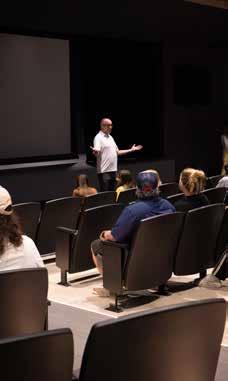
Shots of the the environment and a equipment at the Kent & Martha DiFiore Cinema in the University of Utah Film & Media Arts Building
Photo: Alex Lee
Photo: University Marketing & Communications
SEEING SHIPPOBOT H MA SARAH
By Marina Gomberg
Photo: Todd Collins
Sarah Shippobotham as Sîan in her self-written, one-woman play
“Can I Say Yes to That Dress?” at Salt Lake Acting Company
To be a good performer is to be seen by others, and perhaps to be a great performer is to see others. From a tender age, Sarah Shippobotham has been observing the world around her in ways that have allowed her to absorb and replicate human natures with unique precision.
Growing up in the United Kingdom (Cardiff, Wales, at first and then Bristol, England, from age 10 on), she could often be found playing with her sister or out on errands with her mum where she spoke exclusively — and quite believably! — like people from other places. Yorkshire, Glasgow, etc.
In fact, if you had asked little Sarah then what acting was, she’d have said it was putting on an accent and taking a new shape. Perhaps that’s partly why, when asked to play a character for her third year in drama school that was too much like herself (Mariah in “The School for Scandal”), she thought the role was boring. Turns out, it helps to know who you are to portray anyone else. Especially because acting isn’t about being fake; it’s about unearthing and accessing different truths on demand.
Being keenly self-deprecating, wildly interested in others, and in love with make-believe made Shippobotham the unassuming, world-renowned, and celebrated professional in theatre and film that she is (she’ll politely ask me to cut this part; I’ll refuse).
It’s how she sees the world, and herself in it, that has manifested an empathetic, generous, observant, transformational (new EGOT?) actor, director, voice/ dialect coach, and professor. That, and her brilliant time at the Royal Welsh College of Music and Drama in Cardiff, and her time earning her postgraduate diploma in voice studies from the Royal Central School of Speech and Drama in London.
What she learned, from whom and alongside whom, would launch her from playing character roles at the British Film Institute’s Museum of the Moving Image (she made an amazing Russian revolutionary) to working on “The Hobbit” trilogy, then the biggest movement of film people in history as they moved through New Zealand; in Canada’s Shaw Festival, the second largest repertory theatre company in North America; and the U’s esteemed Department of Theatre, working alongside U Distinguished Professor and Central alumna, Sandra Shotwell.
And she is now one of the legends University of Utah students get to claim as theirs.
What was interesting about talking to some of her current and former students was that while they each felt like their experience was transformative and personalized, they all shared — without prompt — their assumption that they weren’t alone in receiving such life-changing attention, care, and tailored support from Shippobotham.
Actor Training Program student Charley Holt, who with exuberant warmth rattled off the varied lessons and experiences Shippobotham provided her (reduce one’s ego, it’s called “company” for a reason, the
whole body is the performative tool, be kind, etc.), acknowledged that Shippobotham’s reach extends beyond just the Actor Training Program. Holt said she “offers her knowledge whenever it’s requested. She truly goes above and beyond for us.”
CFA Distinguished Alumna Ashley Bryant Miller, who you may know from recent episodes of “Chicago Fire,” “The Marvelous Mrs. Maisel,” or “FBI,” considers Shippobotham “an authentic, humble, sometimes self-deprecating instructor” who “brings her entire self to the room.”
Bryant Miller valued that when the class was learning European dialects, Shippobotham looked at her, a tenacious and talented Black woman, and offered to teach her a Nigerian dialect instead to better specialize what distinctive opportunities might come Bryant Miller’s way.
She sees students, their unique gifts, lived experiences, challenges, needs, and hopes with the same laser focus she’s long viewed the world, though with her students, instead of mimicking them, she helps them become the people of their dreams.
The fact that Shippobotham actively has worked locally and internationally as an actor, a voice/dialect coach or intimacy director while she has risen through professorial ranks at the U, was a gift she shared, too.
When she was working on projects like the acclaimed and beloved one-woman show she wrote and starred in that premiered at Salt Lake Acting Company in 2023 called “Can I Say Yes to That Dress?” or any number of productions for Utah Shakespeare Company, and even some of her international voice and dialect coaching for the Shaw Festival, she took her students, sometimes literally, along for the journey. Oh, to have seen her as Lady Bracknell in “The Importance of Being Earnest” (2025), as Clairee in “Steel Magnolias” (2025), or her penultimate role (thus far, she says) as Williamina Fleming in “Silent Sky.” Pearls were undoubtedly clutched.
“Sarah kept learning and training, so we all learned to expect that in our professional careers as well,” Bryant Miller said. “Sarah struggled and triumphed through rehearsals and coaching sessions, living the life of a professional artist in front of us. That example is invaluable.”
Sarah Shippobotham is an astoundingly talented, rigorously trained, adoringly humble, brilliantly perceptive human whose gaze has manifested her into this iconic portrayer, purveyor, and professor in the worlds of theatre and acting.
To see her is to love her. ■
Photo: Karl Hugh
Photo: Karl Hugh
Shippobotham as Clairee in “Steel Magnolias” at Utah Shakespeare Festival
Shippobotham as Williamina Fleming in Utah Shakespeare Festival’s “A Silent Sky”
Photo: Brandon Cruz
Beverley Taylor Sorenson visual arts educator, Erin Huber, and students at Magna STEAM
By Julia Lyon
At Magna STEAM Academy, it feels like almost anything is possible this school year.
Light streams into the art room where “I can” statements on the white board describe the learning activities for the day. From engineering circuits to creating a 3-D habitat, students are setting academic and attendance goals — and achieving them.
“Everyone feels a little more hopeful this year,” said Erin Huber, the school’s Beverley Taylor Sorenson Visual Arts Educator.
After years of declining test scores and attendance at Magna Elementary, Granite School District announced a reorganization and rebranding of the school as a STEAM (science technology engineering arts mathematics) program last year. Teachers who wanted to stay had to reapply for their positions. New academic coaches would support teachers.
The school had a new name and new direction, but the students and families didn’t change, stressed Principal Benjamin Peters. It remains a Title I school, which means the majority of its roughly 450 K-5 students come from low-income families. Many students don’t attend preschool and have little experience with school before kindergarten.
“With arts integration and a focus on STEAM across the school, the idea is to help students see why learning matters in real life,” he said.
A New Chapter
At the end of January, Principal Peters had good news: the school reported a two percent increase in attendance compared to the prior school year. Kindergarten math and reading scores were the highest they’d been in five years.
The arts are playing a role in that success, he said.
Along with the school’s new focus comes a new partnership with the University of Utah’s College of Fine Arts. The U’s BTS Arts Learning Program is tracking data as part of a broader study on how arts integrated planning and curriculum design impacts student learning and community engagement at multiple schools.
After Huber emphasized geometric shapes through arts-integrated learning in her kindergarten classes last fall, the U’s BTS Arts team examined student learning data from October to December and saw double-digit gains.
“It’s proof that what I’m doing is valuable,” Huber said. “Arts integration is helping our students learn and gain skills.”
Learning by Doing
Over the winter, students across the school prepared for their next STEAM night, inspired by the movie “Night at the Museum.”
They researched and built habitats out of cardboard and clay. Using syringes and tubes, older students added a hydraulic system to move an animal across the scene. Younger students used magnets.
“Fourth grade really got into it today,” Huber said one morning in February. When students struggled, they had to experiment and figure out how to make the hydraulic system work.
“They seemed to enjoy the challenge,” she said.
The school’s STEAM night last fall had been a huge success with nearly triple the attendance of family nights in prior school years. Parents, including many fathers who had not typically attended, participated in the designing, decorating, and racing of cars with their child — learning about art and engineering together.
“The arts are playing an essential role in supporting the school’s academic, student attendance, and family engagement goals,” observed Kelby McIntyre-Martinez, Associate Dean for Arts Education and Community Engagement. “That’s the impact we are striving to sustain.”
Looking to the Future
The College of Fine Arts hopes to continue the partnership over three years so student data can be tracked long-term. This collaboration provides U Arts Education students an opportunity to participate in the Magna school’s community nights, allowing these future arts educators to learn while supporting the event, too.
The U is also working with Granite School District.
The support from McIntyre-Martinez and the U BTS team has been “truly impactful,” said Noelle Converse, PhD, Granite’s Director of Curriculum and Instruction. “From our first conversation, she and her team fully committed to our Magna STEAM vision, helping us launch an authentic plan for the fall. We’ve been better equipped to meet the unique needs of our students due to the partnership.”
Funding from the legislature and the Sorenson Family’s Art Works for Kids Foundation helped make it all possible, she explained.
With more students in the building on a regular basis and more families participating in community STEAM nights, Magna STEAM Academy is poised for long-term success.
“We have to have something exciting and make learning real, so they want to come back every day,” Principal Peters said. “We have some great things to celebrate.”
Note: to see additional coverage on these impacts at Magna STEAM, view the online edition of Studio ‘26 for links. ■
By Merritt Mecham
Alot of universities house academic publishing entities. Here at the U, there is the “Hinckley Journal of Politics” and “Quarterly West,” even the “Journal of Dark Sky Studies.” What’s rarer are journals that focus on undergraduate students — though, here at the U, there is “Range.” But now, housed in the Department of Film & Media Arts, is something truly singular: “Film Matters,” a journal not only for undergraduate students, but by undergraduate students.
“We feel that society benefits from engaging young voices,” said “Film Matters” Co-Editor-in-Chief Liza Palmer. “My coeditor-in-chief (and partner-in-crime) Tim Palmer and I always praise the enthusiasm and innovation of these young scholars.”
From Liza Palmer’s vision, she and Tim Palmer have built a magazine that embodies these values. It began when they were at the University of North Carolina – Wilmington, where they ran the Frank Capra Award for Excellence in Undergraduate Film Scholarship. “It got a lot of interest,” said Tim Palmer. “This showed to us that there was a gap in opportunities for undergraduates, an ability for them to share their work.” Liza wanted to expand on this, and had the idea to create an undergraduate film scholarship magazine.
The Palmers took this idea to Masoud Yazdani, then chair of Intellect Press (where “Film Matters” print editions are published), emphasizing their “points about all of the great emerging voices who had no platform to speak,” Tim said, and they decided to start a magazine to create that platform.
The title comes from a concept Tim Palmer has coined in his research: “media citizenship.” The term implies “that images and sounds inform your engagement with the world, that your vantage point should be empowered by knowledge of media in all its global diversity,” said Palmer. “Hence: ‘Film matters.’”
“Film Matters” has grown and evolved as the Palmers have maintained an openness that has brought in collaborators and adapted to provide new opportunities. The magazine
Photo by Maeve Macsorely
has established relationships with Georgia Tech, Chapman University, Queen Mary University of London, Bilkent University in Türkiye, and other institutions of higher education around the world. “Film Matters” moved to the University of Utah in 2025 after Tim Palmer joined the U as Professor and Chair of the Department of Film & Media Arts.
“This represents an enormous fresh-start opportunity, and we are [considering] ways the journal, and everyone connected to it, can benefit from the new berth, at an ambitious world-class university, in a major global hub of film and media culture,” the journal published in a statement at the time.
It’s the students who benefit the most, as they get to be directly involved in the publication of the “Film Matters” magazine.
U Film students join the magazine by enrolling in FILM 3920: Producing the Undergraduate Film Magazine. The students in the course become the editorial board for one of the magazine’s two annual issues. (The other issue and online content are run by editorial boards at different universities supported by faculty on the “Film Matters” advisory board).
The primary task for students in the course, says Liza Palmer, is to manage the peer review for their issue of “Film Matters.”
“They read through the external submissions ‘Film Matters’ receives as a result of our open calls for papers, ultimately deciding which essays are accepted or rejected.”
While that may sound straightforward, the course treats the peer review process very seriously. “We like to have all our submitting authors walk away from this process with constructive feedback as to how to develop their writing for a broader audience,” said Liza Palmer. “This is an important duty that the students exercise.”
The students prepare for this duty through the FILM 3920 course. The course covers professional communication, writing skills, publication ethics, plagiarism, AI, copyright,
FILM MATTERS AT THE U
privacy, and data security. Additionally, the magazine offers internships over the summer for students to gain additional professional experience.
“These are real-world, transferable skills that will benefit any workplace,” said Liza Palmer. “Indeed, knowing how to give and receive constructive feedback in a collegial manner is an underappreciated art, one that sets students apart for increasingly competitive graduate school slots.” Liza Palmer notes that the ability to give a good peer review is an especially attractive skill for potential graduate students. The “Chronicle of Higher Education” has called it “the scholarly skill almost no one is teaching.”
“Film Matters” also goes beyond traditional scholarly writing. “We have students experimenting in a range of forms, from video essays for our website to poem responses to films,” said Liza Palmer. They also look for other opportunities for students, such as giving them books or films to review, or arranging for press passes to film festivals.
For student Soohwan Lee, being on the “Film Matters” editorial board has expanded her horizons. “I’ve really enjoyed seeing how diverse student film scholarship can be,” she said. “Everyone brings different interests, backgrounds, and perspectives, and being part of a journal that highlights those voices has been inspiring.”
Lee aspires to work in film marketing, distribution, or film festival programming, and feels that her experience in the course made her better prepared for her career — and upended some of her expectations. “I’ve been surprised by how collaborative the editorial process is. I expected a lot of individual work, but instead, I found that shaping an issue of a journal requires constant communication — discussing ideas, giving thoughtful feedback, and making decisions as a team.”
These soft skills go right back into the ethos of “Film Matters” which is to create a place that celebrates students and educators, and gives them a platform to speak. “Both Liza and I came from challenging points of origin, starting environments that didn’t encourage us to speak or be heard,” said Tim Palmer. “We know the toll that takes. So ’Film Matters’ has above all been designed to remedy that, to get non-traditional people onto the record, to give them a place to explore their ideas and send them out into the world.”
And while “Film Matters” is most definitely a magazine — you can subscribe and get your own copy! — it’s also a larger project that will certainly become a point of pride at the University of Utah.
“‘Film Matters’ is much more than the sum of its parts,” says Tim Palmer. “Like Hitchcock, who — it is said, perhaps apocryphally — planned so meticulously in preproduction that he lost interest in the actual film, each issue of ‘Film Matters’ is almost a by-product, for me, of a much grander project. The final product, a true labor of love from all who will it into being, is the priceless experience these young authors and editors gain.” ■
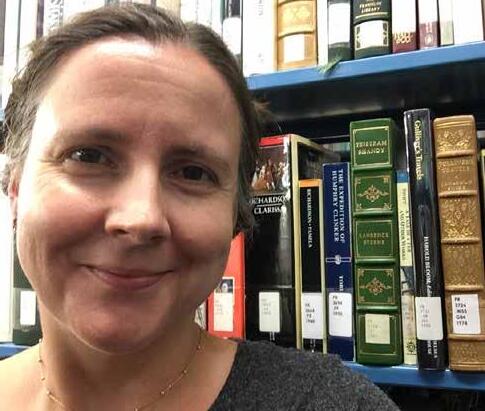
Liza Palmer (left)
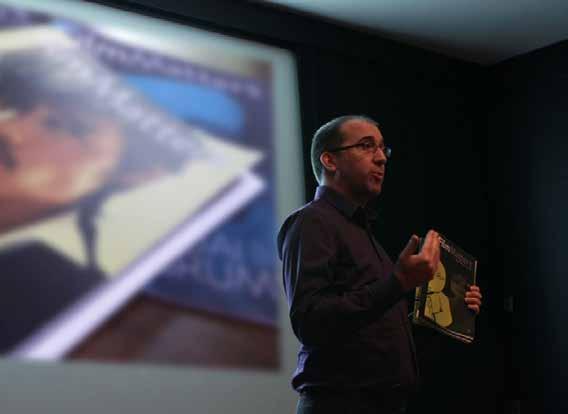
Palmer (right)
Photo courtesy of Kent & Martha DiFiore
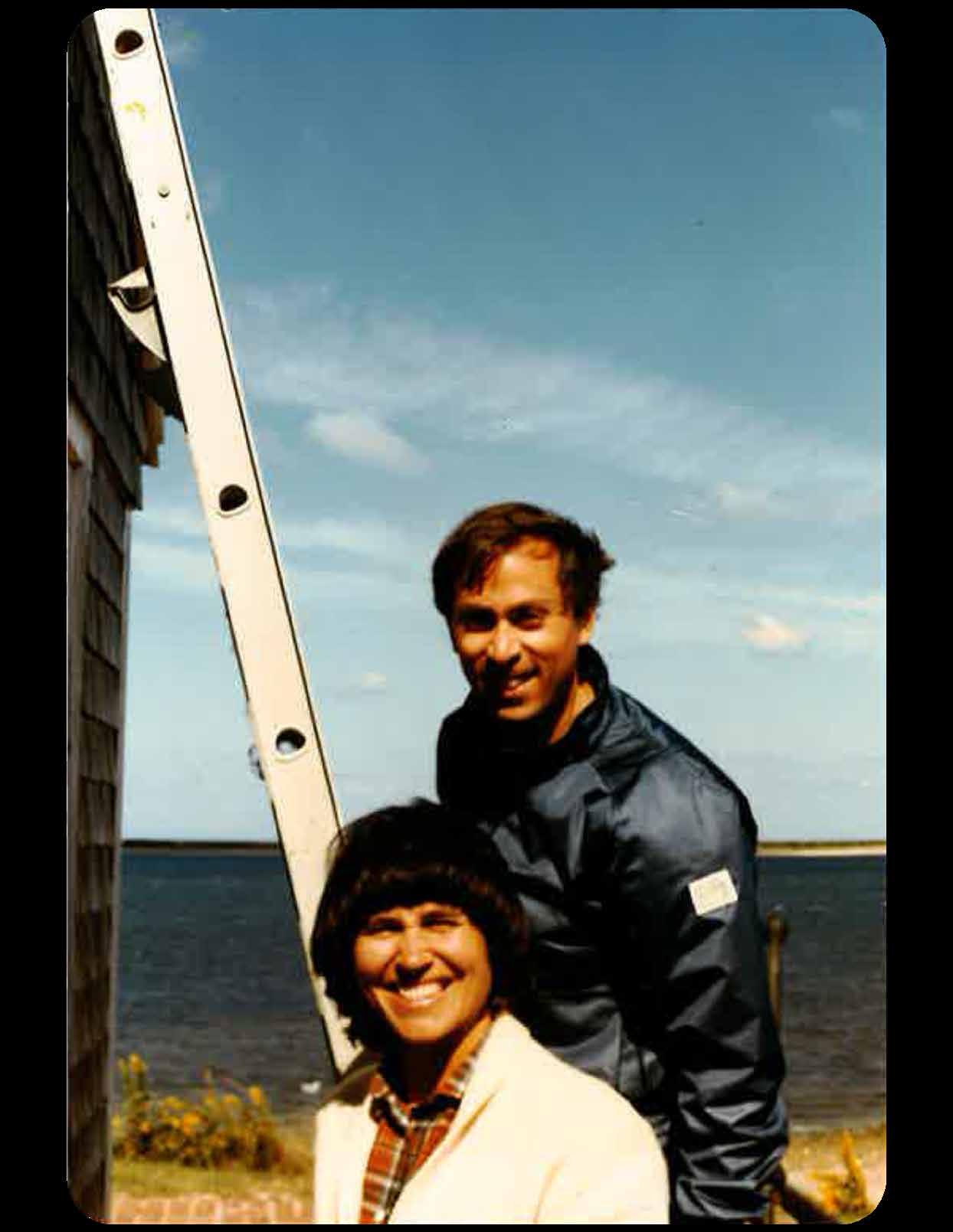
Kent and Martha on Cape Cod in the early 1980s
By Spencer Windes
Their first date was at the movies.
As young doctors working on their residencies in Utah, Kent and Martha DiFiore had known each other for a while before they decided to go out together, so it was never a question of where they would go on that first outing. Cinema has played a part in their lives since childhood, and the magic of the movies is woven into their relationship.
“I came from Kentucky and came out here not knowing a soul,” Martha recalled. “I came to do a medical internship and residency at the University of Utah, and one of the first people that I met was Kent.”
“She paged me at the University Medical Center and asked me to come down and see a patient,” Kent added. “I came down the next day and thought, wow, she’s really cute. I asked her out, and she said ‘No, that’s really forward of you. You don’t even know me.’”
It was film that came to the rescue. As Kent tells it, a few years after their original missed connection, “She came down to the cafeteria for lunch. There was an intern with me I was mentoring. We started talking about films as we were eating lunch. She hadn’t seen this movie, and I hadn’t seen it either. The intern I’d brought with me started kicking me under the table, saying ‘ask her out! She wants to go see this movie.’ I did ask her out and we did go see the movie, and that’s how it all began.”
Martha went on to do a fellowship in pulmonary medicine, and Kent in hematology and oncology, before going into private practice. Their careers were in medicine, but the arts continued to play a role in their relationship for their next 45 years in Utah. Many evenings were spent at the former Blue Mouse and the Tower Theatre, taking in the world through the power of film.
Kent recalls how, growing up in Lincoln, NE, his father, who worked for a theater chain, would drop him and his sister off at the local cinema on Saturday morning to watch cartoons, old Abbott and Costello films, and other fare. One morning, during a showing of “South Pacific,” the theater curtain caught on fire!
Martha remembers her own introduction to cinema. “I must have been no older than eight or ten. I had a couple of babysitters take me to see ‘The Virgin Spring’ by Ingmar Bergman. I was too young. I was thinking, what’s going on? This is too much for me!” She remembers more fondly the first time she was enthralled by seeing Jean-Luc Godard’s “Breathless.” “That was years ago. I’m sure I didn’t understand it at all!”
Kent and Martha don’t just love the arthouse classics. A new favorite is Gints Zilbalodis’ recent animated film “Flow.” They also adore a good comedy. “One way you can look at a favorite movie,” Martha explained, “is something you’re willing to see again. Any Christopher Guest movie, I would see again!” It’s obvious why
Kent and Martha have been Sundance devotees every year since its founding, especially enjoying the documentaries, such as “Hear and Now,” and “God Grew Tired of Us.”
The DiFiore’s have given back to the university that brought them together in many ways over the years, with the College of Fine Arts always at the forefront. “We’re arts consumers,” Kent explained. “Martha loves the opera and with that you get the symphony, which I love. We have two girls and they really enjoy dance. We enjoy all the arts, and especially film and media arts. It just seemed like a natural thing to do, to support these things that we believe in. We’ve finished medicine and now are more involved in community support. We developed a foundation, and most of our money goes to the arts.”
Their commitment to the new Kent and Martha DiFiore Cinema is a huge step forward for the university and for their philanthropy. This state-of-theart facility, with 16mm, 35mm, and digital projection, can show any format — everything from Blu-Rays and DVDs to scans of archival prints. Students will both come for classes and exhibit their own work to their peers and the public. It’s a place to screen films from all around the world, media from the 19th century up to now, and films that have been made by the university’s community of makers and scholars and professors, as well as the emerging professionals that are the U’s film students.
“It gives us pleasure to see young people succeed,” said Kent. “This is the largest school in the College of Fine Arts. If we can have something like this that will help young people succeed in their careers, that’s worthwhile. We wanted to leave a legacy of who we are and what we did. We’re going to be gone someday. It was important for us to have a thing we can call our own, even though we don’t own it, but at least people can know it was important for us.”
Tim Palmer, chair of the Department of Film & Media Arts, described the DiFiore Cinema this way: “The cinema is not just a physical entity — it’s something that adds value to our students, to the campus, to the community, to the region. We as a species are crying out for places where we can come together and reconnect and find our common humanity. Media and films and cinema have a wonderful, amazing ability to do this.”
When asked what their aspiration is for the cinema, Kent replies that it’s bringing people together, and Martha adds that it’s having the students stretch, because now they finally have a space where they can show what they are doing, where they can push their own envelope.
After years of healing bodies, the DiFiore’s are now committed to healing souls. The new cinema is at the heart of that commitment. ■
Photo: Todd Collins
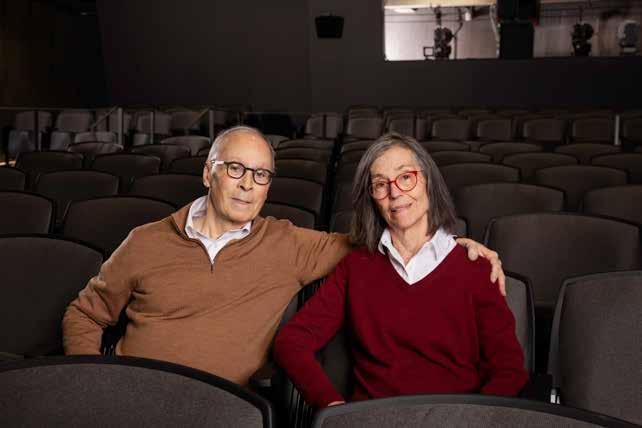
Kent and Martha in the new Kent and Martha DiFiore Cinema in the Film & Media Arts Building.
Guest Artist Thank You
Connoisseur $25,000 +
Anonymous
ArtWorks For Kids
R&Y Atkin Family
John Ballard and Karen Miller, MD
Lisa and Darren Bastian
Beesley Family Foundation
Sandi Behnken
Kenneth P. and Sally Rich Burbidge Foundation I
Dick and Timmy Burton Foundation
Tina and Ken* Burton
Community Foundation of Utah
Lawrence T. and Janet T. Dee Foundation
Julie Dere and Willard Dere, MD
Kent and Martha DiFiore
Emma Eccles Jones Foundation
Marriner S. Eccles Foundation
Fidelity Charitable Gift Fund
Perry Fine, MD and Susan Fine
Clinton Ford and Bruce Bastian*
Carolyn Gardner and Kem Gardner, JD
Caitlin Gochnour
Joel and Frances Harris, PhD
Diana Hinckley and Bob Hinckley III
Kathie and Chuck Horman
Libby Hunter
Tim F. Kenny
Wilma S. Livsey
Nancy Peery Marriott Foundation
James R. and Judith C. Michie
Anne Osborn Poelman
Joyce* and Robert* Rice
Janet* and Bertram* Schaap
Beverley Taylor Sorenson Foundation
Roger H. and Colleen K. Thompson Family Foundation
Kristin Whitaker
Aficionado
Anonymous
$10,000–$24,999
Nathaniel Bowler
Edward L. Burton Foundation
Rebecca England and Jordan Kimball
Lisa L. and Eric C. Evans
Kem C. Gardner Family Partnership, LTD
Doug Jolley
Janet Q. Lawson Foundation
Markosian Auto
McCarthey Family Foundation
S. J. & Jessie E. Quinney Foundation
Gayle and Steve Reiber, PhD
W. Mack and Julia S. Watkins Foundation Trust
Frank and Janell Weinstock
Benefactor $5,000–$9,999
Anonymous
E.J. Bird Foundation
The Rodney H. Brady and Carolyn Hansen Brady Foundation
Sandra Brock
Ellen Bromberg
Kenneth P. and Sally Rich Burbidge Foundation II
Susan Burke
George S. and Dolores Doré Eccles Foundation
Lee A. and Audrey M. Hollaar
Gordon and Connie Hanks
Lynn Hales and Mary Hales, PhD
Mike and Jody England Hansen
Merit Medical Systems
Anne Neeley
The faculty, staff, and especially the students in the College of Fine Arts thank our generous donors for their contributions to the College and its five academic units from January 1, 2025, through April 1, 2026. Their incredible generosity has enhanced education, empowered many, and inspired us all.
If you’re interested in supporting the work of the College of Fine Arts and its academic units, visit finearts.utah.edu
Steven L. Rosenberg
Byron Russell, LLC
Jeffrey Shields, JD and Mary Ross
Joanne L. Shrontz Family Foundation
Patron $2,500–$4,999
Anonymous
American Opportunity Foundation
Tika Beard
John Bennion, PhD and Liz Bennion
Mitzi Brady and Rodney Brady, PhD*
Andrew F. Burton
R. Harold Burton Foundation
Lisa Chaufty and Miguel Chuaqui
Genevieve Christianson and Shane Larson
Susan Dillon
Lisa Eccles
Spencer F. and Cleone* Eccles
Joan Firmage
Darla Gill and Pieter Unema
June Harral
Samuel Harris
J. Chris and Sandra Hemmersmeier
Meg Higgins
Joseph Jarvis, MD and Annette Jarvis, JD
Sarah Kurrus
David J. Luker
James P. Macken
Judith and James McConkie
Michelle Michie and Robert Stringham
Andrea Nelson
Pat and Gene Ninomiya
Wayne Petty, JD and Robyn Petty
Patricia and Frank Pignanelli
Jennifer Price-Wallin and Anthony Wallin, MD
John and Marcia Price Family Foundation
Princeton Area Community Foundation
George and Laurie Ralphs
Lesli and Scott Rice
John Scheib, PhD and Amy Scheib
Katherine W. Smith
Smith and Wilcox Blue Skies Foundation
Joe Zeidner and Susan Dillon
Advocate $1,000–$2,499
Anonymous
Nancy Ann Brockway
Chamber Music Society of SLC Inc.
Marian Connelly-Jones and Gary Jones
Peggy De Azevedo
Anne Decker
Paul Dorgan
Richard Ernst
Abby and Jerome Fiat
Don Froese
Ken Garff For Good
Susan Gillis-Kruman
Ralph and Rosetta* Gochnour
Emma Gourley
Laura Grantier
Greater Horizons
Jeffrey LaMora
Liz Leckie
Donald and Mary Lloyd
E. Marc Mariani, MD and Michelle Mariani
Angelica Matinkhah
David Payne
Donald Pedersen, PhD and Kathy Pedersen
Pepsi Cola Bottling of Salt Lake
Susanne Pisciotta
Sarah Projansky, PhD and Kent Ono, PhD
Ray, Quinney, and Nebeker
Roberta Rea
Anne Riffey
Jean Sabatine
Schwab Fund for Charitable Giving
Michael Shaheen
Beth Souther
U.S. Charitable Gift Trust
Susan Vinetra Burke
Kathleen Weiler
John and Joy Wiscombe
Ethel Wright
Friend $1–$999
thank you
Anonymous
Kurt Addison and Michelle Coulam Addison
Adrienne Ainbinder
Sheila Ainlay and Michael Steiner
Laurel Alder and Nathan Alder, JD
Brady and Carol Allred, DMA
Carol Anderson
Diane and Michael Anderson
Sumiko Anderson
Alex Antonio
Mark Antonio
Natalie Antonio
Vanessa Antonio
Charles Aoki
Dawn Aoki
Sophia Araujo Jacobs
Arkansas Community Foundation
Sidney and Thomas Armstrong
Emily Arvizo-Olivares
Sophia Ashaboglu
Marie and Jack* Ashton
Reed Atkin
Kiri Avelar
Mark Baer, JD and Christina Baer
Belle Baggs
Kyle Bakke
Robert Baldwin, DMA and Maria Baldwin
Andrea Ballas
Sara and Ryan Bardo
Colleen Barnes
Devon and Jake Barnes
Charles Barrus
Anne Barton
Genevieve Basu
Cullen Battle and Mary Ann Battle, DPT
Denise Begue
Caraline Beld
Joyce and Robert* Bennett
M. Lynn Bennion Foundation
Trish Benson
Daniel and Tricia Bergeson
Martha and Craig Berghahn
Rainy Berry
Katharine Biele and George Howze*
bioMérieux, Inc.
Tristana Black
Trevor Blanchard
Penelope and Keith Boettiger
Patti Bollenbaugh
Ann Bonner
Cara and Jeff Bonner
Robert Bonner
Laura Book
Katriya Boonkrataung
Christopher Borg
Blake Bratcher and Kyle Adcock
Samantha Briggs
Anne Brillinger
Maria Brock
Steven Brosvik
Beverly Brown
Joan Brown
Halley Bruno
Jessica Brunsvold
Harriet Burandt
Catherine Burns
Nicole Butler
Darryl Butt, PhD and Ann Butt, RN
Brutus Byward
Cynthia Byward
Matthew Byward
Tiberius Byward
Craig Caldwell
Nichole Campbell
Priscilla Campbell, CPA
Heidi Cannella
Zizheng Cao
Emma Capen
Mckenna Capener
Tracy Cargill
Jennifer and Gary Carlson
Colby Carpenter
Begonia Carrasquillo
Sean Carter
Elsa Castillo
Kathy Castleton
Cedarwood at Sandy CENGAGE Learning
Dhiraj Chand
Marland Chang
Kathleen Chau
Nico Cheek-O’Donnell and Sydney Cheek-O’Donnell PhD
Carrie Cheng
Roseann Cherenson
Susan Chilton, EdD
James Chipman
Chipotle Mexican Grill
Kylie Chu
Gwen and Gary* Church
Ryan and Michele Church
Randy and Tamralynn Clark
Mark Clouse
Ruth Coleman
Justin Coles
Jordan Collum
Jana Conrad
Christina Coonradt
Ford Copple
John and Jennifer Corbett
Brianne Corbridge
Thomas Costello
Clifford and Stanna Coury
Jamie Covington
Janet and Jack* Cox
Roger Cox
Eileen Csontos, MD and Noah Csontos
Olivia Custodio
Brad Dalton, DPT and Jessica Dalton
William Darger
Mary Darron Lillian
Owen Dattilo
Sarah Daughtrey
Teruyo Davis
Elizabeth Dawson
Marc Day
Joselli Deans
Christopher Dechet, MD and Pilar Dechet
James and Monica DeGooyer
John and Shauna Delvie
Cristin and Philip Denlea
Philip and Cristin Denlea
Dianne Shelden Howe Trust
Stanley DiCicco
Kathryn Dodge
Mary Donahue
Chris Donley
Lisa Doyle, MD and James Doyle
Madeline Driver
Cindy Dubon
Elise Dunaway
Christine Dunbar
Casey Duncan, PhD
Melita Dunn
Eve Eckardt
Michael Eckardt
ECS Publishing Corp.
Edward L. Burton Foundation
Jennifer Ehlers and David K. Ehlers, Jr.
Eric Eide, PhD and Shellie Eide
Jennifer and Steven Eitel
Belinda and Homer Elizondo
Adalynn Eller
Merrill Ellis
Elaine Englehardt, PhD
Samuel Englert
Jill Enright
Drew Fallon
Anacelic Fernandez
Sarah Ferreira
David Ferro and Anne Ollilainen
William Ferry, Jr. and Richard Oosterom
David and Marsha Fetzer
Emeri Fetzer
Carli and Mark Fickes-Freshour
Tonya Finley
Cynthia and Jeff Fleming
Marin and Steven Fogg
Melissa Fonnesbeck
Camilla Fowler
Bret and Tawnya Fox
Casee and John Francis
Mary and Daniel* Freed
Diana Friedley
Margie Frohlich
Anette Fuentes
Jan Fugit
Fund Raising Counsel Inc.
Megan Furse
Susan Gabriel
Joseph Galema
Andrew Garcia
Ignacio Garcia
Christian and Marie Gardner
Jerry Gardner, PhD
Kimberly Gardner
Susan Gaskill
Krishna Gaurav
Barbara and William Gelegotis
Michaela Gerard
Jordan Gerton and Brenda Mann
Alexis Gibson
Tori Gilbert
Robert Gilchrist, JD and Mary Gilchrist
Fiona Giudici
Rebecca and Royden Glade
Brandon Glenn
Joan and Gary Glenn
Keely Glenn
Greg and Caitlin Gochnour
Dale and April Goddard
Steven Goemaat
Lareena Goertz
Barry Gomberg, JD and Deborrah Gomberg
Marina and Elenor Gomberg
Juan Gomez
Paul and Stephanie Graber, PhD
Marren Grant
Richard and Carolyn Greene
Dora Grinnell
Roberto Guerricchio
Anne Gutcher
Kristy and Pierre Guzman
Brian and Mary Haan
Jason Hadley
Henning Haffner
Edward Haggerty and Kristine Halverson
Robert Haise
Amanda Hales, DMA
Michele Halstenrud
Larry Hancock
Eric and Pamela Handman
Bill and Christa Hansen
Blake Hansen
Scott Hansen
Hugh and Leslie Hanson
Peter Hanson, USA (Ret.) and Jeanine Hanson
Rachel Harbison
Caitlyn Harris
C. Bradford and Mary Ann Hatch
Frederick Hawkes
Hailey Heagerty
James Heagerty, Jr. and Debbi Heagerty
Jimmy Heagerty
Joe Heagerty
Kathryn Heagerty
Georgia Heller
Steven Henke
Emily Herb
Paul and Leora Hewitt
Rebecca Hickox
Duane and Corrine* Hill
Lisa Himonas and Constandinos Himonas, JD
Janice Hobson
Lisa Hochgraf
Stephen and Patricia Hodson
Corey Hollinger
Michele and Lawrence Holzman
Jeffrey Horne
Lynda and Douglas* Horne
Dianne Howe, PhD
Deborah and Richard Hoyt
Ryan Huey
Miriam and Marc Hugentobler
Shirley Hughes
Meredith Hunnibell
Pai-Lin Hunnibell
Sybil Huskey and Michael Lavine
Bradley Hyatt
Intel Foundation
Scout Invie
J.P. Morgan Charitable Giving Fund
Jackman Music Corporation
Jennifer and Thomas* Jackson
Kimberly James
Nicole Jeffers
Courtnie and Douglas Jensen
Setsuko Jensen
Allan and Karen Jeong
Daniel John
Aaron Johnson
Brandon and Nettell Johnson
Caroline Johnson
George Johnson, IV
Stephanie Jones
Tiffany Jones
Kathy and Eric Kankainen
Heike Kapanicas
Angela Keddington
Angela and Seth Keeton
Ethel Keeton
Pamela Keller
Safia Keller and Lester Keller, PhD
Roger Kiers
Chaeyoung Kim
Michael Kimball and Kari Dineley
Aya Kinoshita
Carolyn Kipp and Carman Kipp, JD*
Rachel and Matt Kitterer
Janice and Rod Klassovity
Mary Jo and Robert* Kleinschmidt
Kerry and Vincent Knackstedt
Kathy Knowlton and Joseph Knowlton, JD*
Jennifer and Roger Kohler
Jesse Kohn
Farnaz Kojouri
Kiarash Kojouri
Stanley and Eileen Kraczek
Jacqueline Kraft
Beth Krensky, PhD and Edward Gorfinkle
Jeannine Krenson
Emma Lamb
Keith and Michele Lampers
Elizabeth Lanza
Amanda Laraway
Hannah Larsen
Lorraine and Matthew Larson
Paige Larson
Hsuanwen Lazalde
Toni Lehtinen
Benjamin Leroy
Alison Lewis
Walter Lewis
Jeanne Liem
Robert Lifferth
Lynn Lininger
Sara Link
Adam Lloyd
Ron Lockwood
Jim Logue
Robert Loynd
Joan Ludwig
Katy and Joel Macey
Kennard Machol and Wendy Summers
Linda Machol
Kristin and Timothy Madden
William Maguire
Kathleen Maierle
Maggie Maierle
Shawn Maierle
Paul Majnik
Brenda Mann
Hank Mann
Brian and Erika Manternach
Mary-Margaret Marcantonio
Evangelina Marenco
Michele Margetts, PhD
Xochitl Marquez
Sue and Kevin Martin
Kim Martinez
Grace Mastroianni
Mary Mathieu
Samantha Matsukawa
Catherine Matthews
J. Michael and Mary Mattsson
Ellen and Lynn Maxfield
Susan and Richard Maxfield
Sydney May
Cassie Mayfield
Sarah McCarthey, PhD and Mark Dressman
Peggy McDonough and Patrick Jan
Sarah McDowell
Maureen McGill
Theresa McGrattan
Dianna Mcknight
TJ and Taylor McMullin
Hale and Mary McNinch
Merritt Mecham
Nathan Megura
Andrin Mele-Shadwick
Robin Merrill
John and Connie Michels
Kent and Barbara Michie
Lisa and M.Scott Mietchen
Suzanne and Chuck Miller
Madoka and Jed Minoff
Kenneth Mitchell
Rassa Modares
Louis Moench, MD and Deborah Moench
Henriette Mohebbizadeh
Frederick Moreton, Jr. and Lucy Moreton
Morgan Stanley Global Impact Funding Trust, Inc.
Eric and Emilee Morgan
Justin Morgan
Kylie Morrissey
Anissa and Daniel Morse
Veronique Moy
Sonya Munsell
Melonie Murray, PhD and Steve Murray
Nathanael Myers and Sian Griffiths
Prajwal Nagaraju
Jay and Sandhya Narasipura
Patricia Nebenzahl
Catherine and Jacob Nelson
Lisa Nelson
Leyla Neslanovic
Jim Ngo and Holly Drury
Erasto Nieves
Stu and Pam Nord
NOVA Chamber Music Series
Emmie Nygard
Kathleen Oboyle
Wilma and Kenneth* Odell
Larry Ogden, JD and Judith Ogden
Braun Oldenkamp
Tyler Oliphant, DMA
Karen Oliver and Mark Oliver, MD
Alan and Julie Olsen
Opera Appreciation Club
Anil Kumar Palaparthi, PhD
Anne Palmer
Ashton Palmer
Panda Restaurant Group, Inc.
Margaret Pearson
Ginger Perkins
Jennifer Peters, MD
Greg Petersen
Lisa Petersen
John Peterson
Jordan Peterson
Leslie Peterson and Kevin Higgins
Toni Lee Peterson
Adam Pfost
Sara Pickett
Ray Pierotti
Jorge Pille
Deanna Pond
David Poslusny
David Power, PhD and Rhenda Power*
Nora Price
Professors Emeriti Club at University of Utah
Peggy Pugh
Yvonne Purcell and Michael Purcell, USAF (Ret.)
Levgen Ragulin
George and Karen* Raine
Edward and Carol Randell
Vernon and Loretta Rice
Katharine and R. Courtney* Richards
Malon and Myron Richardson
Sbomb Richins
Haily and Ryan Roberts
Cara Robertson
Eli Robinson
Kathryn and Rick Rodrigue
Sara Rodriguez
Yolane Rodriguez
Steven Roens, DMA and Cheryl Hart
Ryan Roggensack and Lala Phunkhang
Jorge Rojas
Ben Rolly
Jane Rosenberg and Harvey Tepner
Cindy Rothfeder and Robert Rothfeder, JD
Linda Rountree
Patricia Rubley and Raymond Rubley, Jr.*
Chortney and Deborah Ruesch
Katharin Rundus
Marijane Rushing
Kaylee Rynski
Kara Sauchelli
Richard Scharine, PhD and Marilyn Scharine
Ella Scheer
Claire Schraidt
Syvia and David Schrauth
Ann Schultz
Ellen Schwab
Julie and Ari Schwartz
Devin Schwehr
See’s Candy Shops
Angelica Segovia Madrigal
Rosemary Shadwick
Shake Shack Enterprises, LLC
Gadi Shamah
Samantha Shaw
Jonathan and Madelene Shear
Justine Sheedy-Kramer and Hasko Kramer
Jessica Sheehan
Kim Shelley
Mary Shepard
Betty Sherwood
Thomas Shields
Kyra Shimogori
Mark Shimota
Helen Shingler
Sarah Shippobotham
Chad Shmukler
Kelly Shmukler
Glenda Shrader
Jordan Shumway
Susan Shurtz
Kathryn and Lynn Skene
SLC Ballet Children’s Academy L3C
Barbara and Robert* Sluder
Richard and Jenny Smartt
Alan Smith, DMA
Catherine Smith
Jane Smith
Linda Smith, JD and Lee Shuster
Richard and Mary Jane Smith
Robert Smith
W. David Smith and Jerilyn McIntyre, PhD
Kathleen Snow, PhD and Stephen Snow
Janette Sonnenberg and Brent Sonnenberg, DDS
Beverley Taylor Sorenson Foundation
Kelly South and Terrel South, Jr.
Sandra Sowerby and Melvin Sowerby, Jr.*
Dolores Spacek
Steven Speirs
Kent and Hollie Stanley
Amanda and Hudson Stark
Sandra Starr
Debbie and Robert Stevens
Ruth Stevens and Michael Stevens, MD
Katie Stirling
Gregory Stoddard, MPH
Donna Stokely and Jere Stokley
Grace Story
John and Ramona Stromness
Judy and Mark Sulka
Mark and Judy Sulka
Andrew and Alice Sullivan
Wilson and Jan Svedin
Lennie Swenson, DPT
Utah Swimming
Arthur Swindle, JD
Mandy Tankenson
John Tarbet
Luiza Tarrago Capaverde
Breean Taylor
Cassie Taylor, DMA and Britt Taylor
Jessica Taylor
Scott Taylor
Tea Zaanti
Amy Terpstra
Alden Terry and Laura Everett
Dennis and Margaret* Tesch
Valrae Tesch
Keilah Teuscher
The Benevity Community Impact Fund
The David Power Revocable Trust
The Verity Charitable Fund, Inc.
Wendy Thompson
Ashley and Nolan Thomson
Marilyn Thorne
Megan Tillman
Rex and Allison Tilton
John Titrington
Kathy Titze and Ingo Titze, PhD
Scott Tobin
Sarah and David Tompkins
Sue Tredennick
Blythe Truhe
Lizzie Turley
Rachel Turley
Claire Turner
Erin Turner
Julianne Turner and James Stuart
Susan Turner
Cory Updyke
Madeline Ussery
Utah Music Teachers Association, Davis Chapter
Anne Van Gelder
Miriam Van Mersbergen
John Vandover, Jr. and Dana Vandover
Luc Vanier and Elizabeth Johnson
Zac and Jeri VanLeuven
Nicole Vernon
Janelle Vigil
Gina Villalobos
Maury Viola
Suzanne Wagner
David Waid and Elizabeth Young, PharmD
Cheryl and Brent Walker
Barbara Wardwell, CPA
Andrew Wasilewski
Laura Watkins
Bart Waxman
Holly Waxman
Gary Weight, JD and Jayne Weight
Thomas Welsh, PhD and Sue Carpenter
Nathan West
Carolyn Wheeler Carr
Tim Whetsel
Donovan Wilcox
Connor Wilde-Mathie
Christopher E. Willis
Kyle Willis
Leanna and Kenneth Willmore
Lynne Wimmer
Hayley Winslow
Henry and Lois Wolking
Annalise Wood
Mary and Lance Wood
Todd and Heidi Woodbury
Edith Woodling
John Wright-Costa, DMA and Julie Wright-Costa
Emma Wright
Rolen Yoshinaga
Courtney Young
Kaseem Young
Jisu Yun
Luis Zarate
Jacquie Zegan
Sima Zeiger
Elizabeth Zharoff and Kirk McCune
Michael and Stacy Zinn
Matalyn Zundel
*Denotes donors who have deceased
contributors
On the Cover
Front cover: This behind-the-scenes look at the photoshoot for the School of Dance’s “Latinx Heritage Celebration” concert from Fall 2025 features dancers from the work “Mamonas” by choreographer Vinicius Lima, a ballet in celebration of the music and talent of Brazilian Rock Band “Mamonas Assassinas.” The concert, directed by Daniel Clifton, featured four works that explored the rich history of Chicano Awareness at the University of Utah.
Dancers: Top Row From L-R (hats): Lena Robinson, Autumn Ryskoski, Valentina Meija, Kyra Woodall, Hannah Leonard, Esmee Dieckman, Bottom Row From L-R (skirts): Kaidence Vance, Charlotte Parry, Marlie Lavine, Manami Kawai.
Costume Design: Roxana Sevilla
Photo: Todd Collins
Visit finearts.utah.edu to learn more about what we’re up to and to find the digital version of this magazine with enhanced content.
Editorial Board
Dean John W. Scheib
Sonia Albert-Sobrino
Kirstin Chávez
Marina Gomberg
Kelby McIntyre-Martinez
Merritt Mecham
Kiri Avelar
Spencer Windes
Gage Williams
Rebecca Zarate
Xi Zhang
Editor-in-Chief
Marina Gomberg is the University of Utah College of Fine Arts Director of Communications + Marketing. Formerly an award-winning lifestyle columnist for The Salt Lake Tribune, she now writes on Substack at “Chronically Marina.” When not working, she loves making art and food (which is sometimes the same thing), is an avid reader, and is a 20+ year advocate for marginalized communities.
Writers
Julia Lyon believes in the power of questions. A graduate of the Columbia University School of Journalism, she loves writing about Utah’s untold stories whether on campus or beyond. Those stories have appeared on the front page of The Washington Post and in multiple U publications. Her first nonfiction children’s book, “A Dinosaur Named Ruth,” was recently published by Simon & Schuster.
Merritt Mecham is a Marketing and Communications Specialist for the University of Utah’s College of Fine Arts. She has a Master of Fine Arts degree in Writing for Film & Television from Emerson College. Her writing has appeared in Bright Wall/Dark Room, RogerEbert.com, “The Female Gaze” by Alicia Malone, and “City Weekly,” Salt Lake City’s alt weekly newspaper. Prior to joining the College of Fine Arts, Merritt worked for the U’s Film & Media Arts Department, Sundance Film Festival, and KSL NewsRadio. Outside of work, Merritt is an avid movie-theater-goer and enjoys collecting hobbies and spending time with her husband, Ryan, and dog, Wally Brando.
Spencer Windes works as a communications specialist at the College of Fine Arts. With a long career in nonprofit communications and fundraising, he’s written for numerous publications and worked as an editor at Santa Fe Magazine and Salt Lake Magazine. When not working, you can find him riding his bike, hanging out at the library, getting on a plane somewhere, or hunting up good things to eat.
Special Thanks
Andrea Ashdown
Denise Begue
Blake Bratcher
Sarah Hollenberg
Sheri Jardine
Cassie Taylor
Ashley Jian Thomson
Design in print and online by modern8
Director: Erin Farrell Speer
Choreographer: A. Raheim White
Music Director: Trevor Jex
Scenic Design: Gage Williams
Lighting Design: Michael J. Horejsi
Costume Design: Wilson Leibering
Properties: Arika Schockmel
Hair and Makeup: Tami Thompson
Stage Manager: Sierra Loertscher
Sound Designer: Porter Charlesworth
Photo: Todd Collins
Jordan Soper (MTP ‘26) as Elle Woods and the cast of “Legally Blonde,” the Department of Theatre’s first production in the new Meldrum Theatre in the Einar Nielsen Fieldhouse on the University of Utah campus.