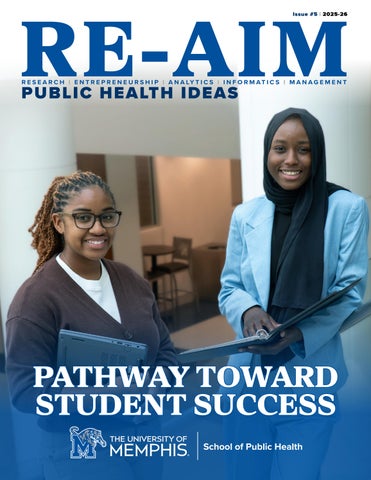
RE-AIM Issue #5 | 2025-26
R E S E A R C H | E N T R E P R E N E U R S H I P | A N A LY T I C S | I N F O R M A T I C S | M A N A G E M E N T
PUBLIC H E A LTH I D E A S
PATHWAY TOWARD STUDENT SUCCESS School of Public Health
School of Public Health
Ashish Joshi, PhD, MBBS, MPH Dean and Distinguished University Professor COMMUNICATIONS TEAM Diyala Abdlrasul, MPP Communications and Events Coordinator Kami Geron, MA Instructional Designer and Coordinator Sarah Johnson, BA Communications and Events Associate Magdalena Reilly, BA Digital Media Associate Devin Wood, BA Digital Marketing Associate Michael Jeremy O’Mara, BA Communications and Events Associate Laura Granack, MS SPH Coordinator Stay Up To Date
@PublicHealthMemphis
@uofmemphis_sph
@school/university-of-memphis-school-of-public-health ____ @MemphisSPH
____ ISSUE #5 | 2025-26 University of Memphis School of Public Health memphis.edu/publichealth
2
University of Memphis | School of Public Health
6.
Model for Public Health Education
In This Issue 40.
Ideas in Action
46-55.
10.
Alumni Spotlights
The SPH Dual Enrollment Program
12.
Dual Enrollment Student Spotlight
14.
Public Health Clubs
16.
RE-AIM Public Health Ideas Hackathon
18.
56.
Faculty Spotlight
P. 40
58-59.
SPH Speaker Series (Cover Story) Meet two students who are creating a comprehensive platform where HIV resources are easy to access and empower Memphians to stay informed and get the help they need.
PH-CARES Changemakers
70.
Community Stress and Well-being Lab
30.
71.
EMPOWER Summer Initiative
P. 22
34.
Sharing Our Mission
Public Health Diplomacy Summit SPH Awards
22.
38.
62-67.
68-69.
Public Health on Wheels
Public Health Career Readiness
60-61.
SPH Meets with TDH and SCHD
SPH launched the first Public Health on Wheels initiative in the nation, that takes students out of the classroom and into the community.
AI for Health Research Lab
72-77.
National Public Health Week
78-79.
SPH Event Highlights Do you have a story idea for the SPH Magazine?
SHARE WITH US AT
sphcommunications@memphis.edu
Issue #5 | 2025-26
3
Letter from the Dean expanding its model of public health education into high schools, public health diplomacy and initiatives around AI and Public Health.
A
s I conclude my fourth year at the University of Memphis School of Public Health, I am humbled to witness the school’s phenomenal growth and impact in the local, regional and international communities. This growth and impact could not have been accomplished without the support of SPH faculty, staff, students and community partners, who believe in the SPH CARES mission. Upon joining the School of Public Health, I set out on a mission to create an impactful school of public health, with the term “glocal” as my starting point. A school that is locally and globally impactful and serves as a social and economic engine in the City of Memphis, Tennessee and around the world. I am happy to share some of the key highlights of last year. Over the last year, SPH has continued to grow its research portfolio with a nearly 10% increase in new funding compared to last year. SPH also expanded its global footprint across a dozen countries through new partnerships and collaborations 4
University of Memphis | School of Public Health
In 2026, SPH leaped in the U.S. News & World Report rankings to No. 74 nationally for graduate public health programs in the country from its previous year’s ranking of No. 99, showing our deep-rooted commitment to building impactful programming and opportunities for our students and the community. In the fall of 2025, we launched the PH-Changemakers initiative, aimed at fueling student innovation and creativity through mini grants that give students free rein to develop socially impactful, real-world public health solutions for their communities. Seventeen SPH students — ranging from undergraduate to doctoral level — rose to the challenge. With the guidance and mentorship of SPH faculty and staff, we provided an entrepreneurial catalyst unlike anything our students had experienced before. SPH launched the first Public Health on Wheels initiative in the nation, that takes students out of the classroom and into the community to learn about real world public health practice through visits with our local community partners. The SPH-sponsored Public Health Clubs have expanded internationally, including into
India, where more than 1,500 students across 64 high schools are now engaged in public health programming. We have also established partnerships with high schools in Egypt to continue growing this network. SPH hosted the 2026 RE-AIM Public Health IDEAS Hackathon, a global hackathon that brought 85 students from 11 countries, including Canada, India, Italy, Kazakhstan, Liberia, Nigeria, Saudi Arabia, Senegal, Taiwan, Tanzania and the United States. The global hackathon served as an opportunity for shared learning, cross-cultural exchange and teamwork. We had another successful year of the Public Health Diplomacy Summit on Regional and International Cooperation to Advance Public Health Diplomacy Among the Schools and Programs of Public Health bringing together over 36 participants from 20 countries: United States, Austria, Belgium, Brazil, Canada, Ethiopia, Kazakhstan, Kenya, Lithuania, Malaysia, Netherlands, Portugal, Qatar, Saudi Arabia, South Africa, Sri Lanka, Taiwan, Tanzania, Ukraine, United Kingdom. We continue to innovate and develop impactful initiatives that can create greater community impact.
Ashish Joshi, PhD, MBBS, MPH
Dean and Distinguished University Professor
HELP US GROW!
By supporting the public health leaders of tomorrow at the University of Memphis School of Public Health
Give at www.memphis.edu/publichealth/alumni/giving.php Issue #5 | 2025-26
5
The Model for Public Health Education A Community-based High School Education Initiative
T
ake a look at the future of education, where the University of Memphis School of Public Health (SPH) is making public health knowledge accessible to everyone through its Model of Public Health Education. “UofM SPH touts itself as a Communityengaged, Anchor institute that fosters Research-based solutions, while promoting Entrepreneurship and innovation that creates an environment geared towards Studentcenteredness (SPH-CARES), says SPH Dean Ashish Joshi. The Model of Public Health Education aims to instill Leadership and Educational Advancement among youth, to solve Public Health (LEAP) challenges of the 21st century.
Built on 4 Pillars: Coping, Adaptability, Resilience and Empathy (CARE), this Model is paving the way toward transformative change that creates ideas into innovative solutions that solve today’s pressing health challenges through Research, Entrepreneurship, Analytics, Informatics and Management (RE-AIM). UofM SPH offers collegiate-level courses to high school students, giving them a head start on their academic journey — and a clear look at what a career in public health can look like. Students can customize their degrees through experiential learning and accelerated programs, stepping into their futures with confidence and making a career in public health more attainable than ever.
6
University of Memphis | School of Public Health
“SPH’s story is not simply that we offer degrees or initiatives,” said Recruitment and Admissions Coordinator Briana McNeil. “Our story is that we create a connected educational journey where students can discover public health early, personalize their learning experiences and engage in meaningful real-world work throughout their academic careers.” The School of Public Health offers students clear, transparent pathways for their education, from certificates to doctorates. Students can choose whatever piques their interest, and those unsure where to start can join a Public Health club to see the impact of SPH-CARES in action. “I truly love working with our undergraduate students, whether they’re joining us from another major or have always known public health was what they wanted to do,” said Coordinator of Undergraduate Advising and Student Engagement Rebecca Kronenberg. “I love introducing them to the field of public health — being that first point of contact in our department — and then passing them off to our expert faculty members to learn and grow their knowledge and skills.” Kronenberg notes that student opportunities have grown significantly since she joined SPH, noting that prior to her arrival, programs like the Accelerated Bachelor to Master (ABM) program had not existed. The ABM program
allows students to start earning graduate credits as undergraduates — the first of its kind in the nation and a significant milestone for students considering public health degrees. Initiatives like Public Health on Wheels give students a firsthand exposure to public health in action through on-site visits to local community organizations, including governmental and nongovernmental agencies, where they connect with public health professionals. “Since joining SPH, I’ve had the opportunity to learn more about the school’s focus on student success, assessment and continuous improvement,” Director of Academic and Student Services Verlesha Wilson said. “I value contributing to efforts that support program quality and enhance the overall student experience.”
SPH students are also a part of a global network of changemakers. With collaborators across 30 countries, experiential learning goes beyond the classroom. These classes give students the skills and tools to create real solutions to local and global problems. These glocal initiatives are not just incubated at SPH — they are implemented here. That is the level of confidence SPH instills in its students. “One of the most valuable things students have taught me is the importance they place on earning their degree and the passion they bring to their work,” Academic Services Manager Shirl Sharpe said. “Through their experiences, I have learned that success often comes from having a strong commitment to making a difference in the lives of others and in their communities.
Graduation Rates in 2025-26
Issue #5 | 2025-26
7
“
Since joining SPH, I’ve had the opportunity to learn more about the school’s focus on student success, assessment and continuous improvement. I value contributing to efforts that support program quality and enhance the overall student experience. Verlesha Wilson Director of Academic and Student Services
2025-26 SPH Data
”
Their dedication, perseverance and desire to create positive change continually inspire me and remind me of the impact that public health professionals can have on the world.” Over the past three years, student enrollment has continued to grow with the most recent academic year hosting 361 students. SPH has expanded both online and on-campus programs while keeping education personal with a 17-to-1 studentto-faculty ratio. The most recent graduating class achieved a 100% graduation rate in the Bachelor of Science in Public Health. “We strive to provide a holistic learning experience that enhances the innovative and value-driven academic pathways from high school to doctoral degrees and goes beyond the traditional classroom,” said Dean of Academic and Student Affairs Dr. Ilias Kavouras. “From internships and fieldwork in major healthcare and public health employers, research opportunities working side-by-side with renowned faculty to share emerging global issues, develop your ideas, professional development and skill bootcamps, career fairs with local, state and
8
University of Memphis | School of Public Health
federal employers, field trips and studentled organizations, we are here to help you succeed.” SPH students are its greatest legacy. The school continuously works to build a professional network of resources that does not end at graduation. Growing the alumni network has been no small feat — SPH is not just helping individuals navigate the field; it is strengthening the entire public health infrastructure. As the school grows, programs will scale to maintain this continuous cycle of support, in which today’s graduates become tomorrow’s mentors.
2025-26 STUDENTS Female 74% | Male 26%
“At SPH, we create a lifelong partnership with our students,” Alumni Relations Associate Brenda Ballance said. “We know that the post-graduation landscape can feel daunting, which is why we are actively deepening our alumni engagement and mentorship frameworks to ensure our graduates have the collective backing of the SPH community at every stage of their career.”
2025-26 STUDENT AGES
2025-26 PROGRAMS
Issue #5 | 2025-26
9
Investing in Public Health Education in High Schools Locally and Globally
T
he University of Memphis School of Public Health is the first School of Public Health in the nation to create a public health dual enrollment curriculum for 11th- and 12th-grade students leading them to obtain an undergraduate certificate in public health. “Youth should gain exposure to the skills of population thinking through public health education. High school public health education will focus on critical thinking, science and digital literacy, youth empowerment, and communitybased participatory action research in each community. Youth will learn the importance on how to acquire, analyze, evaluate, interpret, and apply information to understand societal problems in a real-world context. It also helps to cultivate a sense of social responsibility to address community health needs.” -Dean Ashish Joshi Public health is not just about treatment and service. It is about the systems and decisions that shape how people shop for groceries or schedule a doctor’s appointment. It is about how a school’s lack of extracurricular support impacts students for the next decade. It is about why communities identify problems but lack the tools to solve them.
10
University of Memphis | School of Public Health
Knowing a problem is one thing. Implementing solutions is another. A public health education equips students to address their community’s biggest challenges.
PUBLIC HEALTH DUAL ENROLLMENT: COLLEGE CREDIT Credits earned transfer directly toward a public health degree at the University — an ideal pathway for 11th- and 12th-grade students seeking an education that challenges the way they think and solve problems.
PUBLIC HEALTH IN HIGH SCHOOLS The Nation’s first Model for Public Health Education in High Schools.
“Introducing public health education in high schools is critical because many students aren’t aware of what public health entails. Dual enrollment provides early access to the field, empowering students to get engaged and help make their communities healthier!” -Dr. Alex Parkhouse Dual Enrollment Instructor at SPH
Dual Enrollment at SPH began in 2022 with a clear directive: improve access to and quality of public health education for high school students. “This model can create triple benefits of being an educational institution, a well-being hub connecting young people to services, and as an enabler for health-related engagement” -Dean Ashish Joshi Dual Enrollment students are essential to the growth and development of the School of Public Health. In the past year, SPH implemented a dual enrollment pathway allowing students to earn college credits and an undergraduate certificate
in public health — and the success of these students has been central to the school’s continued growth. Dual enrollment students are part of the SPH network, which includes community partners across the industry, medical, government and nonprofit sectors. As SPH students, they can establish themselves as candidates for internships and research opportunities unique to the program, building a professional network that lasts a lifetime.
JOIN THE SPH COMMUNITY
A HEALTHY WORLD. A CONNECTED WORLD. AND A FUTURE WORKFORCE DEDICATED TO A SHARED COMMITMENT TO PUBLIC HEALTH AND WELL-BEING FOR ALL.
Issue #5 | 2025-26
11
Driving Change in Youth Environmental Health with the SPH Dual Enrollment Program
E
lijah Schaffzin is a high school senior and dual enrollment student at the University of Memphis School of Public Health. As a student passionate about the environment, he demonstrates his commitment to creating a better tomorrow through his work on the national leadership board of the Jewish Youth Climate Movement, mobilizing Jewish youth to participate in climate action within their local communities. His journey into the field of public health surfaced from his deeply felt environmental anxiety and fear for the future and what the world will look like. Through that journey, he came to understand that scientific knowledge and social understanding were equally essential to effective advocacy. “Public health was really at the intersection of those two needs,” he said. “A huge portion of that, I found, was at the convergence of science, social action and galvanizing your communities and for me, that really oriented itself around public health,” he said. Schaffzin describes his decision to pursue public health as a “no brainer” when he was exploring
12
University of Memphis | School of Public Health
educational pathways and career tracks. Since enrolling as a dual enrollment student, Elijah has had the opportunity to take coursework in environmental health, population health and society and the social determinants of health, which he greatly enjoys. “Another important aspect is the amazing faculty that I get to interact with. These are leaders in the fields of public health and environmental health.”
As a dual enrollment student, Schaffzin is able not only to read faculty research but also to participate in it — giving him and his peers the opportunity to distinguish themselves and develop expertise in the field. “I would love to continue down the public health track, learning in fields of social science like political science, anthropology and sociology,” he said. Through his studies in environmental health, Schaffzin has found scientific explanations for questions he sought answers to including why some communities have access to resources that others do not and why some are more environmentally disadvantaged. Raised in Memphis, Schaffzin says he has been inspired by a community with a rich culture rooted in justice and a history at the forefront of civil rights and clean water movements. “I’m learning from my community and I found that justice really serves as the backbone of a lot of the action and movement here in Memphis,” he said. “Being able to become a participant in that through my studies and also through my community work means a lot.”
Elijah Schaffzin at the Global Model WHO Conference in Geneva, Switzerland.
Schaffzin encourages students to consider the dual enrollment track at the SPH, crediting it with deepening his understanding of public health and inspiring him to pursue a lifelong career in the field.
“It’s given me really important understandings of the systems and structures that influence our daily lives, and I’m so thankful for the ways that my career and studies have been furthered,” he said. Schaffzin has participated in multiple research endeavors, including a project at SPH with a faculty member, and will be included in a publication this year. He and his peers have also been considered for grant funding for projects and travel opportunities. The group traveled to Geneva, Switzerland, where they participated in the Global Model World Health Organization (WHO) Conference, gaining insight into public health and international diplomacy from industry leaders and experts.
Students from University High School and White Station High School in Memphis, Tennessee, participated in the Model WHO Health Assembly in Geneva, Switzerland.
Issue #5 | 2025-26
13
Public Health Clubs Are Empowering Youth
Through Public Health Education
I
nside classrooms, community centers and career and technical programs across Memphis, students and community members are learning that public health is not just about healthcare, it is fundamentally about the people, their neighborhoods, schools and the environments where communities live and grow. What began as a vision for youth-centered public health education has evolved into a growing movement focused on leadership, innovation and community engagement.
Students at Cordova High School 14
University of Memphis | School of Public Health
Under the leadership of SPH Dean Dr. Ashish Joshi and the University of Memphis School of Public Health faculty and staff, the RE-AIM Public Health IDEAS Clubs initiative was launched to help students explore real-world health challenges through systems thinking and hands-on learning. Pilot programs at University High School and Medical District High School established a flexible, student-centered model connecting public health concepts to students’ experiences and communities.
Public Health Clubs Continue to Grow Across Memphis During the 2025–26 academic year, SPH expanded the RE-AIM Public Health IDEAS Clubs initiative to nine high schools and two community organizations across Memphis. Through 80 club visits and workshops, nearly 200 youth and adult participants engaged in prevention-focused public health education rooted in systems thinking, communication, innovation and community problem solving.
partnerships and extending programming into community-based settings. The School of Public Health has increased its international public health club's presence to 66 schools in India alone. In Maharashtra State in India, more than 1,400 students across 52 high schools are engaging with public health clubs.
This growth reflects significant expansion from the 2024–2025 academic year, when the initiative operated across six Memphis-area high schools, delivered more than 70 club sessions and engaged approximately 116 student participants. Over the past year, the program expanded both its reach and impact by increasing school
Students at Central High School Issue #5 | 2025-26
15
RE-AIM Public Health IDEAS Hackathon
T
he RE-AIM Public Health IDEAS Hackathon is becoming more than a competition; it is helping prepare the next generation of public health innovators, communicators and changemakers. Artificial intelligence, digital health tools, public health storytelling and community-centered innovation converged during the 2026 RE-AIM Public Health IDEAS Hackathon where students from around the world explored how technology and creative problem solving can support healthier communities. Hosted through the University of Memphis School of Public Health (SPH) alongside global partners including DAV University in India, the University of Minho in Portugal, King Saud bin Abdulaziz University for Health Sciences in Saudi Arabia, L-Università ta’ Malta, the East, Central and Southern Africa Health Community and additional partner institutions — the RE-AIM Public Health IDEAS Hackathon continues to evolve as a global learning platform where students collaborate across disciplines and countries to address real-world public health challenges through innovation, design thinking, communication and research.
THE INTERSECTION OF YOUTH, TECHNOLOGY AND WELL-BEING This year, the Hackathon workshop challenged participants to think critically about how digital environments shape youth’s relationships, 16
University of Memphis | School of Public Health
behaviors and mental health. While students recognized the benefits technology offers through communication, creativity, education and global connection, they also explored growing concerns surrounding misinformation and excessive digital engagement. Framing digital environments as an emerging social determinant of health, participants were encouraged to think beyond technology itself and consider whether innovation truly improves wellbeing, strengthens communities and addresses meaningful public health needs. The Hackathon brought together 85 students representing 37 projects from 11 countries,
including Canada, India, Italy, Kazakhstan, Liberia, Nigeria, Saudi Arabia, Senegal, Taiwan, Tanzania and the United States. Memphis-area high school students competed alongside undergraduate and graduate students from across the globe, creating an environment centered on shared learning, crosscultural exchange and interdisciplinary teamwork.
“Innovations and ideas take time. But that should not stop us from thinking big. No matter what career path you take, know that you must always prioritize an environment that enables out of the box thinking.” -Dean Ashish Joshi
PUBLIC HEALTH HACKATHON WORKSHOPS Throughout the Hackathon, students participated in workshops focused on systems thinking, stakeholder engagement, brainstorming, implementation planning, storyboarding, sustainability and pitching while considering project impact, feasibility, accessibility and longterm sustainability. Participants were encouraged to first understand root causes, limitations and lived experiences connected to the issues they planned to address. The workshop series featured interdisciplinary experts and mentors who guided students throughout the innovation process.
health education. One project explored how AI-supported nutrition tools and meal planning strategies could help reduce obesity and diabetes risk among youth in Memphis communities, while another examined how art and creative expression can support youth mental health awareness and stigma reduction.
University-level teams explored how emerging technologies could strengthen public health systems and prevention efforts. Overall, successful projects focused on low-cost prevention strategies, education campaigns and communication tools that could realistically be implemented within schools and communities. Students were reminded that meaningful public health innovation is often rooted in practical, community-centered solutions that are sustainable, accessible and built to last. “Innovations and ideas take time. But that should not stop us from thinking big. No matter what career path you take, know that you must always prioritize an environment that enables out of the box thinking,” said Dean Ashish Joshi.
2026 HACKATHON PROJECTS Projects reflected a wide range of public health concerns while demonstrating growing sophistication in how students connected innovation, prevention and community impact. Several high school teams focused on youth wellbeing and digital
Ghanishth Awasthi from White Station High School in Memphis, Tenn., accepts his first place award for GOOSE: AI Misinformation Defense Tool Issue #5 | 2025-26
17
PH-CARES Changemakers
W
hat does it take to transform public health ideas into real-world impact? For students at the University of Memphis School of Public Health (SPH), the answer extends far beyond the classroom. It requires research, strategic thinking, collaboration, innovation, implementation and the ability to build meaningful partnerships with communities. Hands-on experiences in public health education are crucial for preparing future public health leaders and developing cultural competency, project management, communication and other competencies. Opportunities to move ideas from concept to implementation are often limited by academic schedules, competing responsibilities and a lack of resources. PHCARES Changemakers was intentionally designed to address that gap by introducing students to the full life cycle of public health innovation, research and implementation.
THE MISSION The PH-CARES Changemakers initiative addressed a wide range of public health priorities that directly impact both the UofM community and the broader Memphis population. Student-led projects centered on topics including community health education, chronic disease prevention, cardiovascular health awareness, HIV testing and prevention, mental health promotion, nutrition education, sexual and reproductive health and wellness initiatives for all populations.
18
University of Memphis | School of Public Health
SPH integrates applied education into the student experience through experiential learning programs that provide real-world expertise. In the fall of 2025, SPH launched the PH-CARES Changemakers program to further facilitate connection and collaboration between SPH students and the Memphis community. Designed as a student-centered innovation and implementation program, Changemakers provides students with the opportunity to transform ideas into real-world public health projects through mentorship, research guidance, project management support and $750 in seed grant funding. More than a learning experience, the initiative creates pathways for students to build partnerships, pilot solutions and navigate the full process of public health innovation from beginning to end.
In early September 2025, SPH students were invited to submit their proposals for communitycentered research, outreach, technology, education, advocacy and health innovation initiatives, with winning submissions chosen by a committee of SPH faculty and leadership. Selected students received a grant applicable toward ongoing education, educational materials, venue fees and any other projectrelated expenses. The inaugural Changemakers cohort consisted of bachelor’s, master’s and doctoral students ranging in fields from social and behavioral sciences to epidemiology and biostatistics. Participants received personalized support from assigned faculty advisors, along with communications, finance and a project-specific implementation team to assist in facilitation across all stages of the project. Interactive workshops and forums were also held to help participants refine their ideas and gather peer feedback. The program emphasized not only idea generation, but actual project implementation and refinement. Students learned to conduct needs assessments, identify evidence-based approaches, manage timelines, coordinate partnerships, evaluate outcomes, build in community and adapt projects throughout implementation. Participants were also introduced to grant management, budgeting, dissemination and stakeholder communication skills critical to sustaining initiatives beyond initial finding cycles. The goal was to create an enabling environment where ideas could evolve into impactful public health solutions supported through research mentorship, community collaboration and project implementation guidance.
COMMUNITY COLLABORATION Many projects were intentionally designed to bridge campus and community health by engaging students, residents, faith-based groups and community organizations in collaborative public health solutions. Initiatives were implemented across diverse venues throughout Memphis, including university campuses, community centers, churches, local
organizations, public spaces and digital platforms such as podcasts and social media campaigns. This multidisciplinary, communitycentered approach allowed students to apply classroom knowledge to real-world public health challenges while promoting health for all, accessibility and culturally responsive interventions. Throughout the process, students also learned how to build relationships, engage stakeholders and collaborate to develop sustainable solutions while gaining firsthand experience of navigating the realities of implementation, partnership development and problemsolving. Several student projects demonstrated the creativity, leadership and interdisciplinary thinking fostered through the Changemakers, with an emphasis on sustainability and longterm community engagement. Students built partnerships with local organizations, created reusable educational materials, trained peer educators and developed program designed to continue beyond the initial funding cycle, incorporating continuity plans to ensure their interventions remain active, scalable and adaptable for future cohorts and community partners. Issue #5 | 2025-26
19
STORIES OF REAL-WORLD IMPACT Doctoral Spotlight: Bikram Adhikari (PhD EBE ’28) Project: HealthyME – Mobile App for Non‑Communicable Diseases Bikram Adhikari advanced digital health equity through HealthyME, a free, user‑centered mobile app designed to prevent and improve management of non‑communicable diseases. Regulating daily self‑care behaviors, from medication adherence to nutrition, physical activity and health tracking, the app addressed key drivers of long‑term outcomes. Through iterative development and culturally responsive design, HealthyME integrated personalized, AI‑assisted recommendations to empower individuals living with conditions like diabetes and hypertension. Adhikari’s work underscored the growing promise of technology to scale prevention, strengthen self‑management and reduce barriers to care.
Graduate Spotlight: Rachel Beauchamp (MPH SBS ‘26) Project: 4 Minute Campus Rachel Beauchamp advanced lifesaving preparedness through 4 Minute Campus, which evaluated the feasibility of implementing a rapid cardiac response model at the University of Memphis. Her work assessed automated external defibrillator (AED) placement, tested real‑world access times and identified gaps in emergency responsiveness across campus. Beyond data collection, Beauchamp developed a campus‑wide preparedness toolkit to strengthen awareness, training and response coordination. Contributing to the broader 4 Minute City framework, her findings offered insights with the potential to shape expansion efforts throughout Memphis. 20
University of Memphis | School of Public Health
Undergraduate Spotlight: Shania Robinson (BSPH ‘26) Project: The Memphis Health Jamboree Shania Robinson redefines what public health engagement can feel like through The Memphis Health Jamboree, a community cocreated experience that blends health equity, public health research, sensory expression and resident-driven design. Instead of relying on traditional outreach, Robinson centers culture, creativity and community voice, making health not only accessible, but also inviting and joyful. Designed to extend well beyond a single event, the Jamboree is supported yearround by the O.K.R.A. Health Network and its C.O.R.N.B.R.E.A.D. initiative. A passport-style reward system encourages residents to stay actively involved in wellness activities over time. Robinson’s work illustrates how joy, participation and cultural relevance serve as powerful gateways to sustained engagement.
Shania Robinson (middle) with her team at the soft launch for the Memphis Health Jamboree. The event took place at the James Lee House on May 6.
THE FUTURE Together, the inaugural PH-CARES Changemakers cohort demonstrates that innovation in public health goes beyond generating new ideas; it requires listening deeply, valuing lived experiences and building solutions grounded in trust, culture and community. Students gain hands-on experience navigating the realities of project execution and leadership development. By guiding students through every phase of the process from research and planning to implementation and evaluation, PHCARES Changemakers is helping prepare a new generation of public health leaders equipped to create meaningful and lasting community impact. As the program continues to evolve, it highlights the impact of bringing students, faculty and staff together for a shared purpose. By nurturing collaboration, creativity and leadership, PH-CARES Changemakers helps prepare future public health leaders while strengthening the communities they serve. Changemakers is more than a program, it is a catalyst for bold thinking, meaningful action and lasting change. Issue #5 | 2025-26
21
PUBLIC HEALTH ON WHEELS
IS TAKING STUDENTS OUT OF THE CLASSROOM AND INTO THE 901 COMMUNITY
P
ublic health students don’t often leave the classroom as part of their coursework - a gap Dr. Ashish Joshi, dean and distinguished professor of the School of Public Health (SPH), set out to change. What began as a concept soon became reality. Using the University of Memphis “Blue Line” bus, students are transported from SPH to community partners’ sites for guided tours. Representatives from participating organizations answer questions and give students an inside look at daily operations and the practical work behind public health programs.
22
University of Memphis | School of Public Health
Since its inception in Fall of 2025, Dr. Lori Ward, Undergraduate Program coordinator and associate professor of Teaching in the Division of Undergraduate Studies and Global Engagement (right) and Becky Kronenberg, SPH coordinator of Undergraduate Advising and Student Engagement (left) helped spearhead the initiative, organizing two PH on Wheels journeys per semester.
“This is very important for us to see public health in action in real time. Public Health on Wheels continues to take our students into the community so they can see the opportunities available as they pursue a future in public health.” - Dr. Lori Ward
Issue #5 | 2025-26
23
SPH maintains more than 200 partnerships with local organizations across Memphis and beyond, making it an ideal hub for this initiative. Through these partnerships, the SPH Office of Experiential Learning and Career Readiness connects students to internships, jobs and practicum opportunities and now students can see those workplaces firsthand before applying.
Tyara Moore | Special Assistant to the Interim Director and Health Officer, Dr. Bruce Randolph, SCHD
SCHD Tour Shelby County Health Department
24
University of Memphis | School of Public Health
The inaugural Public Health on Wheels trip took 15 students to the Shelby County Health Department, where they learned about the department’s comprehensive services and the collaborative efforts that support countywide health outcomes.
The second trip offered a Hop-On-Hop-Off tour of major environmental sites identified as significant air polluters. Led by Jim Holt (far right) from the Tennessee Department of Environment and Conservation’s Division of Solid Waste Management and Dr. Chunrong Jia (second from the right), a UofM SPH professor and expert in air pollution, exposure assessment, environmental disparity and urban health, both experts highlighted the companies and facilities contributing to Memphis air quality issues. Students visited President’s Island, Valero Refinery, the Wastewater Treatment Facility and the xAI facility to observe the environmental and health impacts of these operations.
“This unique experience provided SPH students with valuable insights into local environmental challenges and the Tennessee Department of Environment and Conservation’s mitigation efforts,” Jim Holt from the Tennessee Department of Environment and Conservation’s Division of Solid Waste Management said.
FUME Tour Field Understanding of the Memphis Environment
“As a public health student, classroom learning is often theoretical. Activities like this allow us to incorporate theory into practice.” -Vishva Hajari, MPH student Issue #5 | 2025-26
25
On the third trip, students toured Camellia Foundation/Medicos Medical Center and saw an integrated model of care. Office Manager Joann Labrador led 15 students through pediatric, maternal, family and behavioral health clinics, showing how clinicians and staff address everyday public health challenges. Dr. John McMillan Rodney, associate professor of Family Medicine, Fellowship director at Medicos Para La Familia and President of the Camellia Foundation, emphasized how trust, coordinated care and long-term relationships improve patient outcomes and clinic effectiveness.
Camellia Foundation Tour
26
University of Memphis | School of Public Health
“Putting a face and contextualizing what it’s like to be a patient, and then getting a more tangible way of feeling why the work is important is a good way to motivate them, to see why what they do matters, is a great way for them to develop the inspiration necessary for the work they’re going to do in public health,” Dr. John McMillan Rodney said. “This was my first Public Health on wheels trip and I won’t miss another one! I think Public Health comes from lived experiences and this was one of those experiences where you get to see public health happening in real life,” said Arielle Sloan, SPH undergraduate student.
“Every SPH student should connect with Public Health on Wheels to learn how public health programs work in Memphis.” -Jean Baptist, undergraduate student
PH on Wheels Participants at The Works Inc. South Memphis Market
The final trip of the 2025–26 year took 11 students to The Works, Inc., which offers services focused on affordable housing, nutrition, locally grown food and physical activity. The Works demonstrates how community-connected initiatives can rebuild, restore and renew neighborhoods, a model of public health in action.
The Works, Inc. Tour
Whether exploring local government health services, clinical care models, industrial impacts on air quality or community programs addressing food insecurity and neighborhood renewal, students gain rare behind-the-scenes exposure to the people and organizations shaping Memphis public health.
“The response to the Public Health on Wheels program has been so exciting to see. The students have truly embraced this opportunity to experience public health in action and we look forward to providing even more opportunities during the coming year.” - Becky Kronenberg Through these hands-on experiences, SPH translates academic theory into applied practice.
Neighborhood Tour led by Karen Bernard, Food and Community Wellness Initiatives Manager Issue #5 | 2025-26
27
“I want students to become passi can take them and what better with our community partners? 28
University of Memphis | School of Public Health
ionate about where public health way than through on-site visits ?” SPH Dean, Dr. Ashish Joshi Issue #5 | 2025-26
29
EMPOWER Summer Initiative
T
he EMPOWER Summer Initiative is an oncampus, week-long program that introduces high school students to the world of public health through immersive, real-world experiences. At the heart of the program is a team-based research model that allows students to explore pressing health issues affecting Memphis communities and beyond. Through field visits to local health organizations, nonprofits and community partners students gain firsthand insight into the systems and environments that shape health outcomes.
30
University of Memphis | School of Public Health
Throughout the week, students were led by faculty mentors and public health professionals, as they worked in small groups to investigate a specific health challenge, develop a research question and design a project that reflects both scientific inquiry and community relevance. This year, students researched childhood cancers and HPV vaccines for children, examining their importance in protecting against cancers and other diseases. Each group presented their findings at the end of the week. Participants gained firsthand exposure in the field of public health through visits with organizations such as the Church Health Center, The Works Inc. and St. Jude Children’s Research Hospital.
Students were able to visit these organizations on daily field trips throughout Memphis. The partnerships SPH holds is what makes the EMPOWER Summer Initiative what it is.
Issue #5 | 2025-26
31
32
University of Memphis | School of Public Health
EMPOWER Summer Initiative participants receive participation awards, accompanied by SPH faculty and staff. Issue #5 | 2025-26
33
The Office of Experiential Learning and Career Readiness (OELCR)
Connecting Students to Public Health Career Pathways in Memphis and Beyond
34
University of Memphis | School of Public Health
On Sept. 15, 2025, OELCR hosted a Resume Workshop to show students what employers are looking for. The workshop was led by Dr. Manali Ghag, Healthcare Administrator Operations for Regional One Health.
SPH students attend Tennessee Department of Health Development Session. The event took place on Oct. 1, 2025. It covered topics like cover letter crafting, interview skills, LinkedIn and dressing for success.
F
rom career fairs buzzing with conversation to workshops designed to equip students with practical skills to optimize career readiness, the School of Public Health’s Office of Experiential Learning and Career Readiness (OELCR) is helping students take their classroom knowledge into the real world and into the workforce. Through professional development workshops, internships, practicums and fieldwork placements, the office gives students hands-on opportunities to build skills, gain confidence and make meaningful connections with professionals across the public health field. One of the biggest highlights each year is the Fall and Spring Career and Internship Fairs, hosted by SPH under the direction of the OELCR. These events bring together students and community partners for networking, career exploration and opportunities that can help shape student success. Students come prepared with resumes in hand, ready to connect with organizations offering internships, volunteer opportunities, practicums
On Sept. 9, 2025, a Mock Poster Presentation session was hosted by OELCR. Students were able to present their research to peers and mentors as practice. This is a crucial experience to help students prepare for conference presentations.
and full-time jobs. For many, these fairs become more than networking events, they become life changing experiences. Career Fair is only one example of the SPH’s commitment to student success. The school Issue #5 | 2025-26
35
FALL CAREER FAIR - 33 EMPLOYERS 79 STUDENTS
Anna Gretz (right) is an SPH alumna with a Master of Public Health in Environmental Health (2020) and this year, Gretz graduated with a Doctorate in Epidemiology. While a student at SPH, Gretz worked both the fall 2025 and spring 2026 career fairs, representing the Shelby County Health Department.
SPRING CAREER FAIR - 23 EMPLOYERS 50 STUDENTS
36
University of Memphis | School of Public Health
proudly maintains more than 200 community partnerships with governmental and nongovernmental organizations throughout Memphis, across Tennessee and beyond. These relationships help open doors for students while strengthening the impact of public health initiatives in the community. “I’m an administrative intern at Medicos and I am getting my master’s in healthcare management at the School of the Public Health and I have the opportunity to hire students. The funny thing is I attended the SPH Career Fair in the fall and that’s how I got my current internship.” - Binoy Patel, MPH student and intern at Medicos Patel’s experience is a perfect example of how one conversation at a career fair can lead to a professional opportunity and even a chance to help future students find their own path.
them along, the talent acquisition process so I know their background and their story. When I’m talking to a hiring manager, trying to get them to be hired.” - Kelsie Richardson, Senior Recruiter, Tennessee Department of Health With every internship secured, every handshake exchanged and every new partnership formed, the Office of Experiential Learning and Career Readiness continues to create pathways that empower students to thrive in public health careers. Whether students are just beginning to explore their options or preparing to enter the workforce, SPH is helping them build the connections and experiences that turn career goals into reality.
Students are also using the fairs to explore what comes next after graduation. “I came to the career fair last semester, and I got the opportunity to work at Church Health Center, for an internship. As I further my education in Healthcare Administration, the Spring Career and Internship Fair shows what jobs are available in the workforce after I graduate.” - Fatmata Bah, recent BSPH graduate Community partners say the fairs are just as valuable for employers eager to connect with passionate students entering the field. “I think it’s great that [SPH is] doing a career fair to introduce students to all the different options that they can have after they graduate.” -Tianna Reese, Community Outreach, Le Bonheur Children’s Hospital
Binoy Patel, MHA, (above) talks with peers at the Spring 2026 Career Fair. Fatmata Bah, BSPH, (below) speaks with a potential employer.
And while resumes matter, some recruiters say personal connections often make the biggest impression. “I will say, the biggest thing is the human connection. You can never beat a human connection as far as me remembering their faces. For me, knowing their story while I’m pushing Issue #5 | 2025-26
37
Sharing Our Mission Not just IN the community, but WITH the community
O
n any given day, we read countless messages on our phones or computers but hardly remember them. The School of Public Health (SPH) takes communication a step further through in-person visits to community agencies, various organizations and even neighborhood associations. As students take their seats in the classroom or in front of their laptops for remote learning, I venture out beyond the physical walls of the University to share stories about the academic excellence displayed by our students, faculty and staff. The most often heard comment from those visits, “I had no idea the school of public health was making such an impact locally and internationally!” Taking time to visit “with” people has led to a renewed understanding and appreciation for SPH’s internationally acclaimed curriculum. Dr. Ashish Joshi, dean and distinguished professor at the University of Memphis SPH, said that “We’ve made great strides to keep our community informed in a very personal way in the three years I’ve served as dean. Indeed, a handshake is often more effective than an electronic message.” Each month, the School of Public Health is included on the meeting agenda of community groups and organizations throughout Shelby County. I share the latest information about new curriculum courses, SPH’s national ranking and its work in high schools locally and internationally, to help improve the health of students and introduce them to careers associated with public health.
38
University of Memphis | School of Public Health
Those relationships with community members have led to experiential opportunities for our students, two of which were recently placed at the Shelby County Emergency Management Agency (EMA) and the City of Millington Mayor’s Office. At the EMA, two students took on projects to build a comprehensive community resource for emergency sponsors and to discover best practices that can be shared among other emergency response agencies. In Millington, our student also prepared an upto-date listing of medical, social service and government help agencies for those who contact the City of Millington Mayor’s Office for assistance. Simply said, we’re better together. We work daily with government leaders, community organizations and neighborhood groups. With over 200+ community partnerships and counting, our continual in-person presence has made us a true community resource and strengthened our high school, undergraduate and graduate programs. “Interning with the City of Millington gave me a deeper understanding of how local government can shape community health. I strengthened my skills in public health research, community engagement and resource design, while building connections with people who care about improving access to mental health resources. This experience allowed me to see how important and meaningful collaboration is when building solutions that truly support the community,” said Lauren Freeman, an SPH student who interned at the City of Millington.
During her internship at the City of Millington, Lauren Freeman worked with Frankie Dakin, Millington City Manager, who highly regarded the City of Millington and UofM SPH partnership and shared this message:
Gary Graves, Millington director of public safety, from left, Jamecia Richardson, UofM SPH staff, Frankie Dakin, Millington city manager, Lauren Freeman, SPH student and Steve Shular, community relations liaison, UofM SPH.
“
When I first met with Dean Ashish Joshi and Steve Shular to discuss the University of Memphis School of Public Health internship program, I assumed that hosting an intern would primarily be a service our office could provide to students in important program. I quickly learned it was very much a two-way partnership.
By the conclusion of her internship, it was clear that Freeman had earned a permanent role with the City of Millington. We were proud to offer her a position as a Management Fellow, and she continues to provide outstanding service and perspective to one of Tennessee’s fastest-growing cities.
Lauren Freeman, MPH, became an invaluable member of our team during her internship. She is the only Master of Public Health professional currently on our staff, and her expertise has meaningfully strengthened the organization.
I would encourage any employer to consider partnering with the University of Memphis School of Public Health. The students bring skills, professionalism and fresh perspectives that can make an immediate impact. We are grateful to Dean Joshi and the entire School of Public Health for creating opportunities that benefit both students and the communities they go on to serve.”
Public health touches nearly every aspect of local government, and Freeman’s work portfolio reflects that reality. She has coordinated with major regional partners such as MLGW, the TBI and Alliance Healthcare, while also working closely with our Parks, Police and Fire Departments.
-Frankie Dakin, Millington City Manager
Issue #5 | 2025-26
39
IDEAS in Action Meet the Students Changing Memphis One Dashboard at a Time
40
University of Memphis | School of Public Health
M
emphis Shelby County has led the nation with new HIV cases since 2020*.
Researchers and scholars have been working to end the HIV epidemic — offering free testing, care and prevention methods through local organizations, including the Shelby County Health Department (SCHD). In collaboration with the University of Memphis School of Public Health, two students are creating a comprehensive platform where HIV resources are easy to access and empower Memphians to stay informed and get the help they need. * Source: aidsvu.org
Issue #5 | 2025-26
41
“At first, it was intimidating to start the dashboard,” said Fatmata Binta Bah, a recent graduate, describing her experience in the early stages of dashboard development. “I felt overwhelmed by CodeCrew’s classes, but it was helpful to understand how the dashboard would be built before we started gathering the data and designing it. Meeting with Dean Joshi gave us more clarification and insight on what we would be doing, the goals and how it would combine with the classes we were taking. It really showed me the importance and weight of the project.” Due to the school’s location and affordability, Fatmata Bah explored both the nursing and health sciences programs in search of the right fit. She knew she wanted to work in a health care setting but did not know how to get there until she met Dr. Nichole Saulsberry-Scarboro from the School of Public Health IDEAS Workforce and Strategic Partnerships. “The only keywords and phrases I really
42
University of Memphis | School of Public Health
remember from that meeting are ‘dashboard’ and ‘find resources for HIV in Shelby County’. We ran with it,” fellow graduate Malise Greene said. “We made our own deadlines, did a lot of research and the current results look amazing, thanks to everyone on the team who has put in countless hours of work.” Greene is a Southwest Tennessee Community College transfer student that came to Memphis through the military. She served as a public health technician in the Tennessee Air National Guard and that is how she was introduced to the hands-on work in the field. Greene heard about an exciting new undergraduate program at the University of Memphis School of Public Health and has thoroughly enjoyed herself ever since. Quickly, they were enrolled in CodeCrew Code School and started their internships with the Shelby County Health Department through a Population Health Data Analytics Program grant. As undergraduate students, they built strong
The Team
FATMATA BAH MALISE GREENE foundational public health knowledge and data analysis skills to support their work in population health. “We got the opportunity to work with an organization, so the weight of that versus this just being a project that your teacher is critiquing was different,” Bah said. “We got to see how one of the local partners invited students from high school through early college years to learn about topics like the environment and what that looks like in implementation. That whole process of creating surveys of analyzing qualitative and quantitative data and leading a focus group, was
a very eye-opening experience. That was the class that solidified what I wanted to do — I don’t want to do heavy academic research; I want to solve problems. I want to see an issue and be able to recommend a solution or implement that solution myself.” “Classes with Dr. Debra Bartelli have been most memorable in my experience with the School of Public Health,” Greene said. “I took her Population Health Design and Intervention course as well as her Population Health Program Evaluation one. Her class is set up to be more of an open forum for conversation and as my Issue #5 | 2025-26
43
COLLABORATORS
Code Crew
We are changing Memphis with programs that focus on ensuring that students are taught the principles of information and computation, how digital systems work and they learn how to put this knowledge to use through programming and software development concepts. CodeCrew programming includes a number of summer camps, after school programs, in-school electives classes, internships and special events.
Shelby County Health Department Since May 2015, we have taught more than 15,000 students to code through our summer camps, after-school programs, in-school electives, and exposure events. Of the 800 students we serve weekly, 92% are black and latino youth, 44% are girls who code and overall, 85% of our students are more likely to study computer science. Furthermore, 79% of our students write their first line of code with CodeCrew. By investing in continuous education and professional development, we can ensure that our public health professionals remain at the forefront of innovation and best practices. Collaborative efforts between governmental agencies, academic institutions and community organizations can foster a resilient and adaptive public health infrastructure. This approach not only addresses immediate health challenges but also prepares us for future crises, promoting a healthier, more equitable society for all. Furthermore, by emphasizing the importance of mental health and well-being among public health workers, we can sustain their passion and dedication to serving the community. Together, we can build a robust public health system that safeguards the wellness of generations to come.
44
University of Memphis | School of Public Health
classmates got comfortable with each other, the conversations got better. I enjoyed hearing the different perspectives and opinions everyone had to offer and wish them all the best in the years to come.” Both Bah and Greene are continuing their education with the School of Public Health. From her class experiences, Bah chose a Master of Healthcare Administration to continue learning about strategic thinking, operations management, process and quality improvement to address systemic issues and patient experiences. Alongside her long resume of experiences, Bah will continue to make SPH a better place as well as welcome a new Code Crew cohort to the project in the fall. Greene chose the Master of Public Health in Urban Health to get more volunteer and professional experience in urban development and policy to build communities that reflect the people that live in it and their needs. Growing up in Washington, D.C., shaped her goal of building a career in urban planning by learning about cities like Memphis. “We want to make sure we are serving the community as much as we can,” Bah said. “We took all our lessons into real life implementation. There was a deeper understanding in my education — being a hands-on learner made me grateful for all the skills that I was taught on top of my coursework. For example, you don’t have to reinvent the wheel, you can just tweak it to apply to what you need. I see myself staying in Memphis and branching out to gather more information to bring back here. I want people to feel safe and taken care of.” “There are still a few things to cross off my list of accomplishments before returning to Washington, D.C.,” Greene said. “I will still be in the city for a while. I currently work at the Shelby County Health Department but see myself venturing out to gain more experience in other areas of interest. The SCHD has been flexible with my school schedule as well as all giving me personal and professional lessons that I will carry with me for a long time.”
Issue #5 | 2025-26
45
HOW UNIVERSITY OF MEMPHIS ALUMNI
Patrick and Ellen Denning Blend Epidemiology, Advanced Nursing and Educational Leadership to Transform Communities
W
hen we look at public health through the lens of statistical tracking, county health directives and state-level epidemiology, it is easy to forget the individuals behind the numbers. Yet, for University of Memphis School of Public Health alumni Patrick and Ellen Denning, the vast architecture of systemic healthcare is built entirely upon the art of the one-on-one connection. The Dennings shared their professional trajectories, explaining how their multidisciplinary educations have equipped them to cross institutional boundaries and impact lives across communities. From the hospital setting to the classrooms of early childhood education, this couple continues to exemplify effective leadership. Today, Patrick serves as an accomplished Family Nurse Practitioner at Methodist Le Bonheur Health System, holding an MPH from the SPH, an MSN from Vanderbilt University and a Doctor of Nursing Practice from George Washington University, where he specialized in healthcare quality. During his clinical days, treating patients across the lifespan with acute and chronic conditions, Patrick heavily incorporates non-pharmacological interventions. “We can talk about medication all day long, but lifestyle adjustments are where sustainable health lives,” he says. He is a firm believer in behavioral changes, counseling patients on manageable, evidence-based habits, such as swapping out high-calorie sodas for zero-sugar alternatives or walking briefly after meals to engage skeletal muscles and optimize insulin performance. Patrick connects these individualized routines back to larger public health metrics. By utilizing structural quality improvement
46
University of Memphis | School of Public Health
strategies, ensuring organizational objectives are Specific, Measurable, Attainable and Timely (SMART), he works to reduce the populationlevel prevalence of chronic conditions like hypertension and diabetes.
Ellen, who earned her MPH followed by a Master of Clinical Nutrition at University of Memphis, applies her epidemiological and biostatistical expertise to an unconventional environment: early childhood education. As a school principal, her “epidemiology brain” activates the moment a teacher reports a sick child. “My mind instantly starts tracking and mapping the data,” Ellen said. She visualizes the network of interactions, cross-referencing classroom proximities, sibling pairs across different grades
and timing indicators to trace communicable thresholds before an illness spreads. Her background allows her to issue clear, evidencebased communications to parents regarding institutional health threats. This data-driven background, combined with her deep understanding of human development, has earned her trust within her community. Ellen recounted an interaction with a school parent who holds a doctorate in biology: “When I explained my background in public health and epidemiology, he looked at me and said, ‘You are the captain of this ship.’ There was an immediate baseline of trust because he knew I understood the science behind our health policies.” Furthermore, Ellen utilizes her clinical nutrition and counseling education to coach staff and guide parents through behavioral challenges, food pickiness and the long-term structural impacts of adverse childhood experiences (ACEs). “The things we teach the little ones impact them across their entire lifespan, creating huge ripple effects in the community,” she highlights. When asked what wisdom they would offer
to students currently walking the halls of the University of Memphis, both Patrick and Ellen pointed directly back to the human element. They urge public health students to learn from seasoned professionals and to look beyond purely technological fixes. “Even though Ellen and I are diehard millennials, not everything needs an app,” Patrick emphasized. “There is a vital art to communication. A quote that got me through nursing school and still guides me today is: people will only remember half of what you say, but they will always remember exactly how you made them feel.” Ellen echoed Patrick’s sentiment, noting that every experience, even a challenging or frustrating role, holds immense professional value because it refines one’s understanding of where they can make the most meaningful impact. By pairing mathematical, data-driven frameworks with genuine empathy and active listening, the Dennings are a prime example of how University of Memphis alumni continue to build healthier, safer and more deeply connected communities.
"We can talk about medication all day long, but lifestyle adjustments are where sustainable health lives." -Patrick Denning Issue #5 | 2025-26
47
How One Alumni Couple Is Reshaping Public Health
F
or many couples, keeping work separate from personal life is a golden rule. But for University of Memphis School of Public Health alumni Drs. Allison and Andrew Plaxco, public health is more than just a career, it’s an endless dinner-table conversation and shared passion. Today, both alumni serve as faculty members at the University of Alabama at Birmingham (UAB). Allison is an assistant professor of Biostatistics and Andrew is a clinical assistant professor of Optometry. Together, they represent a convergence of clinical practice and data science. The Plaxcos’ journey began long before their time at the University of Memphis. They first met while earning undergraduate degrees at the University of Tennessee at Chattanooga. When the couple moved to Memphis, it was originally for Andrew to pursue his Doctor of Optometry degree at the Southern College
48
University of Memphis | School of Public Health
of Optometry (SCO). At the time, Allison was working an unfulfilling job in corporate supply management. With an undergraduate background in economics, she found herself longing for a career that could translate her interest into helping others. The turning point came when Dr. Marian Levy spoke to Andrew’s optometry class about a unique partnership: a concurrent online Master of Public Health (MPH) program. Andrew came home and suggested Allison investigate it. “I was looking to go further into economics, but they didn’t have a PhD program at the University of Memphis at the time,” Allison reflects. “Once I started understanding what public health was, it was perfectly in line with what I loved about economics, looking at community-level social determinants of health and public goods but focusing on how it impacts an individual’s outcomes.”
biostatistics and research on sickle cell disease and dry eye syndrome, a project where both of their paths intersect. As Andrew and Allison look back at their time at the University of Memphis, they pay tribute to their faculty mentors, particularly Drs. Meredith Ray, Matt Smeltzer and Marian Levy, for creating an environment of guidance and support. “Get involved in an external research or community project with the faculty. Applying what you learn in the classroom to a real-world initiative cements the concepts in a way a textbook never can,” Allison said. Allison enrolled, spending five years at the School of Public Health to earn both her MPH in 2021 and her PhD in Biostatistics in 2024. Meanwhile, Andrew balanced his clinical duties at SCO with the online generalist MPH program. Though they both share the same master’s degree, they approach public health from opposite ends of the spectrum, making them the perfect collaborative team. “We use each other as a sounding board constantly,” Allison says. “Andrew has a deep clinical perspective. If I have an abstract idea about implementing a program or interpreting study design, he can tell me exactly how that would play out in real practice with actual patients.”
Andrew’s parting advice for students centers on personal growth, adding: “Try to learn as much as you can from every single assignment,” Andrew said. “Avoid the mindset of only studying hard enough to get a passing grade. If you train your mind to treat everything as important while in school, that mindset will carry you incredibly far in your career.” From undergraduate peers to University of Memphis graduate alumni, Allison and Andrew continue to demonstrate the impactful nature of the field of public health.
“My days are mostly individual-based, clinical care. Allison is focused on study design, epidemiology and biostatistics. It teaches me how to be literate when searching through complex research papers and analyzing the validity of data,” Andrew adds. Andrew’s current routine is a whirlwind of clinical instruction. On any given day, you might find him conducting eye exams on residents in a nursing home, treating underinsured communities at a Federally Qualified Health Center (FQHC) or guiding interns through practical skills labs at UAB Eye Care. Allison’s days are equally dynamic, balanced between teaching graduate-level Issue #5 | 2025-26
49
From Rural India to Urban Tennessee How This SPH Sibling Duo Re-envisioned Their Family’s Public Health Legacy
F
or some, the public health experience is viewed as unchartered territory, a world of unknowns. But for siblings Rahul and Hima Bindu Kodali who grew up in the public health space in India, the field was all too familiar. Rahul and Hima were practically raised in hospitals. Their parents, both physicians, explored and experienced public health through a patient-bypatient lens. For Rahul and Hima, however, public health felt more compelling when it was studied at a macro, community-based level, as their interests were absorbed in treating entire communities. Both Hima and Rahul graduated from the School of Public Health. Rahul earned his Master of Public Health (MPH) in 2024, and Hima earned her MPH in 2025. When they first enrolled at the University of Memphis (UofM), they both started on different pathways. Hima came to the University with a Bachelor of Dental Surgery from India, which for her, felt like something was missing. During her time in the field, she organized oral cancer awareness campaigns in rural Indian villages,
50
University of Memphis | School of Public Health
where she realized that individual clinical work couldn’t fix systemic gaps. This brought her to the UofM to study Epidemiology. Guided by Dr. Fawaz Mzayek, Hima took on a major capstone project evaluating the mental health of campus
Rahul Kodali performs an HIV test as a part of Friends for All, in the UofM University Center.
students in collaboration with the Housing Department. “I was drawn to the research and data side,” Hima says. “I wanted to understand how to design programs and analyze surveys to create actual structural change.” As for Rahul, his passion for behavioral sciences and the operational side of health administration drew him to SPH. He highlighted an interactive first-semester class with Dr. Kenneth Ward, as the turning point for him, where his love for public health just clicked for him. “His enthusiasm drove me straight toward behavioral sciences,” notes Rahul, who plans to eventually pursue a PhD in psychology. With these two siblings embarking on similar pathways, sibling rivalry was surprisingly a nonissue. “We didn’t compete; we helped each other,” Rahul said. “Because Hima was focused on research and I was focused on fieldwork and administration, we constantly bounced ideas off each other after classes.” Now based right here in Memphis, Rahul serves as the outreach and Mobile Unit Coordinator for the non-profit Friends for All. On any given day, you can find him driving a mobile medical clinic directly into unhoused encampments and underresourced neighborhoods, stepping out to offer free HIV and STI testing.
Working as an Enhanced Care Management coordinator for Fathers to Founders, she serves as a mediator between frontline care managers, the California Department of Public Health and major insurance entities. “Don’t wait for anyone to hand you an opportunity,” Rahul said. “Let your work ethic speak for you.” The Kodali siblings continue to be optimistic and dedicated to giving back. When asked what advice they would pass down to students today, their answers exhibit their unique public health journeys.
“Every single day, I use what I learned about the social determinants of health,” Rahul explains. “When you are writing grants or interacting with patients from all walks of life, having that training means our deliverables are executed far more effectively.”
Hima points to the power of connection and networking, especially for international students: “Go out and talk to people. Walk into the University in the morning, see how vibrant it is, network across different departments and carry your resume everywhere. You have to be seen.”
Hima on the other hand, set out to the West Coast, where she is tackling the homelessness crisis in San Francisco.
As a powerful sibling duo and legacy alumni, Rahul and Hima Kodali are making their missions to create healthier communities a reality. Issue #5 | 2025-26
51
The Alumni Couple That is Leading Memphis Healthcare into the Future
I
n the fast-paced world of modern healthcare administration, leadership requires a unique blend of strategic vision and empathy. For University of Memphis School of Public Health alumni Christopher and Morgan Jenkins, it also requires a shared Google calendar. As one of the school’s premier “legacy groups” alumni who are married, siblings or multigenerational family members, the Jenkins’s represent the absolute best of what the Master of Health Administration (MHA) program has to offer. Today, they are navigating the complexities of the Mid-South medical landscape side-by-side, balancing executive responsibilities, a busy family life and a deeply rooted commitment to their alma mater.
DIVERSE BEGINNINGS, COMMON GOALS Long before they were executives orchestrating healthcare delivery in Memphis, Chris and Morgan took completely different paths to campus. Morgan, who graduated with her MHA in 2017, earned her undergraduate degree in Community Health from the University of Illinois UrbanaChampaign. Driven by a desire to impact the system from the administrative side, she took a brief hiatus before moving back home to Memphis to plant professional roots. “Proximity and the instant, deep connection I felt during the interview 52
University of Memphis | School of Public Health
process drew me in,” she said. Chris, on the other hand, took what he jokingly refers to as a slightly less traditional route. Graduating from the University of Montana at Missoula with degrees in Business Administration and Radio/TV, he spent his college mornings as an on-air radio DJ. “Clearly, she is the smarter and better-looking of the two of us,” Chris joked. After a stint working in Las Vegas, Chris felt the pull back to the Mid-South. While considering an MBA, a mentor pointed him toward healthcare administration. After auditing a single class, he fell in love. He graduated with his MHA in 2007, exactly 10 years before his future wife. It was also through the local healthcare network and their Tiger connections that the two eventually met. While Morgan was completing a graduate assistantship at Methodist Le Bonheur Healthcare, Chris was climbing the ranks within the same system. Their shared passion for operations quickly turned into a life partnership.
NAVIGATING THE FRONTLINES TOGETHER Today, both Christopher and Morgan hold critical leadership roles in the local market under the Tenant Healthcare umbrella. Chris serves as the chief operating officer for St. Francis Hospital, while Morgan is the associate director for St.
Francis Medical Partners, managing the primary care and specialty physician division across the greater Memphis area.
ethics than you,” she advised. “At the end of the day, we are all on the same team trying to care for the patient.”
Their daily routines are a testament to the 24/7 reality of modern medicine. Chris’s day starts at 4 a.m., mapping out strategic goals over coffee before heading into safety huddles, therapeutics committee meetings and root-cause analyses with physicians.
Chris encourages students to avoid simply “chasing a title or checking a box,” and instead embrace every minor assignment as an opportunity to understand how a complex healthcare ecosystem operates.
Morgan’s days are equally dynamic, moving between clinics to put out fires ranging from sudden staffing shortages to provider coverage. “I particularly love the ambulatory side because I’m not confined to the same four walls,” Morgan said. “Every day is different, and it’s all about building relationships with everyone from the front desk to the practice managers.” Both agree that the turbulence of the pandemic years permanently altered the healthcare administration landscape, forcing leaders to master emergency response and supply chain logistics on the fly. To handle the daily pressures, Chris offers a piece of advice he often shares with current students: “When you go into healthcare administration, you are 50% firefighter and 50% psychologist.”
“Your greatest ability as a healthcare leader is availability and visibility,” says Chris. “Hospitals are 24/7, 365. True leaders show up for their teams on weekends, overnights and holidays. You have to be there.” Through their leadership, service and shared devotion to public health, Christopher and Morgan are ensuring that the legacy of the University of Memphis continues to shine across the Mid-South.
PAYING IT FORWARD Despite their incredibly demanding executive schedules and raising a family, the Jenkins’s refuse to disconnect from the hallways where their journeys began. Chris regularly serves as an adjunct professor for SPH and participates in career panels to mentor the next generation. When asked what wisdom they would pass along to students preparing to lead hospitals in the year 2040 and beyond, their answers are beautifully grounded. Morgan urges students to master technical operational tools like Excel but emphasizes teamwork above all else. “Spend time learning how to appropriately respond to and support people who have different backgrounds or work Issue #5 | 2025-26
53
How Two Siblings Formed a Lifelong
Public Health Alliance
F
or many families, passing down a legacy means inheriting a piece of heirloom jewelry or an old family business. But for the Boop family, legacy is measured by something else entirely: a profound, multigenerational commitment to saving lives and safeguarding community health. Alumni siblings, Scott Boop (MPH ’15) and Sarah Boop (MPH ’16) are the living embodiments of this calling. Born to a family where healthcare was practically dinner-table conversation, their mother was a dedicated Neonatal Intensive Care Unit (NICU) nurse and both their father and grandfather were neurosurgeons. Yet, when
it came time to specialize, both chose to anchor their careers in a shared baseline philosophy in the School of Public Health. Today, the siblings sit on different but equally vital fronts of health care. Scott is wrapping up his rigorous neurosurgery 54
University of Memphis | School of Public Health
residency at the University of Washington in Seattle before heading to Chicago for a fellowship in pediatric neurosurgery, officially stepping into his role as a third-generation neurosurgeon. Sarah has taken her clinical nursing background and public health education and channeled it into large-scale leadership, serving as the assistant regional director of the Northeast Region for the Tennessee Department of Health, where she guides strategic planning and operations for eight health departments across seven counties. Despite the thousands of miles separating the two, the siblings remain aligned thanks to their shared master’s degrees.
"Having a Master of Public Health gives you a fundamentally different perspective compared to a lot of my peers who only come from pure clinical MD backgrounds, it installs a framework of systemic philosophy and modes of thought that change how you look at patient care."
- Scott Boop
While Scott utilizes those systemic viewpoints to evaluate big data sets in academic neurosurgical research, Sarah relies on them to navigate the unpredictable nature of state health administration. "The most surprising turn for me was transitioning from direct patient bedside nursing into an administrative role," Sarah said. When looking back at the halls they both walked a decade ago, both emphasize that the real catalyst for their careers in public health was the SPH faculty. Educators Dr. Marian Levy and Dr. Vikki Nolan left indelible marks on both siblings. For Scott, a master’s research project under Nolan paired him directly with physicians at Le Bonheur Children’s Hospital. The biostatistics and database-building skills he mastered during that study laid the critical groundwork for his success today. For Sarah, her public health world expanded globally through an unforgettable research trip to Haiti with Dr. Debra Bartelli, alongside specialized substance use grant work with Dr. Satish Kedia that directly informs her epidemiological choices today. "It continually blows my mind how relevant the things I learned in grad school remain. When I'm trying to navigate complex professional hurdles, those early lessons are still exactly what I rely on," said Sarah. "We have always shared thoughts, ideas and professional problems with one another," Sarah says of her brother. Because they share the same degree, they act as an unmatched sounding board for one another. Scott and Sarah urge students to look beyond traditional textbook baselines and develop unconventional skills. For those looking to step into leadership,
"I’ve always loved clinical care, but my training helped me grasp the broader, macrolevel context of community well-being. Whether it is tracking a localized overdose crisis or coordinating a multicounty strategic budget, it constantly reminds me that everything is connected." - Sarah Boop Sarah’s advice is simple: master the art of storytelling. "We have to learn how to tell the successes of public health in a way that rebuilds institutional trust," she said, citing mis- and disinformation as a massive modern hurdle. "We need leaders who can translate advanced science and meet everyday people exactly where they are." Scott, on the other hand, encourages a deep dive into numbers. "Become familiar with data science, data structures and even coding," he advises. "To make true, data-informed structural improvements in healthcare, you have to know how to collect and evaluate the big picture." Though their day-to-day realities look different, one spent in operating rooms, the other at the helm of regional health strategy, Scott and Sarah are a dynamic duo, showcasing that when it comes to changing the face of healthcare, family legacy can serve as a powerful catalyst for creating public health impact.
Issue #5 | 2025-26
55
FACULTY SPOTLIGHT DR. MARYAM KARIMI
M
aryam Karimi PhD, MPA, MS, joined the University of Memphis School of Public Health in August 2024 as the director of research and associate professor in the Division of Epidemiology, Biostatistics and Environmental Health. Prior to joining SPH, she held faculty appointments at the University of Alabama at Birmingham and Rowan University. She completed her postdoctoral fellowship at Columbia University’s Mailman School of Public Health.
into environmental science and public health research, first through a bridge program and later through doctoral studies at CUNY. Dr. Karimi recalls her reason for joining SPH as attributing to the school’s vision and mission inspired by the strong commitment to innovation, research excellence, student success and community impact.
Dr. Karimi earned her PhD and Master of Science in Earth and Environmental Sciences from the City University of New York (CUNY) Graduate Center and an MPA from Baruch College, CUNY.
Her research focuses on understanding how environmental factors such as air pollution, climate change, urban heat and flooding affect human health, particularly in vulnerable communities.
Growing up in Queens, New York, Dr. Karimi became aware of how neighborhood conditions, environmental exposures and access to resources could shape people’s health and quality of life. Those early observations eventually led her
“My research helps communities better prepare for environmental risks, reduce exposure and improve health outcomes.” In the next few years, she envisions her research expanding through AI-driven tools, smart technologies and stronger
56
University of Memphis | School of Public Health
community partnerships. One of her most memorable research projects came during her doctoral work, where she studied urban heat islands across New York City at the neighborhood level. At the time, block-by-block modeling of heat vulnerability didn’t exist at that scale — what they found was striking: environmental exposures could vary dramatically within the same community, sometimes just streets apart. That work helped lay the groundwork for bridging climate science, urban planning and public health in ways that have shaped much of her research since. Dr. Karimi is also the founder and the FTO of CanAiry: a wearable health device designed to monitor environmental exposures and respiratory health in real time with the goal of preventing asthma, COPD flare-ups and other respiratory problems while improving quality of life.
supported through NIH-STTR, USDA and USDA-NIFA, with a focus on environmental health, biomedical innovation and climate resilience. Dr. Karimi is currently working towards building interdisciplinary collaborations across universities and hospitals, creating a healthier environment and a better quality of life for every community she serves. “My goal is to help shape the school’s research culture, strategic direction and growth with faster implementation of new ideas, programs, centers or initiatives and more direct mentorship that impact our students and junior faculty,” she said.
She is excited about the potential CanAiry has as a groundbreaking device that can serve over millions of Americans who are living with COPD, asthma or any lung health-related disease. CanAiry is focused on prevention and early detection so that they can receive the one-onone care they deserve from their health care specialist. Dr. Karimi hopes that it will help to avoid unnecessary an in-person visit and hospital admissions through remote patient management and telehealth solutions. Her and her team, which includes Dr. Ross Nazari, chair and professor of the Department of Civil, Construction and Environmental Engineering at the University of Memphis, are working hard to get the device into the hands of users. The device has undergone patient trials and the miniaturized device has been designed for shelf use. “CanAiry represents the successful translation of academic research into a scalable precision health technology with strong clinical, community and public health applications,” notes Dr. Karimi. Among Dr. Karimi’s notable achievements, she is leading and contributing to an externally funded research portfolio exceeding $1.9 million, Issue #5 | 2025-26
57
Dean’s Grand Rounds I
n the Fall 2025 semester, the School of Public Health hosted three Dean’s Grand Rounds events. Two were led by deans of schools of public health in the United States. The third
was a healthcare leadership community advisory panel with healthcare leaders from the top healthcare institutions in the City of Memphis. SPH students, staff, faculty and community
members heard from leading public health and healthcare experts. They were also able to network with these like-minded professionals.
Current and Emerging Opportunities in Healthcare Leadership
with the members of Dean’s Healthcare Leadership Community Advisory Group Panel • • • •
Dr. Diane Sanders-Cepeda, Senior Health Leader, Clinical Strategist, United Healthcare Dr. Manali Ghag, Healthcare AdministratorOperations, Regional One Health Sarah Gaskell, Senior Vice President and Chief Strategy Officer, Methodist Le Bonheur Healthcare Clint Cummins, Chief Executive Officer, The Memphis Medical Society
Global Perspective on Quality Health Information with Dr. Ayman El-Mohandes, dean of the City University of New York Graduate School of Public Health and Health Policy (CUNY SPH)
58
University of Memphis | School of Public Health
•
Dr. Laurie Shanderson, President and Chief Executive Officer, Accreditation Insights
Global Health Diplomacy in Action: Lessons from the TOPOWA Study in Uganda with
Dr. Monika H. Swahn, inaugural dean of the School of Public Health at Virginia Commonwealth University
SCHD Speaker Series T
he Spring 2026 semester had a total of four Shelby County Health Department (SCHD) Speaker Events. They provided students with an
opportunity to learn about different jobs at the health department, day to day work that is involved as well as the lives of some of its employees.
Feb. 27: Erica R. Grant Ervin and Misty Hayes-Winton (L-R) Both speakers work with reproductive and sexual health and focused their presentation on the matters. Guardrails against STDs in the community, like the usage of PEP and PrEP, were explained.
Speakers spoke on their background and what led them to the health department before explaining job functions.
March 6: Dr. Bruce Randolph Interim Director and Health Officer Dr. Bruce Randolph presented at the second event. He highlighted measures and programming SCHD is conducting to create positive health outcomes for the community
April 17: Elatris Estell March 20: Debbie Barrett, Felicia Sawyer and Reginald Keith and Julie Schuman (R-L) Bernard (R-L) To end the semester, the Medical Reserve Speakers included Opioid Response and High Impact Area Manager, the Public Health Nurse Supervisor and the Manager of Population Health.
Corps (MRC) Manager for PHEPP and the SCHD Regional Epidemiologist spoke on emergency preparedness.
Issue #5 | 2025-26
59
SPH Meets with TDH and SCHD To Garner Collaboration Between Academia and the County and State Health Departments
T
he SPH delegation met with Dr. John Dunn, interim commissioner of the Tennessee Department of Health (TDH) and his team, as well as Dr. Bruce Randolph, interim director of the Shelby County Health Department (SCHD), and his team. This meeting served as a pivotal introduction to the many potential opportunities for collaboration between the three organizations, bringing together state, local and academic institutions in shared efforts to advance public health and education. It occurred on Dec. 10, 2025 in the Maxine A. Smith University Center at the University of Memphis. These partnerships are expected to create expanded research and experiential learning opportunities for UofM SPH students, while also contributing to the overall well-being of Tennesseans. Dr. Ashish Joshi, dean and distinguished professor at UofM SPH, highlighted the school’s
60
University of Memphis | School of Public Health
current programs and certificates, as well as upcoming new degree offerings. Dean Joshi emphasized what makes UofM SPH unique on a national and international scale, including a public health education pathway that spans from high school to doctoral levels, one of the first of its kind. He also discussed new SPH initiatives that extend learning beyond the traditional classroom, such as the Public Health Hackathons, which invite high school and university students from around the world to collaborate and compete on innovative public
practice. The PH Diplomacy Lab showcases SPH’s vision for expanding its global presence in the field. The Community Stress and Well-being Lab, housed within SPH, is the first of its kind in Memphis, focusing on the study of stress and mental health through targeted interventions and graduate training. This meeting highlighted the importance of cross-sector collaboration between academic institutions and public health agencies to advance public health education, research and community impact throughout Tennessee.
health solutions. Dr. Joshi also spoke about the Public Health on Wheels initiative, which provides SPH students with a learning experience that goes beyond the classroom and directly into the community, offering students a behind-thescenes look at public health in action. In the past year, UofM SPH established new centers and labs that reflect its strategic priorities. The Center for Responsible AI in Public Health (CRAIPH) underscores the school’s focus on advancing artificial intelligence in public health
Issue #5 | 2025-26
61
2026 Public Health Diplomacy Summit
62
University of Memphis | School of Public Health
O
n March 23, the University of Memphis School of Public Health kicked off its second Public Health Diplomacy Summit. This year’s event focused on Regional and International Cooperation to Advance Public Health Diplomacy Among the Schools and Programs of Public Health. The opening reception was hosted at the FedEx Institute for Technology, at the
University of Memphis. The threeday summit brought together a diverse array of stakeholders, including academicians, civilsociety representatives, diplomats and partner organizations from 19 countries, to advance public health diplomacy.
Contributors, community partners and other guests stand at the opening reception of the 2026 Public Health Diplomacy Summit.
Issue #5 | 2025-26
63
DAY 1: OPENING RECEPTION The summit began with an evening reception and opening remarks from distinguished leaders representing academia, public health agencies and international organizations. The kickoff session provided an opportunity for networking, introductions, and reflections on the evolution and importance of public health diplomacy globally. Speakers: • Dr. David J. Russomanno – Executive Vice President for Academic Affairs and Provost, University of Memphis • J.W. Randolph – Deputy Commissioner for Public Health Infrastructure, Tennessee Department of Health • Dr. Bruce W. Randolph – Interim Director and Health Officer, Shelby County Health Department • Dr. Laura Magaña – President and CEO, ASPPH • Robert Otok – Director, ASPHER • Dean Ashish Joshi – Dean, School of Public Health, University of Memphis and Summit Host/Organizer
64
University of Memphis | School of Public Health
DAY 2: EXAMINING PUBLIC HEALTH DIPLOMACY
The second day of the Public Health Diplomacy Summit was focused on panel discussions between the participants. Panels focused on how countries, institutions and public health leaders can strengthen international collaboration to address global health challenges. Across six sessions, panelists shared regional experiences, research findings and strategies for integrating diplomacy into public health practice and policy.
(Above) Dr. Laura Magaña receives her award for dedication to advancing public health diplomacy.
Discussions highlighted the shift from traditional global health diplomacy toward a broader public health diplomacy approach that emphasizes collaboration, health security and cross-sector partnerships. Speakers examined lessons learned from Europe, Africa, the Americas and Asia while also identifying opportunities for stronger international cooperation moving forward. Panelists emphasized the importance of engaging students and practitioners in applied public health diplomacy initiatives to prepare future leaders in the field. Issue #5 | 2025-26
65
DAY 3: LAUNCH OF THE EXECUTIVE PROGRAM IN PUBLIC HEALTH DIPLOMACY IN PRACTICE To conclude the second Public Health Diplomacy Summit, Dean Joshi and fellow moderator Paul Barach invited panelists to discuss “Exploring Experiential Learning Opportunities for Students in Public Health Diplomacy.” Summit collaborators subsequently announced the launch of the first Executive Program in Public Health Diplomacy in Practice, developed in collaboration with 10 international organizations to provide students with hands-on experiential learning in the field.
66
University of Memphis | School of Public Health
Issue #5 | 2025-26
67
Dean's SPH Awards In April, SPH recognized 12 individuals for their exceptional achievements in Community Engagement, Commitment, Research and Leadership at the third annual Dean's SPH Awards Ceremony.
DEAN’S SPH AWARDS FOR FACULTY
Faculty Research: Dr. Kallol Kumar Bhattacharyya
Assistant Professor, Division of Health Systems Management and Policy
Faculty Teaching: Dr. Alex Parkhouse
Program Coordinator and Assistant Professor, Division of Social and Behavioral Sciences
Faculty Community Engagement: Dr. William C. Bigler
Assistant Professor, Division of Health Systems Management and Policy
DEAN’S SPH AWARDS FOR STAFF EXCELLENCE
Staff Leadership: Laura Granack, MS SPH Coordinator
Staff Commitment: Annette Rhodes
Financial Services Associate
DEAN’S SPH AWARD FOR GRADUATE STUDENTS
Research: Xin Jin, PhD Student
Division of Epidemiology and Biostatistics
Commitment: Pamela Graham, PhD Student
Division of Social and Behavioral Sciences
Dissertation: Edmore Madondo, PhD Student
Division of Epidemiology and Biostatistics
Community Service: Coree Entwistle, MPH Student Division of Social and Behavioral Sciences
DEAN’S SPH AWARD FOR UNDERGRADUATE STUDENTS
Community Service: Shania Robinson, BSPH Student Commitment: Arielle Sloan, BSPH Student Research: A’niyah Williams, BSPH Student
68
University of Memphis | School of Public Health
Faculty Awards DR. MATTHEW SMELTZER In early 2026, Dr. Matthew Smeltzer represented University of Memphis School of Public Health as honorary Head Coach for a Memphis Tigers Basketball game. Dr. Smeltzer was also awarded the 2026 University of Memphis Award for Distinguished Research in Science, Engineering and Mathematics.
DR. CHUNRONG JIA During the University of Memphis vs. Tulane University football game in November 2025, Dr. Chunrong Jia’s research on air pollution and his impactful work at the University of Memphis School of Public Health was recognized during half time. Dr. Jia, a UofM SPH professor, has authored over 80 peer-reviewed publications advancing our understanding of environmental health and air quality. His primary area of research is exposure and risk assessment of organic compounds in the ambient and indoor air.
Issue #5 | 2025-26
69
Community Stress and Well-being Lab Publishes Two Articles
Lab Director Alex Parkhouse, PhD, MA
Assistant Professor, Division of Social and Behavioral Sciences
SPH Graduate Students Chitra Ghosh, MBBS, MPH
Division of Epidemiology, Biostatistics and Environmental Health
Prada House, MPH
his team of three SPH graduate assistants: Chitra Ghosh, Prada House and Dennis Tsegah.
Dennis Tsegah, MBChB
The second paper, “Climate change knowledge and stress: An exploratory survey of undergraduate college students,” is published in The Journal of Climate Change and Health. Results from this study, which center on climate change-related knowledge and stress, revealed undergraduate college students are well informed about climate change, but increased knowledge about climate change is accompanied by increased stress. Survey findings additionally indicated that climate change stress plays a role in undergraduates’ perceptions of their future, career, and everyday lives. The publication was a collaborative effort between SPH’s Alex Parkhouse and colleagues at Quinnipiac University: Drs. Sarah Lawson and K. James Soda, and graduate students Abigail Eydman and Alina Filandro. The Community Stress and Well Being Lab at the University of Memphis School of Public Health was established in 2025, with support from the School of Public Health’s Research Initiative Supporting Excellence in Early Career Development (RISER) Award.
Division of Epidemiology, Biostatistics and Environmental Health Division of Social and Behavioral Sciences
T
he Community Stress and Well-being Lab at the University of Memphis School of Public Health celebrates two inaugural peer-reviewed publications. The first paper, “Graduate student voices on stress and mental health: Narrative survey results from a Mid-South University in the United States,” is published in Preventive Medicine Reports. The study, which highlighted graduate students as a uniquely vulnerable subgroup of the population, revealed students are stressed, though the meaning, chronicity and management of stressors vary. More, graduate student narratives chronicled actionable steps universities can take to reduce stress and improve mental health among graduate students. The research team included Dr. Alex Parkhouse, lab director and assistant professor of Social and Behavioral Science and
70
University of Memphis | School of Public Health
The AI for Health Research Lab at UofM
Celebrating the First Year
S
ome of the most ambitious ideas start in the smallest spaces. Room 202 of Robison Hall is small, tucked away and easy to walk past. But inside, the AI for Health Research Lab at the University of Memphis School of Public Health has been quietly asking some big questions about how artificial intelligence (AI) can improve population health. Launched in 2025 with support from the NIH AIM-AHEAD PAIR program, the lab spent its first year building the groundwork. Weekly training in AI methods and research ethics, partnerships with universities, healthcare organizations and community groups and preparing grant applications to support the work ahead. It has been a year of learning as much as doing.
and careers in public health. The more useful question is not just how we adapt, but whether we can help guide that change toward something safer and more responsible. That is what this lab is committed to, and it is the kind of work I had hoped to be part of. The lab just turned one, and so did I as a PhD student. A lot more to come, as the lab plans to expand its work into maternal and child health, nutrition and military and veterans’ health, bringing the same approach to an even wider range of communities. I am looking forward to growing alongside it.
That work has taken a few different shapes. We have been exploring how a prescription for pain relief quietly turns into dependence over time using machine learning and working toward the development of an AI-based device to support the social well-being of elderly individuals. We have also been asking how public health professionals feel about AI’s growing role in their careers, and what they might need to navigate that change. Spending time on these projects, and with researchers and practitioners across disciplines, has made one thing clear to me. AI is already changing the healthcare field
Joomi Kim, MS, is a first-year PhD student in Social and Behavioral Sciences and a graduate research assistant (left) with Director and Principal Investigator Ricky Leung, PhD, MPhil, MS, professor of Social and Behavioral Sciences (right). Issue #5 | 2025-26
71
NATIONAL PUBLIC HEALTH WEEK 2026 WITH APHA AND SPH
The University of Memphis School of Public Health proudly joined the nationwide celebration of National Public Health Week (NPHW) which began on April 6. The week featured a series of engaging and educational activities designed to promote health and wellness.
72
University of Memphis | School of Public Health
DAY 1: UOFM BRIDGE WALK + PH ON WHEELS The School of Public Health kicked off NPHW celebrations with the annual SPH Bridge walk at the Hunter Harrison Memorial Bridge at the University of Memphis campus, followed by a Public Health on Wheels field trip to The Works, Inc., a nonprofit community development organization dedicated to renewing Memphis neighborhoods through innovation, advocacy and collaboration. Students learned about the programs The Works offers, including initiatives dedicated to affordable housing, nutrition, locally grown food and physical activity.
Issue #5 | 2025-26
73
DAY 2: SPH COOKOFF The School of Public Health hosted its inaugural SPH Cookoff at the UofM Tiger Food Lab, where SPH faculty, staff and students competed to create simple, nutritional recipes that anyone can make at home. The event was a great way to promote healthy eating and teamwork while learning about good nutrition and nourishing, approachable recipes.
SPH COOK OFF WINNERS
THE WINNING DISH
DAY 2: PHSA X SCHD After the cook off, the Public Health Student Association (PHSA) hosted a tabling event in collaboration with the Shelby County Health Department (SCHD) at the Student Activity Plaza. SCHD representatives spoke about the Memphis aquifer and the importance of the aquifer in providing clean water for residents of the City of Memphis, the state of Tennessee and beyond. They also spoke about overall community health in the Memphis and Shelby County area. 74
University of Memphis | School of Public Health
DAY 3: PLANT AND PICNIC The SPH hosted its annual Plant and Picnic event to help beautify the campus and learn about the latest climate health challenges and solutions from the community garden coordinator, Art Johnson and faculty expert, Dr. Naser Titu (R-L).
DAY 4: EBE COLLOQUIUM The day started with the Epidemiology, Biostatistics and Environmental Health (EBE) Colloquium where SPH students learned about AI applications for early detection and adjuvant treatment selection in lung cancer. Dr. Peng Huang, professor of Oncology and Biostatistics, Johns Hopkins University School of Medicine, spoke at the event.
Issue #5 | 2025-26
75
DAY 4: SPH MEET-AND-GREET + YOGA SPH organized its first Campus Meet-and-Greet where the school’s students, faculty and staff spoke to UofM students about SPH programs and the school’s many offerings. The event featured lawn games, watercolor painting, giveaways, yoga and music.
76
University of Memphis | School of Public Health
DAY 5: FRIENDSHIP FRIDAY WALK To wrap up National Public Health Week, students were invited to join faculty and staff for Friendship Friday. This was an opportunity for SPH to come back together after all of the exciting events from the week. We cooled down together with a stroll around the Memorial Field track.
Issue #5 | 2025-26
77
SPH Event Highlights ORIENTATION
FALL 2025
SPRING 2026
New Student Orientation was held both in Fall 2025 and before the start of the Spring 2026 semester. After an introduction of the school, new students were able to mingle with current students, faculty, staff and alumni.
FRIENDSGIVING
Every year, the Public Health Student Association and the Master’s of Health Administration Student Association host Friendsgiving. The November celebration gathers students, faculty and staff. Attendees bring food that is important to them and are able to learn about dishes from other cultures. 78
University of Memphis | School of Public Health
BACK TO CAMPUS The Welcome Back to Campus Social is an annual opportunity for new and current students, faculty, staff and alumni to come together at the start of the spring semester. Old friends were able to reconnect and meet new ones.
FRIENDSHIP FRIDAY UofM SPH is lucky to be located directly next to Memorial Field, giving easy access to its track. Friendship Fridays are a time for faculty and staff to walk and talk as a group in the open air. These events happen throughout both the spring and fall semesters to promote both exercise and camaraderie.
SPH FAMILY PICNIC
The SPH Family Potluck Picnic is a springtime tradition for students, faculty, staff, alumni and their families to get together! The event had fun games for the whole family. Issue #5 | 2025-26
79
80
University of Memphis | School of Public Health
Issue #5 | 2025-26
81
3825 DeSoto Avenue 232 Robison Hall Memphis, TN 38152 MEMPHIS.EDU/PUBLICHEALTH
The University of Memphis School of Public Health is Committed to being a resource to the community through Partnerships, collaborations and engagements.
Follow @UofMemphis SPH