THE U NIVERSITY OF LOUISVILLE COLLEGE OF BUSINESS MAGAZINE
SPRING 2026
Vol. 8 | No. 1
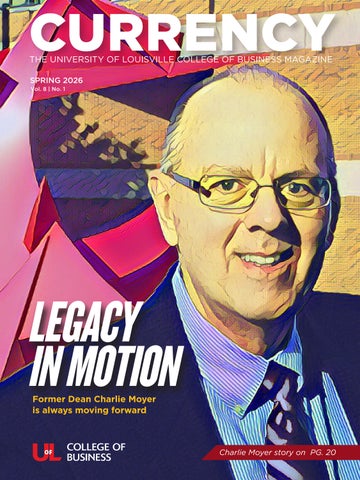
Vol. 8 | No. 1
Former Dean Charlie Moyer is always moving forward
















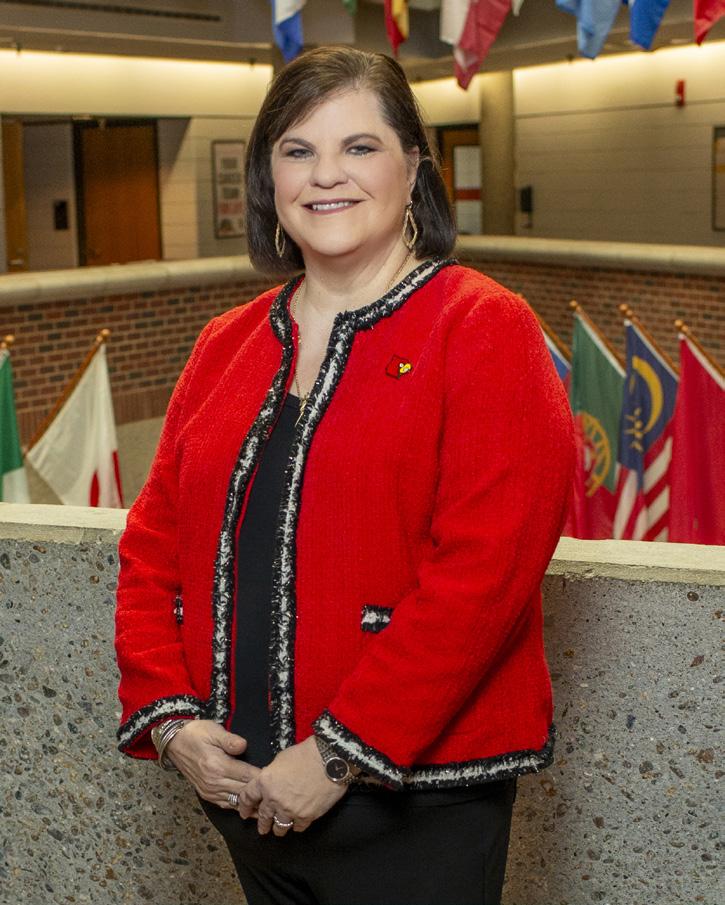
Dear College of Business community,
As I reflect on my first year leading the College of Business, one word stands out: momentum.
You can see it throughout this issue of Currency. It’s in students launching ventures like Thrifted, alumni leading organizations across our region and faculty creating learning experiences that extend far beyond the classroom. These aren’t just stories – they’re proof of what’s possible here.
This issue also gives us an opportunity to recognize a leader who helped build that foundation. Former Dean Charlie Moyer shaped this college in lasting ways, from his vision for growth to the culture of excellence that continues today. As he retires, we celebrate both his legacy and the path forward it made possible.
That forward momentum is accelerating. The Anderson family’s transformational gift (see page 32) is a powerful investment in what comes next – expanding opportunities for students, strengthening our programs and reinforcing our role as a driver of economic impact. Across Louisville and beyond, partnerships continue to open doors for real-world learning and meaningful collaboration.
Over the past year, we’ve advanced key priorities – from expanding experiential learning to deepening our work in artificial intelligence and executive education. New spaces like the Texas Roadhouse student lounge and growing programs such as supply chain reflect a clear focus: creating relevant, career-connected experiences.
What stands out most, however, is our people. The drive, creativity and resilience of our students, faculty, staff and alumni are what truly define this college.
Momentum doesn’t happen by accident. It’s built through bold ideas, strong partnerships and a shared commitment to progress.
And we’re just getting started.


Amy Henley Dean, College of Business
by Erica Hulse
How do you build a career at the intersection of ideas, impact and opportunity? For Larry Horn, it has meant turning his University of Louisville College of Business education into a trajectory that includes founding startups, building the region’s innovation ecosystem and leading Amplify Startups, his entrepreneurial support organization, in collaboration with the CoB.
Having seen Louisville’s entrepreneurial landscape from multiple angles – as a UofL business student and alumnus, a venture-backed founder and a member of the college’s Board of Advisors, Horn works alongside business faculty, administrators and other area corporate leaders to help students turn ideas into real companies. His recent recognition as a Wilson Wyatt Alumni Ambassador and his frequent conversations with CoB students reflect a steady commitment to empowering business students who will become entrepreneurs contributing to regional growth.
Horn recently shared with us how the college helped him build the confidence and skills to navigate a non-linear career, how his experience in startups informs the way he supports founders today and how he envisions CoB graduates playing a central role in Louisville’s next decade of innovation.
UofL: As a first-generation college student, what were some early experiences that shaped your perspective on education, opportunity and work before you ever set foot on campus?
LH: Growing up in a blue-collar household shaped how I think about work and opportunity in very real ways. I watched both of my parents work incredibly hard, and I also knew what it felt like to not have much. That combination – effort without guarantees – ironically made risk feel less scary later in life. When you grow up without a safety net, you learn how to persist, adapt and keep showing up.

For much of my life, my mother was the catalyst for understanding the importance of education. My high school graduation cake famously read “MBA = BMW,” which perfectly captured my youthful, material-driven motivation at the time. Beneath the humor, though, was a deeper message: education could open doors that hard work alone sometimes couldn’t. That early lens – effort matters, opportunity is earned and consistency counts – still shapes how I lead today.
UofL: What initially drew you to UofL for your undergraduate degree in marketing, and later your MBA in entrepreneurship?
LH: Growing up, I admired business leaders the way other kids admired athletes or musicians – they were the rock stars of my youth. I devoured books about people like Jack Welch and David Jones, Sr. The University of Louisville felt accessible, practical and connected to the real world, which mattered to me. Marketing appealed to me because it sat at the intersection of creativity and

Larry Horn
strategy. I was already succeeding in sales roles and learning firsthand how positioning, storytelling and meeting customers where they are can drive results.
Later, the MBA in entrepreneurship was truly catalytic. It wasn’t just about theory – it sharpened my critical thinking and surrounded me with builders. That program didn’t just teach me how to think about business – it helped me see myself as someone who could create one.
UofL: Looking back, what aspects of your time as a student most influenced how you lead and make decisions today?
LH: Two things stand out: critical thinking and relationships. The MBA taught me how to ask better questions and evaluate trade-offs rather than chase perfect answers. Just as important, it helped me build relationships and a network I still rely on today. Leadership, for me, is about clarity, curiosity and trust – and those muscles were developed through classrooms, team projects and real-world competitions at UofL.
UofL: You went on to co-found multiple venture-backed startups, such as Roth River and TNG Pharmaceuticals. What did those founder experiences teach you about risk, resilience and building something from the ground up?
LH: Being a founder – especially in the venture world – has a fast way of teaching humility. You hear “no” far more than “yes.” There’s rarely a perfect moment, and almost never applause when you share an idea. That’s just the terrain. Over time, you learn that progress comes from belief – sometimes bordering on stubbornness – paired with persistence. Ideas don’t bend the world on their own – founders do, by staying in motion, learning from the hits and getting back up. Resilience isn’t optional. Risk is part of the job, but it’s also relative. What looks risky from the outside often feels like the normal rhythm of life to a founder. When you commit to the long game, uncertainty stops being the exception and becomes the work itself. This is how companies – and ecosystems – actually get built.

UofL: What prompted your shift to building the broader startup ecosystem at Techstars?
LH: Building startups is hard – full stop – and there’s a real cost to you and your family that doesn’t show up on a cap table. Over time, I realized my real strength wasn’t only in building companies, but in connecting people and lowering the barriers between them.
That insight, combined with opportunity, pulled me toward ecosystem work with Techstars and eventually to building Amplify. My perspective shifted from “How do I win?” to “How do we reduce friction so more founders can win?” When you take the long view, success stops being a solo achievement and starts looking like something shared.
UofL: As co-founder and CEO of Amplify Startups, how do you describe Amplify’s mission?
LH: I describe Amplify’s mission simply: we help people turn ideas into real companies – and help real companies grow faster, smarter and with fewer unforced mistakes. We work with founders at every stage, from “I have an idea and a lot of questions” to “we’re growing and need capital, customers and talent.” At UofL, that shows up in two important ways. With the College of Business, we support student-led entrepreneurship through programs like the Sandbox, student-run ventures and the Cardinal Challenge. Our goal is exposure – helping students see what entrepreneurship actually looks like in the real world: messy, exciting, uncertain and full of opportunity.
With Research and Innovation, our focus is commercialization. We help translate UofLbased research out of the lab and into industry by pairing researchers with experienced entrepreneurs, investors and operators who know how to build companies around innovation. Zoomed out, Amplify’s role is to reduce friction in the entrepreneurial journey – connecting people to the right resources at the right time through real relationships.
UofL: What opportunities exist for students and graduates to connect with Amplify?
LH: There are many entry points – founders with ideas, interns looking for hands-on experience or future ecosystem leaders who want to learn how this work happens. Students can engage through internships, programming, events and direct coaching. Even curiosity is enough to get started.
UofL: You’ve taken on a number of volunteer roles at UofL. What keeps bringing you back?
LH: Gratitude and responsibility. UofL played a formative role in my life, and I believe giving back is part of the deal. When you benefit from a system, you help strengthen it for the next generation. I also believe the university is one of the most important economic engines in our community – developing talent, advancing innovation and supporting growth. If I can play even a small role in strengthening that engine, it’s a responsibility I take seriously.
A business education didn’t give me a single path – it gave me optionality. It taught me how to think, how to build and how to adapt. Those skills translate across industries, roles and economic cycles.
—Larry Horn

UofL: As a member of the CoB Board of Advisors, how do you see this group shaping the future of the college?
LH: The Board brings real-world perspective into the classroom and creates a feedback loop between industry and academia. We help the administration understand how workforce needs are changing and what employers are looking for in graduates. The opportunity ahead is to deepen those connections so students graduate not just credentialed, but confident, prepared and connected.
UofL: What core message are you most eager to leave with students?
LH: Be curious. Bet on yourself. And remember that clear is kind – especially in leadership. You don’t have to have everything figured out, but you do need to show up, follow through and keep learning.
UofL: How has a business degree opened doors for you?
LH: A business education didn’t give me a single path – it gave me optionality. It taught me how to think, how to build and how to adapt. Those skills translate across industries, roles and economic cycles.
UofL: Looking ahead five to ten years, what is your hope for Louisville’s innovation ecosystem?
LH: My hope is that Louisville becomes known as a place where innovation feels accessible, connected and genuinely founder-driven. I want entrepreneurs to see a clear path from idea to impact, with strong ties between startups, universities, corporations and capital.
by Matthew Willinger
A new investment in innovation and student opportunity is taking shape at the UofL College of Business. The Amplify & Larry Horn Jr. Entrepreneurship Fund has been established to strengthen entrepreneurial education and handson learning for aspiring business leaders.
Through support for the Forcht Center for Entrepreneurship and the Student Run Enterprise program, the fund will empower students and faculty to turn bold ideas into real ventures and meaningful impact.
A portion of the fund will be allocated to the Forcht Center for Entrepreneurship, enabling the development and execution of curriculum, events and activities that foster entrepreneurial thinking and community engagement. Additional support will be provided to the Student Run Enterprise program, offering students practical opportunities to launch and manage real-world business ventures.

Success looks like more homegrown companies scaling here, more research turning into realworld solutions and a culture where collaboration outweighs competition. College of Business graduates will play a major role as founders, operators, investors and community builders who understand that entrepreneurship is a team sport.

This initiative is made possible through the generosity of Amplify Louisville and Larry Horn, a distinguished College of Business alumnus and recipient of the UofL Alumni Ambassador Award.
Amplify Louisville, a nonprofit innovation hub, plays a vital role in supporting early-stage and high-growth entrepreneurs across the region. By providing mentorship, access to capital, educational programming and strategic partnerships, Amplify Louisville helps founders turn ideas into scalable businesses and drives technology-based economic development throughout the community.
by Madison Kurfirst
Ask any business student at the UofL College of Business about Professor Marcus Burke, and you’ll likely hear the same thing: his classes are tough, but they’re worth it. Known for his humor and commitment to his students, Burke has built a reputation for turning the most reluctant learners into engaged accountants, even if only for a semester. Whether he uses games like Monopoly, interactive educational competition platforms like Kahoot or shares real-world stories to make the concepts come alive, students say he makes one of the most intimidating subjects in the college approachable and sometimes even fun. Despite his extensive experience in accounting, Burke’s interests didn’t always lie in logistics – they were centered around creating music.
When you think of accounting, music composition is not the first degree to come to mind. But for Marcus Burke, the path from music to money wasn’t as crazy as it seems. “I wanted to work in music production,” Burke said. And that is exactly what he did. He began his career at Universal Music, where he focused on producing music for movies, television and commercials. He even sold a piece to Nike and worked with Sprint. It became apparent that no matter how rewarding music production was for him, it did not provide consistent work. “It was really rewarding, and I liked it, but it was good for a hobby, not a job.” So, Burke did what accountants do best – analyzed his situation and adjusted accordingly. He pivoted from the instability of music into the world of business,
thanks to every accountant’s favorite instrument, Microsoft Excel.
“People needed associates and employees that had Excel skills and could do analytics, and I could,” he said. “I got into that and then quickly went through the financial side.” There, he learned how many business sectors rely on accounting data. That realization became his gateway into professional accounting – a field that is often described as the language of business. Burke spent a few years at CMA CGM, a top shipping company based in France, which allowed him to manage financial investments and special projects while also traveling the world.
After traveling the world and managing complex logistics, Burke decided it was time for a new
challenge. He returned to school, earning a PhD in Accounting from the University of Scranton. That decision led him to higher education, landing a role as an Adjunct Professor of Accountancy at UofL, and presenting a significant challenge. Burke resides in Texas, where his wife is a tenured professor and their children are established, so he makes a weekly super-commute to Louisville. “It was exciting that UofL was interested in me and interested in my experiences and what I would bring to the classroom,” said Burke. “I liked the professors that I would be working with. I liked the students here. So, it was an easy choice to come here.”
I
—Marcus Burke
Today, Burke teaches across the entire undergraduate accounting curriculum. From Principles of Financial Accounting to the senior Capstone Seminar in Accounting, Burke guides students through each level of their academic journey. “I get to see students at all levels, I get to see the progression as students move through, ‘Oh, do I really want to do this?’ to ‘Hey, this is awesome.’”
MAKING ACCOUNTING APPROACHABLE
In the classroom, Burke’s energy and care for
students set him apart. His students cite his ability to make difficult material engaging. “I try to make the material as engaging as it can be,” Burke said. “Not all material is equally

participation points. These occur before each unit and each exam, giving students a chance to review the material while also being motivated to try. When he walks in with that candy box, everyone knows it is a Kahoot day. Beyond the games, Burke tries to keep material relevant. On occasion, he has connected accounting to current events and pop culture. Whether that be analyzing tariffs, stock buybacks or celebrity businesses, there is always an opportunity to make material relatable.
This mindset is especially important in his Principles of Accounting course, where many students aren’t accounting majors. Burke sees these classes as an opportunity to showcase the diversity of accounting instead of a challenge to keep non-accountants engaged. To help non-majors stay confident in the material, Burke focuses on practical understanding over memorization, encouraging his students to see patterns and logic instead of formulas. He tells his students, “I am invested in your success. I don’t want you to feel like this is unapproachable. I care about you, where you’re going to be and how you can use this information.”
Students respond to his approach because he is invested in their individual success.
“I’m not preparing students to go into lowlevel supervisor positions,” he shared. “I want students to get into the C-suite.” That kind of mentorship has earned Burke a positive reputation among his students. Senior CIS
major Maddy Schroth says, “Burke’s approach to teaching gave me a different perspective on the subject. He took a class I thought to be a waste of time and gave me new skills to bring into CIS.” Even those who enter wary of accounting tend to come out with some newfound respect for the discipline and sometimes, a new career path.
Burke’s advice for anyone considering a major or career in accounting? Follow the opportunity. “Of all the business majors that exist, accounting as a profession has probably the most straightforward pathway to jobs and earnings over just about any other business discipline,” said Burke. “Accountants do all kinds of things in business, so you’re not limited to one application or one area or industry.” For him, that balance, whether it be between creativity and structure or between passion and practicality, is the harmony of his career. He may have traded songs and soundboards for spreadsheets and students, but his story proves that every great career starts with finding your rhythm.
Ready to hit the right notes in business? At the University of Louisville College of Business, we’ll help you stay on beat, stay in balance and make accounting your masterpiece. Learn more: business.louisville.edu/academics-programs/ undergraduate-programs/accountancy
SPRING 2026
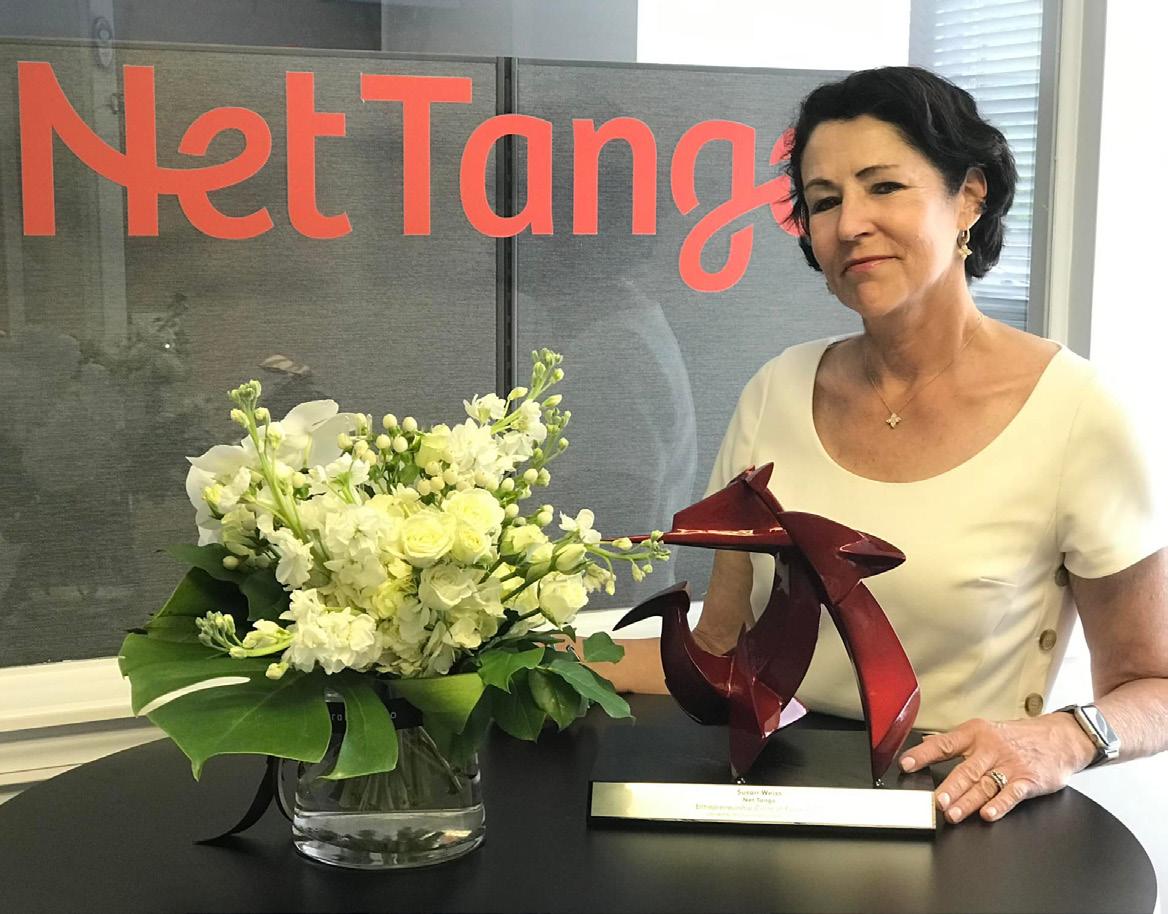
Dear College of Business Community, Alumni and community leaders play a vital role in strengthening the College of Business, and one of the most impactful ways they contribute is through service on our Boards of Advisors (BOAs). From departmental boards that support our academic units to center boards that advance our flagship centers – including the Forcht Center, the Family Business Center, and the Center for Positive Leadership – as well as our collegewide board that partners directly with the dean, these groups help shape the direction and success of the college.
I have the privilege of chairing the dean’s Board of Advisors, a group of 38 dedicated members and 18 emeritus members who bring deep experience, insight and commitment to the college. In addition to our four meetings each year, many of our members give generously of their time and resources: speaking in classes, mentoring students, providing internships and scholarships and serving as ambassadors for the college throughout the region.
The dean’s BOA has existed for decades and continues to evolve as the college grows and new leadership shapes its direction. At its core, the board provides the dean with a direct and honest connection to the business community we serve. With so many bright and engaged leaders around the table, our discussions offer candid feedback on what is working well and where opportunities for improvement exist. At the same time, members gain a deeper understanding of the challenges and opportunities facing a modern business school within an R1 university. Senior members of the dean’s leadership team regularly join our meetings, ensuring they also hear firsthand the real-world needs and expectations of the region’s employers.
We are fortunate to have such active and committed advisory boards across the college. If you have an interest in serving on one of the College of Business BOAs, I encourage you to reach out to Dean Henley to explore opportunities to get involved.
Susan Weiss
UofL College of Business Board of Advisors Chair

by Erica Hulse

Every great leader understands rhythm – when to advance, when to adapt and when to set the pace.
Susan Weiss built her career by staying in step with change. From witnessing the digital transformation of the travel industry to launching Net Tango, her own technology firm, through the University of Louisville’s technology incubator, she has consistently aligned insight with action. Now, as Chair of the College of Business Board of Advisors, she applies that same disciplined momentum to shaping the college’s future. In this interview, Weiss discusses the entrepreneurial spark that ignited Net Tango, the realities of leading a technology-driven enterprise and the strategic responsibility of guiding business education in a rapidly evolving economy.
UofL: What led you to pursue your MBA at the University of Louisville?
SW: I chose to pursue my MBA at the University of Louisville at a time when the industry I worked in was undergoing rapid digital transformation. I realized I needed a stronger foundation in business strategy and leadership to grow alongside those changes. UofL stood out because of its supportive community and its growing emphasis on entrepreneurship. The
program not only strengthened my business skills but ultimately inspired the idea that led me to launch my own company. Looking back, it was a pivotal decision that helped shape both my career path and my approach to innovation.
UofL: What was your experience like as an MBA student at UofL, and what singular experience left the greatest impact on you?
SW: My MBA experience at UofL was incredibly energizing. Being surrounded by classmates
from so many different countries and industries pushed me to think more broadly and helped me grow both personally and professionally.
What had the greatest impact on me was UofL’s strong focus on entrepreneurship and the access to resources like the technology incubator. That environment encouraged me to explore my own ideas and ultimately gave me the support I needed to launch my company.
UofL: What made you decide to pursue your chosen career field in technology?
SW: My journey into the technology field began when I was part of a major digital transformation in the tourism industry. I worked on a team responsible for automating systems and developing interfaces to existing industry platforms, and during that time, I witnessed the dramatic evolution of travel distribution – from proprietary systems used by airlines, cruise lines and hotels to the rise of internet-based booking platforms like Travelocity, Expedia and Orbitz.
This transformation was unfolding while I was completing my MBA at the University of Louisville. At the same time, the university’s growing entrepreneurship program sparked my interest. As I learned more about innovation and new venture creation, I became inspired to pursue my own technology-driven idea.
After developing a business plan, I learned about UofL’s technology incubator program where I ultimately launched Net Tango. The combination of industry experience, academic inspiration and entrepreneurial opportunity cemented my path in technology.
UofL: Could you elaborate on the milestones and challenges you faced with not only launching Net Tango, but in your current day-to-day operations as well?
SW: Launching Net Tango brought a mix of exciting milestones and meaningful challenges. One of the earliest milestones was moving from a business plan to an actual operating company – an especially memorable moment because it grew out of UofL’s supportive entrepreneurship
environment and the technology incubator. Securing our first clients, building an initial team and establishing trust in a fast-changing digital landscape were all pivotal steps that shaped our foundation.
Of course, those early days also came with challenges. As a new company, we had to prove ourselves and constantly adapt to rapid changes in technology. Each obstacle required creativity, persistence and a willingness to learn quickly.
Today, the challenges look different but equally important. Staying ahead of evolving technologies, attracting and retaining top talent and maintaining strong client relationships are all part of running a technology company. Balancing innovation and longterm vision continues to shape how I lead the organization.
Every milestone – past and present – reinforces why I started the company and motivates me to keep moving it forward.
UofL: What do you enjoy most about leading Net Tango?
SW: There is something incredibly rewarding about building solutions that help clients adapt, grow and succeed in a constantly changing digital landscape. I value the opportunity to foster talent and build a culture where people can do their best work. Seeing team members develop new skills, gain confidence and contribute to innovative solutions is one of the most fulfilling parts of my role.
Entrepreneurship also drives me to stay curious, to explore new technologies, identify emerging opportunities and continuously evolve the business. That sense of possibility, combined with the impact we’re able to make, is what makes leading Net Tango so satisfying.
UofL: Could you share more about a person or mentor who helped shape you into the community leader you are today? What advice and how does a business degree from UofL help to foster that CoB/Louisville community connection?
SW: The College of Business plays a vital role in connecting the university with the broader Louisville community and local businesses. One of its greatest strengths is its commitment to building meaningful partnerships – whether through internships, executive education, entrepreneurial programs or collaborative research. These connections ensure that students gain real-world experience while local employers benefit from fresh perspectives and emerging talent.
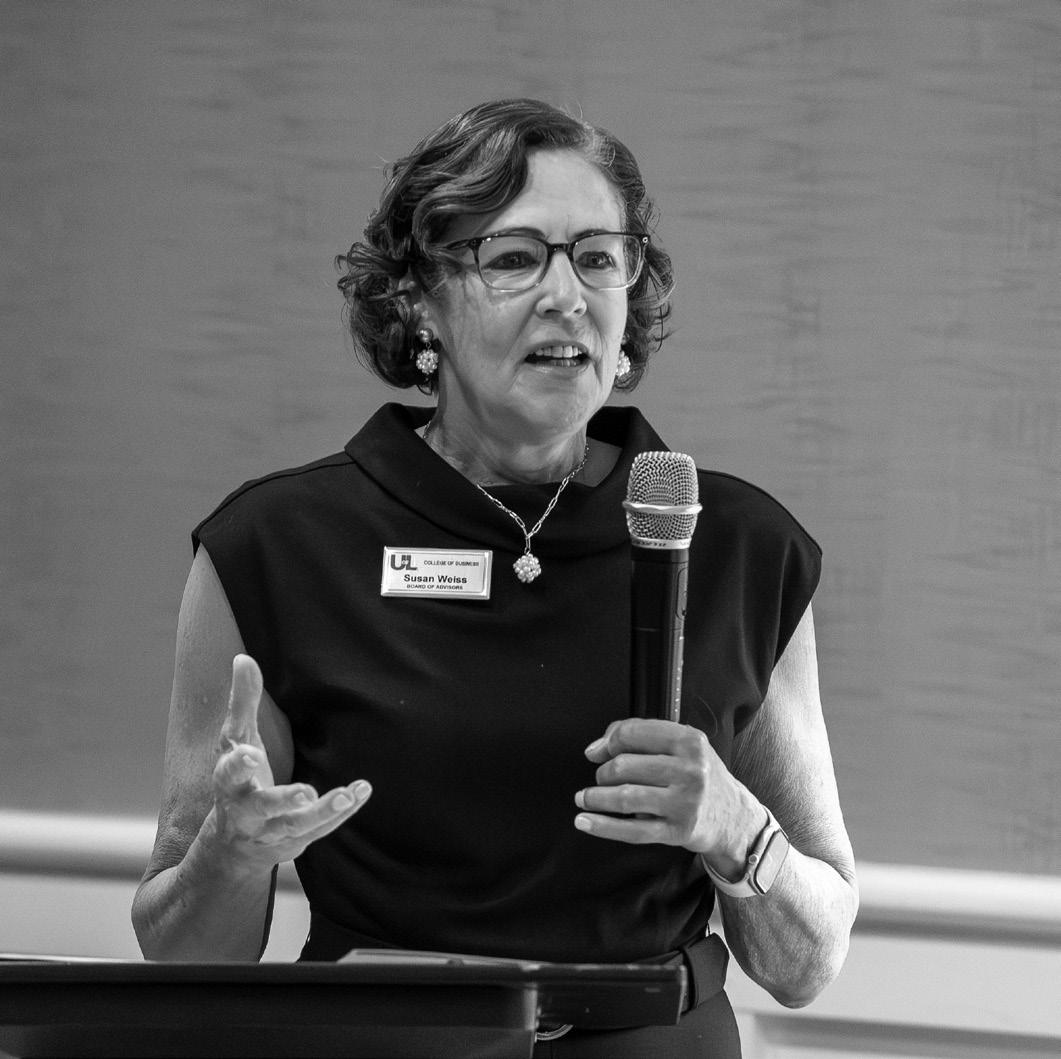
The CoB also serves as a hub for innovation and economic development. By engaging with industry leaders, supporting entrepreneurs and providing resources that address workforce needs, the college helps strengthen the region’s business ecosystem.
A business degree from UofL reinforces this connection by giving students hands-on opportunities to work with local companies, understand regional economic challenges and engage in projects that have direct community impact. Graduates leave with strong professional networks, practical skills and a deep understanding of the local business landscape – making them valuable contributors to Louisville’s continued growth.
UofL: What made you decide to accept a position as a member of the Board for the CoB?
SW: I felt a strong desire to give back because the College of Business has played a meaningful role in my own career. The education, resources and connections I gained through the MBA program and the technology incubator were foundational to launching and growing my company. Serving on the Board is an opportunity to help support the next generation of students, entrepreneurs and business leaders in the same way the college supported me.
UofL: How has being a member of the board impacted you on both a personal and professional level?
SW: Serving on the Board has been incredibly rewarding both personally and professionally. On a personal level, it has deepened my connection to the university that helped shape my career. I’ve enjoyed building relationships with fellow board members, faculty and students, and I find it meaningful to play a role in supporting an institution that continues to have such a positive impact on the community.
Professionally, being on the Board has broadened my perspective on business education, workforce development and the evolving needs of employers. Collaborating with leaders from a wide range of industries has strengthened my own strategic thinking and has given me new insights into trends that influence both education and the business landscape. These interactions often spark ideas that I can bring back to my company – informing talent development, innovation and long-term planning.
Overall, my experience on the Board has reinforced the importance of community engagement, lifelong learning and investing in people. It has been a privilege to contribute to the college’s mission while continuing to grow personally and professionally through the relationships and experiences the Board provides.
UofL: How do you see the CoB connecting with the community, city and local businesses?
What do you feel are our strengths in this area, and how does a business degree from UofL help to foster that CoB/Louisville community connection?
SW: The College of Business plays a vital role in connecting the university with the broader Louisville community and local businesses. One of its greatest strengths is its commitment to building meaningful partnerships – whether through internships, executive education, entrepreneurial programs or collaborative research. These connections ensure that students gain real-world experience while local employers benefit from fresh perspectives and emerging talent.
The CoB also serves as a hub for innovation and economic development. By engaging with industry leaders, supporting entrepreneurs and providing resources that address workforce needs, the college helps strengthen the region’s business ecosystem.
A business degree from UofL reinforces this connection by giving students hands-on opportunities to work with local companies, understand regional economic challenges and engage in projects that have direct community impact. Graduates leave with strong professional networks, practical skills and a deep understanding of the local business landscape –making them valuable contributors to Louisville’s continued growth.
UofL: What are some of your long-term professional goals?
SW: I am committed to lifelong learning and development. As the business and technology landscape continues to evolve, I strive to stay current with emerging trends and continually refine my leadership capabilities. Staying adaptable and curious is essential to sustaining long-term success.
I am also passionate about helping aspiring entrepreneurs navigate the challenges of starting and growing a business. I hope to share my insights, experiences and resources in ways that empower others – whether through mentorship,
advisory roles or involvement in initiatives that strengthen the entrepreneurial ecosystem.
Community engagement remains a core priority in my professional life. I am committed to supporting programs and organizations that make a meaningful impact, whether through volunteering, philanthropic efforts or leadership roles. Contributing to a stronger, more vibrant community is something I view as both a responsibility and a privilege.
UofL: Why would you encourage others to consider participating in an advisory or volunteer role for a non-profit organization?
SW: I would encourage others to get involved because their expertise can make a meaningful difference and help a non-profit advance its mission. Serving in these roles also connects you with a diverse group of people who are passionate about creating positive change. It’s a rewarding way to give back while growing personally and professionally. Furthermore, contributing your time and skills to a non-profit organization allows you to give back to your community and make a meaningful difference in the lives of others.
UofL: Outside of your professional and philanthropic work, what do you enjoy doing to relax or recharge?
SW: Outside of my professional and philanthropic work, I love spending time at our farm, where our young Thoroughbreds grow up and prepare for their future racing careers. I also enjoy riding, and I’m currently competing one of our retired racehorses in dressage.
Travel is another passion of mine, especially discovering new countries and immersing myself in different cultures. A fun fact: I’ve stayed close with many friends from my MBA program and have even attended their weddings in France, Germany, Greece and Thailand. Those trips created some of my most special memories –friendships formed during my MBA years that have truly lasted.
by Erica Hulse
Sitting in the stands on a hot day at Louisville Slugger Field, you might catch sight of Buddy the Bat, hear the sharp crack of wood meeting a fastball at home plate, smell freshly baked pretzels drifting through the concourse or feel an ice-cold drink sweating in your hand. For Louisville Bats fans, these are timeless memories – the kind tied to the simple joy of being together on a summer afternoon.

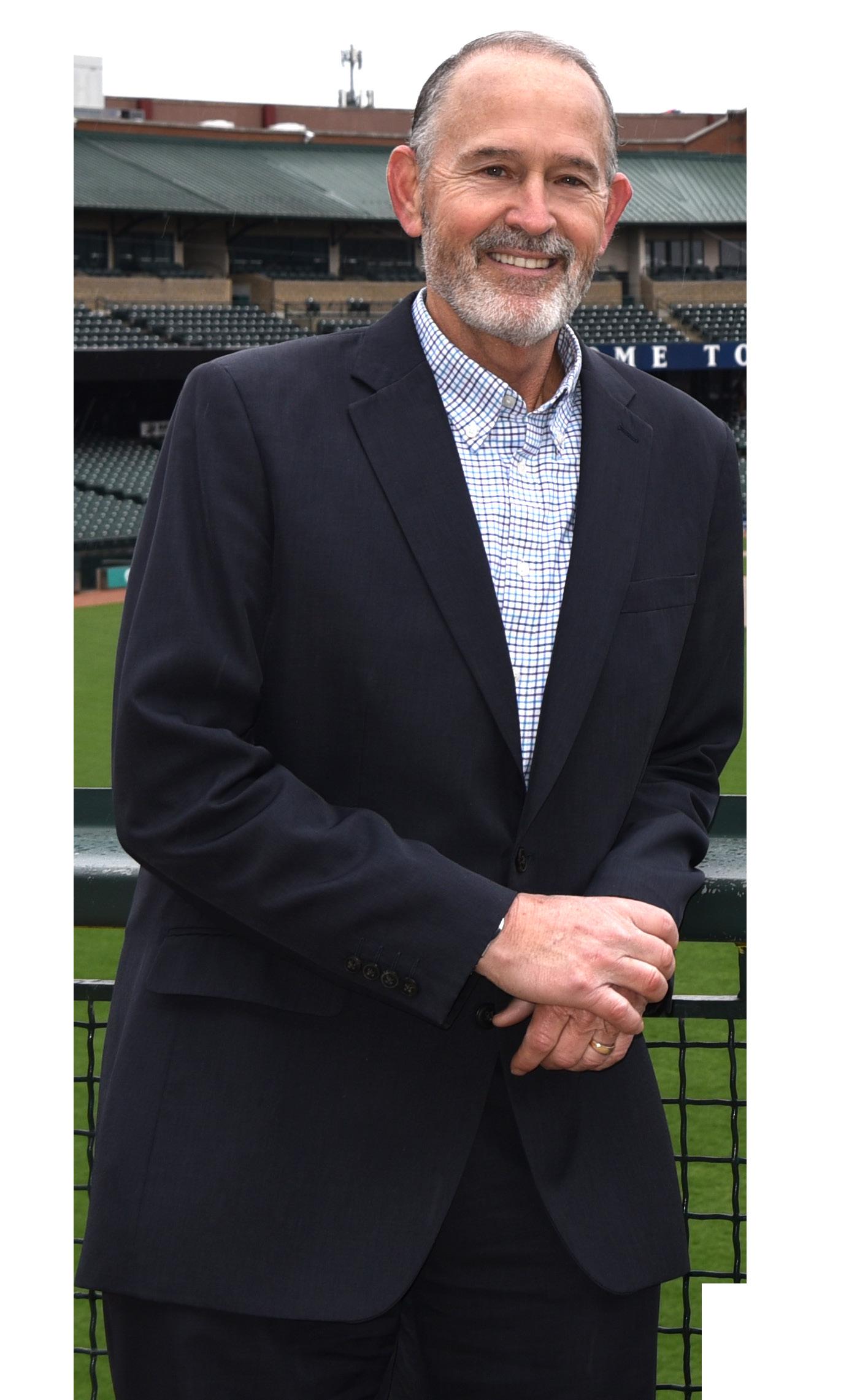
Greg Galiette has built a career around making those moments possible.
The Louisville Bats president and University of Louisville College of Business alumnus understands what draws people to the ballpark and what brings them back. Winning matters, of course, but in minor league baseball, entertainment is what turns an ordinary game into something families remember for years.
“It’s more about...creating memories,” he said. “We’re in the memory creation business.”
For Galiette, that understanding began long before he ever worked in baseball. As a child, he was drawn not only to the game itself, but to the experience of sharing it with family. In the years that followed, his education, early career decisions and hands-on work in the industry helped shape that early appreciation into a professional philosophy – one rooted in creating the kind of fan experience that lingers long after the final inning.
Growing up in Middletown – an area of Louisville that, at the time, Galiette said “had one stoplight, basically” – he experienced the unexpected death of his father when he was only five. In the years that followed, sports became both a refuge and a fascination.

“I had The Sporting News [and] I had Sports Illustrated,” he said. “I just engulfed myself in that.”
That fascination was shaped by family. Galiette’s uncle, who served as the voice of Yale football and worked as a television sports anchor in New Haven, Connecticut, gave him an early glimpse into the sports world from the inside. “I was fortunate,” he said. “He ended up actually becoming one of the early anchors on ESPN SportsCenter when they first came on the air, so I remember as a teenager going up there and going to the trailers where ESPN started.”
While those experiences opened his eyes to the broader world of sports, baseball took hold closer to home. “My passion for baseball was mostly coming out of books and things I read,” he explained. “There weren’t many games televised into the market at that time.” But it was his grandfather who allowed him to experience the game firsthand. “[He] used to have season tickets to...the Louisville Colonels baseball team,” he said. “So, we’d go to those games.”
Those early experiences – reading about games, seeing the sports media world up close and attending games with family – would fuel Galiette’s passion to work in the sports industry. “I always thought it’d be cool to work in pro sports,” he said. “I just didn’t know how to get it done or get started in it.”
When Galiette arrived at UofL, he did not begin as a business student, but as a pre-law major. At the time, that path seemed like the right fit. Looking back, he realized it was the path many in his family had envisioned for him. “I thought that I wanted to be an attorney,” he said. “But the thing is, I thought I wanted to be an attorney because everybody in my family wanted me to be an attorney.”
Choosing instead to “follow my own beat of my own drum,” Galiette changed course and pursued a degree in marketing. The decision would bring him closer to an industry he had long admired. While a student in the college, Galiette attended a presentation by former Louisville Bats owner Dan Ulmer – an experience that stayed with him. “I was just fascinated by his talk,” he said. “I thought to myself it’d be cool to work for a guy like that.” A few years later, he would.
Upon graduating in 1983, Galiette began working for Xerox, where he remained for less than a year. Despite the salary, the work quickly felt limiting. “Every day already seemed like Groundhog Day,” he said. “I just thought to myself, ‘I can’t see myself doing this.’”
At the time, Louisville had gone years without professional baseball after the Louisville Colonels left the city in 1972. But when the Louisville Redbirds arrived, Galiette saw an opening. Through a family friend, he secured an introduction to A. Ray Smith, then-owner of the franchise, and made his interest clear. “I basically told [him] I would do anything to get a job in professional sports.”
Even with a young family and the promise of financial stability, Galiette chose to leave Xerox behind. “The folks at Xerox thought I was an idiot,” he recalled. “They basically told me, ‘You’re going to regret this decision.’” Instead, he took the risk –one that would place him on the path he had been searching for all along.
Galiette began as a sales intern in 1984, selling season tickets and group packages. From there, he moved steadily into larger roles, eventually managing others and gaining a firsthand look at what it takes to operate a minor league baseball franchise. “I was going from selling things to managing people who sell things,” he said. “Then at night, you’re interacting with the general public throughout the game. That quickly teaches you all kinds of different things.”
Those early years gave Galiette more than industry experience. They gave him a working understanding of both the business side of baseball and the people who make it run. In learning to navigate sales, staff management and fan interaction, he began developing the supportive, mentorship-driven leadership style that would later define his career.
As Galiette grew in the organization, he also benefited from the guidance of leaders who had already built strong reputations in Louisville baseball, including former Bats President Gary Ulmer and the team’s late general manager, Dale Owens. Their influence would help shape not only the way he understood the business but also the way he approached leadership.

Owens, in particular, became a key mentor. “He took me under his wing and basically taught me promotionally, sales-wise, marketing – everything I’ve learned,” Galiette said. “I feel so blessed to have had the opportunity to work for him.” Galiette credits both Owens and Ulmer with leaving a lasting mark on the way he runs the organization. “The two of them together really helped shape how I operate the Bats to this day.”
Across his decades with the organization, Galiette has collected no shortage of unforgettable experiences – from selling tickets for concerts featuring The Rolling Stones and The Grateful Dead, to meeting Hall of Famers like Mickey Mantle and Whitey Ford, to hosting former President George H. W. Bush in 1992, when the team was still known as the Redbirds. But for Galiette, some of the most exciting developments are still ahead. That future, he believes, is unfolding both on the field and around it.
Through the years, Galiette has watched minor league baseball become a testing ground for changes that later reach the major leagues. “We’ve been the laboratory...for new rules and changes that have been tried out here at the minor league level before they went to the major league level, such as the pitch clock,” he said. With innovations like the automated ball-strike system also moving forward, Galiette sees a future in which the game continues to evolve while still holding onto what makes baseball distinct. “I’m excited to see where it’s going to go, especially in the next 10 to 20 years,” he said.
Galiette sees a similar sense of possibility beyond the stadium itself. The planned expansion of the Louisville Downtown Management District, which includes the area surrounding Louisville Slugger Field, is expected to bring new energy to an already vibrant part of the city. “I’ve seen this done in other cities close to their stadium properties and seen the infusion of energy that it’s provided,” he said. “I think it’s going to be like a multiplier for downtown and provide a place to live, work and play all in the same area.” For Galiette, that growth represents more than development. It points to a future in which the game
remains connected to the city, its people and the experiences that bring them together.
Even as the Bats continue to evolve, both within the game itself and in the district surrounding Louisville Slugger Field, Galiette’s sense of purpose remains steady. He does not describe his role in terms of ownership or control, but rather in terms of stewardship.
“I view myself more as a caretaker of the sport of professional baseball in this community,” he said. “To take care of it, to cherish it.”
That philosophy extends beyond the day-to-day demands of running a franchise. It shapes the way Galiette thinks about leadership, mentorship and the future of the organization itself. “I want to come back with my grandchildren and take in a game, [and see] that I’ve left this place in a better spot than maybe when I found it,” he said. “That I’ve helped carry it on to the next generation. And that’s really what it’s all about, is to create that next generation of fans.”
One day, perhaps years from now, another child will sit in the stands at Louisville Slugger Field with a cold drink in hand, the smell of ballpark food drifting through the air and the crack of the bat echoing across the stadium. They may not know Greg Galiette’s name or the path that brought him there – from a marketing degree at UofL to a leap from Xerox into the uncertain world of minor league baseball. But they will know what it feels like to spend a day at a Bats game.
That, in many ways, is the point.
The memories made at a Bats game may feel simple in the moment, but they last. For Galiette, helping create those experiences and ensuring they endure for the next generation of fans has been work worth betting on all along. In choosing baseball over the safer path laid out before him, he proved that what once looked like a risk was the right call – not only for himself, but for the generations of fans still making memories at the ballpark.

by Madison Kurfirst
New Yum! Brands Entrepreneurship Fellowship Fund
The University of Louisville College of Business and the Yum! Center for Global Franchise Excellence would like to extend gratitude to Yum! Brands for its generous entrepreneurship fellowship fund. The newly established fund aims to strengthen support for doctoral students in the Entrepreneurship PhD program interested in franchising by ensuring they have the resources needed to focus on innovative research and academic achievement. Through this initiative, students may receive support through scholarship, stipend, fringe and conference travel, empowering them to engage with leading research communities and contribute meaningfully to franchising.
“Franchising is one of the largest entrepreneurial systems in the world, yet it has historically received limited attention in academic research,” said Director of the Yum! Center for Global Franchise Excellence Kathy Gosser. “This fellowship allows us to develop scholars who will advance research and strengthen the future of franchise systems.”
“The fellowship will provide a unique opportunity for PhD students to collaborate with Yum! Center faculty on cutting-edge franchising research and curricular developments, positioning them to emerge from our program as leading figures in franchise scholarship and education, an increasingly important domain of entrepreneurship,” said PhD in Entrepreneurship Program Director Daniel Bennett.
Along with providing our students the opportunity to delve into a new form of research, this positions the college as one of the first business PhD programs to include franchising as a path of study.
The Yum! Brands Entrepreneurship Fellowship Fund will begin supporting students in fall 2026, with funding awarded to students who formally applied during the application period. Learn more about the Yum! Center for Global Franchise Excellence at: business.louisville.edu/researchand-centers/forcht-center-entrepreneurship
by Erica Hulse
R. Charles “Charlie” Moyer loves to run. Steadily, in the same way he has approached much of his life. One foot in front of the other, always moving forward.
For more than 50 years, his wife, Sally, has been beside him for many of those runs – a quiet ritual that mirrors how Moyer has built both his life and his career: patiently, consistently and with momentum.
omentum, the former dean would tell his students, is everything.
At the University of Louisville College of Business, that philosophy stands in the atrium.
Students pass it every day without always realizing the story behind it – that intricately painted horse statue featuring currency from across the globe that Moyer brought to the college and nicknamed Mr. Cash Flow. The name began as a joke about finance. But to Moyer, the idea carried a deeper meaning.
Businesses need cash flow to survive, he would say. Universities need something similar – ideas flowing, opportunities moving and people advancing.

“If things stop moving,” he liked to tell students, “that’s when you’re in trouble.”
From 2005 to 2026, Moyer helped propel the college forward, first as dean and later as a professor of finance. As dean, he transformed the Master of Business Administration program, strengthened the college’s research mission and expanded career opportunities for students. Now, as he celebrates his retirement, his influence continues to shape the institution.
The philosophy that would come to define Moyer’s leadership – rooted in momentum, opportunity and fairness – did not begin in a dean’s office. It began decades earlier, when a working-class kid from Reading, Pennsylvania, arrived at Howard University and quickly discovered that the world was larger and more complicated than he had imagined.


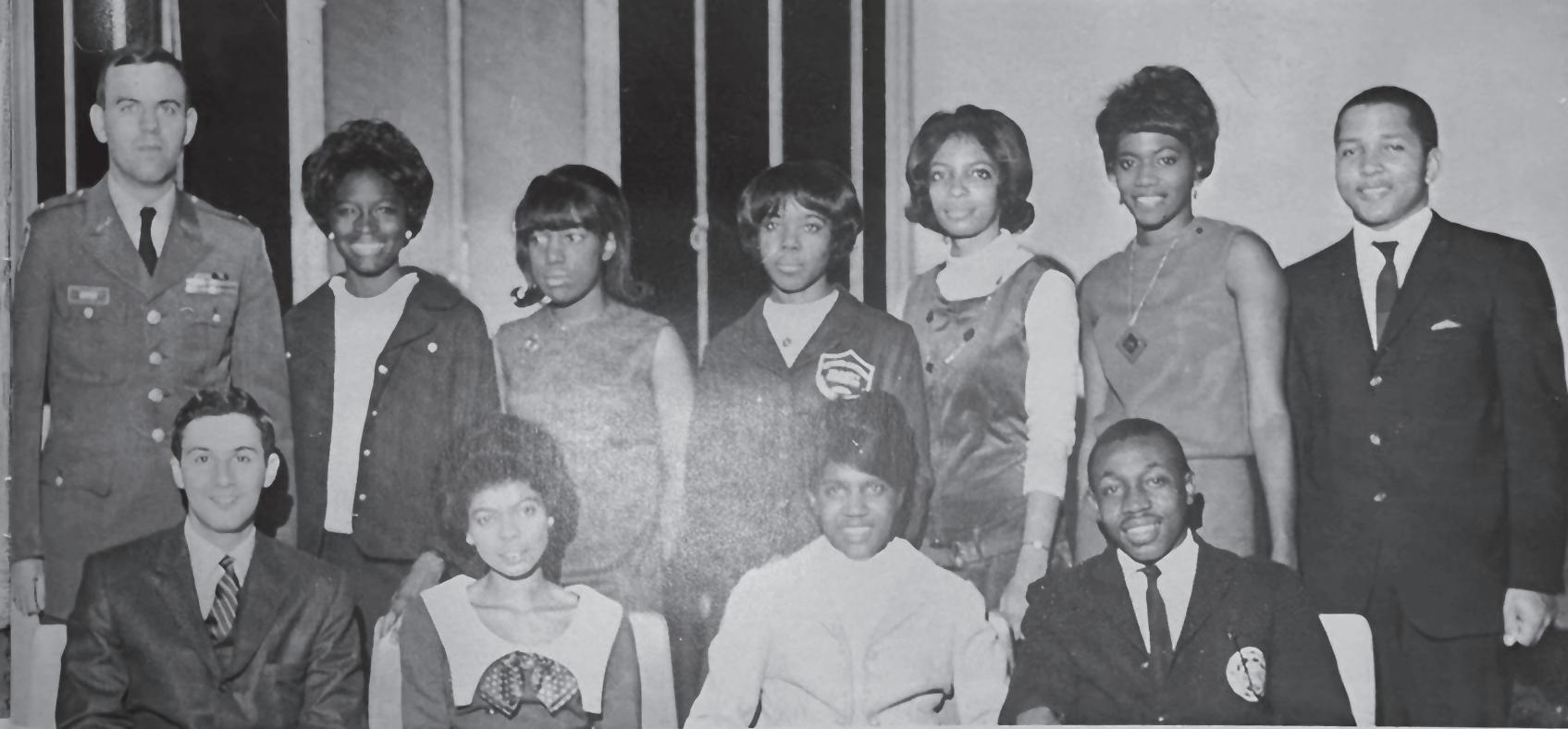
Growing up in Reading, Pennsylvania, an industrial town in a region known for its Pennsylvania Dutch heritage, Moyer and his brother Bob were raised in a family of predominantly German ancestry. The first in their family to attend college, the brothers attended Reading High School, where Moyer first learned about Howard University, widely considered one of the premier historically Black universities in the United States. “My parents didn’t have the money for college,” he explained. “They were encouraging, but there really wasn’t money.”
One morning, during the school’s announcements, students were told that recruiters from Howard were on campus interviewing prospective applicants and offering 40 competitive four-year, full-ride scholarships. “I interviewed and took their test and didn’t think a whole lot more of it,” Moyer said. “A month or two later, I got a letter saying, ‘Congratulations, you’ve been awarded a full four-year scholarship at Howard University.’”
It wasn’t until Moyer arrived on campus as a first-year student in 1963 – just three weeks after the March on Washington for Jobs and Freedom, when civil rights leader Martin Luther King Jr. delivered his iconic “I Have a Dream” speech – that he began to fully grasp the cultural differences awaiting him at Howard. “It was a real eye-opener,” he admitted. “I always thought of myself as pretty open and fair-minded, but I realized I probably wasn’t as open and fairminded as I thought I was. I learned an awful lot.”

The experience was also academically humbling. During his first year in the university’s honors program, Moyer found himself surrounded by exceptionally talented classmates who had also earned competitive scholarships. “I got in classes with people that had these full scholarships – we went through honors freshman year,” he explained. “We took almost all of our classes together, and I said, ‘Yeah, I’m not the smartest guy in the room,’ and I was used to being just about the smartest guy.”
At the end of that first year, Moyer began to question whether he should return to Howard. Then one unexpected phone call changed everything. “One night at dinner, the phone rang, and it was Howard,” he recalled. “They asked, ‘Are you coming back?’ I said yes, and that was one of the best decisions I ever made in my life.”
The following year, Moyer met the man who would help shape him into the leader he would become: Howard professor and debate coach Leroy Giles. At the time, Moyer had a profound fear of public speaking and struggled to speak in front of groups. “If I had to do an oral report,” he recalled, “I’d lay awake the whole night long. My hands and feet would sweat and my voice would crack. I was a wreck in front of a crowd.” One day, Giles encouraged him to join the debate team. Moyer’s reaction was immediate. “I said, ‘Leroy, are you crazy? Have you seen me?’ He said, ‘That’s why you should go out for the debate team.’”
Moyer eventually decided to push through his fear and give debate a try. The experience proved transformative, sharpening his public speaking skills and allowing him to develop the confidence and willingness to take risks that would later define his leadership style. His growth as a speaker and thinker eventually led him to compete against the British National Debate Championship team in debates broadcast on educational television stations in Washington and New York. Reflecting on Giles’ influence years later, Moyer said simply, “He changed my life.”
Moyer’s experience at Howard and the relationships he built there, including his mentorship with Giles and his friendship with fellow dormitory counselor Gloster Current, left a lasting mark on his life. In recognition of the scholarship that brought him to Howard, Moyer and his wife, Sally, later established the Leroy Giles Debate Scholarship Fund, which continues to support students at the university today. The lessons Moyer carried from Howard about fairness, confidence and the importance of stepping forward when opportunity appears would follow him throughout the rest of his career. They would also shape the kind of leader he would eventually become.
Upon earning bachelor’s degrees in both economics and German, Moyer was encouraged by one of his marketing professors to pursue an MBA degree. “I didn’t even know what an MBA was,” Moyer admitted. He applied to several institutions, but after receiving a full scholarship
to the University of Pittsburgh, he decided to pursue both his MBA and later his PhD in economics and finance there.
While completing his doctoral work at Pittsburgh, Moyer discovered a passion he had never expected: teaching. “I taught a class called the Evolution of Business...which was really a fascinating class to teach, and I had a good time doing it. I thought, ‘This is fun.’ I just enjoyed being in the classroom, and then I went down to Houston and kept doing the same thing.”
Moyer went on to teach at several universities, including the University of Houston, Lehigh University, the University of New Mexico and Texas Tech University before eventually accepting an endowed chair position at Wake Forest University. It was there that an unexpected opportunity would shift his career toward leadership. “I would see the president at lunchtime sometimes, because I’d swim sometimes and he had a locker [near mine],” Moyer said. “He said to me, ‘Charlie, why don’t you just be my dean?’”
Within only two months of stepping into the role, Moyer had already begun reshaping the business school’s direction. Passing a new strategic plan and opening a new professional MBA program in Charlotte, North Carolina – a city that at the time had no top-ranked university of its own – resulted not only in a record number of enrollments but also in great financial success for the university. The groundbreaking decision greatly boosted not only Wake Forest’s revenue
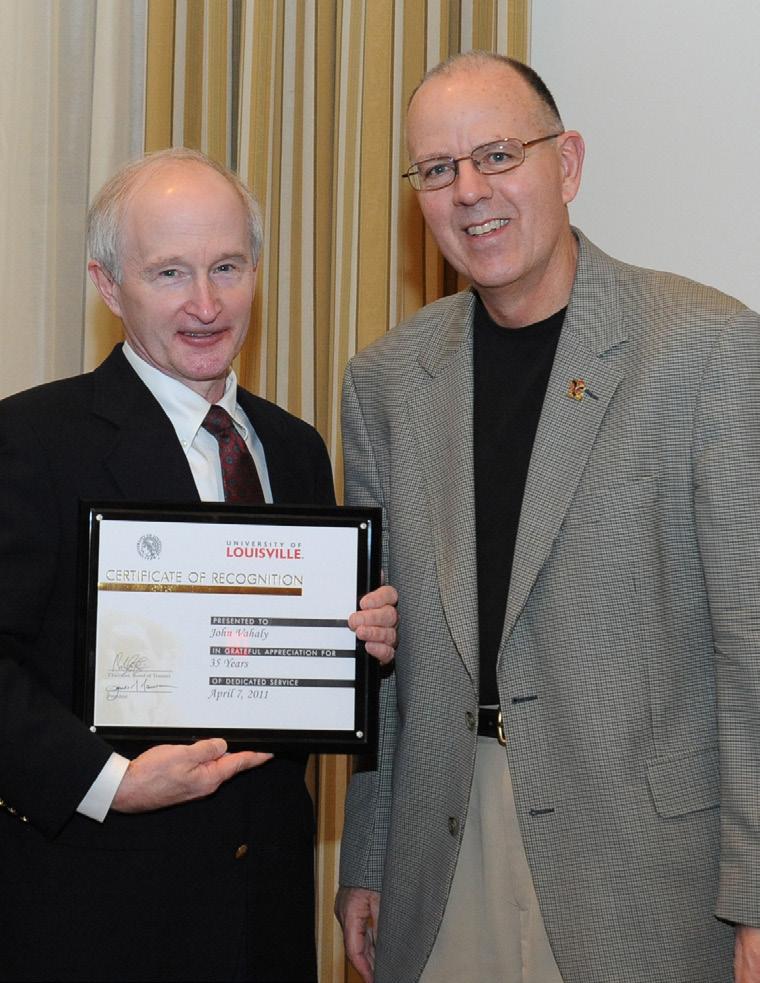
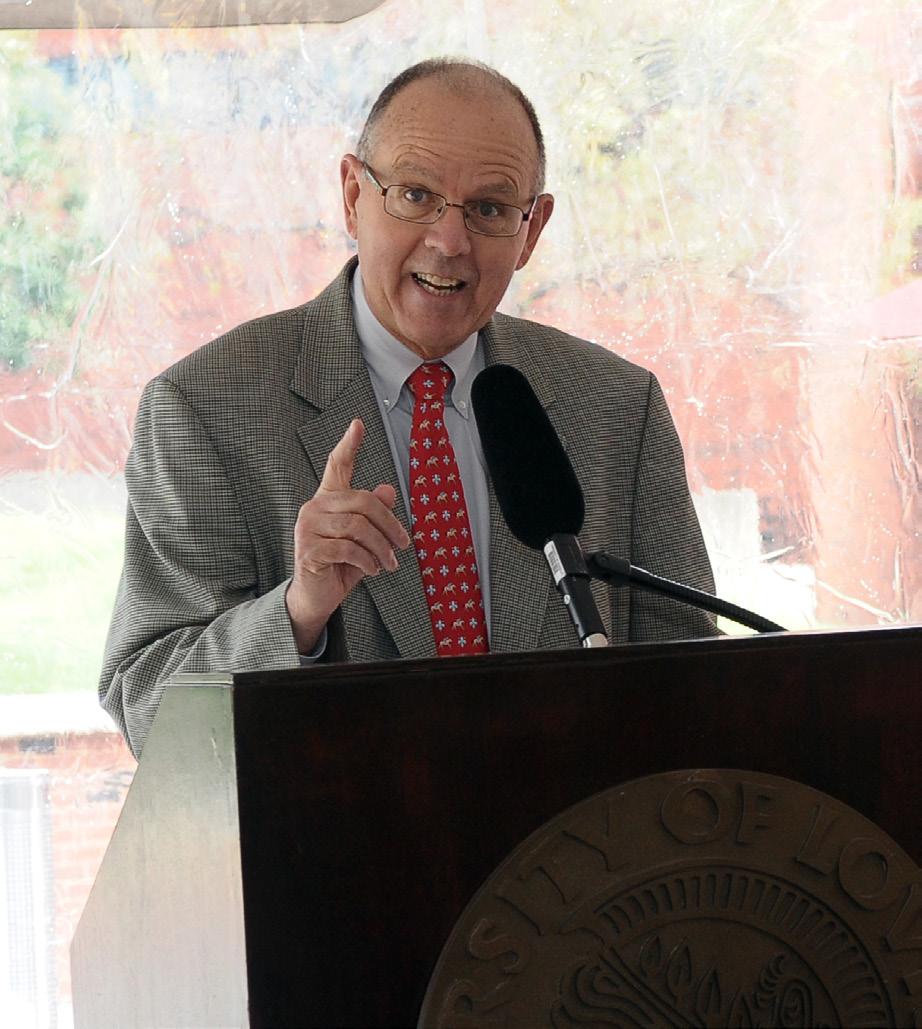
WHILE DEAN OF THE UOFL COLLEGE OF BUSINESS, CHARLIE MOYER:
Authored Contemporary Financial Management, a leading managerial finance textbook that has since reached 14 editions and remains in use today
Designed and secured funding for the college’s iconic horse statue, “Mr. Cash Flow”
Launched the college’s Ulmer Career Management Center
Secured funding to name and enhance the Forcht Center for Entrepreneurship
Secured funding for and oversaw construction of the original Texas Roadhouse Student Lounge
Introduced international paid internships and global travel opportunities that remain central to the MBA experience
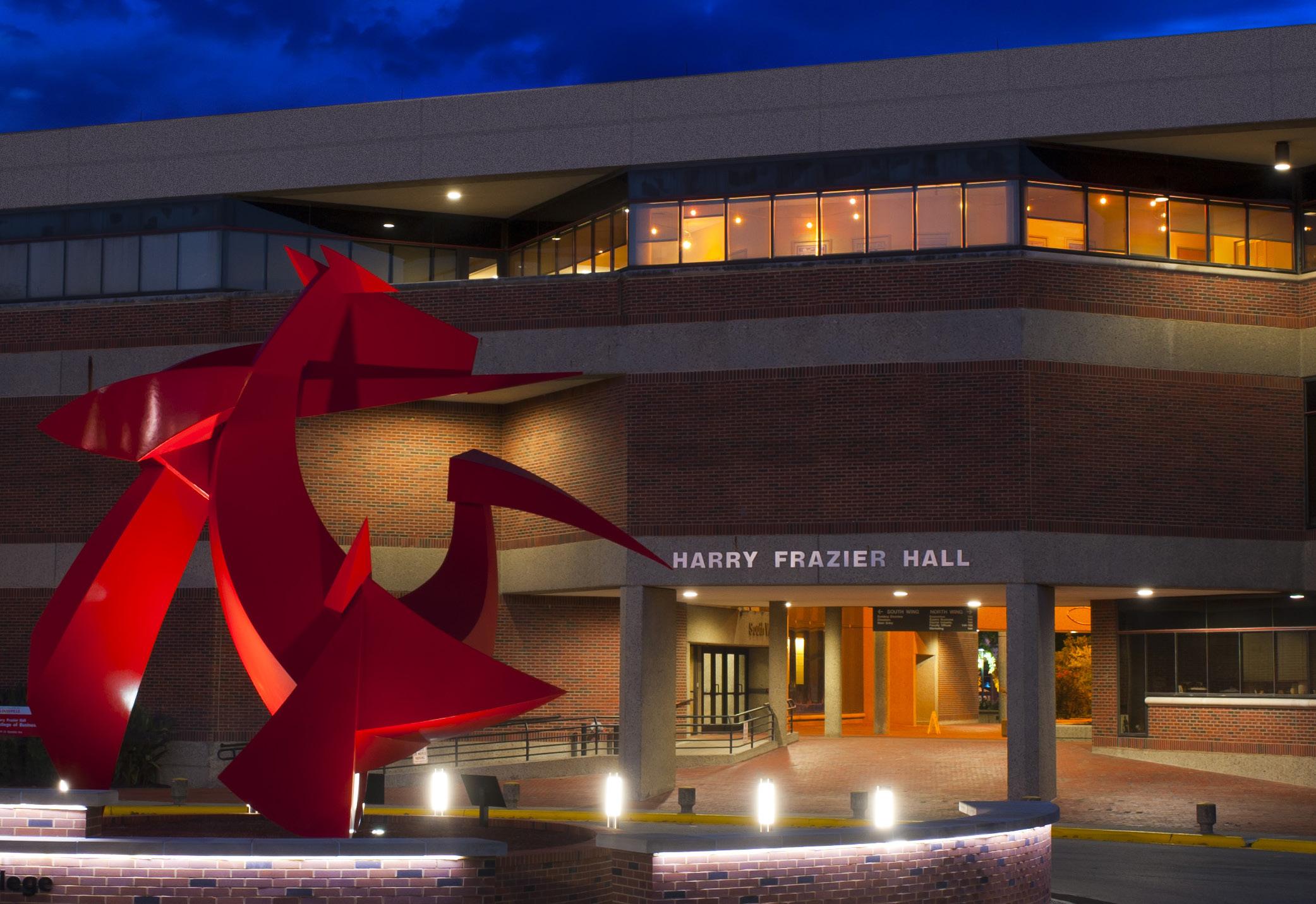
Secured a $10 million gift from the family of alumnus and real estate pioneer Harry Frazier, leading to the naming of Harry Frazier Hall
Partnered with the College of Business Board of Advisors to establish the Entrepreneurship Circle of Fame
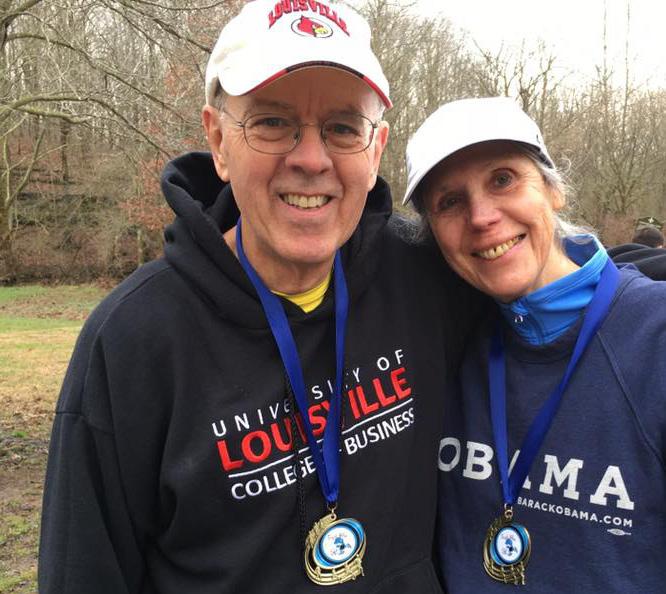
but also its rankings. After finally topping the MBA program rankings of its rival, Vanderbilt University, “I said, ‘I quit. Success. I’m going back to the good life of being a professor in the MBA program.’”
After transforming Wake Forest’s business school and taking a sabbatical year teaching in Germany, in 2004, Moyer began considering his next challenge – a search that led him to UofL.
While Moyer initially knew little about UofL, he found himself drawn to the institution mostly because its students’ backgrounds reflected his own. “I didn’t grow up rich,” he shared. “I came from a very working-class family, and I thought, ‘Wouldn’t it be nice to go to a school where the typical student is more like who I was at that age?’”
After being offered the position and multiple interviews with university leadership he admired and respected, he would have a legendary encounter with former basketball coach Rick Pitino during his final-round interview that would encourage Moyer to take on the role of dean. “I liked [former president] Jim Ramsey and [former provost] Shirley Willihnganz a lot,” he shared. “I came out here for three interviews before I finally said yes. On the third interview, they took me out to dinner at Porcini.” Assuming he would be met with another series of questions, he was surprised when Pitino came over to their table, sat down and began talking with him about basketball, eventually offering him the opportunity to sit in on closed practices and travel occasionally with the team for away

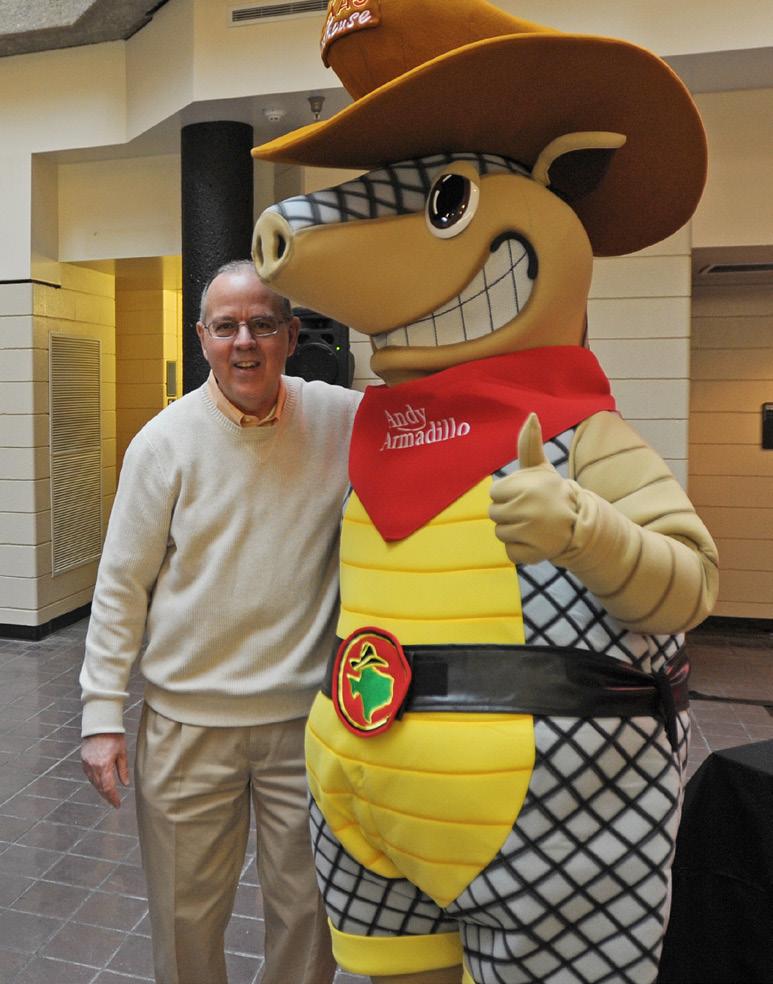

games. “Rick said to me, ‘It’s clear you’re really a huge basketball fan. If you come here, we will always have room on the plane. Anytime you want to fly with the team for an away game, just let me know.’” Admitting the encounter had him a bit star-struck, he said, “I went home, and I said to Sally, ‘I’m shallow enough to be impressed by this,’ and I made the decision to come here.”
Bringing valuable skills from his time at both Howard and Wake Forest to his newest role, including the ability to take risks with bold ideas, the initiative to take action amidst challenging circumstances, building trust with faculty, staff and students through strong communication and always striving for fairness in decision-making, Moyer tackled the challenges in the College of Business by “being honest and caring about the views of others” and maintaining his focus on the issues that mattered, be it in the classroom or the boardroom. “Whether you know exactly how to solve this problem or not isn’t the most important thing in the world,” he said.
One of Moyer’s most important goals was the implementation of a full-time MBA program in the college. After considering various other Association to Advance Collegiate Schools of Business (AACSB) accreditation strategies at universities across the country and through his vantage point of researching other schools’ MBA structures, he eventually conceptualized the radical idea of offering MBA students the opportunity to receive a paid internship by day, while completing their degree program in the evening. Furthermore, at that time, Moyer
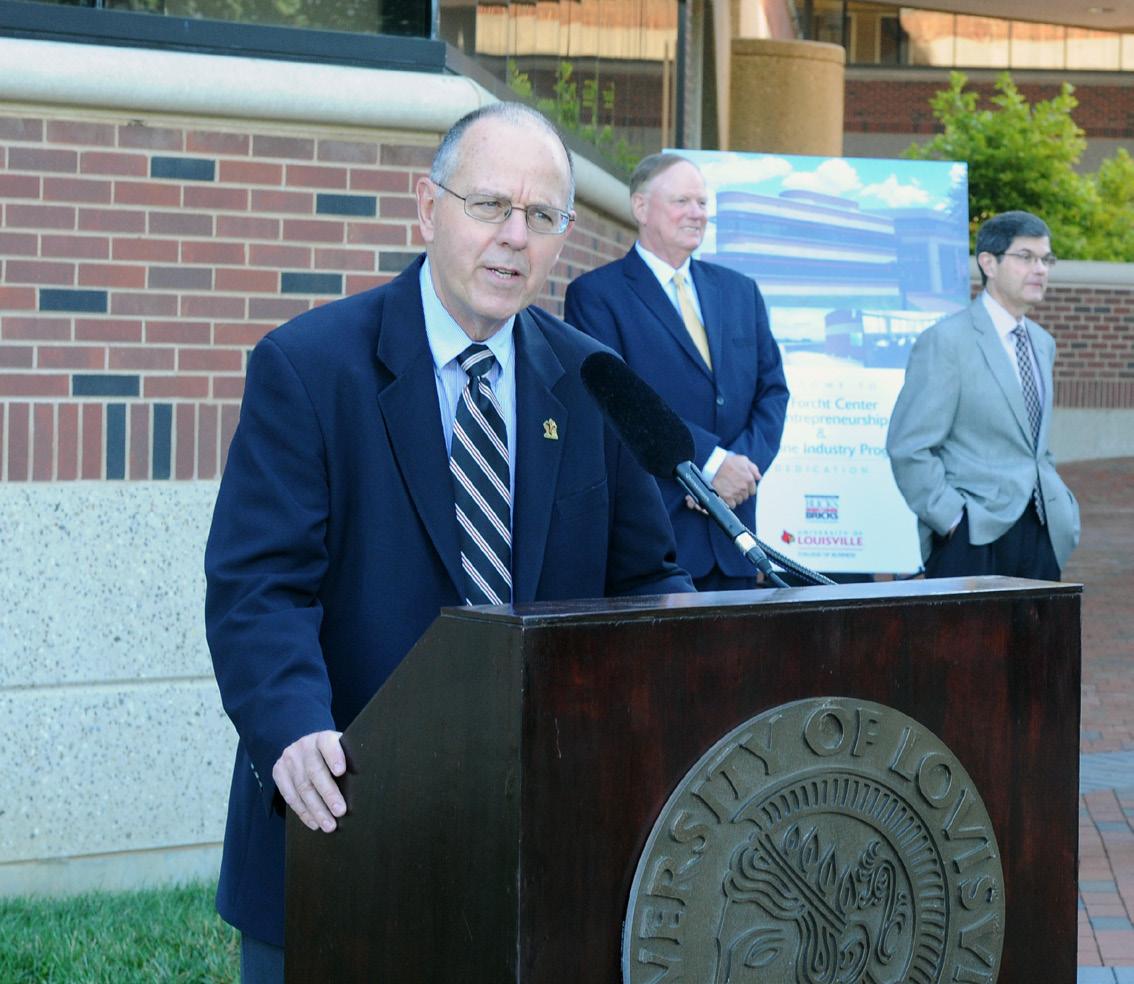
decided to bring on board current Senior Executive Director Vernon Foster, a longtime colleague and friend. The two first met at Wake Forest, where Foster had served on Moyer’s Board of Advisors and multiple other non-profit advisory boards.
Moyer also began connecting with members of the Louisville community, including the late Dan Ulmer, laying the groundwork for the college’s Ulmer Career Management Center to open in 2006. According to Foster, “[Moyer’s] intent was to build a stronger career center to serve all our constituents – undergrad, graduates and retirees. That’s why we have that saying, ‘Career Services for Life.’ That came out under Charlie, and he was very purposeful about creating a career center that could serve all of that.”
Along with providing innovative hands-on learning opportunities and long-term career support for students and graduates, Moyer was committed to elevating the work already being done by the college’s faculty. “He changed us from being primarily focused on teaching to being a great teaching institution coupled with great research and research expectations, along with funding for research to elevate that game,” noted Foster. “That changes how you’re perceived in the market.”
While Moyer’s time as dean brought significant growth, including the launch of the Forcht Center for Entrepreneurship and the construction of the Texas Roadhouse student lounge, his tenure was not without challenges. One of the most memorable moments came during the historic flood of 2009, which caused significant damage
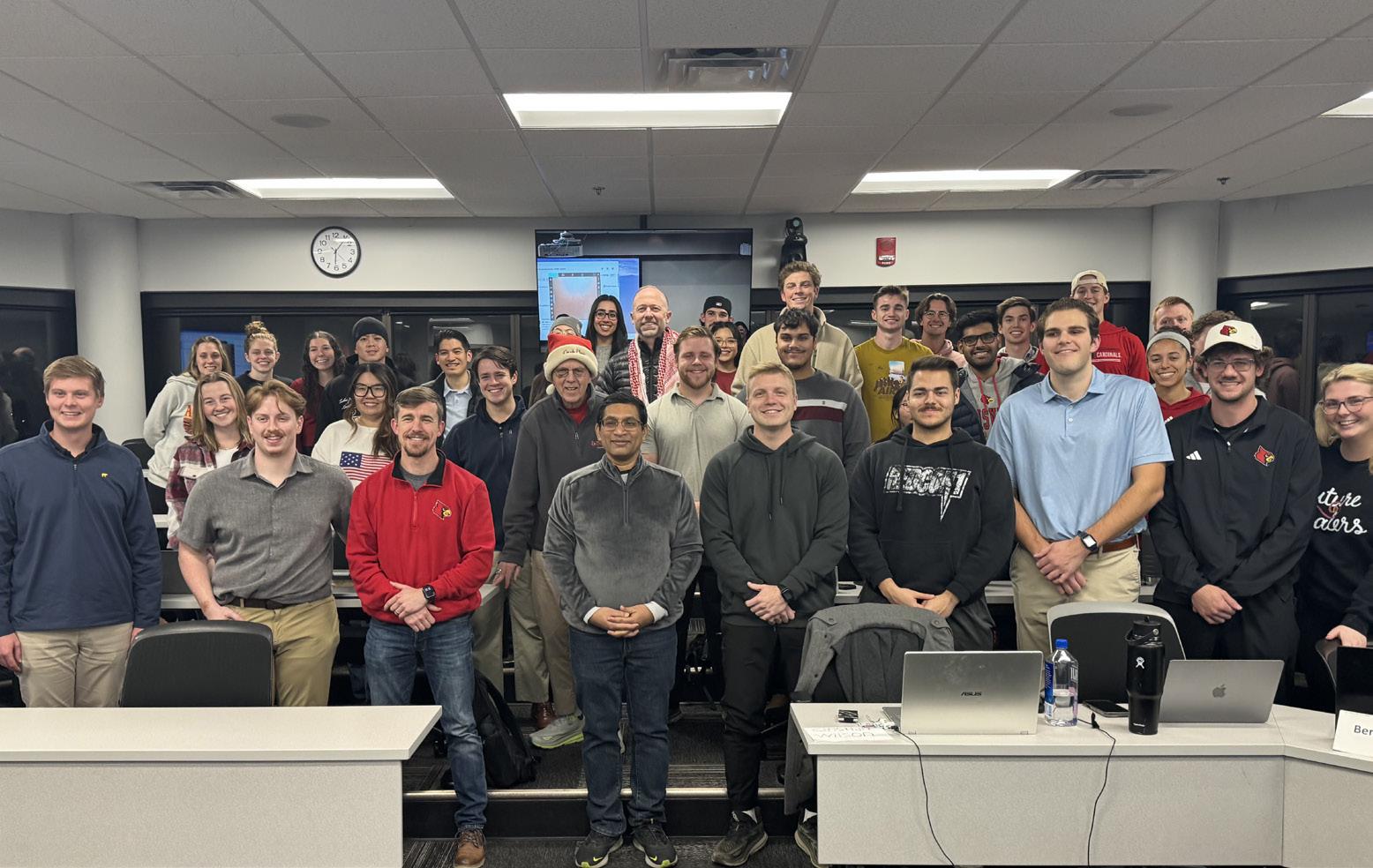
across campus – including the ground level of Frazier Hall.
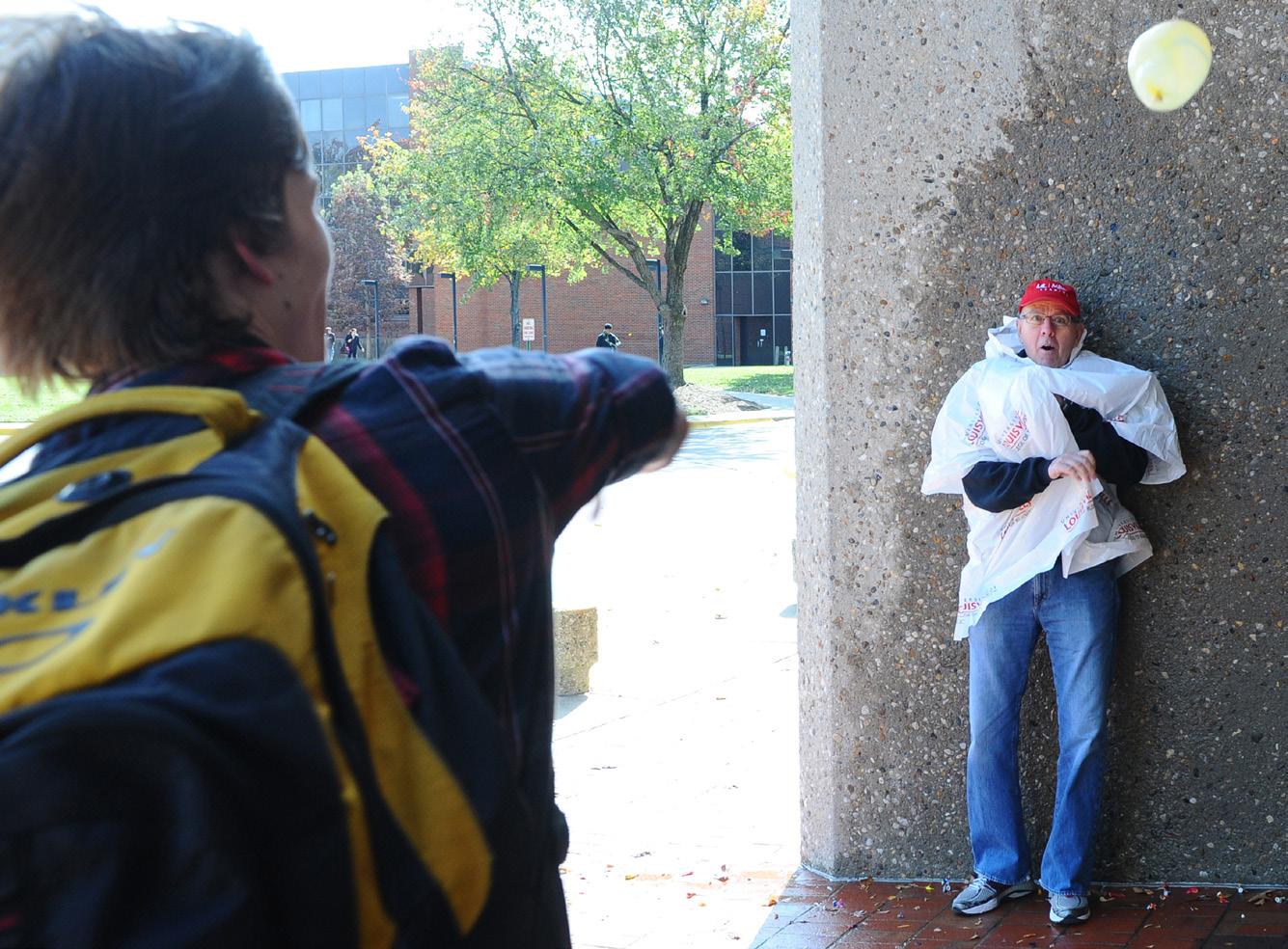
Arriving at the college that morning, Moyer quickly realized the situation was far more serious than anyone expected. “I got to the building, and we had just finished renovating the Reinhardt Center...I was standing with Tom Peterson...on the steps, and all of a sudden, I looked to the doorways into the hallway out where the computer labs are. I saw water at the window level in those doorways and then BOOM – all the water in the world came in, and Mr. Cash Flow started galloping across the [Atrium] – the elevator shafts were full of water.”
Dramatic as the moment was, it became one more chapter in a period of change that ultimately left the college stronger than before. In the years that followed, Moyer helped guide the college’s recovery while reinventing the MBA model, elevating the Ulmer Career Center, building stronger industry partnerships that broadened career opportunities for students and strengthening its research mission – positioning the college for ACC-era visibility. By the time he stepped away from the dean’s role, the College of Business had become very different from what it had been when he arrived – not only rebuilt, but reimagined.
While Moyer’s legacy can be seen across the college, the true impact of his leadership is found in the stories faculty and staff were more than willing to share – stories of a man who
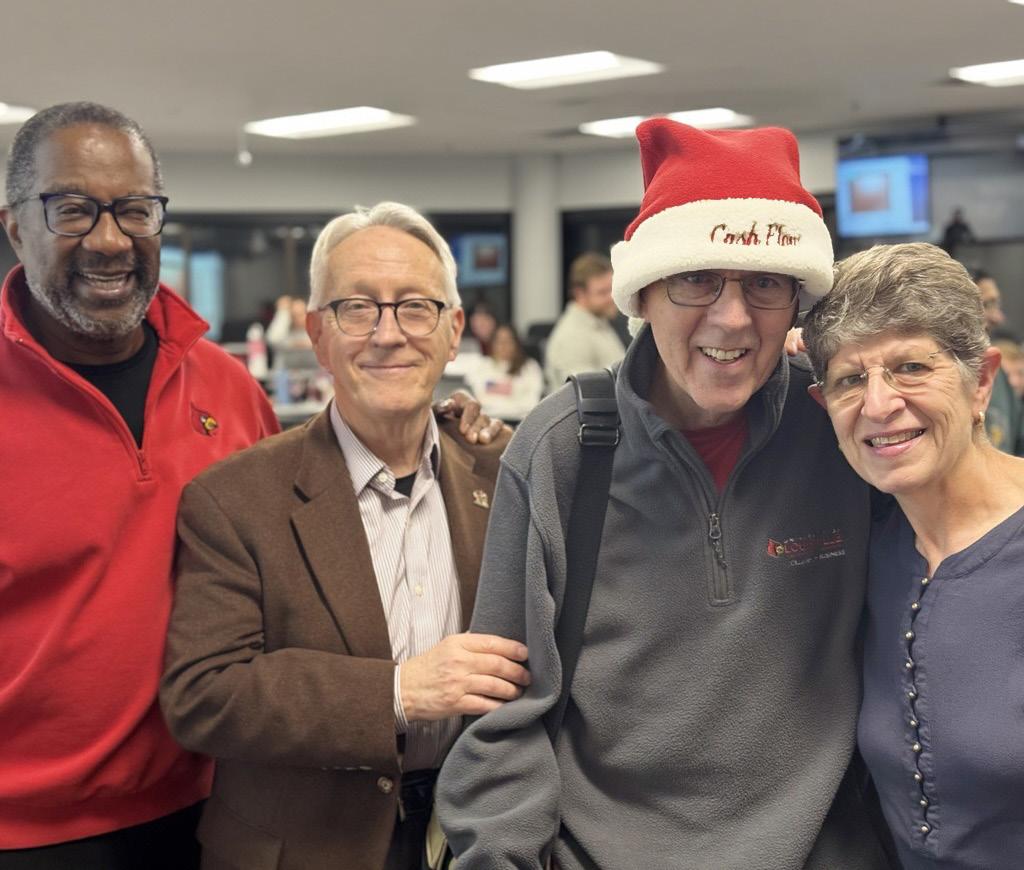
believed in giving. From giving opportunities for students, faculty and staff to succeed, to giving back his money and time toward philanthropic endeavors and organizations of personal importance to him and his wife. “A lot of people don’t realize how humble and caring he is,” shared Foster, “about students and their outcomes, and for the faculty and staff.”
Moyer’s caring nature extended to actively seeking ways to bring on board and to provide his faculty and staff with a platform to build their vision and shine. Current Assistant Dean of Thought Leadership and Civic Engagement Nat Irvin, who had previously worked with Moyer at Wake Forest, was encouraged by Moyer to come to UofL to continue doing what he does best: implement futuristic, forwardthinking programs such as Thrivals. “He started recruiting me immediately,” shared Irvin. “He’s let me develop my own programs. I’ve had so many opportunities to do things that I’ve cared about for other people as a result of Charlie,” he explained.
Current Dean Amy Henley echoed the impact of Moyer’s innovative and insightful changes and the lasting, positive impact those decisions have had on the college, paving the way for a bright future as technology continues to evolve and programs adapt to new challenges. “The college would not be where it is – we wouldn’t have the research endeavors that we have, we wouldn’t have the graduate programs – he completely overhauled the graduate model,” she

explained. “I’m the lucky one who gets to sit in the seat now and execute many of his visions. At the core of who he was, as a dean, was looking out for students. If I can continue that legacy, I’ll be very lucky.”
Although Moyer has retired, he has no plans to slow down anytime soon. He and his wife, Sally, continue to run together – an activity that has long been woven into their family life. “She’s my best friend ever,” Moyer said. “We’ve been married for 53 years.” He also remains committed to giving back through service and leadership.
Today, Moyer continues to serve on the Board of Regents for Kentucky State University, a role that reflects the lasting influence of his undergraduate experience at Howard. “We have a really strong, diverse board,” he said. “Andy Beshear asked me if I would be on the board. He knew about my Howard connection, and I still have this obligation to HBCUs from my experience...so I have a lot to do.”
For someone who built his career around creating opportunity, strengthening institutions and helping others move forward, the work is far from finished. And at the University of Louisville College of Business – where a horse in the atrium still bears the nickname Mr. Cash Flow – the momentum he set in motion continues.
He is always smiling and making jokes. He brings fun and a smile into the room with him.
–Melanie Higgs Director of Admissions
Over the years Charlie and I had lunch every now and then to talk UofL sports. I also enjoyed both his quick wit and his stories in particular.
–Kenneth Hartung, Faculty of Practice in Sales
Charlie transformed the CoB with very little (I think) push-back from existing faculty. He took a very teaching focused college, with more modest research goals, and turned it into an active, high quality research focused college.
–Bill Stout, Retired Chair of Accountancy
They say that fortune favors the bold. Charlie was bold and always willing to be innovative.
–Rohan David-Christie, Dean and Professor of Finance for Marshall University Lewis College of Business
Charlie has a nice, measured way of giving advice. His “chats” with [our] kids were measured, and the kids would do almost anything to avoid them. Charlie is an excellent problem solver, a trait that I really appreciate.
–Sally Moyer Wife
Seeing [Charlie] in the classroom told me so much about what he values and who he is. It was so refreshing to see someone with so many years of key leadership and administrative experience return to the core of who we all are as faculty, care so much, and do such an outstanding job in the classroom.
–Amy Henley Dean, UofL College of Business

by Madison Kurfirst
Kentucky’s springtime spirit is unmistakable: the excitement of basketball, the pride of tradition and the thrill of March Madness just around the corner. The energy builds across campus as fans rally behind their teams, fueled by the hope of another tournament appearance. And every Cardinal fan knows the best way to watch the game is in style. Just a few blocks off campus vintage clothing store Thrifted has quickly become the go-to location for pre-owned fashion, including Louisville gear. Created by three longtime friends and University of Louisville College of Business students, the store blends style, sustainability and a strong connection to campus life.
In this interview, owners Tyler Paul, Peyton Berry and Quan Le talk about how the idea came together, what it was really like opening a store as students and the lessons they learned along the way. From figuring things out as they went to being able to define success, the owners of Thrifted share an honest glimpse at what building a business truly looks like.
Paul, Berry and Le met at Atherton High School and have remained friends since. When they entered college, the trio opted to turn their shared love of thrifting into something bigger, launching online resellers 3 Guys with Clothes and D.S. Finds. Although both businesses pursued different brand identities, they shared a similar strategy, hosting university-wide pop-ups during the busiest times and at the most active areas on campus. There were always signs of this friendship extending beyond pool games and football watch parties, as they frequently

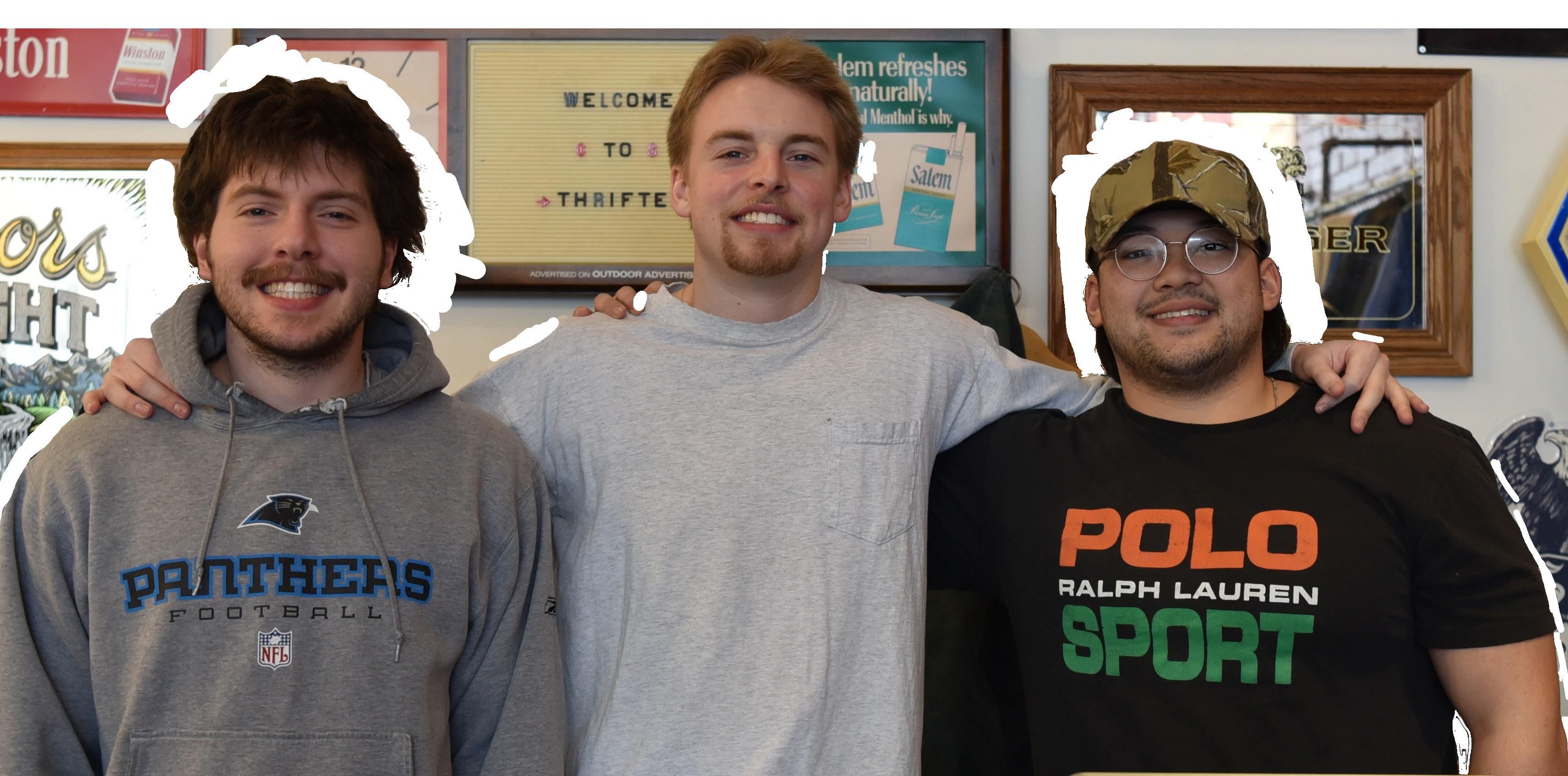


until November of 2025 when the friends decided to combine the two stores into one–Thrifted.
At the time, opening a storefront was something they were collectively interested in, but it was not a priority. In fact, Paul says, “I was mentally preparing to get an internship,” but that quickly shifted as Berry found the perfect building. Situated on 1449 S. Second St., right between the university and downtown, a prime location. Being near the UofL campus was crucial for the team, as the university’s students were the very people who made their success possible. Meanwhile, remaining close to downtown allowed locals to feel comfortable shopping there too.
While the store created new business opportunities, it also allowed them to expand their purpose. Opening Thrifted gave them an opportunity to make a better impact on the environment. The greater public might deem their clothes as old and ready to trash, but they see past the age and take the time to upcycle the clothing to make for a greener, more sustainable shopping experience. “Lots of our clothes come from places that will end up dumping them once they’ve been there long enough. Once trashed, they’re in line to be burned and create pollutants,” said Berry, highlighting Thrifted’s commitment to sustainable sourcing. Procuring clothing, however, is not as easy as it seems. Ensuring
high-quality, beautiful pieces is of utmost importance to the Thrifted team – so important, that the team dedicates hours to properly restoring garments so they are the best they can be for customers. “They do a great job sorting through clothes,” said College of Business student Austin Walsh. “I bought two jackets and I love them.”
Going from a few racks and a folding table to a brick-and-mortar store shows how growth can bring opportunity, but they learned it comes with its own set of challenges. Creating a perfect space that truly represents a business is difficult, and even more so when much of the work falls on a small team. Paint, racks, flooring, décor and branding come at a cost, so the Thrifted team opted to DIY as much of the space as they could. Together they painted the exterior, mounted wall racks and transformed the space into a perfectly curated vintage vault–one they built side by side, putting in long hours and a shared vision for what it could become.




One of the biggest challenges these young business owners faced was learning how to work with city officials. They quickly learned the extensive number of permits and documents required to operate legally. It proved challenging not only to obtain permits but also to navigate through the necessary channels of communication. Communication is not limited to regulatory efforts, but the team recognized the importance of strong internal communication. Clearly delegating responsibilities, coordinating schedules and maintaining equal commitment among members became essential to sustaining the business’s growth.
The growing responsibilities and lessons ultimately set the stage for Thrifted’s official launch on November 8, 2025. Considering 3 Guys with Clothes and D.S. Finds were launched about five years ago, the contrast between past and present was striking. While their former launches were informal and quiet, Thrifted’s launch was on an entirely different scale. “Launch day here blew me away,” said Paul. Le said, “[Both launches] had some similarities in the aspect of uncertainty of where it could go, but the scale of the [Thrifted] idea was more complex.”
The turnout far exceeded expectations and highlighted the strength and support of the UofL community. That strong support not only helped establish Thrifted’s customer base but also reinforced the team’s growth as

Beyond community support, their experience as business students played an unexpected yet crucial role in Thrifted’s success. While classroom concepts initially felt disconnected from their day-to-day lives, those same lessons became increasingly more relevant
as the business grew. Courses in marketing, finance, management and entrepreneurship helped the team stay focused, make informed decisions and think strategically about the future. “Having the store makes it where I can compare [classroom topics] to exactly what I’m doing,” Paul explained, turning concepts into real-world application.
As a result, Thrifted evolved into more than a storefront; it became a living classroom. Every challenge, from budgeting to branding, offered a chance to apply what they were learning in real time. “Generally, my business professors contributed guidance and knowledge toward building Thrifted,” said Paul. “There were great professors [who helped shape me into] a better businessman.” Professors Kenneth Hartung, Jeffery Koleba and Andreas Elpidoru are among the many faculty members credited for providing support and guidance to the Thrifted team. This faculty support quickly translated into distinct opportunities for growth. With the help of UofL Events Coordinator Heather Stein, Thrifted was able to obtain a departmental sponsorship with the Management and Entrepreneurship Department, which allows them to continue participation in campus events. “We’re proud to play a small role in Thrifted and help create an environment where ventures like Thrifted can take root,” said Zachary Goldman, chair of the management and entrepreneurship department.
After weeks of manual labor, a successful launch and continually thriving business, Thrifted’s owners took a moment to reflect on their journey thus far. When asked about advice for students who wish to follow Thrifted’s footsteps, Paul said, “When the opportunity does come, you’ve got to take it.” Berry said, “Create a plan and do it.” These mindsets are woven into every stage of Thrifted’s story. “Don’t ever be scared of an idea and do your best to make that impact,”



said Le. Thrifted stands as a clear example of recognizing an opportunity and acting on it without hesitation.
Seizing these opportunities not only shaped the business but also shaped the individuals behind it. Along the way, the team has learned a lot about themselves. They discovered strengths as hands-on learners and developed a better understanding of each other’s communication styles. These are not skills that can be perfected overnight, but as the business continues to grow, so will the Thrifted team.
Paul shared. “Seeing new faces in here is what success is.”
Together these lessons reveal that Thrifted’s journey represents something larger than entrepreneurship alone. For Paul, Berry and Le, it’s about building not just a store but character, confidence and connections. The willingness to take risks, learn through challenges and prioritize the people who walk through their doors shows that true success is measured in impact as much as achievement.
This personal growth ultimately influenced how the team defines success. For Thrifted, success goes beyond financial gain; it’s rooted in people and shared experiences. “One of my favorite parts is people who you can tell love coming here and love finding new things,”
As Thrifted continues to evolve, Paul, Berry and Le’s story serves as a reminder that opportunity, growth and community are often the strongest foundations for any lasting venture.



by Matthew Willinger
For David and Linda Anderson, supporting the University of Louisville isn’t a new chapter. It’s a lifelong commitment.
The couple recently made a $2.5 million gift to establish the Anderson Chair of Accounting in the College of Business, creating a permanently endowed faculty position that will strengthen accounting education, research and student mentorship for generations to come.
For the Andersons, the gift is about much more than a title or a position. It’s about gratitude and paying forward the opportunities that shaped their own lives.
“Linda and I have been enthusiastic supporters of the university since our tenure as students,” David said. “We have enjoyed watching the university grow and thrive. We are grateful for an education that gave us the foundation for successful careers,” he said.
Linda Raymer Anderson (BSBA ’70, MED ‘78) remembers her undergraduate years not only for the classes she took, but for the work that helped define her professional path. As a participant in UofL’s Work Study Program, she was assigned
to the Admissions and Registrar’s Office. After graduation, she joined the staff full time and remained there for 13 years, ultimately serving as Assistant Director of Admissions.
She later earned her master’s degree in counseling and personnel services from the College of Education and Human Development in 1978 – another example of how UofL remained central to her professional growth.
David Anderson (BA ’69, MBA ’73) charted a path that began in political science before leading him into business and finance. After earning his MBA from the College of Business, he began his career in banking and later transitioned into the healthcare industry, working for Humana and Hospital
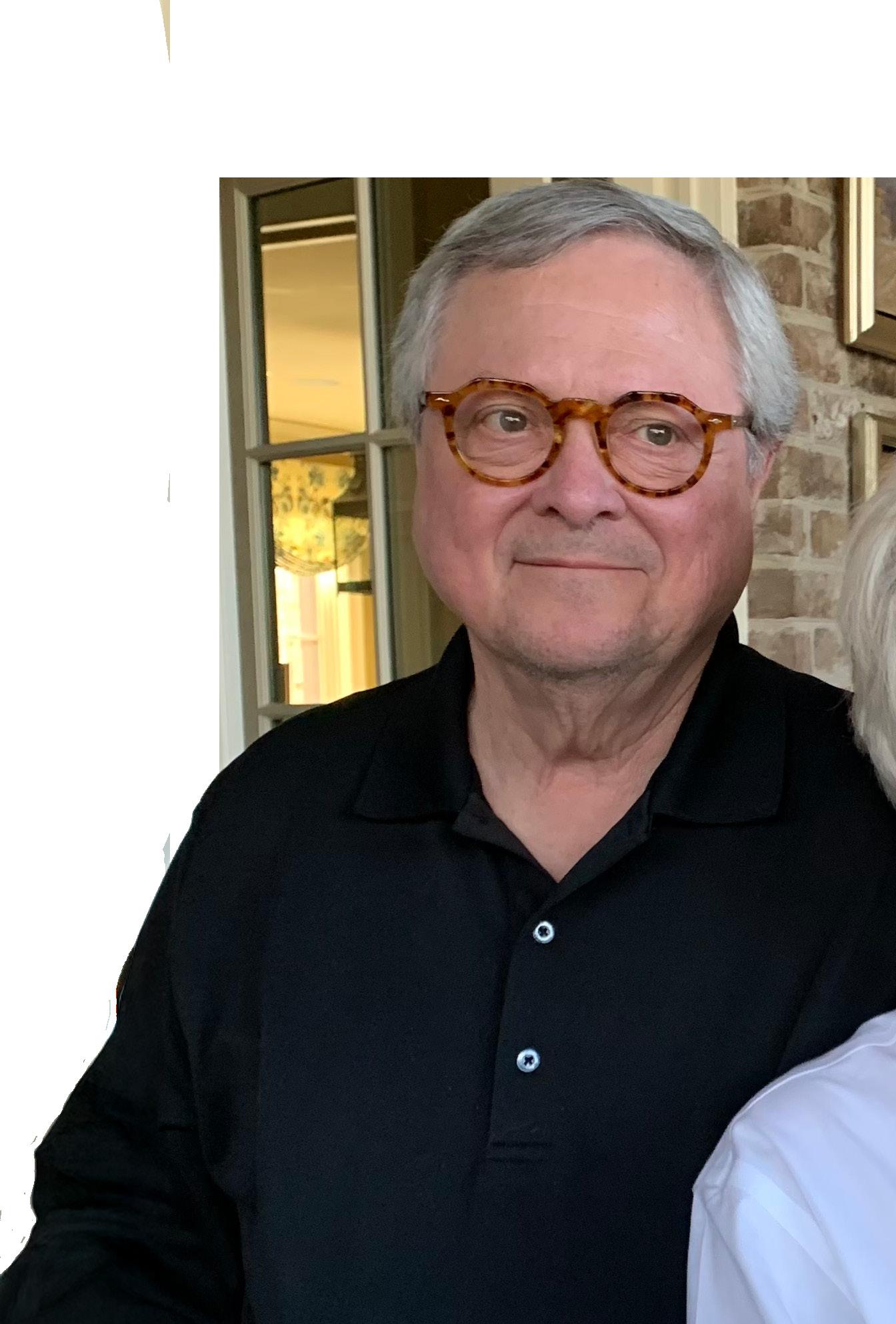
Corporation of America. Over a distinguished 38-year career, he rose to become Senior Vice President of Finance and Treasurer at HCA.
Today, he continues his connection to UofL through service on the University of Louisville Foundation Board of Directors.
When it came time to consider how they wanted to give back, the Andersons were thoughtful and intentional.
“We considered many ways to give back to the UofL community and concluded that endowing a chair in the College of Business Accounting Department would be the most impactful,” David said.
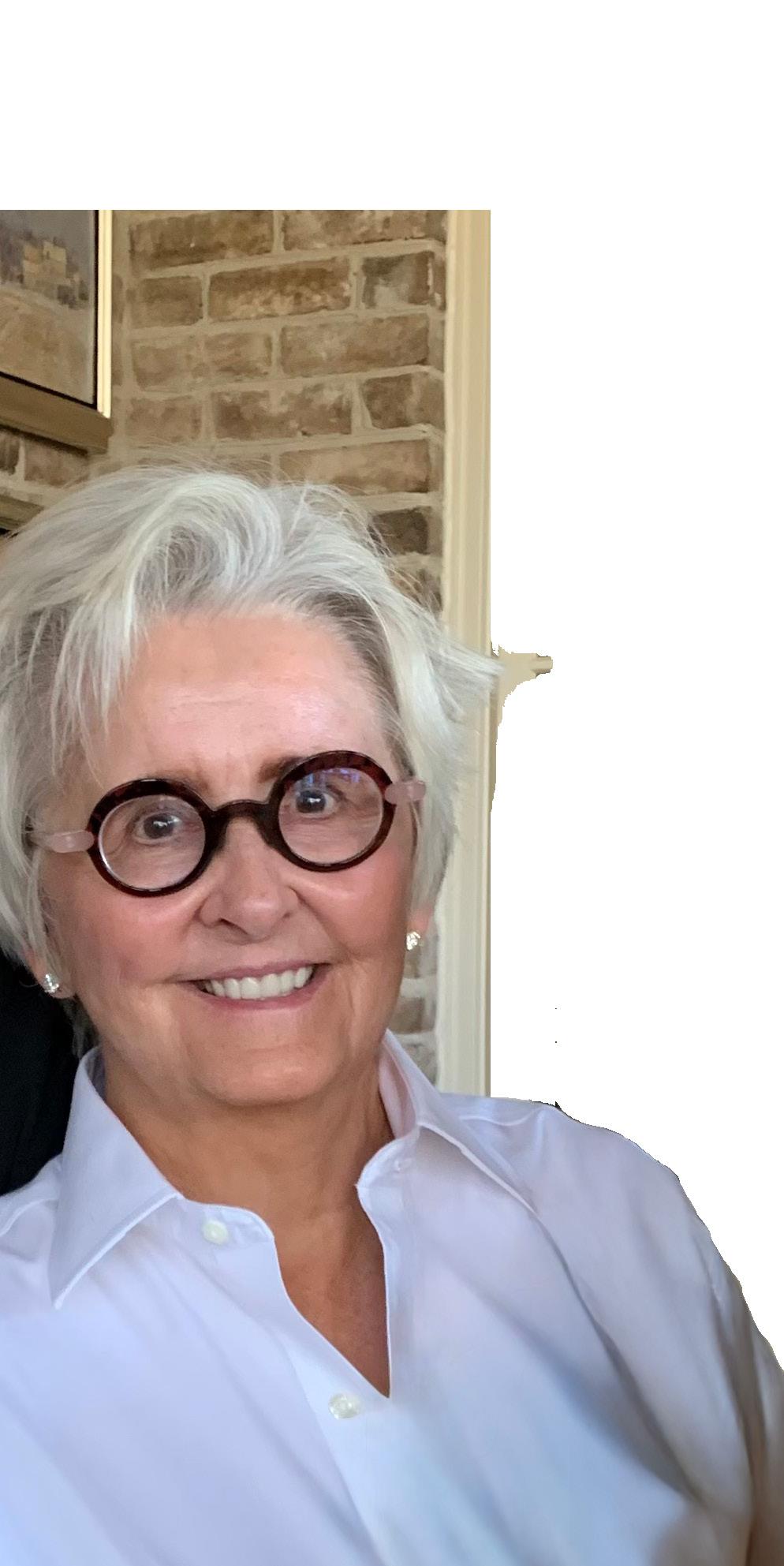
An endowed chair is one of the highest academic honors a university can offer. It provides dedicated, permanent funding to support a distinguished faculty member, enhancing teaching, advancing research and expanding mentorship opportunities for students.
The Anderson Chair of Accounting will help the College of Business recruit and retain exceptional faculty while strengthening connections between the classroom and the accounting profession.
“Endowed chairs are one of the most powerful ways we invest in student success and faculty leadership,” said Amy Henley, Dean of the College of Business. “This gift will help us advance accounting education
while preparing students for a rapidly evolving profession.”

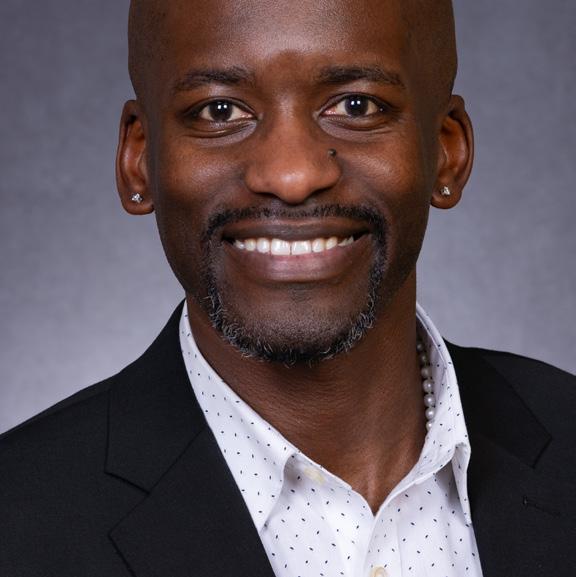
The flexibility of endowed support allows for innovation in curriculum development, growth in industry partnerships and expanded experiential learning opportunities.
“The Andersons’ hope is that this gift will strengthen an already impressive faculty and elevate the university’s position in a competitive academic marketplace.”
The Andersons believe that faculty excellence and accessibility go hand in hand.
“We believe this, combined with the university’s reasonable tuition structure, will enhance the University’s appeal to outstanding faculty and students,” David said. “The expected result is enriched opportunities for students and more successful and supportive alumni.”
For them, the gift represents confidence in the university’s direction and leadership – and optimism about what lies ahead.
“It is an exciting time to be a Cardinal fan,” David said. “We are proud to support those leading the university into the future.”
Through the Anderson Chair of Accounting, David and Linda Anderson are ensuring that future generations of business students benefit from the same strong foundation that shaped their own lives – a legacy of opportunity rooted in education, leadership and enduring Cardinal pride.
by Erica Hulse
Amanda “AJ” Templeton traded Florida’s white sands for the Alpine slopes, building a hospitality career on the power of the unexpected. Now an Associate Professor at the University of Louisville College of Business, Templeton brings a “say yes” philosophy directly into the classroom. For her, hospitality isn’t just a word found in a syllabus. Instead, it is a collection of experiences – from sun-drenched beaches to Wyoming ranches – that shapes how she prepares students for the real world. “My entry into hospitality wasn’t exactly planned,” she explains, but it is through that lack of a straight line that she now reaches her students in practical, high-impact ways.
Having earned a Bachelor of Business Administration in International Business from Florida Atlantic University, Templeton was focused on helping young adults long before her professional career formally began. Coaching basketball and working at the YMCA in high school, and spending summers in the Cayman Islands working in customer service for a telecommunications company, she was actively developing the communication and leadership strengths that would later define her as an educator, long before she entered the classrooms of UofL. After her first professional role at a real estate law firm, Templeton felt the pull toward something different for her future. “That’s where my hospitality story began,” she explained.
Early in Templeton’s career she took a sharp detour, trading a future in real estate law for a life in the snow. “After leaving the law firm, I

interviewed with Alpine Adventures, a ski tour operator in Fort Lauderdale, and was offered a position selling ski trips,” she said. “As a Floridian who had barely seen snow – and never even tried a snow sport – there was definitely a learning curve.” From Switzerland to the French and Italian Alps, Templeton’s opportunity to “stay in amazing hotels and see all the behind-thescenes details showed me just how dynamic the hospitality world really is.” While those experiences were incredible in their own right, “It gave me my first taste of event planning and leadership, and I knew I wanted to build a career in this field.” Driven further into this new industry, she earned her MS in Hospitality and Tourism Management at the University of Central Florida’s Rosen College of Hospitality Management.
Upon graduating with her master’s degree, Templeton continued working in the realm of

luxury experiences for guests, taking a role at The Hideout Lodge & Guest Ranch in Shell, Wyoming. At the upscale resort, she “truly fell in love with hospitality. I got to do a bit of everything,” she noted. “Guest service, event planning, marketing, bookkeeping, culinary operations and even helping with the livestock.” However, after her third season at the lodge, Templeton decided to put her education to use and return to her roots. “I grew up around educators and coaches and spent time coaching

basketball and running camps – but teaching as a career never crossed my mind,” she said. It was those early experiences, coupled with the wise words and encouragement of her father, Richard Templeton, and her mentor at UCF, H.G. Parsa, who “believed teaching would be a perfect fit for me,” even though, at the time, she could not see it. “As it turns out, they were onto something – it just took me a while to get there.”
management. Upon receiving her doctorate, she took on a role at Southern Utah University and then, after nearly seven years with the institution, Templeton saw a posting for a newly-developed hospitality minor at UofL – a program created with the support and funding from local hotels. Taking a chance and saying yes to another career experience, in the fall of 2025 she joined UofL faculty in leading the college’s hospitality minor. Transitioning into this new academic environment, Templeton found herself impressed by the curiosity of UofL business students. She was most drawn to “their eagerness to learn and their willingness to ask thoughtful, thought-provoking questions – not just in the classroom, but also when engaging with industry

After years with the ranch, she became driven to find a full-time position, and Templeton eventually found herself at a crossroads: “work for a tourism bureau or become an instructor for a two-year program at the University of Northwestern Ohio,” she explained. “UNOH made a strong offer, and just like that, my career in hospitality education began.”
After two years at UNOH, Templeton returned to UCF where she earned a PhD in hospitality
I WORK HARD TO BRING REALWORLD EXPERIENCE INTO THE CLASSROOM.
—AJ Templeton
clear that her students weren’t just passively absorbing information; they were ready to challenge ideas, connect concepts to real-world scenarios and actively participate in shaping their own educational experience.
Templeton’s approach in the classroom reflects that mindset. “I work hard to bring real-world experience straight into the classroom,” she said. “This is an industry where application matters. I encourage students to explore, take chances and find their place in hospitality— through guest speakers, site visits and handson opportunities.” That means designing assignments and learning experiences that mirror the pace and unpredictability of hospitality work, giving students space to experiment, make decisions and learn from direct interaction with professionals and organizations across the city.
Entrepreneurship, Zac Goldman, has seen firsthand how effectively Templeton not only builds rapport with students in her courses but also links the college to the booming hospitality field in the Louisville area. “It is truly impressive to see how quickly and authentically she has connected with the local community and leaders

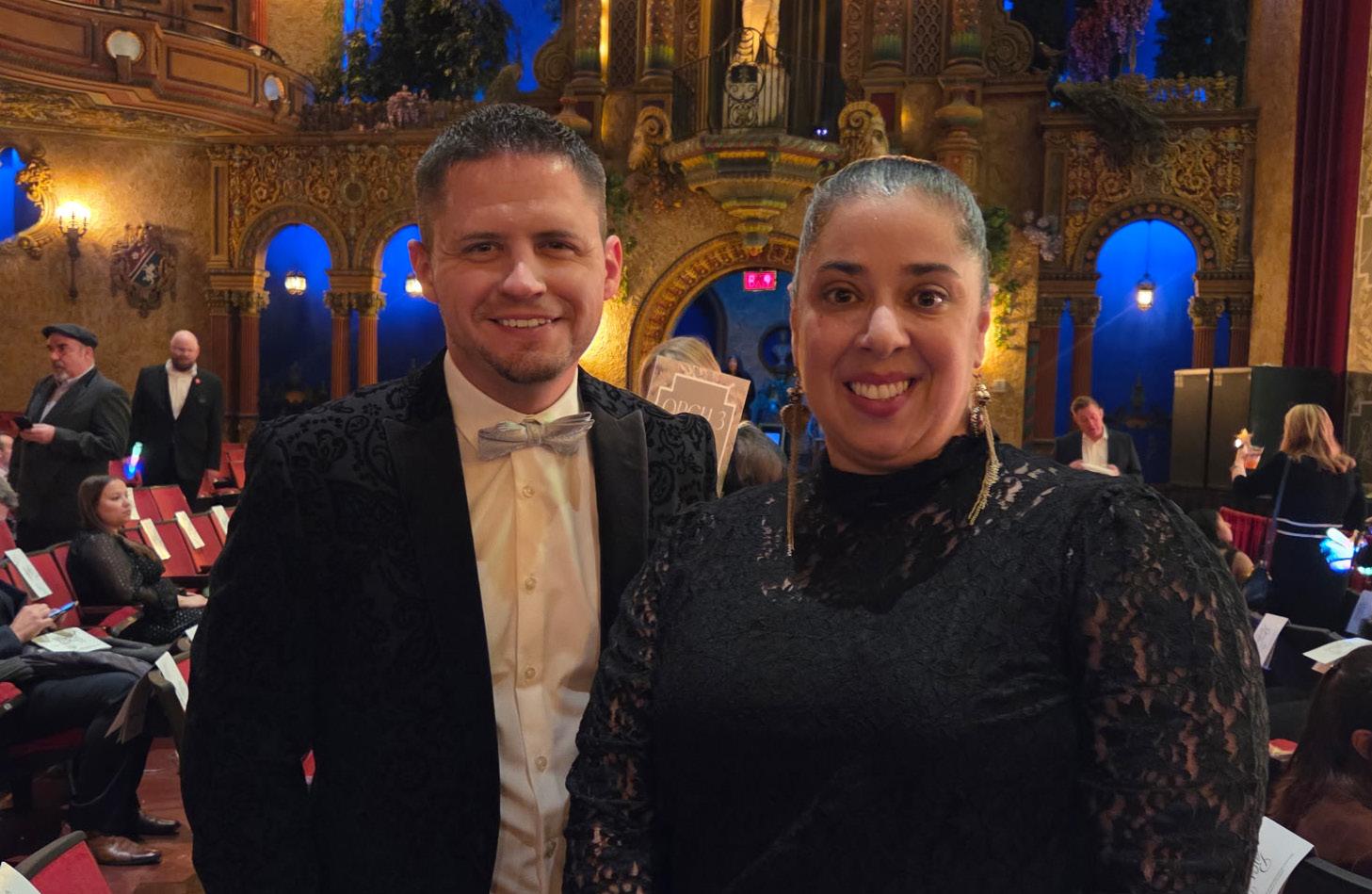
across the hospitality industry,” shared Goldman. “She has incredible subject matter expertise, but beyond that, she cares genuinely about the hospitality industry and all the people associated with it.”
To keep those experiences relevant, she treats her own professional engagement as an extension of the classroom. “I stay engaged with the industry – sitting on boards, being involved in events, attending industry conferences – not only does it keep me up to speed with what is happening, but often I can find ways to get students involved – win-win.” By staying in constant conversation with leaders across Louisville’s hospitality and tourism landscape, she connects students with meaningful opportunities while ensuring the curriculum reflects what employers actually need.
Chair of the Department of Management and
As Templeton looks ahead, her focus reaches beyond any single class or cohort. She sees the hospitality minor as a connector – a bridge between students eager to learn, an industry hungry for talent and a university positioned at the heart of Louisville’s visitor economy. “I want the program to connect students, the industry, the College of Business and the university in meaningful ways. I hope it helps build future industry leaders and industry advocates, creates strong professional networks and provides opportunities that are valuable for both students, UofL and the industry.”
That vision is already taking shape, as evidenced by comments shared at the 2025 Recognition of Service Excellence, or ROSE Awards, held in Louisville. Surrounded by more than 700 hospitality professionals, several UofL students
watched as David Greene, general manager of the Louisville Marriott and president of the Louisville Hotel Association, spoke about LHA and Louisville Hotel Partnership’s investment in the College of Business and the launch of the hospitality minor – and then pointed out that students from the very program were in the room. For Templeton, it was a clear signal that her students weren’t just studying the industry from afar; they were being welcomed into it.
“Engagement in industry events like the ROSE Awards gives our program real ‘street cred,’” Templeton shared. “It opens doors to conversations between the college and industry that may not have happened otherwise. It also keeps our program top of mind for employers as they think about talent acquisition. Now, they’re considering posting positions in Cardinal Careers, [the university’s career search platform], hosting site tours, serving as guest speakers, sponsoring students to attend events and more.”
For Goldman, seeing students in that room underscored the impact of those opportunities.
“It was truly incredible to see our students engage with hospitality leaders and professionals from across Louisville and for them to be publicly recognized and applauded by hundreds of people in the hospitality community,” he said. “The investment these students are making, and the community is making in them, is about the future.”
For Templeton, that sense of momentum is matched by a deep gratitude for the partners, colleagues and students who are helping shape the program alongside her. “I’m incredibly humbled, honored, grateful and proud to be part of a team bringing this vision to life. Sharing in this recognition is truly meaningful; it makes you feel connected to something bigger.”
ALL MAJORS, PLEASE CHECK IN
One of the most compelling parts of hospitality to Templeton is just how many different kinds of students can see themselves in the industry – an industry in need of analysts and storytellers, strategists and people-people. She’s quick to remind students that their major doesn’t limit their path. “The beauty of this
industry is that there is a need for every major: finance, economics, accounting, marketing, communications, management, human resources and more,” shared Templeton. “Gathan Borden, an industry colleague, [once said that], ‘In hospitality, every skillset finds a home,’ and that really speaks to the opportunities for students.”
—AJ Templeton
Her advice for students who feel even a spark of interest is simple, but not passive. “Listen, learn and get involved,” she said. “Be part of an industry organization, go to networking events, go to industry conferences – listen to speakers, listen to the conversations that happen at networking events and then don’t be afraid to engage. Ask the questions, ask how you can be involved – this is an industry that loves providing opportunities to students, but students have to initiate and take advantage of the opportunities.”
Templeton may have started as a Floridian who had never seen snow, but she has become an architect of opportunity for Louisville’s future leaders. By bridging the gap between classroom theory and industry reality, she is proving that in hospitality, there are no wrong turns – only new horizons. For Templeton and her students, the most exciting part of the business is that the best experiences are still waiting to be discovered.
Ready to trade your desk for a destination?
Whether you envision a career on the sand, in the snow or anything in between, our hospitality minor can help prepare you for a career without boundaries.
Visit catalog.louisville.edu/undergraduate/minors/hospitality-minor/ to learn more.
by Shelby Eisenback
Melissa Cozart’s journey into the equine industry is a testament to following passion when it unexpectedly takes the lead.
An alumna of the University of Louisville, Cozart did not initially set out to pursue the equine business major. She began her college career intending to study criminal psychology, but everything changed during freshman orientation when she discovered the university’s Equine Industry Program. “As a horse-crazy girl, I became intrigued,” she recalls. She enrolled in several equine courses and quickly found herself drawn in. Still, it wasn’t until she gained handson experience working on the backside of the racetrack that her interest turned into a true calling, leading her to fully commit to the equine business major.
During her time at UofL, Cozart gravitated toward courses that blended science with industry application. Classes in equine nutrition and genetics stood out, aligning with her strengths and helping her better understand the horse as an individual athlete. An auctions course also broadened her perspective, introducing her to a new and complex side of the equine business.
Cozart complemented her coursework with a wide range of industry experiences, working in insurance, photography, racetrack operations and rehabilitation. These roles gave her a wellrounded understanding of the field, while the Equine Industry Program helped her connect the dots – providing insight into how and why each sector operates. The relationships she built along the way also proved invaluable as she began her professional journey.
After graduation, Cozart made the bold decision to turn down a marketing role at Churchill Downs to pursue her passion as an exercise rider. She moved
to Lexington, where she worked full time with Equibase while managing a barn and prep facility near Keeneland. She later returned closer to home, working at Ellis Park in both the racing office and as a marketing coordinator, where she played a role in launching and promoting historical racing gaming machines.
Today, Cozart is the Director of Equine Operations at Hermitage Farm in Goshen, Kentucky. Her role spans sales coordination, client relations, pedigree consultation and more –requiring a diverse skillset she developed through both her education and experience.
Among her proudest accomplishments is building a career that blends her lifelong love of horses with strong business acumen. She has also achieved success as a thoroughbred owner and breeder, producing four debut winners from five foals, including a stakes winner.
From financial strategy to market forecasting,


A collection of standout students from our graduate programs, each with a unique story of growth, purpose and what’s possible at UofL.

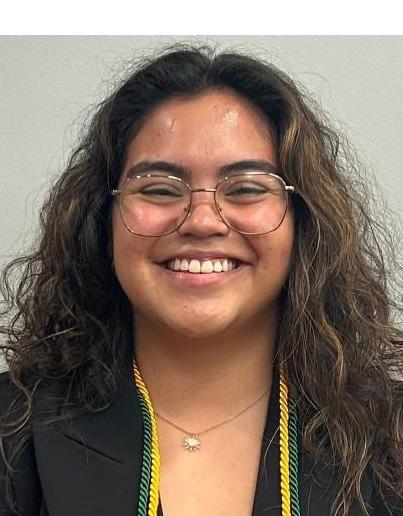
MS in Accountancy & Analytics
Inspired by her father and a desire to grow as a leader, Daniela Aguirre Garcia pursued a master’s degree to reach a long-held personal goal.
Through the MSAA program –and her work as a tax intern at Wetterer & Co. – she is applying her knowledge in real time, building both experience and confidence. “Judgment is the combination of knowledge and experience,” she says, “and I’m building that every day.”
She credits the cohort model for bringing together students from diverse backgrounds with a shared commitment to growth.
Her advice: take the leap. Beyond the degree, she’s gained discipline, adaptability and the confidence to proudly call herself an accountant.

Full-Time MBA
After serving in the U.S. Army, Christian Wilson pursued an MBA to expand his leadership skills and prepare for his next chapter.
While his military experience built a strong foundation, the program is helping him strengthen his strategic thinking, financial knowledge and communication skills for careers in acquisition and project management.
For Wilson, the most valuable part of the MBA is the people, with classmates bringing diverse industry perspectives.
He encourages others to take the leap into graduate school, even when the timing isn’t perfect: “There’s never a perfect moment, but the momentum you gain makes it worthwhile.”

MS in Business Analytics
Ugo Achara’s path to business analytics began with a realization: vision needs technical skills to bring it to life.
After discovering an interest in analytical problem-solving during a master’s in Leadership for Creative Enterprise, a software development course shifted his career direction. In the MSBA program, he’s building the skills to understand the data behind the big picture.
He credits the program’s structure, supportive faculty and collaborative cohort for that growth. Entering without a technical background, he embraces the constant learning. “Every day, I’m learning something new,” he says.
His advice: seek honest insights from students and alumni. “Graduate school is an investment, and the most valuable perspective comes from those who have lived it.”



After graduating from the University of Kansas, Sydney Johnston realized she missed the rhythm and challenge of academic life – making an MBA a natural next step.
At the University of Louisville, she’s found that balance. As a graduate assistant with Louisville Athletics, she supports Student-Athlete Leadership & Development, helping student-athletes prepare for life beyond competition.
She credits the Online MBA’s flexibility for allowing her to grow academically and professionally without compromise.
Initially hesitant about learning online, Johnston now describes the experience as transformative – and one that’s strengthened her passion for a career in athletics.
The College of Business is proud to welcome its newest staff and faculty to the Cardinal Community. These faces will help shape our students’ lives and enrich the university’s knowledge base.
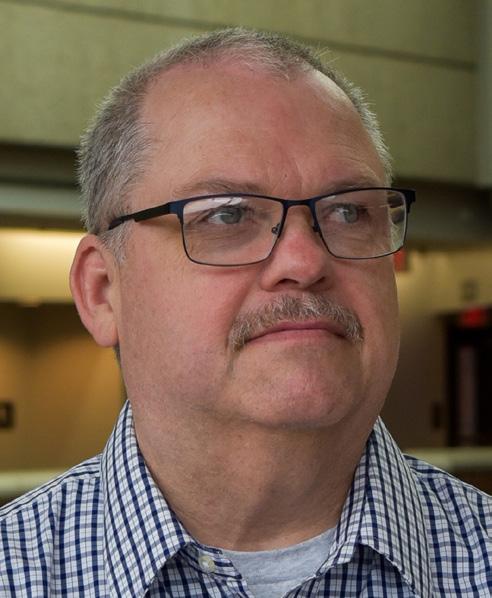
Michael Conkey-Kiper Department Coordinator, Accountancy

Erin Suell Department Coordinator, Dean’s Suite


Anna Nickell Department Coordinator, Center for Positive Leadership

Steven Von Gerlachter Instructor, Marketing
by Erica Hulse
Some careers begin with a plan, but for Tyler Rice, the road forward was forged in sirens, splitsecond decisions and an unshakable willingness to step toward challenge. Now pursuing his Master of Science in Accounting and Analytics (MSAA) at the University of Louisville College of Business, Rice brings to the classroom a perspective shaped by emergency medical services, law enforcement and firsthand experience in the operational and financial sides of health care. His path into business has been anything but conventional, yet it reflects the same discipline, adaptability and sense of purpose that have defined each chapter of his professional life. In our conversation with Rice, he discussed his transition from emergency response and public service into business, the lessons he has gained while balancing full-time work with the MSAA program, and the goals, growth and perspective shaping his future in accounting and analytics.

UofL: Tell us about your background.
TR: I grew up in Naperville, Illinois, a suburb of Chicago. From a young age, I knew I wanted to become a police officer. As I began thinking about how to reach that goal, I learned that individuals must be at least 21 years old to serve as a police officer in the United States. At the same time, I discovered that I could become an Emergency Medical Technician (EMT) at 18. I saw this as an opportunity to gain valuable experience communicating with people,

particularly during stressful and emergency situations, which I believed would ultimately make me a more effective police officer.
Around the same time, I was presented with an opportunity for a major life change. At 17, I made the decision to graduate from high school early and move across the country to Las Vegas. Although my sister was there, it was still a significant transition for a young adult. As I adjusted to a new environment, I enrolled in EMT training and later completed an advanced program. Soon after, I began working on a 911 ambulance in Las Vegas.
To my surprise, I developed a deep appreciation for pre-hospital medicine. Many of the closest friendships I maintain today were formed during that period of my life. Serving as one of the many first responders who responded to the October 2017 mass shooting further strengthened my commitment to protecting and serving the community. Eventually, I transitioned into law enforcement and began working as a police officer with the Las Vegas Metropolitan Police Department. My experience in law enforcement played a defining role in shaping who I am today, teaching me discipline, commitment and the importance of service to others.
UofL: How did working in environments where seconds mattered influence the way you think and make decisions?
TR: Working in environments where seconds matter fundamentally changes the way you view time and decision making. You quickly realize how rapidly circumstances can evolve and how fragile life can be. Responding to emergency calls often requires making decisions within seconds, and those decisions are frequently evaluated later when all of the facts become known.
One mindset that helped guide me during emergencies was reminding myself that “this is not my emergency.” If every person responding to a crisis becomes emotionally overwhelmed by the situation, it becomes far more difficult to help those involved. Maintaining composure allows responders to remain focused and approach the situation with clarity.
partner, who was a fourth-year medical student, matched into a residency program at UofL. Knowing that we would be relocating from Las Vegas, I saw the move as an opportunity to pursue a new professional challenge.
I had long believed that further education would be important for my longterm development. Initially, I was uncertain which field I wanted to pursue academically. Given my experience in pre-hospital medicine, I first considered transitioning into in-hospital medicine. I began working and studying in that field, but over time I discovered a growing interest in finance.


Another critical skill is the ability to step back and analyze a situation objectively, even when time feels limited. By mentally separating yourself from the immediate stress of the moment, you can reduce personal bias and make more thoughtful, rational decisions. Additionally, working in emergency services taught me the true meaning of urgency. While some situations are genuinely life threatening, many others require careful assessment rather than immediate reaction. Understanding that distinction encourages more deliberate decision making and ultimately leads to better outcomes.
UofL: What led you to transition from emergency response to finance?
TR: One of the questions I am asked most often is why I chose to transition from policing to finance and accounting. The answer is both straightforward and complex. At the time, my
As a young adult, I recognized that I lacked financial literacy. At the same time, one of my longterm goals was to achieve financial stability and independence. I wanted to eliminate the stress that can accompany financial uncertainty, such as worrying about everyday expenses like groceries or fuel. That motivation ultimately guided me toward pursuing an undergraduate degree in finance. During my studies, I took several accounting courses that significantly deepened my interest in the field, ultimately leading me to complete a minor in accounting. This experience set the foundation for the academic and professional path I am pursuing today.
UofL: What skills from your previous work translated best to accounting and finance?
TR: One of the most transferable skills from my previous careers has been critical thinking. Emergency response environments require individuals to assess complex situations quickly and determine practical solutions under pressure. That experience strengthened my problemsolving abilities and helped me develop a structured and analytical approach to evaluating challenges.
UofL: What drew you to the MSAA program?
TR: During my undergraduate education, I began exploring potential career paths and thinking more intentionally about my long-term goals. I quickly realized that additional education often creates new opportunities and allows individuals to expand their professional impact. While I knew I wanted to pursue graduate education, I initially explored several options, including MBA programs, business analytics programs and even doctoral programs in finance.
Ultimately, I determined that the MSAA program offered the greatest value for my professional goals. The program provides a strong academic curriculum supported by knowledgeable faculty, while also offering practical resources such as Becker CPA preparation, courses designed to support CPA exam readiness, post-graduate certifications and numerous networking opportunities. Additionally, the opportunity to participate in an international study experience provides valuable exposure to global business practices. Taken together, these elements made the MSAA program the ideal next step in my academic and professional journey.
UofL: What part of the MSAA curriculum has challenged you the most so far?
TR: The most challenging aspect of the curriculum has been time management. While the pace of the program and expectations of the faculty are reasonable, graduate-level coursework requires a significantly greater level of commitment and discipline.
Balancing school, work and personal responsibilities can be demanding. As a result, it has become increasingly important to set clear expectations and communicate effectively with those who support you, whether that be a partner, supervisor or professor. By doing so, you create a support system that helps you remain focused and achieve your goals. Learning to manage competing responsibilities effectively has been one of the most valuable lessons of the program.
UofL: What do you hope to achieve upon earning your MSAA degree?
TR: Upon earning my MSAA degree, I hope to emerge not only as a well-rounded accountant but also as a more capable and adaptable professional. I look forward to applying the technical knowledge and analytical skills developed throughout the program to address increasingly complex challenges within the field.
Equally important, I hope to continue building meaningful relationships within the professional community. These connections will help support my continued growth both personally and professionally as I advance in my career.
UofL: What advice would you give someone considering pursuing an MSAA?
TR: My advice to prospective graduate students is to begin by developing a clear understanding of the programs available. UofL offers a diverse range of graduate business degrees, so it is important to identify the program that best aligns with your professional goals.
Next, actively engage with the program by
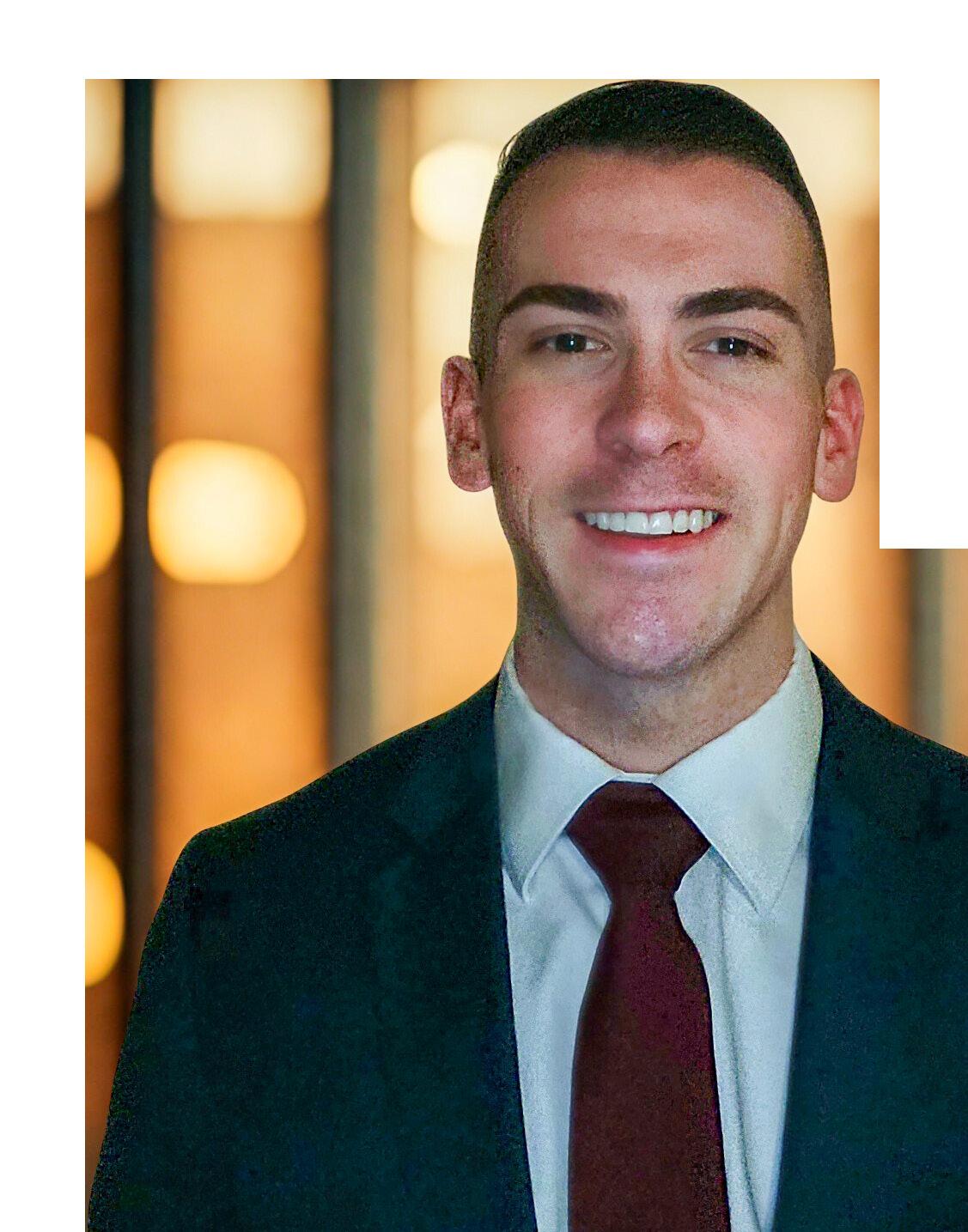

by Erica Hulse

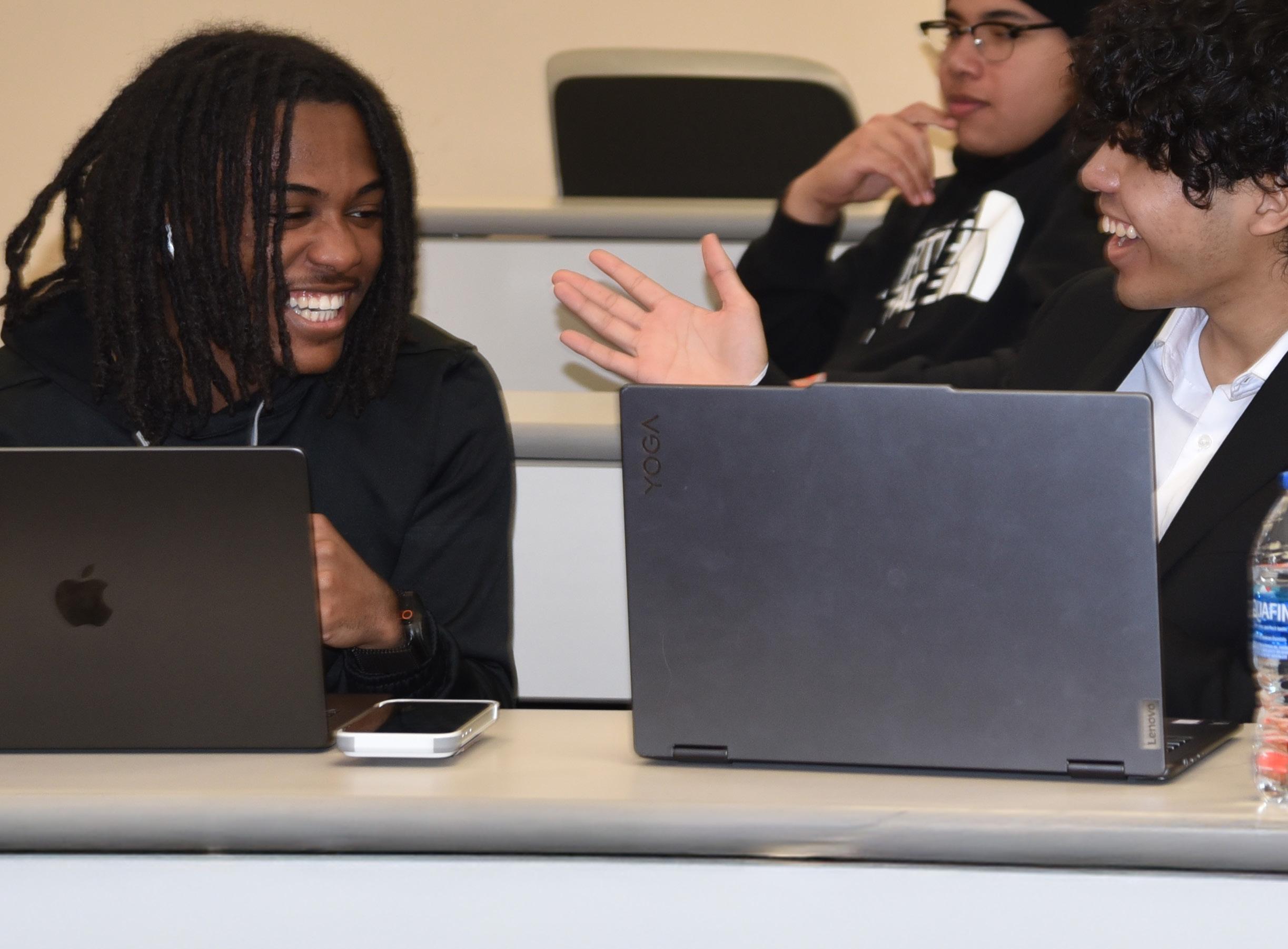
A single cardinal is a striking sight, but a group of them is known as a radiance – a name that perfectly captures the idea that students shine brighter when they are supported by a community. The Radiance program at the University of Louisville College of Business ensures that first-year business students do not have to navigate the complexities of higher education alone. We connected with Lexus Gardner, who oversees the initiative alongside Academic Advisor Anna Goodner, to discuss the program’s evolution from a staff-led initiative into a student-driven community. In the following interview, Gardner shares how peer-to-peer connection helps students “Radiate Together,” building the confidence necessary to thrive throughout their academic journeys.
UofL: Where did the idea to create the student program, Radiance, come from?
LG: Radiance was created as an extension of the CAMP 100 course that first-year students take during their fall semester. CAMP 100 provides structured guidance on many aspects of college life, including navigating campus resources and preparing for registration. However, once the spring semester begins, that built-in structure is no longer there, and students are expected to navigate these processes more independently. Radiance was designed to continue bridging that gap by offering ongoing support as students adjust to the realities of college beyond their first semester.
The name itself came from a conversation with Dr. Raymond Green, who shared that
a group of cardinals is called a radiance. That moment tied everything together. It captured the idea that students are not meant to navigate this transition alone and that they shine brighter when they are supported as a group.
UofL: Why did you think a first-year CoB program was important for students?
LG: It was important to create a program where first-year students could clearly see and feel that the College of Business is here to support them. The transition to college can be overwhelming, and students often hesitate to ask questions or are unsure where to turn. Radiance creates a space where students can get to know College of Business staff, connect with other students and build trust early in their college experience.
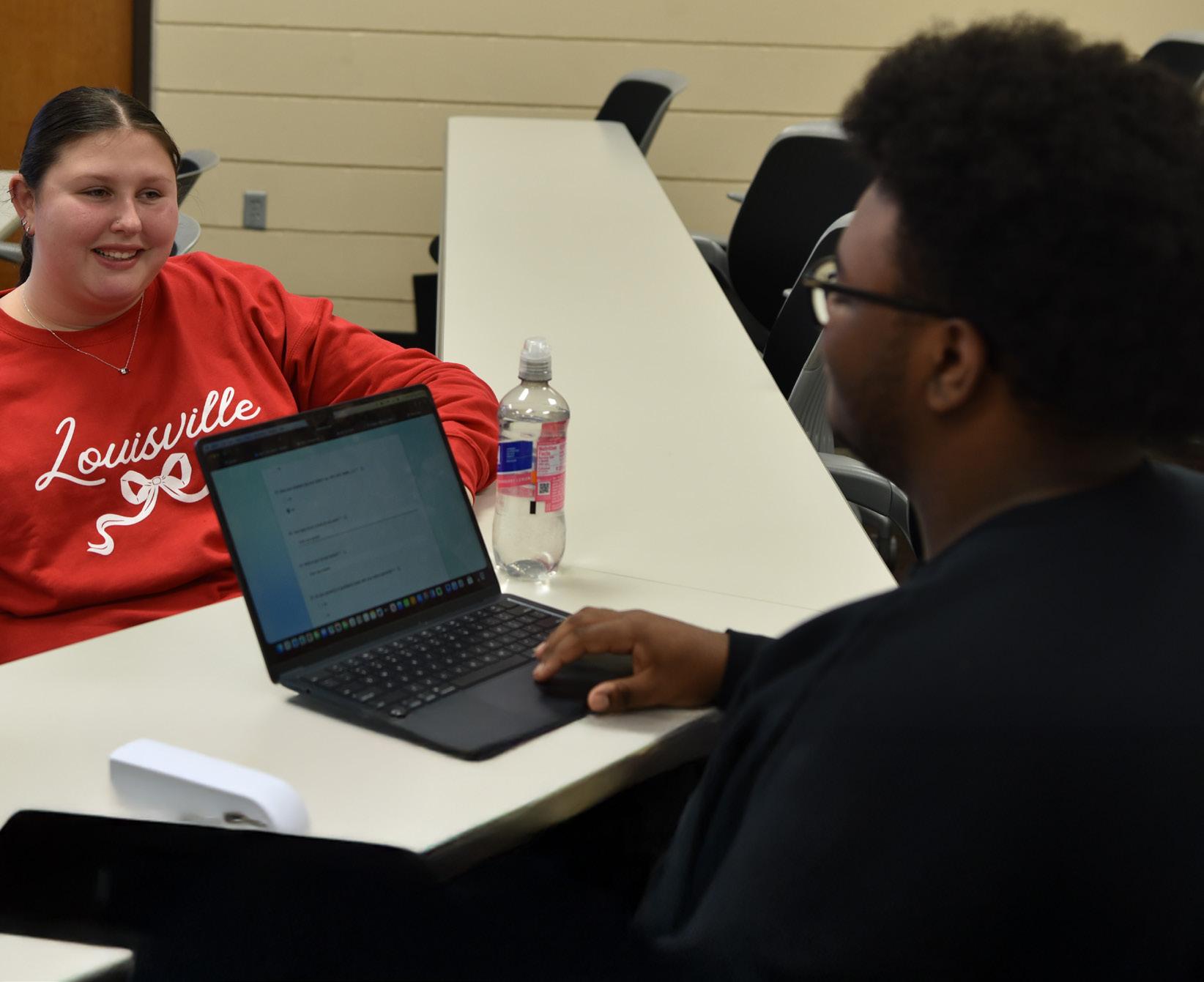
At its core, the program is about comfort. When students feel supported and welcomed by the College of Business, they are more confident navigating challenges, asking questions and engaging fully in their academic journey.
UofL: How have you seen Radiance evolve?
LG: Since its inception, Radiance has grown beyond a staff-led initiative into a more studentdriven community. One of the most notable changes has been the involvement of upperclass students who are actively bringing firstyear students into the space. That peer-to-peer connection has strengthened the program and expanded its reach. You can truly see the group growing as students begin to believe in Radiance and choose to devote their own time to it. That level of ownership and organic growth has been one of the clearest signs of its evolution and long-term potential.
UofL: What can students expect?
LG: Students can expect a welcoming, lowpressure environment where they can connect with peers, learn practical college skills and ask questions they may not feel comfortable asking elsewhere. Activities include structured discussions, skill-building sessions such as registration preparation, wellness-focused events and informal opportunities to connect with staff
and other students. The primary benefit is feeling less alone while gaining tools that support academic and personal success.
UofL: How do you believe students in this program, “Radiate Together?”
LG: Students radiate together by sharing experiences openly, supporting one another through challenges and recognizing that their struggles are not individual failures but common parts of the transition to college. The program encourages peer affirmation, collaboration and mutual accountability, which helps students build confidence both individually and collectively.
UofL: What types of activities have you seen resonate most with your attendees?
LG: The sessions that resonate most are those where students receive something immediate and personal from the experience. Programs that walk students through processes they are navigating for the first time, such as scholarship submissions or registration, tend to be the most popular. Many students have never completed these steps independently before and value having someone review their work and confirm they are on the right track.
The scholarship submission session has been well attended, as students are navigating unfamiliar deadlines and requirements. Registration preparation also draws strong engagement for similar reasons. This will be the first time offering a meditation and study session, but there is strong interest and high hopes that it will meet students where they are academically and emotionally during the semester.
UofL: How does being part of this group support first-year student success?
LG: Radiance helps students build awareness of resources, improve self-advocacy and develop planning skills earlier in their college careers. When students feel connected and supported,
they are more likely to seek help, stay engaged and persist through challenges. While Radiance is not an academic intervention program, the sense of belonging it fosters directly supports behaviors associated with academic success.
UofL: What has been your favorite part of seeing Radiance students connect?
LG: My favorite part has been watching students realize they are not the only ones feeling uncertain or overwhelmed. Seeing those moments of relief and mutual understanding, when students start talking to one another, has been especially meaningful.
One of my most memorable moments happened during the first Radiance session last year. Students initially sat apart, clearly unfamiliar with one another. We hosted a large kickoff event designed to gauge how students were feeling during their first year, and it was evident that many did not yet feel connected. A few days later, I saw several of those same students sitting together in the atrium studying. That moment made it clear that Radiance was doing exactly what it was intended to do.
UofL: What kind of feedback have you received from students in the program?
LG: Students have shared that Radiance feels approachable, supportive and different from more formal programming. Many have said they appreciate having a space where they can be honest about their experiences and learn things they did not realize they needed to know. While feedback has been informal rather than surveybased, it consistently highlights the value of connection and reassurance.
UofL: What is one thing you would like every student in the CoB to know about Radiance?
LG: Radiance is not about having everything figured out. It exists specifically for students who are still learning, adjusting and finding their place. Students do not need to be struggling or perfect to belong here.


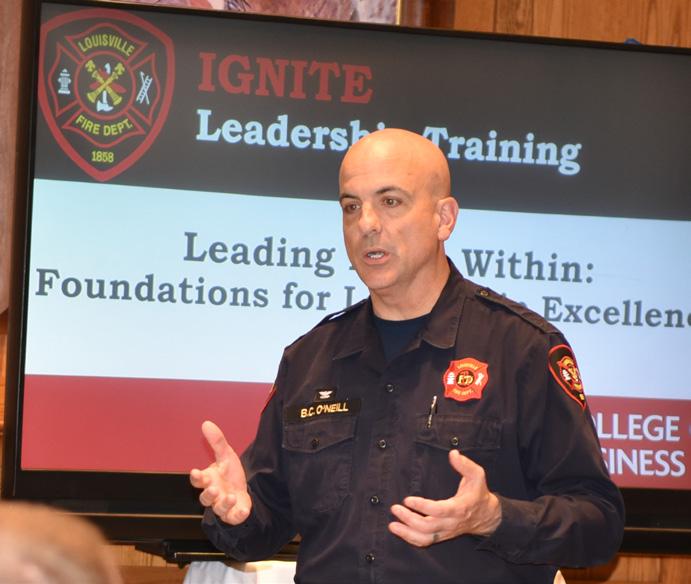
Participants of the inaugural Ignite Leadership program recently celebrated their graduation at the University Club on the University of Louisville campus. The six-month professional development initiative – a collaboration between the UofL Executive Education department and the Louisville Fire Department – empowers firefighters in leadership roles to make effective decisions, manage conflict and cultivate a resilient culture.
The program was created through the vision of LFD Chief Brian O’Neill and Colonel Bobby Cooper, whose commitment to leadership development is paving the way for a stronger, more connected department.


by Madison Kurfirst
As the new year settles in, inboxes fill, paperwork piles up and the countdown quietly begins to one of the year’s more important deadlines: tax season. During this time, individuals are required to complete and submit their tax returns, a process that can be overwhelming and stressful. To help alleviate that pressure, the College of Business and the Beta Alpha Psi chapter offer free tax preparation services through its Volunteer Income Tax Assistance program (VITA). Staffed by trained student volunteers, VITA provides support to students, faculty, staff and members of the surrounding community. During the 2025 tax season, 13 student volunteers helped 191 students from 10 different countries with their taxes. Introduced to the city of Louisville in 2001 and UofL in spring 2024, the program not only serves the public but gives accounting students valuable, hands-on experience preparing tax returns. In this Q&A, UofL accounting major and VITA volunteer Nicole Tioukalova talks about her introduction to the program, what it takes to be a volunteer and reflects on the benefits of VITA for the community.
UofL: Tell us about yourself.
NT: I am a junior accounting major, originally from Richmond, Kentucky. Outside of classes I am involved in several different organizations and student chapters, including President of the National Association of Black Accountants, Beta Alpha
Psi Community Service Coordinator, College of Business Student Council Recruitment Board Member and as a campus ambassador for KyCPA and Becker.
UofL: What led you to choose the University of Louisville for your degree?
NT: During my senior year of high school, I was considering a few different universities in Kentucky. I was drawn to the University of Louisville primarily for its location, a bigger city with bigger opportunities. [Also], while it did not ultimately influence my decision, I liked the fact that students in the College of Business were off on Fridays!
UofL: How did you learn about the VITA Tax Program?
NT: I first learned about the VITA program when I joined Beta Alpha Psi at the start of my sophomore year. Several of the officers mentioned participating in the program the year prior and explained that everything took place directly in the College of Business building.
UofL: Did you have any prior experience in tax/ financial accounting before volunteering with VITA?
NT: Before joining the VITA program, my accounting experience came from prior classes: ACCT 201 and 202, and ACCT 301 and 302. I did not have any real-world accounting experience at the time, so I was excited to get involved.
UofL: What inspired you to become a volunteer tax preparer? Is this something you ever thought you’d do?


NT: In discussions about accounting, it is almost guaranteed that someone will bring up the topic of audit versus tax. Wanting to experience tax firsthand to see if it was something I could pursue as a career, I decided to become a VITA volunteer. Becoming involved in the program also meant giving back to the community, which I love to do.
If you had told freshman-year me that I would be serving as a volunteer tax preparer, I probably would have been pleasantly surprised. At the time, I was not aware of any programs like VITA and assumed I would only be able to get hands-on accounting experience through internships.
UofL: What does a typical volunteer day look like for you?
NT: As a volunteer, every day is a little different. For the spring 2026 program, we are currently open Monday through Wednesday from 3 p.m. to 7 p.m in room 228. We typically have rotating volunteer groups depending on members’ class schedules, internships and extracurricular commitments.
I volunteer on Tuesdays after my Cost Accounting class, ACCT 320. After settling in, I alternate between the roles of greeter and tax preparer, depending on volunteer availability. As a greeter, I welcome clients and assist them in filling out an intake form, 13614-C or 13614-NR, which is used during the filing process. As a tax preparer, I work in a separate room with a few other volunteers to prepare returns using our designated software, TaxSlayer. While the tax preparers complete the filing, the client sits beside us to provide

documents, answer questions and observe the process.
UofL: What skills should volunteers have to succeed in this program?
NT: Successful VITA volunteers are organized, detail-oriented, patient, empathetic and collaborative. It is also important for volunteers serving as tax preparers to be knowledgeable on important tax concepts. Of course, volunteers are not expected to enter the program as fully fledged tax experts; the executive board hosts various training sessions to ensure everyone is certified before the site opens.
UofL: How has volunteering with VITA impacted your future academic or career goals?
NT: Volunteering with VITA has had a tremendously positive impact on my academic and career goals. As my knowledge and skills have improved, so has my interest in the tax field. Just a few months ago, I accepted a tax internship for the upcoming summer!
UofL: Has this program changed how you think about financial literacy and accessibility?
NT: Being a VITA volunteer has ignited my passion for promoting financial literacy and advocating for accessible financial resources for underserved populations. As detailed in the program flyer, VITA offers free tax assistance to many individuals, including college



students and staff, taxpayers who generally make $67,000 or less and limited English-speaking taxpayers.
UofL: In what way has volunteering with VITA helped you apply classroom concepts to real work?
NT: Having completed two tax classes, ACCT 315 and 415, VITA has been an excellent opportunity to apply classroom concepts to real-world scenarios. While taking the necessary exams to become a certified tax preparer for the program, Basic, Advanced, International and Foreign Student–I recognized how helpful it was to already be familiar with topics such as different sources of income, types of deductions and credits and tax treaties.
Shout out to my tax professor, Dr. Lisa Blum! She is incredibly knowledgeable on complex tax topics, is always available to help students with questions and provides numerous opportunities for students to apply their tax knowledge on projects that simulate real-world scenarios. While taking her courses, [I completed] two tax research projects that both utilized RIA Checkpoint, an online tax research database. [I also completed] two federal income tax returns, one for a corporation and one for a married couple. Tax is by no means an easy subject, so I am grateful to have had her as a professor.
UofL: What has been the most impactful experience working with a client?
NT: On my first day volunteering as a tax preparer, I helped three clients with their tax returns. The final return was particularly complex. With the help of other volunteers, we bounced around ideas and carefully reviewed each step. Throughout the process, we kept the client informed, including them in our

discussions and explaining the logic behind certain calculations. Beyond simply completing the return, this experience demonstrated how accessible financial guidance can reduce stress and empower clients to better understand their finances.
UofL: What has been the most rewarding part of volunteering with VITA?
NT: The most rewarding part of volunteering with VITA has been seeing the direct impact of our work on those we serve. On a random Tuesday, you might assist a freshman filing a tax return for the first time, a PhD student participating in the program for the second year in a row, a faculty member, etc. You never know how impactful free tax return assistance can be for someone.
UofL: Why should students and the community care about the VITA program?
NT: The VITA program offers many benefits to both students and the greater community, with one of the primary benefits being free tax assistance. For lower-income individuals, tax refunds can sometimes be substantial relative to their annual income and may help cover certain expenses. Students also benefit by volunteering with the program. For those studying accounting, finance and/or other related fields, VITA provides a great opportunity to serve the community while applying classroom concepts to real-world situations.
UofL: Why do you think programs like VITA are important for the Louisville community?
NT: By providing free tax assistance, programs like VITA are important to the greater Louisville community because they reduce financial barriers, lower stress and empower individuals to better understand and manage their finances and promote economic equity.
Discover a transformative collaboration opportunity with UofL’s College of Business Corporate Partner Program. By joining, companies gain priority recruitment strategies, direct influence on future educational skill sets and engagement opportunities with our Cardinal Community. Enjoy executive education discounts, prominent visibility and roundtable participation to shape today’s students and tomorrow’s leaders.
To become a Corporate Partner, your company will need to commit annually, provide logo permissions, host our representatives once a year and nominate a director-level representative for biannual roundtable








meetings. Elevate UofL College of Business at your company as a top choice for hiring interns, employees and executive education.
The College of Business graduate interns may work new-to-them part- or full-time roles as long as they can apply what they are learning in their programs to the role and will receive coaching and guidance from their direct managers. Internships must be vetted by the graduate internship advisors, and employers must complete a performance evaluation on the intern once a semester.






















by Christopher Dye
If the past few years have made anything clear, it is how much modern life depends on supply chains. When those systems slow down or break, the effects are immediate. They impact businesses, communities and everyday life.
Starting in fall 2026, the University of Louisville College of Business will offer a new Bachelor of Science in Business Administration in Global Supply Chain Management. The program is designed to prepare students for a field that is both increasingly visible and in high demand.
Louisville’s role as a logistics hub makes it a fitting place for a program like this. With access to a major international airport, rail lines, waterways and interstate highways, the city offers students proximity to companies operating supply chains at a national and global scale.


“Supply chain management is a core function of every business,” said Dean Amy Henley. “This program is designed to give students the skills and experience they need to step into that work.”
The program was developed with input from industry partners and focuses on a mix of business fundamentals, operations knowledge and applied skills. Students will study how goods move through complex networks, how data informs decision-making and how teams coordinate across organizations.
Just as important, the degree emphasizes practical experience. Internships, co-ops and potential study abroad opportunities are built into the curriculum. Students will also gain exposure to tools like data analytics and artificial intelligence.
“At UPS, we see how supply chains depend on data, technology and coordination across complex networks,” said Peg O’Neil, president of UPS Network Design & Optimization. “Programs like this help prepare the next generation of professionals entering the field.”
Demand for supply chain professionals continues to grow, with strong projected job growth in Kentucky over the next decade. The work spans industries such as manufacturing, healthcare, retail and technology. That range makes it a flexible path for students with a variety of interests.
At its core, the field is about problem solving. It involves moving goods efficiently, responding to disruptions and improving systems that operate at scale.
For the College of Business, the new degree reflects a continued focus on aligning academic programs with workforce needs. It also gives students a clearer path from the classroom to careers in industries that are already shaping the region.


UofL Hosts Inaugural Hospitality Advisory Board Meeting
Leaders from across Louisville’s hospitality sector gathered at the University of Louisville College of Business for the inaugural Hospitality Advisory Board
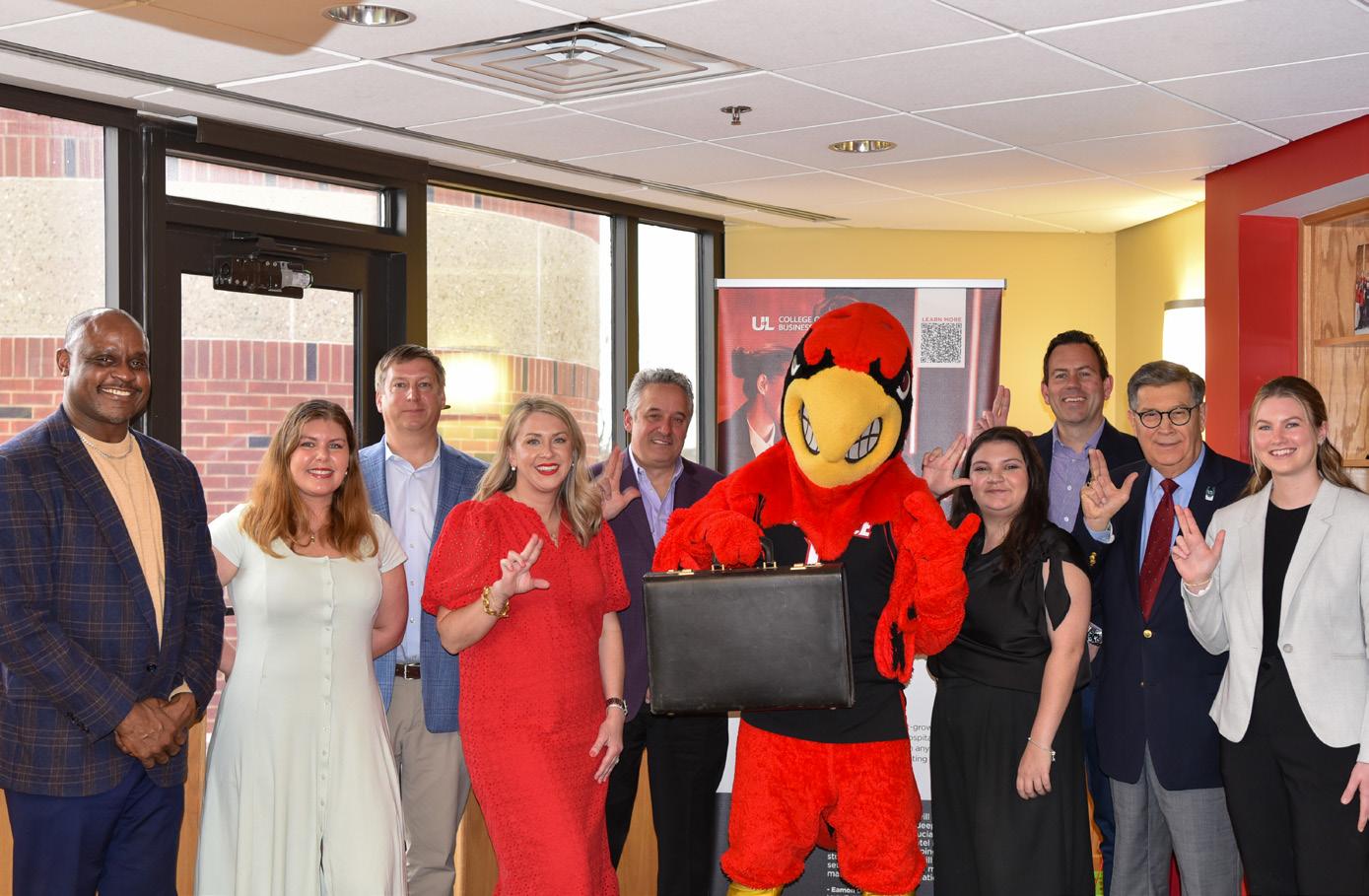
meeting, supporting the college’s hospitality minor and strengthening ties with the local industry. Associate Professor AJ Templeton, College of Business Dean Amy Henley and Zachary Goldman, chair of the Department of Management & Entrepreneurship, welcomed attendees and emphasized the importance of collaboration in preparing future hospitality leaders. As Louisville’s tourism industry continues to grow, the college remains committed to partnering with the community to develop skilled professionals who will contribute to the city’s success.
by Erica Hulse
Louisville Hotel Partnership Expands Investment in Hospitality Program
The Louisville Hotel Partnership (LHP) has pledged an additional

$75,000
over two years to establish the Hospitality Management Program Fund within the University of Louisville College of Business. This new investment builds on LHP’s previously announced three-year,
$550,000
commitment to the university, further strengthening the partnership between Louisville’s hospitality industry and the next generation of its workforce.
Formalized through a Charitable Gift Agreement with the University of Louisville Foundation, the Hospitality Management Program Fund will primarily support students pursuing degrees in Hospitality Management through scholarships, student engagement initiatives, experiential learning opportunities and on-site industry experiences.


This investment directly aligns with LHP’s mission to drive incremental hotel room nights into Jefferson County and support tourism-related infrastructure that fuels long-term economic growth. By investing in hospitality education and workforce development, LHP is helping ensure Louisville remains competitive as a destination while building the skilled talent needed to support visitor growth.
“This continued investment is about building Louisville’s talent pipeline,” said Eamon O’Brien, Chair of the Louisville Hotel Partnership.
“Our industry thrives when we develop local leaders. By supporting UofL students, we are strengthening hospitality, creating career pathways and supporting the infrastructure that allows tourism and our local economy to grow.”
This initiative comes at no cost to Louisville taxpayers. LHP is funded through a modest assessment on overnight hotel guests, ensuring that tourism dollars are reinvested directly into workforce development, industry sustainability and community growth.
A portion of the funds may also be allocated toward curriculum development, industry collaboration, academic advising and other
programmatic initiatives designed to elevate and advance the Hospitality Management program and deepen connections between students and the hospitality sector.
“We are grateful for the Louisville Hotel Partnership’s continued commitment to our students and to the future of Louisville’s hospitality industry,” said Amy Henley, Dean of UofL College of Business. “This support strengthens our Hospitality Management minor by expanding experiential learning, industry engagement and programmatic support –ensuring our graduates are prepared to contribute immediately to one of our region’s most vital economic drivers.”
As outlined in the agreement, the university will provide annual stewardship reports detailing the use and impact of the funds supporting the Hospitality Management Program.
Together, the Louisville Hotel Partnership and the University of Louisville continue to demonstrate how industry-driven investment can fuel student success, strengthen workforce development and support a vibrant, resilient hospitality industry that benefits Jefferson County and the broader Louisville community.
by Erica Hulse
As the expectations placed on business leaders continue to increase and evolve at a rapid rate, so does the need for customized professional development that supports their knowledge, skill development and ability to work effectively with their teams. More organizations are turning to formats that go beyond one-time workshops, opting instead for multi-week programs that mirror the pace and pressures of day-to-day operations. These cohort models offer built-in networking, collaboration and shared learning among peers who face similar challenges, creating an environment where skills can grow slowly, conversations can deepen and a continuing education experience can nurture a lifetime of learning.
That shift is evident at the UofL College of Business, where a six-month professional development cohort model is serving a wide range of professionals across the region and is tailored to a variety of business industries and structures. From executive education offerings geared toward leadership in franchising to the newest professional education opportunities through the college’s Family Business Center, lengthy, cohort-based noncredit courses are giving new and seasoned entrepreneurs, professionals and executives the chance to engage more intentionally with complex material, apply concepts over time and form connections that last well beyond the classroom. To understand how this approach is being applied within the FBC, we sat down with Executive Director Candace Bensel to discuss the design of its newest cohort offering, Financial Fluency for the Non-Financial Manager.
UofL: What sparked the idea for a cohort-style program in the Family Business Center?
CB: Our members are business owners and senior leaders with demanding schedules and require programming that respects their time constraints. While our monthly sessions serve many topics well, certain subjects demand more comprehensive exploration. The cohort model addresses this need by structuring curriculum across multiple sessions, enabling us to break down complex content into digestible segments.
Equally important, the cohort format creates space for members to implement what they learn between sessions and to build meaningful relationships with peers facing similar challenges. This extended engagement fosters both deeper learning and stronger professional connections across our community – outcomes that brief, standalone sessions simply cannot achieve.
UofL: How does the six-month model cohort benefit participants?
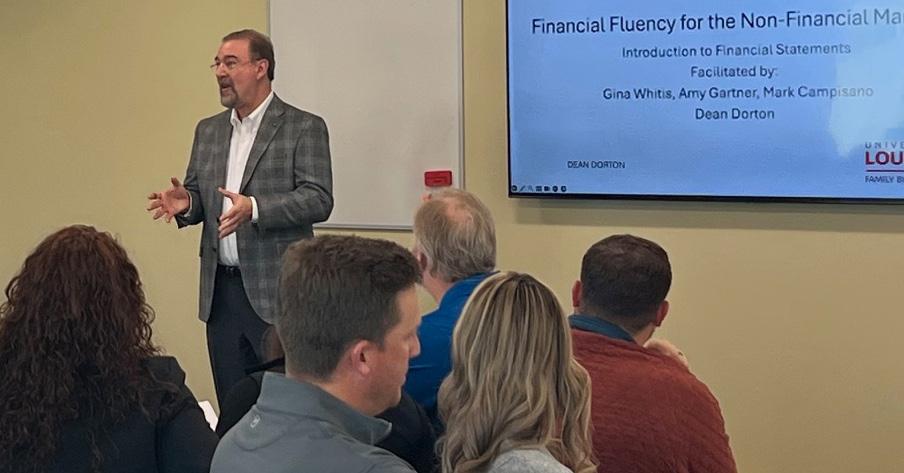
CB: Rather than overwhelming attendees with information in a compressed timeframe, they have the opportunity to practice what they’ve learned, observe real results in their businesses and with their teams and return to subsequent sessions with informed questions and deeper insights. Each session builds progressively on previous concepts, creating a scaffolded learning experience that reinforces retention and mastery.
Additionally, the six-month timeframe fosters stronger peer connections among cohort members. Participants develop trusted relationships over time, creating a network of fellow business leaders who can share challenges, solutions and ongoing support well beyond the program’s conclusion. This community-building aspect has proven to be one of the most valued outcomes of the extended model.
UofL: What do you hope participants take away from this focused learning experience?
CB: The biggest takeaway I want participants to gain is confidence and context – the ability to sit in a room where valuation, capital structure or profitability are being discussed and to understand what’s at stake and how to contribute meaningfully.
Many non-financial leaders are exceptional at what they do. They’re strong operators, excellent people managers and deeply knowledgeable about their functional areas. But when the conversation shifts to financial strategy, they often disengage. Not because they’re incapable, but because they lack the foundational knowledge to connect the dots between their operational decisions and the financial outcomes.
What we want them to take away is:
• The ability to speak the language – to understand terms like EBITDA, debt-to-equity ratios or customer profitability analysis and why they matter enough to ask intelligent questions.
• An understanding of how their decisions, such as hiring, pricing, customer relationships and process improvements, directly affect profitability and business value.
• A readiness for greater responsibility, especially for next-generation leaders, where an understanding of valuation and capital structure is essential for ownership transitions, growth decisions and long-term planning.
Read the full piece online at business. louisville.edu/news-and-events

by Matthew Willinger
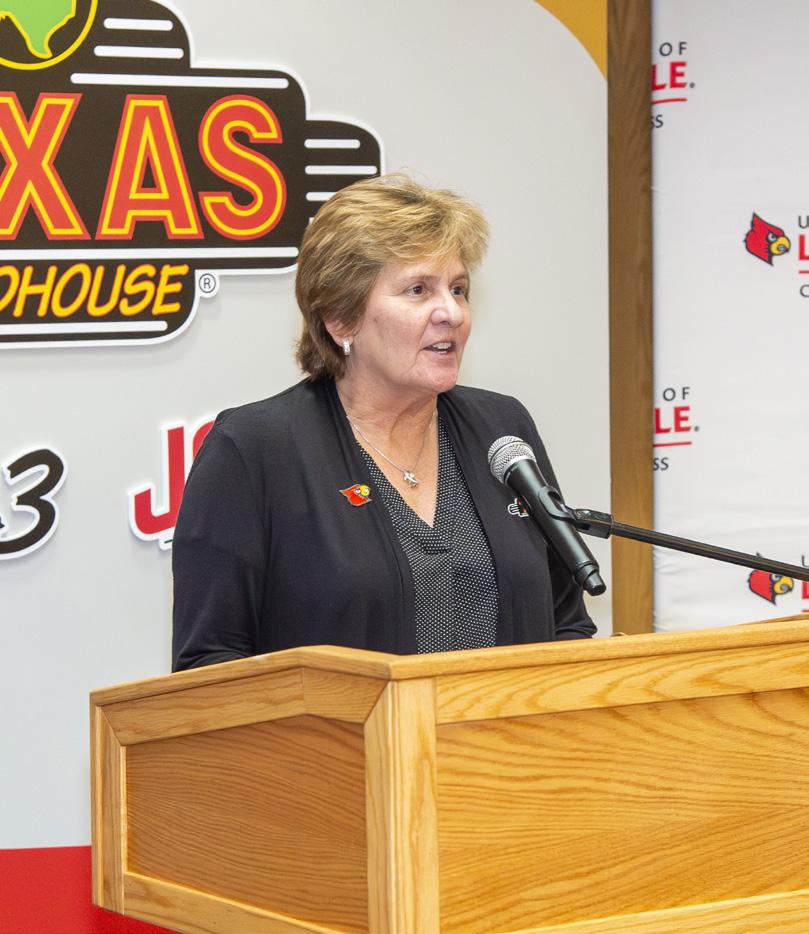
UofL celebrated the newly renovated Texas Roadhouse Student Center, located inside the College of Business, with a ribbon-cutting to recognize the generous support of Texas Roadhouse and the renovation work completed in partnership with Buffalo Construction.
The ceremony brought together students, faculty, staff and community members to mark the continued collaboration between UofL and the Louisville-based restaurant brand.
Special guests included Texas Roadhouse executives Gina Tobin and Chris Colson, along with representatives from Buffalo Construction, university leadership and the College of Business Student Council.
First opened in 2010, the Texas Roadhouse Student Center remains one of the most unique student spaces at any university in the country.
The Western-themed environment, complete with wooden benches, neon signage and design elements found in Texas Roadhouse restaurants, was originally funded and constructed by Texas Roadhouse.
The recent renovations preserve the iconic theming while enhancing comfort, durability and functionality for today’s students.
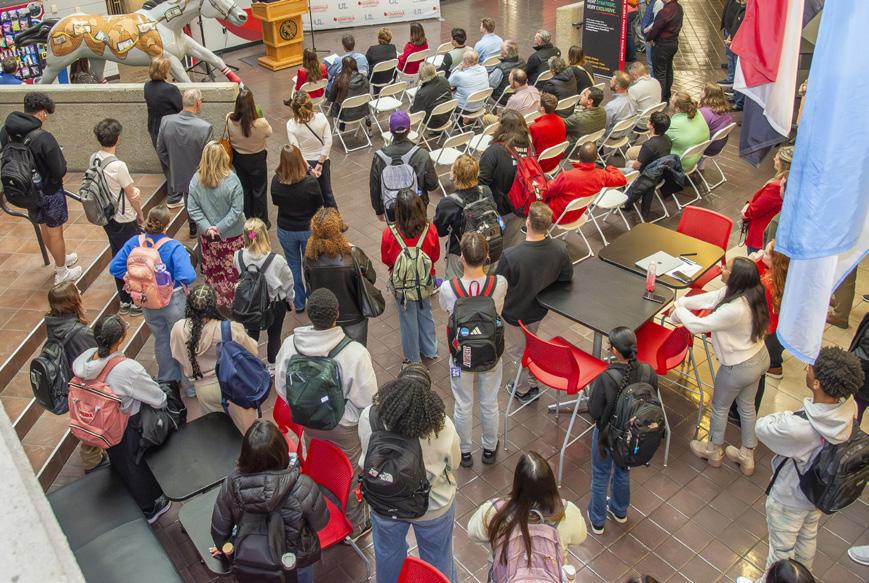
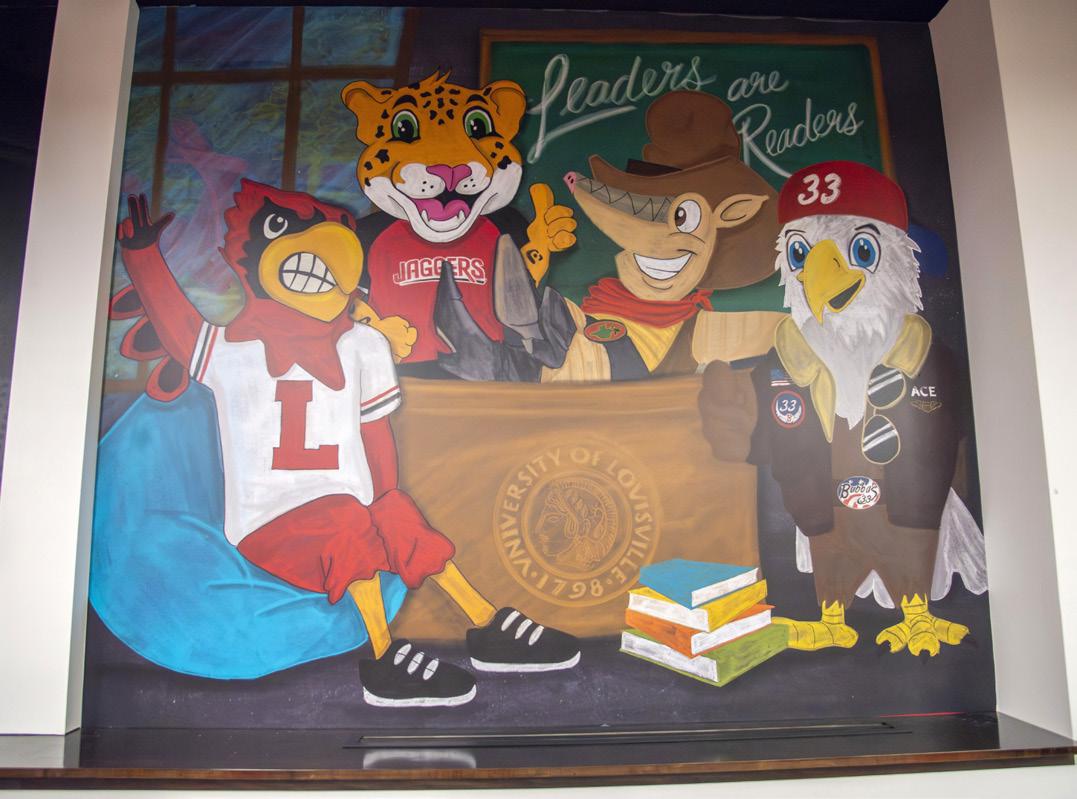

“Texas Roadhouse has been an incredible partner to the University of Louisville for more than a decade,” said Amy Henley, dean of the College of Business. “Their investment with Buffalo Construction continues to strengthen the student experience and demonstrates the company’s ongoing commitment to growing Louisville’s future business leaders.”

Buffalo Construction partnered with Texas Roadhouse to lead the renovation project, mirroring the collaboration the two organizations use to build new restaurant locations across the country. The student center remains one of the most popular study spaces on campus, consistently filled with students seeking a quiet, comfortable and distinctive place to gather between classes.
“We’re proud to support the next generation of leaders at UofL,” said Gina Tobin, president of Texas Roadhouse. “This space reflects our culture, our roots in Louisville and our ongoing connection to the community.”
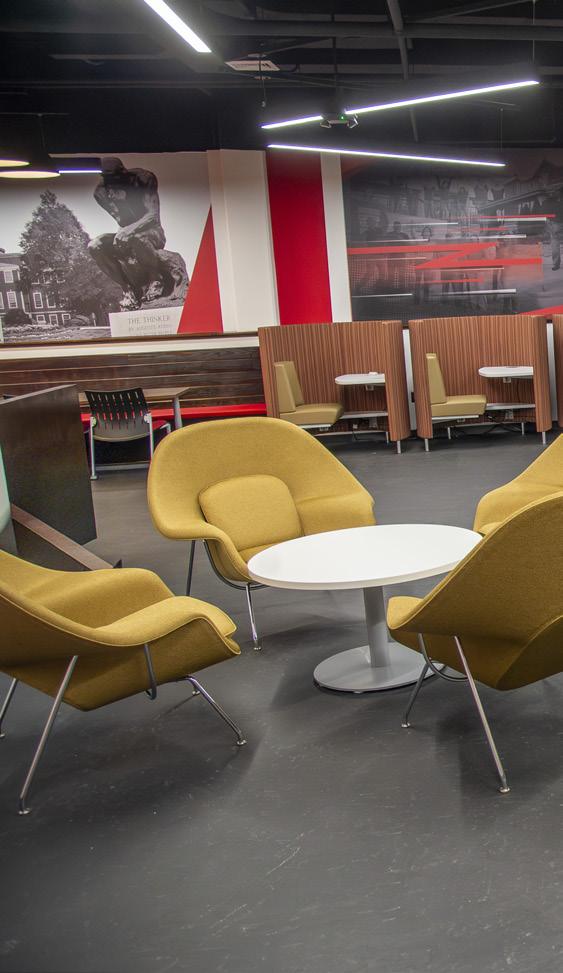

The UofL College of Business continues to advance conversations around artificial intelligence through its ongoing AI Forum series, bringing together industry leaders, educators and community members to explore how AI is transforming the way we work and learn.
Recent sessions have highlighted a range of applications, from the role of AI in creative industries to its growing impact in manufacturing and K–12 education. Speakers shared real-world insights on how organizations are integrating AI to enhance operations, improve decision-making and support human-centered innovation.
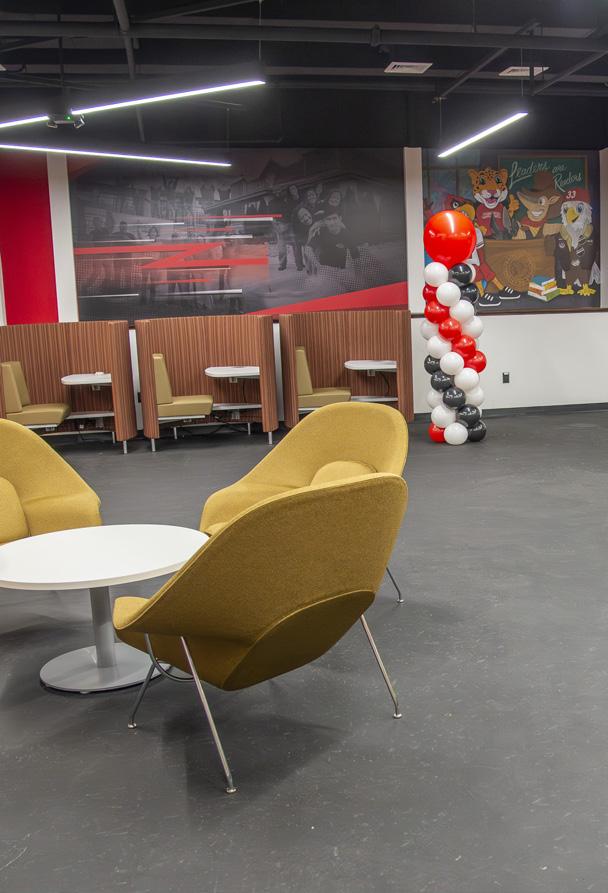
Open to the broader community, the forums provide a space for collaboration and knowledgesharing, reinforcing the college’s commitment to staying at the forefront of emerging technologies and preparing students and professionals for the future
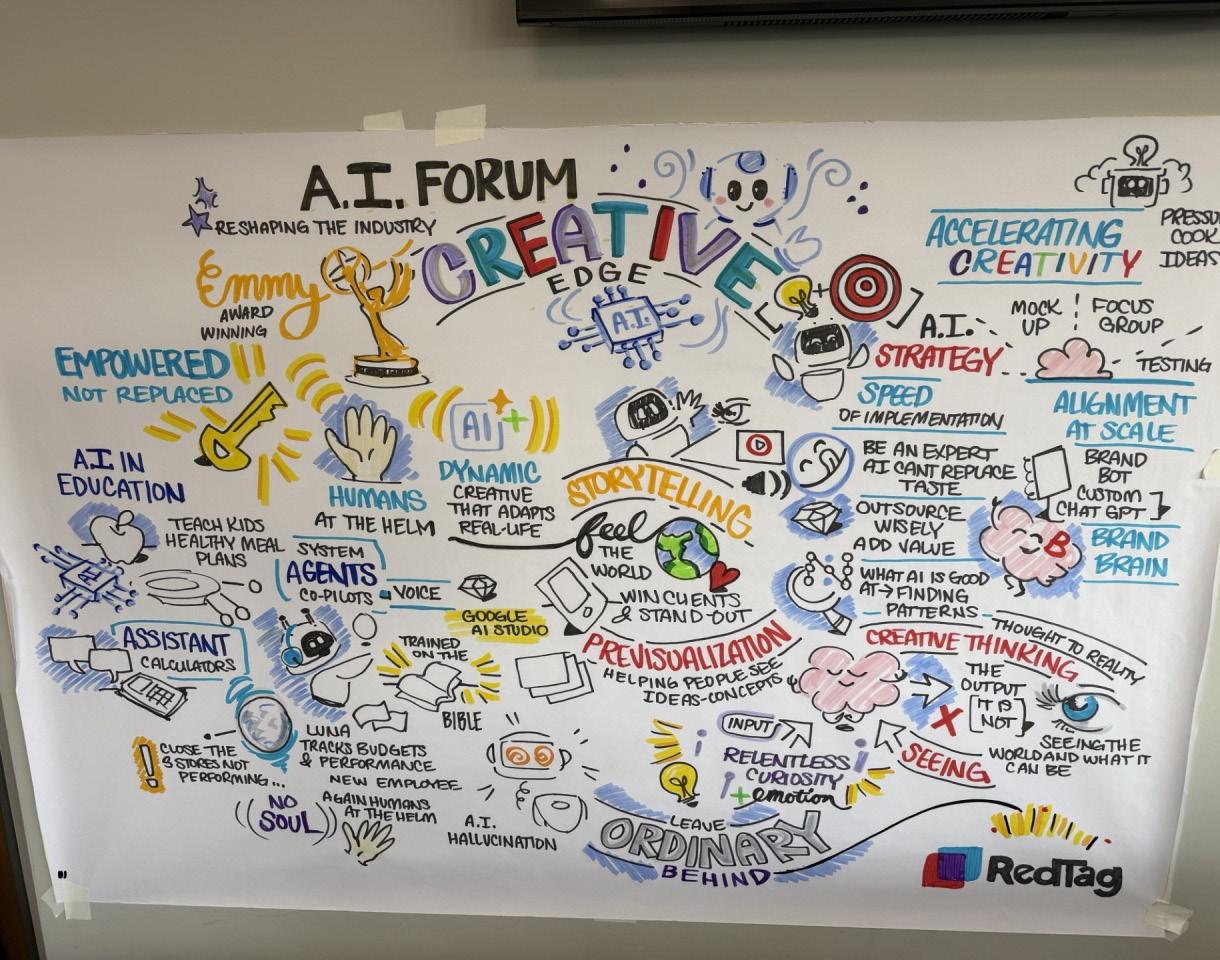
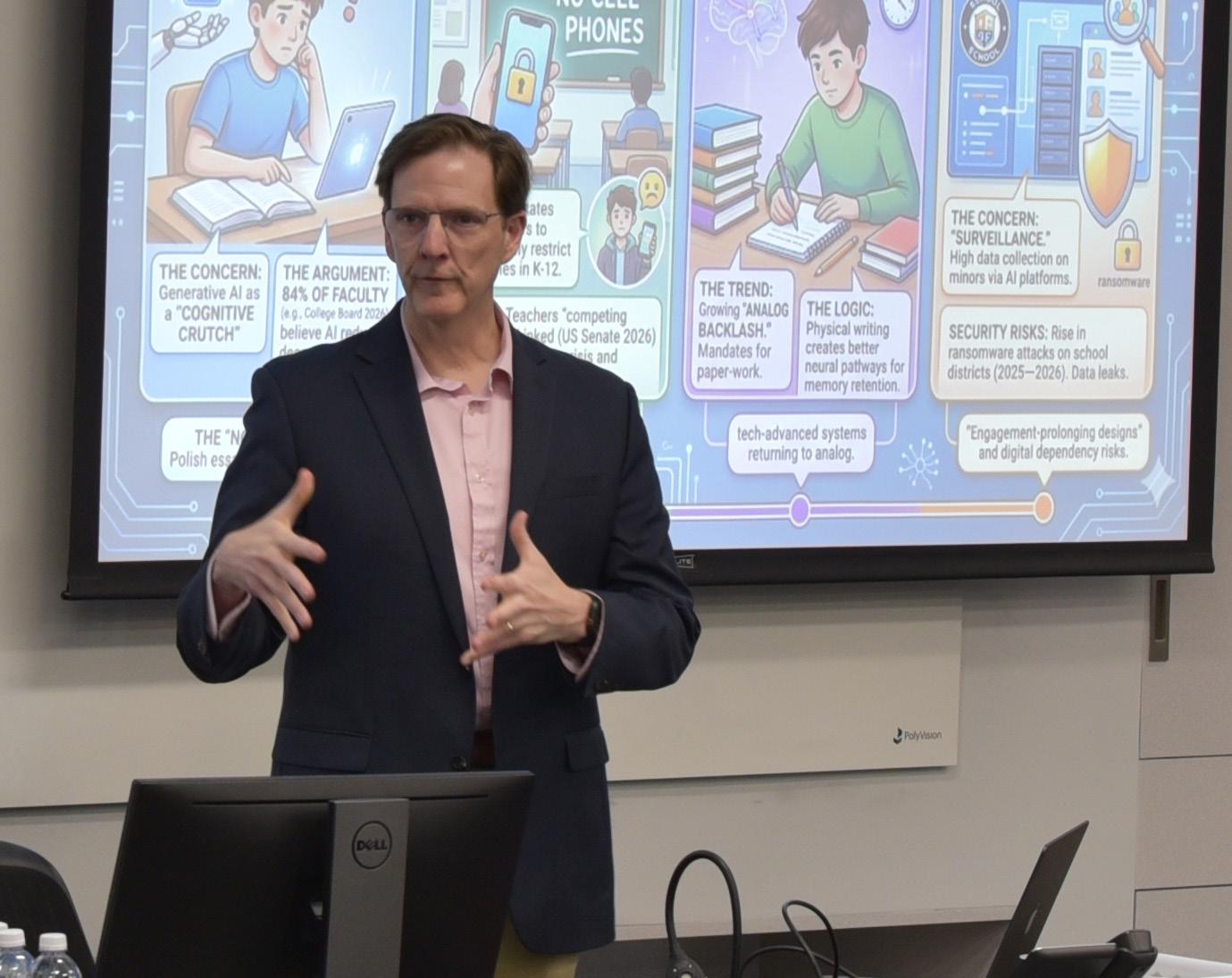
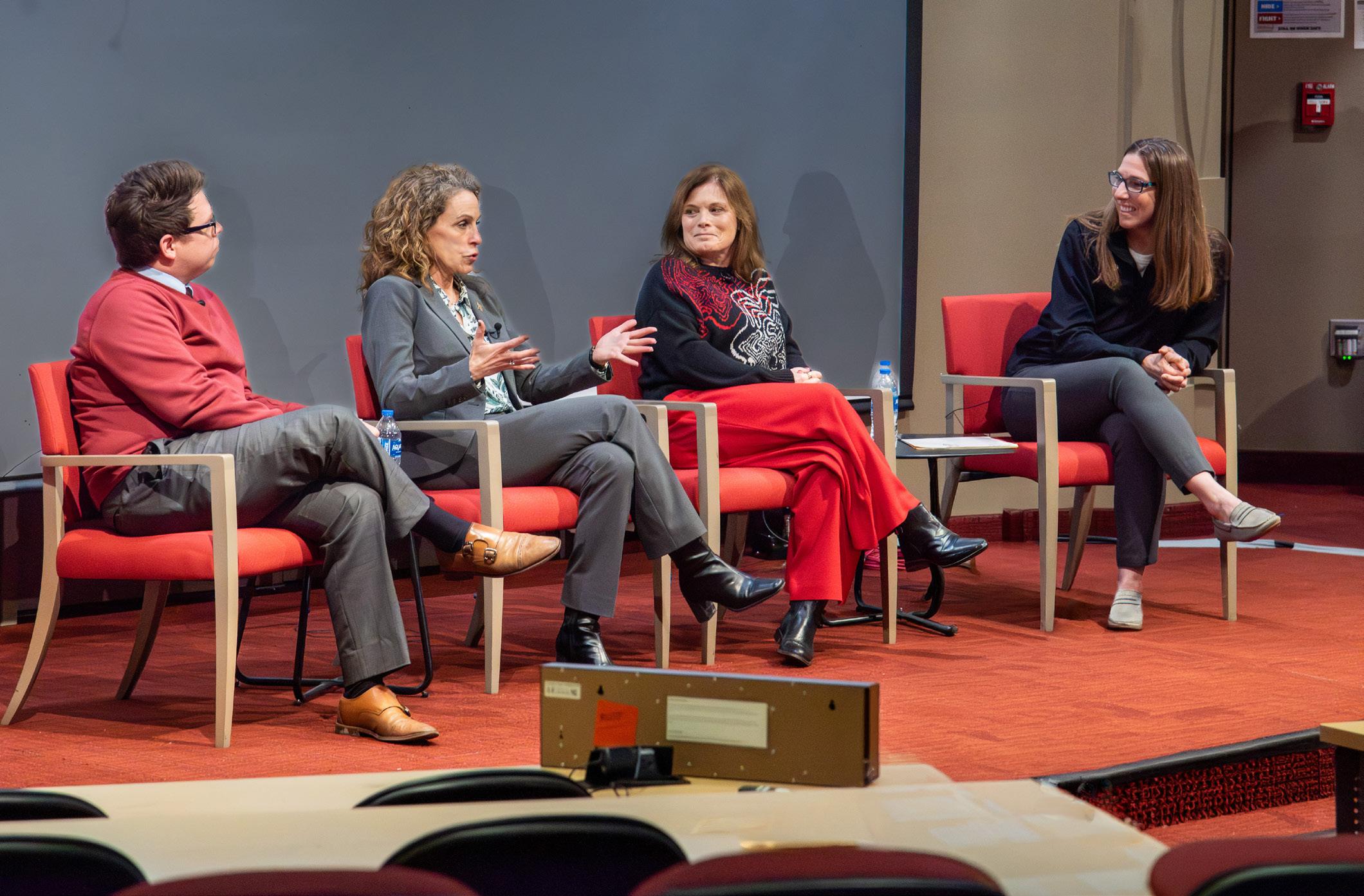
by Donna Zinser Clark
For the past ten years, the Center for Free Enterprise has provided programming focused on how business and entrepreneurial endeavors improve lives. That programming includes the Menard Family Lecture Series – which brings local, national and international experts to the University of Louisville to speak on topics such as policy, private enterprise and entrepreneurship – and student reading groups, which introduce undergraduate students to books, ideas and discussions they may not experience elsewhere on campus. These extracurricular experiences provide students with enhanced learning beyond their classroom studies.
During the spring semester, the lecture series focused on poverty and its impact on families, both locally and around the world. Students and the community heard from local leaders on the economic impact of homelessness, an internationally known social entrepreneur about poverty and two economists who discussed the peaks and valleys of the US economy over the past 250 years.
“The speaking events we host engage students in the ideas of entrepreneurship and free enterprise,” said Professor Steve Gohmann, director of the Center for Free Enterprise. “So, when we are
… WE WANT STUDENTS TO UNDERSTAND THE IMPORTANCE OF THINKING ENTREPRENEURIALLY TO ADDRESS THE PROBLEMS THEY SEE AROUND THEM.
—Steve Gohmann
discussing a topic like poverty, we want students to understand the importance of thinking entrepreneurially to address the problems they see around them.”
Students witnessed what entrepreneurial thinking by businesses can accomplish at the center’s February event, when a panel of local community leaders discussed the problem of homelessness in Louisville and what businesses can do to help alleviate the strain it puts on the local economy.
Moderated by University of Louisville alum Susan Buchino, the panelists shared powerful insights on how housing instability affects communities, local economies and public resources and why prevention and investment are not only socially responsible, but economically smart.
Panelist Lisa Dischinger shared how her company, housing developer LDG Development, recognized the homelessness problem and purchased the Arthur Street Hotel in 2022 to create living space and on-site programming to help people transition into permanent housing. The hotel has graduated dozens of residents into their own homes since 2022.
In March, the CFE introduced social entrepreneur and microfinance pioneer Martin Burt, who shared his innovative methodology for helping families lift themselves out of poverty. The Poverty Stoplight is a program that Burt has instituted around the world, that works to identify each family’s particular needs and builds individualized plans for success, a contrast to the traditional one-size-fits-all approach to poverty.
The final event of the semester featured economists Phil Magness and Ryan Yonk discussing the US economy throughout history and highlighting some of the government programs and policies that helped and hurt Americans’ prosperity, especially those with the fewest resources.
As the Center for Free Enterprise enters its next decade, watch for more compelling programming and topics for students and the community. To learn more about the center and look back at past lectures and guest speakers, visit UofL.edu/FreeEnterprise
February 10, 2026
Susan Buchino (moderator)
Community Advocates for Resources and Empowerment (CARE) at Ash Street Hotel
Lisa Dischinger Co-Owner, LDG Development
Ryan J. Dischinger
Directing Attorney, Kentucky Department of Public Advocacy
Rebecca Fleischaker Executive Director, Louisville Downtown Partnership
March 25, 2026
Martin Burt
Social Entrepreneur
March 30, 2026
Phil Magness
Senior Fellow, The Independent Institute
Ryan Yonk
Director of Education, Senior Research Fellow, American Institute for Economic Research
As an R1 institution, creating new knowledge is at the core of what we do. The College of Business celebrates our faculty’s research contributions to their respective fields in this summary of our most recent publications and reports.
Dereck Barr-Pulliam, Mason, S., & Leah, M., (2026), Believe who you trust: auditor source credibility, PCAOB inspection outcomes, and non-professional investor judgments. Journal of Accounting and Public Policy. Advance Online Publication. Volume 56.
Cook, D., Xudong Fu, & Lori Tang (2026) Common ownership and executive pay duration. The Journal of Financial Research. Advance Online Publication.
Manju Ahuja, Rui Sundrup, & Magni, M., WorkFamily frustration when you and your partner both work from home: The role of ICT permeability, planning and gender. Journal of the Association for Information Systems (JAIS). Advance Online Publication.
Yi,F., Shi, D., Aguilar, J., and Jozef Zurada, (2025), USER: User-side modality representation enhancement for multimodal recommendation. Knowledge-Based Systems. 332.114943
Isabel Botero, Barriuso, M.C., Barroso, A., Sanguino, R., & Bañegil, T.M. (2026). Unpacking the role of context: Understanding ambidextrous orientation in family firms. Journal of Business Research, Advance Online Publication.
Müller, T., T. K. Maran, S. Gauster, K. Matzler, & Kristen Lucas. (2025). Championing better ideas: Workplace dignity as an amplifier of innovative work behaviour. Creativity and Innovation Management, Advance Online Publication.
Weihua Zhao, Larson, W., & Brolinson, B., (2026) The Urban Equilibrium Effects of Electric Vehicle Tax Credit. Journal of the Association of Environmental and Resource Economics. Advance Online Publication.
Connect to our Research: business.louisville.edu/faculty-
Economics Professor Elizabeth Munnich Published in the American Economic Review
Elizabeth Munnich, associate professor of economics, and her coauthors recently published “Raising the Stakes: Physician Facility Investments and Provider Agency” in the American Economic Review. Their research finds that when physicians gain ownership in ambulatory surgery centers, Medicare spending tied to those physicians can decrease significantly resulting in savings for patients and taxpayers.
Munnich’s work has also been named a finalist for the National Institute for Health Care Management (NIHCM) Foundation’s 32nd Annual Policy Research Award – one of six finalists selected from more than 320 entries.



Daniel Bennett recently published Entrepreneurship Policy and the Wealth of Nations in The Annual Proceedings of the Wealth and Well-Being of Nations 2024-25 and contributed Political Economy of Entrepreneurship Policy to the Encyclopedia of Public Choice.


Xudong Fu published a book chapter, “Measuring and Managing Risk,” in Understanding Investment Risk and Return (Edward Elgar Publishing) and was appointed Associate Editor of the Journal of Financial Research



Vitaly Skorodziyevskiy co-authored “Why do family companies even exist? They know how to ‘win without fighting’” in The Conversation, which gained national attention and was featured by multiple media outlets.
Templeton,
AJ Templeton published the chapter “Case Seven: Using Social Media as a Tool for Visitor Education—A Case Study of the U.S. National Parks” in International Case Studies in Visitor Attractions (Routledge, 2026).