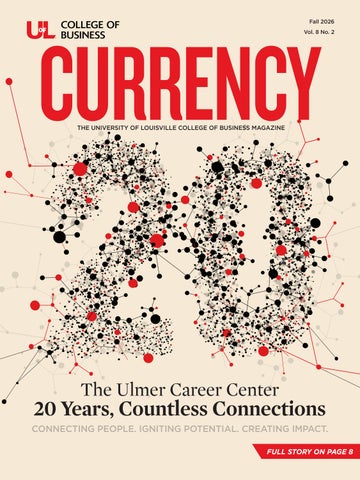
CURRENCY
Fall 2026
Vol. 8 No. 2
THE UNIVERSITY OF LOUISVILLE COLLEGE OF BUSINESS MAGAZINE
The Ulmer Career Center
20 Years, Countless Connections CONNECTING PEOPLE. IGNITING POTENTIAL. CREATING IMPACT. FULL STORY ON PAGE 8
FALL 2026
IN THIS ISSUE A WINNING LEGACY
04
20 YEARS OF IMPACT
08
THE PROOF IS IN THE PLAY
12
ENTERPRISE THAT ENDURES
16
EXPLORING WHAT’S POSSIBLE
18
THE ART OF INNOVATION
21
DRIVEN BY GRIT & GUIDANCE
22
Jeff Brohm named College of Business alumni fellow
Ulmer Career Center: from co-op office to career connections
How business helped shape three student athletes
Retired CFE Director Steve Gohmann built opportunity through exploration
UofL summer camp offers AI Thinker Lab
CURRENCY Vol. 8 | No. 2 | 2026
18th annual Cardinal Challenge showcases eleven UofL ventures
First-gen marketing student overcomes mental health challenges
NEW NEST, NEW NETWORK
College of Business living learning community
24
CONTRIBUTORS Tessa Chilton, Donna Clark,
CRAFTING OPPORTUNITY
PhD in Entrepreneurship student creates jobs to keep Haitian families together
26
Betty Coffman, Christopher Dye, Erica Hulse,
GLOBAL SUPPLY, LOCAL IMPACT
29
BUSINESS WITHOUT BORDERS
32
ENTREPRENEURSHIP, EXPANDED
35
of articles, notes and
UofL’s new Entrepreneurship Graduate Certificate
interviews from the
Audrie Lamb, Mercedes Ramirez, Katie Robinson, Taris Smith, Jill Wegenast This magazine is a compilation
UofL’s new Global Supply Chain Management major
MSAA student builds on family roots while preparing for her future
THE LANGUAGE OF LEARNING
MBA alumna designs experiences at Yum! Brands that help people grow
36
College of Business. To subscribe to the
GRADUATE BUSINESS GOES GLOBAL
39
A PHYSICIAN’S AI PRESCRIPTION
40
SOLUTIONS THAT SERVE
42
newsletter please e-mail currency@louisville.edu.
Summer international trips help graduate students expand their horizons
UofL School of Medicine Faculty uses AI to build clinical tool in five weeks Currency is published by the University of Louisville College of Business Communications and Marketing Department.
MBA alumnus helps nonprofits better serve through technology
FAMILY BUSINESS AWARDS AND SUMMIT
45
FAITH IN THE FUTURE
46
Annual awards summit honors family business leaders and companies
The University of Louisville
Spring 2026 commencement speaker reflects on purpose, gratitude and growth
is an equal opportunity
SANDBOX COURSE
institution and does not discriminate against persons because of race, age, religion, sex, handicap, color or national origin.
©2026 University of Louisville Cover art by Jill Wegenast.
Students use AI to create tools and companies
PHILANTHROPY & ALUMNI ENGAGEMENT
2026 partnerships in action, new college senior director of philanthropy
48 50
THE POWER OF POSITIVE LEADERSHIP
52
THE MIND BEHIND CARDINAL INTELLIGENCE
54
RESEARCH ROUNDUP
56
Lonnie Ali honored with inaugural Lifetime Achievement Award
Jeff Guan named UofL executive director for AI strategy and innovation
Our most recent research and research highlights
FALL 2026
FROM THE DEAN Dear College of Business community, Twenty years ago, the Ulmer Career Management Center began with a powerful idea: a business education should not only prepare students for the classroom, but also help them confidently take the next step into their careers. Today, that idea remains central to who we are at the College of Business. For two decades, the Ulmer Center has connected our students with employers, internships, mentors, career resources and opportunities to put what they are learning into practice. Those connections have helped generations of students discover where their talents can take them and given employers access to the capable, driven graduates who make our college proud. As we celebrate this milestone, I am especially grateful for the alumni and donors whose vision made the center possible, the employers and community partners who continue to invest in our students and the dedicated Ulmer team that has helped make career readiness an integral part of the College of Business experience. You can see that commitment throughout this semester, from career fairs and employer engagement to experiential learning, student recognition and events such as Biz Bash that help students find their place within our college. We are also proud to celebrate alumni whose accomplishments demonstrate where a Louisville business education can lead. Much has changed since the Ulmer Center opened in 2006, and the workplace will continue to evolve. What has not changed is our responsibility to prepare students to meet that future with confidence, curiosity and the ability to adapt. As we celebrate 20 years of the Ulmer Career Management Center, I am excited not only about what we have accomplished, but about where we will help our students go next.
Amy Henley Dean, College of Business
Kathleen Gosser and Dean Amy Henley visit the Yum! Brands and KFC Restaurant Support Center in Dallas, Texas, to discuss opportunities to expand franchise education.
A WINNING LEGACY by Erica Hulse
2026 College of Business Alumni Fellow Jeff Brohm builds trust and relationships on and off the field Standing on the sidelines, headset in place, University of Louisville football coach Jeff Brohm watches as the Cardinals line up for the next snap. With the play clock counting down, he watches the defense, checks in with his staff and adjusts the plan, making the kind of quick decisions that can shift the direction of a game. Yet the choices Brohm makes on game day are only one part of leading a collegiate sports program. He must build trust with players and staff, listen when the people around him see something he may have missed and make decisions that serve both individuals and the team. The football field may be where those abilities are most visible, but Brohm began developing many of them years earlier as a student in the College of Business. Since returning to his alma mater as head coach in December 2022, Brohm has led the Cardinals to three consecutive nine-win seasons, including the program’s first appearance in the ACC Championship Game in 2023. His accomplishments on the field, leadership beyond it and continued impact on UofL and the Louisville community earned him recognition as the 2026 College of Business Alumni Fellow, part of UofL’s Wilson Wyatt Alumni Awards. Brohm welcomed the recognition as a chance to reflect on his experience in the college. “I learned a lot from a lot of great people, and it was really structured and a good environment that helped me achieve some of my goals,” he said. Across decades, teams and changing 4
| ALUMNI HIGHLIGHT
responsibilities, the foundation Brohm built as a business student has remained constant. It has carried him from student-athlete to professional football player to coach and ultimately back home, where he now guides a new generation of Cardinals as they pursue success on the football field and prepare for the lives they will build beyond the game. BUILDING THE PLAYBOOK A Louisville native, Brohm arrived at UofL in 1989 without a clear vision of where his career would lead. While he had not chosen a specific profession, he saw business administration as preparation for the uncertainty ahead. “A lot of things revolve around business and being able to take care of yourself, your family and the people around you and manage that,” he
Photo credit: Taris Smith, Louisville Athletics explained. That preparation required more than practical knowledge. It also included what Brohm called “the relationship part [of business],” including how to navigate different personalities, trust people and “allow them freedom to give opinions.” At the same time, Brohm was balancing his coursework with the demands of playing football for the Cardinals. “You can get really overwhelmed and lose focus and feel like you can’t achieve something if you’re not able to manage your time and to really put in the effort and work,” he said. “But at the same time, if you’re able to handle that, prepare accordingly [and] put in the work, a lot of times you’ll get to the end, whether it’s in sports or business, and feel more than ready and very confident when you enter into an important game or an important meeting.” That repeated cycle of preparation and performance gave Brohm more than control over a demanding schedule. Each successful outcome strengthened his confidence for the next challenge. The relationships Brohm formed within the college also shaped his understanding of what strong leadership could look like. The late Bob Myers left a lasting impression, not only through his teaching but through the personal investment he made in his students. “He developed a relationship and rapport with his students and showed interest in how they were doing in
school,” Brohm said. That interest changed how students responded to him. Brohm described him as “almost like a great coach” because “you wanted to perform for him, and you wanted to do well in his class.” His ability to make students feel valued allowed him to inspire their best work while building relationships that endured long after they left his classroom. The significance of those lessons became clearer as Brohm’s role in football evolved from player to coach, with his focus expanding beyond his own preparation and performance to include the growth and success of an entire team. LEADERSHIP IN PRACTICE After earning his bachelor’s degree in business administration from the university in 1994, Brohm spent eight seasons in the National Football League before turning to coaching. His collegiate coaching career included positions at UofL, Florida Atlantic University, the University of Illinois at Urbana-Champaign, the University of Alabama at Birmingham, Western Kentucky University and Purdue University. In December 2022, he returned to his alma mater as head coach of the Cardinals. Today, Brohm oversees far more than gameday strategy. Each decision must account for the needs of his players, coaching staff and the program as a whole. The College of FALL 2026
| CURRENCY Magazine |
5
Business lessons he draws upon include “being able to process information...and how to handle personalities and get the most out of young men, coaches and people that work with you.” For Brohm, strong leadership depends largely on how well someone understands and supports the people around them. “I think to be a successful leader, CEO or entrepreneur, you have to have good people skills as well,” he said. That means using your own abilities while also bringing out the best in others. Brohm believes that work happens continuously, rather than only when a high-stakes situation demands it. “I think it’s an everyday process where...you have to study, you have to learn, you have to organize, you have to prioritize, you have to sometimes grind things out and then you have to be able to present what you know to people,” he said. “Those are just all small things that add up.” Each day also brings decisions about when to follow established procedures and when individual circumstances require flexibility. For Brohm, managing a large group effectively means providing consistent direction while remaining responsive to the people and situations in front of him. LESSONS BEYOND THE FIELD Brohm’s leadership is reflected not only in how he runs the program, but in what he asks his players to carry from it. College athletes must balance the demands of academics, competition and their everyday responsibilities, but he does not view success in those areas separately. For Brohm, everything ties together. “Trying to excel in the classroom, on the field and off the field in their everyday endeavors are all important,” he said. “You can’t have one without the other.” That broader view informs Brohm’s belief in the value of business education for studentathletes. Regardless of the fields they ultimately enter, studying business can deepen their understanding of the interpersonal interactions they will encounter throughout their careers. “It gives you a sense of the whole dynamic of how to work with people in your everyday life,” he explained. Brohm sees the relationship as 6
| ALUMNI HIGHLIGHT
reciprocal. “I think that’s the best thing about sports that helps you in the business world: how to stick to it [and] deal with people, deal with highs and lows and still do it in a positive way that is able to bring people along with you.” Those lessons take on greater importance as players look toward futures that may carry them far from the stadium. Some may pursue professional sports, while others will move directly into different industries, but all will eventually face new roles, disappointments and unexpected turns. Brohm hopes their time at UofL prepares them not only to pursue their goals, but to remain steady when the path becomes difficult. “I hope they all have success in what they want to do, and that they handle adversity and are able to fight through setbacks that happen along the way,” he said. Sports, he added, teaches players “how to not get too down and continue to move forward and to pedal on and believe in yourself.” BRINGING IT HOME Each time Cardinal football players take the field, Brohm trusts in the preparation and abilities of his players, listens to his coaching staff beside him and believes in his own ability to meet the challenges placed before him and his team. With skills honed years ago in the College of Business, where Brohm learned that leadership is about more than managing people, he is building a legacy based on knowing his athletes and staff as people, valuing their insights and ideas and helping them recognize what they are capable of achieving. That legacy is reflected in Brohm’s selection as the 2026 College of Business Alumni Fellow, an honor that brings his journey at UofL full circle. The business degree he once hoped would serve him wherever his career led now guides the way he prepares a new generation of Cardinals for wherever their own lives may take them. Seasons end and records become part of a program’s history, but the confidence Brohm works to instill in his players will remain with them long after they leave the football field.
COLLEGE OF BUSINESS ALUMNI CELEBRATED
ALUMNI OF THE YEAR Chris ’90 & Lisa ’11 Dischinger are named 2026 Wilson Wyatt Alumni of the Year Chris and Lisa Dischinger are cofounders of LDG Development, a Louisville-based company they launched in 1994 to create quality, affordable housing. Today, LDG is one of the nation’s largest affordable housing developers. Married for 38 years, Chris and Lisa have built a family and business around the belief that everyone deserves a quality place to live. Chris has held numerous leadership roles in the real estate industry and community, including serving as president of four trade organizations and on the Endeavor Louisville board, supporting entrepreneurship and economic growth across Kentucky and Indiana.
Lisa has been instrumental in shaping LDG’s mission and resident services. Her early work with families living in LDG communities inspired programs focused on health, education and opportunity, including food pantries, youth programs and violence prevention initiatives. She also founded the Rita June Foundation, which has raised more than $10 million to support the construction of three Bezos Academies and expand access to early childhood education. Lifelong Louisvillians and University of Louisville alumni, Chris and Lisa are proud parents and grandparents who enjoy family, cheering on the Cardinals and hosting their well-known football tailgate. Together, they remain committed to building stronger communities and creating lasting opportunities for families.
Jeff Brohm ’96 is named the 2026 College of Business Alumni Fellow Louisville native, alumnus and former football letterwinner Jeff Brohm is in his fourth season as head coach at the University of Louisville. In his first three seasons, he guided the Cardinals to a 28-12 record, three consecutive nine-win seasons and four victories over Top 25 opponents. Brohm led Louisville to a 10-4 record and its first ACC Championship Game appearance in his debut season in 2023. In 2025, the Cardinals went 9-4, highlighted by a road victory over No. 2 Miami, a 41-0 shutout of Kentucky and a Boca Raton Bowl victory. A former Trinity High School standout and Kentucky Mr. Football, Brohm played at Louisville from 1989-93 before an eight-year NFL career. He is a member of the Kentucky Athletic Hall of Fame and KHSAA Hall of Fame, and his No. 11 jersey is honored in Louisville’s Ring of Honor. Brohm and his wife, Jennifer, have two children, Brady and Brooke. His father, Oscar, and brothers Greg and Brian also played football at Louisville. FALL 2026
| CURRENCY Magazine |
7
YEARS OF IMPACT experienced firsthand what it was like to enter the workforce without the kind of career guidance and support he believed students should have. Years later, that experience helped motivate his support for creating a dedicated career center at his alma mater, one that could help students prepare for the transition from college to a career and continue supporting them throughout their professional lives.
by Christopher Dye
From co-op office to career connection: Ulmer Career Center celebrates 20 years Twenty years ago, the University of Louisville College of Business made a significant investment in an idea: preparing students for careers should be an integral part of the business school experience. The Ulmer Career Management Center opened in February 2006, but its roots stretch further back. Before 2004, career development within the college operated primarily as a small coop office. Over the next two years, the college expanded employer recruiting, added business roundtables and information sessions and began building relationships designed to bring more career opportunities directly to students. Alumni support helped turn that growing effort into something much larger. For Dan Ulmer ’55, the need was personal. After returning from military service, Ulmer 8
| ULMER CAREER CENTER ANNIVERSARY
The nearly $700,000 center was funded largely through alumni contributions, including $300,000 from Ulmer and his wife, Helen ’55, and $100,000 from James A. Patterson ’55. Their investment helped create a dedicated career center designed to connect business students with employers and prepare them for the transition from college to career. As plans for the center took shape, attention turned to where it would be located. When thenDean Charlie Moyer arrived at UofL in 2005, the space that would become the Ulmer Career Center was occupied by an aging university computer lab. The lightly used space had outdated equipment and furnishings. Moyer worked with then-UofL President James Ramsey to have the space turned over to the college for the new career center. At the same time, the college refurbished and technologically upgraded its remaining computer labs on the same level. What emerged was a dramatic change from both the old computer lab and the college’s two-person Co-op/Career Development Office. The new 3,800-square-foot facility tripled the career operation’s space and staff and included 10 private interview rooms, conference rooms, a student learning suite, career resource library and recruiter lounge. Students gained expanded access to career counseling, resume assistance, internships and co-ops, employer recruiting and technology connecting them with job opportunities.
A career center takes shape The center opens, creating a dedicated hub for career development in the college.
Career development curriculum BUS 201 launches as a required undergraduate course.
’06
’07 Expanding connections CareerTrak and first Career Carnival launch, creating new ways for connections for students and employers.
’10
’08 ’09
Rising to the challenge After a historic campus flood, Ulmer staff relocate for the year.
Career fair connections First business career fair and start of graduate internship program.
’12
Community connections BUMP Mentoring Program launches.
The anniversary was celebrated in Frazier Hall and featured remarks from college leaders, Ulmer staff and students, followed by a reception with students, alumni, faculty, staff and community partners.
’20
Ulmer goes virtual Career coaching, BUS 201 and the career fair move online for the first time.
20 years of career impact Two decades of connecting business students to the skills, experiences and opportunities that prepare them for what’s next.
’22
Industry connections grow The Corporate Partner Program and employer panels connect students with industry.
’26 ’23
FALL 2026
Services streamlined Merge with campus partners onto new Symplicity system, Cardinal Careers.
| CURRENCY Magazine |
9
The impact came quickly. In 2006, career counselors conducted 612 one-on-one appointments, compared with 156 the year before. In 2007, career development became part of the college’s curriculum through BUS 201, helping students connect their interests, skills and values with majors and career opportunities. That foundation has continued to evolve. Career fairs, mentoring, employer panels, virtual services and Cardinal Careers have expanded the center’s reach. Today, students have access to career coaching, mock interviews, mentoring, internships, career fairs and dozens of career-readiness programs. In year 20, 183 employers recruited at four business-focused career fairs, while 218 employer volunteers supported career-readiness events. One priority, however, has remained constant from the center’s earliest days: career support should not end at graduation. The commitment to providing career services for life, at no cost to College of Business alumni, was an important part of the vision championed by the center’s original donors. That lifetime career promise means alumni can return to the Ulmer Career Center as their careers evolve, whether they are pursuing a new opportunity, navigating a career change or preparing for their next chapter. The numbers tell part of the story. The generations of students and alumni who found internships, gained confidence, built professional networks, launched careers and returned for guidance along the way tell the rest. Twenty years after its opening, the Ulmer Career Center continues the vision behind its creation: connecting business education with the world of work and providing career support that extends well beyond graduation, preparing Cardinals not simply for their first job, but for a lifetime of what comes next.
10
| ULMER CAREER CENTER ANNIVERSARY
Over two decades, the career center has served
11,369+ 10,188 2,428 4,486 students and alumni in career coaching appointments.
students in 247 BUS 201 sections.
employers at 57 career fairs.
undergraduate students seeking internships.
MORE THAN CAREER PREPARATION
Danna Williams Sourav Rajesh Kumar
A FORCE RECLAIMED
Neptali Olvera
For Danna Williams, the question of what came next
BEYOND THE TECHNICAL AN UNEXPECTED OPENING
By the time Sourav Rajesh
When undergraduate business administration student Neptali Olvera came to Ulmer, her goal was simple: update an outdated resume. An internship was not part of the plan.
Kumar came to Ulmer, he was already landing interviews. The MS in Business Analytics student had technical experience to share, but he wanted to become a stronger candidate once the conversation began.
As Ulmer Director and Career Coach Paige Erhart learned more about her experience,
arrived years after graduation. The BSBA computer information systems alumna was ready to leave a job she had outgrown. She returned to Ulmer with nine years of experience to fit onto a resume – and a new direction to find.
Through one-on-one coaching
she recognized that Olvera’s interest and coursework in hospitality could point toward an opportunity she had not considered. Erhart encouraged her to pursue an internship with AJS Hotels and supported her through the process.
and mock interviews with Career Coach Cassie Book, Kumar learned to move beyond describing what he had done and explain why it mattered. The shift helped him speak with greater confidence to seniorlevel interviewers.
“I walked out of her office with a new and improved resume and the courage to apply for an internship,” she said.
“The Career Center helped me become more intentional about how I present my professional experience,” he explained.
That courage led Olvera to the Galt House, where she gained firsthand experience in a field she was passionate about and a clearer sense of where it could take her.
That work gave Kumar a stronger way to communicate what he could bring to an organization, and he ultimately accepted a role with MercedesBenz Financial Services.
Her return also reconnected her with former Career Coach Eileen Davis, who had worked with Williams as a student. Davis helped her look beyond the length of her career history and recognize the accomplishments and strengths it represented. Together, they reshaped her resume and, more importantly, Williams’ view of herself. Davis offered a reminder that stayed with her: “You are a force of nature. Never forget that.” Through Ulmer’s Career Services for Life, Williams carried that reminder into a new job and found a team where she could thrive.
FALL 2026
| CURRENCY Magazine |
11
THE PROOF IN THE PLAY by Mercedes Ramirez
Three College of Business students share how their degrees helped them power through the scene of college athletics
It’s a warm Friday evening on the University of Louisville campus. The sunset blazes across the sky and oversees Trager Stadium coming alive as passionate UofL fans fill the stands. As the scoreboard counts down to game start, the anticipation is even higher for field hockey goalkeeper Emily Young. Not only is tonight an opportunity to showcase her skills perfected through practice drills, but also one where she plays against familiar faces. Amid blocking a shot from University of Virginia’s Mia Abello, the stiffening pressure settles when the two break into laughter. Even after a long day of economics lectures followed by pre-game practice, it is those little moments for Young that seal her confidence in knowing that she is exactly where she needs to be. The balance between competition and academics is a familiar one for All-Atlantic Coast Conference Academic and Honor Roll students Emily Young, Julia Shoemaker and Casen Murphy. As they each spend their days moving between lectures, practices, travel and competition, they’ve learned that the habits of excelling in one area often become the foundation for success in the other. What makes this group special is their highly developed discipline that translates between the field and classroom. They don’t allow their adversities to define or distract them and embody the unique culture at UofL, where academic and athletic excellence thrives through a standout spirit and determination.
As she was nearing the end of high school, Shoemaker was hoping to be recruited to play college soccer out of state. “I was trusting the process and what would come next.” When she began to recognize her burnout with soccer, leaving it entirely behind was far from an easy fate to overcome. Still holding onto the hopes of her student athlete career continuing, a phone
REELING IN THE GAINS Julia Shoemaker, a Louisville native, developed an interest in business through a high school pathways program. Both of her parents are College of Business alumni. Shoemaker also recalled that her interest in sports was shaped by her father’s administrative role for the Louisville Bats, a 20-year stint for her father and a lifetime impact for Shoemaker and her brother, who played soccer for Spalding University. 12
| STUDENT HIGHLIGHT
Julia Shoemaker and her grandfather
IS Y Casen Murphy
call from Louisville Rowing Assistant Coach and Recruiting Coordinator Egan Berne opened the door to a new world for Shoemaker. Now in her junior year as a business administration major, Shoemaker has already acquired many valuable lessons through the guidance of her advisors, coaches and professors. The most significant insights that came from her two worlds included an improved ability to advocate for herself, which she learned through her Business Communications course. Shoemaker also credits Professor and Executive Director for Undergraduate Programs Raymond Green’s MGMT 301 course and her experience in the retail industry for sparking her interest in pursuing management roles post-graduation. Louisville rowing Head Coach Derek Copeland and her academic advisor Matt Pence were also part of the team that further shaped her work ethic, confidence and ability to form a simplified strategy that ensured Shoemaker stayed on top of her coursework while managing a 20-hour practice schedule. Copeland’s advice
would also prove important when she ran into communication issues with her group project partners in class. Feeling frustrated, she leaned on the lessons in conflict resolution and the words of Copeland: “If we say something bad to ourselves, would you ever say that to a teammate?” Shoemaker said that the sentiment reminded her to remain competitive while maintaining compassion and patience, allowing her to become a strong team player and reliable leader. “Over the past two years that I’ve been rowing, I’ve seen myself grow exponentially in ways I probably would have never seen if I kept playing soccer. It’s like a blessing in disguise.” For Shoemaker, preserving familial legacy is just one of the many factors that motivates and advances her aspiration to experience personal growth. Shoemaker shared her admiration for “living life on the edge” and finding comfort in uncomfortable situations, thus intentionally creating benchmarks as to what more she can seamlessly take on as an athlete, daughter and future business leader. FALL 2026
| CURRENCY Magazine |
13
PITCHING TOWARD THE FUTURE Born and raised outside of St. Louis, Missouri, accounting and finance major and UofL baseball pitcher Casen Murphy was originally slated to pitch for Arkansas State University and study mechanical engineering. However, an abrupt change in coaching staff led Murphy to make the difficult decision to retract his commitment and repeat the recruitment process. The continuation of his baseball career into college would also inevitably signal a change of degree path choice. Murphy described that his “numbers first” mindset and background in working at his father’s pawn shop led him to choose to double major in accounting and finance. Murphy’s choices ended up narrowing down to the University of Missouri and UofL. With the considerations at hand, Murphy recognized that Louisville’s program was not only a winning team but also offered him the resources needed to further develop as a player ready for the professional league. Steadfast and secure in his routine and goals, the adjustment of being a college student athlete came naturally. Murphy recalled that mandatory study hours for firstyear student athletes became an immediately developed habit, despite catching the displeasure from his teammates and discovered that staying ahead meant being able to perform well on the field and produce high-quality work in the classroom.
and professional communication,” he said. “Those skills can be valuable for building relationships with teams, coaches and potential sponsors while preparing for a professional baseball career.” As he reaches the next stage of his blooming career in professional athletics, Murphy is expected to graduate a year early, thanks to transfer credits from high school. This accomplishment alone establishes the commitment to his career and personal values and exemplifies key traits of staying ahead in the fastpaced and high-pressure industry of professional sports. In his advice to prospective business students, Murphy keeps it direct: “You can’t go halfway; you have to go all the way.” DEFINING THE COMPETITIVE ADVANTAGE Born and raised in Houston, Texas, field hockey goalkeeper and finance major Emily Young doesn’t shy away from maximizing opportunity, no matter the time or place. Young shared details
Several of the important strengths from Murphy’s experience as a student athlete in the college included “[the] ability to ask questions and be curious; I feel like it allows you to learn and develop in a much better way than if you were just sitting back and trying to do everything without asking and wondering how stuff is done.” Murphy emphasizes the importance of planning ahead and the belief that improvement arises from asking questions and consulting with experts. Murphy also shared his intentions to remain in baseball for “as long as possible,” though he recognizes the opportunities available beyond playing. “My business education has taught me the importance of personal branding, networking 14
| STUDENT HIGHLIGHT
Emily Young
from her recruitment process revealing that she had been considering Ivy League schools before UofL came into the picture. This path mirrored that of her older sister Helen, who plays for Dartmouth College. Young recalls her surprising pivot to Louisville was spurred after an invitation to practice with other field hockey recruits at Brown University. While Young could keep up with the fellow recruits, she struggled to find the sense of belonging and competition that motivated her to continue playing the sport, leading her back to the path that her heart had long already decided. “I got a lot of flack from friends and family for choosing UofL over Ivy Leagues and that potential academic opportunity,” Young shared. Despite the doubts she received from choosing to continue her education and field hockey career with Louisville, Young remained firm in her stance. “I can get a great education at UofL and I can accomplish that anywhere, I was such a believer.” To defy the doubts met with the trade-off, Young was intuitively tasked to not only tout her skills and rise through the ranks as a goalkeeper, but to remain on top of her academics and acquire the network needed to help her soar higher in the field of finance. While Young rounds the final corner of her college and athletics career, her interest in empowering others through leadership remains stronger than ever. This year, Young will intern with J.P. Morgan. She shared that her readiness was amplified through her economics courses taught by Babu Nahata, professor of economics at the college. “Having professors that shape the way you think and are able to provide real-world expertise or experience and bring that into the classroom, helps shape your mind and gets you to start thinking, ‘How is this going to translate to me outside of school?’” For Young’s pathway, her educational experience has strengthened her critical thinking skills, which was an imperative expectation within the J.P. Morgan’s firm culture and influential in her responsibilities as a nowprivate banking intern seeking to reach the C-Suite.
Beyond managing client assets and defending goalposts, Young revealed that her journey could not have been achieved without utilizing the personal and professional network around her. Young was also transparent about the mental toll that student athletes experience throughout their careers and the impact of her father’s passing. Young applies her guidance in how she navigates through those challenges in her role with Cards All In, a campus organization focusing on mental health advocacy for student athletes and coordinating UofL’s annual Suicide Prevention Walk with additional support from her field hockey coaches and teammates. “I know that with all of them behind me, I could accomplish anything,” Young said confidently. As she begins a new chapter, the reliability and grit she demonstrated on the field continue to shape her path in finance, extending her impact far beyond athletics. PRACTICING THE STRATEGY FOR SUCCESS There is a moment that every athlete knows – the one where the work you’ve been putting in, quietly and invisibly, finally breaches the surface. An unexpected race win, a game where the seemingly repetitive strategy finally clicks or when the time sacrificed during the offseason becomes justified. Those moments cannot be manufactured; an athlete can only put in the work and be ready when they arrive. Athletics is what brought Shoemaker, Murphy and Young to UofL first. Business would later seal their commitment by quietly shaping them as student athletes and aspiring leaders in their respective fields. The patience and communication required for Shoemaker to remain in sync during a race, for Murphy to work a count amid a late game and for Young to maintain awareness to even the toughest trick shots comes from a disposition built through years of early mornings, coaching and learning to accept misadventures without stopping or straying from the momentum. What the College of Business has given these athletes is a new arena for instincts they already held and the language to understand why those instincts work.
FALL 2026
| CURRENCY Magazine |
15
ENTERPRISE T by Erica Hulse
Retired CFE director Steve Gohmann built opportunity through exploration What do socialism-flavored beer, the cost of homelessness and markets amid drugs, drones and disasters have in common? Together, they reflect the broad scope of conversations hosted by the Center for Free Enterprise at the University of Louisville College of Business, where guest speakers have challenged students to examine the free market from perspectives as varied as the topics themselves. At the heart of those conversations was former CFE Director and Truist Professor of Free Enterprise Stephan “Steve” Gohmann. While he recently retired from the college, his legacy lives on in the center’s work, the discussions he helped create and the students he encouraged to think differently about the world around them. Throughout his decades of teaching, mentoring and leading the CFE since its launch in 2015, Gohmann was passionate about helping others understand the value of economic freedom of choice – and how free markets can make room for enterprise, entrepreneurship, creativity and innovation. ROOTS IN RESEARCH Born and raised in New Albany, Indiana, Gohmann’s path into economics began at Indiana University, where he earned a double major in mathematics and economics. While he had the opportunity to enter the workforce after graduation, he saw a different path forward. “When I graduated from Indiana University...I had a few job offers, but I wanted to further my education,” he said. “I decided to pursue my PhD in economics because I saw more opportunities for success and greater research opportunities.” After earning his doctorate from North Carolina State University, Gohmann joined Ball State University in 1984 as an assistant professor of economics. The position placed him in a
16
| FACULTY HIGHLIGHT
department where research was part of the culture. “I was fortunate to have my first job at Ball State University,” he said. “The economics department had three other young faculty who were research oriented and understood the benefits of the market.” In 1987, Gohmann accepted a postdoctoral fellowship at Duke University. His early research interests focused on the Social Security system and Medicaid payments for nursing homes, and his time at Duke helped him continue developing that work through a new professional connection. “My dissertation advisor, Bob Clark, helped me connect with former Secretary of Commerce Juanita Kreps,” he said. “I did some research for her and continued my research stream.” CENTER OF THE CONVERSATION In 1988, Gohmann’s academic career brought him back home when he accepted a position
Steve Gohman
THAT ENDURES
nn
at UofL. “I was fortunate to get the UofL offer,” he said. “It is quite difficult to get an academic job [near] your hometown.” While at UofL, Gohmann’s work in free
enterprise expanded through the Association of Private Enterprise Education, where he connected with other like-minded economists. Through that network, he met representatives from the Charles Koch Foundation, a connection that later led to John Schnatter, founder of Papa John’s. Schnatter, along with the Koch Foundation, pledged more than $5 million to launch the CFE in 2015. “I truly appreciate John’s generosity,” Gohmann said. “He often came to my classes, spoke at several student events and even hosted student groups at his headquarters, where he led them on personal tours.” For Gohmann, the idea for the CFE grew out of what he was already seeing in the classroom and through student reading groups. Students in his Capitalism and Economic Freedom course were encountering ideas they had not often heard discussed elsewhere, making the center an opportunity to expand those conversations beyond a single class. Best known for its prestigious Menard Family Lecture Series, the CFE is focused on bringing an understanding of the importance of the free market to the UofL community and beyond. Among the most impactful speakers Gohmann remembers were North Korean defector Yeonmi Park and business magnate Steve Forbes. “We moved both of their talks to Strickler Hall...to accommodate more students and community members,” he said. “Each event was standing room only, with students lining the walls and sitting in the aisles.” FALL 2026
| CURRENCY Magazine |
17
For Gohmann, however, some of the center’s most meaningful moments came through its student reading groups, where conversations continued beyond assigned texts and classroom walls. “We would read at least three books and spend an evening discussing each book and then going out for dinner,” he said. Those dinners gave students the rare opportunity to meet guest speakers in a small-group setting, with many of the speakers also serving as authors of books the students had read. The chance to connect directly with authors, business leaders and scholars became one of the center’s most distinctive experiences. CFE Marketing and Events Manager Donna Clark said that kind of access reflected the broader purpose of the center and the legacy Gohmann built through it. “Through the center, he made programming available to students that wasn’t available anywhere else on campus,” Clark said. “The center embodies his belief that education should challenge our perspectives and encourage thoughtful dialogue.” LEARNING THAT LASTS While Gohmann expressed gratitude for his 38 years at UofL and the friends and colleagues he met along the way, including Clark, who he said “added greatly to the success of the CFE,” his reflections returned most often to the students he taught. “I hope as they move through life, they will consider the ideas from class and reading groups and figure out who they want to be,” he
Steve Gohmann with his last class, ECON 375 18
| FACULTY HIGHLIGHT
said. “Although what they got from me may be only a grain of sand on the beach, I hope that it is one that shines for them.” Clark saw that focus on students throughout her years working alongside him, particularly in the way he encouraged learning beyond grades or requirements. “He truly cared about them learning, not for a grade, but for the sake of curiosity and growth,” Clark said. “He helped students develop critical thinking skills that would serve them long past their time in the classroom.” As he steps into retirement, Gohmann plans to spend more time with his wife, Myra, while continuing many of the rhythms that shaped his academic life. Along with cooking, gardening and riding his bike, he has no plans to let his reading group experience end with the CFE, sharing that he has “already started a reading group with some of my friends.” With a wide range of topics and an even wider range of conversations, Gohmann built a community around the fundamental ideas of free enterprise. Through reading groups, panel discussions and guest speakers, he reinforced the importance of the freedom to create and innovate while giving students a platform to ask questions, challenge assumptions and share their opinions. Together, those efforts reflect what lies at the heart of the CFE – the freedom to turn ideas into action and action into change.
Steve Gohmann with Yeonmi Park
Discover a transformative collaboration opportunity with UofL’s College of Business Corporate Partner Program. By joining, companies gain priority recruitment strategies, direct influence on future educational skill sets and engagement opportunities with our Cardinal Community. Enjoy executive education discounts, prominent visibility and roundtable participation to shape today’s students and tomorrow’s leaders. To become a Corporate Partner, your company will need to commit annually, provide logo permissions, host our representatives once a year and nominate a director-level representative for biannual roundtable
meetings. Elevate UofL College of Business at your company as a top choice for hiring interns, employees and executive education. GRADUATE INTERNSHIPS The College of Business graduate interns may work new-to-them part- or full-time roles as long as they can apply what they are learning in their programs to the role and will receive coaching and guidance from their direct managers. Internships must be vetted by the graduate internship advisors, and employers must complete a performance evaluation on the intern once a semester.
FALL 2026
| CURRENCY Magazine |
19
EXPLORING WHAT’S POSSIBLE AT UofL SUMMER CAMPS by Audrie Lamb
While many college students were away during summer vacation, UofL’s campus was anything but quiet. Classrooms, laboratories and athletic facilities were filled with middle and high school students exploring new interests through more than 30 academic and athletic camps. From basketball and robotics to chemistry and artificial intelligence, they got an early look at college life while discovering what’s possible. One of UofL’s newest summer opportunities was the College of Business day camps focused on artificial intelligence. Through AI Thinker Labs, students learned how artificial intelligence works, examined the ethical questions surrounding the technology and discovered how it can be used responsibly in fields like marketing, leadership and finance. By the end of the day, every participant left with a project of their own, whether it was a business idea, marketing campaign or app concept. “Our goal is to show rising high school students how AI can enhance their learning abilities, not replace them,” said Steve Von Gerlachter, an instructor in the College of Business. “My hope is that these students leave with more knowledge 20
| SUMMER HIGHLIGHT
and more confidence about how to use AI as they finish high school and enter college, hopefully here at UofL.” UofL employees like program manager Lexus Gardner offered organizational and logistical planning for the camp, while UofL’s Digital Transformation Center made the opportunity more accessible for learners by offering financial support. The initiative reflected Cardinal Intelligence, UofL’s university-wide initiative to proactively and responsibly engage with the opportunities and challenges of emerging AI technologies.
The Art ofInnovation
18th ANNUAL CARDINAL CHALLENGE SHOWCASES 11 UofL VENTURES by Erica Hulse
A steadier syringe. A smarter way to navigate college. A cat lounge built around coffee, comfort and community. Those ideas may occupy very different corners of the entrepreneurial world, but they shared the same stage at the 18th annual Brown-Forman Cardinal Challenge event, “Celebrate the Art of Entrepreneurship,” held on July 31 at the Speed Art Museum. 11 teams of University of Louisville innovators presented ventures designed to solve real problems, rethink familiar processes and improve the way people work, learn, connect and live. The competition brought the teams together with professional mentors, UofL faculty and staff and members of Louisville’s entrepreneurial community. Their presentations tackled challenges with health care, education, networking, professional development and consumer experiences. AWARD WINNERS Claustrum Design received the opportunity to pursue a $25,000 investment from Keyhorse Capital. Founders Justin Houts, Kieran Richards and Redi Rahmani are developing Precisionject, an easy-to-use syringe attachment designed to improve the accuracy and stability of needle-based procedures. Due Gooder received a $5,000 Forcht Accelerator Award. Created by Ethan Havertape and Nate Royal, the AI-powered student success platform helps college students manage their academic
responsibilities and stay on track. Villo received a $2,000 Forcht Accelerator Award. Developed by Landen Fuller, the all-in-one platform allows photographers to manage bookings, deliver galleries, create invoices and contracts and rent photography equipment. Beans & Biscuits Cat Lounge received the competition’s $1,000 People’s Choice Award. Created by Lydia Crowder, the communitycentered coffeehouse and cat lounge offers a welcoming space where guests can relax, recharge and connect with both cats and one another. Director of Community Engagement for the Forcht Center for Entrepreneurship and event coordinator Jack Manzella shared his pleasure at seeing the continued growth of the competition, saying that “This year’s Cardinal Challenge was one of the strongest showings we’ve had to date, bringing together competitors from across campus, including the MBA program, LaunchIt Bootcamp, Bluegrass BioDesign, the Sandbox program and more.” He also expressed appreciation for the individuals and organizations that helped to make this year’s event possible. “I’m extremely grateful for the support of Dean Henley, the Forcht Center team, the mentors and sponsors involved and our brilliant student competitors,” he said. The event was sponsored by Brown-Forman, Keyhorse Capital, the UofL Forcht Center for Entrepreneurship, Bricker Graydon Wyatt, Canopy, KYX, Occam Design, Story, TriSystem Solutions and Superslates. FALL 2026
| CURRENCY Magazine |
21
DRIVEN BY GRIT & GUIDANCE by Betty Coffman
First-gen student overcame mental health challenges to earn bachelor’s degree in marketing LaRoya Allen has been interested in marketing and entrepreneurship most of her life, launching her first business enterprise while still in elementary school. “I was an entrepreneur before I knew what an entrepreneur was,” Allen said. “In elementary school, I would fold up paper and sell origami – probably not very good origami. In high school I would bake brownies and sell snacks to the students. When COVID hit, I offered homework assistance to other students for an additional stream of income. I didn’t realize that was an entrepreneur mindset, but it was something I really enjoyed.” As a Central High School student, Allen was selected for the Cardinal Bridge Academy with the University of Louisville College of Business. The program offers high school students the chance to earn college credits and a direct path to admission to the school. 22
| STUDENT HIGHLIGHT
The stress of adding college coursework to two jobs, high school and navigating COVID restrictions nearly derailed the opportunity. She messaged the instructor that she wanted to quit the course. “I was in distress. I just wanted to drop this class,” Allen recalled. “I had so much going on. I was a manager at Arby’s and that was all I knew.” A conversation with Raymond Green, the thenprincipal at Central and current executive director of undergraduate programs in the College of Business, changed her attitude toward work and education. “I didn’t know a story of going to college and finding a career. For the first time in my life, someone told me, ‘You have your whole life to work at fast food. This is an opportunity that you wouldn’t want to
miss,’” Allen said. “So, I continued on with the course.” After graduating from high school in 2021, Allen enrolled at UofL and took part in an internship with UofL Campus Dining, which she held for two years. “It didn’t feel like working,” Allen said. “I liked putting together events for students. Going from thinking of the promotions or activities and how to decorate and fast forward to being at the event and seeing everyone enjoying it was fulfilling.”
support through her employer, Allen’s financial aid was restored and she got back on track academically. This month, Allen graduated from UofL’s College of Business with a bachelor’s degree in marketing, a minor in entrepreneurship and a certificate in sales. She encourages anyone struggling with depression to get help and push through. “If I could talk to someone who is in that position I would tell them, ‘Don’t give up. Keep pushing. Keep trying. It’s OK to cry, wipe your tears and get back up. Just don’t give up.’”
I HAD SO MUCH
Allen also took advantage of SUPPORT AROUND ME. Alternative Service Breaks, I HAD SUPPORT THROUGH traveling to Puerto Rico and Chicago. Most recently, SCHOOL, MY FRIENDS she took a trip to the Black AND MY FAMILY SHOWED Elk Wilderness and Mount A BRIGHT FUTURE UP FOR ME. Rushmore through the Office —LaRoya Allen For her next step, Allen of Service Learning and Civic has secured a full-time Engagement and Campus Recreation. position at Republic Bank, where she originally CHALLENGES AND SUPPORT worked as an intern. While Allen enjoyed her classwork and the college experience, mental health challenges threatened her success. Allen experienced several bouts of serious depression, resulting in failing grades and the loss of financial aid. She felt like her life was crumbling around her. Her instructors worked with her and encouraged her to get help at the Student Services Counseling Center. She would find solutions only to experience another setback. “There were a lot of moments where I didn’t know what the end looked like for me. It got so bad where I genuinely felt like it would be better to not be here anymore,” Allen said. “At one point, I attempted suicide.” But her support network rallied to help. “I had so much support around me. I had support through the school, my friends and my family showed up for me. I have a community through church,” Allen said. “I told myself I would no longer be a victim. I just wanted to take control of my life.” With help from her UofL instructors and staff and
Kat Roberts, Allen’s director at Republic Bank, praised her growth since joining the bank. “LaRoya Allen joined Republic Bank as a contact center intern and has since grown into a client experience representative who truly embodies our commitment to exceptional service,” said Roberts, VP and director of contact center client experience for Republic Bank. “She brings a rare combination of professionalism, warmth and genuine care to every interaction. I’ve had the privilege of watching her evolve from supporting behind-the-scenes initiatives to becoming a standout representative. LaRoya’s positive energy and dedication make her not only a valued team member, but a true ambassador of our client experience.” Allen’s long-range plans include engaging her entrepreneurial spirit through additional education and creating a youth program. “I do plan on going back to school after a few years of working. I want to focus on building my own business and climbing a ladder in the field that I choose.” FALL 2026
| CURRENCY Magazine |
23
NEW NEST, NEW NETWORK by Mercedes Ramirez
The College of Business Living and Learning Community strives to shape the first-year experience through personal and professional development On a humid mid-August afternoon, the lobby of Louisville Hall is a sea of moving carts, dorm keys and tearful goodbyes. For incoming students unpacking their lives on the west side of campus, it marks the official start of a massive life transition filled with new schedules, unfamiliar faces and sudden independence. To help incoming business students navigate that leap, the University of Louisville built a dedicated runway: the College of Business Living and Learning Community. Launched during the 2022-23 academic year by University Housing and Resident Experience, the College of Business LLC was established with the mission to strengthen connections between first-year business students. Mirroring a cohort system, students in the LLC are not simply next-door neighbors with a common interest. In addition to residing with fellow business students, they also take core degree courses together, such as CAMP 100, ECON 201 and MKT 301. Student Success Coordinator Brandon Halcomb was brought into the role of LLC advisor last year and continues to carry his goal of supporting first-year students through strengthening peer-to-peer connection and implementing his 24
| PROGRAM HIGHLIGHT
educational experience in leadership. Offered through group or one-on-one meetings, the network available to students also reaches college alumni, faculty and career professionals. The LLC also hosts monthly events within Louisville Hall, organized by the LLC’s student committees, that allow the students to advocate for their interests and gain leadership experience. In Halcomb’s Campus Culture course, the course objectives help business students understand university life and the resources available for their personal and academic success. In addition to students forming a closer relationship with campus, Halcomb also challenges them to consider how leadership is defined. “A lot of students in their work or professional experience might not have had a leadership position, but once you talk about leadership and how it’s different from management, students start really seeing that for what it is, the different traits of an effective leader – they can see themselves as leaders more,” he explains.
Staff of Louisville Hall welcome new students and families.
Since the LLC exclusively serves first-year students, the cohort is reset every year. However, Halcomb’s long-term plan for the LLC is to develop a mentorship model between students who once resided in the LLC and incoming students. While the structure is still a work in progress, Halcomb also strives to minimize the stigma of students utilizing campus resources. For now, the premise of the LLC remains stronger than ever in easing first-year transition and creating a positive undergraduate experience.
FALL 2026
| CURRENCY Magazine |
25
CRAFTING OPPOR by Erica Hulse
PhD in entrepreneurship student Shelley Cameron creates jobs to keep families together For nearly two decades, Shelley Cameron has worked alongside Haitian artisans and families to explore how entrepreneurship can create opportunity, preserve dignity and help keep families together. As founder of Papillon Marketplace, a social enterprise centered on “orphan prevention through job creation,” Cameron has worked with more than 300 families while gaining firsthand insight into both the possibilities and complexities of using business to address social challenges. Now a student in the PhD in Entrepreneurship program at the University of Louisville College of Business, she is stepping back from her day-to-day work to study the questions those experiences have raised. Cameron recently shared with us more of the journey that brought her to Haiti, the lessons that shaped her work and how she hopes to transform nearly 20 years of experience into research that can guide future entrepreneurs. UofL: What first drew you to Haiti, and how did your experiences there lead you to establish Papillon Marketplace? SC: I was first drawn to Haiti as a young mother exploring the idea of international adoption. I wanted to expand my family through adoption, so being curious and wanting to see the situation firsthand, I traveled to Haiti and spent a week in an orphanage. While I was there, to my dismay, I learned that almost all of the children (90%+) in the orphanage who were available for adoption had living parents who just weren’t able to take care of them. My heart was immediately drawn to the plight of mothers and fathers who were faced with the heartbreaking decision to leave their children at an orphanage simply so that their basic needs could be met. I kept thinking about what it would feel like to have to give my children away
26
just so that they could live. This paradigm shift changed my life forever. I immediately began to look for a way to empower parents to keep their children and raise them in the same way I would want to be able to raise my own. Nine months later, I moved to Haiti and lived there full time for the next decade. That passion ultimately led to the creation of Papillon Marketplace, a social enterprise focused on creating quality, dignified jobs for parents in Haiti so they can support their families and keep their children. UofL: How has Papillon Marketplace’s mission shaped your understanding of entrepreneurship as a vehicle for social change? SC: I’ve always been businessminded. I started my first business when I was 17 years old, so when
| PHD STUDENT Q&A Shelley Cameron
RTUNITY I began thinking about how to help families in Haiti, it felt natural for me to look for solutions that involved business and could hopefully become sustainable. Aid is crucial in a crisis, but it rarely creates lasting solutions. After the 2010 earthquake, I saw enormous resources used to help people survive temporarily, with little investment in opportunities that could become sustainable or self-perpetuating. I found that if you can create meaningful employment or give someone the tools and opportunity to build a business of their own, it has a higher chance of creating a generational break out of poverty. Helping people realize their own ability to provide for themselves and make their own decisions for their families felt honoring to the families and also felt like it could have potential for lasting change. UofL: What have the Haitian artisans and families you’ve worked with taught you about leadership, partnership and building sustainable solutions? SC: One of the biggest things I’ve learned from working alongside Haitian families and artisans is that collaboration begins with curiosity. It starts with learning by listening and resisting the assumption that you have all (or any)
Papilion Marketplace artist creating bracelets.
Papilion Marketplace and her child.
of the answers before fully understanding the complexities of their culture. Most of the time, the Haitian people I work with already know the answers to the problems they face. What they may lack are the resources, access or opportunities necessary to turn those solutions into reality. For things to be sustainable, Haitians have to feel like they are working on real solutions collaboratively in order for it to “stick.” While I have led in many ways, I have also learned to follow, understand and turn what I have learned into plans for sustainable solutions.
FALL 2026
| CURRENCY Magazine |
27
I’ve tried instead to see myself as a partner and, at times, a bridge – advising on where market opportunities are, working collaboratively to design products that would be attractive to the most potential buyers and helping get products to market via a website and warehouse managed from the United States. UofL: As you reflect on Papillon Marketplace’s growth, what aspect of its impact has been most meaningful to you? SC: The most meaningful part of Papillon’s impact has been raising my children alongside mothers and fathers who were also trying to raise theirs. I’ve been doing this work for almost 20 years now, which means I’ve had the incredible privilege of watching a generation grow up. I’ve watched children stay with their families, go to school and grow into young adults while their parents have had the dignity and opportunity to provide for them. When I first went to Haiti, I had this dream of finding a way to help keep families together by creating opportunities for parents. At the time, it was simply a dream and a hope that maybe that could be done for a handful of families. Nearly two decades later, having worked with more than 300 families, getting to see the fruit of that dream in the lives of real people is incredibly meaningful to me. Businesses measure success in many ways, but for me, those families, and the children I’ve watched grow up within them, will always be the most important measure of Papillon’s success.
Cameron talks with Papillion Marketplace metalworking artisans.
28
| PHD STUDENT Q&A
Papilion Marketplace potter.
UofL: After years of building and leading a social enterprise, what made pursuing a PhD feel like the right next step? SC: After working in the field for almost two decades, I’ve realized that there are still significant questions that I have. In many ways, I have more questions now than when I started. Years of working alongside entrepreneurs and families in Haiti have given me a tremendous amount of practical experience, but they’ve also raised questions that experience alone can’t necessarily answer. I wanted the opportunity to step back from the day-to-day work and explore some of those questions more deeply and systematically. A PhD felt like the natural next step because it gives me the tools to turn nearly two decades of observations and questions into a clear research direction. My hope is that some of that research I do can eventually help pave the way for future entrepreneurs who want to use business to address social problems, particularly in difficult and fragile environments. After spending so many years doing the work, I’m excited to have the opportunity to study it.
GLOBAL SUPPLY, LOCAL IMPACT
by Erica Hulse
UofL’s new Global Supply Chain Management major benefits students, employers and community At 6:48 a.m., a supply chain manager in Louisville opens her laptop to a warning: a shipment of medical device components is stalled overseas. By 7:30, an aircraft part needed for a same-day repair is being rerouted through UPS Worldport. By 9, inventory data shows a manufacturer could miss a production window unless a supplier can move a delivery up by 24 hours. Before lunch, she has spoken with procurement, transportation, warehouse operations, finance and customer service. Each team is looking at the same problem from a different angle: How do we keep business moving when one part of the chain slows down? This is the work of global supply chain management. It is fast-moving, complex and often invisible when everything goes right. It is also the work Global Supply Chain Management majors and minors at the University of Louisville College of Business are preparing to do by learning how goods, data, people, projects and decisions move across industries, borders and markets.
THE LOUISVILLE ADVANTAGE From 2014 to 2024, business growth in the Louisville metro area increased by 41%, according to LouisvilleKy. gov. With business growth of this magnitude, UofL’s Global Supply Chain Management major is not simply a new academic offering. It provides students with a direct path into a field that is already enabling the economy of Louisville and the world in powerful ways. The launch of the major arrives at a time when streamlining and improving global supply chain processes are paramount across all sectors, including technology, healthcare, consumer products, entertainment and more. A well-known hub for transportation and logistics industries, Louisville and the surrounding area provide a natural setting for the program to thrive.
“The fact that Louisville is a major global logistics hub allows the College of Business to directly involve global employers into our curriculum,” shared Jeff Koleba, codirector of the program. “That’s why it’s a particularly good fit for the College of Business at UofL to launch this.” For incoming student Ethan Gover, Louisville’s position as a logistics hub was part of what made the program stand out. With interests in aviation, logistics and business, Gover said his time around airports and airplanes sparked his curiosity about how goods, parts and people move efficiently from place to place. “Louisville also stands out because it is such a major logistics hub, especially with UPS Worldport nearby,” Gover said. “The program felt like a strong fit because it offers practical experience and real business applications.” FALL 2026
| CURRENCY Magazine |
29
WHY SUPPLY CHAIN, WHY NOW Major events such as COVID-19 and the supply chain bottlenecks that followed brought new attention to a business function many consumers rarely noticed until something went wrong. “It revealed the often-invisible benefit of a wellrun supply chain to the end consumer,” shared Koleba. “When you have really good supply chain management working, from the consumer’s perspective, they don’t see anything. They only see it when things are going wrong or when there are problems that are happening, whether it’s internal to the company or external.” That growing visibility is also reflected in workforce projections. According to the KentuckianaWorks website, there are 6,000 jobs projected to become available in the area’s supply chain and transportation industry in the coming decade. Koleba reiterated the fundamental business need supply chain management processes bring to organizations and how essential this program will be toward delivering graduates with the skills needed to tackle these challenges. “All businesses utilize the supply chain management function. I think the program will be important because all businesses, whether they deal with physical goods or experiential services or something like software as a service, all of those businesses have supply chains that contain some form of inputs, production, inventory and delivery – the core elements of supply chain management.”
and types of supply chains. “The way you go about solving and optimizing a supply chain involves a set of analyses and a type of critical thinking that is applicable to many different kinds of problems,” shared Koleba. “It’s a skillset that’s versatile across many industries.” The program is also committed to ensuring learners gain a fundamental understanding of artificial intelligence and how it is implemented day to day in the supply chain industry. This focus is woven into each course in the program, shaping the way AI is perceived by students. “We’ve created a learning outcome at the program level, a goal for students to understand how AI and other modern technology applies to each course,” explained Koleba. “In that way, we will guide our students through the use of AI in the context of each class along the way.” From hands-on learning through guest speakers, community-based projects and opportunities for internships and co-op work using the college’s Ulmer Career Services Center, the program is focused on bringing local, realworld learning experiences directly into the classroom. The program’s advisory board, composed of representatives from a variety of major corporations with significant operations in Louisville, will also help keep the curriculum aligned with current industry needs.
TOOLS FOR TOMORROW Inside and outside the classroom, the Global Supply Chain Management program is first and foremost designed to benefit learners while they are students and as graduates entering the workforce. From critical thinking to AI implementation, the program is designed to give students access to the tools, experiences and applied learning opportunities needed to prepare for a changing business landscape. The program provides an opportunity for students to develop critical thinking skills that are applicable across a wide variety of industries 30
| NEW PROGRAM
That emphasis on applied learning is one of the parts of the program Gover said he is most looking forward to. “I learn best when I can apply what I am studying instead of only reading about it,” Gover said. “I am excited for projects, case studies and internship opportunities.”
One of the greatest benefits that awaits graduates of the program is the potential for financial stability through a career path connected to strong regional and national workforce needs. The KYSTATS website notes that over the next decade, the median salary for transportation, storage and distribution managers in Kentucky is estimated at $100,000. Koleba echoed that projection, noting that, “For our students, this offers a path to some financial stability and security, which of course is important to most everyone as we come out of college.”
evolve, graduates with supply chain management knowledge can help local companies adapt, compete and grow.
SUPPLYING LOCAL TALENT According to Koleba, employers shared they were looking for five main skill areas for supply chain management graduates: a broad business perspective, core technical supply chain knowledge, the ability to turn data into information, interpersonal and collaborative skills and relevant work experience. Koleba shared that the structure delivers on each of these areas through the program’s introductory courses in core business functions and a dedicated data analytics course, while core technical supply chain knowledge makes up the majority of the program. Soft skills are incorporated into every class through collaborative projects and presentations, and students will have opportunities for hands-on experience through internships and co-ops to fulfill relevant work experience. By building these skills into the curriculum, the program is designed to prepare graduates who can enter the workforce ready to think critically, work collaboratively and use data to make informed decisions. For Louisville employers, that means access to a stronger pipeline of talent trained in the business functions that help organizations move products, services and information efficiently. For the region, the major also strengthens the connection between UofL students and the industries already driving growth in Louisville. As transportation, logistics, health care, manufacturing and other sectors continue to
READY FOR WHAT’S NEXT Shipments need solutions. Aircraft parts need to arrive on time. Manufacturers need updated inventory data. Behind each moment, teams are depending on someone who not only understands how each decision impacts the next but has the tools to respond quickly and strategically to solve problems before they become critical issues. Through the Global Supply Chain Management major, UofL students will be prepared to step into those moments with the technical knowledge, analytical skills and collaborative experience needed to keep organizations moving. For students, the program offers a practical path into a field that touches nearly every part of modern business. For employers, it provides access to graduates prepared to support the complex systems behind transportation, logistics, health care, manufacturing, technology and more. And for Louisville, the major strengthens the workforce behind industries that are already central to the region’s growth. In a city where goods, services, data and decisions move across local, national and global networks every day, UofL students will be learning more than how supply chains work. They will be preparing to lead them. FALL 2026
| CURRENCY Magazine |
31
BUSINESS WITH by Erica Hulse
MSAA student Daniela Aguirre Garcia builds on family roots while preparing for a future in accounting When Daniela Aguirre Garcia left Puebla, Mexico, to play soccer in the United States, she left behind more than a hometown. She left daily lunches with her family, Saturday visits to her grandmother’s house and cousins who felt like siblings. The closeness of her family didn’t make the move harder but instead, gave her the confidence to make it. In the years that followed, that sense of belonging grew. She found it in the friendships formed through collegiate soccer, and later, in the cohort-based support of the Master of Science in Accounting and Analytics program at the University of Louisville College of Business. From family to teammates to classmates, connection has carried Aguirre Garcia toward a future rooted in accounting, ambition and legacy. BEYOND THE FIELD With a passion for soccer since childhood, Aguirre Garcia didn’t let the fact that she was a girl stop her from pursuing the sport she loved most. “My whole life I [felt] something very special for soccer,” she said. “I was in kindergarten, and I went to my mom [and said], ‘I want to play soccer.’ She said, ‘You’re too little.’ She hoped that it would fade away...because soccer for girls was not really a thing in Mexico... but it didn’t.” She explained that soccer taught her “a lot about teams and collaborating with people” – lessons that would later influence how she approached both college life and graduate school. Little did she know that the sport she loved would change the trajectory of not only her educational future, but her entire life. As she entered high school, Aguirre Garcia’s 32
| GRADUATE STUDENT HIGHLIGHT
Aguirre Garcia plays in the National Association of Intercollegiate Athletics (NAIA) national soccer tournament.
love for soccer only increased. “I got to compete in high school, and I was just really into it. I had so much of a passion for it that I was a captain,” she said. With both passion and skill for the sport, it wasn’t long before she began considering ways she could continue to play at the collegiate level. One of her friends, a member of Mexico’s under-17 national team, had committed to play soccer for the
HOUT BORDERS University of Alabama and encouraged Garcia to consider opportunities in the U.S. After giving it a great deal of thought, she made the decision to pursue her education and collegiate soccer career in America. “After talking to my parents and seeing what I could do, we said, ‘You know what? Let’s do it,’” she said. “Then I committed to the University of the Cumberlands.”
Aguirre Garcia celebrates earning her bachelor’s degree with her family at the University of the Cumberlands.
Soccer may have been the door that first opened for Aguirre Garcia, but once she stepped through it, she began discovering new paths that would eventually lead her from the field to the classroom and from athletic ambition to professional purpose. A DIFFERENT GOAL Unable to pursue her chosen degree program in
civil engineering at UC as the program was not available, Aguirre Garcia made the decision instead to focus on accounting. “I had to switch plans, and [I liked] civil engineering because it was numbers and math and logic,” she said. “Then I searched for ‘majors for when you’re good with numbers and logic,’ and accounting popped up.” The unexpected decision connected her back to her family in ways she had not planned for but were ultimately the perfect fit. “I have to admit, my dad is an accountant, my mom is an accountant and my sister decided to study accounting,” Aguirre Garcia said. “I thought, ‘I’m just going to copy the rest of them.’ So, we’re a family of accountants. It wasn’t too far of a stretch, clearly.” While at UC, Aguirre Garcia sustained a sports injury that ended her soccer career but led her to focus more fully on her academic and professional future. That shift opened the door to an opportunity with one of the top accounting firms in the country – Ernst & Young. “I turned my focus from athlete to student, and I obtained an internship with a Big Four with EY,” she explained. “I did that internship and then the next year I did a continuing internship with them.”
Daniela Aguirre Garcia in UofL Frazier Hall.
FALL 2026
| CURRENCY Magazine |
33
If everything went according to plan, Aguirre Garcia would have a gap year before beginning full-time work. Considering how to maximize that time, she looked again to her family, particularly her father, who had earned his master’s degree. “I always envisioned myself by 25 having a master’s completed...and I wanted to evolve myself and be a better professional,” she said. “So, when I was approaching graduation, I thought, ‘I think I should just jump into it and do it.’ I looked at a lot of programs, but what I really liked is that UofL is in person, and that they let me work in the morning.” That combination of flexibility, inperson connection and professional preparation helped Aguirre Garcia see UofL not as a pause before beginning her career, but as the next intentional step toward becoming the accountant she wanted to be.
“[Also,] Dr. (Dereck) Barr-Pulliam will go out of his way to help students. I know if I’m ever stepping out into the professional world and I need someone to help me in auditing, he would help me as much as he can. I think the faculty is welcoming.” That encouraging environment helped Aguirre Garcia continue building the kind of support system she had always valued, rooted not only in support but in shared purpose, mentorship and preparation for what comes next.
TEAMWORK IN PRACTICE Fearful that she would be entering a program filled with professionals with years of experience, Aguirre Garcia was hesitant as she began the MSAA program. “Before starting the master’s, I was really scared,” she admitted. “I was thinking, ‘I know I’m going to jump into the master’s, and there’s probably people that have worked for 10 years, and now they’re coming back for [their] master’s to keep evolving. I don’t have the professional experience that they have.’” However, what she found as she began her classes was that her cohort helped her feel like she belonged. “We’re stuck together four times a week, and we make it count,” she said. “We’re good friends.” For Aguirre Garcia, that connection became one of the most meaningful parts of the program. The cohort model offered not just networking, but a new support system in Louisville, built through shared coursework, group projects and the experience of moving through an intensive graduate program together. While she finds the program rigorous, Aguirre Garcia shared the impact supportive professors have made on not only her education, but in building her confidence to tackle the challenges ahead. “I know Dr. (Carolyn) Callahan will be happy to have a conversation with me any day. She’s proud of all of her students,” she shared. 34
| GRADUATE STUDENT HIGHLIGHT
Aguirre Garcia with her family.
THE LONG GAME With a contract to work for EY, Aguirre Garcia is set to become a public accountant upon completion of her master’s degree. She also plans to pursue her CPA, continuing the professional growth that first drew her to the MSAA program. Still, long term, her sights are set on more than earning credentials or building a career of her own. She hopes to one day extend her family’s accounting legacy by helping bring her father’s firm to the states. “The goal I have is to become a strong accountant and open his firm here in the U.S. and run the operations for him,” she said. “Being able to extend his firm and extend the legacy and have it here in Kentucky. I think that would be my biggest dream.” For Aguirre Garcia, the idea brings her journey full circle. The family that helped give her the courage to leave Puebla, pursue soccer, adapt to a new country and continue her education is now becoming part of the professional future she hopes to build. Through UofL’s MSAA program, she has found not only academic preparation and career direction, but another kind of family – classmates, faculty and mentors helping her carry that legacy forward.
ENTREPRENEURSHIP, by Christopher Dye
New graduate certificate gives students multiple paths to turn opportunity into action Entrepreneurship doesn’t always begin with an idea scribbled on a napkin and a startup built from scratch. Sometimes, the opportunity is already there. The University of Louisville College of Business’ new Entrepreneurship Certificate takes a broader approach to what it means to be an entrepreneur, preparing professionals to launch new ventures, acquire and grow existing businesses, lead family enterprises or drive innovation from within established organizations. The graduate-level certificate combines entrepreneurship fundamentals with practical business skills in areas including venture finance, business ownership, operational excellence and entrepreneurial leadership. Students learn to evaluate opportunities, understand financing, navigate ownership and governance challenges and build businesses positioned for sustainable growth. What makes the program distinctive is the ability for students to shape it around where they want to go. After completing required courses in Introduction to Entrepreneurship and Venture Finance, students choose from three pathways. One focuses on the traditional startup journey, taking
an idea through venture launch and acceleration. Another focuses on entrepreneurship through acquisition, preparing students to purchase, transition and grow an existing business. A customizable option allows students to mix courses across those areas and explore topics such as corporate entrepreneurship, social entrepreneurship and family business management. The six-course, nine-credit-hour certificate is offered online each spring and in person each summer, with courses delivered in five-week terms. It can be completed as a stand-alone graduate certificate or incorporated as an elective option within eligible MBA programs. And students don’t need to arrive with a company or even a business idea in hand. No previous entrepreneurial experience is required. What matters is an interest in learning how to recognize opportunity and create value. Whether that means building a startup, buying a business or growing what comes next, the certificate offers another way for UofL students and professionals to put entrepreneurial thinking into action. Ready to take the next step in your entrepreneurial journey? Visit our website to learn more.
FALL 2026
| CURRENCY Magazine |
35
THE LANGUAGE OF LEARNING
Jasmine Shepherd
by Erica Hulse
MBA alumna Jasmine Shepherd designs experiences at Yum! Brands that help people grow For Jasmine Shepherd, communication has always been about more than delivering a message. It is about understanding people, building connections and creating opportunities for others to learn and grow. That perspective first took shape while Shepherd studied communications and evolved during her time at the University of Louisville College of Business. In her Master of Business Administration program, she connected her strengths in writing and presenting with a broader understanding of business and strategy. Today, she applies those skills as an Organizational Development & Learning Associate Analyst at Yum! Brands, delivering learning experiences that support people companywide. In this Q&A, Shepherd reflects on the education, relationships and experiences that shaped her approach to communication, leadership and lifelong learning. UofL: How did your undergraduate degree shape the way you think? JS: I’ve always been someone who enjoys connecting with people and my undergraduate experience helped me understand just how important those connections really are. Between my classes and being involved on campus, I met people from all kinds of backgrounds and learned that everyone’s perspective is shaped by different experiences. That taught me to lead with curiosity instead of assumptions.
36
| MBA ALUMNUS
Studying communications also changed how I think about organizations. I realized that every organization has a story to tell and the way that story is communicated shapes how people experience its culture, values and purpose. Whether it’s through marketing, leadership or employee communication, the message matters. Looking back, I didn’t realize it then, but those lessons laid the foundation for the work I do today in learning and development, helping organizations communicate, teach and inspire people in meaningful ways.
UofL: What sparked your interest in business and UofL’s MBA program?
mentorship for helping shape the career I’ve built at Yum! Brands today.
JS: After working as an insurance claims adjuster for almost 10 years and then in a chiropractor’s office, I was exploring what to do next for my career. I enjoyed office management and community outreach but felt I needed to expand my business acumen and see what I was missing from being out of school for so long.
UofL: How did your internship experience grow into your current role as an Organizational Development & Learning Associate Analyst?
[UofL’s] cost is very competitive compared to other programs. I could finish in person in a year if I made sacrifices and grounded myself. Most importantly, the internship opportunity and the travel abroad were big sellers. I knew the job positions and responsibilities I wanted for my future self, who may not have the exact background experience, needed to have the MBA to back it up. UofL: You began your career at Yum! Brands as an Equity, Inclusion & Belonging intern. What drew you to that opportunity? JS: I met two amazing gentlemen from Yum! Brands at a career fair on UofL’s campus. I beelined to their table because I knew I wanted an opportunity to work at Yum! Brands. They reviewed my résumé and I shared my interest in human resources. At the time, I wasn’t sure which area of HR was the right fit, I just knew I wanted to get my foot in the door. I interviewed with leaders across several HR functions before finding the perfect intern fit in Equity, Inclusion & Belonging. During my internship, I helped build a virtual talent pipeline to support recruiting while also connecting with people across Yum! and our brands. It was an incredible learning experience that challenged me to think differently and grow professionally. What made the experience even more meaningful was my coach (manager). She challenged me, invested in my development and helped me see potential in myself that I didn’t always see. I still credit that experience and her
JS: While I was an intern, I took the initiative to introduce myself to as many of the HR leaders as possible to understand what success looked like at Yum! Brands, obtain their golden advice and ultimately identify where I could continue to grow my career. Expressing true interest and sharing the work I was already doing as an EIB intern and even taking on an additional project, such as hosting our new hire experience while someone was out on leave, helped me to transition into my full-time role in L&D. I was able to use my transferable skills from the MBA classes, prior work experience and everything else to place me into this role. UofL: How would you describe the work you do in your current role and what do you enjoy most about your current role with Yum! Brands? JS: In my current role as an Associate Analyst on the design side of the L&D team at Yum! Brands, I help create learning experiences and resources that enable our people to grow and perform at their best. My work spans everything from developing leadership and capability-building programs to partnering with stakeholders across the business to solve challenges through learning. Every project is an opportunity to make learning more practical, engaging and impactful. What I enjoy most is knowing that the work we do has a ripple effect. While I may not be on the front lines serving customers, I get to support the leaders who shape thousands of employee experiences across our global brands. I love the combination of creativity, strategy and collaboration that my role requires and I’m especially energized by finding ways to make complex ideas simple, actionable and meaningful for learners. It’s rewarding to contribute to a culture where people are continually learning, growing and helping each other succeed.
FALL 2026
| CURRENCY Magazine |
37
UofL: How has your MBA helped you to excel in your current role? JS: One of the biggest takeaways from my MBA was learning how to collaborate with people who have different perspectives and experiences. So much of my work at Yum! Brands is crossfunctional and the group projects throughout the program closely reflected the way we solve problems as a team today. The MBA also strengthened my strategic thinking. Courses like Strategic Analysis and the marketing case studies helped me think beyond completing a project and instead consider the bigger business objective and the audience I’m trying to reach. I was also introduced to AI tools that have become valuable resources in my current role. Whether I’m designing learning experiences or partnering with stakeholders, I still find myself drawing on lessons from those classes. UofL: What advice would you give someone considering earning their MBA at UofL? JS: For years, I said I would never go back to school after earning my undergraduate degree. Looking back now, getting my MBA was one of the best decisions I’ve made. It definitely wasn’t easy, especially going back to school 10 years later while balancing life and work, but it was worth every late night. The program helped me grow professionally, but honestly, it helped me grow personally too. It gave me more confidence in myself, challenged me to think differently and opened doors that I don’t think would have been possible otherwise. That’s actually how I ended up at Yum! Brands. If you’re thinking about getting your MBA, I’d say go for it. There will probably never be a “perfect” time, so don’t let that stop you. The UofL MBA program truly invests in its students and you’ll walk away with so much more than a degree.
38
| MBA ALUMNUS
UofL: How do you hope to continue growing in the learning and development space and what are some other goals you hope to achieve? JS: I hope to continue growing from designing learning experiences to helping shape the broader strategy behind how organizations develop talent and build capability. I’m interested in understanding not just how people learn, but how learning can solve business challenges, strengthen leadership and create environments where people can do their best work. Long term, I’d love to serve in a leadership role where I can influence how organizations invest in their people and create cultures of continuous learning. Beyond career goals, I also hope to mentor others, continue giving back to my community and never lose the curiosity that first drew me to learning and development. I believe the best leaders are lifelong learners and that’s something I want to carry with me throughout my career. UofL: Are there any other thoughts or insights you would like to share with our readers? JS: Whenever I share my story, I tell people there was a plan, then that plan became another plan and then another. My journey hasn’t been a straight line and honestly, I’m grateful for that. There were plenty of ups and downs along the way, but each experience prepared me for the next opportunity. In my early 30s, I made a major career pivot after spending 10 years in the insurance industry and started over. At the time, it felt like a big risk, but looking back, it was one of the best decisions I’ve ever made. If there’s one thing I’d want readers to take away from my story, it’s that your career doesn’t have to follow the timeline you imagined. Sometimes the opportunities you never planned for end up becoming the ones you’re most grateful for.
GRADUATE BUSINESS GOES GLOBAL This summer, as part of their College of Business graduate program experience, students took their learning around the world. From South Africa to South America and Southeast Asia students are exploring business, culture and leadership perspectives that reach far beyond the classroom. South America Argentina, Chile and Uruguay Students explored South American business and culture, including a business visit to ICBC Banking in Argentina. From left: Metropolitan Cathedral in Chile, Rodin’s The Thinker in Argentina and ICBC presentation.
Southeast Asia Cambodia and Thailand Students explored Southeast Asian business and culture, including a visit to Dorsu, one of the largest clothing producers worldwide, and cultural landmarks. From left: Dorsu business visit and the Grand Palace in Thailand.
Africa South Africa Students explored South Africa’s business landscape through visits to GoTyme Bank, Cisco, Obsidian Systems and Furntech, while also experiencing the history and culture with a tour of Cape Town, a visit to Robben Island and a safari at Aquila Game Reserve.
INTERNATIONAL TRIP
|
39
A Physician’s
AI PRESCRIP by Katie Robinson
UofL School of Medicine faculty uses AI to build clinical tool in five weeks After more than four decades practicing medicine, Charles Barr, professor of ophthalmology, knows the importance of being able to compare a patient’s retinal images from one visit to the next. He also knows what he needs from a tool that can help him do it. Earlier this spring, Barr enrolled in MBA 680: AI for Business Innovation, an elective through the University of Louisville’s College of Business. He had genuine skepticism about AI-assisted coding. Five weeks later, with no background in software development, Barr used generative AI to build a browser-based tool that aligns retinal photographs from different patient visits and highlights changes in a lesion. The prototype focuses on geographic atrophy, a progressive condition that can cause vision loss and requires clinicians to understand how the disease changes over time. Barr is now in conversations with his department about developing the prototype into a clinical product. “I am impressed that AI could build what I wanted in a matter of a few minutes rather than a few weeks,” said Barr. But Barr’s experience also demonstrates what AI cannot replace: the human expertise needed to understand a problem, determine what matters and decide whether a solution is truly useful. Barr knew which structures in the eye needed to align before an image comparison could be
40
| ARTIFICIAL INTELLIGENCE
trusted. He knew the central macula was the clinically important area. And he knew that a tool designed for use in an exam room needed to be simple and intuitive. Each of those decisions shaped his prompts to the AI. “I am a physician, not an engineer,” said Barr. “All I need is a tool that lets me upload two retinal images side by side.” Barr worked through five iterations of the prototype, correcting the AI each time it missed the mark. The technology generated the code while he provided the clinical context and judgement. “We’re already seeing AI deeply Charles Barr integrated into mature clinical systems,” shared In Kim, vice dean of strategy and innovation for the School of Medicine. “We’re being deliberate about how we expand AI at the School of Medicine. We want to make sure that as we embrace these powerful tools, we never lose sight of the human elements of medicine – the judgement, relationships and compassion that are at the heart of caring for patients.” That balance between technology and human expertise is at the heart of MBA 680. Barr wasn’t the only student without a programming background. Students used AI to develop tools addressing challenges ranging from hearing aid comparisons and wound-healing therapeutics to leadership bias and team building.
PTION
The course was designed and taught by Sarah Bhatia, alumna of the college and senior product manager at Slingshot. The course is part of Cardinal Intelligence, UofL’s university-wide initiative to prepare its community to navigate and lead in an AI-enabled world.
For Barr, that preparation meant more than learning how to use AI. It gave him the ability to take a problem he had encountered throughout his career and explore a potential solution himself while relying on the knowledge and experience only a clinician could bring to the process.
Courses like MBA 680 reflect UofL’s core belief that AI literacy is becoming a professional literacy. Rather than simply discussing what AI might make possible, students are challenged to apply it to real problems in their own fields, building and refining working solutions along the way.
As AI continues to evolve, the future of medicine won’t simply be about what technology can do, but how physicians and other health professions use it while applying clinical judgement, human connection and a deeper understanding of the people they serve..
FALL 2026
| CURRENCY Magazine |
41
SOLUTIONS THAT SERVE by Erica Hulse
Justify Solutions founder and MBA alumnus Kazim Noori helps nonprofits better serve their communities through technology
At Justify Solutions, technology is measured by what it gives back: fewer administrative demands, clearer information and more time to serve people. Kazim Noori, who immigrated to the United States from Afghanistan 12 years ago, built the company around the needs of nonprofit and public-sector organizations, pairing his background in technology with a commitment to making secure systems more practical and affordable. To develop the business knowledge needed to expand the company’s reach, Noori earned an MBA at the University of Louisville. In the following interview, he discusses the challenges of building a service-centered technology company, the classroom experiences that shaped his approach and the purpose that continues to guide his work. UofL: Tell us about your professional background and the path that brought you to UofL.
UofL: How did your work help shape your understanding of mission-driven organizations?
KN: My professional background is in technology, software development and nonprofit services. I founded Justify Solutions in 2018 and named the company after Justify, the Kentucky Derby winner that year. Through the company, I began helping nonprofit organizations use technology to improve their operations, manage programs more effectively and better serve their communities.
KN: My work with public agencies and nonprofit organizations showed me that their biggest challenge is rarely a lack of commitment or good ideas. It is often a lack of resources, combined with growing administrative, reporting and compliance requirements. Staff members are deeply committed to the people they serve, but they frequently have to work with limited funding, disconnected systems and processes that were not designed around their dayto-day realities.
Before enrolling in the MBA program, Justify Solutions was doing well, but I felt that I lacked some of the formal business knowledge needed to grow the company in a competitive environment. I was passionate about helping people, organizations and the broader community, and I repeatedly heard the same challenge from nonprofit leaders: limited funding and resources. I chose the University of Louisville MBA with a focus on innovation because I wanted to learn how to grow my business while developing innovative solutions that could help mission-driven organizations achieve more with fewer resources.
In a world where technology is advancing rapidly and most technology companies are focused on profitability, the nonprofit sector remains significantly underserved.
Kazim Noori 42
|
MBA ALUMNUS
Supporting this sector requires more than simply selling a product. It requires a heart for service and a genuine understanding of the people whose primary goal is serving others, not generating a profit. This experience taught me that missiondriven organizations do not simply need more technology; they need practical and affordable solutions that reduce administrative work and allow staff to spend more time helping people. It also taught me the importance of listening to frontline staff and designing solutions around their actual needs rather than expecting them to adapt to a one-size-fits-all system. UofL: What inspired Justify Solutions? KN: When I came to the United States about 12 years ago, I had no family or close friends here, and I had no idea what the future would hold. Like many immigrants arriving in a new country, I was nervous, uncertain and trying to imagine how I would build a life from the beginning. The first people I met at the airport were two volunteers from a local nonprofit organization. They were waiting to pick me up in their personal car and take me to a home the organization had found and rented for me. When I arrived, a warm meal prepared by another volunteer was already waiting. These were people who did not know me, yet they gave me their time, kindness and a sense that I was not alone. That welcome has stayed with me ever since. It was my first impression of the United States, and it touched me more deeply than I can fully express. Over the years, I explored different career paths, but I kept returning to the experience that had shaped me most – the power of serving someone when they need it most. Justify Solutions was born from combining that experience with my background in technology. I wanted to use my skills to support the organizations and people who dedicate their lives to helping others. Today, I am deeply proud that my team and I have helped serve thousands of people across different communities, directly and indirectly,
through partnerships with many remarkable organizations. In many ways, Justify Solutions is my way of passing forward the kindness that was shown to me when I first arrived. UofL: What were the greatest challenges you faced as you began building your company? KN: The greatest challenges were earning the trust of clients and competing with much larger technology companies. Trust is especially important in the nonprofit sector because these organizations serve real people and often manage highly sensitive personal information. With that responsibility comes significant privacy, security and compliance requirements. The problem is that many technology solutions designed to meet those requirements are extremely expensive, placing them beyond the reach of smaller, mission-driven organizations. Nonprofits should not have to spend most of their already-limited funding on technology just to protect their clients’ information and operate effectively. That became one of the main challenges I wanted Justify Solutions to solve: finding innovative ways to provide secure, compliant and effective technology at a cost these organizations can realistically afford. Building confidence in a smaller company while demonstrating that we could meet those complex needs took time, but it also helped define our purpose and the value we bring to the sector. UofL: What motivated you to pursue an MBA after founding Justify Solutions? KN: Once I understood the challenge I wanted Justify Solutions to solve, I also recognized that I needed to better equip myself to solve it. I had the technology background, firsthand experience working with nonprofits and a clear sense of purpose, but I felt that I lacked some of the formal business knowledge needed to grow the company and compete effectively. I began exploring different educational programs and ultimately found that the University of Louisville MBA, particularly its focus on FALL 2026
| CURRENCY Magazine |
43
innovation, was the right path for me. I wanted to learn how to turn a meaningful idea into a sustainable and scalable business while continuing to serve organizations with limited resources.
classroom and analyzed it together. That experience taught me an important lesson that continues to influence how I lead my company: there can be a significant difference between what we believe will work and what customers actually need or are willing to support. The program gave me the opportunity to test ideas in the real world, learn from the results and bring that practical mindset back to my business. UofL: Are there any other thoughts or insights you would like to share with readers?
Noori with members of his MBA graduating cohort.
The program did not disappoint. I gained practical knowledge that changed how I approached strategy, innovation, leadership and business growth. In the years following my graduation, Justify Solutions grew severalfold, and much of what I learned through the MBA helped me navigate that growth with greater confidence and purpose.
KN: One lesson I would share is that business success and service to others do not have to be separate goals. A company can grow, innovate and remain competitive while also being guided by a genuine desire to improve people’s lives. When I arrived in the United States, a few people who did not know me chose to give their time and kindness to help me begin a new life. They probably did not realize how deeply that moment would shape my future. Years later, that same spirit of service continues to guide the work we do at Justify Solutions.
UofL: What was your MBA experience like as someone already leading a business? KN: What I appreciated most was how current and practical the program was. I was often learning something in class in the evening that I could apply to Justify Solutions the very next day. Because I was already leading a business, I could immediately connect classroom concepts to real decisions, challenges and opportunities within my company. The program went far beyond learning material for an exam. In team projects, we would take a hypothetical business from brainstorming and early ideation all the way through product development, launch and the first sale. We even went to public places such as malls and stores with surveys, spoke directly with potential customers about the products we had developed and asked whether they would be willing to buy them. We then brought that feedback into the
44
| MBA ALUMNUS
Noori with his team at the 2022 Cardinal Challenge.
I hope readers remember that even a seemingly small act of service can create an impact far beyond what we can immediately see. The support we offer someone today may inspire them to build something that serves thousands of others tomorrow.
2026 UofL FAMILY BUSINESS CENTER
FAMILY BUSINESS AWARDS AND SUMMIT
On August 25, the University of Louisville Family Business Center held its 2026 Family Business Awards & Summit. Presented by Commonwealth Credit Union, the Family Business Awards recognize excellence in leadership, governance, innovation, philanthropy, education and stewardship. Most importantly, the awards recognize individuals who understand that success is not only measured by what is achieved today, but by what is being built for tomorrow. Selected by leaders of family business centers across the country, among a pool of 48 nominees, we are pleased to share this year’s winners: FAMILY BUSINESS COMMUNITY CATALYST: Zoeller Company
COMMONWEALTH CREDIT UNION EXCELLENCE IN COMMUNITY IMPACT: Mister “P” Express GENERATIONS OF EXCELLENCE: John Horne, #TagSwag FAMILY BUSINESS LEGACY: The LPX Group ROUNDTABLE LUMINARY: Kent Weyland, Weyland Ventures LEGACY BUILDER: Amber Martin, Martin Group EMERGING FAMILY BUSINESS INNOVATOR: Abby Lavelle Staffieri, Lavelle Family and Cosmetic Dentistry Congratulations to this year’s winners and nominees, whose leadership and dedication continue to strengthen family businesses throughout the Louisville region and beyond. FALL 2026
| CURRENCY Magazine |
45
FAITH IN THE FUTURE by Erica Hulse
Spring 2026 commencement speaker and outstanding graduate Matthew McBride reflects on purpose, gratitude and growth
When Matthew McBride talks about his time at the University of Louisville College of Business, he does not begin with awards. He begins with gratitude. Gratitude for the God who gave his life meaning and direction, for the faculty and staff who encouraged him and for the habits of discipline and organization that helped him make the most of every opportunity in front of him. As a dual major in management and finance, McBride learned how to balance competing demands, lean on others and stay focused on what mattered most. As UofL’s student speaker for the spring 2026 commencement ceremony and the College of Business’ banner bearer and outstanding graduate, he looks back with gratitude on the people, values and habits that guided him along the way. UofL: What led you to pursue your bachelor’s degrees at UofL, and to choose to pursue dual majors in management and finance? MM: I took a business class for four years in high school. I took this class because it was a field that I wanted to get into. That business class really sparked my interest in finance, as we did a stock market game and learned about investing. Both of my parents went to UofL, and I love the sports teams, so that was a big influence on why I wanted to go there. I started in finance, but I realized I needed a bunch of electives. So, I explored my options for filling it with another major, as I was told that a double major is better than a minor. I decided to go with management because it applies to many careers, especially given my desire to be a leader in the workplace. I love collaborating with other people. UofL: How did you manage your time and balance the demands of completing two majors? MM: Honestly, this was something that was not as challenging as I thought. I spaced my classes well, so it was nice having a balance of finance and management courses each semester. I used the activity feature on Blackboard to see when everything was due and plan my week based on what needed to be prioritized. I also liked 46
| COMMENCEMENT BANNER BEARER
keeping a note on my computer of important due dates and assignments for the week, and I would make a tentative schedule for what homework I wanted to get done each day. I made sure to space out my homework and not wait until the last minute. UofL: Have you faced any challenges while studying these fields? MM: I wouldn’t say many challenges, but some classes were fairly difficult. Business Strategy, Financial Derivatives and Intermediate Accounting were some of the classes I struggled with. The main way I got through was working with my classmates and learning from each other. I also found a lot of value in having a good relationship with my professors. UofL: What are some of the experiences or lessons you’re taking with you from your time in the College of Business and at UofL as a whole? MM: The biggest lesson I have learned from being in the CoB is the importance of networking and getting yourself out there. Knowing people is so important for landing jobs and opportunities, and the more you make your brand known, the greater your chances of succeeding. Getting an internship is also just such a great
experience, and I learned a lot of career development through the CoB. I also learned a lot about discipline with schoolwork and how to collaborate well with others, as I had many group projects. UofL: How did you feel when you learned you had been selected as UofL’s student speaker for the spring 2026 commencement ceremonies, in addition to being named the college’s banner bearer, overall outstanding graduate and outstanding graduate in management? MM: I was honestly in shock. I really had no idea that I was being considered for anything like this until I got an email one morning. I was...also just very thankful and honored to be selected for these opportunities. It definitely put a smile on my face, and I felt gratitude. UofL: What does receiving these recognitions mean to you? MM: It means a lot. I try to be humble in everything and truly feel honored to be selected for these [recognitions]. It feels good to be shown appreciation and recognized for hard work, but I know there are many students who deserve this opportunity. I am just thankful for the support from my faculty and friends. I am glad that I stewarded my time at UofL well and demonstrated a strong work ethic and good character. UofL: As the university’s student speaker for the spring 2026 commencement ceremony, what do you hope your fellow graduates take away from your speech?
themselves, and to keep being hungry to learn and work hard. I hope they understand that we have a purpose in this world, and it is bigger than just working. UofL: What advice would you give to students who are considering pursuing dual majors? MM: My biggest advice would be a couple of things. For one, be confident in it. It can feel difficult or scary at first, but it’s so worth it. Another thing I would say is to rely on your peers. College is so much better and easier when you can work together with other students and help each other out. My biggest advice would be to have fun, though. College is not meant to be spent doing homework for 30 hours a week. It is important to enjoy yourself, meet people and try new things. You must have a good school-to-life balance. UofL: What are your plans after graduation? MM: I have been blessed to get a [position] at Farm Credit Mid-America. I will be a Loan Servicing Specialist working full time. I am excited for this role, and I loved my internship experience here. I plan to stay in Louisville, remain a faithful member of my church at Third Avenue Baptist and be involved with the Kentuckiana Project Management Institute. I will also consider doing my MBA or certifications in the future.
MM: Well, one thing I want to make sure they understand is that I would not be in the position I am in without God. God has been a huge part of my life since coming to college, and he made these the best three years of my life. He has given my life true meaning and purpose and been there for me every step of the way. I also want to let the graduates know that they have worked hard for this milestone and should take time to celebrate it. And as hard as it may be to find a job, to never quit on Matthew McBride speaking at 2026 Spring Commencement.
47
Students use AI to create tools and companies by Betty Coffman
THEIR PROJECTS WERE ACCELERATED THROUGH THE SANDBOX COURSE Enterprising students at the University of Louisville are using Cardinal Intelligence to develop software applications that employ artificial intelligence to improve student performance and help Etsy sellers use social media more efficiently to market their businesses. They gained support in developing and commercializing their projects through Sandbox, a specialized class offered by the UofL College of Business. DUE GOODER
SANDBOX
Ethan Havertape and Nate Royal developed Due Gooder, an AI-powered application designed to help college students stay organized and manage their coursework. Fed with users’ syllabi or learning management system information (such as Blackboard), Due Gooder can help students manage their work and plan for class deadlines.
The team gained support and mentoring for the project through Sandbox, a year-long class that guides students as they navigate the process of developing software businesses.
Royal, a senior majoring in computer science in J.B. Speed School of Engineering, and Havertape, a junior majoring in CIS in the College of Business, employ AI both within the software programming and in their business operations. “Within the app, we’ve developed ‘Duey,’ a personal AI assistant that understands students’ class schedules, assignments and coursework context. Duey can help students plan study blocks, answer questions about syllabus policies and assist with schedule-related decisions,” Havertape said. The system includes adaptive AI learning tools that generate flashcards and practice tests from the student’s notes, slides and coursework. It even identifies areas where the student needs improvement and adapts the study resources to strengthen those skills. “Beyond the product, we use AI heavily across coding, operations, marketing and internal business workflows to increase efficiency,” Royal said. 48
| STUDENT HIGHLIGHT
“Since entering Sandbox, we’ve grown from only a few hundred users to tens of thousands of student signups across thousands of universities, taken on investment and expanded into university research pilots focused on student engagement, persistence and retention,” Havertape said. First offered during the 2025-26 year, UofL’s Sandbox chapter gave the student teams the opportunity to network with mentors and other Sandbox teams from across the U.S. The class allows students to form interdisciplinary groups to identify and validate software Sandbox students at a build night.
products, sell them and seek venture financing. The students retain 100% of the equity in any company they build as part of Sandbox. Sandbox is for entrepreneurial students in any area of study, whether or not they are technologically trained, said Jack Manzella, entrepreneur in residence and instructor for the course. “Students with a desire to experience a startup team and develop a software business can benefit from spending a year in Sandbox,” Manzella said. “The resources and national networking opportunities available to Sandbox students help them lay a solid foundation and actually work through the steps to launch a business.” Havertape and Royal said Sandbox gave them a distinct advantage in growing their idea. “You do not need to already have a startup or even know exactly what you want to build,” Havertape said. “Sandbox gives students the opportunity to learn entrepreneurship from the ground up while being surrounded by people who are motivated to create and solve problems. The more effort and energy you put into the program, the more valuable the experience becomes.”
AI TOOL FOR ETSY SELLERS Stephanie Sithu, another Sandbox alum, advanced her AI marketing tool, BeforeMe, through the class. Born out of a need to enhance her own Etsy business, BeforeMe is for Etsy sellers who want to grow their business on Pinterest. It generates pins from the user’s Etsy listings and schedules them. In developing BeforeMe, Sithu engaged with both platforms’ tech teams and refined her marketing approach through Sandbox. “I worked directly with both the Pinterest and Etsy API teams to build it. AI is central to BeforeMe in two ways: using Gemini to generate optimized pin copy and building my own heuristic AI layer that adapts scheduling based on which pins are gaining traction and what audience intent (shopping, lifestyle, gift-giving, solutions) they serve,” Sithu said. The 2026 Speed School graduate in computer science said the structure of the Sandbox course was just what she needed. “The customer discovery framework helped me stop guessing and start finding the real, specific problems Etsy sellers face with Pinterest marketing, which directly shaped the features I built,” Sithu said. “The lineup of industry speakers walked us through every stage of building something real, and I especially enjoyed the branding sessions. The pitching process was also humbling in the best way. I revised my pitch up to the final day, and by the end it felt genuinely like me, not a rehearsed productbenefit script.”
FALL 2026
| CURRENCY Magazine |
49
PHILANTHROPY & ALUMNI ENGAGEMENT
Top and right: Stock market ticker donated by LDG Development
2026 partnerships in action Stock market ticker donation
From left: William Bland and Katie Jo Glesing of Philanthropy & Alumni Engagement; William Bland pictured with fellow alumni.
Donated by LDG Development, LLC, a stock market ticker was installed in Frazier Hall over the summer, bringing real time market activity into a prominent student space. The ticker connects classroom learning with the business world and reflects the value of community investment in the next generation of business leaders. Graduate business alumni golf scramble Hosted at the UofL Golf Club, this spring’s Graduate Business Alumni Golf Scramble brought together alumni, students, faculty and friends for a day of connection and friendly competition. We extend our sincere thanks to presenting partner Central Bank and Cardinal sponsor Delta Dental Insurance for helping make the event possible. Cardinal Corral community engagement
From left: Dean Amy Henley, Lance Patterson, Texas Roadhouse CEO Jerry Morgan, Giovanna Gonzales, Ana Videa, Mariana Meneses and President Gerry Bradley. 50
| PHILANTHROPY & ALUMNI ENGAGEMENT
Texas Roadhouse joined College of Business leadership, students and Philanthropy & Alumni Engagement in Frazier Hall’s Cardinal Corral for an opportunity to connect, share experiences and highlight the role the space plays in student life. We’re grateful to Texas Roadhouse for providing lunch from Jaggers and for its continued partnership and investment in our students. The event strengthened connections between our students and the community partners who help enrich their college experience.
Dear alumni, donors, friends and supporters, It is an incredible honor to serve as the new senior director of philanthropy for the UofL College of Business. I step into this role with tremendous gratitude, genuine excitement and a deep appreciation for the people who believe in this college and invest in its future. Throughout my career in nonprofit and higher education philanthropy, I have come to believe that meaningful fundraising begins with people. It is about listening, building authentic relationships, understanding what matters most to others and connecting generosity with opportunities to create lasting impact. That belief is what makes me so excited for this new chapter. I am grateful for the opportunity to lead a talented philanthropy team whose dedication to our mission is evident every day, and I look forward to working alongside our alumni, donors, corporate and community partners, volunteers and friends. Whether your relationship with the college spans decades or is just beginning, you are an important part of our story. I look forward to learning what inspires you and exploring how we can work together to strengthen the college for generations to come. As we look ahead, our work will remain centered on the mission and fundraising priorities established by Dean Henley. Our role is not simply to raise funds, but to connect the aspirations of those who believe in the College of Business with opportunities that support our students and faculty, advance the dean’s vision and expand the college’s impact. I look forward to meeting many of you in the months and years ahead. Thank you for your belief in our students, our faculty, our mission and the future of the UofL College of Business. I am truly honored to be part of it. With gratitude, Andie Savoree Senior Director of Philanthropy
Raise Some L moves to Spring UofL’s annual day of giving is moving to the spring. Raise Some L 2027 will take place April 13 and 14, bringing the Cardinal community together to support the colleges, programs, teams and initiatives that make a difference at the University of Louisville. Mark your calendar and get ready to make an impact. Learn more at give.louisville.edu/raise-some-l-movingspring
FALL 2026
| CURRENCY Magazine |
51
THE POWER OF
Positive Lea by Erica Hulse
Lonnie Ali honored with inaugural Lifetime Achievement Award for Positive Leadership
Lonnie Ali, lifetime director of the Muhammad Ali Center and wife of the late Muhammad Ali, was recognized with the inaugural Lifetime Achievement Award for Positive Leadership during the 2026 Navigating Leadership Now event, held April 23 at the Muhammad Ali Center in Louisville. Presented by Ryan Quinn, director of the Center for Positive Leadership at the University of Louisville, the award honors Ali’s lifelong example of compassion, service and purposedriven leadership. Moving forward, the award will bear her name and be presented annually to individuals who demonstrate a lifetime of positive leadership through both extraordinary accomplishments and everyday actions.
in humility, compassion and long-term impact. “I loved being in the shadows,” Ali said. “There was so much more I could accomplish.” While Ali has often preferred to work outside the spotlight, her leadership has also included moments of national visibility, including her appointment by former President Barack Obama to serve on the Presidential Commission for the Study of Bioethical Issues.
“When you give a lifetime award, you’re doing it for two reasons,” Quinn said. “One is because of extraordinary things that the person has done, but the other is because they have consistently, throughout their life, done normal things in extraordinary ways.”
In addition to establishing the annual award in Ali’s name, the Center for Positive Leadership announced the creation of the Lonnie Ali Scholarship, supported by an initial $10,000 seed fund. The scholarship will be awarded each year to a student participating in the university’s Elevator experiential learning course on change leadership who does the most exceptional job of practicing positive leadership while working on their change project.
Ali has done just that throughout her life, often leading from behind the scenes while helping preserve and advance Muhammad Ali’s humanitarian legacy. Through her work organizing his business and licensing operations, supporting his public life and continuing his mission through the Muhammad Ali Center, she has demonstrated a model of leadership rooted 52
| CENTER FOR POSITIVE LEADERSHIP
Together, the award and scholarship create a lasting connection between Ali’s example of leadership and the next generation of changemakers, extending her influence beyond
adership the moment of recognition and into future work rooted in compassion, service and action.
The full-day event also featured a presentation from Jim James, lead singer, songwriter and multi-instrumentalist for My Morning Jacket, along with leaders across industries, including Jenna Ahern, founder and CEO of Guardian Owl Digital +Go AI; Becky Antle, professor and director of the Center for Family and Community Wellbeing at UofL; Cara Boardman, strategic learning partner and consultant at Leadership Louisville Center; Calvin Coker, associate professor in the UofL Department of Communication; Phillip Crosby, CEO of Dan-O’s Seasoning and Crosby Interactive; Shawn Dawley, president of Shawn Dawley Inspired Leadership; Jesús Martínez, CEO and co-founder of Con Huevos; John Mays, executive leadership coach for John May’s Professional Services; Daniel Montgomery, founder and CEO of Leadership Reality; Seema Sheth, senior vice president and regional executive for the Federal Reserve Bank of St. Louis, Louisville Branch; and Ted Smith, UofL professor of environmental medicine. To help expand opportunities for students striving to become leaders for positive change, consider making a gift to the Lonnie Ali Scholarship Fund and supporting the next generation of compassionate, purpose-driven leaders.
Lonnie Ali
FALL 2026
| CURRENCY Magazine |
53
THE MIND BEHIND
CARDINAL INTELLIG
by Christopher Dye
The University of Louisville, this summer, named College of Business leader Jeff Guan as its new Executive Director for AI Strategy and Innovation, a university-wide leadership role that places him at the forefront of one of higher education’s most transformative initiatives. As part of the university’s newly launched Cardinal Intelligence initiative, Guan will help guide UofL’s strategic approach to artificial intelligence, coordinating efforts across teaching, research and administrative operations while ensuring the university embraces AI responsibly and thoughtfully. For the College of Business community, the appointment represents the continuation of work that has been years in the making. Throughout his career, Guan has championed innovation in business education, helping expand online learning, advance analytics initiatives and integrate emerging technologies into the student experience. His leadership also helped lay the foundation for UofL’s broader AI strategy. As a key member of the university’s AI Advisory Committee, Guan played an instrumental role in developing recommendations that ultimately evolved into today’s Cardinal Intelligence initiative. “There’s real enthusiasm for AI at UofL and across higher education, and that’s a good thing,” Guan said. “But enthusiasm without coordination can lead to fragmentation, especially in an environment as complex as a university. Cardinal Intelligence gives us a way to adopt AI mindfully and strategically, aligned with our strategic plan, guided by sound policies and built around the people and priorities that define us.” Guan has served the College of Business in 54
| FACULTY HIGHLIGHT
numerous leadership roles over the years, including faculty member, associate dean for programs and interim dean from 2022 to 2025. During his time as interim dean, he guided the college through a significant period of transition while earning the respect and admiration of faculty, staff and students for his steady leadership, thoughtful decision-making and trademark dry sense of humor. “Jeff’s longstanding commitment to innovation, strategic thinking and the thoughtful advancement of artificial intelligence has helped move both our college and our university forward,” said Dean Amy Henley. “Many of us have had the opportunity to experience that leadership firsthand. I am incredibly grateful for the support, advice and wit he shared during my transition into the dean’s role, and I couldn’t be more excited to see him helping shape the university’s future.” While Guan is stepping away from his administrative responsibilities as associate dean for programs, his connection to the College of Business remains strong. Half of his appointment
L GENCE will continue within the college, where he will teach AI courses during the coming academic year and remain actively engaged with students and faculty. His appointment also reflects the College of Business’s growing leadership in artificial intelligence. From developing the university’s forthcoming Bachelor of Science in Business Administration in Artificial Intelligence in Business to exploring new ways AI can enhance teaching, learning and decision making, the college continues to position students to lead in an increasingly AI-driven economy. As UofL expands its Cardinal Intelligence initiative, the College of Business is proud to see one of its own leading this important effort. Guan’s new role not only recognizes his years of leadership and innovation but also reinforces the college’s commitment to preparing the next generation of business leaders for a future where artificial intelligence will be an essential part of every industry. FALL 2026
| CURRENCY Magazine |
55
COLLEGE OF BUSINESS
RESEARCH ROUNDUP As an R1 institution, creating new knowledge is at the core of what we do. The College of Business celebrates our faculty’s research contributions to their respective fields in this summary of our most recent publications and reports.
ACCOUNTANCY Xi Ai & Hilda Carrillo. CAM Reporting for Material M&A Transactions: Evidence from the First Year of AS 3101. Accounting, Ethics & Public Policy.
ECONOMICS Yong Chao. Prices, Expectations, and Rationality: From Keynes’ Beauty Contest to Financial Markets in the Age of Artificial Intelligence. Peking University Financial Review. Yong Chao & Babu Nahata. Equivalence between tying and vertical integration with Pareto-improving foreclosure. Economic Inquiry. Liu, M., Wang, J., Ang, J., & Per Fredriksson. From catastrophe to culture: The role of historical disasters in shaping long-term orientation. Journal of Development Economics, Vol 184.
Xudong Fu & Lori Tang. Aligning Incentives for Social Responsibility: Evidence from PerformanceContingent Equity Awards. The Financial Review. Chen, C., Saha, S., Shafaati, M., Chris Stivers, & Sun, L. Predicting Stock Returns of Past-winner Stocks and Bond Returns of Past-loser Stocks with a Stock’s 52-week Price Anchor. Journal of Banking & Finance, Vol 186. L. Qianqiu, Ming Shou. Trust and momentum: International evidence. Journal of Empirical Evidence.
INFORMATION SYSTEMS, ANALYTICS & OPERATIONS Kristen Lucas & Tilton, J., Workplace dignity. Oxford Research Encyclopedia of Communication. Oxford University Press.
Thomas Lambert, Tobe, C. “Safe” Annuity Retirement Products and Possible Future U.S. Retirement Risks, Threats, and Shortfalls. Journal of Economic Issues.
Grotto, A., Rui Sundrup, & Mills, M. The protective role of sleep in tempering the impact of ICT-driven off-hour interruptions on exhaustion at work. Occupational and Organizational Psychology.
Thomas Lambert. Long-wave economic cycles, Political realignment elections, and the Baran Ratio. World Review of Political Economy.
Vo, A., Tao, Y., Rui Sundrup, Mishra, A., Wu, D., & Nathan, L. Digital divide in clinical and operational artificial intelligence adoption and implementation stages: US hospital diffusion patterns and AI deserts. Journal of the American Medical Informatics Association.
Thomas Lambert. Horses and the Transition from Feudalism to Capitalism in Britain. Capitalism Nature Socialism. Thomas Lambert. Revisiting: “The Menace of Competition and Gambling Deregulation.” Journal of Economic Issues. Vol 60.
FINANCE Xudong Fu, Kisgen, D., & Kong, L. Corporate Share Repurchase Policies and Labor Share. Journal of Banking & Finance.
56
| FACULTY RESEARCH
Shi, D., Shen, L., & Jozef Zurada. The Intersection of Knowledge Graphs, Large Language Models, and Mass Spectrometry: Data: Progress and Applications. Wires: Data Mining and Knowledge Discovery. Cheng, J., Shi, D., Sun, Y., & Jozef Zurada. HG-RAG: Hierarchical Graph-Based Retrieval-Augmented Generation for Metabolomics. KSII Transactions on Internet and Information Systems.
Shi, D., Chen, J., Sun, Y, Jozef Zurada, Jeff Guan, Sandeep Goyal, & Karwowski, W. A data stream approach to predicting risk: An incremental learning model. IEEE Access.
Daniel Bennett & Sadek Showkat. Navigating the grey: Microfoundations of informal economic activities among registered firms. Journal of World Business, Vol 61.
Cheng, J., Shi, D., Jozef Zurada, & Sun, Y. Enhancing System Safety Analysis in Aviation: A Causal Knowledge Graph Framework Powered by Large Language Models for Proactive Risk Identification. Reliability Engineering and System Safety.
Daniel Bennett, Boudreaux, Christopher J., Stephan Gohmann, & Minniti, Maria. The Political Economy of Entrepreneurship. Small Business Economics.
Wang, T., Shi, D., Aguilar, J., & Jozef Zurada. DSE-RE: Dynamic Schema Evolution with LLM for Iterative Relation Extraction. Human-Centric Intelligent Systems.
MANAGEMENT & ENTREPRENEURSHIP Sergey Anokhin, Spitsin, V., Vukovic, & D., Maiti, M. Unpacking the Relationship between Sales Growth and Profitability. Strategic Business Research. Isabel Botero, Trimble, J., & Fediuk, T. Beyond exit: The afterlife of socioemotional wealth in business families. Journal of Small Business Management.
Carl Maertz, C.P., Kinkaid, P., Hancock, J., & Noe, C. Practically relevant: Re-evaluating the “relevance problem” through a review of practical turnover recommendations. Journal of Management.
MARKETING Aaron Barnes & Uduehi, E. The Danger of Inclusion as Low-hanging Fruit or Forbidden Fruit: Toward Structural Legitimacy in Marketing Scholarship. Journal of Public Policy & Marketing. Aaron Barnes, Chaudrgy, S., Shen, J., Stoner, J., & Torelli, C. A Good Cry or Gratifying Revenge? The Effect of Culture and Mixed Emotions on Choice. Psychology & Marketing.
How the past may shape the way we plan for the future Could centuries of earthquakes, tsunamis and volcanic eruptions influence how people think about saving, planning and preparing for what comes next? Research co-authored by UofL College of Business economics professor Per Fredriksson suggests the answer may be yes. In From catastrophe to culture: The role of historical disasters in shaping long-term orientation, researchers examine historical exposure to major natural disasters dating back thousands of years and compared it with modern measures of long-term thinking. They found that societies with greater cumulative exposure to catastrophic events were more likely to develop cultural norms that emphasize preparation, saving and future well-being. What makes the finding especially interesting is that the pattern appears to persist across generations. Evidence from folklore and second-generation migrants suggests these habits may be passed down culturally, meaning major events can leave an imprint long after the immediate danger has passed.
FALL 2026
| CURRENCY Magazine |
57
RESEARCH SPOTLIGHTS Xi Ai was invited to join the editorial board of Auditing: A Journal of Practice and Theory. Michael Araki, a recent PhD alumnus, received Best PhD Thesis Award from the Journal of Intelligence. Aaron Barnes was invited to join the Editorial Review Board of the Journal of Consumer Psychology. Mike Barone was appointed Associate Editor of the Journal of Retailing. Daniel Bennett authored a short essay for the Entrepreneurship Researchers’ Exchange blog titled “Theory May Be King, but Every Good King Needs a Queen.” Isabel Botero received the James J. Chrisman Contribution to Theory Award at the Theories for Family Enterprise Conference for her paper “Beyond Exit: The Afterlife of Socioemotional Wealth in Family Enterprises,” coauthored with John Trimble and Tomasz A. Fediuk. Botero also coauthored “Inside the Family Business Boardroom: How Better Meetings Lead to Better Decisions” with M. Mendez and P. Vazquez for the Family Business Institute and “Más distancia necesita más intención: Los desafíos y oportunidades de las familias empresarias globales” with T.A. Fediuk for Revista Legado.
Per Fredriksson was recognized in the 2026 Research.com rankings of top scientists. He ranked #2,025 worldwide and #1,128 in the United States in Economics and Finance and #479 worldwide and #254 in the United States in Political Science. Thomas Lambert published “The Slave Trade and the Industrial Revolution Debate: A Look at the Numbers” in Monthly Review and coauthored three chapters in the Handbook of Research Methods and Applications in Heterodox Economics. Beth Munnich’s paper, “Raising the Stakes: Physician Facility Investments and Provider Agency,” published in the American Economic Review, was named a finalist for the 2026 National Institute for Health Care Management (NIHCM) Foundation Policy Research Award. Sadek Showkat, a recent PhD alumnus, received the 2026 William C. Frederick Outstanding Dissertation Award from the Social Issues in Management Division at the Academy of Management Conference for his dissertation, “Venturing in Limbo: Entrepreneurial Resourcefulness by the Forcibly Displaced.” AJ Templeton was accepted to present at the 56th International Conference of Travel and Tourism Research Association.
Economics faculty, Thomas Lambert examines Humana’s economic impact Applied economist Thomas E. Lambert partnered with Humana to examine the company’s economic contributions across Kentucky. His independent analysis, “The Economic Impact of Humana and Humana Philanthropy on the Commonwealth of Kentucky for 2025,” found that Humana’s operations generated nearly $20 billion in economic activity across the commonwealth in 2025, supporting jobs, businesses and communities.
58
| FACULTY & STAFF
COLLEGE OF BUSINESS
EXCELLENCE AWARDS
Renecia Davis Staff Excellence Award
Kathleen Gosser Faculty Excellence Award & Undergraduate Teaching Award
Raymond Chastain Graduate Teaching Award
Carolyn Callahan Jane Goldstein Award for Service & Collegiality
Xi Ai Nichols Research Excellence Award
Vitaliy Skorodziyevskiy Nichols Research Excellence Award
Christina Davidson Gustafson Adjunct Award
Jacky Eshelby Gustafson Adjunct Award
NEW STAFF & FACULTY Cindy Briggs
Jacky Eshelby
Sydney Tivnan
Assistant Professor, Management & Entrepreneurship
Instructor, Equine
Admissions Counselor, Undergraduate Programs FALL 2026
| CURRENCY Magazine |
59
PR, Marketing & Communications University of Louisville College of Business Louisville, KY 40292
BUSINESS.LOUISVILLE.EDU
@UofLBIZ