Exploring Chester: A Guide for International Students
Welcome
At the University of Chester, we take pride in our diverse and inclusive community, where international students bring a wealth of knowledge, traditions, and cultural perspectives that enrich university life. We are delighted to welcome you to the university, where you are a valued part of our community.
This handbook is divided into four sections: The Essentials, Studying at the University, Community and Culture, and Support at the University.
Each section contains key information designed to help you settle in and make the most of your time at university. We encourage you to take some time to read through the handbook and refer back to it whenever needed.
We wish you every success as you begin this exciting new adventure and look forward to being part of your University of Chester experience.
International Student Experiences at the University of Chester
University
Healthcare
Pregnancy
Who
Staying
Security
Studying at the University
Faculties and Connect Hubs
Personal
University
Understanding
Technology
Libraries
International
Assessment
Support at the University
International Centre
Student Services
Wellbeing and Mental Health
Disability and Inclusion
Student Experience Team
Chaplaincy
Chapel Your Money
Student Safety and Crime Prevention
Scam Awareness
Proctor’s Office and Student Discipline
Report a Concern
Relationships
UK Laws
Careers and Employability Support
Academic Skills
Frequently Asked Questions
Maps
The Essentials
Get World Ready at the University of Chester
International Student Checklist
Before You Arrive in the UK
Inform the university of chester of your visa application outcome: Once you receive your visa application result, inform the University of Chester using the CAS Shield system.
Inform the university of chester of your arrival: After booking your flight, provide your arrival details via the CAS Shield system.
Book your accommodation: Secure permanent accommodation prior to travelling to the UK.
Insurance: Take out an insurance policy to cover personal property and travel costs. Use comparison websites like Money Supermarket to find the best rates.
Financial provision: Ensure you have enough funds to cover your cost of living during your time in the UK. Be prepared for potential increases in costs during your time here. For more information, please visit the Gov.uk website.
Pay remaining tuition fees: You must have paid at least £8,000 of your tuition fees before you can enrol. You must have started this transaction before you leave your home country. You cannot enrol or open a UK bank account before making this payment. The University does not accept cash payments.
Complete your online enrolment: Online enrolment is a mandatory process that you should complete before you travel to the UK.
Upload your photograph: All new students must upload a photograph for their student ID card in advance of their arrival.
Choosing a laptop for university: A reliable laptop is an essential tool for your studies, allowing you to work independently, access learning resources, and complete assignments efficiently. Click here for more information.
Read through this handbook: It is very important to read this handbook as it contains essential, and helpful, information for your student life here in the UK, and at the university.
What happens next after you have submitted your application to the University
After You Arrive in the UK
Complete your in-person enrollment: Attend in-person and present your passport to get fully enrolled and collect your student ID card. You must have completed your online enrolment before in-person enrolment.
• You must wear your student lanyard, which displays your student ID, at all times when on any of our sites. You will also need your student ID card to access university buildings to get to your classes.
• You must have a timeslot appointment to book attend in-person enrolment. If you do not have a timeslot, you may be asked to return at another date. For more information, click here.
Connect to the university wi-fi: To connect to the University of Chester Wi-Fi you must have your username (student number) and password. You can locate your student number and unique password in your Welcome email. For more information, please click here.
Download the University of Chester mobile app: The app displays your timetable, deadlines, alerts, and more on one page. Download it after you have completed online enrolment.
Multi-factor Authentication (MFA): To help provide the highest level of security for your account – and to ensure you are ready to commence your studies – you must set up MFA by following one of the guides available here.
Attend your timetabled classes: Please note that induction sessions are mandatory.
Register with a GP and dentist: It is essential that you register with a GP and dental practice as soon as possible after you arrive. Please see page 20 for more information.
Open a bank account: The University of Chester is a cashless campus, so you must open a UK bank account as soon as possible.
Join the international student community on MS Teams: This is an online community to ask questions, meet fellow students and find out what’s going on for International Students.
Meet new people and make friends: see our helpful advice and tips on making new friends as an international student.
Get involved: Explore your new community, join a sport or society and make sure you visit Chester Students’ Union to find out more about how to get involved.
Visas and Enrolment
Once your classes begin, you should attend all scheduled classes, including any academic induction sessions. It is your responsibility to attend all classes shown on your timetable.
You will also need to complete your enrolment after arriving in the UK. However, you must not miss classes to attend in-person enrolment. When booking your enrolment timeslot, try to choose a date and time that does not interfere with any timetabled classes.
Maintaining good attendance is an important condition of your Student visa. If your attendance falls below 70%, your visa may be at serious risk.
Enrolment Process
1. Online Enrolment and submitting your photo:
Instructions on how to complete your online enrolment will have been sent to your personal email address. This step needs to be completed before you arrive in the UK.
To complete your enrolment please visit E-Vision (via Portal)
2. Pay your fees:
To complete your enrolment, you must have paid your full enrolment fee of £8,000 at least five working days before your course start date. You must have made this payment before leaving your home country.
3. Submitting your Immigration Documents:
Before you travel to the UK , you will need to upload your flight details and share code to CAS Shield. Once you have arrived in the UK, you will then need to attend an in-person enrolment event to submit the following documents to the Visa Compliance team:
• Physical copy of your passport (we do not accept scanned copies, or photographs).
• Prepare your share code UKVI holders only.
• Your UK address, UK contact number and email address.
For more guidence, please visit our Student Visa Compliance page.
To attend your in-person enrolment to present your visa documents, you must book a timeslot in advance. Full booking instructions will have been sent to you by the Study Visa team and the Student Experience team. If you have any questions about booking your timeslot, please contact studyvisa@chester.ac.uk
Please note: If you do not require a Student visa to study at the University of Chester, you must still present your current passport and your current UK visa (if applicable) to our Study Visa Compliance team to finalise your enrolment.
Timeslot Booking Information:
• You must book a timeslot using the link provided via email to present your documents to the Student Visa Compliance team.
• If you do not have a booking, we will not be able to complete your enrolment.
• Timeslots are for individual students only. Please do not book appointments for friends or groups.
• You must ensure that you have booked your own time slot before attending.
• Please ensure that you have read the booking guidance sent to you by studentexperience@chester.ac.uk so that you complete all essential steps before your time slot appointment.
• You will need to bring your passport (not a copy) and flight details to the event. If you are a visa holder, you will need to bring your e-visa share code.
Important Reminders
• Deadline Compliance: Ensure all steps are completed by the course-specific deadline. Contact international@ chester.ac.uk if you encounter issues.
• Address Updates: Update your UK address in eVision if it changes after enrolment.
Attendance Requirements
• Student Visa Attendance: Attend at least 70% of sessions and record attendance using the Chester App.
• Absence Notification: Email studyvisa@chester.ac.uk if you cannot meet the 70% attendance requirement or will be absent for two weeks or more.
Visa Information For Master’s Students
Visa Extensions: Master’s students cannot extend their student visas. Plan accordingly for any deferrals or resubmissions.
Graduate Visa Eligibility: Complete your full degree on time to ensure eligibility.
Useful Resources
UKCISA Visa Advice and Support University of Chester Guidance on Fees and Finance
Accommodation
Pre-Arrival Accommodation Arrangements
You must arrange accommodation before arriving at your study location. This should be permanent accommodation.
The university is unable to provide housing if you arrive without prior arrangements. All university-owned accommodations are for single occupancy only; therefore, we cannot accommodate families or couples.
If you arrive to the UK without permanent accommodation in place, you must find somewhere to live near to Chester as soon as possible, as living too far away will put your visa at risk, please refer to our Accommodation Guidance as a first step to help you find suitable options and support.
The university guarantees accommodation for first-year undergraduate international students who apply by the 20th July deadline. However, we have a very limited number of postgraduate rooms available and are therefore unable to offer an accommodation guarantee for postgraduate students.
Types of Accommodation
Private Providers/Landlords
If you are seeking accommodation through private providers or landlords, whether shared or single occupancy, consider the following websites.
• Zoopla
• OpenRent
• RightMove
• Spareroom
You can use the filters to match your budget and preferences for weekly or monthly rent. These options are available in Chester, Birkenhead, Warrington, and other nearby areas.
Once you sign a tenancy agreement, you are legally committed to the contract and cannot leave it early. This applies to both university and private accommodation. It is important that you take the time to read and fully understand the terms and conditions before signing any contract.
Please note that booking accommodation is a commitment for the full duration of the agreement and should not be used as a short-term option while you continue looking for alternative housing.
University
of Chester
Student Accommodation
Availability in University-owned accommodation is limited and not guaranteed. Email the Accommodation Team at accommodation@chester.ac.uk to apply.
Caution: Be wary of platforms like Facebook Marketplace and Gumtree, as they are not regulated and have higher scam risks. Always insist on viewing the accommodation in person before making any payments to avoid fraud.
Please refer to the Fraud and Scams section of the International Student Toolkit for more information on keeping yourself safe from scams and fraud.
Financial Considerations
• Landlords often require a month’s rent as a security deposit and a UK guarantor. A UK Guarantor, such as a UK-based parent or close relative, agrees to pay your rent if you do not. The university cannot provide a guarantor.
• Full time students who have enrolled are eligible for a Council Tax Exemption Certificate which covers the academic year. A private landlord or your local council may request proof of Council Tax exemption from you. Once you have completed your online enrolment a Council Tax Exemption Certificate will be automatically generated and will be available for you to access and print at any time via Evision
• Some accommodation contracts include bills but if your contract does not include bills, it is important to ensure you budget for rent, utilities (like gas and electric), and other expenses.
Furnishing And Essentials
Some accommodation come fully furnished and others come without any furniture. It is important to check this when acquiring accommodation. Either way, you should budget for essentials like bedding and kitchen equipment. For detailed information and guidance on housing, please refer to our accommodation guide
Useful Resources
UKCISA Advice on Living in the UK
Top Universities Accommodation Guide
Accommodation Fact Sheet
Council Tax Exemption Letter Guide
Accommodation at the University of Chester
Residential Life
Residential Life is part of Student Services, which includes:
• Helpdesk
• Student Experience
• Wellbeing and Mental Health
• Money Hub
• Disability and Inclusion
The team is here to help and improve your student experience by:
• Helping you to settle into your accommodation and the local area.
• Building a sense of community and belonging, through events and engagement.
• Supporting you to find the right services, such as Wellbeing and Mental Health, Chaplaincy, or Careers and Employability.
• Helping with the resolution of issues with flatmates. It is important that you always let a member of staff know of any issues with flatmates right away.
For more information, please click here.
Opening a Bank Account
Requirements to open a bank account as an international student vary by provider. Some banks even allow you to apply from overseas before you arrive in the UK.
Typically, you’ll need to provide at least one of the following:
• Passport, travel document, or National Identity Card.
• Your student visa.
• University bank letter.
• Bank statements showing your full name, current address, and recent transactions.
• Utility or local authority tax bills showing your full name and current address.
For more information on opening a UK bank account, please click here
Most banks offer online application processes, but they also have local branches you can visit or call. Research which bank and type of account best suit your needs.
Banks that offer accounts for International Students include:
• HSBC
• Lloyds Bank
• NatWest
• Santander
• Royal Bank of Scotland
• Monzo
• Revolut
Why Open a Bank Account in the UK?
• Avoid currency conversion fees when making purchases or withdrawing money.
• Easily access your money if your account gets locked, you lose your card or forget your PIN.
• Employers will need to pay you through a UK bank account if you have a part-time job.
• Set up direct debits for recurring payments such as rent and phone bills.
Important: The University of Chester is a cashless campus, so you’ll need a UK bank account and a working bank card as soon as possible to avoid any extra stress when you begin your course.
Transportation
Arriving at Lectures/Events
It is important to arrive on time for your lectures and university events. In the UK, it is expected that you arrive a few minutes early, so you are ready when the session begins. For example, if your lecture starts at 09:00am, try to arrive by 08:50am. This gives you time to find the room, take your seat and get settled before the class begins.
Arriving late to classes can impact your ability to check in, which will affect your attendance record and your visa. You must check in to a lecture within the first 30 minutes, or you will be marked as absent. Please keep this in mind when planning to attend events and lectures.
Public Transport and Railcards
Public transport plays a pivotal role in the provision of a sustainable transport system by offering an affordable way of connecting people with place. For students at the University of Chester, Stagecoach offers the Merseyside Plus Unirider that allows you to travel anywhere throughout Merseyside and Chester from £1.08 a day. If you are aged between 16 and 25 or are a mature student enrolled in full-time study, you may be eligible for a 16-25 Railcard or a 26-30 Railcard. Contact your faculty Connect Hub for more information on Railcards.
For train journeys, a minimum fare of £12 applies before 10am on weekdays (excluding Advance Fares). If you are over 25 or travel on a regular basis a season ticket could be the best way to save money.
• Please click here to find out more information on train ticket types in the UK.
• Please note that students must book their own transport from the airport.
Train Services
In the UK, most cities and towns have their own train station. All our sites are located just a short distance away from local train stations.
From each learning site, the estimated walking time is:
• Chester Train Station to Exton Park: 20 minutes
• Chester Train Station to Kingsway: 20 minutes
• Chester Train Station to Queens Park: 17 minutes
• Chester Train Station to Wheeler: 18 minutes
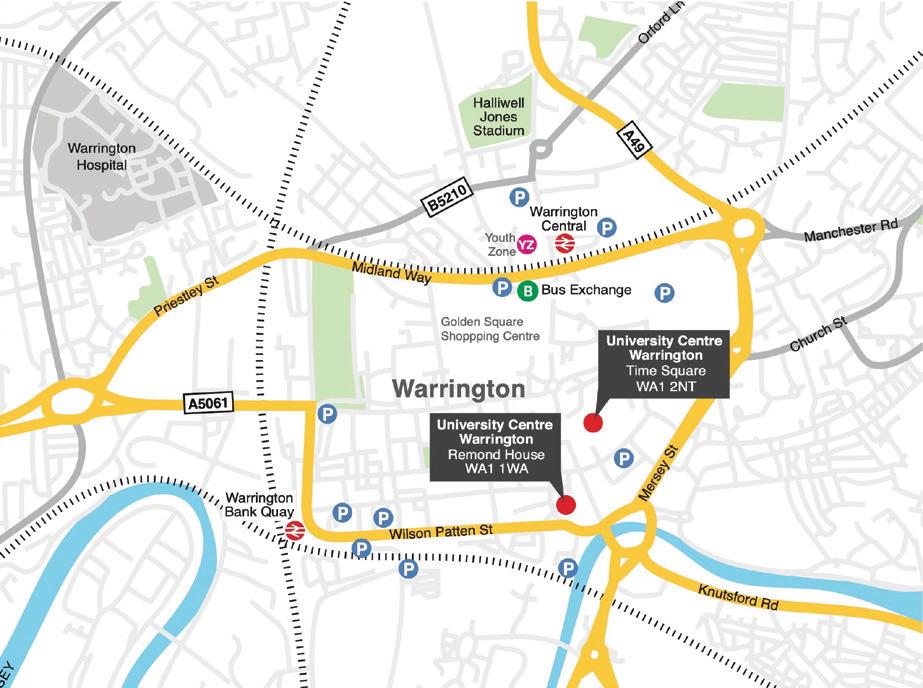
• Warrington Train Stations to Remond House: 10-12 minutes
• Warrington Train Stations to Time Square: 10-15 minutes
• Birkenhead Central Station to University Centre Birkenhead: 9 minutes
In the UK, Trainline and National Rail are two of the most commonly used websites for planning train journeys across the country. You can use them to check train times, compare ticket prices, and book your journey in advance. Simply enter your departure and arrival stations, along with your travel date, to get started.
Please see click here for more information on our sites.
Bus Services
There are also buses which are a costeffective way of traveling around the North West of the UK. However, travelling by bus
may make your journey longer, so please factor this in when commuting to our sites. Bus and train tickets can be purchased from the corresponding apps and websites.
Taxis
The cost of taxi fares will vary depending on traffic and the hire firm you choose. The Visit Cheshire website has useful information on local taxi firms, fares, and more.
Useful Resources
UKCISA – Travel and transport in the UK
For more information please refer to the UoC Website.
University
Term Dates
Term Dates
• You can find information on term dates for Undergraduate and Postgraduate Courses by clicking here
• Please plan your travel during the official vacation dates, as you should remain in the UK during term-time.
• For more information, please visit the official Gov.uk website here. Or contact studyvisa@chester.ac.uk
UK Healthcare
In the UK, the National Health Service (NHS) is the system that residents use to access both physical and mental healthcare services. When you visit a General Practitioner (GP) or receive hospital treatment, you won’t be charged at the point of care. Most NHS services are free when you need them, although some services such as prescriptions, dental treatment and eye care may involve a cost.
Healthcare and the NHS
• The Immigration Health Surcharge (IHS), which is paid as part of your visa application, allows you to access NHS services during your studies.
• Your entitlement begins when your visa is granted and continues until it expires. Please note that some services, such as prescriptions, dental treatment, and eye care, may still incur a charge.
For more information on how much you have to pay for UK healthcare as part of your immigration application, please click here
Dependants
If you have brought a spouse, civil partner, or children with you to the UK, they will be entitled to free NHS treatment, but only if they are dependents with their own visas. Each dependent will have to pay the immigrant health surcharge individually and register with a GP to access the full services offered by the NHS.
Registering with a GP and Accessing Medical Care
It’s essential to register with a GP as soon as you arrive in the UK. This allows you to access medical care for both physical and mental health issues. You can find local GPs here.
How to Register
If you are studying in the UK for less than six months, you may need to pay for NHS treatment, except for certain services that are free to everyone. We strongly recommend arranging private health insurance before travelling to the UK. If you are eligible, you should also bring a valid European Health Insurance Card (EHIC) or Global Health Insurance Card (GHIC), as these may help cover some healthcare costs during your stay.
• Most GP surgeries allow you to register online. Alternatively, visit your nearest GP surgery in person with your passport. You may also need to show proof of student status, such as your student ID card.
• After registration, you’ll receive your NHS number by email or post.
• On the NHS, you do not pay for GP appointments.
GP Appointments – What to Expect
• Duration: Appointments are scheduled for 10 minutes. If you think you will need longer than 10 minutes, you will need to request this when you book your GP appointment. Usually, you attend a GP appointment on your own. However, if you would like someone with you, you can ask for a chaperone when scheduling your appointment.
• What to Expect: The GP will ask about your symptoms and how you’re feeling. Be honest to receive appropriate care. Most GP surgeries have both female and male doctors. If you would prefer to see a female or male doctor, you can usually request this when registering or booking an appointment.
• Prescriptions: If prescribed medication, you’ll need to pay a charge (click here for current prices). Medications can be collected from a pharmacy counter at chemist shops or larger supermarkets. Ask your GP receptionist for more information on where you can collect your prescription.
• Emergency prescriptions are for if you have run out of prescribed medicine and need some urgently. For more information, please click here.
For more information on NHS prescriptions, please click here
Remember, you must register to a GP surgery as soon as possible after arriving in the UK. Do NOT wait until you need a doctor to register as this can possibly delay treatment.
Check out The UK Council for International Student Affairs (UKCISA) for more information
Out of Hours Care
If you need medical help outside of regular GP hours (evenings or weekends), contact your GP for instructions on accessing ‘Out of Hours’ services.
Hospital and Emergency Care Consultant Referrals
Your GP may refer you to a specialist (consultant) for further tests or treatment. You could be treated as an in-patient (admitted overnight) or as an out-patient (attending only for scheduled appointments).
Accident and Emergency (A&E)
A&E departments are available 24/7 for serious or life-threatening conditions. Be aware that waiting times can be long.
Need Medical Advice?
For non-emergencies, call the NHS helpline at 111 for free 24-hour advice. In life-threatening emergencies, dial 999 immediately.
Dental Care in the UK
NHS Dentistry:
• The NHS provides essential dental care at a reduced cost compared to private dentistry.
• NHS services cover clinically necessary treatments to keep your mouth, teeth, and gums healthy.
Private Dental Care
• For cosmetic procedures, like tooth whitening, you’ll need to go to a private dentist. Make sure to enquire about costs beforehand.
Finding a Dentist:
• You can find more information on NHS dental services, costs, and local dentists here
Always confirm whether a dentist accepts NHS patients to avoid unexpected expenses.
Eye Care and Eye Tests
Opticians
Eye care and tests are provided by opticians, often found at high street shops like Specsavers, Boots Opticians, and Vision Express
Costs
Eye tests typically cost around £25. This charge applies regardless of NHS access.
Prescriptions and Costs:
If you need glasses or contact lenses, you’ll receive a prescription detailing the required lens strength. Costs for frames and lenses vary widely, and optician assistants will help you with options and pricing after your test.
Additional Information:
For more details on opticians and potential NHS coverage for eye tests, visit this link.
Pregnancy and Parenting
At the University of Chester, a range of support is available for pregnant students, both from the University and external sources.
Important Steps for International Students
• If Pregnant Before Arriving: Contact the International Admissions team at international@chester.ac.uk before you travel to the UK for guidance on studying while pregnant.
• If Pregnant After Arrival: Contact the Student Visa Compliance team at studyvisa@chester.ac.uk as soon as possible. Pregnancy can impact your visa conditions.
Visa Considerations
• Continuous Engagement Requirement: Student Visas require ongoing engagement with your studies. Extended absences, including those due to pregnancy, could affect your visa status.
• Attendance Requirements: You must attend face-to-face classes as specified before enrollment. Discuss any potential long-term absences with the International Admissions team before you arrive.
• Absence Limits: During term-time, a maximum of 2 weeks’ absence is allowed before risking visa issues.
• Interruption of Studies: If needed, consider an Interruption of Studies, which limits your Student Visa to 60 days. You and your baby should leave the UK within those 2 months. Upon return, obtain a new Confirmation of Acceptance for Studies (CAS) and apply for a new visa.
Dependents
Undergraduates and taught postgraduates can only have dependents if financially sponsored by a government. Researchbased and PhD students may be able to bring dependents. If you give birth in the UK, your baby can stay with you. For births within 3 months of leaving the UK, you can apply to bring your baby back as a dependent. Please contact international@ chester.ac.uk for more information.
Support at the University
For all information on parenting and pregnancy support for international students, please visit our website here
Student Parent Support Network
Join the Student Parent Support Network hosted by the Wellbeing and Mental Health team to connect with other student parents. Participate in events and join our Microsoft Teams network for support and advice.
For questions, contact the wellbeing team at studentservices@chester.ac.uk .
Who to Contact in a Emergency
If you are in distress, having thoughts of self-harm or suicide or need urgent medical help, it’s important to get immediate support. If you don’t feel able to keep yourself safe, please call the emergency services on 999 or go to your nearest A&E department.
Support Right Now
Our Support Right Now web page outlines a range of crisis support services available to students, including in-person, phone, and online chat support, so you can access help in a way that feels most comfortable for you. Click the link here to find out more.
Staying Safe on Road Footpaths and Near Water
Getting around on foot in the UK may be different from what you’re used to. It’s important to stay alert and aware of your surroundings – especially on roads, near train tracks, and around open water like rivers, lakes, or canals. The following tips will help you stay safe.
Crossing Roads Safely
Always use marked crossings such as zebra crossings, pelican crossings, or traffic lights – drivers in the UK will not usually stop unless you’re at one of these.If no crossing is available, look right, then left, then right again –vehicles drive on the left-hand side of the road in the UK.
Avoid using your phone or headphones while crossing –stay alert.
Walking Near Roundabouts
Never walk on a roundabout. Use nearby footbridges, subways (underground paths), or marked crossings. Vehicles on roundabouts have priority and may not expect pedestrians.
Staying Safe Near Train Tracks
Never walk along or cross over train tracks –this is both illegal and extremely dangerous. Use bridges, level crossings, or underpasses to cross safely.
Some train lines have live electrical currents that can be fatal, even if you don’t see a train.
General Footpath Safety
Walk on the footpath or pavement wherever possible. If there’s no pavement, walk facing oncoming traffic and stay as far from the road as you can. If walking in a group, don’t spread onto the road – stay in single file on narrow roads.
Staying Safe Near Water
The UK has many rivers, canals, and lakes –these may look peaceful but can be dangerous, especially if you’re unfamiliar with local conditions.
Never swim or enter open water unless it is part of an organised and supervised activity.
Water temperatures in lakes and rivers can be much colder than expected, even in summer, which can cause cold water shock and sudden breathing difficulties. Banks and edges may be slippery, unstable, or deeper than they appear –always stay back from the edge.
Alcohol and swimming don’t mix. Many accidents happen when people enter water after drinking.
Advice from The Royal National Lifeboat Institution
If you see someone in difficulty in the water, do not enter the water yourself. Call 999 immediately and ask for the Fire and Rescue Service or ask for the Coastguard in coastal areas.
• For more information on Float to Live, please click here
• For more information on staying safe near water, please visit the Canal & River Trust website
Security on Site
Please ensure you wear your lanyard which displays your student ID at all times when you are on any of our sites. This helps us to keep our students, staff and sites safe and secure.
Our sites are covered by CCTV which is monitored for everyone’s safety.
On Site Emergencies
In the event of an emergency on site, call 999 for emergency services and then alert the Security team as soon as possible.
Security
Our Security team are your first port of call for help and emergency support contact outside of the normal University opening hours (9am-5.30pm). The team work on a rota basis to provide a 24/7 service, 365 days of the year. This means they can provide a safe and secure environment at our sites for students, staff and visitors alike.
Our Security Team:
• Provide security, first aid, and first response support to students.
• Respond to calls from students, staff and local residents regarding a range of issues on and off site.
• Liaise with teams across the university, including the Proctor’s Office, the Residential Life Team, Student Services, and external services such as the emergency services.
• Operate and monitor the university’s CCTV system.
• Are key holders for all university properties on and off site and respond to intruder/fire alarm activations as and when needed.
Security Contacts
Exton Park
Call: 01244 511541
At Exton Park, our Security team are located at the main entrance to the site (off Parkgate Road).
University Centre Warrington
Call 07584182856 (Time Square) or 07584182738 (Remond House)
Security & Welcome Officers are based in the vicinity of the main entrances at both Time Square and Remond House during opening hours.
Other sites
Our other sites are supported by dedicated Security & Welcome Officers based at each site during each sites, core hours, supported also by site facilities staff.
They may be contacted via Reception on the following numbers:
• Queen’s Park: 01244 511910
• Wheeler: 01244 512600
• University Centre Birkenhead (Marriss House): 01244 513880
Studying at the University
Faculties and Connect Hubs
The University of Chester’s academic structure is organised into three faculties. Alongside this academic structure, Connect Hubs operate as accessible, student-focused support points across the University.
Students can visit or contact any Connect Hub location to ask questions and receive support, regardless of their course or faculty. Connect Hub teams work collaboratively to provide accurate information or to signpost students to specialist services when needed.
Connect Hubs are designed to make it easy for students, particularly those new to the UK or the University, to find help, guidance and reassurance at any stage of their studies.
Support Available at Connect Hubs
• General student enquiries and advice
• Guidance during induction and transition into study
• Attendance and student engagement support
• Course -related queries and signposting to academic teams
• Advice and referral for personal or wellbeing concerns
Our new Connect Hubs are here to help.
• Student Voice activities and opportunities to give feedback
• Signposting to University support services and specialist teams
Faculty of Arts, Humanities and Social Sciences
The Faculty of Arts, Humanities and Social Sciences is a dynamic and collaborative academic community where students are encouraged to explore ideas, think critically and engage with the world around them. The Faculty brings together subjects across education, law, creative and performing arts, humanities and social sciences, and values inclusivity, creativity and global perspectives.
• 01244 513734
• ahsconnect@chester.ac.uk
Faculty of Science, Business and Enterprise
The Faculty of Science, Business and Enterprise offers courses that focus on innovation, employability and global industry needs. Students develop practical skills and real-world experience linked to science, business, sustainability and digital transformation.
• 01244 512973
• sbeconnect@chester.ac.uk
Faculty of Health, Medicine and Society
The Faculty of Health, Medicine and Society is closely connected to the development of the future health, medical and wellbeing workforce. Courses combine academic study with practical experience in partnership with employers and professional bodies. The HMS Connect Hub offers tailored support for students on professionally focused courses.
• 01244 512126
• hmsconnect@chester.ac.uk
Connect Hub locations
• School of Education Building, Exton –Ground Floor Atrium
• Wheeler Building – CRV002
• Warrington – WRH001
• Birkenhead – HMA211
Opening Hours
• 9am-4.30pm Monday-Thursday,
• 9am-3.30pm Friday
Personal Academic Advice
Before you arrive, you will receive information on where you can access academic advice in relation to your course and subject studies. This may be an academic member of staff from your School within one of our three faculties or directly from your faculty ConnectHub If you are a Foundation Year student, all academic advice will be provided by the Centre for Foundation Studies.
Academic advice and guidance will include monitoring your academic progress for the duration of your course and this will be done in collaboration with you.
Personal Academic Advice will include:
• Subject-specific academic advice and guidance throughout your course.
• Directing or referring students who are experiencing any issues to appropriate sources of specialist support within or beyond the University community.
• Engagement with the electronic attendance monitoring records of individual students.
• Contact and arrange meetings to support students who are not attending taught sessions regularly for any reason.
• Maintaining a general overview of a student’s academic performance.
Induction and Transition
During Welcome Week , you will be given specific information on where you can access personal academic advice. It is important that you attend your Division and/or School orientation meetings for Welcome Week to understand where you can go for academic support. You will also meet your Course or Module Leaders during this week, who will present introductory information on your course of study and the support available to you.
Although your academic teaching staff are primarily concerned with your academic progress, you can ask them to signpost you to the appropriate service for non-academic matters. For example, one of our specialist team members within Student Services for any personal issues impacting upon your ability to attend taught sessions, study effectively, or perform to the best of your ability.
For any questions, please email studentservices@chester.ac.uk
University of Chester App .
The University of Chester app gives you easy access to your timetable, deadlines, alerts, attendance check-ins, Moodle, learning resources, and library search tools, all in one place. It also includes interactive campus maps to help you find your way around.
Please note: the app is only available to current students. If you are joining the University, wait until you receive your Welcome email before downloading and signing in.
Help and support for students
Remember:
• You WILL NOT see a check in button until the start of the class. You can pull down on the screen to refresh the display.
• You MUST check in at the start of the session within 30 minutes. Checking in after 30 minutes will not be counted and you will be marked as absent (if attendance is mandatory).
• You MUST check in at the location of the session and not on your way to the location (if attendance is mandatory).
• You MUST accept any request from your device to allow access to GPS or Location Services; otherwise, the check-in will fail.
• You MUST be connected to the UoC WiFi network.
• You MUST NEVER help another student to check in to a class, and you must never ask another student to help you to check in. If you do this your Student visa will be cancelled, as well as theirs.
Download the app by clicking here.
Questions? Email lis.helpdesk@chester.ac.uk or call on 01244 511234.
Multifactor Authentication (MFA)
To enhance security at the university all of our systems are configured to require the use of Multifactor Authentication (MFA). In order to access these systems, you need to provide your username and password as a first step and then complete an additional verification step to complete the sign-in.
MFA set-up support will be available during in-person enrolment.
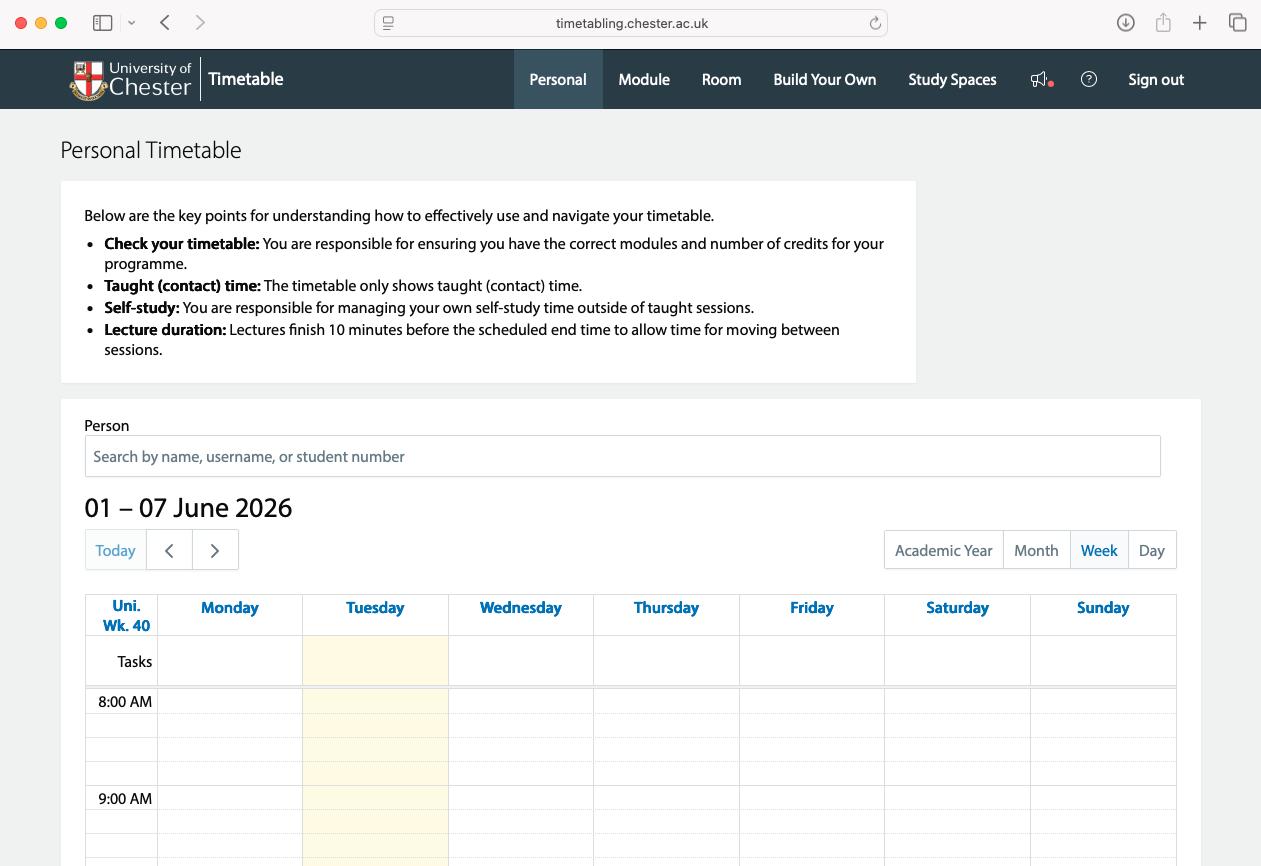
Understanding Your Timetable
You can access your timetable on Portal via the ‘Timetable’ tile or on the University App. You can view the timetable on Portal as a weekly calendar, monthly calendar, or a list of all events. Teaching spaces will have a designated building code before the room number for example, CBK107 means the room is on the 1st floor, room 107 in the Binks Building. Click here for a full list of the building codes.
Guidance on accessing your timetable on Portal can be found here.
Useful Resources
Learning and Information Services Support Information about learning online at the University of Chester
Technology
Student Email
The university’s primary method of communication with you throughout your studies will be via emails sent to your student email address. Please regularly review your inbox and emails for important information and updates which might affect your studies.
You will receive email communications for all the modules you are enrolled in, including the ISE: Academic Culture and Communication sessions. You will also receive International Student Shout Out emails, which provide updates on recent university news as well as information specifically for international students, and highlight upcoming events across the university
Once your place is confirmed, you’ll receive a Welcome email from the University. This will include:
• Your student ID number
• Your university email address (e.g. studentnumber@chester.ac.uk)
• A temporary password.
If you have not received your Welcome email, please contact records@chester.ac.uk as soon as possible
Changing your Password
Your initial password is set by the University and will be included in your welcome email. Each student receives a unique, randomly generated password –please keep this secure and do not share it with anyone.
Once you’ve completed online enrolment, you’ll be prompted to change your password. To help protect your account, we strongly recommend updating your password as soon as possible.
Every student and member of staff has an email address from the university. This email only to formally communicate with you, we don’t use any personal email addresses after Welcome Week unless contact with you is urgent, so please check your email regularly. You have access to your email until 18 months after the end of your course.
You can open your student email by loading Portal and clicking the email tile.
If at any stage, you have questions or do not understand something please contact us on 01244 511234 or log a ticket via the LIS helpdesk .
Portal
On Portal you can access your technology – including your university email account, Calendar, Moodle, MS Teams, Timetable and much more!
Click here to access Portal on your computer, laptop or mobile.
You will be presented with the login page – use your student number and password to log in.
Moodle
• Moodle is where you will find all your online course materials.
• You will likely access Moodle from the app, or from the Moodle tile on Portal.
Some of the things you can expect to find in your module Moodle site are:
• Course and module handbooks.
• Contact details for tutors/Faculty staff.
• Lecture materials.
• Online Tasks.
• Revision aid.
• eLibrary (guided reading, digital books, journals etc).
• Assessment briefs.
• Turnitin Links (for submitting assignments).
Turnitin
The university requires all written coursework to be handed in online. All online submissions are made through your module page on Moodle, using Turnitin.
Turnitin is text matching software which helps academic staff make judgements about academic conduct such as plagiarism and collusion. The software is an aid for your tutors and does not itself make any judgement about academic conduct, only your tutors may do that.
Turnitin checks text for matches against the internet, digital books (most academic texts are available digitally), other assignments in your class and all assignments from around the world which have ever been submitted through Turnitin.
To find more information about Turnitin, including how to submit work and review feedback, please go to the Portal pages
Evision
You can access eVision from the Portal homepage. You can sign in to access your assessment results, download letters, and amend accommodation addresses.
Microsoft Teams
It is very important to know how to use Microsoft Teams (MS Teams) as this is where most students’ weekly ISE: Academic Culture and Communication sessions will be delivered. In addition, many assessmentbased group work, tutorials, and personal academic advice meetings can be hosted on Teams. Click here to learn how to use Microsoft Teams
Using MS Teams is an informal platform, but it is important to be polite and remember the Statement of Expectations. You will be added to MS Teams with your academic department, your Personal Academic Advisor, and the modules in your programme of study.
You can access MS Teams through the MS Teams app (download MS teams here), the university app or the link on your Moodle module and login using your university account details.
Libraries and Study Spaces
Learning and Information Services (LIS)
LIS operate all library facilities across our sites and co-ordinate a variety of technical services. Each library has different opening hours and services so be sure to check with your site. Additionally, each academic faculty has its own library subject team who can provide specialist help and guidance related to your subject area.
Email: lis.helpdesk@chester.ac.uk
Instagram: @UoChester_lis
Your University Libraries
We have multiple site libraries available for you to use:
• Seaborne Library, Exton Park
• Wheeler Library, Wheeler Building
• Queen’s Park Library, Queen’s Park
• University Centre Birkenhead
• University Centre Warrington
Study Spaces
At all our sites, various study rooms are available to book. Whether you’re looking for silent study, group workspaces, or a more relaxed study environment, there will be a space available for you in our libraries.
You can find out more about the study spaces and how to book, here.
International Academic Learning and Development Team (IALD)
Our International Academic Learning and Development Team (IALD) has expertise across four key areas: teaching, language, culture, and international students. Our staff have extensive experience living and working in different parts of the world, learning and teaching languages, and supporting international students.
XXX018: ISE Academic Culture and Communication
This module is designed for international students who come from different linguistic and/or educational backgrounds. Students are automatically enrolled unless they have achieved a score of 7.0 or above in all elements of IELTS (or an equivalent qualification). The module provides 40 hours of interactive sessions delivered in small groups. Online for most postgraduate (PG) international students, and in person for most undergraduate (UG) international students. Students who are not automatically enrolled may choose to opt in.
We support you in understanding and adapting to the academic cultural practices of UK higher education, helping you to become an independent and selfdirected learner. The sessions cover both spoken and written academic language, as well as the following:
• Developing subject-specific academic voice, critical thinking, and argumentation for both written and oral assessments.
• Improving academic speaking skills and supporting cultural adjustment through small, interactive sessions.
• Planning assessments and understanding assignment briefs.
• Introducing reading and listening strategies to help you engage effectively with your subject content.
• Improving paraphrasing, synthesis, paragraphing, and structure with a linguistic and discipline-specific focus.
• Promoting academic integrity within UK higher education, alongside the responsible and effective use of AI for academic work.
One-to-One Tutorials and Feedback/Feedforward Service
Individual tutorials can be booked by emailing iald@chester.ac.uk. These sessions are delivered by our specialist team, who can support you in developing your academic writing, presentation skills,
academic listening and reading, vocabulary, grammar, pronunciation, and more. We can also help you better understand your assessment briefs. Please note that this is not a proofreading service.
Tutorials can also provide feedback or feedforward on your assessments to help you achieve the best possible outcomes. You can use this service before submission (feedforward) if you are concerned about a particular aspect of your work, or after receiving your grade (feedback) to understand how you can improve further.
XXX018 Moodle Site
The Moodle site provides important information about the support available at the university. It includes links to useful websites and resources to support your assessments, such as guidance on academic language, recommended dictionaries, dissertation writing materials, and other helpful tools.
The site also features a ‘Test Your Academic Language’ section, which can help identify areas for development and direct you to relevant resources.
For more information, please contact iald@chester.ac.uk.
Assessment Types
At the University of Chester, we use various assessment methods to evaluate your progress and support your learning. How you are assessed will depend on the course you are studying and the modules you choose. You may be assessed through a mixture of exams, coursework, presentations, reports, essays, and group projects. However, rather than setting assessments at the end of the year, assessments will take place during each module and will be integrated into the learning process, reflecting real-world applications of knowledge that are relevant to the workplace.
Written Assessments
Written assessments are the primary method of evaluation. These may include essays, reports, research papers, and case studies. These assignments are designed to test your understanding of module content, your ability to engage with academic literature, and your skills in critical thinking and analysis. Our Libraries and online resources play a crucial part in your preparation to submit this type of assessment. All written coursework is submitted online via our Moodle, using Turnitin software to check for issues with academic conduct
Exams
Some modules include timed or takehome exams to test your understanding of course material. Exams are more common in Undergraduate courses.
Group Projects and Oral Assessments
Group projects assess your ability to collaborate and contribute to a collective outcome, with teamwork and communication being essential. Oral assessments, such as presentations and viva voce exams, evaluate your ability to communicate ideas clearly and confidently.
You will learn more about the types of assessments you will undertake upon arrival.
For more information on teaching and learning, please visit our website
Community and Culture
Exploring Chester: A Guide for International Students
Student Race Advocates
Each year since 2020/21, we have proudly welcomed a group of Student Race Advocates to our community. Student Race Advocates are students from Black, Asian, and other minority ethnic backgrounds, both home and international.
These advocates play a vital role in supporting and promoting the needs of minority ethnic students by engaging in many aspects of the University’s work, ensuring we provide excellent service across the University of Chester.
Student Race Advocates are dedicated to:
• Enhancing inclusivity and expanding student opportunities.
• Providing support and welfare assistance to Black, Asian, and Minority Ethnic students, including those who are hard to reach.
• Collaborating with staff on various topics and contributing to policy development.
• Offering mentoring, buddying, and reverse mentoring.
• Organising conferences and events.
This paid role offers students a wealth of experiences while promoting race equality at the University of Chester.
Our Race Advocate Masuma
Shares Her Experience
“Hi, I’m Masuma, originally from Bangladesh but born and raised in the UAE! I’m an International Student, here to study Law at the University of Chester. I have been working as a Student Race Advocate, and it’s been amazing to help make a change for students from different ethnic backgrounds. A little bit of advice to everyone arriving – remember to get familiar with your visa rules, set up a bank account and register with a GP. But most importantly – explore your campus and connect with other students, it’ll help you feel right at home! Remember everyone’s in the same boat as you, so don’t be afraid to speak up first and make new friends.”
Managing Culture Shock
As an international student moving to another country, possibly for the first time, it is normal to feel lonely at the beginning. This is a natural part of culture shock and a shared experience for many students. You are not alone – support is available as you settle in and adjust to your new home away from home. Across the academic year, the university runs a range of events, fairs, and activities to help you feel connected and part of the community. You will also have opportunities to connect with your peers through group work, seminars, and course activities.
Here are some top tips to help you manage culture shock:
Create Your Home Away From Home
When you are packing your suitcase, don’t forget to bring something that reminds you of home. This could be a photograph, or anything of sentimental value!
Food
It is exciting to try new foods, but it is also important to discover where you can find your home comforts! Chester has a range of Halal-friendly restaurants, and Chester Market offers cuisine from around the globe. If you live outside of Chester, it is important to explore your local area and discover what is on offer!
Make Friends
Making friends is a great way to manage culture shock. Not only are you meeting new people and discovering new cultures, but you may also connect with students from your home country!
Student Support
From the moment you arrive, our dedicated teams are on hand to help you settle in, feel at home, and make the most of your experience. Click here to explore the support on offer
Chat to a Student
Speak with one of our friendly student ambassadors to explore more about student life at the university. There is an option to select a student ambassador based on their home country.
By following these tips, you’ll be able to settle in and feel connected to your new student community!
Making New Friends
One of the most exciting parts of studying at university is the opportunity to meet new people and build friendships with others from a wide range of backgrounds, both from across the UK and around the world.
As an international student, it’s completely natural to have some worries about fitting into a new community. Please know that you are not alone in feeling this way. Many students (no matter where they are from) share similar concerns when starting university, especially when it comes to meeting people and settling into student life.
Making friends is an important part of your university experience, and it often happens gradually in ways you might not expect. In this section, we’ll guide you through
simple ways to feel more connected, build confidence, and find your place within the university community.
Engage in Welcome Activities
Welcome Week activities are a great way to meet new people and start making friends. Everyone is new and looking to connect, just like you!
For more information on Welcome activities, and university events, click here
More Ways to Connect
Joining a club or society is a great way to meet people, but it is not the only option. For example, many students build friendships through group study sessions, spending time in library spaces, visiting cafés, volunteering opportunities, or attending Chaplaincy events and activities in the Community Hub. These can provide a more relaxed way to meet others, discover shared interests, and feel part of the university community.
Joining a Sports Club or Society
At the University, there is a wide range of sports clubs and student societies for you to explore and get involved in. These are open to all students and are a great way to meet new people and feel part of the university community.
One of the best things about joining a sports club or society is that you’ll already have something in common with others. Whether it’s a shared hobby, interest, or passion, this can make starting conversations feel much easier!
Getting involved is a simple and enjoyable way to build friendships, and try something new.
You’ll spend a lot of time with the people on your course throughout your studies. In the first few weeks, try to introduce yourself to others. Even a simple “hello” can go a long way!
Whether it’s studying together, going to lectures, or spending time on campus, meeting new people on your course is a great way to start making new friends.
Top tips for new students
Masoma Akter – Level 6: Law
Why did you choose to become a Student Race Advocate?
“As an ethnic minority student in the UK myself, I understand the importance of a voice to advocate for students from diverse cultural backgrounds. The SRA role is a brilliant opportunity for me to work directly with the university staff, as well as the student body, to address challenges and promote positive change.”
Masoma shares her tips on making new friends as an international student:
Student Race Advocate Masoma Akter shares tips on making new friends as an international student:
Tip 1: Not sure how to start a conversation?
Try this:
• Hi, what course are you studying?’
• ‘Have you explored the area much yet?’
• ‘Have you joined any clubs or societies?’
• ‘How are you finding your course so far?’
Tip 2: The dos and don’ts of making new friends:
Do:
Say hello first. Starting a conversation is a brilliant way to open new opportunities to connect.
Attend events on your own if needed. You will be surrounded by other students who are just as eager to make new connections.
Ask questions. Discovering shared interests is a great way to build new friendships.
More tips on making friends
Tip 3: Not sure what to do first? Here’s a simple plan to help guide you:
Day 1-3: Attend Welcome Week events. Feeling nervous? That is okay! Everyone will be feeling the same way and looking to make new friends.
Week 1: Join one society and one social event. This is a great way to meet people with the same interests.
Week 2: Talk to two classmates before/after lectures. This is a great way to feel connected to your student community.
Week 2: Go to one Chester Students’ Union (CSU) activity. The CSU hosts several fun and exciting events to help you engage with students across the university!
You can view all events happening at the university here.
All Welcome Week events can be viewed here
Interested in joining a CSU society? You can view the full list of societies here.
Opportunities to make friends as an international student
Catering and Shopping in the UK
Food
We know that when you arrive in the UK after a long flight, you will likely want to buy some essentials and get to your accommodation quickly and easily. Below, we have listed a range of shops that you might find useful for buying essentials.
Some shops commonly found in city centres that have been voted most affordable by students include:
• Lidl
• Iceland
• Aldi
Other popular food shops in the UK include:
• Tesco
• Morrisons
• Sainsbury’s
• ASDA
These shops sell fresh and frozen foods including fruit, vegetables, and meats. You can also visit larger shops like Tesco and Morrisons for homeware and kitchen supplies, including cutlery and pots and pans.
Catering
The University of Chester has several Catering outlets located across our sites which serve a range of hot and cold meals and snacks throughout the day. Within these spaces, we offer diverse world cuisines, sandwiches, baked goods as well as Starbucks coffee.
Some of our food may contain nuts, we therefore ask that if you have any dietary requirements or allergies, please let a member of catering staff know and they can advise you of what you can and cannot eat based on your allergies.
Please be aware we now only accept card transactions in all our outlets. Creating a Welcoming and Respectful Atmosphere in Our Cafeterias
There are also spaces across sites to eat your own food, if you aren’t sure where to go, please ask a member of catering or reception staff.
Meal Schemes
Meal Schemes are designed for students living in self-catered and private sector accommodation or at home. There are three schemes to choose from, offering great value that can help students to budget and give parents peace of mind that their son/ daughter is eating nutritional food.
For more information on the different types of meal schemes, please click here.
Household and Hygiene Products
Shops where you can find cheaper homeware, kitchen equipment, and cleaning supplies include:
• Home Bargains
• B&M
• Savers
Clothes
The weather in the UK can be unpredictable and autumn and winter can be extremely cold, especially when coming from a hot climate. In the winter, the temperature can drop to an average of 2-7 degrees Celsius or 36-45 degrees Fahrenheit, however sometimes it can dip below 0 degrees (32 degrees Fahrenheit).
When you arrive, you might find yourself needing some warmer clothes, like hats, scarves, gloves, and big coats. Popular and affordable clothing shops that you can find on highstreets in the UK include:
• Primark
• New Look
• TK Maxx
Exton Park Dining Hall
Chester City
Chester is a vibrant blend of modernity and tradition, nestled in the Northwest of England. Just under an hour from Manchester and Liverpool, and only a two-hour direct train ride to London,
Chester is perfectly positioned for easy travel. It’s also close to the stunning Welsh coast and picturesque mountains.
The city’s rich history is beautifully showcased by its ancient Roman walls, the magnificent Cathedral, the iconic Eastgate Clock , and the fascinating Roman Amphitheatre.
These landmarks reflect Chester’s remarkable 2,000-year-old heritage, making it a city where the past and present come together seamlessly.
Chester Students’ Union
As a student at the University of Chester, you automatically become a member and part of the community of Chester Students’ Union (CSU).
CSU offers several services, from student voice and opportunities to academic advice, to help you love your student life.
Advice
We hope your time at the university runs smoothly, but we recognise that sometimes you will face challenges and may need support – this is where the CSU advice team can help. We believe that all students should have access to free, confidential, and impartial advice.
The CSU Advice team can support you with academic issues; including Appeals, Disciplinary and Professional Suitability Panels or Complaints. To find out more about what the team can support with, please visit the CSU website.
Advice can be offered in person and by email/MS teams. If you would like to book an appointment, please do so here
Voice
One of the most important things that Chester Students’ Union does is represent you and your fellow students’ views on your student experience, and particularly your experience with the UoC. To achieve this, CSU has three elected officers in post who represent you at the highest levels of university governance, amplifying your voice, sparking debate, sharing ideas, and enacting real and meaningful change.
There are also other ways you can both represent and be represented at the University of Chester. We have the Union Assembly, which is CSU’s student decisionmaking body. It is where your ideas and motions are discussed, debated, and voted on, which helps to lead the direction of CSU and your Elected Officers.
We also have a Student Voice Representation System, where representatives collect your feedback and deliver it to lecturers, tutors, and departmental and faculty staff. To find out more about student voice, please visit the CSU website.
Opportunities
There are a range of opportunities for all students to get involved in extra-curricular activities during their time at the University of Chester, including engaging with one of our 70+ student-led societies.
If you’re looking to connect with likeminded individuals who share the same interests as you on an academic, political, performance, recreational, religious, or cultural level, then check out the here.
Community
At CSU, we want every student to feel a sense of belonging and contribution to our thriving community. We organise events and also encourage student-led activities that bring together like-minded individuals from diverse backgrounds.
And follow our social media channels to stay up to date:
• Facebook
• Instagram
Sport and Active Lifestyle
Whatever your fitness levels, interest in sport or experience we have something for you at the University of Chester.
Many of our facilities at Exton Park and programmes are free to use for students including our fitness classes, Active Campus activities, golf simulator, spin studio, squash courts, tennis courts, 3G and Astro pitches and sports hall. Click here for more information.
Our Facilities Include:
• Large sports hall for badminton. volleyball. basketball. futsal. archery. trampoline. cricket. dodgeball. and netball
• Floodlit 3G Multi-use Games Area for football, rugby union, rugby league, ultimate frisbee, American football
• Floodlit hockey astroturf for hockey, lacrosse, rounders, softball, quidditch
• Floodlit tennis courts for tennis, netball and basketball
• Floodlit sprint track
• Squash courts
• Studio for dance, cheerleading, mixed martial arts, fencing, pole fitness and HEMA
• Spinning studio
• Golf simulator studio
• Indoor and outdoor table tennis
• 25m Swimming pool for swimming and water polo
• Over 100-piece fitness suite
• Regular fun fitness classes in our studios
• Grass pitches for football, rugby union, rugby league and American football
• Access to local facilities for athletics, rowing, equestrian, sailing and canoeing
We also have free Active Zones at University Centre Birkenhead and Queens Park. These are open to all students. Please visit the Sport and Fitness section of the UoC app to find out more.
sportCHESTER Clubs
With 30+ sports and activity clubs, there is something for everyone, whether you want to compete, try something new, or just have fun. Not every club is about competition! Some, like roller-skating and pole fitness, are all about having fun, staying active, and being part of a club. Whatever you’re into, there’s a club for you.
For a full list of our sportCHESTER Clubs, visit our website
British Universities and Colleges
Sport (BUCS) Leagues
Many of our teams play in the British Universities and Colleges Sport (BUCS) leagues, and we compete against other universities within the North-West such as Liverpool, Manchester, Lancaster and Edge Hill to name a few.
With alumni such as cycling supremo Dave Brailsford, Olympic gold and silver medallist in cycling and rowing Rebecca Romero, Netball legend Tracey Neville and ex-women’s rugby union captain Gill Burns, Chester is the perfect environment to launch you into your next phase of development.
When do Teams Play?
The playing season usually runs from October to March/April, however some teams play over the summer months, including our cricket team.
The BUCs season usually finishes in March with the Varsity competition. At Varsity, a number of our AU teams complete with equivalent teams from the University of Salford in several events to win the coveted Varsity trophy.
Where/When/How Can I Join?
All AU clubs are based at Chester sites but welcome all UoC students. Most clubs run from September to April/May time with a break in Summer. Everyone who is a member of a club is required to purchase an AU membership online via Portal.
activeCHESTER
Looking for a fun, low-pressure activity?
Join activeCHESTER sessions – free, fun, social sessions to meet new people!
For more information, contact: sal@chester.ac.uk .
Support at the University
Your Money
International Centre
The International Centre (IC) is a central support department that provides a range of services primarily for new international students up to the point of arrival.
Residential Life Helpdesk
For more information please contact: international@chester.ac.uk.
Follow the International Centre on Instagram
Student
Services
To access any of the following support within Student Services, please email studentservices@chester.ac.uk or call 01244 511550.
Opening Hours
Monday to Thursday – 9am to 5pm Friday – 9am to 4pm.
Student Experience
Our service is confidential; however, there are rare exceptions where confidentiality will not apply because the team will always act in the best interests of the student. For more information on confidentiality, you can read this Privacy Statement.
Wellbeing and Mental Health
The Wellbeing and Mental Health team at the University of Chester are here to provide support, whether you are a student studying a full or part time course, at any of our sites.
For more information or to book an appointment with any of the services listed on our website, please do not hesitate to get in touch with our central Student Services Helpdesk by email studentservices@chester. ac.uk or phone at 01244 511550.
Wisdom App
Prefer digital support? The Wisdom App includes:
• Live chat with a counsellor.
• Mood tracking and wellbeing tools.
• Relaxation, fitness and self-help resources.
• Access code: MHA146072.
• Remember, reaching out for support is a positive step, and we’re here to help you make the most of your university experience.
Disability and Inclusion
At the University of Chester, we have a dedicated Disability and Inclusion team who can offer support to students who have a physical impairment or mobility issue, mental health condition, additional learning need, or social/communication impairment.
You may not think of yourself as disabled, but it’s worth considering whether you may be entitled to support.
Our team of experienced advisors can support students who;
• Have a physical impairment or mobility issue.
• Have a mental health condition, such as depression, schizophrenia or anxiety disorder.
• Have a specific learning difference, e.g., dyslexia, dyspraxia or ADHD.
• Have a social/communication impairment such as Asperger’s Syndrome/other Autistic Spectrum Disorder.
• Are blind or have a serious visual impairment uncorrected by glasses.
• Are deaf or have a serious hearing impairment.
• Have a long-standing illness or health condition such as cancer, HIV, diabetes, chronic heart disease, or epilepsy.
• Have any condition which meets the definition of a disability under the Equality Act 2010
What can Disability and Inclusion help with?
Our Disability Support Officers offer information, advice and guidance in a range of areas such as:
• Reasonable adjustments and support during your studies.
• Obtaining up to date supporting evidence.
• Securing suitable university accommodation.
• Making exam arrangements.
• Provision of Support Workers.
• Specialist equipment loan.
• Liaison with academic departments.
• Accessible parking.
• Obtaining up to date supporting evidence for assessment deferrals.
• Making alternative exam arrangements, such as extra time.
You can contact the Disability and Inclusion team at any point before or after starting at the University of Chester and they will be happy to help.
Contact Disability and Inclusion via the helpdesk:
studentservices@chester.ac.uk 01244 511550
Student Experience
Whether you are a new student, returning for another term, or joining us later in the academic year, if you have questions or need assistance with your induction or arrival, our Student Experience Team is here to support you.
Email: studentexperience@chester.ac.uk
Welcome Week
Welcome Week is your introduction to life at the University of Chester and an important part of settling into your new community. During the week, you can expect a range of activities designed to help you become familiar with the University, meet fellow students, and prepare you for your studies.
As an international student, you will have opportunities to attend sessions covering topics such as enrolment, meeting the faces behind the teams as the university and even fairs to learn all about life and support available to you in Chester. We always work in collaboration with our students working in partnership to help you build connections from around the world.
We encourage you to attend as many Welcome events as possible. These
sessions will provide valuable information, answer common questions, and help you feel confident and prepared for your time at the University of Chester.
Welcome to UoC Tent
During September Welcome Week at Exton Park, the UoC Welcome Tent is here to help you feel supported in your first week.
You can ask us questions about student life and support, ask for directions, or just stop by for a friendly chat!
Pop-Up Points
Alongside your welcome to the University, the Student Experience team runs a range of pop-ups, dropins and informal activities across campus throughout the year. These are opportunities to meet staff, ask questions, find out about university services and get practical guidance, particularly as you settle into life at the University.
Student Experience –Student Services
This activity forms part of our Pathway to Success, which is designed to help all students feel welcomed, connected and supported during the early stages of your student journey. Through Pathway to Success, you can access information, guidance and signposting to support you as you adjust to studying at the University and living in the UK.
Support Fairs
Across the academic year, our Support Fairs bring together a wide range of support services, giving all students the chance to find out how to access help both within and outside the University. External organisations and charities also attend to showcase the services and support they offer, making it a great opportunity to explore what’s available and connect with useful resources.
University of Sanctuary
In 2025, the University of Chester was officially recognised as a University of Sanctuary, joining a national network of institutions committed to creating a welcoming, inclusive, and supportive environment for refugees and asylum seekers. The application to become a University of Sanctuary was led by the Student Experience team, with fantastic support from academic and professional staff across the University.
To find out more about our University of Sanctuary status, please click here
Student Experience Podcast
Join Lily, Induction and Transition Manager at the University of Chester, and Will and Luis your elected student officer team of Chester Students’ Union, for conversations about all things Student Experience.
From wellbeing and money to what is life really like for a student at Chester along with helpful tips on navigating university life.
Lily, Will and Luis invite a new guest each month to offer insights, advice, and stories to help you make the most of your university experience. So, whether you’re a current student or thinking about applying, this podcast offers a supportive space to explore the highs and challenges of student life.
You can listen to the podcast for free on:
• Spotify
• Buzzsprout
• Podcast Addict
• Podchaser
Explore Upcoming Student Experience Events
Visit our website for for all information, dates, and locations for our upcoming events.
Chaplaincy
Our Chaplains are here for everyone at the university, dedicated to welcoming and supporting students from all backgrounds. We strive to help you feel a sense of belonging, regardless of your religion, beliefs, or worldview. Our Chaplains come from a range of religious communities, and we are here to offer support to all students – whether you’re religious or not.
You can always count on us for a listening ear. If you need someone to talk to, simply email us at chaplaincy@ chester.ac.uk to arrange a chat, either in person or on MS Teams.
To learn more about the Chaplaincy, click here.
Community Hub
At Exton Park, the Chaplaincy Team is conveniently located in the Community Hub, right next to the Binks building.
The Community Hub offers a warm and welcoming environment with cozy common rooms, bookable meeting spaces, a small study room, and a quiet room for relaxation. There’s also a kitchen where you can enjoy hot or cold drinks and prepare simple meals.
The Chaplaincy staff’s offices are situated on the ground floor of this building, making it easy to connect with them whenever you need support or advice.
Faith Spaces
Chaplaincy offers a variety of prayer rooms and faith spaces across the university sites for people of all faiths and none, for prayer, quiet reflection, relaxation and as gathering places with others.
You can find information about the faith spaces available at your place of study here.
Please contact Chaplaincy for further details by emailing:
• chaplaincy@chester.ac.uk.
• Instagram: UoC_chaplaincy
University Chapel
Exton Park is also home to the University Chapel, one of the University’s original buildings, which was built by some of our very earliest students and opened in 1847.
The University Chapel hosts our regular weekly programme of worship, as well as occasional services such as weddings, baptisms and memorial services and university services like the annual Founders’ Day and Long Service Awards ceremony.
It is open during the day each weekday for quiet reflection and prayer. There is a piano in the Chapel which is available for students and staff to play during the day (if the Chapel is not otherwise in use).
You can read more about Chapel’s history on our website.
Your Money Residential Life Helpdesk
Managing your finances is an essential part of student life, and we know they can go off track quite easily. We have put together lots of information on how to manage your money effectively, from cheap and easy recipes to the best student discounts. You can find all the information by clicking here.
You’ll need to show you have enough money to support yourself – unless you’ve been in the UK with a valid visa for at least 12 months on the date of your application.
Please click here for information on how much money you need.
In addition to offering wellbeing support, our Student Assistance Programme (SAP) can also offer help and advice on a range of issues related to cost-of-living.
You can talk to a qualified adviser about a range of topics including:
• Consumer rights
• Buying or renting a property
• Budgeting
Student Experience
• Debt management plans
• Benefits and grants
• Mortgage advice
Call SAP for free on 0800 0283766 at any time, day or night – or visit Portal for more info.
Student Support Fund
The Student Support Fund is designed to help ease unexpected financial pressures by providing non-repayable, short-term financial support.
This support is intended to meet the immediate needs of those students who are struggling with an unanticipated situation which is having a negative impact on their studies.
The Fund is open from 1st August to 31st July, and you can apply at any point during this time. However, making an application doesn’t guarantee you’ll receive a financial payment.
For more information, please contact the Student Services Helpdesk .
What We Can’t Help With:
• University tuition fees. If you have concerns about paying your tuition fees, please contact the University Finance team at fees@chester.ac.uk.
• Pre-existing debts from before you joined the university. If you’re struggling with debt, please let us know as we have other support available.
• Travel costs associated with Experiential Learning Abroad or extracurricular activities.
Depending on your student fee status, our eligibility criteria does differ slightly for international students studying at any level:
• You need to show you had the necessary financial provision in place to support your studies.
• You have experienced an unexpected, emergency which has left you in financial difficulties.
• You have explored all other avenues of financial help available e.g., savings, overdraft, family support.
Whether you’re managing you own finances for the first time, or have made the decision to return to education, our Your Money Hub team are here to help you stay financially fit during your time at Chester. We can offer:
• A dedicated Student Money Advisor to provide one-to-one support with a number of money management areas.
• The Your Money Hub Portal page is filled with helpful information about money matters, such as student discounts, banking, and debt.
• Advice and information about financial support you may be entitled to.
Top tips for saving money
Student Safety and Crime Prevention
It is important that all students understand how to stay safe, and how to report a crime.
The British Council has created a useful guide on how students can stay safe in the UK. Please visit their website to read there online guide.
Staying Safe
• Lock all windows and doors even when you are at home. 1 in 3 burglaries are the result of a door or window left open.
• Keep valuables out of the view into your house or room from windows.
• Don’t carry large amounts of cash when you are out.
• Don’t agree to give cash to someone you don’t know whatever their reason and don’t let them come to a cash machine with you.
• Look into obtaining a pre-paid cash card, particularly if you are an international student and need funds for your arrival. The card allows you to load money on to it, and you use it similarly to a debit card.
• Be alert to your surroundings and the people around you when you are off campus.
• You can register your valuable belongings on Immobilise.com free of charge and if they are stolen it can help the police return them to you.
How to Report a Crime, Fire or Health Emergency
In an emergency, remember to always dial the UK fire, crime or ambulance telephone number 999 straight away. To report an incident to the police when it is no longer an emergency telephone 101 or use Cheshire Police’s online reporting site
Scan to Read our Race Advocate’s chat with Cheshire Police
Scam Awareness
Scams and How to Avoid Them
Scammers are using new methods to try and take your personal information. These attempts can be in person, on social media, via email, phone call, and text.
Like everyone, students can fall victim to a scam. It is important you know how to spot signs of a scam and the most effective methods to protect yourself. Protecting your personal information helps protect you and your money.
Hard Luck/Lost Card Scams
• This is where you are approached by someone who claims to have lost their bank card and needs money.
• They ask you for cash and in return they will transfer the money into your account.
• They are likely to make a payment to you on a fake banking app, meaning no money has gone into your bank account.
Money Mules
• ‘Money mules’ receive stolen funds into their account and are then asked to withdraw and wire the money to a different account (often overseas), keeping some of the money for themselves.
Even if you are unaware that the money you are transferring was illegally obtained, you can still be prosecuted for money laundering.
Remember, you should never give your financial details to someone you don’t know and trust.
Bank Account at Risk
• This is where you receive a call or text telling you your bank account has been attacked and for safety reasons your money will need to be moved into a new account.
• Banks will never call you to ask you to move your money. Hang up and call your bank from the number on the back of your card or you can contact most bank fraud lines by calling 159.
Fake Refunds or Unexpected Windfall
• You receive a text message or email from a company (usually Amazon, HMRC or Royal Mail) saying that you are owed money and asking for your bank account details to process the refund.
• Do not respond to the email or text.
• Go to the company’s website to verify the refund is legitimate.
Scams (Report a Scam) –Student Services
Student Loans Company
Phishing Scam
• You receive an email or message from what appears to be the student loan company asking for bank details.
• Do not follow a link in the message but search the official company page and ensure you are on the official web page.
Rental Fraud
• Reports state that millions are lost to Rental Fraud each year.
• In some cases, students looking for property to rent are asked to pay a fee in advance, without viewing the property.
• It could be that the property does not exist or is not available for rent. Always double check.
International Students
There are also some scams that target international students. To keep yourself safe, please read the common scams listed below which affect International Students.
Tuition Fee Scams (distinct from Student Loans Company Phishing Scam)
• Students or their family are contacted and offered discounts or ‘help’ to pay their tuition fees.
• The scam works by the scammers paying the students tuition fees with a stolen card so that it shows up as paid on their university account and the student then pays the scammers.
• The bank then at some point asks for the money back leaving the student out of pocket and still needing to pay their fees.
UK Visa/Fake Home Office/Fake Police Scam
• This type of scan contacts international students by phone call.
• Typically, they are ‘put through’ to someone claiming to be the UK / International police or a Home Office official.
• They claim that you have been involved in a crime, or are at risk of deportation, before demanding payment.
• Legitimate Home Office officials will never contact you and ask you to pay visa fees or fines over the phone.
• If you receive an unexpected call, contact the university or UKVI on 0300 790 6268.
The Virtual Kidnapping Scam
• A student is contacted by someone pretending to be from the embassy of their home country.
• This person tells the student they have been accused of a serious crime.
• They are then persuaded not to tell anyone and to cut all contact with their family.
• Money is then extorted from the family as well as from the student.
Could This Be a Scam?
Scammers will look to use a variety of methods to try and get your personal information.
Here are the key questions to ask yourself:
• Has someone contacted you out of the blue?
• Does the offer or information sound too good to be true?
• Have you been asked to provide personal or sensitive information?
• Are you being pressured to make a quick or immediate decision?
• Does the message contain spelling or grammatical errors?
• Have you been asked to keep something secret or not tell anyone?
• Have you received a one-time code for an account that someone else has asked you to share?
• Are the contact details suspicious (e.g. only a mobile number or PO Box address)?
If you answered ‘yes’ to any of the above questions, it is highly likely that this is a scam.
What To Do Next
If you think you have been scammed:
• Stop all contact immediately.
• Do not share any further information.
• Report it to your bank or relevant authority
• Seek advice as soon as possible.
Proctor’s Office and Student Discipline
The University of Chester is committed to providing a supportive and inclusive environment for all members of our university community. We value equality and diversity and promote respect.
As part of our RESPECT campaign, we work in partnership with Chester Students’ Union, police, third sector and our local community to help promote diversity, inclusivity, and unity.
By accepting an offer of a place at the university, you agreed to abide by all relevant policies and regulations of the university. If you’re on a professional course such as nursing, teaching or social work, please read the Student Professional Suitability Policy. We ask that all students familiarise themselves with the Student Code of Conduct.
The university Proctor is responsible for the investigation of all reports of student misconduct and the management of student complaints against the university. They also investigate professional suitability issues concerning University of Chester students on courses that
lead to registration with a professional body. Reports can come from staff at the university, members of the public and other students.
As a student, you can also make a formal complaint to the Proctor’s Office concerning:
• The provision of courses or part of your programme of study
• Services or facilities of the university
• Action or lack of action by the university
Click here to view the Student Complaints Procedure or you can access the student complaints form here. Student misconduct is dealt with under the Student Disciplinary Procedure.
Living Off Site
Students living in the local community and away from our university sites are the best ambassadors for the university. We appreciate you behaving appropriately and being considerate of your neighbours. Members of the public can contact the Proctor’s Office to raise issues of:
• Antisocial behaviour
• Noise
• Waste and Recycling
If you are unsure how to deal with your bins, information is available on your local Council websites.
Report a Concern
Report a Concern
If you or someone you know has experienced or witnessed unacceptable behaviour such as harassment, discrimination, sexual assault, abuse, bullying or hate crime you can report it via our Report a Concern service. You can report an incident wherever it has occurred, for example off site, during a placement and in the workplace. You can also email: report@chester.ac.uk.
Sexual Violence Liaison Officer (SVLO) Service
Sexual Violence Liaison Officers are university staff who have undergone specific, specialist training to enable them to support students who have experienced sexual violence.
SVLOs listen empathetically without judgement. They will inform you about support available and discuss reporting options. SVLOs can also liaise with external organisations and other University staff on your behalf.
If you would like help navigating the support pathways available, the SVLO service can offer you a safe environment to have these conversations.
You can access the SVLO service by using our Report a Concern tool, emailing report@chester.ac.uk or contacting our helpdesk on 01244 511550.
For more information on the service please click here.
Please remember that the SVLO service is not an emergency service. If you or anyone else are in immediate danger or need medical help, call 999 for emergency support.
Relationships
Our Vision
The university is dedicated to promoting diversity and equality and eliminating all forms of discrimination. It aims to fully develop the talents and potential of all staff and students by treating everyone as individuals, fairly and with respect, based solely on their aptitude, ability, and potential. This commitment applies regardless of age, disability, employment status, gender, gender expression or identity, marital or parental status, race, nationality, ethnicity, religion or belief, sexual orientation, pregnancy or socio-economic background.
Equality Act
The Equality Act 2010 legally protects people from discrimination in the workplace and in wider society. It sets out the different ways in which it’s unlawful to treat someone. These protected characteristics are:
• Disability.
• Gender reassignment.
• Marriage and civil partnership.
• Pregnancy and maternity.
• Race.
• Religion or belief.
• Sex.
• Sexual orientation.
It is illegal in the UK to discriminate against people directly or indirectly based on these characteristics.
Failure to adhere to these standards could lead to disciplinary procedures which may result in you losing your place at the university.
For more information, please read the Equality Act 2010 Guidance.
Support for LGBTQ+ Students
At the University of Chester, we offer a supportive environment for students of all sexual orientations and gender identities. We recognise that LGBTQ+ students may face unique challenges, whether related to coming out, reconciling sexuality with identity, or other concerns. Our student support services, including Wellbeing Advisers, the Counselling Service, and the Mental Health team, are here to provide information, advice, and guidance throughout your journey.
The university has been awarded the Navajo LGBTIQA Charter Mark , which signifies our commitment to understanding and addressing the specific needs and challenges faced by lesbian, gay, bisexual, and transgender individuals.
Understanding
Gender and Sexuality
• Sexuality refers to one’s sexual behaviors, attractions, and preferences, and forms part of one’s sexual orientation.
• Gender involves socially constructed ideas about behavior and roles related to ‘masculinity’ and ‘femininity’. Gender identity is how you personally perceive your gender, which may or may not align with the sex assigned to you at birth.
Using the Correct Language
Identity, including gender identity and expression, is a vital aspect of every individual, including those in the LGBTQ+ community. Pronouns are an important part of this identity. It’s important to use the pronouns a person prefers, though these may not always directly reflect their gender. For instance, a person’s pronouns might not necessarily indicate their gender identity or expression.
Gender identity is your internal sense of your gender, which may differ from the sex you were assigned at birth. Gender expression includes visible behaviors, appearance, mannerisms, and pronouns used.
The university strives to respect everyone’s chosen pronouns. If you encounter any issues with this, please first inform the individual of your own pronouns. If problems persist, contact studentservices@ chester.ac.uk for assistance.
UK Laws
Criminal Offences
The laws in Britain may be different from those in your home country. Some key points to be aware of include:
• You must not carry illegal drugs or substances of any kind (unless proscribed by a doctor) or use or supply any illegal drugs. You can find a list of illegal drugs on the Government website.
• It is illegal to carry any sort of weapon, including knives, guns and stun guns and self-defence CS sprays.
• You must be 18+ years old to buy tobacco.
• It is illegal for anyone under the age of 18 years old to purchase alcohol or have alcohol purchased for them.
• Never buy property you think might be stolen. No matter how tempting it may seem.
Getting Support
If you are worried about any of the information above, you are victim of any crime, or someone is coercing you to take part in crime you can access support from Student Services.
Email: studentservices@chester.ac.uk 01244 511550
Careers and Employability Support
The University of Chester Careers and Employability team is here to support you from the moment you arrive and throughout your time at university and beyond. Whether you are looking for a part-time job or developing your professional skills, a wide range of services and resources are available to you.
You can access CareerHub the university’s online platform offering vacancies, events, and employability resources at any time. You can also book a one-to-one meeting to receive guidance on job searching, career planning, and applications.
Finding Work and Gaining Experience
The team can help you search for part-time work during the academic year, as well as internships and placement opportunities. They also support students in finding volunteering opportunities, an excellent way to build experience, develop skills, and connect with the local community while making a positive impact.
For international students, the Student Circus platform provides access to job opportunities in the UK, along with curated roles in your home country. This includes graduate jobs, internships, and positions with employers who sponsor the Skilled Worker visa.
You can register using your university email at: www.chester.studentcircus.com
Developing Your Skills
You will also have access to the latest AI technology for CV writing, applications, interview practice and developing a global LinkedIn network. Many international students undertake 40 hours of free online knowledge of skill development activities through our bespoke International Employability Hub created for our students looking to learn more about the UK recruitment and labour market.
Many students also complete our curated LinkedIn Learning professional courses and university curated Chester Credentials. You can also join our Venture Programme which offers support and business mentoring for students interested in starting their own business or developing entrepreneurial skills.
Follow us on LinkedIn to keep up to date
• LinkedIn
• Website
By engaging early with Careers and Employability, you can make the most of every opportunity available and build a strong foundation for your future career.
Email: careers@chester.ac.uk
Instagram: @chestercareers
Website: https://careers.chester.ac.uk/students
Student Circus is an online job search platform dedicated to international students, giving you unlimited access
to thousands of filtered visa-enabled opportunities in the UK and handpicked opportunities in your home country, along with other resources on the platform.
Looking for a Skilled Worker Visa Opportunity in the UK?
Student Circus has hundreds of listings of pre-filtered jobs from employers willing to sponsor the Skilled Worker visa Additionally, there are a range of internships and placement opportunities available.
Returning to Your Home Country?
The Student Circus platform also has jobs and internship listings with companies back home that value your global experience and education.
How Can You Sign Up?
You can start exploring career opportunities by clicking on this link www.chester.studentcircus.com and registering for Student Circus, using your university email address.
Careers and Employability at the University of Chester
Working in the UK
While studying in the UK, a part-time job may be of interest to some students to make some extra money.
As an international student in the UK, you’re allowed to work up to 20 hours maximum per week during term-time and full-time during official vacation dates due to the requirements of your visa. Our CareerHub is a great place to start when looking for part-time jobs.
Before starting any job make sure you know your rights. Everyone working in the UK is protected by UK employment law.
Restrictions on working:
• You cannot work a full-time permanent vacancy.
• No self-employment (this means no freelance or consultancy work and you cannot set up your own business).
• No work as a professional sports person or entertainer.
If you have any question about your visa, please do not hesitate to contact studyvisa@chester.ac.uk.
Academic Skills
Our Academic Skills (ASk) Advisers work with students across all levels and on all courses, to develop your confidence in skills such as academic writing, structuring essays, and referencing.
We also have dedicated Maths and Statistics Advisers, who can help with numeracy skills, interpreting statistics, and running your own data analysis in different software.
You don’t have to be referred by anyone to come and chat to us; we are part of your university support package – and our services are 100% free.
Online Resources
We have a wide range of resources that you can access anytime from any location. These include downloadable resources, short videos and our own podcast, The Skills Pod you can check out our resources on our Academic Skills and Maths and Statistics Moodle pages
FeedForward Service
You can email us up to 750 words of any piece of work you have in progress, and an Academic Skills Adviser will get back to you within three working days with feedback and developmental guidance on strengthening your writing.
To use FeedForward, please email ASk@chester.ac.uk
One-to-one Appointments
You can book a one-to-one appointment at a time and date that suits you to have a more in-depth discussion on a particular skill with an adviser.
The ASk team offer one-to-one appointments both online and in-person at a number of our university sites. Appointments last for up to 30 minutes. For more information or to book an appointment please visit the Academic Skills Moodle pages. You must make sure you are registered for these Moodle pages to see upcoming availability.
Please visit our 1-2-1 appointment booking tiles on Moodle for Academic Skills appointments or Maths and Statistics appointments.
Contact:
• ASk@chester.ac.uk.
• Instagram
Frequently Asked Questions
Thank you for taking the time to read through the International Student Handbook.
If you still have questions, please visit our FAQ webpage or contact us at studentexperience@chester.ac.uk .
We wish you every success in your studies and during your time at the University of Chester.