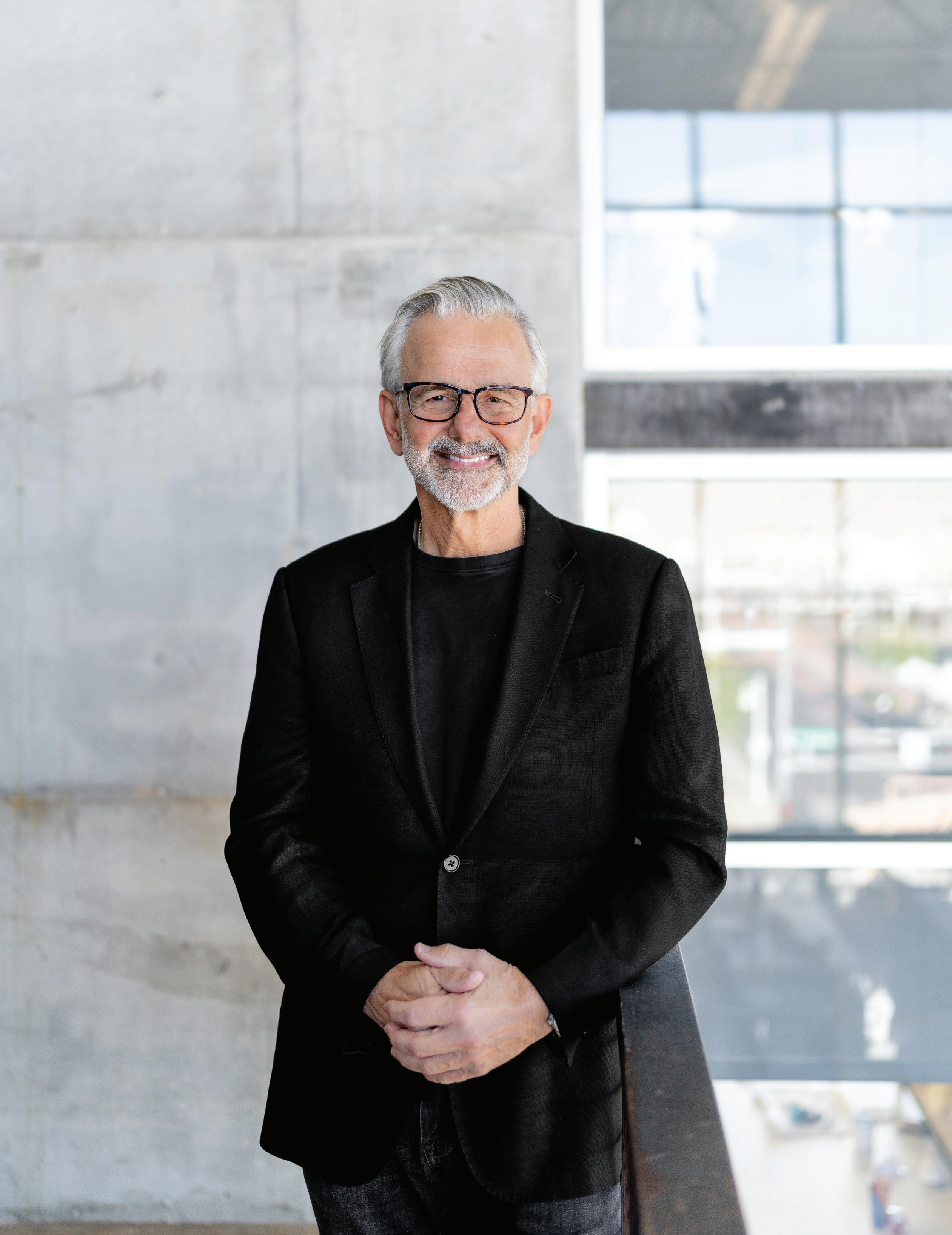
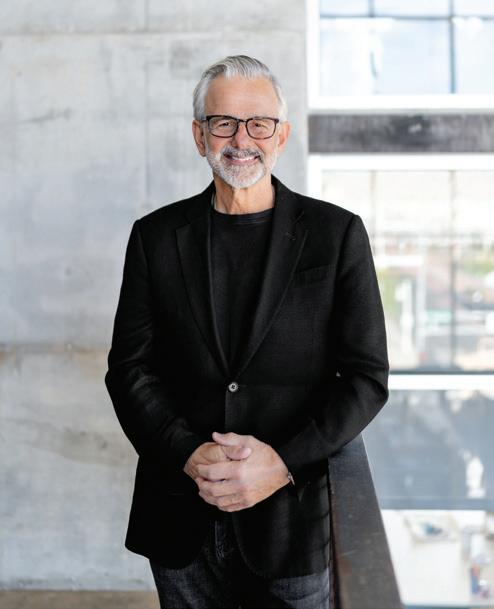
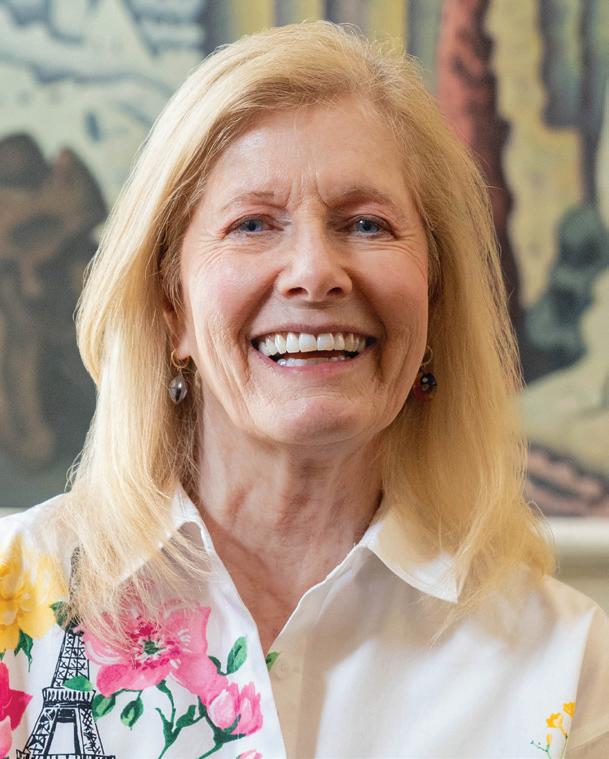
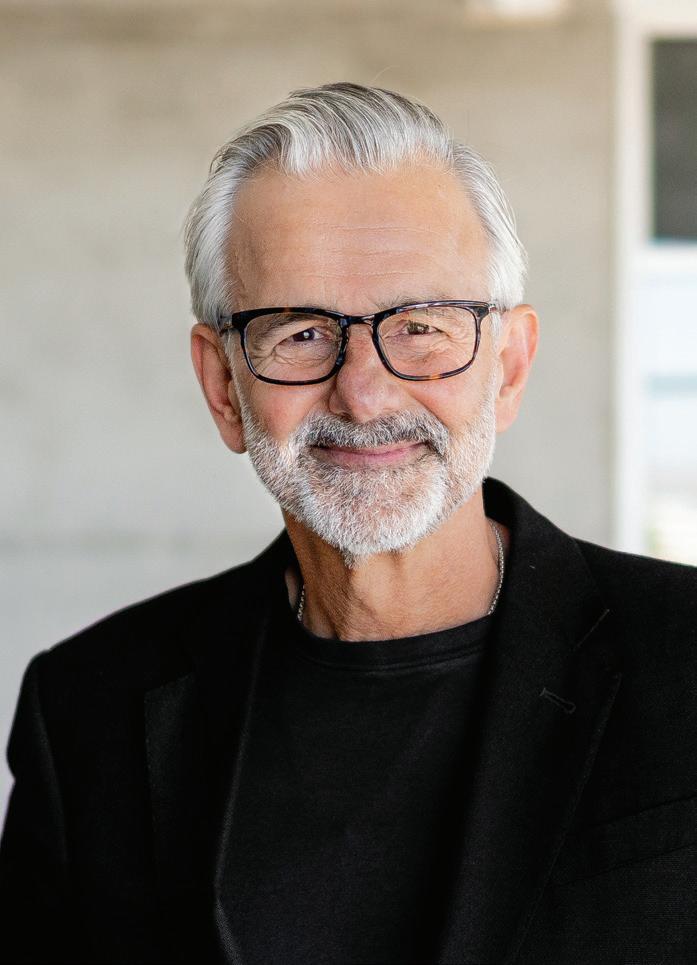
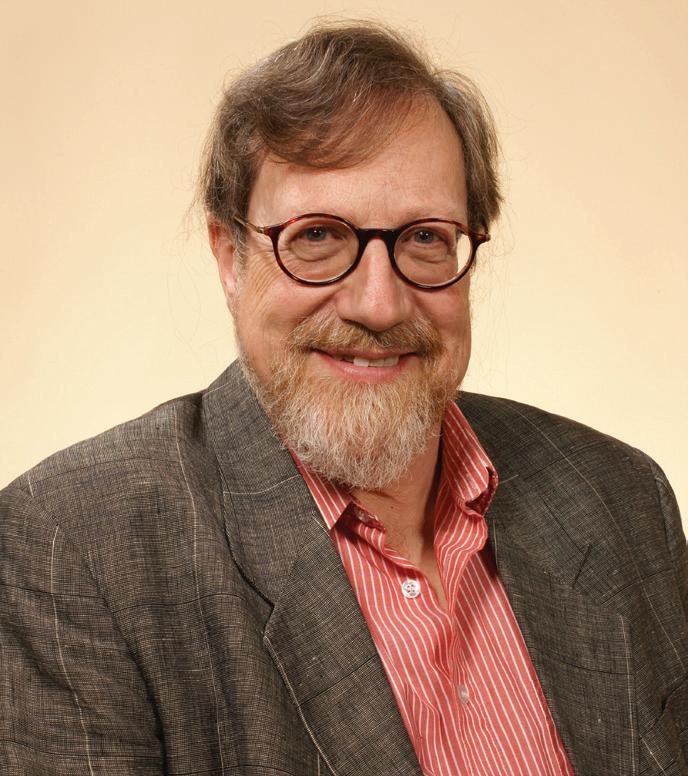
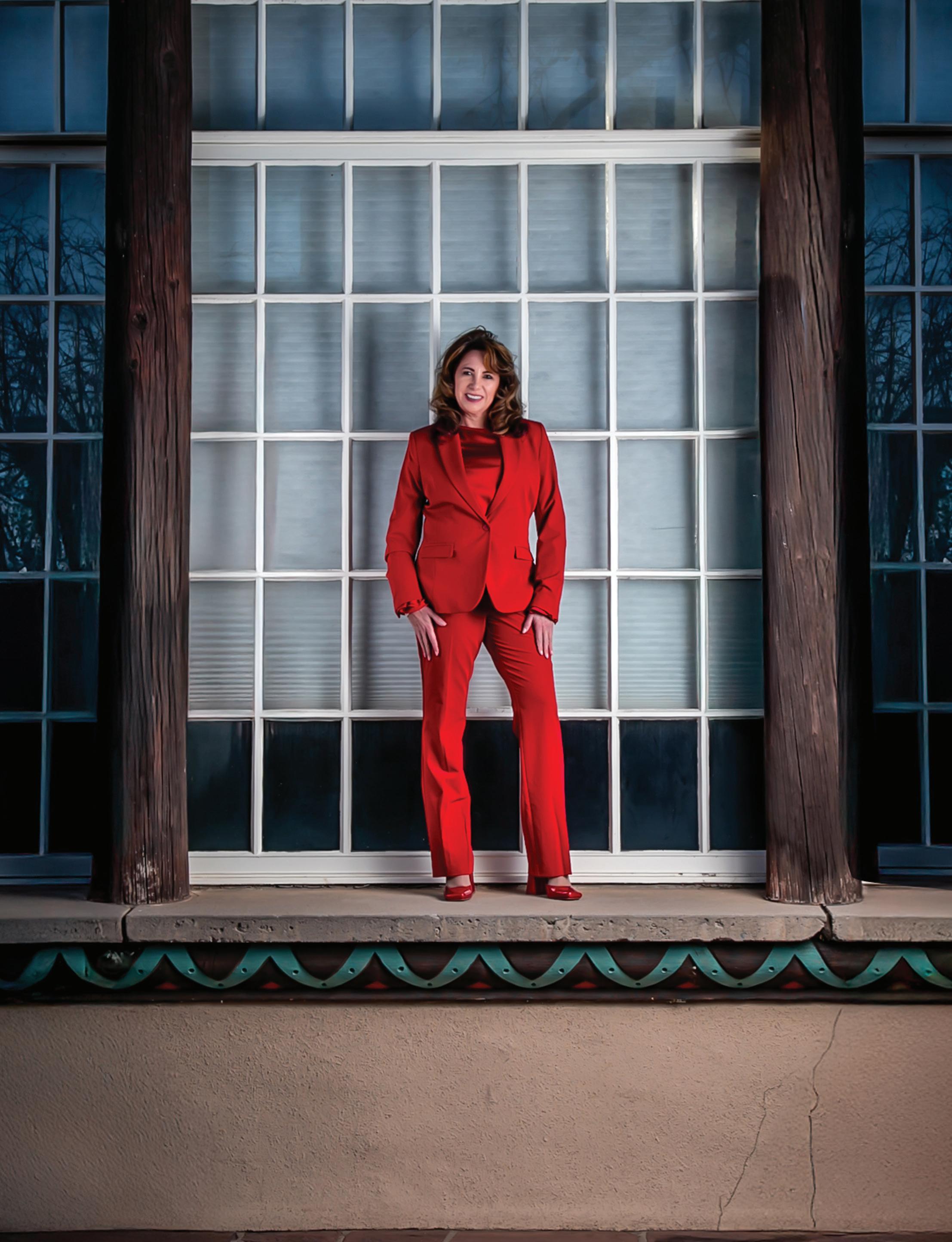
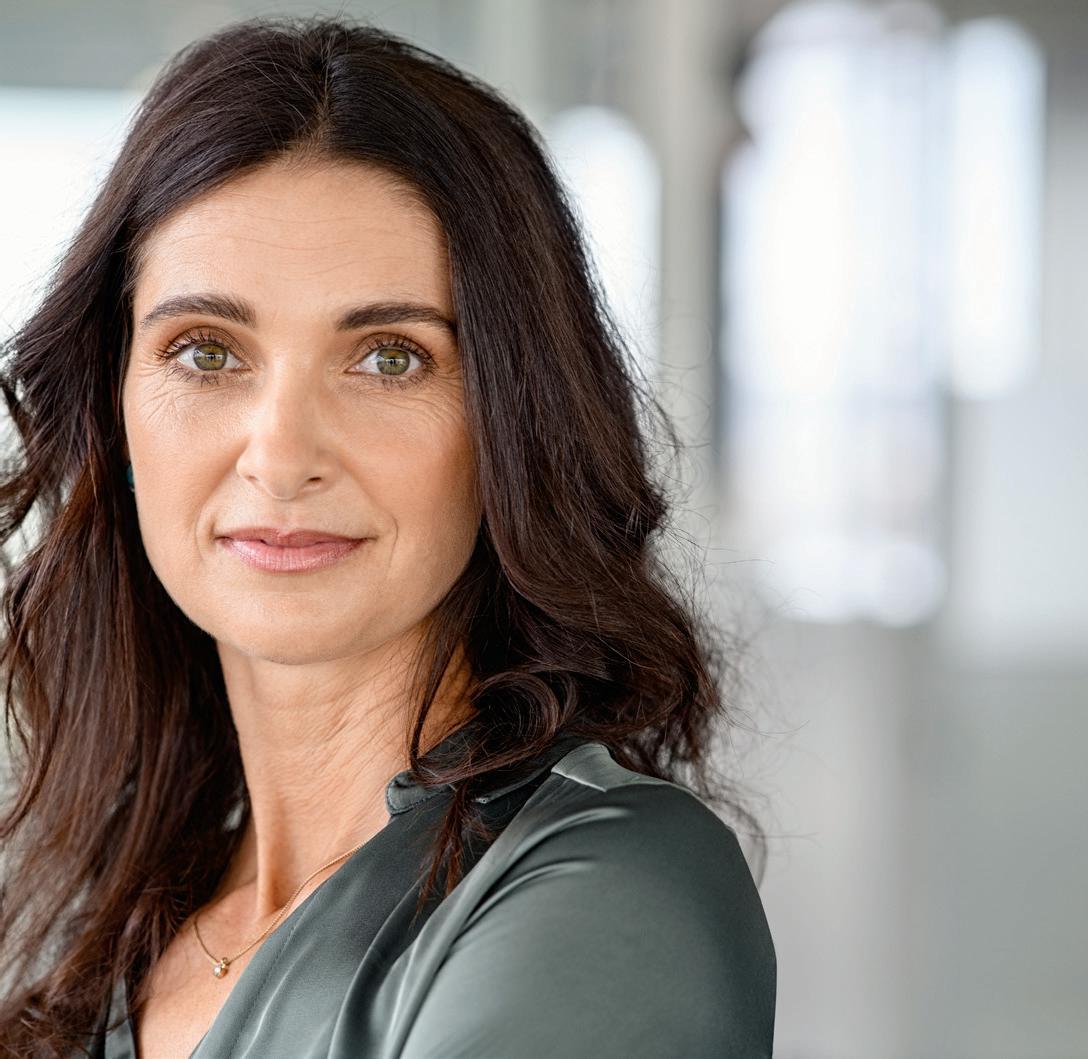
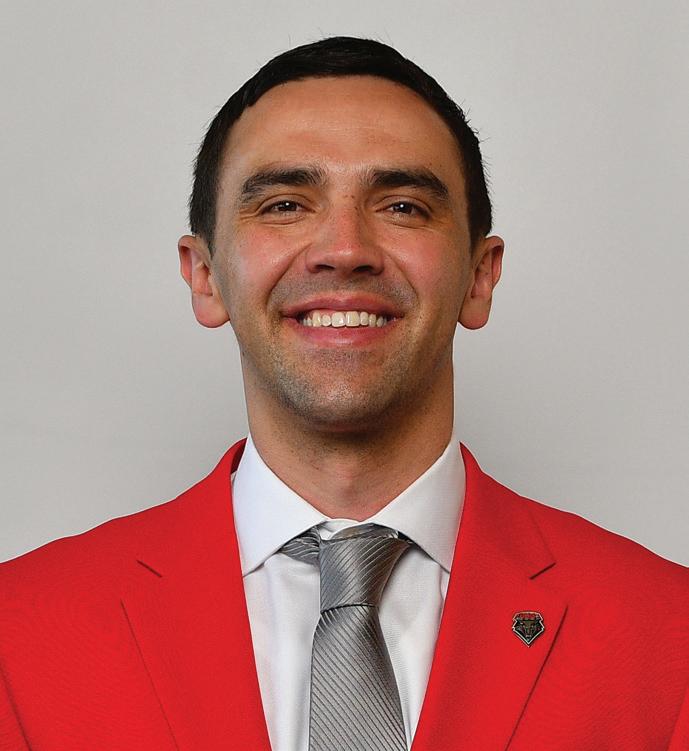
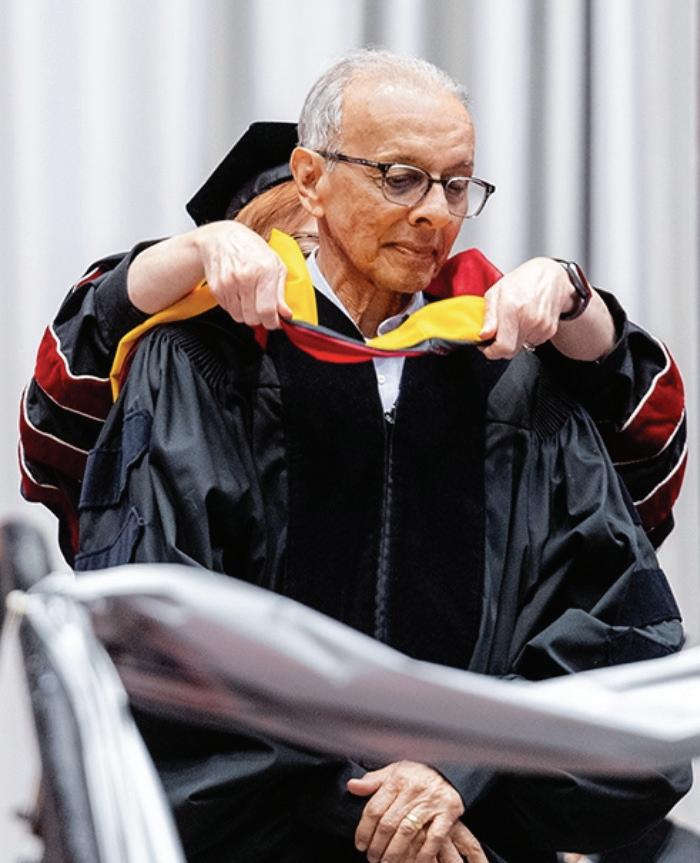
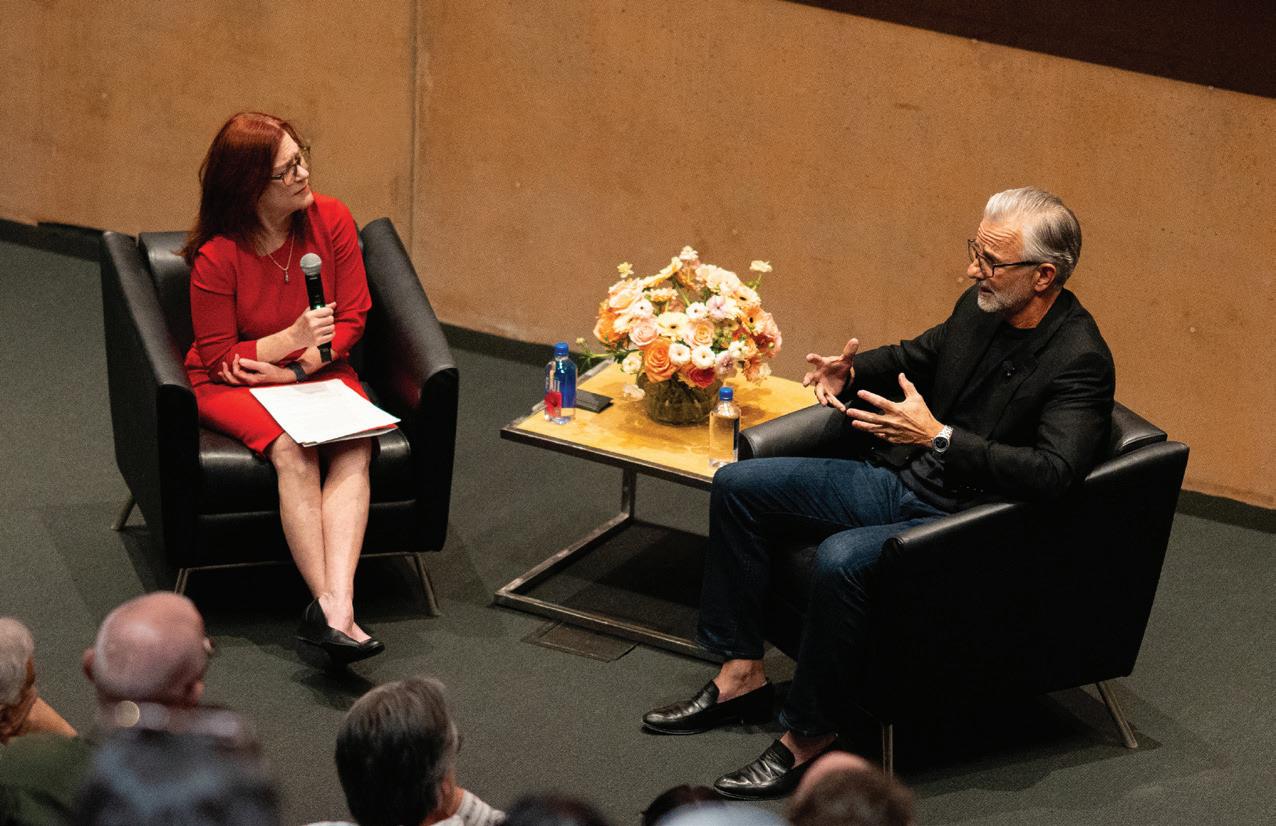
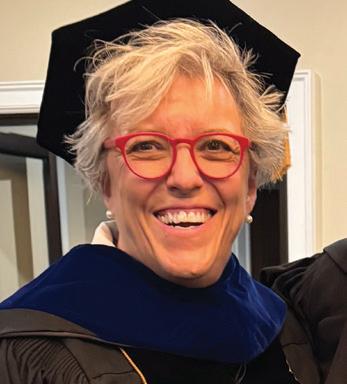
Mark Woodbury (’81, BAA) Chairman and CEO, Universal Destinations & Experiences
SPRING 2026
Annual
What’s happening
By Steve Carr
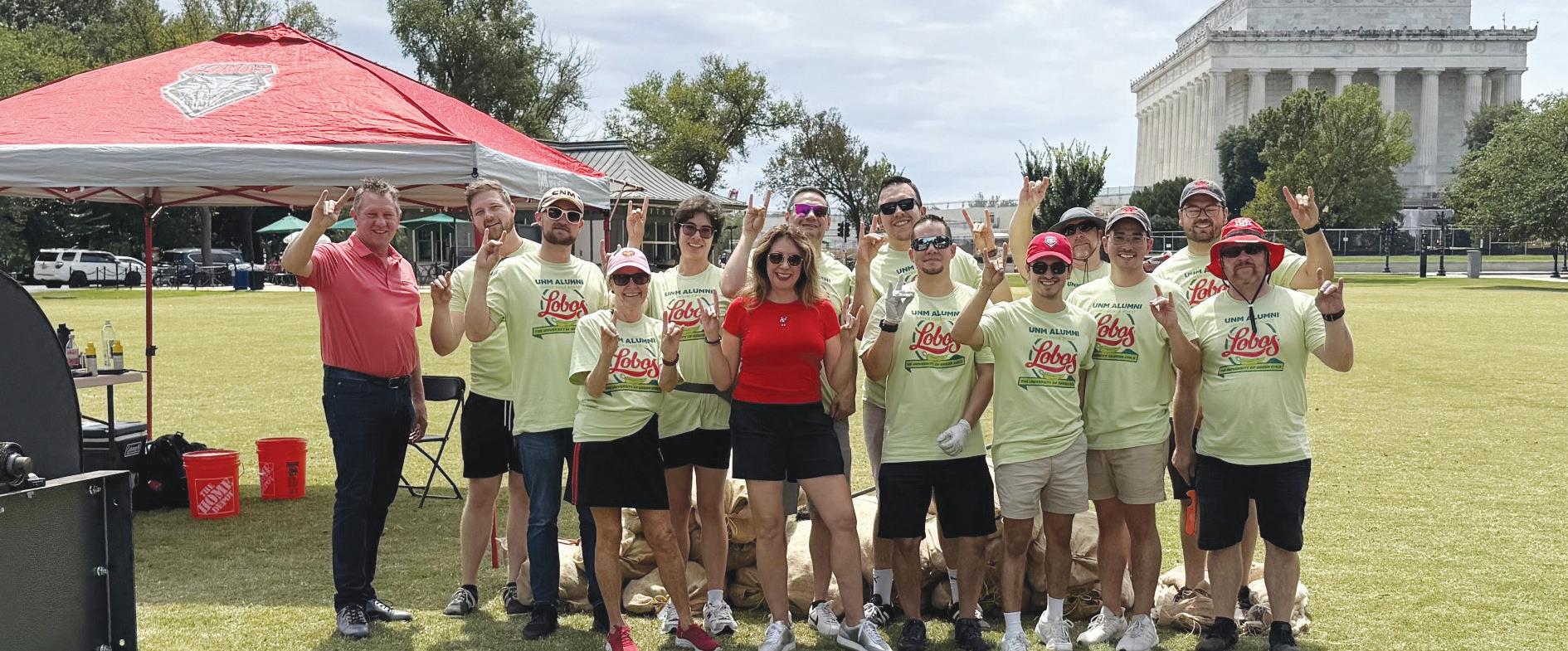
Chile roasts, Veterans and haunted Hodgin Hall
Noé Barnett helped shape Route 66 Remixed
By Mary Beth King
Mary Beth King
Coline Bernal
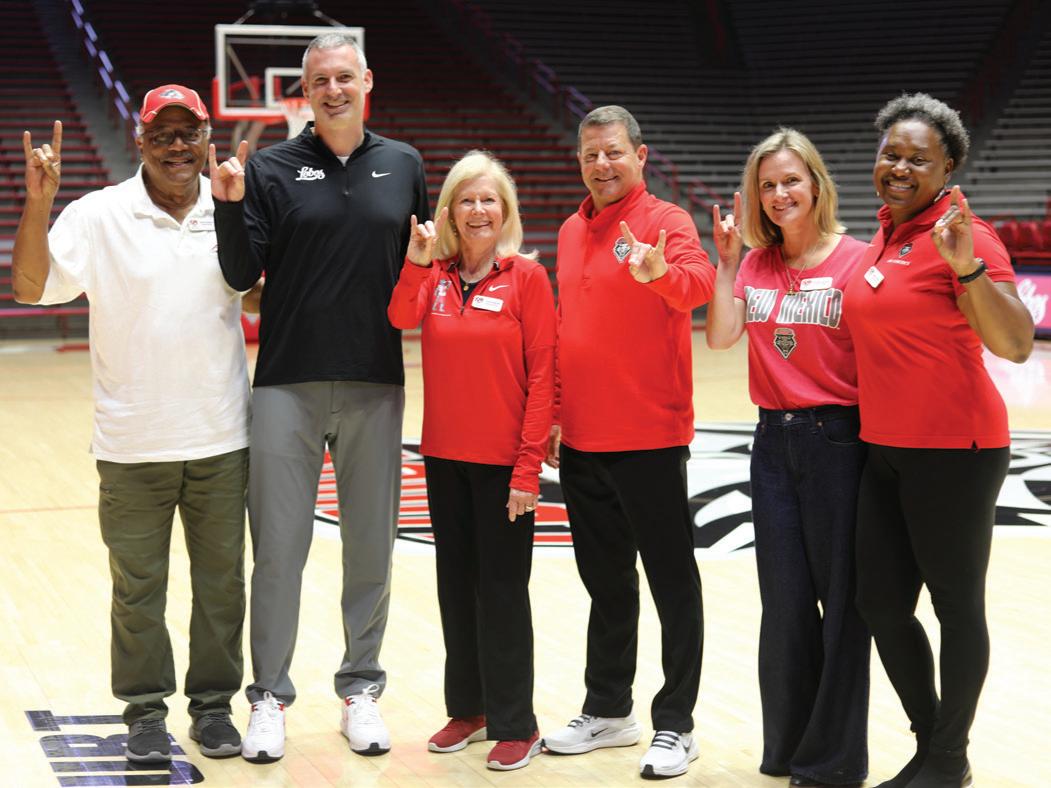
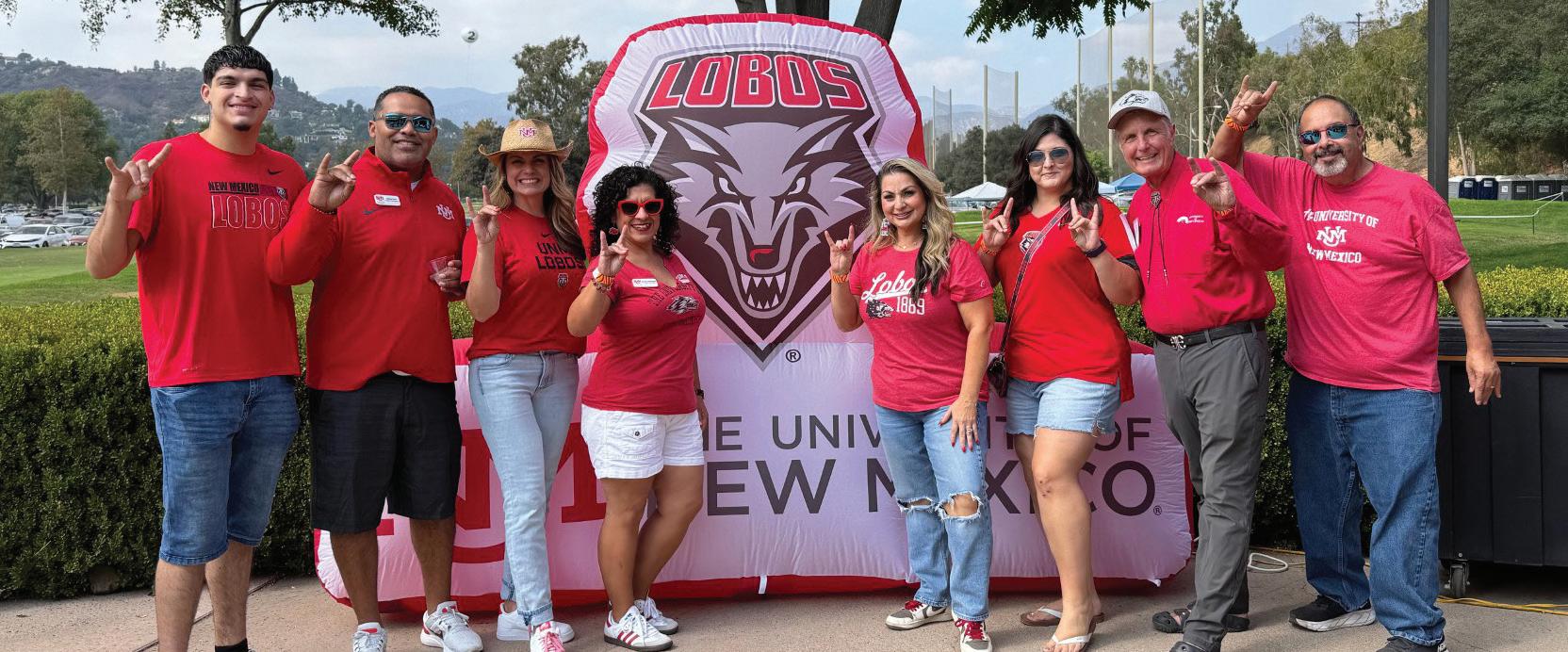
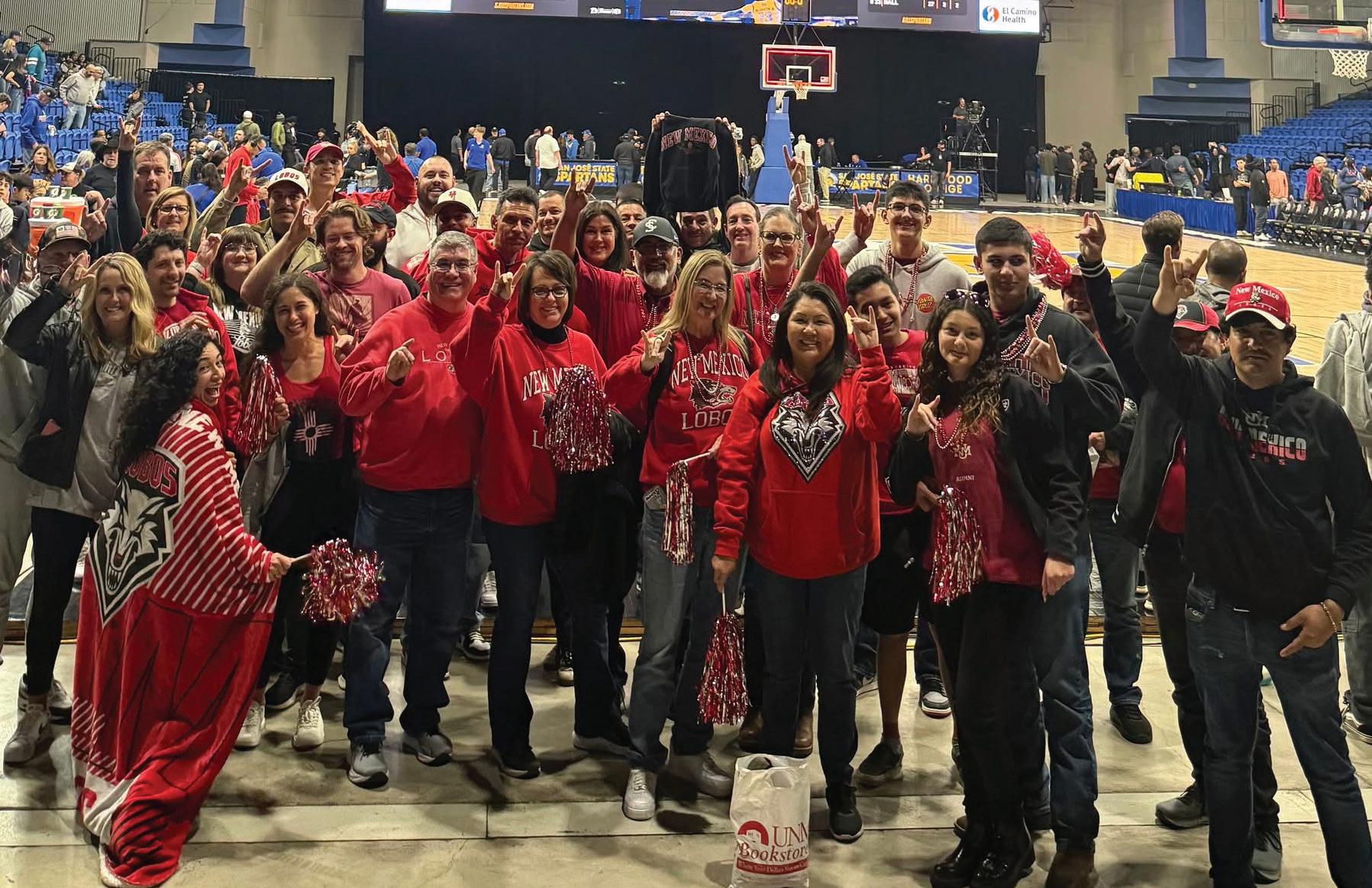
Alumni Relations event photos
See what your classmates have been up to
Spring 2026, Volume 46
The University of New Mexico
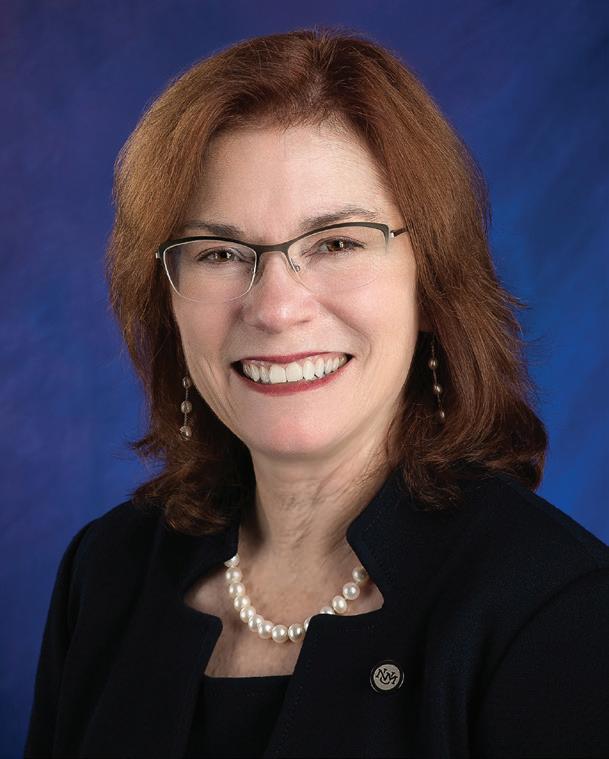
Garnett S. Stokes, President
Connie Beimer, Vice President, Alumni Relations, Executive Director Alumni Association
UNM Alumni Association
Executive Committee
President
Aprilyn Chavez Geissler (’96 BS)
Past President
Kenneth Armijo (’05 BS, ’08 MS, ’11 Ph.D.)
President-elect and interim Treasurer
Joe Ortiz (’14 BBA)
Appointed members
Elijah Baca (’20 MA)
Scott Creagan (’95 BA)
Ryan Ferguson (’05 BUS)
Michele Ziegler (’04 BBA)
Ex-Officio
Connie Beimer (’76 BA, ’79 MPA)
Mirage Editorial
Connie Beimer (’76 BA, ’79 MPA), Vice President
Katie Varoz (’04 BA)
Director
Steve Carr, (’90 BA), Managing Editor
Intuitive Design, Graphic Design
Game
Coline Bernal
By Steve Carr
Photography credit: University Communication and Marketing (UCAM) including Hyunju Blemel, Justin Otsuka, and Anna Padilla. Feature story photos courtesy Vicente Fernandez, April Chavez Geissler, Isabel Gonzalez, and Universal Destinations & Experiences (UDX).
Address correspondence to MirageEditor@unm.edu or The University of New Mexico Alumni Association, MSC 01-1160, University of New Mexico, Albuquerque, NM, 87131-0001. You can also contact us at (505) 277-5808.
Web: UNMAlumni.com
Facebook: Facebook.com/UNMAlumni
Instagram: Instagram.com/UNMAlumni
Flickr: Flickr.com/UNMAlumni
X: x.com/UNMAlumni
DEAR LOBOS,
Spring has arrived in Albuquerque, and with it comes that unmistakable sense of renewal and momentum on the campus of The University of New Mexico. From the fresh blossoms surrounding our newly renovated Duck Pond—you can read more about it in these pages—to the energy of Lobo Day celebrations, this season reminds us of the enduring spirit of our community and the pride we share in being Lobos.
As always, Mirage captures that spirit perfectly. We were honored this spring to welcome Mark Woodbury to campus for a Lobo Living Room conversation that challenged our students to think creatively about leadership, innovation, and the future of immersive storytelling. You’ll also read about the remarkable work of Noé Barnett, whose Route 66–inspired art celebrates the centennial of an iconic American highway—and our relationship to it as Lobos—while reflecting the creative energy fostered at UNM’s “ArtsLab.”
We’re also proud to mark the 50th anniversary of the Presidential Scholarship, a life-changing opportunity made possible through the generosity of the UNM Foundation and alumni like you. This milestone is a powerful reminder that when Lobos invest in one another, we create opportunity that lasts for generations. And as our alumni community continues to grow, I know you’ll enjoy learning more about your latest UNM Alumni Association president, Aprilyn Chavez-Geissler, whose leadership and dedication is strengthening the bonds that connect Lobos everywhere.
As I write to you this spring, I also do so with a full heart, as this will be my final semester serving as president of The University of New Mexico. I am incredibly proud of all that has been accomplished since I arrived here in 2018, whether it’s putting in place our Grand Challenges to define some of our most critical research priorities; making new investments in athletics; working to expand the number of health care providers for our state; advancing our university as a global leader in quantum technology; or helping to guide the implementation of UNM 2040, our long-term strategy for the future of The University of New Mexico. While these things happened during my presidency, none of them happened alone.
I have been fortunate to work alongside an extraordinary leadership team that guides this university with vision and integrity. Our faculty shape our identity through their knowledge, research, and mentorship. Our staff bring the energy and commitment that keep our institution moving forward every day. Our Lobo health care professionals provide compassionate care that touches lives across New Mexico. And our students—remarkable, determined, and inspiring—are the heart of it all, carrying forward the Lobo legacy as alumni who make a difference in their communities and beyond.
Serving as your president has been the greatest honor of my career. While it’s been the toughest job I’ve ever had, it’s also been the most joyful, because we’ve done this work together. I am grateful for your steadfast support, your pride in UNM, and your belief in what this university represents, and I will always be proud to be part of the Lobo family. Thank you for making me a part of such an extraordinary pack.
With appreciation and warmest wishes,
Garnett S. Stokes President
The University of New Mexico
Our UNM Legacy
Maribeth Thornton (MBA ‘96, PhD ‘17) and Chris Thornton
Double UNM alumna Maribeth has dedicated her life to healthcare and is the Chief Nursing Officer at the UNM Hospital. Chris is a senior systems engineer with Boeing. Through their estate, they are supporting education for nurses and business students. They encourage alumni to give back because education is a ticket to furthering careers and opening minds to new horizons.
The Thorntons are members of the New Horizons Society, a group honoring individuals and families who have included UNM in their estate plans. For more information about how you can create a legacy at UNM or to share that you’ve already done so, please contact the Office of Gift Planning at 505-313-7693 or giftplanning@unmfund.org.
Look forward by giving back.
*o our wedding package only
FROM THE EXECUTIVE DIRECTOR, UNM ALUMNI ASSOCIATION
Each year I’m reminded how extraordinary the Lobo community truly is. Whether gathering on campus, cheering on the Pack across the country, mentoring students, or celebrating one another’s achievements, our alumni continue to show that being a Lobo is truly a lifelong connection.
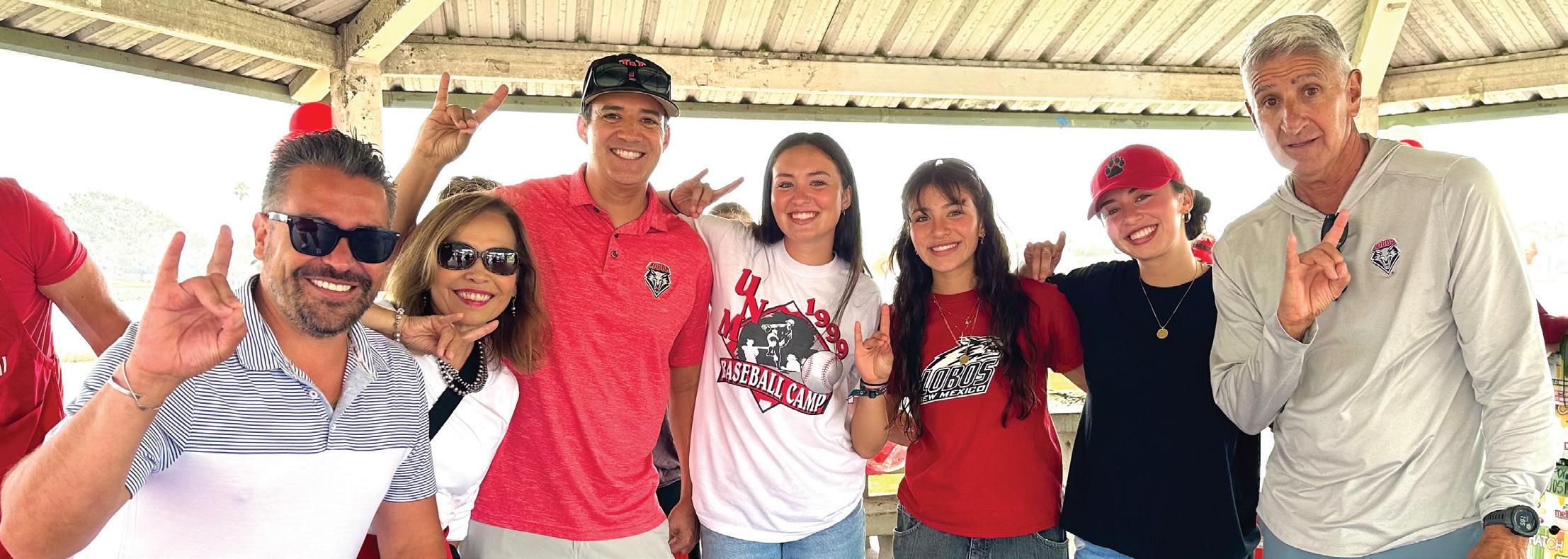
From our popular green chile roasts to Lobo Living Rooms, Senior Send-Off celebrations, and regional chapter gatherings, thousands of Lobos connected with one another and with the University we all care so deeply about over the past year.
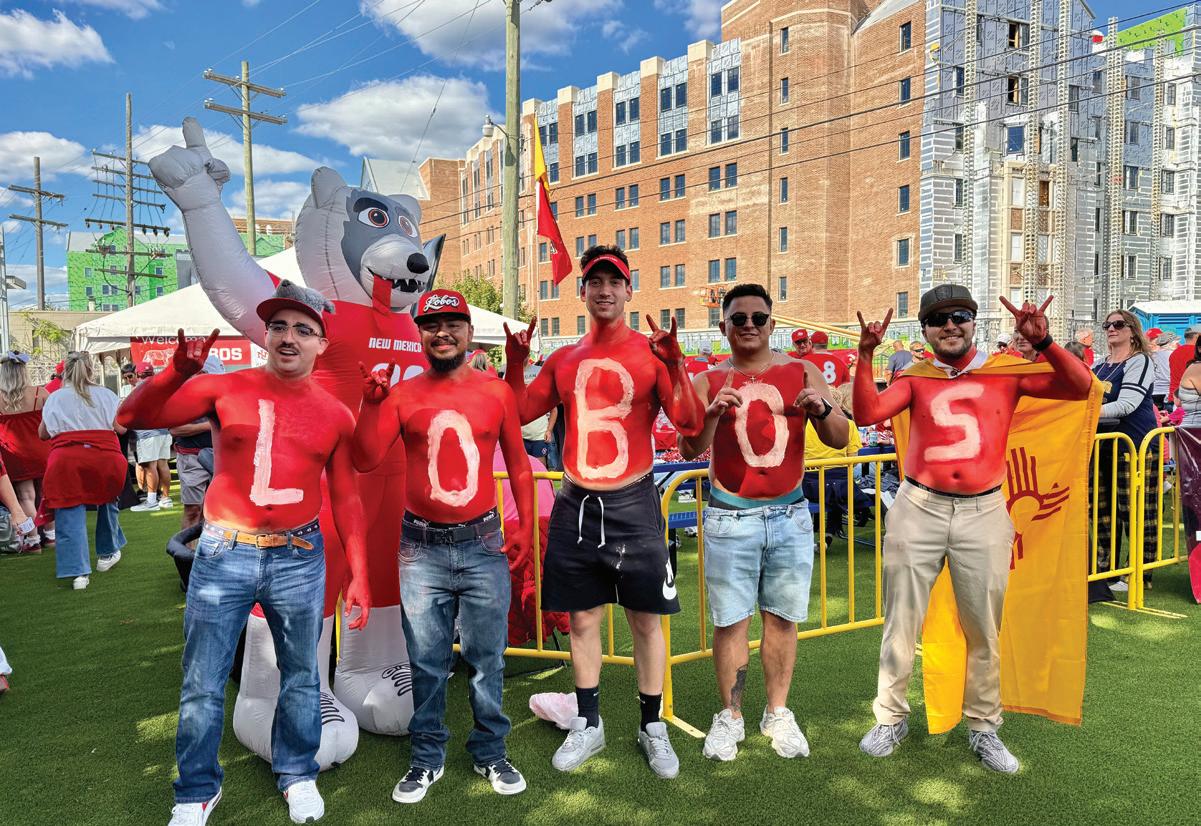
One of the highlights of the year was seeing Lobo pride on display across the country. Hundreds of alumni and fans joined us in Las Vegas for our signature Post Up at the Mountain West Basketball Championships. In the fall, alumni traveled to the Rose Bowl to watch Lobo football upset the Bruins, returned to Albuquerque for a sold-out Rio Grande Rivalry, and saw Coach Jason Eck lead the Lobos to the Rate Bowl.
Homecoming was another unforgettable moment. Last fall we celebrated UNM’s 100th Homecoming football game with a week of activities, from a Lobo Living Room basketball preview to our new ReUnite with the Pack gathering and a spirited tailgate before a victory over Nevada. We also celebrated the future of our Lobo community, awarding 45 scholarships, including a new Seattle alumni chapter scholarship.
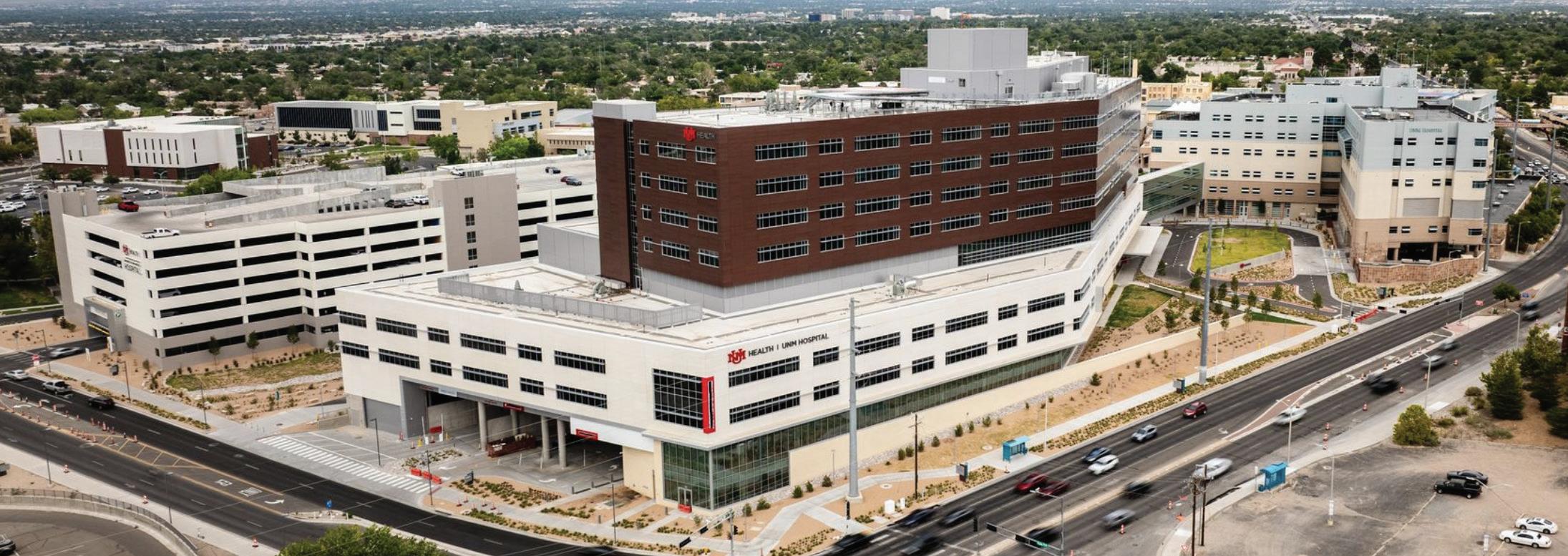
Our Lobo Living Room series showcased some of UNM’s most exciting programs, from the cultural impact of Taylor Swift and Les Misérables to an alumni tour of the new $842 million UNM Hospital Critical Care Tower.
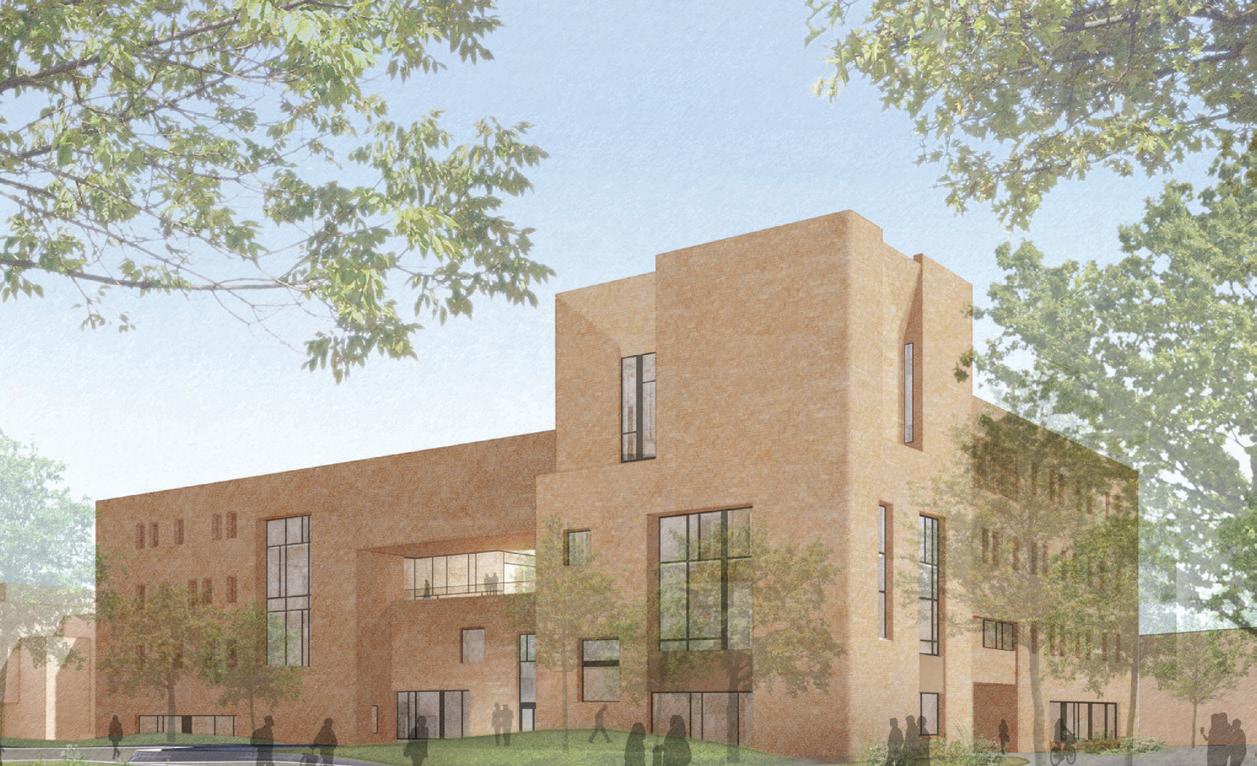
We look forward to milestones this year including the opening of the Center for Collaborative Arts & Technology and the groundbreaking for the Humanities and Social Sciences Complex—both shaping UNM’s future for generations.
Another proud tradition is recognizing alumni who exemplify Lobo spirit. The UNM Alumni Awards Dinner celebrated outstanding graduates making an impact in their professions and communities, while the UNM Black Alumni Chapter honored leaders through its Trailblazers and Living Legends Awards.
Supporting students as they begin their careers remains core to our mission. At Senior Send-Off events, alumni volunteers provided career advice, résumé reviews, networking opportunities, and professional headshots— connections that can make all the difference.
Our regional alumni chapters continue to keep the Lobo spirit alive across the country, hosting game watches, alumni gatherings, and community events from Denver to San Diego to Phoenix and Washington, D.C.
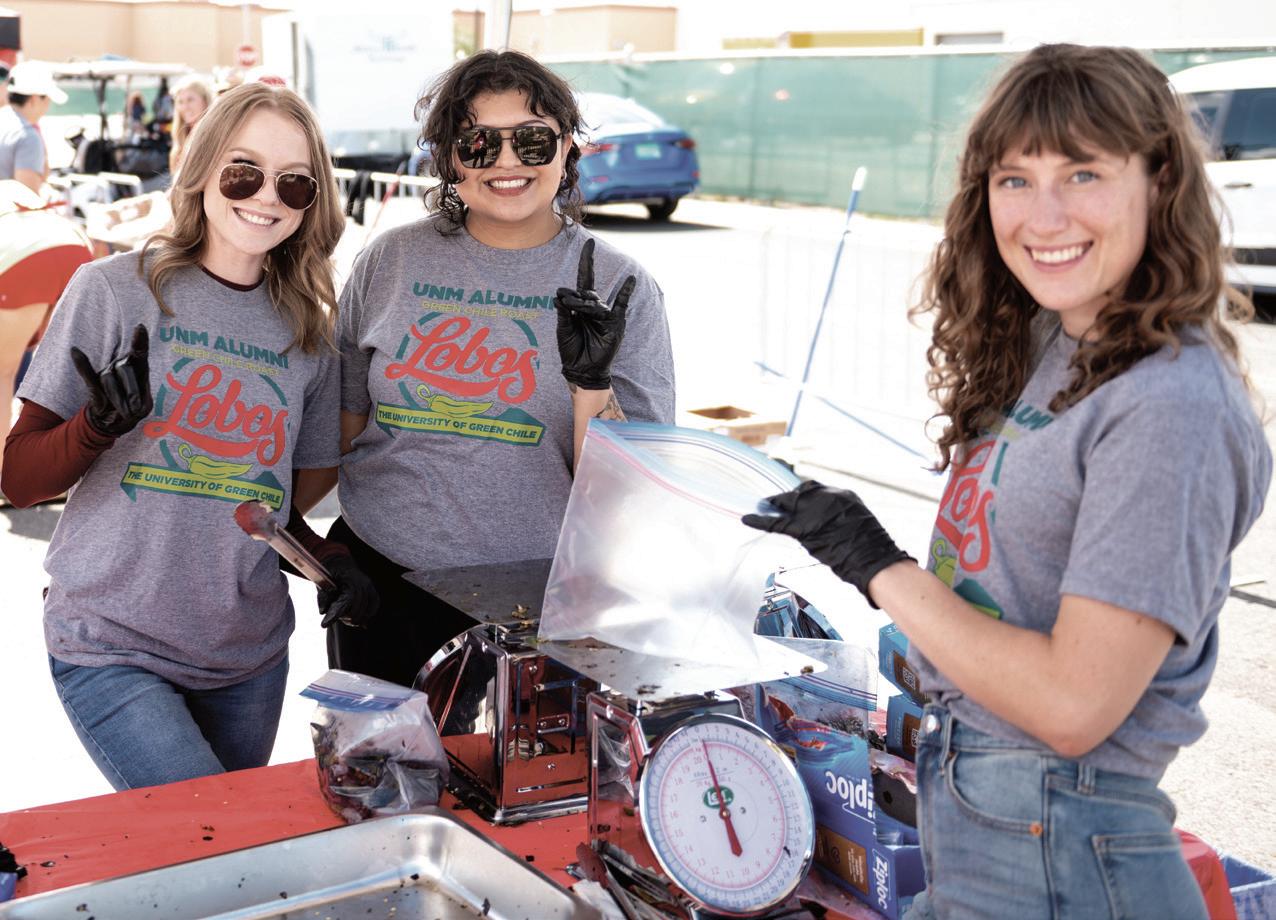
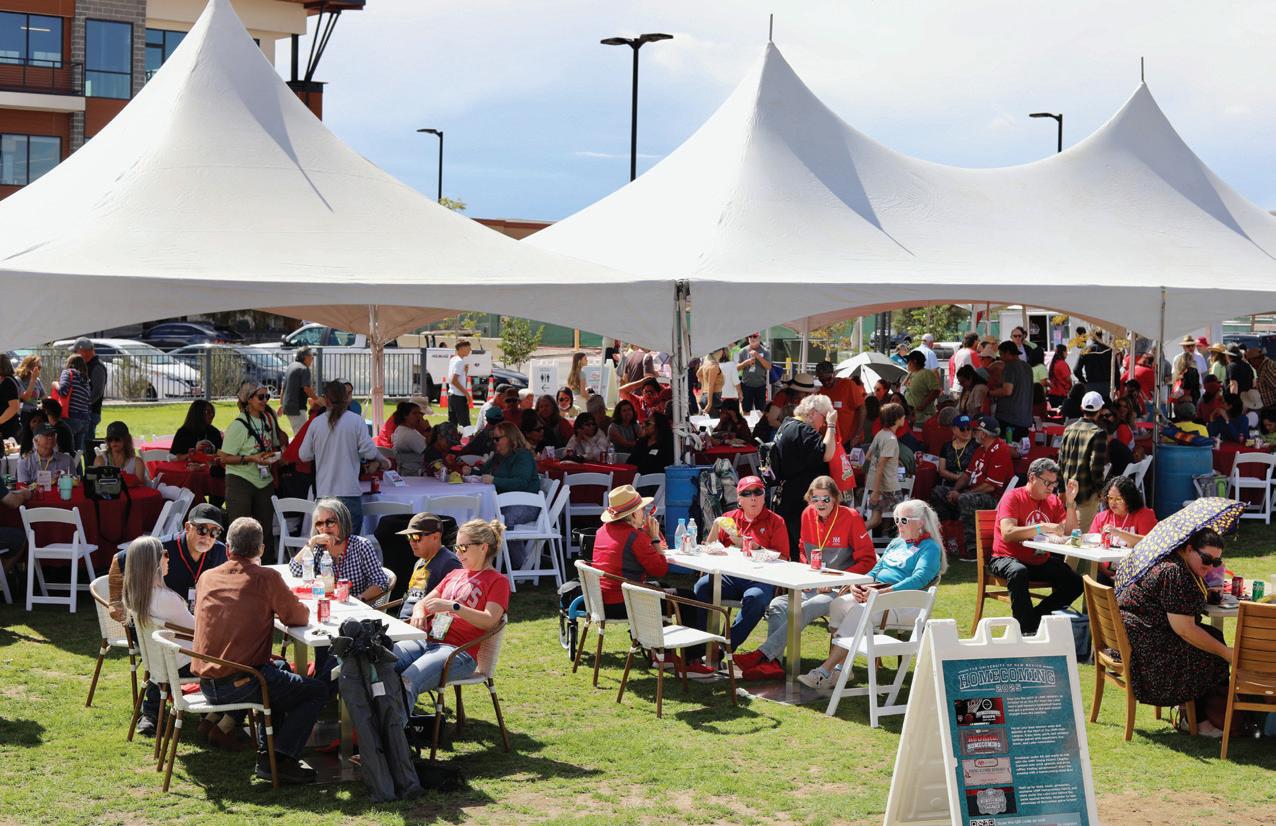
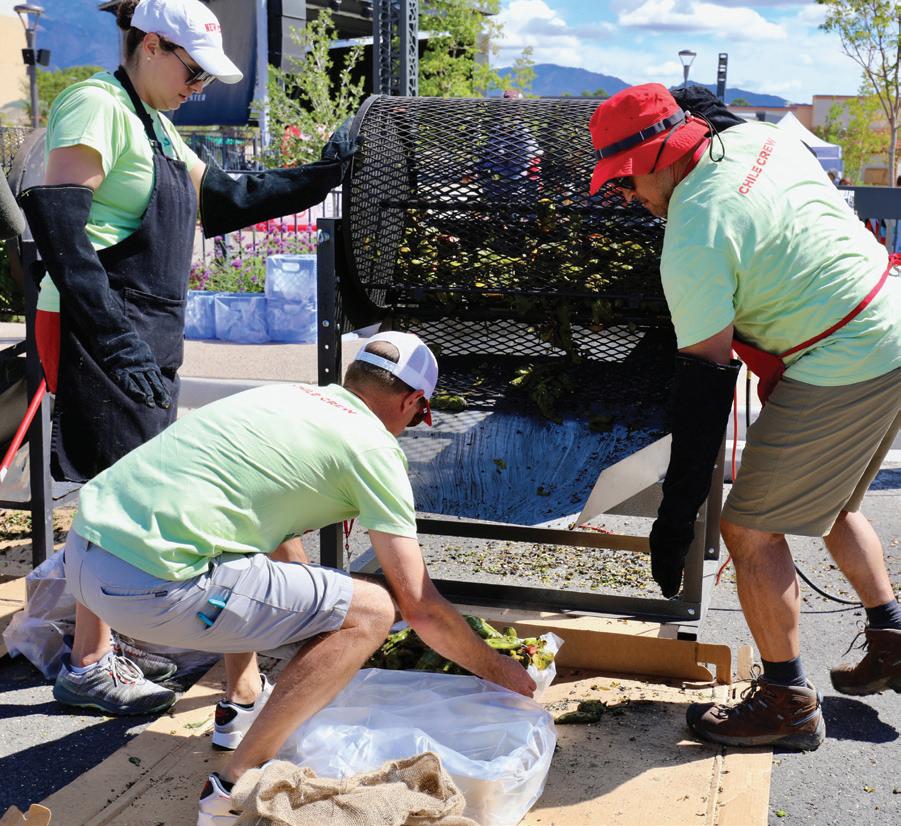
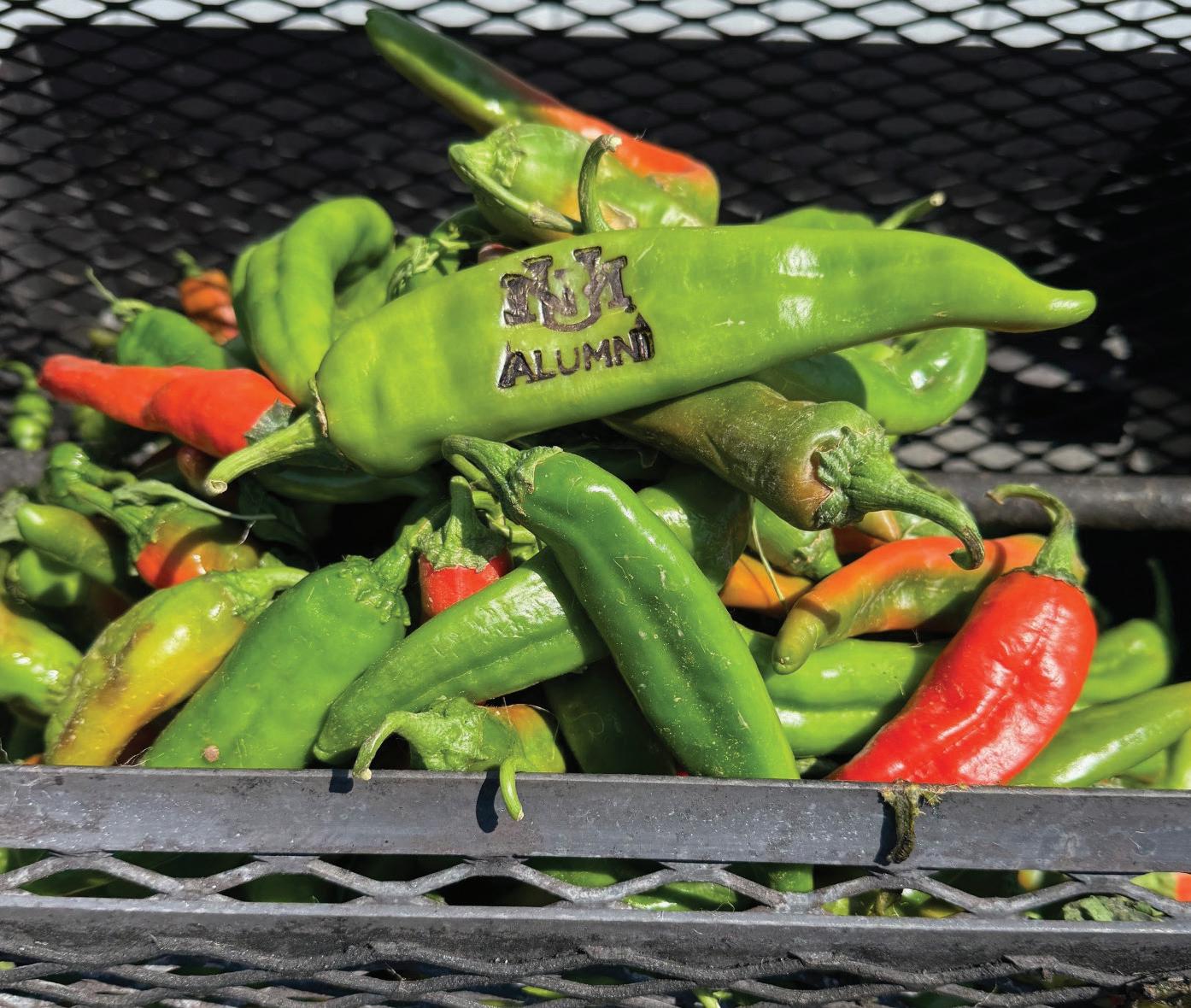
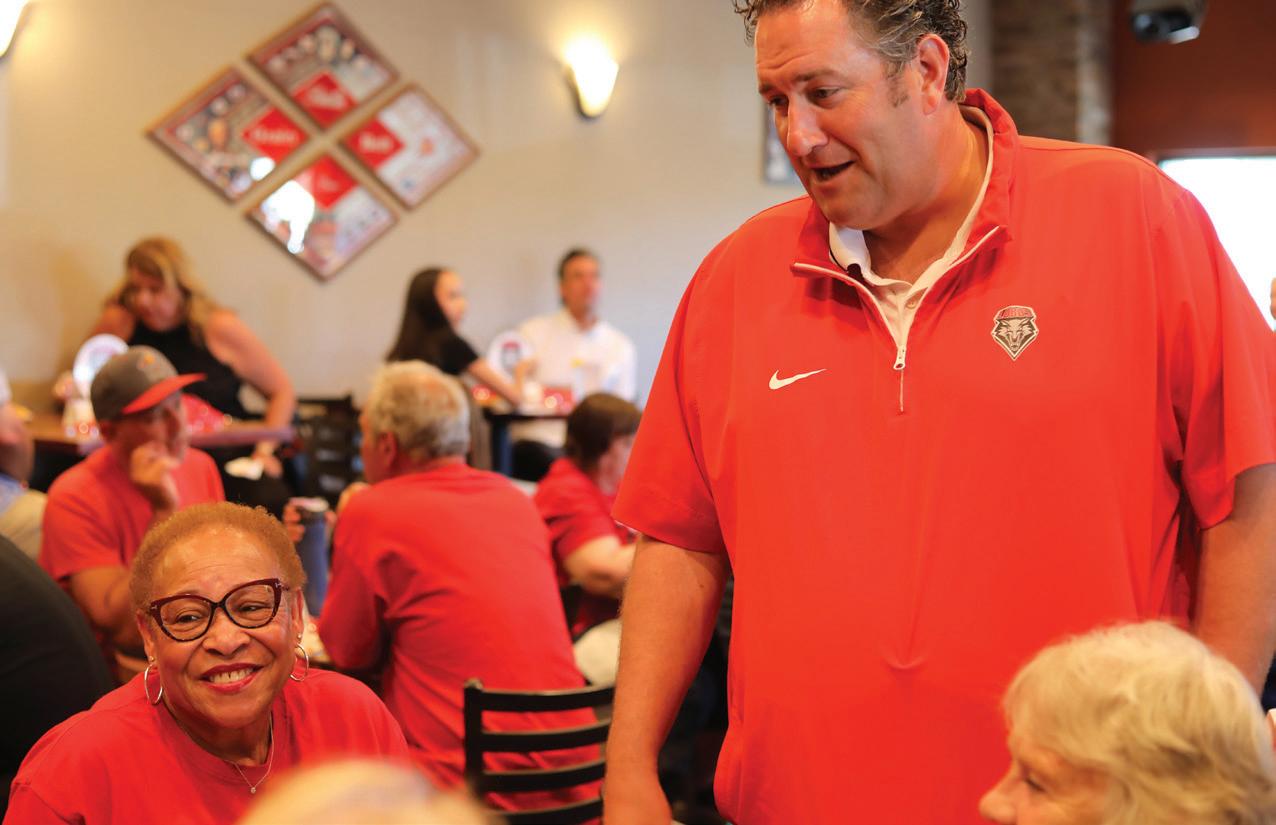
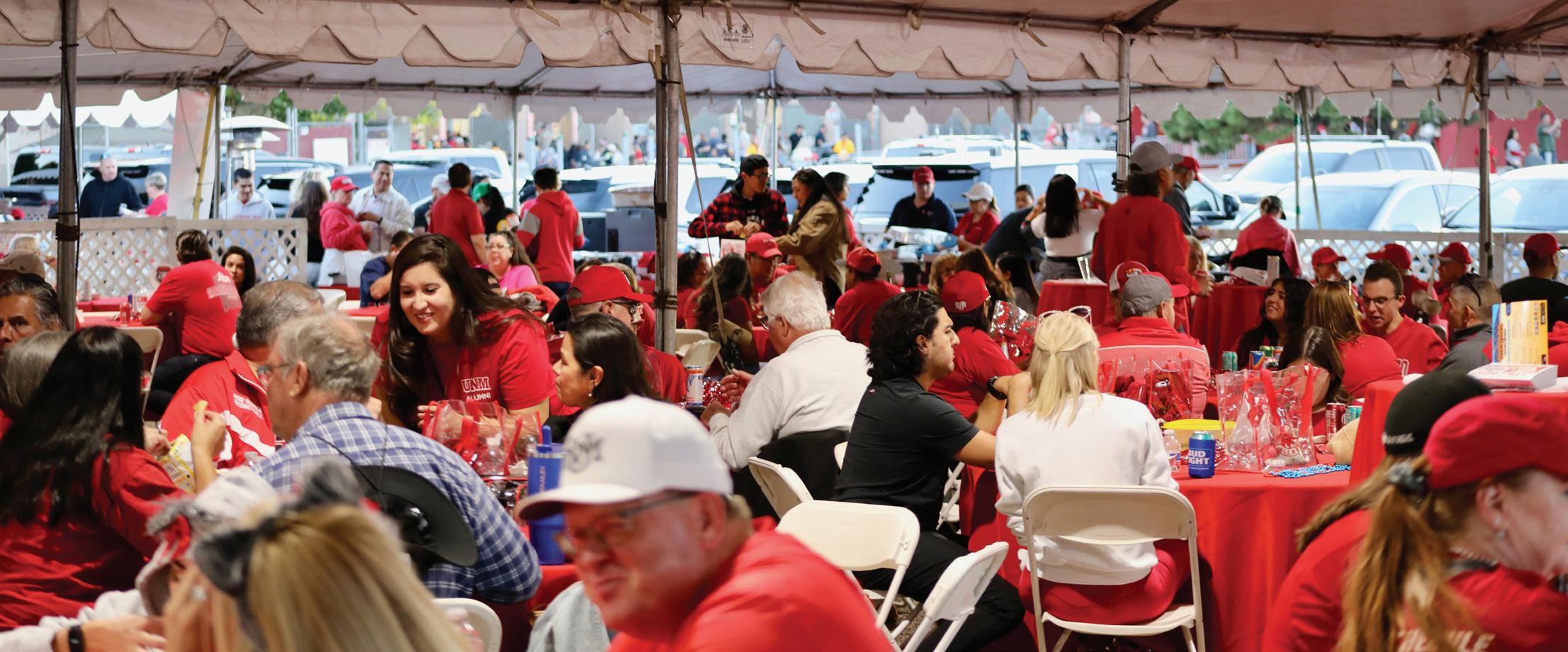
One of our most beloved traditions, green chile roasts, continue to grow. In 2025, alumni and regional chapters roasted more than 13,000 pounds of chile at events around the country, including a packed celebration at Winrock Town Center Park here in Albuquerque.
The Green Chile Roasts program, along with Mirage Magazine, earned two Best of District IV Awards from the Council for Advancement and Support in Education. The awards recognize the outstanding work happening at UNM Alumni.
Today, the Lobo alumni community is more than 225,000 strong worldwide, and every one of you plays a role in shaping the future of our University. Thank you for supporting The University of New Mexico and keeping the Lobo spirit strong wherever you go.
Go Lobos!
Connie Beimer Vice President (’76 BA, ’78 MPA) UNM Alumni Relations & Executive Director, UNM Alumni Association
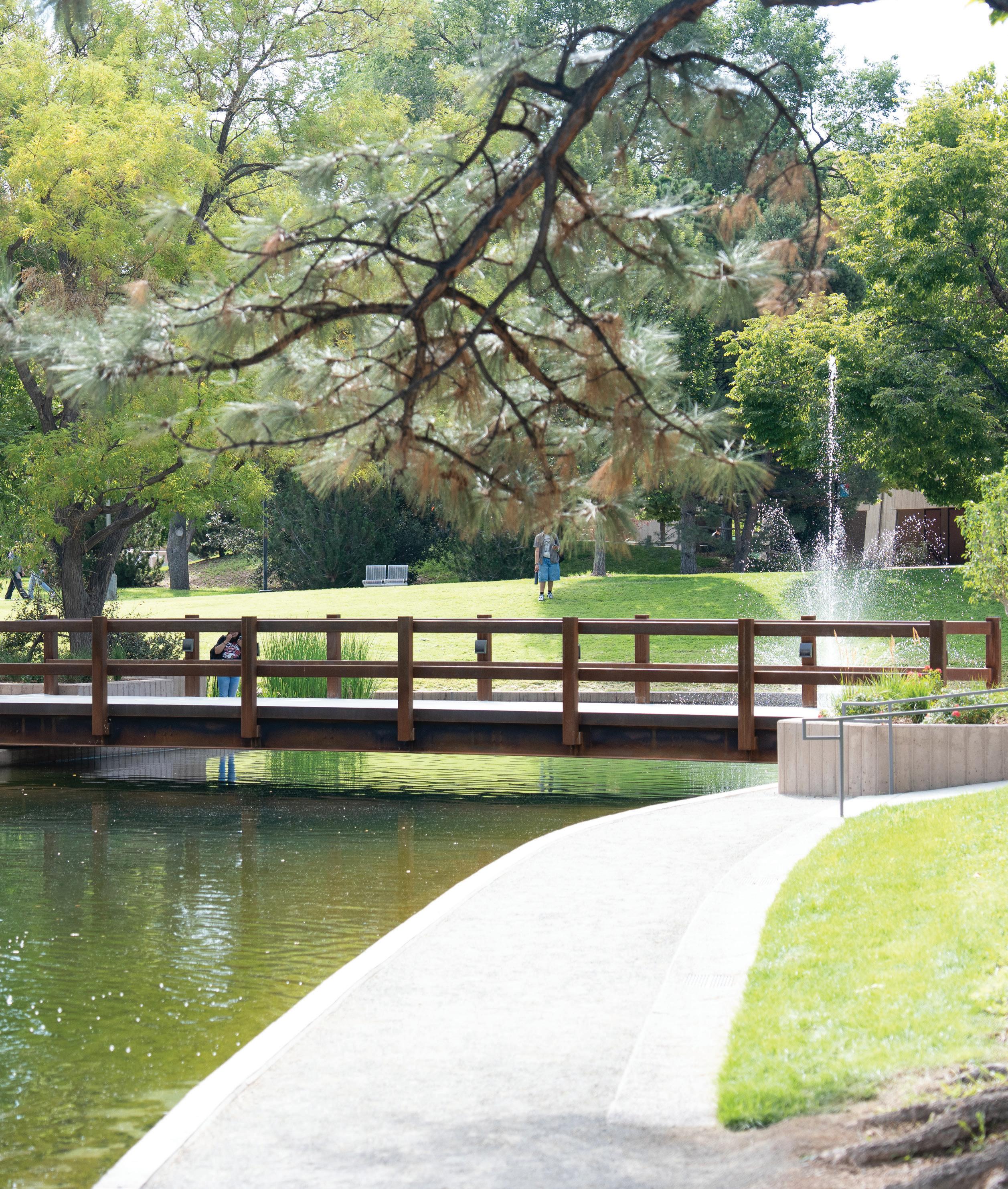
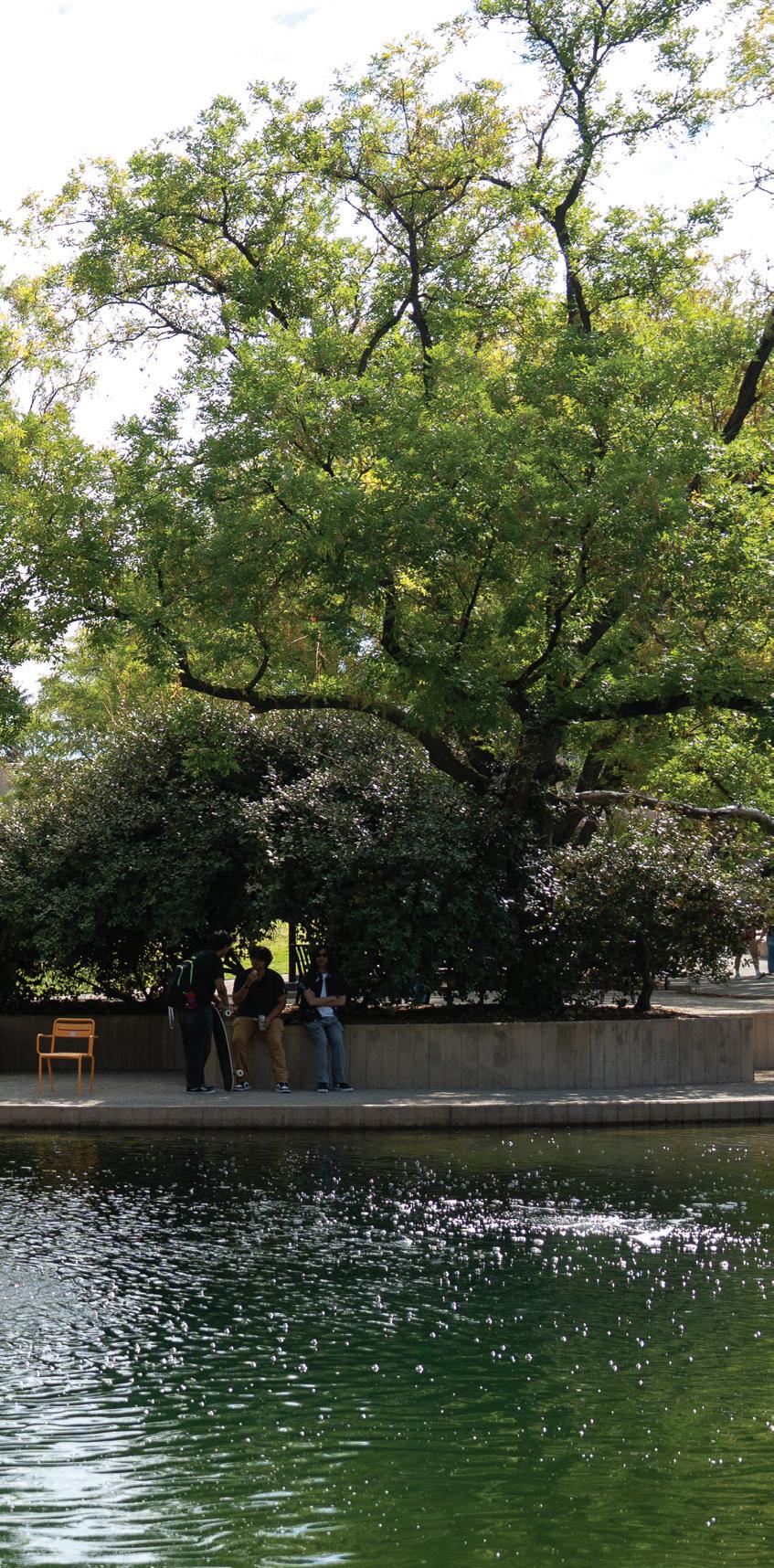
A new bridge was installed as part of the Duck Pond renovation.
RENEWING A LOBO TRADITION: UNM’S HISTORIC DUCK POND REOPENS
By Steve Carr
For generations of Lobos, the University of New Mexico’s Duck Pond has been more than a scenic stop along Central Campus; it has been a gathering place where memories are made.
Located at the heart of campus, the Duck Pond has long served as a backdrop for conversations between classes, quiet moments of study, and celebrations that mark life’s milestones. Since its creation in 1976, the pond has become one of UNM’s most recognizable and beloved landmarks—an enduring part of the Lobo experience that many alumni remember fondly.
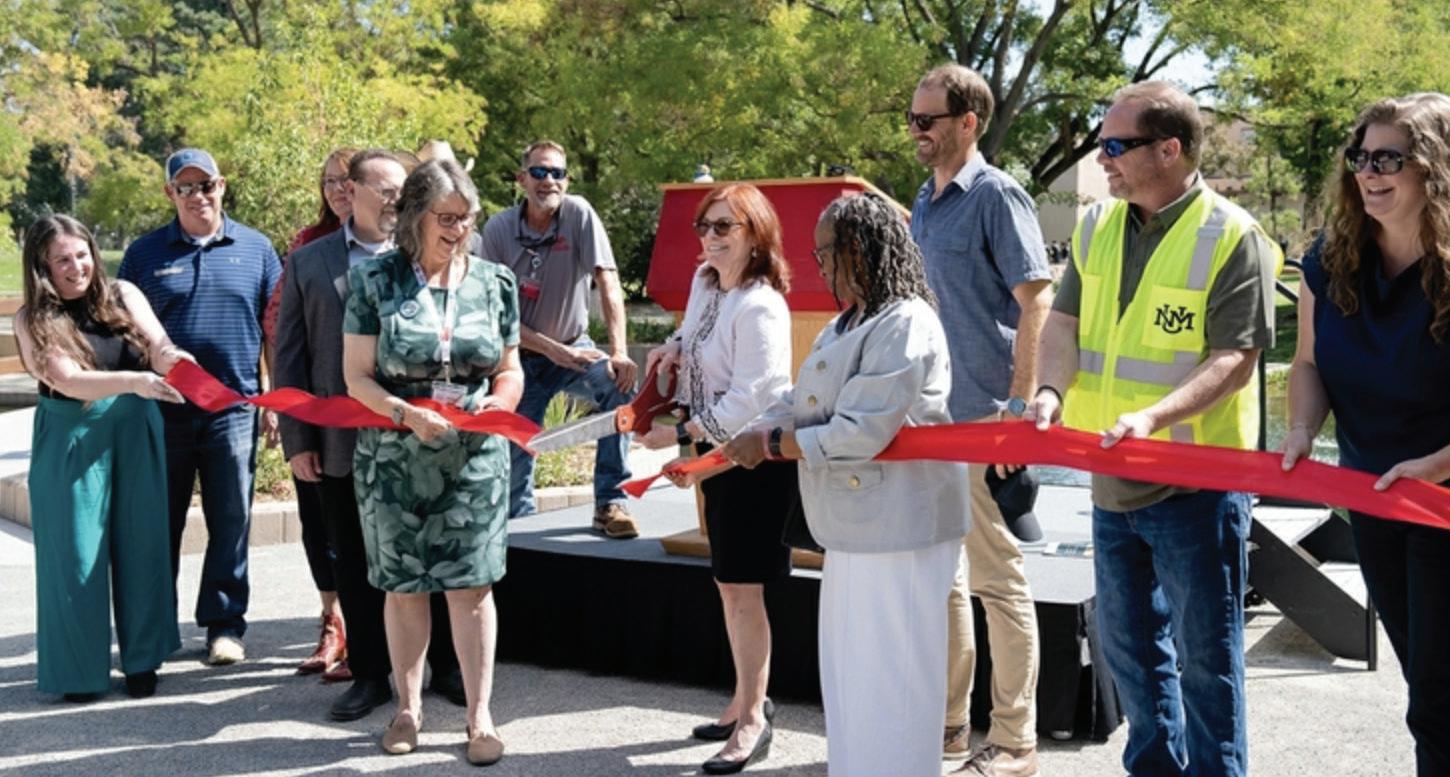
After a comprehensive renovation designed to preserve its historic character while strengthening its sustainability and accessibility, the Duck Pond has officially reopened to the campus community.
“The Duck Pond is so much more than a pretty spot on campus. It is part of the heart of UNM,” said Executive Vice President for Finance and Administration Teresa
Costantinidis. “It’s where students relax between classes, faculty and staff take a moment to connect with nature during the day, and families from across Albuquerque gather for graduation photos, quinceañeras and wedding celebrations. It’s where our neighbors walk their dogs each day and little kids learn to ride bikes. The variety of birds that call the pond home bring beauty, life, and a sense of calm to all who visit. Restoring it with such care feels like honoring all those joyful moments. UNM is proud to preserve this cherished place for everyone in our community. I am so happy to see it renewed and ready for the next generation of Lobos.”
The Duck Pond Revitalization Project addressed aging infrastructure while preserving the pond’s historic design. Originally created as a man-made urban water feature by renowned landscape architect Garrett Eckbo and completed in 1976, the pond has grown over nearly five decades into a defining feature of campus life for
students, faculty, staff, alumni and the greater Albuquerque community.
“While the general nature and shape of the pond remains the same, the physical changes to the pond were reviewed by the UNM Historic Preservation Committee to recognize and preserve the original design intent by renowned campus architect Garrett Eckbo,” explained Facilities Services Project & Construction Manager Michael Pierce. “All of these changes and effort will result in a cleaner, safer, and more sustainable ecological environment for the wildlife and all users of this beloved campus landmark.”
“It is my privilege to help celebrate the reopening of this very special place—a place that over the last 50 years has come to be not just an iconic feature of our landscape, but also the very heart of our campus itself,” said UNM President Garnett S. Stokes. “This is a place where generations of Lobos have joyfully met with new friends, celebrated accomplishments loudly, or quietly
studied in the shade. It’s a place where faculty and staff can take a moment to recharge and reflect at the end—or even the middle—of a long day.
“I don’t think it’s overstatement to say that The Duck Pond is UNM. It’s a beloved symbol of our university, one of the first locations visitors head for, and one of the most-photographed icons on our campus. With this renovation, we haven’t just restored a pond; we’ve renewed a piece of our shared history and invested in our future,” added Stokes.
The renovation focused on improving water quality, ecological health, accessibility and long-term maintenance while preserving the
pond’s historic charm. Importantly, the Duck Pond’s iconic shape, appearance and waterfall remain unchanged.
Major upgrades include a new pond liner to prevent water loss, modern biofilters, and a UV treatment system that improves water quality by reducing harmful algae and microorganisms. Accessibility improvements allow visitors—including those using mobility aids—to reach every edge of the pond, making the space more inclusive for the entire community. Materials used in the planter walls and pond enclosure were upgraded for durability, while the pond’s mechanical systems
were modernized to improve water circulation and ecological balance. These updates will reduce maintenance needs while helping preserve the pond’s natural beauty for years to come.
Pathways around the pond were widened in select areas and regraded to meet accessibility standards so that everyone can enjoy the space. Some trees in poor condition were removed for safety reasons, and new trees were planted to continue the pond’s tradition of shade and greenery.
The revitalization project also reflects the university’s broader commitment to sustainability and campus stewardship, aligning with
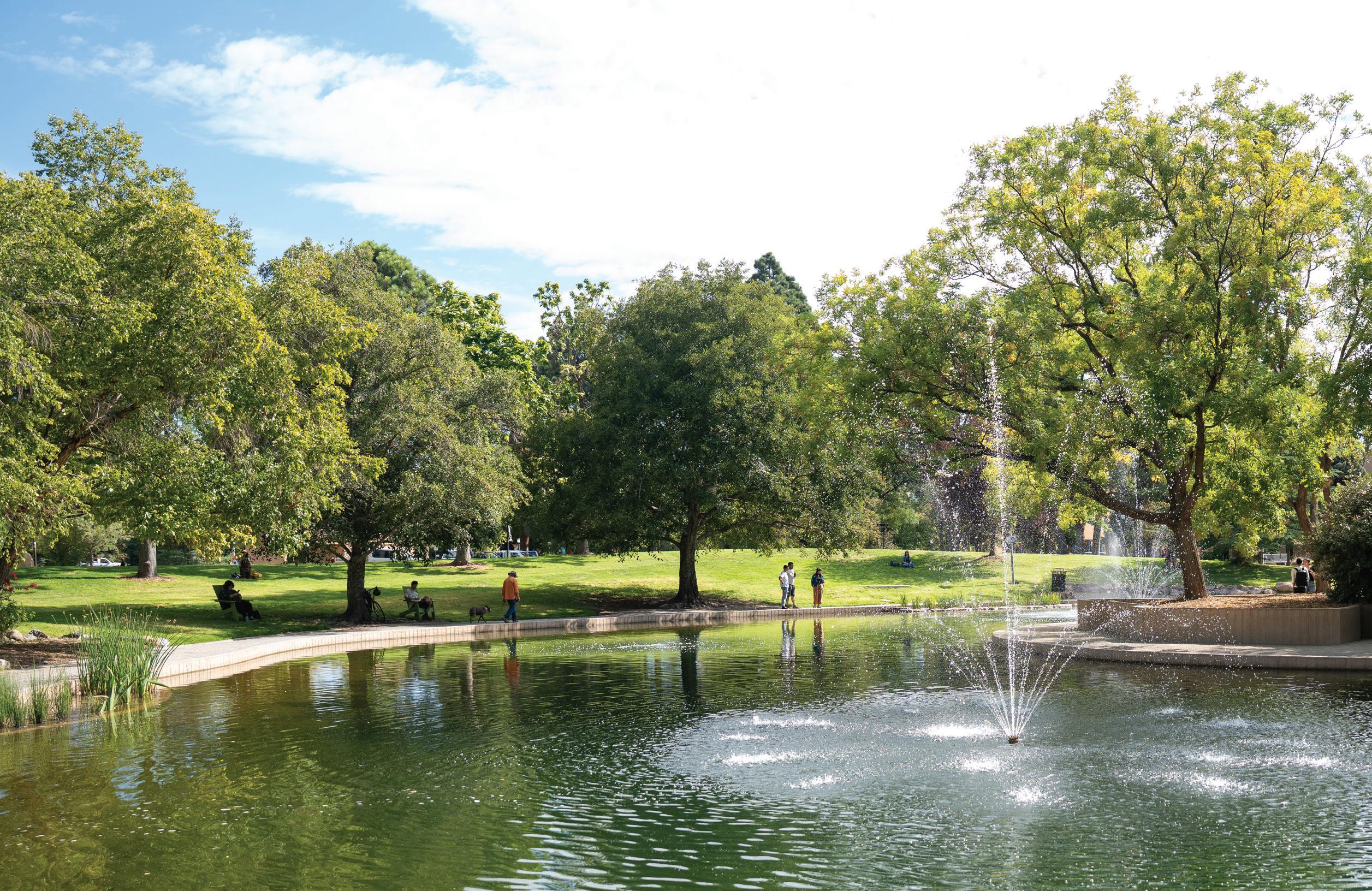
A spectacular view of one of the fountains after the Duck Pond renovation.
goals outlined in UNM’s 2040 strategic vision.
“The restoration of this valuable Heritage Zone marks UNM’s investment in our campus character, community assets, and commitment to sustainability,” said University
Planner and Director of Campus Capital and Space Planning Rosie Dudley. “It upholds the original vision and preservation guidelines while improving the water quality and habitat, making it easier to maintain, and improving safety and security with enhanced lighting and accessible paths.”
“Future phases of improvements will include further furniture and landscaping enhancements to make this space a destination for future Lobos and the community at-large enabling the Duck Pond to continue to hold a special place in so many people’s hearts.”
Additionally, new benches designed to match the historic character of the space were installed in nine existing seating areas, and two additional seating areas will also be added near Mitchell Hall at the south end of the pond.
For alumni returning to campus— or simply remembering their time at UNM—the Duck Pond remains what it has always been: a place to pause, reconnect, and experience the spirit of the Lobo community.
The Duck Pond Through the Years
1976
The Duck Pond is completed as part of UNM’s Central Campus landscape design by renowned landscape architect Garrett Eckbo.
1980s–1990s
The Duck Pond becomes one of campus’s most photographed locations and a favorite gathering spot for students studying, socializing and relaxing between classes.
2000s
The Duck Pond grows into a community landmark, hosting graduation photos, campus events and visits from alumni returning to campus.
2024–2025
UNM begins a comprehensive revitalization project to modernize the pond’s infrastructure while preserving its historic design and character.
Today
With improved water quality systems, enhanced accessibility and restored infrastructure, the Duck Pond continues its legacy as one of the heartbeats of the Lobo experience.
UNM President Garnett S. Stokes cuts the ribbon officially re-opening the UNM Duck Pond.
TO AN EPIC UNIVERSE: THE ARCHITECTURAL JOURNEY OF MARK WOODBURY
By Steve Carr
Universal Epic Universe, which opened in May 2025, is Universal’s most ambitious project yet and marked the first major theme park built in the U.S. in 25 years. Photo courtesy of Universal Destinations & Experiences.
Mark Woodbury’s initial career aspiration was to become an astronaut, but it was a drafting class that eventually took him to where he is today—leading Universal Destinations & Experiences and the teams who create immersive worlds and attractions that showcase creativity and technology.
“My first choice was astronaut, but I think architecture was just before that in the dictionary,” said Woodbury. “When I really discovered architecture, was when I took a drafting class. I was fortunate to have vocational classes in school growing up on Long Island. I got attached to holding a pencil. I thought that being able to visualize technical things was interesting to me at a young age.”
While he may not have become an astronaut, those initial influences, most notably the drafting class, have taken Woodbury on a journey as Chairman and CEO of Universal Destinations & Experiences, a unit of Comcast NBCUniversal that delivers some of the most innovative and sought-after entertainment experiences to audiences worldwide.
The Journey to Universal
Woodbury’s interest in the field blossomed as a middle schooler when his family moved from Long Island to the Chicago area, where he became fascinated by the big city and the famous architect and designer Frank Lloyd Wright.
“I think the big cities made a big impression on me. So, at a pretty young age, I would say probably sixth, seventh grade or so, I knew that's where I was headed,” said
Woodbury. “I had no idea what it meant, but I knew that's what I was going to do.”
His direction in life was further shaped when he worked at a gas station in high school and became interested in the environment.
“I've been working since I was very young,” Woodbury said. “I worked
at a gas station during the oil crisis of the mid- to late-seventies. And at that time, I realized the environment was a really important part of our lives. I was interested in what was referred to as ecology at the time. And then I experienced firsthand what an environmental crisis, like an oil crisis, would mean. So, I became very interested in the environment.”
Coming from the suburbs of Chicago to Albuquerque, Woodbury grew up in a big family and didn’t have the opportunity to travel on vacations to see other parts of the United States, which he sees as kind of ironic, given that he now leads Universal Destinations & Experiences.
New Mexico’s topography was one of the elements that factored into Woodbury’s decision to come to the Southwest. He was drawn to Albuquerque and The University of New Mexico after the oil crisis and The School of Architecture was noted for its environmental design program, so UNM naturally rose to the top of Woodbury’s list.
“I didn't really have much worldly exposure to other places. Arriving in Albuquerque and seeing the mountains and the mesa and the architecture, I mean, it was just a whole new world for me,” said Woodbury. “That, environmentally, as a place, opened my eyes to a bigger worldview, and that's kind of what drew me to Albuquerque.
“New Mexico had a strong environmental design program, and that's really what got me there, thinking about solar energy and passive design and all those things that the school was pretty well known for,” he added.
The UNM School of Architecture
UNM’s architecture program was very well rounded, with an emphasis on design and the creative process, an influence that continues to shape Woodbury today.
“Even with detailed solutions, it was really about the whole being greater than the sum of its parts,” Woodbury said. “It was about solving for a much bigger, complex set of issues.”
Woodbury noted some key themes that emerged, “What do we want people to experience through our
Mark Woodbury
work? What do we want them to take away from the connection to the work we were doing? I thought it was really important. And that stuck with me for a long time.”
He recalled Ed Norris, who ran UNM Design, Planning Assistance Center, commonly known as DPAC, who he worked with on the design of a classroom at the Navajo Elementary school as well as a list of others who impacted his education.
“I spent a summer there in DPAC, and it was one of the most influential summers of my life working on a schoolhouse through that program,” recalled Woodbury. “It was really pretty amazing. I also learned a lot from Ann Taylor, who was very instrumental”.
“And believe it or not, it's multiple decades later,” Woodbury laughs, “I can recite for you, and if I were a good artist, I could draw you the faces of people like David Kal and Howard Kaplan, Edith Cherry, Don Schlegel, Baker Morrow, Steve Dent and Wolfgang Pfizer. I can do that off the top of my head because that's how important those personalities were and how formative those personalities were to me at a very sponge-like phase of my life.”
His early academic career helped shape much of how he thinks about the world, and was developed by the challenges he was presented with, which were unusual and unique in New Mexico. One of the first projects Woodbury worked on as an architecture student at UNM involved a team of players, which turned out to be a very memorable experience
with the people he interacted with, who are still friends today.
“The power of that collaboration and its importance at an early phase of my academic career were really formative in becoming successful as an architect and as an executive,” said Woodbury. “We had a really wide variety of exercises in architecture school, and I think that mindset applied to anything we're doing, whether that was designing a landscape or a building, or a piece of furniture.
Speaking of furniture, he recalled an example that has stuck with him
for decades when he was tasked to design a chair, that was more than a chair, made out of cardboard.
“I remember thinking about that exercise,” he said. “I do remember clearly what my mindset at the time was, what in God's name does that mean? You really had to kind of take a step back and think, how do I tackle this challenge and come up with something that is unique and different, and really push yourself to think outside traditional boundaries.”
That thinking continues to define his career even today.
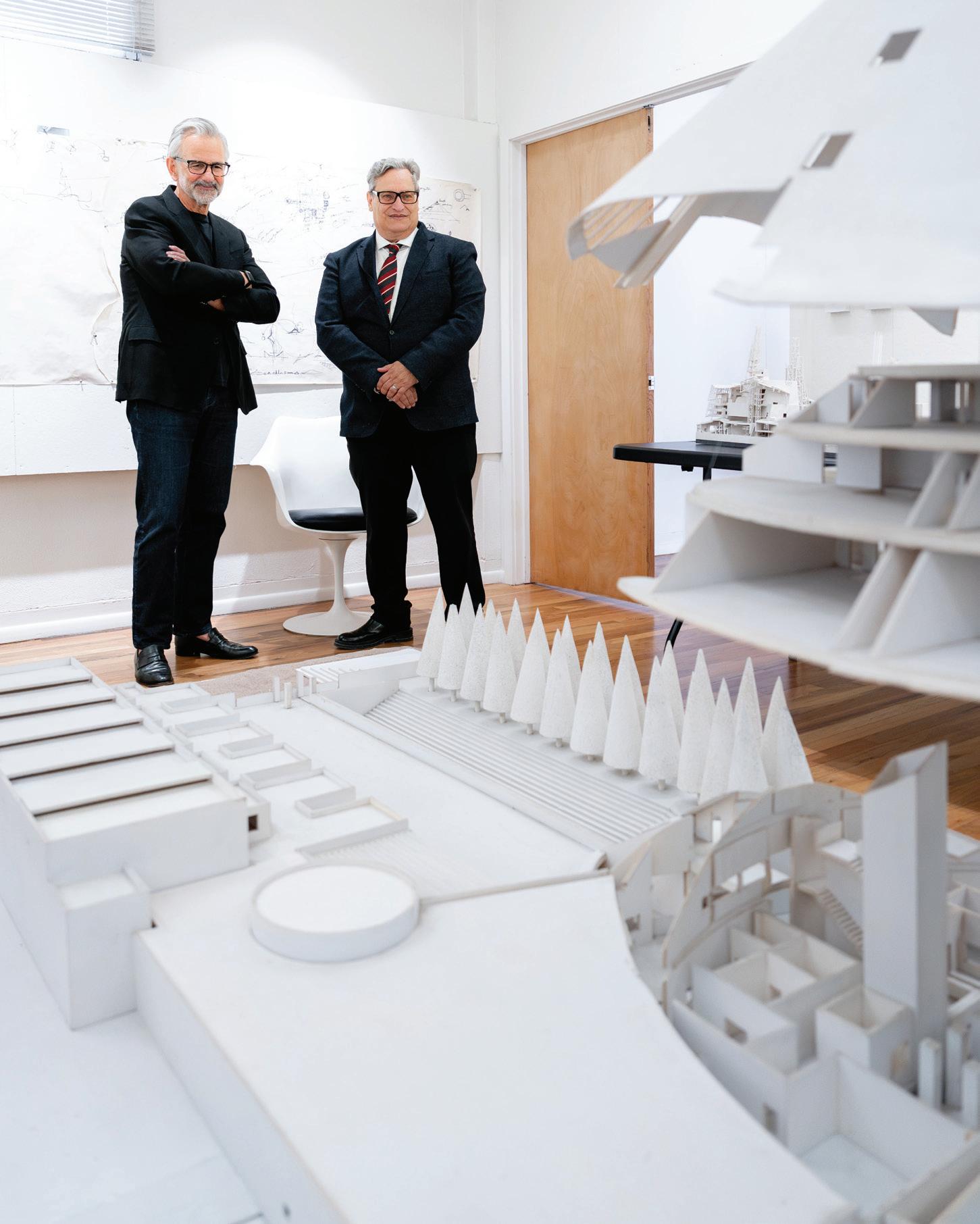
Chairman and Chief Executive Officer of Universal Destinations & Experiences Mark Woodbury and UNM School of Architecture + Planning Dean Robert Gonzalez discuss an architectural model during a recent UNM tour.
“How is this attraction, land or world going to impact the people who experience it? What are they going to take away from that, from an experience standpoint, from creating a memory that lasts forever? In our case, we like to think about how we use those experiences or those designs to create an experience that's truly memorable.”
After he graduated from UNM with a Bachelor of Arts in Architecture, another influential UNM professor, Stephen Dent, suggested he continue his education and pursue graduate school at the University of Wisconsin, where he earned his Master of Arts in Architecture. Once out of graduate school, he went into a traditional architectural practice. It was a direct application of his academic career to practice.
Universal Destinations & Experiences
Woodbury’s architectural training at UNM prepared him well for his entire career. He spent five years in traditional architecture before taking a risk and joining Universal.
“I took a risk and took that fork in the road and went into this business,” said Woodbury. “ It started with master planning and architecture at a different scale. But then it developed into storytelling using technology and attractions, which ultimately led to a leadership role in the company as Chairman and CEO.”
Before that, Woodbury, who’s been with the company for more than 35 years, served as Vice Chair and President of Universal Creative, the division responsible for developing strategy and creating,
planning, and designing all Universal attractions and destinations worldwide. He joined the company during the development of Universal Studios Florida and served on the creative leadership team. He is also a member of the NBCUniversal Executive Committee.
The phrase ‘how is this going to impact the people who experience it’ has been prevalent throughout Woodbury’s career at Universal, leading teams that have blended the architecture, engineering, storytelling, and technology. Despite the differences in scale and typology, the fundamentals are basically the same as in traditional architectural design.
The company’s latest theme park, the first major theme park to open in the United States in more than 25+ years, is called Universal Epic
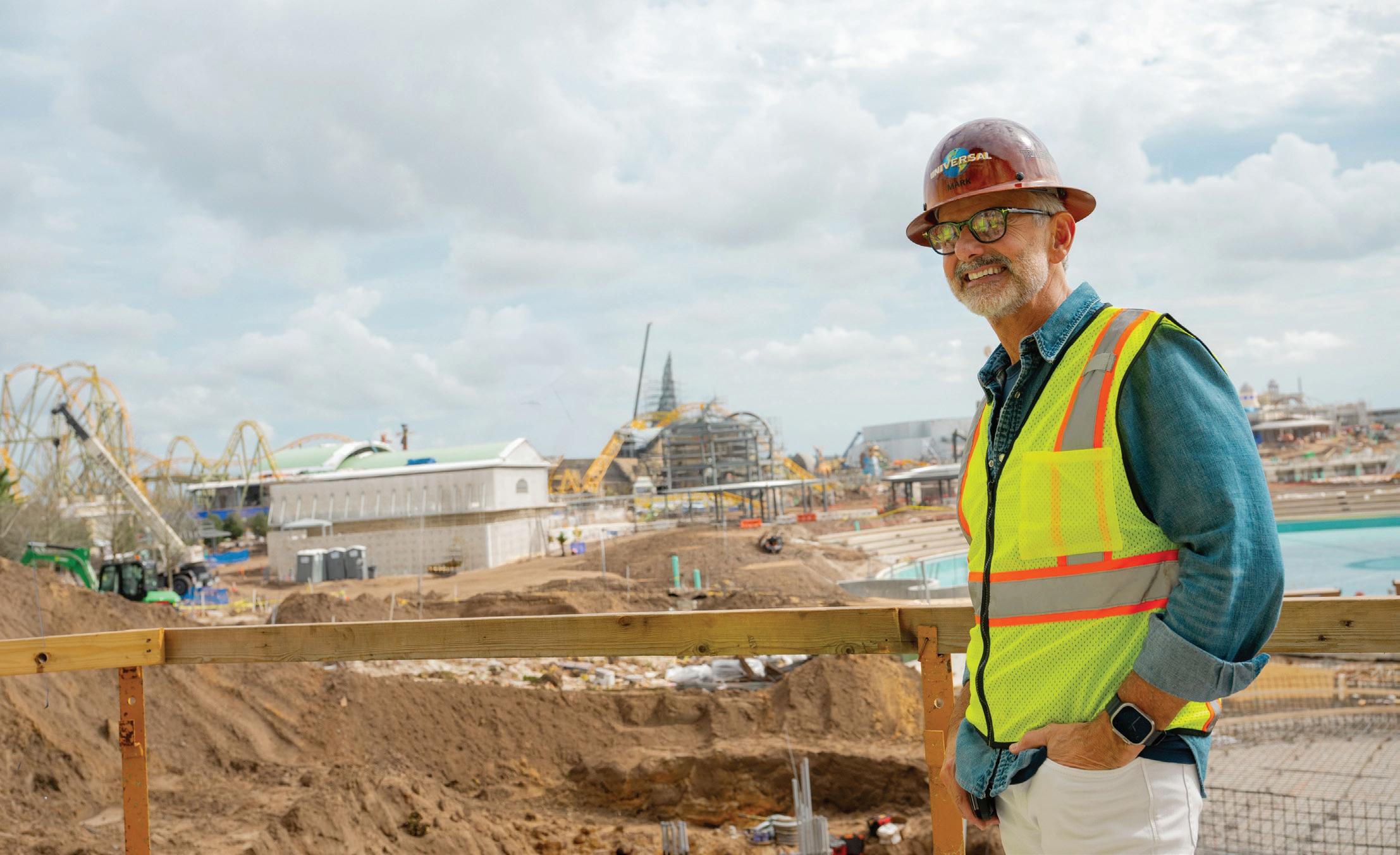
Mark Woodbury tours the site of Universal Epic Universe during the construction of the transformative park. Photo courtesy of Universal Destinations & Experiences.
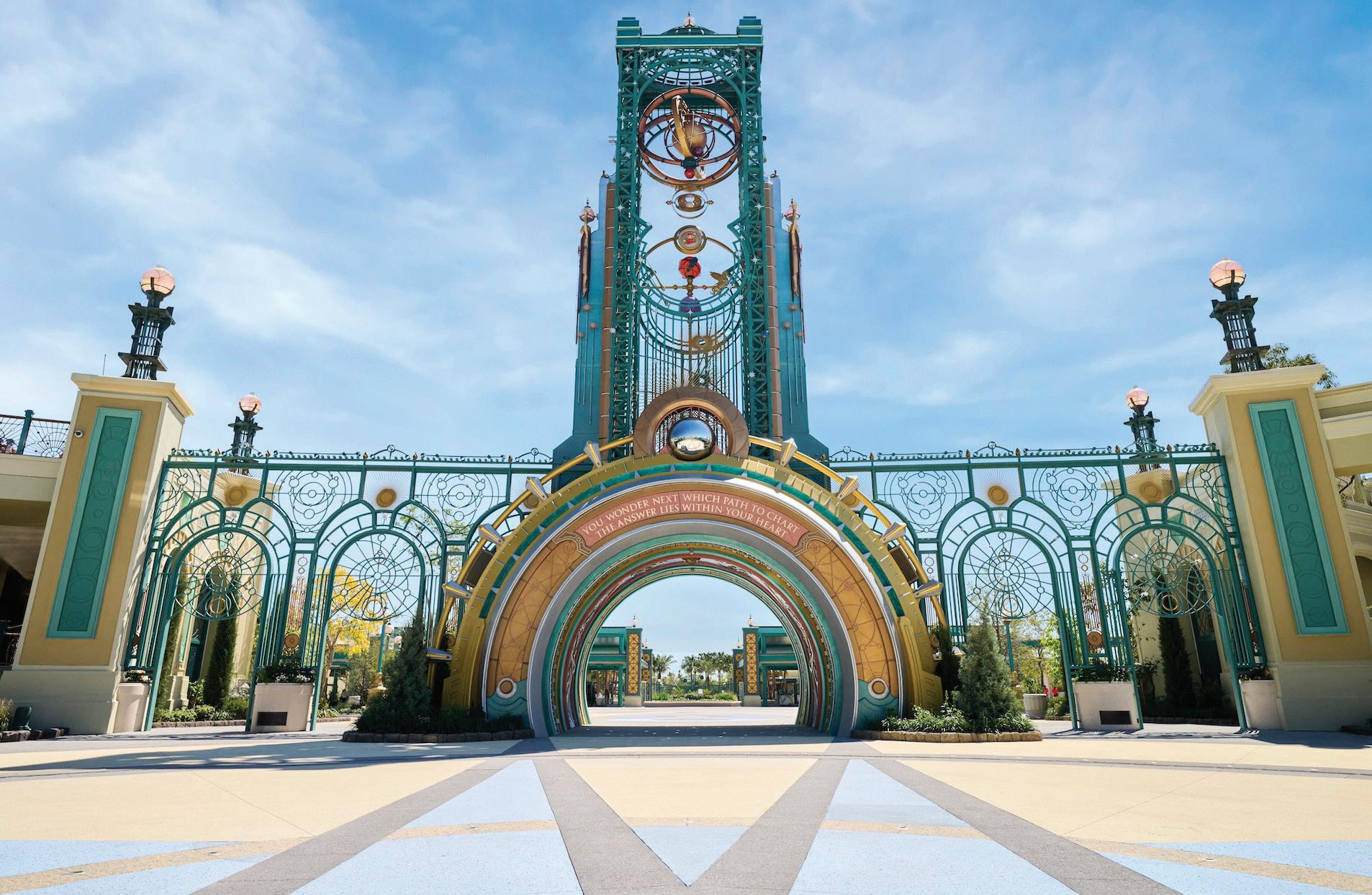
The Chronos at the main entrance of Universal Epic Universe welcomes guests inside Celestial Park. Photo courtesy of Universal Destinations & Experiences.
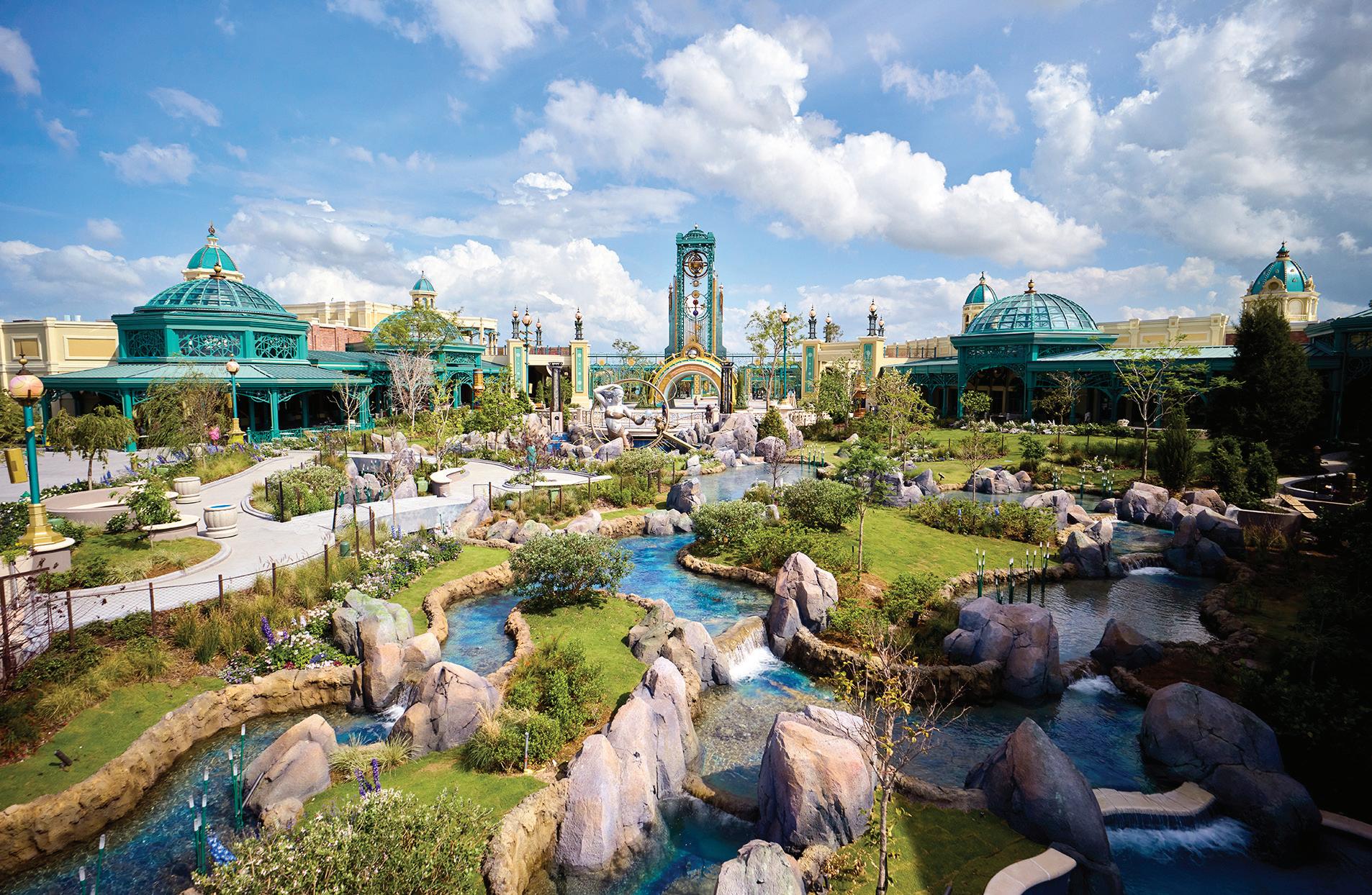
Celestial Park is the central hub of Universal Epic Universe, Universal Orlando’s new theme park. Elegant gardens and grand architecture create a breathtaking gateway to adventure. Photo courtesy of Universal Destinations & Experiences.
Universe, featuring five themed worlds including Celestial Park, Dark Universe, and How to Train Your Dragon: Isle of Berk, in addition to The Wizarding World of Harry Potter’s Ministry of Magic and Super Nintendo World. Overall, the park contains some 50 attractions, including 30 dining and 21 retail locations.
Epic is the fourth theme park at Universal Orlando Resort and the idea of it started with a simple question: How could Universal Orlando become a weeklong destination for guests? What the company found was that guests loved Universal’s immersive storytelling, thrilling rides, and entertainment. That insight set the challenge, and Universal officially announced its intent to build Epic in 2019.
which are non traditional from an architectural point of view. The difference between parks and movies is we have to create a full 360 degree experience that lasts for decades.”
Woodbury’s background, along with the combination of creativity and technology, and how they’ve been applied to different aspects within his various roles throughout his career with Universal, have been instrumental. The fundamentals of his architectural education prepared him by helping to emphasize collaboration and instilling a sense of curiosity that has served him well over the years.
“Everything we do here is really a fusion of creativity and technology,” said Woodbury. “It's really that fusion of creativity, storytelling, and
where architectural fundamentals— thoughtful design, placemaking, and narrative clarity—ensure that each destination feels authentic to its setting while delivering an unforgettable guest experience.
“The pillars of our business are to create mind-blowing experiences and deliver that with really breakthrough marketing and combine that with world-class guest service,” he said. “Wherever we take that, we like to say that it's universal, regardless of the geography. There are clearly cultural nuances to that, but the fundamentals of creating great stories and great experiences from a placemaking and architectural standpoint are pretty universal, no pun intended.”
“Everything we do here is really a fusion of creativity and technology. It's really that fusion of creativity, storytelling, and technology. That technology often delivers the visceral component, supported by sophisticated systems ranging from robotics to motion based ride and show technologies.”
“When you look at Harry Potter in our parks, it brings the places that people aspire to be a part of from those particular canons to life,” said Woodbury. “In the case of Super Nintendo World, how do you put people into the middle of a video game? Those are the different kinds of story based and architectural challenges we face, many of
technology. That technology often delivers the visceral component, supported by sophisticated systems ranging from robotics to motion based ride and show technologies.”
Woodbury’s teams have also navigated the complexities of developing global destinations, including Universal Beijing Resort and Universal Studios Japan,
A cornerstone of delivering exceptional guest experiences is the seamless collaboration among architecture, engineering, storytelling and technology—an approach that mirrors the deep collaborative nature of both architectural practice and the entertainment industry. Success in these complex, immersive environments depends on multidisciplinary teams working in concert, blending creative vision with technical precision to bring ambitious ideas to life.
“This work we do is heavily reliant upon a culture of collaboration,” said Woodbury. “Architects are really oftentimes the composer and the conductor of the orchestra, bringing together diverse expertise to create a cohesive end product. Our business is very much like that.”
ART ALONG THE MOTHER ROAD: UNM ALUM HELPS LEAD ROUTE 66 REMIXED
By Mary Beth King
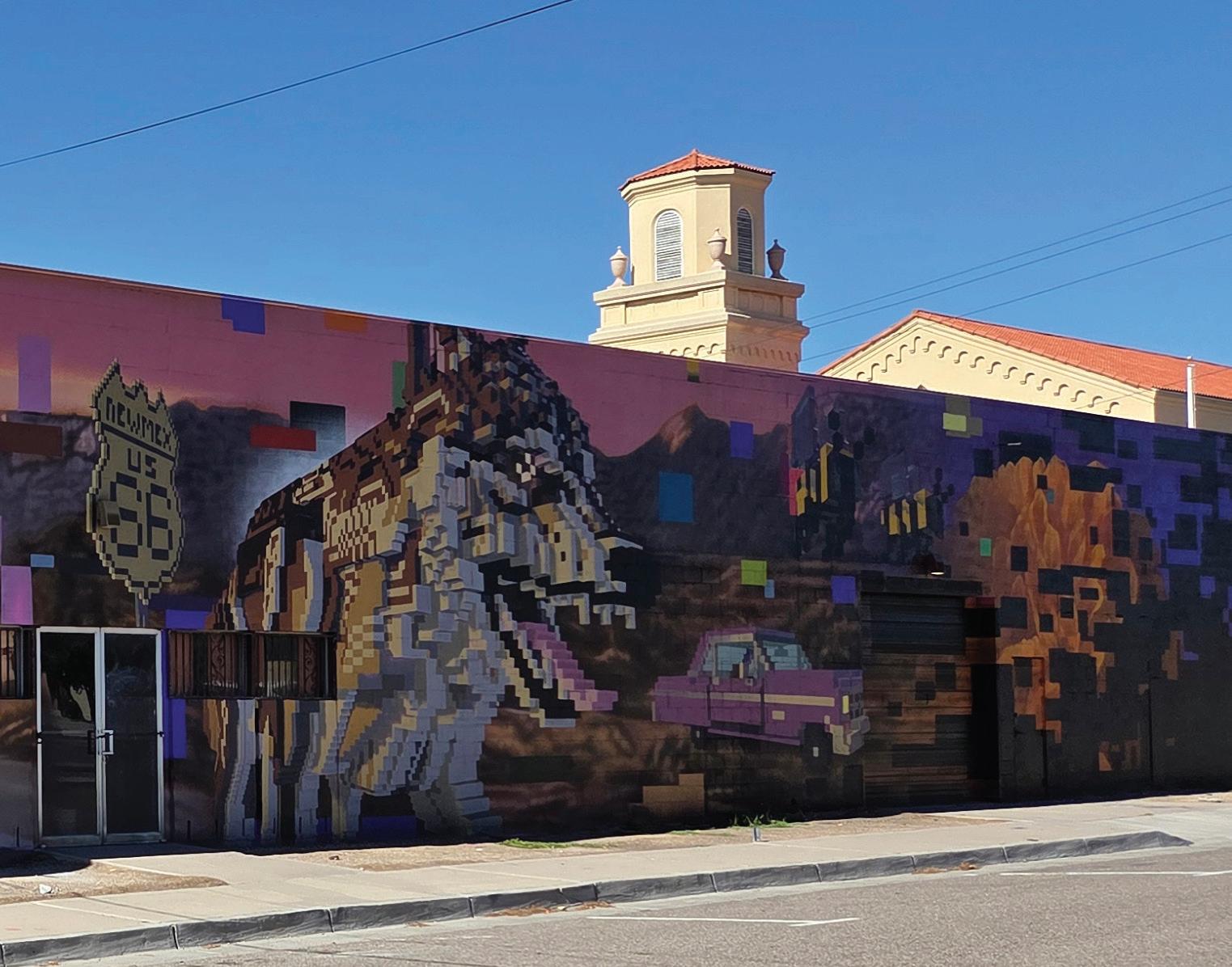
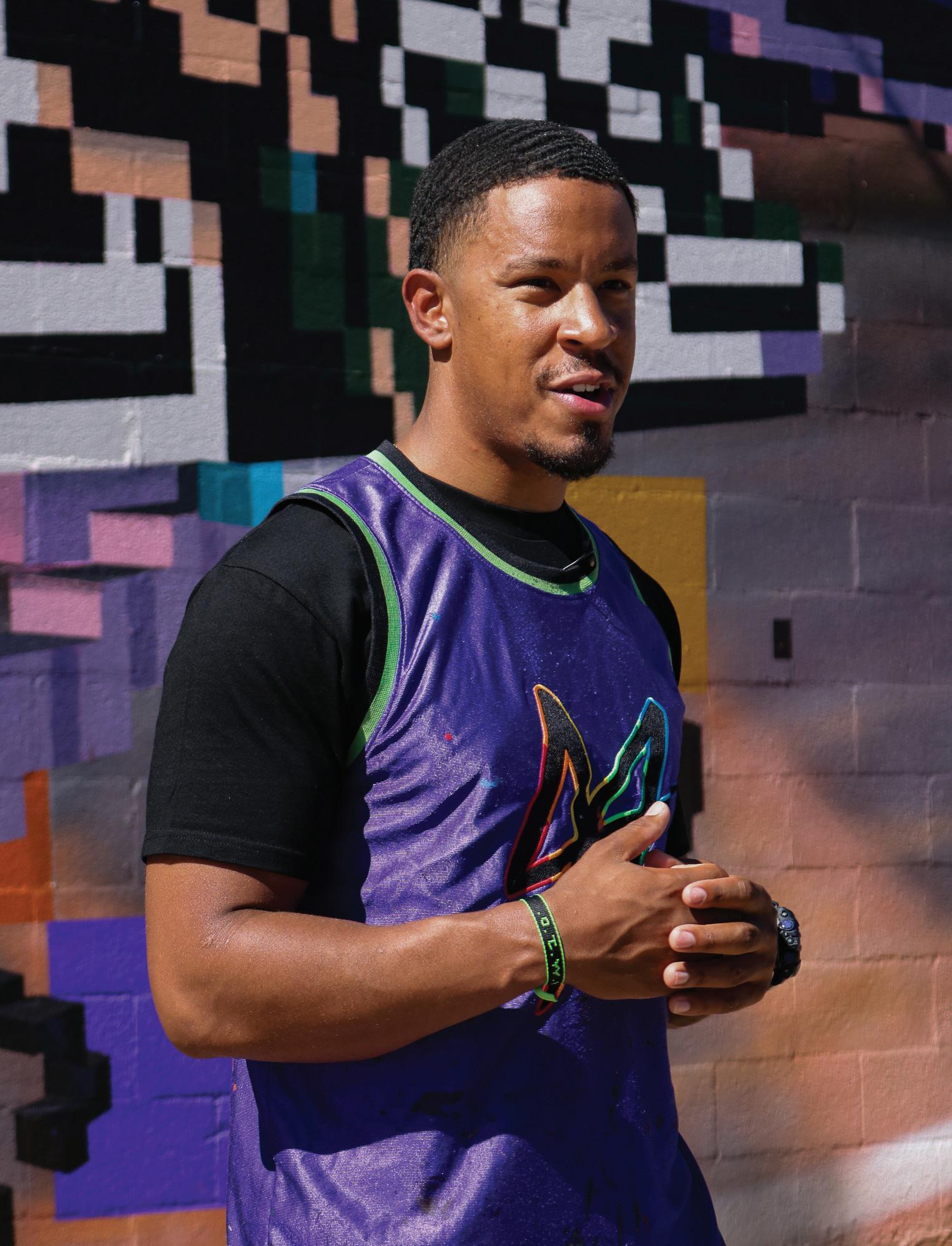
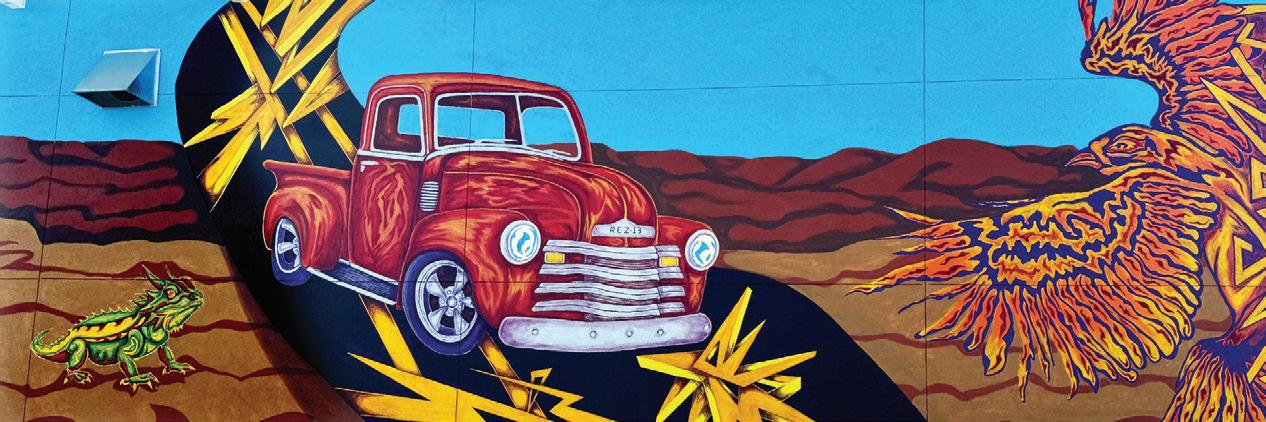
Acentury after Route 66 began carrying dreamers west, a University of New Mexico graduate is helping define how Albuquerque celebrates the historic highway today. Alumnus Noé Barnett helped shape Route 66 Remixed, an ambitious public art initiative that is the cornerstone of Albuquerque’s Route 66 Centennial celebration this year, with his creation of a mural on the UNM campus.
The citywide project reimagines Albuquerque’s stretch of the legendary highway through a collection of murals, sculptures, and cutting-edge augmented reality (AR) experiences, blending history, art, and innovation into an immersive celebration of culture. The series honors the road’s history and legacy while drawing new attention to preservation and revitalization efforts along the corridor. The purpose
of the projects is to celebrate the anniversary of the historic road’s establishment and bring new awareness to efforts to preserve, maintain, restore, and return to use historic properties along the Route 66 corridor.
The UNM mural was created in collaboration with former UNM art student Travis Black.
Like the Mother Road Barnett is celebrating with this latest work, the
road to his diploma at UNM was a long one. A native of Albuquerque, Barnett graduated from Volcano Vista High School before enrolling at UNM as an Architecture major.
Fine Arts as my major with a focus on painting and drawing.”
He graduated in 2018 with a Bachelor of Fine Arts degree in Art Studio.
He soon switched to Criminology, then Accounting, before stepping away from school altogether. After a brief stint as a service aide with the Albuquerque Police Department, he reassessed.
“I didn’t feel like it was necessary to get a degree in the career field that I was pursuing so I stopped going to college but then when the career field I was pursuing didn’t pan out, I decided to go back and declared
Among the faculty members who shaped his development was UNM art instructor Beau Carey, also a UNM alumnus and Albuquerquebased painter.
“Beau Carey was pivotal in my journey,” Barnett recalled. “UNM just gave me the space and the capacity to paint, just being so new and fresh to the art world and not really having the artistic skills, the knowledge, about really how to do anything. It
gave me the space and the ability to really home in on my craft and set me on the path.”
Barnett’s work is a familiar sight around town to local residents.
“I don't think being from New Mexico you automatically have a sense of its importance. My parents being from the Midwest and driving on road trips over the summer familiarized me with the road. A lot of the nostalgia, even the memorabilia you see, on postcards and then all throughout the country really helped me research and understand what it was.”
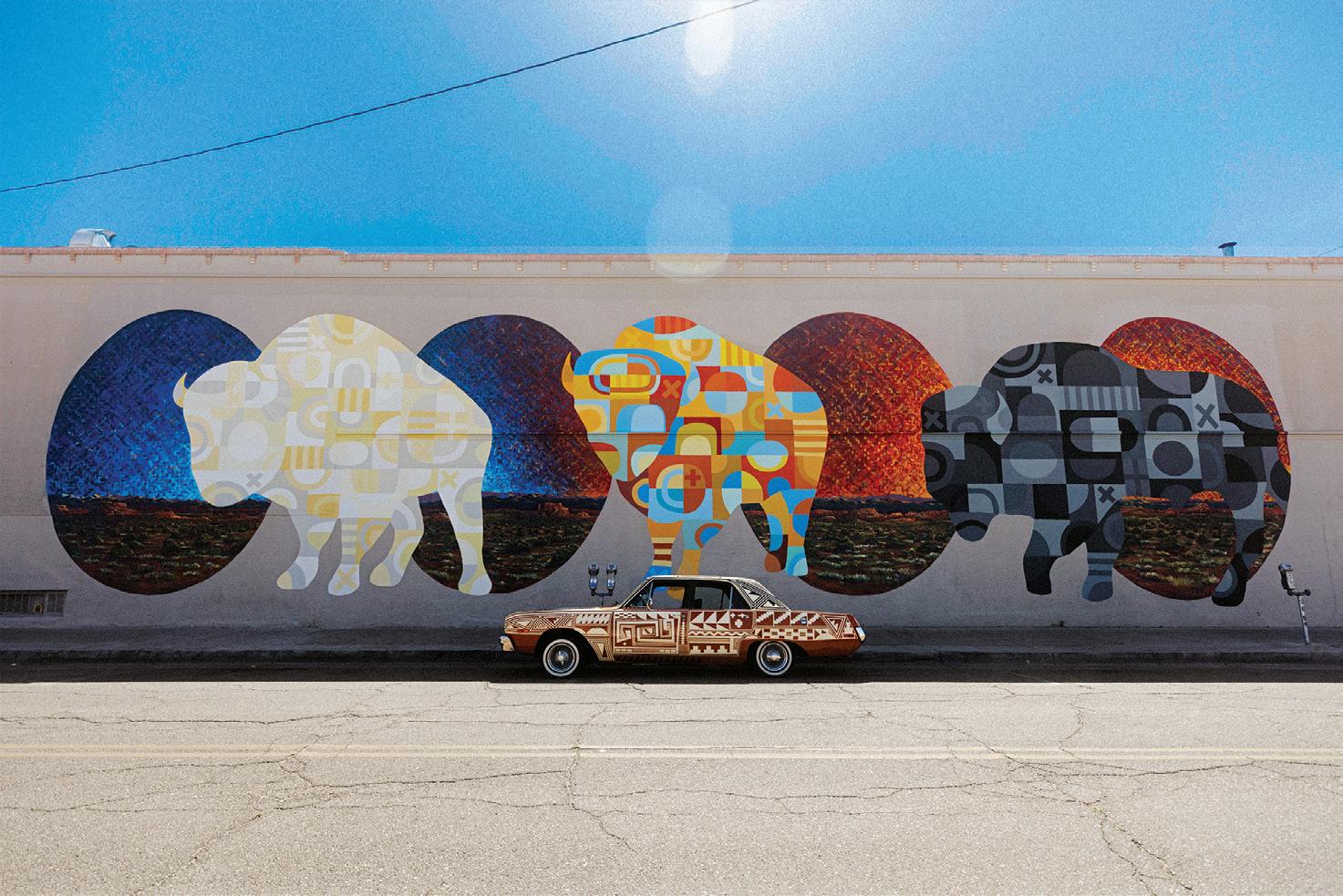
Among his murals are Mountain Top at the intersection of Tijeras and 1st Street in downtown Albuquerque honors the legacy of Martin Luther King Jr. and also includes images of Booker T. Washington, Coretta Scott King, and Frederick Douglass. A giant roadrunner streaks down Eighth Street downtown. A Native American artist plies his craft on the side of the Turquoise Museum on Second Street, S.W.
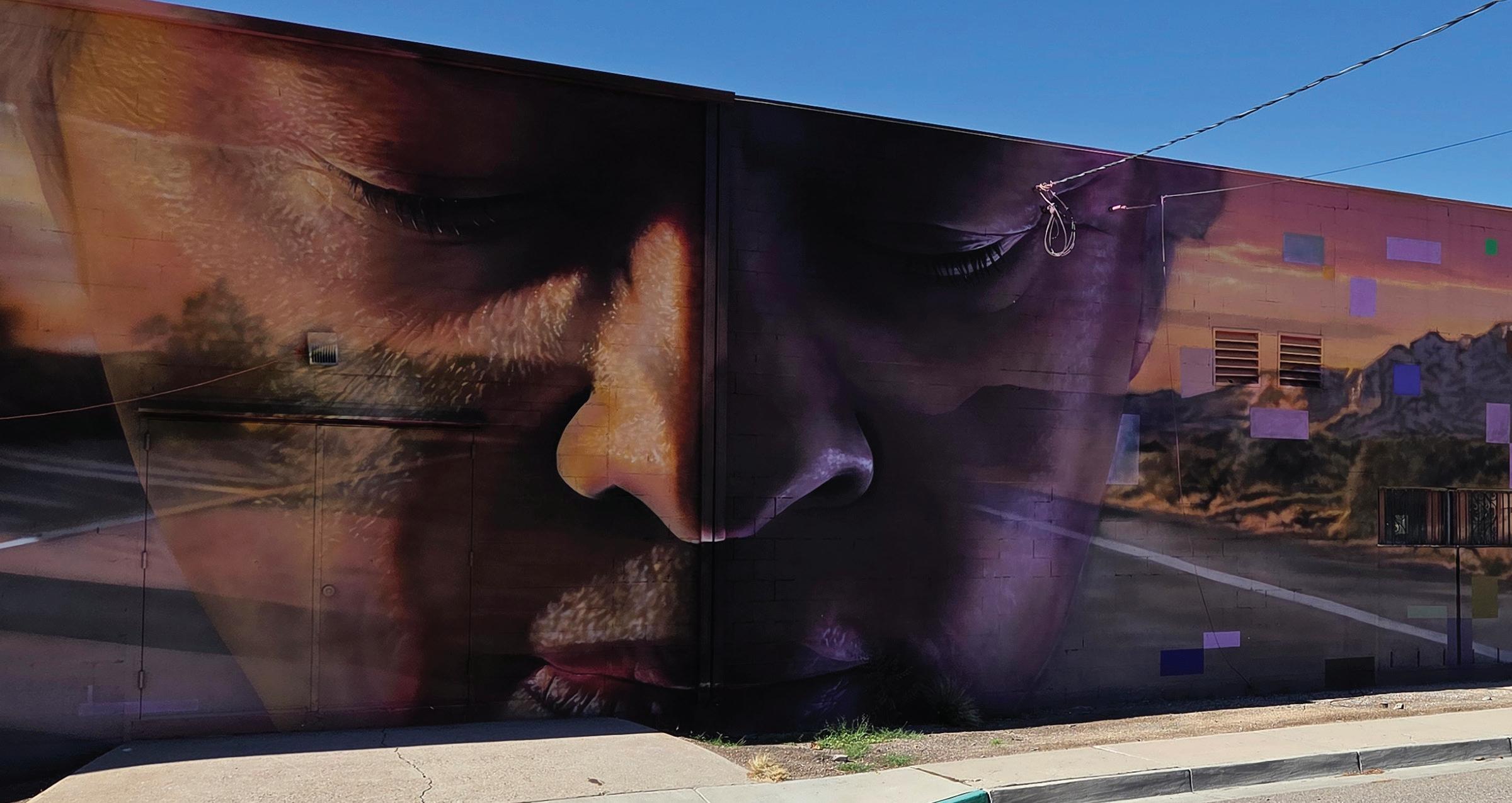
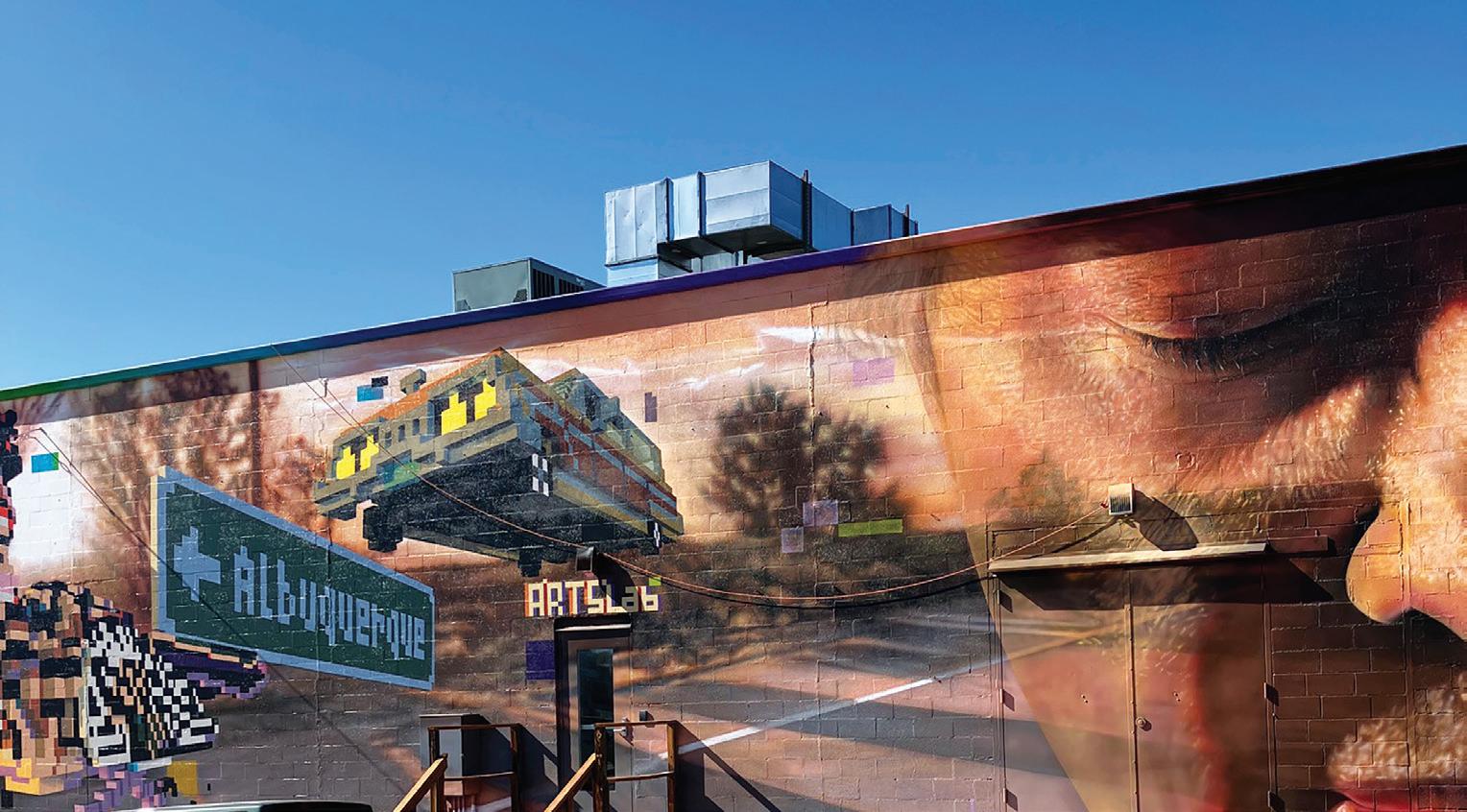
A portion of the ‘Route 66 Remixed’ mural titled ‘Mother: Moment’ at UNM’s ARTSLab.
the memorabilia you see, on postcards and then all throughout the country really helped me research and understand what it was.”
The city reached out to Barnett and Black about working on the UNM project.
“They explained what the project was, discussed the scope, brought up the centennial and then just paired up myself and Travis together. We never met, so there was a familiarization process of us getting to know one another. They gave us a timeline and told us that we wanted to have this done by the end of September.”
Inspiration for the project came through researching the highway’s history.
“I don't think being from New Mexico you automatically have a sense of its importance. My parents being from the Midwest and driving on road trips over the summer familiarized me with the road. A lot of the nostalgia, even
Barnett noted that Route 66 is called the Mother Road, “so I used that as the anchor for the mural, which is why I decided to include my mom Michelle as the focal point and the design is centered on that and everything expands from there. It’s almost as if it’s a memory of past experiences on road trips and traveling on the road.”
Everything in the distinctive pixelated style called “voxels” was done by Black and Barnett painted everything else. The flowers in the design tie into his studio practice.
“It was an honor to be part of this and work with Noé and to work with the university and Meow Wolf and the city,” Black said.” It wasn’t quite like anything I’ve done before to kind of turn that corner every day and just see our progress and to see such a large production felt great.”
Black moved to Albuquerque in 2005 to attend UNM on an Amigo scholarship.
“I saw the quality of the professors and the affordable price and my then-girlfriend and now spouse decided to adventure out here from Michigan. I have always thought my college experience was something that helped me tremendously, I made important connections with students and teachers, and I grew a lot,” he said.
Black created the blocky Lego® or voxel images—the 3-D pixelated— looking designs, creatures, signs, and automobiles.
“Getting to know Noé and collaborating with him has been such a pleasure. Noé was so easy to work with, he knew what he wanted, but he also cared about my perspective, so I'd say it was a really rewarding and successful meeting of minds… Noé is an Olympian of his technique, well respected in the art and mural world at large and a great guy. I'm glad to be connected with him and my life is enhanced by his work and presence.”
“As students, both Noé Barnett and Travis Black exemplify the wealth of talent within the College of Fine Arts. I couldn’t think of a better way to celebrate the inspiring history of Route 66 than with this amazing mural, which captures what makes New Mexico truly the
Noé Barnett at the press conference that featured the unveiling of the Route 66 Remixed mural ‘Mother: Moment,’ one of 16 art installations across the city.
Land of Enchantment” said College of Fine Arts Dean Harris Smith.
UNM’S new Center for Collaborative Arts & Technology is being built on Route 66 a couple blocks east of the Mother: Moment mural. Its location along Central Avenue, will, it is hoped, animate the street and showcase the talents of the UNM College of Fine Arts to the public.
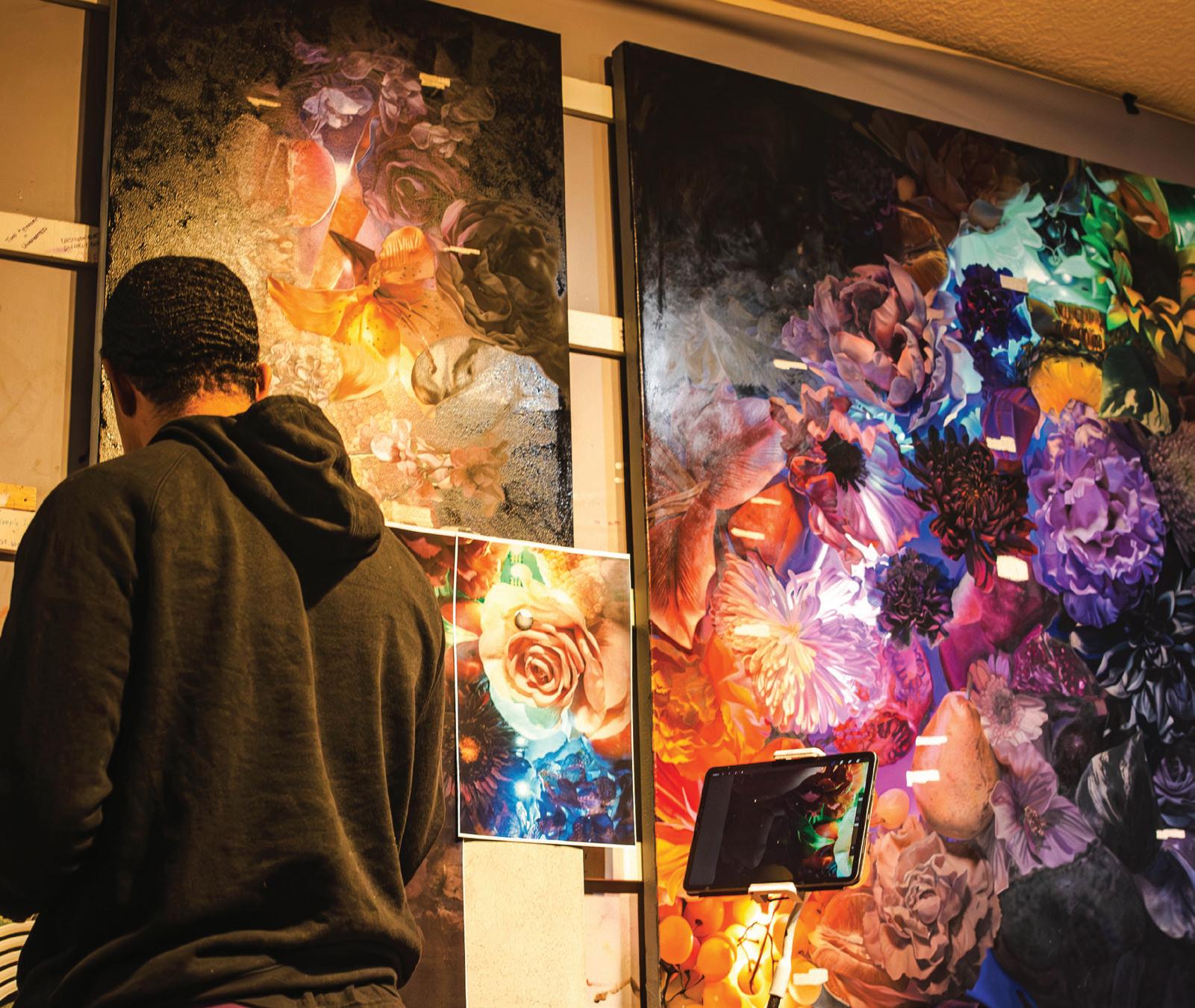
In addition to being a full-time muralist for over five years, Barnett paints in his home studio. His canvases feature bold, colorful floral imagery suffused with light.
“My studio work is all influenced by light both in the metaphysical and physical sense. Flowers and vegetation use light to feed themselves through photosynthesis and in turn give us back beauty so they essentially are solar powered and they feed themselves on the light. So right now, my studio practice is a focus on light in various capacities. I use light both as the subject and a medium with reflective layers and seeing things differently through different angles and through the different forms of light.”
Barnett’s work will be on display this summer at the Albuquerque Museum in Old Town and the Secret Gallery located in the Arrive Hotel downtown.
Led by the City of Albuquerque’s Department of Arts & Culture,
Route 66 Remixed invites locals and visitors alike to explore the legacy of the Mother Road through a modern creative lens. With support from Visit Albuquerque, the New Mexico Tourism Department, community organizations, and property owners, the project transforms Central Avenue into a living art corridor—an art-fueled road trip showcasing the stories, traditions, and people that continue to shape Albuquerque’s identity.
Along the route, travelers will discover large-scale installations and
site-specific digital features that reflect the stories, traditions, and people that have helped shape Albuquerque. Route 66 Remixed is created in partnership with Meow Wolf, Refract Studio, and local artists. The project includes 18 art attractions along Albuquerque’s 18-mile stretch of Route 66 that can be experienced on their own or explored together via a web interface. UNM law school grad Hakim Bellamy, Albuquerque’s inaugural poet laureate, is the road trip narrator and storyteller.
A wall of color at the studio of Noé Barnett highlights the vibrant colors noted in his artwork.
UNM AND THE MOTHER ROAD
By Mary Beth King
Before there was a Route 66, The University of New Mexico was already an established college, sitting high on a hill above Albuquerque. At the time, the whole university was contained in one building, Hodgin Hall— administration, faculty and staff offices, library, labs, and classrooms.
It wasn’t until 1926 that Route 66 was established, linking Chicago to Santa Monica and passing through New Mexico along the way.
“Route 66 passes right in front of the University, making us the largest
university on Route 66,” said UNM Professor Emeritus of English David Dunaway. Dunaway is an authority on Route 66, producer of Across the Tracks; A Route 66 Story, and editor of A Route 66 Companion, an anthology of history and literature with pieces by authors such as Sylvia Plath, Thomas Wolfe, Ross McDonald, and Raymond Chandler.
Dunaway recently wrote an oral history of Route 66, co-authored by Associate Professor Stephen Benz of the UNM English department. But he wasn’t always as aware of the
legendary Mother Road. For years, Dunaway never gave a second thought about Route 66.
“For me, Route 66 was just a street where I went to get a cup of coffee, where I went to the gym. It wasn't Route 66 in capital letters. I didn't visit Route 66. I just worked there. It wasn't the destination that people from all over the world hope they can someday, on their bucket list, make it to Albuquerque and a hundred other cities and towns on the world's most famous road.”
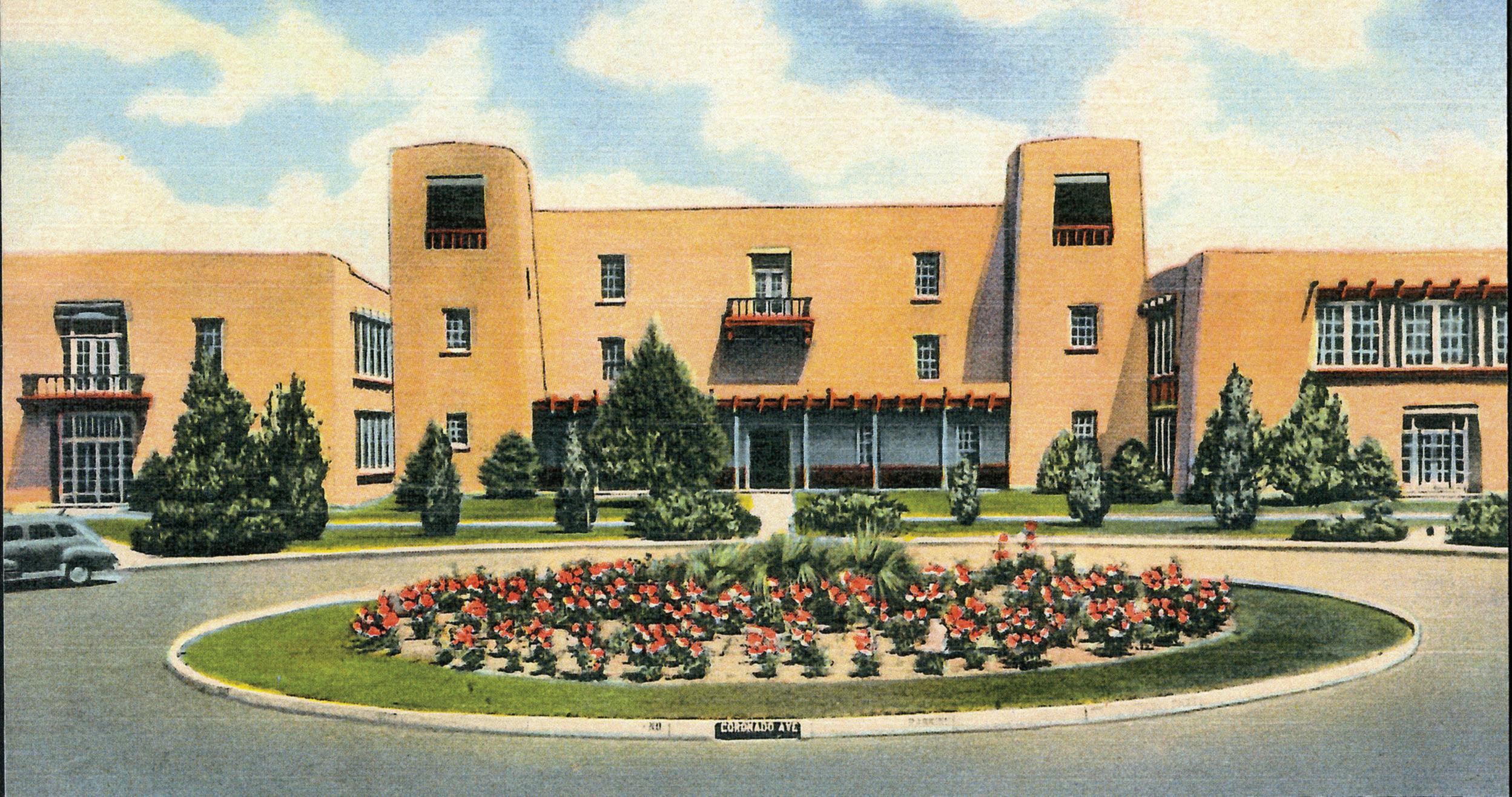
Postcard, Administration Bldg. Scholes Hall, UNM, ca. 1940, notice the street was then called Coronado Avenue, in honor of the 400th anniversary of the Coronado Expedition to N.M. In the 1940s, folks could still drive on main campus streets, by Curt Teich, Chicago, Postcard Coll., CSWR
When Dunaway learned that Central Avenue was Route 66, an 18-mile swath through Albuquerque and past the UNM campus, he saw a new perspective.
“That exposes a fundamental tension between the Route 66 of the traveler and the tourist, and the Route 66 of the resident for whom the road
of the official opening of the road.
Dunaway explained how Route 66 came to be located adjacent to the UNM campus.
“More than 100 years ago, there was a path that went from Tijeras to the other side of Albuquerque and headed west toward Mount Taylor. It was natural that it would go past
the University of New Mexico and pass through the center of the city, back when we were a town with wool wagons making their way through downtown. So, Route 66 and the university have always been entwined.”
There are other universities along Route 66, he noted, “but none of them have the population or
may be just a way to the post office... It's the road we live on and work on.”
Following that realization about 30 years ago, he began to dig into the history and culture of Route 66 and produced for National Public Radio (NPR) a three-hour documentary on Route 66 and pieces for the popular radio program All Things Considered. The series has since been remastered and will air nationally to mark the Mother Road’s centennial on July 4 and again on Nov. 11, the anniversary
prestige of the University of New Mexico.”
“At one point, the University, such as it was in the 1920s, would actually have had horses, maybe drawing drag lines to set up this major road to build it from a trail, a dirt road, then a graded road, and then a paved road in 1938.”
But unlike other roads that cross the country, Route 66 became much more than a paved road, but rather a cultural icon, immortalized in music, literature, and broadcast media,
Photo courtesy UNM CSWR.
Professor Emeritus David Dunaway
drawing visitors from all over the world to immerse themselves in the romance.
“Everybody knows the story of how the Dust Bowl in Oklahoma and Texas created an exodus from that part of the American Southwest, and most people went west to California, to the land of opportunity and, as Jimmy Rodgers sang “in Blue Yodel No. 4 (California Blues) ‘I'm going to California where they sleep out every night...”
After the war, Dunaway explained, there was a burst of travel along the old road with returning soldiers who, with
their families, wanted to take a vacation.
“Route 66 was the all-weather road from the beginning. That's the way it was designed. Route 10 on the border was too hot. The Lincoln Highway to the north was too snowy. Route 66 was a road you could drive at all times, so people began taking this trip, and it was a very exotic one. It took people to Native American tribes they'd never seen. It was full of oddities and strange items, and people came back. Into the ’50s, with this notion that here was an unusual experience.”
Then popular singer Nat King Cole and his trio recorded a song in 1946.
“If you ever plan to motor west Travel my way, take the highway that's the best
Get your kicks on Route 66
It winds from Chicago to LA More than two thousand miles all the way
Get your kicks on Route 66...”
“That stirred things up even more, and from 1959 to 1963, we actually
had a television series called Route 66 about a pair of young guys traveling around in a fast Corvette with no particular destination,” Dunaway said, noting that the show is still popular and running in syndication around the world.
“The combination of a road which tickled people's fancy, which had its own theme song, which had its own TV series, all of these added up to an evocation of what Route 66 came to mean to America and to the world. The chance to drive for Europeans 2,000 miles without hitting a single border, without hitting a single checkpoint. The chance to travel out of the two great cities at either end, into really rural areas, into deep forests near Flagstaff and the Continental Divide, into small-town life. All of these together, merged into a sense of American adventure, and that’s what makes Route 66 arguably the most famous road in the world.
Dunaway would like to see UNM take more advantage of its proximity to the historic cultural icon and has
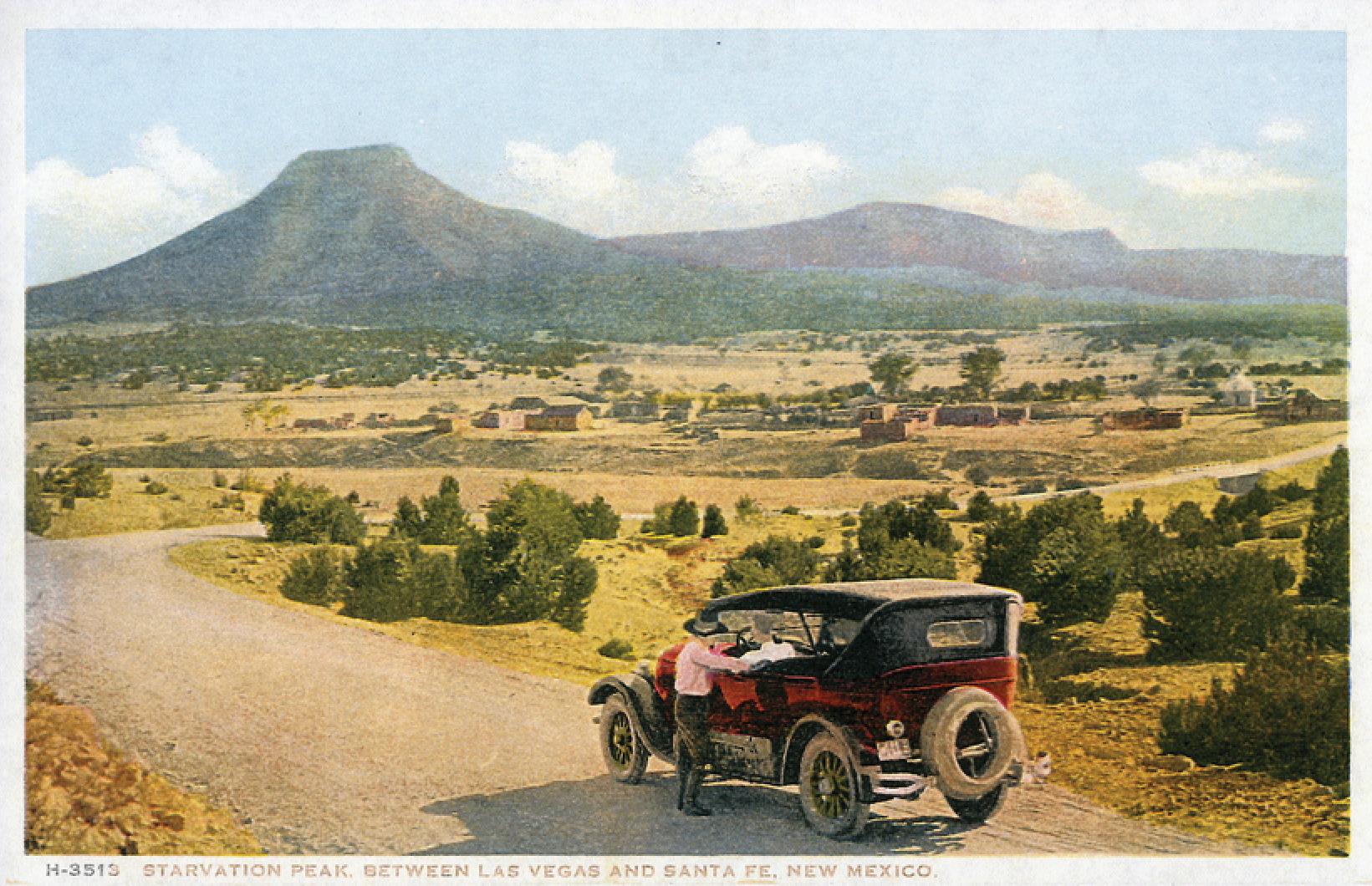
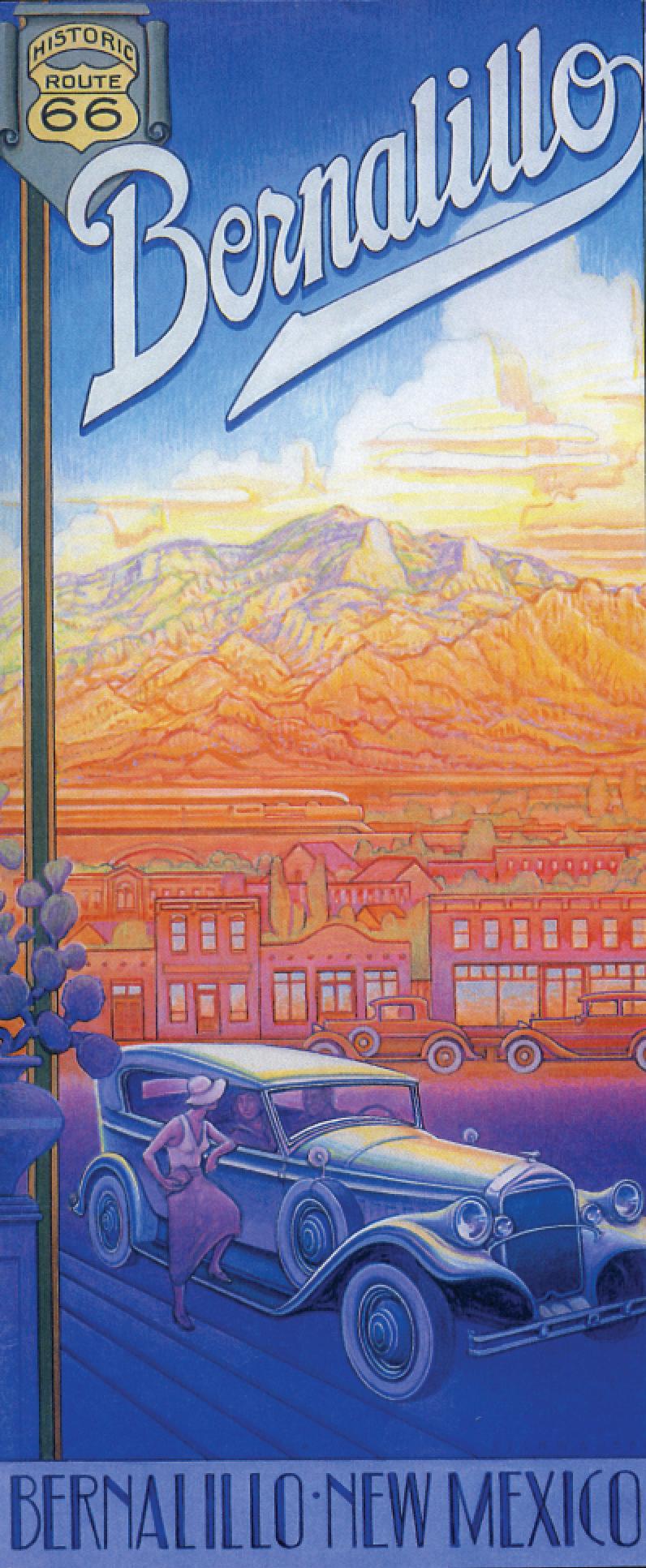
From Albuquerque, Route 66 headed north through Bernalillo and towards Santa Fe and Las Vegas. Photo courtesy UNM CSWR.
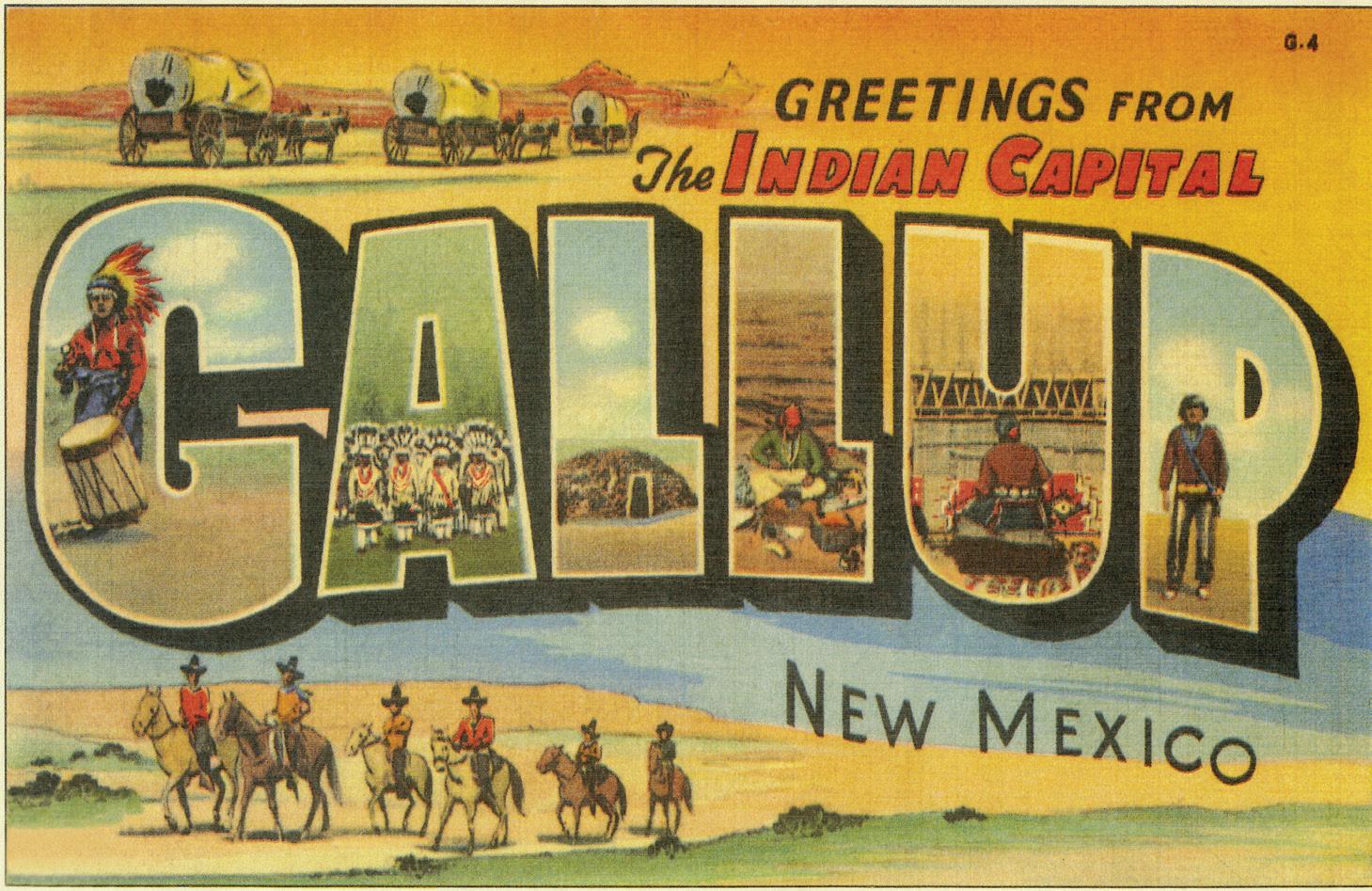
Postcard, El Rancho, Gallup, NM, on Route 66, by M.W.M., Aurora, MO, from Postcard Coll., CSWR
been trying to organize a national center for the study of Route 66 on campus for about 20 years. Plans were for an effort that would draw people from across the University, from real estate, from finance, from various departments who were teaching or doing research on Route 66. Space was allotted at the corner of University Avenue and Central Avenue.
“UNM is a logical place for a national center on Route 66. We're on 66, we have a great library collection of interviews and books on Route 66, and we have faculty such as me who have devoted a part of their lives to the road... The idea fell apart and has not been reorganized… yet.”
UNM’S new Center for Collaborative Arts & Technology is being built on Route 66. Its location along Central Avenue, will, it is hoped, animate the street, create new vibrancy, and showcase the talents of the UNM College of Fine Arts to the public.
“Just as UNM’s connection to Route 66 has long inspired new beginnings through exploration, CCAT represents
what can be achieved through collaboration and innovation,” said College of Fine Arts Dean Harris Smith. Dunaway acknowledges there is some ugliness in the history of the road too: “I want to rebalance Route 66, to consider the communities that willingly and unwillingly gave up their land for the railroad to come through, and later Route 66. The Native and Hispanic communities. It's also a road that was difficult for African Americans to travel. They needed the Green Book to get them to places. So, my Route 66 is a broad avenue into American history, which opens up many of its unresolved issues. I want Route 66 to be seen as a road for all and with a place for all.”
“Although it's an American road, it belongs to the world. There are Route 66 societies in Switzerland, Brazil, Japan, Germany. We have offered the world an ideal. Of smalltown living, big city life, and vast spaces in between. And they come by the thousands to visit. It’s time that Albuquerque and the University step up and recognize the incredible
potential... I'm hopeful that will come about as a result of interest this year in the Mother Road, as John Steinbeck called it.”
Beyond Route 66, Dunaway’s scholarship spans other cultural histories. His latest book is A Foureyed World: How Glasses Changed the Way We See, a historical and humorous look at how eyeglasses shaped culture, science and the way we see today and quotes well-known people from Shakespeare to James Bond to Marilyn Monroe on the subject of glasses.
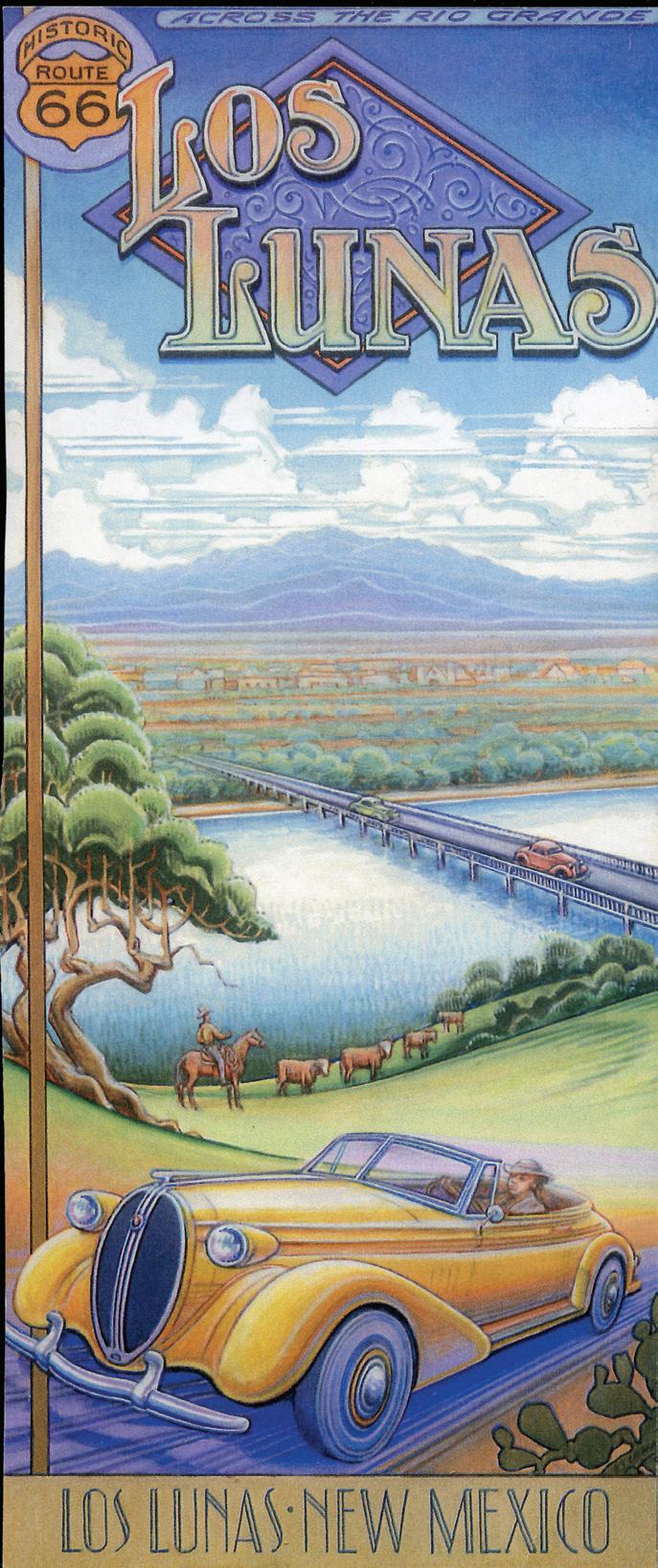
Historic Route 66, Across the Rio Grande, Los Lunas, N.M. Photo courtesy UNM CSWR.
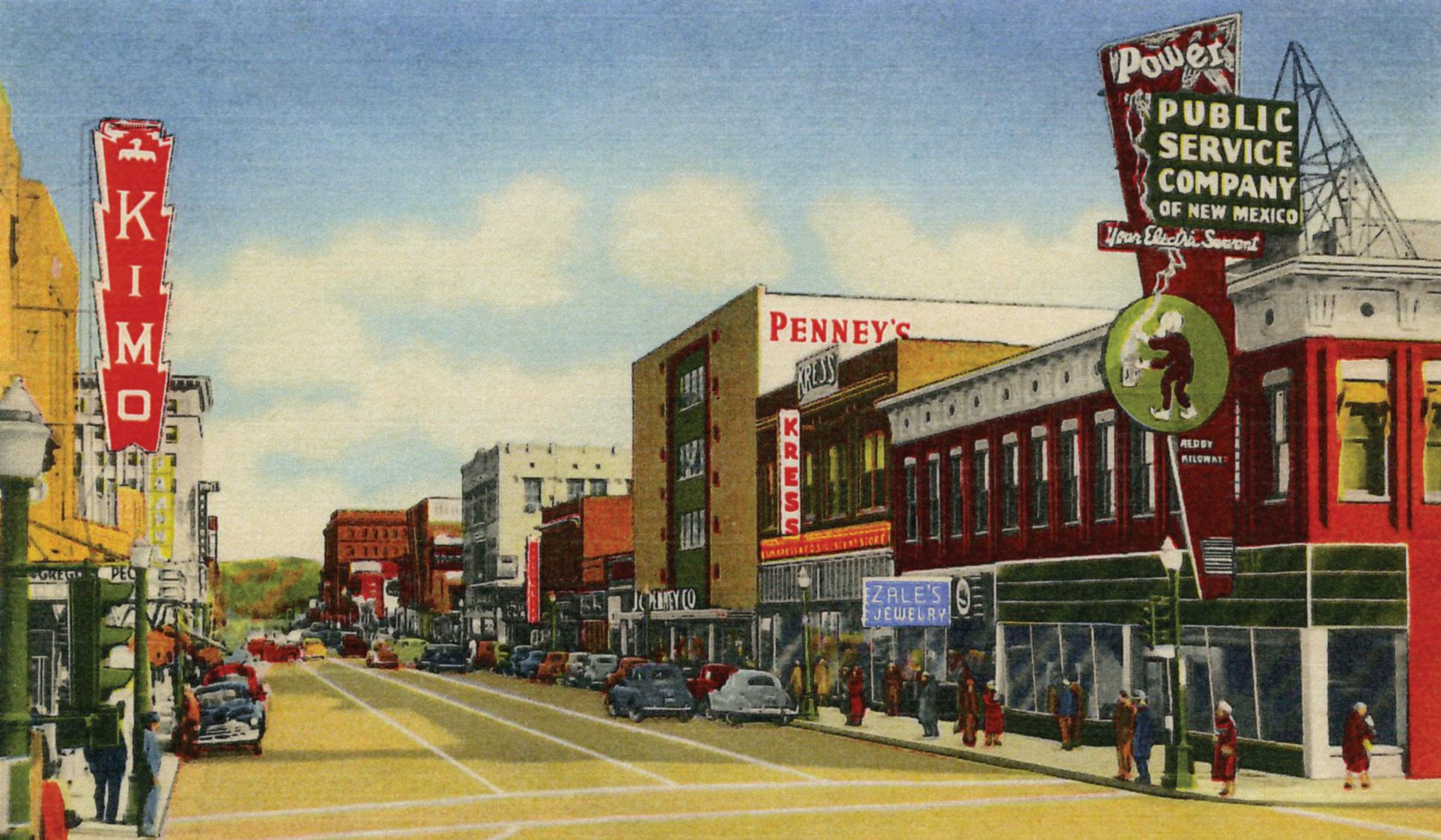
The Kimo Theatre and Public Service Company of New Mexico on Route 66. Photo courtesy UNM CSWR.
IN HEELS, SHE CLIMBED
By Coline Bernal
There was a winter when Aprilyn Chavez Geissler studied for finals from the driver’s seat of her car.
She parked in different corners of campus so no one would notice. “I went to classes. I took showers in the SUB. I ate at Golden Pride Chicken. And I just made it work,” she said.
Today, Chavez Geissler serves in executive leadership at Gateway Insurance and Financial Services, where she advises clients and advocates for broader representation in an industry where she once struggled to see herself reflected. But her path upward began with rupture.
As a freshman at Central New Mexico Community College, then Technical Vocational Institute, Chavez Geissler was engaged to the man she had dated since high school. The relationship escalated into physical violence. “Typically, it takes a woman seven tries before she leaves,” she said. “I finally left.”
Aprilyn Chavez Geissler is an executive leader at Gateway Insurance and Financial Services.
When she did, her parents asked her to leave their home, and she moved into her car. Despite the instability and trauma, she continued going to class, determined not to let her circumstances define her. Eventually, someone noticed her unstable situation and offered her a room to rent at a low cost. That woman also helped her find a needsbased therapist. Chavez Geissler credits therapy as a crucial part of her healing and rebuilding. “I needed it to regain my confidence and move beyond what I was facing,” she said.
Five years later, Chavez Geissler graduated from the University of New Mexico Anderson School of Management with a bachelor’s degree in finance, her tuition paid in full. More than the coursework, she
said, college taught her grit and emotional intelligence.
Determined to Belong
Since high school, Chavez Geissler was set on becoming a financial adviser. Determined to get an early start, she entered the industry at 20, taking a receptionist job at what is now Ameriprise Financial. The leap was intimidating. She remembers being “really nervous and scared” as she stepped far outside her comfort zone, determined to reach the goals she had set for herself.
Her determination did not go unnoticed. The financial advisers in the office took her under their wing, paying her to stay late, inviting her to sit in on client appointments and giving her access to lessons no textbook could offer.
But even as she gained experience, she carried quiet insecurity. At that time, she did not see herself as a survivor. She saw herself as someone who had been financially unstable. She feared her past might undermine her credibility in a field centered on wealth management, so she kept her story to herself. “For years, I never told anybody what had gone on with me,” she said.
The industry added another layer of doubt. In the positions she hoped to hold one day, she rarely saw anyone who looked like her. There was, as she puts it, “no Hispanic financial advisor Barbie.” So she worked harder, learning every aspect of the business to prove she belonged. Looking back, she describes those years with a metaphor that still resonates.
“Some days, I feel like I’m climbing a mountain and I’m wearing heels and everybody else is wearing hiking boots.”
Finding Her Voice
Her trajectory began to shift when she stopped trying to blend in. There was a time, she recalls, when she tried to be like everyone else. But when she started bringing her authentic self into the room, when she stopped being afraid to speak up or share her perspective, was when she began to have the greatest impact. Her mentors did not try to reshape her; they encouraged her. Their acceptance allowed her to stop shrinking herself to fit the room and to own who she was, regardless of others’ expectations.
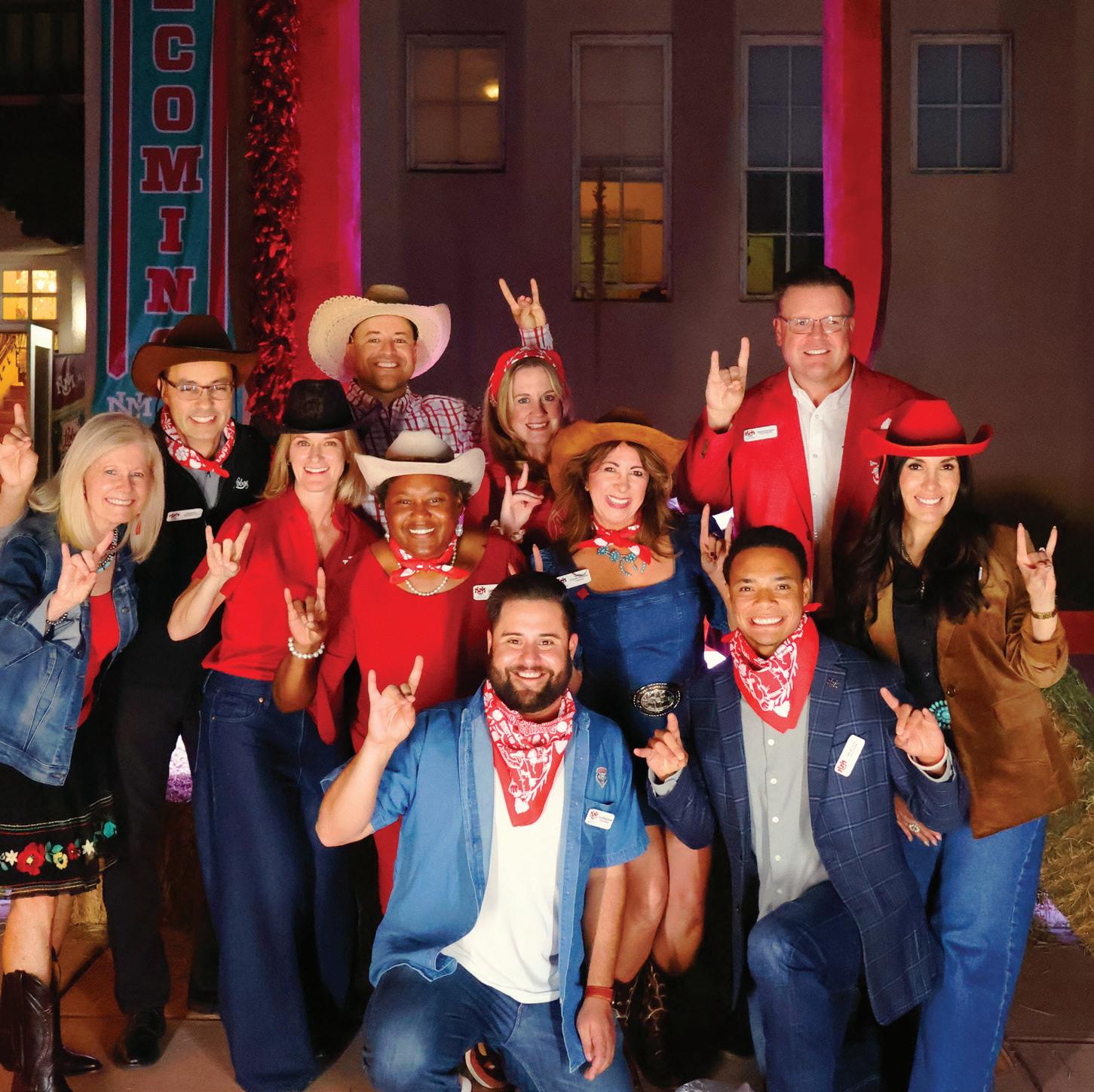
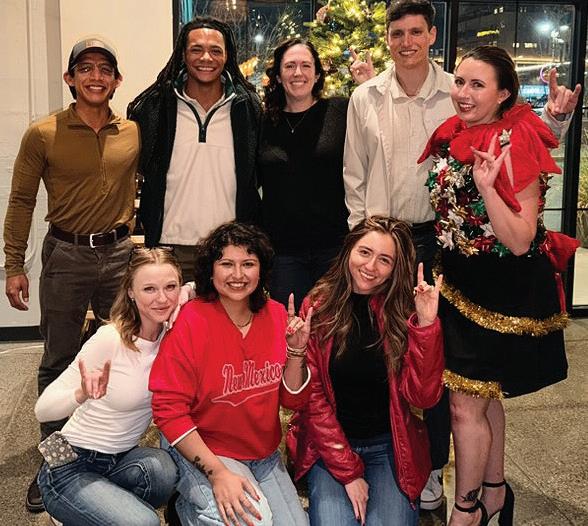
UNM Alumni Board President Aprilyn Chavez Geissler, center, and other board members enjoy a fun night during 2025 UNM Homecoming Week.
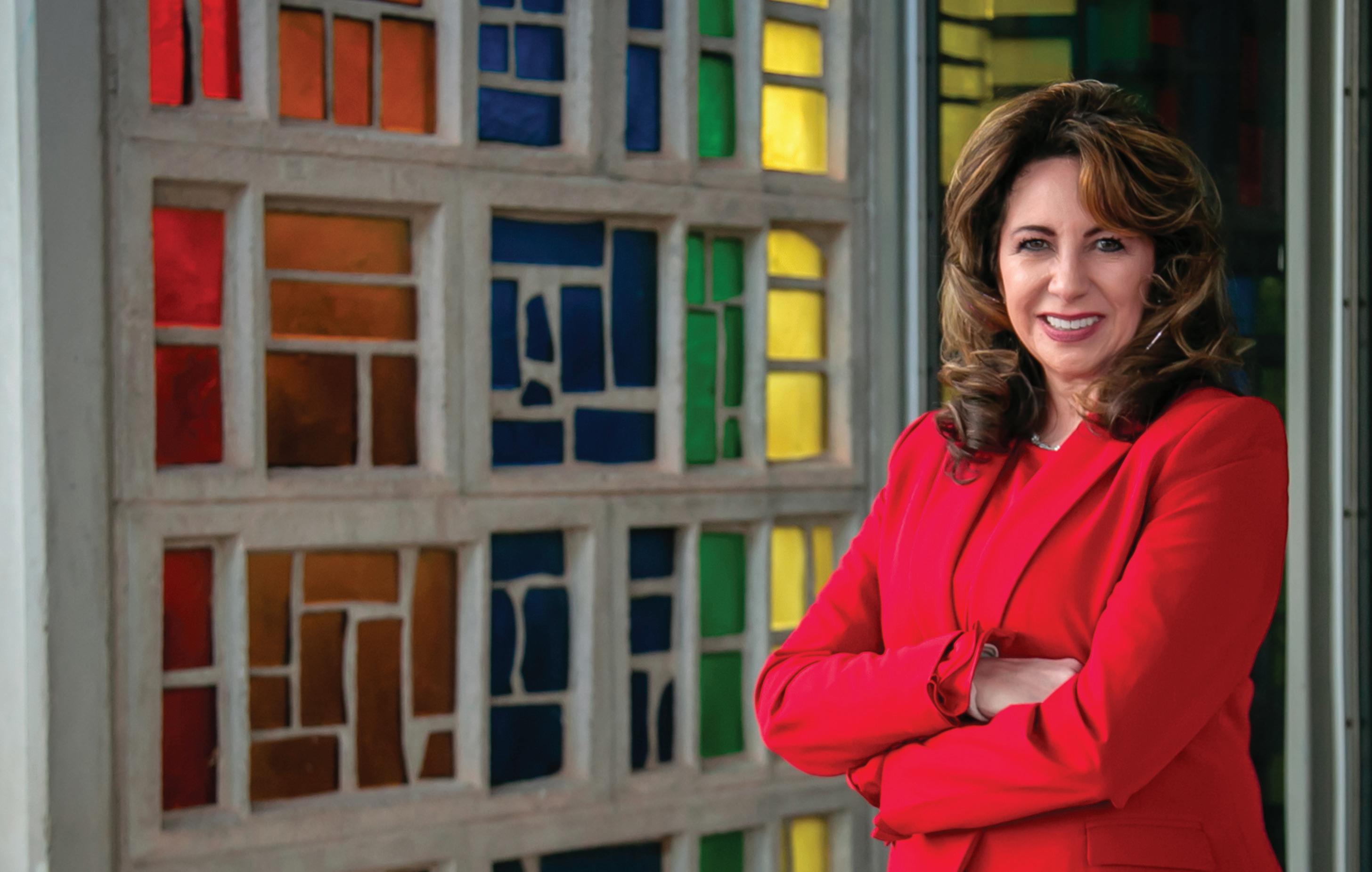
Aprilyn Chavez Geissler is the president of the UNM Alumni Association and an Anderson School of Management Hall of Fame inductee.
From that shift came her guiding mantra: “Let your struggle be your strength, not your identity.”
In 2015, Chavez Geissler was introduced to the owners of Gateway Insurance and Financial Services. They saw her potential and invited her to join. By then, she had already built her own practice as a financial professional and insurance agent.
“I learned every aspect of the industry I could,” she said, determined to always be prepared, “so when I was asked to step into new roles, I was ready.”
She eventually became the first executive vice president of a $30 million organization, a role in which she frames leadership as inspiration: helping others join the mission and engage in ways meaningful to them.
Today, her professional fulfillment comes in two forms: helping financial professionals build practices aligned with their goals and sitting one-on-one with clients to guide financial decisions.
Her philosophy of advising is rooted in lived experience. The past she once viewed as a liability has become one of her greatest assets. Too often, she believes, financial professionals speak at a high level, when most people simply need someone who can meet them where they are. For some clients, financial literacy begins with opening a checking account or understanding credit. Chavez Geissler meets them there.
Rising to Give Back
She has received numerous recognitions throughout her
career, including being named the 2020 Top Woman to Watch by InvestmentNewsNet and a 2019 NAIFA National Diversity Champion. Yet the moment she fully grasped how far she had come was when she learned she would be inducted into the Anderson School of Management Hall of Fame in 2025.
The recognition was “pretty special,” she said, “because they were acknowledging me for the things that I do every day.” It forced her to pause. “Sometimes you just don’t realize what you’ve done or where you’ve come from.”
“you have to rise above it, because everything you need is already inside you.”
She was also named the “Phoenix of Albuquerque” by Insurance News. Initially hesitant to embrace the title, she later recognized it as an accurate reflection of her resilience. “When you are in the ashes and unsure how you will eat your next meal,” she said, “you have to rise above it, because everything you need is already inside you.”
Chavez Geissler has never forgotten the people who extended a hand when she needed it most. Advancing in her career, she committed herself to giving back. She chooses her commitments intentionally, serving in spaces that reflect both her values and her story. As treasurer of the Women in Financial Services Association, she
works to attract and advance women in a profession where representation remains limited, an effort that mirrors her own early experience in the industry.
Her ties to UNM, the institution that shaped her growth, remain just as strong. She now serves as president of the UNM Alumni Relations Board and leads the New Mexico Sports Hall of Fame.
Quoting Mohandas K. Gandhi, she often returns to a guiding principle: “The best way to find yourself is to lose yourself in the service of others.”
Executive leadership, volunteer commitments and motherhood do not exist in separate compartments of her life but overlap in ways that demand constant recalibration. Some days begin before sunrise and stretch long past sunset, and fatigue can be real. Still, she says, as long as there is purpose behind the work, she keeps going. For Chavez Geissler, work and life are intertwined, “all in conjunction, all together.”
If Chavez Geissler could speak to the young woman studying for finals in a parked car, she would not promise ease but purpose. She would tell her: “You’ll change lives in ways you don’t even imagine. Even when it’s not comfortable or easy, you will move mountains.”
Even in heels, she did.
Securities offered through Registered Representatives of Cambridge Investment Research, Inc. a Broker/Dealer, Member FINRA/ SIPC. Advisory services through Cambridge Investment Research Advisors, Inc., a Registered Investment Advisor.
Gateway Financial Advisors, LLC., DBA: Quality Life Insurance Agency, DBA: Gateway Insurance and Financial Services, LLC., Cambridge is partial owner of Gateway Financial Advisors, LLC.
A WORLD OF CLOSE TO HOME
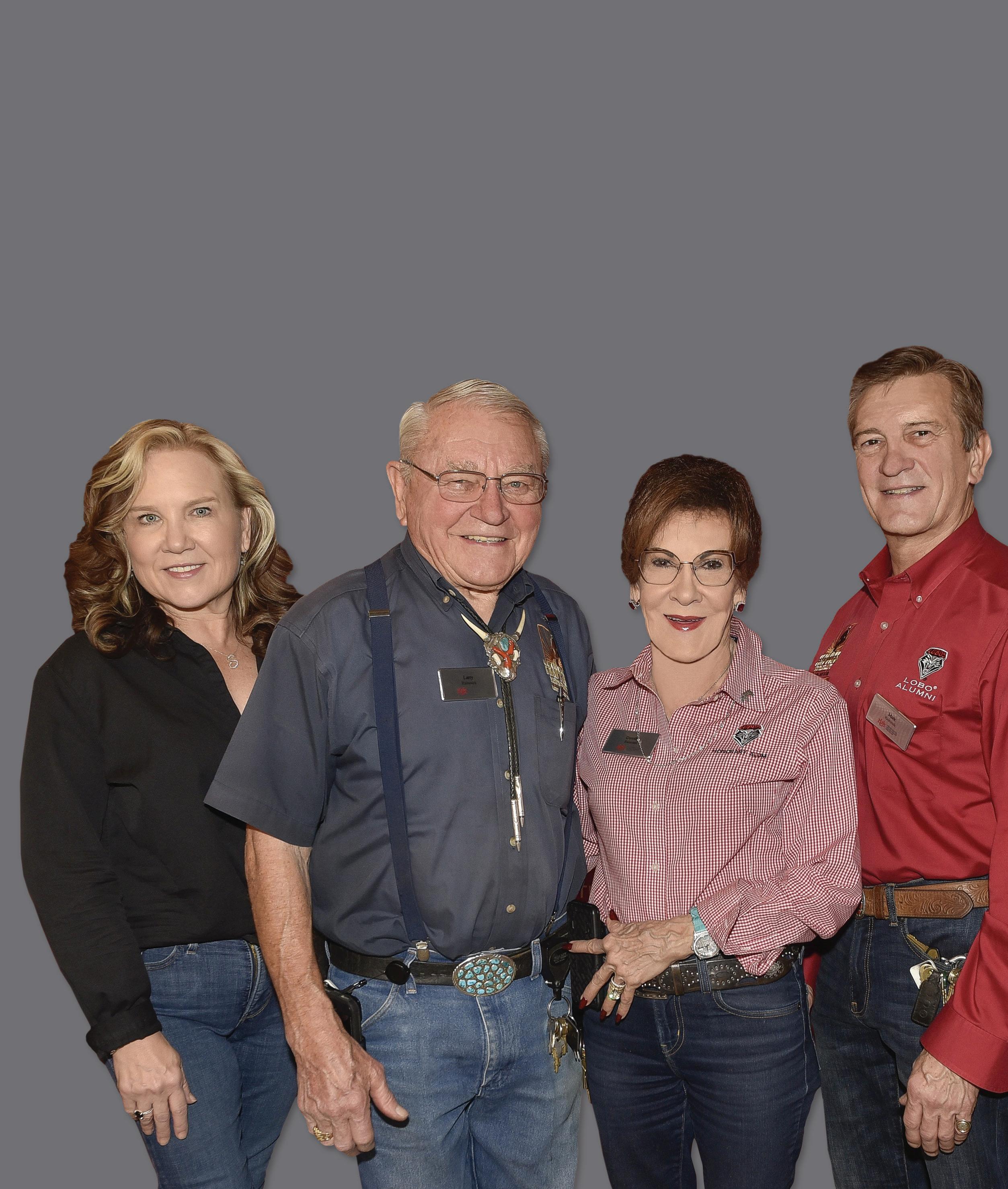
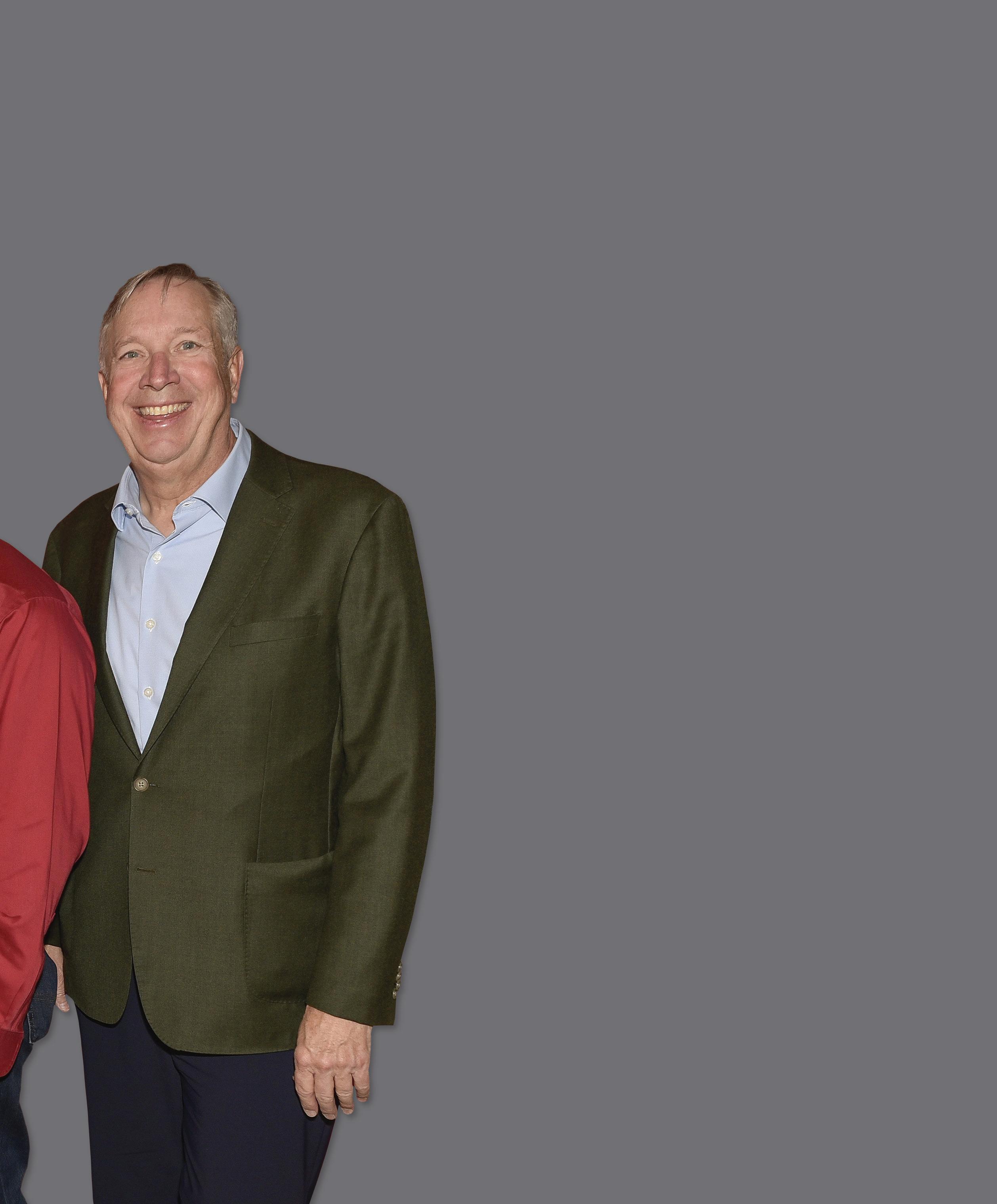
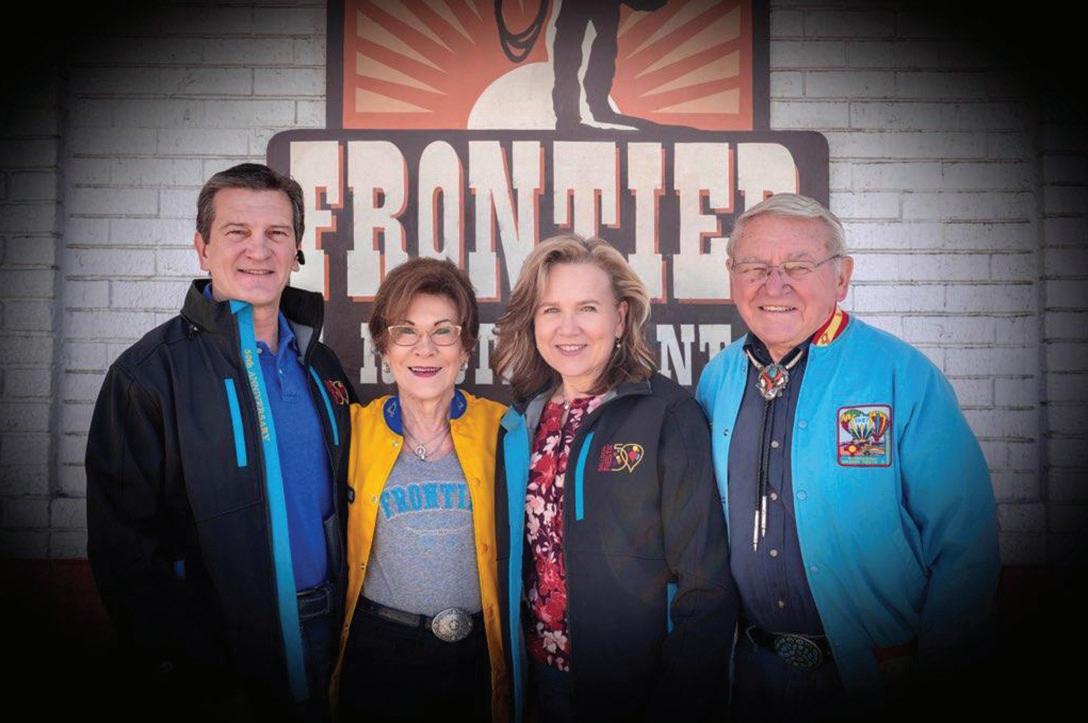
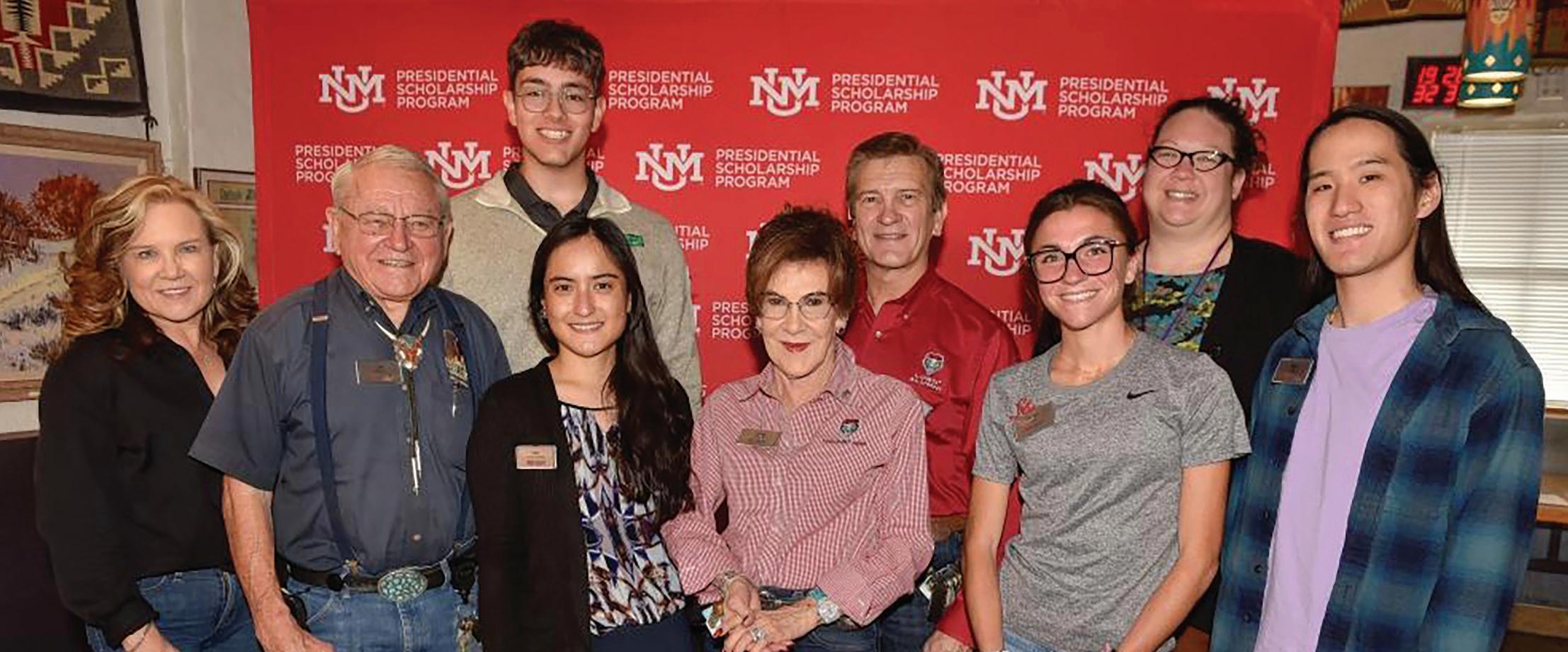
The Rainosek family with Jeff Todd, president and CEO of the UNM Foundation.
OPPORTUNITY
Presidential Scholarship Program marks 50 years of supporting exceptional New Mexico students
By Michelle G. McRuiz
For half a century, UNM’s Presidential Scholarship Program (PSP) has invested in identifying, supporting, and retaining New Mexico talent by offering renewable scholarships to extraordinary high school students from every county in the state.
The program has grown into one of the university’s most defining investments in student success and talent development. That investment is made possible in large part by generous donors who make annual gifts and create endowments to support PSP. Each full Sponsor can be matched with a Presidential Scholar and has multiple opportunities to meet and connect with them.
This unique structure makes the Presidential Scholarship something larger than a source of financial aid. While reducing financial stress allows students to focus fully on their studies, the program functions
as an intentional partnership among the university, donors, and Scholars themselves. Together, that partnership creates a powerful model of shared investment in New Mexico’s future. Sustained support gives students the freedom to explore academic and professional paths they might otherwise never consider—and helps ensure that exceptional talent can grow, contribute, and lead close to home.
A Natural Choice
A thread of continuity runs through the PSP: Many PSP donors once were Presidential Scholars themselves. Mark Rainosek, BS ’87, MD ’92, is one such donor. For him, giving to UNM has been a family tradition. His parents, Dorothy and Larry Rainosek, are longtime donors and the owners of two perennially popular Albuquerque eateries, Frontier Restaurant and
Golden Pride BBQ, Chicken, & Ribs. They inspired Mark, an anesthesiologist who practices in Albuquerque and Anchorage, Alaska, to help New Mexico students succeed.
“Education has always been important in my family,” Mark says. “And UNM has a solid, respectable reputation.”
When Mark finished his residency at the UNM School of Medicine, he decided to give back to UNM as a PSP Sponsor.
“It was a natural choice because I was a Presidential Scholar myself,” he says. “I wanted to invest in my community to help those people who can’t get through school on their own. And it helps keep New Mexico’s brightest young people in the state.”
Over time, PSP has grown in both reach and ambition, supporting generations of high-achieving students while building a powerful community of alumni and donors committed to New Mexico’s future.
More Than Medicine
Mark has supported many Presidential Scholars over the years, including through the newly created PSP Graduate Award. One of his current undergraduate Scholars, Ankit Jaiswal, is a senior in the BA/MD program, a rigorous eight-year curriculum that puts students on a pathway from undergraduate education to the UNM School of Medicine.
“Education has always been important in my family, and UNM has a solid, respectable reputation.”
“The program’s mission is to address the healthcare shortage in rural and underserved areas of New Mexico, and to find students who are dedicated to helping New Mexicans,” Ankit says.
Ankit always had been interested in medicine, particularly surgery, but his undergraduate curriculum in health, medicine, and human values opened his eyes to community and global health.
“It looks at health through a broader lens,” he says. “It’s about social determinants of health, lifestyle factors, health policy—all the things that make up a person’s health. My BA program has motivated me to explore other ways to impact health in addition to treating a person.”
Ankit graduates with his BA in Spring 2026 and will enter medical school in July. He’s already racked up some impressive credentials at UNM. In addition to maintaining a 4.0 GPA, he won the Anderson School of Business Tech Navigator challenge two years in a row with his designs
The Rainosek family have been longtime supporters of the Presidential Scholarship program and UNM.
for a helmet that monitors concussions in real time and an injectable, expandable foam that can be used for emergency hemorrhage control.
In 2024, Ankit spent six months in South America, shadowing and observing physicians as they worked to implement telemedicine programs in rural areas. He also accompanied nursing staff on visits to low-income households and spoke about telemedicine in local media.
“That work was an amazing experience,” says Ankit. “In those parts of the world, people don’t know much about telemedicine. I got to be part of starting a rural telemedicine program and convincing people to adopt it.”
Motivated to Give Back
Another highlight of Ankit’s undergraduate program was meeting his PSP donor, Dr. Mark Rainosek.
“It was awesome to find out that Dr. Rainosek was my donor because he’s an anesthesiologist,” he says. “He works in Alaska a lot, helping rural communities, so our interests are aligned. He has been a great role model for me by investing in UNM students and being interested in hearing our stories. That speaks a lot about his character.”
Being a Presidential Scholar not only eliminated Ankit’s undergraduate financial burden; it opened new academic and professional vistas.
“I was not forced to make decisions based on income or job stability; I could focus on growing through research and community work. My Presidential
Scholarship allowed me to take risks and explore things like business and global travel that otherwise I would not have done.”
As Ankit looks ahead to medical school, he feels excited and self-assured. UNM’s supportive environment has helped him connect with mentors and step into leadership roles. That confidence has sparked a desire in Ankit to pay it forward—through medicine and philanthropy.
“I’m proud of being a Presidential Scholar,” Ankit says. “Knowing that Dr. Rainosek believed in me motivates me to continue building. I want to become a PSP donor one day and help motivate future generations.”
PSP Graduate Award Now in Second Year
The Presidential Scholarship Program began offering graduate scholarships two years ago. Their first Graduate Award Scholar, Maya Dawson, BA ’21, MS ’25, is pursuing a Ph.D. in biomedical engineering at UNM.
“Presidential Scholarship donors made it possible for me to attend a university close to my family and make invaluable connections with members of the New Mexico community,” says Maya. “I’m grateful to continue living and learning in the place I call home. And I’m very excited to continue with my Ph.D. with Dr. Olivia Lanier’s Nanomedicine Toward Health Equity Lab.”
The Rainosek family with a group of Presidential Scholarship Program recipients at the Frontier Restaurant.
KEEPING TRADITIONS ALIVE: MAYORDOMO EARNS DEGREE, INSPIRES RURAL STUDENTS
By Manuel Valdez
Igot tired of being a statistic of those without a degree,” says Vicente Fernandez.
So, after more than four decades of military service and a lifetime rooted in the rural communities of northern New Mexico, Fernandez decided it was finally time to pursue something he had long set aside: a college education.
“I always wanted to obtain a degree so I could further enrich my life as well as my family and community,” said Fernandez. “Society views those without a degree as a person of lesser intellect, which is not true.”
For years, raising a family young, balancing work, and lacking resources meant college remained out of reach. Only after retiring from the military with more than 41 years of service did he finally have the time to begin.
“I started at UNM at a later stage in my life,” said Fernandez. “My family was in a good place, and I had the time to pursue something I had always wanted.”
Fernandez enrolled at UNM Taos, spending two years there before transitioning to main campus in Albuquerque. He earned his Liberal
Arts degree, completing a mix of in-person and online courses that allowed him to stay connected to the nonprofit work that remains central to his life.
“I chose to take some courses at the university and some online. I tried to schedule them as close to each other as possible so I would not have the long commute,” said Fernandez. “Although I enjoyed being in the classroom better, the online courses worked well as my schedule with nonprofit organizations was taking up a lot of my time.”
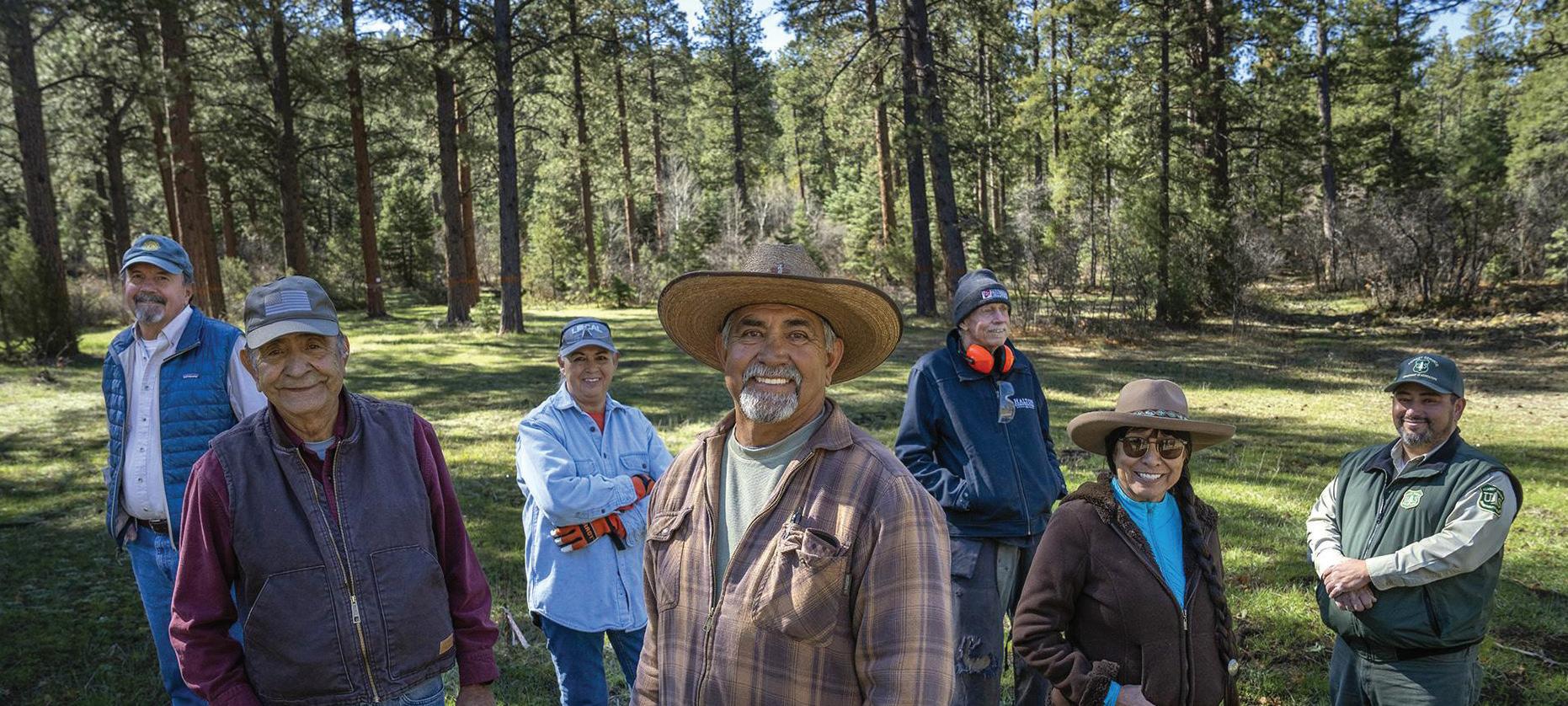
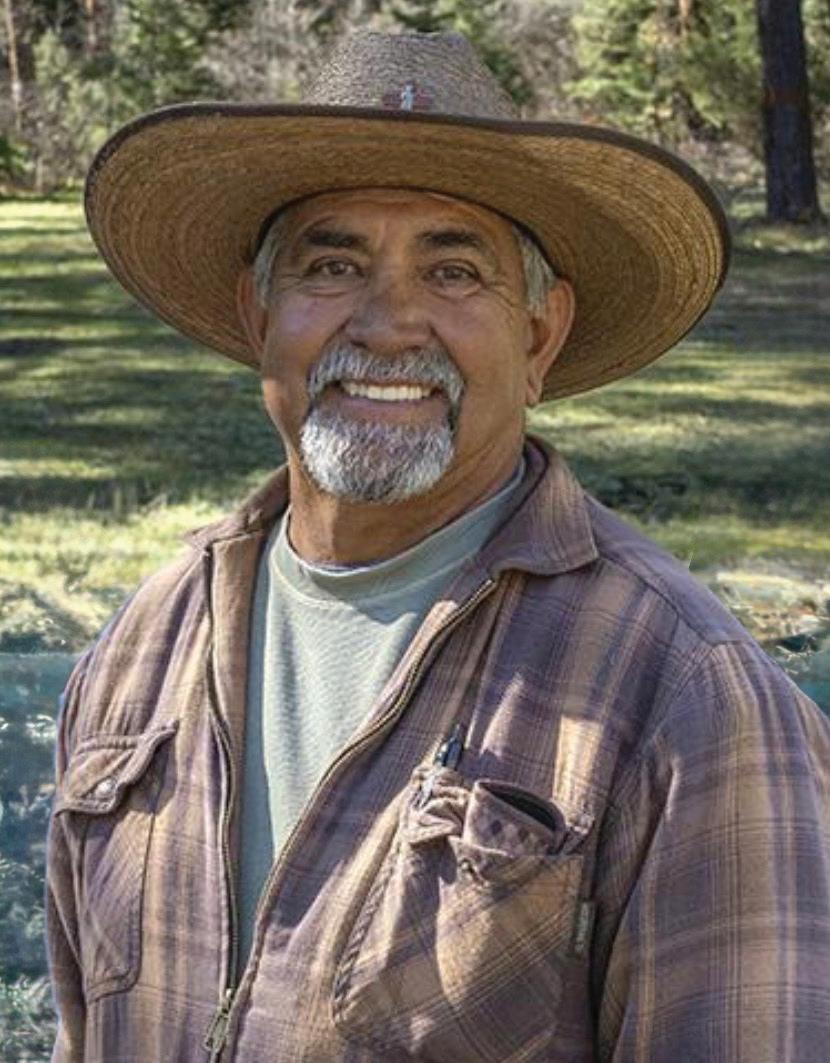
Vicente Fernandez, center, is the mayordomo of the Acequia Madre del Sur de Cañon del Don Fernando and helps maintain one of the region’s oldest communal traditions.
Throughout his studies, one motivation remained constant: giving back to his community.
“I have always believed that community is a very important part of our lives,” said Fernandez. “Being able to give back to the community is very rewarding and gratifying. A lot of people get educated but never give back to the community that raised them. That was my big motivation.”
His coursework also strengthened a passion he has carried since childhood, protecting the land and water systems that sustain northern New Mexico.
“I have always had a deep reverence for both water management and the environment. They go hand in hand,” said Fernandez. “My studies there at UNM and the people I met opened a world of information where I could research and talk to experts in these areas.”
As mayordomo of the Acequia Madre del Sur de Cañon del Don Fernando, Fernandez helps maintain one of the region’s oldest communal traditions.
“Acequias are the glue that keep the community together,” said Fernandez. “It is so rewarding knowing that you are keeping a tradition that our culture has depended on for hundreds of years alive and well and knowing that what you are doing will last well after you are gone.”
His leadership also extends to the Rio Don Fernando watershed project, where he recently welcomed his younger brother to the effort “To keep the project going, I need
to train someone to take over after I am gone,” said Fernandez. “We are continually recruiting people
that they will return to the place that nurtured them and give back to the community to keep our culture and traditions alive.”
Fernandez also encourages anyone from locals or newcomers to engage with the community and its traditions.
“Come to our acequia or community meetings,” said Fernandez. “Speak with locals. They will tell you what needs to be done.”
for our project. It has been hard to get people involved, but through community meetings and word of mouth, we will achieve our goal of saving our watershed and our forests for future generations.”
Ensuring the stability of tradition means inspiring young people to step into leadership roles.
“We involve younger students by offering them a chance to work with one of our participants and through community meetings,” said Fernandez. “Working with other nonprofit organizations is also a way of finding young people that are interested.”
His hope is that future generations not only inherit the landscape he has worked to protect, but the values that shaped it.
“I hope that the younger generation gets more involved,” said Fernandez. “Most young people from rural areas move out due to lack of opportunity. But my hope is
As both a UNM alumnus and a community leader, Fernandez hopes people remember the shared effort behind keeping northern New Mexico’s traditions thriving.
“My hope is that they remember why our acequias, our forest, our community, our traditions, and our culture are still thriving,” said Fernandez. “Not only because of my efforts, but the efforts of those that came before us—the blood, sweat, and tears that go into keeping a community alive.”
Education, he said, empowered him to become a stronger advocate and leader.
“Having a good education where you can make things happen and not have to wait for others, that is what my time at UNM taught me.”
And for students in rural communities who may feel the challenges, Fernandez offers a simple message.
“I would tell them not to give up,” said Fernandez. “It takes discipline, hard work, and time. But the results you get at the end will forever be with you. They will make your life better.”
After four decades of military service, Vicente Fernandez obtained his degree at UNM.
By Coline Bernal
FROM THE ROOF TO THE FIELD
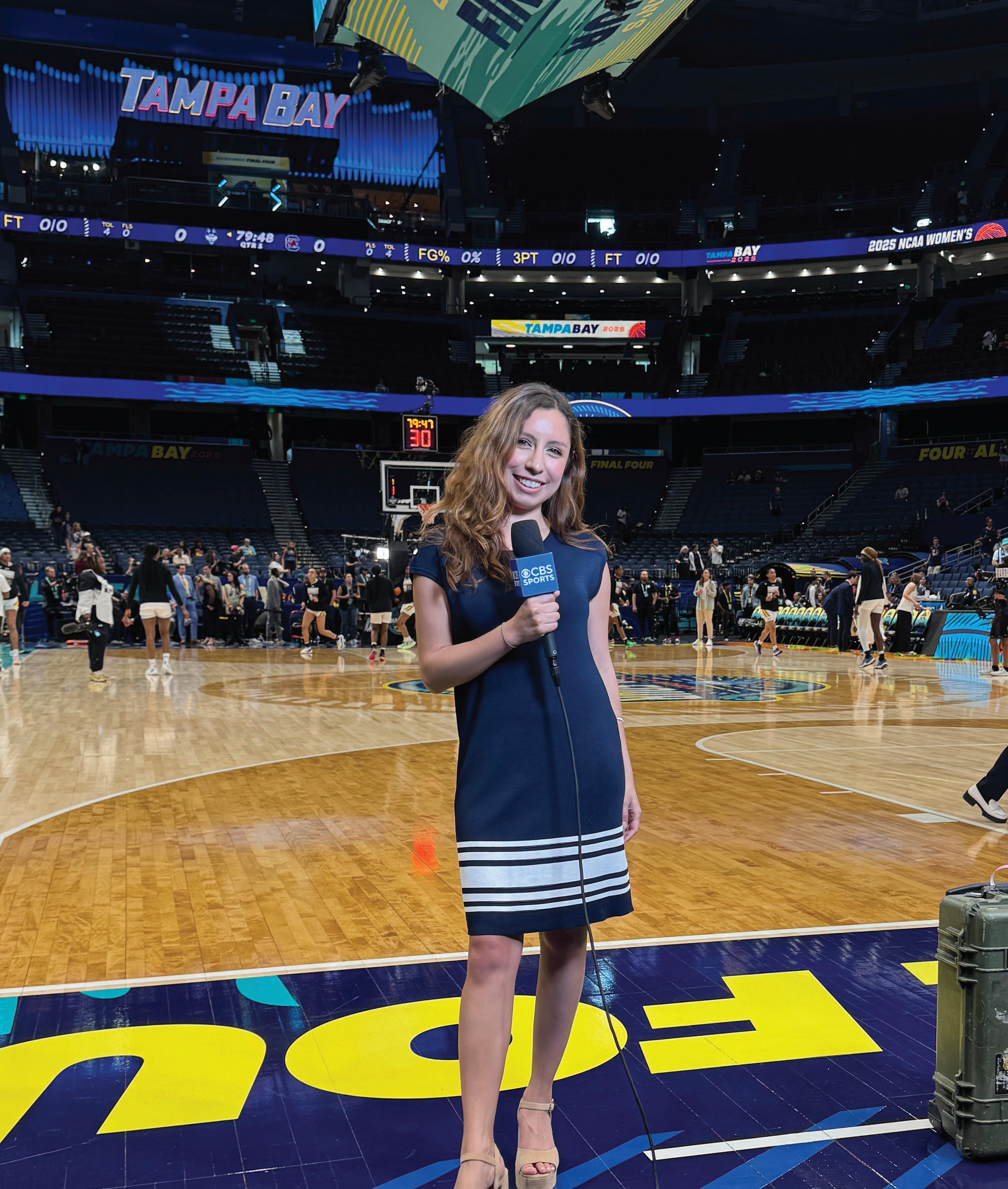
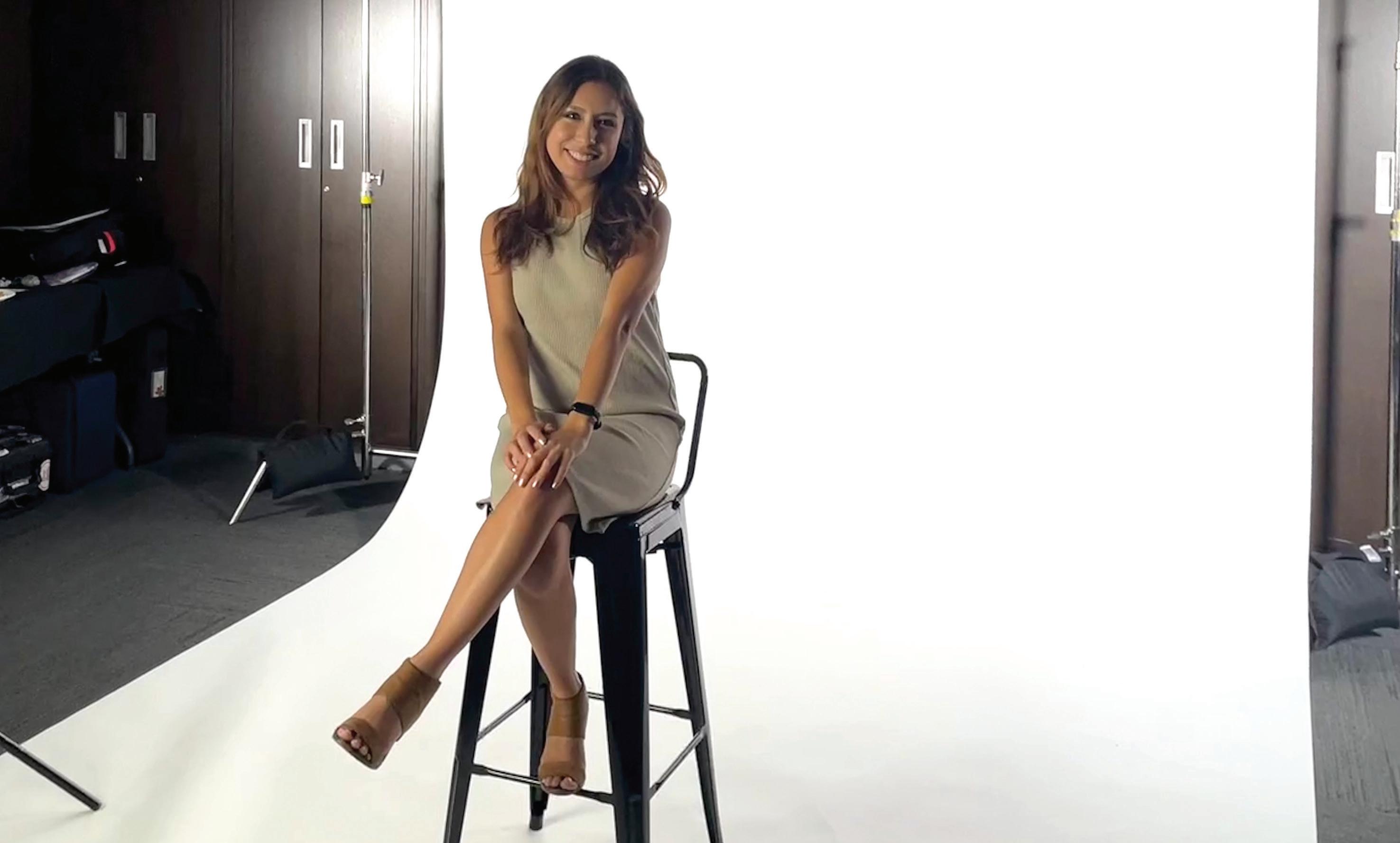
Isabel Gonzalez covering the 2025 NCAA Women’s Basketball Final Four in Tampa Bay, Fla.
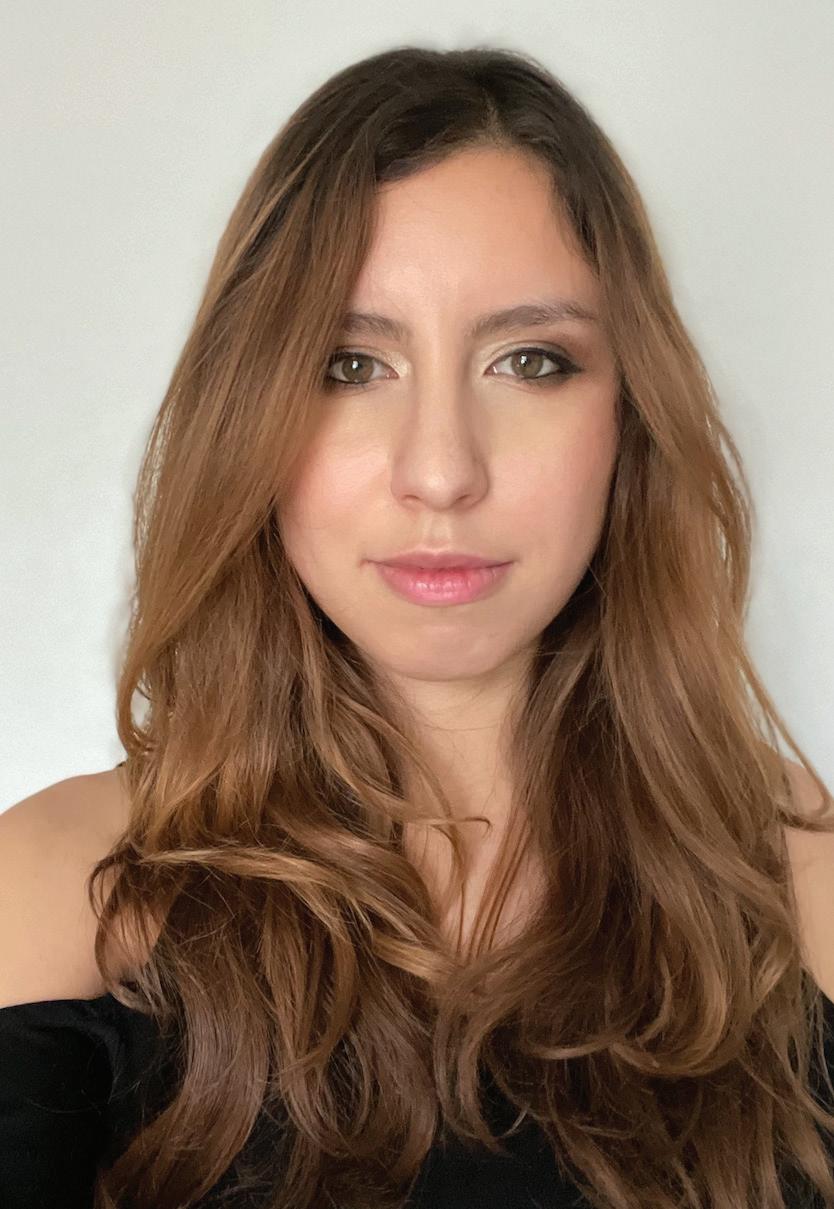
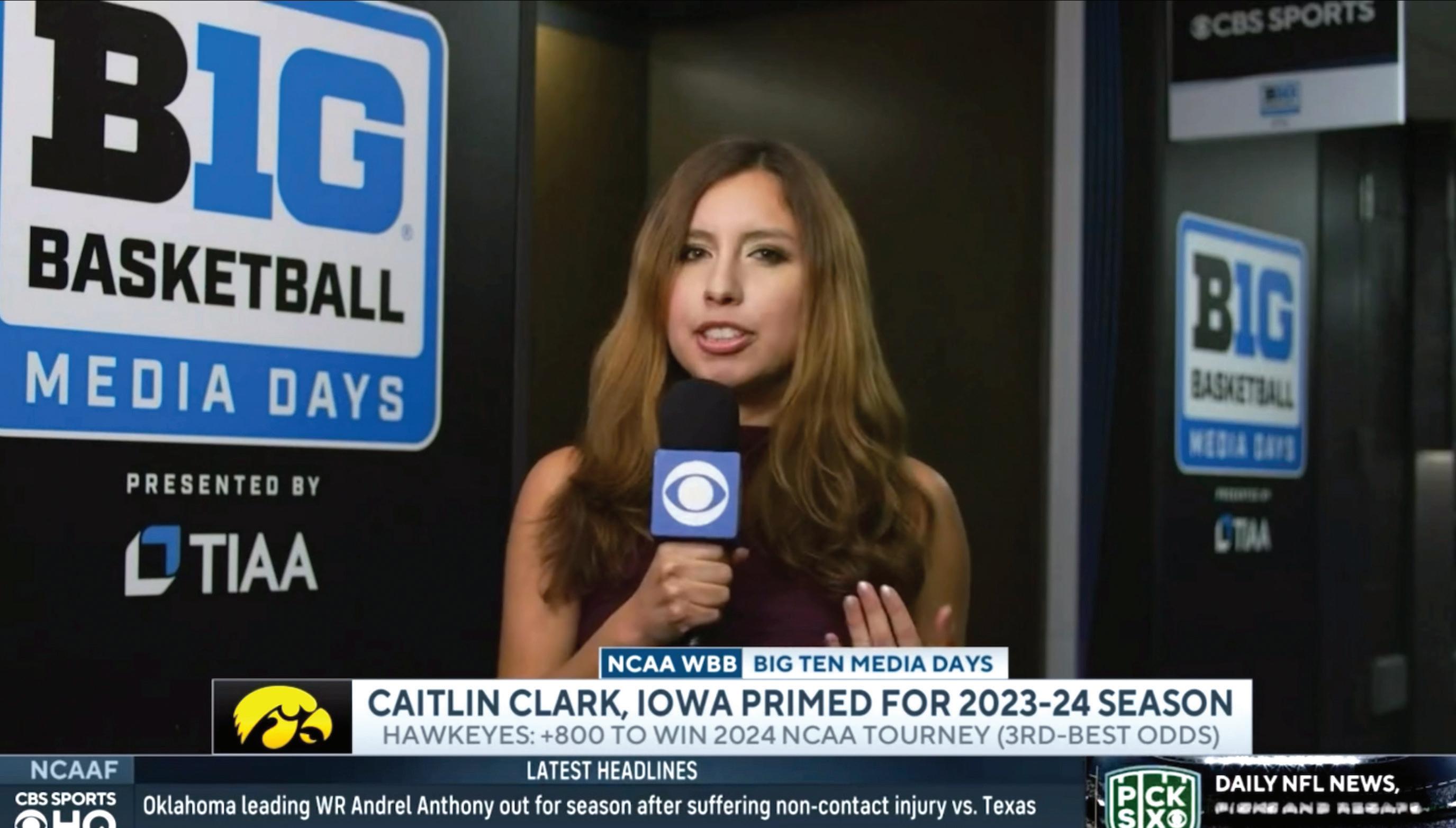
On her 27th birthday, Isabel Gonzalez received a job offer from CBS Sports while standing at the front desk of her godparents’ Styrofoam business. At the time, she was helping them run the family operation while juggling life as an NBA and college basketball freelance writer and quietly wondering what her future might look like.
When she opened the email, she broke down in tears. A minute later, the phone rang. She wiped her face, answered the call and went back to work, knowing everything had changed.
From the outside, Gonzalez’s career may look like a clean ascent leading to her current role as a basketball writer at CBS Sports. But her path was built through years of learning, uncertainty and a deeply rooted philosophy that followed her at every stage: say yes, even when you don’t feel ready. Especially when you don’t feel ready.
“I was just taking every opportunity I could to grow,” Gonzalez said. “I said yes to everything.”
Gonzalez was born in Mexico, surrounded by a family that loved soccer. Her dad, brother and cousins celebrated it passionately, but she didn’t quite share their enthusiasm. Still, she followed them to practices and games and slowly grew attached to the ritual. “You start loving what you’re watching all the time,” she said. After a brief stop in South Carolina, her family settled in New Mexico
when she was 13. It’s where she would spend some of her most formative years.
At the University of New Mexico, she intended to pursue advertising or film. A high school adviser had encouraged her to consider UNM’s film program, and she imagined herself working on music videos or commercials. Journalism entered her life because of a misunderstanding. While registering for classes, she
asked an upperclassman about two communication tracks.
“She told me, ‘One, you kind of study things. The other, you do things,’” Gonzalez said. The answer seemed obvious. “So of course I was like, I want to do things!”
Only later did she realize she had signed up for journalism instead of advertising.
Her first real experience in sports media came through a freshman internship with the Mountain West
Network at Lobo TV. She learned to operate a camera covering soccer. For men’s games, she worked the main angle from the stadium roof, alone. From there, the players looked like “tiny little people moving,” she said, and she didn’t get to talk to anyone. It left her asking a simple question: “How do I get down there?”
Saying Yes
The opportunity arrived unexpectedly. As a sophomore, she overheard classmates discussing open positions at the Daily Lobo sports desk. She got hired assuming she would help with social media or video. Instead, she started writing.
Journalism wasn’t her dream job, but she was already on the path, so she decided to make the most of it. At first, the motivation to write was practical: getting published meant extra credit, and posting on social media came with a little extra pay. She approached the job strategically, but along the way found herself drawn to the access and interaction more than she expected. “I still didn’t consider myself a writer,” she said. “But I loved being in the environment, talking to players, coaches, meeting the fans.”
By her senior year, she wanted to cover basketball more consistently. UNM men’s basketball was the biggest stage, and she wanted to test herself there. That was when it clicked. “I was getting pretty good at this,” she said.
After graduating with a bachelor’s degree in digital communication and media/multimedia, Gonzalez
University of New Mexico alumna Isabel Gonzalez.
returned to her original plan and worked in film for a few months. A mentor brought her in as an assistant to a director and producer. She enjoyed the work, but not the instability. “You work six months,” she said, “and then you have to figure out what you’re going to do next.”
Around the same time, the UNM soccer coach asked whether she wanted to produce and host the official men’s soccer show. Gonzalez had never done anything like it before, but true to form, she said yes.
That experience clarified something. For the first time, she allowed herself to imagine a future in sports reporting.
After that season, she met Kurt Roth, a UNM alum and owner of The Lair, an insider site focused on local athletics. The site had started as a forum and grown into a communitydriven website, and Roth didn’t want it to disappear. Gonzalez was fresh out of college. She remembers thinking she did not know how to run a website and barely considered herself a journalist. Still, she agreed.
The Lair became one of the most demanding learning periods of her career. “That’s probably where I learned the most,” she said, “because you just had to do it.” She wrote stories, maintained the website, learned to answer IT questions, worked with moderators and navigated the challenges without the structure of a traditional newsroom. There were no editors. “It was just me,” she said.
What mattered most was the fan base and the responsibility she
felt to serve it well. The people who followed The Lair were deeply passionate about local athletics, and she wanted to provide them with high-quality articles and a modern community space.
From there, she kept expanding her coverage. She began taking on more Mountain West teams. She got opportunities through SB Nation’s Mid-Major Madness and covered Gonzaga and other men’s basketball programs around the nation for a full season. Much of that year overlapped with COVID-19, when access shifted to
“I was just taking every opportunity I could to grow. I said yes to everything.”
same time, they have everything to do with it.
For Gonzalez, the game itself is only part of the story. Fans already have access to everything: they can watch the game, look up stats, and stream press conferences. What they don’t see is what happens behind the scenes. Now off the roof, Gonzalez watches from closer range, paying attention to the athletes, the bench, and everything unfolding around the action. Sometimes, she said, people talk about athletes as if they are just pieces of a game. But they are people, and their performance is shaped by their mental state and their relationships with teammates.
Zoom, and the remote format made it possible to cover a program she hadn’t been physically close to before. She also freelanced NBA work.
More Than the Game
Her voice as a writer developed alongside those opportunities. She traces it back to early English classes and reading children’s books like Junie B. Jones, which taught her to write in a simple and descriptive way. She likes stories that feel human, textured, and colorful. If a coach loves to cook for his players, she wants to write about how he grills, how intentional he is with the ingredients he prepares. Those are the moments that draw her in. They may have nothing to do with basketball, she said, but at the
She studies who is cheering on the bench, how the handshake line looks, and who leans in during timeouts. If a team is thriving, she said, it is not just about the stats. Something is happening inside the locker room. Building those insights requires trust and genuine curiosity.
“If you ask someone what show they are watching, you have to remember,” she said. “The next time you see them, you follow up and ask how the show is going.” That kind of attention, she said, is what builds real relationships.
A Bigger Stage
All of it eventually led to a direct message from CBS Sports on X—formerly known as Twitter— that she nearly ignored. At first, she assumed it was spam; there was no way it could be real.
Following a demanding interview process, she was offered a position with the network on her birthday.
Not just any role, but the opportunity to become CBS Sports’ first writer dedicated to women’s basketball. Coming from men’s basketball coverage, she understood the responsibility that came with the position and knew she would need to put in the work to build the same depth of knowledge in the women’s field.
Her first day fell in the middle of March Madness, the busiest stretch of the season. Her manager asked her to submit a list of her top 10 women’s players by the end of the day. She remembers starting to sweat. How was she supposed to do it in a day when she was new to women’s basketball? Later, he told her the assignment had been intentional.
He wanted her to jump right in, confident she had the skills to figure it out. More than anything, he wanted her to see that herself.
Looking back, Gonzalez speaks fondly of the people who believed in her before she believed in herself. A high school English teacher insisted she belonged in honors English, even when she still saw English as her second language. A broadcasting professor at UNM kept putting her in front of the camera because he knew she could do it. She remembered finding it “so cool that someone believed in me before I believed in myself.”
When she began working in journalism, that trust followed her: through sideline reporting opportunities, through Kurt Roth
at The Lair, through editors who gave her room to grow. Over time, she stopped seeing those moments as coincidences. “When something is right for you,” she said, “it will find you.”
That sense of belonging extends beyond the newsroom. Gonzalez is proud of being born in Mexico, of speaking Spanish and of carving out space in an industry where she sees few Mexican writers. Her move to the United States was made possible by her parents’ sacrifice, a gift she carries with deep gratitude. “They are a big part of my story,” she said. “I couldn’t have done it without them.” The transition left her unsure where she fit at times, but over the years, New Mexico became home
Isabel Gonzalez covering the women’s basketball Big Ten Media Days prior to the 2023-24 season.
and, eventually, something deeper. Sometimes, she comes across comments that read:
“Isabel came from New Mexico; she’s one of ours!” That support, she said, means more than most people realize.
Now several seasons into her role, Gonzalez remains energized by where women’s basketball is headed. The surge in attention, amplified by players such as Caitlin Clark and Paige Bueckers, has strengthened her ambition to continue expanding women’s basketball coverage and to
show that these stories matter just as much as stories in men’s sports.
March Madness remains her favorite time of year. The travel, the unpredictability, and the intensity remind her why she chose this path in the first place. Still, her curiosity stretches beyond basketball. A former figure skater, she watches the
“When all the fans come together, and something big is happening,” she said. “That’s truly what I love.”
Winter Olympics with a trained eye, ready to field any technical question in the newsroom. She’s also looking ahead to the 2026 World Cup and the 2028 Summer Olympics, ready for whatever
assignment comes her way.
Those global events remind her why she fell in love with sports in the first place. “When all the fans come together, and something big is happening,” she said. “That’s truly what I love.”
Those moments are why Gonzalez has never chased the final score. She chases what happens around it: the energy on the bench, the conversations on the sideline, the crowd rising together.
Years ago, she stood alone on a stadium roof, watching players who looked small from that distance and wondering how to get down to the field. Now she works inside that space, telling the stories behind the result and carrying them back to the fans who give it meaning.
Born in Mexico, Isabel Gonzalez and her family moved to the United States and settled in New Mexico when she was 13 years old.
On March 4, Ryan Berryman was appointed Vice President and Director of Athletics. A three-time UNM graduate and New Mexico native, Berryman becomes one of the youngest athletics directors in Division I, and the first Lobo alumnus to lead the department in the modern era.
By Steve Carr
LOBO ALLIANCE LAUNCHES NEW ERA FOR UNM ATHLETICS
Collegiate athletics has undergone significant changes over the past several years, and recently, to stay competitive and uphold its mission as a leading public institution, The University of New Mexico launched the Lobo Alliance, a coordinated, communitydriven approach to supporting
student-athletes through Name, Image, and Likeness (NIL) with a new revenue-sharing model. The initiative follows last summer’s House v. NCAA settlement, which reshaped how universities can support and compensate student athletes. Under the agreement, Division I schools that
opt in will help fund $2.8 billion in backpay for former athletes through NCAA reserves and reductions in annual NCAA distributions over the next decade. As a result, UNM will receive less NCAA funding but can now directly compensate student-athletes.
While participation is optional, schools may share up to an estimated $20.5 million annually, about 22% of average Power Five athletics revenue from media rights, ticket sales, licensing, and sponsorships. Traditionally, studentathlete support came through scholarships, stipends, and more recently, third-party NIL collectives. The new model adds a direct institutional component, updates roster limits, and opens the door for expanded scholarship opportunities.
For a couple of years, NIL efforts at UNM were led externally through the 505 Sports Venture Foundation (505SVF), ffounded by Kurt Roth, a UNM graduate and current UNM Alumni Association Board Member. The House settlement changed that landscape, allowing athletics departments nationwide to directly facilitate NIL opportunities and revenue-sharing programs.
“When the rules changed to allow institutions to directly compensate student-athletes, it created a major opportunity for us,” said UNM Vice President and Director of Athletics Ryan Berryman. “Recently, Kurt Roth led those efforts independently because schools weren’t permitted to do so, and we saw the impact from Kurt’s efforts when our teams won Mountain West Basketball Championships in 2024 and 2025.
“With the new rules in place, we launched the Lobo Alliance to bring those efforts under the university umbrella. Now, supporters can make tax-deductible gifts through the Lobo Club to directly support our
NIL initiatives and help us remain competitive moving forward.”
Aligning
philanthropy, sponsorship, and athletics
The Lobo Alliance unifies philanthropy, corporate sponsorship, NIL activities, and the long-standing Lobo Club into one coordinated strategy. The model opens new opportunities for businesses to partner with UNM and feature student-athletes in marketing and community engagements, while also encouraging broadbased community support in what
challenges, particularly for nonPower Four schools. Lower NCAA distributions, combined with revenue-sharing expectations, require athletics departments to reassess their budgets. UNM leaders say the university is entering this era from a position of relative strength, but discipline and strong revenue generation will be essential.
“It’s something every athletic department in the country is grappling with right now. If you follow college athletics, you see programs carrying significant debt as they try to stay competitive,”
Berryman noted. “We’ve built a solid financial foundation, but we must continue to focus on fundraising, corporate sponsorships, and strong competitive performance. Success in our revenue producing sports, football and basketball, creates a lift across all 450 student-athletes and every program in the department.”
leadership describes as a “Green Bay Packers model.”
“There’s a philanthropic side, where people give because they believe in the student athlete experience,” Berryman said. “But there’s also a true business component. Companies want student-athletes representing their brand and in Lobo uniforms, and we can now facilitate that.”
These agreements generate revenue that directly supports student-athletes and strengthens the athletics department's sustainability.
While the model creates new opportunities, it also brings financial
Media rights remain the largest revenue engine in college sports, and conference realignment continues to underscore the importance of visibility in football and basketball.
“We’ve seen this more than ever in the past few years, especially with conference realignment. Much of that movement is driven by the value institutions and conferences bring to television partners,” said Berryman. “When media contracts expire, schools reassess their position because there’s so much money on the line tied to multimedia rights. Those deals are largely driven by football and basketball, which generate the most visibility and viewership.”
Ryan Berryman, Vice President and Diector of Athletics.
UNM’s NIL efforts now operate fully within the university ecosystem, with the Lobo Club Board of Directors overseeing fund movement under established donor and compliance protocols. “There are a lot of eyes on this,” Berryman said, crediting both Roth and Deputy Athletic Director and Chief Revenue Officer Jalen Dominguez for the development of the Lobo Alliance and a smooth transition.
Beyond compensation: Education and life skills
The platform of being a Lobo continues to change lives, whether athletes remain at UNM, transfer elsewhere, or arrive from other programs seeking expanded opportunity. To that end, UNM is working with corporate partners, particularly in banking and finance, to provide early and ongoing financial education, helping studentathletes make informed decisions that impact their futures.
“What can’t get lost in all this change is the value of the experience we provide,” Berryman said. “College sports still change lives through education, competition, and holistic development. That mission hasn’t changed. We’re still focused on creating meaningful opportunities and life-changing experiences for the vast majority of our student-athletes.”
Success in the next several years will be measured in both competitive outcomes and community engagement.Athletics success brings national visibility that influences alumni pride, enrollment trends, and broader perceptions
of UNM. Research across higher education has shown that athletic momentum can create broader institutional value.
“This effort is about community,” Berryman said. “It’s not driven by one billionaire—it’s powered by many people giving what they can. If, five years from now, supporters feel they helped put New Mexico on the national stage, that’s success.”
One community partner who recently signed a naming rights agreement for The Pit is Nusenda Credit Union. The 10-year partnership will provide an average annual value of $1.74 million in support of UNM Athletics. As part of the agreement, University Arena—The Pit will carry the name The Pit—Powered by Nusenda, preserving the iconic identity of one of college basketball’s most storied venues while recognizing Nusenda’s longstanding investment in the University and the state.
“We are thrilled to enter into this historic partnership between two of New Mexico’s most identifiable brands—The University of New Mexico Lobos and Nusenda Credit
Union. In this era of collegiate athletics, sustained excellence requires collective investment,” said Berryman. “This agreement provides meaningful operating support for our programs while honoring the tradition and legacy of The Pit. I hope that our community will be inspired by what is possible through The Power of We.”
Supporting the Lobo Alliance
Supporters who want to strengthen UNM Athletics in this new era can make a tax-deductible gift to the Lobo Alliance through the Lobo Club. These contributions directly fund NIL initiatives, helping UNM recruit, retain, and develop student athletes. Looking ahead, Berryman hopes the Lobo Alliance will be remembered as a turning point that elevated both athletics and the university’s national profile. As he notes, “The more people who see your brand, the more weight it carries.”
The Lobo Alliance is more than a funding model—it is a shared commitment to elevating New Mexico.
UNM cross country and track and field standouts Pamela Kosgei (left), Samuel Habtom (right) and Vice President and Director of Athletics Ryan Berryman.
LOBO EXCELLENCE
2026 UNM Native American Alumni Awards Ceremony (l. to r.): Aprilyn Chavez Geissler (BBA ’96, Anderson School of Management), UNM Alumni Association president; Lorilei Chavez (BA ’18, University College), Rising Star Alumni Award recipient; Dr. Greg Cajete (MA ’82, Education), Distinguished Alumni Award recipient; Richelle Montoya (BUS ’11, University College), Outstanding Alumni Award recipient; and Rebekah HorseChief (BUS ’10, University College), UNM Native American Alumni Chapter past president.
2025 COEHS Alumni Awards (l. to r.): Ann Darling, COEHS Alumni Chapter former chair (BAED ’79, & MA ’83, Graduate Programs); Deborah Good, COEHS Alumni Chapter chair (MA ’83, Graduate Programs & Ph.D. ’96, Graduate Programs); Debra Harris, Alumni Award recipient (Ph.D. ’98, Graduate Programs); Katherine Winograd, Alumni Award recipient (EDD ’07, Graduate Programs); Rene Matison (BS ’69, Education), UNM Alumni Association board member—Accepted Posthumous Alumni Award on behalf of Dr. Harold Bailey (BS ’69, Education & MA ’71, Education); Tony Sandoval (BS ’68 Education, MS ’74 Education), Community Award recipient; Aprilyn Chavez Geissler (BBA ’96, Anderson School of Management), UNM Alumni Association president; and Jessica Chavez (BSED ’-04 Education & MA ’05, Graduate Programs), COEHS Alumni Chapter co-chair.
2025 Alumni Scholarships (l. to r.): Antonio Humphreys (BBA ’96, Anderson School of Management), UNM Alumni Association board member; Kandence Kyle, UNM Alumni Georgia Regional Chapter Scholarship recipient; and Aprilyn Chavez Geissler (BBA ’96, Anderson School of Management), UNM Alumni Association president.
2025 UNM Daily Lobo Alumni Awards Ceremony (l. to r.): Iliana Limón Romero, Keynote Speaker; Patrick Lohmann (BA ’13, Arts and Sciences), Young Alumni Award recipient; Santiago Carlos Ayulo, Distinguished Alumni Award recipient; and Dr. Leslie Donovan (BA ’82, Arts and Sciences & MA ’86, Graduate Programs) Contributor Award recipient.
ALUMNI AWARDS
AWARD RECIPIENTS GATHER FOR A PHOTO IN FRONT OF THE PICTURESQUE SANDIA MOUNTAINS DURING THE 2026 UNM ALUMNI AWARDS DINNER
Presented by
Front (l. to r.): Marjori Krebs, Bernard S. Rodey Award; UNM President Garnett S. Stokes, Erna S. Fergusson Award; Sunnie R. Clahchischiligi (BA, Arts and Sciences ’08; Ph.D., Graduate Programs in Arts and Sciences ’23), Zia Award; Laura V. Gonzalez Bosc, Research Award.
Back (l. to r.):, Aprilyn Chavez Geissler, President, UNM Alumni Association; Chaitanya Korra (MArch ’18), Inspirational Young Alumnus Award; Anthony Yanez (BA, Arts and Sciences ’93), Lobo Award; Dimitri Kapelianis, Faculty Teaching Award; William Itoh (BA, Education ’66; MA, Arts and Sciences ’70), James F. Zimmerman Award; Connie Beimer, Executive Director, UNM Alumni Association and Vice President, UNM Alumni Relations Office.
Not pictured: Arturo Madrid (BA, Arts and Sciences ’60), Zia Award.
2026 Alumni Association awards recognize nine outstanding Lobos
The University of New Mexico Alumni Association celebrated nine remarkable members of the Lobo community at its annual Alumni Awards Dinner, honoring alumni and campus leaders whose careers, service and achievements continue to bring distinction to the University and communities around the world.
The event, sponsored by Parnall Law, with additional support from reception sponsor the UNM Foundation
James F. Zimmerman Award
William H. Itoh
U.S. Ambassador
UNM alumnus William H. Itoh has spent a lifetime advancing diplomacy, public service and global engagement. Itoh served as U.S. ambassador to the Kingdom of Thailand from 1995 to 1999 and held senior leadership roles at the U.S. Department of State and the National Security Council. During the Asian financial crisis of the late 1990s, he helped strengthen U.S.–Thailand relations and support Thailand’s economic recovery. Today, Itoh continues his commitment to international understanding as president of the World Affairs Council of Albuquerque, helping connect New Mexicans to global issues. His distinguished career reflects a lifelong dedication to leadership and service, bringing pride and distinction to the University of New Mexico and the state of New Mexico.
Bernard S. Rodey Award
Marjori Krebs
Professor, UNM College of Education and Human Sciences
Marjori Krebs has spent more than four decades strengthening teacher preparation and educational leadership in New Mexico. A professor in The University of New Mexico’s College of Education and Human Sciences, she serves as director of licensure and coordinates the District Partner Teacher Residency program, helping prepare future educators for classrooms across the state. Krebs has secured more than $25 million in grant funding to expand teacher residency programs and has partnered closely with schools and communities, including teacher preparation initiatives in Zuni Pueblo. Her work focuses on
and event sponsor Frontier, recognized this year’s honorees: The James F. Zimmerman Award, William H. Itoh; the Bernard S. Rodey Award, Marjori Krebs; the Erna S. Fergusson Award, Garnett S. Stokes; the Zia Award, Sunnie R. Clahchischiligi and Arturo Madrid; the Lobo Award, Anthony Yanez; the Inspirational Young Alumni Award, Chaitanya Korra; the Faculty Teaching Award, Dimitri Kapelianis; and the Research Award, Laura V. Gonzalez Bosc.
collaborative teacher development, service-learning and building strong educator pipelines. Krebs is recognized for her lasting impact on teacher preparation and professional practice across New Mexico.
Erna S. Fergusson Award
Garnett S. Stokes
President, University of New Mexico
Garnett S. Stokes, the 23rd president of The University of New Mexico and the first woman to serve in the role, was recognized for her distinguished leadership and service. Since becoming president in 2018, Stokes has advanced major initiatives focused on student success, research growth, enrollment expansion and campus transformation. Under her leadership, UNM earned the Carnegie Community Engagement Classification, expanded research through the Grand Challenges initiative and strengthened its national academic profile. With more than four decades of experience in higher education leadership, Stokes has shown a deep commitment to advancing UNM’s mission and serving the people and communities of New Mexico.
Zia Award
Sunnie R. Clahchischiligi
Indigenous Affairs Editor, High Country News
Sunnie R. Clahchischiligi, an award-winning Diné journalist and University of New Mexico alumna, is recognized for her contributions to journalism, education and Indigenous representation in media. As Indigenous Affairs editor at High Country News, she reports on issues affecting Indigenous communities across the region and teaches writing at Arizona State University. A graduate of UNM’s
rhetoric and writing doctoral program, Clahchischiligi was inducted into the North American Indigenous Athletics Hall of Fame for sports writing and serves as president of the Indigenous Journalists Association board of directors. Her work reflects a strong commitment to storytelling, community engagement and elevating Indigenous voices in journalism.
Zia Award
Arturo Madrid
Author & Educator
Arturo Madrid, a New Mexico native and University of New Mexico alumnus, is being honored for a lifetime of scholarship, leadership and service in the humanities. A distinguished professor emeritus at Trinity University, Madrid is an award-winning author and educator whose career has advanced cultural scholarship and student success. He is the founding president of the Tomás Rivera Center, the country's first institute focused on policy studies affecting Latinos. Madrid’s contributions to education, public service and the humanities reflect the values of leadership and community engagement recognized by the Zia Award.
Lobo Award
Anthony Yanez
Chief Meteorologist, KPRC 2 News (Houston, Texas)
Anthony Yanez is being recognized for his professional achievements and continued connection to the university. An Albuquerque native and UNM alumnus, Yanez is the chief meteorologist for KPRC 2 News in Houston. He began his broadcast career at KRQE-TV in Albuquerque covering UNM Lobo athletics before transitioning into meteorology, later working at KNBC in Los Angeles. A two-time Emmy Award-winning meteorologist, he is also a children’s book author and advocate for science education. Yanez’s career in broadcast journalism and public outreach reflects positively on the university and exemplifies the spirit of the Lobo Award.
Inspirational Young Alumni Award
Chaitanya Korra
Senior Design Manager, Redwood Materials
Chaitanya Korra, a University of New Mexico School of Architecture and Planning alumnus, was recognized as an emerging leader in sustainability and infrastructure design. As senior design manager at Redwood Materials, he leads projects that support lithium-ion battery recycling,
carbon reduction and circular-economy initiatives critical to the clean energy transition. Previously, Korra worked at Amazon, where he led sustainable design efforts for fulfillment centers across North America. His work bridges architecture, technology and environmental strategy, and he remains active as a researcher, speaker and mentor. Korra’s professional achievements and commitment to sustainability and innovation reflect the leadership and excellence honored by the Inspirational Young Alumnus Award.
Faculty Teaching Award
Dimitri Kapelianis
Associate Professor, UNM Anderson School of Management
Dimitri Kapelianis was recognized for excellence in teaching and service to students. Known for his dedication to student mentorship and curriculum development, Kapelianis teaches courses in professional selling and marketing strategy that prepare students for careers in business and sales leadership. In addition to his classroom contributions, he has held academic leadership roles and conducted research focused on international and emerging markets. His commitment to student success and applied learning reflects the impact honored by the Faculty Teaching Award.
Research Award
Dr. Laura V. Gonzalez Bosc
Professor, UNM School of Medicine
Dr. Laura V. Gonzalez Bosc, professor in The University of New Mexico School of Medicine, is being recognized for outstanding research in vascular physiology and pulmonary disease. Since joining the UNM Vascular Physiology Group in 2004, her work has focused on the molecular and inflammatory mechanisms that drive pulmonary hypertension and vascular remodeling under hypoxic conditions. Gonzalez Bosc’s research has advanced understanding of how inflammatory signaling, oxidative stress and metabolic pathways affect vascular function and disease progression. Recently awarded National Institutes of Health funding to study inflammatory immune cells in hypoxic pulmonary hypertension, her discoveries continue to contribute to interdisciplinary research and the development of potential new therapies for cardiovascular disease. UNM Alumni Award nominations for 2027 will open in the Fall 2026.
CAMPUS CONNECTIONS
UNM Hospital’s Critical Care Tower Opens
The University of New Mexico Hospital’s Critical Care Tower (CCT) opened last October. Patients will be cared for using some of the most advanced medical technology available. Every floor features art, natural sunlight, and teams of health professionals ready to help.
The CCT includes an expanded Adult Emergency Department with 68 new beds; 96 intensive care beds in total; a second helipad; a new surgical suite with 18 operating rooms; and some of the most advanced medical technology in the country.
As New Mexico’s largest teaching hospital, UNM Hospital ensured the CCT includes ample spaces for training and meetings. The Sky Campus level features several multipurpose rooms—available by checkout—to support students and trainees in educational settings. The level is named Sky Campus because it serves as an extension of the learning environment of the UNM Health Sciences Center.
“The UNM Hospital Critical Care Tower is the instrument for making sure that we have good rural health care delivery,” said New Mexico Gov. Michelle Lujan Grisham. “Whatever emergency comes our way, this campus, this university, this state will be ready.”
First proposed in 2015, the CCT was celebrated during a ribbon cutting ceremony a few days before opening.
Addressing hundreds of engineers, construction workers, tradespeople and facilities professionals, UNM Hospital CEO Kate Becker praised their years of dedication that made the project possible.
“It’s been incredible to see all the pieces of the CCT come to life—from the installation of high tech medical equipment to the hanging of beautiful art pieces that now brighten the walls,” Becker said. “So many of you have worked incredibly hard to prepare the CCT for each other and for patients and their families. The opening of the Critical Care Tower is possible because of your commitment to improving health care services for all.”
Turning Discovery into Impact: UNM Research at Work for New Mexico
At The University of New Mexico, research is not an abstract pursuit confined to laboratories. It is a public good that strengthens communities, grows the economy,
University of New Mexico Hospital’s Critical Care Tower opened last fall.
improves health and prepares the next generation of New Mexico’s workforce.
Guided by the Office of the Vice President for Research (OVPR), UNM’s research enterprise is built on a simple belief: research is education. Students learn by doing, faculty innovate with purpose, and communities are active partners in shaping solutions to real world challenges, from public health and water security to energy transition and disaster resilience. As one of New Mexico’s R1 research universities, UNM plays a vital role in transforming discovery into solutions benefiting taxpayers across all 33 counties.
“It is crucial that all New Mexicans recognize what an R1 designation means to the state. It’s the highest level of research activity because that’s where investment begins,” said Fisher. “What UNM researchers do in our classrooms, labs and in the field directly impacts the lives of all New Mexicans, whether you live in Las Cruces or up north in Taos.”
In fiscal year 2025, the University reported $389 million in research expenditures, supported 1,625 student researchers, received 1,590 awards, and produced more than 3,250 scholarly publications. These investments support high skill jobs, attract federal and private dollars to New Mexico, and help retain top talent in the state.
Innovation is central to this ecosystem. Over the past decade, UNM researchers have disclosed more than 1,100 inventions, filed 823 U.S. patents, and executed more than 500 license and option agreements.
Between 2021 and 2025, UNM helped launch 36 startup companies and now has 83 active startups spanning bioscience, advanced energy, aerospace and defense, agriculture and water technology, and quantum systems. These companies translate university research into commercial solutions—expanding New Mexico’s innovation economy.
“Many of our research projects have collaborators from national labs or industry partners. In other spaces, our students receive hands on training with direct access to state of the art instrumentation and research environments that prepare them to use the types of systems common in industry,” said Fisher.
For legislators and taxpayers, UNM’s research enterprise represents a clear return on public investment. It attracts federal dollars, prepares students for high demand careers, supports rural and urban communities alike, and positions New Mexico as a leader in addressing future challenges.
‘The Pit – Powered by Nusenda’
The University of New Mexico, UNM Sports Properties and Nusenda Credit Union (Nusenda) have announced a 10 year partnership that will provide an average annual value of $1.74 million in support of UNM Athletics.
As part of the agreement, University Arena – The Pit will carry the name ‘The Pit – Powered by Nusenda,’ preserving the iconic identity of one of college basketball’s most storied venues while recognizing Nusenda’s longstanding investment in the University and the state. The agreement is subject to final board approval.
“For more than four decades, Nusenda has been a trusted partner of our University. This expanded commitment reflects not only the strength of that relationship, but a shared belief in the importance of investing in student-athletes and sustaining one of New Mexico’s most visible community institutions,” said UNM President Garnett S. Stokes. “We are grateful for Nusenda’s continued confidence in UNM and in the role we play across our state.”
The naming of The Pit represents the most visible expression of a relationship that began in 1985. Over that time, Nusenda has invested nearly $7 million in University initiatives, including the UNM Center for Financial Capability, UNM Rainforest and Innovate ABQ,
the UNM Wireless Project, the Nusenda Lobo Landing branch in the Student Union Building, and philanthropic commitments to UNM Hospital and Popejoy Hall.
“We are thrilled to enter into this historic partnership between two of New Mexico’s most identifiable brands— the University of New Mexico Lobos and Nusenda Credit Union,” said Vice President and Director of Athletics Ryan Berryman. “In this era of collegiate athletics, sustained excellence requires collective investment. This agreement provides meaningful operating support for our programs while honoring the tradition and legacy of The Pit. I hope that our community will be inspired by what is possible through The Power of We.”
Nusenda is led by President and CEO Michelle Dearholt, a two time UNM graduate. Originally founded in 1936 as Albuquerque Public Schools Federal Credit Union, Nusenda is now the largest credit union in New Mexico in both assets and membership.
“This partnership is more than putting our name on a building. For more than 40 years, we’ve supported UNM students, faculty and families with resources that strengthen their financial well being,” Dearholt said. “From our Lobo Landing branch to funding the Center for Financial Capability on campus, each step has been about deepening our relationship and creating opportunities. The Pit—Powered by Nusenda is the next chapter in our journey, and one that allows us to celebrate Lobo pride while investing in our student athletes. As a local, trusted financial institution for 90 years, we know the community’s history and needs, and
we’re proud to support the fans and the future of the Lobo family.”
Rooted in Place: Architects Share Design for the New Humanities & Social Sciences Complex
When the design team for UNM’s new Humanities & Social Sciences Complex (HSSC) sought to understand Pueblo Revival style, they didn’t simply study examples like UNM’s Zimmerman Library. They traveled to Bandelier National Monument and Acoma Pueblo to explore the architectural forms that have influenced UNM’s campus for more than a century.
Architects from Studio Tsien of New York City and SMPC Architects of Albuquerque spent a long weekend studying the solid walls, carved openings and materials characteristic of Pueblo tradition.
Jennifer Malat, dean of the College of Arts & Sciences, praised this deep engagement during a presentation to college faculty and staff. She noted “how carefully they have listened to what we have told them, how much they are invested and care about our traditions in New Mexico and what it means to build here, and what deep appreciation they have for the humanities.”
The building is designed not only to house academic units but also to help students find their path and pursue it. Linguistics students, for example, will benefit from the
The old Humanities building was completed in 1974.
The new Humanities & Social Sciences building will be completed in 2028.
ground floor Language Learning Center, dedicated Navajo and Signed Language classrooms, and modern language labs. American Studies and philosophy students will find faculty office spaces designed for conversation and informal gathering. And every UNM student will be able to use HSSC’s community “living room” as a place to think, work, collaborate or simply spend time between classes.
communities they come from,” said COEHS Dean Kristopher Goodrich. “We are preparing leaders who can support New Mexican students in every corner of the state—and we are seeing the impact play out in real time.”
In a recent report by Excelencia in Education, UNM ranked 18th nationally among institutions graduating Hispanic students with bachelor’s degrees in education.
New Mexico’s Educator Pipeline Is Taking Root at UNM
Momentum is building at UNM’s College of Education & Human Sciences (COEHS). Across urban and rural communities, on tribal lands and in border towns, more students are choosing teaching as a career—and more experienced educators are stepping into leadership roles—thanks to coordinated recruitment efforts, culturally grounded programs, and statewide partnerships transforming New Mexico’s educator workforce.
The results include national recognition for producing Hispanic education graduates, record cohorts of Indigenous school leaders, a renewed high school to teaching pipeline, and innovative residency models that keep new educators rooted in the communities they serve.
“It’s incredibly meaningful that our future teachers reflect the strengths, histories and needs of the
As one of the largest Hispanic Serving Institutions (HSI) and Minority Serving Institutions (MSI) in the country, UNM’s commitment to linguistic and cultural diversity continues to shape its teacher preparation programs.
“Our state has a huge need for teachers whose backgrounds reflect their students,” Goodrich said. “This ranking is a testament to the hard work happening at every level—from faculty curriculum design to our recruitment partnerships to the donors supporting scholarships for future teachers.”
UNM Professor Emeritus Nasir Ahmed Elected to the National Academy of Engineering
Nasir Ahmed, a UNM alumnus and professor emeritus, has been elected to the National Academy of Engineering’s class of 2026 for inventing the discrete cosine transform (DCT), the data compression format foundational to most modern digital media standards.
The DCT enables technologies such as Zoom calls, HDTV and echocardiograms. Ahmed first proposed the DCT in 1972 while working at Kansas State University, where he spent the first 15 years of his academic career before returning to UNM in 1983 as the Presidential Professor of Electrical and Computer Engineering. He became chair of the department in 1989.
Ahmed, who received an Honorary Doctor of Science from UNM in May 2025, served as dean of the School
The UNM College of Education and Human Sciences recently received national recognition for producing Hispanic education graduates.
of Engineering from 1994 to 1996 before becoming associate provost for research and dean of Graduate Studies. He retired in 2001. He and his wife, Esther Pariente Ahmed, met at UNM, where she also earned a Ph.D. Their son, Michael Pariente, earned his bachelor’s degree from UNM in the 1990s.
& Myers LLP, later becoming a partner at Squire Patton Boggs and Winston & Strawn LLP. He retired from practice this past year.
UNM Center for Fire Resilience Making a Difference Across New Mexico
The NAE, a nonprofit entity based in Washington, D.C., operates under the 1863 congressional act that also founded the National Academy of Sciences. It provides objective analysis and advice to the nation and advances the engineering profession.
Knapps Increase Commitment to $4.5 Million for Winograd Law Scholarship
Eric Knapp (’98) and his wife, Dana Marie Knapp, have pledged $4.5 million to the Peter A. Winograd Endowed Annual Scholarship in Law at UNM’s School of Law.
Their new commitment builds on more than two decades of giving and includes a principal level estate gift that will ensure the scholarship’s long term impact for generations of law students. It is the largest philanthropic gift in the School of Law’s history.
Eric Knapp earned his J.D. from UNM in 1998 after completing a B.S. in Molecular, Cellular and Developmental Biology at the University of Colorado. His initial conversation with Professor Emeritus Peter Winograd sparked a relationship that shaped his legal education and lifelong connection to the School of Law.
After graduating, Eric practiced in Albuquerque with Freedman, Boyd, Daniels, Hollander, Goldberg & Cline, P.A., before moving to San Francisco to join O’Melveny
New Mexico has been getting hotter and drier each year. Last winter, the state experienced record breaking warm temperatures that could significantly affect this spring’s wildfire season.
At UNM, faculty experts are working with state officials and policymakers to help communities build wildfire resilience. The Center for Fire Resilient Ecosystems and Society (FiRES) is an interdisciplinary center that conducts research and community outreach to address the effects of fires. The Center develops next generation fire and vegetation management tools and assesses the economic impacts of fires, the benefits of fire resilience strategies, and the health effects of air quality.
“Our state is highly flammable,” said Director Matthew Hurteau. “There are people working to alleviate this, and I wanted to bring them all together to increase the efficiency and effectiveness of our discussions and solutions.”
Hurteau, a professor in UNM’s Biology Department, officially established the center in 2024 after years of foundational collaborations. FiRES’s vision is a future in which communities and ecosystems across New Mexico and the western U.S. are resilient to wildfire.
The FiRES team spans multiple departments and organizations, including biology, economics, communication and journalism, pharmaceutical sciences, computer sciences, internal medicine, geography and environmental studies, the Earth Data Analysis Center, and collaborators at Sandia and Los Alamos National Laboratories and the U.S. Fire Service.
Alum Launches Viral Snack Shop
Munji Kahalah never expected that a degree grounded in computational thinking would lead him to importing viral snacks from around the world. Today, the UNM alumnus is the creative force behind Monaco Market, New Mexico’s
Nasir Ahmed was elected to the 2026 class of the National Academy of Engineering.
largest exotic snack store, with shelves stocked with Dubai chocolates, Chinese mango ice cream and South Korean juice pouches that have exploded in popularity on TikTok and Instagram.Kahalah began as a computer science and computational math major, but discovered along the way that his true passion lived at the intersection of technology, creativity and entrepreneurship.
“I realized I really loved seeing how businesses go from A to Z,” Kahalah said. “Tech was always interesting to me, but there’s so much more to building something than just engineering.”
He came to UNM in 2015, immersing himself in computational math and computer science. While challenged by the coursework, he grew increasingly curious about innovation beyond the technical side.
That curiosity led him to enroll in several courses through UNM’s Innovation Academy (IA), a decision he now calls pivotal. Through IA, Kahalah participated in pitch competitions, applied entrepreneurial thinking to real world problems and found lasting mentorship.
“It was the total opposite of what I was doing on the engineering side,” he said. “Those courses were more hands on and real world. I enjoyed them a bit more because they were right up my alley.”
Kahalah now operates two locations: one in Albuquerque and one in Wilmington, N.C. and Instagram.
UNM Receives Renewal of Carnegie Elective Classification for Community Engagement
The University of New Mexico’s commitment to serving communities across the state continues to gain national
recognition—something Lobo alumni know well through the University’s lasting impact.
UNM has once again earned the Carnegie Elective Classification for Community Engagement, reaffirming a designation it first received in 2020. The recognition places UNM among 237 institutions nationwide in the 2026 cohort—and among just 277 campuses currently holding this distinction.
“This designation affirms something fundamental about The University of New Mexico: our work is inseparable from the communities we serve,” said UNM President Garnett S. Stokes. “Across the state, our faculty, staff, and students partner with communities to address real challenges and expand opportunity. Community engagement is central to our mission as the state’s flagship public university.”
Earning the classification requires a rigorous review process, including extensive documentation of how universities integrate community engagement into teaching, research, and service. It highlights institutions where partnerships are not just outreach efforts, but deeply embedded in mission, leadership, and day-to-day work.
Tim Castillo, professor in UNM’s Department of Architecture and Planning and director of the Office of Community Engagement, said the renewal reflects a growing commitment to collaboration across New Mexico and beyond.
“The Carnegie Elective Classification for Community Engagement is not an award, but a powerful indicator of institutional commitment,” Castillo said. “It affirms the depth and breadth of UNM’s community-engaged teaching, research and service, and provides clear evidence of the meaningful, reciprocal impact that faculty, students and staff advance every day.”
For the Lobo community—past and present—this recognition underscores a shared legacy: graduates who go on to teach, heal, innovate, and lead in communities across New Mexico and the nation.
UNM’s classification is valid through 2032, continuing a tradition of engagement that reflects the University’s long-standing mission—and the enduring spirit of its alumni.
Monaco Market is one of New Mexico’s largest exotic snack shops.
TRADITIONS
Volunteers at the Albuquerque Chile Roast are all smiles.
(l. to r.): UNM Alumni 2025 Veterans Day Celebration keynote speaker U.S. Army Ret. Col. Jim R. Keene (BM ’88, Fine Arts) meets UNM President Garnett S. Stokes.
Albuquerque Green Chile Roast: UNM graduates, family and friends feel the heat at Winrock Park during the 2025 UNM Alumni Albuquerque Green Chile Roast.
Albuquerque Green Chile Roast (l. to r.): Danette Armijo, (BA ’09, Arts and Sciences & MBA ’25, Anderson School of Management), Sean Ziegler (BBA ’01, Anderson School of Management), and Kenneth Armijo (BSME ’05, Engineering) supervise the roasters at the 2025 UNM Alumni Albuquerque Green Chile Roast.
Members of ASUNM, the National Pan-Hellenic Council, the Health Professions Symposium and UNM Trailblazers gave visitors terror at every turn during Haunted Hodgin Hall.
Lobos play for prizes in the traditional tortilla walk at the UNM Alumni Washington, DC Chapter Green Chile Roast.
Interim Provost Barbara Rodriguez, second from left, with alums at the San Diego Green Chile Roast.
Fans spell out their Lobo spirit at UNM Alumni’s football tailgate to kick off the season against Michigan on the road in Ann Arbor.
UNM Alumni and our regional chapters roasted more than 13,000 pounds of chile for Lobos across the U.S. during our 2025 green chile celebrations.
The Lincoln Memorial provides a beautiful backdrop for the 2025 UNM Alumni Washington, D.C. Green Chile Roast.
ALUMNI NETWORK
Snapshots from Alumni events
Pizza with Professionals (l. to r.): UNM Student Regent Victor Reyes, UNM College of Pharmacy alumni Jimmy Ma (BS ’10, Arts and Sciences, PHARD ’14), Kim Neff (PHARD ’09), PHARM ’09), and Suzette Sturtevant (BS ’07, Arts and Sciences, PHARD ’08) and College of Pharmacy Dean Donald Godwin, Ph.D. share valuable career insights with pharmacy students during Pizza with Professionals.
UNM Alumni Emeriti (l. to r.): Viola Atencio (BSED ’75, Education), Barbara Mulkey (BAED ’75, Education & MA ’80, Education), and Daniel Brannan (BS ’75, Arts and Sciences, Ph.D. ’81 Arts and Sciences) were recognized during the Spring 2025 Commencement for their 50 years as UNM graduates.
Members of the UNM Young Alumni Chapter meet up to celebrate the holidays. (l. to r.): Front: Elizabeth Ramsell (BBA ’23), Victoria Byrd (BA ’14), Diana Duran (BAA ’17 & M.Arch ’20) Back: Dante Gonzalez (BAA ’21), Micah Gray (BBA ’20 & MBA ’21), Nicole Reeves (MA ’11), Chapter President JT Mitchell (BBA ’20) and Nicole Shephard (BA ’21).
Howl and Hang (l. to r.): Deborah Matison (MA ’11, Graduate Programs) gets the inside scoop on the 2025 Lobo football season from UNM Head Football Coach Jason Eck at the UNM Alumni Rio Rancho Howl and Hang.
Photos at the U (l. to r.): Proud mom Michele Roebuck poses with her son, new graduate Tyaire Cooke (BA ’25 Fine Arts), during the Spring 2025 Photos at the U.
ALUMNI NETWORK
Snapshots from Alumni events
Lobo spirit on display at the Mountain West Tournament.
UNM alumna and Nusenda Credit Union President and CEO Michelle Dearholt (center) flanked by athletics supporters, Lobo Louie and Lucy, head football coach Jason Eck (far left) and head basketball coach Eric Olen (far right). Photo courtesy UNM Athletics.
Lobo alumni, students and fans fill University Stadium during the 2025 Rio Grande Rivalry game against NMSU. The 37,440 people in attendance marked the first sell-out crowd since 2007.
Members of the Spriit Marching Band huddle before hyping up a sold-out crowd at University Stadium during the 2025 Rio Grande Rivalry Game.
Lobo fans at the UNM Alumni's Lobos Post Up event.
Lobo Living Room Homecoming Hoops (l. to r.): Rene Mattison (BS ’69, Education), UNM Alumni Association Board Member, gets an autograph from Lobo men’s basketball player Jake Hall at the Lobo Living Room: Homecoming Hoops team meet and greet.
Lobo Living Room Homecoming Hoops (l. to r.): Rene Matison (BS ’69), UNM Alumni Association board member; Eric Olen, UNM men's basketball head coach; Connie Beimer (BAR ’76 & MPA ’78), UNM Alumni Relations Office vice president; Mike Bradbury, UNM women's basketball head coach; Jennifer Brower (BA ’08 & MBA ’12), UNM Alumni Association Lobo Living Room chair; and Deidre Gordon (BA ’98), UNM Alumni Association engagement/outreach co-chair.
UNM President Garnett Stokes and Mark Woodbury (’81 BAA), Chairman and CEO, Universal Destinations & Experiences, have a one-on-one conversation in a special Lobo Living Room.
Robert Wengrod (MA ’93, Graduate Programs & EDSPC ’05, Graduate Programs) demonstrates his pickleball skills during Lobo Living Room: Paddle Up! at UNM Johnson Center.
Researchers from The University of New Mexico pose with UNM Alumni Association leaders and U.S. Rep. Melanie Stansbury (D-NM District 1) during the annual alumni reception in Washington, DC.
ALUMNI NETWORK
Snapshots from Alumni events
Pack the Big House (l. to r.): Trisha Hughes (BS ’95, Education), Lobo Louie and Troy Hughes (MA ’04, Graduate Programs, BAED ’95, Education) pose for a photo ahead of UNM football’s 2025 season opener against Michigan.
Lobos gather at the Rose Bowl to witness UNM football’s big win against UCLA!
Members of the UNM Native American Alumni Chapter meet to thank outgoing chapter leaders for their dedication and to select a new team to lead the way.
Members of the UNM Alumni NorCal Chapter hit the court to celebrate a Lobo men’s basketball road victory against San Jose State.
Young Alumni Chapter President JT Mitchell hands out Lobo for Life honor cords to spring 2025 graduates participating in UNM Alumni’s annual Senior Send-Off.
UNM Trailblazers, the Alumni Association’s student ambassadors, strengthen connections through team-building during their leadership retreat at Hinkle Family Fun Center.
ReUnite at Hodgin Hall (l. to r.): Antonio Fernandez (BM ’02 Fine Arts) and Stephanie Nevarez-Fernandez (DM ’03, Medicine, BS ’97, Arts and Sciences) capture the moment with a professional photographer during ReUnite at Hodgin Hall.
Lobo spirit filled the air at Hodgin Hall on a beautiful evening to ReUnite during Homecoming 2025.
A UNM Alumni banner is raised proudly as fans cheer on the UNM Spirit Marching Band in Phoenix, Ariz. before kickoff at the Rate Bowl.
Lobos across generations gather to celebrate the cherry and silver at the 2025 UNM Alumni Homecoming Tailgate.
CLASS NOTES
Look for a classmate, friend or relative on every page!
Email your alumni news to the Mirage Editor at alumni@unm.edu. Please include a brief write-up with your name, including middle name or initial, degree, graduation year, a few sentences about your news and or accomplishment, and where you’re living now. The submission deadline for the 2027 Mirage is January 31, 2027.
1950s
Don T. Gonzales (‘56 BSCE)
The family of retired Lt. Col. Don T. Gonzales has donated an American Aviation Yankee aircraft to Nashua Community College’s aviation technology program. Gonzales, a decorated U.S. Air Force pilot who flew B-52 and FB-111A bombers and later served as a Strategic Air Command instructor, purchased the plane in the mid-1980s with fellow retired pilots Ed MacNeil and Robert Phoenix. United by their love of flying, the trio nicknamed the aircraft the “Blue Bomber.” Gonzales was raised in Albuquerque’s South Valley and was the eldest of 10 children.
Richard Ellis
Richard Ellis was named to the Indiana Basketball Hall of Fame 64th Men’s Induction Class. Eighteen men are in the class, including Ellis, who played for the Indianapolis Crispus Attucks. The class was celebrated in ceremonies this past March by the Indiana Basketball Hall of Fame.
1960s
Charles Lehman (‘65 BA)
Economics alumnus Charles Lehman donated $30,000 to UNM for a campus-wide license of IMPLAN, the leading software for assessing economic impact. IMPLAN allows economists, geographers, planners, and other researchers to evaluate the economic and environmental impact of different economic development projects and policies. Lehman, who was an economist with the New Mexico Department for Workforce Solutions (formerly the Department of Labor) for over 30 years, graduated from UNM in 1965 with degrees in economics and mathematics.
Scott Childress (‘67 BS)
Scott Childress, former second baseman for the UNM baseball team,
played and coached for the Cleveland Indian baseball organization. He also coached two years at West Mesa High School and two years at Eastern New Mexico University. Five of his former players became head baseball coaches in New Mexico, winning 11 State High School baseball championships, and producing five major league players.
Michael A. Mares (‘67 BS)
The Sam Noble Oklahoma Museum of Natural History announced that Michael A. Mares has been welcomed into the Oklahoma Hall of Fame’s newest class. Michael A. Mares, a Norman resident and director emeritus at the University of Oklahoma’s Sam Noble Oklahoma Museum of Natural History, joined the 2025 class of the Oklahoma Hall of Fame. Mares is a biologist who helped establish the museum. He was honored at a ceremony last May recognizing his lifelong contributions to science, education and the preservation of natural and cultural history.
Bipin V. Vora (‘66 BS, ‘67 MS)
Illinois Tech Armour College of Engineering Department of Chemical and Biological Engineering Adjunct Faculty Bipin V. Vora was selected by the American Chemical Society to receive its annual George A. Olah Award in Hydrocarbon or Petroleum Chemistry Lifetime Achievement Award as part of the 2025 Gulf Energy Information Excellence Awards®. Vora, who is retired from Honeywell, received his B.S. in Chemistry from the University of Mumbai in 1963 and his B.S. in Chemical Engineering and M.S. in Chemical Engineering from The University of New Mexico in 1966 and 1967, respectively.
1970s
Come on 1970s alums, we want to hear from you!
1980s
Jaune Quick-to-see Smith (‘80 MA, Visual Arts)
Jaune Quick-to-see Smith (Salish member of the Confederated Salish and Kootenai Nation, Montana), a groundbreaking visual artist, curator, and activist, died on Friday, Jan. 24, 2025, at her home in Corrales, N.M., at the age of 85, after a long battle with pancreatic cancer. Smith was recognized as one of the first
Distinguished Alumni of the UNM College of Fine Arts, who earned an M.A. in Visual Arts in 1980 and an honorary doctorate in 2008.
Norman D. Sedillo (‘80 BA, ARCH)
Norman D. Sedillo recently retired from Public Service Company of New Mexico after 44 years of dedicated service. Sedillo was twice elected to the Executive Committee for the American Wood Protection Association and was also given the 2025 Award of Merit after serving 40 years.
Melanie L Mills (‘83 BFA, ‘92 MA)
Melanie L. Mills, of Savannah, Ga., was selected to participate in a prestigious group exhibition at the Smithsonian Natural History Museum in Washington, D.C. The show titled "Art x Climate” features a diverse collection of works from artists across the country, exploring the profound impact of world climate change.
Bill Mickols (‘84 Ph.D., Chemistry)
Bill Mickols was elected to the National Academy of Engineering (NAE) in February 2025 for his work on nextgeneration desalination membranes and advanced water filtration systems. Election to the NAE is one of the profession’s highest honors. He earned his Ph.D. in chemistry from UNM in 1984 and later served as a visiting scientist at the University of California, Berkeley. Mickols went on to lead Mickols Consulting LLC and spent nearly 30 years in the water technology industry.
Andrew Megill (‘87 BA, Music)
Andrew Megill was named as one of the UNM College of Fine Arts 2025 Distinguished Alumni. Megill is professor of conducting and director of choral organizations at the Northwestern University Bienen School of Music, where he holds the Carol F. and Arthur L. Rice, Jr. University Professorship in Performance. He leads choir of the Music of the Baroque, the Montreal Symphony Orchestra Chorus, the Carmel Bach Festival Chorale and Fuma Sacra.
Eileen Higgins (‘87 BSME)
Eileen Higgins was sworn in as the first female mayor of Miami, Fla., on Dec. 18, 2025. She previously served as Miami-Dade County commissioner for District 5, where she championed
affordable housing, transportation access, small businesses, and environmental protection. Her priorities as mayor include affordability, effective government, resilient infrastructure, and economic opportunity in every neighborhood of Miami.
Col. Jim R. Keene (‘88 BM)
Col. Jim R. Keene received a Grammy for Best Immersive Audio Album for the recording Soundtrack of the American Soldier, on which he conducted The United States Army Field Band. Keen’s Grammy is first for a military band and or concert band. Born and raised in the Albuquerque South Valley, Keene played violin in the Albuquerque Youth Symphony and graduated from UNM with a degree in piano performance. He performed in the UNM Symphony.
Renee M. Gilmore (‘88 BUS)
Renee Gilmore, of Minneapolis, Minn., recently celebrated the publication of her debut full-length book, WAYFINDING: A Memoir (Trio House Press). WAYFINDING chronicles Gilmore’s explorations across seven continents—but the true journey has been finding resilience in a lifetime shaped by loss, betrayal, and sexual and domestic violence. The story is told through a series of car trips and postcards from the road, this powerful memoir maps a route toward healing, acceptance, joy, and hope, with stops at Waffle House and the Monaco Grand Prix along the way.
Janice Honeycutt Hering (‘88 BBA, ‘08 MA)
Janice Honeycutt Hering received her Ph.D. in Leadership from Anderson University in South Carolina on Dec. 12, 2025. Founder of Firecracker Leadership in Albuquerque, N.M., Dr. Hering serves small and mid-sized New Mexico companies, helping them improve culture and increase capacity. Her dissertation focused on Entrepreneurial Courage in High-Risk Uncertainty.
1990s
Mary Stiner (‘90 Ph.D., Anthropology)
The National Academy of Sciences (NAS) has elected Mary Stiner, a distinguished UNM alumna, to its newest class of members—an honor awarded through a highly competitive, member-driven nomination process. Stiner earned her Ph.D. in anthropology from UNM’s College of Arts and Sciences in 1990 and is recognized for advancing innovative scholarship in her field. Established by Congress in 1863, the NAS is a nonprofit organization that advises the U.S. government on scientific and technological matters.
Rob Black (‘92 BA)
The New Mexico Senate confirmed Rob Black as the cabinet secretary for the Economic Development Department. Born and raised in Lovington, N.M. Black graduated from The University of New Mexico and the University of California College of the Law, in San Francisco. Most recently, Black served as the president & CEO of the New Mexico Chamber of Commerce, where he led the statewide business leadership and advocacy organization of more than 500 members.
Michelle Coons (‘93 BBA) WaFd Bank New Mexico announced the promotion of Michelle Coons to executive director of Business Banking for New Mexico, Arizona, Texas, Idaho, Nevada, and Utah. Coons will be responsible for all business banking across six states to drive regional growth and profitability, represent WaFd in regional communities, champion team development and collaboration, and support the bank’s culture. Coons received her BBA from Anderson in 1993 and is a former president of the UNM Alumni Association.
Ramona Emerson (‘97 BA, Media Arts)
Ramona Emerson was named as one of the UNM College of Fine Arts’ 2025 Distinguished
Alumni. Emerson is a Diné writer and filmmaker originally from Tohatchi, N.M. She earned her degree in Media Arts in 1997 from UNM and her MFA in Creative Writing (Fiction) in 2015 from the Institute of American Indian Arts. She has worked as a professional videographer, writer, and editor for over 20 years and is working on her eighth film project, “Crossing the Line.”
Molly Kocialski (‘94 BSCHE)
Holland & Hart LLP announced that Molly Kocialski joined the firm as Of Counsel in the Denver office. Kocialski brings a rare combination of senior federal government leadership and extensive in-house intellectual property experience, having served as director of the United States Patent and Trademark Office Rocky Mountain Regional Outreach Office for nearly a decade while previously managing mission-critical IP portfolios for major technology and financial services corporations.
Hosho McCreesh (‘97 BA)
A forthcoming poetry collection, Psalms from the Badlands, by New Mexico-based author, artist and UNM alumni Hosho McCreesh is set for release date Aug. 3. Psalms from The Badlands is an expansive collection of 150 "psalms" or haiku-like, Japanesestyle breath poems about the brutal and beautiful American southwest, with nature as the catalyst for deeper meditations on life, love, grief, loss, and, of course, death.
2000s
Elizabeth Anderson (‘02 BSCE, ‘05 MS)
For the first time in New Mexico’s state history, a woman is serving as the state engineer. The State Senate unanimously confirmed UNM alumna Elizabeth Anderson to the position. As state engineer, Anderson will oversee the state’s water resources. Anderson graduated from the University of New Mexico with a Master’s degree in Environmental Science and a Bachelor’s degree in Civil Engineering.
Jennifer D. Herrera (‘03 BA, English) Jennifer Herrera was recently named executive director of PERIOD., a global, youth-powered organization working to end period poverty and
CLASS NOTES
stigma. She joins PERIOD. after nearly six years as vice president of external affairs at the National Women’s History Museum in Washington, D.C., where she led highprofile partnerships and initiatives, including the Museum’s work with the U.S. Mint on the groundbreaking American Women Quarters Program.
Kathy L. Johnson (‘03 BS, ‘13 MA)
Kathy L. Johnson received the Norm Taslitz, Ph.D. Distinguished Physician Assistant Alumni Award in April 2025 for her contributions to the PA profession in New Mexico. She was also re-elected as vice chair of the New Mexico Medical Board (NMMB) last May. She was first appointed to the NMMB in 2019 by Gov. Michelle Lujan-Grisham.
Topher McDougal (‘03 MS)
Topher McDougal, a professor of economic development at the Joan B. Kroc School of Peace Studies at the University of San Diego, is now a published author with the release of his new book last May, GAIA WAKES: Earth’s Emergent Consciousness in an Age of Environmental Devastation Drawing on his background in economics, McDougal explores the idea of an upgraded Earth—one shaped by technology and rooted in both the global economy and the planet's long history.
Alfredo Moreno (‘00 BA)
Alfredo Moreno, of Beaverton, Ore., was re-elected to a second term on the Tualatin Hills Park & Recreation District (THPRD) board of directors in May of 2025 and will also return as board president during the 2025-26 fiscal year. THPRD serves more than 270,000 people across 50 square miles in the suburban areas west of Portland and is the largest special park district in Oregon.
Maria Sprehn (‘03 Ph.D., Anthropology)
Maria Sprehn of Laytonsville, Md., received an Excellence in Scholarly Accomplishments award from Montgomery College in 2025 for
her work on immigration history in the community.
Adam Trubow (‘03 BBA)
New Mexico ultrarunner Adam Trubow will take on the grueling Leadville Trail 100 to raise funds and awareness for Special Olympics New Mexico. Trubow is challenging New Mexicans to “become a friend” and support Special Olympics New Mexico through the campaign, 100 Friends for 100 Miles. Across the 2025 and 2026 campaigns, Trubow aims to raise $100,000—enough to fully fund Special Olympics New Mexico’s trip to the 2026 Special Olympics USA Games in Minnesota.
Marisa Magallanez (‘04 BA, ‘06 MBA)
Marisa Magallanez began a new role as president and CEO of the Albuquerque Community Foundation and New Mexico Community Trust on January 1, 2026. She leads philanthropic initiatives that support nonprofits and communities across New Mexico. Magallanez was also named a 2026 “Women Who Mean Business” honoree by Albuquerque Business First.
Cella Anne / Marcella LaFever (‘05 Ph.D., Communications & Journalism)
Cella Anne published her first book 404 Years. Cella Anne says she wrote the book to encourage anyone struggling to find their life’s purpose, Cella Anne (aka Marcella to those who know her well) uses a 404 year family and personal journey across oceans and continents, through struggles and successes, experiencing births and deaths, enslaving, displacing, building and destroying, and slowly taking on the challenges of learning new ways of living in a world of cultural diversity. She was most recently a full-time professor in Intercultural Communication at the University of the Fraser Valley, British Columbia, Canada.
Kathrin Spendier (‘06 BS, ‘08 MS, ‘12 Ph.D.)
Kathrin Spendier was profiled in a Q&A article in September's issue of Physics Today. After graduating from UNM with a Ph.D., working in Prof. Jim Thomas' lab, she eventually became a faculty member at the University of Colorado, Colorado Springs for about 10 years. In 2022, she left academia and joined the quantum computing startup
Quantinuum, switching specialties from biophotonics to quantum computing. After two years there, she moved to XPRIZE, which is a non-profit that runs award competitions in quantum applications to find innovative solutions to societal problems.
Marisa Magallanez (‘04 BA, ‘06 MBA)
Marisa Magallanez began a new role as president and CEO of the Albuquerque Community Foundation and New Mexico Community Trust on January 1, 2026. She leads philanthropic initiatives that support nonprofits and communities across New Mexico. Magallanez was also named a 2026 “Women Who Mean Business” honoree by Albuquerque Business First.
2010s
Molly Beer (‘10 MFA, Creative Writing)
Molly Beer recently published a new book, Angelica (W. W. Norton, 2025). This is a biography of a woman from the Revolutionary War era. In Angelica, Beer traces the life and times of the eldest Schuyler daughter, presenting a confident, urbane, and intelligent woman, and approaches her subject with eventempered humanity.” The Wall Street Journal says, “A compelling, richly contextualized portrait of a woman whose life reframes and challenges familiar Revolutionary War narratives.”
Paula Castillo (‘13 MFA)
Paul Castillo recently completed a new public art project on the Denver Art Museum campus and at the Denver Central Library. The project, Glyph, Equis, Trestle, is a trilogy of permanent sculptures installed across the Golden Triangle. Together, the works form a walkable narrative that reframes Denver’s civic core through the lens of mestizaje, Indigenous lineage, and hemispheric migration.
Christopher T. Hicks (‘11 BA)
Christopher T. Hicks has joined Nicolaides, a preeminent insurance coverage law firm, as an associate in its San Diego office. Most recently at Hirsch Closson, Chris represents
insurers in insurance coverage litigation, bad-faith disputes, and related appeals. He advises clients on a broad range of coverage matters. Licensed to practice in California and Arizona, Chris earned his J.D. from the University of Arizona James E. Rogers College of Law and his B.A. from UNM.
Mallory P. Nordberg (‘15 BA, ‘21 JD)
Mallory P. Nordberg is currently working for Winthrop & Weinstine, a law firm representing clients across a wide range of industries in contract, real estate, employment, education, personal injury, and commercial disputes. Nordberg earned her J.D., summa cum laude, from the University of New Mexico School of Law, where she was Editor in Chief of the New Mexico Law Review, Vol. 51, and a member of the Order of the Coif. She earned her B.A. in Communication and Spanish, magna cum laude, from The University of New Mexico.
Joaquin A. Rubalcaba (‘12 BA, ‘14 MA, ‘18 Ph.D.)
Joaquin A. Rubalcaba has been selected as one of five recipients of the Emerging Poverty Scholars Fellowship through the Institute for Research on Poverty at the University of Wisconsin–Madison. This two-year fellowship (2024–2026) supports exceptional junior scholars from underrepresented backgrounds with flexible funding to advance their research on poverty and inequality.
Zac Wickstrom (‘13 BA)
Zac Wickstrom is redefining the data privacy industry with his company, VALT. VALT is a cutting-edge data privacy startup that’s making waves in the tech world by offering all internet users a secure, decentralized virtual private network through an app. This Albuquerque-based tech company aims to restore individuals' control over their personal data in an era where privacy has become a commodity.
Eric-Paul Riege (‘17 BFA, Art Studio & Ecology)
Eric-Paul Riege (Diné) was named as one of the UNM College of Fine Arts’ 2025 Distinguished Alumni. Riege is a weaver and fiber artist working in collage, durational performance, installation, woven sculpture, and wearable art. His practice pays homage to and links
him to generations of weavers in his family, which helps him create spaces of sanctuary.
Orlando Madrid (‘14 BA)
Orlanda Madrid performed the national anthem for the Los Angeles Lakers. Madrid studied under Professors Eric Lau, Glenn Kostur and Bruce Dalby, who laid the foundation for Madrid’s journey as a jazz saxophonist, composer, and educator, eventually leading to completion of an Artist Diploma in Jazz Studies at NYU and performing nationally.
Rachel E. Timmins (‘16 BBA)
Rachel E. Timmins has joined the Portland law office of Ogletree Deakins as
an associate. Her practice focuses on employment law. Timmins is an experienced employment litigation associate in the Portland, Oregon office. Timmins graduated cum laude from Lewis & Clark Law School, where she was the lead article editor of the Lewis & Clark Law Review, Research Assistant to Professor John T. Parry, and mentor to incoming law students. Timmins graduated with a Bachelor’s in Business Administration with a concentration in Accounting from UNM and worked as an accountant prior to attending law school.
José Maestas
Las Vegas native José Maestas, was recently named the winner of the Ya Tu Sabes Monologue Slam, presented by NBC and Nosotros-org. The competition connects writers with actors in efforts to showcase emerging Latin voices. His piece, titled "The Comedian," was featured at the historic Montalbán Theater in Hollywood, California last year. After graduating from Robertson High School in 2008, Maestas attended Highlands University and eventually graduated from UNM.
Dominic Pacheco (‘17 BA)
Dominic Pacheco was sworn in last January to a two-year term as commissioner of Advisory Neighborhood Commission 7D06 in Washington, D.C. In this role,
Pacheco serves as a voice for residents on a wide range of policies affecting neighborhoods, from traffic and recreation to police protection and sanitation.
2020s
Clint Brayfield (‘20 BA/MD)
The Migrant Clinicians Network (MCN) has announced the selection of Clint Brayfield, MD, as one of two recipients of the fifth annual Kugel & Zuroweste Health Justice Award. Named after Candace Kugel, former specialist of Clinical Systems & Women’s Health and Ed Zuroweste, MD, founding medical director for Migrant Clinicians Network, the prestigious and unique award recognizes early-career clinicians making an impact at the intersections of vulnerability, migration, and health.
Natalie Stopka (‘23 MFA)
Natalie Stopka recently released “From Plant to Pigment: How to Make Your Own Vibrant Inks, Pastels and Paints,” a new book that invites artists to rethink color, literally from the ground up. Released in late October by Skittledog Books, this studio manual is for artists seeking sustainable alternatives to synthetic materials.
Hanmin Kim (‘23 BA, ‘24 MS)
Hanmin Kim launched Seoul Gimbap, a Korean street food business serving authentic flavors to an Albuquerque community hungry for something new. After graduating from the Anderson School of Management in December 2024, Kim wasted no time applying what he learned in the classroom to real-world entrepreneurship. Kim earned both his bachelor’s degree in Linguistics and his master’s in Business Analytics from The University of New Mexico.
Gregory Romero (‘22 BA)
Gregory Romero joined ABC in November 2025 as a production associate for Good Morning America. Romero helps put the nationally televised program on the air by contributing to video production, research, writing, and creative storytelling. Good Morning America ranks among the nation’s mostwatched morning news programs, reaching nearly 3 million viewers.
IN MEMORIAM
We remember alumni who recently passed away.
1940s
George W. DeGregori, ’45
Martina B. Franklin, ’48
Madeline Kepner, ’49
1950s
Harriet Abrams, ’54
John Joseph Birosak, ’59
Felix Briones Jr., ’56
Delmar E. Calhoun, ’50
Robert Joseph Cheshire, ’58
Pietro Chiello, ’54
William M. Currie, ’52
Roberta Easley, ’58
Sheilah Purcell Garcia, ’59
Judy Haley Griego, ’56
Robert L. Hoyle, ’57
Roberta I. Isaacson, ’56
William R. Kaiser, ’54
Nick P. Kapnison, ’53
William B. Keleher, ’55
Douglas W. Kirkland, ’58
Nazarita G. Lewis, ’59
Oscar J. Linman, ’56
Clyde Allen Lowery, ’51
Carol C. McDonald, ’55
William Keith McKim, ’57
Jean Ann Mueller, ’57
Lee F. Olsen, ’59
Adrian Pelzner, ’50
Carolyn Ramsey, ’55
Frank Collister Redmond, ’59
Irene Marie Ricker, ’50
C. Gene Samberson, ’57
Beverly Schoonover-Scott, ’57
Elisabeth P. Schultz, ’’56
John Shaver, ’54
Wesley W. Skilton, ’58
Beverly E. Southard, ’55
Ellsworth R. Swift, ’56
Lawrence W. Taylor, ’50
Joseph Louis Villa, ’54
Carolyn Ritchie Wilson, ’50
Sue Helen Winget, ’59
1960s
Donna L. Aubrey, ’69
Jane M. Bacchus, ’69
Jerome G. Beery, ’63
June L. Bevens, ’66
John Joseph Birosak, ’66
James E. Bonnell, ’61
John Michael Carmichael, ’69
George Carmignani, ’64
Richard E. Carter, ’66
Ricardo Chaves, ’62
Maureen R. Crocker, ’66
Donald Robert de Tenley, ’68
Lawrence J. Dickerson, ’67
Bruford Leo Doyle, ’61
John Eckert, ’63
James M. Etherton, ’65
Charles I. Fairchild, ’63
David Faulkner, ’69
Thomas A. Ferguson, ’69
Malcolm Richard Fisher, ’65
C. Hugh Formhals II, ’69
Terry Frank, ’67
Ruth C. Fraser, ’66
Glen T. Gares, ’65
Robert F. Gish, ’62
Jimmie Glenn, ’69
Phyllis Smith Glenn, ’61
Albert T. Griego, ’69
Roger Leon Harrell, ’67
Seth Don Hofmann, ’62
David F. Holmes, ’65
Jerry T. Jackson, ’64
Vincent D. R. Kole, ’69
Rudolph J. Kosits, ’69
Bruce William Lockwood‚ ’67
Jack A. Loeppky, ’69
Clyde Allen Lowery, ’68
Gerald E. Lubensky, ’69
Lynn D. Lucas, ’66
Robert Emil Lynch, ’63
John Francis Maito, ’69
Mary Haager McConnell, ’67
John Traynor Miller Jr., ’63
Robert M. Miller, ’69
Ronald Thomas Montoya, ’64
Raymond W. Mulvey, ’63
Ruth Schulte Needham, ’64
Kara Nevin, ’65
Janet Nixon, ’61
Garry LeRoy Oliver, ’63
James Winfield Page, ’67
Larry Madison Parker, ’65
Ramesh Patel, ’65
Ronald L. Paynter, ’60
Antonio Pesavento, ’60
MaryJane Quintana, ’68
Patricia S. Randall, ’61
Theodore R. Reinhart, ’68
Rafael E. Romero, ’69
Benny Joseph Ruiz, ’66
Stephen W. Sherman, ’68
Norman D. Sherwood, ’68
William M. Sigmon Jr., ’61
Jane Ann States, ’62
Marvin I. Tillery Jr., ’67
Robert P. Tinnin Jr., ’61
Judith A. Todd, ’68
John A. Tondl, ’60
Grace-Marie Turner, ’69
John Marvin Wells, ’65
1970s
Kenneth W. Anderson, ’74
Ellen Marie Arias, ’71
Florencio F. Aragon, ’75
Juan Jose Baca, ’77
Bob P. Barrett, ’70
William L. Barringer, ’74
Charlie Margaret Biard, ’73
Mark David Bjorklund, ’77
David F. Britt, ’77
Donna Thomas Bruzzese, ’78
James William Busse, ’71
Karen Taggart Campbell, ’72
Sherry G. Carlton, ’71
Linda D. Carter, ’72
Charlene G. Chavez, ’78
Henry A. Chavez, ’75
Harold Erwin Clark Jr., ’70
Jonathan Lee Denslow, ’74
Janice E. Ellis, ’72
Ross Andrews Ferguson, ’73
Cathryne Marie Fornsel, ’78
Fernando Nunez Garcia, ’77
Adelaida G. Gonzales, ’74
Janice Kahn Goodman, ’70
Thomas S. Harrison, ’77
Ronald Dean Hauber, ’73
David C. Hawn, ’75
Arthur Minyard Hayman, ’73
Mary Lou Haywood-Spells, ’74
Rebecca Mary Helianthus, ’79
Troy Lee Hinton, ’78
Phyllis J. Hoover, ’71
Barry Louis Horowitz, ’72
Zane Adam Jarrett, ’72
Steve Jollensten, ’71
Phillip John Kubiak, ’71
Richard Henry Lammers, ’79
Gary Truman Larsh, ’71
R. Charleene Lennox, ’77
Carroll E. Leonard, ’75
Janet Beran Littleton, ’71
Marjorie B. Logan, ’70
Carol Joyce Lopez, ’73
Edwin Paul Lopez, ’76
Felice Lucero, ’79
Richard P. Maguire, ’73
Roger Fredric Makin, ’74
Joe G. Martinez, ’76
Wayne Carl Mathias, ’77
Gloria J. McCary, ’73
Egan Dugald McCormick, ’78
Sofia F. McGough, ’74
Douglas Edward McGovern, ’72
Kathleen Jeannette McVicker, ’70
Clara Orlinda Miera, ’76
Gilbert G. Montoya, ’78
Randolph C. Moredock, ’73
Carol Lee Mutz, ’78
Harriet H. Neal, ’74
Timothy M. Padilla, ’72
Ralph Fred Pauly, ’71
Ann L. Pettit Getts, ’75
Richard R. Pokorski, ’75
Barbara Jean Pollock, ’73
Edward Lawrence Reindle, ’71
Katie H. Rivera, ’75
Kathleen Jeanette Roberson, ’79
Robin William Roberts, ’77
Joseph Ray Ross, ’79
Virginia Vita Saavedra, ’73
Sharon Lee Salley, ’70
Paul Adrian Sanchez, ’74
Loretta June Sandoval, ’70
W. Anthony Sawtell, ’76
Robert Ronald Smith, ’79
Don Svet, ’71
Dal S. Symes, ’73
Jill J. Taylor, ’76
Theodore F. Them, ’76
Bert Thomas Thompson, ’75
Lawrence Kirk Tolman, ’72
James Kaisch Trump Jr., ’79
Gary Richard Upton, ’76
William Valdez, ’76
Paul Swift Van Nice, ’78
John L. Walker, ’73
Joanne Cisneros West, ’78
Josephine White, ’71
Jan Eugene Whitefield, ’77
Carol Jane Wiggins, ’70
1980s
Ernest F. Armenta, ’81
Mary Keenum Barbee, ’83
Robert Searcy Brooks, ’87
Ruben Araiza Candia, ’88
Raymond T. Cardona, ’88
Christopher L. Chrissos, ’80
Robert David Cipoletti, ’82
Donald Boyer Davidson Jr., ’85
Jo Beth DeSoto, ’83
Sharon Alice Dimaria, ’82
Betty Jane Dominguez, ’84
Catherine Anne Estrada, ’81
Jacqueline Henson Eubank, ’81
Becky Jo Faaborg, ’86
Douglas Glenn Ford, ’83
Lucy Fox, ’87
Nancy Garrison Francis, ’89
Margaret Ellen Grammer Gay, ’88
Antonio Goncalves, ’86
Gloria A. Gonzales-Lambarski, ’84
Timothy Clark Hall, ’82
Steven Daniel Hornung, ’84
Dorothy Y. Hu, ’84
Joanne Lu Jones, ’83
Marcella Cheryl Jones, ’83
Peggy B. Jones, ’80
Velma Kathleen Kerr, ’86
Beverly Ann Lackey, ’82
Joe Richard Lally, ’80
Nikki Lynn Meyer, ’85
Steven W. Monte, ’89
Patricia Moore, ’89
Drake Robert Moreno, ’86
Kenneth L. Opdyke, ’87
Brad Eric Parker, ’86
Steve Robert Peloquin, ’89
Barbara Louise White Peña, ’86
Patricia Gayle Petty, ’82
Daniel E. Rakes, ’83
Anna Mae Ratliff, ’86
Arthur Karl Roth II, ’80
Elizabeth Jane Slota, ’83
Lee Hall Stapp, ’80
Glenda Shank Sterling, ’83
Judy Joan Thompson, ’81
Kathleen C. Toussaint, ’81
Leah Warren, ’80
Joseph M. Wexler, ’80
Jack Ellsworth Wilson, ’83
1990s
David Ross Anderson, ’93
Lola Marie Atkins, ’90
Lauren Lawendowski Baca, ’92
Robert Raymond
De Visser, ’96
Robert D. DoBell, ’99
Elizabeth Ann Emig, ’95
Mark Russell Endicott, ’94
Richard Patrick Farwell, ’91
Rudolph Gallegos, ’91
Erlinda S. Gonzales, ’99
Karen R. Groebner, ’95
David Keith Holmes, ’93
Leslie Nian Madden, ’90
Danizete Martinez, ’99
Marty L. Martinez, ’91
Ramona Maria May, ’91
Sarah Kathleen McHaffie, ’98
Jermaine McGregor, ’94
Liana Mae Morgan, ’92
Trinh Nguyen, ’92
Brandi Renee Ortiz, ’97
Rita Pongetti, ’95
Claude S. Potter, ’97
Paul E. Rockhold, ’92
Deborah Kie Smith, ’96
Yolanda M. Turpen, ’96
S. K. Woodruff, ’94
2000s
Tammy M. Bilberry, ’00
Erik Josef Bockemeier, ’07
Casey K. Caldwell, ’08
Debraha Marie Driggers, ’05
Quinn Martin Fatherley, ’02
Bradley M. Greene, ’06
William K. Gregory, ’09
Erin Elizabeth Hoagstrom, ’02
Rafael H. Howell-Flores, ’09
Anita Denise Johnston, ’06
Anthony R. Kilby, ’08
Phillip Chad Lee, ’05
Eric Paul Mattson, ’03
John T. O'Laughlin, ’08
Eric Phan, ’01
Garett Travis Rex, ’05
Sarah Cady Sartorius, ’09
Lee Michael Truitt Jr., ’06
Thomas J. White, ’00
2010s
Alix Paloma Ami, ’19
Marcus Dorian Bailey, ’14
Andrew Stephen Bockemeier, ’11
Keith Jason Carr, ’17
Freeman Eugene Ellenberg III, ’17
Natalie Kathryn Flores, ’11
Samuel S. Grant, ’10
Jerald Scott House, ’18
John R. Montenery, ’12
Renato A. Reyes, ’13
Marshall S. Shore, ’10
Blaise Treeson, ’12
2020s
Elizabeth Marian Alarid-West, ’23
Mahmoud Hussein Awad, ’25
Gretchen Brockfeld, ’23
Jasmine Jacklyn Jackson, ’22
Jenny Irene Miller, ’22
Alec C. Montoya, ’23
UNM Community Members
Stan Bolton
Stephen Andrew Borbas
Philip D. Bougen
Teresa H. Bremer
William J. Brisk
Peter L. Ciurczak
Larry E. Davis
Dave H. Elliott
Michael Fontana
Linda Jo Gabaldon
Mabel Nunn Graves
Daniel Harbour
Robert Tyrrel Henderson
Gordon Hennessy
Judith D. Honegger
David Reed Johnson
Roy L. Johnson Jr.
Diane J. Klepper
Paula LeSueur
Amy Hongjen Pan
Katherine A. Prestwich
David R. Segura
Wayne E. Swisher
William P. Tully
Gerald Kinsey Weiss
Kimberly D. Wells
Peter Yu
The University of New Mexico Alumni Association
MSC 01-1160
1 University of New Mexico Albuquerque, NM 87131-0001