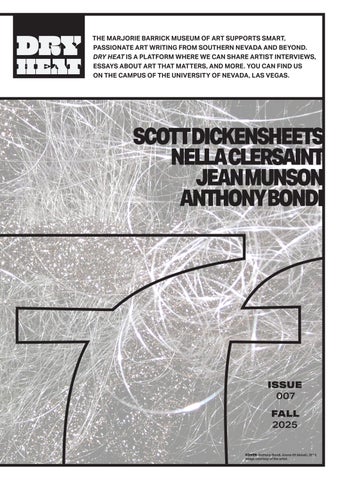
THE MARJORIE BARRICK MUSEUM OF ART SUPPORTS SMART, PASSIONATE ART WRITING FROM SOUTHERN NEVADA AND BEYOND. DRY HEAT IS A PLATFORM WHERE WE CAN SHARE ARTIST INTERVIEWS, ESSAYS ABOUT ART THAT MATTERS, AND MORE. YOU CAN FIND US ON THE CAMPUS OF THE UNIVERSITY OF NEVADA, LAS VEGAS.
SCOTTDICKENSHEETS NELLACLERSAINT JEANMUNSON ANTHONYBONDI
ISSUE 007 FALL 2025 COVER: Anthony Bondi, Axons 05 (detail), 2013. Image courtesy of the artist.
CONTEMPLATING THEFALLOFMAN INMYLIVINGROOM BY SCOTT DICKENSHEETS
“I just like to say things and hope they add up.”
� Poet Christopher Buckley, from “Mitochondrial”
You and me both, Mr. Buckley, so let’s get on with it:
For being the nominal subjects of Robert Beckmann’s painting Eighty-sixed from Paradise, Adam and Eve are maybe the fourth or fifth thing you see as you look at it. First, you’ll notice the massive stone arch in the middle, neatly dividing the canvas’s bright and dark sides, and through which blast huge, pointed spears of light, God’s own angry incandescence. From there you’ll backtrace the light to its source at the right edge of the painting: Paradise. Specifically, Paradise, Nevada, the unincorporated township that contains the Las Vegas Strip, a sliver of which—The Venetian, looks like—glows convivially under a big wedge of sky, fronted by a fountain and lush plant life. After that, you’ll follow a dark sweep of raw, forbidding nature all the way across the bottom to the left of the arch: leafless, deformed trees, wind-bent and broken. A pair of waterfalls does little to soften its harshness. At this point, your eye might finally come to rest on the two figures in the lower left middle: poor Adam and Eve, prodded by the Lord’s cruel luminosity toward their grimdark new normal. They’re tiny, a few expertly controlled brushstrokes apiece, but they’re expressive. Adam’s looking back, arm raised against the radiance, as Eve, holding his other hand, moves forward, head lowered, presumably in shame. All of this eye movement makes for a short, intense visual journey through a cockeyed version of a story you know well.
2 DRY HEAT FALL 2025
This painting is from Beckmann’s turn-of-the-millennium Vegas Vanitas series, in which he insinuates elements of modern Las Vegas architecture into landscapes modeled on works by various Old Masters. Other pieces include a biblical flood at Mandalay Bay, based on a work by Nicolas Poussin, and Moses under a dark sky in the Las Vegas Wash, riffing on a J.M.W. Turner classic. Eighty-sixed has been my favorite of the series’ seven canvases since before it was completed: I first saw it hanging in Beckmann’s large, beautifully lit studio, attached to his former home in Henderson. The composition blocked in with brown washes, it awaited the patient layering of oils that was one of the artist’s hallmarks then. I was there to profile him for a now defunct magazine; this would have been 2000, 2001, something like that. He completed it not long afterward. All of the Vanitas paintings crackle with intelligence, often with wit, but also with the subtle friction of wildly disparate elements—visual and intellectual—rubbing together. They exhibit a game creative ambition, in particular Beckmann’s desire to tease out new contextual associations for Las Vegas.
Robert Beckmann Photographs, 1964–2009. PH-00381. Special Collections and Archives, University Libraries, University of Nevada, Las Vegas. Las Vegas, Nevada.
ISSUE 007
3
Robert Beckmann, Eighty-sixed from Paradise, 2001, oil on linen.
EDEN HAS BEEN RECAST AS THE GLEEFUL, BLASPHEMOUS SOCIAL HIVE OF SIN CITY, WHILE NATURE IS NO LONGER DEPICTED AS A PERFECT GARDEN BUT RATHER A SCARY WOODS PROPER TO A FAIRY TALE. Robert Beckmann, Eighty-sixed from Paradise (detail), 2001.
I’m not sure why I was captivated by this particular one, even in its unfinished state. I’m not religious, so it wasn’t that. I was still in my earliest stages of trying to understand sophisticated art, so it wasn’t exactly that, either. However, back then I was (and, hell, still am) a cheap ironist. So I loved what seemed like the gutsy play of taking Western Civ’s predominant origin-of-man mythology and reversing its polarity. Once the vision of nature perfected, Eden has been recast as the gleeful, blasphemous social hive of Sin City, while nature is no longer depicted as a perfect garden but rather a scary woods proper to a fairy tale. Yet something about the painting’s Old Master mojo—it was based heavily on Thomas Cole’s 1828 Expulsion of Adam and Eve from the Garden of Eden— softens that contrarian reversal into something less like impudence and more like a complex, affectionate homage to the enduring power of art and myth. That was pretty much all I had the chance to conjure about Eighty-sixed from Paradise before it and I went our separate ways, but it was enough to lodge it firmly in my hit parade. In 2012, my wife posted on Facebook a picture of me standing next to it during an exhibit at the now-defunct Pop Up Art House in Henderson: “Scott with his favorite Beckmann painting.”
4 DRY HEAT FALL 2025
***
My assignment here is to write about a piece of art in Southern Nevada. Any piece, my choice. Out of the literally thousands of options, from public works to museum pieces, I picked Eighty-sixed from Paradise not just because I love it, but because two decades after seeing it, I came to own it. I know, I’m amazed, too! Point being less to #humblebrag than to establish the depth of my relationship with the painting now that I interact with it daily, in every conceivable frame of mind. I can follow my own zigzagging curiosity deeper into it, hoping to feel that lovely crackle that happens, somewhere between my thinking brain and my emotional nervous system, when I connect with a work of art.
Now, while I’m a bit farther along on my journey toward understanding this stuff, I’m not an art historian or a biblical scholar; a generalist by nature, my method is simple: just say things and hope they add up. Pretty much like most people trying to figure out pretty much anything. One thing leads to another. For instance, if I accept Beckmann’s premise of Las Vegas as a warped Eden, I gotta wonder why have Adam and Eve been expelled? From Sin City? What infraction gets you run out of this town on bayonets of righteous light? I mean, Las Vegas pretty much is the Tree of the Knowledge of Good and Evil. So what transgression will earn you a God-level eviction? Card-counting? “Public camping”? Rolling large and going bust? “Well,” says my friend Steve, my go-to theological consultant, “we’d have to determine what one, central, overriding command God could have issued to Las Vegans, the violation of which would result in separation from Him, something like ‘Never hit when the dealer is showing 16,’ or ‘Never question the LVCVA when it’s giving away taxpayer dollars to sports teams.’” My friend Richard, a poet, thinks Adam and Eve are being trespassed for the basic sin of knowing too much on a Strip that, godlike, wants to control everything: “Our traipsing lapsarians should’ve known better than to know—but then to admit knowing? Inexcusable.” One of the joys of leisurely getting to know an artwork is your haphazard accrual of randomly relevant information and off-kilter insights. Each one readjusts your engagement with the piece. For instance, you learn that Vanitas refers to an early style of allegorical painting meant to remind viewers of their own mortality and the futility of enjoying earthly things. Which, and perhaps this is Beckmann’s irony at work, might be exactly the thing Las Vegas doesn’t want you to know—or maybe it does want you to know, the better to monetize your response. Either way would be on-brand for this place. At some point, maybe you begin to wonder about Eve. Sure, her downcast slouch scans as shame, thanks to the apple story we’ve been fed. But what if she’s simply focusing on the trail, leaning into her fate? Indeed, you might wonder, what if she was the only one who understood that The Fall had to happen and just handled it while Adam puttered uselessly around the Garden? How would that change the myth? This isn’t an original notion, by the way. Biblical scholar Phyllis Tribble: “The initiative and decision are (Eve’s) alone,” she writes. “She acts independently. By contrast, the man is a
ISSUE 007 silent, passive, and bland recipient.” But it was cool to be led to that notion by thinking about a painting hanging in your living room. Then, finally, you look at tiny Adam as he gazes back with longing for the comfortable life he’s being deported from, and you’re reminded of his complaint to God, as imagined by humorist Miles-Erik Bell: “No offense, but it kinda seems like you’re setting us up for failure.” There you go, Adam, that's the Knowledge the tree was really there to impart: that, whether it’s in the biblical paradise or this one, the house always wins.
***
Here’s a factoid I couldn’t fit anywhere else but don’t want to leave out: According to one reading of the Torah, Adam and Eve were loose in the Garden for just nine hours before going bust. Nine high-rolling hours, a single shift, then it’s snake eyes, and they’re gone. A rise and fall at the speed of Vegas.
***
By now it should be apparent to you, the reader, that the point of such ruminations isn’t necessarily to be correct about this (or any) artwork. Few things kill the enjoyment of art like thinking I’m right about it. What I love is the cognitive jostle of different ideas and impressions delivered by a visual medium that rarely expresses itself straightforwardly. Even now, when I look at Eighty-sixed from Paradise, my thoughts want to go at top speed in different directions. It’s that pleasant disorientation I’m after.
BECKMANN’S HAD A LONGSTANDING FASCINATION WITH THE CONCEPT OF THE SUBLIME — A BEAUTY SO VAST, SO CLOSE TO THE DIVINE, THAT IT ELICITS BOTH AWE AND TERROR.
Anyway, back to the painting: At a certain point I realized that by trying so hard to tweeze meaning from tiny Adam and Eve, I was ignoring, like, literally, the other 2,789 square inches of Eightysixed from Paradise: the landscape.
Beckmann’s painting is not just modeled on Expulsion from the Garden of Eden. Once I actually looked into the original, I could see Eighty-sixed imports most of its imagery and compositional dynamics from Cole: the division of good and evil by the stone arch, the tiny figures, the operatic scale; it was Cole, not Beckmann, who so thoroughly deconsecrated the vision of nature from the symbolic perfection of Eden to the dark, Stygian woods on the painting’s dark side.
“When I ran across this painting,” Beckmann told me back when I was writing about him, “it was pretty obvious what needed to happen to it.” Beckmann’s had a longstanding fascination with the concept of the sublime—a beauty so vast, so close to the divine, that it elicits both awe and terror, an implication of higher order as well as a dire threat of chaos. Look at his absolutely majestic Body of a House series from 1993: Across eight canvases it depicts the frame-by-frame destruction of a test home by a 1953 atomic blast in the Nevada desert. It’s undeniably beautiful and indescribably terrifying, lit by an unholy glare. For my part, I last experienced something like the sublime at Michael Heizer’s massive City complex in central Nevada, briefly swallowed in the deep time that is so much of what that much-admired, much-reviled project is about.
5
In Eighty-sixed as in the original, the sublime is embedded in the image’s contrasting light and dark halves. But Cole, a leading figure in the 19th-century Hudson River School, had a more uplifting sublimity in mind. He painted an American Eden, a vision of this brawny new country in sharp contrast to the depleted vistas of old Europe. “American associations are not so much of the past as of the present and the future,” he wrote. And, he made clear, “There is in the human mind an almost inseparable connection between the beautiful and the good.” That is, our robust natural beauty reflected our potent national character, and tipped the divine sublime in our favor. So when Beckmann says it was “obvious what needed to happen,” I think he meant to fiddle with the terms of Cole’s American sublime by intensifying it with a sly dose of Las Vegas. After all, when he painted Eighty-sixed, Las Vegas was already established as a uniquely American place, where anyone could try on new versions of themselves while indulging our national virtues of personal freedom, transformation, risk, and spectacle. A few years before Beckmann embarked on Vegas Vanitas, Time magazine used its famous cover to dub this “Las Vegas, U.S.A.” “America,” the magazine proclaimed, “has become Las Vegasized.” By piggybacking that concept onto Cole’s exceptionalism, Beckmann’s painting suggests that any robust American future will contain a lot of Vegas DNA. As a concluding thought on the painting, it’s clever and provocative, and I remember the levitating energy release I felt when I finally pulled all those strands of thought together. It turns out that just saying things had kinda added up! But, art being art, there’s always more. In this case, as I continued daily to look at and consider the painting, a subtle reversal has come into view: See, the glimpse of Paradise, Nevada, that Beckmann offers us in Eighty-sixed is The Venetian, an ersatz version of a real place, an elaborate fake, a beautifully executed sham that exists to fleece the innocent and guilty alike—and God Himself seems to be a major shareholder. And so, as Beckmann’s shrewd modernity outfoxes Cole’s antiquated probity, we viewers are left suspecting that this robust, Vegasized American future is really delusional, phony—that this country is just another casino intent on picking us clean as the fall of mankind picks up speed. And with that bitter thought, Eighty-sixed from Paradise expels me from my private reverie of artistic contemplation and back into the acrid realities of 2025. Damn, I’d really, really hoped to get all the way through this essay without thinking about Trump. But I still love the painting, because if I’ve learned one thing from throwing what’s left of my mind at artworks again and again, it’s that the really good stuff will fit itself to the moment, and then to the next one, somehow renewing its mysteries so as to keep meeting you wherever you are, falling, or rising, or just sitting in your living room.
SCOTT DICKENSHEETS Now a freelance writer and editor, Scott Dickensheets has worked all over Las Vegas media, primarily focused on arts and culture: most recently as a daily newsletterist for City Cast Las Vegas, and before that as features editor of the Las Vegas Review-Journal, deputy editor of Desert Companion, and editor-in-chief of Las Vegas CityLife and the Las Vegas Weekly. Dickensheets edited, co-edited, or contributed to eight volumes of the Las Vegas Writes book series, and, in 2015, curated the Transient Landscapes exhibit for Nevada Humanities. He lives in Henderson.
GRAFFITIWASTHE FIRSTTYPEOFART IWASEXPOSEDTO TALKINGTOGABRIELLARODRIGUEZ ABOUTALAMENECER BY NELLA CLERSAINT Somehow sampling comes to mind when I think about AL AMANECER. The elements of the picture don’t seem fixed; they’re movable, able to be transposed into other situations, reorganized into other compositions. However, they’re still all distinct. The fact that they are together begins to create a specific meaning, but there is still something so vague about everything, like how dreams and memories are, or become over time. On the placard at the left corner of the display, I could read this collection of thoughts, offered up by the artist herself: • • • • • •
A little bit here, a little bit over there Banderitas de coco The smell of smoked poblano chiles in a plastic shopping bag When the sun rises over the valley That fuzzy feeling when you receive a balloon The mystery of what a seashell has been through by the time it ends up on the shore, the idea of how a scar comes in the form of a pearl, and the one tile in the bathroom that stares back at you • Being Together Gabriella Rodriguez’s bullet-pointed description mirrors the approach and effect of her painting. The literal and metaphorical space between everything leaves the story fluid; open for the viewer to complete, and perhaps attach themselves to.
6 DRY HEAT FALL 2025
Interacting with this piece at the Marjorie Barrick Museum of Art came at an interesting time for me. I had recently returned to Las Vegas after studying in New York. Before leaving, I found that in attempting to understand my own work (and maybe life), I became somewhat obsessed with trying to identify how growing up in Las Vegas impacted my thoughts, and how I visually represented them. I perhaps felt a bit lost on that point as well, because growing up I never really had the chance to get to know the art scene here, and was not in art-making environments before college, despite always being focused on art myself. I was still thinking about things that I had noticed in much of the current work being produced by Gen Z and Millennials internationally. Rodriguez’s artwork interested me because I saw in it reflections of those connections I had been making and wanted to investigate. My curiosity culminated in an opportunity to meet the artist herself. As I sat down with Gabriella at noon on a sunny day in June, we started with a few big questions: What is Las Vegas to you? Las Vegas is a sanctuary, but also a place that grounds me to the realities of life. I grew up here; I was born here. My parents came to this city [at] a late phase in their life from their home country, but this is where they settled, so that history means a lot to me.
ISSUE 007 I've traveled a lot in and out of the country. Las Vegas is still a very special, unique place. It's like a collection of many different little cities in one. It’s small, but it’s also big. It means home. When I said that it reflects reality, what I mean is that it has good things, but then it also shows you the nature of humanity. We like gambling, we like easy sex and other vices. Vegas has that, but at the same time, kids grew up here too, so you also have the things we had to create, because we weren't part of that world. If you're born here, or if you're raised here, after a certain age, you are part of that culture. It is the closest thing to me. It’s what I bring everywhere. Culture here is humongous. It's a melting pot. People tend to only think of places like New York like that, but it is here too. What is your relationship to the landscape? I have a love-hate relationship with it. When you're a kid, you're like “California's cool,” it has the beach and all that. Now that I'm back here, I love the desert. I see so much beauty in it. The morning sky is periwinkle, and the afternoon sky is pink, right? The mountain range always reminds you that you’re in the middle of a “bowl.” I appreciate that more after living in other areas and coming back. The city landscape in general, too, it’s like a little jungle. As a kid, going through the Strip with family members from out of town, it felt like exploring a giant playground. I will say that this heat is crazy. I'm scared that Las Vegas is not gonna be livable in 30 or 40 years, because, I mean, global warming is very real. But, the fact that people still came and settled here in the middle of this desert, it's a little magic treasure box. About AL AMANECER: What about the title and your process? “Al Amanecer” means, in the morning, more like at sunrise. “At Sunrise,” because before getting this opportunity, I wanted to make a painting of “going to sleep.” In Spanish, when you're telling a kid, a baby, someone young or even your pet, that it's time to go to bed, you'll say “A dormir.” When I got this opportunity, I was like, let me do the opposite of that. Getting the day started can be hard, but it can also be a fun thing to look forward to. If you see the painting, it says that in graffiti. That was the first thing I did, and I loved it. Then, I went on with every other little element. I was thinking of what people do in the daytime. Do you have an attachment to the materials and styles
that you’re drawn to, like graffiti, airbrush, etc.?
I want the viewer to feel some type of familiarity and similarity to their life and experience. I try to add an element of graffiti most of the time. Graffiti was the first type of art I was exposed to. If you think about it as a kid, walking with your mom or your dad or your sister down the sidewalk: the concrete is gray, the sidewalk is gray, the road is black, and here in Vegas, the walls are bleached white. Then, there's a pop of color and it's the graffiti. It's someone's tag or it's a cute cartoon face or something. That always stood out to me. I've always thought it was just cool. That was the first thing I saw. I didn't go to museums. I saw a sticker on a bench somewhere and thought, “this is so cute,” and I wanted to do that. Now I make stickers and little graffiti things because maybe a kid will also walk by and see it.
I've traveled a lot in and out of the country. Las Vegas is still a very special, unique place. It's like a collection of many different little cities in one.
What about fabric? Fabric is number one. I love fabric, it’s beautiful. I love that you can touch it. I love that it took people hella long to make it. Every little fiber is someone's finger. I mean, now stuff is more automated, but I still think about it that way.
Gabriella Rodriguez, Al Amanecer, 2024. Installation photo: Marjorie Barrick Museum of Art, Window Gallery. Photo by Krystal Ramirez.
7
I think having fun is fine art. You know how kids glue glitter and stuff like that. Fabric is the more elevated version of glitter for me. I like to put it everywhere. I like using mixed media, I don't necessarily think that you need to just keep to one medium to make it look nice and [like] fine art. I think having fun is fine art. You know how kids glue glitter and stuff like that. Fabric is the more elevated version of glitter for me. I like to put it everywhere. I have a lot of fabric that I've collected. I love airbrush with fabric, that relationship is so beautiful. As a kid, at Circus Circus, sometimes they would do airbrush art, like shirts or name posters. Stuff like that attracts you for a reason. It doesn't work like any other medium. When you airbrush, you can add so much depth so quickly; it's very forgivable as well. It's magical. I wish I could explain why I like it so much, but I genuinely can't, and I think that's the part I like. I liked your description of AL AMANECER.
Personally, I'm tired of when people try too
hard to make a formal explanation of artwork. Bullet points are more realistic, because it’s
a lot more like a natural thinking process.
I love that you said that, because it's so true. I am also tired of having to explain everything. You should not completely explain, especially when it comes to art. You want the viewer to see it, have a conversation in their own mind, then make something of it. When you write so much, the viewer gets lost and they don't have the space to make their own thoughts, opinions or feelings. I don't always like being specific, like how I said “a little bit over here, a little bit over there,” right? I love that people can come up with anything just by reading that. Making that space for the viewer is so important to me. What are you most proud of, right now?
8 DRY HEAT FALL 2025
I feel proud that even though I have none of my art supplies right now, I’ve still been trying to draw every day. It's hard to motivate yourself and to get better and keep that creativity. You have to be strict with yourself. You have to try to have some type of routine, and constant practice. I'm waiting on my supplies because I just moved from Morocco, so they're shipping everything back. I'm proud of this interview. What I'm not proud of is I feel stuck right now … I feel like I could be doing more. I could be making big paintings and getting opportunities. At the same time, maybe this is my time to focus on the drawing, the sketching, and the ideas. So then when I get my stuff, I'm ready to go.
I’m very proud that I am part of the Barrick Museum’s archive. I'm proud that I’ve had my artwork there. It’s important for the community that represents Las Vegas, and who represents this world. Education has always been a tool, but in these very dark, stupid days, it will be a tool against those forces, and it'll be a tool of protest. I'm happy that I get to be part of a place that brings community and education to Las Vegas. What are your hopes for the art scene in Las Vegas? What kind of work do you notice is being made here
right now, and do you have any favorite artists?
First, let me say, most of the best Las Vegas artists are women. Don't get me wrong, there are some good fellas, but the women here are amazing. A lot of people in Las Vegas make art with a message. It’s just being humane, advocating for humane stuff. I do have a lot of favorite Las Vegas creatives: Abi Ramirez, Alexys Keller, Isaac Quezada, and Scrambled Eggs collective/artists. Deanne Sole, she saw my artwork at one of their shows. That’s how I got connected to be here [at the Marjorie Barrick Museum of Art]. I'm grateful for the Las Vegas community. If it wasn't for them, I wouldn't really be as confident with my artwork the way I am now. What are your worries and hopes as the city grows? I am scared of things that I love disappearing. The other day, I was driving on the freeway, and I started crying because I saw that the Mirage was gone. The Mirage means so much to me and my childhood. When my parents were together, we would go there, so of course that's gonna touch a space in my heart. I heard that Circus Circus is being renovated, which really broke my heart too. Like, in a million pieces. I have so many memories there that I really hold near to my heart. My husband and I have been together for almost 12 years now, and that's where we had our second date. We had our first date in Texas Station, which is now gone, too. The day the Treasure Island or the Bellagio go down, I’m done … Art serves an important role in the way that locals are able to remember and archive our histories, as things that we love continue to disappear. Do you think it's hard to be an artist here? I think it's a perfect environment. People are super nice, and willing to display art. A lot of young people have parties or shows for people to show and sell their art. There are so many opportunities here, because the community is small. Once you know somebody, it opens up. I had struggles when I lived in bigger cities. I couldn't even find opportunities. It's easier here. We're not the MoMA, but we see and create things that will eventually be in the MoMA.
ISSUE 007
9
Gabriella Rodriguez, Al Amanecer, 2024, air brush, oil paint, and fabric. Photo by Krystal Ramirez.
NELLA CLERSAINT Nella Clersaint is a visual artist and writer. Working in painting, drawing, and mixed media, she believes that “Materiality, objects, and symbolism play fundamental roles in how we understand and engage with ourselves and the world around us.“ After receiving her BFA from the School of Visual Arts, New York in 2024, she now lives and works in Las Vegas.
10 DRY HEAT FALL 2025
ISSUE 007
11
12 DRY HEAT FALL 2025
ISSUE 007
JEAN MUNSON Jean Munson is the founder of the Las Vegas comics company Plot Twist Publishing. She focuses on Asian American narratives through activism, art, and teaching.
13
THEBURNINGBUSHAND THEHUMANCARWASH BY ANTHONY BONDI
An excerpt from Anthony Bondi’s memoir, Flamingo Wash: the Era of Magnetic Radiation in Small Las Vegas, is followed by an inquiry into potential connections between the artist’s experience as a child growing up in Las Vegas and the artwork he made as an adult. Flamingo Wash is available from Avantpop Publishing.
1
THE BURNING BUSH
We were taught in kindergarten to draw a house. We were told to draw a square and then a triangle on top of it. But most houses around here were flat-topped. What we were told was a house did not look like the houses where any of us lived. I asked Dad about the funny triangle. He explained snow to me and how pitched roofs help accumulated snow to fall off. When I looked at pitched roof houses after that, I tried to imagine how thick a pile of snow the pitch of the house was designed to dislodge. I had never seen snow. My first sense that our desert might be unusual geography came from reading Tom Sawyer. On hot days, kids in Missouri went swimming in a creek. There were no creeks here, no Mississippi River. The scrub brush desert looked afflicted with famine. There was only enough rain for the shrubs in a fiveyear cycle. It was a viable ecosystem, but it left us with many more dry years in our experience than wet years. Our norm was a dormant desert. During dry years, the shrubbery looked dead, too dry to survive, nothing left of the plant but a gray spindly exoskeleton. If this was survival, it was at a desperate cost. When we saw a bloom on a shrub, the temptation was to look at it with polite cynicism. It would not last long. It was a tourist.
Small tumbleweeds looked funny, bowled by the wind down an empty street. It was a baby scooting for a minute out of grownups’ control.
On windy days, tumbleweeds blew down streets and across vacant lots. These were gray balls of brambles, maybe ten feet in diameter. They looked like congealed dryness, as if heat had begun to metastasize like a fungus. They looked like they were wiser than us and running away from something that would happen after they were gone. Small tumbleweeds looked funny, bowled by the wind down an empty street. It was a baby scooting for a minute out of grownups’ control. The desert was moving, something it did not do from month to month. It took a long season of dry weather to shrivel a tumbleweed until its stalk broke and it turned hobo. But this is how tumbleweeds spread their seeds by bopping down the road away from home with no planned direction. There they go, changing their names again.
14
Other brambles stayed anchored and were much larger cousins to tumbleweeds. Their growth was a symbiotic process: As the bush grew, its roots and aboveground thicket impeded the flow of sand around it. The drift of sand around the stem began to bury it. The bramble grew above the drift until both the sand dune and bush matured together. The health of the bramble was based on its function as an anchor, as a drag on free movement around it.
DRY HEAT FALL 2025 (LEFT TO RIGHT) Anthony Bondi, Belts 04, 2012, Axons 06, Axons 05, 2013, staged photography & assemblage. Images courtesy of the artist.
Anthony Bondi, The Human Car Wash 03, 1999. Image courtesy of the artist.
Sand dunes capped with bramble bushes were nearby no matter where a kid lived. The attraction of a big bramble was a crawl to its heart. Entry was through paths already in it, the crawl spaces of small animals, coyotes, lizards, turtles, or squirrels on their way to dens deeper in the spines. Tamped-down twisting paths showed us how to make our own path when the others ran out. We slithered and crawled to avoid close needles. It might be easier to scoop a path in fine sand under a branch than to try to crawl over it. We wore long sleeve shirts if we thought ahead on a day when we went exploring brambles. Our path was through its age. The passages ended in a branch-tangle. We were at our goal when branches held us in a cocoon of needles so tight that we could no longer move. We could see the mother stem. We studied the summer sun. The air was salted with fine dust that lay on stalks that we disturbed with our arrival. The dust that remained on the thorn trunks looked distilled as if it had lain there for a hundred years. The point of stasis was best if we reached it during the hottest time of the day. We sipped the heat when we breathed. The needles were glowing spits further heating the air. We savored the old breath of the bramble. Then, friends and I would have good conversations. When I first heard the story of Moses and the Burning Bush, I wondered how it would have felt to crawl into it.
2
THE HUMAN CAR WASH
DEANNE SOLE When I read over The Burning Bush, it struck me that some of the artworks I’ve seen in your backyard are similar to that bramble mass. Does that sound right? I was thinking of your rubber snake sculpture, for example. Those works came out of the art you
made for Burning Man. You suggested the Human Car Wash was similar to the experience of the bramble … could you talk about that? ANTHONY BONDI My childhood experience with brambles was unlikely to have a sequel. Yet I was led back to the brambles from an entirely different basis than when I played inside them. In 1996, I began building projects for Burning Man. Its location in Black Rock Desert made projects subject to high winds. Any large surface was at risk of becoming airborne unless careful rigging held it down. My solution to high winds was to make screens, apparently solid structures which did not impede wind blowing through them. I built penetrable nets instead of potential sails. A net could be made of belts or springs or plastic snakes and lizards. Many single objects were stitched or fastened together. Sometimes, in their great numbers, the fasteners were extraneous to any purpose beyond decoration. With this universal armature I had inadvertently re-created my bramble, now as a flat abstraction of the chaos of nature. The primary opportunity artists found there, was an invitation to contribute to defining an as-yet amorphous culture. In this context, there was an intuitive imperative not to make work like we had done at home. In Black Rock City I would not make pictures. As well, there was a challenge to create art that acknowledged a physical space that was alien from what most of us had experienced before now. Attendees brought to the event a spontaneous, abiding interest in physical engagement with art. It was the opposite of the behavior we were familiar with. Also present were many opportunities to be near fire. Always there was the temptation to reach out and pet the flames. All night, we stayed alert to what we must not do. As if in mockery of our good sense, I created pieces designed to confound this hesitation. The only way to engage with these pieces was to touch them. The mechanisms of engagement were walk-through portals lined with lattice screens that held tactile materials. The 1999 Human Car Wash was eighty feet long. Materials included ball chain, feather dusters,
loofah bath sponges, paint brushes, raffia strands, and mylar curtains. Whatever the item was, there were hundreds of them clustered into what looked like solid structures, which at second glance were permeable. Tactile portals were the opposite of fire. In time, I recast immersive portals as child-size tunnels with only ball chain as the tactile element. Preverbal children showed deep perplexity as they tried to understand what they were looking at. It was impossible to guess if it was solid or permeable. It was an unusual confusion. After the pause for thought, carefully, slowly, the little kids explored the mystery. DS Practical questions. How did people experience the Human Car Wash? How did you come up with the idea? AB The Human Car Wash could be a hypothetical experience as well, as it was a toy. People who only stopped to wonder about it were as significant as those who walked through. How will it feel to touch all that stuff? It might feel better if I take my clothes off first. Within the portals, distant vision was constricted by the screens. For a moment they masked the omnipresent 360-degree unbroken horizon line of Black Rock Desert. Then the far horizon was back. It felt like exiting from a bramble.
I was intrigued by the intellectual basis for current art theories while I was not emotionally engaged by them. This was not criticism of the theories. It is hopeless for an artist to try to force an emotional engagement with specific work. Affinity is inexplicable.
First, I replicated my old bramble in a flat configuration. Then I recognized that walking through the portals was a progression as if toward the heart of a bush. Without my having tried to deliberately suggest that sensation of physical play, I had still done so. I don’t know where else I might have found such an experience to work from. DS You’ve said that you “almost” went to art school in the 1980s. Could you explain that? The ideas you encountered in California seem important to you, particularly the ones you got from films. I’m wondering how they’re reflected in your later work. AB In the early 1970s, after a year at UCLA, paying for an art degree with a student loan seemed like a very bad idea. Instead, for the next decade I audited UCLA art classes and used its library for free. I was intrigued by the intellectual basis for current art theories while I was not emotionally engaged by them. This was not criticism of the theories. It is hopeless for an artist to try to force an emotional engagement with specific work. Affinity is inexplicable. What were called Underground Films were typically made by artists with low budgets. Yet such films often relied on technological innovation. I learned that homemade technology can be a fine source for spectacular imagery. I was introduced to tawdry and yet visually effective stage sets. My later extensive use of re-purposed retail products was directly based on such filmmakers as Kenneth Anger, Carolee Schneemann, Jack Smith, and Stan Brakhage. DS You’ve said that the area of dunes at Sunset Park is similar to the brambles. Do you ever feel a desire to crawl through them again? ANTHONY BONDI Anthony Bondi is a Las Vegas artist who uses digital imaging to make art about his home city and the environment surrounding it. For twenty years he presented large-scale interactive art at Burning Man. His work has been exhibited at Core Contemporary Gallery, The Studio at Sahara West, the Marjorie Barrick Museum of Art, and other venues. He is the author of Flamingo Wash: the Era of Magnetic Radiation in Small Las Vegas, a memoir released by Avantpop Publishing in July 2025. The book can be purchased online at avantpopbooks.com, or (at time of writing) from The Writer’s Block in downtown Las Vegas. Bondi maintains an archive of information about Las Vegas art history (Las Vegas arts in print media, 1990-2015) at lasvegasarts.org. His website can be found at www.anthonybondi.com Marjorie Barrick Museum of Art, University of Nevada, Las Vegas. 4505 S. Maryland Pkwy. Box 4012, Las Vegas, NV 89154 www.unlv.edu/barrickmuseum 702-895-3381 Printed by www.PRINTNEWSPAPER.com, Paris, France. Copyright © 2025 Marjorie Barrick Museum of Art, Dry Heat. All rights reserved. No part of this publication may be reproduced, distributed, or transmitted in any form or by any
AB The brambles fenced off in the southwest corner of Sunset Park are the same type as those in which I once played. (The area where I played was around Desert Inn and Pecos.) When I see them, I am vividly brought back to childhood when where I thought I lived was not at home, it was in the desert. The tactile pieces were a subset of physically interactive projects. Before the Human Car Wash was the Hula Hoop Training Center. After the tactile corridors, there were a couple of Merry Go Downs and other projects based on enticing visitors to spend a few calories to make the pieces work. In all of them, using screens was a constant design element. It was necessary that even basic materials used in the projects should be durable. It meant that when the projects were finished, the screens remained intact. Over years, I reconfigured them in half a dozen ways as sets for photo projects. Inevitably, during this process, single two-dimensional screens were layered until new approximations of the old brambles were present. Meanwhile, installed outdoors, the screens were affected by weather and time. Instead of familiar marks of time, such as rust on metal, plastic decay was measured by crumbling decomposition. (LEFT) Anthony Bondi, The Human Car Wash 03, 1999. Images courtesy of the artist. means, including photocopying, recording, or other electronic or mechanical methods, without the prior written permission of the publisher, except as permitted by U.S. copyright law. For permission requests, contact barrick.museum@unlv.edu. EXECUTIVE DIRECTOR Alisha Kerlin EDITOR D.K. Sole COPY EDITOR Michael Freborg CREATIVE DIRECTOR Chloe J. Bernardo
COLLEGE OF FINE ARTS