OCT 2026 | ISSUE 102 | FREE UNLTDBUSINESS.COM
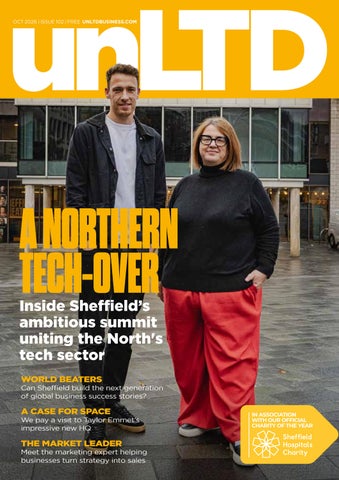
A NORTHERN TECH-OVER
Inside Sheffield’s ambitious summit uniting the North's tech sector WORLD BEATERS
Can Sheffield build the next generation of global business success stories?
A CASE FOR SPACE We pay a visit to Taylor Emmet’s impressive new HQ
THE MARKET LEADER Meet the marketing expert helping businesses turn strategy into sales
IN ASSOCIATION WITH OUR OFFICIAL CHARITY OF THE YEAR
SC AN TO BOOK
CEL EBR AT E OU R
3 0 th A N N I V E R S A R Y J O I N U S FO R A W EEK O F EN T ER TA I N M EN T, O FFER S A N D P R O M OT I O N S *
M O N D AY 2 N D - S U N D AY 8 T H N O V E M B E R
BR ADFORD | HULL | LEEDS | M ANCHES TER | SHEFFIELD
Data Loss can Cause Severe Financial Consequences So prevent it before it strikes! Jibba’s Managed Cloud Services offer secure, flexible and cost-effective data storage — so your files are always safe.
>Ethical >Secure >Future jibbajabba.co.uk Contact to find out how we can help Tel: 0114 303 7130 Email: sales@jibbajabba.co.uk
ISO Certificate No: 454872024
Contents
@UNLTDBUSINESS UNLTD BUSINESS UNLTDBUSINESS
Hello, and welcome to the latest issue of unLTD Business Magazine. If you’re reading this while attending our annual business expo, it means two things: Marc and I hit an early deadline to get these mags back in time – a quite unprecedented achievement – and you’ve made an excellent choice in how to spend your time. This year, the team have upped their game to ensure exhibitors and visitors get genuine value from the day. Whether it’s inspirational speakers and panellists with bags of experience to share, workshops to help you get more from your business or even a wine-tasting session to break things up, we genuinely believe this is an event that gets better every year. Oh, and by way of some shameless self-promotion, I’ll be manning the unLTD TV Studio, interviewing entrepreneurs and business owners about what they’ve been up to. Do come and say hello – especially if you’ve got something you’d like to share on camera, as I’ll be inviting people into the studio for impromptu chats throughout the day. While we’re on the subject of events, this month’s cover is devoted to arguably the biggest of the month. Riding high after Sheffield and South Yorkshire’s tech ecosystem was ranked as the UK’s number one rising star, TECH SY has has organised the Northern Tech Summit, aiming to unite and harness the North's potential. Read all about it, and how you can get involved, on P18. Elsewhere, we’ve got the usual heady mix of news, opinion, advice and inspiring local stories. And my personal favourite article of the month? Four pals joining forces to establish a national beer museum right here in Sheffield. A no-brainer, surely, and an idea we can all raise a glass to! Joseph Food, Magazine Editor
CONTENTS 18: NORTHERN EXPOSURE What can the North achieve by working together? Ahead of the Northern Tech Summit, TECH SY’s Tracey Johnson and Matthew Snowden discuss how stronger connections could help businesses grow, attract investment and open up opportunities, while explaining why Sheffield is the place to bring that conversation to life this month.
16: A WORLD OF POTENTIAL What does South Yorkshire need to turn promising startups into global success stories? At our latest Business Breakfast, we brought together local business leaders to tackle the big questions. From finding lab space to landing investment, we’ve got the main takeaways on helping homegrown businesses make their mark on the world stage.
EDITORIAL EDITOR Joe Food Joe@unltdbusiness.com
ONLINE EDITOR Ash Birch
Ash@unltdbusiness.com
DESIGN Marc Barker ADVERTISING Phil Turner phil@unltdbusiness.com 07979 498 034
Nick Hallam nick@exposedmagazine. co.uk 07843 483536
FINANCE Lis Ellis accounts@ exposedmagazine.co.uk CONTRIBUTORS Jill White Lowri Rennick Isabel Butler
24: FROM THE FRINGES As part of the tech summit, Pennine Five will open its doors for a free festival of live demonstrations and behindthe-scenes access. We explore the fringe programme, from meeting the businesses shaping the city’s future to app-guided tours and a social run through its growing innovation district.
44: CASE FOR SPACE An exciting new space for a historic Sheffield firm: Taylor Emmet’s latest chapter puts it at the heart of the city’s regeneration. We step inside its stylish Isaacs Building HQ and speak to Steve Hinshelwood and Ovo Spaces about bringing the ambitious vision for its flagship new home to life.
unLTD is published monthly by Blind Mice Media Ltd Unit 1B Rialto, 2 Kelham Island Sq., Kelham Riverside, Sheffield S3 8SD The views contained herein are not necessarily those of Blind Mice Media Ltd and while every effort is made to ensure information throughout unLTD is correct, changes prior to distribution may take place which can affect the accuracy of copy, therefore Blind Mice Media Ltd cannot take responsibility for contributors’ views or specific listings.
unLTDBUSINESS.COM
5
Word from the Top AN UPDATE FROM OUR MD
PARTY TIME!
With the unLTD Business Awards taking a break from their usual festive slot this year, we’ve decided to do something a little different. We’re teaming up with our friends at Sheffield Business Runners for a big Christmas party, bringing the business community together for good food, a few drinks and an opportunity to let our hair down after another busy year.
THE UNLTD OFFER IS GROWING, OUR EVENTS ARE EVOLVING AND WE’RE HAVING A LOT OF FUN BRINGING PEOPLE TOGETHER.
We’re busy putting the finishing touches to the plans, with the date, venue and ticket details to be announced soon. What we can promise is a cracking opportunity to get together and enjoy a proper festive knees-up. Keep an eye on our socials for the big reveal! That social side of things is important to what we’re building at unLTD. The business community around the magazine continues to grow and, as I write this, we’re gearing up for what should be our biggest gathering yet: the unLTD Business Expo. By the time you read this, it’ll have happened, or be in full swing, so hopefully I’m not tempting fate by saying we’re expecting around 500 people, more than 75 stands and a packed programme of talks and sessions. We’ve even got wine tasting thrown into the mix. That probably sums up what we’re trying to do quite nicely. We want to bring people together to talk about the serious stuff, whether that’s business sales that have gone wrong or the impact AI is going to have on specific industries and wider society. But we’re also human beings who like meeting people in social settings and letting our hair down. Work is a lot more fun when you’ve got a wide group of friends around you, and that’s exactly what we’ve been building over the past few years. That approach runs through the
rest of our events calendar, too. We’ve recently held our first Working Lunch at The Psalter, which has been a great opportunity to bring another Sheffield venue into the fold. We’re always looking for interesting places to hold events, while continuing to work with brilliant long-standing partners such as Pennine 5 and Kenwood Hall. In fact, we’re heading back to Kenwood for our next Speed Networking event. The first one had fantastic energy in the room, although a slight administrative hiccup meant not quite everybody managed to speak to everybody. Lesson learned! We’ve tweaked the format this time around, so it should be even better. We’re also really excited about our Business Breakfast with The Curve at Pennine Five on 28 October. The AI Reality Check: Show Me the Money will be aimed at senior decision-makers and focus on real-life examples of how businesses are using AI – and, crucially, whether they’re actually seeing a financial return from it. There’s plenty going on, then, and plenty more to come. The unLTD offer is growing, our events are evolving and we’re having a lot of fun bringing people together. Hopefully we’ll see you at one soon – and if nothing else, I’ll see you at the Christmas party!
PHIL TURNER Managing director, unLTD Business
unLTDBUSINESS.COM
7
Agenda
Plans are brewing for a new museum celebrating the city’s beer heritage and the wider history of the UK’s pubs and breweries. Co-founder George Brown tells unLTD about the project and how the public can help shape it. Sheffield has long had a reputation for its beer scene, with a rich brewing history and an enviable collection of independent breweries and pubs. There are now plans underway to give that heritage a permanent home, with a group of local beer enthusiasts looking to establish a dedicated beer museum in the city. The Sheffield Beer Museum project is the brainchild of four friends who, after discovering a surprising gap in the UK’s museum offering, decided to do something about it. “It essentially all came from a few beer lovers wanting to visit a beer museum in the UK,” explains director George Brown. “There are so many abroad, but there wasn’t one here. The National Brewery Centre in Burton-upon-Trent shut down a few years ago, and while some breweries have their own visitor centres, there’s nothing dedicated to beer and brewing heritage across the UK. It seemed like an obvious thing to do.” The group has spent the past two years developing the idea, establishing a community interest company and speaking with organisations including Museum Development North and Collections Trust to understand what bringing such a project to life would involve. Having worked largely behind the scenes until now, the team has 8
unLTDBUSINESS.COM
now launched a public consultation to gauge interest and find out what people would like to see. “We want it to be communitydriven,” George explains. “We’ve sent a survey out to landlords, breweries and the public to see what they want from it. That’s still on our website now and we’ll use that feedback to help decide what direction to take.” The consultation will run until December, after which the team hopes to organise an event sharing the findings, alongside stories from the brewing community and opportunities for potential sponsors to get involved. The next step would be a series of pop-up exhibitions in pubs, museums or vacant spaces, provisionally planned for mid-2027. These would help demonstrate the concept and build support before the team seeks funding and gets a permanent home in place, hopefully towards the end of 2027 with a view to opening in 2028. Although Sheffield will naturally provide the starting point, the ambition stretches to sharing hopheavy stories beyond the city. “We definitely want to look at Sheffield’s breweries and pubs, but also recognise the national history,” George explains. “There’s a gap in the UK for something like this, and eventually we’d love it to become the Sheffield National Beer Museum.” For the museum’s proposed
exhibitions, George envisages interactive displays charting the locations of Sheffield’s former pubs, examining how brewing influenced the development of towns and cities, and exploring the social and political significance of beer and pub communities. “Our little tagline is ‘there’s more to beer than drinking’, and we want everything we do to revolve around that,” he adds. Interestingly, none of the founders comes from a professional brewing background. George and fellow director Steve work in IT, while another member of the team works in the legal sector. They met through various connections involving pubs and beer, eventually coming together around the museum idea. “We’re not claiming to be experts,” George admits. “We’re hoping to be the glue that brings all the experts together to launch it.” All the founders are keen to develop the project carefully rather than rush what could be a huge addition to the city’s cultural offering. In the meantime, they hope to make appearances at beer events over the winter while encouraging local residents and businesses to contribute their ideas. Anyone interested in helping shape the museum can complete the public consultation at sheffieldbeermuseum.co.uk.
Global Shipping, Zero Stress. GlobalCustoms. Shipping, ZeroWorldwide. Stress. Documentation. Delivery. We handle it all, so you can run your business. Importing / Exporting
UK-based freight forwarders. Reliable, One reliable partner transparent, and careful with every shipment,Total wherever it's heading. peace of mind
01709 610 000 / intfreight.co.uk
STOP DOING THE WORK YOU DON'T WANT TO DO. WHAT COULD YOU AUTOMATE? Less admin. Fewer repetitive tasks. More time to grow your business. Discover what automation could do for you.
automate.sevenhillscreative.co.uk
FIND OUT WHAT YOU COULD AUTOMATE.
Get free, personalised automation ideas for your business.
Agenda WESTON PARK SMASHES £1.85M TARGET Weston Park Cancer Charity has raised more than £2.15 million to bring South Yorkshire’s first dedicated cancer MRI simulator to Sheffield, exceeding its original fundraising target by more than £300,000. The charity’s ‘see it. treat it.’ appeal raised £2,151,030 towards the new scanner, which will help clinicians deliver more precise radiotherapy while reducing damage to surrounding healthy tissue. The achievement was announced at an event marking the conclusion of the appeal and the 2026 Master Cutler’s Challenge, which contributed £170,353 towards the total. Since launching in May 2025, the campaign has attracted support from 1,220 individuals, 83 organisations and businesses, and 57 volunteers. Westfield Health also played a major role, matching donations up to £500,000. Emma Clarke, CEO of Weston
Park Cancer Charity, said: “This achievement shows what we can do when we come together to enact change. It demonstrates the generosity of our region and its commitment to advancing cancer care for local people.” The additional funds will support future cancer research and treatment improvements, including the first-year costs of two specialist staff members. Sheffield Teaching Hospitals NHS Foundation Trust can now move forward with purchasing the scanner and creating a dedicated treatment suite. Find out more at westonpark.org. uk.
CROSSED WIRES HITS THE RIGHT FREQUENCY The world’s biggest podcast festival has doubled its attendance and delivered a multimillion-pound boost to Sheffield’s economy in just its third year. Crossed Wires has generated £6.65 million in economic impact for Sheffield, with an independent assessment revealing significant growth for the city’s podcast festival. The 2026 event attracted 50,000 attendees, double the previous year’s footfall, with 52% travelling from outside South Yorkshire. Some 40% came from beyond the North and Midlands, while international visitors arrived from countries including the US, Canada, Australia and several European nations. Now in its third year, the festival has established itself as a major fixture in Sheffield’s cultural calendar, attracting audiences to venues across the city for live recordings featuring leading names in podcasting, comedy and entertainment. This year’s programme included everything from a live recording of 10 unLTDBUSINESS.COM
The Blindboy Podcast to Bold Politics featuring Zack Polanski, with the festival attracting a broad audience across different age groups. Co-founder Dino Sofos said: “We’re delighted to see Crossed Wires become one of South Yorkshire’s biggest cultural events in just three years. There’s a real buzz around the festival, and reaching 50,000 attendees while generating over £6 million for the local economy this year shows the scale of what we’ve created – and its potential to grow even further.” South Yorkshire mayor Oliver Coppard praised the festival’s contribution to the region’s growing creative economy. “Crossed Wires shows what’s possible when you back creative people with big ideas,” he said. “We’ve got worldclass talent here in South Yorkshire and we’re building a reputation as a place where creators, producers and the wider industry, including the BBC, want to be.” The festival’s fourth edition will return to Sheffield from 1–4 July 2027. Find out more at crossedwires.live.
Award-winning podcast producer Persephonica, founded by Sheffield-born Dino Sofos, relocated its headquarters from London to Leah’s Yard in 2024. The company has produced major shows including The News Agents, Miss Me? with Lily Allen and Miquita Oliver, and Political Currency with Ed Balls and George Osborne, which won two Political Podcast Awards in 2025.
Stripping back the biggest business stories – what happened, who’s involved and why it matters to our region.
FLAGSHIP EVENTS SPACE DELAYED
WHAT ARE THE MAIN TAKEAWAYS? Sheffield’s Event Central development on Fargate will not open until 2027 after complications securing a permanent electricity connection for the building. First announced in August 2020 as part of plans to revitalise Fargate, the project was included in a £15.8 million government funding package secured in January 2021. Planning permission followed in October 2022, with Willmott Dixon appointed as lead contractor in February 2024 and an anticipated opening in early 2026. Sheffield-based arts organisation CADS was subsequently named preferred operator in March 2025, with the venue expected to host community events, exhibitions, workshops, talks and cultural showcases.
WHAT DOES THIS MEAN? The latest setback means another significant delay for one of Fargate’s flagship regeneration projects, with the council now working alongside Northern Powergrid and specialist contractors to establish an alternative permanent power connection. The previously agreed electricity connection is no longer available, prompting further technical assessments and discussions about how best to supply the building while minimising disruption to Fargate. Some exploratory work, including trial holes, is expected to begin in October, although the council says the options being considered aim to limit the impact on surrounding businesses and public spaces. The discussions will also consider electricity capacity for future developments on Fargate. A further report outlining technical proposals, costs and delivery arrangements is expected by the end of 2026.
WHO SAID WHAT? Councillor Alexi Dimond, chair of Sheffield City Council’s Transport, Regeneration and Climate Committee, described the delay as “hugely disappointing” for the council and those looking forward to using the venue. He added: “Our priority is to secure the permanent power the building needs while limiting any impact to Fargate and protecting the investment already made in the area.” The council says it remains committed to delivering Event Central as a major cultural and community venue, showcasing Sheffield talent and supporting the wider regeneration of the city centre.
unLTDBUSINESS.COM 11
Office interiors that inspire. Your vision, our everyday. With over 50 years of industry experience, The DL Company specialises in commercial office furniture, fit outs and refurbishments. Whatever your individual specifications, our talented design team will work closely with you to ensure all your needs are met.
@thedlcompany
0114 244 0202 sales@thedlcompany.com thedlcompany.com
Agenda With Jill White of Andy Hanselman Consulting
CASTLE HILL PARK OPENING PUSHED BACK Previously set for completion in 2026, Castlegate’s new park has now been pushed back to summer 2028, amid complex excavations of Sheffield Castle and attempts to restore the River Sheaf, which hasn’t been opened up since 1912. Additionally, due to new archaeology surfacing, the cost of the project has risen from a projected £18m in 2021 to £25m, which accounts for the resultant redesign. Sheffield City Council has been working with local planning, conservation and archaeology boards, with the aim of preserving and incorporating some of the exposed castle remains throughout the park and introducing a fish pass to allow salmon and other species to travel up the Sheaf. Councillor Alexi Dimond, chair of the Transport, Regeneration and Climate Committee, said of the decision to delay: “Castle Hill Park will be a focal point for Sheffield for years to come. “It’s important to get it right, so that future generations can experience the site in its historical context and learn about the birthplace of our city.” Plans for the park include a 500-plus-capacity events space, public art and heritage interpretation boards, children’s play areas, historic remains of Sheffield Castle and biodiverse green space enhanced by the river. Although Sheffield Castle is thought to date back as far as the Norman period, it is most famous for its association with Mary, Queen of Scots, who was reportedly held captive there by the Earl of Shrewsbury in the 16th century. Sheffield Castle was demolished after the English Civil War, but Wessex Archaeology, which is carrying out the excavations, has found evidence of activity at the site spanning centuries. These findings include previously undocumented sections of the Norman castle, as well as evidence of an 18th-century bowling green, a slaughterhouse and housing, along with evidence of the city’s 19th-century steelworking industry.
For more information, head to sheffield.gov.uk.
ST LEGER RACING, OFF THE SHELF AND A NEW MASTER CUTLER! It must be the end of September and the start of October – the social calendar is filling fast! Great weather for the St Leger in Doncaster, with plenty out in their finery. Not many winners for us, but lots of lovely ‘bump intos’ and special birthday celebrations with Marie Cooper from CBE+. Our 3D Connect at Bloom, part of Sheffield College, was uplifting and inspiring. Big thanks to panellists Lisa Pogson from Airmaster, James Biggin from Steel City, Adam Batty from Sheffield Theatres and Tom Hudson from Afro Magic. All did a fantastic job, although no one revealed their salary to the oh-soinquisitive interrogators! Hats off to the students for their questions and bravery, and to Vanessa Martin and Andrew Skellet from the college team. Off the Shelf is off, and we were lucky to hear Bradley Wiggins share his open, honest and at times heart-wrenching story at the Lyceum. There’s plenty more coming up this month. The unveiling of Sheffield Legend John Burkhill’s star and a farewell to Faye at Suit Works also kept us busy. You’ll be missed, Faye – and all the best to new manager Lynn Urpeth. Finally, surpassing the scanner target for Weston Park Cancer Charity’s See It, Treat It appeal was a fitting farewell to outgoing Master Cutler Professor Keith Jackson. Welcome to the 387th Master Cutler, Ian Nicholls. Onwards and upwards to all!
Follow Jill at uk.linkedin.com/in/jilltywhite or find Andy Hanselman Consulting at andyhanselman.com. unLTDBUSINESS.COM 13
Agenda
PLAYING THE LONG GAME Kelham Arcade is celebrating its tenth anniversary, marking a decade of providing a home for independent retailers and creative businesses in Sheffield’s Kelham Island.
Founded and owned by Lawrence Wheen in 2016, the Arcade began life as a disused former industrial unit before an extensive renovation transformed it into a hub for small businesses and independent traders. Over the past decade, the space has hosted businesses spanning fashion, homeware, art, lifestyle, tattooing and music, with its focus on independent operators helping it become an established part of Kelham Island’s business community. For Lawrence, one of the project’s biggest successes has been seeing businesses use the Arcade as a springboard for growth. A number of former tenants have gone on to outgrow their units and move into larger premises elsewhere in the city. At the heart of operations is Lawrence’s own Kelham Barber, which has grown alongside the development over the past ten years. Training and career progression have become an 14 unLTDBUSINESS.COM
TEN YEARS ON, I’M INCREDIBLY PROUD OF THE COMMUNITY WE’VE BUILT AND OF THE BUSINESSES AND PEOPLE WHO HAVE BEEN PART OF THE ARCADE’S STORY.”
increasing focus for the business, with educational events taking place in the UK and overseas. That emphasis on development has also led to Lawrence’s latest venture, 92 Academy, which recently opened at the Arcade alongside 92, his new range of professional hair products. The Academy provides a flexible training environment where barbers can practise, produce content and take part in professional development away from the pressures of a working barbershop. Lawrence said: “Our ethos has always been about creating a progressive, inclusive space, coupled with really good customer service and, hopefully, very nice haircuts. “Ten years on, I’m incredibly proud of the community we’ve built and of the businesses and people who have been part of the Arcade’s story. It’s exciting to think about what the next ten years could bring.” @kelhamarcade / kelhamarcade.uk
Austin Fletcher is a multi-disciplinary construction consultancy, supporting businesses and organisations across the UK
Project Delivery
Health, Safety & Compliance
Estate Services
Visit our website or call us to find out more
www.austinfletcher.co.uk 0114 213 8305 info@austinfletcher.co.uk
Agenda
GOING GLOBAL?
What will it take to build more globally successful businesses from South Yorkshire? At the latest unLTD Business Breakfast, held at Pennine 5, Phil Turner explored that question with Tom Wolfenden of Sheffield Technology Parks and the Innovation Spine, Tim Craggs of Exciting Instruments, Gary Neville of Startwell Ventures and Yvonne Asquith, head of Business Sheffield. From lab space to investment, here are five key takeaways from another lively discussion.
1. A SHEFFIELD BASE CAN SUPPORT GLOBAL AMBITIONS
2. THE RIGHT SPACE CAN BRING BUSINESSES BACK
Tim, founder of Exciting Instruments, explained that his company offered a working example of the journey Sheffield wants more businesses to take. Spun out from Tim’s University of Sheffield research in 2021, they make instruments capable of detecting individual molecules, identifying their shape and observing how they interact. Its journey took it from a university laboratory through Sheffield Technology Parks, support from fellow tech company Razor and UKSE’s Innovation Centre, before securing £4 million in investment led by Northern Gritstone and moving to Pennine 5. “We’ve had 60% of our sales in the US from day one,” Tim said. “Our first instruments went into the US.” The company now has customers across Europe and teams in Boston and Germany. But, crucially, behind that international reach is a local support network. Tim praised Sheffield’s responsiveness, while acknowledging the demands of helping build that support system alongside running a company. The challenge now is making the route easier for those following behind, with appropriate spaces and support available as businesses grow.
Sheffield’s innovation ambitions began with a practical problem: companies could not find the facilities they needed. Yvonne recalled discovering that the city was missing out on tech investment enquiries because growing businesses wanted central space it couldn’t offer. Tom traced the Sheffield Innovation Spine’s origins to the same issue. Businesses were leaving for locations with established facilities and investment networks. “It actually started with a single problem: one company couldn’t find lab space,” he explained. The response is already making a difference. Sheffield Technology Parks has converted 40% of its space into small-scale laboratories, with Tom reporting that four companies which previously left have relocated back. The wider Spine is a 20-year vision connecting research, innovation and workspace across a 190-acre city district. Success will depend on continuing to provide suitable facilities before growing businesses are forced to look elsewhere.
16 unLTDBUSINESS.COM
3. INVESTMENT FOLLOWS CUSTOMERS, AND FUNDING GAPS REMAIN Gary highlighted the importance of helping founders develop the commercial skills to match their technical expertise. Alongside a strong product, businesses need to demonstrate customer demand and a clear opportunity for growth. “I’d love to see a lot more focus, when it comes to investment, on the growth side and the sales side,” he said. His point was that practical support with sales could help more founders turn promising ideas into established businesses, strengthening their case for investment along the way. There were different perspectives on where capital is needed. Yvonne identified pre-seed and seed funding as gaps, while Tim emphasised the larger cheques required to scale. Tim also called for acquisitions and stock market listings that would allow successful founders to reinvest money and experience locally. That cycle would demonstrate a maturing ecosystem, giving the next generation access to people who have already built and grown businesses here.
4. AI IS CHANGING WHAT GROWTH LOOKS LIKE One of the discussion’s most striking examples came from Tom, who highlighted Chalkie, an AI lesson-planning business that emerged from Sheffield Technology Parks’ incubator. “Their hook is that they give Sunday afternoons back to teachers. It’s a really good problem they’re addressing and a really good solution,” he said. “They’ve got £8 million annual recurring revenue with three staff. It’s absolutely incredible.” The implications extend beyond a useful classroom tool. Businesses can now generate substantial revenue without the staffing levels previously associated with that growth. For a city planning future employment and workspace, that raises difficult questions. Tom argued that the Innovation Spine must remain adaptable as assumptions about company size and job creation change. Gary suggested AI was also shifting investor priorities, with commercial traction becoming more important as technology becomes easier to create or replicate. Both saw an opportunity for Sheffield to respond quickly, provided its institutions adopt the entrepreneurial mindset they want to encourage in founders.
5. SHEFFIELD NEEDS A SHARED PITCH, BACKED BY ACTION The panel repeatedly returned to the need to explain Sheffield’s offer confidently. Affordability, collaboration and quality of life matter, but businesses considering relocation also need a coordinated welcome and a clear route into local networks. Tom described showing visiting Colombian entrepreneurs the wider city alongside its business facilities. Their subsequent enquiry about establishing a UK subsidiary illustrated why selling Sheffield requires more than offices and grants. “You need to really sell the place,” he said. “We’ve talked about businesses selling their products. We need to sell the product that is Sheffield as well.” Yvonne pointed to the Landing Pad partnership as a way to coordinate that message, while Tim called for a single front door for enquiries. Gary argued that attracting experienced founders internationally could accelerate progress. Yvonne also stressed that entrepreneurship must reach more Sheffield communities, with relatable role models and practical support. A stronger innovation economy needs to welcome newcomers while opening doors for people already here.
WANT TO GET INVOLVED IN THE NEXT DISCUSSION? SCAN THE QR CODE ON THIS PAGE FOR NEWS OF OUR UPCOMING PANELS AND NETWORKING EVENTS. unLTDBUSINESS.COM 17
More than 500 entrepreneurs, investors and industry leaders are set to descend on Sheffield this month as a major new summit looks to strengthen connections across the North’s technology sector.
A NORTHERN TECH-OVER The Northern Tech Summit will take place at the Crucible Theatre on 21 and 22 October, bringing together startups, scaleups, investors, policymakers, public sector leaders and technology specialists from across Northern England. Organised by TECH SY under the theme ‘collaborate to compete’, the two-day event will explore how closer relationships between cities, regions and organisations can support growth, attract investment and strengthen the North’s position within the global technology sector. The summit builds on the South Yorkshire Tech Summit and comes at a time of significant growth for the region’s technology ecosystem. Figures published by global data intelligence platform Dealroom estimate the wider Northern technology ecosystem to be worth £82bn. Earlier this year, Sheffield and South Yorkshire was also named the UK’s leading region in the ‘Rising Stars’ category of Dealroom’s Global Tech Ecosystem Index, which measures fast-growing 18 unLTDBUSINESS.COM
technology ecosystems across more than 325 cities in 77 countries. South Yorkshire’s tech ecosystem is now valued at a record £3.7bn, representing fourfold growth since 2019, while businesses across the region secured more than £52m in early-stage investment during 2025. Oliver Coppard, Mayor of South Yorkshire, said of the event: “Two years ago, at the South Yorkshire Tech Summit, we made the case that if the North is going to compete globally, we need to collaborate more closely across our regions. The Northern Tech Summit is about turning our ambition into action. “From Barnsley's emergence as the UK's first Tech Town to the startups and scaleups driving innovation across our communities, South Yorkshire is proving what's possible. “But our ambition doesn't stop at our boundaries. By bringing together partners from across the North, we can build stronger connections, attract more investment, support more high-
growth businesses and make the case for the North as a globally competitive tech powerhouse, so all of us can stay near and go far.” Among the headline speakers is Yoram Wijngaarde, founder and CEO of Dealroom, who will discuss his journey from investment banking in London and New York to building an international technology business. Wijngaarde founded Dealroom in 2013, creating a data intelligence platform tracking high-growth companies and venture capital ecosystems around the world. Earlier this year, the company raised $7m to support its growth plans. His keynote will explore his entrepreneurial journey and offer advice on building and scaling a successful technology business. He will be joined by Tom Adeyoola, executive chair of Innovate UK, alongside speakers including Manchester Digital managing director Katie Gallagher OBE, Northern Gritstone head of NG Innovation Services Joanne Hosker and British Business Bank
COVER
NORTHERN TECH SUMMIT
OUR AMBITION DOESN'T STOP AT OUR BOUNDARIES... WE CAN BUILD STRONGER CONNECTIONS, ATTRACT MORE INVESTMENT, SUPPORT MORE HIGHGROWTH BUSINESSES AND MAKE THE CASE FOR THE NORTH.”
local growth managing director Mark Sterritt. Other confirmed names include representatives from the Royal Academy of Engineering, National Wealth Fund, Sovereign AI, Sunderland Software City, Tech West Yorkshire and Hypha Private Equity. The first day will run from 10am to 3pm at the Crucible, focusing on individual sectors alongside the challenges and opportunities surrounding greater collaboration between technology ecosystems across the North. A separate Startup Showcase will follow at Trafalgar Warehouse from 3pm, giving emerging businesses an opportunity to connect with the wider technology and investment community. Day two returns to the Crucible from 9am to 3pm, turning the focus towards the practical and political connections required to bring regional ecosystems closer together and support future growth. Across both days, the programme will feature panel
discussions, debates and networking opportunities, while showcasing startups and scaleups from across Northern England. Tracey Johnson, project director at TECH SY, said: “There's a lot of investment, work and effort going into promoting and supporting the tech economy in the North at city and regional level. This Summit will show that the North is more than the sum of its parts, with the capacity to challenge the most successful, globally recognised ecosystems, and grow incredible businesses within it.” Overall, organisers hope the summit can provide a platform for businesses to make new connections, learn more about support available across Northern England and identify opportunities to collaborate beyond their immediate regions. A full two-day Northern Tech Summit ticket costs £14, with tickets for the separate Startup Showcase priced at £5. Both are available at techsy.co.uk.
unLTDBUSINESS.COM 19
RECRUITMENT THAT PUTS PEOPLE FIRST www.incconsulting.co.uk
Untitled-1 1
(0114) 303 5720
hello@incconsulting.co.uk
13/11/2025 13:19:15
COVER
NORTHERN TECH SUMMIT
What can the North achieve by working together? Ahead of the summit, TECH SY’s Tracey Johnson and Matthew Snowden talk collaboration, investment, the region’s growing tech ecosystem and what comes next.
This event has grown out of the South Yorkshire Tech Summit. What prompted you to take a bigger approach? MS: At the South Yorkshire Tech Summit in Doncaster in 2025, we had Oliver Coppard and David Skaith, the mayors of South Yorkshire and York and North Yorkshire, talking about the need for the North to collaborate to compete. We came off stage and TJ immediately said, ‘We should run this. We could do an event that brings the North together.’ It took a little longer than we perhaps thought to get it over the line, but we were very conscious that we didn’t want this to be something South Yorkshire ‘owned’. It genuinely has to be about bringing the whole of the North together and helping it work better. A lot of conversations start with: how does South Yorkshire improve? Well, it improves when the North improves as a
whole. Different areas have their own strengths, so rather than duplicating things or leaving gaps, how can we understand those strengths and work together for the benefit of founders? TJ: We’ve done a lot of work at South Yorkshire level, which itself grew out of work we originally did at a very local level in Barnsley. There are levers you can pull locally and regionally, but some things need a bigger lever. Unlocking the true potential and power of the North is one of those. That needs to happen through policy, through things such as the Great North Partnership, but also at industry level. ‘A rising tide lifts all boats’ might be a twee phrase, but it applies here. How do we unlock the potential of the North through all those different channels? ‘Collaborate to compete’ is
the theme. What does that collaboration actually look like for a tech business? TJ: Part of it is about how the region presents itself outside the region. We’re all passionate about the North, and being able to go onto a global stage with a brand and a place behind you that has genuine scale is really powerful. Tech companies that want to scale have to think globally. If you’re a deep-tech startup trying to grow in the US, for example, there’s a compelling story in being part of a united Northern ecosystem with specialisms in health tech, deep tech and quantum technologies, with research spinning out of our universities. It also creates strength in numbers. If you wanted to organise a trade mission for quantum startups, you might not have enough businesses in one locality. Across the North, you could potentially have a dozen or so companies at the top of their game. You can bring founders
unLTDBUSINESS.COM 21
together, create collaboration and show talent the breadth of opportunities available here. When putting it together, what did you want the programme itself to achieve? MS: We wanted different perspectives in the room. We’re opening day one with a discussion around regional ecosystems, bringing together organisations working in places across the North to talk openly about what’s working, what isn’t and where collaboration could improve things. We’ve also got Northern startups talking about their experiences, and Tom Adeyoola is returning after speaking at our 2025 summit. He’s now chair of Innovate UK, so it will be fascinating to hear what they’re doing nationally and how they’re looking to support businesses. One of the most successful elements of our previous summits has been the Dealroom Report, which we’ve brought back and scaled up. Having that data allows us to understand what tech in the North actually looks like, position it more effectively and compare ourselves with other ecosystems around the world. Their chief executive is coming over from Amsterdam to present it, and previously that’s been one part everybody comes away quoting. TJ: The data brings everything to life. Tech can sometimes feel like something that exists in the ether, but when you start putting numbers against how many companies there are and what those companies are worth, it becomes incredibly compelling. This is a summit rather than a conference about a particular technology. We’re bringing together people who lead on policy, start companies, support companies and invest in them, alongside people who are simply interested in this space. The conversations on stage should hopefully spark many more conversations off it and ultimately create positive change. This is very deliberately an event for the whole of the North, but why is Sheffield the right place to host it? MS: Sheffield is a gateway to 22 unLTDBUSINESS.COM
the North in some respects, and South Yorkshire is an emerging tech ecosystem. Being named the number one Rising Star in the UK for tech ecosystems has helped position both the event and Sheffield as its host. TECH SY are doing work for the benefit of the whole region, and this summit follows the same principle. Sheffield is a big city, the Crucible is a fantastic venue and we’ve developed a strong formula for bringing these events together. TJ: The Crucible is iconic for so many reasons. It’s a perfect space in the middle of a brilliant city and Sheffield is accessible from across the North, London and elsewhere in the UK. We talk a lot about unlocking the North, but part of that is unlocking it for everybody else too. We want people coming from London and overseas to see what we’re doing. Sheffield is a brilliant place to do that because it has personality. It's a place where you make stuff and where
you get stuff done. I also love that we’re unlocking more than one venue. The fringe activity brings the city into the summit, whether that’s walking through Sheffield to Trafalgar Warehouse or people running around the city. Those spaces are the engine of what we’re trying to achieve because they’re where founders, people with ideas and investors come together. We also have organisations such as Digital Forge, Yorkshire AI Labs, Venture Community and Sheffield Digital supporting that ecosystem. It makes Sheffield a really exciting place to hold this conversation. What needs to happen afterwards for you to consider the summit a success? How can it be measured? TJ: There are two sides to it. One is the underpinning work that nobody necessarily sees. I’d love us to have a conversation about how we do that better at Northern level, particularly
COVER
NORTHERN TECH SUMMIT around data. One of the powerful things for TECH SY has been understanding where we started, where we’re progressing to, what money is coming in and who is investing. Imagine having that picture for the whole North. We have pockets of it, but we don’t yet have the complete Northern landscape, and that kind of information is foundational. For founders, I want people walking out knowing the North is a scaling economy and that there are routes into the right support, investors, programmes and markets. We want those conversations to continue after the summit. Often you hear about the impact a couple of months later when someone says, ‘I met so-and-so at the Tech Summit and now we’re talking about investment.’ It would only take one startup with a really exciting, scalable business to bump into the right investor, market owner or operator and for that
connection to help transform part of the economy. You’re trying to curate that serendipity. You can’t measure all of it, but if we come out with a group of ambassadors who are passionate about the North and its potential, that’s a brilliant outcome. Ultimately, do people leave feeling like this can work in the North? For me, that will be the game changer.
YOU CAN BRING FOUNDERS TOGETHER, CREATE COLLABORATION AND SHOW TALENT THE BREADTH OF OPPORTUNITIES AVAILABLE HERE.”
Finally, which parts of the summit are you personally most looking forward to? MS: I’m really looking forward to Trafalgar Warehouse at the end of day one. We’re planning for eight businesses to showcase there, with around three live demonstrations. After a full day discussing what the North can do and how we can collaborate better, that’s where we’ll actually get to see what Northern businesses and people are capable of doing. Hopefully we’ll have plenty of investors in the room too, so we can see some of those conversations starting to happen. I’m hosting it, so that should be a lot of fun!
TJ: For me, the Women in Tech and Investment Breakfast is really important. I’ve been a woman working in tech for three decades or more, so it brings together something I’m incredibly passionate about and something that is important if we’re serious about unlocking the North’s potential. We’ll also be announcing an exciting opportunity for Sheffield’s creative and tech industries at Trafalgar Warehouse. I can’t say too much about that yet, but it involves Sheffield City Council investing in growing that part of the economy where creative industries and technology meet. There are a couple of other programmes coming that will benefit founders across the North, including support for women moving into technology roles and scale-up support. Having those announcements happening around the summit should make it a really exciting couple of days. The full programme is online now at techsy.co.uk/techsummit.
unLTDBUSINESS.COM 23
YOUR INVITATION Curious about what's happening inside Sheffield's innovation spaces? Join us on Tuesday 20 October, 9.30am–4.30pm, for a free day of demonstrations, tours and opportunities to meet the people behind the businesses. Scan the QR to download the Spine Guide app, explore the programme and plan your visit.
The Northern Tech Summit action won’t be confined to the Crucible – and here’s your chance to get involved! As part of its three-day fringe programme, Pennine Five is inviting visitors to step inside Sheffield’s innovation economy at Open Doors on 20 Oct, a free festival packed with live demonstrations, lab access and behindthe-scenes experiences. Pennine Five will become a central hub for Sheffield’s Open Doors Innovation Festival on Tuesday 20 October, inviting businesses, students and members of the public to explore the Cathedral Quarter campus and meet some of the innovators based there. The free festival kicks off three days of activity organised by Sheffield Innovation Spine, official fringe partner of TECH SY’s Northern Tech Summit, and will offer behind-the-scenes access to technology, science and startup spaces across the city. The former HSBC headquarters is increasingly positioned as a home for scaling businesses in the digital, technology and life sciences sectors, and occupies a prominent 24 unLTDBUSINESS.COM
position within Sheffield Innovation Spine – a 190-acre urban innovation district connecting businesses, universities, specialist workspaces and innovation assets across five city centre neighbourhoods. Open Doors will provide an opportunity to see some of that work first-hand. Among the Pennine Five businesses taking part will be Exciting Instruments, which develops technology for singlemolecule spectroscopy, and manufacturing analytics specialist FourJaw, with visitors able to tour labs and see product demonstrations. Venture Community will host a sustainable design showcase featuring innovators including Matt
Willox of Colab3, a startup creating new products from recycled industrial waste. Discovery Cafe Bar will act as the festival’s central hospitality hub, where visitors can also explore The Hub podcast space and record their own vox pop message. Visitors will even be able to head to the top of Block One for panoramic views across Sheffield. Exciting Instruments will also demonstrate its EI-FLEX system, technology designed to enable real-time 3D tracking of individual biological molecules and accelerate research into areas including Alzheimer’s and Parkinson’s disease. Tim Craggs, CEO and co-founder of Exciting Instruments, said: “We
COVER
TECH SUMMIT FRINGE
THREE DAYS OF FRINGE ACTIVITY TUESDAY 20 OCTOBER OPEN DOORS INNOVATION FESTIVAL Pennine Five takes centre stage as a primary host location for the free, citywide festival. Visitors can explore the campus, meet innovators and experience demonstrations before using the Spine Guide app to continue along the wider Innovation Spine trail. The event runs from 9.30am–4.30pm and is open to anyone who lives, works or studies in Sheffield.
WEDNESDAY 21 OCTOBER GUIDED URBAN INNOVATION DISTRICT TOURS Coinciding with day one of the Northern Tech Summit, Sheffield Innovation Spine will host hour-long guided walking tours during the summit’s afternoon break, between 3pm and 4.30pm. Exclusive invitations will be extended to summit delegates, including civic leaders, technology ecosystem partners and regional businesses, offering a curated tour of Sheffield’s urban innovation district and an opportunity to make connections beyond the main programme at the Crucible.
THURSDAY 22 OCTOBER
are really pleased to welcome visitors and shine a light on innovation in the region. We went from founding to delivering our first unit in 13 months, and we hope to inspire people that great ideas turn
into reality when the right people and environments connect.” Beyond Pennine Five, visitors can use the Spine Guide app to explore other innovation locations across Sheffield, unlocking content and founder stories as they travel around the route. Participating venues include Electric Works, Sheffield Technology Parks, Sheffield Hallam University’s Strines Building, the University of Sheffield’s Engineering Heartspace and the Royal Academy of Engineering’s UKSE Innovation Centre. Visitors who check in at venue checkpoints through the app can also climb the festival leaderboard, with £100 in Sheffield city centre vouchers up for grabs.
RUN THE SPINE The fringe concludes with a 5km group run through Sheffield city centre, organised by Sheffield Innovation Spine with local entrepreneur Hannah Duraid, founder of Sheffield Business Runners. Open to all running abilities, summit delegates and Sheffield’s wider innovation community, the social-paced run will meet at 7am and finish no later than 8am. It provides an altogether more active opportunity to network and experience the Innovation Spine before day two of the Northern Tech Summit begins at the Crucible at 9am. KEY DETAILS WHAT: Open Doors Innovation Festival WHEN: Tuesday 20 October, 9.30am– 4.30pm WHERE: Pennine Five Campus, 41 Silver Street Head, Sheffield S1 2DD, plus venues across the Innovation Spine ADMISSION: Free and open to all HOW TO JOIN: Download the free Spine Guide app on iOS or Android to follow the interactive trail and access exclusive content.
unLTDBUSINESS.COM 25
Offering a full range of Commercial Property services from the heart of Sheffield. Property Sales & Purchases
Land Acquisition & Sales
Commercial Leases
Property Development
Commercial Landlord & Tenant Dispute
Re-financing
We know... your time matters. That’s why we are here for you however you need us. Flexible fee options available. Phone
Face to Face
Video Call
Call our friendly team of experts on 0333 200 2301 or email info@bannerjones.co.uk
Built on trust. Focused on outcomes. We help ambitious businesses make the hires that change everything.
ShillitoGroup.com EXECUTIVE
COMMERCIAL
ENGINEERING
HUMAN RESOURCES
OPINION
SHILLITO GROUP
South Yorkshire has the investment, innovation and quality of life to compete for ambitious talent. Pete Shillito, founder of recruitment experts Shillito Group, argues that now we need the confidence – and careers – to match.
I’ve had this conversation many times over the years: we don’t shout loudly enough about the good things happening here. It often feels like other cities are far more at ease in celebrating their successes. Something positive happens across the Pennines and you don’t hear the end of it, whereas around these parts we can sometimes be strangely deferential about our achievements. That matters when you’re trying to attract – and retain – talent. We’re competing with places such as Manchester, Leeds and, inevitably, London for talent, and while salary and career opportunities will always be fundamental, people also want to live somewhere that feels confident in itself and like it’s going places. We have plenty of evidence to support that story. South Yorkshire was recently named the UK’s number one Rising Star tech ecosystem, while major investment has been announced from big names such as McLaren, Rolls-Royce and Sheffield Forgemasters, alongside businesses including Special Melted Products, Independent Forgings and Alloys 28 unLTDBUSINESS.COM
and Advanced Manufacturing Sheffield. Taken together, we’re talking about hundreds of millions, if not billions, of pounds being invested across the region. The question is how many people outside South Yorkshire know about it, and whether that investment will translate into the long-term careers we need to keep talented people here. Studies have shown how our universities do well at retaining graduates immediately after their academic careers end, but statistics also show this drops off after the first couple of years. To me, that suggests people like living here but need to see where their career goes next. You can offer someone a good entry-level job, but they also need to believe they can build a successful career here over five, ten or 15 years, with the salaries, opportunities and stability that allow them to picture a future in South Yorkshire. Of course, attracting talent is about more than work. We have an incredible theatre scene – the largest outside of London – and the Snooker World Championship is staying at the Crucible with significant added investment now
behind it. Our sporting heritage is extraordinary: the rules of football were created here, while Sheffield regularly produces world-class sporting talent. It should at least be enough to give us a bit of a swagger (and certainly a dedicated football museum!). The city centre is changing too, with its role evolving beyond traditional retail and towards hospitality, leisure and experiences. That wider infrastructure matters because people considering where to build their lives will look at the whole package: the job, the salary and what they can do when they leave work. There are already some great organisations banging the drum. We recently got involved with Digital Forge, which is bringing investors, startups and established business leaders together to talk about how we grow businesses here. TECH SY, the Sheffield Innovation Spine and others are doing incredible work across the technology ecosystem. We need more of that, but we also need to get behind the people already doing it by attending events, sharing success stories and talking positively about the investment and opportunities being created. I think certain sections of the local media could do with getting on board, too. There can be a tendency towards the negative, where we’re very good at shouting about what has gone wrong but less comfortable making a big deal when something goes right. Of course, scrutiny is important, but if every piece of good news is immediately counterbalanced with negative clickbait, it inevitably affects the story we tell about ourselves. Ultimately, other cities and regions aren’t going to start shouting about South Yorkshire on our behalf. If we want ambitious people to come here and stay for the long term, all of us have a part to play in selling what the region has to offer. There’s plenty happening here to justify a little more confidence, so perhaps it’s time we got a little better at showing it. shillitogroup.com
IF WE WANT AMBITIOUS PEOPLE TO COME HERE, BUILD CAREERS AND STAY FOR THE LONG TERM, ALL OF US HAVE A PART TO PLAY IN SELLING WHAT THE REGION HAS TO OFFER” unLTDBUSINESS.COM 29
mechanical services
Sector: Office fit out
Contract: Mechanical Install Working with our long-term partners The DL Company, Airmaster successfully completed the installation of Air Conditioning within the offices, training rooms and cellular spaces over two floors at BOC, Brinsworth in Rotherham. This provides independent heating and cooling, reducing the impact on climate change, and making it a more sustainable choice. Value was at the heart of our design, which was delivered on time and to budget.
for all your energy-efficient heating, cooling and mechanical services
www.airmaster.uk.com 0114 288 9911 • team@airmaster.uk.com
ISO 45001 CERTIFIED
9963
625417
CATCHING UP WITH...
CHLOE WILKIN
Even branding experts need to step back and look at their own business. Chloe Wilkin explains why she’s rethinking hers – and what’s coming next as a result. A client messaged me on LinkedIn recently asking where I’d been as my feed had been unnaturally quiet. At networking events, I’ve had similar questions: “I haven’t seen you for ages. What have you been up to?” So, a little update is probably overdue. I’m still here, still working and still taking on clients. That said, I’ve also been making some big decisions about what comes next. Until now, I’ve been running Wilkin Design and Four UX Studio as separate businesses. They offered slightly different services, but there was plenty of crossover. Eventually, I found myself asking: what am I doing?
IT'S TIME FOR A CHANGE... I have a bad habit of forgetting that I’m one person. Someone who needs rest, a personal life and can’t
QR CODE Connect with Chloe on LinkedIn
work 24/7, however much I try. Wilkin Design was well established and keeping me busy, which meant I wasn’t giving Four UX Studio the time and energy it needed. I was working a lot, but I wasn’t necessarily building the life or career I wanted. After stepping back and having some good conversations with my business coach, bringing everything together made more and more sense. I’m now combining the two under one limited company, with a new name, a new brand and a clearer approach. It’s a big shift for me. When I first started, I wanted to work for myself and be in charge of my own future. Now, I want to build a company that can grow, employ people and give me the freedom to take time off without everything stopping.
A NEW WAY OF WORKING I’ve also changed my approach to how I’ll be working with clients. You see, branding doesn’t stop at the logo. Your website, social media, marketing materials and customer experience all need to work together, building trust and giving people a real sense of who you are. You might come to me wanting help with social media. But if the aim is to send people to a website that’s difficult to use, we'll need to look at that too. Equally, if your brand hasn’t been reviewed for
ten years, does it still reflect the business you’ve become? I want to understand the whole picture and help clients prioritise what needs attention. Recently, someone thought their website needed completely rebuilding. After an audit, my advice was that it was doing its job; their social media needed more work. I care about making useful recommendations, including when that means telling someone they don't necessarily need what they initially asked for.
GETTING THINGS RIGHT The preparation has taken time. Choosing the name alone took about three months, with help from people in my network and a conversation at the Forge 2026 event that finally helped me decide. There’s an interesting Amsterdam connection too, but I’ll save that story for the full reveal in my upcoming unLTD cover feature. For now, I’m balancing the rebrand and new website with delivering client work. It hasn’t felt right to keep promoting two businesses while preparing to bring them together, but if you do currently need help with building your brand, UX/UI or marketing your business, drop me a message on LinkedIn. The feed might be quiet. But behind the scenes, I’ve been very busy indeed! unLTDBUSINESS.COM 31
INTERVIEW
TALENT DIVISION
After 25 years away, experienced recruiter Emma Grace returned home to Sheffield with an ambition to do things differently. Together with Talent Partner Natasha Holland, she’s building The Talent Division around an increasingly rare commodity in recruitment: genuine human connection. It’s very much Monday afternoon vibes at The Talent Division when I visit their Ecclesall Road South office, but if I’d swung by the previous Friday evening, I’d have encountered a rather different scene. The relaxed, tidy workspace where I’m sitting with founder Emma Grace and Talent Partner Natasha Holland was packed with family, friends, clients and contacts celebrating the official office opening. Such was the party atmosphere, a few passersby even wandered in from the street under the impression that a new bar had opened. Maybe not what you’d expect from your everyday recruitment office, but perhaps fitting for a business whose entire philosophy revolves around getting people through the door and engaging face to face. “We opened this office because we want people to come in,” says Emma. “We want to get to know our clients and candidates personally. Recruitment has become very online and processdriven in a lot of areas, whereas we’re probably a bit more old school in the relationships we build.” Opening The Talent Division also represents something of a homecoming for Emma. Sheffield-born, she left the 32 unLTDBUSINESS.COM
city at 23 and spent around 25 years away, building a career in recruitment that included a decade with Office Angels in Cambridge and then Ipswich. Covid eventually provided the opportunity to spend more time back in Sheffield with her parents. She initially continued working remotely for her employer in the south, but something important was missing. “You’re in recruitment for the people. I wasn’t visiting clients or meeting the people I worked with. Eventually I thought, why am I 200 miles away from everybody I love? I’d wanted to come home for years and the time finally felt right to start my own company.” The business officially launched in June, with the team moving into its S11 base the following month. Emma knew from early on that she wanted Natasha alongside her. The pair had a mutual friend but had barely seen each other for around 20 years before a chance encounter brought them back into contact. “Our paths crossed again completely by accident, but her personality shone through immediately and I thought she’d be great,” Emma recalls. “You can teach the job, but you can’t teach personality, care and people skills. You’ve naturally got to have those to do this well.”
That belief in personality over process now sits at the heart of the business. The Talent Division primarily recruits across professional, manufacturing and engineering roles, while its remit can stretch from front-ofhouse appointments for smaller companies to senior international sales positions. Rather than simply matching a CV with a job description, Emma and Natasha want to understand the business, candidate and circumstances around each appointment. “If you ask me to find you a PA and I’ve never been to meet you, how do I really know what you need?” says Emma. “I need to know what the office is like, what you’re like, whether it’s casual or formal. Moving jobs is a really big, stressful thing. It has to fit your life, your family and what you want from your career. It’s all part of a big jigsaw and we’re looking for matches that have longevity.” Technology still plays a significant role in how The Talent Division operates. The company has invested in tools to identify and headhunt potential candidates, but Emma says they draw a firm line when it comes to allowing technology to make the final judgement. “A lot of recruitment agencies have invested heavily in tech to sift CVs, but there are so many nuances in people’s experience that I wouldn’t trust AI to make those decisions. We have technology to help us find the right people, but then we contact them properly. We don’t let computers make the decisions.” The team also refuses to rewrite candidates’ CVs into a standard agency format. Natasha argues that speaking to somebody can reveal qualities no automated process or sheet of paper will necessarily capture. “Someone can look great on paper and then you speak to them and realise they’re not quite right. Equally, someone might look just OK on their CV, then you speak to them and they’re amazing. You need to be able to see beyond the paper – it’s an important part of the job.” They pride themselves on going a step further in a way you wouldn’t necessarily find
SOME CAN BE HESITANT ABOUT USING A SMALLER FIRM, BUT ONCE THEY WORK WITH US, THEY CAN SEE THE DIFFERENCE.”
with the bigger firms. Natasha recently helped recruit someone returning to the UK after 17 years abroad for a senior international sales role. The candidate needed somewhere to live and help arranging care for her dog, so Natasha attended property viewings and researched local dog care on her behalf. “She’d never lived in Sheffield before, so I helped with all of it,” she says. “Even finding places for yoga and Pilates. We don’t really think twice about doing those things; it’s about being helpful and genuinely caring.” That level of attention appears to be turning first-time clients into repeat customers, with some businesses already returning with fourth and fifth vacancies. “When companies use us and then come back again and again, that’s really rewarding,” says Natasha. “Some can be hesitant about using a smaller firm, but once they work with us, they can see the difference.” Sheffield has proved fertile ground for building that kind of relationship-led business. Emma notes that, after a quarter of a century away, she has been struck by the openness of the city’s business community. “Coming back here has been like a dream. The business community is so supportive and friendly. There’s no facade. People are genuine and it’s an absolute delight.” The ambition now is to turn that warm reception into sustainable growth. Emma and Natasha plan to add to the team, potentially doubling its size over the coming years, while remaining around Ecclesall Road even if continued expansion eventually demands a bigger office. “This isn’t a hobby for us,” says Emma. “It’s a serious business and we want to grow it. We want to build a really good base, bring more people in and make our mark.” We can only hope that, when the next office opens, unLTD gets an invite to the bash. THE TALENT DIVISION 916 ECCLESALL ROAD S11 8TR 0114 331 0092 // TALENTDIVISION.CO.UK
unLTDBUSINESS.COM 33
OPINION
MEL ARCHBOULD
New tax rules have raised the stakes for family businesses planning for the next generation. Mel Archbould, founder of Cloud-Busting, explains why the conversation needs to start early... For family businesses, the new Business Property Relief rules are not simply another tax issue. They are another reason why succession conversations can no longer wait until somebody is ready to retire. The cap was announced in the October 2024 Budget, initially at £1 million, before the Government increased it to £2.5 million in December 2025. From 6 April 2026, a £2.5 million allowance per individual applies to the combined value of assets qualifying for 100% Business Property Relief or Agricultural Property Relief. Qualifying value above that allowance receives 50% relief, creating an effective Inheritance Tax rate of up to 20% where the standard 40% rate applies. Unused allowance can transfer to a surviving spouse or civil partner, potentially giving a couple up to £5 million combined. This is not automatic; ownership, eligibility and how much allowance has been used all matter. A simple illustration brings the potential exposure to life. If a sole shareholder leaves a qualifying business worth £5 million, and no transferable allowance or nil-rate band is taken into account, the first £2.5 million could receive 34 unLTDBUSINESS.COM
100% relief. The remaining £2.5 million would receive 50% relief, leaving £1.25 million taxable. At 40%, the resulting IHT would be approximately £500,000. The business may be worth £5 million without the family having £500,000 sitting in cash. Its value may be tied up in premises, machinery, stock, goodwill and future earnings. The rules allow eligible IHT to be paid in 10 equal annual interest-free instalments. That can ease the immediate pressure, but it does not remove the liability. Cash still has to leave the estate or family and may ultimately need to be generated by the business. This is why tax planning cannot be separated from succession planning. At a recent networking event, I spoke to a third-generation family business leader whose family had been working through exactly this issue. After modelling the potential liability, they had spent considerable time and money reviewing how assets were held, rebalancing the balance sheet and ensuring suitable liquidity was available. They had also identified which assets could be realised, if necessary, without weakening the trading business. Their aim was clear: a future tax bill must not force the next generation to
sell or damage the business they were trying to protect. Families need to understand who owns what, what the business is realistically worth, what each generation wants, and whether their wills, shareholder agreements and ownership structures still reflect those intentions. They must also distinguish between ownership and management: passing shares to the next generation does not automatically mean those family members should run the company. Good succession is not a single event. It is a journey that may take years. You should start with an up-todate valuation and advice from your accountant, tax adviser and solicitor. Then have the conversation no professional adviser can have for you: what do we, as a family, actually want to happen to this business? The rules may well change again. Always remember: good preparation protects choice. Cloud-Busting is a Chesterfieldbased business consultancy that helps SME owners and family businesses plan leadership succession and scale sustainably. Find out more at cloud-busting. com.
The Charleston
Bakewell, DE45 1BT
Plan your Christmas party Private rooms across four Peak District venues, built for celebrations of every size this December
The George
Hathersage, S32 1BB
Tucked away from the main restaurant, Dragon’s Den is The George’s own private dining room. Seating up to 40 guests, it offers a close-knit space for a festive gathering. Its location in Hathersage makes it an easy trip out from Sheffield by road or rail.
Tucked away off the main bar of The Charleston in the original bank vault, the Speakeasy is an intimate private dining room for up to 10 guests, full of character from the building’s past life. Expect expertly mixed cocktails throughout the evening and live music filling the room, making it a striking, theatrical setting for a smaller Christmas celebration. Enjoy private dining with no room hire fee, just a minimum spend for your group.
The festive menu is available for 2 courses for £32.50 and 3 for £39. My Longbow members can enjoy three courses for the price of two when dining Monday to Thursday, until 17th December.
The Maynard
Grindleford, S32 2HE
The Maynard’s Chatsworth Suite is a perfect space for a private Christmas party. Prices from £45pp, which includes a 3 course meal, drinks reception and DJ. Available throughout December for groups of 50+, making it a strong choice for a full company celebration. It’s just a stop from Sheffield on the Hope Valley line if you’re travelling in. Other packages available for smaller groups with live bands and mixed party nights. For further information, please view our website.
The Peacock at Rowsley
Rowsley, DE4 2EB
The Peacock at Rowsley offers two private spaces for a Christmas gathering with real occasion. The Wye Room seats up to 24 guests beneath a full length window wall, while the more intimate Derwent Room suits smaller groups of up to 16. Both rooms pair naturally with the elegant festive menu and that particular Peak District quiet you only get once you’re properly out of the city.
December fills up fast
From an intimate private dining room to a suite that fits the whole company, we have a venue for groups of every size. Scan below to browse all our venues and get in touch with the one that suits you.
INTERVIEW
LAURA CARTWRIGHT
Dr Laura Cartwright has spent 15 years watching sales and marketing teams wrestle with the same problem: plenty of activity and plenty of technology… but not always much idea of what’s actually working. Now, through her business Anchor & Dash, she’s helping businesses join the dots between strategy, systems and sales. unLTD sat down with Laura to talk AI, the multi-millionpound opportunity she uncovered for one client, why more tech isn’t always the answer, and what on earth a ‘timeshare marketing director’ is. PHOTOGRAPHY: MARC BARKER
There’s an age-old tension at the heart of many businesses. Marketing says it’s generating leads. Sales says they’re rubbish. Marketing wants to know what happened to them. Sales has the answer somewhere in a spreadsheet. Then somebody around the boardroom table asks the killer question: what did we actually get back for the money we spent? Laura Cartwright has seen versions of that conversation throughout her career. “I’ve always been in marketing, whether that’s as marketing manager, marketing director or head of marketing,” says Laura, founder of Anchor & Dash. “And the constant challenge you get as a head of marketing is sales telling you that their leads are rubbish. “‘We haven’t got enough leads’, ‘they’re the wrong people’, there’s this constant backwards and forwards between marketing and sales. “The challenge is joining that process up so that at the end of the pipeline you can report to the board and say: here’s what we did, here’s what we sold and this is the ROI.” After around 15 years working 36 unLTDBUSINESS.COM
in marketing, both in-house and independently, Laura realised that recurring problem was increasingly where her real value lay. Her route into it is an unusual one. She holds a PhD in law and criminology, and that legal training still shows, in a sharp eye for the IP, data and contractual risks that marketing tends to gloss over. Rather than simply producing more marketing, Anchor & Dash works further upstream, looking at the machinery underneath it: what a business is trying to achieve, the systems it has in place and whether all that activity is actually capable of delivering measurable growth. Laura, who recently became a HubSpot Solutions partner, calls it Growth Architecture. And her approach boils down to three words: strategy, systems, scale. “Strategy is looking at whether your marketing and sales strategy actually matches your business plan, your ideal customer profile, your products and your pricing,” she says. “Systems is my favourite part, and the one that makes or breaks everything. Is your CRM talking to your digital marketing? Does it produce accurate reports? Is your website linked up? Can you pull the
stats you need and analyse your customer data? “Or are you working off a salesperson’s spreadsheet that’s sitting in their glove box because they’re field sales?” Only then comes scale: taking what works and making it repeatable and measurable, so growth is deliberate rather than a run of one-off wins. The channels, PR, print, social media, content, SEO, GEO and advertising, are what gets scaled, not where the thinking happens. “If you’re scaling something from the top but you don’t know that it’s going to hit a report that directly measures the KPIs you set in your strategy, there’s a problem.” If that problem has been around for years, AI has thrown something new into the mix. “I think AI tools have sped everything up,” she says. “People have started experimenting and building things that they wouldn’t necessarily have done before because now the resource is there. “The challenge I’m seeing is that scale has happened rapidly because businesses can implement AI tools to create content, but they haven’t spent the time making sure it talks to their systems.” Businesses that previously needed significant budgets and specialist expertise can now implement new tools almost overnight, providing somebody is looking at how it all fits together. “It’s sped up the scale end of the spectrum without linking it back,” says Laura. “Now, one or two years in, you’re looking at all these subscriptions and costs, or leads coming in that you can’t track. “You can’t report an ROI on it and you don’t know what’s happened to the data. “It’s like building a house. You can have the whole shell built and say, ‘Okay, I’ve got a house,’ but actually all the plug sockets and light switches are in the wrong place because nobody scoped out the first fix.” But working extensively with technology doesn’t mean Laura believes every problem needs a technological solution. She’s already been handed strategies produced using generative AI that look impressive enough, until you ask whether they actually make sense for the
MARKETING HAS ALWAYS BEEN ABOUT ANSWERING PEOPLE’S QUESTIONS AND SOLVING THEIR PROBLEMS. NOW THEY’RE JUST ASKING IN A DIFFERENT PLACE.” unLTDBUSINESS.COM 37
INTERVIEW
LAURA CARTWRIGHT business. “I’ve had people give me ad strategies that simply won’t work because their strategy has been produced by AI. “It doesn’t know their business. It will quite happily churn something out, but it won’t necessarily tell you what to do with it. “I’ve had to say, ‘This is an ad strategy. It’s just not yours.’” Where she does see huge potential is in handing over repetitive work and giving people back something many business owners desperately lack: time to think. “AI has given a lot of people more headspace to work on strategy and work on the business, which they perhaps didn’t previously have. “Very small teams, sole traders or one-person businesses would have spent a lot of their time doing the same things every time. Those repeatable tasks can now be automated. “AI is never going to replace the decision-making process, and I don’t think it ever should. Or creativity. But if you’ve honed a repeatable task, absolutely hand it over.” Laura practises what she preaches. Anchor & Dash operates leanly, with a collective of specialist freelancers brought into projects when needed and AI handling some of the repeatable work. “I automate the admin, not the relationship,” she says. “My AI assistant, Rachel, handles the scheduling and the first-line queries. The judgement and the thinking, the reason clients actually hire me, never gets handed to a machine.” The rest of her time is decidedly more human: running workshops, working within clients’ businesses and then retreating home for the “deep-focus work”, preferably in “absolute silence”. That time with teams is particularly important when new systems are being introduced. “People don’t like learning new tech. “If I go into a sales department and say, ‘You now have to use this CRM,’ they’re not necessarily going to like me. It’s new and they’re busy people.” So she doesn’t start with the software. “Before I even introduce any kind of new system, I do a full scoping workshop. What does your day38 unLTDBUSINESS.COM
THE ANCHOR & DASH PROCESS STRATEGY. SYSTEMS. SCALE. Laura’s ‘Growth Architecture’ approach looks at three connected areas of a business before deciding what needs to change.
STRATEGY Does your marketing and sales strategy actually support your wider business plan? Who are you trying to reach? What are you selling, how are you pricing it and what does success look like?
SYSTEMS Can the technology support that strategy? Your CRM, website, marketing platforms, customer data and reporting should work together so you know where a lead came from, what happened next and whether it ultimately converted.
SCALE Only then do you scale what works, making growth repeatable and measurable rather than a run of one-off pushes. The channels, social media, content, PR, print, SEO, GEO and advertising, are what gets accelerated once strategy and systems are sound. Laura will typically begin with an audit across all three areas, identifying where the gaps are before producing a 90-day action plan. The business can then take that plan away and implement it internally, or bring Anchor & Dash in to deliver it and provide ongoing support.
to-day look like now? What do you hate about it and what do you love about it? “Then I try to make sure everything they hate gets fixed and everything they love stays or gets better.” One area where Laura does think businesses should be paying attention to change is search. SEO has been part of the marketing vocabulary for years. Now comes GEO, generative engine optimisation, and the need to think about how your business is discovered through AI-powered search. Laura believes the basic principle is surprisingly old-fashioned. “Marketing has always been about answering people’s questions and solving their problems,” she says. “Now they’re just asking in a different place. “LLMs are reading information in a different way, but the information is still largely the same. I’m currently working with a window company and we recently did a whole campaign on uPVC versus aluminium because that is what people are searching. Those are the questions people have. “If you ask your staff, ‘What do people ask when they come through the door?’, that’s what you should
WHERE BUSINESS, NOVATION & COMMUNITY COME TOGETHER
OFFICE SPACE IN THE HEART OF THE SOUTH YORKSHIRE INVESTMENT ZONE
SCAN HERE FOR MORE INFO:
A prime central location in the heart of Sheffield, Pennine Five is just minutes from the city’s best amenities and transport connections, and benefits from over 390 secure car parking spaces. Comprising five distinctive blocks arranged around a unique central plaza, Pennine Five offers highly flexible accommodation ranging from 3,229 sq ft (300 sq m) to over 100,000 sq ft (9,290 sq m). With flexible leases and versatile floor plates, Pennine Five is designed to adapt to your business. Speak to our team to find the right solution for you.
TENTER STREET | SHEFFIELD | S1 2DD
Let’s chat about a space for you! Christina Staniforth Business Development & Campus Manager T: 07837 569776 E: christina@rbhproperties.co.uk
PENNINEFIVE.COM
unLTDBUSINESS.COM 39
Christmas at Kenwood Hall Classic party night
Traditional party night
Signature party night
Tickets include a scrumptiuous two course meal, paried with coffee. Then, let loose on the dance floor with our resident DJ.
Experience the ultimate Traditional Party Night with great food, music, and a lively atmosphere. Enjoy a delicious three-course meal followed by our resident DJ.
Indulge in a delicious three-course meal, complete with coffee. Be entertained by our fantastic live singer, then dance the night away with our resident DJ.
Friday 4th December Friday 11th December Friday 18th December
Saturday 5th December Hits of The 90’s
Thursday 10th December *25% discount on drinks throughout the evening* *Blue light holders get a 10% discount on ticket price*
Saturday 19th December Motown
To find out more information - email us on christmas@kenwoodhall.co.uk
Community
Firework Night at Kenwood Hall Contact us: 0114 250 5600 christmas@kenwoodhall.co.uk www.kenwoodhall.co.uk
THURSDAY 5th NOVEMBER 2026 Spectacular fireworks display Selection of food & drink stalls Live entertainment from our resident DJ Craft stalls in Kenwood House
Kenwood Hall Hotel, Kenwood Road, Sheffield, S7 1NQ
y
F
ntr E e e r
INTERVIEW
LAURA CARTWRIGHT CASE STUDY: A MULTI-MILLIONPOUND GAP HIDING IN PLAIN SIGHT
be answering.” In many ways, it’s the latest evolution in a marketing landscape Laura has watched change dramatically throughout her career. “When I first started, I was doing photography, content creation and social media management. At one point I had about 35 clients who wanted Instagram and Facebook, because that was all people knew. “Then TikTok came in and people realised the value of LinkedIn. Then they realised the importance of personal branding, not just the brand of your business.” The result has been a seemingly endless conveyor belt of things businesses are told they absolutely must be doing. “Marketing teams have thought, ‘Now we have to learn TikTok. Now there’s YouTube. Now I need a YouTube person. Now I need video content. Now I need a lead magnet. Are we still doing print?’ “Nobody has had enough time or space to breathe and think: what does that actually do for the business?” And that’s where Laura believes her own role has changed. “Somebody will still come to me and say, ‘Can you do our social media?’ “Well, I could. But it’s rarely where
I add the most value. “The best social usually comes from someone in-house, close to the brand and living it every day. “My strength is seeing the whole picture from the top down and running it as a commercial engine, making sure every channel ties back to strategy, systems and a number the board can measure. That’s a different job from doing the channel work itself.” For a large company, that overarching view would traditionally sit with a chief marketing officer. Growing businesses often don’t need or can’t justify somebody of that level full-time. Hence the increasingly ubiquitous phrase fractional CMO, or, if you prefer Laura’s version, a timeshare marketing director. “Someone said to me that in Barbados they have fractional properties, which are basically timeshares. “And I thought: that’s exactly it. I’m a timeshare marketing director. You can have me for X amount of days a month. “It’s actually quite a good way of explaining it.” And, in an industry increasingly fond of finding complicated names for things, perhaps that’s the best marketing lesson of all.
So, what does all this actually look like in practice? One of Laura’s current projects provides a pretty striking example. She’s been working with a large, multi-site organisation made up of several distinct departments. The company was embarking on a significant digital transformation project when Laura was brought in to support its marketing team through the transition and take a deeper look into its customer data. “The first thing we did was analyse what their customers were doing, how they were behaving and what their ideal customer profiles were for each different department,” she says. “And in doing that, we identified a multi-million-pound gap in sales because the departments couldn’t see each other’s data and they weren’t talking to each other.” Customers might be buying from one department without anybody spotting that they were also a potential customer for another. With different teams and different datasets operating independently, those opportunities were being missed. A CRM is now being built around the way the company actually works, with a cross-selling strategy designed to allow teams to see relevant opportunities elsewhere in the business. “Each team will be able to run its own activity but also have oversight of what other departments they can share pipelines and deals with. “It’s basically about taking a potential client from buying from one department to buying from two or three.” You can find out more about what Laura's been working on recently and get in touch by heading to anchoranddash.com.
unLTDBUSINESS.COM 41
ADVICE
HUMAN RESOURCES something changes, it can be updated centrally and employees can be directed to the latest version.
BUSINESS From leaving it too late to dusting off an old contract found online, HR mistakes can prove costly for growing businesses. Kat Derbyshire, founder of Black Kat HR, highlights five common traps SMEs fall into – and how to avoid them. When you’re running a small business, HR might not be at the top of your priority list. There are customers to look after, finances to manage and, hopefully, plenty of work coming through the door. But employing people brings responsibilities from day one, and putting HR on the back burner can create much bigger problems further down the line. Here are some key mistakes I regularly see growing businesses make. 1. Thinking you’re too small to worry about HR One of the most common things I hear is: “We’ve only got one member of staff, so we didn’t think we needed HR.” Unfortunately, it doesn’t work like that. Whether you employ one person or 100, you still have responsibilities as an employer. Your first employee needs an employment contract and you need to understand the rules around employing them. That doesn’t mean a small business needs to immediately recruit an HR manager. It means having access to the right expertise from the point you start employing people. Most business owners aren’t employment law experts, and often the biggest risk is simply not knowing what you don’t know. 2. Borrowing contracts and policies from elsewhere Another mistake is using documents 42 unLTDBUSINESS.COM
that weren’t created for your business. They might have come from the internet, another business, a previous employer or been generated using AI. There’s a misconception that a generic employment contract exists that will work for everybody. It doesn’t. I once worked with a business using a contract that required an employee to have a DBS check, despite there being no reason for one in that particular role. When the employee questioned it, the employer couldn’t explain why it was there. Your contracts and policies need to reflect how your business operates and what an individual actually does. Think of them a little like car insurance: you hope you’ll never have to rely on it, but if you do, you need to know it’s fit for purpose. 3. Creating your HR documents – then forgetting about them Having the right paperwork is only the beginning. Employment law constantly changes and businesses evolve, so contracts, handbooks and policies will need reviewing too. I often see businesses that had excellent documents produced five or even 10 years ago but haven’t touched them since. They were right at the time, but that doesn’t necessarily mean they’re right now. Keeping an employee handbook digitally rather than printing copies makes this much easier. When
4. Giving HR to someone because they’re already there HR often gets added to somebody else’s job. It might be the finance person, PA or office manager who suddenly finds “HR” added to their responsibilities. Having an internal point of contact is useful, but expecting someone without HR expertise to handle employment law is a different matter. If somebody asked me to do their accounts because I run an HR business, I’d say absolutely not – I wouldn’t know where to start. The same applies in reverse. This becomes particularly important when difficult situations arise. If you need to manage redundancies, a grievance or a disciplinary issue, suddenly asking someone without the relevant expertise to handle it puts a lot of responsibility on their shoulders. 5. Waiting for a problem before getting help Ultimately, good HR should be proactive rather than something you turn to when a situation has already escalated. Putting proper contracts and policies in place forces you to think about how your business operates. What happens when someone needs a particular type of family leave? What is your disciplinary process? How should an employee raise a grievance? Going through that process can be an education for the employer as much as the employee. You understand your obligations, your team understands how things work and everybody knows where to find the information when they need it. You might not need a full-time HR professional, particularly while you’re growing. But you do need access to the right expertise. Because if something does eventually reach an employment tribunal, “I didn’t know” isn’t much of a defence. For support with contracts, policies, employment law and everything in between, Black Kat HR helps businesses take the headache out of managing their people. Contact Kat and find out more at blackkat-hr.com.
unLTDBUSINESS.COM 43
WORKSPACES
TAYLOR EMMET A REASON TO COME TOGETHER For chief executive Steve Hinshelwood, the move represents confidence in Sheffield and Taylor Emmet’s continued growth. He spoke to unLTD about why the office needed a clear purpose.
Taylor Emmet’s new Sheffield office opened last month, bringing a fresh approach to working life into a historic city centre building. We take a closer look at the thinking behind the move. For a law firm with around 150 years of history, finding a new home means considering how the space can reflect its heritage while supporting its future. At Taylor Emmet’s new offices in the Isaacs Building, that balance runs through everything from the architecture to the places where colleagues stop for a coffee. Opened last month, the 14,885 sq ft workspace provides room for 150 desks and 16 meeting rooms. It also reduces the firm’s overall office footprint by 7,040 sq ft, making more efficient use of space while supporting a flexible approach to working. The setting brings its own story. Built between 1904 and 1905 by wallpaper merchant David Isaacs, the seven-storey Edwardian building retains its distinctive brick and terracotta façade as part of Sheffield’s Heart of the City redevelopment. Inside, natural wood, dark timber and soft furnishings create a warm, contemporary feel, with plants, large windows and skylights adding greenery and natural light. Openplan desks sit alongside informal seating and breakout spaces, giving staff different settings for focused work or catching up with colleagues. 44 unLTDBUSINESS.COM
What prompted the move to the Isaacs Building? This move has been around 18 to 20 months in the making. Finding the right location was important, but the bigger consideration was finding a workplace that supports the business we are today – and the business we want to become. We are an established Sheffield firm with a history stretching back around 150 years, but we also have an increasingly regional and national outlook. Being in the heart of the city reflects that. What made the building the right fit? The Isaacs Building brings together heritage and modern working space. There is something particularly fitting about that for a business like ours. We wanted to respect the history of the building while creating an environment that works for a modern professional services firm. It gives us a city centre presence that reflects our ambitions while bringing together our own heritage with a modern approach to working. How do you create an office people want to come into? I don’t think you can solve that simply by telling people they need to be in the office. You have to give them a reason to want to be there. For us, that means creating an environment where people can collaborate, learn from each other and build relationships. Some of the most valuable conversations aren’t the ones that appear in a diary. They happen when people from different teams cross paths, grab a coffee or share an idea. We have seen through our other office developments that spaces encouraging that interaction help teams collaborate more effectively and develop stronger relationships across the business. Culture doesn’t happen by accident. How did the client experience shape the space? Professional services businesses are
built on relationships. Technology means we can conduct a meeting from almost anywhere, but there is still real value in sitting down with a client face to face, particularly when discussing something important. We wanted spaces that accommodate different conversations – from formal meetings to informal discussions, group sessions and meetings with referral partners. The aim was somewhere welcoming and professional, but also flexible. What should businesses ask themselves about their workplaces? The more important question is: what is the office actually there to achieve? It needs to support collaboration, help build culture and facilitate client relationships. It also needs to reflect the organisation’s identity and ambitions, and make people feel that coming together adds something they can’t get working remotely. How will you measure the success of the move? The real measure won’t be how the building looks. It will be what happens inside it. If our people feel engaged, connected and proud to work here, and our clients feel it is somewhere they want to spend time with us, we will have achieved what we set out to do. Rather than asking whether the office is still relevant, businesses should be asking: how can we make it relevant?
THE MORE IMPORTANT QUESTION IS: WHAT IS THE OFFICE ACTUALLY THERE TO ACHIEVE?”
unLTDBUSINESS.COM 45
WORKSPACES
OVO
Fitting out a flagship HQ in a key city centre regeneration zone is a sizeable undertaking. Spread that brief across two floors and around 15,000 sq ft within a historic building, then add the needs of a busy law firm, and there is plenty for a design team to consider. Luckily, Sheffield-based commercial interior design and build partner Ovo Spaces was up to the challenge. Working from early concept designs developed by Clara Hinshelwood, the team built on those initial ideas to create a workplace that matched the firm's ambitions while respecting the character of its new home. Having already worked on Taylor Emmet’s Ecclesall Road office in 2023, Ovo was well placed to bring the vision to life.
An important consideration was how to make the space work for the people using it every day. From the flow between different departments to the balance of collaborative and quieter areas, the design needed to accommodate the varied demands of a busy legal practice. Across the two floors, Ovo has created a series of distinct but connected spaces, with carefully considered finishes and furnishings helping to establish a consistent look and feel throughout. A strong sense of Sheffield pride runs through the details, too. Meeting rooms and pods take their names from the city’s rivers, landmarks and neighbourhoods, while the large training and meeting space, The Foundry, nods to its industrial heritage. ▶
Behind Taylor Emmet’s swish new headquarters is an ambitious design brief and 18 months of work. We hear from Sheffield’s Ovo Spaces about the process of bringing it all together. 46 unLTDBUSINESS.COM
▶ For Christina Adamson-Jones, Ovo’s head of design, bringing those elements together meant balancing the building’s character with the practical demands of a modern law firm. With the team now settled in, she talked unLTD through the thinking behind the design and the work that brought it to life.
“INCREASINGLY, BUSINESSES WANT OFFICES THAT PEOPLE ACTIVELY CHOOSE TO SPEND TIME IN.” Christina Adamson-Jones Head of design at Ovo Spaces Taylor Emmet has done a lot to modernise its brand over the past few years. A big part of our starting point was thinking about how we could translate that into a physical environment. The firm has a long history and strong traditional values, but it is also looking ahead. We wanted the design to reflect both sides of that identity. The Isaacs Building gave us a really interesting setting in which to do that. It is such a prominent part of Heart of the City, and the building
unLTDBUSINESS.COM 47
WORKSPACES
OVO
WE WANTED AN INTERIOR THAT FELT WELCOMING WHILE RETAINING THE PROFESSIONALISM YOU WOULD EXPECT FROM A LAW FIRM.” itself combines a historic exterior with the new workspace created inside. That relationship between heritage and contemporary design became an important influence on our approach. We drew directly from the building’s exterior, taking proportions and motifs from its stonework and window framing into features such as the bespoke wall panelling, planters and banquette seating. Those details help establish a connection between the interior and the building around it, giving the office a sense of belonging. The materials and colours were important to that balance, too. We paired warm natural woods and darker timber with bronze accents, calming blues and rich wine-red tones. We wanted an interior that felt welcoming while retaining the professionalism you would expect from a law firm.
The client experience was a major consideration. The third floor is largely dedicated to clients, with a suite of meeting rooms providing different settings for conversations. We wanted people coming into the building to feel comfortable spending time there, and for Taylor Emmet to have an environment that supports those relationships. That same thinking applies to staff. Increasingly, businesses want offices that people actively choose to spend time in. We are seeing more emphasis on creating places where colleagues can connect and work together, with a variety of spaces available throughout the day. At Taylor Emmet, that meant giving people options beyond their desk. There are private rooms where someone can step away to concentrate, smaller rooms for video calls and breakout areas dotted throughout the office. People can
unLTDBUSINESS.COM 49
WORKSPACES
OVO
THERE IS A REAL SENSE OF PRIDE IN DELIVERING THIS PROJECT IN SUCH A PROMINENT PART OF SHEFFIELD.”
find a setting that suits what they are doing, rather than staying in one place for every task. We also paid attention to the meeting rooms and how comfortable they would be to use. Some include soft seating and offer a more versatile environment. If someone is spending a substantial part of their day in meetings, the quality of that space matters. The layout was an opportunity to encourage more interaction across the business. Moving into an open headquarters can change how teams work together, and we wanted the different spaces to help break down silos and make connection easier. Seeing those elements come together was one of the most rewarding parts of the process. This was certainly one of the biggest projects I have ever worked on. Delivery took 12 months, with around six months of work before it went to site, so the whole process was approximately 18 months from beginning to end. As both designer and fit-out contractor, we were involved from the initial ideas through to the finished workspace. That is a particularly satisfying part of the job. You spend so much 50 unLTDBUSINESS.COM
time developing the visuals and space planning, then you get to walk into the completed building and see those designs realised. When the finished space reflects what you set out to create, it is an amazing feeling. The feedback so far has been really positive, both about the design and how the office works for people individually. That is what we are aiming for when we work closely with a client: understanding what they want, what their previous space struggled to provide and how we can improve their working day. A successful office needs to look good and function well for the business using it. Every individual should be able to get something valuable from the space, and that practical understanding has to inform the design throughout. There is a real sense of pride in delivering this project in such a prominent part of Sheffield. Heart of the City represents a significant step forward for the city, and we are pleased to have helped Taylor Emmet establish its next chapter there. Looking to make more of your workspace? Find out how Ovo Spaces can help at ovospaces.co.uk.
YOUR NEXT GREAT HIRE IS OUT THERE. You just need to find them. Recruitment shouldn't mean wading through hundreds of CVs, chasing candidates or hoping you've made the right appointment At The Talent Division, we do things differently. We take the time to understand your business, your team and what you're really looking for — then we find and introduce carefully curated talent who genuinely fit the role, the culture and your future plans.
What you can expect from us Personally interviewed and hand selected candidates. Quality over quantity. No CV dumping.
Hiring now? Planning ahead? Struggling to find the right person?
Honest advice. Straightforward conversations about the market, salaries and availability.
Let's have a conversation.
A personal service. You deal with people who know you, your business and your recruitment needs.
01143 310 092 talentdivision.co.uk 916 Ecclesall Road, Sheffield
Genuine investment. We're with you throughout the process — not just until the contract is signed. We recruit across Commercial, Professional, Technical, Engineering, Finance, HR, Sales, Marketing and Office roles, from experienced specialists through to senior appointments.
Curated Talent. Real Results.
ADVICE
STAFF CULTURE
What working parents are really looking for from employers Flexible working is back in the spotlight. While employees have had the right to request flexible working from day one since 2024, the Employment Rights Bill has reignited conversations around family-friendly workplaces and what good employment practices should look like. But beyond legislation and policy, what does flexibility really mean in practice? As businesses continue to compete for talent in a challenging market, retaining experienced people has never been more important. We caught up with Anna Hunt, Associate Director at Inc Consulting. Anna is a working mum to one, with another little one on the way, so understands first-hand the realities of balancing a busy career with family life. Whilst Anna's experience is through the lens of parenthood, flexibility isn't just a conversation for working parents. Whether it's caring for elderly relatives, attending appointments, supporting loved ones or simply balancing the demands of everyday life, employees increasingly value employers who recognise that people have lives outside of work. Speaking from both personal experience and the hundreds of conversations she has with candidates and employers, Anna shares why flexibility is about far more than working from home – and why creating a supportive culture doesn't always require a huge HR budget.
52 unLTDBUSINESS.COM
As a working parent, has becoming a mum changed the conversations you have with candidates? Absolutely. Becoming a mother has given me a completely different perspective when speaking with candidates. I have a much greater appreciation of the reality of being a working parent – the challenges, but also the rewards – and I understand that those experiences are different for everyone. I've always tried to take a consultative, people-first approach, but becoming a parent has reinforced that work is only one part of someone's life. That doesn't mean it comes second. People can still be ambitious and want to progress their careers whilst juggling family life; it's tough, but absolutely doable within the right role, environment and team. I now ask different questions to understand what really matters to someone, whether that's flexibility, career progression, supportive leadership, location, culture or a combination of things. Ultimately, recruitment is about understanding people and finding opportunities that genuinely fit their lives, not just their CVs.
What does flexible working actually look like in today's workplace? Flexible working means different things to different people. It's certainly not a one-size-fits-all approach, and I think that's where some employers get it wrong. For working parents, particularly those returning from maternity or paternity leave, small adjustments can make a huge difference. That could be slightly different start and finish times, working from home on certain days, or flexibility around nursery drop-offs. But flexibility isn't just about parents. Life looks different for everyone, whether that's caring responsibilities, health appointments or simply finding a better work-life balance. Changes to hours, core hours instead of fixed hours, compressed hours, staggered start and finish times, or flexibility around appointments can all help attract and retain great people. I don't think flexible working has necessarily become an expectation, but people's expectations have changed and having some degree of flexibility is much more important to many employees. The best employers don't make assumptions when someone asks for flexibility. They ask, "What does flexible working look like for you?" Once you understand what someone needs and why, you can often find relatively small adjustments that have a significant impact. Are childcare challenges really the main reason working parents leave? I don't think childcare is usually the main reason. It can be the catalyst, but in my experience, it's often a combination of feeling unsupported, a lack of communication and policies that are too rigid to accommodate
THE BEST EMPLOYERS DON'T MAKE ASSUMPTIONS WHEN SOMEONE ASKS FOR FLEXIBILITY. THEY ASK, "WHAT DOES FLEXIBLE WORKING LOOK LIKE FOR YOU?"
unLTDBUSINESS.COM 53
ADVICE
STAFF CULTURE changing circumstances. I speak to parents who return from maternity or shared parental leave feeling like they're no longer part of the conversation, or that they're expected to slot straight back into exactly the same way of working without any discussion about what they need. They don't want special treatment. They want to feel listened to, understood and supported. I’ve worked with many parents who would rather stay with an employer they know and enjoy than move, but they need the business to meet them halfway. Retention often comes down to communication – the businesses that keep their people are the ones that listen before someone reaches breaking point, rather than waiting until they've already decided to leave. Is flexibility actually about trust and culture rather than policy? Absolutely. Policies are important and provide consistency, but they don't create a flexible workplace on their own. I've seen businesses with almost identical policies where the employee experience is completely different because of the culture and, in particular, the managers leading the teams. For me, it comes down to trust. The best managers focus on outcomes rather than presenteeism. They're interested in whether someone is delivering, adding value and doing a good job, rather than exactly where they're sitting or what time they logged on. When people feel trusted, they're also more likely to be honest when life becomes challenging. They feel comfortable having those conversations early rather than struggling in silence. What can employers, particularly SMEs, actually do to support their people? One of the biggest advantages smaller businesses have is that they can often move much quicker than larger organisations. They may have fewer layers of approval and can make sensible changes to support individuals. From my own experience, I feel incredibly fortunate to have returned to an employer that has always been open, honest and 54 unLTDBUSINESS.COM
understanding about what it's like to be a working parent. I've been able to return part-time and have flexibility around my hours and where I work. My expectations and targets were also adapted to reflect my new working pattern. Returning to work was daunting and my confidence had taken a knock. Knowing I wasn't expected to pick up exactly where I'd left off made a huge difference and gave me the confidence to settle back in. As a business, we've also introduced a nine-day fortnight, giving people the opportunity to work reactively, or not at all, every other Friday depending on workload. It's a simple idea, but having that extra time for life admin, appointments or simply switching off has had a really positive impact on morale and wellbeing. That's the important thing: supporting your people doesn't always have to cost money. Often, it's about trust, communication and practical adjustments. If an SME owner could make one change on Monday morning, I'd simply say: start a conversation. Ask your people what they need rather than assuming you already know. Not every business can offer everything, and that's okay. Be honest about what is and isn't possible, and explore alternatives together.
What's the biggest misconception about flexible working you'd like employers to challenge? I'd challenge two. The first is that flexible working is only for working parents. Whilst it's incredibly important for parents, most of us will need some form of flexibility at different points in our lives. It could be caring for an elderly relative, dealing with a health issue, supporting a partner or family member, navigating bereavement or simply managing the demands of everyday life. The second is that flexible working means working less. In my experience, that's rarely the case. It's about working differently and giving people the opportunity to work in a way that allows them to perform at their best. Ultimately, supporting people isn't about ticking a box or having the best policy on paper. It's about creating a workplace where people genuinely choose to stay because they feel valued, trusted and treated as individuals. Inclusive Consulting are a Sheffield-based recruitment and talent consultancy connecting talented people with businesses across Yorkshire, the Midlands and beyond. Find out more at incconsulting.co.uk.
OUT AND ABOUT
LONGBOW VENUES
EAT, DRINK AND BE MERRY Christmas get-togethers have a habit of becoming complicated. Someone wants a proper sit-down meal, someone else wants live music, someone’s planning to leave the car and, if kids are involved, Father Christmas might need to make an appearance too. Longbow Venues has six spots dotted around the Peak District, each doing Christmas slightly differently this year. From big-band nights and festive tasting menus to open fires and breakfast with Santa, here are five reasons to consider heading out of Sheffield and into the Peaks for this year’s celebrations.
1. THEY TAKE SANTA SERIOUSLY Anyone organising Christmas with kids knows a decent Santa appearance can be surprisingly difficult to find. Longbow reckons it has one of the best around – and given its Santa events tend to sell out quickly, booking ahead would be sensible. There are three different options this December. The Peacock at Owler Bar is hosting Breakfast with Santa on Sunday 6 and 13 December, 8–10am, while The Maynard in Grindleford has Afternoon Tea with Santa on the same dates from 12.30–2pm. New for this year, The Charleston in Bakewell is joining in with Brunch with Santa on Saturday 19 December, 9–11am. Tickets cost £25 for adults and £12.50 for children.
2. THERE’S SOMETHING FOR PRETTY MUCH EVERY GATHERING The office Christmas do and a catch-up with a few mates are two very different beasts, so having options helps. Private dining is available at The George, The Maynard, The Charleston and The Peacock at Rowsley, while those after something livelier can find nightly live music at The Charleston and weekly big-band nights at The Maynard. Saturdays at The Peacock at Rowsley take things in another direction with a festive tasting menu. Over at The Peacock 56 unLTDBUSINESS.COM
Owler Bar, it’s more about cosy lunches, open fires and finding a corner to settle into. Then there’s The Ashford Arms, where you can combine lunch or dinner with a winter wander around Ashford-in-theWater – a pretty solid way to spend a December afternoon.
3. THE FOOD ISN’T AN AFTERTHOUGHT We’ve all encountered a Christmas menu that feels like the usual fare with a sprig of holly stuck on top. However, Longbow’s festive menus get the same attention as its yearround food. That means properly cooked turkey, crispy roast potatoes, plenty of gravy and, crucially, pigs in blankets worth arguing over. There are also plenty of gluten-free options available across the venues. And with six different places to choose from, there’s nothing stopping you doing the festive rounds more than once.
4. YOU DON’T HAVE TO GO HOME AFTERWARDS A Christmas party becomes considerably easier when nobody has to keep checking the time of the last train. Hotel rooms are available at Longbow’s venues apart from The Charleston and The Peacock Owler Bar, meaning groups celebrating at The Maynard, The George, The Peacock Rowsley or The Ashford Arms can turn dinner and drinks into an overnight stay. It also removes the dreaded designated-driver conversation from proceedings.
5. GREAT SERVICE FROM GREAT PEOPLE A Christmas do is only as good as the people keeping the food coming, the glasses full and the whole thing moving along. Across its venues, Longbow puts plenty of emphasis on the teams behind the bar, in the kitchen and out front – particularly during the December rush. There’s a nice detail to its approach, too. Every Longbow venue closes on Christmas Day, giving staff the day off to spend with family and friends after a month of Christmas lunches, parties and festive events. It means the people bringing the energy, personality and festive spirit throughout December get to enjoy a bit of Christmas themselves, too. And when you’re choosing somewhere for the annual get-together, having a team that genuinely wants to be there goes a long way. See what’s on offer and book your venue at longbowvenues.com
SIMODA
AI ISN’T THE OPPORTUNITY. CLARITY IS. BY SIMODA MANAGING DIRECTOR, DANIEL BUMBY. Why most businesses are struggling to turn AI into real value Every week there’s another headline about AI transforming industries, replacing tasks and creating competitive advantage. Yet for many business owners and leadership teams, the reality feels different. They know AI matters. They just don’t know what to do next. Many organisations are stuck between curiosity and action. They’ve experimented with ChatGPT, attended webinars or heard success stories from competitors. But they still struggle to answer some simple questions: ∙ Where could AI create value in our business? ∙ What should we focus on first? ∙ How do we avoid wasting time and money? ∙ What’s a genuine opportunity and what’s hype? You don’t need to become an AI expert to benefit. You need a clear plan. Every Business Is Somewhere on the AI Journey At Simoda, we’ve found that most organisations sit within one of five stages of AI maturity. 1. Curious You’ve heard the excitement around AI, but you’re unsure where it fits within your organisation. 2. Experimenting Individuals and teams are testing AI tools, but there’s
no consistent approach or strategy. 3. Adopting You’re implementing AI in specific areas and seeing early results. 4. Scaling AI is delivering value, and you’re expanding its use across departments and processes. 5. Transforming AI is becoming a core part of how your organisation operates, innovates and competes. The majority of SMEs are somewhere between stages one and three. The challenge isn’t a lack of technology – it’s understanding how AI can solve genuine business problems. Start With Problems, Not Technology One of the biggest mistakes organisations make is starting with the latest AI tool and trying to find a use for it. The most successful projects begin by identifying: ∙ Repetitive manual tasks ∙ Inefficient workflows ∙ Bottlenecks in customer service ∙ Slow reporting and decision-making ∙ Challenges accessing and using business data Once these areas are understood, AI can deliver meaningful improvements in productivity, service quality and operational efficiency. Turning Complexity Into a Roadmap AI can feel overwhelming,
with thousands of tools, platforms and opinions competing for attention. You don’t need another list of products. You need clarity. That’s why we’ve developed the free Simoda AI Assessment. It helps organisations understand: ∙ Their current level of AI readiness ∙ Where the biggest opportunities exist ∙ Which risks should be considered ∙ What practical next steps will deliver the most value It creates a realistic roadmap based on the organisation’s goals, people, processes and technology. From Opportunity to Competitive Advantage The businesses that benefit most from AI won’t necessarily be the biggest. They’ll be those that adopt it intelligently. Understanding their opportunities, building the right foundations and
embedding AI into their operations will help them improve productivity, customer experience and innovation. The key is knowing where you are today and having a trusted partner to guide the next step. Ready to discover where your business sits on the AI journey? Take the free Simoda AI Assessment to receive a personalised view of your AI readiness, opportunities and next steps, and qualify for a free one-hour AI consultancy session.
Visit: www.simoda-aiassessment.co.uk Or speak to Simoda about how our AI Transformation Services can help turn AI into a practical competitive advantage.
START YOUR AI JOURNEY WITH SIMODA, SCAN THE QR CODE. unLTDBUSINESS.COM 57
EVENTS
BUSINESS BREAKFAST
THE AI REALITY CHECK: SHOW ME THE MONEY AI might be saving your business time, but is it actually making you money? The next unLTD Business Breakfast, held in association with The Curve at Pennine Five, will cut through the hype to tackle the commercial realities of AI adoption.
SCAN THE QR CODE TO REGISTER Artificial intelligence is already changing how businesses operate. Teams are working faster, processes are being automated and new tools are becoming part of the working day. But for leadership teams, there’s an increasingly important question to answer: what is the return? Following The Curve’s first AI Reality Check, this closed-door session with unLTD Business will move the conversation beyond what AI can do and focus on what it is actually worth to businesses today. The AI Reality Check: Show Me the Money will examine where AI is delivering measurable returns and where it may simply be creating more activity. The discussion will explore how businesses can convert time savings into improved margins, additional capacity or growth, and how leadership teams can properly measure return on investment. There will also be a closer look at the decisions facing businesses considering their next move with AI, including whether to build their own solutions, buy existing technology or wait as the market develops. The session will consider the bigger commercial implications too, from how increased productivity could affect pricing to whether AI has the potential to reshape established business models. Rather than a sales pitch or a theoretical discussion about what might happen in years to come, the breakfast is designed as a candid conversation about the decisions businesses are facing right now.
58 unLTDBUSINESS.COM
Wednesday 28 October | 9am–11am Discovery by Scrannery, Block 4, Pennine Five Campus, 20 Hawley Street, Sheffield S1 2EA £10 + VAT (free for Business Club members)
SHEFFIELD’S HIGHEST RATED WITH 2700+ REVIEWS WHY YOU SHOULD CHOOSE US! If you live in South Yorkshire, Global Windows in Sheffield is your trusted installer of windows, doors and conservatories. We’re an award-winning company, recognised for the quality of our installations and customer care. With a 10-year insurance-backed guarantee and an excellent rating from 98% of customers, you can enjoy complete peace of mind. Visit our indoor showroom to explore our quality products and experience our outstanding service firsthand. Contact us today for your home improvement needs!
Global House
Orgreave Drive, Handsworth Sheffield, S13 9NR Tel: 0114 288 95 95 sales@global-windows.co.uk www.global-windows.co.uk
4.9 5
OUT OF
4.9 5
OUT OF
4.9 5
OUT OF
IN THE FRAME For over 30 years, Sheffield-based double glazing company Global Windows has been at the forefront of the industry in our region. But rather than just tell you about the quality of their workmanship, we’ve asked Managing Director Liam Hulme to talk us through a recent project in Kirton, near Newark – alongside some great shots of the finished installation… Kirton Installation This project took us beyond Sheffield to Kirton, near Newark, where we installed 18 cream-on-white-grain flush casement windows with astragal bars and black monkey tail handles. The customer had a specific requirement for flush windows, where the sash sits flush within the frame when closed. The astragal bars and monkey tail handles complemented the traditional style. Alongside the windows, we installed a set of kitchen French doors in the same creamon-white-grain finish. While we’re based in Handsworth, this installation is a good example of how our work extends beyond Sheffield and South Yorkshire.
60 unLTDBUSINESS.COM
CUSTOMER TESTIMONIAL “We chose Global because they could offer the window style we wanted. We had a very specific requirement for flush windows, and they could provide these at a competitive price with good quality. “The installers were very thorough and tidy. They explained exactly what they were doing and what to expect, then cracked on with the job and completed it in good time. “The sales process was clear and concise. They explained the options, what they could do and what they couldn’t. They also helped us establish whether any planning permissions were needed, ensuring the windows were appropriate for the building and the area. “I’d certainly recommend Global Windows. Their service and care were exemplary.”
Global Windows Global House, Orgreave Dr, Handsworth, Sheffield, S13 9NR 0114 288 9595 www.global-windows.co.uk
unLTDBUSINESS.COM 61
ANY OTHER BUSINESS
CHARITY
RAISING THE BAR Last month, on a chilly autumnal morning at 6.30am, 40 employees from Longbow Venues set off on a sponsored marathon walk for Sheffield Children’s Hospital, in honour of the hospital’s 150th anniversary year. The 42km Peak District walk took more than 12 hours and ultimately raised £12,697 for Sheffield Children’s Hospital Charity – a significant step up from the group’s first charity walk in 2025, when 29 members of the team walked 29km and raised almost £6,500 for the charity. Longbow’s head of commercial, Andy ShielRedfern, played a central part in organising the event. He said: “We set ourselves a much bigger challenge this year and people really embraced it. “From setting off with
that beautiful sunrise to reaching each venue along the way and eventually seeing the finish, there were lots of moments that made all the planning worthwhile.” The team was led by Lizzie from What’s Not to Hike, who took them through some of the most scenic areas of the Peak District via the company’s six pubs, finishing at The Ashford Arms in Ashford-
in-the-Water. Each walker was presented with a commemorative slate coaster bearing the date of the challenge, while every member of the Longbow Venues team was paid as if it were a standard working day. Rob Hattersley, managing director of Longbow Venues, said: “Forty-two kilometres across the Peak District
sounded like a good idea when we were planning it – I’m not sure everyone would have agreed with me by the final few kilometres! “What made me incredibly proud was the way everyone got each other through it – there were people physically pushing colleagues up hills, waiting for each other, clapping as people reached each milestone and constantly checking that everyone was OK. It became a real team effort.” Sheffield Children’s is one of only three dedicated children’s hospitals in the UK, providing specialist care to children and young people from Sheffield and across the country. The fundraising page remains open for anyone who wishes to donate to the cause: justgiving. com/team/longbow venuescharitywalk
FANCY A WINE WADDLE? Networking, a stroll around Sheffield and a glass or two of wine are being brought together this October, as The Northern Wine Guy hosts a special Wine Waddle in support of loneliness charity B: Friend. Taking place on Friday 30 October, the event will begin at 3pm at CATS, the new café-bar on Glossop Road in Broomhill, before heading to two further venues along the route. The concept combines relaxed business networking with a chance to discover Sheffield hospitality venues, with no more than 30 minutes of walking in total across the afternoon. Each attendee will make a £10 donation to B: Friend, the charity Andrew joined as corporate relationships manager in January this year. Founded in Doncaster in 2017, B:Friend works across South Yorkshire, North Derbyshire and Nottinghamshire 62 unLTDBUSINESS.COM
to tackle loneliness and social isolation among older people. Its work centres on one-to-one befriending, connecting older neighbours with volunteer befrienders for regular companionship, alongside weekly social clubs designed to help people meet others and build connections within their communities. For Andrew, the Wine Waddle brings together two areas of his working life. As The Northern Wine Guy, he has spent years bringing people together through wine tastings, corporate events and private parties, while his role at B:Friend focuses on building relationships that can support the charity’s work. The event offers businesses an informal way to make new contacts, get some fresh air and support local hospitality venues while raising money for a hugely important cause. letsbfriend.org.uk
Creative. Digital. Marketing. Web Development Content Writing Photography
PPC
Creative Design
Marketing Strategy
Social Media Management
Videography
call us 0114 218 0626
Email Marketing
Paid Search Ads Custom Web Apps
email us hello@fenti.co.uk
www.fenti.co.uk
SEO
ANY OTHER BUSINESS
CHARITY
PRAM AND PROPER Sheffield fundraising icon John Burkhill has been honoured with a Sheffield Legends plaque recognising decades of charity work that has seen him raise more than £1.2 million for Macmillan Cancer Support. John, affectionately known across the city as ‘The Man with the Pram’, was recognised at a ceremony outside Sheffield Town Hall on Tuesday 29 September, followed by a civic reception hosted by the Lord Mayor. The honour celebrates John’s extraordinary contribution to charitable causes and the impact he has made across Sheffield through decades of fundraising. A familiar sight in his trademark green wig and pushing his decorated pram, John has raised more than £1.2 million for Macmillan Cancer Support, taking on walking challenges and participating in events across Sheffield and further afield. His fundraising began following devastating personal tragedy. John lost his wife, June, to breast cancer in 1992, a year to the day after the couple lost their daughter, Karen, during a routine procedure at the age of 29. The pram that has since become synonymous with his fundraising was originally bought for Karen as a baby in 1961. John continues to push it across the city and at events in memory of his wife and daughter, raising money and awareness for Macmillan. Speaking about the recognition, John said: “Sheffield has always been my home and the people of this city have supported
me every step of the way. I’m incredibly proud and humbled to receive this recognition. “If my fundraising has encouraged even one person to support Macmillan or help someone affected by cancer, then every mile and every push of the pram has been worthwhile. “As long as I’m able, I’ll keep pushing the pram, raising awareness and supporting Macmillan.” Lord Mayor of Sheffield, councillor Andrew Sangar, described John as “one of Sheffield’s best-known and most loved community champions”.
“Following personal tragedy, he devoted his life to helping others and has gone on to raise more than £1.2 million for Macmillan,” he said. “His kindness, determination and generosity have touched countless lives and made a real difference across our city.” Sarah Peet, Macmillan relationship fundraising manager, said the charity was “incredibly proud and thrilled” to see John recognised by his home city. “We are eternally grateful to John and the amazing people of Sheffield who have supported him over
the last two decades to raise over £1.2 million for Macmillan Cancer Support,” she added. The Sheffield Legends scheme recognises people who have made an outstanding contribution to the city and its communities, creating permanent tributes to individuals whose achievements and service have helped shape Sheffield. John’s plaque now joins that roll of honour as a permanent tribute to a man whose green wig, pram and tireless fundraising have made him one of the city’s most recognisable figures.
unLTDBUSINESS.COM 65
YOUR PITCH
CHLOE WALLACE The OneSource HR founder on bringing a fresh approach to workplace conduct, combining specialist HR expertise with trauma-informed practice and new technology. Tell us about your business/ idea – sell yourself/it! I run OneSource HR, a specialist HR consultancy focused on workplace conduct, sexual misconduct, complex employee relations and trauma-informed practice. A big part of my work is helping organisations deal with difficult issues well, including investigations, harassment, disclosures, culture, conflict and risk. I am particularly passionate about bringing trauma-informed practice into mainstream HR and the private sector, where it is still really unusual. Under OneSource HR, I created the CEASE® Framework, a registered and trademarked continuous improvement framework specifically for the prevention of sexual harassment. It takes a Plan, Do, Check, Act-style approach, making it especially relatable to quality-driven businesses across the North. This year I also unveiled Scenari, an AI-powered workplace conduct platform built around practice rather than passive learning. My work now spans consultancy, specialist practice and technology, but it all comes back to taking difficult workplace problems and finding better, more practical ways to solve them. What distinguishes your approach from the competition? I think it is the combination of being commercial, creative and credible. I have spent around 15 years in HR, including senior roles in fast-paced, male-dominated and operational environments, so I understand that HR has 66 unLTDBUSINESS.COM
prevention, CEASE® risk assessments, investigations, workplace conduct training, complex employee relations and trauma-informed HR practice. Through Scenari, employers can introduce practice-based workplace conduct learning, giving their people regular opportunities to build confidence through realistic scenarios. I am also interested in collaboration, particularly with employers, HR practitioners, researchers, technology businesses and organisations working around workplace conduct, culture and gender-based violence.
to work in the real world. Advice has to be legally sound, commercially sensible and practical enough for managers to actually use. I am also entrepreneurial in the way I work, always looking at where the gaps are and asking whether there is a better way of doing something. That is how CEASE® came about and why I created Scenari. Alongside that commercial experience, I have developed a specialist area of practice around trauma, sexual misconduct, victim-blaming and workplace conduct. I am interested in how people actually behave, how organisations really operate and how we can build something better around that. What is the key ethos underpinning what you do?
Creativity, practicality and humanity probably sum it up best. I want to take complicated ideas and make them useful in real workplaces. I am also a big believer in practice. People can know a policy inside out and still freeze when faced with a difficult conversation, disclosure or piece of behaviour. I am much more interested in helping people build the confidence to respond well when it actually counts. Everything I create tends to start with the same question: what would make this more useful, relatable and likely to work in real life? How can people get involved with what you do? Organisations can work with me through OneSource HR on sexual harassment
What does success look like to you? Success is seeing the impact of my work inside organisations. I am very analytical and believe strongly in demonstrating return on investment, whether through improved confidence, better reporting, stronger management capability, reduced risk or measurable shifts in understanding and behaviour. I also love seeing the lightbulb moments in training, when somebody suddenly sees an issue differently or feels more confident about how they would respond. I would love CEASE® to become a recognised approach to sexual harassment prevention and for more organisations to apply the same rigour to workplace conduct that they already apply to safety, quality and operational risk. onesourcehr.co.uk // scenari.co.uk
Legal advice that supports and protects you and your business. For you. For life. 0114 218 4000 tayloremmet.co.uk
Give the gift of light
This Christmas, help us light up the Royal Hallamshire Hospital. For the first time, the Hallamshire will shine bright with illuminated gifts and stars, bringing a little extra light and festive spirit to patients, their families and the NHS staff who care for them. How it works 1 Choose your light: A gift or a star 2 Make it yours: Add your company, family or individual name 3 See it Shine: Your light will become part of the Royal Hallamshire’s Christmas display Registered Charity No: 1169762 68 unLTDBUSINESS.COM
Scan the QR to secure your light