

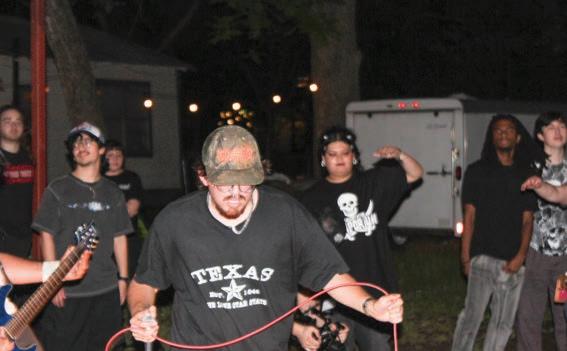
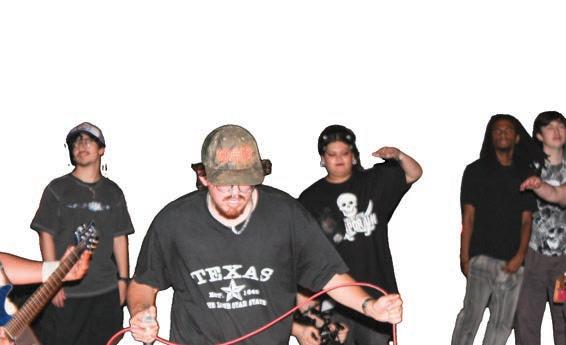

In cramped dorm rooms and crowded student hallways, two Texas State bands found something louder than their genres; they found each other.
Cuerno and Michael on the Counter may sound nothing alike, one fueled by beatdown rock, the other by indie softness, but both bands were shaped by the same foundation: the chance encounters and tight quarters of Texas State student housing.
Their origins reveal how campus spaces can become incubators for connection, giving students room to experiment, collaborate and build friendships that outlast the semester.
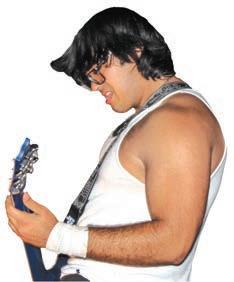
Cuerno Cuerno chose its name, Spanish for “horn”, because the members liked its punchy sound and the visual possibilities for merch. Its members consist of Leo Saldivar, anthropology junior and vocalist, Jack Furbee, film junior and drummer, Michael Flores, education junior and guitarist and Desarey Elizondo, electronic media junior and bassist.
By Cady Clements
& Arts Editor
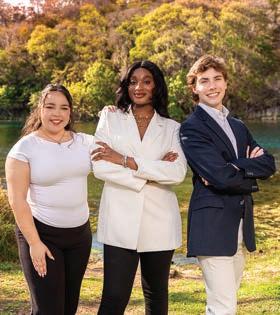
In conversations with students across campus, Johanna Ajayi kept hearing the same quiet frustration: leadership rarely looked like the students it served. She decided to change that.
Ajayi, Texas State’s first Black woman student government president and finance junior, saw
representation in positions of power as non-negotiable and thought she could fill the gap she was seeing.
She created the Bobcats in Bloom campaign with Keller Hammack, Student Government vice president and accounting senior, to elevate the voices of every group at Texas State.
Ajayi and Hammack built a campaign around the phrase
“Texas State: Where every
Gymnastics Program reintroduced, first in Texas
By Ayden Ordeson Sports Editor
Texas State athletics announced Monday morning that they will be bringing back women’s gymnastics. This marks a historic first as this will be the first institution in the state of Texas to sponsor an NCAA Division I Women’s Gymnastics program.
This comes with Texas State’s planned entrance to the Pac-12 in July alongside being in a state that is a hotbed of talent but had only one program within the state.
The Bobcats will join five other programs in the Pac-12 that field a women’s
gymnastics team; including Utah State, Boise State, Oregon State and Southern Utah. These programs have been nationally competitive, and Texas State will have to adapt fast to these programs that have been around for decades. The competitions and meets will take place at Strahan Arena, with the head coach search underway as their first season is expected to begin in Spring 2028. Texas State’s once nationally-recognized program competed in multiple Division II championships before being shuttered in April 1986.
voice blossoms.” They plan to accomplish that goal by filling their cabinet with people from as many walks of life as possible.
“One of the things that I want to accomplish by the end of the school year, or even with my cabinet specifically, is for students to look up and see themselves in these leadership positions,” Ajayi said.
By Arabella Dichristina
After a successful habeas corpus filing, Gerardo Reyes, a San Antonio father, is being released from Immigration and Customs Enforcement (ICE) after a traffic stop in March that led to his arrest and later detention by ICE.
Gerardo Reyes was released at 5 p.m. from the T. Don Hutto ICE Detention Center in Taylor, Texas on June 1, after over 60 days in detention. A habeas corpus claim challenged the legality of Gerardo Reyes’s detention and allowed a judge to release him from the detention center while his immigration case is pending.
“Gerardo is coming home,” Guadalupe “Lupe” Sarinana, Gerardo Reyes’ daughter, said in a press release sent out by Eric Martinez, executive and policy director of Mano Amiga. SEE ICE PAGE 2
By Ayden Ordeson
In what felt like a
and the
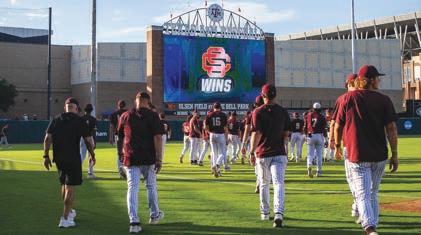
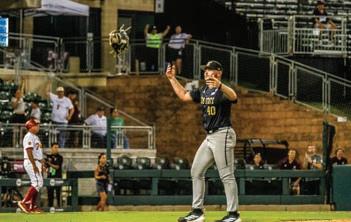
they took part in the 2026 NCAA Tournament at the College Station Regional, from Friday, May 29 to Sunday, May 31. Despite the elimination, Texas State’s first regional in four years featured senior third basemen Chase Mora, who arguably had his greatest moments as a Bobcat in their comeback victory against the Southern California Trojans (USC) and Texas State setting a new single-season conference record in home runs by a team in the Sun Belt Conference.
“This victory belongs to every person who signed a petition, showed up at City Hall, called the DA [District Attorney], and refused to stay silent. We proved that when we move together, we win together.”
On March 14, the San Marcos Police Department conducted a traffic stop that led to the arrests of Gerardo Reyes and his 17-year-old son, Esteban Reyes. Both were charged with interfering with an officer’s duty after refusing to exit the vehicle. After the arrest, Gerardo Reyes was transferred to ICE custody.
Habeas corpus is a legal right that allows anyone detained by the government to demand a court review of their imprisonment, requiring law enforcement to produce the detainee and legally justify their confinement.
Gerardo Reyes’ legal team filed for habeas corpus after an immigration judge denied his application for cancellation of removal on May 12. Additionally, SMPD placed the arresting Officer Jaciel Cortina on administrative leave on April 10.
According to the press release, Cortina was only placed on a 24-hour suspension and the city of San Marcos admitted Cortina violated three department policies during the arrest.
“A 24-hour suspension did not bring our father home. Community pressure did,” Sarinana said in a Mano Amiga press release. “Detention centers profit from keeping families apart. Politicians win votes on fear. But we proved that people power is stronger.”
Hays County District Attorney Landon Campbell declined to charge, meaning no formal charge was filed against Gerardo Reyes after the Reyes Family and Mano Amiga delivered a petition on May 8.
Throughout Gerardo Reyes’ immigration case and his time in the detention center, Gerardo Reyes’ wife,
Sanjuana Escalante, said they were struggling to keep their house in San Antonio because her husband was the main financial provider.
“We gather not only for the Reyes family but for every person enduring the tension, separation and injustice behind closed doors. We gather for the fathers, mothers, children, siblings and loved ones who are being treated as disposable by systems that criminalize immigrants,” Nataly Avendano, immigration equity director for Mano Amiga, said during the solidarity vigil for Gerardo Reyes on May 12.
Esteban Reyes’ charges remain in a pre-file status, where the district attorney has yet to make any action to file or disregard Esteban Reyes’ charges.
According to the press release The Reyes’ family is demanding a full dismissal of all charges against Esteban Reyes, greater accountability for Cortina, a policy change at SMPD to adopt the Hartman Reforms and to end police and ICE collaboration in Hays County.
The Hartman Reforms are a set of community police accountability and transparency policies that eliminate the 180-day statute of limitations on investigation of officer misconduct, end delays in misconduct interviews by increasing transparency and making personnel files more accessible, bans third-party arbitrators from the disciplinary process, gives local authorities the final say in employment, and eliminates vacation forfeiture, no longer allowing officers to substitute suspensions with forfeited vacation days.
By Andrew Bencivengo Editor-in-chief
The San Marcos Police Department has seen an increase in burglaries of motor vehicles (BMV)’s, arresting multiple people connected to the crime.
According to a statement posted to the San Marcos Emergency Services Facebook, officers responded to reports of suspicious people checking car doors, resulting in the arrest of five individuals.
Russel Wilde, San Marcos public safety communications specialist, said in a message to The Star that there were 146 BMV’s reported since the
start of the year.
According to the San Marcos Police Department monthly crime and activity statistics, there were 30 reported BMV’s in April, a 43% increase since the same month last year. San Marcos Emergency Services indicated that an increase in BMV’s is typically seen during the summer, however according to police data, each month of 2026 has surpassed cases reported the same month last year.
San Marcos Emergency Services advises residents and visitors to lock their cars, remove valuables from plain view, never leave a firearm inside a vehicle and report suspicious activity immediately.




Editorial
Editor-in-Chief: Andrew Bencivengo stareditor@txstate.edu
Managing Editor: Meg Boles starmanagingeditor@txstate.edu
News Editor: Arabella DiChristina starnews@txstate.edu
Life & Arts Editor: Cady Clements starlifeandarts@txstate.edu
Opinions Editor: Regina Orozco Lopez Forment staropinion@txstate.edu
Design Editor: Jen Nguyen stardesign@txstate.edu






Sports Editor: Ayden Oredson starsports@txstate.edu
Multimedia Editor: Aiden Fritsche starmultimedia@txstate.edu
Engagement Editor: Tatum Pou starengagement@txstate.edu
PIR Director: Keely Florez starpr@txstate.edu
Creative Service Director: Sophia Gerke starcreative@txstate.edu
TV News Director: James Phillips startvnews@txstate.edu
Publication Info
Copyright: Copyright Tuesday, June 2, 2026. All copy, photographs and graphics appearing in The University Star are the exclusive property of The University Star and may not be reproduced without the expressed written consent of the editor-in-chief.
Corrections Policy: Errors appearing in the pages of The University Star and brought to our attention will be corrected as soon as possible.
By Arabella DiChristina News Editor
The Texas State University System (TSUS) approved Texas State’s contract with Aramark Collegiate Hospitality as the new food supplier and prepares to comply to Texas House Bill 157.
Effective June 1, Aramark will take over the dining services across the Texas State campus, replacing Chartwells Higher Education, who has been providing food services since February 1998 and has been responsible for all campus dining halls, Paws-N-Go, J.C. Kellam’s snack bar, among other regular food services and event catering.
“The contract aims to ensure that the campus community has consistent access to safe, nutritious, and diverse food options in a variety of convenient formats and locations,” the contract states.
The contract estimates a $301 million valuation throughout the ten-year term of the contract, including
the one five-year renewal option once the ten years are concluded.
According to a Texas State press release, Aramark will change the residential dining halls now featuring a distinct culinary identities, with Jones Dining Hall undergoing a shift of concepts and the addition of more national brands. Additionally there will be expanded retail dining options, improved access for students living off-campus, integrated technology and an expanded food security initiatives.
The Workers Adjustment and Retraining Notification (WARN) listed that Compass Groups USA, which oversees Chartwells, issued a notice that 183 layoffs would take effect on May 31 at Texas State. While it is unclear how many jobs will transfer over to Aramark, Chartwells employed a large number of student workers.
“The proposed program will enable Texas State University to deliver high-quality, reliable and efficient dining, snack vending and concession services that enhance
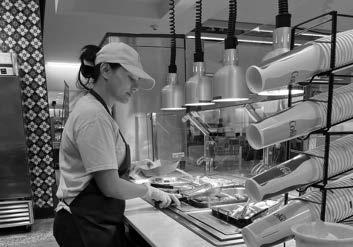
Health science sophomore and employee at
student’s order, Monday, April 20, 2026, at Jones
Center is set to go through the most changes with Aramark.
the overall campus experience,” the contract stated.
According to the contract, the source of funding comes from local institutional funds.
Vice President for Student Success Cynthia Hernandez sent out a mass email to students stating Aramark will provide an enhanced focus on access, quality, convenience and consistency.
“With any transition of this scale, changes will be phased in with continued attention to student feedback. We recognize there may be challenges and adjustments during the transition, and we are committed to addressing issues as they arise,” Hernandez wrote.
Students who have questions about Aramark can attend a campus webinar on June 9, at 12 p.m., where Aramark representatives will provide insight. Students can register on the mass email from Hernandez.
Along with other schools in TSUS, Texas State is preparing to comply with the Texas House Bill 127, which requires Texas universities to strengthen protections against foreign influence and research risk.
The initiative is led by Shreek Mandayam, vice president for research at Texas State and chief security officer of TSUS. He presented that compliance with HB 127 will include enhanced screening, restricted partnerships, oversight of foreign funding in student organizations and tracking and documenting international travel and collaborations.
“This was a law that was passed last year to make sure that we protect our Texas research from foreign adversaries. There are some requirements that they have put out and we are working very hard with other sister institutions in the system to make sure we meet that,” Mandayam said.
Mandayam said what Texas State needs to comply with for HB 127 will be different than what
other schools in the system need to comply with, creating tiered levels throughout TSUS.
HB 127 was passed on June 20, 2025, going into effect on Sept. 1, 2025, to tighten oversight on research security, foreign donations and international travel.
According to HB 127, campuses are prohibited from renewing contracts for or using testing, touring and educational software controlled by designated foreign adversaries.
“The state auditor shall periodically conduct a compliance audit of each institution of higher education to determine whether the institution has spent money in violation of this section [Sec. 51B.301],” HB 127 states. “The state auditor shall adopt a schedule by which the state auditor will conduct compliance audits under this subsection. The schedule must ensure that each institution of higher education is audited at least once every four years.”
If an institution violates HB 127, there is a 180-day grace period to correct the violation after it is identified, or they are ineligible to receive state funding or special funding requests during the next state budget period.
During Mandayam’s presentation, meeting the HB 127 standard also included active security controls, defending certification with auditable documentation, governance for the research security officer structure and preparing for the State-driven standard to activate.
The bill defines “Foreign agent” and “Foreign instrumentality” as a representative of a foreign government and entity that is substantially owned by a foreign government. Additionally, an offense under HB 127 is a thirddegree felony.
Mandayam stated he will meet up with the board of regents before their August 6 - 7 meetings to confirm both Texas State and TSUS are on the right track to comply with HB 127.
By Arabella DiChristina & Charlise Daniels News Editor | News Reporter
Recent graduates are entering an uncertain labor market, the unemployment rate for recent college graduates has reached 5.6%. and innovation is requiring students to rethink their skillset.
According to data published by the U.S. Bureau of Labor Statistics, the civilian unemployment rate has been trending upwards, reaching 4.3% in April, but is still noticeably below the rate for recent college graduates. According to CBS News, the recent graduate employment movement can be attributed to the rise of artificial intelligence (AI).
Despite the rising national trend in unemployment, Texas added 46,800 nonfarm jobs in March, with Gov. Greg Abbott calling it “the best business climate in the nation,” in a May 6 press release.
However, many recent graduates are facing a different economic reality with 41.5% of recent college graduates being classified as underemployed nationally by the Federal Reserve Bank of New York, meaning they are working in jobs that do not require a bachelor’s degree or higher.
Haiyong Liu, department chair of finance and economics and a professor of economics, said the class of 2026 is facing a different job market compared to four or five years ago when they first enrolled at Texas State.
“It’s not a recession-level labor market by any means; it’s still a market characterized by caution, low hiring, and greater competition of a desirable position,” Liu said.
Liu said he observed that many employers are posting open job positions but are taking longer to hire, creating an impression that opportunities are out there, but offers are just slow.
According to Forbes, one in seven job postings remain active for more than 30 days. These jobs are classified as “ghost jobs,” where jobs are posted or remain posted even if the company is not currently hiring for the role, leading to confusion for applicants.
“I think entry-level positions [are] increasingly [requiring] prior experience, internships, neotechincal skills or industry certifications, that once were considered optional,” Liu said.
Felix Quayson, assistant professor of practice in organization, workforce and leadership studies, said the current labor market employers are laying people off because of the benefits of artificial intelligence (AI).
“They want to use AI to make the profits and revenue and so forth,” Quayson said. “So they’re laying off people, but at the same time they actually need people to work these AI machines, so now they’re like we kind of made a mistake by laying off all these people.”
Quayson said employers are going to start hiring based on how the employees benefit the company and how well they work with AI.
“So now a lot of entry-level positions are being devastated by AI, so the thing that employers are actually looking for are the human skills,” Quayson said. “Some people call it soft skills, but I call it human skills because those are essential skills that even artificial intelligence machines ... don’t possess that kind of intelligence.”
Soft skills are personal attributes or interpersonal people skills that allow someone to dictate their communication with others and how to navigate different environments. Quayson said college students on any level learn soft skills throughout their college career, but they have to learn how to put them into practice.
“AI doesn’t have emotional
intelligence, right? So you, as a human being, you as the professional have to exercise your discretion of emotional intelligence, communication, so forth,” Quayson said.
“Those interdisciplinaries [are] what makes you more advanced than artificial intelligence
Marissa Bruno, a business administration sophomore, said the pressure to secure professional experience early has made the job market feel discouraging at times.
Bruno said it’s hard to get experience early on, with employers dismissing her applications for entry-level jobs and internships because she is a sophomore.
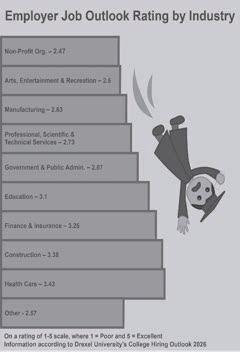
Although Bruno said human resources will remain dependent on interpersonal communication or soft skills, beginning a professional career now feels more competitive than ever.
“I hate to say it, but AI really is eliminating entry-level positions. Especially for jobs that deal with accounting and finance,” Bruno said. “It’s a struggle because AI replacing entrylevel jobs, but upper management jobs require years of experience.”
According to Quayson, the old days when a bachelor’s degree guaranteed a job are over, with the college career transition changing; students should approach it with a general plan.
“Every job is different. So once you
go out there, they can train you on the hard skills, but the soft skills, which is the human essential skills, are what employers are basically emphasizing over and over,” Quayson said.
According to Liu, most of the desirable jobs require more than just a college degree.
“One thing I often time trying to provide some counsel to our graduating seniors is that all you need is one job,” Liu said. “You don’t worry about, you know, the statistics on how many job postings are in central Texas, in the industry; all you need is one job. You build on that.”
Regina Orozco Lopez Forment
By Maryam Ali Opinion Columnist
single characteristic.

At Texas State University, students bring with them a wide range of cultures, languages and identities. Yet for many Middle Eastern and North African (MENA) students, their identities are still shaped by misconceptions that overlook the diversity of the region and the experiences of the people within it.
Texas State has the opportunity to challenge these misconceptions through stronger cultural programming, more inclusive curriculum and clearer institutional recognition of MENA students. Without these efforts, stereotypes continue to shape how MENA students are understood both socially and academically on campus.
Many people hear the term “Middle Eastern” and immediately picture one identity, religion or way of life. When in reality, the region flourishes with diversity. Professors and students should instead encourage critical thinking and learn the true meaning of MENA identity.
This oversimplification does not just affect how others view MENA communities, it also shapes how MENA Americans experience their own identity. Constantly being grouped into a single stereotype can create a feeling of invisibility, where individuality and cultural differences are overlooked.
Whether it is being asked where you’re “really” from or hearing your culture discussed only in relation to war, conflict or religion, these stereotypes reduce a person to a
Media representation has played a major role in shaping these perceptions. For decades, MENA groups have been portrayed through narrow and negative lenses. News coverage, films and television have reduced entire communities to political talking points instead of showing the depth of everyday people and cultures.
These misconceptions can also appear in education itself. MENA history is often taught through conflictcentered narratives that focus on war, terrorism or political instability rather than literature, art or everyday life.
This hyper-critical portrayal on college campuses, because of continuous reinforcements of pre-established stereotypes, can unintentionally reinforce the idea that the region is defined only by crisis instead of its cultural depth.
Tamara Younes, interior design junior, said it feels like the MENA identity has become something many people feel pressured to distance themselves from.
“I feel like so many of the Arabs here in America are almost ashamed to be Arab,” Younes said. “I wish they could speak more openly about their experience and their culture and their people.”
However, these challenges extend beyond personal interactions, media portrayals and curricula. Misrepresentation is also reflected institutionally, particularly in how Arab Americans are categorized and counted within the United States.
Under the current United States Census, people of MENA descent are categorized as “white,” a classification that renders them statistically invisible.
This lack of recognition obscures social and political issues affecting MENA communities that may require attention and support.
Fortunately, after a decades-long battle, the federal government has approved updated standards that include a MENA category in official race and ethnicity data collection. However, its future is far from guaranteed.
Texas State also follows federal Common Data Set guidelines established by the U.S. Department of Education and IPEDS, which categorizes individuals of MENA descent as White. As a result, MENA students are not classified distinctly.
This is particularly significant at Texas State, where over half of the students are classified as racialethnic minorities. For MENA students, this classification may make their experiences and challenges feel invisible or unrecognized.
Universities such as Texas State have the ability to advocate for more accurate representation of MENA students. Better demographic data is essential to understanding and addressing disparities that may otherwise remain invisible.
Conversations about identity and diversity are increasingly important, especially in environments like Texas State, where students from different backgrounds interact every day. Understanding begins when people are willing to listen beyond assumptions and recognize that no community is a monolith.
“Our culture is beautiful, and our people are loving and kind. I just wish everyone would see that,” Younes said.
Being Arab in America isn’t defined by one story or one experience. It is layered, personal and deeply connected to

both heritage and environment. Universities should encourage broader discussions about MENA identity through curriculum, campus programming and inclusive representation.
Students can challenge stereotypes by supporting cultural organizations, engaging with MENA voices beyond moments of conflict and by being willing to question the assumptions they have grown up hearing. At a university that values diversity, MENA students deserve more than symbolic inclusion they deserve to be fully understood and represented.
-Maryam Ali is a computer science senior
By Mark Gabrielides Opinion Columnist
Short-form content has changed the way students consume information, disregarding nuance and prioritizing entertainment.

With this content becoming increasingly prevalent, Texas State teachers and students may have to approach learning differently.
Short-form content is characterized as being momentary while offering instant gratification with little to no cognitive effort. Although short-form content has been found to be engaging and effective in communicating information, the brevity of these videos inhibit the introduction of nuance to complex topics, fostering surface-level understanding.
While obtaining overviews of information in short spans of time is attractive to the consumer, a surfacelevel understanding of a topic cannot be overcome without additional educational sources, such as in-depth sources and longer-form content.
TikTok users reportedly spend an average of 1 hour and 37 minutes a day on the app, with college-age students making up approximately 85.4% of the app’s audience. Targeting students as a primary audience by utilizing algorithms that tailor content to the individual, where personalized echo chambers are created. This
endless stream of content blurs the lines between videos, distorting information while ensuring that the user stays engaged for longer periods of time.
According to a study conducted by PubMed Central, the continuous consumption of short-form content was found to increase students’ level of academic procrastination as attention span worsens. With lessened attention spans becoming a potential impact of the continuation of shortform content consumption. Texas State lecturers will have to adapt traditional learning strategies to effectively convey educational nuance.
It is projected that the average attention span will not improve. The University of Louisiana Monroe has opted for adapting their lectures to accommodate students’ lessened attention span, implementing storytelling in lectures and embracing micro-lessons, breaking longer readings into more manageable chunks. Changes such as these may increasingly become seen at Texas State as they will be vital in combating declining attention span trends and maintaining analytical thinking standards.
The addictive nature of social media, in conjunction with the human baseline capability for concentration falling from 12 to 8 seconds, will become increasingly relevant for Texas State educators to consider when making edits to their curricula. More engaging teaching methods such as group work, hands-on activities and classroom conversations will become
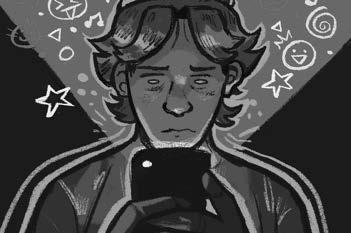
impactful in conveying information than classic lecture style lessons.
Assistant Professor of Instruction of English and 10-year K-12 teacher, Rebekah Proffer, said that she received shocking reactions from students when assigning a textbook chapter that was recently reformatted to include more photos, making the text appear longer than it had in previous years.
“It [an assigned textbook reading] is eight and a half pages long with a lot of pictures, but every semester when this chapter comes up, it’s the same conversation. [Student’s respond] ‘Yeah, it was good, but it was long, and I kind of lost the thread towards the end,’” Proffer said.
Rising trends in short-form content consumption have the potential to normalize more rapid learning approaches, leaving previously utilized
e-mail address when submitting a letter. Submissions that do not include this information cannot be published. This information is seen only by the editors and is used to verify the identify of the letter writer. It is not used for any commercial purpose.
readings and lectures to appear longer or more overwhelming to students than they may have in previous years.
“Compared to the instant dopamine hit that we’re getting on the internet… sitting in a 90-minute lecture is such a different state of mind that you have to adapt to pay attention to this longer format,” Proffer said. The stark difference in analytical thinking and attention required of students on the internet versus in a lecture will exacerbate surface-level learning further. Texas State lecturers and students alike need to adapt to the fast-paced dopamine rush cycle fostered on the internet in order to maintain vital academic nuance when addressing crucial topics.
-Mark Gabrielides is a English
Letters become the property of The Star and may be republished in any format. The letter may be edited for length and clarity. An editor will contact the letter writer if their letter is a candidate for publication. The Star will not run letters that are potentially libelous, discriminatory, obscene, threatening or promotional in nature.
Letters can be submitted to staropinion@txstate.edu or by mail to Attn: Opinion Editor, The University Star, 601 University Drive, San Marcos, TX, 78666.
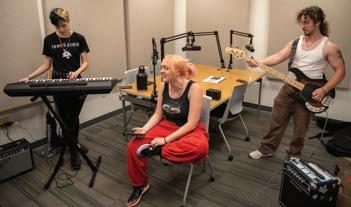
The band formed in fall 2024 after Saldivar and Furbee met at New Student Orientation (NSO) and bonded over each other’s graphic tees. Their quick friendship sparked Saldivar’s long‑held plan to start a band.
“I just walked up, and I was like, ‘Dude, I like your Star Wars shirt,’ and he said, ‘Dude, I like your Spawn shirt,’ and then we hung out for NSO. I got his Instagram and he said he was gonna start a project,” Furbee said.
Saldivar searched for a guitarist by posting flyers around campus, only to discover Flores had posted one too. He reached out, and the lineup began to take shape.
“I was putting up flyers looking for guitarists, and I was going to put one up at Commons,” Saldivar said. “And I saw that [Flores] had put up a flyer [looking for guitarists] also, so I hit him up.”
The next piece of the puzzle was finding a rehearsal space. Rehearsing in Saldivar’s dorm proved impossible because the drum set couldn’t fit, forcing the band to rely on digital drums. They eventually secured permission to practice in the Music
Building, where they could finally hear their full sound.
Elizondo was a fan of the band for a while prior to meeting them. They attended a couple of Cuerno’s shows in and around San Marcos, listened to the band’s singles and heard about the band online. Elizondo also learned bass over the summer, so when Cuerno posted online that they wanted a bassist, Elizondo reached out.
“I think I was able to jump in pretty quickly into the rehearsal, just jam out and come up with whatever,” Elizondo said. “And then that’s what I did at the show.”
While Cuerno still has to work to find time to practice and travel to perform in different cities around Texas, such as Houston, Austin, and San Antonio, Flores said the members have a tight bond that helps them overcome obstacles.
“We always talk about how a big part of why we’re so good as a band is because we’re really good friends … it’s also because we met as friends,” Flores said.
Michael on the Counter
Michael on the Counter, an
indie rock group, also traces its beginnings to student housing and chance encounters. Its members include Jacob Hoke, business management sophomore and bassist; Jakob Epps, chemistry graduate and guitarist; Kenzie Turner, electronic media sophomore and keyboardist; and Presley Neffendof, technical production sophomore and vocalist.
There were a number of different ideas for names, but the way it settled on “Michael on the Counter” is very interesting. The indie band’s name is a mix of a song from the musical “Be More Chill” called “Michael in the Bathroom” and a comedic moment from a different musical, with the punchline being a character, Gabe, sitting on a counter.
Michael on the Counter began its formation in the spring when Turner and Neffendof met. The band idea originated while they were in the same Fundamentals of Digital and Online Media class.
“We were working on our website project, and we got a little distracted, and Presley mentioned that she was in a band in high school, and I said, ‘Oh, I’ve always wanted to be in a band,” Turner said.
That single comment gave way to form something special, because that same night, the pair wrote their first song. Neffendof said while they couldn’t do much instrumentally that day, they did set up the band’s platform by creating social media accounts and taking pictures in a local park, where the band found its next member.
know anyone who plays instruments?’ And I was like, ‘Funny you ask, but I play bass.’”
The trio played for a couple of rehearsals before they realized they needed a guitarist. That guitarist would become Epps, who said a flyer on a column at the LBJ Student Center that caught his eye. He reached out to the band and turned out to be exactly what they needed.
Michael on the Counter practiced in Turner’s dorm room. Neffendof said the band’s team chemistry and writing ability are two of its strongest suits and believes Michael on the Counter can overcome any obstacle in its way with them.
Both bands are different in their sound and stage of formation, as well as their music production methods. However, their shared origin in student housing shaped their bonds and their music. Those early connections continue to influence how they collaborate, trust one another and grow
“They were playing music,” Hoke said. “I was kind of dancing to the music, and then they came up and asked me, ‘Do you

Ajayi was previously a senator at large, which represents students through legislation, and as a senator, she aimed to streamline Texas State transportation services and food insecurity programs. She said as president, many of her goals will stay the same, and she will build on them based on her cabinet’s suggestions.
“As a senator, I passed legislation about transportation to basically give them more support,” Ajayi said. “I actually talked to them even while I was campaigning to figure out what we could do in order to make this system better.”
Ajayi also plans to expand Texas State programming for men’s mental health after a student took his own life this past school year. She said that with a university as big as Texas State, it can be overwhelming to try to make connections, and she hopes the programs she implements will bring people together across the board.
“It’s sometimes hard to find that community here at Texas State,” Ajayi said. “We want to have that desegregation this school year where people from different cultures and ethnicities are meeting each other and becoming friends because you never know who you could become friends with.”
Bobcats in Bloom won the student government
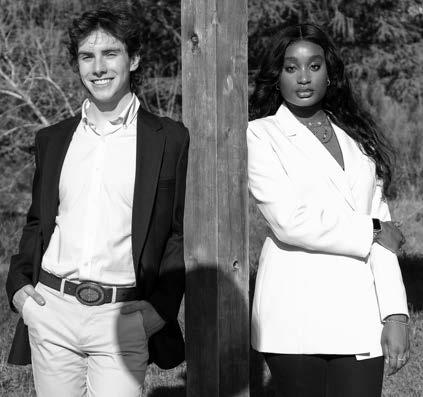
election with 61.17% of the vote (1,572 votes) due to the sheer number of endorsements from minority clubs and organizations, as well as, broad student support. Naomi Umeh, president of Genius Girls and a biochemistry junior, said the way Ajayi approached her as an individual and the details of her campaign were what made the difference
in whether she decided to propose endorsing Bobcats in Bloom to Genius Girls.
“She was like, ‘I know I’m not going to ask you to endorse me because that’s your decision, but I do want to tell you about my campaign,’” Umeh said. “She just literally talked to me for hours about her campaign and what she was trying to do, and I could tell she was
being very genuine.”
Though their victory was undeniable, the Bobcats in Bloom team had a few bumps along the way.
Anaysa Guerra, student government chief of staff and a public administration sophomore, said that, as the campaign manager, securing endorsements from as many organizations as they did was not easy because they didn’t
always have a connection that would let them into the room.
“It was very hard for [organizations] to allow us into those rooms without us already having someone that we knew in the organization,” Guerra wrote in an email to The Star. “We relied heavily on word of mouth of our friends to get us in contact with the executive boards.”
Bobcats in Bloom aims to be the voice of the students towards the administration throughout the next year.
Esteban Puzon, accounting junior, said the student government was never really on his radar until Ajayi began to make it more accessible to every college student.
“From someone who didn’t really even know we had a student government, it speaks volumes that I wanted to learn more about their campaign,” Puzon said.
“It looks like [Bobcats in Bloom] will really represent the students.”
Ajayi and Guerra said they hope to leave student government and Texas State as a whole better than they found it.
“The legacy that I would love to leave is holding the student government to a certain standard that the next student government would have to reach and exceed,” Ajayi said.
By Andrew Bencivengo Editor-in-Chief
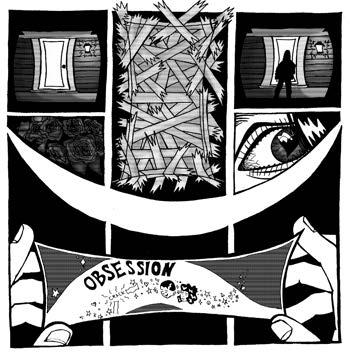
With tense performances, unsettling dialogue and sharp cinematography, “Obsession” transforms a simple premise into a gripping film worthy of its title.
“Obsession,” written and directed by YouTuber-turned-filmmaker Curry Barker, explores a familiar trope: the wish for undying love. Barker, however, expands the concept into an expertly woven commentary on autonomy and relationships, grounding its horror not in its gore, but in its exploration of control.
However, “Obsession” does not simply benefit from Barker’s vision. Its most captivating element may be its acting, with Michael Johnston’s Bear, named after the viral internet thought experiment of choosing between a man and a bear, and Inde Navarrette’s Nikki reinforcing the horror of losing control.
With a budget of less than $1 million, “Obsession” avoids the excess that could have turned its premise into a mixed bag of horror tropes, instead relying on an earnest exploration of its concept. While many modern horror blockbusters pour millions into CGI demons and ghosts, “Obsession” is constrained by its small budget to use sparing practical effects to unsettle the audience.
The film begins with Bear practicing an embarrassing monologue he plans on delivering to his thenfriend Nikki, introducing audiences immediately to Bear’s infatuation and awkwardness.
Bear wanders into a novelty shop where he purchases a trinket called a One Wish Willow after Nikki tells him that she lost her crystal necklace. Bear sees an opportunity to impress Nikki with a gift, but ironically purchases her an item he found interesting rather than the one she lost.
The One Wish Willow, a novelty that grants one irreversible wish, acts as a catalyst for the film’s plot. When Bear purchases the item, he has no
expectation of its promise being genuine, despite warnings from the cashier, and to this point, his intentions seem pure.
With the One Wish Willow in tow, and a desire to finally make his feelings known after Nikki revealed she had put in her two weeks at their work, Bear goes out drinking with his friends. When both he and Nikki see the night at its conclusion, despite insistence from their friends to stay out, Bear brings Nikki home.
In the car, Bear, stumbling through his awkwardness in a moment he has likely pictured for months, attempts to make his feelings known but is ultimately unable to do so.
Noticing his demeanor, and seemingly vulnerable due to details learned later, Nikki asks Bear directly if he likes her, to which Bear denies.
After Nikki walks away, Bear grovels in his unhappiness of letting
the moment slip away, retrieving the One Wish Willow and wishing that, “Nikki Freeman loved [him] more than anybody in the [expletive] world.” Nikki then reappears and asks Bear to come inside, until ultimately going to his place and kissing him before screaming.
This scene reveals several aspects of Bear’s character, but the most evident is his emasculated insecurity, which later spirals into predation. Unable to confess his feelings for Nikki, Bear resorts to wishing for her affection, only finding success in his desire when Nikki is stripped of autonomy.
The two become a couple and, despite their friends’ bewilderment, fall into a cliché romantic montage. At this point, Bear believes Nikki’s infatuation is genuine; however, cracks begin to appear in the facade as it becomes increasingly clear that
Nikki is no longer fully in control of her actions.
By the film’s midpoint, the true villain and abuser of the film is made clear, with them continuing to act without remorse. When granted opportunities to acknowledge the harm caused, they instead work to preserve their fantasy.
As the film progresses, increasingly more horrifying, and typical horror elements are presented, done in a way that works to evoke the insidiousness of the predicament.
The film’s final act ironically turns that same obsession back onto the abuser, after consistently and knowingly violating agency, they ultimately are forced to confront that same loss of control. When presented with an opportunity to reverse the suffering, they once again act to act in self-interest.
“Obsession” reveals itself as a striking commentary on modern male entitlement, with Bear not driven by a desire for genuine love but rather relishing in the perverse fulfillment of a longstanding fantasy. The movie uses horror to visualize a relationship dynamic all too familiar, where insecurity turns affection into obsession and ownership.
The film expertly blends writing and cinematography with compelling and rather unnerving performances by its cast. “Obsession” is ultimately a horrific exploration of a man’s insecurity turned depravity, at the expense of a woman’s autonomy, delivered in possibly the best film of the year.
-Andrew Bencivengo is a business management senior.
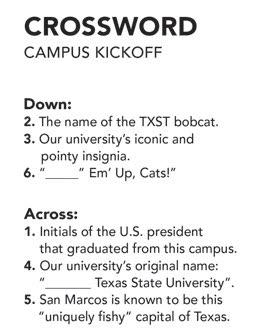

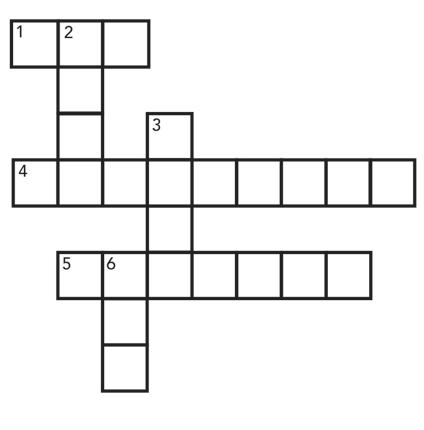
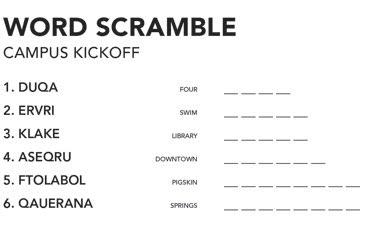

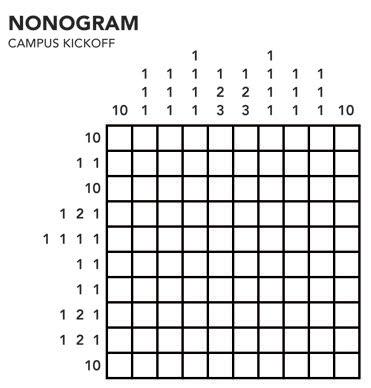
By Luke Landa Sports Reporter
Many runners have to wait until they step into the blocks to see who they will be competing against. For the Lloyd twins, their competition has always been each other.
Freshmen Ja’Shaun and Ty’Shaun Lloyd, two highly recruited athletes in the track world, have provided Texas State Track and Field with a jolt of contagious energy. The electric duo have used their lifelong bond to bring attention to the Bobcats by scoring points and breaking records.
Bobcats assistant coach, Aries Merritt, who won an Olympic gold medal in the 110-meter hurdles in 2012, said that the twins have already made their presence felt.
“The Twins don’t let anything faze them; they buckle down and get the job done,” Merritt said. “They’re really hungry for success; their presence alone has garnered eyes to Texas State track and field.”
Ja’Shaun, the Sun Belt Conference Indoor Freshman of the Year, specializes in the 110-meter hurdles. Ja’Shaun says that Texas State checked all the boxes for him when he was deciding which school he would compete for and that Merritt

Friday vs No. 25 USC: W, 5-4
Texas State opened regional play going toe-to-toe against one of the best pitching staffs in the country, the Trojans. The game was back-and-forth, as whenever USC threw a punch, the Bobcats delivered a counter-punch of their own.
As head coach Steven Trout put it, Texas State kept finding ways to survive.
“I’ll be honest, we didn’t play very good today and it’s hard to say that after you get a regional win,” Trout said. “We just felt like we were surviving all night long.”
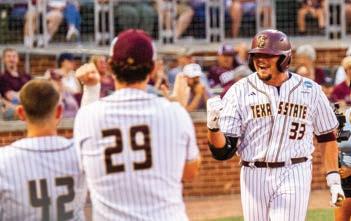
After USC scored three runs in three innings to take a 3-1 lead by the fifth, sophomore shortstop Brady Boles drove in a two-run home run into left field that evened it up at 3-3 apiece.
Through the next few innings, it turned into a staring contest between the pitching staffs of Texas State and USC. The Trojans kept threatening, but impressive defensive plays, highlighted by senior right fielder Rashawn Galloway crashing into the right field wall to make a two-out catch to prevent scoring, which kept the game tied.
When momentum seemingly swung back into the Trojans favor after a go-ahead solo home run in the eighth inning from junior first baseman
made him feel at home.
“I knew right away [Merritt] was one of those people who was going to make sure we were taken care of,” Ja’Shaun said. “It was a welcoming feeling.”
For Ty’Shaun, a talented sprinter who earned a Third Team All-Sun Belt Indoor accolade, it was unknown if he would ever compete collegiately.
“I never planned on running in college. I was going to go to school for academics, but it was a last-minute switch,” Ty’Shaun said. “Texas State drew my attention and kept me close to my family.”
Their freshmen seasons have shown how impactful the students can be and glimpses of how much farther they can go.
Ja’Shaun recorded seven top-three finishes, including three victories during the indoor season. He also set a new program record in the indoor 60-meters with a time of 6.62 seconds, and scored the most points since 2011 at the Sun Belt Conference Indoor Championships with 29.5 total points.
Ty’Shaun, who dealt with an injury early in the season, has since come back and been a pivotal piece of the Bobcats sprinting squad,

Adrian Lopez to make it 4-3, Texas State, once again, found a way.
Mora became the hero the Bobcats needed in the ninth inning: not only did he deliver the go-ahead, two-run blast into deep centerfield to put Texas State on top, but he also caught a hard linedrive out to prevent a game-tying hit and sealed the victory, helping advance the Bobcats to the winner’s bracket.
Saturday vs No. 12 Texas A&M: L, 17-2
The Bobcats poor defense from Friday’s win was still present the next day, committing two errors for the second night in a row. Unlike USC, however, Texas A&M took full advantage.
Despite a strong start from the Bobcats in the first two innings, which included home runs from the bats of junior designated hitter Manny Salas and freshman left fielder Jackson Cotton, the Aggies took a massive step-up in the third inning with a solo home run.
From there, Texas A&M carried that momentum to a dominating victory on the backs of 20 hits, including eight doubles and two home runs combined.
“I feel that’s our offense,” Aggies senior left fielder Jake Duer said.

participating in relay races such as the 4x100 and the 4x400 events, and recording three top-10 finishes.
Despite their different approaches, both twins have their eyes set on continuously improving as the outdoor season continues.
For Ja’Shaun, the next step is making new history far beyond the Sun Belt.
“I want to break the world record in the 110-hurdles,” Ja’Shaun said. “That’s been a goal of mine; the coaches have me on the right track, so I’m on pace to do it.”
Ty’Shaun’s mindset is different, yet just as driven. He allows his progression to speak for itself rather than attaching a set number to it.
“I try not to get so fixated on goals; there is no need to put extra pressure on yourself with a specific number when you don’t even know if you can run past that number,” Ty’Shaun said. “As long as I run fast, I’ll end up where I want to be.”
As their young careers continue
“That’s what our mindset has been, just passing the baton and I feel like we passed it tonight.”
A strong performance by junior pitcher Weston Moss for Texas A&M also stifled Texas State, featuring 10 strikeouts across seven innings and retiring 12-straight Bobcats from the second inning to the seventh, ultimately making this a for-sure victory early on for the Aggies.
Sunday vs No. 25 USC: L, 15-4
Sunday’s elimination game was a complete inverse of their earlier match-up. While the Trojans left 14 baserunners on base on Friday, USC left no doubts in their offensive prowess.
The moment the Trojans unloaded the bases with a grand slam at the top of the first with no outs, the Bobcats’ chances of playing in a regional final drastically dropped.
In the bottom of the fourth, the Bobcats offense showed their only bit of life in the game with a four-run spotting, which included senior first basemen Coy DeFury hitting not just his first home run of the season with a two-run blast into the right field bleachers but also making history in the process.
That home run was the team’s
to unfold, the Lloyd twins continue to raise the standard. The competition that once existed between the two of them now elevates an entire program as evidenced by the men’s team ranking top 35 in the nation all outdoor season.
The twins impact to the squad bodes well for the Pac-12 bound Bobcats who may be entering one of their most competitive eras yet, especially as Ja’Shaun prepares to compete for a championship.
He, along with seven others with Texas State Track and Field, qualified to compete in the NCAA Outdoor Championships in Eugene, Oregon from June 10-13 after their performances in the NCAA West First Round this past weekend from May 27-May 30.
Both the men’s and women’s events will be held simultaneously and be available to watch across ESPN and ESPN2.
116th home run of the season, breaking the previous Sun Belt Conference record that was held by the 2004 New Mexico State Aggies for most home runs by a team in a single season. Many seniors and graduates who would be leaving the team also got some minimal playing time as the game became further out of reach, such as catcher Austin Munguia and pitcher Braylen Timmins among others.
Trout’s season goal of making the NCAA Tournament for the first time in four seasons was accomplished, a necessary building block for a program hoping to sustain that success as they will begin Pac-12 play in Spring 2027.
“The young guys got the regional taste in their mouth,” Trout said. “Now they got to know what it’s like to go win a regional and get to a super regional and eventually get [Texas State] to Omaha.”

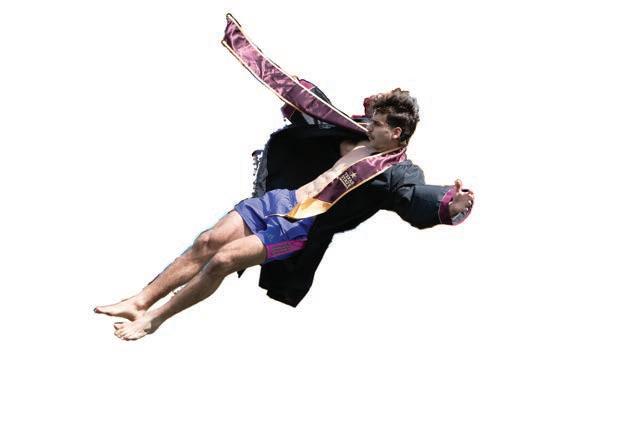
Animal science sophomore Madison Furch (left), health science senior Wisdom Mosley (center) and psychology senior Alyssa Carranza (right)swim in the river, Wednesday, May 13,

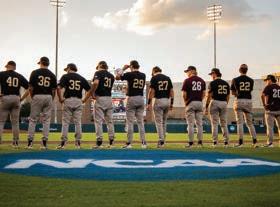
Texas State players line up at the NCAA College Station Regional Playoff, Friday May 29, 2026, at Blue Bell Park in College Station, Texas. The Bobcats upset the No. 25 USC Trojans 5-4 but went on to lose 17-4 on Sunday.