NEWS PRICE CENTER’S REQUEST FOR FUNDING DENIED PAGE 2
OPINION
LIFE & ARTS
STUDENT VISA CAPS LIMIT UNIVERSITY TALENT
BOBCATS RECOGNIZED FOR REGENTS’ AWARDS
PAGE 4
PAGE 7
TUESDAY
September 29, 2026 VOLUME 115 ISSUE 39
UNIVERSITY
AIDEN FRITSCHE | MULTIMEDIA EDITOR
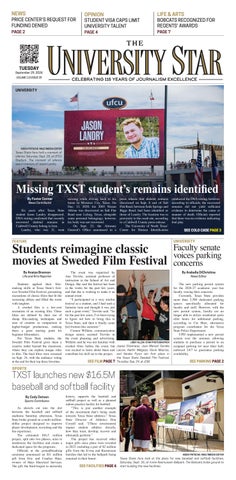
Texas State fans hold a moment of silence, Saturday, Sept. 26, at UFCU Stadium. The moment of silence was in memory of Jason Landry.
Missing TXST student’s remains identified By Foster Conner News Contributor
Six years after Texas State student Jason Landry disappeared, DNA testing confirmed that recently recovered skeletal remains in Caldwell County belong to him. Landry, who was 21, went
missing while driving back to his home in Missouri City, Texas. On Dec. 13, 2020, his 2003 Nissan Altima was discovered on Salt Flat Road near Luling, Texas, alongside some personal belongings; however, his body was not recovered. On Sept. 23, the Attorney General’s Office announced in a
press release that skeletal remains discovered on Sept. 8 east of Salt Flat Road, between Soda Springs and Biggs Road, had been identified as those of Landry. The location was in proximity to the crash site, according to a Caldwell County press release. The University of North Texas’ Center for Human Identification
conducted the DNA testing, however, according to officials, the recovered remains did not yield sufficient evidence to determine the cause or manner of death. Officials reported that there was no evidence indicating foul play.
SEE COLD CASE PAGE 3
Faculty senate Students reimagine classic voices parking movies at Sweded Film Festival concerns UNIVERSITY
FEATURE
By Anaiya Brannon Life and Arts Reporter
Students applied their filmmaking skills at Texas State’s firstever Sweded Film Festival, presenting recreations of classic films that lit the screening ablaze and filled the room with laughter. A sweded film is a low-cost recreation of an existing film. These films are defined by their use of cheap film-making techniques and ease of creation in comparison to higher-budget productions, making them a great starting point for beginner filmmakers. For Texas State students, the Sweded Film Festival gives them a creative outlet beyond the classroom, where they can explore unique roles in film. The final films were screened on Sept. 24, with the audience voting at the end for their top three favorites.
The event was organized by Ana Treviño, assistant professor of instruction in the School of Art and Design. She said the festival has been in the works for the past few years, and that she is working to make it an annual event. “I participated in a very similar festival as a student, and I had such a fantastic time and thought it was just such a great event,” Treviño said. “So for the past few years, I’ve been trying to figure out how to bring this to Texas State, and then it finally came [to] fruition this semester.” Connor Willette, communication design senior, assisted Treviño in the event planning and advertising. LIBBY ALLEN | STAR PHOTOGRAPHER Willette said he was not familiar with sweded films before the event, but Juarez Elizarraraz, Juan Manuel Gavidia was excited to learn about them and Lacure, Kaitlin Melgoza, Davis Maurice, contribute his skill set to the project. and Xander Pyron win first place in the Texas State Sweded Film Festival, SEE FILM PAGE 7 Thursday, Sep. 24, at JCM.
By Arabella DiChristina News Editor
The new parking permit system for the 2026-27 academic year has faculty voicing their concerns. Currently, Texas State provides more than 2,700 dedicated parking spaces specifically allocated for faculty and staff. However, with the new permit system, faculty are no longer able to utilize residential spots after hours for additional parking, according to Cat Hoyt, alternative program coordinator for the Texas State Police Department. UPD implemented a new permit system over the summer, allowing students to purchase a permit to an assigned parking lot near their hall, enforced 24/7 to guarantee parking availability.
SEE PARKING PAGE 2
SPORTS
TXST launches new $16.5M baseball and softball facility By Cody Dotson Sports Contributor
As shovels cut into the dirt between the baseball and softball stadiums Saturday afternoon, Texas State broke ground on a multi-milliondollar project designed to improve player development, recruiting and the fan experience. The estimated $16.5 million project, split into two phases, aims to modernize the facilities and create a dedicated space for the programs. Officials at the groundbreaking ceremony announced an $11 million gift from Eric and Candice Hays, owners of Hays Electrical Services. The gift, the third-largest in university
history, supports the baseball and softball project as well as a planned indoor practice facility for football. “This is just another example of the investment that’s being made towards Texas State athletics,” Texas State Director of Athletics Don Coryell said. “[These investments] impact student athletes directly, how they train, develop, recover and ultimately perform.” The project has received other major gifts since plans were revealed in 2023, including a pair of $2 million gifts from the Irvine and Rasmussen families that led to the ballpark being renamed in their honor.
SEE FACILITIES PAGE 6
AIDEN FRITSCHE | MULTIMEDIA EDITOR
Texas State fans look at the plans for new baseball and softball facilities, Saturday, Sept. 26, at Irvine-Rasmussen Ballpark. The Bobcats broke ground to start building the new facilities.
NEWS
2
Arabella DiChristina | News Editor | starnews@txstate.edu
Tuesday, September 29, 2026
Price Center denied annual funding by Hays County By Rylee Valva News Contributor
The Hays County Commissioners Court denied the San Marcos Price Center and Garden’s annual $10,000 grant request in the fiscal year 2027 budget. Managed by the Greater San Marcos Area Senior Association, the Price Center is a historic, nonprofit community and event center where residents can access affordable resources, including private event spaces, a variety of dance classes and art-focused workshops. Clay DeStefano, the executive director of the Price Center, said the center’s grants and funding are used to maintain long-term operations. After applying for the county grant, DeStefano learned the request had been denied, ending more than a decade of county funding with no reason for the decision provided. “I found out at the same time as the public,” DeStefano said. “It was in the form of a very short email, and it just said, ‘Thank you for applying; your request has been denied.’ Not why, or how, or next steps. I saw it on Wednesday evening. I saw [the] email, and you know, it was just hard news to swallow.” The Price Center needs $150,000 annually for operation expenses to keep running, according to DeStefano. The Price Center does not solely rely on the county for funding; it also receives funding from the City of San Marcos through the museum grant program, a locally owned private foundation, and other sources. The center hosts occasional fundraising events aimed at addressing different needs, such as renovations. “The grant funding is necessary because we couldn’t survive without it,” DeStefano said. “We don’t bring enough in with paid rentals, and if we want to continue offering classes,
STAR FILE PHOTO
The historic Price Center, Monday, March 28, 2022 in San Marcos. The Price Center was renovated into a community center for various activities, events, and galleries.
social gatherings, the discounted films, plays, concerts, all that stuff, [it’s because of the] grant funding. The reason we can afford to have a $5 yoga class is [that] it’s partially funded through these grants.” After reviewing the fiscal year 2027 budget, DeStefano said he discovered that some senior centers received between $10,000 and $22,500 in county funding. “One of the challenges for us is we’re the Greater San Marcos Area Senior Association, doing business as the Price Center,” DeStefano said. “So we’re not a Senior Center; we’re a community center run by a senior association.” The center’s audience expanded beyond the senior population after COVID-19, attracting a younger audience and community. “We still serve the same elderly,” DeStefano said. “However, [there are] more younger people, different organizations, that are using the price center today that weren’t using it before.”
FROM FRONT PARKING During its Sept. 2 Faculty Senate meeting, senate members brought concerns about parking spots and what demographic were being prioritized. “... The priority bias for residential students having parking that’s very close to where they are residing seems a little bit out of the flux with what I think Faculty Senate would say, needs to be prioritizing faculty staff,” Lynn Ledbetter, professor of music and violin, said during the Faculty Senate meeting. Professor of Instruction in the Department of Psychology Amy Meeks said during the meeting that the administration has inadvertently created a parking problem by not considering the number of students who bring cars their freshman year. “So while they were building residential dorms, I think they really need to consider building more parking garages. I know that they say that it is in the pipeline; I’m not sure how far down the pipeline that is,” Meeks said during the meeting. Texas State President Kelly Damphousse said during the Sept. 23 Faculty Senate meeting that the San Marcos campus has only 3,000 more students than Fall 2016, which amounts to a 0.82% increase per year for the past 10 years. “We’ve added over 1,000 employees since 2022, so the big growth of people on campus [has] been employees, faculty and staff and that’s been causing some issues,” Damphousse said during the Sept. 23 meeting. Eric Algoe, executive vice president and chief operating officer of Texas State, said during the
Hill Country Senior Center received $22,500 in county funding. Both Onion Creek Senior Center and Kyle Area Senior Zone received $12,000, while Wimberley Senior Center received $10,000. “We are the poorer community; we serve [30,000] people, yet we don’t receive anything. It doesn’t add up,” DeStefano said. “I’ve gone onto all of their websites; I’ve looked at comparable services they’re providing. Some of them have venues, some of them provide classes and activities. So, as I look at it, we’re pretty comparable. I just have trouble understanding how [the commissioners] came up with these numbers.” The Hays County Commissioners Court has not released an official statement explaining why the Price Center’s grant request was not recommended for funding. “We have a very painful budget process that is now behind us, and so whoever got plugged last minute from the budget, know that it wasn’t intentional; it wasn’t about you, it was
Sept. 23 meeting that Texas State has about 47,000 students and 5,000 employees, which is totals 52,000 people. “When you do the math, that total population of people who are looking for a parking spot at Texas State every day is somewhere in the neighborhood of 40,000 people, give or take,” Algoe said during the meeting. “When I tell you that we have 12,838 parking spaces, people [are shocked].” Of the 40,000 people who are looking to park, Algoe said during the meeting, only 17,000 permits were sold this Fall and 23,000 people don’t pay for a permit at Texas State, according to Algoe. “Most of those are [not]students; that’s because we give about four million bus rides per year on our transportation system,” Algoe said during the meeting. “It’s working; it’s doing what it’s supposed to do, preventing students from coming and looking for parking spaces.” Algoe said during the meeting that the university only sells about 3,000 permits for employees; and that 2,000 employees don’t park at Texas State. There are about 2.5 students per space, 1.7 faculty per space and 1.1 staff per space Algoe said, because staff are usually only on campus for a few hours, faculty go back and forth and students spend a lot of time on campus. According to Algoe, if the university could capture 10% of the parking spots from students, it would solve the faculty parking issue while bringing back residential parking issues. Hoyt wrote in an email to The Star, that Texas State President Kelly Damphousse established the Campus Parking Strategy Working Group,
which is co-chaired by university chief financial officer, Cristine Black and Chief of Police Matthew Carmichael. “To support daily operations, we have expanded enforcement and monitoring staffing through our Student Public Safety Officer (SPSO) program,” Hoyt wrote. “On a strategic level, the university is preparing to invest up to $100 million over the next several years to address long-term parking and transportation infrastructure.” The new working group will review permit zones, transit options, technology like realtime space tracking and potential new facility construction to meet campus needs, Hoyt wrote.
AVA MILLER | STAR PHOTOGRAPHER
The new employee parking sign on Pleasant Street Sept. 18.,
Editorial Staff
History:
Trinity Building 203 Pleasant St. San Marcos, TX 78666 (512) 245 - 3487
The University Star is the student newspaper of Texas State University and is published every Tuesday of the spring and fall and once a month in the summer semesters. It is distributed on campus and throughout San Marcos at 8 a.m. on publication days with a distribution of 3,000. Printing is by the New Braunfels Herald-Zeitung.
Publication Info
Editor-in-Chief: Andrew Bencivengo
Multimedia Editor: Aiden Fritsche
stareditor@txstate.edu
starmultimedia@txstate.edu
Managing Editor: Meg Boles
Engagement Editor: Tatum Pou
starmanagingeditor@txstate.edu
starengagement@txstate.edu
News Editor: Arabella DiChristina
PIR Director: Keely Florez
starnews@txstate.edu
Life & Arts Editor: Cady Clements starlifeandarts@txstate.edu
Opinions Editor: Regina Orozco Lopez Forment staropinion@txstate.edu
Design Editor: Jen Nguyen stardesign@txstate.edu
starpr@txstate.edu
Creative Service Director: Sophia Gerke starcreative@txstate.edu
TV News Director: James Phillips startvnews@txstate.edu
Web Editor: Nico San Esteban starweb@txstate.edu
Sports Editor: Ayden Oredson starsports@txstate.edu Check out Star News Network for broadcast news!
the line item. I could say more, but that’s enough,” Hays County Judge Becerra said during the Sept. 15 Commissioners Court meeting. Precinct 1 Commissioner Debbie Ingalsbe said the county’s administration and budget staff reviewed funding requests to ensure they met the county’s goals. The Price Center’s grant was not recommended for the fiscal year 2027 budget. DeStefano said he feels blindsided after years of support from the Commissioners Court, to receive no prior warning that the center’s funding request was in danger of being cut. Steven Hughes, a San Marcos resident and a Price Center member, said the Price Center is a sacred, inclusive space for community members, especially artists. “This is a really important space for so many emerging artists,” Hughes said. After years of successful business and local support, Hughes said he is disheartened by the Commissioners Court’s decision. “It’s such a shame to see these elected officials making these decisions that are having quite a significant impact on the culture of the city; the Price Center [is] really a direct reflection of what is around us,” Hughes said. DeStefano said he remains hopeful the Price Center will overcome not receiving the grant through community support. “I think the odd result is we’re going to end up better. I think people are gonna want to say, ‘How can I help you?’ [And] I think it just proves that community is our strength. It’ll make us stronger, make us rise to the occasion,” DeStefano said. “I think it’s an opportunity to take action and say, ‘Hey, let me tell you why this place matters.’”
Director: Laura Krantz, laurakrantz@txstate.edu
Copyright: Copyright Tuesday, September 29, 2026. All copy, photographs and graphics appearing in The University Star are the exclusive property of The University Star and may not be reproduced without the expressed written consent of the editor-in-chief. Corrections Policy: Errors appearing in the pages of The University Star and brought to our attention will be corrected as soon as possible.
Advertising Inquiries Contact at: 512-245-3487 advertising@universitystar.com
NEWS
3
Arabella DiChristina | News Editor | starnews@txstate.edu FROM FRONT COLD CASE
In an email to The Star, Jayme Blaschke, director of university communications and public relations, wrote that the university community was saddened by the identification and expressed support for Landry’s family, friends and classmates.
COURTESY OF TEXAS EQUUSEARCH
“Our hearts are with them as they grieve this loss,” Blaschke wrote. “University counseling and support resources are available to students, faculty and staff members who may need them during this time.” The Forensic Anthropology Center at Texas State (FACTS) also assisted with the search and recovery. Blaschke wrote that FACTS was on-site in Caldwell County Sept. 10 to assist with the recovery of Landry’s remains. According to the email, FACTS’ faculty, staff and students provided technical and scientific assistance throughout the search, including training, skeletal consultation, drone imaging and field search and recovery. The center worked with the Caldwell County Sheriff’s Office, Texas Rangers, Texas Search and Rescue (TEXSAR) and civilian search teams. “We are proud to have been a part
Tuesday, September 29, 2026 of the mission to bring Jason home and our thoughts are with his family at this time,” FACTS wrote in an email to The Star. Landry’s disappearance has remained on the mind’s of the Texas State community with annual vigils held by his family, volunteers from around the community conducting searches for Landry and special shirts worn during events for Landry. Donna Egenolf, Landry’s aunt, said in a previous interview with The Star that during the candlelit vigil held for Landry on the fifth anniversary of his disappearance that members of the Jason Landry Search Team wore bright yellow shirts with “Bring Jason home soon” on the front. “I notice everybody’s in their bright yellow [Landry] shirts, and I love it,” Egenolf said. “When I was asked to speak with an intro, this is
what came to mind, so I am going to go with it. One of the songs that was Jason’s favorite was “Waymaker” song by Michael W. Smith, and you can see it’s on our shirts.” During the vigil, Kent Landry, Jason’s father, spoke about the impact of his son’s disappearance on the family, while other family members and friends shared memories of Jason. During the Sept. 26, 2026 Texas State football game against Incarnate Word, the university held a moment of silence for Landry before the national anthem. Kent Landry said he was surprised by Texas State honoring his son at the football game. “He was only there for a semester, but yet to honor him that way really is special,” Kent Landry said. “And I think it speaks to the sense of family and community that Texas State has.”
STAR FILE PHOTO
San Marcos and Caldwell County community members gather for a candlelight vigil for Texas State Student Jason Landry, who went missing in 2020, Saturday, Dec. 13, 2025, in Luling, Texas.
OPINION
4
Regina Orozco Lopez Forment | Opinion Editor | staropinion@txstate.edu
Tuesday, September 29, 2026
Opinions in The University Star are not necessarily those of our entire publication, Texas State University’s administration, Board of Regents, School of Journalism and Mass Communication or Student Publications Board.
Student visa cap will create barriers at TXST By Mark Gabrielides Opinion Columnist
The Trump administration’s restrictions on student visas, if carried out, will deter talent from Texas State while placing unnecessary obstacles and pressures upon international students. On July 16, the Department of Homeland Security finalized a policy that caps both F-1 and J-1 exchange visas at four years and shortens the grace period for departure after graduation to 30 days. U.S. District Judge Frank Dennis Saylor IV issued a preliminary injunction one day before the restrictions were set to take effect, temporarily blocking the policy. A legal battle regarding this policy’s implementation remains ongoing. An international F-1 Texas State student, granted anonymity due to the fear of retaliation, said that the four-year cap will create obstacles for graduate students to finish their degrees on time, potentially forcing them to file for an Extension of Stay (EOS), which can be a challenging process “For people that are planning on pursuing graduate school [in the U.S.], they are going to have a very hard time filing a form for Extension of Stay, which, so far from what I’ve heard, has been very challenging,” the student said. “There is a great degree of uncertainty.” According to the National Science Foundation, data collected in 2024 revealed that the median number of years required to complete a doctoral program was 5.7 years.
SOPHIA GERKE | CREATIVE SERVICES DIRECTOR
Prashant Panta, computer science senior and student advisor for the Nepalese Student Association at Texas State, said students in their fourth year of study will have to worry about their visas rather than being able to focus on completing the degree they traveled to earn. “Imagine a PhD student on his fourth year and he finds out that he needs to renew [his visa] in like, two days ... it’s going to put a break in his research progress,” Panta said. The proposed four-year fixed visa cap could harm enrollment of international PhD students at Texas State, as they may have to reapply or leave the country before finishing their program. This could decrease the doctoral graduation rate and international talent from studying at Texas State, as well as disadvantage the program because of the negative
connotations this limit puts on international students. Undergraduate international students could face the same challenge. Although it typically takes four years to complete a bachelor’s degree in the U.S., factors such as failing a class can delay this deadline. As of fall of this year, 2,027 international students are enrolled at Texas State, a 30% increase from 2025. Student visa policy should reflect the increased interest that international students are taking in studying at higher education institutions such as Texas State. Under the new policy, students on a visa may not have the ability to change their major or transfer before their first year is completed. This may cause students to be restricted to what they are currently studying, as changing their major may push their graduation date
past the four-year cap. Limiting international students’ stay puts unfair academic pressure on them. Students who do not require a U.S. visa are able to graduate later than originally anticipated if their study timeline is changed due to failing classes or changing their major. By not granting this same grace to international students, a disproportionate pressure is placed upon them as they adapt to a new culture and perform under strict guidelines that others do not have to adhere to. The Trump administration’s policy changes regarding student visas will likely harm universities rather than help them. Discouraging international student enrollment puts limits on education that should be open to all. As a school with a diverse student body, Texas State thrives on international talent, and diminishing that would be detrimental to the institution. Having to adapt to a new culture while additionally experiencing greater academic pressure, studying in the U.S. may become increasingly overwhelming. International students are essential to Texas State. F-1 and J-1 students bring a unique culture to Texas State, fostering a stronger community feeling on campus. Texas State’s ability to attract international talent should be strengthened and celebrated. Instead of making things harder for these students, the federal government should see the advantages these students bring.
-Mark Gabrielides is an English and education sophomore
Your professor is a resource, go talk to them By Regina Orozco Lopez Forment Opinion Editor
Navigating the ups and downs of college can be challenging, but fostering relationships with professors can make it easier. Approaching your professor and making use of their office hours can lead to homework assistance, networking and career advice, along with other opportunities that can stem from a simple conversation. For many professors, office hours are idle time, but this could be filled by students asking questions about course-content or going for a quick chat. Students can take advantage of the expertise of faculty, building their skills and relationships with professors along the way. Jose Rivera III, assistant professor of instruction in the Department of World Languages and Literature, said that students often do not take advantage of his office hours, despite him being readily available and eager to help them. “Whether that’s in class or outside of class … I always try to encourage students to communicate with me about meeting with me if they have any questions … but half the time [students] do not show up,” Rivera said. According to a poll by The Star on Instagram, out of 2,223 responses, 50% of respondents said they never attend a professor’s office hours, 35% said they attend once or twice a semester, 10% said they attend two
to three times per semester, while only 5% said they attend five times a semester. This data shows that only a small number of respondents take full advantage of office hours, while half never do. Professor’s knowledge goes beyond a static textbook, instead, they actively work and engage with their area of study, constantly evolving their skills through research and when interacting with students. Although office hours are widely seen as useful, many students feel intimidated by the idea of attending them. This may be due to anxiety about appearing unintelligent or because they may believe that office hours are solely designed for students who are struggling and seeking help for specific questions. “I do feel like some students are scared to ask for help … I want to see their academic growth and want to help them reach it,” Rivera said. When it comes to first-generation college students, professors can serve as more than instructors, they can also be a guide to academia. As the first in their family to attend college, many face a disconnect and lack the guidance necessary for important academic requirements like registration or FAFSA. Professors know and understand the hectic process of being a university student, they’ve been there, meaning they can serve as mentors and guides for collegiate success. Some students place their professors on a pedestal, and while that respect is earned, they often forget that they were once sitting in a lecture hall. According to The Chronicle of
Letters to the Editor Policy
The University Star welcomes letters from our readers. Letters must be 300 words or fewer to be considered for publication. Writers must include their full name, mailing address, major and academic year designation (for students), phone number and e-mail address when submitting a letter. Submissions that do not include this information cannot be published. This information is seen only by the editors and is used to verify the identify of the letter writer. It is not
KAI DRAGOMIR | STAR ILLUSTRATOR
Higher Education, a conversation with a professor can genuinely alter the trajectory of a student’s life; they just need to make the first step in beginning this relationship. Attending professor office hours and engaging in active conversation with them builds a strong studentprofessor relationship that can advantage the student’s future, both professionally and academically. Creating a strong and engaging relationship with a professor can also be part of networking. They can help students find jobs, opportunities and new endeavors post-grad, all while lending a hand with recommendations, professional introductions and
career advice. Building a relationship with professors makes the whirlwinds of college a bit easier. They can become a great friend and resource all while rooting for the betterment and ultimate success of students that cross their path. “I want to help [students] to the best of my abilities, that is what I am here for,” Rivera said.
- Regina Orozco Lopez Forment is an English senior
used for any commercial purpose. Letters become the property of The Star and may be republished in any format. The letter may be edited for length and clarity. An editor will contact the letter writer if their letter is a candidate for publication. The Star will not run letters that are potentially libelous, discriminatory, obscene, threatening or promotional in nature. Letters can be submitted to staropinion@txstate.edu or by mail to Attn: Opinion Editor, The University Star, 601 University Drive, San Marcos, TX, 78666.
3 2 5 8 4 9 1 6 7
6 4 8 1 3 7 2 9 5
9 7 1 6 2 5 4 8 3
4 1 2 9 5 6 3 7 8
8 6 3 7 1 4 5 2 9
5 9 7 2 8 3 6 4 1
7 5 4 3 9 2 8 1 6
2 8 6 5 7 1 9 3 4
(3) MNUEMONIC, (4) CIRCUITS, (5) BASILISK, (6) SINGULARITY, (7) PYTHON
Word Scramble (1) CODE, (2) DRAG, (3) CLICK, (4) MOUSE, (5) DELETE, (6) COMPUTER Crossword (1) MATRIX, (2) JAVA,
1 3 9 4 6 8 7 5 2
Sophia Gerke & Milla Deur | Creative Services | starcreative@txstate.edu
5
GAMES Tuesday, Sept 29, 2026
SPORTS
6
Ayden Oredson | Sports Editor | starsports@txstate.edu
Tuesday, September 29, 2026
FOOTBALL PHOTO ILLUSTRATION NATALIE MURRAY | ASSISTANT DESIGN EDITOR AYDEN OREDSON | SPORTS EDITOR
(Left) Texas State freshman running back Davian Jackson (6) rushes for a touchdown against North Texas, Saturday, Sept. 19, at UFCU Stadium. (Right) Texas State senior running back Torrance Burgess Jr. warms up, Saturday, Sept. 5, at Darrell K Royal-Texas Memorial Stadium in Austin, Texas.
TXST finds it’s dynamic running back duo By Ayden Oredson & Luke Landa Sports Editor | Sports Reporter
Starting the season without a clear direction, the Texas State Bobcats’ running back room has begun to take form as two players emerge as the primary backs: senior Torrance Burgess Jr. and redshirt freshman Davian Jackson. Burgess Jr., currently the fourthhighest rusher in the NCAA with 537 yards, provides his explosiveness while Jackson, who leads the team with seven total touchdowns, brings the physicality and finishing product. As former RB1 Lincoln Pare graduated and Greg Burrell was dismissed following his arrest in April, the running back room had plenty of questions entering the opener against then-No. 5 Texas. The depth chart listed Burgess Jr., Jackson, Jaylen Jenkins and Taji Atkins with an “or” designation rather than naming a starter. Burgess Jr. started against Texas but averaged 2.8 yards per carry. While Jackson, a former Mississippi State wide receiver who moved to RB, rushed for 29 yards and a touchdown. “I thought [Davian Jackson] played really well,” head coach G.J.
NATALIE MURRAY | ASSISTANT DESIGN EDITOR
Kinne said after the game. “He’s big, he’s physical and he’s fast.” As Texas State returned to San Marcos for a three-game homestand, Burgess Jr. and Jackson began taking the majority of the carries. In the Bobcat’s 31-26 homeopening loss to the UTSA Roadrunners, the duo combined for 248 rushing yards on 35 carries and one touchdown. Burgess Jr. rushed for 149 yards on 17 carries, averaging 8.8 yards per attempt, while Jackson gained 99 yards and scored on 18 carries.
FROM FRONT FACILITIES
AIDEN FRITSCHE | MULTIMEDIA EDITOR
Koko & Boko the Bobcat, Kelly & Beth Damphousse, baseball catcher Clayton Namken and softball pitcher Abigail Jennings pose for a picture, Saturday, Sept. 26, at Irvine-Rasmussen Ballpark. The Bobcats broke ground to start building the new facilities.
The first phase, with an estimated cost of $4.5 million, is expected to add indoor batting cages and a pitching performance lab. Construction is expected to begin in October and be completed by June 2027. The remaining $12 million will go towards the second phase of the project, which includes the construction of a clubhouse that will feature a weight room, training room, locker rooms, coaches’ offices, locker rooms and player lounges. This will effectively move the programs’ spaces from Strahan Arena to the ballparks. The new batting cages and pitching lab will provide athletes with year-round training resources while helping coaches evaluate and develop talent with modern technology. The facilities are expected to help with recruiting efforts. This expansion will also impact the fan experience on game days, with expanded capacity alongside a new hospitality suite. The baseball and softball programs have had success in recent years, with both making the NCAA tournament in 2026. Texas State baseball head coach Steven Trout said the project gives the
program resources it needs to continue to grow the program. “[The project is] going to help us bring home the Pac-12 championship for the very first time [and help] lead us to [the College World Series in] Omaha,” Trout said. For the Texas State baseball and softball programs, they hope this latest investment in their facilities will propel the teams towards more consistent national contention. “Going into [the Pac-12 Conference], standards are going to be raised, as we will be playing on a bigger field and a bigger stage with deeper competition,” Texas State softball pitcher Abigail Jennings said. “This facility is exactly what we need with the tools to raise that standard to achieve the goals we want.”
The 49-35 win over North Texas in week three showed a clearer contrast. Burgess Jr. took the bulk of the carries, rushing for 214 yards on 25 attempts. Jackson had 10 carries but emerged as a scoring threat, finishing with four total touchdowns, three of them on the ground. “It’s crazy that [Davian Jackson is] only a freshman; just imagine him in two years,” Burgess Jr. said. “The sky is the limit for [him].” The duo continued to produce in week four against Incarnate Word,
but the 63-10 blowout victory allowed carries to be distributed more widely across the backfield. Still, Burgess Jr. extended his streak of games with at least 100 rushing yards to three, finishing with 140 yards on nine carries. He finally hit paydirt for his first score of the season with a 46-yard rushing touchdown. “I tried to get [Burgess Jr.] at [Incarnate Word in 2023] ... I brought him here and man, he was playing his best football before he got hurt [in 2025],” Kinne said. “I remember sitting there and telling him, ‘Hey, this is going to work out really good for you. You might not see it now, but it’s going to work out for you.” Jackson led the team with 16 carries and scored a receiving touchdown, scoring in every game this season. The duo’s swiss knife attack method has been lethal so far, with Texas State currently ranking third in the NCAA with total rushing yards at 1,125. Texas State opens conference play against San Diego State at 9:30 p.m., Oct. 3. at Snapdragon Stadium. The game will be available to watch on the CW.
LIFE & ARTS
7
Tuesday, September 29, 2026
Cady Clements | Life & Arts Editor | starlifeandarts@txstate.edu FROM FRONT FILM
LIBBY ALLEN | STAR PHOTOGRAPHER
Juarez Elizarraraz, Juan Manuel Gavidia Lacure, Kaitlin Melgoza, Davis Maurice, and Xander Pyron win first place in the Texas State Sweded Film Festival, Thursday, Sept. 24, 2026 at JCM. They created a film based off the famous movie “Jennifer’s Body.”
“It’s an opportunity to get together with people who are also interested in making movies and shoot it with whatever you have, wherever you are,” Willette said. “It’s not supposed to be money-intensive or require a lot of knowledge; it’s very accessible.” The film festival was structured as a friendly competition, with contestants being split into five teams. Each team was randomly assigned a movie to watch and recreate in just three days. The film recreations screened were “Jennifer’s Body,” “Scream,” “The Hangover,” “The Hunger Games” and “The Shining.” Student volunteers selected films that were randomly drawn by participants. “It was completely student-led and all about the student voice,” Treviño said. “I felt that it was really important for students in their age group to select
Ewa Siwak
Regents’ Teacher Award
RAE KNIGHT | STAR PHOTOGRAPHER
the films and put those on the roster so [the movies would] be things that [contestants] would be excited to make.” A five-minute time limit was given to filmmakers, giving participants freedom to pick and choose which parts of their movies they wanted to reenact. Filmmakers also had to be resourceful with their use of locations. Many teams filmed scenes in their homes, while others used campus locations like Alkek Library and the [TXST] Galleries building. Suzette Corona, photography junior and one of the filmmakers behind the “Scream” remake, said the freedom to create a project in a nearly fully student-led film festival was liberating. “Even though we had to recreate a film, it still gave us the creativity to do whatever we want with it,” Corona said. “We definitely kind of used
Nicole Wagner
Regents’ Teacher Award
RAE KNIGHT | STAR PHOTOGRAPHER
the movie in terms of like we just picked what we really liked and then kind of just messed with it from there.” “Jennifer’s Body” was voted the most popular remake among the audience, with “Scream” and “The Hangover” following in second and third place. However, each film had its moment, with all drawing plenty of laughs from the audience, which was everything Treviño could’ve asked for from the event. “One of the biggest reasons I wanted to bring this [sweded film] to Texas State is for students to have a sense of community and belonging, and make friends along the way by doing something that is pretty low stakes,” Treviño said. “This is just for them to meet new people and to use their creativity and sense of humor.”
Anne Hee Hiong Ngu Regents’ Professor Award
PHOTO COURTESY OF ANNE HEE HIONG NGU
Melisa Opranozie Regents’ Student Scholar
PHOTO COURTESY OF MELISA OPARANOZIE
Excellence: TXST celebrates 4 Regents’ awardees By Rae Knight Assistant Life and Arts Editor
From farms to computer labs, four Bobcats were honored as Texas State University System (TSUS) Regents’ Award Recipients. On Thursday, Sept. 24, three Texas State faculty members and one student celebrated their achievements in the LBJ Ballroom with a ceremony and reception. According to TSUS’ website, each year, the TSUS Foundation administers four programs at its seven member institutions to recognize outstanding faculty, staff and students. For these awardees, the recognition validated their work and made their impact at Texas State clear. Ewa Siwak, Regents’ Teacher Siwak, a professor of instruction in the Department of World Languages and Literatures, was awarded the Regents’ Teachers Award. According to the TSUS website, the award is given based on the awardees outstanding performance as an educator, contributions to the development of courses and use of innovative teaching methods. Siwak teaches German one through four, several advanced German classes and participates in the Munich summer study abroad program. She serves as the Texas State University Structured Program for the Acquisition of German (SPARK) Lab Director. SPARK, a North American initiative of the Goethe-Institut, is a professional internship in German, where three students are selected to teach German classes to middle schoolers across the country. Siwak said she believes SPARK and her dedication to the classroom stood out to the TSUS Foundation and that she works to inspire the next generation of teachers. “That [SPARK] also creates teaching experience and community service experience for the college students. … I really have always enjoyed working with future teachers very much,” Siwak said.
Nicole Wagner, Regents’ Teacher Wagner, an associate professor of instruction in the Department of Agricultural Sciences, was also recognized as a Regents’ Teacher and is a fellow with the Translational Health Research Center (THRC) and Project Director for Bobcat Farm. THRC leads interdisciplinary research projects, programs and partnerships, improving health in Texas. Wagner said the program communicates research in a digestible way to the general public. She said her research on environmental soil health affects humans and the greater ecosystem. Bobcat Farm is a student club that offers unpaid internships and volunteer options for all students to develop farmland, tend to crops and deliver produce. Wagner oversees the grant money used to cultivate the farm and keep it operational. “We just started with basically mostly raw land. There was water access, but no power, no tools, no shed, no space to wash vegetables, anything. So we built it from scratch,” Wagner said. Wagner said her dedication to Bobcat Farm shone in the selection process. Anne Hee Hiong Ngu, Regents’ Professor Ngu, a Distinguished Professor and PhD Program Advisor in the Department of Computer Science, was recognized as a Regents’ Professor. According to the TSUS website, the award is given for exemplary contributions to the educational community. Ngu received national grants, was published in 160 research journals and her work was recognized by the Institute of Electrical and Electronics Engineers (IEEE) as one of the most influential papers in the journal’s three decades. Ngu co-authored a paper proposing a dynamic service conversation framework, a system made to adapt to its users and their needs. This same system is now used for agent artificial intelligence, according to Ngu. Ngu said, as PhD Program Director, she mentors many students, which she said is the best part of her job.
“I feel blessed that I had the opportunity to transform students’ lives,” Ngu said. “… When somebody goes through a PhD, their life gets transformed ... So I found that I was making an impact on those, on the next generation; it’s something that is very satisfying, as a faculty [member].” Melisa Opranozie, Regents’ Student Scholar Opranozie, a biology junior, was honored with the Regents’ Student Scholar Award. According to the TSUS website, awardees are nominated by institution presidents based on their outstanding academic achievement and contributions to the institution and their community. Opranozie said she was asked to apply for the Regents’ Student Scholarship by her mentor, Caitlin Gabor, in Spring 2026. As part of the application, Opranozie wrote an essay describing the importance of a college degree in America, connecting it with her family’s personal experiences in American higher education. According to Opranozie, her family immigrated to the U.S. when she was around six years old. Her parents worked to put food on the table, and eventually her mother went back to medical school to complete her degree. Watching her family persevere encouraged her to pursue her own education, and she is now on track to go to medical school and become a doctor. The application process was not easy for Opranozie, who was also leading her own research, studying for finals and traveling back and forth to Houston to take care of her father, who had been in a serious car accident. “If you’re African, whether or not your parent is a doctor or not, they’re gonna want you to become a doctor, but that desire felt personal to my family, considering everything that my parents had been through, and it felt personal to my family, it felt personal to me.”
SNAPS
8
Aiden Fritsche | Multimedia Editor | starmultimedia@txstate.edu
Tuesday, September 29, 2026
PHOTO ILLUSTRATION | AIDEN FRITSCHE | MULTIMEDIA EDITOR
Texas State education senior Ellee Carlisle holds up a poster, Saturday, Sept. 26, at UFCU Stadium. The Bobcats faced the University of Incarnate Word in football and won 63-10. Texas State trombone players scream during pregame, Friday, Sept. 26, at UFCU Stadium. Texas State’s Bobcat Marching Band performs during both pregame and halftime at football games.
AIDEN FRITSCHE | MULTIMEDIA EDITOR
Scan the qr code to view the full Gallery Texas State music studies sophomore Christian Dunn leads the band in their pregame performance on Saturday, Sept. 26, at UFCU Stadium. Dunn is a drum major for Texas State’s Bobcat Marching Band.
Texas State families gather for Family Weekend, Saturday, Sept. 26, at Boko’s Backyard. Texas State hosts Family Weekend to invite families to visit their bobcat children.
Texas State student gets his face painted, Saturday, Sept. 26, at Boko’s Backyard. Boko’s Backyard is the new Texas State tailgate location and offers many amenities for students to enjoy. AIDEN FRITSCHE | MULTIMEDIA EDITOR
AIDEN FRITSCHE | MULTIMEDIA EDITOR
Texas State students pose in front of a TXST sign, Saturday, Sept. 26, at Boko’s Backyard. Boko’s Backyard is Texas State’s new spot for tailgating.
AIDEN FRITSCHE | MULTIMEDIA EDITOR